Tag: Brent McMurtry

  • Hanging Up the Boots: Kershaw Retires from Skiing, Embraces Next Challenge

    Hanging Up the Boots: Kershaw Retires from Skiing, Embraces Next Challenge

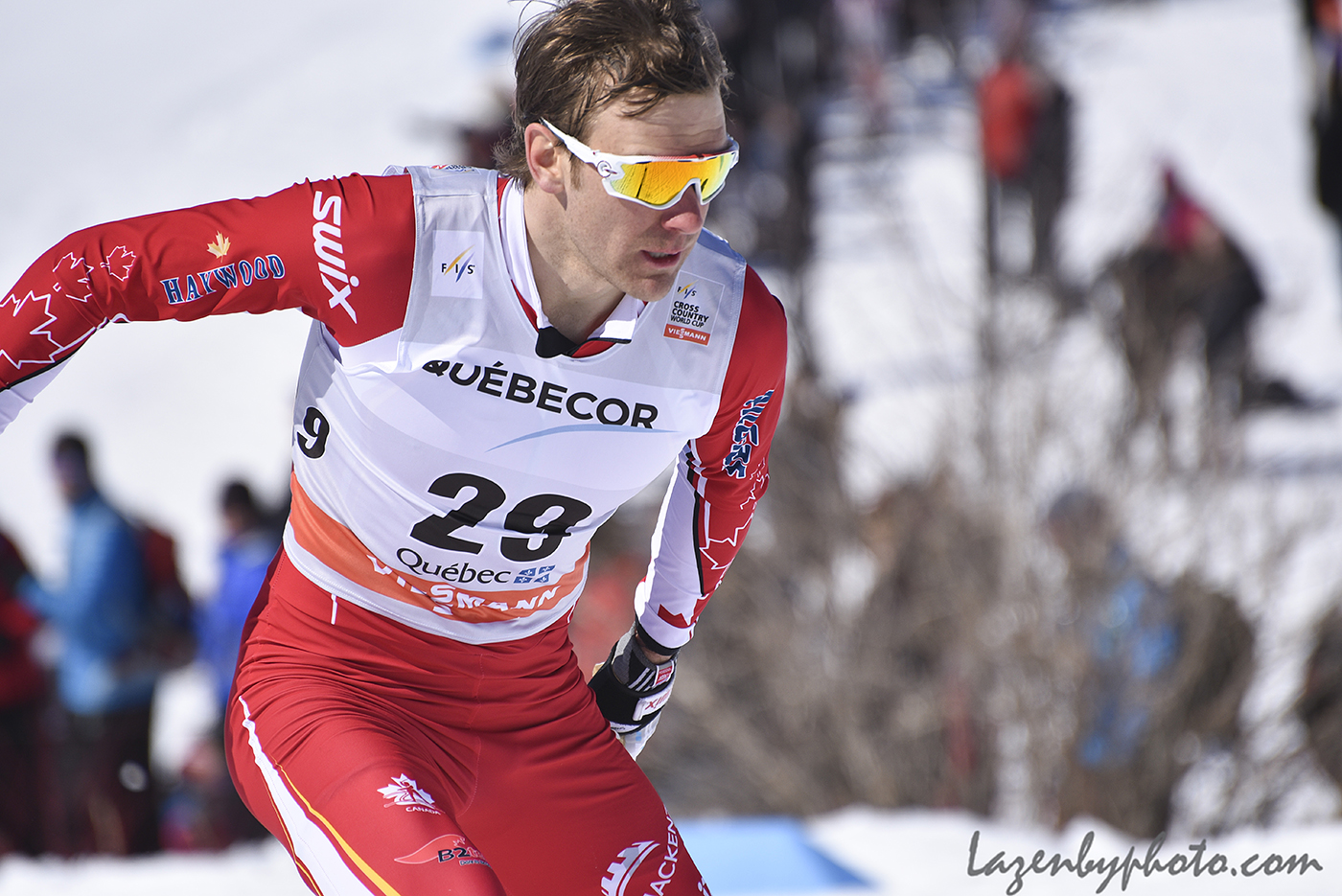
    Canada’s Devon Kershaw racing at 2017 World Cup Finals in Quebec City, where he finished 26th in the 15 k freestyle pursuit and 19th for time of day in the last race of the 2016/2017 season. (Photo: John Lazenby/Lazenbyphoto.com)

    On April 26, Devon Kershaw posted a photo on social media of Alpina boots hanging on a line. The next day, he spoke on the phone with FasterSkier from his new home in Lillehammer, Norway, after a day of running around outside with his 15-month-old daughter, Asta Isabel.

    Kershaw was tired, but in a good way. For the first time in 17 years, he was ready for a new challenge, a new focus and much more time with his daughter and wife, Kristin Størmer Steira, a former standout Norwegian skier.

    Three years after Steira left professional cross-country skiing and pursued a career in business, starting with her master’s degree in business management, Kershaw is following suit and headed back to school. The 35-year-old Canadian hung up his boots to quietly announce his retirement after about a month of deliberation.

    “I was really keen to keep ski racing, to be honest,” Kershaw said. “I had the motivation to go one more year, and in my head, I wanted to race one more season, but as things progressed in the spring, there were a lot of different factors that just made it seem like, oh man, it doesn’t look like it’s gonna be super realistic at this point.

    “I struggled with that, when you feel like you still have more in the tank,” he continued. “But at the same time, it’s a bit of a double-edged sword in the sense that it’s been a fantastic career.”

    Kershaw was quick to reflect on his roots as a kid growing up in Sudbury, Ontario, “a mining town with a small but passionate skiing community,” as he put it. He also reiterated how proud he was to represent Canada for 17 consecutive seasons, first as a junior national team skier for two seasons starting in 2001, then as an under-23 national team member in 2003, and finally as a full-fledged World Cup Team member starting in 2004.
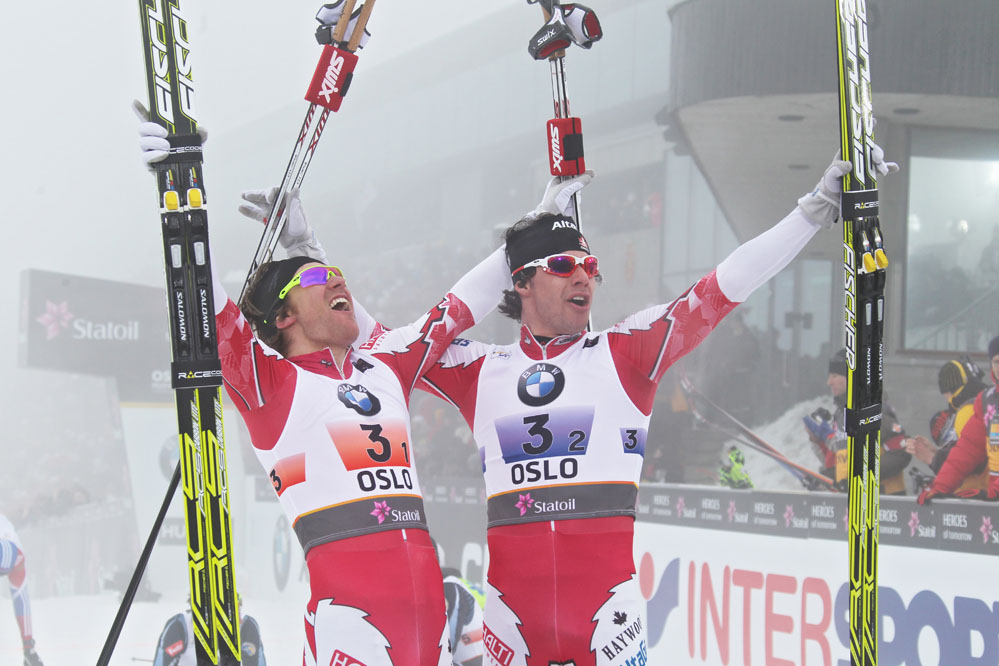
    Devon Kershaw (l) and Alex Harvey celebrate their 2011 World Championships gold in Oslo, Norway. (Photo: Fischer/NordicFocus)

    His career included three World Cup wins and 14 podiums, and a gold medal at 2011 World Championships with teammate Alex Harvey in the classic team sprint. Kershaw finished the 2011/2012 World Cup season ranked second overall and second in the distance rankings.

    When he reflects on those accomplishments, he still has a hard time believing that all happened to him.

    “So instead of focusing on being bummed at the situation or a bit frustrated with the state of things in Canadian skiing right now, I have to look back with a smile,” Kershaw said. “I feel just so privileged and grateful to have had the opportunity to be part of a real movement for men’s skiing in Canada.”

    Kershaw said he was left with unanswered questions this spring during a transitionary period at Cross Country Canada (CCC). The team’s budget was undetermined, camps were not yet set in stone, and Kershaw said his decision — which he wanted to make by May 1, the start of the new training year — became about energy management.

    “Part of managing your energy properly is putting all of your energy and focus into training, and if you’re being pulled with uncertainty or being stressed about uncertainty, that will come back, the World Cup will exploit that,” he said.

    According to CCC Chief Executive Officer Shane Pearsall, High Performance Director Thomas Holland had planned to retire this past March, yet has stayed onboard as an advisor until CCC fills the position. Pearsall said the hiring process is still ongoing and will hopefully be wrapped up by next month. He confirmed that CCC has yet to finalize its budget and doesn’t anticipate being able to do so until a government minister signs off on the amount from Own The Podium (OTP), one of its primary funding sources, in July. Pearsall explained that they expect to have a better sense of national-team finances in mid to late June.

    Typically, the team’s budget is determined in May, but because of necessary “quad reviews” following the Olympics, which took place before CCC met with OTP, the process was delayed by about a month. Pearsall did not elaborate on how significantly the budget would be decreased from last year, but said, “It’s certainly tighter than last year.”

    Kershaw said he needed to pay about $25,000 Canadian dollars in team fees if he wanted to continue racing this year, up from $15,000 last year. That didn’t cover the cost of living, which he figured to be around $55,000 Canadian, for a grand total of $80,000.

    “The financial burden is big, and moving forward the financial burden went from big to 100 percent paying for every cost,” Kershaw said. “So all travel, accommodations, everything. … I’ve just been in the sport a long, long time, and from a directional standpoint, I’m not sure we’re moving in a direction that will yield sustainable results at this point in time, but I understand it is difficult when you’re under such financial duress to create a sustainable program. But from a vision standpoint, I think there’s a lot of questions that remain unanswered, and it’s late in April. The fact of the matter is the rest of the world has all of the holes plugged — if they have holes in their boat — because May 1 is the new year of every ski program. And we’re just constantly slow and off the mark with that.”

    Budget cuts had been expected as Canada’s World Cup Team missed performance benchmarks throughout last season. The team finished 2017/2018 with just two men scoring World Cup points (top 30) in distance races: Harvey and Kershaw. Two men (Harvey and Julien Locke) scored in World Cup sprints. On the women’s side, Dahria Beatty landed one World Cup sprint top-30 last season, and Cendrine Browne was the top Canadian woman in a distance race with a 27th place for time of day in the last race of the season.

    Meanwhile, Alex Harvey led the team with four World Cup podiums, including third overall in the 2018 Tour de Ski, and a top result of fourth place at the 2018 Olympics. He finished his season in fourth in both the Overall and Distance World Cup standings. But Harvey’s results alone weren’t enough to buoy the whole team for another winter.

    “Throughout my entire career, it’s almost unfathomable to think that the season ends and that’s the stat line,” Kershaw said of the team’s overall results. “It wasn’t so long ago that we had over 16 World Cup podiums in a season. The truth hurts, as [former Canadian coach] Tor-Arne Hetland once said, but things go in waves and this is the reality that we live in right now.”

    Despite the prospect of self-funding, Kershaw didn’t feel pressed into retirement. Several of his teammates have decided to retire as well, including Graeme Killick, Jess Cockney and Knute Johnsgaard, but Kershaw said they weren’t forced, either.

    “You can choose to work and you can choose to hustle for money; there are ways to make it,” he said. “No one’s forced into it. I could keep skiing if I wanted to, but I think the stark choice you’re faced with is, maybe perhaps some people are like, I can’t really see a path to international success currently, and that’s what I think is sad…”

    ‘A dream scenario’

    When Kershaw moved to Canmore, Alberta, in 2001 and entered Canada’s elite skiing scene, Cross Country Canada (CCC) was entering a fruitful period. At the 2002 Olympics, Beckie Scott was proclaimed winner of the women’s 10-kilometer pursuit (now called the skiathlon), becoming the first North American woman to win an Olympic gold. At 2005 World Championships, Sara Renner earned a sprint bronze to become the first North American woman to medal at World Championships. Scott and Renner teamed up for silver in the team sprint at the 2006 Olympics in Turin, Italy, where yet another Canadian woman, Chandra Crawford, won the individual skate sprint for Canada’s second-straight gold in as many Winter Olympics. Scott finished that 2005/2006 season ranked second overall in the World Cup, just 16 points behind Norway’s Marit Bjørgen in first.
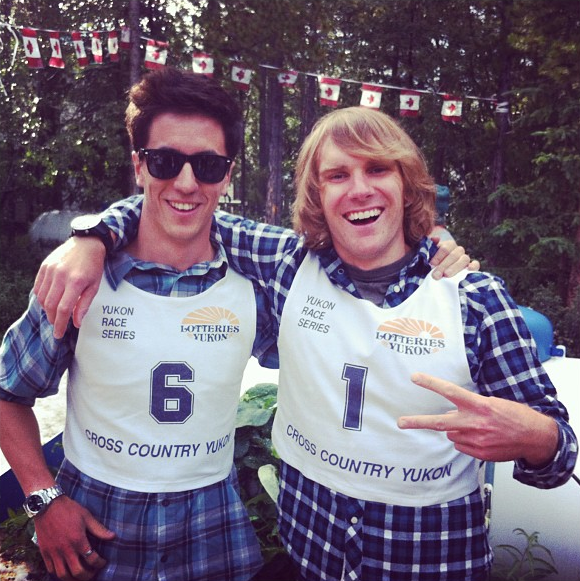
    Devon Kershaw (r) with Graham Nishikawa in 2013. (Photo: Devon Kershaw)

    Kershaw made his Olympic debut in 2006.

    “Coming into Torino, we were quoted in the newspaper as being like the world’s most anonymous men’s ski team,” he said of the Canadian men’s team that year. “We weren’t really ‘on the map,’ but I’ve just been so grateful and lucky to have such a great group of guys around that really welcomed me in.”

    He credited his former roommate and teammate Chris Jeffries as well as other Canadian competitors of his time, including George Grey, Gordon Jewett, Dan Roycroft, Sean Crooks, Dave Nighbor, Phil Widmer, Brent McMurtry, and Graham Nishikawa (who’s still racing), for having a major impact on the formative stages of his career.

    “[There were] so many athletes in Canmore that tried hard, wanted it bad, and loved ski racing and training,” Kershaw reflected. “That’s a dream scenario for a young athlete to come into a community like that and be welcomed into that environment.”

    Less than a month after the 2006 Olympics, he notched his first World Cup podium by placing third in the Borlänge, Sweden, skate sprint. In doing so, he became the first Canadian male cross-country skier to reach the podium since Pierre Harvey (Alex’s father) in 1988 and the first ever to medal in a World Cup sprint.

    “I had no idea who Pierre Harvey was,” Kershaw said of his younger self.

    Pierre Harvey had previously won the 1988 Holmenkollen 50 k as well as two other World Cup distance races and the Norwegian Birkebeiner, making him the most successful Canadian male skier before Kershaw.

    “He could walk into the room and I would not recognize him,” Kershaw continued. “Even his results, I had heard that he had five World Cup podiums and that seemed pretty cool, but that’s all I knew about him.”

    Kershaw’s second World Cup podium came early in the 2006/2007 season in a skate sprint in Munich, Germany. That same day, Crawford — whom he was dating at the time — placed third in the women’s sprint.
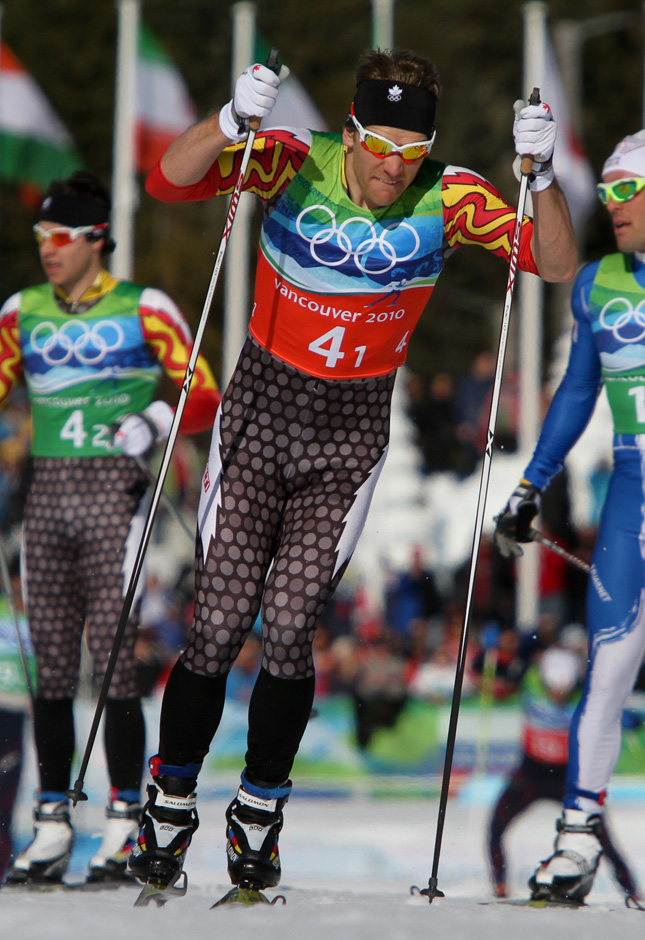
    Devon Kershaw after being tagged by his Canadian teammate Alex Harvey (l) in the freestyle team sprint at the 2010 Olympics in Vancouver, B.C. They went on to finish fourth.

    At his second Olympics in 2010, Kershaw finished fifth in the 50 k classic mass start for the best individual Olympic result for a Canadian male nordic skier. That record stood until Alex Harvey, who burst onto the World Cup scene in 2008, bested it with a fourth place in the 50 k classic at this year’s Olympics in PyeongChang, South Korea.

    Kershaw and Harvey also teamed up to place fourth in the freestyle team sprint at the 2010 Olympics.

    Kershaw’s first World Cup win came in a skate sprint during the 2011 Tour de Ski. He finished that Tour in seventh, and the next year, came back to place fourth overall in the 2012 Tour de Ski (TdS). Kershaw started all 12 editions of the TdS, a record he shares with France’s Jean-Marc Gaillard.

    Harvey scored his first individual World Cup podium in a 50 k classic in 2009 and won his first World Cup race (a 3.3 k freestyle prologue) at the TdS in 2012.

    “Then next thing you know, Alex and I are sharing a podium on some World Cups,” Kershaw reminisced. “Two Canadians on one podium in the World Cup, like, really? And then you win World Championships and I’m on the overall World Cup podium, and then next thing you know, Alex has been on the overall World Cup podium a few times and also now 50 k world champion. It’s crazy. It’s insane. From nothing. From no results. The journey has just been amazing. … I never would’ve thought Canada would, I mean, how could you? We had Pierre Harvey and that’s it in, like, a hundred years of international ass-kicking.”

    Kershaw credited his initial World Cup breakthrough as a 23-year-old skier in Borlänge to Dave Wood, Canada’s national-team coach at the time.

    “I came into a team with a coach that you could call at midnight. He’d do anything for you,” he said of Wood. “There was no way I would’ve stepped onto the podium in 2006 without him, and Mike Cavaliere, too, my first-year senior, Mike was my coach. We had staff that was just committed to the core for the cause and I’m incredibly grateful for that.”

    ‘A hell of a season’
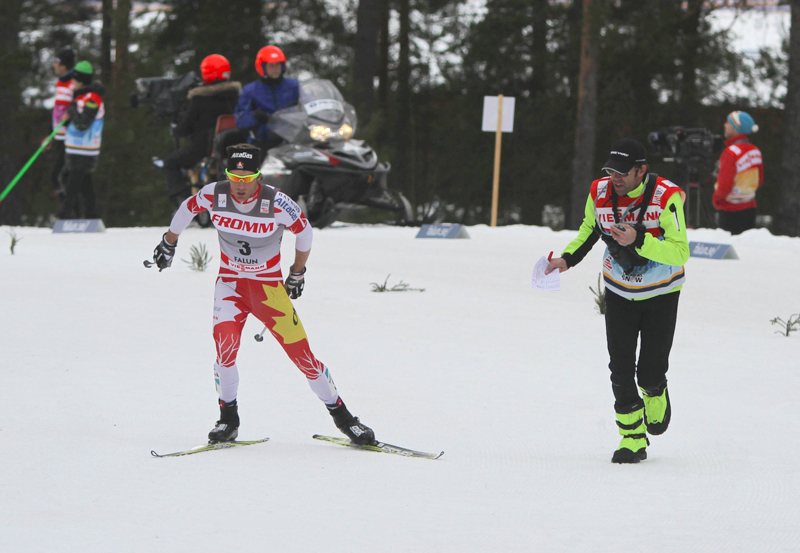
    Canadian head coach Justin Wadsworth (r) giving splits to Devon Kershaw at 2012 World Cup Finals in Falun, Sweden.

    Of his coaches, Kershaw gave special credit to Justin Wadsworth. A three-time U.S. Olympic cross-country skier who became Canada’s head coach in the spring of 2010, Wadsworth coached Kershaw for five seasons, and the two developed a close friendship.

    “When Justin came into the national team, the level of professionalism and excitement and freshness that he brought … I don’t know if you call it luck or happenstance or just the right place, right time,” Kershaw reflected, alluding to his 2011 World Championships gold with Harvey and his 2012 Overall and Distance World Cup podiums. “Justin’s best results as a coach were me and my best results as an athlete were when I was coached by Justin. Talk about an amazing relationship there.”

    “The main thing that I really appreciated with Devon, and I think he would say the same thing about me, is that we could be honest with each other and talk about hard things and enjoy the good times when we had them,” Wadsworth said on the phone last week. “… It’s cliche, but when I was talking to Devon the other day about his retirement, it’s not about the medals or the performances or whatever, it’s about your times together on the road.”

    One of Kershaw’s biggest moments came at those 2011 World Championships in Oslo, Norway, where he and Harvey beat out Norway’s Petter Northug and Ola Vigen Hattestad by 0.2 seconds for gold on the Norwegians’ home turf. They had done so after Kershaw lost one of his skis early in the race, Wadsworth pointed out.

    buy antabuse online, buy wellbutrin

    “His ski fully came off and he had to put it back on and get back into the race,” Wadsworth said. “Just the whole day was pretty incredible. That was a great, great opportunity for us, and the guys cashed in.”
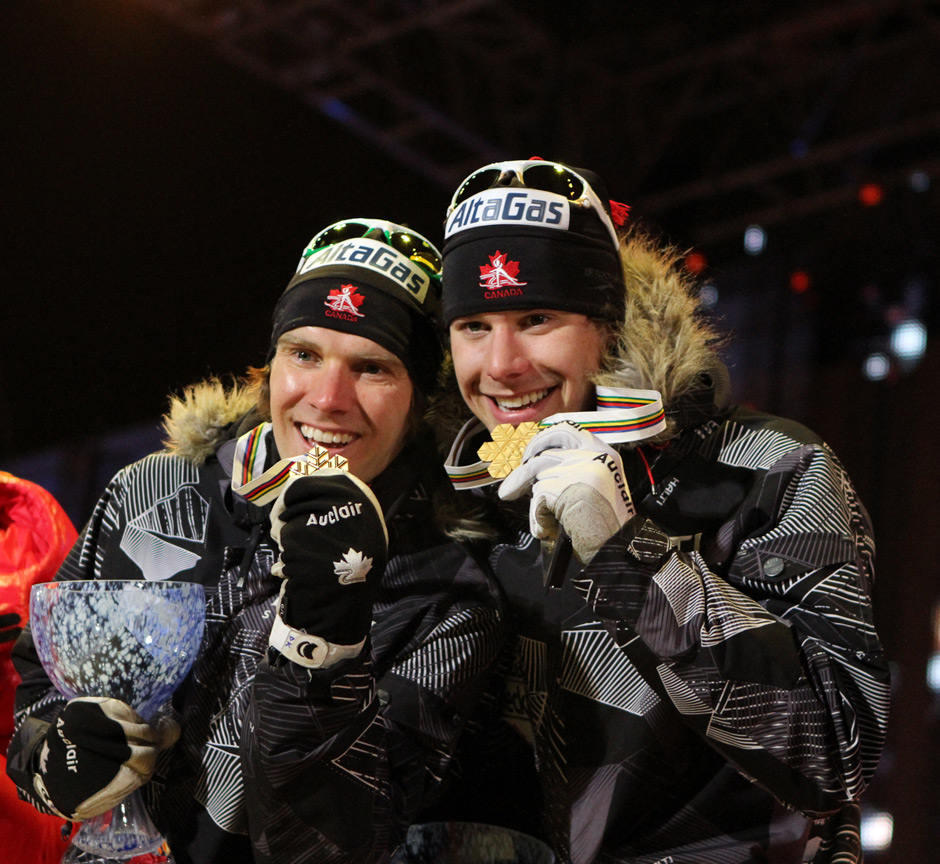
    Devon Kershaw (l) and Alex Harvey with their World Championship gold medals at the 2011 World Championships in Oslo, Norway.

    In a difficult-yet-strategic move to conserve for that race, Kershaw and Harvey both sat out the 15 k classic the day before.

    “With anybody else running the ship, there’s no way I would’ve trusted that [decision],” Kershaw said of Wadsworth’s call. “But I trusted Justin’s leadership and we went all-in, and the next thing you know we won World Championships. I mean, are you kidding me? How can you get a better start to the next quadrennial? And Justin as a first-year head coach of a national team, that’s gotta go down as maybe the best season ever for a first-year North American coach of a national-team program.”

    He and Wadsworth reiterated the crucial foundation that Wood had laid.

    “Dave Wood had done a really good job with the athletes leading into that period, mainly focused on building a big base and doing a lot of hours and also doing a lot of time at altitude,” Wadsworth explained. “And when I took over the position, I saw that both Alex and Devon were really primed and had a really good response rate to altitude, and all we had to do was fine tune a little bit of strength training and intensity. I was really excited to work with both those athletes and saw that they had a lot of potential.”

    For Kershaw, Wadsworth’s “American swagger … was magic for me,” he said. During the 2011/2012 season alone, he stood on the podium 10 times, with four top-three finishes in seven races at the 2012 Tour de Ski.

    “It was a hell of a season for me,” Kershaw said.

    ‘Best sand-digger ever’

    He went on to compete at two more World Championships and two more Olympics. This past season, Kershaw finished in the top 30 in eight World Cup distance races, with a top result of 19th in the 30 k skiathlon in Lillehammer, Norway. While struggling with lung issues, he finished 26th in the 50 k classic at the PyeongChang Olympics.
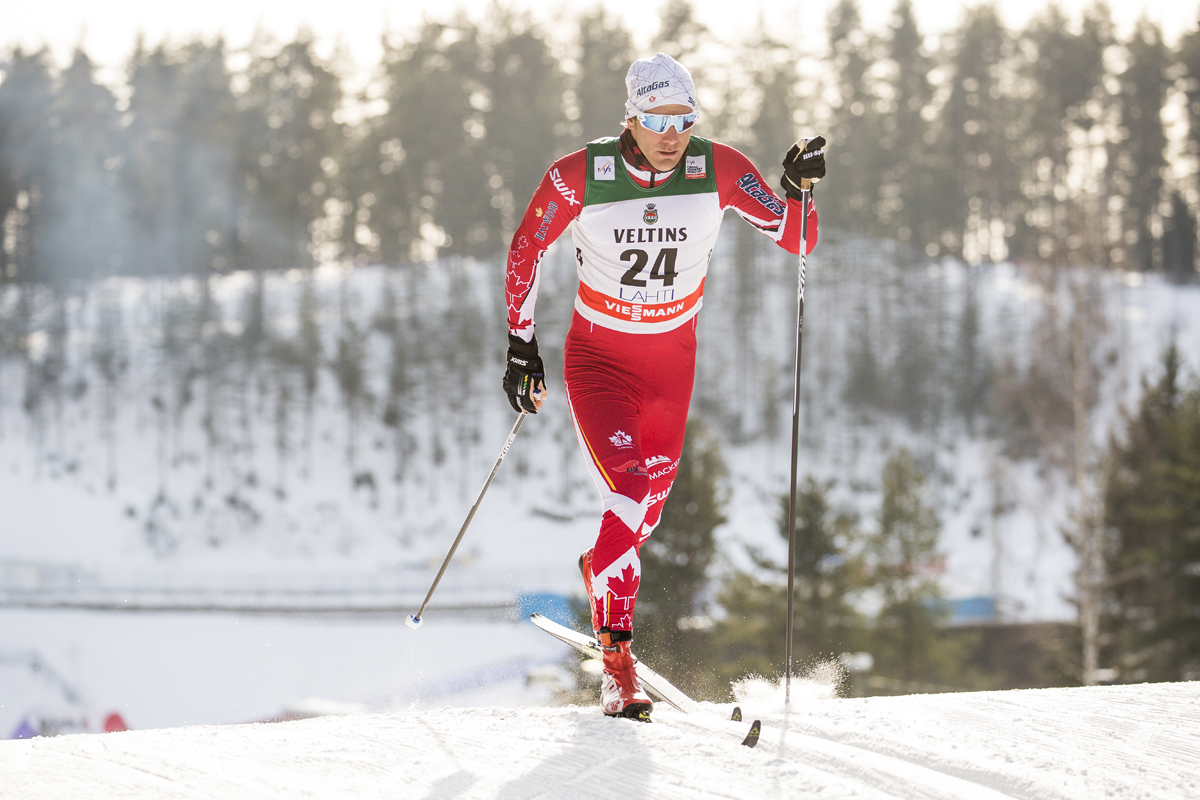
    Devon Kershaw racing to 25th in the World Cup 15 k classic this past March in Lahti, Finland. (Photo: Fischer/NordicFocus)

    Initially plagued by a lung infection in 2014, Kershaw discovered after a 2015 bout with an pneumonia and whooping cough that he has exercise-induced asthma.

    “We worked to get that under control and it was manageable but it never felt good like it felt prior to 2015,” Kershaw said his health over the last three seasons. “In PyeongChang, it was a calamity of bad luck. When we got there it was minus 20 [Celsius], and this makes me sound so soft, because I’m from northern Ontario so you’d think I’d know, but it was really cold. I did some intervals and it aggravated my lungs and it was super windy and dirty and a lot of sand blowing around, and that really flared up my asthma to the point that I was wheezing badly.”

    His breathing troubles also affected his sleeping and took most of the two-week Olympics to manage. At one point, he had a chest X-ray to make sure it wasn’t pneumonia.

    “It was sporting asthma,” he said. “… It took all the way to the 50 k to kind of get it 70 percent.”

    While he noted he was left wanting more from a performance standpoint at both his final Olympics and in his final season, Kershaw also acknowledged that he’s his biggest critic.

    “That’s been probably the biggest detriment to my entire career; I’m the best sand-digger ever,” he said. “I am disappointed in the sense that I work really hard and I train hard and I prepare well, and it didn’t go exactly as planned. … When you’ve competed in the top 10 for as many years as I have and on the podium, of course that becomes your bar that you hope to achieve, but at the same time … when you’re in the top 30 in the results page, you’re in the race at least. And I’m proud of the fact that in almost all classic races, not every, but most, I was in the top 30 and ‘in the race’.

    “Am I satisfied? In my life I’ll probably never be satisfied, that’s just how it goes,” he added with a laugh. “But am I somewhat proud of maintaining a fairly competitive level? Yeah, absolutely.”

    Wadsworth reflected that Kershaw was one of the best athletes he had ever seen, even “physiologically as good as Alex [Harvey]” at the peak of his career.
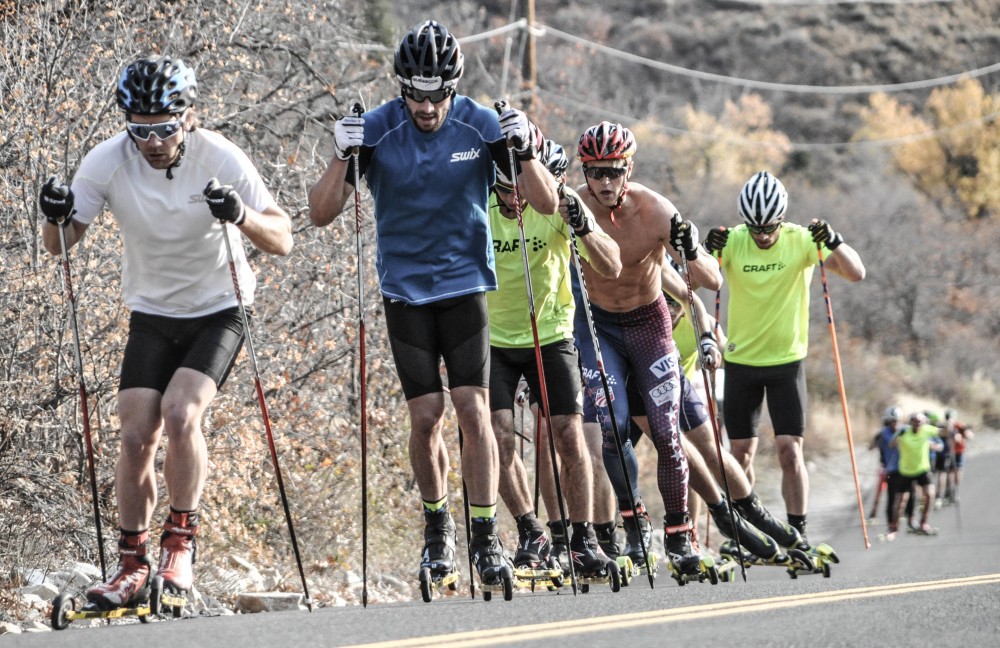
    Left to right: Canada’s Devon Kershaw leads his teammate Alex Harvey and U.S. Ski Team members Noah Hoffman, Erik Bjornsen and Simi Hamilton during a Level 3 interval skate session up Snake Creek Canyon in Midway, Utah, during their respective teams’ 2016 training camps in Park City, Utah. (Photo: Matt Whitcomb)

    “Devon’s a very intelligent person and sometimes he might’ve overthought things and lacked in confidence, and as a coach that’s really frustrating to see because you know how good they are physically,” Wadsworth said. “And when he was on mentally, too, in training, when he was at his very best, he had total confidence and could destroy anybody in any workout.”

    He recalled a hill-bounding workout with the Norwegian team in which Kershaw was literally leaps and bounds ahead of everybody else — even Martin Johnsrud Sundby and Russia’s Ilia Chernousov, who joined the training session.

    “He was just shelling everybody,” Wadsworth said. “So when Devon was at his best like that and mentally confident and relaxed, he was a real force of nature. Unfortunately that didn’t always translate into the racing season, but in 2012 he put it all together and had a tremendous year. … If he had the confidence the whole time, he would’ve been almost unbeatable, in my opinion, but it takes the whole package all the time, and he was among the greats there for a while.”

    ‘Younger, faster, better dog’

    And then there was Harvey, another one Kershaw’s of his best friends and longtime roommates.

    “I’ve spent more nights in a room with him than my wife or any girlfriend I’ve had,” Kershaw joked. “… He was eager to learn, he chased me for years, he was always a hard worker, too. He trained really hard, he believed in himself, and I still am in total awe of that. I’ve never met anybody as confident as him. It’s too bad that didn’t rub off on me, but that’s been great to be around.”

    He likened Harvey’s addition to the team as a family adopting a puppy.

    “You know when your parents get a puppy because your dog is 10 years old? He’s kind of slowing down a little bit and then you see that old dog get fired up and run again and jump around and play; that’s me,” Kershaw said. “And I’m so grateful that my owners got a younger, faster, better dog to hang out with because it was so inspiring.”

    Several times over the last few years, Kershaw has said that witnessing Harvey make Canadian history has been one of his biggest reasons for staying in the sport.

    “He, for sure, has kept me in this probably longer than I should’ve,” Kershaw said. “I just love traveling with him and seeing what he can accomplish and training with him and seeing that professionalism.

    “There’s no question he’s the best Canadian skier ever, that’s not even close,” he added. “… I just feel so honored that I got the chance to see it all happen, from his last-year junior when he did his first World Cups and then all the way though I’ve been with him.”
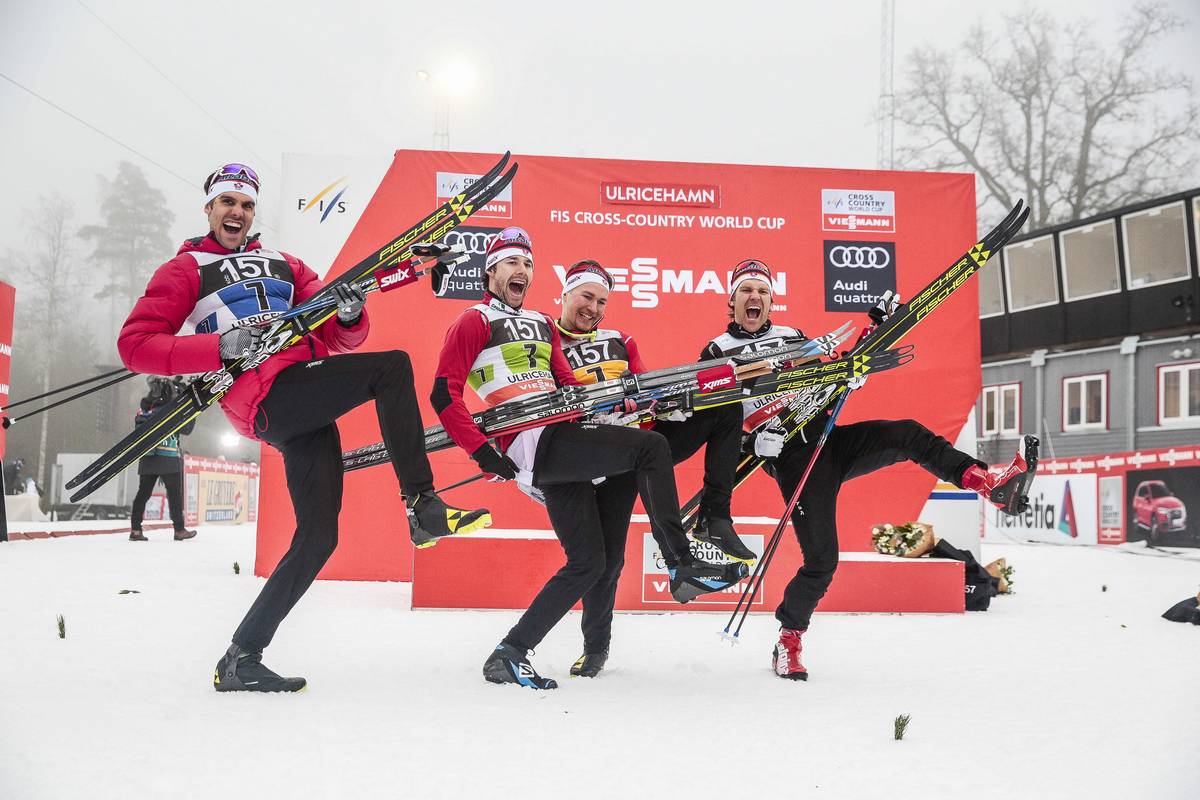
    The Canadian men’s relay after placing third in January 2017 in Ulricehamn, Sweden, for Canada’s best-ever World Cup result in the 4 x 7.5 k relay. From left to right: Lenny Valjas, Alex Harvey, Knute Johnsgaard, and Devon Kershaw. (Photo: Salomon/NordicFocus)

    In an email, Harvey explained that he and Kershaw first met in the fall of 2005 at a training camp at Sovereign Lake, British Columbia. Harvey was on the junior team and Kershaw a senior, but the whole team stayed at the same hotel.

    One morning, Kershaw accidentally took Harvey’s poles from the hotel. Harvey had to track him down on the ski trails to get them back.

    “That was the first time I talked to him and to me it’s just perfect because that’s so Devon,” Harvey wrote.

    Later that season on March 7, 2006, Kershaw made history with his first podium. That same day, Harvey won his first national title in the 10 k classic at Canada’s senior national championships as a 17-year-old junior.

    “I guess our friendship was meant to be before we even knew it!” Harvey wrote.

    When the two became teammates, Harvey immediately took to imitating Kershaw, both in training and racing.

    “He took me under his wings and he has a big part in the athlete I became today,” Harvey wrote, likening Kershaw to a big brother. “I feel very privileged to have spent all that time with him. I think we became such close friends because we are both very driven athletes and we don’t accept any compromise. We’re both huge fans of our sport, ‘nor-dorks’, so we also love to talk about everything from altitude training to who is seeing who on Tour.”

    Kershaw’s decision to retire didn’t surprise Harvey.

    “I think it’s a mix of a few things,” Harvey wrote. “… Probably this biggest reason, he has a little girl at home. I know this winter was extremely hard on him. Not seeing Asta Isabel was pure torture, I think I would have done the exact same if I was him.

    “I will miss a lot of things about Devon,” he added. “He’s always there to give good advice about everything and anything. He knows so much about all that is going on in the world, probably the most well-read person I know. He’s kinda my news source. I’m still amazed by how indecisive one can be. This brought a lot of laughter throughout the years. I have so many memories from the last 10 years with him. Seeing him dominate the World in 2012 was just amazing but also very eye-opening for me. He raised the bar for all North American skiers that year and I’m very thankful for it.

    “We both lived great emotions in high accomplishments and huge disappointments. I’d like to think I helped him get through these upsets and I can say he definitively helped me get through mine. A page turns in the life of Devon Kershaw but knowing the man, I’m not worried about what’s gonna come next.”

    Without Kershaw, Killick, Cockney, and Johnsgaard on the men’s team, Harvey acknowledged that next winter will be “very different” for him on the World Cup.

    “All these guys are calling it a career and I’m super proud of what all my friends accomplished,” he wrote. “I’m excited to try to help the next generation step it up and fill the shoes of the previous generation. … Also, after 10 years on Tour I’ve made some friends on other teams so I’m not too worried. I’m just excited to step into a bit of a mentor role for our next generation.”

    Onto the Next

    As for Kershaw, he didn’t rule out coaching future generations of Canadian skiers, but he said he was focused on getting an education first. In just over a week, he’ll start a course that requires 20 hours of classes a week — all in Norwegian — for what he anticipates will take six months. The course is essentially an advanced version of Norwegian as a second language, and foreigners must pass it to pursue a degree in Norway.

    After that, Kershaw plans to apply to universities “and hopefully study forever,” he said with a laugh. “Not forever, but study, and I want to stay involved in skiing in any way I can and I want to help the next generation get better.
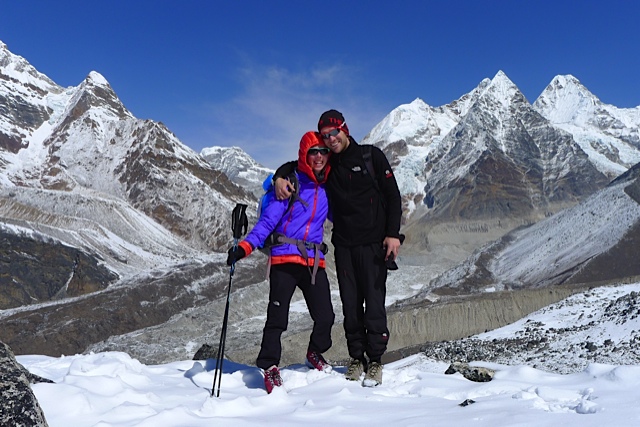
    Kristin Størmer Steira (l) and Devon Kershaw during a day hike on one of their acclimatization days. The couple got engaged in 2014 after summiting Mera Peak during a three-week trek in Nepal’s Himalayas. (Photo: Devon Kershaw)

    “First things first, I have to get my Norwegian at a level where I can sit through a lecture and write an essay at a decently good level, at least good enough that my wife doesn’t have to rewrite it, she can just correct it,” he explained.

    Asked what he’d like to study, Kershaw said medicine, specifically orthopedic surgery, has always intrigued him. (As a junior skier, Kershaw took undergraduate classes at the University of Calgary until 2006, but those credits have since expired.)

    “But now I’m 35 and I’m going to have to do all of this in my third language,” he acknowledged. “So for now, I’d say that that’s still my first choice and I’m exploring what it would take.”

    If not medicine, he’d like to pursue a degree in “some kind of science physiology, and then in a totally shifted way, if I have a panic attack and be like, ‘Science is too hard after ski racing forever,’ then I am interested in economics and economic theory and business to some degree…”

    Regardless of which path he choses, he’ll be doing it in Norway, Kershaw said.

    “I don’t mind the challenge. … It’s intimidating in a way, but it’s also really exciting,” he said. “Kristin’s family [who lives in Lillehammer] is just so fantastic and to see how happy my daughter is here, to have her family, to have family around her and everything for the short term, and I hope to be educated in Norway.”

    Asked if he’ll jump into any ski races this season, Kershaw was quick to respond, “No.” But he will continue skiing. The beauty of the sport and the struggle, as he put it, is what’s kept him in it so long.

    “Imagine just having a singleness, a purpose, a goal that’s just there in your face and then you get to wake up every day and do the things you absolutely love to do,” he said. “… I adore cross-country skiing. I just think it’s such a peaceful, beautiful exercise, and the technique and the flow of it all. … You’re just skiing through the woods peacefully, gliding over snow, over all the terrain you can cover. It’s a beautiful, zen-like endeavor, and I think that’s what’s kept me in it this long. And the people, the Canadian ski community, the world ski community, really. I’ve met so many inspiring people and beautiful people and worked with a lot of absolute experts and I’ve had brilliant teammates and brilliant coaches.”

    And because of skiing, he met his wife and started a family in Norway.

    “I have a daughter with a woman that I love and respect and am in total awe of every day of my life and without ski racing there’s no way that would’ve ever come to fruition,” he said. “There’s the biggest gift right there, as cliche and Hallmark as that sounds, it’s true.”
  • The JP Grand Prix: The ‘World’s Best Ski Race,’ in July

    The JP Grand Prix: The ‘World’s Best Ski Race,’ in July

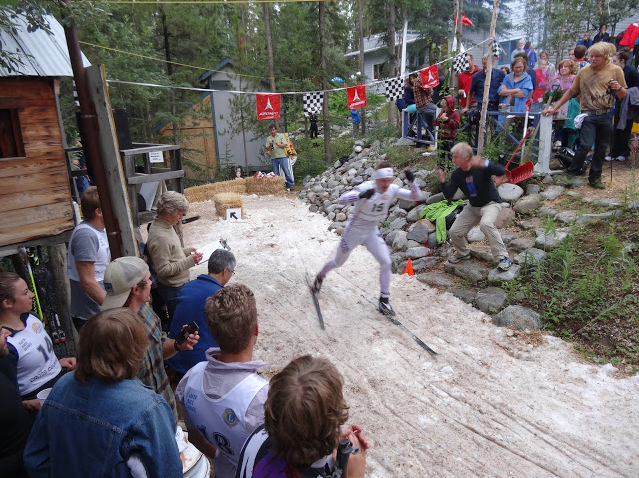
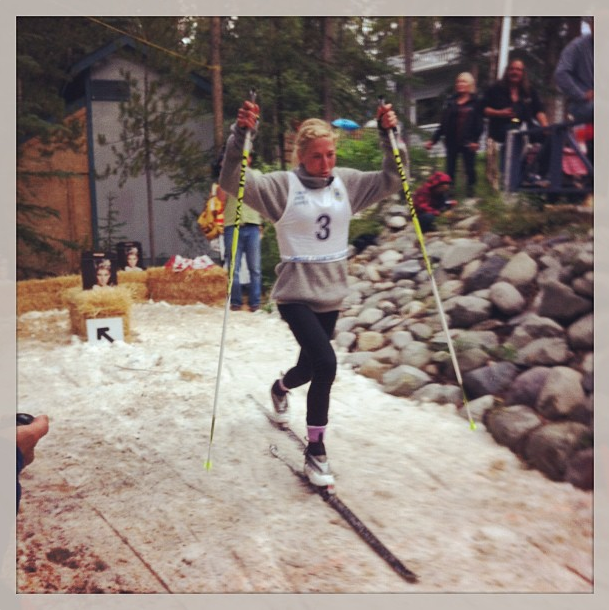
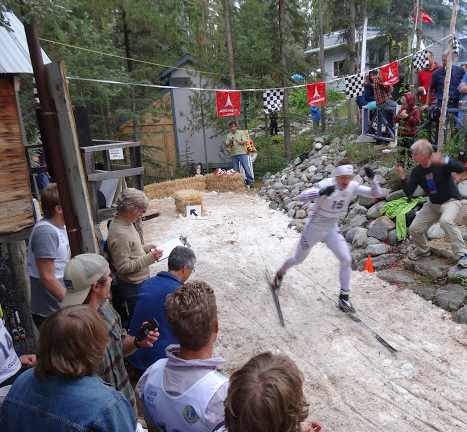
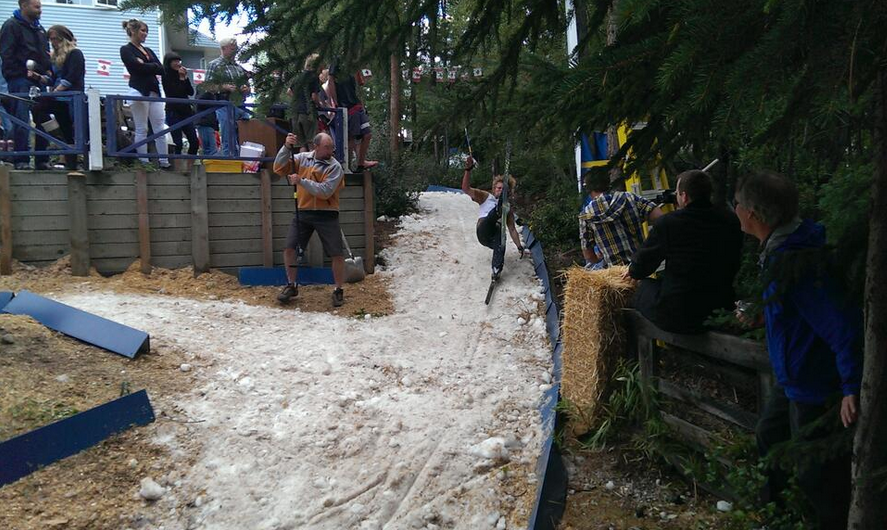
    A competitor on course at the JP Grand Prix, a ski race that took place in a backyard in Whitehorse, Yukon, last Friday. (Photo: Brian McKeever)
    A competitor on course at the JP Grand Prix, a ski race that took place in a backyard in Whitehorse, Yukon, last Friday. (Photo: Brian McKeever)

    If you noticed the slew of photos from a ski race in the Yukon last week, you weren’t dreaming. The second-annual JP Grand Prix, hosted in the backyard of Whitehorse skier John Perry and his family, was held on Friday complete with live music, a barbecue, TV crew and, yes, snow. And because it was scheduled to coincide with Canadian World Cup skier Graham Nishikawa’s wedding, there were quite a few world-class athletes who partook in the festivities. Welcome to the world’s coolest ski race.

    The course laid out for the JP Grand Prix. (Photo: Devon Kershaw)
    The course laid out for the JP Grand Prix. (Photo: Devon Kershaw)

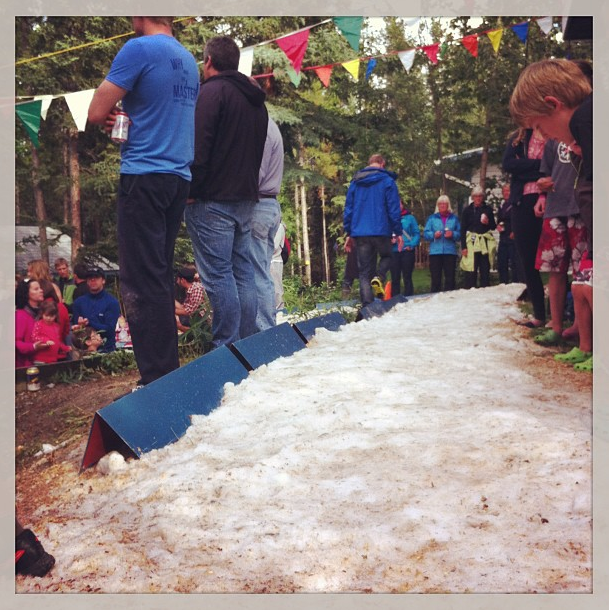
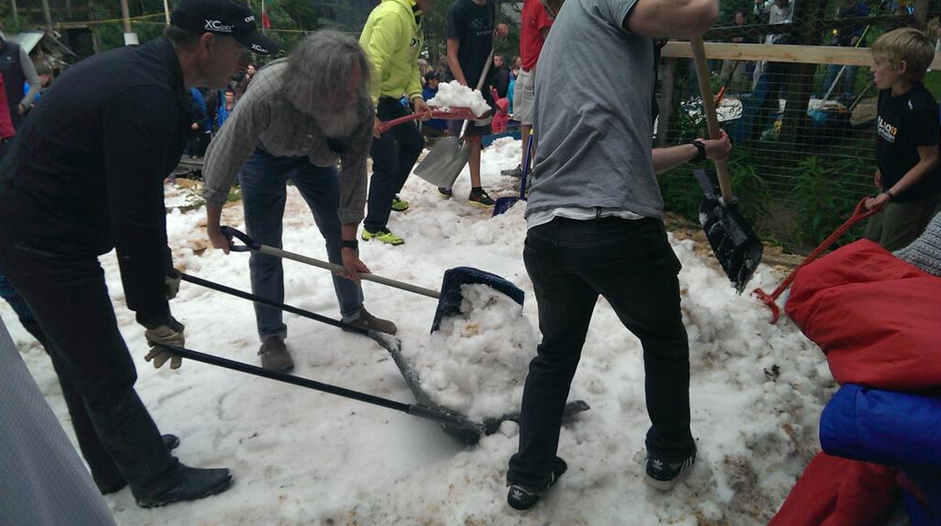
    So, how is a ski race made possible in late July? With a lot of foresight. Perry and his father began stockpiling snow last winter to save up for the event. When it came time for the race, everyone at the party grabbed a shovel to build the course.

    “The man with the name in the title deserves all credit for organizing the race,” wrote Canmore’s Phil Widmer in an email. “John Perry and his Dad save snow through the winter under their deck, cover it with saw dust and wait for the right time to host the ‘JP Classic.’ They did an amazing job with forerunners, a bagpipe lead procession for all competitors, bibs, prizes, medals, beer, it had all the fixings of a great race. This year it made sense to have it while everyone’s in town for the wedding. Thanks John!”

    The making of the course. (Photo: Brian McKeever)
    The making of the course. (Photo: Brian McKeever)

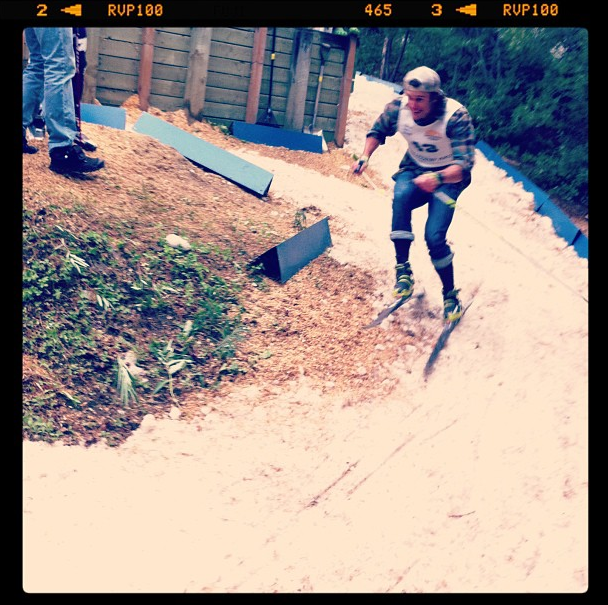
    Widmer estimated that about 150 showed up for the event, and the Yukon Elite Squad’s website put the number of competitors at around 40, although ‘competitor’ is a loosely-applied term for race participants. The atmosphere was relaxed; Devon Kershaw raced in jeans and a flannel, as did Widmer and Nishikawa.

    “I don’t know that there are results,” Widmer said. “It was honestly more about having fun skiing in the middle of summer in downtown Whitehorse.”
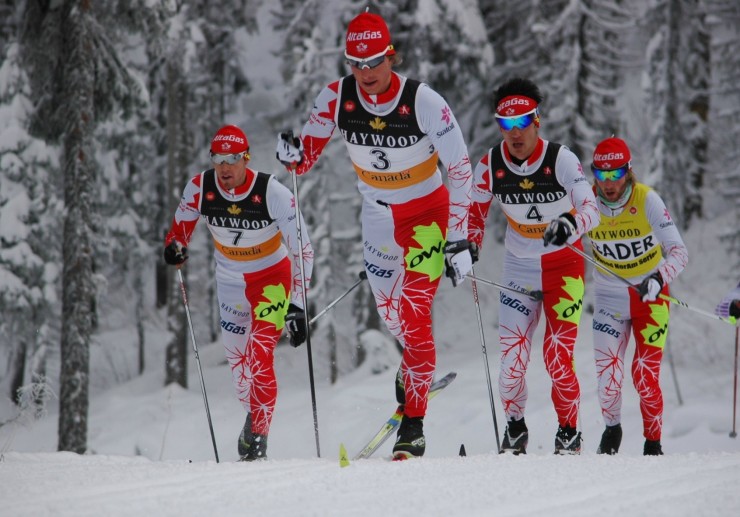
    Knute Johnsgaard leaves the gate. (Photo: Yukon Elite Squad)
    Knute Johnsgaard leaves the gate. (Photo: Yukon Elite Squad)
    Phil Widmer on course. (Photo: Devon Kershaw)
    Phil Widmer on course. (Photo: Devon Kershaw)
    Kristin Størmer Steira on course. (Photo: Devon Kershaw)
    Kristin Størmer Steira. (Photo: Devon Kershaw)
    Devon Kershaw with Graham Nishikawa, who was married over the weekend. (Photo: Devon Kershaw)
    Devon Kershaw with Graham Nishikawa before the start. Nishikawa was married the weekend following the race. (Photo: Devon Kershaw)

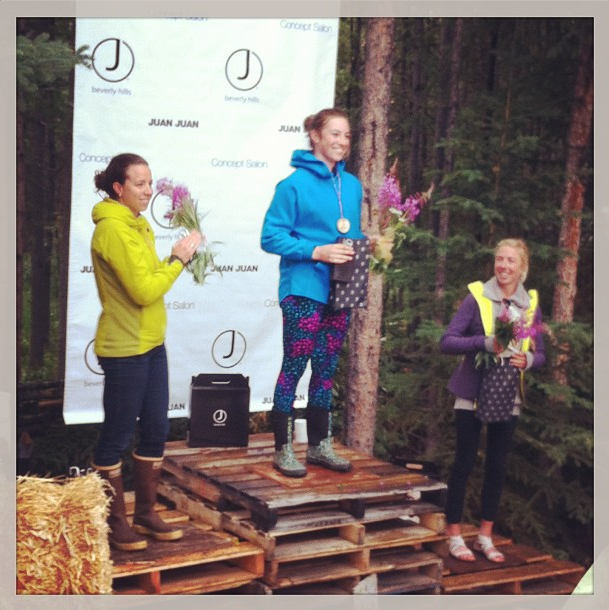
    Results or no, somebody kept track of times and named podium finishers. Locals Janelle Greer and Knute Johnsgaard of the Yukon Elite Squad took top honors. Phil Widmer and Brent McMurtry took second and third, respectively, in the men’s category, and Perianne Jones and Kristin Størmer Steira claimed silver and bronze in the women’s race.

    The women's podium: 1. Janelle Greer (Yukon Elite Squad), 2. Perianne Jones (Canadian National Ski Team), 3. Kristin Størmer Steira (Norwegian National Team). Photo: Devon Kershaw.
    The women’s podium: 1. Janelle Greer (Yukon Elite Squad), 2. Perianne Jones (Canadian National Ski Team), 3. Kristin Størmer Steira (Norwegian National Team). Photo: Devon Kershaw.
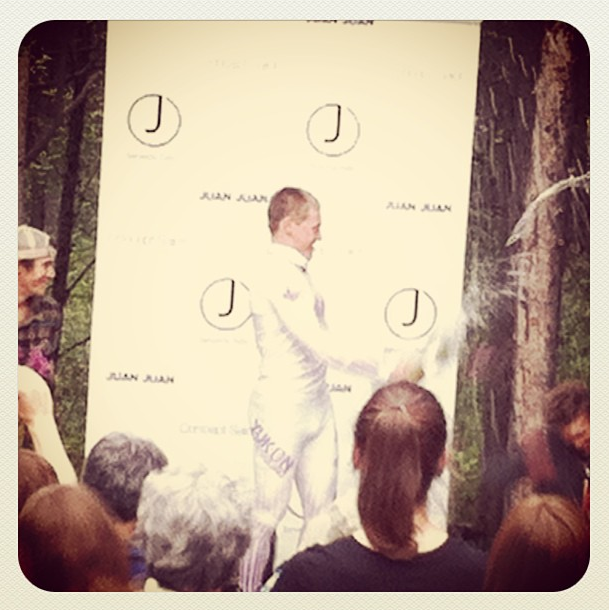
    Men's race-winner Knute Johnsgaard (YES) pops a bottle of champagne on the podium. (Photo: Devon Kershaw.)
    Men’s race-winner Knute Johnsgaard (YES) pops a bottle of champagne on the podium. Phil Widmer and Brent McMurtry, not pictured, took second and third, respectively. (Photo: Devon Kershaw.)

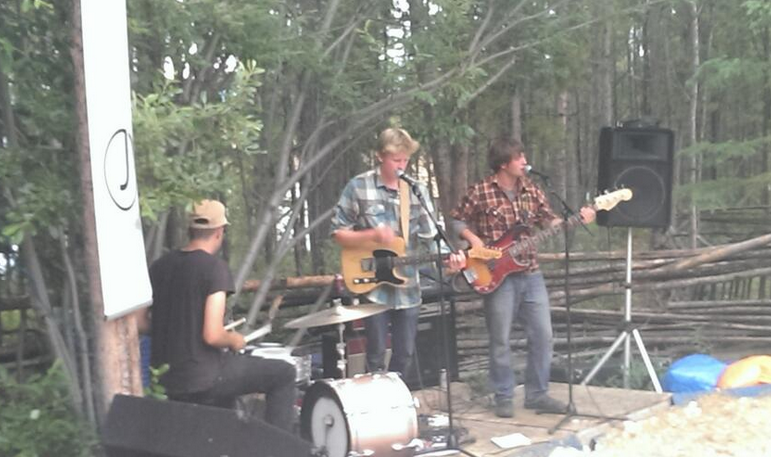
    After the race, the real party began, complete with good food, drink and multiple bands.

    “The idea is amazing and they pulled it off really well. I think two to three different bands played through the night and the atmosphere was great,” Widmer said.

    Former Yukon Elite Squad skier Fabian Brook and his band Griswold played at the afterparty. (Photo: Brian McKeever.)
    Former Yukon Elite Squad skier Fabian Brook and his band Griswold played at the afterparty. (Photo: Brian McKeever.)

    In conclusion, Brian McKeever’s description of the JP Grand Prix as the “world’s best ski race” seems to be fairly accurate. If the number of video cameras that cropped up in pictures is any indication, we may be able to expect another video recap of it in the near future. In case you missed it last summer, here’s last year’s edit from David Greer.


  • International Couple Top Canadian Nationals Mass Starts; McMurtry Ends Career with Gold (Updated)

    International Couple Top Canadian Nationals Mass Starts; McMurtry Ends Career with Gold (Updated)

    Former US Ski Team member Torin Koos (Bridger Ski Foundation/Rossignol) leading Saturday's 50 k freestyle mass start at 2013 Canadian Nationals in Whistler, B.C. Koos won the race by 0.4 seconds over Brent McMurtry (AWCA). (Photo: Martin Kaiser)
    Former U.S. Ski Team member Torin Koos (Bridger Ski Foundation/Rossignol) leading Saturday’s 50 k freestyle mass start at 2013 Canadian Nationals in Whistler, B.C. Koos won the race by 0.4 seconds over Brent McMurtry (AWCA). (Photo: Martin Kaiser)

    WHISTLER, B.C. – Canadian Cross Country Nationals ended the way it started at Whistler Olympic Park, with exciting racing and sunshine on a freestyle-technique day.

    In the men’s 50-kilometre race, American Torin Koos (Bridger Ski Foundation/Rossignol) attacked on the final hill and held on to edge Brent McMurtry of the Alberta World Cup Academy (AWCA) by just 0.4 seconds in 2 hours, 4:55.2 minutes. His girlfriend, Bettina Gruber of Switzerland, later won the women’s 30 k.

    Brent McMurtry of the Alberta World Cup Academy (AWCA) checks back during the men's 50 k freestyle mass start at 2013 Canadian Nationals on Saturday in Whistler, B.C. McMurtry went on to place second to American Torin Koos for his second Canadian title of the week. (Photo: Martin Kaiser)
    Brent McMurtry of the Alberta World Cup Academy (AWCA) checks back during the men’s 50 k freestyle mass start at 2013 Canadian Nationals on Saturday in Whistler, B.C. McMurtry went on to place second to American Torin Koos for his second Canadian title of the week. (Photo: Martin Kaiser)

    The men’s runner-up by a ski length, McMurtry, 26, ended his season and career as a National Senior Development Team athlete with one last Canadian title (he won the 15 k classic earlier in the week).

    His teammate, Kevin Sandau was third, 1.8 seconds behind Koos, and Brian McKeever of the Para-Nordic Ski Team took fourth and the Canadian bronze (+2.2).

    The race started at 9 a.m. Saturday at -2 degrees Celsius with the sun starting to rise over the mountains to warm the stadium. The first hour featured hard, crusty snow, with fertilizer making a few climbs hard enough to be difficult for skating.  The first lap was the blue 5 k (Olympic skating) loop, then the men settled in for six 7.5-k laps, featuring the first 4 k of the red loop (Olympic class) then the last 3.5 k of the blue.

    This was the fifth event and eighth day of cross-country nationals and tired bodies contributed to a relaxed pace on very fast snow (the opening 5 k, with a total climb of 170 meters, was completed by the leader at the time – McMurtry – in just over 11 minutes).  The next four 7.5-k laps were completed in about 19 minutes each, with slightly softening snow and increasing intensity resulting in an even pace.  An all-Academy pack with McMurtry, Michael Somppi and Chris Hamilton led much of the opening 35 k, while Graham Nishikawa (AWCA) and Koos skied relaxed in the group.

    On a slower-starting sixth lap, Somppi tried a push before Sandau made a real attack, but Koos ultimately closed on Sandau.

    “I was a little worried; that was the first time I thought maybe I’m not going to have it today,” Koos said. “Two k’s later I felt good again, and I was like, ‘Okay, all right, I know how to win this race.”
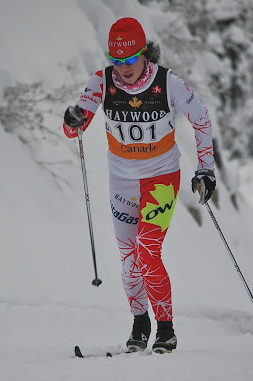
    Fifteen men were still together at the start of the final lap.

    “With 5k or one lap to go, I thought Torin was the guy to mark,” McMurtry said. “I was trying to stay on him, watch him.”
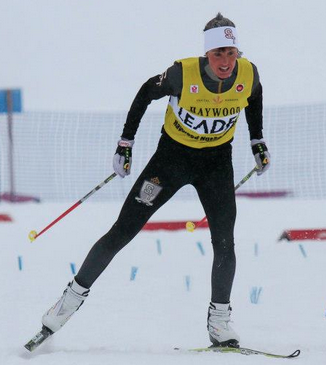
    Koos went to the front with about 1.5 k to go and “just slowed the pace to his speed,” Sandau said. “He was definitely one of the guys you didn’t want to bring to the finish line, but he had some good endurance today.”

    “I am a little disappointed,” McMurtry said of his second place. “I had the gas at the top of the hill, but I was behind Brian [McKeever] and I didn’t push to get on Koos. He opened up a bit of a gap. Coming into the stadium, I used some gas to catch up to him. In the final stretch, I just didn’t have the legs to get around him.“

    “I felt really strong and had perfect skis,” McMurtry said, “I enjoyed the final race of my career.”

    McMurtry’s first Nationals win, as a juvenile boy in 2001, was in the sprint where he was beaten by an American, so it was “a fitting way to end my career with a title but also getting beat by an American.”

    The men had similar views on the course conditions:

    Koos: “It was awesome!”

    Somppi: “Conditions were awesome.”

    McMurtry: “It was amazing. A perfect day for ski racing in March, or almost April. You can’t really ask for anything more. Sunny, super fast at the beginning, and still held up really well. A perfect way to go out, a super, super day.”

    In the junior men’s 30 k, starting just after the open men, national-junior team member Raphaël Couturier of the Pierre-Harvey National Training Centre (CNEPH) attacked with more than a kilometre remaining to take the gold by 8.3 seconds in 1:18.15.4. Matthew Vrielink of Rocky Mountain Racers (RMR) placed second, and Sebastien Dandurand (Callaghan Valley TC) outsprinted four others to take the bronze medal, 18.8 seconds after Couturier.

    Gruber Dominates Women’s 30 k

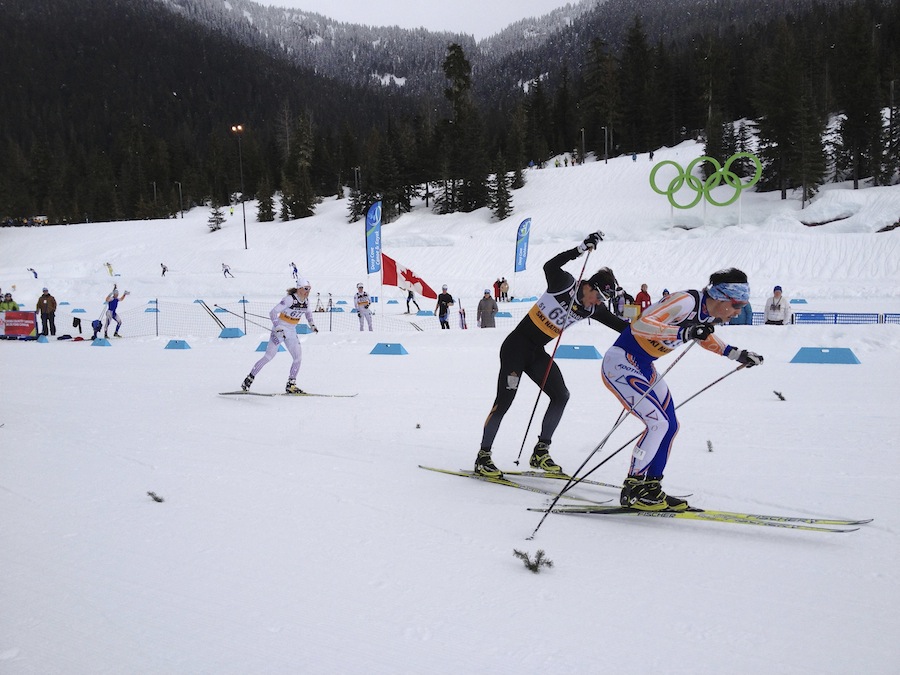
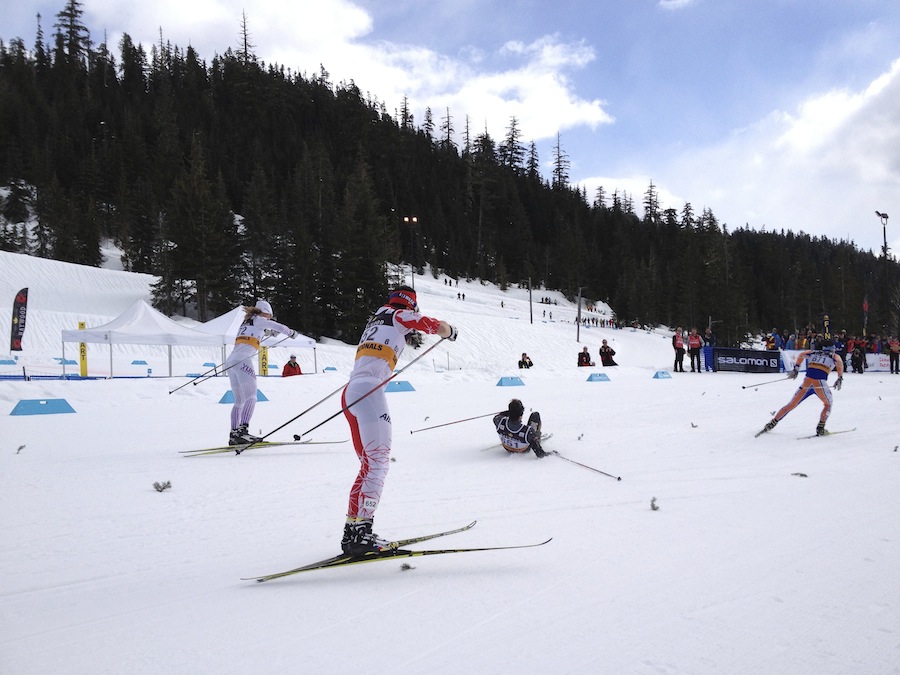
    Japan's Chisa Obayashi (second from r) leads a group after crashing early in Saturday's 30 k freestyle mass start at Canadian Nationals in Whistler, B.C. Eventual winner, Bettina Gruber of Switzerland (r), runner-up Zina Kocher (l) and Heidi Widmer (second from l) follow. (Photo: Martin Kaiser)
    Japan’s Chisa Obayashi (second from r) leads a group after crashing early in Saturday’s 30 k freestyle mass start at Canadian Nationals in Whistler, B.C. Eventual winner, Bettina Gruber of Switzerland (r), runner-up Zina Kocher (l) and Heidi Widmer (second from l) follow. (Photo: Martin Kaiser)

    The women’s freestyle mass start began just before noon with the temperatures already up to 9 degrees Celsius and sun on most of the course.  Organizers previously fertilized the entire stadium, plus the climbs and corners, to preserve the course and it held up well for the women, with a thin layer of slush over a frozen base for most of the blue 5 k course.

    The action started on the first climb out of the stadium with Japan’s Chisa Obayashi (Madshus/Black Jack) taking a hard fall, breaking her pole across both knees, and losing about 40 places.  Obayashi quickly rejoined the leaders, finishing the first lap in the top 10.

    Bettina Gruber of Switzerland's National Ski Team en route to her first victory at 2013 Canadian Nationals in Whistler, B.C. Gruber won the women's 30 k freestyle mass start by over 40 seconds. (Photo: Martin Kaiser)
    Bettina Gruber of Switzerland’s National Ski Team en route to her first victory at 2013 Canadian Nationals in Whistler, B.C. Gruber won the women’s 30 k freestyle mass start by over 40 seconds. (Photo: Martin Kaiser)

    The second lap quickly separated with a group of four who would ski most of the race together at the front.  Heidi Widmer (AWCA), Zina Kocher (Biathlon Canada), Bettina Gruber (Swiss National Team) and Obayashi slowly grew their lead through three laps.

    On the fourth lap, Obayashi dropped back, with the combination of a tired body from chasing back to the group on the first lap and swelling knees slowing her down.

    On the final lap, Kocher made a hard attack up the first hill out of the stadium and only Gruber followed.  By the staircase climb, Gruber was comfortable again.

    When Kocher faltered, Gruber was able to ski away for the victory in1:18:41.1, 40.2 seconds ahead of Kocher, the top Canadian, in second.  Widmer wasn’t able to close on Kocher, finishing another 19 seconds back in third.

    Resurgent Brittany Webster (Highlands Trailblazers) skied two fast final laps and outsprinted Obayashi for fourth place and the Canadian bronze.  Eliska Hajkova (University of Colorado-Boulder), who struggled with ski speed as the snow softened, took sixth.

    “Until about 15 k, it was four girls together, it was solid speed, a good pace,” Gruber said. “Then it went a little bit faster, and we dropped Chisa.”

    “We kept it pretty easy until that final lap and then we really tried to put on the moves,” Kocher said. “The first one I did and dropped Bettina a bit, but she caught me after the downhill and then she made a move on me on the second uphill in the woods and I could go for half of it, and then I was done.”

    Zina Kocher attacks during Saturday's 30 k freestyle mass start at Canadian Nationals. Kocher was the first Canadian and second overall behind Switzerland's Bettina Gruber.
    Zina Kocher (Biathlon Canada) attacks at the start of the last lap of Saturday’s 30 k freestyle mass start at Canadian Nationals. Kocher was the first Canadian and second overall behind Switzerland’s Bettina Gruber (second from l).

    “It was a lot of fun,” Widmer said. “I definitely exceeded my expectations as far as 30 k’s go. Really strong girls to ski with; Zina, Bettina, Chisa Obayashi and I skied the first four laps together and then on the fifth lap Chisa dropped off.

    “At the end, coming out of the stadium for the sixth lap, Zina and Bettina attacked and I didn’t have the gas to go with them,” she added.

    “That race was really fun,” Webster said, despite struggling with the pace from the start. “I was yoyo-ing off the back, got swallowed up by the girls behind and then kind of accelerated again.

    “I had the best skis ever, so that was definitely a bonus,” Webster added. “Foothills Nordic did my skis, and yeah, they were phenomenal.”

    “After start, I crashed, my pole is broken and I scratched my knees,” Obayashi said. “First lap, I used too much energy, so fourth, fifth, sixth laps, I lost energy.”

    Gruber said the conditions were “pretty good. I was surprised, I thought it would be slower and more sluggish, but the track held up pretty well.”

    In the junior women’s 20 k, Cendrine Browne (CNEPH) skied away from teammate Anne-Marie Comeau to take the gold by 3.7 seconds in 54:47.6.  Biathlete Julia Ransom (Canmore) finished third, 49 seconds after Browne.

    While the fertilizer gave the men an extremely fast course and the women a fairly fast course, the sheer volume of younger skiers and a high of 15 C created slushy skiing by the end of the day.

    At the end of a long week and a long season, the start list was shorter.  There were 79 open men, 45 junior men, 53 open women, 22 junior women, 73 juvenile boys, 82 junior boys, 59 junior girls, 74 juvenile girls, and 14 para-nordic skiers.

    More than 150 volunteers made this event possible.

    ***

    Full results and splits are at zone4.ca, with photo galleries coming at the event website.

    Results by race:

    Men’s 50 k

    Junior men’s 30 k

    Women’s 30 k

    Junior women’s 20 k

  • Gaiazova Shakes Off Jet Lag to Dominate Canadian Nationals 10 k Classic; McMurtry Captures First National Title in 15 k

    Gaiazova Shakes Off Jet Lag to Dominate Canadian Nationals 10 k Classic; McMurtry Captures First National Title in 15 k

    Sixteen hours after flying in from Sweden, Canadian World Cup Team member Dasha Gaiazova charges up the opening climb of Tuesday's 10 k classic interval start at 2013 Canadian Nationals in Whistler, B.C. She won the race by 1 minute 23 seconds.
    Sixteen hours after flying in from Sweden, Canadian World Cup Team member Dasha Gaiazova charges up the opening climb of Tuesday’s 10 k classic interval start at 2013 Canadian Nationals in Whistler, B.C. She won the race by 1 minute 23.5 seconds.

    WHISTLER, B.C. — Whistler Olympic Park delivered the first warm and slow day of Canadian Nationals for Tuesday’s classic individual starts.  The younger skiers got fast snow in the morning and open categories got sticky, transformed snow in the afternoon.  By the time the final starter, World Cup Team member Ivan Babikov, hit the line, the temperature had reached 9 degrees Celsius and the very fast conditions of the first two races were a memory.

    World Cup sprint specialist Dasha Gaiazova, also of Rocky Mountain Racers, who arrived just sixteen hours earlier from Sweden, showed no signs of jet lag as she destroyed the field, winning the women’s 10-kilometer race in 34:04.2. Clocking the fastest splits throughout the three-lap race, it was apparent that Gaiazova was the strongest from the start.

    “I just got off the plane from Sweden last night,” she said. “It was a long flight and I’m feeling pretty jet lagged, but it was a surprisingly good day for me.”

    “At this time of the season we have been racing for five months and it is easy to just shut it down mentally and not push to the maximum,” she said. “Today I really wanted to do a really good job of giving it my all.”

    Gaiazova’s all was too much for the rest of the field.  Japan’s Chisa Obayashi finished 1:23.5 minutes back in second.  After racing three days earlier at Japan’s nationals, Obayashi flew to Canada in search of FIS points and the possibility of earning a start at the 2014 Sochi Olympics.

    Obayashi said she struggled with her technique and the effects of jet lag, but moved up from eighth in the first lap past competitors that were slowing down in the softening snow. Asked about Thursday’s classic sprint, the distance specialist replied, “I like long distance.”

    Another Canadian World Cup Team member, Perianne Jones (Nakkertok) returned to Canmore, Alberta, a week earlier than her teammates, who qualified for World Cup Finals. She finished third on Tuesday, 11.7 seconds behind Obayashi, and collected the silver as second Canadian.

    “It was really fun to be out here,” Jones said. “It’s a beautiful day and seeing the whole Canadian ski community and everyone from my club and everyone who has been supporting us all year, but [the race] was tough.”

    “I am looking forward to the sprint on Thursday,” Jones added. “One k is more my thing than 10.”

    Alysson Marshall of the Alberta World Cup Academy (AWCA) continued to finish her season strong, taking fourth (+1:42.5) to collect her second bronze of the week.

    Eliska Hajkova (University of Colorado-Boulder) was the top non-Canadian in seventh. American Caitlin Gregg (Central Cross Country), and Anne-Marie Comeau (Pierre-Harvey National Training Centre) was the top junior in 11th overall.

    Second No More, McMurtry Claims Gold

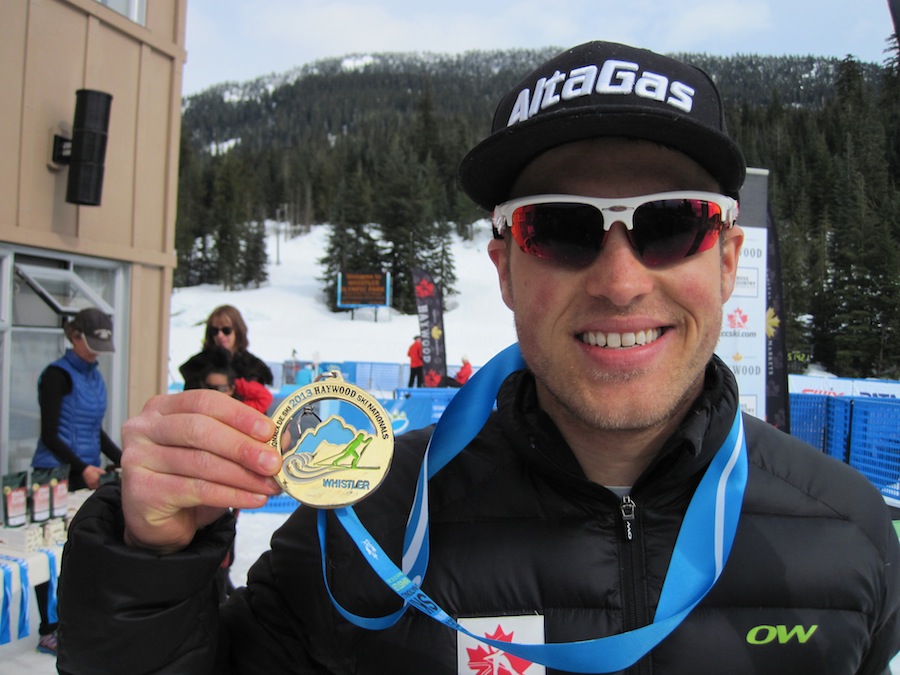
    Brent McMurtry of the Alberta World Cup Academy after winning his first gold medal at Canadian Nationals in Tuesday's 15 k classic interval start in Whistler, B.C.
    Brent McMurtry of the Alberta World Cup Academy after winning his first gold medal at Canadian Nationals in Tuesday’s 15 k classic interval start in Whistler, B.C.

    In the men’s 15 k classic interval start, Brent McMurtry (AWCA) collected his first individual Canadian title with a solid performance in slower, deeper snow of the afternoon, winning in 41:26.9.

    “It feels pretty good [to be national champion],” McMurtry said. “I’ve been second many, many times and I am happy to finally get a win.”

    While almost every skier had a slower second lap in the softening conditions, McMurtry lost less than most to set the fastest second lap time, moving up from second place after the first of two 7.5 k laps.

    Norwegian Rune Ødegärd, a sophomore at the University of Colorado, faded after a commanding first lap to take silver, 22.8 seconds behind.

    “It was so nice out there, really warm, really slow, really tough for every one,” Ødegärd said. “It’s fun racing, spring skiing.”

    After missing his warmup because he was waxing his own skis, Ødegärd thought he had started his first lap too slowly, but soon discovered that it was actually too fast.  Leading after the first lap, he was fourth fastest the second time around to hang onto second place.

    “I had really good skis,” he said, crediting help from the team in the neighboring wax cabin and personal klister expertise from growing up in a coastal town in Norway.

    David Greer of the Yukon Elite Squad (YES) finished in third to take the Canadian silver, 44.3 seconds behind McMurtry.

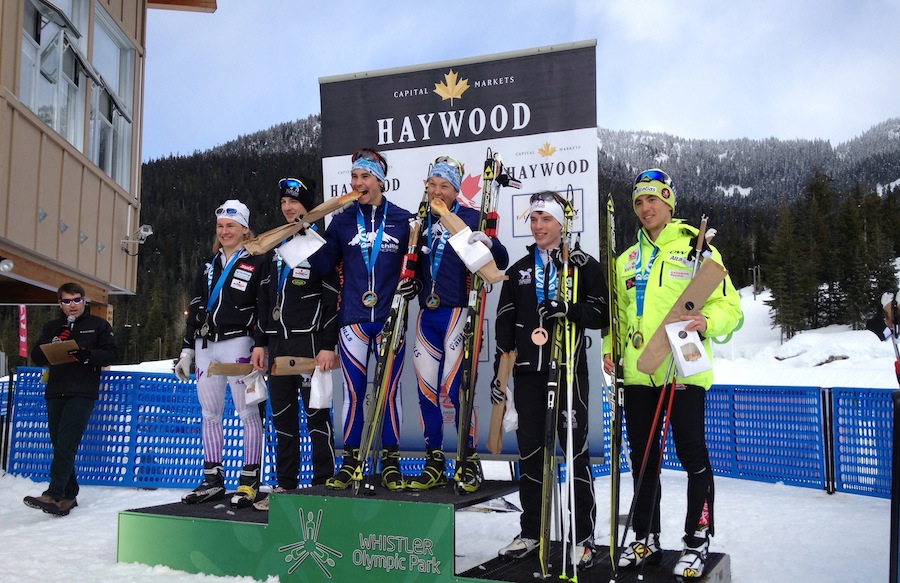
    Men's 15 k classic podium at Canadian Nationals on Tuesday in Whistler B.C.:
    Men’s 15 k classic podium at Canadian Nationals on Tuesday in Whistler B.C., with winner Brent McMurtry (third from r), runner-up Rune Rune Ødegärd (second from l), David Greer in third (second from r), Graham Nishikawa in fourth (r), Sylvan Ellefson in fifth (second from l), and Kevin Sandau in sixth (l).

    “[I had] good glide, good grip and I felt super-strong on the first lap,” Greer said. “On the second lap, I started to hurt pretty bad, but I was able to keep it under control.”

    In the first season of the Elite Squad, his achievement marked the team’s first individual nationals podium.

    Graham Nishikawa (AWCA) topped off a great day for Whitehorse, taking fourth place 8.9 seconds behind Greer, his club-mate.

    “Today was pretty tough,” Nishikawa said, “I had no power out there, but I was just focusing on skiing fast and smooth.”

    Nishikawa’s bronze medal matches the one he got on Saturday’s team sprint with Colin Abbott. That day, Greer took silver with Knute Johnsgaard.

    “I think our team had amazing skis,” Nishikawa said. “Alain [Masson] did a great job [along] with the whole staff here.”

    The Yukon staff is feeling the love; the YES team baked beavertails for the support team during Monday’s rest day.

    Sylvan Ellefson (SSCV/Team HomeGrown) took fifth place for the U.S., and Kevin Sandau (AWCA) edged pre-race favourite Graeme Killick (AWCA) for sixth. David Palmer (Blackjack) was the top junior man in 12th, 2:57.5 behind the winner.

    The rest of the Canada’s World Cup team flew back from Sweden on Monday. Emily Nishikawa (AWCA) and Ivan Babikov (NST) shook off the travel to arrive at the start line and hear the appreciative crowd.  Both looked visibly tired on the first climb out of the stadium, with snap and power absent, possibly lost in somewhere over the Atlantic. Emily Nishikawa finished the race, while Babikov dropped out partway through the second lap.

    The crowd roared each time the stadium announcer mentioned one of the four World Cup Team members who made the effort to race on home snow after a long season in Europe.

    Lenny Valjas was a surprise non-starter for his favoured 15 k classic event, while Alex Harvey and Devon Kershaw had earlier announced that they wouldn’t be racing.

    Results: women | men

  • Canadian Nationals: Foothills Tops Both Men’s and Women’s Team Sprints

    Canadian Nationals: Foothills Tops Both Men’s and Women’s Team Sprints

    Foothill Nordic's Jess Cockney (r) and Phil Widmer (Canmore Nordic), after colliding in the finishing straight of Saturday's freestyle team sprint final at 2013 Canadian Nationals in Whistler, B.C. Cockney went on to win with teammate Brent McMurtry, defending their 2012 national title, while Widmer and Russell Kennedy settled for fourth.
    Foothill Nordic’s Jess Cockney (r) and Phil Widmer (Canmore Nordic), after colliding in the finishing straight of Saturday’s freestyle team sprint final at 2013 Canadian Nationals in Whistler, B.C. Cockney went on to win with teammate Brent McMurtry, defending their 2012 national title, while Widmer and Russell Kennedy settled for fourth. Knute Johnsgaard (l) took silver with teammate David Greer for Whitehorse.

    WHISTLER, B.C. – On a sunny day at Whistler Olympic Park, the men put the cap on an exciting first day of Canadian Nationals with a collision and crash in the final 50 metres of the 2×3 1-kilometre freestyle team sprint.

    Whitehorse divides and conquers to take second and third in Saturday's freestyle team sprint at Canadian Nationals in Whistler, B.C.
    Whitehorse divides and conquers, with Graham Nishikawa skiing around a fallen Phil Widmer (Canmore) on the right and Knute Johnsgaard at left, to take second and third behind Foothills’ Jess Cockney (far right) in Saturday’s freestyle team sprint at Canadian Nationals in Whistler, B.C.

    Four teams entered the final straight together with Phil Widmer of Canmore Nordic in the lead. At the start of the pine-bough lane markers with 50 metres to go, Widmer and Jess Cockney of Foothills Nordic chose the same lane.  Widmer fell, leaving Cockney to defend his national team-sprint title with partner Brent McMurtry. Skiing for different Whitehorse teams, Knute Johnsgaard and Graham Nishikawa split around the fallen Widmer and lunged for the line.

    A year after winning at Canadian Nationals in Quebec, McMurtry and Cockney claimed the team victory in 15:32.03. Johnsgaard finished in 15:33.00, taking silver with partner David Greer.  Nishikawa was 0.31 seconds behind to take bronze with teammate Colin Abbott.

    Widmer recovered to take fourth with Russell Kennedy, 11 seconds after Cockney.  Raphaël Couturier (Skibec) led the second pack another 5 seconds back in fifth with teammate and Canadian National Team biathlete Marc-André Bédard.

    When asked what made the difference, Cockney had a one-word answer: “Brent.”

    “Brent skied so strong on his last leg and gave me such a huge lead,” Cockney added. “All the other guys were gassed after catching up to me.”

    Johnsgaard had a similar view. “I felt really strong. I just didn’t quite have the finishing speed that Jess had in the final,” he said.

    Cockney skied the last leg with a clear tactic in mind.

    “I didn’t feel that strong so I held the lead as long as I could and made sure to tuck in behind Knute and Phil on the downhill into the last 300 metres,” he said. “With the headwind, it was good to tuck behind someone else.”

    Nishikawa also took a strategic approach to the final. A big crash and a broken pole on his first lap of the semifinal put him well off the back of the pack. While Abbott was able to finish the job of rejoining the group, the energy they spent qualifying in second in the fastest heat would come back to haunt them.

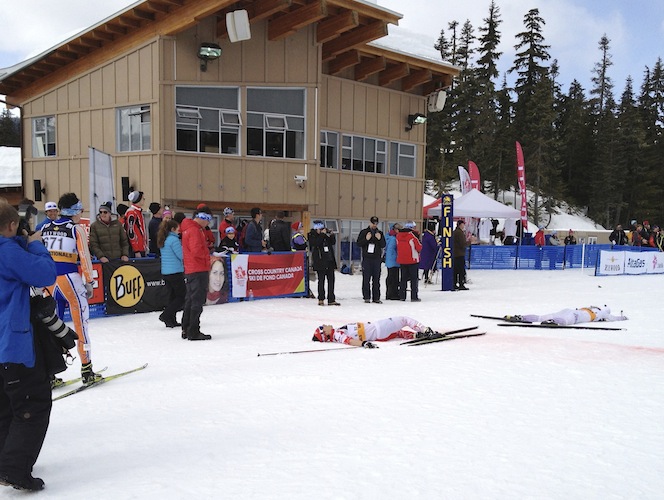
    An exhausted top three after Saturday's freestyle team sprint final at 2013 Canadian Nationals in Whistler, B.C.
    An exhausted top three after Saturday’s freestyle team sprint final at 2013 Canadian Nationals in Whistler, B.C.

    In the final, the first-leg skiers went out hard on their third and final lap.

    “Brent attacked and dragged Colin,” Greer said.  “I got around a couple of people and ended up coming in second.”

    “I finally caught the top three teams at the corner with a hundred to go and then they all started their sprint,” Nishikawa said.

    Asked about the crash, he said, “It took a lot of energy to get there so I just had my head down trying to sprint.  I saw some tangles and then I was in a lunge for second as well. It happened fast so I don’t really know what happened.”

    Johnsgaard, who also was in a good position to see the collision, didn’t think any penalties would come of it. “I think it is part of racing,” he said.

    The jury agreed and took no action.

    The women’s 2×3 1-kilometer team sprint was also exciting, but without the finishing-straight fireworks.  On the final lap, Foothills’ Marlis Kromm opened up a gap to send Heidi Widmer off with a sizable lead. Their finish time of 15:17.1 was nearly 10 seconds ahead of Hardwood’s Erin Tribe, who shared silver with Mary Thompson.

    Heidi Widmer (Foothills) leads Anne-Marie Comeau (MSA) in the semifinal of Saturday's freestyle team sprint at 2013 Canadian Nationals in Whistler, B.C. Widmer and her teammate Marlis Kromm went on to win the final.
    Heidi Widmer (Foothills) leads Anne-Marie Comeau (MSA) in the semifinal of Saturday’s freestyle team sprint at 2013 Canadian Nationals in Whistler, B.C. Widmer and her teammate Marlis Kromm went on to win the final.

    Zoe Roy and Michaela Howie teamed up for Rocky Mountain Racers and won the sprint for bronze. Roy finished just over a second ahead of biathlete Julia Ransom (Canmore), who partnered with Kathryn Stone.

    Anne-Marie Comeau (Mont St. Anne) took over from Camille Pépin and quickly moved from fifth to second on the final leg , but a crash on the top hairpin put her back in fifth, six seconds out of the medals.

    Kromm and Widmer were very happy with their result.

    “We were junior challenge girls here [in Whistler at 2008 nationals] and won the relay here so it was really fun to come back,” Widmer said.  “It’s a great start to the week and Mother Nature has been really great today.”

    Both saw the race as tactical. “We wanted to start in control, ski the first couple of laps with the pack and try to save some energy and make our moves in the second half of the race,” Kromm said.

    “It is a long week of racing at nationals,” Widmer added. “The team sprint is important, but you have to be aware of your energy for the rest of the week.”

    The silver medalists said the race was “definitely tactical.”

    “You had to hold on to a spot and pick when to move up and make sure you had something for that last lap,” Thompson said.

    “It was really refreshing that the sun was shining and the skis were fast,” Tribe added. “It was a great day.”

    Results: men | women

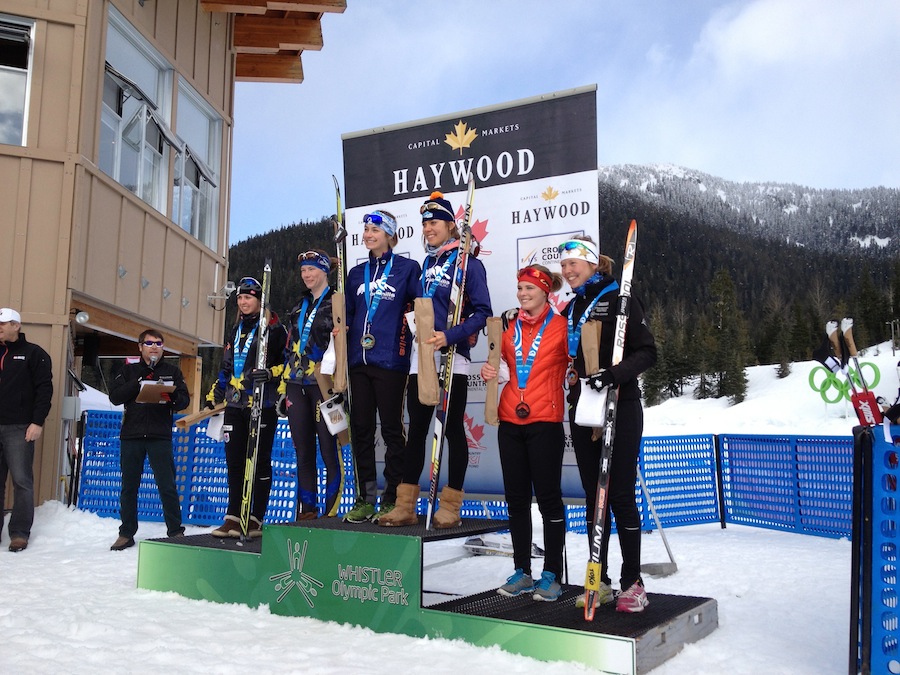
    Women's freestyle team sprint podium at 2013 Canadian Nationals, with Marlis Kromm and Heidi Widmer of Foothills Nordic in first (c), Erin Tribe and Mary Thompson of Hardwood in second (l), and Michaela Howie and Zoe Roy of Rocky Mountain Racers in third. (Photo: Peggy Hung)
    Women’s freestyle team sprint podium at 2013 Canadian Nationals, with Marlis Kromm and Heidi Widmer of Foothills Nordic in first (c), Erin Tribe and Mary Thompson of Hardwood in second (l), and Michaela Howie and Zoe Roy of Rocky Mountain Racers in third. (Photo: Peggy Hung)
    2013 Canadian Nationals men's freestyle team sprint podium: (Photo: Peggy Hung)
    2013 Canadian Nationals men’s freestyle team sprint podium with Purebread Bakery baguettes in hand. Jess Cockney and Brent McMurtry of Foothills Nordic took first (c), Knute Johnsgaard and David Greer of Whitehorse were second (l), and Whitehorse’s Colin Abbott and Graham Nishikawa placed third (r). (Photo: Peggy Hung)
  • Notes and Quotes: Thomas and Killick Take Western Canadians in Grande Prairie

    Notes and Quotes: Thomas and Killick Take Western Canadians in Grande Prairie

    Graeme Killick (AWCA/CNT) racing earlier this season at the West Yellowstone SuperTours.
    Graeme Killick (AWCA/CNT) racing earlier this season at the West Yellowstone SuperTours.

    The Canadian Noram series wrapped up with the Western Canadians mini-tour in Grande Prairie, Alberta. Graeme Killick (AWCA) and Alana Thomas (Nakkertok) crossed the finish line first on Sunday to take the overall victory.

    Competition was intense despite the reduced field, with most of the racers from eastern Canada avoiding the travel and four of the usual suspects busy in Val di Fiemme.

    In Friday’s classic sprint, Heidi Widmer (AWCA) crossed ahead of Alysson Marshall (AWCA) and Kate Brennan (AWCA). Widmer was thrilled with the win; Marshall on the other hand was a bit frustrated crossing the line in second.

    Thomas (Nakkertok) leading Zoe Roy (RMR) and Emily Nishikawa (AWCA) in the 15 k skathlon at the Lappe Nordic NorAm on Jan. 3 in Thunder Bay, Ontario. (Courtesy photo)
    Thomas (Nakkertok) leading Zoe Roy (RMR) and Emily Nishikawa (AWCA) in the 15 k skathlon at the Lappe Nordic NorAm on Jan. 3 in Thunder Bay, Ontario. (Courtesy photo)

    “Friday went okay for me, I didn’t feel great in my qualifier but started feeling better as the heats went on,” she told FasterSkier. “I didn’t ski the final as tactically well as I wanted to but I was satisfied with the final result.”

    Jess Cockney (AWCA) outsprinted Brent McMurty (Foothills) and fastest qualifier Andy Shields (Thunder Bay NDC) in the men’s final. Michael Somppi (AWCA) narrowly missed out on the podium to shields after what he called “a mixup in the finishing lanes.”

    Saturday was classic distance interval starts in tricky waxing conditions.  Amanda Ammar (AWCA) finished in 31:56.0 to beat Thomas by 49 seconds, with Annika Hicks (AWCA) a further ten seconds back in the 10km event.

    “I was out on a mission,” Ammar told FasterSkier. “These trails were tailored perfect for me. Lots of striding, many exchanges, and technical downhills. I went out hard and made a gap early. It was a fantastic race, and I was pumped to have two classic podiums in a row.”

    Thomas, though, was happy with her race too.

    “I felt pretty good but had AMAZING skis thanks to help from the Foothills coaches, conditions were a little tricky so this played a big part,” she reported.

    Killick led the men’s 15km race in 40:27.1, with Kevin Sandau (AWCA) 41 seconds behind and Cockney at 1:01.

    Sunday’s 15km skate pursuit began with Ammar starting 12 seconds ahead of Thomas and 15 seconds ahead of Hicks.  Widmer skied the fastest in 43:24.46 to move from sixth to third and the final podium spot for the weekend.  Thomas quickly caught Ammar and won the sprint for the mini-tour title, with Thomas also taking the second fastest time for the day ahead of Ammar in third.

    The men closed out the weekend with a 30km skate pursuit.  Killick began the day with a 37 second lead and finished with 45 seconds, earning the second fastest time for the day with 1:14:06.6.  Cockney started in second and was caught by fourth starter Michael Somppi (AWCA).  Cockney edged Somppi at the line to take second overall with third starter Sandau sliding back to fourth overall while taking 5th for the day.

    FasterSkier contacted the podium finishers, and got comments about their races as well as the weekend on the whole and the wrap-up of the Canadian NorAm season.

    Overall Thoughts

    Widmer: I am really happy with the way my body responded this weekend. I haven’t done that much consecutive racing yet this season and have missed it! It’s such a fun and demanding format and having two skate races worked well for me. It is great to be able to stand on a podium again as well as traveling with the whole team together feels great. It’s been awhile since we’ve travelled with this big of a team this season and feels great – especially when everyone is doing so well!

    Hicks: As a whole, the weekend was really good. Two out of three races were really good, so I’m happy about that. I’m disappointed Sunday didn’t go better, because it would have been nice to fight for a podium position in the overall standings, but sometimes the body won’t let that happen. I was happy to hang onto 5th.

    Ammar: These mini tours are great fun! Obviously I would of liked to have done better in the sprint, but I’m so pumped about how good my classic race went. I’ve been feeling quite strong in this race, and it’s nice to see that it’s becoming consistent. Overall, this was a great weekend!

    Shields: Westerns was a great set of races for me. I wasn’t planning on making the long trip of Grande Prairie, but I decided to go around two weeks ago when I found out the flights were so cheap. Thunder Bay didn’t sent any coaches to this event so I got race support from the Augustana Vikings and their coach Les Parsons.

    Somppi: Overall it was a good weekend of racing. It felt good to be on the podium for the mini-Tour this time instead of finishing one step off in fourth like I did at Eastern Canadian Championships.

    Sprints

    Widmer: Sprint day was my focus and I wanted to put everything on the line in the qualification to see what would come of it – I was pleased to have it pay off on a speedy course. There was a lot of time between heats because there were a lot of racers to get through with the Juniors as well, so I did my best to conserve energy and not let my mind get too far from ski racing. The final was really fun – I just hammered from the gate and hoped I wouldn’t see anyone in my peripheral. My goal for the weekend was to take the win in the sprint and it’s my first NorAm title of the season so a great early birthday present!

    Thomas: I was pumped to make my first A-final of the year on Friday, unfortunately I crashed myself out of contention but felt awesome so was stoked for the rest of the weekend.

    Hicks: I had one of the best sprints of my life. I made the A final for my first time as a senior so that was exciting. I felt a little out of place standing on the start line in the final. I just tried to stay with the leaders as long as possible, but ran out of steam at the end. I can’t complain about a 5th place in a sprint though!

    Ammar: I was very disappointed with the sprint. I unfortunately fell in the qualification, and ended up having a high bib number, and since they weren’t timing heats, I ended up in a stacked first heat and didn’t even making it into the semi’s.

    Shields: The Mini-tours started off with one of my best sprint qualifiers of my career and I was able to make it to the A-final without too much trouble. In the final I was able to squeak onto the podium with a lunge. It was my first Senior NorAm podium of my career.

    Interval

    Widmer: The classic day was tough. It was really abrasive and transformed snow with a glazed track which meant a lot of running for me. Although it wasn’t my strongest race and didn’t play to my strengths, I came away with a lot of lessons learned about my ski selection as well as my body in classic skiing.

    Hicks: The 10km classic the next day went really well too. The conditions were really challenging. It was really icy and abrasive. I think everyone struggled a little with grip, but the Academy especially. Our glide was great, though. I was slipping a lot right off the start and thought “Oh no, this is not going to go well” but I just tried make it work and kept pushing. I crashed pretty hard on one of the downhills, which was unfortunately right when Amanda passed me, so I didn’t get a chance to ski with her. I was a little surprised I finished 3rd because I didn’t feel smooth at all, but I knew I put in a good effort.

    Marshall: Saturday was pretty rough, I was tired and struggled for kick on some sections so the race felt like a slog. I have been dealing with some ongoing health issues with my thyroid and have been tired and having trouble recovering. I decided not to race on Sunday to give my body a chance to get back on track and not get too beat down from three days of racing on tired legs.

    Somppi: The classic distance wasn’t great. I started well, skiing a strong opening 5km lap, but couldn’t hold the pace and crashed towards the end of my second lap.

    Pursuit

    Thomas: Sunday was just a total blast. I started 12 seconds down on my good friend Amanda and worked to catch her asap in the first few kilometers. From there we skied together and let it come to a sprint finish. I’ve never won a NorAM before so it was really great to do it on such a fun day!

    Widmer: The 15k Skate race went really well for me. I’ve done a lot of work on skating, especially one skate, this past training season and I have come to rely on it in the distance races. I started 6th, 1:08 back from the lead and after finding out Alysson was a scratch I knew I wanted to get Zoe and Annika in my sights as soon as possible on the winding race trails so that I would be motivated to catch them. It’s like hunting season in the pursuit races! A really fun format. After about 7km I caught Annika and Zoe, Annika had a crash so Zoe and I skied the second half of the race together and she gave me an awesome push. I put my head to the ground in the last 1.5km and did everything in my power to knock off as many seconds as possible to secure a 3rd place overall on the weekend and my first ever distance NorAm win.

    Hicks: The 15km skate was the biggest disappointment of the weekend. Usually, it’s my favourite race because I’m generally a stronger skater, and I was in a really good position (only 27 seconds back of Amanda in first). Unfortunately, my legs had nothing left in them, and I knew it right off the start. I really struggled to keep my turnover high, my legs were so heavy. I crashed on the downhill again, which really didn’t help matters. The whole race was just a struggle.

    Ammar: I’m happy with the skate race, with me skate races can go two ways, good or really really bad. Luckily Alana and I worked together kept the pace consistent, got a big enough gap that no one was a threat to catch us, then we battled at the last 100meters to the finish. I didnt race a gutsy race like the classic, but tried for a more tactical. Alana got me by a boot, and even though I was so close to winning, I still have to be happy with this result.

    Somppi: I started the final pursuit race in 4th place, much further behind the leader than I would have liked to be.  I had a tall task of making up 1 minute and 4 seconds on tour leader Graeme Killick.  Fortunately it was a skate 30km, which is a good race for me, so I figured I had a chance.  Graeme ended up skiing a very good race and held off all the challengers to win the mini-Tour.  I did my best to pace the 30km well and finish fast.  The final 6km I emptied the tank completely and was able to catch Jesse a few hundred metres from the finish line.  Knowing Jesse’s sprinting abilities I executed the best strategy I could think of, blowing by him on the final short climb and trying to hang on to a small gap to the finish line.  Unfortunately I didn’t get enough of a gap and he was able to tail me into the finish lanes then ski up beside me and win in an photo finish.

    Full results are at zone4, with separate sprint qualifying and heats results, individual-start results, and then final-stage times and overall standings.


  • Cockney Claims First Mini-Tour Title at Easterns; Emily Nishikawa Prevails in Pursuit

    Cockney Claims First Mini-Tour Title at Easterns; Emily Nishikawa Prevails in Pursuit

    Jesse Cockney
    Jess Cockney (AWCA/NST) at last season’s Sovereign Lake NorAm in Dec. 2011. Cockney won his first mini-tour title at the 2013 Eastern Canadian Championships on Sunday, edging teammates Brent McMurtry and Graham Nishikawa in the 30 k classic pursuit. (Photo: Jesse Winter / jessewinterphotography.com)

    Heading into Sunday’s NorAm 30-kilometer classic pursuit in Cantley, Quebec, Jess Cockney knew he’d have to rely on some pretty smart skiing to get him through. The 23-year-old Alberta World Cup Academy (AWCA) skiers had more than half a dozen teammates to contend with, and he really wanted the Eastern Canadian Championships mini tour title.

    Racing against guys who know your strengths and weaknesses is hard enough, but try outdueling them over a six-lap course. Traditionally known as a sprinter, Cockney started first, just 2 seconds ahead of distance specialist and AWCA teammate Graham Nishikawa. More of Academy men were close behind: Brent McMurtry started six seconds back in third and Michael Somppi went 12 seconds after Cockney in fourth.

    Skiing in a pack for much of the race, all the top guns wanted the same thing and predicted what it would come down to. Cockney executed as planned, winning the sprint finish by 0.4 seconds over McMurtry and 0.8 ahead of Nishikawa in second and third, respectively. Somppi was 2.3 seconds off Cockney’s winning time of 1:20:14.9, and another teammate, Graeme Killick, skied the fastest 30 k in 1:20.00.3. Killick crossed the line in fifth, 1:14.4 after Cockney, and helped the AWCA sweep the top seven with Chris Hamilton in seventh (+1:52.1).

    “It felt great today,” Cockney wrote in an email. Throughout the long weekend at Nakkertok Ski Club, he was fourth in Friday’s classic sprint and third in Saturday’s 15 k freestyle.

    “I’m so happy to put together three days and win a mini tour for the first time,” he continued. “The tactics were pretty straightforward today as I just wanted to make sure to help the pace of the group and be in a good spot for the sprint finish. Next thing for me is some training in Canmore and a few weeks from now we’ll face again at Westerns.”

    Canada’s next NorAm, the Western Canadian Championships will take place Feb. 22-24 at Wapiti Nordic in Grande Prairie, Alberta. The last mini-tour of the season, they’ll include skate sprints, 10/15 k classic interval starts and 15/30 k freestyle pursuits.

    While McMurtry couldn’t be reached for comment, Nishikawa – who made the podium twice at Easterns in both distance events – described it as “a very tactical race as the course was on the easy side.”

    Eleventh in the classic sprint and second in the 15 k, Nishikawa tried to push the pace at times, as did McMurtry (the third-fastest of the day), but neither had much luck. Ultimately, it came down to a sprint – which Cockney excelled at.

    Somppi posted the second-fastest time for fourth overall in the mini tour, which was just short of the podium he had hoped for.

    “I felt good skiing today and was able to close down the margin on the guys starting in front me pretty easily,” Somppi wrote in an email. “Unfortunately  I crashed on an icy corner just before starting the 3rd lap and used up some energy closing down the 10 second gap that opened. … I’m happy I stayed with the guys to the end and had the 2nd fastest time for the day, but I’m a little disappointed.”

    Fresh off a trip to U23 World Championships, Colin Abbott of the Yukon Elite Squad tied his a personal-best NorAm result in seventh and was the top U23.

    “I felt relaxed, smooth and powerful for the whole race,” Abbott wrote. “I’m really excited about this result! it’s one of a handful of races that I’ve really been competitive with the best guys in Canada. … To be top 6 in both a sprint and 30k was beyond my expectations. In retrospect, my time in Europe for the U23 championships felt like a good training camp for this weekend.”

    Raphaël Couturier of the Pierre-Harvey Training Centre (CNEPH) was the top junior in eighth. He and several other CNEPH juniors raced as seniors to garner more FIS points and secure better starting positions next year.

    David Greer (YES) placed ninth, and Patrick-Stewart Jones (AWCA) made the top 10 for the second time this week after placing second in Friday’s sprint.

    Men’s results

    Nishikawa Tops Brennan for Women’s Title

    In the women’s 15 k classic pursuit, Emily Nishikawa (AWCA/NST) came out on top despite battling a cold throughout the week. After starting in second, 14 seconds after mini-tour leader and teammate Kate Brennan, Nishikawa caught Brennan on the second of three laps with the help of Amanda Ammar (Canmore), who started nine seconds behind Nishikawa in third.

    The three skied together for the final lap, and Nishikawa attacked on the second-to-last climb to finish first in 45:30.3, 5.5 seconds ahead of Brennan in second. Ammar was third (+6.8), but posted the fastest time for the open 15 k win.

    “I am starting to feel better from my cold now, and I’m really happy with my result today!” Nishikawa wrote in an email. “I’m really excited to head to Europe now. I’m hoping to keep building momentum and have my best results at the world champs.”

    While Brennan could not be reached for comment, Ammar described the weekend as “really draining” in the cold weather with temperatures around -10 Celsius on Sunday.

    “I just tried to push as hard as I could without absolutely dying out there!” Ammar wrote.  “I can’t remember the last time I was first on a Senior Noram, so today is a great day! I’m happy with the overall weekend, I tried to ski smart, and just be consistent. The first day was unreal though, I’m not known for my sprinting abilities, and I’m really pumped about making the A-Final, that was another first in many many years.”

    Ammar was fifth in the classic sprint and fourth in Saturday’s 10 k skate.

    “Em put an amazing surge on the last hill, and I fought to keep her in sight, while Kate snuck up beside me in the double pole finish,” she explained Sunday. “But I was still able to claim the fastest time of the day, and that’s all I really wanted.”

    After placing 13th on Saturday, Alysson Marshall (AWCA/NST) made up some ground from starting seventh, improving to fourth (+1:21.3) with the fourth-fastest time.

    “It was really nice to have a solid distance race. I still want to be back fighting for gold but I feel like my body is coming around,” she wrote. “The skate race yesterday was rough for me but I was happy to finish the weekend as well as I did as I’ve been fighting a cold all weekend.”

    Zoe Roy (Rocky Mountain Racers) placed fifth (+2:15.1), and Cendrine Browne of CNEPH was the top overall U23 (another junior who raced as a senior) in sixth (+2:18.1).

    “I am really, really happy. I never had a good result like this in a classic race,” Browne wrote. “Classic isn’t my strength but maybe it’s becoming it! My coaches told me to find someone to ski with: it was a hard course and if you skied alone, you would get tired. So I stuck with a pack of girls, repeating to myself over and over again: don’t lose them, stick with them. That’s what I managed to do and it really helped me to stay focused and to have a great result.”

    Andrea Lee (NDC-Thunder Bay) placed seventh, Anne-Marie Comeau (CNEPH) finished ninth and Nakkertok’s own Alana Thomas notched her third top-10 of the weekend in 10th.

    After starting fourth, 33 seconds behind Brennan, Brittany Webster (Highlands Trailblazers) did not finish because of illness.

    “I came down with a bug,” she explained. “I felt pretty heavy and run down before I started today. Then in the warm up I started to feel dizzy and nauseous. Started the race and by 7.5 k I had to pull out- I felt just terrible. … Hopefully I won’t be sick for long. It’s going around though- there were 1/2 a dozen racers that came down with something. I’m optimistic some good rest will do the trick.”

    Women’s results

  • Marshall Back on Top; Widmer Notches Another Classic Sprint Win at Easterns

    Marshall Back on Top; Widmer Notches Another Classic Sprint Win at Easterns

    Alysson Marshall (AWCA/NST) racing at the 2012 World Cup finals in Falun, Sweden, last March.
    Alysson Marshall (AWCA/NST) racing at the 2012 World Cup finals in Falun, Sweden, last March.

    Alysson Marshall could feel it coming, and she couldn’t believe it was happening.

    Burdened with a cold the night before the Eastern Canadian Championships, she thought back to all the other times she hadn’t felt well this season. She started the season in Europe and had to sit out the first races over there because of a cold.

    Upon returning back to Canada, jet lag took a major toll on the Alberta World Cup Academy (AWCA) and Senior Development Team skier. Last year’s NorAm winner, Marshall couldn’t find those good vibes at the Canadian World Cups and struggled to get back on top of the NorAm podium.

    Friday morning, she wasn’t even sure she was going to race the 1.6-kilometer NorAm classic sprint at Nakkertok Ski Club in Cantley, Quebec. She decided to see how she felt warming up and proceeded to try her luck in the qualifiers. There, Marshall was second to teammate Kate Brennan by 1 ½ seconds. Not bad, she thought.

    Marshall, 24, went on to win her quarterfinal and semifinal, refining her tactic of dropping her competitors on the course’s two major climbs. In the final, she did more of the same, tucking behind Brennan out of the flat start then finding an open lane up the first hill.  She created a gap and kept pushing, lengthening her lead for a comfortable victory – her first of the NorAm season.

    “It wasn’t a full-on sprint to the finish,” Marshall said on the phone Friday. “I knew I had it a little ways out.”

    Three of her AWCA teammates raced for second, with Rebecca Reid slipping by on the downhill ahead of Brennan in third and Emily Nishikawa in fourth, respectively. Amanda Ammar (Canmore) was fifth and Alannah MacLean (NDC-Thunder Bay) placed sixth in the final.

    “Twenty-four hours ago I was pretty upset and not very impressed with how things were going so I was really happy to get a good result in,” Marshall said. I’ve had some bad luck and just tired, just haven’t had a break yet this season, so today was really nice.”

    Second in the Thunder Bay classic sprint and third in the same race in Duntroon, Ontario, at Canada’s World Championships trials last month, Marshall narrowly missed a trip to Val di Fiemme, Italy. Team selections were announced earlier this week, and Marshall resolved to move on and learn from her experiences.

    “I don’t really have any opportunities to go to Europe now so I’m going to focus, restart, figure out what I need to do to be fast the rest of the season,” she said. “Figure out what I need to work on, what’s going on and try to have a good [Western Championships] and nationals. … I’m going to do some training, figure out my weaknesses and hopefully finish off the season better than it started.”

    Thinking about ways she could improve as well, Reid, 20, placed second for her best NorAm result and second career podium, which she sought at the World Championships trials last weekend.

    “I got inched out of a podium last weekend in Duntroon where I was fourth in the classic sprint and I really wanted to build on that result this weekend,” Reid wrote in an email.

    After qualifying in seventh, she was happy with her position but continued to strive higher. Reid went on to win her quarterfinal and finished second to Brennan in the semifinal.

    “I was ranked fourth going into the final and it went smoothly for me. I was feeling confident and I knew I had wicked fast skis on my feet so I was patient and came through in the finishing straight,” she wrote. “I was pretty excited that it wasn’t just a good day for me, having the Academy girls take the top-4 spots in the final made for a really fun day!”

    AWCA racing director Mike Cavaliere was pretty impressed.

    “Rebecca has been skiing stronger and stronger,” he wrote in an email. “I think she is starting to settle into life as a senior and getting more comfortable and aggressive.”

    Brennan and Nishikawa sprinted to the finish for the third podium spot, which Brennan narrowly took. After sitting out last Sunday’s NorAm distance race in Duntroon, Nishikawa wrote that she was still recovering from a cold.

    “I’m still not 100% but all things considering I was happy with how things went today,” she said, describing the final as fast to start with the four Academy women skiing together before Marshall gapped the field. “Feeling better everyday, so I’m looking forward to tomorrow!”

    Saturday features 10 and 15 k freestyle interval starts on the second of the three-day Eastern Championships. Racing ends Sunday with 15 and 30 k classic pursuits.

    Women’s results

    AWCA Men Also Take Top 4

    Friday’s 1.6 k men’s sprint results looked similar to the women’s with the AWCA sweeping the top four. Phil Widmer led the group in first with his second victory in the last three NorAm classic sprints.

    Phil Widmer (AWCA) at the Québec City World Cup sprint on Dec. 7.
    Phil Widmer (AWCA) at the Québec City World Cup freestyle team sprint on Dec. 7. He and teammate Brent McMurtry placed 20th.

    Widmer crossed the line first last weekend in the Duntroon final as well, but was relegated to sixth for an infraction before the finish. Without the penalty, he would’ve swept the last three NorAm sprints. Regardless, he had won the qualifier in both sprint trials to secure a trip to the upcoming World Championships.

    However on Friday, Widmer wasn’t first, at least not initially. The 29-year-old was third in the qualifier behind Academy teammates Brent McMurtry and Patrick Stewart-Jones. That didn’t sit well with Widmer, and he resolved to do better in the heats.

    He did, winning his quarterfinal and placing second to Stewart-Jones in the semi. In the final, the two dueled to the finish, where Widmer outlunged Stewart-Jones in a photo finish. McMurtry was third after leading early.

    “Neither Patrick or I were sure who won,” Widmer said. “After we crossed the line, the announcer thought Patrick won, but I guess after reviewing the photo, I got it.”

    Widmer opted to follow McMurtry and Stewart-Jones up the herringbone climbs, conserving energy on the steeper terrain.

    “I knew my strength was in the finish with the double pole,” he said. “My climbing on that steep stuff isn’t amazing. I was just trying to hang with the stronger guys like Brent and Patrick and hope that I could out-doublepole them.”

    The three broke away from the pack when Jess Cockney (AWCA) and Colin Abbott (Yukon Elite Squad) fell about halfway through the final. With Abbott’s teammate, Knute Johnsgaard, the three finished behind the leaders with Cockney in fourth, Abbott in fifth and Johnsgaard in sixth.

    For Abbott, it was a career-best finish in his first NorAm final just a few days after flying back from the Junior World Championships in Liberec, Czech Republic.

    “I didn’t know what to expect,” Abbott wrote in an email. “I was back in Canada two days ago and I only got one real ski in before racing today. I felt like today was my best day of racing all year which was a nice surprise.”

    Incident-free up front, Stewart-Jones explained that he made a point to lead early and keep the pace high.

    “I was leading coming into the end but ran out of juice in the last 15 meters and Phil got me on the lunge,” the Chelsea, Quebec, native and Nakkertok club member wrote. “I’m happy with second and very happy with my qualifier yet a part of me is disappointed I didn’t pull off the win on my home course.”

    McMurtry, who won the qualifier by 2.7 seconds over Stewart-Jones, knew he was off to a good start in what isn’t always his signature event. “I haven’t won many qualifiers in my career so I was pretty happy with how that went,” he wrote in an email.

    He went on to win both his quarterfinal and semi, and tried to lead the final as well.

    “I didn’t have the energy that I was hoping to,” McMurtry wrote. “I was able to stay at the front but just didn’t have the power for the double pole sprint to the line. Climbing was definitely a strength of mine today so I think it was a bit of a disadvantage for me that it was all herringbone.”

    Behind him in fourth, Cockney described his crash as a “small tangle” shortly after catching up to the three leaders.

    “There was a full 180 corner and I got tangled with Colin Abbott and we both fell,” Cockney wrote. “I lost contact with Phil, Patrick and Brent and never caught them again. I felt great in the final and it was a real waste of good shape but on to the next one.”

    Coming into Easterns, Cockney explained that he struggled with some disappointing news.

    “I’ve been down mentally after the decision to not bring me to World Champs,” he wrote a few days after being named the sprint alternate. “I was really hoping to make today a day that I could make the selection committee regret not taking me but it was pretty far from that.”

    Outlined in the decision, Cockney was granted some World Cups starts in March.

    “I really can’t wait to get back to Canmore and start a small training block for the spring World Cups,” he wrote. “It’s a great opportunity to race the World again even if it’s not on the World Championship stage.”

    Even for someone like Widmer, who qualified for worlds, being mindful now is more important than ever.

    “My goal is always to try to win but it’s also about finding ways to improve, which for me today was in the qualifying round,” Widmer said. “Plan is for me [to race] tomorrow and not do the 30 k just because we don’t have a ton of time at home in Canmore.

    “I think we’ve only got five or six days of training before I fly to Europe so I would rather, instead of doing a 30 k race, channel that energy into some good training, stay healthy and head to Europe with good energy.”

    Men’s results

  • At Home in Canmore: The Canadian Up-And-Comers

    At Home in Canmore: The Canadian Up-And-Comers

    Coverage of the Canmore World Cups was made possible through the generous support of Travel Alberta and Tourism Canmore.

    Thirty Canadian men and women will be putting on World Cup bibs in Canmore this weekend. Some are old pros and some are competing in the first World Cups of their lives. (Photo: Angus Cockney)

    With the start of the mass start classic in Canmore, Alberta, less than 24 hours away, nerves are running high at the World Cup venue. With two distance races and one sprint on the schedule, there will be both returning and new nation’s group faces lining up over the next few days.

    Chances are you know exactly who Alex Harvey and Devon Kershaw are, but as the host nation Canada has a large number of quota spots this weekend (15 men and 15 women). Every single one of them, when they pull on that bib, are looking to honorably represent their country in front of a home crowd. Here are a few names to watch out for.


    Photo: Angus Cockney.

    Emily Nishikawa (CNST/AWCA)

    The 23-year-old has a few World Cup starts to her name already, but hasn’t contested one in Canada since 2008. After a win at Sovereign Lake on Sunday, she’s looking forward to testing her fitness against the world-class field.

    “My shape is coming along now so I’m happy to get a good race under my belt before Canmore; get a little confidence going into it,” she said. “It’s super exciting to race in a hometown and on trails you know so well.”

    Her goals for the weekend are to “perform to the absolute best of abilities. My family will be here watching, so I’m really looking forward to that!”


    Photo: Cross Country Canada.

    Brittany Webster (Highlands Trailblazers)

    The former national team member is making a bit of a comeback this year with three NorAm distance podiums (two of them wins) under her belt already. It’s been four years since she was on the World Cup circuit, so in Canmore she’s entering the gate without any expectations other than to enjoy the opportunity.

    “I know that, myself included, there are lots of Canadians out there who are a bit apprehensive about what it will like,” she said. “I think — and hopefully this is some advice for the younger girls out there — that it’s really important to remember that it’s simply just a great opportunity to race against the best. This is what we work towards, and you have to be really happy when you set foot on the start line to do it.”


    Photo: Angus Cockney

    Michael Somppi (CNST/AWCA)

    With a second and fourth place at Sovereign Lake, Somppi is feeling confident in his fitness for Canmore. He first competed on the World Cup at this venue in 2010, but this year is the first time he’ll have the chance to compete in three back-to-back races.

    “The mass starts are more nerve-wracking than the individual, but I feel like I’m in pretty good shape right now so it should be fun,” Somppi said.

    “I’m looking forward to it. I’ve been improving every race so I hope the trend continues.”


    Erik Carleton (PNST/RMR)

    Carleton competed in his first World Cup for Canada in 2005 when the circuit stopped in Vernon, BC. He is also a guide for national Para Nordic team member Brian McKeever, but was fast enough to prequalify for Canmore based on his results from last season.

    “It was a good feeling since it was the first time in my career I had been selected based on the previous season,” Carleton said. “I knew I could focus my training program towards the World Cup races, have to worry about the trial races.”

    His goals for Canmore are reasonable: “to ski relaxed, trust myself and feed off the energy of the fans.”

    Mostly, Carleton is looking forward to comparing himself against the international field.

    “When you do not have the opportunity to race in many World Cups, the rewards are great if you can have one of your best-ever races,” he said.


    Photo: Angus Cockney

    Graeme Killick (CNST/AWCA)

    The senior development team member has been a part of the whole World Cup production before, in Estonia in 2011. As the winner of the NorAm opener in Canmore and third-place finisher in the classic race the following weekend, Killick will be one of the top Canadians to watch for on the big stage.

    He’s feeling particularly confident after his recent podium finishes: “It was a good start for me.  Normally it takes me a few races to get in race shape, but I was able to win last week so that is a good sign,” Killick said.


    Photo: Angus Cockney.

    Patrick Stewart-Jones (AWCA): He had “the best race of my life so far” in the mass start classic NorAm at Sovereign Lake, so the 21-year-old is feeling pretty good heading into Canmore. Stewart-Jones also qualified for the sprints in Quebec, but turned down the opportunity in order to save his top gear for the distance events.

    “It wasn’t easy at all,” he said of the choice to skip Quebec. “I was sort of on the fence, but told myself if I qualified for the distance races then I’d focus on that.”

    The 15 k mass start classic in Canmore will be Stewart-Jones’ first World Cup appearance.


    Jesse Cockney (AWCA)

    In Quebec City Cockney missed out on qualifying for the heats by a mere 0.25 seconds in 32nd place. He said afterwards that he already learned a lot from the experience, like how to roll with the punces on race day and ski relaxed.

    Luckily, he’s got another shot at the heats in Canmore with the freestyle sprint scheduled for Saturday. On truly home terrain and against essentially the same field, he could be ready to crack the top 30.


    Raphaël Couturier (CNST/Pierre Harvey NTC)

    Couturier made his World Cup debut in Quebec last weekend, where he placed 51st in the freestyle sprint.

    “I was super excited to race my first World Cup at home and I had a great time with my friends and family,” he said of the experience. “Everyone around the event did a great job and I’m pretty sure we all agree on saying it was one of the most epic city-sprint ever and I feel privileged to have been part of the event. I was just looking forward to break the ice and step up the game.”

    The 19-year-old was pretty excited when he first learned he qualified back in November, and is mostly focused on gaining international experience in sprint and distance in Canmore.

    “It would be amazing to get to race some heats with the big boys, but I don’t want to put any pressure on myself. I’ll deal with the results I’ll get and build on from there,” Couturier said.


    Canmore, Western Canadian Championships
    Photo: Angus Cockney.

    Brent McMurtry (CNST/AWCA)

    With numerous World Cup starts under his belt, McMurtry is no stranger to the scene. He says he’s most looking forward to the 15 k mass start classic.

    “I have raced a lot of places, and for classic Canmore is my favourite course: steep climbs with firm tracks,” he said. “As far as goals, I am hoping to execute my race plan and ski smooth throughout. It is hard to put a number of what I am aiming for but I would like to be in the points.”

    Like most of his countreymen, McMurtry is most looking forward to competing in front of friends and family on familiar terrain.

    “It is great to race at home where I have family and friends cheering me on and I know most of the volunteers who are running the race. It is just an amazing atmosphere,” he said.


    NorAm Sovereign Lake
    Photo: Jesse Winter

    David Greer (Yukon Elite Squad)

    The 23-year-old will be making his first World Cup appearance on Thursday and is hoping to continue the upward trend in his recent NorAm results when he goes up against the best in the world. In Sovereign Lake this weekend he was sixth in the mass start classic and third in the 15 k freestyle.

    “Each race seems to be getting better, so I’m looking forward to [Canmore],” Greer said. “It should be fun.”


    Photo: Angus Cockney.

    Graham Nishikawa (CNST/AWCA)

    The senior development team member is an old standby on the World Cup scene; he was recently 34th in the 30 k freestyle in Davos, Switzerland.

    “I’m always honored to race for Canada, especially at home in Canmore,” he said.

    Coming off a win in the 15 k freestyle last weekend, Nishikawa appears to be in top form for this weekend.

    “I just want to thrown down a great race and see what happens,” he said. “Having my family and friends around to watch will be great.”


    Phil Widmer (AWCA)

    Widmer has numerous World Cup starts to his name and is looking forward to the opportunity to represent Canada in front of a home crowd.

    “The goal for me though is putting together a solid World Cup race,” he said. “My team mates and I have been pushing each other hard all year in preparation for these races and the rest of the season.”

    He was 55th in the individual sprint in Quebec City last weekend. A personal best for the sprinter would be to make it into the semifinals, which is just what he’s shooting for this Saturday on the home track.

    “Competing against the best skiers in the world on the home track is special,” Widmer said. “I’d say that has to be the most exciting part of the world cup coming to Canada. It doesn’t happen every day, so it’s special when it does happen.”


    Kevin Sandau (CNST/AWCA)

    Sandau, of recent Movember fame, has been on the World Cup circuit all season as last year’s Continental Cup leader. Still, he hasn’t competed in a World Cup on home soil since 2008 and is looking forward to competing on the trails he trains on every day.

    “I know what [the trails] are like and how they ski,” he said. “I’d like to have some personal bests in the distance races and cap off 2012 with some really good results.”

    “The Alberta World Cup Society definitely has organized this on a much grander scale since 2008, with the town fully backing the event and a lot of smaller and distinct details added. This is for sure going to be one hell of a week!”


    Matt Wylie (AWCA)

    Wylie earned starts both in Quebec and Canmore, but skipped out on the sprints in order to save energy.

    “Ideally preparing for Canmore would set me up for a top result rather than travelling back and forth across the country,” he said. “It was one of the hardest choices I have had to make, turning down that kind of opportunity.”

    This will be Wylie’s first international racing experience.


    Photo: Mark Nadell.

    Russell Kennedy (AWCA)

    The Truckee, Calif., native is a dual citizen of the US and Canada and has been training with the AWCA for the past few years. When he learned he’d won his fist career World Cup starts while cooling down from the Canmore NorAm prologue, he was “over the moon.”

    “I’m generally a happy guy but it was pretty hard for me to stop smiling,” Kennedy said.

    Kennedy’s main focus this year was to qualify for U23s, but now that he’s in a position to race well on the World Cup, he’s aiming to make the sprint heats (he was 45th last weekend in Quebec).

    “When a dream comes true it is hard to pick your favorite part of the dream,” Kennedy said. “However, I’m looking forward to racing the top guys, seeing all my friends and family that are coming to watch and just having a hard summer of training start to pay off.”


    More Canadians to look for in Canmore: Brian McKeever (PNST), Frederick Touchette (CNST/CNEPH), Heidi Widmer (AWCA), Amanda Ammar (Canmore), Annika Hicks (AWCA), Rebecca Reid (AWCA), Dahria Beatty (AWCA), Zoe Roy (RMR), Kate Brennan (AWCA), Alana Thomas (AWCA), Anne Marie Comeau (CNEPH), Maya MacIsaac-Jones (RMR), Erin Tribe (Team Hardwood), Frederique Vezina (CNEPH), Andrea Dupont (RMR)


  • NorAm Preview: World Cup Starts on the Line and More

    NorAm Preview: World Cup Starts on the Line and More

    The start of the NorAm men’s 15 k freestyle mass start last December in Rossland, B.C.. It could be chaos this weekend at the NorAm opener in Canmore, Alberta, with hundreds of Canadians vying for World Cup starts.

    Last weekend in West Yellowstone, Mont., the U.S. SuperTour opener drew a grand total of about two Canadians, which isn’t to say the races weren’t competitive. With nearly 300 entered in the distance race, including a couple Norwegians, Australians and even a Brazilian, they were.

    So why no representation from the neighbors to the north? Well, up in Canada there’s a little thing called the World Cup that’s about to take place in 10 days, and its qualifiers start Saturday when the NorAm circuit kicks off in Canmore, Alberta.

    While SuperTour skiers continue to seek World Cup starts at their qualifiers Thursday through Sunday in Bozeman, Mont. (U.S. quota spots are awarded based on SuperTour standings after West Yellowstone and Bozeman), the Canadians will be shooting to make their national quota in just two races this weekend.

    The difference is Canada as the host nation of the Québec and Alberta World Cups (Dec. 7-8 and Dec. 13-16, respectively) can enter 14 athletes per gender per individual race. The U.S. gets nine. Of those, four will be World Cup team members from each country, leaving up to 10 openings for domestic skiers in Canada and five in the U.S. for each competition.

    In Canada, nine skiers have already prequalified for certain races (after meeting national criteria last season), and most already accepted the starts. According to Cross Country Canada (CCC) High Performance Director Tom Holland, the rest can decide whether they’ll race the Canadian World Cups after this weekend’s qualifiers in Canmore.

    Of the nine, national biathlete Rosanna Crawford turned down cross-country World Cup sprints in both Québec and Alberta to chase a chance to race at Biathlon World Championships this winter. National Senior Development Team/Alberta World Cup Academy (AWCA) member Kevin Sandau, who’s already in Europe taking advantage of World Cup starts he earned on the NorAm last year, qualified for every Canadian World Cup race (with the exception of Québec’s team sprint). Even so, he planned to skip the Québec sprints and fly directly home to Canmore to prepare for the World Cup distance races there.

    In an email, Sandau wrote that he might do the Sovereign Lake NorAm, the second on the circuit Dec. 8-9 near Silver Star, British Columbia, instead. It all depends on his energy, he explained.

    Last year’s overall NorAm winner, Brent McMurtry (AWCA/NST) also won starts in every Canadian World Cup (as did women’s leader Alysson Marshall and her AWCA/NST teammate, NorAm runner-up Emily Nishikawa). Despite McMurtry’s strengths in distance over sprints, he plans to race all the Canadian World Cups in an effort to notch a top 12 in one of them. Why the lofty goal? McMurtry, like so many other Canadian development skiers, wants to qualify for World Championships in late February/early March.

    “That means that I’ll need to be racing really fast at the World Cups in Canmore,” McMurtry said. “Top twelve is a pretty big result, but a lot of it depends of the field of guys who are here. There’s lots of factors, but I think that’s within my reach.”

    There’s a lot of pressure riding on these first races of the season, and even prequalified skiers like McMurtry are feeling it. He will race for the first time this season in Canmore this weekend, and less than a week later, will have to get the World Cup jitters out in Québec.

    What someone would give to race at the Canadian World Cups in the first place. At most, they only come every two years with the last one taking place right before the 2010 Olympics in Canmore.

    That’s where these first NorAms come in. While the favorites mostly come from national training centres, like the World Cup Academy (see also: Thunder BayPierre-Harvey and Callaghan Valley), there are a few independent/other racers (think Amanda Ammar of the Canmore Nordic Centre and the Yukon elite skiers) who are also gunning to finish atop the NorAm sprint and distance races this weekend.

    Here’s a brief breakdown of last year’s NorAm leaders and who to watch this year:

    Top 6 Men

    1.          Brent McMurtry (AWCA/NST) Formerly of the Pierre-Harvey NTC (CNEPH) in Québec, he’s been training in Canmore since he was a kid and is now part of the Academy with perennial rival Kevin Sandau. This year, he and Sandau once again have the same goals: race internationally as much as possible.

    2.         Kevin Sandau (AWCA/NST) He didn’t exactly win last year’s NorAm title, but he essentially took the cake by leading pivotal periods and thus earning World Cup starts. He started and ended last season in Europe and finished with personal best results at World Cup Finals, so there’s no reason to think he’ll aim for anything else this winter.

    3.          Jesse Cockney (AWCA/NST) Another senior development skier, Cockney is known for his sprinting prowess, but he hung in for seventh at the Canadian Nationals 50 k classic mass start in March in Mont Sainte-Anne, Québec. And that was 10 laps.

    4.          Graeme Killick (AWCA/NST) Are we seeing a trend? Expect the Academy men to once again hog the NorAm podium throughout the season. Killick won two races last year: the West Yellowstone SuperTour 10 k classic and the Mont Orford NorAm 15 k freestyle. While he didn’t notch a victory at nationals last year (World Cup members Alex Harvey and Devon Kershaw took care of that), Killick has two national titles from 2010 and two silvers from 2011 in distance races.

    5.         Pate Neumann  (Canmore Nordic Ski Club) Not on the Academy this year, Neumann’s a bit of an unknown. He’s been busy as the Haig Glacier coordinator in Canmore, but he’s also known to bust out NorAm podiums once the racing season starts. Last year was one of his best with two second-place results and a third in NorAm distance races.

    6.          Graham Nishikawa (AWCA/NST) You might recognize this guy from as a World Cup racer last year and several seasons before that. While he didn’t win last year’s NorAm to secure overseas starts in the first period of this season, he’s good to go in Canmore after prequalifying for the Alberta World Cup skiathlon. This is someone you shouldn’t rule out of any race: he’s won both NorAm sprints and 30+ k distance events.

    Also:

    • Erik Carleton (Para-Nordic World Cup Team) Prequalified for Alberta World Cup 15 k classic mass start and 30 k skiathlon. Technically fifth on the 2011/2012 NorAm standings (behind Sandau, McMurtry, Cockney and Nishikawa) he was second to World Cup skier Ivan Babikov in the 10 k classic interval start at Canadian Nationals last year and seventh in the 15 k skate the next day. Won’t be racing many NorAms because of his international race schedule as a guide for Brian McKeever on the IPC World Cup (the two swept IPC World Cup Finals last year), but is someone to watch when he does find time to race in Canada.
    • Michael Somppi (AWCA/NST) Formerly of Thunder Bay, the ninth-place NorAm finisher last year is trying something new with the Academy and has ramped up the intensity in doing so. First, he’s shooting to qualify for the Canadian World Cups and if he does that, aiming for a top 30 there. This is another one that could pull out a stellar result in either a distance or sprint race; he’s been known to do both. Third in 10 k classic at nationals last year.
    • David Greer (YES) Previously raced for CNEPH, now with the newly formed Yukon Elite Squad (with Colin Abbot, Knute Johnsgaard, John Parry and Fabian Brook). Fourth in the 15 k skate at nationals last year.
    • Phil Widmer (AWCA) Prequalified for all the World Cup sprints after winning being a top qualifier at nationals last year. Also strong at the 10 to 15 k distances, with a fourth-place finish in the 15 k skate at nationals.
    Alberta World Cup Academy women, including Alana Thomas (back left), Alysson Marshall (second from back left) and Emily Nishikawa (second from front right) during a summer hike up Centennial Ridge near Canmore, Alberta. (Alana Thomas courtesy photo)


    Top 6 Women

    1.          Alysson Marshall (AWCA/NST) A World Cup racer who appeared on the circuit at the beginning and end of last season, Marshall made it into the points last year when she placed 28th at a World Cup classic sprint in Stockholm. The sprinter missed the first non-World Cup races this season due to a cold, but has otherwise been healthy this training season and has her sights set on qualifying for World Championships. In an email, she confirmed she planned to race all the Canadian World Cups she prequalified for.

    2.          Emily Nishikawa (AWCA/NST) Marshall’s teammate and main contender on the NorAm last year, Nishikawa joined her for training camps with the Canadian women’s World Cup team throughout the summer. This season, she’s looking to build on the momentum from last year, which included a national title in the 10 k skate and multiple NorAm distance wins.

    3.          Amanda Ammar (Canmore Nordic Ski Center) An independent skier last year, Ammar trained with World Cup members Chandra Crawford and Perianne Jones throughout the offseason. An Olympian who’s trying to make a go of it in World Championships year, expect big things out of Ammar, especially in classic distance races.

    4.         Kate Brennan (AWCA) Brennan notched her first NorAm victory last season in a 5 k classic race at Mont Orford and was seventh in the 5 k classic at nationals. If she’s healthy again this year, there’s no reason to expect her to reach the NorAm podium.

    5.         Andrea Dupont (Rocky Mountain Racers) Dupont’s got a new teammate in Zoe Roy (formerly of XC Oregon and Stella Racing), which could translate into continued success after some NorAm podiums and a pair of sprint-qualifier wins last season.

    6.          Andrea Lee (NDC Thunder Bay) Tenth in the 30 k at nationals last year, this U23 won the Mont Orford NorAm 15 k skate last year and placed fourth in a skate sprint in Whistler. The term “up-and-coming” doesn’t exactly do this racer justice.

    Also:

    • Alana Thomas (AWCA) New to the Academy, this former Nakkertok skier has been gearing up for the World Cup skiathlon in Canmore, which she prequalified for by placing third at a NorAm 15 k skiathlon (a trials event) at Whistler last year. While it’s one of her favorite races, Thomas also wants to secure other World Cup starts, so look for her to come out firing this weekend.
    • Marlis Kromm (AWCA) The fourth Canadian in the skate sprint at nationals (seventh overall) with a couple of NorAm sprint podiums, she’s also finished in the top 10 of distance races.
    • Heidi Widmer (AWCA) At just 21, she’s one of the Canada’s best domestic skate sprinters with a podium or close to it in every NorAm freestyle sprint. Enough said.
    • Zoe Roy (RMR) A Canadian citizen who’s back from Oregon (and the University of Utah), Roy should be a staple on the NorAm circuit this year – if she doesn’t get over to World Championships first.


    NorAm Schedule

    1. Canmore, Alberta: Dec. 1-2 (skate sprint & 15/20 k classic races = World Cup qualifiers for Québec and Alberta races the following two weekends)
    2. Sovereign Lake in Vernon, British Columba: Dec. 8-9 (same weekend as the World Cup skate sprints in Québec City, but race organizers at Sovereign Lake are expecting higher numbers – between 300 and 500 – for the event, which also includes the B.C. Cup.) Includes 10/15 k classic mass start & 10/15 k freestyle
    3. Thunder Bay, Ontario: Jan. 3-6 (first mini tour of the season with 15/20 k skiathlon, classic sprint & 10/15 k freestyle)
    4. Highlands Nordic in Duntroon, Ontario: Jan. 26-27 (classic sprint & 10/15 k freestyle)
    5. Eastern Championships hosted by Nakkertok at Mont Orford, Québec: Feb. 1-3 (mini tour: classic sprint, 10/15 k freestyle, 15/30 k pursuit)
    6. Western Championships hosted by Wapiti Nordic at Grande Prairie, Alberta: Feb. 22-24 (mini tour: freestyle sprint, 10/15 k classic, 15/30 k skate pursuit)

    Haywood Ski Nationals at Whistler, B.C.: March 23-30 (team sprint, 5/10 k freestyle, 10/15 k classic, classic sprint, 30/50 k freestyle mass start)

    ***

    See also: Canada World Cups: Who Gets to Go

  • Canada World Cups: Who Gets to Go?

    Canada World Cups: Who Gets to Go?

    View of Quebec City and Parliament Building (at right), where World Cup sprints will take place for the first time Dec. 7-8, 2012. (Cross Country Canada photo)

    This past spring, nine Canadians learned they prequalified for their nation’s World Cups in December. Most had an inkling they were in the mix; last season’s NorAm winners Kevin Sandau and Alysson Marshall automatically guaranteed themselves starts in every Québec and Alberta World Cup race, as did the second-place finishers Brent McMurtry and Emily Nishikawa.

    Sisters Rosanna (l) and Chandra Crawford at the Canadian Ski Nationals freestyle sprint on March 22 in Mont Sainte-Anne, Quebec.

    But then there were some wild cards, like Canadian national-team biathlete Rosanna Crawford. In March, Crawford jumped into a couple races at Canadian Ski Nationals. After sweeping biathlon nationals a few days before, she figured, what the heck? Might as well have fun with some straight-up cross-country.

    In the skate sprint at Mont Sainte-Anne, Québec, Crawford posted the seventh-fastest qualifying time – the fourth best among Canadians. She went on to race her sister, 2006 Olympic gold medalist and national ski team member Chandra Crawford, in semifinal and later finished 10th overall (sixth Canadian) in the B-final.

    In the end, her qualifier made the difference, prequalifying her for every Canadian World Cup sprint in December. Not long after nationals, her sister told her the good news.

    “Chandra had just sort of mentioned that I prequalified and I didn’t really believe her,” Crawford said in a phone interview from Canmore, Alberta. “Then finally we had decided that we needed to make a decision and Roddy Ward, my coach, got in contact with [Cross Country Canada High Performance Director] Tom Holland and got all the details with him.”

    Ultimately, she chose not to race the cross-country World Cups in Québec City and Canmore from Dec. 7-8 and 13-16, respectively.

    “I really thought about it and talked about it with my coach whether or not we thought it would be a good idea to come home,” the Biathlon Canada B-team member said. “It doesn’t really work out. They’re going to pick our world champs team before Christmas so I kind of have to do all the biathlon races before Christmas.”

    If she left Europe for the races, Crawford said she’d miss the second and third biathlon World Cups and third IBU Cup, which were critical in her quest to make Biathlon World Championships in February.

    While she wished she could do both, she said the decision wasn’t hard.

    “Biathlon’s my sport and it’s the one that I love and the one that I chose,” she said. “It’s something I’ve put so many hours and so much dedication [into] that switching isn’t anything that I’ve ever really wanted to do.”

    If the opportunity came up again, say after the 2014 Sochi Olympics, Crawford wouldn’t think twice. “I would definitely skip a biathlon World Cup to be able to qualify for [another Canmore World Cup],” she said. “But with Sochi being so close I’ve got to put my focus into biathlon right now.”

    ***

    2012 Canada World Cups:

    Who’s racing: 4 World Cup skiers per team/race plus up to 10 additional Canadians for each race (for a total of 14). For the U.S., 5 additional skiers per race (for a total of 9).

    Schedule:
    Quebec World Cup: team skate sprint (Dec. 7), individual skate sprint (Dec. 8)

    Alberta World Cup (in Canmore): 10/15 k classic (Dec. 13), skate sprint (Dec. 15), 15/30 k skiathlon (Dec. 16)

    On the flip side, Crawford’s gracious decline of World Cup starts opens up an opportunity for another Canadian woman to qualify for the sprints. Canada as the host nation of the Québec and Alberta World Cups can enter 14 competitors per race. Four of those starts come from the usual World Cup quota (i.e. national team members) and up to 10 more are allowed as national quota (the U.S. gets five additional entries for its nation’s group).

    That’s a lot of racers, and Cross Country Canada (CCC) has every intention to fill those spots, according to Holland. “Giving developing athletes an opportunity to compete in World Cup events is one of the objectives having WCs in Canada,” he wrote in an email.

    Athletes have to meet FIS standards to do so. For a breakdown of international-points requirements, refer to “World Cup Entry requirements” of 2012/13 Canadian NST Selection Criteria (page 4, figure 5.5).

    To determine whom to award the remaining national-quota starts, CCC will use the Canmore NorAm (Dec. 1-2) as trials for the Québec and Alberta World Cups. Those races include a skate sprint and 15/20 k classic, and coaches will select racers based on top results and qualifying times.

    Starting with the Sprints

    At this point, close to eight openings for Canadian men and nine for the women remain for the individual sprints in Québec and Canmore. The top male and female qualifiers and finalists from the Canmore NorAm sprint will be selected to the final ranking list, which will be reviewed by Canadian National Ski Team Head coach Justin Wadsworth and the high-performance selection committee.

    Essentially, the top eight males and nine females, with the exception of those who prequalified, should make the cut for the individual World Cup races, but Wadsworth can use discretion under unusual circumstances (i.e. a top-projected finisher gets sick).

    Phil Widmer of the Alberta World Cup Academy (AWCA) prequalified for all the sprints as a leading qualifier and top-six finisher at nationals, and Sandau and McMurtry get dibs on every Canadian World Cup race.

    Sandau explained in an email that he would not be racing the Québec World Cup sprints to cut down on travel and better prepare for distance races (men’s 15 k classic and 30 k skiathlon) in Canmore.

    Canadian Senior Development Team member Kevin Sandau in the 15 k classic mass start on March 17 at the World Cup Finals in Falun, Sweden, where he finished 34th.

    “The goal in Canmore is a top-12 in either of the distance races,” Sandau wrote before leaving for Europe for early season World Cups at the end of November. “Depending on how the energy is I may travel to Sovereign Lakes for that weekend of NorAm racing as a last primer before Canmore World Cups. I decided to skip Québec simply just because they’re sprint races.”

    That could open up another spot for a sprinter at the Canmore NorAm trials at the end of the month. Holland wrote that any athlete has the right to turn down an entry after the NorAm events in Canmore. “At that time, they will be asked to accept or decline,” he said.

    That makes a putting a concrete number on the amount of World Cup starts left for hopeful Canadian skiers slightly tricky. Among the prequalified athletes who probably aren’t concerned: Para-Nordic World Cup Team member Erik Carleton (made the 15 k classic and skiathlon), Graham Nishikawa (skiathlon) and Alana Thomas (skiathlon). And of course, the Canadian World Cup team (with four men and three women).

    Then there’s the team sprint in Québec, in which Canada can have four teams (two per World Cup quota and two for national quota). Without a team-sprint trial beforehand, Wadsworth said picking the second, third and fourth teams could potentially be difficult.

    “As soon as the races are over here in Canmore we’ll have a sprint list and we’ll start to talk about that with out high performance committee,” he said. “Myself and Tom Holland and [women’s World Cup coach] Eric [de Nys] will get together, we’ll put together a list, based on the criteria, of who should race. It goes to the high-performance committee for clearance. It’s worked well in the past; I think it’s pretty straightforward.”

    According to Holland, here are the remaining spots in the national quota:

    10/15 k classic (Canmore): 8 males and 9 females

    Skiathlon (Canmore): 7 males and 8 females

    Distance specialist Emily Nishikawa (Senior Development Team/AWCA) couldn’t confirm that she’d be doing all the races, but thought she would. Marshall planned to do all the events in Québec and Canmore.

    “I love the atmosphere, people are always so excited to have World Cups in North America,” Marshall wrote in an email. “I think it will be a great opportunity for me to post some good results.”

    McMurtry said in a phone interview that had his sights set on all the Canadian World Cups, even though he had to pay the bulk of his way to do so. The government’s carding system covers living expense for senior development skiers like him, but not travel and racing, he said.

    “I work part-time and I should have some sponsors, but I’m not very good at chasing them down,” he said. “So it’s 100 percent me and my earnings that pays for what I do.”

    Regardless, he’s excited to kick off his race season at the Canmore NorAm and follow up with the big efforts in Québec. By the time he gets to Canmore for the distance World Cup races, he’s hoping for a top-12 performance to make World Championships in March.

    “If that doesn’t work out then there’s trials in Thunder Bay and Duntroon [Ontario] in January,” he added. “Goal is to be skiing really fast in Canmore and I really enjoy racing in Canmore. I think the 15 k classic mass start is a race I’m going to be looking forward to. I don’t know, top 12 is a pretty big result, but a lot of it depends of the field of guys who are here. There’s lots of factors, but I think that’s within my reach.”

    Meanwhile, top skiers like Michael Somppi, a Senior Development Team member who recently joined the AWCA, will be shooting for qualifying results at the Canmore NorAm. To do so, Somppi wrote in an email that he needs to find good racing form early, which is why he bumped up his intensity work this summer.

    “I don’t want to get stuck worrying about numbers though, I just want to focus on skiing to the best of my abilities and things should work out if I can do that,” he wrote. “My goal for the Canadian World Cups is to get in the points, a top 30 result. There’s lots of racing left after Christmas and of course I am aiming to be strong all the way through to Canadian National Championships, but for now, one step at a time.”

    For skiers champing at the bit before the start of the season, Wadsworth gave a few words of advice.

    “Fourteen deep is deep, if you can’t make that 14 then I don’t know what to say,” he said on the phone. “There’s lots of options so I don’t think there’s too much pressure for those athletes. If they can win the spot at Canadian Nationals last year, if they were even that good, 14 deep would not have been an issue for them.”

  • Buddies to the End, Kershaw & Harvey Tie at Canadian Nationals

    Buddies to the End, Kershaw & Harvey Tie at Canadian Nationals

    Canadian National Team members Devon Kershaw (l) and Alex Harvey snowplow before the finish of the 50 k classic mass start at Canadian Ski Nationals on Saturday. The finished together to tie for the win at Mont Sainte-Anne, Quebec.

    MONT SAINT-ANNE, Québec – To say that Devon Kershaw and Alex Harvey are close would be a massive understatement.

    When Kershaw decided to pack it in for the season, Harvey and some of his other teammates on the Canadian National Ski Team convinced him to reconsider.

    They found Kershaw on the start line Saturday as fired up as ever for the 50-kilometer classic mass start at Canadian Ski Nationals. After skiing together with a lead pack for more than 10 kilometers, Kershaw and Harvey turned to each other. One had to go to the bathroom; they figured the other did as well.

    Second and sixth respectively in the overall World Cup standings, Kershaw and Harvey stood in the woods together, off the trail, taking care of business.

    A moment later, they were back on course, but found they had some catching up to do.

    One of their World Cup teammates, Ivan Babikov boosted the pace when the two took a pit stop. Coming into the stadium at 15 k, he led a tight group of 15, and Kershaw and Harvey trailed nearly 15 seconds behind.

    Devon Kershaw (r) and Alex Harvey lock their legs together to cross the line at the same time and tie for the 50 k classic mass start victory at Canadian Ski Nationals on Saturday.

    That didn’t last long into the fourth of 10 laps, when the duo blew past the leaders and skied away to a 3-½ minute lead. They finished nearly 2 ½ minutes in front of anyone else, and once again, they did it together.

    Side by side entering the finishing stretch, Kershaw and Harvey snowplowed just before the line, wrapping their arms around each other’s shoulders and trying to cross at the exact same time. They were awarded a tie with a time of 2:14.45.96.

    Dan Roycroft of Zone4 timing said photo finish doesn’t work when racers are moving that slowly.

    Harvey and Kershaw found it a suitable way to end their seasons, and Babikov “Tebowed” across the line in third (+2:27.10).

    “I didn’t think I was gonna drop [Kershaw]; Devon didn’t think he was gonna drop me so we’re like, might as well just go for the tie,” Harvey said.

    The hometown hero from Club Nordique Mont Ste. Anne, Harvey also wanted to thank the fans for all of their support throughout the week and season. He and Kershaw actually had two options, he said. Their head wax tech, Yves Bilodeau, could stop them about 100 meters before the finish and restart them for an all-out sprint, or they could do what they did.

    Harvey was happy with how the later turned out.

    “Devon’s had such a good season; he’s had an amazing career also, but this year was just tremendous and it’s just a way to celebrate him,” he said. “We push each other really hard every day and both try for the same thing … to improve every year and excel in our sport. It was fun to share the moment.”

    Kershaw figured they would give Harvey the win. For most of the race, he heard spectators calling Harvey’s name.

    “I found it really funny, barely anybody was cheering for me,” Kershaw said with a laugh. “It felt like I was racing in a different country. That was pretty interesting.”

    Devon Kershaw (l) and Alex Harvey smile while starting their last lap with a comfortable lead in the Canadian Ski Nationals 50 k classic mass start on Saturday.

    Kidding aside, he was amazed by the energy of the week and thrilled he could soak it in for the last 10 kilometers. The two had broken away from the pack before the 20-k mark and skied hard for another 10 to 15 kilometers before asking each other what they wanted to do.

    “We’re like, ‘Well the race is over, no one’s going to get us so we just cruised,’ ” Kershaw said. “Then we decided, ‘Ah, we might as well tie the thing because it’s been such a great season.’ ”

    Nothing was premeditated, Kershaw said, since he wasn’t even sure he was going to race until before he went to sleep the night before.

    “It just didn’t sit well for me to end,” Kershaw said. “Just seeing all the youth here so excited about ski racing and just the excitement at Mount Saint-Anne. … I’m like, ‘Ah, I can suffer through 50 k,’ and actually, I felt amazing today.”

    While the two up front chatted about the season and their back problems (Kershaw’s bothered him a little, Harvey’s didn’t), a group of four a few minutes behind remained in a battle for third.

    After Babikov and Senior Development Team members Graham Nishikawa, Brent McMurtry and Kevin Sandau took turns leading for most of the race, Babikov saved a little extra for the last lap and attacked on the first hill out of the stadium.

    He built a gap and finished 9.41 seconds ahead of Nishikawa (Alberta World Cup Academy) in fourth. Sandau (AWCA) was fifth and McMurtry (Pierre-Harvey NTC) placed sixth after falling on a long, steep and curving downhill on the second to last lap.

    Ivan Babikov (CNST) celebrates as he finishes third in the 50 k classic mass start at Canadian Ski Nationals on Saturday.

    “I knew I had to try to hurt a bit on the uphill because I knew those guys were going to be stronger on the finish,” Babikov said.

    When Kershaw and Harvey first took off, Babikov said he immediately tried to keep up. The rest of the group opted they were better off conserving their efforts.

    “When they attacked, if I tried to stay with them it would have been the demise of my 50 k,” Sandau said. “There was 35 k to go almost, I didn’t want to ski that much hurting.”

    “You knew it was going to happen, did you see Kersh before the race?” Babikov asked Sandau and McMurtry.  “He was freaking out. When Kersh is freaking out he’s gonna freakin’ go out. When he freaks out, he cares.”

    Babikov was pleased with how he placed considering.

    “Those guys are the strongest in the world right now so no disappointment there,” he said. “It was a decent week. Good way to finish the season for me. I struggled the last few races on the World Cup. I didn’t finish a couple, had some health issues, but it was fun here, super-nice crowd, better than some World Cups.”

    Nishikawa said he also felt good about his performance. He knew one of them would go for it on the last lap; it was just a matter of who had anything left.

    Graham Nishikawa (AWCA/NST) leads the field after the second of 10 laps in Saturday's 50 k classic mass start at Canadian Ski Nationals. He went on to place fourth.

    “After the Harvey-and-Kershaw surge, things calmed down a bit,” Nishikawa said. “We could get back in and relax. It could’ve gone either way for me, I haven’t been feeling super, I didn’t know if I would totally bonk. … I’ve had some horrendous 50 k’s in my life that have gone the other way.”

    McMurtry said the writing on the wall regarding Harvey and Kershaw was clear early on.

    “They do everything together,” McMurtry said. “I don’t know if you saw them come across the line; bro-mance, maybe even a step higher than that.”

    After McMurtry finished 3:22.62 after the winners, Jesse Cockney (AWCA) placed seventh (+4:33.25). Cockney bridged a 40-second gap on Michael Somppi (NDC-Thunder Bay), who skied alone behind the chase pack for at least 20 kilometers.

    Somppi finished eighth (+4:36.51), Colin Abbott (Whitehorse) was ninth, and Harry Seaton (NDC-Thunder Bay) was 10th.

    Men’s 50 k results

    Saturday’s complete results

    2012 Canadian Nationals 50 k classic men's podium (from left to right): 6. Brent McMurtry (CNEPH), 1. Alex Harvey (CNST), 1. Devon Kershaw (CNST), 3. Ivan Babikov (CNST), 4. Graham Nishikawa (AWCA), 5. Kevin Sandau (AWCA)
  • The Big Guns are Back: Notes, Quotes & Video from Canadian Nationals

    The Big Guns are Back: Notes, Quotes & Video from Canadian Nationals

    MONT SAINTE-ANNE, Québec — While Alex Harvey was the man of the day at Canadian Ski Nationals on Tuesday, Devon Kershaw, Lenny Valjas and the remaining World Cup crew (including Chandra Crawford, Dasha Gaiazova, Alysson Marshall and Kevin Sandau) also met a strong welcome after flying into Québec late Monday night and racing the next day.

    Cross-country ski fans, friends, family and media outlets came out to Mont Sainte-Anne to catch a glimpse of the nation’s top skiers in their flashy red suits. Several competitive skiers showed up as well for a shot at contending with some of the world’s best.

    Some quotes from the 15 k:

    Marc-André Bédard (Canadian Biathlon Team/Québec), 4th

    The first thing I did was ask Alex if he was coming to nationals. He was like, ‘Of course I’m coming.’ I was like, ‘OK, I need to go just to see how I do against them.’ That was fun. I’ve been friends with him since I was a kid when we were in Mont Sainte-Anne together.

    There’s lots of biathletes who make podiums on lots of World Cups … so we know that the top biathletes are pretty much the same as the top cross-country skiers. I’m not a top biathlete; I’m just hoping to do good and those guys [Devon Kershaw, Alex Harvey, etc.] are the best skiers so it’s really cool to be not so far behind them.

    I wish I could do more cross-country, but it’s rare that the opportunity comes, especially with the strong guys. 

    [Note: Bédard said he last competed at Canadian cross-country nationals in 2007.]

    David Greer (Pierre-Harvey National Training Centre), 5th

    Alex was really moving today. He started 45 seconds behind me and caught me at about 2 k. I tried to stay with him for about 10 seconds and decided I’m probably better off just racing my own race. That wasn’t very encouraging, but later in the race I felt better and better and then got encouraging splits.  

    End of the season, a lot of people are fried and not super pumped about the racing, but it was definitely super fun having those guys here because we don’t get to race with them very often. You see them racing World Cups all year so it’s the one chance we have to measure ourselves against them. I was definitely looking forward to it.

    Brent McMurtry (Pierre-Harvey National Training Centre/Senior Development Team), 6th

    I was getting splits off of Devon and Ivan [Babikov] I was third. Devon caught me for 30 seconds after two-and-a-half kilometers or something, but I was not going the same speed as him. It was good motivation because once he caught me and went by, I was able to keep him in sight for the next two laps so I sort of knew I was at least a little bit competitive. 

    Devon was second in the World Cup, Alex last weekends had two podiums. You know that when you’re two minutes back, it’s two minutes off the best in the world. It’s not where I want to be and not where I think I can be, but at the same time, it’s not so bad.

    I’m staying at Alex’s house; they’re good friends of mine. It was funny sitting around at breakfast [Tuesday] morning with Devon and Alex. Their season is done and talking about things other than skiing and just life. It’s nice to have them around. 

    Erik Carleton (Rocky Mountain Racers/National Para-Nordic Team), 8th

    It’s my only chance to race against our World Cup team. … I knew it would be, for sure, at a different level. When Alex passed me [about halfway through], I just saw the pace he was going. I stayed with him a bit, then the last lap was pretty tough after that. … You can just see he’s really efficient and he keeps pulling away. He was gone on the last lap.

    Tuesday’s complete results


  • Cockney, McMurtry Join Forces to Win Canadian Nationals Team Sprint

    Cockney, McMurtry Join Forces to Win Canadian Nationals Team Sprint

    Graham Nishikawa (l) of Whitehorse and Jesse Cockney (Foothills Nordic) race toward the finish in the team sprints at Canadian nationals on Saturday. Cockney (r) won by three-tenths of a second.

    QUEBEC CITY – Two tiny specks charging toward the finish, Graham Nishikawa and Jesse Cockney appeared to merge into a single lane, and then suddenly jolted in opposite directions.

    Whatever made them move must have been significant, and it could have explained why Nishikawa lost his lead and ultimately the classic team sprint at the Canadian Ski National Championships on Saturday.

    Turns out it was just water in the tracks on a balmy afternoon at the Plains of Abraham.

    Usually Alberta World Cup Academy teammates, Cockney and Nishikawa were competitors in the club event on the first day of nationals. With one lap to go in the open men’s relay final (each racer did three alternating 1 k loops), Nishikawa of Whitehorse decided to test his AWCA training partner. He immediately moved to the front of the pack on the first hill out of the stadium.

    Cockney (Foothills Nordic) followed close behind until the final stretch, where Nishikawa slipped on some standing water and shifted to another track, causing Cockney to react as well. Both found themselves in lesser-used lanes, and Cockney powered ahead to win by 0.3 seconds.

    Start of the second anchor leg of the team sprint at Canadian nationals (left to right) Jesse Cockney (Foothills Nordic), Graham Nishikawa (Whitehorse), Patrick Stewart-Jones (Nakkertok)

    “’[We] kind of both left the fast track and we were just skiing down some tracks that hadn’t been skied in,” Cockney said. “Thankfully, I closed it to the line.”

    After Cockney secured the victory with Foothills teammate Brent McMurtry in 14:52.7, Nishikawa and David Greer were second for Whitehorse, and Nakkertok’s Steffan Lloyd and Patrick Stewart-Jones placed third (+31.9).

    McMurtry as the scrambler and Cockney, the anchor, worked to stay in front of the 10-team pack early in the final. They led through the first exchange, but Nishikawa overtook Cockney at his trademark spot on Saturday: the first gradual climb.

    McMurtry made his way back in front during his remaining laps, but not without the help of his teammate and NorAm competitor.

    “In the last exchange I was telling Brent, ‘You gotta go! You gotta go!’ because Nish was hammering,” Cockney said. “I knew he’d have a lot left for the final.”

    2012 Canadian nationals open men's podium: 1. Foothills Nordic (Cockney, McMurtry), 2. Whitehorse (Greer, Nishikawa); 3. Nakkertok (Stewart-Jones, Lloyd)

    The Foothills racers never got much more than a second ahead or behind Whitehorse, but made up the time when it counted: at the finish. Nishikawa knew sprinting was Cockney’s strength and not necessarily his or Greer’s, and anticipated a close result regardless.

    “We raced it perfectly,” Nishikawa said. “I was coming into the stretch in the lead and hit a bit of water and got lost my balance a bit. Jess is a really, really strong finisher; that’s what he’s known for. I would have taken my chances, but that was the best I could do.”

    “I was lucky not to fall, but I don’t know if I would have beat him if I stayed upright,” Nishikawa added. “My strategy was to go for it and try to make him hurt as much as possible. We know everybody’s strengths and we’re a bit better distance and not as good at sprints versus those guys, but it was just fun. No stress.”

    Three years ago, Greer and Nishikawa, former Pierre-Harvey National Training Centre teammates, also placed second in the team sprint. They wanted the win this year.

    “But it was still a good race,” Greer said.  “Team sprints are just a good warmup for the rest of the races, too. It’s always fun.”

    “It’s the one time of year, domestically at least, where we get to race not for ourselves, but for representing our club, wearing different suits,” McMurtry said. “It’s kind of cool, something I look forward to.”

    “It’s good to race side by side,” Cockney added.

    McMurtry was glad to be racing with Cockney as well.

    “It’s nice knowing I have a strong partner and a guy that beat me to the line a few times this year,” he said. “I was pretty confident with him coming on the last leg.”

    McMurtry and Cockney won the first men’s qualifying round to advance to the final. Greer and Nishikawa also won their opening relay, as did Skibec’s Etienne Richard and Raphael Couturier after Stewart-Jones fell a few meters from the finish.

    Open men’s team sprint results

    Complete results

  • Canadian Nationals Attract Some of the Best

    Alex Harvey (l) and his father, Pierre, embrace after Harvey won the 3.3 k freestyle sprint at the World Cup Finals in Falun, Sweden, on Friday. Twenty-five years ago, Pierre won a World Cup in Falun. Alex Harvey is a local hero in Quebec and will return for the Canadian nationals next week.

    This year, the Haywood Canadian National Championships have been pushed back a week to accommodate a special group – Canada’s World Cup elite, which are returning in force to put on a show for the home crowd in Quebec.

    With Alex Harvey, Devon Kershaw, Chandra Crawford and all the major Canadian stars slated to participate, the fields will be some of the deepest in North America all season. The Canadian World Cup squad has turned in no less than 12 World Cup medals this winter and will be back to entertain their native fans.

    The Location

    Hosted by Skibec Nordique and Club Nordique Mont Ste-Anne (MSA) for the first time since 2007, the eight-day competition will be held between two venues. Starting Saturday, the club team sprints will take place in Quebec City, one of the oldest cities in North America, on the historic Plains of Abraham. The individual open freestyle sprints are also scheduled for downtown Quebec on Thursday.

    About 45 minutes north of the provincial capital, Mont-Sainte-Anne and its large trail network will hold the remaining races, including an interval-start classic race on Monday, interval skate on Tuesday and classic mass start on Saturday, March 24.

    The Events

    This year, Canadian nationals open with team sprints on the Plains of Abraham, a large downtown park and national historic site. Individual-start racing begins Monday at MSA with 10 k senior men’s and 5 k senior women’s distances. Tuesday includes 15 k men’s and 10 k women’s individual-start skate races.

    The Open categories then have Wednesday to rest before heading south to Quebec City for Thursday’s 1.7/1.5 k freestyle sprints. The championships wrap up a week from Saturday with 50/30 k classic mass starts back at the club trails.

    The Skiers

    With the Canadian National Ski Team attending, racing will be some of the most competitive on this side of the Atlantic all season. After several of its athletes qualified for World Cup finals, many will arrive back in Canada on Monday and race from Tuesday on.

    Harvey will be the highlight as he returns to race in his home province of Quebec. Kershaw will also be a big favorite as the all-around skier, who currently sits second in the World Cup overall standings.

    Young Canadian sprinter Len Valjas also stayed in Europe after earning his first World Cup medal last week in Drammen, Norway. Another World Cup team member, distance specialist Ivan Babikov will raise the level of the field significantly at nationals; the two individual-start races are his to lose.

    Outside of the World Cup, the depth of the Canadian men remains strong, particularly in sprinting.

    NorAm leader Kevin Sandau (Alberta World Cup Academy/Senior Development Team) remained in Europe for World Cup finals, but the strong distance skier that raced his first Holmenkollen this season will be back to contest the 50 k classic at nationals next Saturday.

    Veteran skier Drew Goldsack (AWCA/NST) had a bumpy ride over the course of the season, climbing as high as fifth place in the team sprint in Dusseldorf, Germany, before crashing hard in the final of a NorAm skate sprint in Whistler, B.C., where he suffered a concussion, injured his shoulder and broke his favourite pair of skis. Ever since his recovery, he’s been pushing hard for a positive result, especially in the sprints.

    His World Cup Academy teammate, Phil Widmer will also be vying for a top spot in the short distances at nationals. The 29-year-old was consistent on the NorAm and earned a trip to Europe. In Scandinavian and Alpen Cup action, Widmer fought his way to the final in two sprints, facing Switzerland’s World Cup leader Dario Cologna in one of them.

    One of this season’s top NorAm skiers at any distance, Graham Nishikawa (AWCA/NST) has been a consistent podium contender and earned some valuable World Cup experience in November and December. He collected four top-10 finishes on the mid-winter Alpen and Scandinavian Cup swing.

    Two more Academy members, Jesse Cockney (NST) and Patrick Stewart-Jones are both threats in the sprint with plenty of experience in NorAm A-finals this season. Cockney is fresh off a trip to the U23 World Championships in Erzurum, Turkey.

    Well-rounded Brent McMurtry (Pierre-Harvey National Training Centre/NST) stood on the podium at every NorAm stop this season, yet lost the NorAm World Cup spot to Sandau. McMurtry will doubtlessly be hungry after a winter without a trip to Europe.

    As for younger skiers, Graeme Killick (AWCA/NST) finished in the top 20 twice at U23 Worlds. His U23 teammate, David Greer (CNEPH/Whitehorse) is also climbing the distance ladder.

    Thunder Bay’s National Development Centre features a trio of strong males. Michael Somppi (NST) enjoyed a series of solid races on the OPA Cup circuit in Europe, Chris Hamilton picked up some international racing experience at U23 Worlds, and Harry Seaton emerged as a strong sprinter on the NorAm circuit this year.

    On the women’s side, two of the nation’s leading women, Crawford and Dasha Gaiazova remained in Europe for World Cup finals along with Alysson Marshall (AWCA/NST), who claimed the NorAm World Cup slot.

    Perianne Jones (NST) is back in Canada and primed for several national-championship events. After finishing in the top 30 in two World Cup distance races, she is a favourite for both individual-start races.

    Emily Nishikawa (AWCA/NST) will be one of her challengers. A close runner-up to Marshall in the NorAm standings, Nishikawa notched 17th at U23 Worlds.

    Watch out for 2006 Torino Olympian Amanda Ammar, an Independent racer from Canmore, Alberta, who is on a charge in her comeback year. Ammar picked up two bronze medals in the last NorAm in Orford, Quebec, and had a several top NorAm results throughout the season. She also won the Gatineau Loppet 51 k freestyle in February.

    Kate Brennan (AWCA/Kanata Cross Country), who won the 5 k classic race at the final NorAm of the season, is a strong sprinter also enjoying her first full season back on the circuit. She was recovering from a shoulder surgery last year.

    Andrea Dupont (Rocky Mountain Racers) is perhaps the biggest sprint threat, as she has made the finals in every NorAm sprint this season. Andrea Lee (NDC Thunder Bay/Strathcona Nordic) also had a breakout year, turning in a handful of top-10 results on the NorAm circuit, including her first win in the 15 k freestyle mass start in Orford.

    Club skiers Zoe Roy (RMR) and Alana Thomas (Nakkertok) skied well enough earlier this season to earn a trip to Europe for international racing experience. Thomas went on to place eighth in an Alpen Cup 10 k pursuit in Switzerland.

    The Americans

    While it is Canadian nationals, Quebec City’s close proximity to the Eastern seaboard and the extremely competitive field attracted some Americans.

    The confirmation list featured about a dozen competitive U.S. skiers, including Craftsbury Green Racing Project members Dylan McGuffin and Tim Reynolds. Ida Sargent is back in Craftsbury after spending most of the season abroad on the World Cup, and wrote in an email that she would attend nationals and possibly race a sprint and a distance race.

    U.S. Ski Team development member, Skyler Davis, who suffered from illness earlier in the season, is also registered along with Leif Zimmerman (Bridger Ski Foundation) and Bryan Cook (CGRP).

    Simi Hamilton (USST) wrote in an email that he was heading to Canada and planned on racing the 15 k interval-start skate on Tuesday and Thursday’s individual skate sprint.

    Euro Invasion

    The Americans aren’t the only ones taking notice of the stiff competition at Canadian nationals. According to a Cross Country Canada press release, several notable French and Norwegian skiers will be there, thanks to a grant from Sport Canada’s International Hosting Program.

    In the senior ranks, sprint specialist Roddy Darragon of France is of note as a World Cup and Olympic veteran. If his name sounds familiar, it’s because he won silver in the sprint at the 2006 Winter Games. He was recently fifth in a World Cup freestyle sprint in Poland, and placed fifth in a team sprint earlier this year in Milan, Italy.

    Two talented Norwegian juniors will test themselves in Canada. Both Junior World Championships medalists, Sindre Bjornstad Skar and Martin Nyenget are considered top-tier in their country.

    For more information, visit skinationals2012.com and follow FasterSkier’s live coverage here.

    For start lists and results, visit Zone4.ca.

  • Elite Racers Ready for Birkie

    Elite Racers Ready for Birkie

    Tad Elliott (l) of the U.S. Ski Team/Salomon and Matt Liebsch (r) Team Strong Heart/Team Birkie/Gear West stand outside the American Birkebeiner expo, clearly ready for Saturday's 50 k skate race with Liebsch wearing a "Birkie Fever" face mask. Courtesy photo.

    All American Birkebeiner coverage is brought to you through the generous support of Concept2, makers of the SkiErg.

    CABLE, Wis. – Matt Liebsch’s wife had been in a car accident.

    Lars Flora couldn’t feel his fingers nearly two weeks after a ski mountaineering race in Vail, Colo.

    Holly Brooks had just returned home to Alaska to recharge. Caitlin Gregg was waiting for an OK from her doctor.

    Holly Brooks (APU) toughing it out in this year's Tour de Ski 10 k skiathlon in Oberstdorf, Germany.

    Tad Elliott wasn’t sure what to do with a weekend off from the World Cup. His U.S. Ski Team coaches suggested he look for a ski marathon in Europe.

    Brent McMurtry and Graham Nishikawa felt like flying down from Canada, Adam Swank made the short trip south from Duluth, Minn., and Bryan Cook and Maria Stuber returned to their roots in Wisconsin.

    Former Central Cross Country (CXC) racer and 2012 Winter Triathlon National Champion Rebecca Dussault was back with three kids cheering her on. Last year’s classic champion, Jennie Bender couldn’t wait to give the skate race a try.

    Norway’s Tore Martin Gundersen knew he’d be back as soon as he won here last year.

    The paths nearly 350 elite racers took to the 39th American Birkebeiner were varied, but they made it. On Saturday, about 300 skiers will compete for the top-six money spots in the 50-kilometer men’s and women’s freestyle races from Cable to Hayward, Wis. Another 50 will contend for glory rather than cash in the 54 k classic race.

    Nearly 6,000 skiers will follow them in waves 1 through 10, but the elites will likely keep their attention forward. If they look back, it will likely be to see where their familiar friends or foes are.

    Really, the American Birkebeiner as North America’s largest ski marathon breaks down into several separate races. From elites to beginners, every participant enjoys or suffers through their own journey. If they’re lucky, they will all end up together after the finish on Main Street in Hayward.

    That’s if they finish.

    For the racers at the highest level of the sport, like more than a dozen Norwegians that ventured to the states, the event is about winning. And if they don’t win, they want to come close.

    The fastest male and female in the Birkie’s 50 k skate race get $7,500 – more than twice the amount winners received at the five-stage Tour de Twin Cities SuperTour event last month. Second place in the Birkie skate race earns $4,500 and the purse trickles down to sixth place, which gets $1,000. That’s enough of a draw for most skiers.

    “I think that this year might be the strongest field we’ve had in a long, long time,” said American Birkebeiner Executive Director Ned Zuelsdorff. “We have the past champions back, both in the men’s and women’s skate division.”

    Norwegian Olympian and FIS Executive Director Vegard Ulvang skis with some multiple-sclerosis fundraisers at a "Ski with Vegard" event in Cable, Wis., on Thursday.

    The top nine women from last year’s skate race returned, including Gregg as the defending champion who set a course record last year in 2:16.07. Seven of the top 10 men also came back, including Gundersen and Benoit Chauvet (FRA), who placed first and second, respectively, in the 2011 Birkie.

    In the classic race, Norway’s six-time Olympic medalist, Vegard Ulvang, will be the man to beat – even if he isn’t really racing. He was invited as a research ambassador for the National Multiple Sclerosis Society, the Birkie’s Skiers for Cures cause. Regardless, he still gets the top elite bib in the classic race.

    “I haven’t competed in a few years,” Ulvang told FasterSkier on Thursday. “If I race too much I will be disappointed because the feeling will never be as it was, so I prefer staying with the old memories.

    “I will ski quite fast, I think,” he added. “But I don’t know, I have no ambitions.”

    His wife and former Norwegian national team biathlete, Grete Nykkelmo, has the lowest bib among the elite women in the 50 k state.

    Female Contenders

    Caitlin Gregg: The reigning skate champion from CXC is back for more, although a week ago, it seemed uncertain whether she would be healthy enough to race. Upon coming down with a cold last weekend, Gregg skipped the SuperTour sprints in Madison, Wis.

    Caitlin Compton Gregg (CXC) celebrates winning the 2011 American Birkebeiner 50 k skate in frigid temperatures below zero. Photo: Andy Canniff, Swix Sport USA.

    “I think it was a good move,” Gregg wrote in an email. “That was my first weekend off since Nationals and it was very refreshing to be at home and catch up on sleep and rest.”

    She stayed off her skis for a few days, which wasn’t a big deal because that’s what she would have done for a taper anyway.

    “I am feeling much better now and got the OK from the doctor to get after it in the Birkie!” she wrote.

    Last year’s win helped her pay off her debt from the 2010 Olympics, and she and her husband, Brian Gregg, bought their first house. Brian was eighth in the men’s 50 k skate last year.

    Holly Brooks: After starting out on the World Cup for what she expected would be a six-week stint, this Alaska Pacific University coach and athlete remained with the U.S. Ski Team in Europe for about 13 weeks.

    Despite breaking her wrist in the Tour de Ski and fighting a stomach bug in Russia, she kept competing. Two weeks ago, Brooks decided she had enough after she was unable to finish her first race in several years because of her illness. On Feb. 11, she bought her plane ticket for home and left the following day, a few hours after she helped the U.S. women nab a historical fifth in a World Cup relay.

    Less than a week ago while in Anchorage, she signed up for the Birkie. Her husband and former U.S. Ski Team member, Rob Whitney, had already entered the 50 k skate.

    “This is going to be my first domestic race of the entire season, my first race that’s not a World Cup, and so I think it’ll be really fun to mix it up,” Brooks said. “It’s different, not only doing a marathon, but going into a race where you’re like, ‘OK, I’m in contention for the podium or a win.’ ”

    Three years ago, Brooks was second to Dussault in the Birkie skate race by one-tenth of a second. She figured now would be a good time to shoot for the podium again before heading to Lahti, Finland, for the World Cup next weekend.

    “You get in a groove; it’s a physical groove, it’s a mental groove, and it feels good to keep racing,” Brooks said. “As long as you’re healthy, that’s a great thing to do.”

    Other Notables

    Morgan Smyth (APU) finished second to Gregg last year by three seconds. Evelyn Dong (Rossignol) was third after her pole grip slipped out  of her hand and she had to ski back down a hill to retrieve it.

    Nicole Deyong (Sun Valley) was fourth last year and Maria Stuber (formerly of CXC, now with Craftsbury) was fifth. Stuber rolled her ankle a few days before this year’s skate race while running in the dark, but said she would be fine to race.

    Jennie Bender as the 2011 classic champion and course record holder decided to test herself in this year’s 50 k skate.

    “The classic was a lot of fun,” Bender said of last year’s race. “I was really happy with how that brought me into the Midwest community, like, ‘Oh we don’t know you, but you won the classic Birkie.’ ”

    While classic distance races remain her known strength, Bender tried not to downplay her potential in a marathon skate race.

    “I don’t know how Saturday will go so I can’t start dismissing anything yet,” she said.

    Male Contenders

    2011 American Birkebeiner champion, Tore Martin Gundersen, poses for pictures. Photo: Andy Canniff, Swix Sport USA.

    Tore Martin Gundersen: At one of the coldest Birkies on record, with temperatures around minus 10 degrees Fahrenheit last year at the start, this Norwegian said it didn’t faze him.

    “That wasn’t hard at all,” Gundersen said on Thursday. “It’s a great event and doing so great, I just had to go back.”

    He won the 2011 skate race by just over three seconds in 2:00.32.8.

    “I think the trail suits me, it’s a very nice trail,” Gundersen said of the 50 k Birkie course, which winds through rolling forests and includes several short but steep hills. “I can go long distances and I am pretty fast in the end.”

    Tad Elliott: Two years ago, Elliott was second to the man who set the Birkie course record, Fabio Santus of Italy. Santus won in 1:56.58, and Elliott was about eight seconds back.

    That probably factored into his decision to fly to the U.S. earlier this week for the Birkie. His coaches and father, three-time Olympian Mike Elliott, suggested he skip the unnecessary travel and find a long race in Europe to keep him sharp during the bye week.

    Elliott said he was on the fence about the Birkie, but his mom talked him into it. He said she loves the race, and he fed off her excitement.

    Matt Liebsch: A week and a half ago, Liebsch wrote in a blog post that his wife, Marybeth, was on several medications and resting to recover from an injury to the back of her neck, which she suffered in the car accident.

    On Friday, Liebsch wrote in an email that she had improved dramatically over the last few days and would watch him finish the Birkie. After placing ninth last year, he was focused on topping the podium.

    “Birkie fever big time,” wrote Liebsch, a Midwest hero and Gear West employee who races for Team Strong Heart and Team Birkie.

    Earlier this month, he won back-to-back distance races one weekend: the 32 k Boulder Mountain Tour in Sun Valley, Idaho, and then the City of Lakes 17 k loppet in Minneapolis.

    Other Notables

    Benoit Chauvet of France was last year’s runner-up by three seconds and already has two 42 k races under his belt this season. He won the Trans’ Champsaurine in early January and placed second in the White Stride in the French Alps at the end of last month. Bryan Cook (Craftsbury Green Racing Project) was fifth last year while racing for CXC. Originally from Rhinelander, Wis., he relocated to North Petersburg, N.Y., last spring with Stuber, his longtime girlfriend.

    Brent McMurtry and Graham Nishikawa, both Canadian Senior Development Team members, traveled from Calgary to Cable, Wis., on Thursday for their first Birkie.

    “The prize money is definitely higher than all other races I have competed in beside World Cups,” McMurtry wrote in an email. “But I feel like I have a much better chance to take home some cash here compared to on the World Cup circuit.”

    “I really don’t what to expect,” Nishikawa wrote. “I am just going to try a stay out of trouble and enjoy the weekend.”

    Easier said than done. Lars Flora (APU) could have won the 51 k Gatineau Loppet last weekend if not for a crash that took down three of four frontrunners shortly before the finish. Adam Swank, Flora’s roommate at the Birkie and an ER doctor in Duluth, Minn., won the Canadian event. Also from Rhinelander, Swank is back for his 14th Birkie.

    Meanwhile, Flora wrote in an email that he is still trying to feel his fingers “due to the worst bonk of my career” at the Teva Mountain Games two weeks ago.

    “The Gatineau Loppet was a great experience,” he wrote. “Being a World Loppet, I thought it would be a great warmup for the Birkie. The whole trip (minus the fall at the end of the race) was a blast. … No big lessons, other than stay on your feet in the last few kms if you want to win.”

    ***

    While FasterSkier will be tweeting as much as possible from the 39th American Birkebeiner (@fasterskier) on Saturday, this Birkie Live webcast is also available via CXC.

    If you happen to miss the races starting at 8 a.m. local time (9 a.m. Eastern), check out archived videos here.

  • Looking Back at the Last NorAm Weekend in Orford

    The field wasn’t as deep as usual and the stakes weren’t quite as high, but the final NorAm weekend at Parc National du Mont-Orford left participants with plenty to talk about.

    They skied atypical courses, some saw crashes and everyone braved unbearable temperatures at the two-day event. Some notched their first wins of the season; others raced with old rivals.

    While Kevin Sandau of the Alberta World Cup Academy had already locked up the top regional spot and its reward of World Cup starts, he had to face his season-long challenger again in Orford, Quebec. Brent McMurtry (Pierre-Harvey National Training Centre) came out on top of their first race on Saturday, winning the 10 k classic interval start and essentially securing the overall NorAm title.

    Sandau responded with a resounding victory in Sunday’s 20 k freestyle mass start. In temperatures that barely allowed racing at -17 degrees Celsius, he beat AWCA teammate Pate Neumann by more than 30 seconds. McMurtry was third, 1:42.2 behind.

    “I was hoping to sort of redeem myself after two pretty terrible skate races and didn’t feel spectacular,” McMurtry said in a phone interview on Sunday. “Kevin made a hard attack, like, three kilometers in. I had chased back onto him, but I just didn’t have the body to be able to follow.”

    While it wasn’t McMurtry’s day on Sunday, Sandau said he felt much better in the second race after placing fifth in Saturday’s 10 k.

    “[Saturday’s] course was a bit flat for me and didn’t have the greatest warmup,” Sandau said. “[Sunday] I was able to hurt the body and really push the climbs. I was able just accomplish what I wanted to do and that was to blow the field open right away.”


    Saturday’s 10 k Classic

    In the men’s first race of the weekend, McMurtry took advantage of the one-lap course, with mostly rolling terrain and a two-kilometer downhill finish, by doing what he does best: start hard and try to hang on.

    McMurtry kept up the pace for 6 or 7 kilometers, catching Drew Goldsack (AWCA) around the halfway point, he said. Goldsack stayed with him and later passed McMurtry, pushing him for the last kilometer to the finish. He finished behind Goldsack, who started 30 seconds ahead of him, but won the race in 27:30.2.

    “I was pretty gassed on the double pole coming into the finish,” McMurtry said. “But happy with the way the body felt and happy to have another strong classic race.”

    Goldsack was second (+24.0) for his best result of the season, after suffering a concussion and shoulder injury at a NorAm in mid January. Another Academy member, Gerard Garnier, notched a career-best in third (+44.0).

    Neumann was fourth (+45.8) and Sandau finished fifth (+1:05.2).

    10 k classic results 


    Saturday’s 5 k Classic

    For only the second time this year, the women raced 5 k at a NorAm. Previously 12th in the 5 k classic in Canmore, Alberta, on Jan. 20, Kate Brennan (AWCA) nailed her pacing in Saturday’s interval start. She won in 15:52 and said it wasn’t too complicated: she just went for it.

    The victory was her first at a NorAm in more than seven years on the circuit.

    “I just kind of went out with a sprint attitude in mind,” Brennan said. “It was just basically a 1 k climb right in the middle and once I made it through that I just kind of stayed on my feet.”

    The winner by 7.2 seconds over Andrea Dupont (Rocky Mountain Racers), Brennan said she was “pretty happy with it.”

    Amanda Ammar (Canmore/Track ’n Trail) was third (+22.2).

    5 k classic results


    Sunday’s 15 k Free

    In the women’s second race of the weekend, Brennan said the not-so-technical course turned ugly with a few kilometers remaining. The pack of nearly 40 starters stayed together on the relatively flat course until a crash broke it up around 12 k.

    “I narrowly avoided that,” Brennan said. “I skied through two people as they careened down a hill, rolling. I was just lucky there.”

    Earlier in the race around 7 k, she lucked out again when a spectator threw a pole at her. She lost hers when someone stepped on it, but within seconds, saw someone she knew. She didn’t have to say anything; they just made eye contact.

    “He just javelined it and I caught it,” Brennan said. “It was a really messy race, really messy.”

    The crash left those standing with a shot at the podium. Eight women remained within 10 seconds of one another until the finish.

    There, Andrea Lee (National Development Centre-Thunder Bay) squeaked out her first NorAm victory by 0.5 seconds in 43.18.4. Brennan was second, and Ammar was once again third (+0.9).

    For Lee, who had several top-10 results this season, the win marked her first time in the top three at a NorAm — ever. Her previous best was fourth in a freestyle sprint on Jan. 14.

    15 k freestyle mass start results


    Sunday’s 20 k Free

    In the men’s distance mass start, Sandau skied his own race despite a busy start.

    “It was sort of a funny race because right off the start, there were some guys that were three lanes back and made their way to the [front] and got pretty antsy,” Sandau said. “I was worried that I was going to have to lead out.”

    He instead relaxed and stayed with the group for the first 3 k. Then at the first climb, he dropped everyone.

    “I just made my way to the front and did an attack and in the end it was only Pate Neumann that could respond,” Sandau said after winning the 20 k in 48:06.2.

    Neumann, who was second (+31.4), wrote in an email that he hadn’t been in the best position to follow Sandau at the time and it took him a while to close the gap.

    “Once I caught back up to Kev, I tried to ski as efficient as I could behind him,” Neumann wrote. “It seemed like he was constantly attacking and I knew we were putting good time into the chase group so I clung onto his ski tails as long as I could before eventually loosing contact at the end of the 3rd lap.”

    With one lap to go, Sandau solidified the victory and distanced himself from McMurtry and the chase group. After losing contact with Sandau, McMurtry said he waited for the pack to catch him and skied conservatively to the finish.

    “I was pretty confident that I was the strongest coming into the finish,” he said, after edging Erik Carleton (RMR) and Aidan Lennie (Nakkertok) for third. “[I] knew that if I was fifth place or better that I won the overall series.”

    Carleton finished 0.8 seconds after McMurtry in fourth and Lennie was about one second off in fifth. It was Lennie’s first time inside the top 20 this season.

    20 k freestyle mass start results

  • AWCA Men Work Together; Women Sweep Top 4

    AWCA Men Work Together; Women Sweep Top 4

    Canmore NorAm
    Alysson Marshall (l) and Emily Nishikawa (r) of the Alberta World Cup Academy and Senior Development Team leading the 10 k freestyle pursuit at the NorAm Western Canadian Championships in Canmore, Alberta, on Jan. 22. Photo courtesy of Angus Cockney.

    The art and appeal of racing usually boils down to the unexpected. One can guess who will win, pick the favorites and anticipate the moves, but nothing is ever over ’til, well, it’s over.

    In two entirely different pursuit races Sunday in Cantley, Quebec, the odds and work ethic played out for the Alberta World Cup Academy (AWCA). In the men’s 30 k classic pursuit, Graeme Killick and Jesse Cockney set out to aidi teammate Kevin Sandau in his quest for the NorAm lead and World Cup racing opportunity that came with it.

    As it turned out, Killick won and Sandau successfully held off Brent McMurtry of the Pierre-Harvey National Training Centre (CNEPH), placing second in the last race of the three-day Eastern Canadian Championships. McMurtry, who was third, previously led the NorAm circuit and was also looking to secure a few World Cup starts this season.

    Five of the Academy’s men placed in the top 6, with Jesse Cockney in fourth, Pate Neumann in fifth and Gerard Garnier in sixth.

    In the women’s 15 k classic pursuit, four Academy athletes swept the top 4, and most guessed the win would go to either Alysson Marshall and Emily Nishikawa. Both AWCA athletes, they started more than a minute ahead of their next closest contender. Eventual third-place finisher Kate Brennan, also of the AWCA, said the start was almost comical as the rest of the women watched them take off then stood around and waited to go.

    Race Favorites

    With a NorAm mini-tour title and World Cup trip at stake, Marshall and Nishikawa strategically skied together for most of the race, waiting for the best opportunity to make a move. Neither could have predicted a minor slipup near the finish would make the difference.

    With slightly less than a kilometer to go, Nishikawa found herself on Marshall’s heels. A moment later, Nishikawa was on the ground, trying to catch her breath and make sense of what just happened.

    Nishikawa had crashed at a high speed on the final downhill, and while she wasn’t sure what happened, she knew the win was out of reach. Marshall skied away and locked up the victory and NorAm leader’s spot by 29.2 seconds. She needed to beat Nishikawa by at least 4 seconds to do so.

    Canmore NorAm, Western Canadian Championships
    Alysson Marshall (r) leads her teammate on both the Alberta World Cup Academy and Senior Development Team, Emily Nishikawa, in the 10 k freestyle pursuit at the NorAm Western Canadian Championships in Canmore, Alberta, on Jan. 22. Photo courtesy of Angus Cockney.

    Marshall said she looked back shortly after Nishikawa fell and could not see her. At that moment, she knew she had won with the chase group nearly 2 minutes behind.

    “I still had gas left,” Marshall said in a phone interview from the airport, where she was getting ready to fly to Latvia via Frankfurt and join a few other Canadians on the OPA/Scandinavian Cup circuit. She would stay in Europe and compete in the World Cup for a few weeks, starting at Feb. 17-18 in Poland.

    “I was ready for the last sprint and I think I probably could have gotten it [without Nishikawa falling],” Marshall said. “But at the same time, I didn’t really know.”

    Nishikawa said she was fine after the crash, but had to sit down at the finish after salvaging second place.

    “I was aiming to go into a wider track, and I think Alysson was aiming for the same track,” she said. “I think I got a pole in the rib. I winded myself pretty bad. That happens all the time in racing; it’s kind of unfortunate.”

    Other than that, Nishikawa said she felt good, attacking on the climbs and responding to Marshall’s pushes on the downhills and flats. Starting 4 seconds behind Marshall, she caught up to the pursuit leader on the first climb and let Marshall lead the first of three laps. Nishikawa said she was ahead for most of the second and third laps, and remembered AWCA program director Mike Cavaliere calling out to them on the last hill: “Here’s where the race begins!”

    A few moments later, it ended for Nishikawa. Even if she had finished within a second or two of Marshall and beat her time, Nishikawa would have secured the NorAm regional spot. Regardless, she was looking forward to the U23 World Championships in Turkey, which she would leave for next Saturday.

    With a few World Cup experiences of her own, Kate Brennan held off AWCA teammate Brittany Webster by 1.4 seconds for third. She also edged Sara Hewitt (CXC) by 3.8 seconds for her best NorAm result in three years and career-best in a NorAm distance race.

    “I think I finally figured out pacing. I’ve been having trouble with that all year,” Brennan said. “I grew up in the Ottawa area so I was kind of coming back to my home trails and had lots of people cheering for me so that was fun.”

    Webster skied the fastest 15 k of the day to climb her way out from ninth place to start to finish fourth. In two NorAm starts this season, she has placed fourth in both.

    Working Together

    Men's 30 k classic pursuit podium on Day 3 of NorAm Eastern Canadian Championships in Cantley, Quebec: Graeme Killick (center) in first, Kevin Sandau (r) in second, and Brent McMurtry (l) in third. Photo courtesy of Mike Cavaliere.

    In preparation for the men’s race, the AWCA athletes and coaches met Saturday night to discuss tactics, according to Cavaliere.

    Sandau was trying to make it back to Europe after starting his season on the World Cup circuit this year, and it was critical that the men starting around him helped him out.

    For Killick, the first out of the gate after winning Saturday’s 15 k freestyle interval start, he would have to see how his problematic hip flexors felt during the classic race. Sandau started 7 seconds behind, and Cockney was next out 8 seconds later.

    If the three worked as a team, they figured they could hold off McMurtry, who started just over a minute after Sandau. With World Cup starts on the line after he placed an uncharacteristic 11th on Saturday, McMurtry would likely be hungry.

    “We wanted to make sure they kept pushing each other and didn’t let Brent get any encouragement,” Cavaliere said. “We needed those guys not to let their guard down.”

    Within the first 5 kilometers of the race, McMurtry had already put the pressure on, narrowing the gap to about 46 seconds. They still had five laps to go.

    “Brent skied so strong today; he was clawing back time just skiing alone,” Sandau said. “The whole race I had the Jaws theme song in my head. It was one of the scarier races in my career.”

    With the three AWCA teammates skiing together in the lead, Sandau said they took turns leading, each setting a fast pace in an effort to permanently drop McMurtry.

    “We knew that we should take advantage of our starting positions and work together to maintain that gap,” Sandau said. “It would be stupid not to unless one of us was feeling phenomenal.”

    Killick said he fed off the teamwork as each skier used their strengths to pull them ahead.

    “Jess was amazing on the double pole, even on the climbs, and Kevin and I [pushed] on the climbs,” Killick said. “Through the race, I was trying to do my part. I was sort of strung out in a few places when Jess and Kevin would go up the front and start hammering the hills and flat sections, but I was able to recover well in the draft.”

    According to Cavaliere, the coaches told Cockney that he could help set a fast pace for half the race and drop out around 15 k. That way, the sprinter could help Sandau without having to worry about recovering for the team’s training camp in Italy in a few days and stiffening up during the long flight on Monday.

    As Sandau, Killick and Cockney opened the gap to almost a minute on McMurtry at the midway point, Cockney had done his job, but decided to finish the race. Before then, Sandau said he was a little worried Cockney might ski away from him. He told Cockney how well he was skiing as they entered the stadium near the end of the third lap.

    “He spent all he had at 12 k,” Sandau said of Cockney, who hung in to place fourth. “He just kind of sacrificed himself. I owe a lot of today’s race to Jess.”

    Cavaliere joked that they gave Cockney the George Hincapie Award, referring to the American cyclist known for helping Lance Armstrong win the Tour de France seven times.

    While Sandau didn’t win, he did what he needed to.

    “Priority number one was to beat Brent,” he said. “It would have been good to win overall, but Killick got the little push at the end. … I was ecstatic to be up there with him. He’s obviously in some good shape.”

    Killick said he was similarly happy to feel strong enough to stay with Sandau. The two traded leads until the shortly before the stadium finish, when Killick stayed in front on the last hill.

    “I just turned it on the last little climb [and] put in my best sprint after 30 k,” Killick said.

    There, he edged Sandau for his second victory in two days. Saturday’s marked his first career NorAm win. Killick said it was a good indication of what kind of shape he was in before U23 Worlds in two weeks.

    The third man to finish, McMurtry had a different experience in Sunday’s pursuit. For all but the first 2 k, when he skied with teammate David Greer, McMurtry skied alone. When he passed other Academy skiers, many of them refused to help him gain ground on Sandau. McMurtry didn’t blame them.

    “Honestly, I knew that it would take a minor miracle [to catch Sandau and win],” McMurtry said. “It’s a race that I really enjoy. I like 30 k and I like classic so I just sort of focused on skiing my own race. After 20 k, I heard they were working together pretty seamlessly. I knew that I couldn’t catch them at that point.”

    According to lap splits on Zone4.ca, McMurtry came as close as 44.2 seconds from Sandau around 10 k. He later lost time, but regained about 9 seconds around 20 k. Regardless, he was 54 seconds back. Disappointed he didn’t set himself up better for the pursuit, he was glad to win the time trial.

    “It’s like a little bit of a consolation prize,” McMurtry said. “If nothing else, I think I was quite a bit stronger relative to those guys. Skiing 30 kilometers by yourself is pretty tough.”


    Women’s results

    Men’s results


  • Cockney Nabs Third NorAm Sprint Victory (updated)

    Cockney Nabs Third NorAm Sprint Victory (updated)

    Canmore, 2012 Western Canadian Championships
    Jesse Cockney (AWCA) races to a sixth-place finish in the 15 k freestyle pursuit at the Western Canadian Championships in Canmore, Alberta, on Jan. 22. Photo courtesy of Angus Cockney.

    Note: This recap has been updated to include quotes from third-place finisher Harry Seaton.

    Heat after heat, Jesse Cockney may have been racing around the same 1.4-kilometer sprint course in Cantley, Quebec, but in his mind, he was at the U23 World Championships on Friday.

    Cockney, 22, had been trying to visualize what it would be like in Erzurum, Turkey, ever since he officially qualified for the U23 trip in mid January. It helped that the NorAm circuit provided a variety of terrain for the Alberta World Cup Academy member to practice tactics on.

    Two weeks ago at the Western Canadian Championships in Canmore, Alberta, Cockney faced a new course on his home turf, just as hilly as ever. Transitioning to the Eastern Championships on Friday, he discovered the Cantley course was similar to last year’s: flat and fast. That was good for Cockney; he won the freestyle sprint there last year.

    Aiming to hang back and ski relaxed, just like he did in the final a year ago, Cockney found ways to win his quarterfinal and semifinal. The second-fastest qualifier after Brent McMurtry (Pierre-Harvey NTC), Cockney primed himself for the A-final.

    Starting out in third or fourth, Cockney said in a phone interview that he made his way to second behind Drew Goldsack (Rocky Mountain Racers). At the final climb, Cockney saw his opportunity to overtake the leader and pushed the pace until the finish.

    Cockney went on to win the final – his third in five NorAm sprints this year – despite McMurtry’s push to stay with him. He nipped McMurtry at the line, and Harry Seaton (NDC Thunder Bay) crossed the line just behind them in third. It was Seaton’s best NorAm result of his career.

    “Brent and I were definitely right with each other on the last corner coming in with about 100 meters left,” Cockney said. “I had a couple solid free skates and I think I put a small gap on Brent and … I think [Harry was] pretty close.”

    “I just worked hard to put myself in a good position near the front,” Seaton wrote in an email. “[I] skied really smart and made the best of the opportunities that came my way. … Being a bigger guy I like the power courses.”

    Russell Kennedy (Canmore) was fourth and Graeme Killick (AWCA) finished fifth ahead of Goldsack, who had severe shoulder pain when someone stepped on his pole before the last climb. The two-time Olympian and World Cup skier has been coping with a rotator-cuff injury since crashing in the A-final at the NorAm sprint in Whistler, British Columbia.

    “I couldn’t put much power through my arm or move it very quickly for a few strides due to the pain,” Goldsack wrote in an email. “By that time it was too late, a gap had opened up. I was also hurting quite a bit at that point so I wasn’t able to close the group.”

    Cockney said the pace in the A-final was especially slow from the start and probably ended up being the slowest heat of the day. That made timing more important. Cockney was still learning how to push the pace early without blowing up.

    “I have led in a lot of [heats] and kind of got burned at the end,” Cockney said. “[I was] just trying to relax and let someone else lead and make moves in smart places and put myself in a spot to kind of come down to that last 100 meters and trust my legs.”

    Perhaps just as importantly, Cockney trusted his skis and said they helped determine when to make his moves on the hard-packed course.

    Best known for his distance results, McMurtry exploded out of the gate for his first-career NorAm qualifying win. He went on to nab second place for the sixth time in a NorAm race this season.

    After winning the quarterfinal and placing second to Killick in the semifinal, McMurtry wrote in an email the final went as he’d hoped.

    “I wanted to come down the last hill and into the stadium in second position and slingshot around to take the win,” he wrote. “This all went [according] to plan other than I was not able to get around Jess. He was pretty fast coming into the finish so I had to settle for second.”

    For McMurtry, the result was a good start to the three-day mini tour, in which he is trying to secure his top spot in the NorAm standings. Kevin Sandau (AWCA) as the runner-up was eighth in Friday’s sprint behind B-final winner Matt Wylie (AWCA). Dudley Coulter (NDC Thunder Bay) was ninth and Pate Neumann (AWCA) finished 10th.

    ***

    Competition resumes Saturday with the women’s 10 k and men’s 15 k freestyle interval starts.

    Men’s overall sprint results

  • Sandau Rallies to Overcome Deficit, Beat McMurtry (updated)

    Sandau Rallies to Overcome Deficit, Beat McMurtry (updated)

    Kevin Sandau (AWCA) racing to a 32.3-second victory in the 15 k freestyle pursuit on the last day of the NorAm mini tour in Canmore, Alberta, on Sunday. Photo courtesy of Angus Cockney.

    Note: This story has been updated to include quotes from third-place finisher and overall NorAm leader Brent McMurtry.

    If there’s one thing an athlete dreads besides injury, it’s sickness. Kevin Sandau felt the latter coming on Saturday in Canmore, Alberta, the night before the last race of the Western Canadian Championships.

    With most other NorAm races, the Alberta World Cup Academy and Senior Development Team skier would have found it easier to simply sit one out. However, Sandau was in the middle of a mini tour and with just two on the NorAm circuit this season, he needed to finish out the three-day series.

    His push to capture the lead in the overall NorAm standings depended on it.

    Fortunately, the body is an amazing thing. As Sandau shot out from the start of the men’s 15 k freestyle pursuit, he felt his body match his intentions. He was the second man to start, 41 seconds behind the mini-tour and overall NorAm leader Brent McMurtry (Pierre-Harvey National Training Centre).

    Canmore, Western Canadian Championships
    Brent McMurtry (CNEPH) racing to a third-place finish in the NorAm 15 k freestyle pursuit on the last day of the Western Canadian Championships in Canmore, Alberta, on Sunday. Photo courtesy of Angus Cockney.

    By about 8 k, Sandau said he caught McMurtry and extended his gap on 77 others, racing against only the clock and winning the pursuit by 32.3 seconds in 1:07.10.1.

    Sandau’s teammate, Graham Nishikawa, was the overall runner-up after starting 1:26 behind McMurtry. Nishikawa caught the man in the leader’s jersey on the second lap, and despite McMurtry hanging with him until the end, Nishikawa managed to edge him in the final sprint. McMurtry was third by 0.8 seconds (+33.1).

    “I don’t really know what the reason is, I just had low energy and bad legs right from the start,” McMurtry said in a phone interview on Monday. “Once Kevin caught me which was pretty quickly, he skied right through me and there was nothing I could do.”

    He regrouped by focusing on second, but with about 3 k to go, Eric Carleton (Rocky Mountain Racers) and Nishikawa caught him. From there, McMurtry dug deep to stay with them to the finish and  ultimately edged Carleton, who was fourth.

    While Nishikawa and Sandau acknowledged some racers, like McMurtry, didn’t have their best races on the World Cup course, they were pleased with how they felt throughout all three laps.

    “I think things started working together and when I started catching time on [McMurtry],” Sandau said on Sunday. “My coach told me before the race, ‘There’s 15 k, you don’t need to make up the time all at once.’ … I didn’t think I started that quick and I was already making time up.”

    Sunday morning when he woke up and decided to race, Sandau thought he might be contending for second.

    “I thought first was too far gone,” he said. “In the race, I felt pretty normal … I was surprised by that and my legs actually felt good. It was kind of a mental thing, like, think about it after the race.”

    On the downhills, Sandau felt his body respond well to the recovery and he sensed a shot at winning.

    “I knew I could make up that 41 seconds and push it at the end,” he said. “I think I was the fifth-fastest time of the day. That was still a heck of a day for me.”

    Nishikawa posted the fastest 15 k split after starting six places back. He made the winning the time trial his goal and hoped his body would hold up. On Friday, Nishikawa said he had an unusual experience in the middle of the 10 k classic interval start.

    Canmore, mini tour
    Erik Carleton (RMR) leads Graham Nishikawa (AWCA), center, and Brent McMurtry (CNEPH), right, during the NorAm 15 k freestyle pursuit at the Western Canadian Championships in Canmore, Alberta, on Sunday. Photo courtesy of Angus Cockney.

    “I don’t know if I ate enough food and I got really, really tired out there and kind of had to pull over for a bit,” he said. “It was really bizarre … all of a sudden I was really out of it.”

    His coaches told him to keep racing and he finished ninth. With the snafu out of the way and a double oatmeal in his stomach for Sunday’s 15 k, Nishikawa wanted a better result, but was unsure how his body would react.

    Throughout the race, he gradually increased his pace so as not to rock the boat and blow up. By the last climb, Nishikawa moved to second place just ahead of McMurtry and Carleton.

    “As it happens, I skied really well today and managed to catch up to some guys,” Nishikawa said.

    He pointed out another racer on the course, Canadian National Ski Team member Ivan Babikov, as a motivator. Babikov, who is on break from the World Cup circuit until the end of the month, jumped into the NorAm race as sort of a tune up. He started close to the end as a result and skied the second-fastest time to finish 28th overall.

    “[I] wasn’t planning to race because I don’t have any race skis here with me,” Babikov wrote in an email from Canmore, where he’s recovering after the Tour de Ski with his expectant wife and 9-year-old son. His second child is due in April.

    “I wasn’t expecting anything,” he added. “That was simply for training, another hard workout.”

    The two-time Olympian was also nursing his wrist injury after a crash in Stage 4 of the Tour. He finished out the event, placing 27th overall, and took some time off with the team in the Canary Islands before returning to Canada. While Babikov said his wrist, which suffered soft tissue damage, was not 100 percent, he explained it was much better than the Tour: “just a bit sore.” He estimated the healing time was four to six weeks since; he was on Week 3.

    On Jan. 31, Babikov wrote that he would fly to Russia to compete in the Rybinsk World Cups on Feb. 4-5.

    Note: The NorAms have a break in the schedule next weekend and will resume with the second of two mini tours this season at the Nakkertok Nordic Centre in Cantley, Quebec, on Feb. 3-5.

    With one win and two third-place finishes in Canmore, Brent McMurtry remains on top of the NorAm standings with 854 points. Sandau trails by 40 points, and Nishikawa is third with 529. Jesse Cockney (AWCA) ranks fourth with 516, and Michael Somppi (NDC Thunder Bay) was fifth with 419.

    Rounding out the top 10 on Sunday, Brian McKeever (Foothills) was fifth, Somppi was sixth, Cockney was seventh, David Greer (CNEPH) was eighth, Phil Widmer (AWCA) was ninth, and Pate Neumann (AWCA) was 10th.

    Men’s 15 k freestyle pursuit results