From the FasterSkier archive — posts syndicated from athletes’ and coaches’ own blogs between 2004 and 2012, kept online as published. Current coverage is at fasterskier.com.

Tag: Brett Camerota

  • Silver Medalist Camerota Retires after Rough 2011 Start

    Brett Camerota (in red) heading out on his 2nd lap during the 2010 Olympics in Vancouver.

    FasterSkier caught up with Brett Camerota, 26, a silver medalist from the 2010 Olympics in Vancouver in the nordic combined team competition, as he was getting ready to head out to Brazil for a vacation with his brother Eric, also a US nordic combined skier, and some mutual friends.

    After starting the season on the US Ski Team, Camerota opted to retire after a slow start to the year.

    In November, half a year after the Olympics in Vancouver, Brett Camerota headed over to Kuusamo, Finland, for the FIS season opener. The summer had been the best in his career; Camerota was faster and better than ever. But then in the World Cup competition, things fell apart on the hill, which had always been Camerota’s strength as a nordic combined skier. The first month of the 2011 World Cup season was a road trip through Northern Scandinavian darkness and frustration.

    “In the summer championships, I did really well. But as soon as the winter season started in Kuusamo, I lost the feeling for jumping and the cross-country was a struggle, and I had too much frustration,” Camerota recalled.

    In February, he was no longer a part of the US Ski Team headed to the 2011 World Championships in Oslo.

    “When I had no chance at making the World Championships in Oslo, I had reached my limits for frustration,” Camerota said to FasterSkier.

    In mid-March, the talented 26-year-old retired from professional skiing.

    “I got a little bit burned out on skiing last winter and I needed a change,” Camerota said.

    “With all the pressure from the Olympics and all the attention after the Olympics, I wanted to keep going and see how it went. But I need a break. I want to do whatever I want to do for myself. It’s nice to walk away from it, including the training and team goals,” Camerota said.

    “Maybe it’s because how much effort we put into the Olympics, the four-year block of training and then it went so well. After that, you think about whether you are in for it for another four-year block. If you want to be the best, you sacrifice a lot for training, and it was awesome, it was totally worth it,” Camerota explained, adding that he will return to school and plan to study finance at Westminster College in Salt Lake City.

    Welcome on the team

    Camerota discussed his decision to retire with US Nordic Combined head coach Dave Jarrett, who is sad to see him quit, but on the other hand also understands his decision.

    “I told him that if he were to walk away from it all right now, he’d still be one of only four US Nordic Combined skiers to own an Olympic medal, and I would understand that,” Jarrett said to FasterSkier.

    “It takes a lot to commit to the sport, and the season didn’t start the way he wanted to. He was ready to be done,” Jarrett explained.

    While Jarrett understands and respects Camerota’s decision, he is still open to have him back on the team if Camerota should decide he wants to, once he has put this winter completely behind him. The US Ski Team criteria for the Nordic combined team is that an athlete who finishes in the top 50 of the world ranking is considered, the rest is up to the coaches. Camerota is still among the top 50 in the world.

    “If he’d come back and recommit and do everything it would take to improve on the cross-country side, he has certainly earned it, and earned the right to be considered. But it requires a yes or no,” Jarrett said.

    Camerota doesn’t rule out a comeback, after all, he is only 26 years old in a sport where it takes years to fully mature.

    “Next winter, I am not going to ski. In a year, I might feel that coming back could be a lot of fun, but right now I need a break,” Camerota said.

    Nordic combined: Two sports that fight each other

    Jumping and cross-country skiing are not naturally complimentary sports. The training that goes into improving in cross-country, can negatively affect the performance on the hill.

    Camerota was always good on the hill – his strength since he was a kid.

    “Jumping I’d say is almost 100 percent mental once you’re at a level where you have the mechanics of it down. Cross-country is very much physical. In nordic combined, I needed to get faster, and too much of that training has an effect on the jumping,” Camerota explained.

    “Once jumping clicks, you don’t want to affect it with too much of the cross-country training,” he said, adding that two workouts a day almost every day was a challenge.

    Jarrett explained that Camerota, whose strength was on the hill, needed to jump well to have a competitive advantage.

    “Jumping was his strong spot, and he needed to jump well to hold on to whatever spot he had. He did not jump well in Kuusamo and Lillehammer at the beginning of the season. But when you put all your eggs in the jumping basket and don’t jump well, you’re screwed.”

    Brett Camerota at a glance

    Born: January 9, 1985

    Hometown: Park City, Utah

    Merits: Silver medal, team competition 2010 Olympics, competed at the 2006 Olympics, the 2007 and 2009 World Championships, 23 World Cup starts since 2006.

  • NoCo: Taylor Fletcher Podiums at COC, Secures Extra WC Spot

    Park City, UTAH – “It was definitely a hard day on the jumping hill with tail winds and soft conditions,” Taylor Fletcher said, admitting that this was not his best jump ever.

    But once on the course, Fletcher was in control.

    “I’ve skied well on this course before and I knew I could do it again,” Fletcher said, explaining that going balls to the wall was not an option. He had to ski smart. “It was almost 50 degrees so we were skiing in about a foot of slush, It was very important to go out at a very moderate tempo and not too hard, If you were to go too hard you would certainly blow up in the second lap out of five laps,” Fletcher said.

    “I didn’t pull too hard to start with, just followed them. Then I started picking off people, and by the third lap I was in fifth place. I followed the Norwegian guy who was in second place pretty well, but when we came up to the finish I just couldn’t outsprint him, and I had to settle for third place,” Fletcher said.

    Geoffrey Lafarge of France won, clocking in at 26:52.9, with Joergen Graabak (NOR) in second place (27:23.9) and Taylor Fletcher in third (27:30.4).

    Looking back, Fletcher thinks he could have placed higher had he made his move earlier.  “Maybe I could have stayed ahead of the French skier and dropped the Norwegian,” he theorized.

    Regardless, Fletcher is satisfied with the day and considers it mission accomplished.

    “It was a big confidence booster. This helped secure another World Cup spot for us, and that was the goal of the competition today,” Fletcher said. By shutting the top Austrian and German racers out of the podium, Fletcher secured an extra spot for the next two rounds of the World Cup.

    While Taylor Fletcher landed a podium finish, US Nordic Combined Head Coach Dave Jarrett said there were plenty of highlights for the US team Sunday. He is particularly happy to see Brett Camerota both jump and ski well.

    “Brett Camerota won the jumping and had a good race until the last lap when the pack containing the eventual podium winners caught him. Fortunately, Taylor Fletcher was in that pack,” Jarrett said, noting that Camerota managed to stay in the top ten overall.

    Additionally, Jarrett was happy to see the developing skiers deliver solid races.

    “Brett Denney had a good race and moved up to 23rd, while Nick Hendrickson was a bit tired today and didn’t have it for the race,” Jarrett said, adding that Hendrickson did a good race Saturday when he was 15th.

    “The young guys had a great period. Cliff Field scored points in three out four completions. Erik Lynch scored his first points in Steamboat and Michael Ward scored his first points today,” Jarrett said.

    Fletcher and the rest of the US team left for Austria on December 13. They will arrive on the 14th, then do an easy day on at the venue, hammer out some intervals on Wednesday, take Thursday off to prepare for the official training Friday, and then let it rip for the races starting Saturday. The group defending the Stars and Stripes for the World Cup in Ramsau, Austria, consists of Todd Lodwick, Eric Camerota, Nick Hendrickson, Bryan Fletcher and Taylor Fletcher.

    Complete results from Sunday.

    FIS Cup standings.

  • Demong 5th in Nordic Combined Continental Cup

    Park City, Utah – Dave Jarrett, US Ski Team Nordic Combined Head Coach, is content with Demong’s result and glad to see him returning from his early-season jumping funk. Despite a less than stellar jump this morning, Demong has delivered some promising jumps since returning from Europe last weekend. And he is generally reliable on the cross-country.

    “We definitely had difficult racing conditions today. Bill was leading going into the stadium, but it was so soft he didn’t have a chance to sprint,” Jarrett said.

    Demong, who was 18th after the jumping, had quite a job to do on the cross-country course. After a less than stellar day on the hill, Demong started 1:40 behind Sebastian Reuschel (GER), who had the best jump and proceeded to win the competition.

    “Bill came back from pretty far behind and caught the leaders on the first lap. He tried to make a move on the top of the last hill, but he just couldn’t drop anyone. They all came in together, but when they lined up to sprint it was just too soft,” Jarrett said.

    “I was definitely in it to win today,” Bill Demong said. But he is not disappointed with fifth place. “I got what I wanted out of this, and it was a good hard race,” he said, noting that the conditions on the hill in the morning were difficult. At first, there was not much wind at all, while those jumping later had more wind.

    “I started out behind, but I put my head down and caught everyone. I wanted to not be following anyone, so when we got to the sprint, the others were definitely going to be a bit fresher,” Demong explained.

    Decent and difficult

    “It was a pretty good day,” Jarrett said of the US team after Saturday’s event.

    Friday’s trial round was marred by rain, and conditions didn’t set up over night, so both the hill and the cross-country course featured soft, saturated conditions.

    Eric Camerota also had a good race, and landed himself a ninth place, as the only other American in the top 10.

    The COC continues tomorrow in Park City/Soldier Holllow. Taylor Fletcher and Brett Camerota, who didn’t compete Saturday, will be in that event, while Demong takes the day off. Jarrett hopes that Brett Camerota can get back in business on the jumping hill. For Taylor Fletcher, the Sunday race is merely an opportunity to stay sharp and get a race in on a weekend off before he heads back to the World Cup in Ramsau (AUT) next weekend.

  • Slow Snow and Tough Course Hampered US NoCo in Lillehammer WC

    Hometown favorite Mikko Kokslien (NOR), who started the cross-country in 16th place, 1 minute and 4 seconds behind Braud Francois (FRA), won by 8.4 seconds over Lamy-Chappuis. Francois, who was first after a jump of 138.5 meters, ended up in 20th place overall. In the final kilometer of the race Kokslien dug into the reserves and beat the French Olympian to earn his first WC victory.

    Kokslien jumped into the Norwegian national spotlight when he skied into second place in the World Cup opener in Finland last weekend, only narrowly beaten by Felix Gottwald (AUT). Lamy-Chappuis started the cross-country in third place, 18 seconds behind Francois, after a jump of 137 meters. Gottwald started in 32nd place, 1:50 behind.

    Brett Camerota jumped the longest of the Americans, 126 meters, and started in 22nd place, 1:20 behind Francois. Bryan Fletcher jumped 119.5 meters and started in 35th place, 2:11 behind. Taylor Fletcher was 44th after the jumping (118.5 meters) and 2:30 behind, while Bill Demong (111 meters) started 3:20 behind. Except for Demong, who advanced from 53th to 45th over the 10K course, all had a tough time on the course and dropped spots in the overall.

    Bryan Fletcher, who delivered his career best World Cup result in Finland last week when he hauled into 18th place, was not content with Saturday’s effort.

    “Today was not as good as I hoped. The race was tough today. Slow snow and a course with not a ton of rest so it was a very challenging day for myself and for others,” Bryan Fletcher admitted to FasterSkier, but has already put the race behind him and preparing for the next.

    “I am just focusing on tomorrow. Tomorrow is a new day and we will try again. Hopefully I will have a better go. Oh well,” he said.

    Complete results.

  • US NoCo Gears up for 2nd WC in Lillehammer

    Aside from Bryan Fletcher’s career best finish, there were not a whole lot of things to cheers about in Finland last weekend for the U.S. nordic combined team. But simply getting the season underway and the World Cup opener under their belts was a start.

    With Head Coach Dave Jarrett back in the U.S. helping out with the Continental Cup races in Soldier Hollow, Utah, Chris Gilbertson is in charge of the U.S. nordic combined squad for this weekend’s World Cups in Lillehammer.

    While extreme cold still is holding a firm grip on Scandinavia, the skiers are getting used to it, and with a more comfortable venue, it’s not looking half bad this weekend, Gilbertson told FasterSkier.

    “Things are going better. It’s still cold, -17 Celsius, but we are back in a venue that the guys are much more comfortable in,” Gilbertson said, noting that Fletcher and Brett Camerota, especially, have been jumping better this week.

    The jumping was definitely the weak spot for the Americans at the Finland events.

    “Taylor (Fletcher) is struggling a little bit, and Bill (Demong) and I have gone over tons of videos of old jumps to get him back where we know he can jump,” Gilbertson said.

    Gilbertson also noted that the whole squad feels better about the skiing side.

    “We were able to follow our normal routine this week, as opposed to last week, which was hampered by delayed, then missed flights. So I think we will see our guys racing much better,” Gilbertson said.

    So far, the only challenge the Americans have had in Lillehammer was being moved by the organizers, once they had set up camp and gotten organized.

    “We were settled in our jump cabin, but then the organizers decided to move us to another cabin, and move the Austrian special jumpers in. Some things never change,” Gilbertson said.

    Exciting atmosphere

    Bryan Fletcher, 24, who is coming off his best-ever World Cup performance, is excited about the competitions in Lillehammer.

    “Lillehammer is cool, because it’s just in the nordic capitol of the world, which means lots of fans cheering you on, as well as some good competitions,” Bryan Fletcher told FasterSkier, adding that his workouts this week have been promising.

    “I am feeling good about the races this weekend. We have had some good training heading into the weekend, both on the jump hill and the cross-country side,” he said.

    Fletcher said that he knows his performance last weekend was not just luck.

    “My hopes for the weekend are same as last weekend. I had a good result last weekend, but my goals have not changed. I know I am capable of doing it again, and I will be doing my best to better it,” Bryan Fletcher said, adding that he knows the competition at the World Cup level is fierce, and that he needs to be realistic.

    “My goal is still just to be in the top 30. I am trying to establish top 30s as a consistent result for me throughout the season,” Fletcher said.

    As far as preparing for the competitions, Fletcher said he feels like things are on track, aside from from the constant challenge of beating the cold.

    “The only thing I have been working on non-stop is finding warm gloves. It’s been so cold outside that I cannot take it,” Fletcher said.

    The American starters for the two individual competitions in Lillehammer on Saturday and Sunday include Bryan Fletcher, his brother Taylor, Brett Camerota and Bill Demong.

  • Breakthrough for Young American Talent in NoCo World Cup

    The Nordic world is focused on Kuusamo, Finland, this weekend. In addition to the cross-country World Cup taking place, the first Nordic Combined World Cup is taking happening in the same location.

    Bryan Fletcher led the American contingent with a strong ski, moving himself four spots up on the result lists after finishing 22nd in the jumping competition Saturday. Fletcher started 1 minute 20 seconds behind the leader, only a second behind Mikko Kokslien (NOR), who ended up second overall. Fletcher went right to work from the get-go, and picked off a couple of spots in just the first quarter of the race. He was able to pluck off two more spots in the final kilometer of the race to earn himself 18th place.

    “I was able to jump more like I had been jumping in training, which landed me in 22nd after the jumping,” Fletcher said to FasterSkier after the race. “I was able to ski strong and ski my own race without pushing it too hard and blowing up,” he said, explaining that he was happy with a top 20 result.

    “Kuusamo was a tough place to start the season, cold weather and a large hill, with an even tougher course make it a really challenging opener for the season,” Fletcher said, noting that the cold added more trouble.

    “The cold can really screw up your routines on the jump hill and on the race course. The weather was very, very cold and the humidity didn’t help.  Everyone was freezing during and after the race. Because it so cold you tend to try to stay in a warm place as long as possible, however this can make you late for your jumps or the race and then jumping into the comp can be hectic,” Fletcher explained, adding that two hours after the race, his fingers were still tingling.

    “I hope it is a breakthrough for him,” U.S. Nordic Combined Team head coach Dave Jarrett said to www.usskiteam.com.

    “It’s a step in the build to 2014 where we need to have more different guys doing this more often. It starts with top 30s, then top 20s,” Jarrett continued. “But we need to keep it in perspective. It is his best result but we have higher expectations.”

    Billy Demong jumped 111 meters to start the cross-country in 38th place, which Jarrett suspects is partly an equipment issue. Demong worked himself up two spots to finish in 36th but that doesn’t concern Jarrett too much at this point.

    “With more and more jumps leading into Oslo [World Championships], he’ll have plenty of time to dial things in. That’s the focus for Bill this season,” Jarrett said.

    Taylor Fletcher was 36th after the jumping with a distance of 115 meters, but dropped to 39th after the cross-country. Brett Camerota did not start the cross-country after a tough start on the hill.

    Day for breakthroughs

    It was the day for breakthroughs in Finland; Mikko Kokslien (NOR) was 21st after the jumping but skied into second place. Kokslien was narrowly beaten by Felix Gottwald (AUT), who won the competition after skiing from 26th to 1st place over the 10K course, only passing Kokslien on the last kilometer. Jason Lamy Chappuis (FRA), who earned himself a 15-second head start after soaring 140 meters in the jumping, ended up in third place.

    Kokslien, who started 1:19 behind and lead the race for parts of the course, said he doesn’t know what to feel, losing first place by 7.5 seconds at the finish.

    “I don’t know what I was thinking. This is a new situation for me. I thought the Austrian was a little ways back, but then suddenly he was right there,” Kokslien said to Norwegian television station NRK

    “This was wicked good. I’ve worked so hard for so many years,” Kokslien said to NRK.

    This is Kokslien’s best international result, and the Norwegian coaches consider it a breakthrough for the 25-year-old.

    Francois Braud (FRA) was second after the jumping, but finished the cross-country in 16th place. Wilhelm Denifl (AUT) was third after the jumping but finished 11th overall.

    More work

    “Overall I am happy with my results in Kuusamo, however I know I can still do better,” Fletcher said. “The whole team is looking ahead to Lillehammer and hoping to post some solid results there. Our team knows we can be at the top and the group of guys here can definitely put it together, it’s just a matter of time,” Fletcher said.

    And while Jarrett is excited about Bryan Fletcher’s break into the top 20, he is looking at the performance as a whole and seeing that there are plenty of things to work on. The crew now heads to Lillehammer (NOR) for a pair of World Cup races next weekend, and then to Ramsau (AUT) the weekend after, and looks to build on the season opener in Finland.

    “Collectively we’re not skiing on par,” said Jarrett. “We come into a long block of racing now. If the plan goes as we’re hoping they’ll ski stronger in Lillehammer next weekend and be in good shape for Ramsau the following weekend.”

    Complete results

  • U.S. NoCo Starts 2011 as…Favorites?

    Johnny Spillane (left) leading Billy Demong through the stadium in an event at the 2010 Olympic Games.

    An American team entering a winter as a favorite in a nordic sport is kind of like the Detroit Lions somehow starting an NFL season with good odds to win the Super Bowl. But here’s the U.S. Nordic Combined Team, its members entering the 2011 season with targets on their backs.

    After winning four medals at the 2010 Olympic Games in Vancouver, the squad’s “Big Three” are back, and will headline the American presence at the 2011 World Ski Championships in Oslo, Norway. Billy Demong will compete on the World Cup circuit beginning this weekend at the season-opener in Kuusamo, Finland, while Todd Lodwick and Johnny Spillane will both start competing later on this winter.

    With Lodwick and Spillane out, the U.S. has three young guns starting in Kuusamo with Demong on Friday: Olympic medalist Brett Camerota, 25, and brothers Bryan and Taylor Fletcher, 24 and 20. According to Dave Jarrett, the team’s head coach, the younger Fletcher is ahead of where Demong and Spillane were at his age—which should worry European competitors.

    After the first two World Cup weekends, in Kuusamo and Lillehammer, Norway, the U.S. team will head home for a short break before the last race weekend of 2010, in mid-December in Ramsau, Germany. Demong will stay home to await the birth of his first child, and his return to the circuit will depend on when the baby is born. Meanwhile, Lodwick will begin his World Cup season in Ramsau, while Spillane will likely get a few starts in January, before World Championships get underway a month later. Lodwick’s participation is confirmed, while Spillane’s depends on the pace of his recovery from torn knee ligaments.

    This year’s World Cup nordic combined schedule is curtailed from last season, with just seven weekends on the docket compared to 11 in 2010 and 13 in 2009.

    According to Jarrett, the dearth of races is due to difficulty in finding organizers, as well as a change in the International Ski Federation staff member that oversees the nordic combined circuit—but things should be back to normal by 2012.

    “The calendar looks much more filled up moving forward, after this season,” Jarrett said.

    In past years, the U.S. has skipped the World Cup races directly before major championships, and instead executed a well-honed peaking plan while their rivals kept competing. But this year’s schedule leaves a month-long hole leading into World Championships, which Jarrett said could negate the Americans’ advantage—unless the Europeans elect to race lower-level competitions in early February.

    “Everyone will be on our [peaking] plan, by the very nature of the calendar,” Jarrett said.

    While the World Cup schedule may not be to the Americans’ liking, there is at least one silver lining to the season: a second team competition at World Championships.

    Team events entail four athletes from each country taking jumps to determine a handicap for a 4×5 k relay to follow later in the day. In the past, there has been just one team competition at World Championships, but this year, organizers elected to run another, rather than a mass start event. After their silver medal in the format in Vancouver, Jarrett says he likes his team’s chances.

    “There’s not a lot of nations that have four really strong guys, so that’s good for us,” Jarrett said. “We feel we have as much opportunity to win a medal in team events as anybody.”

    After World Championships, the season wraps up with one last World Cup in Lahti, Finland. The American team could be in for some big changes, depending on whether the 34-year-old Lodwick and the 30-year-old Spillane decide to continue their careers. (Demong has committed to racing through the 2014 Olympics in Sochi.)

    “What Todd does after this year is anybody’s guess,” Jarrett said. “Who knows with Johnny, too? He’s had his fair share of injuries…I think he wants to [continue], but we’ll have to wait and see.”

  • T. Fletcher Finishes Career Best 14th

    OBERWIESENTHAL, Germany – The first of the two final nordic combined Grand Prix competitions of the summer was completed on Friday in Oberwiesenthal. Norway’s Magnus-H. Moan took home the win, while Olympian Taylor Fletcher (Steamboat Springs, CO) crossed the line with a career best finish in 14th and first for the U.S.

    Moan captured the third of four Grand Prixs this summer, finishing with a time of 28:30.00. Germany’s Johannes Rydzek found himself nine seconds behind Moan, ending the day in second. Eric Frenzel of Germany rounded out the podium.

    Although he did not land on the podium, Taylor Fletcher proved he is a force to be reckoned with in the cross country portion. He crossed the finish line with the fastest cross country time sliding him into the top 15 in 14th, as well as career best finish.

    Unfortunately, Taylor Fletcher’s brother and teammate Bryan Fletcher (Steamboat Springs, CO) experienced a bit of bad luck, breaking a pole at a crucial part of the course. Struggling to recover and make up time, he glided over the line in 17th.

    The U.S. Nordic Combined Team will compete again on Saturday with another chance for career bests, points and redemption. Saturday’s competition marks the final Grand Prix of the summer.

    “We are psyched,” said U.S. Nordic Combined Head Coach Dave Jarrett. “We are ready for one more event tomorrow and look to continue getting our next generation moving up in the world!”

    OFFICIAL RESULTS

    Grand Prix

    Oberwiesenthal, Germany – August 13, 2010

    Nordic Combined

    1. Magnus-H. Moan, Norway, 28:30.00

    2. Johannes Rydzek, Germany, 28:39.20

    3. Eric Frenzel, Germany, 28:42.20

    4. Miroslav Dvorak, Czech Republic, 28:57.70

    5. Mikko Kokslien, Norway, 29:07.50

    –

    14. Taylor Fletcher, Steamboat Springs, CO, 29:54.70

    17. Bryan Fletcher, Steamboat Springs, CO, 30:06.60

    38. Nick Hendrickson, Park City, UT, 31:42.10

    DNF: Brett Camerota (Park City, UT)

    Source: USSA

  • Camerota Ninth in Tight Finish

    OBERTSDORF, Germany (Aug. 8) – A pair of brothers represented the U.S. Nordic Combined Team on Sunday in the final Grand Prix staged in Obertsdorf. Brett Camerota (Park City, UT) slid inside the top-10 for the first time, finishing first for the U.S., while Germany’s Johannes Rydzek won the competition.

    The nordic combined competition was tight, with the top nine men separated by 20 seconds as they pushed across the finish line in the cross country portion. Rydzek, who finished second Saturday, picked up his first Grand Prix win of the 2010-11 season with a time of 25:47.90, almost 12 seconds ahead of second place finisher Francois Braud of France.

    The fight for second place was fierce with places second through seventh finishing within a second of each other. Braud crossed the line first in 25:59.80, one-tenth ahead of third place’s Janne Rynnaenen of Finland, who shared the same time as Germany’s Eric Frenzel in fourth.

    “It was another solid day. Both Eric and Brett [Camerota] (Park City, UT) jumped very well and were ninth and 10th after jumping,” said U.S. Nordic Combined Head Coach Dave Jarrett. “Brett skiied a solid race and was looking good the whole time. It was his first ever top-10, which is awesome.”

    Brett Camerota finished in ninth, clocking in at 26:07.40. Brett Camerota was the top U.S. competitor, ending the race less than 20 seconds behind Rydzek and around seven seconds out of third.

    Bryan Fletcher (Steamboat Springs, CO) scored another set of points finishing within the top-30 in 23rd. Taylor Fletcher (Steamboat Springs, CO), who had the fourth fastest cross country time, and Eric Camerota finished respectively in 31st and 48th.

    “We are psyched and moving forward,” said Jarrett.

    The summer Grand Prix series will continue Friday and Saturday, Aug. 13-14 in Oberwiesenthal, Germany.

    OFFICIAL RESULTS
    FIS Grand Prix
    Obertsfdorf, Germany – August, 8, 2010
    Nordic Combined

    1. Johannes Rydzek, Germany, 25:47.90
    2. Francois Braud, France, 25:59.80
    3. Janne Rynnaenen, Finland, 25:59.90
    4. Eric Frenzel, Germany, 25:59.90
    5. Tomaz Druml, Austria, 26:00.30
    –
    9. Brett Camerota, Park City, UT, 26:07.40
    23. Bryan Fletcher, Steamboat Springs, CO, 27.11.50
    31. Taylor Fletcher, Steamboat Springs, CO, 27:41.40
    48. Eric Camerota, Park City, UT, 29:38.20

    Source: USSA

  • Brett Camerota Wins U.S. Combined Champs

    PARK CITY, UT (Aug. 1) – The 2011 backcountry.com U.S. Nordic Combined Championships concluded Sunday evening at Soldier Hollow with Park City’s own Brett Camerota (Park City, UT) coming across the finish line first, marking his first U.S. Championship title.

    After the jumping portion, held at the Utah Olympic Park, Brett Camerota was seeded 1:14 ahead of 2011 runner-up Todd Lodwick (Steamboat Springs, CO). Lodwick went into the cross country portion starting third behind brothers Brett and Eric Camerota (Park City, UT).

    “After the jump, I knew I would have a little bit of a lead, so that means I would be out there by myself,” said Camerota. “My plan was to take the first lap kind of easy and try to have the last lap my fastest because you really don’t have anyone to race with. It was good to just hold everyone off.”

    Lodwick made up ground moving from a third place start to finishing second. Lodwick started 53 seconds behind Eric Camerota. Pressing full steam ahead, he made up the difference in the first lap, going into the second lap in second place.

    “It’s hard to be disappointed in not winning when you have so many young kids coming up in the program pushing us older guys,” said Lodwick. “It’s encouraging for the years to come for this program. If I can still compete against the young guys half my age and still have the gusto and drive then so be it. I’ll be out here trying my best every day, but it’s nice to see those young kids push us day-in and day-out. It’s a testament of the growing program we have in nordic combined.”

    Billy Demong (Vermontville, NY) started the race in fifth. Demong let it fly during the roller-ski portion making up time and places to finish on the podium in third. Demong started 1:50 behind Brett Camerota and 36 seconds behind Lodwick.

    “I haven’t been roller-skiing much, but I’m pretty fit coming off a bike race last week,” said Demong. “I kind of had to go for it since I jumped so short today. I ended up hanging on for a pretty good time and got on the podium, it was kind of unexpected, but it was a good fight.”

    Sunday’s nordic combined competition wrapped up the weekend long 2011 backcountry.com U.S. Ski Jumping and Nordic Combined Championships. Events were held under a hot summer sun at the Utah Olympic Park and Soldier Hollow, with cheering fans.

    OFFICIAL RESULTS
    2011 backcountry.com U.S. Nordic Combined Championships
    Utah Olympic Park and Soldier Hollow, Park City, UT
    Nordic Combined

    1. Brett Camerota, Park City, UT, 21:37.00
    2. Todd Lodwick, Steamboat Springs, CO, 21:58.00
    3. Billy Demong, Vermontville, NY, 22:25.00
    4. Eric Camerota, Park City, UT, 22:34.00
    5. Bryan Fletcher, Steamboat Springs, CO, 22:49.00
    –
    6. Taylor Fletcher, Steamboat Springs, CO. 23:52.00
    8. Nick Hendrickson, Park City, UT, 24:45.00
    9. Brett Denney, Steamboat Springs, CO, 25:39.00

  • Frenette, Van Large Hill Champs

    PARK CITY, UT – The 2011 backcountry.com U.S. Ski Jumping Championships wrapped up Sunday morning with the large hill competition. Both Peter Frenette (Saranac Lake, NY) and Lindsey Van (Park City, UT) won their second U.S. Championships title of the weekend. This marks Van’s 15th U.S. Championship title and Frenette’s second.

    The men’s competition was eventful, with Frenette crashing on the landing of his first jump of 139 meters. Frenette combined a second jump of 133 meters to top nordic combined athlete Brett Camerota (Park City, UT). Anders Johnson (Park City, UT) rounded out the podium, grabbing his second third place finish of the weekend.

    “My first jump was a really good, but it was from too high of gate. I went really far and landed too flat, so I wasn’t able to stand,” said Frenette. “It’s just nice to have good results early in the season and to go to Europe with momentum.”

    Van stomped the furthest jump for the women, with her second jump of 124.5 meters. Van’s second jump pushed her onto the top step of the podium ahead of Jessica Jerome (Park City, UT), the leader after the first jump. Sarah Hendrickson (Park City, UT), who turned 16 today, finished the day in third.

    “Everyone has been so competitive and that’s good for our team and our sport,” said Van. “We’re pushing each other every jump and everyone is improving. It keeps it interesting for everyone.”

    The large hill competition results will be used to seed the cross country portion of the 2011 backcountry.com U.S. Nordic Combined Championships. After the jumps, brothers Brett Camerota and Eric Camerota (Park City, UT) take the top two starts heading into the cross country race. Todd Lodwick (Steamboat Springs, CO) is in fifth place, followed by Bryan Fletcher (Steamboat Springs, CO) in sixth and Billy Demong (Vermontville, NY) in eighth. Also competing from the U.S. Ski Team are Taylor Fletcher (Steamboat Springs, CO), Nick Hendrickson (Park City, UT) and Brett Denney (Steamboat Springs, CO). The second half of the event will be held at Soldier Hollow, beginning at 6 p.m.

    OFFICIAL RESULTS

    2011 backcountry.com U.S. Ski Jumping Championships

    Park City, UT

    Large Hill

    Men

    1. Peter Frenette, Saranac Lake, NY, 260.60

    2. Brett Camerota, Park City, UT, 256.90

    3. Anders Johnson, Park City, UT, 239.80

    4. Eric Camerota, Park City, UT, 230.20

    5. Todd Lodwick, Steamboat Springs, CO, 224.90

    –

    6. Bryan Fletcher, Steamboat Springs, CO, 203.40

    8. Billy Demong, Vermontville, NY, 197.40

    9. Mike Glasder, Cary, IL, 190.20

    11. Nicholas Fairall, Andover, NH, 177.90

    16. Nick Hendrickon, Park City, UT, 147.30

    18. Taylor Fletcher, Steamboat Springs, CO, 146.60

    31. Brett Denney, Steamboat Springs, CO, 55.80

    Women

    1. Lindsey Van, Park City, UT, 226.00

    2. Jessica Jerome, Park City, UT, 220.10

    3. Sarah Hendrickson, Park City, UT, 206.20

    4. Alissa Johnson, Park City, UT, 197.70

    5. Abby Hughes, Park City, UT, 195.90

    Source: USSA

  • Frenette, Van Crowned U.S. Normal Hill Champs

    PARK CITY, UT – The 2011 backcountry.com U.S. Ski Jumping and Nordic Combined Championships were underway Friday morning with athletes jumping on the K90. Peter Frenette (Saranac Lake, NY) and Lindsey Van (Park City, UT) were crowned 2011 Noraml Hill U.S. Champions.

    The men’s competition was tight with Olympic silver medalist Brett Camerota (Park City, UT) and two-time Olympian Anders Johnson (Park City, UT) landing solid jumps forcing Frenette, who jumped last, to fly high. Camerota followed Frenette in second, while Johnson claimed the final spot on the podium.

    “I’m confident with my jumps this summer,” said Frenette. “My best jumps this were in this competition.”

    Also on the start list were Olympic medalists Todd Lodwick (Steamboat Springs, CO) and Billy Demong (Vermontville, NY). Lodwick and Demong joined a roster of 84 male athletes, ranging in all ages. Demong and Lodwick, who took Vancouver by storm, hope to secure and impact the U.S. nordic combined program for the future.

    “A lot of these guys have been training really hard,” said Demong. “One of the benefits of doing U.S. Championships in the summer is it’s the first big competition for everybody. It’s a time to showcase what they’ve been doing. Since Todd and I have taken some time off, it’s a good opportunity to beat us.”

    The women’s final round kicked off the championship title battle, with Van dethroning 2010 U.S. champion Jessica Jerome (Park City, UT). Van took the top step of the podium with Sarah Hendrickson (Park City, UT) in second and Abby Hughes (Park City, UT) third. The podium was swept by three Park City women competing in front of a hometown crowd.

    “It’s definitely good to be jumping again. I haven’t competed in almost a year so it’s a little nerve racking, but more relief,” said Van. “I’m just happy that I was able to jump in general and perform pretty well, I can’t complain.”

    Events continue Friday night with a nordic combined two-man relay roller-ski exhibition. The race is scheduled to begin at 5 p.m. at the Utah Olympic Park. The 2011 backcountry.com U.S. Ski Jumping and Nordic Combined Championship titles are on the line again on Sunday with the K120 jump and nordic combined competition.

    Complete and official results will be posted on www.parkcitynordicskiclub.org in the near future.

    2011 backcountry.com U.S. Ski Jumping and Nordic Combined Championships

    Men

    1. Peter Frenette, Saranac Lake, NY

    2. Brett Camerota, Park City, UT

    3. Anders Johnson, Park City, UT

    Women

    1. Lindsey Van, Park City, UT

    2. Sarah Hendrickson, Park City, UT

    3. Abby Hughes, Park City, UT

    Source: USSA

  • Jumping Combined Champs Kick Off Friday

    PARK CITY, UT – With the 2011 backcountry.com U.S. Ski Jumping and Nordic Combined Championships just days away, the U.S. Olympic and World Championship medalists are in town training on the Olympic venues, the Utah Olympic Park and Soldier Hollow. The event will be held July 30-August 1, marking the third year the traditionally wintertime event has held its championships in summertime.

    “The summer’s warmer and it’s more comfortable to jump,” said Eric Camerota (Park City, UT). “It seems more relaxed, not as many competitions. A lot of people just have fun in the summer.”

    The U.S. Ski Team’s Olympic medalists including Olympic champion Billy Demong (Vermontville, NY), World Champions Todd Lodwick and Olympic silver medalist Brett Camerota (Park City, UT) will highlight the field, competing in both the ski jumping and nordic combined championships.

    “This is sort of the first real competition of the year, so it has a little more importance to it,” said Demong. “Everyone is fired up to see how summer training is going. This year we have a lot of young hungry juniors on the ski jumping and combined side. They’re going to go hard and see if they can dethrone Todd and I from the string of U.S. Championship titles.”

    Lake Placid’s 1980 Olympic village has hosted the summer Championships for the past two years. From east to west, the venue shifts to the 2002 Olympic venues for an exciting late July weekend extravaganza. The site change also puts two jumps back onto the schedule with the K90 and K120.

    “The track is a porcelain track with your skis fitting right in so they can’t move around,” said Olympian Peter Frenette (Saranac Lake, NY). “It mimics ice pretty well, just like in the winter and when you land it’s like plastic mats. They wet it down so it’s kind of like a big slip-and-slide.”

    The U.S. Ski Jumping and Nordic Combined Championship competition opens this weekend on Friday with the men and women launching off the K90 Olympic jump. The trial jumps start at 9:00 a.m., followed by two competition rounds. The U.S. Ski Jumping Championship also acts as a qualifier for the male athletes to earn spots in the Norwegian Continental Cups in the fall.

    Defending champions Nick Alexander (Lebanon, NH) and Jessica Jerome (Park City, UT) will be looking to repeat their success in Lake Placid from a year ago. Anders Johnson (Park City, UT) and Lindsey Van (Park City, UT), who are among the ski jumping favorites, will be flying for the titles, hoping to win in front of their hometown crowd.

    Friday will also feature a nordic combined exhibition event, with the morning competition used as the jumping segment of a nordic combined two-man team sprint. The traditional cross country piece will be contested on roller skis on a multi-lap sprint course set around the Utah Olympic Park. The second portion of the event is set to begin at 5:00 p.m.

    The Utah Olympic Park’s annual Festival of Flight is scheduled for Saturday, beginning on the Park’s smaller jumps at 9:00 a.m. with the Springer Tournee. The standing ski jump competition starts at 2:00 p.m. on the big K120 Olympic jump, where fans can be sure to watch some big jumps. The Flying Aces All Stars will shut down the event with a 5:00 p.m. performance in the splash pool.

    The official U.S. Nordic Combined Championship will be on Sunday with athletes jumping on the K120. Men and women’s ski jumping large hill titles will be on the line with jumping starting at 9:00 a.m. The day will close with a 6:00 p.m. start for the 10km title at Soldier Hollow’s paved roller ski trails. Lodwick is the defending U.S. champion with a goal of adding another title to his list.

    “I want to win on my son’s birthday, August 1,” said Lodwick. “That’ll be sweet.”

    “It’s a great setting to come out and watch ski jumping, especially with nice weather in Park City,” said Demong. “It’s absolutely no different than the winter. We’re still going super fast, super far and flying really high.”

    Admission to the 2011 backcountry.com U.S. Ski Jumping and Nordic Combined Championships is free.

    Source: USSA

  • U.S. Nordic Combined Wants to “Keep It Rolling”

    U.S. Nordic Combined Wants to “Keep It Rolling”

    Johnny Spillane (l) and Billy Demong (center) celebrate their medals in the individual normal hill event at the 2010 Olympic Games. U.S. National Team Head Coach Dave Jarrett hopes to see more scenes like this one at the 2011 World Championships in Oslo.

    With their dominating performances at the 2010 Olympics, Billy Demong, Johnny Spillane, and Todd Lodwick have welded their names to the sport of nordic combined like Bill Koch did to cross-country skiing. But if Head Coach Dave Jarrett has his way over the next few years, they won’t be the only ones people remember.

    After taking three silvers and a gold from the Games, the team’s main focus for 2011 is winning more medals—they want three at the World Championships in Oslo. But there’s a long-term goal as well: grooming the next generation to take over when the Big Three retire. That means more travel, more racing, and more experience for the team’s developing athletes.

    “It’s kind of a double-edged sword for a coach to have the depth at the top,” Jarrett said.

    “Bill and Todd and Johnny are very good ambassadors for our sport, and they do tremendous help with development for the younger guys,” he said. But, he added, “it makes it a bigger challenge for somebody to reach the top of the team.”

    Like last year, Demong, Spillane, and Lodwick are the only athletes named to the nordic combined A-Team for 2010-2011, and those three will get the World Cup starts they need to be in shape for Oslo. But the six-member B-Team—brothers Eric and Brett Camerota, Bryan and Taylor Fletcher, Brett Denney, and Nick Hendrickson—will attend a healthy share of competitions themselves.

    Despite the medals in Vancouver, Jarrett said that the program’s budget stayed flat for the upcoming year. But the team did get extra funding for several new initiatives from the U.S. Ski and Snowboard Association—essentially internal grants for things like camps and trips—and Jarrett said that money will mean that the team can provide enough support both for its top-level athletes, and those still developing.

    “Everyone’s going to say they can use more, but we are able, right now, to do just about everything that we need to do,” Jarrett said. “We got almost all the big initiatives we asked for, and that enabled us to do basically everything…at the level that we can get service to the best guys, and also prepare Taylor and Nick and those guys as best we can, too.”

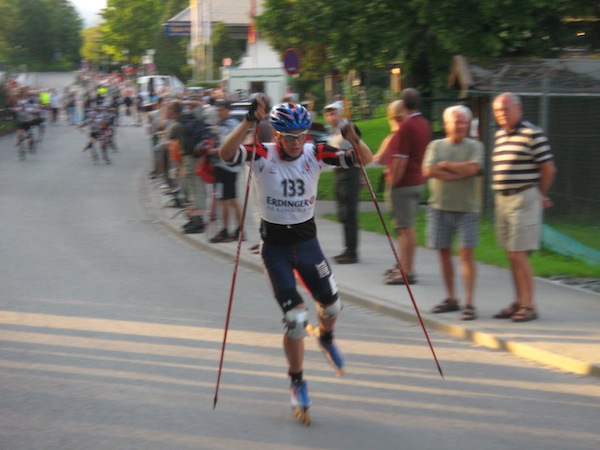
    Billy Demong racing in a Grand Prix race in Europe in 2008. While Demong is racing on inline skates, this year's competitions will be held on rollerskis.

    The team’s season will start with the Grand Prix competitions in Europe—essentially a summer version of the World Cup. Instead of racing on snow, athletes jump off plastic ramps and rollerski around city streets.

    In the past, the Grand Prix races have used inline skates instead of rollerskis, which put the Americans at a disadvantage. (According to Jarrett, the skates are an Austrian and German thing.) As a result, the team’s commitment to the summer races has been inconsistent—they’ve shown up with a mix of elite and developing athletes, or sometimes not at all.

    “It’s not worth it to spend a month training on rollerblades just for four or five races,” Jarrett said.

    But this year, the circuit switched to rollerskis, and accordingly, the U.S. will field a full squad. Unlike in prior summers, the trip will consist solely of B-Team skiers, to get them more experience in Europe and to “start closing the gap,” Jarrett said.

    According to Fletcher, it’s not just the racing that’s important at the summer events.

    “I think it’s just the atmosphere of being over there, being in the competition circuit, seeing what other teams are doing and seeing how they’re racing,” he said. “It’s something that can definitely help me.”

    The Big Three will sit out the summer competitions, but as the winter season gets underway, they will ease back onto the World Cup circuit. But the U.S. only has slots for four athletes at each competition, which means that the B-Team will get fewer starts.

    Lodwick, though, will be focusing his efforts on World Championships in late February, and he will do most of his racing domestically until then—leaving the door open a little bit wider for the B-Team. Just like the summer races, the winter World Cup starts are crucial for the team’s younger athletes, Jarrett says—they need those experiences to ensure that the sport doesn’t fall off the radar when the Big Three retire.

    “In order to keep our program moving forward…we need to have other guys being successful, too,” he said.

    “Todd’s World Cup start will be pretty much open for most of the year,” Jarrett said. “So there’s a bit more impetus and more opportunity for the Nick Hendricksons, the Fletchers, the Camerota brothers to step up and score points.”

    Race organizers pay the travel expenses for the top-50 ranked athletes in the world, and Jarrett said that he wants to see five of his team members in that group by the start of World Championships. That means that two athletes from the B-Team will have to up their game, placing in the top 30 consistently, or even the top 20.

    “In the Camerota brothers, we know those guys are perfectly capable, both on the jumping hill and skiing, to be in there,” Jarrett said. “Our expectation is for those guys to really step up and become full-fledged World Cup skiers.”

    As for the Big Three, Jarrett acknowledged that it might be tough to get them to buckle down again on the day-in, day-out training and racing after the cathartic experience of the Games. But he said the team has adopted a mantra to keep them focused: “The Olympics are over.”

    “We have new goals now,” Jarrett said.

    Demong has committed to racing through Sochi in 2014, and his training over the next four years will be geared towards achieving strong results there. But he has also made clear his commitment to working with his younger teammates–helping them step up to the next level.

    “Ultimately, his goal is to have to fight to even make the team—that we’ve brought the next generation of guys up to the level where they’re beating Bill out of the spot,” Jarrett said.

    Lodwick and Spillane have the same attitude toward the developing athletes, Jarrett said, but those two also see the sport as a profession.

    There’s money on the line every time they pull on a bib, since FIS pays the top 20 finishers at each World Cup—roughly $5,000 for a win, down to $500 for twentieth. That, Jarrett said, should help keep Lodwick and Spillane sharp.

    “There’s money to be made out there, but it’s only getting made by doing well, and they know that,” Jarrett said. “They want to continue the lifestyle and continue the momentum they’ve started, and they want to keep it rolling.”

    As long as Lodwick, Spillane, and Demong continue to race, it will be tough for the B-Team to break onto the scene. But Fletcher said he thinks that’s a good thing.

    “You definitely need the top guys on the World Cup as much as possible, to get the press, the results, and stuff like that,” he said. “Then, it gives the guys below them something to push for.”

  • Olympics Lead 2010 FasterSkier Performances of the Year

    Olympics Lead 2010 FasterSkier Performances of the Year

    Performance of the Year

    This year we expanded the Performance of the Year Award to include three different categories – cross-country, biathlon, and nordic combined.

    XC Performance of the Year (men):

    This season featured a number of outstanding performances, and for the first time we breaking out the award into three categories – cross-country, nordic combined, and biathlon.  The challenge, like in many of the other awards, is how to weigh Olympic results.

    The Olympics are the most prestigious event in skiing, and the biggest stage.  So regardless of field strength, weather, or other incidentals, an Olympic result is worth more than anything else.

    Deveon Kershaw (CAN).  Kershaw’s performance in the Olympic 50km event was one for the ages.  Racing in front of a home crowd, Kershaw put himself in position to sprint for a medal, he came up just short crossing the line just meters, and all of 1.6 seconds, behind gold medal winner Petter Northug (NOR).  Kershaw was outlunged by Tobias Angerer (GER) for 4th.

    The result matched Ivan Babikov’s 5th in the Olympic pursuit as the best Olympic result ever by a Canadian man.

    Petter Northug celebrates his victory while Angerer and Kershaw lunge for the line.

    Honorable Mention

    Ivan Babikov (CAN).  As mentioned above, Babikov finished 5th in the 30km Olympic pursuit, just 9.1 seconds out of the win and 6.3 seconds from a medal.  This was the second time in the Games that Babikov set a new Canadian mark for best male Olympic result.

    Kershaw gets the nod only because he was a bit closer to a medal.  Babikov fell off the pace at the end, and was not in contention for a medal in the final sprint.

    Canadian Men’s Olympic Team.  The team had a stellar Olympics.  In the pursuit, led by Babikov’s 5th, they placed 5, 8,9, and 16.  Babikov was also 8th in the 15km, and Gray 18th in the 50k.

    And the Team Sprint duo of Alex Harvey and Devon Kershaw placed 4th in that event.  While no medals were won, it was by far the greatest Olympics ever for the Canadian men.

    Andy Newell (USA).  Newell placed 3rd in the World Cup classic sprint in Drammen, Norway, an impressive feat considering that classic sprint events in Norway are without doubt the toughest fields on the circuit.

    Kris Freeman (USA).  In a nation with a dearth of World Cup distance skiers, Freeman’s 4th in the Kuusamo 15km stands out.  Freeman just missed his first World Cup podium by just 2.2 seconds, and again demonstrated that when he is on, and has his blood sugar dialed in, he can compete with anyone.

    [poll id=”45″]

    XC Performance of the Year (women):

    Unlike the men’s award, the women’s version is easy – at least in relation to the skier.  The issue, is what performance was the best.

    Kikkan Randall (USA) was easily the top North American woman this season, and she had a number of impressive performances.  She had an excellent Olympics, with great results in every even she started, and she finished on the podium in the pre World Championship World Cup in Oslo.

    Kikkan Randall (USA).  Randall’s podium performance in Oslo gets the nod.  She was leading entering the homestretch, and while she was unable to hold off a red hot Marit Bjoergen (NOR), Randall’s performance shows she is still one of the best skate sprinters out there.  This bodes well for World Championships.

    Randall was the dominant North American once again.

    Honorable Mention

    Kikkan Randall (USA).  Randall’s 8th place in the Olympic classic sprint was a career-best in that event, and set a new mark for top finish ever by an American woman xc skier in the Olympics, bettering her own marl set in 2006.

    Kikkan Randall (USA) and Caitlin Compton (USA).  Randall and Compton teamed up to finish 6th in the Olympic Team Sprint, turning in a gutsy performance.

    Sara Renner (CAN).  Renner thrilled the hometown crowd with a surprising 3rd place finish in the World Cup classic sprint in Canmore just prior to the Olympics.  This was Renner’s first World Cup podium since 2006, and demonstrated that she still had the sprint speed to compete in the finals.

    [poll id=”46″]

    Biathlon Performance of the Year (men):

    Tim Burke (USA).  Burke climbed onto the World Cup podium for the first time this season, finishing 2nd twice and 3rd once.  His 2nd place finish in the 20km individual in Ostersund, Sweden, gets the nod as the top biathlon performance of the year.

    Burke finished 35.5 seconds behind winner and eventual overall World Cup winner, Emil Svendsen of Norway.  The race, early in the season, was the first of the three podium results for Burke, and catapulted him to a new level – from a very good biathlete capable of skiing in the top-10, to a legitimate threat to win races, and a strong medal contender in Vancouver.

    Tim Burke racing in Ostersund (photo USBA/Nordicfocus.com)

    Honorable Mention

    Jean Philippe LeGuellec (CAN).  LeGuelle had an excellent Olympics, capped by a 6th place finish in the sprint event.  LeGuellec actually led the race after the 1st shooting stage.  While this competition was unusual due to a mid-race snow storm, LeGuellec still just 33.7 seconds behind overall World Cup winner and multiple Olympic medalist Emil Svendsen (NOR) who took 2nd.

    Jeremy Teela (USA).  Teela placed a season-best 9th in the same Olympic sprint event.

    [poll id=”47″]

    Biathlon Performance of the Year (women):

    Zina Kocher (CAN).  Kocher finished an impressive 4th in the women’s 10km pursuit in Pokljuka, Slovenia.  She was 23 seconds off the podium, and the only woman in the entire race to shoot clean.

    Honorable Mention

    Lanny Barnes (USA).  Barnes turned in the best North American Olympic biathlon performance in the 15km individual, placing 23rd.  The veteran Barnes was her usual sure-shot on the range, cleaning the 20 targets.  After the final shooting stage she was ranked 16th.

    [poll id=”48″]

    Nordic Combined Performance of the Year

    In a season that included World Cup victories and four Olympic medals, picking the top performance is not easy.  But gold trumps all else.

    Billy Demong (USA).  Demong became the first American to win a championship gold medal in any of the Nordic sports when he captured the top spot in the large hill competition at the 2010 Olympics.  Demong and teammate Johnny Spillane worked together to hunt down Austrian Bernhard Gruber before Demong used a powerful attack on the final climb to open up a gap for the win.

    Demong and Spillane working over Gruber

    Honorable Mention

    Johnny Spillane (USA).  Spillane finished 2nd to Demong in the large hill event at the Olympics, following Demong’s attack with one of his own while laying claim to his third medal of the Games.

    Johnny Spillane (USA).  In the normal hill competition, Spillane also finished 2nd, losing out to Jason Lamy Chapuis (FRA) in the final sprint.

    Brett Camerota (USA).  Camerota, the least experienced member of the US team in the Olympic Team Compeition, did his job and then some.  Camerota moved the US into first, and most importantly, did let any of the other top teams to completely close the gap.

    [poll id=”49″]

    Previous Winners

    2009
    Kikkan Randall (USA)
    Alex Harvey (CAN)

    2008
    Kikkan Randall (USA)
    Andy Newell (USA)

    Award Schedule:

    Thursday, April 15 – Rookie of the Year
    Friday, April 16 – Collegiate Skier of the Year
    Monday, April 19 – Adaptive Skier of the Year
    Tuesday, April 20 – Continental Skier of the Year
    Wednesday, April 21 – Biathlete of the Year
    Thursday, April 22 – Nordic Combined Skier of the Year
    Friday, April 23 – Performance of the Year (cross-country, biathlon, nordic combined)
    Monday, April 26th – Cross-Country Skier of the Year

    FasterSkier Awards 2010
  • 2010 Nordic Combined Skier of the Year is…Combined…

    2010 Nordic Combined Skier of the Year is…Combined…

    Nordic Combined Skier of the Year

    In a year in which the US Nordic Combined Team won five Olympic medals, including gold, and when racing a full squad on the World Cup, was a realistic threat to sweep the podium, how do you pick one athlete.

    Billy Demong won gold and silver at the Olympics, becoming the first US Nordic athlete to bring home a Championship gold.

    Johnny Spillane left the Games with three silver medals, while Todd Lodwick finally got his Olympic medal.

    While the athletes were focused on the Olympics, they still were impressive on the World Cup.  Lodwick placed in the top-6 in in six of eight starts, including two podiums.

    Demong got off to a slow start (by his standards), but still was in the top-14 in all 12 of his World Cup appearances.  He won one race and was in the top-10 eight times.

    Spillane also won a World Cup race, and while he never made it back on the podium, he did place 4th four times.

    In the overall World Cup rankings, Spillane finished 9th, Demong 12th, and Lodwick 15th.

    Finally, there is Brett Camerota, whose clutch performance in the opening leg of the Olympic Team competition helped set up the silver medal.

    So who was the best?

    There is no question that theses skiers are very much part of a team.  They frequently worked together in races to create top finishes for different individuals, and the top-3 have been through all the ups and downs of the last decade together.

    Ultimately this was a historic year for the entire sport in the US due to the performances of each of these athletes.

    The 2010 FasterSkier Nordic Combined Skier of the Year is presented to the entire US Nordic Combined Team.

    US Nordic Combined Team

    [poll id=”44″]

    Previous Winners

    2009
    Billy Demong (USA)

    Award Schedule:

    Thursday, April 15 – Rookie of the Year
    Friday, April 16 – Collegiate Skier of the Year
    Monday, April 19 – Adaptive Skier of the Year
    Tuesday, April 20 – Continental Skier of the Year
    Wednesday, April 21 – Biathlete of the Year
    Thursday, April 22 – Nordic Combined Skier of the Year
    Friday, April 23 – Performance of the Year (cross-country, biathlon, nordic combined)
    Monday, April 26th – Cross-Country Skier of the Year

    FasterSkier Awards 2010
  • USSA Nominates 2011 Nordic Combined Team

    USSA has released nominations for the 2011 US Nordic Combined Team.  Led by Olympic medalists Billy Demong, Johnny Spillane, and Todd Lodwick, the team would consist of nine members.

    Athletes must accept the responsibilities of a USST athlete.  The final team will be named later this spring.

    Demong became the first US skier to win a gold medal in any of the nordic sports this year in Vancouver.  Spillane won three silver medals, and Lodwick captured one silver.

    The trio, along with Brett Camerota, won the silver in the team event.

    Demong, Spillane, and Lodwick are the only athletes nominated to the A Team.

    Brett Camerota leads the B Team, along with fellow Olympian Taylor Fletcher.  The two are joined by their siblings – Eric Camerota and Bryan Fletcher respectively.  Additionally, Brett Denny and Nick Hendrickson were both nominated to the B Team.

    The B Team athletes look to carry on the success of the Demong, Spillane, and Lodwick, all who are likely moving toward the last years of their careers.

    Official USSA announcement

    Silver Medalists – Demong, Spillane, Lodwick, and Camerota
  • Nordic Medalists Head to Middle East

    STEAMBOAT SPRINGS, CO – With a total of seven Olympic medals in tow, the U.S. Ski Team’s nordic combined superstars Billy Demong (Vermontville, NY), Johnny Spillane (Steamboat Springs, CO), Todd Lodwick (Steamboat Springs, CO) and Brett Camerota (Park City, UT) have shipped off to the middle east to visit the troops as part of the 2010 Heavy Medal Tour.

    The Olympic heroes received a sendoff of gold-medal proportion on Friday as the town of Steamboat Springs came together to celebrate their success and wish them well overseas. Saturday morning, another huge crowd gathered at Steamboat’s airport in Hayden as the four boarded the jet for the first leg of their journey in full military battle dress.

    The celebration kicked off in the morning Friday with the four athletes visiting three of the town’s schools. They were greeted by swarms of children eager to see the medals, get autographs and even sing the Olympians a special song.

    Then, after an autograph signing for the town that lasted over three hours with lines still out the door, the athletes hopped in sleds to parade through the snow with their families down Steamboat’s Lincoln Avenue.

    “It’s not one entity or organization, but the entire community that openly embraces these athletes and plays a key role in establishing the core foundation for Ski Town, U.S.A.,” said Jon Roberts, city manager for the City of Steamboat Springs. “The Hometown Heroes Celebration is a way for the entire community to come together to celebrate the Olympic spirit and all that these athletes have accomplished.”

    “Steamboat has a rich tradition in snow sports and an Olympic heritage that dates back nearly 80 years,” said Rick DeVos, executive director of the Steamboat Springs Winter Sports Club. “The spirit to strive for greatness and the unwavering support of athletes of all ability levels, allowing them to fulfill their dreams, whether that’s just getting started in the sport or competing on the international stage, is truly what makes this community unique and sets Steamboat apart from any other place in the world.”

    Following the night of excitement, the Olympic medalists were off to the middle east. While their locations have remained primarily undisclosed, the public can follow the Olympians through photos and videos posted on The Warrior Tours fan page on Facebook.

    According to World Champion Lodwick, the experience he has had with the troops has been eye opening.

    “To see some of the soldiers, and actually see where they come from, that’s when it really hit me – these guys are doing it for us,” Lodwick said. “To give back to these guys, it’s beyond words. I almost get choked up. It’s pretty cool.”

    From his Facebook, Demong, who won the first gold medal in nordic combined for the U.S., noted he gained inspiration from the troops he was meeting.

    “First full day in middle east. I met a lot of folks who sacrifice a ton to be here. Totally inspiring! Going somewhere off shore tomorrow,” Demong said.

    Judging by the pictures of Demong, Spillane, Lodwick and Camerota, the men have been spending time on various bases, as well as on an oil platform in the middle of the Persian Gulf and flying in a desert hawk helicopter.

    And, in a majority of their online photo galleries, the Olympians are putting their medals around the necks of as many soldiers as they can.

    With his silver from the team event on over a “flak jacket,” Lodwick noted one of the many purposes of hacing the Olympic medals on tour with them.

    “If this thing ain’t bulletproof, it is now,” Lodwick said, pointing to the medal as a source of armor.

    The Olympians will be touring the middle east for two weeks. Follow the action on Facebook.

  • 2010 Olympic Gold and Silver Medalists to Visit Troops Overseas

    Olympic Heavy Medal Tour to visit U.S. military bases in Southwest Asia

    Washington, D.C. – The 2010 U.S. Olympic Nordic Combined Team takes the helm of the Armed Forces Entertainment (www.armedforcesentertainment.com) “Olympic Heavy Medal Tour,” bringing for the very first time, four Olympic medalists and their Olympic hardware on a special tour to visit troops stationed at U.S. military installations around the globe.

    “As these Olympians will tell you, there is an enormous sense of pride in representing your country at the Olympic Games,” said USAF Colonel Ed Shock, Chief of Armed Forces Entertainment. “That same sense of pride is what drives the troops of the United States daily, and to bring these two teams together will be a real treat.”

    U.S. Team ended an 86-year U.S. Olympic medal drought in the sport of Nordic combined (a sport combining ski jumping and cross-country skiing) at the 2010 Vancouver Olympic Games when they captured medals in each of the Nordic combined events contested at the games. As the first reigning Olympic medalists to visit troops this season, the team will end another drought when Bill Demong (Vermontville, NY), Johnny Spillane (Steamboat Springs, CO), Brett Camerota (Park City, UT) and Todd Lodwick (Steamboat Springs, CO) place their combined seven Olympic gold and silver medals around the necks of U.S. soldiers during this special tour.

    “We’re blessed to have the opportunity to compete on the world’s largest sporting stage and return home from the 2010 Winter Olympics with a heavy medal load,” said Johnny Spillane, four-time Olympian, World Champion and three-time Olympic silver medalist. “Now it’s time to show the world who the true HEROES are!”

    Following the F.I.S. Nordic Combined World Cup Finals in Oslo, Norway, March 12-14, the U.S. Nordic Combined Team will return to their hometowns briefly, before re-deploying as members of Armed Forces Entertainment’s inaugural “Olympic Heavy Medal Tour.”

    “We’re bringing more than 35 pounds of gold and silver in the form of Olympic medals on this tour,” commented four-time Olympian, World Champion and Olympic gold and silver medalist, Bill Demong. “We’re not coming home until we’ve met thousands of soldiers and crowned them the true gold medalists.”

    One of the biggest stories at the 2010 Olympics was the performance by the U.S. Nordic Combined athletes. Spillane started the two weeks of historic results off with the U.S.’s first-ever Olympic Nordic Combined medal, winning silver in the Normal Hill Combined event. Spillane was then joined by teammates Demong, Camerota and veteran Lodwick for the team competition where they came away with a silver medal. Demong and Spillane then capped off the historic Olympic fortnight with a gold-silver finish in the Large Hill Combined competition.

    “Our goal is to see how many soldiers we can crown champions by placing our medals around their necks,” says five-time Olympian, two-time World Champion and Olympic silver medalist, Todd Lodwick.

    “While the guys are away, rest assured all of us at the U.S. Ski Team are going to be wearing yellow ribbons till they come home and beyond,” said U.S. Ski Team Nordic Combined Head Coach Dave Jarrett about his athletes’ commitment to the troops and the U.S. Ski Team’s support of their efforts.

    The team is scheduled for an early-April departure on a worldwide tour of U.S. armed forces bases led by trip leader Rob Powers, founder of The Warrior Tours (www.thewarriortours.com) and a 2nd Lt. U.S. Army (Ret). Powers, a veteran of the Armed Forces Sports Program, is a former national and Olympic team ski coach. Joining Powers on the group will be a videographer and photographer documenting the trip.

    Troops can expect personal interaction with the athletes, the ability to inspect the Olympic medals and opportunities to ask questions of their favorite Nordic Combined heroes. In addition, Under Armour will provide performance apparel as part of the Armed Forces Entertainment “Olympic Heavy Medal Tour.”

  • With Two Silvers, Can Combined Cash In?

    With Two Silvers, Can Combined Cash In?

    Medals

    For a complete report on Tuesday’s team event, click here

    Whistler, British Columbia – This one was big time.

    After its first-ever Olympic medal last week, the U.S. Nordic Combined Team got the full treatment Tuesday, as sports journalists converged in hordes to watch Billy Demong, Johnny Spillane, Todd Lodwick, and Brett Camerota jump and ski their way to a second silver.

    ESPN, Time Magazine, Sports Illustrated—all the major players showed up at Whistler Olympic Park to take in the event and relay the news to millions around the country. All the buzz reflects the sport’s newfound appeal to the American public, and it will give a big boost to a program that has labored on the fringes for its entire existence.

    Billy Demong at the post-race press-conference

    It’s not just the silver medals. It’s the years of hard work, the charismatic subjects, and the triumph (or near-triumph) of the underdog that make a recipe for a perfect narrative.

    “It’s a great story,” said Sean Gregory, a staff writer for Time who was covering Tuesday’s race. “America has never done well in the sport, and their sudden success in the team event is great because it’s not just one guy—it’s the whole thing. I came into this thinking it would be exciting, and it was.”

    The hardware and the media spotlight are no guarantee that nordic combined will end up with more funding from the U.S. Ski and Snowboard Association (USSA) in coming years, especially given the state of the economy. But the TV time and photos splashed on front pages of USA Today’s web site sure don’t hurt, says John Farra, who oversees the program at USSA. He will go before his superiors in a few months with nearly six pounds of ammunition—the total weight of the five silver medals won by the nordic combined team here (one in the individual, and four in the relay).

    “If there’s more money in the pot, I believe strongly that we can walk in there in the spring and make an argument that…we have a plan that shows we’re going to continue this success at the next Games,” Farra said. “I’m not fool enough to think that it’s going to absolutely help us, but it’s sure as hell better than the alternative.”

    The ramifications don’t just come from the top down. They also come from the bottom up, as thousands (or at least hundreds) of potential future nordic combined skiers see the spotlight that could be in store for them.

    At a recent local race, Demong said he handed out participation awards to more than 200 star-struck young athletes. Each of them wished him luck in Whistler, and will now get to soak in the team’s triumphs at the Games. Those youngsters now can see that a career in combined doesn’t mean consigning yourself to a lifetime of obscurity.

    USSA staff watches the race with apprehension

    “What’s really exciting about some of the success we’ve had in the past, but especially now at the Olympics, is that these kids look at nordic sports as something that they can do not only to be on the U.S. Ski Team, but also to be Olympic medalists,” said Demong.

    The question now is whether the strong American results and thrilling finishes of the two Olympic races thus far can actually sustain an interest that will extend all the way through the next four years, until the combined boys get another chance to gun for gold in Sochi.

    It’s probably not reasonable to expect the New York Times to bring on a nordic correspondent. But the thrills inherent in the sport do make for good press, according to ESPN.com’s Jim Caple.

    “The way they can show it now—rather than, ‘oh, they just go off into the woods and come back’—it is exciting. There’s a lot of strategy involved,” he said.

    While no one’s going to go over to Europe and cover the World Cup, Caple said, the medals and exposure garnered by the Americans here have given the sport a platform to stand on for the next Olympics.

    “That’s how you build it. You win some medals, people see what the event is, they hear the athletes, they hear their stories, and they gain some more respect,” he said. “It’s going to take some time, but they’re making a lot of progress.”

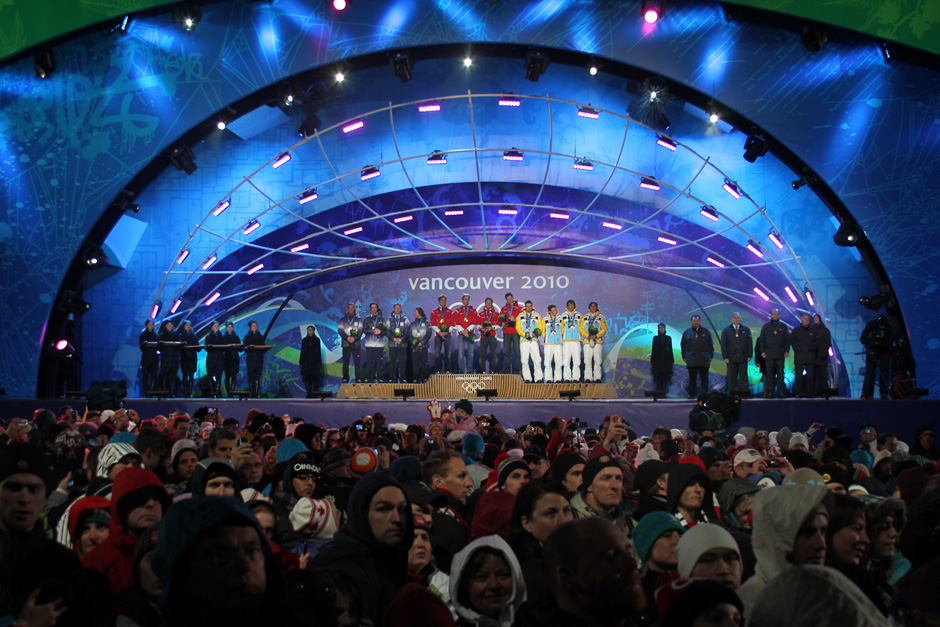
    Medals ceremony