From the FasterSkier archive — posts syndicated from athletes’ and coaches’ own blogs between 2004 and 2012, kept online as published. Current coverage is at fasterskier.com.
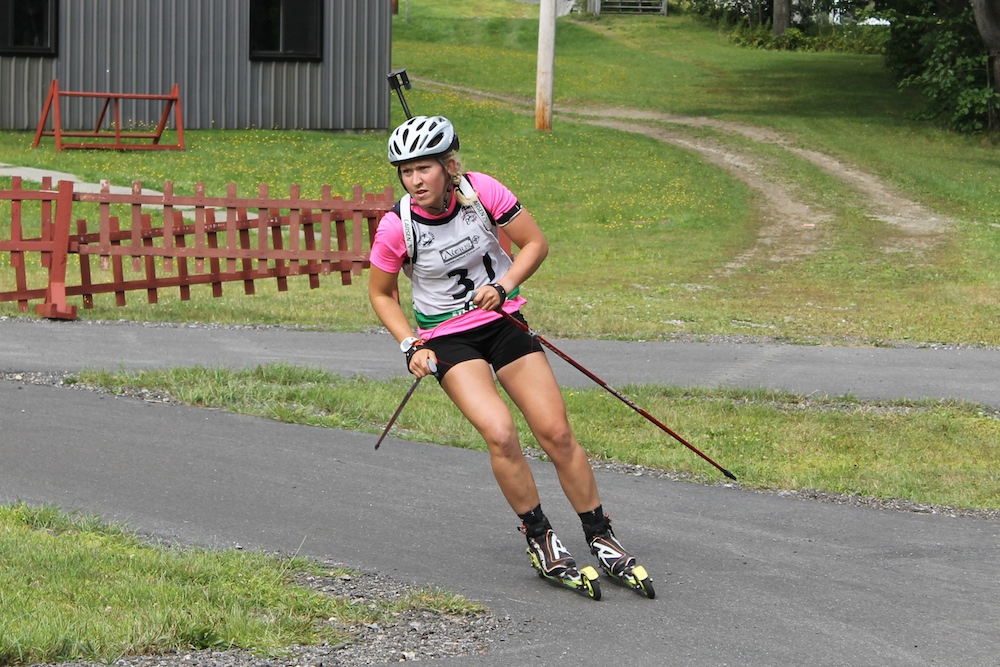
American Siena Ellingson during her standing stage of the women’s 3 x 6 k relay at IBU Junior World Championships in Cheile Gradistei, Romania. (Photo: IBU YJWCH Cheile Gradistei 2016/Facebook)
(Photo: IBU YJWCH Cheile Gradistei 2016/Facebook)
Hamel cleaned both stages without any spare rounds. (Photo: IBU YJWCH Cheile Gradistei 2016/Facebook)
(Note: This article has been updated to include comments from Canadian coach Richard Boruta after Tuesday’s junior relays.)
It was the last day of IBU Youth/Junior World Championships, and for several juniors racing on Tuesday in Cheile Gradistei, Romania, the idea was to have fun. Maddie Phaneuf said that was a priority on U.S. women’s 3 x 6-kilometer relay team: “We hadn’t really set a goal for the day…I was just reminding the girls to have fun out there and do their best,” she wrote in an email.
Personally, she wanted to hand off to second-leg Siena Ellingson in a good position. Phaneuf did so, skiing the second-fastest scramble leg of 16 teams and coming into the first exchange in fourth, 42 seconds behind the leaders.
While she avoided the penalty loop on both shooting stages, Phaneuf used a total of three spare rounds to clean: two on the first prone, which put her back in 12th, and one in standing.
“It was fun to pick off the girls on the last loop and move up to 4th from 7th after my standing stage,” she wrote. “I felt really strong today and my skis were fast thanks to our wax techs.”
The Norwegian women’s team (Anne Marit Bredalen, Turi Storstrøm Thoresen and Ingrid Landmark Tandrevold) skied to the win in 55:26.3, passing Sweden on the last loop to win by 15.6 seconds with a team total of five spares (0+2, 0+3). Sweden took second with four spares (0+0, 0+4), and Austria reached the podium in third, 55.5 seconds back with seven spares (0+2, 0+5).
The U.S. finished 12th (+5:55.2) with one penalty and nine spares (0+4, 1+5). Ellingson shot identical to Phaneuf, cleaning with the help of two spares in prone and one in standing, and anchor Claire Waichler cleaned prone but had to ski a penalty lap after using all three spares in standing.
Fifteen teams finished. Canada did not. Kendall Chong started the team off with three penalties and six spares (0+3, 3+3) and tagged teammate Charlotte Hamel in 16th. While Hamel cleaned both stages without any spares, she couldn’t move up from that position. The third Canadian, Leilani Tam von Burg did not start.
“Leilani was getting sick and it was not sure until the last moment whether or not she will be able to race,” Canadian trip leader and Biathlon Alberta Training Center coach Richard Boruta wrote in an email.
The fourth junior woman on the team, Caitlin Campbell was hospitalized after crashing in the sprint last Saturday.
“She is not allowed to exercise much at this moment,” Boruta explained. “We did’t have any other chance than to include Leilani and hope for the best. However, it didn’t work out with her, but the other girls still felt that they would like to have one more opportunity to compete against the strong international field, one of the important things missing in Canada / North America.”
For Phaneuf, in her third and final Youth/Junior World Championships, she explained the relay was a good way to end the week in Cheile Gradistei. Individually, she notched three top 10’s: fifth in the 12.5 k individual, seventh in the 7.5 k sprint, and ninth in the 10 k pursuit.
“I think I ended my junior career on a really solid note,” Phaneuf wrote. “It was exciting to reach my goals and end I can’t wait to see what the rest of the season brings.”
Next up for the 20-year-old US Biathlon development skier? Phaneuf said she’s headed back to the U.S., where she’ll spend just under a week training and recovering in Lake Placid, N.Y., before heading to Presque Isle for the IBU World Cup next week.
“During those races I have the opportunity to qualify for the World Championship team, so that’s definitely a goal of mine,” she wrote. “We’ll see what happens! Either way, I’m happy with how my season has turned out so far. It’s great to see how much I’ve improved from last year.”
(Story continues below)
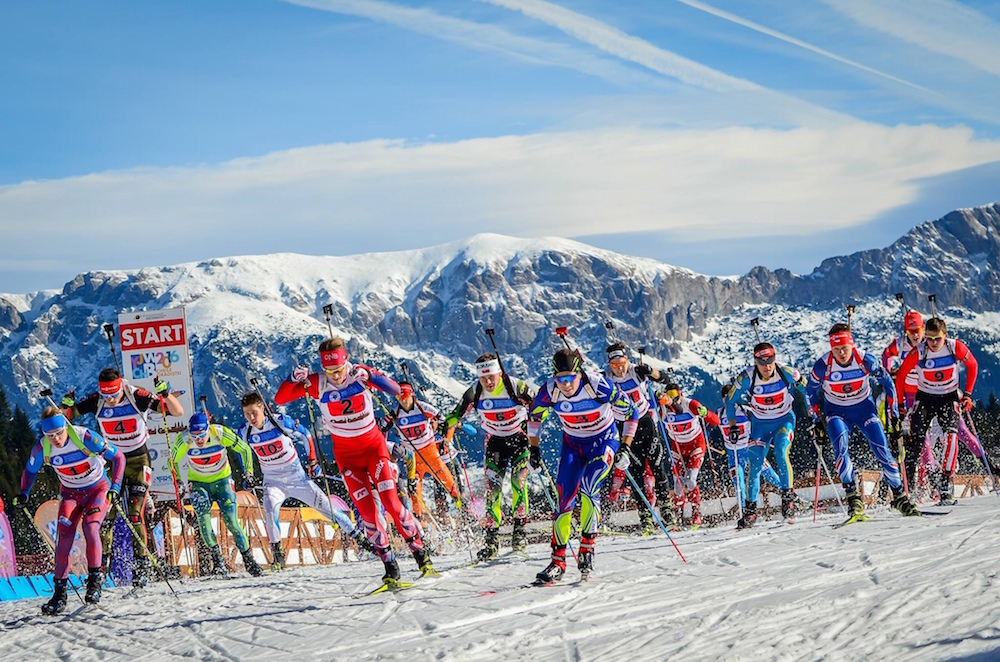
Start of the junior men’s 4 x 7.5 k relay at IBU Junior World Championships on Tuesday in Cheile Gradistei, Romania. (Photo: IBU YJWCH Cheile Gradistei 2016/Facebook)
In the junior men’s 4 x 7.5 k relay, the Russians dusted the field by two minutes in 1:23:56.7. All four men (Dmitrii Shamaev, Viktor Plitcev, Nikita Porshnev, and Krill Streltsov) shot flawlessly in prone and everyone but Streltsov cleaned standing without any spares (Streltsov used two — the team’s only spares).
Germany claimed second (+1:59.6) with eight spares (0+4, 0+4), and the Czech Republic took third (+3:05.8) after using six spare rounds (0+1, 0+5).
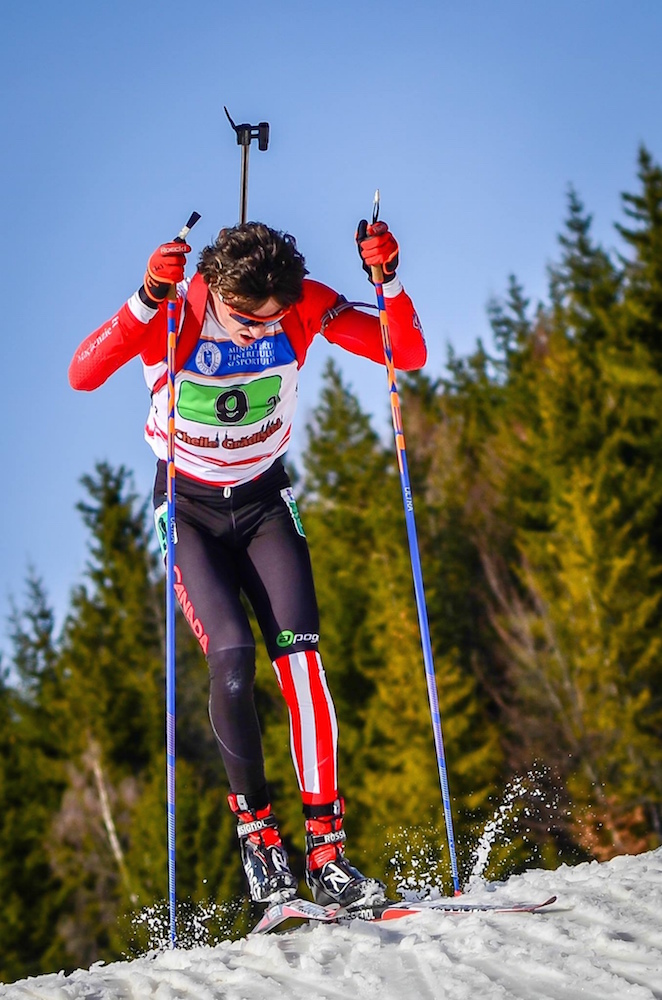
Alex Dupuis (Canada) racing the second leg of the men’s 4 x 7.5 k relay at IBU Junior World Championships on Tuesday in Cheile Gradistei, Romania. (Photo: IBU YJWCH Cheile Gradistei 2016/Facebook)
The Canadian men finished 14th (+11:12.1) after skiing eight penalty loops and using 18 spares. Matthew Strum opened with one penalty and five spares (0+2, 1+3) and tagged the team in 16th, Alex Dupuis cleaned both stages, using one spare in prone (0+1, 0+0) to tag off in 14th.
The Canadians held onto the position from there, despite Aidan Miller skiing five penalty loops and using six spares (3+3, 2+3), then tagging Pearce Hanna in 14th. Hanna shot skied two penalty loops after prone and cleaned standing with three spares (2+3, 0+3) to finish about a minute behind 13th and 19 seconds ahead of 15th.
According to coach Boruta, top 10 was a reasonable goal for the junior men’s relay.
“Alexandre Dupuis was the only one who did have a good relay performance…,” Boruta wrote. “Charlotte [Hamel] did have a good day on the range as well, unfortunately her skiing is quite far off of the pace.
“Overall, all the top 20 (or even 30) placings are very respectable results and we should be happy, that we have at least few athletes who can be at that level,” he reflected on the team’s overall showing at the championships. “The competition is becoming stronger and more nations are in a position for good results.”
Biathlon Canada doesn’t fund programming for junior or youth athletes, so essentially “there is also no high expectation for their performance,” Boruta explained. “Those athletes are spending around $20,000 – $30,000 a year for the privilege to train full time and represent Canada internationally, but sometimes this makes it frustrating for the coach, because there is no real leverage if there is a need to change their attitude or anything.
“Our mandate is to develop athletes to such a level that they can make the jump from juniors to seniors and become competitive within a reasonable time frame,” he added, explaining that’s working so far.
The U.S. men’s team of Paul Everett, Brian Halligan, Brendan Cyr, and Travis Cooper finished 18th of 20 teams, with seven penalties and 17 spare rounds.
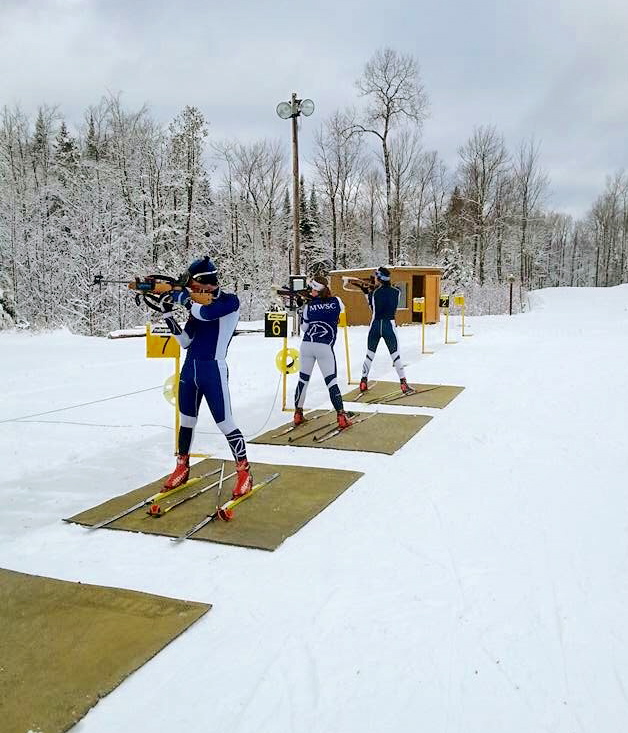
Maine Winter Sports Center (MWSC) biathlete Brendan Cyr finishes his second round of prone shooting during a late-December workout at the Fort Kent Outdoor Center in Fort Kent, Maine.
Before the USA Youth and Junior Biathlon World Championship Team Trials kicked off this week (Dec. 27-30) in Anchorage, Alaska, FasterSkier caught up with the Maine Winter Sports Center (MWSC) biathlon program for a workout to help prepare athletes for the heat of the competition season. The workout can be done once or twice per training cycle and may be easily adapted into a cross-country workout.*
FORT KENT, Maine — What could be better than a rugged set of intervals with Northern Maine’s finest. How about a rugged set of intervals with a rifle?
Though not everyone can handle shooting with a simultaneously high heart rate, Seth Hubbard, biathlon director and head biathlon at the Maine Winter Sport Center (MWSC), said a head-to-head shooting workout is essential for biathletes looking to improve both their skiing and shooting.
“What we’re trying to do is recreate the pressure of coming into the range of a competition with other racers around,” Hubbard said on the phone.
Left to right: MWSC biathletes Brendan Cyr, Mikaela Paluszek and Russell Currier shoot during a head-to-head workout in late December at the Fort Kent Outdoor Center in Fort Kent, Maine. (Courtesy photo)
In order to mimic the high stakes and stress of a race, the workout itself involves a 4 x 1-kilometer mass start, with shooting and 150-meter penalty laps to follow each 1 k interval loop.
“What it does is it puts a lot of pressure on shooting well. You want to shoot fast, but you also want to hit your targets because the penalty loops, in comparison to the 1 k loops, are a pretty large percentage of the [workout],” Hubbard pointed out.
The shorter-distance interval loops allow athletes to push the pace without overexerting themselves too much prior to upcoming competitions, while also providing a practice scenario for shooting with a high heart rate and high pressure.
“This is a workout we use as we get closer to competitions to mimic race efforts and race stress level,” said Hubbard, “It is also something we’ll use periodically throughout the year just to stay in touch with that stress of a shooting competition.”
Brendan Cyr of Caibou, Maine, currently a post-graduate biathlete at the MWSC who plans to attend St. Lawrence University next fall, said the workout strengthened his preparation for the Youth and Junior World Championships trials taking place this week in Anchorage.
“I like the workout because I get to practice shooting with a very elevated heart rate,” Cyr said during an in-person interview. “The head-to-head racing is also great preparation for competitions because [my teammates and I] generally hit the mats at the same time and have the added pressure of shooting with other athletes around.”
Current MWSC biathletes in the program, in addition to Cyr, include Brian Halligan, Cody Johnson, Hannah Streinz, Mikaela Paluszek, Maddie Phaneuf, and elite athlete, Russell Currier.
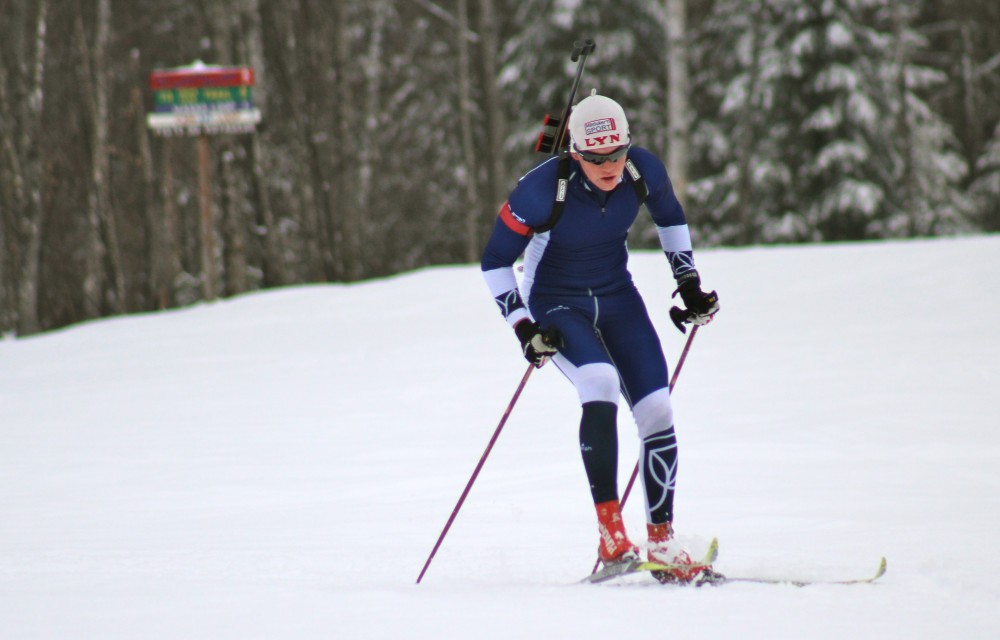
Brendan Cyr (MWSC) rounds the stadium of the Fort Kent Outdoor during a workout in late December in Fort Kent, Maine.
With a smaller team compared to previous years, Hubbard looks to expand the breadth of their program, as well as its depth.
“We don’t just want to push to get numbers if they’re not going to be the people who are going to mesh well with the program and mesh well with the area,” Hubbard said.
He added that the MWSC program continues to seek dedicated athletes willing to grow individually and athletically in the hillocks of northern Maine.
“Whether or not they’re going to be the next Olympian, we want to draw in and develop more mature athletes. Mature in the sense that they’ve developed — as an athlete and an individual — a better understanding of planning, process, commitment, and goal setting, whether those are in life or skiing.”
The Workout: Head-to-Head Shooting
Warmup: 20-25 minutes easy Level 1 skate skiing
Intervals: 4 x 1 k mass start with shooting and 150-meter penalty laps after each 1 k interval (depending on the amount of targets missed). Skiing should be continuous.
– Shooting format is prone, prone, standing, standing
– 1 k interval effort/pace should be race pace or just above race pace. “You’re trying to get race intensity experience — something that’s going to be a very challenging intensity to be shooting at,” Hubbard explained.
*Cross-country adaptation: Instead of shooting in between each 1 k interval, take approximately two minutes of rest before beginning the next interval piece.
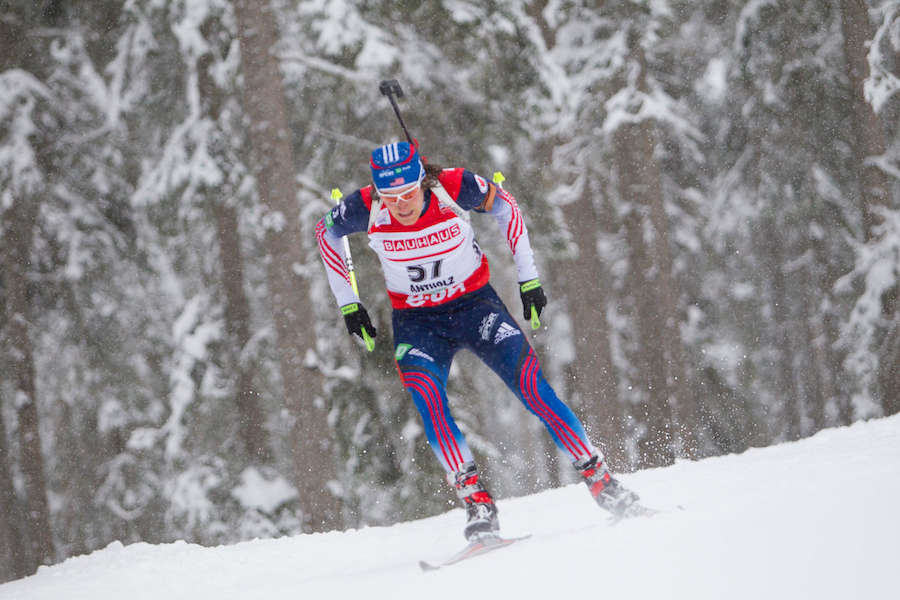
Russell Currier competing in a World Cup sprint in Antholz, Italy, in 2014. An Olympian in Sochi and a two-time sixth-place World Cup finisher, Currier had his worst season in years and was cut from the U.S. National Team. Paired with funding cuts to his home club, the Maine Winter Sports Center, Currier and his teammates are trying to pick up the pieces. (Photo: USBA/NordicFocus.com)
For a group of biathletes based in Maine, two painful announcements came in the last few weeks: first, the news that their home base, the Maine Winter Sports Center (MWSC) would be drastically reducing the support offered to its Olympic Development Team (ODT), and secondly, that many of them did not get re-named to teams by the United States Biathlon Association (USBA).
When the team nominations came out, neither Russell Currier nor Casey Smith were back on the B-team, and Brian Halligan and Kelsey Dickinson were not re-named to the National Development Group. Only one MWSC athlete, Maddie Phaneuf, retained her spot, in her case on USBA’s upper-tier development squad, the X-Team. Phaneuf, still a junior, got her first World Cup start this past season.
Smith, Currier and Dickinson had represented the United States at IBU Cup competitions, the circuit one tier below the World Cup. Halligan, a first-year junior, had competed at World Youth and Junior Championships. All four are now struggling to decide whether to stay in Maine for the upcoming training year, and if so how to support themselves both financially and with coaching at trials competitions, since MWSC will no longer send staff to out-of-region races.
USBA Chief of Sport Bernd Eisenbichler heard about the cuts and has talked to the athletes, but it did not affect the national team selections. He said in a phone interview that while he wishes that he could support the struggling MWSC athletes more, it’s not the job of the federation to take over for the clubs.
“Maine Winter Sport is a great partner for us,” Eisenbichler said. “Together we must see what we can do for the athletes. But it is also clear that the federation cannot take care of all biathletes in America. So we have to have criteria and we have to have a qualification system to get more funding, resources, and coaching attention along the way. There are not a lot of clubs out there with lots of resources, so it’s not really good for us what happens there right now, I have to say honestly. But I also really want to speak to [MWSC President] Andy [Shepard] to hear more details about it.”
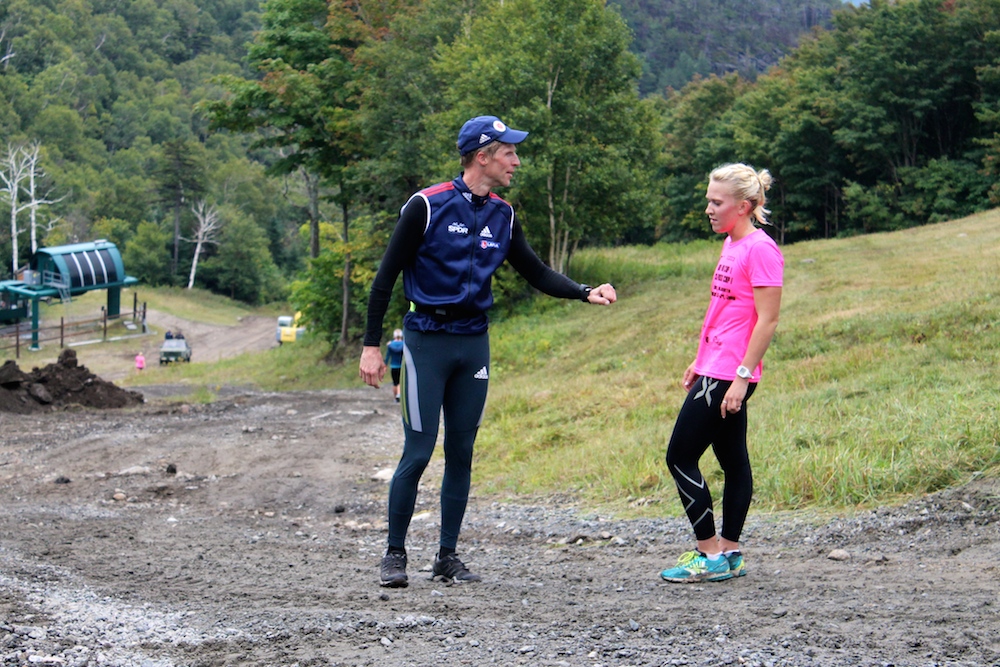
Kelsey Dickinson talking to U.S. Women’s Coach Jonne Kähkönen at USBA’s Talent ID Camp last year. Dickinson was selected to be part of USBA’s Development Group last season.
At the time of his interview, Eisenbichler emphasized that he had not yet spoken with the MWSC CEO, Shepard, who made the decision.
“I don’t want to talk about inside things as I don’t know,” Eisenbichler said. “I just can say that I know Andy and his team did a great job over the last decade being a great development resource for us and our athletes, and getting them ready for the next level. I feel very thankful for that. If there are changes now, there will be a good reason for it. I want to talk to him in more detail.”
For Dickinson, though, that support from MWSC just gave her a painful taste of what she could have had, before it was taken away.
“People don’t realize necessarily the commitment that it takes to be a senior level biathlete that’s not getting massive amounts of support from U.S. Biathlon,” she said. “It’s heartbreaking to be in this place where I’m looking at next year and trying to make it work because I want to pursue biathlon. A lot of people are feeling that right now. I’m not the only one.”
Not Quite Good Enough
In most cases, the athletes saw it coming that they wouldn’t get re-named to the USBA teams. Currier, a 2014 Olympian who has two previous World Cup top 10’s to his name, had his worst season in several years..
“The season started out pretty well but by January I was mentally and physically exhausted,” he explained. “Since then I have felt a little better. For me it was a good summer with some big improvement. I just got really stressed out on race day and couldn’t put it together on the shooting range, and that spilled over into the skiing. I never really got going the way I wanted things to go. It just sort of snowballed.”
Casey Smith (left) on his way to placing second in a NorAm mass start in Canmore, Alberta, in early December. (Photo: Jake Ellingson)
Neither he nor Smith made the criteria to get re-named to the national B-team. The objective criteria would have been two top-35 performances on the World Cup or at World Championships. While Currier raced the first period of World Cups, with a top finish of 61st, Smith did not appear at the sport’s highest circuit. His top IBU Cup finish was 38th in a sprint in Ridnaun, Italy; Currier placed consistently in the high 30’s in early January.
While the USBA rules allow for discretion in naming the B-team, Eisenbichler said that none of the athletes made a compelling case for themselves with their non-World Cup results.
“The B-team for us is really a team that we really want to have people who when they come to the World Cup they would be really competitive there,” Eisenbichler said. “And unfortunately nobody really made the criteria, and for nobody was there an outstanding result where you can say, okay, this is a discretionary thing. We know that all these athletes, Casey Smith, Russell Currier and Wynn Roberts, have the potential to be there, and have already showed that they can be at a much higher performance level than they were at this year. But unfortunately this year was not their strongest year.”
Roberts, a 2010 Olympian who is a member of the National Guard biathlon program, also had his hat in the ring. He placed in the top 30 of the IBU Cups in Canmore, Alberta, in three different races. But the fields were not deep, with just 45 or 46 finishers, and even when he placed 22nd in a sprint, he was 1:41 back in a race that took the winner just over 24 and a half minutes, or about 6% slower than the winner.
Smith, an Under-26 athlete and younger than Currier and Roberts, could have also qualified for the B-team by placing in the top third of the field at Open European Championships. But his best finish, 61st out of 98, did not come close.
Brian Halligan (Maine Winter Sports Center/USBA Development Team) competing in the NorAm mass start in Canmore, Alberta, on December 7. Halligan later swept all three junior men’s races at World Youth and Junior Trials in Mount Itasca, Minnesota. (Photo: Jakob Ellingson.)
Still, Smith, who crashed hard while training on course at the final IBU Cups of the season in Canmore, believes that if he hadn’t had to abandon the rest of his season he could have turned in results that would have netted him a nomination. As it was, he was laid up with broken ribs, bones in his back, and a punctured lung, and will be recovering for a long time before fully resuming training.
And he also believed that domestic results should have spoken in his favor.
“I would have thought that after winning the IBU trials two years in a row they would see more potential in me,” he wrote.
The USBA criteria note that winners of the National Championships – which Smith missed with his injury – would be invited to a summer training camp and evaluated for eventual inclusion on the B-team or another team, although such a naming is not guaranteed. The double victor at nationals, Patrick Johnson of the Auburn Ski Club, was named to the X-team, an intensely-focused training group based in Lake Placid, N.Y., for outstanding juniors and cross-country skiers converting to biathlon. A standout skier, Johnson has been doing biathlon for roughly a year.
As for why Halligan and Dickinson were not re-named to the Development Group – a lower-tier, non-residential program below the X-team – both understood that they hadn’t raced as well as they had hoped this season. Halligan, for instance, said that he had overtrained.
“By the time I got to Europe my body was just exhausted and I didn’t have too great of a result,” he said. “So I honestly didn’t expect to get called back to the Development Team this year.”
As a first-year senior, Dickinson was thrilled to have made the IBU Cup team, a goal she said she hadn’t been confident she could achieve. She hoped that that accomplishment would have been recognized, but at the same time understood why the results themselves were not. She got to race in Poland and Italy, where she had a top finish of 68th, as well as in Canmore, where she twice placed 28th out of 36 women.
Kelsey Dickinson competing at the 2014 North American Rollerski Championships at Ethan Allen Firing Range in Jericho, Vermont.
“There are criteria,” she said. “I didn’t do well when I was over in Europe. It was a bit of a rough trip. The new levels that they have are pretty tough especially because it’s mostly the A1, A2, and A3 teams now I think. I understand… I get why I didn’t get named.”
In order to be a better biathlete in the future – and biathlon is the sport she intends to follow long-term – she has read the criteria and, metaphorically, the writing on the wall. Incidentally, what she needs to do may not in the long term be incompatible with a return to the College of Saint Scholastica, where she was enrolled before spending a year at MWSC to focus on biathlon full-time.
“My goal this year is to ski faster,” she said. “That’s why they didn’t name me to anything. It was because I wasn’t skiing fast enough this year. Skiing for the NCAA circuit and skiing for [coach] Chad Salmela, I think I could make some of those advances.”
Cuts on the Home Front
Between the dual cuts, the four athlete are looking at a loss of opportunities to train in Lake Placid with other top-level biathletes, reduced contact with national team coaches and other support staff, like sports psychologists, and, perhaps most significantly to their chances of getting re-named to a national team down the road, a cut in both funding and coaching support for national trials races in the summer, fall, and winter.
That also affects other biathletes, like Katrina Howe, who also represented the U.S. at IBU Cups in Canmore but hasn’t been a member of their development program since 2010, the year after she graduated from the University of Vermont.
Maine Winter Sports Center athletes and friends enjoying Lake Tahoe on their trip to U.S. National Championships in March. There, Dickinson, Phaneuf and Katrina Howe shuffled back and forth between places two and four in the combined junior/senior women’s results. (Photo: Katrina Howe/Facebook)
“Last year our trips, like to Canmore and Minnesota for trials, were all covered by Maine Winter as part of being on the team,” said Halligan, who paid to be part of MWSC’s postgraduate training program for the last two years. “This year the trip to Junior World trials will be covered. But all the others, like for rollerski races and IBU Cup trials, you have to cover those on your own. And also since Seth [Hubbard] is the only coach at the moment, they won’t be sending a coach out there either. So you’ll have to go at it alone, or have to hook up with another team.”
Hubbard did not return a request for comment.
The financial stretch seemed to trouble some athletes more than others; Halligan didn’t seem overly concerned with the increase in tuition of the postgraduate program, although covering travel expenses was a stressful prospect. For the senior athletes, however, who had not been paying program fees, the vastly increased expense seemed devastating.
“For me it’s a financial thing,” Dickinson said in an interview. “I can’t afford to fund myself and be completely unsupported next year.”
With Will Sweetser leaving as the head of MWSC’s cross country skiing program, Hubbard’s responsibilities in northern Maine have changed and increased. Not having him with the team on the road is one of the most daunting changes for the biathletes: there’s additional components to preparing for a biathlon race compared to a ski race, like zeroing on the shooting range.
Casey Smith competing in the men’s 10 k sprint at the 2014 North American Rollerski Championships.
“With me the biggest thing was even if we could hire a part time coach to come with us to Canmore, Minnesota and those different places, it’s a little different in biathlon especially because when you’re working with someone through the whole year they really understand your shooting,” Dickinson said. “It’s harder to just jump in with someone else.”
Halligan and Smith both said that the support changes are making them look at other clubs and doing some cost analysis. Smith wrote that the change “makes me question if [MWSC] will continue to be the best option for me.”
For Dickinson, the financial aspect as well as the coaching support is what is making her contemplate a return to college.
“I qualified for World Juniors in Presque Isle basically training [at College of Saint Scholastica] and doing biathlon on my own,” Dickinson said. “I didn’t have a coach. I was shooting on my own – there’s a range, although I don’t know what the status of it is now that I’m going back. I had a little help from Chad [Salmela, the CSS coach and a former biathlete] but not really because he’s so busy with the team. He supported me going to different races. The problem is that I made this really big jump last year as a first year senior with qualifying for the IBU Cup and that level of training does require have a coach and having higher level opportunities. I see that a little more difficult for me to make that happen on my own in Duluth while I’m going to school. It would just require so much more.”
While all lauded the training group atmosphere in Maine, which will remain despite the funding changes, Currier is the only one who seemed to be definitely staying, although he said that he is still working out the details of how that can be compatible with international competition.
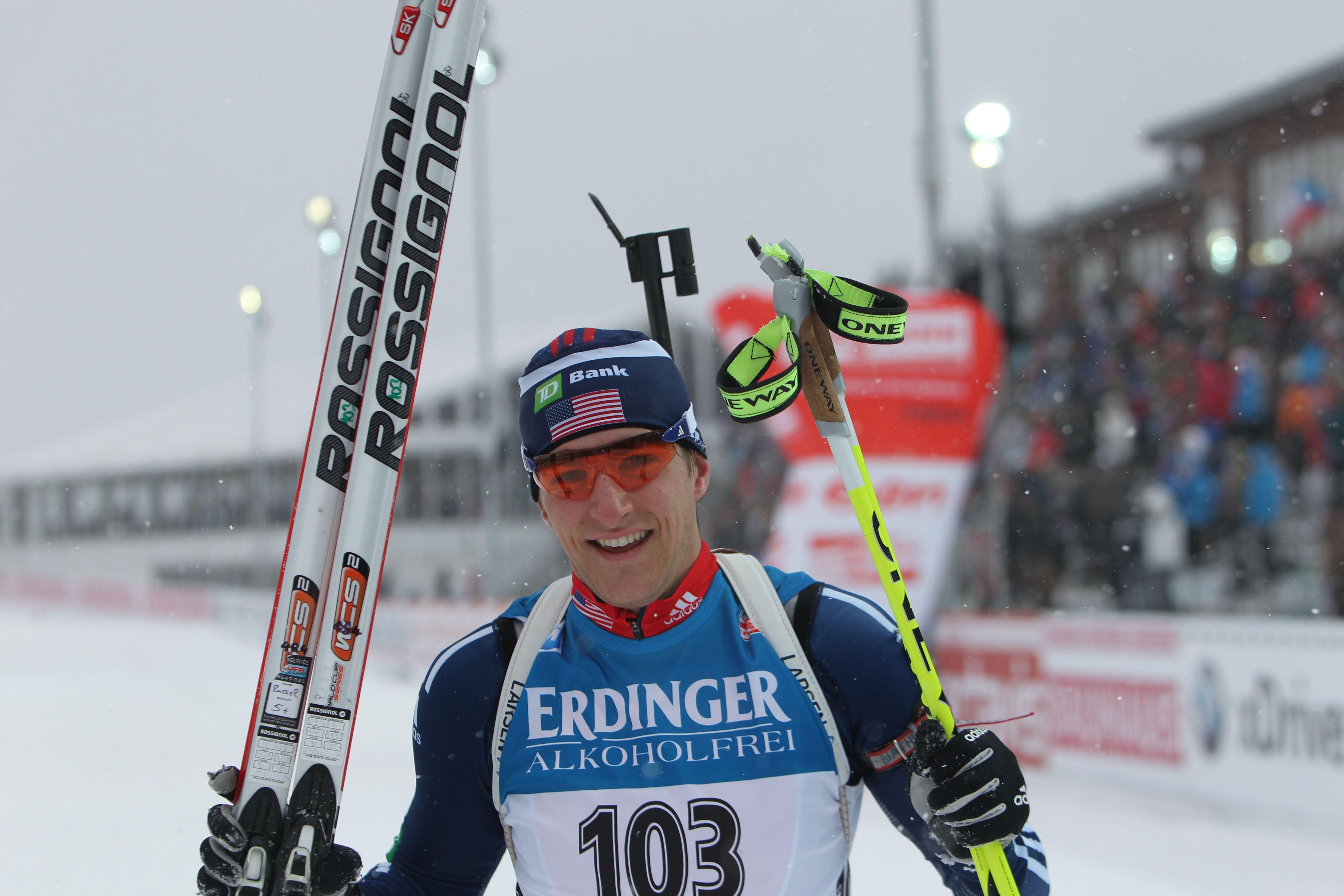
Currier at the finish of the Nove Mesto sprintin 2012, where he came from bib 103 to place sixth. (Photo: USBA/NordicFocus.com)
“For me, it still makes sense to be there because nobody knows training in the area like I do,” the 2014 Olympian explained. “I know where all the good roads are. For me it’s home, really. From a training perspective that’s a big advantage.”
An Open Door?
Eisenbichler said that just because athletes were not named to the national team in the spring did not imply that they would never be named again. In a new strategy, USBA expanded their national team by nominating or promoting six athletes in November last year. According to Eisenbichler, the same thing could happen this year as early as the end of August, after national rollerski championships in Jericho, Vermont.
“It’s first of all good to have rewards on the way for athletes who are developing in a fast way,” Eisenbichler said. “But also to use the opportunity to say okay, we add an athlete who shows a good performance level right now to the team and make the [national] training group even stronger, so everyone can capitalize on that.”
For Currier, “that’s the plan,” he says, in terms of getting his national team creds back and all of the coaching and supplementary support that entails. He hopes to still talk to national team coaches in the coming months about changes he is thinking of making to his training, and wishes that he could maintain his relationship with the team’s psychologist and other staff.
“We’ve talked to all of them individually and it’s really important for me to be clear, and say that the door is not shut for any of the teams during the training period,” he said. “If you show a really good development, or show a really good performance marker during the [rollerski] nationals compared to our A team who are really World Class performers… you have a really good chance to get named to the ‘B’ team end of August, or be invited to some camps in the fall.”
Smith is more cynical about the offer.
“With adding people to the ‘B’ team, they said the same thing last year, that there would be more opportunity for training and coaching in Lake Placid after the rollerski races in August,” he wrote in an email. “This turned out true only for athletes trying biathlon for the first time, not existing athletes. I am not holding my breath that this will actually happen and think that it is more just to pacify us for the summer.”
Dickinson, meanwhile, said that she applied to be a part of the Talent ID Camp for a second year, hoping that by competing with other junior-level biathletes and elite cross country skiers she can prove that she deserves funding or at least the invitation to some national team camps. She indicated that USBA staff had encouraged this move.
“I had hoped to get more opportunities to work with Jean [Paquet, USBA’s Head Development Coach] this year,” she said. “For people like Maddie who have had complete access to the national team resources, you look at the jump that she’s made this year. It really does make a difference. It’s going to be really hard for all of us that… aren’t getting anything.”
Brian Halligan (Maine Winter Sports Center/USBA Development Team) competing in the NorAm mass start in Canmore, Alberta, on December 7. Halligan swept all three junior men’s races at World Youth and Junior Trials in Mount Itasca, Minnesota, and earned a spot on the championships team. Photo: Jakob Ellingson.
The U.S. Biathlon Association (USBA) has concluded its trials series for World Youth and Junior Championships, to be held in mid-February in Minsk, Belarus. The trials were held in Mount Itasca, Minnesota, after being canceled from Anchorage, Alaska, due to a lack of snow.
USBA has named eight initial members of the team (press release below the story), and may name more athletes as discretionary picks after a meeting of its International Competition Committee on January 1.
The opening sprint was held on Sunday, with Brian Halligan (Maine Winter Sports Center, MWSC), Paul Everett (Methow Valley), Mikaela Paluszek (MWSC), and Chloe Levins (Mountain Top Nordic Ski Club) picking up wins.
On Monday, 10 k pursuit races were held on the basis of the first sprint. Cold temperatures reportedly made cold fingers ubiquitous and shooting difficult. In the youth men’s pursuit, Cam Christiansen of Nisswa Biathlon climbed from fourth place up to first thanks to only two penalties – by far the most impressive shooting in the field. He finished over a minute ahead of Everett, who had six penalties in total including a crushing four in the third shooting stage alone.
In a junior men’s field which struggled on the range, Halligan eked out a 9-second win over Jakob Ellingson of Mount Itasca, with seven penalties to Ellingson’s six. In the junior women’s field, the only entrant, Paluszek, nevertheless improved her performance, accruing only three penalties over the four-stage race.
The youth women’s pursuit came down to a battle between Levins and Siena Ellingson of Mount Itasca. Through three stages, Ellingson accumulated a big lead with only a single penalty to three by Levins. But in the final stage Ellingson missed four shots and Levins only one. After a furious final loop of skiing, Levins won by three seconds.
Temperatures were forecast to be so cold on Tuesday that racing was likely to be canceled, but race organizers were able to pull off a final set of sprint races. Halligan completed a sweep of the junior men’s series, winning the 7.5 k competition by a minute and 21 seconds over Jakob Ellingson. Zean Baker of Nisswa Biathlon placed third.
In the youth men’s 7.5 k sprint, Chistiansen again showed excellent shooting, picking up a single penalty to tally his second win of the weekend. He finished 22 seconds ahead of MWSC’s Brendan Cyr, who had two penalties, with Everett placing third with four missed shots.
Paluszek picked up four penalties in the 6 k sprint to again win her division. Two youth women, competing over the same distance, beat her: Hannah Streinz of MWSC, who had two penalties and won the youth competition, and Siena Ellingson, who had four penalties and finished 17 seconds behind Streinz. Amanda Kauzer of Loppet Nordic Racing finished third in the youth women’s field, also with four penalties.
December 30, 2014. Mt. Itasca, Coleraine, MN. The US Biathlon Youth / Junior World Team Trails were completed today at Mt. Itasca in Coleraine, MN despite sub-zero temperatures. US Biathlon congratulates the following athletes, as well as their families, coaches and clubs, on their qualification for the 2015 IBU Youth / Junior World Championships in Minsk-Raubichi, Belarus, Feb 17 to 24, 2015. US Biathlon’s International Competition Committee may announce additional team members in the evening of Jan 1, 2015. The Youth (under 19) and Junior (under 21) World Championships will attract the best age group athletes from over 30 nations.
Junior Women
Maddie Phaneuf, Maine Winter Sports Ctr, USBA X Team, Old Forge, NY, pre-qualified by her 4th place at the 2014 YWCH
Mikaela Paluszek, Maine Winter Sports Ctr, Saxtons River, VT. Top ranked Junior women at the trials.
Youth Women
Chloe Levins, Mtn Top Nordic Ski Club, Rutland, VT. Top ranked youth woman at the trials
Siena Ellingson, Mt. Itasca / MN Biathlon, Minnetonka, MN. Second ranked youth woman at the trials
Junior Men
Sean Doherty, USBA X-Team, Center Conway, NH, pre-qualified by medals at the 2014 YWCH
Brian Halligan, Maine Winter Sports Ctr, Gansevoort, NY Top ranked junior man at the trials
Youth Men
Cam Christiansen, Nisswa NW / MN Biathlon, Pequot Lakes, MN. Top ranked youth man at the trials
Paul Everett, Methow Valley Biathlon, Tacoma, WA Second ranked youth man at the trials
US Biathlon wishes to thank the Mt Itasca Biathlon Club for organizing the trials on short notice due to a lack of snow Anchorage, Alaska, where the trials were scheduled. Full results will be posted soon at: http://MinnesotaBiathlon.com/