From the FasterSkier archive — posts syndicated from athletes’ and coaches’ own blogs between 2004 and 2012, kept online as published. Current coverage is at fasterskier.com.
BOZEMAN, Mont. — On June 2, local non-profit Crosscut Mountain Sports Center (CMSC) announced closing on the long- awaited acquisition of Bohart Ranch in Bridger Canyon. This landmark deal represents a commitment to continuing the Nordic skiing legacy at Bohart Ranch that Bozeman residents have cherished since the 1980s.
“After nearly sixty years of skiing in Bridger Canyon, it’s really special to see this legacy of mountain recreation continue,” said Cliff Montagne, longtime Bozeman resident and CMSC Board member. “It’s an honor to have a role in this once-in-a-lifetime project.”
Bohart Ranch is one of two iconic Bridger Canyon properties that CMSC plans to assemble in 2017. When conjoined, this iconic property will comprise over 500 acres adjacent to the Bridger Bowl Ski Area, and will include a network of trails for non-motorized outdoor recreation and mountain sports.
Hal Stanley, CMSC Board member who grew up skiing at Bridger Bowl, sees this project as the Nordic equivalent. “CMSC has everything it takes to be as successful and as important to the Gallatin Valley as Bridger Bowl has been,” said Stanley. “I’m excited to give back to the community and look forward to working with other community members who want to help shape this vision.”
While CMSC has raised close to half of the funds necessary to acquire the two properties through cash donations and pledges, there remains the need for continued philanthropic support. CMSC plans to exercise on their remaining Crosscut Ranch purchase agreement by year-end, with the aim to start designing new facilities in 2018.
“It is the generous support of the Bozeman community that has allowed us to take this major first step, and this support is critical to ultimately see this project through. Investing in Bohart Ranch is an investment in outdoor recreation now and for future generations,” said Lowell Bailey, CMSC’s Executive Director. “Now that we own the land, we can truly begin to think about how to design a venue that will best serve the community for decades to come. We look forward to working closely with Bridger Bowl and other partners to create a mountain venue that serves all ages and abilities.”
In 2017, CMSC’s focus will be on maintaining Bohart Ranch’s Nordic ski trails and connecting this network to new trails on Crosscut Ranch. Together, these properties will encompass a total of over 50 kilometers of groomed, tracked trails for skate and classic skiing. Bohart Ranch will be the home-site for both the Bridger Biathlon Club (BBC) and U.S. Paralympic Nordic and Biathlon Teams.
“I grew up training at places like Lone Mountain Ranch where community members and Olympic hopefuls overlapped on the ski trails everyday,” said Kari Swenson, former U.S. Biathlon Team member and BBC Board member. “That’s unique, and it’s a valuable experience for novices and experts alike. I look forward to working to help deliver the Crosscut Mountain Sports Center vision on behalf of our community.”
Jean MacInnes with Erika and Lowell Bailey at Bohart Ranch
(Press release)
BOZEMAN, Mont. (March 3) — Local non-profit Bridger Biathlon Club (BBC), in partnership with another community non- profit, the Crosscut Mountain Sports Center (CMSC), today exercised an option to purchase the 270-acre Bohart Ranch Cross-Country Ski Center property in Bridger Canyon. BBC and CMSC aim to carry on the Nordic ski legacy established by Bohart Ranch owner, Jean MacInnes.
The iconic Bohart Ranch property has been operating as a cross-country ski center since the 1980’s, and along with neighboring Bridger Bowl Ski Area, has helped define Bozeman as a mountain ski town. MacInnes established the Bohart Biathlon Club in 1994, and hosted the U.S. Summer National Biathlon Championships in 1995. This history is rooted in the present-day Bridger Biathlon Club, which MacInnes has generously supported by helping renovate Bohart’s biathlon venue with new state-of-the-art targets, installing a storage building for training equipment, and leasing the facility to BBC for $1 per year.
Lowell Bailey (center) receiving Gold Medal at Biathlon World Championships
BBC is working with the Crosscut Mountain Sports Center to raise the funds required for the Bohart Ranch acquisition. CMSC’s board is comprised of four Bozeman locals – Cliff Montagne, Hal Stanley, Stuart Jennings and Eric Love – and led by Lowell Bailey who serves as its Executive Director. Bailey is a member of the U.S. Biathlon Team and has been competing on the World Cup circuit and internationally since 1999. In February 2017, Bailey won a gold medal at the Biathlon World Championships in Hochfilzen, Austria, making him the first American to win a World title in the sport of biathlon. He has competed in the last three Winter Olympic Games and as the defending World Champion, was the first U.S. athlete from any sport named to the 2018 U.S. Olympic Team in PyeongChang, South Korea.
As an Athlete Representative for the International Biathlon Union, Lowell was appointed to the advisory
committee on anti-doping and has been a leading voice in advocating for clean sport in the fight
against doping.
“Over the past two decades I’ve had the opportunity to experience some of the best recreation centers in the world, and the Crosscut Mountain Sports Center site has the potential to rival all of them,” said Bailey. “The beauty and wildness of the Bridger Mountains, combined with the proximity to Bozeman’s beloved Bridger Bowl, make for the perfect venue for the Crosscut Mountain Sports Center.”
Former biathlete and life-long Bozeman resident Stuart Jennings said, “Our vision is to work with the community to build a recreational asset that will provide easy access to the trails and mountains for outdoor enthusiasts of all ages and athletic abilities. CMSC is committed to providing families with top-notch outdoor education and environmental programs that connect kids with nature, and where children can learn and develop outdoor skills to last a lifetime, as well as provide a world-class Nordic and biathlon venue for everyone from energetic novices to Olympic hopefuls.”
Crosscut and Bohart Ranches labeled red; Bridger Bowl blue; USFS green
After the Winter Olympics next year, Bailey will be relocating to Bozeman with his wife Erika and daughter Ophelia to lead the Crosscut Mountain Sports Center and continue his service on the Bridger Biathlon Club board, alongside volunteer board members Carol Smith, Kari Swenson, Stuart Jennings, Brian Wadsworth, Jim Sites and Eric Love.
The Crosscut Mountain Sports Center also maintains an exclusive purchase agreement providing for the acquisition of the 259-acre Crosscut Ranch located directly between Bridger Bowl and Bohart Ranch, and envisions unifying the Bohart and Crosscut properties into a single 500+ acre recreational asset on behalf of the Bozeman community. Bailey is working with the BBC and CMSC boards to raise the remaining funds needed to complete this ambitious project, and is committed to working closely with community leaders to create a mountain sports venue that will attract and sustain healthy families for generations to come. To learn more or to make a tax-deductible contribution, please contact CMSC at info@crosscutmt.org.
***
Crosscut Mountain Sports Center is a non-profit community organization committed to conserving the 500+ acres adjacent to Bridger Bowl Ski Area to provide year-round recreational access and athletic opportunities for human-powered mountain sports, with a special focus on empowering youth in skiing and biathlon. To learn more, visit: www.crosscutmt.org
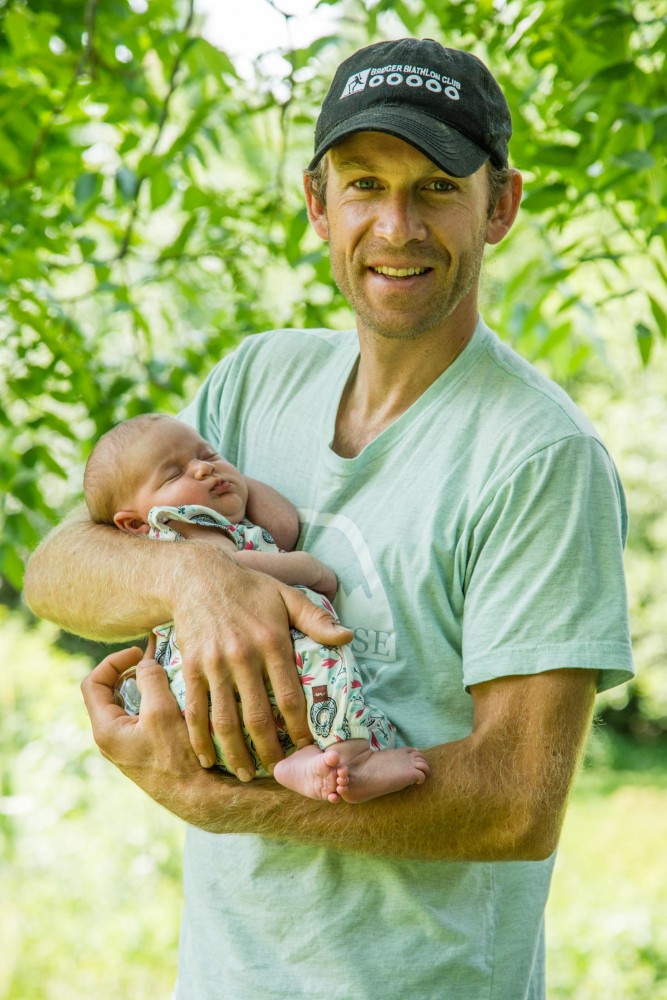
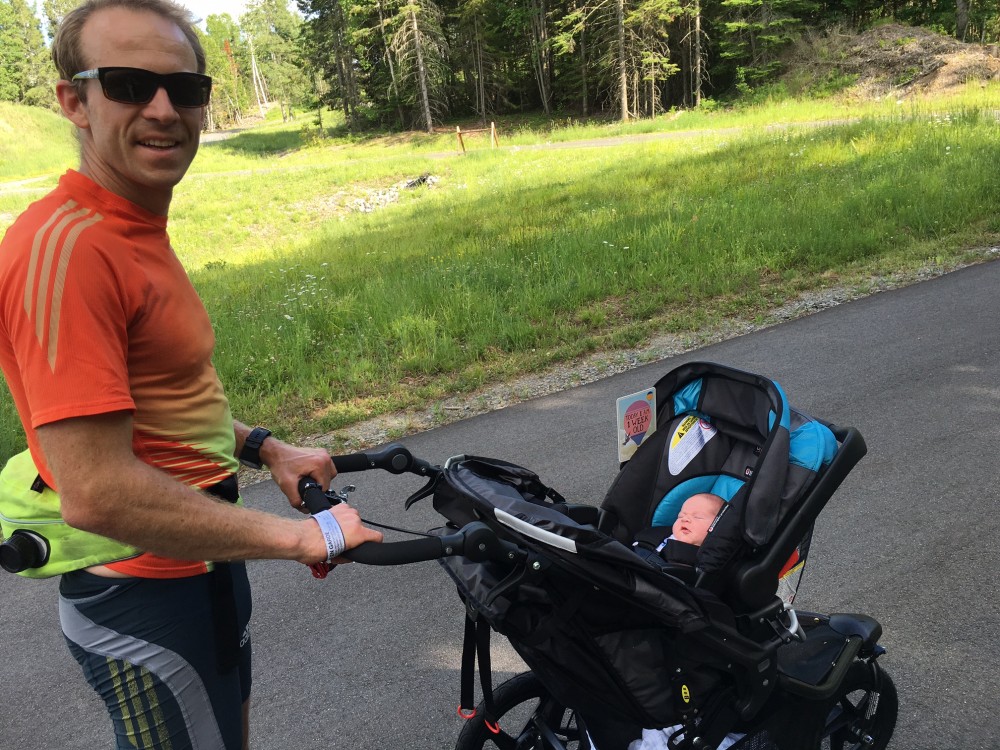
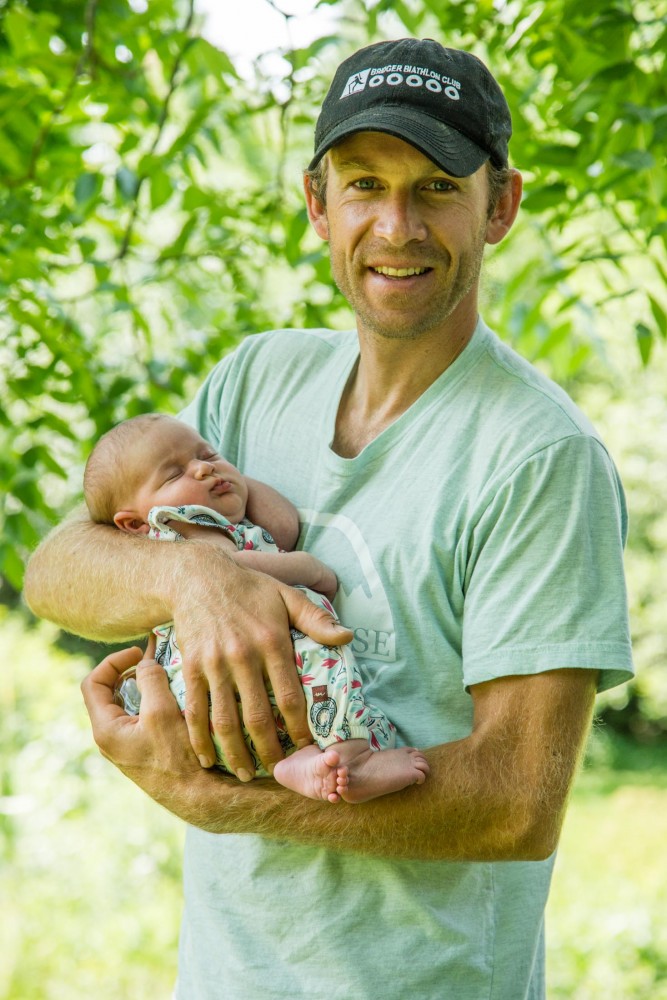
US Biathlon’s Lowell Bailey and his daughter Ophelia getting her first biathlon training experience at one week old in Lake Placid, N.Y. (Photo: Erika Bailey)
After immersing himself in skiing for the last 25 years, Lowell Bailey, a US Biathlon team veteran, is well practiced in the art of mid-afternoon naps between training sessions. A little over a month ago, however, his naps have taken on a new meaning. Midday naps no longer mean he curls up under a blanket in bed or on the couch to watch television until he falls asleep. Instead, for the past six weeks, Bailey falls asleep while watching his one month-old daughter, Ophelia Jane Bailey, fall asleep on him.
“One of my favorite things is she really likes sleeping on either [my wife’s or my] chest and the feeling of having an infant just totally fall asleep on you, like completely passed out, there’s just nothing like it,” Bailey said recently on the phone.
Bailey and his wife, Erika, who have been friends since elementary school and were married a year ago, have already introduced Ophelia to the norms of nordic skiing, including outdoor adventures and the paved path of Lake Placid’s rollerski loop.
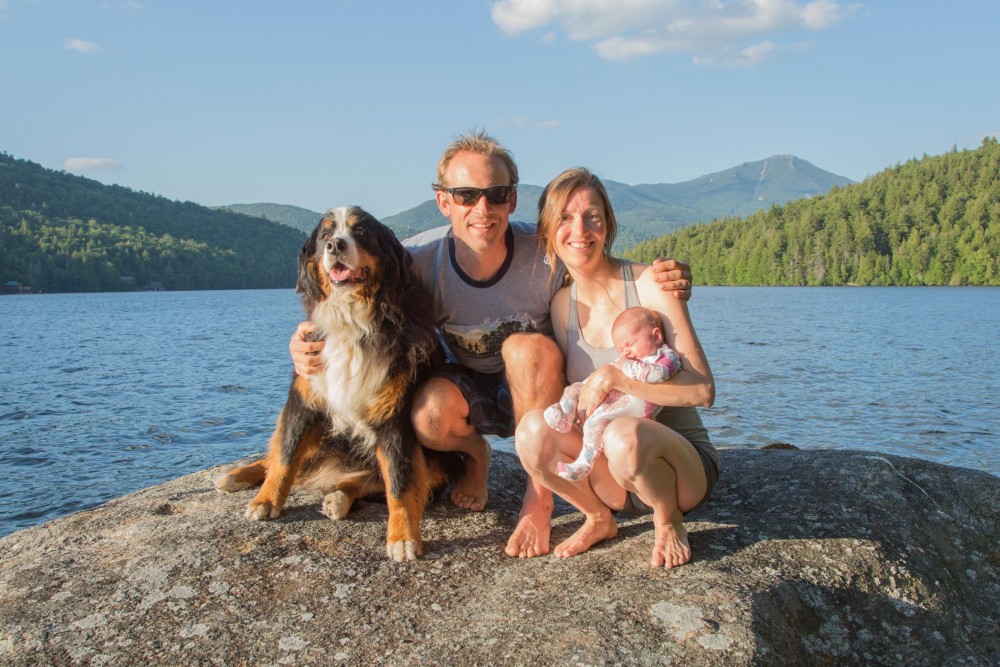
US Biathlon’s Lowell Bailey (c) his wife, Erika, daughter, Ophelia, and dog, Hazel (Photo: Erika Bailey)
“We took her out on the rollerski loop the other day and introduced her to the biathlon loop,” said Bailey, 35, who’s lived in Lake Placid since he was 10. “My wife Erika and I, we’ve tried to introduce her to as many Adirondack outdoors experiences as we can, so we’ve taken her out to the lake and on hiking trails.”
In terms of training this season, not much will change for Bailey other than his decision to stay closer to home. This year, Bailey opted to skip the US Biathlon’s annual European training camp, taking place in Ruhpolding and Oberhof, Germany from Aug. 21 to Sept. 11. Rather than travel abroad during those dates, Bailey will remain in Lake Placid and train at the local venues with the US Biathlon Development Team.
“We have great training venues and training opportunities [in Lake Placid], so it’s not really a sacrifice other than the fact that I don’t get to go to Europe and train on some of the other world-class venues out there,” Bailey explained.
While expressing his gratitude for his trainers, coaches and manager for helping him with the transition to parenthood while simultaneously remaining committed to his training, it’s the one closest to Bailey who has enabled him to continually pursue his athletic ambitions.
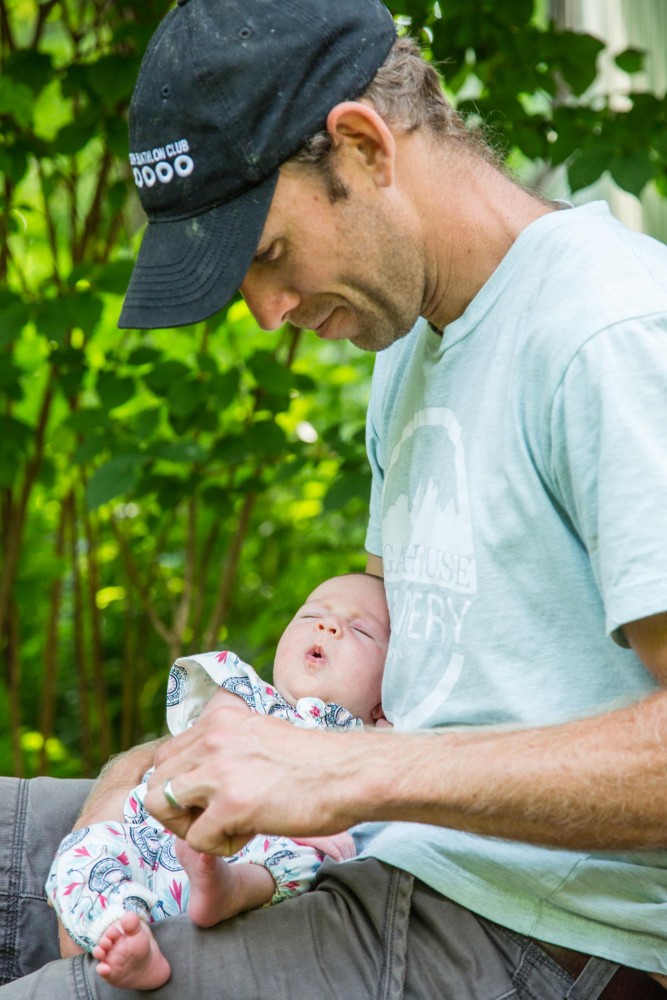
US Biathlon’s Lowell Bailey and his daughter Ophelia. (Photo: Erika Bailey)
“The biggest person that I can thank is my wife Erika because you know, as much as I’d like to think I’m doing a lot of the work, she’s really been there for Ophelia and for me and allowed me to do the training that I need to do,” Bailey said of his wife, who is currently on maternity leave from her job with a nature conservancy.
Bailey plans to stay on the (International Biathlon Union) IBU World Cup circuit all season long, and may have the opportunity to have his daughter on the sidelines watching him race.
“At this point, we anticipate that Erika and Ophelia will be able to come over to Europe for some of the world cups,” Bailey wrote in an email.
Part of his motivation to continue with his training and biathlon career involves the potential he sees for the U.S. at international levels of competition as well as the 2018 Olympic Games in PyeongChang, South Korea.
“I think US Biathlon is at an unprecedented level right now internationally,” Bailey said. “We’re more competitive than we’ve ever been and it’s so exciting to be a part of the National team right now. [Our] potential as a four-man relay team, I think everyone is pretty excited to get to the season and see what we can do. I mean, we were within seconds last year of the podium in the relays on multiple occasions. That’s a big goal and focus of mine looking forward to this season.”
On top of focusing on relay podiums this season, 2017 World Championships in Austria, and the 2018 Olympics — all while also remaining a dedicated dad to his baby daughter — this year, Bailey is an active member of the Bridger Biathlon Club (BBC) Board of Directors. Late this spring, a few members from the BBC, based in Bozeman, Mont., approached Bailey about joining their nonprofit and Bailey agreed.
“Seeing the US Biathlon Team, the success that I’ve witnessed from the men and women of the national team over the last ten years and the progression from really a no-name nation to one of the top nations in biathlon, as that has occurred I’ve become more and more interested in what the what happens after this current crop of national team athletes retires,” Bailey said. “Susan Dunklee, Tim Burke, you know these are people that have contributed a huge amount to the progress and success of US Biathlon. So the question for me has become, how do we maintain and build on that?”
“We’re more competitive than we’ve ever been and it’s so exciting to be a part of the National team right now. … I think everyone is pretty excited to get to the season and see what we can do.” — US Biathlon’s Lowell Bailey
US Biathlete Lowell Bailey and his daughter Ophelia. (Photo: Erika Bailey)
With a connection to US Biathlon’s staff and resources, Bailey hopes that his work with local clubs like the BBC will promote and empower youth into the sport and further build upon the success the program has had over the past few years. He plans to travel to Bozeman in August to meet with fellow board members for the first time and expects to return once or twice more this year.
“I’m trying to help with the communication between US biathlon and a local club like Bridger Biathlon,” he said. “The youth stage is one of the most important stages and I think it’s critical that kids get a balance, or that they witness a balance, of something that’s fun, but also hard work and challenging … Whether they go on to be Olympians or healthy empowered individuals in their communities, I don’t see any downside to it.”
Training for international levels of competition, the Olympics, alongside being a father and acting as a liaison between US Biathlon and local biathlon clubs like the BBC makes for a busy schedule, which begs the question, how does the new dad handle it all? According to Bailey, one word: balance.
“I think it’s all about balance and I think the key to it is I love everything that I’m doing,” he said. “I feel very fortunate to have all of these aspects of my life and all of these things in my life. So then it becomes less like work and more like fulfillment.”
Corrine Malcolm (standing in Nuun hat) with some of her athletes after a Bridger Biathlon Club practice this summer. (Photo courtesy of Corrine Malcolm)
Corrine Malcolm has one word to describe the Bridger Biathlon Club: momentum.
“It has gained a lot of momentum,” she said of the fledgling program based in Bozeman, Montana. “It’s a really big ball of energy and momentum. It’s pretty cool to be part of.”
Malcolm, a former national team biathlete who just finished her bachelors degree at Montana State, was hired as the club’s first paid coach this summer. That represented another big step for a program which began less than three years ago.
“It started when two boys came home from school when they were eight years old and told their parents they wanted to be biathletes,” Malcolm explained. “I think the parents were like, okay, what is that? But it was great. These two dads said, all right, let’s ask some questions and figure this out and start something.”
The two boys are now 11 and have recruited a lot of friends into biathlon; the two dads, Eric Love and Jim Sites, are the club’s directors.
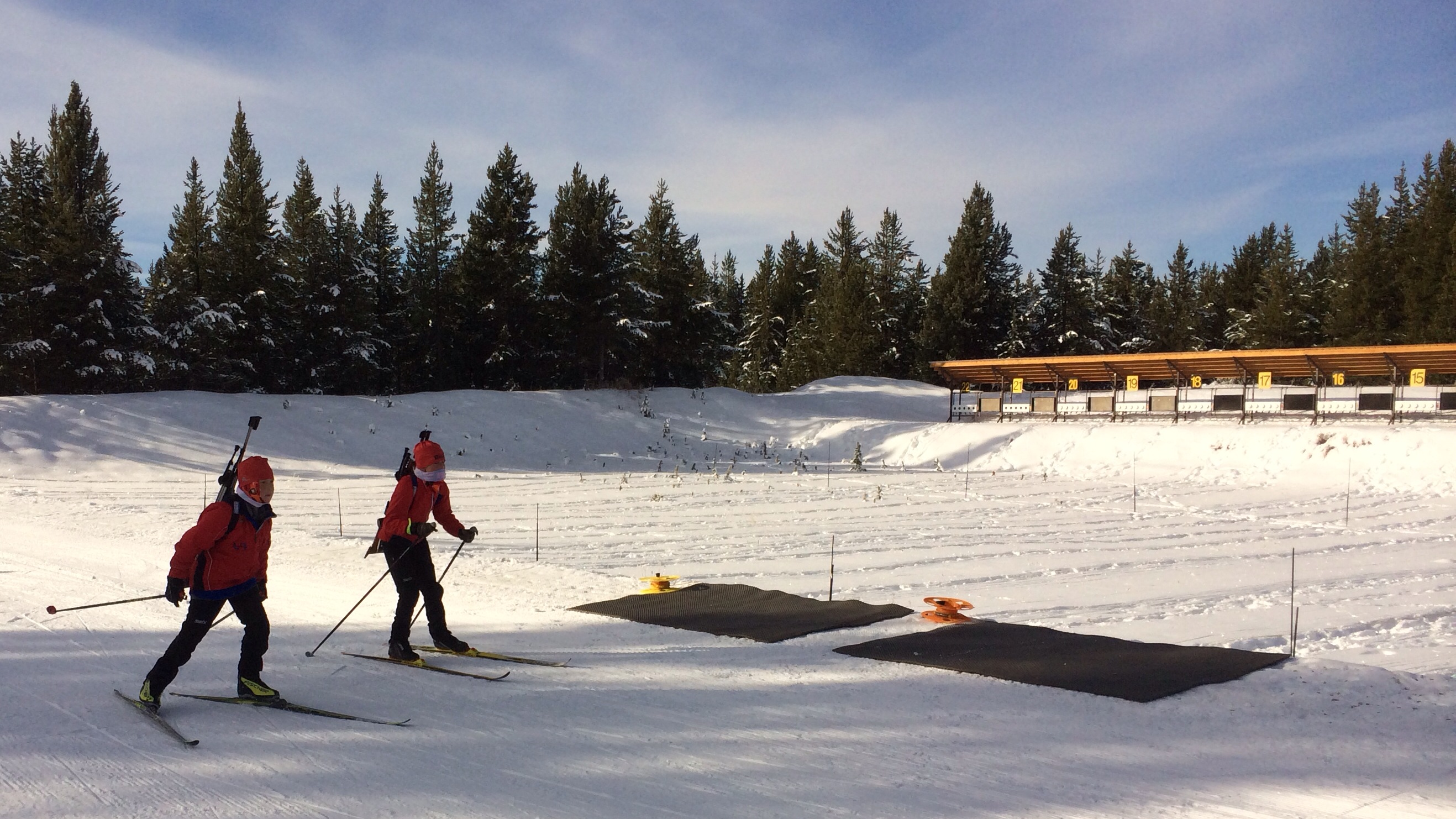
The Bridger Biathlon Club boasts 32 kids enrolled in Malcolm’s summer program this year. She runs three practices a week, some based at a gym and others on the shooting range.
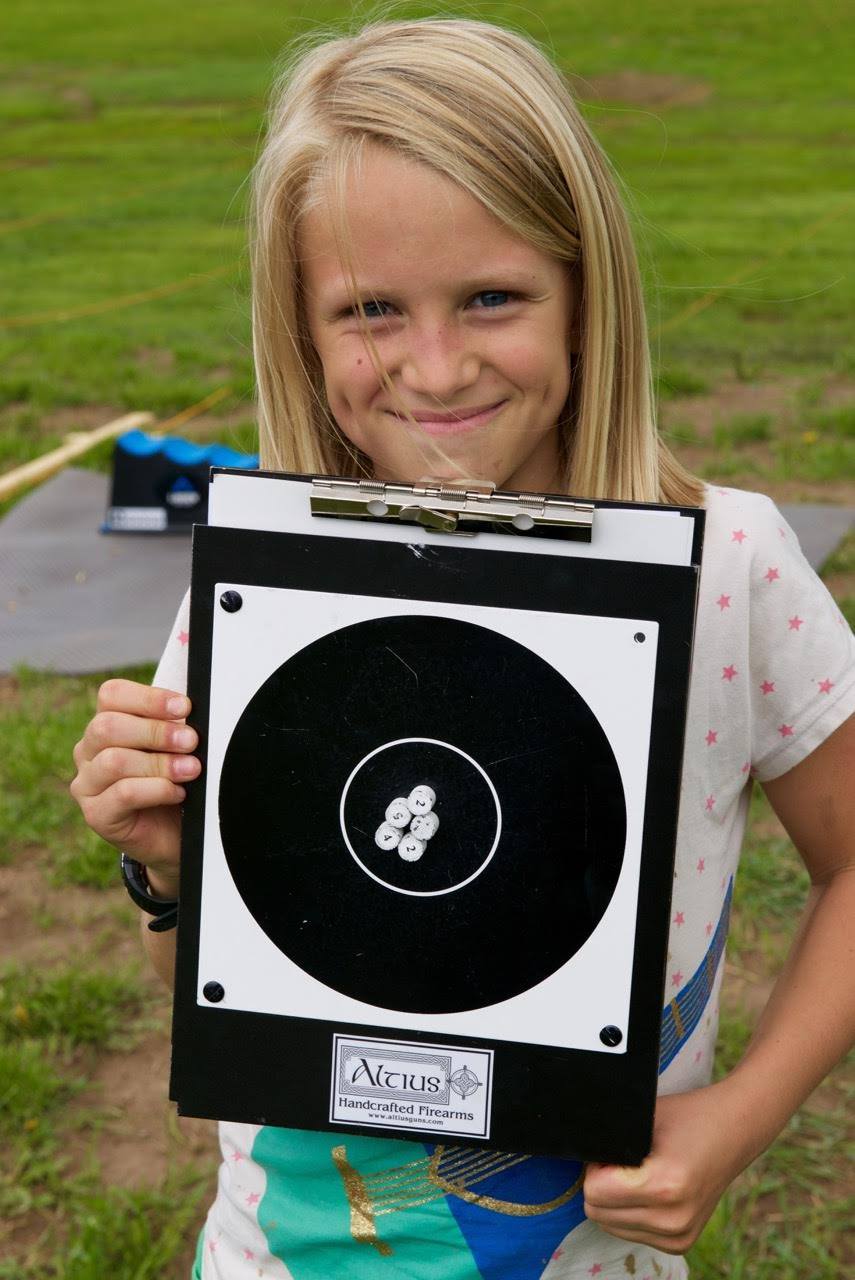
A happy young biathlete with very precise shooting. (Photo: Doug Hartnett)
The athletes have a variety of different backgrounds, from some who are more interested in simply biking farther than they’ve ever gone or hiking a seemingly unattainable peak, to others who are keen to race in biathlon. Malcolm’s goal is to motivate them all.
“It’s definitely a program that’s designed to be inclusive and welcoming and not to weed out all the kids that aren’t competitive,” she said. “Although the program is inclusive, ultimately we want to prepare the kids who want to race, to be ready to race. Kids that might not want to race right now, we want to make sure that if that changes they are comfortable in that situation.”
Already she has seen success and growth from some of her young charges. Two weeks ago Bozeman hosted the Big Sky State Games, and most of the kids participated in not one but two biathlon races.
“It’s been cool in the last six weeks to have kids who in other programs would probably be considered unathletic or uncoordinated or uncompetitive, who would be weeded out because they don’t want the competitive pressure,” she said. “We had a summer biathlon race and almost all of them raced. It was so cool to watch them grow and really go for it… The kids did a running biathlon race in the morning and a mountain bike biathlon race in the afternoon, and just didn’t want to stop. It was pretty sweet.”
With some as young as nine years old and others in the J2 category for skiing, there’s a variety of skill levels in the group. One of the oldest athletes, Ariana Woods, went to U.S. National Championships in Truckee, California, in March, and won a silver medal in the girls’ sprint.
That can make it challenging to match ability levels. Malcolm tries to put groups together as best she can at practice and relies on the club’s still-strong volunteer crew to make it work.
The start of a bike biathlon race in West Yellowstone, Montana, this summer. (Photo courtesy of Corrine Malcolm)
“I have parent volunteers helping, board members who are former biathletes, and also a former high-level competition shooter helping,” she said. “We do a really good job of herding 20 kids with rifles. It’s good to limit the number of kids on the range at one time, maybe only six to eight kids. The others run or bike and we rotate them through.”
Looking Ahead
Malcolm will start an accelerated PhD program at Simon Fraser University in Vancouver, British Columbia, in 2016, studying biomedical physiology and kinesiology. Until then, she’s on board as the club’s coach and plans to run fall and winter training programs that are more robust than the Sunday practices the club offered the previous year.
What shape those programs will take is still up in the air. As an athlete who came from a running and cross-country skiing background herself before starting biathlon, Malcolm doesn’t want to demand one-sport fidelity from athletes. And having competed in biathlon at a high level, she knows that it’s also crucial to be a strong cross-country skier.
“By no means is biathlon big enough for junior athletes to only be racing biathlon,” Malcolm said. “And if those kids want to be competitive, they need to be great nordic skiers too.”
Ariana Woods is one of the first athletes who has had to navigate this question of how to train for both skiing and biathlon, simply because she’s the oldest. She has been part of the Bridger Ski Foundation’s large and successful junior program, and Malcolm sees no reason for that to change.
Ariana Woods on her way to second place in the girls’ sprint at 2015 U.S. Biathlon National Championships. (Photo: Mark Nadell/Macbeth Graphics)
Woods plans to go to World Youth and Junior Championship Trials in December to try to represent the U.S. abroad, and to do so she’ll need to ski fast. So Malcolm hopes that the biathlon offerings can complement Bridger Ski Foundation’s program, and that the two clubs can share some athletes who have diverse athletic interests.
“My vision is that it’s part of the mountain culture and the ski community here, which does mean that it’s a joint effort,” Malcolm said. “Bozeman doesn’t need two ski teams… I have no intention to steal or poach children. It should be about the kids, and everyone should do what’s best for the kids and the ski community. So we need to come together in the ski community.”
Progress So Far
An expanded winter program will be the next step in what is looking like a very fast evolution of the Bridger Biathlon Club. Last winter, the club ran an all-volunteer program, mostly on Sundays at Bohart Ranch. The previous autumn, they offered a gun safety certification program that is part of the U.S. Biathlon Association’s curriculum, again staffed by volunteers, this time including some former high-level competition shooters.
There have been infrastructure changes, too. Last year the club installed new targets that made biathlon training truly viable at Bohart Ranch for the first time in nearly a decade. And the club has now launched a $10 million fundraising campaign to buy Bohart Ranch and the adjacent Crosscut Ranch and merge them into one nordic center for the Bozeman community to use.
Young athletes competing at the Big Sky State Games. (Photo courtesy of Corrine Malcolm)
“There’s twelve really good points on the range,” Malcolm said. “When I was here starting to get into biathlon in 2010 or so, all we could use were two targets tucked up above Jane’s Gate, and you had to cross a giant gully to get to the targets and pull ropes.”
Although biathlon took a dive in popularity in the Big Sky mountain town in the 2000’s, it actually has a rich biathlon legacy. World Championships medalist Kari Swenson is a member of the board, along with fellow former U.S. biathletes Brian Wadsworth and Stuart Jennings. Other past top-level competitors like Clarissa Werre also help out with the club.
Those former biathletes, as well as other volunteers, were initially the whole coaching and support network for the club. This spring they began to think about hiring a coach, and Malcolm happened to contact them at the same time. Until this spring, she said, she had been so buried in school that while she always meant to help out with the club it just didn’t happen.
“I actually reached out to them this spring when I realized that I would be graduating in May instead of August,” she explained. “I was wondering if they wanted a coach. I think I was hired on the spot, which was pretty fun. I sat down with a couple of their board members and all of a sudden we had a summer program.”
With the progress from two kids coming home from school three years ago and mentioning biathlon to their parents, through the club’s incorporation as a nonprofit in February 2014, to infrastructure improvements and the hiring of its first coach, the trajectory is looking impressive.
As she tries to put together a fall and winter program, Malcolm thinks that things will only get bigger.
“It’s a program that has monumental potential for growth,” she concluded.
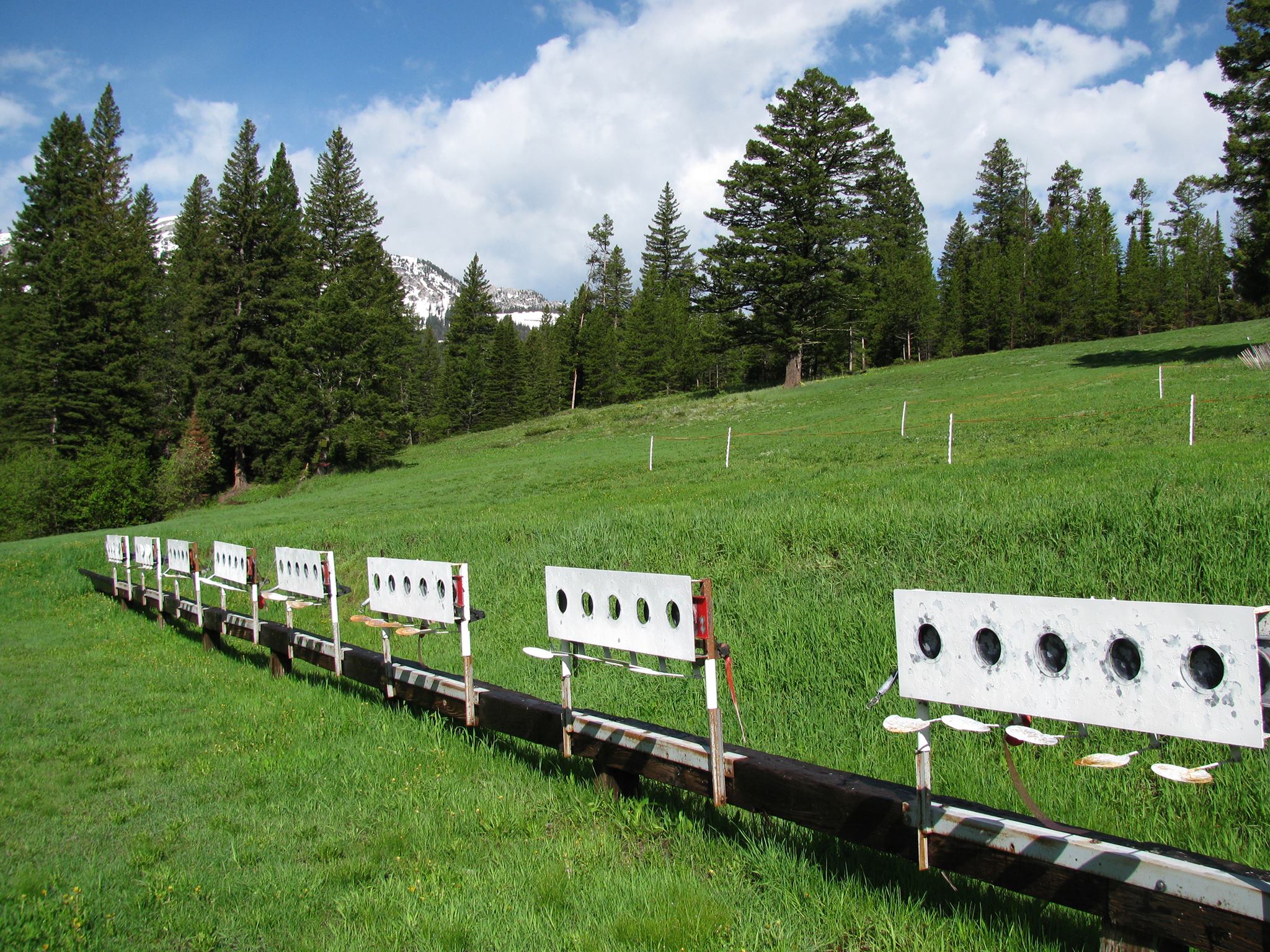
The biathlon range at Bohart Ranch in Bozeman, Mont. was installed in 1989 at the height of the sport in the small mountain town. The Bridger Biathlon Club is attempting to bring biathlon back to Bozeman and is starting by installing new targets from Norway. (Photo: Bridger Biathlon Club)
If you’ve been to Bohart Ranch in recent years, you’ve likely seen the Biathlon range nestled on the doorstep of the Bozeman, Mont., ski area. If you looked closely it would become apparent that the targets have had little use in recent history. They are mostly used for summer competition, and serve as a reminder of what had been.
The targets weren’t always as weathered. Biathlon in Bozeman was booming in the in 1980s. With renowned Olympic-level athletes such as Kari Swenson training in the area and a club based at Bohart Ranch, it seemed as if Bozeman was becoming a U.S. biathlon hub in the west.
However, the biathlon surge in Montana did not last. Biathlon in Bozeman began to diminish in the final decade of the twentieth century as cross-country skiing became more popular. By the time the 2000’s hit there was hardly any support for biathletes in the small Montana town.
Alex Love and Ben Sites train in West Yellowstone with the founders of the Bridger Biathlon Club in 2013. They are two of 45 potential athletes for the new ski club. (Photo: Bridger Biathlon Club)
Fast-forward to 2014, where a group of locals is attempting to change the absence of biathlon in Bozeman. Starting with a fundraiser in the fall of 2013, the newly formed Bridger Biathlon Club has already made major ground in bringing biathlon back.
The club’s goal is to provide a top-tier training program for biathletes of all abilities that hosts national and regional races. The club also plans to sustain a biathlon culture in Bozeman by maintaining facilities and equipment in addition to creating enthusiasm within the community.
While their goals are lofty, the club is tackling on task at a time.
The first item on the agenda is replacing the ghosts-of-biathlon-past and installing new state-of-the-art targets from Norway. The new targets are set to be installed in the fall of 2014 will carry a plaque to commemorate the late Peter Hale with who passed away in 2013.
Once the new targets are in place, the next undertaking is to build a club from the ground up.
According to the Bridger Biathlon Club’s marketing and public relations director, Katie Smith, the task of finding future biathletes in Bozeman is already off to a good start.
Alex Love prepares his rifle while training in West Yellowstone, Mont. in 2013. Love is one of the junior athletes who will train with the Bridger Biathlon Club in the fall of 2014. (Photo: Bridger Biathlon Club)
“A total of 45 kids, ages 8 to 14 have reached out to the Bridger Biathlon Club to express their strong interest in participating in a training program this coming season,” Smith said in an interview.
To ensure these skiers have no barriers of entry the sport, the Bridger Biathlon Club has already purchased rifles, ammo, and other equipment. As of this fall, the club will be without a head coach, but will be lead by those who started the club.
“BBC board members Stuart Jennings, Brain Wadsworth and Kari Swenson are leading the effort to establish BBC’s training program, and will be volunteering their time to coach BBC’s team,” said Smith.
Not only will the club be supporting new athletes in the upcoming season, it will also be hosting a series of U.S. Biathlon Association (USBA) races.
According to Smith the 2014/2015 national schedule has yet to be finalized, but the plan is to have two national races at Bohart during the season. The races will be held in conjunction with the USBA races in West Yellowstone, Mont.
The hope is to create a series of races in Montana, where athletes stay in Bozeman and travel between Bohart and West Yellowstone.
USBA President and CEO, Max Cobb, is excited with the prospects of a new club building in Bozeamn.
“It is great that biathlon is again blossoming in Bozeman,” Cobb wrote to FasterSkier. “For many years there were athletes coming out of the Bozeman area and making national teams. I hope that this rise in interest and the new facilities there will usher in a new generation of Bozeman biathletes and step by step we may once again see some on the national teams.”
Cobb said that he hoped the increased interest in biathlon would help spur an new wave of the sport in the Rocky Mountain region. Cobb sited efforts lead by the Casper Mountain Biathlon Club and it’s Board President Rob Rosser, as well as the recently upgraded facilities in West Yellowstone as signs that the region was ready for growth in the sport.
Once established at the local and national level the Bridger Biathlon Club hopes that it will continue to grow.
“We want to see the club grow exponentially. In the next five years we want to see a full training program where we have junior’s elite and masters,” Smith said.
For now, however, those in the club are excited that the sport they love is making an attempt to resurface in Bozeman.
“It’s time that biathlon came back to Bozeman. There is enough interest and there are a lot of kids out there who are excited about it. You can’t get more biathlon than Montana: Skiing and shooting at targets,” Smith said.