From the FasterSkier archive — posts syndicated from athletes’ and coaches’ own blogs between 2004 and 2012, kept online as published. Current coverage is at fasterskier.com.
At 26 years old, Andrew Musgrave, or “Muzzy” as the Eurosport commentators call him, of the British National Ski Team is a top-20 ranked distance skier on the World Cup. The down-to-earth, self-deprecating Scotsman placed sixth in the 15 k freestyle World Cup on Jan. 21 in Ulricehamn, Sweden. And let’s not forget, Musgrave burst onto the scene when he won the Norwegian skate-sprint national championship in 2014 before the Sochi Olympics. Then last year, Musgrave busted out a fourth place at 2016 Norwegian nationals in the 30 k skiathlon. That’s downright cheeky.
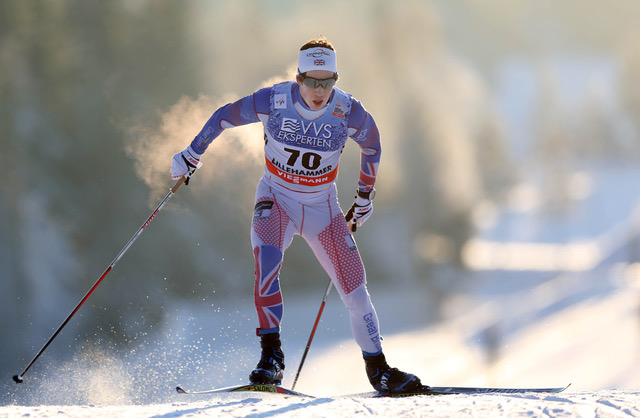
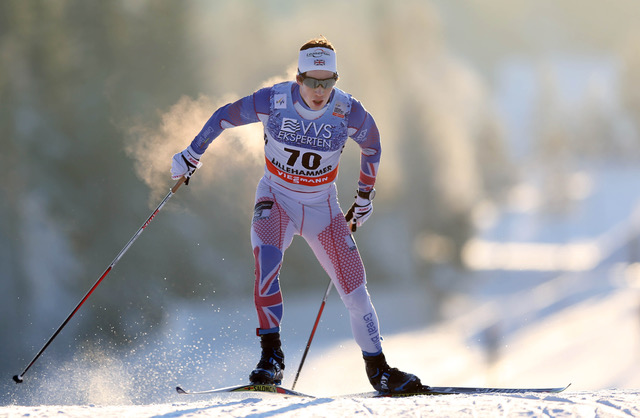
Great Britain’s Andrew Musgrave racing in the 10 k freestyle at the December 6th, 2014 Lillehammer, Norway World Cup — he placed 13th on the day. (Photo: Go Media)
Did we mention he’s from Britain (Scotland actually)? We did.
He’s an outsized presence on the World Cup despite hailing from a land of kilts, bagpipes, and golf links. Musgrave balances out that lack of nordic heritage with a hardy work ethic and a willingness to wend to where the snow and competition is — in his case, that’s been Norway. He’s based out of Trondheim where he is taking the extended-stay plan when it comes to earning his engineering degree and training for international competition.
Nordic Nation caught up with Musgrave on Jan. 24 when he was in Livigno, Italy, for a pre-World Championships high-altitude camp.
(Here’s a link to a FasterSkier article explaining how the British National Team gets Norwegian assistance with its waxing — the waxing help is mentioned in the podcast. Musgrave also gets wax and ski selection help from Salomon service techs.)
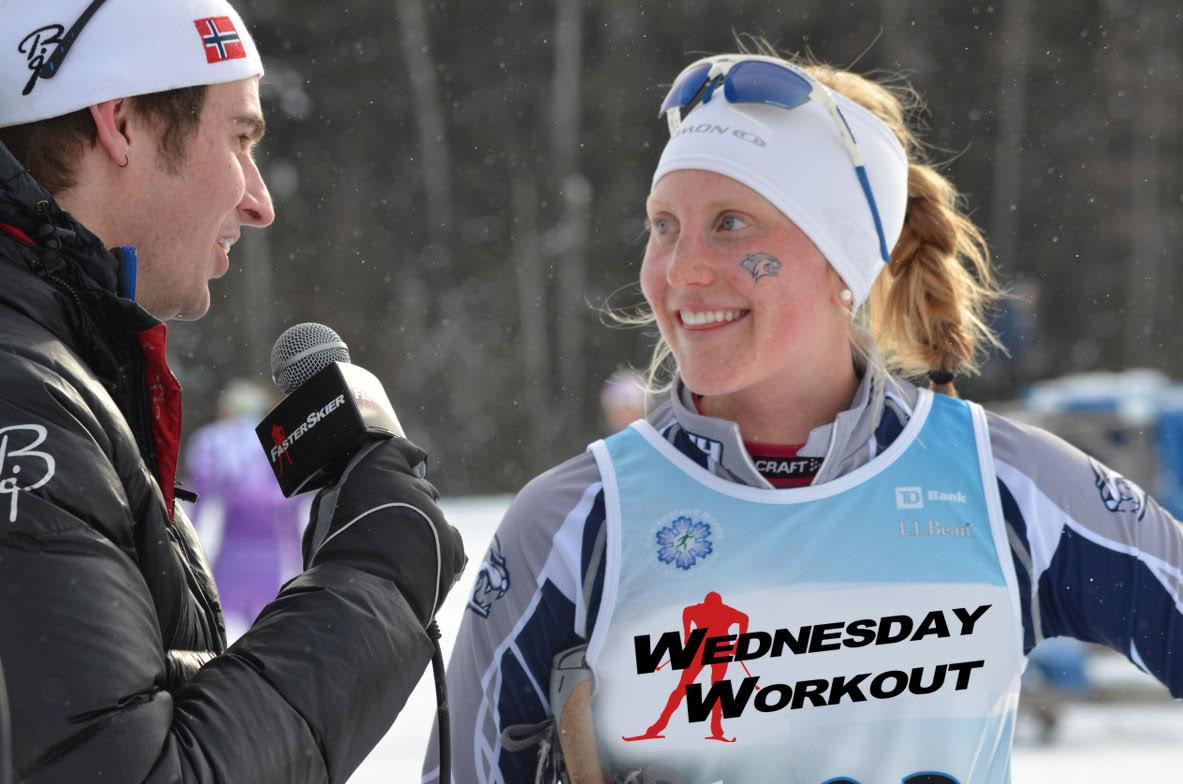
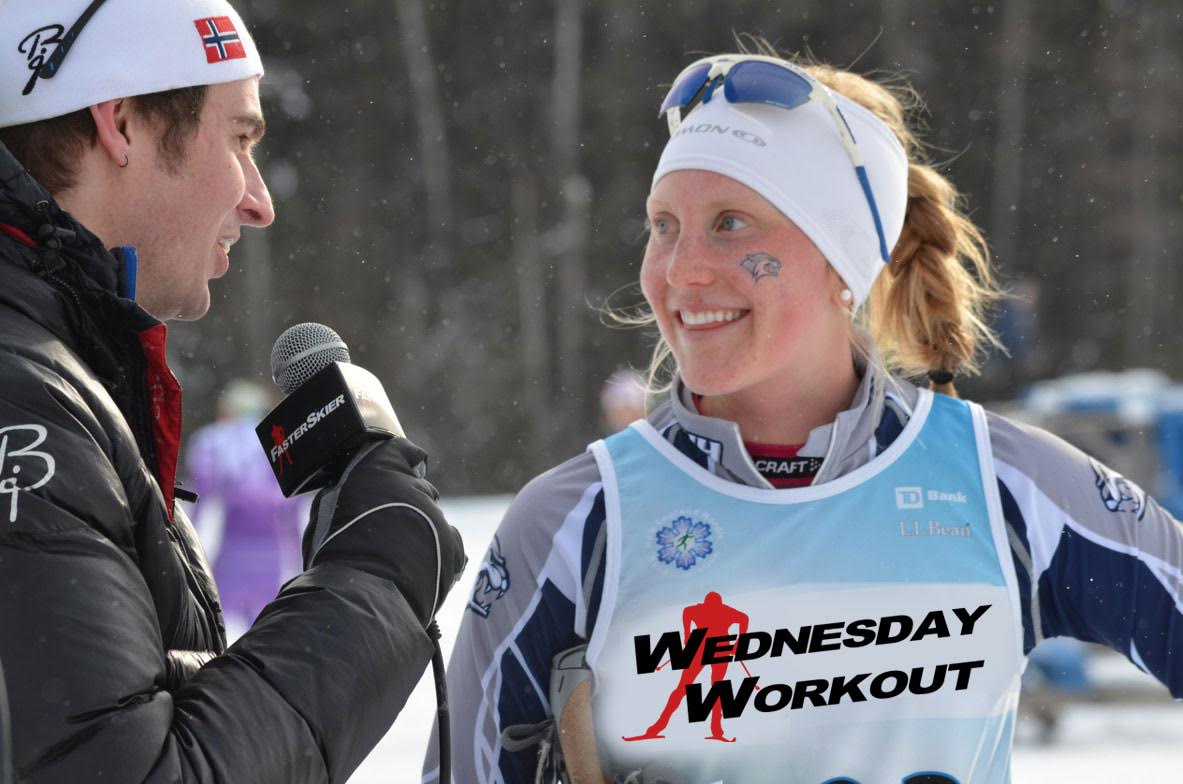
Former UNH skier Annika Taylor (r) during an interview with FasterSkier at the 2015 SuperTour in Craftsbury, Vt., last year.
With the demanding race schedules of World Cup athletes, mid-season workouts have to be effective without adding too much training stress.
Roy Young, the British Nordic Head Coach, developed a sprint workout that utilizes short intervals on varying terrain to focus on specific techniques during each effort.
Young has guided the British team to some of the country’s best World Cup results yet, including his son Andrew Young’s historic bronze in the freestyle sprint in Toblach, Italy, earlier this season.
Annika Taylor, a member of the British National team and Sugar Bowl Academy Elite Team, is skiing her first season under Roy Young and especially enjoys this speed workout. After graduating from the University of New Hampshire as an All-American last spring, this season is Taylor’s first on the World Cup.
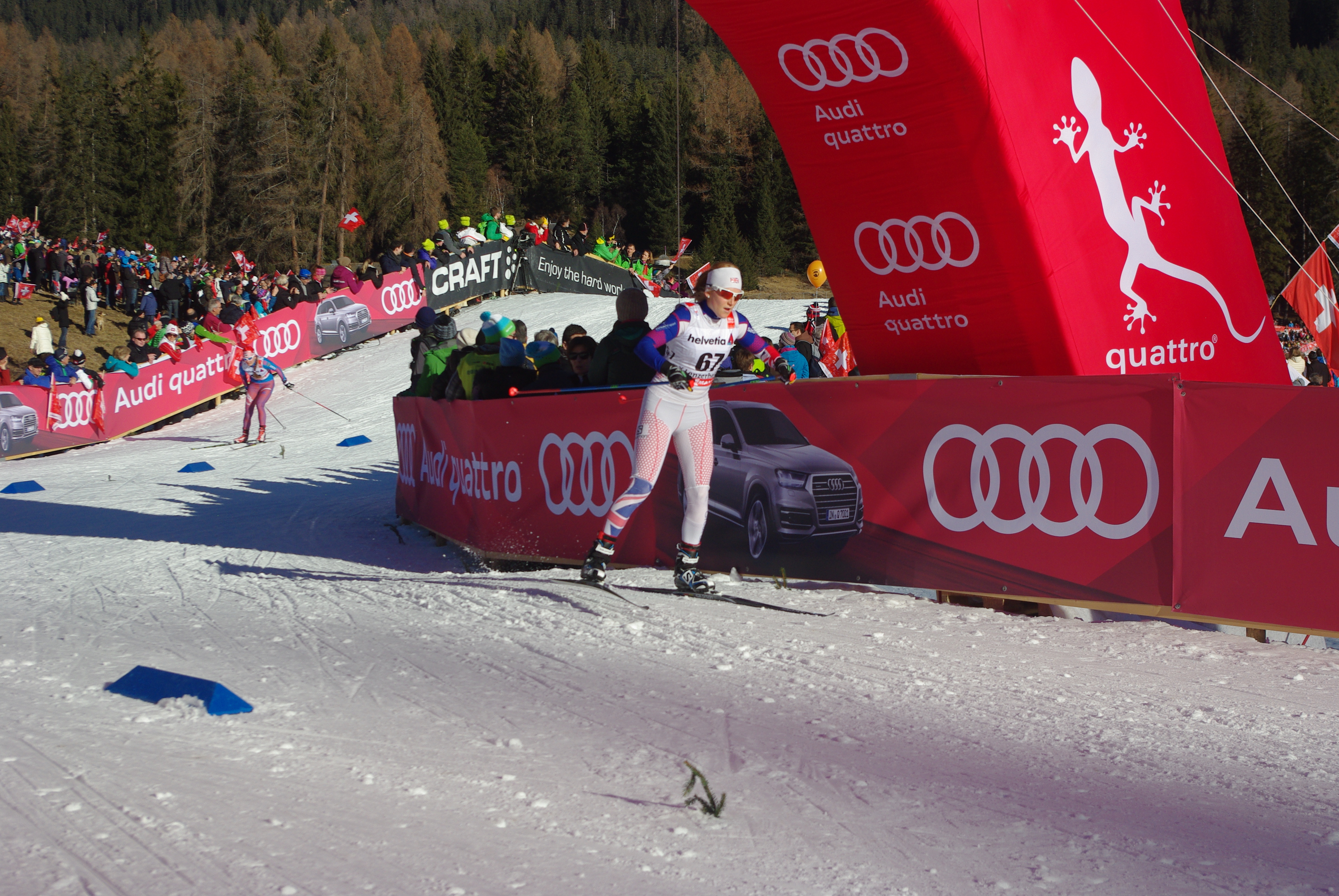
Annika Taylor (Great Britain) competing at the Tour de Ski In Lenzerheide, Switzerland.
“The workout focuses both on the neuromuscular (limb speed) required in sprinting and improving anaerobic capacity,” describes Taylor.
“I enjoy it because it is an efficient workout and that sprint improvement results after just a few focused sessions,” she added. “The most challenging part is keeping correct, efficient form and maintaining the same speed in the second set as was done in the first set.”
Taylor outlined an example of a freestyle workout that utilizes varying terrain to focus on transitions, V1, and V2 alternate.
The shortest intervals (20 seconds) are to be skied on a flat section of trail utilizing V1 to accelerate before transitioning to V2.
Next, the 30-second intervals are done on slightly downhill terrain into a slight uphill, with a focus on long V2 alternate strokes.
Finally, the focus of the 45-second intervals is changing V1 tempo in the transition from a gradual into steep uphill.
Taylor has also been working with exercise physiologist Kurt Rumley, from SportScotland Institute of Sport to develop a complete warmup for interval workouts and races which is described below.
Work into 4 minutes of Level 2, then easy ski for a four minutes.
Work into 3 minutes of Level 3 (10-15 kilometer race pace), then easy ski for 3 minutes.
Finally, work into full-on sprint race speed with 3 x 30-second efforts, with a few minutes rest in between each effort.
Speed Workout:
3 x 20-second, 2 x 30-second, 1 x 45-second efforts (with techniques as detailed above) followed by 10 minutes of easy skiing before repeating the progression for the second set.
Between each speed effort, take enough rest to get back to your starting point and for your heart rate to return to Level 1.
Cool down:
Finish with 20-30 minutes of easy skiing and foam rolling/stretching.
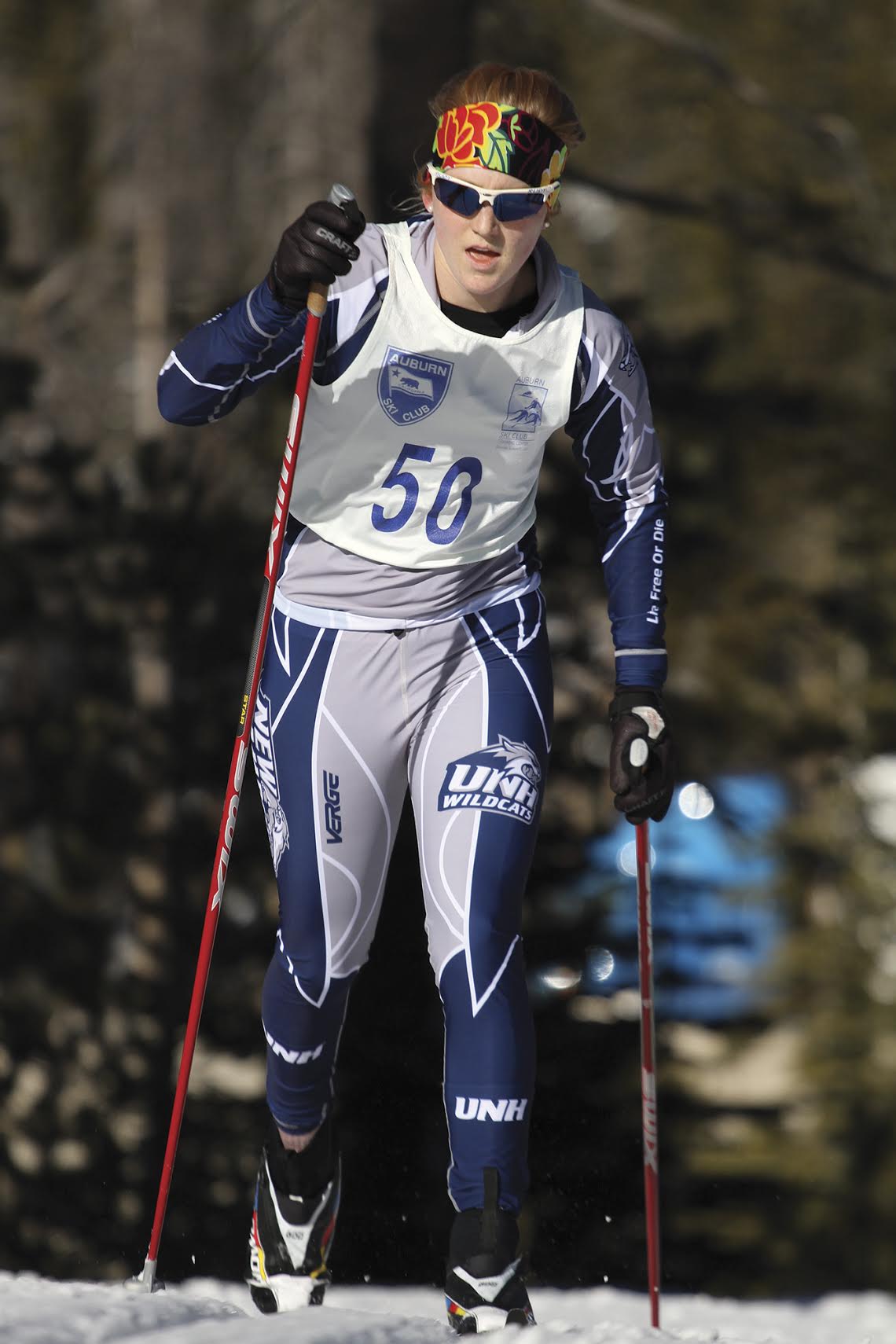
Annika Taylor, formerly of UNH, on her way to winning the women’s 5 k at the 2013 Snowshoe Thompson Classic at the Auburn Ski Club in Truckee, Calif. (Photo: Mark Nadell/macbethgraphics.com)
Although much of the focus of World Cup racing is on the stars from powerhouse skiing countries, the World Cup fields are filled with skiers who are working towards goals that don’t necessarily entail a podium. Racing on the World Cup is not always about the pursuit of medals but the experience itself.
For Annika Taylor, the World Cup experience hasn’t quite sunk in yet. Just six months after graduating from University of New Hampshire (UNH), Taylor, 22, found herself on the starting line of her first World Cup race in Kuusamo, Finland, in late November as the sole female representative of Great Britain.
A native of Truckee, Calif., Taylor holds dual British citizenship as her father is originally from the United Kingdom (her family now lives in Truckee). As a junior, she skied for California’s Auburn Ski Club and the Far West Ski Association, winning three California State Championships and notching three top-10 finishes at Junior Nationals. Taylor continued her ski career at UNH in Durham, N.H., under the guidance of head coach Cory Schwartz.
Annika’s first taste of international racing came in 2014 when she raced with the British national team at U23 World Championships in Val di Fiemme, Italy. Although she had inklings of future opportunities to race for Great Britain at that time, she realized she would need to continue to see improvement to make competing post-collegiately worthwhile.
These gains were realized in a breakthrough season her senior year, highlighted by a seventh-place finish in the 15 k classic at 2015 NCAA Skiing Championships. Earlier last season, she placed ninth in the 20 k classic mass start at U.S. nationals.
Upon graduating in the spring of 2015, Taylor was armed with both a chemistry degree, and the opportunity to continue skiing for Great Britain. Racing for the British team would mean more international competition and the chance to compete with the best skiers in the world on the World Cup — an opportunity she couldn’t pass up.
In May, Taylor joined the newly established Sugar Bowl Academy Elite Team based out of the Truckee/Tahoe region. The 2015/2016 season is the team’s debut as it aims to fill the gap left by the recently dissolved Far West Elite team and provide financial support, coaching, and training opportunities to its athletes.
After a summer training with the Sugar Bowl Elite Team as well as the British team in Scotland, Taylor started her first World Cup season in November with British Cross Country Head Coach Roy Young. Britain’s other female skiers opted not to race in Period 1 of the World Cup, leaving Taylor as the sole woman on the team. She joined a men’s contingent on the circuit, including recent World Cup bronze medalist Andrew Young.
FasterSkier caught up with Taylor about her World Cup experience over the holiday break. She spent the holidays training in Davos, Switzerland, sharing an apartment with U.S. Ski Team member Caitlin Gregg. The two met several summers ago, as Gregg visits Truckee in the summer to train at altitude and visit family.
After the holiday break, Taylor raced the first three stages of the Tour de Ski in Lenzerheide, Switzerland, before traveling to Östersund, Sweden, to compete in Scandinavian Cup races.
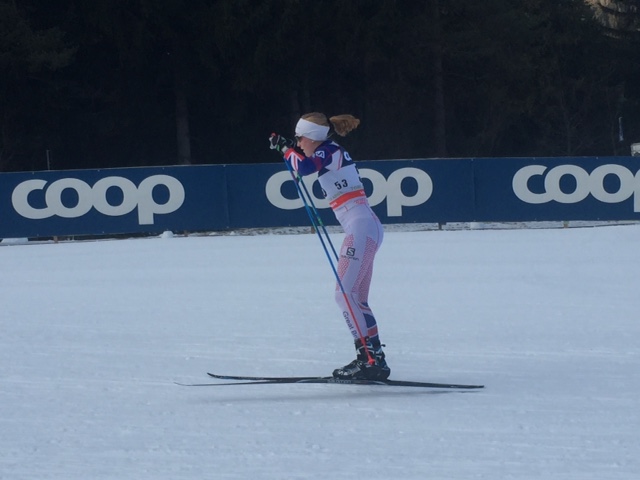
Annika Taylor racing for Great Britain in the World Cup freestyle sprint qualifier in Toblach, Italy. She placed 54th. (Courtesy photo)
FasterSkier: What is your favorite World Cup venue so far?
Annika Taylor: I really enjoyed Toblach [Italy]. They have a two-lap sprint course and I like V2 technique and I felt like it played to my strengths. And it was beautifully sunny so that always helps.
FS: What do you consider your best races so far on the World Cup?
AT: My best race was my first race: the classic sprint in Kuusamo [where she placed 50th in the qualifier]. It was best result so far and the whole experience came to fruition at that moment, too, so I’ll never forget that day. For everything to come together in the first race, I was really pleased with that.
The other races I was most pleased with were the opening races in Beitostølen, Norway. That’s where the Norwegian team started their season as well so it was World Cup caliber racing just with fewer countries. That was my very first taste of racing the best in the world so I was definitely a little star-struck that weekend.
FS:Do you prefer the sprints or the distance races?
AT: I would say distance has become my cup of tea. When I was a junior I was more of a sprinter but being at university for four years, I didn’t train much for sprinting. If I have a bit more sprint training in the next couple years I think I’ll really grow to enjoy it. Right now I do like distance racing a bit more. You can push yourself longer and harder and there is more time for tactical fixes. I like having that opportunity to turn things around.
FS: How is the intimidation factor racing the best skiers in the world?
AT: There’s definitely intimidation, but there’s also more a respect and awe for them. I am also just excited to be racing because I don’t have much pressure to perform this year. Obviously I want to ski fast, but I have to adjust to so many factors that I don’t have the energy to be nervous because I have to focus my energy on skiing the best I can technically, tactically, and physically in every race. But at the same time, there’s that moment that you think, “Woah, we are on the World Cup circuit, this is crazy.”
Annika Taylor (Great Britain) competed in the first three stages of the Tour de Ski In Lenzerheide, Switzerland.
FS: What was your favorite part of the Tour de Ski?
AT: My favorite part of the TDS has to have been the atmosphere and just the general excitement from both the fans and the athletes! You could sense the nervous energy bouncing around the wax cabins, and then going out to warm up on the race track with 12,000 fans (equipped with flags and cow bells) on the sprint day, with the sun shining down was a feeling I’ll never forget! Throughout the weekend fans and athletes enjoyed food vendors, opening ceremonies, performances from bands and dancers, and free swag. Cross-country skiing can feel a bit like an under-appreciated sport at times, but this was the polar opposite!
FS: What was the biggest difference racing the Scandinavian Cup races vs World Cup races?
AT: The Scandinavian cup races in Östersund were quite different from the World Cup races mainly in the sheer amount of racers competing in the Scandinavian cup (and the blisteringly cold -20 C temperatures compared with the mild temps felt at the World Cup venues recently). The level of competition is impressive in the Scandinavian cups as well, with the race leaders most likely fit enough to achieve a top-10 in a World Cup race.
FS: What race did you enjoy the most since the holiday break?
AT: I was quite pleased with how I skied the 10k freestyle race in Östersund! [She placed 21st.] Being back at low altitude made racing just that little bit “peppier,” and it was encouraging to be back in a field where I can be more competitive and “catch a ride” mid-race with the ladies racing around me.
FS: What are your goals for the season?
AT: My main goal this season is to race well at U23 Worlds because that’s where I can be the most competitive. But there are always goals week to week, even weeks I don’t have races I will focus on skiing technically well during each workout so that when my technique comes under pressure in a race, the foundation has been laid and I can ski technically well. I always have result based goals but this year is hard not really knowing what is going to happen competing against the best in the world. I can’t really measure success against them just yet.
At the Toblach 10 k classic Heidi Weng of Norway started behind me (in the interval starts) so my goal was to catch a ride with her when she passed me and match her technique, tempo and pace. The Norwegians know how to ski efficiently, ski fast and charge. That’s what I’m trying to learn this year is to find that extra level of intensity in a race necessary to do well at the World Cup level.
FS: Have you been enjoying the lifestyle?
AT: I wasn’t sure how I’d do because I chose not to go home for Christmas and I believe it will be a total of five and a half months on the road. I’m learning to be fine wherever I’m at with whomever I’m with, but also not feed into the ups and downs that go along with being an elite athlete. I’m actually addicted to the lifestyle because every weekend is a new experience. I’ve really enjoyed meeting new people and it has motivated me to learn bits of different languages.
FS: What is your schedule for the remainder of the season?
AT: Following the Scandinavian Cup, I will head to Ramsau, Austria to train for a few weeks. My next World Cup race in Lahti because Worlds will be there next year and I can get a feel for the course and the area. After that U23 Worlds in Rasnov, Romania then the day after fly out to Canadian Tour. Then I will race the Spring Series in Craftsbury, Vermont and finally home.