From the FasterSkier archive — posts syndicated from athletes’ and coaches’ own blogs between 2004 and 2012, kept online as published. Current coverage is at fasterskier.com.
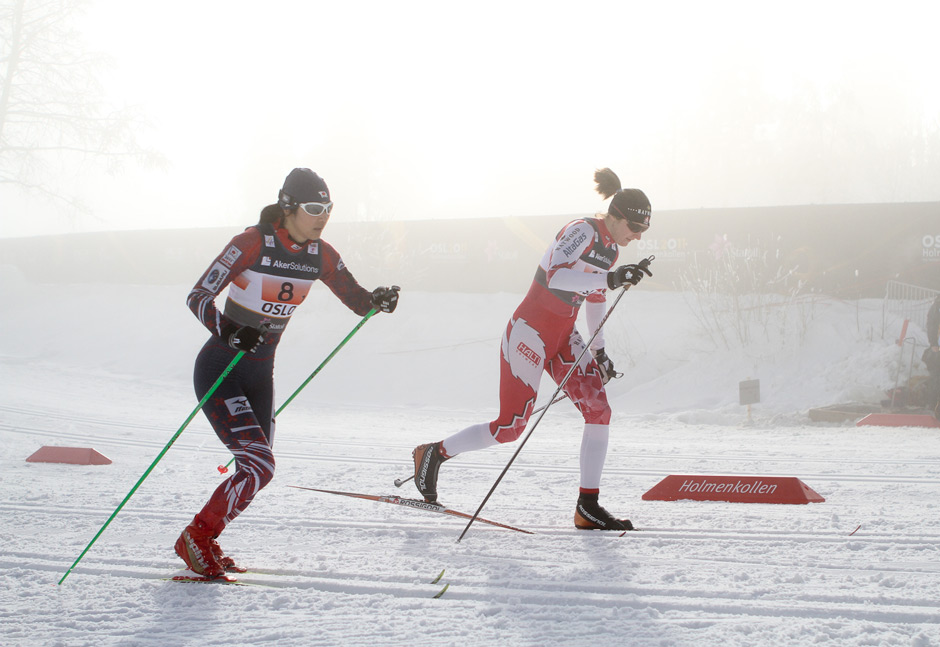
Leadoff skier Dasha Gaiazova (r) battles Madoka Natsumi of Japan in the thick fog of Oslo.
When Dasha Gaiazova started the 4 x 5 k relay at World Championships in Oslo on Thursday, she still had a hangover.
Was it from drinking? No.
“We went to bed on time,” Gaiazova told FasterSkier, promising that the women’s team had behaved themselves and not celebrated too hard.
But after her teammates Alex Harvey and Devon Kershaw won the men’s team sprint in thrilling fashion on Wednesday and got to stand atop the podium in the ceremony in downtown Oslo that night, Gaiazova was hung over emotionally.
“We, the girls, just went to the plaza to watch the awards and there was a lot of screaming and waving the flags,” she said. “It was very intense.”
But though her voice might have been hoarse from cheering and she said that “so much racing had taken its toll” – this was Gaiazova’s fourth race of the World Championships series – she still had form to turn in the tenth-fastest scramble leg in the relay.
“It was hard today,” she said. “It’s a team event and you have to represent- it was important for me to push hard no matter what just to make sure that the other girls have a better chance. The skis were great and the crowds were louder than ever.”
In fact, Gaiazova said that with so much encouragement from the 26,000 spectators, pacing was tough.
“It’s a lot of discipline and you have to remind yourself, don’t do a sprint of death on this hill. Don’t just turn on the jets. But when it gets really really hard, too, the crowd just pushes you on, and it’s fun.”
Jones.
Gaiazova tagged off to Perianne Jones, who was also her partner in the team sprint yesterday. Jones skied the 13th-fastest second-lap time, and dropped two places to twelfth.
Next up was Chandra Crawford, who was battling some emotional issues of her own. Crawford, the 2006 Olympic sprint gold medalist, was left off of Canada’s sprint relay team the day before. While Crawford was handing the decision well, it had clearly been bittersweet for her to watch from the sidelines as her teammates skied to a stellar sixth-place finish.
“I would like to be in the top two girls in my country,” Crawford said after much thought. “But I feel grateful that we have more than two. That forces us to earn the opportunity to start at events like this. It makes our team faster to have to earn one of those two spots.”
While she said that sitting out yesterday’s race had no effect on her attitude coming into the relay today, something else did.
“What made me excited?” she asked. “Devon and Alex! It was such a feeling of shared accomplishment, of those two incredible buddies.”
Excitement or no, Crawford had her work cut out for her. After receiving the tag from Jones ahead of only one team, Kazakhstan, she skied the 13th-fastest third leg. It wasn’t enough to keep her from dropping into 14th place, last in the field.
Gosling skiing to the finish.
Nevertheless, Crawford said that the experience was “incredible.”
“The crowds- even though I was kind of stuck in the battle for the basement, I felt like I was winning and I was just confused!” she exclaimed. “They were cheering for me like I was winning. When I started to push beyond my limits, I thought, the crowd will carry me. I’ll keep up this unreasonable pace and go for it.”
Canada’s anchor leg, Brooke Gosling, was unable to gain any places.
“We didn’t really have a chance,” she told FasterSkier. “But it was fun.”
While none of the Canadian women are favored in the 30 k skate on Saturday, they will be starting – which is somewhat of a surprise. Crawford, in particular, said that despite focusing almost entirely on sprinting, she had been planning to race the 30 k.
“Then during today’s race, I was thinking, oh my gosh, this is going to be hard,” she said. “But it’s Oslo, it’s the opportunity of a lifetime. I have to just prepare myself emotionally and psychologically for suffering beyond my wildest dreams. But that’s the goal, and the reason to do it – to get the experience of a lifetime. I’m pretty into both those things.”
“Comfy,” was how American Sadie Bjornsen described the leader’s chair, the seat occupied by the finishers with the best times after they cross the line in individual start races.
Sadie Bjornsen relaxing in the comfy chair.
The young American continued a strong World Championships showing, notching her second top-30 in two starts in the 10 k classic in Oslo. Starting at bib 36, Bjornsen was not unseated as race leader for nearly five minutes, when Sweden’s Sara Lindborg took over.
Bjornsen, who started before most of the top skiers, ultimately ended the day in 29th place. She was joined in the top-30 by teammate Holly Brooks, who led the U.S. squad in 27th, while Kikkan Randall struggled to 32nd.
Like Bjornsen, Brooks’s finish was also her second top-30 of the Championships, and both women agreed that the course was one of the hardest they have experienced.
“Definitely the hilliest course I have skied,” Bjornsen said after the race, with Brooks adding, “there are some seriously big hills out here.”
They may have had the same opinion on the terrain, but each tackled the 10-kilometer loop with a different strategy.
“I knew if I took it out at a quick pace that I couldn’t sustain, it was really going to be miserable for the last 3.75 k, and the sprint hill [the last climb on the course],” Brooks said.
Holly Brooks striding up the first climb.
She tried to ski within herself and stay smooth, working into the race—an approach she described as a “completely different tactic.”
Bjornsen, on the other hand, took the opposite approach. “I kind of just went hard from the start, because I have been doing that for the last couple of races,” she said. “If I blow up, I blow up, but it is worth it to try and go out like a bat out of hell.”
Brooks categorizes middle-distance classic skiing, including the 10 k, as her weakest events. She noted that she blew up in the other two 10 k classic races she skied this year – at U.S. Nationals, and the World Cup in Drammen.
The more conservative strategy was an attempt to change that trend.
“It made a huge difference,” Brooks said.
The Canadians were led by Dasha Gaiazova in 37th, three minutes behind winner Marit Bjoergen (NOR).
Gaiazova also described the course as “really hard,” and said that pacing was critical.
“I felt like I paced the first half well, and then the second half is just fighting the pain threshold,” she said.
With the big climbs, kick was critical. Gaiazova spent all morning dialing her skis in, and the effort was worth it, as the Canadian techs eventually redid her wax job and her skis were “perfect.”
Brooks also had great skis. She said she had to get out of the track just once, but felt okay doing so after seeing silver medalist Justyna Kowalczyk (POL) do the same thing on the stadium video board.
Brooks was a last-minute addition to the start list, not getting the call to race until Sunday afternoon.
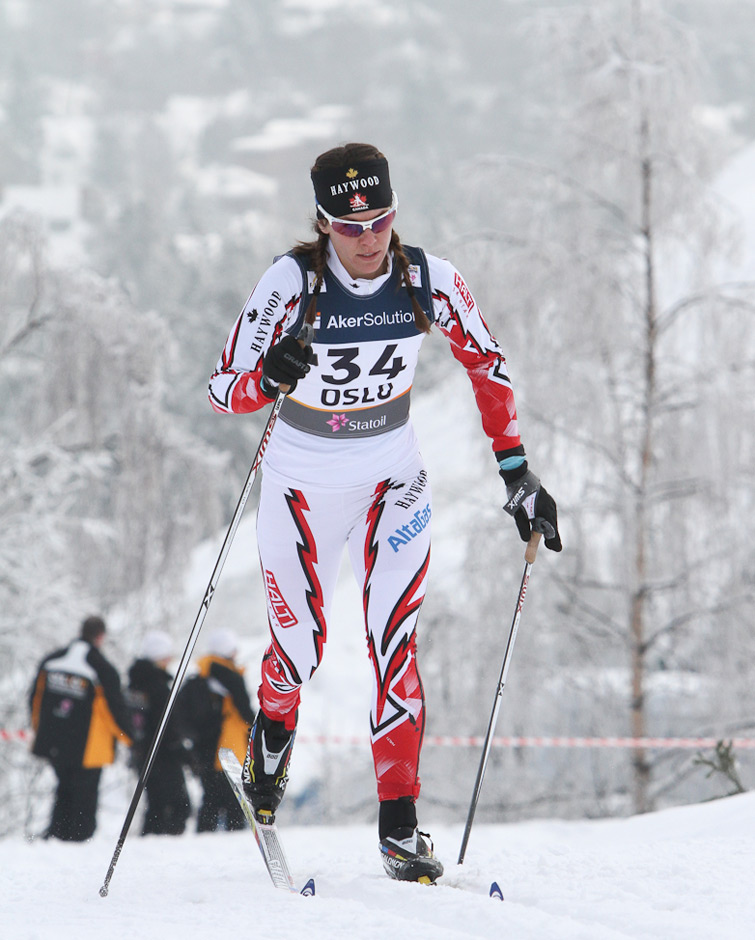
Dasha Gaiazova striding up the first climb.
“I guess I got added to the start list late yesterday afternoon, with like 45 minutes to go until the starts were supposed to be turned in,” she said.
That meant she didn’t get to preview the course until this morning, but that clearly did not hurt her.
Gaiazova entered the race with few expectations. She said she has been focusing on sprinting, and hasn’t tailored her training to the longer events. While she was happy with her performance, she said she would like to work on improving her distance skiing next season.
Despite the race falling on a weekday, and the less spectator-friendly individual start format, the Norwegian fans were out in force.
Gaiazova found herself out on her own for much of the race—not an ideal situation.
“I’m a sucker. I love skiing with other people,” she said. “But there were lots of fans to help me along.”
She described one tough climb where a group of children were chanting, “kick in the track!”
“So I stayed in the track all the way up the hill,” Gaiazova said.
Brooks had a similar experience. She met a group of kids at the opening ceremony, who then appeared out for the race, along with their entire class. They recognized the American skier, and exhorted her on with the classic Norwegian “heia heia!”
Canadian sprinter Chandra Crawford, who placed 52nd, said there was plenty of cheering, even without fans on certain parts of the course.
Ida Sargent also striding up the first climb.
“Where there weren’t people, the volunteers would pitch in,” she said.
Ida Sargent (USA), who bested Crawford by just three seconds on her way to 51st, summed up the scene: “Way more cheering than I’ve ever heard. Some parts were crazy!”
At the end of the day, though, neither Crawford nor Sargent was thrilled with her performance.
Crawford characterized her race as “not that good,” noting she waxed her skis like a surf board – thick.
“It helped me on the climbs,” she said—but she added that it was not enough.
Like Gaiazova, Sargent had few expectations.
“I haven’t been skiing that great,” she said. “It is just great to get this experience skiing here, at my first World Championships.”
Due to a problem with the athletes’ shuttle system, Sargent said she was unable to ski the course until the morning of the race.
Perianne Jones and Brooke Gosling rounded out the Canadian racers. Jones was caught by Bjornsen from 30 seconds down, and the two skied together for a bit.
“I had really good kick,” Jones said—pleased with her skis, like her Canadian teammates. “I was able to climb up everything. I didn’t have to herringbone, which I was really happy about.”
Gosling was 56th.
Randall Struggles with Conditions
Randall, in her first start since crashing out of the quarterfinals in the sprint event – a race she entered as one of the favorites – skied to 32nd place.
Kikkan Randall striding up the first climb – yes, it was a good spot for photos…
“I had a hard time getting really solid kick,” Randall said. “The skis were great. I haven’t quite figured it out for these conditions yet.”
She described the track as “greasy,” and washed out in places.
“I tried to get up on my toes, but I could just feel it slipping, and I kind of felt like I was hanging on by my toenails to grip in there,” she said.
Coming off the emotional sprint race, she said she was glad to get a hard effort in, even if her body wasn’t in top form, and feels that the race set her up well for the upcoming events at the Championships.
Over the last several days, she has been working on moving on from the sprint.
“I could never have anticipated the physical and mental letdown I have been going through the last couple of days,” Randall said. She has been “feeling a little more positive every day,” and was glad to “have another race to focus on and move forward.”
She started 30 seconds behind Sweden’s Ida Ingemarsdotter, the woman with whom Randall tangled with in the sprint.
“I would have liked to catch her from 30 seconds and just blow by her,” she said. “If it was there, it would have been fun today, but it wasn’t there.”
Randall kept the Swedish skier in sight on the long open hills on the Oslo courses, but eventually, Ingemarsdotter pulled away.
Randall’s next start is likely on Wednesday in the team sprint, though the U.S. has not officially announced who will race.
Sadie Bjornsen…guess where…Chandra Crawford. I won't even say it.Brooke Gosling striding up the seconds climb…just kidding…still the first climb.Perianne Jones. Say no more.
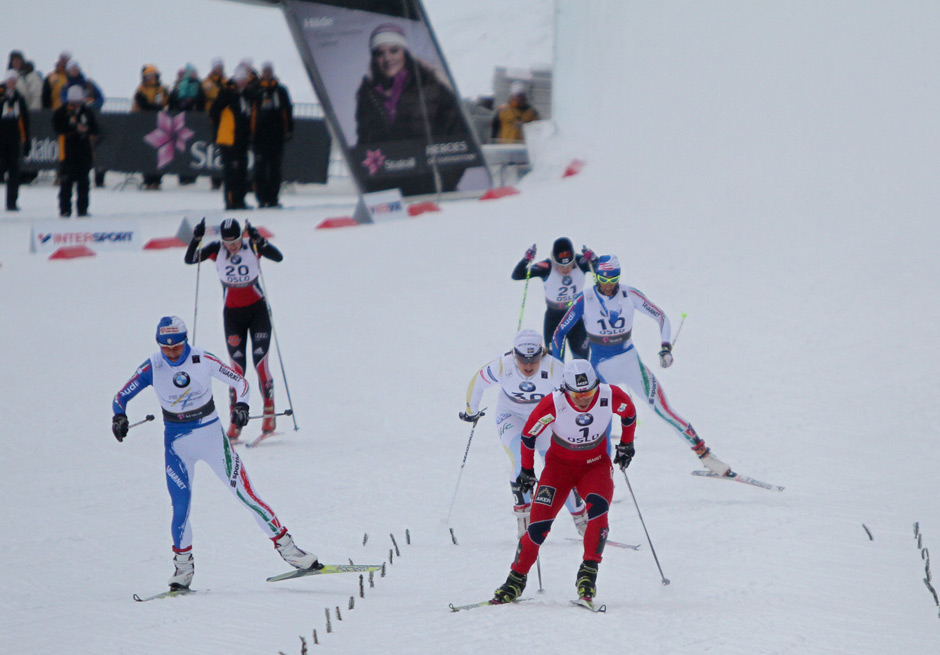
Bjoergen leading her quarterfinal in Thursday's sprint. Follis is on the right. Nobody consumed by a tiger.
Marit Bjoergen (NOR) has already achieved her goal of winning an individual gold at the 2011 World Championships. Now the ski world gets to see what a relaxed Bjoergen can do.
The winner of five medals, including three golds, at the 2010 Olympics, Bjoergen is the clear favorite in the women’s 15 k pursuit on Saturday, as distance racing gets underway at Holmenkollen in Oslo, Norway.
While rival Justyna Kowalczyk (POL) is the defending World Champion in the event, a lot has changed since 2009. The few things that could stop Bjoergen from winning the race include her technicians swapping her skate and classic skis in the dual technique event, Emil Joensson dressing up as his girlfriend Anna Haag and taking over for the last kilometer of the race, or being eaten by the tiger that currently resides in her bed.
Needless to say, it is Bjoergen’s race to lose. She has put together a remarkable string of nine consecutive World Cup distance race victories dating back to last season, and her margins of victory have run the gamut from convincing to ridiculous. European betting sites are paying a mere one dollar for every four bet on Bjoergen to win.
Kowalczyk in Thursday's sprint – she suffered an early exit, and will be out for revenge.
The most likely to unseat the “Queen of Cross-Country Skiing” is Kowalczyk. The Pole has already locked up the overall World Cup title, and finished a relatively close 17 seconds down in last weekend’s 10 k classic World Cup in Drammen.
Kowalczyk’s primary weapon is her ability to go harder than anyone else, usually splintering the field on the large climbs. But she hasn’t had that edge on Bjoergen this year, and if the race comes down to a sprint, Bjoergen, the winner of Thursday’s individual sprint, is clearly faster.
While Bjoergen is considered a near-lock for the win, Kowalczyk will have plenty of challengers for second place, including Charlotte Kalla (SWE), Aino-Kaisa Saarinen (FIN), Kristin Stoermer Steira (NOR), Therese Johaug (NOR) and the aforementioned Haag (SWE).
Stoermer Steira will try to defend her silver in this event from the 2009 Liberec Championships. The slender Norwegian, despite being a stronger skater, has excelled in this event since its introduction. In addition to her 2009 silver, she has two bronzes, from 2005 and 2007, and has twice finished fourth at the Olympics.
Stoermer Steira (right) gets encouragement from a Norwegain coach during the 10km classic in Drammen. Teammate Vibeke Skofterud is to the left. Stoermer Steira finished 19th.
She struggled with a foot injury early in the season, but appears to be well clear of those issues. She is obviously experienced, and should not make any mistakes.
Saarinen skipped the sprint, a potential medal event for her, in order to be well rested for the pursuit. She also started the season slowly due to injuries, but has skied very well of late. She was third in the classic race in Drammen, and is defending a bronze medal from the 2009 pursuit. She skis well in both techniques, and has good finishing speed.
Kalla is a stronger skate skier, though she has improved her classic skills in recent years. If she can maintain contact with the leaders through the first half of the race, there are few better in the free technique. Her speed is World Cup top-10 on a good day in classic, and winning material in skating.
Her teammate Haag was a big surprise in Vancouver, besting Kowalczyk in taking the silver in this event. She has just one podium finish this year, but she has already proven her big-race ability. She will be hard-pressed to repeat her Olympic performance, but Haag shouldn’t be counted out.
Johaug gives the Norwegians three legitimate medal contenders. The diminutive twenty-two-year-old has two career podiums in the pursuit, and should thrive on the challenging Oslo courses. She had a brilliant finish to the Tour de Ski, dominating the Final Climb, and her classic skiing is on par with her skating.
Johaug in the Drammen classic race.
After Johaug, the list of potential medal contenders is long – veteran Italians Marianna Longa and Arianna Follis cannot be counted out, nor can the rest of the Finns – young Krista Lahteenmaki, who exploded onto the international scene during the Tour de Ski, and the more experienced Riitta-Liisa Roponen.
The key to the race will be who decides to go with Bjoergen, and how they hold up. The favorite will likely push the pace early, and blow apart the field. Anyone who can get a ride could end up far enough ahead to hold on for a medal. But the stakes are high, especially on these courses. Give too much too early, and the chasers will come back to get you.
Four Americans will take to the line, led by Holly Brooks.
Brooks did not race the sprint on Thursday, and should be sharp. She is joined by teammates Liz Stephen, Morgan Arritola and Jessie Diggins.
Brooke Gosling is the lone Canadian starter.
The racers will ski an interesting configuration of loops – one 2.5-kilometer classic, a different 5-kilometer classic, and then two 3.75 circuits for the skate leg.
The race kicks off at 11:30 in Oslo, a pre-dawn 5:30 EST in the US.
Saarinen attacking the sprint qualifier in Drammen. Nobody can say she doesn't go for it.
Europe seems to suit Sadie Bjornsen just fine. Nearly a month into her first long-term overseas tour, Bjornsen is skiing fast and appears to be getting faster. She led a contingent of a US World Championship skiers in the 5km classic FIS race in Beitostolen, Norway, placing 8th overall.
The race was won by former overall World Cup runner-up and current Norwegian World Championship team member, Astrid Jacobsen. The veteran posted a time of 15:02, 19.8 seconds ahead of runners up Martine Ek Hagen and Ragnhild Haga who tied for second.
Bjornsen was 16 seconds off the podium and 37.9 seconds in back of Jacobsen.
“I love 5k classic, so I went out there with a good amount of confidence and just skied a strong race,” Bjornsen wrote in an email to FasterSkier. She had Jacobsen starting 45 seconds behind, and entered the race with the goal of holding of the Norwegian.
“I just charged from the start and didn’t ever look back,” Bjornsen said. “I had the feeling I was having a good race…it was my goal to hold her [Jacobsen] off, and if I couldn’t, I was going to stick on her like glue!”
US Ski Team athlete Morgan Arritola placed 12th, +48 seconds, with Jessie Diggins in 15th, another 1.3 seconds down. Liz Stephen skied to 28th and Ida Sargent in 35th rounded out the US field.
Sprinter Chandra Crawford paced the Canadian team, finishing 18th, 51 seconds in back of Jacobsen, a solid performance for a skier who prefers both short distances and the freestyle technique.
Her teammate, Brooke Gosling, skied to a 99th place finish. One hundred and ninety-six skiers completed the race, and quite a few more opted not to start.
Temperatures were quite cold at the start, and the race was delayed 30 minutes. Bjornsen said that it ended up not being “too bad,” and that the day just required some extra layers.
Hamilton Leads Men
In the men’s 10km classic event, Simi Hamilton set the mark for the North Americans, placing 19th, 1:20 behind winner Ronny Fredrik Asnnes (NOR).
A day after sending two men to the A-Final, the Americans started just two athletes, and had significantly less success. Tad Elliott also raced, placing 74th, +2:32.5. Elliott just missed out on the sprint heats yesterday, but was unable to take appreciable revenge.
Junior Skyler Davis continued to gain valuable experience, placing 227th out of 486 starters.
Canadians Ivan Babikov and Len Valjas finished 29th and 30th respectively, separated by just half a second.
Devon Kershaw did not start for Canada, while Andy Newell, Torin Koos, and Noah Hoffman sat out for the US.
Kershaw never traveled to Beitostolen from Lillehamar, where the Canadian team has been training.
After a tough travel day on Wednesday, Kershaw opted not to take any chances with World Championships jsut around the corner.
“I didn’t really eat anything Wednesday and Thursday (for those two days my total food intake was: 3 pieces of white bread and a pretzel) and was (obviously) having some stomach issues,” Kershaw wrote in an email to FasterSkier.
“I am feeling better today (no more stomach issues), and my appetite is slowly coming back so I don’t think it will be a big deal for next weekend and beyond,” Kershaw said.
After Friday’s sprint, Newell told FasterSkier that he might not start the 10k if the weather was too cold, but despite “chilly” temperatures, the American sprint star told FasterSkier that it was “really nice outside.”
Newell cited a poor night of sleep due to an allergic reaction as the reason for skipping the event.
Koos dislocated his shoulder in the A-final of the sprint, and was not expected to race today following the injury.
Hoffman was listed on the start list, but the decision was made some time ago for the young American to remain in Sjusjoen to train over this weekend.
For all the North American athletes, with the exception of Davis, these races are serving as tune-up events for next weekend’s World Cup events and the World Championships immediately following.
Temperatures are supposed to be even colder on Sunday for the scheduled for 15/30km freestyle, and there is a chance the event will be canceled.
“The Norwegians are very smart about not racing when its too cold,” Bjornsen said, “so I can see postponing happening, if not canceling.”
Overnight lows are predicted to be -5F with temperatures just getting above 0F by race time.
When the 2010-2011 ski season began, Canadian Brooke Gosling barely had the World Championships in Oslo, Norway, on her radar.
“Every time I was asked about it or thought about it, I just dismissed the notion because I was also starting to shift my focus on a career that wasn’t skiing,” she told FasterSkier.
And her training reflected the change in goals. Before the end of September, she hadn’t done any rollerskiing or strength, instead focusing on things she enjoyed – mountain biking and trail running. When the season started, she wasn’t sure how her base of ski walking, running, and mountain biking would translate onto snow.
But as Gosling, a member of Central Cross Country Skiing (CXC), traveled to more races, and turned in results topping some of the best female skiers in Canada, all of a sudden going to Thunder Bay, Ontario, to attempt to qualify for World Championships seemed like a good idea.
“I didn’t want to be at home watching the World Championships, wondering if I could have qualified,” she said.
In Thunder Bay, she gave it her best shot, finishing second and third in the selection races to two National team women who had already been selected to the World Championship team. While both races were strong, Gosling still thought she had come up short.
“I didn’t think I would get a call, because I hadn’t won a race outright,” she said.
But it turns out that didn’t matter – with only three women named to the team (Chandra Crawford, Perianne Jones, and Dasha Gaiazova) the Canadian squad needed a fourth. And after Gosling’s hot start to the season, she was the natural choice.
She was the top Canadian at the SuperTour events in West Yellowstone to kick off the season, as well as the top Canadian at the 10 k freestyle during the first NorAm event of the season in Sovereign Lake, B.C.
During the mini-tour at the NorAm event in Rossland, B.C., she was the second-fastest Canadian, finishing behind Jones.
Gosling racing this winter (Photo courtesy of Brooke Gosling)
And after her two races in Thunder Bay, it was obvious that she was the next fastest Canadian woman.
“I got a phone call about four days after the races and managed only to say ‘okay’ and ‘thank you’ about 20 times,” Gosling said.
“I was surprised, if not shocked, at the fact that it was actually happening,” she said, “I had sort of let go of that goal and dream, so to have it come true when I wasn’t focusing on it was a little overwhelming, in a good way.”
For Gosling, the road to World Championships started in an unusual way.
She was introduced to skiing at a surprisingly late age – standing on soccer field outside of her high school as a 14-year-old ninth-grader. Gosling began skate skiing mainly as cross training for her primary sport of running, and fell in love with the sport.
Gosling attended Mayfield Secondary School in Caledon, Ontario, a southern Ontario high school which has a reputation for producing cross-country skiers, including current Canadian National Team member Brittany Webster. She grew to love the sport in a large part due to her dedicated coaches.
“The emphasis in that system is enjoying the sport, the places it takes you, and the people you get to meet and ski with,” she said. “From there, you can build in high performance and start to think about becoming an elite skier.”
She still counts her coaches and team members from those high school days as an important part of her life today.”Racing fast was fun and motivating, but it was the experience and those memories that I think were more important in my development as an athlete,” she said.
If Gosling got into skiing a little bit more slowly than some of her peers, she entered the ranks of full-time athletics even later.
While National Team stalwarts like Chandra Crawford and Dasha Gaiazova have gone through the full program, including the junior national team, for Gosling, her first year of full-time training and racing without school or work came just three years ago.
As a member of the Alberta World Cup Academy, she improved steadily on the Nor-Am circuit. Last season, she applied to remain with the Academy, but was not named to the team. As a result, she looked elsewhere – and found CXC, which named her to its marathon team. It was originally planned that Gosling was to race loppets; however she was given the opportunity to race Nor-Am and SuperTour events, and ran with it.
Gosling splits her time between Calgary and Canmore, Alberta, where she works and trains. She has reconnected with Robin McKeever, coach of the Foothills Nordic Ski Club, and CXC and McKeever have worked in tandem.
The results seem a little surprising, as Gosling admits she was headed in a different direction this summer. In the early part of the training season, Gosling found herself exhausted, and instead of rollerskiing or strength, she decided to run, and ride her bike.
“Those were the two things I could do with friends, and I absolutely love,” she said.
“I found my legs were so heavy and tired the last few years, and the biggest thing I could tell that changed was doing strength,” she said.
Gosling also focused on a specific goal – the World Mountain Running Championships, which she qualified for. However, she declined her spot in favor of skiing, opting instead to head to a CXC camp in Lake Placid.
That camp in Lake Placid was just her third time on rollerskis – but she made sure to do quite a bit of good quality skiing, with legs only, and double poling.
Brooke Gosling training in Lake Placid
With a full time job in Calgary working for a pipeline company, Gosling found she didn’t have a lot of time for training. She cut out strength in favour of aerobic fitness, and made sure she listened to her body. That had had some drawbacks, though.
“My sprinting this year is terrible,” she said, “Which is a result of not doing any explosive strength.”
It may seem ridiculous that Gosling has managed to hold down a full-time job as well as train the necessary hours to be competitive enough to get to World Championships, but Gosling acknowledges the support she has been given as crucial to her success.
“They have been so supportive of my racing and training, even though initially when I was hired in the spring, I wasn’t intending to race anything other then loppets,” she said.
While it has worked out well, Gosling wouldn’t recommend the plan. “I was pretty exhausted by Rossland, and was sort of ready to just work and then race the Birkie, but things change, and it’s hard not to get fired up for training again,” she said.
The most difficult part about balancing a full time job and training? Sleeping.
“The sleeping part was hit the hardest this year, but work has allowed me to take a few days off a week leading into…Worlds,” Gosling said. “I can make sure I don’t get sick and train properly. It’s not ideal, but I also didn’t think I was going to qualify.”
Gosling is understandably excited for the experience to race at World Championships – it is her first trip to a World Championship event at any level in skiing, be it junior, U-23 or senior.
“It is intimidating for sure, but it is also an amazing opportunity,” she said.
And the experience is something Gosling will savor. Making World Championships came as a surprise this season; at the same time she was scaling back her ski-specific training, she was looking elsewhere for careers.
Gosling has a degree in finance from the University of New Mexico, and has already made a bit of a name for herself with one entrepreneurial idea. Two years ago, she and a friend began Tweet Headware, a company which sold unique hand-made toques. It took off in the Bow Valley (the area around Canmore and Calgary), and the two were busy cranking out hats.
However, recently things have slowed, as Gosling has moved on to other projects. “It was fun for a bit, and provided some supplemental income,” said Gosling, “but we have put Tweet on the backburner.”
Gosling departs for World Championships on February 9th, and will get in some training in Norway before the events begin in late February.
“We work so hard all year to race,” she said, “That’s the fun part!”
The Canadians will field an experienced 11-person roster for the World Championships in Oslo, Norway at the end of February, and all 11 will also ski the World Cup in Drammen, Norway, the week before.
The roster is almost identical to the Olympic roster from last year – 9 of the 11 skiers competed in Vancouver, and all 11 have at least one World Cup start.
Devon Kershaw during the Vancouver Olympics
According to Cross Country Canada (CCC)’s selection criteria, the team was chosen based on the projected achievement of three major goals – to collect one medal, a top 6 result in the men’s relay, and other podium and top 12 results.
In order to achieve those goals, CCC listed four clear-cut performance goals that athletes were required to meet, and other athletes would be selected in order to field the full complement of four athletes in all events but the team sprint.
The first criteria was that all skiers in the FIS World Cup period II Red Group, which is considered to be roughly the top 30 male and top 30 female World Cup point collectors, would be selected to the team.
Second, all athletes who recorded a top 12 finish in an individual World Cup would be selected to the team.
Third, those athletes who won domestic selection races would be placed on the team. The Canadians used two separate selection weekends – the winner of NorAm skate sprint in Rossland B.C. on December 17 was automatically selected to the World Championships team. For distance selections, the men had just the NorAm 30 k pursuit on January 6, 2011 in Thunder Bay, Ontario as a qualification race. For the women, both the 15 k pursuit and the 10 k freestyle in Thunder Bay were selection races.
Fourth, if an athlete finished in the top 20 and top half in World Cup events, they could be selected to the team.
Finally, athletes who did not meet any of the other criteria could be selected to the team based on their position on the sprint and distance ranking lists, and the recommendation of Head Coach Justin Wadsworth.
Just two Canadians made the period II Red Group as of the time of selection – Devon Kershaw (Ona-Wa-Su/National Ski Team) and Dasha Gaiazova (Rocky Mountain Racers/NST). The Red Group is an ongoing list, which shows performance over a period of time.
Stefan Kuhn in action during the Rossland NorAm (Photo: Brad Jones)
It should come as no surprise that Kershaw made the distance Red Group, as he had a strong start to his season, before recording a plethora of podium finishes during the Tour de Ski. In the period that counted towards the Red Group ranking, Kershaw finished 10th during the Kuusamo mini-tour, 9th in the 15 k classic in Davos, and finally 13th in la Clusaz, earned him 22nd place on the Red Group rankings.
Gaiazova was the second to last woman selected to the sprint Red Group, as a result of her consistent qualifying over the past 8 months, including finishing 24th and 27th thus far this season. Gaiazova has also been arguably the strongest Canadian woman on the circuit this season – regardless of distance or technique.
Vancouver Olympians Ivan Babikov (Foothills Nordic/NST), Alex Harvey (Club Nordique MSA/NST) and Chandra Crawford (Canmore Nordic/NST), all recorded a top 12 finish in an individual World Cup, thus qualifying for a trip to Oslo.
Babikov used his trademark event, the climb up Alpe Cermis on the final day of the Tour de Ski to record a 6th place, while Harvey has recorded five top 12 finishes so far this season.
Crawford, still rounding back into form following an injury-filled 2009-2010 season, finished 8th in the Dusseldorf city sprint.
Vancouver Olympians dominated in the domestic selection races, as Perianne Jones (Nakkertok/NST), George Grey (Blackjack/NST), and Stefan Kuhn (Canmore Nordic/NST) were all selected based on performances in Canada.
Jones (Nakkertok/NST), who has yet to race in Europe this season, booked her ticket to Oslo by finishing as the top Canadian in the Rossland skate sprint, as well as winning the 10 k freestyle in Thunder Bay.
Kuhn and Grey both won a domestic selection race each, thus earning berths on the team. Kuhn won the skate sprint at the NorAm event in Rossland, while Grey won the recent 30 k Pursuit at the Thunder Bay NorAm.
Finally, sprinters Phil Widmer (Canmore Nordic/NDC Quebec/NST) and youngster Len Valjas (Team Hardwood/NDC Quebec/NST) also cracked the squad.
Dasha Gaiazova (L) and Perianne Jones (R) battling it out during the final of the classic sprint at the Thunder Bay NorAm (Photo: Brad Jones)
Widmer and Valjas both recorded top 20 results in the freestyle sprint World Cup in Davos, and also finished in the top half of the World Cup field, earning themselves a chance to compete at World Championships.
Finally, Brooke Gosling (Foothills Nordic/CXC) rounds out the woman’s team, giving the group four women, and therefore a relay team.
While Gosling failed to win a selection race outright, she was selected based on her strong performances at the NorAm races in Thunder Bay, where she finished second in the 15 k Pursuit to Gaiazova, and third in the 10 k skate, to Jones and Gaiazova.
According to Head Coach Justin Wadsworth, Gosling was selected based on her ranking on the Canadian distance and sprint lists as the next strongest woman in the country.
The only athletes who have not been to World Championships before are Valjas and Gosling, and all 11 have World Cup experience. The performance of the athletes is at an all-time high as well – with the exception of Gosling, every athlete has finished in the top 30 in non-Canadian international World Cup competitions.
However, the Canadians are not without problems. Of the seven men, there are five who could conceivably start the freestyle sprint in Oslo. Kershaw, Harvey, Kuhn, Valjas, and Widmer have all finished in the top 30 in World Cup sprints this season. As the maximum number of starts at World Championships is four, the Canadians are in a bind.
Therefore, the results of the World Cup freestyle sprint in Drammen, as well as previous results during the year will be used to select which of the sprinters get the start – the one left out will be considered an alternate.
The most intriguing part of the Canadian team selection could be the makeup of the various relays at World Championships. While the womens 4×5 k relay is set, as the team has only four women, the mens 4×10 k relay could see some interesting combinations.
After stating at the start of the year that the team would switch up a few of the legs, Wadsworth is now in a position where he has some additional firepower to throw in the lineup. Lenny Valjas skied a strong classic leg in the La Clusaz 4×10 k relay in Grey’s absence, and Stefan Kuhn has also proven himself to be a strong classic skier over that distance.
George Grey in action during the Rossland NorAm (Photo: Brad Jones)
While the men’s sprint relay seems to be a no-brainer – Alex Harvey and Devon Kershaw finished 4th in the event at the Olympics last February, and are in even better sprint for this season – the women’s sprint relay could be interesting.
Crawford and Gaiazova have combined twice in the sprint relay this season, and have finished 3rd and 5th. However, the podium placing was in a skate event, by far Crawford’s strength, whereas the World Championships team sprint will be classic – the same event where Jones combined with Sara Renner for a sixth place finish two years ago.
Currently, the coaching staff has not set the teams in stone. “There are a lot of factors leading into those races, and nothing is ever set until the entry goes in the day before,” Wadsworth wrote in an e-mail to FasterSkier.
“Even then we can sub a person in if someone gets sick after the entry is in up to 2 hours before the race starts.”
The qualifying for Canada’s World Championships team may be over, but racing continued Sunday at Lappe Nordic, in Thunder Bay, ON.
In the men’s 15 k skate, George Grey (Black Jack/NST) snagged the men’s victory, crossing the line in 39:21.9 and beating Graham Nishikawa (Whitehorse) by just over five seconds. Michael Somppi (Lappe Nordic/Thunder Bay, Ontario) came in another seven seconds behind, clocking in at 39:34.6 for third place. Saturday’s sprint winner Brent McMurtry (Foothills) was fourth, more than 45 seconds behind Somppi (40:16.9).
George Grey leading his teammate Ivan Babikov in the skate leg of the 30k pursuit in Vancouver, 2010.
“My race form is coming up, and there were a lot of close finishes here as many were peaked for the trials. It made for exciting racing…and it was nice to have tight competition,” said Grey, who was content to win two out of the three races this weekend.
But Grey also knows that the merits are just for posterity. Now starts the real work preparing for Worlds, and he knows there are still gains to be made before he reaches his own peak fitness.
“I need to do some more good training before I get to my top race form,” Grey told FasterSkier in an e-mail after Sunday’s race. “My plans are to train hard, long, and smart until the departure date. I will also compete in the [mini-tour] in Kelowna, B.C [in early February] as a small preparation.”
While nailing a ticket to Oslo was the focus of the weekend for Grey, he is also optimistic about his country’s potential internationally.
“The obvious highlight for me was qualifying for the championship team, and taking two wins in two distance races. Many of the men’s positions were filled in Europe on the World Cup, and two spots were left up for grabs to be filled in Canadian races. Stefan [Kuhn] took the sprint spot and I nipped the distance spot. Both qualifying races were very tight, showing the depth of our Canadian squad. Canada is rising in its skiing ability across the board,” Grey said.
Spread in the women’s field
While the top three men finished within 13 seconds of each other, things were a little more spread out in the women’s 10 k skate. Perianne Jones (Foothills/NST) cruised through the course in 31:02.7 and beat Dasha Gaiazova (Rocky Mountain Racers/NST) by a solid 15-second margin. Gaiazova, who finished in 31:18.3, put more than a minute on Brooke Gosling (Foothills/CXC), who was third in 32:27.5.
Perianne Jones (CAN) was 29th in the Canmore World Cup on Feb 5, 2010. Photo: Win Goodbody.
“I felt really good out there, and I’ve known all year that I’ve just been feeling a lot better,” Jones told Cross Country Canada after her race on Sunday. “My body was just really tired last year, and it is nice to be building that confidence and racing professionally again here. I have been working hard on my technique and things have been going really well.”
Important races
Between Thursday and Sunday, a number of athletes were named to the various Canadian championship teams, as this was the final opportunity for racers to qualify. Hence, the skiers seemed to overlook the frigid temperatures that blanketed Thunder Bay this week, and were going for broke. The only evidence of the mercury plummeting to nearly -20 C were the times for the distance events. The cold snow made for draggier conditions, especially in the skate events.
Dasha Gaiazova racing in the Canmore World Cup in February 2010. Photo, Win Goodbody.
While the athletes at the US Senior Nationals were nearly undone by balmy weather last week, the racers vying for spots on the Canadian World Championship team were struggling to keep their bodies warm and their skis moving in Thunder Bay. Temperatures plummeting toward the negative 20 C made for gritty snow and tough racing.
“It was a little cold today, but I think we all survived,” Dasha Gaiazova of Banff, Alberta, said to FasterSkier after winning the women’s 15K pursuit.
Despite the cold snow, Gaiazova said her skis had amazing glide, and found herself pulling away from the field just out of the gate. She thinks that was a big contributor to the overall success.
“My teammate Perianne Jones and I had a gap on the field already a few hundred meters from the start, which was pretty surprising. I kind of expected everyone to be together on the downhill from the start. But we definitely had good boards today,” Gaiazova said.
Gaiazova polished off the 7.5K+7.5K pursuit course in 48:31.6. That left a gap of almost 10 seconds down to Brooke Gosling (Calgary) in second place (48:41.0), while Jones (Almonte, Ontario) finished third in 48:46.
Gaiazova, who considers herself a sprint specialist, was happy to snag one of the berths to the distance races at the upcoming 2011 World Championships in Oslo. The distance events are her biggest challenge.
“The biggest challenge was pacing myself for 15K. It was definitely a long one for me,” said Gaiazova, who is looking forward to Saturday’s sprint race. “I know how to pace myself for 1K,” she said.
And while Gaiazova was stoked to secure a spot on the Worlds team, the 27-year-old also excited to race on Canadian soil.
“I was looking forward to doing some racing in Canada. It was good. It’s nice to race in Canada once in a while. It’s nice to come home, see old teammates and race in a friendly relaxing atmosphere for a change,” she said, noting that she spent most of the early race season in Europe and is headed back across the pond after this weekend.
George Grey leading his teammate Ivan Babikov in the skate leg of the 30k pursuit in Vancouver, 2010.
Thriller from start to finish
In the men’s 30K pursuit, George Grey of Rossland, British Columbia, snagged the top of the podium by a photo finish margin.
Grey entered the transition in seventh place, but fought his way up to the front of the pack and duked it out with Graham Nishikawa (Whitehorse, BC) to the bitter end. But experience before youth, and the 31-year-old Grey was a hair faster, nailing the win in 1:18:41.0 while Nishikawa logged 1:18:41.4.
“It was awfully tight and very technical out there today,” Grey said in a press release after the race. “I don’t really have my shape but I think my experience put me in the front in the end.”
Drew Goldsack of Red Deer, Alberta, was claimed the last spot on the podium, clocking in at 1:18:44.7.
Excited to get the Tour skiers back
Grey explained that his fitness is not where he wants to be, and that it has been challenging to get workouts done lately. Now, with the ticket to Oslo taken care of, Grey is looking forward to preparing for the Championships in the end of February. He is excited to have Alex Harvey, Devon Kershaw and the rest of the Canadians back from the Tour de Ski, and welcomes the opportunity to train with them leading up to the Worlds. However, they have a job to finish in Central Europe, and Grey still has a couple of races on the dock in Thunder Bay before then.
Saturday, the Nor-Ams continue with sprints, while Sunday features distance skate events.
U23 and World Juniors trials
Thursday’s races also served as trials for the Canadian U23 World Championship team and the Junior World Championship team. Kevin Sandau, of Canmore, Alta., was the top under-23 male, while Emily Nishikawa was the fastest under-23 woman. Heidi Widmer, of Banff, Alta., won the junior women’s 10-kilometer pursuit race with a time of 32:38.8. Andy Shields, of Thunder Bay, Ont., won the junior men’s 20-kilometer pursuit with a time of 55:15.1.
While Sunday’s Haywood NorAm 10 and 15 k freestyle races were held in Canada, it was the Americans who took the top step of both podiums – and convincingly.
The men’s race started in sloppy conditions – approximately 20 centimeters of snow fell overnight, and continued right up until the start of the men’s race, resulting in ankle deep snow in some places. The men skied three loops of 5 k, and each one contained two large climbs, as well as a large number of flat sections.
Weather notwithstanding, APU’s Lars Flora proved that he is the pre-eminent male distance skier in North America. Flora won every single split en route to the win, posting a time of 41:39, a comfortable 30 seconds up on the second place finisher, Canadian Graham Nishikawa of the Alberta World Cup Academy (AWCA).
CXC’s Brian Gregg rounded out the podium, crossing the line four seconds behind Nishikawa for third place.
Nishikawa described himself as “pretty satisfied,” with his race in an interview with FasterSkier. Like most racers, he identified the conditions as “challenging”, but he said they played to his strengths. “I was pretty pumped when I got to the course and saw the deep snow,” he said.
Nishikawa stressed that skiing well technically and proper pacing were crucial to his success on the day. He focused on being smooth on the deep snow of the uphills, plus carrying his speed well onto the flats.
He skied most of his day alone, but on the third lap managed to connect with CXC’s Garrott Kuzzy and a train of skiers, which gave him a little bit of extra motivation.
James Southam (APU) finished fourth, 6.4 seconds behind Gregg. Saturday’s sprint winner Drew Goldsack was the second Canadian finisher, rounding out the top five just under a minute behind Flora’s winning time.
Despite finishing fourth, Southam was disappointed with his result. ”I felt pretty steady, pretty solid, so I was a little annoyed, no, actually, really annoyed with the result,” he said in an interview with FasterSkier, “I was in second place for most of the race. I didn’t feel like I slowed down, but the others must have sped up. I was definitely hoping for more.”
Southam had good splits, and knew his position most of the time. But he didn’t expect to be pushed off the podium, unless it was by fractions of a second.
“I thought maybe one more racer would squeeze in between Lars [Flora] and me, but not both of them,” he said.
The women’s side saw American Olympian Holly Brooks (APU) shell the field, finishing the 10 k in a time of 30:44, nearly a full minute up on her nearest competition. While Brooks was clearly in a class of her own, the CXC women were not to be outdone after Gregg’s podium finish earlier in the day.
Caitlin Compton (CXC) finished second, while Brooke Gosling, a Canadian national also skiing for CXC, rounded out the podium, narrowly preventing an American sweep. Junior Jessie Diggins (CXC), who holds dual citizenship, finished fourth, two tenths of a second back of Gosling.
“I think I started a bit too hard,” Gosling said via e-mail. “Basically, the plan was to ski relaxed, and race the course the best I could…with what I had. I definitely lost a bit of momentum at the end.”
While the conditions were a challenge for some, Gosling said they suited her; she considers soft snow and the resulting adversity a bit of a specialty.
After Gosling, the next Canadian finisher was Perianne Jones, winner of Saturday’s classic sprint. She crossed the line eighth, more than a minute behind Brooks. Brittany Webster (AWCA) was the third Canadian, finishing tenth overall.
In a phone interview with FasterSkier, Jones described the uphills as “choppy and slow,” as the women skied after the open men on the same course.
Jones, who considers distance skate races her weakest event, said she benefitted from the many quick American women in attendance.
Evelyn Dong (XC Oregon) started 30 seconds behind Jones, and went by the Canadian near the end of the first 5 k lap. Jones stayed on the American’s tail for much of the second lap, getting away from her on the downhills and ultimately finished just 15 seconds behind.
Of the strong American results compared to the Canadian contingent, Jones acknowledged that “we clearly have a ways to go on the distance side of things; the Americans are so strong in distance racing right now.”
The Canadian NorAm racing continues next weekend with a mini-tour event, being held in Rossland, B.C. The mini-tour is the first event of its kind being held on the NorAm circuit, and it also functions as part of the qualification process for the Canadian team for the World Ski Championships.
Many athletes are taking advantage of the two events’ location in fairly close proximity, opting to either stay at altitude near Sovereign Lake for a few extra days of training before heading to Rossland, or simply heading down right away.
Big changes to the team roster and the coaching staff are this spring’s news for the Central Cross-Country Ski Association (CXC). 18 athletes and three coaches will comprise the 2011 team for one of North America’s largest and fastest-growing clubs.
Vacating the post of head coach that he held since the formation of CXC in 2006, Bryan Fish has accepted a position with the US Ski Team (USST) as Continental Cup coach. Jason Cork will be stepping in to fill this void, bringing his experience with Durango Nordic Ski Club, Michigan Tech University, and recent J1 and World Junior Championships coaching staffs to the job. Gus Kaeding, a former CXC athlete, will be stepping up as the team’s elite development coach this season.
Under Bryan Fish, CXC sent its first athlete to the Olympics in Garrott Kuzzy
Olympian and CXC athlete Garrott Kuzzy is optimistic about the changes in coaching staff, saying “I see the changes as positive, all the way around; we’ve now got three great coaches, four if you include Igor Badamshin, instead of just one.”
Turnover among athletes is similarly high. A notable loss to the team comes with the departure of Rebecca Dussault, who along with her husband has taken an internship position at an organic farm in Colorado for the year and is pregnant with her third child, due January 19. Also leaving the team are decorated skiers Kristina Owen, Kelly Chaudoin and Audrey Weber.
The men’s team will be headed by Kuzzy, who will continue to work with CXC after a parallel stint with the USST. Notable newcomers include Santiago Octariz, who represented University of Wisconsin-Green Bay last year as the lone NCAA All-American from the central region, and Tad Elliott, a National Champion and U23 World Championships team member. (Elliott raced for CXC’s marathon squad last year; this year he will be a full member.)
Filling out the remaining spots on the men’s team are Brian Gregg, Karl Nygren, Eric Wolcott, Matt Liebsch, Bryan Cook, Andre Watt, Ben Lannin, and Doug DeBold.
Caitlin Compton and Bryan Cook do a strength workout Photo: CXC
There is an Olympian among the CXC women as well, as Minneapolis resident Caitlin Compton joins the roster. Other new additions are former University of Vermont standout Jennie Bender and Canadian Brooke Gosling. Maria Stuber, who had six top-5 SuperTour results in 2010, returns for another year with the squad, as will JoJo Winters and Melissa Schwartz. Jessie Diggins will be joining the squad full-time this year following her high school graduation.
The roster is an impressive hybridization of veteran and newcomer. “It’s going to be an ideal mix of skiers. I can’t wait to start working with our ‘new additions’—some of the strongest skiers on the circuit,” says Kuzzy, “The vets will have more to learn from them than they will from us!”
The CXC association has enjoyed rapid growth and huge success since it was founded only four short years ago. The program now encompasses not only the elite Vertical Limit team but juniors, masters, and educational opportunities.
The team’s schedule is structured such that athletes participate in a ten- to fourteen-day camp every few weeks and train at home over the weeks between camps. CXC is currently in the midst of their first summer training camp of the season, located in the Saint Croix Valley of Minnesota.
Since Kikkan Randall began Sunday’s 5 k hill climb with a 1:30 advantage over CXC’s Rebecca Dussault, the biggest question was not who would win. Rather, it was why Randall was racing in the German national team’s suit.
Turns out she traded for it after the Olympics were over. But regardless of the reason, it didn’t get in the way of her skiing, as Randall rolled to another victory in the mini-tour in Fort Kent.
“I had to pull it out just once,” she said of the suit, which she got from Nicole Fessel.
After all the hype about the hill, Randall looked crestfallen that it wasn’t a little longer.
“I thought I would be dying,” she said, “but it felt really good! It felt a little too good.”
She started the climb a half hour after more than 100 men had made their way up, making for tougher going.
“It took me a little bit to find a rhythm,” she said.
Once she did, though, Randall was rolling, and nobody else was able to make up much ground. Dussault did make up a few seconds by the finish, to set the fastest time of the day, but that wasn’t nearly enough.
Like men’s overall winner Andy Newell, Randall said that she had a blast in the mini-tour this week.
The scene on the climb
“I think it’s fantastic—I mean, what a fun way to end the year,” she said. “Lots of different types of races, finish with the hill climb here, the sprints and primes.”
She had high praise for the officials and volunteers here–and they certainly did work for it.
Race organizer Eileen Carey said that she’s been working 16-hour days for the entire month of March, with her club also hosting Junior Olympics two weeks ago. She said her crew was challenged to nail down all the details of the new format, since there aren’t official rules for this type of event, and the three straight days of racing between two different venues was another stress.
She still said it was worth it, though, especially after seeing most of the men’s field head back out on course to watch the women.
“It was totally electric on the hill climb today,” she said. “People were pumped.”
Dussault and Randall had the fastest pair of times on the day, respectively, with Brooke Gosling (Alberta World Cup Academy) in third.
Holly Brooks (APU) was the third woman across the line, after Randall and Dussault, to take the final overall podium position.
Kikkan Randall leads up the last rise during yesterday's 30km at US Distance Nationals.
The SuperTour Finals fits into a relatively new genre of competition – that of “mini-tour.” The term derives from the Tour De Ski, the multi-stage World Cup event featuring eight races in ten days. And while World Cup points are awarded for each individual race (half points actually), the big prize is the overall title.
The success of the Tour on the global stage has led to the concept of the mini-tour, a similar format usually consisting of three races in three days. The recently concluded World Cup Finals is an example of just such an event, and the OPA Cup Finals in Slovenia, another iteration.
Skiers must complete all three events to be eligible for the overall. In a break from the standard Tour format, skiers will be allowed to enter one or two races if they choose.
Breaking News: Ivan Babikov has reported that he is feeling sick. If Babikov is not in top form, or does not race, it will have a major impact on the results. Of course he is known for his toughness, and won the Final Climb at the Tour de Ski a year ago when sick.
Mass Start
The US version starts Friday with a classic mass start event 7.6km for women and 10.9km for men. As is standard practice in the mini-tour format, bonus seconds will be awarded at various intermediate points throughout the race.
The mass start races are very short for that format, so it is likely that the field will stay tight at the front and the bonus seconds will be critical in the overall standings.
The 4.3km main loop features one large extended climb nearly 1.5km in length, and one of the bonus preems will be awarded at the top of this hill. The men’s race features three preems, at 3km, 6.3km and 9.6km. The women’s race has two bonus sprints, at 3km and 6.3km.
15,10 and 5 seconds will be subtracted from the overall time for the top-3 at each preem.
It will be interesting to see how the bonus seconds will impact race strategy. On the World Cup, they have generally led to more exciting races with more attacks and counters. It is likely we will see similar action tomorrow, and given the short race distances, an attack for the preem could turn into a full break away.
Ivan Babikov (CAN) is the heavy favorite to win overall honors this weekend.
The fields are large and highly competitive. World Cup skiers Ivan Babikov, Andy Newell and Torin Koos headline the men’s field, but will be pushed hard by a number of domestic racers.
Koos has been sick this spring, and did not travel to Europe, so his form is unknown. Newell and Babikov have been racing a ton and fatigue could be an issue.
Babikov won yesterday’s 50km US National Championship event, while Newell did not start. The two skiers are polar opposites, with Newell a world-class sprinter, and Babikov a top-10 World Cup distance skier.
Newell’s distance racing has vastly improved this season, and he will be looking to stay with the leaders in preparation for the sprint on Saturday, while Babikov needs to get as much cushion as possible as is sprinting is weak to say the least.
Tad Elliot, the Naitonal Champion in the 50k is coming off a very successful season and will be in the mix. The list goes on form there – James Southam, Lars Flora, Gord Jewett, Simi Hamilton, Brian Gregg, Garrott Kuzzy, Frederic Touchette, Brent McMurtry, and Len Valjas to name just a few. Patrick Weaver, former Olympian, and current UVM assistant coach will join the fray, as will former UVM standout Juergen Uhl. It will be interesting to see how they fare against the current crème de la crème of North American ski racing.
Young David Norris, who leapt into the national spotlight with his performance in Anchorage in the 30k, is also worth keeping an eye on.
This is the most elite field for a US race of the season, and it is hard to pick favorites. Gregg has been racing in Europe, and should be confident. But Kuzzy and Hamilton are more rested…
And again, the short distance does create even more uncertainty.
The one thing that you can count on is that if he is recovered, Babikov will attack on the big climb and try to get away. Whether or not he succeeds is another question. The rest of the field should stay tight and battle for the bonus seconds.
The women’s field is just as impressive. Kikkan Randall, Rebeccas Dussault, Holly Brooks, Caitlin Compton, Brooke Gossling and Kristina Strandberg will do battle in Madawaska.
Randall is definitely the favorite. She is a top-20 World Cup skier in distance events, and is skiing very well right now.
She has also been racing a ton and just arrived from Europe to boot. She won the 30km and is stronger as the distance gets shorter. Look for her to ski at the front and use her superior sprinting speed to collect bonus seconds and the overall win.
It won’t come easily, however, and it is unlikely that she will be able to break away completely. Many of the women have unfinished business after a very hard 30k where things got rough as the finish approached. No one will be settling for second.
As with the men’s event, the short distance and bonus sprints will make for an exciting and close race.
On top of that, this should be an excellent opportunity for good FIS points. The times will be close, and the presence of the World Cup skiers, as long as they are at the top of the result sheet, will make for a good base.
In addition to the bonus seconds, there is a preem of $250 at the 1km mark, ensuring there will be no relaxed skiing out of the start. 1st, 2nd and 3rd receive $250, $150, 1n2 $100 respectively.
Sprint
Andy Newell recently took home 4th place in the overall Sprint Cup (Photo: Kikkan Randall)
The classic sprint is a little more straightforward. There is no question that Newell and Randall or the favorites.
Newell is coming off his first World Cup podium in the event, and is fit and fast. Koos would normally be considered a challenger, but his health raises questions.
The biggest threat to Newell is most likely Hamilton, who raced very well at both the Olympics and in the Oslo World Cup in the classic sprint, and should be in the final.
After that it is another crapshoot. Kuzzy is always a force in a US sprint, and based on the results at US Nationals in Anchorage, where the final was made up of young, relatively (and relative is the operative word here) unknown skiers, there could be many surprises.
Look for Len Valjas of Canada to be in the mix. He has been skiing very well and has the speed to reach the final.
Randall set a career-best in the Olympics, finishing 8th in the classic sprint, and followed up with a 2nd in the skate sprint in Oslo. She is rolling now, and the women’s sprinting field in the US is not as strong as the distance racers, so it is unlikely anyone will be able to hang with Kikkan.
The usual suspects of Brooks, Dussault, Gosling and Compton should be contending for the podium, but don’t count out Ida Sargent, a ripping fast sprinter who skied very well at U23 Championships.
Sargent could easily take the 2nd spot behind Randall.
Like the European tours, bonus points are awarded to all sprinters qualifying for the heats. The race winner receives 60, down to 1 for 30th place.
With just three events, and both distance races quite short, these bonuses will be huge.
The big question in the men’s race will be whether or no Babikov can qualify. He needs to have a good race to keep his chances in the overall alive.
In an interesting and fun variation, the top qualifier in both races receives a $250 bonus. Race winners will get the same prize money as in the mass start.
Hill Climb
Tad Elliot (USA) racing earlier this year at the U23 Championships, Hinterzarten, Germany – 15km Classic.
Sunday marks the final day of racing, and as in the Tour de Ski, racers get to tackle a major climb. The Maine version is a bit easier, but should provide plenty of suffering.
The men race 7.5km, the women 5.3.
Both courses feature rolling terrain over the first portion of the race. The women ski roughly 2k before hitting the climb, while the men do nearly 4.5. There is a rolling gradual descent over the kilometer approaching the hill.
The climb itself is not long, just over 1 kilometer long, but gains 125 meters of elevation in that time.
In an interesting adaptation, the race does not end at the top. Another 2 kilometers of rolling terrain awaits skiers at the summit. This will definitely impact race strategy, as simply hammering the climb may not be the wisest of choices.
The race is a handicap start meaning racers will start in order of the current overall standings. The shorter climb and rolling terrain on the rest of the course will make it more likely that sizable leads will hold up, but there should be plenty of action where the field is compressed.
Babikov is the clear favorite in the men’s event. He won the Final Climb in the Tour de Ski last season, and was 5th this year. He is one of the best pure climbers in the world. The big question will be if there is enough climb for him to come back after the sprint., but the “man of the day” should go to him (skier with the fastest time).
Newell should like the short distance, and the somewhat individual nature of the race, and Elliot, if continues to ski well, could make the podium for the day. But again, any of a dozen or more men should be in the mix.
Randall is an obvious pick on the women’s side. The 5.3km distance will suit her well, and her fitness is a step above the rest. Her body just needs to hold on for one last race after a grueling month.
Compton will also be very strong – she is a better skater, and had an impressive 14th on the notoriously hilly Canmore World Cup course.
An unknown is Japanese World Cup skier Chisa Obayashi. The veteran of the 2005 World Championships, Obayashi’s results have been on par with the likes of Brooks and Dussault. She has never cracked the top-30 on the World Cup, so it is unlikely she will challenge Randall.
Overall
As this is the first time most of these skiers have raced a mini-tour event, predictions are tough. If Babikov can stay close enough in the sprint, he should be in position to take the lead on the last day. He will be gunning for every second in the mass start, and no one is tougher.
Newell should make some time on the sprint, and will be in position for the podium. After that it is wide open, but given the short formats, I believe the sprint will hold extra importance. The difference between any two places is not significant, but a skier in the top-5 of that event will gain big time on the back of the top-30 and those who do not qualify. For that reason, Simi Hamilton is my pick for 3rd.
Brent McMurtry has not received any hype so far here, but the Canadian is an excellent all-rounder, and could be in the top-5 in any event, putting him in position for the overall podium.
For the women, it is all Kikkan. She is the best in each event, so the only thing that will derail her is fatigue or illness.
Compton is a stronger skater, so the first two classic races will be a challenge, but she will love the last day and could make up big ground.
Finally, Brooks has shown she can compete with anyone other than Randall in any distance and technique in the US. This versatility will put her on the podium.
Prize money for the overall is as follows: 1st – $1,500, 2nd – $1,000, 3rd – $500, 4th – $400, 5th – $300, 6th – $200.
Predictions
Here are my predictions, but what do I know? FasterSkier is running a “Pick the Podium” contest for the SuperTour Finals. You pick the podiums for each race as well as the overall. Prizes to the winners. You can enter the contest here.
Mass Start
Men:
Babikov – he will charge hard early and try for every second.
Hamilton – has the speed to sprint for the podium.
Kuzzy – he was the fastest Continental Cup skier in North America in the fall. He rallies here
Chris Cook – a great classic skier and fast finisher
Southam – has been the 2nd best distance racer in the US behind Kris Freeman.
Newell – I think he has the distance chops.
McMurtry – could be on the podium. Talented and fast, he has gained valuable international experience.
Elliot – smoking fast, a great talent.
Gord Jewett – experienced, fit and fast.
Koos – he could easily be further up, or way down. Depends entirely on health and fitness
Women:
Randall – she is the best in North America.
Brooks – More experienced with every race, she didn’t have the Olympics she was hoping for. She will be hungry.
Dussault – An excellent season on the SuperTour circuit. She will not back down.
Gosling – will just miss the podium again, but will be in the mix.
Kristina Strandberg – a great classic skier, she could sneak onto the podium.
Compton – classic is not her forte, but the distance and mass start format will keep her in the mix. Her fitness is excellent.
Nicole DeYong – showed good stuff in the 30k, and skied very well on the OPA circuit this spring.
Tazlina Mannix – has been quiet this year, but has plenty of speed.
Ida Sargent – Has been a little inconsistent in the distance races this season.
Katie Ronsse – Fast Alaskan should be looking for the top-10 in every race.
Sprint
Men:
Newell – World Cup podium, need I say more.
Hamilton – top-30 at the Olympics, and more impressively, 34th in Oslo. Legit.
Koos – When he is on, he can sprint with anyone, will he have the endurance in the heats?
Cook – the classic sprint is his best event.
Kuzzy – I am predicting a good weekend from him, but he is not a sure thing.
McMurtry – Will lead the Canadians.
Women:
Randall – the best. By a long shot.
Sargent – one of the best sprinters in the country.
Brooks – a finals appearance for sure.
Dussault – will just miss the podium in a tight finish.
Strandberg – Dominated the SuperTour a year ago. Anything classic is good for her.
Compton – classic sprinting is not her thing, but she has the fitness to make it to the finals.
Final Climb (best time of the day)
Men:
Babikov – no one should be close.
Elliot – has the legs for the climb.
Noah Hoffman – Surprise of the weekend, Hoffman is light and quick on the climbs.
Newell – Will be working for the overall podium.
Hamilton – like Newell, will be pushing for the overall.
Women:
Randall – she could end up further down if she has a big lead.
Compton – skating + climbing = good race.
Dussault – Will like the tough course.
Ronsse – Will move up in the overall.
Gosling – finishes strong.
Overall
Men:
Babikov – he will make up some big time.
Newell – Starts with a lead, but can’t hold Babikov on the hill.
Hamilton – Can do it all, and the sprint will be big.
After four races and flying across half a dozen different time zones in the last week, Kikkan Randall probably had a tough time telling up from down and left from right on Wednesday. But in the U.S. 30 k National Championship, she could still do the one thing she does best: ski fast, and win.
“My body really doesn’t know what to think,” she said. “But it’s in good shape, so we’ll just keep rolling.”
After an hour and a half of tight pack racing, Randall won the sprint over CXC’s Rebecca Dussault and APU’s Holly Brooks, with Caitlin Compton (CXC) and Canadian Brooke Gosling just behind.
With narrow trails and only one track skied in, there was little chance for Randall’s rivals to mount a challenge once she took the lead on the last of three ten-kilometer laps.
“There wasn’t room,” Dussault said. “I made a move to try to get by Kikkan, and it…got shut down, because it was just so easy to block each other.”
While eight inches of snow and a big dose of rain fell overnight, the precipitation had mostly tapered off by the time racing got underway at nine. But there was still enough new snow on the course to keep the women single-file.
Holly Brooks leading a big group in the field early in the race
Randall led the race from the gun, stringing things out to stay out of trouble in the first few kilometers. With Brooks’s help, the lead pack was already down to six by the end of the first lap: Randall, Brooks, Compton, Dussault, Gosling, and SVSEF’s Nicole DeYong.
Taz Mannix (APU/USST) had been left behind in an early split, when she’d been passed by some skiers who couldn’t respond to a pace increase. Mannix managed to chase back to the leaders with Kristina Strandberg (XC Oregon), but the pair couldn’t hold on for long.
For the next 15 kilometers, all six women did their time at the front.
“We…all took one, some maybe took two longer leads,” said Dussault. She said she tried to ratchet the pace up at one point to see who could hang, “and everyone hung.”
Through the end of the second lap, the composition of the lead pack was static. Then, at 25 k, the pace finally ramped up as the women got a whiff of the finish line, and DeYong got popped.
As they dropped down onto the open field that precedes the long, grinding, two-kilometer climb to the finish, Randall was at the front, and from that point, her win seemed inevitable.
“I kind of knew I was going to be stuck out there—I didn’t think a lot of people were going to want to take the lead,” she said. But, she added, she also knew that “with it being such a narrow trail, if I could control the pace on the way up, then I’d have a good shot for the end.”
Randall’s decision proved to be a wise one, as behind her the remaining women did everything but drop their poles and bare-knuckle box for position for the downhill sprint into the finish.
“There’s really no opportunity to pass,” Brooks said. “If someone’s trying to make a move, they just get off in this soft stuff on the side…People were trying all kinds of things—that was more contact than I’ve had in a ski race in a long time, sprints included.”
Brooks made a desperate bid to pass Dussault before the sprint, but couldn’t get by, while Compton elected to stay out of the fray.
“There were some definite fist throws, and poles, and things going on skis everywhere,” said Compton. “I was like ‘oh my gosh, I’m staying out of this one!’”
No one could challenge Randall, though, and with a downhill sprint to the line, she was on overdrive, cruising to the line to beat Dussault by just over a second. Brooks, Compton, and Gosling followed.
Randall crossed the line at about 4:30 PM Swedish time, where just she wrapped up her fourth race in five days on Sunday.
Randall at the line
She said she couldn’t miss partying with the her friends from the World Cup, so she only got about two hours of sleep before catching a four AM shuttle to the airport.
She arrived in Maine at about 11 PM , then slept for seven more hours before heading out for an easy ski on Tuesday. With the coach’s meeting wrapping up late in the evening, she still didn’t get much rest before Wednesday’s race.
A 30 k on top of so much travel probably would have put most skiers in a coma, but “Kikkan’s really, really, really tough, and really good at managing her recovery,” said Erik Flora, her coach at APU.
There was some concern over Randall opening herself to illness, but the two discussed it on Tuesday, and she felt more than good enough to pull the trigger.
It was Randall’s first-ever U.S. Championship in the 30 k, and her success after such a brutal schedule could be a harbinger of things to come next year.
“It kind of gives her a little bit of a look at racing the Tour de Ski,” Flora said.