Tag: budget

  • Inside the Numbers of the UNM Athletic Department Budget

    Inside the Numbers of the UNM Athletic Department Budget

    University of New Mexico (UNM) Ski Team supporters assemble outside the UNM Board of Regents meeting in Albuquerque, N.M., on April 18. (Photo: saveunmskiteam.com)

    Football at the University of New Mexico (UNM) cost nearly as much in allocated expenses last fiscal year as 19 other sports combined, according to a new analysis of data provided to the federal government by the UNM athletic department. The financial context comes amid continuing suggestions by ski-team advocates that cutting skiing will provide substantially less than the $600,000 dollars in annual savings previously announced by the school.

    The University of New Mexico, like all American co-educational colleges or universities that receive federal financial aid and sponsor intercollegiate sports, is required to submit certain information annually to the U.S. Department of Education under the Equity in Athletics Disclosure Act, or EADA. While the announced purpose of this data collection, visible at the EADA reporting site, is to help support gender equity in college sports, the data also permit an approximation of a school’s overall athletic department budget.

    And the data show that, at UNM as elsewhere, football is king. The school reported total expenses for football, in the 2015 fiscal year (July 2015 – June 2016), of, in round numbers, $9.1 million. Men’s basketball cost $3.7 million, and women’s basketball $2.0 million, for a combined total of $5.7 million. The 19 other varsity sports at UNM had expenses of $9.9 million combined, or approximately $521,000 per sport. (This counts men’s and women’s teams as separate sports, as is standard for NCAA reporting and Title IX purposes even though skiing is, uniquely, scored on a coed basis. This also suggests that each of men’s and women’s skiing, at approximately $300,000 per sport given a total cost of $600,000, is cheaper than the average sport at UNM.)
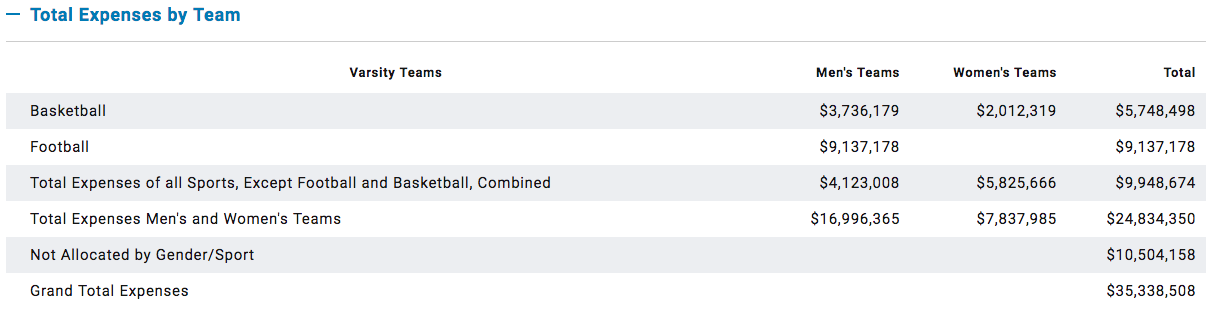
    Total expenses for UNM’s 22 varsity sports in fiscal year 2015. (Screenshot from ope.ed.gov/athletics)

    The University of New Mexico currently sponsors 22 NCAA Division I varsity sports. In addition to football, men’s basketball, and women’s basketball, the other 19 sports are: men’s baseball, men’s cross-country running, men’s golf, men’s skiing, men’s soccer, men’s tennis, men’s indoor track and field, men’s outdoor track and field, women’s beach volleyball, women’s cross-country running, women’s golf, women’s skiing, women’s soccer, women’s softball, women’s swimming and diving, women’s tennis, women’s indoor track and field, women’s outdoor track and field, and women’s volleyball.

    A man associated with the University of New Mexico carries a Lobos flag in support of its ski team on March 8 at 2017 NCAA Skiing Championships at Cannon Mountain in Franconia, N.H. (Photo: flyingpointroad.com)

    Two UNM sports teams have won an NCAA championship in any of those 22 sports: skiing in 2004, and women’s cross-country running in 2015.

    There are some reasons for caution regarding the expense data. Nearly every single revenue and expense figure matches up, dollar for dollar, within the report. That is, football apparently had expenses of $9,137,178 last fiscal year, but had revenue of precisely $9,137,178 as well.

    Another weakness with these numbers is the gap between sport-specific and unallocated expenses. The EADA site lists an additional $10.5 million in expenses “Not Allocated by Gender/Sport” (the penultimate line in the screenshot above). So while roughly $25 million in athletic department expenses are broken down by sport and gender, an additional $10 million more is not attributable to any given sport. That’s nearly 30 percent of the listed total athletic department budget.

    Finally, the bottom-line figure of the EADA document shows the UNM athletic department as reporting total revenue for the 2015 fiscal year of $35,338,508 and total expenses of precisely the same amount, suggesting that it neither made nor lost money last year. This suggestion clashes with both external reporting by the Albuquerque Journal and an internal financial memo sent to the UNM Board of Regents (see pages 243-248) by then-UNM President Bob Frank, both of which suggested that the UNM athletics department had a budget deficit of $1.54 million in fiscal year 2015. (Off revenue of $31.8 million and expenses of $33.3 million, both of which are less than the $35.3 million figure reported through EADA.)

    The $1.54 million deficit figure is correct, UNM assistant athletic director Frank Mercogliano clarified in an email to FasterSkier. “There are certain numbers that go into the EADA report that are different than what we refer to here as the ‘actual budget,’ ” Mercogliano wrote to FasterSkier Tuesday. “The ‘actual budget’ numbers are the ones that the Journal reported on… the one with the deficit.”

    Mercogliano added, “I personally have never seen the EADA report but I have been told that is why there are always differences in the numbers.”

    Paul Krebs, UNM vice president for athletics, “didn’t have specific sport-by-sport figures,” the Albuquerque Journal reported last summer. But he acknowledged that “football, despite a winning season and a bowl game appearance, lost money and men’s basketball, despite a downturn in ticket sales, made the largest profit in the department.”

    Men’s basketball marks the only portion of the EADA report listing different numbers for revenue and expenses. The figures given there suggest that men’s basketball earned $2,225,538 in profit for the athletic department last fiscal year.
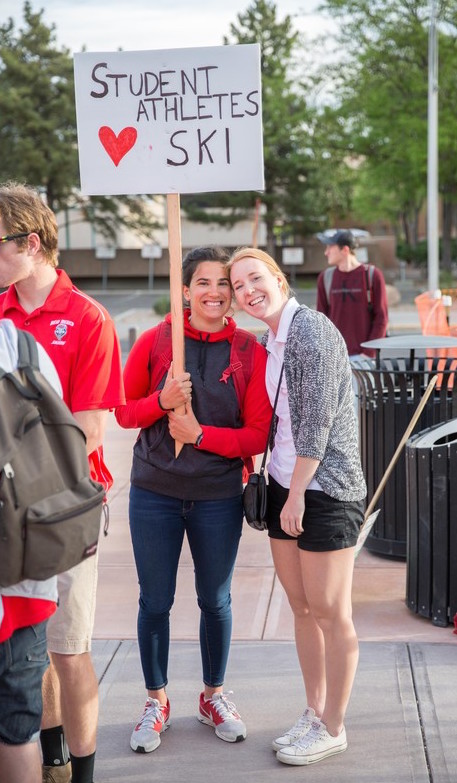
    A pair of ski team supporters outside the UNM Board of Regents meeting in Albuquerque, N.M., on April 18. (Photo: saveunmskiteam.com)

    If the UNM football team indeed lost money, it has ample company. The Washington Post reported in November 2015 that 28 of the 48 “Power Five” schools (those schools in the ACC, Big Ten, Big 12, Pac-12, and SEC, the five wealthiest college athletic conferences) saw their athletic department operate at a loss in 2014. And that included schools like Wisconsin, Auburn and Michigan State, whose annual athletic department revenues of $104 to $123 million dwarfed the $32 million figure for UNM last year.

    The Washington Post article did not consider UNM, nor any other school outside the Power Five conferences. All 48 Power Five conference schools had substantially more revenue in 2014 than UNM.

    And finally, back to the ski team. The UNM athletic department initially announced that “The decision [to cut skiing] will save the department approximately $600,000 per year in operating budget, scholarships and salaries.” Ski team supporters have since countered that “The Ski Team’s annual budget is actually only about $285,000 for the university as a whole, not the $600,000 figure the Athletic Department claims it will save by cutting the team.” The explanation given is, “This is mostly because the largest line item in the Ski Team budget is scholarships paid out of the Athletic Department budget, but paid TO the university’s main campus.”

    On Tuesday, the UNM Board of Regents met in Albuquerque. It was greeted outside by sign-waving attendees showing their support for the ski team. A video from inside the meeting shows multiple people speaking in support of the ski team.

    The next scheduled Board of Regents meeting is the budget approval meeting on May 11.

  • ‘You Can Just Feel the Energy,’ Wadsworth Says of CCC’s Renewed Coaching Emphasis

    ‘You Can Just Feel the Energy,’ Wadsworth Says of CCC’s Renewed Coaching Emphasis

    Cross Country Canada coaches Justin Wadsworth (l) and Louis Bouchard will continue to lead the Canadian cross-country ski team at the national and World Cup levels. (Photo: Cross Country Canada/Twitter)
    Cross Country Canada’s Justin Wadsworth (l) and Louis Bouchard will share coaching duties on the World Cup Team while mentoring less-experienced Canadian coaches on the World Cup circuit for the 2015/2016 season. (Photo: Cross Country Canada/Twitter)

    Canada is getting back to its roots. A year after Cross Country Canada (CCC) hired Norwegian Olympic gold medalist Tor-Arne Hetland to co-coach its World Cup Team, the national governing body is once again emphasizing homegrown coaches at the highest level of skiing.

    And although national-team head coach Justin Wadsworth is technically American, he might as well be considered Canada’s own after leading its team and living in Canmore, Alberta, since 2010.

    “Besides me, I think we’ll just try to work with Canadians,” Wadsworth said with a laugh on the phone on Thursday.

    This season, the 46-year-old California native is at the helm again and is prepared to share World Cup coaching duties with Louis Bouchard, Alex Harvey’s personal coach and head coach of the Pierre-Harvey Training Centre in Quebec. Wadsworth and Bouchard have worked together on the Canadian World Cup Team for the last five years.

    In addition to the duo, a select crew of training centre and potentially club coaches will be called upon in 2015/2016 to assist on the World Cup circuit as well, Wadsworth explained. The idea is to give them elite-level experience and form a pool of strong coaches to draw from nationwide.

    “We really feel like one coach, like myself or Louis, with the addition of a younger coach [at each World Cup] will fill in nicely and really promote the coaching system that we talked about a lot,” Wadsworth said.

    Tor-Arne Hetland, Swiss sprint coach from 2010-2014, at the 2014 Sochi Olympics in Russia. (Photo: FIS) http://www.fis-ski.com/cross-country/news-multimedia/news/article=tor-arne-hetland-nor-become-world-cup-team-coach-for-canada.html
    Tor-Arne Hetland, Swiss sprint coach from 2010-2014, at the 2014 Sochi Olympics in Russia. (Photo: FIS)

    In a press release on Tuesday, CCC announced its “integrated national coaching structure,” with an emphasis on developing coaches within its own borders. The organization did not renew Hetland’s one-year contract.

    “If we truly want to put Canada’s cross-country ski athletes on the Olympic podium in 2018 and 2022, then I believe it is critical at this time to put the Canadian system in the hands of coaches that are living and embedded in our training centres across the country,” CCC High Performance Director Tom Holland said in a press release.

    “Tor-Arne brought many great qualities and technical savvy to our program,” Holland added. “In looking at the long-term goals of Olympic medals in 2018 and beyond, we felt that a Canadian-based program brings greater stability and synergies in coaching philosophy and sport science approaches – and, ultimately, a stronger platform to breed medal-winning performances from our current- and next-generation high-performance athletes.”

    Wadsworth explained that in the aftermath of the 2014 Sochi Olympics, in which the Canadians missed the wax in multiple races and did not reach the podium, the timing wasn’t right to implement this kind of coaching system.

    “I think it’s a lot brighter,” Wadsworth said of the atmosphere within CCC this year compared to last spring. “Not just because we got medals at a major championship, but I think this renewed vision … you can feel the energy there.”

    And it’s not necessarily because of the money, either. Last year, CCC’s budget took about a $300,000-dollar hit in the wake of the Olympics, and Wadsworth estimates they could be down another hundred-thousand dollars or more this season. Next week, CCC will present to Own The Podium — one of its main sources of government funding — and while the outcome of those meetings is to be determined, Wadsworth said CCC is losing one if its major sponsors: Statoil.

    “Definitely the pie has shrunk a little bit and we have to be more cautious with the money we have, which is sometimes a good thing … you have to spend your money more wisely,” he said. “We’re definitely not going to have an increased budget, that’s for sure, it’ll probably be slightly decreased.”

    Regardless, spirits remain significantly higher than the beginning of 2014/2015 from Wadsworth’s standpoint.

    “After the Olympics, I was so beat down by that experience and the fallout of it, I didn’t have the energy to build up the system and I wasn’t sure I was going to continue in April and May last year,” he said.

    In the aftermath of some coaching moves last spring, Wadsworth became the national-team head coach tasked with bridging the gap between the Canada’s development skiers and World Cup athletes. He’ll do more of that this year, with a more explicit goal of better reaching out to smaller hotbeds for skiers, such as Whitehorse, Yukon, and share training or technique knowledge with clubs in those areas.

    “I’m going to try to be a little bit more available for helping any coaches that are interested…” he explained.

    Before last year, Wadsworth had been on the road, away from home, nearly 200 days each winter, and he needed a change — specifically less travel. Last season, Wadsworth estimated he traveled half that amount and anticipates he will only travel two days more in 2015/2016 while trading off on the World Cup with Bouchard.

    “Traveling is part of being a ski coach,” Wadsworth said. “Part of what I gained from last year was gaining a bit of focus and energy back.”

    “Part of what I gained from last year was gaining a bit of focus and energy back.” — Justin Wadsworth, Canadian World Cup and national team head coach

    With a new physiologist and new psychologist on CCC’s Integrated Sports Team, he added that “the energy sharing and idea sharing” is at an all-time high. The addition of less experienced coaches, as well as wax technicians (to work alongside seasoned staff members), on the World Cup will require athletes to adapt, but now is the time to focus on coaching, he said.

    Canadian National Team Head Coach Justin Wadsworth works on offset with development skier Jenn Jackson. (Photo: Pavlina Sudrich)
    Canadian National Team Head Coach Justin Wadsworth (l) works on offset with development skier Jenn Jackson in 2013. (Photo: Pavlina Sudrich)

    “You get so focused on one thing in the program and World Cup success and I think some of [these domestic coaching priorities] in particular fell through to the side,” Wadsworth said. “It’ll be open to more than just training-centre coaches; there are key club coaches that have produced athletes [as well] … In the meetings that we have coming up next week, we really need to start figuring out the balance … and who’s going to be able to travel where and get the experience to right people.”

    For Wadsworth, who was driving back to Canmore on Thursday after a three-day trip in Sweden with head wax tech Yves Bilodeau, he tentatively plans to be in Europe before the first World Cup in Kuusamo, Finland, and for the start of Period I. Bouchard will take over the second part of that period, then Wadsworth will be back with the team at the end of December for the Tour de Ski. He’ll return again for the mid-February World Cups in Falun, Sweden, before an “exploratory trip” to South Korea — the site of the 2018 Olympics — with Bouchard. Both will subsequently return home for the Tour du Canada, the final World Cups, in March.

    “Louis and I [have] a great relationship and great communication,” Wadsworth said. “I think that working relationship now is almost stronger than ever.

    “Tor-Arne’s done a lot of good things for our team and led the team well, but we really needed to get back to a Canadian model,” he added.

    On Wednesday, news of Hetland being hired to coach the Norwegian national team spread to the Scandinavian press. According to Langrenn, he will move from Davos, Switzerland, to Trondheim, Norway, this fall.

    “I think I have gained enough experience internationally to come home to Norway,” Hetland said, according to a translation. “Now I’m ready for my biggest challenge as a coach.”

    Hetland, Wadsworth and Bouchard worked alongside one another throughout last season and at 2015 World Championships, where Harvey earned two individual medals in Falun.

    “I think [Tor-Arne] ended up where he probably would have in a year or so,” Wadsworth said.

  • Despite Centralization Push and Improved Results, Own The Podium Cuts Budget for Biathlon Canada

    Note: This is the first of two pieces based on an interview with Biathlon Canada’s High Performance Director, Chris Lindsay, from earlier this spring.

    Canada’s Jean Philippe Le Guellec en route to 14th place in the sprint at 2012 World Championships.

    Any way you look at it, 2012 was a good year for Canadian biathlon on the World Cup.

    Jean-Philippe Le Guellec, Brendan Green, and Zina Kocher all notched multiple top-tens. While Green continued an ascent that began with top-20 finishes in 2010 and 2011, for the older two athletes, the results were a return to form: Le Guellec, who was the top Canadian at the Vancouver Olympics, had suffered from mono in 2011, and Kocher, a former World Cup podium finisher, had struggled mightily that year.

    Add a handful of points-scoring performances each by Megan Imrie and Scott Perras and one by Nathan Smith, and the team seemed to be right on track.

    But the sport’s governing body, Biathlon Canada, faces the same challenges as many of its counterparts in countries where nordic sports are not king: lack of funds. This spring the organization’s major partner, Own The Podium (OTP), decided to pull part of its funding from the sport.

    “OTP reviewed our performances this year and decided that none of our biathletes met the standard for targeted funding for the 2012-13 season,” Biathlon Canada High Performance Director Chris Lindsay wrote in an e-mail last week. “They are looking to help athletes on the verge of World Championships and Olympic medals to turn into sure bets. The reality is that our athletes were not at that level – basically being top five performer on average over a season.”

    Kocher, the top-ranked Canadian at the end of 2012, landed 19th in the overall World Cup standings; she finished ninth in three separate races. While Lindsay admitted that his athletes didn’t meet OTP’s criteria, he suggested that the criteria themselves were not ideal for a sport like biathlon.

    “Meeting this level of success in biathlon is very difficult due to the more chaotic and unpredictable results – for instance 23 different men were on the World Cup or World Championships podium this year, which is more than twice what you would see in most other sports,” Lindsay wrote.

    FasterSkier originally interviewed Lindsay in early April, before the OTP budget cuts were announced. Then, he said that OTP laid out tough criteria and demanded change from Biathlon Canada – but that he thought the changes were improving the federation. The following is based on that conversation.

    We Want Medals

    Own The Podium was started before the 2006 Olympic Games in Torino with a goal of targeting potential medal winners and helping them reach gold. The program expanded further for the 2010 Games, held on home soil in Vancouver. Its attitude represented a major change for sports in Canada.

    “The project was essentially created to try to drive our national organizations away from a participative model in Canada, where we would eventually have success internationally because were engaging large numbers of beginner athletes and we would have a trickle-up system,” Lindsay said. “OTP is the exact opposite. They target individuals within sports, and they will target specific sports where they feel that they have a strategic opportunity for success.”

    The participatory model had worked well for Canada’s most popular sport, hockey. But OTP, a joint venture between the government and corporate sponsors, had its own successes, for instance in some of the newer freestyle winter sports, and in speedskating. Biathlon wasn’t an obvious choice for this targeted funding – Lindsay said that OTP initially reached for “low-hanging fruit,” sports where the group could quickly make a difference.

    “In very mature sports with an extremely competitive international field, like biathlon, I would suggest that this poses challenges for us in order to get additional funds,” Lindsay said. “But because there are 33 medals in biathlon and slightly more than that in cross-country, OTP has seen that we are going to need to tackle this project eventually… we’re going to tap out the market in freestyle and curling.”

    Another challenge was that OTP specifically targets Olympic and World Championship medals – “You can win all the World Cup medals you want and it doesn’t matter,” Lindsay lamented – and in biathlon more than most sports, it isn’t just the top-ranked athlete who is capable of winning.

    In Vancouver, for example, gold medals went to Anastisiya Kuzmina of Slovakia, who finished the year ranked 20th, Vincent Jay of France who ranked 11th, and Bjorn Ferry of Sweden who ranked 16th. At 2012 World Championships, Slovenia’s Jakov Fak won the individual race before finishing the season ranked 17th. None of those athletes were slouches – all had multiple World Cup podiums – but they show how unpredictable biathlon can be.

    All of which meant that when OTP looked at the sport of biathlon, their metric for whether any athletes were future medal-winners didn’t seem encouraging. They saw a sport where a lot of work needed to be done.

    Central Planning

    Biathlon Canada is a membership organization – it has 60 clubs nationwide and thousands of members – and Lindsay said that in the past, the federation’s biggest strength was encouraging participation in the little-known sport and developing talented juniors (Canada has won a bevy of World Youth and Junior Championships medals in the last decade).

    “The business of running the national team is done by a subset of staff who report through the executive director to the board… which has authority over the budget,” Lindsay explained. “That can be a benefit and can also cause some frustration, because the people who sit around the board table tend to be the presidents to their divisions as opposed to being experts on biathlon. They are very good at running volunteer-driven organizations, but don’t necessarily have expertise at how to get people onto the podium.”

    OTP saw this broad-based, highly regional model – which was not unusual for the post-Calgary push for higher participation in sports in Canada – and demanded changes. The federation complied.

    “Biathlon Canada is in a period of transition now,” Lindsay said. “We are trying to move to an updated structure. There will still need to be a board with regional representation because the membership are served well by that, but the reporting structures regarding high performance are being reworked in order to make sure that the high performance group has the autonomy, the authority, and the responsibility required to actually converge into medals.”

    OTP’s other big push, across all sports, is centralization of high performance resources. So the national team is also spending more and more time in the Calgary/Canmore area (OTP reportedly suggested this to Cross Country Canada as well). Besides the benefits of the Olympic venue, Lindsay said that OTP has offered “targeted funding” to establish what it calls integrated support teams to the area: sports scientists and doctors, physiotherapists and psychologists.

    “Centralization is both a carrot and a stick from our funding partners,” Lindsay explained. “They encourage you to centralize as much as possible, because you will have access to better training facilities instead of putting your own money into training facilities. But also they say things like, ‘well, we’re asking you to centralize, and if you don’t, you run the risk of not being able to access these funds because we think this is the best strategy.’”

    In June, a brand-new, $200,000 rollerski treadmill was installed in Canmore; both the nordic and biathlon teams have been making use of it. Later this summer, Lindsay said, a new shooting facility will be finished which will rival the well-known lab at the University of Salzburg in Austria. Many national teams travel to Salzburg throughout the year to analyze their shooting, but Canadians will now be able to stay at home.

    Nevertheless, the federation has been somewhat hesitant about a full-blown move to Calgary; they also have a training center in Quebec, at the Myriam Bedard Center, where athletes like Le Guellec got their start.

    “Cross country has done a better job of [centralizing], and part of that is that they have been able to have the outside funding from other corporate sponsors that allows them to leverage their position, and still have a regionally-based development program with centers in the west and the east and central,” Lindsay said. “We have less visibility and… there’s no guarantee of the benefits.”

    Commitment, Then A Letdown

    Still, the federation came around to the idea of centralization and has slowly but surely been making changes.

    “But we are moving strongly now in that direction, with more time being spent by the non-Canmore athletes here,” Lindsay said this spring, speaking from his office in Canmore (Biathlon Canada’s headquarters are still in Ottawa).

    “The government has been putting a lot of investment into this training center,” he continued. “We’ve said, okay, we’re going to commit to this and do whatever it takes. We’re finally getting the message – everyone in the organization is getting it – that we are going to need to do things differently if we are going to survive, and not just survive but excel.”

    But excel to whose standards? For OTP, the changes weren’t enough, and the athletes, despite the improved results in 2012, still aren’t close enough to gold. The decreased funding will be a major blow to the federation’s high performance program, but the team will have to adjust – and try even harder to make the podium.

    “These are the standards and we will continue to try to meet them,” Lindsay wrote last week in an e-mail. “I am optimistic that despite the cuts we will still be able to support our athletes at levels which will optimize their performances.”

  • US Ski Team Budget Cuts Stretch Already Thin Resources

    US Ski Team Budget Cuts Stretch Already Thin Resources

    Two rounds of cuts have hit the U.S. Ski Team’s already-reduced budget this spring and summer, increasing demands on athletes, coaches, and administrators alike.

    According to U.S. Ski Team (USST) Head Coach Chris Grover, the program was directed in late June to trim nearly $60,000 from its 2012 operating budget—in addition to a $30,000 reduction that came in the spring, during the annual budgeting process.

    The impact of the cuts will mostly fall on the USST’s second-tier athletes. Funding is also diminished for the domestic SuperTour race series, as well as for the American participation in the World Junior Championships. And there is no time frame for the hiring of a replacement for former Nordic Director John Farra, according to Luke Bodensteiner, the U.S. Ski and Snowboard Association’s executive vice president for athletics.

    Neither Grover nor Bodensteiner would divulge the total cross-country budget, so the overall financial magnitude of the cuts is unclear.

    But Grover told FasterSkier in an interview that the reductions “definitely have us a little bit stressed out,” pointing out that the team is also plagued by a weak dollar against European currencies, as well as rising fuel costs.

    The team has preserved core programming and the strategic vision has remained intact, Bodensteiner said. Yet a number of areas will feel the effects of the belt tightening.

    While Bodensteiner describes the budget reduction as “not that significant” in the big picture, he acknowledged that some individual athletes will experience more of a strain.

    A-Team Insulated; B-Team Exposed

    As has been the case over the past several years, the USST has worked to insulate its top tier of athletes from budget fluctuations.

    Freeman at World Championships 2011. His medal hopes should not be hindered by recent budget cuts.

    Grover has a directive to prioritize “athletes that are on a potential path to win an Olympic medal in Sochi”—the World Cup Team members like Kikkan Randall and Andy Newell.

    Bodensteiner presents it simply enough— “We have one mandate and that is to win the Olympics, and that means winning more medals than any other nation,” he told FasterSkier. Funding is funneled to programs and athletes in direct support of this mission.

    So the A-team skiers will see little change in their support from previous years—but they are not fully immune.

    Funding for a team masseuse and physical therapist to attend several World Cup events has also been cut, a change that will mainly affect the top skiers.

    Additionally, longtime World Cup Team member Kris Freeman told FasterSkier that the U.S. squad brought a “barebones” staff to its recent New Zealand camp, with just a single coach and no wax techs. That was in comparison to the Russians, who Freeman said brought six athletes and eight staff.

    The reduced support down under was planned prior to the recent budget reduction, but was a result of the spring decrease and the fact that only the men’s team made the trip. With the USST sending two coaches to a women’s team camp in Alaska, Grover described the decision as “one-third financial, two-thirds logistical.”

    However, members of the A-team will still have their travel expenses largely paid for. That’s in contrast to the B-team, according to Grover, which he said is being asked to shoulder “a lot of their own costs, and sometimes all of their own costs when racing in Europe.”

    “We’re paying for basically travel this year,” said B-team member Simi Hamilton in an interview. “Last year, my travel to and from Europe was paid for. So that’s the biggest difference this year.”

    Hamilton said that he is paying airfare to camps, as well, which is another change from last season. But he also added that in a number of cases, athletes’ clubs have stepped in to pick up the slack—something that the USST staff said they were counting on.

    “In most cases, the clubs they’re involved with have come forward and helped out a bunch,” said Pete Vordenberg, the USST’s development coach.

    As an example, Vordenberg pointed to the recent addition of B-team athletes Noah Hoffman and Tad Elliott to the Team Homegrown squad, where they will receive financial support from the Ski and Snowboard Club of Vail.

    But according to Grover, funding for an additional staff member, either a coach or wax tech, to attend certain Europa Cup competition trips has also been cut—another blow to the non-World Cup skiers.

    The B-team athletes, however, are not alone in bearing the burden. The annual World Junior/U-23 Championships trip has also seen reductions in funding, and the prize money awarded to the winners of the sprint and distance SuperTour disciplines has been completely eliminated (see article).

    Jessie Diggins (USST) racing at World Junior Championships in 2010. The event is a key component of the US development strategy.

    The World Junior/U-23 (WJ/U23) trip, which has become a key component in the US development pipeline, will continue, but athletes will have to pick up more of the tab.

    Grover told FasterSkier that the USST contributed $22,000 to the WJ/U23 trip in 2011, and that those funds will not be available for the upcoming season. Without additional support Grover says that this will raise the cost per athlete by $1000.

    The nordic combined program has faced cuts as well, after entering the season with a relatively flat budget, according to Head Coach Dave Jarrett.

    “Everybody in the company took a cut in the summer, and that was a little bit harder to swallow because we had already set plans in motion,” Jarrett said. “It’s hard to go back to people and say ‘oh, by the way we’re not going to be able to do this, or if you want to do this we’re not going to be able to pay for it.’”

    Like the cross-country side, Jarrett confirmed that he has been directed to “keep the World Cup program as strong as possible.” That, he says, necessitates some belt tightening on the Continental Cup side—though Jarrett, who was traveling in Europe, said he could not provide specifics.

    “We’re trying to stretch everything as far as we can, without sacrificing the very elite part of it, because that’s what the mandate is from [Bodensteiner],” Jarrett said.

    USST Staff: Club Partnership Crucial

    Grover noted that the USST’s decision not to operate a centralized, Park City-based program allows the program to minimize the impact of budget fluctuations.

    “If we pin development on the money that the ski team has, or their ability to support athletes, I think we really are shooting ourselves in the foot,” he said.

    Instead, by opting for partnerships with local and regional clubs, there is a “a much wider development base, and financial support base, for the development group”—allowing the program to weather the annual fluctuations of the USSA budget.

    Over the last several years, the team has shifted its focus for developing racers from domestic racing to the European circuit.

    “We have these really young, talented athletes that need to get experience racing in Europe,” Grover said. “They need to get Europa Cup level racing experience. They need to have some introduction to World Cup-level racing, or more chances to race World Cup if they have had some already.”

    He describes the cuts as “tying their hands” on this front, limiting the USST’s ability to provide those European opportunities.

    The result has been to focus on the infrastructure of such trips – the coaching staff, wax support and logistics.

    This way, says Grover, if athletes can come up with the funding to get to Europe and cover their lodging, everything else will be in place.

    Still, Vordenberg, with his focus on development, said that it could be frustrating to contend with the yearly fluctuations.

    The USST enjoyed a period of more freely flowing funds a few years ago, during Vordenberg’s own tenure as head coach, which he said allowed the program to “really gain some traction.” But the current tight budget, he said, makes it difficult to put “muscle” behind new initiatives like the D-team.

    “While what we did can be carried forward by harder work from the clubs and stuff like that,” Vordenberg said, “it’s still frustrating to see that from our end of things, we aren’t still able to be taking those huge steps forward too.”

    Despite the setbacks, however, Vordenberg remains positive, saying “We’re charging forward and it seems like the overall ski community is charging forward too.”

    Tough Economy and New Sports Create Budget Pressure

    The reasons for the budget cuts are twofold, according to USSA personnel.

    First, the faltering economy is hurting private donations, which make up a big portion of USSA revenue, Bodensteiner said.  Second, five new sports that fall under USSA’s purview—parallel slalom snowboarding, women’s ski jumping, halfpipe skiing, slopestyle skiing, and slopestyle snowboarding—have been added to the Olympic program, and are now all in need of funding.

    In fact several of the new sports have yet t have funds allocated.

    The result is a smaller pie, and a need for more pieces.

    Grover was not surprised with the cuts, noting that in his time with the USST, he’s contended with similar scenarios several times.

    “When we do our budget planning in the spring, there is a little bit of guesswork going on with the marketing department,” Grover said. “We are creating a budget based on what those folks think is possible to bring in.”

    Grover said that strong fundraising in the fall could return some money to the cross-country budget. But Bodensteiner would not confirm that.

    Unexpected revenues, he said, would go to “fund the next most urgent need in any of the programs”—meaning that the nordic disciplines could be competing against alpine, snowboarding, and freestyle for the extra dollars.

    The overall picture is further complicated by a weak dollar against European currencies and higher transportation costs due to rising fuel prices Grover said.

    The World Cup room and board rate provided by the International Ski Federation (FIS) is set at 125 Swiss francs (CHF). Last year, this equated to approximately $120. As of August 28th the rate is $155.

    Nordic Director Position Remains Open

    USSA has not moved quickly to find a replacement nordic director following Farra’s resignation earlier this summer, and Grover said that funding has played a role.

    “We are looking to save a little bit of money right now,” Grover said. “And by not paying salary and benefits to someone right now, we do save…money.”

    Bodensteiner downplayed the financial pressures, instead focusing on his desire to take his time naming a replacement. He pointed out that during his tenure as vice president for athletics, he has never had a full complement of Program Directors.

    “I like to pull the program in a little bit and help to manage it for some period of time, to really understand where the greatest needs are going to be,” Bodensteiner said.

    Farra (r) and Jarrett (l) watch Billy Demong's gold medal performance at the 2010 Olympics in Vancouver.

    Farra’s tasks have been divided up between existing staff, with Bodensteiner stepping in to shoulder some work.

    But neither Grover nor Vordenberg said their workloads had increased drastically. And Bodensteiner, who was Farra’s own predecessor as nordic director, described the time he spends on the role as “not a lot.”

    Much of the burden appears to have fallen on Toni Adams, the nordic program manager. All three men described her as stepping up her workload significantly since Farra’s departure.

    On the nordic combined side, Jarrett describes Farra as putting 80 percent of his time into cross-country.

    “Right now, we haven’t felt it as much as probably the cross-country program has,” Jarrett said. “But it certainly is a big loss to have him not there.”

    Grover added that Farra was still on board for the team’s spring planning, and that now the program is comfortable in its training routine.

    “We got through the part where we need some guidance, and the rest of the year we know what to do,” Grover said.

    Bodensteiner describes his current approach as running the program with a “management team,” and made it clear that there is no time-frame for hiring Farra’s replacement. Some program director jobs have gone unstaffed for as long as two years, Bodensteiner said, and the nordic opening “could definitely be longer-term.”

    “Unfortunately, we don’t have the luxury to say, ‘we have an open spot,’ and then go hire somebody,” he said, “because we have a thousand demands on the dollars that I could put into that role.”

    The high level of experience of current nordic staff has helped the situation as well Bodensteiner told FasterSkier.

    “Those guys [Nordic coaches] for the last couple of years have been the ones setting the tone for the program and providing the leadership for the community and the athletes,” he said.

    He did confirm that he has given thought to potential candidates and that if the workload became too heavy for existing staff, he could accelerate the hiring process.

    — Nat Herz contributed reporting