From the FasterSkier archive — posts syndicated from athletes’ and coaches’ own blogs between 2004 and 2012, kept online as published. Current coverage is at fasterskier.com.

Tag: Cable

  • ‘Train Like A Birkie’ Camp Timed for Fat Tire Bike Festival, with Elliott Back in Town

    ‘Train Like A Birkie’ Camp Timed for Fat Tire Bike Festival, with Elliott Back in Town

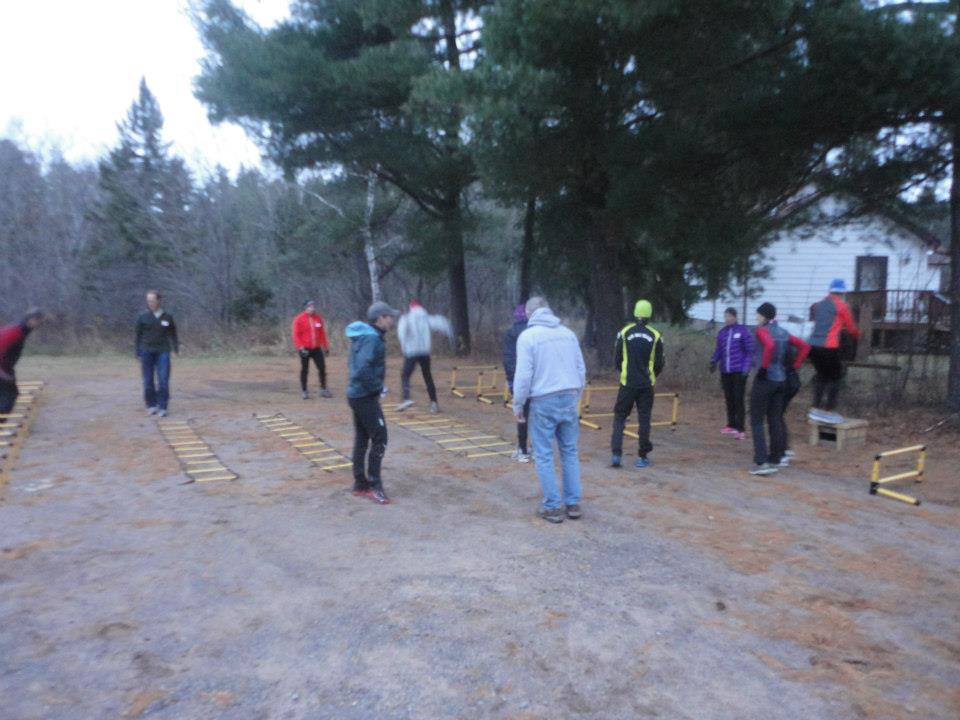
    Scenes from the 2012 "Train Like A Birkie Champion" camp: featured skiers Tad Elliott and Matt Liebsch lead fundamental movements and balance work. (Photo: Facebook)
    Scenes from the 2012 “Train Like A Birkie Champion” camp: featured skiers Tad Elliott (black and yellow) and Matt Liebsch (fourth from left) lead fundamental movements and balance work. (Photo: F.A.S.T./Facebook)

    Bill Pierce gets it. If you’re a citizen or master athlete in the Midwest, chances are you’re not training year-round for the Birkie – or at least you have other races and diversions to keep you entertained through the summer.

    And if one of those interests is mountain biking, you might be signed up for the Chequamegon Fat Tire Festival from Sept. 13-15 in Cable and Hayward, Wis.

    Perfect, thought Pierce, the outgoing director of F.A.S.T. Performance Training who recently took over as head coach of the Central Cross Country (CXC) elite team. Let’s give those athletes a dryland camp with a mountain-bike twist. And let’s get Tad Elliott back to northern Wisconsin.

    Both elements were relatively easy to pin down, Pierce explained on the phone earlier this week. At the end of last year’s “Train Like A Birkie Champion” camp, Elliott, a former U.S. Ski Team (USST) member who’s still pursuing professional skiing while mixing up training with his other love – mountain biking (he was on the U23 national team) – vowed to make the trek from Durango, Colo., back to Seeley, Wis. Then Pierce suggested adding a mountain-bike option to the three-day camp.

    “I suggested it and he jumped on it,” Pierce said. “It was done for a marketing reason. The citizen-master athlete does not train for skiing from May ’til March. They’re doing multiple things, and I think one of their main goals is to enjoy an exercise program that’s two or three sports.”
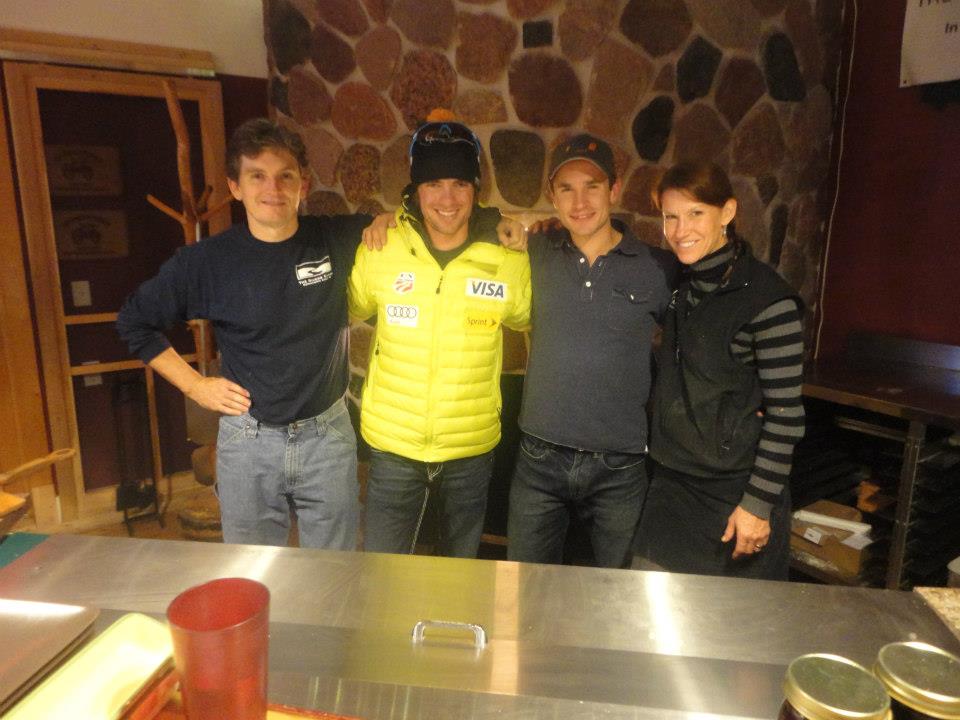
    Pro skiers Tad Elliott (second from left) and Matt Liebsch (second from right) with Rivers Eatery owners Mick and Beth for the Saturday-night dinner at last year's "Train Like A Birkie Champion" camp. (Photo: F.A.S.T./Facebook)
    Pro skiers Tad Elliott (second from left) and Matt Liebsch (second from right) with Rivers Eatery owners Mick and Beth for the Saturday-night dinner at last year’s “Train Like A Birkie Champion” camp. (Photo: F.A.S.T./Facebook)

    From Sept. 6-8, F.A.S.T. will sponsor its third consecutive “Train Like A Birkie Champion” camp, which Pierce timed strategically before the Fat Tire Festival that attracts some 2,500 riders annually. Last October, the citizen/masters’ camp that featured Birkie champs Elliott and Matt Liebsch had 15 or 16 participants, Pierce said. This year, he’s hoping for as many as 30.

    “We’re kind of taking advantage of fall training,” he said. “For almost all masters and citizens, [it] doesn’t get thought about until Sept. 1.”

    While Liebsch won’t be at this camp (the Minnesota native and Gear West race services director held his own earlier this summer), Boulder Nordic Sport race service director and former USST member David Chamberlain will, according the schedule.

    Elliott will lead a mountain-bike skills and training session on the afternoon of Sept. 7, and about $1,500 dollars of the money raised through registration and a silent auction will go to him.

    Another $2,000 to $4,000 dollars generated by the camp will go to the Birkie Skier Development Grant Program, which has doled out more than $200,000 dollars over the years to nordic programs across the U.S. Last year, the American Birkebeiner Ski Foundation (ABSF) awarded 10 grants to programs in Wisconsin and Minnesota totaling $11,000 dollars. Pierce hopes his fundraiser will supplement the ABSF’s yearly donation.

    “They’ve given funds all over the country,” Pierce said. “The revenue is entry fees, $20, 40 or $50,000 in their budget; [they] give it as a line item. We’re trying to help them.”

    “Train Like A Birkie Champion (On a Mt. Bike!)” Camp Schedule

    Friday, September 6, 2013

    8-9:00am: Check in at Lenroot Lodge, Seeley, WI
    9-10:30am: Intro to the fundamental movements of Nordic skiing. Dry land drills and skills.
    10:30-Noon: Double pole and V2 fundamentals on roller skis.
    Noon-2:00pm: Lunch at the Sawmill and video review after.
    2-5:00pm: V1 skate technique work with video.
    5-6:15pm: Strength instruction and session.
    6:45-8:30pm: Fish fry at the Sawmill and discussions with Dr. TBD.
    8:30-10:00pm: Discussions and demos on ski selection and waxing by David Chamberlain from Boulder Nordic Sport.

    Saturday, September 7, 2013

    7:30am: Morning run or bike for 20 min. with exercises.
    8-9:00am: Breakfast on your own.
    9-10:15am: Stretching with Dr. Jim Mullens
    10:30-Noon: Basic classic technique session and video with Bill, David, and Tad.
    Noon-2:00pm: Lunch at the Sawmill with video review after.
    2:00-4:30pm: An additional skate/classic roller ski workout session(specific strength) or an afternoon training and skills session with Tad on the mountain bikes.
    4:30-5:30pm: How to deal with repairs in a race: flats, broken chains or spokes, etc…
    6-7:30pm: Pizza dinner at the Rivers Eatery in Cable.
    7:30-Done: Chat with a Champion, dessert and coffee during discussions with Tad about his pursuit of a US Olympic Team position.

    Sunday, September 8, 2013

    7-8:00am: Breakfast on your own.
    8-10:30am: Classic or skate technique and video with Bill, David, and Tad.
    10:30-Noon: Video review from the morning session.
    Noon: Camp departure.

    Camp Fee: The fee for this camp is $224.00.  It includes 2.5 days of coaching and sport instruction, two lunches, two dinners, and some swag.  The camp is limited to the first 30 registrations.  All proceeds from this camp go to supporting Tad Elliot and also a gift to the Birkie Skier Development Fund.

    For more information or to sign up, click here.

  • Worldloppet Meeting Means Big Things for Smaller Ski Nations, Passport Holders

    Worldloppet Meeting Means Big Things for Smaller Ski Nations, Passport Holders

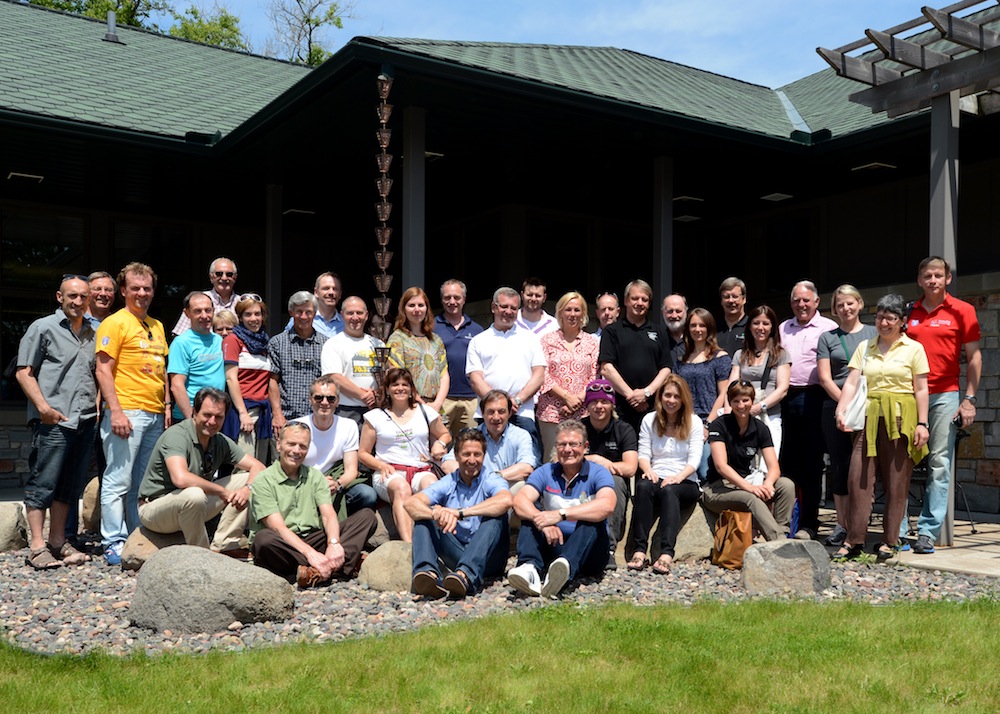
    The 2013 Worldloppet Annual General Assembly met in Cable and Hayward, Wis., from June 13-16. (Photo: ABSF)
    The 2013 Worldloppet Annual General Meeting met in Cable and Hayward, Wis., from June 13-16. (Photo: ABSF)

    Thirty-five years ago, Tony Wise rounded up delegates from eight nations – including himself – and threw some mud at Telemark Lodge in northern Wisconsin.

    Five years earlier in 1973, Wise founded the American Birkebeiner, a 48-kilometer cross-country ski race from Cable to Hayward, Wis. He dreamed up the creation to commemorate the Norwegian Birkebeiners, which skied little Prince Haakon to safety in 1206, and the race evolved into the largest ski marathon in North America.

    Wise had no way of knowing what it would become, but he had big plans. It wasn’t long before he was thinking internationally and sharing his vision of a Worldloppet with different nations hosting marathons across the globe.

    “His concept was to provide average citizen skiers the opportunity to achieve something on a truly global scale,” explained Wise’s former PR director, Tom Kelly, now the vice president of communications at the U.S. Ski and Snowboard Association. “Some 35 years later, it’s gratifying to see his dream still growing.”

    In March of 1978, nine nations met in Uppsala, Sweden, to officially form the Worldloppet federation. The series drew slightly more than 50,000 participants that year with nine races. The Worldloppet has held an Annual General Meeting (AGM) every year since in each of its member nations, which grew to 16 last year with the addition of Russia and its Demino Ski Marathon.

    Worldloppet Races:
    1. Jizerská padesátka, Czech Republic 2. Dolomitenlauf, Austria
    3. Marcialonga, Italy
    4. König Ludwig Lauf, Germany
    5. Tartu Maraton, Estonia
    6. La Transjurassienne, France
    7. Finlandia-hiihto, Finland
    8. Vasaloppet, Sweden
    9. Engadin Skimarathon, Switzerland
    10. Birkebeinerrennet, Norway
    11. Bieg Piastow, Poland
    12. American Birkebeiner, U.S.A.
    13. Gatineau Loppet, Canada
    14. Sapporo International Ski Marathon, Japan
    15. Demino Ski Marathon, Russia
    16. Kangaroo Hoppet, Australia
    17. Marcha Blanca & Ushaia Loppet, Argentina*
    18. Merino Muster, New Zealand*
    19. Vasaloppet China, China*
    20. Fossavatn, Iceland*
    *Associate members pending inspection and approval at 2014 AGM

    In 2012/2013, the grand total for race participation in all 16 races exceeded 135,000 people. Last weekend, the AGM returned to Cable for the first time in 15 years, and approximately 45 delegates made one of the federation’s most historic decisions to date.

    Four nations were tentatively named associate members: Argentina, China, Iceland, and New Zealand. The idea was to open the gate to more countries eager to host Worldloppet marathons and loosen some requirements, namely the participant minimum.

    “It wasn’t too controversial,” said Worldloppet Executive Committee member Dennis Kruse, who represented the overseas nations (U.S., Canada, Japan, and Australia) at the AGM meeting from June 13-16.

    The federation had been talking about adopting these races since last year’s meeting, when it welcomed Russia as a full member. According to the Worldloppet constitution, a marathon can become part of the circuit if it meets certain criteria (i.e. it’s the only Worldloppet race in that country, has existed for at least five years, has computer timing and has a minimum of 1,000 participants). The size standard was where nations like Argentina struggled.

    “In the last few years we’ve kind of adopted a new theme or model,” Kruse said. “We think that Worldloppets should really be the voice of nordic skiing across the world.”

    That meant letting Argentina host its race, the Marcha Blanca and Ushaia Loppet, as long as it passes inspection in the coming year. Next June, the AGM will meet again and vote to confirm the associate nations’ status – and if all goes well, those races will be on the 2013/2014 Worldloppet calendar.

    Associate members will pay federation dues and attend meetings, but won’t have voting rights. Kruse said that isn’t a huge deal because nations can be promoted to full members if they expand to meet all criteria.

    “China, we expect in a few years, will come back to us and say we would like to be a full member,” Kruse said.

    Besides the anticipated economic boost to developing ski nations (the American Birkie brings in around $5 million to the area each year), the addition of four nations to the series makes a longer to-do list for Worldloppet Passport holders. Kruse said that’s a good thing.

    Worldloppet Secretary General Angelo Corradini from Italy enjoys a dance with a local Ojibwa Chippewa dancer during an Indian Pow Wow at the Worldloppet Annual General Meeting at Lakewoods Lodge near Cable, Wisconsin. (Tom Kelly)
    Worldloppet Secretary General Angelo Corradini from Italy enjoys a dance with a local Ojibwa Chippewa dancer during an Indian Pow Wow at the 2013 Worldloppet Annual General Meeting last weekend at Lakewoods Lodge near Cable, Wis. (Tom Kelly)

    One man – a Worldloppet Master – has filled his Passport book with the required 10 races 25 times, he said. One woman has achieved 20 Worldloppet Masters, which means she’s completed at least 200 marathons in various nations.

    “They just keep doing this repeatedly on a gerbil track, just circling the globe doing world marathons,” he said. “This gives them another challenge.”

    The federation hadn’t decided whether Global Skiers needed to complete the four associate races as well as the required 16. Either way, Kruse felt their addition would give avid Worldloppet racers a better shot at getting into capped races.

    Some of the most popular marathons, like Sweden’s Vasaloppet, the Norwegian Birkebeinerrennet and Italy’s Marcialonga, have sold out in minutes. The Vasa is currently the largest race in terms of participants, limiting registration to 15,800 skiers for its 90 k classic race. The American Birkie recently set its cap at just under 10,000 for its 50 k skate, 54 k classic and 23 k Kortelopet events. For the first time in Birkie history, registration for its 2014 events can only be submitted online.

    How quickly registration fills up is actually a problem for Worldloppet race organizers, and its something they’ve been trying to remedy as marathon popularity has grown, Kruse said. For certain races, like the Vasa, Marcialonga and Norwegian Birkie, people have been known to enter their information online ahead of time and press send as soon as registration opens. That can pose a problem for people living several time zones away.

    “We’ve said we need to be user-friendly for our skiers coming from outside the country,” said Kruse, a former Birkie president who now serves as competition director. “There’s definitely an effort by every country, and we do the same.”

    With races like the Birkie filling up faster every year, one might wonder how long marathons will be a hot item and whether their prime audience of masters is aging with them.

    Kruse said the Birkie went through some stagnant years, but has recently seen a resurgence in participation and younger average age from what it used to be in the mid 40s and 50s.

    “Our [average participant age] was creeping upward, that’s why I felt like we needed to invest in financial support for youth programs,” he said. “I said, ‘Look, it doesn’t take much to predict the future, and nobody skis the Birkie when we’re all dead.’ ”

    More people in the 20- to 30-year-old bracket are doing the Birkie now, he said, but generally, it’s an older population that has the time and financial ability to travel the world and complete Worldloppets.

    “Typically people are doing this when their kids are gone, when their career is not on the fast track for promotion any more, or they’re retired,” he said.

    But a trip to Argentina might be appealing to anyone, and so might the chance to ski with some of the world’s best.

    “There’s not many sporting events where a guy in his 60s gets to line up with Peter Northug, with top international skiers who are doing the same course at the same time,” Kruse said. “Obviously some skiers want to have really good results and some skiers want to have a tourist experience and come visit.”

  • Fat Bike Birkie Debuts to Sold-Out Crowd

    2013 Fat Bike Birkie (Photo: Kelly Randolph)
    2013 Fat Bike Birkie (Photo: Kelly Randolph)

    First-Annual Event Welcomes 300 Riders to the Snow-Covered Birkie Trail

    See All 141 Photos on Facebook

    The American Birkebeiner’s first-annual Fat Bike Birkie, presented by Freewheel Bike, held Saturday, March 9, in Cable, WI, was a great success with 300 registered riders. The main event, the 45K Fat Bike Birkie was won by Jorden Wakeley, Grayling, MI, while Danielle Musto, Grand Rapids, MI, won the 45K women’s race. All races were held on the expertly groomed Birkie Trail system. The event was capped at 300 riders to ensure a great snow-biking experience on the Birkie Trail for everyone involved.

    There were four races: the 45K Fat Bike Birkie, an 18K Fat Bike Birkie, a 45K mountain bike race, and an 18K mountain bike race. All races started and finished at Telemark Resort, with the long races reaching the Birkie “OO” trailhead.

    Congratulations to all riders who participated in this first-ever event! The overall champions in each bike and distance category are listed below.

    Please see complete race results at

    www.itiming.com

    45K Fat Bike Race:

    Jorden Wakeley, Grayling, MI, in 1:48:30

    Danielle Musto, Grand Rapids, MI, in 2:14:11

    45K Mountain Bike Race

    Leo Kendrick, Minneapolis, MN, in 2:38:54

    18K Fat Bike Race

    John Riley, Cross Plaines, WI, in 00:42:45

    Cindy Bijold, Hayward, WI, 00:48:52

    18K Mountain Bike Race

    Tom Gaier, Hayward, WI, in 00:43:18

    Elsa Hansen, Duluth, MN, in 1:03:11


    The Fat Bike Birkie is a once-a-year chance to ride a fat bike or mountain bike on the world-famous, snow-covered, and beautifully groomed American Birkebeiner Trail system. Fat bikes and mountain bikes are otherwise not allowed when there is groomed snow on the trails. In fact, this new Birkie event took place just two weeks after the 40th annual American Birkebeiner ski marathon, which hosted 13,000 skiers from February 21-23.

    According to columnist Tom Held, who regularly reports on endurance sports in the Upper Midwest, “Interest in fat bikes has increased dramatically over the last three years, from a couple races to about 80 in the Midwest alone. Fat Bikes are the fastest growing segment of the bike market, with sales reported as increasing from a couple hundred a year to nearly 10,000 in that same three-year time period.”

    Of course, snow was mandatory for this to be the kind of fast, fun event that got everyone so excited about heading for the Birkie Trail on their bikes. After low- to no-snow conditions in the Hayward/Cable area in much of January, the tables turned. The snow started in February and has kept coming, all the way through the beginning of the week leading up to the Fat Bike Birkie. Even though temperatures reached the low 30sF by Friday, the Birkie Trail was offering some of the best corduroy of the season.

    Saturday morning, race day, opened with a “winter mix” of rain and sleet that quickly changed to light snow. It did change to a rainy mist later, but by then most participants were already swapping stories and digging into the post-race lunch of brats and burgers provided by the Birkie at Telemark Lodge.

    “Riders reported the course was firm and fast, and the trails held up well to the fat bikes,” said Ned Zuelsdorff, Executive Director of the American Birkebeiner Ski Foundation, who added, “This is a great crowd who made this a very fun event for everyone, and we will do it again next year!”

    For more information about the Fat Bike Birkie and other American Birkebeiner events, like the Birkie Trail Run & Trek on September 21, 2013, visit www.Birkie.com, email birkie@birkie.com, or call the Birkie office at 715-634-5025.

  • First Birkie Paintball Biathlon Set fo July 28

    NEW Birkie Paintball Biathlon

    – July 28, 2012 –

    Run or Mountain Bike This Newest Birkie Event

    The American Birkebeiner Ski Foundation (ABSF) has announced a new addition to its year-round lineup of Birkie Trail events. The ABSF, together with the North End Ski Club of Cable, WI, will host the all-new “Birkie Paintball Biathlon” on Saturday, July 28, 2012. The event will take place on the Birkie Trail loops surrounding the Birkie “OO” trailhead south of Highway “OO” in Seeley, WI, just nine miles north of Hayward.

    Participants can either run or mountain bike the biathlon course. They will complete a course where they stop twice–between each of three laps–to shoot five targets at a temporary target range which will be set up for the event. Each target hit will count as a deduction to the participant’s overall race time.

    The paintball target range will be supervised by an adult who will hand the paintball gun to the participant. The participant will fire at the five targets from a distance of 30 feet. The participant will then hand the gun back to the supervisor before completing the next lap.

    Age categories and race distances include a 1.5K run for participants age 8 to 12, and a 5K run for participants age 13 to adult. Or, participants ages 8 to adult can mountain bike a 10K course. The running event will be held first, followed by the biking event.

    Cross country ski biathlon is already a popular winter sport and Olympic event. As a summer event on dry land, it is a great way to introduce kids and adults alike to the Birkie Trail and the biathlon competition format.

    The Birkie Trail is open to the public 365 days a year, so holding additional, supported events like this is a way to get people out on the trail to enjoy one of the area’s greatest recreational resources.

    “We’ve made sure this event is trail-friendly in every way,” says Ned Zuelsdorff, Executive Director of the American Birkebeiner Ski foundation. “The plastic paintball casings will fall below the targets and will be cleaned up at the end of the event. The paintball liquid itself is water-soluble, non-toxic, and biodegradable.”

    You may register prior to the event or from 8:00 to 8:30 the morning of the event, July 28. Please note, however, that the event will be limited to a total of 100 participants. You can download a registration form at www.Birkie.com Home Page or register at the Birkie office in downtown Hayward, WI. A nominal fee will be charged to help cover the cost of supplies. ABSF will rent the paintball guns, and the North End Ski Club will provide other materials.

    For more information, click here, email birkie@birkie.com or call 715-634-5025

  • Elliott Leads American Birkie Sweep (Updated with Photos)

    Elliott Leads American Birkie Sweep (Updated with Photos)

    U.S. Ski Team member Tad Elliott celebrates winning the 2012 American Birkebeiner in 2:04.48.5, more than 13 seconds ahead of Matt Liebsch, Brian Gregg and Michael Somppi (at right) on Saturday in Hayward, WIs. (Photo: Darlene Prois/American Birkebeiner)

    All American Birkebeiner coverage is brought to you through the generous support of Concept2, makers of the SkiErg.

    HAYWARD, Wis. – For the first half of Saturday’s 50-kilometer skate race at the 39th American Birkebeiner, Tad Elliott mostly looked down. The 23-year-old U.S. Ski Team member was hanging in there, but it wasn’t easy.

    Reaching for a water bottle around 24 k, he mustered the strength to ask his Salomon support staff where the frontrunners were. Last year’s runner-up, Benoit Chauvet of France, and Canadian Graham Nishikawa were nearly a minute ahead of Elliott and the chase group.

    The fact that Elliott asked indicated he had some spark left. He hadn’t really warmed up for the race — he typically didn’t for a 50 k — but he’d get there eventually.

    A few kilometers later, he and his former teammate, Matt Liebsch, worked together to gun down Chauvet and Nishikawa. That’s what Elliott instinctually wanted to do all along, but Liebsch in his ninth Birkie knew better.

    “Tad kept poking me saying, ‘We’ve got to bring it back, they’re gonna get away,’ ” said Liebsch, who previously trained with Elliott on Central Cross Country (CXC). Liebsch now skis for Team Strong Heart and Team Birkie.

    “I was like, ‘No, no, they’re not going to be able to hold that,’ ” Liebsch said. “I knew it, but I wasn’t 100 percent sure.”

    It turned out the 28-year-old Minnesota racer was right. Chauvet and Nishikawa faded to finish 10th and 25th, respectively, after Liebsch, Elliott and a few others overtook them around 34 k.

    2012 American Birkebeiner men's 50 k skate podium: (left to right) Matt Liebsch (Team Strong Heart/Team Birkie) in second, Tad Elliott (USST/Team Homegrown) in first, and Brian Gregg (CXC) in third.

    Elliott continued to hit his stride and went on to lead the pack, creating about a 30-second gap in the process. He held on for the final 10 kilometers to win the race by 13.7 seconds in 2:04.48.5.

    Liebsch was second and another former teammate, Brian Gregg of CXC was third (+14.8).

    “In the past, I have a really good kick and can make a gap open up fast, but then I tire a little bit,” Elliott said. “I just kind of ramped it up and no one followed and from there on, I was committed to going real hard to the finish.”

    Shortly after crossing the finish line in downtown Hayward in front of an estimated 20,000 spectators, Elliott borrowed a stranger’s phone and called his mom. She had convinced him to come back to the event after placing second there two years.

    In 2010, he placed second to Italy’s Fabio Santus, who set a course record in 1:56.58. In his first Birkie, Elliott was just eight seconds behind. Besides his mother’s enthusiasm for the largest ski marathon in North America, Elliott was motivated by how close he previously came to the victory and its $7,500 prize.

    “I wanted to win the Birkie,” Elliott said, after becoming the second American man to win the 50 k American Birkebeiner in 20 years. “It is a dream come true.”

    Liebsch previously claimed the title three years ago. On Saturday, American skiers topped the podium in every elite men’s and women’s race for the first time since 1975. Back then, the Birkie featured one 55 k classic race.

    Flying directly from Europe to the Midwest earlier this week, Elliot prepared for the Birkie in part by watching last year’s video, in which Norway’s Tore Martin Gundersen put on a commanding sprint to win by about three seconds.

    U.S. Ski Team member Tad Elliott (Salomon) racing alone with about a 30-second lead at 44 k in the 50 k American Birkebeiner skate race. Elliott won in 2:04.48.5 on Saturday.

    “I wanted to be nowhere near that guy,” Elliott said.

    He planned accordingly by working with Liebsch, who also wanted to build a gap rather than try to duke it out at the end.

    After Liebsch pulled to the front around 34 k, Elliott went with him, and the two switched leads until Elliott made a game-changing move around 40 k.

    On the infamous long gradual uphill known as Bitch Hill, Elliott jolted ahead. Gregg quickly responded and tucked in behind, but Liebsch missed his pole plant. He and Lars Flora went down in a tangled mess while Elliott and Gregg continued on.

    Gregg remembered watching the mishap unfold.

    “It was sort of like, ‘Oh man what’s going on?’ ” Gregg said. “Matt’s a real good buddy of mine, Tad’s a real good buddy, so I thought, ‘We should get this.’ ”

    He decided not waste energy chasing Elliott alone and hold onto second, while Liebsch skied without a pole for about half a kilometer. He eventually picked one up off the snow next to a spectator, who told him to give it back.

    “Then he was like, ‘That better be at the Birkie office after,’ ” Liebsch said. “It was some heavy, crappy pole. It didn’t even have a strap on it, and I skied with that.”

    Santiago Ocariz (CXC) immediately offered Liebsch his pole. He refused to accept it and skied for nearly 5 k with the same cumbersome one. Anticipating his father would have a better pole at 44 k, Liebsch discovered he didn’t. Ocariz renewed the offer, and the two traded poles. A few strides later, Ocariz found a suitable replacement.

    “If [Liebsch] would have taken it right away, he might have won,” Ocariz said. “I mean, what’s the difference if I’m eighth or fourteenth? He had the chance to win. He’s a good friend of mine.”

    Ocariz ended up 11th.

    “I’m realistic. I know my limitations and I know how much stronger those guys are,” he said. “I was just like, ‘I’m going to hang on as long as I can and then we’ll see what happens.’ ”

    The gesture helped Liebsch move to second as he sped away from the others shortly after. Halfway across Lake Hayward a few kilometers before the finish, Liebsch quickly gained ground on Elliott.

    Elliott knew it, checking back several times as his 30-second lead dwindled.

    “I honestly thought I was gonna get caught right as I turned onto Main and it would be over,” Elliott said. “But I ended up hanging on so I was pretty fired up coming down Main Street.”

    Liebsch reasoned that if he put his head down into the headwind and pushed as hard as possible, he could have caught him. But he wasn’t sure could hold off the men behind him in a sprint and thought the same for Elliott.

    “I would have been toast and he probably would have had to deal with my baggage,” Liebsch said.

    He worried they could end up out of the top three and didn’t want European sprinters taking those spots.

    “I didn’t care if [I] was top three as long as it was American, American, American,” Liebsch said.

    Gregg held off Michael Somppi of Canada’s National Development Centre in Thunder Bay by two-tenths of a second for third. He had hung onto Liebsch after his big push near 45 k and saw six men ahead of him at the start of the lake.

    “The last couple years I’ve finished just out of the money in eighth, seventh, eleventh,” Gregg said. “So I was like, ‘I’m not going to do that this year.’ ”

    He picked them off one by one, passing Somppi on the final turn before Main Street.

    “It was pretty cool because both Elliott and Liebsch are big training partners [and] we were all on the team together last year and two years before,” Gregg said. “You always want to win but it’s awesome to have those guys ahead of you.”

    Morten Pedersen (NOR) placed fifth 20.7 seconds after Elliott, and Flora received $1,000 for finishing sixth (+23.9).

    Second in last year’s 54 k classic Birkie, Karl Nygren (CXC) was seventh in the 50 k skate. The race’s 2011 champion, Gundersen was eighth. Nishikawa’s teammate at the Alberta World Cup Academy, Brent McMurtry finished ninth.

    Classic Race

    Six-time Olympic medalist and FIS Cross-Country chairman, Vegard Ulvang of Norway, after his first American Birkebeiner on Saturday. Ulvang was second in the 54 k classic race in 2:51.17.1. (Photo: Darlene Prois/American Birkebeiner)

    In the men’s 54 k classic race, Dave Chamberlain of Boulder Nordic Sport notched the default victory after originally placing second by a small margin to Joe Dubay of the College of Saint Scholastica in Duluth, Minn. The 21-year-old Dubay was disqualified for racing in the bib of another athlete, his teammate Chris Parr.

    Chamberlain won the race in 2:51.15.2, edging Vegard Ulvang of Norway by 1.9 seconds. The Birkie guest of honor, Ulvang participated in his first American Birkebeiner as a research ambassador for the National Multiple Sclerosis Society. He was one second ahead of Murray Carter of Manitoba, Canada.

    2012 American Birkebeiner Results

    Birkie finish videos (recorded live)

  • New Birkie Trailhead Decision Postponed Until March

    American Birkebeiner press release

    CABLE, Wis. — At the public hearing held last night, January 11, by the Bayfield County Forestry Committee (BCFC) at the Cable Community Center, the BCFC passed a motion to postpone a decision on the American Birkebeiner Ski Foundation’s proposal for a new trailhead at the Highway 63 – Leonard School Road location (east of hwy 63).

    A decision by the Bayfield County Forestry Committee is required because constructing the proposed Birkie trailhead would involve a connector trail to the main Birkebeiner Trail that would cross three-quarter miles of Bayfield County forest.

    The five representatives of the BCFC concluded that enough new information was presented at last night’s meeting that it would like to postpone its decision in order to further review this information and provide an additional opportunity for public discussion. A decision will be made after further discussion at the BCFC’s monthly meeting in March, to be held in Washburn.

    For additional information, see the Trailhead Proposal press release and the FasterSkier story: “Birkie One Step Closer to Securing Backup Start“.

  • Birkie One Step Closer to Securing Backup Start

    Birkie One Step Closer to Securing Backup Start

    Start of the 2011 American Birkebeiner at the Cable Union Airport in Cable, Wis., in February. A new trailhead proposal could give Birkie race organizers the option to move the start a few miles south in the future. Photo courtesy of the ABSF.

    The American Birkebeiner Ski Foundation (ABSF) is one step closer to having its wish in developing a new trailhead about three miles south of Cable, Wis., after its Board of Directors voted in favor of the proposal.

    The foundation posted a press release on its Birkie website on Wednesday, after its board voted last Thursday night. According to media coordinator Susan Kendrick, the release was meant to highlight the most relevant topics of discussion related to the project, which has yet to be approved by the county.

    On Jan. 11th, the Bayfield County Forestry Committee will hold a public hearing on the trailhead proposal at the Cable Community Center at 6 p.m. If approved, the ABSF would purchase 120 acres from two private landowners and break ground on the new trail in the spring of 2012. The start of the 2011 Birkie will not be affected.

    According to the press release, the trail would be used as a backup start for future Birkebeiner ski races and enable year-round recreation for non-motorized activities, such as hiking, running, snowshoeing, mountain biking and of course, cross-country skiing.

    The project would cost less than $250,000, American Birkebeiner Executive Director Ned Zuelsdorff told the Sawyer County Record in late November. Zuelsdorff could not be reached immediately for comment.

    Since the Birkie’s beginnings in 1973, the Telemark Lodge has been a staple of the 50 k race. Back then, skiers trekked from Hayward to Cable, finishing at the lodge. Today, they start near the lodge at the Cable Union Airport to accommodate the ever-growing number of participants. This year, the race sold out at 9,000.

    The problem with the airport start is that its trail crosses private land belonging to six landowners. Last year, one of the landowners proposed charging $100,000 to $150,000 dollars for race-day use, the press release stated. The ABSF and the landowner negotiated the fee down to $25,000 dollars and secured access five weeks before the race.

    Every year, the foundation also has to gain state and federal approval to use the airport. The proposed trailhead as a possible new start for future Birkies gave the ABSF a backup plan. By purchasing its own land and creating about 5 kilometers of new trails, race organizers could avoid certain budgeting woes and stresses of uncertainty.

    According to the press release, the board will continue to use the Cable Airport for the Birkie start as long as possible. In the meantime, an additional, more visible trailhead off Highway 63 (near Leonard School Road) would broaden the area’s recreational options. While it would be a few miles south of Cable, its proposal involved including signage to direct recreational users north toward town.

    “It could be a backup start area, but there are other advantages to having it as a trailhead,” Kendrick said.

    For the Birkie press release, click here.