From the FasterSkier archive — posts syndicated from athletes’ and coaches’ own blogs between 2004 and 2012, kept online as published. Current coverage is at fasterskier.com.
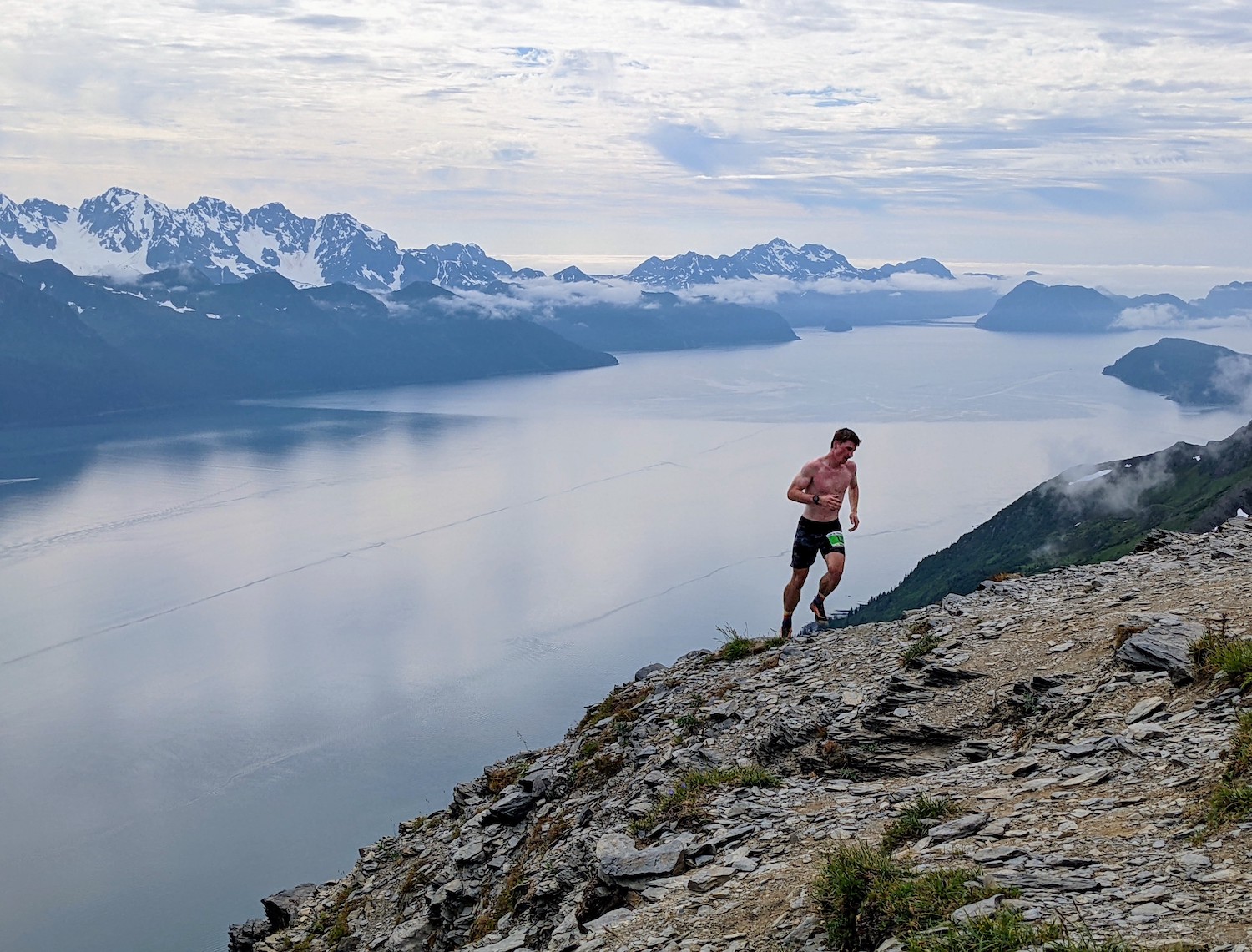
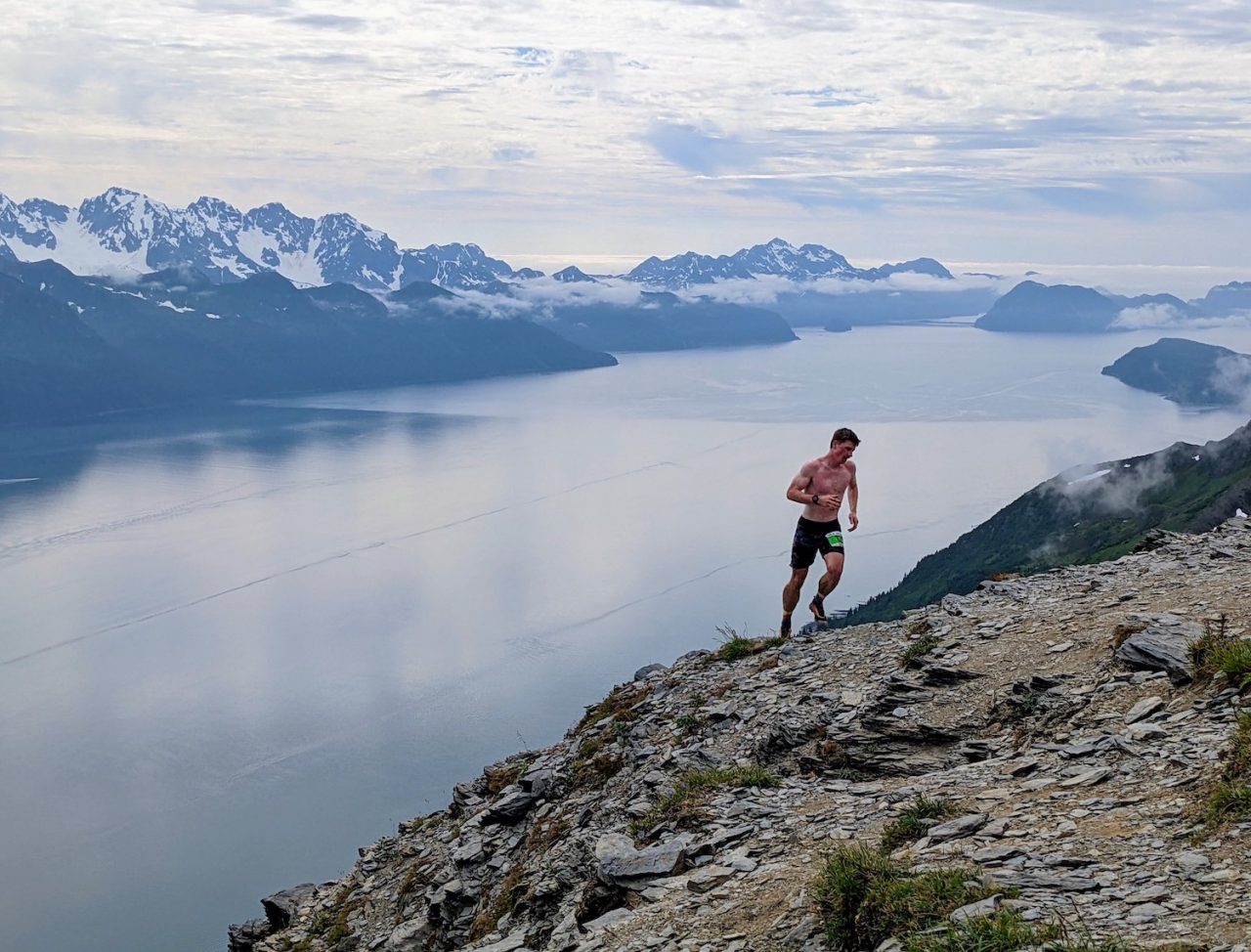
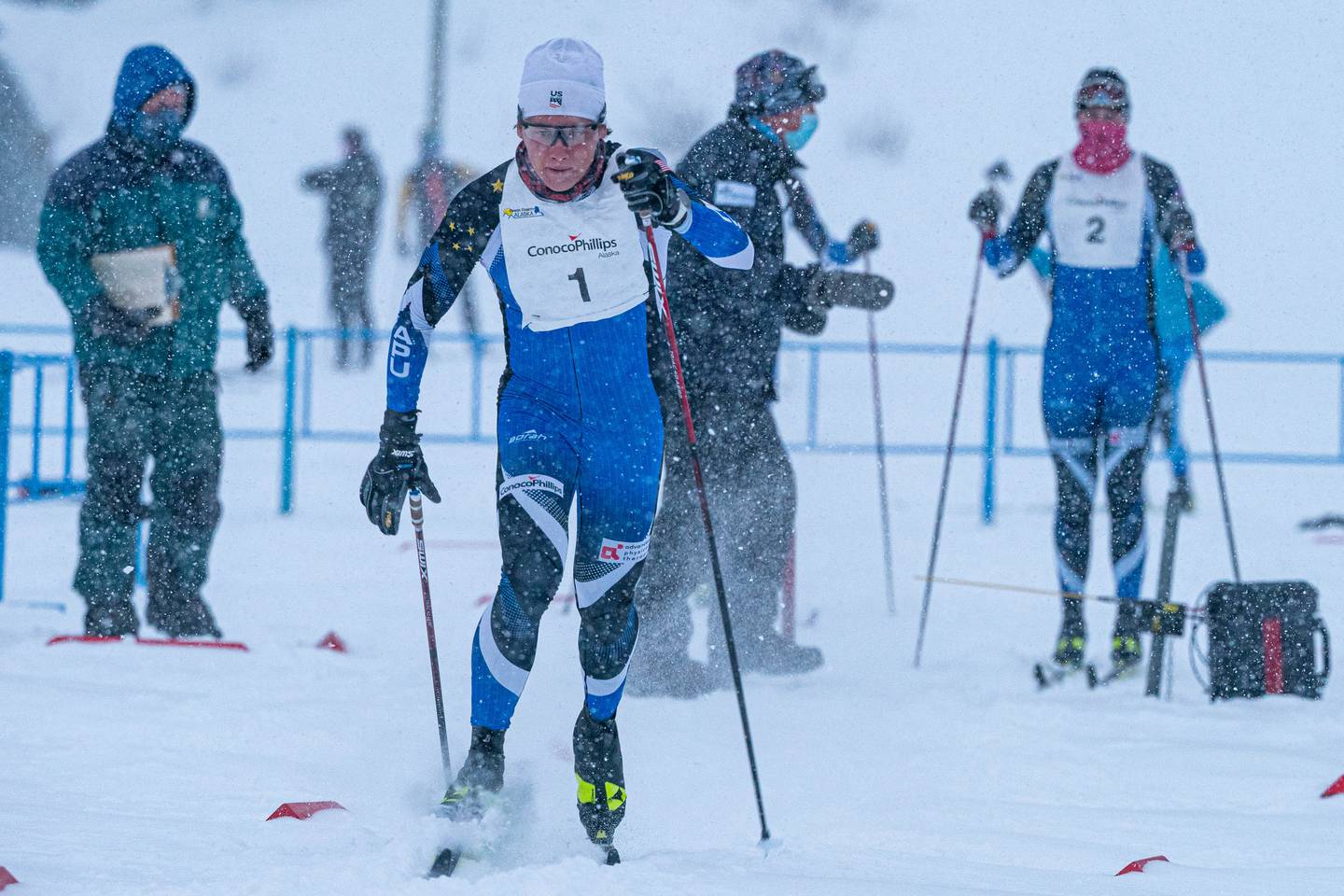
Thomas O’Harra (APU) approaches the turnaround point in the 2022 Mt. Marathon race above Seward, Alaska. (photo: Anna Engel)
Occurring annually on the 4th of July, and touted as the toughest 5 k on the planet, the 94th edition of the Mount Marathon race took place this past Monday in Seward, AK. Needless to say, the race is a storied tradition, beginning with its first “official” running in 1915. Over the years, participation has increased to such an extent that these days there are a number of complex ways for race entrants to register, including selection through a lottery system, petition for a race spot, or even buying a bib at a last-minute live auction.
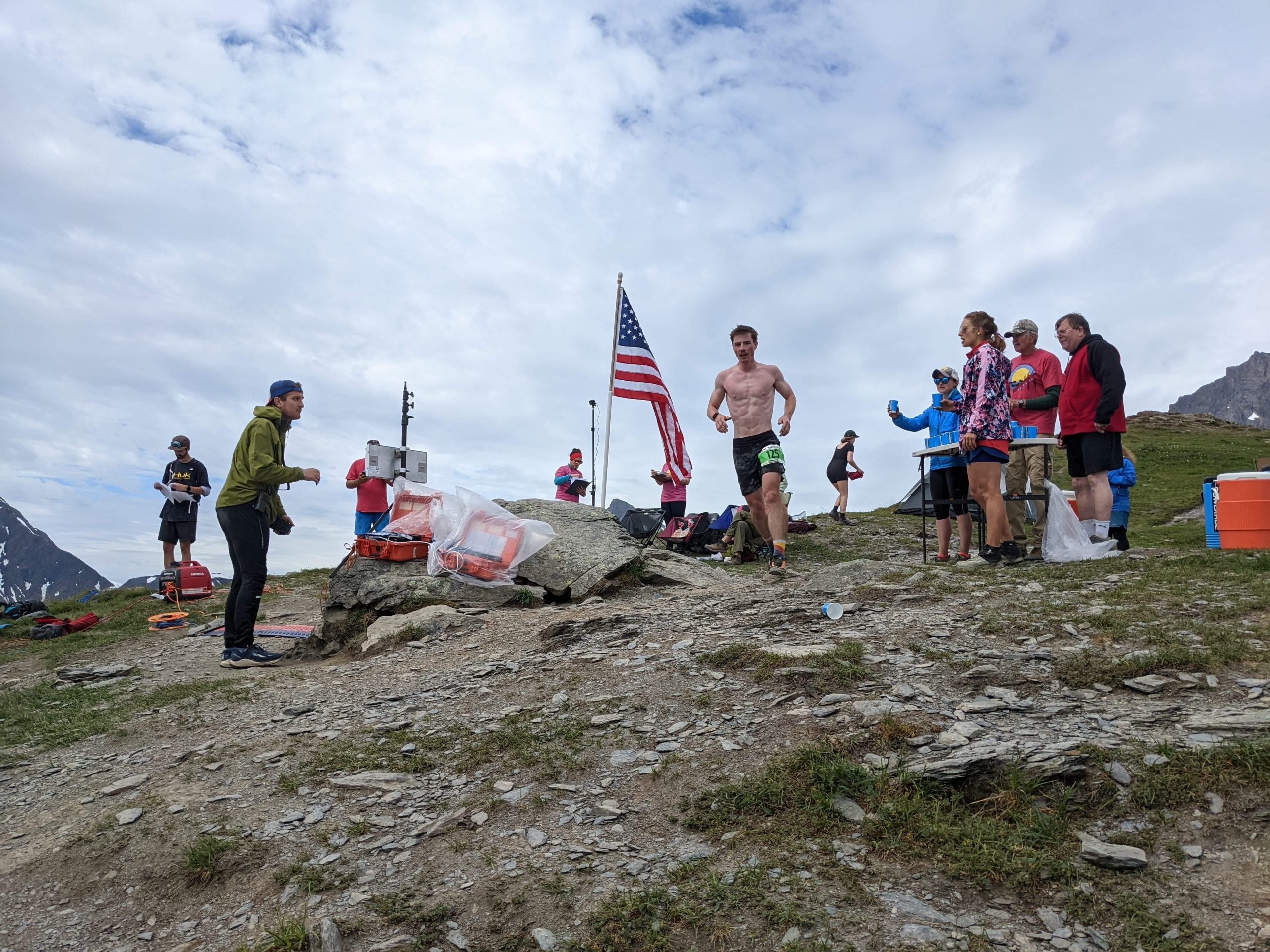
There is no set course up the mountain itself. Racers start on city streets, at sea level, and run through town for half a mile before starting the climb and heading straight up the mountain. During the climb, athletes cover roughly 2,675 vertical feet of climbing in less than a mile (0.9 to be exact). Once they’ve crossed the timing mat around the false summit at Race Point, they turn around and descend that same steep slope via a slightly different route. A junior boys and girls race is also run, in which the participants only ascend partway up the mountain before turning around.
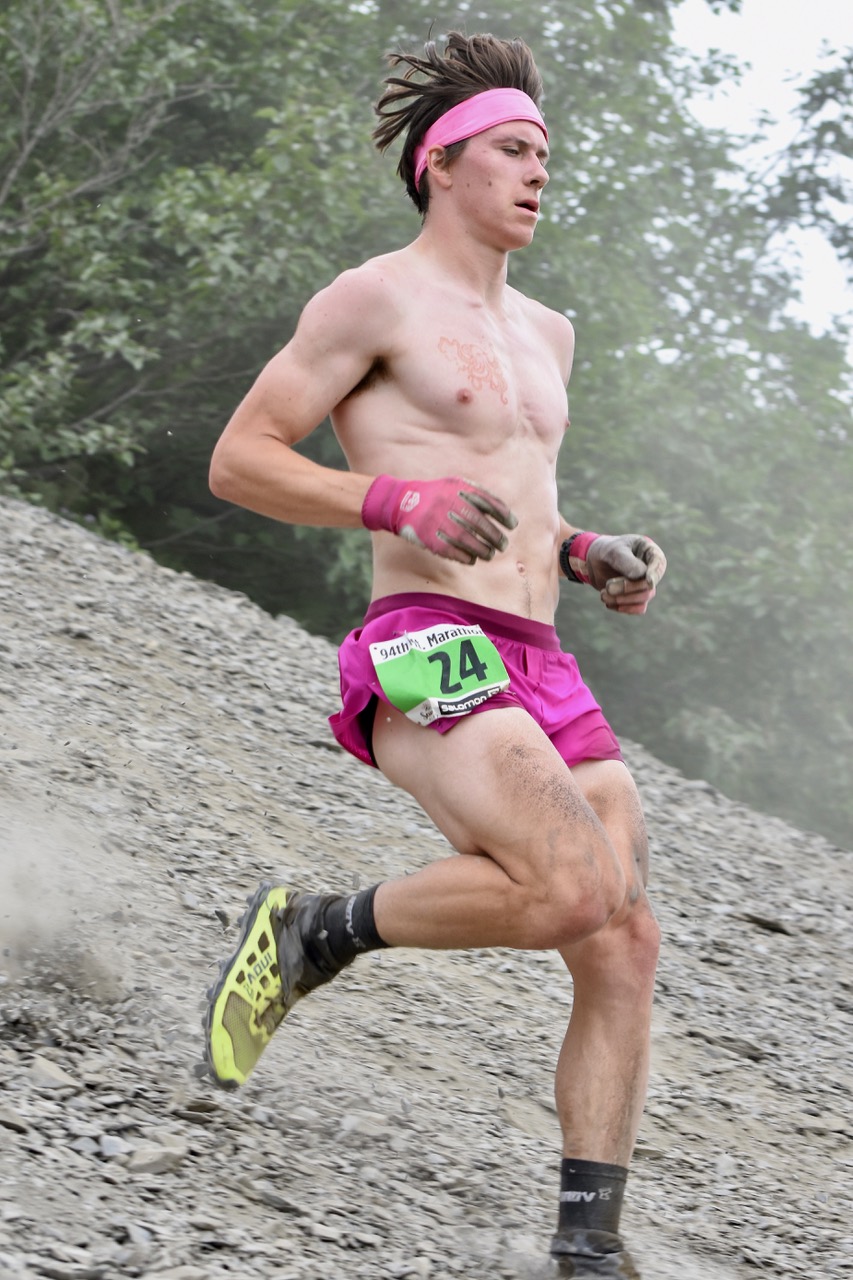
Runners bomb down scree back towards Seward and Resurrection Bay after turning around at Race Point. (Photo: Walker Hall)
This steep and challenging course has seen a number of nordic skiers succeed, including current men’s record holder, David Norris (41:26). Norris has won the race all three times he entered and took the record from mountain master, Kílian Jornet (41:48). Four-time Olympian, Nina Kemppel, holds the record for most race wins at an impressive nine victories. And until this year, three-time Olympian, Todd Boonstra was the oldest victor at age 41. However, at the conclusion of the 2022 edition of Mount Marathon, that crown went to a new champion.
The men set off at 11 a.m. local time and Max King of Bend, Oregon, took this year’s victory in a time of 43:37. At the age of 42, he became the oldest winner in the race’s long history.
Behind King, APU skier Thomas O’Harra placed second in his Mount Marathon debut. “I really didn’t expect to do as well as I did,” shared O’Harra. “It’s such a strong field, even without David [Norris] racing this year.”
Just a few weeks before O’Harra took top spot in the Bird Ridge Hill Climb, so he had confidence heading into the uphill section of Mount Marathon. “I knew that I was in good shape for the climb at least, after Bird Ridge, so I figured that I could be in the top three to the top and then the downhill was a total unknown to me. I practiced it once, a week before the race, but I’ve never raced a downhill like that before so I had no idea what to expect.”
Thomas O’Harra (APU) rounds Race Point in second place in the 2022 edition of Mount Marathon (Photo: Anna Engel)
Plummeting down the scree slope, O’Harra said his main goal was to stay on his feet and not get hurt. “I was shocked that I was still in second coming off the mountain and suffered my way down the road to the finish, where I managed to sneak under 45 minutes, which was a kind of secondary, if-it-goes-well goal,” said O’Harra. “[It was a] super fun time though, the closest running race I’ve ever done to the Birkie, and I’m stoked to come back and race again next year!”
Canadian skier and current Ute (athlete at the University of Utah), Sam Hendry, finished second behind Norris in 2021. This year, Hendry placed 7th with a time of 47:39. Hendry shared that this year’s Mount Marathon “was a bit of a disappointment.” He continued, “I finished second last year and was really hoping for a strong result again. With some busy travel getting up to Alaska, I didn’t have the best preparation and my legs were just a little off.” Hendry raced both the Vertical Kilometer (VK) and 26 k at the Broken Arrow Skyrace mid-June and placed fourth in both, besting King by nearly a minute in the 26 k. Hendry said, “I had some good results there, and plan to add some more running competitions to the calendar for later in the summer. I really enjoy getting some competitions in during the summer and getting to feel stressed and nervous.”
Michael Earnhart descends a dusty slope towards Seward (Photo: Jim Jager)
New U.S. D-Team member and APU skier, Micheal Earnhart, finished his day in 15th (49:45). He wrote to FasterSkier, “I wasn’t stoked with my results by any means but I am happy that I’m at a point in my career where top-15 at Mount Marathon can be a bad day.” Earnhart was quick to praise his teammate’s success saying, “My main takeaway was how impressive it was to see my APU teammate, and race rookie, Thomas O’Harra get second place. Definitely a strong day for APU and skiers in general which is always fun to see.”
Fellow U.S. Ski Team athlete Luke Jager was shortly behind Earnhart in 18th.
With the men’s race concluded, the focus turned to the women, who started at 2 p.m. local time. (The men and women now race in the flagship afternoon slot in alternate years.) Breaking the seven-year-old women’s record, Allie McLaughlin of Colorado earned the victory in a time of 47:09. Previously held by Swedish runner, Emelie Forsberg, with a time of 47:48, McLaughlin created a margin of 39 seconds in her favor.
Rosie Frankowski, who finished 4th in 2021, and is perhaps one of the fastest climbers out there, came in sixth this year (53:19). Racing Mount Marathon for the first time, newly named U.S. Ski Team A-Team member, Novie McCabe placed 8th (56:27). About her race, McCabe shared, “Mount Marathon was crazy! So hard, but a very cool experience for sure. I’m pretty happy with it. I was nervous about the downhill and was honestly pretty happy with myself for just doing something a bit out of my comfort zone.”
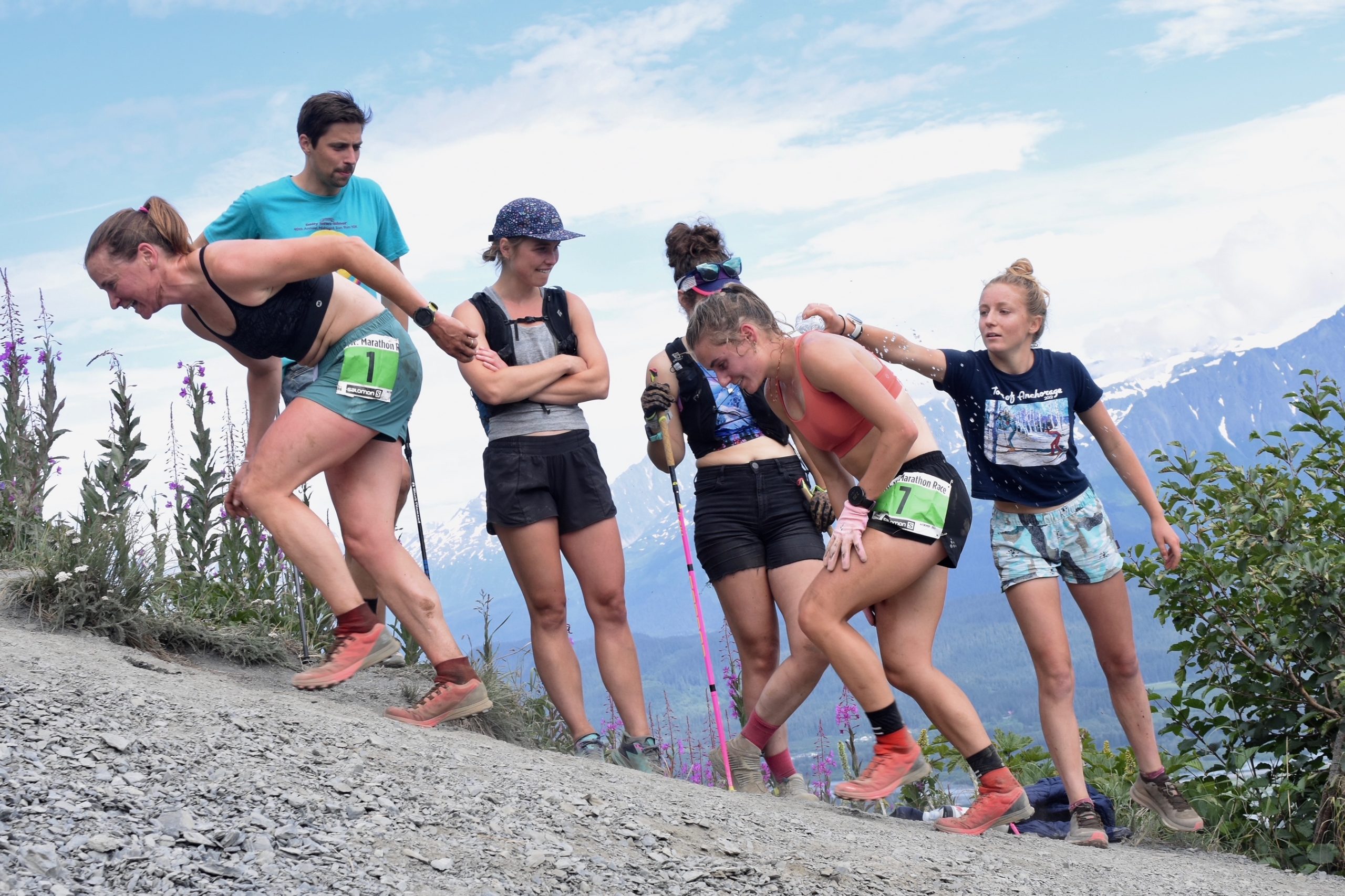
After racing the junior girls event, Dashe McCabe waters her sister, Novie (bib #7), on the climb (Photo: Jim Jager)
Kendall Kramer of UAF finished just outside the top-ten in 11th position (57:12). Kramer finished 9th last year (56:50) and was the junior girl’s race champion in 2018 (34:05).
Full race results of all the Mount Marathon events can be found here.
In other racing news, U.S.A. Track and Field Mountain Running Championships (USATF) in Wilmington, NY at the beginning of June saw two 2022 Beijing Olympians competing. Sophia Laukli finished third in a time of 1:29:03., and Caitlin Patterson came in sixth (1:35:52.3). Results for that event can be found here.
The Loon Mountain Race hosted Vertical U.S. Mountain Championships on July 10th, which a number of nordic and biathlon athletes attended. Alex Lawson representing Craftsbury Green Racing Project finished third, and posted the second fastest time on the “Upper Walking Boss,” a 40% grade ski hill for a half-mile at the end of the race.
Jake Brown (also of CGRP) had the second fastest time on the “Upper Walking Boss” and finished 9th overall. Full results for the event can be found here.
The Cirque Series mountain race circuit kicks off this coming Saturday (July 16th) at Brighton, UT. With a schedule of six U.S. based races taking place over the next few months nordic ski fans should keep an eye out for familiar names near the top of the results sheet.
Each year at the conclusion of the race season, there are always a few athletes who hang up their skis and step away from professional racing. The end of the four year Olympic cycle inevitably means a higher concentration of such announcements. Whether it was a fourth or a first appearance at the Games, or a near miss, the Olympics are always a target and their completion provides a good moment to move on. While the retirement announcements will likely continue into the spring, here is a roundup and recognition of the international athletes who have shared the news that they will be ending their ski careers.
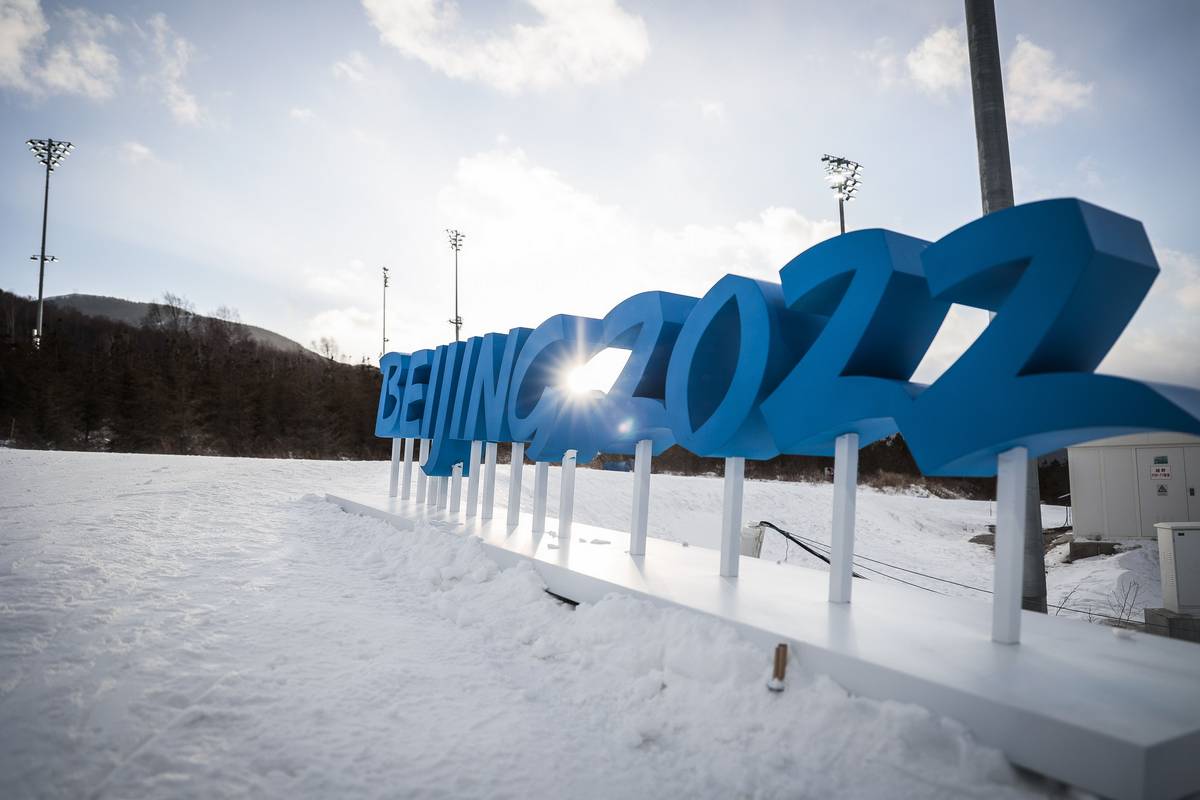
A scene from the cross country venue in Zhangjiakou, China, host to the 2022 Olympic Winter Games. (Photo: NordicFocus)
Four athletes from the Swiss team have announced that they will be moving on, chief among them – the king of the 15 k, Dario Cologna. At the age of 36, Cologna released his decision before the 2021/22 season even began, saying, “the decision came within the last months and after the Olympics, it will be the perfect timing for me. I have achieved everything I ever dreamed of in the sport.”
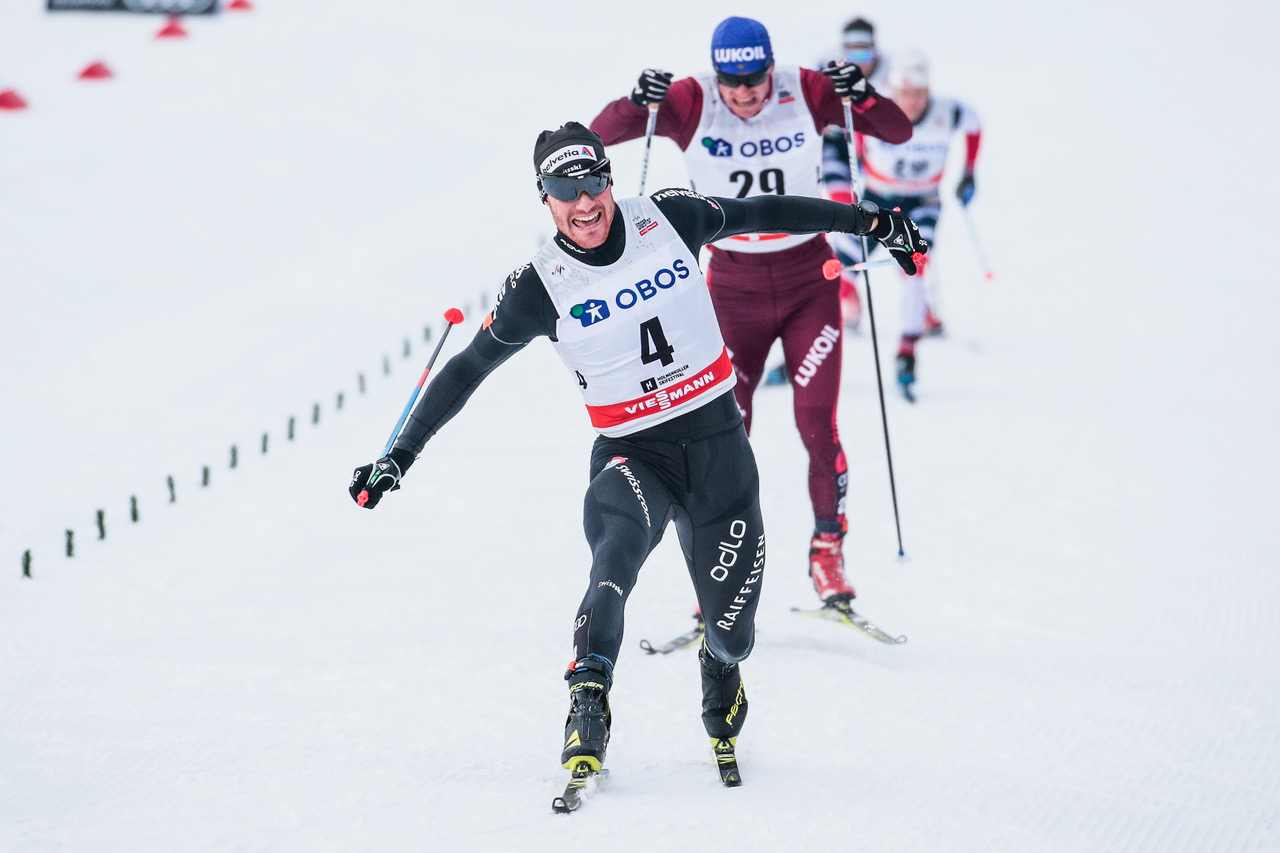
Switzerland’s Dario Cologna lunges to the line at the 2018 Holmenkollen 50-kilometer freestyle race in Olslo, Norway. (Photo: NordicFocus)
Cologna had his World Cup debut in 2006 and his first Olympic start came in 2010 in the 15 k skate event, where he finished first. This victory crowned him as the first Swiss cross-country skier to earn an Olympic gold medal. He went on to win three additional golds, in the 2014 Sochi Games he won both the skiathlon and the the 15 k classic, and in 2018 in PyeongChang added a gold in the 15 k skate. All told, Colgona had eighteen Olympic starts at four different games.
In between Olympic years, he was equally successful. He won the Overall World Cup globe four times, first in the 2007/08 season, again in 2010/11 and 2011/12 and a few years later in 2014/15. In the 2007/08 season he also earned his first Tour de Ski victory, in spite of the fact that he never took a stage win that year. He won the grueling event three more times, in 2010/11, 2011/12 and again in 2017/18.
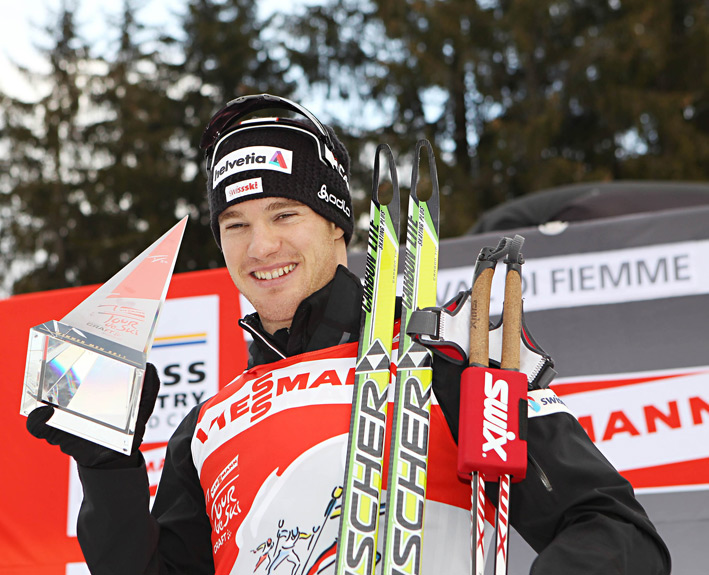
Dario Cologna (SUI) with his trophy after winning the Tour de Ski in 2011 (Photo: Fiemme2013)
After his final outing in the legendary Holmenkollen 50 k, Cologna wrote on Instagram, “I look back on a beautiful and successful career. 15 years ago I never dared to dream that one day I would be a four-time Olympic champion, World Champion, multiple Tour de Ski- and overall World Cup winner. In addition, I was privileged to travel to places I would never have seen and met great people, who became good friends.”
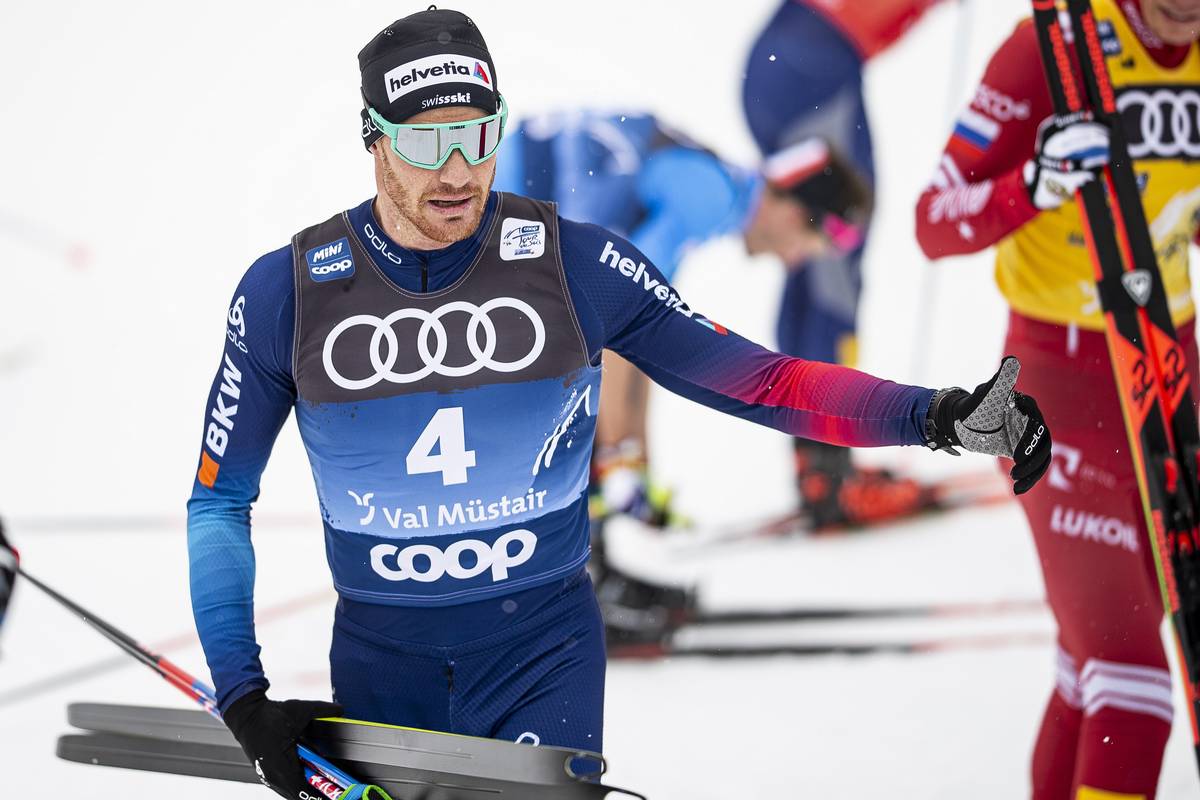
Dario Cologna (SUI) after a 6th place finish in Val Mustair during the 2021 Tour de Ski. Photo: Nordic Focus
Cologna’s teammate, Jovian Hediger, also announced his retirement prior to the start of this season. Hediger was known as a sprint specialist and has 107 World Cup starts to his name, having made his debut in 2009. His first and only podium appearance came in 2021 during the team sprint event in Ulricehamn, Sweden, where he and Roman Furger finished second. Hediger represented Switzerland at three Olympic games, beginning with Sochi in 2014 and ending most recently in Beijing (2022).
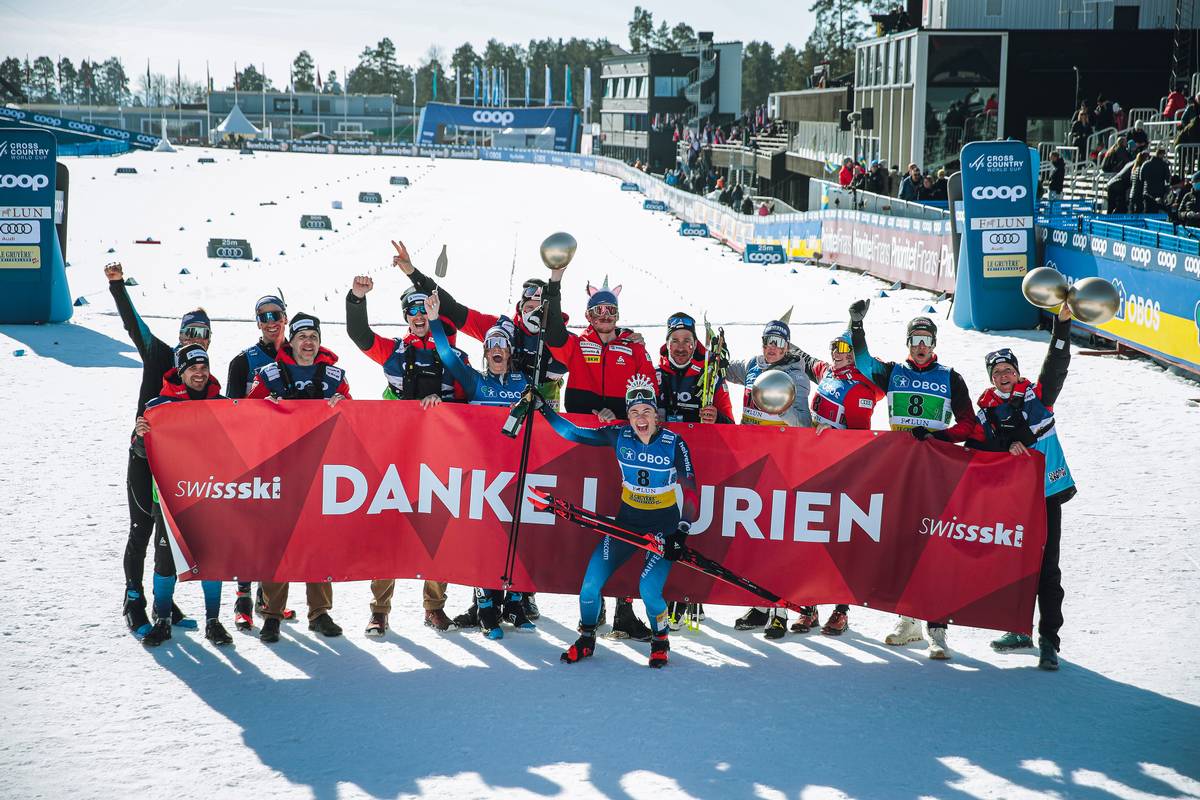
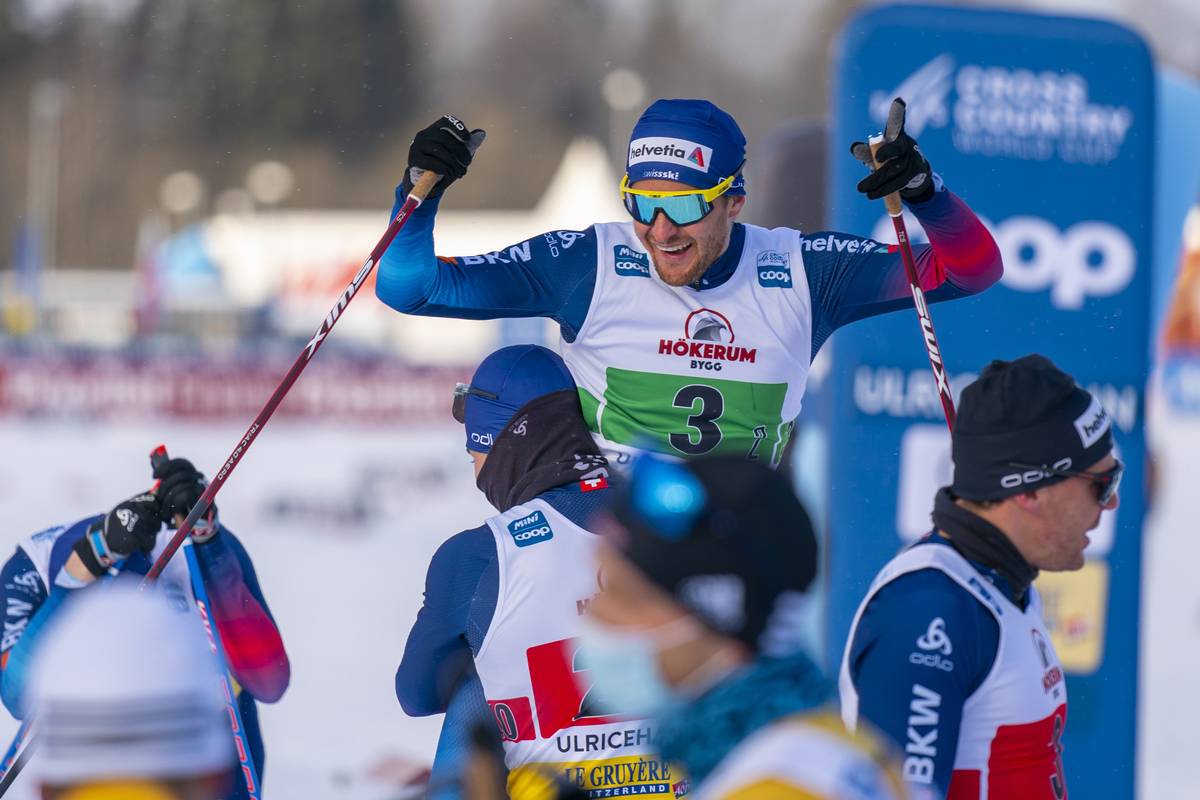
Jovian Hediger (SUI) gets a boost from some happy teammates at the finish line in Ulricehamn Sweden. (Photo: Nordic Focus)
Ueli Schnider of Switzerland is also stepping away from elite competition. Schnider has 62 World Cup starts and made two Olympic appearances, both in 2018 in PyeongChang where he finished 37th in the classic sprint and 41st in the 50 k classic mass start.
On the women’s side, Laurien Van Der Graaff of Switzerland is moving on. Van Der Graaff has long been a staple in women’s sprinting, beginning in 2011 with her first World Cup podium in Duesseldorf, Germany. In doing so, Van Der Graaff became the second Swiss female athlete ever to reach the podium and over the years she continued to pave the way for young Swiss female athletes. Her first victory came in 2017 in a skate sprint Tour de Ski stage race on home ground in Lenzerheide, Switzerland.
The women’s sprint podium in Rybinsk Russia, 2015 (from l-r): Natalia Matveeva (RUS) second, Jennie Öberg (SWE) first, and Laurien Van Der Graaff (SUI) third.
Van Der Graaff partnered up many times with Nadine Fähndrich in team sprint events, resulting in four World Cup podium finishes. At the World Championships in Oberstdorf, Germany (2021), Van Der Graaff and Fähndrich teammed up again, earning a silver medal when they finished just hundreths of a second behind team Sweden.
Van Der Graaff shared with FIS, “for some time I was convinced that I would not continue skiing until Beijing 2022, but I made it and I am very proud of what I have achieved. However, now my time has come and I am excited for everything that is coming my way in this new chapter.”
The Swiss program celebrates the retirement of Laurien Van Der Graaff at the finish of the 4 x 5 k mixed relay in Falun. (Photo: NordicFocus)
While some athletes knew from the outset of the season that this would be their last, others only recently came to the decision. Such was the case for Swedish star, Charlotte Kalla, who just announced her intentions within the last month. The 34-year said, “the curiosity about life outside of elite sports weighs heavier than what a continued investment would entail.”
Kalla burst onto the World Cup scene at the age of eighteen. She earned her first victory in the next season, taking a stage win in Nove Mesto (2007) in the 10 k skate pursuit. In her first individual World Championships appearances, coming in Sapporo, Japan in 2007, Kalla finished 7th and 5th. To give you a sense of her consistency from then on, of the 34 World Championship events Kalla completed spanning 2007-2021, she finished in the top ten in 30 of those appearances with the exceptions being three 11th place finishes and one 18th.
Charlotte Kalla of Sweden on her way to Olympic gold in Vancouver 2010 (Photo: FS archives)
Kalla represented Sweden at four different Olympic Games, Vancouver 2010, Sochi 2014, PyeongChang 2018, and Beijing 2022. She came away from these events with five individual podiums, including two gold medals and three team medals including her jaw-dropping relay performance in the relay in 2014 when she made up a 25 second deficit to bring the Swedish women their first Olympic relay gold since 1960.
Since then, the Swedish women’s team has come to dominate the World Cup circuit and Kalla has taken on a mentorship role within the team. “It’s an inspiring team to be a part of and many girls who have the right mindset to do their very best every day,” said Kalla in 2020. On March 22, 2022, Kalla announced on Instagram that the Swedish national competitions would be her last as an elite athlete. She wrote, “here I took my first [steps] as a seven-year old and it feels nice to end my career here.”
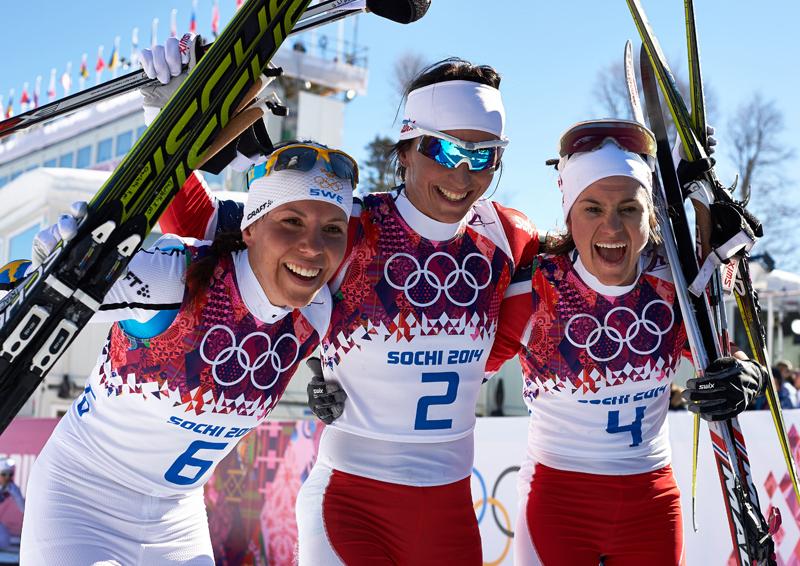
Charlotte Kalla (SWE), Marit Bjoergen (NOR) and Heidi Weng (NOR) claim the podium in the women’s Olympic skiathlon, Sochi 2014. (Photo: Fischer / Nordic Focus.)
Elisa Brocard of Italy is ending her ski-racing career at the age of 37. Brocard had her first World Cup start in 2006 and went on to contest 162 World Cup events. She represented Italy in three Olympic Games, beginning in Vancouver 2010, through PyeongChang in 2018. Her best season came in 2018 when she finished in the top-30 distance World Cup rankings and 38th overall.
Nadine Herrmann of Germany is leaving elite competition as well. She is the younger sister of Denise Herrmann who raced the cross-country World Cup circuit until she transitioned to biathlon in 2017 where she went on to win gold in the individual event at the 2022 Beijing Olympics. Nadine Herrmann finished in the top-thirty in her maiden World Cup appearance in 2018 in the Dresden city sprints. She went on to earn a number of top-thirty finishes, including a personal best individual finish of 18th in Dresden in 2020. At the age of 26, Herrmann has decided to move on, she wrote “My active sporting career is coming to an end. The last 14 years of performance sports have shaped me into the person who today can say in the best of my conscience, I gave it my all.”
Adrien Backsheider of France has also announced his retirement. Backsheider began racing on the World Cup circuit in 2013. He earned six World Championships starts and helped propel team France to a bronze medal in the men’s 4 x 10 relay in Falun in 2015 and again in Seefeld in 2019. Backsheider also has four Olympic starts, as he represented France in Sochi 2014, PyeongChang 2018, and Beijing 2022. He was a member of the bronze medal relay team in PyeongChang when the French again earned a podium spot in the 4 x 10 relay. Backsheider’s personal best individual World Cup finish came in Östersund, Sweden in 2020 when he finished 7th in the 15 k skate stage race during the Tour de Scandinavia.
The men’s 4 x 10 k relay at 2015 World Championships in Falun, Sweden, Norway with gold, Sweden with silver, and France with bronze . (Photo: Fischer/NordicFocus)
Cendrine Browne of Canada is saying goodbye to professional ski racing as well, having concluded her career with a national title in the 45 k skate in Whistler, Canada. Browne made her World Cup debut in 2012 and went on to start 76 World Cup races. She made the Canadian Olympic team in 2018 and 2022 and also posted thirteen World Championships starts. Browne finished 16th in the 30 k skate mass start in Beijing, a personal best individual finish for her. In a statement to Nordiq Canada after the 45 k race, Browne said, “thank you to everyone in the ski community who has believed in me and cheered for me over the last ten years.”
Cendrine Browne reached a new personal best with her 16th place finish in the 30 k skate mass start in Beijing 2022 (Photo: NordicFocus)
The notable retirement of the extremely successful, Therese Johaug of Norway has not been missed but will be receiving its own feature from FasterSkier in the coming weeks. Additionally, US Ski Team members Katharine Ogden, Hannah Halvorsen, and Caitlin Patterson have all shared news of their retirement, in addition to top SuperTour athletes Ian Torchia and Adam Martin. (Read Torchia’s retirement story here.)
Stay tuned for more in-depth reporting on those athletes from FasterSkier.
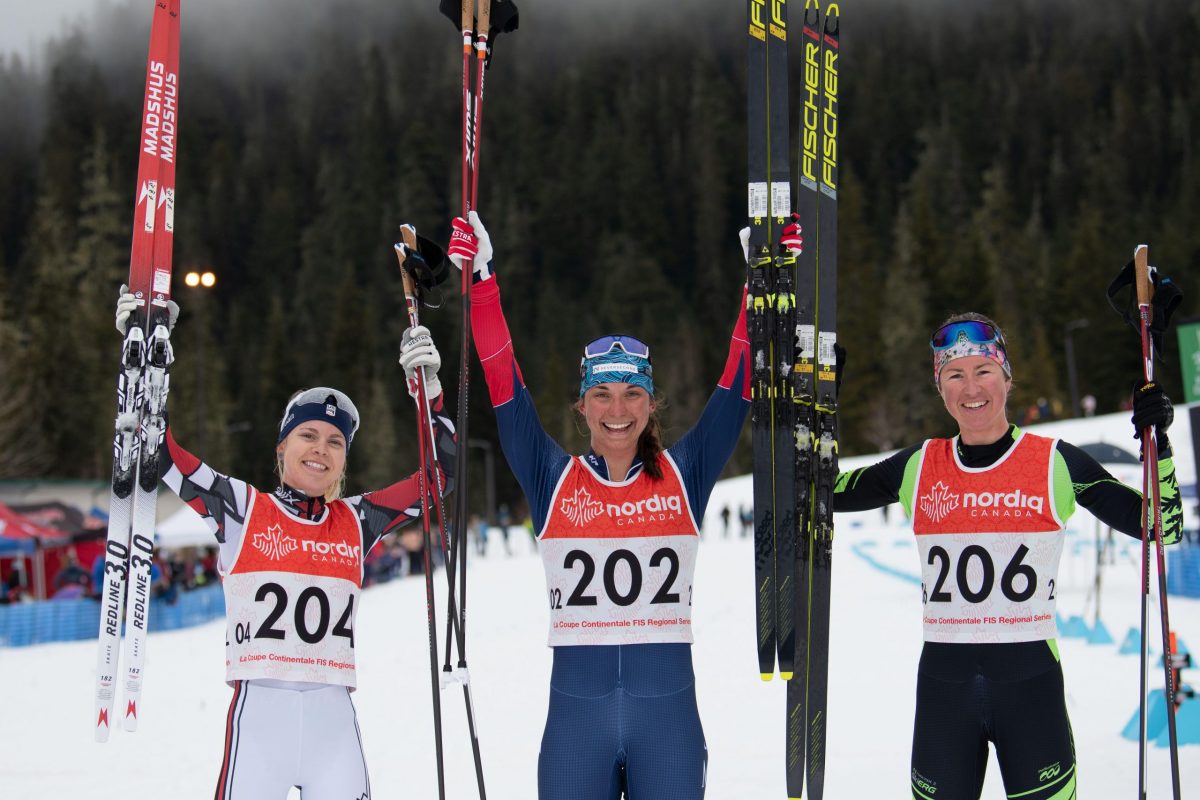
The top three long-distance women in Whistler, after the final stage of the Canadian Nationals / US SuperTour Finals event series. Julia Kern took the win for SMS T2 ahead of Caitlin Patterson (CGRP) and Sophia Laukli (U of Utah). (Photo: Doug Stephen / VR 45 Photography)
We’ve arrived at the final act, the culmination of a week of racing in Canada and a season of international racing before that. Piloting a gender-equal distance, both men and women raced a 45 k mass start skate on Sunday, completing six laps of a 7.5 k loop at the Whistler Olympic Park. Continuing a pattern of challenging weather conditions, the day started with temperatures around 37° F with rain, making for soft and wet skiing.
Open Men
The open men went first, with a field of 99 starters heading off the line at 8:30 local time. With 107 on the start list, some notable names among the athletes who did not start include Gus Schumacher (Alaska Winter Stars), Tyler Kornfield (APU) and Xavier McKeever (Foothills Nordic), who took his first national title in the sprint race earlier this week.
Relying on live-timing to provide a picture as the race unfolded, it appeared that the first three laps saw steady skiing with a big pack together at the front. Between 22.5 – 30 k that group splintered with ten athletes breaking +31 seconds or more clear of the rest of the field. Among those ten, the Canadians were represented by Russell Kennedy (Canmore Nordic), Rémi Drolet (Team Black Jack), Philippe Boucher (CNEPH), Antoine Cyr (CNEPH), Graham Ritchie (Thunder Bay Nordic) and Olivier Léveillé (CNEPH). Up front for the Americans was Luke Jager (University of Utah), Scott Patterson (APU), Adam Martin (CRGP) and Finn O’Connell (BSF Pro).
Beginning the final lap, that group of ten lost a member as Léveillé (CNEPH) dropped off the pace, drifting into no-man’s land, still a minute clear of chaser Johnny Hagenbuch (Sun Valley Ski Education Foundation). At the next split, Boucher (CNEPH) too had dropped, leaving eight men at the front, all within 5.5 seconds. With just a few kilometers to go, the fight was on.
Creating a gap in the final stages, Graham Ritchie (Thunder Bay Nordic) claimed the victory and earned his first national title. Ritchie finished in a time of 1:40:32.5.
“I’m not sure how this happened,” said Ritchie to Nordiq Canada, “I haven’t raced this long of a race in a couple of years, so I had no game plan going into it. I just said I’m going to stick with the lead pack as long as I can.” This strategy worked in his favor.
“I was able to stick with the lead pack and being in the top three with one kilometer left,” continued Ritchie, “I knew I had a little jam left to go for it in the last few hundred meters. I had a good day and really fast skis. The techs killed the boards so I’m super stoked.”
Concluding a strong week of racing, Jager (University of Utah) topped the American podium, coming in +6.8 seconds behind Ritchie. Speaking to the conditions, Jager said, “it was good, the news that they were salting last night was music to my ears because it would have been so different if they hadn’t. It was really firm and fast and even where it was getting mushy it was pretty firm underneath so it was fast out there.”
The men’s SuperTour podium for the final day of racing in Whistler: Luke Jager (Univ. of Utah) came out on top ahead of Scott Patterson (APU) and Adam Martin (CGRP). (Photo: Nordiq Canada / Nathaniel Mah)
Coming down to a sprint finish, Ritchie made an early move to gain the advantage. “I didn’t even know who was in the group anymore,” said Jager, “I was kind of in the front going into the last climb and [Ritchie] came ripping by me and he was really strong so even if I had the foresight of that coming I don’t know if I would have been able to hold him off because he was so strong coming into that hill.”
The 45 k skate Canadian National Championship podium: Graham Ritchie took the title, ahead of Antoine Cyr, Russell Kennedy, Rémi Drolet, and Philippe Boucher. (Photo: Joerne Rohde / Nordiq Canada)
Cyr (CNEPH) finished third overall and was the second Canadian (+7.8). Completing the Canadian podium, Kennedy (Canmore Nordic) finished fourth overall (+8.1).
Patterson (APU) was the second American finisher, coming in fifth overall (+9.6), while Martin (CRGP) was the third American and sixth overall (+12.6).
Open Women
Following the conclusion of the men’s race, the open women got underway at 10:30 local time. At the crack of the gun, fifty-six racers set off to complete their six laps. Although there were 72 athletes registered, sixteen did not start, including Rosie Brennan (APU), Katherine Stewart-Jones (Nakkertok Nordique), Novie McCabe (University of Utah) and Olivia Bouffard-Nesbitt (Foundeurs-Laurentides).
This is the first time the women raced 45 k at a national championship event, a new event stemming from the push for equal distance racing. When asked about this distance after the race, Julia Kern (SMS T2) told Nordiq Canada, “I think it’s a really interesting format. For me personally I like the shorter distance but recently I’ve had really good experiences with 30 k and today was a great day so, I think whatever makes ski racing exciting for both men and women should be what pushes the sport forward.”
Regarding whether this should become a permanent feature, or be introduced to the World Cup, Kern said, “potentially, or just shortening the men’s race so that everything is short and exciting because there are marathon circuits out there as well.”
With the race under way, the first 7.5 k saw the pack at the front was a slightly strung-out group of twelve. Just a few kilometers later, that number was cut in half as six athletes pulled twenty seconds clear. Of that group, Cendrine Browne (Foundeurs-Laurentides) was the lone Canadian, skiing with Sophia Laukli (University of Utah), Kern (SMS T2), Rosie Frankowski (APU), Caitlin Patterson (CGRP), and Sydney Palmer-Leger (University of Utah).
In her final race as a professional skier, Cendrine Browne (Foundeurs-Laurentides) collects the Canadian National title in the final long-distance event in Whistler. (Photo: Nordiq Canada / Nathaniel Mah)
For the next four laps, those first six women skied together, alternating leads and staying within ~5 seconds at each split. As they set out for the final lap, Browne (Foundeurs-Laurentides) dropped slightly, +10 seconds behind the pack. “I just wanted to be in the lead pack today and I was until the last lap, I bonked. It was tough conditions today, but it was a really fun way to go out,” said Browne.
From there, the splinters in the group became larger cracks as Kern (SMS T2) applied pressure at the front. Next to drop was Palmer-Leger (UU) who was +6 seconds back at the first split on the final lap. A few moments later, Kern had made a full break.
“My tactic was just hang on, conserve energy for as long as possible,” shared Kern, “I didn’t really want to suffer for 45 k and it was fun to ski in a pack and work together. So for me it was just being patient and seeing how I was feeling and evaluating my plan from there. What I ended up doing was skiing with the pack, alternating leads and in the last lap I was feeling good so I decided to send it. 7.5 k to suffer isn’t too hard.”
At the final time split before the finish, Kern was 27.5 seconds ahead of runner-up Patterson (CGRP). Reaching the finish line, she had widened this lead to 34 seconds, finishing in a time of 1:58:55.6. This victory was Kern’s fourth of the week, having topped every race save for the 5 k individual skate where she finished second behind teammate Jessie Diggins (SMS T2). Commenting on the conditions Kern said, “the first few laps held up pretty well and the last few laps got really deep and slushy, you just had to make sure you didn’t catch a tip or fall and look for the less skied in areas. But it made it exciting, good spring skiing, classic slush conditions.”
Patterson (CGRP) finished second overall, +34 seconds back. Behind her came Laukli (UU), completing the American podium and finishing third overall (+1:00.9).
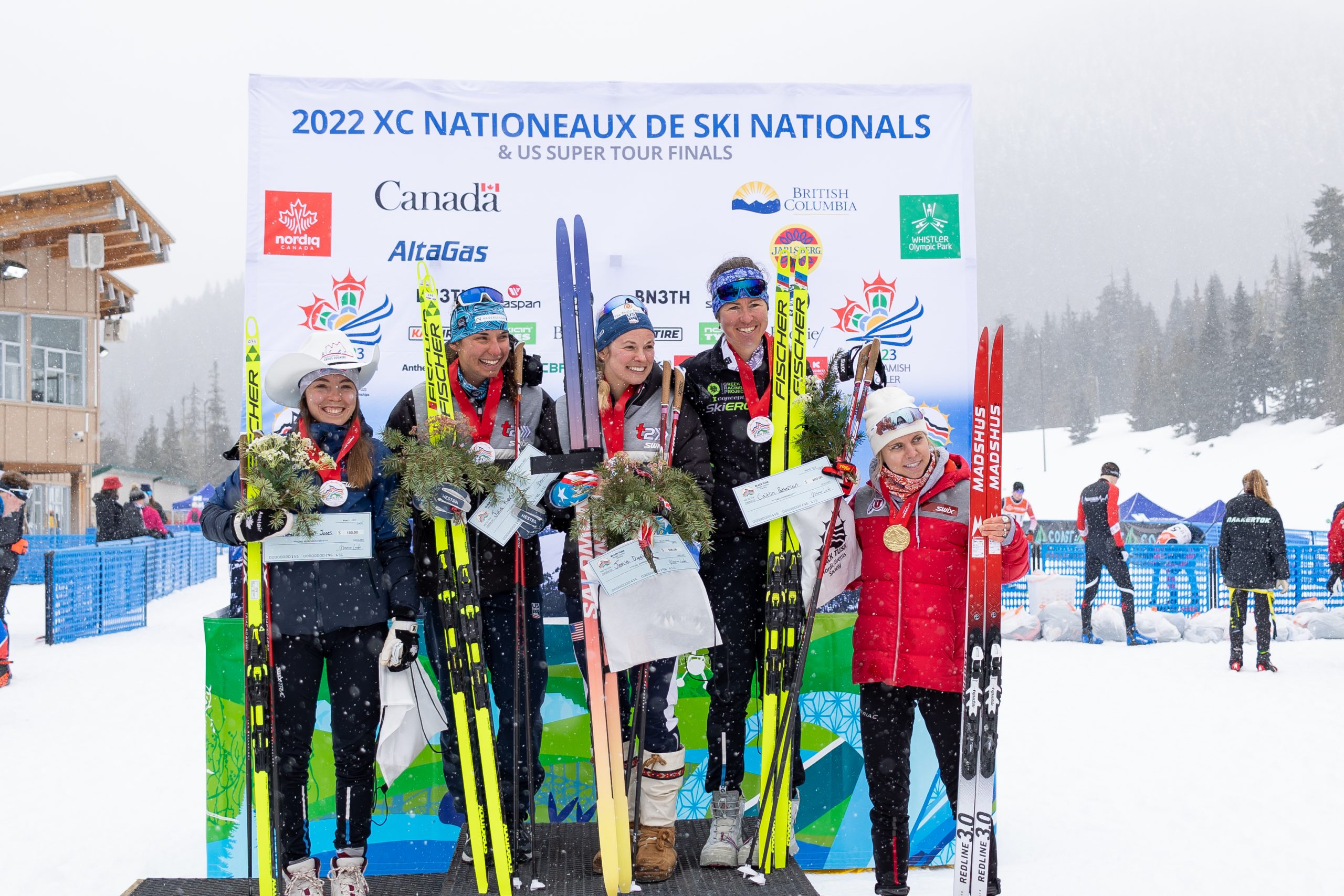
The top five SuperTour women on the final day of racing in Whistler: Julia Kern (SMS T2) continued her win-streak, with Caitlin Patterson (CGRP) in second, Sophia Laukli (U. of Utah) third, Sydney Palmer-Leger (U. of Utah) fourth, and Rosie Frankowski (APU) fifth. (Photo: Nordiq Canada / Nathaniel Mah)
Browne (Foundeurs-Laurentides), for whom this race was her final as a professional athlete, held sixth position overall, and was the first Canadian (+2:41.5). “It feels really good to end my career this way. I love distance racing and it is a great way to go out as National Champ,” said Browne to Nordiq Canada. “Thank you to everyone in the ski community who has believed in me and cheered for me over the last 10 years.”
Dahria Beatty (Whitehorse Ski Club) was the next Canadian in twelfth overall, +9:39.8 behind Kern. Completing the Canadian podium, Laura Leclair (Club Chelsea Nordiq) came in sixteenth overall (+12:08.8).
This race concludes the 2022 Canadian Ski Championships and US SuperTour Finals as the athletes now get to enjoy a break after a long season.
The collaborative event featuring Canadian Nationals and SuperTour Finals kicked off Sunday March 20th in Whistler with 5 / 10-kilometer individual start freestyle races. (Photo: Nordiq Canada / Nathaniel Mah)
Sunday kicked off a week of racing at the combined Canadian Cross-Country National Championship and U.S. Super Tour Finals event held in Whistler, British Columbia. Hosted by the Black Tusk Nordic Events Society (BTNES) on the Whistler Olympic Park courses, this event also offers junior and U23 skiers a preview of the courses for next year’s Junior and U23 World Championships. With Paranordic, Nordic Combined, and both junior and senior cross-country events, it looks to be a busy week of racing.
After a morning of Paranordic and junior events, the senior women got underway with a 5 k interval skate. This meant a single lap of the “Blue A” course, which features two major climbs, one almost right out of the start. Despite a wintery mix of precipitation forecasted throughout the week, and light snow accumulating on top of the corduroy, times were fast as athletes took to the course.
The women’s 5 k individual start freestyle podium: Jessie Diggins (SMS T2) took the win ahead of teammate Julia Kern and Craftsbury’s Caitlin Patterson. Katherine Stewart-Jones (Nakkertok Nordique) was fourth, with Sophia Laukli fifth (University of Utah). (Photo: Nordiq Canada / Nathaniel Mah)
Swapping stars and stripes for her red and blue SMS T2 team suit, Jessie Diggins won the women’s 5 k event in 11:47.9, with her club teammate Julia Kern in second (+7.7). Craftsbury’s Caitlin Patterson took third (+29.8), ahead of Katherine Stewart-Jones who was the top Canadian racer in fourth (+33.1). Dahria Beatty was second for the Canadian women in eighth overall (+56.1), with Cendrine Browne just behind as third for Canada and ninth overall (+1:00.6).
In an interview with Nordiq Canada after the race, Diggins first spoke to the experience of racing amongst a field of over 180 women and girls from across Canada and the U.S.
“This is super cool,” Diggins said emphatically. “I mean, I’m half-Canadian, so this is really very special for me any time I can come be in Canada. I really love it, and with COVID, it’s been a while.”
She also spoke to the change of pace and pressure, in transitioning away from the high-stakes environment of the World Cup where the team operated under strict COVID precautions to ensure the season would not be derailed by an outbreak within the team.
“The biggest draw for me was to be here with my club, to have fun. There’s all these really awesome kids racing. And, yeah, it’s really nice to have a little more relaxed, not quite as high pressure, [especially] after the Olympics. It’s nice to just get back to racing because it is super fun. So I’ve really enjoyed being here.”
Diggins described watching the field of rising junior athletes race as “super cool” and spoke optimistically of what this means for the long term health and success of the sport at all levels.
“It’s so fun to see how invested in the sport, overall, that they are — because they love it, and they want to work hard, and they’re having fun. It’s just really cool to see how our sport’s been growing and expanding, and how great this next generation is looking.”
Sophia Laukli skates to fifth in the women’s 5 k interval start free, which kicked off Canadian Nationals and US SuperTour Finals in Whistler. (Photo: Doug Stephen / VR 45 Photography)
Finally, on her own race, Diggins shared it was a “shock to the system.” Following the World Cup finals last weekend in Falun, Sweden, Diggins spent the week in Annecy, France, where she visited the Salomon design center, participated in a live Q&A with a Salomon representative, and even snuck in a guided mountaineering experience in nearby Chamonix.
She then hopped aboard a flight to Western Canada, finding herself once more on a start line soon after.
“I got off the plane from France like 40 hours before the start,” Diggins laughed. “So it was one way to kick the jet lag, and it was highly effective. It was a bit of a bit of a shock, but it was really fun to just get out there and work hard, and really enjoy these — I mean, it’s fun. They’re Olympic courses. They’re really, really nice, they have great flow. So I really enjoyed being out there.”
As the top Canadian woman, Katherine Stewart-Jones spoke with Nordiq Canada about the tough competition, “It was really exciting to race today and having the Americans here I knew it was going to be a competitive race, and I definitely wanted to perform because, you know, you want to show that Canadians are also competitive,” she said.
Katherine Stewart-Jones, racing on behalf of her club, Nakkertok Nordique, is the top Canadian athlete in the women’s 5 k skate on day 1 of Canadian Nationals/SuperTour Finals in Whistler. (Photo: Nordiq Canada / Nathaniel Mah)
“Overall, I was happy with my result. I didn’t think it was my best race. It was the type of race where the conditions are brutal, and nobody feels technically great, but you had to keep going. In warm-up I could tell it was hard conditions to ski in, so I gave myself a few technical cues during the race, making sure I reminded myself it was like this for everyone. I’m really happy with my effort.”
Sydney Palmer-Leger (University of Utah) earned the top spot in the women’s U20 ranking with a time of 12:36.8. She finished seventh overall.
Russell Kennedy (Canmore Nordic) skis to second place in the men’s 10 k interval start freestyle, which kicked off Canadian Nationals in Whistler. (Photo: Doug Stephen / VR 45 Photography)
With the women’s race wrapped up, the competition turned to the men who skied 2 x 5 k. In a reverse of the women’s results, it was the Canadians who took the top three spots led by Rémi Drolet (Team Black Jack) in a time of 22:50.2. Russell Kennedy (Canmore Nordic) finished second, +19.8 behind Drolet, while Antoine Cyr (Skinouk QC) rounded out the podium in third (+29.7).
Luke Jager (University of Utah) was the first American of the day in fourth (+37.4). Jager was followed by two fellow collegiate athletes, Kjetil Bånerud of Northern Michigan University, and Sam Hendry of the University. Bånerud is a native of Norway, while Hendry was also racing on behalf of Canmore Nordic, his home club. This leaves BSF Pro Team athlete Finn O’Connell as the next on the US SuperTour podium in seventh overall (+49.7), with Craftsbury’s Adam Martin third for the US in eighth overall (+50.1).
The top-six Canadians stand on the podium following a 10 k individual start skate. Rémi Drolet (Team Black Jack) took the top spot ahead of Russell Kennedy (Canmore Nordic) and Antoine Cyr (Skinouk). Sam Hendry (Canmore Nordic) was fourth, followed by Graham Ritchie (NTDC – Thunder Bay) and Philippe Boucher (Skibec). (Photo: Nordiq Canada / Nathaniel Mah)
Like many of the top athletes, Drolet just recently returned from Europe after the conclusion of the World Cup circuit. He spoke with Nordiq Canada after the race saying, “I really went into the race today with zero expectations. I was thinking in my head that if I execute well and push hard, then I’ll be happy with the race, and the result just came so that was just a bonus for me.”
In soft and sloppy conditions there were a number of mishaps out on the race course and Drolet said, “I think with conditions like that it can be really easy to kind of sketch yourself out. I think a lot of people were doing that. But I think you can just kind of stay focused on skiing and not worry too much about the conditions, then everything will be okay.”
“You need to stay focused on skiing and not on the conditions. When you overthink it, things happen. I was really happy I was able to put together a great race today. This is where I strive to be, and it feels really good.”
University of Utah’s Luke Jager is the top American and fourth overall in the opening 10 k interval start skate in Whistler. (Photo: Doug Stephen / VR 45 Photography)
The U20 men’s race was won by Tom Stephen (Foothills Nordic) in a time of 23:33.3. Stephen finished sixth overall.
Racing continues today, Monday March 21st, with a 10/15 k classic, followed on Wednesday March 23rd by an individual classic sprint. The sprint heats will be livestreamed; these be viewed here.
This World Cup coverage is made possible through the generous support of Marty and Kathy Hall and the A Hall Mark of Excellence Award. To learn more about A Hall Mark of Excellence Award or to learn how you can support FasterSkier’s coverage please contact info@fasterskier.com.
There wasn’t much to be decided, only facts to reaffirmed.
In the last individual race of the World Cup season on Saturday, a 10-kilometer individual start freestyle in Falun, Sweden, the overall World Cup standings of consequence were already decided. Individual season goals for each racer were already moving towards reflection.
Off the course, bare patches of ground seemed to suggest that even the snow was ready to move on from this winter and this ski season. The air was in agreeance; it was 6℃ (44℉) at race start.
Frida Karlsson (SWE) skis past a vibrant Swedish scene in Falun. Karlsson finished 12th in the 10 k freestyle (+1:07:00), but ends the season as the World Cup Distance runner-up behind Therese Johaug (NOR). (Photo: NordicFocus)
And why wouldn’t they be? For all the hints of a return to some kind of normalcy this World Cup season – fans back at venues, a majority of courses covered with natural snow – the World Cup couldn’t out-ski the anxieties and the full-blown winds of change that the winter of 2021-22 has sent around the world. At its conclusion today, the World Cup overall will be awarded to a skier, Natalia Nepryaeva (RUS), who was barred from competing on account of the Russian government’s invasion of Ukraine. Nepryaeva sits atop a World Cup Overall points list that was shaped, and is shaped by, COVID-19 – which forced multiple cancellations of World Cup events in January, and across the season has seen individuals and teams miss races.
All we could hope for from skiing, across this season and at today’s race, was for some sort of center to hold. That we could watch and see something that we had seen before, and that it would bring light and levity to the challenges of the times.
For that type of drama? Well, while World Cup finals may have moved from Siberia to Sweden, their final destination could have been Shakespeare’s Globe.
Woven and interlocked throughout the 10 k individual start were acts ski fans have come to know by heart over the past few years and over the course of this season. But that didn’t make them any less impactful to watch. We would see valiant efforts from early starters, a women’s field where margins are only ever a few seconds throughout a race, capped off, apropos the start order,by the one question that has animated distance racing on the World Cup for nearly a decade, posed for the last time – what about Therese Johaug?
To get to the answer to that question, we would have to wait. In the meantime, the Falun course played host to narratives that followed the contours of its terrain. The 10 k was raced as 3 laps – one 2.5 k loop that was relatively flat, before two laps of a 3.75 k loop where the terrain was punctuated with a set of climbs that would look to separate the field.
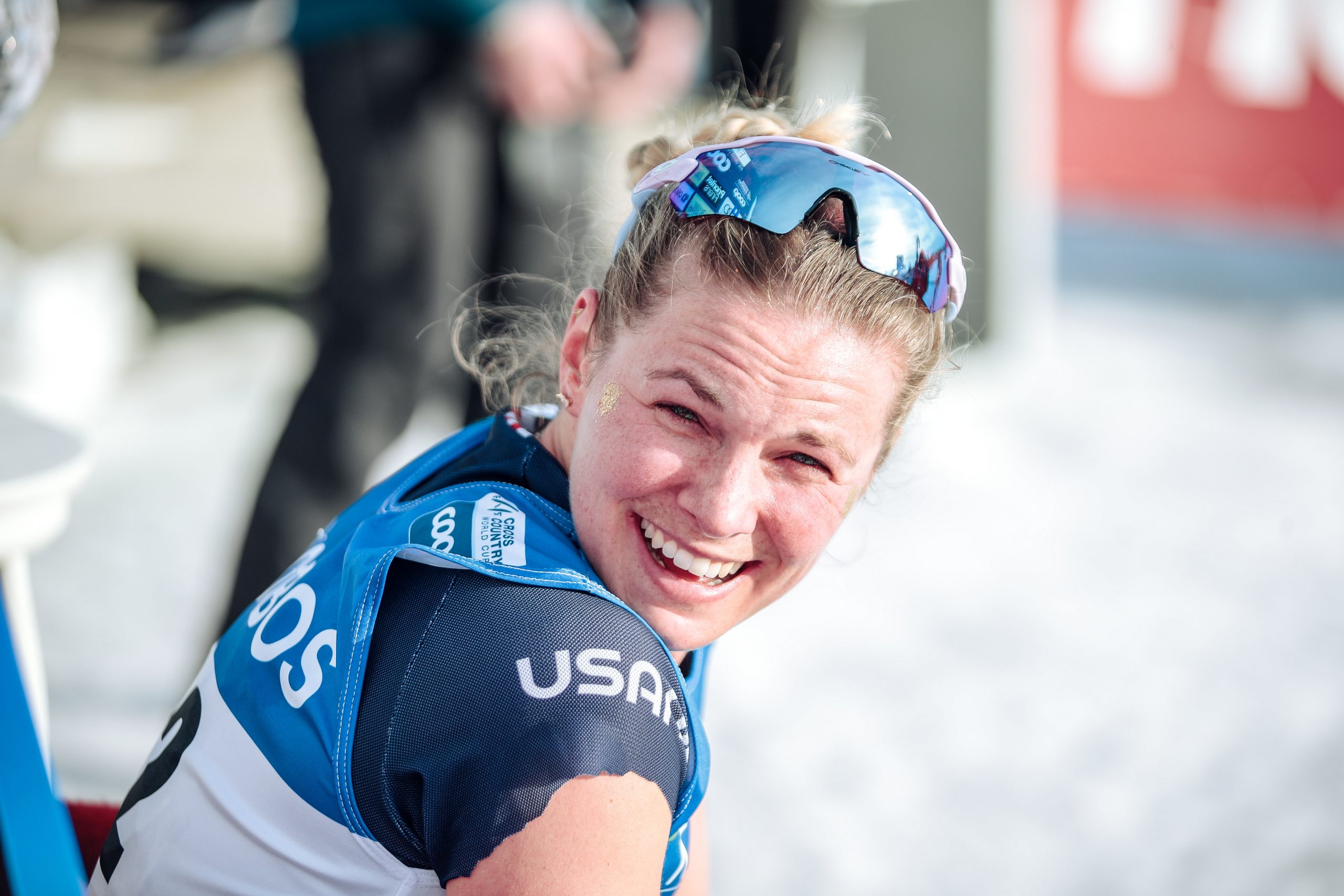
Julia Kern skis to 20th in Falun’s 10 k individual start skate. (Photo: NordicFocus)
The early racer to watch in the field was bib 10, Julia Kern, who came through the 1.5 k checkpoint 3.7 seconds ahead of the field. While the top racers would soon follow, with Frida Karlsson (SWE) eventually topping Kern’s mark as she moved through the course, Kern would prove to be a pace-setter for the earlier starters throughout her 10 k effort. She set the fastest time on course at the finish, but it would fall as seeded athletes followed. Her efforts though, ultimately yielded a 20th place finish (+1:30.3), and the image of Kern crossing the line as a champion (even if it proved temporary) seemed an appropriate conclusion to a season where she had battled to overcome the growing pains of World Cup skiing from last season and prove to be one of those American women that ought to be seen as a force on the start line.
“She raced four rounds yesterday. There was gonna be a limit to the energy, [and yet] she swung really hard today and came up with a big result today. I think a fresh Julia Kern can race with the top ten, and that’s not diminishing her 20th place today. There’s more to give, and that’s exciting” said US Ski Team Head Coach Matt Whitcomb on Kern’s result in an interview with FasterSkier.
Full audio interview with Matt Whitcomb.
Jessie Diggins races to third in Falun’s 10 k skate. (Photo: NordicFocus)
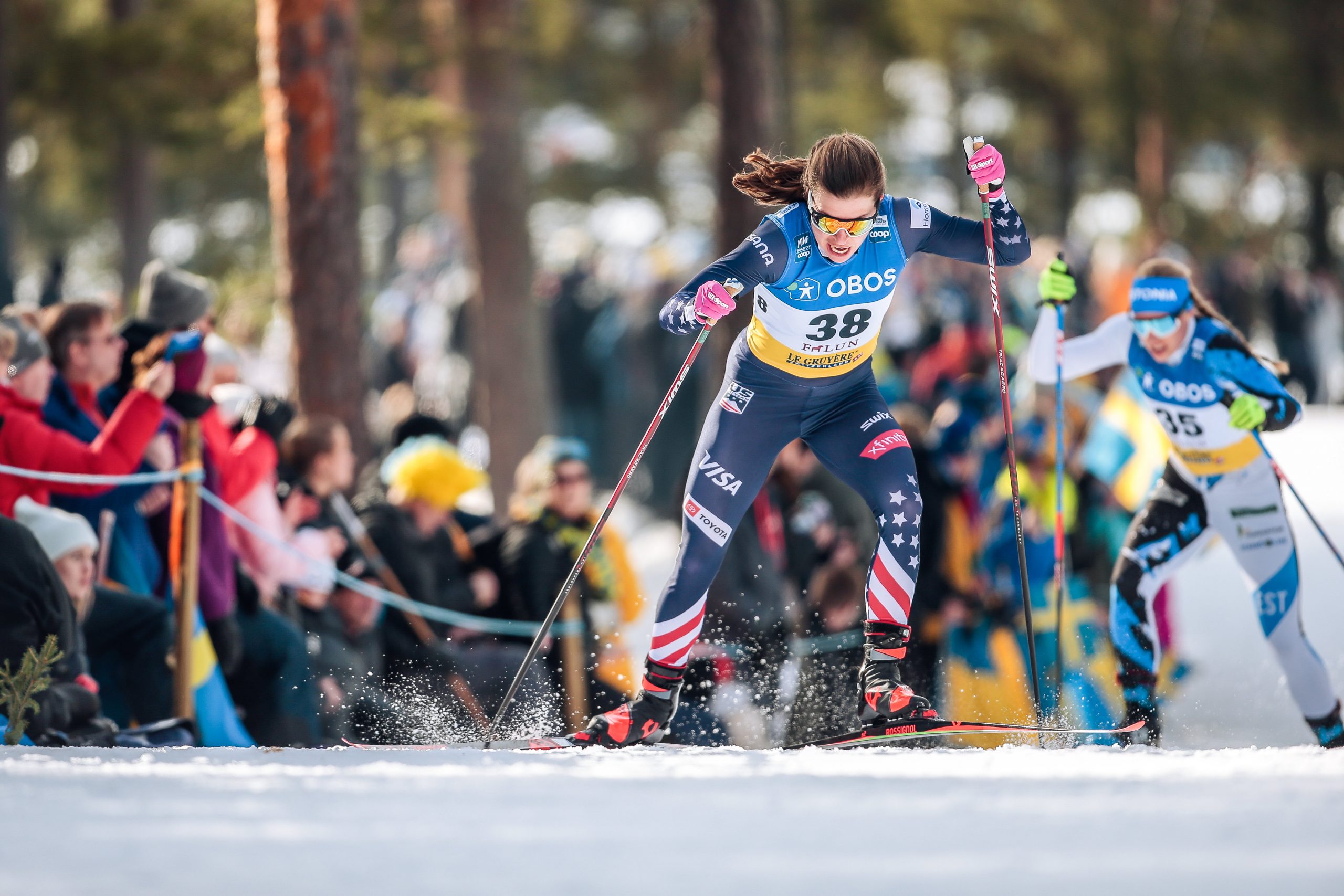
Joining her in the category of American women to be excited about throughout the season has been Rosie Brennan and Jessie Diggins. Brennan started in bib 38 today, with Diggins two minutes later in bib 42. They followed the lead of Frida Karlsson and Krista Pärmäkoski throughout the duration of the course. Karlsson, in bib 23, was the first skier to top Kern’s 1.5 k mark, coming in at 2.8 seconds over the field. Pärmäkoski, in bib 30, came through that checkpoint in 2nd, +1.6 back on Karlsson. When Brennan came through, she was +2.5 seconds off Karlsson and in 5th place, and when Diggins came through she was +0.2 off Karlsson and had put herself in 2nd place. The field, in other words, was tight, and those skiers, Karlsson, Pärmäkoski, Brennan, and Diggins – along with Ebba Andersson (SWE) and Kertu Niskanen (FIN) – would jockey and swap places through the remaining 8.5 k.
Krista Pärmäkoski races the 10 k individual start free in Falun. (Photo: NordicFocus)
At 4.3 k, Pärmäkoski had overtaken Karlsson by 1.2 seconds. Brennan came in +1.7 off of Pärmäkoski. Diggins moments later came in +1.8. Through the halfway point with the group the standings read: Pärmäkoski first, Karlsson second, Brennan third, and Diggins fourth, with less than 2 seconds between them.
By 7.7 k, the gaps had started to grow. Pärmäkoski came through with a 14.6 second advantage over Karlsson, while Brennan was +21.6 off the top and back in fourth place. The, in one of the familiar sights that colored the day, Jessie Diggins had started to somehow, someway, increase her pace. She came through 7.7 k now in second place, just +2.6 seconds off of Pärmäkoski.
Rosie Brennan on course Saturday. Brennan finished 8th in the 10 k freestyle. (Photo: NordicFocus)
At 9.1 k, Pärmäkoski still had first place, but Diggins had cut her deficit to a mere +0.6 seconds. As Pärmäkoski crossed the finish in first place with 21.8 seconds on the field, one started to get the exhilarating feeling that the camera would soon cut to Jessie Diggins doing what Jessie Diggins does best.
There was almost dramatic irony to it – we, the audience, just knew that there would be Diggins, free skating, looking ahead, and somehow increasing her tempo from 100% to beyond that. Then, she did it. Diggins crossed the finish line having not only erased her deficit, but gained a second on Pärmäkoski to finish in first place, 1.9 seconds ahead of the rest of the field.
In remarks to FasterSkier, Diggins said that her race today reflected renewed energy levels after her silver-medal winning 30 k at the Olympics, “Today was wonderful. After [sitting out the Holmenkollen race], I felt like I could go out and race the way I wanted to, having the energy to really attack the course.”
Jessie Diggins sits in the winner’s circle after crossing the line in first place on a sunny day in Falun. Diggins would eventually cede the spot to Jonna Sundling (SWE), before Therese Johaug (NOR) crossed the line in first. Final results: 1st Johaug, 2nd Sundling, 3rd Diggins. (Photo: NordicFocus)
Diggins’ result though, only was a subset of the dramatic irony that prevaded the overarching race. Behind her, wearing the red leader’s bib (56, last starter in the field), fresh off of a win at the Holmenkollen 50 k, and in her individual last professional ski race, was Therese Johaug (NOR). The immensity of her character in the drama of the day was hard to understate. Johaug had already secured the Distance World Cup title for the season – her record-breaking fifth time winning that title (breaking a record jointly held by Justyna Kowalczyk and Dario Cologna). Coming into today, she was looking for her 100th World Cup win. She had been on every World Cup distance podium except one (a 4th place in a 10 k classic two years ago) since 2019.
Posting outstanding results across all distances, Jonna Sundling takes second in Falun’s 10 k skate. (Photo: NordicFocus)
What she might achieve in today’s 10 k was continuously foreshadowed throughout the course by Jonna Sundling, who wore bib 50. The Swede, on her home turf, broke through the jockeying at the top of the field when she came through the 1.5 k checkpoint 8.1 sec ahead of the field. When Johaug came through behind her in 2nd place, +4.0 sec, the little separation the pair had created seemed to be a turning point in the race. Johaug might do it. She could do it. She would probably do it. And then, she was doing it.
“It,” of course, was opening a commanding gap on the best skiers in the world. At 4.3 k, she had a 14.1 second gap on Sundling. At 7.7 k, the gap was 30.6 seconds. At 9.1 k, the gap was 35.4 seconds. Building steadily, Johaug had set the stage for a final, triumphant act.
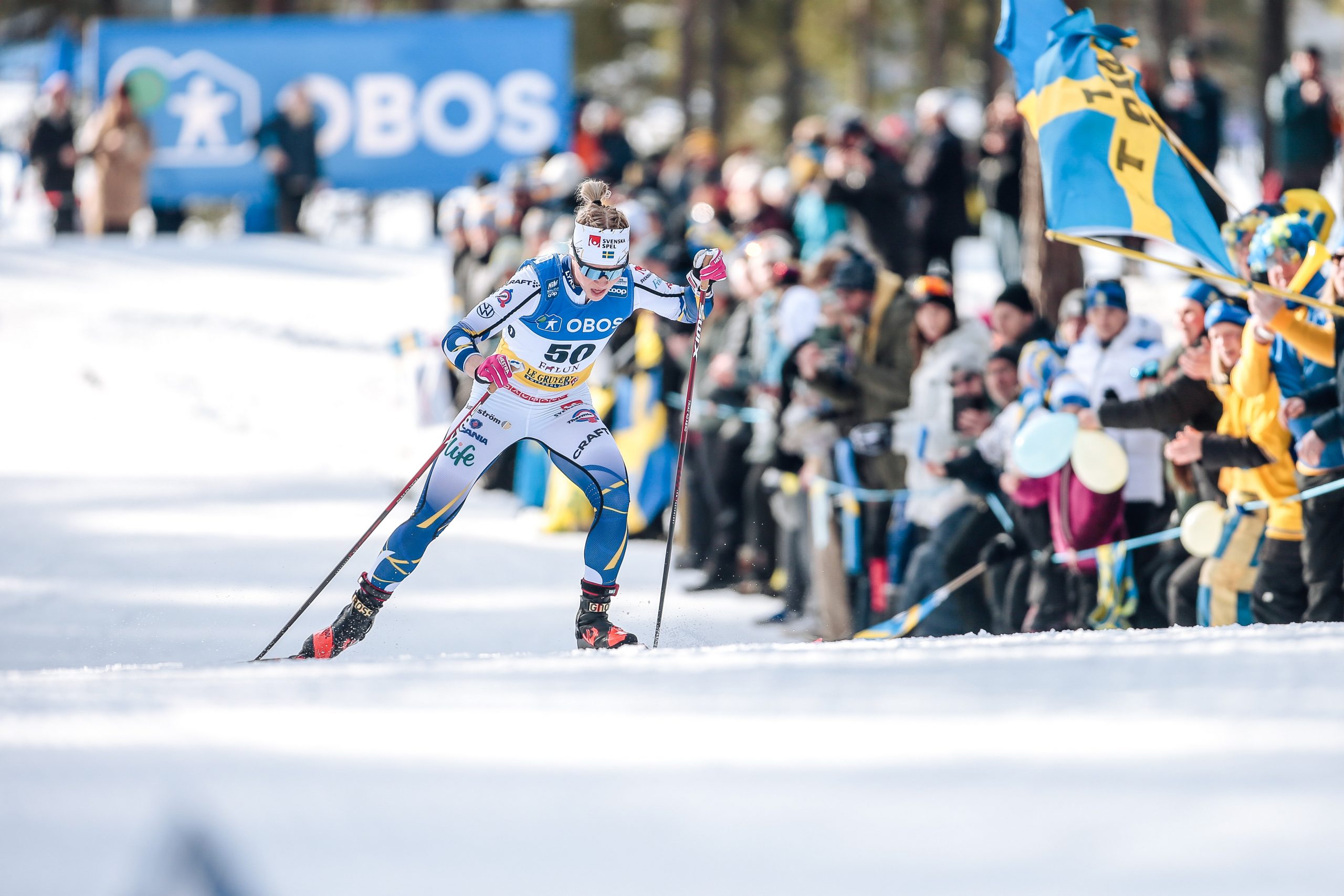
Jonna Sundling skis past her home crowd in Falun, Sweden. Sundling finished 2nd place, after a dramatic sprint to finish 0.4 seconds ahead of third place Jessie Diggins (USA) at the line. (Photo: NordicFocus)
First though, Jonna Sundling would add another scene. As she crested the hill going into the stadium the background was dotted by her country’s flags. The clock put her agonizingly close to Jessie Diggins. She did what she does better than any other skier at the moment – the Olympic gold medalist in the freestyle sprint unleashed a finish line burst that saw her come in 0.4 seconds ahead of Jessie Diggins in first place. The Swedish crowd let out a roar. It was the best that skiing as a spectator sport has to offer.
And then, it was surpassed by the best that skiing, period, had to offer. Therese Johaug finished in first place in a time of 22:34.4. To sum up her career, all you have to do is remove the last preposition.
Therese Johaug finished in first place.
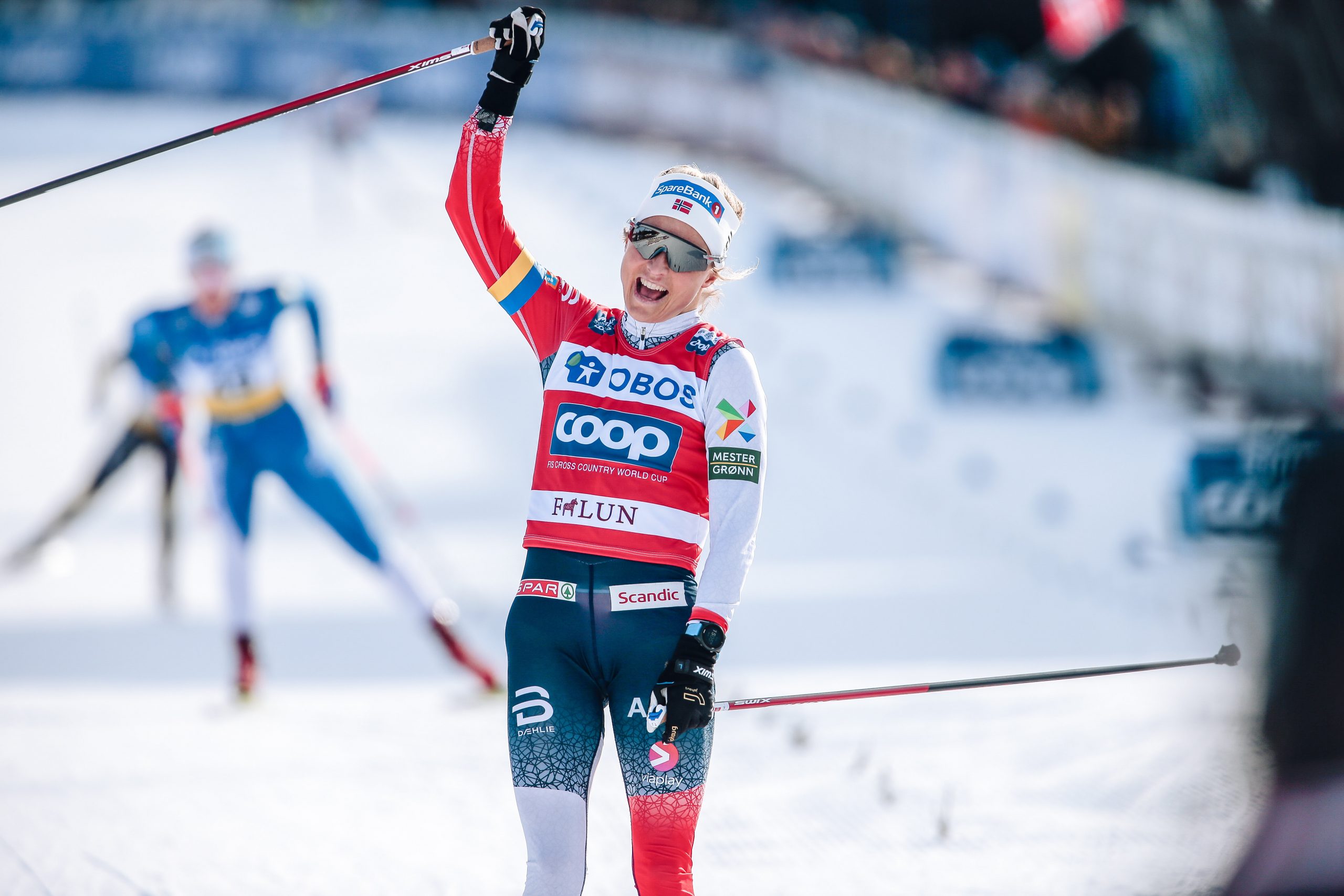
Therese Johaug (NOR) crosses the finish line, in first place, for the final time in her remarkable career. Johaug won on the day (22:34.4), and also secured the distance World Cup title for the season in Falun. (Photo: NordicFocus)
Joahaug came across her last finish line with a yelp, and then quickly turned to her competitors still mulling in the finish area. In an instance, she had gone from racer to ambassador.
With the Norwegian at the back of the seeded group, this meant the podium would be Johaug on top, Sundling in second (+35.9), and Diggins third (+38.5). Rounding out the top-five, Pärmäkoski took fourth (+38.2), with Norway’s Heidi Weng in fifth (+42.7).
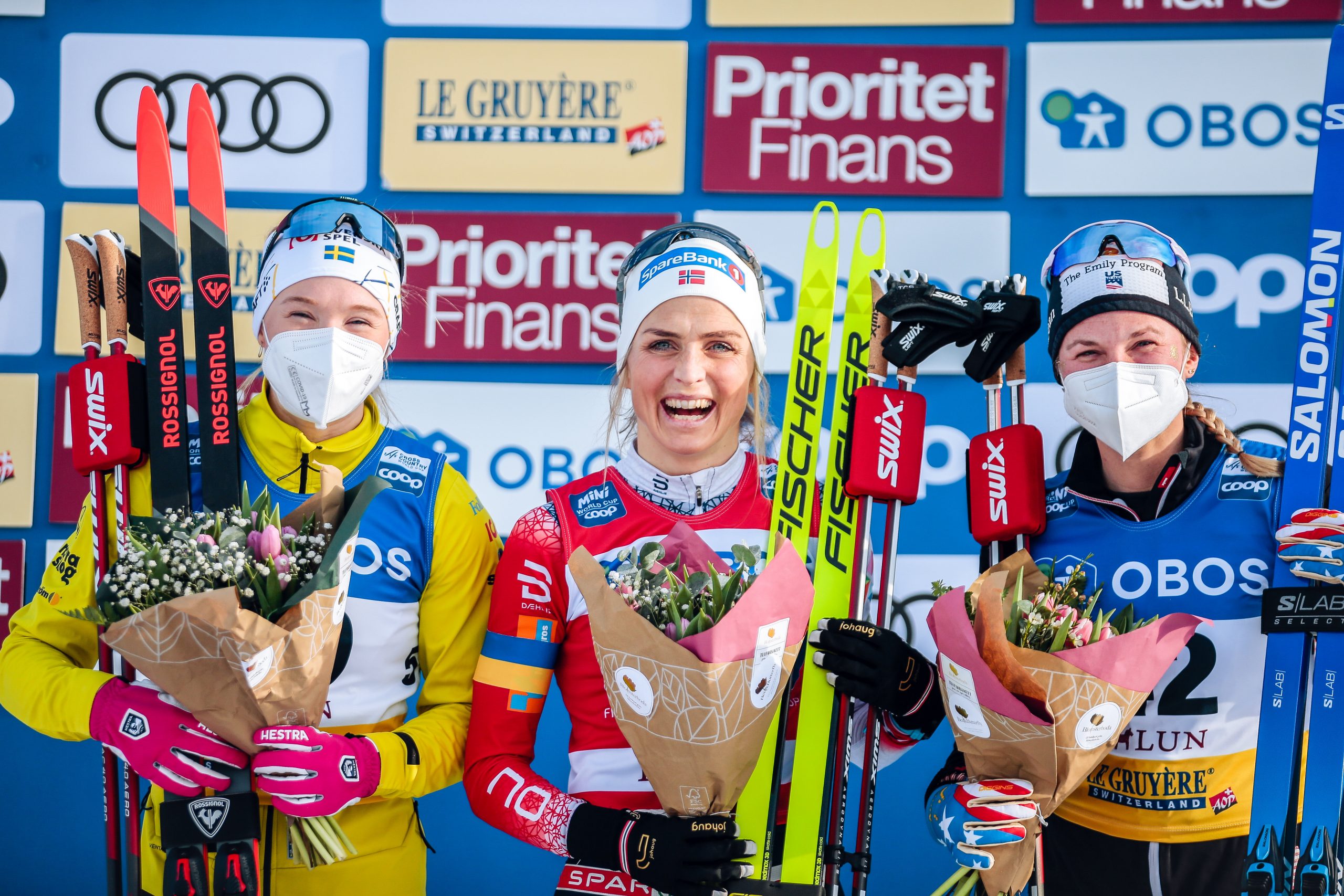
The Falun 10 k freestyle podium. (l-r) 2nd place Jonna Sundling (SWE), 1st place Therese Johaug (NOR), and 3rd place Jessie Diggins (USA). (Photo: NordicFocus)
Johaug leaves a sport that’s transformed since she first raced a World Cup in 2007. For one, it is a sport in which Therese Johaug has raced. Her ability to win races so decisively, and consistently, will cast a long shadow. She finishes her final World Cup Distance title with 177 point advantage over 2nd place Frida Karlsson (SWE), who at the young age of 22 looks poised to chart a course that follows in Johaug’s footsteps. 3rd place in the classification will go to Krista Pärmäkoski (FIN).
It’s also a sport where its leading star is an American, joined by her teammates who are now capable of putting two skiers in the top ten (Diggins 3rd and Brennan 8th), and three in the top thirty (Kern 20th, +1:30.3). The depth of the Americans, in fact, was one of the great takeaways from today’s race. Caitlin Patterson just missed a top thirty finish, coming in 31st (+1:49.5). Rosie Frankowski finished 41st (+2:26.4).
Rosie Frankowski (USA) comes down the final stretch in Falun. Frankowski finished 41st (+2:26.4). (Photo: NordicFocus)
Diggins, in particular, has proved skiing’s muse of fire, her grit and heroics adding to the depth of what ski racing purports to be the ideal for. Just today, she came into the race just one point ahead of Ebba Andersson (SWE) in the World Cup Overall. Between her and Andersson, the first finished today would secure World Cup runners-up. After Diggins podium finish today, adding to the mountain of evidence she’s accrued that belief and push are worth it, she secured that title. The overall champions’ title and crystal globe, meanwhile, will go to Natalia Nepryaeva (RUS).
Diggins said of her runners-up in the World Cup overall standings:
“It was really special to finish 2nd in the overall World Cup. I’m really proud. It represents a lot of hard work and consistently giving it everything I have everytime I race…
“I’m definitely still processing it. For me, this was a season where I came in with very concrete goals about my preparation physically and mentally for the Olympics. That was the big target. I’m really proud of how as a team (coaches and teammates) we handled that, and having World Cup wins and podiums was really just the icing on the cake.”
Full post-race audio clip from Jessie Diggins.
Therese Johaug holding her record 5th World Cup Distance crystal globe after winning in Falun. Johaug announced she is retiring from professional skiing last week in Holmenkollen. (Photo: NordicFocus)
Johaug leaves a sport too, at the end of a weary and winding road of a season. Not only out-skiing the best skiers in the world, but navigating the inextricable circumstances that surround the sport in our times. COVID-19, for one, but also the rapidly shifting planes of geopolitics – and the interplay between nationalism, identity, and narrative – that have always been at the heart of all sports, and in particular (as we’ll be reminded in the team event tomorrow) skiing.
That state of flux in the meanings surrounding the sport of skiing will continue. More so now than ever. As will the stories of athletes that are, in their pursuit of dreams, caught in contested ideas that animate the world way beyond this sport.
But then again, we have seen that all before. And as today showed, when in skiing we see something familiar, it is drive, passion, and joy in their pure human forms, that make us turn our heads and pay attention.
That is, after all, the drama of skiing, and in Falun today, we saw one of its best examples.
The Canadian women also had a string of strong results today. Katharine Stewart-Jones finished 33rd (+1:57.7), Dahria Beatty finished 43rd (+2:36.7), and Jasmine Drolet finished 52nd (+3:08.2).
Canada’s Jasmine Drolet sporting Dartmouth’s signature pink-hair look as she raced her way to a 52nd on the World Cup in Falun. (Photo: NordicFocus)
Crowds line the storied tracks at Holmenkollen during the women’s 30 k classic. (Photo: NordicFocus)
This World Cup coverage is made possible through the generous support of Marty and Kathy Hall and the A Hall Mark of Excellence Award. To learn more about A Hall Mark of Excellence Award or to learn how you can support FasterSkier’s coverage please contact info@fasterskier.com.
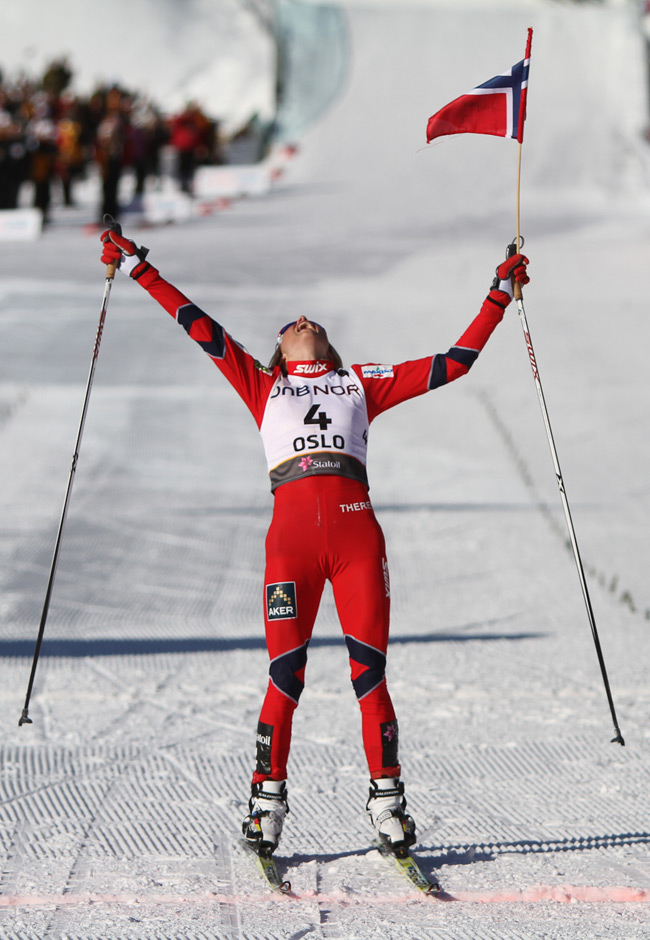
Terese Johaug wins her first individual World Championship gold medal in the 30 k mass start skate in Oslo, NOR. (Photo: FS Archives)
Eleven years ago to the day, racing the 30-kilometer mass start skate, a 22-year-old Therese Johaug won her first individual World Championship gold medal in a breakout performance at Holmenkollen near her home in Oslo, NOR. In doing so, she had broken apart a field of women considered legends of the sport on an equally legendary course known for long grinding climbs that require superior fitness and technique. Johaug won by nearly 45 seconds over one of the greatest cross country skiers of all time, her teammate Marit Bjørgen, and was 1:34 ahead of the Polish champion Justyna Kowalczyk.
“It was hard for me. It’s hard to see her go in front, and the gap [grow] bigger and bigger,” said Bjørgen that day. Then at the peak of her career, Bjørgen had gone four-for-four that week with gold medals in each of the previous World Championship races in Oslo, and the upset was a shock to those following along. “But I’m very happy for Therese. She is a young girl, and a girl for the future—and for Norway.”
Little did cross country ski fans know just how storied the athlete’s career would be.
Therese Johaug races in front of a home crowd during the 30 k classic at Holmenkollen. (Photo: NordicFocus)
Today, under clear skies that allowed for views of the city skyline and Oslofjord, Norwegian flags flying, and fans returning to the crowded stadium and partying in the woods, she did it again, as one of her final performances after more than a decade as the top female distance skiers of all time.
And what’s more, Johaug won today’s 30 k classic in the same dominant fashion that she did eleven years ago, and has done many time since, stopping the clock at 1:19:22.8.
Though the final results show just 19.4 seconds as her winning margin, this only tells part of the story. By 10 k, Johaug held a margin of over 23 seconds, which she steadily grew over the subsequent laps. At 25 k, she led by nearly a minute and a half.
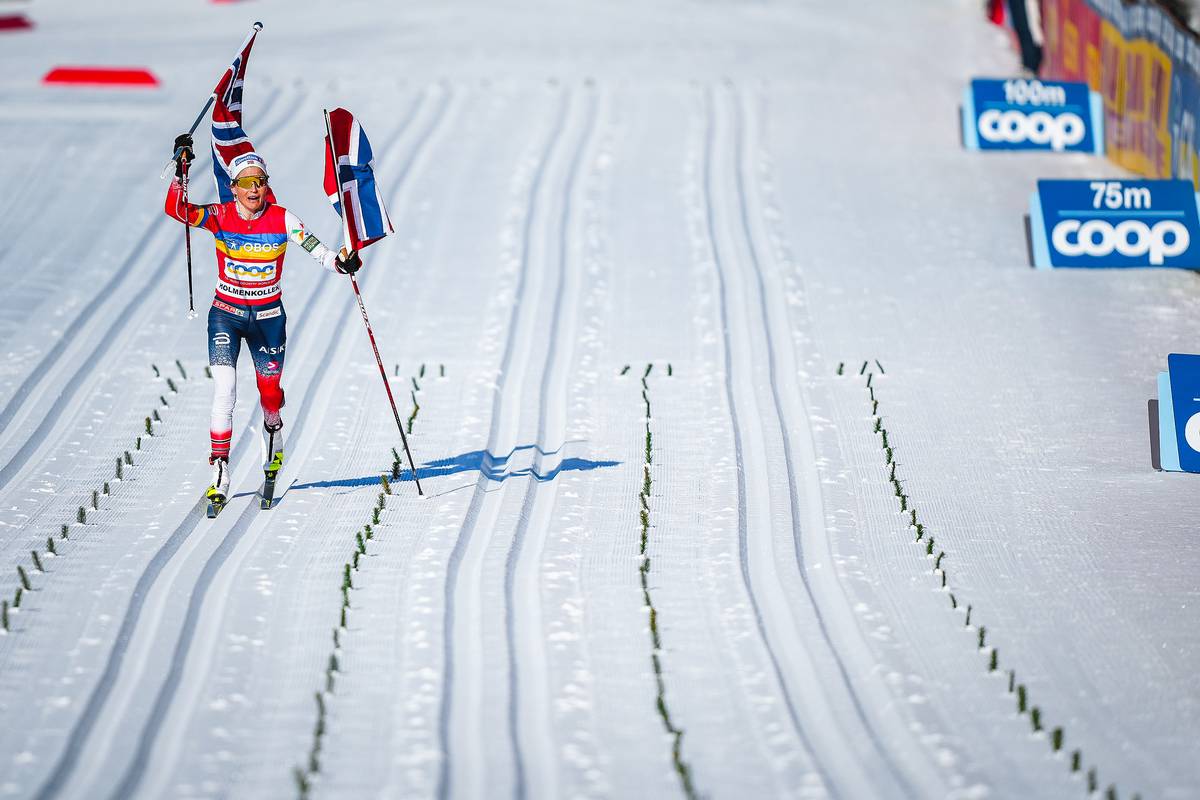
Therese Johaug waves Norwegian flags as she skis the final meters of 30 k classic at Holmenkollen. (Photo: NordicFocus)
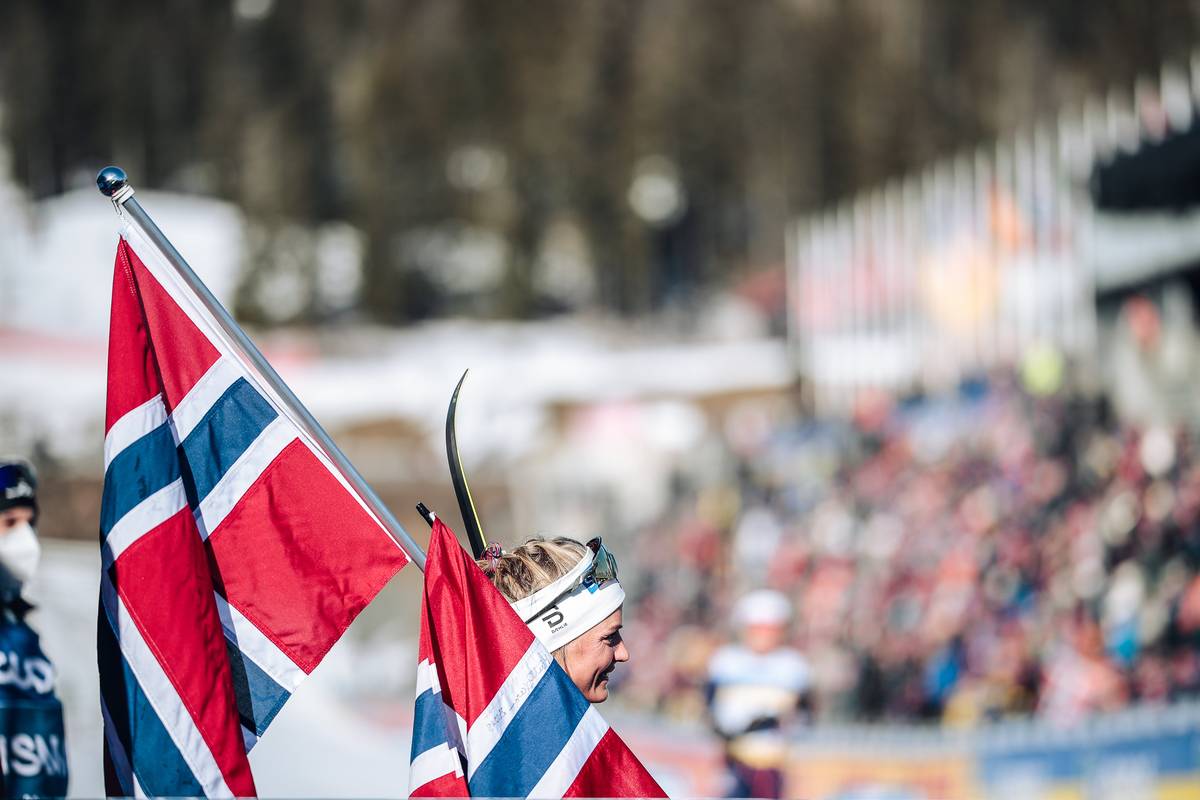
As she entered the stadium, Johaug was greeted by coaches and techs who handed her a flag for each hand, which she carried through the finish, waving, and stopping to take in the erupting cheers from the crowds.
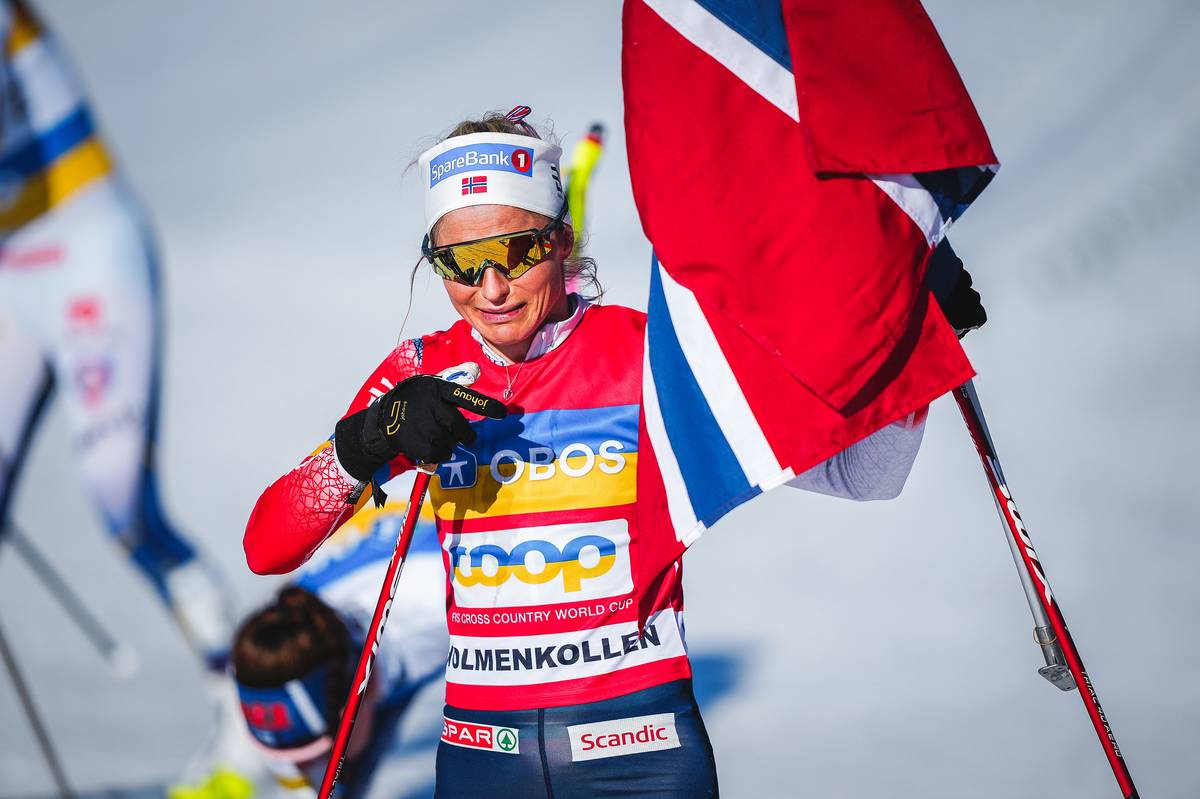
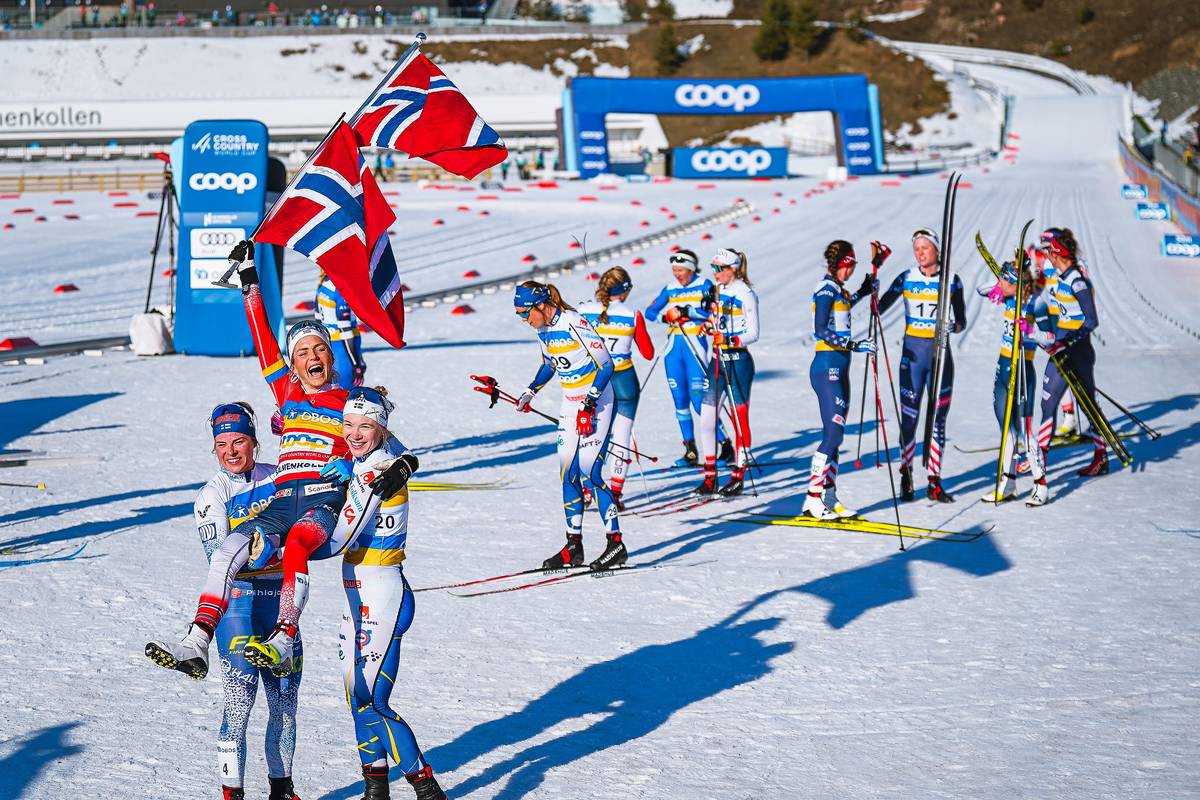
Laughing behind tears as the rest of the field began to trickle across the line, Johaug was hoisted onto shoulders, waving her flags for a loud Norwegian crowd who had supported and applauded her through fifteen years of racing on the World Cup.
“It’s a lot of emotion now,” Johaug said at the finish. “I start here in 2011 with my first individual victory, and today is my last race here. It was sun and blue sky, the same as in 2011, and there were a lot of people around the track cheering for me. I’m so happy now, but also so sad that this is the end of my career.”
Therese Johaug was emotional at the finish of today’s 30 k classic at Holmenkollen, the venue where she won her first individual World Championship gold in the 30 k skate eleven years prior. (Photo: NordicFocus)Norway’s legendary Therese Johaug wins the 30 k mass start classic, exactly 11 years after her first individual World Championship gold medal was won on the same tracks. (Photo: NordicFocus)
While she indicated during the Olympics that she would not compete another four years, it was not until yesterday that she officially announced that this would be her final race at Holmenkollen.
“In many ways, it feels as if the [story] ends when on Saturday, March 5, 2022, I stand on the starting line for another 30 k in Holmenkollen. I really do not want the journey to end, but it is a time for everything,” she wrote to NRK. “In light of this, I look forward to a final fight at home with the flag on my chest, and I am grateful for everything the sport has given me.”
Therese Johaug is showered with champagne after winning the 30 k classic at Holmenkollen following her retirement announcement. (Photo: NordicFocus)Therese Johaug celebrates her final race race at Holmenkollen, winning the 30 k classic exactly eleven years after taking her first individual World Championship gold on these tracks. (Photo: NordicFocus)
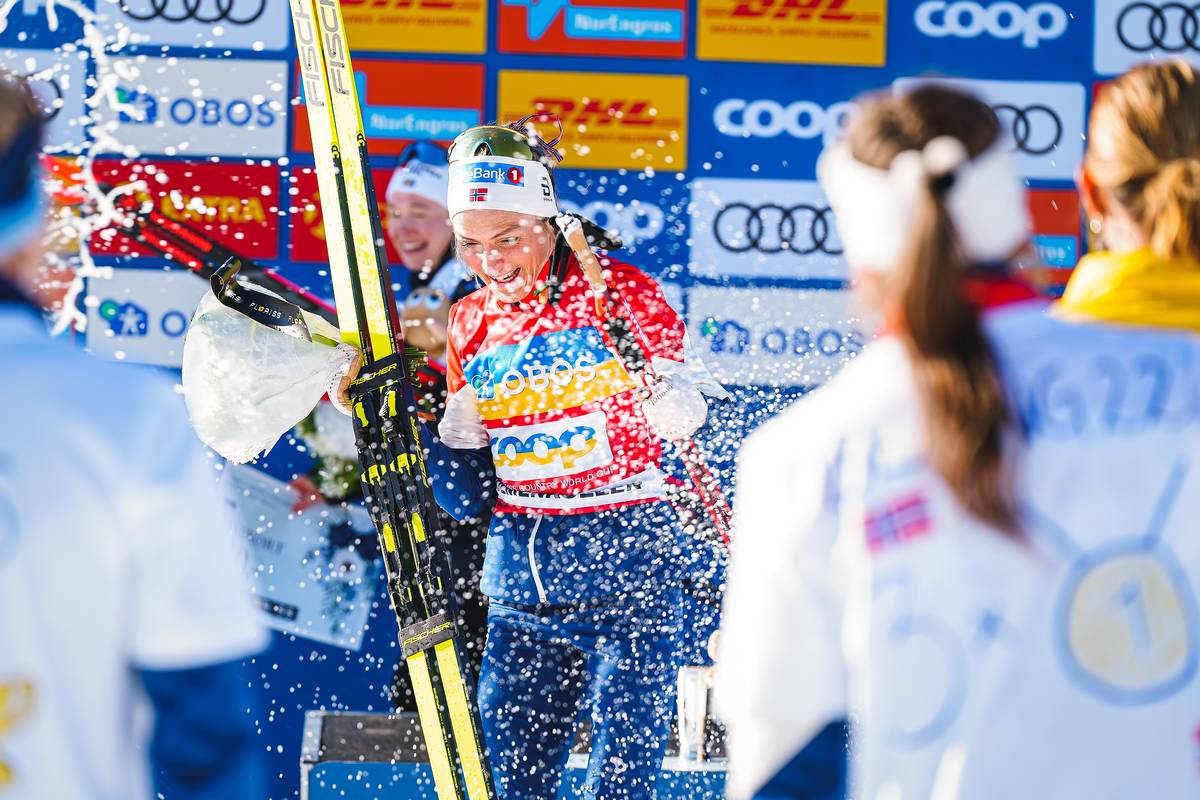
As Queen’s “We are the Champions” blared through the stadium, Johaug stepped off the podium only to be soaked by champagne sprayed by a flock of teammates wearing shirts spelling her name, with “takk” – thank you – written with a heart at the end of the row. It was a joyous celebration fitting for the moment, and perhaps also a refreshing distraction from the times at large.
“There are a lot of strong moments, but I am moved when so many people come here and see my last race. I must thank the Norwegian people who stand here today,” Johaug later said to NRK.
While you can certainly expect a more in-depth look at her storied career on FasterSkier, for now, we’ll echo the crowds in congratulating Therese Johaug, and we look forward to following along for the next chapters.
Therese Johaug celebrates her final race race at Holmenkollen, winning the 30 k classic exactly eleven years after taking her first individual World Championship gold on these tracks. (Photo: NordicFocus)Krista Pärmäkoski (FIN) and Jonna Sundling (SWE) lift champion Therese Johaug (NOR) for a podium shot at the finish of the 30 k classic in Oslo. (Photo: NordicFocus)
Behind the celebration, the lineup of women in today’s top-10 was remarkably similar to the Olympic 10 k interval start classic, with a few name swaps, and of course, a few noteworthy athletes missing – namely, Natalia Nepryaeva and Tatiana Sorina of Russia, and Jessie Diggins, who had been fourth, seventh, and eighth, respectively.
The volume of the ringing cowbells swelled as Finland’s Krista Pärmäkoski skied through the stadium on her own for second place, after pulling away from the first chase pack with 5 k to go and maintaining a healthy 10-15 second gap through the finish. Coming back on form after a few rocky seasons, Pärmäkoski had been third in the 10 k classic in Zhangjiakou, behind her teammate Kerttu Niskanen, who was fourth today (+33.8).
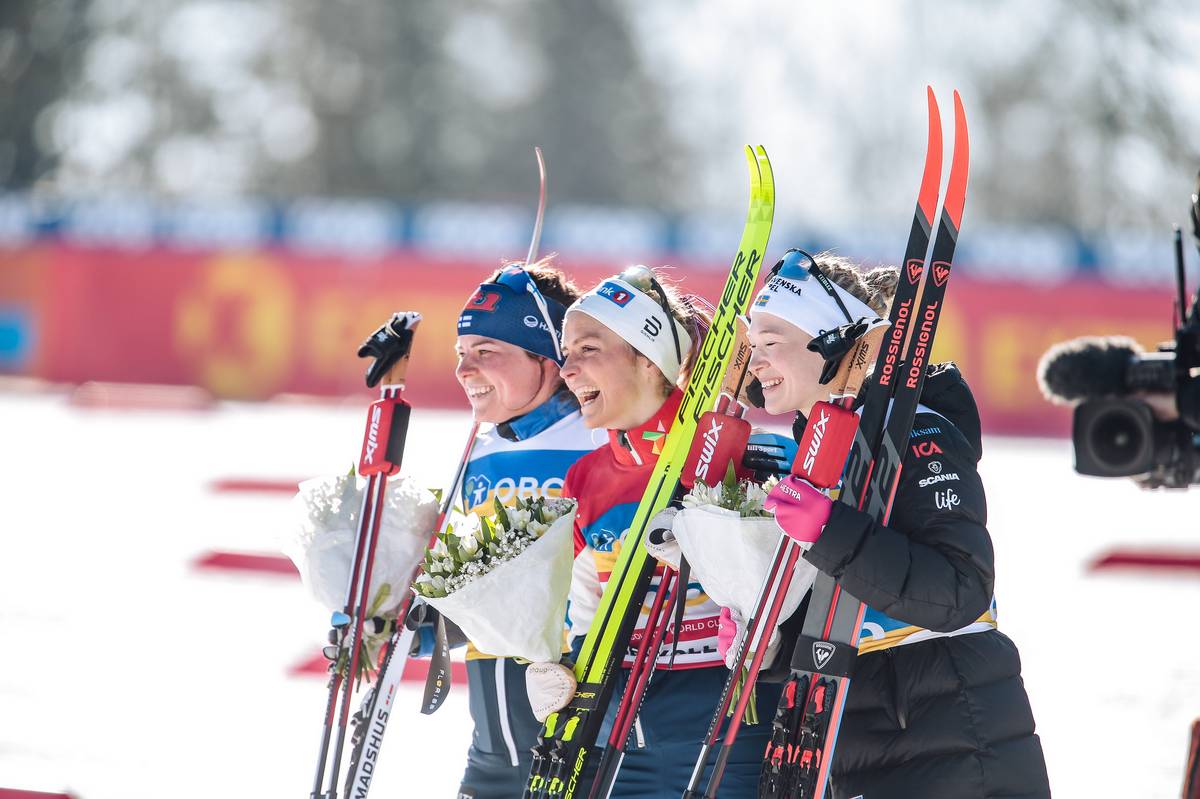
Finland’s Krista Pärmäkoski takes second in the 30 k mass start classic at Holmenkollen in Oslo, NOR. (Photo: NordicFocus)The women’s 30 k classic podium at Holmenkollen: Therese Johaug (NOR) took the win ahead of Krista Pärmäkoski (FIN) and Jonna Sundling (SWE). (Photo: NordicFocus)
Between the Finns, Sweden’s Jonna Sundling reaffirmed her talents across all distances, taking the third spot on the podium (+32.3) just two days after being second in Drammen’s classic sprint. Matching her fifth place result in the Olympic 10 k, Germany’s Katharina Hennig followed Niskanen to the line (+34.7) with Therese Stadlober, who was ninth at the Games, crossing after a gap in sixth (+46.7).
Leading the next chase group, and the American team, was Rosie Brennan in seventh (+1:12.3), bringing Norway’s Marte Skaanes and Sweden’s Ebba Andersson to the line just behind her for eighth (+1:13.1) and ninth (+1:13.8), respectively.
Rosie Brennan leads Norway’s Marte Skaanes and Sweden’s Ebba Andersson to the line. (Photo: NordicFocus)
“Today was huge for me,” Brennan wrote in a post-race email. “I have struggled here my entire career, and [though] it’s been a few years since I’ve raced here and I have improved a lot in the last few years, I still felt I lacked a lot of confidence and excitement coming here [today]. It’s also been a really stressful week for a variety of reasons, so I showed up today with an immense amount of anxiety that I needed to get a hold of before the race started.
“I am really proud of giving myself another chance to put together a good race here and to have managed the stress and anxiety well enough to do so. I wasn’t feeling in a place to shoot for the moon so I tried to start a bit a conservative the first 5 k and then reevaluate. I had a great ride with Ebba and really had an enjoyable time skiing out there today. The last lap, we had the chance to pick off a few from the lead pack and so I started to ramp things up to see what was possible. I felt strong on the last climb and felt I had a good shot at the sprint finish so I went on the last little bump before the [last 100 meters]. It felt great to finish strong and to put together a really solid race today.”
Rosie Brennan skis to seventh in the 30 k classic at Holmenkollen. (Photo: NordicFocus)
Following her classic sprint race in Drammen Thursday, Brennan joked post-race that she had lost out on yet-another boot slide. Today, the final sprint was hers. It was perhaps, also worth American fans celebrating that today that she won amongst her chase group, just under two weeks after a brave and gritty performance in the Olympic 30 k skate where she had pulled the chase group for much of the race, wearing herself out to break the wind, only to be dropped in the final 600 meters as Niskanen pulled away for a bronze medal. However, Brennan said she is not connecting any dots between the two.
“This race was nothing like Zhangjakou, really hard to even compare the two. 30 k’s are always an adventure and I am really happy to have put together two strong ones, in each technique.”
Rosie Brennan skis to seventh in the 30 k classic at Holmenkollen. (Photo: NordicFocus)
Commenting on how she is feeling, mentally and physically, with one final race weekend to go, Brennan concluded, “I am really bummed that the [World Cup] Finals were canceled. I haven’t raced a ton this season because of the earlier cancellations and while it has been a very high density block since the Olympics started, I am still feeling strong and wanted to see what I could do. But it will be really fun to end the season with the mixed relay event as that is a new one for us!”
Julia Kern was next for the US in 23rd (+3:37.2), followed by Hailey Swirbul in 26th (+3:57.8), and Caitlin Patterson – six days after taking second at the American Birkie – in 30th (+4:11.5).
Julia Kern skis to 23rd in the 30 k classic at Holmenkollen in Oslo, NOR. (Photo: NordicFocus)Hailey Swirbul skis to 26th in the 30 k classic at Holmenkollen in Oslo, NOR. (Photo: NordicFocus)
In a post-race call, head coach Matt Whitcomb shared that Kern’s result was perhaps especially noteworthy as she has been struggling throughout the season with nausea during distance races, making it difficult for her to keep down fluids taken in prior to the race, let alone receive feeds during. Whitcomb also explained that Diggins sat out today’s race as she was feeling lingering fatigue from the long, and successful, season of racing. He affirmed that she is healthy and will be ready to race for the final World Cup weekend in Falun, beginning next Friday. Listen to the full call with Whitcomb below.
Outside the top-30 for the US, Katharine Ogden was 37th (+5:54.1), followed by Rosie Frankowski, who has consistently landed on SuperTour podiums throughout the season, in 46th (+8:12.2).
Katharine Ogden (left) and Caitlin Patterson (right, bib 32) take to the course at the start of the women’s 30 k classic at Holmenkollen. (Photo: NordicFocus)Canada’s Cendrine Browne (bib 43) leads Katharine Ogden (bib 40) during the 30 k mass start classic at Holmenkollen. (Photo: NordicFocus)
Racing for Canada, Katherine Stewart-Jones led the way in 22nd (+3:25.0), with Cendrine Browne also inside the top-30 in 25th (+3:53.7). After a successful World Junior Championship in Lygna, NOR, Jasmine Drolet finished 42nd today (+6:53.2), with Olivia Bouffard-Nesbitt closing out the Canadian racers in 48th (+10:19.8).
ZHANGJIAKOU, CHINA — American cross-country ski coaches face a high-stakes dilemma over the next 24 hours as they choose which members of their deep, talented women’s team will race Saturday’s four-person relay at the Beijing Olympics.
The U.S. women have a fair shot at a medal in the event, in which each woman skis a five-kilometer leg. But don’t envy the American coaches, who are still pondering which of six athletes will fill the last two spots on the team alongside stars Jessie Diggins of Vermont and Rosie Brennan of Anchorage.
Rosie Brennan crosses the line in 13th after the 10 k individual start classic. (Photo: NordicFocus)
“We try to instill belief all year long, so that we can roll through some of these punches and athletes have that level of confidence that allows them to flow through some of these setbacks, potentially, of maybe not being selected for a team,” said U.S. Ski Team Head Coach Matt Whitcomb. “But straight up, it’s impossibly hard.”
In an interview next to the cross-country venue’s empty stadium late Thursday, all Whitcomb could say for sure about the team is that Brennan and Diggins will be on it.
Entries are due by late Friday afternoon Beijing time.
“I will say with 100% honesty, we haven’t decided yet,” Whitcomb said. “We have a team of eight women who are incredible racers, and we’ve considered every name, in multiple legs. And we are currently in the process of talking with these athletes about how they’re feeling.”
Novie McCabe races to 24th in the 10 k individual start classic. (Photo: NordicFocus)
The relay is a preoccupation not just for the coaches but also for the athletes on the bubble.
But both Novie McCabe and Hailey Swirbul, the two Americans who raced in Thursday’s individual start Olympic event in addition to Diggins and Brennan, said there’s nothing personal about it.
“It’s for sure a goal of everyone’s,” said McCabe, who finished 24th in her Olympic debut. “There are definitely a lot of girls with a chance to be on it. But I think we all believe in each other a lot.”
The coaches will likely be informed by the results from Thursday’s race, in which Swirbul placed 32nd, along with the two previous women’s events at the Games.
Hailey Swirbul embraces her teammate, Julia Kern, following the opening event of the 2022 Olympics, the 15 k skiathlon. (Photo: NordicFocus)
Two other U.S. women who haven’t yet competed in Beijing, Sophia Laukli and Caitlin Patterson, also skied a race effort on Thursday’s course before the Olympic event. But Whitcomb said it wasn’t intended as a test for the relay.
“Am I curious with how they felt? Yes, definitely. But…I don’t have the times, and they deliberately didn’t want to be compared, and we didn’t want them compared. This is a workout, so they can get faster,” he said. “We’ve talked about running time trials before, and we just don’t feel like it aligns with our team culture.”
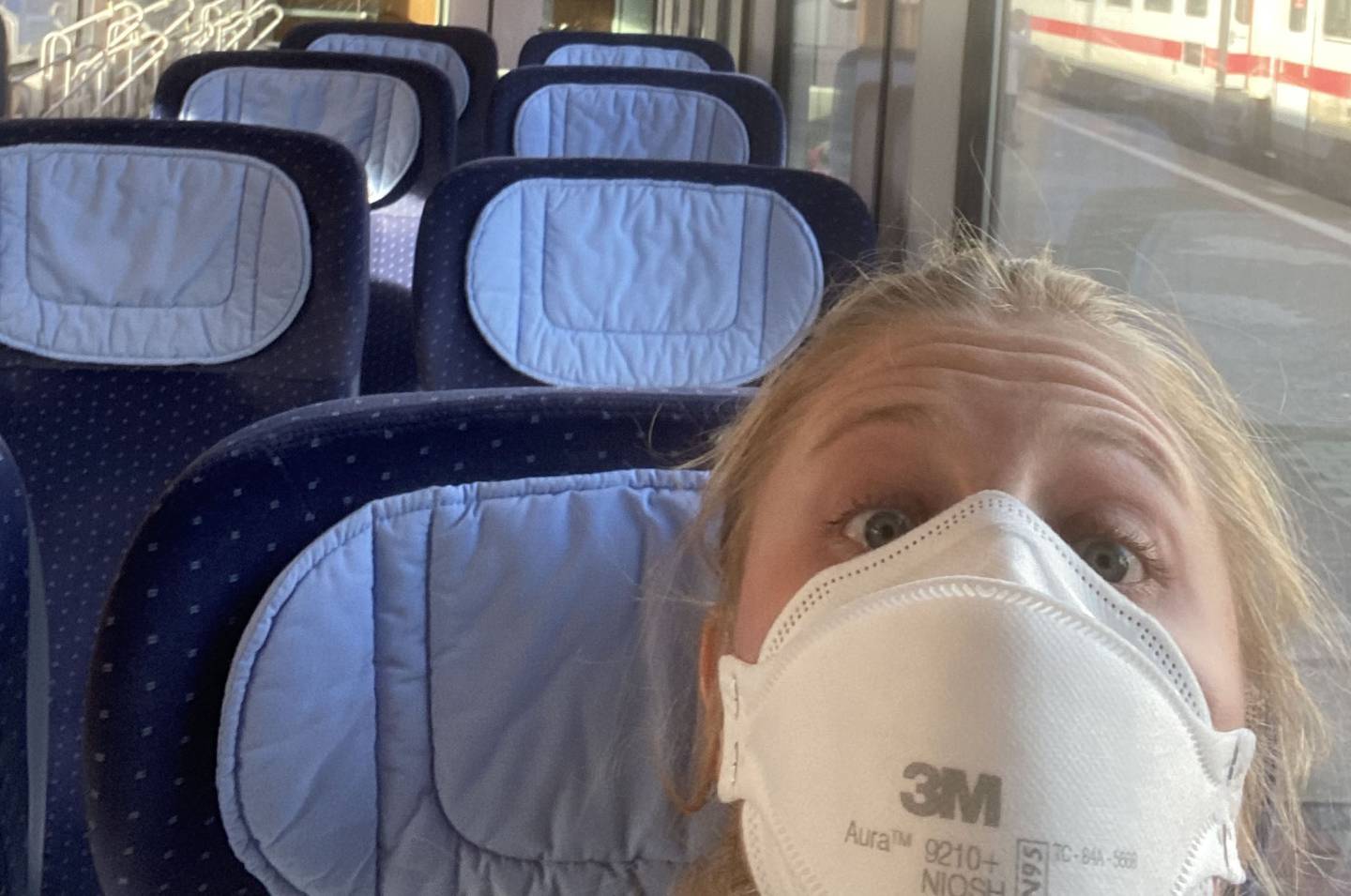
Hailey Swirbul searched out an empty train car to ride in while trying to avoid infection with the omicron variant on her way to a ski town in Austria this month. Swirbul is one of a number of Alaska athletes taking rigorous COVID-19 prevention measures to avoid derailing their hopes of competing in the Winter Olympics in Beijing. (Courtesy photo)
This article originally appeared on Wednesday January 19th, 2022 in the Anchorage Daily News. Reposted with permission.
The organizers of next month’s Winter Olympics in Beijing have imposed a rigorous regime of testing, quarantines and isolation for incoming athletes and staff.
Among the casualties is Steve Patterson’s pickleball game.
Patterson has two adult children, Scott and Caitlin, who grew up in Alaska and are both Olympic hopefuls in cross-country skiing.
They’re planning to prepare for the games from their parents’ home in Montana. Which means the whole family is being careful to avoid any contacts that could invite the coronavirus into their home — potentially derailing access to China for Scott, 29, and Caitlin, 31.
The Patterson siblings are two members of what’s currently one of America’s most COVID-conscious demographics: aspiring Olympians with plans for Beijing.
China, with its “zero COVID” policy, has draconian requirements for anyone flying into the country for the Games. They start with two negative lab tests just to get on the plane to China, followed by another immediately upon arrival at Beijing’s main airport.
A positive test would disrupt teams’ meticulously laid plans for travel and training, and even asymptomatic cases would almost certainly force athletes to miss flights and competitions for which they’ve trained for years.
As a result, Alaska athletes and others involved with the Olympics are going to great lengths to stay free of omicron as the variant spikes across the U.S. and the globe — even with training and competition schedules that include inevitable cross-country or intercontinental travel.
“This experience that I’ve dreamed of my entire life is sort of now just grounded in stress, more than anything,” said Luke Jager, a 22-year-old Anchorage cross-country skier likely to be named to the Olympic team. “I’m sure at some point, being over there, it’ll kind of set in. But right now, the challenge of not getting COVID feels just as big as the challenge of even qualifying for the Games did.”
Luke Jager starts a race at Anchorage’s Kincaid Park in 2020. (Loren Holmes / ADN)
Chris Grover, the Anchorage-raised program director for the U.S. cross-country ski team, recently returned home to Idaho from the European racing circuit.
He spent his first few days with his in-laws, rather than with his family, to avoid catching the coronavirus from one of his children who’d had a potential exposure.
Meanwhile, one of the athletes that Erik Flora coaches at APU, he said, has even been wearing masks around and sleeping in a different room from their romantic partner.
“That’s the commitment that probably tops just about everything,” Flora said. “You’re messing with the human spirit at that point.”
More than a half-dozen cross-country ski racers with Alaska ties have a good chance to make the American Olympic team when it’s named Thursday — joining two curlers, a hockey player and a figure skater as some of those destined for Beijing from the 49th state.
In interviews, the skiers and coaches describe taking Olympic-level anti-omicron precautions. But each faces a unique set of risks, depending on their circumstances.
Hailey Swirbul also trains with APU in Anchorage; she planned to return from European racing to Alaska for a pre-Olympic camp, where she could spend time with her boyfriend and dog.
But after catching a cold, Swirbul, 23, decided to stay in Europe and avoid two rounds of major international travel.
After three train rides — sporting an N95 mask, with no breaks for eating or drinking onboard — Swirbul arrived in Austria for pre-Olympic training. There, she and her teammates broke into smaller groups that don’t mix indoors.
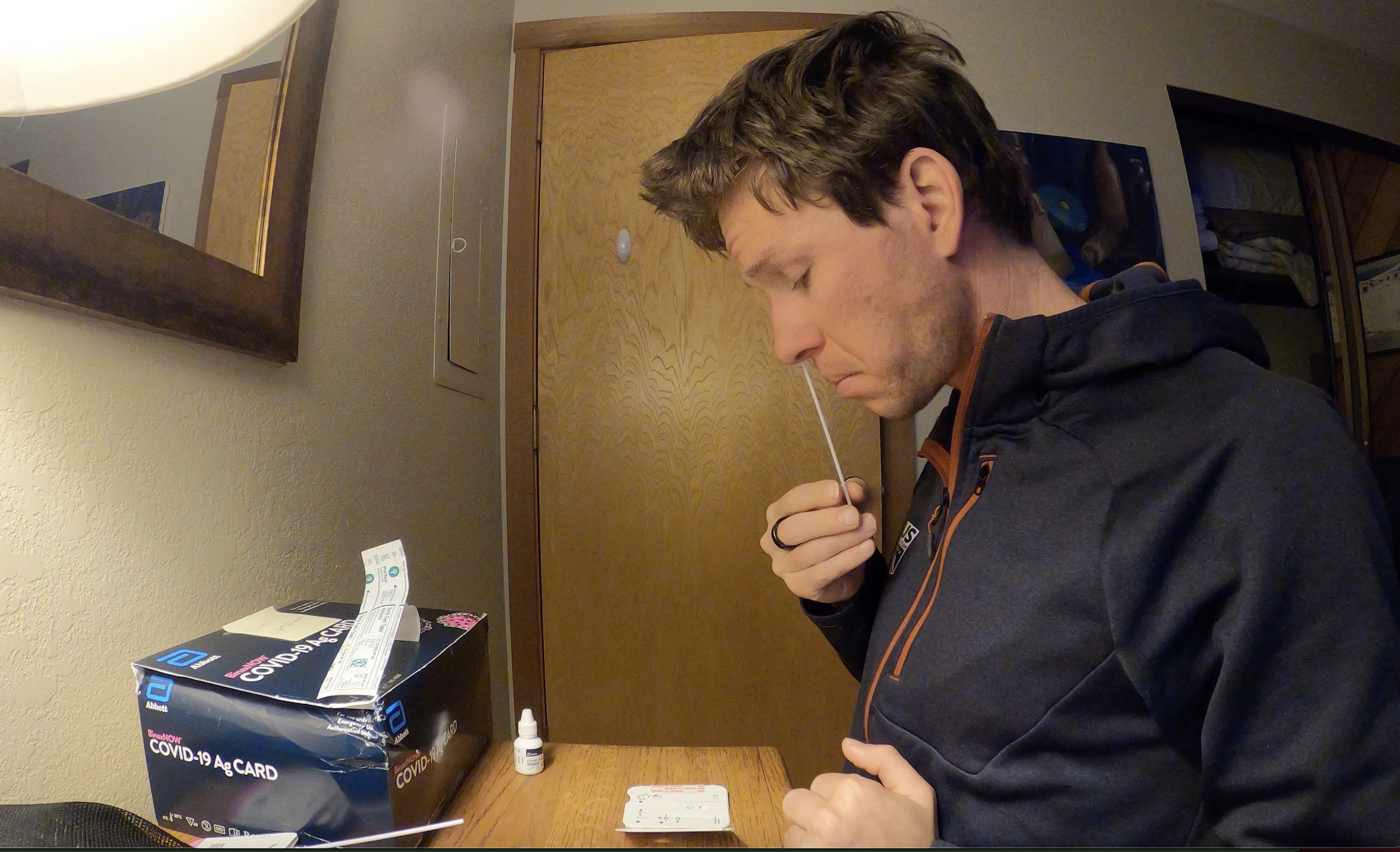
Scott Patterson self-administers a COVID-19 rapid test. (Courtesy photo)
The athletes take rapid antigen coronavirus tests every day, retrieve meals cooked by a team chef, bring them back to their living quarters and eat only after washing their hands. Swirbul got in the habit of climbing out a window to leave her apartment, rather than walking through a shared space that would require her to don an N95.
She also turned down an invitation to meet a friend, outdoors, for hot chocolate. And “definitely no grocery stores — we haven’t been in those since we’ve been here,” Swirbul said in a Zoom interview.
Jager has suffered through much more of a saga. Outside of international competitions, Jager races for the University of Utah, and he had to return from top-level European racing a few weeks ago to compete in collegiate events in the U.S.
When he arrived, the coronavirus was circulating among his team, so he couldn’t move back into his house. In a phone interview last week, he described staying in the vacant home of friends of his girlfriend’s parents before a race series in Idaho.
“They get back tomorrow night. So, we’re trying to find some other place to stay because we’re trying not to see anybody,” he said. “I’ve been nomading, pretty hard.”
Jager returns to Europe this week for a training camp in Italy with the American team, then will fly to Beijing from Switzerland.
JC Schoonmaker, another likely Olympic team member who competes for University of Alaska Anchorage, is on a similar program to Jager, except he traveled and lived with his collegiate team during races in the western U.S. this month.
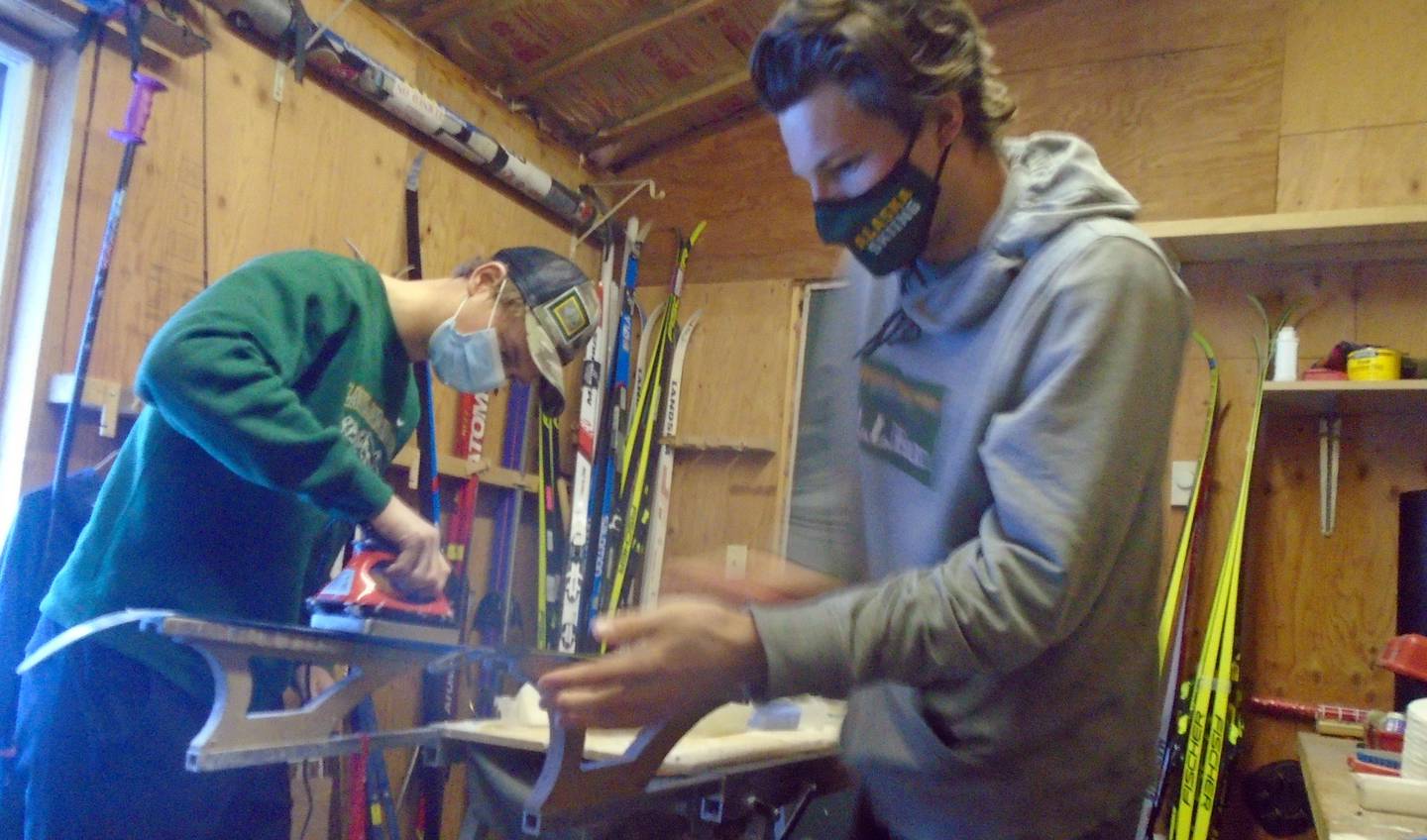
JC Schoonmaker, right, and a teammate tune skis Friday, January 14, 2022, before a weekend of racing in Idaho. Schoonmaker is one of a number of Alaskans taking rigorous COVID-19 prevention measures to avoid derailing his hopes of competing in the Winter Olympics in Beijing. (Adam Verrier)
Schoonmaker’s coach, Trond Flagstad, said the UAA coaches are doing all the shopping; they enter the athletes’ houses to drop off groceries only while wearing masks.
“It’s definitely risky, but I’m pretty confident,” Schoonmaker said. “And I really do trust my teammates — I think they’re doing a good job.”
Aside from presenting obvious logistical problems, the coronavirus has affected the skiers in subtler ways, too.
It’s forced them to keep their support networks at a social distance, whether that’s partners, family members or friends. And with coaches taking on more risks, like grocery shopping, it’s also harder for them to work closely with their athletes, or even to drive them to races in vans.
Added all up, it makes for an especially grueling, and isolating, build-up to what was one of the most pressure-filled experiences in athletics even before the pandemic.
“It really weighs on me,” said Rosie Brennan, a medal hopeful who trains with APU in Anchorage. “It’s honestly harder than preparing yourself to race.”
With the Games, and the negative tests required to enter China, approaching, each swab presents aspiring Olympians with a new reason to worry — especially with the awareness that omicron may present itself without symptoms.
“You know how it is when you’re a skier: You’ve got stuff coming out of your throat and you’re always blowing your nose and stuff,” said Jager. “You’re like at 7,000 feet, you’re like, ‘Maybe I’m a little tired today and I just blew my nose a couple extra times. Definitely could be low-level symptoms of COVID.’”
One silver lining for the Alaska ski racers, in the final days before the games begin: They’re not alone.
One of Norway’s top cross-country skiers, Heidi Weng, made tabloid headlines in that country when she said she wouldn’t be seeing her boyfriend before Beijing.
And Maja Dahlqvist, a Swedish cross-country superstar, has to stay at least 6 feet away from her boyfriend, American cross-country skier Kevin Bolger. That applies even as their teams hold separate pre-Olympic training camps on the same trails in Italy.
“I mean, of course we wish we could hold hands or hug,” Bolger said in an email. “But both knowing what is on the line, we will survive until after Beijing.”
PARK CITY, UTAH (January 20, 2022) — U.S. Ski & Snowboard announced today its nominations for the U.S. Olympic Cross Country Team to represent Team USA at the Olympic Winter Games Beijing 2022 from February 4-19, 2022. Nominations are to be confirmed by the United States Olympic & Paralympic Committee when it formally announces the U.S. Olympic Team.
Fourteen athletes were nominated to Team USA, including the 2018 Olympic gold medalist and defending World Cup overall and distance champion Jessie Diggins, and two-time World Cup winner Rosie Brennan. Brother and sister Caitlin and Scott Patterson, both 2018 Olympians, are also nominated to return to the Games. The 10 remaining nominated athletes will be competing in their first Olympic Winter Games.
“We are incredibly excited to be welcoming so many athletes to their first Olympic team,” said U.S. Ski & Snowboard Cross Country Director Chris Grover. “We’ve been watching this American talent emerge at World Juniors for the past five seasons, and now these very same athletes that have brought home so much hardware are populating the Olympic team. Beijing will be such a valuable experience for them as they progress towards being medal contenders at the highest level. We are also lucky to have the experience, leadership, and professionalism of athletes like Jessie Diggins and Rosie Brennan to show these young athletes what it takes to be successful at this level.”
Athletes were selected based upon World Cup results, World Cup rankings, SuperTour results, and the recently completed U.S. Cross Country Championships.
The 2022 Olympic Winter Games will feature 12 cross country events, including four individual events for both men and women and two team events for each gender, including the team sprint and the team relay. At each Olympics, disciplines swap between freestyle and classic techniques. For example, Diggins and Kikkan Randall won the freestyle team sprint at the 2018 Games—the first-ever Olympic gold medal for the USA in cross country skiing. The team sprint hosted at the 2022 Games will be held in the classic technique.
JC Schoonmaker was the top U.S. qualifier in the Davos sprint, placing 5th. (Photo: Nordic Focus)
Cross country kicks off the 2022 Games with its first medal event, the women’s 15k skiathlon on Saturday, February 5. The event features two 7.5k legs, with the athletes skiing the classic technique for the first 7.5k, then switching to the freestyle technique for the second 7.5k. The men will compete in the 30k skiathlon on Sunday, February 6— a 15k classic followed by 15k freestyle. The complete Olympic cross country program is listed below.
2022 U.S. OLYMPIC CROSS COUNTRY TEAM
(Name, Hometown; Birth Date; Club; Past Olympics)
Women
Jessie Diggins, Afton, Minnesota and Stratton, Vermont; 8/26/91; Stratton Mountain School Elite Team (Olympics: 2014, 2018)
Rosie Brennan, Park City, Utah; 12/2/88; Alaska Pacific University Nordic Ski Center (Olympics: 2018)
* Julia Kern, Waltham, Massachusetts 9/12/97; Stratton Mountain School Elite Team
* Hailey Swirbul, El Jebel, Colorado; 7/10/98; Alaska Pacific University Nordic Center
* Sophia Laukli, Yarmouth, Maine; 6/8/2000; University of Utah
* Novie McCabe, Winthrop, Washington; 12/15/2001; Methow Valley Nordic Team
* Hannah Halvorsen, Truckee, California; 2/19/1998; Alaska Pacific University Nordic Ski Center
Caitlin Patterson, Craftsbury, Vermont; 1/30/90; Craftsbury Green Racing Project (Olympics: 2018)
Putting together another highlight weekend in Davos, Rosie Brennan skis to 4th in the 10k individual start skate. (Photo: NordicFocus)
Men
* JC Schoonmaker, Tahoe City, California; 8/12/2000; University of Alaska Anchorage
* Kevin Bolger, Minocqua, Wisconsin; 4/11/93; Sun Valley Ski Education Foundation
* Ben Ogden, Landgrove, Vermont; 2/13/2000; University of Vermont / Stratton Mountain School Elite Team
* Luke Jager, Anchorage, Alaska; 1/7/2000; University of Utah/Alaska Pacific University
“I’m honored and excited to be representing my country once more as a member of the 2022 Olympic team! This will be my third Olympics and I’m so proud of all the hard work and dedication from all our athletes to make this team. I’m also incredibly thankful for the support from so many people who have helped me prepare for the Games! I won’t be racing for just myself out there.”
Julia Kern
“I am very excited to be named to the Olympic team, it is a dream come true! I believe the team we are bringing is really strong and will do great things at the Olympics. It takes a massive support system to get there and I am extremely thankful for all of the people who have been a part of this journey.”
Rosie Brennan
“I am honored to be representing Team USA in another Olympic Games. I am very excited to be on this team and to be in a place where we can fight with the best. I am looking forward to getting there and getting the races started.”
Hailey Swirbul skis to 6th place in the 10k individual start skate in Davos. (Photo: NordicFocus)
Hailey Swirbul
“More than anything, I feel honored to represent my country on the world stage at the Olympics. I have dreamed of the opportunity to do this since I was a kid and it hasn’t totally set in for me yet! I think it won’t feel real to me until we actually arrive in Zhangjiakou. I am really looking forward to finishing my preparations knowing I am ready to fight with everything I have out on the race courses. Going into my first Olympics, I’m not sure what to expect, but I am going to try to stay true to myself and do what I know how to do!”
Novie McCabe
“I am super excited! The Olympics have always been the dream and it’s surreal to have actually made the team! Going into this season I was very uncertain of what it would hold, but it’s been full of so many great experiences and it’s pretty hard to believe that I also get to go to the Olympics. Just overall, I’m feeling quite happy about things and very thankful for everyone who has helped make all of it possible!”
Sophia Laukli
“I’m so so excited. It’s pretty incredible to actually be named to the Olympic team and I still haven’t fully wrapped my mind around it. Even just a year ago, the Olympics seemed far-fetched, so it feels pretty surreal. That being said, I am so excited and grateful for the opportunity. It’s definitely a proud moment and I’m looking forward to the whole experience and learning a lot from it, and I especially can’t wait to see what the U.S. team can do this year!”
Caitlin Patterson
“I’m very excited to be heading to my second Olympic Games! The U.S. is bringing a strong group of cross-country athletes and I’m looking forward to seeing what we can do!”
Hannah Halvorsen
“All of my emotions are on overload. I am beyond proud, beyond grateful, and beyond excited and honored to be on the 2022 Olympic Team.”
JC Schoonmaker
“I’m super pumped to be named to my first Olympics! Pretty crazy feeling. It’s still kinda hard to believe it! Can’t wait to get over there, enjoy the experience and race the best I can!”
Kevin Bolger
“It’s every kid’s dream come true. It’s something I’ve been shooting for and dreaming of for a long time. And to be able to call my family and give them the news is just as satisfying as getting the news myself—they are just as much a part of this journey as anyone. So now making the team is the last stepping stone to my ultimate goal and that is to return from Beijing with the result I want! And I couldn’t be more excited about the men’s team I get to travel there with. It goes without saying the men’s team is putting up big results on the World Cup, and now I think we can expect some big results at the Olympics! Time to go have some fun!”
Ben Ogden leads teammate Luke Jager up the first climb during the quarterfinal of the classic sprint in Ruka. (Photo: NordicFocus)
Ben Ogden
“I’m really excited to be named to the Olympic team. Growing up in southern Vermont, I have been inspired by Olympians my whole life, and becoming one myself has always been a dream. I am excited to race hard and have some fun in China.”
Gus Schumacher
“I really have to stop and give myself some credit because it’s a lifelong dream coming to fruition, but at the same time my goals keep coming, and just making the team isn’t the end of the road. I wanna race fast! But overall I’m very excited for the opportunity to represent the U.S. on the highest level in my sport.”
Luke Jager
“This is a dream come true for me! I remember being a little kid watching Kikkan (Randall) and Andy (Newell), Simi (Hamilton), and crew at the Olympics and getting so fired up. Feels pretty crazy to get to be here now a few years later with my best friends. I feel so thankful for all the people that have worked so hard over the years to help us get here!”
Scott Patterson
“Races at the 2022 Olympics have been on my goal list for a long time. I’m excited to return to the Olympics and build on the successes I had in 2018. We have a strong contingent of U.S. athletes and I look forward to being a part of it!”
2022 Olympic Winter Games Cross Country Schedule
Saturday, Feb. 5
Women’s 15k Skiathlon
Sunday, Feb, 6
Men’s 30k Skiathlon
Tuesday, Feb. 8
Men and Women’s Freestyle Sprint
Thursday, Feb. 10
Women’s 10k Classic
Friday, Feb. 11
Men’s 15k Classic
Saturday, Feb 12
Women’s 4x5k Relay
Sunday, Feb. 13
Men’s 4x10k Relay
Wednesday, Feb. 16
Men and Women’s Classic Team Sprint
Saturday, Feb. 19
Men’s 50k Freestyle Mass Start
Sunday, Feb. 20
Women’s 30k Freestyle Mass Start
Jessie Diggins celebrates a podium effort with team sprint partner, Julia Kern, who anchored the team to 2nd place in Dresden, GER. (Photo: NordicFocus)
About U.S. Ski & Snowboard
U.S. Ski & Snowboard is the Olympic National Governing Body (NGB) of ski and snowboard sports in the USA, based in Park City, Utah. Tracing its roots directly back to 1905, the organization represents nearly 200 elite skiers and snowboarders in 2021, competing in seven teams; alpine, cross country, freeski, freestyle, snowboard, nordic combined and ski jumping. In addition to the elite teams, U.S. Ski & Snowboard also provides leadership and direction for tens of thousands of young skiers and snowboarders across the USA, encouraging and supporting them in achieving excellence. By empowering national teams, clubs, coaches, parents, officials, volunteers and fans, U.S. Ski & Snowboard is committed to the progression of its sports, athlete success and the value of team. For more information, visit www.usskiandsnowboard.org
The 2022 Sun Valley Nordic Invitational continued Sunday with 10/15-kilometer mass start classic races, featuring SuperTour, RMISA collegiate, and Intermountain junior national qualifier divisions. With overnight temperatures in the low teens which rose to roughly 20 degrees Fahrenheit by start time, tracks looked ideal for kicking and gliding on the meticulously groomed trails at the Lake Creek Ski Center in Ketchum, ID.
The opening meters of the women’s 10k mass start classic, with Rosie Brennan setting the pace in her blue APU race suit. (Photo: Tobias Albrigtsen / @untraceableg)
Today’s races featured four laps each, with men starting the morning off on a 3.75k loop that featured three progressively larger climbs, totaling roughly 417 feet of climbing per lap. The women raced next on a 2.5k loop, which truncated the third and most significant climb of the men’s loop to reduce the lap length.
Men’s 15k Mass Start Classic:
After his victory in Saturday’s 10k individual start skate, local Johnny Hagenbuch (USST/SVSEF) moved into second place in the overall SuperTour rankings, still led by Adam Martin of the Craftsbury Green Racing Project. Martin won the 15k individual start classic at the U.S. Cross Country Championships just ten days ago, taking his first national title. With fellow national championship podium finishers Scott Patterson and JC Schoonmaker also taking part in today’s classic mass start, along with a number of other accomplished competitors in a field of 122 athletes, the stage was set for an exciting race.
Ian Torchia pulls the lead group around a bend early in the men’s 15k mass start classic in Sun Valley. (Photo: Tobias Albrigtsen / @untraceableg)
In the end, it was another strong day for APU as they put together yet another podium sweep. Today, the APU men were led by David Norris, who took the win in a time of 36:50.5. Hunter Wonders finished second (+8.0), after outsprinting his teammate, Scott Patterson, in the final meters, leaving Patterson in third (+8.5).
“Lake Creek and all the Sun Valley trails are in such good condition right now,” wrote Norris in a post-race email to FasterSkier. “Earlier in the week I skied with the team at four different trailheads, and they were all so nice.”
Given the field size, level of competition, and relatively short lap length, one might expect congestion on the course, or the dreaded accordion that can sometimes occur as the pack repeatedly stretches out and compresses, making it hard for athletes in the later half of the pack to ski consistently. Norris explained that this was not an issue during today’s mass start.
“The course today is one of the harder courses in the U.S. and because of that the pack wasn’t overly crowded. I was surprised by how large of a group we had for the first three laps. I felt really relaxed skiing within the pack. Until Scott started pulling away from the lead group at the end of the third lap, I don’t think I had been in the top five. I bridged up to Scott on the last uphill of the third lap and then he, Hunter and I skied together until the last 1km of the race.”
David Norris leads the way through a corner on his way to a win in the SuperTour 15k mass start classic in Sun Valley. (Photo: Tobias Albrigtsen / @untraceableg)
“Approaching the last hill, I went to the front and right away felt a small gap open up so I pushed it to the top of the course where I had a solid gap that stayed to the finish. It’s really nice to put this race together after a really slow start to the season. The APU coaches have been working super hard and it was super cool to be a part of such a great day for the team.”
Norris concluded by sharing his upcoming objectives, perhaps foreshadowing tomorrow’s release of the 2022 Olympic team. Today’s result moved Norris into third place in the SuperTour overall standings, behind Adam Martin in first and Scott Patterson in second. In the Olympic qualification standings for distance racing, Norris is also third, with Patterson first and Martin second.
“From here I’m likely racing the Boulder Mountain Tour and the Birkie, which I’m excited about.”
Scott Patterson races to third place in the SuperTour 15k mass start classic in Sun Valley. (Photo: Tobias Albrigtsen / @untraceableg)
In Patterson’s post-race comment to FasterSkier, he echoed Norris’ statement that congestion was not an issue, particularly as they had started at the front-edge of the pack. Patterson did add, however, that some obstacles arose as they began to lap some of the skiers finishing near the back.
“Many were great about stepping over to the side,” Patterson explained. “But there were a few who were very focused on their own race and didn’t recognize our group charging through.”
Patterson also shared his version of the race narrative, including the final move that moved Wonders one step up the podium.
“The race started pretty hot. I was surprised to end up in about 15th off the line even from the tip of the chevron. However, by about a kilometer in, the pace had settled and I was back up near the front. Johnny Hagenbuch and Hunter (Wonders) did a lot of the work on the early two laps. I mostly stayed near the front, but was keeping it relatively casual and felt ready for some hard pushes later.
On the third lap up Torin’s Tucker or the South Bench climb, I decided it was time to make it a real race. My move quickly split the lead pack. I had some space behind, but David and Hunter were able to rejoin after the long descent down to the stadium. I continued to lead for most of the fourth lap before David put in a good charge up the final large climb. He got a little space from me, while I slightly distanced Hunter on the climb. However, Hunter’s finish came into play as he chased me down and out sprinted me into the finish.”
Scott Patterson makes his move, leading APU teammates David Norris and Hunter Wonders. (Photo: Tobias Albrigtsen / @untraceableg)
Giving another nod to the coaches, Patterson celebrated his team’s success, despite finishing below where he would have liked.
“It was another sweet day for APU with the sweep. I am a little disappointed to have made most of the animating moves myself and only end up on the bottom step of the podium, but it is cool to see David and Hunter put together good ones. Our coaches put in a lot of hard work this week on top of a hard nationals to make it possible.”
Though perhaps more vague than Norris, Patterson also concluded with what is next on deck for him.
“I’m heading to my parent’s in Bozeman now,” Patterson said. “My plan is to put together a good training block there at somewhat altitude and get ready for the next races.”
As mentioned, Patterson put himself on top of the Olympic qualification rankings with the combined points of his win in the 30k skate and second place finish in the 15k classic; both events are on the Olympic schedule. While the five guaranteed spots of the men’s quota have likely been filled by those with stronger early-season World Cup results (note that Patterson had wrist surgery in October, which set him back performance-wise until recently), this indicates that Patterson would likely snag the sixth spot should one be added to the U.S. quota after reallocation, happening later this week. (Find more information on quotas and selection here.)
The top six men surround the podium following the 15-kilometer mass start classic in Sun Valley. (Photo: Tobias Albrigtsen / @untraceableg)
Lacking a livestream video and intermediate splits in the live timing, it is difficult to make many observations about the race other than those apparent in the finish times. Breaking up the string of four APU men who finished in the top-five, Ian Torchia (SMS T2) finished fourth again (+28.1), on the heels of a fourth place finish in the 10k skate on Saturday. In another finish-line sprint, Torchia crossed just ahead of APU’s Zanden McMullen (+28.2) with University of Denver’s Bernhard Flaschberger just behind in sixth (+28.4).
In the collegiate standings, Flaschberger skied his way to a double victory in Sun Valley. Sam Hendry (U of Utah) also earned a double podium, taking second place today after yesterday’s third, just one second behind Flaschberger and in eighth overall. Rounding out the collegiate podium, Andreas Kirkeng of University of Denver came in third (+24.1) for RMISA and tenth overall.
The RMISA men’s podium after the 15k mass start skate in Sun Valley. (Photo: Tobias Albrigtsen / @untraceableg)
Women’s 10k Mass Start Classic:
While there was no official livestream, APU’s Forrest Mahlen did record an Instagram live of the women’s race on the APU account, which offers some insights into the action. The footage and commentary are perhaps a significant step down from that offered in Soldier Hollow, but the primary storyline was nevertheless clear from the start. By the time Rosie Brennan (USST/APU) passed Mahlen, just over a minute into the race, she had created a five second gap over the remainder of the women’s field.
Unmatched, Rosie Brennan wins the women’s 10k mass start classic by nearly a minute. (Photo: Tobias Albrigtsen / @untraceableg)
Gun to tape, Brennan put on a clinic. Unmatched, she time-trialed her way around each of the four laps to finish in 29:35.3, nearly a minute ahead of the next racer. Brennan explained after the race that she was not totally prepared for classic races, as her original plans for her U.S. altitude block changed with the cancellation of the Les Rousses and Planica World Cups. Despite the time away from the main hub of the likely U.S. Olympic squad who are now training in Livigno, Italy, Brennan has seemingly thrived as she continues to hone her mental and physical sharpness before heading to China.
“I was honestly quite nervous for the race because I was never planning to do a classic race while I was home,” Brennan shared after the race. “I only brought home two pairs of training classic skis, so I wasn’t sure if it would be enough in this very strong field of women. Luckily, they were both cold skis and we did have cold, hardpack conditions today. APU did a great job preparing them and turning them into good race skis so it was alright in the end.”
More of a time trial than mass start, Rosie Brennan gaps the women’s field early, eventually winning the race by nearly a minute. (Photo: Tobias Albrigtsen / @untraceableg)
Speaking to her race strategy, Brennan continued, “I started hard to try to simulate what I will encounter in Beijing. I wasn’t sure what the other girls would do so I just really tried to focus in on strong skiing. This is only my 3rd classic race of the year so I really wanted the practice of holding my technique together, finding a relaxed stride, and all while at altitude. I felt really strong on the long climb and was able to find a good groove, so I pulled away on that climb and then had to just keep pushing. It was a good mental challenge with a four lap race at altitude. I was definitely feeling tired on lap 3 and had to turn my mind around and find a way to push hard again that last lap in preparation for the Olympics. All in all, it was a good weekend to get some hard efforts in before we start to taper and focus in on Beijing.”
Leading the chase pack in the final lap, Katharine Ogden (USST/SMS T2) skied to second place for the women (+55.4). Ogden was second in the 10k classic during the U.S. Cross Country Championships, the only event she contested, and finished fourth in yesterday’s 5k free.
Rosie Brennan has a medal placed around her neck by SVSEF youth athlete after winning the women’s 10k mass start classic. (Photo: Tobias Albrigtsen / @untraceableg)
Next to the line was Novie McCabe (USST/U of Utah) in third (+1:07.6), her second third place finish of the weekend.
“It was fun for sure!” McCabe wrote in a post-race email. “I’ve always liked racing in Sun Valley and haven’t done too many mass starts this season so I was stoked for this one! We had a good group for the first three laps and it was kind of nice to just try and settle in and find a good pace. Overall, I felt good and am super happy with how things ended up. My skis were also amazing, which for sure didn’t hurt!!”
Rosie Frankowski skis to fourth in the SuperTour 10k mass start classic in Sun Valley. (Photo: Tobias Albrigtsen / @untraceableg)
Rosie Frankowski (APU) was fourth to the line (+1:17.1), with Sydney Palmer-Leger (USST/U of Utah) behind in fifth (+1:26.4), leading her teammate Sophia Laukli who finished roughly a second behind her in sixth (+1:27.2). Improving on yesterday’s result, Caitlin Patterson (CGRP) was next to the line in seventh (+1:35.7).
Going 3-5-6 in the overall standings set the women of Utah up nicely for a back-to-back podium sweep, the first time any RMISA team has done so within the same meet since 2013, according to the team’s press release. A look at the roster shows the Utes as the U.S. Ski Team-lite. A force to be reckoned with, the Utah women’s team has now won each of the five RMISA races this season.
Sydney Palmer-Leger skis to third overall and rakes the RMISA collegiate win in Sun Valley’s 10k mass start classic. (Photo: Tobias Albrigtsen / @untraceableg)
Beginning a northeast swing, the SuperTour circuit moves to Lake Placid, NY for Period III, resuming in two weeks on January 29th. This two-day race weekend will include a classic sprint, followed by a 10k mass start skate.
A big thank you to Tobias Albrigtsen, who generously shared his outstanding photos with us throughout the weekend.
The final weekend of SuperTour racing in Period II, and the final weekend within the Olympic qualification window, kicked off Saturday at the Lake Creek Nordic Center in Ketchum, Idaho. Part of the 2022 Sun Valley Nordic Invitational, the SuperTour races were held in conjunction with a Montana State University RMISA event and an Intermountain XC junior national qualifier.
Highlighting the size of the event, there were 157 female athletes in the field. With 141 senior and U18 men racing in the 10k, and another 46 racing in the men’s U16 5k. Spanning all age groups, an additional 70 U14 athletes and another 18 U12 athletes raced a 3k and 2k course, respectively. In all, nearly 400 cross country skiers, from Olympians to 10-year-olds in their first seasons on skis, made their way around the tracks in Lake Creek.
An athlete races the 10k interval start free on the Lake Creek trails in Ketchum, ID. (Photo: Tobias Albrigtsen / @untraceableg)
As the World Cup events in Les Rousse, France and Planica, Slovenia were both cancelled due to rapidly increasing coronavirus caseloads with the omicron variant, several athletes who might have headed back to the World Cup for these events found their way to Sun Valley instead, meaning fields were more in line with the U.S. Cross Country Championships than a typical SuperTour.
On the women’s start list for the 5-kilometer individual start skate, which kicked off the weekend of distance racing, were six women who have spent at least part of their season racing on the World Cup: Rosie Brennan (USST/APU), Caitlin Patterson (CGRP), Katharine Ogden (USST/SMS T2), and three University of Utah athletes who are also members of the U.S. Ski Team, Sophia Laukli, Novie McCabe, and Sydney Palmer-Leger.
Likewise, the men’s 10k field included seven World Cup athletes: David Norris (APU), JC Schoonmaker (USST/UAA), Scott Patterson (USST/APU), Hunter Wonders (USST/APU), Zanden McMullen (USST/APU), Luke Jager (USST/U of Utah), and Zak Ketterson (Team Birkie).
Given Ketchum’s elevation of roughly 5,950’, approximately the same as the courses in Soldier Hollow, Utah and those Olympic team members will face in Ziangjiakou in February, the events provided another opportunity to spend time training at the elevation and to hone their approach to racing at altitude. Overnight lows in the single digits meant cold air and snow temps at the start of the women’s race, another important similarity to forecasted Olympic conditions.
According to co-chief of competition Kelley (Sinnott) Yeates, livestream was not available during the Sun Valley Nordic Invitational due to connectivity issues along the courses. As such, FasterSkier’s reporting this weekend is based on live timing and the feedback of those on-site.
Of the course, Sun Valley native Johnny Hagenbuch provided insight into the 5km loop that was raced today in an email to FasterSkier: “The new courses at Lake Creek are very difficult: they essentially removed all the flat from the old course and replaced it with the biggest climb at Lake Creek.”
Senior Women’s 5k Free:
Without the ability to view the race and no intermediate splits in the live timing, the women’s race results left little room for suspense. Given her dominant performance in the 20k skate during the U.S. Cross Country Championships, it was no surprise to see Rosie Brennan’s name top the list. Brennan smashed the 5k loop, finishing in 14:28.6, a full 48.6 seconds faster than the next woman.
Rosie Brennan enjoys a wintery training day before the weekend of World Cup racing in Davos, SUI. (Photo: NordicFocus)
“I decided to come to Sun Valley after the World Cups in France were canceled,” Brennan wrote to FasterSkier in a post-race email. “My coach, Erik Flora, has been up here all week with the rest of my APU teammates, so it made sense for me to come here to be able to work with my coach and teammates. That has been the total silver lining of the World Cups being canceled. Erik is not allowed to come to the Olympics, but is my personal coach and someone who I trust and value immensely, so getting this extra week to work on things with him has been such a welcome surprise.”
Now several weeks into an extended altitude block, Brennan has been training near her childhood home in Park City, UT. The races in Soldier Hollow put her back on familiar tracks with hometown advantage, and the nostalgia continued today.
“It has been a full circle moment for me this weekend as I spent many years racing JN Qualifiers in Sun Valley growing up, so to be back here doing so now as I prepare for the Olympics has brought back all kinds of memories from my whole ski career. My high school and college coach were also out there today cheering and it’s been really special to have this extra time in the U.S. to share moments with people like that who have helped in getting me to where I am today.”
Brennan had originally planned to rejoin the U.S. Team in Europe, but following the cancellations of the two remaining World Cups before the Olympics, has shifted her plans to limit her risk of covid exposure, as a positive test might jeopardize her ability to travel to China, regardless of the severity of her case.
“With travel being risky on all kinds of levels today, I decided to just stay put after the World Cup cancellations and make the most of the training opportunities I have here in the U.S. before heading to Beijing. This weekend is serving as a replacement for the races I would have done in France and also another opportunity to test my limits at altitude. We just incorporated the races into a little intensity block to get my engine running again after a good volume block.”
Rosie Brennan logs hours on home trails during an extended altitude camp near Park City, UT. (Photo: Instagram @rosiewbrennan)
Speaking to her feelings holistically as she prepares for the Olympics, entering the Games on the heels of a career-best 2020/21 season with a host of early-season indicators that she can be a medal contender, Brennan spoke to the stress athletes face amidst the pandemic, which has added layers of complexity in traveling to Beijing and entering the Olympic bubble.
“It’s definitely a stressful lead up to the Games with COVID raging everywhere, a multitude of requirements and things that need to get done to be allowed into China, and figuring out all the details of being prepared for such a long travel to a very foreign country with lots of restrictions. I am doing my best to just stay on top of all the requirements, stay far away from everyone I can, and chip away at the things I need to be prepared for. The training at home has been great and having a coach to work with is so helpful, so from an actual racing perspective, I am feeling good and optimistic. I feel very lucky to have a home base in Park City and that the venues in the area provide good preparation for the Games.”
Sophia Laukli races to second overall and finishes the top collegiate racer in the women’s 5k interval start free in Ketchum, ID. (Photo: Instagram @utahskiteam)
Recovered from racing the Tour de Ski, where both women notched top-10 finishes on the hill climb, Sophia Laukli (USST/U of Utah) took second place (+48.6) today, with Novie McCabe four seconds behind in third (+52.6). Katharine Ogden (USST/SMS T2) was fourth (+52.0) for the women, with Rosie Frankowski (APU) next (+59.8) to round out the top-five.
With their top-three overall finishes, Laukli and McCabe also took home top results in the collegiate standings on behalf of the University of Utah. With teammate Sydney Palmer-Leger in 7th overall (+1:32.5), the Ute’s swept the RMISA podium.
“Today was definitely quite the race,” wrote Laukli after the race. “I was really looking forward to it since I love 5k skates, and courses with lots of climbing. I was also excited to get back into racing after the tour, especially on the domestic circuit which I was starting to miss. I was very happy with how the race ended up today, and it was actually a bit of a surprise (results-wise) just based on how I felt during it. I know I was not alone by getting rather cold out on course, but it felt like quite the shock to the system and difficult to get in a good groove—sometimes that will happen though! While it was probably one of the hardest 5ks I’ve ever done, it’s an awesome course and I just had fun getting back into racing after a short break.”
Commenting on her recovery post-Tour de Ski and her goals over the next couple of months, Laukli continued, “I took the past couple weeks very easy in my training, with minimal intensity, to recover from the tour. I wanted to take advantage of that racing block to really get into my best racing shape so taking a step back in training right after was important. The rest of the season is still a bit up in the air, but I know these races at altitude will be great preparation if I do end up at the Olympics. Either way, I’m planning to continue doing some college races and hopefully NCAAs, so these races will be good prep for that as well.”
With Sophia Laukli and Novie McCabe also taking second and third on the overall podium, Sydney Palmer-Leger brought the Ute’s home for a collegiate podium sweep. (Photo: Instagram @utahskiteam)
Other noteworthy results include the retired, but nevertheless still a contender, Caitlin Gregg, who hopped into the race while still serving as a co-head coach of the Midwest’s Team Birkie. Gregg finished in 8th (+1:37.5), just ahead of the day’s top Craftsbury skier, Alexandra Lawson.
Also, Caitlin Patterson, who earned a spot on the podium in each of the events at the U.S. Cross Country Championships and SuperTour in Soldier Hollow, finished 17th, nearly two minutes behind Brennan. In a post-race Instagram story, Patterson wrote that she had been very cold during the race with numb legs and toes, which left her feeling like a “floppy fish popsicle.” Despite finishing below where she was perhaps aiming, Patterson remains in second place behind Frankowski in the SuperTour overall standings, and in second behind Brennan in the Olympic qualification rankings for distance racing.
Senior Men’s 10k Free:
The men’s field would race the same lap the women did, but twice. That meant there was a time checkpoint at the halfway mark to indicate how the race was shaping up, yielding interesting insights into just how tight a spread the top of US men’s skiing is right now. With World Cup athletes, elite-level domestic racers, and top collegiate skiers from the West, there were plenty of names to watch.
Ian Torchia (SMS T2) leads Sam Hendry (U of Utah) during the SuperTour 10k individual start in Ketchum, ID. (Photo: Tobias Albrigtsen / @untraceableg)
An Aspen, CO native and no stranger to altitude, Graham Houtsma (BSF Pro) was early off the line as the second starter in bib 172. Houtsma came across the 5km split as the early leader at 13:30.3. His mark would look to be the point around which the top of the field clustered for the first part of the race. Then, Scott Patterson (USST/APU) came through in bib 194 and raised the bar. His split topped Housma by a full 30 seconds (13:00.2), and would be chased as the remainder of top-seeded athletes lapped through.
Before diving into that group, however, a caveat. A couple of the top skiers today weren’t assigned splits at all in the live timing, including overall SuperTour leader Adam Martin (CGRP), Johnny Hagenbuch (USST/SVSEF), and top-collegiate finisher, Bernhard Flaschberger (U of Denver). That gave an incomplete picture of what the race looked like through one lap, setting the stage for a few surprises in the eventual final results.
Scott Patterson skis to fifth in the 10k individual start free in Sun Valley. (Photo: Tobias Albrigtsen / @untraceableg)
So what did we know through 5km? If you were just observing, you would have seen Patterson overtaken by one, and only one, skier. Teammate Hunter Wonders (APU) completed the first lap of the course 3 seconds ahead of Patterson at 12:57.9. The field that had splits looked to be shaping up into a tight affair, with the top 5 skiers all within 15 seconds of each other. That included Wonders in the lead (12:57.9), with Patterson next (+2.3), Ian Torchia third (+8.5) seconds, David Norris (APU) in fourth (+10.0), and Finn O’Connell (BSF Pro) in fifth (+12.1). Based on eventual results, it is safe to assume that Hagenbuch, Flaschberger, and Martin all went through in the 13:00 min pack too.
At the finish, Wonders would cross the line in first place at 26:28.7, and slightly increase his lead over the pack in the second lap. Over Torchia, it had grown to 8.5 seconds, and Patterson 20.9 seconds. But it would be the skiers of the “mystery 5k” splits that really made a difference in defining today’s results. Hagenbuch came in soon after Wonders, and crossed the line in 26:15.4. It would prove to be a mark no one could top on the day. Bernard Flaschberger too, would slotted himself into the top of the pack – finishing less than a second ahead of Ian Torchia to claim 3rd.
The top 5 of the final results then, looked finished like this: Johnny Hagenbuch with the win in 26:15.4, Hunter Wonders in second (+13.3), Bernhard Flaschberger in third (+27.0), Ian Torchia in fourth (+27.5), and Scott Patterson fifth (+34.2).
The men’s podium of the SuperTour 10k individual start skate in Sun Valley, including the top-six athletes. (Photo: Tobias Albrigtsen / @untraceableg)
In an email to FasterSkier, Hagenbuch pointed to an intimate knowledge of his home course in Sun Valley as being a key to his impressive margin at the top:
“The conditions were firm and well skied-in, and it was fairly fast. I have skied a whole lot here at Lake Creek in my years, and I knew the race was going to be super hard. I think it’s important to focus on the transitions and more rolling parts of the courses at Lake Creek, as just about everyone will be suffering on the climbs. I tried to ski [with a] really big, powerful V2 on the more gradual north end of the course; the strategy for the uphills was mostly to step on and off the skis quickly.”
With his results, Hagenbuch wins his first SuperTour of the season, on his home course, to boot. Not too shabby for a Saturday morning in Ketchum. He also did so in convincing fashion, rising above a field of seasoned SuperTour athletes to claim a definitive win by a stout margin. It will also improve his 5th place overall in the SuperTour standings, replacing two 6th place finishes from early in the season at Duluth.
On his win, Hagenbuch wrote, “frankly it’s quite a relief to have done well today, as I feel I haven’t really expressed my shape to the fullest for a variety of reasons this season… I’m just taking it day-by-day, [and] it was a real treat to have so many friends and family to cheer me on at home in a field that was deeper than U.S. Nationals.”
Hunter Wonders skis to second place in the men’s 10-kilometer individual start skate race in Ketchum, ID. (Photo: Tobias Albrigtsen / @untraceableg)
Elsewhere in the SuperTour standings, Wonders’ 2nd place finish will improve his distance standing going into today from 12th overall – replacing a 4th place finish in Soldier Hollow in the 15km Classic off his point standings. Overall SuperTour leader Adam Martin finished 7th (26:57.6) on the day, while 2nd place holder JC Schoonmaker was 21st (28:04.3).
“Today was a solid effort,” Wonders wrote to FasterSkier after the race. “It’s been a while since I’ve been home to Alaska and that’s started to weigh on me this week. Leading into the racing I was low energy trying to get my feet back under me after nationals in Utah. It was a good confidence boost and a pleasant surprise when I realized I was having a good day on the course today.”
Shedding light on the course conditions for those unable to watch, Wonders continued, “It was amazing conditions for a race, not too cold with firm grooming which is always welcome. 10k is pretty short, so I knew I had to take it out hot. I was a little concerned about blowing up, but realized that the course had more recovery when you’re at race pace versus easy skiing. The high part of the course is brutal but it sets you up into a ripping decent to the finish. Overall, it was a great day and I’m happy with my racing and thankful for my teammates keeping my spirits up this week and the coaches hooking me up with some great skis.”
In the RMISA collegiate standings, the Utes again had a strong podium showing. With Flaschberger taking the win for Denver, Walker Hall (U of Utah) Sam Hendry (U of Utah) skied into the next two collegiate spots to solidify the overall lead for Utah this weekend.
The RMISA men’s podium of the 10k interval start classic in Sun Valley: Bernhard Flaschberger took the win for the University of Denver, ahead of Utah’s Walker Hall in second and Sam Hendry in third. (Photo: Tobias Albrigtsen / @untraceableg)
Precipitation was no longer a threat for the final day of racing in Soldier Hollow on Friday, a 1.5-kilometer classic sprint offered alongside the 2022 U.S. Cross Country Championships, yet classified as SuperTour only. However, athletes still faced unseasonably warm weather as blazing sun brought temperatures into the low 50’s on course during the midday heats.
Howling wind and rippling bibs could be heard as background noise as Adam Verrier called the event on the livestream, creating extra work for the athletes who would fight through degrading course conditions throughout the heats. This extra work showed in the times on course; with the combination of freestyle technique and significantly faster course conditions, Sunday’s sprint races featured times over a minute faster on average. A similar difference was seen even between the qualifier today at 9 a.m., when temperatures were still colder and tracks firmer, and the heats which began at 12:30 p.m.
Warm temperatures, degrading tracks, and loose granular spray set the stage for a challenging classic sprint in Soldier Hollow. (Photo: Tobias Albrigtsen / @untraceableg)
“Sprint” seemed to perhaps be a misnomer, as times in the women’s heats climbed over five minutes and were well above four minutes in the men’s heats. Combined with a qualifier, this meant athletes who raced through the final saw between 16 and 20 minutes of racing, testing their endurance and fitness differently from the average sprint event.
Women’s Race: Katharine Ogden on Top from Qualifier to Final
On the heels of a second place finish in yesterday’s 15k classic, Katharine Ogden (USST/SMS T2) set the bar in the qualifier, finishing in 3:51.79.
Julia Richter (U of Utah) was the second fastest qualifier (+0.77), ahead of Lauren Jortberg (BSF Pro) in third (+1.48). Both Ogden and Jortberg won their quarterfinal to advance comfortably into the semis, however, Richter took fifth in Heat 4 and did not advance.
In the first semifinal, two Craftsbury teammates Annika Landis and Caitlin Patterson led the way in the opening climb, with Ogden and Sydney Palmer-Leger (USST/U of Utah) sitting in third and fourth a few strides behind. Descending from the high point, a third Craftsbury racer, Michaela Keller-Miller, had pulled to the front, but was quickly overtaken by Patterson and Ogden as the pack headed into the final short herringbone climb before the long descent toward the stadium. Patterson and Ogden sat in low tucks, letting their fast skis glide as long as possible before transitioning to doublepole as they headed over the bridge and into the finish.
Sydney Palmer-Leger heads out for the 10k interval start classic race during the 2022 U.S. Cross Country Championships in Soldier Hollow. (Photo: John McColgan)
Upping the power in the final 200m, Palmer-Leger accelerated to make contact with Patterson as the women crossed over the bridge, but Patterson had better glide in the quick descent from the bridge’s exit, maintaining an advantage as they headed into the final stretch. Patterson tucked in on the tails of Ogden in the left-most track to go one-two in the heat, with Palmer-Leger not quite in the fight for an automatic qualifier spot finishing 1.5 seconds behind Patterson in third.
In the second semi, Bridger Ski Foundation (BSF) Pro Team members, Lauren Jortberg and Hannah Rudd lead the charging, looking as if their skis were gliding well as they pushed the downhills, perhaps with compromised kick as both showed signs of slipping in the final punchy climb.
In the long glideout, Lauren Jortberg moved from the far left side of the course outside of the track into the second track, losing some time on Rudd who had stuck with the second track from the start. Nevertheless, both held a significant gap over the remainder of the heat as they doublepoled over the bridge and into the finish lanes. Rudd took the win in 4:55.52, roughly +0.7 seconds ahead of Jortberg in second.
A few meters behind, Craftsbury teammates Margie Freed and Alexandra Lawson raced side by side to third and fourth, and as the heat proved to be seven seconds faster on average than the first, both advanced to the final.
As the women’s final headed out of the stadium and toward the first climb, Lauren Jortberg who was the first in a train of two BSF skiers, had her ski stepped on as she was switching from doublepole to a run outside the track. This caused Jortberg to stand up, spin sideways and crash in slow motion. Rudd, who was just behind, quickly moved around Jortberg without going down, soon taking the lead charging up to top of the first climb with Patterson, Freed, and Ogden close behind.
Patterson looked strong with solid kick as she chased a slipping Rudd up and over the final long climb, but it was Ogden on fast skis who quickly moved into second on the subsequent downhill.
Over the last punchy climb the women ran. Heading into the long glideout, Ogden was off the front in the left-most track, but Rudd and Patterson remained within reach a few ski lengths behind. Descending off the bridge, the top three accordioned together, all choosing the same track with Ogden confidently leading the way to the finish. Patterson, who was in third, moved into her own lane to the right, slowly gaining ground on Rudd as they headed to the line.
Katharine Ogden leads Caitlin Patterson and Hannah Rudd to the line during the SuperTour classic sprints in Soldier Hollow. (Photo: Livestream Screenshot)
Ogden maintained her lead to stop the clock in 5:01.63, while Patterson edged out Rudd for second (+0.98) and third (+1.53), respectively. After regaining contact with the pack following her crash, Jortberg finished fourth (+6.64), with Lawson fifth (+7.11), and Freed sixth (+21.55).
“I was having a lot of fun out there today!” Ogden wrote to FasterSkier after the race. “The sprint was definitely on the long side, especially late in the day, but that did not significantly affect my strategy; I am confident in my endurance as well as my short duration power. I was really excited to have fast skis from Pat [O’Brien] and it was fun to experience the high level of sprinting in the U.S. currently. I also haven’t really done a full sprint day in a while so that was a lot of fun! It was also so impressive to see Caitlin get her fourth podium in as many races and to see Hannah Rudd have an incredible breakout performance today!”
Katharine Ogden celebrates her win in the classic sprint while Caitlin Patterson edges out Hannah Rudd for second and third. (Photo: Livestream Screenshot)
In a post-race email, Patterson reflected on her experience racing through the heats.
“My racing today went fairly well, and it was a beautiful day to be out skiing and spectating,” wrote Patterson. “The sun-warmed snow became quite wet and broken apart for the heats, and combined with the wind, it certainly made a long sprint with plenty of herringbone and some sloppy tracks. I tried not to really think about the time duration much, it was mostly about getting from start to finish, however long it would take. All of the heats required some scrappy skiing, moving around through the slush and timing the length of the tuck. Now I’m really looking forward to some recovery after a good week!”
Patterson also spoke to the week of racing in Soldier Hollow, where she finished on the podium four times in as many races, including wins in both the 10k individual classic and the skate sprint. But she was not the only person in a green suit putting together a successful week. Yesterday, she shared the distance classic podium with teammate Adam Martin. On Tuesday, Crafstbury went 3-4-5 in the 20k skate, with Lawson and Freed leading a chase group behind Frankowski and Patterson. And today, five CGRP women raced in the semis, with three advancing to the final.
“Everyone at Nationals is really feeling the fatigue, and myself and my team were no exception out there today. The race coughs are becoming quite terrible from so many days of racing at altitude, which is not the most fun to be coughing uncontrollably in this time of COVID. However, I was really proud of our whole team, with 5 women in the top 10! We have a really strong group, as evidenced by the performances in the distance races too; it came as no surprise to me that the women were awesome today, because training and doing intervals all summer and fall we’ve been neck-in-neck and pushing each other.”
The women of Craftsbury with coach Pepa Miloucheva. CGRP put five women into the semifinal and three into the final of the SuperTour classic sprint in Soldier Hollow. (Photo: Facebook Crafsbury Green Racing Project)
For Rudd, this was her first career SuperTour podium. Originally from Plymouth, MN, she graduated from University of Alaska Anchorage (UAA) in May, 2020 before heading to Bozeman to join the newly minted BSF Pro Team. Placing in the top-10 in each of the three stages of the 2022 U.S. Cross Country Championships, Rudd has steadily worked her way up the results list, finishing 10th in Sunday’s freestyle sprint, 8th in the 20k mass start free, and 6th in the 10k interval start classic. She ends her week in Soldier Hollow on a podium high note.
Hannah Rudd is a member of the BSF Pro Team based in Bozeman, MT. (Photo: bridgerskifoundation.org)
“Yesterday was a pretty exciting day for me!,” Rudd wrote to FasterSkier after the race. “The sprint course at Soldier Hollow this year was very challenging as it included three solid climbs. During the qualifier, the course remained very firm and fast. However, the temperature quickly began to rise throughout the day, and by the time the quarterfinals began, the sun was baking the course, the wind was blowing, and temps were nearing 50 degrees. This made the snow begin to transform and slow down and turned the tracks into mashed potatoes in some sections.
“I woke up in the morning feeling quite tired from the past week of racing so I was not sure how the day was going to play out,” Rudd continued. “I ended up qualifying in 22nd, so it was clear that I had some work to do in the heats. I felt like I was able to gain momentum and energy throughout the day, and progressed through the quarters, and semis and onto the final. Going into the final, I knew that my team’s skis were running really well so I tried to ski big and relaxed and put myself in a good position for the last downhill. It was pretty neat to be in a final with my BSF teammate Lauren Jortberg, who is an incredible sprinter and someone that I have learned a lot about sprint racing from over the past few years. I was extremely excited to land myself a spot on the podium and think it will help me to continue building momentum and confidence for the rest of the season!”
The podium ceremony for the women’s final following the SuperTour classic sprint in Soldier Hollow. Katharine Ogden took the win ahead of Caitlin Patterson and Hannah Rudd, with Lauren Jortberg 4th, Alexandra Lawson 5th, and Margie Freed 6th. (Photo: Facebook Craftsbury Green Racing Project)
Men’s Race: Colorado’s Magnus Bøe Upsets Schoonmaker in the Final
In qualifying, JC Schoonmaker (USST/UAA) showed why he has been the U.S. Ski Team’s most reliable fixture of World Cup Classic heats this season, winning the qualifying with a time of 3:08.43, 6.42 seconds ahead of 2nd place Peter Holmes (Sun Valley SEF). Andreas Kirkeng (University of Denver) rounded out the top 3 (+6.57), in a field where the top 30 were all within 20 seconds of each other.
With a dominant performance in qualification, the racing throughout the day always seemed to have one eye on where Schoonmaker was in the field. In his quarterfinal, Schoonmaker looked to start conservatively from the back of the field, which led the whole heat to sit back as well. When he moved to the front at the beginning of the first climb, the race surged forward with him. No one could match him, however, and he finished with a comfortable lead, with Kjetil Bånerud (NMU) taking the 2nd semifinal spot (+1.02).
JC Schoonmaker prepares for a sunny and warm classic sprint in Soldier Hollow. (Photo: Tobias Albrigtsen / @untraceableg)
The following two quarterfinals also previewed the competitors, and their preferred way of attacking the course, that would define the semifinal and final racing later on.
The second heat set a stark contrast in pace to the previous heat, with Noel Keefe (U of Utah) and Bill Harmeyer (SMS T2) leading the field out hard from the gun. Hunter Wonders (APU) and Johnny Hagenbuch (SVSEF) were able to keep with the pair though, and ended up out-sprinting Keefe and Harmeyer going into the finish. Still, the duel between Keefe and Harmeyer led to a blistering pace for the heat overall, and they would claim the lucky loser spots for the semifinals.
Then came the 3rd quarterfinal, featuring winner of today’s most aggressive racer award (unofficially handed out here, by Fasterskier), Ian Torchia (SMS T2), who in every heat he was in today would hammer out to the front of the pack while others seemed content to let the field play out. He was joined in the heat by Magnus Bøe (U of Colo.), who made his move on the first climb, stayed out in front, and came through in first place. Torchia, meanwhile, held onto second to advance automatically to the semifinal.
The semifinals marked more an amalgamation of race strategies than anything unique. But it was an amalgamation – which requires multiple parts. And indeed, on a course known for rewarding smart-racing, and in conditions – above freezing, on man-made, wind-swept snow – that reward smart waxing as well.
Magnus Bøe and JC Schoonmaker are off the line during the 2022 U.S. Cross Country Championships freestyle sprint stage. (Photo: Tobias Albrigtsen / @untraceableg)
The first semifinal featured Schoonmaker and Bøe, both of which stayed back in the back during the early part of the course. Going into the first climb, Bøe took a look back, saw Schoonmaker and Harmeyer were sitting in fifth and sixth place, respectively, and decided to attack. He led over the top, into the downhill, and up the final climb. Schoonmaker successfully did maneuver through the pack to counter the move, and on the final climb took the outside line up, cutting in to tuck behind Bøe going into the final downhill. When they came up, Schoonmaker had used the draft to put himself out front, while Bøe held off a late-surge from Hunter Wonders (APU) to take the second qualifying spot into the finals.
The second semifinal was again led out by Ian Torchia, who was then followed by former sprint National Champion Tyler Kornfield (APU). Kornfield seemed content to sit behind Torchia until the first climb, when he put in a burst of speed and broke open the field. The smartest racer, however, may have been Karl Schulz (SVSEF), who rode Kornfield’s attack, and then drafted, to go into the final climb with speed. By the time he hit the downhill, he had a gap which would remain unclosed. Kornfield, who had gone into the downhill in second, found himself joined by Noel Keefe and Ian Torchia into the final sprint for the second spot. As it would happen, all three would make it through to the finals, with Kornfield in second, and Keefe and Torchia being rewarded for their efforts early in the race by claiming the two lucky loser spots to the final.
The A-final then looked like this: JC Schoonmaker, Magnus Bøe, Karl Schulz, Tyler Kornfield, Noel Keefe, and Ian Torchia.
JC Schoonmaker races the qualifier during the SuperTour classic sprints in Soldier Hollow, UT. (Photo: Tobias Albrigtsen / @untraceableg)
With memories of Schoonmaker’s dominating qualifier in mind, it seemed like the field orbited around him off the line. Schulz found himself in front, but not going full bore to open the field up. Even Torchia, when he did make a move to the front, didn’t seem to do so with the same force that had marked his quarter and semifinal attacks. Schoonmaker waited until the first climb to move to the front, and then the final really was on. Schultz seized on the attack, and then put an extra-push into the downhill to try and open up an unclosable gap like he had in his semifinal. It was a good move, but one that didn’t prove to have the same force as his previous attack, and going into the final climb he was joined up with Bøe and Schoonmaker.
Then, Schoonmaker’s pace seemed to drop-off, with a few noticeable slips that progressed into a herringbone. Bøe, meanwhile, went for the herringbone from the get-go. He was the one that made contact with Schulz before the course gave way to a final downhill on the day. Schultz held a gap on the field through the glideout and over the bridge, but it proved not to be enough of a margin to feel comfortable in the final stretch. Meanwhile, Schoonmaker had fallen back to fifth.
Utilizing his dominating doublepole sprint, when they hit the final 100m it was all Bøe, who closed a significant gap to catch Schulz in the final 50 meters. Looking as if he was leaping forward with each push, Bøe switched lanes, overtaking Schultz just before the line and letting out a fist pump as he realized a SuperTour – and collegiate – victory in a time of 4:08.28. Pushing to the line, Schulz was a close second (+0.35). (Video clip here.)
Magnus Bøe overtakes Karl Schultz just before the finish of the men’s classic sprint final. (Photo: Instagram @cubuffs)
After a gap, Schoonmaker, who was fighting for the final podium spot alongside Kornfield and Torchia, crossed the line outside of the track in third place (+4.53). Kornfield was a half second back from Schoonmaker for fourth (+5.10), with Torchia fifth (+5.64), and Keefe sixth (+11.02).
After the race Bøe explained that he changed his tactics in the heats relative to Sunday’s freestyle sprint, though he joked he thought it wise not to reveal everything.
“Today was a windy and slow-condition day,” Bøe wrote in an email. “There was headwind in the first half, and tailwind in the second half. Hence, pulling during the first half would be pointless. Furthermore, the second half, particularly for the last downhill there was very little to gain on the slipstream, due to the low speed and the ‘suctiony’ snow (cold conditions create better glide for the person coming behind on ‘heated tracks’). Therefore during all my heats I pretty much went all out from the top of the last uphill all the way to the finish, which on sunday would’ve been a suicide.”
Bøe walked through the final, including how he reacted to lead changes and adjusted his strategy when the race began to play out differently than anticipated.
“The final started off very slow, but then the positioning battle developed gradually from under the bridge. My main focus was to keep my eyes on JC, since he was clearly the favorite of the day, and I knew I would do well if I laid it up to beat him. Hence I never fell for the temptation of passing him, even though I had many chances of doing so. However, he did get tired during the last climb and tried to get others to pass him. This is when Karl took off and gained a massive gap that at first seemed too late to close. As soon as I realized that JC might not be able to catch up, I committed to catching Karl by myself. I made sure to put in a great push before the downhill straight, and did the ‘supertuck’ to gain every single inch I could. Once I started double poling towards the last bend it was just heads down and maximum effort. Was never certain I would catch Karl, I thought maybe he’d have something left at the very end. But lucky for me he didn’t and I had just enough to pull it off.”
University of Colorado’s Magnus Bøe heads out for the men’s 30k mass start free during the 2022 U.S. Cross Country Championships in Soldier Hollow. (Photo: Tobias Albrigtsen / @untraceableg)
A dual citizen of Korea and Norway, 23-year-old Bøe has already built a robust resume in international ski racing, including competing for Korea during the 2018 Olympics in Pyeongchang. Earlier this week, Bøe was fifth in Sunday’s freestyle sprints and finished 11th in the 15k classic. His only down race of the series happened in the 30k mass start freestyle, where he finished 43rd (+12:30.9).
“This week of racing has been up and down, from a miserable 30km where I got lapped, to today’s win. It’s been a lot of fun, and not least has been helpful for my shape. Next up is the Super Tour in Sun Valley, which I am looking forward to. Think I would be able to build on top of what I gained during this week.”
For Schultz, today also marked a career-first SuperTour podium. The 23-year-old Lake Placid, NY Native raced for the University of Vermont (UVM) until graduating in May, 2020, then heading to Sun Valley. Schultz had a podium just-miss earlier this year in a freestyle sprint where he finished fourth during the opening weekend of SuperTour racing in Duluth, MN.
“I was pretty fatigued from the three races prior,” Schultz wrote after the race. “I knew there was a decent headwind on that first climb, so I decided I’d tuck in behind up and over the first climb. I figured I’d need to save my strength for the final climb and long finishing straight, so I played my cards well and pushed where I needed to, and it just worked perfectly. I’ve learned sprinting is about preserving energy for critical parts of the course, it couldn’t have gone better.”
“And I won’t lie,” Schultz continued. “The spectators and everyone cheering allowed me to find another gear, especially up the last climb. I dug deeper than I have before.”
The men’s podium of the SuperTour 1.5k classic sprint in Soldier Hollow: Magnus Bøe took the win ahead of Karl Schultz and JC Schoonmaker. (Photo: Instagram @nysefnordic)
Writing to FasterSkier after the race, Schoonmaker explained how changing conditions forced athletes to make tough decisions about skis as well as tactics.
“It was a pretty crazy difference from this morning to the afternoon,” Schoonmaker explained. “The morning was icy and fast and the heats got really sloppy and slow. I had amazing skis in the morning and in the heats I struggled a bit with choosing whether to go for more kick or glide. I ended up asking for less kick to free the ski up a bit and I’m still not sure what was the right call. It was just really challenging conditions.”
Schoonmaker also explained that he had made fewer adjustments to the technique he had found such success with in Sunday’s skate sprint, however, the final proved to break the mold of what has historically proven to be the recipe for Soldier Hollow sprint racing.
“For this course I tried to take a somewhat similar approach as in the skate race by respecting the draft on the last downhill and trying to be careful about the guys behind me there. In the quarterfinal I felt I was able to ski away and create a big enough gap so that I couldn’t get sucked back in by the draft. In the semifinal, I tried to stay more in the pack and use the draft for myself. The final was tricky because I was going to try and use the draft again but Karl put in a really good move on the last hill that I couldn’t match. Then I was leading the rest of the pack and I decided to push over and try to catch Karl rather than go to the back to find the draft. It ended up not working out so great, but I’m happy with the day and the tough effort.”
We conclude a week of racing at Soldier Hollow, then, with a race that highlighted the strength and depth of the domestic circuit of U.S. skiing at present. Variable conditions on a technical course, which racers approached with tactics as diverse as the regions they hail from, indicated that this is a field that represents top-level racing. It was a testament to the development and growth of the sport in this country that a top-level racer like Schoonmaker can come off the World Cup and find a field where every heat is raced with closeness and intensity in his own country. That bodes well, and is a great place to leave the last national gathering of the US ski racing community before its best representatives look to take a crack at the Olympic Games in Beijing next month.
The spirit of the sport captured at the finish line as Alaska Winter Stars athlete Meredith Schwartz embraces her coach at the finish of the classic sprint in Soldier Hollow. (Photo: Tobias Albrigtsen / @untraceableg)
FasterSkier extends congratulations to all athletes who competed in Soldier Hollow this week, commending their efforts in a fiercely competitive field through a variety of race formats and course conditions. Also, a big thank you to Tobias Albrigtsen and John McColgan, who generously shared their photos with us throughout the week. Stayed tuned for an upcoming gallery highlighting many of the fantastic images that were not included in our reports.
Here’s a quick results recap from today’s SuperTour classic sprint in Soldier Hollow. Stay tuned tomorrow for detailed coverage including comments from athletes.
On a second warm and slow day of classic racing, temperatures in Soldier Hollow, UT climbed into the low 50’s as athletes raced through the heats of the 1.5 kilometer sprint.
In the women’s race, Katharine Ogden (USST/SMS T2) won each round of racing, from the qualifier to the final, where she stopped the clock in 5:01.63. Caitlin Patterson (CGRP) was second for women (+0.48), with Hannah Rudd (BSF Pro Team) in third (+1.53).
The men’s podium of the SuperTour 1.5k classic sprint in Soldier Hollow: Magnus Bøe took the win ahead of Karl Schultz and JC Schoonmaker. (Photo: Instagram @nysefnordic)
The men’s final saw a surprise upset. After JC Schoonmaker (USST/UAA) won the qualifier, and took first in his quarterfinal, and semi, it was Magnus Bøe (U of Colo.) whose tactics and strength carried him over the line in 4:08.28 for the men’s win. Bøe narrowly edged out Karl Schultz (SVSEF) who finished second (+0.35), with Schoonmaker hanging on for third (+4.58).
Soldier Hollow, UT offered a variety of conditions over the three days of racing at the 2022 U.S. Cross Country Championships. (Photo: Tobias Albrigtsen / @untraceableg)
By Rachel Bachman Perkins, Ella Hall, and Gavin Kentch
Thursday marked the final day of racing at the 2022 U.S. Cross Country Championships in Soldier Hollow, UT. (Friday’s classic sprint is a SuperTour only, not part of the National Championship series.)
After prime conditions in Sunday’s freestyle sprint and Tuesday’s 20/30-kilometer freestyle distance races, warm and wet weather made its way into the forecast just in time for the 10/15k interval-start classic races. Temperatures that started in the mid 30s for the women’s race climbed into the low 40s for the men’s race. In combination with variable precipitation that was not-quite-white, teams faced a dreaded combination of conditions for classic racing.
Looking like thoroughbreds, skiers shuffled and kicked their skis in the tracks to prevent icing as they lined up at the start gate to begin racing. For many athletes, the shuffling continued even after they pushed through the start wand and headed out onto the course. Even top-10 finishers could be seen slipping, struggling, and doing anything possible to get their skis to kick, while exhibiting technique that looked more like “desperate times call for desperate measures” than “this is what my technique videos should look like.” Classic racing in a warming world can be rough.
Women’s Race: Caitlin Patterson Wins by Nearly a Minute
One athlete who had scant difficulty with the variable conditions was Caitlin Patterson of Craftsbury Green Racing Project (CGRP). Starting in bib 37, near the back of the top-seeded field (bibs 21-40), Patterson had the advantage of receiving splits telling her how she was doing relative to the rest of her competition. Tuesday’s second-place finisher in the distance skate race, Rosie Frankowski, started one minute later in bib 39, but athletes starting ahead of her included Katharine Ogden (USST/SMS T2) in bib 23, Master skier Erika Flowers (BSF) in bib 29, and U20 skier Sydney Palmer-Leger (USST/U Utah) in bib 36.
Caitlin Patterson takes the national title in the women’s 10k interval start classic in Soldier Hollow. (Photo: John McColgan)
All that said, Patterson didn’t have to do very complicated math out there. After the first of three 3.33-kilometer laps, she was already in first, by 6 seconds over Palmer-Leger. After the second lap, her lead had grown to a healthy 30.9 seconds through less than 7 k of racing, this time over BSF Pro Team skier Mariah Bredal. Patterson proceeded to clock the fastest third leg in the field, by over 20 seconds, on her way to the finish, ultimately winning by nearly a minute.
Patterson notched the fastest first and second legs, too. The math can sometimes get complicated in interval-start races, but it’s safe to say that if you have the fastest time for each of three legs, you have won the race. Patterson did so by a remarkable margin of nearly one minute over ten kilometers, crossing the line in 28:12.0. No other athlete in the field broke 29 minutes on the day.
“Today was a really nice race for me, and I’m very happy with it,” Patterson wrote to FasterSkier after the race. “I skied my own race, but also felt that I went for it aggressively right from the start. It’s not every day that it’s possible to hold on to an effort like that, but I was able to keep pushing and building into the race. It’s fun to be able to race so hard, dig in deep but also be getting hints of recovery on the downhills. I was getting occasional splits that I was in the lead, but not many details, so I just kept pushing, especially since you never quite know with splits if they’re capturing everyone. However, in my 3rd and final lap, I believe I heard some cheering to the effect of ‘Caitlin you’re putting on a clinic, keep going!’ and I had some ideas that the race was quite a good one in results, to match the feelings.”
Patterson was one of few skiers who looked as if she could trust her skis throughout the race, still keeping her technique shorter and choppier than a traditional stride and glide, but nevertheless consistently achieving grip where her opponents were faltering. She acknowledged the role that the CGRP service team played in today’s success.
“The CGRP waxers – Nick Brown, Jake Barton, Ollie Burruss, and coach Pepa Miloucheva – did an awesome job with skis today and I’d like to thank them for their hard work today and every day! Great skis really helped set us up for success, and I’m proud of my whole team’s efforts this week.”
The women’s 10k interval start classic podium at the 2022 U.S. Cross Country Championships in Soldier Hollow, UT: Caitlin Patterson took the national title ahead of Katharine Ogden in second and Mariah Bredal in third. (Photo: John McColgan)
Patterson also reflected on her performance in the three stages of the U.S. Championships as a whole. Putting together a successful week of racing, she took home two wins, today and in the freestyle sprint Sunday, along with a third place finish in the 20k on Tuesday.
“Overall Nationals feelings have been quite good once I’ve gotten into the racing itself. Once I toe the line, my body wakes up and I’ve been able to push hard. It’s not all sunshine though, as many of the off days and even the warm ups before races have been a little rougher around the edges. Most racers I expect are familiar with the restless nights of sleep, the pre-race jitters, and the accumulated toll of so many races in a row – still, that’s part of the challenge to get through. I think the fact that Sunday was my first sprint race of the year, plus going the full four rounds, took more out of me than I would have expected. However everything seems to bounce back pretty well in time for the next race, and I’m looking forward to tomorrow’s sprint and overall enjoying so many chances during the week to dig in and race hard!”
Ogden, very recently returned from Europe after racing to 31st in Monday’s 10 k classic in Val di Fiemme in stage five of the Tour de Ski, took second, 53.4 seconds back, in a steady effort that saw “only” the third- and fourth-fastest individual lap times, but the second-best time overall.
Katharine Ogden races the classic sprint during the 2021/22 Tour de Ski in Oberstdorf, Germany. (Photo: NordicFocus)
“This race was brutally hard!” Ogden wrote to FasterSkier. “The course was hilly and a lot of fun, exactly what we expect of Soldier Hollow. I knew that winning today was a total long shot after racing five races of the tour and then flying [to Salt Lake City] only a day and a half before the race, but I am really proud of the way that I skied today. Even though it wasn’t the miracle race that I was hoping for, it was incredibly fun to race at home in the U.S. and to see so many people that are really special to me and have been instrumental in my ski career.
“Despite how painful the race was today, I can honestly say that I am so incredibly happy to be here and that I have never felt more loved by the ski world. It is always an honor to get a chance to race for Stratton, the team that has supported me unconditionally for the past 10 years. I am also extremely impressed by the way that Caitlin and Mariah skied today. They both work exceptionally hard and it was really special to witness that effort paying off in a big way.”
Bredal raced to third overall (+1:01.2), after moving up from fifth at the first checkpoint.
Originally from Victor, ID, just over Teton Pass from Jackson Hole, WY, Bredal is a 2021 graduate of the University of Utah, where she earned two-time All American and three-time All RMISA honors. Bredal also finished 8th in Tuesday’s 20k freestyle (+4:44.5) and 16th in Sunday’s freestyle sprint.
Mariah Bredal raced to third in the women’s 10k interval start classic in Soldier Hollow. (Photo: Instagram @bsf_pro_team)
“Today’s race was a day that everything fell into place for me and actually ended up being one of my better races ever!” wrote Bredal after the race. “It was pretty fun for that to happen and result in a podium at U.S. Nationals. I felt really good to begin with and was able to push myself a lot throughout the race too. I had amazing skis as well today.”
Speaking to her transition to post-collegiate racing, Bredal also shared her thoughts on joining the Bridger Ski Foundation Pro Team in Bozeman, MT.
“I have enjoyed it a lot so far and feel like my skiing is improving also. It’s been awesome to be on the team and I’m grateful for the quality of training and coaching I’ve had so far! Bozeman is a pretty sweet place too. I feel like I’ve had a pretty good start to the season at the SuperTours, and it’s been nice to start the season a little earlier as well.”
Initially a podium favorite, Frankowski had a rough day, posting the third-ranked time for lap one, but the 17th-ranked time for lap two, en route to finishing ninth overall (+1:41.2). Her APU teammate Becca Rorabaugh, who was second in the 10k classic in the Cable SuperTour races earlier this season, finished in a tie for 14th. Notably, APU may also have had trouble waxing for comparable conditions in the men’s classic sprint at this venue in 2017, when none of its athletes made the heats.
Notable performances from athletes starting outside the seeded group included Hannah Rudd (BSF) in eighth (+1:31.8), U18 athlete Nina Schamberger (Summit Nordic Ski Club) in 10th (+1:48.0), and Annika Landis (CGRP) in 14th (+2:02.0).
The junior women’s podium of the 10k interval start classic in Soldier Hollow. Sydney Palmer-Leger won the junior race ahead of Nina Shamberger in second and Samantha Smith in third. (Photo: John McColgan)
There was no separate juniors race on Thursday; all athletes raced the same course. Extracting the top junior athletes from the results yields an unofficial junior women’s podium of Palmer-Leger (6th overall, +1:23.7), Schamberger, and Samantha Smith (SVSEF, 13th overall, +2:01.7).
Men’s Race: Martin Out-Paces the Field for a Second Craftsbury Title
While temperatures continued to warm, the rain cleared and the sun began to shine at the start of the men’s 15 k classic individual start. Over 100 athletes completed the four 3.75 k laps, and it was Adam Martin (CGRP) who came out on top, winning in 39:18.0. With live timing down for most of the race, it was difficult to tell with certainty how the places were playing out, instead identifying strong contenders based on how skis were kicking and gliding and how well an athlete’s technique was holding together.
Adam Martin lines up to race the 30k mass start freestyle in Solder Hollow earlier this week. (Photo: Tobias Albrigtsen / @untraceableg)
For Martin, it was his first national title after several previous podium finishes, all coming in the classic technique. In 2019, racing on home tracks at Craftsbury, Martin was second in the 15 k classic, finishing behind Kyle Bratrud. The year prior at Distance Nationals in Craftsbury, Martin was second in the 50 k classic mass start. In 2016 at Nationals in Houghton MI, Martin was third in the 15 k classic behind Kevin Sandau (CAN) and Thursday’s second-place finisher, Scott Patterson.
“I wanted to win,” wrote Martin after the race, “However, I have a lot of respect for my competitors, so I knew it would take many pieces falling into place to have a shot at it.” He added, “I’m stoked – this is a dream come true for me!”
Reflecting on the conditions Martin wrote, “The conditions were soft klister skiing, and I was really happy with my skis – a good balance of enough kick and still good glide. I started towards the front of the A seed, so I tried to push a hard pace from the start. I was able to recover well on the course downhills, so even though it was at altitude, I was able to accrue big deficits on the uphills without completely blowing up.”
The men’s 15k interval start classic podium during the 2022 U.S. Cross Country Championships in Soldier Hollow, UT. Adam Martin took the win ahead of Scott Patterson in second and JC Schoonmaker in third. (Photo: John McColgan)
Scott Patterson (APU) came in second (+48.9), following up his victory in the 30 k with another podium finish. After the race he wrote, “I felt solid throughout the race. After talking to my sister following her success, I knew it was going to be hard from the start. I had that in my mind and went out for battle. I started quite strong and felt solid early on, but later, I knew my form was falling apart a bit and my arms were tiring. Four months of one pole and limited two pole skiing through the fall following my wrist injury didn’t exactly enhance my double pole endurance. However, I think I fought through that well and made the most of what I had today.”
Regarding the conditions Patterson noted, “Conditions were tough out on the course today. Warming up quite a few of my APU teammates were noting that it felt a bit like skiing on Eagle glacier in the afternoon. The pole troughs were deep, and the tracks were getting a bit wobbly and blown out. Days like today require a lot from both the athletes and the wax techs.”
Patterson started bib 231, meaning he could get splits off of Martin who started bib 224. To this, Patterson wrote, “Most of the race I was focused on chasing down my APU teammate Hunter Wonders who started right in front of me. (Wonders finished fifth, +1:18.5 back from Martin.) I did receive a few splits from Adam Martin, but it became clear pretty quickly in the race that he was skiing in a different league today.”
Scott Patterson races to second in the men’s 15k interval start classic in Soldier Hollow. (Photo: John McColgan)
“Instead I was focusing on the little things right in front of me,” Patterson continued. “Hunter proved a good rabbit with a strong start and similar performing skis. I was unable to catch him, but finished just a few seconds behind. I also had a bit of a view of JC Schoonmaker when we turned at the top of the hollow. His continual presence about 30 seconds back kept me pushing all the way as I knew it would be close.”
He turned out to be right. Rounding out the podium was JC Schoonmaker (USST/UAA) in third (+52.9), just four seconds behind Patterson.
Schoonmaker earned his first national title on Tuesday during the skate sprint but he wrote, “[Thursday’s] distance podium probably feels better than the sprint win the other day just because it’s been something I’ve been working super hard on. I’ve never viewed myself as just a sprinter, so today helps to prove that and I’m really proud to feel like I can do both.”
He continued, “I felt really good for the whole race, I definitely took it out pretty hard I think and just tried to hang in there. It was really tough conditions but I had awesome skis and I got a nice train with two of my other UAA teammates. It’s pretty fun when you can race next to your teammates and it just feels like another hard training day.”
Schoonmaker’s teammates Espen Persen and Magnus Norøy, both from Norway, finished fourth (+1:04.9) and eighth (+1:28.7), respectively.
JC Schoonmaker leads a train of UAA teammates during the men’s 15k interval start classic in Soldier Hollow. (Photo: John McColgan)
Looking forward to the next few weeks, Schoonmaker shared, “I’ll race the classic sprint tomorrow and then head to Sun Valley next weekend for some more super tours and RMISA races. After that, hopefully back to Europe and Beijing.”
Alexander Maurer (CU) was the first junior finishing in 41:59.7, 15th overall and +2:41.7 behind Martin. Walker Hall (UU) was the second junior, taking 17th overall, just +1.9 behind Maurer and +2:43.6 behind Martin. Will Koch (CU) was third for the day, 20th overall, +27.7 behind Maurer, and +3:09.4 behind Martin.
The junior men’s podium for the 15k interval start classic in Soldier Hollow: Alexander Maurer took the win ahead of Walker Hall in second and Will Koch in third. (Photo: John McColgan)
Men’s official results were not yet available at the time of publication, but will be posted here when possible. The first page of unofficial results is shown below.
Unofficial results for the first 23 finishers of the men’s 15k interval start classic, day three of racing at the U.S. Cross Country Championships in Soldier Hollow, UT. (Photo: Greta Anderson)
Quick Recap:We’ll have a full race report up tomorrow, including athlete comments and photos, but here is a quick recap of the action in Soldier Hollow this morning.
Warming temperatures and liquid precipitation set the tone for the final stage of the 2022 U.S. Cross Country Championship in Soldier Hollow. The livestream showed athletes of all levels struggling to find kick on the challenging Olympic caliber course.
In the women’s 10-kilometer interval start classic, Caitlin Patterson (CGRP) ran away with the win in 28:12.0, nearly a minute ahead of second placed Katharine Ogden (USST/SMS T2) in second (+53.4). BSF Pro Team member Mariah Bredal raced to third (+1:01.2).
Patterson also won the 10k classic during the 2019 National Championships, and was second in the 10k interval start skate in 2020, finishing behind Finland’s Riitta-Liisa Roponen who spent the season racing in the U.S. while her husband led the Denver University ski team.
Racing with the senior women, the top three juniors were Sydney Palmer-Leger (USST/U of Utah), Schamberger (Summit Nordic Ski Club), and Samantha Smith (SVSEF). They finished 6th (+1:23.7), 10th (+1:48.0), and 13th (+2:01.7) overall.
The men’s and women’s podiums of the 10/15k interval start classic. (Photo: Craftsbury Green Racing Project Facebook)
Temperatures now in the low-40s for the men’s 15k, Adam Martin raced to another commanding win for the Craftsbury Green Racing Project, finishing in 39:18.0. Tuesday’s 30k mass start freestyle winner Scott Patterson (USST/APU) finished second (+48.9), while Sunday’s sprint champion JC Schoonmaker (USST/UAA) took third (+52.9).
In the junior race, Alexander Maurer (U of Colo.) was the top finisher in 15th overall (+2:41.7), with Tuesday’s winner Walker Hall (U of Utah) next in 17th overall (+2:43.6). Third for juniors was Will Koch (U of Colo.) in 20th (+3:09.4).
By Gavin Kentch, Ella Hall, and Rachel Bachman Perkins
Tuesday brought distance races to Soldier Hollow, in the second full day of racing at 2022 U.S. Cross Country Championships. The story at the front of the field was strong performances by athletes who had begun the year racing on the World Cup, as Rosie Brennan dominated the women’s field to win by over a minute, and Scott Patterson took the men’s race by roughly twelve seconds.
U.S. Ski & Snowboard Development Team Coach Greta Anderson encourages athletes during the men’s 30k distance race in Soldier Hollow. (Photo: Tobias Albrigtsen / @untraceableg)
Brennan was followed by Rosie Frankowski and Caitlin Patterson. Scott Patterson was followed by David Norris and Hunter Wonders, giving APU five out of six podium spots on the day. Craftsbury athletes went 3-4-5 in the women’s race. Notably, four out of six podium finishers were on the north side of 30, with a fifth gaining Master status later this month, underscoring the lengthy developmental curve often required to achieve success in distance racing.
Women’s Race: Rosie Brennan Solos to Victory
Tuesday’s race, the women’s 20-kilometer freestyle race at 2022 U.S. Cross Country Championships, was, technically speaking, a mass start – but for Rosie Brennan, it skied more like an interval-start race. Brennan wore bib 101, at the sharp end of the chevron start in a field of 55 athletes, and led every one of 20,000 meters of the 20 k, pushing the pace right from the start and never looking back all the way through the finish line. She covered the challenging course in a speedy 53:16.9 to take her seventh national title, and first since 2015, in a dominating performance.
The race began under overcast skies and moderate temperatures. By one second into the race, Brennan (USST/APU) was in the lead. By one minute into the race, she was notably off the front, with only three athletes, Rosie Frankowski (APU), Caitlin Patterson (CGRP), and Sydney Palmer-Leger (USST/Utah) even contemplating whether to follow.
By two minutes into the race, Brennan had a sizable gap, as athletes in the Frankowski-led chase pack had decided that discretion was the better part of valor, and opted to ski their own race and focus on chasing the remaining two spots on the podium. No athletes other than Brennan would appear on screen again in the free livestream until the six-minute mark, in a wide-angle shot of the main climb up the Cabin Loop most of the way through the first lap. This is nothing against the production values of the online broadcast, which were once again superb, just a statement about how quickly Brennan distanced herself from the rest of the field.
Rosie Brennan (USST/APU) skis away with the women’s 30k mass start freestyle national title. (Photo: John McColgan)
After the first of six 3.33-kilometer laps, Brennan’s lead over the chase pack was roughly 26 seconds. After two laps, this gap had nearly doubled, to 49 seconds. The chase pack was now led by Patterson, who collected her tenth national championship earlier this week, and Frankowski, who has a 21st at the Olympics and World Cup top-30s to her name. These were not bad skiers; Brennan was simply unmatched on the day.
Over the next four laps, as the wind increased and a light snow began to fall, Brennan put on a clinic. She V2ed where others V1ed, and added a slight hop at the end of V1 strokes where others adopted a more labored V1 reflecting the tough terrain and elevation. She slowed down through the coaching zone long enough to get a full drink from her feed. She skied the downhills aggressively and took the best lines throughout. It was a 53-minute demonstration of the form and fitness that have already brought her a World Cup podium this season behind Frida Karlsson and Therese Johaug, and an additional five top-six finishes.
Brennan lapped her first skier midway through lap 4. She would ultimately lap 26 athletes in a field of 52 finishers before the end of the race, precisely half the field. In a national championship.
Brennan actually slowed slightly, or the chase pack may have sped up, as the race went on. Her gap over the Frankowski/Patterson duo was “only” 1:02 at lap 3, 1:17 at lap 4, and 1:21 at lap 5. It may have even shrunk by a fraction of a second over the final lap, as Frankowski and Patterson raced for second behind her. But the outcome was never in doubt – and barring multiple broken skis, a devastating earthquake or meteor strike, or some other truly unforeseen occurrence, the outcome was never really in doubt after the first minute of the race.
A young Rosie Brennan prepares to race at Soldier Hollow in a vintage Team Utah Nordic Alliance suit. (photo: @rosiewbrennan Instagram screenshot)
Brennan grew up skiing in Park City, starting in eighth grade, first with Team Utah Nordic Alliance, then with coach Gordon Lange at Park City Nordic. She won her first ever ski race, a Wasatch Citizens race, albeit aided by the fact that “there was only one other girl in my age group,” she told the Park City Park Record for a 2017 profile. She’s come a long way since then.
“It was so great to race at home and have my family and friends cheering me on the whole way!” Brennan wrote in a post-race email. “With COVID, even my Mom has been unable to watch me race for years so it felt really special to be able to race with a hometown crowd before heading to Beijing.”
On her approach to the race, Brennan explained the role that she hoped her effort would play in her preparation for the upcoming Olympics, concluding with her feelings about sitting out the Tour to instead join her club teammates in SoHo.
“I was feeling quite inspired after watching some great performances by the APU men this morning and that gave me faith that our fitness was high and we could grind away,” Brennan wrote. “I wanted to do my best to simulate World Cup racing so I wanted to start hard and then reassess based on what others in the field did and then ultimately keep grinding to get a long hard effort in at altitude, which we haven’t had the opportunity to do on the World Cup this year. The course we raced played into my strengths with a long gradual climb right out of the start so I felt I had to use that every lap to keep building on my strengths and do my best to work on relaxed, powerful skiing the rest of the lap. I am really happy that I had the opportunity to come home and race a long race! I think I may have lost my voice screaming Frankie into the finish as well. It was really awesome to see her dig so deep today and to have APU put in such strong performances all around today.”
Caitlin Patterson (CGRP) and Rosie Frankowski (APU) race through 20k to round out the women’s podium. (Photo: John McColgan)
Behind Brennan, Frankowski and Patterson were locked in a dogfight for second and third. The two women, age 30 and 31, respectively, have raced head-to-head frequently over the years. They have spent much of their careers in that liminal space between being some of the fastest domestic skiers and some of the slower American World Cup skiers, competing for limited start spots on the World Cup or at global championships. In the last Olympic-year National Championships, in 2018 at Kincaid, Patterson was the first American in every race; Frankowski was the 2nd and 4th American in the two distance races; ultimately both women went to Pyeongchang.
Four years later, there the two athletes were again, holding down the chase pack with potential Olympic berths on the line. Patterson, from Anchorage but now skiing for Craftsbury, is taller, with a more upright skate stance and a tempo that looks nearly languid when skiing behind Frankowski. Frankowski, from Minneapolis but now skiing for APU, is shorter, with a somewhat more hunched-over approach to attacking an uphill, and with a higher tempo. (see photo above)
The two are a study in contrasts, but their differing approaches left them evenly matched throughout Tuesday’s race, as they literally occupied the space between the top American World Cup skiers and the top domestic skiers. At the start of lap two, they were separated from one another by 1.6 seconds, skiing in a larger pack that at the time included Alexandra Lawson, Palmer-Leger, and Lina Sutro. By the start of lap three, the chase pack was down to two, Patterson and Frankowski, 0.5 seconds apart. Start of lap four: 0.5 seconds. Start of lap five: 0.5 seconds. You may sense a theme. It was, once again, going to come down to two athletes with divergent strengths.
Writing in the FasterSkier Slack channel on Monday morning, 24 hours in advance of Tuesday’s race, this reporter foresaw Brennan skiing away with the win with relative ease, then one of two things happening behind her, as he jokingly drafted an article for a race that had not yet happened: “Behind Brennan, Rosie F. pushed the pace hard from the start, attempting to create a gap over the rest of the field. She [was ultimately able to do so, and took second slightly ahead of Caitlin Patterson et al.] [was unable to do so, and was swallowed up by Caitlin Patterson/someone else] in the final kilometers.”
This is not to claim any great powers of prognostication. This is rather to say that everyone in the venue, the two athletes on course notably included, knew what Frankowski’s strengths were, and what she would aim to do over the final three kilometers: open up enough of a gap over Patterson that it would not come down to a sprint, or bury herself in the attempt.
A few minutes later, this is precisely what occurred. The sixth and final time up the main hill on the Cabin Loop, Frankowski came into view in the distance at the bottom of the climb, V1ing with an explosiveness and tempo befitting a sprint heat more so than the final lap of a tough 20 k. Patterson was being dropped, but not definitively so, as she followed up the climb with a more human tempo, keeping Frankowski in view the whole time.
Rosie Frankowski (APU) pulls away from Caitlin Patterson (CGRP) to take second in the women’s 20k mass start freestyle in Soldier Hollow. (Photo: John McColgan)
Fast forward to the finish a few minutes later: Frankowski’s surge on the final uphill proved to be just enough. Patterson made up time on the downhill return to the stadium… closed to within a few meters… but was unable to shrink the gap any more.
Frankowski held her off with a progressively ragged V2, crossing the finish line and immediately collapsing into a heap on the snow just past the line. Brennan came over to take off her APU teammate’s skis and offer support. A few minutes later, Frankowski was upright, and giving Patterson a Covid-safe congratulatory hug.
Frankowski’s time was 54:37.5, 1:20.6 back of Brennan. She was 1.9 seconds ahead of Patterson in third.
The women’s 20k mass start freestyle podium: Rosie Brennan (USST/APU) won the national title ahead of Rosie Frankowski (APU) in second and Caitlin Patterson (CGRP) in third. (Photo: John McColgan)
“Today was something I am really proud of,” Frankowski wrote to FasterSkier after the race. “I have targeted this race for the last year and although I was excited, over the days leading up to the race, I was dreading the pain level Rosie B would inflict on the field. My initial plan was to try to stay with Rosie for any length of time, but that plan went out the window in the first kilometer when I thought I would literally pass out at 2k in if I tried her pace. I then had to recover for a lap in the chase pack, and the downhills were giving me real grief so I kept having to surge to get back on the pack or back with Caitlin P. After a few laps, Caitlin and I had a gap and we worked together using our individual strengths to make that gap larger, and that was super fun! Caitlin and I have raced together many times throughout the years so it was great to have the chance to relive some of that today. I knew I was feeling strong on the uphills, and the downhill finish was definitely on my mind, so on lap 5 I tried to push the pace on the ups a bit, and then on lap 6 going up the hollow I just went for it with total abandon. I created a gap that Caitlin narrowed over the rest of the course, but I managed to not fall on the last hermod’s downhill and take 2nd. I could see Rosie B in the finish stretch cheering me on so I was just full speed til that line.”
Frankowski also shared her thoughts on whether or not the race played out as anticipated.
“I’d say one of the surprises was how terrible the wind made the Hermod’s downhill. As someone who struggles with downhills anyways (but has made a lot of progress the last year), the wind drifts and the blowing snow were really dicey. And you couldn’t see the glazed icy spots under the snow so it was very stop-go. Otherwise, the race played out pretty much how I expected (or hoped) and one of the best parts of the day was having my APU teammates and coaches cheering out there, especially on the final lap.”
Rosie Frankowski (APU) leads Sydney Palmer-Leger (USST/Univ. of Utah) during the women’s 20k mass start freestyle. (Photo: John McColgan)
“It was quite the battle between Frankie and I,” Patterson wrote post-race. “However we also had a great time skiing and working together for the first 3/4 of the race or so. At the end certainly it was a furious battle to the finish, but earlier in the race we worked together to use each of our strengths and pull away from the chasers. Frankie and I have quite different styles, uphill vs downhill strengths, but it was really fun racing… Of course I would have been happier to be 2nd and I have slight regrets that I didn’t work my strengths a little better, but overall it was a strong race.”
Also commenting on the effect of wind, Patterson continued, “That was definitely a factor and annoyance on a few parts of the course. The Hollow had a notable head wind as we climbed up, which just added to the grinding nature of that climb. From lap 3 or 4 on, on both the back-side sprint downhill and the big downhill off of Hermod’s hill, there were small pockets of wind drifted snow forming. Especially on the Hermod’s downhill, the wind pockets were blowing across the course and making the downhill a little less predictable as the wind pockets felt much slower than the glazed path. Weather is just an aspect of racing, and while it was annoying, I think we as xc skiers have to learn to adapt to anything and everything, so it just became another variable to work around in the race.”
Patterson concluded with a nod to her brother, acknowledging the setbacks he has faced this season, which are elaborated upon in the men’s recap.
“I was quite nervous this morning watching the men’s race on the live feed, but I’m really proud of my brother Scott for skiing so smoothly and controlling the 30k. It’s awesome to see him showing a return to form and winning, after a tough start to the season attributable to his summertime broken wrist.”
Rosie Brennan (USST/APU) and Caitlin Patterson (CGRP) share congratulations at the finish of the women’s 20k mass start freestyle in Soldier Hollow. (Photo: John McColgan)
Craftsbury skier Alexandra Lawson took 4th (+2:49.2), in a brave effort after skiing solo for basically the entire race. Her teammate Margie Freed came in 18 seconds later for 5th (+3:07.2), giving the green-clad skiers from Vermont 3rd, 4th, and 5th overall on the day.
In the other close finish of the top-10, BSF skier Hannah Rudd (+4:13.5) came in a few seconds ahead of Palmer-Leger (+4:17.6) for sixth, after skiing substantially above the seeding suggested by her 125 bib number. (The start list ranked athletes according to their current USSS distance points.)
Palmer-Leger, in seventh, was notable as one of only four juniors in this senior women’s field.
Looking ahead to the rest of this week, Tuesday marked Brennan’s only planned race in this series. Her plan coming into today was to rejoin the World Cup soon, though those plans may have become somewhat more fluid with the recent cancellation of the Les Rousses World Cup stop set for mid-January. Regardless, even if Brennan were to compete in and win both distance races this week, the second-ranking domestic woman at these championships is still eligible for consideration for potential Olympic selection, due to the precise phrasing of selection criterion four of the USSS criteria document, which excepts athletes otherwise nominated to the team on other grounds. (Brennan has achieved nomination already via criterion one, multiple top-eight finishes in specified World Cup races.)
That is, that second-ranked domestic woman (Frankowski or Patterson, for example, or someone else who does well in the classic race if both these women do not perform as expected) is not guaranteed to be selected, but she certainly could be alongside Brennan.
Kate Oldham (Middlebury) leads the junior women’s 7.5k during the 2022 U.S. Cross Country Championships in Soldier Hollow. (Photo: Tobias Albrigtsen / @untraceableg)
In the junior women’s race, Middlebury’s Kate Oldham paced the 7.5k freestyle ahead of the Ninas, Nina Seeman (Dartmouth) and Nina Schamberger (Summit Nordic Ski Club). The threesome pushed the pace from the front, maintaining a small gap over the remaining women throughout the two-lap course.
In a three-way sprint to the finish, Oldham snagged the win in a time of 20:17.7, +0.7 ahead of Seeman in second place and +1.1 ahead of Schamberger in third.
The junior women’s 7.5k mass start freestyle podium: Kate Oldham (Middlebury) took the win in a tight race ahead of Nina Seeman (Dartmouth) in second and Nina Schamberger (SNSC) in third. (Photo: John McColgan)Ian Torchia (SMS T2) leads the charge at the start of the men’s 30k mass start freestyle in Soldier Hollow. (Photo: Tobias Albrigtsen / @untraceableg)
Men’s Race: Scott Patterson Leads APU Sweep
The first race of the day was the senior men’s 30 k, with 73 athletes completing eight 3.75 k loops. From the gun, the race was about bib number one, Scott Patterson representing APU. Patterson returned to the US after racing most of Period 1 of the World Cup.
Missing only the opening weekend in Ruka, Patterson competed in each of the distance stages despite having surgery on his wrist in late fall, roughly five weeks before he returned to World Cup racing, and still needing a brace to protect the healing injury. After his first race of the season in Lillehammer, Patterson explained that this made it harder for him to use his poles, shifting his energy use more to his legs and altering his technique, which likely impacted his ability to capitalize on the high level of fitness he had built through the summer.
Scott Patterson (USST/APU) leads the men’s 30k mass start freestyle in Soldier Hollow. (Photo: Tobias Albrigtsen / @untraceableg)
Through the first lap most of the field held together, though as the leaders departed for lap number two, a group of fourteen skiers at the front had separated, led by Patterson. Trading leads with Ian Torchia of SMS and Hunter Wonders of APU, the gap to the rest of the field had widened although the front group was still largely together. Among those front fourteen skiers were Johnny Hagenbuch skiing for Sun Valley Ski Education Foundation, David Norris of APU, Peter Wolter (SVSEF), Braden Becker (CGRP), Adam Martin (CGRP), Torchia (SMS T2), Zanden McMullen (APU), Wonders (APU), and the leader, Patterson (USST/APU).
Finishing the third lap in a total time of 27:01, the lead group was down to nine, having lost Hagenbuch and Wolter. Norris (APU) moved to the front for the first time, as the group headed up the Cabin Loop climb on the fourth lap, and upped the pace. This briefly created a gap with Norris, Patterson, and Wonders, though that gap was closed with the downhill draft and the group passed through the lap lane as a group of six, having lost Becker (CGRP).
The lead pack of men push through the 30k mass start freestyle at U.S Cross Country Championships. (Photo: John McColgan)
Climbing the hollow, Norris again put in an effort as he and Patterson created a small gap. Wonders worked to close it, bringing Torchia and Martin with him and once more, they closed on the front two on the sprint course downhill.
Ending lap five and departing for lap six, Patterson had gained a five-second advantage over his teammate, Norris. Through increasing lap traffic, Patterson continued to grow his lead. Despite the windy conditions, Patterson seemed to have no problem out on his own. Initially, Torchia was the sole chaser in second, with a gap to Wonders, Norris, and Martin.
Scott Patterson leads the men’s 30k mass start freestyle during the 2022 U.S. Cross Country Championships in Soldier Hollow. (Photo: Tobias Albrigtsen / @untraceableg)
Entering lap seven, Patterson was well clear of any competition, +24 seconds ahead of Torchia. Over the course of this penultimate lap, Torchia was caught by Wonders, Norris, and Martin and the chase group was once again a group of four.
Patterson held strong out front and entered the last lap after 1:03:58.2 of skiing. Norris and Wonders pulled away from Torchia and Martin, settling into second and third position respectively. Over the final 3.75 k, Norris gained steadily on Patterson, though Patterson had developed such a solid lead he was able to remain unchallenged to the line. Crossing the finish in 1:13:25.0, Patterson claimed his first national 30 k title.
“I went out today with the intention to win and establish myself as a top contender after some tough races early in the season,” Patterson wrote to FasterSkier after the race. “My intention from the start was to keep the pace fast even if I had to do most of the work. It was awesome on the early laps having APU teammates in the pack with the same intention. Although we strung things out earlier, lap 5 and 6 were really the key ones for eventually pulling away. On lap 5, David put a hard move up the cabin hill that gave the two of us a little gap. The front pack came back together in the stadium, but it was clear the next time up the hollow that many others in the pack were tiring. On lap 6 up the cabin hill, I put in a hard effort and found I had space behind me. At that point, I decided to go for it as I was still feeling strong. Climbing the hollow felt like my strength and I solidified my lead there. From that point it was a time trial to the finish while holding off David’s late charge. David and Hunter coming in to sweep the podium for APU and many of our younger skiers posting strong results were cherries on top of my personal success.”
In terms of how the races at U.S. Nationals fit into his season plan and goals, Patterson explained that his wrist injury has forced him to adjust on the fly, making it difficult to set objective goals.
“My grand plans for this season were a bit derailed from the start with my wrist injury and surgery. Mid summer, my intention was to race the full World Cup, but going into Period 1, I knew I had to take everything with a grain of salt. Every week would help my wrist, but also I was just lacking a bit of form following three months of training with one pole, a brace, or other modifications. I felt confident that my general fitness was still strong, but it was buried under a lack of race fitness early on in the season. Period 1 has always been a bit difficult for me and adding a few extra factors didn’t help. Following Davos I knew it was time to regroup a little. Nationals seemed like the best bet with a little more time. Also looking at the Tour [de Ski] races, I didn’t think they really suited my style, especially given my wrist.”
Providing additional insight into his rehabilitation, Patterson also gave an optimistic update on the status of his wrist and it’s lingering impact on his racing.
“Today marked 10 weeks post surgery for my wrist. While over on the world cup for period 1, I raced Lillehammer in a large plastic brace and Davos with it extensively taped. Neither of these were great solutions especially given where I was in the recovery process. Since then it has continued to improve and show signs of healing in all my follow up x-rays. I have also dialed in my taping since Davos. Only in the last week has my wrist really begun to feel that it’s ready for racing (with copious amounts of leukotape).”
Concluding on his plans moving forward, Patterson wrote, “At this point, I’ve got a little more confidence in racing and am looking forward to Thursday’s classic race. I’m not sure what my plans are after that, especially with the recent cancellation of the French World Cup, so I’m focusing on the remainder of races here for now.”
APU teammates Scott Patterson (left) and David Norris (right) head to the start of the men’s 30k mass start freestyle at the 2022 U.S. Cross Country Championships in Soldier Hollow, UT. (Photo: Tobias Albrigtsen / @untraceableg)
Norris, who skied the final lap 11.2 seconds faster than Patterson, finished in second place, +11.7 behind his teammate. Norris won the last 30k freestyle he contested at the 2019 National Championships, ahead of now-retired Kyle Bratrud (SMS T2) in second and Patterson in third.
“I’ve been skiing poorly this season without any explanation as to why,” Norris wrote in a post-race email. “This week I am enjoying being back with my team and seeing tons of friends on the course each day.”
In terms of his race, Norris continued, “Today I felt bad from the gun, but I tried to ignore those feelings and focus on making a race. Although I struggled quite a lot I am still proud to pull out a podium finish and to be part of a strong day for APU. Our coaches did a great job and gave me every opportunity to ski well.”
While Norris is perhaps facing an unlikely reality in terms of his selection for the currently five-man 2022 Olympic Team, his conclusion on the day was process focused.
“Every season I ski much stronger in February and March so I’m sure good form is on the horizon, but that doesn’t help me achieve my goals when I need to be skiing well right now. All I can do now is focus on the 15km classic coming up and then rest and prepare for the next races. After that – I don’t know yet what that will be.”
The men’s podium of the 2022 U.S Cross Country Championships 30k mass start freestyle: Scott Patterson took the win ahead of David Norris in second and Hunter Wonders in third. (Photo: Tobias Albrigtsen / @untraceableg )
Closing out the APU sweep was Wonders, finishing third +27.9 back. A sprint for fourth position went to Martin, while Torchia took fifth.
In the junior men’s 10k, the pace started easy as 121 racers headed out for the first of three 3.3 k loops. Initially Wally Magill (Dartmouth), Will Koch (Colo. Univ), and Walker Hall (Univ. of Utah) traded off in the lead. Up the Cabin Loop hill on the second lap Hall picked up the pace and pulled away with Magill. Koch worked hard to bridge the gap and join the leaders though the effort cost him and as the front two upped the pace once more, Koch dropped off.
The junior men’s podium of the 10k mass start freestyle: Walker Hall (Univ. of Utah) won the event ahead of Wally Magill (Dartmouth) in second and Brian Bushey (Univ. of Utah) third. (Photo: John McColgan)
Cresting the final hill in the last lap, Hall was in the lead though Magill drew even with the draft on the descent. In a sprint finish, Hall crossed the line first in a time of 24:29.4, his second junior championship title of the week. Magill finished second (+0.5), while Brian Bushey (Univ. of Utah) overtook Koch at the line for third (+18.9).
This article has been corrected to reflect the fact that Rosie Frankowski was the fourth American in the 10 k freestyle at 2018 U.S. Nationals, not the third.
Quick Recap:We’ll have a full race report up tomorrow, including athlete comments and plenty of photos, but here is a quick recap of the action in the men’s 30k and women’s 20k, which took place this morning at the 2022 U.S. Cross Country Championships in Soldier Hollow, Utah.
Perhaps becoming a theme of the 2022 U.S. Cross Country Championships, the 20/30-kilometer mass start freestyle distance races were both won by athletes who have spent the last six weeks racing in Europe on the World Cup.
In the men’s 30k, Scott Patterson (USST/APU) led the lead pack of men through an eight-lap course to take the win in 1:13.25. David Norris (APU) was next over the line for second (+11.7), with Hunter Wonders (USST/APU) rounding out the podium in third (+27.2) for an APU sweep. This is Patterson’s first national title in the 30k, though he won the 15k interval-start race in 2016 and 2018.
The men’s podium of the 2022 U.S Cross Country Championships 30k mass start freestyle: Scott Patterson took the win ahead of David Norris in second and Hunter Wonders in third. (Photo: Tobias Albrigtsen / @untraceableg)
Continuing the theme of APU dominance, Rosie Brennan (USST/APU) led from the start to win the women’s 20k free in 53:16.9. Her teammate, Rosie Frankowski (APU), won the race for second place, crossing the line 1:20.6 behind Brennan. Coming down to a final sprint, Caitlin Patterson (CGRP) finished 1.9 seconds behind Frankowski to take third.
In the junior men’s race, Walker Hall (Univ. of Utah) won the 10k in 24:29.4, edging out Wally Magill (Dartmouth) who finished second (+0.5), and Brian Bushey (Univ. of Utah) in third (+18.9). In the junior women’s 7.5k, Kate Oldham (Middlebury) took the win in 20:17.7, ahead of Nina Seeman (Dartmouth) in second (+0.7), and Nina Schamberger (Summit Nordic Ski Club) in third (+1.1).
Stay tuned tomorrow for detailed coverage, athlete interviews, and more photos from the action.
Results, including splits from live timing, can be found here.
From left, Becca Rorabaugh (APU), Caitlin Patterson (CGRP), and Sydney Palmer-Leger (Utah) on the podium, 2022 U.S. Nationals. (photo: John McColgan)
By Gavin Kentch and Rachel Bachman Perkins
The 2022 U.S. Cross Country Championships began in Soldier Hollow, outside of Salt Lake City, Utah, on Sunday with skate sprints. JC Schoonmaker, recently returned from Europe, took his first national championship with relative ease for the men, while Caitlin Patterson, who was the first American in all four races at 2018 U.S. Nationals, returned to her Olympic-year winning ways by taking the victory for the women. Will Koch and Rosie Frankowski won the qualifiers, the race that matters for potential domestic Olympic qualification.
Men’s Race: JC Schoonmaker Wins First National Title with Tactics and Speed
JC Schoonmaker was born in August 2000. Eighteen months later, American skier and ski journalist Cory Smith, writing on a nascent website called FasterSkier.com, observed that race tactics were important on the sprint course being used for the 2002 Winter Olympics in Salt Lake City, and that it was generally disadvantageous to be leading into the final downhill as athletes approached the sweeping lefthand turn into the finishing stretch. He discussed Kateřina Neumannová’s quarterfinal heat as an example of the potential dangers of leading throughout, if that name gives you a sense for how long ago we’re talking about.
Twenty years later, in the opening race of 2022 U.S. Cross Country Championships, the names had changed but not the physics, as time and again it became apparent that athletes’ positioning on the final downhill was the single most important aspect of the course. Multiple heats saw athletes come back from fifth or even sixth to move up through the field and advance, and the one male athlete who tried to lead his heat from the gun paid for it in the end.
Schoonmaker, the U.S. Ski Team athlete who skis domestically for University of Alaska Anchorage, understood these tactics to perfection, using the experience gained from racing into 14th in the current World Cup sprint standings (despite missing two sprints in the Tour de Ski) to position himself exactly where he wanted to be throughout the afternoon. The result was his first national title, on a sunny, high-pressure, perfect day at Soldier Hollow.
JC Schoonmaker heads out in the qualifier. (Photo: John McColgan)
We’re not going to survey every heat from Sunday’s races, on the first of four days of competition at Soldier Hollow, but it’s worth looking at the fastest qualifiers, and the day’s first quarterfinal, to set a tone for what followed.
In the qualifier, 19-year-old University of Colorado skier Will Koch may have turned some heads when he notched the day’s fastest time, 3:07.88. Schoonmaker had the day’s second-best mark, 0.47 seconds back, with Bridger Ski Foundation athlete Logan Diekmann third by over a second more.
In the day’s first quarterfinal, Koch picked up where he had left off in the qualifier, blasting off the line to set a hot pace right from the start. He was probably the only athlete all day to V2 the entire first hill leading out of the stadium. He led up the first hill, down the first downhill, up the second and main climb on the course, and into the start of the final sweeping downhill into the stadium and the finishing lanes (see course map and profile below).
Course map and elevation profile for 2022 U.S. Nationals sprint course. (photo: screenshot from race website)
But then, for the first time on the day but not the last, the athlete who led into this descent was swallowed up by the rest of the field by the time they reached the final lefthand curve. Koch was caught up, gamely contested the group sprint that ensued, but barely ran out of gas after pushing hard for the entire heat.
Koch would finish fifth in a five-man heat – despite skiing faster than he had in qualifying. For his troubles, he towed the entire heat to the day’s fastest times by far, and both lucky loser spots; fifth in this heat would have won any other quarterfinal, semifinal, or final on the day. By nearly 5 seconds.
While the top qualifier was knocked out in the first quarterfinal, the effort is not to be diminished. Indeed, Koch chose a tactic, committed to it fully, executed it well, and came within 0.05 seconds of claiming fourth in his quarterfinal to advance as a lucky loser. With that in mind, this heat set the tone for the day, as a field of observant professional athletes noticed that there was maybe not a lot to gain by leading out the heat, and a lot to lose.
As Smith wrote of these dynamics on this course 20 years ago, “The ideal situation is to spend the first three-quarters of the race in the back, avoiding mayhem and drafting. Then move up to second coming into the final turn, and use the turn to shoot out and around the leader to win the sprint. But obviously that is easier said than done when everyone else is trying to do the same thing.”
In lieu of a play-by-play of the next six quarterfinal and semifinal heats on Sunday, let’s just survey some winning times: 3:06.09 (QF1, Koch’s heat); 3:15.31 (QF2); 3:13.97 (QF3); 3:16.83 (QF4); 3:10.99 (QF5); 3:13.16 (SF1); 3:20.04 (SF2). There’s a theme there: While the heat 1 lucky losers may see Koch’s reward for pushing the pace, no one else in the men’s field chose his approach. Racing was slower-paced, but it was hard to fault the results, at least for the athletes who advanced.
(The discrepancy is perhaps even greater than that, as local observers noted that the course got progressively faster throughout the day, as it warmed up from below-zero F temperatures the night before. On quiet moments in the livestream, the difference between notably squeaky snow (for the qualifiers) and not-squeaky snow (for the heats) was apparent.)
The other, related issue was falls at the bottom of the long runout, as trailing athletes accordioned back up to the leaders, and four, five, or even six men all sought to move from a narrow tuck to a wide V2 at the same time on the same stretch of trail. Through what consistently looked like incidental contact rather than malicious contact punishable by a yellow card or other formal sanction, Ian Torchia, Bill Harmeyer, Christopher Kalev, and Brian Bushey all hit the deck in their quarterfinals. The same thing happened in the semis, too, with Karl Schulz falling in the first semifinal and John Schwinghamer in the second. Again, it certainly appeared that it was not intentional, just the results of athletes all commencing a V2 at the same time at high speed.
After one fast heat and six slower heats, six men lined up for the final: JC Schoonmaker (UAA/USST), Noel Keeffe (University of Utah/USST), Logan Diekmann (BSF), Johnny Hagenbuch (SVSEF/USST), Magnus Bøe (University of Colorado), and Andreas Kirkeng (University of Denver).
Their average age was slightly less than 22; they had probably not read Smith’s coverage of the 2002 Olympic sprint when it was first published. But they had all successfully raced two heats on this course already, and they seemed disinclined to change what had got them there.
All of which is to say that Schoonmaker’s winning time for the final, 3:21.05, was the slowest of any men’s heat that day. (Indeed, this time would have placed him fourth in the first junior boys semifinal.) Diekmann led the pack out of the stadium in the final, closely tailed by the rest of the field. The men skied fairly leisurely up the first uphill, down the first downhill, and up the second uphill.
Finally, coming into the final downhill, Bøe moved, and Schoonmaker followed. The field started racing in earnest at this point, but there was still not much separation between six athletes traveling at high speeds: Here’s the men’s field, nearly three minutes into the final, about to come up out of their tucks, navigate the final lefthand turn, and sprint into the finish:
JC Schoonmaker (far left) leads the final in the men’s skate sprint at 2022 U.S. Nationals. (photo: screenshot from livestream)
That’s Schoonmaker in the lead, Keeffe just off his right shoulder in second, Bøe (bib no. 30) in third, then Diekmann, Hagenbuch, and Kirkeng trailing slightly behind in fourth through sixth, respectively, from left to right. And, spoiler alert, these were not their final finishing positions; there was more movement yet to come.
While the camera work, free live broadcast, and Adam Verrier’s announcing were consistently superb, the limitations of the available camera angles meant that a portion of the final lefthand curve was obscured from view for a few seconds. (That curve can be seen in the video in the second half of this Instagram post from BSF.)
By the time the athletes came into view once more, Schoonmaker had positioned himself precisely where he wanted to be, on the inside of the curve, carrying a lead of multiple meters. His gap was small but consistent through the finish, which he approached with sufficient time and space to stand up and celebrate across the line.
JC Schoonmaker celebrates across the line as he wins the men’s skate sprint at 2022 U.S. Nationals. (Photo: John McColgan)
Schoonmaker’s winning time was 3:21.05. Behind him, Diekmann (+0.83) outlunged Keeffe (+.91) for second by less than a ski. Hagenbuch was another 0.20 seconds back in fourth (+1.11) , followed by the two collegiate skiers, Bøe and Kirkeng, in fifth (+2.14) and sixth (+3.47).
“I’m feeling really good after a nice relaxing Christmas at home [in Tahoe City, CA],” Schoonmaker wrote to FasterSkier after the race. “It was great to have a mental break from racing and we got absolutely dumped on with snow so that was really fun too.”
Schoonmaker also spoke to his feelings in the sprint, after a successful, but potentially draining stint in Europe, where he skied into the semifinals three times, finishing as high as 7th in Ruka, Finland.
“Today I felt pretty good and felt like I was getting better throughout the day after a little break from racing. It’s a weird course with the last downhill being so tactical but I was happy with my positioning and how I skied it. I won’t race the 30k just to make sure I’m not overdoing it but I’m really looking forward to the 15k classic, almost more than the sprints since I haven’t been doing much distance racing. I’m also just super excited to be back racing in the US and seeing a ton of friends out there!”
From left, Logan Diekmann (BSF), JC Schoonmaker (UAA/USST), and Noel Keeffe (Utah/USST) on the skate sprint podium, 2022 U.S. Nationals. (Photo: John McColgan)
It was Schoonmaker’s first national championship. His trajectory to the top of American sprinting has been quick, and recent; he finished 13th in the skate sprint at 2020 U.S. Nationals, and 14th in the classic sprint at 2019 U.S. Nationals. The last time he raced a national championship at Soldier Hollow, in 2017, he was 165th, albeit also age 16.
Women’s Race: Caitlin Patterson Times Her Move to Take the Victory
The tactical theme held fast through the women’s heats. Athletes stayed relaxed through the first two climbs of the course, using the sweeping downhill in the middle to establish position heading into a final shorter climb. Pushing over the top and into the downhill, athletes benefited from tucking into the slipstream of the leader rather than being first in the glideout, conserving energy for the final explosive push over the bridge and up through the finish lanes to the line.
Perhaps the only skier breaking from this narrative was APU’s Rosie Frankowski. Though she was third in both Period 1 SuperTour sprint races this season, Frankowski has historically been better known for her distance chops. Perhaps recognizing she’d need a fast heat to ensure lucky loser opportunities, Frankowski took the first heat of the quarterfinal out hot, dropping the field on the opening climb only to be reeled back in on the subsequent descent. As the women left the critical descent and began to skate out of the subsequent glideout, Frankowski was within a group of four women.
Powering into the final stretch, it was Frankowski matched by her teammate Becca Rorabaugh leading the way to the line, with Sun Valley’s Samantha Smith and Northern Michigan’s Katarina Hyncicova close behind. Rorabaugh took the heat in 3:43.67 with Frankowski in second. Though she qualified automatically, Frankowski’s fast start achieved the objective; it was the fastest heat of the quarters, allowing both Smith and Hyncicova to advance to the semis.
A trio of APU women on site at US Nationals. From left to right, Annie Gonzales, Rosie Frankowski, and Becca Rorabaugh. (Photo: Instagram @frankowitz)
In the semis, Frankowski repeated her approach, again pushing the pace early to establish a fast heat. Sydney Palmer-Leger (Univ. of Utah/USST) looked comfortable and content with her position as she trailed Frankowski into the sweeping downhill. Rorabaugh and Anna Bizyukova (UVM) also caught the leaders in the glideout, with Bizyukova sliding around the outside to head over the bridge alongside Palmer-Leger, setting the stage for a tight four-way spread at the finish with Frankowski and Rorabaugh on their tails.
Finishing with what would be by far the fastest times of the day, Palmer-Leger took the win in 3:38.61, edging out Bizyukova by 0.14 seconds. Half a ski length behind, Frankowski crossed in third (+0.31), with Rorabaugh fourth (+0.46). Roughly seven seconds back, Hannah Rudd (BSF) was fifth in the semi, finishing just ahead of Hyncicova.
The start of the second women’s semifinal. (Photo: Julie Oldham)
In the second semi, SMS T2 athlete Lina Sutro set a more conservative pace, leading Middlebury athlete Kate Oldham through the first two climbs. Sun Valley’s Samantha Smith made some aggressive hop-skate pushes to take the lead on climbs, but she was caught and passed on each of the subsequent descents. Sutro and Oldham charged hard over the top of the final climb, pushing into the downhill, but a strong move around the curve by Mariel Pulles (UAF) shot her to the front from fourth, while Caitlin Patterson also accelerated into the lead group.
Coming into the final stretch, it was Pulles with a narrow advantage over Patterson, with Sutro and Oldham holding on for a fast time, but no longer within reach of automatic qualification. Pulles crossed the line in 3:45.15, well behind the previous heat’s benchmark, indicating that only she and Patterson, who crossed +0.10 behind, would advance to the final.
Sutro crossed the line just ahead of Oldham for third (+0.28), followed by Oldham in fourth (+0.74). Lucinda Anderson (UNH) and Smith rounded out the second semi in fifth (+1.04) and sixth (+2.72), respectively.
In the final, a broken pole early on put Pulles at a significant disadvantage, though she held contact with the leaders. Frankowski again pulled ahead from the start, looking to be at the front, and set a pace that would not leave her opponents fresh for a fast and tactical final push.
After maintaining her position at the front through the meat of the course, Frankowski was once again swallowed up in the glideout as Patterson, Palmer-Leger, Rorabaugh, and Bizyukoga each caught and passed her. Frankowski wobbled as she found her position, looking as if some unintentional bumping of skis had taken place at the spot where we saw many crashes in the men’s quarterfinals and semifinals.
Patterson led over the bridge with Rorabaugh on her tails and Palmer-Leger in a competitive position alongside. Creating a small gap ahead of the three women in pursuit in the final straightaway, Patterson, Rorabaugh, and Palmer-Leger skied three abreast, seemingly evenly matched in the closing meters. Palmer-Leger skied with the highest tempo, but Patterson’s smooth and powerful technique carried her through the finish with the advantage, stopping the clock at 3:42.60, with Rorabaugh half a ski length behind in second (+0.24), and Palmer-Leger spaced evenly behind in third (+0.57).
Caitlin Patterson (far right), Becca Rorabaugh (center), and Sydney Palmer-Leger (far left) race to the line in the women’s sprint final at 2022 US Nationals. (Photo: John McColgan)
Bizyukova won the second-wave sprint to take fourth (+1.57), with Pulles, still racing with a dysfunctional pole, next over the line in fifth (+2.28), with Frankowski finally losing steam to finish sixth (+2.52).
Patterson was realistic after the race when she assessed her chances, while also revealing it was no secret that the final downhill was the crux of the course.
“The sprint today was really fun,” she wrote to FasterSkier late Sunday. “I went into it in no way expecting to win, but believed that it was within the realm of possibilities. The key would be to see how the final downhill played out in the heats and and try to play it well myself.”
Patterson added, “I do love downhills, but this Soldier Hollow sprint course perplexes me somewhat because it feels hard to control what’s going to happen in the race, with the way the draft might play out in those final hundred meters. I didn’t feel particularly in control during my heats, but I took advantage of whatever I could work with for positioning and made it work to move on through the quarterfinal and semifinal. I felt better in the heats than during the qualifier, but in much of the heat race I felt that the packs moved around and stayed tight together in a way that I had to tap into surges here and there rather than a consistent effort throughout the whole course. There were a lot of really tight finishes today – my own and others – and I think there were a ton of super strong skiers out there who probably got edged out by the tiniest of margins, but so goes sprint racing.”
Caitlin Patterson won the opening freestyle sprint of the 2022 US National Championships in Soldier Hollow. (Photo: John McColgan)
Turning to the final, Patterson recounted, “I was forced out wide to the right at the base of the final climb, and had to tuck in behind some people skiing up that steep hill. It wasn’t necessarily my plan to enter the downhill in 5th, but then when I pushed super hard over the top of the hill, I caught several drafts and executed good passes. When I found myself taking the lead going into the final corner, I pushed to the finish with everything I had even as I started to get a bit wobbly, and fortunately managed to hold off Becca and Sydney!”
The 30-something Patterson added, “Becca and I would like to note that no one should count us Master’s racers out of the game!”
Patterson noted that she is pleased to achieve sprint success domestically, but is seeking more international opportunities in distance races.
“Period 1 racing on the World Cup was ok for me, but not great, it felt like a bit of a slow start to wake up the distance race speed. Undoubtedly the whole World Cup field is extremely competitive right now, and the other US women are super strong which is awesome to see, but I want to get up there myself into contention! Without scoring any World Cup points in P1, it wasn’t really an option to stay and race the Tour this year, so I came back to the US to regroup and focus on Nationals racing. I believe that with strong Nationals distance race performances I may be able to earn more upcoming international racing starts, so that is my focus looking ahead.”
Juniors
A full field of juniors raced as well, going through a complete set of heats and finals after the senior athletes. Kendall Kramer (University of Alaska Fairbanks/USST) took the junior girls final over fellow Alaskan Marit Flora (APU), with Erica Laven (Täby IS Skidor) in third. Laven is from Sweden; Lauren McCollor (Northern Michigan University), fourth overall, rounded out the domestic national championship podium as the third American.
In the junior boys final, Finegan Bailey (SMS) took the win, with Trey Jones (Steamboat Springs Winter Sports Club) in second. Aidan Burt (University of Vermont) was third.
More about the course
The Soldier Hollow sprint course has historical relevance looking back to the 2002 Olympics, as discussed above. It also has prospective relevance, to the 2022 Olympics that start in Beijing in roughly a month.
Notably, and speaking of this year’s Olympics, it is “only … qualification round finish placing” that is considered for the USSS 2022 Championship Selection List, i.e., Koch and Frankowski each received a full 45 points (30 points for first plus 15 points for the national championship bonus) for winning the qualifier, regardless of their final overall placing.
While it remains an open question how many domestic athletes will be selected to this year’s Olympic team off of these races, it would be hard to find a better course to use as a basis for comparison. As Rosie Brennan noted in explaining her decision to come back home during the Tour de Ski and experience an extended period of living and skiing at altitude, the two trail systems were even designed by the same person.
In addition to their more holistic similarities, their statistics are very comparable as well, particularly the overall elevation but also the more specific details of the course profiles:
Course information for 2022 U.S. Nationals and 2022 Olympics sprint courses. (FasterSkier table by Gavin Kentch)
If an athlete is indeed picked for the Olympic team based off of their performance in this week’s sprint races, it seems fair to say that they will have achieved success on the type of course they can expect to find in Zhangjiakou.
This World Cup coverage is made possible through the generous support of Marty and Kathy Hall and the A Hall Mark of Excellence Award. To learn more about A Hall Mark of Excellence Award or to learn how you can support FasterSkier’s coverage please contact info@fasterskier.com.
By: Ben Theyerl
It was “going to be a new adventure for sure.” That’s how Rosie Brennan framed the new 10- kilometer course that was laid out in Lillehammer for the race on Saturday morning in an interview before with FIS media. In retrospect, her positive comment, a simple positive affirmation that she was ready to take on the day, should have been taken as a promise for U.S. ski fans.
On Saturday morning, Brennan’s race was the adventure for American fans to follow – a smartly raced 10 kilometers where she finished on the podium, in third place, and with the first U.S. Ski Team distance podium of the season.
Rosie Brennan skis to 3rd place in Lillehammer’s 10k skate. (Photo: NordicFocus)
The new 10k at Lillehammer was a course that invited one to think about approach. Three laps on a 3.75k course where the A-climb came at the 0.5 k mark. It would have been easy to go into that first climb too hard, and many racers did. The first checkpoint at 0.9k was placed at the peak of the climb, and when Brennan came across it, she was in 4th place, +6.5sec from leader Frida Karlsson. Quickly though, others passed in front of that mark. Moa Olsson (SWE) took Brennan’s 4th place spot, then Victoria Carl (GER), then Natalia Nepryaeva (RUS), and then later Tatiana Sorina (RUS). It was an auspicious start for Brennan, and also reiterated how compact the field would be throughout the day.
Meanwhile, two skiers went through the first check-point locked in a battle for first and second. They were familiar to those who watched the distance races in Ruka last weekend, and for those who have watched skiing for years. Frida Karlsson (SWE) went through the 0.9k checkpoint at 2:27.5, and only Therese Johaug would come close to matching her – and it was close – just 0.1 seconds between them at the top of the first climb.
No longer the assumed winner, Therese Johaug (NOR) takes second in the 10k skate in Lillehammer. (Photo: NordicFocus)
Karlsson and Johaug would remain in lockstep on the clock all day. Karlsson, in bib 32, setting the mark at the 6.1k, and 8.3k checkpoints, only for Johaug, in bib 40, to come in with just tenths of a second to separate the two. At 6.1k, the gap was still 0.1 seconds in Karlsson’s favor. At 8.3k, it was up to 1.1 seconds for Karlsson. And then at the finish, Johaug had closed it down to just 0.3 seconds, and that was the final result. Karlsson first place at 26:58.4, Johaug second place (+0.3)).
The two skiers replicated last weekend’s results, which perpetuates an intriguing rivalry for the distance World Cup at the start of the season.
A focused Frida Karlsson on her way to victory in the 10k individual start freestyle in Lillehammer, NOR. (Photo: NordicFocus)On course and on her way to her first podium of the season, Rosie Brennan powers through the 10k skate in Lillehammer. (Photo: NordicFocus)
Brennan, wearing bib 42, was close behind Johaug all day. Her race, though, would be marked against the skiers that had slotted in front of her early on. At the 6.1k checkpoint, she had moved back up into fourth place. During the second lap she tucked in behind Tiril Udnes Weng (NOR), who was on her final lap and on the way to a sixth place finish.
As Brennan went into the final lap, she was on her own, attacking the final A-climb and then heading towards the finish line with the podium in reach.
When Brennan reached the stadium, she had not only maintained the 4th place position she had at the 6.1k mark, but had the real possibility to move up a spot. She would need to edge out Helene Marie Fossesholm (NOR), who despite not being given starts in Ruka last weekend found herself holding onto 3rd place.
In her first World Cup starts of the season, 20-year-old Helene Marie Fossesholm (NOR) skis to fourth place in the 10k skate in Lillehammer. (Photo: NordicFocus)
Seconds later, that possibility became a result, with Brennan finishing in third place. She had gained nearly five seconds on Fossesholm, to finish just +11.3 seconds off of Karlsson. As skiers who had earlier knocked her off her podium spot at earlier checkpoints crossed the finish line, Brennan remained in position, claiming her first podium of the 2021-22 season in the venue where she had, way back in 2015, claimed the first podium of her career (a 3rd place finish in the 4 x 5k relay).
The women’s podium of the 10-kilometer individual start freestyle in Lillehammer, Norway. Frida Karlsson (SWE) took the win ahead of local favorite Therese Johaug (NOR) and Rosie Brennan (USA). (Photo: NordicFocus)
Brennan credited a trust in herself for the late push that got her to third place, reflecting in an email to multiple news outlets:
“I was getting too many splits but I knew it was really tight so I really tried to let loose the last lap and trust my strength. I had great skis and was able to hold pace all the way to the finish while others faded.”
Brennan’s podium finish capped a day that showed the depth that the North American women have built for the present and the future on the World Cup. Off her 2nd place finish in the freestyle sprint yesterday, Jessie Diggins finished in 18th place today (+1:07.4). That result early in the season will help her stay near the top of the overall points list as she looks to defend her World Cup overall title from last year.
Jessie Diggins skis to 18th in the Lillehammer 10k skate. (Photo: NordicFocus)Just missing the top-30, Hailey Swirbul skis to 32nd in the individual start 10k freestyle in Lillehammer, NOR. (Photo: NordicFocus)
The young American women showed their continued development, with Hailey Swirbul finishing in 32nd (+1:38.2) and Julia Kern in 36th (+1:43.1). Swirbul was less than three seconds off the top-30 time needed to score World Cup points, and Kern was less than eight seconds back of 30th. With Norway receiving additional nation’s group starting slots for hosting in Lillehammer this weekend (Norwegian women took five of the top-10 spots and put ten athletes total in the points), cracking a top-30 was perhaps one notch harder than usual, and these women were as on-the-cusp as you can get.
After the race, Swirbul shared the following sentiments on her day via email.
“I thought I skied a strong race, but I definitely faded in the end. When my muscles started to hurt, I tried to remind myself that my legs are strong and that I know I can keep going! It takes a special day for everything to line up perfectly to pull off a great result, but results aside I am proud of the way I raced today.”
On whether she contextualizes a result just outside the Top-30 differently with additional Norwegians included, Swirbul seemed indifferent, focused on her own race and her team’s success.
“To be completely honest, I forgot to look at final results, so I don’t know where all the Norwegians ended up, but this is certainly a super competitive field. I am so impressed with Rosie and my other teammates today because they are SO tough!”
Sophia Laukli, at just 21 years old, finished in 46th (+2:00.0), with Novie McCabe in 52nd (+2:19.8), Caitlin Patterson in 53rd (+2:22.7), and Katharine Ogden in 56th (+2:37.6).
Sophia Laukli skis to 46th in the individual start 10k freestyle in Lillehammer, NOR. Laukli was just 25 seconds outside the top-30 on the day. (Photo: NordicFocus)
Tomorrow in Lillehammer, we shift to thinking in terms of countries rather than individuals, with the 4 x 5k relay. The results today build on Friday’s evidence for what may happen then. Again, it’s a Swede, a Norwegian, and an American on the podium in Lillehammer. Call that a preview, but also a testament to where American skiing has come so far in this still-new season, and yet another hopeful sign for where this the women of the U.S. Ski Team may go.
Katherine Stewart-Jones (CAN) skis to 54th in the 10k individual start freestyle in Lillehammer, NOR. (Photo: NordicFocus)
The Canadian woman also had a strong showing on Saturday. Cendrine Browne finished 45th (+1:58.1), with Katherine Stewart-Jones in 54th (+2:24.6), and Dahria Beatty in 63rd (+3:14.3).
Coaches: Pepa Miloucheva (head coach); Michael Gibson (biathlon coach); Nick Brown (assistant coach and wax tech); Ethan Dreissigacker (assistant biathlon coach)
Current roster (skiing and biathlon): Braden Becker, Adam Martin, Akeo Maifeld-Carucci, Caitlin Patterson, Michaela Keller-Miller, Margie Freed, Annika Landis, Alex Lawson (skiing); Jake Brown (Luke’s brother), Raleigh Goessling, Hallie Grossman, Susan Dunklee, Kelsey Dickinson, Tara Geraghty-Moats, Clare Egan, Luke Brown (Jake’s brother) (biathlon)
Who’s new: Luke Brown joins the team for biathlon, coming from Crosscut; Carsen Campbell joins the team for biathlon, coming from Rocky Mountain Racers; Tara Geraghty-Moats rejoins the team for biathlon, coming from nordic combined; Annika Landis joins the team for skiing, coming from Sun Valley; Alex Lawson joins the team for skiing after graduating from Middlebury this spring
Who’s still on this team, or otherwise involved in American skiing, from when we did this in 2012: Caitlin Patterson (athlete, skiing); Susan Dunklee and Clare Egan (athletes, biathlon); Maria Stuber (head nordic coach, St. Scholastica); Patrick O’Brien (head coach, SMS Elite Team); also, former CGRP teammates Pat O’Brien and Ida Sargent got married this summer
Susan Dunklee in Pokljuka, Slovenia, February 2021. (photo: Manzoni/NordicFocus)
Top results last season: Starting with biathlon: The redoubtable veteran Dunklee finished last season on a strong note with two individual eighth-place finishes in Nové Město, one in sprint and one in the pursuit. She teamed up with Sean Doherty for the country’s first single mixed relay World Cup podium since Lowell Bailey and, well, Dunklee, in 2017. Egan had a pair of top-10 finishes, 9th and 10th in Hochfilzen, and was a member of two sixth-place relay teams. Dunklee and Egan are both already qualified for the Beijing Olympics. Jake Brown was on a sixth-place mixed-relay team in Nové Město and had a season’s best of 12th in individual races, in the sprint in Pokljuka.
Moving on to nordic combined: Geraghty-Moats won the only regular-season women’s noco race that was able to be held last year, in Ramsau, to take the inaugural overall title, while garnering praise as a trailblazer for women’s sports. She was fifth at World Champs in Oberstdorf.
And finally, on the nordic trails: Patterson raced on the World Cup from Ruka through the end of January, including finishing 34th overall in the Tour de Ski. She was on a fifth-place relay team in Lahti, and had individual World Cup bests of 27th, 29th, and 30th. Martin had three World Cup starts in distance races, with a best of 44th in Davos. Lawson was 24th at World Juniors in the 10 k skate.
Tara Geraghty-Moats racing at World Champs in Oberstdorf, February 2021. (photo: Modica/NordicFocus)
Coach’s comments: Pepa Miloucheva writes, “Summer and fall training for GRP was good and mostly went as planned. This spring we officially added Alex Lawson, although she was here last year too and the only other addition was Annika Landis, who joined us after a year in Sun Valley.
“The whole team stayed and trained in Craftsbury through August. Waverly Gebhardt and Rena Schwartz trained with us as part of the summer U23 program and with our GRP biathletes here we had a really solid training group.
“Michaela had a setback early summer, broke her ankle and had to have surgery, but she kept really good fitness by spending hours on the SkiErg and was able to join the rest for the ski camp in September.
Adam Martin racing in Davos, December 2020. (photo: Modica/NordicFocus)
“Early September we went to Oberhof, Germany, for just over two weeks of training in the ski tunnel. This was our first trip since the pandemic, so I was little nervous, but everything worked out really well. The first few days the focus was on technique, transferring on-snow improvements athletes worked on during the summer. Second part was a solid speed block. Luckily there ware only a few other skiers [in the tunnel] at this time so we ware able to have really high quality intensity sessions.
“After a few weeks training at home and having incredible fall weather we packed up bags again and went to Park City for two weeks of elevation training. First part of the camp was lots of volume, some L3, a few athletes even hopped in a rollerski race at SoHo for fun. Second week we lowered the volume, had a couple mellow days, and finished the camp with a couple solid TT efforts to gain some experience racing at this elevation in preparation for Nationals.
“Back home athletes took a few easy days post-Utah. I did some testing, where a few records were broken, which was exciting to see, and now we are concentrating on race prep. Caitlin Patterson left for Europe [on Nov. 17], she will race the first WC period and in less than two weeks we all are about to hit the road for a month and a half.
Caitlin Patterson racing in Lahti, January 2021. (photo: Vianney THIBAUT/NordicFocus)
“Last year we were totally sheltered here at the center, didn’t travel at all, didn’t go to any camps, didn’t go to any races outside Craftsbury. Although we had everything we need here and the outdoor center staff was incredible, taking really good care and keeping us safe and healthy, it was mentally very hard on the athletes not to be able to race against the other regions. So this year I’m excited for this team to have a more normal race season and to see what they can do, as they worked really hard for it.”