From the FasterSkier archive — posts syndicated from athletes’ and coaches’ own blogs between 2004 and 2012, kept online as published. Current coverage is at fasterskier.com.

Tag: Caitlin Patterson

  • Team America: The Distance Specialists

    Team America: The Distance Specialists

    Coverage of the Canmore World Cups was made possible through the generous support of Travel Alberta and Tourism Canmore.


    It’s been almost two weeks since the Americans competing in the World Cup as part of the nation’s group found out they’d earned spots in the Canmore distance races. The initial excitement now abated, the athletes focused on the mass start classic and skiathlon on Thursday and Sunday want to ski within themselves and not let the bright lights of the World Cup get too blinding.

    Here’s what they’re hoping for in Canmore:


    Mike Sinnott (Sun Valley Ski Education Foundation)

    Sinnott got his first European World Cup starts last winter as the mid-season SuperTour leader, and in Canmore he’s hoping to build on that experience.

    “You evolve a layer of comfort at the start line,” he said. “I’ve been to Canmore for World Cups before and that helps as well. I think the first couple times you want to think of World Cups as ‘big races’ and thus emotionally tire yourself out or try to ski out of your ability. No race is bigger than the last, and racing each as hard as you can is the best you can do.”

    He has his sights set on the 15 k mass start classic on Thursday. “[It] will be a doozy of a race. I’d like to stay with the pack until the end, as I think they will keep it mellow until a furious kick brings it home.”

    __________

    Matt Gelso (SVSEF)

    This will be Gelso’s first World Cup start, and he says he was (and is) “very happy” to have checked a career goal off his list in making the team.

    Now that he’s in Canmore, Gelso has ambitious results-based goals, too. First, he’s aiming for a top 30 finish in both races.

    “I realize this is a big goal and I would not say it is necessarily probable, but on the right day with the right skis it is certainly possible,” he said.

    Secondly, the World Cup production is a good setting to test the mental strength of any athlete, and he’d like to make sure he treats it just like any other competition.

    “I want to remain calm and cool, and not let the magnitude of the World Cup I have only seen on TV get to my head,” Gelso explained. “I also want to keep the larger perspective; these are two races, jut like any others I have done.”

    That being said, he’s excited to experience what it takes to race at the highest level.

    “I look forward to seeing what World Cup racing is actually all about… It will be fun getting an inside view of what is going on and how real top level racing works,” Gelso said.

    __________

    Matt Liebsch (Borton Volvo XC United)

    Liebsch competed on the World Cup when it last came to Canada, placing in the points (29th) in the 15 k freestyle in Canmore in 2010. The distance course should suit Liebsch quite well — he’s dropped weight this fall in part to make himself a better climber for Canmore’s wall of an uphill.

    Earlier this season Liebsch skied to a convincing win in West Yellowstone but broke multiple poles during the 15 k classic in Bozeman, and is most looking forward to redemption on Thursday.

    “Even though I won’t be in full peak mode I still want to put together a solid result,” he said. “I am looking forward to another chance at a 15 k classic.”

    __________
    David Norris (MSU) racing to a third-place finish at the West Yellowstone SuperTour freestyle prologue on Nov. 24.

    David Norris (Montana State University)

    College skiers can sometimes fly under the radar once the NCAA circuit takes up the majority of their race commitments, but Norris didn’t come out of nowhere. The Fairbanks, Alaska, native has long been posting strong sprint and distance results on the SuperTour and was second in the 30 k classic at U.S. Nationals last winter.

    This will be Norris’ first World Cup, and is he’s primarily happy with the opportunity to compete.

    “I think I have trained well this fall so I should be in a good place,” he said. “The World Cup plus Olympics an World Championships are what I train for.

    “This is a stepping stone to those larger goals and I think this experience will give me a chance to raise my level of racing plus motivate me even more for future workouts and races. It’s going to be awesome to go head to head with the guys I watch on TV.”

    __________
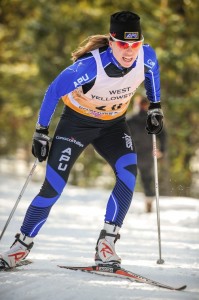
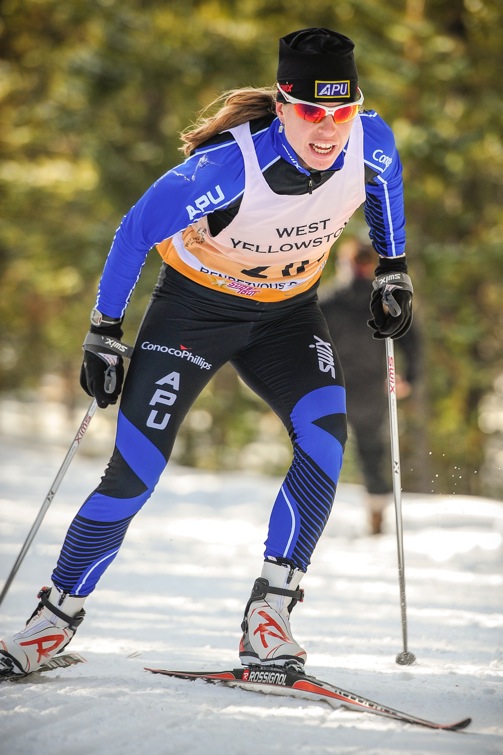
    Photo: Swix Sport.

    Rosie Brennan (Alaska Pacific University)

    Brennan has competed in World Cup sprints before, but this will be her first distance experience on the circuit.

    “I don’t have many expectations for myself, certainly not results wise as I have no idea how I stack up or even who will be in attendance,” she said. “My goal is simply to be in the mix and to feel like I raced as best I possibly good with good technique and smart tactics.”

    The distance events will be especially different for Brennan because they’re both mass starts. Brennan is looking forward to the classic event in particular, which she views as her stronger discipline, and to joining the momentum her teammates have built on the World Cup this season.

    “[Kikkan Randall and Holly Brooks] have so much more experience and insight and are an incredible asset to have,” Brennan said. “Many of my teammates from Dartmouth will be there as well. Having good teammates and friends makes the whole experience more enjoyable and less stressful.”

    __________

    Chelsea Holmes (SVSEF)

    With two second-place distance finishes on the SuperTour thus far, Holmes is clearly in a good place at this point in the season. Canmore will be her first World Cup start, but she’s approaching it just like any other race.

    “I absolutely love racing and this is just a new (and slightly bigger) stage to do it on,” Holmes said.

    She has high expectations for herself in Canmore, but her primary objective will be to ski “with good technique and with confidence.”

    Above all, “I am just looking forward to an awesome racing opportunity,” she concluded.


    __________

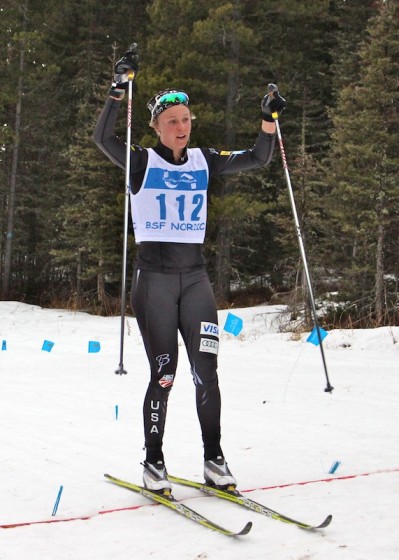
    Caitlin Patterson (Craftsbury Green Racing Project)

    The Anchorage, Alaska, native will be making her World Cup debut in Canmore. She’s seen international competition before as part of the U.S. World Junior team in 2010, but qualifying for the World Cup brings her to a whole new level of competition in her first year out of college.

    “I’m definitely looking forward to testing myself against the best skiers in the world and learning what I can about how to become a faster racer,” Patterson said. “I am also looking forward to enjoying the atmosphere of a World Cup race from a first-hand perspective, and to the camaraderie among the athletes from different nations.”

    An equally strong skater and classic skier, Patterson claimed third and a fifth in the two distance races on the SuperTour this season. She’s quick on her feet, so the challenging Canmore terrain could be right up her alley.

    “If I make the most of every transition and feature of the course during the race, I believe I can ski as fast as many of the women in this field, so I’ll go out there and race as well as I can to prove it,” she said. “With so many U.S. women racing and the mass start format, I’m also hoping to find some teammates out on course to ski with and work together to move up in the field.

     __________

    In addition to the distance-only nation’s group competitors, a few athletes who were in Quebec City last weekend will be starting again in Canmore. Watch for Sophie Caldwell (SMS T2), Sadie Bjornsen (APU/USST) and Erik Bjornsen (APU/USST) in all three races this weekend and sprint-specialists Ryan Scott (SSCV Team HomeGrown), Reid Pletcher (SVSEF), Reese Hanneman (APU), Skyler Davis (SMS T2/USST), Pat O’Brien (CGRP), Lauren Fritz (APU), Corey Stock (Dartmouth), Becca Rorabaugh (APU) and Kate Fitzgerald (APU) in the freestyle sprint on Saturday.

     

  • Bjornsen Climbs out of Deficit to Claim Bozeman 10k Classic

    Bjornsen Climbs out of Deficit to Claim Bozeman 10k Classic

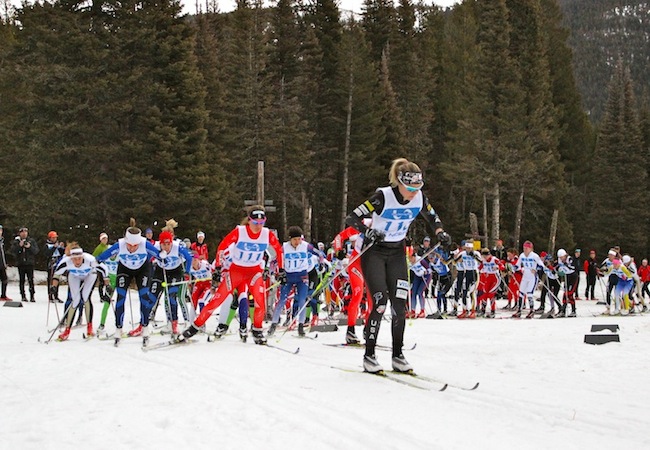
    Sadie Bjornsen (APU/USST) leading the women’s field out of the meadow at the start of the 10 k classic in Bozeman, Montana, on Sunday.


    BOZEMAN, Mont. — Something rare happened partway through the women’s 11 k classic race at Bohart Ranch on Sunday: Sadie Bjornsen began to falter. On the heels of her classic sprint victory, she charged out of the meadow in front and appeared to settle comfortably in the group for the first lap. But on lap two out of three, the wheels started coming off.

    “I had this moment of weakness,” Bjornsen laughed afterwards.

    Holmes and Brennan leading, out of sight of the next skiers.

    Chelsea Holmes (SVSEF) and Rosie Brennan (APU) began to lay the hurt on in the second lap and pulled away from her. Sophie Caldwell (SVSEF), meanwhile, tagged Bjornsen closely.  But rather than let the weak moment last for the rest of the race, Bjornsen dug deep, started the backburners and reeled the leaders back in to win by a healthy 17 seconds. Holmes held on to second and Brennan, on her twenty-fourth birthday, took bronze (+0:27).

    Despite only recently coming back to a full training load, Bjornsen was still the odds-on favorite to win on Sunday given her consistent sprint performances earlier in the week (silver in the freestyle technique and gold in classic). Holmes made a gutsy decision to push the pace on a course suited to her light, quick style of skiing.

    “This course flows really well and it’s hard, but the timing is good for me,” she said. Knowing this, Holmes chose to pick up the pace on the second lap to avoid a packed sprint finish.

    The lead pack on the first lap.

    “Sprinting is clearly not my strength,” Holmes said. “I did not really want to lead, but I don’t like being around a million people, so I just did that. It’s not smart sometimes but…”

    Brennan, whose 24th birthday was on Sunday, leading on the second lap.

    Had Bjornsen not found second wind, it would have been a brilliant choice, as Brennan ended up far behind Holmes. But return Bjornsen did, and Holmes was left to hang onto second.

    “I just thought about the girls in Europe,” Bjornsen said. “I was like, ‘No, those girls are pushing so hard!’”

    Thinking of her teammates, one of whom was fifth on the World Cup earlier that morning, she left it all on the course. Thought it may not have been an ideal way to race, the Bjornsen said the weak moment ended up being instructive for her.

    “It worked out well that I had that little thing in the middle. It’s good to remember racing is hard and you have to dig a little bit deeper than you realize you can,” she said.

    Holmes was positive about her result after finishing. “Everybody wants to win — obviously I wanted to win and wanted to kind of break away — but those girls are strong,” Holmes said.

    Brennan, who led Holmes early on, said she didn’t feel quite as strong as Holmes might have imagined.

    “I tried to get out in front and then some other girls took off at a really aggressive pace,” Brennan said. “I didn’t know if I could sustain it, so I backed off the first lap and just tried to keep my own pace going.”

    After settling in, picking people off, breaking away with Holmes and then getting passed back by Bjornsen, Brennan was generally pleased with her placing.

    “I felt pretty good, it was a decent race,” she said.

    Caitlin Patterson nipping Kate Fitzgerald (APU) at the line to take fifth place.

    Brennan, Holmes and Bjornsen, along with Caldwell and Caitlin Patterson (CGRP), who was fifth on Sunday, were all named to the American team for the Canmore World Cups on December 13 – 16. The stakes were quite high heading into Sunday, but as the women’s distance field has been generally more stable than the men’s, there were few surprises.

    For Bjornsen, who resumed interval work only a month ago after nursing a foot injury this fall, the whole week has been additionally important as a way of racing back into shape. And perhaps most significantly, she was able to regain confidence coming off injury.

    “When you’re coming off of injury, your biggest weakness is your confidence,” Bjornsen said. “So that’s really important.”

    Lastly, she’s been able to be home with more of her APU teammates and witness the effect the American women’s World Cup performances have had on them in such a short amount of time.

    “You wake up in the morning and see Kikkan and Holly at the top and the whole house has a-buzz, like, ‘We can do this!’ It’s been fun to be part of that, too. With them making history, but also it’s fun being the generation below watching how it affects everybody.”

    Womens Mass Start Classic Results.

    Bjornsen, triumphant.
  • Caldwell Reigns Again in Bozeman Sprint

    Caldwell Reigns Again in Bozeman Sprint

    Sophie Caldwell (SMS T2) en route to her second sprint win in the last five days, this time going head-to-head at Bohart Ranch. Sadie Bjornsen (right) and Caitlin Gregg (left) took second and third, respectively.

    BOZEMAN, Mont. — Let it be known, there’s a new queen on the SuperTour. On a sunny morning at Bohart Ranch, Sophie Caldwell (SMS T2) handily won the freestyle sprint from early morning qualifier through to the finish, putting herself on top of the sprint rankings halfway through the Quebec World Cup qualifying period. Sadie Bjornsen (Alaska Pacific University/USST) skated to second place and Caitlin Gregg (Central Cross Country) took third.

    “I never know what to expect,” Sophie said after her race. “I was happy with my prelim and just hoped to hang on to the final.”

    Her competitors, many of them good friends and former teammates, made up for Caldwell’s modesty in the mixed zone.

    “Sophie is just the best. She’s a rock star,” said Annie Hart (Dartmouth), who was fifth.

    “To watch Sophie crush it, that was insane,” added Parker Tyler (Univeristy of Utah), who was sixth. “She skis better than anyone in my opinion, she can ride a ski like no one. I’m so stoked for her.”

    Caldwell cruising to victory.

    Caldwell said she simply skied to her strengths over the course of the morning.

    “I knew my strength was the sprint finish,” she said. “I wanted to try to hop in behind whoever was leading, stick with them, and save a little energy for the final sprint. And that’s what I did, so it played out well.”

    Such a strategy is actually quite cunning, and easier said than done. Bjornsen clearly showed an advantage out of the double pole zone when the final got going and held onto it with the rest of the field breathing down her neck for much of the race.

    “I wanted to lead from the start and control it, but there was no controlling it,” Bjorsnen said. “We just went as hard as we could.”

    Gregg, who tucked into third behind Caldwell at the start, agreed that the pace was blistering in the final heat. Since she’d led her two preliminary heats outright, Gregg decided to change tack and see whether she could catch a ride by skiing from the middle of the pack.

    “Those two girls are tough to sit behind because once they decided to go, they go,” Gregg said. “You can’t sit there and coast on by them and surprise them.”

    The start and finish area sat on an elevated plateau, and the course thereafter swung down, up another short hill into the biathlon stadium, and up another sharp climb to the high point before horseshoeing back towards the finish for a total of 1.5 k.

    By the time the field reached the final turn, Caldwell moved to the outside and around Bjornsen, and from there the race was nearly decided. By the time Caldwell, Bjornsen and Gregg reached the last stretch, Caldwell had built a comfortable gap.

    Hart and Bjornsen easing off the gas in the quarters.

    “I think that she probably skied a tactically better race, and Sophie’s known for that,” Bjornsen said, but concluded that she was happy with how the day went for her since it gave her a chance to practice sprinting before heading back to the World Cup circuit with the U.S. Ski Team.

    “Last year I didn’t really ski heats because I only made it in once on the World Cup, so it’s fun to go back and remember how to ski a bunch of hard times again and again,” she said.

    Some distance separated the podium from the rest of the field. Caitlin Patterson (Craftsbury Green Racing Project) finished by herself in fourth after starting in the seventeenth qualifying spot. The Alaska native was happy with the effort and grateful for the chance to finally ski rounds.

    “It was a fun day, and it was really fun to do the sprint heats,” she said.

    Hart and Tyler sprinting in the finals.

    At the back of the pack, two college skiers duked it out to finish the best sprint races of their lives; Hart and Tyler finished fifth and sixth. Hart had never made it as far a the final before, and Tyler hadn’t even contested a sprint since 2009 at the Junior Olympics.

    “It was all my favorite people, minus some, at the start,” Hart said. “It was just good vibes, I was really happy, and I think the happier we are the faster we ski.”

    Tyler appeared slightly shocked several minutes after the finish. “It was pretty much amazing,” she said. “I was not expecting that at all. I had a blast.”

    Given the above-freezing conditions on Wednesday night and Thursday morning, it’s a marvel that the races could even take place. Gregg thanked the organizers for pulling off the feat with less that a week’s advance notice that Bohart would host the sprints that West Yellowstone couldn’t.

    “The snow is obviously not abundant, but I thought the courses were totally fair and totally fun,” Gregg said.

    Official results.

    The A-final start.
  • Caldwell Turns Heads with Yellowstone Sprint Victory

    Caldwell Turns Heads with Yellowstone Sprint Victory

    Sophie Caldwell (SMS T2) sprinting to her first win of the season at the West Yellowstone 1.6 k sprint.

    WEST YELLOWSTONE, Mont. — Sophie Caldwell (Stratton Mountain School T2 Team) has been winning ski races for a long time. From her junior days at SMS to collegiate dominance at Dartmouth, the 22-year-old is no stranger to showing up at the top of results.

    Past success didn’t necessarily mean she expected to win against a stacked SuperTour field on Saturday, but that’s exactly what she did. In her first sprint race as a professional skier Caldwell dusted her competitors on a 1.6 k point-to-point course by 4.59 seconds. Seventeen-year-old Anika Miller (Payette Lake Sports) took second and Caitlin Patterson (Craftsbury Green Racing Project) was a close third (+6.63).

    “I really had no idea,” Caldwell said of her pre-race expectations. “I felt awesome on the flat parts and just tried to ski whippy and relaxed and quick. The legs were burning on that last part and I just did all I could to hang on.”

    The course went finished where the 9 k started the day before. There wasn’t a lot of opportunity for rest; Caldwell said she V2-ed all of the flats and threw in some no-pole skating on the working downhills. The 1.6 k-distance also made for a fairly long sprint race; Caldwell’s winning time was 3:33.19.

    Caldwell leaving the gate.

    Though nothing was guaranteed, Caldwell’s victory shouldn’t come as too much of a surprise given her strong background and recent focus on shorter distances. Since leaving school, where there aren’t many opportunities for sprint racing, she’s been working on bringing her fast twitch back up to speed.

    “I’ve always liked sprinting a lot but in college we didn’t do much of it, so my distance skiing improved a lot then,” she said. “But this summer I’ve gotten to work a lot more on speed.”

    The West Yellowstone sprint race was just a qualifier and results have no bearing on team selection for the upcoming World Cup sprints in Quebec. Still, results were a good indicator of where everybody’s legs are at this early point in the season. Caldwell’s speed work is already playing dividends, and the confirmation that she’s on the right track has her looking forward to the real freestyle sprint in Bozeman, Mont. on Thursday.

    “That would be a dream come true [to qualify for Quebec],” she said. “That would be my first World Cup, so it would be pretty exciting.”

    SMS T2 head coach Gus Kaeding credits Caldwell’s victory in part to some technique tips she’s learned from her male teammates this week.

    “She’s picked up a couple tips this week from the guys, sprinting-wise — the techniques they have that are advantageous on a course like this,” Kaeding said. “She’s worked on being able to ride the skis stable, being comfortable at a really high speed and working on putting that ski straight down the track. A true sprinter — you’ll see a lot of the men and sometimes the women — are really quick on that edge. And Sophie’s as comfortable as anyone riding her skis, so we encouraged her to lengthen it out and add some power there.”

    Anika Miller.

    Behind Caldwell came a relative unknown. Miller is a J1 from McCall, Idaho, and according to Miller herself, second place was right where she should be.

    “A top one or two was the goal,” she said.

    The high school senior battled symptoms of compartment syndrome last winter while she attended Stratton Mountain School, which put a damper on her training. Miller had always planned to return to McCall for senior year, and now that the health of her legs has improved she’s been able to log more hours.

    “This is the payoff of all that training,” Miller said. “This course actually favors my kind of skiing. I’m not really good at scrambly, tight uphill courses. An open V2 course really favors me.”

    Miller’s prologue performance has her excited for the true sprint tests in Bozeman next week. Like many of her competitors, her primary goal this winter is to compete in a World Cup bib in December.

    “That’s what we’re going for, so I’m psyched,” she said.

    When preliminary results were posted on site at the finish, Caldwell and Miller were listed as 1-2. They held on to those positions once results were calibrated to include start data several hours later, but the third finisher moved up a spot from her initial placing. Patterson, originally listed as fourth, found out she was actually third after hitting refresh on results all afternoon.

    (The bump reflects the fact that she started late in the 6-second legal starting window relative to Caitlin Gregg (Central Cross Country), who switched places with Patterson in the final results.)

    Caitlin Patterson.

    Like Caldwell, Patterson has ramped up her sprinting since graduating from the University of Vermont.

    “It’s definitely one of the better sprint races I’ve had both in terms of results and how I felt,” Patterson said. “It was a really difficult course and it was hard to tell how you were doing.”

    She gauged herself off the woman in front of her, fifth-place Eliska Hajkova (University of Colorado).

    “Relative to her I couldn’t tell at all,” Patterson said. She ended up beating Hajkova by a slim 1.35-second margin. The top end of the field was tightly packed; second through seventh finished within five seconds of each other.

    “I’m extremely happy with third place,” Patterson said. “The girls in front of me, and the whole field, were so close together.”

    Despite just missing the podium Gregg felt her sprint performance was a good step forward after her seventh-place showing the day before.

    “I definitely feel each race will get better and better,” she said. “All in all it felt good to go hard and get back in the swing of things.”

    Caitlin Gregg.

    Gregg has been working with Methow Olympic Development coach Scott Johnston this summer, and his advice to her after the 9 k was to bring more quickness to her stride.

    “Today I had a couple of extra cups of coffee to get a little more pop in my step. It’s still not quite there but it’s a step in the right direction,” she said.

    Gregg was a podium regular on the SuperTour last winter. The top three women on Saturday were all relative newcomers to the domestic circuit. There’s a long winter still ahead, but in just one weekend it’s safe to say it will be a different kind of season than the last one.

    “It’s always exciting to see young blood on the top of the results there,” Gregg said. “Sophie has always been a super talented sprinter and now focusing full-time she’s really going to turn some heads.

    “And Anika Miller — it’s always exciting when the person that beats you a little over half your age! (Gregg is 32). I’m really psyched for her and hopefully she gets excited and keeps doing well this year.”

    Complete results (scroll for women).

  • Brennan Attacks Grueling Course to Win Yellowstone SuperTour Opener

    Brennan Attacks Grueling Course to Win Yellowstone SuperTour Opener

    Rosie Brennan (APU) posting the fastest time in the West Yellowstone SuperTour 9 k individual start on Friday at the South Plateau near West Yellowstone, Mont.

    WEST YELLOWSTONE, Mont. – The distance course on the South Plateau wasn’t too bad if you didn’t think about it too much. The 9-kilometer freestyle race – the first of the 2012/2013 U.S. SuperTour series – netted a slight elevation gain of about 300 feet from start to finish. A course profile indicated that the terrain was rolling. No problem.

    Try racing it.

    The individual start began around 7,260 feet above sea level, which is enough to make breathing difficult for lower-altitude dwellers. After gradual downhill out of the start – a teaser for what was to come – racers endured several kilometers of working hills with little rest and a grand finale at the final multi-tiered climb.

    If anything was going to test one’s fitness in the first race of the season, this was it.

    Rosie Brennan (APU) on her way to winning the West Yellowstone SuperTour 9 k freestyle individual start Friday on the South Plateau. (Photo: Swix Sport)

    The eventual winner, Rosie Brennan of Alaska Pacific University, didn’t feel that great right off the bat – and she’s originally from altitude in Park City, Utah.

    “When you race at altitude, within the first k, I feel like as bad as I do the whole race,” she said after winning in 24:36.3, beating runner-up Chelsea Holmes (Sun Valley Ski Education Foundation) by 5.3 seconds. “It’s figuring out how to deal with the taste of blood in your mouth for 9 k or whatever. It’s sort of part of racing at altitude, but I really like it.”

    She laughed. That was the kind of grit it took to win Friday’s race on a course that was the same for both men and women. Many said they felt similarly on the final hill, arguably the toughest one of all: horrible.

    “I think I V2ed everything but the last steep hill,” Brennan said. “I sort of struggled up that thing, but I made it.”

    A staple on APU’s female squad with the likes of U.S. Ski Team members Kikkan Randall and Sadie Bjornsen, the 24-year-old earned some more attention with Friday’s performance. It was her first SuperTour win in nearly half a decade of racing at that level. She had made the podium several times before, but this confirmed her offseason training paid off.

    Skating isn’t usually her forte, Brennan said. Flats aren’t great for her, either. The course was certainly rolling, but unforgiving if you let off the gas. One could lose time quick, but burn out even faster.

    Brennan thought about all the work she had put into her skate technique and concentrated on making every movement count along the flats.

    “I guess I must’ve figured something out this summer so it’s really great,” she said.

    While her Anchorage-based team tapered its training for the West Yellowstone SuperTour, which includes a freestyle sprint prologue on Saturday, Brennan hadn’t expected to be in top form.

    “We haven’t tried to peak or anything for these races so I still feel like I have race fitness to gain so I’m really encouraged by doing well today,” she said of taking one gigantic step forward toward securing a Canadian World Cup start next month.

    Qualifiers for the Québec City skate sprints and Alberta World Cup (which includes a freestyle sprint, skiathlon and classic distance race) will be decided following next week’s SuperTour races in Bozeman, Mont.

    Brennan’s not counting herself out of an opportunity to make the World Cup sprints as well.

    “I was a really good sprinter when I was a junior and then I had a lot of injuries and lost some of my fast twitch,” she said after having knee surgery in 2010. “It’s something that I’ve been working on trying to get back.”

    Chelsea Holmes (SVSEF) after passing Heidi Halvorsen (GMVS) on the last hill of the West Yellowstone SuperTour 9 k.

    Not far behind Brennan, Holmes was excited to race in Montana after missing last year’s SuperTour opener to an injury of her own. About three weeks before the 2011 races, she broke her thumb and was in a cast until mid-December.

    On Friday, she was raring to go. Training at altitude throughout the summer between Sun Valley, Idaho, and Canmore, Alberta, where she joined some Canadian Ski Team workouts, Holmes anticipated how racing at even higher elevations would feel. So when her breathing redlined and overpowered the splits people were giving her, she didn’t freak.

    “My breathing was just about loud enough to cover anything I could hear,” Holmes said with a laugh. “I had an idea [what place I was in], but you can never really tell until you finish.”

    Second at this point in the race season was great, she said. After starting 1 ½ minutes behind Brennan, Holmes gauged how she was doing off her.

    “It was just a fight the whole way,” Holmes said. “I kept hearing that Rosie was kind of just in front of me. I just couldn’t get her, but I mean, she had a killer day.”

    Caitlin Patterson (CGRP) cresting the final hill before ultimately finishing third.

    Less than a second behind Holmes, Caitlin Patterson of the Craftsbury Green Racing Project took third (+6.2). Like Holmes, Patterson wasn’t sure the course necessarily suited her. Both were hill climbers, but the mostly V2 race on the plateau didn’t include many of the hills they usually thrive on.

    “For a while I was thinking I felt like I started too hard, but that might just be the altitude feeling to some extent,” Patterson said.

    Throughout the race, she tried to catch Holmes, who started 30 seconds in front of her. Patterson frequently lost sight of her on the varied and twisting terrain, but didn’t give up.

    “She’s a really good skier at altitude and uphill terrain so I knew she would be a good one to chase down,” Patterson said.

    By the last climb, however, Patterson said she was nearly done for. From her conversations with competitors and teammates after the race, she discovered everyone suffered there. Luckily, she heard some motivating final splits that pulled her through.

    “I knew it was a big hill at the end and I wanted to ski fast as possible, but its amazing how it twists and turns at the top and doesn’t crest,” she said. “Even when you get to the top it’s not even a steep downhill on the other side. It was all I could do to free-skate and not tuck.”

    Sadie Bjornsen (APU/USST) skating to fourth-place finish at West Yellowstone SuperTour 9 k.

    Also holding steady through the suffer-fest, Bjornsen finished fourth (+23.3) in her first race after a summer hindered by back and foot injuries. Sophie Caldwell (Stratton Mountain School T2 Team) was fourth, 52.7 seconds behind Brennan, Kate Fitzgerald (APU) was sixth, and one of the race favorites, Caitlin Gregg (Central Cross Country), was seventh.

    Several A-seeded skiers said they used Greg as a measuring stick. One of the smoothest skaters on the circuit, she started right in front of Brennan.

    “I knew when I was catching her that I was having a good race,” Brennan said.

    From Gregg’s point of view, the race “hurt like hell,” she said, considering she hadn’t raced or done any sort of time trial since March.

    “But I think it did for everybody. It’s at high altitude and a lot of uphill and the first race of the season so it’s just a recipe for pain out there, which felt really good for me,” she said. “This was a definitely good race for me to blow the cobwebs out and remember what that next level, that next gear, feels like.”

    While she felt good about her team, sponsor and outside support, Gregg said she simply needs to log some more hard efforts.

    “Obviously it’s always great to win the race, but I think the trajectory I want to head in is right on,” she said.

    Extras

    — Bjornsen is coming off some lingering injuries, and while the tendonitis isn’t completely gone in her foot, she’s happy to have started the race season strong after a walking warmup.

    “This year will be a lot about racing myself into shape, so today was a great day to feel the burn and gain some fitness,” she wrote on Skype. “I had the goal of holding my technique together throughout the course, and remembering how to ski at altitude. I felt like I was able to keep pushing even when it felt bad, so it was nice to finally feel like an athlete and a racer again today. So all in all, I am stoked.

    “I am also super happy for Rosie. I have been living with her this summer watching her train, and I know she is going to be doing nothing but turning heads this winter. It will be fun!”

    Bjornsen knew how well she was doing based on splits from Gregg, who started right behind her.

    “I just kept listening for how quickly people were cheering for her after me,” she wrote. “At one point I think she nearly caught me … so that was my split system.”

    Asked how her foot felt Friday after the race, she explained that it was an ache and pain that fortunately took a backseat to the burning in her legs and lungs while racing.

    “I didn’t feel it once in the race, and it actually doesn’t feel too bad now,” she wrote. While Bjornsen will skip Saturday’s prologue to rest her foot, she’s looking forward to the rest of the season – especially the middle.

    “I want to be racing in the World Cups, but these first months are training,” she explained.

    — Considering that 10 k skate races aren’t exactly her specialty, Caldwell was pleased with how she fared Friday. The sprint lover had hoped for a top 10.

    “I really had no idea where I’d stack up because really the only girls I’ve skied against are the girls on my [Stratton] team,” Caldwell said. “I went to those U.S. Ski Team camps, but those girls weren’t here, either.”

    To keep herself in the running, she tried not to go above Level 3 before the last hill. She paced herself pretty well, running in fifth or sixth early and as high as third mid-race, but she worried about blowing up before the end. She thought back to the classic intervals her team had done nearly a week ago on that same climb, and later remembered they didn’t reach the top.

    “I kind of forgot once you get around that corner you’re only halfway up,” Caldwell said. “But once you get so close to the finish, you get an adrenaline rush and that pumps you to the finish.”

    — Audrey Mangan contributed reporting

    ***

    Complete results (scroll down for women’s)

  • After Roll-Run-Row, Craftsbury Skiers Primed for Season Ahead

    After Roll-Run-Row, Craftsbury Skiers Primed for Season Ahead

    Start of the Craftsbury Outdoor Center’s Roll-Run-Row, a race which tested the program’s elite skiers against its elite rowers, on Oct. 3 in Craftsbury, Vt. (Courtesy photo)

    It downpoured across much of the Northeast on Wednesday. Those at the Craftsbury Outdoor Center in northern Vermont hardly noticed. Owner Judy Geer called it “drizzle.”

    That morning, about 20 Craftsbury Green Racing Project (CGRP) athletes and coaches participated in the second annual Roll-Run-Row race, which pitted the some of the nation’s best nordic skiers against top-tier rowers. All belonged to the same program, but the idea was to have some competitive fun while pushing individuals out of their comfort zones.

    This summer, the Outdoor Center started an elite-level rowing team similar to the nordic one. The result was an increase in high-level athletes for a total of 14 skiers and five rowers, most of which live and train there.

    According to Geer, the skiers spent time before the race teaching the rowers how to rollerski. In turn, the rowers provided some pointers on Hosmer Pond. The field included one rower, Peter Graves, who represented the U.S. at the London Olympics this summer as well as Lynn Jennings, a three-time World Champion in cross-country running.

    The race itself involved point-to-point rollerskiing, running and rowing legs, which took the winner, rower Kyle Lafferty, about 30 minutes to complete.

    Craftsbury Green Racing Project skier Gordon Vermeer (front) finishing up the rollerski portion of the second annual Roll-Run-Row in Craftsbury, Vt. (Courtesy photo)

    Craftsbury’s nordic coach Pepa Miloucheva estimated the uphill rollerski was about 2 kilometers long, the run was about 3.5 k, and the row was about 2 k with two 90-degree turns.

    “There were some big gaps between the winning and last times in the rollerski and the rowing legs, but was a hard effort for all for sure,” she wrote in an email.

    There were no gender or age categories; finishers classified as overall. Craftsbury skier Clare Egan placed second and Gordon Vermeer represented the nordic guys in third.

    Vermeer is one of four newcomers to the Craftsbury’s elite cross-country team. This spring, he graduated Dartmouth College and, like his teammates, began the transition to full-time training.

    According to Miloucheva, she couldn’t ask for much more from athletes like Vermeer, including former University of Vermont (UVM) grads Alex Howe, Caitlin Patterson and Amy Glen.

    “The new athletes this year are great,” Miloucheva wrote. “All were able to adjust to the new training regimen without a problem and make some good fitness and technical improvements. … We have a big team this year, but it has been great to see them challenge and enjoy pushing each other, during practice.”

    Some highlights this summer included hosting the New England Nordic Ski Association (NENSA) Regional Elite Group and J2 national camps in Craftsbury, and training with the U.S. Ski Team in mid-September in Lake Placid, N.Y. According to Miloucheva, most of her athletes have stayed healthy and avoided serious injuries, and enjoyed a productive and busy training season.

    “Right now we are into a hard training block before we leave on our first big trip this winter,” she wrote of the entire team’s departure for on-snow training in Canmore, Alberta, on Oct. 25. “[We’ll go] straight to Yellowstone from there for the first [SuperTour] races of the season.”

    ***

    A few weeks ago in Lake Placid, FasterSkier caught up with two CGRP rookies: Patterson and Glen. Here’s what they had to say about their season so far:

    Former UVM skier Caitlin Patterson (Craftsbury Green Racing Project) during the Roll-Run-Row in-house event on Oct. 3 in Craftsbury, Vt. (Courtesy photo)

    FasterSkier: What’s it like being part of a new team?

    Caitlin Patterson: It’s been great. I think it’s easy to get used to the atmosphere of the team. It’s a good group of people and the training is similar to what we’ve done before.

    FS: But it’s got to be different from college skiing, right?

    Amy Glen: It’s definitely different. Your job is your work now. And then we do work [at the Outdoor Center] in our free time, but it’s more, like, for fun almost.

    FS: How’s the transition to full-time training?

    CP: For me it hasn’t been very tiring at all, probably less so. In past summers, I was doing a lot more. Last summer I was working almost a full-time job and training full time and this is a lot more laid back. At Craftsbury, we eat all our meals in the dining hall so we don’t have the food-prep piece, so it’s been pretty relaxing.

    FS: How did you approach two weeks of training in Lake Placid with the U.S. Ski Team?

    CP: I think it’s kind of a fun opportunity to train with other people. It doesn’t really matter if your first, even in [a] sprint situation, or certainly not in a workout. As long as you can have fun and talk to some people who you haven’t seen in a while or maybe get to know some of the juniors who are here, that makes it fun. To ski on different terrain, that helps keep the excitement up.

    Former UVM skier Amy Glen, who won an NCAA title in the 15 k classic race on March 9 at Bohart Ranch in Bozeman, Mont.

    FS: What are some of your goals for the racing season?

    AG: Ski as fast as I can.

    CP: Changing to a new training program coming out of college, you have high expectations, but you can’t be unreasonable about it. It’s not the end of the world if things don’t go quite as well as they could. But I’d like to be optimistic that it should go well for all of us because of the training program.

    There’s the early season races and then West Yellowstone and Bozeman and leading up to the World Cup, certainly it would be great to qualify for those. I think for any of us on this team, it’s a realistic possibility. From there hopefully we have some Europe trips planned and nationals and U23’s for any of us still in the age group. All sorts of fun stuff.

    FS: How would you describe your team?

    AG: Funny.

    CP: Lots of humor on a daily basis. Everyone’s really serious about training, too, but we can be serious at the same time as your having constant competitions. The guys are having a lot of competitions, strength and whatever else. I think we laugh a lot and have good fun with it.

    ***

  • Jones, Thomas Run Away with Team Sprint at Canadian Nationals

    Jones, Thomas Run Away with Team Sprint at Canadian Nationals

    Canadian National Team member Perianne Jones (r) celebrates winning the classic team sprint at the 2012 Canadian Ski National Championships on Saturday as Nakkertok teammate Alana Thomas (l) awaits her arrival at the finish on the Plains of Abraham in Quebec City.

    QUEBEC CITY – As Alana Thomas stood in the finish pen on the Plains of Abraham and looked back beyond the line, she smiled as Perianne Jones cruised down the final stretch.

    The Canadian National Team member was going to win by a mile – or maybe a kilometer, figuratively speaking in Canadian terms.

    While Jones didn’t quite have a full lap on the 11 other teams in the open classic relay at the Canadian National Ski Championships on Saturday, she finished in 17:59.6, more than 24 seconds ahead of anyone else with the help of Thomas, her Nakkertok teammate in the club event.

    Nakkertok teammates Alana Thomas (at left) and Perianne Jones (CNST) celebrate winning the team sprint at Canadian nationals on Saturday.

    “We drove here together this morning and we talked about kind of what we wanted to do,” said Jones, who flew into Quebec the night before from Canmore, Alberta. She previously spent a full season on the World Cup circuit in Europe.

    “We were going to build into it,” Jones added. “I think we executed pretty well.”

    They beat runners-up Amy Glen and Caitlin Patterson of the University of Vermont (+24.2), and Annika Hicks and Amanda Ammar of Canmore Nordic finished third overall (+31.4).

    Jones and Thomas also won their first heat, nearly two seconds ahead of Hicks and Ammar. Hicks passed Thomas on the final leg of the 3×1 k race, (in which each racer competed three loops in the city park, tagging off in between), but Jones reeled in Ammar as the anchor.

    While they worked hard in the qualifying round, the Nakkertok women made sure they had plenty left for the final. Jones said they planned to push hardest on the last lap while skiing relaxed throughout. Both did so and built a nearly 22-second gap by the end of the second leg.

    Thomas said she was trying to hang in the pack and ski smart. She also skied ahead, and most importantly, managed to stay on her feet. Heidi Widmer and Marlis Kromm of Foothills Nordic had been in second place for most of the final, but Widmer fell victim to the slushy conditions about halfway through her last lap. She tagged off to Kromm, who finished 1 second behind Ammar in fourth place.

    When Widmer slipped, Glen scooted around her and tagged off to Patterson in second. With Jones nearly 25 seconds ahead, Patterson held the position and clinched silver.

    “We’re definitely more distance skiers,” Patterson said. “We’ve been doing a lot of 5 k’s, 10, 15. So in general, we feel like we’re skiing pretty consistently. We just have the endurance to take us to the third lap still strong.”

    Open women's team sprint podium at 2012 Canadian nationals: 1. Nakkertok (Thomas, Jones); 2. University of Vermont (Patterson, Glen); 3. Canmore Nordic (Ammar, Hicks)

    Fresh off a trip to the NCAA championships in Bozeman, Mont., the two helped UVM notch its first national skiing title since 1994. Glen became the second woman in UVM history to win a U.S. crown in the 15 k classic race.

    After all that, Patterson said they jumped at the chance to race in Canada, about four hours away from their campus in Burlington, Vt.

    “Our college season had ended, we were just out in Montana and had come back, [had a] little bit of school to tend to,” Patterson said. “Why not come up here?”

    “I wanted to come check out the skiing at Mont-Sainte-Anne,” Glens said. “And this [city sprint], this is a huge draw.”

    The two planned to race Monday and Tuesday in the interval starts and then head back to Vermont to prepare for the SuperTour finals in Craftsbury, which start next weekend.

    While the relays didn’t count for much besides pride at Canadian nationals, several racers said they participated because of the atmosphere.

    “Team sprints are special,” Thomas said. “I usually only get to do one a year so this is a nice day.”

    Jones was a World Cup team-sprint veteran, but said the race was still her favorite and probably one of the toughest on the circuit because of its lack of recovery time. She found it especially fun at home.

    “I’m pretty pumped,” Jones said. “The club brought me to where I am, so I love to come race today with Nakkertok; to do it with Alana is awesome.”

    Perianne Jones (Nakkertok/CNST) ahead of the pack in the qualifying round of the team sprint at Canadian nationals
    Start of women's open team sprint final at Canadian nationals with Alana Thomas (Nakkertok) up front

    Open women’s final results

    Complete results

  • Graefnings, Tarling Win FS Collegiate Skier of the Year

    Graefnings, Tarling Win FS Collegiate Skier of the Year

    FasterSkier Collegiate Skier of the Year

    Collegiate Skier of the Year (women):

    Maria Graefnings (SWE/University of Utah) A senior at the University of Utah, and a native of Falun, Sweden, Graefnings dominated the RMISA circuit during the regular season, winning seven of eight starts.

    Maria Graefnings (UU)

    Graefnings transferred to Utah from the University of Nevada when that program was cut. In addition to her success in the western region, Graefnings won the NCAA national title in the 5km freestyle event, and placed second in the 15km classic mass start.

    The 25-year-old also had plenty of success outside the collegiate ranks, finishing the year with three SuperTour podiums, including a victory in the Owl Creek Chase, and a second place finish in the US National Championship 30k.

    Honorable Mention:

    Eliska Hajkova (CZE/University of Colorado) Hajkova spent most of the 2010 seaosn in the shadow of Graefnings. In the first four races of the RMISA season, she placed second to the tall Utah star, and went on to place outside the top-3 just once – a fourth in the UNM Invitational classic race.

    The trend continued in the first race of the NCAA Championships in Stowe, Vermont. Graefnings took the victory in the 5km skate, with Hajkova ten seconds back in second. But the 23-year-old former member of the Czech National Team saved her best for last, upsetting Graefnings in the 15km classic and earning her first NCAA title. Her effort helped propel CU to the national championship.

    Caitlin Patterson (USA/University of Vermont) Patterson may have been hard-pressed to match the performances of Graefnings and Hajkova, but at just 21 years of age, Patterson gave up several years, and significant experience to her European competition.

    The Alaskan native, in her junior year at the University of Vermont, won seven of eight regular season EISA starts, placing second in her one “off-day.”

    She placed sixth in the 5km skate at the NCAA Championships, but struggled in the classic event, finishing 23rd.

    Patterson also managed to squeeze in a trip to the U23 Championships in Otepaa, Estonia, where she skied to 20th in the 15km pursuit, and 26th in the 10km freestyle.

    [poll id=”56″]

    Collegiate Skier of the Year (men):

    Sam Tarling (USA/Dartmouth) The men’s collegiate field lacked the domination at the top that highlighted the season on the women’s side. Six different men won EISA races, and five took top honors in the RMISA, while the CCSA had several strong contenders as well.

    Sam Tarling (DAR)

    Ultimately, Tarling gets the nod over the likes of Miles Havlick (USA/UU) and Vegard Kjoelhamar (NOR/CU) on the strength of his NCAA National Championship title and consistency throughout the season.

    Tarling won two regular season EISA races and finished in the top five in each of his eight starts – a strong campaign to say the least, but not even the best in the Eastern region. It was Tarling’s victory in the 10km skate that put him over the top. In an upset victory over Colorado’s Kjoelhamar, Tarling joined the relatively sparse ranks of American skiers to win an individual NCAA title in recent years.

    He was unable to duplicate the performance, or even come close in the 20km classic two days later, placing 32nd in the 39 skier field, but with top challengers Havick and Kjoelhamar unable to claim a victory of their own, Tarling becomes the first American to win the FasterSkier Collegiate Skeir of the Year award.

    Honorable Mention:

    Vegard Kjoelhamar (NOR/University of Colorado) Kjoelhamar won two RMISA races and finished second two other times before placing second in the 10km skate at the NCAA Championships.

    The 2009 winner of this award, Kjoelhamar ended a successful collegiate career with another podium, taking third in the NCAA Championship 20km classic.

    Miles Havlick (USA/University of Utah) Havlick ended the 2011 season as the top ranked skier in the RMISA, edging Kjoelhamar by a single point. The sophomore won three races, finished second twice, and fifth once in his six starts.

    At the NCAA Championships, he took the final podium spot behind Tarling and Kjoelhamar in the 10km skate, and placed sixth in the 20km classic.

    Eric Packer (USA/Dartmouth) Packer deserves recognition as the top ranked EISA skier, besting Tarling, among others, and leading the circuit with three victories

    He started all ten regular season races, never finishing outside the top five. At the NCAA Championships, he finished 5th in the 10km skate and 25th in the 20km classic.

    [poll id=”57″]

    Previous Winners:

    2010
    Antje Maempel (GER/DU)
    Franz Bernstein (GER/UVM)

    2009
    Antje Maempel (GER/DU)
    Vegard Kjoelhamar (NOR/CU)

    2008
    Maria Grevsgaard (CZE/CU)
    Marius Korthauer (GER/UAF)

    FasterSkier Awards 2011:

    Rookie of the Year
    Breakthrough Skier of the Year
    Collegiate Skier of the Year
    Adaptive Skier of the Year
    Continental Skier of the Year
    Biathlete of the Year
    Nordic Combined Skier of the Year
    Performance of the Year (cross-country, biathlon, nordic combined)
    Cross-Country Skier of the Year

  • EISA Regionals: Packer and Brennan win double titles for Dartmouth

    Caitlin Patterson (UVM) and Rosie Brennan (DAR) lead the charge in the women's mass start 15k classic (photo: flyingpointroad.com)

    Dartmouth’s Eric Packer and Rosie Brennan took individual titles on the second day of the EISA Regional Championships hosted by Bates in Rumford, Maine.  For Packer it was his third straight win and second win of the Championships, and for Brennan it was her first win, helping put their team ahead of UVM in both team scores for the day.

    An inch or two of snow overnight continued to soften the tracks at Black Mountain for the 15 and 20 kilometer mass start races, but the wind was not a factor and the partial cloud cover and mild 20 degree temperatures made for an overall pleasant day of waxing and racing.

    The soft conditions contributed to a wide spread in the finish times across both races, shown by the fact that the top eight men were separated by two minutes.

    The men’s race was off to a clean start at 10am  and right away the top skiers from Dartmouth led the race out, followed by UVM, Williams, and Middlebury: the order the teams – and top individuals –  would ultimately finish in.

    Packer wore the leader jersey well, letting other racers in front but never letting go, and putthe hammer down at the right moment so that his sprint to the finish could not be matched.

    “Going in, I was actually going to try to break away at some point,” Packer explained of his race strategy.

    “The races so far this year have tended to be pack skiing and I wanted to try –  mainly for the effort and preparation for NCAA’s –  to go hard for the third lap and just try to survive to the finish.”

    Packer was able to execute his plan well.  After the first two laps the lead group consisted of Packer, teammate David Sinclair, UVM’s Scott Patterson, Alex Howe and Franz Bernstein, and Williams’ Dimitri Luthi.  Packer made his move on the third lap, skiing as hard as he could to break off the front, but Patterson was able to stick on his tails.  Close behind, Dimitri Luthi and David Sinclair tried to maintain a competitive distance.  Packer explained that, by the fourth lap, he and Patterson “were pretty well blown up” by their earlier surge, but with Luthi “yo-yo-ing” several meters behind them, they were unable to let down their guard.

    Coming into the last kilometer, however, Packer found enough left to commit to a final push, and though Patterson was able to holdon to a solid 2nd place, he could not match Packer’s finishing speed.

    “I made my move and just started sprinting as hard as I could,” described Packer “and when I looked over shoulder and saw I had some daylight I was pretty excited about that, and was able to push it in to the finish.”

    Scott Patterson (UVM) and Eric Packer (DAR) lead the men's 20k mass start classic race in the final kilometers (photo: flyingpointroad.com)

    Luthi also shot into the stadium unchallenged, crossing the line in 3rd, less than 4 seconds behind Patterson and another 27 seconds ahead of Sinclair for his first podium finish of the season.

    Benjamin Lustgarten from Middlebury finished in 5th, 11 seconds up on a sprint finish between UVM’s Fritz Horst and UMPI’s Welley Ramsey for 6th and 7th.  UVM’s third score was charted when Franz Bernstein edged Williams’ Keith Kantack for 8th place, and Alex Howe of UVM rounded out the top 10.

    The team scores were close, but it was the Dartmouth men who took the win, 4 points ahead of UVM, in second, and 19 points ahead of Williams, in third.

    Without several of their top guns competing in the weekend of racing, Packer praised his younger teammates for rising to the challenge.

    “It was really cool to see them step up.  They’ve been really fit in training – Scott Lacy has made a big jump this year and David Sinclair is just an ‘aerobic machine’.”

    Packer pointed out that younger skiers  are still learning how to race a 20 kilometer distance, which requires a far different strategy and fitness than the 10 and 15 kilometer distances of junior races, but that their efforts culminated when it mattered most.

    “They really came through in a big way this weekend.”

    The start of the women’s race was a little messy, with several pile-ups resulting in falls and broken poles.  Once  things were straightened out on the tracks, however, it was a sea of UVM and Dartmouth green that dominated the lead around every lap.  At the front – not surprisingly – was UVM’s Caitlin Patterson.  Having won 7 for 7 starts in the carnival races this year, the question was: could she finish the EISA season with a perfect record?

    Dartmouth was determined the answer would be “no”.  Led by Rosie Brennan and Erika Flowers, all six of the Dartmouth women raced in the lead pack of a dozen skiers, switching out positions with the top UVM racers including Patterson, Lucy Garrec, and Amy Glen, UNH’s Clare Egan, and Bates’ Natalie Ruppertsberger.

    In the finishing kilometers it was Erika Flowers who tried to crack the field, but Patterson, Glen, and Brennan had more in the tank, catapulting out of the final downhill into the stadium in a double pole sprint to the finish line.  Brennan proved the stronger competitor in the race, finishing 3 seconds up on Patterson, with Glen just on the ski tails of her teammate to finish another half second back.

    Rosie Brennan (DAR) captures the win ahead of UVM's Caitlin Patterson and Amy Glen (photo: flyingpointroad.com)

    Dartmouth’s Flowers, Annie Hart, and Isabel Caldwell finished in a string of 4th-5th-6th , backing up Brennan to take the overall women’s score of the day, a slim 2 points ahead of UVM, for whom Lucy Garrec’s seventh place rounded the score out for 128 points.

    Headed by Rupperstberger in 8th place, the Bates’ women had the third team score, with 90 points.

    With a 9th and 10th place finish by Sophie Caldwell and Stephanie Crocker, Dartmouth managed to finish with all six women in the top 10.

    Brennan made a strong statement with her win: not only was she the first EISA competitor to unseat Patterson this season, but she also showed the strength and form that allowed her to finish in 2nd and 5th place at last season’s NCAA championships.

    For Patterson, the loss may not be such a bad thing: a crack in the armor may mean a little release on the pressure.  Patterson will still enter the NCAA’s as both the EISA leader and hometown favorite, the championships being held on UVM’s home course at Trapps.

    “I can’t overthink it – how much pressure there is on me, but just be sort of ready to have fun with it,” said Patterson of her attitude going into the NCAA’s. “I don’t really know how those Western girls ski at low altitude, at sea level, so yeah – it should be interesting. I’m sure I’ll think about it a ton before then, but I’ll just try not to overthink it.”

    Patterson has been keeping her eye on her Western competitors, listing the Colorado women, as well as Utah’s Maria Graefnings, as several of the women to look out for.

    “I have to make sure I don’t get too stressed out about it: ‘the big match-up with the Western Girls’,” said Patterson, “but I think it will be really fun.”

    Meanwhile, Packer may not have started the year in the contending favorites, but by heating up the last couple weekends he has finished the EISA season heading the All-East Team as the overall points leader.

    Packer was hesitant with any concrete speculations.

    “I don’t want to make any results predictions. I just want to keep doing what we’ve been doing for the last couple weekends, and do my best to keep rested, and training well, and we’ll see what happens at NCAA’s,” said Packer, who then added, trailing off, “but I think Dartmouth does have a really good team this year, so. . .”

    Team Scores from Classic Race:

    1. Dartmouth: 251

    2. UVM: 245

    3. Middlebury: 163

    Team Scores for classic and skate races combined:

    1. UVM: 501

    2. Dartmouth: 500

    3. UNH: 328

    EISA Awards:

    Points Leaders:

    Women: Caitlin PATTERSON (UVM)

    Men: Eric PACKER (DAR)

    Coach of the Year:

    Patrick Weaver – UVM

    Rookies of the Year:

    Women: Annie HART (DAR)

    Men: Scott PATTERSON (UVM)

    All-East Men:

    Eric PACKER (DAR)

    Sam TARLING  (DAR)

    Scott PATTERSON  (UVM)

    Nils KOONS (DAR)

    Franz BERNSTEIN (UVM)

    Alex HOWE  (UVM)

    Scott LACY (DAR)

    Dimitri LUTHI  (WIL)

    Erik FAGERSTROM (DAR)

    Fritz HORST (UVM)

    All-East Women:

    Caitlin PATTERSON (UVM)

    Lucy GARREC (UVM)

    Rosie BRENNAN  (DAR)

    Erika FLOWERS (DAR)

    Amy GLEN (UVM)

    Clare EGAN (UNH)

    Stephanie CROCKER (DAR)

    Annie HART (DAR)

    Caitlin CURRAN (UVM)

    Elizabeth GUINEY (UNH)

    Full Regional Results

    Women’s Ranking List

    Men’s Ranking List

    The men's mass start heads out of the stadium and under the spectator's bridge (photo: flyingpointroad.com)
  • EISA: Dartmouth Tops First Day Of Home Carnival

    EISA: Dartmouth Tops First Day Of Home Carnival

    Caitlin Patterson skates her way to victory on Oak Hill

    The temperatures were bitter cold in Hanover, New Hampshire this morning – when the first racer started it was a slight 5 degrees Fahrenheit – but the tracks around Oak Hill were hard pack and fast.

    Despite the hype around their home carnival – slated as the 100th annual – the Dartmouth team kept their focus and  showed their home town crowd how a ski race is won.

    Sam Tarling (DAR) pushes through the last kilometer to win the men's 10km skate

    Sam Tarling led the team to victory with his time of 24:17.5 , taking the win by 11.2 seconds over his teammate Erik Packer in the fast-paced, two-lap race.

    Snagging the top two spots was enough to ensure a top team score in the men’s race, though not for lack of form from the men of UVM, who filled the next three slots on the scoreboard.  Just 1.5 seconds behind Packer, Scott Patterson took 3rd and finished 13.4 seconds up on teammates Franz Bernstein and Alexander Howe.  In true teammate style, Bernstein and Howe tied for fourth place, both posting times of 24:43.6.

    Tarling, who said he received splits of 10th after the first lap and 4th in the middle of the second lap, thought he made up time on the course by racing strong through the transitions and the last “gradual, grueling” kilometer to the finish.

    “I was psyched to get back on this course,” said Tarling, “I haven’t raced it since high school, and I won my first Eastern Cup here, so I like this course a lot and I was just hoping that things would come together today.”

    With Tarling’s win, the Dartmouth men posted a score of 134 points, 10 points up on rival UVM.

    Eric Packer (DAR)

    Though Dartmouth missed out on the individual title, they accumulated the top team score in the women’s race as well, posting 126 points to UVM’s 117 points.

    UVM’s Caitlin Patterson continued to dominate the field in the women’s race, finishing with a gaping margin of 25 seconds on a 5km loop which took just under 14 minutes to complete.  Patterson, who has not lost a race she has entered yet this year, only tightened her hold on the yellow jersey.

    Patterson said she was pleased to be racing fast, admitting that the two weeks of  class she missed while racing overseas was now catching up to her in the way of make-up work, tests, and less-than-optimal rest.  However, Patterson pointed to the terrain on Oak Hill as a major factor for her strong race.

    “There are some good, steep uphills that are sort of hard to climb – but I like those – and then some good, fast downhills that you really have to be on your toes for,” said Patterson, who sympathized with some of her competitors that got caught off-guard on the first sharp left-hand turn out of the stadium.  Dappled sunlight made for tough visibility, though the turn was heavy with V-board and signage, and several women slid out of control.

    With her strengths as a climber, Patterson planned to make up time in the hilly section between 3 and 4.5 kilometers if she was down to a competitor in a split.  But though she received winning splits the whole way around the course, knowing one of her fiercest competitors was behind her made Patterson charge all the way across the finish line.

    Erika Flowers led the Dartmouth women's team to victory on their home course

    “I got one split at 3 k that said I was 13 seconds up on Erika Flowers, but Rosie [Brennan] was still behind me so I wasn’t about to let up,” said Patterson.

    Not to be completely outdone on their home course, Erika Flowers and Rosie Brennan made a team win possible for Dartmouth with their 2nd and 3rd place finishes.  With a time of 14:09.6 Flowers was just 2.6 seconds ahead of Brennan on the podium.

    Having a stand-out race, Kirsten Gill of Bates placed 4th, four seconds up on Clare Egan of UNH to round out the top 5.

    After the first day of racing, the top three nordic scores are:

    1. Dartmouth: 260

    2. UVM: 241

    3. Middlebury: 155.5

    Full Results

  • EISA: Patterson duo take individual titles; UVM takes weekend at home Carnival

    Nils Koons (DAR) overtakes classic winner Franz Bernstein (UVM) in today's skate race.

    Though an afternoon storm warning was being issued over the radio station in Stowe, Vermont, those who were witness to the hard-cut corduroy, bluebird skies, and near-spring temperatures for the morning races at Trapps Family Lodge had a hard time believing the caution.

    The University of Vermont continued to use their home-course advantage for all it was worth on the second day of their home carnival.

    Caitlin Patterson (UVM) keeps the yellow jersey with today's win.

    Brother-sister pair from UVM, Scott and Caitlin Patterson, took their respective titles in the men’s and women’s 5/10km individual start skate races. This was the second time this season that the two stood on top of the podium in the same day,  but this time it was in a different technique (the first time was at the 5/10 classic races in Lake Placid), which only further proved their strength as all-around competitors.

    In the women’s race, the UVM trio that swept the podium yesterday – Caitlin Patterson, Lucy Garrec, and Amy Glen –  again put together a winning combination to edge the Dartmouth women for the win by 25 points.  Patterson was just 3 seconds up on Garrec in 2nd place, while Glen took 5th.  Rosie Brennan of Dartmouth, in 3rd place, was only 5.6 seconds off the lead pace and her teammate Erika Flowers finished in 4th.

    Just 8 points behind Dartmouth and led by a 6th place finish from Natasha Kullas, the UNH women took third.

    Dartmouth answered back in the men’s race, and though Scott Patterson scored the top spot for UVM, Sam Tarling and Nils Koons of Dartmouth finished off the podium, just 3 and 6 seconds back, respectively.

    Sam Tarling (DAR)

    Skiing in the yellow jersey, Alex Howe of UVM narrowly beat Dartmouth’s Eric Packer by .6 seconds for 4th place.  It was not enough to score a team win, however, and Dartmouth ended up just 2 points ahead of UVM.

    UVM and Dartmouth then continued their top-ten domination: Franz Bernstein (UVM) in 6th, Scott Lacy (DAR) in 7th, David Sinclair (DAR) in 8th, and Fritz Horst (UVM) in 9th. Middlebury’s Chase Marston broke up the duel by grabbing the last spot in the top-ten.

    UVM posted the top nordic team scores for the weekend, with 527 points. Dartmouth was second, with a score of 482 and UNH was third, with 348 points.

    Combined with alpine scores the top three teams of the weekend remained the same, UVM amassing 1009 points to Dartmouth’s 801 and UNH’s 783 points.

    Full Results

    Women's skate podium: Lucy Garrec, 2nd (UVM); Caitlin Patterson, 1st (UVM); Rosie Brennan, 3rd (DAR)
    Men's skate podium: Sam Tarling, 2nd (DAR); Scott Patterson, 1st (UVM); Nils Koons, 3rd (DAR)
    UVM women's team and Mascot, Rally, cheer trailside during the men's race
  • UVM Takes First Day of EISA Races At Home Carnival

    UVM Takes First Day of EISA Races At Home Carnival

    The women's mass start 15km classic at Trapps

    Mildly cold temperatures, partly sunny skies, and clean-cut tracks met the EISA teams this morning at the Trapps Family Lodge in Stowe, Vermont for mass start 15 and 20 kilometer classic races.

    UVM's Caitlin Patterson, Lucy Garrec, and Amy Glen, ski the last hill to the finish line for a 1-2-3 sweep on their home course

    Stacking the podium in an impressive 1-2-3, the UVM women stole the show for the first day of their home carnival. Taking the lead early and keeping a distance on the field, the trio of Caitlin Patterson, Amy Glen, and Lucy Garrec skied into the last climb together, Patterson taking the win over Glen by 2 seconds at the line and Garrec another 5 seconds back. The Dartmouth and UNH  women had a close contest for 2nd place team, as Rosie Brennan and Erika Flowers shuttled in at 4th and 5th, respectively, with teammate Annie Hart placing 11th for a combined score of 109, while UNH’s Elizabeth Guiney, Natasha Kullas, and Clare Egan stacked 6th through 8th place for a score of 104.

    UVM head coach Patrick Weaver was not surprised by his women’s team but he was definitely happy with their performance.

    “They’re definitely all capable of doing it, just seeing them all do it in one day is pretty cool.”

    Weaver was especially impressed with the performances of Caitlin Patterson and Amy Glen, who recently traveled back from Junior Worlds and U23’s in Estonia, Glen getting stuck and spending the night in the Detroit airport on her way home.

    UVM also captured the individual title in the men’s race, but lost the men’s team score by 10 points to Dartmouth.  UVM’s Franz Bernstein clinched his first win of the season by out-sprinting Dartmouth’s Eric Packer to the finish line.  Dartmouth’s Sam Tarling and Nils Koons followed on their teammate’s heels in 3rd and 4th. In 5th place, Dimitri Luthi of Williams broke up a two minute difference before UVM’s Scott Patterson and Dylan Grald finished in 6th and 7th.

    UVM's Franz Bernstein (yellow jersey) sprints ahead of Dartmouth's Eric Packer on the last climb of the men's 20km race.

    Bernstein, who took first and second places at last year’s NCAA championships but has not yet won a race this year,  showed with his victory today that he is coming back into form.  Bernstein, however, said that it may have been the race format – he is an especially strong distance skier and does well in mass start races –  and not his race legs, that enabled the win.

    “I was a little surprised with how well it went today,” said Bernstein, “but maybe it’s the home course – I really love this course, it’s good for classic striding.”

    The races were held on the relatively new, Morton Trails-designed and homologated 5km track situated at the Trapps Family Lodge; ski-able terrain and wide trails which loop often through the large, open stadium make for  spectator-friendly and clean-run mass start races.

    Coach Weaver said although not everyone on his men’s team had their best race, as a team they put forth a very solid showing.

    “You always want everybody to have the best race of their lives,” said Weaver, “but when we can ski six out of the top fourteen in this league, we’re pretty happy about it.”

    Full Results

    Women's Podium: UVM's Amy Gle (2nd), Caitlin Patterson (1st), and Lucy Garrec (3rd)
    Men's Podium: (Eric Packer stand-in for 2nd, DAR), Franz Bersntein (UVM, 1st), and Sam Tarling (DAR, 3rd)
  • Brooks Leads APU Sweep in Lake Placid SuperTour

    Brooks Leads APU Sweep in Lake Placid SuperTour

    Women's Podium (l-r) – Stuber, Fitzgerald, Brooks, Smyth, Patterson

    APU’s Holly Brooks began her 2011 domestic campaign 50 days ago, with a pair of sprint qualifier wins in West Yellowstone, MT. One day before that campaign concludes, not much has changed.

    In Friday’s SuperTour in Lake Placid, a 6 k classic, Brooks led an APU sweep, with an eight-second victory over her teammate Kate Fitzgerald. Morgan Smyth was third, another five seconds behind.

    It was Brooks’s sixth win of the season, and with another $750 in the bank, she will head home to Alaska after Saturday’s 10 k freestyle race. Named Wednesday to the U.S. team for the 2011 World Championships in Oslo, Brooks said she was looking forward to some training time before heading to Norway in February.

    “Kikkan [Randall], Kate Fitzgerald, Morgan Smyth and I are going to do a little distance block,” Brooks said. “I’m really psyched—it’s been nine weeks on the road, with a little six-day break in the middle.”

    Holly Brooks (APU) on her way to victory

    Like the men, the women skied on a two-kilometer loop at Lake Placid’s Olympic Jumping Complex, completing three laps for a total of six kilometers.

    After a pair of longer distance races at last week’s U.S. National Championships in Maine, the women had to be ready to go from the gun on Friday.

    “Six k—you can’t really waste time,” said UVM’s Caitlin Patterson, who finished fourth—nearing, but not matching, her brother Scott’s third place in the men’s race.

    The course was essentially a kilometer of uphill followed by a kilometer of down—but the descent wasn’t all rest, according to APU Head Coach Erik Flora.

    “There’s a lot of good technical terrain on the way back down. We noticed that you can’t just kind of ski up the hill and fall asleep—you have to ski the whole time,” he said. “So it rewards those who train a lot, and who have good technique as well. I would come here every weekend if I had a choice—this was one of my favorites venues this year.”

    The fact that his women took the top three spots in Friday’s race probably didn’t hurt, either. Brooks said that she charged out of the gate—especially after seeing some people start too conservatively in Maine last week—and skied the race “just like an interval session.”

    “It’s like three-by-three up,” she said. “It skied fast, and fun.”

    Two laps in, Brooks had staked herself to a ten-second lead over Fitzgerald, then held that gap over the final two kilometers of the race.

    Fitzgerald had been knocking on the door since she came out of nowhere to win one of the distance races in West Yellowstone in November. She’d had four top-fives in December and January, but no podiums.

    Kate Fitzgerald (APU) – Second place

    On Friday, she said she didn’t think she had peaked in the early season, but couldn’t put a finger on what had been the difference between now and then.

    “I’ve worked hard every race, and kind of approach it the same way,” she said. “Every race is different.”

    Fitzgerald was one of a handful of women on the bubble to make the American team for World Championships, but was ultimately passed over in favor of younger talent.

    So was Smyth, even after hitting the podium twice in four races at U.S. Nationals last week. After the race, said she was “surprised” by the number of women named to the Oslo team using coach’s discretion, and used that snub on Friday.

    “After being totally unconsidered, it definitely motivates you to go out and prove yourself,” she said. “A little fuel for the fire—everybody needs that.”

    Smyth compared the course’s challenging climb to those used in World Cup races—though she noted that she still may have started too slowly.

    “I went out really hard, and I feel like I could have gone out maybe even a little harder—it went by pretty quick,” she said.

    Morgan Smyth (APU) – Third place

    If the course felt quick for Smyth, one woman for whom it clearly did not was Craftsbury’s Ida Sargent, who cracked towards the end of what she called her first solid effort since racing in Finland in the fall.

    “I was not moving very fast,” she said.

    Sargent injured her neck in a car accident in December, and was unable to race to her full potential at U.S. Nationals. Despite finishing ninth on Friday, she seemed upbeat at the finish.

    After qualifying for the Oslo team, Sargent said that she will take the rest of the winter off from school to race full time, and will return to her studies at Dartmouth later this year.

    Women’s 6km Classic SuperTour – Results

  • NTG Camp Update: Agony Hill Time Trial

    The first annual National Training Group (NTG) camp in Park City is underway, and participants were challenged early on with the infamous Agony Hill Time Trial on the first day.

    Alexa Turzian (SVSEF/CU) and Caitlin Patterson (Alaska Winter Stars/UVM) tied in the women’s race, both posting a time of 18:40.  Kate Dolan (BSF/DU) finished third, 40 seconds back.

    Scott Patterson (Alaska Winter Stars/UVM) edged Reid Pletcher (SVSEF/CU) by two seconds in the men’s event, clocking in at 15:00.  Sylvan Ellefson (Ski and Snowboard Club of Vail) was third in 15:18.

    Commented US Ski Team (USST) World Cup Coach Matt Whitcomb, “As far as today’s test goes, I’m encouraged with U.S. development.  The effort was maximal without exception.”

    Video of the time trial can be seen below.

    <Get Microsoft Silverlight

    Camp participants followed up the time trial with two easy distance sessions and a speed workout before getting a day off.

    Whitcomb pointed out that the USST has found that the third or fourth day after travel is usually hardest on the athletes, compounding the issues of jetlag, dehydration, altitude, and training load.

    Whitcomb described the off day as a “precautionary rest day that can yield very productive camps.”

    Matt Gelso (SVSEF) joined the group on Monday, and USST members Andy Newell, Liz Stephen, and Noah Hoffman have participated in several workouts.

    USST National Training Group Agony Time Trial

    Women

    1.   Alexa Turzian                        18:40
    1.   Caitlin Patterson                        18:40
    3.   Kate Dolan                        19:20
    4.   Sophie Caldwell                        19:22
    5.   Rebecca Rorabaugh            19:43

    Men

    1.   Scott Patterson                        15:00
    2.   Reid Pletcher                        15:02
    3.   Sylvan Ellefson                        15:18
    4.   Erik Bjornsen                        15:28
    5.   Andrew Dougherty            16:13
    6.   Rolf Figi (U of U)                      16:29
    7.   Ben Fick (independent)            16:38
    8.   Tyler Kornfield                        16:55
    9.   Sam Tarling                        16:58

  • Caitlin Patterson and Patrick Johnson take EISA skate races

    Caitlin Patterson and Patrick Johnson take EISA skate races

    Caitlin Patterson (UVM) leads Ida Sargent in the 10km skate race (photo: Lincoln Benedict)
    Caitlin Patterson (UVM) leads Ida Sargent in the 10km skate race (photo: Lincoln Benedict)

    Light snowfall and intermittent gusts of winds combined with cold temperatures to make for less-than friendly spectating, but that did not stop the crowds from clustering at trail junctions to cheer on the more than 400 racers that participated in the second day of racing for the combined UVM college carnival and Eastern Cup weekend at Trapps Family Lodge in Stowe, Vermont.

    Both men’s and women’s races were run with two rounds of the same 5km loop, a course whose long steady climbs and rolling downhills were well-designed by Morton Trail Systems to test the mettle of any well-trained athlete.

    Rosie Brennan (DAR)
    Rosie Brennan (DAR)

    The women’s 10km skate race was the first event, and the podium – though in slightly different order –  held the same three women as the day before.  It was Caitlin Patterson of UVM who stepped up for the performance of the race.  Having the luck to start right behind Dartmouth’s Ida Sargent, whom she had taken second place to in the classic race, Patterson had a target in sight off the start.  Patterson caught Sargent in the first lap and the two skied together for most of the race. Rosie Brennan (DAR), skiing alone, stepped up one place from the day before to finish in second, 15 seconds behind Patterson. Sargent ended up 24 seconds back.

    Patterson returned home last Monday from the U23 Championships in Germany and said she is still “reacclimating to the time zone and school” after a heavy travel and racing schedule.  She said she has tried to “take every day as it comes”, and that after starting slow and feeling a bit sluggish in yesterday’s classic, she tried a different approach to the skate race.

    “I think my warm-up was really well-organized and good today, so that really helped me feel well during the race,” said Patterson.  It also allowed her to start at a quicker pace and quickly eliminate the 15 second deficit she had on Sargent.

    “I started out strong,” said Patterson, “ I caught up to Ida in front of me and that was really fun to ski with her and see right where I was relative to some of my fast competitors.”

    If not for Patterson, the Dartmouth women would have completely claimed the day.  After Sargent and Brennan, 4th-6th places were taken by teammates Sophie Caldwell, Erika Flowers, and Katie Bono.  With Patterson’s win and her teammate Jennie Bender in 9th, UVM finished behind Dartmouth for the top women’s team scores.

    UVM's Franz Bernstein gives the home crowd something to cheer about
    UVM's Franz Bernstein gives the home crowd something to cheer about by taking the podium twice over the weekend.

    The men also raced 10 kilometers, and UVM’s Franz Bernstein again had a great day on his home course by making it back onto the podium with his 2nd place finish.  It was Patrick Johnson of Middlebury who had the winning time of 26:46, ten seconds up on Bernstein.  Johnson led his teammates Graham Egan (7th) and Dylan Grald (16th) to take the top men’s team score of the day.

    Dylan McGuffin from UNH continued his strong season by jumping back onto the podium in third, 21.5 seconds back.

    Patrick Johnson (MID) winning the 10km skate (photo: Lincoln Benedict)
    Patrick Johnson (MID) winning the 10km skate (photo: Lincoln Benedict)

    Johnson said that pacing and skiing relaxed helped him toward his top result today.

    “I took it out pretty conservatively, skied it smoothly. It’s a nice course just to ski efficiently and glide a lot and I just took it easy on the first lap and then put the hammer down on the second lap.”

    When asked why his team was so much stronger now, Johnson said it was more a matter of sickness and bad luck during the first couple races of this year that the team was not where they are now.

    “We’ve been training really hard this season,”said Johnson,”so I think we knew that what we did this weekend was possible for the whole season.”

    Men's Podium: Franz Bernstein (UVM), Patrick Johnson (MID), Dylan McGuffin (UNH)
    Men's Podium: Franz Bernstein (UVM), Patrick Johnson (MID), Dylan McGuffin (UNH)
    Women's Podium: Rosie Brennan (DAR), Caitlin Patterson (UVM), Ida Sargent (DAR)
    Women's Podium: Rosie Brennan (DAR), Caitlin Patterson (UVM), Ida Sargent (DAR)
    Kevin Rose, UNH: "Best Mohawk" in EISA keeps upping his style
    Kevin Rose, UNH: "Best Mohawk" in EISA keeps upping his style
  • Norway Tops Women’s Relay in Thrilling Finale; U.S. Team Eighth, 15 Seconds From Fourth

    Norway Tops Women’s Relay in Thrilling Finale; U.S. Team Eighth, 15 Seconds From Fourth

    Hanna Brodin (SWE) leads Ingvild Flugstad Oestberg (NOR) in the women's relay
    Hanna Brodin (SWE) leads Ingvild Flugstad Oestberg (NOR) in the women's relay

    With pursuit champion Ingvild Flugstad Oestberg and sprint champion Hanna Brodin anchoring their respective teams, today’s women’s relay race was primed for a showdown.

    Oestberg, a Norwegian, had proven to be one of the strongest distance skiers here at the World Junior Championships after winning the pursuit, while Brodin, a Swede had dominated the sprint. The 3.3k distance was right in between the two disciplines.

    They received the tag ten seconds apart, with Oestberg in the lead. By the time they reached the bottom of the main climb here, Brodin had made up the ground, and the two were together. In the middle of the hill, Brodin came around Oestberg to make her move, and for about a minute, she gave it full gas.

    Oestberg told FasterSkier afterwards that she didn’t think she would be able to hold on— but she did. And after hammering up the entire hill, Brodin was exhausted. Over the top, Oestberg put in a surge, and left the Swede behind. Coming into the stadium, she had a lead that looked insurmountable.

    But as the Norwegian neared the finish, one more challenger turned up: Finland’s Krista Lahteenmaki. Chasing ferociously, Lahteenmaki had nearly closed a thirty-second gap to Oestberg, and she passed Brodin like she was standing still, relegating the Swedish team to a bronze medal. And by the time Oestberg made the turn onto the finishing straight, Lahteenmaki was only a few meters behind, and closing hard.

    For fifteen seconds, the crowd held its collective breath, waiting to see if Lahteenmaki could do it. It came down to the final meters. In the end, Lahteenmaki needed just a few more, as Oestberg held her off by 0.5 seconds.

    Ingvild Flugstad Oestberg getting mobbed by her teammates at the finish of the women's relay
    Ingvild Flugstad Oestberg getting mobbed by her teammates at the finish of the women's relay

    “I would have been thinking about that for a long time, if I hadn’t managed to win,” Oestberg said.

    As the Scandinavian battle unfolded at the front of the race, the U.S. women were less than a minute back, just behind heavyweights Russia and Germany. At the finish, Jessie Diggins gave a huge effort to nearly top France in the sprint for seventh, collapsing in pain and exhaustion as soon as she crossed the line. The American team of Diggins, Sophie Caldwell, Caitlin Patterson, and Joanne Reid ended up eighth, just fifteen seconds from Kazakhstan in fourth.

    The team was one spot back of their finish last year, but Matt Whitcomb, the head junior coach here, said that the result wasn’t indicative of the way the women skied.

    “The actual performance was better this year,” he said.

    The Canadians struggled today, ending in 14th, three and a half minutes back. Dahria Beatty’s first leg left the team in eighth, but the rest of her teammates—Heidi Widmer, Marlis Kromm, and Rebecca Reid—couldn’t hold on.

  • Oestberg Wins World Juniors Pursuit on Hectic Day; Americans Put Three in Top-25

    Oestberg Wins World Juniors Pursuit on Hectic Day; Americans Put Three in Top-25

    Ingvild Flugstad Oestberg of Norway leads the women's 10k pursuit at the World Junior Championships
    Ingvild Flugstad Oestberg of Norway leads the women's 10k pursuit at the World Junior Championships

    It took her three tries, but Ingvild Flugstad Oestberg would not be denied.

    Undefeated at the World Junior Championships last year, Oestberg had been relegated to silver in this week’s skate sprint and distance classic races. But today, despite having to race in soft-snow conditions that don’t suit her, she easily stamped her authority on the women’s 10k pursuit here, leading a Norwegian sweep with the help of her teammates Heidi Weng and Tuva Toftdahl.

    It was redemption for Oestberg—undefeated at World Juniors last year in France—who had been relegated to silver in both the sprint and classic distance races earlier this week.

    With many of them coming from far back in the mass start, three of the American women made the top-25, led by Joanne Reid in 18th. Caitlin Patterson followed in 23rd, with Jessie Diggins in 25th and Annie Hart in 38th.

    After the race, Oestberg told reporters that she doesn’t like soft skiing, and so when she woke up this morning to heavy snowfall, she wasn’t happy.

    But the groomers here had been working since 5:00 a.m., according to Chief of Competition Georg Zipfel. And they had multiple Pisten Bullies working the 2.5k women’s course until just half an hour before the race—only stopping to give the course crew enough time to set up the stadium and the rest of the race loop.

    So while there was a significant layer of powder on the trails by the time the women headed out, Oestberg said that it was actually still firm underneath.

    For the skate portion of the race, the women also received some help from the coaches and spectators here.

    Because the trails in Hinterzarten are so wide, both legs of the pursuit were held on the same course, which was split into two parallel sections. During the first half of the race, the spectators and coaches were standing on and cheering from the skate trail, inadvertently doing some grooming of their own by packing down the powder with their feet.

    While the effect of the trampling wasn’t huge, it probably helped, and the athletes needed all the help they could get today. At the end of the race, the finishing pen was littered with limp, exhausted bodies, entirely spent.

    Women in the finish pen after the end of the 10k pursuit
    Women in the finish pen after the end of the 10k pursuit

    For Patterson, the weather on top of the mass start made for a taxing combination—“really hard” were the words that she used to describe the race. Stronger over longer distances, Patterson had high hopes going into the 10k pursuit, after finishing 17th in the 5k classic on Wednesday.

    But she said that she got pushed towards the tail end of the pack during the mass start, and had to expend a lot of energy working her way back towards the front. Though Patterson still moved up two places in the skate leg, it was clear afterwards that she was not satisfied.

    MassStart
    Marlis Kromm (bib 46) with Jessie Diggins (American suit, far right), and Annie Hart (American suit, middle) at the start of the women's 10k pursuit at the World Junior Championshps

    But with three women in the top-25, Matt Whitcomb wasn’t complaining. Head coach of the juniors here, he said that his athletes handled a challenging day with aplomb—as they have all week. He related an anecdote from the morning’s trip up to the venue in the team van, which involved getting all eight passengers—athletes and coaches—in the front seat to give the wheels more traction.

    “When we almost got stuck on the first corner going up the ten-mile climb,” he said, “we knew it was going to be an adventure, and that’s about what it was out there for all of the races.”

    The Canadian women struggled here today, with Marlis Kromm the team’s top finisher in 41st. She was followed by Rebecca Reid, Dahria Beatty, and Heidi Widmer in 60th, 65th, and 71st, respectively.

    Also of note was Michiko Kashiwabara’s (JAP) fourth place finish. She almost caught Toftdahl in the finishing sprint with a huge effort, and ended up just one tenth of a second behind for Japan’s second fourth-place finish in two days. For a quick video with one of the Japanese coaches, and one of their men who cracked the top ten, check out this post on the this post on the junior nationals blog.

  • 3 of 4 U.S. Women Notch Top Thirties in WJ Classic; Lahteenmaki Wins

    3 of 4 U.S. Women Notch Top Thirties in WJ Classic; Lahteenmaki Wins

    Sophie Caldwell in the 5k classic at the World Junior Championships, Hinterzarten, Germany
    Sophie Caldwell in the 5k classic at the World Junior Championships, Hinterzarten, Germany

    After a strong day by the U.S. U-23 team yesterday, the American junior women said they were feeling the pressure for a strong performance today in the 5k classic.

    “We’ve got to step it up and show that we mean business here,” said Annie Hart.

    While they didn’t exactly match yesterday’s fourth place by Ida Sargent, the juniors did manage a decent show of depth today, putting three of their four women in the top 27. Caitlin Patterson led the way in 17th, with Sophie Caldwell and Hart following in 24th and 27th. All three were within a minute and fifteen seconds of the winner, Krista Lahteenmaki of Finland, while Adele Espy was the fourth American, in 51st.

    Krista Lahteenmaki (FIN) on her way to the win
    Krista Lahteenmaki (FIN) on her way to the win

    Lahteenmaki was followed closely by Ingvild Flugstad Oestberg, a Norwegian who frequently races on the World Cup circuit. Oestberg led halfway through the race by six seconds, but she gave it all up on her second loop to finish three seconds down.

    “I didn’t feel that I went slowly at the end—Krista was tough,” Oestberg said afterwards.

    Monday’s sprint winner, Hanna Brodin (SWE), was another second back, in third.

    Matt Whitcomb, head coach of the American juniors, said that three top-30 results for his women are nothing to scoff at—they used to be “unheard of for the U.S.—we’d get a couple a year. Now we’re shooting for dozens.”

    “The standard has been higher for the last several years,” he said. “The athletes feel it.”

    One of the strengths of the group here, Whitcomb said, is its depth.

    “We don’t have just single athletes that are our only hope in any of these races—we have a full team of athletes that can contend,” he said.

    A slow starter, Patterson said that she favors longer races, and is more jazzed for the upcoming pursuit 10k pursuit on Friday.

    “Do this race and then tack a five k skate on the end of it, plus mass start, I’m really excited,” Patterson said.

    Racing for the U-23 athletes resumes here tomorrow with another individual start classic race. With snow in the forecast, conditions could be more challenging than today’s, but the temperature is expected to stay cold enough to avert any chaotic waxing.

    Link to full results.

    Caitlin Patterson climbing one of the hills in the 5k classic
    Caitlin Patterson climbing one of the hills in the 5k classic