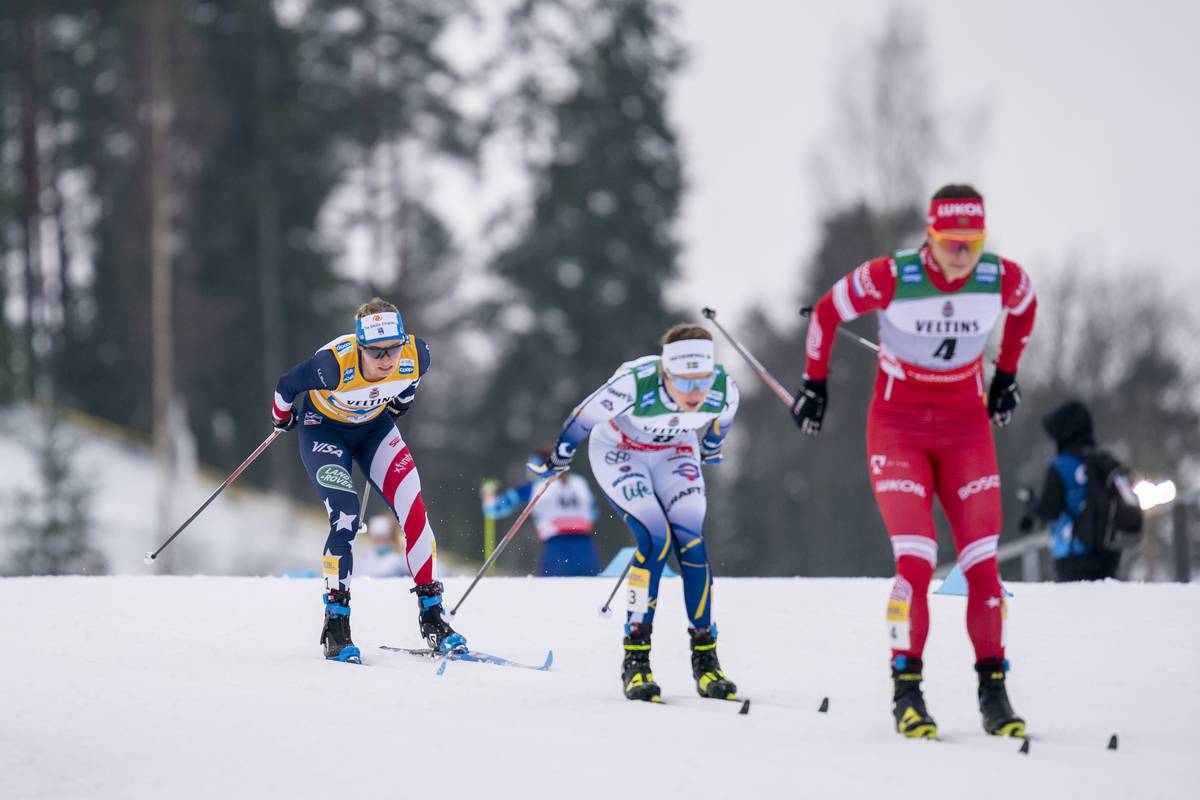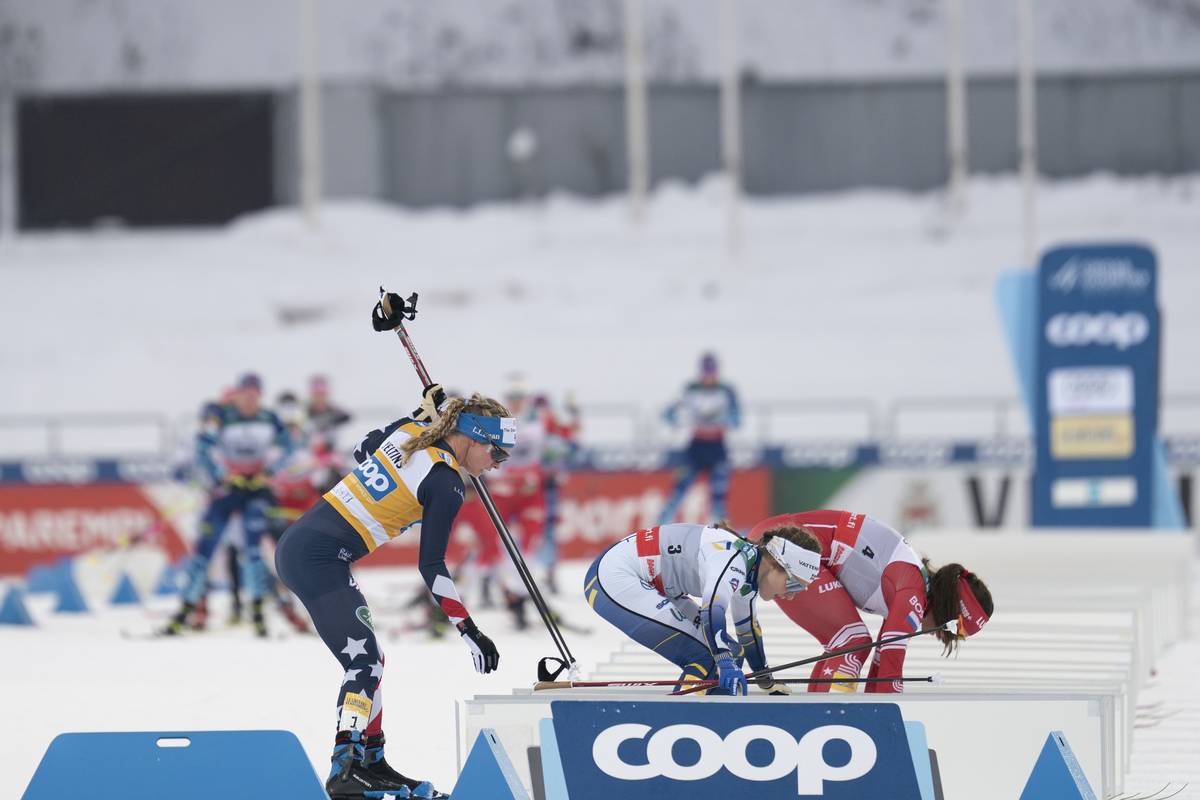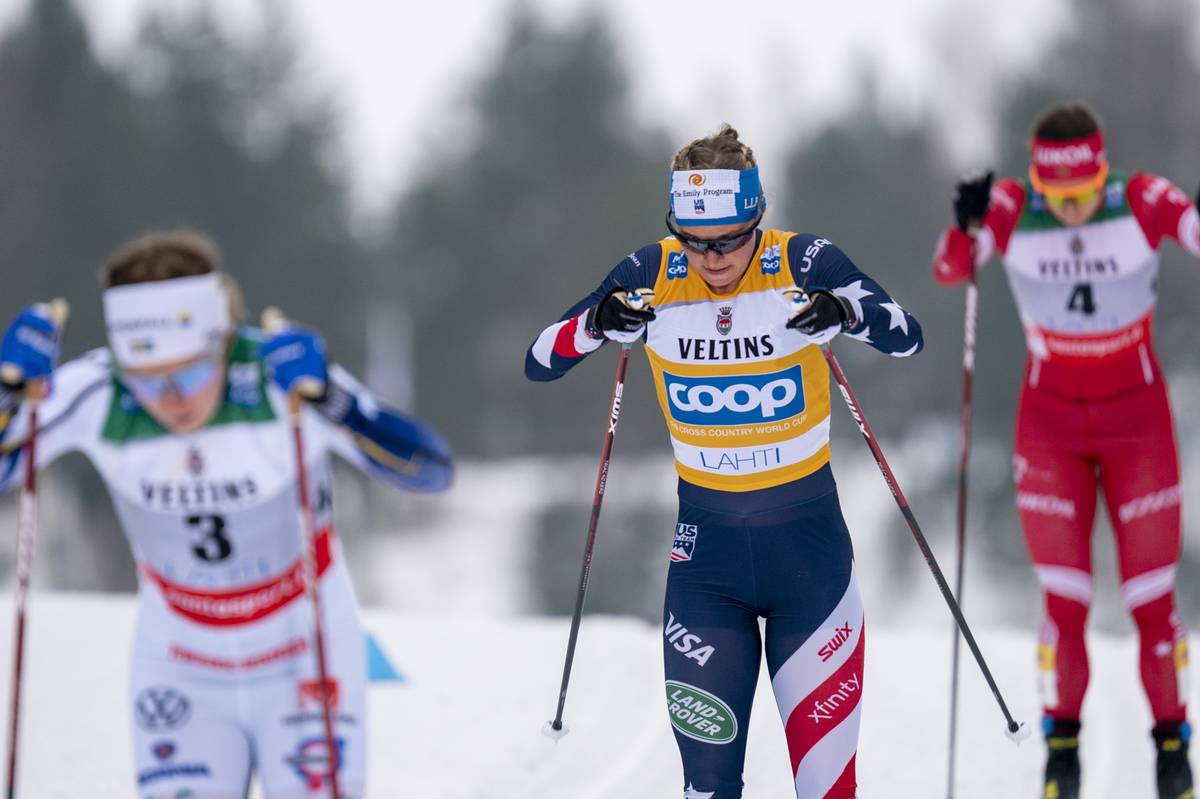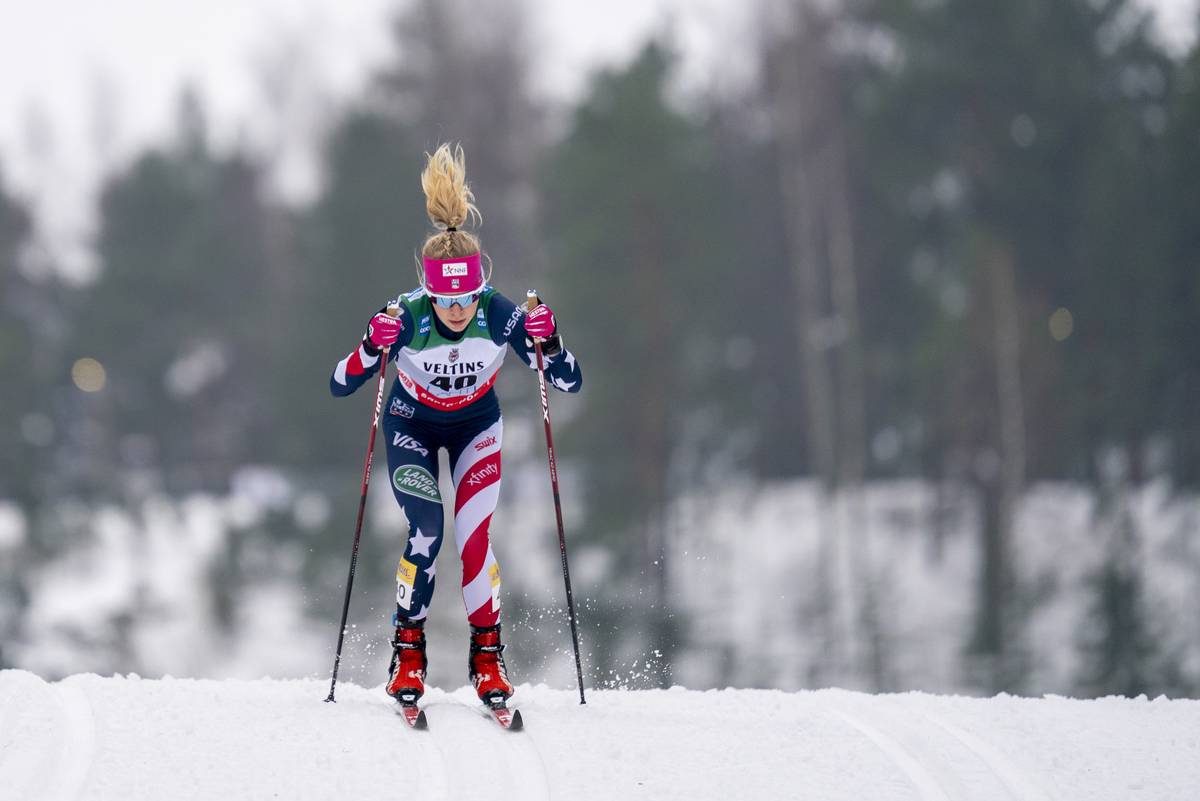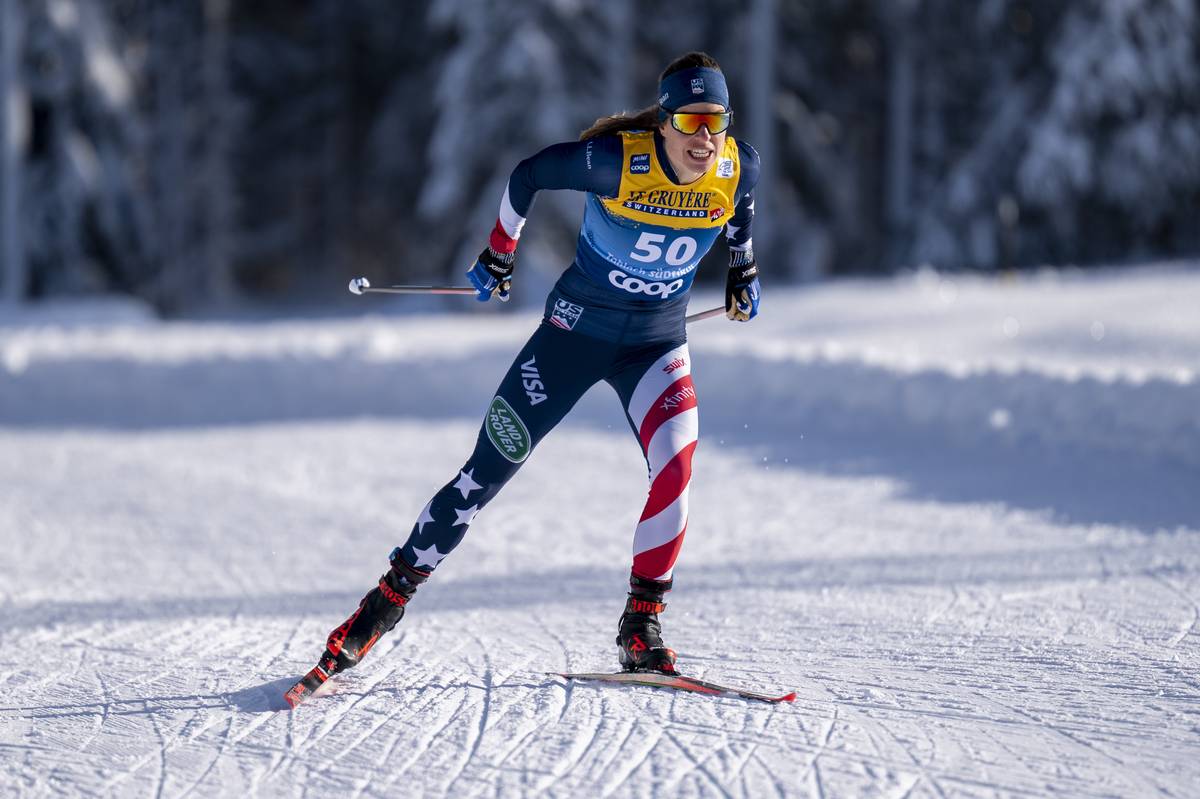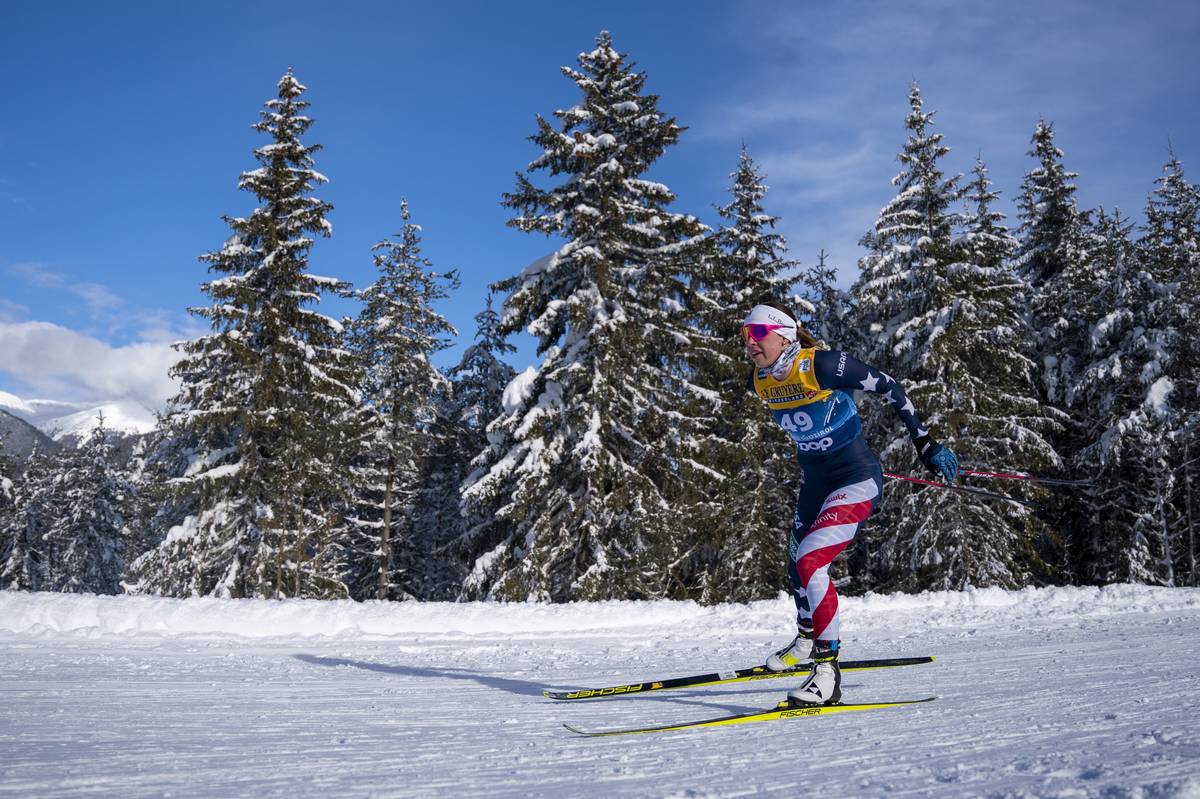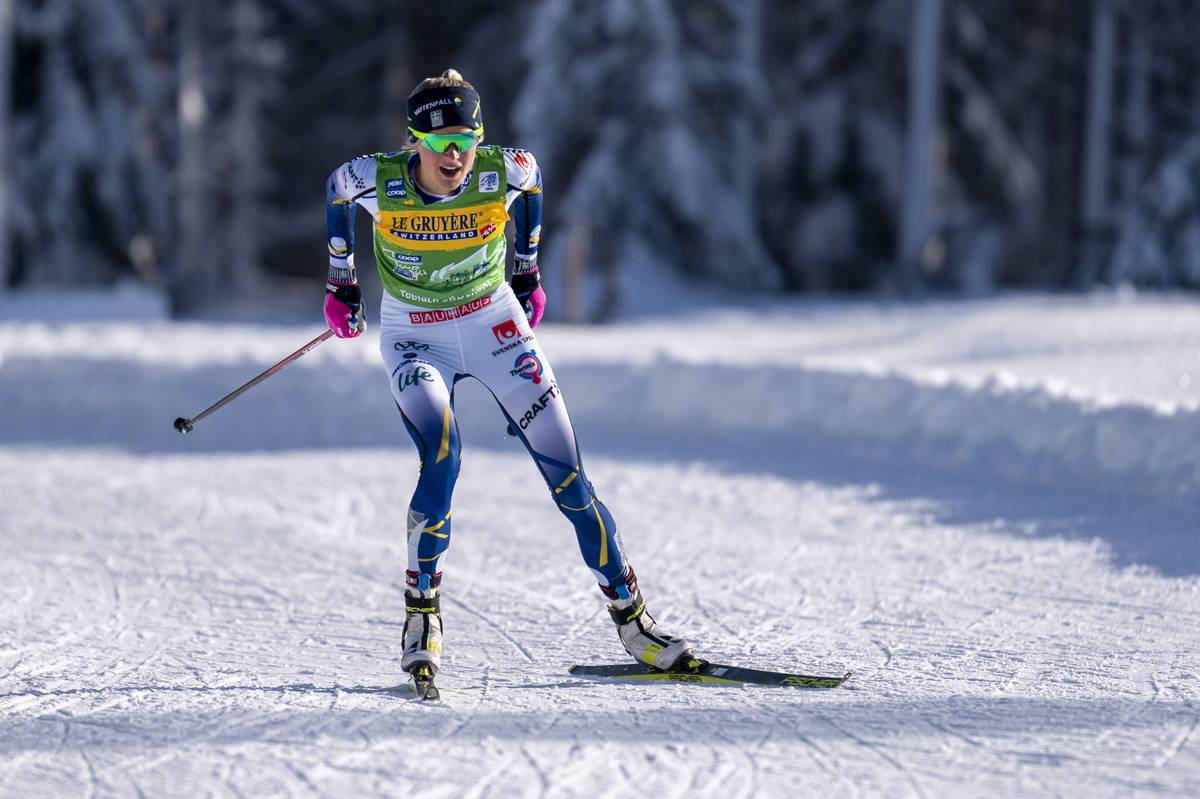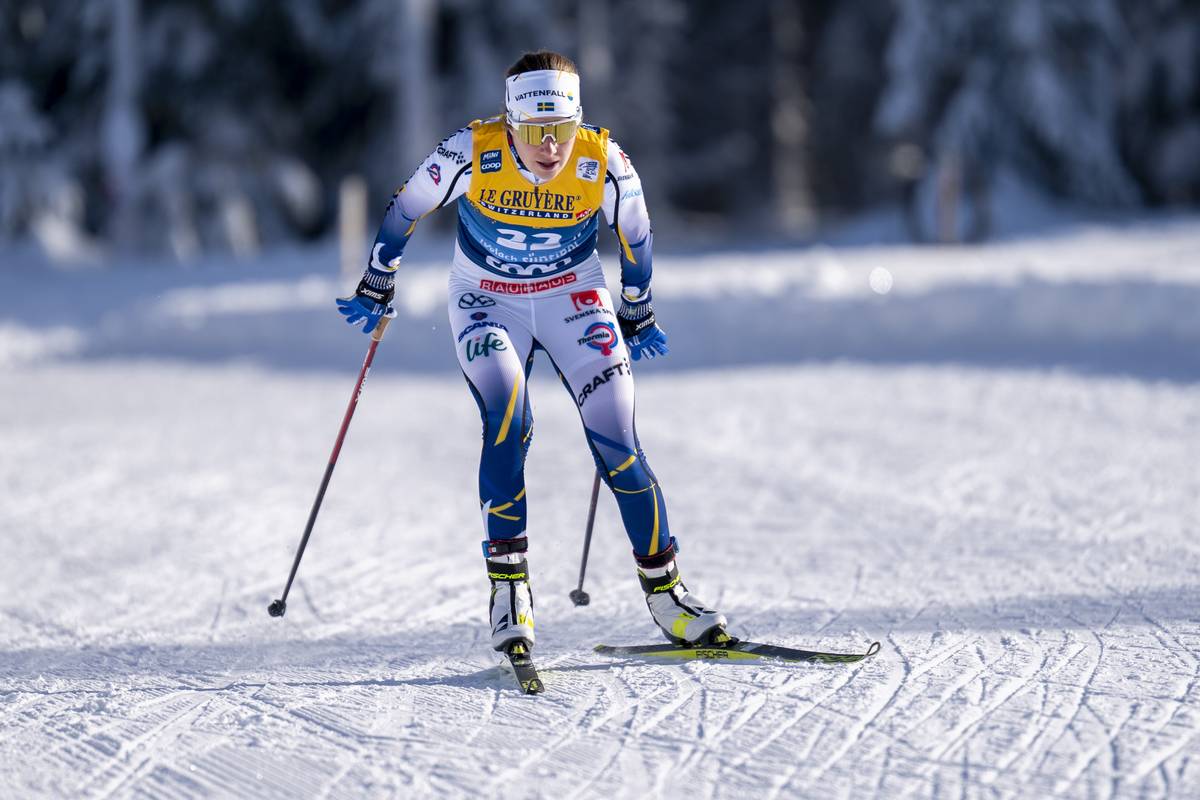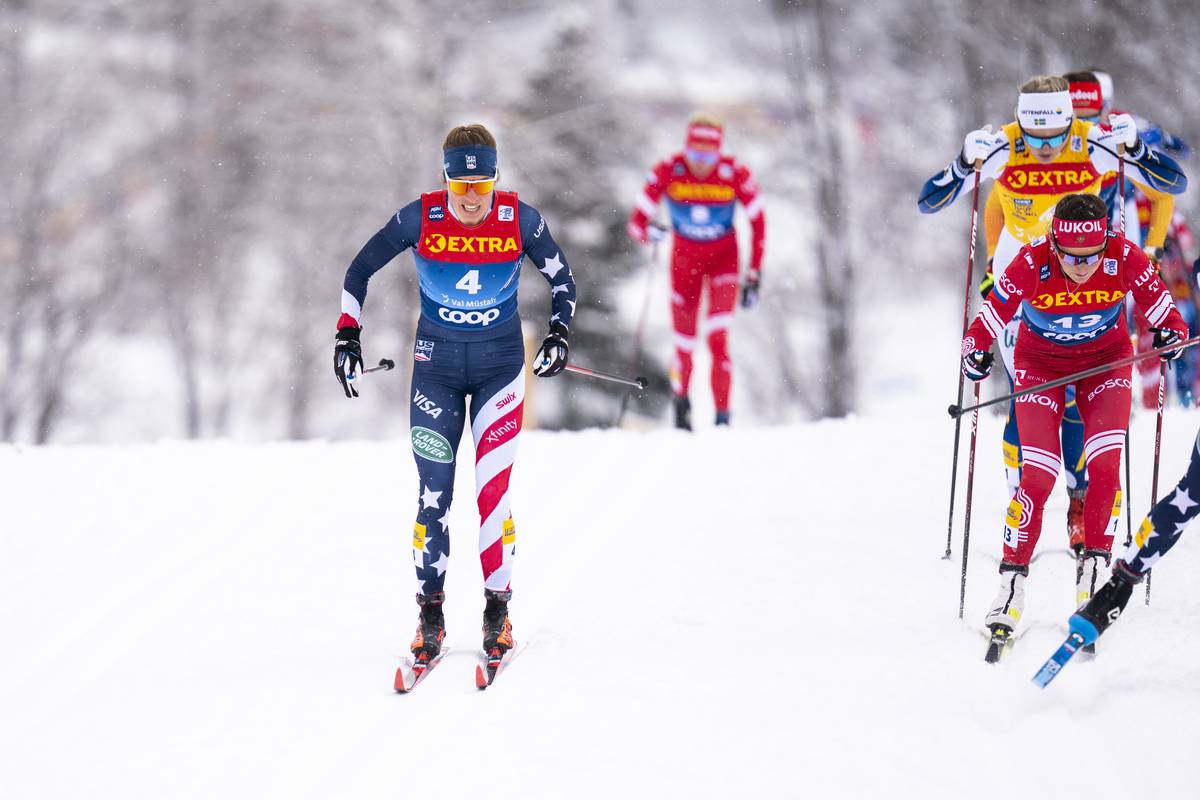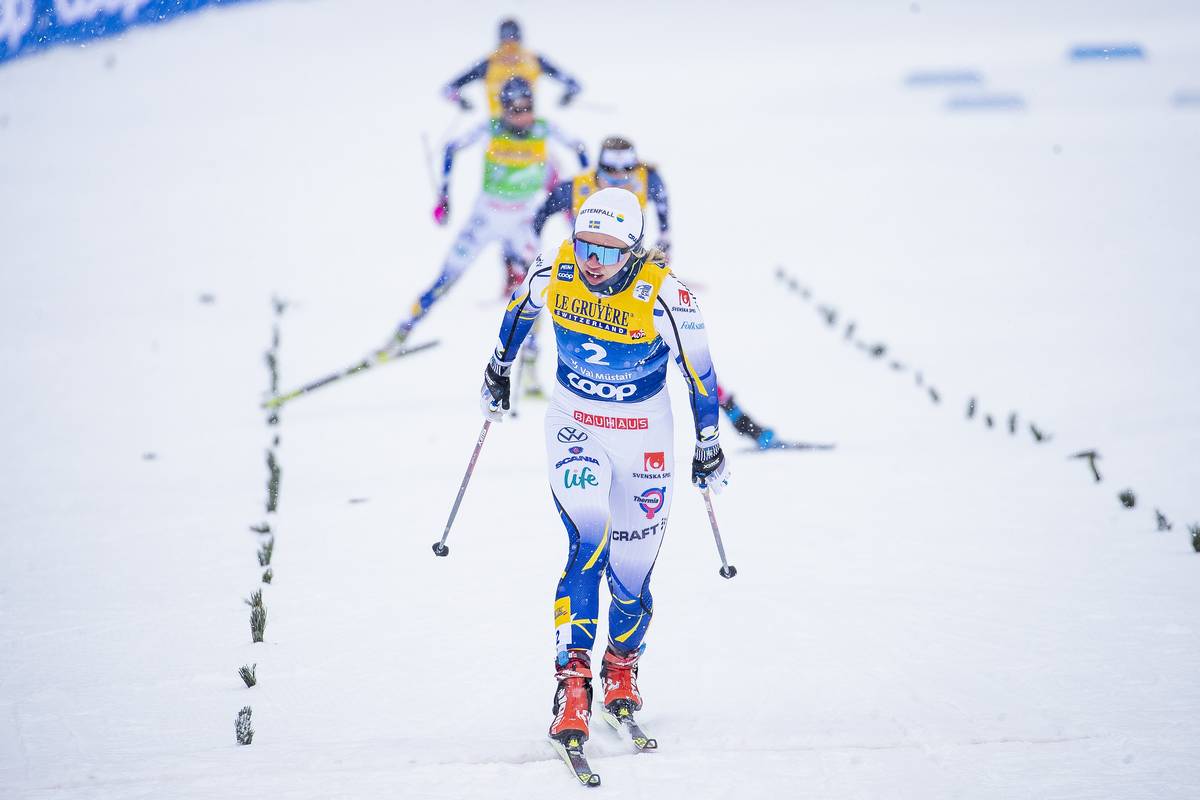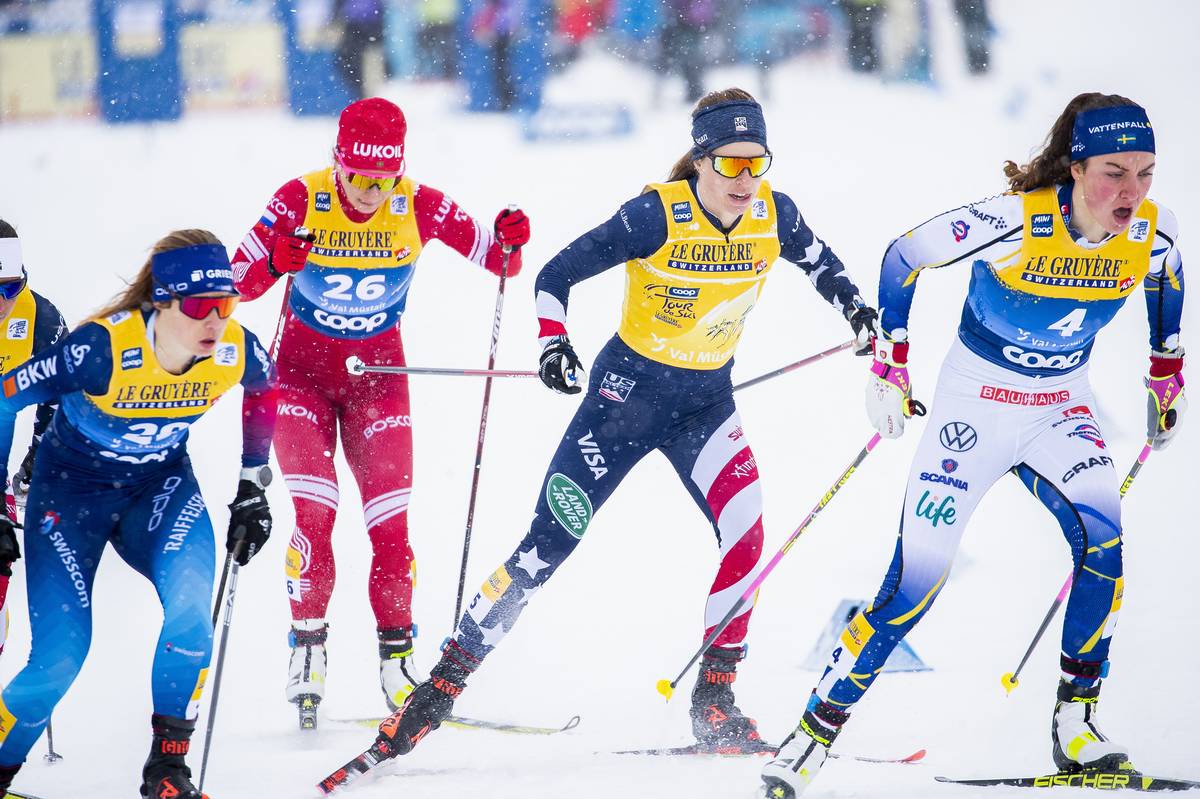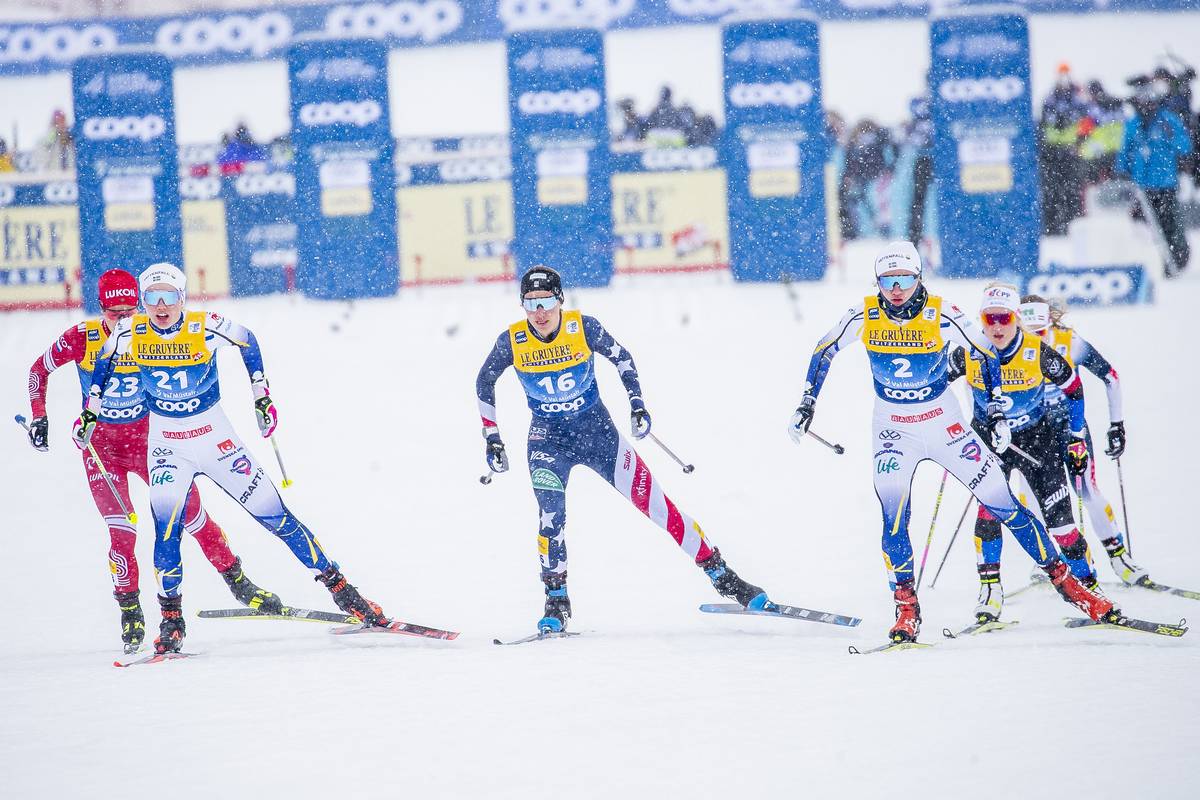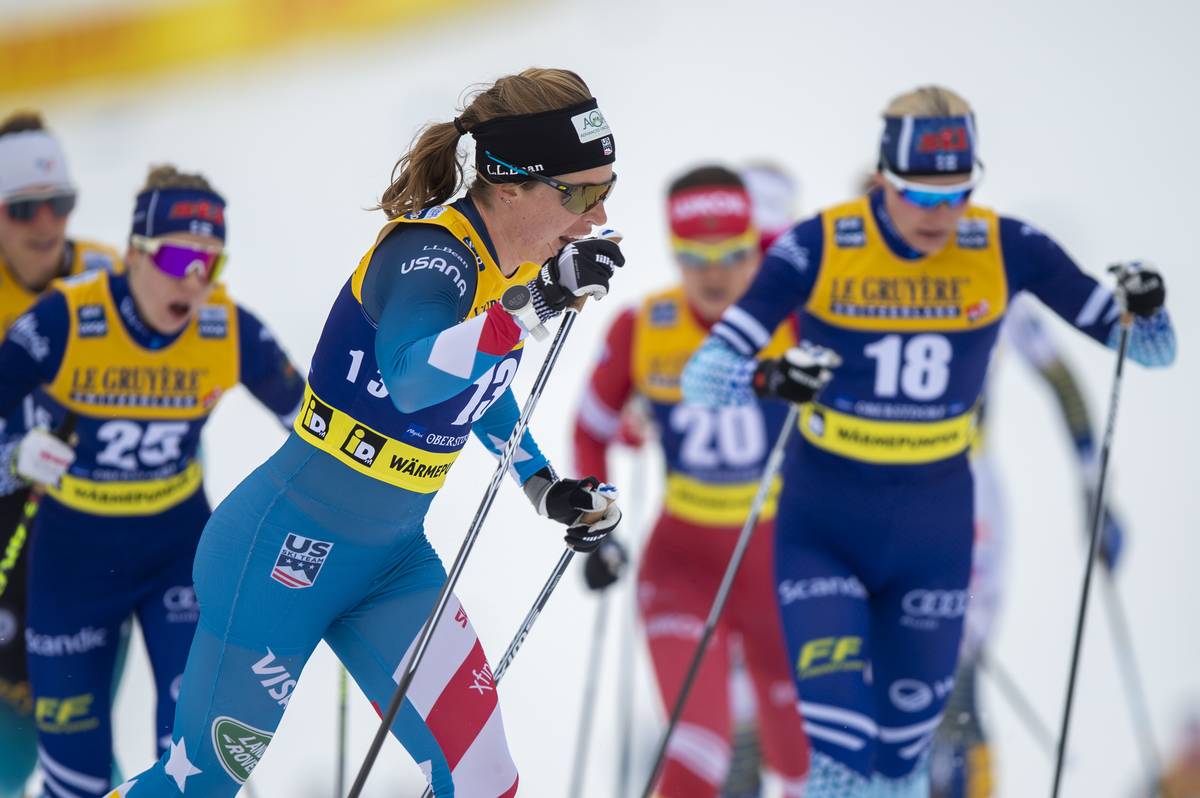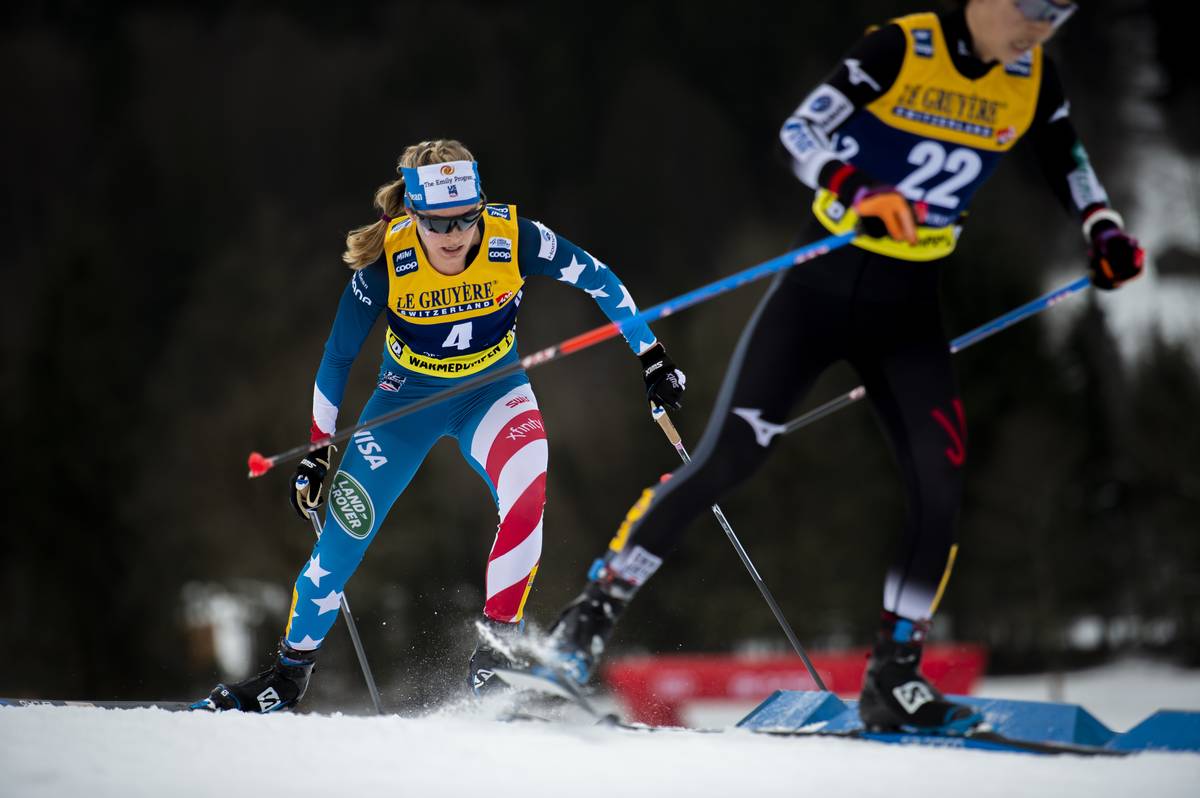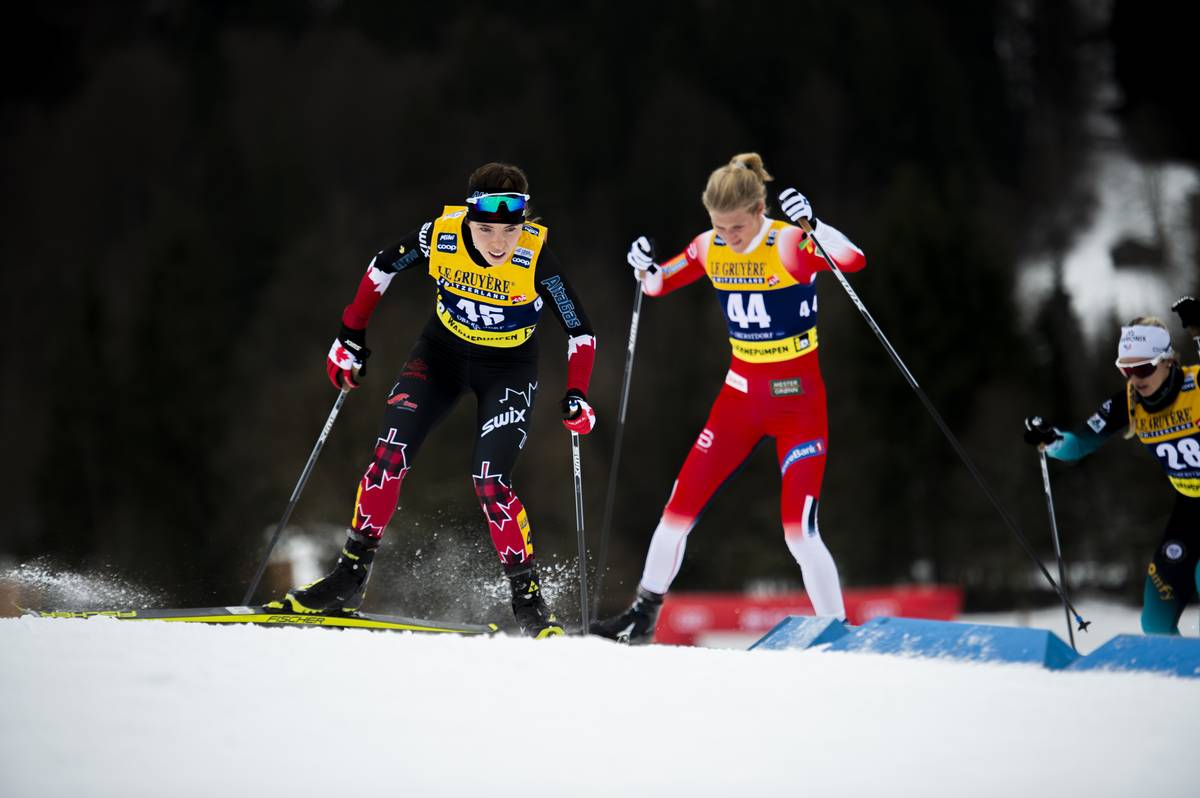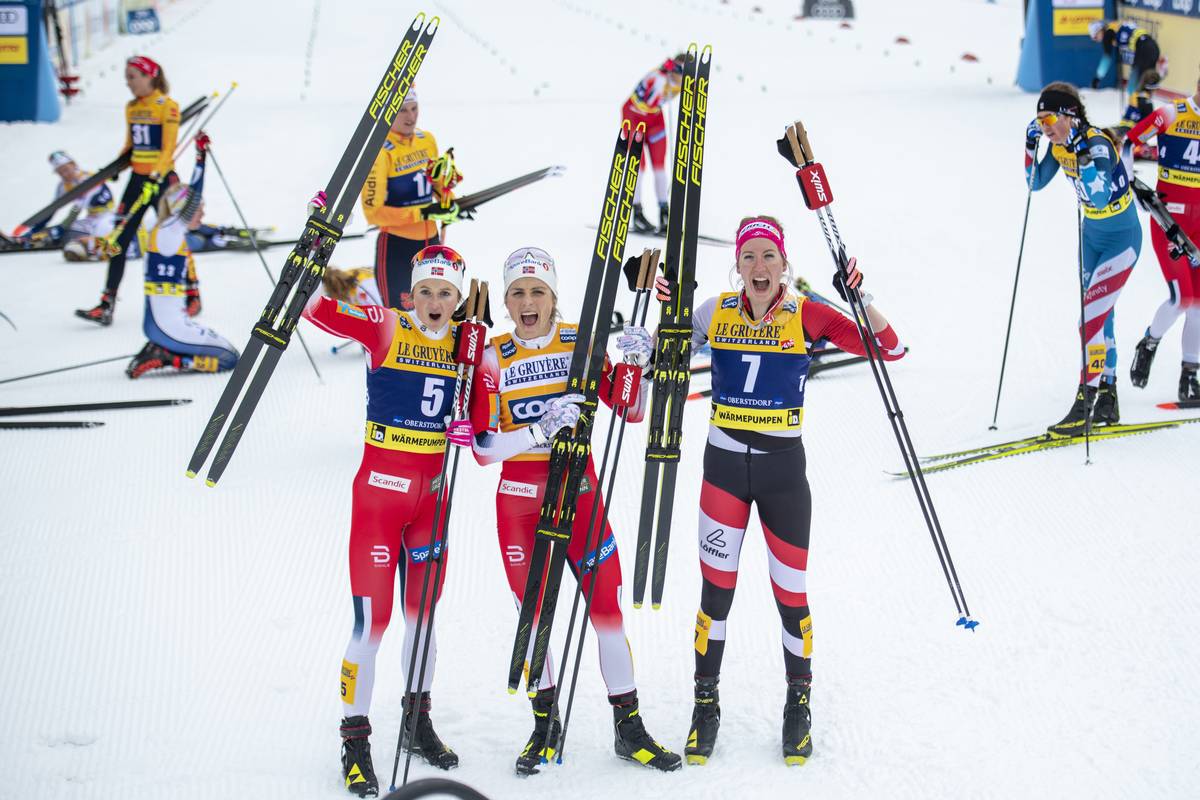
Tag: Caitlin Patterson

  • Rollerskiers in the  Mist: Patterson, Brown Win Foggy Climb to the Castle

    Rollerskiers in the Mist: Patterson, Brown Win Foggy Climb to the Castle

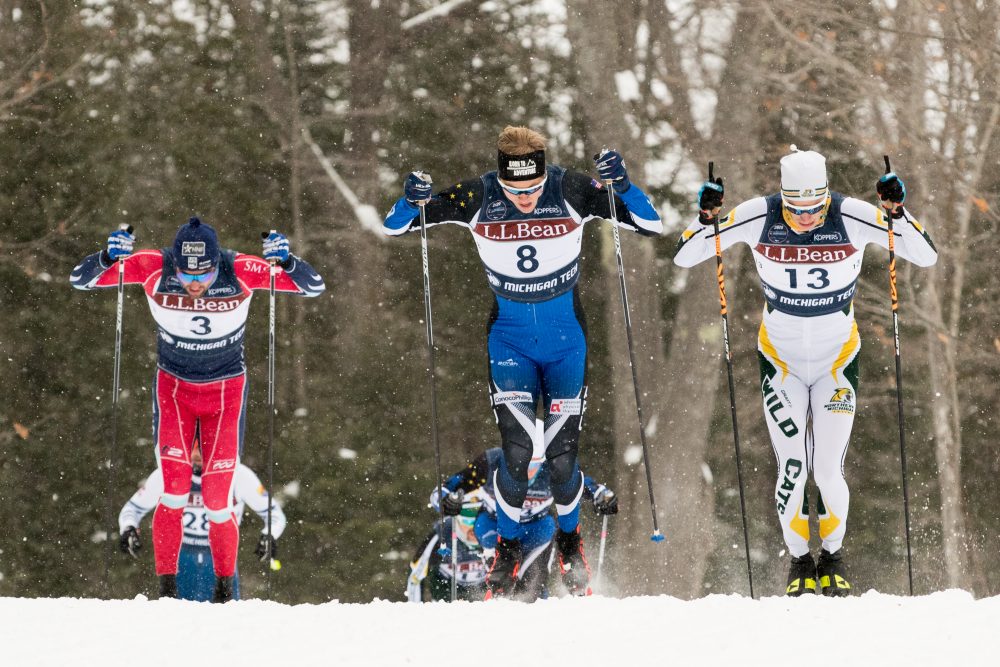
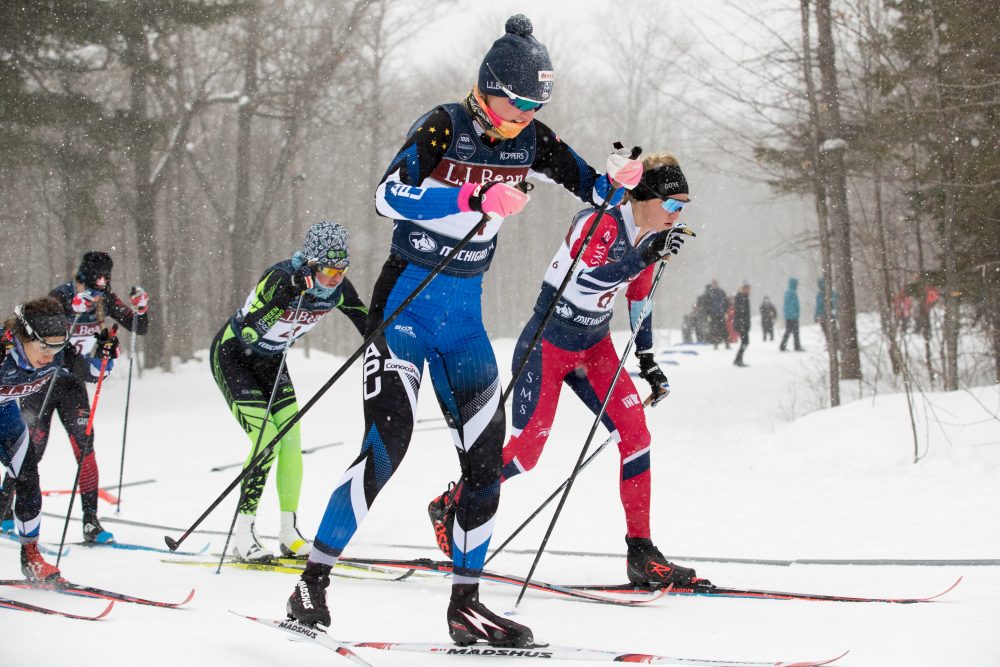
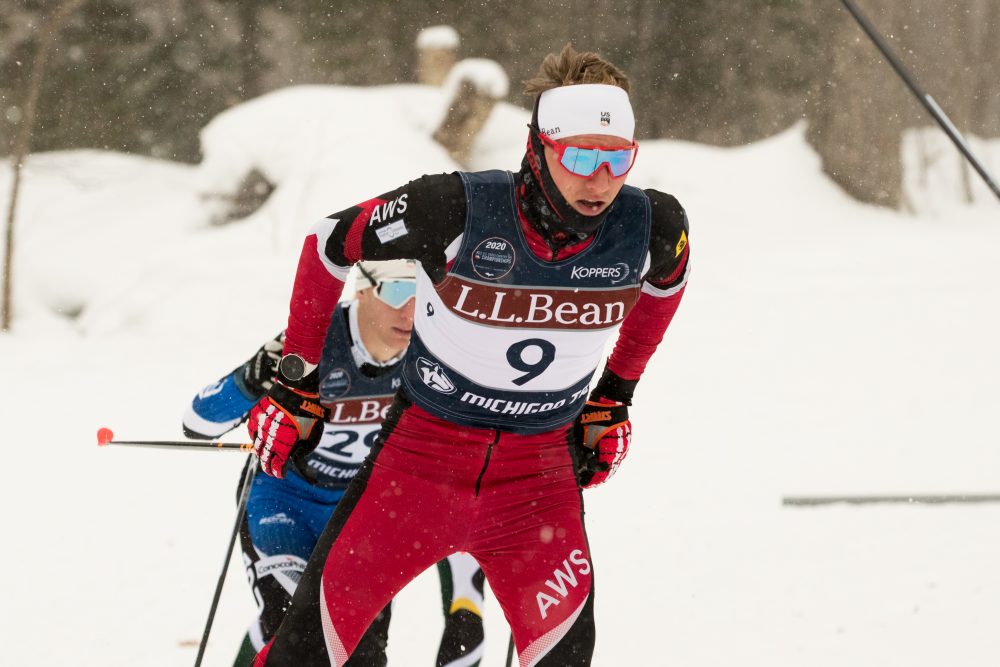
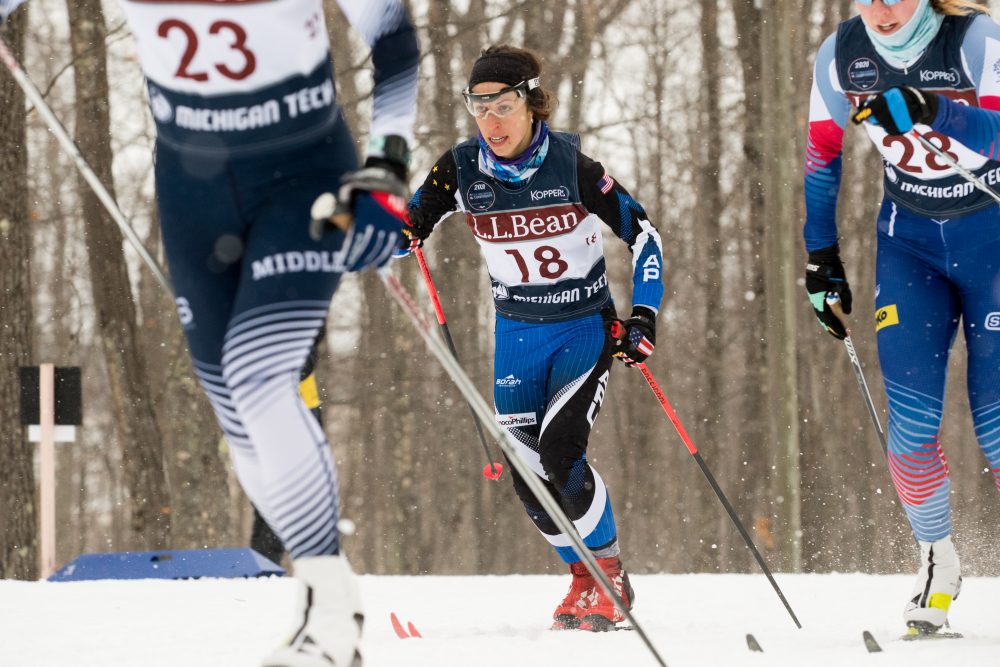
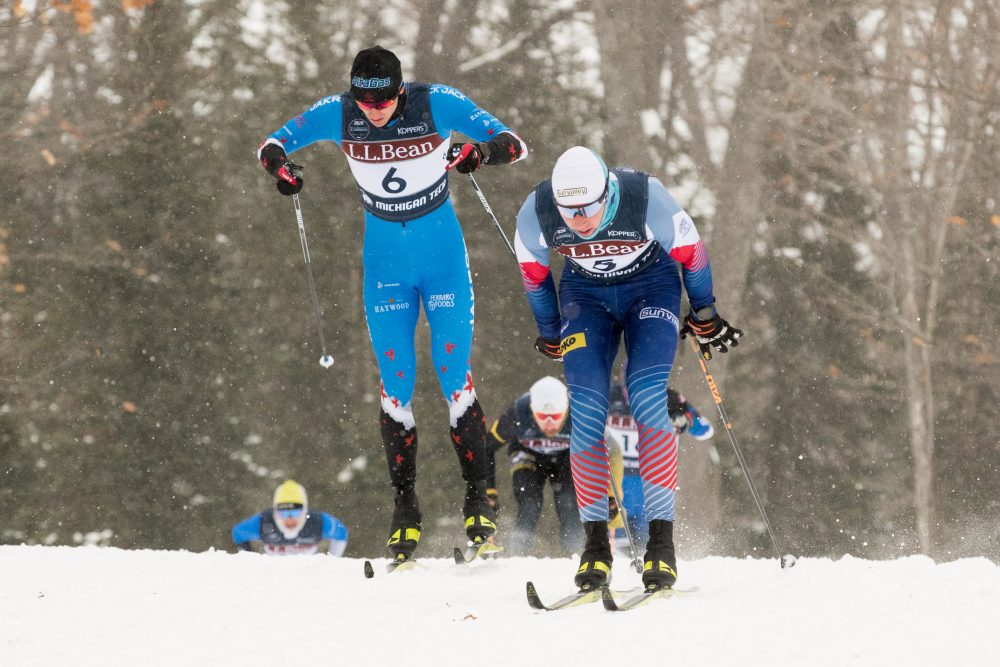
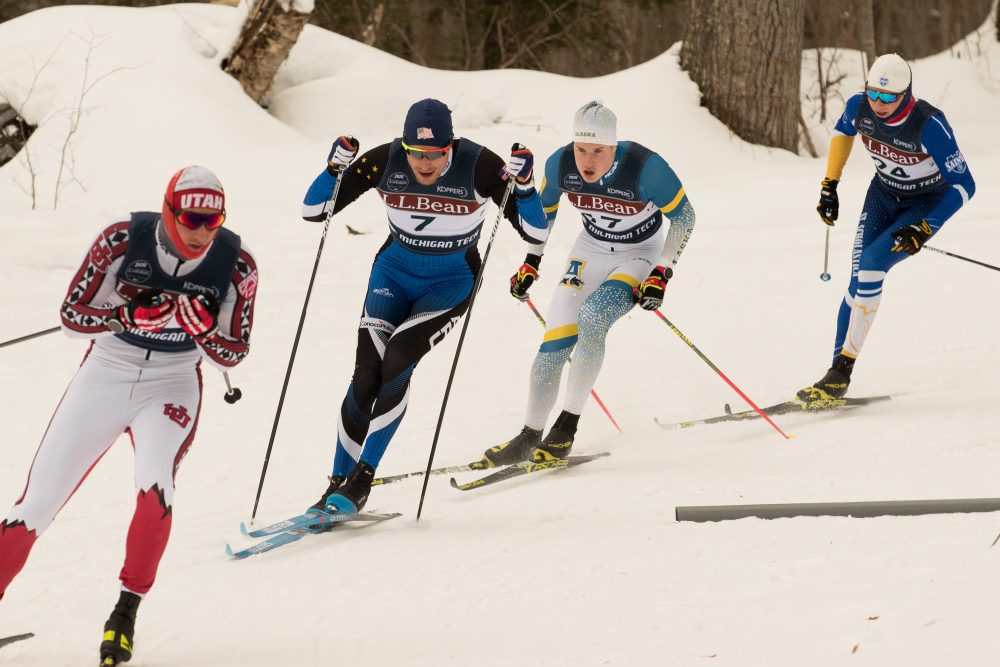
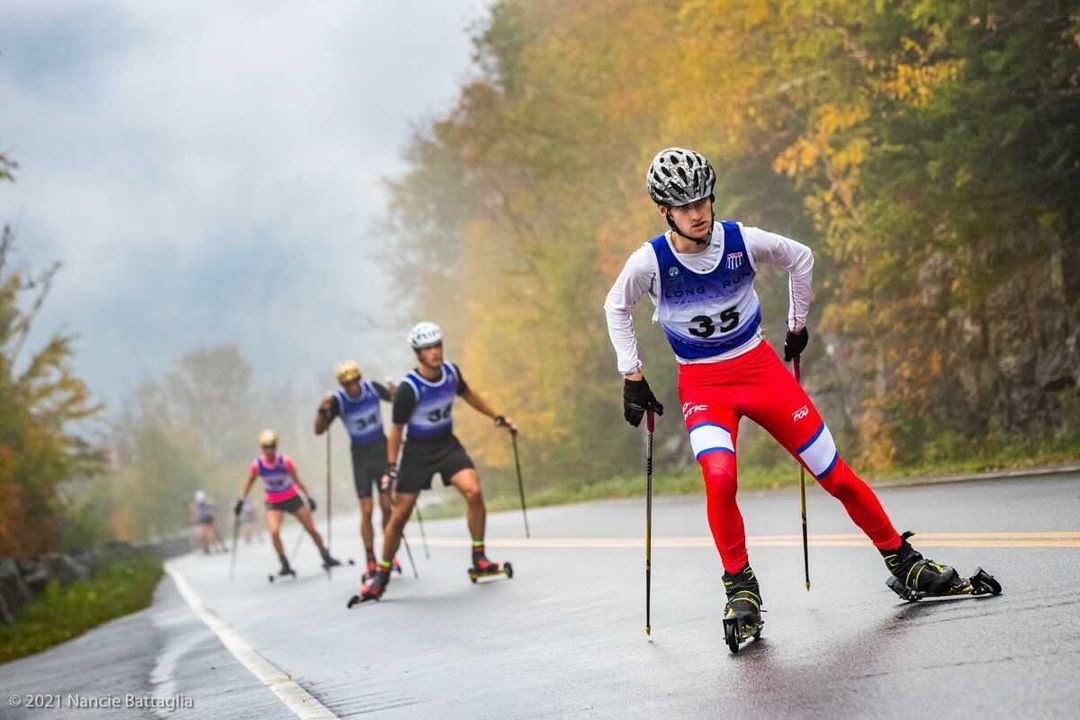
    Racers climb the Whiteface Veteran’s Memorial Highway during the 2021 Climb to the Castle. (Photo: Nancie Battaglia/NYSEF)

    The rain stopped just long enough for Caitlin Patterson and Jake Brown to savor their wins at the 2021 edition of the Climb to the Castle last Saturday in Wilmington, NY, near Lake Placid. 

    Craftsbury Green Racing Project (CGRP) swept the women’s podium; Caitlin Patterson edged Margie Freed for the win in 46:48.8, with her teammate just .7 second back in 46:49.5. Tara Geraghty-Moats placed third in 47:35.0.

    Brown, skiing for US Biathlon / CGRP, took the men’s win in a time of 38:04:00. CGRP teammate Akeo Maifeld-Carucci came second in 39:34:9, and Junior athlete Tabor Greenberg, a U16 athlete out of the Green Mountain Valley School (GMVS), interrupted CGRP’s command of the podium in third place at 41:24.7.

    After taking 2020 off due to the pandemic, the Climb to the Castle returned to the Northeast roller ski calendar, co-hosted by NENSA and NYSEF. The race leads skiers five miles up the Whiteface Veteran’s Memorial Highway at an average eight percent grade. Whiteface is the fifth highest mountain in New York’s Adirondacks; start too hard, and you’ll never recover. This author can attest. 
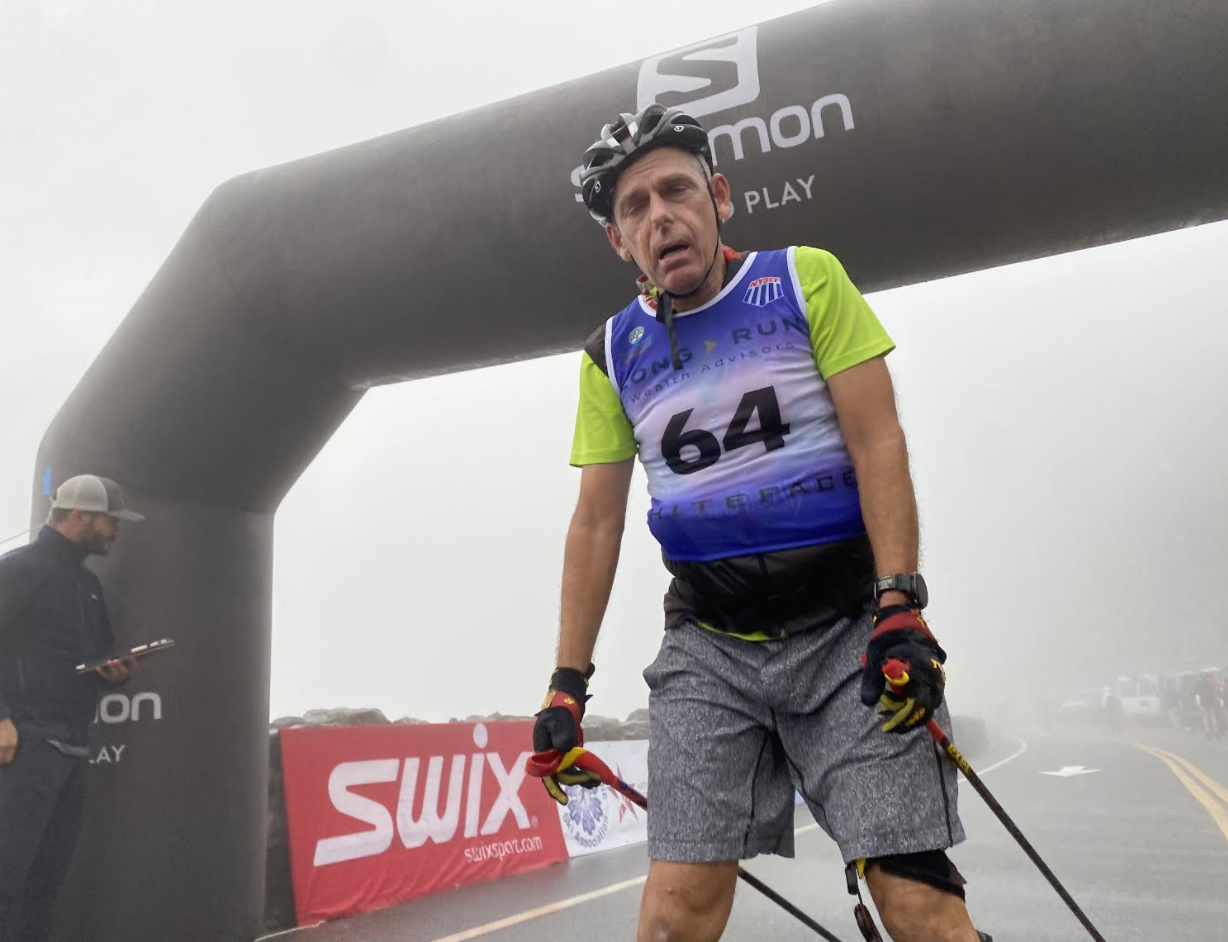
    The author completes his Climb to the Castle. (Photo: NENSA)

    As is often the case, weather made the race…. interesting. Light overnight rain tailed off about an hour before the start. Although the temperature hovered in the low 50s, the humidity made it feel warmer.  Clouds and fog obscured vision throughout the day.  In some places, one was lucky to see a hundred feet. For a change, there was little wind, even at the infamous Windy Corner and chute, 800 meters or so from the finish.

    For COVID safety, organizers started five waves of skiers, each two minutes apart. Competitors wore masks at bib pickup and on the summit after finishing their race.
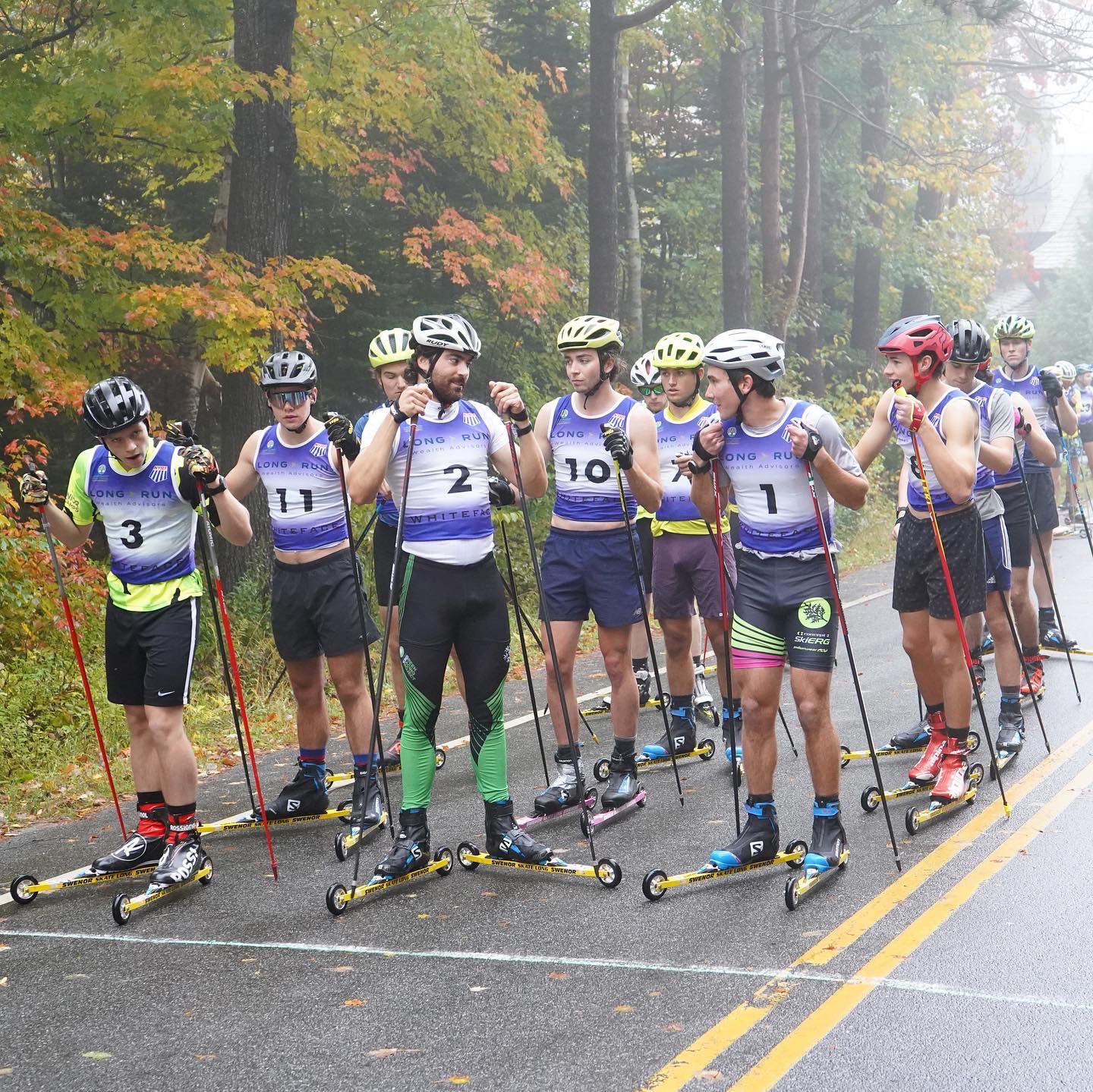
    Visibility low, energy high: a wet start for the men’s wave in the 2021 Climb to the Castle. (Photo: NENSA)

    The women’s race was high drama as Patterson, Freed, and Geraghty-Moats worked together up the road.

    “Tara and Margie and I knew we wanted to work together, especially with the way the Climb can be pretty windy at the top. It was just gonna be: ski smooth, work together, and shuffle around the leads, which is what we did. I definitely wanted to make sure not to start too fast.  I did that well, though I certainly had some rough moments in the middle.”

    From the start, Patterson said that she and Geraghty-Moats took turns in the lead, trading off about every kilometer.  “Towards the upper part, Margie was taking some really strong leads. I was suffering a bit,” Patterson added.
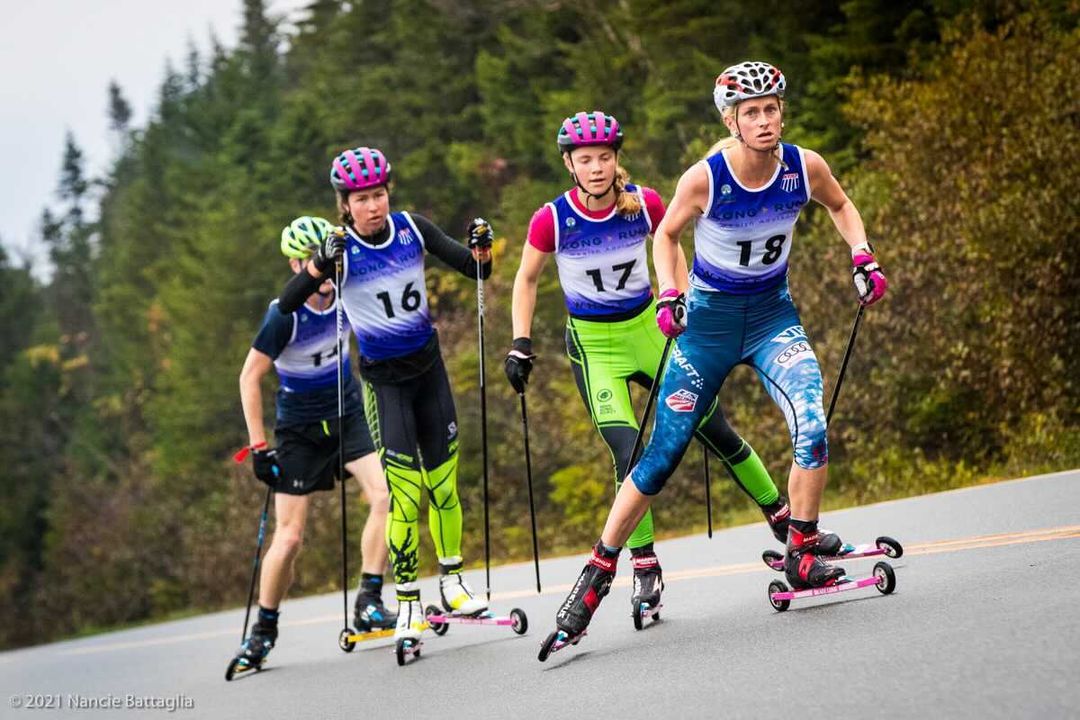
    With two kilometers left, Freed opened a gap from Patterson and Geraghty-Moats. Patterson said it took a few minutes for her to regain contact.  At that point, Patterson and Freed pulled away from Geraghty-Moats, skiing to the finish.  

    “Maybe 30 seconds out, I passed [Margie],” Patterson said. “It was really strong work by both of them. It was great to ski with people because it was as tough a course as ever.”

    Of her finishing kick, Patterson said, “I know that I can tap into a late surge. We were working together for most of it, and as the finish line was drawing near, it was definitely every person for themselves.”
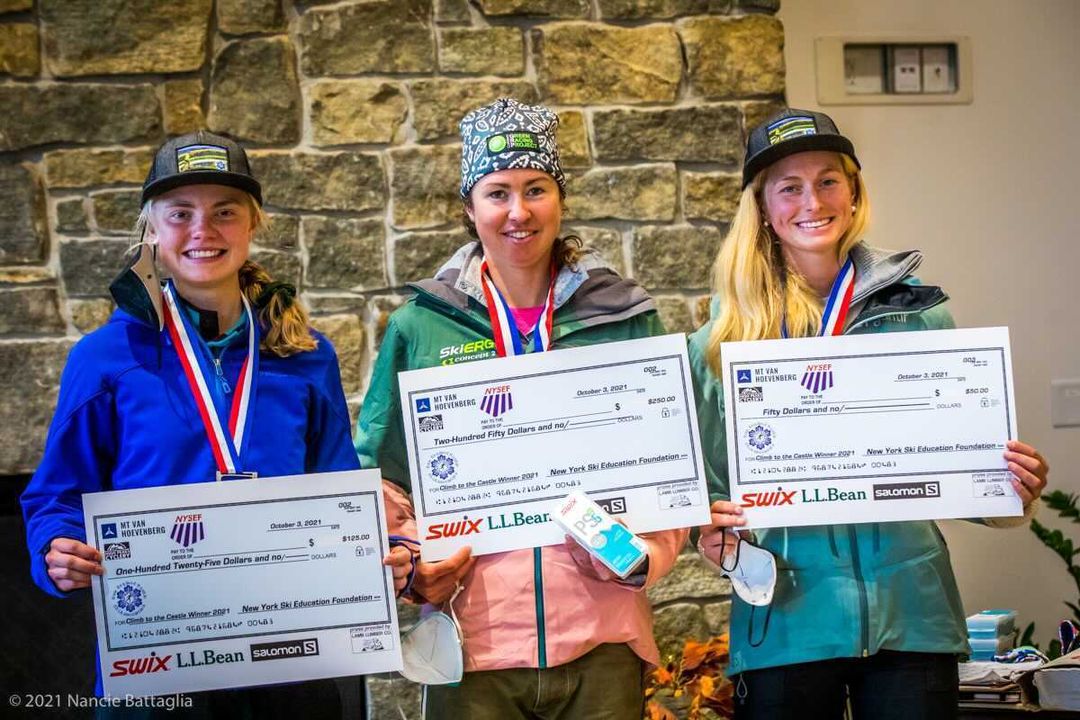
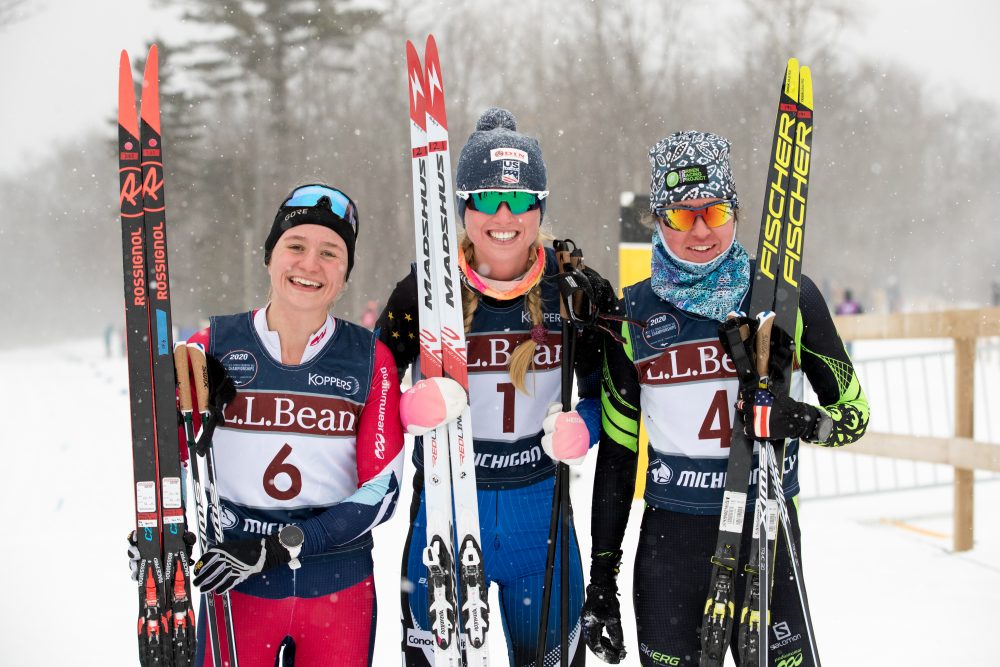
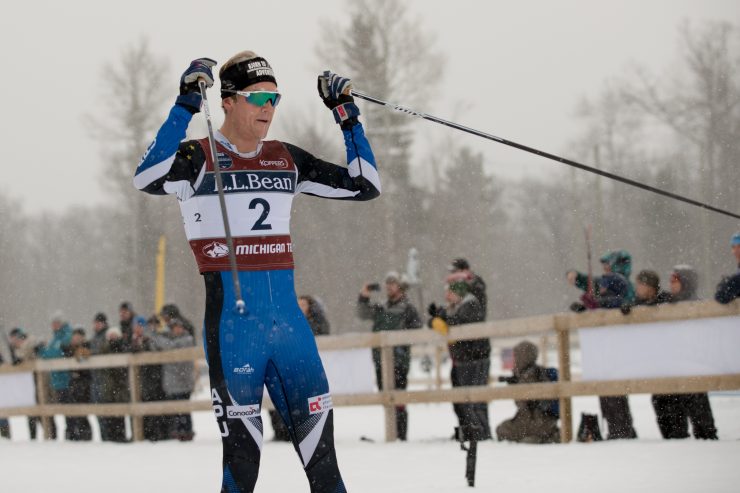
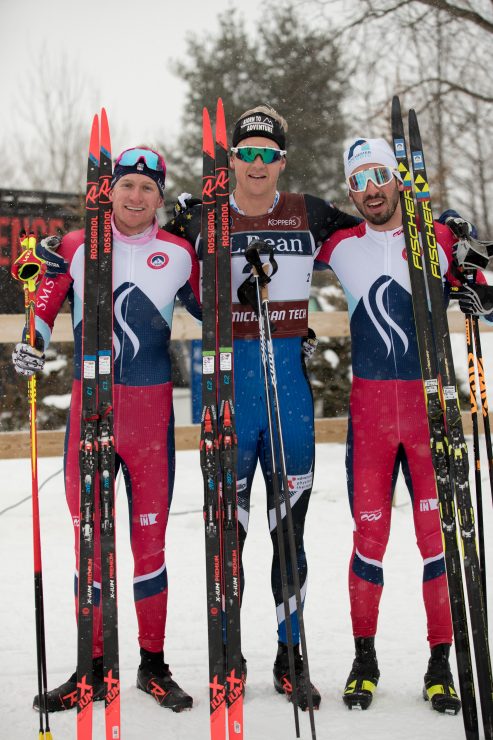
    Craftsbury women clean up at the 2021 Climb to the Castle. Caitlin Patterson took the win ahead of Margie Freed (left) and Tara Geraghty-Moats (right). (Photo: Nancie Battaglia/NYSEF)

    “It went pretty well today,” said Freed of her race. “It was awesome to ski with Tara and Caitlin for so long. I don’t think I could have kept up that pace if I was alone.

    “I’ve never done this race before, so it was exciting to have every step be something new for me,” Freed continued. “Even though I didn’t quite know where the finish was, or when it was coming.  I couldn’t quite see it because it was so foggy.  It was an awesome day out there, and I was glad it wasn’t as windy or rainy or cold as I was thinking it was going to be.”

    This past winter, Geraghty-Moats won the first ever crystal globe for FIS Women’s Nordic Combined.  She also won the Climb in 2018. After the race, she wrote, “It was really nice to go all out with my teammates. We skied together really well. We all had moments of fading and then climbed back on. I dropped back about half a k after the Lake Placid turn — I just kind of ran out of  gas. I’m pretty happy with how I felt and it was a really fun race.”

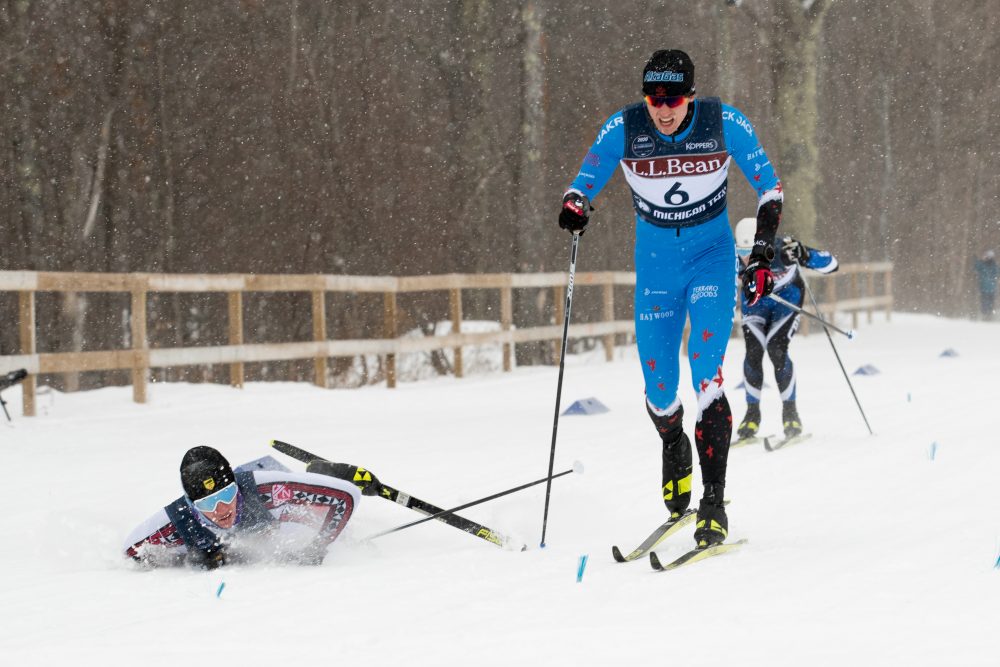
    Jake Brown wins the 2021 Climb to the Castle in a long solo effort. (Photo: Nancie Battaglia/NYSEF)

    For Brown, this was his third win at Climb to the Castle, his previous two coming in 2017 and 2018.

    “I wanted it to be a good, solid effort,” Brown said. “I knew that I couldn’t sprint too hard off the line, but I wanted to get into that high heart rate zone and stay there as long as I could.”

    Asked about race strategy, Brown said, “I was with Akeo [Maifeld-Carucci], my Craftsbury Green Racing Project teammate. He led for the first 3 minutes or so.”

    At that point, Brown said, he took a turn pulling and developed a gap. “I was hoping we could work together a little bit more, but we ended up with an awkward 20-meter gap between us that we  held for maybe half the race. Then I slowly pulled away and was by myself.”
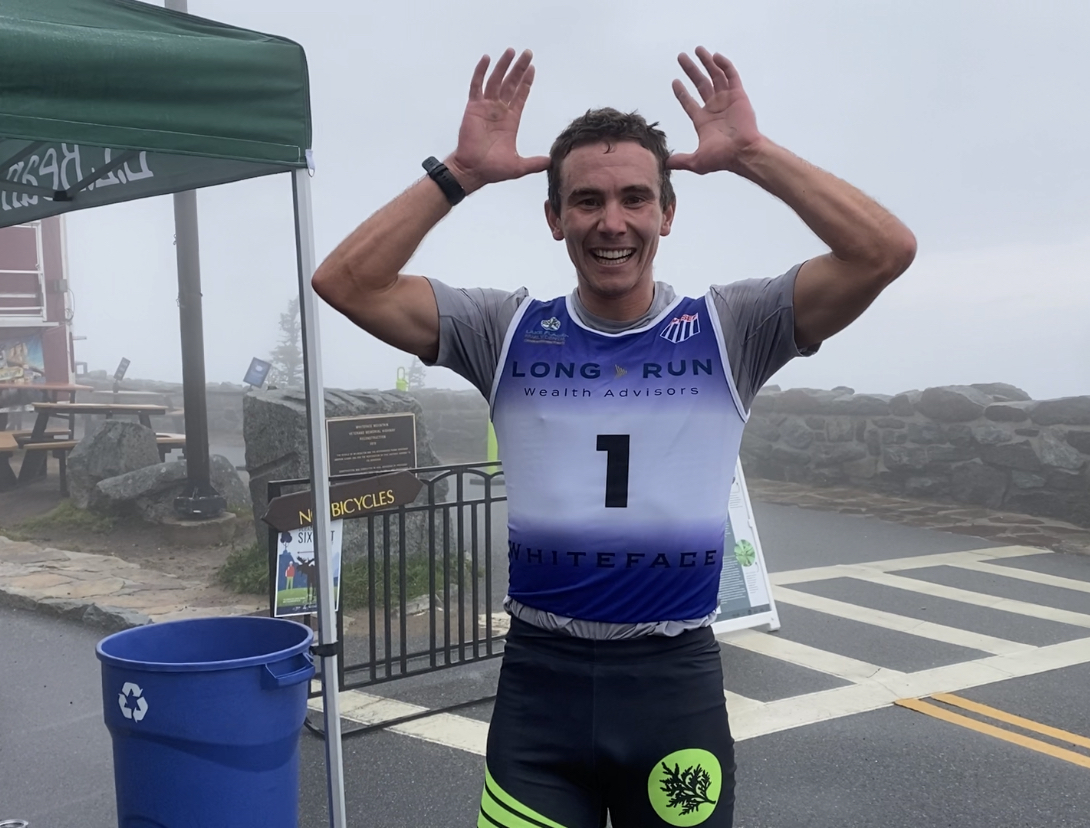
    Jake Brown wears the moose-antler crown after winning the 2021 Climb to the Castle. (Photo: NENSA)

    Asked if he could use this as a fitness benchmark, Brown said, “This was my fourth time doing the race. This was a bit of a slower year; I’m hoping it was just because of the weather. Maybe a little later in the year and a little colder pavement. It was kind of warm today, but maybe the pavement was a little colder.  Maybe my fitness isn’t where it was.  We’ll find out when the winter comes — that’s what matters.” 

    For Maifeld-Carucci, “It was a sweet day. I wanted to do this race for a long time, since early in college. So it was great to actually be here and do it.  The weather was way better than we expected. It was a little wet and a little cloudy at the top, but there were moments when it opened up and it was super pretty. Constant great climb, hard skiing — it was definitely a hard race and a really good effort.”

    Commenting on the men’s pacing and tactics, Maifeld-Carucci echoed Brown’s explanation of the duo’s ability to collaborate. 

    “Jake and I were hoping to ski together and trade leads,” Maifeld-Carucci explained. “He was feeling a little stronger than I was so I fell off early and we were dangling 20 meters apart for a long time. Then he started to open it up.”
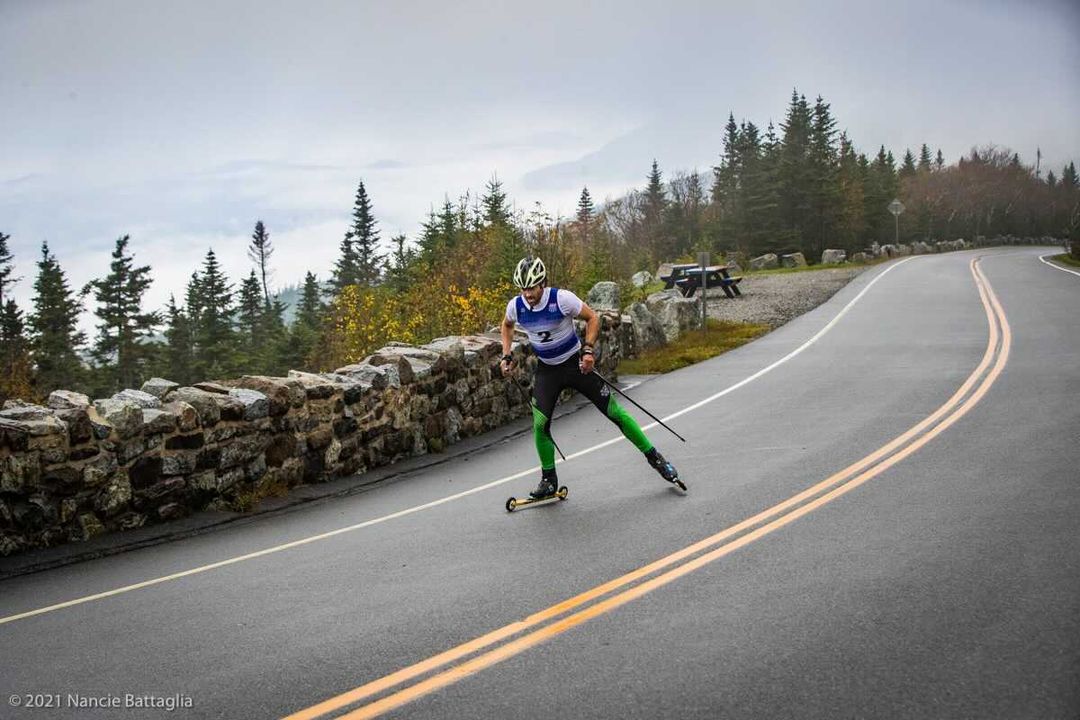
    Akeo Maifeld-Carucci skis to second place at the 2021 Climb to the Castle. (Photo: Nancie Battaglia/NYSEF)

    In addition to Greenberg nabbing third place overall, the GMVS boys swept the junior podium. 

    Responding to an email, GMVS head coach Colin Rodgers said that his skiers didn’t taper for the race. “Tabor actually trained a lot in the past week including a 120 mile bike ride to raise money for the Kelly Brush Foundation.”

    Commenting on the preparation for this event, and how it fits into the season preparation, Rodgers explained:

    “We spent some time recently working on climbing technique. When we were recently on snow on the Stelvio glacier we were working on standing well (balanced and forward) on our skis. We did not discuss any mass start race tactics for today — I really just wanted the crew to focus on pacing the effort properly and being consistent throughout the duration of the climb. [Having] a dialed warm up and trying to keep good form when tired were also a few other things we were honed in on today.”
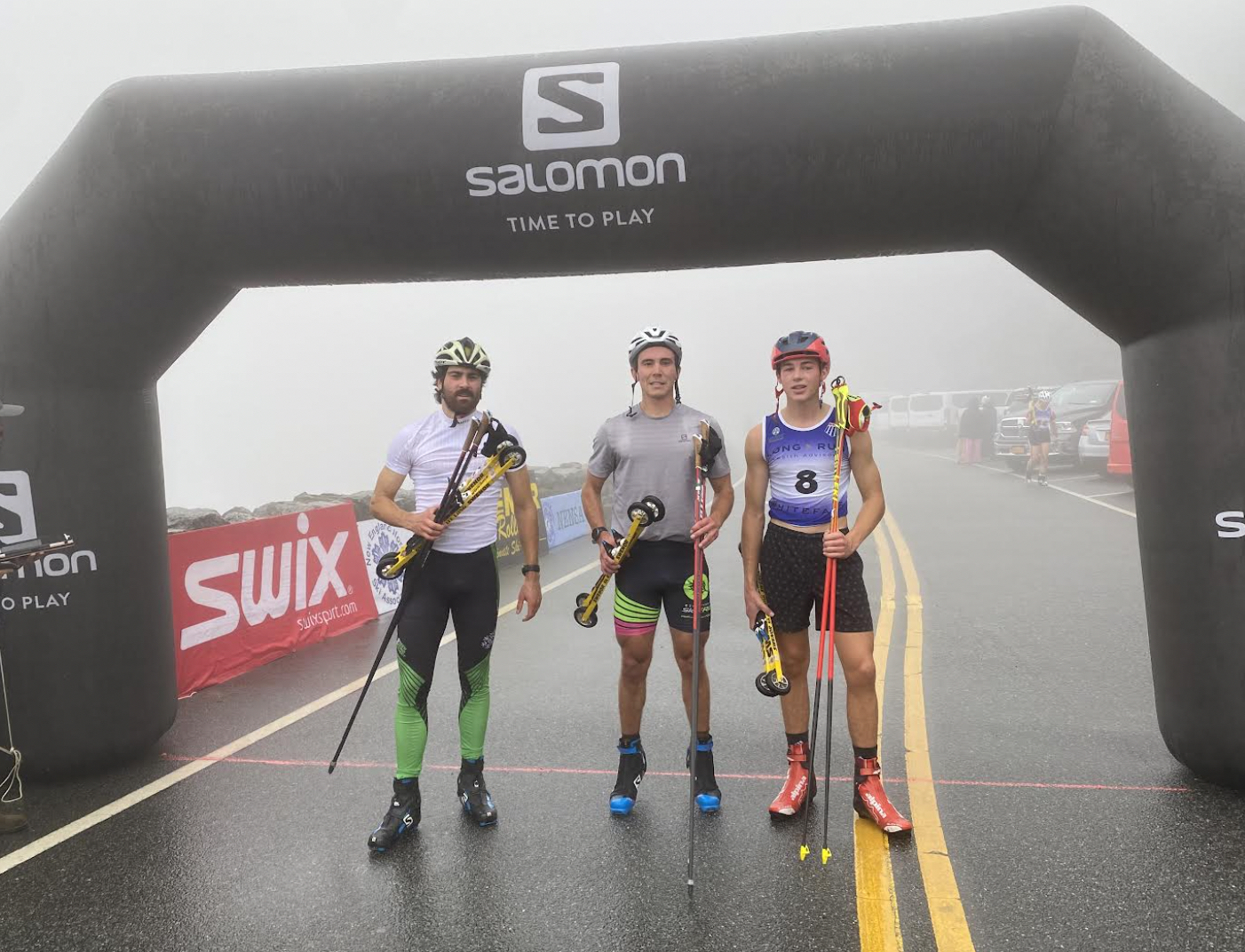
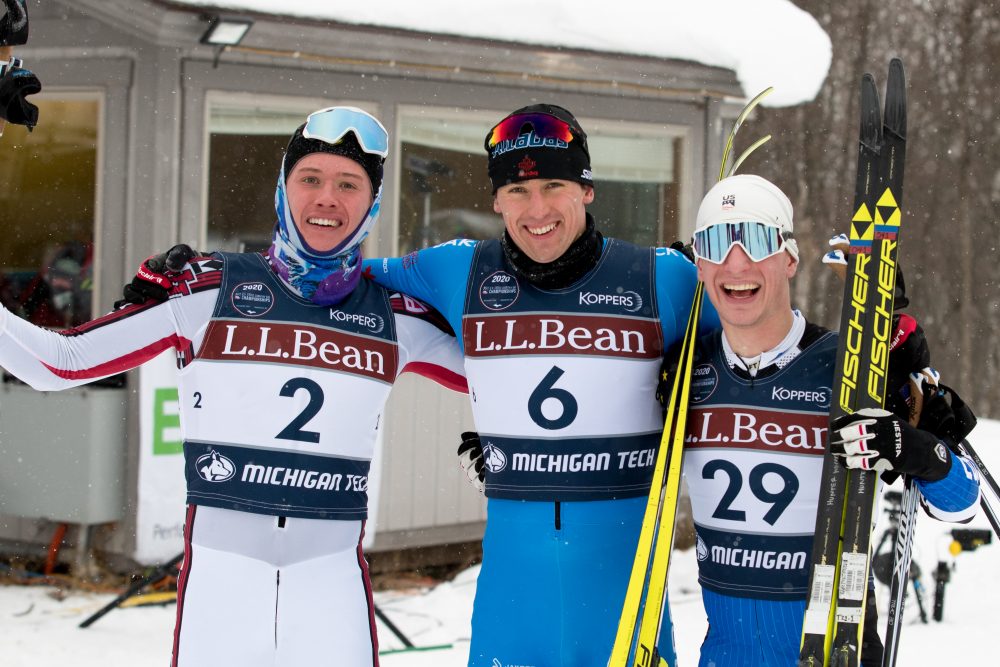
    The men’s podium at the 2021 Climb to the Castle. Jake Brown (CGRP) took the win ahead of Akeo Maifeld-Carucci (CGRP) and Tabor Greenberg (GMVS). (Photo: NYSEF)

    Did Rodgers have an inkling that Greenberg might podium? 

    “We were not focused on the podium, we were just focused on executing a solid race effort. We are primarily focused on competitions in March, so all of this is just trying to build momentum towards the end of the race season.”

    Although COVID border closures prevented Canadian clubs from driving across the border, many clubs and colleges still showed up to throw down.  

    According to Sara Falconer, a coach at Mansfield Nordic (MNC) in Vermont, “It’s a good opportunity for [MNC junior athletes] to race other high school athletes and college athletes that are here.  It’s also a chance for them to compare their times to last year and see the results of all the work they put in over the summer.  They can see a lot of dramatic improvement.  It’s a really motivating thing for them.  And it’s also a good workout.”

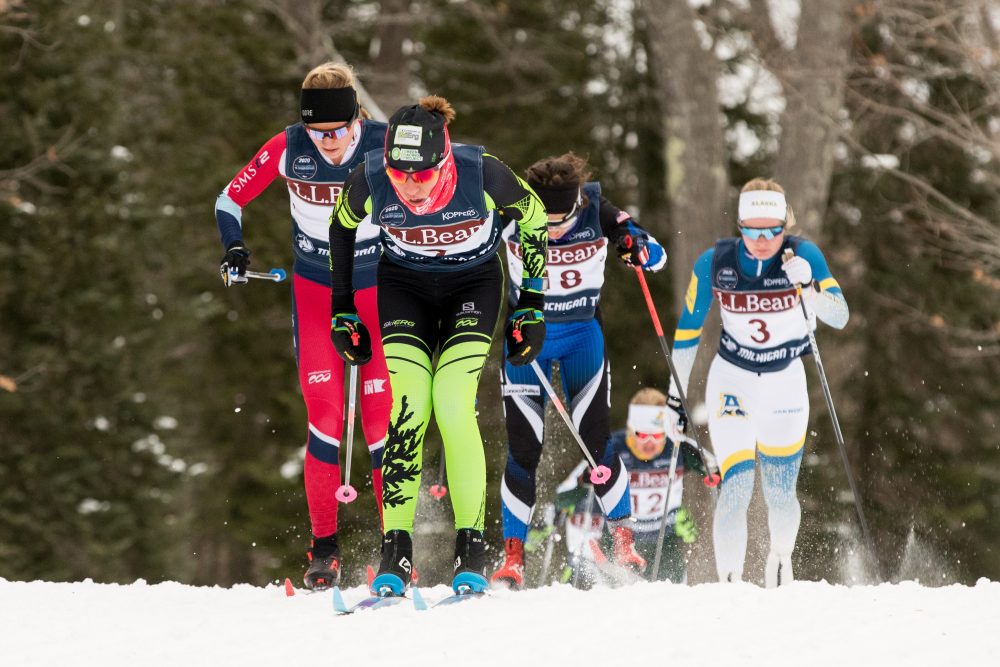
    From juniors to collegiate to masters, racers ascended Whiteface during the 2021 Climb to the Castle. (Photo: Nancie Battaglia/NYSEF)

    Ethan Townsend, Saint Lawrence University’s (SLU) head nordic ski coach, planned a training weekend for his team. SLU athletes also roller skied the new loop at Mount van Hoevenberg on Friday.

    “Saturday morning, we got up early and did a run/hike” said Townsend. “They had the option of going up Algonquin or Wright or Marcy. A lot of them took the option of going up Marcy. A few of them went up Phelps and Tabletop. Probably an average of five hours.” 

    Mount Marcy is the highest Adirondack mountain at 5,344 feet and Algonquin, the second highest, stands at 5,114 feet. The remaining peaks named are also among the 46 Adirondack High Peaks, which are all above 4000 feet. 

    After coming out of the woods, the SLU team reconvened for an afternoon double pole roller ski session.

    “We weren’t concerned about performance, necessarily, in this race,” Townsend said. “It’s a training race. Something to do as a group. I told them, ‘Don’t worry about the results so much.  It’s great that we can come here and do this. If you just stay in level three the whole time and you’re not feeling it to go super hard, I think that alone would be worthwhile.’”

    You can find more footage of the 2021 Climb to the Castle on NENSA’s YouTube channel.
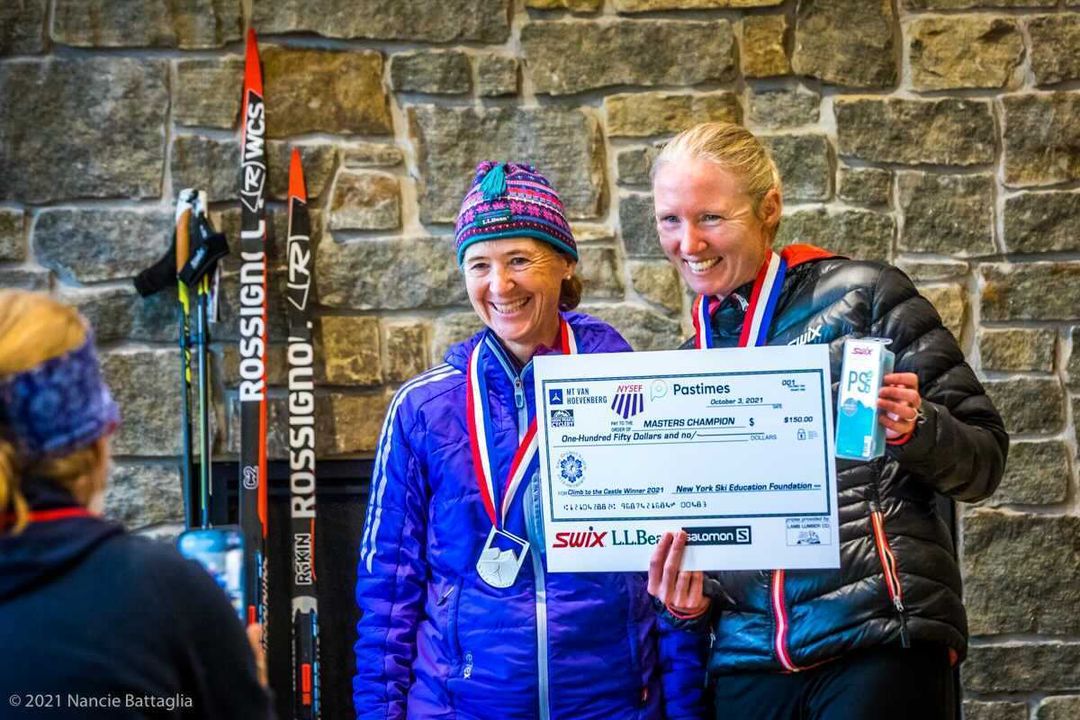
    From Juniors to Collegiate to Masters; a broad scope of rollerskiers ascended Whiteface during the 2021 Climb to the Castle. (Photo: Nancie Battaglia)

    Women’s complete results

    Men’s complete results

  • Craftsbury Green Racing Project Races to the Top of Vermont

    Craftsbury Green Racing Project Races to the Top of Vermont

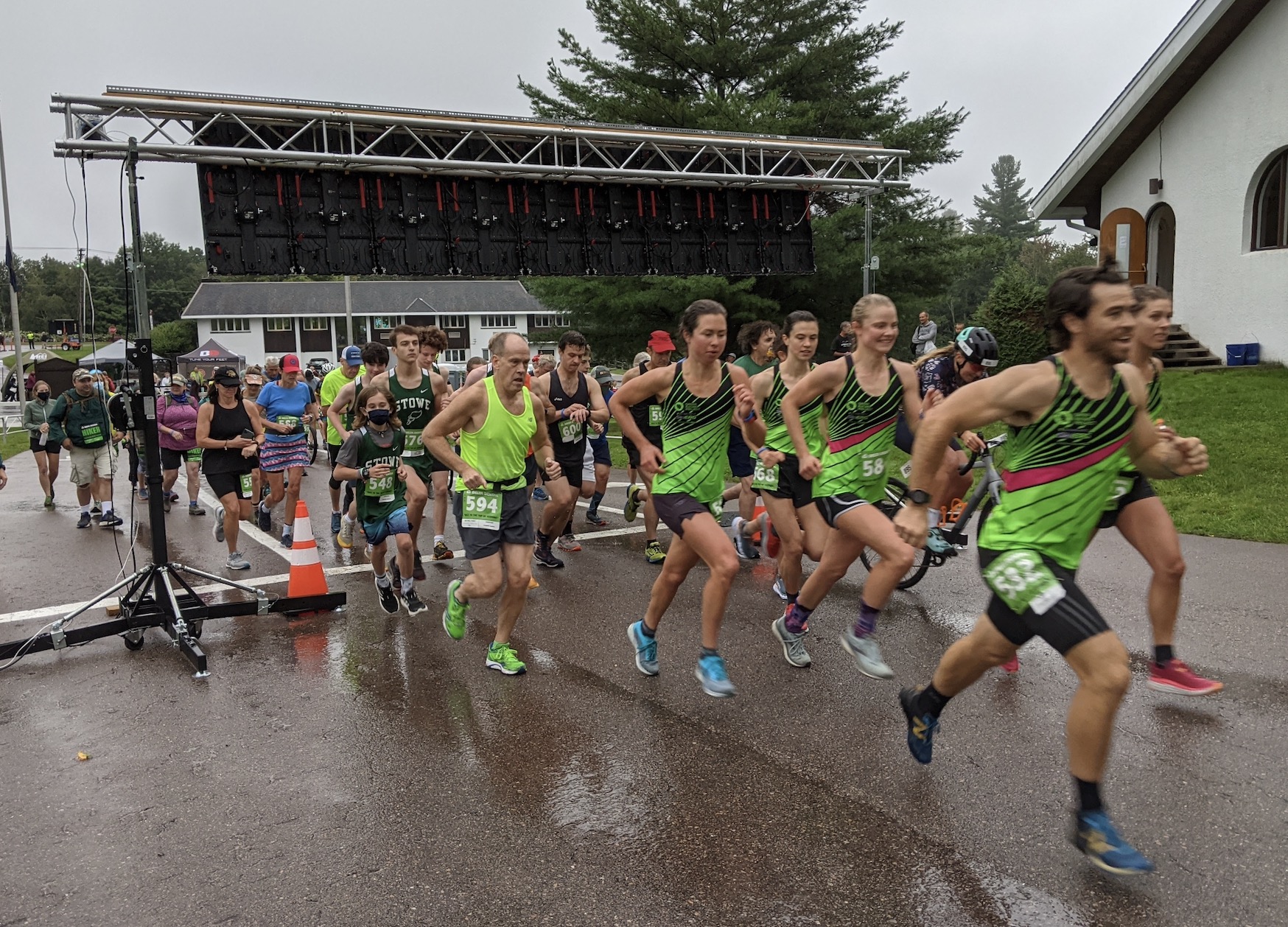
    Racers take off to climb the Mount Mansfield service road in the 2021 Race to the Top of Vermont. (Courtesy photo)

    Under gray skies, runners and bikers lined up on Sunday, August 29th in Stowe, VT, to “Race to the Top of Vermont.” The 4.3 mile race climbs over 2,500 vertical feet up the  Mt. Mansfield Toll Road at roughly an 11% average grade, this year finishing inside a cloud with wind whipping the finish line flagging. The event drew in nearly 300 participants with 215 runners taking on the focal challenge of making their way up the mountain on foot. The event is a fundraiser for the Catamount Trail Association (CTA), which maintains a 300 mile long backcountry ski trail through the heart of Vermont, from the Massachusetts border to the south and ending on the Canadian border at its northern end. 

    According to CTA events director Greg Maino,  “[The CTA] focuses on developing backcountry ski terrain, conservation in the state of Vermont, and increasing access to the outdoors for everyone.”

    Topping the results list were several members of the Craftsbury Green Racing Project (GRP), including winners Adam Martin and Caitlin Patterson. FasterSkier connected with Martin and Patterson via email as they prepared to travel across the pond to spend time on snow. 

    Martin expressed that his summer training has been “going great”. Crossing the line as the first runner to the top — he was beaten by just one cyclist — Martin stopped the clock at 34:11.5, nine seconds off his fastest time. In his email, he explained how this race fits into his ski training regimen.

    Adam Martin breaks the tape (and stops his watch) at Race to the Top of Vermont. (Photo: Granite State Race Services)

    This year my big focus is on prioritizing intensity workouts, and so far, I think my body has been responding well. We’re planning on heading to Germany [to get on snow in] the Oberhof ski tunnel this week, so last week I backed off a bit ahead of the race and upcoming travel. Across the GRP, I think we were all coming in at varying levels of fatigue.”
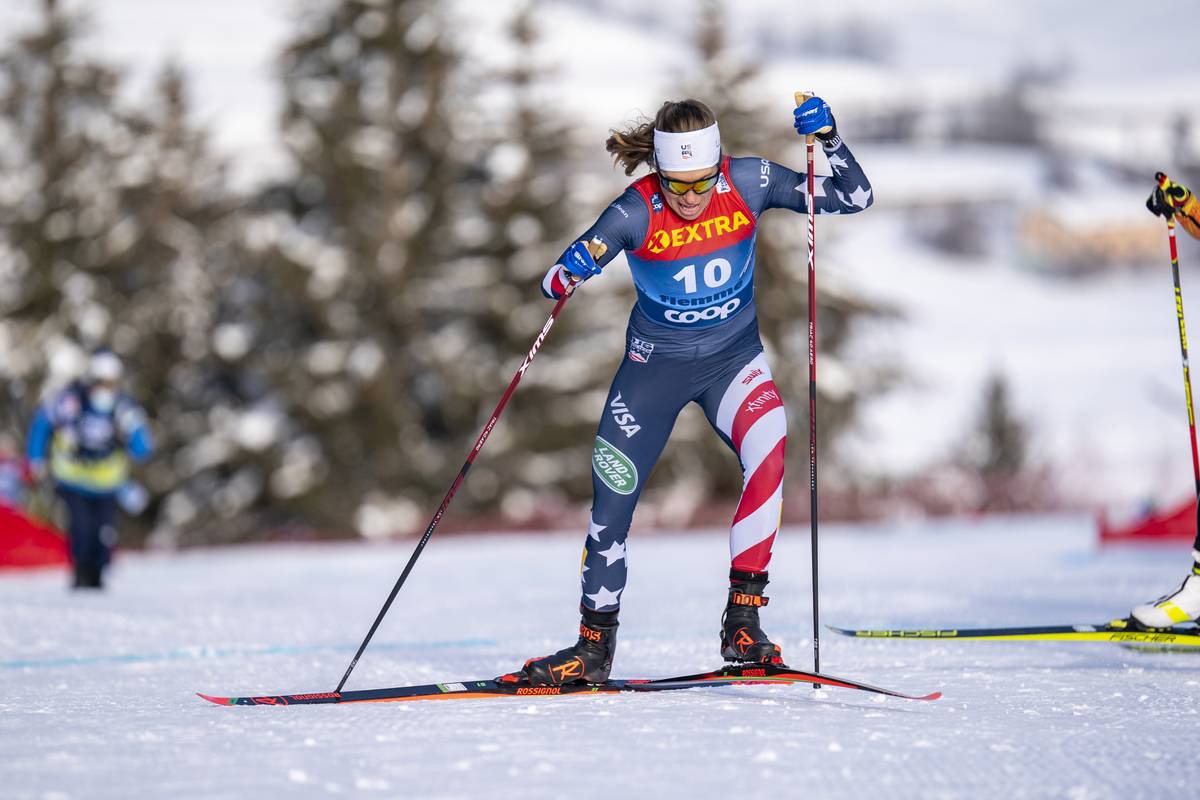
    It’s no secret that Martin has got some wheels. He’s got a 1:06:18 half marathon PR (5:03 per mile), and caught our eye for running a 14:34 5k in 2019 (4:41 per mile). While uphill is a different ballgame for some runners, ski training lends itself well to the challenge. 

    “Sunday the race was great – and hard. Early on I broke away from the rest of the field and tried to embrace the grind for the remaining 30+ minutes of the race. I really like this event, specifically how it’s a huge climb on an easy running surface, and I’m really happy to come away with the win.”

    All five of the men of Crafsbury landed in the top-eight, with biathlete Raleigh Goessling taking third (37:10), Luke Brown fourth (37:45), Akeo Maifeld-Carucci seventh (38:28), and Carsen Campbell eight (39:14).


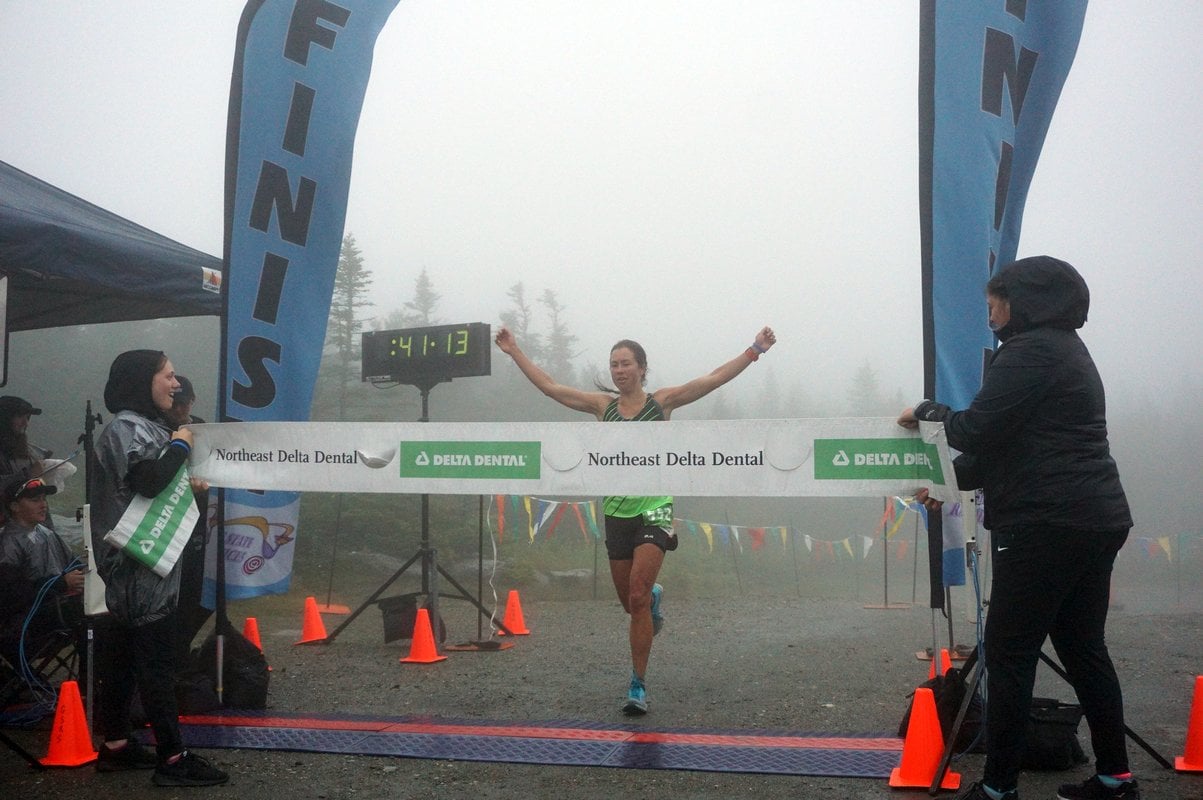
    Caitlin Patterson takes the win at Race to the Top of Vermont. (Photo: Granite State Race Services)

    Female cross country skiers have a history of breaking the tape at this event. Queen of the hill climb, Liz Stephen holds the course record of 37:15.9 set in 2014. This year, Patterson set a new personal best of 41:14 for tenth place overall.
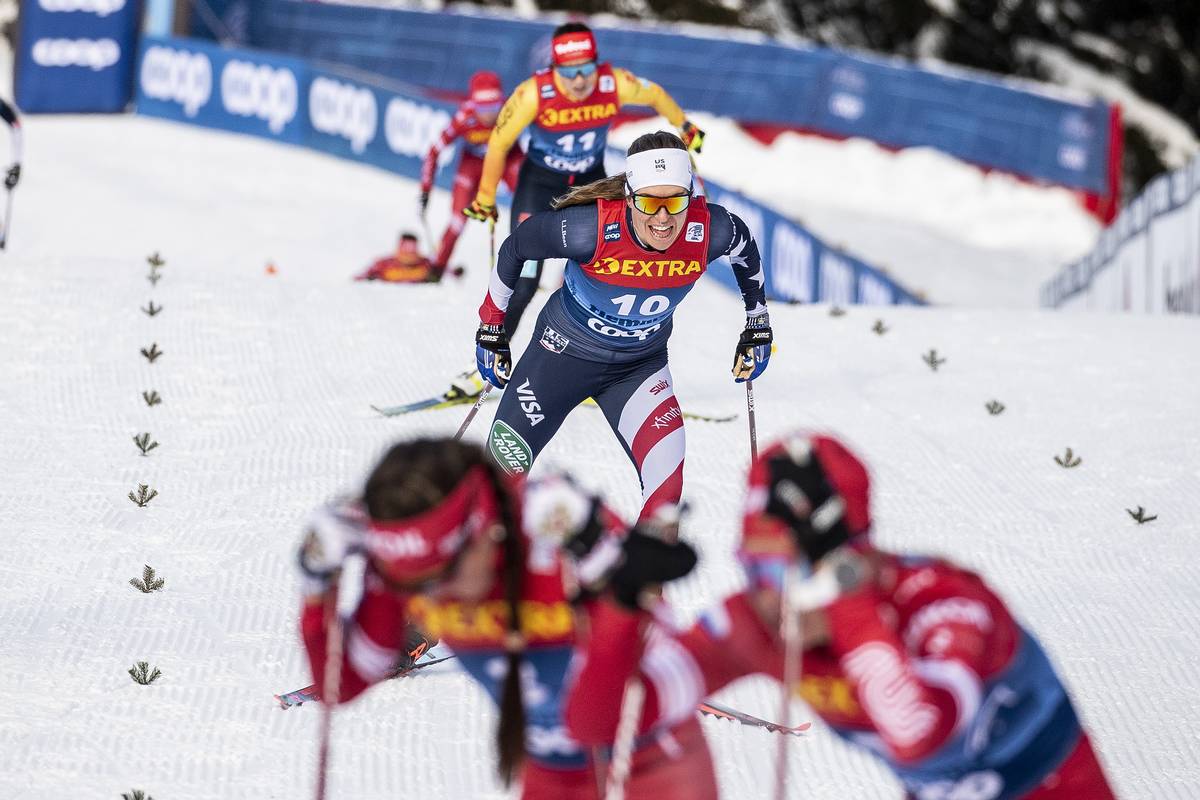
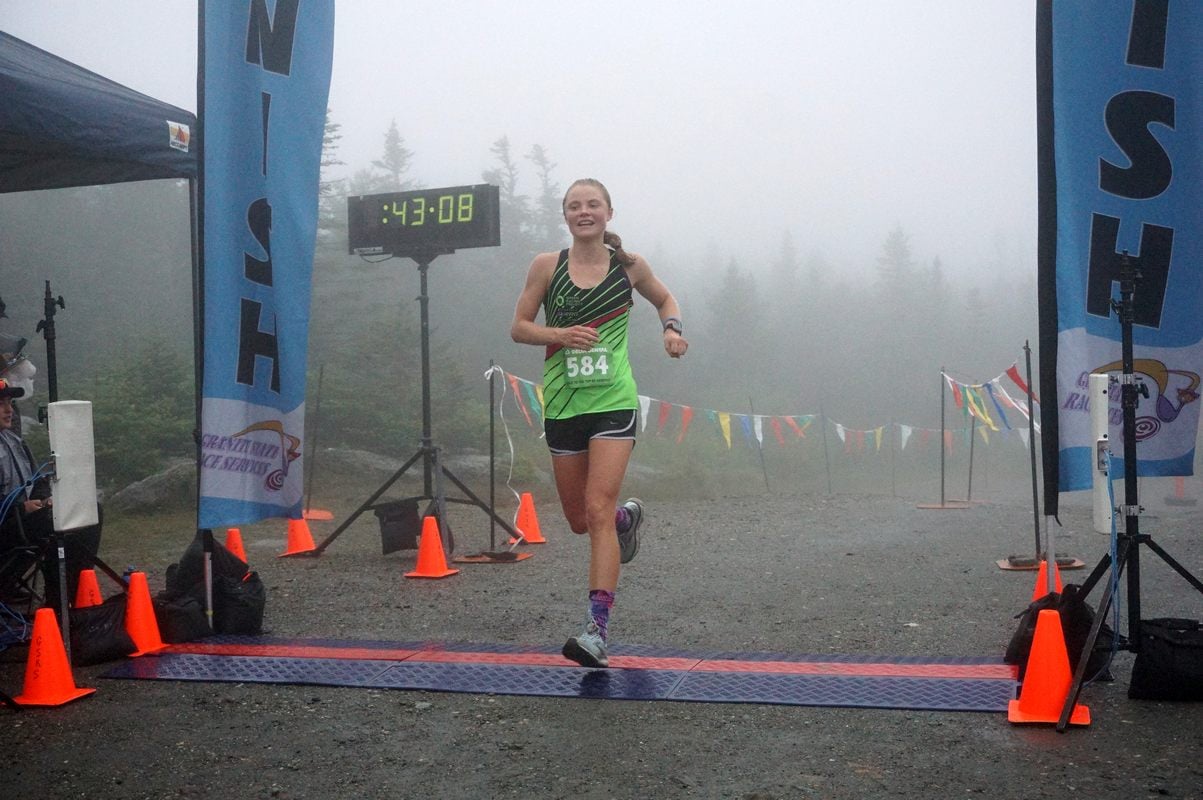
    Making a clean sweep for Crafsbury, Alex Lawson took second place in 41:42, with Margie Freed following for third in 43:09. Both women are new to the GRP this season after graduating from Middlebury College and the University of Vermont, respectively. 
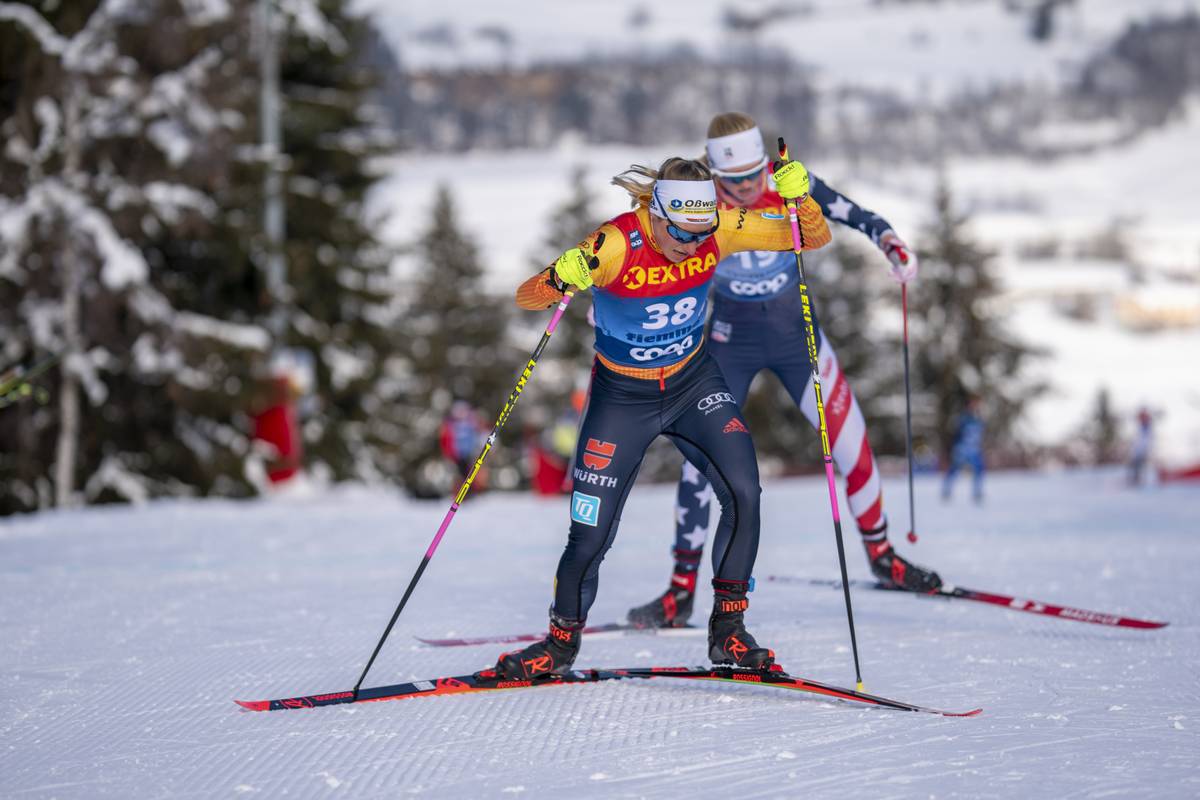
    Hallie Grossman took fourth in 45:25, and Annuka Landis rounded out the GRP results in sixth 47:23.

    Margie Freed finishes third at Race to the Top of Vermont. (Photo: Granite State Race Services)

    “Race to the Top of VT is always a fun one, and I’ve done it enough past years that it’s a bit like a fitness-check time trial for me,” wrote Patterson after the race. “I was looking forward to it as a hard effort and chance to put on a bib – I’d hoped to have done some running races earlier in the summer, but I strained a tendon in my foot in July so have hardly run at all during August. Of course I’ve been doing plenty of other ski training and all of that is going well, but I was very pleased with the Race to the Top, to win it and to run a fast time. In fact this year was my fastest time ever, helped I’m sure by the nice cool misty weather conditions.”

    Patterson also sent the following comment about her racing strategy, which she initially shared with a local newspaper covering the event. 

    “Alex and I ran together for at least the first 3 miles, and she was really strong today too. We’ve been doing running workouts together for our ski training and I had an idea that Alex would be fast today. So we ran together for much of the race, and then I very gradually pulled ahead in the last mile or 1.5 miles or so, but Alex was not far back at all. In an uphill race like this, I think we were just enjoying the company in suffering, keeping moving, but not doing anything drastic. My race strategy was basically just to run smooth and efficiently, to breathe well, and be ready to dig in and make it hurt especially towards the top. So I was pleased with how the race went and I enjoyed running with Alex while it lasted because otherwise I did not see many people at all.”


  • Norway Returns with Gusto, Sweeping the Women’s Podium in the 7.5/7.5 K Skiathlon; Diggins 5th

    Norway Returns with Gusto, Sweeping the Women’s Podium in the 7.5/7.5 K Skiathlon; Diggins 5th

    Same as it ever was – Therese Johaug with the off the front win. (Photo: NirdicFocus).

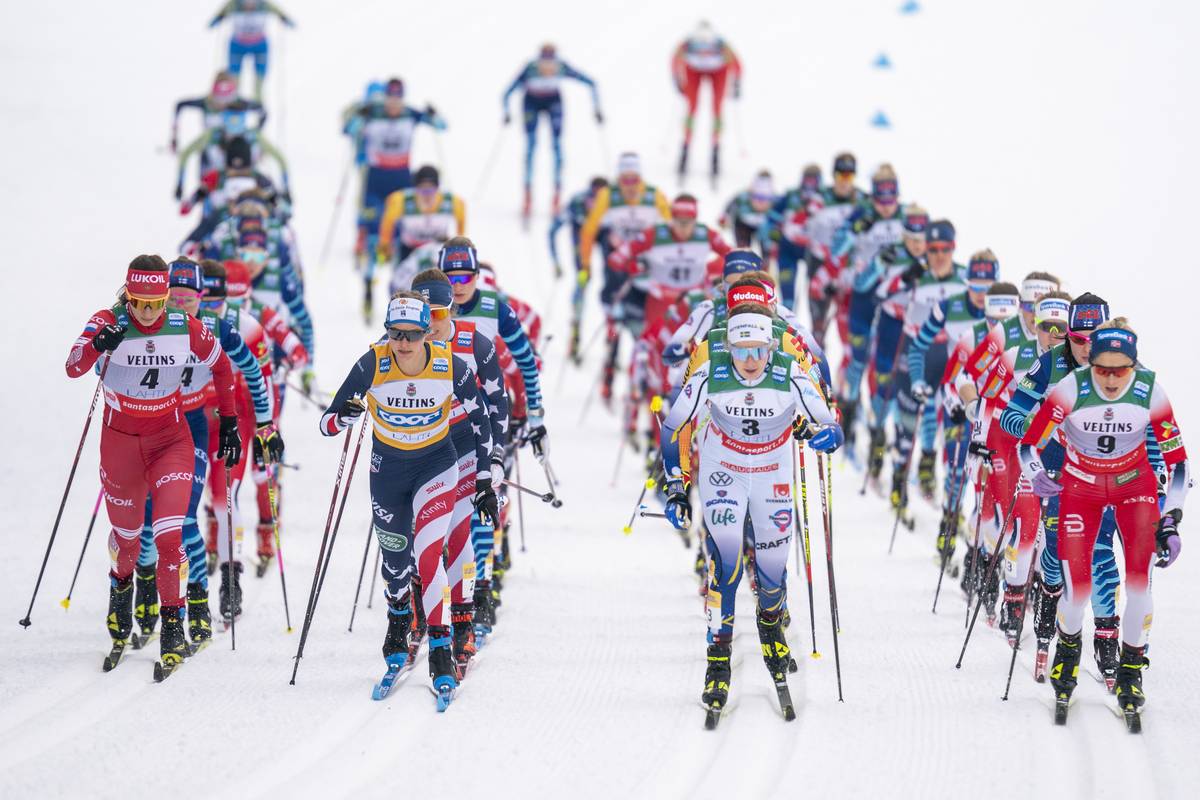
    In case you missed the discussion on the Devon Kershaw podcast, the Norwegian team made its World Cup return today in Lahti, Finland after nearly two months of training and competing domestically. As predicted, neither their form nor racing gears have not been from this decision. The women in red went 1-2-3 in the 7.5/7.5-kilometer skiathlon, led by powerhouse Therese Johaug who notched her third consecutive win in the event and third career skiathlon win on the tracks in Lahti. Her total of nine career skiathlon wins is a women’s record, surpassing Johaug’s former teammate and one of the most decorated skiers of all time, Marit Bjørgen.

    In her usual style, Johaug took command from the start, skiing away from the pack displaying remarkable precision in her technique and metronomic tempo, stopping the clock at 37:45.1.

    Therese Johaug drives the pace during the classic leg of the Lahti skiathlon. (Photo: NordicFocus)

    As has been remarked before, with the lack of spectators and commentary overlaying the live stream, it’s hard not to be struck by the intensity of the athletes’ breathing. As they kicked, glided, and skated six laps of the 2.5 k course, their lungs pumped at a rate and effort that seemed impossible to sustain. Yes, Johaug had a gap to the chasers from early on, but like the others, her rapid breathing made it abundantly clear that she did not simply walk away with the victory.

    “It was so fun to be on the World Cup again,” Johaug told FIS after the finish. “It has been a long time since I was in Kuusamo [for the opening World Cup races in Ruka, FIN], so it’s really good to race here and see all the people in the cross country family again.”

    Unlike the teams coming off a two-week break following the Tour de Ski, the Norwegian squad made a quick turnaround from their National Championships, which wrapped up just five days ago in Trondheim. Today’s skiathlon is the second this week that Johaug has raced and won. In fact, with only minimal rearrangement for the second and third spots, the podiums in the two events were identical.

    The women’s 15 k skiathlon podium in Lahti, Finland: Helene Marie Fossesholm (NOR) second, Therese Johaug (NOR) first, and Heidi Weng (NOR) third, (l-r). (Photo: NordicFocus)

    “My shape has been really good, now and the last weekend. Today, I know that I was starting in the line, so I knew to take it a little bit easy in the first lap and then go hard from the second and the third. I felt really strong today, and of course, I had to do all the job alone, and especially then, it’s really good to stand on top of the podium.”

    Norway’s Heidi Weng and  Helene Marie Fosseholm – lead the chasers during the skiathlon in Lahti, Finland. (Photo: NordicFocus)

    Perhaps the more interesting race to watch unfold happened behind Johaug. When the Norwegian began to pull away in her second classic lap, a small chase pack emerged in her wake, containing Russia’s Natalia Nepryaeva, Sweden’s Ebba Anderson, and Jessie Diggins in stars, stripes, and the yellow overall World Cup leader bib. Diggins striding was strong and confident, as she tucked in behind the other two racers, entering the exchange zone at 7.5 k on their tails and smoothly switching into her skate skis and poles. 

    The eventual second and third-place finishers, Helene Marie Fossesholm of Norway followed by teammate Heidi Weng apex a corner during the skate leg. (Photo: NordicFocus)

    As the first skate lap unfolded, Norway’s Helene Marie Fosseholm and Heidi Weng began to ski off the front of the second group of chasers, which contained names like Olympic champion in the Skiathlon Charlotte Kalla of Sweden and bronze medalist Krista Pärmäkoski of Finland. Wearing the red World Cup distance leader bib, Rosie Brennan also sat comfortably in this group.

    Though only 29-years-old, Weng is a veteran compared to Fosseholm, who is only 19. Her results this season indicate she is a name to get to know; she finished 6th overall in the Ruka Triple, and proceeded to earn four podiums during her subsequent time racing on home turf, including a Johaug-like victory in the 10 k skate last week during the Norwegian National Championships, winning by a margin of over 30 seconds. Johaug did not contest this event. 

    By the 10 k mark, Fosseholm and Weng had caught the group of Andersson, Nepryaeva, and Diggins. The Russian began to fall off the pace, but Diggins was not about to follow suit. The women skated as a unit through the next lap, never separated by more than a second or two. 

    Jessie Diggins (USA) skiing behind Sweden’s Ebba Andersson and Russia’s Natalia Nepryaeva on Saturday’s 15 k skiathlon in Lahti, Finland. (Photo: NordicFocus)
    Jessie Diggins (USA) at the ski exchange 7.5 k into the women’s skiathlon alongside Ebba Andersson of Sweden and Natalia Nepryaeva of Russia. (Photo: NordicFocus)

    As they left the stadium for their final lap, Fosseholm made a surge, testing her mettle against her more seasoned pursuers. With just over a kilometer to go, she had nearly a seven-second gap, which dissolved much faster than it was formed. 

    Andersson, Weng, and Diggins powered through the back half of the lap, steadily closing in on Fosseholm. Aerial shots showed the women charging up the final climb, still able to jump skate after nearly 40 minutes of exertion. They V2’ed over the top of the climb, all cylinders firing as they dropped back toward the stadium, around a couple of tight curves and toward the lanes.

    Fosseholm could be seen taking nervous glances over her shoulder, knowing the other women had zeroed in their sights and there was no room for error. Luckily for Fosseholm, she had maintained enough real estate to enter the lanes with a clear path to second place (+28.1).

    Behind her, it was still anyone’s game. Weng was first into the lanes, but Andersson was by her side and charging, Diggins just behind. With a furious throw of boots at the line, Weng snagged the third spot on the podium (+29.6) with Andersson centimeters behind in fourth (+29.7) and Diggins in 5th (+30.1). 

    Yellow bibbed Jessie Diggins double poles during the first leg of the 7.5 k / 7.5 k skiathlon. (Photo: NordicFocus)

    In a post race interview, Diggins shared insights into the conditions in Lahti and how bomber kick on klister allowed her to ski what she identifies as one of her best classic races on the World Cup. With suboptimal glide in skate, Diggins had to shift her tactics so she could stay in the draft of those in front of her and ultimately left a final slingshot around Andersson and Weng to fight for the podium just out of reach. 

    “I was excited to dare greatly and try to stay with Johaug as long as possible, just to see and to really push it… In the skate half, it was nice to have those girls to work with. I had to keep adjusting my strategy as I realized how our glide stacked up to their glide. I had to keep changing it around, and I played the only card I had, tactically speaking. It didn’t really work, but it was the only thing I could do in the situation that I was in. I was really proud of that and I think I skied as smart of a race as possible.”

    Jessie Diggins leaves everything on the course to finish 5th in the 15-kilometer skiathlon in Lahti, Finland. (Photo: NordicFocus)

    Diggins also discussed the team recovery camp in Seiser Alm, Italy, how she manages the balance of increased media attention with training and recovery and her desire to support meaningful causes like the Emily Program, and how “new blood” on the World Cup squad re-energizes the veteran members of the American team.

    Maintaining her position in the second group of chasers, Brennan skied to 11th place (+1:07.6), ending her race just ahead of Kerttu Niskanen in a photo finish.  

    In focus and red bibbed as the World Cups leading distance skier, Rosie Brennan near the start of the 15 k skiathlon in Lahti, Finland. (Photo: NordicFocus)

    It’s always hard to know how the body is going to bounce back from an event like the Tour de Ski,” wrote Brennan in an email after the race. “As a result, I decided to start controlled and then see what I had when I switched to skating. I felt much stronger in classic than I have all season and as a result maybe should have been more aggressive in the classic leg, but hindsight is always 20/20. After the transition to skate, my muscles struggled a bit, but I found better movements and strength as the skate portion went on. There wasn’t much space to move in the skate portion and I feel I missed some moves that I shouldn’t have, but had a strong final climb to move up a bit. In all, I feel this race was a really good step in the right direction for me as I am now focused on preparation for the World Championships.”

    Rosie Brennan finishes strong in the chase pack for 11th place in the 15-kilometer skiathlon in Lahti, Finland. (Photo: NordicFocus)

    A quick look to the overall World Cup ranks. With today’s results, Diggins remains at the top of the overall leaderboard with 991 points and also ties Brennan for the top spot in the distance standings with 401 points. Brennan remains in second place overall with 824 points, followed by Russia’s Yulia Stupak with 802 points. 

    In her first World Cup start, Sophia Laukli (USA) skis to 33rd in the Lahti, Finland skiathlon. (Photo: NordicFocus)

    Also for the U.S., Sophia Laukli in her first World Cup start raced to 33rd (+3:54.8). Laukli is a member of the US Cross Country D-Team and is a sophomore at Middlebury College in Vermont. Caitlin Patterson was the next American in 37th (+4:33.8), Julia Kern 40th (+6:31.3), and Alayna Sonnesyn 43rd (+6:41.1). Forty-eight skiers finished the race. 

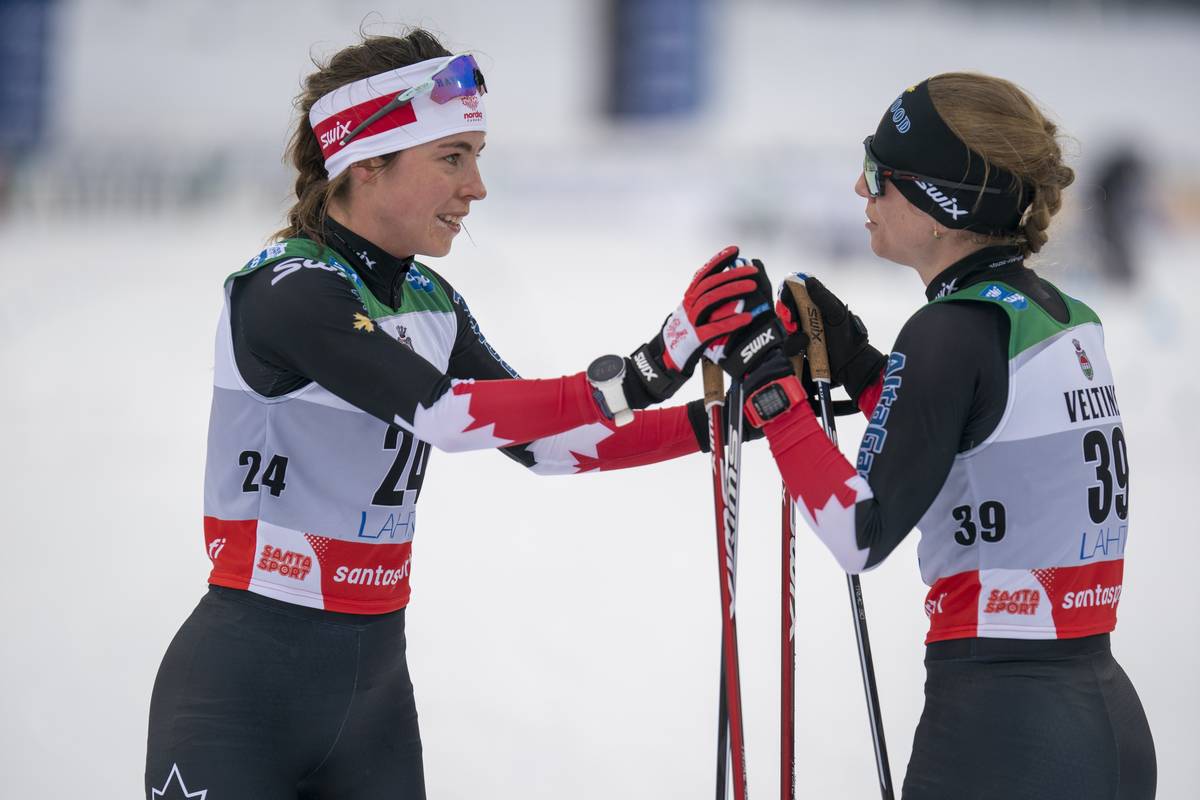
    This was Canada’s first World Cup appearance this season. Two athletes scored points, Katherine Stewart-Jones in 24th (+3:23.5) and Cendrine Browne in 27th (+3:44.9). Laura Leclair skied to 44th (+6:41.7).

    Katherine Stewart-Jones (CAN) and Cendrine Browne (CAN) (right) at the finish of the 15 k skiathlon. (Photo: NordicFocus) – FIS world cup cross-country, skiathlon women, Lahti (FIN). www.nordicfocus.com. © Vianney THIBAUT/NordicFocus. Every downloaded picture is fee-liable.

    7.5/7.5-kilometer Skiathlon Results  

    World Cup Standings: Overall | Distance 

  • Diggins Becomes the First North American to Win the Tour de Ski

    Diggins Becomes the First North American to Win the Tour de Ski

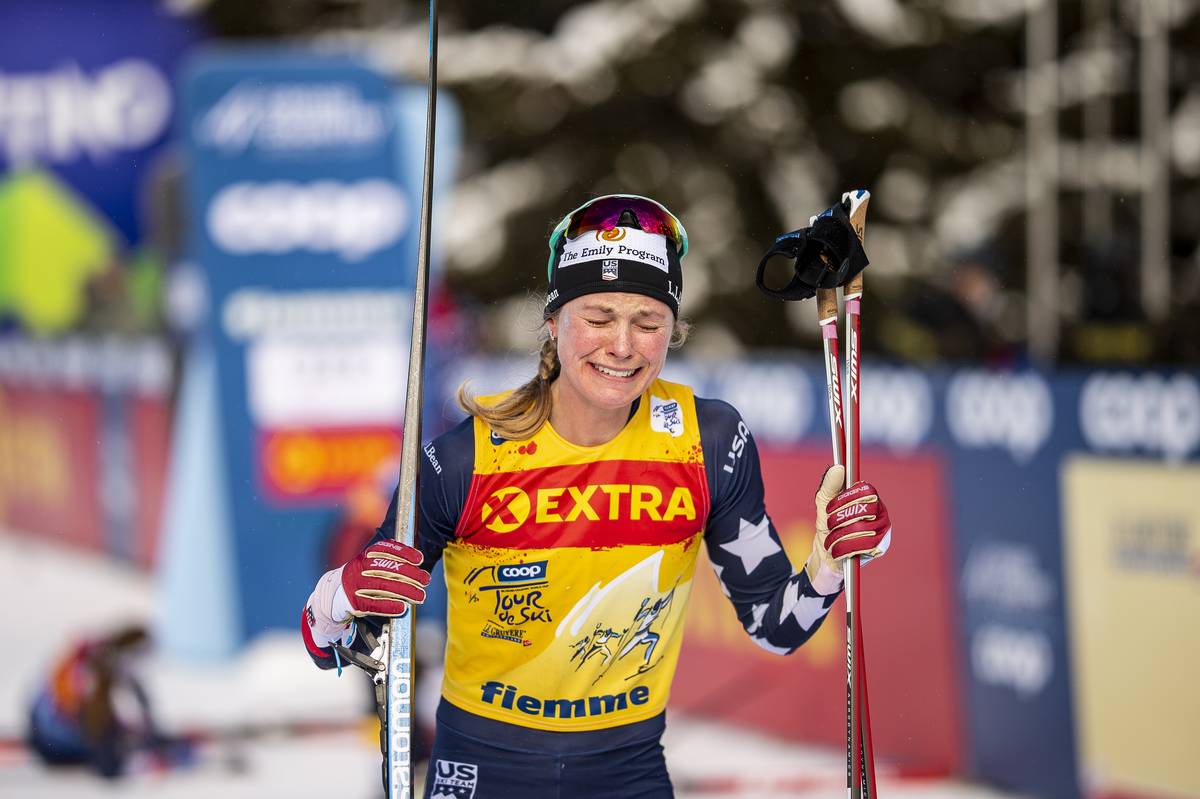
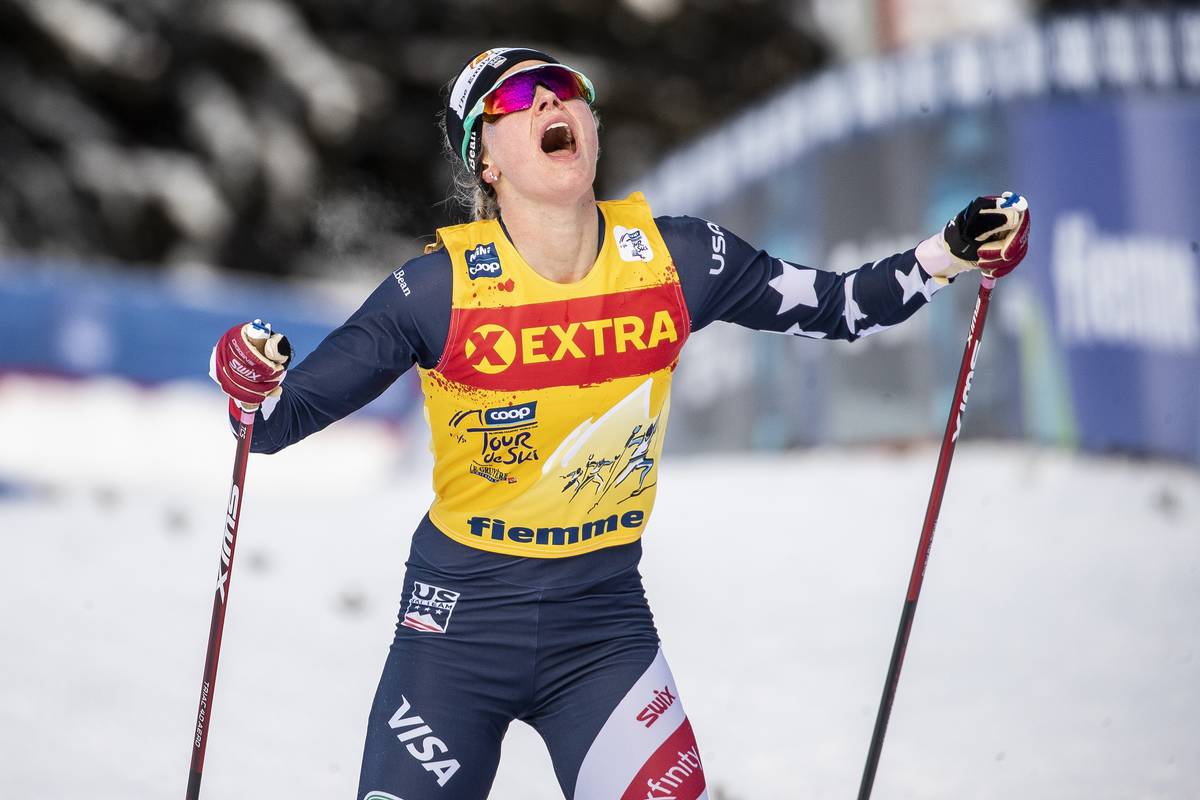
    Raw emotion as Jessie Diggins becomes the first North American to win the overall Tour de Ski. (Photo: NordicFocus)

    This World Cup coverage is made possible through the generous support of Marty and Kathy Hall and their A Hall Mark of Excellence Award. To learn more about A Hall Mark of Excellence Award or to learn how you can support FasterSkier’s coverage please contact info@fasterskier.com.

    Though Devon Kershaw might fairly say “It’s not really cross country skiing,” as a viewer, the grueling climb up the Alpe Cermis is the crown jewel of the Tour de Ski. Sure, it is both impressive and visually appealing to watch beautiful technique and tactical racing, but there is nothing quite like watching racers toil through the lactic burn of grinding their way 400 meters up a ski area, at times with over 40% grade. Wheels come off, gaps close quickly, anything can happen. 

    Here’s how today shook out.

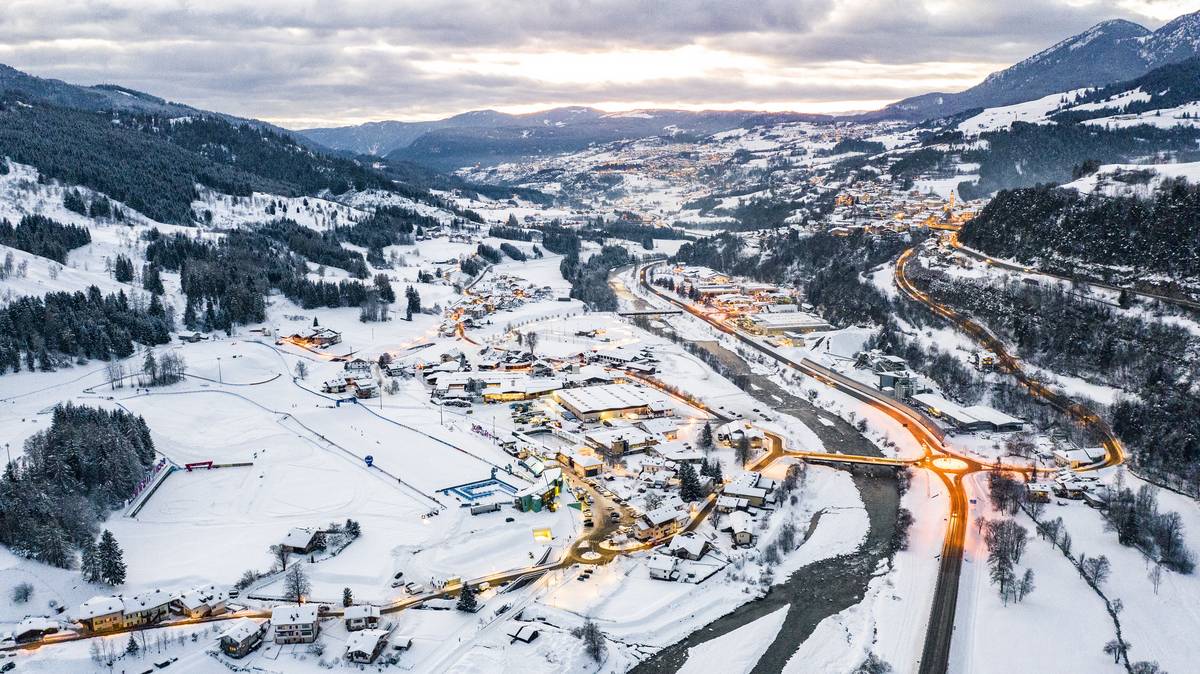
    After nearly 50 kilometers of racing over seven stages, skiers take to the tracks one last time in Val di Fiemme, first for a lap of the sprint course, then soaring along the river banks along the narrow winding track of the Marcialonga, Italy’s WorldLoppet series classic. And, as camera angles altered from shots of the Swedes that set pace down the valley, controlling the narrative from the front while still conserving energy for the climb over the final 2k, to breathtaking aerial views of the frosted valley, it is clear why Marcialonga organizers refer to Val di Fiemme as a “Italian cradle of cross-country skiing”.

    An aerial view of the storied venue in Val di Fiemme, Italy. (Photo: NordicFocus)

    After a thrilling set of four podium finishes, including back-to-back distance wins in Toblach, all eyes were on Jessie Diggins. She entered the final stage wearing the yellow bib with a lead of 55 seconds in the overall standings. Given the beastly nature of the climb, this time margin certainly did not indicate that Diggins had her first Tour de Ski win in the bag. 

    To add to the energy, two sprint opportunities for bonus points were available at the 2.5 and 6.6 k checkpoints, this alternate leaderboard adding interest and incentive for sprinters to remain in the Tour.

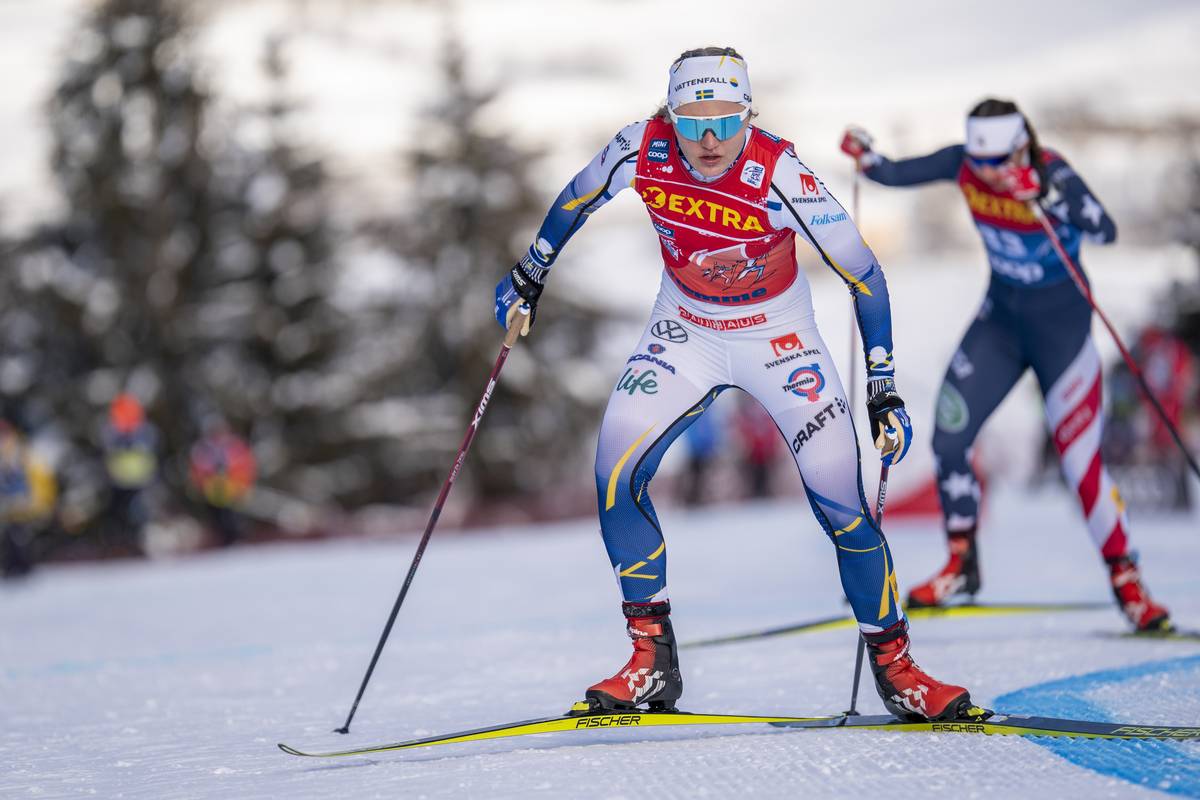
    Linn Svahn on the Alpe Cermis- she helped pace Andersson early in the stage and won three stages in this edition of the Tour. (Photo: NordicFocus)

    Point leader and winner of both sprint stages, Sweden’s Linn Svahn charged off the front of the pack at the 2.5 k mark, collecting 15 bonus points with her teammate Ebba Andersson hot on her tails. The two quickly allowed the pack to close the nearly 4-second gap, but Andersson remained at the front, pulling away to create a gap of over 10 seconds at the 6.6 k mark, which she kept as the grade inclined. 

    Perhaps trying to lure Diggins to push too hard too soon, perhaps she had her eye on the TdS podium, or perhaps just looking to be the queen of the hill and win her first World Cup, it was clear that Andersson wanted to dictate the pace from the front in the back half of the mass start event.

    Sweden’s Ebba Andersson takes the stage win, and placed third overall in the Tour. (Photo: NirdicFocus)

    Andersson was the epitome of steady as she worked her way up the climb. She could V2 when the grade was humane, and smoothly transitioned between her V1 and the “coach’s skate” required to keep skis gliding on the steepest pitches. 

    While the Swede remained composed, Diggins displayed the grit and perseverance for which she is beloved as a racer. Though Andersson was more than two minutes back in cumulative time heading into the final stage and the remainder of the field behind her, Diggins left nothing to chance, giving her all as she pushed every meter. Holding her ground, the American kept her time back on the leader even and tight, hovering around nine seconds throughout the climb. 

    Like everyone, even Diggins rides the struggle bus up the Alpe Cermis. Diggins, however, motored to a Tour de Ski overall win on Sunday. (Photo: NordicFocus)
    Jessie Diggins racing to second on the stage and first overall in the Tour de Ski atop the Alpe Cermis. (Photo: NordicFocus)

    With less than a kilometer to go, head coach Matt Whitcomb cheered from a switchback as Diggins passed, his excited shouts leaving him nearly as breathless as the athletes. Pine boughs tucked into the snow to create the final lanes as Andersson and Diggins headed toward the inflated arch that offered relief from the pain in their bodies. 

    Ebba Andersson (SWE) chugging along in front for the Stage 8 win. (Photo: NordicFocus)

    With the end in sight, Andersson with a poker face V2’ed through the finish while a slack-jawed Diggins held together in V1 to cross the final meters and collapse over the finish line. 

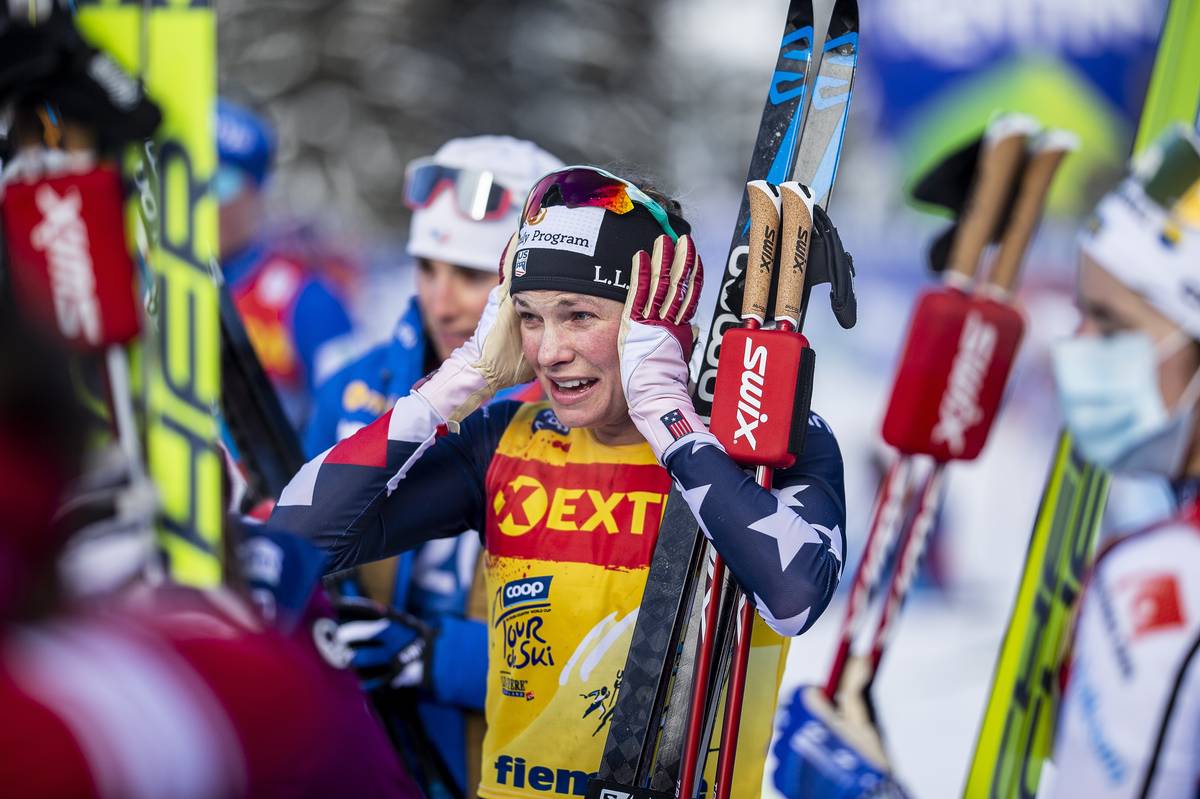
    Finally, the Tour de Ski victory was hers and she could simply lie in the snow, chest rising and falling with her labored gasps for air. More than a win, this achievement makes Diggins the first American — in fact, the first non-European — man or woman winner in the 15-year history of the Tour. She also sits atop the leaderboard for Overall World Cup standings

    Victory and relief, Jessie Diggins completes the climb up the Alpe Cermis to win the overall 2021 Tour de Ski. (Photo: NordicFocus)
    Exhausted, Jessie Diggins crosses the line second in the stage to hold onto her lead in the overall Tour de Ski. (Photo: NordicFocus)

    “This was a lifelong goal,” Diggins told FIS after her race. “We had an amazing team atmosphere this whole time, and amazing support and help, and so many cheers from around the world — it really gave me wings up the hill today.”

    The interviewer asked what this result meant in light of a World Championship season, as completing the arduous Tour in such a year could be seen as a risk. If an athlete cannot recover properly in the subsequent six weeks, their potential on the championship stage could be compromised. Diggins’ answer looked through a wide-angle lens. 

    “It means so much. I think it’s so cool for our country to show that it’s possible. And now I’m looking forward to resting.”

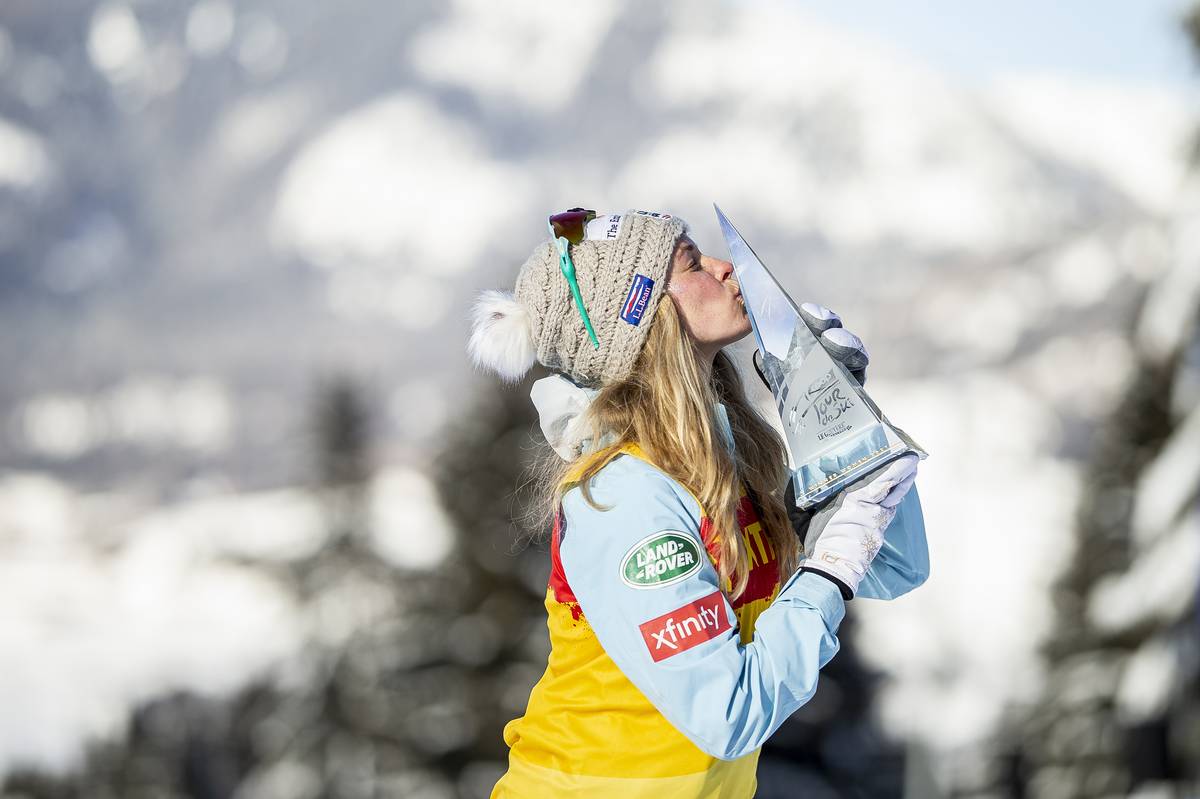
    Jessie Diggins wins the overall 2021 Tour de Ski and sits at the top of the overall World Cup standings. (Photo: NordicFocus)
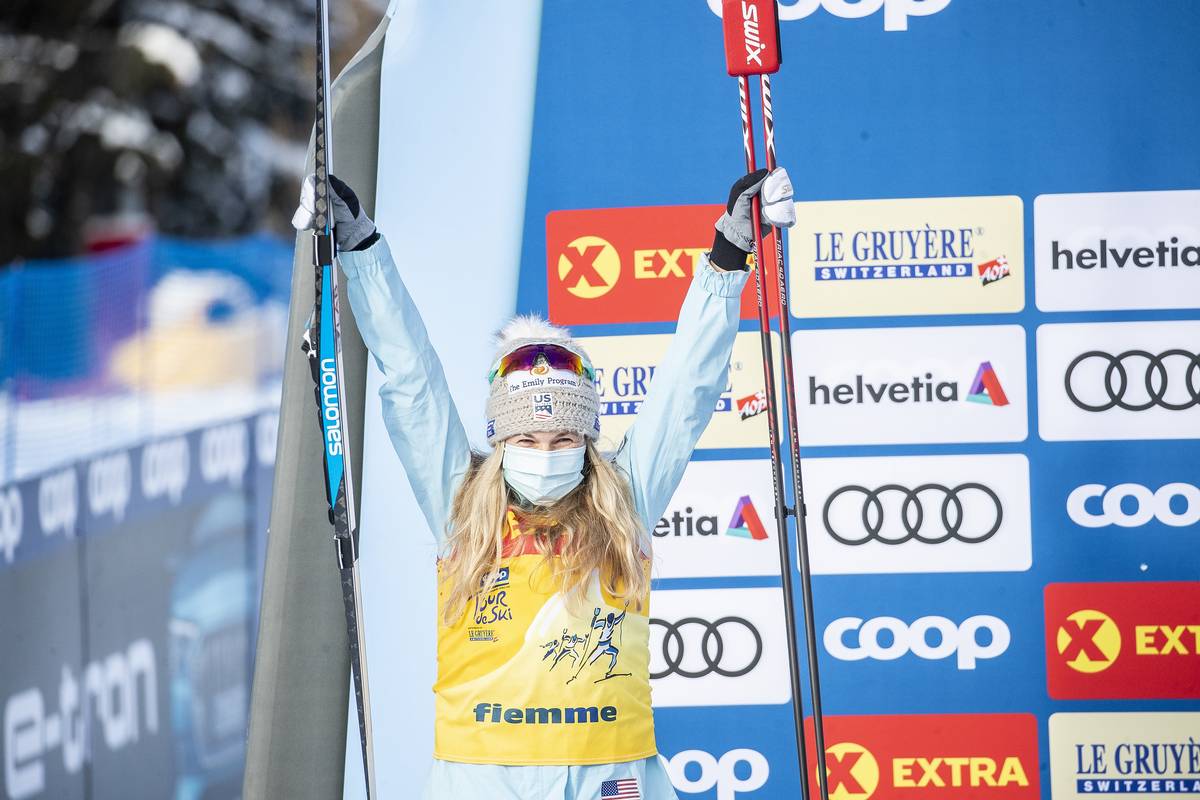
    On the top step of the podium, Jessie Diggins is the 2021 Tour de Ski winner. (Photo: NordicFocus)
    Jessie Diggins becomes the first North American skier to win the Tour de Ski in its 15 year history. (Photo: NordicFocus)

    Behind the two leaders, France’s Delphine Claudel crossed the line in 3rd (+32.6). Evidencing the “anything can happen on the Alpe Cermis” sentiment, Claudel sat in 19th in the overall standings leading into the final stage and had never before earned a World Cup podium, though she was 7th in the 10 k skate in Stage 4. The 24-year-old overtook Russia’s Yulia Stupak in the final kilometer, closing a 12 second gap and creating a nearly 8 second one of her own. 

    Stupak held on for 4th place (+40.0), followed after a gap by teammate Tatiana Sorina (+1:04.3) rounding out the top five.

    Yulia Stupak of Russia here on the Alpe Cermis, placed second overall in the Tour. She won two stages, and podiumed in four others. (Photo: NordicFocus)

    With this result, Stupak held her ground in second place for the overall TdS standings, finishing 1:24.8 behind Diggins in cumulative time. Andersson’s outstanding climb was a springboard, advancing her from 6th to 3rd (+2:00.8). Recall that Andersson did not make the heats in Stage 1 of the Tour and finished 12th and 18th, respectively, in the second and third stages. Landing on the podium four times in the final five stages fueled her steady rise through the ranks.

    Today’s queen of the Alpe Cermis, Sweden’s Ebba Anderson set the fastest time in the final stage of the 2021 Tour de Ski. (Photo: NordicFocus)
    A good day for Sweden, Ebba Andersson wins Stage 8 of the Tour de Ski to finish 3rd overall, while Linn Svahn takes home the victory in the point standings. (Photo: NordicFocus)

    Adding reason for Swedish team celebration, Svahn was the winner in the point totals, with Diggins in second and Slovenia’s Anamarija Lampic in third.

    Rosie Brennan, here in the Alpe Cermis, animated this Tour and finishes a career best 6th overall. (Photo: NordicFocus)

    Closing out a career best finish in the Tour de Ski, Rosie Brennan was the 7th woman up the hill (+1:17.8) to finish 6th in the overall standings. Brennan’s previous best finishes in the TdS overall were 15th last season and 24th the season prior. 

    “I love the final climb because of its simplicity and the feeling of accomplishment of reaching the top,” wrote Brennan in an email after the race. “I knew there was an opportunity to make up some places today so I set out with intention. Unfortunately, I stuck a tip in the powder on the side of the trail on the Marcialonga portion leading into the climb and took another digger. Luckily, I didn’t lose much time, but was then at the back of the pack and knew that if I was going to make the most of the climb, I needed to be ready for the breaks as soon as we hit the bottom. I worked really hard to make up the places that I could and then really went for it when we reached the climb to try to get into the leading group. It was my only option at the time, but definitely took a little more energy than I had hoped. I had a moment of weakness when I hit the first steep pitch and lost the ride I needed to take. I was able to recollect myself and hold strong, but frustratingly missed top 5 by a mere 4 seconds. 6th place is absolutely a career best and I am proud of my effort of fighting back after the disaster that was stage 6, but I always want more of myself and those 4 seconds certainly sting a bit.”

    The end in sight, Rosie Brennan finishes 7th in the hill climb and 6th in the overall Tour de Ski. (Photo: NordicFocus)

    “It was inspiring to watch Jessie put so much fight in every day and that certainly inspires me to find more,” Brennan continued. “I couldn’t think of a better person to take the yellow bib off my back. I am also really excited to hold onto the red [World Cup distance leader] bib! The Tour de Ski is always a new experience and always requires a lot of fight. I am thankful to have been able to race the event this year and am really looking forward to some recovery!”

    Antonia Fraebel (GER) and Hailey Swirbul (USA) behind, during Stage 8. (Photo: NordicFocus)

    Hailey Swirbul skied the 15th fastest time today, bumping her up to 18th in the overall Tour standings. The 22-year-old is in good company with this result, considering the only other American women to finish in the top-20 of the Tour de Ski are Jessie Diggins, Kikkan Randall, Rosie Brennan, Sadie Maubet Bjornsen, and Liz Stephen. 

    Hailey Swirbul, another American high point, placed 15th on the day and 18th overall. (Photo: NordicFocus)

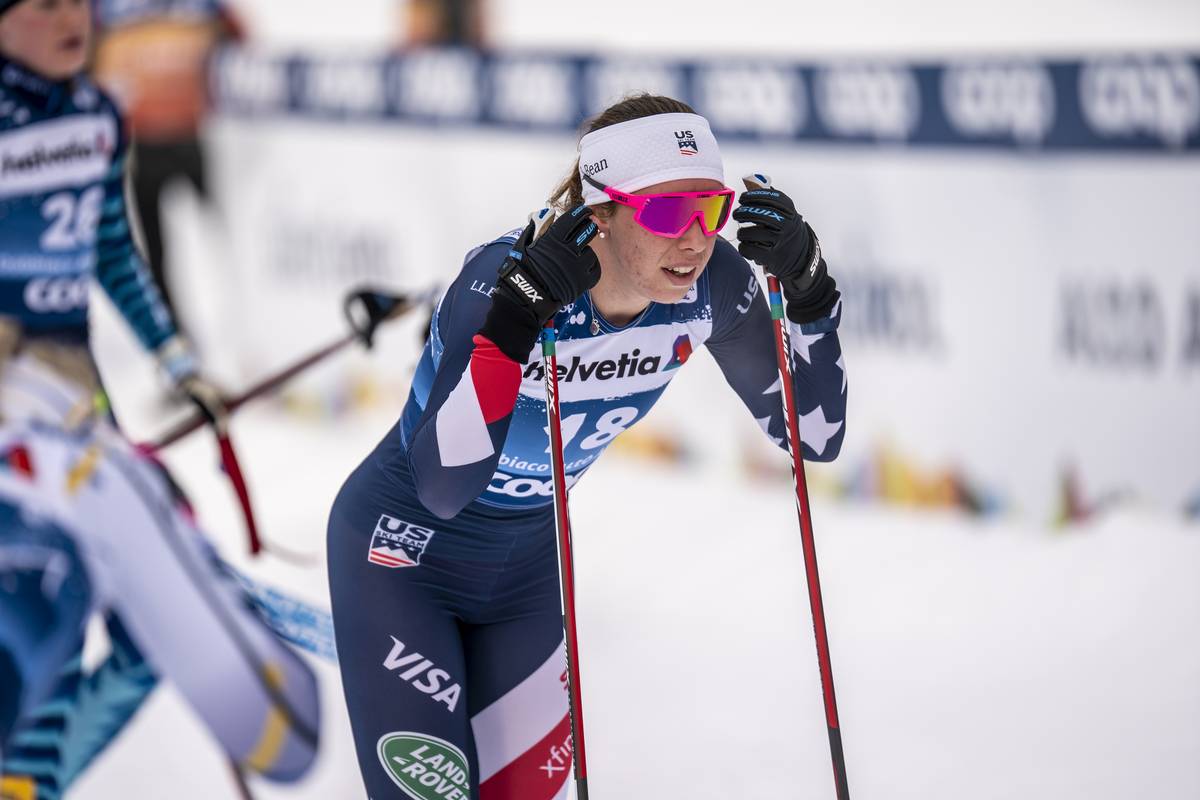
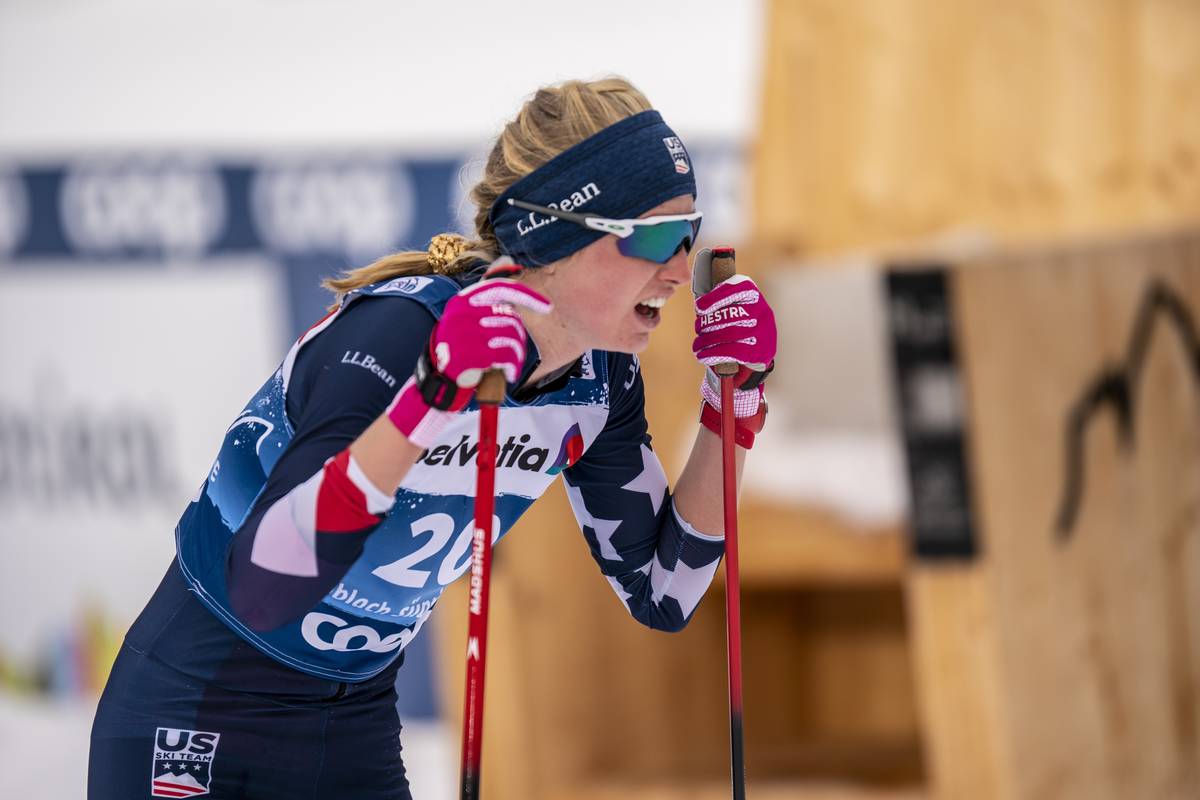
    Katharine Ogden finished 24th (+2:34.5) up the climb for 23rd overall in the Tour, while Caitlin Patterson rounded out the Americans in the top-30 finishing 27th (+2:42.9) in Stage 8. Patterson was 34th in the overall TdS standings. 

    Katharine Ogden V1-grinding on the Stage 8 final climb. (Photo: NordicFocus)
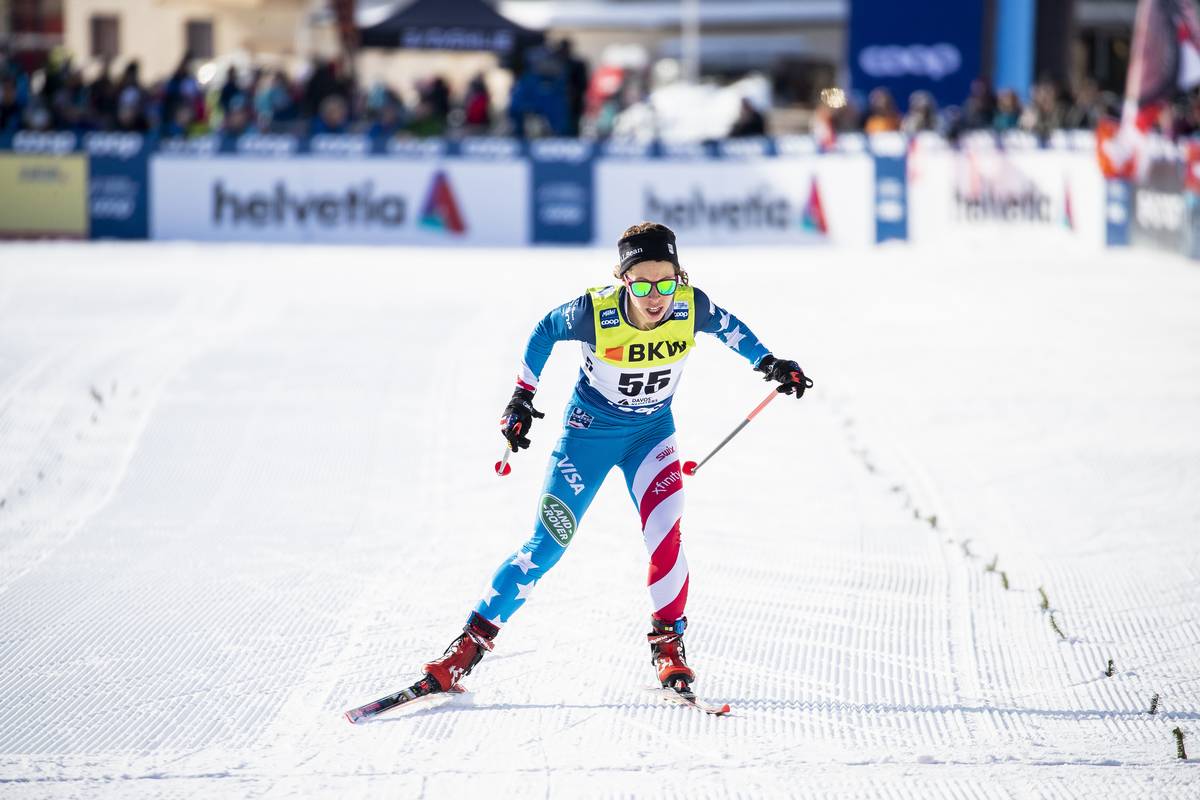
    Caitlin Patterson climbs to 27th in the final stage of the 2021 Tour de Ski. (Photo: NordicFocus)

    Finally, Julia Kern skied to 37th today (+3:41.3) to end the Tour in 38th.

    Gavin Kentch contributed

    This story will be updated with additional comments from athletes when available.

    Stage 8 Final Results 

    Overall Tour de Ski: Cumulative Time | Point Standings

    https://www.youtube.com/watch?v=pXmh3OqBkY8&fbclid=IwAR3YUhS8-zkT0FlOzaCutt6X44Ax8IPLlH9JDyFR2YkuK_FVhWq28WkTf64


  • Stupak and Andersson Overtake the Americans to Keep the TdS Tight; Diggins 3rd, Brennan 4th

    Stupak and Andersson Overtake the Americans to Keep the TdS Tight; Diggins 3rd, Brennan 4th

    Eyes on the clock, the leaders prepare for a 10-kilometer pursuit start classic race in Stage 5 of the Tour de Ski. (Photo: NordicFocus)

    This World Cup coverage is made possible through the generous support of Marty and Kathy Hall and their A Hall Mark of Excellence Award. To learn more about A Hall Mark of Excellence Award or to learn how you can support FasterSkier’s coverage please contact info@fasterskier.com.

    We have entered the back half of the 2021 Tour de Ski. With five of eight races complete, roughly 45 kilometers raced and a little under 25 remaining, fatigue has set in. While it might be easy to think the storylines are set, in such a grueling feat of endurance, nothing is certain. Crashes happen, wax is blown, recovery compromised. 

    Whereas Jessie Diggins and Rosie Brennan had the advantage of chasing splits in yesterday’s individual start freestyle, in today’s pursuit start classic the hunters became the hunted. The women took to the course in Toblach, Italy in order based on their results in Stage 4, with their chasers starting behind with the deficit they attained only from the previous day’s race. This put Diggins first out of the gate with Brennan 15 seconds back, Sweden’s Ebba Andersson +22, Russia’s Yulia Stupak +26 and Finland’s Krista Pärmäkoski rounding out the top five starters +31 back. (Start list)

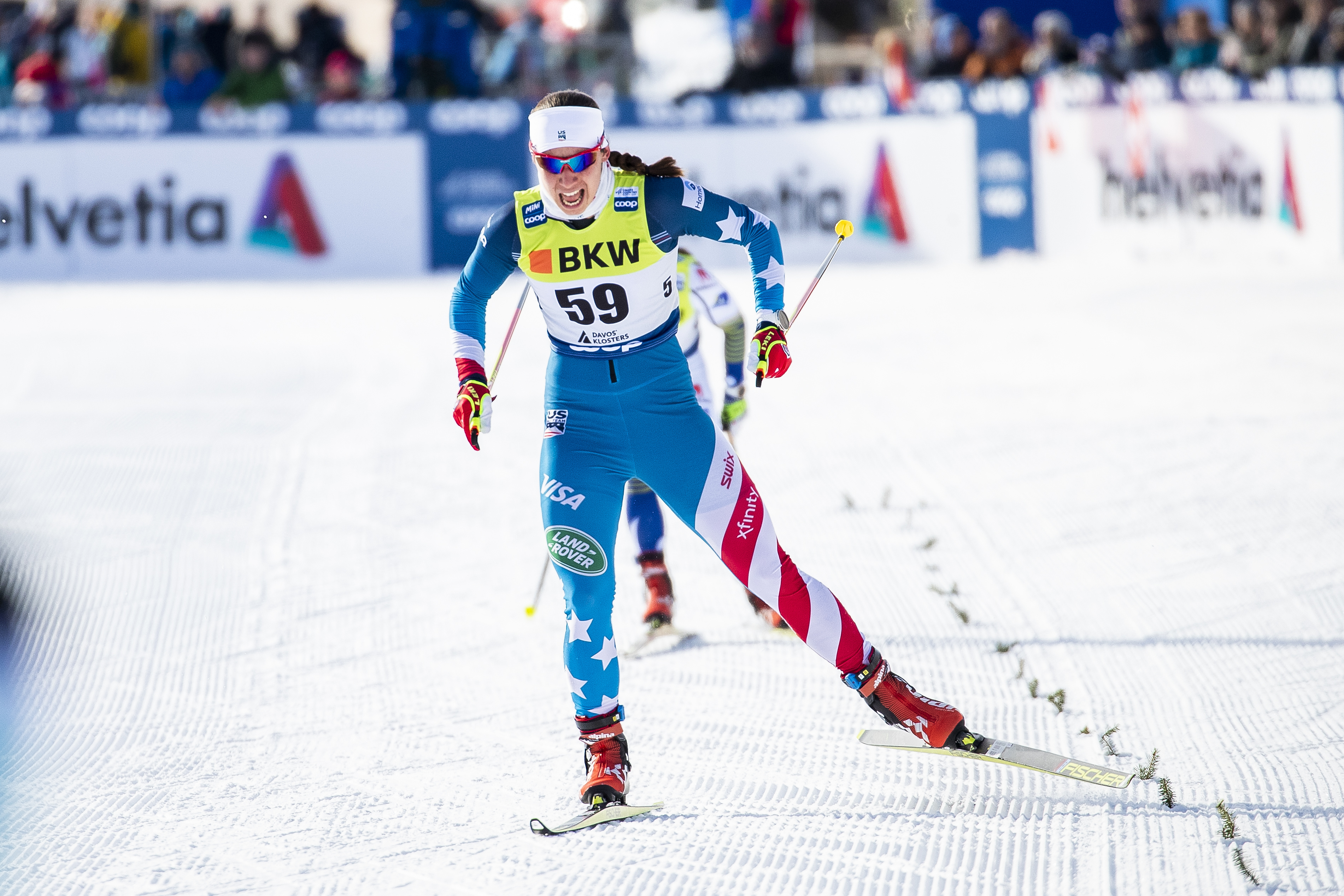
    Striding away from the stadium with a target on her back, Jessie Diggins is the first athlete on course during Stage 5 of the 2021 Tour de Ski, a pursuit start 10-kilometer classic. (Photo: NordicFocus)

    Her yellow bib like a target on her back, Diggins set out solo with her usual high tempo. Behind her, Brennan was chased by the charging duo of Stupak and Andersson, who caught her by roughly 3k. Brennan hopped onto their tails as the group worked their way toward Diggins. 

    As head coach Matt Whitcomb predicted in his interview after Stage 4, conditions near freezing made for icy and glazed tracks which led through a variety of sun exposures, meaning athletes could kick up some hills in the tracks, but had to hop out and run to make it up others. In summation: it makes things a little funky out there. 

    Perhaps this was what caused Diggins to fall just before the 4 k mark. The crash was relatively minor and she was able to quickly bounce back upright, however, it gave the chasing threesome the opportunity to catch and pass the leader. 

    Stupak and Andersson seemed to try to capitalize on the opportunity, surging as they skied smooth and strong up the subsequent climb with Brennan and Diggins hanging on in their wake. 

    Russia’s Yulia Stupak charges ahead for the win in Stage 5 of the 2021 Tour de Ski. (Photo: NordicFocus)

    Try as they might, the two could not quite lose the Americans, who matched every push to prevent gaps from forming. Living up to her reputation, Diggins worked the downhills in the final kilometers making up for any small amounts of space between her skis and those in front of her that were created on the climbs. 

    In the final rolling climbs before descending into the stadium, Diggins found a new gear, overtaking Andersson and challenging Stupak for the lead. Coming into the lanes, Stupak’s double pole could not be matched, allowing her to pull ahead by a ski length while Diggins and Andersson fought side-by-side to the line for a photo finish. It was determined that Andersson edged out the American by centimeters, Sweden in second (+0.7) and USA in third (+0.8).

    The leading trio: Julia Stupak, Ebba Andersson, and Jessie Diggins enter the finish-straight. (Photo: NordicFocus)
    Down to the final meters, the top three women — Yulia Stupak (RUS), Ebba Andersson (SWE), and Jessie Diggins — fight for position in Stage 5 of the 2021 Tour de Ski. (Photo: NordicFocus)
    Yulia Stupak of Russia with the win, as Ebba Andersson (SWE) and Jessie Diggins (USA) lunge for the line. (Photo: NordicFocus)

    “So proud of our techs for the skis they made us in tricky warm conditions today!” wrote Diggins in an email after the race. “Wow, that was a tough fight out there. I was really proud of myself for hanging tough and just gritting it out until the end! It was a good test of mental toughness for me after a little fall and getting caught to be able to refocus, stay calm and ski as smart and smooth as I could! It was really important for me to stay with those girls today in terms of overall tour time, and I was just able to hang in there. Super pumped for our team and for another good classic race!”

    Fighting hard through another strong 10-kilometer classic performance, Jessie Diggins takes third in Stage 5 of the 2021 Tour de Ski in Toblach, Italy. (Photo: NordicFocus)
    After a string of podiums in the Tour de Ski, Jessie Diggins is rich with cheese, flowers, and a variety of regionally-significant memorabilia. (Photo: NordicFocus)

    After falling back from the leaders in the final k, Brennan held on for fourth place (+17.3). 

    “Today was a very tough fight,” wrote Brennan in an email to news outlets. “My goal was to lose as little time as possible and then see what I had in me. I went out hard hoping I could find Jessie to ski with but got caught before I found Jessie. It’s the kind of course that is much easier to draft so once we got caught, it was nice to settle in a bit, however, the pace was still high. I fought as best I could but couldn’t keep contact over the top of the big hill. I fought as hard as I could to regain contact but it’s just so much faster in a pack. I fought with all I had today and am proud of that and happy to maintain second in the overall tour.”

    Fighting the clock for a solo finish, Rosie Brennan takes 4th in Stage 5 of the 2021 Tour de Ski. (Photo: NordicFocus)

    Working together throughout the day, Finland’s Pärmäkoski and Russia’s Tatiana Sorina skied to a strong fifth (+37.3) and sixth (+38.3), respectively. 

    The women’s podium of the 10-kilometer pursuit start classic of Stage 5 of the 2021 Tour de Ski in Toblach, Italy. Russia’s Yulia Stupak took the win ahead of Sweden’s Ebba Anderson in second and Jessie Diggins in third. (Photo: NordicFocus)

    Though margins for the overall TdS standings were narrowed as her win streak came to an end, Diggins remains in possession of the yellow bib with a cumulative time of 1:54.15. Brennan holds strong in second place (+22), with Stupak in third (+58), overtaking Sweden’s Frida Karlsson who was a favorite for the win.

    Frida Karlsson drops to 13th after the Stage 5 of the 2021 TdS, a 10-kilometer pursuit start classic in Toblach, Italy. (Photo: NordicFocus)
    Frida Karlsson, struggling with a tailbone injury sustained from a dislodged pull-up bar, finishes 13th in Stage 5 of the Tour de Ski, sliding back to 4th in the overall standings. (Photo: NordicFocus)

    It is unclear whether Karlsson will be able to lodge a counterattack on her seemingly increasing deficit. FasterSkier learned that in an unfortunate accident involving a pull-up bar that let loose from the door frame it was affixed to, the 21-year-old sustained an injury to her tailbone and leg. According to an interview with Swedish news outlet Expressen, Karlsson was not sure whether she would race in Stage 4, let alone finish the tour. This may explain her fall from podium contender to 9th place in the 10 k skate and 13th (+1:20.1) in today’s classic pursuit. Karlsson holds onto fourth place in the overall (+1:29), with Stupak in 5th (+1:53). (This incident is also discussed in The Devon Kershaw Podcast from Stage 4.)

    Consistently demonstrating her talent and fitness, Katharine Odgen finishes 20th in Stage 5 of the 2021 Tour de Ski. (Photo: NordicFocus)
    Steadying herself on her poles, Hailey Swirbul finishes Stage 5 of the 2021 in 22nd with a string of consistent distance results. (Photo: NordicFocus)

    Further into the pack, Katharine Ogden and Hailey Swirbul skied to 20th (+2:05.8) and 22nd (+2:07.5). The two started amidst a relatively dense group of ten women in the range of 1:10 to 1:36 behind Diggins. This larger chase group stayed together through much of the course with a few exceptions breaking off the front and back. Both Americans maintained their position in the body of the group, with only a handful of seconds separating a subset of six at the finish. As they were 18th and 20th in Stage 4, Ogden and Swirbul demonstrated remarkable consistency in their solid performances. 

    Wrapping things up for Team USA, Caitlin Patterson skied to 39th (+3:57.3) while Julia Kern took 41st (+4:04.3). 

    Modeling the cumulative fatigue of the Tour de Ski, Caitlin Patterson finishes 39th in Stage 5. (Photo: NordicFocus)

    Stage 5: Start List | Final Results

    Overall TdS Standings After Stage 5

  • American Women Light Up Toblach With Another Diggins-Brennan 1-2 Performance

    American Women Light Up Toblach With Another Diggins-Brennan 1-2 Performance

    Jaw drop. An aerial view of the Toblach Arena, which plays host to Stages 5 and 6 of the 2021 Tour de Ski. (Photo: NordicFocus)

    This World Cup coverage is made possible through the generous support of Marty and Kathy Hall and their A Hall Mark of Excellence Award. To learn more about A Hall Mark of Excellence Award or to learn how you can support FasterSkier’s coverage please contact info@fasterskier.com.

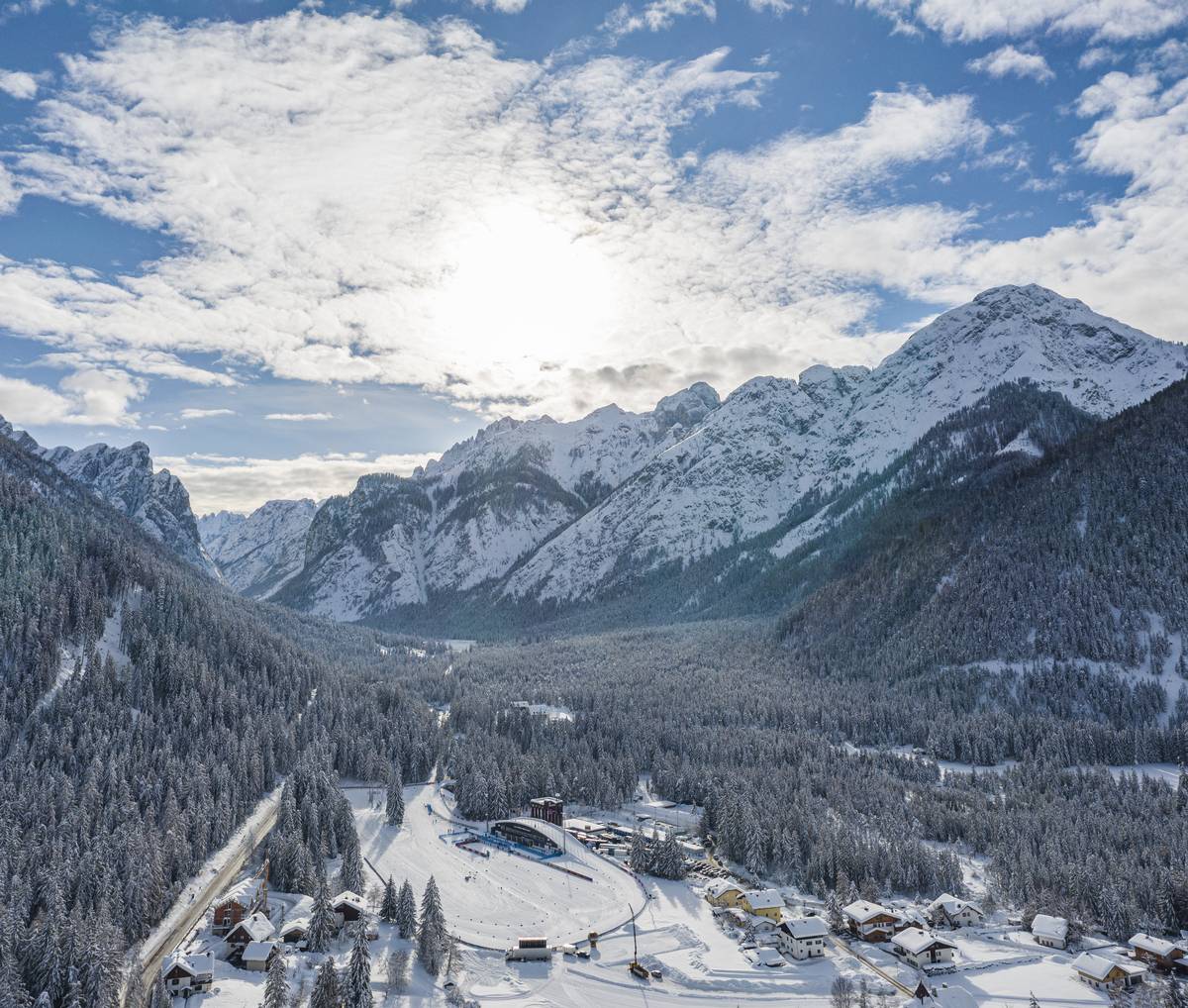
    Onward with the 2021 Tour de Ski! From the western edge of Switzerland, we’ve landed in the tiny and spectacular Italian village of Toblach. Nestled at just over 4,000 ft of elevation in the Dolomites, bluebird skies illuminated pines wrapped in snow, jagged rocky peaks, and hard pack frosty trails. It’s the kind of backdrop that might make viewers lose focus on the athletes as they stare longingly at the fairytale-esque scene. Just me?

    Entering the heart of the Tour, the storyline of individual stages and overall standings are inseparable. As athletes took to the course for today’s individual start 10-kilometer skate, the overall tour contenders focused on optimizing their time margins. Current TdS leader Jessie Diggins aimed to maintain or add to her 5 second lead over teammate Rosie Brennan, and both wanted to keep the Swedish distance star, Frida Karlsson at bay in third (+0:10). 

    Continuing her streak, Brennan dominates the course in Toblach, Italy during Stage 4 of the 2021 Tour de Ski. (Photo: NordicFocus)

    In individual start races, start position can provide two important advantages: firstly, starting behind a comparable athlete might offer the chance to close the gap and either catch a ride or work together to push through the challenging course, and secondly, coaches can feed athletes the splits of skiers who started before them, providing a ghost to chase from checkpoint to checkpoint. 

    A string of Americans starting in the last four positions were seemingly primed for these two benefits. In order wearing bibs 49 through 52 were Katharine Ogden, Julia Kern, Brennan, and Diggins.

    Katharine Ogden on her way to 18th in Stage 4 of the 2021 Tour de Ski. (Photo: NordicFocus)

    Conversely, Karlsson started in bib 24, 13 minutes ahead of Brennan. This put the Swede roughly halfway through her race with all the splits that entails as the American leaders left the start. 

    Karlsson hit it hard. When she passed the 2.1 k checkpoint at which bonus points were available, she set the bar high, stamping a time that stood unmatched at the top. That is until Diggins knocked it down and took the maximum of 15 bonus points. Let that be the first indicator of how Diggins’ day at the office would go.  

    Unfortunately for Karlsson, it also marked the beginning of a fade.

    After a strong start, Sweden’s Frida Karlsson fades to 9th in Stage 4 of the 2021 Tour de Ski. (Photo: NordicFocus)

    As this took place, yet another young Swede should catch your eye as she steadily advanced up the live timing ranks: 23-year-old Ebba Andersson. Taking charge in the second half and leading from 6.7 k onward, Andersson set the time to beat at each checkpoint, finishing in a time that was not bested until the final moments of the stage.

    Ebba Anderson climbs the leaderboard during Stage 4 of the 2021 Tour de Ski. (Photo: NordicFocus)

    And, a familiar veteran with TdS overall podium history, Krista Pärmäkoski, rose to the Stage 4 occasion. Her results have steadily improved during the tour after a disappointing start to the season since the opening weekend Ruka, Finland where she did not make the top-30 in the sprint or distance events. Along with Russian’s Yulia Stupak, who entered Stage 4 in 5th place in the standings (+0:59), and Tatiana Sorina, the top of the leaderboard jockeyed for position as they worked through the woods.  

    With results steadily on the upswing, Krista Pärmäkoski skis to fifth in Stage 4 of the 2021 Tour de Ski. (Photo: NordicFocus)

    With no spectators, it becomes perhaps even more clear just how hard these athletes are working. It’s like having a seat trailside: head coach Matt Whitcomb’s shouts of encouragement unimpeded by his mask, while the high pitched swish of poles striking whipped through the crisp air. With labored breathing for durations mere mortals could not sustain, Diggins and Brennan powered up the final climb, working their way toward the stadium with complete command over the field. 

    Powerful tempo on display and a look of determination, Brennan powered down the final stretch to knock nearly eight seconds off Andersson’s time. A few seconds later, braids whipping in time with her V2, Diggins lit up the stadium as she ran away with her second consecutive victory, stopping the clock at 25:14.5. 

    With a final lunge, Jessie Diggins wins Stage 4 of the 2021 Tour de Ski by nearly 15 seconds. (Photo: NordicFocus)
    At the top of the ranks for the second consecutive 10 k skate, Jessie Diggins takes the Stage 4 win in Toblach. (Photo: NordicFocus)

    Piggybacking on their Stage 3 performance, it was another 1-2 performance for Diggins and Brennan (+14.8). The first occasion was history, now — dare we say it — maybe a pattern for this Tour.

    This result keeps Diggins at the top of the overall standings with an improved margin of 20 seconds over second place. Standing alongside her teammate on the podium in second place in both the Stage results and overall Tour, Brennan also cushioned her margin for the TdS podium. 

    Consecutive 1-2 performances for Jessie Diggins and Rosie Brennan in Stages 3 and 4 of the 2021 Tour de Ski. (Photo: NordicFocus)
    “Getting a win here in Toblach is so special to me,” wrote Diggins. “This is where my first podium came during the Tour de Ski, and where I first felt that confidence in an individual race that I feel on relay days! It was also special for me to have this be my 30th podium because it feels like a full-circle moment. Just like a super cheesy Netflix show!

    “Most importantly, I smiled and had fun and kept the pressure off, just saying “this is my favorite course and I’m going to go out there and see how fast I can ski it!” I loved getting to ski with Julia and having the four of us girls starting right in a row made the start pen such a psyched-up vibe!

    “So proud of Rosie and how she’s been crushing it all year, and loving every podium we get to share together! Also, so pumped for Gus for his breakthrough race today! It’s so cool to see this team on fire.”
    Rosie Brennan powers through the final meters for a commanding second place finish in Stage 4 of the 2021 Tour de Ski. (Photo: NordicFocus)

    “Today was the only individual start race of the tour and is my preferred format so I had a lot of expectations and hopes for myself today,” wrote Brennan in an email. “The course here is challenging with lots of climbing in the beginning and then lots of downhills that require a lot of work and aren’t terribly restful coming back into the stadium. Knowing that, I wanted to make sure I didn’t waste time getting down to business but also wanted to be sure I had enough in me to push all the way to the finish. I felt I did this well and skied a very consistent race, but it was not enough to not lose time to Jessie, especially on the working downhills which I consider her to be best in the world at. That said, I left it all out there and am happy with the way I skied. If I’m going to lose a race, losing it to a teammate is not a bad way to go! More importantly, I gained some time in the overall standings on everyone except Jessie so for the long game, it was a good day. I feel that I am holding up well at the halfway mark of the Tour and really hope I can continue to fight hard in the second half. We made it another day with America 1-2 and that in itself is something to celebrate!”

    Andersson’s time held up for third place (+22.2) in Stage 4 with Russia’s Stupak fourth (+25.7), Pärmäkoski fifth (+31.3). Karlsson fell back to ninth (+52.4). 

    The women’s podium at Stage 4 of the 2021 Tour de Ski. Jessie Diggins clocked the fastest time with Rosie Brennan in second and Sweden’s Ebba Andersson in third. (Photo: NordicFocus)

    In the overall standings, Karlsson remains in third place just over a minute behind Diggins, and 42 seconds behind Brennan. Russians Stupak and Sorina sit in fourth (+1:25) and fifth (+1:51), respectively. By earning top points in today’s bonus sprint, Diggins moves to the top of the TdS point standings with 45 points. Karlsson is two points behind in second, with her teammate Linn Svahn trailing Diggins by seven points in third. 

    Hailey Swirbul racing her way to 20th place in Stage 4 of the Tour de Ski. (Photo: NordicFocus)

    While Diggins and Brennan were certainly the highlight of the day, three additional American women clocked strong performances that kept them well inside the top-30. Ogden skied to 18th place (+1:16.9), with Hailey Swirbul close behind in 20th (+1:24.8), and Kern in 25th (+1:35.7). Caitlin Patterson, who was the first athlete on course in bib 1, skied to 39th (+2:12.1). 

    The first athlete on course in the Stage 4 10-kilometer individual start freestyle, Caitlin Patterson skis to 39th. (Photo: NordicFocus)

    Before we conclude, an important update from FIS addressing Slovenia’s Anamarija Lampic’s disqualification in Stage 1. Lampic had brushed skis with Switzerland’s Nadine Fähndrich on the technical downhill less than 500 meters from the finish line during the final, where the two looked to be fighting for the second and third podium positions. It was concluded on the day that Lampic had illegally interfered and impeded Fähndrich, however, that decision has since been overturned in an appeal from the Slovenian Ski Association. 

    From FIS: “The appeal by the Slovenian Ski Association against the FIS Jury decision of the Sprint F case concerning Anamarija Lampic from 1st January 2021 was partly approved. The Appeals Commission asks to change the sanction to a written reprimand (yellow card). As a consequence, Friday’s Sprint results will be updated and Anamarija Lampic will be ranked as 2nd and Jessie Diggins ranked as 3rd and Frida Karlsson ranked as 4th. Additionally, the decision impacts the Tour Overall standing, the Tour point standing and therefore also the start list of today’s Pursuit competition.”

    Anamarija Lampic on course during Stage 4 of the 2021 Tour de Ski. Lampic finished 19th on the day. (Photo: NordicFocus)

    This update is reflected in the overall results posted below. Though this moves both Brennan and Diggins down a spot in the Stage 1 results, it does not affect their current standings at the top.

    Stage 4 Start List | Final Results  

    Overall TdS Standings: Cumulative Time | Points

    Post-race comments from U.S. Head Coach Matt Whitcomb. 

  • Svahn Wins Back-to-Back in Val Müstair; Diggins 3rd, Brennan 6th (Updated)

    Svahn Wins Back-to-Back in Val Müstair; Diggins 3rd, Brennan 6th (Updated)

    And they’re off! The women take to the course in Stage 2 of the 2021 Tour de Ski, a 10-kilometer mass start classic in Val Müstair, Switzerland. (Photo: NordicFocus)

    This World Cup coverage is made possible through the generous support of Marty and Kathy Hall and their A Hall Mark of Excellence Award. To learn more about A Hall Mark of Excellence Award or to learn how you can support FasterSkier’s coverage please contact info@fasterskier.com.

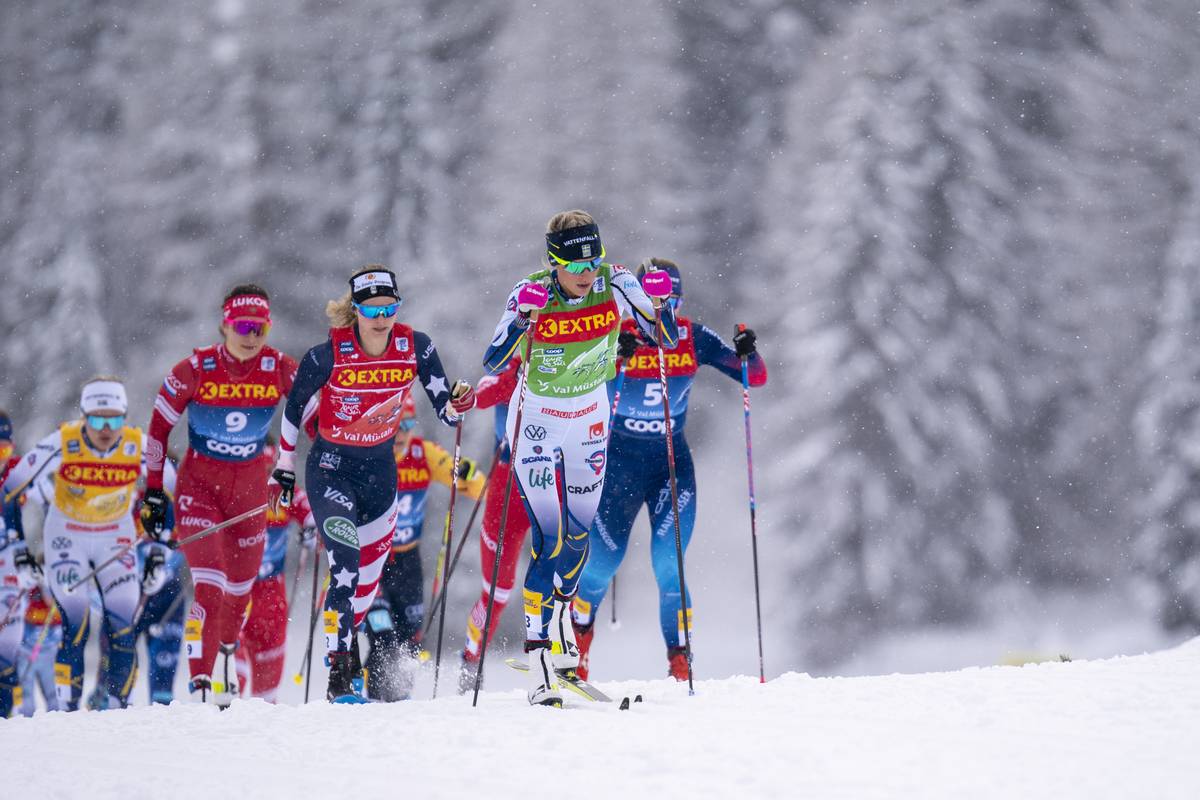
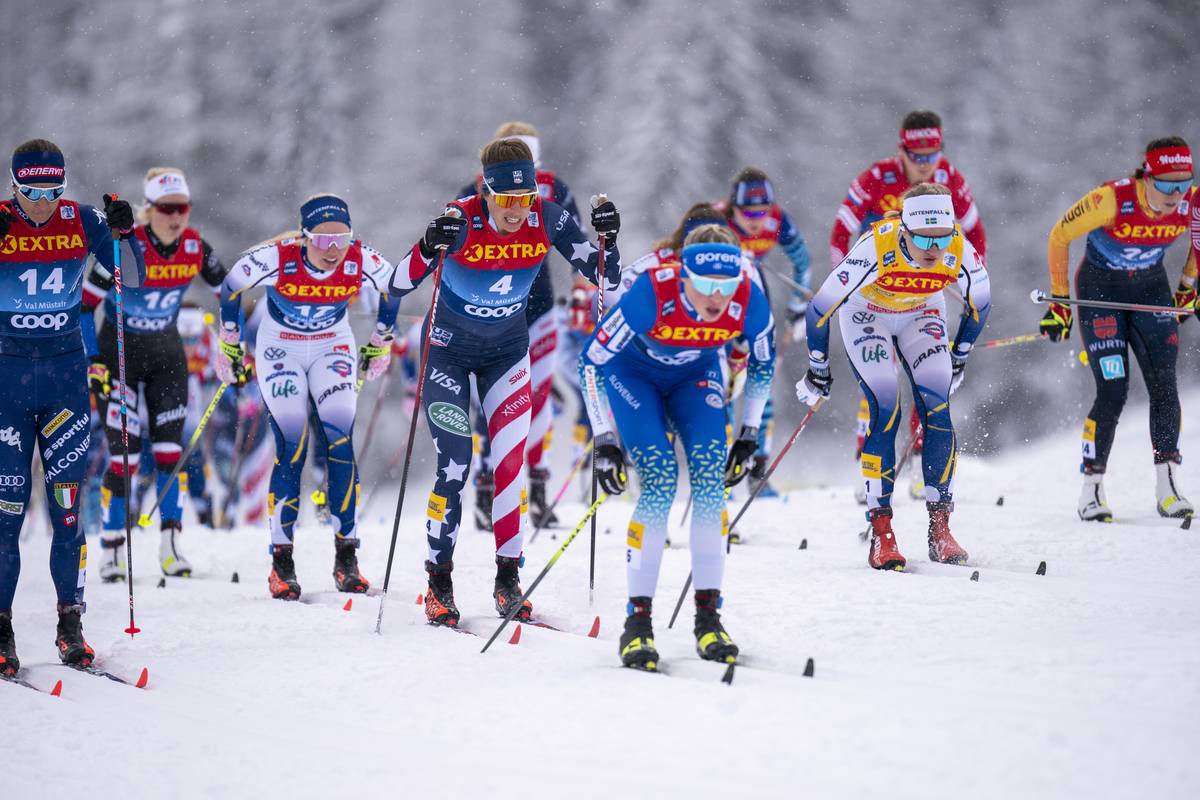
    Light snow continued to fall in the quaint Swiss village nestled in Val Müstair as the athletes took to the tracks for the first distance stage of the 2021 Tour de Ski, a 10-kilometer mass start classic race. As the first mass start of the season, the women kicked, glided, and poled over 10-kilometers broken into four challenging laps, seeing exactly where they stacked up relative to their competitors.

    With four consecutive distance stages, the Tour quickly becomes part poker match, part ultramarathon. Standings and cumulative time are influenced not only by the final result from each day, but by the bonus points athletes can garner at checkpoints on course; in today’s case, an opportunity at the 3.3 kilometer mark.

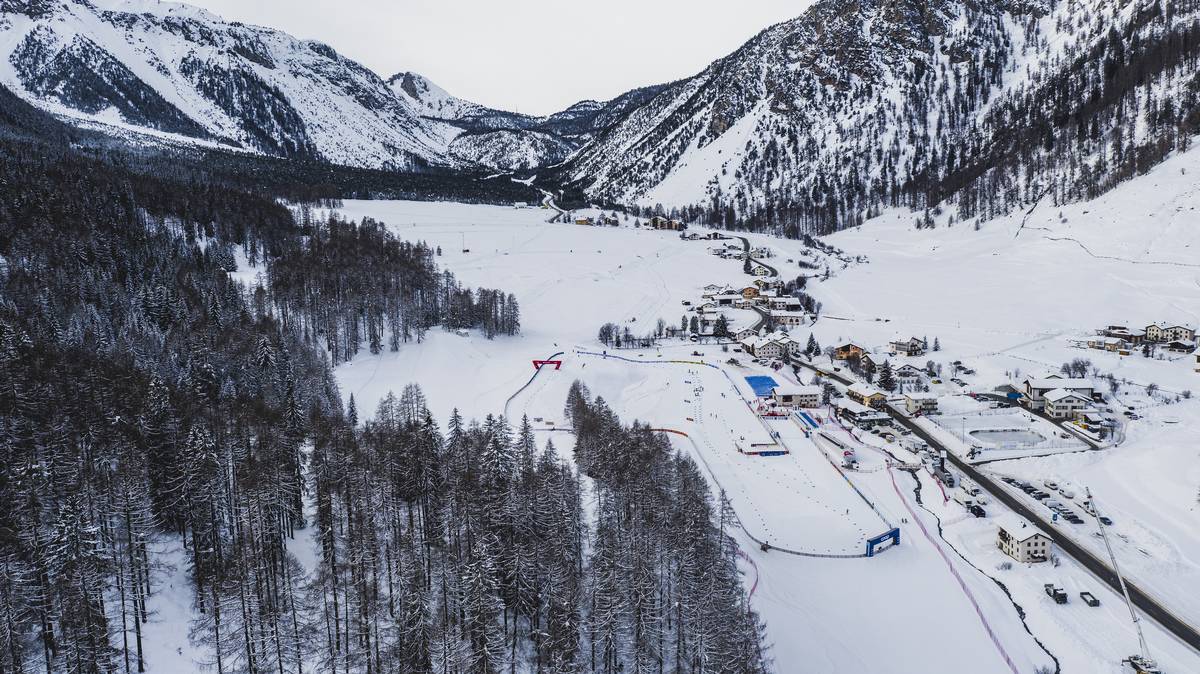
    The picturesque village and tracks of Val Müstair play host the first three stages of the 2021 Tour de Ski. (Photo: NordicFocus)

    As position in the field is relatively clear in a mass start — versus chasing the splits of a “ghost” racer in an interval start — tactics, patience, and drafting become more significant. 

    Today, it was soon evident who intended to make a run at the dealer in the Stage 2 match. Wearing a bright green bib as overall U23 leader, Sweden’s Frida Karlsson skied at the front of the pack from the start. She out-sprinted teammate Ebba Anderson approaching the 3.3 k checkpoint to snag the maximum of 15 bonus points, and seemed to be comfortably kicking up each of the steady climbs. After her defeat of Norway’s powerhouse Therese Johaug at last year’s Holmenkollen 30k, albeit in part attributed to Johaug’s decision not to change skis, Karlsson solidified her position as a woman to watch in distance races.

    Frida Karlsson sets the pace with Diggins marking from behind during Stage 2 of the 2021 TdS. (Photo: NordicFocus)

    However, despite her seeming authority at the front, she was unable to create any true gap to the women behind her. At the midpoint of the last lap, six women sat on her tails including two women whose stars and stripes flashed on their legs as they matched the tempo of the other women striding alongside them. 

    One of these women, Jessie Diggins, comes off a second place finish in yesterday’s sprint. Diggins held her position in the top three throughout the race, at times challenging Karlsson at the front, leaving no room for weakness or error on the young Swede’s part. 

    Rosie Brennan tucks into the lead group during Stage 2 of the Tour de Ski, a 10-kilometer mass start classic. (Photo: NordicFocus)

    Fellow American Rosie Brennan, who finished fourth in Stage 1 also sat comfortably in the lead group, matching the surges that were made to break away as the race progressed. 

    In the final two kilometers, the other women began their own runs for the win, challenging Karlsson who was faltering, but unwilling to fold. Up the final climb and down the same screaming S-turn descent featured in the sprint course, the women charged furiously toward the finish, Karlsson slowly being swallowed into the pack. 

    Rounding the final corner and thrashing her poles to accelerate toward the finish, a different woman in white lycra took the reins. 21-year-old Linn Svahn, the winner of yesterday’s skate sprint and of the 2019/2020 World Cup sprint globe, put her closing speed on display to stop the clock at 30:09.9. Though she has won FIS distance races on home soil, this is Svahn’s first distance win at the World Cup level.

    The top women fight to the line during Stage 2 of the 2021 Tour de Ski. Sweden’s Linn Svahn took the win, with Yulia Stupak (RUS) and Jessie Diggins in 2nd and 3rd, respectively. (Photo: NordicFocus)
    Sweden’s Linn Svahn throws her boot to seal the deal on victory in Stage 2 of the TdS, a 10-kilometer mass start classic. (Photo: NordicFocus)

    “It was really fun. I love going classic,” she told FIS after the race. “My plan was to just keep it as chill as I could, then watch the girls going strong on the uphill and try not to use so much energy. When I knew it was one lap left, I just kept thinking ‘I need to win this. I need to win this.’ So it was really good to race today.”

    A champion in sprint and distance, Sweden’s Linn Svahn wins back-to-back stages of the 2021 Tour de Ski. (Photo: NordicFocus)

    Just behind, a threesome including Diggins, Karlsson, and Yulia Stupak of Russia fought for the remaining spots on the podium. Stupak and Diggins crept ahead of the Swede, matching each other’s poling tempo before throwing their boots at the line. Stupak barely edged out Diggins, taking second (+0.7) with Diggins just behind in third (+0.8). 

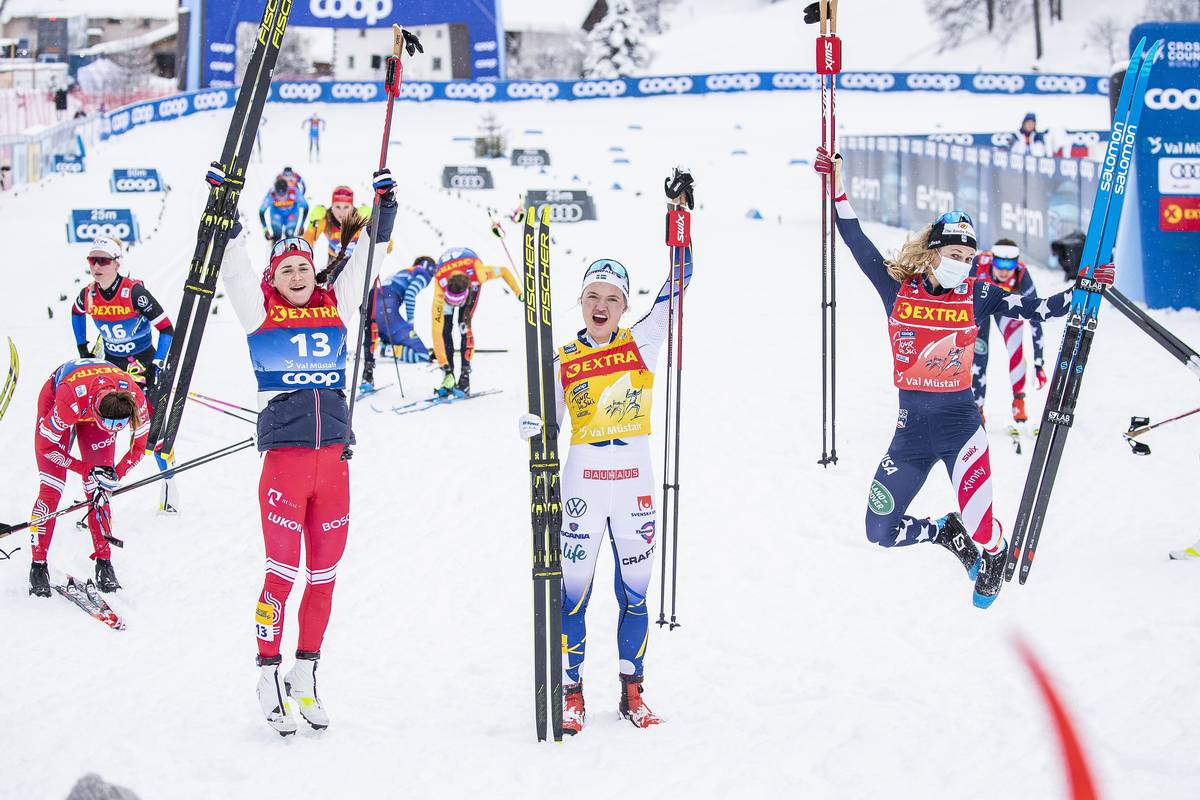
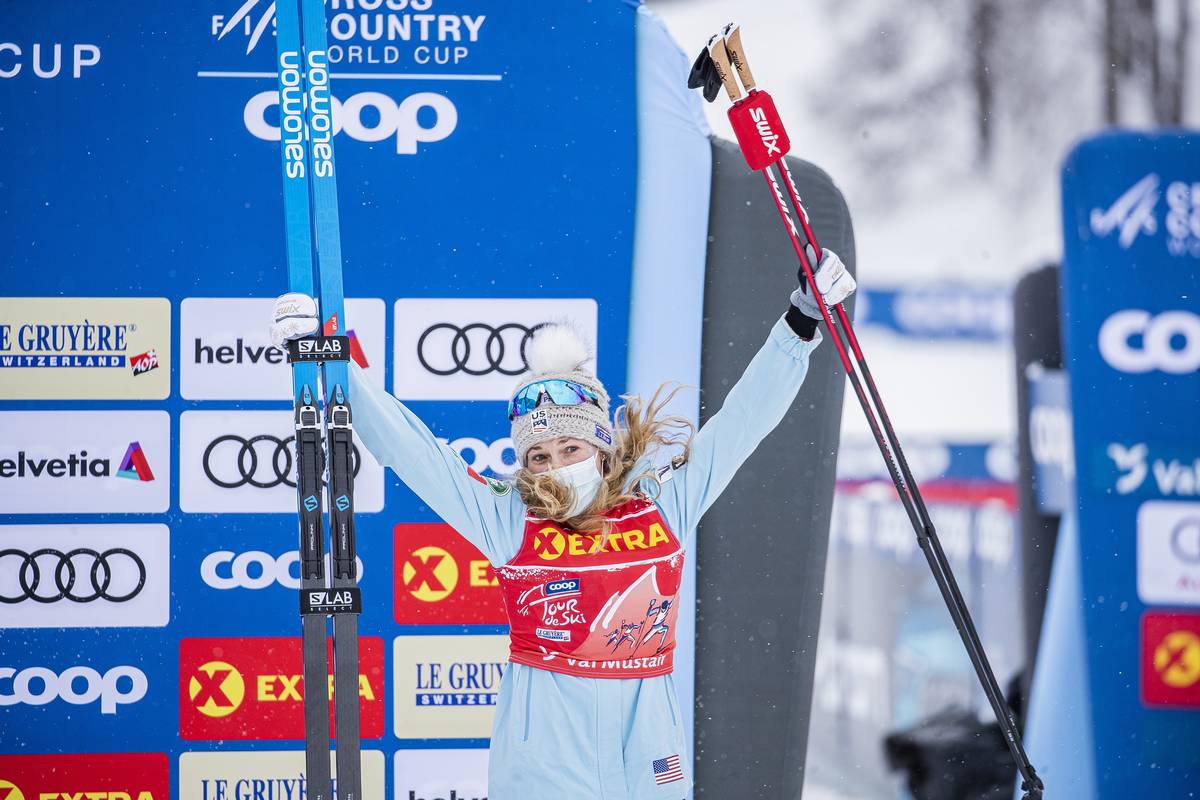
    Airborne and on form, Diggins celebrates her third place finish in Stage 2 of the Tour de Ski. Sweden’s Linn Svahn (center) took the win, followed by Russia’s Yulia Stupak in 2nd. (Photo: NordicFocus)

    “We had great skis out there!” wrote Diggins in an exuberant post race email. “Huge thanks to our service team and coaches for all their hard work, and the Salomon service team for their help picking my skis before the race!”
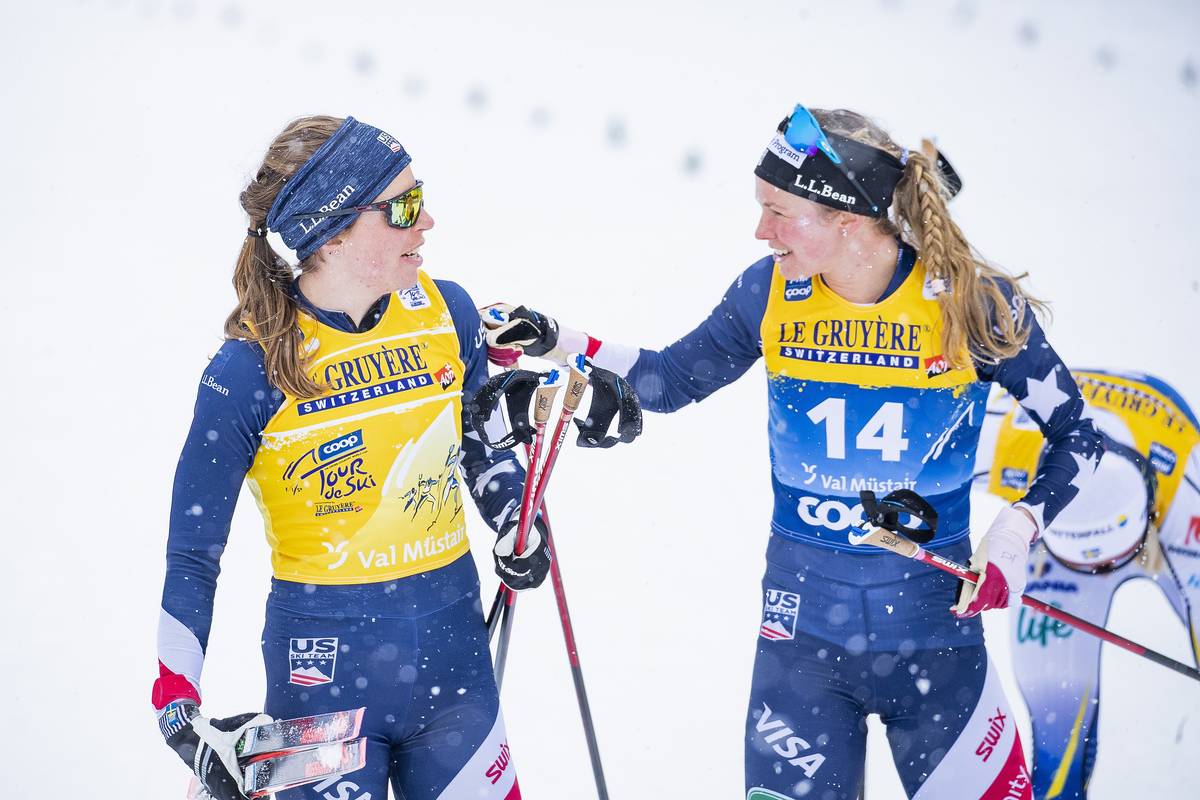
    Diggins continued by commenting on today’s effort, and how this classic result represents years of focus on technique and collaboration with her coaches and teammates.

    “My goals for today were to ski smooth and really work the downhills without letting them become a stress in a mass start environment, so I stayed near the front to keep out of trouble. This was a great course for me with all the long power-striding, and when I felt good on the last half of the last lap I just decided to push it! For someone previously labeled as a skater only, it was very exciting to find myself sprinting for the podium in a 10 km classic race, and confidence-boosting as well since I’ve been working so hard for so long on my classic striding! I think that improvement speaks to our coaches’ dedication and our positive team environment where we can learn from one another and push each other in our weaker areas. This summer I really benefitted from my SMST2 teammates helping me push the envelope in classic intervals and I’m extremely grateful to them!”

    Coming on form in the 2021 Tour de Ski, Jessie Diggins takes third in Stage 2. (Photo: NordicFocus)

    Despite spending over 8 kilometers at the front, Karlsson took the wooden medal in fourth (+1.4). She was followed closely by Katharina Hennig of Germany in fifth (+2.0), with Rosie Brennan on her tails for sixth (+4.5). 

    Evidence of the effort, the leaders of the Stage 2 of the 2021 TdS, a 10-kilometer mass start classic, gasp for air at the finish line. (Photo: NordicFocus)

    “Today was the first mass start of the season, which is always a little nerve wracking for me as I prefer individual starts,” wrote Brennan in an email to multiple news outlets. “My goal was to keep things as close as possible and then see what I left in the end. I think I did this well as I skied in the front pack throughout the race. I was unhappy with my tactics on the long gradual downhill coming back towards the stadium. I took a gamble on lane choice that didn’t pan out and found myself out of contention for the sprint finish, but managed to minimize my time lost to the leaders and also get a career-best classic result so I am proud of that. I am in a great position for tomorrow’s pursuit start so I hope to find some good energy and take advantage of that!”

    Outside the top-10 with noteworthy finishes were Hailey Swirbul in 17th (+40.5) and Katharine Ogden in 22nd (+1:21.2). Swirbul was among a larger lead group through the 5 k, dropping into a chase pack as the top 10 began to break away.  

    Hailey Swirbul on her way to a 17th place finish in Stage 2 of the 2021 Tour de Ski. (Photo: NordicFocus)
    Katharine Ogden on course in Stage 2 of the 2021 Tour de Ski. (Photo: NordicFocus)

    Caitlin Patterson was the next American finisher in 38th (+2:10.4), followed by Julia Kern in 41st (+2:30.6), and Sophie Caldwell Hamilton in 46th (32.49.0). Caldwell Hamilton experienced a crash near the end of the first clustered lap; “You got it, Soph!” could be heard from a passing teammate. 

    Post-race comments on the women’s 10k mass start from U.S. Head Coach Matt Whitcomb. 


    Julia Kern on course in Stage 2 of the 2021 Tour de Ski. (Photo: NordicFocus)

    Overall Tour de Ski and World Cup Standings

    With back-to-back wins, Svahn leads the 2021 Tour de Ski by 13 seconds, with Diggins in 2nd, and Karlsson third (+0:18).

    Because of snagging the bonus points in today’s stage, Karlsson sits at the top of the TdS point standings with Diggins one point behind in second, and Svahn three points back in third. 

    Brennan skis to 6th in Stage 2 of the 2021 Tour de Ski, adding to a string of outstanding performances. (Photo: NordicFocus)

    Continuing her streak of outstanding races, Brennan remains in possession of the yellow bib as overall and distance World Cup points leader and sits 4th in the TdS standings for both time (+0:20) and FIS points. 

    The tour continues tomorrow with a 10-kilometer skate pursuit.

    Stage 2 Results | Overall TdS Standings After Stage 2: Cumulative Time | Points

  • Tour De Ski Opens With Spills and Thrills in Val Müstair; Diggins 2nd, Brennan 4th

    Tour De Ski Opens With Spills and Thrills in Val Müstair; Diggins 2nd, Brennan 4th


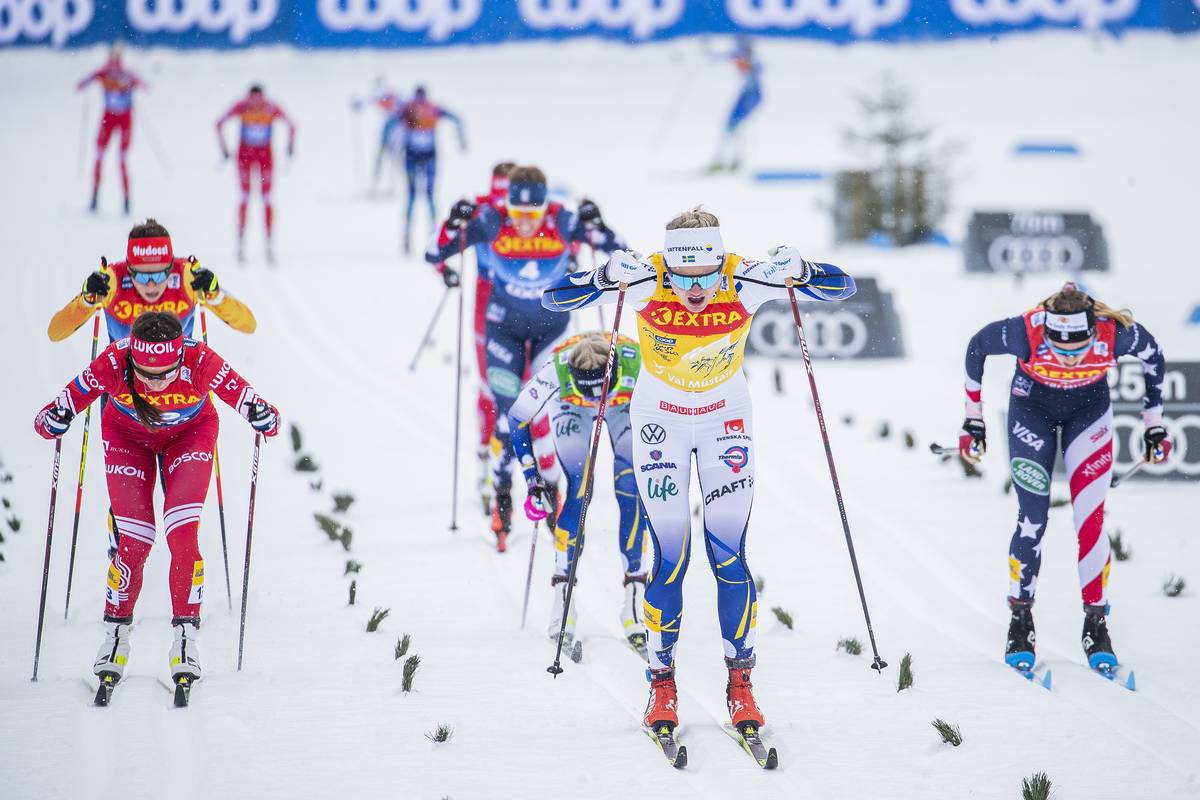
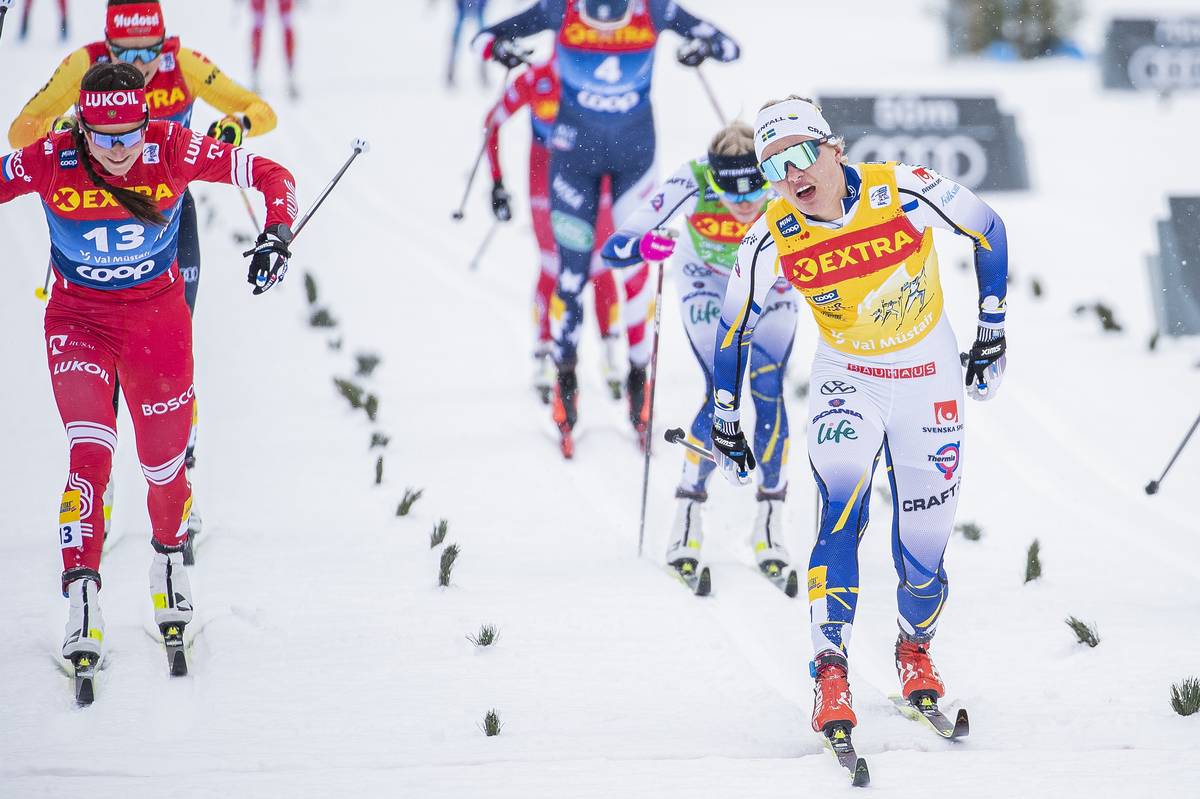
    Sweden’s Linn Svahn winning the first stage of the 2021 TdS in Val Müstair, Switzerland. (Photo: NordicFocus)

    This World Cup coverage is made possible through the generous support of Marty and Kathy Hall and their A Hall Mark of Excellence Award. To learn more about A Hall Mark of Excellence Award or to learn how you can support FasterSkier’s coverage please contact info@fasterskier.com.

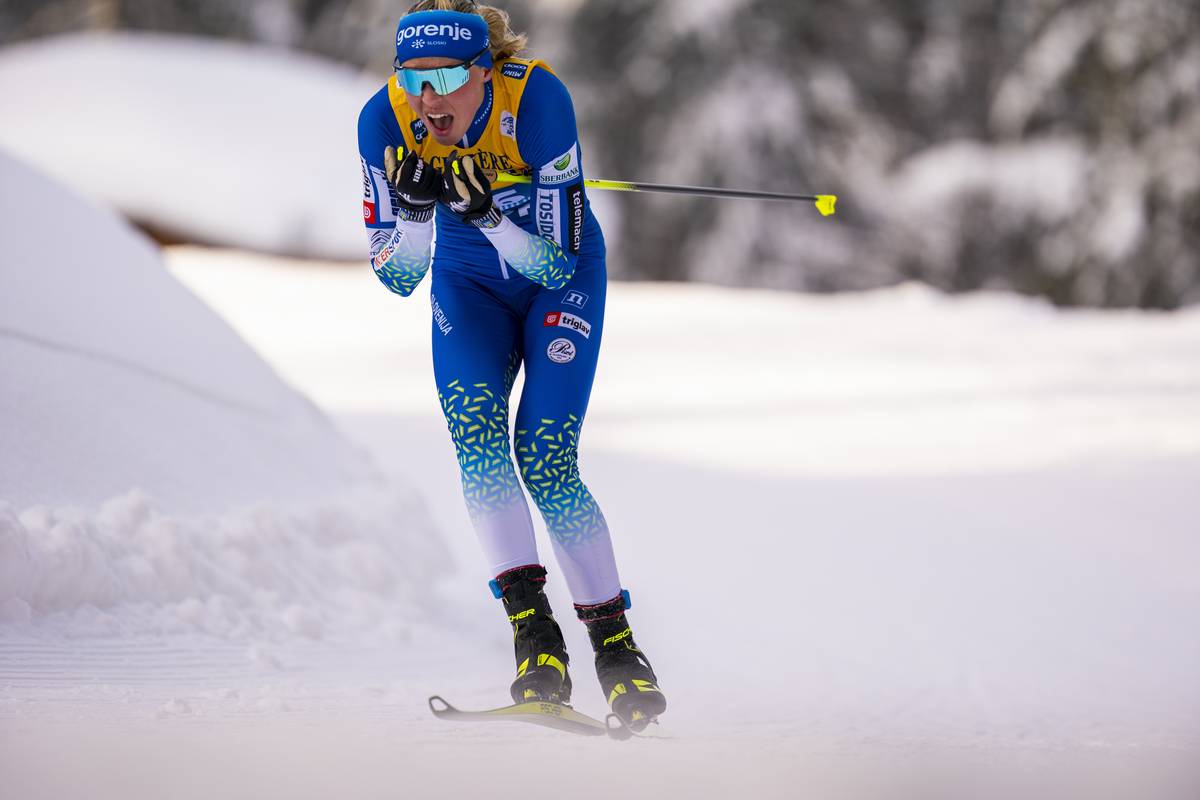
    Out with 2020, in with 2021. Here in the world of multicolored lycra and skinny skis, we are kicking off the new year with the opening of the Tour de Ski on the sprint track of Val Müstair, Switzerland. As snow fell lightly but steadily, the usually remarkable mountain backdrop was veiled, narrowing our focus to the athletes as they embark on the grueling eight stages over ten days that is the TdS.  

    The two-lap 1.4-kilometer sprint course in the alpen valley featured two punchy climbs per lap leading down into fast and tight S-turns. Small rollers after these turns kept the skiers on their toes as they charged around the course.   

    Though the Norwegian athletes remain absent from the World Cup and TdS, the Swedish women are back in full force. They made their sprint prowess known in the qualifier, with 26-year-old Maja Dahlqvist setting the fastest time by nearly three seconds in 3:30.86. Seven members of their squad qualified for the heats, with an additional three in the top 10: Linn Svahn in 2nd, Moa Lundgren 4th, and Frida Karlsson in 8th. Though Karlsson is normally known for her distance racing (in particular besting Norway’s dominant Theresa Johaug at last year’s Holmenkollen 30 k), her possession of the green U23 Overall World Cup leader bib evidenced that she was not to be dismissed as a contender for the stage. 

    Rosie Brennan (yellow bib) locked onto Sweden’s Moa Lundgren (bib 4). (Photo: NordicFocus)

    Wearing the yellow Overall World Cup leader bib, Rosie Brennan was the top American qualifier in 5th (+4.38), followed by Hailey Swirbul in 13th (+8.65), Jessie Diggins in 14th (+8.96), Sophie Caldwell Hamilton in 16th (+9.77), and Julia Kern in 25th (+12.61).

    Brennan raced in a stacked first heat of the quarterfinals, racing against two of the top Swedes, Dahlqvist and Lundgren, in addition to Russia’s Natalia Nepyaeva, teammate Kern, and Switzerland’s Laurien van der Graaff. Brennan stayed near the front and in position to advance from the get-go, but couldn’t break from the lead group of four. She finished in a three-way photo finish with Nepyraeva and Lundgren, taking third but snagging a lucky loser spot allowing the threesome to all advance into the semis.  

    Jessie Diggins finding her form in Val Müstair, Switzerland where she placed second overall in the TdS stage 1 sprint. (Photo: NordicFocus)

    Also advancing from the quarters from the fifth heat, Diggins held a position near the front throughout her heat, showing with her lightning-fast tempo that she intended to advance. She pushed Karlsson and Italy’s Greta Laurent break from the remainder of the group. In the second lap, Diggins had the fastest V1 cadence on the climbs and stayed smooth in the descents, priming herself for good positioning in the final sprint to win the quarter. 

    Ending their day after the quarters, Caldwell Hamilton marked Swedes Svahn and Emma Ribom. In her usual calm, cool, collected manner, she skied smoothly through the S-turn and tucked in comfortably on Ribom’s tails. Despite great position coming into the final lanes, Caldwell Hamilton could not quite overtake Ribom and finished centimeters behind for third in the heat. Swirbul stayed close to the leaders but was unable to fight for the top two and ultimately ended the heat in third also. Neither heat was fast enough to obtain a lucky loser spot. 

    Sophie Caldwell (bib 16) qualified in 16th and placed 16th overall in Friday’s skate sprint. (Photo: NordicFocus)
    Hailey Swirbul, here in bib 13 during stage 1 of the 2021 Tour de Ski, placed 15th overall. (Photo: NordicFocus)

    On to the semifinals. Racing on home soil in the tight first heat, Nadine Fähndrich (SUI) edged out her opponents for the win in a three-way photo finish with Slovenia’s Anamarija Lampic and Sweden’s Dahlqvist. Considering Lampic and Fähndrich both finished in the top four of the last two freestyle sprints in Davos and Dresden, this result serves as a testament to the depth of the sprint field in those venues despite the lack of Swedes, Finns, and Norwegians. 

    Brennan and Diggins took off in the second heat, marking Swedes Svahn and Karlsson who held the front in the first lap. In the second lap, Brennan upped the tempo on the climbs, while Diggins pushed over the top and worked the downhill, free skating out of the rollers and putting herself into position to charge down the lanes ahead of Karlsson to hold onto the second position and a secure advance to the final. 

    Frida Karlsson (SWE), Jessie Diggins (USA), Greta Laurent (ITA), (l-r) during stage 1 of the 2021 TdS. (Photo: NordicFocus)

    Fighting for millimeters, Karlsson and Brennan were just behind in third and fourth. Both squeaked through as lucky losers, but only just as Brennan’s time was a mere 0.1 seconds faster than the next fastest time. 

    The pace stayed hot and the pack stayed tight in the first lap of the final. Diggins and Brennan stayed in the mix near the middle of the pack and in contention for the podium. 

    As the racers rounded the bend into the second lap, Svahn began firing on all cylinders, taking off at the front with Lampic and Fähndrich marking her from a couple ski lengths back. Just when the top-3 positions seemed locked up, Lampic and Fähndrich brushed skis in the downhill S-turn causing Fähndrich to crash, losing sight of the podium. Svahn continued to hammer, flying down the final stretch to take the win with Lampic nearly a second behind her. 

    Seizing the opportunity, Diggins nimbly dodged around the downed Fähndrich, hopping over her pole and hitting the gas to drop a chasing Karlsson and snag third. 

    Linn Svahn during qualification in Val Müstair, Switzerland. (Photo: NordicFocus)

    “I didn’t know how I’d feel in high altitude,” Svahn told FIS after the race. (Val Müstair sits above 4000 ft.)  “I tried to take the first lap to get into my own zone and technique, then I tried to push all I had in the last uphill since the other girls were going really strong beside me.”

    FIS also asked about Svahn’s goals for the tour ahead. 

    “I try to focus on each race, and now I’ll just focus on getting my legs working again after these tracks,” Svahn said with a tired laugh.

    After a lengthy review, during which Diggins demonstrated the importance of staying on top of nutrition during the arduous tour by refueling with a bowl of pasta on the sidelines, Lampic was deemed to have interfered and was disqualified. This moved Diggins into the second position on the podium, with Karlsson stepping into third.  

    “Today was a fun way to start 2021,” wrote Diggins in a post-race email to FasterSkier. “But I think it’s important for me to say that I’m equally as proud of my all-out effort and our team today as I am when I’m not on the podium! It was just another day of giving it my absolute best effort, but the patience and trust in the training plan that Cork and I set down together has been paying off and my race form is coming into sharper focus now.”

    Jessie Diggins finishing second overall on Friday’s stage 1 sprint. (Photo: NordicFocus)

    So far this season, Diggins had a near miss at the podium with a 4th place at the individual sprint in Dresden and was unable to advance from the quarterfinals in Davos after getting boxed out on a curve just before the final straightaway. Today marks her first podium of the season in sprint or distance.

    “The final was exciting, for sure,” she wrote. “I fell behind a bit on the steep climb, and was working my way down the downhill sections with as much speed as I could when I saw Nadine go down and slide around the corner in front of me. I didn’t want to hit her (or break her equipment, or my own) so I jumped over her pole while rounding the corner! In sprinting you can get lucky or be the recipient of incredibly bad luck, and today the luck definitely came my way (and I’m grateful for it).

    “It was so exciting to have Team USA be 1/3 of the women’s final,” concluded Diggins. “And for myself, it was exciting to be out there having fun, not putting pressure on myself but still skiing with confidence and enjoying the banked turns and rollers all at the same time.”

    With the disqualification, Brennan moved into fourth position. Though historically stronger in distance, Brennan has shown her potential as an all-arounder this season with back-to-back sprint and distance wins in Davos and a fifth-place overall standing in the opening mini-tour in Ruka

    Rosie Brennan (l) and Jessie Diggins in Val Müstair, Switzerland after the first stage of the TdS. (Photo: NordicFocus)

    “It was a surreal day to be starting the Tour de Ski with the yellow bib,” Brennan wrote in a post-race email to multiple news outlets. “My one goal was to fight with what I had and I felt I did that well so I am proud of my effort out there today. I still have to remind myself just how far my sprinting has come and not change my expectations so quickly. This was only my second final ever and I am just so excited by the gains I’ve made.

    “This might be the hardest sprint course I have ever raced,” Brennan continued. “It’s long, at altitude, and had some slow snow out there today. With that in mind, I tried to keep things under control, but also use my strengths. I had a near miss in the quarterfinal and was really happy about my quick acceleration in the finish after getting stopped up. I worked hard in the semi to keep the pace high to ensure our heat would have lucky losers which I then benefited from. However, I was pretty beat by the time we got to the final. I tried to open up on the second lap, but there wasn’t much there. I stayed out of trouble and for that was rewarded another two places. That’s a sprint race for you…That was a tough start to the Tour so the focus will now be on recovery to get ready for tomorrow and all the races to come. It’s also very cool to note that we had our 4th different girl on the podium in just 4 weeks of racing. Our team is really working hard to get through this tough season together and support one another as we navigate the world.”

    Outside the top 30, Katharine Ogden finished 49th in the qualifier (+20.07), followed by Caitlin Patterson in 57th (+22.25). 

    Results: Qualifier | Final

  • Sans Fans, Sweden’s Karlsson Takes Johaug at the Holmenkollen Line

    Sans Fans, Sweden’s Karlsson Takes Johaug at the Holmenkollen Line

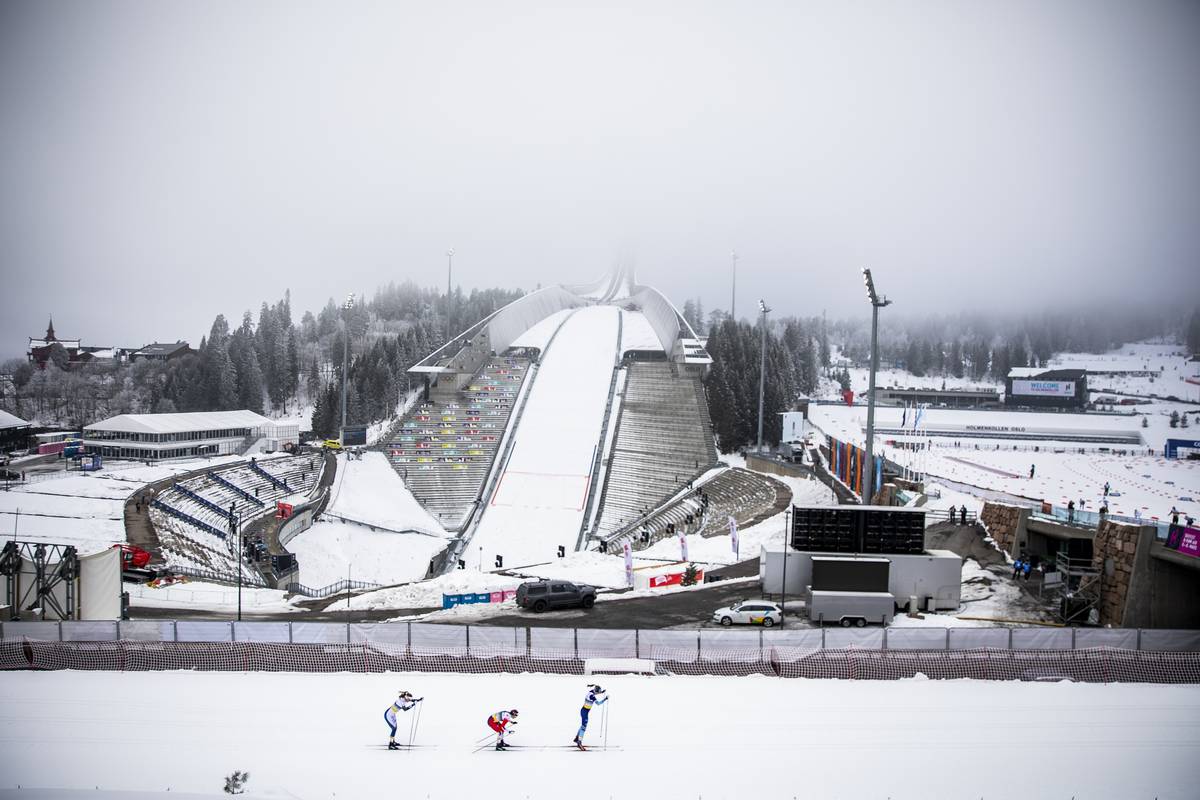
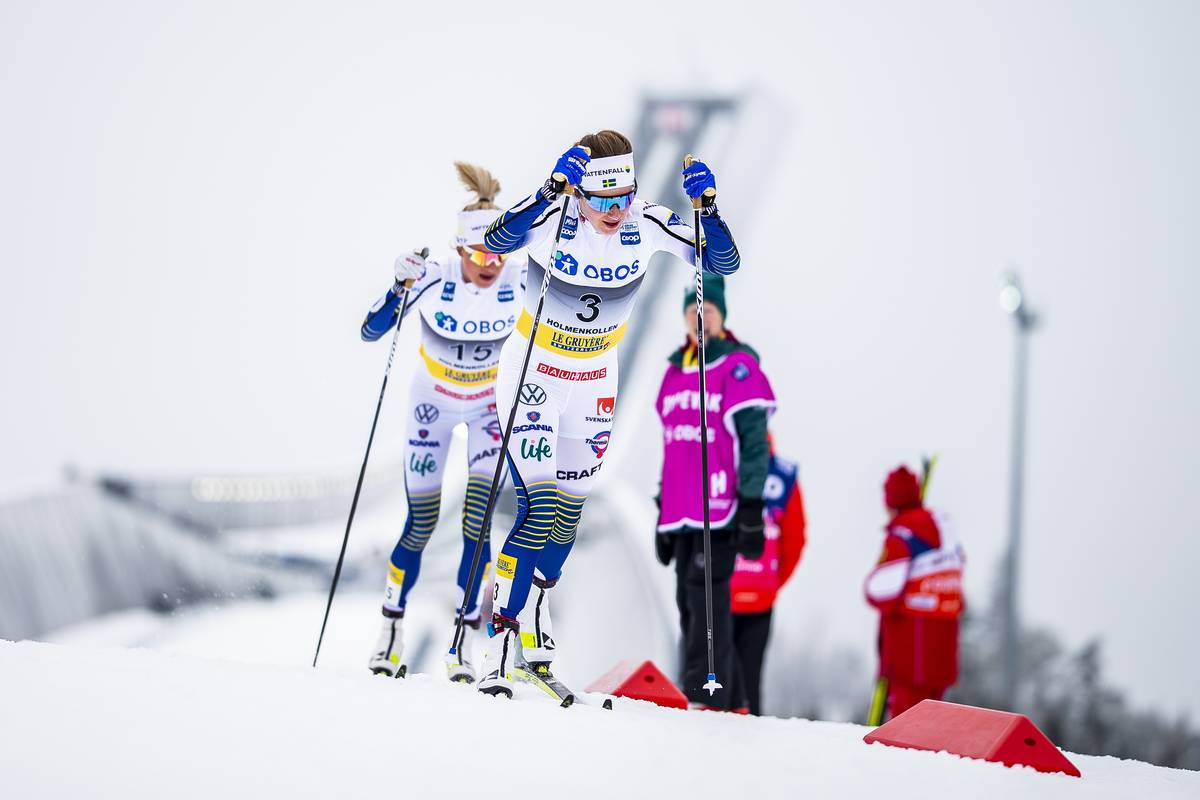
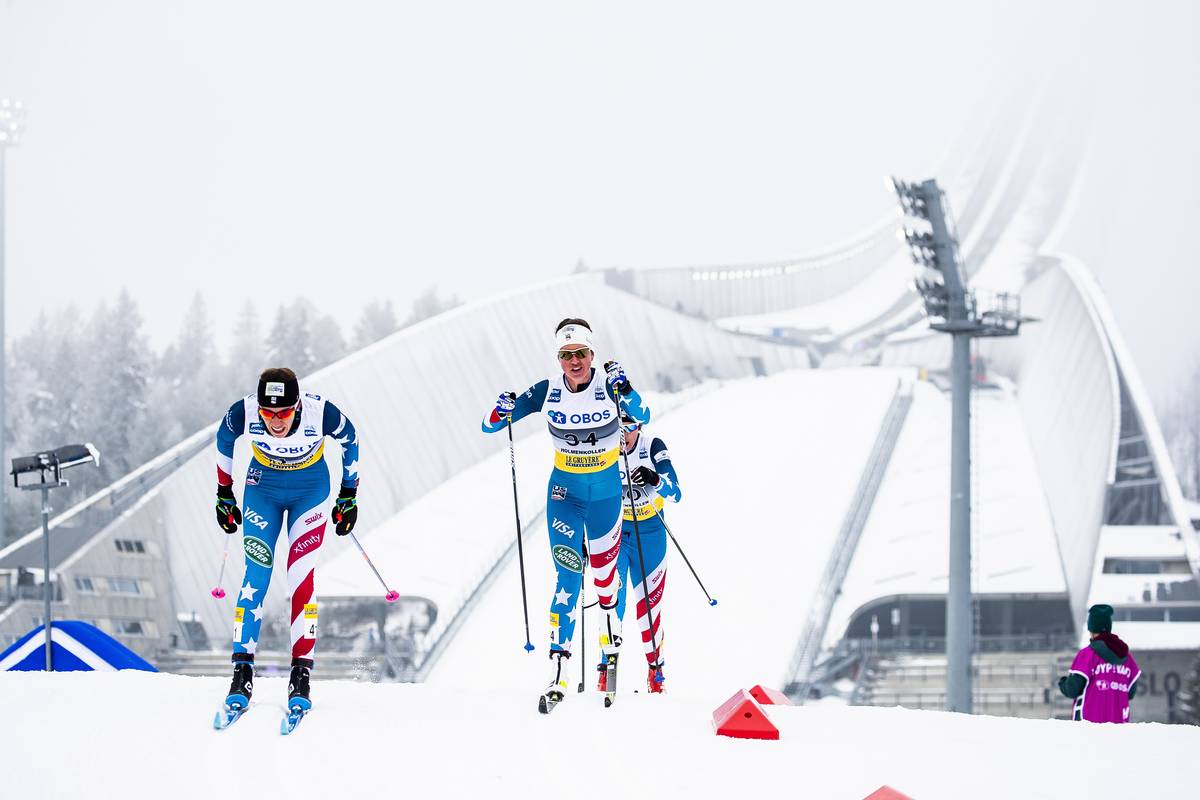
    A quieter and more serene Holmenkollen stadium area with fans banned from much of the course. (Photo: NOrdicFocus)

    Racing the Holmenkollen without spectators is a bit like not getting a white Christmas. It does not change the end result, here racing a 30-kilometer mass start classic race on the famed tracks above Oslo, Norway. But the experience loses some of the magic.

    Race organizers announced Thursday that spectators would not be allowed to attend the race due to the increased risk of spreading COVID-19. On a typical year, crowds in numbers up to 100,000 per day take the tram from the city center to the venue, where they either pay to sit in the grandstands or they post up in the woods, often drinking and cooking over a fire. 

    Though the stadium was empty, some spectators did choose to watch the event from the woods, but their numbers were not close to the norm.

    Matt Whitcomb, U.S. World Cup Coach, however, wrote this in an email, “The Holmenkollen stadium, which can at times boom so loudly we can’t hear our own shouts to the athletes, was a ghost town today. But the people did not stay home; they moved to the forest. The woods were as loud as I can remember. It was a great fan turn-out.”

    A empty feeling through the main stadium. (Photo: NordicFocus)

    If you’ve ever skied the tracks at the Holmenkollen, you’ve probably uttered a humbled and exhausted expletive somewhere along the way. The climbs are long and unforgiving, and the downhills can be lightning fast.

    Unsurprisingly, Norway’s distance champion Therese Johaug looked to be running away with the race. Within the first 10 k, Johaug gapped the field with flawless technique by 25 seconds. She took the maximum of 15 bonus points at each checkpoint, which happened at 3.7, 9,9, 16.1, and 22.3 k.

    Behind her, a large chase pack worked together in a race for second place. With less than ten k to go, the top-20 were within 8 seconds of one another. As the final round of bonus points drew near, Sweden’s Ebba Andersson and Frida Karlsson surged to the front and broke away, steadily cutting Johaug’s lead in half by the 26.3 checkpoint. 

    They had chosen to switch skis before the final lap, and it was evident that their kick and glide were superior to those around them. Johaug, however, had not changed skis or taken her last opportunity for a feed.

    Ebba Andersson (front) and Frida Karlsson chasing Johaug. (Photo: NordicFocus)

    This is where things got interesting. After skiing alone for 28.5 k, suddenly a figure appeared in the screen with Johaug. That figure was Karlsson who was closing hard from less than ten seconds behind. 

    It became a matter of real estate. After another kilometer, Karlsson was only five seconds behind. But there were only 2 k left. 

    Up the final long climb and inside the final k, Karlsson marked Johaug from the tails of her skis, switching lanes near the crest of the hill and dropping into a tuck to take advantage of the speed of her skis. Johaug stayed in her draft, sneaking back around before the final roller. 

    But Karlsson had the superior speed in the final sprint, leapfrogging the Norwegian and creating a gap in the lanes to win the race in 1:22:19.1. Johaug crossed 1.9 seconds behind and immediately congratulated her young opponent  on her effort. 

    Andersson, who had fallen off of Karlsson’s pace, took third (+20.9), followed by teammate Charlotte Kalla (+40.5) and Natalia Nepryaeva in fifth (+43.1). 

    Karlsson’s excitement about her performance was clear as the 20-year-old hugged her teammates and jumped into a coach’s arms, somewhere between laughing and crying.

    “I felt so good today,” Karlsson told FIS emphatically. “I had great skis and I think it was a winning concept to change skis and have new fresh ones. I felt so strong in the end and I was hunting and heard I was taking time on Therese. In the end, I felt like ‘now I am going all the way’ and it was a success.”

    Women’s Oslo 30 k classic podium: Therese Johaug (NOR) second , Frida Karlsson (SWE) first, and Ebba Andersson (SWE) third, (l-r). (Photo: NordicFocus)

    Racing for North America, Caitlin Patterson was the top finisher in 47th (+!0:15.1), followed closely by her CGRP teammate Kaitlynn Miller in 48th (+10:37.5) and APU’s Becca Rorabaugh in 49th (+12:26.4).

    Results

    Caitlin Patterson (USA), Kaitlynn Miller (USA), Becca Rorabaugh (USA), (l-r). (Photo: NordicFocus)

    Below we have included a post-race interview with Caitlin Patterson in which she discusses some frustrations with her race.

    Post-interview with Caitlin Patterson

  • Johaug Keeps Andersson at Bay for the Win in Lahti; Brennan 19th

    Johaug Keeps Andersson at Bay for the Win in Lahti; Brennan 19th

    A ribbon of snow and a winter that never arrived in Lahti, Finland. (Photo: NordicFocus)

    In a typical season, you might expect late February in Lahti, Finland to look wintery. 61 degrees North latitude, ample snow on the ground and clinging to the trees, maybe even a reindeer? In fact, in a plug for the venue showed a woman skiing through a snow-laden town and arriving at the base of the towering ski jumps. 

    But it was not so today. Women time-trialed through the woods for two laps on a 5-kilometer ribbon of man made snow. Aerial shots of the venue told the story that winter had never arrived — green trees, bare ground, and an unfrozen lake.

    “It’s sad that they have no natural snow, we’re not used to it,” Theresa Stadlober of Austria told FIS before her race. “But the conditions on the track are really good, so the organizers did a really good job and I think it will be a fair race today.”

    Despite a low snow year (read: no snow year), the 5 k track in Lahti was as challenging as ever. (Photo: Screenshot FIS Broadcast)

    Though some athletes, like Jessie Diggins and Sadie Maubet Bjornsen, chose to sit out the weekend of distance races following the wrap of the FIS Ski Tour 2020 across Scandinavia, the field remained relatively stout. 

    In fact, without Diggins, the top-10 for today’s stage looked alarmingly similar to the top-10 overall in the Tour

    Norway’s Therese Johaug, who won both the Scandinavian Ski Tour and the Tour de Ski, posted the fastest time on icy tracks in Lahti, finishing in 23:53.3. Her victory here was not a given. Her margins stayed tight at each checkpoint and a slowed down clip of her climbing a short punchy hill with a few k to go showed her slipping. 

    Therese Johaug notches another distance win at the 10-kilometer interval start classic in Lahti, Finland. (Photo: NordicFocus)

    “It was really tough today,” Johaug told FIS at the finish. “It’s a hard course here, and I like that a lot, but I had to fight with myself today. Mentally, after the Ski Tour, I have been a little bit tired, but the shape is still really good so I’m really happy to stand on top of the podium again today. It was really close to Ebba, but I have the second on my side.”

    With three distance races to go, Johaug has the overall winner’s Crystal globe on lock. She leads the standings with 1311 points, over 400 ahead of the next competitor — a margin that is insurmountable given the remaining point opportunities. She leads the overall standings by an even greater margin of 721 points. 

    Her teammate, Heidi Weng, sits comfortably in second place in both standings. Natalia Nepryaeva of Russia is third for the overall and Ingvild Flugstad Østberg of Norway is third in distance. 

    Ebba Andersson slides across the finish in second at the 10-kilometer interval start classic in Lahti, Finland. (Photo: NordicFocus)

    Johaug’s primary challenger today was Sweden’s Ebba Andersson, who started six bibs behind and kept herself within four seconds of the Norwegian throughout the majority race, finishing 3.4 seconds back for second place. Andersson was fourth in the Ski Tour and sits in the same position in the distance standings. 

    Finishing third in Lahti was Krista Pärmäkoski (+11.8). Though the Finnish veteran has a list of podium finishes and Olympic medals to her name, she has not cracked the top-3 in an individual event since January, 2019 when she took third at the final stage of the Tour de Ski (she has had top-3 results for time of day). 

    Krista Pärmäkoski kicks her way to a season best performance and podium in her home country. (Photo: NordicFocus)

    Pärmäkoski looked like a metronome, covering the tracks with a smooth and steady kick-glide rhythm. Her only falter was untimely. Rounding a sharp downhill curve just before the finish, she found herself on the far edge of the turn where the chunky edge of the of track abutted the bare ground of the hillside.  

    The Finn fell to the ground, losing momentum that could have put her higher on the podium. Nonetheless, as she pushed the final meters across the line, the volume in the stadium surged, blue and white flags waving wildly, putting a smile as her face as she caught her breath. 

    Sweden’s Frida Karlsson and Østberg rounded out the top-5 in fourth (+21.9) and fifth (+25.0), respectively.

    The top American of the day was Rosie Brennan in 19th (+1:28.9). 

    Charging to 19th, Rosie Brennan is the top American finisher in Lahti, Finland. (Photo: NordicFocus)

    “There is not a flake of natural snow around Lahti, so it’s amazing that they were able to put together a full 5 k course that was all hard packed man made snow,” wrote Brennan in an email. “I felt pretty good for somewhere around 4 k’s and then fatigue hit hard. I did my best to keep moving well but unfortunately, I did lose quite a few positions… I think I am definitely feeling some tour fatigue but more so just season long fatigue as I’ve haven’t been home since mid November. I happy with how I skied all considering and certainly am optimistic that with some rest I can have a strong finish. I am headed to Park City now to rest and prepare for Canmore.”

    Outside the to-30, Caitlin Patterson was 36th (+2:33.7) and Becca Rorabaugh (APU) 39th (+2:57.3). 

    Today was Rorabaugh’s first European World Cup start. Though the 30-year-old was first raced a World Cup in February of 2010, her only other experiences at that level have been in Quebec and Canmore during Canadian Ski Tours or World Cup finals.

    “I really enjoyed the World Cup level downhills and the perfectly firm tracks out there,” wrote Rorabaugh in an email. “Our wax guys nailed it for me so I was able to ski with a few different people, but it was a tougher course than what I’m used to in the US.  This was definitely a step up in steepness of pitch and amount of climbing, and I’d love to have more domestic opportunities to work on this kind of thing. The crowds were awesome and it was cool to see all the national pride with Finnish skiers on both podiums.  I’m very thankful to have had the opportunity to come over and race against such a strong field in such great conditions. I’m also excited to have more World Cup starts coming up!”


    Results | World Cup Overall Standings | Distance Standings

    Ebba Andersson (SWE) and Krista Pärmäkoski (FIN) exchange a high five as they join Therese Johaug (NOR) on the podium in Lahti, Finland. (Photo: NordicFocus)
  • Johaug Crushes Stage 6 for Ski Tour Overall Win; Diggins Leads U.S. in Sixth (Updated)

    Johaug Crushes Stage 6 for Ski Tour Overall Win; Diggins Leads U.S. in Sixth (Updated)

    Therese Johaug, untouchable during Stage 6 of the Ski Tour 2020. (Photo: NordicFocus)

    We’ll start with the weather: think all over the place. A moving target for meteorologist with moisture spitting from the skies, and air masses swirling this way and that making the trees sway like a mamba line along the course. A wax tech’s nightmare scenario? Yes. It certainly trended in that direction.  

    By all measures, this was Therese Johaug’s, Norway’s latest version of a cross-country skiing record-breaker, stage and tour. Of six stages total, she won five outright, with the lone exception, Saturday’s Stage 5 classic sprint in Trondheim.

    Stage 6 featured a 15 k classic pursuit. Call it a pursuit, however, on the race’s sharp end, this was a runaway. Although the field was, in theory, pursuing Johaug, she simply put more time into her challengers on Sunday. She began 2:33 ahead of Norwegians Heidi Weng in second, while Ingvild Flugstad Østberg set off another second back. 

    Johaug expanded her lead at the finish, by over a minute, to Weng and Østberg. Johaug won the pursuit in 41:13.8. Weng placed second (+3:40.8) with a slight gap over Østberg, who toed the line 0.7 seconds further back. Sweden’s Ebba Andersson, the day’s fourth starter at 4:48, lost time to0, finishing 5:54.3 back to end the Ski Tour in fourth overall. 

    “I felt really good today and the waxers had done a really good job the whole Ski Tour and today as well I have the perfect skis,” Johaug told FIS after the race. “When the skis are good and the shape is good I can just go out there and enjoy all the people that come here and cheering us.”

    As far as time of day, Johaug took that prize as well. However, Norway’s Astrid Uhrenholdt Jacobsen placed fifth overall and had the second-fastest race time, 44.8 seconds off Johaug’s winning mark. Krista Pärmäkoski of Finland notched the third-fastest time of day (+1:04.4). 

    Jessie Diggins of the U.S. was the top placed North American in sixth (+8:40.1). (She skied the 17th fastest time of day.) 

    “Today, like yesterday, was a crazy day in terms of weather and waxing. It kept snowing on and off, the sun coming out and then the wind picking up as more snow came down! I was pretty much skiing an individual start race as I was alone the entire time, but I was really proud of my pacing and efforts as I held my placing without anyone to work with. There was a really tricky time in the middle of the race when the skis weren’t kicking very well (for much of the field, I think) but I was able to refocus and reset and keep pushing as hard as I could.

    “As for the overall tour, I’m really happy with my efforts and how I hit my goals for every race. One of my big goals was to see each day as an entirely separate opportunity and to not put pressure on myself for the overall tour, since there are so many factors that I can’t control that play into that placing. But by hitting my own process goals for each race and staying consistent I was able to have a tour that I’m proud of.

    “I’m really proud of our tech team and coaches for their tireless efforts day in and day out through this tour. It’s been exhausting but they’re the hardest working guys out there!”

    Sadie Maubet Bjornsen ended her tour in 10th (+9:43.8). With the big time gaps, the second wave of skiers (the mass start) began with Pärmäkoski in bib 13, starting at 8:08 back. Maubet Bjornsen (bib 12), began 16 seconds ahead and was the initial target of the wave starters. Maubet Bjornsen held off a charging Pärmäkoski for over 5 k. 

    “Wow, I made it!! That was one heck of a tough tour! Things were looking mighty rough to begin with, but I knew I had to just keep fighting and believing!,” Maubet Bjornsen emailed. 

    “But among some challenging times, there were some glimmering hopes in there. Tours are my favorite types of racing, because you have to be so resilient and such a fighter. Day after day, you have to put your fatigue and emotions aside, and just stay so positive. 

    “The tummy troubles at the beginning of the tour were particularly tough! It was scary to start a tour so depleted, but I was thankful we had our nutritionist, Susie Parker Simmons around to help me stay on my feet! From there it was just a matter or fighting for every second from there on.

    “Today was a totally wild scene! Conditions were constantly changing, and it was hard to find the perfect skis! I knew the name of the game was to just keep fighting, because everyone would be struggling at some point out there. I managed to find something to work, and went through some highs and lows out there in the 15k which brought me to 10th overall in the tour! I’m super happy and satisfied with that, given the little fatigue hole I had to crawl out of this past month. Thank you to our team for helping make a tricky classic day at the finish of the tour possible to fight with the others. 

    “I’m looking forward to taking a rest now, and finding the energy to finish the end of the season strong, for the third tour of the season. 

    “Thanks to the Ski Tour 2020 for bringing some different types of racing. While it wasn’t always the best type of races for my strengths, it was so refreshing to visit some new locations with some different types of events! These are some of my favorite memories this season! 

    “And of course, hugest thanks to the staff. We couldn’t race day after day like this without them!!! They are the heroes.”

    Sadie Maubet Bjornsen (bib 12) racing to 10th overall in the Ski Tour 2020. (Photo: NordicFocus)

    Rosie Brennan, starting in bib 10, 7:27 behind the first starter Johaug, placed 12th (+9:53.3).

    “Today was a very challenging day,” Brennan wrote in an email. “Due to the massive time gaps in the overall, the wave started at bib 13 so I had a big pack starting not too far behind. The conditions were very challenging with snow, sun, rain and everything in between and some very icy tracks. I did my best to stay in front of the wave but just didn’t have the skis or the energy to make it happen today. I am very disappointed in myself. After having a great tour, it was hard to end on this note, but I am doing my best to look at all the positives from the tour as a whole and make a nice little work list to improve on the things that were so tough today.”

    Rosie Brennan (stars and stripes) during Stage 6 of the Ski Tour 2020. (Photo: NordicFocus)

    Also for the U.S., Julia Kern placed 30th (+14:51.4), Caitlin Patterson 36th (+16:38.4), Katharine Ogden 42nd (+20:26.6), Rosie Frankowski 43rd (+20:36.7), Sophie Caldwell 44th (+21:41.2), and Alayna Sonnesyn 48th (+24:34.6). 

    Canada’s Katherine Stewart-Jones placed in the points for the tour overall, by finishing 29th in the pursuit (+14:46.3). Cendrine Browne was 33rd (+15:47.5), and Emily Nishikawa 35th (+16:08.4). 

    Katherine Stewart-Jones during Stage 5 of the Ski Tour 2020. (Photo: NordicFocus)

    This stage concludes the Ski Tour. Racing continues in Lahti, Finland next Saturday. 

    Results | Overall Standings | Winner of the Day

    The women’s Stage 6 and overall Ski Tour 2020 podium: Heidi Weng (NOR) in second, Therese Johaug (NOR) first, and Ingvild Flugstad Østberg (NOR) third, (l-r). (Photo: NordicFocus)
  • Falla Steps up For the Trondheim Win; Five U.S. Skiers in the Heats

    Falla Steps up For the Trondheim Win; Five U.S. Skiers in the Heats

    The day began in Trondheim with a centimeter of snow, which then transitioned to big blue skies for the thousands of fans attending the fifth stage of the Ski Tour 2020, a 1.5 k classic sprint. The Norwegians can throw a cross-country race party. The scene, despite the different setting, was reminiscent of the festive cowbell and camp-out sideshow of Holmenkollen’s Frognerseteren. It’s not quite the Yankee stadium of cross-country skiing, but a sign that in the hot-beds of the sport, fans arrive in droves. 

    The sprint course was more traditional, meaning this was no simple VO2 max test of an effort — that went down on Stage 3, in  Åre, Sweden as athletes ascended an uber steep alpine ski hill to close out that event. Trondheim’s classic sprint was bolstered by two punchy climbs on a three-terrace course, long and fast glide outs, and two speedy corners which swung skiers through a 180-degree direction change to keep it spicy.   

    Sweden’s Jonna Sundling laid down the fastest qualifying time in 3:22.75, shadowed by her teammate, Linn Svahn, 0.24 seconds back. Maybe, not surprisingly, Therese Johaug was the third-fastest qualifier, 0.83 seconds back. Johaug won her first career sprint on Stage 3 of the Ski Tour

    Jonna Sundling of Sweden in bib 1, during her quarterfinal of the Stage 5 classic sprint in Trondheim, Norway. (Photo: NordicFocus)

    The U.S. packed five skiers into the heats. Sadie Maubet Bjornsen qualified in 10th (+6.20). Rosie Brennan in 11th (+6.34), Sophie Caldwell 15th (+7.32), Jessie Diggins 20th (+8.58), and Julia Kern 24th (+9.54). Yet the story on the U.S. women’s side ended earlier than their highwater mark norm, which is most often, representation in the six skier final. In no uncertain terms, this is the golden age of U.S. women’s cross-country skiing. A stars and stripes void marked the semis and final. No U.S. skiers advance beyond the quarterfinals. 

    In the third quarterfinal, Kern and Brennan lost contact with Sundling and Tiril Udnes Weng who came in 1-2, respectively. Kern was fourth in the heat (+3.7), Brennan fifth (+7.71). 

    Maubet Bjornsen and Diggins fell off the pace as well in the fourth heat, placing fourth and fifth respectively. Both were over four seconds off Norway’s Anna Svendsen’s pace of 3:19.34 who won that quarterfinal. 

    22.02.2020, Trondheim, Norway (NOR):<br /> Sadie Maubet Bjornsen (USA) - FIS world cup cross-country, individual sprint, Trondheim (NOR). www.nordicfocus.com. © Thibaut/NordicFocus. Every downloaded picture is fee-liable.
    Sadie Maubet Bjornsen during the Stage 5 classic sprint in Trondheim, Norway. (Photo: NordicFocus)
    “It was an extremely tricky weather day with a combo of rain/snow/sun, and everything in between,” Maubet Bjornsen emailed.
    “I was excited to put together a solid qualifier, but felt like a few adjustments would allow things to be even better for the heats. My body felt sharp and powerful, so I knew the key for me was to be quick out of the start, and do my favorite thing… ski from the front. I was quick out of the start, but struggled to hold the speed up the first climb. Since climbing is generally my strength, it’s unclear whether it was skis, body, or both that held me back. But, that’s how ski racing is. You can’t overthink anything too much, you just keep believing, and chasing away!
    “It is the tour of crazies for me, so I’m going to let it go, and look on to “the chase” tomorrow. With the tour ending with a 15k classic, I am sitting just outside top 10 overall, and really hoping to climb my way within that tomorrow. Let’s see if I can channel all amounts of frustration towards some constructive racing in the final day!”

    The last U.S. athlete eliminated was Caldwell. She placed third in the fifth quarterfinal, 1.53 seconds back on Norway’s Heidi Weng in first. Caldwell placed 14th in the final standings, Maubet Bjornsen 16th, Kern 20th, Brennan 21st, and Diggins 23rd. 

    Sophie Caldwell (bib 15) during her quarterfinal in Trondheim: Stage 5 of the Is Tour 2020. (Photo: NordicFocus)

    Post-race interview with U.S. World Cup Coach Matt Whitcomb

    Wintry weather moved in during the men’s quarterfinals. The blue-bird scene morphed quickly into an intermittent snowglobe. With the swift winds swirling around the stadium, the snow squalls eventually moved on as the semifinals progressed. 

    The 12 skier field in the two women’s semis consisted of six Norwegians, four Swedes, and two Swiss skiers in Laurien van der Graff in the first semi, and Nadine Fähndrich in semi two.  Fähndrich kept Swiss hopes alive by advancing to the finals after winning her semi. 

    The first semifinal featured Norway’s Maiken Caspersen Falla and Sweden’s Sundling. These two athletes were the skiers to watch. For Falla, by her own high standards, this has been an offseason, as the young Swedish sprint team has pushed her aside for precious top-of-the-podium real estate. Falla won the opening World Cup sprint in Ruka, Finland, otherwise, it’s been a first-place void for the former Crystal Globe sprint winner.

    In bib 12, Maiken Caspersen Falla strides it during her quarterfinal in Trondheim. (Photo: NordicFocus)

    In Falla’s semi, she and Sudling took first and second, respectively, with Astrid Uhrenholdt Jacobsen and Linn Svahn of Sweden in close contact, only a few tenths of a second back. In the final, Falla was locked in. Although at moments Sundling was side by side with Falla, the Norwegian dictated the decisive move off the front. Over the second climb, at roughly 2:25 into the race, Falla powered over the hill and into the glide out transition with only Sundling able to match two meters back. 

    Falla took the win in 3:15.55 with Sundling in second (+0.48). Fähndrich was third (+2.88), Anna Dyvik of Sweden fourth (+3.71), Svendsen fifth (+5.26), and Heidi Weng sixth (+6.64). 

    “This feels always like the [World Championships] so crowded and so many people screaming my name at the start and after the finish,” Falla told FIS after the race. “It’s an amazing atmosphere and I’m so happy to be here. There has been some hard distance races for me now. The 30 k and also 10 k was really hard so I’m really happy that I stayed in the tour, didn’t go home and got this opportunity to win here and race in this amazing atmosphere.”

    This was Falla’s 21st individual sprint win. She sits second overall in total World Cup sprint wins. Marit Bjørgen of Norway still reigns with 40 World Cup sprint victories. For Fähndrich, this was her second career individual podium. Prior to her third place on Saturday, the Swiss skier posted up a second place in Cogne, Italy’s 2019 10 k classic for her first World Cup podium.

    Hands up: Nadine Fähndrich earns a third place for the Swiss in Trondheim. (Photo: NordicFocus)

    Katharine Ogden in 37th was the top-U.S. skier outside the top-30. Alayna Sonnesyn placed 42nd, Caitlin Patterson 48th, and Rosie Frankowski 51st.

    For Canada, Emily Nishikawa finished in 34th, Katherine Stewart-Jones 35th (+14.19), Cendrine Browne 40th, 

    The Ski Tour overall looks certain for Johaug who placed ninth in Saturday’s sprint. She leads with a total time of 2:19:28. Weng remains in second (+2:33), and Ingvild Flugstad Østberg third (+2:34). Østberg finished 22nd in Stage 5.  This Norwegian trio is the likely overall podium, as Sweden’s Ebba Andersson is fourth at 4:48 back. Racing concludes for the Ski Tour on Sunday with Stage 6, a 15 k classic pursuit for the women.  

    Norway’s Therese Johaug (yellow bib) the Ski Tour’s overall leader was the third overall qualifier. (Photo: NordicFocus)

    Qualification | Results | Overall Ski Tour Standings 

    The women’s Stage 5 podium: Jonna Sundling (SWE) in second, Maiken Caspersen Falla (NOR) first, and Nadine Faehndrich (SUI) third, (l-r). (Photo: NordicFocus)
  • Sweden’s Svahn Takes the Win on Home Soil; Caldwell 7th in Seven Person Final

    Sweden’s Svahn Takes the Win on Home Soil; Caldwell 7th in Seven Person Final

    The women’s podium in Falun, Sweden. Linn Svahn (SWE) took the win ahead of Natalia Nepryaeva (RUS) and Jonna Sundling (SWE). (Photo: NordicFocus)

    Not the backdrop one might expect from Scandiavia in mid-winter, rather, green grass, bare ski jumps, and a ribbon of snow were found in Falun, Sweden. However, what was lacking in snow was made up for by a densely packed crowd of cheering fans, erupting as athletes flew by in the women’s classic sprint.

    An occurrence that might meet our expectations is that the Swedish women showed up on home turf. Johanna Hagström won the qualifier in 3:15.96, followed by Anna Dyvik. Sweden also took 4th, 5th, 8th, 9th, and 10th. Yes, seven of the top ten qualifiers were from Sweden. Only Sophie Caldwell, Ane Appelkvist Stenseth of Norway, and Anamarija Lampic of Slovenia in 3rd, 6th, and 7th, respectively, were the outliers from other nations. 

    Sophie Caldwell chases Anna Svendsen (NOR) and Jonna Sundling (SWE) during the quarterfinal of the classic sprint in Falun. (Photo: NordicFocus)

    Five of the seven continued on to the semifinals, along with four Norwegians who weren’t going to back down easily. To round out the remaining three nations, Sophie Caldwell advanced to the semis as a lucky loser after a photo finish with Sweden’s Jonna Sundling in the first heat, which was won by Russia’s Natalia Nepraeva. Lampic moved on by taking second in the next heat. 

    Fast racing in the semi-final of the 2020 classic sprint in Falun, Sweden. (Photo: NordicFocus)

    The intensity ramped up in the stacked first heat of the semi: Nepryaeva, Lampic, Hagström, Jonna Sundling (SWE), Maiken Caspersen Falla (NOR), and — perhaps unexpected in a sprint semi — Therese Johaug. Nepryaeva led the charge with Sundling and Hagström. The pack took the troublesome corner fast, but the women kept their composure, with Nepraeva shooting out of the turn with high speed. She held the lead all the way into the stadium as a group of Lampic, Sundling, and Falla duked it out for the remaining spots in the final. 

    In the final sprint, Lampic and Sundling created a gap to Falla, surging to a photo finish. Lampic took second, Sundling third, and Falla crossed a second behind in fourth. As the pace was hot, all four women moved on. 

    Sophie Caldwell matches Sweden’s Jonna Sundling stride for stride up the climb in Falun. (Photo: NordicFocus)

    For Caldwell, the next round was spicy. With a misstep on a punchy climb, Sweden’s Anna Divyk dropped to her knee, catching Caldwell’s arm and pole with hers and robbing some of the American’s momentum. Climbing halfway, Caldwell was trapped on the inside of a left turn. Skis were stepped on, racers were slipping, but she made it through. Calm and collected, she dropped into a tuck and glided into third as they headed for the final climb. 

    Attacking the double pole sprint down the straightaway, Caldwell challenged Norway’s Astrid Jacobsen for the second guaranteed spot in the final. Caldwell threw her boot early, with Jacobsen’s foot matching hers at the line for a photo finish. After review, the two could not be differentiated. It was declared a perfect tie, down to the hundredth. Though their times were too slow for a lucky loser, both women advanced, making it a final of seven women. 

    Captured. A perfect tie between Sophie Caldwell and Astrid Jacobsen during the semifinal of the classic sprint in Falun. (Photo: Screenshot FIS-ski.com)

    Six women across, with the second lucky loser, Falla, in the second row behind Svahn. And off they went.

    The two Swedes, Svahn and Sundling, led the charge into the first climb, Lampic occupying the outside lane. Around the sweeping turn they went unscathed, Sundling continued to push the pace up the next climb, with Lampic losing grip alongside her. The lead group was four deep in the final climb and into the downhill towards the stadium. 

    Three across, Svahn, Sundling, and Nepryaeva powered down the final stretch as the crowds leaned in with bated breath. In the final meters, Svahn crept just ahead of the other two, throwing her boot for the win in 3:23.54. At her heel, the boots of Sundling and Nepryaeva slid across in a photo finish. It was deemed that the Russian was 0.02 seconds ahead of the Swede, taking the second spot on the podium. Both women were within a tenth of a second of Svahn.

    “It’s fantastic. I wanted to win so, so much today,” gushed an out of breath Svahn during her interview with FIS. “I pushed so hard on the final, and managed to win. Before the start, I saw Maiken behind me and I thought, ‘What is happening?’ So it was special, but so nice to compete in my hometown and to win. And to get Jonna on the podium as well, we are a strong team.”

    A unique statistic, Svahn is the second woman to win three individual World Cup sprints before her 21st birthday, which she celebrates in September. 

    Lampic took the fourth spot in the final (+0.93), followed by Falla in fifth (+3.70). Jacobsen and Caldwell had fallen off the pace by the halfway mark. They finished sixth (+7.00)  and seventh (+8.46), respectively. 

    After the race, Caldwell discussed her three week training block in Seefeld, Austria, interrupted by the races in Oberstdorf, Germany, where she finished fourth. She also spoke to the tangle with Divyk and how she stayed relaxed in order to ski the downhill well in order to reconnect with the group. She also discussed the evolution of her career and the effect of her plans to head back to Vermont after the FIS Ski Tour, missing the city sprints in Drammen, Norway to focus on the sprints in Quebec and Minneapolis.

    Post-race interview with Sophie Caldwell.

    Three victories before her 21st birthday, Linn Svahn strikes again in Falun, Sweden. (Photo: NordicFocus)

    Three other Americans headed into the heats with Caldwell. Sadie Maubet Bjornsen qualified in 11th. Racing in the 4th heat, Maubet Bjornsen tucked into the middle of the group. As they reached the swooping icy found along the downhill halfway, the women began pumping the brakes to stay upright, and Maubet Bjornsen was nearly slingshot off course into the banner lining the outer edge of the turn. She regained her composure and made it through the remaining turns with more speed. However, she was not able to catch the leaders and finished 4th in the heat, 17th overall.

    “I always struggle a bit in these conditions, so I didn’t have a star performance, but felt proud that I fought back even after coming dangerously close to falling on the fast, crazy corner,” Maubet Bjornsen emailed after the race. “At one point I feel like I skied the side of the fence, so I sure hope Bode Miller was watching me try to reinact his famous move!

    “Despite a 17th place classic sprint, I am still believing in my body’s ability to feel sharper and shaper going into the Tour de 2020. Sometimes when I have been training at altitude, it takes my muscles a bit to get firing on high speed. The Swedes sure managed to find that speed today, so I will have to kick it into gear quickly to keep up! I look forward to another wild ride tomorrow for the 10k mass start. My goal is to stay on my feet, and find some of my gears that I know are in there!”

    Jessie Diggins fights through the quarter final of the classic sprint in Falun, Sweden. (Photo: NordicFocus)

    Jessie Diggins was the next American qualifier in 25th. She too finished 4th in her heat, ending the day in 20th. In a post-race call, Matt Whitcomb explained that Diggins was fighting a “tweaked neck”, but with the help of Zuzanna Rogers, the team therapist, it is showing improvement.

    Whitcomb provided further insight into Diggins’ day, her likelihood to rebound tomorrow, and how the course and conditions affect the type of athlete that can excel on the tracks of Falun.

    Post-race interview with Matt Whitcomb.

    Hailey Swirbul qualified just behind Diggins in 28th for her third set of World Cup points. She landed in the top-30 on both days in Davos, Switzerland. Swirbul raced in the first heat with Caldwell, where she finished 5th in the heat and 25th for the day. 

    Hailey Swirbul charges the hill for the 28th fastest qualifying time in Falun, Sweden. (Photo: NordicFocus)

    “I am learning so much with every World Cup race this season,” wrote Swirbul in a post-race email. “I thought my skis and support were great today on the tricky course. It was sweet to race in a heat with Sophie and learn from the best in the world up those climbs! I hope to get another opportunity to mix it up in the heats soon.”

    Outside the points, Alayna Sonnesyn qualified in 46th (+23.45), followed by Caitlin Patterson in 47th (+23.50). 

    For Canada, Maya Macisaac-Jones qualified in 23rd and raced in the fifth heat, which was won by Svahn. She was fifth in the heat, ending her day in 24th.

    Canada’s Maya Macisaac-Jones chases Katri Lylynpera (FIN) during the quarterfinal of the classic sprint in Falun. (Photo: NordicFocus)

    Also bearing the maple leaf, Dahria Beatty qualified in 37th (+17.03), followed by Cendrine Browne in 43rd (+22.96), and Katherine Weaver in 48th (+23.62). 


    Qualification | Final Results

  • Rebounding From the Skiathlon, Three Americans Sprint to Top-10 Results (Updated)

    Rebounding From the Skiathlon, Three Americans Sprint to Top-10 Results (Updated)

    The speedy women of Oberstdorf. Natalia Nepryaeva (RUS) won the classic sprint ahead of Anamarija Lampic (SLO) and Jessie Diggins. (Photo: NordicFocus)

    Onward and upward. Day two in Oberstdorf, Germany featured a 1.5-kilometer classic sprint with three sharp toothlike climbs. Seemingly riding the edge of their capability inside the tracks, athletes pumped their way up each pitch before wrapping around a bend and descending an equal grade back toward the stadium.

    Wolf jaw or race course? The Obesrtdorf sprint loop in profile. (Photo: Screenshot FIS Broadcast)

    After what Matt Whitcomb called an “off day”, the Americans demonstrated their ability to rebound. To not let the sensations or disappointment from one day percolate into subsequent races. Onto the next.

    This was clearly demonstrated in the qualifying round: three, four, nine, eleven. Diggins was the fastest of the crew finishing 2.24 seconds behind top qualifier Natalia Nepyaeva of Russia, who stopped the clock at 3:38:08. Diggins was 0.8 seconds behind Anamarija Lampic of Slovenia, who won both sprint events, skate and classic, during the Tour de Ski, and took second the weekend after the Tour in the freestyle sprint in Dresden. Lampic also popped the second fastest qualifying time of the day.

    Sadie Maubet Bjornsen nearly matched Diggins time in fourth (+2.35), followed by Sophie Caldwell in ninth (+5.38), and Rosie Brennan in eleventh (+5.90). The only other country to put three athletes in the top ten was Norway, a testament to the strength of the American women on a day where our expectations meet reality. 

    Striding it out in Oberstdorf, Caitlin Patterson skis to 61st in the qualifier. (Photo: NordicFocus)

    Also starting for the U.S., Caitlin Patterson took 61st (+24.18), and Alayna Sonnesyn finished 66th (+26.7).

    In the quarterfinals, Maubet Bjornsen wore the lowest bib number in the first heat, which is curious as this is often the choice of the top two qualifiers (see Diggins comments on heat selection below). Maubet Bjornsen took second in a tight finish with Lotta Udnes Weng and Astrid Uhrenholdt Jacobsen of Norway, moving with Weng into the first wave of semis. 

    Caldwell won the third heat of the semis in a photo finish with Ane Appelkvist Stenseth of Norway. Brennan was eliminated after finishing fourth in the fourth heat to finish 16th for the day, a top result in the event. 

    Rosie Brennan attacks the climb behind Norway’s Heidi Weng. (Photo: NordicFocus)

    “Sprint is always such a bitter sweet event for me,” Brennan emailed. “While today was the best classic sprint of my career, I still felt that I made some mistakes and didn’t ski as well as I felt. The course here is long and has some good striding which I was really excited about. I know there are probably some sprinters that aren’t excited about the length but I felt the course did a good job of including all kinds of skiing and really rewarding good skiers. I am really happy with my feelings and for sure have a little list of things to work on moving forward.”

    Diggins charged full gas through the fifth heat of the quarters for the win, beating out Sweden’s Linn Svahn who advanced alongside her. 

    Jessie Diggins leads Sweden’s Linn Svahn during the quarterfinal in Oberstdorf. (Photo: NordicFocus)

    In the first semi, Caldwell and Maubet Bjornsen took it out with the leaders, matching Nepryaeva’s long powerful bound up the climbs and the speedy out-of-the-track tempo of Anna Svendsen of Norway. Coming into the final downhill, Svendsen, Nepryaeva and Caldwell pulled ahead, creating a small gap to the remaining women. Caldwell held her tuck longer than the other women, collecting herself for a spicy double pole sprint to the finish. Sliding across the line at the heels of Nepryaeva, Caldwell stayed ahead of the Norwegian to take second in the heat. Maubet Bjornsen finished fifth between Nadine Faehndrich of Switzerland and her opponent from the quarters, Weng.

    “It was one heck of a thrill out there today on the courses for next year’s World Championships,” wrote Maubet Bjornsen in an email to several outlets. “This is certainly one of the hardest sprint courses I have sprinted on, but I really enjoyed it! My legs felt a lot stronger than last weekend, but still not quite recovered enough to put together the race I was dreaming of today. Finishing 9th is still and achievement, but I know I am capable of more when I have my full strength.

    “My tactic today was to race at the front of the group, even if it required a bit more energy, because then I knew I wasn’t going to get stuck behind anything. I always feel most confident skiing that way. In the final climb of the semi’s, I think I paid the price a bit.”
    Sadie Maubet Bjornsen matches Astrid Uhrenholdt Jacobsen (NOR) up the climb in Oberstdorf. (Photo: NordicFocus)

    Striding hot out of the gate, Diggins also held a position at the front, matching Lampic, who dictated the pace, up the climbs and tucking into her draft on the descents. On the last and longest climb, Diggins was overtaken by Svahn and Heidi Weng of Norway and she was unable to regain her position on the subsequent downhill. Though her tempo was faster than her opponents in the final double pole sprint, she finished fourth. As her time would have won the previous heat, Diggins and Svahn advanced with Lampic and Weng as the lucky losers. 

    Again taking the reins from the start-beep, Lampic surged to the front of the group and stayed there, though she could not drop the strong group of women in her wake. Up the final climb, Nepyaeva matched Lampic stride for stride, her long powerful pushes keeping her alongside the Slovenian’s green and black suit.

    Like a slingshot, Nepryaeva sped around Lampic as they rounded the final curve into the straightaway. The duo duked it out double poling in perfect synchrony, but Lampic recovered no ground on the Russian. Nepraeva stopped the clock at 3:27:08, the fastest split of the day. 

    Racing for the last podium position, Diggins and Caldwell flew into the final straight in neighboring tracks, with Svahn not far behind. Firing on all cylinders, Diggins pulled ahead of Caldwell to take third by just over a second (+2.44). After being left behind by the Americans, Svahn finished fifth (+5.16), followed long after by Stenseth (+30.20). The Norwegian had fallen off the pace midway through the round, ceding her chances to contend with the pack. 

    Due to poor WiFi connection, athletes chose to send comments via email. Reflecting on her performance, Diggins expressed that she “loved” the long sprint course.

    “You had time to try out different tactics and that last hill saw some moves, for sure. We had awesome skis today so I was able to use a little bit of a slingshot to get into good position in the finishing lanes, and I just worked to stay smooth and calm in the first half, while looking for openings to get into better position.”

    Diggins explained that heat selection is variable, and did not feel today’s variance from a usual bracket was explained by the length of the course. Her choice to race in the fifth quarter and second semi were based simply on her perception of the opportunity to advance.

    “I chose the latter heat because it was wide open, and seemed to be a good path forward out of the quarters. But you never know how it’s going to go, and I was happy to secure lucky loser time in the fast semifinal!”

    Gasping for air after an effort Diggins can be proud of in Oberstdorf. (Photo: NordicFocus)

    After finishing 22nd in the skiathlon, some might question from the comfort of their couches whether Diggins is on the same form that we have seen in previous years. As was discussed with Matt Whitcomb, “success breeds expectation.” We expect to see Diggins at the top of the results sheet day in and day out, and that pressure can creep into an athletes self-expectation as well. When asked how she handles this, Diggins explained that she does not dwell on what is on the paper or posted in the comments.

    “That’s a great question about handling expectations and pressure…and my plan for that has always been to set really concrete process-oriented goals, work as hard as I can to meet them, and then regardless of the result on paper I can decide if it was a “good” day for myself or not based on my effort, focus, technical progress and strategy.”

    In her post-race remarks, Caldwell offered an insightful perspective that took into account her strengths as a sprint specialist versus an all-arounder like Diggins or Maubet Bjornsen.

    “This sprint was definitely one of our longest ones, and for sure the longest one of the year. I think it’s really exciting to have varying sprint courses throughout the year and this is about as far from the Dresden course as you can get. I used to think short and flat suited me best, but now I don’t really know what I like, especially for classic, but I try to be excited for any kind of sprint so I don’t count myself out before it begins. That said, I do think that there are already a lot more distance races than sprints, so when it gets much over 3 minutes, it’s starting to favor distance skiers more, which is fine to do sometimes, it’s just too bad when there are already so few sprints if too many of them start getting really long. But I personally really enjoyed the course and the race today. I don’t think it’s too much different for recovery for me whether the course is 3 mins or 3:30, but I think for the men it is probably harder because if they’re in the second half of the bracket, they have a lot less recovery. I usually just try to move around until I’ve flushed my legs out and then relax for a little bit and then start moving around again before my next heat!

    “Today was a really awesome day for our team. I was psyched to make my first classic final in years, and I think only my third ever. I’ve now had three 4th places in the last four races, which is a little bittersweet, but it’s important to remind myself that 4th is still a really strong result, especially in a tough classic sprint. It was great to ski with Sadie in my semi and I know she’s bouncing back from giving her all in the tour, but is getting stronger each day and a good result today is a huge step in the right direction. And Jessie was on fire all day and it was awesome to see her get another classic podium. So really fun to have such a strong day for our women and even though it was a tough day for the guys, I know they will be fighting back in Falun!”

    Sophie Caldwell skis to 4th place in Oberstdorf. (Photo: NordicFocus)

    Between the city sprints in Dresden and today’s event in Oberstdorf, Caldwell headed to Austria for an altitude camp. She explains the role this plays in balancing training and recharging, and how the sprinters use an altitude stint to build fitness without losing their top end speed.

    “Simi and I just took a little break in Seefeld during the distance weekend in Nove Mesto and it’s was really nice both physically and mentally. The schedule this year is very demanding, with almost no weekend off, so we felt it was important to find in a couple times to work in a break, remove ourselves from the World Cup, and take some time for ourselves. I was really tired right after Dresden and didn’t realize it until I allowed myself to take a break, so it was nice to have a few days of true recovery and then I felt I was able to train really well for 9 or 10 days before coming here. Seefeld is at mild altitude, but I think it’s only at 3,700 ft, so as long as I keep my easy skis easy, I don’t feel too many effects of altitude and don’t worry about not being sharp when coming down a little in elevation.”

    Maya Macisaac-Jones posted the top qualifying time for Canada in 35th. (Photo: NordicFocus)

    Racing for Canada, Maya Macisaac-Jones posted the top qualifying time in 35th (+14.28), followed by Dahria Beatty (+15.79), Katherine Stewart-Jones in 50th (+18.58), and Katherine Weaver 65 (+26.08).

    Qualification | Final Results 

  • With Arms Raised: It’s a Johaug Win in Oberstdorf – Brennan in 17th, Diggins 22nd

    With Arms Raised: It’s a Johaug Win in Oberstdorf – Brennan in 17th, Diggins 22nd

    The start of the 56 skier deep field in the women;’s 115 k skiathlon in Oberstdorf, Germany. (Photo: NordicFocus)

    Here at FasterSkier, we do not play the odds. Some contributors we know play Noah Hoffman’s Fantasy League – but we steer clear of rolling the dice on cross-country skiing. But the women’s skiathlon events on the World Cup may not be the biggest payouts since in recent history they have been a lock. 

    Oberstdorf in Oberstdorf, Germany — the site of next year’s Nordic Ski World Championships — required no crystal ball of an imagination to determine the top-spot for the women who raced a 7.5 k / 7.5 k skiathlon on a championship-caliber course.

    Coming into the race, Norway’s Therese Johaug had won a total of seven World Cup skiathlon’s, including a win in the format this season in Lillehammer. With a win today she could match the record of eight skiathlon World Cup wins held by her former teammate, the now retired Marit Bjørgen. 

    This is about the most unspoiling of a spoiler alert: Johaug won today’s skiathlon in 40:05.2 to tie Bjørgen on the skiathlon win list. But her day was more tenuous than we would have imagined. Her gap on second place at the finish, Norway’s Ingvild Flugstad Østberg, was for Johaug somewhat meager, 15.5 seconds. Austria’s Therese Stadlober placed third (+15.6). According to FIS, this was Stadlober’s third career World Cup podium. Her two other podiums came in the 2018 Tour de Ski, one of which was a time of day podium up the Alpe Cermis.

    Today, for Johaug, her race day concluded with arms raised in the air win.  

    A familiar pose for the World Cup distance leader: Therese Johaug winning the 15 k skiathlon in Oberstdorf, Germany. (Photo: NordicFocus)

    She was able to slowly stretch away from a group of chasers during the 7.5 k classic leg. She inched ahead from the main chase group near 2.5 k as she charged up the course’s main climb, the Burgstall hill. The field was spread out, but not shattered. Joahaug came over the top and into a long glide out with a 100-meter lead.  

    At 3.8 k, Joahug had a 5.3-second buffer on Østberg in second, with eight other skiers within 15 seconds. Roughly two kilometers later, she added another three-second cushion. By the exchange to skate skis at 7.5 k, Johaug’s lead was 14.1 seconds to Østberg. But in close contact with Østberg were Finland’s Kerttu Niskanen and Krista Pärmäkoski, Norway’s Heidi Weng, Sweden’s Ebba Andersson, Stadlober, German Katharina Hennig, and Russia’s Natalia Nepryaeva who was 18.9 seconds back.

    Churn as she may in her free-radical producing high octane tempo, Johaug essentially put no more time on the core chasers during the skate portion. For a time, up through 13.7 k, Johaug had a 20.1-second margin on the next closet skier, which winnowed by five seconds at the finish. This was not a Johaug walk-away as we have seen in the past. Østberg and Andersson took the primary responsibility of keeping the void to Johaug in check.  

    Østberg, Stadlober, and Andersson were able to sprint to the finish for their 2-3-4 order. (They came through +15.5, +15.6, +15.7, respectively.)

    “It was a tough race out there,” Johaug told FIS after the race. “Especially the classic when I have a gap of five seconds, I know that I have to push myself all the way because if they attack me it will be a group. And it will be hard to go into skating and get a new gap again. I tried to focus on myself and work in my head all the way, but I am really happy with the first place today.”

    Johaug has won 11 of 12 World Cup distance races this season and leads those standings with 896 points. Weng is in second with 595 points. 

    Ingvild Flugstad Østberg (bib 5) lading the chase during the classic portions of the Oberstdorf, Germany 15 k skiathlon. (Photo: FasterSkier)

    It was not the day hoped for by the top American women. That reality became evident early in the classic portion of the race. By 3.8 k, Jessie Diggins had ceded 23.3 seconds, and Rosie Brennan 27.4. The time-bleeding trend never fully stabilized. Brennan was 18th through the exchange (+55.3), Diggins 24th (+1:04.1). 

    Brennan placed 17th overall (+1:46.6), while Diggins was 22nd (+1:55.0). 

    Rosie Brennan of the U.S., during the classic portion of the 15 k Oberstdorf, Germany skiathlon. (Photo: NordicFocus)

    “Skiathlons are always a little unpredictable when we do so few in a year,” Brennan sent in a group email. “We were able to race on one of the new courses they have made for World Championships but due to lack of snow, we could only use one 3.75km course. The course is significantly hillier than the old course and skied quite well. However, doing a skiathlon on one course that’s split half classic half skate always causes some problems with not much room to pass. I felt very good today but struggled a lot moving through the field. I was frustrated with that but very happy about my feelings and skiing so I feel good that I am in a good place and have more good races to come.”

    World Cup Coach Matt Whitcomb explained in a post-race interview that Diggins was feeling slightly off today with her sensations.

    Jessie Diggins on the skate leg of the 15 k Oberstdorf, Germany Skiathlon. (Photo: NordicFocus)


    Post-race interview with U.S. World Cup Coach Matt Whitcomb discussing the women’s race

    Post-race interview with U.S. World Cup Coach Matt Whitcomb discussing the race course

    Also for the U.S., Cailtin Patterson returned to the World Cup after contesting U.S. Nationals in early January to place 34th (+3:16.5). Patterson moved up in the skate portion to 34th, after transitioning to skate in 42nd. Alayna Sonnesyn raced to 51st (+5:45.1). 

    For Canada, Katherine Stewart-Jones just missed the points in 31st (+2:40.2). Dahria Beatty placed 47th (+4:54.0). 

    “It was a fun race, I knew that I would need to make up positions in the classic part of the race without using too much energy… but I also knew the pace would start out fast,” Stewart-Jones emailed. “I was able to move up little by little throughout the race. I felt better on the skate portion but wasn’t quite able to close the gap to top 30. I am for sure a bit disappointed to be so close but it is also motivating to know that I can ski like that on a day where I don’t feel at my best! As for the team, I am really excited about our progress. Dahria has been consistently in the top 30 in World Cup sprints this year which is really exciting and her and Emily were really close to top 30 in Davos. The best is definitely yet to come with most of the team focusing on the Scando tour and World Cup finals!”

    Katherine Stewart-Jones of Canada (bib 45) skiing to 31st in the Oberstdorf, Germany 15 k skiathlon. (Photo: NordicFocus)

    And with those concerned with the baggy bibs last week in Nové Město – it was a return to the form-fitting bibs we’ve come to know on the World Cup. 

    Racing continues tomorrow in Oberstdorf with a classic sprint.   

    Women’s Results 

    The Oberstdorf, Germany 15 k skiathlon podium: Ingvild Flugstad Østberg (NOR) second, Therese Johaug (NOR) first, Teresa Stadlober (AUT) third. (Photo: NordicFocus)


  • Johaug Sweeps the Pursuit in Nové Město; Diggins 10th

    Johaug Sweeps the Pursuit in Nové Město; Diggins 10th

    The classic pursuit podium Nové Město: Therese Johaug (NOR) took the win ahead of Natalia Nepyaeva (RUS) and Ingvild Flugstad Østberg (NOR). (Photo: NordicFocus)

    Yesterday’s snow coated Nové Město, Czech Republic, clinging to the tall pines and masking the unsettling contrast of the man made ribbon of snow. Though wintry precipitation continued to fall, cheering crowds filled the stadium, ringing bells and sounding horns as racers passed through.

    Picking up where they left off after the skate stage, athletes set out onto the arduous tracks for a 10-kilometer classic pursuit. Steep climbs, sharp curves, and gentler though rippling terrain in between. 

    Start to finish, Norway’s champion Therese Johaug put on a show. Looking unstoppable, she glided and kicked with rapid tempo, in a race that was hers to lose. Perhaps it was over before it began, as the champion started the race with a lead of 33 seconds over the next skier, Russia’s Natalia Nepryaeva. 

    But Johaug was not about to wait for her chasers to catch her and leave it to a final sprint. She simply hammered every meter, widening her gap over the field at each checkpoint. By the halfway mark, she was 55.4 seconds ahead, which grew to over a minute by the time she double poled powerfully down the final stretch to stop the clock at 26:49.7.

    The champion in Nové Město: Therese Johaug. (Photo: NordicFocus)

    FIS interviewers described it as a “perfect weekend” for Johaug while asking for post-race comments in the mixed zone.

    “I’m really happy now,” she said in response. “My shape is really good at the moment, I didn’t know that before we started here in Nové Město. But I think all the competitions in the Tour de Ski and some quiet days at home, I think it’s perfect for me here to come here and race and have this shape.”

    Johaug was asked about her “full gas” energy expenditure in a race she so clearly had on lock. She explained that she can’t be complacent in races, as she needs the intensity to maintain her fitness through the season. 

    “I had my focus on myself today and I want to have a good competition and also a good training sensation, if you understand what I mean. I did not have so many hard sensations after the Tour de Ski, so it’s good to do it here. Of course, I have perfect skis today so the waxers have done a really good job and the tracks here in Nové Město was really good for me, so I’m really happy.”

    Therese Johaug (NOR) heads for the top spot on the podium in Nové Město. (Photo: NordicFocus)

    In the densely packed chase group, Norway’s Heidi Weng started seven seconds behind Nepryaeva, followed by Jessie Diggins, teammates Ranghild Haga and Ingvild Flugstad Østberg of Norway, and Krista Pärmäkoski of Finland. 

    By 5 k, Weng and Østberg had charged ahead to close the gap to Nepryaeva, and the trio continued together through the second lap. The Norwegian’s took turns leading the charge, while the Russian waited in the draft, matching their attempts to leave her behind. Rolling and poling to the finish, Nepryaeva emerged at the front, leading the Norwegians into the stadium. 

    Cruising down the final stretch, Nepryeava had a gap of several meters on her chasers, who were side by side double-poling furiously in off-set timing. She held her position to remain in second place in the pursuit (+1:04.8).

    Sprinting down the straightaway, Weng and Østberg looked almost as though they were pumping an old fashioned railcar. Putting in their final strokes, they threw their boots for a photo finish. It was deemed that Østberg had her teammate by millimeters, though the duo were given the same time, +1:06.0 on Johaug.  

    The next group to the line included Pärmäkoski and Sweden’s Ebba Andersson, who spent much of the race in a pack with Diggins, Haga, Finland’s Kerttu Niskanen, and Czech athlete Katerina Razymova. In the second half, Pärmäkoski and Andersson were able to pull ahead from the other women, sprinting to the line in another photo finish to take 5th and 6th, respectively. 

    With a final push, Krista Pärmäkoski (FIN) and Ebba Andersson (SWE) head to a photo finish. (Photo: NordicFocus)

    Though fading, Diggins held her position with the remaining women through 7.5 k. She began to fall off the pace, but was fortunate to have a significant gap to the next chaser. Trailing by five seconds in the last kilometer, Diggins brought it home for 10th (+2:12.0). 

    “I was excited to be starting in a group of really great classic skiers, and I was proud of how hard I pushed the entire race,” Diggins emailed. “It was a really tricky wax day with a wide range of skis, but it was a great step in the right direction for me in terms of classic striding. I focused on staying in the draft to keep up as much as possible on the flat sections and was 100% focused on my technique on the striding parts, because the tracks were breaking down and getting good kick felt different on different parts of the course.”

    The next American, Rosie Brennan, advanced from her 17th place start position into 13th (+2:35.1). She skied the 12th fastest time on course of the day.

    “Today was a much better day for me,” Brennan wrote. “I had much better energy and really enjoyed skiing today. I had a really solid group that I started with and we stuck together throughout the race picking people off in front of us. The snow held up a little better today so it wasn’t quite as tricky as yesterday and I was thankful for that! I feel good that my energy is coming around after the tour and things are headed in a good direction.”  

    Tucked in with a group, Rosie Brennan skis the 12th fastest time of day in Nové Město. (Photo: NordicFocus)

    Sadie Maubet Bjornsen also advanced, moving into 20th (+3:03.5) from 26th and posting the 15th fastest time of day. 

    “It was a redeeming day of ski racing after a really tough day yesterday,” wrote Maubet Bjornsen. “Recovering from the tour is a challenge of its own. Balancing the excitement of the experience with the fatigue is never easy. I managed to catch a cold post tour, and thought I had done a good enough job of resting, but I think I got a hair excited, which left me feeling flatter than I would have hoped yesterday. That combined with challenging conditions made for a perfect storm of imperfection yesterday.

    “An ice tub, a night of sleep, and as much mental positivity as possible left me in a better place today! I would have loved to have been skiing with one of the front groups today, because I felt I had the strength to hang on, but instead, I worked my way through some girls, and tried my best to catch the group working together in front of me. It was a hefty mission on my own, but I feel really good about that way my body came around.

    “My plan is to take a bit more rest, and then just participate in the sprint race next weekend in Obertsdorf, Germany. When I love racing as much as I do, it can be easy to just keep charging on, and forget to plan ahead. There is another tour event coming in hot, so I will take this opportunity to make sure I am fully recovered, and stronger than ever coming into the next period of racing.”

    Sadie Maubet Bjornsen strides through the ranks in Nové Město. (Photo: NordicFocus)

    Julia Kern fell back two spots into 32nd (+4:10.4), Caitlin Patterson slid into 44th (+4:58.1), and Alayna Sonnesyn into 51st (+6:13.2). 

    In a post-race call, Grover provided insight into how the athletes perceived their races and the opportunities each had to ski in group. In particular, this tactic supported Brennan and Bjornsen as they chipped away at the women ahead of them. (Please excuse the echo.)

    Post-race interview with Chris Grover on the womens’ performance.

    Alayna Sonnesyn strides it out in her second round of World Cup starts in Nové Město. (Photo: NordicFocus)

    Reflecting on overall takeaways from the weekend, Grover acknowledged that the first set of distance races after the Tour de Ski can reflect the cumulative toll of the event. Some athletes may need additional recovery to regain form.

    Post-race interview with Chris Grover regarding takeaways from Nové Město.

    Racing continues next week in Oberstdorf, Germany with a 7.5 k/7.5 k skiathlon and classic sprint. 

    Start List | Results | Time of Day 

  • Johaug Takes the Lead in Nové Město Pursuit; Diggins 4th

    Johaug Takes the Lead in Nové Město Pursuit; Diggins 4th

    The women’s podium inNové Město. Therese Johaug (NOR) took the win ahead of Natalia Nepryaeva (RUS) and Heidi Weng (NOR). (Photo: NordicFocus)

    “It has everything,” Sweden’s Charlotte Kalla told FIS before the start of the 10-kilometer interval start skate in Nové Město, Czech Republic. Though she was describing the steep uphills and working downhills, found along the 5 k track, it might have also been an apt description for what the weather had in store. As athletes headed out on course, the light icy precipitation transitioned into chunky white flakes accumulating on the deteriorating ribbon of man made and farmed snow. 

    The course profile of the 5-kilometer lap in Nové Město, Czech Republic. (Photo: Screenshot FIS broadcast)

    The two distance stages in Nové Město mark the start of Period III and the midpoint of the World Cup season, the tenth and eleventh of twenty one races. It also marks the return of the the squads of distance athletes who sat out last weekend’s city sprints in Dresden, Germany to recover from the compounding effect of their efforts in the Tour de Ski (TDS). Who made it through unscathed and who begins the second half of the season with lingering fatigue? Nothing like a two-day pursuit to find out.

    By 3 k, it was evident that Norway’s Therese Johaug, Tour de Ski winner and leader of both the World Cup overall and distance standings, was feeling on form. From the start, she unleashed her usual high tempo attack, clocking the fastest splits at each checkpoint. She stopped the clock at 23:31.1, over 30 seconds ahead of the next fastest time.

    “It was an amazing race today,” Johaug told FIS at the finish. “My shape and my body was really good. I have been a little bit tired after the Tour de Ski and I had some good sensation and bad sensations, but today it was a good day. Of course, the tracks out here and the snow was perfect for me, so I am really happy.”

    Johaug was chasing the ghost of her teammate, Heidi Weng, who started two bibs prior at the front of the seeded group. Leading the race for second place, Weng time-trialed through the wooded course, setting splits that were just faster than her peers’. At the half, she trailed Johaug by 17 seconds with four women within ten seconds of her: Natalia Nepryaeva of Russia, Moa Lundgren of Sweden, Jessie Diggins, and Ingvild Flugstad Østberg of Norway.  

    Soaring, Natalia Nepryaeva (RUS) powers to a second place finish in the 10-kilometer individual start skate inNové Město, Czech Republic. (Photo: NordicFocus)

    During the second lap, Nepryaeva closed the gap to Weng’s times, matching her with roughly two K’s to go, then pulling ahead by a few seconds. Throwing her boot for the second fastest time of the day, she knocked Weng back to third on the podium. Nepryaeva finished 32.7 seconds behind Johaug, and Weng was 40.3 seconds back.

    Weng is now batting 70 percent for podium finishes; she has only missed the top-3 in three of the ten stages, with her lowest rank of 8th occurring in the final stage of the Tour de Ski.

    Eyes locked on the task at hand, Heidi Weng skis to third during the 10-kilometer skate in Nové Město, Czech Republic. (Photo: NordicFocus)

    Diggins started third in the seeded group behind Johaug and Weng. After hovering in the top 5 throughout the race, she was next across the line in fourth (+48.5), with Ragnhild Haga of Norway just behind (+48.8). Østberg rounded out the final spot in the top five (+49.7).

    When asked for a preview of tomorrow’s pursuit, Johaug commented on this strong group of women who would be chasing her.

    “Of course, I’m really happy that I have 30 seconds, but I know that it’s a big group behind me and they can do work together and I’m going to be in the front alone,” Johaug said. “I have to work hard to have the first position in the finish, but I will do my best and we will see tomorrow how it ends.”

    The women of Nové Město. Therese Johaug (NOR) led the day, followed by Natalia Nepryaeva (RUS) and Heidi Weng (NOR). (Photo: NordicFocus)

    Due to poor WiFi connection, Diggins chose to share her post-race comments via email.

    “Today was a good race for me, although it was kind of funny because with the super deep, sugary snow, it never felt like I was moving very fast, especially stepping through the sugar on the uphills! But overall I’m happy with where my body is after the Tour de Ski, and I’m working on training as smart as I can to find that balance between racing and training hard and finding good recovery after such a big effort.” 

    After today’s result, Diggins is ranked third in the World Cup distance standings behind Johaug and Weng. She is ranked 5th in the overall standings. Diggins commented on how this plays into her tactics in the second half of the season.

    Glitter, snow. and grit. Jessie Diggins takes 4th in Nové Město. (Photo: NordicFocus)

    “In terms of overall ranking, there isn’t really a plan because it’s out of my control – as we saw during the TDS, a few tough waxing days can make a huge difference, and you obviously have no control over how other athletes are performing. With that in mind, I don’t worry about the overall and instead focus on making every race I do a complete effort, training and racing it to the best of my ability, only worrying about the things I can control like my race effort, technique and pacing. If I can do that well, then it sets me up as best I can for the overall.”

    After the Tour, Diggins headed to the Dachstein glacier in Austria, where she was joined by her boyfriend, Wade, for a block of recovery and training. 

    “My post-TDS training camp was really awesome, and I felt so lucky to have my boyfriend there with me! It’s very important to me to find a healthy life/skiing balance, in order to be happy and want to continue racing on the road for years to come. So my main focus during that time was simply happiness, as well as quality rest and recovery after the huge effort of the Tour.”

    Diggins closed with optimistic remarks heading into tomorrow’s classic pursuit. 

    “I had great skis today and I’m very thankful to our hardworking staff! Tomorrow should be an exciting pursuit start and I’m excited to ski with so many speedy ladies.” 

    Rosie Brennan (USA) during the women’s 10 k skate in Nové Město. (Photo:NordicFocus)

    Following Diggins, Rosie Brennan was the second fastest American, finishing 17th (+1:35.3), followed by Sadie Maubet Bjornsen in 26th (+1:51.1), and Julia Kern in 30th (+2:03.3). 

    “We faced some challenging conditions today,” Brennan emailed to several news outlets. “With no [natural] snow on the ground, the course was made up of all man made or saved snow, which didn’t adhere well to itself so it was deep, sugary, and dirty. The course was challenging in the sense of the amount of transitional skiing.  I wasn’t sure how I would feel after the Tour de Ski but tried to stay optimistic that my break was good and I would be back where I left off. I started well and was happy with my first lap. I faded much more than I had hoped in the end and think I am still feeling a bit of fatigue from the Tour. Overall, it was a solid day and I hope I can find another gear tomorrow.”

    Alayna Sonnesyn skis to 46th in Nové Město. (Photo: NordicFocus)

    Fresh off of U.S. Nationals in Houghton, Mich., Caitlin Patterson finished 39th (+2:17.7), and UVM graduate Alayna Sonnesyn (SMST2) rounded out the American squad in 46th (+2:38.1).

    “I’m really happy with my race today,” Sonnesyn emailed about her race. “I feel like I skied well and was consistent through the whole thing. I think I will learn a lot each day and hope to keep improving in the next few weeks!”

    New to this level, Sonnesyn begins her second set of World Cup starts, which she earned from her position as SuperTour points leader. Her first World Cup starts took place at the World Cup finals last spring in Quebec City, where a string of bad luck kept her from performing at her potential: illness, followed by three crashes and two broken poles, resulting in a DFL — “dead freaking last.” 

    “I was really excited about those starts [in Quebec City], but by mid-March I had traveled around the world (literally, I went from the Birkie to China to Germany and back to the US) all in about 2 weeks and I was totally wiped,” Sonnesyn explained. “I knew I didn’t have the kind of energy to have races that I was truly capable of but I still wanted to start them to gain that experience.

    “This year, I was slightly more comfortable showing up at a World Cup race and didn’t have to waste a ton of energy fan girling (too hard),” she wrote with a wink. “That being said, the field is so deep here and going into the race I wanted to focus on my own skiing, without worrying about results. That’s the really nice thing about being SuperTour leader right now; I didn’t need to “prove myself” in this first race. I have six races over 4 weeks to grow accustomed to racing at this high level and hopefully keep building on a race like today.

    In a post-race call, Chris Grover shared additional insights into the womens’ performances, including how Maubet Bjornsen is feeling after the Tour de Ski, and Patterson and Sonnesyn’s results fresh off the plane.

    Post-race interview with Chris Grover.


    Results | World Cup Overall Standings | World Cup Distance Standings


  • U.S. Senior National Classic Sprint Rundown (Updated with Images & Audio)

    U.S. Senior National Classic Sprint Rundown (Updated with Images & Audio)

    Racing at the 2020 U.S. Senior Nationals wrapped on Tuesday with a 1.5-kilometer classic sprint. Although the day came down to six skiers in both the men’s and women’s finals — as is the norm — what flummoxed a few skiers of note were the dicey conditions, which left the tracks covered with slow-me-down lake effect snow.

    Men’s 2020 National Championship classic sprint overall podium: Luke Yager in third, Julian Locke first, and Hunter Wonders second (l-r). (Photo: Reese Brown.

    Post-race interview with Hunter Wonders

    Canada’s Julien Locke (CNST) won the men’s final in 4:03.83 — a time indicating the high-burn but slog-like effort needed to finish the course. The first American, and by default, the U.S. champion, was Hunter Wonders (APU) in second overall (4:05.75). Luke Jager skiing for the University of Utah was third overall and the second American in 4:09.52.

    Jager came into the finish double poling, while Locke strode in an adjacent track. Just feet before the line, Jager looked like he’d nip Locke by a toe. Amidst the thick snow, it appeared Jager’s wax simply iced up and his ski stopped abruptly, causing a fall. He quickly righted himself and crossed the line for third.

    Luke Yager takes an unfortunate spill before the finish line. Canada’s Julien Locke (bib 6) took the win. (Photo: Reese Brown)

    Tyler Kornfield (APU) placed fourth overall (third American) in 4:11.26. Peter Holmes (SVSEF) was fifth, and Canada’s Julian Smith (NST-NTDC Tbay) was sixth (+4:18.40).

    Men’s Final Results

    Hailey Swirbul (APU) concluded a stunning Nationals week with her second sprint title of the 2020 Nationals. Swirbul also won the 20 k classic National Championship in Houghton and placed third in the 10 k skate.

    The lunge: Hailey Swirbul (bib 1), Caitlin Paterson (bib 4), and Alayna Sonnesyn (bib 6) go to the line. (Photo: Reese Brown)

    Post-race interview with Hailey Swirbul

    Swirbul won today’s classic sprint in 4:41.79, after posting the fastest qualifying time in 4:18.11. Caitlin Patterson (CGRP) was second in 4:42.03, and Alayna Sonnesyn (SMST2) third (4:42.14).

    Cendrine Browne of Canada placed fourth (4:50.08), and University of Alaska Fairbanks skier, Mariel Pulles of Estonia, skied to fifth (4:54.32), and Rosie Frankowski (APU), known for her distance skiing, was sixth (4:59.24).

    Women’s Final Results

    The women’s 2020 National Championship classic sprint podium: Alayna Sonnesyn in third, Hailey Swirbul first, and Caitlin Patterson second (l-r). (Photo: Reese Brown)

    Post-race interview with Cailtin Patterson

    Kaitlynn Miller (front) during the women’s classic sprint at the 2020 Senior Nationals. (Photo: Reese Brown)


    Erik Bjornsen (bib 8), Ben Saxton (bib 3), and Daniel Streinz (bib 13) during their quarterfinal classic sprint at the 2020 Senior Nationals in Houghton, MI. (Photo: Reese Brown)


    No separation yet, the start of the women’s classic sprint final at the 2020 Senior Nationals. (Photo: Reese Brown)


    Gus Schumacher (bib 9) during the men’s classic sprint at the 2020 Senior Nationals. (Reese Brown)


    Rosie Frankowski (bib 18) advanced during the women’s classic sprint at the 2020 Senior Nationals. (Photo: Reese Brown)


    Julien Locke (bib 6) and Peter Holmes (bib 5) during the men’s classic sprint at the 2020 Senior Nationals. (Photo: Reese Brown)


    Follow where the lens is focused: Tyler Kornfield (bib 7) locked in. (Photo: Reese Brown)


  • U.S. Senior Nationals Distance Classic Rundown

    U.S. Senior Nationals Distance Classic Rundown

    This post will be updated throughout the day with additional information.

    The last time Erik Bjornsen (APU/USST) raced at mid-season U.S. Nationals, it was January 2014. Competing at Soldier Hollow in a series of races designed to choose the American team for the 2014 Winter Olympics in Sochi, Bjornsen captured his last mid-season national title when he won the 15-kilometer classic interval start race. He was followed by Reese Hanneman, Kris Freeman, and Sylvan Ellefson, all of whom have since retired.

    Erik Bjornsen for the win in the men’s 30-kilometer classic. (Photo: Reese Brown)

    Six years later, Bjornsen found himself on the top step of the podium again on Sunday morning. Racing the 30 k classic mass start at the 2020 Cross-Country Skiing National Championships in Houghton, Mich., he pulled away from a group of pursuers over the fourth of four 7.5 k laps to take the win in 1:19:34.0.

    Post-race interview with Erik Bjornsen.

    Bjornsen was followed by Kyle Bratrud (+3.5) and Ian Torchia (+17.0), both of whom ski for SMST2. It was the second podium of the week for all three, after Bratrud won Friday’s 15 k skate and Bjornsen and Torchia tied for third.

    The men’s podium of the 30-kilometer mass start classic. Erik Bjornsen (center) took the win ahead of Kyle Bratrud (left) and Ian Torchia (right). (Photo: Reese Brown)

    Post-race interview with Kyle Bratrud.

    Torchia spent time leading the race and felt comfortable there. He explains that he made a move with 3 k to go, finishing by duking it out with his teammate and training partner in the final push.

    Post-race interview with Ian Torchia.

    Through three laps of the course, there were still 13 athletes within 10 seconds of the lead when the pack came through the stadium at 22.5 k. Everyone who eventually finished in the top 10 came from this group.

    Gus Schumacher locks eyes on 4th place in the 30-kilometer classic. (Photo: Reese Brown)

    Fourth overall at the finish was Gus Schumacher (Alaska Winter Stars/USST), who was 4.2 seconds out of third and missed the podium for the first time this week. Fifth was Adam Martin (Craftsbury Green Racing Project, or CGRP), sixth was Ben Lustgarten (CGRP), seventh was Tyler Kornfield (APU), eighth was Norwegian Kjetil Baanerud (NMU), ninth was Canadian Philippe Boucher (CNEPH), and tenth was Canadian Ricardo Izquierdo-Bernier (Fondeurs-Laurentides). Tenth place was 43.9 seconds back of the win, and 26.9 seconds off the podium.

    In the race-within-a-race for top age-group finishes (relevant for selection for upcoming international competitions), Schumacher and Johnny Hagenbuch (SVSEF), both of whom have already pre-qualified for World Juniors, were the only two U20 athletes to compete in the senior race. The top five U23 American skiers were, in order, Finn O’Connell (UVM), Peter Wolter (Middlebury), Reid Goble (Michigan Tech), Hunter Wonders (APU), and Logan Diekmann (Utah).

    Men’s results

    Hailey Swirbul charges for the win in the 20-kilometer classic. (Photo: Reese Brown)

    The last time Hailey Swirbul (APU/USST) won a national championship in January, it was Thursday morning. The 21-year-old continued her string of strong performances at this year’s championships when she distanced herself from Caitlin Patterson (CGRP/USST) and Riitta-Liisa Roponen (Finland’s Oulon Hiihtoseura club team) to cross the line in 1:04:06.7 to take her second victory, and third podium finish, of the week.

    Swirbul explained that leading suited many of her strengths, allowing her to lengthen her stride and race her own race.

    Post-race interview with Hailey Swirbul.

    Patterson was 1.0 seconds back, and Roponen 1.7 seconds back, after the three skied together in a five-women pack for much of the second half of the race.

    Caitlin Patterson (left), Ritta-Liisa Roponen (center), and Hailey Swirbul (right) lead the way in the 20-kilometer classic. (Photo: Reese Brown)

    Post-race interview with Caitlin Patterson.

    Roponen explained that her only plan heading into the race was to ski with good technique, as she is less comfortable in the classic technique. She explains that she struggled in the downhill, but was “very, very, very” happy with her fight for the finish.

    Post-race interview with Ritta-Liisa Roponen. 

    Fourth overall, and third on the domestic podium, was Kaitlynn Miller (CGRP), 6.1 seconds back from the win and 4.4 seconds back from third. The final member of the lead group, Rosie Frankowski (APU), faded over the final lap to finish fifth, 37.4 seconds back.

    The National Championship podium after the 20-kilometer classic. Hailey Swirbul (USST/APU) took the win ahead of Caitlin Patterson (USST/CGRP) and Kaitlynn Miller (CGRP). (Photo: Reese Brown)

    The rest of the top 10 went to Alayna Sonnesyn (SMST2) in sixth, Becca Rorabaugh (APU) (who improved substantially on Friday’s 80th place finish in the 15 k skate as she began to recover from illness) in seventh, Erika Flowers (Bridger Ski Foundation) in eighth, Canadian Cendrine Browne (CNEPH) in ninth, and Emma Tarbath (Montana State) in tenth. The time gaps were substantially larger in the women’s race than in the men’s race, as Tarbath, in tenth, was 2:25 back from Swirbul.

    Turning to internal age-group competition, Swirbul, who has pre-qualified for U23 World Championships, was the top U23 skier on Sunday. The next four U23 women were Tarbath, Annika Landis (Middlebury), Mariah Bredal (Utah), and Alex Lawson (Middlebury).

    Women’s results

    The podium for the junior boys 10 k classic mass start race (two laps of the 5 k course) had an Alaskan theme on Sunday: Luke Jager (Utah/USST), who grew up in Anchorage and skied with APU for the last ten years before going to college, took the win in 29:39.7; JC Schoonmaker (University of Alaska Anchorage) was second, 5.1 seconds back; and Zanden McMullen (APU) was third, just behind at 5.5 seconds back.

    The top three overall are all U20 skiers. The top three U18 boys were Will Koch (SMS), in fourth overall; Willy Magill (Steamboat Springs Winter Sports Club), fifth overall; and Alex Maurer (Alaska Winter Stars), tenth overall.

    Boys results

    The junior girls take to the course for the 7.5-kilometer classic. (Photo: Reese Brown)

    The podium for the junior girls 7.5 k classic mass start (one lap of the 7.5 k course) featured two familiar names from American junior racing, and one relative unknown. First was Sydney Palmer-Leger (SVSEF), who was on the fourth-place American relay team at 2019 World Juniors and who took home a pair of overall podium finishes at the Sun Valley SuperTour stop last month. Third was Kendall Kramer (Nordic Ski Club of Fairbanks), who was fourth at World Juniors in the distance classic last year and who will be representing the U.S. at the 2020 Youth Olympic Games in Lausanne, Switzerland, starting next week.

    And second was Sophia Laukli (Middlebury), who has posted strong results domestically at Junior Nationals but does not appear to have been previously selected for a World Juniors team. She was 20th (among finishers with an active FIS license) in the classic mass start at 2018 nationals, and 14th in the skate mass start at 2019 nationals. (She was second in the 20 k mass start at 2019 Spring Series, first American, but that was in a field of only six FIS finishers.)

    Today in Houghton, she was second. Palmer-Leger took the win in 24:06.3, with Laukli 10.0 seconds back for second. Kramer, third, was 47.6 seconds back.

    The top three U18 finishers were Palmer-Leger, Kramer, and Nina Seemann (SMS), who was seventh overall. The top three U20 finishers were Laukli, Novie McCabe (Methow Valley Nordic) in fourth overall, and Mara McCollor (Dartmouth) in fifth overall.

    Girls results

  • Johaug Strikes Again in Davos 10 k Skate; Diggins 3rd; Five Americans in Top-30 (Updated with Whitcomb Audio)

    The podium of the 10-kilometer freestyle in Davos, Switzerland. Therese Johaug (center) took first, Heidi Weng (L) second, and Jessie Diggins (R) third. (Photo: NordicFocus)

    Day two in Davos, Switzerland looked much like the first; blue skies, fast tracks, and spectacular alpen backdrop. Following an interval start, athletes time-trialed through two 5-kilometer loops loops of a course that predominantly climbs the first 3k, ripping back toward the stadium the last two. Gone are the days of the stopwatch and furious arithmetic, coaches with tablets peppered the woods near checkpoints to relay information to their athletes as they skated by, hunting the shadows of the racers starting before them. Data on splits and time back at the coaches’ fingertips, translating to pacing advice for athletes. 

    As predicted, Norway’s dominant distance champion Therese Johaug clocked the fastest time, crossing the line in 25:02.7. 

    Champion Therese Johaug shows off her prizes after the 10-kilometer freestyle race in Davos, Switzerland. (Photo: NordicFocus)

    Wearing bib 34, Johaug was the second of the athletes ranked in the top 15 of the World Cup distance list on course. This seeded group wears even numbered bibs and follows the 30 athletes ranked between 16th and 45th on the list, alternating with athletes ranked 46th to 60th who wear odd numbered bibs.

    Because of her full-throttle effort that could not be matched on the day, her early start and finish provided her with ample time in the fur-lined leader chair. Plenty of time for Johaug, who did not appear concerned about the athletes chasing her time, to comfortably review the effort on her watch and catch up on her text messages, as she seemed to be doing. 

    “Of course, I feel that we are in the altitude, but it was a really good race today,” Johaug told FIS after her race. “My skis were perfect and my body also felt also really good. I’m really happy to be on top of the podium again.”

    As the race behind Johaug unfolded, two athletes emerged at the top of the ranks in contention for the podium: Heidi Weng of Norway wearing bib 32 and Jessie Diggins racing with more information on splits in bib 52.

    Heidi Weng crosses the line in second place at the 10-kilometer freestyle in Davos, Switzerland. (Photo: NordicFocus)

    On her first lap, Diggins crept under Weng’s times at each checkpoint, her splits a second or two faster than the Norwegian’s. Ascending the long climb in the second lap, Diggins could not keep pace with Weng’s ghost and began trailing a few seconds behind. 

    Leaving nothing behind, Diggins powered through the descent, not allowing the small gap to widen. Working through the final straightaway and collapsed in the finish corral, gasping loudly for the oxygen her body craved. Weng’s time held up for second place (+30.6) and Diggins sealed the deal on third (+36.4). 

    The threesome had the podium on lock, as fourth place Theresa Stadlober of Austria was 12.5 seconds behind Diggins and fifth place Krista Pärmäkoski, who was third in Davos last year, nearly 20 seconds behind the American. 

    Camaraderie and sportsmanship were on display as the women congratulated each other and chatted during their top-3 finish line photo. 

    “I never go fast here, this is awesome!” Diggins exclaimed with a laugh to Weng as they lined up for the shot. Today’s result was her career best in sprint or distance in Davos, building from a fifth place finish last year. 

    They jocularly suggested words they could say as they smiled.  

    “Christmas!” shouted Johaug. 

    “Cheese!” offered Diggins, a nod to the large blocks of it that they would be taking home. 

    FIS asked Johaug what it meant to share the podium with the other two accomplished women, and how she felt as she wrapped up Period 1 of racing.

    “It means a lot. Heidi had a really good race and Jessica too. It’s Christmas time for me. We’re staying here until Thursday then going home before Tour de Ski. It has been a really good season  so far, so now I think it will be really good to have a little bit of a break.”

    Jessie Diggins embraces coach Chris Grover at the finish of the 10-kilometer freestyle in Davos, Switzerland. (Photo: NordicFocus)

    Because of poor internet connection, FasterSkier was unable to record an audio interview with Diggins. She alternatively responded via email.

    “I haven’t historically had great races here because I take my time working into the season, and this course is extremely difficult to pace with the first 3 km being an absolute grind up the valley and then a working downhill,” Diggins wrote about the day. “This year one of my goals was to come into the season a little closer to form than in the past, and it’s been awesome to feel like I’m in great shape while still working my way into top race form! I was sick earlier in the week, so getting healthy in time to race this weekend was a big focus, and then feeling rested and ready to rock and roll today definitely contributed to a good race effort. And of course, we had great skis today! I had a lot of fun testing with Cork and Frise from Salomon, and even with a short window on course we narrowed it down to a really fast pair of skis.”

    Diggins commented on the information she received from coaches on course and how that influenced her strategy.

    “It was nice to have the splits on course because this is such a hard course to pace, and I knew it was going well from the numbers I was getting during the race. It’s also super motivating when you hear you’re fighting for podium positions!”

    In order to get some rest before the Tour de Ski, Diggins will sit out next weekends sprint races in Planica, Slovenia.

    “I’ll stay in Davos the next two weeks training, and my family is coming over for Christmas so I’m very much looking forward to having quality time with them!”
    Another consistently strong performance by Sadie Maubet Bjornsen (9th) at the 10-kilometer skate race in Davos, Switzerland. (Photo: NordicFocus)

    Also finishing inside the top-10, Sadie Maubet Bjornsen crossed the line with the 9th fastest time of day, advancing from her 12th place finish last year in Davos. Her effort modeled perfect pacing; Maubet Bjornsen’s position in the field held steady with little variance and she skied her second lap with a 12 second negative split. 

    With consistently strong finishes throughout Period 1, Maubet Bjornsen is ranked 4th on the Overall World Cup list, trailing her teammate Diggins by 65 points.  

    Also racking up FIS points, the trio of Julia Kern, Hailey Swirbul, and Rosie Frankowski finished 19th (+1:49.1), 21st (+1:54.0), and 23rd (+1:58.5) respectively. 

    Kern moderated her effort in the first lap. The 22-year-old was ranked 48th at the 3 k checkpoint and 42nd at 5 k. By 8 k, she had skyrocketed into 21st, and she continued to chip away on the final descent. 

    Julia Kern powers over the line for a 19th place finish at the 10-kilometer skate race in Davos, Switzerland. (Photo: NordicFocus)

    In her post-race interview, Kern explains that she lucked into a ride from Sweden’s veteran athlete Charlotte Kalla, who pulled Kern along for 7 k then lost to the up-and-comer in a final sprint.

    Post-race interview with Julia Kern.

    World Cup Coach Matt Whitcomb on Kern’s day.

    Swirbul, who scored her first World Cup points with a 28th place finish in yesterday’s freestyle sprint, took a more balanced approach and skied well within the points throughout her race.

    Hailey Swirbul gets a congratulatory hug from Sadie Maubet Bjornsen after placing 21st at the 10-kilometer skate race in Davos, Switzerland. (Photo: NordicFocus)

    Growing up in Basalt, Colorado — neighbor to Simi Hamilton and Noah Hoffman’s hometown of Aspen — Swirbul was comfortable racing at altitude and expressed in her post-race interview that her confidence on the World Cup continues to increase as Period 1 wanes. 

    Post-race interview with Hailey Swirbul.

    Frankowski seemed to take the opposite approach. She was ranked 10th at the top of the first long climb at 3 k, 17th at the lap, sliding back to her noteworthy finish position in 23rd. Despite her descending position, she too negative split her race by a few seconds. 

    Rosie Frankowski finishing the 2019 Davos, Switzerland 10k skate. (Photo: NordicFocus)

    Today was Frankowski’s career-best World Cup finish and the first time inside the top-30 in a non-championship race. The APU athlete finished 24th in the 7.5/7.5 k skiathlon during the Seefeld World Championships and 21st in the 30 k classic in the PyeongChang Olympic Games

    “This was the first time I have scored world cup points, so it is really exciting for me, and a fun way to cap off my first time racing Period 1 of the World Cup before heading back to Minneapolis for Christmas,” emailed Frankowski. “Last week in Lillehammer in the skiathlon I was battling for top 30, and ended up 33rd, so it was fantastic to be inside the top 30 today.
    “I love racing in the mountains where the scenery is so pretty, and the sun is out, so I tried to just enjoy the race and look around a bit and enjoy how cool it was to be skiing in a beautiful place. I played my own cards, which is a very fast L3 pace for the first lap, and then tried to use my extra energy up in the second lap. I always struggle with downhill finishes and so I lost quite a bit of time in the final 2k, but I blame it on being a little person, and maybe doing a bit too many speed checks through the S-turn section. Regardless, I had wicked fast skis, awesome coaches and cheerers out there, and Christmas cheer to get me to the finish line.”

    Outside the top-30, Emily Nishikawa of Canada finished 35th (+2:15.2) followed by her teammate Dahria Beatty in 36th (+2:16.5). Caitlin Patterson (USST) finished 39th (+2:22.6). Rosie Brennan did not start. 

    Full Results