From the FasterSkier archive — posts syndicated from athletes’ and coaches’ own blogs between 2004 and 2012, kept online as published. Current coverage is at fasterskier.com.

Tag: Caitlin Patterson

  • Red, White, and… Black? A Visual History of the USST Uniform, 2008–2019

    Red, White, and… Black? A Visual History of the USST Uniform, 2008–2019

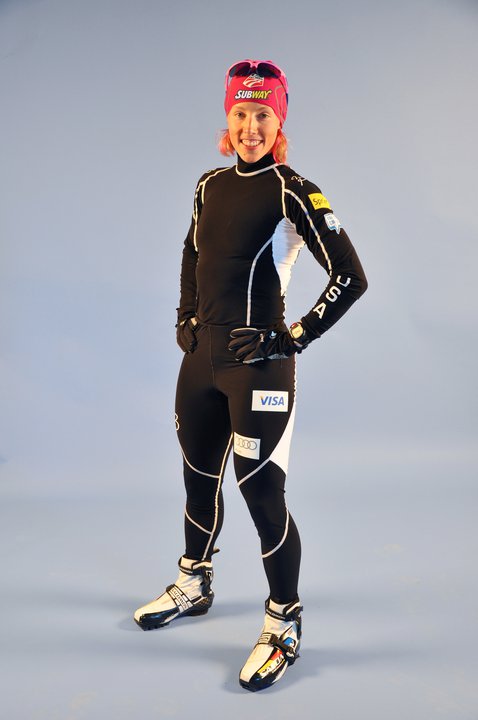
    From October 2010: Kikkan Randall modeling the U.S. Ski Team suit for the 2010-2011 season. Photo courtesy of the U.S. Ski and Snowboard Association.

    A national team uniform for cross-country skiing has to do a lot of things. At the most utilitarian level, it has to wick sweat and aid performance while an athlete pursues one of the world’s most demanding sports at temperatures between –4 F and 40, in steady snow or driving rain or anything in between. At the functional level, it has to let spectators and coaches identify where their athlete is out on the course, while distinguishing them from athletes from other countries. And at the symbolic level, it lets the athlete know that he or she is competing on behalf of their country, for everything that that means. Ask a skier who has represented the United States in international competition what it meant to them to pull on a national uniform for the first time. They’ll probably be able to tell you.

    (And if they ever forget, this detailing from Craft and L.L. Bean on the American uniforms, ca. 2015/2016, is there to remind them. “You are representing the United States of America,” a slogan intones, above a martial-looking eagle, with a U.S. Ski Team master mark for its aegis, gripping an olive branch (?) in its dexter claw and a skis and ski poles fasces in its sinister. “Pretty fun to be representing an American brand with our American uniforms!,” wrote Sadie Bjornsen in a blog post describing the uniforming process.)

    For whatever reason, the period roughly one decade ago represented the highwater mark for domestic and global coverage of ski uniforms on this website. There was “US Ski Team Brings Suit Consistency,” from Jan. 2009 (lede: “After years of a remarkable level of wardrobe schizophrenia, the US Ski Team has ushered in a new era of racing suit consistency that should make it easier to follow our favorite US athletes on the race course.”); “The costume disciplinarian speaks: Is it better to look good than to ski fast?” from July 2009; “The Best and Worst (Suits) of the Olympics,” from Feb. 2010; and “USST Goes Black for 2010-2011,” from Oct. 2010 (lede: “In the sport of cross-country skiing, most people would agree that competing with New Zealand is probably smarter than picking a fight with Norway.”).

    After that, attention to this important issue appears to have lain largely fallow until the 2018 Winter Olympics in Pyeongchang, which brought “FasterSkier’s Unofficial Guide to 2018 Olympic Cross-Country and Biathlon Suits.”

    So it seems to have been nearly 10 years since the last sustained attention to the uniforms of the Davis U.S. Cross Country National Team Program (née U.S. Ski Team). To fill that gap, FasterSkier hereby presents A Visual History of the United States Ski Team National Team Uniform, 2008–2019.

    (Why 2008 for the starting point? Mostly for the simple logistical reason that the image library in the current FasterSkier content management system, WordPress, only goes back to 2008, so this article can be written while using only images that FasterSkier may legitimately post on this site. To go back to closer to the start of this century would require a lot of external links to Getty Images and not that many photos to actually look at on this website. That said, this piece from 2009 has a nice visual roundup of the plethora of different USST designs worn from 2006–2008, which takes you back two more years. Before that, well, just imagine Kikkan Randall and a lot of other skiers you probably haven’t thought about for a while — Wendy Wagner, anyone? Rebecca Dussault? Sarah Konrad? — wearing various iterations of early-aughts red and black.)

    2008/2009 World Cup season: Red

    January 2009: No question who is from the US here… Kikkan Randall in the women’s Team Sprint in Whistler


    January 2009: Kris Freeman preferred the orange to silver in the men’s pursuit

    As a contemporary uniform article explained, “There are currently two suit variations being used by US Ski Team athletes, and athletes racing for the US in international events. They are so similar, that for practical purposes (identifying US skiers in a race) they may as well be the same. Both suits are predominantly red, with one version having patches of orange, and the other silver.” Both were manufactured by Norwegian company Bjørn Dæhlie.

    There appears to have been no change to the basic World Cup design for the 2009 World Championships in Liberec, Czech Republic:
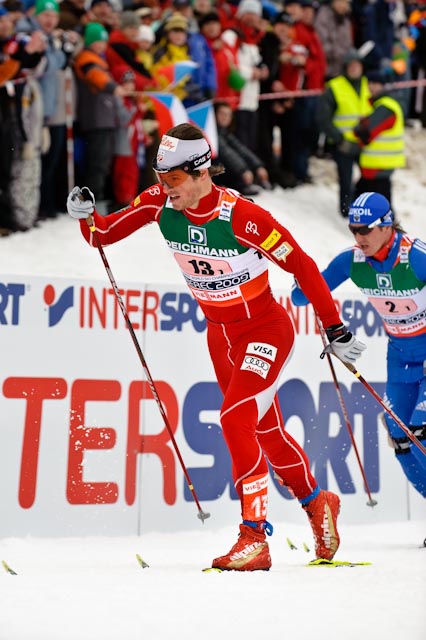
    Freeman at the 2009 World Championships in Liberec. (Photo: Swix Sport)

    2009/2010: Still red Bjørn Dæhlie

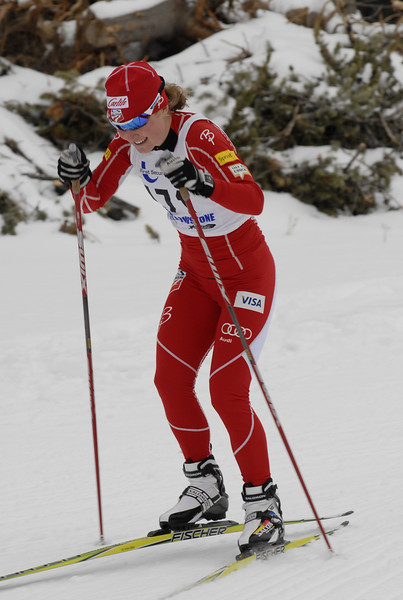
    November 2009: Tazlina Mannix (APU, USST) racing in West Yellowstone.


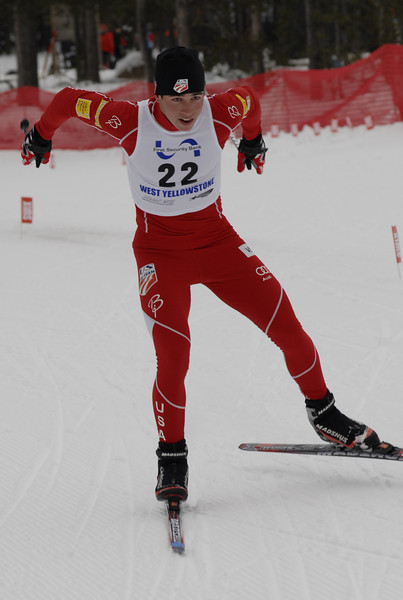
    November 2009: A very young Noah Hoffman (USST) racing to 3rd in a distance race in West Yellowstone.

    Honorable mention, domestic suits division:
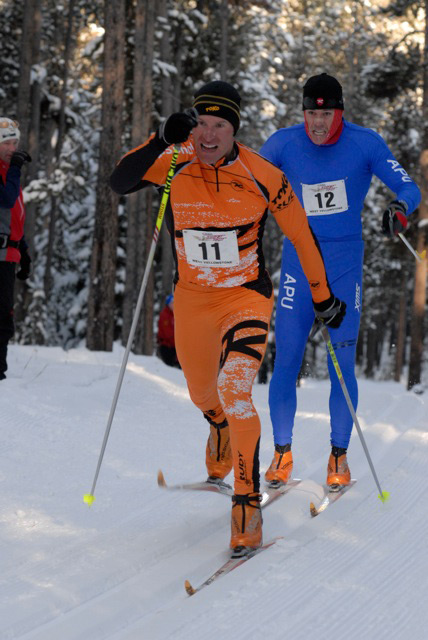
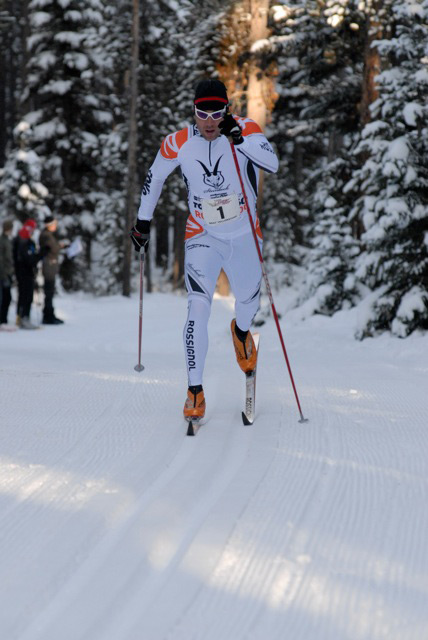
    November 2009: This is a very orange suit. Kevin Hochtl (Rossignol) – 32nd – leads Anders Haugen (APU) – 7th – to the finish in a West Yellowstone race.


    November 2009: This is one hell of an ibex. Chris Cook (Steinbock Racing) – 12th – sporting the new Steinbock Racing uniform


    2010 Winter Olympics, Vancouver: Red and silver

    For the Olympics, the Americans appear to have taken their World Cup template – Bjørn Dæhlie suit, largely red – but have changed it by, inter alia, lightening the shade of red, adding “USA” on the right arm and left leg, adding silver accents, and of course removing all sponsor logos. Kikkan, already skiing in her third Olympics, coordinated with a red headband, red gloves, and her famous pink highlights. Andy Newell went with the red hat (he may not have had a choice), but was otherwise somewhat less vermilion.
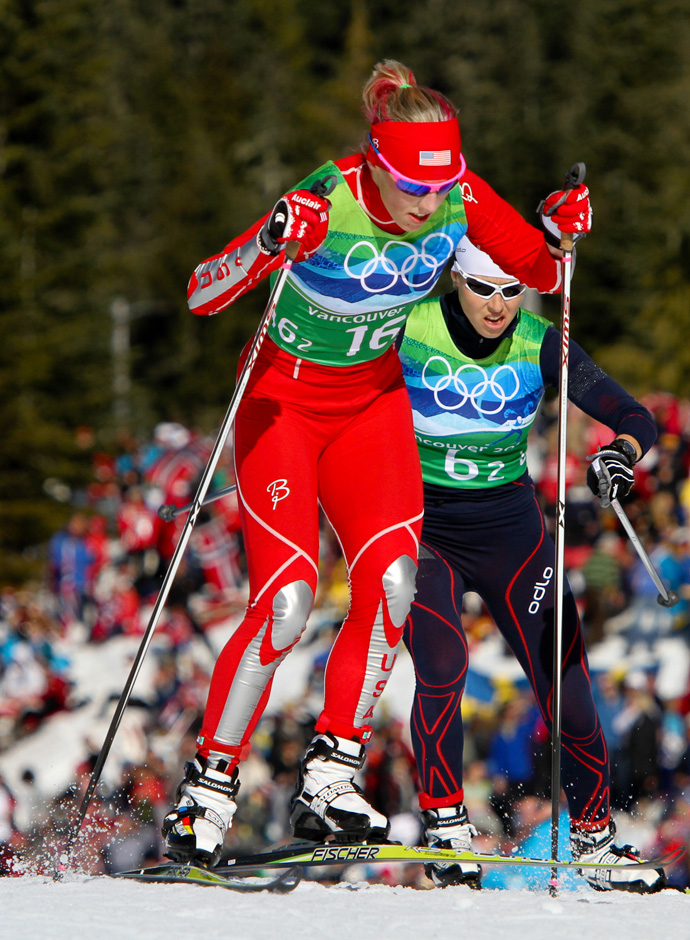
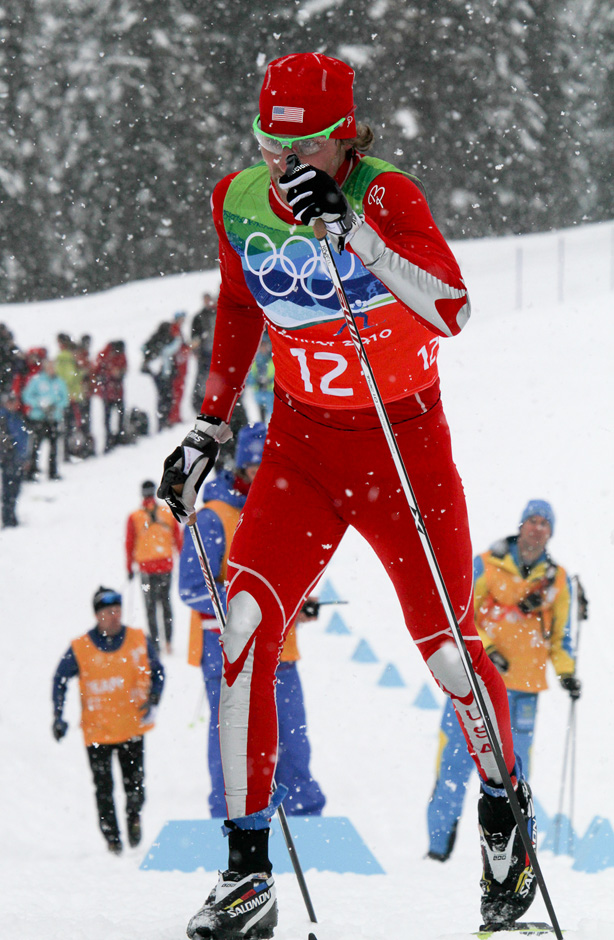
    Feb. 2010: Kikkan Randall
    Feb. 2010: Andy Newell on the big climb during the men’s 4 x 10 k relay.

    There was a lot of red in Vancouver. For example, here’s Andy Newell (far left, bib no. 13-2) tagging Korin Koos for the U.S. in the team sprint, while Petter Northug (far right, bib no. 2-2) tags Øystein Pettersen (middle right, bib no. 2-1) for Norway. (An entire standalone article could likely be written on the Canadians’ infamous kit (bib no. 4, back right).)
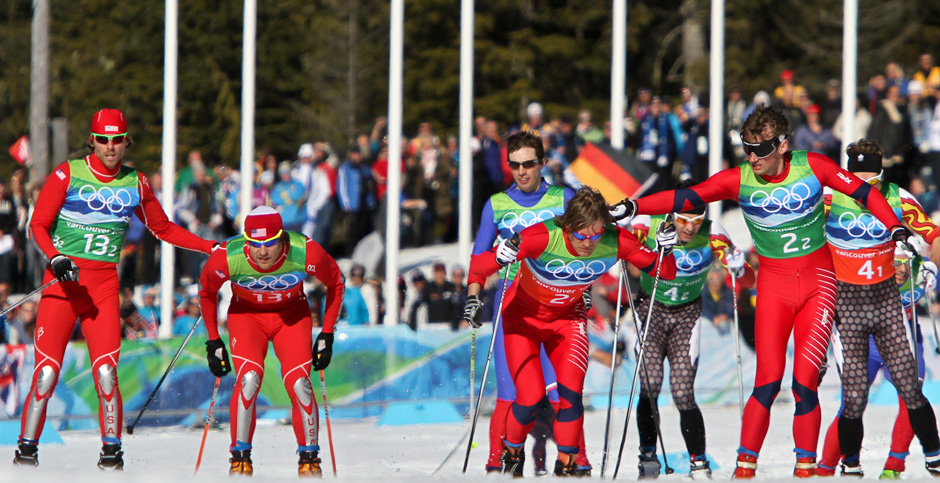
    Newell tags Koos (left) and Northug tags Pettersen (right) at the 2010 Vancoulver Olympics.

    Or here’s Newell in the middle, between Switzerland’s Dario Cologna (bib no. 12) and Yuichi Onda of Japan (bib no. 18):
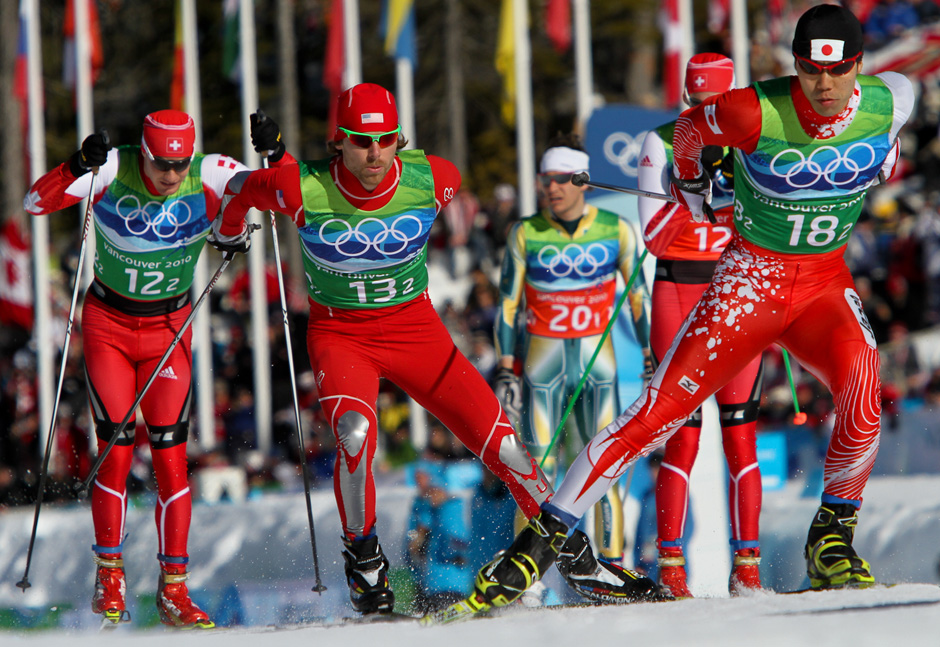
    Newell in the semis of the skate sprint: 2010 Vancouver Olympics.

    Finally, Poland (shown here: Sylwia Jaśkowiec, bib no. 6) was just red:
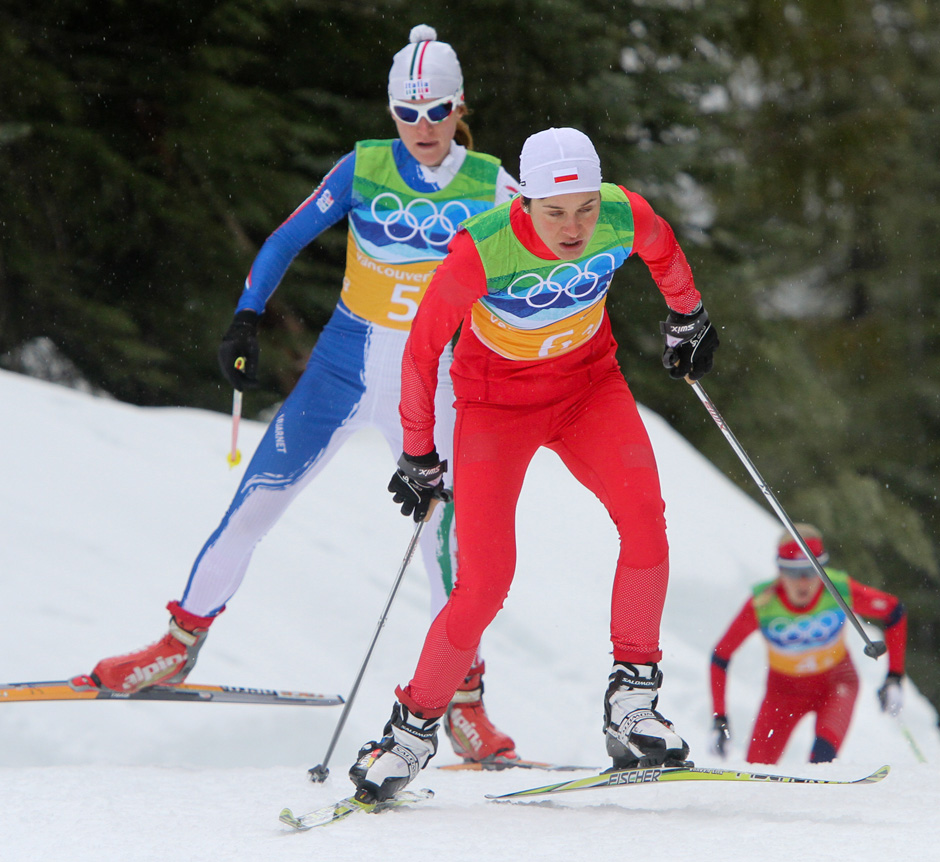
    Poland 2, 2010 Vancouver Olympics.


    2010/2011: The black era begins

    Perhaps as a natural reaction to the dominance of a single color across multiple nations, the U.S. made a significant shift for the 2010/2011 World Cup season: black. The color does not appear on the national flag or in other common American iconography, but it is certainly distinctive. Bjørn Dæhlie remained the suit manufacturer.

    Or, as then-FasterSkier reporter Nat Herz wrote in fall 2010, “After any number of years of being drowned out by a sea of Norwegian crimson, U.S. Ski and Snowboard Association Nordic Director John Farra said that the USST will be ‘distinctly not red’ for the 2010-2011 season—including at World Championships in Oslo. ‘We went in a very different direction, in part from our experience in Oslo, where they [Norway] have a nation’s group of ten, and we can barely see our athletes in the group,’ he said.”
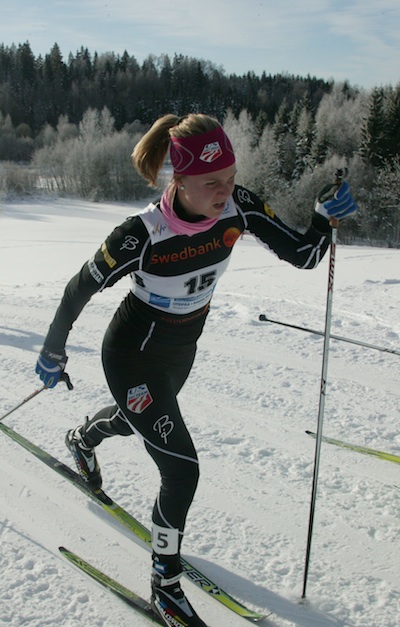
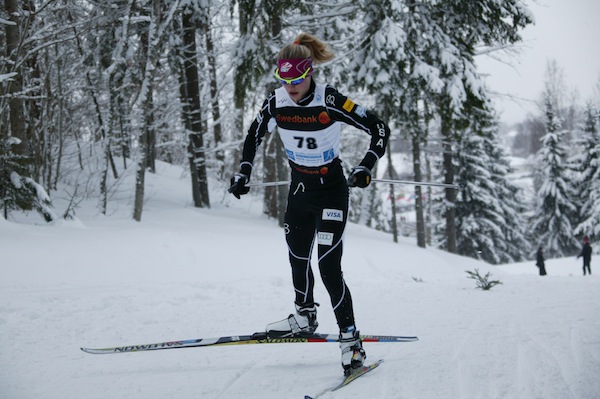
    January 2011: A 21-year-old Sadie Bjornsen races to 17th at U23 World Championships in Otepää, Estonia.


    January 2011: Jessie Diggins, then aged 19, races to 7th at Junior World Championships in Otepää.


    January 2011: Noah Hoffman at a SuperTour race in Lake Placid.


    February 2011: No change for World Champs: Kikkan Randall racing at 2011 World Championships in Oslo.


    2011/2012: Still black Bjørn Dæhlie
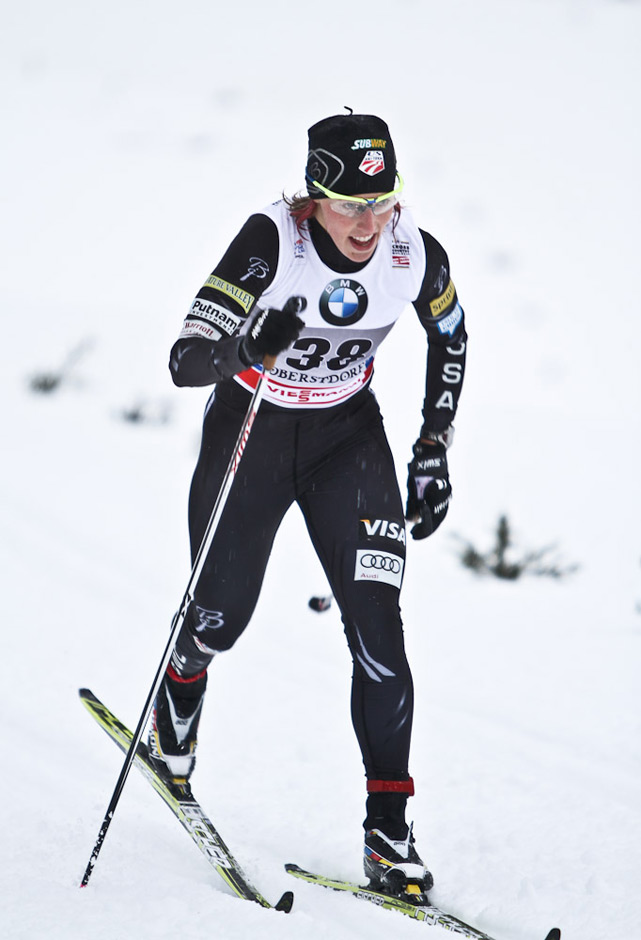
    December 2011: Kikkan Randall sprinting during the Tour de Ski.


    March 2012: Kris Freeman (SSCV/USST) on his way to claiming the US Distance Nationals 50 k freestyle title on Saturday morning in Craftsbury.


    2012/2013: Still black

    December 2012: Noah Hoffman in the Tour de Ski.


    December 2012: Kikkan Randall blasting to victory in the Tour de Ski opening prologue on Saturday. She skied to 14th in the pursuit on Sunday and is leading the U.S. women in the Tour de Ski standings after two stages. Photo: Marcel Hilger.


    February 2013: Diggins and Randall won gold in the team sprint at 2013 World Championships in Val di Fiemme, Italy, which was awesome, but, for purposes of this article, mostly relevant for the addition of the epochal relay socks but otherwise no change to the standard World Cup uniform.


    2013/2014: Yup, still black

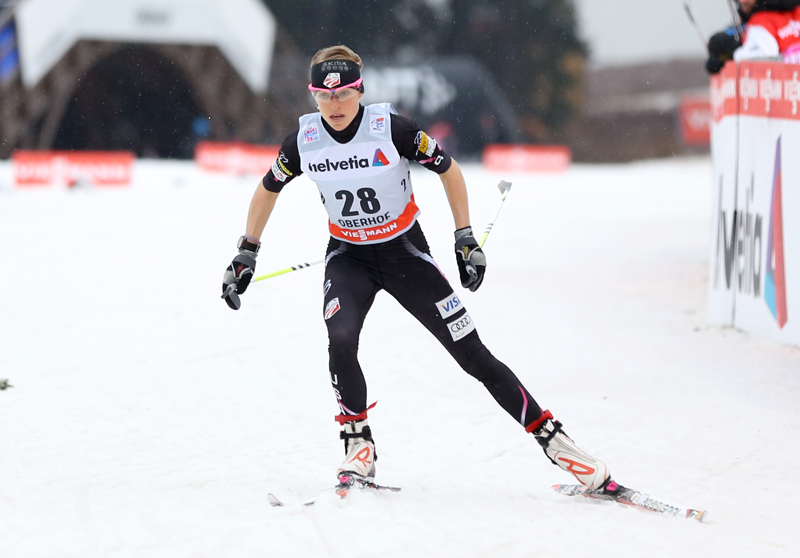
    December 2013: Liz Stephen (U.S. Ski Team) on her way to 34th in Saturday’s 3 k freestyle prologue at the first stage of the Tour de Ski in Oberhof, Germany. (Photo: Marcel Hilger)


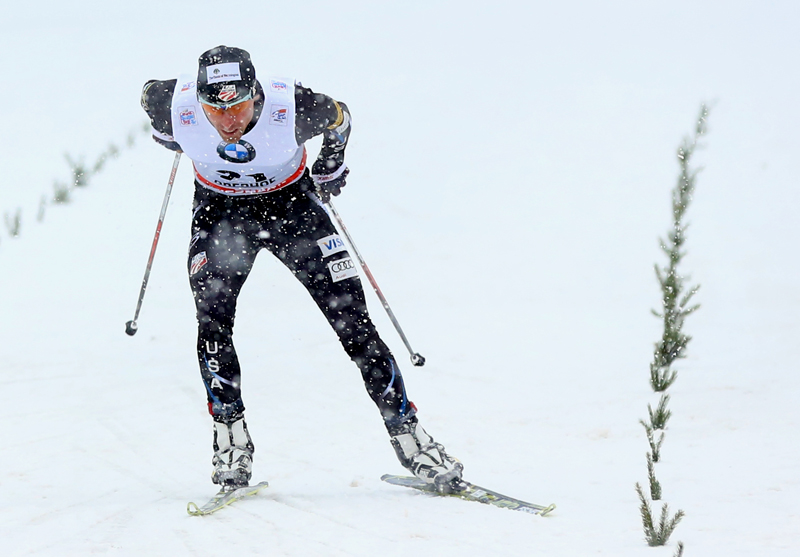
    December 2013: Andy Newell (U.S. Ski Team) qualified 12th and finished 10th overall in Sunday’s freestyle sprint. (Photo: Marcel Hilger)


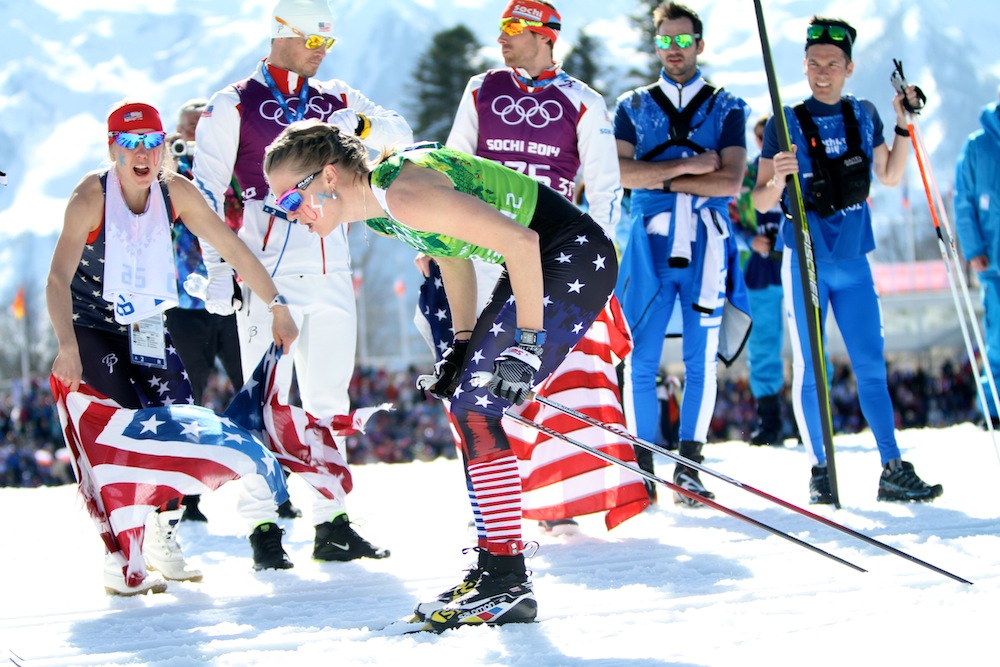
    2014 Winter Olympics, Sochi: Stars and stripes

    The 2014 Winter Olympics, in Sochi, Russia, were known at the time for Kikkan Randall’s disappointing result in the individual skate sprint, and after the fact for the revelation that Russia was engaged in a massive state-sponsored doping scheme and cover-up. They were also significant for a change in uniforms: stars and stripes on the right arm and left leg, and a large “USA” on the right leg. The left arm was relatively plain. Also, several of the U.S. women drew attention for racing sleeveless in warm temperatures. Bjørn Dæhlie continued to be the brand logo featured on the upper right quad. (Pictured below: Noah Hoffman, in a solo race, and Sadie Bjornsen, in the women’s relay.)
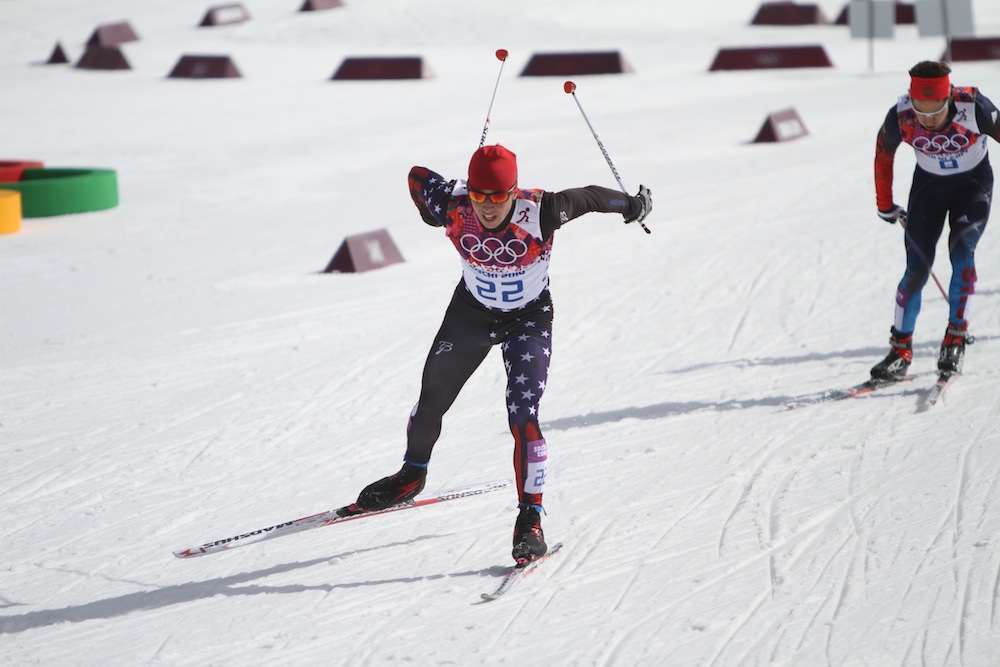


    2014/2015: Stars and stripes redux

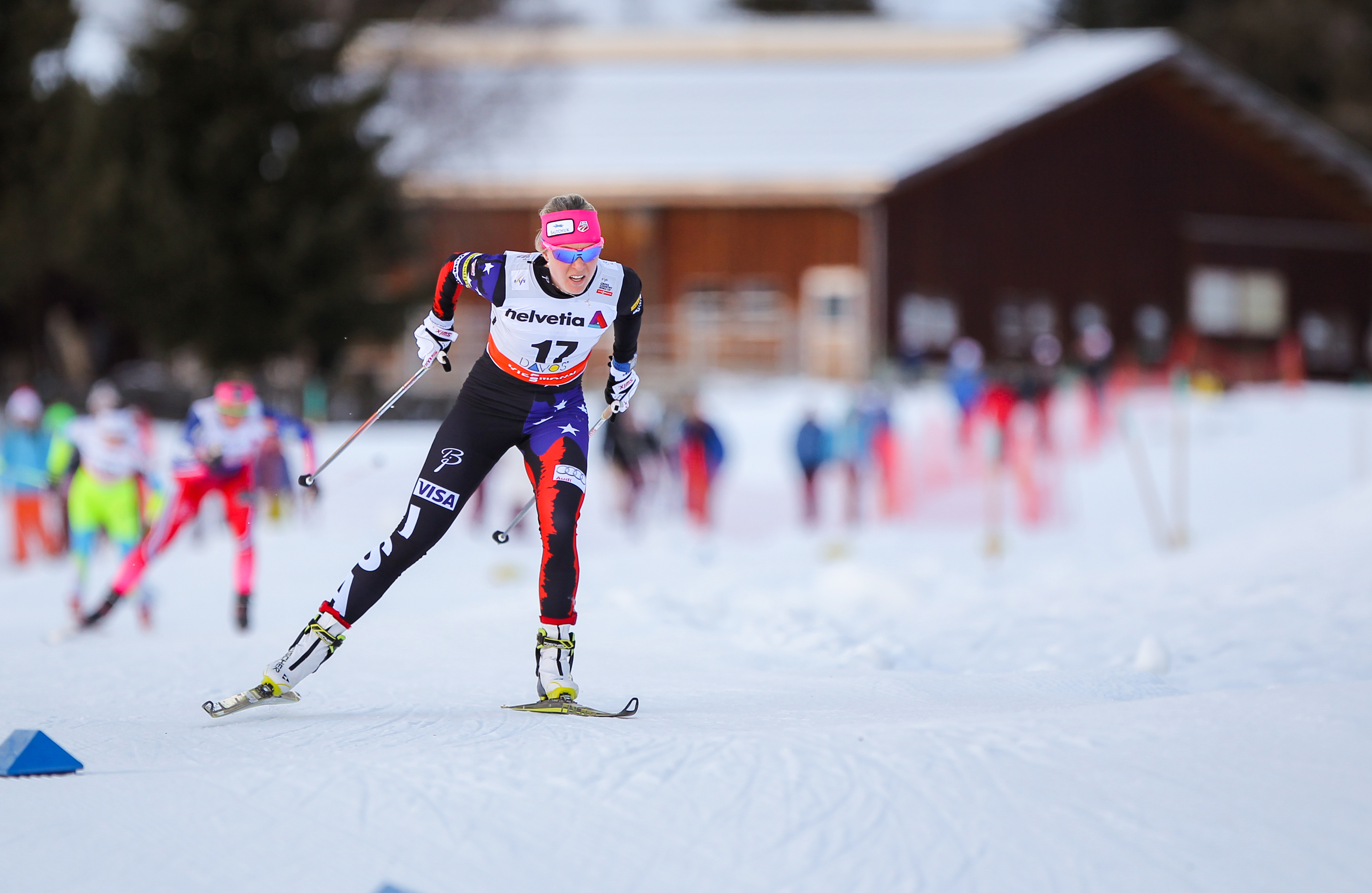
    Athletes took to the trails next season with a slightly modified version of the recent Olympics uniform: Larger stars on the left upper quad, with a deeper blue background. The stripes on the left leg became more pronounced and stretched farther up the race suit, to above the knee. Also, once the non-commercial period of the Olympics had passed, there was space for sponsor patches on the arms and legs.
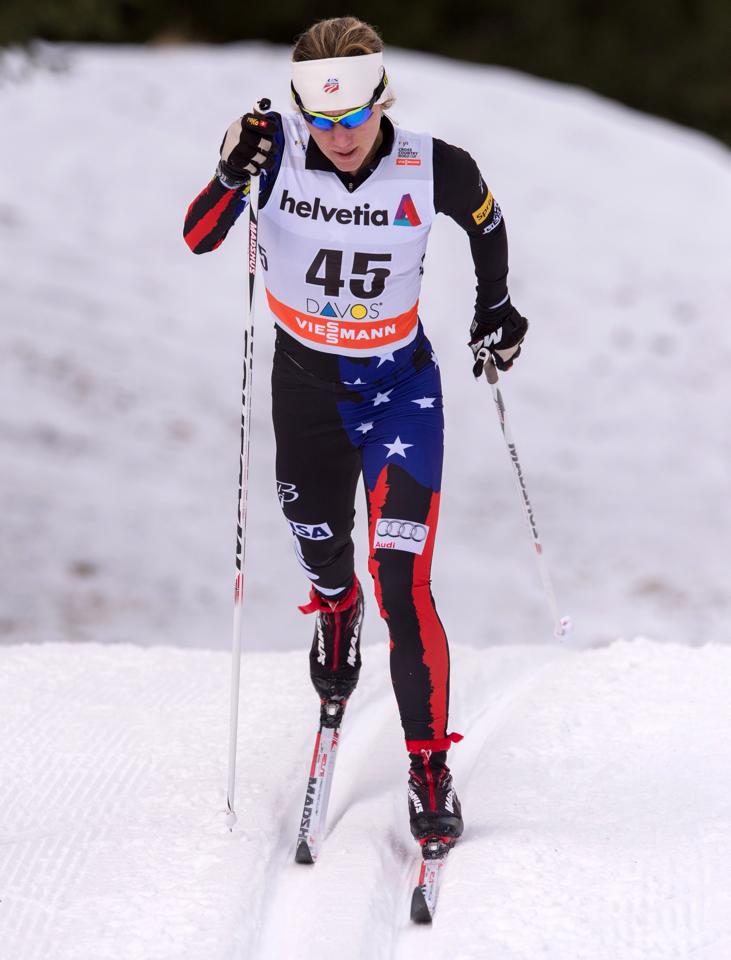
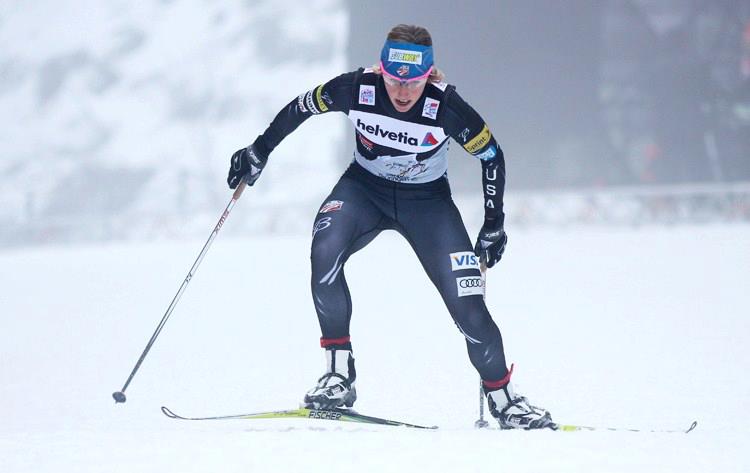
    December 2014: Caitlin Gregg (Team Gregg) skiing to 56th place in the Davos World Cup 10 k classic, Dec. 13. (Photo: Toko)


    USST’s Sadie Bjornsen racing to 29th in the Davos World Cup 10 freestyle, Dec. 20, 2014. (Photo: Fischer/Nordic Focus)

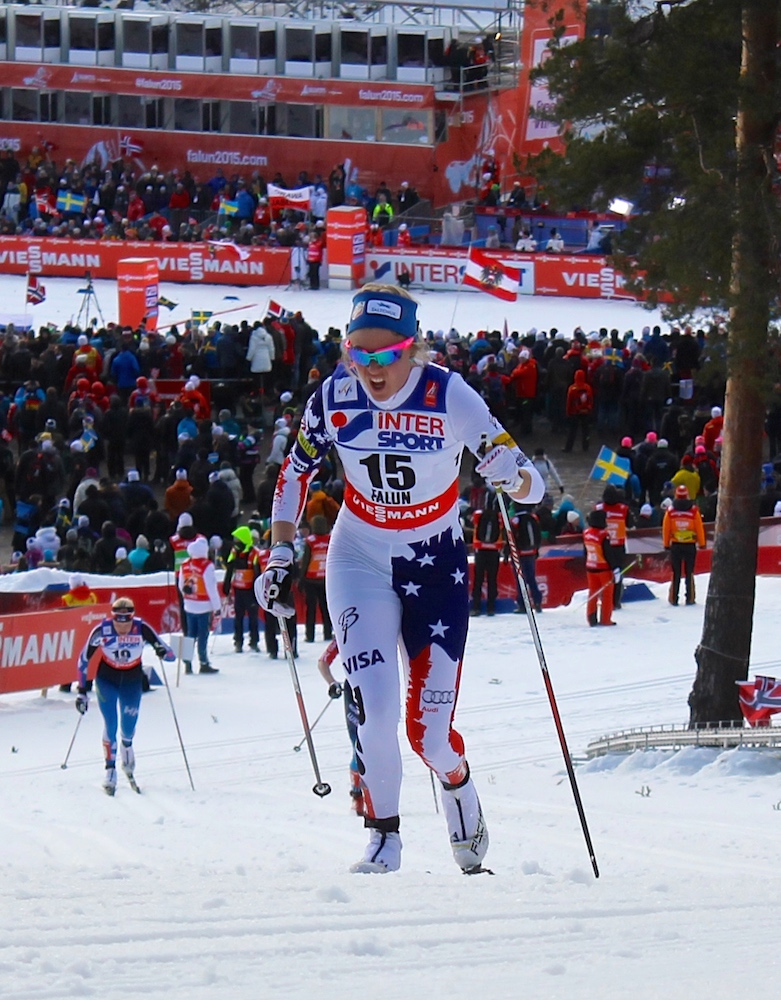
    World Championships, in Falun, Sweden, brought a mostly-white version of the uniform, helpful for the warm temperatures and soupy conditions that characterized many of the races. Here’s Sadie Bjornsen in Falun in February 2015:
     

    2015/2016: Red, white, and blue

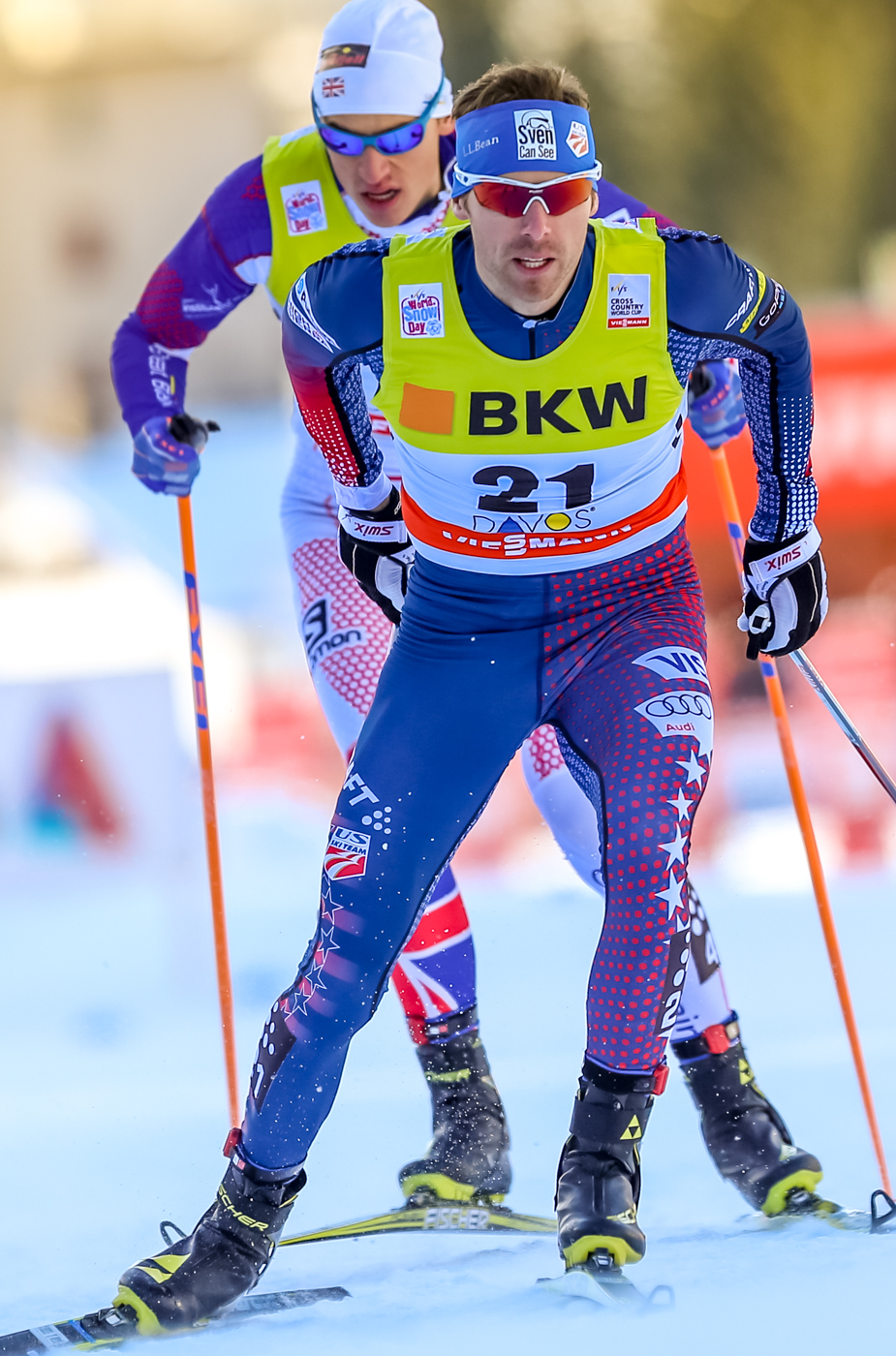
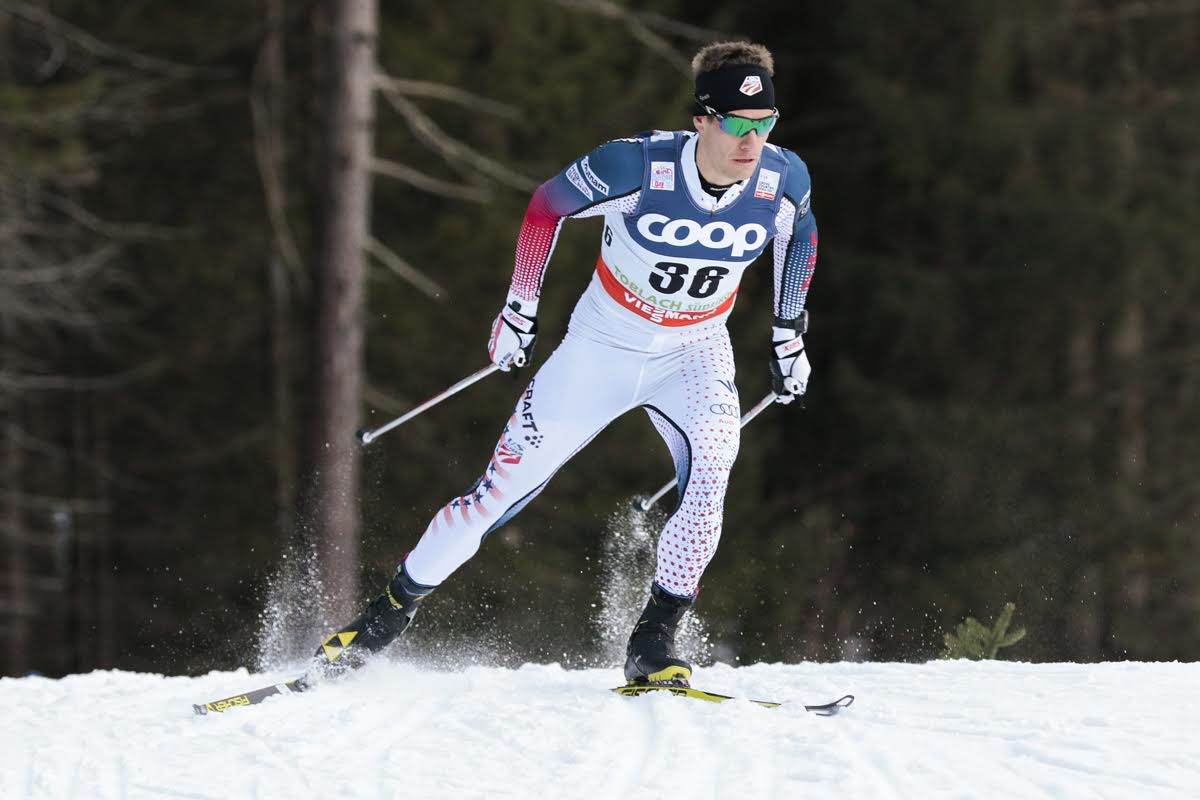
    By fall 2015, the move away from black, and towards red, white, and blue, was complete. Athletes now had the option of being attired in a predominantly white color scheme, which would aid in preventing overheating on warm days, while thankfully solving the transparency issues that had plagued recent all-white suits for Sweden or Italy. An alternate version had roughly the same patterning, but with blue as the primary color. Notably, the Americans also moved to a race suit manufactured by the Swedish company Craft for the first time in this survey.
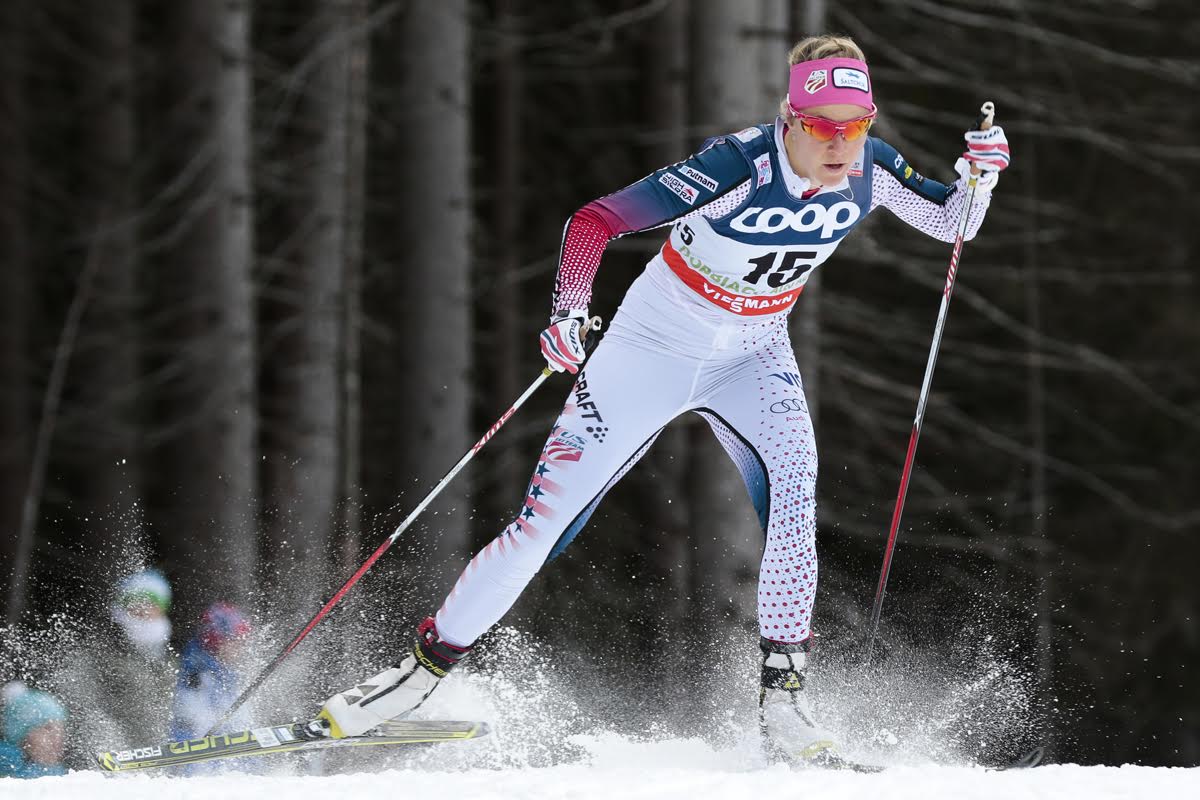
    December 2015: Sadie Bjornsen (U.S. Ski Team) racing to her best-ever sprint qualifier in sixth at the World Cup freestyle sprint in Toblach, Italy. She went on to make the semifinals and place 10th overall. (Photo: Fischer/NordicFocus)


    December 2015: Simi Hamilton (U.S. Ski Team) racing to his first non-stage World Cup podium on Saturday in Toblach, Italy, where he placed second in the freestyle sprint. (Photo: Fischer/NordicFocus)


    December 2015: American Andy Newell (r) and Great Britain’s Andrew Young (c) trail Norway’s Håvard Solås Taugbøl (2) in the quarterfinal at the Davos World Cup freestyle sprint on Sunday in Switzerland. Taugbøl won the heat, Young placed third, and Newell was fifth after missing out on a photo finish for fourth. Newell finished the day 23rd overall. (Photo: Marcel Hilger)


    January 2016: Ida Sargent (U.S. Ski Team) teamed up with Sophie Caldwell (not shown) to place fifth in the 6 x 1.2 k freestyle team sprint at the World Cup in Planica, Slovenia. (Photo: Madshus/NordicFocus)

    Honorable mention: Trending towards “purple cobras” for American biathlon but not there yet.

    American Claire Waichler started 58th and finished 33rd in the youth women’s pursuit on Sunday at IBU Youth/Junior World Championships in Cheile Gradistei, Romania. (Photo: IBU YJWCH Cheile Gradistei 2016/Facebook)


    2016/2017: More red, white, and blue

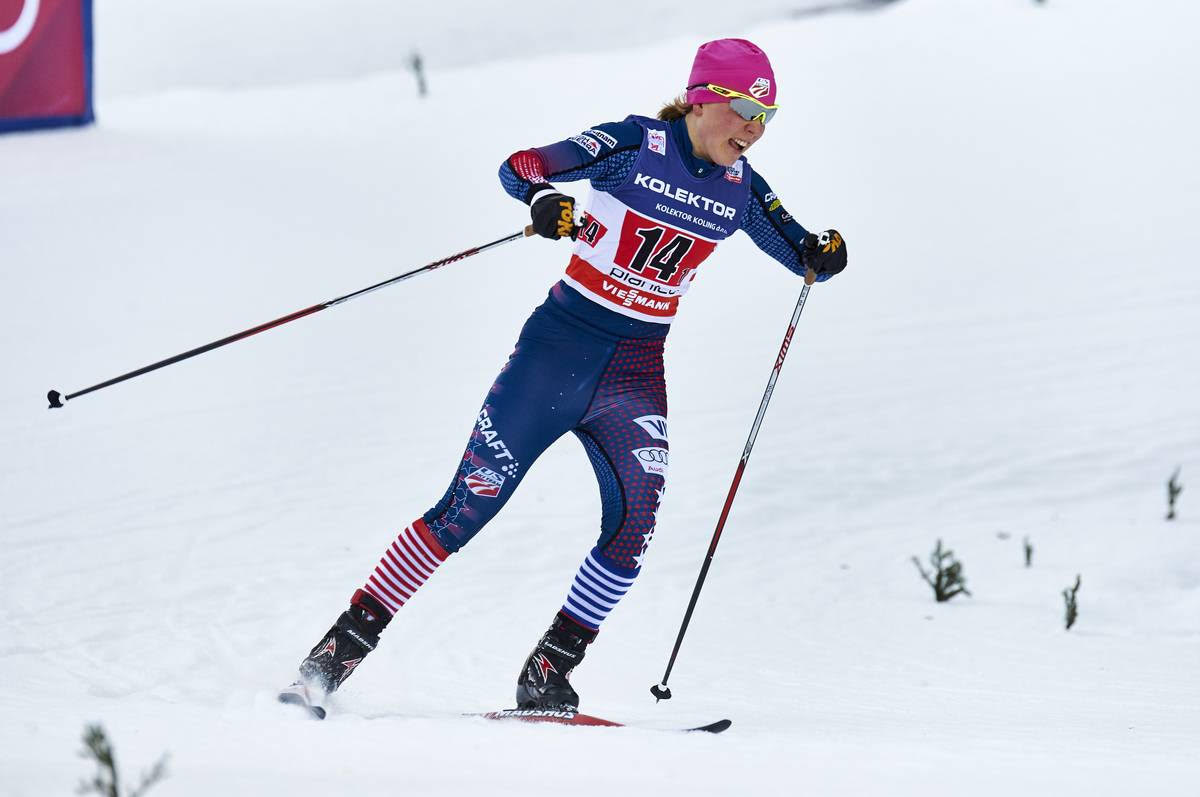
    An interpretation of red, white, and blue, still on a Craft suit, remained in place for the 2016/2017 World Cup season, which was marked within the team by Randall and her husband, Jeff Ellis, traveling the European race circuit with a newborn in tow. The changes to the USST uniform were less dramatic than Randall’s familial status: Still red, white, and blue, though now with blue as the dominant color. The entire left leg, and the bottom half of the right leg, had markings, somewhere between subtle striations and full-on stripes, that evoked the stripes of the American flag. (Let’s put aside for the moment the fact that the stripes on the actual flag are white and red, not white and blue.) The pattern was repeated on the lower right arm. An understated evocation of blue or white stars marked both lower legs, with more pronounced stars scattered around the bottom of the torso (possibly the top as well, but nearly all of one’s torso is typically covered by the standard race bib). The left arm and left leg both proclaimed “USA” in red lettering.

    The vehicular logo on the legs remained that of Audi, as it had been since the start of this history.

    There appears to have been no change for the 2017 World Championships. At least to the uniforms; on the race course, the Americans won an unprecedented three medals.
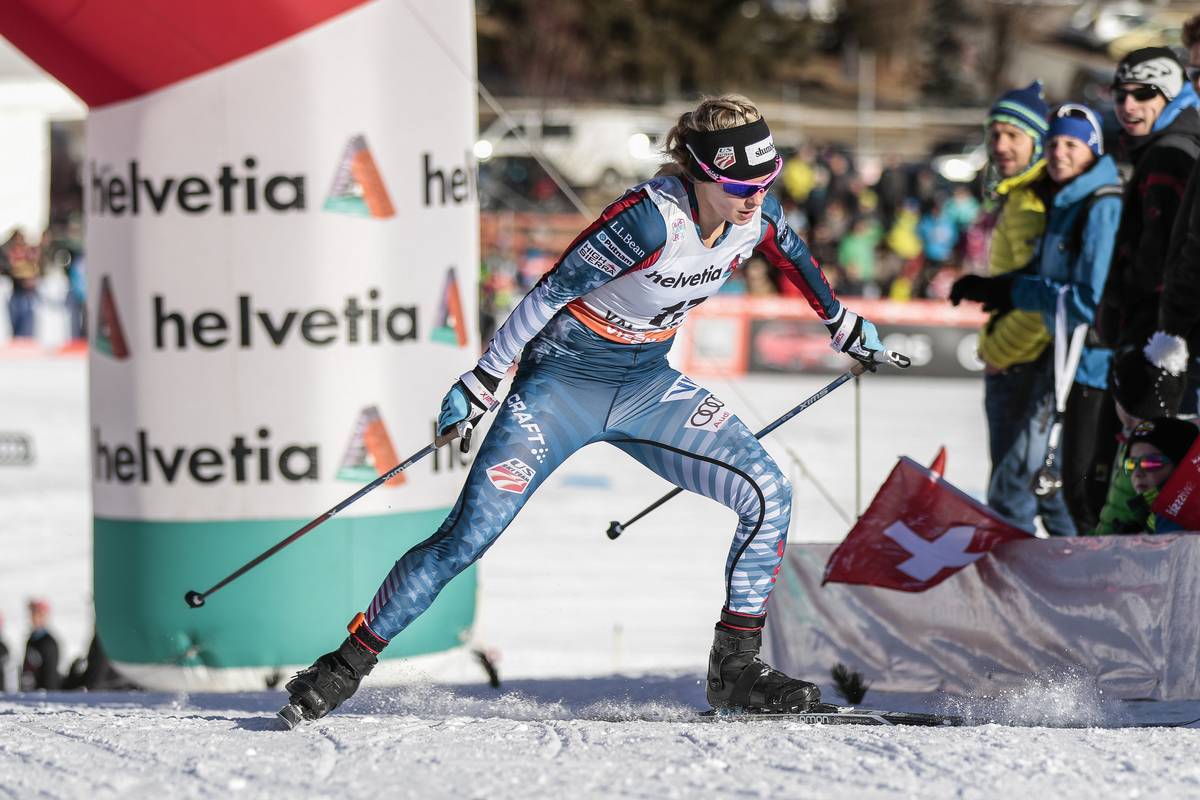
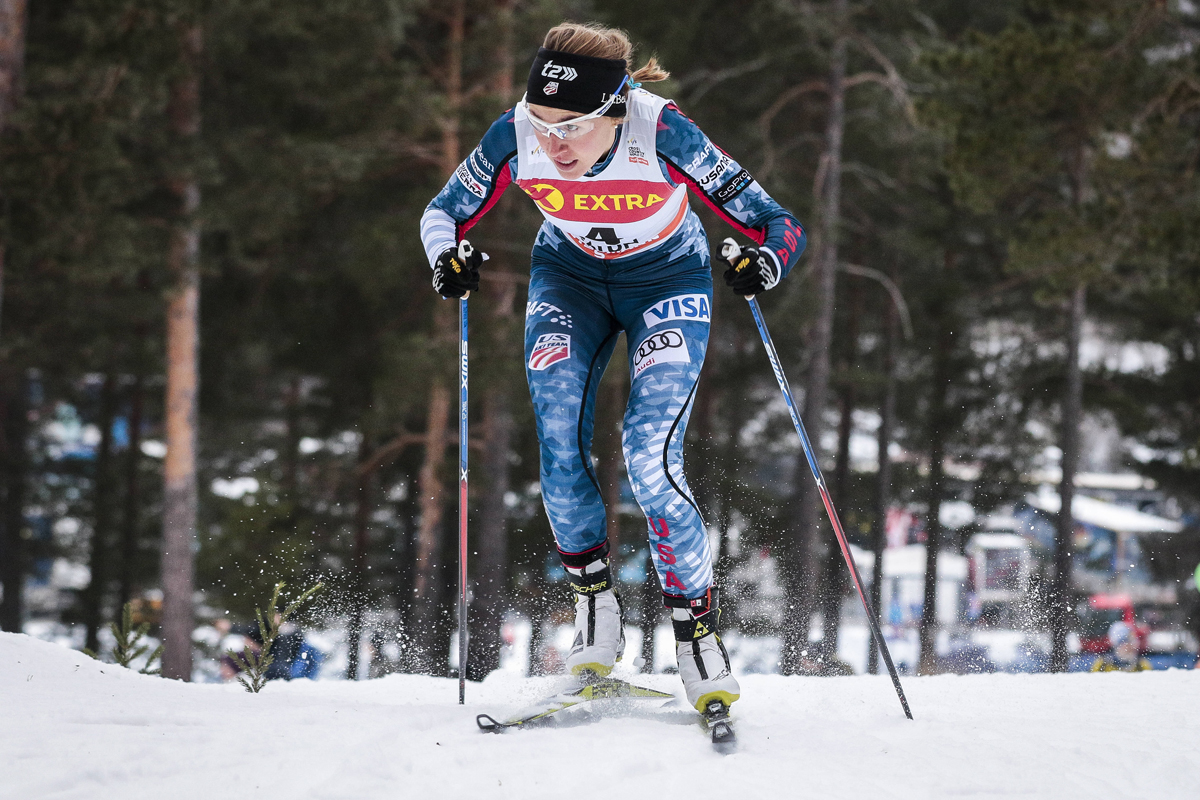
    December 2016: Jessie Diggins (U.S. Ski Team) racing to ninth in Saturday’s 1.5 k freestyle sprint qualifier in Val Müstair, Switzerland. Diggins went on to place sixth in the final. (Photo: Salomon/NordicFocus)


    January 2017: Sophie Caldwell (U.S. Ski Team) racing to third in the qualifier of Saturday’s 1.4 k freestyle sprint in Falun, Sweden. She went on to finish 16th overall (Photo: Fischer/NordicFocus)


    February 2017: Kikkan Randall (U.S. Ski Team) racing to 26th in the women’s 10-kilometer classic individual start at the 2017 Nordic World Championships on Tuesday in Lahti, Finland (Photo: John Lazenby/Lazenbyphoto.com)

    Meanwhile, biathlon saw the advent of the beloved “purple cobras” era:
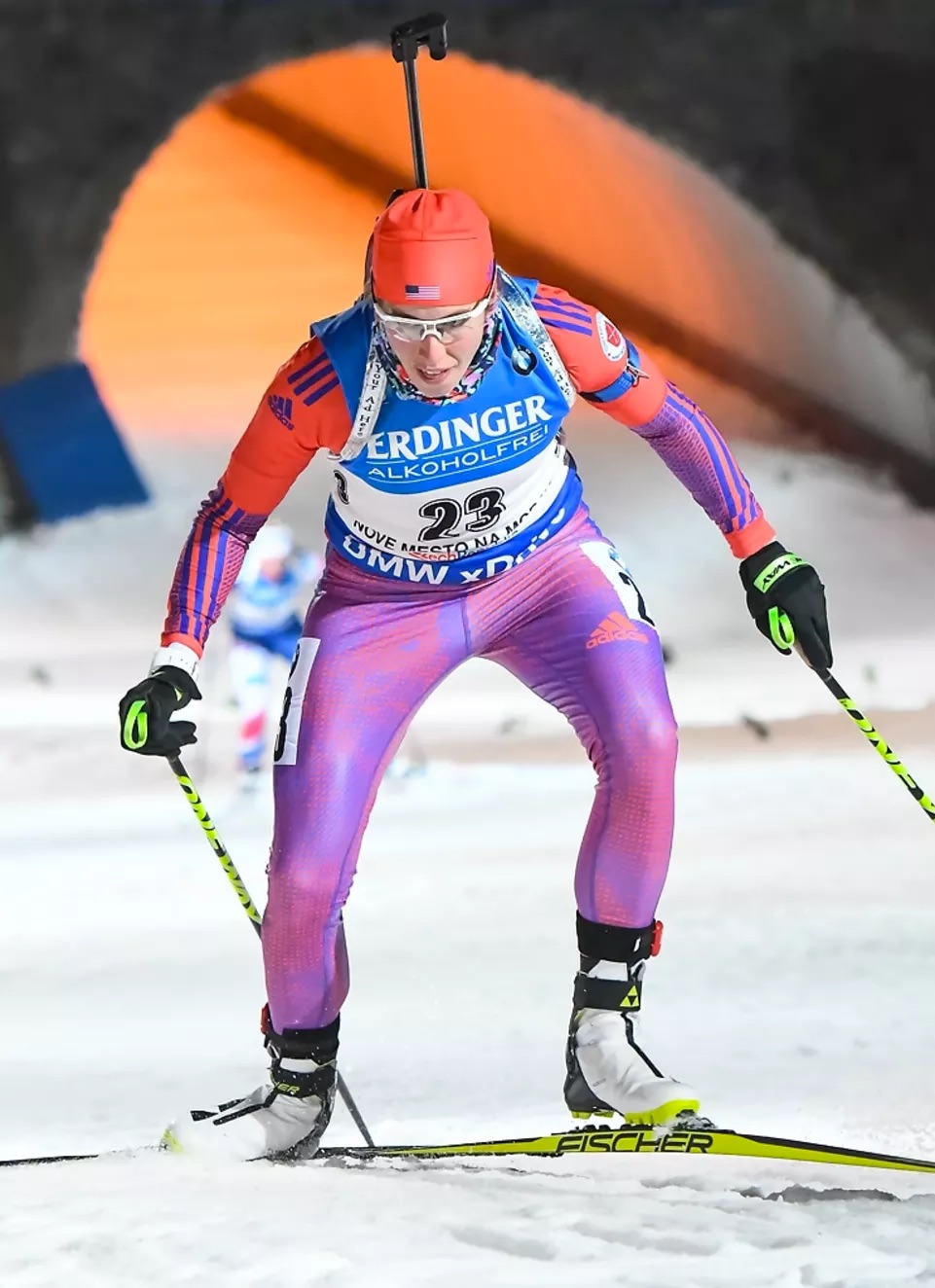
    US Biathlon’s Susan Dunklee on her way to finishing third in the women’s sprint at the IBU World Cup in Nove Mesto, Czech Republic. It was the third podium of her career. (Photo: IBU)


    2017/2018: Red, white, and blue redux

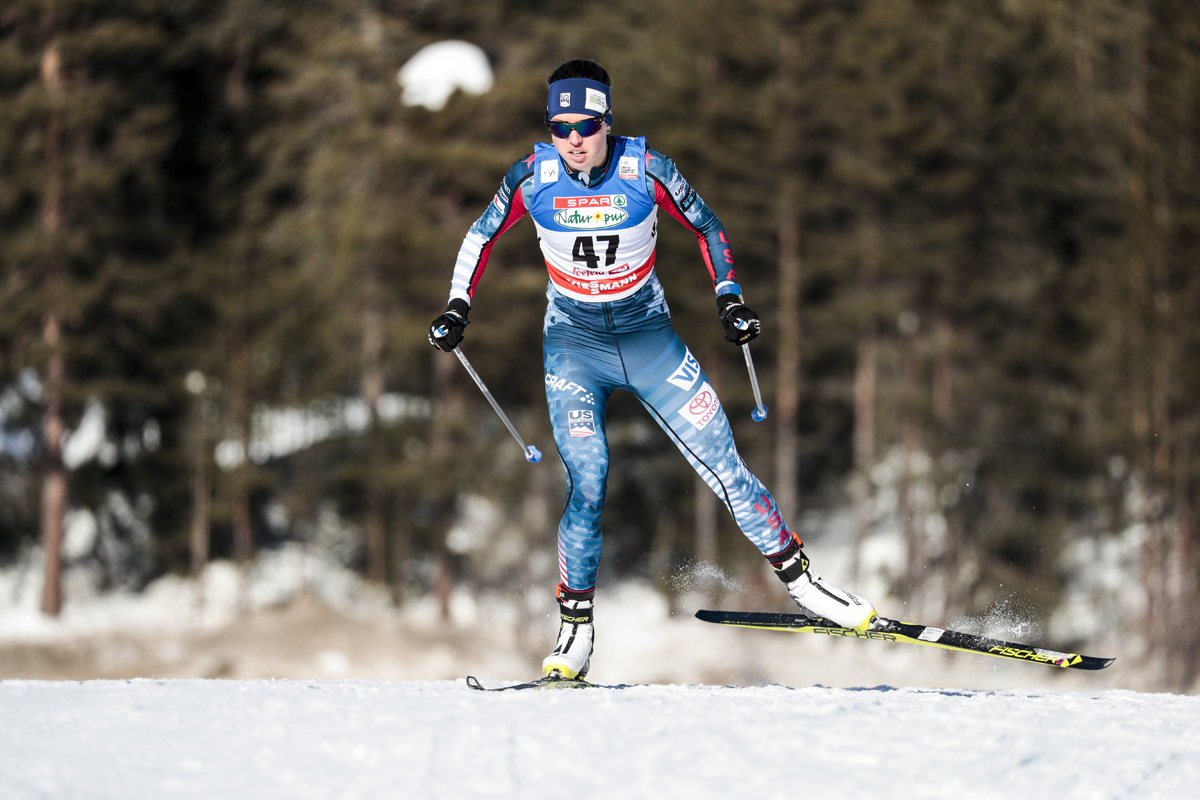
    There appears to have been no change for the 2017/2018 World Cup season: still red, white, and blue, but mostly blue, on a Craft suit. The most notable change may have been to the car sponsor… for the first time since at least the scope of this article, a Toyota logo was on the leg, not Audi. Nichts ist unmöglich (“Nothing is impossible”), as the company’s European slogan proclaims.
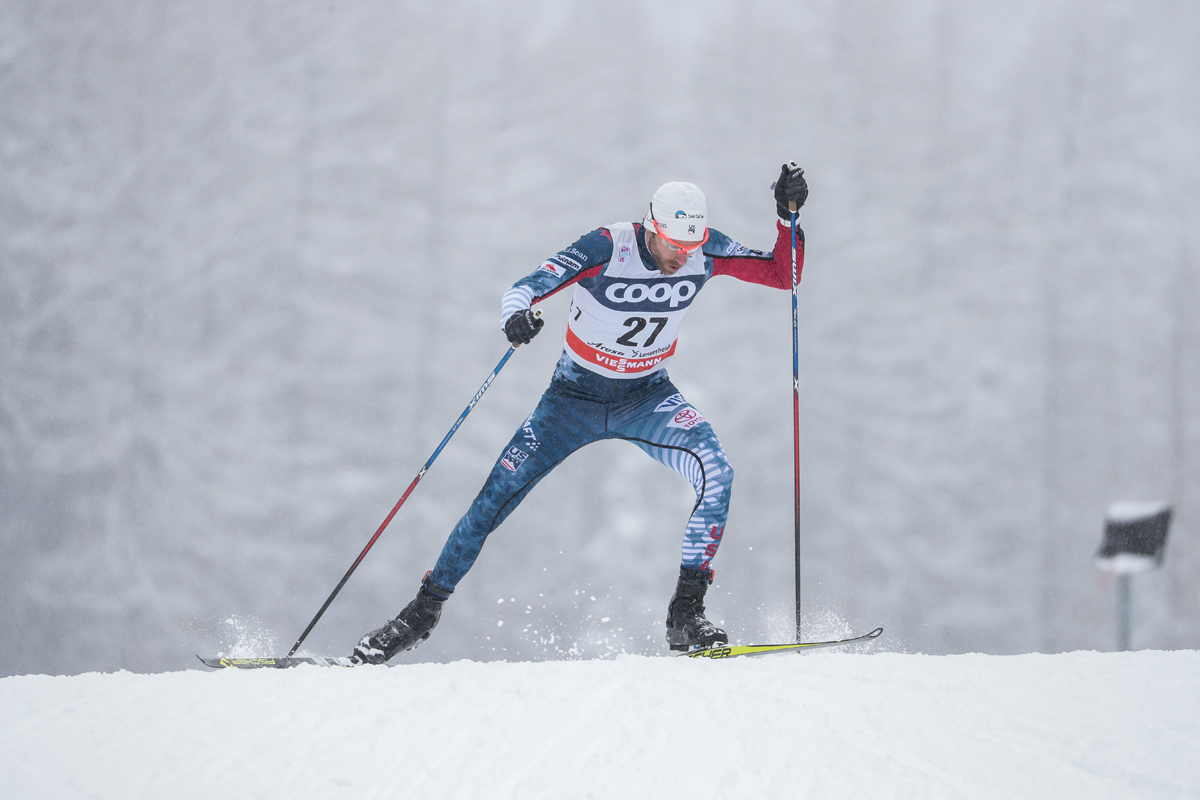
    American Andy Newell racing the men’s 1.5 k freestyle-sprint qualifier at Stage 1 of the Tour de Ski on Saturday in Lenzerheide, Switzerland. He qualified 20th and went on to finish 19th overall. (Photo: Fischer/Nordic Focus)


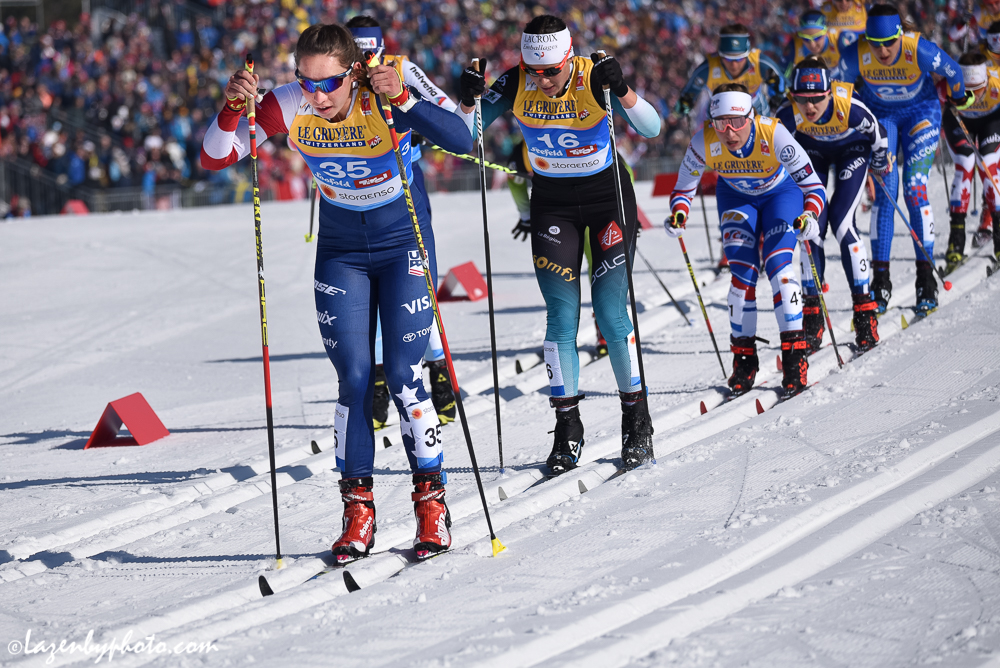
    Caitlin Patterson (Craftsbury Green Racing Project) racing to 52nd in the freestyle sprint qualifier at the last World Cup on Jan. 27 in Seefeld, Austria. The next day, she placed 23rd in the 10 k freestyle mass start. (Photo: Fischer/NordicFocus)


    2018 Winter Olympics, Pyeonchang: Red, white, and blue, and a lot of stripes

    There is a somewhat famous picture from the 2018 Winter Olympics that you may already be familiar with. In the picture, Jessie Diggins, on the lefthand side of the frame, stretches her left foot across the finish line to secure an historic Olympic gold medal for the United States. Her left arm mirrors the gesture, punching the air above her in what is presumably an instinctual counterbalance to the lunge but also appears, in a frozen moment in time, to be a triumphant fist-pump. In the middle, her face is rent in a rictus of exertion and triumph. On the righthand side of the frame, Stina Nilsson of Sweden lunges as well, 0.19 seconds behind Diggins. Mute V-boards and still flags fill in the background of the image, as Maiken Caspersen Falla of Norway appears to stand up and stop skiing in order to watch the finish unfold.

    It was a few seconds before 7:16 p.m. in Pyeongchang, 4:16 a.m. in Afton, Minnesota, and 1:16 a.m. in Anchorage, Alaska. If you’re reading this website, you may remember where you were at that moment.
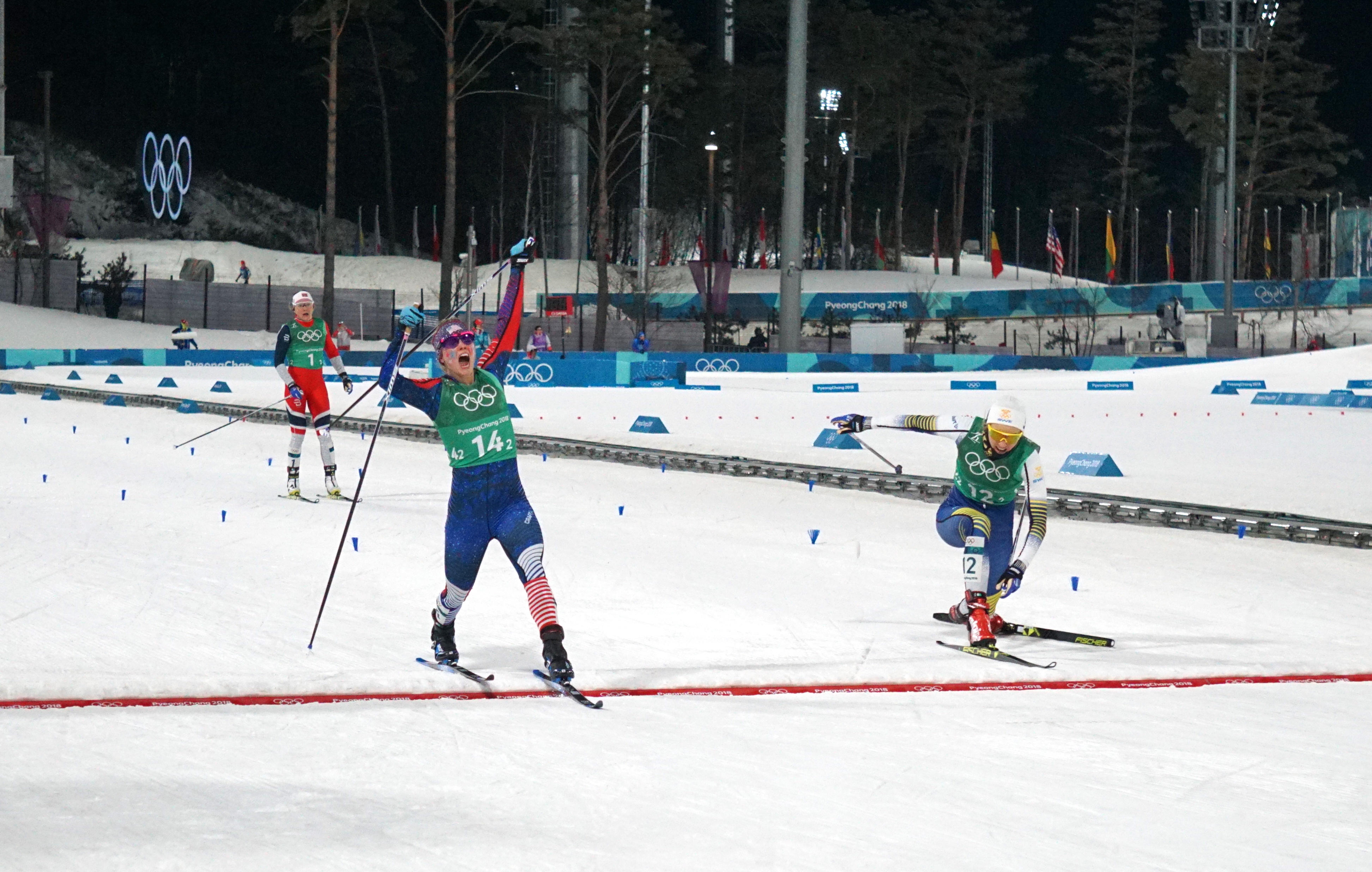
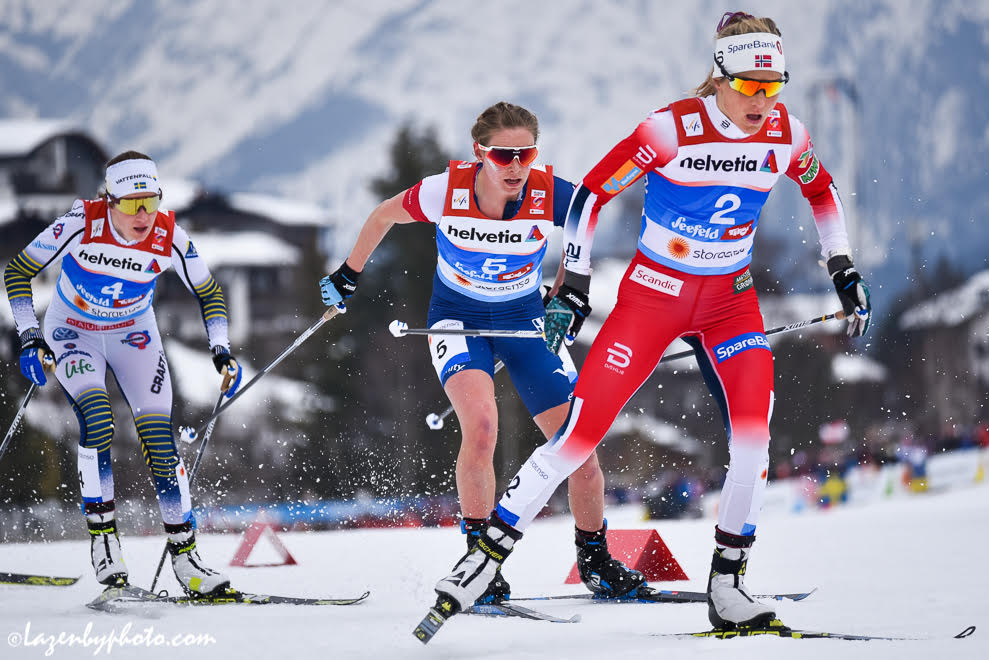
    February 2018: Jessie Diggins (14) edges Sweden’s Stina Nilsson (r) for gold, while Norway’s Maiken Caspersen Falla (far left) races to bronze, in the women’s freestyle team sprint final at the 2018 Olympics in PyeongChang, South Korea. (Photo: Noah Hoffman)

    But let’s talk about the uniform. Another Craft product, the dominant impression is once again blue; in the photo above, taken at whatever distance from the finish Noah Hoffman was allowed to stand while there was a race on, there is a whole lot of blue approaching the finish line between the American suit and the Swedish one. Some white stripes are visible around the knee of Diggins’s suit, trending down the lower leg, though they are soon subsumed by The Relay Socks.

    On closer inspection, however (see next picture, below), there are a lot of stripes going on in this uniform. The entire legs are striped, with stronger white stripes on the sides of the torso fading to fainter stripes at the top of the leg. The knees have white stripes on a blue background, with the width of the white stripes gradually decreasing and the extent of the blue interstices gradually increasing across the course of the knee. As shown in more detail here, the patterning gives way to thin red stripes against a blue background, on the lower right leg, and a bold white “USA,” on the lower left.

    The right arm has white splotches, potentially stellar in nature, against a blue background. The left arm has red and white stripes to midway down the biceps, which then transition to blue and red stripes.

    The torso has a subtle blue and black patterning perhaps best described as “Swedish forest camo.”

    Finally, although it is not apparent in either picture, “USA” was written in white letters against a blue background on both the right arm and lower left leg, as shown in the images available here (lettering on arm) and here (lettering on leg).
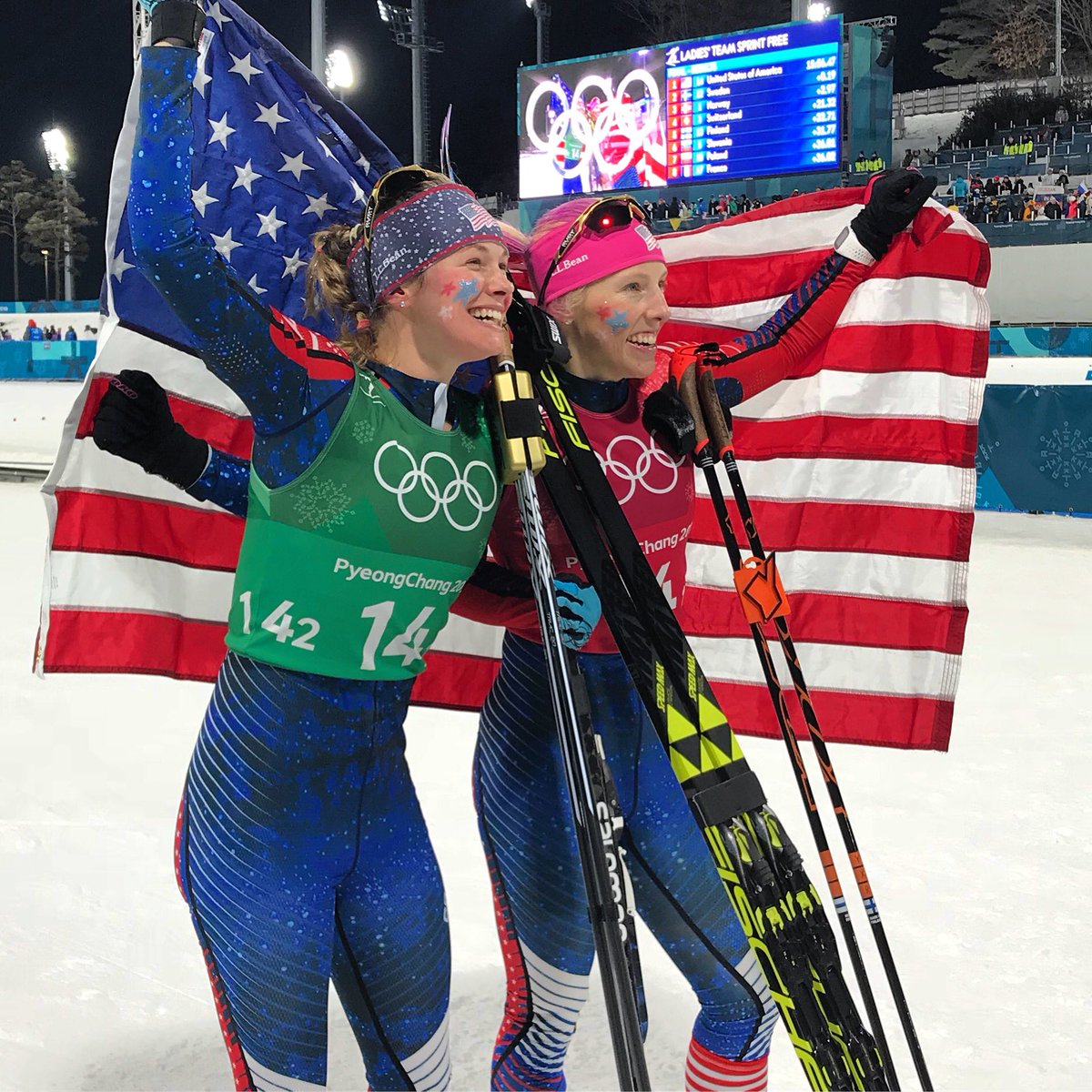
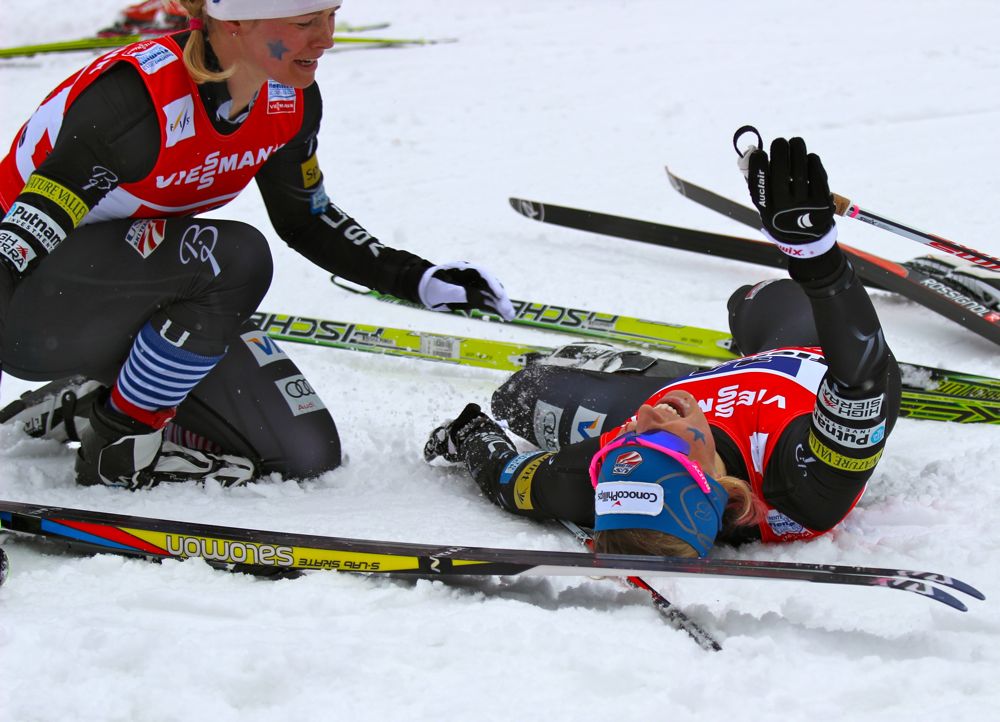
    February 2018: Jessie Diggins (l) and Kikkan Randall soak up their win in the women’s freestyle team sprint on Wednesday at the 2018 Olympics in PyeongChang, South Korea. (Photo: FIS Cross Country/Twitter)

    Here is another fine picture of Diggins and Randall from the evening of February 21, 2018. This one does not show the famous American relay socks, but does show the equally renowned facepaint and glitter. As Diggins has written, in what is both a pro-glitter cri de cœur and “a brief message for [the] high school officials” who harshed on her glitter as a junior racer, “Putting on glitter before my race is a salute to the little girl who just wants to ‘go super speed!!!’ It’s a promise to myself that I will race my absolute hardest that day. It’s a ritual that gets me in the right mindset to get out of the start gate and give it everything I have. It’s harmless, doesn’t negatively impact anyone, but to me it’s a huge part of my race morning. . . . And on relay days? Oh man. I get so excited about relay days. I get to paint the flag, ‘USA’ and stars on the faces of my teammates, and one of them will paint it on me as well. Then I put glitter over everything! It’s a special time when everyone is nervous, and excited, to be representing our country and we get together early in the morning to help each other get ready and deal with our pre-race nerves. It’s a little bit like our special striped relay socks…it’s part of what we do, as a team.”

    End of the 2017/2018 season: Farewell tour

    Honorable mention for the 2017/2018 season, World Cup edition: Randall and Liz Stephen’s outfits for their final World Cup race (standard Craft base, but with a whole lot of flair):
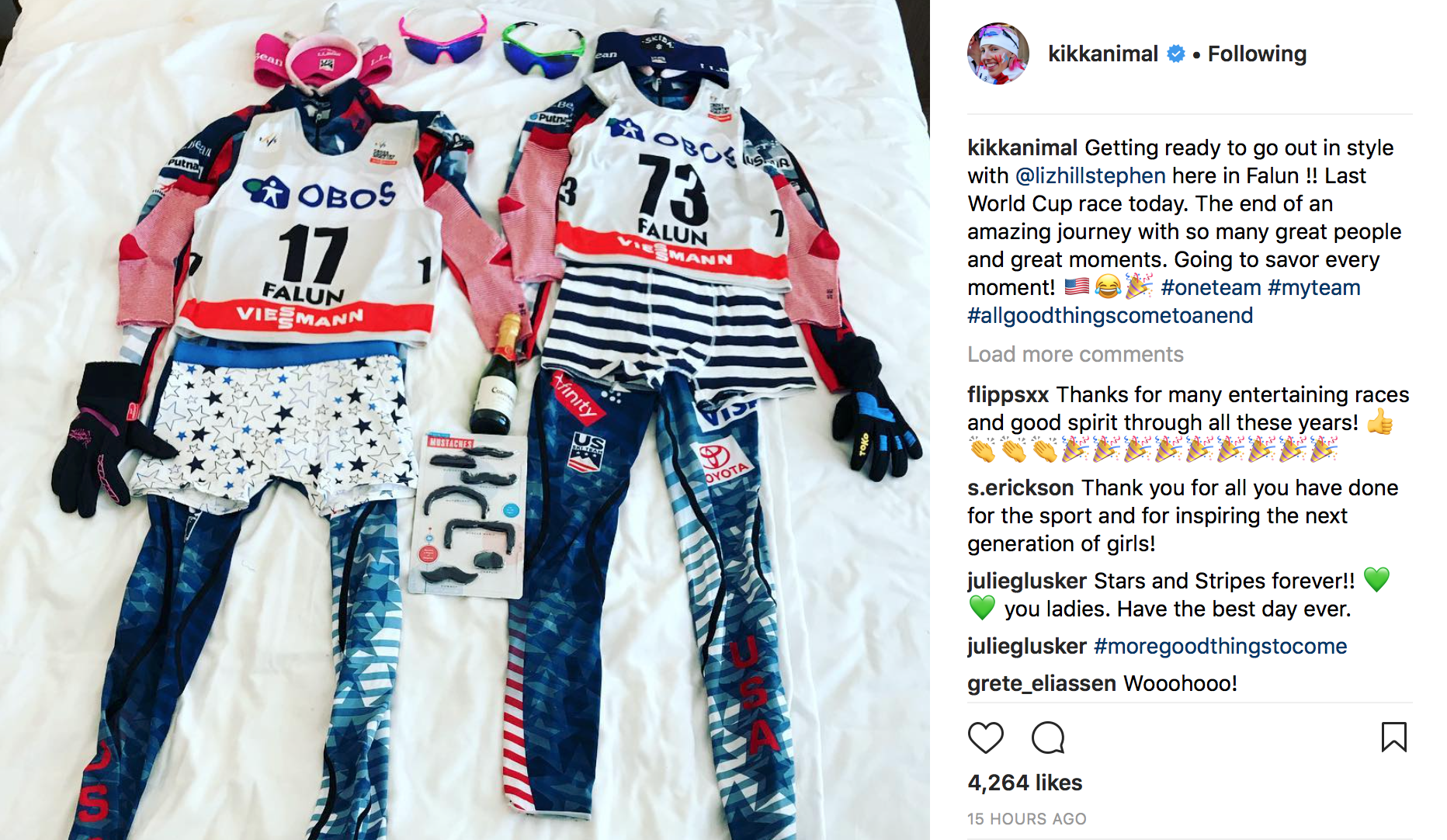
    March 2018: The last-race outfits worn by Kikkan Randall and Liz Stephen for Sunday’s World Cup Finals pursuit. (Photo: Kikkan Randall/Instagram)

    Honorable mention, domestic edition: Randall’s bespoke pink and blue Craft USST/APU suit (essentially the Olympics suit but with different patterning) that she wore for her final race as a professional skier, at Spring Series in Craftsbury. The suit said “USA” on the right arm and left leg, “APU” (for Alaska Pacific University, her club team of 19 years) on the left arm, and “Kikkan” on the left arm and right upper leg.
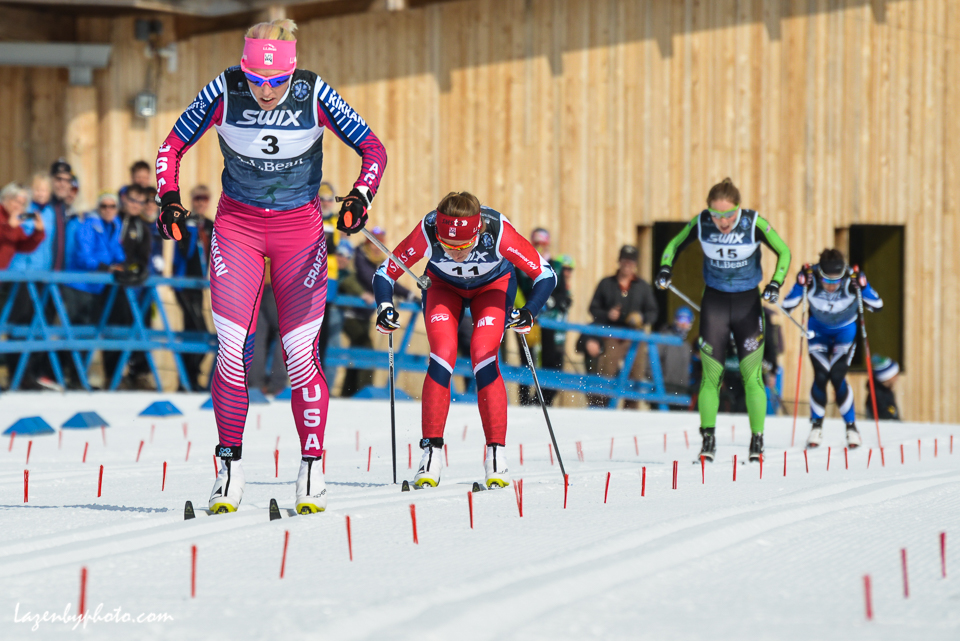
    March 2018: Kikkan Randall (3) racing for third place in the women’s 30 k classic mass start at 2018 U.S. Distance Nationals in Craftsbury, Vt., ahead of Sophie Caldwell (second from l), Ida Sargent (second from r), and Rosie Frankowski (r). (Photo: John Lazenby/Lazenbyphoto.com)

    Honorable mention, face paint edition: This remarkable evocation of Randall and Stephen on Diggins’s left cheek at Spring Series.
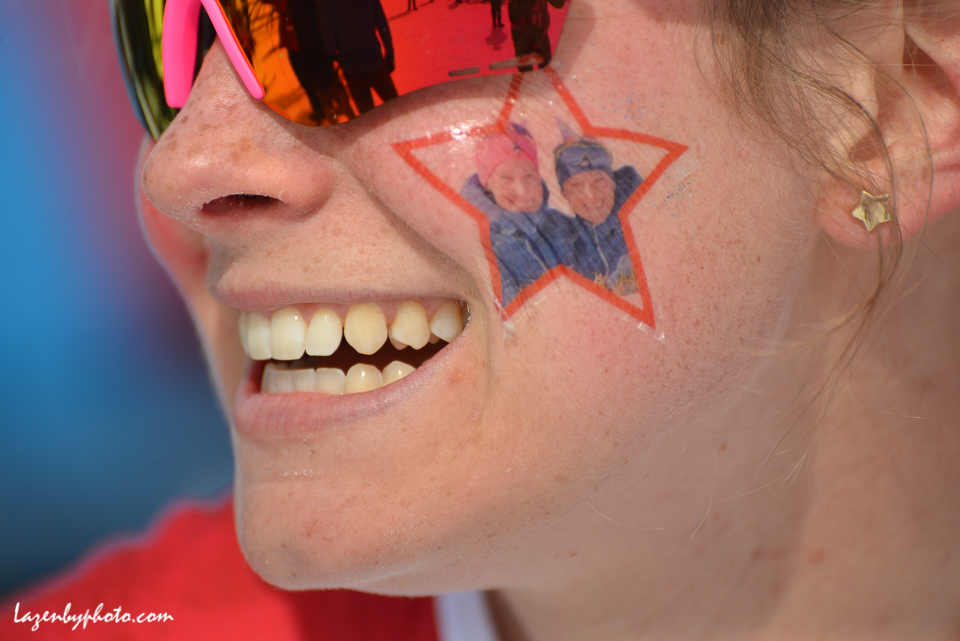
    March 2018: Jessie Diggins with a photo of her retiring U.S. Ski Team teammates Kikkan Randall and Liz Stephen on her cheek at 2018 U.S. Distance Nationals in Craftsbury, Vt. (Photo: John Lazenby/Lazenbyphoto.com)


    2018/2019: Red, white, and blue, but with larger color blocks. Also, a move to Swix.

    Randall retired. Stephen retired. Randall got breast cancer. Randall was treated for breast cancer. Diggins worked hard to — successfully — bring a World Cup ski race to Minneapolis. And the Americans kept racing in red, white, and blue, albeit now with a move from Craft to Swix for the suit manufacturer. This year’s interpretation of the theme brought a shift to white as the dominant color, with blue through the torso and upper legs, as well as on the arms. Red was the least-pronounced color this year, limited to accents alongside the larger blocks of blue.

    While the Americans continued their perhaps now-accustomed success at the World Cup level, American juniors served notice at World Juniors that they were a force to be reckoned with, taking a gold in the men’s relay, a fourth in the women’s relay, two fourths in classic distance races, and multiple other top-tens. Here are two shots from a frigid Lahti:

    January 2019: Luke Jager (middle left, hands in air) after tagging off to Ben Ogden (bib 2, middle right, pink hat) in the U20 men’s 4 x 5 k relay at Junior Worlds in Lahti, Finland. (Photo: Doug Stephen)


    January 2019: Kendall Kramer on her way to fourth place in the U20 15 k classic mass start at World Juniors in Lahti, Finland. (Photo: Doug Stephen)

    Back to the World Cup (where senior athletes wore the same uniform shown above on the juniors for the regular season), 2019 World Championships, in Seefeld, Austria, brought something new. The dominant hue in the race suit was now blue instead of white, and the large color blocks of the 2018/2019 World Cup regular season were gone. White stars were added to the lower left leg, making the evocation of the American flag far more apparent. Red and white stripes, on the right arm, continued the vexillological theme. While the four sponsor logos on the legs remained the same (Bose, Xfinity, Visa, and Toyota), the Swix logo shifted from the lowest position on the left leg to the middle position on the right.

    A Swix press release about the new suits advised: “Featuring bold stars and sharp American colors, the focus was on visibility in mass start events and an iconic look.”
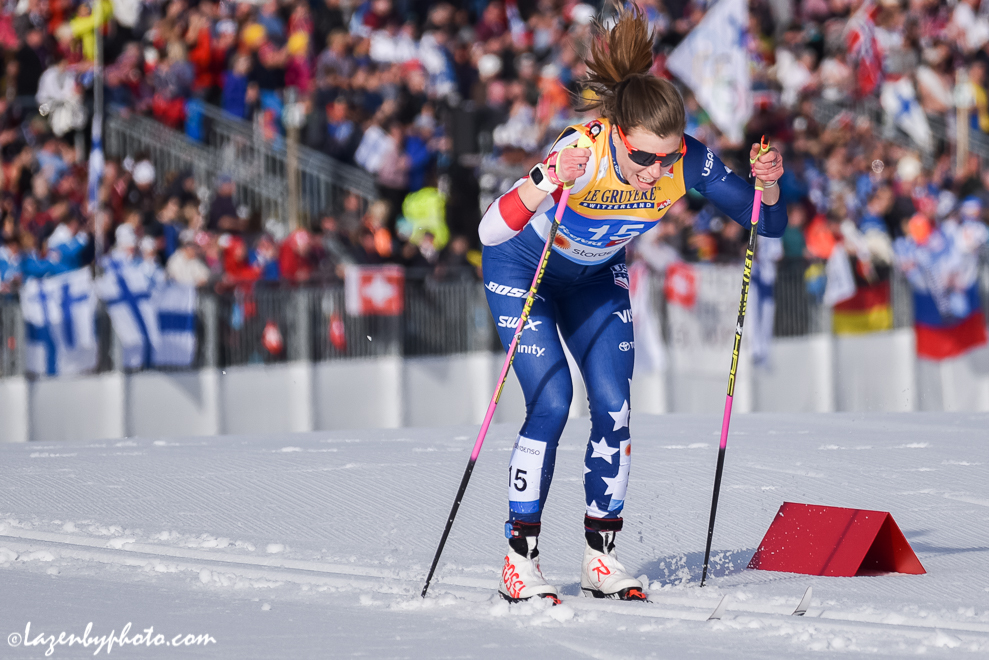
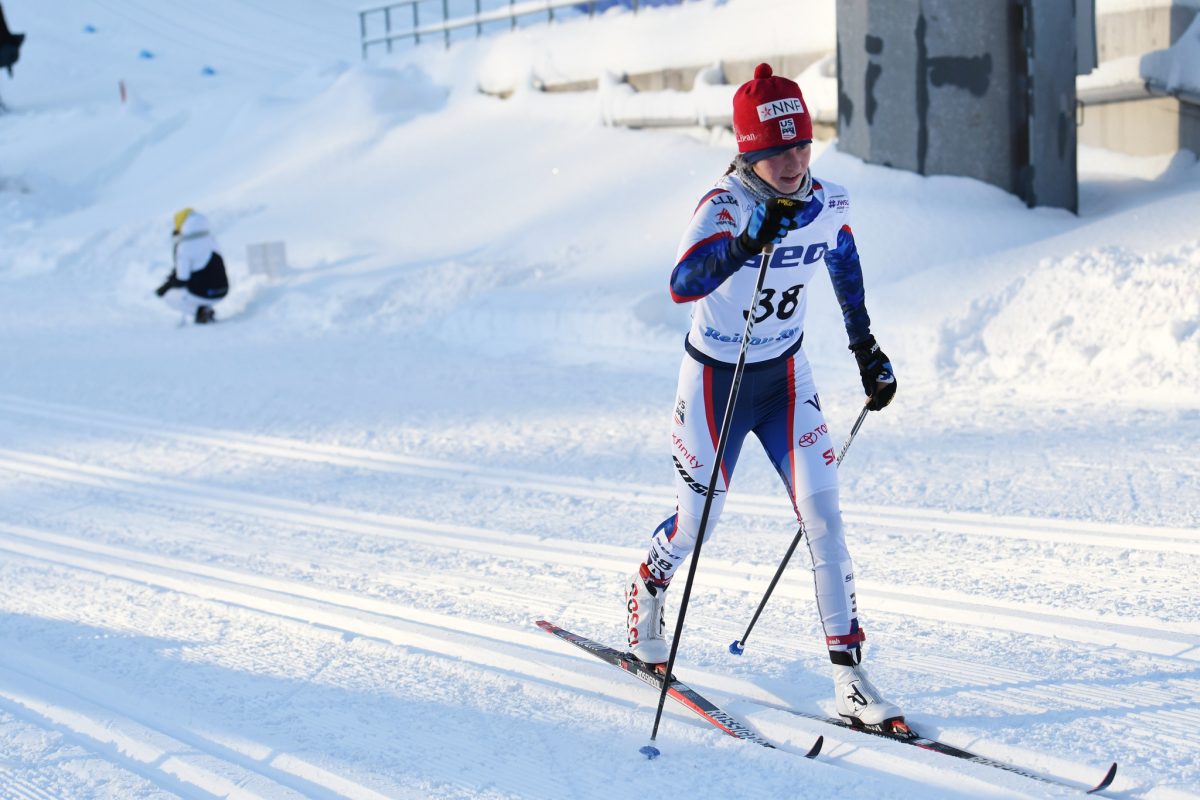
    February 2019: Rosie Brennan races in Seefeld.

    Honorable mention: Bare arms and cutoffs. It was hot in Seefeld. Like, over 50° F hot. Erik Bjornsen raced the 15 k classic with nothing underneath his race bib (sun’s out…), attire typically befitting Eagle Glacier in July more so than Austria in February. Brennan raced the relay with only a t-shirt on top, and no gloves. And Jessie Diggins drew widespread attention for her DIY cutoff look for the relay (which still featured the iconic relay socks, albeit rolled down so they wouldn’t counteract the shorts by covering most of her lower leg).

    As Diggins later wrote on her blog a month after World Champs: “Let me start by saying this; no, I was not cold racing in shorts and short sleeves, yes, you should try it sometime, and yes, it was refreshing to have the cold slush hitting my legs! Somehow, the sight of me racing in a short suit was more interesting and befuddling to most reporters than the actual race itself. Clearly, they haven’t ever experienced a Minnesota cold snap. Now THAT is cold weather! … Honestly, it’s hard to describe the amount of distress overheating puts me in, but let me put it this way; racing is already one of the most painful things you can do. If I have to deal with being incredibly uncomfortable, dizzy, and feeling my body start to shut down because I’m way too hot, it becomes even harder to continue pushing my body to the limit, because it’s already that much closer to the limit! And besides, everyone needed the laughs by the time we got to the end of the races.”

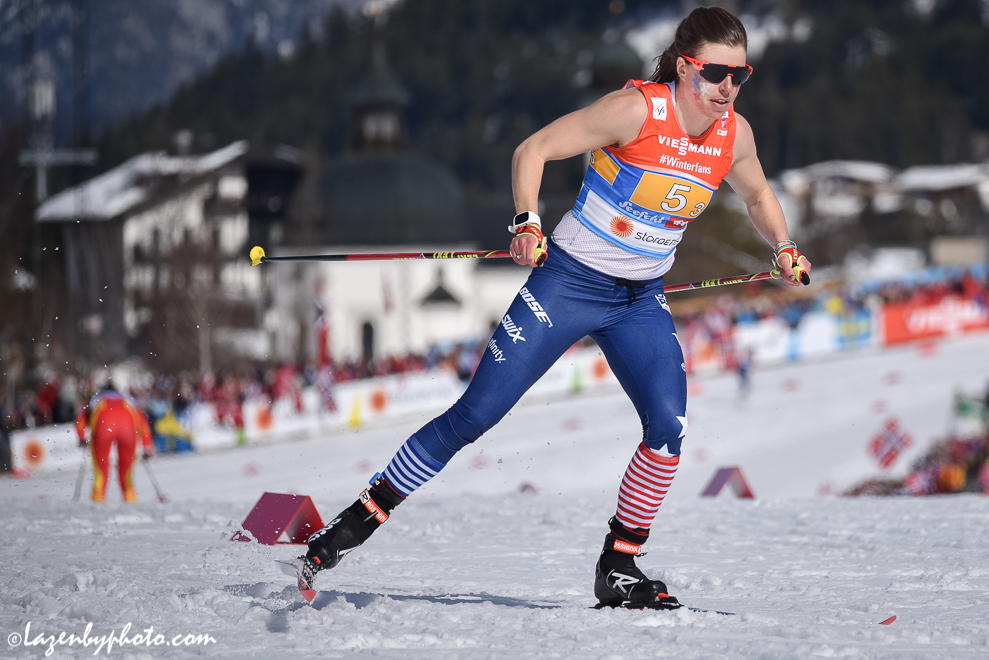
    Erik Bjornsen of the U.S. skiing to 17th overall during the 15 k classic at the 2019 World Championships in Seefeld, Austria. (Photo: John Lazenby/lazenbyphoto.com)


    Rosie Brennan of the U.S. during the third leg of the 2019 World Championship 4 x 5 k relay in Seefeld, Austria. (Photo: John Lazenby/lazenbyphoto.com)


    Custom race suit for Jessie Diggins of the U.S. She anchored the fifth place U.S. team during the 2019 World Championship 4 x 5 k relay in Seefeld, Austria. (Photo: John Lazenby/lazenbyphoto.com)


    2019/2020: Candy cane stripes!

    Finally, the start of this season brought the dawn of what has variously been called the “candy cane stripes” or “barber pole stripes” suit (#wellactually a barber’s pole historically has alternating red and blue stripes, not just red stripes as on the current U.S. suit). The left leg features red and white stripes, in a color-appropriate rendition of the American flag. The right leg has white stars on a blue background, again in patterning true to the actual flag. The stars are repeated on the left arm, and the stripes are briefly evoked on the right.

    The car sponsor has once again changed, this time to Land Rover.

    Here’s Kelley Roche, Soft Goods Product Manager for Swix Sport US, explaining the backstory for this year’s suit design in an email to FasterSkier: “Swix worked with Garen Riedel who owns his own design firm, Riedel Creative in New York. Garen worked closely with the athletes to design a suit that graphically works and they were excited to compete in. The goal is to design a suit that you can pick out of the pack and immediately and know it is a US athlete! This is important for the fan but really important for the coaches who support the athlete during the race. We ended up going with an asymmetric design, a continuation of the Seefeld suit design from 2019 and a retro reference to some of the suits of old, leveraging the iconic and patriotic American flag color palette with a slight color fade across the body.”

    Roche added that the suit itself is made out of mesh, which in addition to being flexible and breathable “acts like  dimples on a golf ball, balancing the lift and drag of the athlete.”
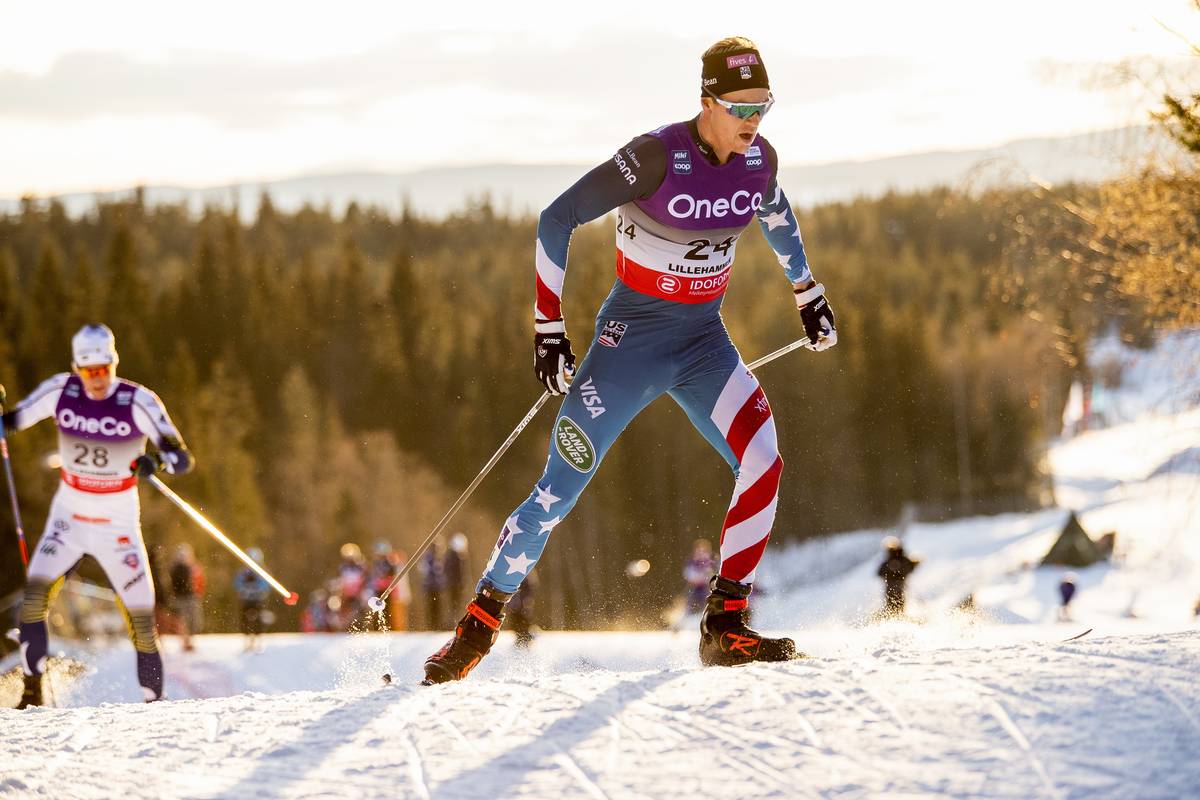
     

    December 2019: Erik Bjornsen during the skate leg of the 2019 30 k skiathlon in Lillehammer, Norway. (Photo: NordicFocus)


    December 2019: Lillehammer, Norway (NOR): Rosie Brennan (USA). (Photo: NordicFocus)

    We’d like your thoughts on the suits. Here’s a google form/survey about the U.S. Ski Team’s suits over the past decade or so.

    If you have read this far: For one, congratulations. For another, there is a wealth of historical material available in the FasterSkier archives. If you would have any interest in future compilations with a different focus — American biathlon, say, or best and worst of domestic American race suits over the past decade — please comment below, or email the author directly: gavin (at) fasterskier (dot) com. Thanks, and thanks for reading.
  • Therese Johaug Notches Seventh Skiathlon Victory; Diggins Charges to 2nd

    Therese Johaug Notches Seventh Skiathlon Victory; Diggins Charges to 2nd

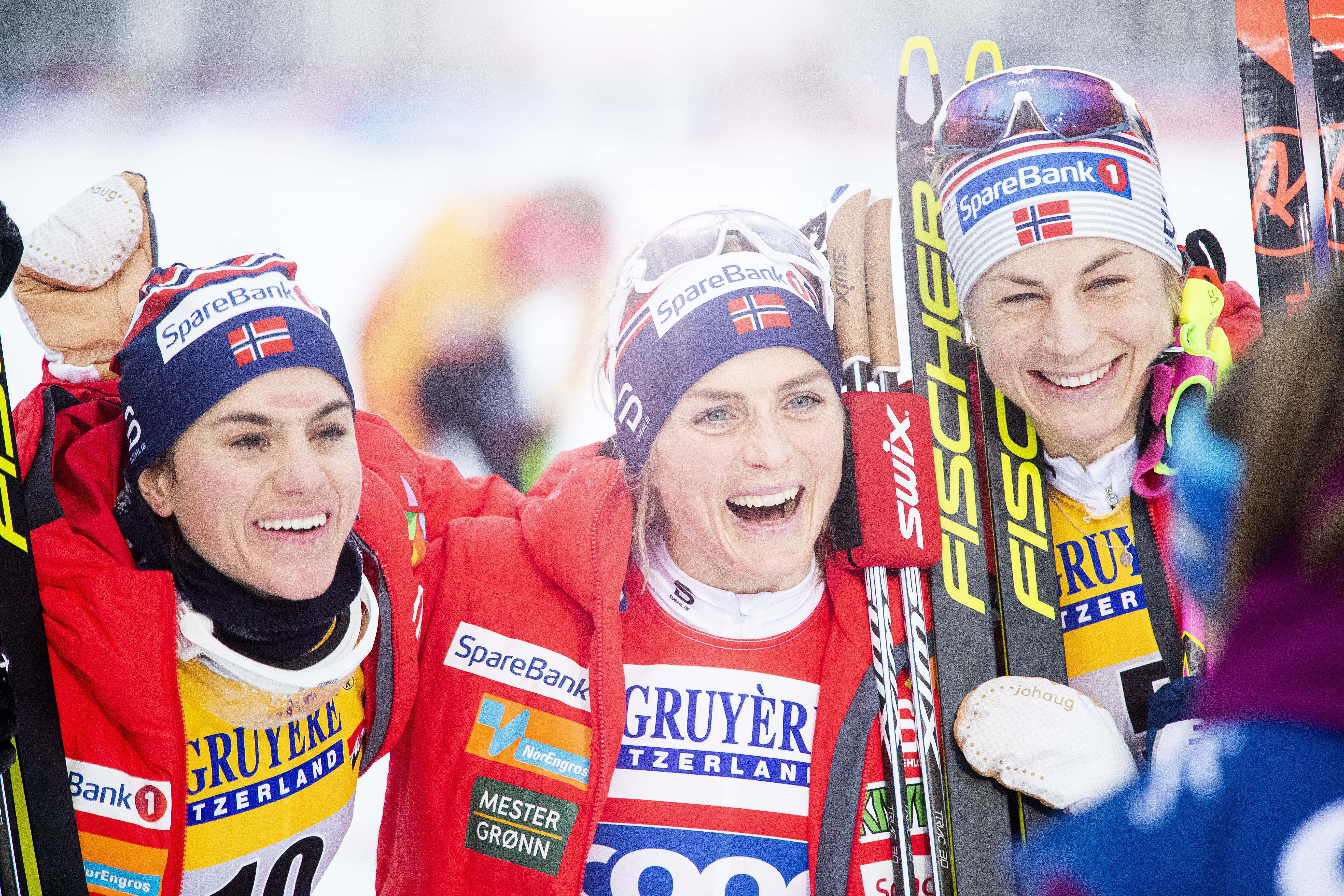
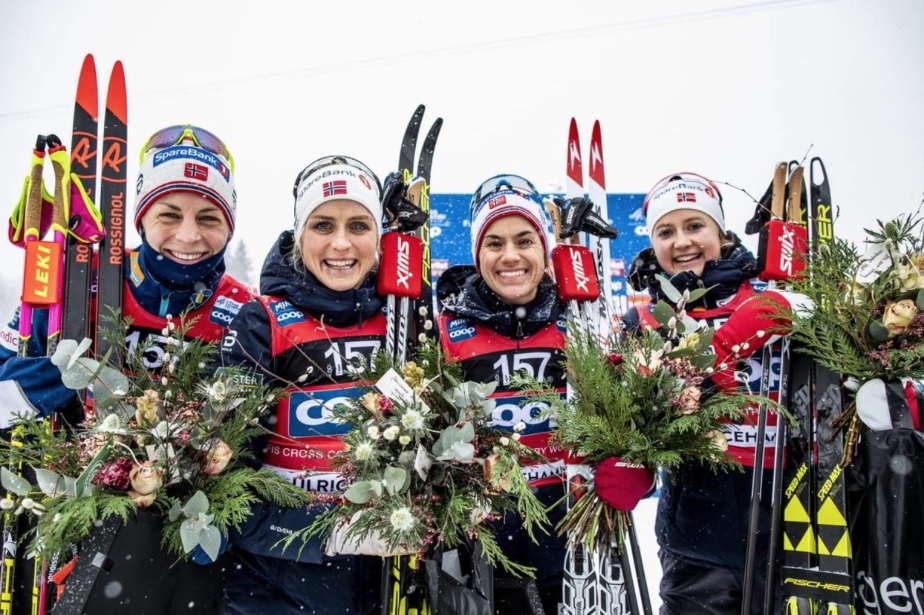
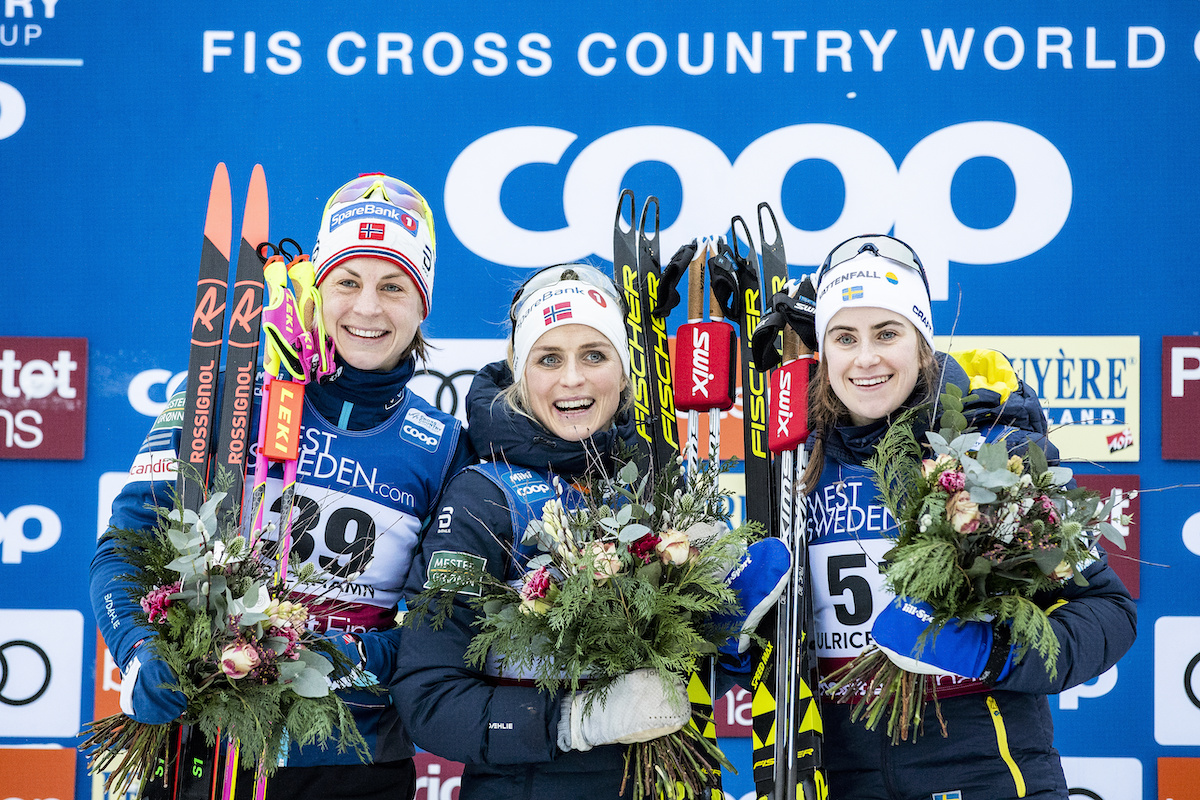
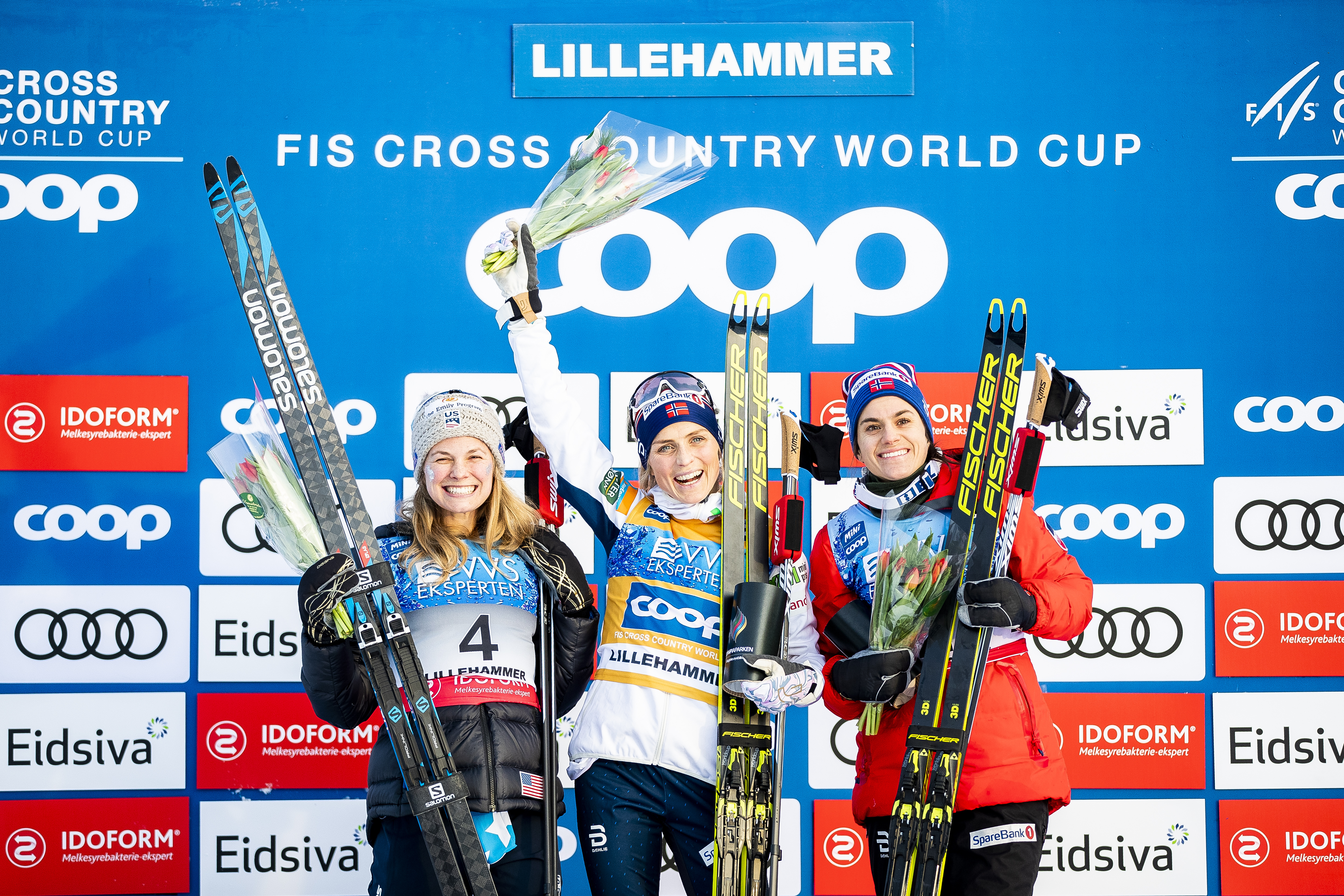
    The women’s podium of the 2019 7.5k/7.5k skiathlon in Lillehammer, Norway. Therese Johaug (c) took first, Jessie Diggins second (l), and Heidi Weng third (r). (Photo: NordicFocus)

    This week’s episode of the Therese Johaug show featured a clinic in her signature event, the 15-kilometer mass start skiathlon in Lillehammer, Norway. Before today, the two-time World Championship gold medalist had made the podium in 13 of her 14 World Cup skiathlon starts (six of those were wins), failing only in Oberstdorf, Germany during the 2011 Tour de Ski. 

    Her strategy was familiar. Johaug set the pace from the gun, attacking the first climb out of the famed Birkebeiner stadium. She pulled away from the field with her usual high tempo ferocity. She created a nearly 14 second gap by the 2.4 k checkpoint, which expanded to 30 seconds at the halfway mark. 

    Coming into the exchange zone, Johaug ripped open her pole straps with her teeth as she glided into her gate. She then stepped out of her classic skis into skate without pause. Celebrating as she skied through the stadium 7.5 k later, Johaug stopped the clock at 42.35.3. Her lead had grown to over a minute. 

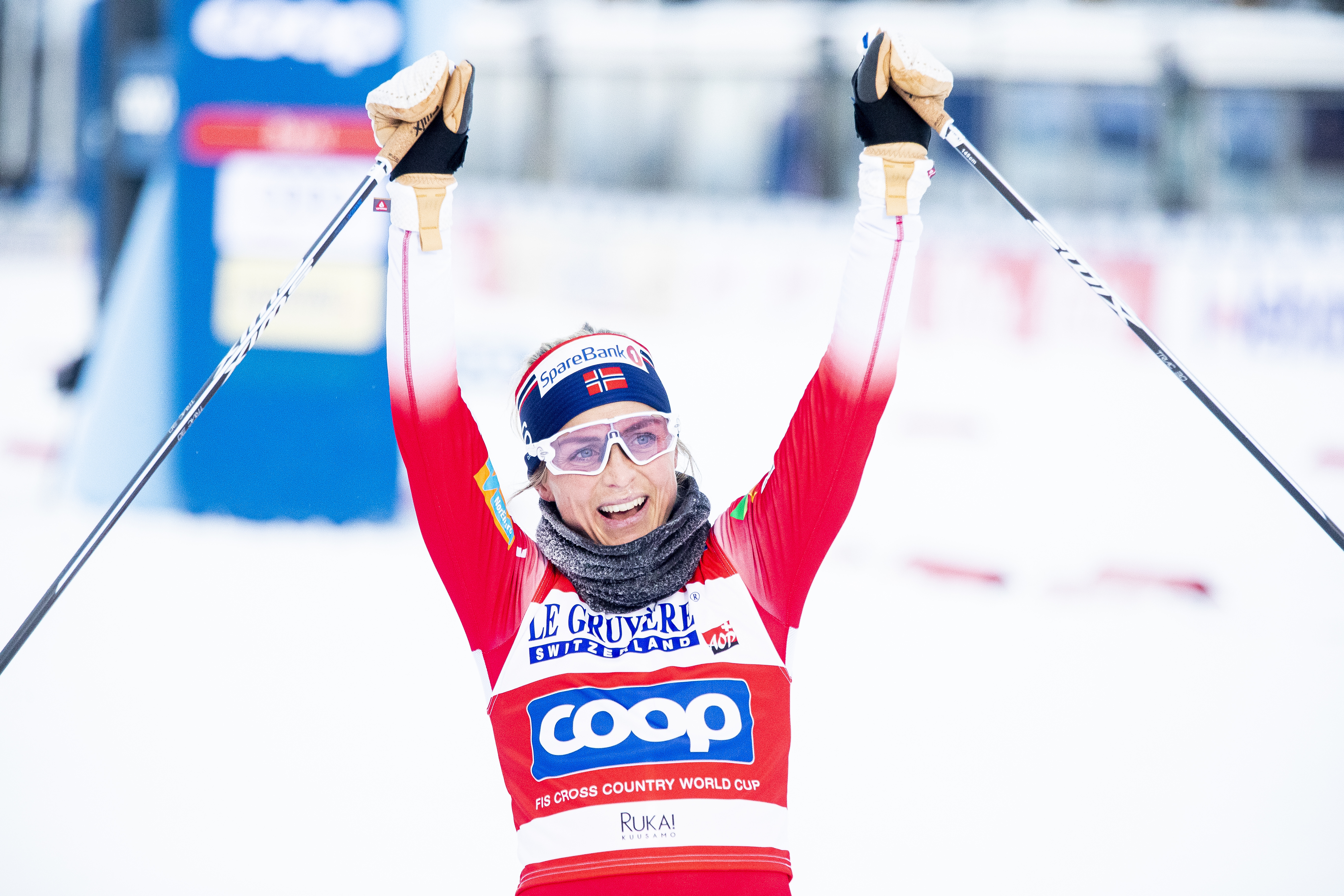
    Therese Johaug celebrates her victory on home turf at the 15-kilometer skiathlon in Lillehammer, Norway. (Photo: NordicFocus)

    Notching her seventh World Cup victory in the skiathlon and her 100th career World Cup individual distance podium, Johaug is closing on Marit Bjørgen’s record of eight skiathlon wins and 110 podiums. This was news to Johaug when she spoke to FIS at the finish.

    “That was a big surprise to hear,” she said with raised eyebrows. “It was really good to celebrate with a first place today and also in my hometown, Lillehammer. It was a really good day today. My skis were perfect and my shape has been really good after [the Ruka Triple in] Kuusamo, so I could just go out there and enjoy it because I didn’t feel that I used so much energy. I am really happy.”

    Based on Johaug’s trajectory, it does not seem to be a question of if, but when these records will be broken — the latter possible within the 2020 season. Just over half (51) of her World Cup podium finishes have been wins, and she has not failed to land on the podium in a distance race since before her doping suspension in 2016. She won every individual distance race during the 2018/2019 season. She was beaten only once and that occurred on the icy tracks of the Plains of Abraham during the World Cup finals in Québec City where Stina Nilsson, who began the pursuit start race with a lead of 1:45, held her off for 10 k. Johaug still skied the fastest time of that day.

    Hot off a strong showing in Ruka, a duo of candy-cane striped left legs led the charge in the chase pack, namely Jessie Diggins and Sadie Maubet Bjornsen. The Americans stayed stride for stride at the front with Norway’s Heidi Weng and Russia’s Natalia Nepryaeva through the 3.5 k checkpoint, when Diggins took hold of the pace and surged to begin spreading out her peers. With Diggins went Weng and her Norwegian teammate Astrid Jacobsen, along with a string of Swedes: Moa Lundgren, Charlotte Kalla, and Emma Ribon. 

    Jessie Diggins charges from the exchange zone ahead of Norway’s Heidi Weng and Astrid Jacobsen during the 15-kilometer skiathlon in Lillehammer, Norway. (Photo: Aleks Tangen)

    Diggins entered and left the exchange zone ahead of her competitors, closely followed by the Norwegians and Swedes. The American pressed her foot to the accelerator, again surging to spread the chase group. Weng matched Diggins’s tempo and energy on the climb away from the stadium and tucked into her draft on the descent into the woods. 

    From there, the lead exchanged hands a few times leading into the fourth and final time up the longest climb with two k’s to go. Devon Kershaw referenced this hill when he explained is one of the hardest courses on the World Cup, featuring crippling climbs where skiers “will fall apart”. 

    It was here that Diggins made here move. She stepped around the Norwegian, out matching her tempo as they climbed steeply and transitioning into a strong V2. Trusting her downhill strength, Diggins continued to hold off her pursuer through the descending 400 meter reprieve. 

    In a flash of V1, Diggins dropped Weng for good on the final steep climb with 500 meters to go. She flew down into the stadium and powered down the straightaway to a comfortable second place finish (+1:08.3), eleven seconds ahead of Weng. 

    After sliding across the line, Diggins collapsed in relief. Johaug, who by this time had caught her breath and donned her puffy jacket, gave the American an encouraging and celebratory pat on her back.

    “I was trying to keep up with you and I was like, ‘Buh bye.’” Diggins laughed as she congratulated Johaug.

    Post-race interview with Jessie Diggins.

    After fading from the lead chase group, Maubet Bjornsen tucked in patiently with an international group that included Theresa Stadlober of Austria and Krista Pärmäkoski of Finland, hovering just outside of the top 10. After the exchange, Stadlober, Pärmäkoski, and Maubet Bjornsen began steadily moving up in the standings, catching Kalla and Jacobsen. By the finish, Pärmäkoski had worked her way into 4th place, Stadlober 7th, and Maubet Bjornsen 8th (+1:43.9).  

    “I generally prefer classic as opposed to skate, but I had new and fun feelings today,” Maubet Bjornsen wrote in an email to several news outlets. “Not only did I enjoy the skate portion more, but I felt really strong climbing. I am walking away from today with new confidence, and excitement. To finish the day within sight of the podium fight on a less than perfect day is a good sign.”
    One final push across the line for Sadie Maubet Bjornsen at the 15-kilometer skiathlon in Lillehammer, Norway. Maubet Bjornsen finished 8th. (Photo: NordicFocus)

    Post-race interview with Sadie Maubet Bjornsen.

    Taking a similarly patient approach, Rosie Brennan steadily turned up the dial in her race, cautious of burning too many matches early in the grueling terrain. At 4.6 k, Brennan sat in 21st, moving up one spot before the exchange. She picked up another two spots by 11.3k, and another two by the finish. Brennan crossed the line in 16th (+3:10.0).

    “Today was a solid race, not my best and certainly not my worst,” wrote Brennan to several outlets. “I was struggling in the classic, just not finding the relaxed good feelings you want. I couldn’t hang with the front group, which I was disappointed by, but after I switched to skate, I found better feelings and was able to pick some people off. Unfortunately, I let a little too big of a gap open up to the big group in front so there was only so many people pick off. This course is one of the hardest on the circuit and you really have to be on your A-game to pull of good things here. I wasn’t quite there, but I am satisfied with the result given my feelings out there.”

    Rosie Brennan during the 15 k skiathlon in Lillehammer, Norway. (Photo: NordicFocus)

    Post-race interview with Rosie Brennan.

    Outside the top-30, Rosie Frankowski (APU) finished 33rd (+4:14.1) and Caitlin Patterson 46th (+5:36.0). 

    Full results

    – Aleks Tangen and Harald Zimmer contributed


  • Johaug Dominates in Ruka; Three Americans in the Top Ten

    Johaug Dominates in Ruka; Three Americans in the Top Ten

    Ruka, Finland looked quintessentially Nordic at the start of the 10-kilometer freestyle pursuit. December at 66 degrees north: temperatures in the low teens (F), flat Northern light, frosted pines looking as though they were spray-coated with foam. Athletes warmed up in puffy jackets with mittens, neck warmers, and taped faces while crowds huddled with cups of soup.  

    First out of the start and racing in a balaclava and mittens, Norway’s Theresa Johaug attacked the course from the gate. Steadily turning up the dial on each of the four 2.5 k loops to cross the line over a minute ahead of her peers, the 31-year-old distance phenom quickly made the event a race for second place. 

    Norway’s Therese Johaug dominated the field in the pursuit distances races in Ruka, Finland. (Photo: NordicFocus)

    “I felt I was really strong today,” Johaug told FIS about her performance. “I heard that Heidi was fast behind me, but in the end I had a little bit more power and I also win the race today. I’m really happy.”

    She also described her skis as “excellent” and thanked her wax technicians for their handiwork. 

    Chasing in red for an all-Norwegian podium, Johaug’s teammates Heidi Weng and Astrid Jacobsen worked together to steadily pick off the athletes wearing lower bib numbers. Weng, who started in tenth, 1:03 behind Johaug, made up 17 seconds to catch Jacobsen. By the 5-kilometer mark she was ranked 5th and closing on Finland’s Krista Pärmäkoski. 

    Weng finished second (+1:11.13), followed closely by Jacobsen (+1:13.3). 

    “It’s fantastic,” Johaug said of the Norwegian trio. “We have three girls top three and it’s a long time since this has happened before. We are so happy.”

    The all-Norwegian women’s podium after the 2019 10-kilometer skate pursuit in Ruka, Finland. From left to right, Heidi Weng (2nd), Therese Johaug (1st), and Astrid Jacobsen (3rd). (Photo: NordicFocus)

    Ascending the final climb before the stadium, Weng looked reminiscent of the version of herself who charged up the Alpe Cermis to take home the 2018 Tour de Ski (TdS) victory. She had the second fastest Time of Day (ToD), outmatched by Johaug by a margin of only 8.3 seconds. 

    The 28-year-old was the 2017 and 2018 overall World Cup winner, landing on the podium 21 times each year. After the 2018 TdS, Weng seemed to lose a gear and though she held onto the overall World Cup win, performances that were lackluster relative to her former prowess ensued. She left the 2018 PyeongChang Olympic Games empty handed and finished the 2019 season ranked 16th with no podium performances. 

    Coupled with a strong opener in Beitostølen,  Weng’s rebound looks real.

    Four Norwegian women landed in the top ten, but so did three Americans: Sadie Maubet Bjornsen, Jessie Diggins, and Rosie Brennan.

    Today was icing on the cake for Maubet Bjornsen who wore the yellow overall World Cup leader bib. She maintained her second place start position through the first half, then was overtaken by the pack of Pärmäkoski, Weng, and Jacobsen. Maubet Bjornsen stayed with these women through the 7.5 k checkpoint, but could not hold off the hungry Norwegians. Maubet Bjornsen ended the day in 4th (+1:27.9).

    Sadie Maubet Bjornsen skis alone during the 2019 10-kilometer freestyle pursuit in Ruka, Finland. (Photo: NordicFocus)

    “It was another fun and final day of racing here in the tour,” wrote Sadie in an email to several news outlets. “What an honor to head out on the course in the yellow bib, that sure was fun! I found myself quite distracted off the line because I had a broken binding and my foot was sliding around on my ski, which left me so worried I was going to lose my ski on one of the downhills. 

    “After I made it around the first loop in one piece, I was able to forget about it, and focus on the task at hand. As I rounded the corner on the second lap, still alone, I caught sight of the huge group hunting right behind me. My plan going into the race was to hang as absolutely tough as I could if anyone caught me, and be in a place to sprint for the finish since that is my strength. As the group caught me the third lap, I jumped on, and held on for dear life. In the final lap when Heidi started attacking on the uphill, I did my absolute best, but started sinking back slowly.” 

    Despite ceding two positions, Maubet Bjornsen held off the remainder of the field. Hers was the 14th fastest time of day.

    Sadie Maubet Bjornsen catches her breath amidst the finish line carnage after the 2019 10-kilometer freestyle pursuit in Ruka, Finland. (Photo: NordicFocus)

    “I knew my strength would be coming over the top of the climb, and just as I clawed myself back to Astrid and Heidi, they made another surge leaving me just out of their draft for the final descent into the sprint climb. As I sprinted up that climb the final time, it was with all the energy stores I had left. I managed to cross the line, fourth in the tour. My goal was to be able to fight for the podium today. While I came just shy for a second day in a row, it is still a huge step to finish a tour in 4th! I look forward to taking some new confidence, and run with it this winter!

    “Now it is time to do some resting, recovering, and traveling to Norway for our second weekend of racing. With the way my teammates are skiing right now, we should have a SUPER fun relay event ahead!!”
    On the hunt, Jessie Diggins moves up through the field during the 2019 10-kilometer freestyle pursuit in Ruka, Finland. (Photo: NordicFocus)

    Matching Weng’s spirited hunt, Jessie Diggins had an outstanding performance, advancing from her 12th place start position by seven positions to finish three seconds behind her teammate for 5th place (+1:30.9). Known for her skate talent and energy, Diggins hammered the course with a high tempo, skiing the third fastest time of day,  20.9 seconds off Johaug’s split. 

    “Any day I can land a TOD podium is a great day, so I’m really happy with how it went!” wrote Diggins in an email. “I just went out charging as hard as I could today, looking to hunt people down, and skied without putting any pressure on myself. It was cold out there, but having grown up in Minnesota, I just loved that and felt right at home! My skis were great today and I really applaud the wax team and coaches for working so hard every day of this season, since we arrived for pre-camp in Beito. I’m so proud of how hard they work and how well they have tackled every weather condition.”

    Not landing on the overall podium right away is nothing new for Diggins. Last season, Diggins did not finish inside the top-10 until her seventh race and did not stand on the podium in an individual race until the Tour de Ski. 

    One last push across the line for Jessie Diggins during the 2019 10-kilometer freestyle pursuit in Ruka, Finland. (Photo: NordicFocus)

    “I always work my way into the season and this year is no different,” she explained. “But it was a great surprise to feel so awesome today and to see a TOD podium. With no [world championships] or Games, this year I’m excited to focus on making each and every weekend that I race an absolute all-out effort, and I’m also looking forward to having so many tours this season because I think they are a ton of fun and a great challenge for the body and the brain.” 

    Closing out the top ten, Rosie Brennan slid back from her 8th place starting position into 10th (+2:15.3). Fighting for every second, Brennan skied a strong race, losing a four positions in the first half, then climbing back up ahead of Sweden’s Jonna Sundling and Russia’s Natalia Nepryeava before crossing the line. 

    Rosie Brennan catches a ride with a Tiril Udnes Weng of Norway during the 2019 10-kilometer skate pursuit in Ruka, Finland. (Photo: NordicFocus)

    “I had a tough starting position with big gaps in front of me and a small gap to the chasers behind me,” Brennan wrote to several outlets. “When the chasers caught me, I tried to follow but struggled to stay with the pack. I recollected and had a better second half of the race, passing back a few girls. It was far from my best race, but I am satisfied with the fight I put up and really thrilled to have opened the World Cup with a 10th in the Ruka Triple. That far exceeds my expectations for the weekend. It’s certainly time for a little rest after a big opening weekend and hopefully trying to find more speed in the coming weeks.”

    Outside of the top-30 and in a tight spread, the remainder of the American women advanced from their start positions, including the newest members of the ranks. Julia Kern moved from 55th to 49th (+5:13.1) and Hailey Swirbul jumped from 66th to 54th (+5:32.8). Caitlin Patterson ended her day in 52nd (+5:21.6) and Rosie Frankowski in 56th (+5:35.9). 

    Women’s Results

  • Day Three in Beitostølen: Women’s 10 k Freestyle

    Day Three in Beitostølen: Women’s 10 k Freestyle

    The women’s podium from the 10 k skate in Beitostølen, Norway. Therese Johaug( c) won, Heidi Weng (l) placed second and Helene Marie Fossesholm (r) placed third. (Photo: Aleks Tangen)

    Sunday in Beitostølen, Norway the nation’s opening national races concluded with a women’s 10-kilometer freestyle race. The conditions remained as they have for the past few days — near freezing.
    The top-three spots were secured by the same skiers who took first through third in Saturday’s 10 k classic: Therese Johaug won in 21:48.0, Heidi Weng placed second (+31.3), and Helene Marie Fossesholm, at 18 years old, placed third (+32.8).
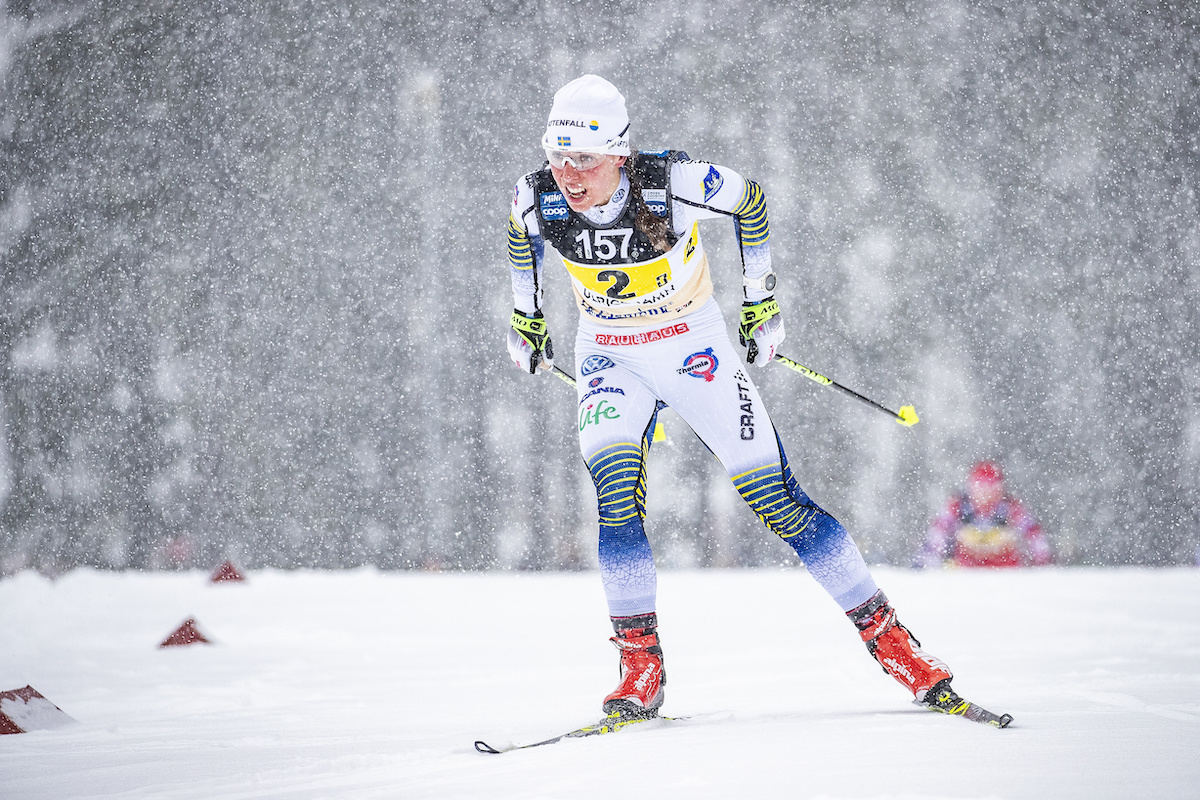
    Caitlin Patterson during the Beitostølen, Norway 10 k skate. (Photo: Aleks Tangen)

    U.S. Ski Team member Caitlin Patterson skied to 13th overall (+1:33.5). Julia Kern, also of the U.S. Ski Team, was 21st (+2:14.9), and Rosie Frankowski (APU) was 40th (+3:06.1).  The World Cup begins next Friday in Ruka, Finland.

    Caitlin Patterson’s mixed zone interview

    Women’s Results

    Click images below to enlarge

  • Beitostølen 10 k Classic: Diggins Fourth Bjornsen Fifth

    Beitostølen 10 k Classic: Diggins Fourth Bjornsen Fifth

    Therese Johaug on her way to winning the 10 k classic in Beitostølen, Norway – part of the national opening races in Norway. (Photo: Aleks Tangen)

    FasterSkier reporter Aleks Tangen was in Beitostølen to report. As a new feature we are posting his interviews from the mixed zone in the report below. 

    With temps hovering around zero degree celsius in a mid-winter looking Beitostølen, Norway day two of the opening national races played out. The women raced a 10 k interval start classic race with a field, as expected loaded with Norwegians. 

    First thing first: Norway’s Therese Johaug showed early season futness that already resembled World-Cup-crushing form. She won the 10 k classic in 26:08.8. Heidi Weng placed second (+1:03) and 18-year-old Helene Marie Fossesholm was third (+1:13). 

    Americans Jessie Diggins (+1:35.7) and Sadie Maubet Bjornsen (+1:37.3) placed fourth and fifth respectively. Rosie Brennan cracked the top-10 in ninth (+2:04.9). 

    Jessie Diggins’ mixed zone interview

    Sadie Bjornsen’s mixed zone interview

    We wanted to note a nice age outlier as we checked out the results: born in 1980, making her 39, Japan’s Ishida Masako finished in seventh (+1:57.6). 

    Rosie Frankowski skiing for APU skied to 22nd (+3:31.4), while Caitlin Patterson was 23rd (+3:32.0). 

    Cailtin Patterson’s mixed zone intervew

    Women’s Results 

    Click image to enlarge.

  • Off-Season Training Options: Ramsau am Dachstein

    Off-Season Training Options: Ramsau am Dachstein

    First the Snow:

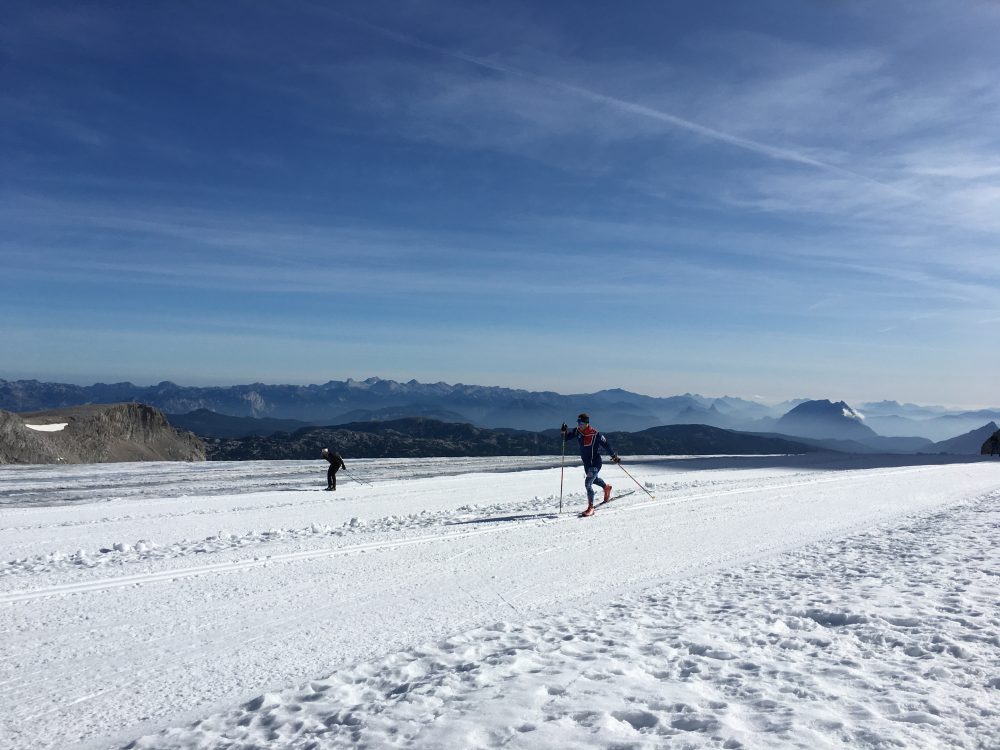
    Ben Lustgarten (CGRP) striding out on the Dachstein Glacier. (Photo: courtesy Ben Lustgarten)

    Sometimes off-season snow is an afterthought — access to trail running, mountain biking, and yes even rollerskiing is enough to satiate the training apatite. And sometimes it’s not. Warm temps prevent access to snow and maybe you simply need a break.

    With that in mind, here are some resources for accessing snow in Ramsau am Dachstein: the famed high region in Austria where the Dachstein glacier awaits with groomed “off-season” cross-country tracks.

    The basics to access snow are this: take toll road to gondola — gondola to the glacier — walk/hike a short distance to glacier skiing — ski. Reverse in order when descending to town.

    Most tourist stay in or around Schladming, a small mountain town nestled in the valley with all the amenities you’d expect. Schladming is also at the base of the toll road.

    Dates for Groomed Ski Tracks: Mid-May through the end of November. During the fall months, you are likely to see a smattering of World Cup skiers on locale testing skis and readying the fitness.

    Costs for Cross-Country Passes: A single day will set you back € 40.00 for adults. A seven-day pass runs € 217.50.

    Travel to the Gondola: It’s a bit more complicated than simply hopping on an express chairlift and zipping to snow right from town. So let’s back up a bit. The gondola is accessed by a toll road. According to online info, the toll road fee is waived for those presenting a validated pass for the Dachstein gondola. We assume you are there to ski, so you’ll have a lift pass and therefore will not be paying to use the toll road. Otherwise, that’s a € 14.00 toll road fee with no valid lift pass. Local buses also offer transport up the toll road.

    Gondola Service to and from the Glacier: Round trip on the gondola for an adult is € 39.00. (This does not include a cross-country ski pass. It’s only for the lift ride up and down.) The first lift up rolls at 7:50 AM. Make note, if you are traveling to the Dachstein during the summer, you are required to make a gondola reservation. “DURING SUMMER A GONDOLA RESERVATION IS REQUIRED!” All caps and an exclamation point claims the website– they mean business. The website we have linked claims reservations are needed until the beginning of September. Evidently, non-ski tourist love the high altitude access too.

    Some scale for reference. Groomed ski tracks on the Dachstein Glacier. (Photo: Ben Lustgarten)

    The Skiing: The groomed glacier skiing is high elevation: situated at 2700 meters, which is pushing 9,000 feet. You’ll want to check the weather and be prepared. To ensure the weather gods won’t be tossing thunder and lighting or spitting moisture — you can view the live cam.

    The 18 kilometers of tracks are groomed for skate and classic. Depending on snow conditions, the available skiing may be less than 18 k.

    Ben Lustgarten of the Craftsbury Green Racing Project (CGRP) has been in Ramsau am Dachstein with several teammates and had this advice:

    The skiing this year is pretty good, but short. This is only my second time here but it is shorter than the previous time, and there are plenty of rocks and dirty snow/ice. I would recommend rock/training skis for sure. The temperature this time of year is around 25 Fahrenheit or when its sunny it can warm to 40 Fahrenheit. We aim to take the first gondola ride up that leaves the tram at 7:50 am so we ski at around 8:05 am for a few hours. Earlier is better because it only gets warmer and softer and skied in throughout the day.

    So far we have been lucky and have had good weather. When it is sunny it is absolutely gorgeous. But it can be quite windy, foggy, cloudy, and rainy as well. I always pack a rain jacket, ski pants, ski jacket, buff, etc just in case because even if it is sunny at the bottom it can be totally different up there. Also remember sunscreen for your face and dark or photochromatic sunglasses. Even if it is cloudy, there’s a ton of UV reflection on the glacier. I would recommend boot covers that brands such as Alpina, Rossi, and Fischer have now because you have to walk down a steep rocky section that can very easily destroy carbon ski boots, or bring running shoes to use for that section. As always, plan to pack dry clothes and a snack for after, because if you miss the gondola down it is a 20 min wait then a 10min gondola ride down and you don’t want to mess up your recovery especially when you are training at 10,000 ft.

    There is not a table and bench waxing set up at the glacier. For skate skiing I recommend waxing, scraping, and brushing your skis before you get to the gondola so you are ready to go when you get up there. For classic I think we were kicking on some universal klister. But if you want to ski for a while bring the tube with you because there are lots of icy corners and you will inevitably scrape off your kick within an hour or so.

    We have been cooking all of our meals, so can’t comment on local food, but I am sure it is awesome! There is an extensive grocery store in Schladming as well.


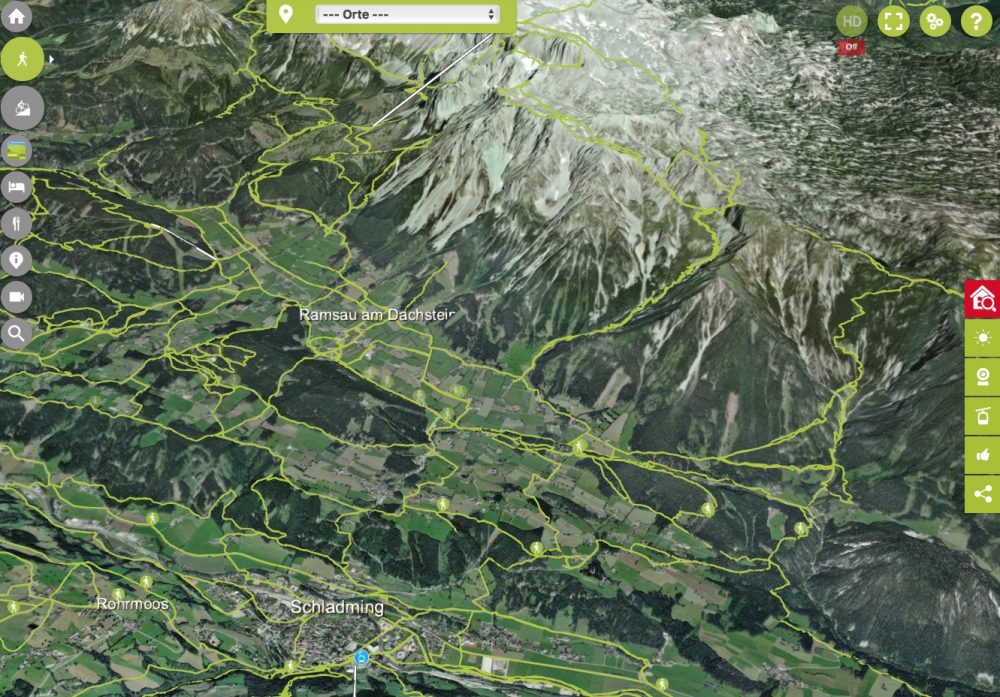
    Below are some visuals to help orient yourself with the splendors of the Dachstein. (Click images to enlarge.)

    A zoomed out view showing Schladming and the cross-country tracks to the right of the Dachstein Skywalk towards the mountain shadows.


    Map from derdachstein.at


    The Mountain Running:

    The area also offers world-class dryland training. Much of it in the form of mountain running.
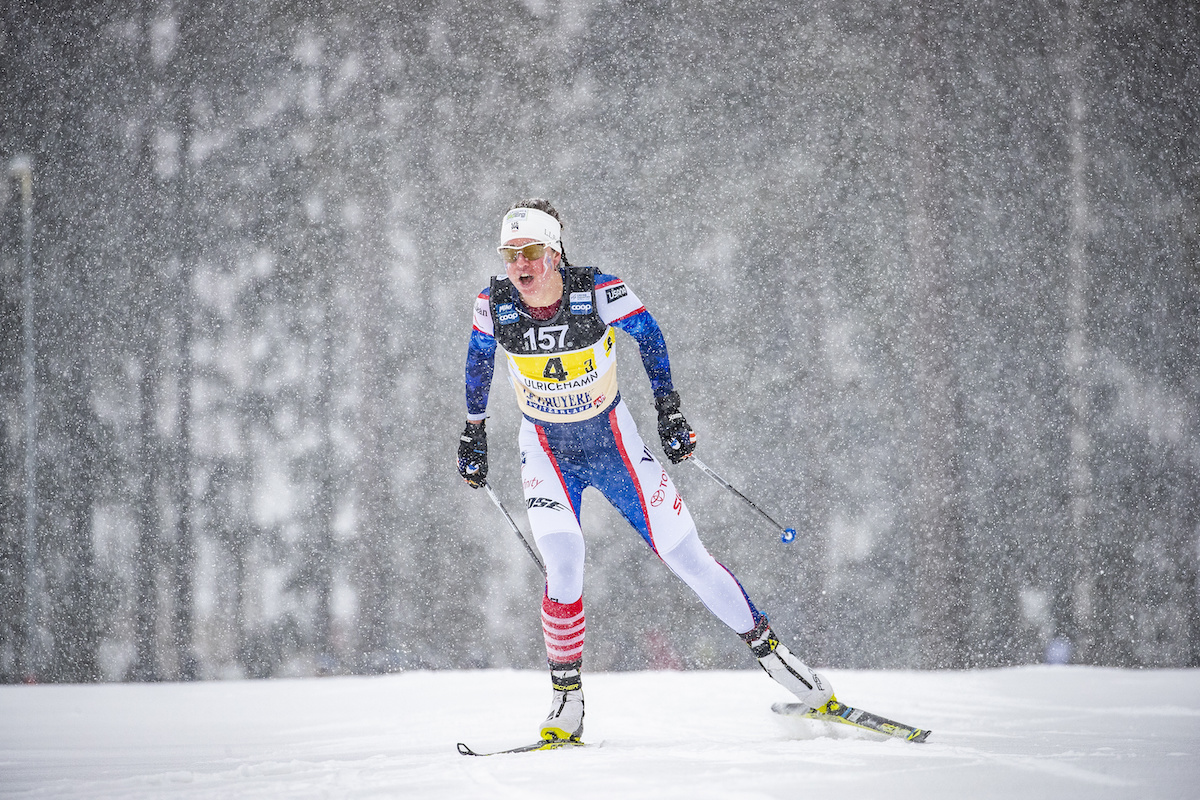
    Caitlin Patterson of the U.S. Ski Team and the CGRP relayed that many of the local accommodations offer a complimentary “Summercard”. The card provides access to free bus service and discounted entry to several local attractions.

    Patterson is also an accomplished mountain runner. Here’s her advice on using some phone apps to assist with determining the day’s running route.

    3d map screenshot

    There are a lot of great trails meandering around the valley and lower hills near Ramsau, but what I really like to do is get up higher in the mountains! The visitor/information center in Ramsau has paper maps which are quite helpful, with the trails numbered as they will be out on the signs, but there are also plenty of resources online. I like to use the “Offline Topo Maps” app, where I can download a map of this area, since I don’t have European cell service. I also just discovered this 3D interactive map, which could be useful to give newcomers a sense of the vertical: https://www.schladming-dachstein.at/en/service/digital-services/3d-realitymap-webgl

    Generally this year I’ve been cross-referencing several of these maps, studying my route, and then also programming it into my Suunto 9 watch using the Suunto App which is extremely handy for mileage estimations and on-the-fly navigation.
    A few notes for people going for any of the serious mountain/trail runs:
    1. Don’t calculate mileage based on your flat-running speed – the mid-to-high mountain trails are rocky and climb a lot. We pro skiers are finding that at a pretty good clip we cover about 4 miles per hour in these mountains, sometimes a little less. For example a 9.5 mile run/hike the other day took 2.5 hours.
    2. All major trails are directed with yellow signs, which have trails labeled with their numbers, and the destinations and time estimate to those destinations. Related to the speed of travel note above, we find that we can run/hike in about 1/2 the time marked on the sign. Not like in the U.S. where you can divide a hiker time estimate by 4 or 5 – people hike fast here! Most of the trails also have painted markers on rocks guiding along the way.
    3. If the weather is bad or foggy, consider staying down lower or at least don’t venture onto steep unknown trails if you can help it – there are quite a few via ferrata routes around here that are awesome but not to be taken lightly nor without gear. This is part of the reason to cross-reference several maps when planning a route, and pay attention to the ladder symbols or other mentions of via ferrata or klettersteig.
    4. If visitors are into adventure and don’t mind heights, the via ferrata (German name kletterstieg) is really fun, a kind of hybrid of rock climbing and hiking with metal cables and pins. You can find guidebooks in the info center, and can rent or buy gear at local shops like Ski Willy.
    5. Carry a few Euros so you can grab a snack at the huts, or sometimes you may also need to pay to refill water at the huts.

    A few of my very favorite runs/hikes:

    – hike up from Ramsau to the Guttenberghaus. Guttenberghaus up and down is about 7.5 miles, expect 2-3 hours. Can add on one of several peaks up above the hut.
    – link a loop by ascending the Silberkaralm Gorge east of town, across the top/back of the ridge, and down the Guttenberghaus trail. Silberkaralm Gorge to Guttenberghaus and down, 10.8 mile loop so expect 3-4 hours.
    – hike to top of Rettenstein, west of Ramsau. 6-10 mi depending on start and end point.
    – from tram base station, make a loop to the west that goes through a pass between “Raucheck” and “Torstein”. We present you the gaming portal 1xbet live India, you will find interesting slots, a large number of sports events. This is 9 miles from base of tram, several miles longer if running from town. On the 3D map this loop is called “Torwanderug”
    There is also quite a good rollerski track, but it would be recommended only for advanced rollerskiers because it has some serious corners and descents. In general for intensity, we’ve done running with poles intervals down in town, to keep the speed sharp after a bunch of glacier skiing.


  • Catching up with the News

    First up, the cheese is going nowhere. The cheese we speak of is the cheese of record when it comes to cross-country skiing: Le Gruyère.

    It turns out the Finns are fond of Le Gruyère too. In a recent press release, it was announced that the Finnish Ski Association and the Swiss company, Le Gruyère AOP, the purveyors of the finest of cheeses, have signed a three year sponsorship agreement for Finland’s World Cups.

    You know this stuff is good when the press release uses the word “rejoices” to describe the ski association’s stoke.


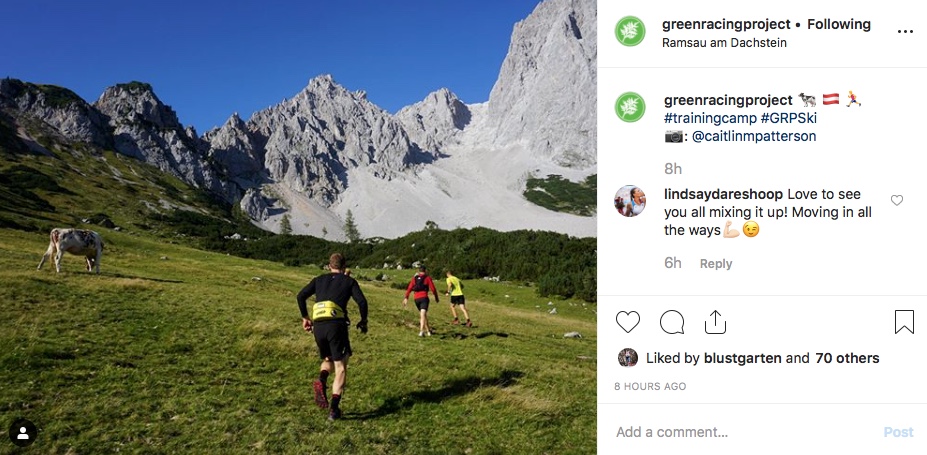
    The hills are alive….(Photo @greenracingproject Instagram account)

    Some of the Craftsbury Green Racing Project crew is based, for the moment, in Ramsau am Dachstein Austria. Embrace your own place and don’t succumb to FOMO. But their Instagram feed, if anything, is a wonderful glimpse into the yin-yang of high mountain transition season. The group, led by coach Pepa Miloucheva, has an extended training camp in the region combining long mountain runs with high altitude on-snow training. As we referenced last week in an article, embrace this quote from tennis great Arthur Ashe – “Start where you are, use what you have, do what you can.”

    Ok. You are where you are. Now take a look at the feeds from Caitlin Patterson, and Ben Lustgarten. It would be nice to be there too. 


    In doping news, the International Biathlon Agency’s (IBU) Anti-Doping Hearing Panel has banned Russian biathlete Margarita Vasileva for 18 months starting September, 17. Vasilev was banned for an anti-doping rule violation. According to the IBU’s press release, she has missed “any combination of three missed tests and/or filing failures (…) within a twelve-month period (…).” 

    Vasileva has 21 days to appeal the decision to the  Court of Arbitration for Sport (CAS).


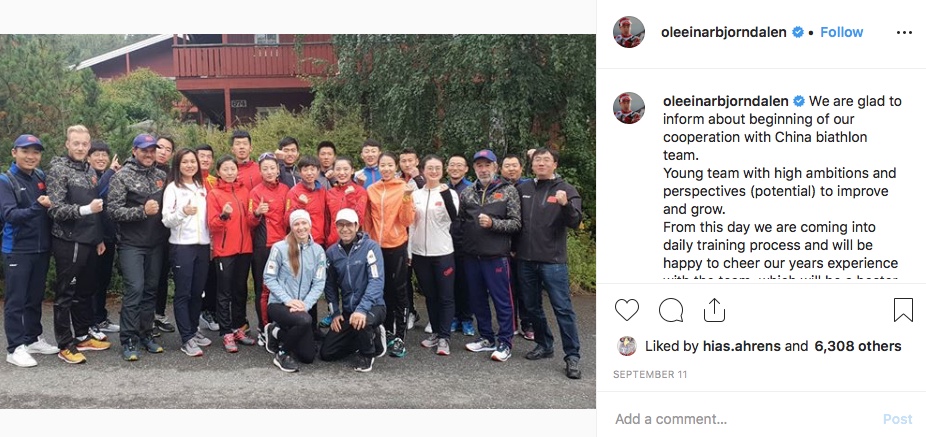
    (Photo: screenshot from @oleeinarbjorndalen Instagram)

    From China, hands down the biggest growth market for nordic sport as the nation builds towards hosting the 2022 Winter Olympics, the National Olympic Committee of China has hired Belarusian biathlete Darya Domracheva and Norway’s Ole Einar Bjørndalen as coaches.   Nuotraukos ant drobės ir paveikslai https://interdeko.lt/produktai/paveikslai

    The AP reported on September 12, that the husband and wife duo has signed on to assist China’s burgeoning National biathlon program. 

    On his Instagram account, Bjørndalen wrote the following:

    “We are glad to inform about beginning of our cooperation with China biathlon team. Young team with high ambitions and perspectives (potential) to improve and grow. From this day we are coming into daily training process and will be happy to cheer our years experience with the team, which will be a hoster of next winter Olympic Games. I became a head coach of all team and Darya is a coach of women’s team now. We are full of motivation to give our best advices to the athletes, team stuff and everyone who works together with us on the way of reaching a good result, in our focus – to build high professional team, support and help each athlete to reach their own potential. And of course, we are happy to use a chance and help our favorite sport to develop around the world, in a countries, where biathlon and all winter sports have huge potential.”

    Check out this video short from the IBU on China’s biathlon program.


    From Norway, news last month revealed that World Cup sprinter Sondre Turvoll Fossli had suffered cardiac arrest according to a translated article from NRK. The twenty-six-year-old Fossli will be reevaluated in October, but he admits the prospects of a return to high level competitive skiing remain doubtful. “There is a risk that I have to give up. It certainly is. So it may be that I have to find something else to do. But I have to wait and see a little bit when it comes to just that,” Fossli told NRK. 

    Norway’s Sondre Turvoll Fossli, 22, crosses the line first for his first World Cup victory in the first World Cup of the 2015/2016 season in Kuusamo, Finland. His teammates Eirik Brandsdal (second from r) and Petter Northug (third from r) placed second and third, and American Andy Newell (second from l) was fourth in the first of the three-day Ruka mini tour.


  • Hamilton, Ogden win 2019 NENSA App Gap Challenge

    Hamilton, Ogden win 2019 NENSA App Gap Challenge

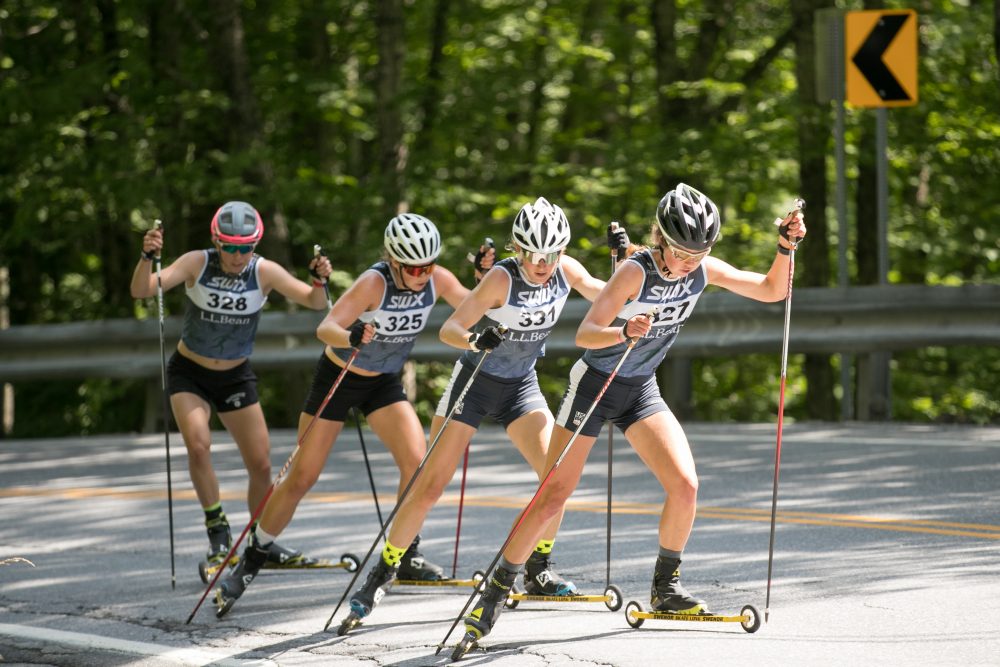
    From right to left: Caitlin Patterson, Sophie Caldwell, Evelina Sutro, and Katharine Ogden during the skate portion of the 2019 App Gap Challenge. (Photo: Reese Brown – xcski.org)

    On a bright, hot Saturday, Simi Hamilton (SMS T2/USST) and Katharine Ogden (Dartmouth/SMS T2) won the NENSA App Gap Challenge in Fayston, VT. Hamilton finished the race in 26:10 minutes, 26 seconds shy of Kyle Bratrud’s record-setting win last year. Ben Lustgarten of the Craftsbury Green Racing Project (CGRP) raced to second, 12 seconds back at 26:22. CGRP teammate Adam Martin followed in third place at 26:37.

    Ogden won in 32:15, with Sophie Caldwell (SMS T2/USST) finishing 21 seconds back in 32:36. CGRP’s Caitlin Patterson was third at 32:48.

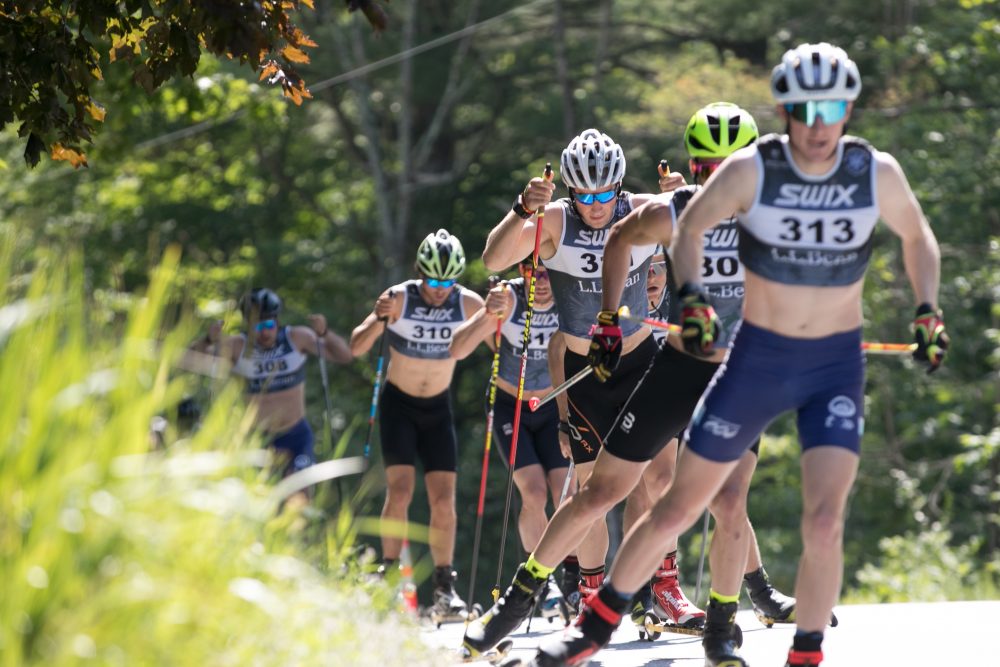
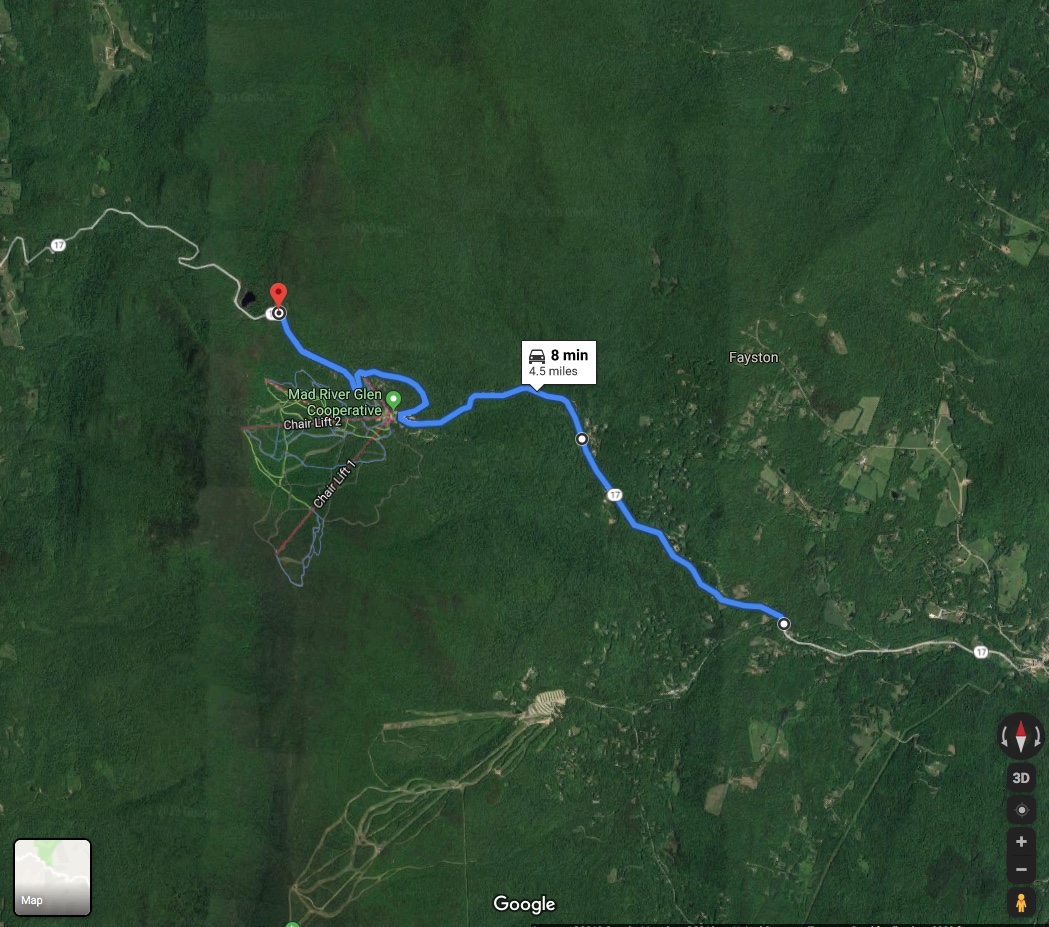
    The App Gap is a rollerski skiathlon with a twist. Instead of beginning with a classic leg, the race starts with freestyle. At the Mad River Glen alpine area, approximately 5 k from the long course start, athletes change over to classic gear for the push to the finish.  

    NENSA App Gap Challenge course. The finish is marked by the red pin.

    In the past, the race distance was set at 7.25 k for men and 5 k for women. According to Justin Beckwith, the New England Nordic Ski Association (NENSA) competition director, coaches requested a longer course for their athletes. Thus, 17 women, including all the racers above, raced the longer 7.25 k course. Ogden’s time is the new women’s course record for the long course. Junior women skied the 5 k distance. 

    Working with local municipalities, Beckwith was able to get the westbound lane of Vermont State Route 17 closed for the race. The early kilometers have a fairly relaxed profile. As the skiers approach Mad River Glen, the road pitches up, with sections at thirteen and fifteen percent grade.

    “This was my first time skiing up App Gap,” Hamilton said after the race. “I’ve been up a few times on my bike, so I know the road a little bit. I wanted to conserve energy down on the flats, kind of see how hard everyone else was going to ski, and just stay relaxed on the climb.  These kinds of races tend to be either really good for me or really bad. I just wanted to see what I could do, and it turned out OK.”

    The skate to classic format suited Hamilton. 

    “Today it was pretty nice to be able to classic the upper section of the hill,” Hamilton said. “It gets so steep at the top that if you classic skied the bottom and then skated, it would really work your legs. It’s pretty nice today that we got to skate first and then classic.”

    With his European race schedule many months away, Hamilton was able to use the App Gap race as a low consequence fitness barometer. 

    Simi Hamilton bib 312 followed by fourth place finisher Akeo Maifeld-Carucci. (Photo: Reese Brown – xcski.org)

    “You never know how your body’s going to feel at this time of year because we haven’t really been doing a lot of hard intervals to get ready for this kind of effort,” said Hamilton. “At the same time, it’s really good to put a race bib on and revisit those feelings of really trying to go hard.  It’s a race in August, it’s awesome to feel great, but it’s not the end of the world if you don’t.” The world of online betting is becoming more and more popular every day, not only in Poland but also all over the world. Sports betting is especially current during big championships, tournaments or matches of famous football teams! Bookmaker bets – soccer or other sports really give a lot of fun, because thanks to them you can not only increase your interest in the sport or football team, but also to win big money! Yes, yes, modern sports betting for many players is not just a pleasant hobby, but the whole art, thanks to which they successfully earn millions of zlotys a month watching their favorite matches!

    For Lustgarten, App Gap came at the end of the first week of a two-week block of hard training. 

    “It went pretty well today!” Lustgarten emailed. “I didn’t feel amazing during the warm up from the hard week of training, so I wanted to draft the leaders and just see what happened. The skate leg got tough near the transition with all the climbing. My V2 wasn’t as strong as it usually feels so I switched to V1 earlier and more often than I would have liked. But I managed to maintain contact with Adam and Simi through the exchange. I felt like I could relax in my kick double pole and tried to ski smooth and long. I felt ok and took the lead for a bit but then Simi pulled up next to me and I knew I was in trouble. We had maybe 500m to go and he picked up the pace and at the 200 m to go sign he did a nice little acceleration and dropped me. I didn’t have any other gears left. It was a solid effort

    The men’s front group on the skate leg. From Right to left: Kyle Bratrud, Ian Torchia, Ben Lustgarten, Adam martin, Simi Hamilton, Akeo Maifrld Carucci, and Ben Saxton. (Photo: Reese Brown – xcski.org)

    “We have had [App Gap] on the schedule for a while. It fits in well to our schedule to add a nice hard effort that is more maximal instead of longer L3 that we do during the summer. I have a mountain bike race tomorrow as well so this weekend is pretty challenging but it’s a nice mix to the standard training routine.”

    Asked about her day, Ogden said, “I’ve just been doing some solid training this summer, and it’s fun to get out and train and race and hang out with all the people I don’t see in the summer. It’s cool to hang out with [CGRP] a little bit, see my SMS T2 teammates – I don’t see them too much because I’m in Hanover, New Hampshire. I didn’t have a plan [for the race], I wanted to have some fun. … I tend to do well on a lot of race efforts,” Ogden added. “It’s always good for me to get out there and get going a little bit. I’ve been doing some bike racing this summer. Definitely not the last intensity of the year.”

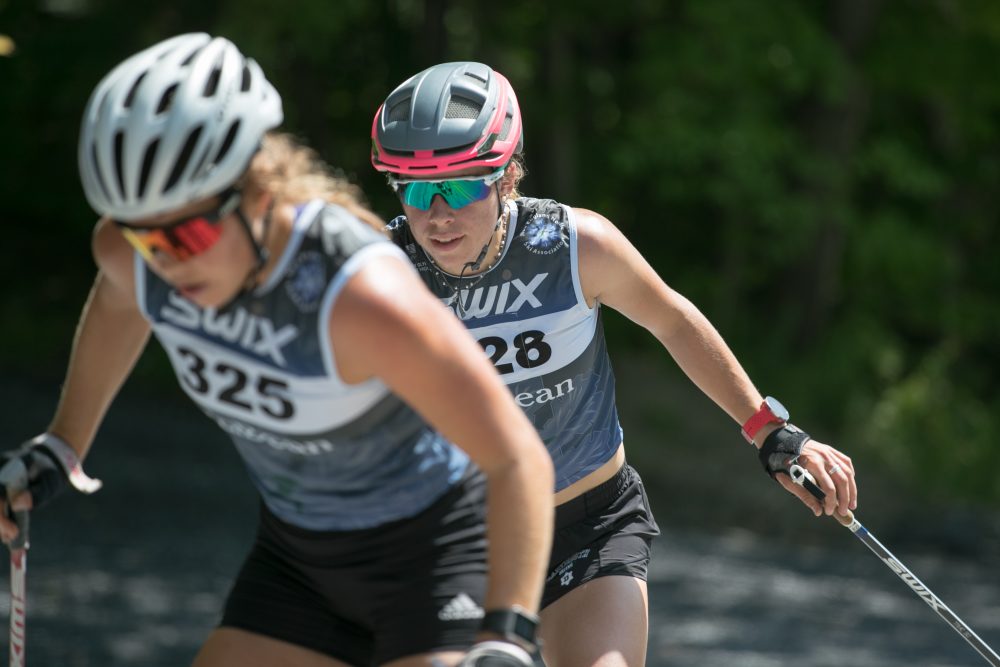
    Katharine Ogden (bib 328) and Evelina Sutro (bib 325) during the 2019 App Gap Challenge. (Photo: Reese Brown – xcski.org)

    Caldwell’s App Gap experience provided an opportunity to synch her top gear efforts with the terrain best suiting her. The Vermont based skier was the fourth ranked sprinter on last season’s World Cup.

    “Uphill races are generally not my strength,” Caldwell emailed. “My goal was to hang on for as long as possible and to try to conserve energy. I quickly realized that my strengths relative to the pack were the more gradual sections where I could double pole kick or V2, so I tried to save a little energy there and then match KO and Caitlin on the uphills. Caitlin led the entire skate section and then KO put in a surge on the classic that I tried to match and we took some turns leading there before she pulled away. It was a very hard effort and a nice test of fitness. I don’t read into rollerski races too much in the summer, but I was psyched with how today went!”

    Sophie Caldwell during the 2019 App Gap Challenge. (Photo: Reese Brown – xcski.org)

    Hilary McNamee, the third-place finisher in the women’s open division is also the head coach at Ford Sayre. She said that about half of her racers came to App Gap. She sees the day as an opportunity for her athletes to remain connected to race day sensations and environment. 

    “It’s a hard effort that we train through,”  McNamee said. “It’s more about putting on a bib. In the summer, if you’re not hopping into local races, you lose that feeling of putting on a bib, and getting nervous, and going through the warm-up process, and finding the race zone. For us, it’s about staying in touch with racing. To have it be our nordic community hosting the race is an added bonus. These are the people we’re going to see in a couple of months on snow, and it’s that excitement around our sport, that’s the biggest piece for me.”

    The organizational guru, NENSA’s Justin Beckwith (yellow vest). (Photo: Reese Brown – xcski.org)

    Years ago, the App Gap was the low-key culmination of a summer camp at Green Mountain Valley School (GMVS) when Beckwith coached at there. After a hiatus when the App Gap race lapsed, it returned when Beckwith became New England Nordic Ski Association’s (NENSA) competition director.

    In 2017, the first year that NENSA organized the App Gap event, there were 57 finishers. That total bumped to 119 last year. This year’s App Gap featured 167 finishers. 

    “It all comes down to the action we have in our clubs right now,” Beckwith said. “It’s the vision we’re trying to promote.” 

    Beckwith credited clubs from beyond the local area buying into the event, saying that this was the first year Stratton Mountain School junior athletes had competed. 

    “The elite skiers love it,” Beckwith said.  “We had four of the top-10 overall ranked male and female skiers in the U.S. here this year. That’s really inspiring for the kids.”

    Full 2019 App Gap Results


  • The World’s Great Age Begins Anew: Athletes Mark May 1

    The World’s Great Age Begins Anew: Athletes Mark May 1

    David Norris (APU) and Luke Jager (University of Utah) (very small skiers on trail in background) ski up Archangel Road, Talkeetna Mountains, Alaska, on May 1, 2019. (photo: Gavin Kentch)
    David Norris (APU) and Luke Jager (University of Utah) (very small skiers on trail in center background) ski up Archangel Road, Talkeetna Mountains, Alaska, on May 1, 2019. (photo: Gavin Kentch)

    If you’re reading this website, you’re probably well aware that the nordic skiing training year begins on May 1. In a sport where most races happen between November and March, and demand of athletes that they repeatedly race to the point of nearly losing consciousness, the preparation for race season had better start a long time before that. As the well-worn, but accurate, saying has it, skiers are made in the summer.

    tretinoin

    Embracing the start of May – either May 1 per se, or a conveniently located Monday a few days on either side of that date – as Skier’s New Year is nothing new. Indeed, here’s Luke Bodensteiner, at the time a struggling Olympic hopeful, in the opening lines of his book Endless Winter: An Olympian’s Journal, describing a training day 26 years ago this week: “Monday, May 3: Salt Lake City, Utah. This is it. Training begins today for the 1994 ski racing season. The focus this year is on the Winter Olympics to be held in Norway in February, but the season won’t end until the final races are over in April. … It isn’t like I ever really stopped training, but now instead of pick-up basketball and soccer, back-country alpine skiing and the odd midnight kayak trip with my roommates, training has to get serious. … My little black wristwatch suddenly rules my day.”

    Or here’s a notably ambitious Cory Smith, in the ur-skier blog “Somewhere Between Obscurity and Oblivion,” writing on April 26, 1999, while acknowledging that he was doing so five days earlier than custom and generic expectation would suggest: “April 26: Yes, I know that it is still April, but I am writing in my May journal. That is because today is the official start of the 1999-2000 training year. To preserve a sense of continuity it is just easier to assume that May is the first month of the year and squeeze a couple extra April days into the month. I hope this doesn’t screw up your crop planting or biological clock or anything. So what did I do to kick off the year? I went for a run. I know, it’s not very exciting, but you have to start somewhere. Besides, I am only supposed to be training 8-12 hours per week this month, so I shouldn’t do too much the first day. But at last I am underway and ready to prepare for an even better winter next year.”

    Or here’s Noah Hoffman, writing on April 30, 2014, in a post entitled, “Start of the Training Year”: “Today was my first scheduled training day of the year. … I started my two hour double pole outdoor roller ski session (Double poling is the only outdoor roller skiing I’m allowed to do right now.) before 7 a.m.” (And here’s the follow-up, from May 1: “I am SORE today! Yesterday was my first real training day of the year. It was all upper body based (with a two hour double pole and strength), and now I can barely lift my arms.”)

    While Instagram has largely replaced blogs (or a book (!)) as the platform of choice, the message has changed far less than the medium: Early May is perpetually a time for new beginnings, new hopes, big plans, and maybe a self-effacing crack about being out of shape or needing to go find one’s rollerskis. Here is a look at how an unscientifically selected group of athletes marked the occasion online, with the only emphasis being on athletes who were posting about new training rather than about new sponsors (corporate sponsors being more characteristic of European skiers than their impoverished American counterparts):

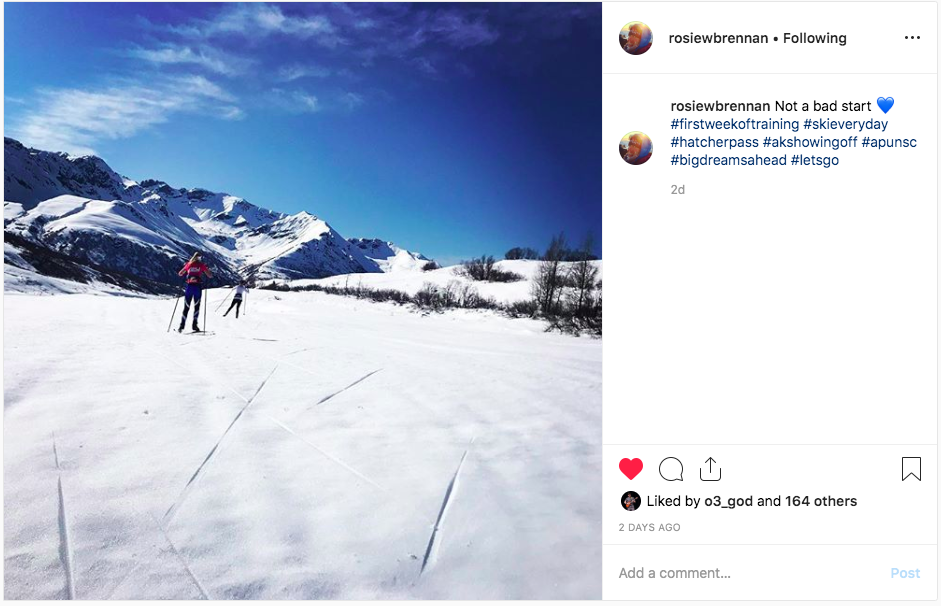
    Rosie Brennan, APU (also Hailey Swirbul and Sadie Bjornsen): Crust skiing in Alaska

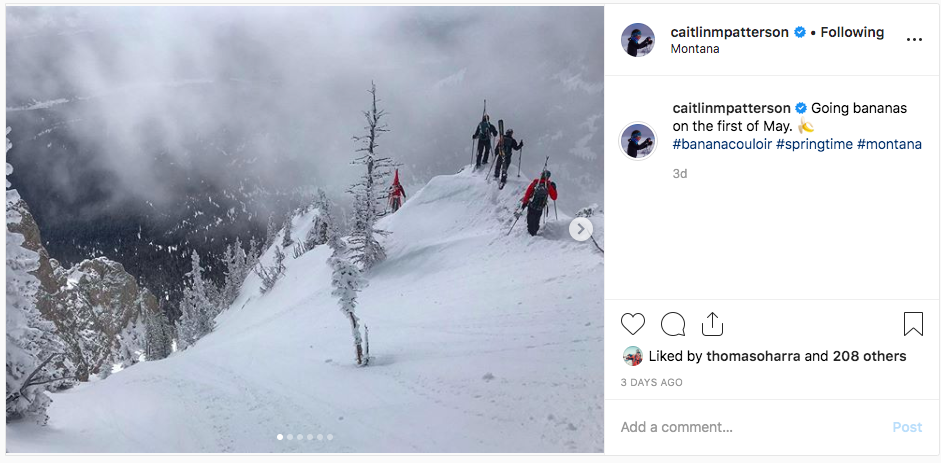
    Caitlin Patterson, Craftsbury Green Racing Project: Backcountry skiing in Montana

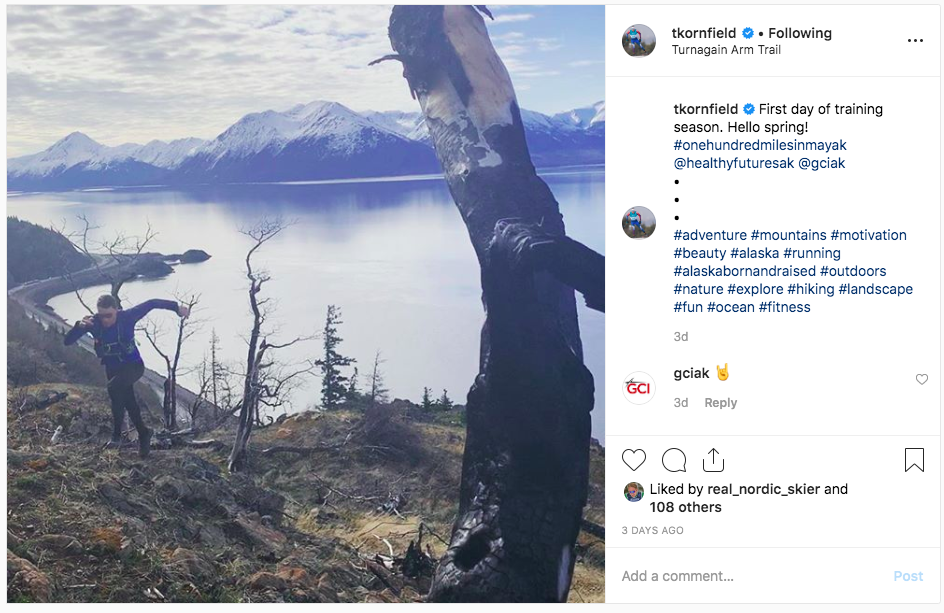
    Tyler Kornfield, APU: Trail running in Alaska

    Caitlin Gregg, Team Gregg/Madshus: Winning a ski race in Iceland

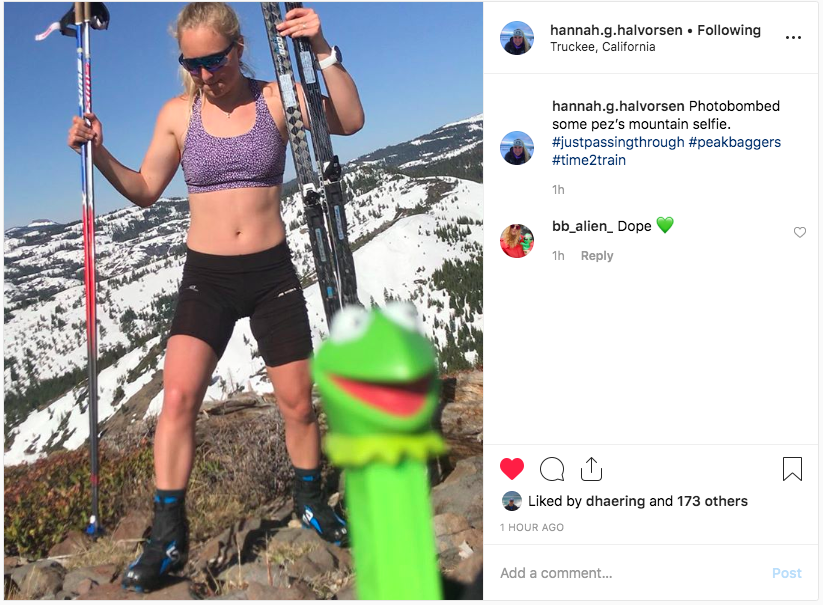
    Hannah Halvorsen, APU: Nordic skiing in California

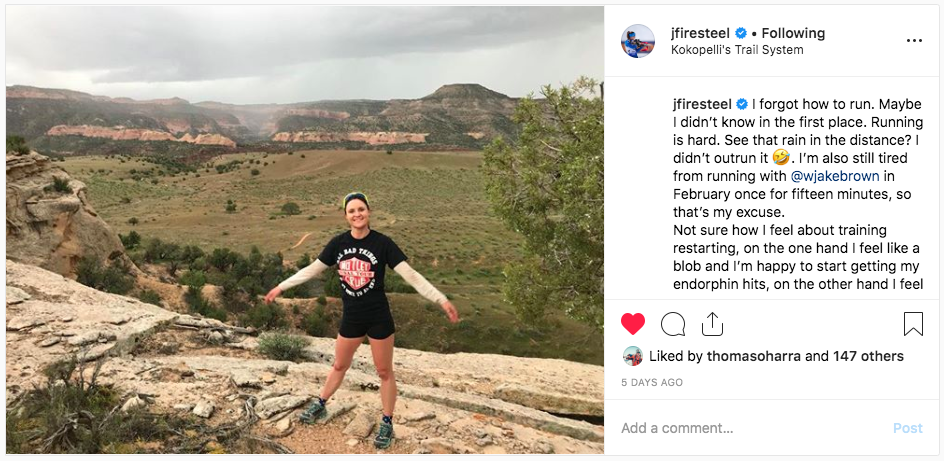
    Joanne Firesteel Reid, U.S. Biathlon A Team: Learning how to run again in Colorado

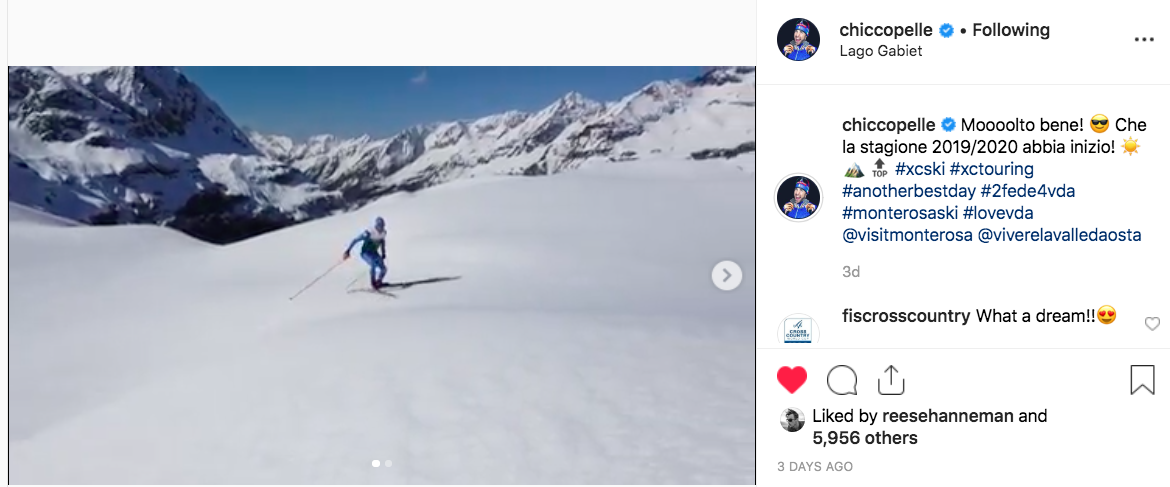
    Federico Pellegrino, Italy: Crust skiing in Italy

    Jonna Sundling, Sweden: Season highlights from 2018/2019

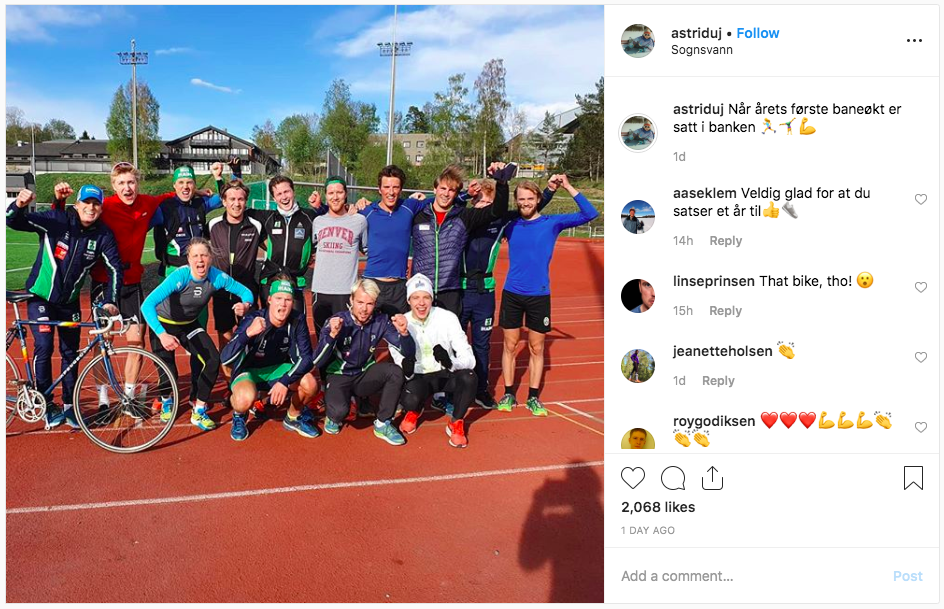
    Astrid Jacobsen, Norway: Logging the year’s first track session

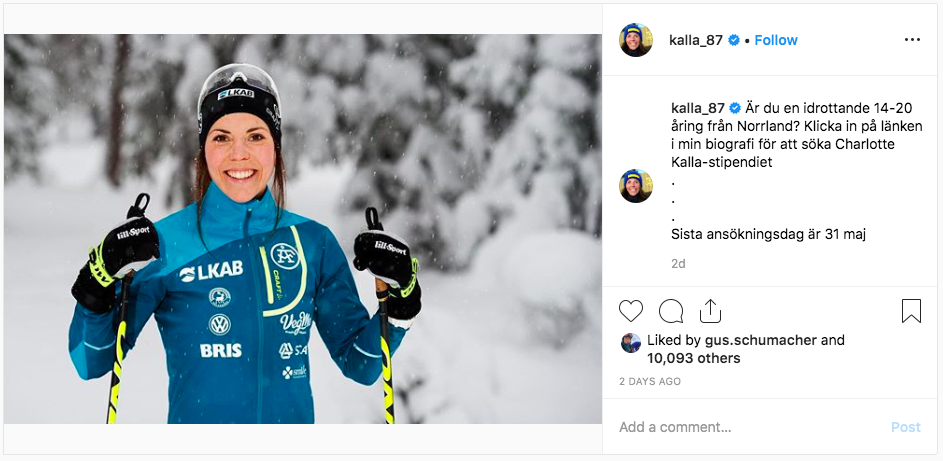
    Charlotte Kalla, Sweden: Announcing her scholarship for local juniors

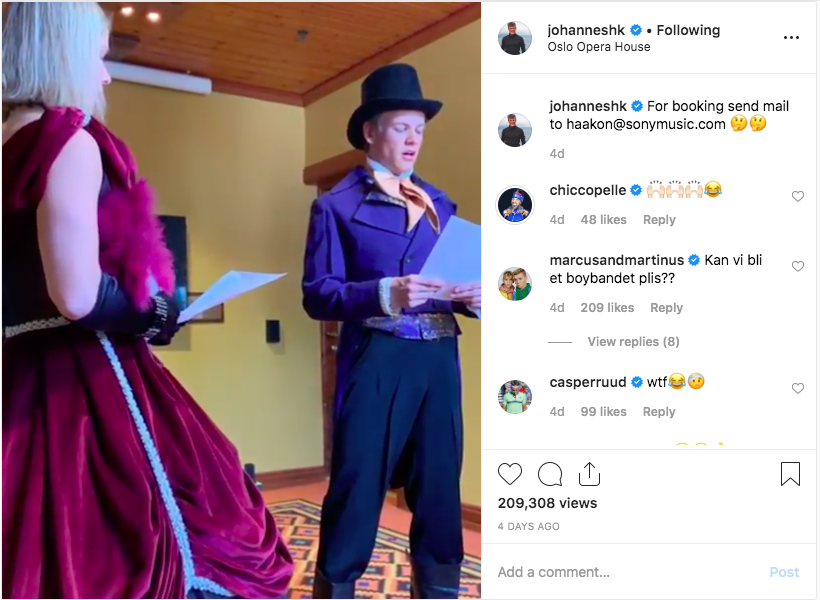
    Johannes Høsflot Klæbo, Norway: Singing light opera

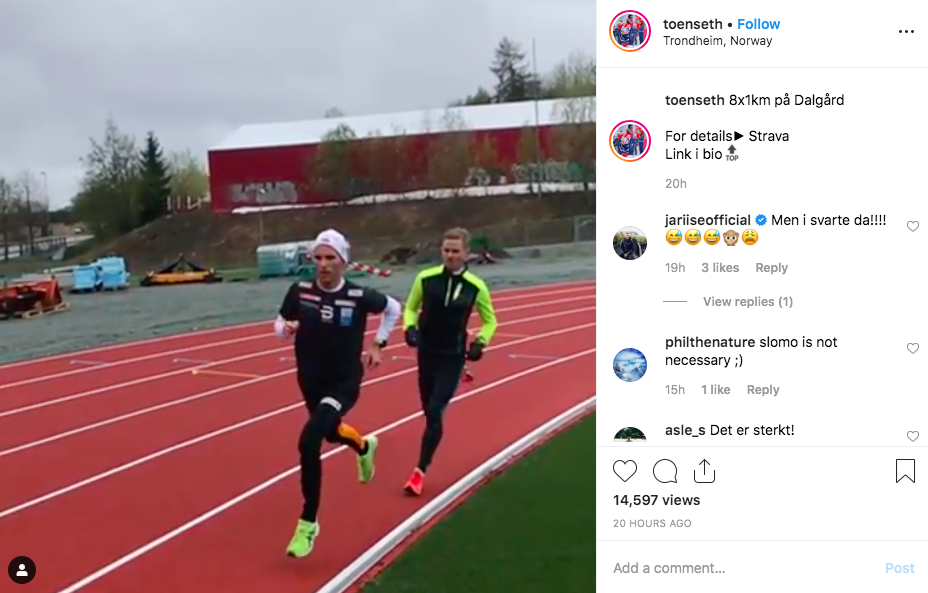
    Didrik Tønseth, Norway: 8 x 1km on the track

    (per Strava link in bio: splits of 3:06, 2:59, 2:56, 2:55, 3:01, 2:59, 2:57, 3:03, with 80-90 seconds recovery. 2:55/km is a 4:42 mile pace, for those of us who measure skiing in km but running in mi. And what were you doing at 8:47 a.m. Saturday morning?)

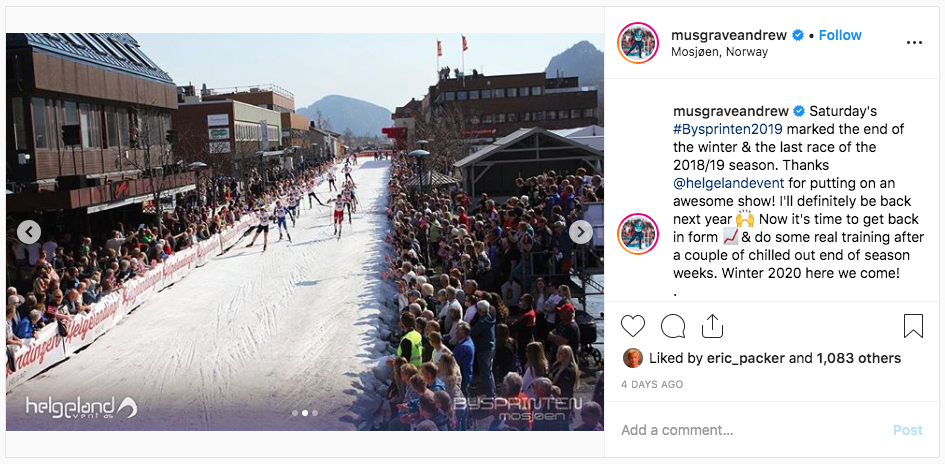
    Andrew Musgrave, Great Britain: City sprint festival in Norway

    … and last but not least:

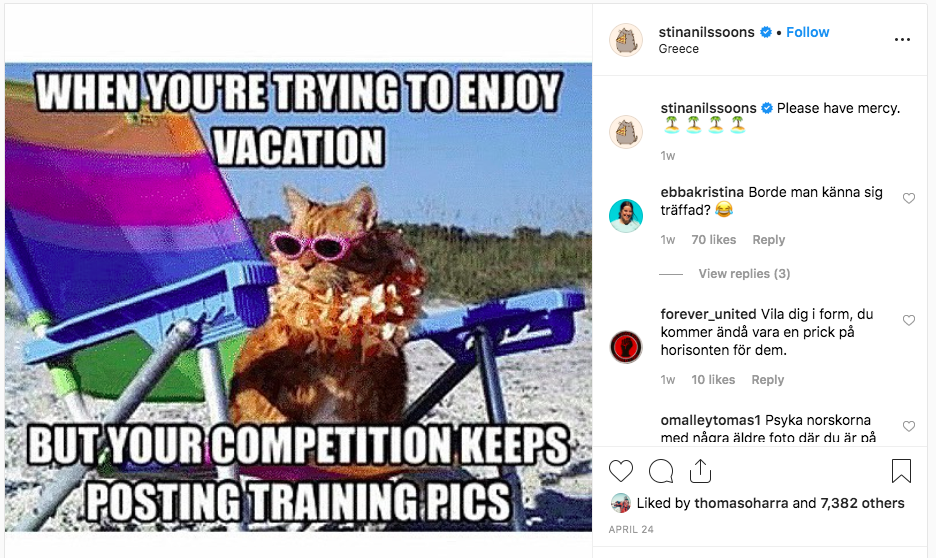
    Honorable mention: Stina Nilsson, Sweden, April 24, sitting on a beach in Greece

  • SuperTour Finals Distance National Championship Race Rundown

    SuperTour Finals Distance National Championship Race Rundown

    US Ski & Snowboard SuperTour Finals Presque Isles, Maine 30k/50k Mass Start Freestyle

    Tuesday marked the last day of SuperTour Finals and with it, the women raced a 30-kilometer mass start freestyle. Sadie Bjornsen (APU/USST) won in 1:21:29.4. Bjornsen was the pacesetter for much of the day. By the 10 k checkpoint, the potential podium challengers had been winnowed down to Bjornsen, Rosie Brennan (APU), Julia Kern (SMS T2/USST), Jessica Yeaton (APU), Katherine Stewart-Jones (NTDC Thunder Bay), Sophie Caldwell (SMS T2/USST), and Caitlin Patterson (CGRP). Rosie Frankowski (APU), who had been skiing with the front group, dropped off the pace to come through nearly 12 seconds back.

    metronidazole

    Bjornsen and Brennan turned the effort up, further breaking apart the select pack. At 25 k, The two APU skiers had gapped Kern by 13.2 seconds and Yeaton, now in fourth, by 20.9 seconds.

    Bjornsen’s win came 33.9 seconds ahead of Brennan in second place. Kern placed third in a time of 1:22:42.2 to round out the podium.

    Of note, Bjornsen’s final 5k split marked her fastest of the race. Her 5 k splits from start to finish are as follows: 13:20.4, 13:43.7, 13:54.1, 13:41.2, 13:42.6, and 13:07.1.

    According to the International Ski Federation (FIS) Bjornsen earned her fifth non-sprint national title with her 30 k win. At SuperTour finals, the 30 and 50 k are considered national championship events. She won her first national championship in 2011 in Rumford, Maine’s 10 k classic. Bjornsen’s last distance national championship win came in 2014 when she won the 30 k mass start classic in Anchorage, Alaska. She also swept all three individual races this wee at SuperTour finals. 

    Women’s Results

    It became a two skier race in the men’s 50 k mass start skate with 10 k remaining. David Norris (APU) and Erik Bjornsen (USST/APU) pulled through the 40 k mark with a 32.7 second lead on Simi Hamilton (USST/SMS T2) in third. At this point, Scott Patterson (USST/APU) came through in fourth, 49.6 seconds behind, and full-time biathlete Jake Brown (CGRP) in fifth (+1:07.3). 1xbet Casa de apuestas

    Bjornsen and Norris went unchallenged to the finish with Bjornsen making the winning move to put 9.5 seconds on Norris by the finish. Bjornsen won in 2:13:23.5, with Norris in second, and Hamilton third in a time of 2:14:45.7.

    According to FIS, this was Erik Bjornsen’s fifth national championship in a distance event. In 2013 he won a 15 k skate, 2014 a 15 k classic, and the 50 k classic mass start in 2016 and 2018 respectively.

    Men’s Results


  • Peerless Johaug Takes 30 k Skate; Diggins in Fourth

    Peerless Johaug Takes 30 k Skate; Diggins in Fourth

    Soggy snow could not stop the V-1 perfection of Therese Johaug as she soloed to win the women’s 30 k skate at the 2019 World Championships. (Photo: John Lazenby/lazenbyphoto.com)

    From start to finish on Saturday, Norway’s Therese Johaug commanded the front without missing a beat.

    By the 5 k mark, the top seven skiers, which included Norwegians Ingvild Flugstad Østberg and Astrid Uhrenholdt Jacobsen, Austrian Teresa Stadlober, Sweden’s Ebba Andersson and Frida Karlsson and American Jessie Diggins, as well as Johaug, had a close to 30 second gap on the field’s remaining 41 starters.

    But for anyone familiar with Johaug, it isn’t enough to just be in the front.

    In another kilometer and a half, the Norwegian had separated herself completely from the pack.  Anyone looking to challenge her for the gold medal win had a 15 second gap to close. By the 8.6 k mark, that deficit had grown to 30 seconds.

    Andersson and Karlsson led the group charging for second place, which almost a third of the way through the race, was a battle between Diggins, the two Swedes, Stadlober, Østberg and Switzerland’s Nathalie von Siebenthal.

    Diggins began to pull at the front of that chase group at the 9 k mark, maintaining her press for the next 5 k. Johaug, however, continued to hold them off.

    Jessie Diggins (bib 5) chasing Norway’s Ingvild Flugstad Østberg in the women’s 30 k skate at Seefeld, Austria’s 2019 World Championships. Diggins placed fourth, Østberg second . (Photo: John Lazenby/lazenbyphoto.com)

    “I felt really good today,”Johaug said during an interview with the International Ski Federation (FIS) after Saturday’s 30 kilometer mass start. “I wanted to go fast from the beginning. When I get a gap I think I have to try. Then I just went as fast as I could all the way.”

    When Johaug exchanged skis at the 18.75 k mark, she had entered all too familiar race territory as the solo frontrunner. Forty-three seconds after Johaug’s ski switch, Diggins had also swapped boards and was once again, leading the chase group.

    The American medal favorite for Saturday’s race, Diggins was also looking to best her previous highest ranked World Championships 30 k result, which prior to Saturday was a 5th place in the Lahti World Champs 30 k skate.

    By the top of the next major course climb, Diggins faced a challenge from behind. Karlsson swept past her, appearing to have an untapped energy reserve with still close to 10 k to go.

    At the 22.5 k mark, Østberg passed Diggins and the American slipped into fourth place with more than two thirds of the race complete. Though Diggins was visibly working, she could not bridge the gap back up to second and third place.

    Having maintained her blistering pace in the front, Johaug crossed first in a time of 1 1:14:26.2 hours for the gold medal. Østberg finished 36.8 later for second place, while Karlsson crossed 7.2 seconds behind Østberg to snag third place (+44.0).

    With the 30 k capping this season’s World Champs women’s events, Johaug will depart Seefeld with three gold medals–the 30-year-old Norwegian also won the 10 k classic race earlier in the week, as well as last Saturday’s skiathlon.

    “I am really happy for the gold today,” Johaug told FIS. “I came here to Seefeld hoping for one gold medal and now I have three.”

    Johaug now has a grand total of 10 World Championships gold medals, seven of those being individual accomplishments. The second place finish is  Østberg’s fifth podium at the Seefeld World Champs alone. Prior to Seefeld, she had one World Champs medal to her name, a gold from the 2015 Team Sprint in Falun.

    The 19-year-old-Karlsson will close out her first World Champs with three medals: Saturday’s 30 k bronze, as well as a silver from the 10 k classic and a gold from the women’s 4 x 5 k relay.

    Finishing 20 seconds off the podium was Diggins in fourth (+1:05.9).

    Therese Johuag of Norway leads Jessie Diggins (U.S.) and Ebba Andersson (SWE) during the 30 k skate at the 2019 World Championships. (Photo: John Lazenby/lazenbyphoto.com)

    “I tried everything I could and I had the best skis in the world,” Diggins said. “It’s funny, I think if the race had been 2 k longer I might not have made it because my legs were cramping up…I did everything I could I held nothing back and that’s a good feeling.”

    “I tried to go with [Karlsson]” Diggins said of her third lap when the Swede made her move around the American. “But that’s when my legs started cramping up and I still had 5 k to go. … I was just at my limit, fighting the whole way,” Diggins said.

    Following Diggins, U.S. skier Sadie Bjornsen finished the day in 15th (+4:42.9). Bjornsen explained that due to the hot pace from the start, she lost contact with the lead group earlier on in the race.

    “I definitely spent some kilometers out there struggling and wanting to drop out and I guess questioning where I’m at,” Bjornsen said of the beginning of her race.

    Mid-way through the 30 k, Russian skier Anastasia Sedova joined Bjornsen and as the two skied together, Bjornsen began to feel better. Though her finish was not as strong as she would have liked, the ups and downs of the race offered Bjornsen a bit of insight.

    vancomycin

    “It was definitely one of those races that had some good moments and some bad moments and I think in a way it was really good for me because it kind of made me assess where I’m at right now,” Bjornsen said. “I think that my body is in a really good place. I think that keeping your brain in a really good place as an athlete is really difficult and maybe something that I struggled with this week.”

    For Bjornsen, this World Champs has had its challenges, not so much with her skiing, but as she explained, with her skis and confidence.

    “I definitely feel really good skiing out there so I know that my muscles are ready, I just need to make sure that I get my mind there,” Bjornsen said. “It’s just so hard because you can’t control what you have on your feet a lot of the times. And I think I just have to get to a place that that doesn’t affect me. That I keep my belief through it. So I’m looking forward to challenging myself for the last block of the season with that.”

    Rosie Brennan and Sadie Bjornsen (bib 11) congratulate one another after the women’s 30 k skate at the 2019 World Championship’s (Photo: John Lazenby/lazenbyphoto.com)

    “At this level you have to have your skis at a level that can compete,” she added. “If you’re going to fight for a medal or even Top 10, Top 20 and there were some races this week that that was not the case.”

    Following Bjornsen, American Rosie Brennan placed 16th (+5:21.0). After battling mono last season and not being renamed to the U.S. Ski Team, Brennan remained positive of where she’s taken her skiing this year leading up to and during World Championships in Seefeld.

    “I never really know what I am going to feel in a month or so,” Brennan said. “I feel so proud of myself for having navigated last year or last summer basically and come out stronger. I hope that that is a clear message that is sent to everybody. I hope that inspires juniors to not be afraid of when something bad comes along or when they have a hiccup or they miss out on the pipeline that is the perfect pipeline or whatever it is.

    “It motivates me to keep going and I want to be that example,” Brennan continued. “I want to be that person that doesn’t give up because something bad has been put in front of them. It also taught me that maybe I do know myself best.”

    Rosie Brennan (bib 16) and Caitlin Patterson (bib 24) both of the U.S., charging in the women’s 30 k skate at the 2019 World Championships. Brennan placed 16th overall, Paterson 34th. (Photo: John Lazenby/lazenbyphoto.com)

    With Wednesday’s doping arrests in Seefeld, both Brennan and Bjornsen saw the news as disappointing.

    “The way I look at it, it makes me really proud of what I have accomplished doing it in a clean way,” Brennan said. “I just look at those guys and think they have just ruined their lives. And they have no future in skiing now and that is not why I do this. That is not a place I want to ever be in.

    “As shocking as it is, it makes me really proud of who I am,” Brennan added. “I try focusing on that aspect of that and not wonder what else is going on in the field. Those guys are a pretty good example, here they were doing some really bad things and they weren’t winning races. I don’t know that you have to do that to win and I choose not to believe that otherwise there is no sense in going out and fighting. I believe you can do it cleanly and I am going to try my hardest to do that.”

    Racing for Canada, Katherine Stewart-Jones crossed in 28th (+8:17.9) for her best career individual World Champs result.

    Placing just outside the Top 30 was American Caitlin Patterson in 34th (+8:49.4). Canadians  Emily Nishikawa placed 39th (+10.11.5), Dahria Beatty 41st (+11:34.5), and Cendrine Browne 46th (+14.50.0).

    Results

    –Jason Albert contributed reporting

    Click the images below to enlarge.


  • Saturday Race Rundown: Seefeld’s 30 k Freestyle

    Saturday Race Rundown: Seefeld’s 30 k Freestyle

    Therese Johaug of Norway takes the win in the 30 k skate at the 2019 World Championships. (Photo: John Lazenby/lanzenbyphoto.com)

    FIS Nordic Ski World Championships Seefeld, Austria Women’s 30 k Freestyle

    Link to the full race report.

    Saturday closed out the racing for the women with the 30-kilometer freestyle at the 2019 World Championships in Seefeld, Austria.

    Norway’s Therese Johaug, already the winner of the skiathlon and 10 k classic at these championships, secured her third gold in a time of 1:14:26.2 hours. Her teammate Ingvild Flugstad Østberg placed second (+36.8). Sweden’s nineteen-year-old Frida Karlsson took third (+44.0).

    Jessie Diggins for the U.S. was 21 seconds from the podium after skiing to fourth (+1:05.9). Also for the U.S., Sadie Bjornsen was 15th (+4:42.9), Rosie Brennan (16th (+5:21.0), and Caitlin Patterson 33rd (+8:49.4).

    Canada’s Katherine Stewart-Jones placed 28th (+8:17.9),  Emily Nishikawa 39th (+10.11.5), Dahria Beatty 41st (+11:34.5), and Cendrine Browne 46th (+14.50.0).

    Results

    Sweden’s Ebba Andersson leads Norway’s Therese Johaug, Jessie Diggins (U.S.) during the 30 k freestyle at the 2019 World Championships. (Photo: lumiexperiences.com)
  • After a Long Wait, Johaug Wins Second Gold Medal in the World Championship Skiathlon; Brennan 10th

    After a Long Wait, Johaug Wins Second Gold Medal in the World Championship Skiathlon; Brennan 10th

    Therese Johaug of Norway taking the women’s World Championship 15 k skiathlon win in Seefeld, Austria. (Photo:John Lazenby/lazenbyphoto.com)

    An emotional Therese Johaug of Norway stood atop the podium after the 15-kilometer skiathlon in Seefeld, Austria. While the race seemed to be decided during the second of two classic laps where Johaug began to pull away, the title has taken much longer to achieve. This moment was one she has been hoping for since she last earned the title during the 2015 world championships in Falun, Sweden. Johaug was unable to compete in the 2017 championships in Lahti or the 2018 Olympics in PyeongChang as she was serving an 18 month suspension after using a medicated lip balm containing the banned steroid clostebol.  

    “It’s been a big dream for me to come here to Seefeld for a long time now,” Johaug told the International Ski Federation (FIS) as she held back tears. “I’m looking forward for these championships for two years. The last time I was in the World Championships was in Falun, it’s four years ago now. I’m training so much and working so much for this. All the team around me have helping me everytime, so I’m really happy. The waxer team they were awesome today, I had so good skis, I could just fly out there.”

    This victory was not unexpected; the well-decorated Norwegian has won each of the eight distance race that she has entered this season by a large margin and has over 50 world cup victories to her name. She adds this gold medal to a collection of three others in the skiathlon, a gold in 2015, silver in 2013, and bronze in 2011, and is now tied with her former teammate, Marit Bjørgen, for the most world championship medals in the event.

    The day’s winner, Therese Johaug of Norway, at the start of her second classic lap during the women’s World Championship 15 k skiathlon in Seefeld, Austria. (Photo: John Lazenby/lazenbyphoto.com)

    Johaug commanded the race from the gun, her powerful and flawless technique driving her ahead at a pace no other skier could match. At the exchange, she switched into her skate skis calmly and confidently, exiting the zone smoothly in just seconds. At this point, Johaug had nearly 30 seconds on the women chasing her, and 7.5 k later when she stopped the clock at 36:54.5, she was nearly a minute ahead.

    Behind her also wearing red lycra was a battle for silver and bronze as a group containing Ingvild Flugstad Østberg and Astrid Uhrenholdt Jacobsen of Norway, and Natalia Nepryaeva of Russia chased the leader. When Johaug took the race out fast, the threesome went with her in the first kilometers of the race, separating themselves from the larger chase pack behind. When Johaug began to pull away, the three women stayed together, exchanging the lead frequently as they covered ground.

    Therese Johaug of Norway during the skate leg of the women’s World Championship 15 k skiathlon in Seefeld, Austria. (Photo:John Lazenby/lazenbyphoto.com)

    It was not until a final climb brought the trio to a hairpin turn before descending into the stadium for the final sprint that Østberg moved to the front and began to make her run for second place. She crested the hill with a small gap ahead of Nepryeava, with Jacobsen not far behind. Østberg flew into the stadium in a no pole skate, switching to V2 as she clinched her position in second place (+57.6). She crossed the line and into the awaiting arms of her teammate, Johaug, where she collapsed and began to let out shrieks of joy and relief. Her silver is her first individual world championship medal.

    Nepryeava crossed the line in third (+58.7), Jacobsen fourth (1:02.0).

    Rosie Brennan of the U.S. placed 10th in the women’s World Championship 15 k skiathlon in Seefeld, Austria. (Photo:John Lazenby/lazenbyphoto.com)

    Three of the four American competitors landed in the top 30 with Rosie Brennan in 10th (+2:01.8), Julia Kern 19th (+2:55.5), and Rosie Frankowski 24th (+3:00.6). Caitlin Patterson finished just outside in 34th (+3:54.5).

    With added variables and little experience in the event, it can be difficult for athletes to set expectations in a skiathlon. Today’s outstanding results came as a bit of a surprise to the American women who went in optimistic, but without positive experiences to look back on.  

    “Skiathlons are tricky because we just don’t do that many so you never really know what’s going to happen or how you’re going to feel, especially once you switch skis,” Brennan told FasterSkier in a call. “Last year the skiathlon at the Olympics was literally the worst race of my life, so it’s been a while since I’ve had a good one, so I was a little nervous.”

    Julia Kern in bib 35 during the classic leg of the women’s World Championship 15 k skiathlon win in Seefeld, Austria. Kern placed 19th overall. (Photo:John Lazenby/lazenbyphoto.com)

    It was the second skiathlon Kern had completed; she was not happy with her result in the first and in the most recent one she entered at U23’s, she had to drop out due to illness. Her top-20 finish exceeded her expectations today.

    “I had no idea what to expect, but I was really excited,” said Kern in a call. “My goal was top-40 and on a good day maybe a top-30, but I didn’t really know what to expect and my goal for today really was just to ski hard and see what I could do.”

    Brennan found herself amidst a larger chase pack behind the threesome of Østberg, Nepryeava and Jacobsen. This group worked together through the 7.5 k classic half, then began to spread after the exchange.

    “My goal was just to stay in the pack and be as relaxed as possible and see what else was left once we switched [to skating],” Brennan shared. “I’m really happy with how I skied tactically, I think it was one of the better races I’ve done tactically, that’s not usually my forte.

    “The only regret I have is that I kind of forgot that in skiathlons, once you switch skis, that first k or so it’s super important to find the right group, but it’s also the most nerve-wracking k because you never know how your legs are going to feel once you switch skis,” she continued. “And I actually felt pretty good, so I wish I had pushed that first k in the skate a little harder to be in the front end of that chase group instead of the back end because I kind of wasn’t paying attention when that pack broke up. And the skate leg was a lot faster and flatter, so it was a little challenging to ski away from people, so the group you got in in that first few k really determined where you would be in the end.”

    After the split mentioned, a group containing 2018 Olympic gold medalist Charlotte Kalla and Frida Karlsson of Sweden, Heidi Weng of Norway, Krista Pärmäkoski of Finland, and Anastasia Sedova of Russia pulled ahead of the remainder of the pack. These women finished fifth through ninth.

    “I found myself in still a good group, and so I realized pretty quickly that it was going to be hard to ski away,” Brennan explained. “But I didn’t really want to sprint with four people, so I tried to make a move on the far hill and I think it dropped one girl, but it wasn’t really what I hoped for. So then I decided that then I would settle and have faith in my sprint finish. And I had really great skis, so I was able to draft well off the sprint downhill into the stadium and kind of play a good tactic into the finish and bust a move on that last little climb. So I was really psyched with how that worked out and how I skied that section.”

    Brennan’s result is her second top 10 finish of the season, her first coming in the 10k freestyle race in Davos. The APU skier also raced in the World Championships in both 2015 and 2017, but today was her best result in an individual race. This progress is especially rewarding after a season hampered by illness. Brennan was diagnosed with mono at the end of the 2018 race season after a slew of less than satisfying results.  

    “I’ve been really psyched. After last year, I didn’t know if I would ever be able to ski fast again or even if I was going to keep skiing,” Brennan reflected. “So it was kind of an interesting summer, but I was able to have a really good training group at home and just focus in on what I needed to do, and that was really successful. I started feeling better and better as the summer went on and started getting more and more confidence and hopes for what the season to come would bring.

    “And knowing that I was not on the national team and had to earn all my start spots, I wanted to come into Period 1 ready to race,” she continued. “I was really happy with that [plan], I did that really well and each weekend got better in period 1, so that was super successful. Then, because I had done that, I felt like I needed to take a break and do another training block to be ready for the championships since they were so late [in the season]. So I took some time and did quite a bit of training. I think that made me a little flat in the first two world cups when I came back, so I was a little nervous that my form had left me, but I was feeling good and my training had gone well, so I guess I had a hint of optimism. But I’m glad to feel like my form did come back and I’m racing at the level that I was in Period 1, so I think my plan worked really well. I’ve been really excited with all of that.”

    Kern started the race with a slightly different plan than Brennan. The beginning of the race played out differently than she anticipated, but she quickly adjusted her tactics.

    “I had a feeling it was going to start out pretty hot since I figured that Johaug would push the pace early, so things would string out,” explained Kern. “My plan was to start out fast and settle in, but I ended up – it was hard to pass people in the start, so I kind of just stayed relax the first climb, then in the second lap began to push the pace a bit. Once I got through the transition, I saw it as a new race, just skating.”

    The start of the women’s World Championship 15 k skiathlon win in Seefeld, Austria. (Photo:John Lazenby/lazenbyphoto.com)

    While her start was not as fast as she expected, she took advantage of her confidence and speed on downhills to move ahead in the second half.

    “I had the absolute fastest skis out there –  they were insanely fast, the techs did an amazing job,” she said gratefully. “So even on the uphills if I would get dropped a little, I skied the downhills super well. A lot of people were skiing the downhills scared and my skis were so fast that I would catch and pass people every downhill. So it was this sort of cat and mouse game where on the uphills I would try to hang on and keep it as close as possible, then on the downhills just shoot by people. So it was really fun skiing knowing I had insanely good skis and that the techs had given us the best skis out there, so I could just focus on hanging on as long as I could on every climb.”

    It was Frankowski’s first start in a World Championships. Earlier in the season, Frankowski won a pair of 10k’s while racing domestically on the Super Tour, one in classic and one in skate, and took second at the 20k skate at US Nationals.

    “It was fun out there today,” wrote Frankowski in an email. “I felt much better in the skate portion of the skiathlon, but would have preferred a but slower conditions – there were some scary downhills. A big thank you to the techs for some good skis and the weather gods for bringing out the sun again for the race.”

    Canada’s Katherine Stewart-Jones skied to 39th (+4:19.8), Cendrine Browne 40th (+4:25.2), and Maya Macisaac-Jones 54th (+8:53.4).

    Racing continues tomorrow with a classic team sprint.

    Results

  • Saturday Rundown Starting with Seefeld and Ending in Hayward, WI. (Updated)

    Saturday Rundown Starting with Seefeld and Ending in Hayward, WI. (Updated)

    Therese Johaug of Norway crossing the line solo as she won Saturday’s World Championship 15 k skiathlon in Seefeld, Austria. (Photo: ARD screenshot)

    FIS Nordic World Ski Championships Seefeld, Austria 15 k/30 k Skiathlon

    Men’s Race Report | Women’s Race Report

    Between 3.75-kilometers and 4.85 k on Saturday, Norway’s Therese Johaug began to pull away in earnest during the women’s World Championship 15 k skiathlon — by then she had built a near 15 second lead.

    The time back to the Norwegian would only grow. Johaug powered into the classic to skate transition zone in control with a lead padded by 26.2 seconds. At the finish, Johaug crossed the line with no other skiers in sight and a winning time of 36:54.5 minutes. It was Johaug’s fourth World Championship medal in the skiathlon.

    Ingvild Flugstad Østberg, also of Norway, placed second (+57.6), with Russia’s Natalia Nepryaeva third (+58.7).

    Rosie Brennan of the U.S. was the top North American in tenth (+2:01.8). Also for the U.S., Julia Kern placed 19th (+2:55.5), Rosie Frankowski 24th (+3:00.6), and Caitlin Patterson 34th (+3:54.5).

    Canada’s Katherine Stewart-Jones skied to 39th (+4:19.8), Cendrine Browne 40th (+4:25.2), and Maya Macisaac-Jones 54th (+8:53.4).

    Women’s Skiathlon Results

    The men’s 30 k skiathlon featured no off the front  winner like Johaug. As the pace setting screws tightened well into the men’s race, with Russia’s Alexander Bolshunov often taking charge, the pack was winnowed to five skiers at the 26 k mark. Along with Bolshunov, France’s Clement Parisse, Norway’s Sjur Røthe and Martin Johnsrud Sundby, and Iivo Niskanen of Finland were the skiers vying for the win.

    By the final half-k, only Sundby, Bolshunov, and Røthe remained up front. Down the final straight Røthe possessed the strongest reserves as he won in a time of 1:10:21.3 hours. Bolshunov placed second (+0.1), and Sundby third (+0.7).

    Canada’s Alex Harvey paced himself to sixth overall (+58.9). Evan Palmer-Charrette placed 45th (+6:12.4), and Scott James Hill 56th (+9:58.8).

    For the U.S., Scott Patterson raced to 32nd (+4:40.6), David Norris 38th (+4:54.4), Kyle Bratrud 49th (+6:19.6), and Adam Martin 54th (+7:47.4).

    Men’s Skiathlon Results

    ***

    SuperTour/American Birkebeiner Hayward, WI. 50 k Freestyle

    Full Race Report

    The plotline thickened on Saturday in the elite men’s freestyle 50 k at the American Birkebeiner when Akeo Maifeld-Carucci (CGRP), Brian Gregg (Team Gregg), and Matt Liebsch separated themselves from the field. The three skiers fended off any chasers and charged onto main street three across in their final effort towards the finish line.

    Maifeld-Carucci took the win in 2:12:35 hours, with Gregg second (+0.93), and Liebsch third (+8.50).

    Alayna Sonnesyn (SMS T2) won the overall women’s 50 k skate in 2:34:01. By the time Sonnesyn passed the time check on Lake Hayward, she had gapped Anja Gruber (Salomon) in second by 29.60 seconds. Gruber took second overall finishing 54.60 seconds back from the winning time. Third place went to Katie Feldman (SVSEF Gold Team) crossing 1:08.63 minutes back.

    FasterSkier will be posting race reports on the 2019 American Birkebeiner later today.

    Men’s Overall Skate Results | Women’s Overall Skate Results

    ***

    (Friday) FIS Nordic World Ski Championships Seefeld, Austria Individual Gundersen 10 k

    U.S. athlete Taylor Fletcher on his way to placing 35th overall during Friday’s individual Gundersen 10 k at the Seefeld, Austria World Championships. (Photo: John Lazenby/lazenbyphoto.com)

    On Friday in Seefeld, the first nordic combined event, an individual Gundersen 10 k was won by Germany’s Eric Frenzel. The German was the best ranked jumper and won the ski in a time of 24:43 minutes. Jan Schmid  of Norway, the day’s third ranked racer after the jump, placed second (+4.3). Austria’s Franz-Josef Rehrl placed third overall (+8.7).

    Americans Taylor Fletcher skied to 35th (+4:05.5), Ben Loomis 44th (+5:29.7), Jasper Good 47th (+6:25.1), and Grant Andrews 48th (+6:52.8).

    Nathaniel Mah of Canada was 50th (+7:12.3).

    Results


  • Sunday Race Rundown: Cogne, SoHo & Minneapolis

    Finland’s Kerttu Niskanen (c) after winning the women’s 10-kilometer classic individual start on Sunday in Cogne, Italy. Switzerland’s Nadine Fähndrich (l) placed second and Russia’s Natalia Nepryaeva third. (Photo: FIS Instagram screenshot)

    FIS Cross Country World Cup 10 k/15 k Classic Individual Start Cogne, Italy

    World Cup athletes returned to the Cogne race venue on Sunday for a men’s and women’s classic interval start race. In the women’s 10 k, Finland’s Kerttu Niskanen, won in a time of 27:24.8. Finishing just 3 seconds behind her for second place was Swiss skier, Nadine Fähndrich. Russia’s Natalia Nepryaeva claimed third, 12.6 seconds behind the winner.

    Racing for the U.S., Rosie Brennan led the way in 21st (+1:19.6) followed by Caitlin Patterson in 36th (+1:49.6), Rosie Frankowski in 37th (+1:55.2), and Julia Kern in 39th (+1:59.2).

    Finishing just 13.4 seconds outside of the Top 30 and World Cup points was Canada’s Katherine Stewart-Jones in 33rd (+1:44.6).

    Cendrine Browne, also racing for Canada, placed 48th (+2:49.0), while the U.S.’s Ida Sargent finished just behind her in 49th (+3:12.3). Canadian Emily Nishikawa started Sunday’s 10 k race but dropped out after the 8.2 k mark.

    Results: Women’s 10 k

    Russia’s Alexander Bolshunov (c) after winning the men’s 15-kilometer classic individual start on Sunday in Cogne, Italy. Finand’s Iivo Niskanen (l) placed second and Russia’s Alexander Bessmertnykh in third. (Photo: FIS Instagram screenshot)

    In the men’s 15 k classic, Russia’s Alexander Bolshunov won in a time of 34:48.4. Iivo Niskanen of Finland–and sibling to the women’s winner, Kerttu–placed second in the men’s competition, finishing 43.7 seconds behind Bolshunov. Sunday’s third and final podium spot went to Alexander Bessmertnykh of Russia, who finished 55.9 seconds back from his teammate and the overall winner.

    Alex Harvey of Canada finished 10th (+1:40.7) and American Erik Bjornsen 16th (+1:54.8), 14.1 seconds outside of the Top 10.

    Also skiing for the U.S. and scoring World Cup points was Kyle Bratrud in 26th (+2:21.1).

    American David Norris finished 9.3 seconds outside of the Top 30 and World Cup points in 33rd (+2:52.2). Two more U.S. skiers competed on Sunday, with Scott Patterson finishing in 43rd (+3:36.8) and Adam Martin in 50th (+3:56.3).

    Canadians Evan Palmer-Charrette and Scott James Hill placed 56th (+4:17.0) and 58th (+4:20.6), respectively.

    Results: Men’s 15 k

    Single Mixed relay winners, Lukas Hofer and Dorothea Wierer of Italy. (Photo: IBU Instagram screenshot)

    IBU World Cup Soldier Hollow (Midway), Utah: Single mixed relay

    IBU athletes returned to the Soldier Hollow race venue in Midway, Utah, on Sunday for a single mixed relay event. The Italian pairing of Lukas Hofer and Dorothea Wierer claimed the victory in a time of 35:27.9. In the first leg, Hofer missed two shots (0+1 0+1) clocking in at 7:41.2. Wierer completed the next leg in a time of 16:06.0 after one miss. In the third leg, Hofer again missed two shots and tagged off to Wierer at 24:02.6. In her final leg, Wierer once again missed one shot (0+1 0+0). https://newswire.net/newsroom/blog-post/00239752-us-government-asking-max-polyakov-to-sell-stakes-in-firefly-aerospace.html

    Finishing 22.9 seconds back from the winners was Austria’s pairing of Lisa Theresa Hauser and Simon Eder in second place, with a team total of two penalties (0+0 0+2).

    Third place went to the French team of Antonin Guigonnat and Julia Simon, who finished 50.2 seconds back from the winners with a team total of nine missed shots (0+3 1+5).

    Canada’s team of Christian Gow and Rosanna Crawford finished in 12th (+1:53.6) with 12 misses (0+5 0+7). Racing for the U.S., Sean Doherty and Susan Dunklee were 14th (+2:03.1) after skiing a total of 15 penalties (0+6 2+7).

    Results

  • Norway Wins 11th Consecutive 4 x 5 K Relay; U.S. in Sixth with a Diggins Charge

    Norway Wins 11th Consecutive 4 x 5 K Relay; U.S. in Sixth with a Diggins Charge

    The women’s 4 x 5 k relay winners from Ulricehamn, Sweden’s World Cup. From left to right, Norway’s Astrid Uhrenholdt Jacobsen, Therese Johaug, Heidi Weng, and Ingvild Flugstad Østberg (Photo: Fischer/Nordic Focus)

    “We have a strong team, many girls are going fast. We do this together so we are really happy,” Therese Johaug told the International Ski Federation (FIS) after Sunday’s 4 x 5-kilometer relay in Ulricehamn, Sweden. With wind, snow, and crowds lining the course the 4 x 5 k women’s relay appeared to simply be an illustration of Norway’s astounding plug-and-play depth. Sunday marked Norway’s 11th 4 x 5 k consecutive relay win dating back to 2011.

    When Johaug makes a move expect gaps to form. Norway’s Therese Johaug, making her move during the women’s 4 x 5 k relay in Ulricehamn, Sweden. (Photo: Fischer/Nordic Focus)

    Earlier this season, Norway bested Russia in Beitostølen, Norway for the win. Back in that December race, Norway’s winning lineup featured Heidi Weng, Therese Johaug, Haga Ragnhild, and Ingvild Flugstad Østberg. Employing their luxury of depth on Sunday, Norway simply swapped an in-form Astrid Uhrenholdt Jacobsen for Ragnhild. Jacobsen placed second in yesterday’s 10 k skate.

    Whether the race is tight, or a runaway, Norway’s benchmark is the win. In 57:06.3 minutes, the winning time on Sunday, Norway I illustrated that over four legs of skiing, they remain peerless.

    At the first tag after 5 k, Weng came in among a cluster of nine teams all within 8.1 seconds. Russia I was first, Norway I second (+0.5). The gift that is Johaug took over for Norway I on the second classic leg. Nothing earth-shattering, but Johaug kept the pace high enough to tag Jacobsen for a 9.3 second lead on chasers Russia I. A bit more than 15 seconds back were Sweden I and Finland I.

    Sweden’s Charlotte Kalla during the women’s 4 x 5 k relay in Ulricehamn, Sweden. (Photo: Fischer/Nordic Focus)

    With Kalla taking over for Sweden I on the initial skate leg, empowered by the frenzied crowds, one could envision a Kalla-catch where she powers and glides into contact with Norway I. That simply did not happen.

    Kalla’s magic was subdued on Sunday. Jacobsen added more time to Norway I’s lead. As Jacobsen tagged Østberg skiing the anchor leg for Norway I, Jonna Sundling waited 21.4 seconds for Kalla to come through.

    Five k later, Østberg came through for the win and a comfortable 37.4-second gap on second place Sweden I.

    Sweden I’s team consisted of Evelina Settlin, Ebba Andersson, Charlotte Kalla, and Jonna Sundlin. In third was Finland with Laura Mononen, Krista Pärmäkoski, Riitta-Liisa Roponen, and Evelina Piippo. Finland was 41.2 seconds behind Norway I’s winning time.

    For the U.S., Sadie Bjornsen, Rosie Brennan, Caitlin Patterson, and Jessie Diggins finished in sixth (+1:26.6). The order of the U.S. lineup was a carbon-copy of December’s 4 x 5 k team in Beitostølen. Back then, the foursome placed fifth, 48 seconds back, in what was a tighter race for second and third place. In that race, the U.S. was 10.7 seconds from the podium’s second step.

    Sunday in Ulricehamn, Bjornsen kept the U.S. in contact, tagging Brennan in fourth, 4.5 seconds behind. Brennan lost some ground, losing contact with chasers Finland, Sweden I, and Russia I. She tagged Patterson in fifth place, 44.9 seconds behind  Norway I in the lead.

    In bib 4- the U.S Ski Team’s Sadie Bjornsen is locked on during the women’s 4 x 5 k relay in Ulricehamn, Sweden.( Photo: Fischer/Nordic Focus)

    “I knew that it was going to be challenging to break the race up,” Bjornsen emailed to several outlets. “That said, I was going to do my best to do so. On the two climbs, I moved to the front, and tried to push the pace. On the flat section following the second climb, I was doing my best to push the double pole, but the draft seemed to keep the race as one. As we rounded a corner into the stadium, suddenly six people passed, and I was stuck back in the pack. With little room to move, I felt like a tiger in a cage as I was trying to make my way back to the front in the final 1.3k loop. Unfortunately, I got stuck behind Germany and Norway team 2  when those front two girls made a small break, so I wasn’t able to respond as I would have liked. With two tracks, and v-boards on both sides of those tracks, it is way too easy to get stuck at the wrong place at the wrong time.”

    Patterson found herself in that place of fending off skiers from behind and attempting to gap up to those in front. She tagged Diggins at 15 k in seventh, with a 1:20.3 deficit.

    Diggins kept firing as she skied the anchor leg. Even if a podium spot was out of reach, the immediate task of catching Russia II was her carrot. At the 15 k mark, when Diggins took the team on her own 5 k journey, Russia II has already tagged off roughly 18 seconds ahead of the Americans. By 17.2 k, Diggins had Russia II almost in contact, and by a kilometer later, she had passed Russia II to gain sixth place.

    The U.S. was able to put nearly 20 seconds on Russia II, who placed seventh overall, by the finish.

    “I’m so proud of my teammates for going out there and fighting as hard as they can!” Diggins emailed to FasterSkier. “I had fun hunting down Russia and practicing my tactics, all-out race effort, and pacing and I’m really looking forward to the World Champs relays! I’ve been feeling great this weekend and finally absorbing the fitness boost from doing the tour de ski, so I’m happy with where I’m at as we ramp up preparations for the Seefeld.”

    The relays are a moment to assess a team’s collective standing on the World Cup — to find areas to improve upon during the podium quest.

    “Rosie [Brennan], I think she’s wishing she pushed a little bit harder at some points in her race; I haven’t had time to talk to Caitlin [Patterson] or Jessie [Diggins] after the race but I think we had a little bit of what we had at Beitostølen, which was two really strong legs and then two decent legs, medium legs, but we just don’t have quite the four extraordinary legs to put together right now to stay in the mix as long as we need,” U.S. Ski Team Head Coach Chris Grover explained in a post-race phone call.

    Caitlin Patterson for the U.S. during the women’s 4 x 5 k relay in Ulricehamn, Sweden. (Photo: Fischer/Nordic Focus)

    The nature of powerhouses like Norway in the women’s field is that reality reveals itself with large sample size datasets. Eleven wins in a row are, within the world of World Cup skiing, statistically significant. Even more, all four members of Sunday’s relay team for Norway I placed in the top-8 in Saturday’s 10 k skate. In the quest for relay podiums, none of this is lost on Grover, who remains optimistic and grounded in the U.S. quest to remain podium viable in the 4x 5 k relay.

    Asked if Norway’s power comes into the calculus when planning for relay day, the longtime coach kept the tangible goal of catching second and third place as the benchmark.

    “We’re always trying to put together a team that might be third, on the right day if everything could come together,” Grover added. “We’re trying to compete for a medal spot, but we don’t feel like we have the team to win that race, and I think other nations are probably looking at it in a similar way.”

    The World Cup takes a break from racing and will commence again in Lahti, Finland on Feb. 9.

    -David Brown contributed

    Women’s Results


  • Sunday Race Rundown: Ulricehamn, Antholz, and Lake Placid (Updated)

    Sunday Race Rundown: Ulricehamn, Antholz, and Lake Placid (Updated)

    The winners of the 2019 4 x 5 k relay in Ulricehamn, Sweden: (l-r) Norway’s Astrid Uhrenholdt Jacobsen, Therese Johaug, Heidi Weng, and Ingvild Flugstad Østberg. (Photo: fis-ski.com screenshot)

    FIS World Cup Ulricehamn, Sweden 4 x 5 k / 4 x 7.5 k relay

    The sun rises, the sun sets, and Norway wins the women’s 4 x 5-kilometer relay in Ulricehamn, Norway on Sunday. For the 11th time in a row, a Norwegian women’s team bested the world in the storied race format.

    Heidi Weng, Therese Johaug, Astrid Uhrenholdt Jacobsen, and Ingvild Flugstad Østberg won in a time of 57:06.3 minutes. For the first tag, nine teams came in separated by 8.1 seconds. Johaug, skiing the second leg for Norway, opened a gap of 9.3 seconds over Russia I by the 10 k mark.

    The time back to second-placed Sweden I stretched to 37.4 seconds by the finish.

    Sweden I’s team consisted of Evelina Settlin, Ebba Andersson, Charlotte Kalla, and Jonna Sundling.

    Finland I placed third (+41.2) wth Laura Mononen, Krista Pärmäkoski, , Riitta-Liisa Roponen, and Evelina Piippo.

    The U.S. team of Sadie Bjornsen, Rosie Brennan, Caitlin Patterson, and Jessie Diggins finished in sixth (+1:26.6).

    Women’s Results

    In the men’s 4x 7.5k relay, Russia II and Russia I came away in first and second place respectively.

    Russia II’s team of Evgeniy Belov, Alexander Bessmertnykh, Denis Spitsov, and Artem Maltsev won in a time of 1:17.53.2 hours.

    Russia I’s Andrey Larkov, Alexander Bolshunov, Andrey Melnichenko, and Sergey Ustiugov finished 20.8 seconds back.

    In third was Norway, 35.8 seconds behind. Hans Christer Holund, Didrik Tønseth, Sjur Røthe, and Simen Hegstad Krüger, Norway’s foursome, were 35.8 seconds back. On the first leg, at 9.7 k, Norway was in ninth place, with a 43.1-second deficit.

    The U.S. team of Erik Bjornsen, Scott Patterson, David Norris, and Ben Lustgarten placed 13th (+4:10.8).

    Men’s Relay Results


    ***

    IBU World Cup Antholz, Germany 12.5 k / 15 k Mass Start

    On Sunday in Antholz, home country athlete Germany’s Laura Dahlmeier won in 35:32.8 minutes while skiing a single penalty lap during her first prone stage. The Czech Republic’s Marketa Davidova placed second (13.1, 0+0+1+0), with Vanessa Hinz of Germany in third (+16.4 1+0+0+0).

    “It’s a fantastic feeling to be right at the top again,” Dahlmeier told the IBU. “I started very badly and I felt slow. But I came back strongly and I remained virtually without error in the shooting. It was a good weekend for me.”

    US Biathlon’s Clare Egan raced and shot to 15th overall, 1:05.8 back, with two penalties in her first prone stage, otherwise she shot clean.

    Rosanna Crawford of Canada placed 28th (+3:50.2, 0+1+3+1).

    Women’s Results

    In the men’s 15 k mass start, there was one new development: Johannes Thingnes Bø of Norway did not win.  He did, however, place second to France’s Quentin Fillon Maillet. He won the race in 34:39.4 seconds while shooting clean in all four stages. Depositing between PLN 60 and PLN 199, we will receive a bonus of 125% of our deposit (a maximum of PLN 1,600), as well as a package of 50 free spins Vulkan Bet on the Doom of Dead slot machine. On the other hand, if we deposit at least PLN 200, we will get 100 free spins after the game as a reward, as well as a bonus of as much as 200% of our own deposit (a maximum of PLN 2,800 to visit).

    Bø was 14.3 seconds back in second place, with a single miss in each of his standing stages. Germany’s Arnd Peiffer was third (+24.6, 0+0+0+0).

    Christian Gow of Canada was the sole North American in the race. He placed 27th (+3:22.5, 1+1+0+1).

    Men’s Results

    ***

    Lake Placid SuperTour 10 k/15 k mass start classic

    Kaitlynn Miller (CGRP) won the women’s 1o k classic mass start in 36:12.7 minutes. Coming in 2.9 seconds back was Jessica Yeaton (APU/Australian National Team) in second place. In third, skiing for Dartmouth, was Katharine Ogden (37:27.8).

    Women’s Results

    Kyle Bratrud (SMS T2) won the men’s 15 k classic mass start in 46:41.3 minutes. In second place was Adam Martin (CGRP) who raced to a time of 46:55.0. Canada’s Andy Shields (Lappe Nordic) placed third in 47:41.6.

    Men’s Results


  • 50th World Cup Victory for Johaug; Diggins 4th

    50th World Cup Victory for Johaug; Diggins 4th

    The women’s podium for the 10-kilometer individual start freestyle race in Ulricehamn, Sweden. Norway’s Therese Johaug took the win for her 50th career victory, followed by her teammate Astrid Jacobsen (l), and Sweden’s Ebba Andersson (r). (Photo: Fischer/Nordic Focus)

    The World Cup returned to Ulricehamn, Sweden for the second time today for the women’s 10-kilometer individual start freestyle event. Ulricehamn earned rave reviews when it first hosted a World Cup two years ago, with athletes expressing their gratitude for the top notch course preparation and for the support from a huge crowd of fans. This year appeared no different; tens of thousands of people lined every inch of the 5k loop, erupting in cheers for the racers as they passed, raising to a roar for those racing in their home country.

    As period 3 comes to a close and only two race weekends remain before the World Championships in Seefeld, Austria, athletes hope to be coming into their peak form, as their results may further implicate how they may stack up at the end of February.  Firm tracks with no new snow made it easier for wax techs to create an even playing field for the racers than last week in Estonia, and a slight change to the 2017 Ulricehamn course included one additional hill to further test the athletes.

    Leading the way in bib number one, Sandra Ringwald of Germany set a fast tempo, posting splits that held her the lead until the fastest pack of women entered the course wearing bib numbers 30 and higher. As the later group began, Jessie Diggins looked strong as she knocked down the fastest times at each checkpoint. Diggins vied for the podium throughout the race along with Finland’s Krista Pärmäkoski, Sweden’s Ebba Andersson, and Norway’s Astrid Uhrenholdt Jacobsen and Therese Johaug.

    It was no surprise that Johaug took charge of the field upon starting, creating a gap over the next skiers that steadily widened throughout the race. Johaug crossed the line in a time of 22:48.2 minutes to remain undefeated in distance races this season. It is Johaug’s 50th World Cup victory.

    Her teammate, Jacobsen, moved into second place by the 5 k mark and held on to finish 22.8 seconds back on Johaug, sealing the deal on her first podium of the season.

    “Oh my god, it was crazy out there,” Norway’s Therese Johaug commented to the International Ski Federation (FIS). “I feel like it was the World Championships. I am so impressed with the people here in Sweden and Ulricehamn who took a trip up here and cheering for us. It was amazing. It was crazy.

    “The tracks have everything, they have a flat area, they have steep hills,” Johaug continued. “I think the course here is really good. We have to have more World Cups here. They are crazy good to cheering us, the people, and all the people that work here are so kind and so nice. So we have to have more World Cups here in Sweden.”

    Ebba Andersson of Sweden skis to the finish line in Ulricehamn amidst an erupting crowd of her countrymen. (Photo: Screenshot FIS/Nordic Focus)

    Racing in her home country for her first World Cup podium, Andersson skied conservatively through the first half with splits just faster than those of Diggins. The Swede then made a strong push in the final 5 k, closing on Jacobsen and pulling ahead of Diggins. As she crossed the line and clinched her spot in third, she was welcomed with a cacophony of cheers and a wave of blue flags from the sea of her countrymen in the stadium.

    “It was crazy out there and it was a lot of people cheering for me and for the other girls who are competing,” Andersson told FIS. “It’s a special feeling”

    A strong first lap put Diggins just ahead of Andersson, but her second lap did not quite hold off the Swede’s surge. Diggins crossed the line in fourth place (+38.3), followed by Pärmäkoski in fifth (+53.3). Also with solid results for the US, Sadie Bjornsen took 15th (+1:25.1), Caitlin Patterson (CGRP) 23rd (+1:49.9), Rosie Brennan (APU) 28th (+2:03.2), and Rosie Frankowski 42nd (+2:28.0).

    Dahria Beatty was the only Canadian entered. She finished 56th (+3:54.7).

    Moving ahead from a 13th place finish last weekend in Otepää, Diggins is feeling refreshed and positive. She attributes some of today’s strong performances to the adrenaline rush of watching the men’s and women’s U20 relays in Lahti this morning, where the men earned a historic gold medal and the women landed just off the podium in fourth.

    “First off, I have to say, I am so so proud of our junior team and so psyched for them,” Diggins told FasterSkier in a call. “We didn’t start out race until 2:15, so we were all gathered around watching the girls and watching the guys, and they are skiing so well. They are taking US junior skiing to a new level. It got me so fired up – I had happy tears when the boys won their relay, there’s nothing more motivating than that… So that brought a lot of really positive energy and momentum into the day for sure!

    “I had been feeling pretty tired last weekend, a little bit rundown like I wasn’t quite recovered from everything that the Tour took out of me,” she continued. “So I did a little more resting this week, a little less training, and it worked. I got some of my snap back and it felt so nice to feel really sparky and to feel like I was able to push really hard in the race today. I think that’s the closest I’ve been to Johaug all year, so things are definitely trending in the right direction as we lead into World Champs.”

    “Nice racing by all the ladies,” Chris Grover told Fasterskier. “Really cool to see Rosie Frankowski just get off the plane a few days ago and she was challenging for the top 30 especially on her first lap… Sadie was in the top 10 for her first lap but faded a little bit at the end, but she’s been in a pretty good training phase this week preparing for the World Champs. She felt good about her race that she was skiing as fast as she was given the amount of training she’s been doing.

    “It was an interesting race,” he added. “Some of the other ladies that they were competing against probably didn’t go out quite as hard and had a little bit more on the second lap. We seem like today overall we started pretty fast and maybe across the board paid for it a little bit on the second lap. But overall, really solid day for those ladies and nice to see Jessie in particular fighting for the podium.”

    Frankowski was offered a start after her second place finish in the 20 k skate at US Nationals.  She will also be starting in the 10 k classic in Cogne, Italy. 

    “It was super fun to race in Ulricehamn,” wrote Frankowski in an email. “There were fans lining the course cheering the entire time, chanting U-S-A, which was really motivating! The course was fast, and although there were 3 big uphills, it felt like a whirlwind of just speedy skiing. As my first World Cup this year, and first individual start race, I was unsure of what to expect and thought I would get passed by a lot of people, but I was pleasantly surprised that the girl behind me didn’t pass me. I think the biggest thing I am taking away from this race is the reminder that at this level, fitness is just one of the factors in your performance, and you really have to remember to ski well with powerful good technique.”

    Caitlin Patterson (CGRP) racing to 23rd in Saturday’s 10 k skate in Ulricehamn, Sweden. (Photo: Fischer/Nordic Focus)

    The winner of the 20 k at US Nationals, Patterson earned her best World Cup result today.

    “Racing today felt good,” wrote Patterson in an email.  “It’s great to feel forward progress. Last week I may have been holding onto a little more travel and jet-lag fatigue than I realized. I felt fine but was not able to dig really deep during the race, so it was nothing special. This week I do feel better, but mostly I was excited to skate, to enjoy racing this course, and to feed off the energy of the crowds.

    “I know I can keep improving, because today was quite good but it wasn’t perfect, there’s more to come! After this weekend I’m heading to a training camp in Davos Switzerland and looking forward to continuing to sharpen the fitness towards the later season.

    “I tried to make the most of features of the course that I knew were my strengths – fast downhill corners and rolling, gliding flats,” she elaborated. “My execution on those parts I thought was quite good, and the hill climbing was really pretty good too.”

    Both Patterson and Brennan earned FIS points for their top 30 finishes.

    “I had to conquer some of my weaknesses out there today which was a good challenge,” wrote Brennan in an email. “I didn’t quite do as well in the challenge as I had hoped, but there were some positives to take away. I found some better speed on the second lap which I was happy about and moved up in the end.

    “I think it will take some races and some hard efforts to get back to where I want after a long break,” she continued, “but I have the time and have a plan. I am really excited to get in yet another relay tomorrow and am hoping to channel some incredible inspiration from the junior boys who brought us all to tears today.”

    All of the Americans expressed their appreciation and gratitude for the race atmosphere in Ulricehamn, where FIS reported an estimate of 27,000 spectators.

    “Right now, all my clothes, my hair, everything smells like a bonfire,” Diggins laughed. “It was so cool. I’ve talked about this before because I get annoyed that women and men don’t switch days on the Holmenkol, so if you’re not a man, you never get to race with that amount of people, just because Saturday is the big day… everyone always buys tickets for Saturday, that’s the big party watching day.

    “So to have around 30,000 people was just so cool,” she continued. “We have a lot of fans here in Sweden and I really love them because you’re warming up and people are cheering for you and you just feel like such a rockstar. It gives you such a cool boost of energy. There was not a silent section of the course to be found… It was such a cool atmosphere, and that’s what ski racing should be.”

    “It’s no secret – I love relays, our whole team loves relays,” Diggins expressed emphatically. “I am super excited, I mean, I am pretty nervous because I think you get nervous when you have good chances. I really believe in all these girls and all the guys and what I think we can do out there. Relays are also really hard because you need everyone having their best day all at one time, so it takes something really special to make a relay go well, but that’s why it’s so cool when it happens. So I’m really excited and as always, we’re going to get out there and do our absolute best.”

    Racing continues tomorrow with the 4 x 5 k relay.

    Women’s Results

  • U.S. 2019 World Championship Team Announced

    U.S. 2019 World Championship Team Announced


    Sadie Bjornsen and Jessie Diggins are both medalists from the 2017 World Championships. (Getty Images – Richard Heathcote)

    In a press release Monday afternoon, U.S. Ski and Snowboard announced the members of the 2019 Cross-Country World Championships in Seefeld, Austria. 

    (Press Release)

    U.S. Ski & Snowboard has named 18 athletes to the U.S. Cross Country Team that will compete in the 2019 FIS Nordic World Ski Championships next month in Seefeld, Austria. The biennial World Championships brings together the best athletes in the sport for the Feb. 20 – March 3 event which will be live streamed in its entirely on NBCsports.com.

    “This team has the experience and the tenacity to bring medals home from Seefeld,” said U.S. Cross Country Team Head Coach Chris Grover. “Both Sophie and Jessie know how to win on these courses, and they’ll be supported by a veteran group. Our staff has been making some great skis this season and brings many years of Championship know-how to Seefeld. We are excited to see what everyone can do.”

    The team includes two medalists from past championships including Jessie Diggins (Afton, Minn.) and Sadie Bjornsen (Winthrop, Wash.). At the 2017 World Championships in Lahti, Finland, Diggins won the silver in the freestyle sprint and teamed up with Bjornsen in the classic team sprint to take the bronze. Only five Americans have won a cross country medal at World Championships.

    “It’s always an honor to be named to a Championship team, and I’m excited to join such a strong team as we head into Seefeld 2019,” said Diggins. “Although there’s always pressure coming into big events like this, I’m going to be focused on executing my race plan and peaking for the events I’ve targeted at the World Championships in the next few weeks. I’ve enjoyed racing and training on the trails in Seefeld and they have a great atmosphere there, so it should be a really fun and exciting set of races.”

    Competition opens on Thursday, February 21, with the freestyle sprint, followed by the skiathlon before heading into the distance races.  The Championships conclude on March 2-3 with a 30k women’s and 50k men’s freestyle mass start.

      2019 U.S. Cross Country World Championship Team
     (name, hometown, ski club, birthdate)

    Men
    Simi Hamilton, Aspen, Co., (SMST2) 5/14/1987
    Erik Bjornsen, Winthrop, Wash., (Alaska Pacific University) 7/15/1991
    Andy Newell, Shaftsbury, Vt., (SMST2) 11/30/1983
    Kevin Bolger, Sun Valley, Idaho, (SVSEF) 04/11/1993
    Logan Hanneman, Fairbanks, Alaska, (Alaska Pacific University) 6/2/1993
    Kyle Bratrud, Eden Prairie, Minn., (SMST2) 2/9/1993
    David Norris, Fairbanks, Alaska, (Alaska Pacific University) 12/12/1990
    Ben Lustgarten, Burlington, Vt., (Craftsbury Green Racing) 4/17/1992
    Adam Martin, Wausau, Wis., (Craftsbury Green Racing) 10/26/1994
    Scott Patterson, Anchorage, Alaska, (Alaska Pacific University) 01/28/1998

    Women
    Sadie Bjornsen, Winthrop, Wash., (Alaska Pacific University) 11/21/1989
    Sophie Caldwell, Stratton Mountain, Vt., (SMST2) 3/22/1990
    Jessie Diggins, Afton, Minn., (SMST2) 8/26/1991
    Rosie Brennan, Park City, Utah, (Alaska Pacific University) 12/2/1988
    Ida Sargent, Craftsbury, Vt., (Craftsbury Green Racing) 1/25/1988
    Julia Kern, Waltham, Mass., ( SMST2) 09/12/1997
    Caitlin Patterson, Craftsbury, Vt., (Craftsbury Green Racing) 1/30/1990
    Rosie Frankowski, Minneapolis, Minn., (Alaska Pacific University) 7/30/1991

  • Johaug Returns With Win in Typical Fashion; Diggins 13th

    Johaug Returns With Win in Typical Fashion; Diggins 13th

    Norway’s Therese Johaug (bib 56) strides powerfully to another victory by a large margin in the 10-kilometer interval start classic race in Otepää, Estonia. (Photo: Fischer/Nordic Focus)

    In the first distance race after the Tour de Ski, it remained to be seen whether Norway’s Therese Johaug, undefeated in distance events, would be able to pick up where she left off in December. As Johaug sat out the TdS, her teammate Ingvild Flugstad Østberg entered the 10-kilometer interval start classic race with momentum, having taken the win in four distance stages of the Tour, including two 10 k classic victories. Østberg also posted the fastest time of the day on the 9 k hill climb to the top Alpe Cermis, a feat that could benefit her on the course in Otepää, Estonia which featured two brutal climbs in each 5 k lap.

    Appearing at the 2 k and 7 k mark, the largest uphill of the course pushed the limits of the climbing distance allowed in a FIS homologated course. It was too steep for skiers to remain in the track, forcing them into an energy sapping herringbone for the 400-meters toward the top. Adding to the challenge of the terrain were tricky waxing conditions, as light blowing snow fell throughout the race.

    Sweden’s Ebba Andersson (bib 52) races the clock as she herringbones up the course next to the ski jump in the 10-kilometer individual start classic race in Otepää, Estonia. (Photo: Screenshot ADN/FIS Broadcast)

    Known as a classic specialist, Krista Pärmäkoski of Finland was another favorite for the win. Last season, the Finn won three World Cup 10 k classic races during the season making her, according to an FIS press release, the only woman to win multiple 10 k classic events.

    As skiers entered the course, Pärmäkoski, who started in bib 30, raced conservatively in her first lap, then progressively set the bar higher at each checkpoint. In the second half of the race, Pärmäkoski’s pace reserved her the leader’s chair where she watched the remaining skiers fight for her coveted spot.

    Sweden’s Charlotte Kalla made an early push for the podium, skiing faster than Pärmäkoski in the first 5 k, but fell back in her second lap. Likewise, Østberg and her teammate Astrid Jacobsen, bested the Finn in the first half, falling behind in the second.

    However, three skiers starting behind the Finn wearing bibs in the 50’s were able to best Pärmäkoski, one in her usual supremely dominant fashion. As Johaug attacked the long climbs, powering her way seamlessly through the course with an unmatched tempo, it became clear that the break from racing has not slowed the distance champion.

    While Natalia Nepryeava of Russia and Ebba Andersson of Sweden, who started one and two minutes ahead of Johaug, respectively, were knocking down Pärmäkoski’s splits at each checkpoint, the Norwegian was chasing fiercely, gaining steadily on the other skiers.

    As Johaug double poled powerfully to the finish, reeling in Nepryeava, her victory was indisputable. The Norwegian ran away with the win with a time of 29:53.7, crossing the line 48.4 seconds faster than second place Andersson, and 56.7 seconds ahead of third place Nepryeava.

    “My shape is really good at the moment,” Johaug told the International Ski Federation (FIS) on Sunday. “I had a really good rest at home when the other girls were at the Tour de Ski. But after the break, I was really motivated to come back.”

    Pärmäkoski ended the day in fourth (+1:14.0), followed closely by Østberg in fifth (+1:14.8), Kalla in sixth (+1:19.9), and Jacobsen in seventh (+1:26.5).

    The women’s podium in the 10-kilometer interval start classic race in Otepää, Estonia. Therese Johaug of Norway (c) took the win ahead of Ebba Andersson of Sweden (l) and Natalia Nepryeava of Russia (r). (Photo: Fischer/Nordic Focus)

    On the American side, Jessie Diggins posted the best result with 13th (+2:26.0). Rosie Brennan (APU) finished next in 27th (+3:09.9), followed by Sadie Bjornsen in 29th (+3:11.3), Caitlin Patterson (CGRP) in 39th (+3:50.9), and Ida Sargent (CGRP) in 41st (+4:17.2).

    Diggins, who finished in sixth place in the Tour de Ski, now sits also in sixth place in the overall standings. Most often thought of as a skate specialist, Diggins has earned three top ten finishes in distance skate races outside of the TdS this season. However, she has steadily improved as a classic skier in the past few seasons and also cracked the top ten this year in the Val di Fiemme 10 k classic race.

    “Today was a really interesting and tricky waxing day out there, with variable conditions and snow blown in the tracks in many sections of the course,” Diggins wrote in an email. “I was really happy with my kick and I know I lost a lot of time on the flats, but I was happy with how I raced my race. I was in the zone, pushing as hard as I possibly could and skiing technically better than years past. I’m still carrying some fatigue from the Tour so I need to rest a little more in the next few weeks, but I’m happy with where I’m sitting right now.”

    “I was really impressed with Jessie’s result today,” Matt Whitcomb told FasterSkier in a call. “She works endlessly on her classic skiing, and this condition would’ve eaten her up just a couple years ago because of technique alone. She was skiing very well today.”

    After racing as a discretionary pick in Period 1, Brennan declined her spots in the Tour de Ski and headed back across the pond. Because of her strong results in Period 1, Brennan was offered Period 3 starts as well. She returned to Europe for the races in Otepää and Ulricehamn, Sweden in hopes of qualifying for the World Championships in Seefeld, Austria. After today’s finish, Brennan is ranked 22nd in the overall distance World Cup standings.

    “It was tough conditions this weekend in Estonia,” said Brennan. “I didn’t have too many expectations after suffering some illness and not racing for a little while. I had good feelings in the sprint, but not the speed I needed for the result I wanted. It left me optimistic for the distance race, however.”

    “I was pleased to wake up to new snow as I love slow, tough races, however, I really struggled to find skis that worked well on the uphills and were still fast on the downhill,” she continued. “I made the choice I thought was best, but it wasn’t quite what I needed to be competitive today. I am happy to be back racing and my shape feels good so I am hopeful that things will improve from here.”

    Dahria Beatty, the only Canadian to enter Sunday’s 10 k, finished 43rd (+4:42.5).

    Results