From the FasterSkier archive — posts syndicated from athletes’ and coaches’ own blogs between 2004 and 2012, kept online as published. Current coverage is at fasterskier.com.
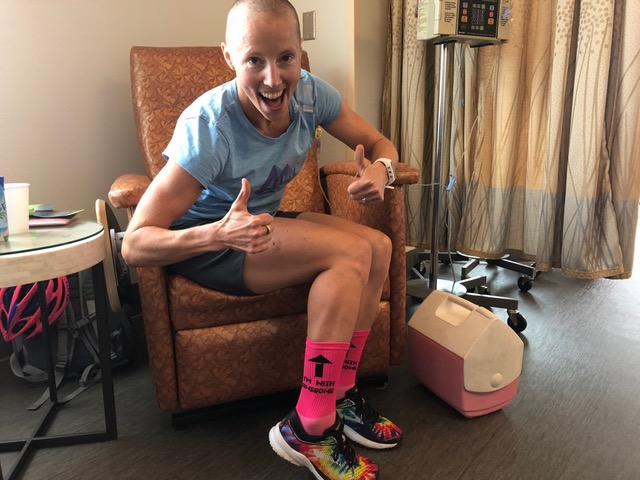
Kikkan Randall staying positive with pink socks and rainbow shoes during her second round of chemotherapy on July 31 at the Providence Alaska Medical Center in Anchorage. (Courtesy photo)
A quick look at ski-related news from around the web as we wait for the Tour de Ski to start:
– As anyone reading this site is likely aware, retired American skier Kikkan Randallwent public with a breast-cancer diagnosis in July of this year, mere months after teaming up with Jessie Diggins to win a gold medal at the Pyeongchang Olympics. But what happened after that? The Anchorage Daily News (ADN) recently published a six-part series, “Kikkan Randall’s cancer year,” that tracked Randall during her treatment and recovery, augmented by a video and dozens of photos. The reporting is intimate yet respectful, revealing, poignant, and very, very good. It ran on the front page of the print ADN over a week earlier this month. You can find it online here.
– As FasterSkier reported last month, Calgary voters went to the polls to express their views on whether or not the Canadian city should continue its efforts to remain in the running to host, and pay for, the 2026 Winter Olympics. A majority of voters said “no.” So what’s next for the future of the next winter games after Beijing in 2022? Deadspin’s headline in a recent article on the subject, “Nobody Wants To Host The Olympics Anymore,” doesn’t pull any punches. It begins, “The 2026 Winter Olympics will be held, somewhere. That’s about the only thing we can say for certain, six months before the International Olympic Committee is due to announce who the host city will be.” Read the rest of its analysis here.
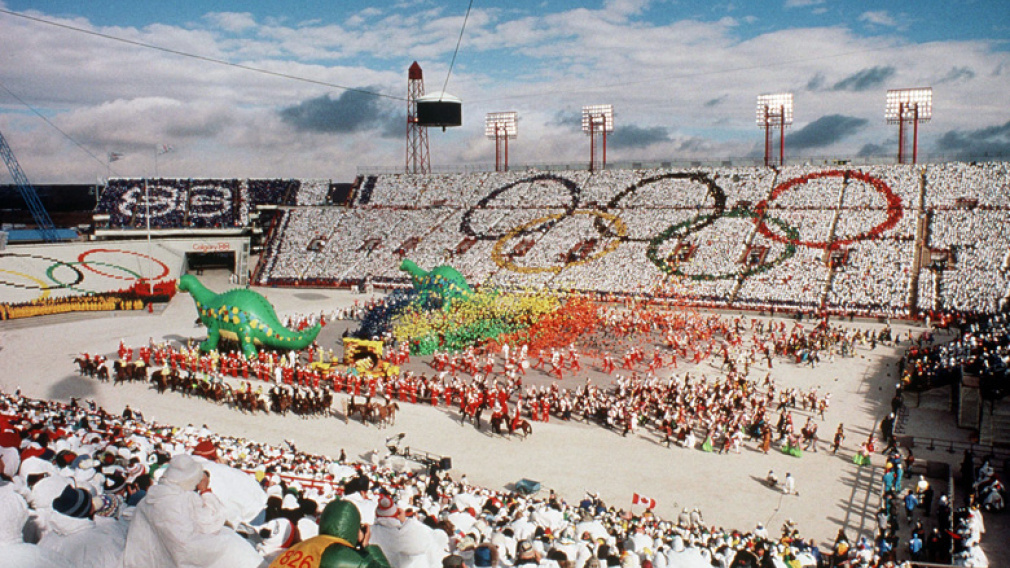
The Opening Ceremony at the 1988 Winter Olympics in Calgary, Alberta. Calgary is in the final three for hosting the 2026 Winter Olympics and Paralympics. (Photo: Olympic.ca)
The Olympics are a global spectacle, but all politics is local. And when the two truisms go head-to-head in today’s plebiscite vote in Calgary, Alberta, local threatens to win. At stake is the future of one of three remaining host cities for the 2026 Winter Olympic Games, a status that has perhaps lost some of its former luster.
There were once seven cities that had progressed to the “dialogue stage” of potentially hosting the 2026 Games, including Calgary; Graz, Austria; Erzurum, Turkey; Milan–Cortina d’Ampezzo, Italy (joint bid); Sion, Switzerland; Sapporo, Japan; and Stockholm, Sweden. (Other boldface names, such as Lillehammer or Innsbruck, had previously expressed some interest but then withdrawn.)
Then Graz, Sapporo, and Sion withdrew, followed by Erzurum. As of Tuesday morning, there are three cities still in the running: Stockholm, Milan–Cortina, and Calgary.
But Calgary might not be on the list too much longer. As the New York Times headlined its story on today’s vote, “Does Calgary Really Want the Winter Olympics? Does Anyone?” The article begins, “Hobbled by a reputation for gross expense and corruption, the International Olympic Committee has become a mendicant, shuffling from nation to nation, shaking its cup and asking if anyone might be interested in bidding on the 2026 Winter Games.”
Calgary’s plebiscite, which is synonymous with a referendum vote, is technically non-binding – “but a majority ‘no’ vote would make it almost impossible for the project to continue,” noted GamesBids.com. The Calgary City Council has final say on whether the city proceeds with its bid. Today’s vote will help guide the council’s decision.
GamesBids.Com added, “More than CAD $2 billion (USD $1.5 billion) of Olympics funding promised from the provincial and federal governments is contingent on a satisfactory ‘yes’ result on Tuesday. The total taxpayer costs are estimated at almost CAD $3 billion of the entire $5.2 billion project.”
Much more background information is available here on GamesBids.com. As the Calgary Herald explains, polls close at 8 p.m. local time tonight (6 p.m. Alaska Time, 10 p.m. East Coast Time for American readers), with results available roughly two hours later.
Here’s GamesBids.com on the “standings” of the other two remaining cities if the results of today’s vote lead Calgary to withdraw its bid at next week’s city council meeting:
Stockholm remains in the race to bring the first Winter Games to Sweden, but the Capital has failed to rally any government support for the project and it will need approvals in place before a January 11 IOC deadline.
A joint Italian bid between Milan and Cortina d’Ampezzo emerged just last month, but it lacks federal government funding. The Italian Olympic Committee (CONI) has said that the regional government representing the two cities will foot the bill, and last week IOC President Thomas Bach confirmed in Rome that this plan would be accepted.
If Calgary voters say ‘no’ Tuesday, it will be the Italian bid with the best chance of being elected as 2026 host city when the IOC takes the vote at the end of June.
The site also notes that the last eight cities to proceed to a referendum vote have seen voters reject the chance to host the Olympics… but that all those cities were in Europe, and that the last two Canadian cities to take up this question, Quebec City and Vancouver, voted in favor.
The Opening Ceremony at the 1988 Winter Olympics in Calgary, Alberta. Calgary is in the final three for hosting the 2026 Winter Olympics and Paralympics. (Photo: Olympic.ca)
The bidding process for the 2026 Winter Olympics and Paralympics is crawling forward, and when the International Olympic Committee (IOC) announced the shortlist last Thursday, Oct. 4, Calgary was in the final three.
Calgary, Alberta, is one of the final three in the running to host the 2026 Winter Olympics and Paralympics. (Photo: www.calgary2026.ca)
Much has changed since the last time Calgary, Alberta, hosted the Games in 1988 as well as since Vancouver, British Columbia, in 2010. The IOC is now in favour of joint bids, re-use of existing facilities and lower costs. These improvements have resulted in more competition for 2026 than for 2022 (which was awarded to Beijing), but each comes with challenges.
The increased interest in 2026 may turn out to be temporary. Sapporo, Japan, ended its bidding process after a major earthquake. Sion, Switzerland, dropped out after losing a referendum, and Graz, Austria, couldn’t get the support of its regional government.
Last Thursday, the IOC announced that Erzurum, Turkey, was out of contention. IOC Vice President Juan Antonio Samaranch, Jr., referenced telecommunications, transport and airports as concerns, but did not mention that there was no sliding centre (for bobsled, luge and skeleton). The Turkish government had previously declined the suggested use of Sochi’s sliding centre, some 650 kilometers away in Russia, which would likely have been unpopular with the IOC as well.
Calgary, Stockholm (Sweden), and Milano/Cortina d’Ampezzo (Italy) are still in the running, each with their own advantages and challenges. While most cost estimates are being disputed by local “experts”, comparing costs between bids remains difficult.
Bid books are to be delivered in January 2019 with a final decision announced in September 2019. The September announcement will be in Lausanne, Switzerland, replacing the originally planned meeting in Milano, as bidding countries are not allowed to host decision meetings.
Many of Calgary’s 1988 Olympic facilities are still in tact, the most visible being the 70- and 90-meter ski jumps. By the 1992 Winter Olympics in Albertville, France, the standard jump sizes were increased, replacing the 90-meter hill with the HS106 (K95) and adding a larger HS140 (K125) hill. Neither of the existing jumps, slated for closure this month, are suitable for upgrading.
The current proposal from Calgary is to maintain the jumps in Whistler, B.C., to current standards, allowing ski jumping and nordic combined events to be held in Whistler. This would save a great deal of money and avoid the construction of facilities that will get minimal use after the Olympics. The 11-hour drive and one-hour time difference between Calgary and Whistler is the largest separation of the remaining bids. The flying time from Calgary to Vancouver is about 90 minutes, but requires an additional 2 1/2 hours of driving to and from airports. The distance is not viewed as a problem in the IOC’s new vision. This is a big change from the 2010 bid process, when the two-hour drive from Vancouver to Whistler was originally seen as a deal-breaker. The cooperation between Whistler and Calgary makes financial sense for the local organizing committee, but will be difficult to achieve during the current economic battle between Alberta and British Columbia (see “The Alberta/B.C. Conflict” sidebar).
The Alberta/B.C. Conflict:
This is a very complicated and long-standing issue, but the conflict is currently front and centre in both provinces.
Alberta’s economy is almost entirely dependent on oil exports. Alberta is desperate to build a new pipeline to transport diluted bitumen to the coast for shipping. Alberta needs this export capability to restore its status as the richest province and re-employ laid-off citizens. The Alberta government needs the tax revenue from increased exports to function, let alone maintain support for expensive recreation facilities like Canmore Nordic Centre and Frozen Thunder.
B.C.’s economy depends on tourism, fisheries, and forestry, all of which would be seriously damaged by an ocean oil spill. A large increase in tanker traffic through the narrow and rock-infested passage to the open ocean is a serious concern, with the cleanup expected to be more difficult than the Exxon Valdez oil spill, with Vancouver, Victoria and Seattle all at risk.
The dispute between the provinces is unlikely to be solved quickly, unless the politicians of one province put their own voters’ jobs at risk to help the other province. The federal government is feeling the pain of Alberta’s tax revenue drop, but the Federal Appeals Court ruled that they must consider risks of an ocean oil spill before expanding their recently purchased pipeline to Vancouver. The Washington state government is concerned about the risk its state will face while Alberta reaps all the rewards, but it seems unlikely that it can interest the U.S. federal government in an environmental issue.
A natural gas (LNG) pipeline from Alberta to the coast is currently proceeding with support from the B.C. government as the risks to B.C. are much smaller. While the gas pipeline is in the news, it is unlikely to distract Calgary’s residents from viewing the 2026 plebiscite as a way to share their economic pain.
There is an idea that the Olympics should move around the world, and many feel that it is Europe’s turn. Calgary already hosted in 1988 and Vancouver in 2010. Asia has hosted since 2014 with Sochi in 2014, PyeongChang (South Korea) in 2018, and next up Beijing (China) in 2022.
Calgary has the most organized bid, having started the process three years ago.
The city of Calgary’s non-binding plebiscite is scheduled for Nov. 13. Voters will be considering their struggling economy, growing provincial debts, the disputed legacy from 1988, costs, and hitting back at B.C. against the possibility of a better legacy after 2026. While cross-country skiers wouldn’t doubt the value of the Canmore Nordic Centre to North American skiing, not all Calgarians are convinced about the value of hosting the Games.
The IOC is campaigning for Calgary to support the bid.
As a side note, in 2010, most Canadians saw the Vancouver Olympics as a two-hour event. The men’s gold-medal hockey game was what changed those Olympics from ‘disaster’ to ‘best-ever’ status.
Milano/Cortina d’Ampezzo
The Milano/Torino/Cortina d’Ampezzo bid briefly lost Milano in August before Italy’s differences were resolved. Then, when the national government confirmed that it would not support the bid financially, Torino dropped out, apparently for good. The Lombardy and Veneto regions are expected to provide funding, and considering that the two regions’ combined GDP is larger than Sweden’s, this may not be a problem.
This bid is very spread out, in European terms, with events in Milano, Cortina d’Ampezzo, Val di Fiemme, and Anterselva (“Anterselva” is the official Italian name for what the biathlon world and German-speaking locals call Antholz). Milano has excellent train service and two major airports, making it the most accessible host city. However, the mountain communities are served largely by bus and travel times can be as much as six hours from Milano. Express buses could reduce this to four hours.
Italy’s national political situation is always interesting, with short-lived coalitions running the country most of the time. This bid is dependent on the far more effective regional governments; while Lombardy and Veneto officially represent only 40 percent of Italy’s GDP, their influence is much larger.
Milano/Cortina, Italy, is among the final-three candidates in the running to host the 2026 Winter Olympics. (Photo: Neveitalia/Twitter)
Stockholm
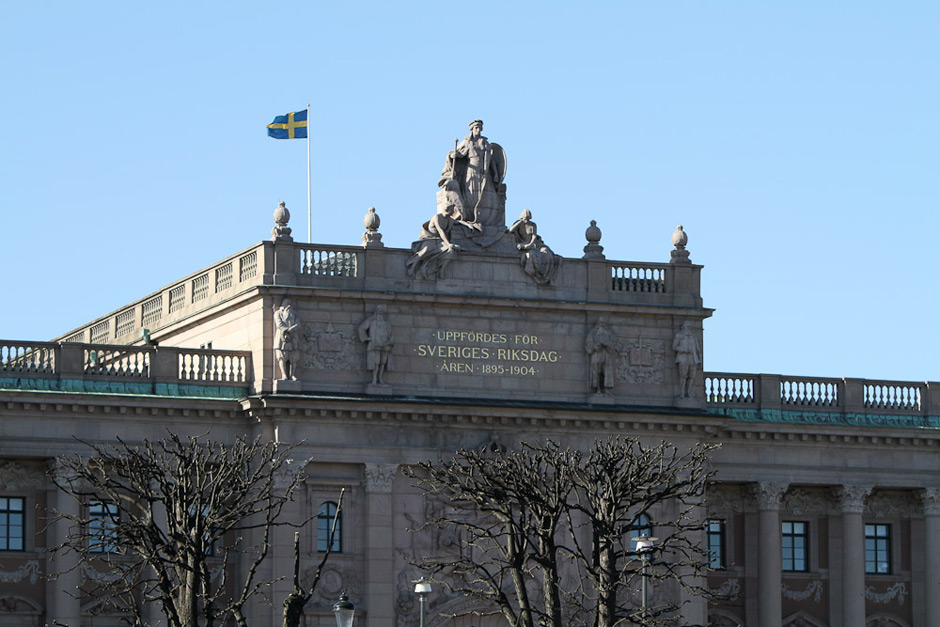
Stockholm’s Royal Palace as seen in 2012 during FIS Cross Country World Cup Finals.
Stockholm’s bid is moving along quietly, with Latvia planning housing for its existing sliding centre at Sigulda, 680 kilometers and a ferry ride away from Stockholm. Sweden has most of its facilities in place already and appears to have the least building costs of the candidates. Sweden’s bid currently has no official support from any level of government, which is partially why it’s been less visible. Sweden’s September federal election has added some uncertainty, with the far right making large gains and the prime minister losing a vote of confidence on Sept. 25. It is not clear that a stable coalition will form, which brings more uncertainty to the process of gaining political support and funding.
More on the 2026 candidates
Robert Livingstone of gamesbids.com wrote a good summary of bid politics before the announcement of the final three.
The Canadian Broadcasting Corporation (CBC) asked some experts to rank the three short-listed bids. The result is interesting, more for the reasoning that the ranking.
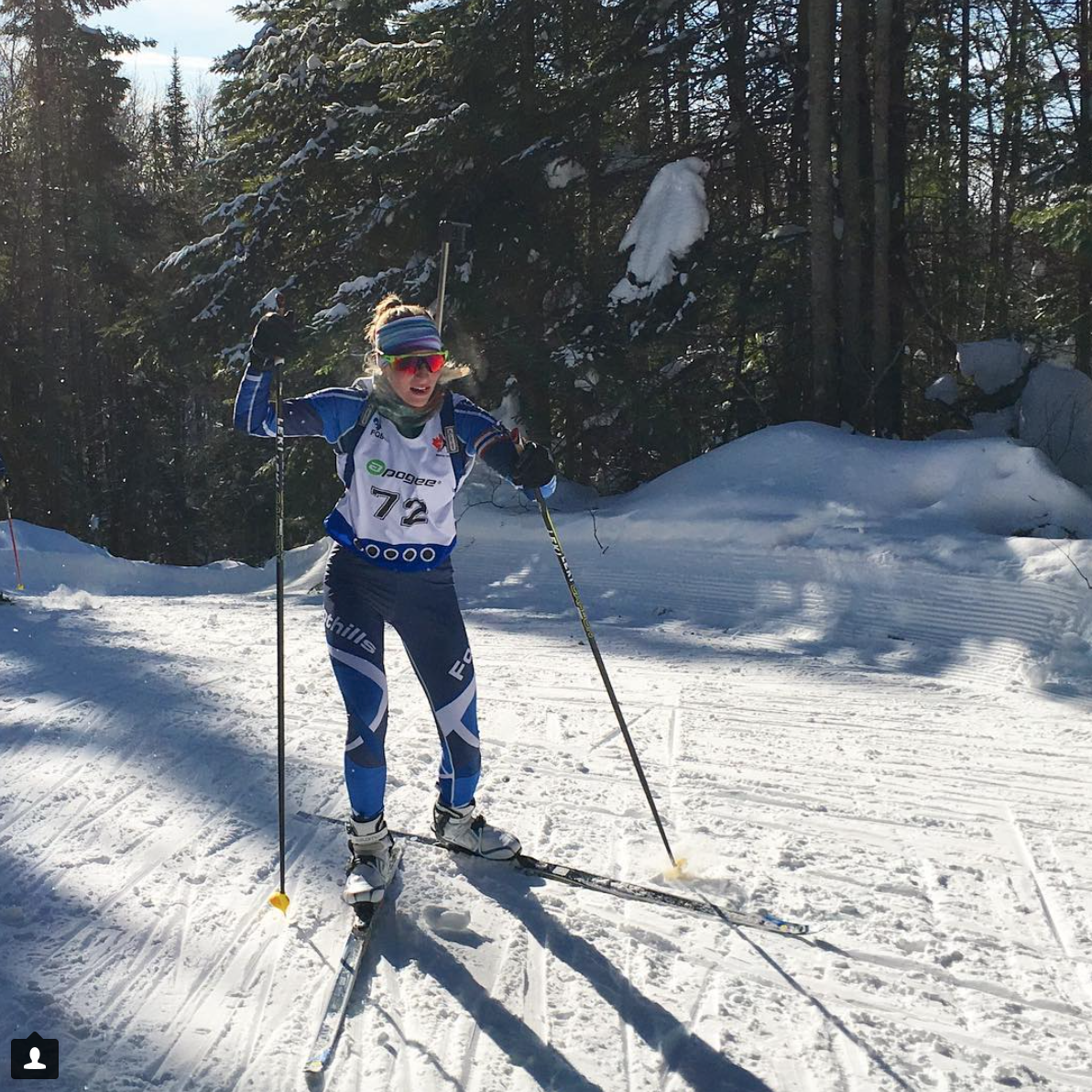
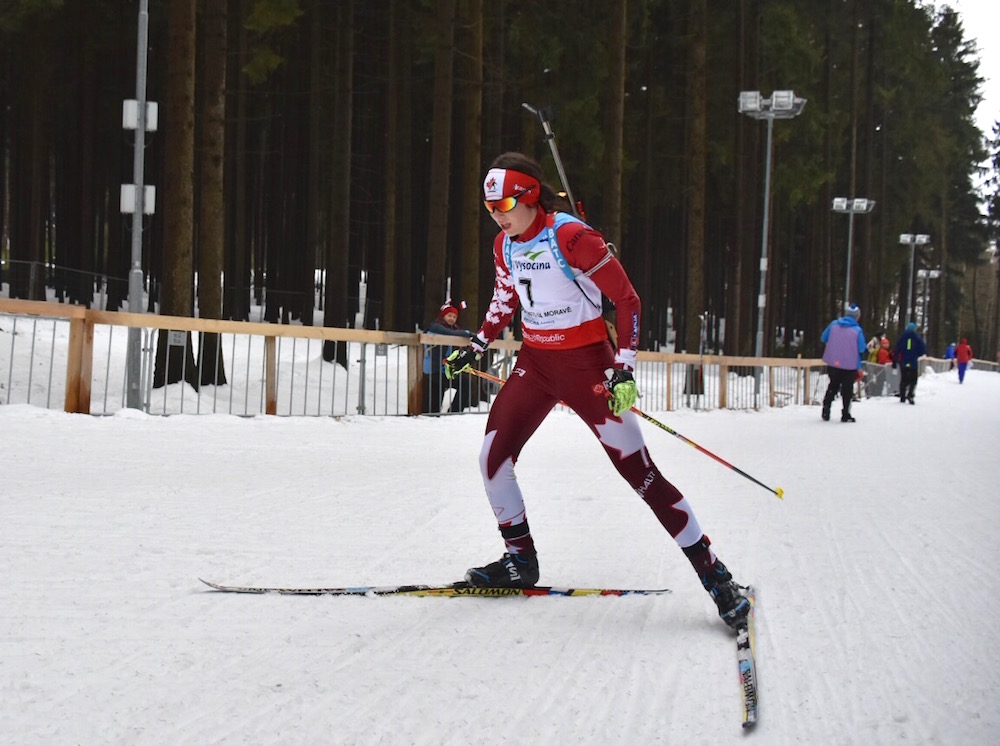
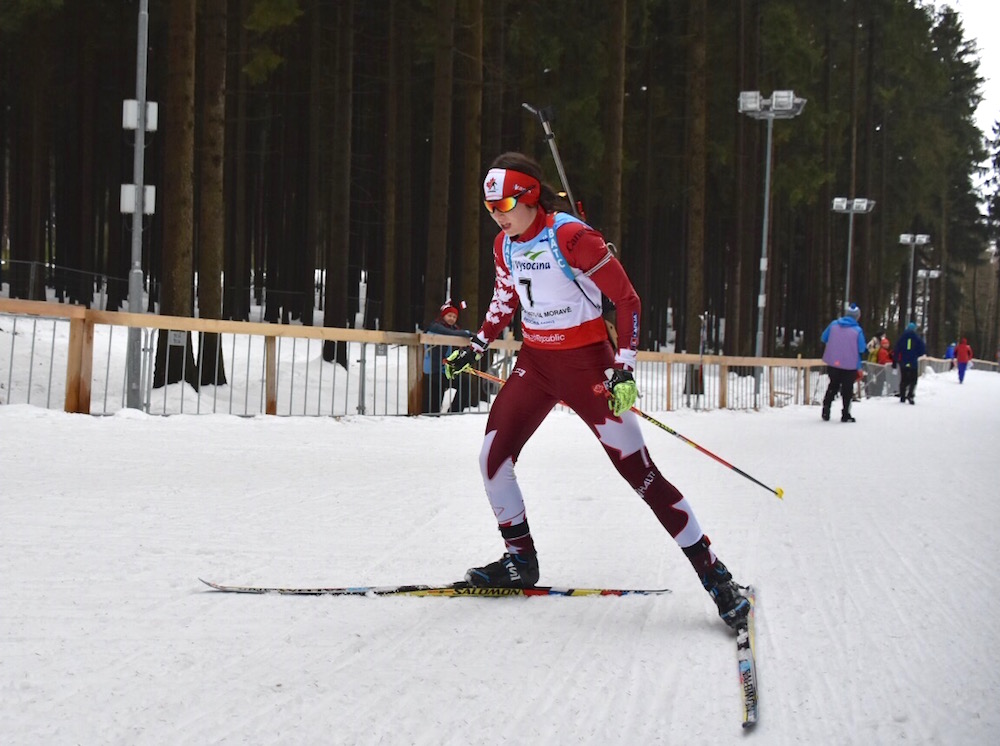
Jenna Sherrington racing at Biathlon Canada’s Youth World Trials in Valcartier, Quebec. (Photo: Jenna Sherrington/Instagram)
In an effort to showcase the North Americans competing at this week’s International Biathlon Union (IBU) 2018 Youth and Junior World Championships in Otepää, Estonia, we asked those qualifying athletes several questions about themselves — actually, we had them fill in the blanks. Here we have 16-year-old Jenna Sherrington, of Calgary, who is representing Canada at her first Youth World Championships.
In her last race of Youth Worlds, the youth women’s 7.5 k pursuit, Sherrington placed 39th (+5:28.1 with four penalties). She also finished 40th in the 10 k individual on Monday and 46th in the 6 k sprint on Friday.
***
“My full name is Jenna Sherrington but you can call me Jenna.
I was born and raised in Calgary, Alberta, and I learned to ski at age 2.
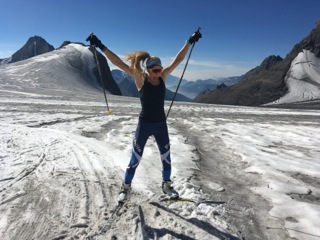
Jenna Sherrington getting some sunny training in on the Haig glacier near Canmore, Alberta. (Courtesy photo)
I spent the time between World Youth/Junior trials and Worlds training, preparing, going to school and coaching cross-country skiing to 5 year olds.
The hardest and most fun workout I did in the last training year to prepare for this was bicycle 1100 kilometers from Quebec City to Charlottetown with my Dad.
One thing I’m working on this season to improve my biathlon is being able to completely focus during a race. Last year I had quite a bit of trouble getting out of my own head while racing so I’ve been trying to improve that.
This is my first time in Estonia and first time racing internationally, and so far it’s been an incredible learning opportunity and experience.
One difference I’ve noticed between Estonia and Canada is the language is very different and they eat lots of potatoes.
One of the things I’m most excited about for World Youth/Junior Championships in Otepää is travelling to a new country and competing against the best youth biathletes in the world.
One race I’m especially targeting there is the sprint.
Watching the Olympics in the lead up to my own races was really inspiring to see the best biathletes in the world race as hard as they could for their country. One of my favourite moments of the Olympics was when Martin Fourcade won in the 15km mass start with a photo finish against Simon Schempp. I want to be like Laura Dahlmeier because she always has a smile on her face and it looks like she has a genuine love for the sport of biathlon.
At Worlds, I really hope I can chat/make friends with someone from Norway and ask them what it’s like to live in Norway and what the Norwegian culture is like.
My favorite thing at the breakfast where we are staying is the fruit, there’s always oranges or grapes, which is fantastic.
Before this trip, if you said “Estonia”, the first thing I’d think of would have been “sorry, where?”.
Now that I’m here, I’m pretty sure something I’ll always remember will be the people I meet and how incredibly sparkly the snow is.
If I had a totally free day here and didn’t have to worry about race fitness or training, I’d spend it skiing around on the absolutely breath taking trails that intertwine and surround the town.
The best way to follow me on social media is on Instagram @jennasherrington.”
Rory Gilliland of Foothills Nordic racing at Canadian World Youth and Junior Trials in Whistler, British Columbia, earlier this season. (Courtesy photo)
In an effort to showcase the North Americans competing at this week’s International Biathlon Union (FIS) 2018 Youth and Junior World Championships in Otepää, Estonia, we asked those qualifying athletes several questions about themselves — actually, we had them fill in the blanks. Here we have 17-year-old Rory Gilliland of Calgary, who is representing Canada at his first Youth World Championships.
“My full name is Rory Gilliland but you can call me Rory.
I was born and raised in Calgary, and I learned to ski at 10 years old.
I spent the time between World Youth/Junior trials and Worlds finishing my first semester at school and training.
The most fun workout I did in the last training year to prepare for this was playing battleship on paper targets with teammates.
One thing I’m working on this season to improve my biathlon is ski speed.
This is my first time in Estonia and second time racing internationally, and so far it’s been fantastic!
One difference I’ve noticed between Estonia and the Canada is the lack of mountains that I train a lot in at home.
Rory Gilliland of Canada hits the range in Obertilliach, Austria, in an IBU Junior Cup sprint earlier this season. (Courtesy photo)
One of the things I’m most excited about for World Youth/Junior Championships in Otepää is racing against athletes from around the world of my age.
One race I’m especially targeting there is the individual competition.
Watching the Olympics in the leadup to my own races was fun, because they were much different from watching World Cup races. One of my least favourite moments of the Games was the Canadian men being beaten in the hockey semi-finals! I want to be like Martin Fourcade, because he is a talented but gracious athlete.
At Worlds, I really hope I can chat/make friends with someone from Norway and ask them how they train and how they like Estonia.
My favorite thing at the breakfast where we are staying is bacon!
Before this trip, if you said “Estonia”, the first thing I’d think of would have been potatoes or Ethiopia (oops).
Now that I’m here, I’m pretty sure something I’ll always remember will be the beautiful frosty mornings.
If I had a totally free day here and didn’t have to worry about race fitness or training, I’d spend it sledding.
The best way to follow me on social media is on Instagram@rorygilliland_“
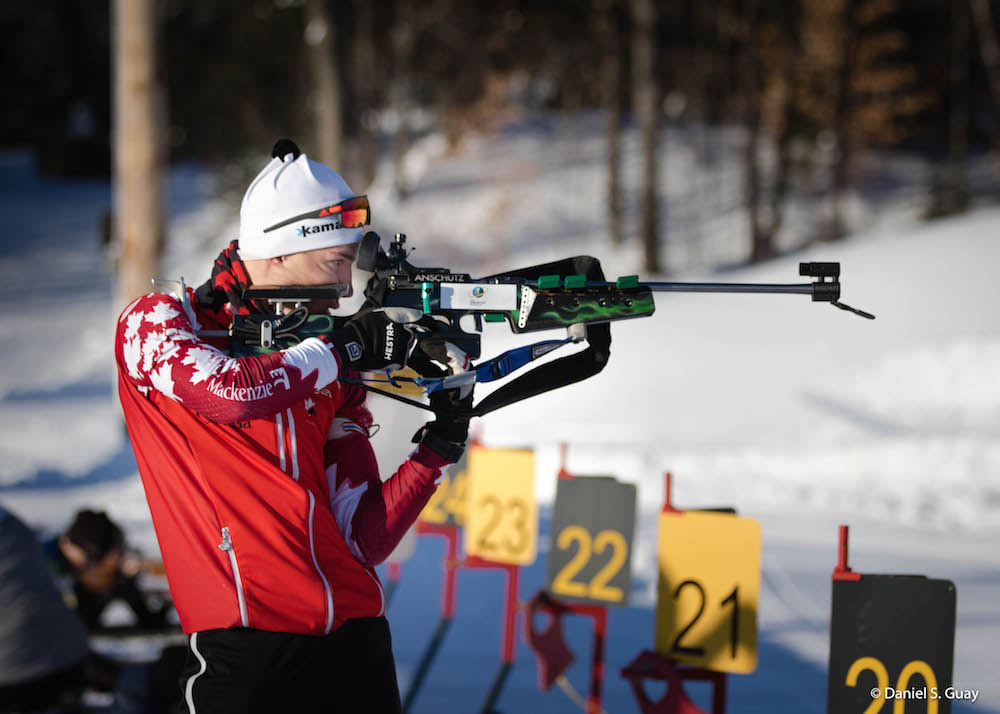
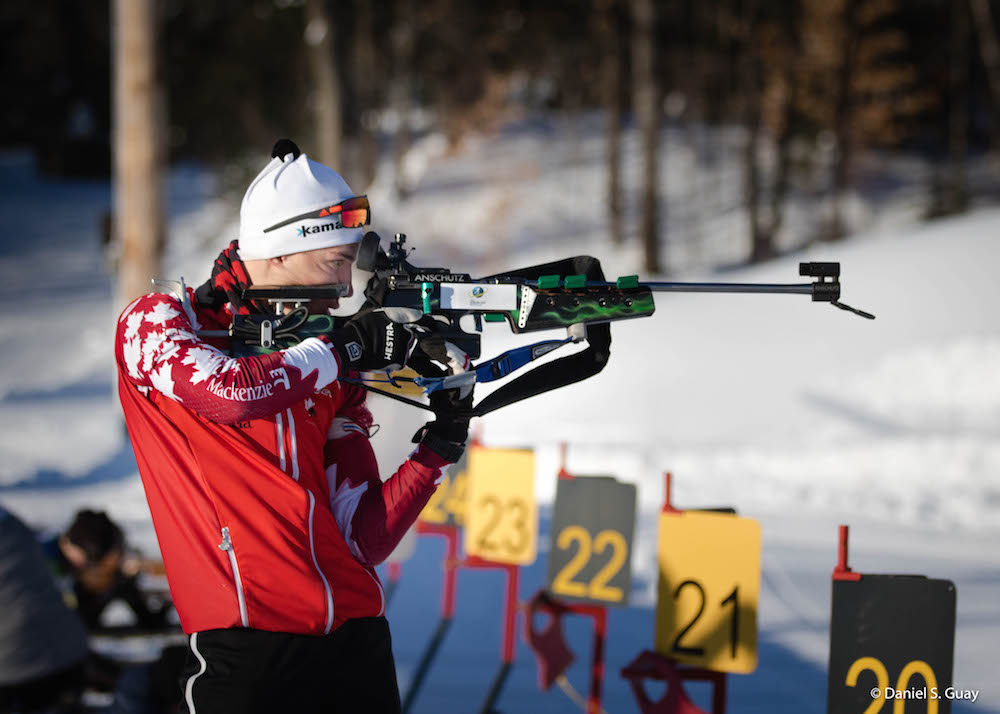
Adam Runnalls (Calgary Biathlon Racers) takes aim at Canadian team trials in Quebec last season. (Photo: Daniel S. Guay)
In an effort to showcase the North Americans competing at this week’s International Biathlon Union (IBU) 2018 Youth and Junior World Championships in Otepää, Estonia, we asked those qualifying athletes several questions about themselves — actually, we had them fill in the blanks. Here we have 19-year-old Adam Runnalls of Calgary, who is representing Canada at his first World Junior Championships after twice being part of the team for the Youth division.
On Tuesday, Runnalls anchored the Canadian team to 17th in the junior men’s 4 x 7.5 k relay.
***
“My full name is Adam Runnalls but you can call me boring old Adam.
I was born and raised in Calgary, and I learned to ski at 1 years old.
I spent the time between World Youth/Junior trials and Worlds training hard and going to school.
The hardest workout this season would be our road bike on Highwood Pass. I did it on a rental bike as it was my first road ride ever. Once the day was done, we did 110 km of riding and like 2000 meters of climbing. so being my first road ride ever it was pretty pouched about half way through. And I did this workout with my club, Calgary Biathlon Racers (CBR).
One thing I’m working on this season to improve my biathlon is my shooting consistency.
This is my first time in Estonia and 5th time racing internationally, and so far it’s been pretty all time.
One difference I’ve noticed between Estonia and the Canada is things are very quiet here. We almost drove across the entire country to get from the airport to Otepaa, which was only a 2 and a half hour drive. In Canada a drive this long might not even get you to the next town.
One of the things I’m most excited about for World Youth/Junior Championships in Otepää is getting into the racing.
One race I’m especially targeting there is a top 16 result.
Watching the Olympics in the lead up to my own races was very inspiring and gave me a great sense of national pride (Ferda). One of my least favorite moments moments of the Games was when Canada lost women’s hockey and then the next day lost men’s curling and men’s hockey. I want to be like Scott Moir, because he exemplifies what a Canadian is.
At Worlds, I really hope I can chat/make friends with someone from Sweden and ask them how can they turn 20 year olds into Olympic medalists??
My favorite thing at the breakfast where we are staying is the mini wieners. Who doesn’t like a hot dog for breakfast?.
Before this trip, if you said “Estonia”, the first thing I’d think of would have been potatoes and a skiing culture.
Now that I’m here, I’m pretty sure something I’ll always remember will be how the doors all open the opposite way I think they should.
If I had a totally free day here and didn’t have to worry about race fitness or training, I’d spend it probably still skiing.
Canada’s Élise Sauvé (Foothills Nordic) racing at Calforex race on Jan. 15 in Camrose, Alberta. (Photo: Kevin Nguyen)
In this 20-something-question, fill-in-the-blanks series, we checked in with the world-class U.S. and Canadian biathletes before they competed at 2017 International Biathlon Union (IBU) Youth & Junior World Championships Feb. 22-28 in Osrblie (also known as Brezno-Osrblie), Slovakia.
Here’s 16-year-old Élise Sauvé , of Foothills Nordic, who represented Canada at her first Youth Worlds. In two individual races, she finished 78th in the youth women’s 10 k individual and 86th in the 6 k sprint.
***
“My full name is Élise Sauvé, but you can call me Ediddy. I was born in Calgary, Alberta, raised in Calgary, and one thing you should know about my hometown is the weather can never make up its mind.
Élise Sauvé (Foothills Nordic) at a Calforex race in January in Camrose, Alberta. (Photo: Susan Sauvé)
I started cross-country skiing when I was 7 and started biathlon when I was 9, thanks to my parents and Jackrabbit coach who suggested that it might be something I would enjoy. I currently train in Calgary and Canmore with Foothills Nordic.
If I’m not skiing, you might find me reading, or outside doing something fun.
If I had to pick a favorite book, it would be ‘The Book Thief‘.
One of the things I’m most excited about for Youth/Junior World Championships in Brezno-Osrblie is being able to compete in another country against the best from all around the world and to represent Canada.
This will be my first Youth/Junior World Championships, and this year, I’m competing as a youth. One race I’m especially targeting there is the individual.
The best advice anyone ever gave me about skiing or racing was don’t ever give up, every second counts and could make a difference between 1st and 2nd.
One of the best race memories I have is finishing one of my pursuit races in 2nd place behind my teammate when the whole time I thought I was in dead last.
If I could meet one World Cup skier, it would be Heikki Ikola.
If I don’t end up being a professional skier, I’ll probably be something that gets me outside and keeps me active.
I’m missing 12 days of school to be here, and my teachers/professors are probably thinking, ‘Have fun with that.’
Thomas Hulsman (Foothills Nordic Ski Club) racing at the Calforex Cup #4 in January 2016. (Courtesy photo)
In another 20-something-question, fill-in-the-blanks series, we checked in with the world-class U.S. and Canadian biathletes that competed at 2017 International Biathlon Union (IBU) Youth & Junior World Championships Feb. 22-28 in Osrblie (also known as Brezno-Osrblie), Slovakia.
Here’s 17-year-old Thomas Hulsman, of the Foothills Nordic Ski Club, who represented Canada at his first Youth Worlds. He finished 57th in the youth men’s 12.5 k individual, 87th in the 7.5 k sprint, and on Monday, 15th with his team in the men’s 3 x 7.5 k relay.
***
“My full name is Thomas Hulsman, but you can call me Tommy. I was born in Calgary, Alberta, raised in Airdrie, Alberta, and one thing you should know about my hometown is it’s the best City in Canada.
Thomas Hulsman (Foothills Nordic Ski Club) racing at an Alberta Cup. (Courtesy photo)
I started cross-country skiing when I was 11 and started biathlon when I was 12, thanks to watching the 2010 Olympics. I currently train in Canmore, Alberta, with Foothills Nordic Ski Club.
If I’m not skiing, you might find me coaching, trail running and biking.
If I had to pick a favorite book, it would be none!…….no time to read, too busy training, probably military history.
One of the things I’m most excited about for Youth/Junior World Championships in Brezno-Osrblie is the experience.
This will be my first Youth/Junior World Championships, and this year, I’m competing as a youth. One race I’m especially targeting there is the individual.
The best advice anyone ever gave me about skiing or racing was just shoot, don’t think during a race.
One of the best race memories I have is my first nationals medal.
If I could meet one World Cup skier, it would be Martin Fourcade.
If I don’t end up being a professional skier, I’ll probably be in the Canadian Forces.
I’m missing 15 days of school to be here, and my teachers/professors are probably thinking, ‘How is Tommy doing?‘
In another 20-something-question, fill-in-the-blanks series, we checked in with the world-class U.S. and Canadian biathletes that will be competing at 2017 International Biathlon Union (IBU) Youth & Junior World Championships Feb. 22-28 in Osrblie (also known as Brezno-Osrblie), Slovakia.
Here’s 19-year-old Megan Bankes, of the Biathlon Alberta Training Centre (BATC), who will be representing Canada at her fourth Youth/Junior Worlds. On Thursday, Bankes won the junior women’s 12.5 k individual to notch the second gold medal for Canada in the second day of the championships.
***
“My full name is Megan Bankes, but you can call me Money Banke$. I was born in Calgary, Alberta, raised in Calgary, and one thing you should know about my hometown is it’s the sunniest major city in Canada.
Canada’s Megan Bankes racing to 30th in the IBU Cup sprint in Obertilliach, Austria, earlier this season in December 2016. (Photo: Michel van Balkum)
I started cross-country skiing when I was 3ish and started biathlon when I was 12, thanks to my parents/brother.
I currently train in Canmore, Alberta, with BATC.
If I’m not skiing, you might find me baking tasty treats with Sarah Beaudry.
If I had to pick a favorite book, it would be ‘Through Black Spruce‘.
One of the things I’m most excited about for Youth/Junior World Championships in Brezno-Osrblie is racing and lots of delish wafers.
This will be my fourth Youth/Junior World Championships, and this year, I’m competing as a junior. One race I’m especially targeting there is the pursuit.
The best advice anyone ever gave me about skiing or racing was have fun and do the best that you can do.
One of the best race memories I have is just recently, the last lap of the pursuit at Junior OECH [European Championships], when everyone lining the course was cheering for me, particularly my teammates. I shot really well, and finished 2nd, it was a pretty stellar day.
If I could meet one World Cup skier, it would be Laura Dahlmeier.
If I don’t end up being a professional skier, I’ll probably own a bakery called ‘Gong Show Bakeshop’ with Sarah Beaudry, or be an ecologist.
I’m missing zero days of school to be here, (I take an online course) and my teachers/professors are probably thinking, ‘When will Megan submit the next assignment?‘
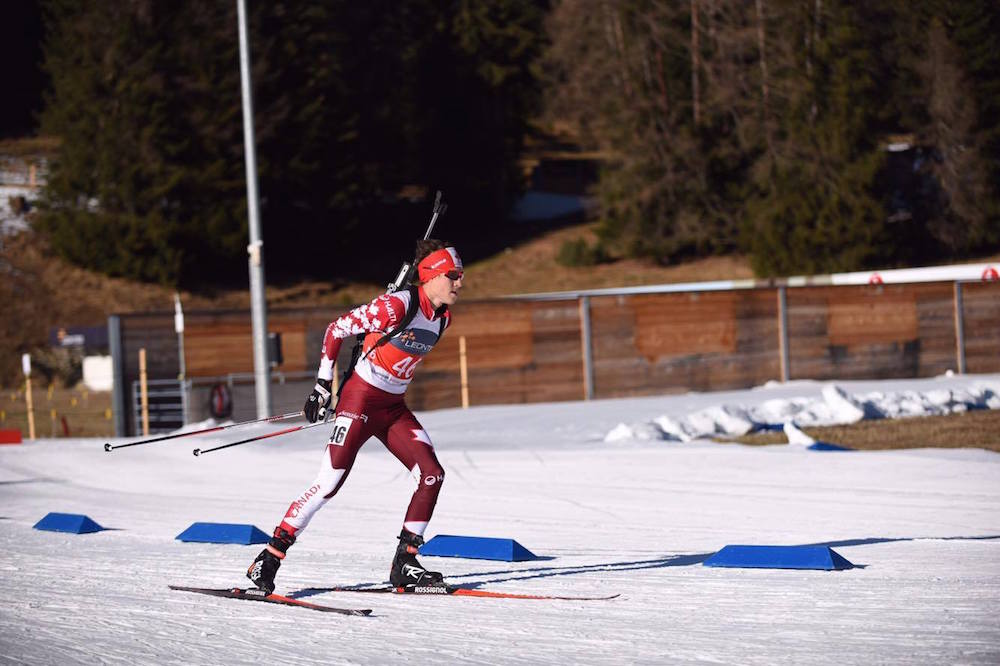
Canada’s Adam Runnalls competing at the the Junior IBU cup in Lenzerheide, Switzerland. (Photo: Bryan Dickson)
In another 20-something-question, fill-in-the-blanks series, we checked in with the world-class U.S. and Canadian biathletes that will be competing at 2017 International Biathlon Union (IBU) Youth & Junior World Championships Feb. 22-28 in Osrblie (also known as Brezno-Osrblie), Slovakia.
Here’s 18-year-old Adam Runnalls, of Calgary Biathlon Racers, who will be representing Canada at his second Youth Worlds.
***
“My full name is Adam Runnalls, but you can call me Adam. I was born in Calgary, raised in Calgary, and one thing you should know about my hometown is that it’s still to0 far from the mountains.
I started cross-country skiing when I was 11 and started biathlon when I was 11, thanks to Alberta Biathlon Club and my coach Airat Aitniakov. I currently train in Calgary/Canmore with Calgary Biathlon Racers.
Adam Runnalls (Calgary Biathlon Racers) takes aim at Canadian team trials in Quebec. (Photo: Daniel S. Guay)
If I’m not skiing, you might find me with friends.
If I had to pick a favorite book, it would be… not really a big reader so probably a book I had to read for school.
One of the things I’m most excited about for Youth/Junior World Championships in Brezno-Osrblie is the racing.
This will be my second Youth/Junior World Championships, and this year, I’m competing as a youth. One race I’m especially targeting there is the pursuit because its the funnest style of race.
The best advice anyone ever gave me about skiing or racing was race like you train and train like you race.
One of the best race memories I have is the pursuit race last year at world youth.
If I could meet one World Cup skier, it would be Tarjei Bø.
If I don’t end up being a professional skier, I’ll probably be a sports doctor.
I’m missing 15 days of school to be here, and my teachers/professors are probably thinking, ‘Why?’
Anna Sellers (Canmore Nordic Ski Club) practicing shooting last month on Mount Shark near Canmore, Alberta.(Photo: Rachel Koroscil)
In another 20-something-question, fill-in-the-blanks series, we checked in with the world-class U.S. and Canadian biathletes that will be competing at 2017 International Biathlon Union (IBU) Youth & Junior World Championships Feb. 22-28 in Osrblie (also known as Brezno-Osrblie), Slovakia.
Here’s 17-year-old Anna Sellers, of the Canmore Nordic Ski Club, who will be representing Canada at her first Youth Worlds.
***
“My full name is Anna Sellers, but you can call me Anna. I was born in Calgary, Alberta, raised in Canmore, Alberta, and one thing you should know about my hometown is it’s awesome because every day you can find a new mountain just in your own backyard to climb and explore.
Anna Sellers (Canmore Nordic Ski Club) racing the individual race at 2016 Canadian biathlon nationals in Quebec. (Photo: Lowell Niven)
I started cross-country skiing when I was 6 and started biathlon when I was 12, thanks to my best friend being in the sport. I currently train in Canmore with Canmore Nordic Ski Club.
If I’m not skiing, you might find me taking photos or eating Chips Ahoy.
If I had to pick a favorite book, it would be ‘The Hobbit‘.
One of the things I’m most excited about for Youth/Junior World Championships in Brezno-Osrblie is getting to compete in amazing new venues with people from all around the world.
This will be my first Youth/Junior World Championships, and this year, I’m competing as a youth.
One race I’m especially targeting there is the sprint because one of my main goals for world youths is to qualify for the pursuit.
Canada’s Anna Sellers at 2016 biathlon nationals in Quebec. (Photo: Lowell Niven)
The best advice anyone ever gave me about skiing or racing was from Caitin Gregg when she told me don’t worry if you break the skis, that just means that you were giving it everything you had.
One of the best race memories I have is the skate individual at 2016 cross country westerns. It was a good race but the best part was that I was the only person from my team in that category so my coach Matty D was running all over the course cheering me up every single hill and giving me splits all along the way.
If I could meet one World Cup skier, it would be Kaisa Makarainen.
If I don’t end up being a professional skier, I’ll probably be a minority rights lawyer or a country ambassador.
I’m missing 15 days of school to be here, and my teachers/professors are probably thinking, ‘lol good luck.’
India McIsaac (Rocky Mountain Racers) striding during the Frozen Thunder classic sprints on Nov. 1, 2016. (Photo: Jenn Jackson)
In an effort to showcase the North Americans competing at next week’s International Ski Federation (FIS) 2017 USANA Nordic Junior World Championships and U23 Cross Country World Championships at Soldier Hollow in Midway, Utah, we asked those qualifying athletes several questions about themselves — actually, we had them fill in the blanks. Here we have 16-year-old India McIsaac, of Rocky Mountain Racers, who’s representing Canada at her first Junior Worlds.
***
“My full name is India Rose McIsaac but you can call me India. I was born in Calgary, AB, raised in Calgary, AB, and one thing you should know about my hometown is we have great running paths by the river.
I started cross-country skiing when I was nine (although technically it was biathlon), thanks to someone in my competitive swim club. I currently train in Canmore with Rocky Mountain Racers.
If I’m not skiing, you might find me driving 2.5 hours to get to and from training. If I had to pick a favourite book, it would be anything Harry Potter.
One of the things I’m most excited about for Junior Worlds at Soldier Hollow is familiar food and no time change. One race I’m especially targeting there is 5 k skate.
The best advice anyone ever gave me about skiing or racing was ‘Just go’. One of the best race memories I have is racing any first race of the season, as it’s so nice to pop on real skis and race on snow.
If I could meet one World Cup skier, it would be Jessie Diggins.
If I don’t end up being a professional skier, I’ll probably be a Doctor.
I’m missing 12 days of school to be here, and my teachers are probably thinking, ‘Well there goes her grades 🙂‘
Emma Lunder (left) sharing the “Queen of the Mountain” title from Biathlon Canada’s summer “Testival” with Rosanna Crawford (right); Brendan Green was the “King of the Mountain”. (Courtesy photo)
Welcome to “17 Questions for 2017”, where we are catching up with American and Canadian national-team members before the beginning of the winter season.
***
Canada’s Emma Lunder had her big break in 2014, when she finished 30th in her first-ever World Cup sprint in Pokljuka, Slovenia. Now 25 years old, the Biathlon Canada “B” teamer has a few more World Cup starts under her belt, including a tenth-place relay result in Hochfilzen last season with teammates Julia Ransom, Megan Tandy, and Rosanna Crawford.
Lunder missed the cut for the first period of World Cup racing, finishing eighth (+1:30.4) and ninth (+43.7) behind Crawford in national team trials in Canmore in November. But then she has also jumped in a ski race, placing third in an 8.1 k Alberta Cup race behind American cross-country skiers Chelsea Holmes of APU and 2010 Olympian Caitlin Gregg of Team Gregg.
Lunder is set to start racing on the IBU Cup circuit Ridnaun, Italy, this week.
1. Biggest change in your life in the last five or so months since the ski season ended?
The Canadian women’s biathlon team with Anais Bescond of France (third from left), who joined them for a training camp this summer. (Courtesy photo)
The biggest change in my life since the ski season ended has probably been the amount of time I’ve been spending in Calgary. I’ve been heading into the city almost every weekend to spend time with my boyfriend (Christian Gow) and his amazing family. Since my family lives in Vernon and Yellowknife, it’s been pretty special to have a home away from home to relax and recharge at on the weekends.
2. Biggest change in your training?
I was really happy with the training I put in last year, so my approach this year was very similar. There haven’t been too many changes, but I’ve put a much larger emphasis on core work, which usually includes a pilates session every week, as well as trying to be better about rest and recovery.
3. Major areas of improvement you’ve seen so far?
This year I’ve put a lot of focus towards my shooting, and I think with something like shooting there’s always going to be more to improve, but so far I’m quite happy with the progress I’ve made.
4. Whom you’ve been working closest with this offseason (coaches or training partners)?
Julia, Rosanna and Sarah have been my closest training partners all season. We’ve definitely become a tighter group of teammates and friends, with another year of learning and understanding how we work best together.
5. Best trip in the last five months (and why)?
Emma Lunder and Christian Gow at a Biathlon Canada training camp in New Zealand this summer. (Courtesy photo)
Our team spent three weeks in New Zealand this summer, and it was an amazing experience. I loved being able to ski right from the door, come inside to an amazing meal, take a nap and do it all over again. Skiing on snow in August is always a perk.
6. Favorite cross-training?
Running! On rest weeks I love exploring new trails wherever I am (or old favorites, like the trails I grew up running on in Vernon). And nothing beats running with a dog – Rosanna’s dog Gonzo has joined us on more running workouts this year than I can count.
7. Favorite non-athletic activity or pastime this summer?
Reading! Last January a close group of my friends decided we’d keep track of how many books we read in 2016 and compare notes in the new year. I’m currently on book #39. Also, this summer I picked up some sourdough starter from my dad in Yellowknife, so twice a week Christian and I have the most amazing sourdough waffles for lunch.
8. Song that was your jam this summer?
Closer – The Chainsmokers. And basically anything country.
9. All time favorite race moment?
My 2nd place finish at the Canmore IBU Cups in 2015. Racing in Canada with my family and friends watching, PLUS my first ever podium was an unbeatable experience.
10. First thing you pack in your bag when you leave for Europe?
Canada’s Emma Lunder leaving the range en route to second place in Saturday’s 7.5 k IBU Cup sprint in Canmore, Alberta. (Photo: Pam Doyle)
My Kindle + one hardcover book. I love being able to turn real pages for at least a few days on tour.
11. Venue/event you’re most excited to visit this season?
The venue I’m most excited to visit this season is Hochfilzen, Austria. If I’m racing there in February it’ll mean I’ve qualified for my first ever World Championships, which has been a major goal of mine since I started my biathlon career.
12. Who will win the World Cup title this year?
Martin Fourcade and Rosanna Crawford!
13. Biggest sacrifice you feel you’ve made choosing this career path?
I know I’m extremely lucky to be following my dreams right now, but I fret about being a freshman at the age of 30.
14. If you could change one thing about your sport, what would it be?
I would eradicate doping. I think if we could erase any doubts about who is racing clean and who isn’t, biathlon would be pretty close to perfect.
15. What did you have for breakfast this morning?
Homemade eggs benny and cinnamon buns! (Sunday morning breakfasts in Calgary are always the best)
16. In 5 years, I’ll be ____?
Beginning my 30’s.. and hopefully a career?
17. In 50 years, I’ll be ____?
Reading book after book to my grandchildren.
The women’s 8.1 k freestyle podium at the Alberta Cup in Canmore, Alberta, with winner Chelsea Holmes (c), of APU, Caitlin Gregg (l), of Team Gregg, in second, and Biathlon Canada’s Emma Lunder (r) in third. (Photo: annas4036/flickr)
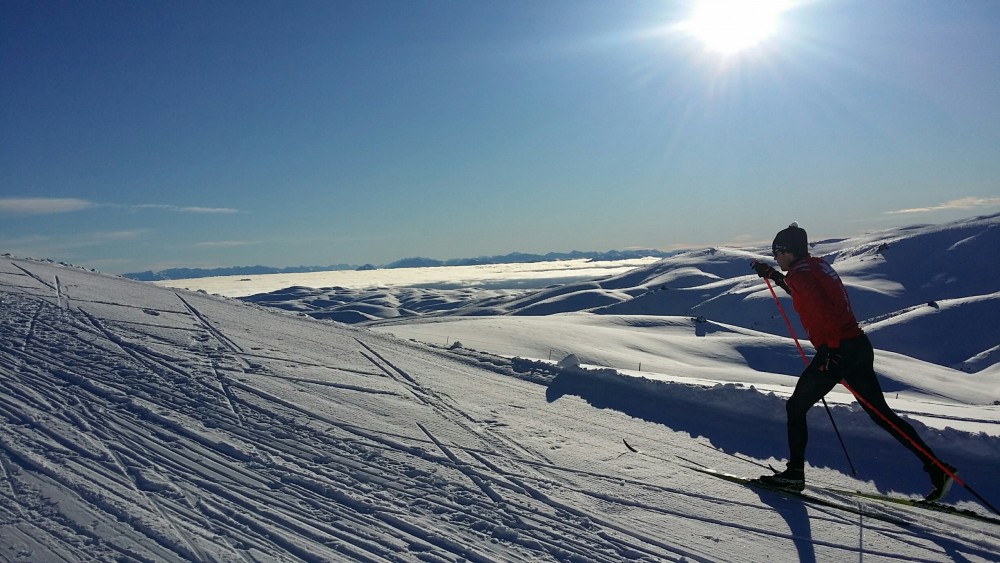
Nathan Smith, of Biathlon Canada, skiing during a national-team training camp this August at the Snow Farm in Wanaka, New Zealand. (Courtesy photo)
Wake up: 7:30 a.m. Coffee: 7:45 a.m. Commute to work: 8:15 a.m.. Punch in at 9. Punch out at 5. While this may describe the daily routine of an average North American’s work week, it’s not the case for Biathlon Canada’s Nathan Smith. And to the 3o-year-old Calgary native, there’s nothing wrong with that.
While he maintains that putting his education on hold has been one of his biggest sacrifices by choosing biathlon as a career, Smith also sees his decision to take a few years and be his own boss as better than a bachelor’s degree — not only to make himself more marketable in the future, but more unique in his life experience.
“I guess my reasoning [for choosing this path] was, I could go to school and get my bachelor’s degree and then go and work,” Smith said recently on the phone. “But that’s kind of like, I guess I’ll put it as, that’s a normal career trajectory. That’s what everyone does.
“When I’m training, I’m like my own boss, kind of an entrepreneur,” added Smith, who has been taking a few college courses (mostly science) on-and-off since he graduated high school in 2004. “And I think it’s probably similar in the States, but unfortunately here in Canada, getting a bachelor’s degree isn’t even all that great. It just makes everyone overqualified.”
Nathan Smith with his girlfriend, Caroline. (Courtesy photo)
Instead, Smith has spent the past nine years (excluding the 2008/2009 season when he wasn’t named to the national team) sporting the red maple leaf of Canada. He’s also known to cruise the streets of Canmore, Alberta (where Biathlon Canada is based), on his 2007 Kawasaki ZZR 250 (at least when there’s no snow).
However, being a full-time biathlete was not always what Smith planned to do after high school. Before Biathlon Canada, he competed alongside his brother on Calgary’s local club biathlon team. And before that, he belonged to Calgary’s youth cross-country skiing program.
“I didn’t really know anything about the sport until I was doing Racing Rabbits which is [a program] for really young kids who [want to] cross-country ski in Calgary,” he said. “My brother and I were doing that and my mother was like, ‘Well, do you guys want to try biathlon?’ and we were like ‘Well, what’s that?’ and she was like, ‘Well, you shoot guns with skiing.’ I was 1o years old [at the time], so I was pretty excited about that … but I never really saw myself as staying in it past high school until I started to go to World Championships.”
Smith made his debut Junior World Championships appearance his sophomore of high school in 2002, and qualified again the following year, as well as in 2005 and 2006. From then on, he continued to build competition on competition, qualifying for his first World Championships in 2008, the Vancouver Olympics in 2010, five more World Championship events, and the Sochi Olympics in 2014.
During the 2014/2015 season, he had a breakthrough performance when he raced to a first place in the men’s 10-kilometer pursuit in Khanty-Mansiysk, Russia. While he hopes to once again medal this season, he indicated that this year, doing so will take even more accurate shooting on his part, as many athletes continue to improve the speed of the shots they take.
“There’s definitely been some big changes in the way athletes approach the shooting range psychologically,” Smith explained. “It used to be a lot more cautious, [but] because skiing is getting tighter and tighter you really have to set yourself apart by shooting as fast as you can on the range.
“I’ve always been a fairly fast shooter,” he added. “So I’ve been focusing a little bit more on trying to improve accuracy while maintaining the speed I’m at.”
“There’s definitely been some big changes in the way athletes approach the shooting range psychologically. It used to be a lot more cautious … you really have to set yourself apart by shooting as fast as you can on the range.” –Nathan Smith on recent changes in biathlon
With a solid summer of volume training behind him, a fall full of intensity, and a few sessions on snow at the Snow Farm in New Zealand, Smith is excited about the start of a new season, but especially the fact that his job for another year will take place on skis.
“Obviously you go out there sometimes and there’s tough training days or times where you’re super tired or you’re having bad races and you’re like, ugh, why do I do this?” Smith said. “But if you have a normal 9-5 job, you’d have a lot more of those days I think.”
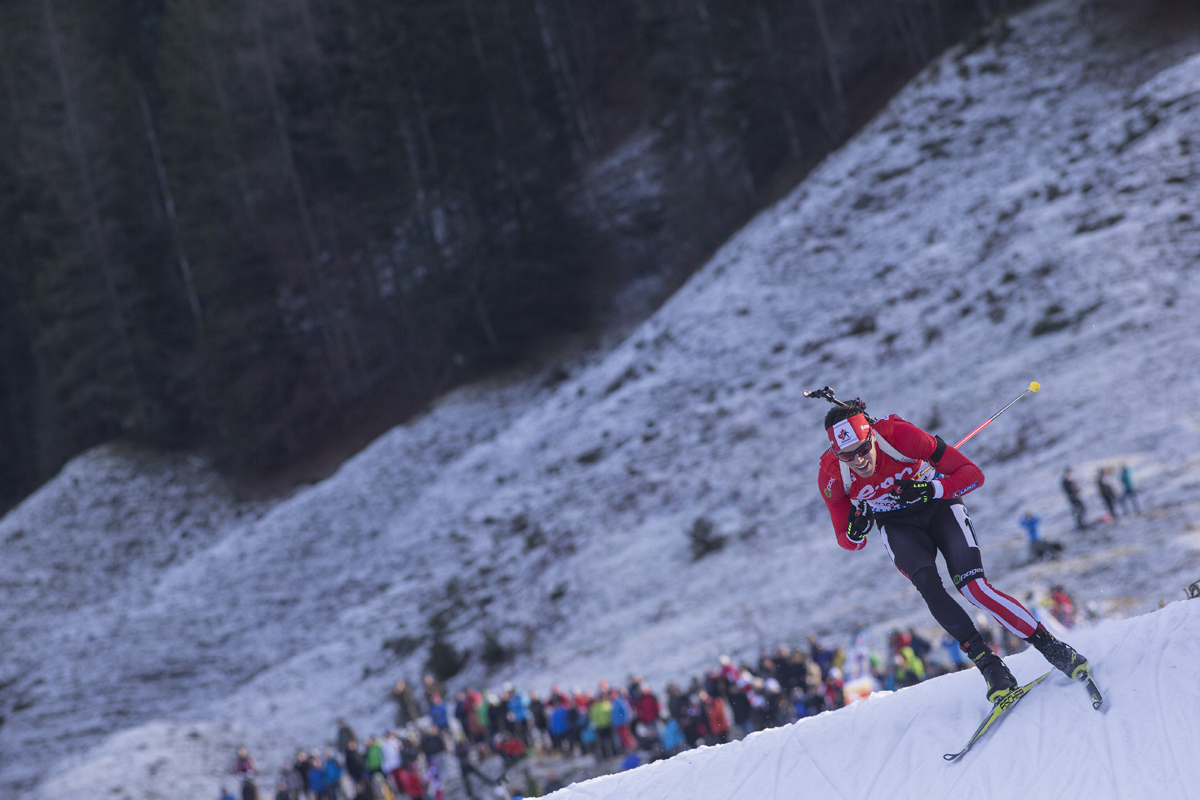
Nathan Smith skating his way to 18th at the 2015 IBU World Cup pursuit in Hochfilzen, Austria, last December. (Photo: Fischer/NordicFocus)
***
We asked Smith to give our ’17 Questions for 2017′ a go. Here are his responses:
1. Biggest change in your life in the last five or so months since the ski season ended?
I’ve been making trips up to Grande Prairie to visit my girlfriend (and her kitten). It’s nice to get away from Canmore on rest weeks, decompress, and experience regular town life sometimes.
2. Biggest change in your training?
I haven’t had too many changes in over all training philosophy. The team was reorganized this spring so Matthias [Ahrens] is now my personal coach instead of Roddy [Ward]. They work closely together though so aside from feedback it hasn’t changed too much in day-to-day training.
3. Major areas of improvement you’ve seen so far?
I’ve made some good gains in lower body strength and double pole work.
4. Whom you’ve been working closest with this offseason (coaches or training partners)?
Aside from Matthias and Roddy, we also have technique coaching at some camps from Mats Larsson. Former athlete Andrew Chrisholm has also been helping out our team on the range so we can get more individualized attention.
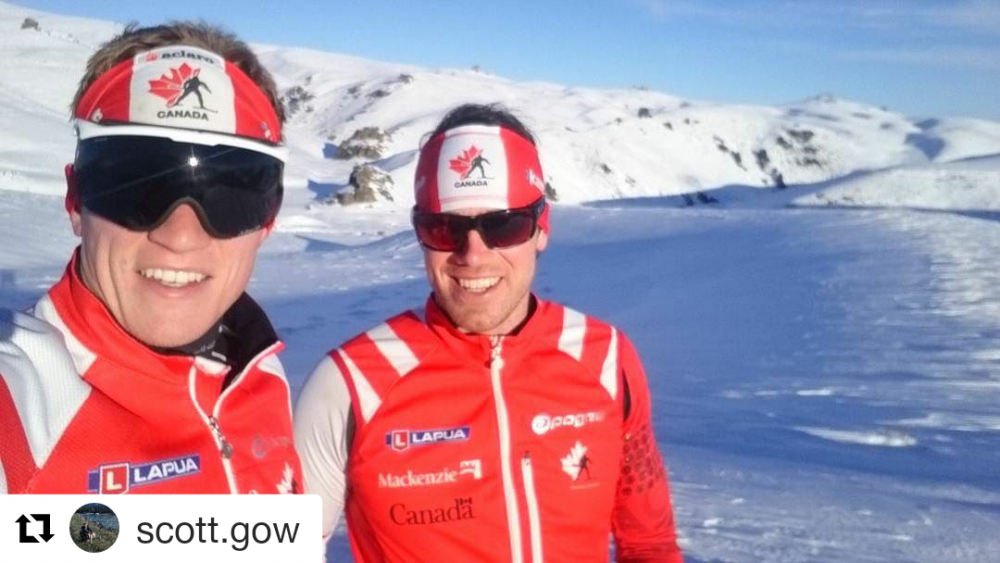
Biathlon Canada’s Nathan Smith (r) and Scott Gow during a ski. (Photo: Nathan Smith)
5. Best trip in the last five months (and why)?
Even though its not far, I always enjoy going to Jasper [Alberta] for “ManCamp”. It’s an amazing roller ski and drive up the Icefields Parkway, and the options for varied training once we get there are awesome. We also get to stay in rustic cabins on the river and practice slammo.
6. Favorite cross-training?
Mountain Biking
7. Favorite non-athletic activity or pastime this summer?
Motorcycling, and trying to fly fish.
8. Song that was your jam this summer?
That would definitely be Justin Bieber – I’ll Show You
9. All time favorite race moment?
Winning the pursuit at the world cup final in Khanty-Mansiysk in 2015
10. First thing you pack in your bag when you leave for Europe?
Armband. Never forget it!
11. Venue/event you’re most excited to visit this season?
Tyumen. I’ve never been there and I’m sure its going to be impressive
12. Who will win the men’s and women’s World Cup titles this year?
Martin Fourcade and Laura Dahlmeier
13. Biggest sacrifice you feel you’ve made choosing this career path?
Putting my education on hold.
14. If you could change one thing about your sport, what would it be?
Can it be -3, hard packed, calm, and sunny every day?
15. What did you have for breakfast this morning?
I desperately needed to go grocery shopping, so 3 bowls of granola with milk and a banana.
CALGARY — While Canada’s summer Olympians take the podium, young cross-country and biathlon development athletes clamber for a Calgary training facility for the upcoming winter. WinSport Canada’s June 2016 announcement to install a tube park through the cross-country ski trails at Canada Olympic Park has left Foothills Nordic Ski Club and other local clubs scrambling to find an alternate venue for their 2016/17 winter programming.
Without suitable training facilities within the city, the training and competition goals of young biathlon and cross-country athletes are hindered, as precious hours are spent traveling outside of the city for regular training sessions. According to Alberta Development Team athletes, Anna and Ben Pryce, “Terrain loss in Calgary could mean driving to Canmore four times a week,” which the Pryce’s feel is, “simply impractical” for reaching their goals and taking their skiing to the next level.
Sustaining a healthy population of Nordic development athletes, who themselves have opportunities to take the podium, means providing access to suitable facilities for all ages and development stages within the city of Calgary (1988 winter Olympic host).
Foothills Nordic Ski Club is taking decisive action to ensure its members and all Calgarians have access to cross-country skiing in Calgary this winter by launching its Snow Making at Confederation Park crowdfunding campaign (www.gofundme.com/foothillsnordic) that kicks off on August 15. A successful campaign will see Foothills implement innovative, hydrant-based snowmaking along with snow farming and harvesting techniques – maximizing the longevity of natural snow.
Committed to the community, the non-profit Foothills Nordic has volunteer groomed ski trails at the City of Calgary’s Confederation Park Golf Course for over 20 years, to the benefit of its over 700 club members and all Calgarians, but Calgary’s chinook-influenced winters make snowmaking a necessity for delivering reliable programming and continuous ski days.
Former Canadian Cross Country Ski Team member and Foothills Jackrabbit Kevin Sandau says of growing up in Calgary, “I was fortunate enough to have accessible skiing within the city. Skiing and racing my entire life has shaped who I am, the people I’ve met, and my desire to live a healthy lifestyle. Now with the uncertainty of reliable, safe and consistent ski facilities within Calgary, we will lose out on grassroots programs that would create the next generation of Nordic enthusiasts.”
ABOUT FOOTHILLS NORDIC SKI CLUB
Foothills Nordic Ski Club (FNSC) is a not-for-profit, full service ski club based in Calgary, Alberta. Incorporated in 1964, FNSC has a long history of organizing and delivering programs geared towards cross-country skiers and biathletes of all ages and performance levels. The Club has an annual active membership of 720, ranging from Jackrabbits and Biathlon Bears to High Performance athletes, Masters level recreational skiers and para-Nordic skiers. With a 9-member Executive, approximately 70 cross-country and biathlon coaches (both paid and volunteer) and over 200 active volunteers, the Club’s initiatives also include the staging of major events and races in Calgary and the Bow Valley. Foothills is an 8-time Canadian national cross-country aggregate club champion, and is a member of Cross-Country Canada, Cross-Country Alberta, Biathlon Canada and Biathlon Alberta.
Winter Olympians Jason Myslicki (l) and Robin Clegg (yellow/red leaders jersey on the right) competing in the Banff Bikefest in June. Teammates on the Canmore-based Rundle Mountain Cycling Club, Clegg won the overall Category 3 title on June 17 to earn Category-2 status. Myslicki won a race later this summer to also achieve Cat. 2. (Courtesy photo)
The average adult makes somewhere around 35,000 decisions per day. Before setting out for a road ride on Sunday, three retired Olympians made a couple of casual ones.
First, former Canadian national-team members Robin Clegg (biathlon), Jason Myslicki (nordic combined) and Sean Crooks (cross-country skiing) decided to ride between 80 to 100 kilometers just outside Calgary, Alberta. Second, they picked a quiet township road, which would lead them to a coffee shop in the suburb of Cochrane.
In a phone conversation on Tuesday, Myslicki said he initially didn’t want to go that way. His friends and Rundle Mountain Cycling Club teammates out of Calgary and Canmore, Alberta, convinced him the road was newly paved and seldom used.
Cruising along the same road in a sport utility vehicle, one driver made some choices of his own. Upon approaching the three cyclists from behind, he honked his horn and buzzed by them, yelling that they shouldn’t ride on a road with no shoulder, according to Myslicki.
They reacted to the close call between the car and their bodies by yelling back, and the male driver responded by slamming his brakes just ahead of them. Myslicki and Crooks veered to the left to avoid colliding with his tailgate, and Clegg, who was behind them, went toward the opening on the right. The driver then allegedly accelerated, hitting Clegg with the front of his car and sending him crashing onto the ground.
A three-time Olympian who helped Canada place 10th in the relay at the 2010 Vancouver Games, Clegg, 35, never lost consciousness, but took the brunt of the fall on his right side. An ambulance transported him to the hospital, where he later had surgery to insert a plate in his broken elbow. According to Crooks, Clegg also broke his collarbone and potentially some ribs.
A 2006 Olympian who spent seven years on the Canadian National Ski Team, Crooks, 29, wrote in an email that he visited Clegg on Tuesday. “He is pretty beat up,” he wrote, but Clegg expected to be out of the hospital by Wednesday. Doctors estimated it would take 12 weeks for his elbow to heal.
“I’m frustrated with how some drivers perceive athletes training on the road,” Crooks wrote. “There are too many drivers out there who, for whatever reason, think it is a good idea to bully the athlete with their vehicle.”
As a competitive cyclist living and training in the area, he’s had several run-ins with drivers before. Unfortunately, Calgary is notorious for driver aggression toward bikers, he wrote. But he had never witnessed anything as bad as this.
“The guy was trying to scare us, and it went too far,” Crooks wrote. “I’ve had a few verbal confrontations in the past, but, honestly, when I see a vehicle stop to get angry for me being on the road, I’m not excited about what’s coming. With the skier/cyclist physique, I’m not looking for a physical confrontation. Also, chances are, this person is obviously irrational and is likely wearing much more stable footwear than I am.”
Myslicki said he threw up his hands as many cyclists do when drivers intentionally get too close. He pointed toward the road as if to say, ‘What’s your problem? It’s a wide-open road; it’s straight, it’s flat.’
“If it was a tractor driving on the road, you wouldn’t buzz them and honk,” Myslicki, 34, recalled thinking.
“It’s definitely a greater hatred towards cyclists,” the two-time Olympian said. “I feel a bit sorrowful for those people; I wonder how bad their lives are that they’re willing to go out of their way and ruin someone else’s life.”
After the incident, in which the Cochrane police, Royal Canadian Mounted Police, emergency services and a fire crew responded, Myslicki and Crooks continued on their ride. At the time, they hadn’t been identified as Olympians – no one knew who they were – and they decided to keep the story under wraps.
Myslicki later reconsidered and made perhaps his second-most important choice that day, after his split-second reaction to swerve left and avoid the SUV. He wanted to go public with this.
He thought about his girlfriend and her family and all the other people he had turned onto cycling. After retiring, he, Clegg and Crooks became teammates at the Rundle Mountain Cycling Club (RMCC). They biked as frequently as they could together and each achieved the prestigious Category 2 in road racing.
“I’ve got to use this platform because it’s an opportunity to raise awareness for cycling,” Myslicki told himself Sunday. “If I can prevent even one person from bullying a guy on a bike then we’re getting somewhere as far as that’s concerned.”
He contacted the Calgary Herald that evening, and by Monday morning, his phone was lighting up with press inquiries. Myslicki said he also spoke with Calgary’s mayor and several administrators about the incident, which was still under investigation.
According to Myslicki, there was at least one witness – a woman in another vehicle who was an unknown distance behind – but he wasn’t sure what she reported.
“I haven’t heard of what precedent is out there,” he said of the punishment for aggressive driving toward cyclists. “We’re hoping that someone makes an example of it.”
Dave Nighbor, left, has a bit of design fun at the Vancouver 2010 Games with friend, Matt Jeffries.
This article is the first in a series that will look at the post-athletic careers of former elite cross-country skiers, coaches, and others involved in the sport.
Dave Nighbor is out of the ski racing game, and has moved onto bigger and brandier things. After he finished up his ski career as a full-time Canadian National Team athlete, Nighbor packed up and moved himself to Calgary. There, he uses another talent, graphic design, to shift into the next chapter of his life.
It’s been a smooth and natural transition for the 25-year old, he said. “I feel good about my decision [of retiring from skiing]. I did all the things I wanted to do with it. There are no lingering feelings,” Nighbor said in a phone interview. Now, he exercises to keep himself in shape, and is concentrating on his future in advertising.
Nighbor’s company, 9 Lives Graphic Designs, lives in the offices of one of his biggest clients, threesixtythree, a sponsorship and branding company–and he is their “go-to guy” for outsourced design work. He also takes on independent contracts and has done posters for events such as Share the Road and the XTerra Canadian National Championships.
Nighbor’s ultimate goal is to move into corporate branding or advertizing. “What I enjoy the most and what I have a knack for is the idea of advertizing and getting people’s attention through design. I could see myself doing that,” he said.
Whether or not he’s going to go back to school for design is up in the air. “Everything’s undecided right now. It depends on where work and school may take me,” he said.
To see Nighbor’s work, go to http://9lives-design.com/
Nighbor's company, 9 Lives Design, combines his love for art and graphic design with his business-savy skills. Design: Dave Nighbor