From the FasterSkier archive — posts syndicated from athletes’ and coaches’ own blogs between 2004 and 2012, kept online as published. Current coverage is at fasterskier.com.
Auburn Ski Club (ASC) is a historic non-profit organization dedicated to providing snow sports opportunities to the greater Northern California region since 1928. Today, ASC operates a snow sports Training Center on Donner Summit that provides athletic programs, USSS/FIS competition and training venues, and youth snow sports teams ranging from entry-level to elite for Alpine, Snowboard, Nordic, and Biathlon. The Training Center’s cross-country venue also operates as a 25-kilometer Nordic Center open to the public.
ASC is now hiring a Head Coach for its Nordic Development Program.
Position Overview
The Head Coach of the Nordic Development Program leads the Devo 1 and Devo 2 teams, where U10 through U14 athletes move from learning to ski toward learning to train. This is the stage of the pipeline that determines whether a young skier stays in the sport. ASC is looking for a coach who understands that skill, confidence, and enjoyment at this age build better racers than early specialization does.
The Head Coach takes graduates of the Super Sliders program and prepares them, technically and personally, for the Competition Team. The role covers session planning and on-snow coaching, technical progression across both Devo groups, support and training of assistant coaches and parent volunteers, and steady communication with families. It suits a coach who wants ownership of a program rather than a set of practices, and who is comfortable being the person a nine-year-old remembers as the reason they kept skiing.
The Details
Annual salary based on experience
Salary structure includes coaching hours, administrative responsibilities, and flex time off
Health insurance offered
ASC 401(k) program with annual 3% salary match
Key Responsibilities
Coaching & Athlete Development
Lead the Devo 1 and Devo 2 programs year-round, on snow and in dryland
Plan and deliver weekly training across the Devo schedule, including weekday afternoon sessions under the Nordic Center lights and Saturday mornings
Build technical progressions appropriate to the age group: classic stride with coordinated pole use, skate skiing with and without poles, V1, step turns, hockey stops, terrain reading, pacing over varied distances, and smooth transitions between techniques
Run Devo 1 as a train-to-learn environment and Devo 2 as a learn-to-train environment, with a clear and deliberate step between them
Teach athletes to take care of their own equipment as they approach the Competition Team, including ski selection, basic tuning, and hot waxing
Introduce racing as something athletes look forward to, supporting Devo skiers at local and Far West Nordic events without making competition the price of admission
Identify athletes ready to move up, and prepare both the athlete and the family for that step
Keep retention and long-term participation as measures of the program’s success alongside results
Program Leadership & Collaboration
Work with Super Sliders staff so athletes arriving in Devo 1 meet a familiar teaching language and a consistent standard
Coordinate with Competition Team coaching staff to keep one continuous progression across the Nordic pipeline
Recruit, train, schedule, and support assistant coaches and parent volunteers, including the volunteer sessions Devo families are asked to fill
Support ASC-hosted racing, including Far West Nordic qualifying events held on the Training Center trails
Contribute to registration, retention, and program growth planning with Nordic program leadership
Build a culture of mentorship and sportsmanship across the ASC Nordic community
Community & Regional Engagement
Serve as a visible and positive presence in the Far West Nordic community
Work with regional programs on development events, clinics, and youth racing opportunities
Support initiatives that create access and opportunity for athletes at every level, including needs-based scholarship efforts
Potential leadership role representing ASC at the FW Junior Committee or FW Board
Communication & Family Engagement
Maintain consistent, proactive communication with athletes and families
Lead parent education on what development looks like at this age, and on what it does not need to look like
Guide families through equipment decisions, including fall meetings ahead of the season
Help families understand the pathway ahead while keeping expectations honest and athlete-centered
What ASC Offers
Leadership & Professional Growth
ASC is committed to investing in coaching development and leadership growth. The Head Coach will receive:
Support identifying and attending regional and national camps
Increased investment in coaching certifications and continuing education
Opportunities for leadership development within a growing organization
Athlete Support Philosophy
ASC believes opportunity and access are critical to athlete success. Coaches work within a system that actively supports:
Needs-based scholarships
Athlete development scholarships
Offseason camp and training support opportunities
Long-term athlete development pathways
Benefits
Use of the CA Gold pass
Opportunity to shape the foundation of Nordic skiing in the Far West region
Support for professional growth and development opportunities
When JC Schoonmaker talks about his earliest memories of ski racing, he doesn’t begin with speed or snow conditions, or the particular magic of gliding across winter trails. He starts, instead, with raffles. “I just remember as a kid, there’d be raffles after every race that I would be so stoked for,” he says. “Trying to get a prize, like a new pair of gloves or a hat.” It is an unexpectedly tender snapshot of a skier now known for his explosive starts and the sharp, angular drama of World Cup sprint heats. But it is also revealing. Long before Schoonmaker was on national team radars, long before he was analyzing sprint tactics or refining breathwork, he was simply a boy who loved showing up at races, surrounded by friends, snow, and the possibility of leaving with a hat.
Schoonmaker grew up in Tahoe, a place where winter sport is woven into the fabric of childhood. Yet unlike many of the region’s rising athletes, he was not funneled into Alpine skiing or a single disciplinary track. Instead, he moved constantly—and in every direction. “Both my parents were super athletic, into sports,” he says. “So from a really early age, I was just doing tons of different stuff: soccer, downhill skiing, andNordic skiing. I played lacrosse. A little bit of baseball.” The variety shaped him in ways he didn’t appreciate at the time: balance from soccer, strength from downhill, elasticity from lacrosse, and a developing sense of rhythm from all of it.
Meanwhile, the Nordic community in Tahoe was small enough to feel intimate yet substantial enough to provide him with peers, mentors, and a place to grow without suffocation. “Joining a Nordic team for me was super fun because I got to go out and ski with friends,” he says. “It was kind of my first experience racing.”
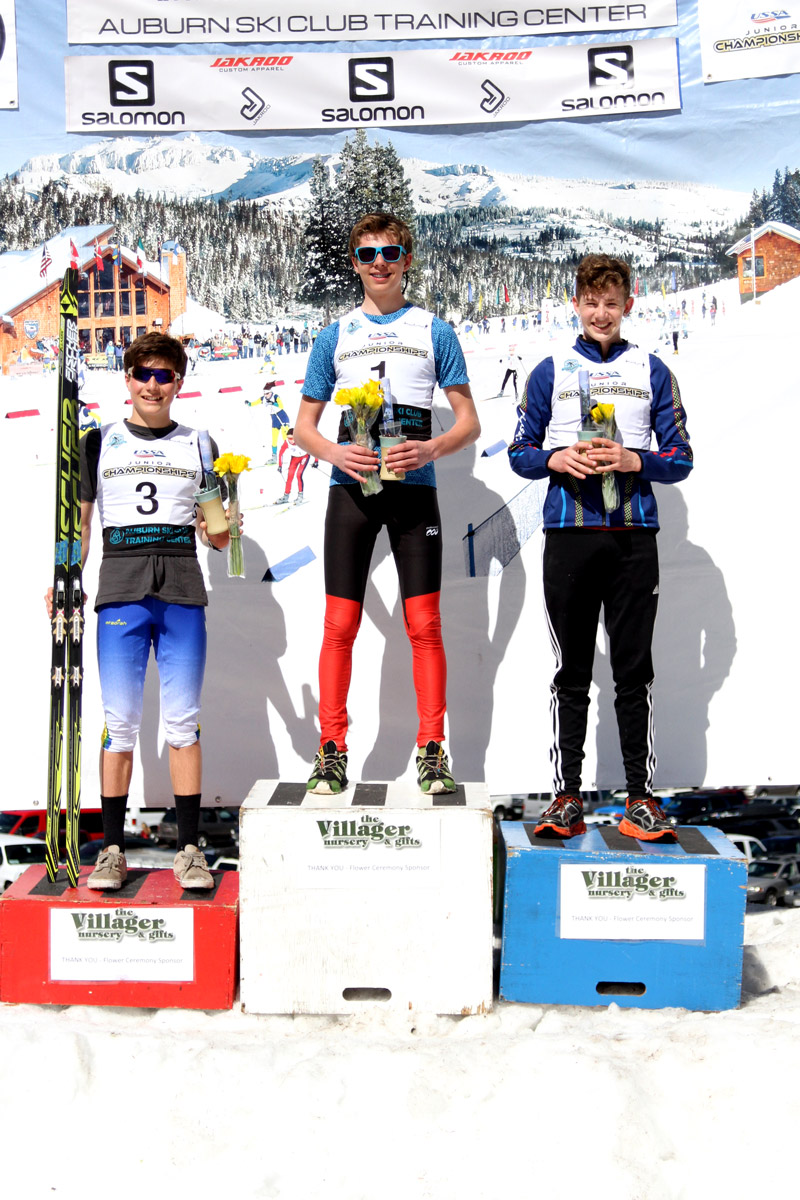
The U16 men’s podium from the 5 k Classic Mass Start at 2015 U.S. Junior Nationals at Auburn Ski Club in Soda Springs, Californial. JC Schoonmaker took home third place. (Photo: Mark Nadell/MacBeth Graphics)
Early Validation in Soldier Hollow and Truckee
It wasn’t until he traveled outside his region that Schoonmaker realized how he measured up. On a Far West trip to Soldier Hollow—his first time racing beyond his local bubble—he surprised himself. “I think I got third in the first race… then I won the second one,” he recalls. “I didn’t even really know it was a big deal, but all the older kids on the trip were… really excited for me.” Their reaction revealed something he hadn’t yet recognized: that his potential extended well beyond his local podiums.
A similar revelation arrived at Junior Nationals in Truckee, where home snow became a proving ground. He had hoped to earn All-American status, although the early races had gone poorly. “All the first races didn’t really go super well,” he says. “I had high expectations.” Yet in the final individual race before the relay, he stepped onto the podium. “Somehow onto the podium and got third,” he says. “That gave me a bunch of confidence… really helped me.” It was not just affirmation but a directional sign. Skiing was becoming more than an activity. It was becoming a path.
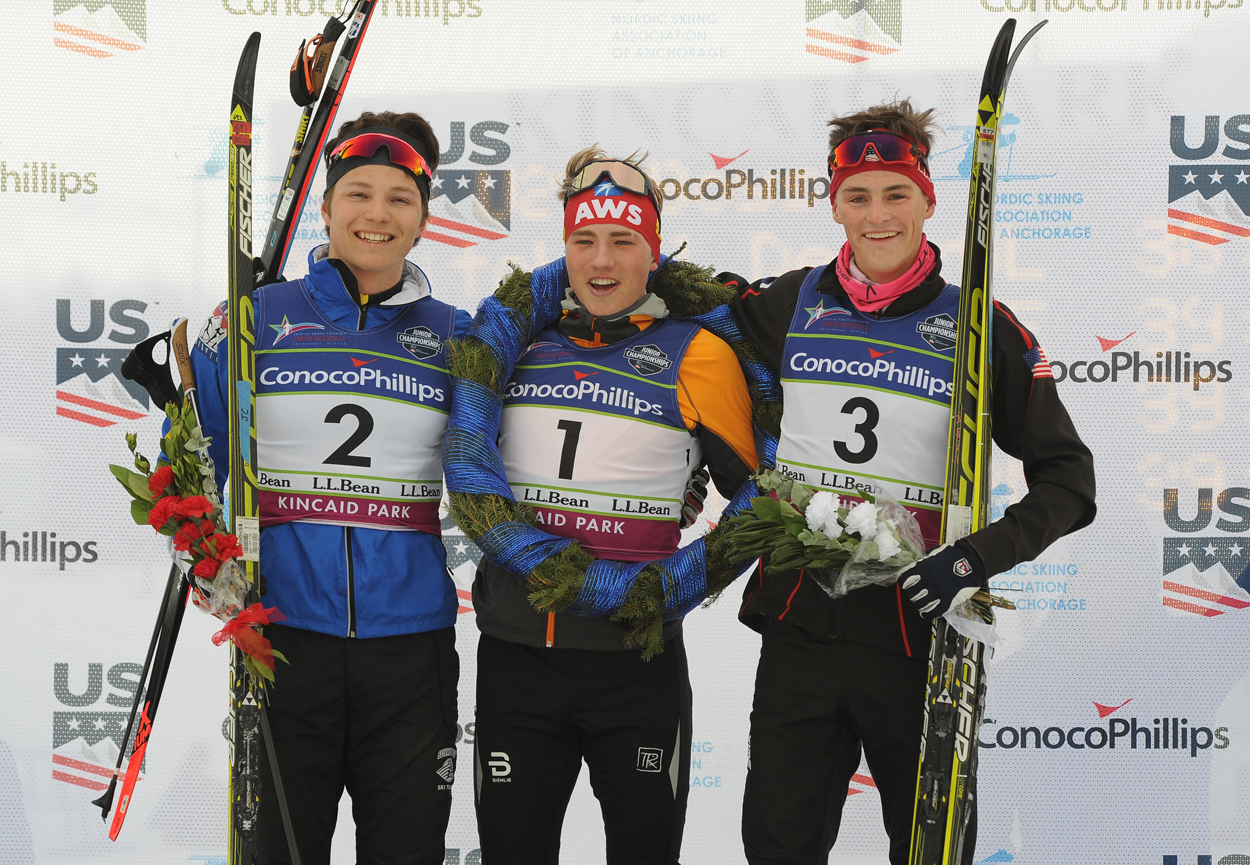
Gus Schumacher (Alaska Winter Stars/Team Alaska), center, won the U20 men’s 15K classic mass start race at the 2019 U.S. Ski & Snowboard Cross Country Junior National Championships at Kincaid Park. J.C. Schoonmaker (UAA-Auburn Ski Club/Far West), left, was second, followed by Cameron Wolfe (Ski and Snowboard Club Vail/Rocky Mountain), right. (Photo: Michael Dinneen)
Choosing Anchorage and the Power of the Right Environment
Despite his junior successes, Schoonmaker’s college recruiting process was sobering. His age cohort was stacked—Gus Schumacher, Luke Jager, Canyon Tobin—and their achievements overshadowed many strong skiers. “My top choice was UVM, and I just didn’t get a spot there,” he says. “I didn’t have a ton of options.” But an unexpected opportunity appeared when a Tahoe friend encouraged him to consider the University of Alaska Anchorage. He visited, and something clicked. “I’d say that’s the best decision I ever made,” he says. “I ended up coming to an excellent team… It’s an awesome place for skiing.”
Anchorage wasn’t glamorous, but it was grounding: clear air, big terrain, and a training culture built on consistency rather than spectacle. Under coach Trond Flagstad, Schoonmaker’s skiing matured—his engine, his technique, and his confidence—all while laying the foundation for a collaborative coaching story that would shape his rise.
A Uniquely Collaborative Coaching Path
Schoonmaker’s development is defined by the unusually harmonious network of coaches who supported him. In Tahoe, he trained with Will Sweetser, whose workout creativity brought nuance to his summer training. At UAA, Flagstad built his fall rhythm with threshold work and bounding. In the winter, U.S. Ski Team coaches—Matt Whitcomb, Kristen Bourne, and Chris Grover—stepped in with race-day craft and a national pipeline. And now, in Anchorage, he works with Eric Flora at APU, whose daily presence has brought structure and clarity.
“I feel like I didn’t even really have to do much in the way of balancing that,” he says. “Trond, Will, and Matt… kind of just took that on themselves.”
That kind of multi-coach collaboration is rare. Instead of conflicting philosophies, Schoonmaker received overlapping layers of expertise, each building on the others. He remembers one of Sweetser’s signature interval sets with particular fondness: “Twenty seconds L5… forty seconds rest… forty seconds L5… then six minutes of threshold. A cool blend… essential for getting you ready for doing sprints on the World Cup.” Flagstad brought heavy doses of fall bounding at L4. Whitcomb and Bourne added race sharpness. Flora, finally, aligned everything. “Having him at World Championships last year made it feel like just a practice in Anchorage,” Schoonmaker says.
JC Schoonmaker (bib #1) at the 2020 Senior Nationals in Houghton Michigan. (Photo: Reese Brown)
The Unexpected World Cup Start That Changed Everything
The first moment when Schoonmaker truly understood the trajectory he was on came suddenly. At U.S. Nationals in Houghton, Michigan, in 2020, he won the sprint qualifier. It was exciting, but he didn’t assume it meant anything beyond that day’s result. Then his assistant coach, Marine Dusser Bjornsen, approached him with unexpected news. “She was like, ‘Oh yeah, you’re gonna get World Cup starts from that,’” he recalls. “And I was like, ‘What? No way.’” His passport was expiring, his bags were unprepared, and within days, he was on a plane to Dresden.
Stepping into the World Cup for the first time felt surreal. “I wasn’t even really worried about those being my first World Cups,” he says. “I was mostly just hoping to get to go over there.” The qualifiers felt manageable; the heats were startling. “Racing against those dudes in the heats… was just a whole other level. A different beast.” Still, he never felt crushed by the moment. “We were just having fun,” he says. “It wasn’t crazy high expectations.” That experience didn’t instantly transform him, but it recalibrated his sense of where he belonged.
APU: A Training Collective That Became Home
When Schoonmaker finished college and committed to training full-time in Anchorage, it wasn’t only because of Flora’s coaching. It was because the environment felt like home. “Luke coming back… Gus joining… Zan and Michael… it was such a good team,” he says. “A lot played into it… but mostly that stuff.” APU is one of the few places in the country where the majority of the national team trains together throughout the year, creating a rare sense of continuity on the World Cup.
Yet even in a group that suits him so well, Schoonmaker knows he needs occasional solitude to stay balanced. “I definitely find times during the summer where I’m pretty excited to do an interval session by myself,” he says. “I grew up training alone in Tahoe.” Winter, of course, is different. “You’re living with this group of people for the entire winter,” he says. “Sometimes it is hard to find time to yourself.” But the team understands him. “Everyone knows whatever’s best for you is what’s best for the team.”
A New Kind of Training: Mindfulness and Sprint Awareness
This year, Schoonmaker added something he had never practiced formally: daily mindfulness training. “Some breath holds… super simple, just five minutes of mindfulness,” he says. “Focusing on my breath, trying not to let my thoughts wander.” The shift wasn’t driven by physical shortcomings, but by an honest assessment of where he needed to grow tactically. “In sprint heats… I’ve tended to have my head down, thinking about my technique… rather than, ‘I need to get this position around this corner.’”
Mindfulness gave him a way to sharpen his presence during races and training. During intervals, he began noticing moments when his focus drifted. “My mind starts thinking about what I’m gonna have for lunch,” he admits. “I’m getting better at bringing myself back… loosen up, ski relaxed.” The work is subtle, internal, and mostly invisible, yet deeply connected to the kind of racer he wants to become.
Passing It On: What He’d Tell the Next Generation
If Schoonmaker were speaking to a group of juniors in Tahoe today, he would know exactly what he would emphasize. “I love this puzzle of trying to get better every day,” he says. “Focus on the small things you can control… let the cards fall where they fall.” But he would also add a piece of training wisdom gained from experience. “I almost feel like I got a little too caught up in L1 and L3,” he says. “Walking up hills on classic skis isn’t getting you better at classic skiing. You have to ski fast to get better at skiing fast.” It is the kind of message that cuts through both trends and dogma.
Life on the Road: Davos, Oslo, and a Simpler Suitcase
Schoonmaker’s favorite destinations reflect a balance of beauty and familiarity. Davos stands out. “I’d love to go there when I’m not getting ready for the Tour de Ski… explore it a little more,” he says. He also holds a soft spot for Oslo. “That’s a special spot. I always feel like I’m having a really good time there.” On race mornings, he keeps things simple: “Probably a couple eggs and a few pieces of toast with jam.” And he no longer travels with the heaviest item from his early career. “I brought over an Xbox… took up, like, 12 pounds in my bag,” he laughs.
Schoonmaker and girlfriend, Emma Ribom (SWE). (Photo: Courtesy Photo)
Olympic Season: Ambition, Clarity, and the Calm Before the Heats
Despite the stakes of the Olympic year, Schoonmaker hasn’t reinvented his approach. “I honestly haven’t been doing anything different,” he says. “I’m more excited to be healthy and head into Period 1 feeling good.” But his goals are not small. “My goals would be to win a medal,” he says. “That’s what I’m shooting for.” A chance to race the relay again is just as meaningful. “The relay in Trondheim was super fun,” he says. “I would love to get another chance.”
As for the individual sprint, his ambition is both grounded and bold. “If I could make the final… that would be a solid day,” he says. “But I do feel like I can win a medal.” Few athletes can express that kind of aim with such composure. Schoonmaker delivers it as calmly as if he were describing a morning ski.
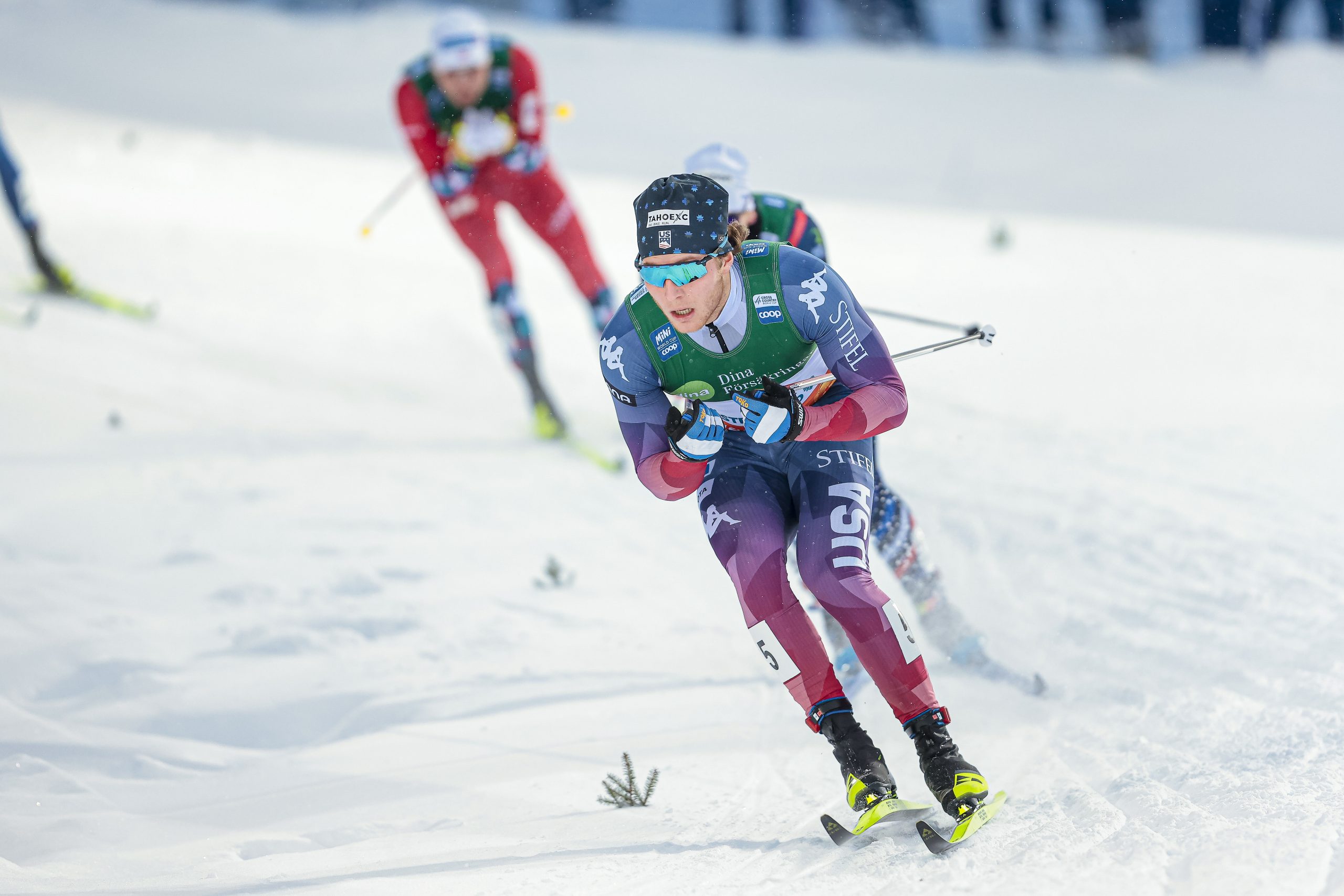
JC Schoonmaker (USA) had a breakout day in Oestersund (SWE) in 2023, reaching the podium for the first time. The American took third place. (Photo: NordicFocus)
Where He Stands Now
What stands out most about Schoonmaker at this moment is not bravado, but clarity. He is no longer the boy who raced for raffle prizes, nor the college skier unsure of his place, nor the rookie dragging an Xbox through European airports. He has become something steadier, more self-aware, and more intentional. A sprinter with composure. An athlete with perspective. A competitor capable of holding his ambition lightly without losing its sharpness.
Presence, for Schoonmaker, is not stillness. It is an ongoing process of tuning himself to the shifting rhythms of a sprint heat, listening to what his mind and body are telling him, and moving through the season with intention rather than urgency. If he keeps his head up—literally and figuratively—this may be the season when the skiing world begins to see not only what he has built, but why it was built this way.
Love Stories Like This? Help Keep Them Coming.
Feature interviews like this one take time, access, and care to produce. If you value thoughtful storytelling and independent ski journalism, please consider becoming a Voluntary Subscriber. Your support directly fuels the work we do to cover the people, places, and moments that make our sport special.
When we spoke, Kristen Bourne was sitting on the couch in her living room in Truckee, California, a small ski town she now calls home. Tibetan prayer flags hung loosely behind her, shifting gently in the morning light that poured through the window. The room felt warm and calm — the kind of quiet space that comes from someone who spends much of her year on the move. Bourne smiled easily as she spoke, her voice’s cadence unhurried, like someone grounded in both her work and the mountain rhythm around her.
She had just returned from camp and was preparing to leave again this weekend to start the World Cup with the U.S. Ski Team. Between talk of travel logistics and packing lists, she mentioned the soundtrack that keeps her company on solo skis. “When I’m skiing by myself? Yes,” she said, grinning. “I really like skiing to Machine Gun Kelly… it kind of brings me back to the Blink-182, Sum 41 days. It feels almost like nostalgic, but newer age.”
That small confession says a lot about Bourne, now in her fourth season on the U.S. Cross-Country Ski Team coaching staff: rooted in rhythm, grounded in joy, and always blending the familiar with the fresh.
Joy, she’ll tell you, isn’t a garnish. It’s the point.
Kristen Bourne, Olivia Nesbitt Bouffard, and Jessie Diggins on an afternoon run in Wanaka, New Zealand. (Photo: Jessie Diggins)
“Happiness goes such a long way in professional sport… our secret weapon as a team is having fun. Our staff genuinely enjoys being together. The athletes genuinely enjoy being together. We love to all come together.”
The proof, for her, is a memory from the day Jessie Diggins won the 10 K at the World Championships in Planica. The scene isn’t what the public imagines. “You’d think everybody is stressed,” Bourne said. “We were ahead of schedule, and we all just sat down in [our wax truck], Yolanda, and made instruments out of whatever we could find for, like, 30 minutes.” The room filled with improvised drums and laughter. “It was so fun,” she said. “That’s the stuff people never see.”
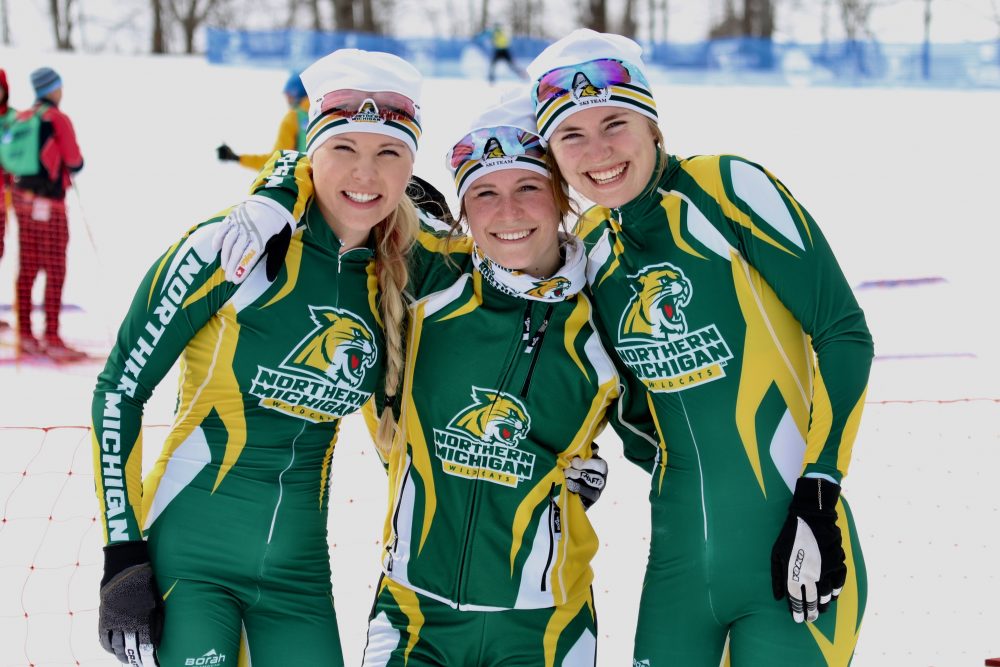
Northern Michigan University’s Kristen Bourne (c) after the 5-kilometer classic race at the 2017 NCAAs in Jackson, New Hampshire. (Photo: Jackie Schneider)
Minnesota Roots, and a Goal Cut in Half
Bourne grew up just outside the Twin Cities, where endurance sport was a family language. “Our family vacations were going to [my dad’s] marathons and triathlons,” she said. She started by hopping into a mile here and there, handing him nutrition at the end of the driveway, learning the cadence and care that go into long efforts.
Skiing arrived as a nudge. A new high-school coach was recruiting runners to cross-country ski at Mounds Park Academy. The first season was rough: “I swore I was going to quit. Every single race I did, I cried after most races,” she said. In a 5k, Jessie Diggins (then a rival in the same section) beat her by 12 minutes. Bourne’s response was characteristic—specific, measurable, gritty: next year, get that down to six.
She continued to run and ski through high school, then headed to Northern Michigan University after spending a semester at the University of Colorado. She transferred mid-winter 2014 and skied at NMU through 2018, working under a rotation of assistants. Her path after graduation would tilt everything she thought she knew about training.
Kristen Bourne spent time in Norway after college training with Lyn Ski / Team Obos. Bourne is pictured here racing in a Norwegian Cup race in Gålå. (Photo: Martin Riseth)
Norway: Where Individual Plans Meet Shared Trails
Right out of college, Bourne moved to Norway for a year and a half. She intended to ski; illnesses complicated the plan. But a concurrent internship at the Norwegian School of Sports Science opened doors into a different coaching world. Back home, she was used to “show up and the coach tells you the workout and everybody does the same thing.” In Norway, she said, “you sit down with a coach and you generate your plan… It was the first time I was exposed to individual planning—thinking about what’s best for you, not necessarily the team.”
Interval days there could look like organized chaos: “Every single person… almost had a different workout, but people would sync up where they could.” At first, she struggled; she missed the mob grind. Then she looked around at a culture of success and realized what was happening: athletes were learning their bodies early, practicing agency. The lesson stuck. “Team workouts are also the way to go,” she said, “but giving athletes a platform to think for themselves—creating this athlete-coach collaborative experience versus coach telling athlete, ‘this is what you should do’—had a tremendous impact” on how she now works.
(l-r) WSCA members Maria Stuber (then CSS), Kristen Bourne (then CSS, now with the US Ski Team), Kristen Monahan-Smith (Michigan Tech), and Tracey Cote (Colby College) at the NCAA Championships in Jackson, New Hampshire, in 2021. (Courtesy Photo).
The Parking-Lot Pivot
Her return to the U.S. was abrupt. She lost her residence permit—”turns out it was under the seat of my roommate’s dad’s car”—and flew home with two days’ notice, arriving just as COVID was beginning to ripple into sport. She kept racing a little, then decided she was done.
That’s when a well-timed email—and a parking-lot shout—changed everything. Her dad reached out to Maria Stuber, who was building the Women’s Ski Coaches Association. “Maria found me in a parking lot at U.S. Nationals and yelled out her window, ‘I’m going to call you,‘” Bourne remembered. A call later, Maria offered her a position at the College of St. Scholastica and connected her with Pepa Miloucheva at the Craftsbury Green Racing Project. After two school years at Scholastica, with summers in Craftsbury, Bourne joined the U.S. Ski Team staff.
The transition was, by her own admission, intimidating. “It was this idea of, like, how am I here?“ she said. But Norway’s reminder—that fresh eyes are valuable—kept her steady. “Just because you’re newer and have less experience doesn’t mean your ideas aren’t valid,“ she said. “You’re maybe fresher out of a ski career, you relate with athletes in a different way. There’s a lot of value in that.”
She also learned to de-personalize the miss. “Technique feedback doesn’t always stick. That’s not a reflection of me as a coach or the athlete,“ she said. “We tried that idea; it’s fine. We’ll try something else.“ Each year, she felt more confident; more importantly, she built deeper connections.
Julia Kern—one of the athletes Bourne works with most closely—sees that same quality every day.
“Kristen is unique in the sense that she’s able to connect with just about any personality type on the team,“ Kern said. “One of her strengths is figuring out how to connect differently with different athletes. Every athlete responds differently and has different needs, and she just gets that. She’s very approachable and sees athletes as whole people.”
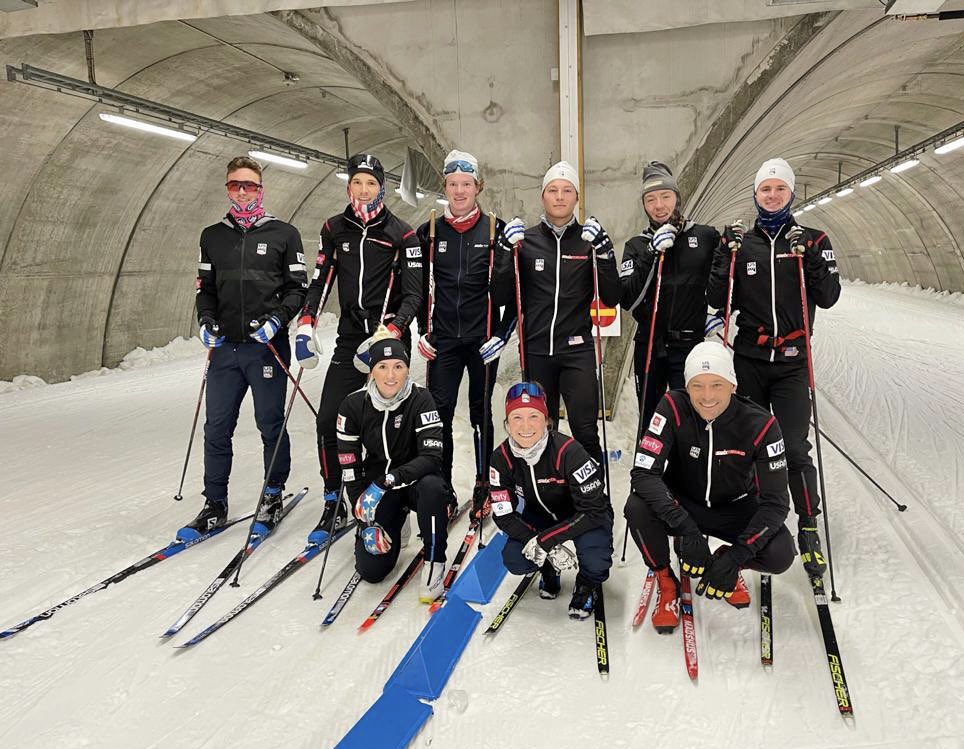
USST athletes and coaches in the Torsby Ski Tunnel, August 2022. Back row, from left: Johnny Hagenbuch, Kevin Bolger, Finn O’Connell, JC Schoonmaker, Ben Ogden, and Walker Hall. Kneeling, from left: coaches Greta Anderson, Kristen Bourne, and Matt Whitcomb. (photo: François Faivre)
Mentors and a Collaboration-First Culture
Ask Bourne about mentors and the names tumble out: Matt Whitcomb, Chris Grover, Jason Cork. “From the very beginning… incredibly supportive,“ she said. “Matt will answer his phone every time. He usually likes to FaceTime… we brainstorm ideas.“ The flow goes both ways: she calls when the connection is hard; he calls when he’s stuck on something.
Her women’s network is just as active. “Maria Stuber, hands down,“ Bourne said. “And Sam Benzing at Montana State—we coached together at Scholastica. She’s younger, but her perspective is so interesting.“ Group FaceTimes are common: Maria, Sam, Kristen, swapping angles and problem-solving. It’s not just helpful; it’s survival. “It would be really hard to be in this job and not have that,“ Bourne said. “The collaboration makes it so much more sustainable.”
That same approach underpins her work with athletes like Kern.
“Kristen’s helped me figure out what kind of training plan works well for me,“ Kern said. “We’ve tried some new things the last few years—different kinds of workouts, always thinking creatively. She’s open-minded, reads up on what other athletes are doing, but also thinks for herself. She’s got such a growth mindset.”
Julia Kern and Kristen Bourne in Sjusjøen at the 2025 pre-World Championships camp. (Photo: Matt Whitcomb)
Coaching Women, Coaching Men — and Being Seen
On the World Cup, visibility is progress measured in inches. FIS’s women-coach bibs created access (up to two additional bibs if teams have women on staff), but change is slow. “Every year, maybe there’s one or two new women… it definitely hasn’t blown up,“ Bourne said. Old assumptions linger. “I probably get asked a couple times a year from male coaches: ‘Are you the massage therapist or PT?’“
For Kern, Bourne’s presence is more than symbolic.
“It’s huge,“ Kern said. “She’s one of the few female coaches on the World Cup level, and she’s down to work hard and just have fun with it too. I hope the next generation of women who want to coach feel inspired that they can do it too. Kristen’s paving the way, even in ways people might not see from the surface.”
Bourne herself agrees that visibility matters. “You can’t be it if you can’t see it,“ she said. “It’s important for young men, too, to see women in leadership roles. Our men’s team has been incredible—they’ve never made me feel like I don’t belong.”
Her advice to aspiring women coaches is emphatic: build a robust support community. “Ask for advice,“ she said. “It makes a world of difference.”
Kristen Bourne and Sophia Laukli on the pre-race day at Val di Femme during the 2025 Tour de Ski. (Photo: Leann Bentley)
Athlete Work: Julia Every Other Day, Gus and Sophia on the Radar
Bourne’s primary day-to-day is Kern. “We’re talking basically every other day—texting or on the phone, training planning. We work very closely, very in depth,“ she said. She also monitors Gus Schumacher and Sophia Laukli.
Kern said that beyond the workouts, Bourne has shaped the team culture itself.
“She’s really good at encouraging athletes to bring their own sense of leadership,“ Kern said. “Not everyone is going to be outspoken—some are quiet leaders, some lead through training. She empowers people to be leaders in their own way. She creates a team atmosphere that’s a judgment-free zone. No idea is a bad idea.”
Gus Schumacher and Kristen Bourne after his 4th place finish in the Davos sprint during the 2023 Tour de Ski. (Photo: Leann Bentley
Season Outlook: Keep the Vibe, Chase the Team Moments
Last year’s long illnesses made for uneasy preseason reading. This year feels different. “People are in a pretty good place,“ Bourne said. “At our camp in Utah, I would assume there would be a little more stress—it’s an Olympic year. Not at all. People were so relaxed and chill and vibing and doing their thing.”
If there’s a metric she’d choose for success, it’s carrying that “happy momentum“ through everything—the Olympics, Lake Placid World Cup Finals. “In a year with so many eyes on cross-country skiing, that would be massive,“ she said.
Results still matter, of course. And she lights up talking about the collective ones. “It would be so awesome to see success in team events,“she said. “Relay and the sprint relay—those mean so much when it’s a collective team event. We want to do well there.”
Lucas Wilmot, Kristen Bourne, Murphy Kimball, Tabor Greenberg in Bend, Oregon 2025 after wrapping up the first L3 intervals at camp. (Photo: Leann Bentley)
Representation, Purpose, and the Long Run
There’s a moment near the end of our conversation when Bourne zooms out to the why. “We are very deeply intertwined in another person’s process and journey,“ she said. “What an absolute privilege to be part of that. It’s impossible not to come to absolutely love and care so much about these people.”
Kern echoed that sentiment from the athlete side.
“Kristen understands there’s life outside of skiing,“ Kern said. “She also knows what it takes to be one of the best in the world—and when it’s time to step away. She helps us stay grounded.”
Five years from now, Bourne hopes she’s doing exactly this, just deeper—”coaching, getting to know these athletes more and more.”
And she hopes the picture around her looks different: more women coaches on staff, on other staffs, in other sports at U.S. Ski & Snowboard; more women wax techs. “If I can have a tiny ounce of contribution into changing that,“ she said, “I’d be so, so happy.”
Kristen Bourne and Colin Rodgers out for a run during the OD run at Park City camp, 2025. (Photo: Matt Whitcomb)
Purpose, Rhythm, and Joy
As our conversation wound down, Bourne slightly rotated her position as the light spilling through the window shifted—yet still filtering across the prayer flags behind her. She laughed when she mentioned her must-pack item: heated socks for Finland. “I get cold fast,“ she said. “Those are my best friend.“
There’s rhythm in that, too: warmth, joy, and purpose, all braided into one.
Because for Kristen Bourne—and for the athletes who work with her—the secret weapon really is fun.
Leann Bentley, Kristen Bourne, and Bernie Nelson at Val di Fiemme the morning of one of the last stages of the 2024 Tour de Ski. (Photo: Matt Whitcomb)
Love Stories Like This? Help Keep Them Coming.
Feature interviews like this one take time, access, and care to produce. If you value thoughtful storytelling and independent ski journalism, please consider becoming a Voluntary Subscriber. Your support directly fuels the work we do to cover the people, places, and moments that make our sport special.
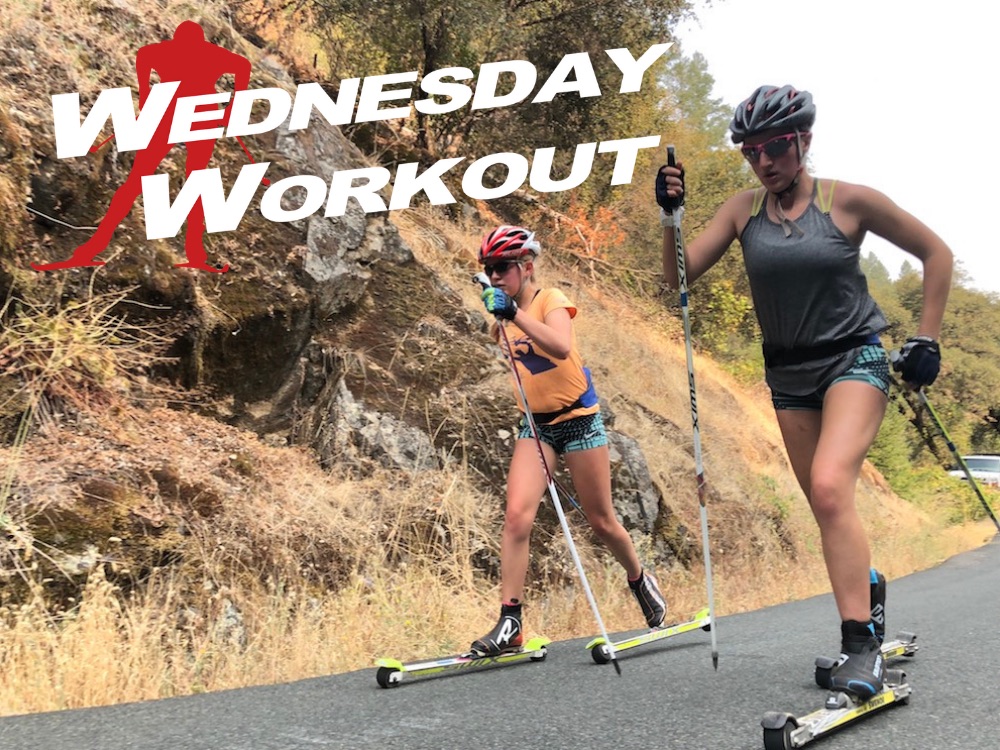
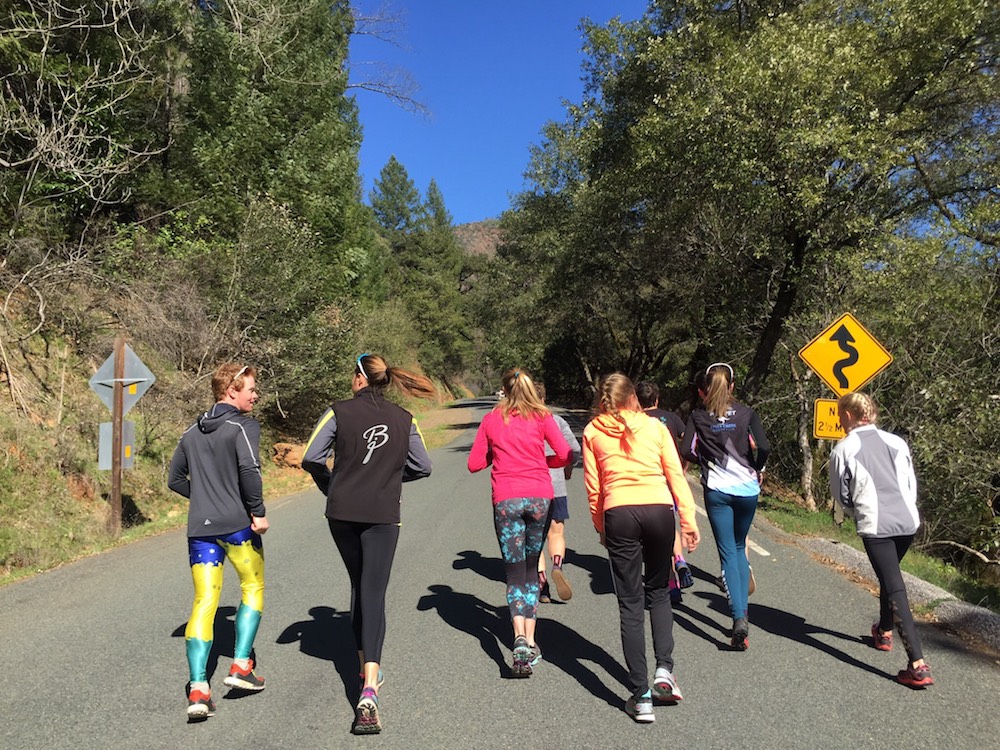
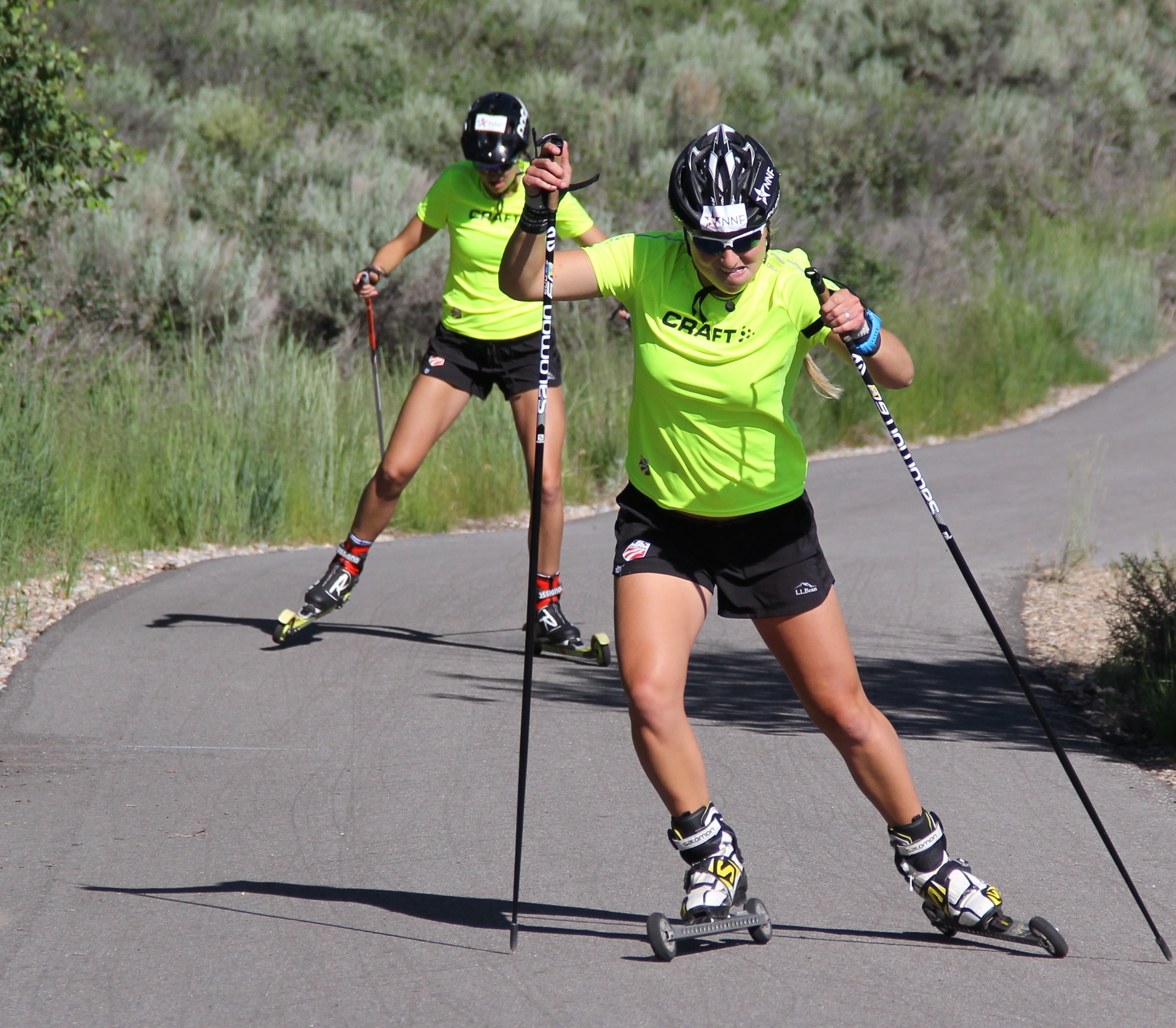
Kili Lehmkuhl (l) and Lilly Murnane of the Auburn Ski Club Training Center striding on Iowa Hill Road near Colfax, California, on Aug. 26. (Photo: Gus Johnson)
This Wednesday Workout came to us just over a week ago from Gus Johnson, nordic program director and head coach at the Auburn Ski Club Training Center (ASC-TC) on Donner Summit in California. Have a workout of your own (or one of your club’s) that you’d like to share? Send submissions to info@fasterskier.com with the subject line “Wednesday Workout”.
***
August proved to be smoke season in California for the Auburn Ski Club Training Center athletes, but a few days of clear air has given us the opportunity to put in some late summer intensity. Like many athletes across the west, ASC-TC athletes have had to adjust their training to be flexible with the wind and smoke patterns this summer. When the smoke outside became unhealthy, workouts consisted mainly of focusing on technique and shorter sessions, or finding alternatives for indoor training.
Auburn Ski Club Training Center is located on Donner Summit at 7,200 feet above sea level, but has easy access (within one-hour drive) to rollerski locations at elevations around 1,000 feet. This week, with a change in the weather and the sunny skies California is famous for, the Auburn Ski Club Training Center Comp Team headed down to Colfax, California, to rollerski Iowa Hill Road for some Level 4-5 (L4-L5) intervals.
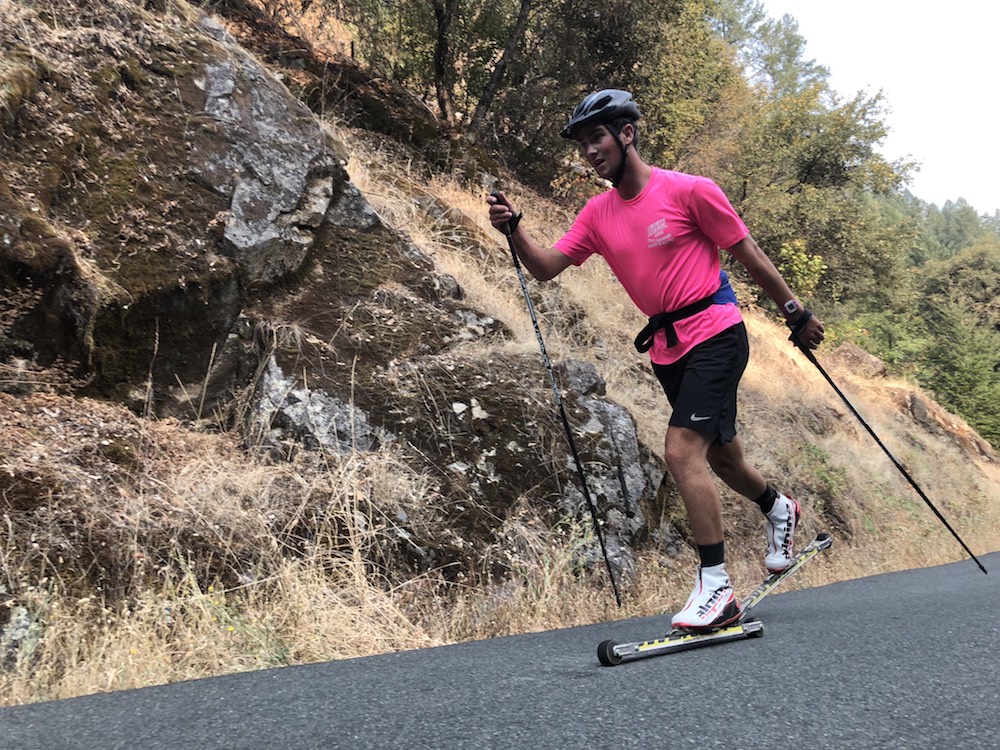
Max Roske of the Auburn Ski Club Training Center striding on Iowa Hill Road near Colfax, California, on Aug. 26. (Photo: Gus Johnson)
With Junior Nationals at sea level this year in Anchorage, our altitude athletes are looking for ways to inject some pace into their normal ski preparations. Our team typically plans at least one week-long training camp on the California coast, and several mini camps at low altitude for hard rollerski intervals and speed sessions. We’re lucky to be able to hop in the car on short notice and find cheap campgrounds to stay at for low-altitude over the weekends. It spices things up whenever we feel things getting stale at home in the mountains.
The base of Iowa Hill Road starts around 1,000-feet elevation in the river gorge of the North Fork of the American River and climbs up to Colfax at 2,100 feet. We find the session to be both a test of mental toughness and a great opportunity to challenge our fast-twitch muscles.
The workout:
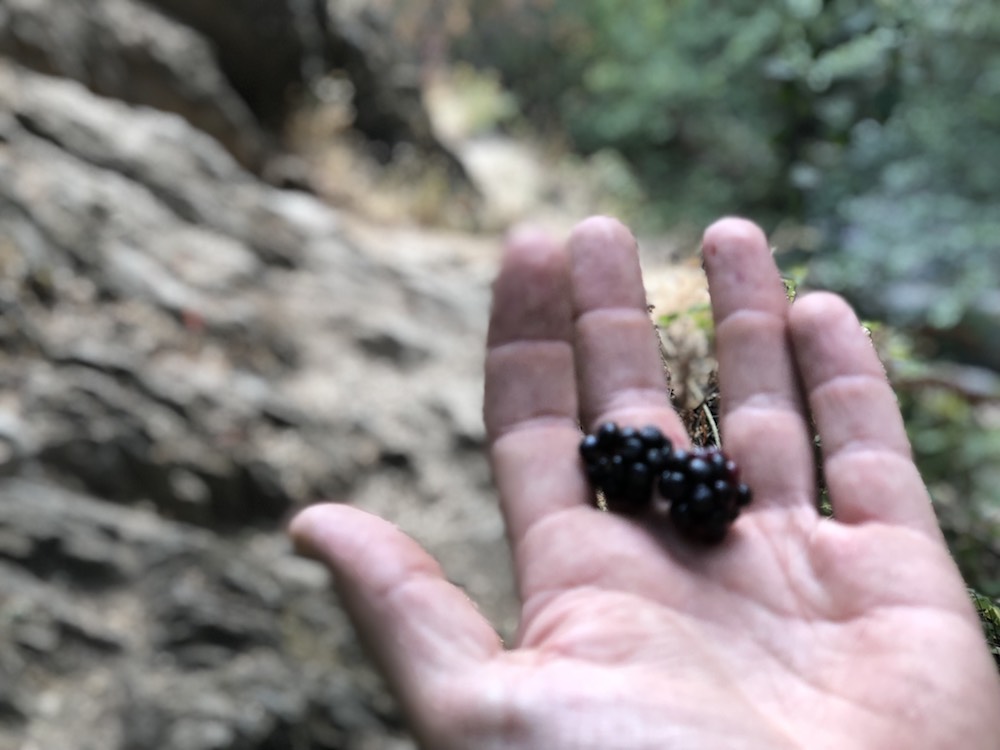
Blackberry picking doubles as a warmup for Auburn Ski Club Training Center athletes in California. (Photo: Gus Johnson)
Warmup (on foot): 10-15 minutes of easy jogging (hunt for blackberries)
– 5 minutes of dynamic warmup (A-skips, B-skips, agility ladders, and dynamic stretching)
Change into the rollerski gear
– 4-6 short speeds, starts, and lunges, each about 8-seconds long
– 4 x 1-minute classic rollerski intervals (L4+) uphill with 1-minute recovery, followed by 2 x 5 minutes with 3-minute recovery, and another set of 4 x 1 minute intervals.
Cool down
***
Auburn Ski Club Training Center skiers warm up on Iowa Hill Road near Colfax, California, on Aug. 26. (Photo: Gus Johnson)
About the Auburn Ski Club Training Center:
The ASC Training Center is a premier training and racing venue in the western U.S. with programming for all ages and ability levels across four ski and snowboard disciplines (alpine, cross country, biathlon, and snowboard). Our institution’s roots go back to the club’s founding in 1928 (we were instrumental in the development of ski culture and ski tourism in California), and that legacy continues today with a bid to host the 2020 xc junior national chamionships. We have hosted the XC Junior Nationals four times to date, the US Ski and Snowboard Supertours twice, as well as the NCAA National Championships and the US Biathlon Nationals. Whether it is as a training and racing venue for the region or as a part of our programming, it is safe to say ASC-TC plays a significant role in the development of all Far West Nordic skiers.
The ASC-TC Competition team is made up of athletes from all across the greater Northern California and Nevada region and is for athletes ages 14-19. The majority of Comp Team athletes live and train near the Truckee and Tahoe area, but some athletes are based out of the sierra foothills (Grass Valley, Colfax, Nevada City, and Auburn) and even some as far away from snow as the Bay Area will come up and ski with the team on weekends or gain race support at events. Our programming is year-round and strives for flexibility to support both elite junior racing as well as participation for athletes whom skiing is only one of their many passions.
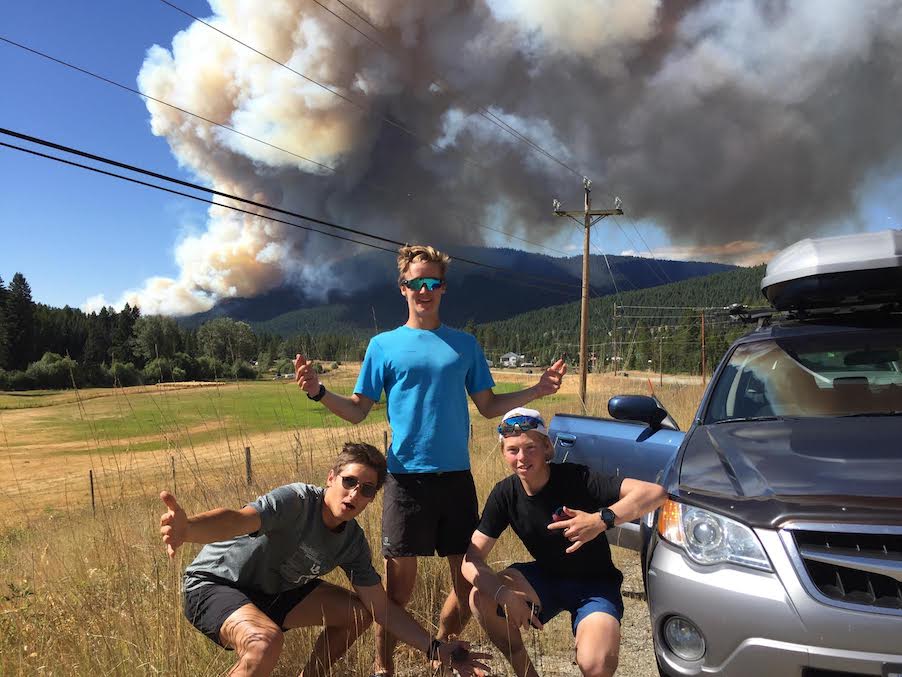
Canadians Fran Vukonic, Tallon Noble and Ian Williams after completing a trail run on Sept. 5 at Big White in Kelowna, B.C.,with the backdrop of the newest Kelowna fire on an otherwise bluebird day. (Photo: Gareth Williams)
Beyond the hundredth meridian, a traditional geographic line demarcating where the West begins, it’s been a hot and dry summer. Wildfires have raged from Washington to California, the Intermountain West, and in western Canada. The conditions remain ripe for extreme fire danger. Even if a wildfire didn’t burn near you, odds are the smoke found its way there.
Across the board and across the U.S., it’s been an off-the-charts summer. While many Americans have been consumed with hurricane coverage and concerns over the last several weeks, fires have scorched more than a million acres in Washington and Oregon alone this year, according to Quartz Media. That’s up from 513,226 total acres in 2016, but in 2015 and 2014, more than a million acres were affected.
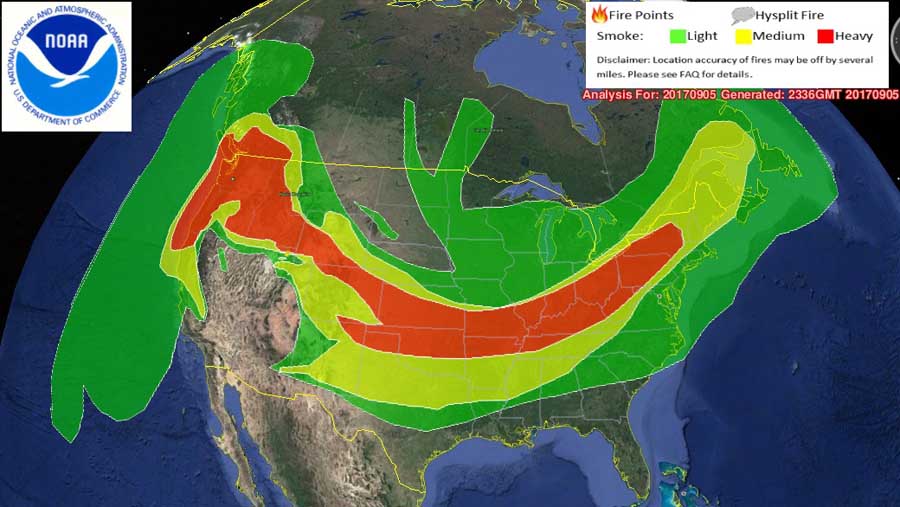
NOAA wildfire smoke and the correlating Air Quality Index for Sept. 5, 2017. (Photo: NOAA)
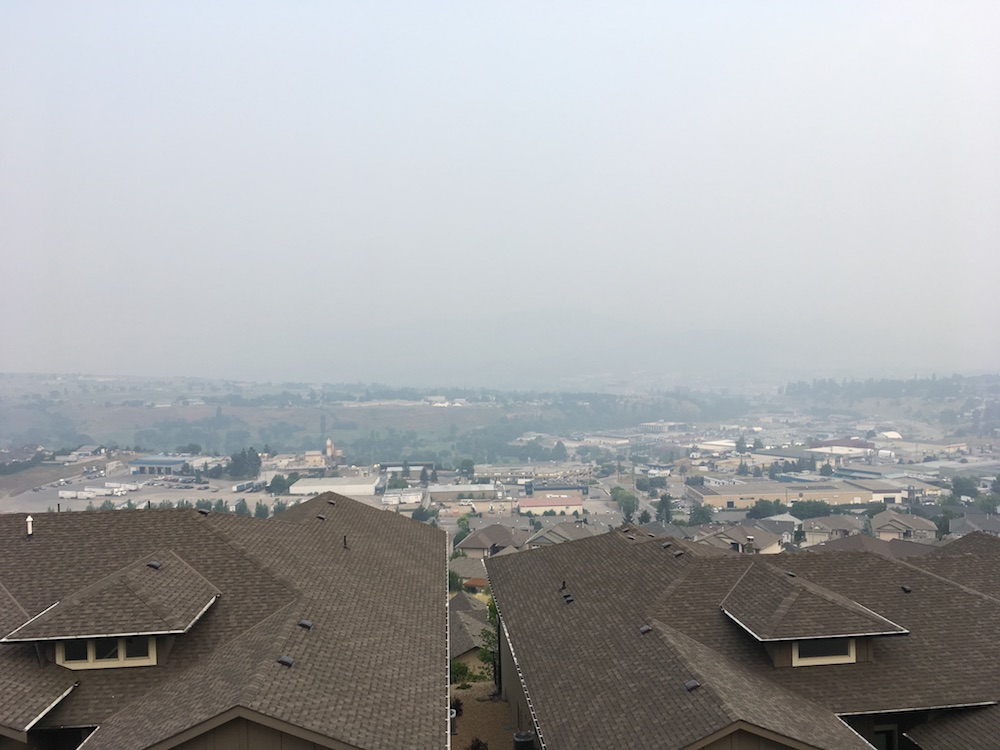
Along with the devastated landscapes and loss, the wildfires’ byproducts of smoke and ash have made for smoggy, poor air quality. We’re talking about seriously hazy days when visibility often wasn’t more than a mile or two.
Training outside in less-than-ideal quality air can compromise an athlete. To better understand when it’s OK to go out or stay in, many skiers and coaches became intimate with the scientific benchmarks for air quality.
“I sort of have this rule where if I can see the glaciers on the mountain, I would rollerski but not do intervals,” Dakota Blackhorse-von Jess, who’s based out of the Bend Endurance Academy in Oregon, said on the phone last Friday. “My personal limit for being outdoors is that 75 AQI limit. That’s the unhealthy or moderate zone.”
Here’s a quick primer. The U.S. Environmental Protection Agency (EPA) has developed an user-friendly Air Quality Index (AQI). The index is color coded and provides a numerical value indicative of a region’s air quality. An AQI of 75 means the air has a PM2.5 concentration of 23.5 microgramsper cubic meter. Going further, PM2.5 refers to the size of particulate matter in the air. In this case, the 2.5 corresponds to particulate matter 2.5 microns or less in width. That’s small enough to penetrate deep into the lungs, even the bloodstream.
U.S. Environmental Protection Agency Air Quality Index (Photo: EPA/AIRNOW.gov)
That 75 Blackhorse-von Jess limit falls midway into the moderate zone on the AQI.
“The higher end of moderate,” Blackhorse-von Jess clarified. “You see what the station says and then you walk outside and determine if it is going to work. Honestly, at this point, it’s been five weeks. I’ve done so much training indoors, that now it’s more of a mental break than a training deficiency.”
In places like Bend, Ore., where Blackhorse-von Jess calls home, some athletes have ignored the warnings.
“I saw guys out there riding today, I see them every time when I am looking for breaks in the smoke,” Blackhorse-von Jess explained. “I cannot believe that people are out there. I think people living in the smoke have accepted a lower standard and are going about their daily lives and actually, their daily activities in the smoke have come to accept the shittiness of the feeling they are experiencing. And for the professional athlete, it is something that you cannot afford, I don’t believe.”
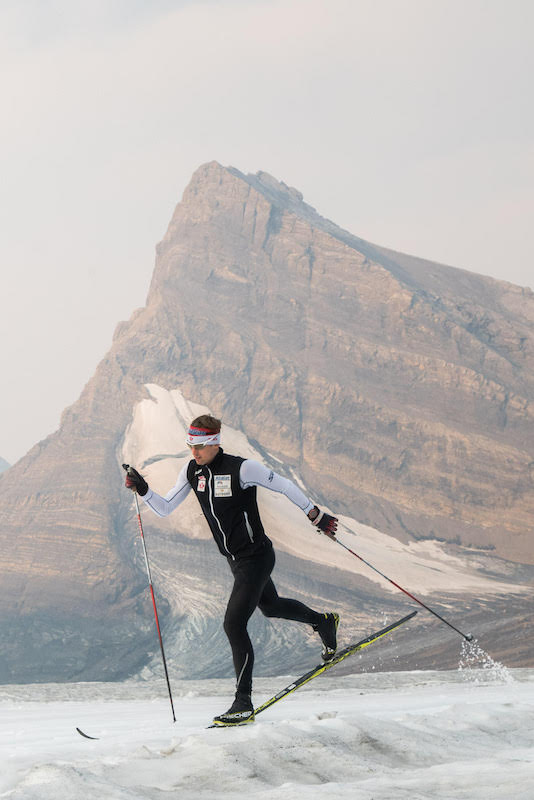
Julien Locke (Canadian U25 Team) training at a hazy Haig Glacier camp in August. (Photo: Anthony Killick)
While several fires continue to burn, the smoke cleared in Bend on Sept. 9. During much of August and into the beginning of September, Blackhorse-von Jess relied on a SkiErg, running treadmill and a stationary bike for much of his over-distance training.
He is not alone.
“Actually today, it was still dark when I woke up, but when the sun came up there was actually blue sky,” U.S. Ski Team member Liz Stephen said Friday from her home in Park City, Utah. “Where other days, you weren’t even sure the sun was up. It was really nasty.”
Like other elite skiers across the West, Stephen had made use of indoor training opportunities. The day before Stephen spoke to FasterSkier, she logged four hours on a ski treadmill at U.S. Ski and Snowboard’s Center of Excellence (COE) in Park City.
The AQI is also careful to note what are called “sensitive groups”. That can mean older adults, children, or people with lung or heart issues. Those populations must take precautions when high exertion exercise and poor air quality mix. Being responsible for junior athletes places a premium on being cautious.
For Leslie Hall, director of the Methow Valley Nordic Team in Washington state, dealing with smoke and subsequent air quality issues have been an on-and-off again affair.
“We had a bad two week period at the beginning of August and it was leading into our annual Methow PNSA [Pacific Northwest Ski Association] Camp … so we had to make the call to move the camp,” Hall wrote in an email. “We ended up going to Oakridge, Ore., for the camp and had a great camp there with 32 kids but a fire started nearby there while we were there so we had one moderately smoky day and it has since gotten much worse there.”
Like her athletic and coaching counterparts, Hall keeps an eye on air-quality websites to determine if a practice is indoors our out. But kids are kids.
“It is quite hard to keep the kids motivated and they do not enjoy the gym workouts,” Hall noted. “But during the early smoke time, we knew we were going to go somewhere else to train fairly soon so we kept that in mind. This past week was good because there are a variety of kids running and different coaches which help. Also, intensity workouts on the exercise machines help the time go by quicker. There is plenty of complaining and calls to move East, but I think all the kids realize that we are very fortunate in general and it is hard to complain when the hurricanes are decimating the south and we just have bad air for a week or so.”
Reports from Canada mirrored the smoke-filled experience of skiers in the Western part of the U.S.
Air Quality Health Index 5 in Vernon. BC (Photo: Gerry Furseth)Air Quality Health Index 1, Vernon, BC (Photo: Gerry Furseth)
Gareth Williams, a member of Canada’s national U25 Team and a native of Kelowna, B.C., wrote in an email that the smoke was a near-constant companion this summer.
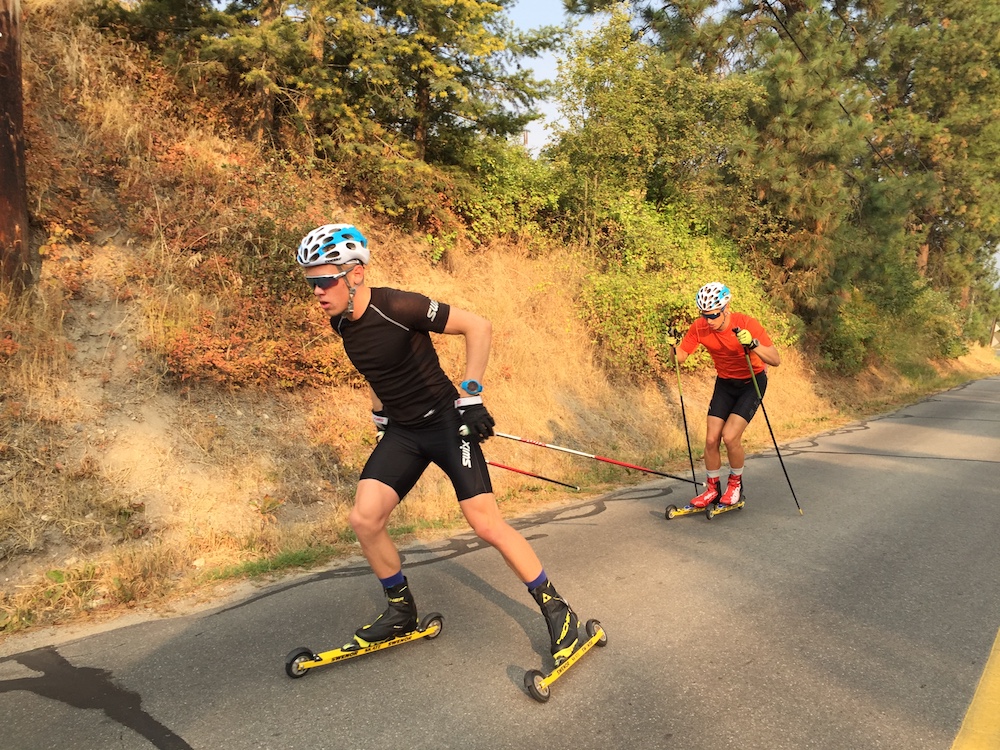
Gareth Williams (Canadian U25 Team) leads Fran Vukonic during an orange-tinted rollerski in Kelowna, B.C. (Courtesy photo)
“Summer has been great for me, I spent much of it on the Haig [glacier near Canmore, Alberta] in July,” Williams explained. “I’ve been in Kelowna the whole month of August and the smoke has yet to subside, it has actually gotten much worse recently. In past years the smoke has been bad, but I have never seen it like this. … I think the smoke isn’t as bad as some people have suggested, for me it’s not the greatest worry. I will be happy once it is gone though, getting a little tired of the orange lighting and not being able to see the sun!”
Michael Somppi, who trains with the Alberta World Cup Academy (AWCA) in Canmore, altered his plans depending on conditions.
“Personally, I haven’t found the breathing to be too bad,” Somppi wrote. “That said, I am avoiding doing any hard intensity efforts on smoky days. Today was the first day (in Kelowna) I was forced to alter my training plans, as I had planned to do a rollerski time trial, and instead opted to do zone 3 because of the smoke. Even breathing semi hard felt sketchy with how bad the air quality is at the moment.”
Another member of Canada’s U25 Team, Julien Locke has literally trained above the smoke on occasion.
“I’ve been lucky in that the smoke hasn’t been too thick during most of the important training blocks so far,” Locke wrote. “I was at the Haig Glacier 4 times this summer and while we had some hazy days, for the most part, 2400m elevation was high enough to have clear skies.”
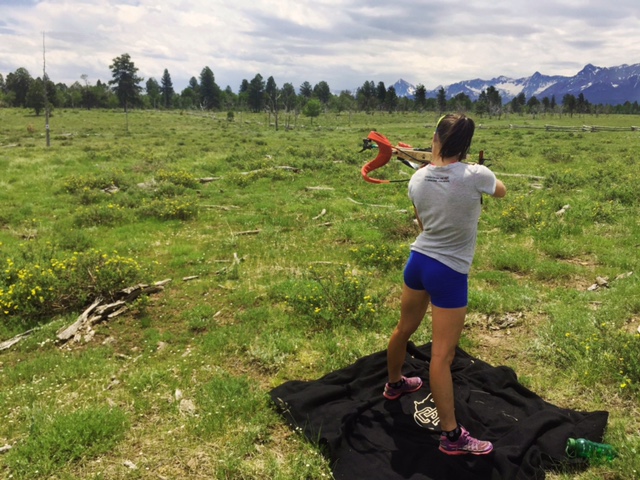
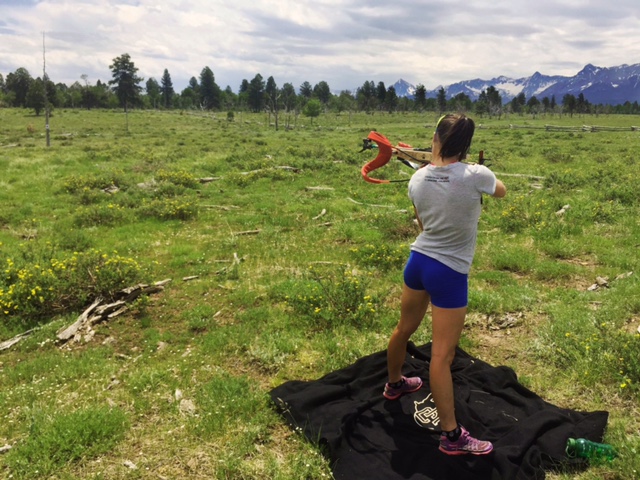
Joanne Reid proving that you don’t need an official biathlon range to train. (Courtesy photo)
Welcome to “17 Questions for 2017″, where we are catching up with American and Canadian national-team members before the beginning of the winter season.
***
Joanne Reid is certainly the newest newcomer in North America to have earned World Cup starts last season, representing the United States in Europe and Canada last season just six months after picking up the sport.
The CU Boulder graduate student had strong races all summer and fall at U.S. Biathlon rollerski trials and earned more World Cup starts for this season’s period one races. She most recently finished on the podium at the Frozen Thunder biathlon races in Canmore, Alberta.
1. Biggest change in your life in the last five or so months since the ski season ended?
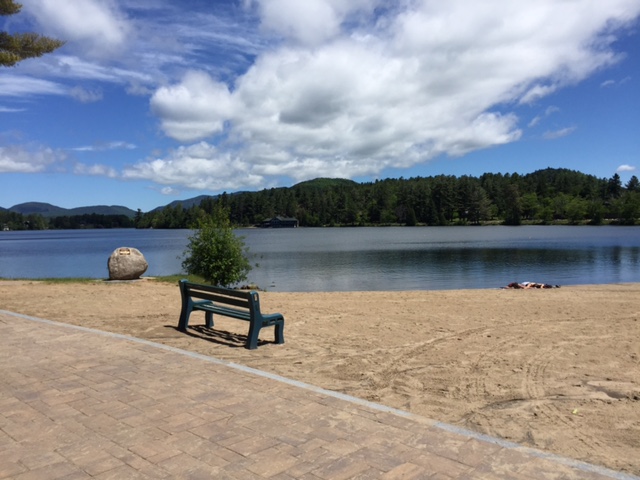
Mirror Lake, near Reid’s part-time home in Lake Placid, New York. (Courtesy photo)
My life has been one constantly shifting situation from the instant I picked up a biathlon rifle, so it’s hard to pick just one change. USBA gave me a resident room in Lake Placid starting in June, so I’ve been living and training there. Not full-time, since I’m still in graduate school, but a large chunk of time. It’s like sliding backwards on the life scale, right back to freshman-year dorm life. Roommates, hallway cameras, alcohol bans, dining hall, no overnight guests, the whole nine yards. I’m 24, and this is the first time in my life I’ve actually been treated like a potentially wild teenager (I graduated high school at 16 and opted out of the dorms when I arrived at University of Colorado). On the other hand, there’s something seriously incredible about living in a place with bonafide housekeeping that cleans your bathroom for you.
2. Biggest change in your training?
Structure. I’m not a person who plans or lives with a structured rhythm of life. I’m a very spontaneous and sometimes reckless person, and my training has always reflected that fluidity. It’s not necessarily a bad thing, I’m very in-tune with my own body and I know when I can push and when I shouldn’t, so I tend to rearrange workouts on the fly. My coach (Jean Paquet), has been trying to find a balance between the school-sport juggling act while also keeping me in a more defined training plan. To his credit, he has been able to rein me in and allow me the flexibility I need while I finish school, and also hasn’t had a aneurism from trying to deal with me. (Yet.)
I decided if I was going to go, I’d go all the way. If my coaches are going to put this much time into me, I owe them an effort back, so here’s things I’ve never done before that I’m trying out:
1) keeping training log
2) using a heart rate monitor
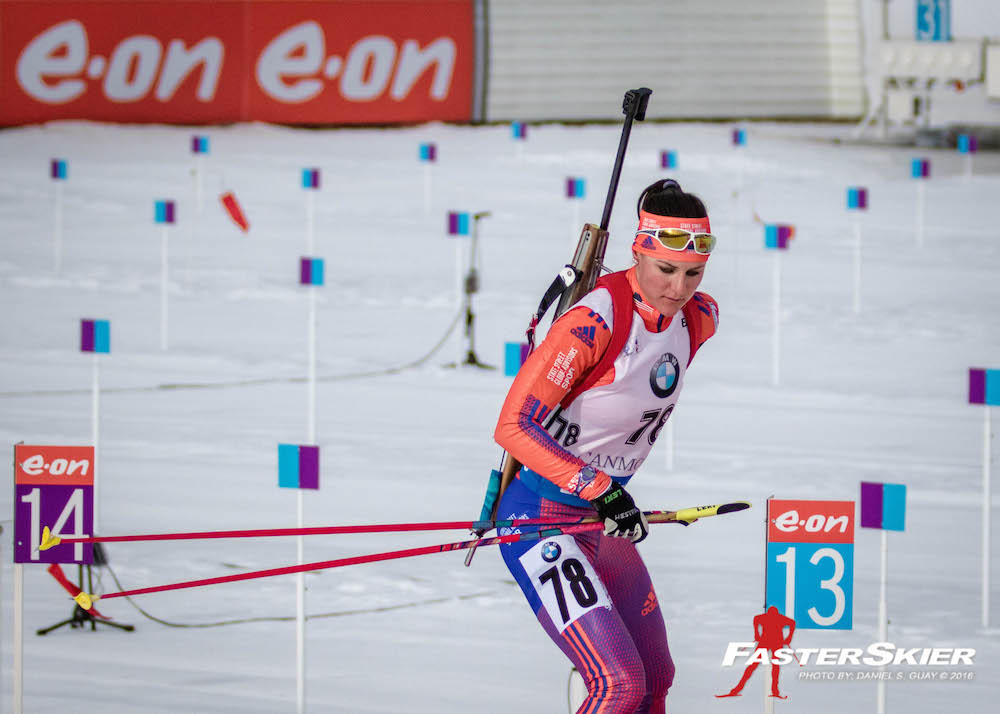
Joanne Reid representing the United States in the women’s 7.5 k sprint at the IBU World Cup in Canmore, Alberta. (Photo: Daniel S. Guay)
3) having technique that doesn’t look like a speedskater taught me to ski
4) hydrating… You want me to carry a rifle AND a drink belt?
5) recovery/actually addressing injuries instead of waiting for them to go away, like the ex-boyfriend you hope will stop texting you
6) not having to classic race, ever again (I’m really enjoying this 83% pole uproar over here)
7) keeping coaches (and USADA!) updated of my whereabouts, rather than wandering to a new city or state somewhat randomly
3. Major areas of improvement you’ve seen so far?
Jean and the USBA coaches have completely redesigned my ski technique. Because I’ve done so little technique work across the years (basically none, ever), I’ve had the same funky style forever. (Funky Style Forever would be a great name for a rock band). For instance, I came into Placid for the first time last October, and within the first three days found out my poles were an inch too short and had been since I stopped growing about eight years ago. I’ve been watering my race poles and keeping them in sunlight, but they haven’t grown any taller, so I think I’ll just have to get new poles for this coming season.
And then there’s that whole shooting thing. Since I only started a year ago, I still have a very steep upward trajectory. At the top, you can work for months and drop only a second off your range time. At my level, I can work for months and drop half a minute off of mine. But sometimes you hit things, sometimes you don’t. It’s all part of the ride. The CBC traditionally utilizes the “spray and pray” method when it comes to big races, so I just might make that my race motto.
4. Whom you’ve been working closest with this offseason (coaches or training partners)?
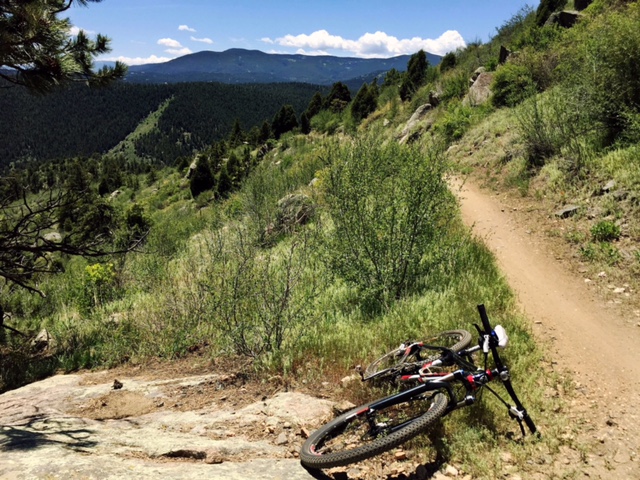
Mountain biking in Colorado. (Courtesy photo)
I’m lucky to have the coaches I do in US Biathlon, they’ve been incredibly patient with me and my long commute back and forth to school. When I’m home in Colorado, I’ve had some help from some of the BNS staff in trying to implement technique work that my Placid coaches have been teaching me. To have them on the same page and helping me focus on the right pieces has been a godsend. On the other hand, having those guys allied may have been the biggest mistake of my life. Big brother is always watching…..
Jennie Bender has been dabbling in biathlon, so it has also been really fun training with her in Placid sometimes. She has always been one of my biggest ski heroes, and is definitely a kindred spirit of mine.
5. Best trip in the last five months (and why)?
I got in my car and journeyed down to Santa Fe, southern Arizona, the Grand Canyon, and back across Colorado. I also drove my car from Colorado to Placid (yeah, that’s as long as it sounds), and I stopped to see my grandparents (and dog) in Madison along the way. I actually love to drive, and I love the heat (worst winter athlete ever), so I had a great time.
The best trip was NOT when I got stuck in the Chicago airport during the great Southwest server meltdown of summer 2016. I’m actually surprised I’m not still stuck there.
6. Favorite cross-training?
Grand Canyon, Arizona. (Courtesy photo)
Mountain biking, rollerblading, speedskating drills. I have actually done intervals with all three of these training mediums.
7. Favorite non-athletic activity or pastime this summer?
I stood in one place and played a lot of corn-hole.
Don’t be ridiculous. Why would you do that? You only get one life. I ran around with my nerdy engineering friends chasing Pokemon on bicycles (yeah, I said it), brewery hopped at some incredible Colorado microbreweries, climbed some of the mountains in the Rockies, went on spontaneous road trips with my mountain bike and rifle into the Wild West, went to a rodeo, visited the home of a CU astronaut where I also shot an AR-15 (does that count as training?), jumped in Boulder Creek, drove across the country, body surfed in the Pacific. All of those things were my favorite thing to do in that moment, so I did them.
8. Song that was your jam this summer?
Heart’s Desire, Kip Moore (**country alert**) and On the Turning Away, Pink Floyd.
9. All time favorite race moment?
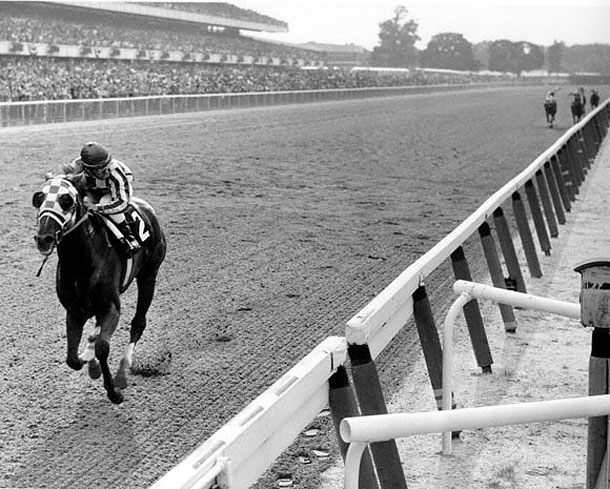
1973, when Secretariat won the triple crown, immortalizing himself as the greatest racehorse of all time and shattering the course record (he holds all three records to this day, in fact: the Derby, the Preakness, and the Belmont stakes).
10. First thing you pack in your bag when you leave for Europe?
My rifle? Oh wait, I put that in the box. Skis in the bag, rifle in the box. You think packing for nordic is hard? Trying cramming all your stuff for three months into a rifle case that, you know, already has a rifle in it.
Other than that, my bag is usually about 30% socks. I love socks, especially the bike socks that come in the crazy designs. I also way overdo down jackets and vests because I don’t do cold well, but I have mastered the art of the rifle on the back, down jacket on backwards technique. Don’t tell me I don’t look cool wearing my down jacket backwards, because I know I do, and the hood keeps my nose warm.
11. Venue/event you’re most excited to visit this season?
The warmest, sunniest one. (Can you tell I grew up in California?)
12. Who will win the World Cup title this year?
Honestly, I follow the NFL (go Seahawks!) much more closely than I follow biathlon or nordic. Fourcade is always a good bet. Just as long as he doesn’t put on the wrong lip balm.
13. Biggest sacrifice you feel you’ve made choosing this career path?
Travel. Travel is ouch. Did you know Susan Dunklee hasn’t been in one place longer than fourteen days for the past four years? Can’t say I’m that extreme, but sometimes it feels like it.
I was stopped at the Canadian border the other day and border control asked me where I live. I was genuinely flummoxed. For the next five minutes, I proceeded to make border control my personal shrink, while I explained the woes of the transient and vaguely homeless, whilst the line of cars grew and grew behind me. I think this was really aided by my Californian license plate.
14. If you could change one thing about your sport, what would it be?
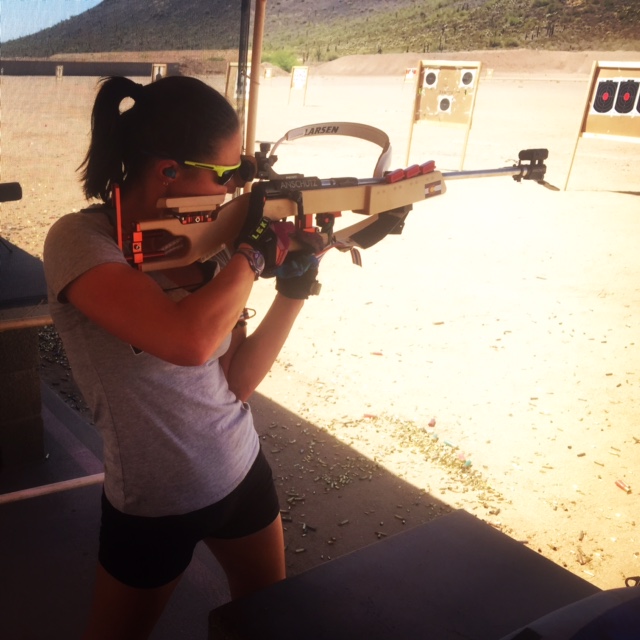
For now though, real rifles. Reid training at Cave Creek, Arizona, the largest outdoor shooting range in the United States. (Courtesy photo)
I would be a huge fan of switching to laser rifles, just because flying with a firearm that shoots live rounds is such an enormous pain in the ….. Arm.
15. What did you have for breakfast this morning?
I’m not really good at breakfast. Usually I roll out of bed five minutes before training, cramming a power bar in my face while I shove on my ski boots with a bleary-eyed, dazed expression. If I’m home in Boulder I don’t usually wake up before 10 or 11, so waking up for an 8am practice AND having time to eat when I shift to the Eastern time zone is an impossible task for me. Morning people…. Morning people are freaks.
I didn’t have coffee. I actually had to give up caffeine when I switched to biathlon, because it makes me shake. I know, cry for me.
16. In 5 years, I’ll be ____?
In the mountains somewhere, smiling at the sky. It’s actually pretty rare for me to know what I’m doing next month, let alone five years from now.
17. In 50 years, I’ll be ____?
Drinking all the coffee I want, doing something completely unrelated to skiing or biathlon, probably residing in a desert in the southwest.
Hannah Halvorsen (foreground) attacking the rollerski track at Soldier Hollow. (Photo: Bryan Fish)
Welcome to “17 Questions for 2017″, where we are catching up with American and Canadian national-team members before the beginning of the winter season.
***
Last season, Sugar Bowl Academy’s Hannah Halvorsen snagged her first SuperTour podium – before heading back to the junior ranks to win a U18 race at U.S. National Championships, a title at Junior National Championships, and represent the United States at the Youth Olympic Games in Lillehammer, Norway.
The California cross-country skier also ended up with her first U.S. Ski Team nomination. Now 18 years old, Halvorsen has been making the most of her first training season without school.
1. Biggest change in your life in the last five or so months since the ski season ended?
The biggest change in my life since ski season ended has been adjusting to a slightly different lifestyle as a post graduate skier. I still train with Sugar Bowl Academy but now I don’t have to work around a school schedule.
2. Biggest change in your training?
This year not being in school has allowed me to drive down to low elevation training about twice a week.
3. Major areas of improvement you’ve seen so far?
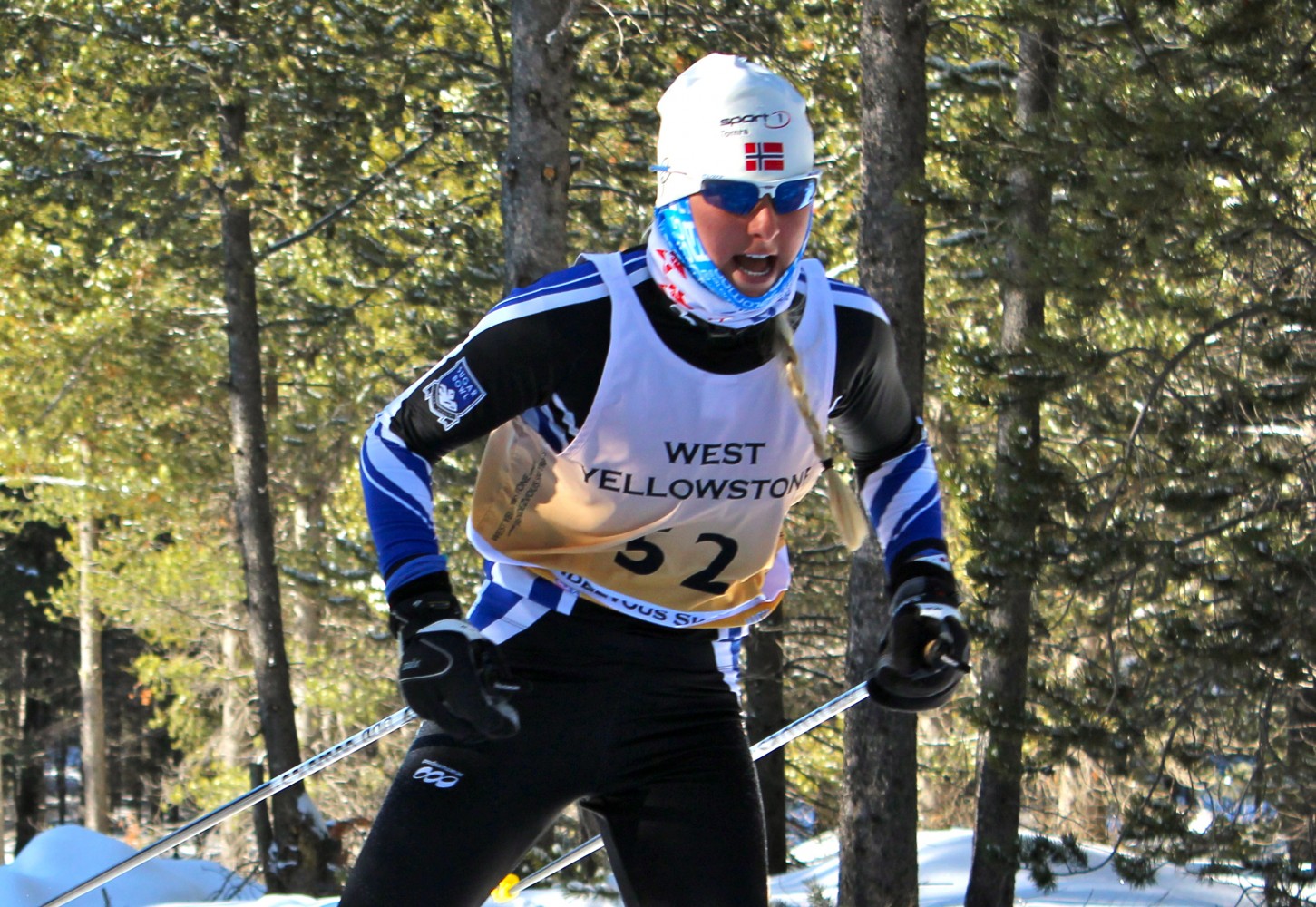
Hannah Halvorsen (Sugar Bowl Academy) racing to third during qualifying for the women’s SuperTour 1.3 k freestyle sprint in November 2015 in West Yellowstone, Mont. Halvorsen went on to edge out AWCA’s Dahria Beatty for second place overall, 4.31 seconds behind race winner, Jennie Bender.
I’ve been excited about my improvements in v1 technique and running foot speed.
4. Whom you’ve been working closest with this offseason (coaches or training partners)?
I have been working with the Sugar Bowl Academy skiers and coaches, and have also had the opportunity to train with TXC Coach Eliska Hajek Albrigtsen.
5. Best trip in the last five months (and why)?
I had the opportunity to train out in Stratton with the SMS team in August, which was a great opportunity to train at low elevation and be pushed by really fast skiers.
6. Favorite cross-training?
My favorite cross training is mountain biking.
7. Favorite non-athletic activity or pastime this summer?
This summer when I was resting I did a lot of painting, reading, and watching Seinfeld.
8. Song that was your jam this summer?
Love Yourself by Justin Bieber.
9. All time favorite race moment?
Halvorsen (right) and U.S. Ski Team teammate Julia Kern taking off on some ski bounding in Park City this summer. (Photo: Bryan Fish)
Racing in the Scando cup in Sweden two winters ago and realizing, “the training I’ve done is working really well!”
10. First thing you pack in your bag when you leave for Europe?
My stuffed animal Bunny.
11. Venue/event you’re most excited to visit this season?
I am excited to have a Super Tour in my own town this January at Auburn Ski Club.
12. Who will win the World Cup title this year?
Jessie Diggins.
13. Biggest sacrifice you feel you’ve made choosing this career path?
The biggest sacrifices I have made have been social. Instead of giving time to my friends and family, it often goes towards training or even simply resting so I am ready to train again.
14. If you could change one thing about your sport, what would it be?
I think it would be awesome if being a skier didn’t cost money.
2016 AXCS National Masters Coming To Royal Gorge March 19-20
With several feet of recent fresh snowfall to replenish the trails, the world-famous Royal Gorge ski resort is ready and waiting for master skiers from across the USA to visit for the 2016 National Masters coming up March 19-20.
Racing will start off on Saturday, March 19 with a 10km classic race. Skiers will start in various waves based on age category registration. An open 5km is also offered for juniors and adults not interested in the full 10km distance. Current plans are for the classic race to begin at 8am, but that time may be adjusted to allow for additional kick wax testing if temperatures and snow conditions permit.
Then on Sunday, March 20 the NM2016 will wrap-up with the California Gold Rush taking center stage offering 42km, 28km (Silver Rush) and 14km (Bronze Rush) freestyle races. A new 14km course will be used for 2016 with all races starting at the Summit Station trailhead beginning at 8am.
As is traditionally the case at the AXCS National Masters, skiers are welcome to enter any distance race they wish, but only the official distances designated for each masters age category will count towards points for the 2016 U.S. Masters Team presented by Podiumwear and also the honorary NM2016 official podium.
AXCS National Director J.D. Downing is excited for the NM2016 to be returning to the Far West. “It’s been a long time since we’ve had the National Masters in California, the last time was in 2002 so this is a really special opportunity for skiers across the nation. The recent snowfall has bolstered the snowpack quite a bit so we are looking for great conditions March 19-10. Hopefully a bunch of skiers from places that haven’t enjoyed the best winter will consider hopping on a plane to come join the fun!”
Royal Gorge Event Director David Eastwood adds, “Royal Gorge XC is very proud to host the NM2016 Classic and Marathon races. We believe our varied terrain, sunny weather and enjoyable spring skiing conditions will challenge the athletes and provide great competitive racing!”
Registration for all events is available at RoyalGorge.com with links and supplemental NM2016 info also available on xcskiworld.com.
The Far West Elite Team, a post-collegiate senior team based in Truckee, Calif., is looking to support six athletes for the 2015-16 season. Our goal is to develop post-collegiate skiers towards being named to the U.S. Ski Team. The primary focus of the team is the USSA Supertour race series. The large collegiate summer training program, run by Martin Benes, in Truckee makes for excellent summer training. Team members receive funding to offset race, travel, and living expenses as well as additional support within the Tahoe region.
The team is currently working to iron out specific funding details and an exact dollar amount to be offered to each 2015-2016 athlete. Applications will officially open later this spring. In the meantime, any interested parties are encouraged to contact us to learn more about how the team works and functions throughout the year.
Athletes climb to the high point of the prologue course at the Auburn Ski Club during training on Wednesday.
FasterSkier’s coverage of SuperTour Finals and U.S. Distance Nationals is brought to you by the generous support of Concept2, the leading manufacturer of indoor rowers, racing oars, and the SkiErg.
TRUCKEE, Calif. — When skiers think of northern California, they think of the sun, deep snowpack, forested trails, and long, ridge-line ski routes. Unusual weather led to smaller snow banks than usual this April, but the hundreds of athletes and coaches in town for the 2013 SuperTour Finals and U.S. Distance Nationals will nonetheless be getting their racing’s worth starting on Thursday.
Truckee’s reputation for spring skiing precedes it. This year it’s drawn skiers to the race series from as far away as Sweden, Switzerland and Norway.
“Four girls from Sweden decided to come here to race, like an adventure,” said Hanna Falk, a Swede with a handful World Cup starts this season. “We’re really happy to be here. This is the first time in the U.S. for me, ever.”
“We heard that this venue was one of the best in the U.S., so we wanted to come,” added fellow Lisa Larsen, a member of Sweden’s 2013 World Championship squad. “We talked with Kikkan [Randall] and Jessie [Diggins] and they said, ‘You must come to California!’ So we decided late to come.”
The foreigners add an extra level of excitement and competition to this edition of SuperTour Finals. In addition to the Europeans, a handful of Canadians are on the start lists, as is the regular domestic field, and handful of dedicated college and junior skiers, most of the US Ski Team back from the World Cup and a few biathletes.
“This is a nice opportunity to ski and have fun and be in the sun,” said Annelies Cook of the U.S. Biathlon team and Maine Winter Sports Center. “And I don’t get to classic race ever. Last year was the last time I classic skied and I loved it, so it was just kind of fun to see what happened. I never go hard but I still love it.”
For the athletes, the plethora of SuperTour points up for grabs in each race make the stakes high for skiers currently in contention for the lead. But most everyone is looking forward to five relatively laid-back races in between catching up with friends and enjoying California. Some were perhaps hoping for a bit more snow on the backcountry trails, though — like the course at Tahoe Donner Cross Country, where three races were supposed to take place this week, the usually snow-abundant routes along the mountain ridges are pretty bare this year.
“I was hoping to take people on some of the sweet trails they have here up high,” said Truckee native Matt Gelso (Sun Valley Ski Education Foundation).
“But this is nice,” he added, indicating the snow around him at the Auburn Ski Club, where Thursday’s prologue will take place. “It’s nice being in Truckee, I like the trails here, I like the setup, I like the spring corn wet skiing.”
Precipitation is in the forecast this week, but the warmth and blue skies on Wednesday before the first race contributed to a relaxed atmosphere in the stadium.
“It’s hard to get worked up at this point in the season,” said Alaska Pacific University’s Rosie Brennan, who currently leads the women’s SuperTour. “With double SuperTour points, there’s quite a bit riding on [these races]… but at this point in the season everyone’s just tired. Racing in the West is my favorite thing, so I just enjoy it.”
Brennan primarily wants to keep her spot on the list in order to get back to Europe for World Cups next fall.
“I just want to make it through all the races and keep the SuperTour lead,” she said. “So I don’t really care which race goes well as long as a couple of them do!”
The first step towards that goal is the first race of the series on Thursday, a 3.3 k prologue. Though it’s short, there are just as many points awarded for winning it as there are in the longer events. The course on tap is being described as deceptively challenging. There is nothing illusory about the steepness of the focal point, an A-climb that was built in the last few days specifically for this race, but before and after it there are rolling transitions that will force skiers to stay on their toes where they might not expect it.
“I’ve never raced this course,” Gelso said. “The climb is new — they put that in a few days ago and this is the third iteration of it. It’s pretty serious. It’s long and steep at the top. You can’t blow it out otherwise you could really not have a good race.”
The venue sits just over 7,000 feet above sea level, which is good news for athletes who are used to the height at not so good for the unacclimated.
“I’m excited,” said Sylvan Ellefson of Ski & Snowboard Club Vail/Team HomeGrown. “I haven’t race here since JOs in 2005, and back then the hills certainly seemed a lot bigger than they do now. The A-climb that they just put in is serious and it’s tough and I think it’ll definitely weed out the boys from the men. … All the hay’s in the barn, so whatever hay is there will hopefully be enough to finish up the season.”
There are a few notable absences in both the men’s and women’s fields this week. Noah Hoffman (SSCV/USST) just had surgery on his shoulder and is recovering at home in Colorado. Last year’s prologue winner, Simi Hamilton (SVSEF/USST), is having tonsil and sinus surgery next week and decided to skip the series. Holly Brooks (APU/USST) went home to rest after a tiring season in order to be ready for the national team’s first training camp in May.
The rest of the SuperTour regulars and USST members are in Truckee, however, and are ready to race.
On the women’s side, the hilly prologue course should be right up Kikkan Randall’s alley. The World Champion and two-time World Cup sprint champion improved her prologue skiing at the end of this season and Thursday’s contest will most certainly be hers to lose.
“I’m feeling pretty psyched,” Randall said. “It is so great to be back in the USA and good to be skiing in the sun and to see everybody.”
As for the course?
“It’s going to be fun,” she said. “It’s deceptively hard. You’ve got the big climb but still a lot of skiing after that and not a lot of rest. And being at altitude, it’s going to be a good challenge.”
Randall’s teammate was of the same mind.
“It’s going to make us work,” said Sadie Bjornsen. “It has a lot of hills which at least keeps you awake and working, but there’s also mysterious places where you forget to work, like at the top of the hill where it keeps climbing but at a gradual rate.”
When it comes time to put on a race bib on Thursday, athletes will ultimately be doing all they always do — going out to see what they’re capable of.
“It’s fun to go into a race series and not have any specific goals, but more just see what we can do with what we have,” Bjornsen said. “If you do well then it’s super exciting, of course. But you know, it’s more fun to see what we can make of it.”
FasterSkier’s coverage of SuperTour Finals and U.S. Distance Nationals is brought to you by the generous support of Concept2, the leading manufacturer of indoor rowers, racing oars, and the SkiErg.
Athletes climb to the high point of the prologue course at the Auburn Ski Club.
Part of the prologue A-climb.
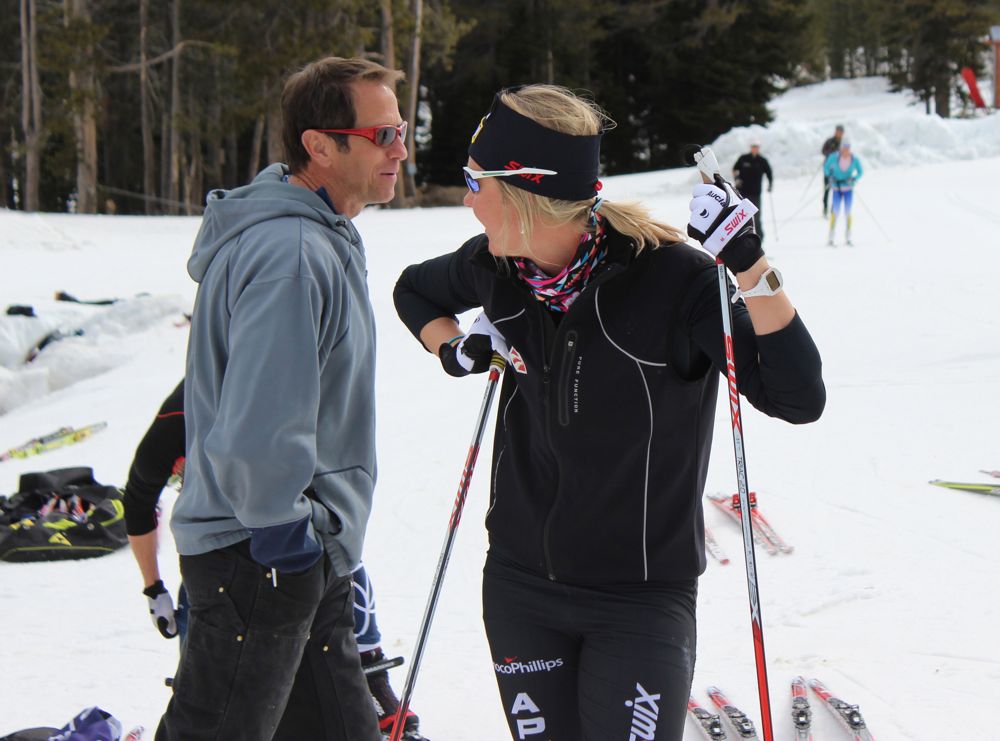
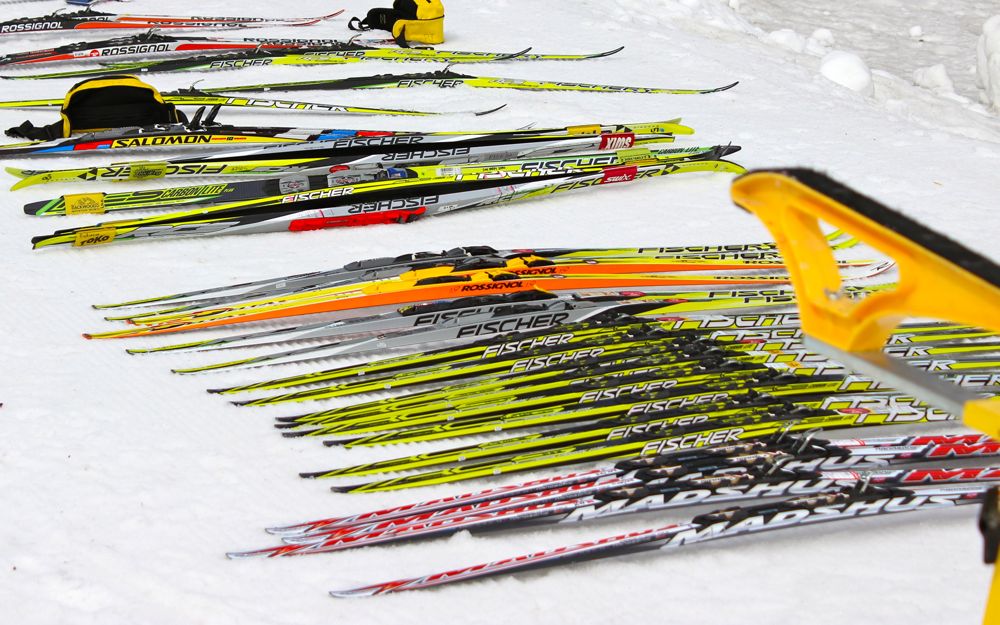
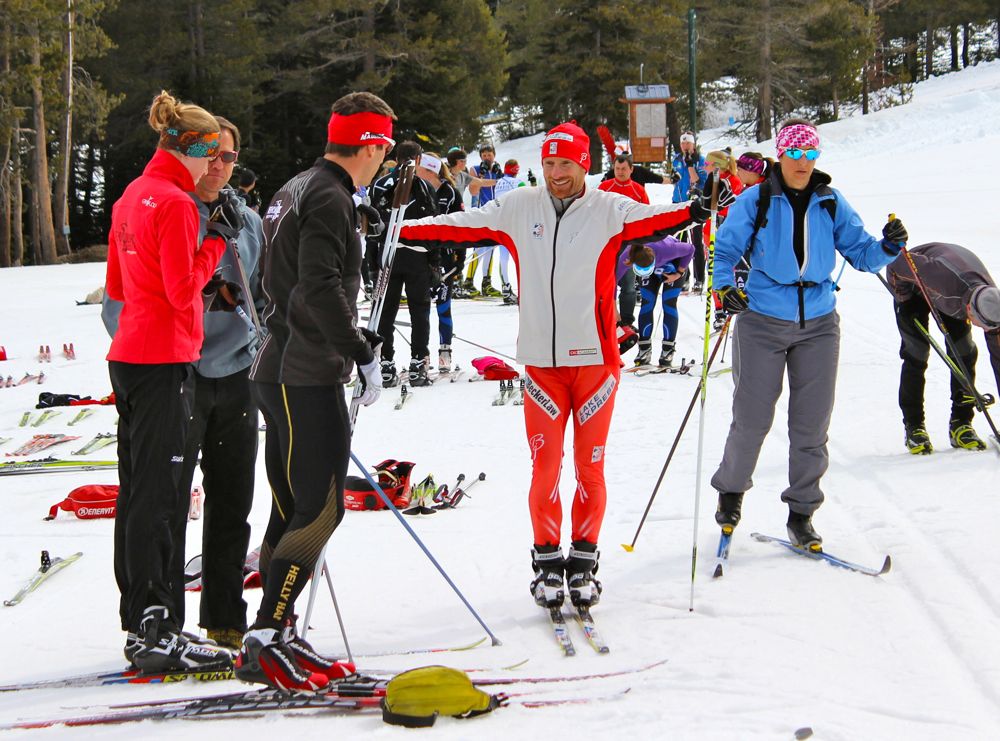
In the stadium, skiers congregate to test skis and catch up with friends.
Far West skiers check out the scene on their home course.
Temperatures reached the 50’s by mid-day.
University of Utah’s Miles Havlick and Sun Valley’s Mike Sinnott.
The Methow Olympic Development Project gets ready.
The Far West squad.
APU’s Sadie Bjornsen and MOD coach Scott Johnston.
Skis await testing.
Central Cross Country’s Brian Gregg.
APU confers in the stadium.
CXC’s Jennie Bender previews the course.
APU’s Kikkan Randall.
SuperTour Finals Training Day
SuperTour Finals Training Day
Switzerland’s Bettina Gruber gets ready for training.
Canadian athletes made the trip down for SuperTour Finals.
SuperTour Finals Training Day
Craftsbury Green Racing Project’s Dylan McGuffin.
Sweden’s Hanna Falk and Maria Graefnings.
Truckee native Matt Gelso (SVSEF) talks with his wax tech.
Maine Winter Sports Center’s Kris Freeman.
University of Utah’s Parker Tyler with biathlete and UU alum Annelies Cook.
Team Sweden.
TRUCKEE, Calif. — SuperTour Finals, the last racing push before the offseason, begins on Thursday with a 3.3 k freestyle prologue at the Auburn Ski Club. Though there isn’t enough snow to host the race at Tahoe Donner Cross Country, there is plenty to go around at the backup course. Professional, junior and college athletes from all over the country were out training and testing skis on Wednesday morning to dial in their game plans before the races series gets underway at 9:00 a.m. Thursday.
Craftsbury Green Racing Project skiers training at Royal Gorge this week in preparation for SuperTour Finals. Photo: Mark Nadell, Macbeth Graphics.
If it wasn’t already official, it is now: if you want to host a major cross-country ski championship in the United States, you’d best have a contingency plan for worst-case snow scenarios. The area around Lake Tahoe, Calif., usually one of the best places to go spring skiing in the country, just recorded its driest January through March on record. Race organizers for the 2013 SuperTour Finals and Distance Nationals, faced with insufficient snowpack on the newly-homologated championships courses at Tahoe Donner Cross Country Ski Center this week, were recently forced to move three races to higher ground. The 30/50 k was moved to Royal Gorge Cross Country Ski Resort and the freestyle prologue and 10/15 k classic will take place at Auburn Ski Club.
“[The original course] has melted out, particularly in the stadium and a couple key parts of the trails,” said chief of competition August Teague on Monday afternoon. “We spent two weeks really trying to find snow and really make it work and it just wasn’t… We ran out of snow where we were planning on racing, and Royal Gorge stepped up.”
The freestyle prologue, 10/15 k classic and classic sprint will now all take place at Auburn Ski Club and the hill climb will remain at Sugar Bowl Resort. The entire series was set up to be a tour that showcased ski areas in northern California, so the decision to cut Tahoe Donner from the lineup was a tough one for organizers. Homologation improvements were made to the trail system in preparation for the championships, but given the limited snow cover it was either move the races or shrink the original loop from 10 k to a few kilometers — not an ideal way to race a marathon, as athletes learned in Craftsbury, Vt., last year.
“It’s really unfortunate that we’re not able to showcase those trails, because there was a lot of time and energy spent to make sure they were championship- and Olympic-caliber courses,” Teague said.
Though the backup 10 k course at Royal Gorge is not fully homologated nor as wide as Teague would have liked, volunteers have worked overtime since the venue changes became official to make the reserve courses as good as they can be. A new section of trail was built up out of snow in the last three days to make sure the distance nationals course includes an challenging ascent of A-climb caliber.
Now that the backup plan is in place, Teague thinks Royal Gorge has plenty of snow. The biggest remaining challenge for organizers is the threat of runoff from underneath. Teague estimates the new course still has a half-meter to a meter of snowpack on north-facing aspects and predicts they’ll have to divert drainage away from the trails to minimize melting from below. Rain and temperatures in the 60s are forecast this week.
The organizing committee planned for the possibility of a low snow year, but the driest winter on record was an unusual curveball. Average snowfall over the last 30 years for Tahoe City between January an March has been about 16 inches. On Monday, the region officially tallied a whopping low point of 2.68 inches of precipitation for the same time frame.
“We had backup plans in mind, but we never thought we’d have to go to them because an average snow year would have been fine, even last year would have been fine,” Teague said. “Things are changing whether people want to admit or not.”
In the days before the race, the weather has been variable — Auburn Ski Club received a dusting of new snow on Monday morning. But despite the snow woes, the best skiers in the country have been showing up in Truckee over the past week to get ready for the upcoming series and to finish off the season. There are valuable Continental Cup points to be had in Truckee in the jockey for World Cup start rights next fall, and as long as there are races the field will show up to compete. At Teague’s last check, 175 athletes had signed up, including several international names from Sweden, Switzerland and Norway. Lisa Larsen (SWE), Maria Graefnings (SWE), Hanna Falk (SWE) and Bettina Gruber (SUI) are among the entrants, as is most of the U.S. Ski Team athletes that were racing on the World Cup all winter.
Petter Northug, Jr. (NOR), was almost among the list of entrants as well. According to Teague, the 2013 World Cup champion had been seriously considering a trip Truckee to log a high-altitude training and racing block away from the spotlight, but race obligations in Norway ultimately kept him at home.
“He really wanted to come and train at altitude, but unfortunately Norwegian championships [in Løten] was the same week and there was a lot of pressure from the Norwegians that he partake in that,” Teague said.
2013 SuperTour Finals begin on Thursday with a 3.3 k freestyle prologue at Auburn Ski Club.