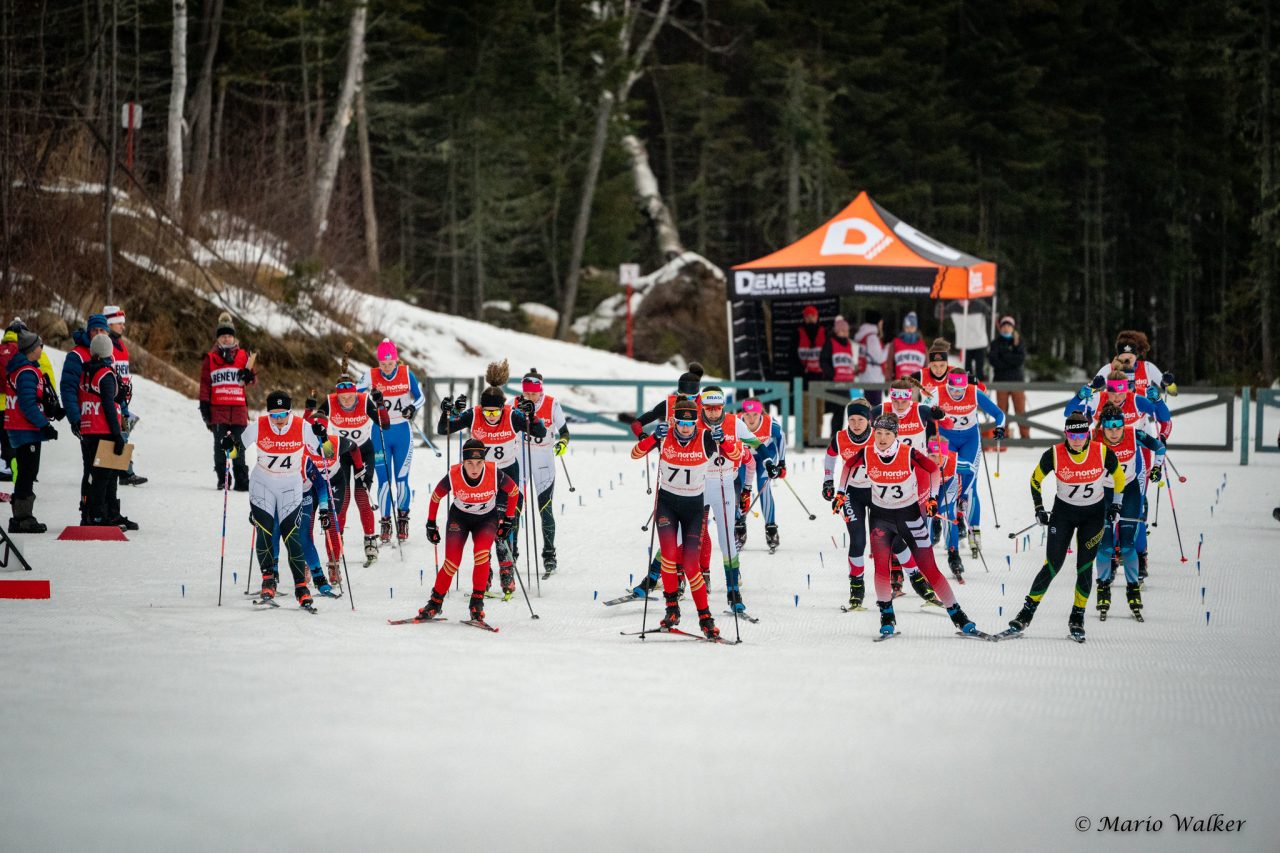
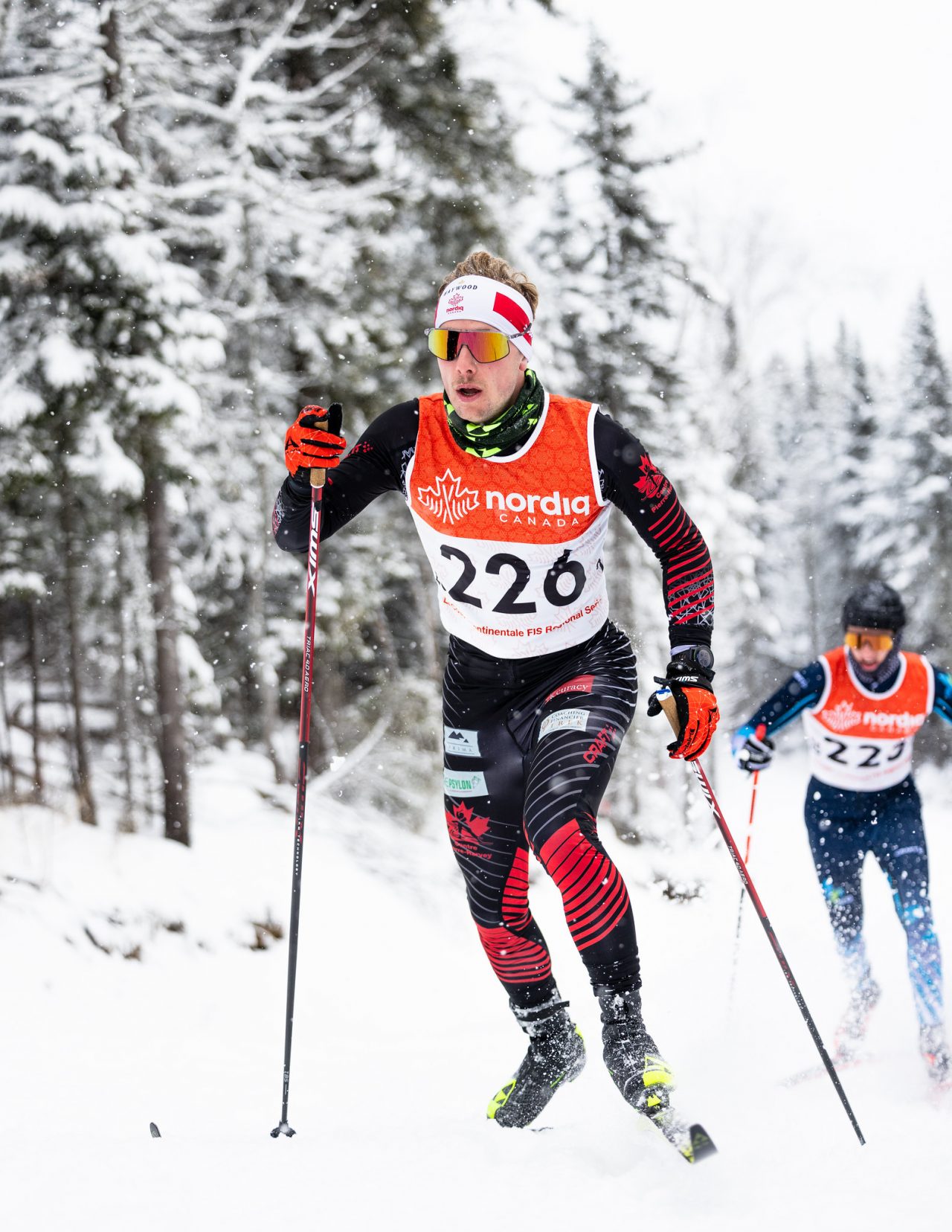
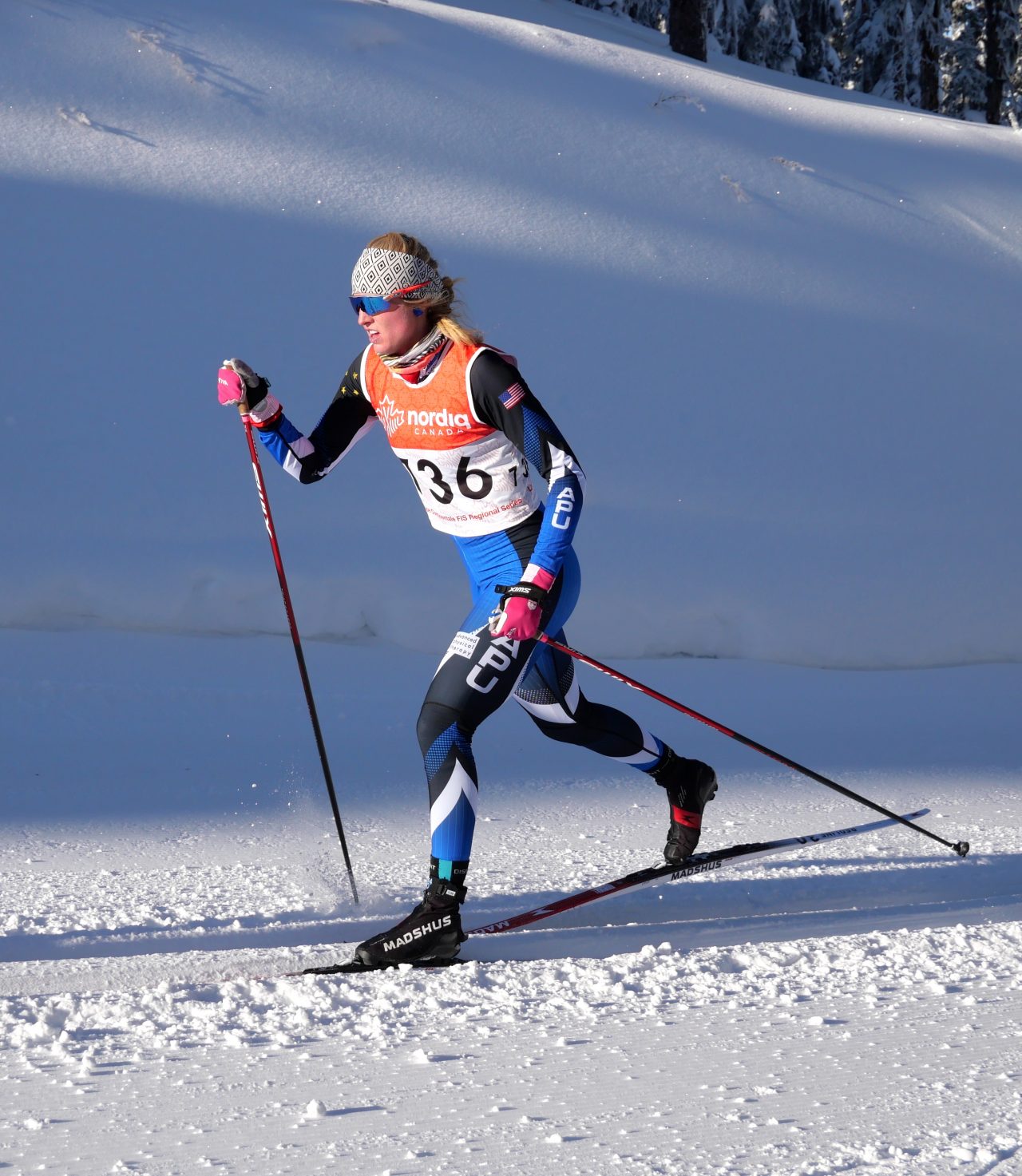
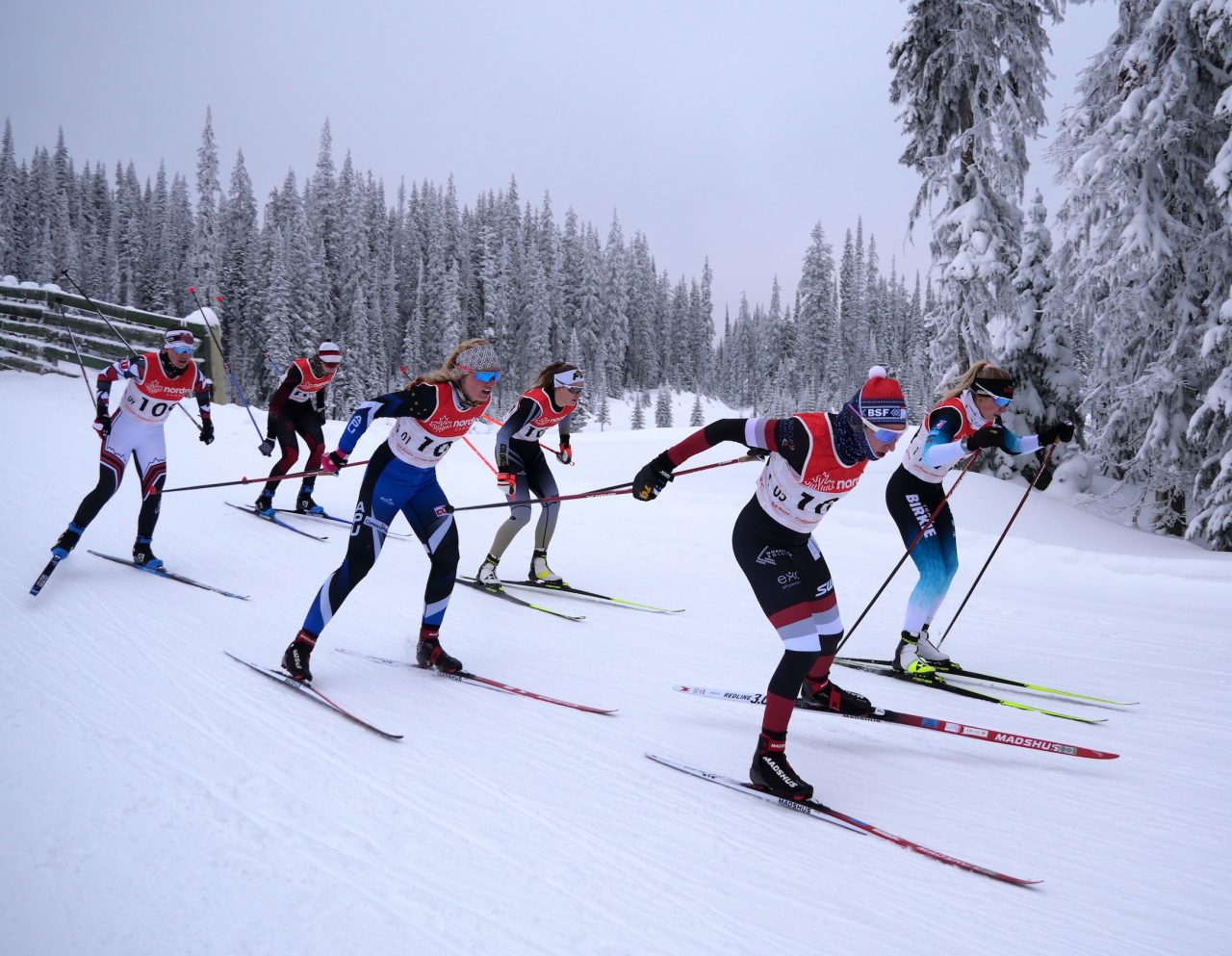
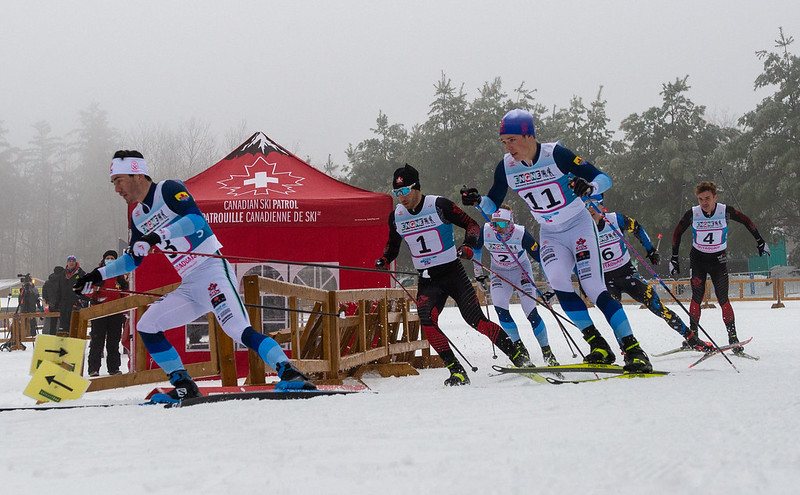
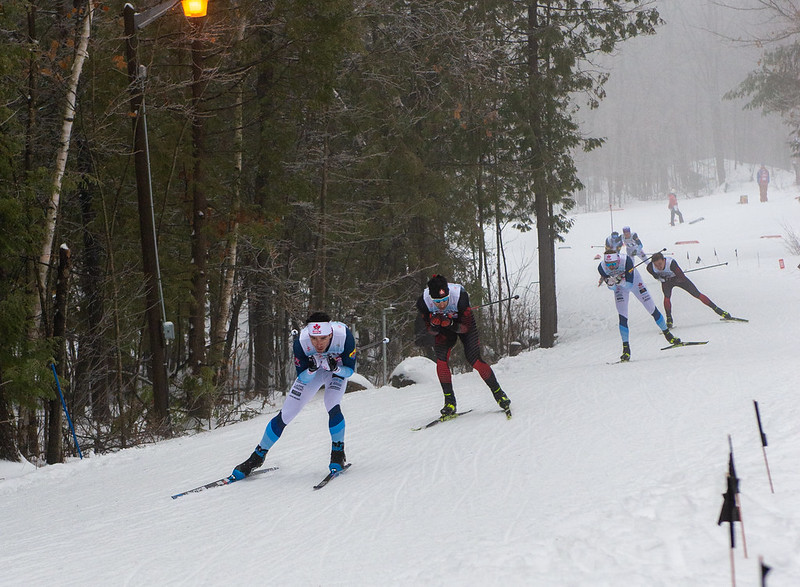
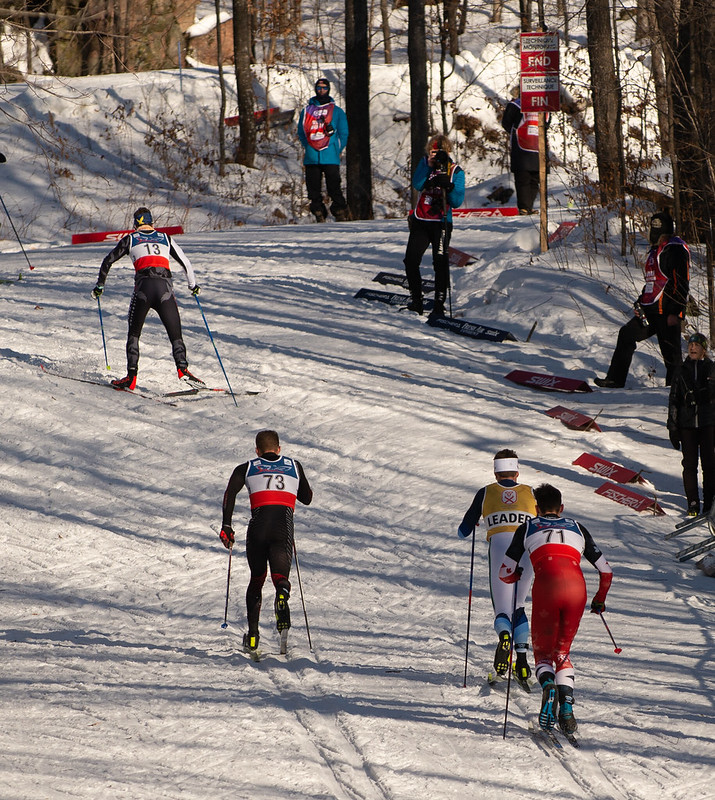
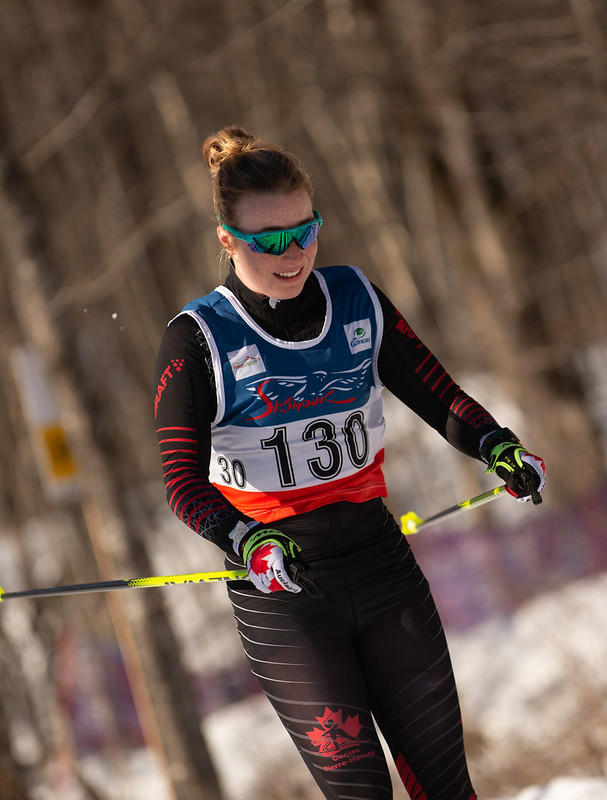
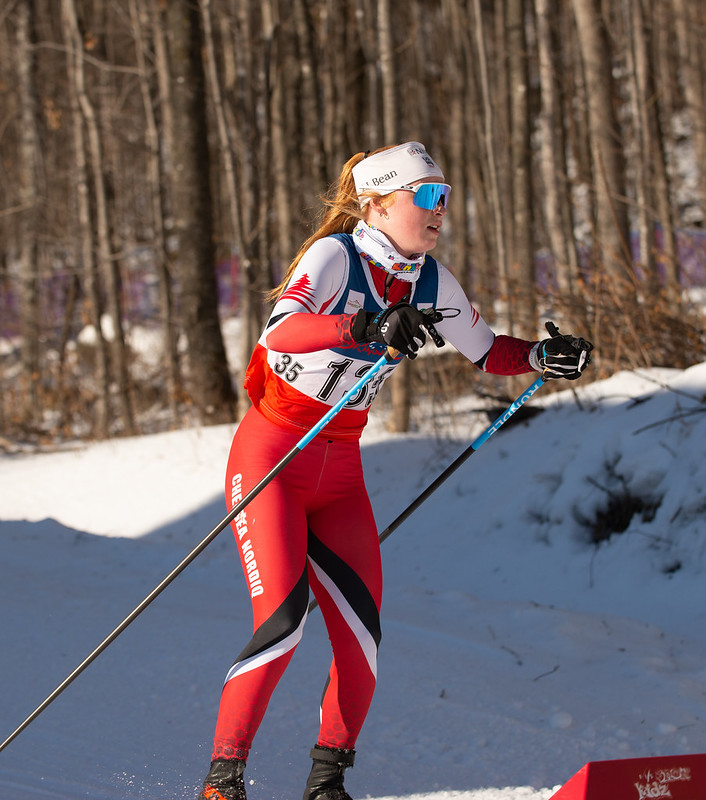
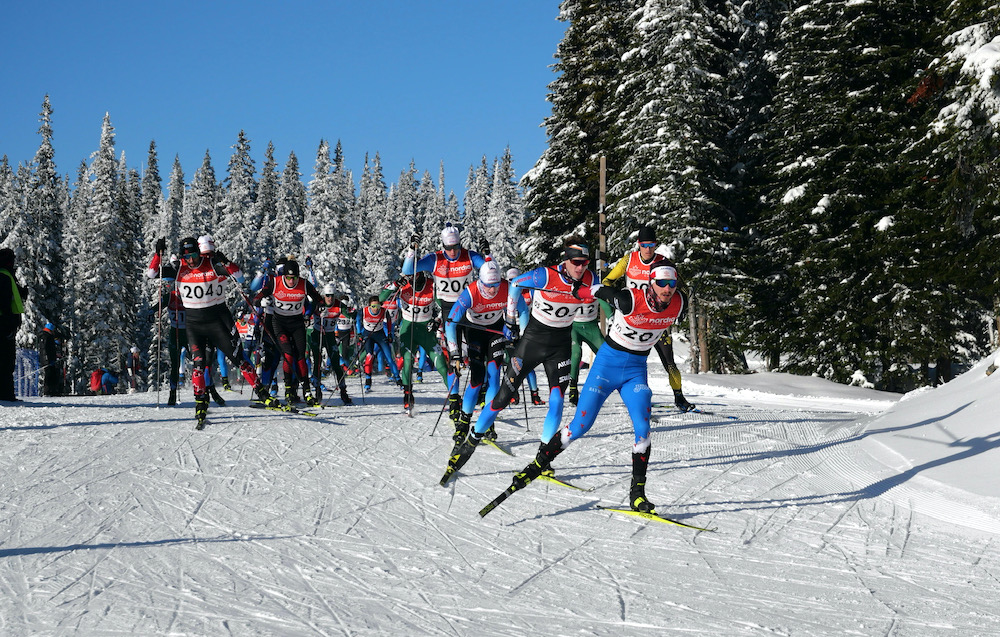
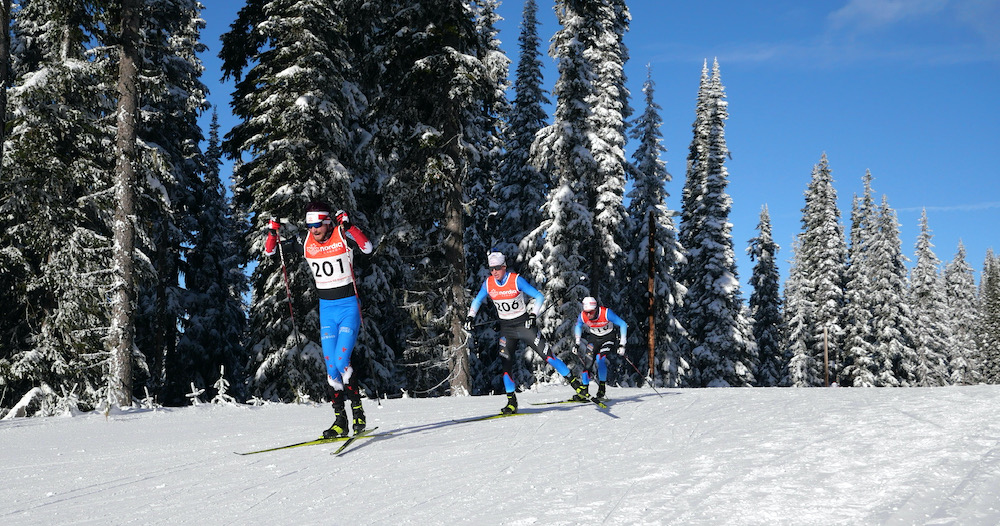
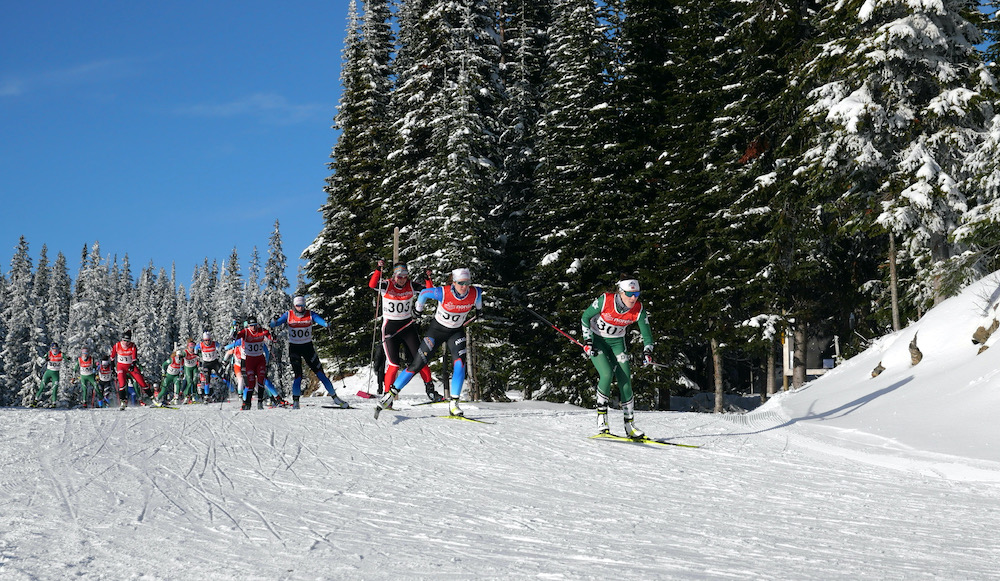
The women start at Mont Sainte Anne. This is the first mass start 20km for most of the field. (Photo: Mario Walker)
Mont Sainte Anne (MSA) held the final pre-Christmas races in Canada over the weekend, with a 20km freestyle mass start Friday, freestyle sprints on Saturday, and 10km individual start classic on Sunday.
Fresh snow, steep hills, and temperatures comfortably below freezing greeted 400+ racers at a continental cup hosted by Skibec, Centre National d’Entraïnemente Pierre Harvey (CNEPH) , and Club Nordique MSA.
MSA is a popular racing destination, as Nakkertok’s Bronwyn Williams explained: “I love racing at MSA because the trails are amazingly challenging! For some other race courses you need to work hard to bury yourself but at MSA the courses go out of their way to destroy you and if you’re not careful they will. That’s what makes it so fun though because you are not just racing your competitors, but you are also trying to survive the courses.”
Friday
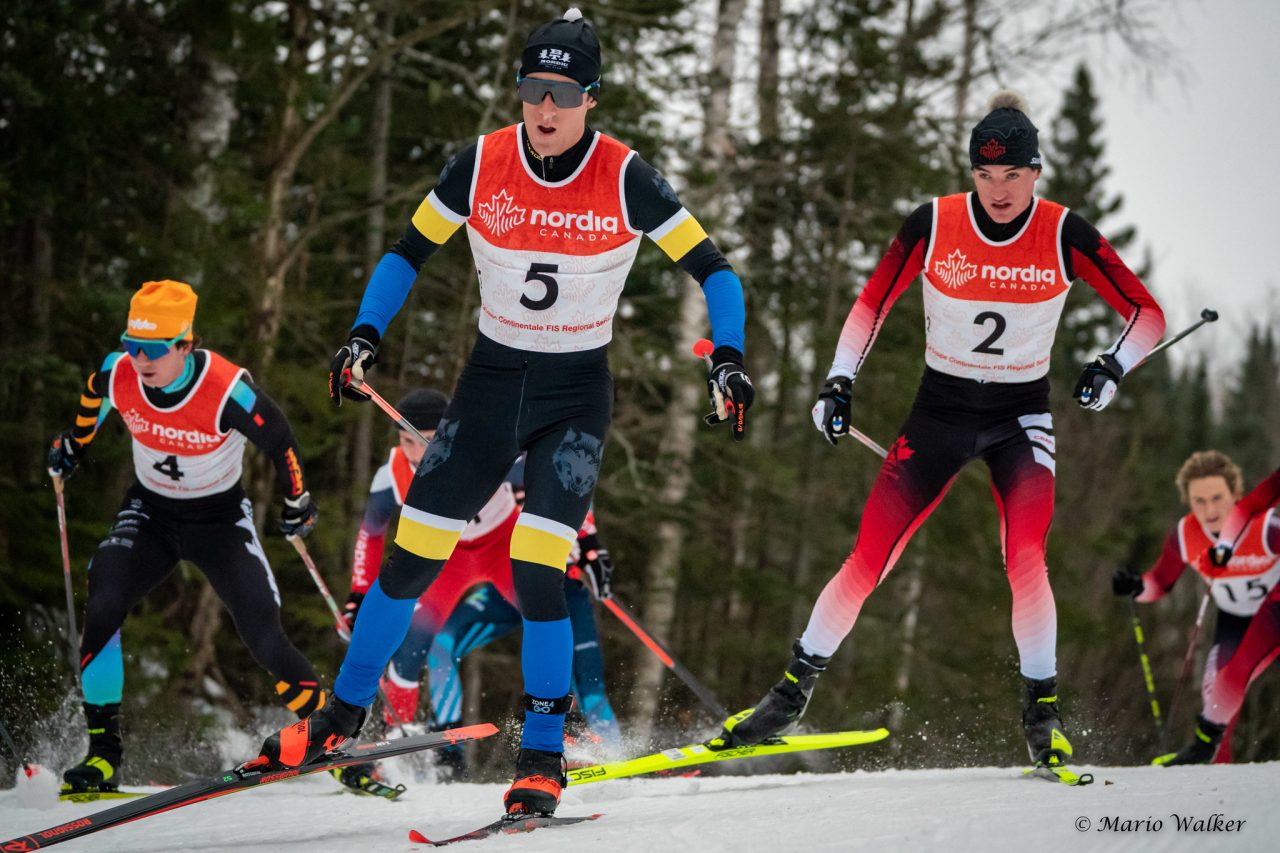
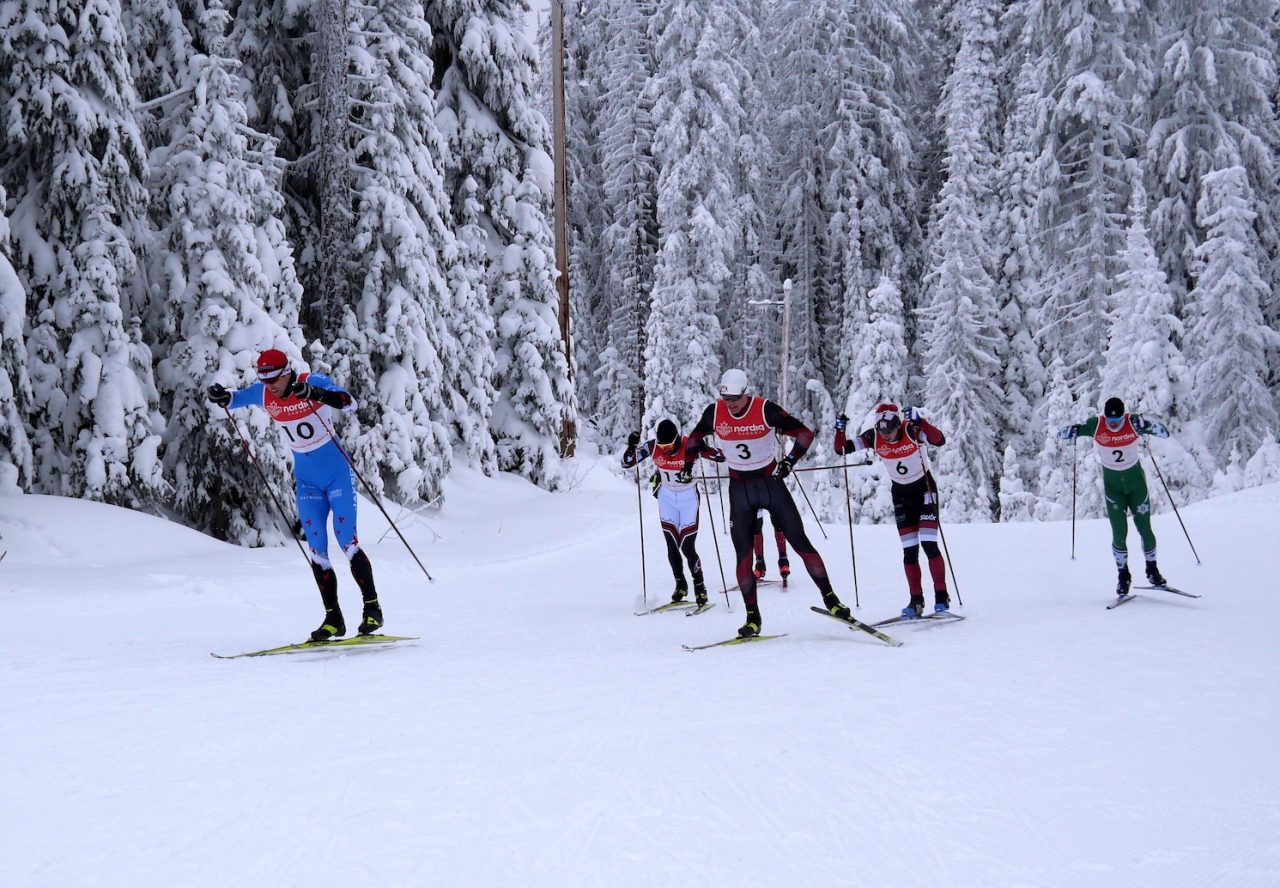
Winner Sasha Masson (#2) skiing patiently in the lead pack. (Photo: Mario Walker)
Sasha Masson (CNEPH) kicked off the weekend with a win in the 20km skate, finishing in 47:44.9, 6.2 seconds clear of four skiers: Orford’s Léo Grandbois, Montériski’s Alexandre Bourque and Xavier Lefebvre, and Big Thunder’s Conor McGovern.
“It was a good day overall,” Masson wrote to FasterSkier. “I played it safe and skied with the pack for a bit, then used my legs to work my skis on the flats and the downhills. Today, pushing over the top and in the downs was essential and allowed me to win.”
For the women, it was the U20 show with Kanata’s Helen McCulligh winning in 59:08.5, followed by MSA’s Ophélie Grandmont at 8.9 seconds and Whitehorse product Constance Lapointe at 9.8 back.
“It was a very fast day out on the course,” McCulligh told Nordiq Canada. “It was my first ever time racing a 20km, so I didn’t know what to expect going in.”
As in Davos two days later, the new distance caused some learning moments and a change from ‘normal’ tactics.
“We had a really big group of girls, a big pack stuck together for a long time.”
Saturday
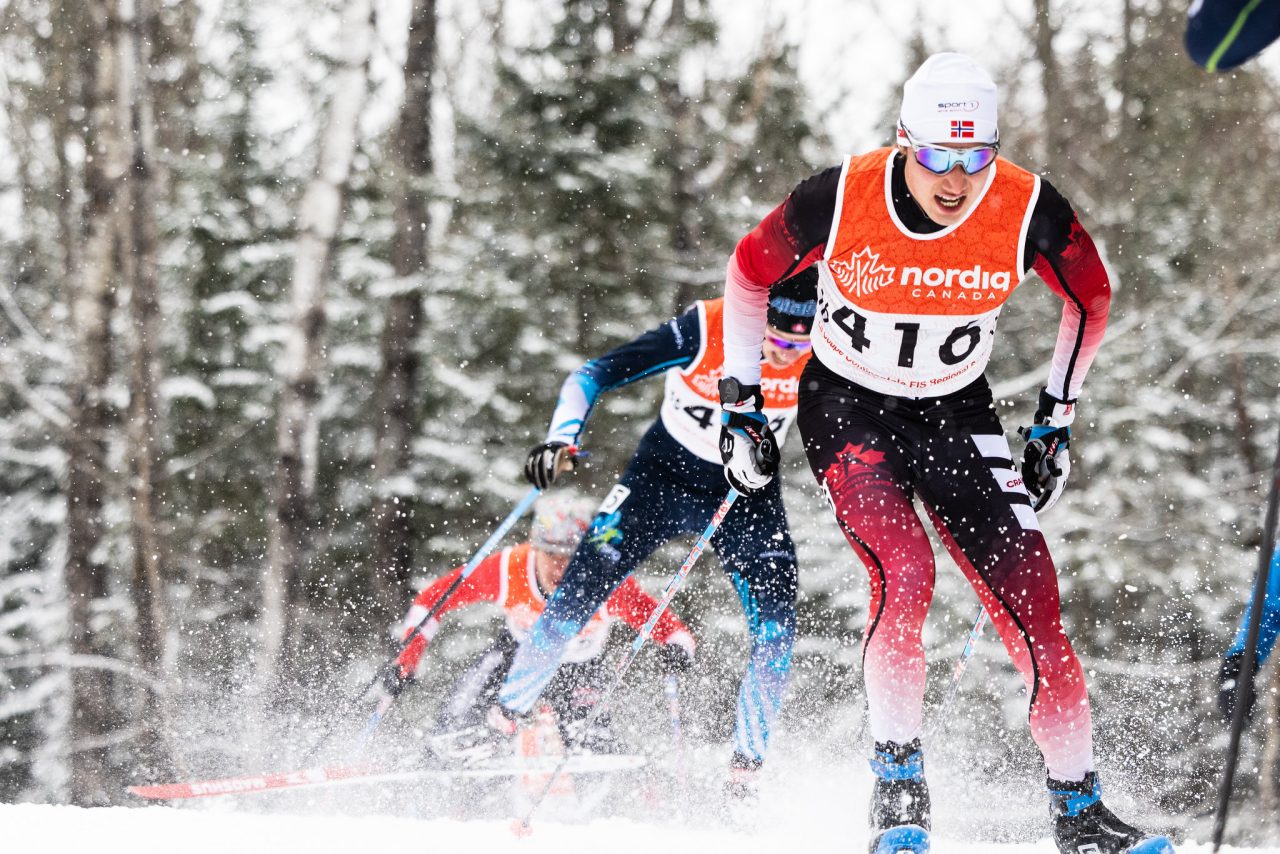
Mats Halvorsen chasing hard in the semi-final. (Photo: Raphaël Payo)
Saturday brought a 1.1km skate sprint and a deeper field with the addition of many student athletes.
Chelsea’s U20, Ry Prior, now training with the Alberta World Cup Academy, won the Open men’s final in 2:20.53, ahead of CNEPH teammates Felix-Olivier Moreau at 1.58 back and Guillaume Pelchat at 3.25 seconds.
Chelsea’s U18, Tory Audet, continued her domination, skiing away from the group in each heat on her way to win in 2:35.94, 10.13 seconds ahead of Nakkertok’s Bronwyn Williams. Katherine Mason was third for Nakkertok, 12.54 behind.
Audet went with a straightforward tactical plan: “I didn’t think much about tactics,” she said. “I just tried to ski the course as fast and efficiently as possible due to the fact that it was a very short course.”
A very short course at MSA? There was a course change announced at 7:30am race day.
“The course ended up basically being a short 1km loop that had one really big uphill followed by a downhill and a loop of the stadium,” Williams explained in an email. “It was a wind tunnel through the end of the stadium and the snow wasn’t really fast because it was snowing. I found out pretty quickly that if I got out in front at the beginning, skied controlled until the middle of the big hill and then accelerated over the top of the hill and into the downhill that no one would be able to draft off me on the downhill and through the windy stadium. This tactic really helped secure my spot in the A final.”
Sunday
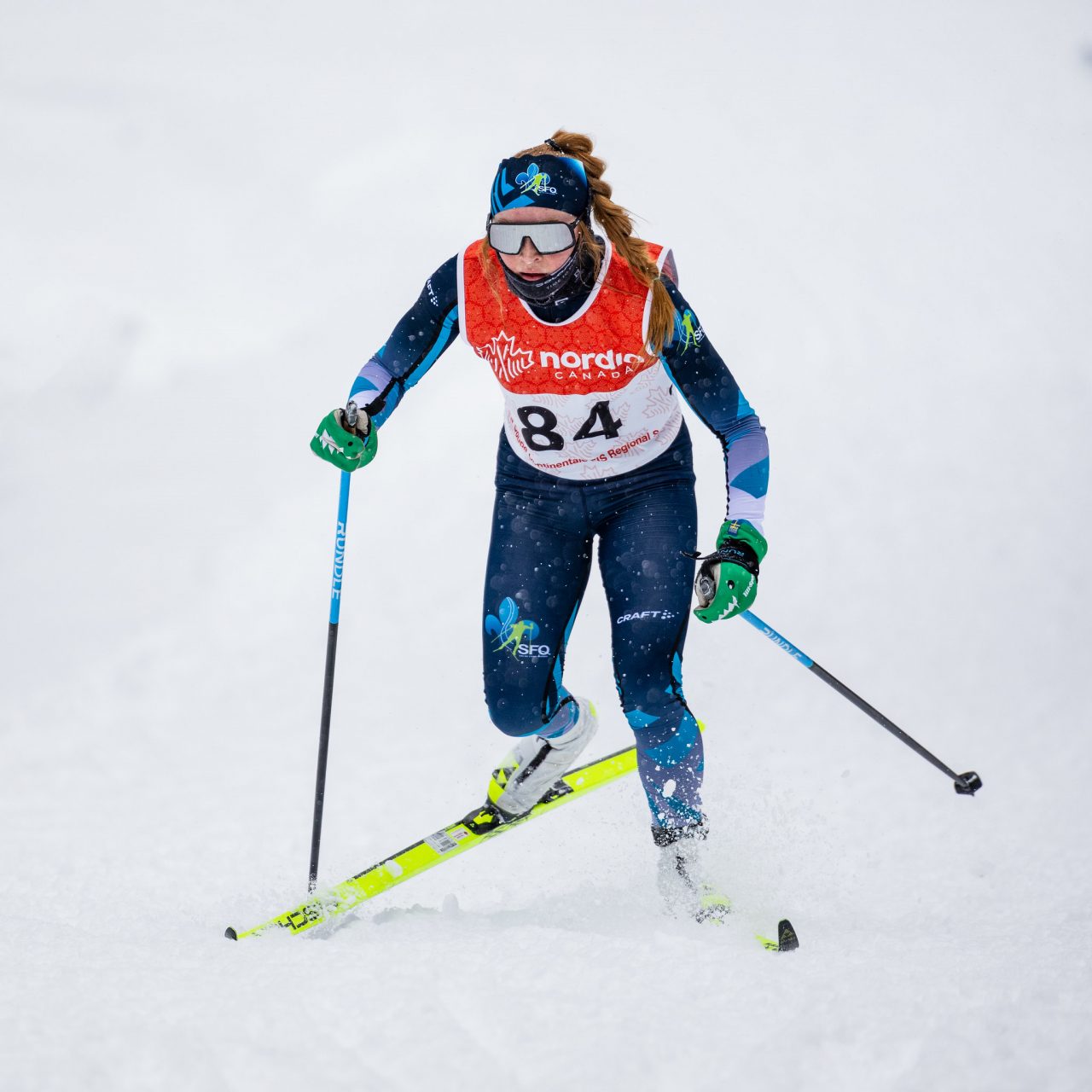
Tory Audet pushing to a snowy win in the 10km. (Photo: Raphaël Payo)
The 10km classic brought more fresh snow but the same women’s winner. Audet won in 36:15.9, ahead of Williams in second again at 25.6 back. Lappe’s Hannah Shields was third at 1:37.0.
“The 10km classic race yesterday was definitely one of the hardest races I’ve done,” Audet wrote to FasterSkier. “The course had some epic climbs and with the fresh snow we got, there weren’t any tracks going up any of the hills making it very difficult. I felt good, I think I paced my race very well, and my skis were awesome!”
Williams, one of three athletes older than U23 to reach the podium this weekend, was not expecting to repeat her 10km victory from the previous weekend.
“The race was two times a crazy challenging 5km course that had huge hills and finished with about 1km of flat double pole…the bane of my existence. Tory Audet, my friend and an incredible athlete, started 30 seconds behind me, so I decided my goal was to see how long I could stay ahead of her.”
The strategy worked to the end, with Williams finishing with 4.4 seconds to spare.
Felix-Oliver Moreau on the trail to victory. (Photo: Raphaël Payo)
For the men, Moreau moved up a step on the podium, winning in 32:13.1. Orford’s Nicolas Beaulieu was second, 4.6 behind to improve on his 6th in the sprint. CNEPH’s Mats Halvorsen was third at 12.7 back.
This brings Canadian ski racing to a holiday pause, with lots of positives to look back on: all the Canadians who raced World Cup period 1 have at least one top 30 result, first-year senior Liliane Gagnon earned her first World Cup weekend in Davos, eight days of FIS racing happened at three Canadian venues, the Para National team collected a suitcase worth of World Cup medals, and Nordiq Canada has signed on with Abuse-Free Sport, a significant upgrade from the previous SafeSport program.
Hailey Swirbul striding to victory at Sovereign Lake. (Photo: Peggy Hung)
Race day four at Sovereign Lake was a 10km individual start classic in the sunshine. With humid new snow at -10C all day while the air warmed up to -4C, all the teams found fast skis and solid kick on a great day for striding.
Once again, the Open and U20 categories skied 2x5km first, followed by U18 and U16 who skied 2×2.5km, for a total of 385 starters Sunday.
Individual start races are about skiing fast, but also about pacing. Keep reading to the end to see the different pacing ideas from top skiers.
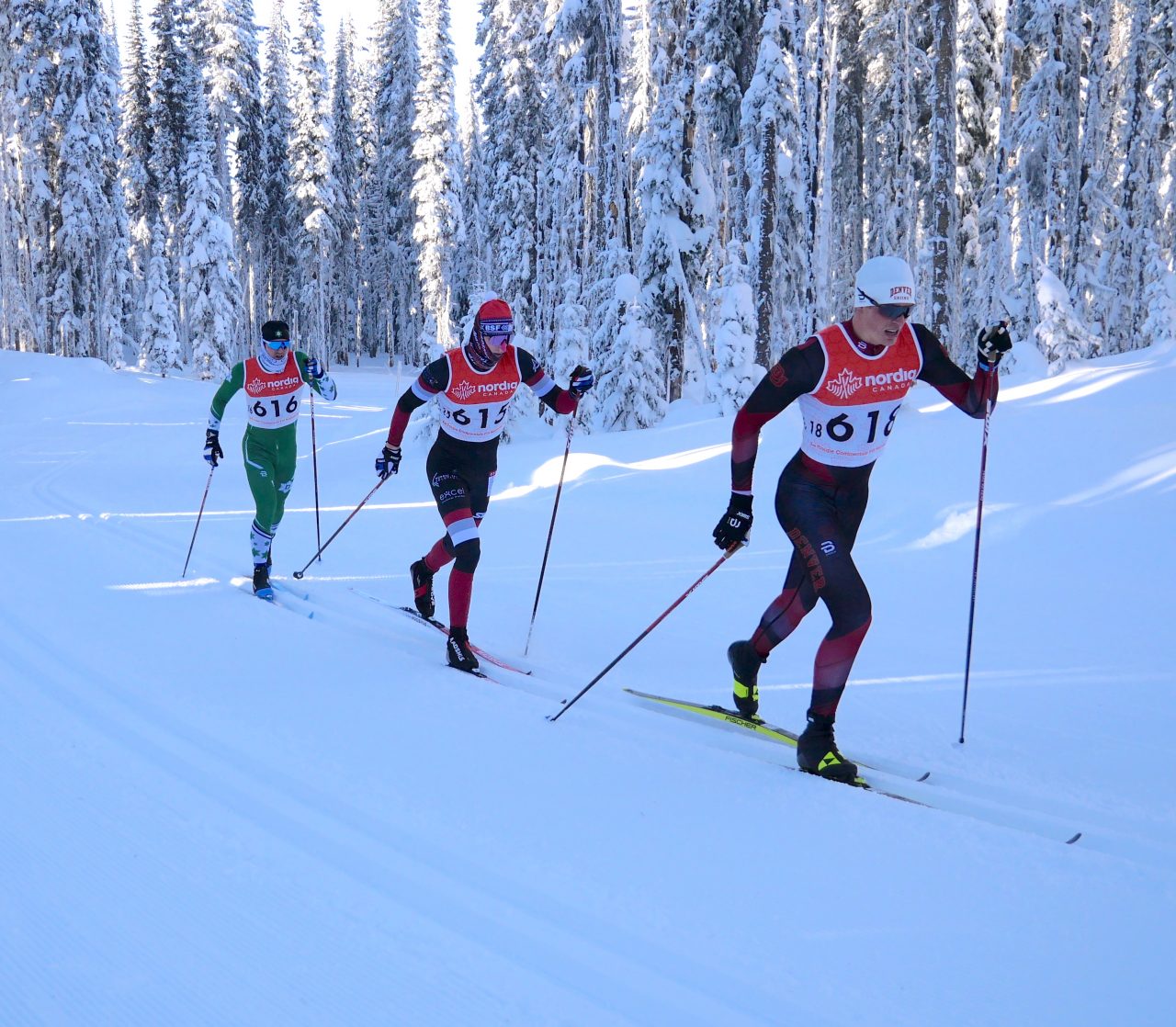
Andreas Kirkeng (618) leads Reid Noble (617) and John Steel Hagenbuch (616) on the second A climb. (Photo: Peggy Hung)
At the end of a hard week of racing, only 102 men of 118 would finish, with University of Denver’s Andreas Kirkeng (NOR) taking his second win in his second race, completing the 10km in 27:17.7. Bridger’s Finn O’Connell (USA) was second, 53.1 seconds back. Dartmouth’s John Steel Hagenbuch (USA) was third at 1:08.6.
Canada took the next three spots, with AWCA’s Scott Hill at 1:09.6, U of Utah’s Sam Hendry at 1:23.5, and National team member Xav McKeever at 1:25.3 (and top U20).
Kirkeng was pleased with his racing, having skipped Wednesday and Thursday to complete a volume block here.
“Today, I was really good. I felt super strong and my skis were perfect. They were like real good kick, more than enough to do the hills here and the speed on them in the downhill were just insane. So perfect day.”
Here is Kirkeng’s second time up the final ‘kicker’ climb with 500m to go:
O’Connell was more moderate about his second place: “It was pretty solid I’d say. The goal is always to go out there and fight for to win and I felt good today, skis were really good. Thanks to both my coaches and yeah, gave it everything I had.”
So many skiers commented on having great skis that it would become repetitive to quote each one.
“It was good,” Hagenbuch said. “It was definitely quite hard after a long week of racing and a lot of cold air that has been breathed so far this week. So like the lungs are definitely feeling that but I tried hard.”
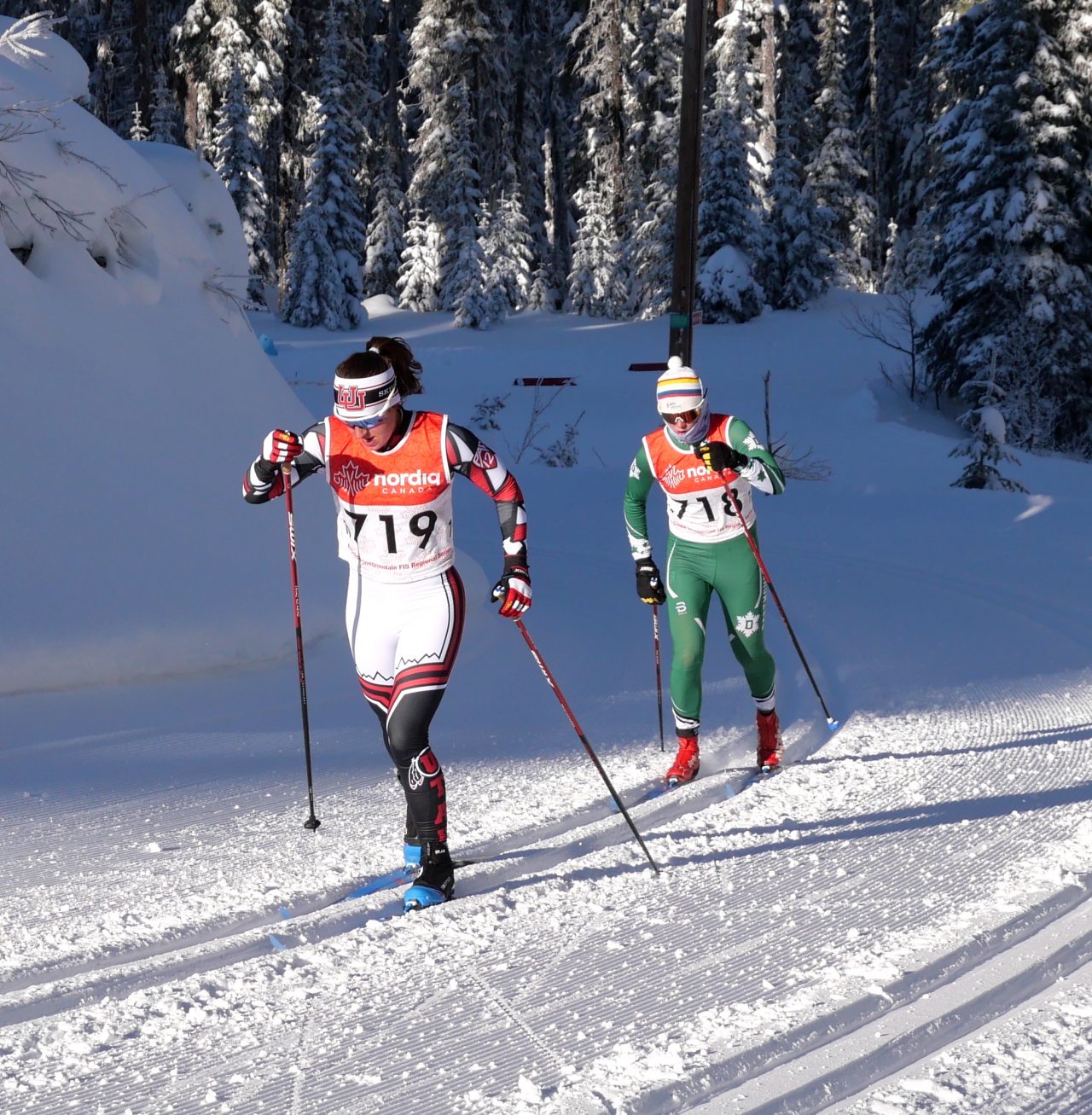
Sydney Palmer Leger (719) on her way to a fourth podium in five days. (Photo: Peggy Hung)
On the women’s side, APU’s Hailey Swirbul (USA) continued her solid week with a third win, skiing the 10km in 31:55.9. U of Colorado’s Hanna Abrahamsson was 23.6 seconds back with U of Utah’s Sydney Palmer Leger (USA) taking third at 1:12.5. AWCA’s Sonjaa Schmidt was top Canadian, in sixth at 1:33.5.
Swirbul was happy: “Today was a really good one for me. I felt like I paced it well and tried to race really smart for me. And I think that paid off.”
Abrahamsson was all smiles on Sunday and FasterSkier has the video evidence:
FasterSkier missed Palmer Leger, but did get some video on the final ‘kicker’ climb:
The women’s field was also diminished by a hard week, with only 75 of 87 starting. There were a lot of smiling faces on those that persevered.
For some, the Upper World Cup 5km is a course they can ski in their sleep. Or nightmares. For others, it was the first visit. The course looks simple on paper, with only 154m of climbing in 5.2km. With 14 splits per lap, there is endless opportunity to compare pacing.
Kirkeng won by 53 seconds. Almost a minute in a 10km with a deep North American field. Which means when he talks about pacing, FasterSkier records video:
Kirkeng took a different view of the course than most of the others and maybe that made the difference.
“I knew with fast skis that some of the downhills and flats that were tracked I would be able to rest quite a bit. So I really just pushed the hills and got up with as quick as I could, knowing that there was rest ahead.” — O’Connell
“It’s at altitude. And it’s there’s a lot of sustained climbing on this course. So I think you have to start out the first lap almost in threshold. And that actually is race pace on a course like this. I also had the benefit of, honestly, some of the best skis I’ve had in years. And my coaches did an amazing job with skis today. So that really helps to have good kick and also enough glide through the double pole you can make up time because there’s a lot of time to be made on those transitions. ” — Swirbul
“I started out a bit easier on the first lap, especially because it’s a lot. There’s a lot of uphill the very first half of the first lap. So I started out a bit easier. And then when I came around for my second lap, I really started to dig deep and give it all I had.” — Schmidt
“Oh, just crush it up hill and double pole like a maniac in the flatter part. I would say and just survive. Yeah, enjoy a little bit of a nice view, it was so beautiful out there today.” — Abrahamsson
“You got to really keep it controlled in the first k. I almost feel like I’m warming up the first climb and then kind of get into the race. But yeah, thinking about it, I don’t think I’ve raced a race course in any part of the world more than this course, I’m used to it. ” — Hill
“It’s always hard to race at Sovereign because it’s high altitude. Always hard racing. So yeah, it’s probably one of the tougher spots to race in Canada.” — McKeever
“Just kind of settling into a rhythm on the long climb there [pointing to the first A climb] and just working it and then making sure you save something for those last two punchy climbs into the finish.” — Hendry
How Was Your Week
After a long five days that both Swirbul and her coach Erik Flora compared to the start of the Tour de Ski, FasterSkier asked skiers for their impressions.
The wax techs had skis dialed by sunrise. (Photo: Peggy Hung)
“Oh, I absolutely love SilverStar. And there’s no better day like today to finish off this really good week of racing and just well, well put on races by everyone here.” — Swirbul
“I really like this place. I don’t want to go home. We’re flying back to Boulder tomorrow. And I don’t want to do that. I want to be here. It’s like, it’s so amazing. The skiing is so good. And yeah, so beautiful.” — Abrahamsson
“It was great. I’ve never been to SilverStar [before] but the conditions have been unbelievable and races have been very, very well organized. The volunteers and race organizers did an amazing job and I look forward to coming back sometime.” — Hagenbuch
“I live over in Canmore, so as soon as Sovereign gets snow, I’m hopping in the car and coming here [and] did a two week training camp leading into these races. So yeah, the SilverStar magic is a real thing.” — Hill
It is an early start under the lights for the coaches. (Photo: Jacqueline Akerman, Sovereign Lake Nordic Development Academy)
The U20 women’s semifinal 2 heading up onto the bridge at Sovereign Lake. (Photo: Peggy Hung)
Day 3 of the Sovereign Lake race week brought a skate sprint on a shorter course and warmer weather: -10C with no wind and occasional light snow.
Wednesday and Thursday were Nordiq Cup events, with only U20 and Open categories. Saturday and Sunday are Canada Cup races, with the addition of U18 and U16 categories, resulting in 402 racers across the eight groups. All four race days are part of the US SuperTour.
All groups completed the 1.2km qualifiers first, starting at 8:30am, and the heats ran from 11am until 4pm, finishing 1 minute ahead of schedule. Though today’s skate course incorporates one meter more of climbing than Wednesday’s classic course (37m total skate climb, compared to 36m on the classic course), many athletes described the feel of skate course as flatter. For comparison, the fastest women’s qualifier on the skate course—APU’s Hailey Swirbul (USA)—finished in 2:46.77, significantly faster than her 4:10.99 win in Wednesday’s classic sprint on a slightly longer 1.3km course.
Julien Locke leads the men’s final up into the finish straight. (Photo: Peggy Hung)
Men’s Freestyle Sprint
The men raced first today, with University of Denver’s (DU) Andreas Kirkeng (NOR) taking the victory in 2:20.30. Dartmouth’s John Steel Hagenbuch (USA) was second, at 0.07 back, with Black Jack’s Julien Locke (CAN) in third at 0.54 seconds behind. Tom Mancini (U Utah, FRA) who won Wednesday’s classic sprint was fourth, followed by Bridger’s Graham Houtsma (USA) and teammate Finn O’Connell (USA).
Kirkeng liked the course: “It’s a flat course, but you don’t have any rests so every small uphill, over the top, transitions, turns, everything matters in this course. The finish is really hard . . . 25 seconds with slightly uphill and a long flat section to the finish line. So the finish is really hard and that’s coming after like two minutes with all out flat skiing so it’s a challenging course, not like in terms of steep hills and a lot of climbing, but just because you have to ski fast and be on top of everything all the way.”
As with many of the podium finishers, Kirkeng tried to save energy for the end.
“For the final, I plan to stay like in third, fourth position and go all out from like the last turn, up and under the bridge, and it worked out real well,” he told FasterSkier. “[Hagenbuch] was coming real fast like the last 100 meters but I managed to stay in front of him.”
“I actually did better than I thought considering I’m usually a distance skier,” Hagenbuch said. “And it was super fun out there. I think, tactically, I was kind of doing the same thing, where I was sitting back a little bit for the first part of the course, and then really pushing on the final hill through the finish.”
Hagenbuch liked the course: “it’s super fun. It’s fast. And obviously a very competitive field here today.”
Locke was the top Canadian, expressing satisfaction with the day as he builds back from injury. He pushed hard into the ‘hole’ descent and led the climb back to the bridge.
“My tactics in all the heats was just cruise the first half and then try to have some good punch at the end,” he said. “Unfortunately, I didn’t have great legs in the finishing straight. But it was not a bad day; a step in the right direction for me.”
Many racers would be happy with a SuperTour/Canada Cup podium under any circumstances, but skiers reach the top by always chasing the next target, each success leading to a higher goal.
The women’s Final descending the stadium bridge towards the final downhill. (Photo: Peggy Hung)
Women’s Freestyle Sprint
After the men’s open and U20 heats completed, it was the women’s turn. “It was a really fun and exciting day,” top qualifier, Swirbul, told FasterSkier. “It’s a shorter sprint course than last time so it was fun to do some real sprinting and tactics.”
Swirbul wanted to try something new today: “I’m normally a racer that will kind of hammer from the gun. So today I challenged myself to try to play more strategy and try and sit behind people into that last downhill. In the last downhill, I’ve tried to free skate as hard as I could and carry as much speed into the final corner and up into the last climb into the drag race in.”
Swirbul won the final in 2:43.02, 0.87 seconds ahead of Bridger’s Sarah Goble (USA). U of Colorado’s Weronika Kaleta (POL) completed the podium, 1.17 seconds back.
Goble was happy with her hard finishing tactics in the earlier heats: “I tried to do that again in the final when I was in third, and I pushed over the top of the hill to put myself into second and kind of control the race through there,” Goble said. “And then Hailey had a really good final push to the finish but [I] couldn’t quite hang.”
Kaleta was very happy with her racing and sticking to her plan: “I wanted hard to be controlled, make sure that I save some energy for the last part. So I tried to do it and I guess I did it quite great.”
U of Utah’s Sydney Palmer Leger (USA) continued her solid week in 4th at 3.49 behind, followed by top Canadian Liliane Gagnon from CNEPH and Team Birkie’s Erin Bianco (USA).
U20 skiers who qualified in the top 30 were automatically moved to the Open heats. Sun Valley’s Samantha Smith (USA) and Chelsea Nordiq’s Tory Audet (CAN), both born in 2005, ‘raced up’ in the U20 group, and qualified into the Open heats where they were eliminated in separate semi-finals.
Tory Audet (bib 108) on her way to a lucky loser spot in her Open quarterfinal. (Photo: Peggy Hung)
Asked about the challenge of racing in the open heats instead of U18, Audet was direct: “I love it. I love the competition,” she told FasterSkier. “World juniors would be probably the biggest goal this year. And then a national title would be awesome. Due to COVID and then a concussion last year, I wasn’t able to attend.”
As Canada ignores the U18 championships, Audet is targeting U20 World Championships in Whistler in late January.
Many of the skiers appreciated the race volunteers at these Sovereign Lake events, but Hagenbuch may have phrased it best: “Sovereign put on a great event. The volunteers have been great. I think they’re gonna be out here for something like nine hours today. So pretty Herculean effort. So big thanks to all the volunteers for their hard work and another day of racing tomorrow.”
The men’s sprint final at Eastern Canada Cup #1 on Nakkertok trails. (Photo: Robert Smith)
Once again, there was a great weekend of racing on the Nakkertok trails in Gatineau, QC. It was almost like the pandemic pause hadn’t happened: lots of racers, live results on Zone4, great support for media.
But it isn’t really just Nakkertok. ENGNE, a coalition of local clubs, puts on great races using Nakkertok trails and the NakkerTrak snowmaking magic.
“The mood at this weekends races was super fun!,” wrote Laura Leclair. “Even if it was pouring rain on Saturday, people were very happy to put a bib back on. Super grateful towards all the volunteers who stand in the rain in order to run the event smoothly!”
Leclair is a CNEPH team member from Chelsea Nordique, one of the ENGNE host clubs and a double winner. Her thoughts were echoed by National Team Development Centre (NDC) Thunder Bay’s Julian Smith, who also won both events.
“The race went really well today, it was super fun, the volunteers put on a really good event. It was really wet and rainy this morning, but that actually made it for a really fast day.”
A number of athletes wanted FasterSkier to know that the volunteers got the worst of the Saturday rain before the athletes were on course. Smith put it best:
“I want to thank the organizers profusely because they were true champions. It was a terribly miserable day to stand still outside for 10 or more hours and they did so with smiles and cheers!”
Luckily for these volunteers, Sunday brought sunshine for an individual start.
***
Canada is in a sense divided by Thunder Bay, though it is not equidistant from the eastern and western borders. The west has more space, but the east has more people. Sovereign Lake draws volunteers from the local population of 43,000, noticeably smaller than Ottawa/Gatineau with 1.3 million. The population difference also affects the number of athletes, with 12 million Canadians living close enough to drive to Nakkertok for a weekend. As in, almost a third of all Canadians.
Nakkertok hosted about 480 racers, continuing the trend as the largest event on the continental cup circuit in North America.
Thunder Bay is neither east nor west, but is within flying distance from both. The only races in driving distance are in the US.
NDC TBay sent their team west for WCC 1&2 before heading east for ECC 1 – 4. This will give the viewers a few hints about the relative strengths of the two solitudes.
FasterSkier is trying to bring the Eastern Canada Cup to life from a sunny Sovereign Lake parking lot while this reporter’s partner is doing yet another double workout day at ladies camp. Both Western Canada Cups were held at my home venue, which makes it easy to capture athletes before or after their cooldown ski, record video of the race itself, talk to officials, and feel the vibe from the volunteers, the parents, the siblings, and a few hundred recreational skiers who have never seen a race before. So how is this going to work? And how can it be better for Eastern Canada Cup 3&4 next weekend? Or for the National Championships in Canmore in January?
Pre-pandemic, the key to getting good content remotely was to email questions to the athletes at the magic time when they could read the message at the venue, then reply at the first convenient pause with wifi, often the airport. When a ‘surprise’ athlete made the podium, it was usually someone FS had been tracking. Now we have a Tory Audet earning her first FIS points and her first senior podium on the same weekend.
Luckily, Julian Smith helped FasterSkier out with some videos that bring the weekend closer.
Saturday: Free Technique Sprints
Saturday started with a downpour on the volunteers setting up, but the action heated up quickly as most racers got their first race in a bib in twenty months. The men raced first, unusually.
Pierre Grall-Johnson leads Étienne Hébert early in the sprint final. (Photo: Robert Smith)
CNEPH’s Étienne Hébert won the qualifier in 2:39.86 in his first official race, edging out two TBay skiers who had raced WCCs the previous weekend: Smith by 1.15 seconds and Pierre Grall-Johnson-Johnson by 2.03
In the heats, it was the Smith show again, winning all of his heats. Hébert took second in his first sprint day, ahead of Grall-Johnson-Johnson who, like Smith, had done all three rounds at Westerns the week before.
“I felt strong but a little stiff in the qualifier which maybe have been due to warming up in as much water proof clothing as possible,” Smith wrote to FasterSkier. “But the heats, the skis were running fast and the body felt snappy.”
Hébert was thrilled to be racing again.
“It’s amazing to finally put a bib back on and race against the other Canadian athletes. Stress levels were somewhat high before the sprint but it quickly got replaced with excitement. Having the possibility to race, especially before Olympic trials, is great and I want to say that Nakkertok did an amazing job this weekend. We train all year as a team for those moments when you get to put the CNEPH suit on and show everyone how fast we are. This weekend was only the start and we’re all excited for MSA next weekend.”
MSA is Mont Sainte Anne near Québec City, the home of CNEPH, and like Nakkertok, a keystone race venue in Canada.
“Saturday’s sprint had a lot of positives,” Hébert wrote about the results. “I got to see that my form was really good and that I can already compete at a high level. Tactics can still be improved but that will come with simply racing more.”
“Tactics was the key factor in the sprint on Saturday. Pierre and I had a gap on the rest of the field after the first climb but Julian got back in touch before the last downhill and used the slipstream to get ahead. thought I could just stay behind [Grall-Johnson] until the finish and pass him but he slowed down too much on the second climb which allowed Julian to come back.”
Grall-Johnson had his own view of the final on his home trails.
“Knowing the course very well, as I grew up on it, I was pretty confident in what tactics were best but these races are always good opportunities to try out new ones,” Grall-Johnson-Johnson wrote. “In the final I decided to go out hard from the start and see if I could create some separation, I was able to get a few meters on the first climb but had a pole go deep through the snow which almost made me crash with loaded legs and then on the second climb I had very little energy so I was caught and then conceded in the downhill due to a very advantageous draft going into the finish. Overall though happy with a third place.”
Laura Leclair wins the final, just ahead of Shaylynn Lowen (Photo: Robert Smith)
Leclair won the qualifier in 2:55.08, just ahead of CNEPH teammate Liliane Gagnon at 0.29 seconds back. TBay’s Bronwyn Williams and Shaylynn Loewen followed at 2.96 and 3.25 behind.
In the heats, Leclair won her quarter, came second in her semi, and then edged Loewen for the win.
Liliane Gagnon leads Laura Leclair in the final. (Photo: Robert Smith)
“I was pretty confident in Saturday’s final heat,” Leclair wrote to FasterSkier. “I knew that my teammate (Liliane Gagnon) and I could work together in order to position ourselves in the front. I knew we were stronger in the last uphill and Lili and I were able to make a gap between the other skiers.”
“Unfortunately, Lili fell in the last corner (I swear I did not tackle her ) so I was alone for the last downhill. The other girls caught up because of draft, but I was able to take the win.”
Williams took third, followed by Chelsea’s U18 Tory Audet, who qualified 5th. Audet also lead the list of new names to watch. Twenty months without racing is a long time in the development of junior skiers, which means more welcome surprises are coming.
Sunday: Classic Interval Start 10km/15km
Julian Smith (yellow bib) skis beside Étienne Hébert (73) in the 15km classic. (Photo: Robert Smith)
Smith won the 15km in 35:21.3, giving him four wins in four race days, and then summarized the event in a short sentence to FasterSkier.
“The weekend was a blast!”
Smith later added a little more detail: “The Sunday weather could not have been more different. -4 and bright sunlight was a welcome change and the track was set for a blistering 10/15km for the seniors.”
Grall-Johnson was a close second, 4.6 seconds back.
“Today it was a relatively flat course with lots of laps so I double poled 90% of the race other than the stride zone,” Grall-Johnson wrote. “It was a great fight between Julian and I today, we were going back and forth in the lead, unfortunately Julian pulled away in the end but despite a crash on the first lap I was happy with how I was able to refocus and push mentally.”
Hébert was third at 25.1 seconds back, changing podium places with Grall-Johnson.
“The last two laps of 2.5km is where the order of the podium got decided,” Hébert wrote. “Julian and Pierre finished stronger than I did. We were, all three of us, really close after 10km, inside 10sec I think. I’m looking forward to a course with more climbs because striding felt really good but my muscles got stiff in the double pole which definitely caused me to lose some time.”
Laura Leclair poling to victory. (Photo: Robert Smith)
The women’s 10km also had a double winner, Leclair in 28:05.3.
“I am not usually a classic skier but I worked hard on my technique this summer and I am super happy to see it paid off,” Leclair wrote. “I felt really good, the conditions and skis were super fast and I just went for it. For some reason I didn’t get any split during the race so I wasn’t sure where I was but I just skied my best.”
The next three places were U20 athletes: Audet at 25.8, Gagnon at 32.5, and Big Thunder’s Sarah Cullinan at 54.3.
Gagnon is well known to Canadian fans and raced at U20 World Championships in Vuokatti last season.
Tory Audet on her way to her first open podium. (Photo: Robert Smith)
Audet, who recently turned 16, has less public history as a skier.
“This was my first U20 podium, and my first FIS pointed race,” she wrote. “I was only eligible for a FIS license last year, and since there were no races, this was my first FIS pointed race.”
In her first weekend, she raced up in U20/Open and it paid off for her with a 4th in the sprint and 2nd.
“Having not done a sprint in over a year, and never with older athletes, I had no clue what to expect. My goal was just to race fast and see how far I could get. I knew the trails quite well and had raced them in previous years, which was good because I knew what to expect.
“As for race tactics, I have limited experience in sprints so at the beginning of the day, I didn’t have any tactics. It was not until I hit semis and made the mistake of leading the pack that I started to think about tactics. I was drafted on the hill and I lost my spot in the finals, but regained it as a lucky loser. When it came to the final, I decided to try a different strategy: to get out in 3rd or 4th and draft off everyone. It was was really fun because I got to observe everyone else’s tactics, to see the lines they were taking, and learn from their extensive experience.”
With U20 athletes on the podium at both Eastern and Western Canada Cups this weekend, it is clear the next generation made good use of a season without races.
Sprinting heats: Robert Smith caught the reactions to a crash. (Click to enlarge.)
Oh
No
Wait
What
All Good
Getting In The Mood For Racing
“Everyone just seems to be happy racing again and I think that really helps in making the events fun. Its the first time many of the volunteers have helped with racing events, either for a long time or just first time ever so obviously you have to be patient and understand that everyone is a bit rusty but overall energy is great!” — Grall-Johnson
“I could feel that everyone at the venue was really excited to be there. Saturday’s weather was suppose to be horrible but we got kind of lucky with the worst of the rain falling before the qualifier. Despite this, athletes and everyone else at the venue had big smiles on. Seeing everyone again after a year and a half was exciting. I got to see the athletes and coaches from Monteriski, my home club, and all the competitors I didn’t see for the entire pandemic. Excitement is really the mood that was present last weekend.” — Hébert
“I am super stoked to be racing back in Canada again. It was great to be at home in front of friends and family and super cool to see how everyone has been training!” — Leclair
“Our wax techs did an incredible job so a huge shout out to our staff and the organizers [who] put on a great event for a second day. It is just so exciting to be racing in Canada again, and having friends and family cheering from the sidelines makes it even more special.” — Smith
Rémi Drolet leads out the first mass start of the season. (Photo: Peggy Hung)
Race, rinse, repeat. The Western Canada Cup series returned to Sovereign Lake for race days 3 and 4 of the new season.
Originally scheduled for Rossland, BC, the event had to be moved after an ‘atmospheric river’ event delivered warm rain to almost all southern BC trail systems on December 1st. Sovereign Lake was the least damaged, able to hold WCC #1 and #2 on the 4th and 5th as scheduled. By December 11th, skiing conditions were much improved and the racers were primed to go again.
The organizing committee was a little less primed, with four chiefs unavailable, along with many of the 180 volunteers from the previous weekend. With some timely help from Nordiq Canada, it all came together. Next Gen coach Eric de Nys (a Vernon resident) could be seen moving V-boards with High Performance Manager Joel Jaques (from three ski areas to the south in Penticton) while Al Maddox shortened his vacation to fill in as Technical Delegate.
Despite hosting major events on the two previous weekends, the club was able to find enough volunteers to make it work.
While there was still plenty of rust on display, more athletes were getting more things right than last weekend.
Saturday: 5km/10km Classic Interval Start
The weather gods delivered one of everything for Saturday’s classic, with fresh snow, strong winds, a brief blizzard during wax testing, before settling for overcast race conditions with firm tracks that occasionally filled with dry blowing snow at -4C.
On the flat 2.5km course, there were enough skiers lapping to keep the tracks packed. This is the first time this course has been used for the open categories and it has a distinctly different feel to the traditional 5km loop. Eliminating much of the climbing, the new course turns downhill halfway up the first A-climb at the 5km mark, before skipping the second A-climb entirely.
Dartmouth’s Jasmine Drolet took the win in 17:22.0, matching her result from last Sunday with an overall win, in addition to topping the U20 list. AWCA’s Olivia Bouffard-Nesbitt was 3.0 back in second ahead of teammates Laurence Dumais in third (+47.1) and Beth Granstrom in fourth (+1:00.8).
“Definitely not my favourite race,” Jasmine Drolet told FasterSkier, despite preferring classic technique. “I tend to prefer the longer races but still good and a good effort out there.”
“I was happy with it,” Bouffard-Nesbitt explained after the race. “It was unusual for us to start so late at one [pm]. It was sunny this morning, beautiful, mild. We showed up to the racecourse this afternoon and it was blizzarding, so windy. And then it cleared up for our race. So it was fun to do 5km.”
“It’s definitely quite a bit different than the five km [course]: it’s less climbing and more flat,” Dumais told FasterSkier. “Which is in my favour, because I’m better at double polling, so it was good.”
In the men’s 10km, Black Jack’s Rémi Drolet matched his sister’s achievement, finishing in 30:37.2, edging out Foothills junior teammates Tom Stephen by 4.7 seconds and Xavier McKeever by 7.0. AWCA’s Jack Carlyle (39.2 back) and Hardwood’s Scott Hill (54.3 behind) completed the senior podium.
“It was a pretty good day,” Stephen explained. “Not a course that favours me, but I still pushed hard and I’m happy with the results.”
Asked about ski and wax choices, Stephen said “the coaches were really accommodating today because they tested my skis before we got here, because we had such a late start. So that was nice, a lot less stress than having to get here and test all the skis with the new tracks and stuff like that.”
McKeever enjoyed the ‘new’ course.
“I felt really strong with the double pole, there was a lot of double poling on this course. That really played into my favour.”
McKeever also broke down how the course skied during the race.
“Overall, there’s some good climbs. there’s two good climbs in there for sure. But once again, it’s it’s a lot of double pole. So I’d say in that sense, it’s like fairly flat overall. There’s like gradual sections, but yeah, you definitely can’t get caught off guard.”
There were 112 finishers. The smaller field was a result of only two age groups (open and U20) and road closures affecting some teams.
Sunday: 10km/15km Mass Start Free
Sunday was a great day of skiing, with snow clouds blowing away in the morning for a sunny afternoon of mass start racing on the traditional Upper World Cup 5km course that older racers know so well.
Rémi Drolet leads Xav McKeever and Tom Stephen at the end of lap 2. (Photo: Peggy Hung)
The men raced first, with a very tactical first lap before the action began on the second of three laps.
On the third lap, McKeever attacked on the ‘wall’ climb to get a gap he would not relinquish in the final 1.x km. With only one small climb left, racers need either a gap at the top of the wall or confidence in their final sprint.
McKeever took his first open win in 37:22.3, 1.2 seconds clear of fellow U20 Tom Stephen. Carlyle passed a fading Rémi Drolet to take third, 21.0 seconds behind, while Bob Thompson narrowly missed out on fourth, finishing 40.0 back.
“I was really happy with my race and how I skied both tactically and technically, so overall, [it was a] good day,” McKeever said after collecting his first senior win at age 18.
He continued that he “couldn’t really have asked for anything better from a start [to the season], but we’ve just got to keep putting in the work, keep training hard.”
Stephen, in his last year as a U20, was more philosophical.
“I’m definitely feeling a little tired,” Stephen said. “There’s a lot of racing back to back for me. But yeah, I think it went well. I’m happy with the result.”
On his approach to racing, Stephen explained how the weather factored into his race plan.
“I think I was pretty smart in the tactics part. There were a lot of people throwing down sprints halfway through trying to break away and then easing up because the wind plays a big factor into it.”
Carlyle also enjoyed the day: “It was good, super fun to ski in the pack and do a mass start race and it felt like Real Racing was back.”
“I didn’t really think too much about how to win I just kind of wanted to like make their day as hard as I possibly could,” Carlyle continued. “The way it played out was going into the second last climb, I guess it would have been the like the super steep hill [the wall], Xav just had so much speed. So much speed. So Tom and I are kind of standing still and that’s pretty impressive.”
Jasmine Drolet stretches out the group at the start of the 10km. (Photo: Peggy Hung)
Shortly after the top men finished, the women began their first mass start of the season with two laps of the same course. Jasmine Drolet strung the group out quickly, opening passing opportunities for lower ranked skiers like Bouffard-Nesbitt who would quickly join the action at the front. After the pandemic break, the points list is a much less useful guide to current performance, but today there was no difficulty to pass on the wide opening climb with room to skate four abreast for over a kilometre.
Bouffard-Nesbitt finished alone in 29:04.4.
“It was really good. I love mass starts and I’m so happy that sovereign decided to host a mass start race today,” she said. “The conditions were the best they’ve been in the last two weeks. It was a great day.”
Jasmine Drolet took second, 12.4 seconds back, followed by fellow U20 Marielle Ackermann from Kimberly in third (+21.0), and Granstrom in fourth (+26.5).
Jasmine Drolet leads a large pack near the end of lap 1. (Photo: Peggy Hung)
“It was pretty chill for the first lap,” Bouffard-Nesbitt said. “I didn’t feel that I needed to lead especially, [since] I’m pretty confident in my sprint. So I was happy just to follow and then, yeah, on the second lap, I started to have fun playing around, going to the front a little bit and pushing the downhills and unfortunately, as Jasmine might tell you if you interview her, she had a fall before the last two climbs. That was too bad and that’s where my gap opened up. I just pushed it from there.”
Jasmine Drolet did include her fall in her post race comments, reflecting on an experience that was “Pretty hard. That’s all, really hard.”
“A little bit frustrating,” Drolet continued. “I mean, I lead a lot of the race, which is not really what I wanted, but then fell and couldn’t catch up again. So a little bit frustrating, but that’s how mass starts are.”
She fell on the one tricky corner on the course, a fast hairpin that becomes challenging as the lactate builds in the legs.
The pandemic has made student life easier, with distanced exams that can be done anywhere. Easier, but not easy, with a large number of athletes needing a quiet space to write exams Sunday evening after the racing was done. Ackermann was one of those student athletes who rushed away before FasterSkier could catch up with her.
In addition to all the racing, there were bets to be settled.
Rémi Drolet explains his new purple hair to Next Gen coach Eric de Nys.
This writer entered a casual masters program mass start classic race on Saturday morning, using the same course as the elite skiers used in the afternoon. The finish times were very different, but I am still smiling days later. To twist up Joni Mitchell, “you don’t know what you’ve got til it’s back!”