From the FasterSkier archive — posts syndicated from athletes’ and coaches’ own blogs between 2004 and 2012, kept online as published. Current coverage is at fasterskier.com.
Position Title: Development Coach, National Ski Team (NST), Olympic
Location: Canada
About Nordiq Canada
Nordiq Canada is the national governing body for both cross-country and Para Nordic skiing. We lead, support, and inspire world-class performances and lifelong participation in these sports nationwide.
The Opportunity
Reporting to the High-Performance Director and working within a collaborative high-performance environment, the primary responsibility of the Development Coach will be to lead and oversee the Development Team program. Development Team athletes have been identified as having strong potential for transitioning from junior racing to international excellence.
As a contributing member of the Nordiq Canada coaching staff, this position will involve organizing and leading training camps and competitive opportunities, providing enhanced services and support, and ensuring optimal functioning of Development Team athletes in their DTEs, including alignment with their IAPPs.
This is an exciting opportunity to contribute to one of Canada’s leading winter sport organizations and to work alongside world-class athletes, coaches, and support staff in pursuit of sustained international excellence.
Key Responsibilities
Provide support, oversight and technical expertise on the Yearly Training Program (YTP), daily program planning, delivery, and athlete gap mitigation to identified athletes and their coaches.
Check in regularly with athletes and coaches to ensure training is progressing, and athlete accountability measures are fulfilled.
Contribute to a culture of excellence, openness and growth.
Work in collaboration with experts in their respective fields.
Maintain a high level of scientific rigour in all processes, ensuring performance-based decision making and optimizing athlete health and wellness.
Lead projects and work plans with respect to gap analysis, the Podium Pathway and the Gold Medal Profile.
Assist the HPD in annual report writing and presentations.
Lead and oversee competitive opportunities such as World Juniors, international junior camps, and Nordiq Canada camps.
Attend all meetings as required or requested by the HPD and CEO.
Assist the HPD in program development, direction and philosophy.
Skills & Requirements
Experience coaching and connecting with young and developing athletes.
Experience leading competition trips and travel with teams, provincially and domestically.
Strong technical skiing ability, including the capacity to analyze and communicate areas for technical improvement and efficiency.
Competency in assessing and interpreting sport science testing and data.
Must be physically fit and capable of testing skis as well as training with athletes on some of their easy sessions.
Ability to contribute to a positive and professional team environment in and outside of competitive settings.
Excellent interpersonal, time management, and communication skills.
Detail and task oriented, goal driven, a strategic and tactical thinker and planner.
Bilingualism (English/French) considered a strong asset.
Valid driver’s license.
Working Conditions
This position requires approximately eight (8) weeks of travel domestically and internationally for training camps, athlete visits and competition opportunities annually.
How to Apply
Interested candidates are invited to submit a resume and cover letter to: bscott@nordiqcanada.ca
Application deadline: June 22, 2026, or until the position is filled.
Please include your name and “Development Coach NST” in the subject line. Only candidates selected for an interview will be contacted.
Nordiq Canada is committed to employment equity and encourages applications from all qualified candidates. Preference will be given to Canadian citizens and permanent residents.
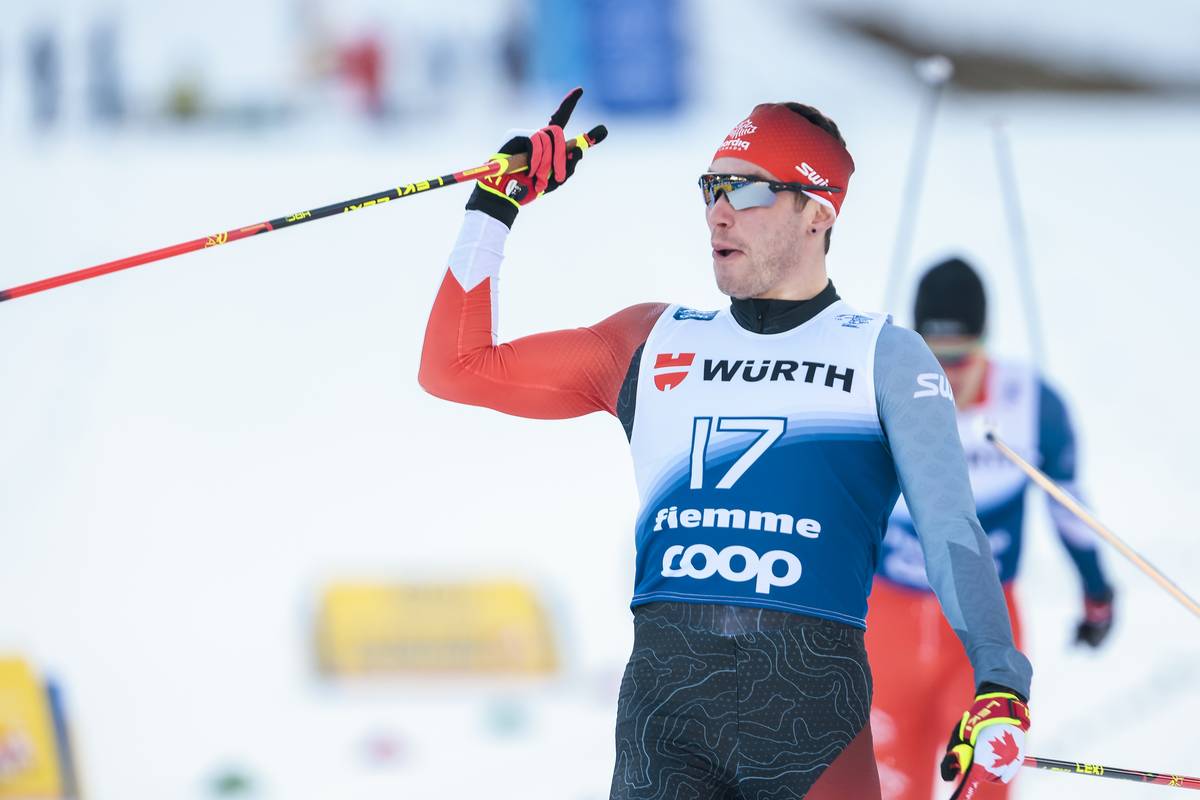
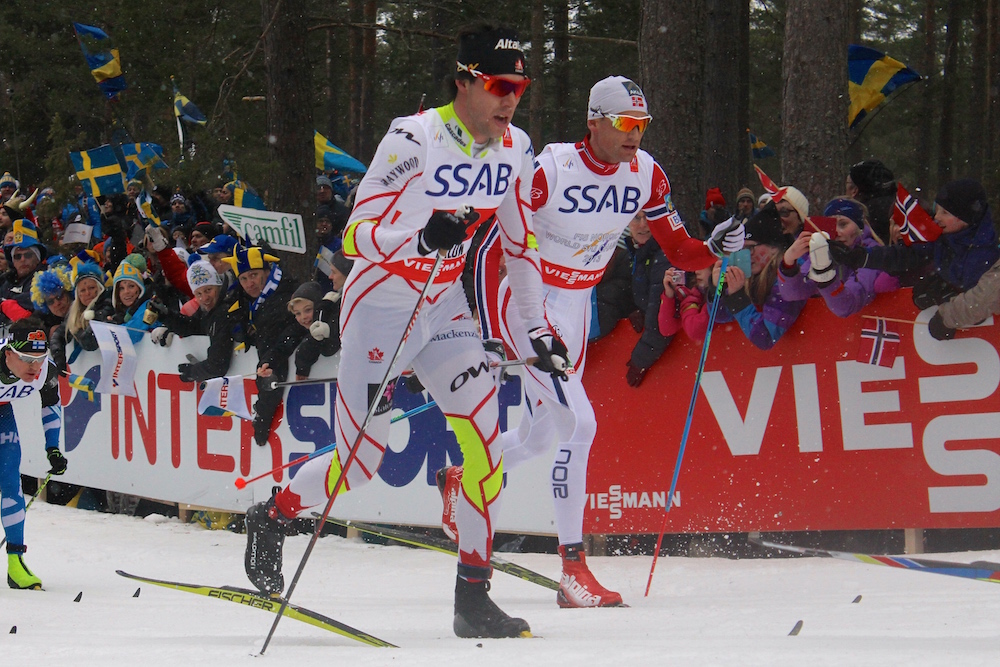
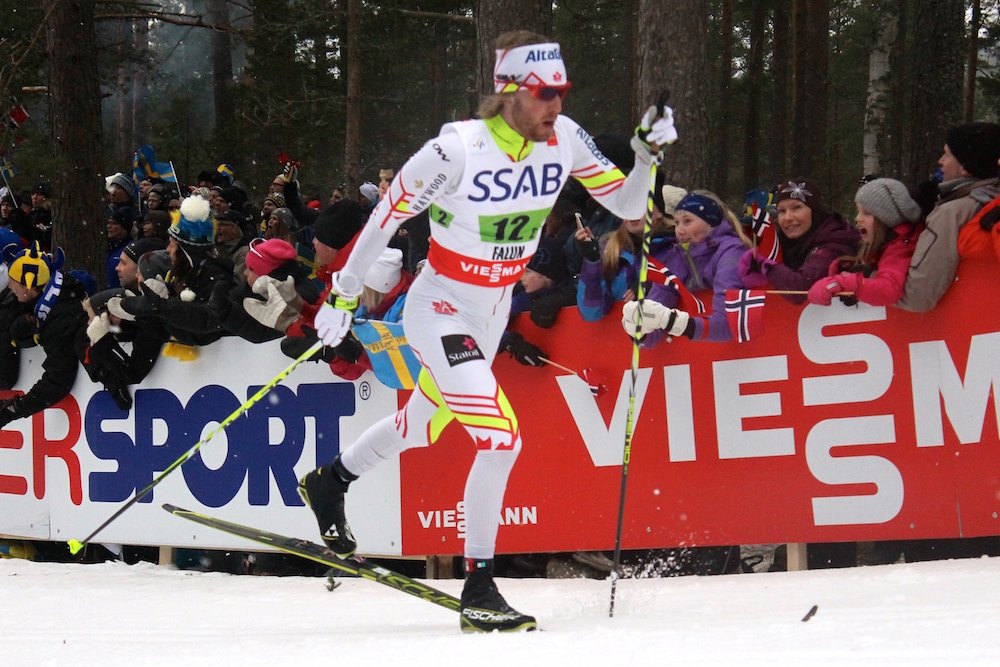
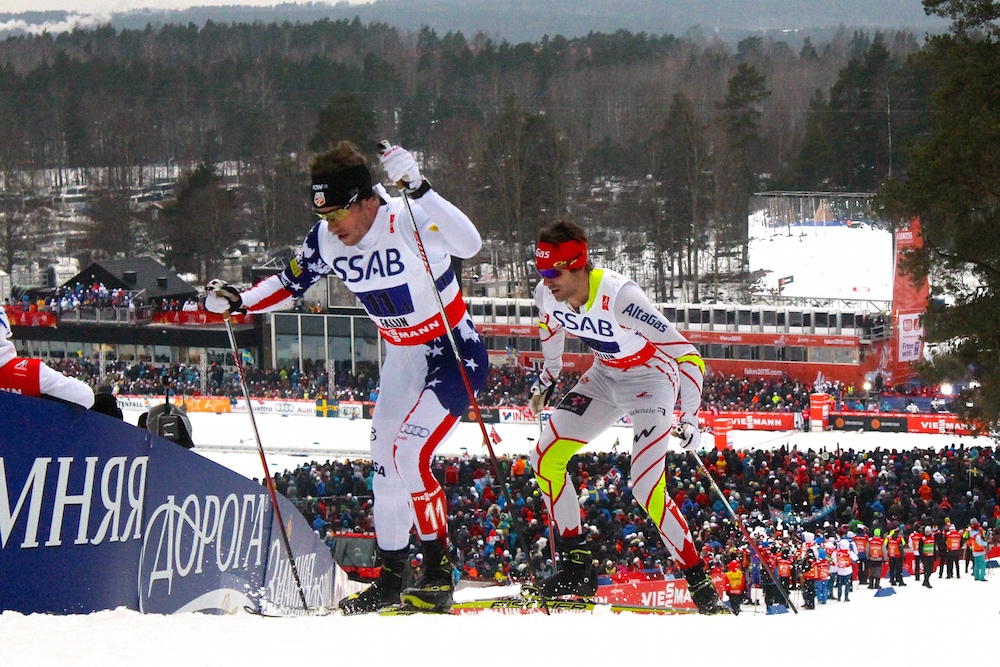
Antoine Cyr qualified for his first sprint finals during Stage 5 of the 2023 Tour de Ski, and the first for a Canadian since Alex Harvey in 2018. (Photo: Nordic Focus).
Version française
Intitulé du poste : Entraîneur de développement, Équipe nationale de ski (ENS), Olympique
Lieu : Canada
À propos de Nordiq Canada
Nordiq Canada est l’organisme national de tutelle du ski de fond et du ski nordique paralympique. Nous encourageons, soutenons et inspirons des performances de classe mondiale ainsi qu’une pratique de ces sports tout au long de la vie à l’échelle nationale.
L’offre
Sous la responsabilité du directeur de la haute performance et au sein d’un environnement collaboratif axé sur la haute performance, la principale responsabilité de l’entraîneur de développement sera de diriger et de superviser le programme NexGen et l’équipe de développement junior.
En tant que membre à part entière du personnel d’entraînement de Nordiq Canada, ce poste impliquera d’organiser et de diriger des stages d’entraînement et des compétitions, de fournir des services et un soutien améliorés, et de veiller au fonctionnement optimal des athlètes de l’équipe de développement dans le cadre de leurs programmes de développement (DTE), y compris l’alignement avec leurs plans de développement individuels (IAPP).
Il s’agit d’une opportunité passionnante de contribuer à l’une des principales organisations de sports d’hiver du Canada et de travailler aux côtés d’athlètes, d’entraîneurs et de personnel de soutien de classe mondiale dans la poursuite d’une excellence internationale durable.
Responsabilités clés
Fournir un soutien, une supervision et une expertise technique concernant le YTP, la planification quotidienne des programmes, leur mise en œuvre et l’atténuation des lacunes des athlètes identifiés et de leurs entraîneurs.
Effectuer des bilans réguliers avec les athlètes et les entraîneurs pour s’assurer que l’entraînement progresse et que les mesures de responsabilisation des athlètes sont respectées.
Créer et soutenir une culture d’excellence, d’ouverture et de croissance.
Travailler en collaboration avec des experts dans leurs domaines respectifs.
Maintenir un haut niveau de rigueur scientifique dans tous les processus, en garantissant une prise de décision fondée sur la performance et en optimisant la santé et le bien-être des athlètes (toutes disciplines confondues).
Diriger des projets et des plans de travail concernant l’analyse des lacunes, le parcours vers le podium et le profil de la médaille d’or.
Assister le HPD dans la rédaction du rapport annuel et les présentations.
Diriger et superviser les opportunités de compétition telles que les Championnats du monde juniors, les camps internationaux juniors et les camps de Nordiq Canada.
Assister à toutes les réunions requises ou demandées par le HPD et le PDG.
Assister le HPD dans l’orientation et la philosophie du programme.
Compétences et exigences
Expérience en tant qu’entraîneur auprès de jeunes athlètes et d’athlètes en développement.
Expérience en tant qu’entraîneur au niveau provincial et national.
Compétences en matière d’évaluation et d’interprétation des tests et des données issus des sciences du sport.
Doit être en bonne condition physique et capable de tester des skis ainsi que de s’entraîner avec les athlètes lors de certaines de leurs séances faciles.
Capacité à contribuer à un environnement d’équipe positif et professionnel, tant dans le cadre de la compétition qu’en dehors.
Excellentes compétences interpersonnelles, en gestion du temps et en communication.
Souci du détail et de l’exécution des tâches, orienté vers les objectifs, esprit stratégique et tactique, et sens de l’organisation.
Le bilinguisme (anglais/français) est considéré comme un atout majeur.
Permis de conduire valide.
Conditions de travail
Ce poste nécessite environ huit (8) semaines de déplacements nationaux et internationaux par an pour des stages d’entraînement, des visites d’athlètes et des compétitions.
Comment postuler
Les candidats intéressés sont invités à envoyer leur CV et leur lettre de motivation à : bscott@nordiqcanada.ca
Date limite de candidature : 22 juin 2026, ou jusqu’à ce que le poste soit pourvu.
Veuillez indiquer votre nom et « Entraîneur de développement NST » dans l’objet de votre message. Seuls les candidats retenus pour un entretien seront contactés.
Nordiq Canada s’engage en faveur de l’équité en matière d’emploi et encourage toutes les candidatures de personnes qualifiées. La préférence sera donnée aux citoyens canadiens et aux résidents permanents.
Nordiq Canada is hiring an Assistant Coach for its National Ski Team (NST) Olympic program, with the successful candidate stepping into a high-performance role supporting Canada’s top cross-country skiers on the World Cup, at World Championships, and at the Olympic Games.
Reporting to the Head Coach, the Assistant Coach will help plan, coordinate, and deliver coaching support for NST A and B athletes, with occasional responsibility for leading training camps and managing competitive periods on the World Cup circuit. The position is based in Canada and requires extensive domestic and international travel.
Key Responsibilities
Assist with the planning, coordination, and execution of training camps, competitions, and international tours for NST A and B athletes.
Provide technical, tactical, and race-day coaching support.
Contribute to athlete monitoring, performance analysis, and training feedback.
Support ski preparation, waxing operations, and equipment management as required, including serving as a technician for athletes when needed.
Collaborate with Integrated Support Team (IST) providers including physiologists, strength and conditioning coaches, sport science, medical, and mental performance staff.
Assist with logistics, travel coordination, and operational planning.
Uphold a culture of excellence, professionalism, accountability, respect, and athlete wellness.
Comply with Nordiq Canada’s Safe Sport policies and commitments.
Skills & Requirements
Experience coaching World Cup athletes, either individually or on the World Cup circuit.
Experience on the World Cup circuit as a coach or athlete.
Competency in assessing and interpreting sport science testing and data.
Must be physically fit and capable of testing skis as well as training with athletes on some of their easy sessions.
Excellent interpersonal, time management, and communication skills.
Detail- and task-oriented; a strategic and tactical thinker and planner.
Ability to coach Sprint format technical and tactical capacities considered an asset.
Bilingualism (English/French) considered a strong asset.
Valid driver’s license.
How to Apply
Interested candidates should submit a resume and cover letter to bscott@nordiqcanada.ca, with their name and “Assistant Coach NST” in the subject line.
Application deadline: June 12, 2026, or until the position is filled.
Nordiq Canada is committed to employment equity and encourages applications from all qualified candidates. Preference will be given to Canadian citizens and permanent residents.
Position: Assistant Head Nordic Ski Coach Employer: Black Jack Cross Country Ski Club Location: Rossland, British Columbia, Canada Reports To: Head Coach & Director of Skier Development Program FTE: Negotiable Start Date: Flexible Compensation: $40,000–$50,000 inclusive of benefits, commensurate with qualifications, and adjusted for agreed-upon FTE Term: One-year contract from start date, potentially leading to a permanent position Application Deadline: Open until filled
About the Position
Black Jack Cross Country Ski Club (BJSC) is looking to welcome a motivated and energetic individual to fill the position of Assistant Head Nordic Ski Coach. In collaboration with the Head Coach and other team members, the position will lead and/or oversee programming for all levels of the program as aligned with Nordiq Canada’s Long Term Athlete Development model.
About Black Jack Cross Country Ski Club
BJSC is a registered non-profit organization functioning to support and grow the sport of Nordic skiing since 1983. With a history of producing skiers at the international and national levels, the club is looking to promote cross-country skiing at all levels of the sport.
BJSC offers athlete development programs for ages 3 to adult, including:
Bunnies
Jack Rabbits
Track Attack
School Outreach
Community lessons
Private and group lessons
Race Team
Programming is delivered under the leadership of the Director of Skier Development, the BJSC Board, and a part-time Head Coach. BJSC has a dedicated and skilled set of volunteer coaches who are committed to delivering high-quality, fun programming. The BJSC Board is an avid and responsive supporter of the Skier Development program and actively collaborates on initiatives to enhance the sport of Nordic skiing for all members of the community. The Head Coach is committed to mentoring as needed.
Facilities and Community
BJSC has over 50 km of groomed trails for both skate and classic, including 2.5 km of daily lit night skiing. The main trailhead is five minutes from town and has professional groomers on staff supported by a robust group of volunteers to keep trails in great shape. Two connected ski areas extend the ski season from November to April. In 2025–26, club membership was over 1,000 strong, and the club successfully built a new day lodge. A dedicated GM supports club operations from September through April.
Black Jack Ski Club and Rossland offer an ideal location to live and train both summer and winter, with backyard access to roller-skiing, running, hiking, road and mountain biking, climbing, alpine and backcountry skiing. Rossland has an outdoor summer pool, tennis courts, a bike park, multiple fields, and a local gym. Trail, a 15-minute drive away, has indoor training facilities. An active, young community, Rossland is a desirable destination for both vacationers and those seeking to be locals.
Qualifications
Education
Minimum post-secondary education, including coaching, athlete development, and leadership
Occupational Certification
Canada National Coaching Certification Program: minimum Training to Train (T2T) or international equivalent as related to Nordic skiing
Valid Standard First Aid (minimum), Wilderness First Aid (preferred)
Class 4 driving license, or ability to obtain within 3 months, and access to a reliable personal vehicle
Criminal Record Check with Vulnerable Sector Screen
Experience
Previous coaching experience
Athlete training plan design and monitoring, including Training Peaks
Managing and leading a team of volunteer coaches (beginner through experienced)
Wax and race support operations
Planning and executing training camps
Administration
Personal Suitability
Demonstrates good decision-making skills
Enjoys collaborating with others, including volunteers, parent groups, and other coaches
Personable, enjoys connecting with people
Able to initiate and complete projects
Communicates effectively and proactively, including when resolving sticky situations
Considers conflict an opportunity for growth and focuses on win-win resolutions
Takes responsibility for self
Strives for excellence
High degree of fitness, with ability to demonstrate and give feedback on skate and classic ski techniques
Commits to professional development, including ongoing coaching training and connection with provincial and national programs
Responsibilities
Reporting to the Head Coach & Director of Skier Development, the successful applicant will support the club’s Racers, Junior Racer, and Track Attack programs. They will work in collaboration with volunteer coaches for the Bunnies and Jack Rabbits programs and the School Outreach program. Adult clinics, lessons, and programs will be coordinated with the GM.
Specific responsibilities include:
Support BJSC’s Head Coach with Racer program delivery, including session facilitation
Collaborate on the delivery of year-round athlete programming for Junior Racers and Track Attack that aligns with Nordiq Canada’s Long Term Athlete Development Model, including working with volunteer coaching staff to ensure appropriate dryland and on-snow programming
Provide technical feedback to athletes to ensure physical competency of all cross-country ski techniques as appropriate for the athlete’s development
Support volunteer coaches’ ongoing development
Facilitate mentorship opportunities between athletes at various stages of development
Uphold a safe, inclusive, and positive training environment, with Safe Sport practices, BJSC policies, appropriate supervision standards, and risk management
Support the organization of camps, races, and other events
Attend races as negotiated with the Head Coach, providing leadership, coaching support, wax selection, logistics, direction to parent and coach volunteers, and other tasks as needed
Maintain familiarity with BJSC Board activities, contribute to ongoing improvement of club operations, and assist in planning and execution of club events as necessary
Collaborate with the Bunnies and Jack Rabbits Program Coaches as directed by the Director of Skier Development
Collaborate effectively with the BJSC Skier Development Director
Collaborate with the BJSC Race Hosting Committee
Attend monthly Skier Development Program (SDP) Committee meetings
Other duties as directed by the Director of Skier Development
The position will require travel as well as working in the evenings and on weekends.
Cover letter outlining how you meet the Education and Experience criteria listed in the Statement of Qualifications, with concrete examples (2,000 words maximum)
The position will remain open until filled. All applicants are thanked in advance; only those considered for an interview will be contacted.
In this Olympic year, what a great chance for skiers of all ages and abilities to plan their ‘Olympic event’. Make the S2S yours! Host of the Canadian Olympic trials in December 2025. Rub shoulders (likely best when not skiing!) with Canadian World Cup and Olympic team members and some top Norwegian and other international athletes. There truly is something for everyone at the S2S. Elite, competitive, and Finishing is Winning categories. The last one is the biggest category with the biggest smiles too! The course is a very scenic point-to-point ski marathon. Both Classic and Skate races. 21km and 41km distances. Stussi Night Sprints (1.1km Skate) as an extra race or spectator option. Other extras too, like a Film Festival, lodging deals, full-service stays at SilverStar Mountain Resort, and springtime activities 20 minutes away in the Okanagan Valley. Wow. Sign me up!
S2S features officially on the Worldloppet Global Calendar, and is part of the Ski Classics Challenger series. It’s quickly becoming a popular season finale for ski groups, clubs, and elite racers too.
Last year’s event video is under 3 minutes and worth a watch. Cool drone coverage, voices of participants, a fun social vibe, and some hearty competition too!
We’re especially keen on welcoming first timers to the S2S. If that’s you, a Q&A with a first-time S2S participant might be that little reassurance and nudge you need. You can also direct any questions to info@sovereign2silverstar.com with a real person (no bot!) at your service.
We’re also keen to welcome clubs who can vie for prize money (and bragging rights!) in the Club Championships. A fun and fair winning formula includes the number of club members finishing the event and travel distance to the S2S. Fewer finishers are needed with longer distances traveled.
A few final links to get set for your Olympic event for 2026:
REGISTER NOW before prices increase midnight February 22, 2026
Check out accommodation deals, with great access to Nordic and Alpine skiing, and lots of options for varied budgets.
It’s race season, baby. It’s also Thanksgiving week, at least in America. Tune in to learn how to avoid turkey legs while you’re racing and for a full recap of last weekend’s competitions in Sweden and Norway. Didn’t know the name Andreas Ree before Sunday? We’ll catch you up. Julia Ystgaard, Canada’s World Cup coach, joins us to break down her team’s solid performances, as well.
It’s also the time of year when we remind you that we need your help to keep this podcast running, along with the rest of the site. Please consider a voluntary membership — options available here.
At 1am Eastern time on Friday, Nordiq Canada sent out a press release. The release mentions that the decision to drop out was made in solidarity with a list of countries, including the USA. As FasterSkier shared a flight to Québec City with a number of US and Canadian athletes and officials on Thursday afternoon, this was a late decision.
Nordiq Canada Withdraws from FIS Cross Country World Cup in Quebec City
QUEBEC CITY—After much consideration for the health and safety of each of Canada’s athletes and staff in Quebec City, Nordiq Canada’s executive team, in cooperation with its Board of Directors, has informed the International Ski Federation (FIS) that it will be withdrawing Team Canada from the 2020 FIS Cross-Country World Cup scheduled for the Plains D’Abraham, March 13-15.
Nordiq Canada recognizes the tremendous preparation invested by its event partner, GESTEV, as well as the volunteer-base to be ready to host the world for the final week of World Cup cross-country ski racing.
Our number one priority is, and always will be, the safety and health of our athletes and staff. We feel this is the best course of action to do our part in keeping, not only each and every athlete and staff member safe, but also the general public.
As the host nation of the World Cup in Quebec City, this decision was not an easy one for Nordiq Canada to make. However, it was made in solidarity with other Nordic teams including Norway; Germany; Sweden; Finland; Great Britain; the Czech Republic and the United States.
The decision also comes on the heels of Nordiq Canada cancelling the 2020 Canadian Ski Championships and the Alberta World Cup Society putting a halt to the staging of the World Cup Finals in Canmore, Alta. – not to mention the suspension of play by nearly all major North American sports over the last two days.
This decision supports Canada’s efforts to minimize the transmission of the Coronavirus (COVID-19), which is a fast-evolving situation globally.
Quebec City has a powerful history of staging world-leading cross-country ski events. Over the last decade, tens of thousands of passionate Olympic and Paralympic sport fans have blanketed Canada’s historic battle fields outside the old city to catch a glimpse of the world’s best cross-country skiers. We were endeavouring to give our fans a much-needed respite from the current climate. But at this point – and as the situation continues to rapidly change – the right thing to do for our athletes and broader community, is to return their homes.
Nordiq Canada is the governing body of para-nordic and cross-country skiing in Canada, which is the nation’s optimal sport and recreational activity with more than one million Canadians participating annually. Its 60,000 members include athletes, coaches, officials and skiers of all ages and abilities. With the support of its valued corporate partners – Haywood Securities Inc., AltaGas, Swix and Lanctôt Sports– along with the Government of Canada, Canadian Olympic Committee, Canadian Paralympic Committee, Own the Podium and B2Ten, Nordiq Canada develops Olympic, Paralympic and world champions. For more information on Nordiq Canada, please visit us at www.nordiqcanada.ca.
Canadian biathlete Thomas Hulsman training at the Canmore Nordic Centre in Canmore last season. (Photo: Britton Ledingham/iEvolve Photo Inc.)
In an effort to showcase the North Americans competing at this past week’s International Biathlon Union (IBU) 2018 Youth and Junior World Championships in Otepää, Estonia, we asked those qualifying athletes several questions about themselves — actually, we had them fill in the blanks. Here we have 18-year-old Thomas Hulsman, who represented Canada at his second World Youth Championships.
Over the last week, Hulsman placed 35th in the youth men’s 7.5 k sprint, 45th in the 10 k pursuit, 65th in the 12.5 k individual, and 16th in the 3 x 7.5 k relay.
***
“My full name is Thomas Gary Hulsman but you can call me Thomas.
I was born Calgary and raised in Airdire and I learned to ski at Foothills Nordic around the age of 12.
I spent the time between World Youth/Junior trials and Worlds on the Junior IBU tour and then in Norway for some training time.
My hardest workouts I did in the last training year to prepare for this was uphill intensity where we did a pyramid. That means we ran up, then back down, then ran a little bit further up, then back down, up then down, and up to the top.
One thing I’m working on this season to improve my biathlon is my sking.
This is my first time in Estonia and second time racing internationally, and so far it’s been a blast.
One difference I’ve noticed between Estonia and the Canada is the food.
Thomas Hulsman racing at the IBU Junior Cup in the Czech Republic earlier this season. (Courtesy photo)
One of the things I’m most excited about for World Youth/Junior Championships in Otepää is seeing the country.
One race I’m particularly targeting is the sprint, because it is the race I need to place in the top 60 to do the pursuit.
Watching the Olympics in the leadup to my own races was inspirational. One of my favourite moments of the Games was watching the races with the boys in my room. I want to be like Martin Fourcade because he is so consistent.
At Worlds, I really hope I can chat/make friends with as many people as possible.
My favourite thing at the breakfast where we are staying is all of the fruit and the omelettes.
Before this trip, if you said “Estonia”, the first thing I’d think of would have been “Where is that?”
Now that I’m here, I’m pretty sure something I’ll always remember will be how there is skiing everywhere.
If I had a totally free day here and didn’t have to worry about race fitness or training, I’d spend it seeing the country, probably in the capital and shopping for stuff.
So many suits — The start of the women’s 15 k skiathlon on Saturday, Feb. 10, Day 1 of the 2018 Winter Olympics in PyeongChang, South Korea. (Photo: FlyingPointRoad)
PYEONGCHANG, South Korea — This time last week, we brought you the basics of Olympic cross-country and biathlon cheat sheet, and not long after, we received a comment from a reader asking for a uniform cheat sheet. We, too, found ourselves sometimes befuddled. During Saturday’s skiathlon, this reporter found himself looking for the emblematic stars on the U.S. Ski Team’s new unis. There were stars, think Diggins and Kalla, just no obvious stellar-like branding on the USST suits.
So for you and for us, here’s a basic cross-country race suit cheat sheet. Disclaimer: we do nordic here at FasterSkier. Which is saying fashion and nordic are often mutually exclusive. Sometimes we do fashion (right FBD?), but not really. For more fashion expertise here’s a site that popped up when googling “most famous New York fashion writer”. Back to race suits.
Sweden: Out with the all-whites and in with the mostly royal-blue tights. The blue is emphasized on the thighs and blends into yellow knee-highlights, which in turn blends into white on the lower leg. Blue, yellow, white is all Sweden. Here’s Sweden’s own Charlotte Kalla racing to second in Thursday’s 10 k skate.
Sweden’s Charlotte Kalla racing to second place in the women’s 10 k skate at the 2018 Winter Games in PyeongChang, South Korea. (Photo:FlyingPointRoad)
Sweden’s biathlon race suits epitomize reductionism. In other words — K.I.S.S. — as in, keep it simple, Sweden. Our wish is their command. Two words to help identify Sweden on the biathlon range or tracks. Canary yellow. Thank you Sweden.
Sweden’s Hanna Öberg on her way to a gold medal in the women’s 15 k individual at the 2018 Olympics in PyeongChang, South Korea. Öberg skied the sixth-fastest time and shot 20/20. (Photo: IBU/Biathlonworld.com)
Finland: Every day is a new day. A positive outlook works wonders in the tough-to-win sport of World Cup skiing. Finland’s Krista Pärmäkoski is positive and owning it in Finland’s lycra whites. Yes, there’s navy blue on the forearms and just below the patella, but if you can kill in mostly white, you can kill on the ski course. That’s evidenced by Pärmäkoski’s arm raise: positive vibes and she’s in for the bronze. (Note: if Pärmäkoski is skiing away from you, the Finland suits emphasize blue on the backside.
Finland’s Krista Pärmäkoski crosses the line for bronze in the 2018 Olympic women’s skiathlon. (Photo: FlyingPointRoad)
You’ll have to look past Canada’s Rosanna Crawford and zero in on Finland’s Mari Laukkanen in bib 22 to burn the Finn’s biathlon uniform into the synapses. Finland’s biathlon unis do the flag proud. It’s a zippy look that takes the essentials into play: blue and white. Certainly less white and more blue than their cross-country brethren. For the feisty Finns — they dealt with invading Soviets in winter of 1939 — we say it works.
Fashionably crushing it, Canada’s Rosanna Crawford (bib 22) in the 7.5 k sprint in PyeongChang. Finland’s Mari Laukkanen (bib 21) skis behind Crawford. (Photo: FlyingPointRoad)
France: We’re sticking with countries that begin with the letter F. C’est la vie. But we’ll go a little crazy and start with France’s biathlon garb. Why is that? Because of Martin Fourcade — the French force of biathlon. He shoots like a veritable post-doc in Jedi-studies and skis like he could crush the 15 k skate on the cross-country World Cup. France’s biathlon suits get jazzy in a sky blue kind of way on the lower leg. And just when you get complacent with all the blue tones, the right arm gets proud in red. You should get to know this suit, Fourcade is likely to rule these Games; he’s already won the men’s 10 k pursuit.
France’s Martin Fourcade defending his Olympic gold from four years ago on Monday in the men’s 12.5 k pursuit at the 2018 Olympics in PyeongChang, South Korea. (Photo: FlyingPointRoad)
France also gets props for keeping it easy on spectators and viewers. If you’ve studied Fourcade’s race suit already, you’re all set. In the image below, France’s Jean-Marc Gaillard (9) proves our point. Biathlon or cross-country, the suits are the same.
Canada’s Alex Harvey (4) leading France’s Jean-Marc Gaillard (9) and Finland’s Iivo Niskanen (8) during the skate leg of the men’s 30 k skiathlon at the 2018 Olympics in PyeongChang, South Korea. Harvey went on to finish eighth. (Photo: FlyingPointRoad)
Norway: It’s Norway after all. Nothing too drastic here, and certainly we’re imagining athletes will have several colors schemes to choose from at a later date. For now, the new kind of looks like the old. Which when consulting fashion guides, retro can be cool — think the resurgence of L.L. Bean’s duck boots or those Greg-Lemond-era Oakleys that Harvey has rocked.
OK, the cross-country suits. Here’s Norway’s race wear as worn by Heidi Weng (bib 1) and Ingvild Flugstad Østberg (bib 2) during Saturday’s skiathlon. The easy thing about trying to identify the Norwegians in a deep field cross-country scrum: look towards the sharp end of the race. Most often in the lead pack you’ll see a predominately red-suited athlete pushing the pace. Yeah, that’s probably Norway. (That said, deference to Canada’s Harvey, we want to get our red suits straight. We’ll get to the maple leaf in a bit, but in the case of Canada just think a different shade of red, because Harvey is a front-pack skier. Big respect for Harvey in red.)
The start of the women’s 15 k skiathlon on Saturday, Day 1 of the 2018 Winter Olympics, with (front row, from left to right) Austria’s Teresa Stadlober, Norway’s Ingvild Flugstad Østberg, Norway’s Heidi Weng, American Jessie Diggins, and Sweden’s Charlotte Kalla leading out of the stadium in PyeongChang, South Korea. (Photo: FlyingPointRoad)
Here’s a shot of Norway’s biathlon suit. Again, Norway has gone with reliable themes. Yet in this case, pin striping rules. There’s the red, the deep blue, and the white. The striping certainly gives it a more formal look as if to say “we’re here to shoot clean”.
Norwegian biathlete Erlend Bjøntegaard on his way to fifth in the men’s 10 k sprint. (Photo: FlyingPointRoad)
Canada: Why not? Let’s break down Canada’s race gear next. Nothing too crazy here on the XC side from our good friends up north that brought us Bob and Doug McKenzie and sort of Kenny G. (Officially, Kenny G. is American; he was born in Seattle. But his mom is from Saskatchewan. A loose connection, but only separated by one degree. And Seattle is super close to Vancouver.) Like the Norwegians’ cross-country race suit, this is a mostly red affair. But it rocks perhaps the most identifiable flora icon on the planet: the maple leaf. In our opinion, this suit is an instant classic. Maple-leaf patterns run down the length of the arms. Nothing too gaudy here. No fluorescent yellow, no overdoing it with the “Canada-ness” of it all. And there’s just the right amount of white lycra highlights to keep it sleek looking. If you’re looking to impress on the Olympic trails but be simultaneously understated, look no further than Canada. Here’s Alex Harvey racing to seventh, his best individual result in his third Olympics, in Friday’s 15 k skate:
Canada’s Alex Harvey racing to seventh in Friday’s 15 k freestyle at the 2018 Olympics in PyeongChang, South Korea. (Photo: FlyingPointRoad)
Under the bright lights of the Alpensia biathlon venue, Biathlon Canada got a wee bit friskier. Down the right arm you’ll note … wait for it … white maple leaves of varying sizes. Little known fact, at least to FS, “an infusion” of maple-tree bark can be used to treat cramps and dysentery. Any chance that infusion works on norovirus? Just asking.
Lots of digressions here. But this is for certain and maybe it’s a trickle-down effect of honoring the most beautiful autumn tree on the planet. Across the board, XC or biathlon, Canadian athletes are a delight to chat with. You parent-folk raise them well up north.
Canada’s Brendan Green en route to 82nd in the men’s 10 k sprint at the 2018 Olympics in PyeongChang, South Korea. (Photo: FlyingPointRoad)
The lower half of Canada’s biathlon unis are trending more towards what we have seen in the recent Canadian lycra past: bigger and badder maple leafs. A big white maple icon sits on the lower right leg, with a smaller slightly more delicate yet distinguished maple icon on the upper left thigh. There you have it. When in doubt, channel the red suit and the maple leaf and you’ll know it’s Canada at any of the nordic venues.
Canada’s Christian Gow racing to 62nd in the men’s 10 k sprint at the 2018 Olympics in PyeongChang, South Korea. (Photo: FlyingPointRoad)
U.S.A.: Jingoism = “extreme patriotism, especially in the form of aggressive or warlike foreign policy.” We are not jingoistic here at FasterSkier. Read Saturday’s skiathlon report and it’s clear we’re not jingoistic. The day’s winner Kalla — from Sweden — is given plenty of coverage. Yeah, Jessie Diggins killed, but Kalla was a force, too.
Jessie Diggins racing to fifth in the women’s 10 k skate for her third top-six (and second top-five) of the 2018 Olympics. (Photo: FlyingPointRoad)
So the good ole’ red-white-and-blue (r-w-b). That’s pretty much still the theme. Visually speaking, we think it’s a nice blend of the r-w-b trifecta. It’s mostly blue. And a cool blue at that. Again coolness reigns with the white downward slanting stripes running from the lower thigh to below the knee. Those stripes scream, “Scoreboard!” And the red on the arms? Awesome. And if you’re like this reporter looking around in the pack for the U.S. skiers, it helps to read the bold print on the right upper arm. Read: U.S.A.
American Noah Hoffman racing in the 15 k freestyle at the 2018 Olympics in PyeongChang, South Korea, where he finished 48th. (Photo: FlyingPointRoad)
Now to US Biathlon. For starters, the national governing body of biathlon in the U.S. is … US Biathlon. A totally different sporting body than U.S. Ski and Snowboard. And the uniforms on the biathlon side make that clear. There’s little cross-pollination like we see with the Canadian suits.
For awhile, U.S. Biathlon raced in suits with a distinct mix of blue and red. If you can harken back to elementary school art class, or if you’re in elementary school now, you’d have to pass this basic test to move onto more complex colors.
Test: How do you make purple. Yes! Mix red and blue together.
The older U.S. biathlon uniforms had a distinct purple hue on the bottom-half. The top was a tasteful strawberry red called into action by iconic Adidas striping down the arms. That purple hue is no longer. Get rid of that in your mind’s eye. We’re not even posting a photo of that older race suit. It’s so not now.
Want to know where Susan Dunklee or Lowell Bailey are? Look for uniforms that harness the “blue blazer” in all of us. First let’s zoom in. (See photo below). We note here that it’s not simply a solid-blue pattern. The hat, shoulders and upper torso host a maze of small deep blue “three-stripe” hash marks printed over a lighter bluebird blue. Since those appear on several team’s 2018 Olympic suits (like Sweden, Germany, and the Olympic Athletes from Russia), all of which were made by Adidas, we’re guessing it’s a nod to their uniform supplier? (You know, with the “threes” theme.) Nonetheless, the upper is mostly covered by the bib. And from a distance, as we zoom out, it simply looks blue. But before we do that, here’s Clare Egan — total badass polyglot; she speaks Korean — during the women’s sprint here in PyeongChang.
Clare Egan (US Biathlon) racing to 61st in the women’s 7.5 k sprint at the 2018 Olympics in PyeongChang, South Korea. (Photo: FlyingPointRoad)
Now for the zoom out. This shot is great for many reasons, so a shoutout to FlyingPointRoad guru Steve Fuller. Since we are talking colors here, let’s just continue the shout out to Steve. This photo kills because a Swedish skier follows Tim Burke in a canary yellow race suit. Blue and yellow are primary colors. The blue-Burke here stands out more as he’s contrasted by the yellow-Swede. Intentional or not Steve, well done.
Let’s focus on Tim Burke’s legs. That’s a solid royal blue, right? A basic blue, but a royal blue. There’s just no damn distractions from the business at hand here. Maybe the small USA on the left calf area is a nod to those fans still time-capsuled with Lake Placid’s 1980 gold-medal hockey team and the venerable announcer Al Michaels. That USA on the leg isn’t really yelling U.S.A!!! U.S.A!!! It’s sort of a kinder and gentler u.s.a. (no caps intentional). Like a whisper, saying we come in peace even though we’re charging hard with rifles on our backs. Back to the point. No distractions. #businesstime.
USA = basically blue. Look for the blue. That’s the U.S. biathlon team.
Tim Burke (US Biathlon) en route to 47th in the men’s 10 k sprint at the 2018 Olympics in PyeongChang, South Korea. (Photo: FlyingPointRoad)
Other notable suits:
Switzerland: From a country we all associate with Swiss-Army-Knife red, we get thrown a change up. It took us all a few seasons to get accquainted with the race-lycra formal wear donned by the Swiss cross-country team. Cross-country World Cups aren’t exactly formal occasions, but the tuxedo black suits the Swiss have worn for a few years now — a look you’d seek if you were on the race equivalent of a Georgetown cocktail circuit — are gone. The Swiss sport maroon suits with red highlights on the lower legs and arms.
(Note: These suits resemble Russia’s cross-country race suits on the World Cup. Alas, they also resemble Russia’s suits during the Games despite the fact that Russia’s skiers are competing under the Olympic flag as Olympic Athletes from Russia (OAR). See photo featuring Great Britain’s Andrew Musgrave — that’s Denis Spitsov of the OAR chasing, not a Swiss skier. It helps that the Swiss skiers wear hats reading “Suisse”.)
Switzerland’s Dario Cologna racing to gold in the men’s 15 k freestyle on Friday at the 2018 Olympics in PyeongChang, South Korea. (Photo: FlyingPointRoad)
Great Britain: From the people who brought us the modern navy … we get navy blue. Nothing says “we are not in your face” more than navy blue. Great Britain’s cross-country race suits are appropriately regal. Think the Queen, Lady Di, and the ever so cool and soon-to-be-in-line-for-the-throne, Meghan Markle. Also, Andrew Musgrave, as this reporter’s grandfather used to say, is the real McCoy. (The Scottish McCoy, not the Irish McCoy). It was a delight to watch the 2018 Olympic skiathlon unfold as a fly-on-the-wall surrounded by British journalists. Move over Chelsea. Move over Man-United. Yeah, that’s right. Musgrave is on your tails sporting navy blue lycra.
Britain’s Andrew Musgrave (10) during the men’s 30 k skiathlon in PyeongChang, South Korea, followed by Russia’s Denis Spitsov (16), skiing as a member of the Olympic Athletes from Russia. (Photo:FlyingPointRoad)
Italy: Ah Italia. They exported high fashion with the house of Gucci and they school us in the color wheel. First, Italy’s cross-country race suits feature a halcyon blue. A blue when blues sang like a pristine alpine sky and times were simpler. A time perhaps when you were finishing an altitude camp in Seiser Alm and all you had to worry about was visiting the physio for a rub-down and connecting for a post-training sesh espresso with the whos who of the World Cup … also finishing an altitude camp.
Second, we note orange. Orange is many things, but it does not scream Italy. However, we believe Italy is paying respect to its storied-art legacy by deferring to the color wheel — Italy’s suits have just a tad more than a splash of orange on the lower legs and lower arms. Blue and orange are complementary colors. That means they are opposite one another on the color wheel. Opposites attract. And if anything is attracting here, it’s Federico Pellegrino and his panache on the big stage. Dude can classic sprint, too. Here’s Pellegrino an eyeblink before crossing the line in the classic sprint final (he took silver).
Third, and this may be breaking news, Italy may have a one-off suit for Pellegrino. If you compare the below image with the one below that (behind American Caitlin Patterson, there’s an Italian skier, Sara Pellegrini), newsflash — no splash of orange. Absent the orange, the suit is identical to Pellegrino’s. ITA adorns the upper-left quad area on each suit. Italy’s biathlon team also wears the all-blue suit. Ciao for now.
Norway’s Johannes Høsflot Klæbo (l) and Italy’s Federico Pellegrino finishing first and second, respectively, in the first semifinal of the men’s 1.4-kilometer classic sprint at the 2018 Olympics in PyeongChang, South Korea. (Photo: FlyingPointRoad)American Caitlin Patterson leads Italy’s Sara Pellegrini (not to be confused with Pellegrino) into the finish of the women’s 15 k skiathlon at the 2018 Olympics. They finished 34th and 35th, respectively. (Photo: FlyingPointRoad)
Austria: What’s black and white and red allover? Austria. Across the board: cross-country, biathlon, and nordic combined, the uniforms are all the same. You’ll never not notice Austria.
Austria’s Dominik Landertinger racing to bronze in the men’s 20 k individual at the 2018 Olympics in PyeongChang, South Korea. (Photo: FlyingPointRoad)
Germany: Embracing their inner-Vader is Germany. Like the old Swiss race suits but taking black lycra to “11”. Germany. Add just a sprinkle of white around the shoulders to lighten the mood. The red hat emblazoned with the Bundesadler — the German federal eagle — is a fitting cap for their race wear. As badass as Clare Egan is speaking Korean (go back to U.S.A. for a refresher), the Bundesadler is nearly her avian iconography equivalent.
Germany’s Eric Frenzel (5) leads Austria’s Lukas Klapfer during the individual normal hill/10 k competition on Wednesday at the 2018 Olympics in PyeongChang, South Korea. Frenzel went on to win while Klapfer placed third. (Photo: FlyingPointRoad)
Germany’s cross-country, biathlon, and nordic combined teams share the same uniform.
Germany’s Laura Dahlmeier racing to her first Olympic gold (and first Olympic medal) on Saturday in the women’s 7.5 k sprint, the first biathlon race of the 2018 Winter Olympics in PyeongChang, South Korea. (Photo: FlyingPointRoad)
We couldn’t cover every team, so we’re aware we left more than a few out. Hopefully this leaves you feeling a little more in-the-know when it comes to Olympic XC and biathlon spectating. Onto the relays (and biathlon mass starts) we go!
***
A message from a Korean fan during the men’s 15 k freestyle on Friday at the 2018 Olympics in PyeongChang, South Korea. (Photo: FlyingPointRoad)A message from an unidentified spectator during the men’s 15 k freestyle on Friday at the 2018 Olympics in PyeongChang, South Korea. (Photo: FlyingPointRoad)
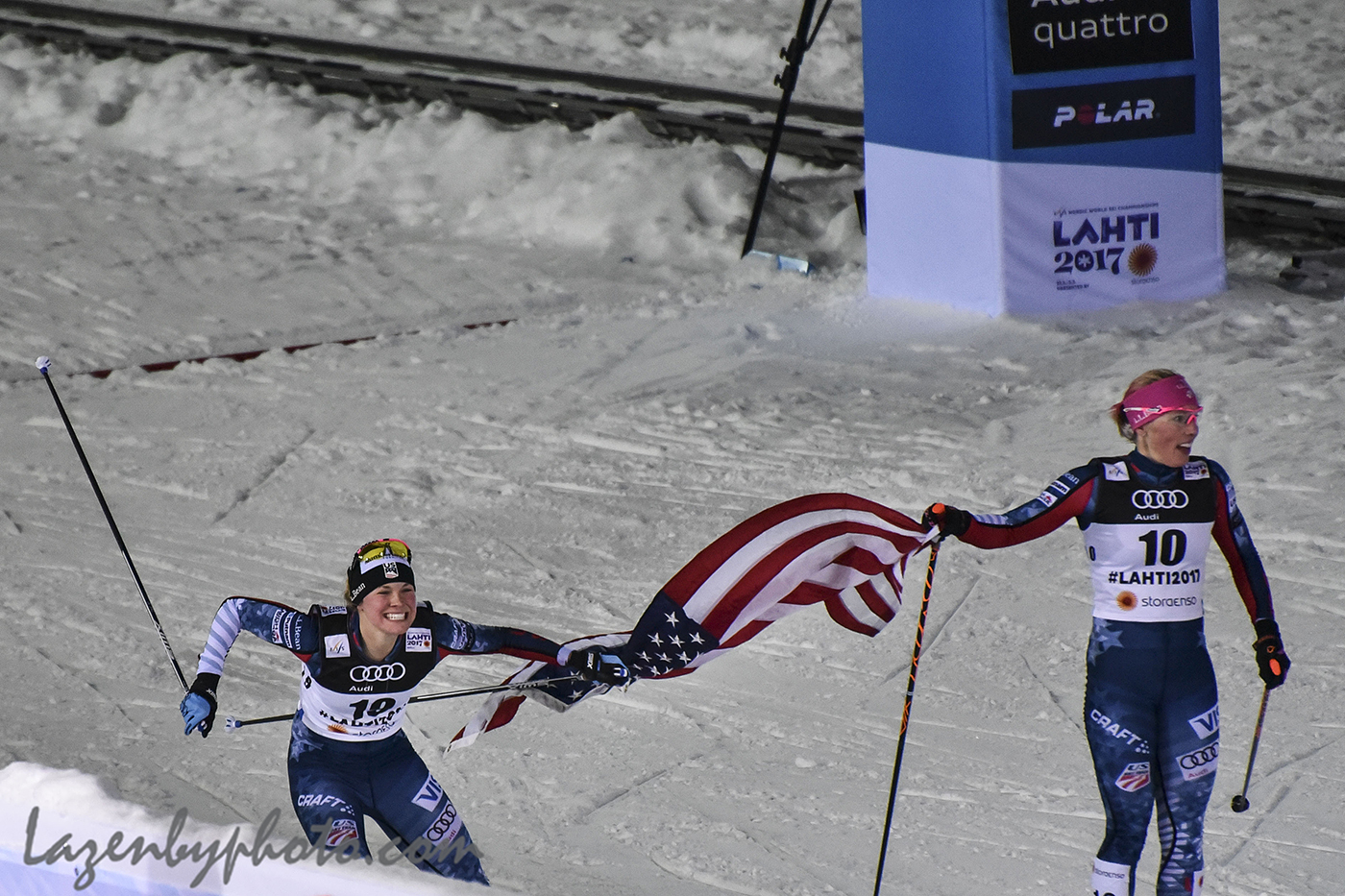
U.S. Ski Team members Jessie Diggins (l) and Kikkan Randall hold the American flag during a victory “lap” down the homestretch after placing second and third, respectively, in the women’s freestyle sprint at 2017 Nordic World Championships in Lahti, Finland. (Photo: John Lazenby/Lazenbyphoto.com)
ANCHORAGE, Alaska — Kikkan Randall is approaching a season full of lasts: her final season as a full-time athlete, her final season on the World Cup, and, she hopes, her fifth and final Olympics. Her main focus these days is resolutely on the future, but she took some time earlier this month to speak with FasterSkier about her summer training and what comes next.
Summer training
Randall’s final summer of training was anchored by the same thing as most of the 17 summers before it: multiple weeklong training camps on Eagle Glacier, the Alaska Pacific University (APU) facility in the Chugach Mountains above Girdwood, Alaska. But this summer saw Randall take only two trips to the glacier, instead of the three camps attended by most of the APU team.
In place of a third glacier camp, Randall traded a short helicopter ride for a long plane flight and traveled to Sweden for a 12-day training camp with the Swedish national team. It was Randall, fellow U.S. Ski Team (USST) member Liz Stephen, and 10 women from the Swedish team, Randall explained in a phone interview.
https://www.instagram.com/p/BXk2D1rj0W2/
Randall began her trip with three days in Östersund, Sweden, with Anna Haag and Stephen, who was coming from the Blink rollerski festival in Gjesdal and Sandnes, Norway. Then came three days in Åre with the full Swedish national team, as well as USST Women’s Coach Matt Whitcomb. The remaining days of camp were spent with the full Swedish team near Vålådalen. The whole thing made for a “really sweet” 12-day training block, Randall recalled.
American skiers were hardly receiving invitations to train with Scandinavian national teams at the start of Randall’s career, but such exchange programs are now relatively commonplace. This was not Randall or Stephen’s first such trip to Sweden, and Jessie Diggins joined the Norwegian national team for a camp last summer.
“I think it’s also a strong testament to our nation, and our program as a good partner to Norway as well,” Whitcomb previously said about the invitation, as well as speaking highly of both Diggins and the Norwegians.
“We’re all training at a high level now,” Randall says when asked whether she sees similarities or differences between American and Swedish training. “We’re all doing very similar types of training, loads of training.”
But even if the training quality and quantity are comparable, the logistics are different, reflecting the simple fact that the U.S. is more than 20 times larger than Sweden, with top-level skiers spread out across five time zones and thousands of miles.
“The real difference for me and what stands out is just the lifestyle of it,” Randall reflects, “and how the Scandinavians never have to travel more than three or four hours away from home. They get together for camps once every three weeks. They’re in camp but they’re these shorter camps and then they go home. Whereas for us, we have the geographical challenges of so much more travel, that when we get together, we have to get together for longer to make it worthwhile, but that of course changes the exact kind of training we can do within a camp, so that part’s varied a little bit.”
The difference isn’t just academic, but rather bears on the type of training that can be done in a group environment. “This camp we went to was an aggressive training schedule,” Randall notes, “and I don’t think it would be smart to necessarily take that schedule and bring it back to the U.S. and replicate it because just the way we live is a little different.”
https://www.instagram.com/p/BXay55rD8oi/
Randall found a valuable training stimulus from the camp, and appreciated the chance to “rub elbows with those guys, be like, OK, I may train a little differently, but I’m on track, versus having to wait seven months between race seasons and not knowing where the heck you are.”
But even more than the reality check on training and fitness, she says that it helps to have local friends in Europe when the Americans are on the road and living out of a suitcase for four months at a stretch.
“I think the biggest benefit” of this offseason training exchange “is that we get to know them as people,” Randall notes. “When we’re on the World Cup, then all of a sudden we have these friends on other teams. If we do need a weekend off and want to go to a home, we can go home with them and get a little break or we see them and we go out for jogs together. It’s pretty cool because I’ve developed lifelong friends now and I look forward to continuing to visit beyond just these training years. I think that shared experience is what really makes it special to me.”
The final World Cup season and the Olympics
It’s tough for any American skier to spend that long away from home. But Randall, with husband Jeff Ellis and support from family members on both sides, is upping the logistical ante by bringing along a toddler. The couple’s son, Breck Stuart Randall Ellis, turns 18 months old next month, and will be spending his second winter on the World Cup circuit.
“Our plan is to pack up early November and head over as a family,” Randall says of their approach for the 2017/2018 season. “We’ve got most of the winter figured out. We’ve got a few more apartment-style accommodations lined up this year. We know with a busy year-and-a-half-year-old, it’s going to be a little harder to contain him in a hotel room. We’re trying to set up the best kind of situation for our family.”
https://www.instagram.com/p/BMy2IR8A_q3/
Randall and Ellis have most of the winter already dialed in, but there’s still one large hole left in their schedule: PyeongChang. “The challenge we’re really wrestling with right now is with what to do about the Olympics,” Randall notes.
Randall is certain that she wants to have her child with her in South Korea if at all possible. “Ideally I’d have Breck at the Olympics,” she says.
Looking back to the 2017 World Championships, Randall says, “I think that was a really positive force having him with me at Lahti, but it’s looking to be exorbitantly expensive to be able to have him in South Korea nearby. We’re looking for accommodations, figuring out can we possibly afford this, and if not, what are some other options? We don’t have a clear answer on that one yet. Outside of that we’re looking forward to a totally fun winter altogether.”
It’s no secret to any parent that traveling with kids is tough. Alaska parents arguably learn this as well as anyone, just because it’s so darn far to travel anywhere from The Last Frontier. (Figure three hours’ flying time from Anchorage to Seattle alone, in the shortest flight that most Alaska kids ever take. And forget driving; that’s a 2,400-mile roadtrip.) It’s tempting to think that a four- or five-time Olympian would have an easier time of things, but Randall recounts challenges and choices that are relatable to any parent.
“It’s an interesting dilemma,” Randall analyzes, “just thinking about it from all sides, because on one hand, it was my choice to have a baby and with that comes different logistical challenges than when you don’t have children. At the same time, I am a strong contributing member of this team, I hope I can contribute to some Olympic medals, and for me to perform at my best, like I said, it was always a really positive influence to have Breck around while I was competing at the World Championships. It would be awesome if I could be able to have him there with me so that I could be in the right state of mind and perform really well. It’s, ‘Do I need to shoulder all the cost myself or can I get some support from the [United States Olympic Committee] or from the U.S. Ski Team?’ At this point it’s going to be fairly challenging to make it happen on our own.”
Complicating matters for anyone who hopes to stay outside of official athlete housing, as of this spring the PyeongChang area was reportedly facing a severe shortage of Olympic accommodations. These problems had not been alleviated as of earlier this month.
Skiing and parenting
Randall speaks candidly about the tradeoffs of doing her job effectively versus being available to her child, a balancing act instantly familiar to any parent. Breck was not with her in Sweden for last month’s 12-day training camp; Randall and Ellis “felt like that wasn’t a super-long stint,” and Breck was able to stay with Ellis and grandparents in Canada while Randall focused on training in Sweden. Randall was also solo at spring camp in Bend (also 12 days), and at each of the two Eagle Glacier camps (6–7 days each).
https://www.instagram.com/p/BY4X5ePHdm9/
“It has actually been a pretty challenging summer,” Randall notes. “I’ve had to be away from him a lot more than I had to be last year. I think I’m willing to do this now because I know it’s my last season. I can’t imagine doing it really any longer.”
She continues, “I’m glad he’ll be with me most of the winter and in Park City [at a USST training camp next month], because it’s getting tougher and tougher to be away, even though it’s nice for training and recovery and sleep and rest. I definitely miss him.”
If athletic training is, generally, a balancing act, then training while parenting is a balancing act while riding a unicycle backwards and juggling flaming knives. If those knives could at any moment start having a meltdown because they couldn’t find their preferred socks or a favorite toy. (Good thing Randall knows how to ride a unicycle.) Choosing between having your child be with you or with a supportive spouse is one such tradeoff. Choosing between more effective recovery and more effective parenting is another such tradeoff, one that Randall has to negotiate at least twice a day as a parent and an athlete.
“The hardest part for me,” Randall analyzes, “is when I’m tired and I come home [from training] and I know that the most productive thing for me is to recover, take a nap, get some time off my feet, to make the next workout effective and do my job, in a sense. But I also have this little boy who wants my attention and I love spending time with him, and it’s been a challenge this summer to navigate that and find a happy medium. I think some days I end up being more of a mom and some days I can, with the support of my husband and my parents, I can be a focused athlete.”
Randall and Ellis have made it work for a year, but Randall doesn’t want to have to make those choices much longer. “Like I said, I can wrap my mind around doing this one more year to make a final push at this Olympics, but that’s why I can’t think about doing it any longer, because I want to be able to not have that dilemma anymore.”
https://www.instagram.com/p/BHGIHlggsXM/
(Randall perceptively acknowledges that this dilemma never really goes away: “I know that while I look forward to not having the restrictions of a ski racer’s life for my family next year, I know that there’ll be, getting back to a more normal life of a job and wanting to fit in training and family and how all that’s going to work. I think it’s an issue a lot of parents face.”)
After PyeongChang
Randall remains committed to her goals for this season, and is working hard to achieve them. But she has also begun to think about what happens next.
So what to do following a nearly two-decade career as a professional athlete? Get involved in athlete representation, of course.
Randall is one of six athletes currently running for two open spots on the International Olympic Committee (IOC) Athletes’ Commission, a representative body established in 1981 for the purpose of representing athletes and their concerns within the IOC context. The commission’s mission is “to ensure that the athletes’ viewpoint remains at the heart of the Olympic Movement decisions,” says its website.
Elections will be held in February 2018 during the Olympics.
Randall has spent many years as a cross-country representative to the FIS Athletes’ Commission, which plays a comparable role relative to the International Ski Federation (FIS), but has not previously served on the IOC commission.
“Why do you want to do this?” Randall is asked.
“That’s a good question,” she replies. “Because it is an eight-year commitment. … I definitely asked myself if I want to go from being committed to a ski racer’s life, finally be retired from competition, and then go right into another eight-year commitment, but I really have enjoyed the athlete representation work I’ve done over the last eight years. I think to take that experience and expand it to the IOC level would just be really interesting.”
Randall has a politician’s poise as she explains why she wants to continue her involvement with the Olympics: “I think now is a great time to get involved and help strengthen the Olympic movement, get it back to a point where it’s being a good force in the world, because I want to see the Olympics still be important for my children, still be important for your children,” she tells a FasterSkier reporter who is also a parent. “I don’t want to see the Olympics go away. I’m hoping I can blend my experience having been an athlete at four Olympics, hopefully number five coming up, and then also having worked on the other side, representing the athletes, being in the business side of the sport, and I just think it would be a really cool way to stay involved.”
But she also seems authentically committed when she talks about the potential of the Olympics as a force for good.
“Bringing the world together every two years for an Olympic Games just creates so much goodwill amongst our global community and it inspires everybody to really find the best in themselves in a fair and clean way, which I think is really good for humanity.”
Norway’s Astrid Uhrenholdt Jacobsen, another candidate for the IOC Athletes’ Commission, racing to bronze during the women’s 10 k classic at the 2017 Nordic World Championships in Lahti, Finland. (Photo: John Lazenby/Lazenbyphoto.com)
As noted, there are six Winter Olympics athletes in the running for two open spots on the Athletes’ Commission. The other five candidates are Spanish skeleton racer Ander Mirambell, Finnish hockey player Emma Terho, Chinese long-track speedskater Zhang Hong, Italian luger Armin (“Il Cannibale”) Zöggeler, and Norwegian cross-country skier Astrid Uhrenholdt Jacobsen.
Randall does not reject a suggestion that the presence of both her and Jacobsen could to some extent split the “Nordic vote.”
“By having two cross-country skiers in the mix, it does have the potential to dilute the vote,” she notes. But she continues, “I think you can also look at it as we now have two ponies in the race. Both of us in the election and there’s probably a better chance that a cross-country athlete will make it to the IOC Commission. That’s good odds.”
Randall is quick to call Jacobsen, with whom she has previously trained on Eagle Glacier as an invited guest of the North American Women’s Training Alliance, an “accomplished person,” who “put a lot of thought into taking on this role.” But she diplomatically notes that Jacobsen “is coming from one side of getting involved in the athlete representation side, at least in an international way, for the first time. I’m coming from the side where I’ve been involved. It’ll just be interesting where people land on who they want to put forward.”
What comes next: Retirement and Canada
First things first, Randall officially plans to retire after this season. “I haven’t done an official press release,” she notes, “but I’ve definitely talked about it to plenty of people. Most people know that’s my plan.”
That leaves Randall and her family (Ellis has spent the past five years working as marketing support manager for the World Cup, but would presumably no longer want to spend all winter in Europe without his wife and son) needing jobs, and a place to do them.
What she’ll be doing next year is “also a very good question,” Randall says. “We’ve been talking about that as a family for a while.”
Randall notes that Ellis “has been very supportive,” pointing out that he moved to Alaska 10 years ago for her sake and has supported her once he retired from his own ski career. “We’ve always talked about once I retire from skiing to be open to chasing some career opportunities for him,” Randall notes. “He’s Canadian; maybe that meant moving to Canada and experiencing that for a while.”
The couple were exploring their options this spring when “an opportunity fell into our lap”: Ellis was invited to apply for a job with Swagman, a bike rack company based in Penctiton, British Columbia, about a four-hour drive east of Vancouver.
“It was total long shot because they were looking to fill the position in April of this year,” Randall notes. But Ellis applied anyway, “just to see what would happen.” He got the job. They were willing to hold it open for him for roughly a year, till April 2018, if he would be willing to move there. Penctiton it is for the Randall–Ellis family.
(Ellis was born in Orangeville, Ontario, and is a Canadian citizen. As the child of an American and a Canadian, Breck has dual citizenship. Randall is working on the immigration paperwork to gain legal residency in Canada as the spouse of a Canadian national.)
While Ellis works for Swagman, as well as parenting, Randall will be pursuing at least two other projects, as well as parenting.
Kikkan Randall (left) and former Canadian national team member Chandra Crawford (32) leading the Fast and Female forerunners before the classic sprint at Stage 5 of the 2016 Ski Tour Canada in Canmore, Alberta. (Photo: Fischer/NordicFocus)
For one, she wants to be able to devote more attention to Fast and Female, a nonprofit sports advocacy group that, its website explains, aims at “keeping girls healthy, happy and active in sports through their teens by introducing them to inspiring athlete role models.” (You may have seen one of their Champ Chats in a ski community near you, particularly if you are the parent of a preteen or young teenager girl.) Randall is the U.S. leader of an international organization that was founded by Canadian skier Chandra Crawford in 2005.
“We’ve kept the U.S. side in a maintenance mode for the last few years,” Randall notes of Fast and Female, “since my time’s been limited, but since now that I can work on it more full time, I look forward to helping grow the U.S. organization maybe to the level that they’ve been operating in Canada. That’s a project on the horizon, depending on how this IOC athletes’ election goes. Should I get that position, that’s going to be a commitment. I want to be able to be flexible around that.”
And for another, she plans to finally get that degree. Randall graduated summa cum laude from East Anchorage High School in 2001 [around the time of the below throwback photo], then has been working on her undergraduate degree in business from Alaska Pacific University (the school, not the ski team) ever since.
https://www.instagram.com/p/BDtGVFmDSqk/
Randall has three classes left at this point. She plans to combine that with a flexible MBA program that recognizes the value of work experience, and to graduate from APU, with both a bachelor’s and a master’s degree in hand, by 2019.
Randall will attend the APU classes through a mix of online learning and intensive class blocks held in Anchorage. She looks forward to staying involved with the Anchorage and APU ski communities, and hopes that the MBA program “kind of creates a blend, allows me to move on to our next step … but also keeps me connected” with Anchorage as she goes through this period of transition.
Looking back and looking ahead (mostly just ahead)
But Randall has a lot of things to get through first in the next six months: her last Park City camp, her last World Cup season opener, (presumably) her last Olympics, her last World Cup race, and so on.
She’s spending much more energy these days training hard than stopping and reflecting, though the significance of some of these “lasts” isn’t lost on her. “I’ve got big goals I’m working towards this year,” she says. “I have my head down a lot of the time working toward that. Though when I was leaving the glacier, knowing it was the last camp, it hit me a little bit.”
But then she adds, “I really do want to take this year in, enjoy it, of course, leave everything I have on the table. I think I have a good perspective now. I got a little practice run the year I was pregnant because I stepped away from the racing season and I got to really appreciate what I love about racing and about training and about my team. This last two years, I think it’s given me the perspective to slow down a little bit and enjoy it because it will be over before we know it.”
Bottom line, Randall says, “Everything I love to do I get to do one more time, and everything that has been hard and maybe I don’t love doing, I only have to do it one more time.”
Randall made this final comment while driving back from the day’s first workout on a blustery and raw Tuesday in September. She made no mention of the weather, but it was a day when the first big fall storm of the season was rolling out of the Gulf of Alaska; a cold rain fell all day, temperatures stayed in the 40s, and the local paper warned of winds gusting to 45 miles per hour, nearly twice that in the mountains. Going back to her freshman year of high school, Randall has trained through the last 21 Alaska autumns.
Ontario’s Provincial Sport Organization for cross-country skiing announced a new name, logo, official colours, and website. The new brand is part of an overall plan to improve access to information, increase awareness about cross country skiing in Ontario, and present a more modernized look to the sport.
“We are thrilled to launch this new brand for our sport in Ontario,” said Steve Howard, Chair of Cross Country Ski Ontario (XCSO). Adding the word “ski” to our name reflects what we do, and our new logo, with its bold, clean look, clearly distinguishes our sport at a glance.”
Equally as important as the new name and logo is the new, mobile-friendly website also launched today (xcskiontario.ca). The new website provides easy access to information about cross country skiing in Ontario for anyone who might need it — from recreational skiers looking for a place to ski to athletes, coaches and club administrators. It also features an interactive “Community” section where users of the website can contribute their own posts in either the “Lost and Found” or “For Sale” sections of the site.
The Cross Country Ski Ontario re-branding initiative was undertaken in collaboration with former National Ski Team member Dave Nighbor, whose graphic design company, 9 Lives Design (9livesdesign.ca), designed and developed all elements of the new brand.
“Our goal was to create a brand that is fresh, modern, and instantly identifies the sport,” said Dave. “The use of the strong red and clean white reflects our Canadian roots and the simple use of crossed skis easily distinguishes cross country skiing from other sports.”
9 Lives Design is continuing to work with Cross Country Ski Ontario on the rollout of the new brand on products such as bibs, banners, and other marketing materials in the weeks and months ahead. As an aside, the Board used the new logo for the first time on an extensive application for high performance funding from the Government of Ontario and recently learned its application was successful – an excellent first step for the new brand.
The new brand will be used for Cross Country Ski Ontario’s social media: Twitter; Facebook; Instagram.
A Graphic Design Standards Package, featuring downloadable versions of the logo for clubs across Ontario and other divisions who would like to use it with permission, will be made available on the website in the days ahead.
Heidi Widmer, who lives and trains in Switzerland, racing to 15th in the women’s 8 k classic preseason race on Nov. 19 in Davos, Switzerland. (Photo: NORDIC-ONLINE.CH)
In 2015, Swiss-Canadian skier Heidi Widmer moved from Canada to Switzerland. In 2016, she moved between the World Cup and the lower-tier Alpen Cup. Now she’s trying to figure out what’s next, while left rueing the difference that four-tenths of a second can make.
Widmer, now 25, skied strongly throughout the 2013/2014 season. She represented Canada in three races at the Sochi Olympics, won her first Canadian national championship, and won the season-long NorAm sprint title (Canada’s Continental Cup). But 2014/2015 was in many ways a step back for Widmer; her results suffered, and she failed to earn World Cup or World Championship starts.
Heidi Widmer, a former Alberta World Cup Academy and Canadian national team member, racing a skate sprint at 2014 Canadian Olympic trials. (Photo: Angus Cockney)“I was under recovered” throughout that season, Widmer told FasterSkier in May 2015, “and when your body is run down, it leads to other problems such as low iron and ferritin as well as sickness.”
Widmer was not re-named to the Canadian national team, but wanted to continue with high-level racing. Thanks to a Swiss-born father, and a sympathetic ally in coach Christian Flury (currently in Switzerland, but formerly with Widmer’s Canadian club, the Alberta World Cup Academy), Widmer successfully embarked on the process of using her dual citizenship to begin racing for Switzerland.
Positive results soon followed. Widmer gained World Cup starts at several weekends in the 2015/2016 season, qualifying for the heats in two out of five freestyle sprints she entered. She consistently placed in the teens on the Alpen Cup, and on the podium in Swiss Cup races. The move to trade the red-and-white maple leaf for the white-and-red Swiss cross seems to have served her well.
But vexillology aside, her most recent results are still somewhat vexing. Widmer finished 32nd in last Sunday’s skate sprint qualifier in Davos, 0.39 seconds away from making the heats and earning World Cup points. (Sprinting can be a cruel mistress: Widmer’s 32nd in qualifying placed her ahead of, among many others, Norway’s Heidi Weng, Ida Ingemarsdotter of Sweden, and American Kikkan Randall. All three have World Cup sprint wins on their résumés. Randall and Ingemarsdotter have World Championships sprint medals.)
Objectively speaking, that’s almost nothing, the difference between 5.95 seconds back from the qualifying winner, Jonna Sundling, and 6.34 seconds back. The literal blink of an eye. Less time than it takes a Major League fastball to reach home plate. But when it comes to World Cup-level racing, tiny margins can have a big impact.
“It’s really hard to say now” whether or not start rights for this year’s Tour de Ski are in her future, Widmer told FasterSkier in an in-person interview shortly after her qualifying effort. “Had I qualified today it would have been an easy decision, but who knows.”
Widmer added that she had “no idea, to be honest,” where she would be racing this coming weekend.
“I usually play my season one step in front of the other,” she said. “My first priority is to process today and if I am granted the opportunity and the privilege next weekend in La Clusaz for the relay I would be super stoked; I know that we want to start a team in the relay there so that is unfortunately not in my hands. If I don’t go there then I will be in Goms [Switzerland] again for COC Cup [Europa Cup], which is also super-good competition. So yeah … those decisions are above my reach. And then hopefully a Tour de Ski start.”
Widmer was disappointed with her result in Davos, but clear-eyed about the implications of 0.39 seconds at this level of competition. “[I] had really good feeling in my legs today,” she said in Davos. “I lacked that last little [bit]. 99.9 percent was there, but I lost a little; a little snap was missing. So I need to be really happy with what I put on the line today, but obviously super disappointed at the same time.”
She continued, “It’s the name of the game that we sign ourselves up for that all the ladies here are obviously super strong, and to know it can go one way” or the other. “Last year,” Widmer recalled, she was “so close on the other side of the fence in 29th qualifying … and I think there were more ladies on the start line this year, and that’s what we want to see.”
Stepping back to consider her season as a whole, Widmer was pleased that her training “has been really good.”
Heidi Widmer (c) with Swiss skiers Nathalie von Siebenthal (l) and Christa Jäger after rollerski intensity on Stelvio Pass in Switzerland in June 2013. (Courtesy photo)She added that she has found a challenging and complementary training group in her fellow Swiss skiers.
“I can say confidently that I have never trained so hard in my life and never challenged myself so much. Training with Nadine Fähndrich and Nathalie von Siebenthal is an incredible opportunity, those girls train really hard and have an incredible work ethic and professional take on the game. … We are all completely different personalities and we gel together really well. I think we challenge each other in ways that the other person can’t take the lead in and vice versa.”
In November, Widmer was getting in some early racing on farmed snow in Davos. She said at the time that her performance was “FAR off the mark!” and that “the fitness is not where it should be.” By early December, things had come around somewhat, and Widmer was winning the season’s first Swiss Cup race in Goms, posting the top qualifying time by 1.79 seconds in a three-minute sprint. But then came last weekend in Davos, and those missing 0.39 seconds.
“We want it to be a close game,” Widmer graciously told FasterSkier immediately after her just-short qualifying effort, “because we always – we all work so hard to be here.”
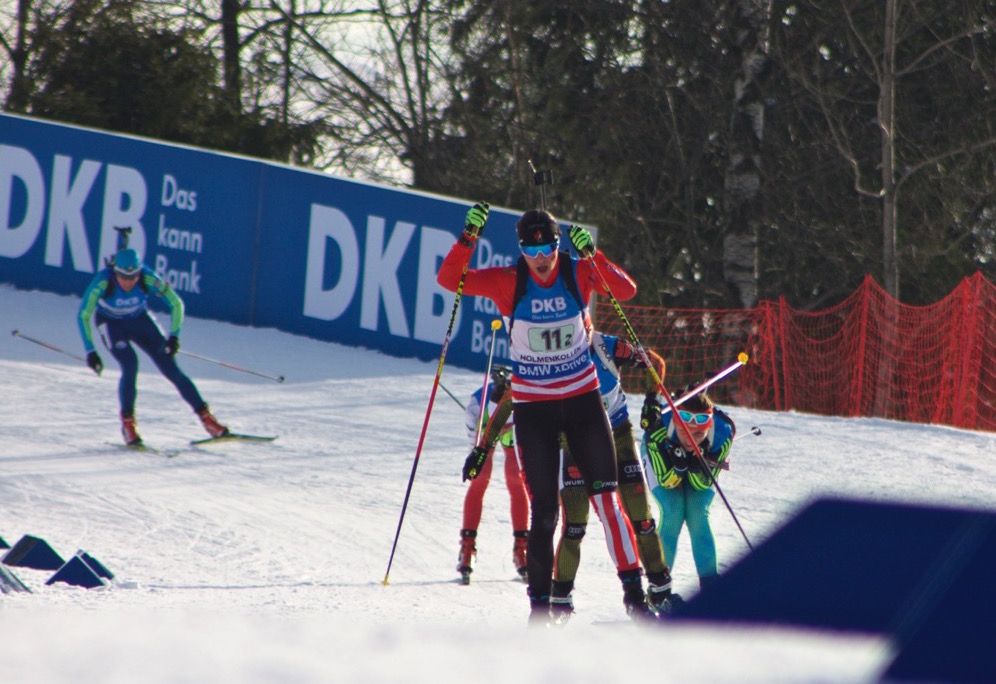
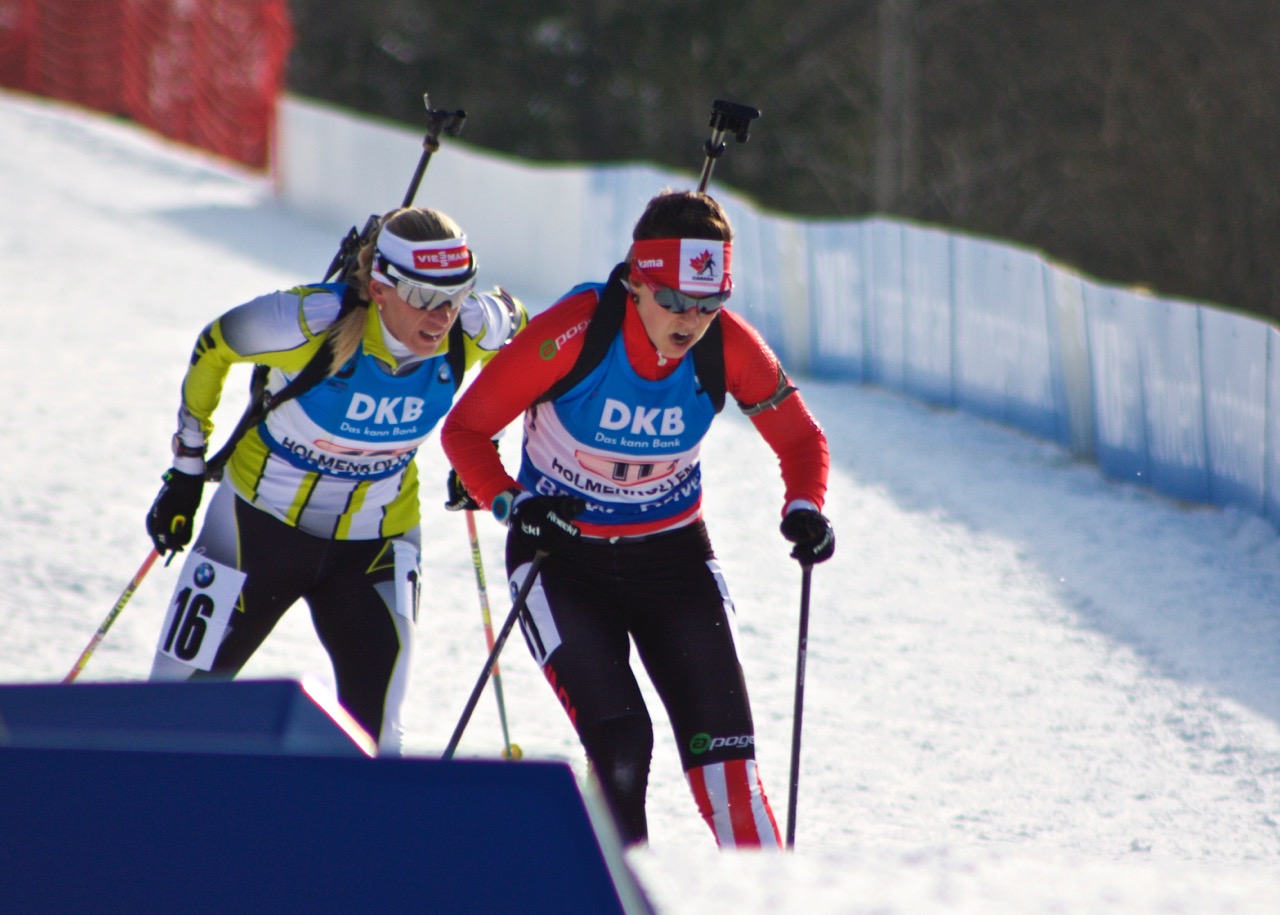
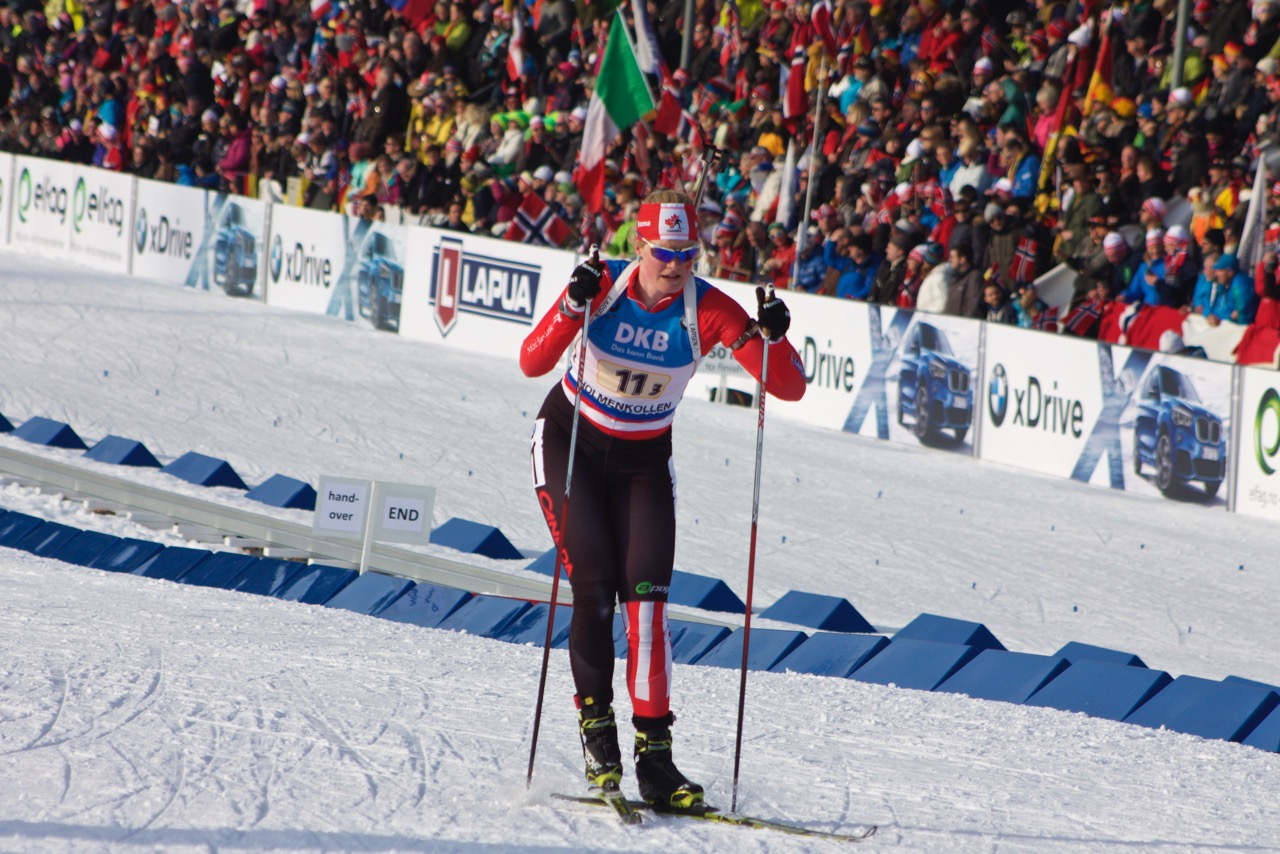
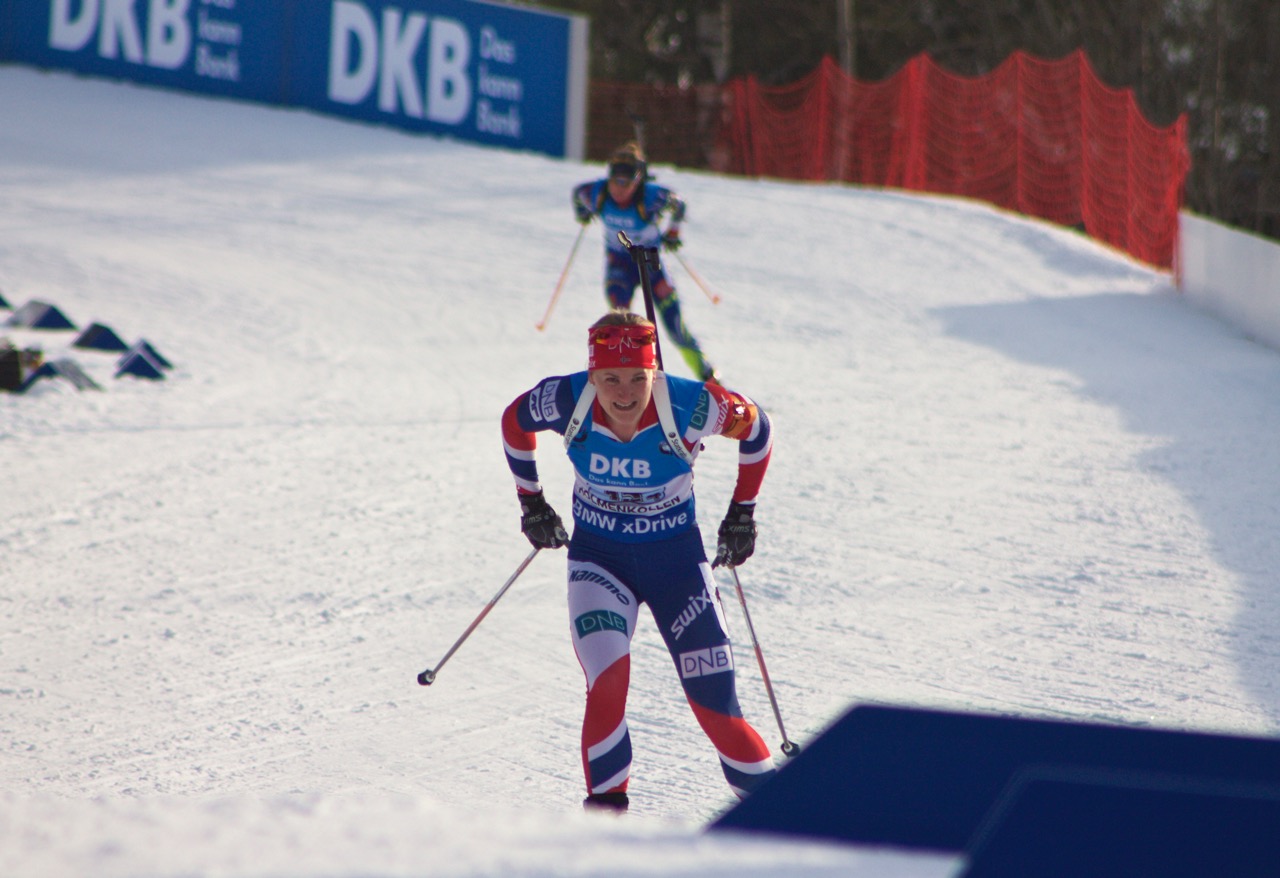
Canada’s Rosanna Crawford (11) leading the women’s 4 x 6 k relay at 2016 IBU World Championships on Friday in Oslo, Norway. Crawford skied the second leg and the Canadians went on to place 15th. (Photo: JoJo Baldus)
OSLO, Norway — At the halfway point of Friday’s World Championships women’s 4 x 6-kilometer relay, one woman was feeling better than she had all week.
It was Rosanna Crawford of Canada, and she attacked her way to the lead of the race.
“It felt so good out there today,” she said after tagging off. “Just like, I could attack, and I didn’t die on the last loop. It was pretty exciting to pass the leader and be in the lead. I haven’t done that in a long time. So, it was a lot of fun.”
Canada eventually ended up 15th, ceding the lead to France and then Norway, which ultimately took home a much-desired gold on home turf. The Canadians finished 4:48.6 back.
Julia Ransom had led off for the team, and used one spare in each shooting stage. In her first full season on the World Cup, Ransom is getting used to the leadoff position and was satisfied to tag off in 13th place – not where the team wanted to finish place-wise, but time-wise close enough to the leaders with just 37.6 seconds separating them from first place.
Canada’s Julia Ransom (r), skiing with Romania’s Eva Tofalvi, during the first leg of the 4 x 6 k relay at 2016 IBU World Championships in Oslo, Norway. Ransom tagged off in 13th and Canada went on to place 15th. (Photo: JoJo Baldus)
“Of course I would have loved to have cleaned a bout,” Ransom said. “But it was what it was. My legs are ready to have a bit of a break.”
But she had done her job, as teammate Crawford would later say.
“Julia did a great job, just 1+1 is good and taking off within 30 seconds is super-awesome,” Crawford said. “So she did her part. Everyone just has to do their part… with [relays and] mixed relays we [Julia and I] know how to do the first and second legs. I am confident and I trust Julia to lead us off with a good start.”
As several women remarked, the start was particularly physical for a race in the women’s field. There were multiple crashes and broken poles, and Ransom had to hold her ground.
“It was fun to be in the mix,” she said. “I love starting because it’s so different, and today especially was incredibly aggressive. A lot of elbows out there and stomping on poles. The girls had their talons out — I’ve started every relay this year, and every day there’s something new. There was one day that I broke a pole right off the start, another day that I crashed. I’m taking a little something from each race.”
The physicality seemed to die down a bit on leg two, or at least return to normal levels. Crawford cleaned prone with no spare rounds to move up to ninth and inch seconds closer to the leaders, and then used just one spare round in standing and left the range in sixth.
From there, Crawford went into attack mode.
“On the top of the hill [behind the stadium] I caught back up to the lead group, and then I just decided that I felt good and you get a big rest after that, and I hammered a little bit to pass them,” Crawford said. “Catch up to third, and then down the hill my skis were running really well so I passed Germany and just tried to hold onto the front until I tagged off to Sarah [Beaudry].”
Canada’s Sarah Beaudry skiing the third leg of the women’s 4 x 6 k relay at 2016 IBU World Championships. After being tagged in first, she came through the final exchange in ninth. (Photo: JoJo Baldus)
For Beaudry, in her first-ever senior World Championships and about a week away from her 22nd birthday, receiving the tag in first place was something of a surprise.
She also used another “s” word to describe it.
“I don’t want to say scary, but wow, I wasn’t expecting this,” Beaudry said after finishing her leg of the relay. “The whole [first] loop, I was like‚ ‘Are they coming?’ I was skiing scared that someone might overtake me. I was happy I stayed in the front, and not just get completely annihilated in the first lap. It was too bad, because I came out after my prone not with anybody. I was trying to catch the two girls ahead of me.”
Beaudry used two spares in prone, leaving the range in eighth, and then cleaned standing to move up to sixth. Her last loop was not without adversity.
“I wasn’t feeling great on the skis,” she said. “Last lap it was really hard. And then the Italian girl [Alexia Runggaldier] passed me and then I crashed. That hurt quite a bit — I couldn’t get up and couldn’t keep skiing and was like ‘OW!’ But then I just got it in. Too bad going out with a lead, not that big but going out first, and then coming in in ninth.”
Still, Beaudry didn’t feel as if skiing her first loop all alone out in front on the course had changed her pace or made her ski too fast. She was able to enjoy a bit of the atmosphere, even if it was stressful, and the adrenaline didn’t wreck her race.
“It is typical for me to go out too quickly,” she laughed. “So that being said, I feel like I would have gone out at a similar pace anyway. Maybe I shouldn’t have gone this fast, but I mean, I probably shouldn’t have gone out this fast on any of my first laps this year. I wouldn’t say I did it differently because I was in the lead.”
Despite Beaudry’s last-lap woes, Canada was still in ninth place and just under a minute and a half from the lead.
After Zina Kocher took over and used all six spare rounds as well as skiing three penalty loops, they had dropped to 15th and finished 4:48.6 behind.
Norway Wins at Home
Norway’s Tiril Eckhoff racing from ninth to first in the third leg of the women’s 4 x 6 k relay at 2016 IBU World Championships in Oslo, Norway. (Photo: JoJo Baldus)
While Canada was slipping through the standings, Norway was rising, much to the delight of the Holmenkollen crowd. First and second skiers Synnøve Solemdal and Fanny Horn Birkeland had kept the team in contention, tagging off 13.4 and 12.4 seconds from the leaders, respectively.
It was Tiril Eckhoff, the gold medalist from the sprint, who skied third for Norway and brought the team to the front.
Eckhoff was ferocious, shooting perfectly and skiing the fastest time of all the third-leg skiers by 22 seconds over just six kilometers. She tagged off to Marte Olsbu with a 23.2-second lead.
And like Beaudry before her, Olsbu was facing a pressure that she perhaps did not expect. Norway had finished no better than fifth in any women’s relay this season, and after dropping the race at the Presque Isle World Cup started today’s competition with bib 12.
With a career-best week so far – in her second World Championships ever, she finished eleventh in the sprint and turned in a strong leg in the mixed relay – Olsbu was new to the anchor position, but the choice proved genius.
Norway’s anchor Marte Olsbu racing to the win in the IBU World Championships 4 x 6 k relay at home in Oslo, Norway, holding off France’s Marie Dorin Habert (behind) by 5.3 seconds. (Photo: JoJo Baldus)
She used two spares in each stage, and was helped by errors from some of her competitors as well, allowing her to stay in the lead. Olsbu was able to hold on during the last loop despite a hard chase from Marie Dorin Habert of France, who had won gold in the 15 k individual just two days before and is widely acknowledged to be one of the most fearsome skiers on the circuit.
When asked by the IBU’s Jerry Kokesh if they were ever worried that they would not win gold, Olsbu raised her eyes wide and said, “I was!”
“I just went as fast as I could on the last loop, and I was so happy when I crossed the finish line in first,” Olsbu, who ended up with just a 5.3 second margin ahead of Dorin Habert, said in the press conference.
Of all the gold medals at World Championships, this was one that Norway did not expect to win. The women were ecstatic that they could pull it off.
“Last time we were big favorites,” Solemdal said of her role in the team’s 2013 World Championships gold medal with Tora Berger and Ann Kristin Flatland. “And this time we were not good at all. So I feel like it’s, we have worked so hard the whole team, for such a long time to be good in the relay. For me it’s the greatest feeling to take home the gold at home in Oslo.”
Canada’s Zina Kocher receiving the tag from teammate Sarah Beaudry (behind) in the final exchange of the women’s 4 x 6 k relay at 2016 IBU World Championships in Oslo, Norway. Tagged in ninth, Kocher went on to finish 15th for Canada. (Photo: JoJo Baldus)
The jam-packed stadium at Holmenkollen for Friday’s women’s 4 x 6 k relay at 2016 IBU World Championships in Oslo, Norway. (Photo: JoJo Baldus)
Norway’s Martin Johnsrud Sundby shows off his arm strength after double poling the entire 15 k classic at the World Cup in Toblach, Italy. He won by 12.6 seconds over Russian runner-up Alexander Bessmertnykh (l) and Norwegian teammate Sjur Røthe (r) in third. (Photo: Fischer/NordicFocus)
In an impressive display of strength and consistency, Norway’s Martin Johnsrud Sundby once again bested the men’s World Cup field by double poling on skate skis during Sunday’s 15-kilometer classic individual start in Toblach, Italy.
Just like Kazakhstan’s Alexey Poltoranin double poled to the win in last year’s 10 k classic on the same course in Toblach, Sundby opted for strictly glide wax and double poled all three laps of the 5 k loop. With slightly below freezing temperatures on artificial snow, the kick wax was fairly straightforward, but some racers figured they’d be faster by simply hammering the course with brute arm strength.
“I am incredibly happy. I have achieved a big goal, namely to win on shiny [skate] skis,” Sundby told NRK, according to a translation, after winning the 15 k by 12.6 seconds in 35:27.4.
No stranger to double poling classic races, Sundby drew widespread media attention at this year’s Norwegian season opener in Beitostølen, Norway, for setting the fastest time in the 15 k classic and subsequently being disqualified for skating.
Two of the top three used skate skis to reach the podium on Sunday. Sundby’s Norwegian teammate Sjur Røthe also opted to double pole and finished third, 48.6 seconds behind Sundby.
“I started quite early and I did not know how I was doing comparing to others,” Røthe said in a post-race interview with FIS. “In the last lap I learned that I was fighting for the podium. I felt great and very strong in the last kilometers.”
Røthe’s 5 k lap time ranked fourth, 20.8 seconds back. By 10 k, he was third, 38.2 seconds behind Sundby.
Norway’s Martin Johnsrud Sundby finishing the men’s World Cup 15 k classic on Sunday in Toblach, Italy, which he won by 12.6 seconds. (Photo: Fischer/NordicFocus)
Before ultimately placing second, Russia’s Alexander Bessmertnykh waited anxiously on the leader’s chair through 34 finishers before Sundby dethroned him. Bessmertnykh chose classic skis, as one of three in the top five and six of the top 10 on kick wax.
“I had a very good race and it was a good choice to go with kick wax,” he told FIS. “I had amazing skis. Our service team did a great job.”
After the first lap, both Sundby and Bessmertnykh’s times ran similar, with Sundby leading by 2.1 seconds. However, by 5 k, the two had already distanced themselves from the field with the next closest challenger, Norway’s Emil Iversen, 14.1 seconds behind Bessmertnykh.
At 10 k, the gap widened a bit, with Sundby opening his lead to 5.2 seconds on Bessmertnykh and 38.2 seconds on Røthe, who had moved into third. The finishing order would not change from there, although Bessmertnykh’s time at 12.1 k was within 2.7 seconds of Sundby’s.
“… I’ve got to throw some compliments to the Russian. He skied extremely well today,” Sundby told NRK. “It was a cool fight, but I’m glad it went my way of course.”
Sundby has now won all five World Cup distance races so far this season, including the Ruka Triple pursuit despite not being the winner of the day (which leaves some interpretation about whether Sundby has won four or five distance races this season). Last season, he won two non-pursuit distance races (plus two pursuits) and ended up winning the Overall World Cup crown.
For those keeping track at home, the male record for outright distance wins in one season is seven, achieved by Sundby’s teammate Petter Northug Jr. in 2009/2010, and Kazakhstan legend Vladimir Smirnov in 1993/1994.
In nine total World Cup races this season, Sundby has won six — including a relay as a member of the Norwegian men’s 4 x 7.5 k team.
Of 88 finishers, five were disqualified for skating: Kazakhstan’s Sergey Cherepanov and Nikolay Chebotko, Germany’s Andreas Katz, Austria’s Dominik Baldauf, and Korea’s Hwang Jun-ho.
Harvey 16th for Canada
Alex Harvey (Canadian World Cup Team) racing to 16th in the men’s World Cup 15 k classic individual start on Sunday in Toblach, Italy. According to coach Justin Wadsworth, it was the first time he double poled a World Cup distance race on skate skis. (Photo: Fischer/NordicFocus)
Leading the North American men on Sunday were Canadians Alex Harvey in 16th (+1:29.9) and Devon Kershaw in 28th (+2:14.7).
According to Canadian head coach Justin Wadsworth, who is in Canada but touched base with his team after Sunday’s race, this was the first time Harvey and Kershaw double poled a World Cup distance race on skate skis.
“They were satisfied with their race, happy with the skis,” Wadsworth said on the phone. “For double poling they’re both pretty satisfied.”
Also for Canada, Graeme Killick double poled to 54th (+3:39.7) while Michael Somppi and Len Valjas opted for classic skis with kick wax and finished 70th (+4:34.9) and 75th (+5:03.6), respectively.
Comparing Sunday’s classic distance race with the freestyle sprint the day before, where the Canadians all finished outside of the top 60, Wadsworth said his team showed resilience on Sunday.
“Definitely a solid effort by the guys and I think it shows they are good mentally to be able to bounce back after yesterday,” he said in a Cross Country Canada press release.
Devon Kershaw (Canadian World Cup Team) double poling to 28th in the World Cup 15 k classic on Sunday in Toblach, Italy. (Photo: Fischer/NordicFocus)
He added that Kershaw has landed in the points at every distance race this season, a potential first for him and a welcomed sign for the upcoming Tour de Ski, one of the team’s focuses going into the season. Wadsworth told FasterSkier that Canada’s starters for the upcoming 2015/2016 Tour de Ski will be announced on Tuesday, Dec. 22.
For the U.S Ski Team, sprint specialist Andy Newell was the team’s top finisher after double poling to 52nd (+3:32.9). He was followed by Noah Hoffman in 61st (+4:00.3), and Kris Freeman in 78th (+5:15.3). After placing second in Saturday’s sprint, Simi Hamilton did not race on Sunday.
Erik Bjornsen did not race as he was recovering from a cold and “playing it safe in order to be fully healthy for the [Tour de Ski],” according to U.S. head coach Chris Grover in an email.
World Cup racing will resume after the holidays with the Tour de Ski kicking off Jan. 1 with a freestyle sprint in Lenzerheide, Switzerland.
Canada’s Alex Harvey skating his way to a bronze medal in the 30 k skiathlon at World Championships in Falun, Sweden, three weeks ago. In Oslo on Saturday, he capped off his season by placing 13th in the 50 k skate mass start. (Photo: FlyingPointRoad)
There was a moment in today’s 50 k skate race in Oslo, Norway, where it looked like Canada might repeat its resounding success from the 50 k at World Championships in Falun, Sweden, two weeks ago.
At ten kilometers, Alex Harvey and Ivan Babikov were both skiing in the top five of the mass start, looking comfortable. Would they go on to replicate their fifth and 30th place results?
It wasn’t to be. Harvey led the way with a 13th-place finish and Babikov eventually faded to place 27th, but further back (+4:55) than in Falun. (And Graeme Killick, who placed 19th in Falun and whose result represented positive signs for Canada’s future teams, wasn’t even racing.)
But there seemed to be little disappointment from the Canadian camp. Harvey was happy with his finish, and deemed it a good way to finish off a season in which he earned two World Championships medals and finished ninth in the overall World Cup standings.
“I’m really happy,” he said. “It’s probably my best skate race of the season, so I’m happy to finish like that on a positive note. It has been a really good season.”
“Holmenkollen is the best place to finish WC season,” Babikov tweeted. “Amazing atmosphere, crazy fans! Made some tactical mistakes, but happy to finish in points.”
For Harvey, who has shown all season that if he can stay with the lead group until the finish he has scary finishing speed, expectations had been low because he feels he hasn’t done well in skate races this season. On top of that, he suffers from a leg problem which makes skating up steep hills painful. It’s bad enough that he’s leaving Oslo on Sunday to go directly back to Canada for surgery; he should be back training by May.
“Skating has been going quite bad for me this year, and the course with those huge uphills, I didn’t expect much,” Harvey admitted. “But it ended up being a pretty good race.”
Harvey stayed in the main pack until the last few kilometers, when Hans Christer Holund of Norway and then Dario Cologna of Switzerland pushed the pace. They successfully fractured the lead group of 15, and Harvey had already been skiing near the back of that pack.
“On the last push up to Frognerseteren I lost some ground and then from then on it was just kind of survival mode,” Harvey said. “But 13th, I’m still happy with the result.”
Skiing into the finish, he beat out Cologna’s teammate Toni Livers in a sprint by just two tenths of a second. He was 52.7 seconds behind Norway’s Sjur Røthe, who edged Cologna in a photo finish for the win.
If Harvey has one regret, it’s that he didn’t change his skis near the end of the race. In the past few years, FIS has implemented rules that skiers may change skis twice during the course of a 50 k competition.
Harvey’s best pair of skis, which he started on, were great in the slush and so he didn’t change them until 33 kilometers into the race.
“My skis were really good so I decided not to switch when the guys went after two laps,” Harvey said.
After the success of Lukas Bauer of the Czech Republic in Falun, who changed his skis just five kilometers from the finish and used their fresh speed to power to a World Championships medal, Harvey thought of doing the same thing, switching back to his best pair – now with an added topcoat of fluoros – with nine kilometers to go.
But then the pace increased, and it seemed like a bad idea.
“Just before [the stadium], Sundby went to the front and pushed kind of hard going up the Hellnerbacken coming into the stadium,” Harvey explained. “I thought, oh, maybe he’s going for a long drive. I could have seen that from Martin because he might not want it to end in a sprint. So if he went hard the whole way, I couldn’t change because I would lose the group.”
As it happened, nobody was able to make a break at the time, so the pace slowed down again. Anders Gløerssen of Norway decided to switch skis, and was the long member of the lead pack to do so. He lost time, but managed to catch a few straggling members of the pack, including Harvey, and finish 11th.
“Gløerssen changed there and it was good for him,” Harvey said. “Right after that the pace slowed down and it was good. But I didn’t want to risk losing the group because I was starting to fade and I knew I wouldn’t be able to close a 15 second gap on my own. Looking back, had I known the pace would slow down again, I probably would have switched.”
The Canadian men’s team finished the season in eighth place in the Nations Cup standings.
Lenny Valjas of Canada leads Simi Hamilton of the United States on the last lap of the men’s 4 x 10 k relay at World Championships in Falun, Sweden.
FasterSkier’s coverage of the 2015 FIS Nordic World Ski Championships in Falun, Sweden, is brought to you by the generous support of L.L. Bean, now featuring a complete line of Kikkan Randall training wear.
FALUN, Sweden — It was a North American battle royal in Sweden as the the U.S. and Canada dueled in the last leg of the men’s 4 x 10-kilometer relay at the 2015 FIS Nordic World Ski Championships. American Simi Hamilton attempted to ditch his Canadian counterpart on the climbs while Lenny Valjas tried to lose the Amercian on the downhills – both to no avail. Ultimately, North American relay supremacy was decided in the final meters as Valjas out-sprinted Hamilton to the line.
Ahead of the North Americans Norway defended its 2013 relay title with Petter Northug finishing with a time of 1:34:18.5. He bested Calle Halfvasson by just 0.6 seconds to give Sweden its second silver medal of the Championships. France provided an inspiring performance to repeat the nation’s bronze medal showing from the 2014 Olympic games.
Canada and the U.S. finished 3:03.5 and 3:04.9 behind the Norway to take 10th and 11th.
While the two North American nations are close friends and training partners, they’ve always been friendly competitors. Canada’s two time medalist in Falun and starter of the relay’s scramble leg said that he and his team entered the competition with two goals – improve on their 12th place finish at the 2014 Olympics and beat the U.S. team.
Alex Harvey led Canada out of the gate in the men’s 4 x 10 k relay at 2015 World Championships.
Early in the race it appeared that Canada had secured its goals, as Harvey skied at the front of the 10 k leg. The Quebec skier, who is hoping to earn another podium the weekend’s 50 k, said he used the relay as preparation for Sunday as he hasn’t raced since claiming bronze in last week’s 30 k skiathlon.
Harvey explained his body responded well to the effort and decided to hang on to to Russia’s Maxim Vylegzhanin and Norway’s Niklas Dyrhaug when they made a move on Mördarbacken, otherwise known as ‘Murder Hill’. As the pack entered the stadium and readied to tag off to their respective teammates, Harvey took advantage of superior skis and gave his teammate Graeme Killick a slight lead over the field of seventeen teams.
“It was really scary going out first,” Killick said of his 1.3 second lead. “ [It was] a really tough pace there right off the start.”
Killick managed to stay with the leading pack for the first half of his leg, but by the 6.5 k mark he trailed by over 30 seconds. “The plan was not to blow up, but eventually it was a bit too much up Mörderbacken,” he said, explaining that once he lost contact his main objective was to ski smooth and relaxed.
With Killick quickly losing time on the leaders, the American team began to make their advance.
Graeme Killick of Canada on his second loop in the men’s 4 x 10 k relay in Falun, Sweden, on Friday.
In the relay’s first leg, U.S. scrambler Erik Bjornsen skied between fifth and tenth to keep the U.S. in contact with the leaders. As the top skiers’ speed increased the 23-year-old was dangerously close to losing the advantage of the pack. The American gave several strong pushes to match pace and eventually finished his leg 32.9 seconds behind Harvey.
“We talked about, you know, don’t fight too hard for seconds if it’s going to lose minutes,” Bjornsen said of his strategy. “Trying to ski the last lap pretty smart so that you’re not hanging on too long if it’s going to cost you minutes.
“My goal was to try to hang on as long as I can, and come up pretty close to that first group. I’m happy with what I did,” he added.
Bjornsen tagged off to teammate Noah Hoffman in 10th and the American left the stadium alone. Hoffman said it was an advantage to ski by himself, as it allowed the Colorado native to focus on his pacing and technique. Hoffman knew he couldn’t lose many seconds to the leaders as the possibility of getting lapped was high, especially given the 2.5 k course.
“In these relays you get exploded off the back you’re never going to ski back to the group, so keeping in contention for as long as possible is the best way to stay in the race,” Hoffman said. “On a 2.5 k lap there are going to be a lot of teams out there who will get lapped. If we don’t get lapped it will be a successful race for us.”
At roughly 3 k into the second leg Switzerland’s Dario Colonga, along with team’s from Japan and the Czech Republic, caught Hoffman. The American was able to hold the Swiss on the uphills, but Colonga eventually pulled away. Hoffman then used a ride with Jaks Martin of the Czech Republic to make contact with several teams who were struggling ahead, one of which was Canada.
“Some of those guys seemed pretty shattered and we were catching the remnants of the group that had exploded ahead of us, which is always a good way to go,” he said.
By the time the new group of skiers reached the end of the relay’s second leg, Hoffman had passed Killick and the two teams were ranked ninth and 11th.
Noah Hoffman of the United States on his third loop in the men’s 4 x 10 k relay in Falun, Sweden.
According to Hoffman, his 10 k leg demonstrated a return to form. The American, who expressed discouragement by his results in the Championships skiathlon and 15 k, explained his leg in the relay was a step in the right direction especially for his classic skiing.
“Best race of the season, so a step in the right direction,” Hoffman said. “The last year has been a struggle for classic but today was the best classic skiing I’ve done in a year. It wasn’t spectacular by any means, but It was a step in the right direction.”
With Hoffman’s leg complete Kyle Bratrud took over for the Americans. The Northern Michigan University skier was originally scheduled for one race at the Championships – Wednesday’s 15 k freestyle – but was propositioned by the American coaching staff be the third leg of the relay.
“They asked me if I wanted to be in it and I said sure. I was flattered,” he said of his selection. “It’s another race on the international stage for me so I was all for it. I knew I was going to get my butt kicked around a little bit out there but that’s how you get better, racing these guys.”
Bratrud explained that he hadn’t fully recovered from the 15 k and complained of tired legs that felt better by the last kilometers. At that point Canada’s Ivan Babikov had passed the Minnesota native.
Ivan Babikov of Canada finding his legs towards the end of the third leg of the men’s 4 x 10 k relay.
Babikov lost time to Bratrud in the first laps of the third leg, but eventually fought back to bring Canada into 11th place by the relay’s final exchange. Kyle Bratrud entered the exchange 2.4 seconds behind the Canadian in 12th.
“It was not so great,” Babikov said. “The first lap was way too fast for me. Those guys went out way too fast and I couldn’t manage that speed. Then I picked up a bit at the end.”
With Valjas and Hamilton on course, the fight for North American relay supremacy began to heat up. Hamilton surged ahead to ski together with Valjas and the two remained together for the rest of the final 10 k. Both skiers had their sights set on the German and Czech Republic teams roughly 20 seconds ahead, but when it became apparent they were out of reach the fight for 10th position began.
Hamilton said he made a push to leave Valjas behind halfway through the final leg, but once the Canadian remained close behind he reevaluated his strategy and decided to stick behind his friend and competitor until the finish. Valjas, on the on the other hand, continually attempted to ditch Hamilton to no avail.
“I was trying everything,” Valjas said of his leg with Hamilton. “I tried my early attack up the main sprint hill, and he stayed with me. I regrouped, and on the next hill I just really slowed down over the top and tried to sneak attack, just as we started going downhill I started sprinting to see if I could break the draft. That worked a bit, but then he caught up.”
Valjas entered the final meters with Hamilton just behind, and the two strong sprinters gave a final push to claim the last spot in the top-10. Valjas was victorious, beating the American to the line by 1.4 seconds.
“It was a good fight right to the finish. I wasn’t looking back, I knew he was coming,” Valjas said.
The 10th place finish for Canada was an improvement on their 12th place at the 2014 Olympic games. Valjas that he was pleased with the way his team skied, but hoped that the future would bring better results.
American Simi Hamilton leading Lenny Valjas of Canada over the top of a hill in the men’s 4 x 10 k relay at 2015 World Championships in Falun, Sweden.
“We’re extremely happy and I think everyone skied extremely well. A few of us including myself know that we can race differently next time,” Valjas said after the finish. “We’re all learning. I’m excited for the next version of this race. See if we can do better, both the Americans and the Canadians. We’re not far from the main group, the sixth and seventh place guys.”
Hamilton said he was proud of his team’s effort and that Friday’s result will be motivation for a better performance in the future.
“All those guys skied awesome legs and I got tagged off in a great position,” he said. “I wish I could have skied that last lap a little better or caught those two guys in front of us so it always gives you goals for the future.”
According to U.S. Ski Team Head Coach Chris Grover, the Americans did especially well considering the team’s level of experience.
“We definitely entered a young team today,” Grover explained. The 2015 Championships is Bratrud’s first and both Bjornsen and Hoffman are relatively young. While Hamilton has anchored several relays, he’s primarily focused on sprinting. “I’m really super proud of how all four of these guys skied. They all kept it super close. We knew this was a course with such a short skate leg that there were teams that were in danger of getting lapped and pulled.”
Canada’s Emily Nishikawa (Alberta World Cup Academy/National Development Team) racing to 30th in Tuesday’s 10 k freestyle for her best World Championships result at 2015 worlds in Falun, Sweden. Nishikawa led the Canadian women with the result and Perianne Jones placed 32nd. (Photo: Fischer/NordicFocus)
FasterSkier’s coverage of the 2015 FIS Nordic World Ski Championships in Falun, Sweden, is brought to you by the generous support of L.L. Bean, now featuring a complete line of Kikkan Randall training wear.
FALUN, Sweden — With the pressure off, the Canadian women posted some career-best performances on Tuesday in the 10-kilometer freestyle individual start at 2015 FIS Nordic World Ski Championships.
In Emily Nishikawa’s first race coming off illness, which kept her and fellow Canadian World Championships team member Olivia Bouffard-Nesbitt back in Östersund, Sweden, until Sunday, recorded her first top 30 at her second World Championships.
“I was sick last week so I didn’t really know what to expect, how my body would react,” Nishikawa said after placing 30th, 2:20.5 behind Sweden’s Charlotte Kalla, who won the 10 k skate in 25:08.8. “It could’ve gone either way and it went well today, so I’m very happy with that.”
Canada’s Perianne Jones (Alberta World Cup Academy/National Development B-Team) racing to 32nd for her best World Championships distance result at 2015 worlds in Falun, Sweden. (Photo: Fischer/NordicFocus)
Meanwhile, team veteran Perianne Jones notched yet another best distance result at worlds in 32nd after placing 37th in Sunday’s 15 k skiathlon. And in what she anticipates to be her last season of professional racing, and ultimately her last races, Jones, 29, didn’t expect to do any of the distance races.
“I had zero expectations going in,” Jones said after finishing 2:26.7 back from Kalla. “Coming into these championships, I thought I was going to do the sprint and the team sprint … and I ended up doing the sprint and the 10 k and the pursuit.”
Even on the World Cup, Jones hadn’t done better than 32nd in a distance race since placing 30th two years ago in a 15 k classic mass start in Nové Město na Moravě, Czech Republic.
And then there was Nishikawa, 25, who cracked the top 30 for the first time this season on the World Cup, placing 29th in the 10 k classic in December in Davos, Switzerland.
The 54th starter out of 71, the Alberta World Cup Academy (AWCA) and Canadian National Development Team skier faced some of the toughest conditions of anyone in Tuesday’s race, skiing two different loops of a 10 k course in heavily falling, wet snow.
“It was snowing pretty heavily, [but] my skis felt great,” Nishikawa recalled. “I pushed as hard as I could … I was just dying to get here to Falun. I’m so happy to be here and to be racing is a real treat.”
Nishikawa, Jones and Canada’s third woman at the championships, Bouffard-Nesbitt, warmed into their races, with Nishikawa’s 1.5 k time ranking 45th, followed by Jones in 46th and Bouffard-Nesbitt in 53rd.
By 5 k, Nishikawa was up to 35th and 2.8 k later, 33rd, before closing hard for 30th. At the end of the day, she finished 3.1 seconds ahead of Norway’s star skier Marit Bjørgen, who placed 31st (for her first result outside the top 24 in a World Championships in at least 14 years).
Jones, who sped up to clock the 34th-ranked 5 k time and 32nd 6.3 k time, finished 6.2 seconds behind Bjørgen, the 65th starter.
“I was lucky I started early — I was number 22 so I have probably never been that close to Bjørgen in a skate distance race ever,” Jones said. “I just wanted to ski hard and pick a pace up those hills I could maintain. I was pretty sure the girl behind me [France’s Coraline Thomas Hugue] was going to catch me, so I just tried to stay with her for as long as possible.”
While Hugue had a career-best day of her own in 12th, Jones said this race would go down as one she’d remember — and likely her last international race.
“This was my final World Champs, probably my final international ski race,” she said. “After last year, I just kind of wanted to give it another shot, and it has been a good year in a lot of ways — I have been really healthy, more than I have been in the past. I think these last few distance races, too, I have surprised myself a little bit even though they weren’t in the plans.
“This is the first time this week that I skied with teammates, so it is really nice to have the other girls here and for us all to come to the start line together and to have a teammate to hug at the finish line,” Jones added. “It has been a great year and I think there are lots of good ladies coming up and it has been fun to spend a year with them and hopefully pass some things on.”
Canada’s Olivia Bouffard-Nesbitt (Rocky Mountain Racers) racing to 52nd in Tuesday’s 10 k freestyle, her debut race of 2015 World Championships in Falun, Sweden.
In her first World Championships, Bouffard-Nesbitt, of Rocky Mountain Racers, placed 52nd, 4:05.4 behind the winner.
“Today was just a really cool experience,” she wrote in an email. “I was loving every second of it. The fans, the atmosphere, the location, the conditions, so many things that made today amazing and memorable.”
Less than three weeks ago, Bouffard-Nesbitt earned her spot on Canada’s World Championships team with a 12th-place finish in the skiathlon at U23 World Championships in Almaty, Kazakhstan. Coming off that performance, she came down with a long-lasting cold.
“The race itself wasn’t great,” Bouffard-Nesbitt wrote of Tuesday’s race. “My movements were lacking power, and I didn’t feel that race fitness that generally leads to good races. I was missing that ability to really push, my body just wasn’t really doing it today.”
She hoped the effort would be good preparation for Saturday’s 30 k classic mass start.
“I was dealing with pretty low energy and a cold last week, but I’ve bounced back from that and am healthy now,” the 22 year old wrote. “I’m not upset about my race. I just raced my first ever World Champs and I’m totally psyched about that. There isn’t much that can take away from how amazing it was to be on the start line! And there was so much to be stoked about today too.
“Today wasn’t about me. I raced, and I was super pumped about being in the race, but I was also super excited for [American medalists] Jessie [Diggins] and Caitlin [Gregg] who had just mind blowing performances, and for Emily having her second top 30 of the year!” Bouffard-Nesbitt added. “It was a pretty great day!”
With three women at World Championships, Canada will not field a relay for Thursday’s 4 x 5 k team event. Instead, Nishikawa and Bouffard-Nesbitt will likely focus on the final race in Falun: the 30 k classic on Saturday.
FasterSkier’s coverage of the 2015 FIS Nordic World Ski Championships in Falun, Sweden, is brought to you by the generous support of L.L. Bean, now featuring a complete line of Kikkan Randall training wear.
FALUN, Sweden — Two days after Alex Harvey earned his second medal of the 2015 FIS Nordic World Ski Championships, more than any other Canadian at a Nordic World Championships, FasterSkier caught up with the 26-year-old Harvey in Falun, Sweden. With two more races on his schedule at worlds, he talks about his last few days in the limelight and the possibility for taking home more hardware.
Norway’s Petter Northug (l) leads the Czech Republic’s Ales Razym (second from l), Canada’s Lenny Valjas (third from l), Poland’s Maciej Starega (6), American Simi Hamilton (5), and Kazakhstan’s Nikolay Chebotko (r), among others, in the freestyle team-sprint semifinal at 2015 World Championships on Sunday in Falun, Sweden. Norway went on to win the heat, the U.S. was third, and Canada placed seventh. (Photo: FlyingPointRoad.com)
FasterSkier’s coverage of the 2015 FIS Nordic World Ski Championships in Falun, Sweden, is brought to you by the generous support of L.L. Bean, now featuring a complete line of Kikkan Randall training wear.
FALUN, Sweden — Canada’s Jess Cockney and Lenny Valjas could see exactly where they needed to be in the men’s 6 x 1.4-kilometer team sprint on Sunday, they just couldn’t quite get there before the finish.
That was the difference between the pace during something like a World Cup, where they placed eighth in the freestyle team-sprint final last month in Otepää, Estonia, and the Nordic World Ski Championships.
“We tried to stay, obviously, in the group, in the front of the group if possible,” Valjas said after Sunday’s race, in which the Canadian men missed advancing to the final after placing seventh in their semifinal for 13th overall.
“The first couple of laps [we were focused on] just spending as little energy as possible, and then on the last laps give everything we had and stay out of trouble,” he added. “Everything worked to plan, it was just we were a little bit too far back, a second or two.”
In his first World Championships, Cockney, 25, skied them into fifth on his first of three laps in the second semifinal. Valjas then slipped to eighth, where they remained for the next two laps.
With Petter Northug, who anchored Norway to the semifinal and ultimately the final win on Sunday, leading up front, the pace slowed significantly on the semifinal’s fourth lap. Despite Valjas posting the fastest course time of anyone on that lap, he tagged Cockney in the same position in eighth.
The fact that the race was slowing wasn’t necessarily good for the Canadians, which regained contact on that lap but struggled to pick off the places. In order to guarantee themselves a spot in the finals, they needed to finish in the top two. Beyond that, the six fastest teams between the two semifinals move on. Since the first heat was faster, that didn’t leave teams outside the top two with much hope in the second semifinal.
“You can hear in the stadium, they were saying this heat is six seconds slower than the first heat, so you start to think,” Valjas recalled. “You got to be ready to go. You know that the heat can go six seconds faster, so just being in a spot to react when it does get faster.”
On Cockney’s final lap, he rose to fifth once again — behind Russia, Norway, Germany, and the U.S. — with the third-fastest time on that leg. From there, Valjas dropped two places to finish seventh, 2.27 seconds behind the Norwegian winners and 1.24 seconds away from a lucky loser spot. Norway and Russia advanced out of their heat in first and second, as did the U.S. in third, Poland in fourth and Germany in fifth. Belarus did not qualify in sixth (+2:07).
The first semifinal was about nine seconds faster than the second, with Italy winning it in 15:34.02. Norway won the second heat in 15:43.06.
“We were hoping to ski ourselves into the final, for sure, and fight for the top two, top four spots in the heat, so that’s where we thought we would be,” Cockney said.
“I just wish I was with that group of four in the front,” Valjas added. “I was a second and a bit behind them; there’s no coming back from that. When you are that far back, there’s no draft, you’re kind of stuck.”
Overall, the two explained they felt better than they had earlier in the week and earlier this season.
“It felt better today, for sure, than the classic sprint,” Cockney said. He was 49th in the classic sprint at World Championships three days ago. “I think my skate skiing is decent right now. I don’t think I’m in 100-percent top shape. I think I was pretty good at the start of the year, before Christmas, just trying to find that shape again. Still have a little bit of racing here to do.”
In the same sprint, Valjas placed 14th.
“I’m feeling better — first half of the year, it was tough,” Valjas said. “Made some changes with intensity, and I feel much better. … We have one more [race], hopefully the relay, if I get selected, so gotta just keep getting the fitness better. It’s coming, it’s going in the right direction.”
Canadian National Team Head Coach Justin Wadsworth called it a “good effort. I think they skied pretty smart,” he said.
“They just weren’t quite there at the end,” he said. “If they both could of just made a spot each on the big uphill there, I think it would have put them in a little bit better contention for the final sprint.
“This is a really fast finish, especially when the conditions are like this and the skis are running fast, it is hard to pass a lot of people,” Wadsworth added. “You’re trying to get around from eighth to fourth. I was trying to yell at them that they needed to be top four from the times we were seeing, but they were just trying to stay the pace.”
The Canadian women did not field a team sprint, as two out of three women on its World Championships team (Emily Nishikawa and Olivia Bouffard-Nesbitt) planned to arrive in Falun on Sunday after recovering from illness in Östersund, Sweden.
Canada’s Alex Harvey, 26, celebrates his second place finish in Thursday’s 1.4 k classic sprint on the opening day of the 2015 World Championships in Falun, Sweden. (Photo: flyingpointroad.com)
By Colin Abbott
FasterSkier’s coverage of the 2015 FIS Nordic World Ski Championships in Falun, Sweden, is brought to you by the generous support of L.L. Bean, now featuring a complete line of Kikkan Randall training wear.
FALUN, Sweden — By now most of the ski world and probably a number of people outside of it know about Alex Harvey’s standout result from Thursday. Harvey’s classic-sprint silver stood as his third-consecutive podium in three-straight World Championships.
What we see on TV and read in blogs highlight the results — the shiny finished products that we associate with greatness. What we don’t see is the production of those results; the hands and minds that build them and the organizational structures that establish environments where greatness is possible.
After disappointing Olympic results last year, Cross Country Canada (CCC) evaluated gaps that could have contributed to the lack of results at Sochi. If Thursday is any indicator, changes made last year to optimize results have worked. Tom Holland, CCC high-performance director, offers us some insight into the changes CCC made to improve skiing immediately and in the future for Canada.
Canada’s Alex Harvey racing to 14th in the men’s 10 k classic individual start at the 2014/2015 Tour de Ski’s fourth stage in Toblach, Italy. (Photo: Fischer/NordicFocus)
FasterSkier: What changes did CCC make after Sochi that helped Alex reach the podium yesterday?
Tom Holland: We did a very in-depth analysis after Sochi of what worked, what didn’t work, what did we learn and what could we do better. In answering those questions, we went into this season with a significant decrease in our budget. So, it has been a year that has had to be focused on priorities.
One of those top priorities was to find things we could do better with ski preparation — in that respect our technical team and coaches were mandated to continue to innovate and research, this is the only way to stay ahead of the game with our ski fleet and ski preparation. Additionally we created a ski-pilot position, in a few key competition periods to support Alex Harvey; this has been a successful collaborative effort with our whole support team. We are very satisfied with the work our techs and coaches have done this year to close any gaps identified after Sochi.
FS:How will Harvey’s World Championships medal impact development of a stronger national team in Canada? Will Own The Podium (OTP) funding and/or Sport Canada (SC) funding be affected next year?
TH:How the national team performs at [World Championships] and [the Olympic Winter Games] impacts development, particularly in how Sport Canada allots AAP [Athlete Assistance Program] carding. OTP funding is performance-driven based on podiums and real podium potential. OTP is also starting to look at each sport’s 2022 podium potential. It is up to OTP to decide how they will distribute the limited money they have for winter sports. Medals help, however a very comprehensive HP [high-performance] plan is critical for OTP/SC funding.
Cross Country Canada’s headquarters in Canmore, Alberta.
FS: While we have already seen one standout result this week, the depth of the Canadian team is something that could be improved. What initiatives does CCC have in place to bring up the next generation of world cup medalists?
TH: This is outlined in the HP section of our business plan which is posted on the CCC website. In brief, we have some talented athletes now between the ages of 17 and 22. We need to be very supportive of this group of athletes, particularly in defining a clear long-term path for these athletes to 2022; this includes addressing key athlete retention factors that coaches and athletes have identified over the last year. In supporting this next generation of talent, we have to realize that success is not a straight upward curve — we have to stay the course with them to sustain their individual performance growth curve. We have developed a number of strategies to ensure this happens.
The men’s 1.4 k classic sprint podium at the 2015 FIS Nordic World Ski Championships in Falun, Sweden. Canadian Alex Harvey (l) notched second, Norwegian Petter Northug (c) took first and Northug’s teammate Ola Vigen Hattestad (r) finished third. (Photo: Falun2015)
About the Author: Colin Abbott hails from the Yukon Territory where he learned to ski and race from a young age. Years later his life mostly revolves around skiing. At the moment, Colin is racing for the Yukon Elite Squad and the Carleton Ravens university team. He sits on the board of directors for Cross Country Canada and is involved in the education and womens committees there. He has also started writing ski-related articles for XCOttawa and FasterSkier and for the next week is supporting the Trinidad and Tobago team at FIS Nordic World Ski Championships.
The Norwegian men celebrate after winning the 7.5 k team relay in Antholz Sunday. (Photo: IBU/ChristianManzoni)
A spell of nice weather in Antholz, Italy broke Sunday with a cold wind blowing across the team relay competition to conclude an extremely busy month of IBU World Cup action.
As competitors overcame the packed schedule, the thin air of the South Tyrol mountains wasn’t done with them yet, as a steady breeze made shooting a toss-up. The 7.5-kilometer course was composed of three laps of skiing and two rounds of shooting for each of the four competitors.
Norway took the men’s relay victory, with only five spare rounds used by the four men in 16 rounds of shooting. Germany was close behind, in second (+16.4), with seven spares used. France, who was missing their ringer, Martin Fourcade, took third (+42.0) also with five spares used.
Both the United States and Canada made the top-10, with the U.S. in eighth (+3:28.9) after three misses in prone and 17 in standing. Canada finished in ninth (+3:36.1) with one miss in prone and 15 in standing.
Germany took the lead early on, with Erik Lesser shooting clean and taking first, barely holding France’s Simon Fourcade to second place after also shooting clean. Norway’s Ole Einar Björndalen missed one shot in standing to bring Norway in in third.
On the second leg France briefly pulled into the lead as Quentin Fillon Maillet out-skied and out-shot Germany’s Daniel Boehm. The lead did not last, as Norway’s Johannes Thingnes Bø had a remarkable third leg, cleaning and bringing Norway from third to first place. Germany’s Arnd Peiffer was hot on his heels, only a half-second behind after only missing one in standing. France’s Simon Destheiux struggled on the range and course during his second and third laps, and moved France back to third place.
Meanwhile, Norway’s Emil Hegle Svendsen took the tag just moments ahead of Germany’s Simon Schempp, and opened his lead with perfect shooting, allowing Norway to take the win. France finished nearly half-a-minute back, battling with Austria’s Simon Eder, who took fourth (+49.8) with seven spare rounds used by the team. Russia took fifth (+58.5), with six spare rounds used.
For the Americans, Lowell Bailey started and stayed ahead of Canada’s Christian Gow. However, Gow used only one spare in each shooting stage compared to Bailey’s three, putting Canada in ninth and the US in tenth. On the second leg, American Sean Doherty moved the U.S. into eighth, while a long time spent shooting by Brendan Green moved Canada to tenth. Tim Burke kept the U.S. in eighth in spite of struggling with shooting in the second round, using all of his spares in standing and prone. Canada’s Scott Gow moved Canada back to ninth on the third leg. Leif Nordgren skied the final leg for the U.S., with Nathan Smith finishing for Canada. On the first lap Smith pulled ahead of Nordgren, but Nordgren was able to pass Smith back to take eight place, eight seconds ahead of Canada.
The teams will get a break until World Cup resumes in Nove Mesto on February 6th.