Fifteen years is a solid run at anything, let alone the fickle sport of biathlon which features more ups and downs than your favorite roller coaster.
With the closure of the 2016 season, Canadian biathlete Zina Kocher will end her career after fifteen years as a professional biathlete competing in three Olympics and 12 World Championships.
“Saying good bye is actually quite emotional,” Kocher said in an interview in Oslo, Norway, in early March after 2016 World Championships. “I hadn’t quite thought about it as much, but it kind of started to hit me in Canmore [for the World Cups] and I’ve had to continue to deal with it this week. Saying goodbye to all the refs, I’m like ‘Why am I crying about this?’ I think it’s just, I have been here for a long time and it has been a part of my life for so many years.”
A cross-country skier from the age of seven, Kocher made the transition to biathlon at the age of 15 after becoming intrigued by the sport when the Winter Olympics came to Calgary in 1998. Biathlon became integral to her life in 2000 when she graduated from high school and moved from Red Deer, Alberta, to Canmore to train full time with the Rocky Mountain Racers.
Kocher competed at the 2001 World Junior Championships, posting top-20 finishes in all three competitions to earn her first World Cup start later that season. Kocher soon became a staple on the international biathlon circuit, missing only one World Championship event between 2003 and 2016.

“It’s a big family with the many teammates and staff I’ve had, and it was an awesome family to be a part of,” she wrote in an email after World Championships. “There’s so many people to say thank you to, who helped shape me as an athlete and person. I’m so grateful that skiing and biathlon became such a great part of my life.”
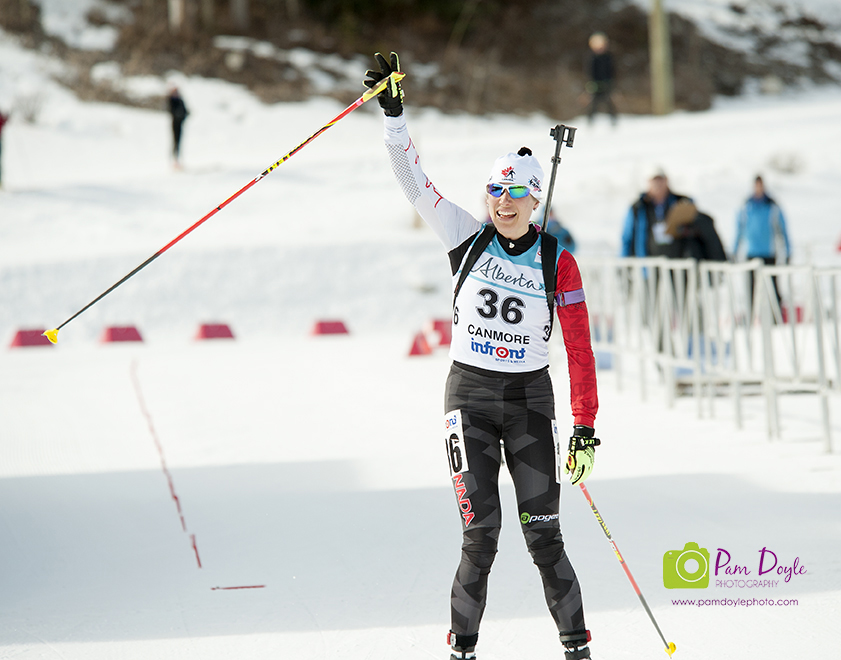
Despite her long career, there was one thing that Kocher had never done: competed in a World Cup in her adopted hometown of Canmore. Between that and the much-anticipated 2016 World Championships in Oslo, it gave her concrete goals and a reason to stay in the sport when she easily could have retired along with teammates Jean Philippe Le Guellec and Megan Imrie after the 2014 Olympics.
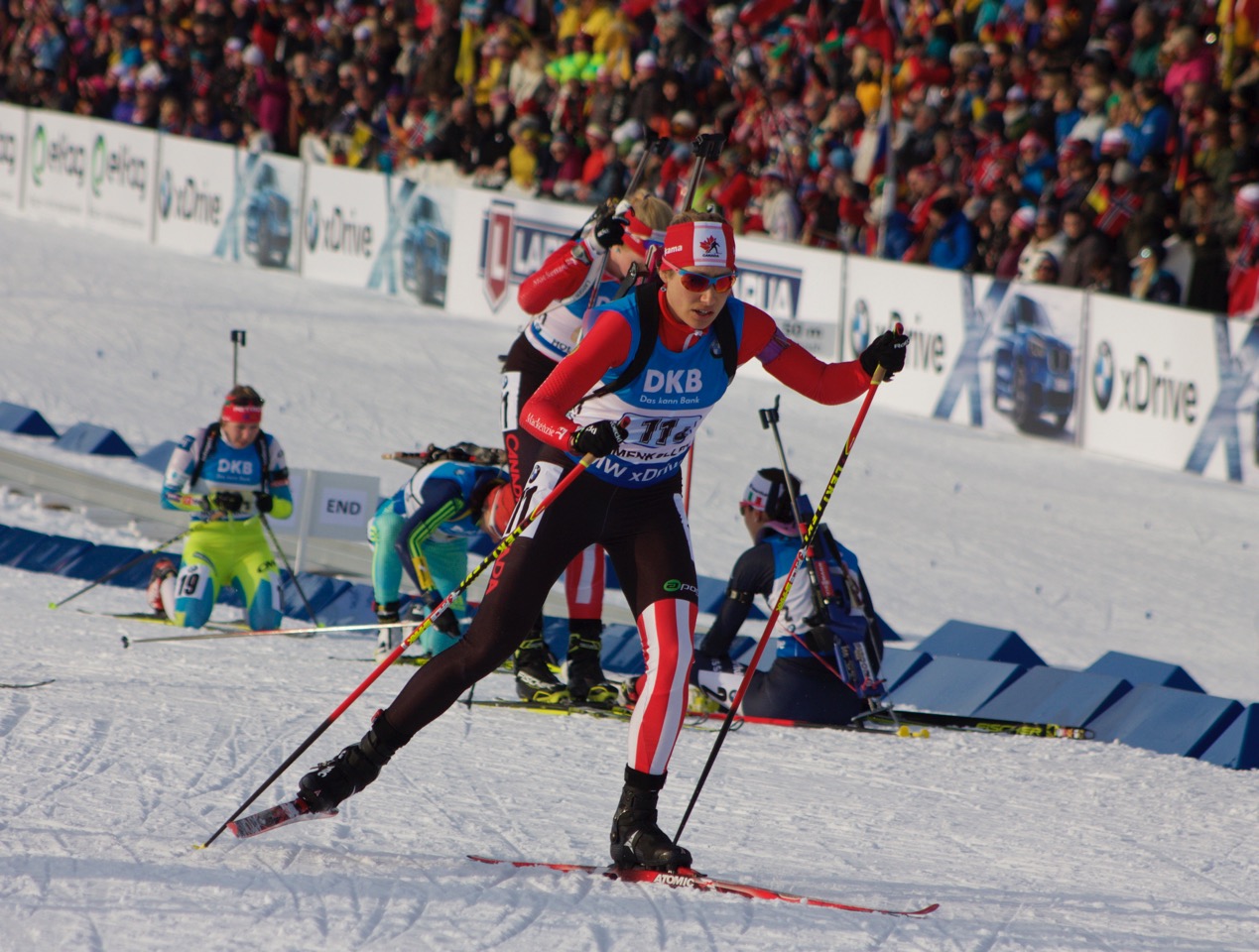
“I could have retired in Sochi, but for some reason I felt like I wanted to try again,” Kocher said. “Last year did not work out at all, but I really wanted to race in Canmore and race at home after so many years of not having that chance, and then come to Oslo… It is a great place to finish. The number of spectators here- yesterday was crazy. It is an incredible atmosphere to take in right before retiring.”
The sport of biathlon lends itself to rollercoaster seasons and careers and Kocher had her share of both highs and lows. She found success early in her career, claiming a bronze medal in the 15 k individual event at the opening World Cups of the 2006-2007 season in Östersund, Sweden. At the time, this result marked the first international biathlon medal by a Canadian in over a decade, and no other woman has since replicated her feat (On the men’s side, Jean Philippe Le Guellec won a World Cup in 2012 and Nathan Smith won one in 2015).
Although the podium would stand as her highest World Cup finish of her career, she accumulated many top-ten finishes and was a member of the Canadian 4 x 6 k relay team that brushed the World Cup podium in 2013, finishing fourth with Megan Imrie, Rosanna Crawford and Megan Tandy.
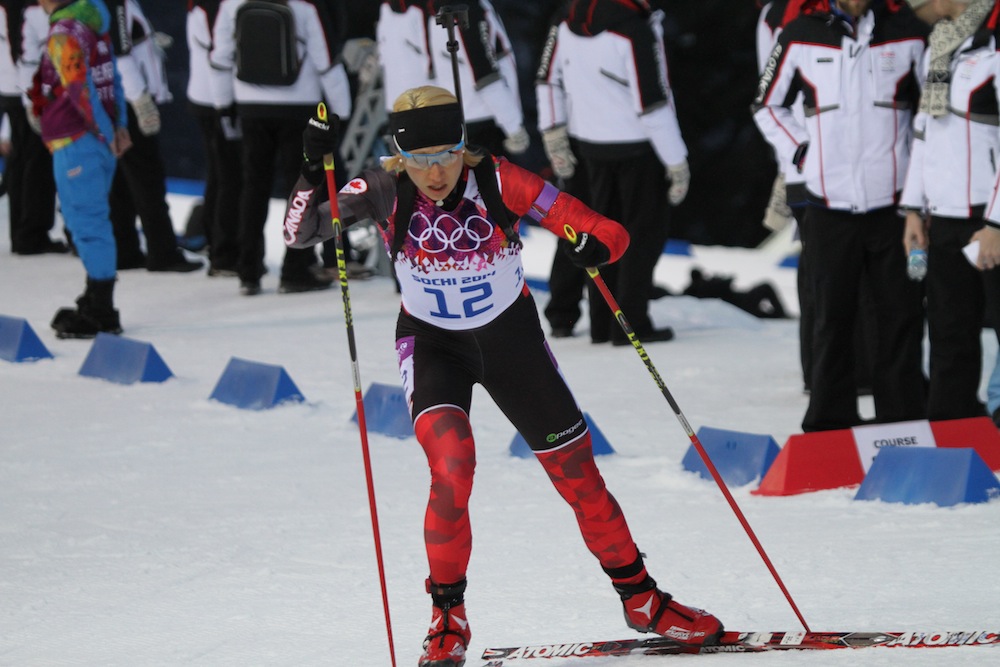
At the Sochi Olympics in 2014, Kocher was a member of the 4 x 6 k relay tam that notched the best ever Canadian Olympic result in the event, taking eighth. She also posted a Canadian-best 25th place in the 10 k pursuit. Kocher considered capping off her career after this successful Olympic Games but a part of her told her to go back.

“I think that is a struggle that finally in your 30’s you start to realize, if you are not at this place and making it viable, you have to think about moving on,” she admitted.
Her decision to continue racing was not immediately rewarded as the 2014-2015 season was the first year in her career she did not make a World Championship team.
Despite the disappointment, with the 2015/2016 schedule including World Cup races in Canmore, Kocher decided to give it one more go.
With few strong results from the previous season to earn her automatic qualification for this year’s World Cup circuit, Kocher knew that if she wanted to compete in Canmore and at World Championships in Oslo she had to perform well early in the season.
She posted strong early season results, notching a 27th place in the sprint in Östersund in December. But in the next race she slipped to in the 51st in the pursuit after missing seven shots, and never returned to the top 30 this season.
“I had a really good time in December, that was probably performance wise my best month. I knew I had to do well in the beginning and I almost achieved the goal of the high performance group to go to the second World Cup and instead I went to the IBU Cup where I actually relaxed a bit and had a fun time with the young team.”
Kocher returned to World Cup racing in January for the fourth race and completed the remainder of the season on the circuit. However, her results did not meet expectations as her highest placing fell just out of the points in 42nd in Presque Isle, Maine. In the highly anticipated Canmore sprint she placed 56th, followed by 54th in the individual start at Worlds.
“Disappointing,” she said to describe World Championships. “One of my goals was to be here and part of the team, but I was definitely aiming for a bit higher finishes than what happened. It was a bit disastrous in the relay. It wasn’t exactly the note I wanted to end on, but that is the way it is.”
Speaking of the relay: the “gut wrenching nerves” were something she won’t miss once she’s retired, Kocher added.
Despite her personal performance disappointments, Kocher was thrilled to see the team succeed. The North American World Cups and the World Championships were high points for Canadian biathlon with the Canadian men’s relay taking third in Oslo and sixth place for the mixed relay in Canmore.
“It has been a long time in the making,” Kocher said. “There have been a lot of races that we have been very close but just have not made that breakthrough. To see that finally come together for the men, that was really astounding.”
Although the results were not what she was hoping for, the Canmore races were rewarding: she got to experience what she had been hoping for for so long, to race at home.
“The highlight was racing at home in Canmore, results aside, that was awesome and to see the town was so proud to host it,” Kocher said.
After the World Cup season, Kocher took advantage of her final races at Canadian National Championship to end on a better note. She secured second behind Audrey Vaillancourt in the 15 k mass start.
Being on the circuit so long, Kocher has had a unique perspective watching both the sport of biathlon as well as the Canadian team evolve.
“Overall (the team) is definitely stronger and we have a bit more depth,” she explained. “The athletes who have been here the longest stuck with it. Whereas when I was on the podium [in 2006], athletes were retiring early. I just happened to have good results early. I think that is great to see, to see growth and see athletes sticking to it.”
Despite the rollercoaster results of the past several seasons, Kocher felt that time helped her to make the transition from biathlon to the next stage of her life.
“Part of what I needed to do after Sochi was, there was a huge part of me that didn’t know what I wanted to do,” she said. “So I used these past two years to get a better understanding of what I want for my next life and different options I could pursue. That helped me a lot in transition even if the races didn’t go so well.”
In the midst of the raw emotions of leaving a sport that has been part of life for so long, Kocher is also looking forward to being able to reprioritize her life after closing the door on biathlon. Reconnecting with friends and family, helping with her brother’s urban farm and beginning work as a doula are all on in her plans. Kocher and her boyfriend plan to stay in Canmore close to family as he finishes his mountain guide certification.
Biathlon in North America has made significant strides over Kocher’s career, which is also makes it harder to leave.
“It is sad to move on,” she said. “I think I have seen the growth in the sport. And there is a huge part of me that even wants to continue because you see the growth and you want to be part of it, but at some point you have to call it quits.”
— Chelsea Little contributed reporting