From the FasterSkier archive — posts syndicated from athletes’ and coaches’ own blogs between 2004 and 2012, kept online as published. Current coverage is at fasterskier.com.
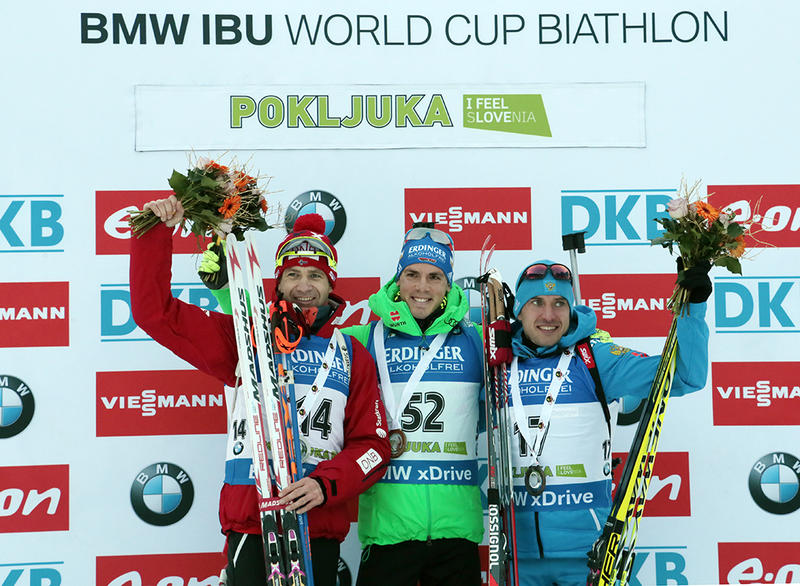
The men’s sprint podium at the IBU World Cup in Pokljuka, Slovenia, with winner Simon Schempp (c) of Germany, Norway’s Ole Einar Bjørndalen (l) in second, and Russia’s Evgeniy Garanichev (r) in third. (Photo: IBU/Kvetoslav Frgal)
Does anybody remember when Simon Schempp placed 77th in the first International Biathlon Union (IBU) World Cup sprint of the season two weeks ago in Östersund, Sweden? The German missed four out of five targets in each of two shooting stages for an insurmountable eight penalties. That was three days after he placed second in the 20-kilometer individual race, in which he hit 19-of-20 targets.
As the best biathletes know, sometimes you’ve got it, sometimes you don’t.
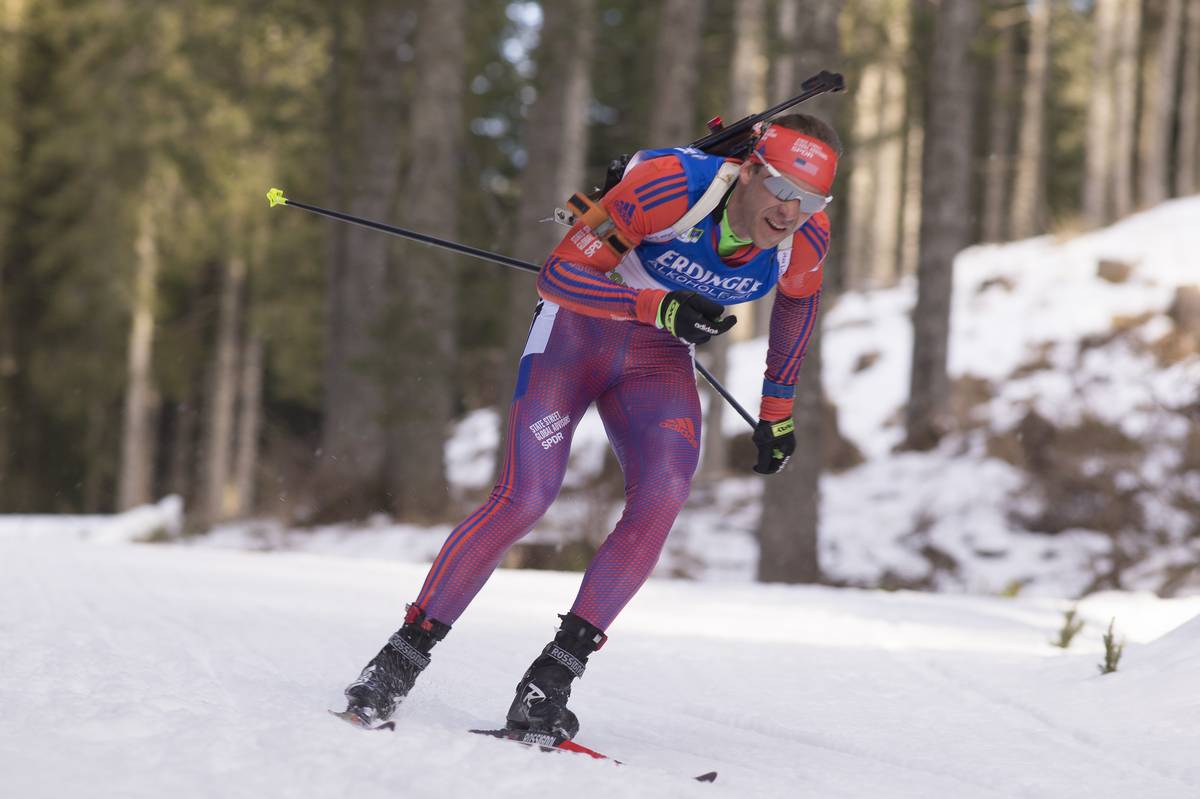
Lowell Bailey (US Biathlon) cleaned the IBU World Cup sprint to place 15th on Thursday in Pokljuka, Slovenia. (Photo: USBA/NordicFocus)
However, Schempp, 27, appears to be on something of a streak after winning his second-straight sprint in the last two World Cup weekends: he fired on all cylinders and cleaned to win in Hochfilzen, Austria, then topped Norway’s Ole Einar Bjørndalen with some blazing-fast loops in Pokljuka, Slovenia, to win the men’s 10 k sprint on Thursday.
With a winning time of 23:02.5, Schempp shot 100 percent with the best of them: Bjørndalen in second (+15.2) also cleaned, as did the two Russians in third and fourth — Evgeniy Garanichev (+25.1) and Alexey Slepov (+25.3), respectively.
France’s Martin Fourcade was fastest with a single miss (0+1) and ended up fifth (+25.6).
“I just felt good again today,” Schempp told the German broadcaster ZDF after the race. “Everything worked well on the shooting range again. The conditions for shooting were very good. … I felt good on the track, and of course it’s crazy if it was sufficient again today.”
For Schempp, the World Cup victory was his seventh in his career and it came on a day with practically invariable conditions. The sun was shining in Pokljuka and there wasn’t much wind, helping nine of the eventual top-15 finishers hit all of their targets.
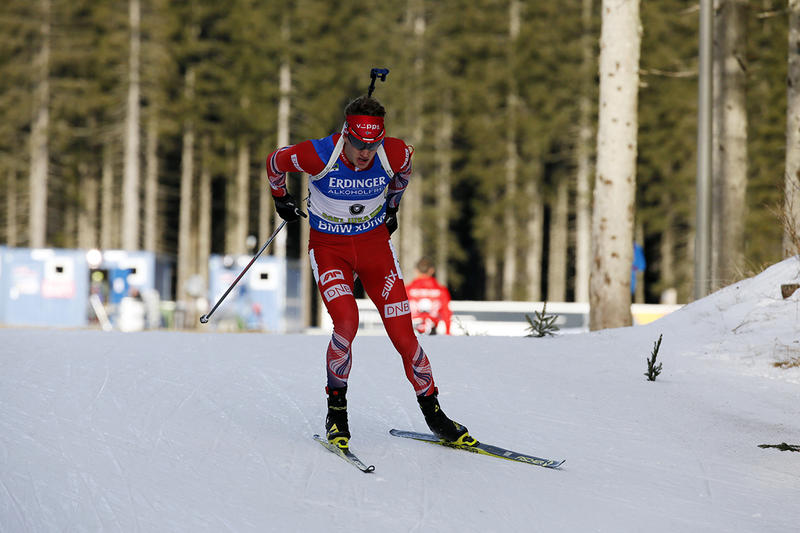
Norway’s Tarjei Bø racing to ninth on Thursday at the IBU World Cup sprint in Pokljuka, Slovenia. (Photo: IBU/Kvetoslav Frgal)
While Schempp started 52nd and picked off his biggest rivals for the win, including Bjørndalen in bib 14, Garanichev in bib 17 and Fourcade in bib 20, with the second-fastest overall course time, US Biathlon’s Lowell Bailey started seventh and cleaned both stages for his moment in the spotlight.
Albeit briefly, Bailey was initially first at the finish after holding off Norway’s Tarjei Bø on the final loop. Bø started 30 seconds behind Bailey, and ultimately bested the American’s time by 22.2 seconds. With a single standing penalty (0+1), Bø placed ninth overall (+36.9), while Bailey settled into 15th (+59.1).
“Although I started out fairly slow in the first lap, I was happy that I was able to keep Tarjei off my back for the final loop,” Bailey wrote in an email. “He’s in great shape right now and I wasn’t sure I could keep him behind me until the finish!”
Bailey explained the Pokljuka course is one of his favorites on the circuit, with long gradual uphills — totaling 336 meters (1,100 feet) of climbing per loop — and several transitions. He chose the early start as he and his coaches thought the tracks would be fastest at the beginning of the race.
There were some icy patches, as Fourcade nearly crashed on the first loop on a steep downhill where racers approached 70 kilometers per hour. Fourcade narrowly avoided skiing off the trail and finished the race 0.5 seconds off the podium.
Germany’s Arnd Peiffer fell at the end of his first loop while approaching the range, breaking the sole of his boot and costing him valuable time. Despite clean shooting, he ended up 42nd (+1:38.6).
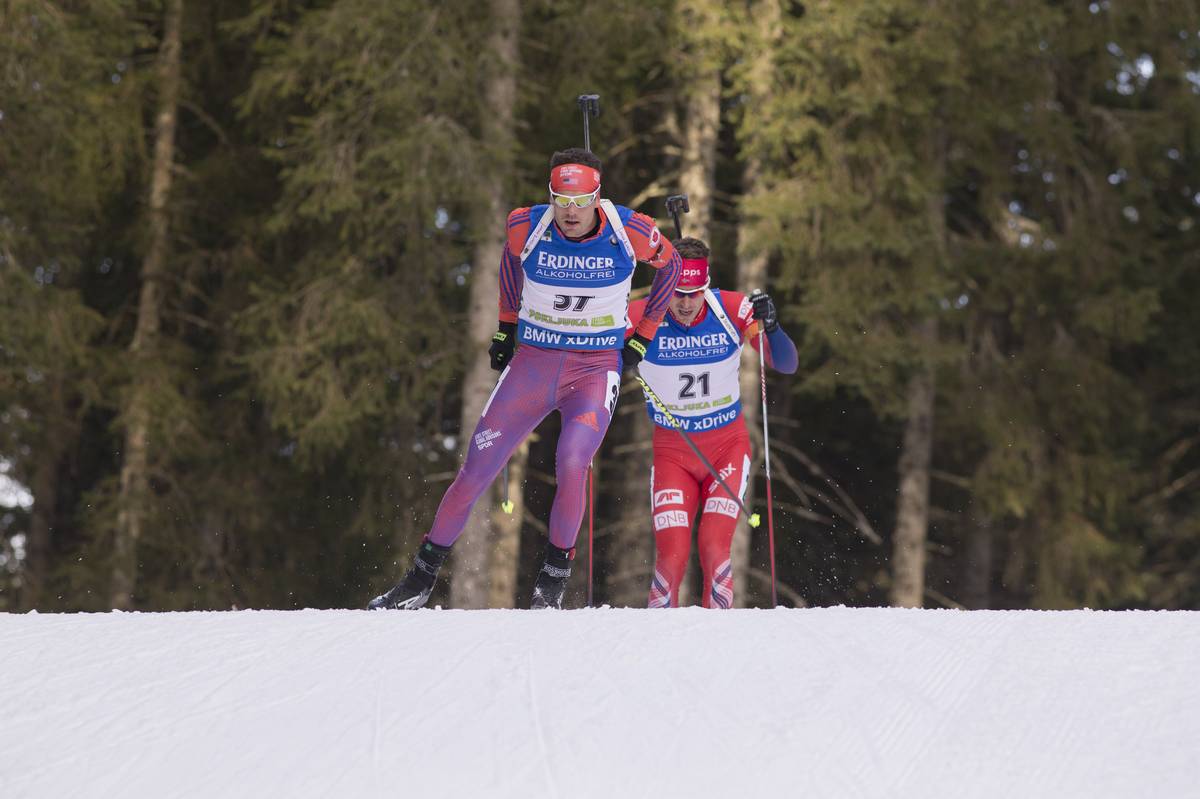
Tim Burke (US Biathlon) leads Norway’s Emil Hegle Svendsen (21) on Thursday in the men’s IBU World Cup 10 k sprint in Pokljuka, Slovenia. Svendsen placed 11th and Burke finished 14th. (Photo: USBA/NordicFocus)
Bailey’s teammate, Tim Burke set out on the course in bib 37, cleaned prone and missed one standing to place 14th, 4.5 seconds ahead of Bailey. It was Burke’s first top 20 of the season.
And Bailey, like Schempp, had recovered from 68th in the Östersund sprint (with six penalties), to place 12th in Hochfilzen with perfect 10-for-10 shooting.
“I was really happy with the way that shooting went [today],” Bailey wrote on Thursday. “I didn’t feel 100% on the tracks, but it wasn’t bad either.”
While Bailey had the fifth-fastest shooting time (and 41st-ranked course time), Burke was 13th-fastest on the course.
“This is definitely one of my favorite courses,” Burke wrote in an email. “I think it suits my strengths well with long, sustained gradual climbs. I am able to V2 most of the course, which is definitely my best technique.”
He explained he focused on his race plan rather than a specific result. In two previous sprints this season, Burke placed 30th in Hochfilzen (and 27th in the following pursuit), and 45th in Östersund. Thursday marked his best shooting in an individual race this season.
“Of course I always want a better result but I am satisfied with my time back,” he wrote. “In the sprint last week and this week, I had the skiing to make it to the podium with clean shooting and that’s where I want to be.”
Nathan Smith led the Canadians in 24th with 90-percent shooting (1+0). He started ninth and finished 1:15.9 back from Schempp, notably with the second-fastest shooting time and third-ranked range time of 102 finishers.
Burke, Bailey and Smith all qualified for Saturday’s pursuit, along with four other Canadians, including Macx Davies in 34th (+1:28.8), and Scott Gow in 35th (+1:30), both with a single penalty. Christian Gow cleaned to place 37th (+1:31.3) and meet the top-60 pursuit criteria, as did Brendan Green, who had two prone misses en route to 46th (+1:47.3). American Leif Nordgren finished 52nd (+2:02), with one standing penalty, and his teammate Sean Doherty placed 71st (+2:31.3) with four misses (3+1).
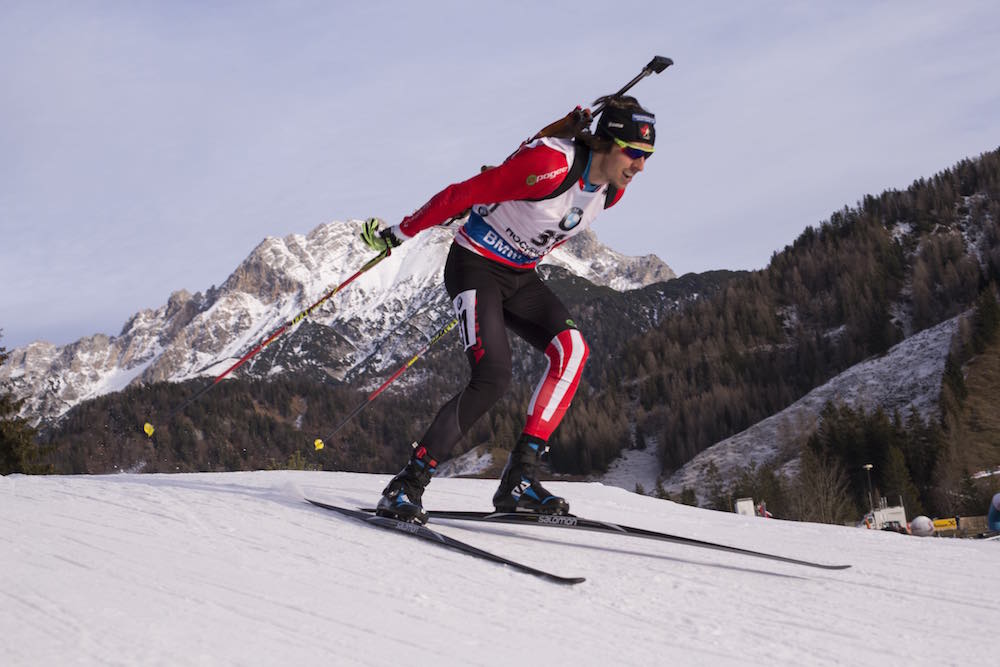
Brendan Green racing to sixth for Canada in the men’s 4 x 7.5 k relay at the IBU World Cup in Hochfilzen, Austria. Sixth place remains the Canadian men’s second-best relay result. (Photo: Biathlon Canada/NordicFocus)
The men’s 4 x 7.5-kilometer relay at the IBU World Cup in Hochfilzen, Austria, was marked by frequent lead changes on Sunday, leaving the big question of which nation — out of several — would actually win.
At one point, US Biathlon’s Tim Burke was sitting in first place as his team’s second skier. But in the end, three of the “usual suspects” prevailed, with Russia catching up to and eventually overtaking Norway at the very end of the final lap. France claimed the third podium spot, and Canada and the U.S. finished sixth and eighth, respectively.
For Canada, sixth place stood as the second-best men’s relay finish since the same four skiers placed fifth at last season’s World Cup in Oslo, Norway. With Christian Gow, Nathan Smith, Scott Gow, and Brendan Green racing in the same order as they did in Oslo, the Canadians rose to sixth during the second half of Sunday’s race and ended up 21.3 seconds off the podium in Hochfilzen.
With a clean prone stage and one spare in standing, Christian Gow, 22, tagged Smith 25.7 seconds behind Latvia in first. The Latvians had been elevated by a flawless leg from their scramble skier, Andrejs Rastorgujevs. On the second leg, Lativa slipped to 23rd (and was ultimately lapped on the final leg), while Canada moved into seventh with Smith.
“It was a lot of fun to race and to be so close to the top of the field,” Christian wrote in an email. “I am happy with how well I held it together in the range and out on the course! It was an all round very good day for me.”
Smith explained that while his men’s team repeated its sixth-place result from last year’s Hochfilzen relay, the competition was a lot tighter on Sunday.
“It was a much more exciting race to be in, with constant changes,” he wrote.
“Each time I went into the range I could still see the leaders,” Smith added. “This might’ve led me to be overly aggressive in shooting as I knew a quick clean could get me up there. Unfortunately I didn’t have any of those…”
Smith needed all six spares — three for each shooting — but knocked down all his targets to avoid the penalty lap. He noted that “6 spares is a lot on this course. Ski times are so close that it really all came down to shooting accuracy and speed. The rest of the guys had phenomenal shooting, though. I’ll admit I was the one that didn’t race to my potential today.”
With the seventh-fastest course time, Smith overtook three teams to move the Canadians into seventh, 49.3 seconds back at the second exchange. From there, Scott Gow cleaned without needing any spares and also skied the seventh-fastest course time for his leg to put his team in sixth (+59.0) before the final leg.
“My goal today was to try and not rely on spares, and the end result was exactly what I wanted,” Scott, 25, wrote in an email. “My skiing felt good today and my shooting was perfect, so overall I’m very happy.”
Canada’s anchor leg, Greene used one spare in both prone and standing and posted the fifth-fastest course time of his leg to secure sixth. He was able to still overtake Sweden’s Jesper Nelin, while Germany’s Simon Schempp moved ahead of him.
“Austria has been great to us,” Green said with a laugh. “It’s hard to say what it is. I think right now momentum is building on the team with some good results early in the season. But I think as a team we are more confident now.
“The biggest thing for me is knowing if I don’t perform, one of the younger guys will, so that removes some pressure because the expectations for the team are not all on one athlete anymore,” Green added.
A 29-year-old team veteran, Green felt the pressure on the final leg after his teammates skied as high as fifth during the race.
“There was a lot of pressure out there on that last leg today but I’m happy with how I handled it,” Green said.
He considered the Gow brothers to be the difference-makers on Sunday, and Smith agreed.
“The Gows are a lot stronger this year skiing and can fight with the top teams now,” Smith wrote. “I think a relay medal is within reach if we can all lay down our best on the same day.”
After using nine spares, the Canadians ended up behind Russia in first, with Alexander Volkov, Evgeny Garanichev, Dimitry Malyshko, and Anton Shipulin winning in 1:11:40.8. Norway placed second, 3.1 seconds back, with Henrik L’Abee-Lund, Johannes Thingnes Bø, Tarjei Bø, and Emil Hegle Svendsen. France was more than a minute back in third (+1:01.9), and Austria finished fourth 9 seconds later. Germany placed fifth (+1:18.4), 4.8 seconds ahead of Canada.
According to Smith, sixth place wasn’t necessarily a surprise. The team ranked seventh in the relay based on last season’s results. At the same time, coming close to a team best was always a good thing.
“All of us put forward strong legs to get in to the top 6 and that is an accomplishment we are all proud of,” Christian wrote. “I am hoping that we can match or hopefully even improve upon our 5th place relay from last year. That will be a tall order to say the least, but today was a good sign that we are on the right track!”
“That was some high-pressured racing today. We are all pretty happy for sure,” Green told Biathlon Canada.
“It was a really exciting race. I mean when you look at how the position changed, and now at the end still a good fight for the sixth place with the Swedes. I’m very happy that we made it,” Ahrens said.
Asked which athlete he would single out he added: “You know I’d have to pick all four, they put their work in, and not having a penalty and shooting very solid all throughout. But also the skiing, really fighting it out there, attacking … And our anchor Brendan at the end, when Schempp passed him to go with him and catch the Swede was the highlight.”
“It’s a young season, but so far, besides our other relay, the mixed relay in Östersund, it’s definitely a highlight,” he added.
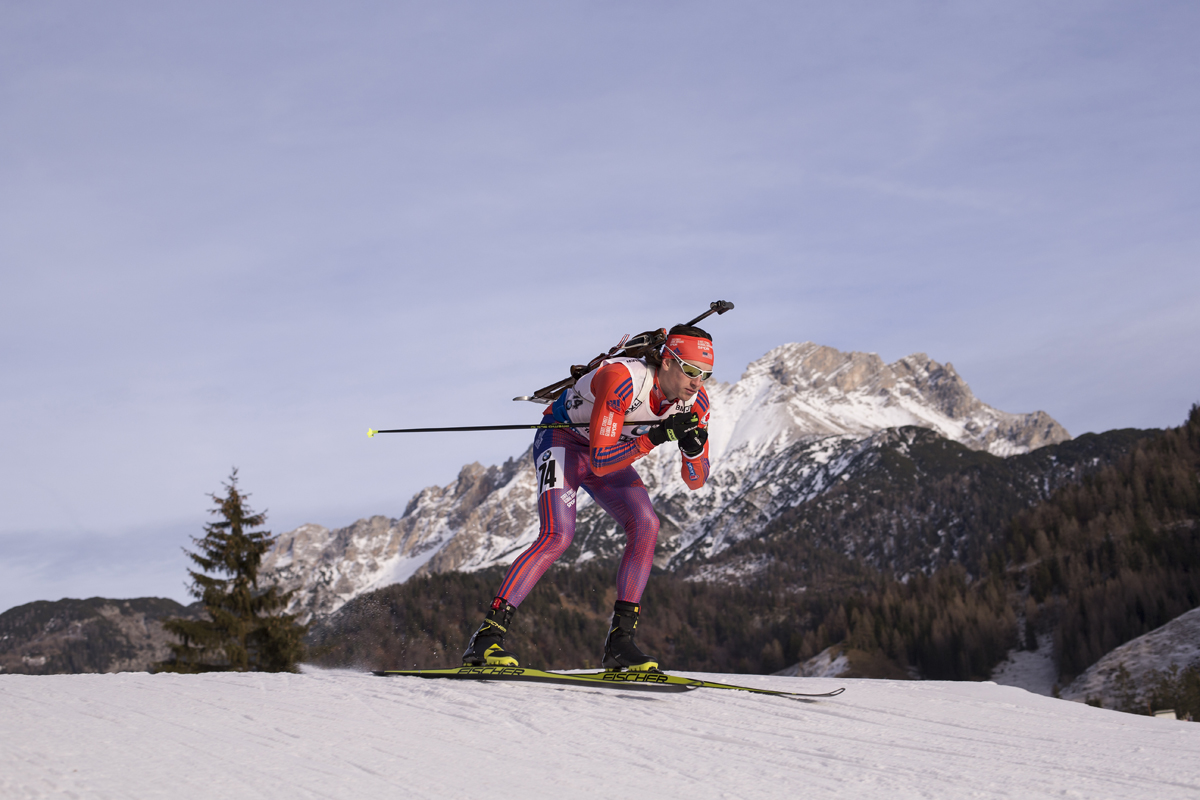
Sean Doherty on his way to anchoring the U.S. men’s 4 x 7.5 k relay to eighth on Sunday at the IBU World Cup in Hochfilzen, Austria. (Photo: Fischer/NordicFocus)
The U.S. men placed eighth (+2:06.6) with Lowell Bailey, Burke, Leif Nordgren, and Sean Doherty requiring a total of 12 spares and one penalty lap.
Sixth after Bailey’s first leg, in which he used one spare in prone and cleaned all of his targets, the U.S. moved into eighth with Burke, who ended up skiing a penalty lap after using all three spares on his second shooting (0+0, 1+3). Nordgren used a total of three spares between his two stages (0+2, 0+1) before tagging Doherty in ninth. Doherty recovered to eighth despite five spares (0+3, 0+2) with the sixth-fastest anchor leg.
“I was really happy with the performance. I felt a little bit better on course today, too,” Bailey wrote in an email, ”which is encouraging leading into the Pokljuka World Cup next week. I think we are satisfied as a team, but we all know that we have the potential to be on the podium…”
“We’re all capable of much more,” Nordgren wrote in an email. “This was a good starting point, but as we get deeper into the season we’ll be expecting more.”
Shipulin Attacks for the Win
n a large field of 27 starting countries, Russia came out at the top, requiring just six spare rounds and no penalty laps. Russia’s anchor Anton Shipulin achieved his first podium of the season on Sunday, and later said in the post-race press conference that he felt that he was “doing better and better race by race.” He put an exclamation mark to this statement on Sunday, outsprinting Norway’s Svendsen on the last meters.
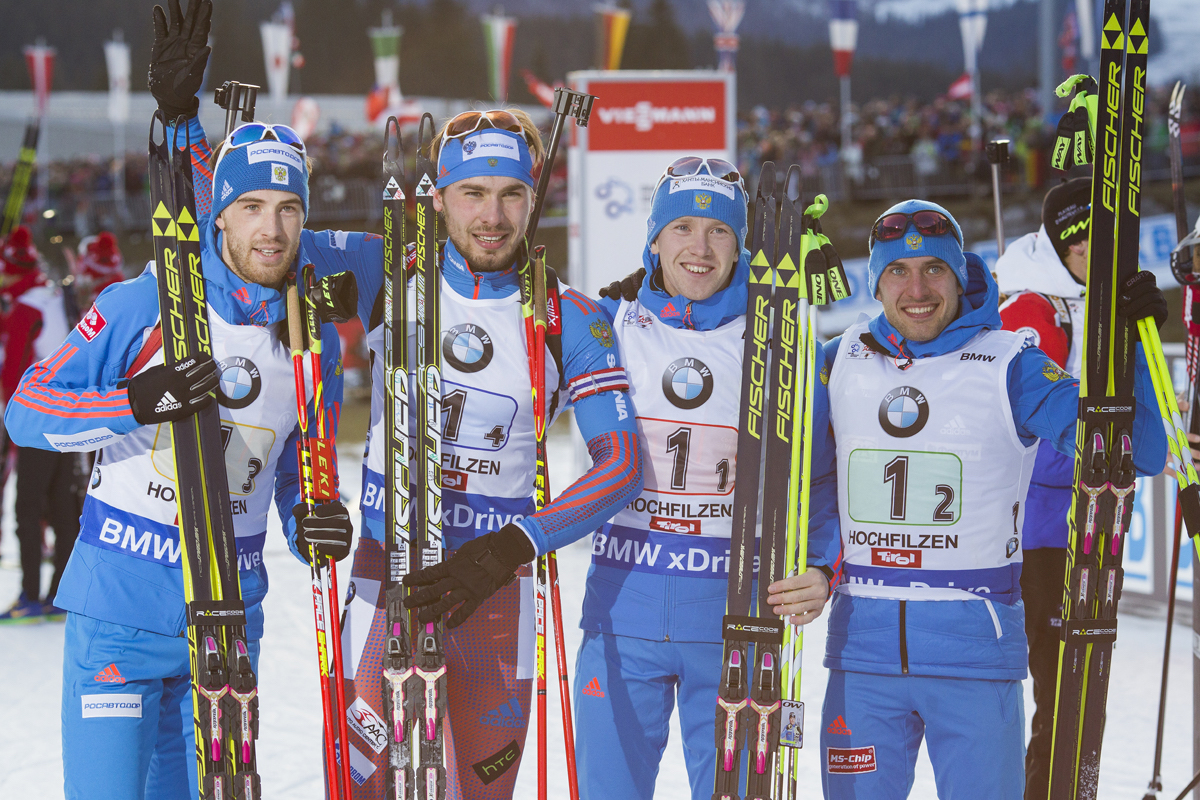
The Russian men’s relay team won the IBU World Cup 4 x 7.5 k on Sunday in Hochfilzen, Austria, with (from l to r) Dmitry Malyshko, Anton Shipulin, Alexey Volkov, and Evgeniy Garanichev. (Photo: Fischer/NordicFocus)
“After the last shooting stage, I saw Emil was not too far away from me and I knew I had to attack and catch him; I was a bit better on the track, so that was basically the plan,” Shipulin said through a translator. “This was not just my victory; all of the guys on the team were really great today.”
Norway had decided to give superstar Ole Einar Bjørndalen some rest, with L’Abee-Lund starting in his place, then handing off to the Bø brothers and finally closing with Svendsen. For quite a while they looked like the eventual winners, with Tarjei Bø handing over to Svendsen with a 30.8 second lead over Russia at the final exchange. But that gap wasn’t enough.
Svendsen still led by 18.1 seconds after the penultimate shooting, and many local as well as Norwegian fans that had traveled to Austria loudly chanted the typical “Hey!” with every target he cleaned while uncontested in the range (0+0). He still came into the final stage first, but then required two spares and his lead shrunk significantly to 10.4 seconds when he left the stadium.
Seeing the opportunity to catch Norway, Shipulin began his chase up the last climbs, posting the best course time on the final loop and sprinting past Svendsen as they approached the finish. Just 3.1 seconds behind Russia in the finish, Norway required seven spare rounds, and had no penalties.
Despite the close loss, the Norwegians weren’t too disappointed: “The team did a good job today, and we are satisfied with the race,” L’Abee-Lund said during the press conference.
“I feel my shape and confidence is coming back,” Johannes Thingnes Bø said.”Hopefully after the New Year I will come back and fight with Fourcade, Schempp and the best.”
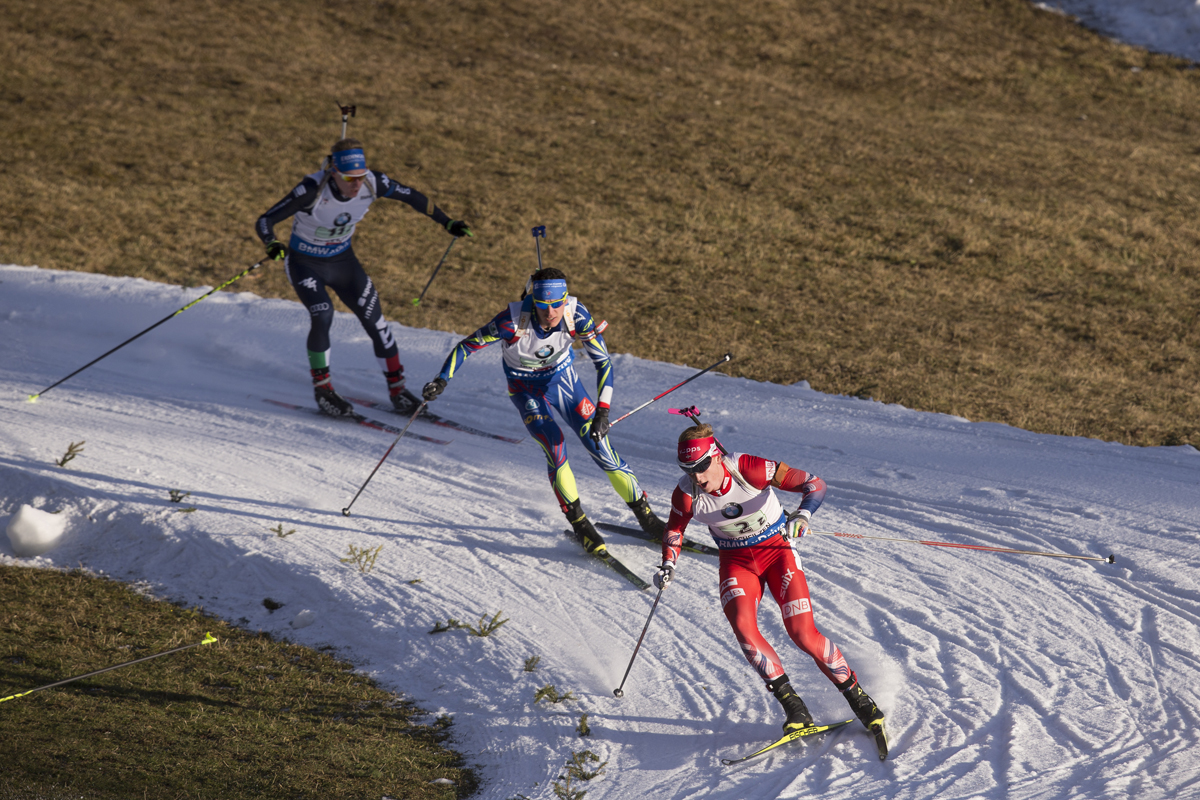
13.12.2015, Hochfilzen, Austria (AUT): Norway’s Johannes Thingnes Bø leads France’s Quentin Fillon Maillet (c) and Italy’s Lukas Hofer during the second leg of the men’s relay at the IBU World Cup in Hochfilzen, Austria. (Photo: Fischer/NordicFocus)
France grabbed the last spot on the podium, finishing more than a minute behind Russia, also requiring six spares and no penalty lap. The team chose a lineup of Simon Fourcade, Quentin Fillon Maillet, Simon Desthieux, and Martin Fourcade, and was skiing just outside the top three for most of the race.
Then, anchor Martin Fourcade, last year’s overall World Cup winner and runner-up in Friday’s sprint and winner of Saturday’s pursuit, managed to move them up one position after he required just one spare in his prone shooting. On the next loop, he crashed descending down a bridge before the final shooting stage, a mistake that didn’t cost France the podium, yet ended any chances to catch up to the two leading teams before the last shooting.
“It was not a perfect race, but I’m satisfied with it,” the team’s starter Simon Fourcade said in the press conference, after using one spare in prone and handing off in eighth. “I had some little mistakes in the shooting … But yeah, satisfied with the race today, and satisfied to see that my ski level is back.”
Local favorite Austria, with Sven Grossegger, Julian Eberhard, Simon Eder, and Dominik Landertinger placed fourth (+1:10.9) and just 9 seconds off the podium, despite having to ski two penalty loops, which all the other top teams avoided. They used a total of 13 spares, two of which came from Landertinger on his first stage, but the Austrian anchor closed out the race with a flawless standing stage and the second-fastest time behind Shipulin on the final loop.
“A little bit more would have been possible, the two misses in prone shooting are really annoying,” Landertinger told Austrian broadcaster ORF. In the pursuit the day before, he had already achieved the best individual result of the season so far for his team.
Germany’s Simon Schempp, who had battled Martin Fourcade for the win in the other two races this weekend, again skied a very strong last lap with the third-fastest time behind Shipulin and Landertinger and only required two spares. With that performance he elevated his squad from 10th to fifth place (+1:18.4), after his teammates Erik Lesser, Andreas Birnbacher and Benedikt Doll struggled throughout the race with shooting. Uncharacteristically, Germany required 16 spares, the second-most of any team on Sunday, and narrowly avoided the penalty lap on four of eight stages.
Arguably the biggest surprise of the day was Sweden in seventh (+1:26.1), with Torstein Stenersen, Ted Armgren, Fredrik Lindström and Jesper Nelin. Aside from Lindström, the team had little World Cup experience. Despite that, Sweden managed to stay near the top the whole race and even tagged off in third place on the last exchange, before Nelin missed three targets on his leg and fell back a bit to seventh place, finishing 2.9 seconds after Canada and 40.5 seconds ahead of the U.S.
Norway’s Petter Northug (l) leads the Czech Republic’s Ales Razym (second from l), Canada’s Lenny Valjas (third from l), Poland’s Maciej Starega (6), American Simi Hamilton (5), and Kazakhstan’s Nikolay Chebotko (r), among others, in the freestyle team-sprint semifinal at 2015 World Championships on Sunday in Falun, Sweden. Norway went on to win the heat, the U.S. was third, and Canada placed seventh. (Photo: FlyingPointRoad.com)
FasterSkier’s coverage of the 2015 FIS Nordic World Ski Championships in Falun, Sweden, is brought to you by the generous support of L.L. Bean, now featuring a complete line of Kikkan Randall training wear.
FALUN, Sweden — Canada’s Jess Cockney and Lenny Valjas could see exactly where they needed to be in the men’s 6 x 1.4-kilometer team sprint on Sunday, they just couldn’t quite get there before the finish.
That was the difference between the pace during something like a World Cup, where they placed eighth in the freestyle team-sprint final last month in Otepää, Estonia, and the Nordic World Ski Championships.
“We tried to stay, obviously, in the group, in the front of the group if possible,” Valjas said after Sunday’s race, in which the Canadian men missed advancing to the final after placing seventh in their semifinal for 13th overall.
“The first couple of laps [we were focused on] just spending as little energy as possible, and then on the last laps give everything we had and stay out of trouble,” he added. “Everything worked to plan, it was just we were a little bit too far back, a second or two.”
In his first World Championships, Cockney, 25, skied them into fifth on his first of three laps in the second semifinal. Valjas then slipped to eighth, where they remained for the next two laps.
With Petter Northug, who anchored Norway to the semifinal and ultimately the final win on Sunday, leading up front, the pace slowed significantly on the semifinal’s fourth lap. Despite Valjas posting the fastest course time of anyone on that lap, he tagged Cockney in the same position in eighth.
The fact that the race was slowing wasn’t necessarily good for the Canadians, which regained contact on that lap but struggled to pick off the places. In order to guarantee themselves a spot in the finals, they needed to finish in the top two. Beyond that, the six fastest teams between the two semifinals move on. Since the first heat was faster, that didn’t leave teams outside the top two with much hope in the second semifinal.
“You can hear in the stadium, they were saying this heat is six seconds slower than the first heat, so you start to think,” Valjas recalled. “You got to be ready to go. You know that the heat can go six seconds faster, so just being in a spot to react when it does get faster.”
On Cockney’s final lap, he rose to fifth once again — behind Russia, Norway, Germany, and the U.S. — with the third-fastest time on that leg. From there, Valjas dropped two places to finish seventh, 2.27 seconds behind the Norwegian winners and 1.24 seconds away from a lucky loser spot. Norway and Russia advanced out of their heat in first and second, as did the U.S. in third, Poland in fourth and Germany in fifth. Belarus did not qualify in sixth (+2:07).
The first semifinal was about nine seconds faster than the second, with Italy winning it in 15:34.02. Norway won the second heat in 15:43.06.
“We were hoping to ski ourselves into the final, for sure, and fight for the top two, top four spots in the heat, so that’s where we thought we would be,” Cockney said.
“I just wish I was with that group of four in the front,” Valjas added. “I was a second and a bit behind them; there’s no coming back from that. When you are that far back, there’s no draft, you’re kind of stuck.”
Overall, the two explained they felt better than they had earlier in the week and earlier this season.
“It felt better today, for sure, than the classic sprint,” Cockney said. He was 49th in the classic sprint at World Championships three days ago. “I think my skate skiing is decent right now. I don’t think I’m in 100-percent top shape. I think I was pretty good at the start of the year, before Christmas, just trying to find that shape again. Still have a little bit of racing here to do.”
In the same sprint, Valjas placed 14th.
“I’m feeling better — first half of the year, it was tough,” Valjas said. “Made some changes with intensity, and I feel much better. … We have one more [race], hopefully the relay, if I get selected, so gotta just keep getting the fitness better. It’s coming, it’s going in the right direction.”
Canadian National Team Head Coach Justin Wadsworth called it a “good effort. I think they skied pretty smart,” he said.
“They just weren’t quite there at the end,” he said. “If they both could of just made a spot each on the big uphill there, I think it would have put them in a little bit better contention for the final sprint.
“This is a really fast finish, especially when the conditions are like this and the skis are running fast, it is hard to pass a lot of people,” Wadsworth added. “You’re trying to get around from eighth to fourth. I was trying to yell at them that they needed to be top four from the times we were seeing, but they were just trying to stay the pace.”
The Canadian women did not field a team sprint, as two out of three women on its World Championships team (Emily Nishikawa and Olivia Bouffard-Nesbitt) planned to arrive in Falun on Sunday after recovering from illness in Östersund, Sweden.