Tag: Canadian men’s relay

  • Sunday Rundown: Davos, Pokljuka & Sovereign Lake (Updated x3)

    Sunday Rundown: Davos, Pokljuka & Sovereign Lake (Updated x3)

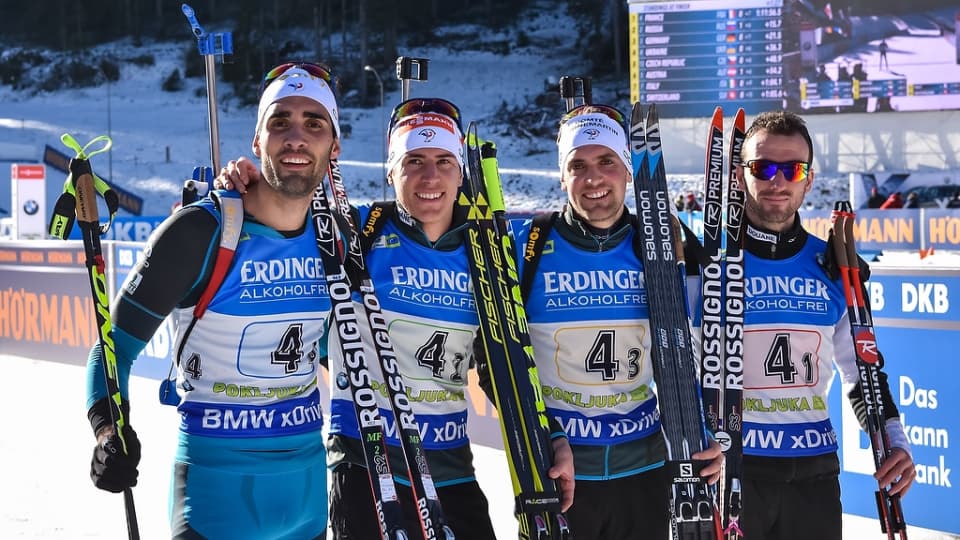
    The French men's relay team after their IBU World Cup win on Sunday in Pokljuka, Slovenia, with (from left to right) Martin Fourcade, Quentin Fillon Maillet, Simon Desthieux, and Jean-Guillaume Béatrix. They beat Russia by 15.7 seconds for the win. (Photo: IBU)
    The French men’s relay team after their IBU World Cup win on Sunday in Pokljuka, Slovenia, with (from left to right) Martin Fourcade, Quentin Fillon Maillet, Simon Desthieux, and Jean-Guillaume Béatrix. They beat Russia by 15.7 seconds for the win. (Photo: IBU)

    Welcome to The Rundown, your quick primer of need-to-know information about the day’s racing. We’ll be updating this digest as the day goes on with additional results, photos and quotes. The Rundown is NOT a race report; stay tuned for complete race reports later today with interviews from the day’s top racers.

    ***

    Note: This recap has been updated to reflect the correct positions each of the four Canadian women exchanged in during Sunday’s 4 x 6 k IBU World Cup relay. 

    IBU World Cup in Pokljuka: Men’s & Women’s Relays

    Germany and France reached the podium in both the men’s 4 x 7.5-kilometer and women’s 4 x 6 k sprints on Sunday, the final day of the International Biathlon Union (IBU) World Cup in Pokljuka, Slovenia.

    France won the men’s race by 15.7 seconds over Russia with a total of seven spare rounds and zero penalties. Jean-Guillaume Béatrix started off by putting the French team in fourth, then Quentin Fillon Maillet elevated them to first, a position both Simon Desthieux and Martin Fourcade held for the victory in 1:11:56.5.

    “When we started the relay, we thought that winning was possible,” Béatrix said, according to an IBU press release. “At the same time, the competition was very tough. There were many strong teams today.”

    “I was very happy to tag Martin with a 20-second lead,” Desthieux said. “This is good for my confidence.”

    Russia placed second with Maxim Tsvetkov, Anton Babikov, Matvey Eliseev, and Anton Shipulin, the four of which combined for one penalty (on Eliseev’s third leg) and six spare rounds.

    Germany rounded out the podium in third, 21.5 seconds behind France, with Erik Lesser, Matthias Dorfer, Benedikt Doll, and Simon Schempp. In ninth after Lesser’s first leg, Dorfer brough the team to eighth and Doll raced them into second before Schempp lost one place to end up third. They used a total of 11 spares but avoided the penalty lap.

    Canada placed 10th of 22 teams, 1:44.7 out of first with one penalty and seven spares. Christian Gow started the team out with clean shooting and tagged off in sixth at the first exchange, and his older brother Scott Gow also shot clean without any spares to move up to fourth at the second tag. Macx Davies required three spares and had to ski a penalty lap on his prone stage, then used another spare to clean standing and tagged off in 14th place. Brendan Green anchored the Canadians to 10th, using three spares but avoiding a penalty in prone, then cleaning standing without any spares.

    “I had a somewhat disappointing pursuit race yesterday, and my goal for today was to refocus on the range and push the ski speed as much as possible,” 28-year-old Scott Gow told Biathlon Canada, according to a press release. “I was happy with the overall performance I was able to put forward for my leg of the relay, and I was especially happy with another clean shooting day.

    “Today was an acceptable result for the team,” he added. “Christian and I are very proud of our results so far this season. We worked very hard all year to try and elevate our racing abilities to the next level, and we saw our hard work pay off today with great skiing and perfect shooting for both of us. It’s also a big confidence boost going forward with the season knowing we are capable of competing among the best.”
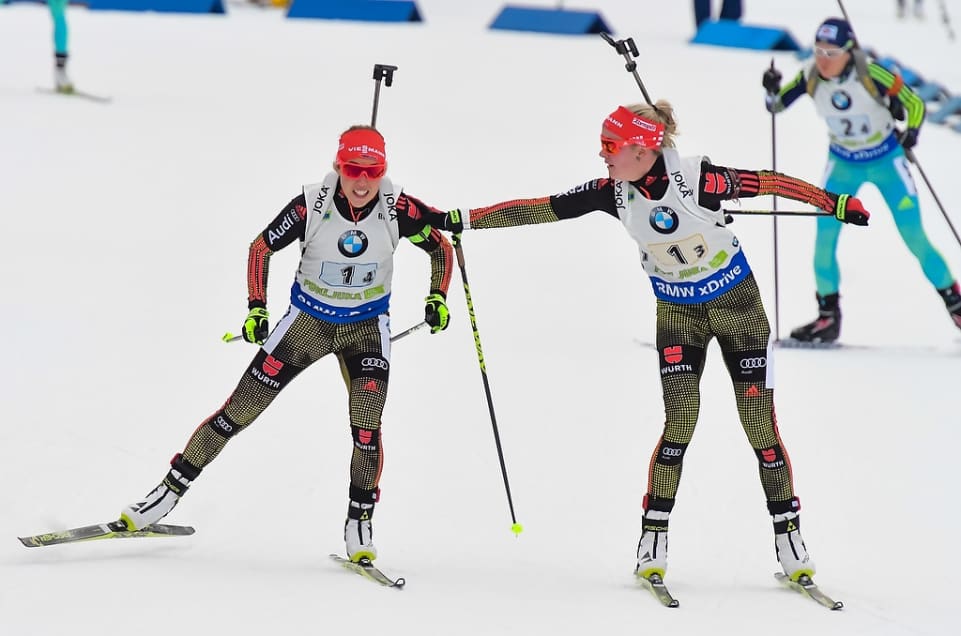
    Germany's Karen Hammerschmidt (l) tagging her teammate Laura Dahlmeier in second place at the final exchange of the women's 4 x 6 k relay at the IBU World Cup in Pokljuka, Slovenia. Dahlmeier anchored the team to the win by 10.1 seconds over France. (Photo: IBU)
    Germany’s Karen Hammerschmidt (l) tagging her teammate Laura Dahlmeier in second place at the final exchange of the women’s 4 x 6 k relay at the IBU World Cup in Pokljuka, Slovenia. Dahlmeier anchored the team to the win by 10.1 seconds over France. (Photo: IBU)

    In the women’s relay on Sunday, Germany took first by 10.1 seconds over France, using nine spares but no penalties.

    Vanessa Hinz started the Germans out and tagged off in fifth, and second-leg Franziska Hildebrand moved them up into second by the halfway point. Karen Hammerschmidt held that position, which was enough for Laura Dahlmeier who anchored them to the win in 1:11:31.1.

    “This was a brutally beautiful race today,” Dahlmeier told German broadcaster ZDF after her third win in as many races in Pokljuka. “It was very fun, and I was very relaxed because I knew we were competing as a team. Even if you don’t have as much power left there are still three others. I was on top of my game and just enjoyed it. I really looked forward to the race, although yesterday I was knocked out. But on the course I had a good feeling right from the start.”

    France in second and Ukraine in third (+37.7) both required just three spare rounds and no penalties per team. France secured second place with Anais Chevalier (who initially tagged off in 11th), Justine Braisaz (who picked off eight places to move into third), Celia Aymonier (who tagged off in first), and Marie Dorin Habert (who cleaned without any spares but came up 10 seconds short of Dahlmeier at the finish).

    Ukraine reached the podium with Iryna Varvynets, Yuliia Dzhima, Olena Pidhrushna, and Anastasiya Merkushyna.

    Canada placed 11th (+3:33.1) with a total of just four spares and no penalties. Sarah Beaudry initially tagged off in 23rd, Rosanna Crawford skied them into 18th, Megan Tandy shot clean without any spares and tagged off in 14th, and Julia Ransom anchored them to 11th out of 23 teams.

    The U.S. did not field a men’s or women’s relay team, with just three men and three women in Pokljuka.

    Results: Men | Women

    ***

    FIS Cross-Country World Cup in Davos: Freestyle Sprints

    In the men’s 1.6-kilometer freestyle sprint on Sunday it was Russia’s Sergey Ustiugov who emerged victorious, besting Finn Hågen Krogh of Norway and his Norwegian teammate Sindre Bjørnestad Skar for first.

    After qualifying 29th overall, Ustiugov crossed first in his quarterfinal and held the led through his semifinal and into the final, winning in a time of 2:24.65. Krogh crossed 0.59 tenths of a second behind him for second place and Skar took the final podium spot, crossing 3.29 seconds after Ustiugov.

    Also in the sprint final was Russia’s Alexey Petukhov, who finished just off the podium in fourth (+3.47), Norwegian Emil Iversen in fifth (+5.52) and France’s Lucas Chanavat  who won the qualifier — ended the day in sixth (+11.48).
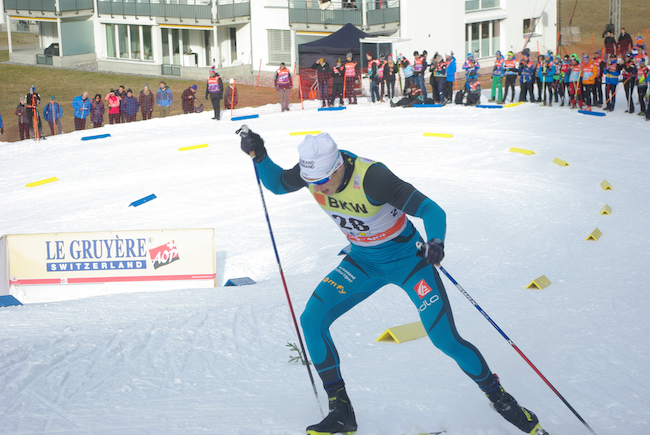
    Lucas Chanavat of France had the fastest men's qualifying time in the Davos World Cup freestyle sprint on Sunday.
    Lucas Chanavat of France had the fastest men’s qualifying time in the Davos World Cup freestyle sprint on Sunday.

    Canada’s Lenny Valjas was the top North American finisher for the day, qualifying 12th and advancing to the quarterfinals where he finished in 14th overall. No other Canadians made the sprint heats, with Alex Harvey left just outside advancing in 33rd, Devon Kershaw ending the day in 49th, Knute Johnsgaard 60th, Bob Thompson 67th, and Andy Shields 73rd. Jesse Cockney did not finish the race.

    Simi Hamilton led the U.S. in 24th (+3.88). Andy Newell was just outside the heats in 36th, and Eric Packer placed 95th (+21.62).

    In the women’s 1.6 k freestyle sprint, Maiken Caspersen Falla of Norway took the overall win, crossing in a time of 2:44.63. Just 0.53 tenths of a second behind Falla was her Norwegian teammate Ingvild Flugstad Østberg in second place overall. The final women’s podium finisher, Hanna Falk of Sweden was 0.60 tenths of second off Falla in third.

    U.S. Ski Team member, Jessie Diggins made the final, racing to a fifth place overall (+5.91), behind Sweden’s Jonna Sundling in fourth (+1.04) and ahead of Russia’s Natlalia Matveeva in sixth (+6.80).

    The United States put three other women into the heats, including Sophie Caldwell who finished 11th, Sadie Bjornsen 15th, and Ida Sargent 20th.

    American Caitlin Patterson ended the day 47th, Kikkan Randall 58th, and Liz Stephen 61st.

    Dahria Beatty was the top Canadian on Sunday, finishing in 25th overall. Cendrine Browne ended the day 53rd and Sophie Carrier-Laforte 59th.

    Qualifier Results: Men | Women

    Final Results: Men | Women

    ***

    NorAm/SuperTour at Sovereign Lake: 10/15 k Freestyle

    [UPDATE] It was Americans owning the podium again Sunday at Sovereign Lake, and a little bit more. It was warmer on Sunday, -7 Celsius, and snowed lightly throughout.

    The men’s 15 k freestyle was first on the schedule.  APU’s Scott Patterson won in 40:00.2, followed by Saturday’s A-finalist Matt Gelso at 13.2 seconds and Vail’s Tad Elliot at +26.6.

    The top Canadian was Team R.A.D.’s Russell Kennedy in ninth, at 1:38.8 behind.

    In the women’s 10 k freestyle, the podium was owned by APU’s Chelsea Holmes in 30:42.9. SMS Elite’s Katharine Ogden was second at 13.4 seconds, also winning the junior category. Her teammate Erika Flowers was third, 36.4 behind.

    AWCA’s Olivia Bouffard-Nesbitt was the top Canadian for the second day, placing 13th at 1:51.8.
  • FasterSkier’s Biathlon Performances of 2016: Dunklee and Canadian Men’s Relay

    FasterSkier’s Biathlon Performances of 2016: Dunklee and Canadian Men’s Relay

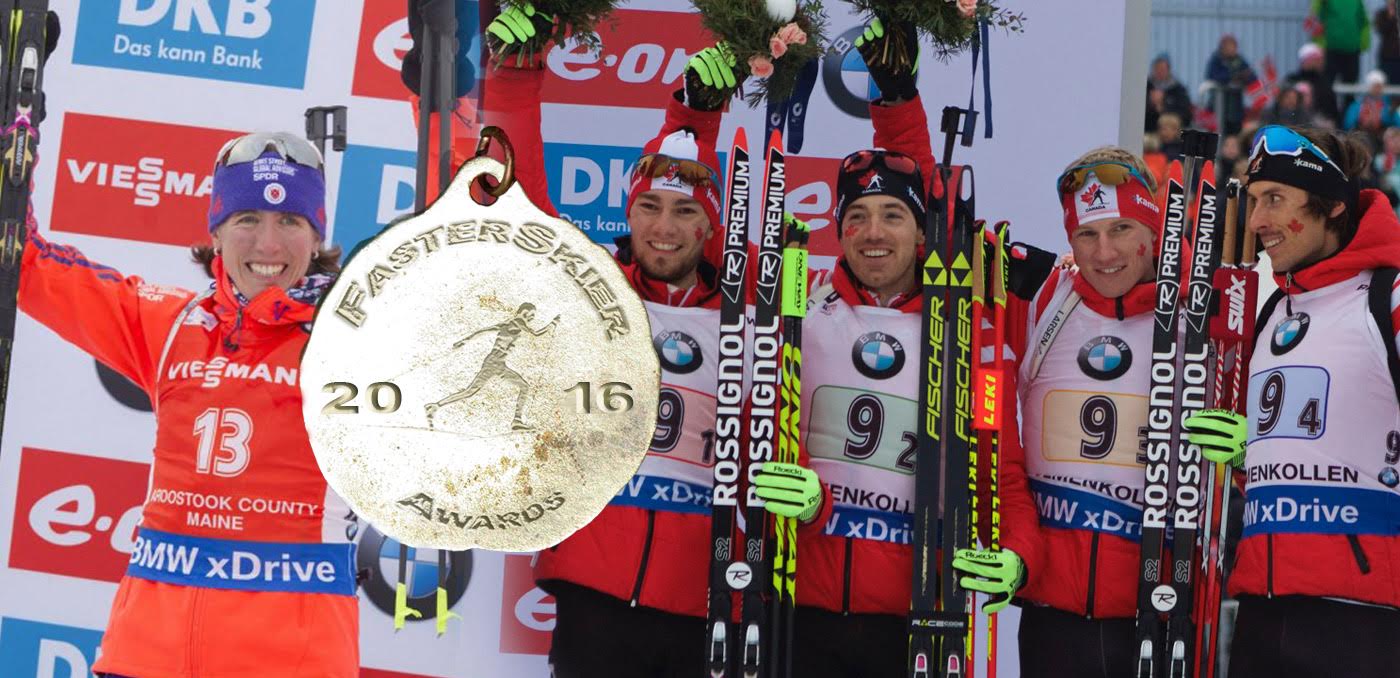
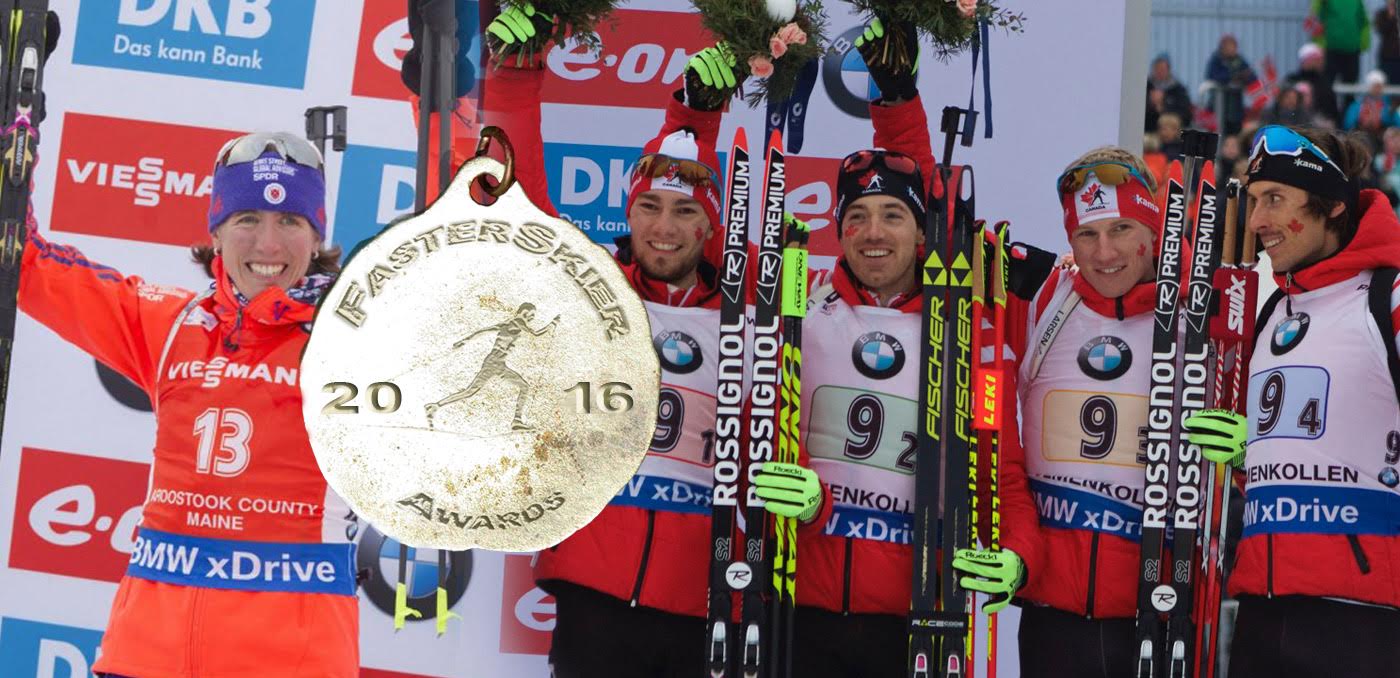
    Susan Dunklee (l) and the Canadian men's relay earned FasterSkier's biathlon performances of the year with their results at the Presque Isle World Cup and World Championships, respectively. (Photo: USBA/NordicFocus & JoJo Baldus)
    American Susan Dunklee (l) and the Canadian men’s relay, with (from l to r) Christian Gow, Nathan Smith, Scott Gow, and Brendan Green, earned FasterSkier’s biathlon performances of the year with their results at the Presque Isle World Cup and World Championships, respectively. (Photos: USBA/NordicFocus & JoJo Baldus)

    We’re entering the homestretch for the 2015/2016 FasterSkier awards, chosen by our staff based on performances last season. While not scientific, these points of recognition are intended to reflect a broader sense of the season in review.

    The following set of honors goes to outstanding North American male and female biathlon performances of the year. Cross-country performances of the year will follow.

    Previous categories: Breakthrough Skiers (Canada & U.S.) | Biathletes | Coaches | Collegiate Skiers | Continental (Canada & U.S.) | International Skiers and PerformancesJuniorsNordic Combined | Para-Nordic

    ***

    • Susan Dunklee (US Biathlon): Presque Isle World Cup 10 k sprint

    Both Susan Dunklee and teammate Lowell Bailey seemed to have breakthroughs after the 2014 Olympics in Sochi, Russia: they had notched best-ever finishes for Americans, with Dunklee 11th in the mass start and Baily eighth in the individual, and then picked up their first World Cup podiums in the weeks post-Olympics.

    Heading into 2015, the team (as well as its fans) was giddy with the possibility of more podiums. But none came.

    Dunklee delivered this season in Presque Isle, Maine, exactly where those fans could most appreciate it. Shooting a perfect 10-for-10 in the 10-kilometer sprint, she sped past many pre-race favorites and finished second, 17.8 seconds behind Gabriela Soukalova of the Czech Republic (who later won the World Cup Total Score).

    “I knew I probably had one of my best races in my life and I’d done it at home and my parents were there,” Dunklee said after the race. “I just felt really good about my performance. I was really happy.”

    It was close, with second through fourth place separated by fewer than three seconds. But Dunklee, an early starter, got to watch her time hold despite challenges from the likes of Marie Dorin Habert of France.

    “You still need to fight like hell,” Dunklee recalled of heading out on the final loop knowing that times were tight. “When you’re having that sort of race, you don’t want to lose a second anywhere … I’ve just got to fight for the next seven minutes or whatever it takes.”

    Dunklee had a solid season, just as she has for each of the last several years; consistency on the World Cup circuit landed her in 14th place in the Total Score, the best ever for an American woman.

    But consistency doesn’t breed excitement quite the same way that podiums do.

    “It’s unbelievable,” U.S. women’s coach Jonne Kähkönen said. “Just to be able to grab the podium on the home soil, home World Cup, even if it’s not the hometown, but there’s a lot of friends and family and fans that are great support. The local community is just awesome, so it means the world to us.”

    Dunklee is now tied for the best performance ever by an American, along with Tim Burke, Anna Sonnerup, Joan Smith, and Josh Thompson, all of whom also won silver at World Cup or World Championships events.

    Next up? The U.S. is still waiting on a gold.

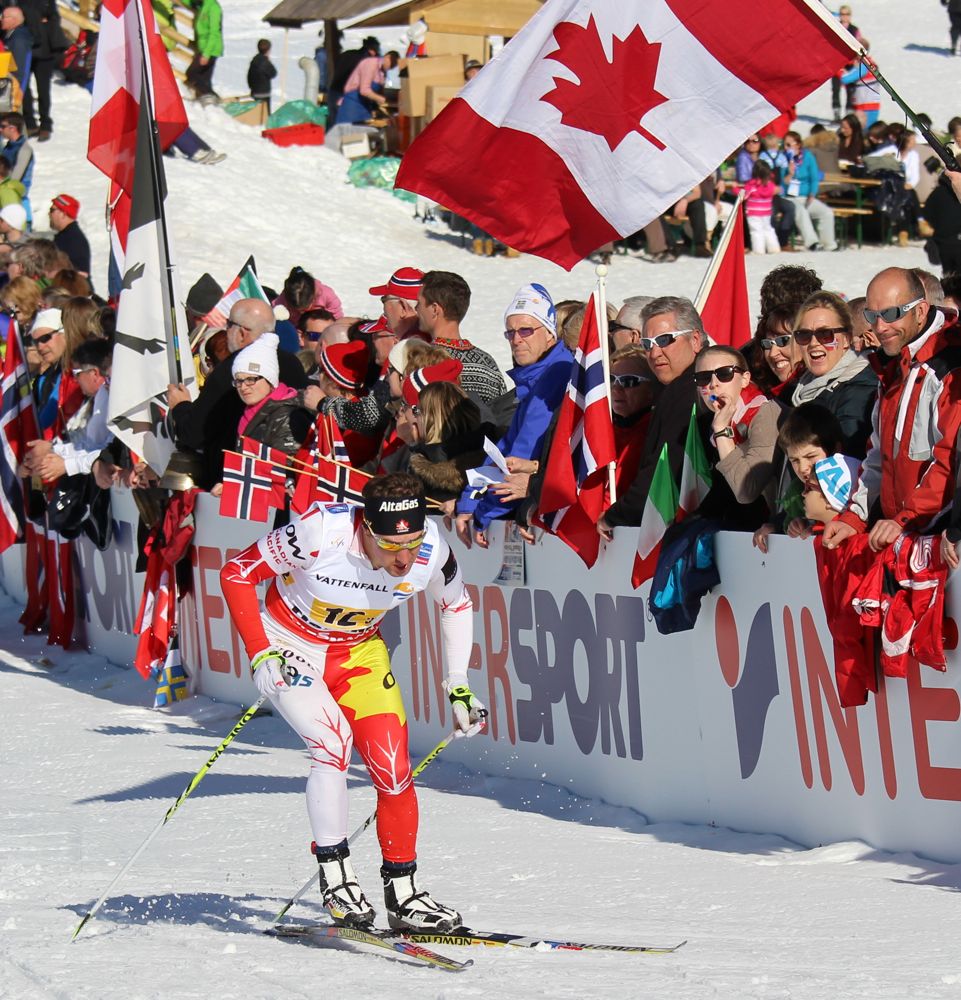
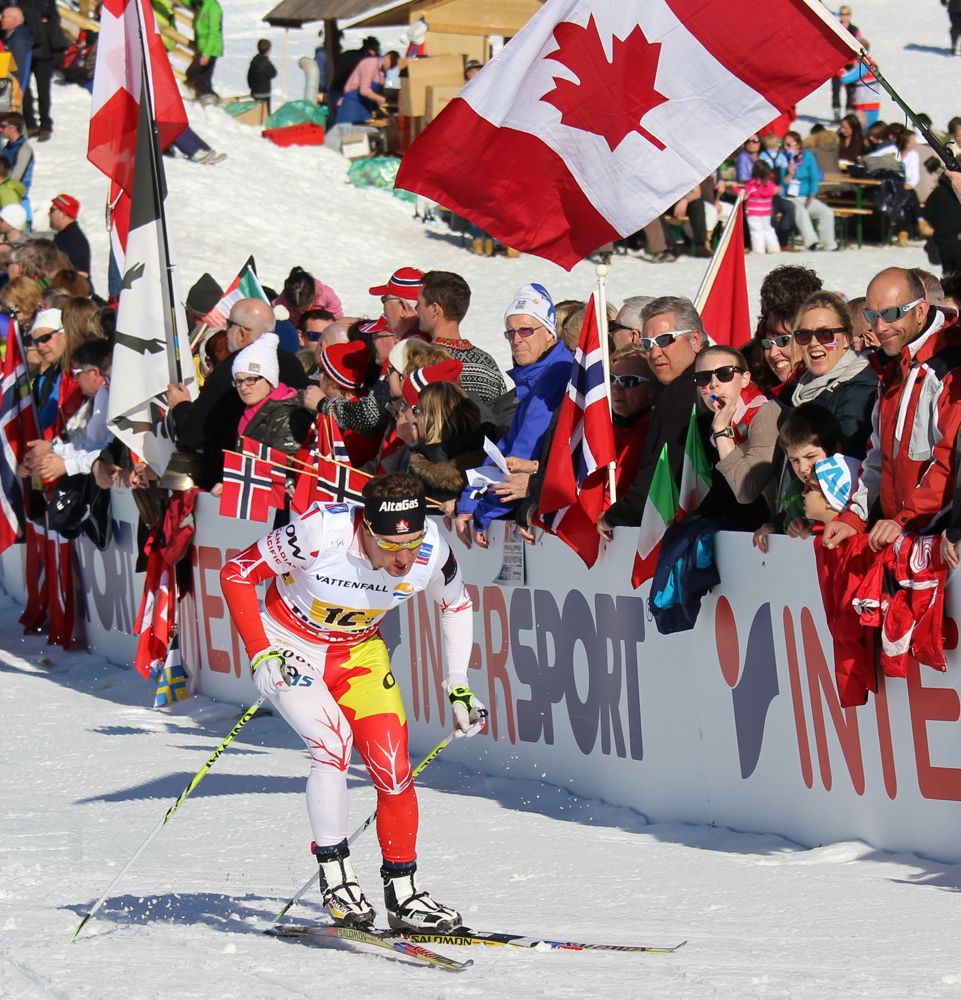
    • Canadian men’s relay team (Christian Gow, Nathan Smith, Scott Gow, and Brendan Green), World Championships men’s 4 x 7.5 k relay

    While Dunklee’s second-place finish was historic, it didn’t send the same shock waves as another record-setting result which came a few weeks later: when the Canadian men’s team broke through for bronze in the World Championships relay in Oslo, Norway, earning their country’s first-ever relay medal.

    “In a relay anything is possible,” anchor racer Brendan Green said at the time. “Today we all really put it on the line together. Every single one of us raced really well. When that happens, when things come together like that, it’s really incredible.”

    It was easily the most surprising result of the championships, and the athletes themselves said that they hadn’t seen it coming – they had thought a top five was possible. The medal? Maybe in a few years, they had hoped.

    Some aspects of the performance were predictable. The Canadians tied with Germany and the U.S. for the best shooting on the day – not surprising because they already were a great shooting team, with Christian Gow the fourth-most accurate shooter on the World Cup and Smith the fifth-fastest.

    And seeing Nathan Smith bring the team to the front of the field? He has won an individual World Cup, so that wasn’t unusual.

    Seeing Green anchor the team like a pro? He has done it dozens of times, and also has five individual top-10 finishes to his name – although shooting a perfect ten-for-ten when a medal is on the line is a whole different story. Green was stone-cold as the anchor even though he said his nerves were a nightmare.

    Perhaps what fans hadn’t been expecting were the stellar performances of the Gow brothers, who are the younger members of the Canadian team. Christian Gow, then 22 years old, tagged off just 14.7 seconds behind the leaders on leg one, handing over to Smith, who skied into a more or less dead heat with the leaders on leg two.

    Older brother Scott, 25, turned in one of the best ski performances of his career, casually hanging with Norway’s Johannes Thingnes Bø, a many-time World Cup winner who later went on to take gold in the 15 k mass start.

    “Watching Christian tag off really close, and then Nathan obviously moved us right into contention… I thought, OK, I have to [stay with him], I don’t have a choice,” Scott said. “I don’t know if I believed I could, but I had to, to try and keep our team in it. I’m just happy that I was able to stay right behind Johannes for most of it and hang on.”

    He did hang on, tagging off in third; Green sealed the deal; history was made.

    “Every year you kind of think it’s coming,” National Team Coach Roddy Ward said. “It’s close, it’s close, and we’ve been close for a couple of years. We were close enough, I guess, that on the right day we were there.”

    Maybe next time the commentators won’t be so surprised.

    Honorable mentions:

    • Canadian mixed relay team (Rosanna Crawford and Nathan Smith), single mixed relay at Östersund, Sweden, World Cup
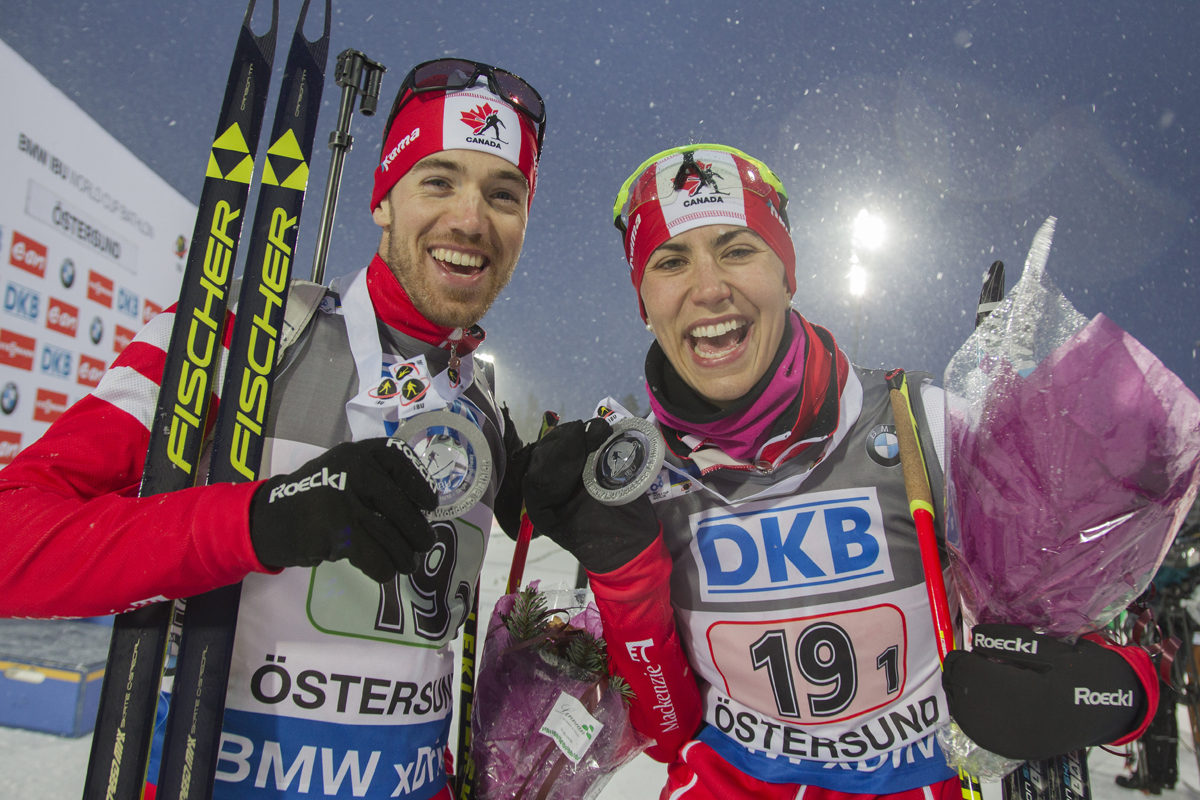
    Nathan Smith and Rosanna Crawford celebrate their second-place finish in the World Cup single mixed relay in Oestersund, Sweden. (Photo: Fischer/NordicFocus)
    Nathan Smith and Rosanna Crawford celebrate their second-place finish in the World Cup single mixed relay in Östersund, Sweden. (Photo: Fischer/NordicFocus)

    Canada had actually started the year off with a relay “bang”: in the very first World Cup competition of the season, Nathan Smith and Rosanna Crawford teamed up for silver in the mixed relay.

    Despite a rocky start and nine spare rounds, they managed to avoid the penalty loop and finished 11.9 seconds behind Norway, claiming Canada’s first ever World Cup relay podium.

    “It feels amazing,” Crawford said at the time, before pointing out that she’s still hunting for her first individual podium. “I don’t want to downplay it. Those team events, it feels so exciting and I feel so lucky to share the podium with my teammate who I’ve trained with for so long. But also, it’s probably not the same as an individual podium, which is definitely what I’m gunning for this year.”

    • U.S. (Susan Dunklee, Hannah Dreissigacker, Tim Burke, and Lowell Bailey) and Canadian (Rosanna Crawford, Sarah Beaudry, Macx Davies, and Brendan Green) mixed teams, Mixed relay at Canmore World Cup

    Perhaps team events were just the thing for North American biathlon teams this season. In Canmore, Alberta, both the Americans and Canadians were in the hunt for the podium until late in the race. The U.S. ended up fourth, less than two seconds off the podium, and the Canadians ten seconds behind them in sixth.

    The result was a best-ever mixed relay for the U.S., with Canada tying its previous best in the two-man, two-woman event.

    “It’s easy to say, ‘Oh man, if I had known, I would’ve skied two seconds faster,’ but I really don’t think I could’ve,” U.S. anchor skier Lowell Bailey said of finishing less than two seconds out of third. “I put everything I could have into that last lap. It’s bittersweet, but it’s also our best result ever in the mixed relay. …  Fourth is where we ended up, and I think we have to be satisfied with that and keep that momentum going forward.”

  • Russia’s Shipulin Prevails Again, Edges Germany for Relay Win; U.S. Ties Season Best

    Russia’s Shipulin Prevails Again, Edges Germany for Relay Win; U.S. Ties Season Best

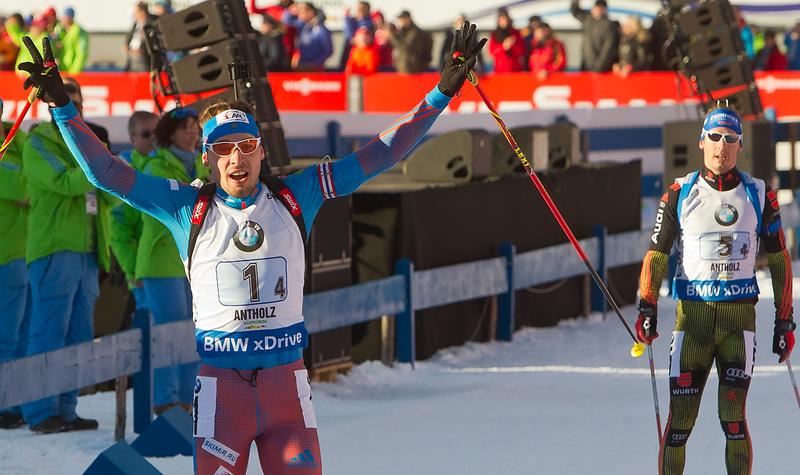
    Russia's Anton Shipulin (l) celebrates after holding off Germany's Simon Schempp to anchor Russia to the men's relay victory on Sunday at the IBU World Cup in Antholz, Italy. Shipulin outlasted Schempp by 1 second for the win. (Photo: IBU/Rene Miko)
    Russia’s Anton Shipulin (l) celebrates after holding off Germany’s Simon Schempp (r) to anchor Russia to the men’s relay victory on Sunday at the IBU World Cup in Antholz, Italy. Shipulin outlasted Schempp by 1 second for the win. (Photo: IBU/Rene Miko)

    Russia’s Anton Shipulin and Germany’s Simon Schempp have met multiple times on the final loop of an International Biathlon Union (IBU) World Cup race and duked it out for first, both in individual races as well as relays. In fact, they did so in Saturday’s pursuit in Antholz, Italy, where Shipulin prevailed by 10 seconds to claim his first victory of the season.

    On Sunday in the men’s 4 x 7.5-kilometer relay in the same packed arena with over 20,000 biathlon fans, Shipulin did it again to anchor a Russian team — with Maxim Tsvetkov, Evgeny Garanichev and Dmitry Malyshko — to first in 1:12:24.8, with no penalties and seven spare rounds.

    The German team, with Erik Lesser, Benedikt Doll, Arnd Peiffer, and Schempp, finished just 1 second behind, with one penalty but just four spares.

    “It has become sort of a tradition with me and Simon together on the last shooting range and then on the last lap,” Shipulin commented in the post-race press conference through a translator. “Honestly Simon becomes stronger and stronger every time, but today I would say I didn’t beat him physically, it was more about tactics. It is not a very long finish lane here, so I just made it tactically better to not give him a chance.”

    “Being on the podium shows that we are in good shape,” Malyshko said through a translator. “We will try our best at the World Championships [in Oslo in March] to show everybody that we are even stronger than in the World Cups.”

    “We trust in Anton, and Anton believes in the team,” one of Shipulin’s teammates added in an interview with the IBU.

    Schempp was not pleased with a situation that happened when he and Shipulin came into the arena, having to pass a lapped athlete from Japan just before the last turn, with Shipulin overtaking on the right but Schempp getting slightly blocked.

    “The lapped athlete ran in the middle of the track. The whole audience was yelling for him to go to the side. I don’t know, maybe he is deaf on his ears, or whatever he is doing,” Schempp told German broadcaster ARD. “With all the peace of mind he is running right between us, and that must not happen.”

    Asked if he thought a protest with the IBU would be an option, Schempp replied: “Nah, surely that would not go through. That result stands.”

    “I gave everything I had, it was a neat relay, and we were rewarded with the second place,” he added. “The Russians were very, very strong, especially Anton in the finish. We can live with that. It was a clear step forward in the relays [the German men’s first relay podium of the season]. Of course the end is a little annoying, but we can be satisfied.”

    The head coaches for German and Russia, Mark Kirchner and Ricco Gross, respectively, hugged and congratulated each other in the coaching zone after the race. Both 45 years old, they are former German teammates and won gold together in the men’s relay at the 1994 Olympics in Lillehammer, Norway. More recently, they were also colleagues, with Kirchner coaching the German men’s team and Gross being an assistant for the women at the 2014 Olympics, before Gross took an offer last summer to lead the Russian men’s team (after being “demoted” to the IBU Cup by the German Ski Federation).

    “It’s difficult to even pick the six best athletes for the World Cup,” Gross had told German newspaper FAZ in an interview published on Friday, just before Shipulin’s sprint victory. “I was extremely surprised in September when I watched the Russian championships for the first time, with more than 100 athletes. There is a giant talent pool … My target is the Olympic Games in 2018.”

    Norway opted to rest its usual starters Tarjei Bø and Emil Hegle Svendsen for the relay on Sunday, instead starting veteran Ole Einar Bjørndalen, Lars Helge Birkeland, Johannes Thingnes Bø, and Erlend Bjøntegaard.

    “They married and went on vacation,” Johannes Bø joked during the press conference when asked about the absence of his brother Tarjei and Svendsen.

    Thus it fell to the relatively inexperienced Bjøntegaard to anchor the team. Bø tagged  him with a 29.2-second lead over Russia, and 33.5 seconds ahead of Germany, with Shipulin and Schempp chasing after him.

    “Now it’s becoming really exciting. I wouldn’t like to be in the shoes of Bjøntegaard right now,” Germany’s third-leg Arnd Peiffer said during an interview with ARD while the race was still going on. “I think he has a lot of stress now, and I am curious what happens.”

    But facing this big challenge, Bjøntegaard did a good job skiing a fast first loop to return to the range still in first and only needing two spares in his prone shooting. Yet this still reduced his lead to 6.8 seconds over Schempp, who had shot clean, and 14.9 seconds to Shipulin, who required one spare.

    In the final standing shooting, the Norwegian needed two more spare rounds, while Shipulin and Schempp both remained clean and left the range just 0.5 seconds apart. They skied together until the finishing sprint, with Bjøntegaard securing the third place on the podium, 22.9 seconds after Russia, but securely ahead of the rest of the field.

    “With Emil and Tarjei, two of our best athletes were not in the relay,” Johannes Thingnes Bø said during the press conference. “I was hoping that we could make the podium, and we did. A perfect race for everyone on the team. Erlend and Lars Helge were called up last minute, but they were relaxed, and third place is good. It’s not easy for Erlend to go out with Schempp and Shipulin.”

    Behind Norway, Austria, with Sven Grossegger, Julian Eberhard, Simon Eder, and Dominik Landertinger, finished fourth (+1:01.7), with one penalty and 11 spare rounds.

    “Better shooting,” Simon Eder told the IBU in a video interview when questioned what it would have taken to reach the podium. “We always have the extra [penalty] loop. It’s not easy, it happens so fast. But we hope to manage it at the World Champs without it.”

    “The running shape is very good in the Austrian team,” Landertinger added. “And if the shooting is a little bit better we can make the podium.”

    France, starting without World Cup leader Martin Fourcade with a lineup of his older brother Simon Fourcade, Quentin Fillion Maillet, Simon Desthieux, and Jean Guillaume Beatrix, placed fifth (+1:39.3), with no penalties and 11 spares.

    U.S. Ties Season-Best 6th; Canada 11th

    Lowell Bailey (US Biathlon leads Russia's Maxim Tsvetkov during the first leg of the men's 4 x 7.5 k IBU World Cup relay on Sunday in Antholz, Italy. Russia went on to win and the U.S. finished 1:43.7 minutes back in sixth, tying a season-best team result. (Photo: IBU)
    Lowell Bailey (US Biathlon leads Russia’s Maxim Tsvetkov during the first leg of the men’s 4 x 7.5 k IBU World Cup relay on Sunday in Antholz, Italy. Russia went on to win and the U.S. finished 1:43.7 minutes back in sixth, tying a season-best team result. (Photo: IBU)

    On the last leg, Beatrix narrowly won out a race against American Sean Doherty, who crossed the finish less than five seconds later in sixth place, 1:43.7 behind the winners. The U.S. ended up with one penalty and 13 spares, and tied its season-best result after having achieved sixth in the relay a week ago in Ruhpolding, Germany.

    The Americans started the race in bib 6 with their now-usual lineup of Lowell Bailey, Tim Burke, Leif Nordgren, and Doherty, the same starters they had used at the World Championships in Kontiolahti, Finland, where the U.S. placed 14th in the men’s relay.

    Bailey briefly took the lead on the loop out of the arena, before two misses in his prone shooting stage required spare rounds and set him back to 15th, but still within 15.5 seconds out of the lead. With another spare in his standing stage, he still moved up five positions, and with the second-fastest, first-leg course time on his final loop, he tagged off in seventh, 20.8 seconds behind Germany’s Lesser.

    Burke held that position throughout his first loop, but two misses in the prone stage set him back. In the standing shooting, he used all three spare rounds to avoid the penalty lap, falling back to 14th before he made up ground again with a fast last loop (third-best course time) to tag Nordgren in ninth (+1:04.3).

    “Today proved that last week was not a fluke,” Burke said in a US Biathlon press release. “We are happy to be right in the mix with the ‘big’ biathlon nations but we still know that we are capable of more.”

    “I got the tag from Tim right with the Czech Republic,” Nordgren wrote in an email to FasterSkier. “For all of the first loop I just focused on staying nice and relaxed, trying to conserve as much energy as possible. Prone I wanted to be pretty aggressive and it worked out well.”

    After a clean prone shooting, Nordgren left the range in seventh place, virtually tied with a few other teams.

    “The second loop I left the range with Eder from Austria, again I was just tucked in with him saving energy,” Nordgren recalled. “Although I had super great skis today, so eventually on the downhill I put in a good transition and was pushing towards the French team in front of us.”

    After using two spare rounds in his standing stage, Nordgren still managed to move up to sixth place as some other teams, such as Italy and Switzerland, struggled on this leg, and handed off 1:04.5 minutes behind the leaders — about the same gap he had when he started.

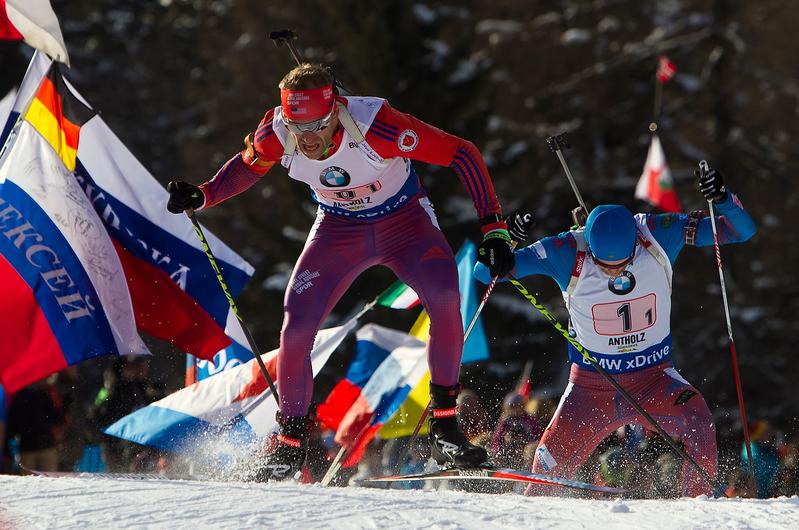
    Russia's Evgeniy Garanichev (l) leads Tim Burke (US Biathlon) during the second leg of the men's 4 x 7.5 k IBU World Cup relay in Antholz, Italy. (Photo: IBU/Rene Miko)
    Russia’s Evgeniy Garanichev (l) leads Tim Burke (US Biathlon) during the second leg of the men’s 4 x 7.5 k IBU World Cup relay in Antholz, Italy. (Photo: IBU/Rene Miko)

    “Standing was the only disappointing part about my race today, it was a bummer to have two mistakes, but I didn’t lose any places and I was quick with the extras,” Nordgren wrote. “I was surprised on the third loop, I actually had some energy to push. Eventually France passed me and got a small gap I couldn’t close.”

    Doherty kept the team in sixth on his first loop and through the first prone shooting, which he cleaned, reducing his gap to first by about ten seconds.

    “The conditions today were ideal,” Doherty wrote in an email. “The course was in great shape and there was no wind. The altitude here adds to the difficulty, but I also pushed hard on the second loop and I did not really hold it together on the range as I wish I could have.”

    By the final standing shooting he had moved to fifth, and was on the range behind Austria, with France nearby and Slovakia further behind. Austria’s Landertinger shot clean and finished first, while Doherty caused a penalty lap. But he only lost one position and still had France’s Beatrix in sight who had needed three spares.

    Doherty skied a fast final loop, almost closing a 20-second gap again, finishing sixth, 4.4 seconds behind France in fifth and 1:43.7 behind Russia.

    “I am a little bummed to have had that penalty because I was excited to fight for 5th. But overall 6th was secure,” Doherty wrote.

    “I am happy with another strong result,” Doherty added in the US Biathlon press release. “We were in the mix the whole time and even though I did not shoot my best the team did well. We are all looking forward to the next relay.”

    “As a team I think we’re happy with this race, but it was nowhere near a perfect race for us,” Nordgren wrote. “We still have more to give and will be looking for more in the relays to come.”

    Canada in bib 7 chose a lineup of Christian Gow, Nathan Smith, Macx Davies, and Scott Gow. Brendan Green had to sit out the relay because of back issues following his collision in Saturday’s pursuit, “which did not improve until race time,” according to Biathlon Canada head coach Matthias Ahrens. “We had to put Scott Gow in his place,” Ahrens wrote in an email.

    Younger brother Christian Gow jumped out to the lead after cleaning the initial prone stage, but on the next loop he lost some ground, crossing the next timing point in 11th, just 10 seconds out of first. After he required two spare rounds in his standing stage, Christian lost additional time to the leaders, but kept his position in the field, tagging off to Smith in 11th (+1:08.3).

    Smith, currently the highest-ranked Canadian in the overall World Cup, cleaned both stages for his first 100-percent shooting in a race this season. Reflecting on his race in an email, he said his ski shape was off — and it has been for the last couple days. Unable to move up in the field, he tagged Davies in 11th (+1:07.7).

    “I wanted to make up some spots and get our team up to the top 10. I knew it would mean some really good shooting,” Smith wrote in an email. “I’m really happy to finally have my first clean of the winter, especially after poor shooting in the other two races this weekend. On the other hand my skiing hasn’t been where it should for the last two weeks. I’m not sure why, I went from my best ski shape to my worst ski shape in literally 3 days. I have been struggling with back pain after a hard downhill crash in the Ruhpolding 20 km.”

    Davies went on to clean his prone stage and move into 10th, reducing the gap to the leaders to 41 seconds. In standing, he needed all three spares, which caused him to lose some time. Overall Davies skied the second-best course time of his leg (only behind Norway’s Bø), and handed off to Scott Gow in 10th place (+1:39.0).

    On the anchor leg, Scott needed two spares in his prone stage and one in standing, with Estonia’s anchor Ermits Kalev still passing him on the final loop. The Canadian crossed the finish in 11th, 5.7 seconds behind Estonia and 2:28.9 minutes behind Russia.

    Combined, the team had no penalty and required just eight spares. But 11th wasn’t exactly close to their season best: the Canadians finished sixth in Hochfilzen, Austria and 10th last week in Ruhpolding.

    “There were some good aspects of our relay: Christian’s first prone was amazing, my shooting, and Macx’s skiing,” Smith wrote. “Overall though I would say unfortunately it was not a good relay. A good race for us is top 6. The potential for a medal is there if everyone can put together their best race on the same day. Easier said than done.”

    The Biathlon World Cup resumes in two weeks on Canada’s home turf in Canmore, Alberta, with sprints on Thursday, Feb. 4 and Friday, Feb. 5, followed by mass starts on Saturday, Feb. 6, and single-mixed (1 woman, 1 man) and mixed (2 women, 2 men) relays on Sunday, Feb. 7.

    “I’m going to North America in a good mood,” Germany’s Peiffer said at the press conference. “The last three weeks were really exhausting. Now I had a good week here in Antholz, and I am looking forward to go to Canmore. I have never been there before. Maybe not as many [spectators] as in Ruhpolding or Antholz, but it’s nice to see a new place for biathlon.”

    “I will be in Romania for my last Junior World Championships,” Sean Doherty, 20, wrote, which will take place in Cheile Gradistei (Brasov, Romania) from Jan. 27 to Feb. 2. “So I will only be attending the Presque Isle World Cup [after Canmore].”

    Results

  • Canadian Men: ‘Just Wasn’t Our Day’ in World Championships Relay

    Canadian Men: ‘Just Wasn’t Our Day’ in World Championships Relay

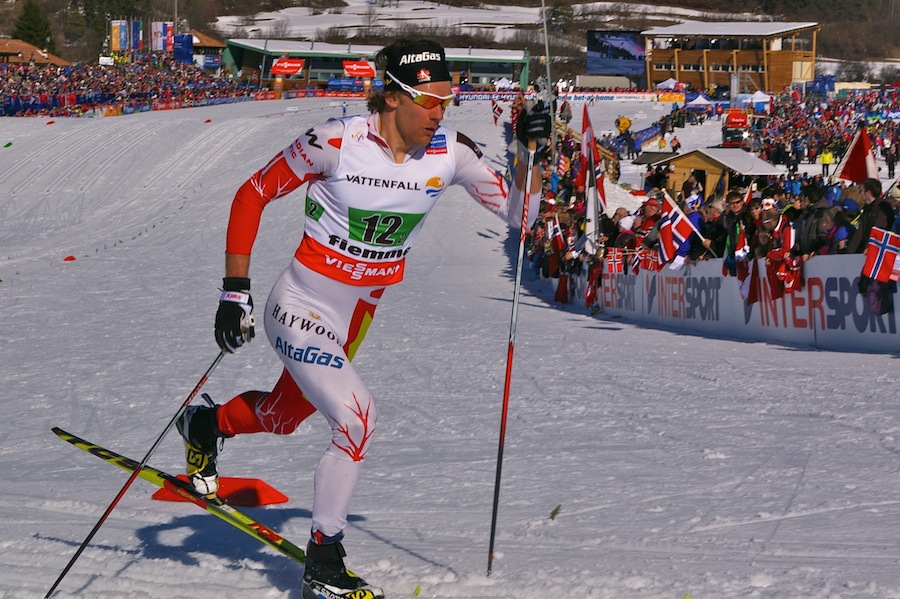
    Ivan Babikov sets out on the third leg for Canada in Friday's 4 x 10 k relay at the 2013 World Championships in Val di Fiemme, Italy. Out of contention by Devon Kershaw's second leg, the Canadians finished 12th.
    Ivan Babikov sets out on the third leg for Canada in Friday’s 4 x 10 k relay at the 2013 World Championships in Val di Fiemme, Italy. Out of contention by Devon Kershaw’s second leg, the Canadians finished 12th.

    FasterSkier’s coverage of the 2013 FIS Nordic World Ski Championships in Val di Fiemme, Italy, is brought to you by the generous support of Fischer Sports.

    VAL DI FIEMME, Italy – The Canadian men had no reason to believe they couldn’t contend for the podium in the Friday’s 4 x 10-kilometer relay at Nordic World Ski Championships.

    In the last week, they had already been there with Alex Harvey notching a career-best bronze in the individual classic sprint – a best for a Canadian male at World Championships as well. Harvey and Devon Kershaw went on to place fourth in the freestyle team sprint, just three-hundredths of a second from third, and on Wednesday, Ivan Babikov set another new mark of fourth in the 15 k freestyle individual start.

    With those three primed for the relay, it seemed anything was possible. Scramble leg Lenny Valjas was a bit of an unknown coming off a long bout with strep throat, but everyone knew what the 24-year-old was capable of, with two individual World Cup podiums this season.

    But as athletes often say, relays are relays, and anything can happen.

    In an effort to get in front and out of trouble early, Valjas started strong for the team, taking the lead on a long downhill halfway through the first of three 3.3 k laps. At the end of the first loop, he remained within 3.7 seconds of eventual-winner Norway up front, and moved from 13th in the pack to seventh by the end of the second lap.

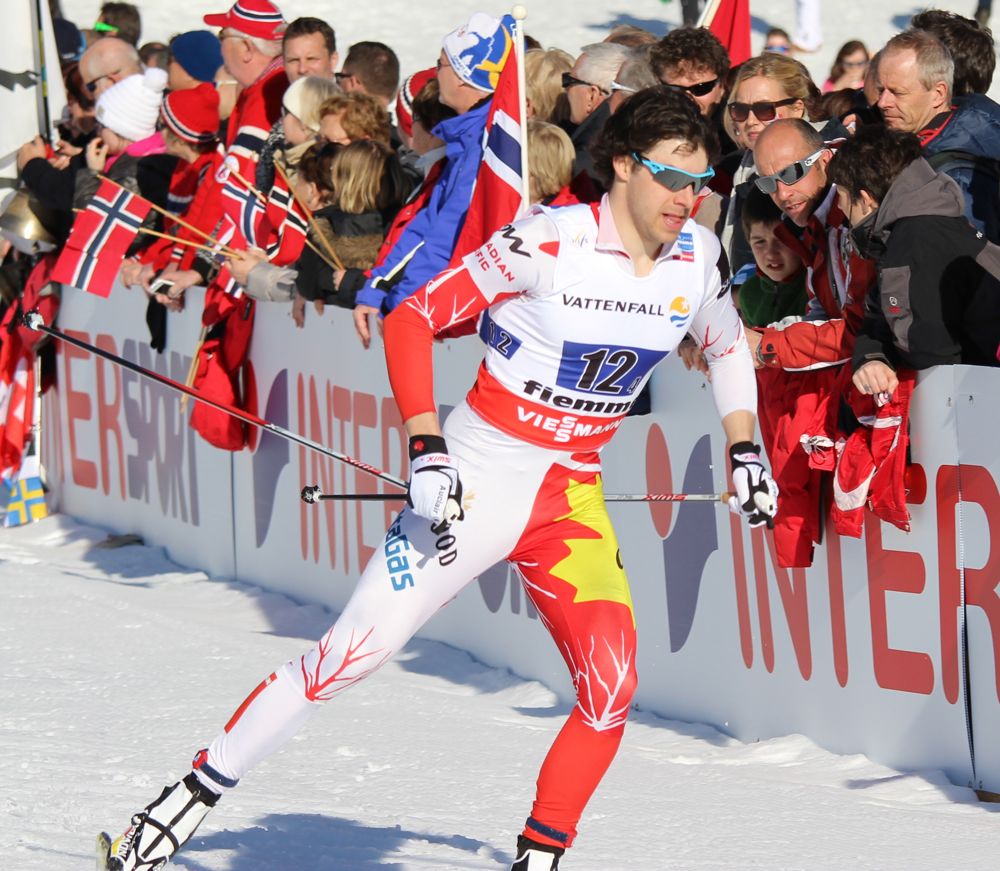
    Lenny Valjas heads out of the stadium alongside Italy's Dietmar Nöckler on the first leg of Friday's 4 x 10 k relay at World Championships in Val di Fiemme, Italy.
    Lenny Valjas heads out of the stadium alongside Italy’s Dietmar Nöckler on the first leg of Friday’s 4 x 10 k relay at World Championships in Val di Fiemme, Italy.

    Valjas charged up the big climb out of the stadium in fourth behind Germany’s Hannes Dotzler, Sweden’s Daniel Richardsson and Evgeniy Belov of Russia, but lost contact with the leaders on the second half of the course.

    Valjas tagged Kershaw in 11th, 11.6 seconds back, in a chase group with Czech Republic, France and Belarus.

    “I blew up for the last 100 meters,” Valjas said. “But other than that I was happy with the effort, happy to be out of bed.”

    While the group caught up to the nine others on the first kilometer of the second leg, Kershaw worked hard to hang on, holding onto 11th through the first lap. The next time around, he slipped to 12th, four seconds behind France’s Maurice Manificat.

    Unable to stay with the Frenchman, Kershaw fell nearly 20 seconds out of contention midway through and handed off to Babikov in 12th, 1:47.3 seconds out of the lead and 39.1 behind Finland in 11th.

    “I was in a pain cave like I’ve never been in. I was a mess,” Kershaw wrote in an email.

    Burdened by stomach problems for since mid-January, he explained he felt good enough out of the start, but was having some issues with his skis, specifically his kick.

    “For sure the skis weren’t the best-ever, but even with the skis I had I should have been able to limit my losses,” he continued. “I was struggling to even stay on my feet coming down the last hill. And that’s after getting just shelled by 1:50. One minute fifty. In a classic race. … The last lap was just so, so, so difficult. It was the worst-feeling race of my entire career – and that’s not being dramatic.”

    Canada's Devon Kershaw tries to stay in contention on the second leg of Friday's 4 x 10 k relay at World Championships in Val di Fiemme, Italy. He finished his leg 12th and the Canadians finished in the same position.
    Canada’s Devon Kershaw tries to stay in contention on the second leg of Friday’s 4 x 10 k relay at World Championships in Val di Fiemme, Italy. He finished his leg 12th and the Canadians finished in the same position.

    “Devon’s body just wasn’t there,” head coach Justin Wadsworth said. “It’s been up and down for him all year, especially in the last six weeks with his stomach issues. Some days in training he feels great, like team sprint day, he felt great, and then other days he feels horrible.

    “We had doctors look at it and we still need to do more looking at it to make sure we know what the problem is, but right now it’s like rolling the dice.”

    From the third leg on, the Canadians struggled to stay relevant, skiing alone for the rest of the race. Babikov tried to close the gap, but realized early it would be near impossible to catch anyone. Ahead of him, American Noah Hoffman was pushing with Finland and France to cut down a 30-second gap, but they were at least 50 seconds from his reach.

    “It was hard to ski by myself and see no one around,” Babikov said. “Today didn’t feel super great, not as good as two days ago.”

    He and the rest of the field were also fighting warming conditions above 10-degrees Celsius (50 Fahrenheit) as the race wore on under the beating afternoon sun.

    Alex Harvey takes it out for Canada on the last leg of the 2013 World Championships men's 4 x 10 k relay in Val di Fiemme, Italy. Positioned in 12th without anyone around him, Harvey finished 12th for Canada.
    Alex Harvey takes it out for Canada on the last leg of the 2013 World Championships men’s 4 x 10 k relay in Val di Fiemme, Italy. Positioned in 12th without anyone around him, Harvey finished 12th for Canada.

    Babikov tagged Harvey as their anchor in 12th, 2:41.5 out of first. Finland was a minute and 15 seconds ahead of them in 11th. Harvey completed the final three laps alone, finishing in 12th, 2:39.3 behind Norway.

    “I’m feeling good,” Harvey said. “It’s been five days since I’ve raced now. I was feeling pretty rested this morning so just used that as a prep for the 50 [kilometer classic mass start on Sunday].”

    The Canadians’ finish tied their result from the 2011 World Championships in Oslo, but it wasn’t even close to what they were hoping for. In 2009, the team was fifth with Kershaw, Harvey, Babikov and the now-retired George Grey. They placed seventh in the 4 x 10 k at the 2010 Olympics.

    “Just one of those days that we should not really think about much and forget,” Babikov said.

    Valjas was healthy, but hadn’t raced in over a week, Harvey explained. “And Devon had a rough one, really rough one,” he said.

    “It’s racing and when the body just isn’t there there’s nothing you can do about it,” Wadsworth explained.

    “We have a good team and today just wasn’t our day,” Valjas said. “We’ll make it there.”

    — Audrey Mangan contributed reporting

    Results