This reporting costs money. Please support this coverage with a voluntary subscription (below) so FasterSkier can provide this level of access to the sport we all love year-round.
Tag: Canadian men’s team
-

Mindful Babikov Plans to Pace Season for Olympic Peak
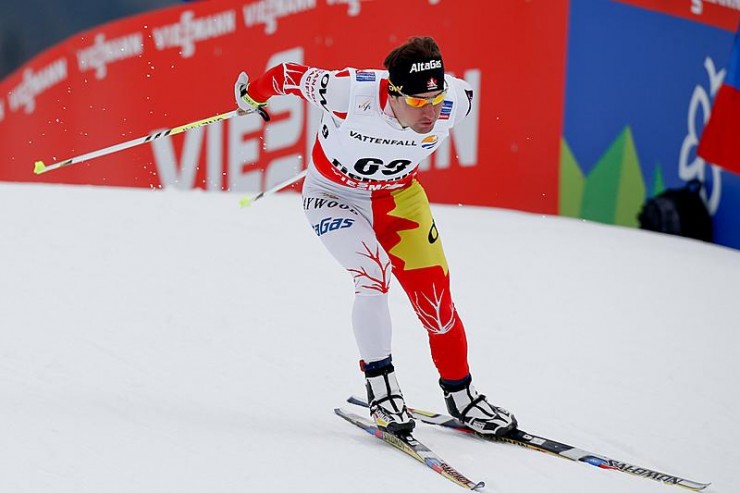
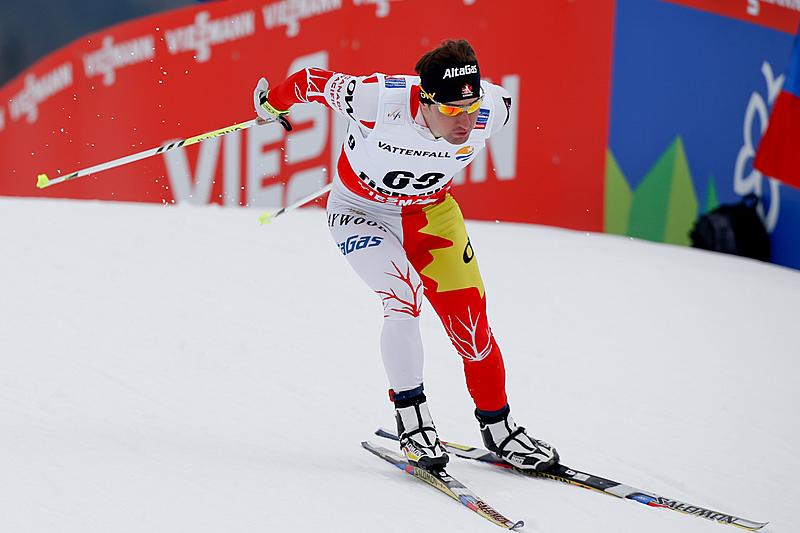
Ivan Babikov (CAN) racing to a career-best fourth in the 15 k freestyle individual start at 2013 World Championships in Val di Fiemme, Italy. (Photo: Fiemme2013) Ivan Babikov knows the deal when it comes to Olympic years. Having already competed in two previous Olympics, the Canadian World Cup Team member is entering this season with the confidence that comes from knowing how the game works. At 33, he’s essentially prequalified for this season’s Olympics in Sochi, Russia, and so far all of his prep work is going according to plan.
Babikov ended last season with some serious fatigue, but all wasn’t lost.
“It actually turned out the best ever,” he wrote on his blog. “With scoring points in pretty much every World Cup Race before Christmas, awesome result at Tour de Ski, and 4th place at the World Championship 15km skate race, which let me finish in top 20 in the World Cup Overall.”
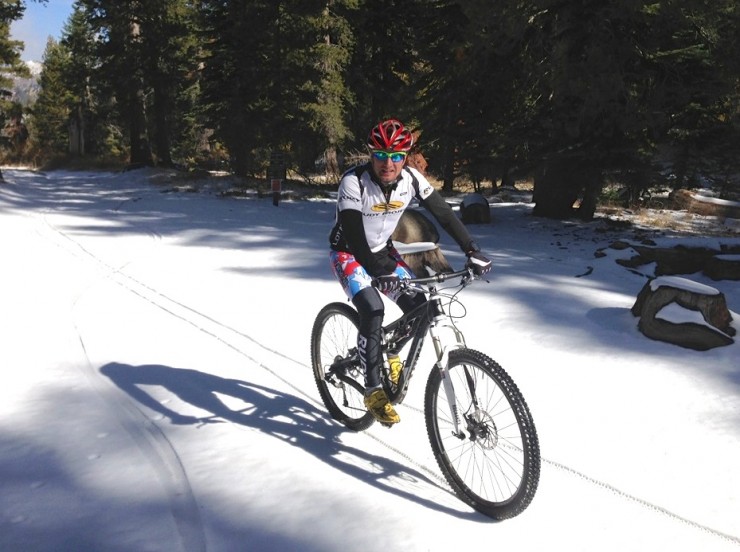
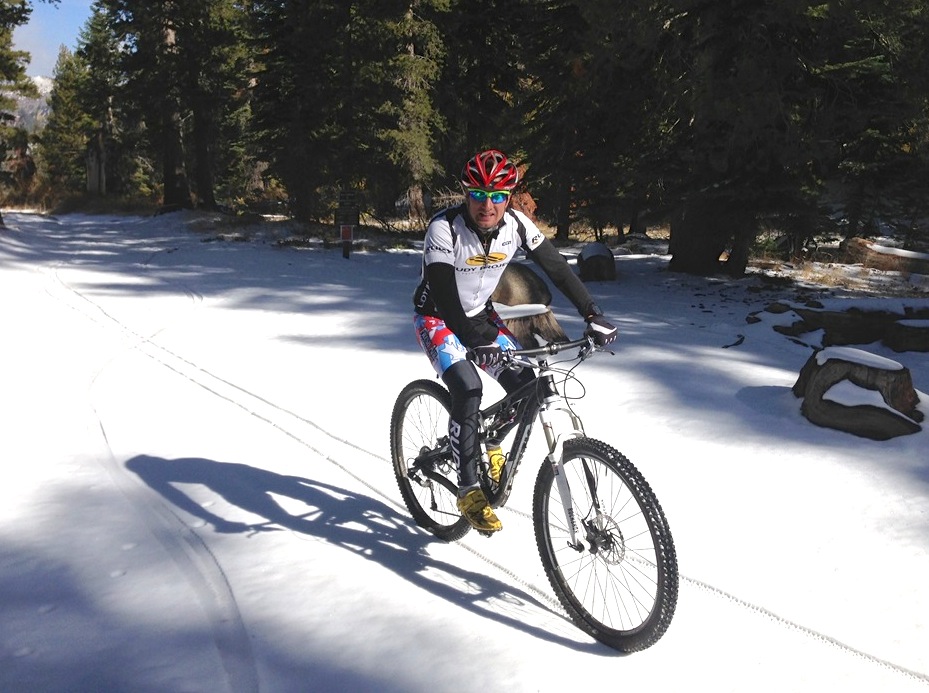
Babikov biking on the South Rim Trail at the California training camp this fall. (Photo: ivanbabikov.com) Babikov’s fourth-place finish at World Championships was the best ever by a Canadian man in that event, and his runner-up result at the Tour de Ski hill climb earlier the season — also in Val di Fiemme, Italy — was also notable.
After that the World Championships, the effects of the long season started to kick in. He struggled with sickness for the next several weeks of World Cups, won the 10k classic race at Canadian Nationals, and then hit the wall.
“I just went straight to vacation, without even finishing Canadian Nationals,” Babikov continued. “I was exhausted mentally and physically, tank was empty, no juice left.”
After a bit of a reboot, Babikov moved on from that exhausting-yet-successful season to build upon what he knows works for him.
His early season saw the familiar iteration of a June training camp in Bend, Ore., followed by a New Zealand camp in August, where Babikov has been going for the past six years.
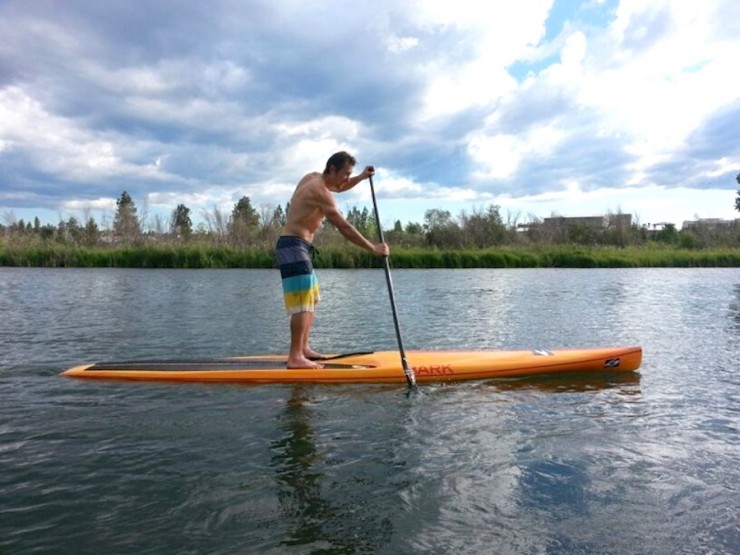
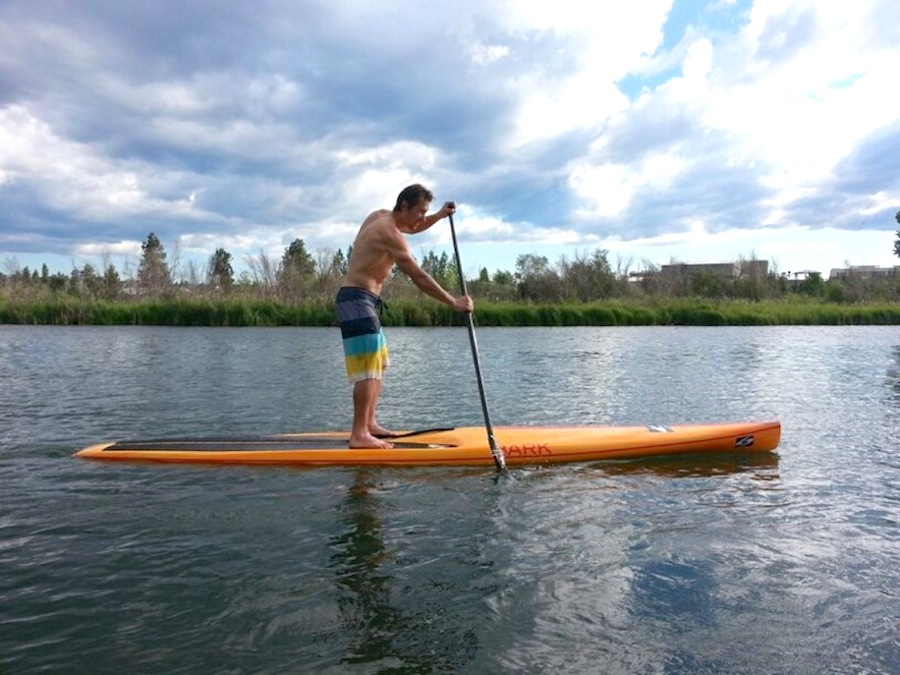
Babikov getting some cross-training during his national-team training camp this summer in Bend, Ore. (Photo: Ivan Babikov) The Canadians have the benefit of training on the Haig glacier just outside of Canmore, Alberta, where Babikov lives. Even so, the Russian native feels that the benefits of accessing many kilometres of trail, combined with the mid-winter conditions, more than make up for the hassle of travelling to New Zealand.
This fall included a new national-team camp in Truckee, Calif., for high-altitude training. Besides that, Babikov has stuck to his usual regimen.
“[I’m] not trying to reinvent the bicycle, you know how they say?” Babikov said in a recent phone interview.
However, with the lessons of last season, Babikov’s main goal for this winter is to “pace the season well and pace the energy.”
“The season is long, and the Olympics are at the end of it, so you’ve got to pace [the World Cup races and the Tour de Ski] and get in good shape for February,” he said. “That’s what matters the most. But, yeah, we’ll see what’s gonna happen.”
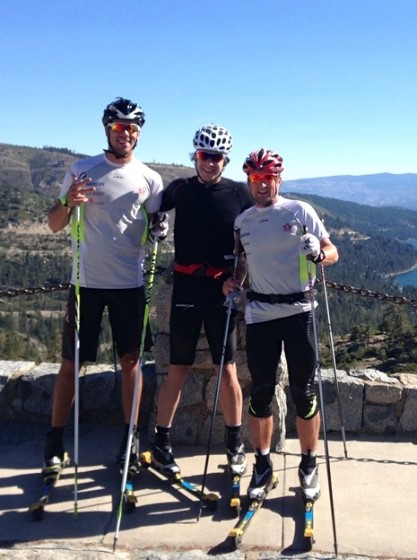
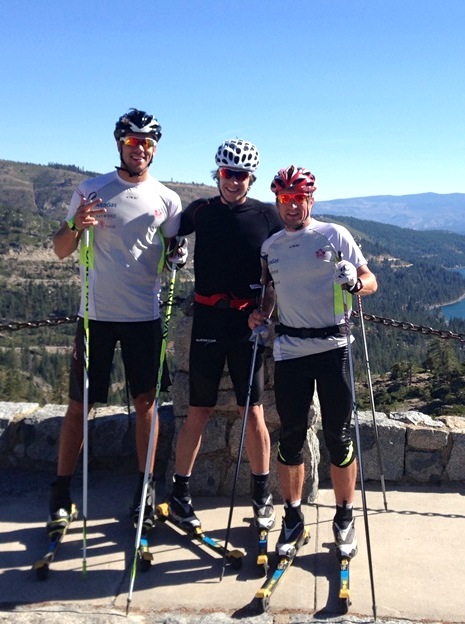
Ivan Babikov (r) and his teammates on the Canadian World Cup team, Alex Harvey (c) and Lenny Valjas (l), during a rollerski near Truckee, Calif., in October. (Photo: Ivan Babikov) Babikov has already seen some indication that his fitness is close to where he wants it; in an informal time trial at Canmore’s Frozen Thunder earlier this month, Babikov beat a solid group of Canadian and U.S. competitors in the distance skate race.
Looking ahead to the Olympics in February, Babikov is especially excited about racing in his country of birth. Although he was born and raised in Kozhva, a tiny town close to the Arctic Circle far away from Sochi, he said, “It’s going to be special … going back to your motherland and race. Not many athletes in the world get a chance to race two home Olympics. … I raced one in Vancouver and then [Sochi]. That’s already pretty special.”
At the same time, he doesn’t want to put too much emphasis on his results there.
“It’s all energy wasting … thinking too much and then getting too excited and too psyched,” he said. “I try to waste as least energy as possible and then just focus on the races.”
Fortunately, he said the courses suit him.
“There’s [a] huge uphill in the skate part and of course I love that,” Babikov said. “Harder is better for me. I’m not super-speedy guy, but I can manage those uphills.”
“What matters most is that the athletes are in the top shape for the best moment for those two weeks,” he added. “Whoever feels the best is going to [do best]. That’s why it’s so important to pace your season and save some energy for February.”
And, despite racing as a Canadian, Babikov is not worried about feeling like an outsider in his homeland.
“I still have my Russian passport and I’m still Russian,” he said. “We [my wife and kids] still speak Russian at home. So it’s like when some people have two houses, but they’re both home, and that’s kind of what it is for me. Of course, my home home is Canada, but I still know so much about Russia and it’s not going to be weird at all. It’s going to be like, ‘Oh yeah, I’ve been here so much and I’m comfortable here,’ that kind of stuff.”
Until leaving for the World Cup circuit at the end of November, Babikov is doing his best to keep things normal and spend time with the family. His 11-year-old son Sergei, a budding biathlete, has his first race coming up.
“He’s going to start racing even before me!” Babikov says.
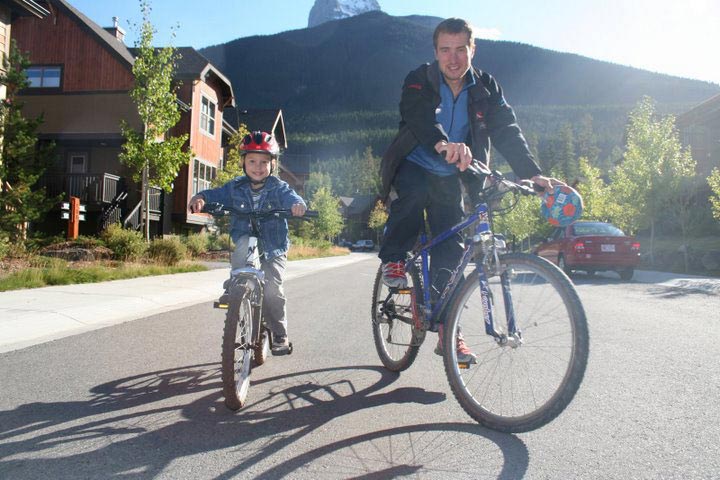
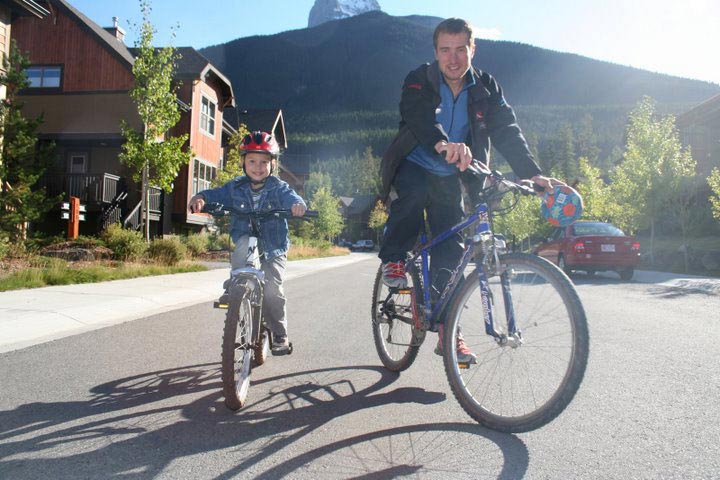
Ivan Babikov and his son Sergei, now 11, in 2008. (Photo: Ivan Babikov) -

Canadians Bounce Between High and Low California Training; Kershaw Off to Norwegian Camp
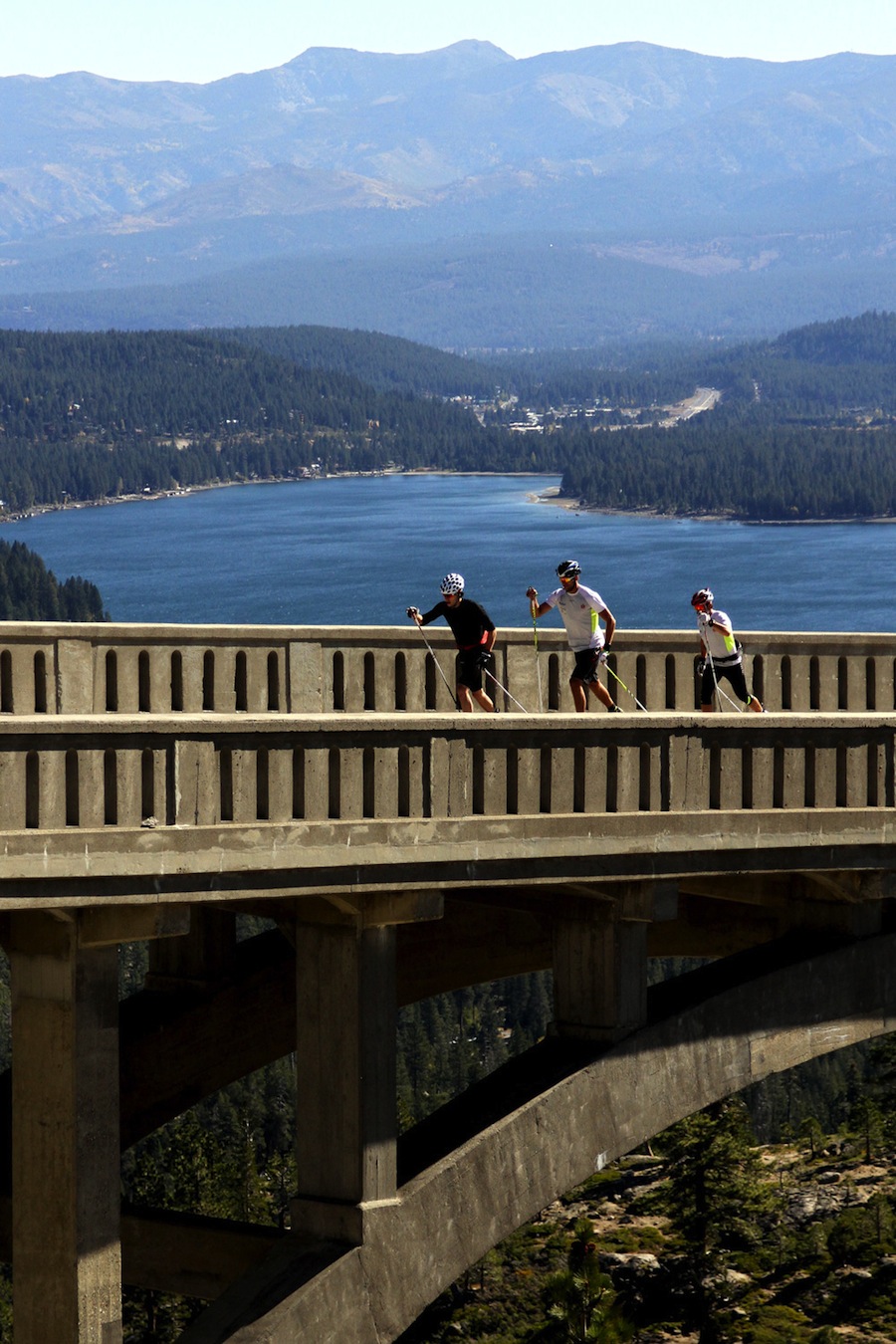
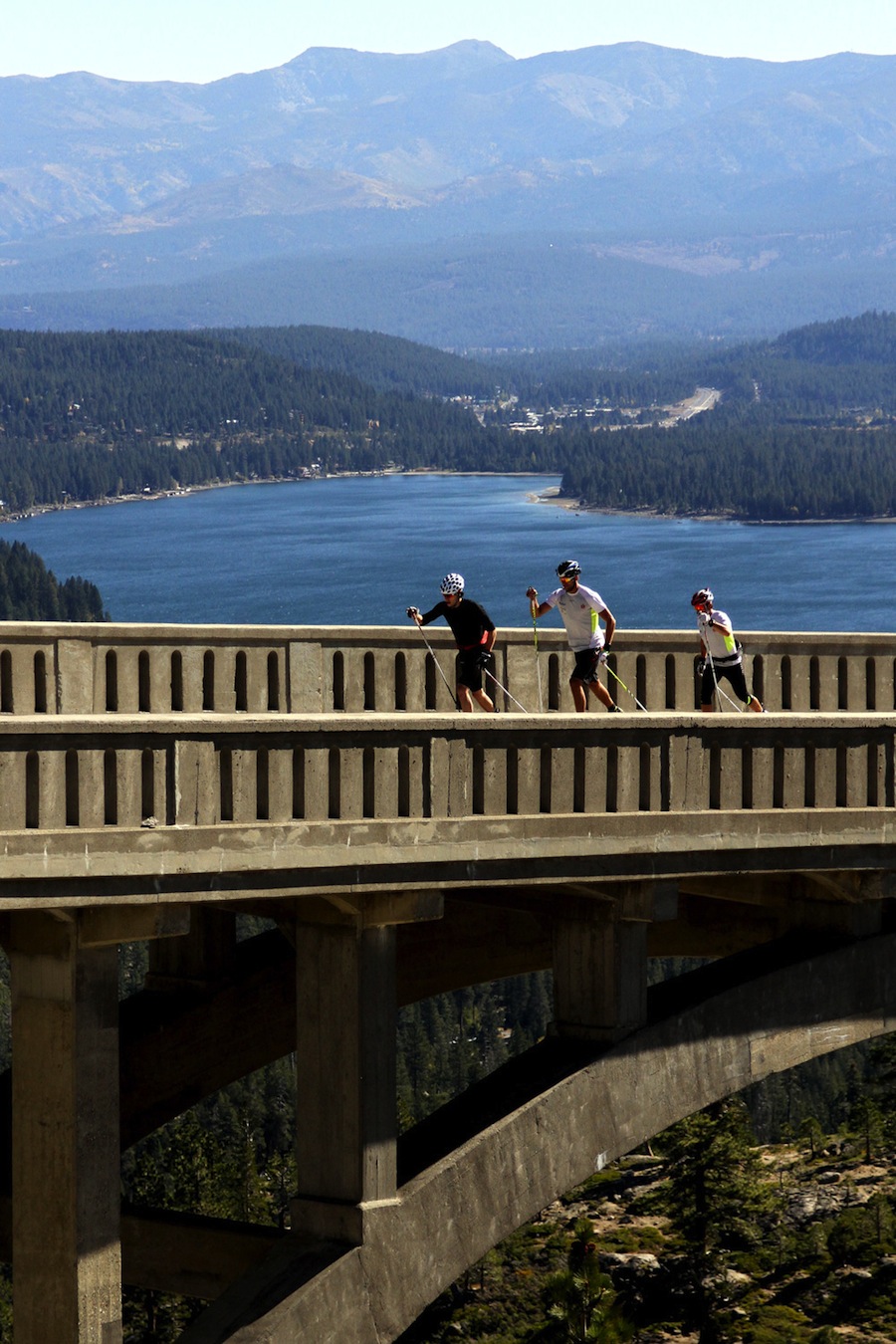
On Oct. 4, the Canadian World Cup Men’s Team rollerskis across the Rainbow Bridge toward Donner Pass near Truckee, Calif. (Photo: Mark Nadell/MacBeth Graphics) “The leaves crunch beneath my now worn running shoes as I negotiate the soft, pine needle infested single track above the Nor-Cal town of Truckee, CA. After days upon days of warm weather, blue skies and summer-like vibes, the jackets and long tights were thrown on – a rude reminder that even in California it’s approaching mid-October. As I weave between some seriously large pines and over the endless ridges, it feels as though I am literally running into winter.” – Devon Kershaw, on his blog
There’s no place like California. That’s what Canadian World Cup Team Head Coach Justin Wadsworth thought when he scouted the Truckee area in July. He stayed with a former teammate from the U.S. Ski Team, Marcus Nash, and spent two days exploring northern California and all the high-elevation ski town had to offer.
What he found was seemingly endless roads covering technical terrain at elevations around 1,775 meters (more than 5,800 feet). About a 45-minute drive away, one could find themselves more than 1,000 meters lower in Nevada City (at 2,477 feet), which Wadsworth deemed perfect for harder efforts. Weather was good there in autumn: warm, sunny and dependable. And who on his team wouldn’t want to go to California for a change?
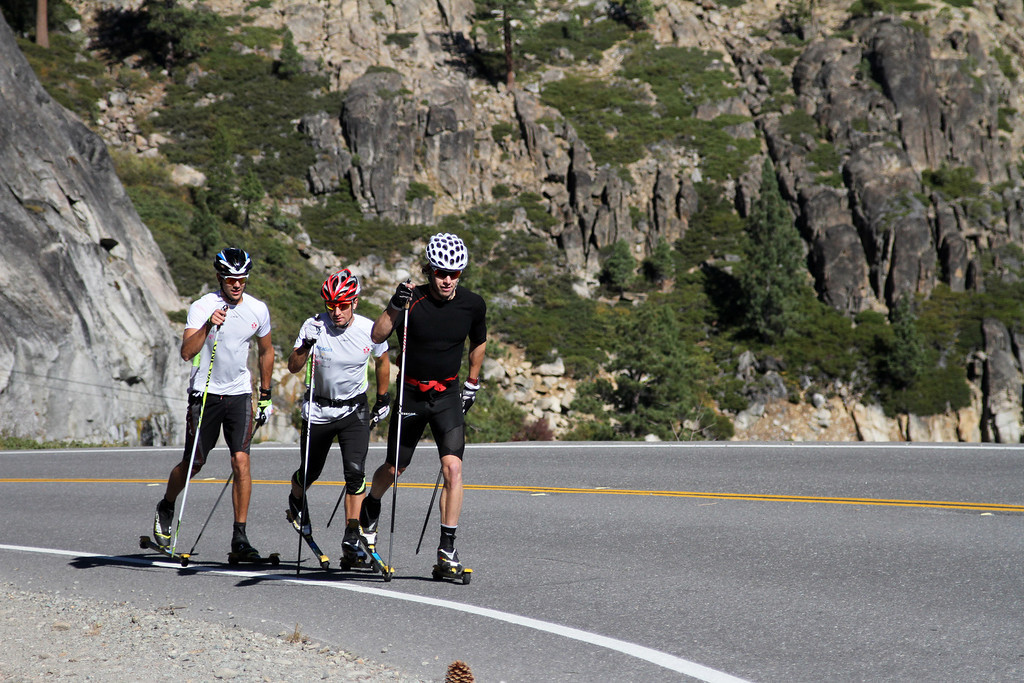
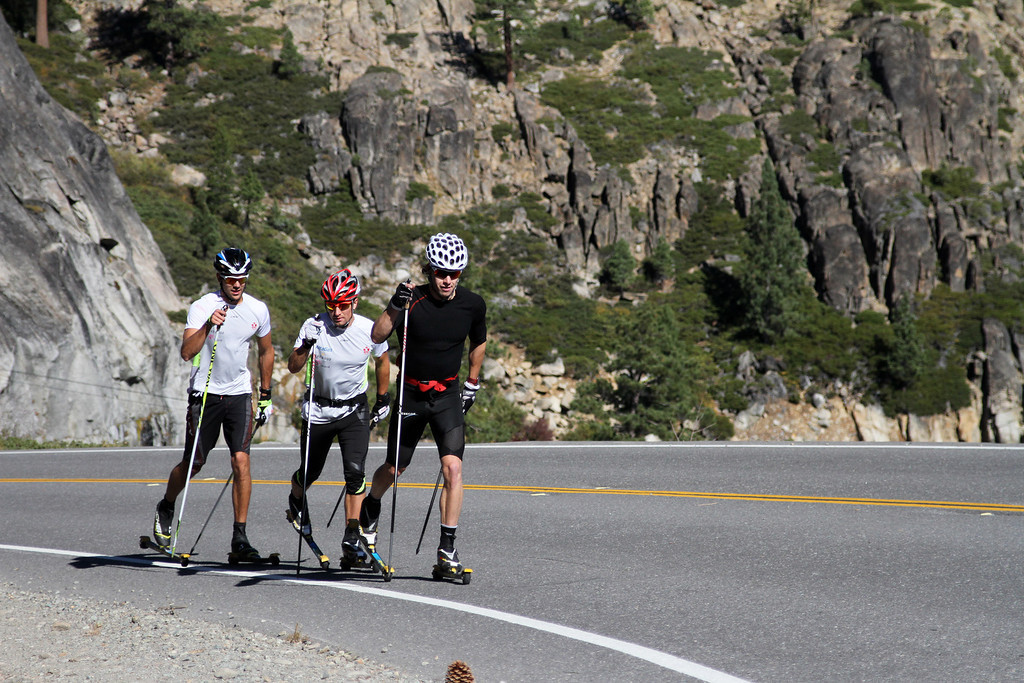
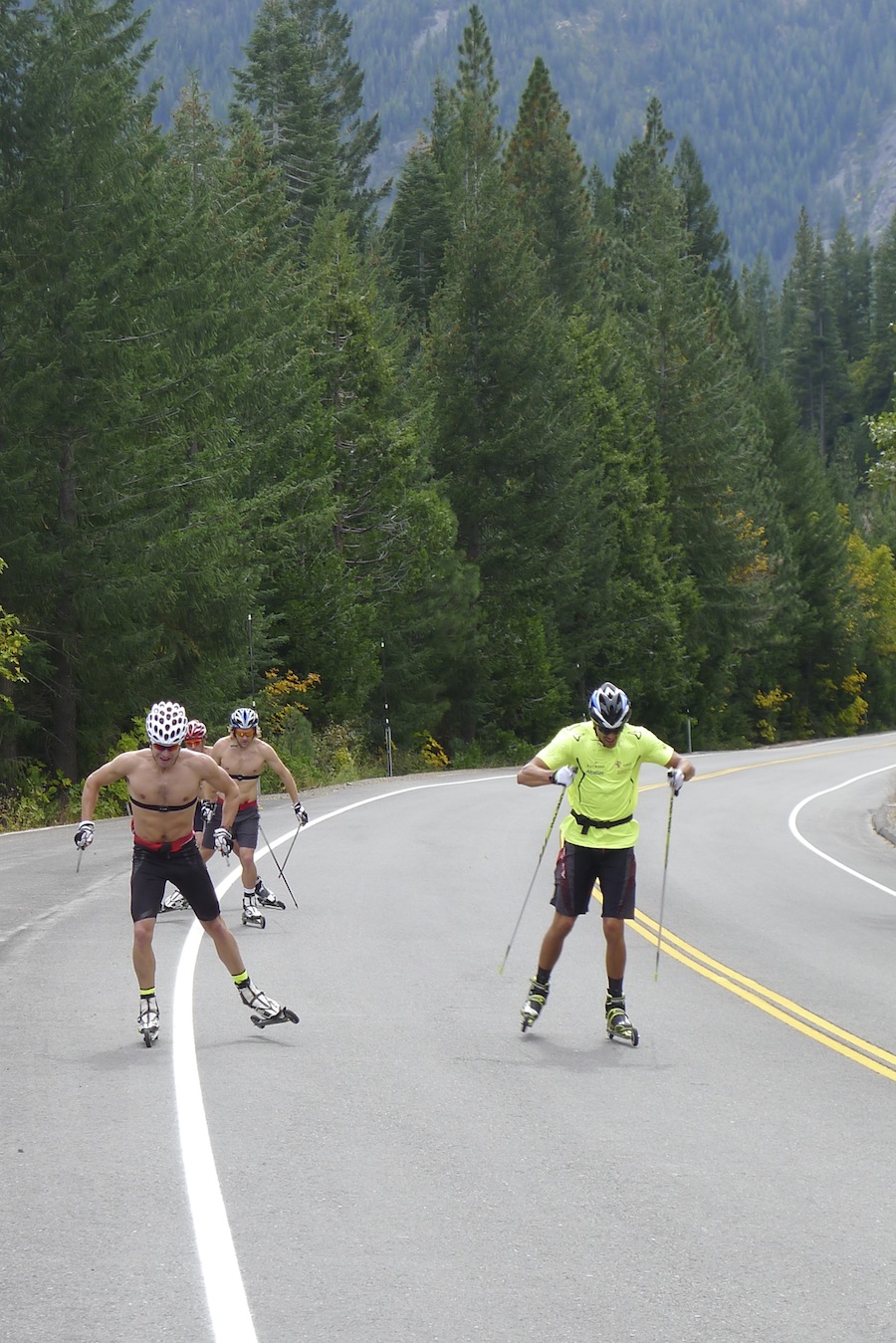
Alex Harvey leads Canadian World Cup teamamtes Ivan Babikov (c) and Lenny Valjas (l) during a rollerski on Old Highway 40 on Oct. 4 near Truckee, Calif. (Photo: Mark Nadell/MacBeth Graphics) “It’s been a really great camp; there’s been sunny, blue skies every day,” Wadsworth said on the phone from Truckee on Tuesday. “Everyone can train in shorts and a T-shirt or no shirt.”
Not that Park City, Utah, where the team normally takes its final dryland camp of the season, is a bad place to be – especially for altitude training at 2,000-plus meters (6,500 feet). But after somewhat of a hold-and-cold season last year, in which some of his skiers reached career bests and others finished a little disappointed, Wadsworth decided it was time for change.
Off to Truckee they went. Starting Oct. 1, the entire men’s and women’s World Cup team spent nearly three and a half weeks in California, wrapping up Thursday before heading home to Canmore, Alberta, for the opening of Frozen Thunder on Saturday.
The men’s team – Devon Kershaw, Alex Harvey, Ivan Babikov, and Lenny Valjas – opted for RV dwelling, like their training camps in Hawaii. The women – Perianne Jones and Dasha Gaiazova – weren’t as into that, so they split their time between a Truckee hotel and a house the team rented in Nevada City, Wadsworth said.
Between the mountain town and low-lying Nevada City, the Canadians divided their efforts accordingly, with sustained easy training in Truckee and more intensity at lower elevations.
Wadsworth said the area offers some of the best roads and steepest hills he’s ever seen, quiet and ideal for training. He had been looking for rollerski terrain where he could push his men to work on their offset, or V1, for long stretches.
“We’re so fit these days you have to get a really big hill to get these guys working continuously,” he said.
California in autumn has been what I remembered it to be. Blue skies and sunny weather, vistas with apparent and looming granite monoliths, stellar soft single track running trails and long, winding (and climbing!), quiet roads. I remember all that from my years training in the fall both in the Mammoth Lakes and Truckee areas in the past. – Kershaw
Among the skiers he works with directly on the men’s team, Wadsworth said Kershaw, Harvey and Babikov are in the best shape he had ever seen. Valjas was still recovering from his knee surgery in July. According to his blog, Valjas had done “almost no cardio” before the California camp, but Wadsworth said he was jumping into most workouts.
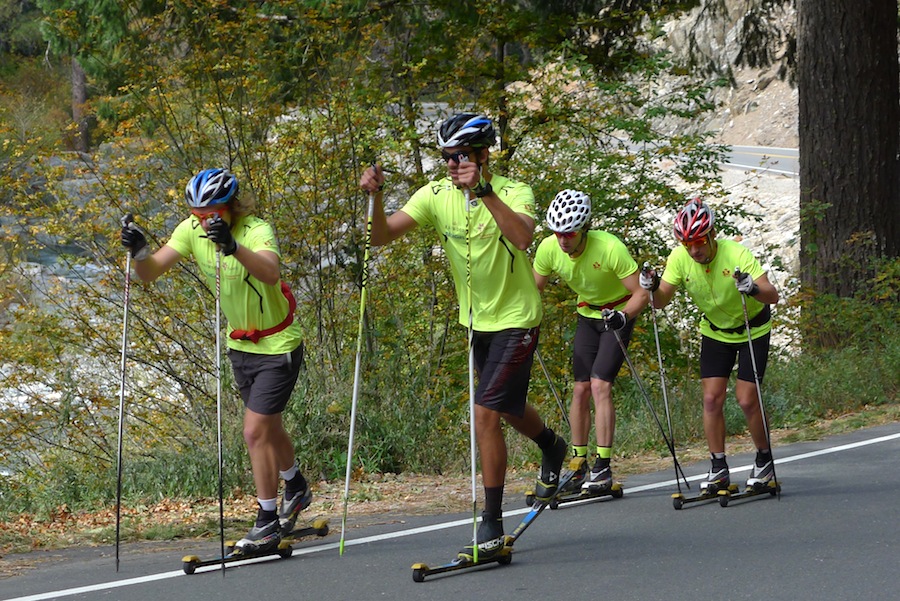
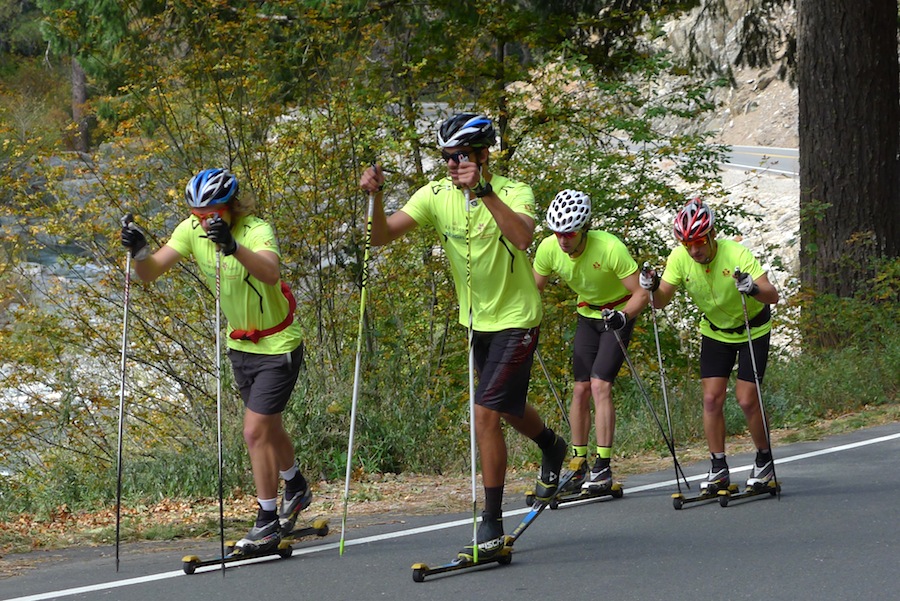
The Canadian World Cup Men’s Team during a four-hour rollerski from 1,000 to 7000 feet. From left to right: Devon Kershaw, Lenny Valjas, Alex Harvey, and Ivan Babikov. (Photo: Justin Wadsworth) “I was pretty happy he hopped right in and could hang with the guys really well,” Wadsworth said. “We have to make sure we’re not overdoing it with his knee.”
Women’s coach Eric de Nys worked with the women separately on more sprint-specific training. Jones and Gaiazova left earlier to get on snow in Canmore, and Kershaw flew to Europe on Monday to train with the Norwegian men’s team on the glacier in Val Senales, Italy. Wadsworth will meet him over there later this month and said this was the first time the national team invited one of his athletes to such a significant training camp. It was a no-brainer for a couple reasons.
“Devon came to me and needed a bit of a change,” Wadsworth said.
The 30-year-old world champion had been touring North American training camps for his entire career, even before he started racing internationally in 2005. He was also dating Kristin Størmer Steira, who came to Canmore in July, but he hadn’t seen her since, Wadsworth explained.
“I’ll be there for six days to make sure things are handled well,” Wadsworth said.
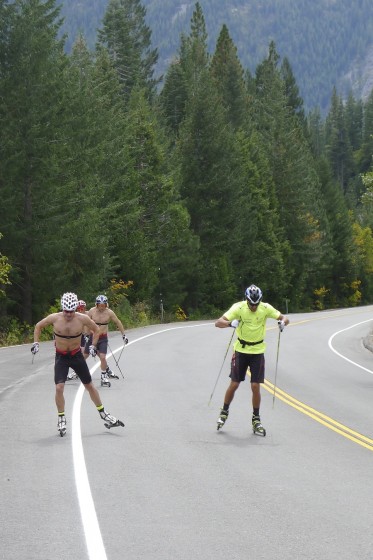
The Canadian World Cup Men’s Team hard at work near Truckee, Calif., during their final dryland camp from Oct. 1-17. (Photo: Justin Wadsworth) Mostly, he doesn’t want to blow all the work the team’s put into proper recovery this season. In retrospect, his athletes were a little too eager last summer and they paid the price during the race season, he said.
“I think things got a little out of hand last year with the intensity,” Wadsworth said. “People being too fired up and doing intensity a bit too hard than what we should.”
This spring, summer and fall, the Canadians have been more carefully monitoring each workout, placing some responsibility on the athletes. Heart-rate profiles could tell them a lot about where each individual was at with training, and they also tested a bit more this year.
“After each period, we tested to double and triple check where the athletes were,” Wadsworth said. “That’s something we brought back more … [but] I get more from the actual workouts outside seeing their fitness. The tests give us more indicators of small nuances and changes in physiology. We want to see improvements obviously, but the testing looks at other things that would be red flags or other areas, if they’re missing, we want to see there.”
Looking at his team’s training progress, Wadsworth said his athletes were right on track.
“Everybody’s a little bit different, but as a whole I’m really pleased with where we are,” he said. “The main thing is people have been really consistent and doing what they need to do. There hasn’t been a lot of showy stuff; we’re just really, really trying to hit the markers in every training session.”
Once they get on snow and start gearing up for the start of the World Cup late next month, they’ll have to be more diligent at keeping that in check, he added. The team will skip its typical warmup FIS races in Sweden and jump right in the World Cup opener in Finland.
“We’re basically using Kuusamo [Nov. 29-Dec. 1] as the first racing that we’ll be doing,” Wadsworth said. “That’s on purpose to build through the season and not having too much hard intensity and save it for later on.”
Jones and Gaiazova won’t go to Europe until mid-December for the third World Cup in Davos, Switzerland. Wadsworth said the entire goal of the season is a continual slope and gradual build up toward the Tour de Ski and, ultimately, the Olympics in Sochi, Russia.
“When we get over there, we’ll be fit and ready,” he said.
In Canmore, the women will have nearly two months at home on manmade snow at Frozen Thunder (Gaiazova will arrive there later this month after training in Montreal and Quebec). Harvey will stay in Quebec with coach Louis Bouchard and the Pierre-Harvey Training Centre.
On Oct. 24, the rest of the Canadian World Cup Team will host a classic sprint race with the U.S. Ski Team and other elite skiers in town. From what he’s heard, Wadsworth said temperatures have been ideal for making snow, and he hoped they’ll be able to add a “few more meters” to the course.
-
Unsure of Future in the Tour, Harvey Rises to Fifth in Stage 2
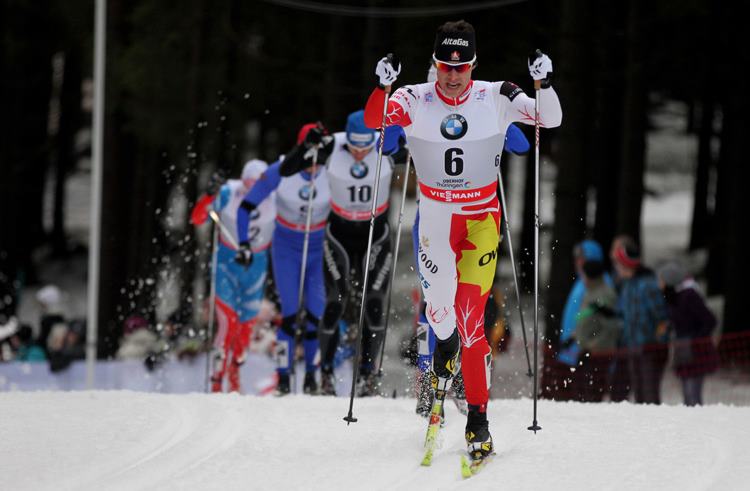
Canadian Alex Harvey pushes early in the Tour de Ski 15 k classic pursuit Sunday in Oberhof, Germany, where he went on to finish fifth. (Marcel Hilger photo) For someone who said a couple months back he wasn’t interested in pursuing the Tour de Ski overall and unsure he’d even finish it, Alex Harvey has done pretty well through the first two stages.
On Sunday, he put himself fifth in the standings with his best result of the season, knocking off one place in the 15-kilometer classic pursuit after finishing sixth on Saturday. One could speculate he’s on a similar track as last year, in which he started the Tour in sixth and ended up 12th, but last year, he didn’t place fifth in Stage 2 — he was 27th.
“I feel like it’s the best technique I’ve ever been skiing with right now and I think it’s just good timing,” Harvey said on the phone Sunday after finishing 7.7 seconds behind Russian winner Maxim Vylegzhanin, positioning himself 22.7 seconds back (based on bonuses) overall.
With tricky snow conditions both days with high humidity and temperatures above freezing, Harvey said his technique was what got him near the podium. While some – like Swiss favorite and defending Tour champion Dario Cologna – appeared to be slipping behind him, Harvey felt like he stayed on top of his skis, kept his hips high and took advantage of fast boards.
He almost secured third just 500 meters from the finish after chasing Vylegzhanin and another Russian, Alexander Legkov, who placed second. Harvey built a few meters on Cologna and Petter Northug (NOR) behind him, but it wasn’t enough to hold them both off. The two passed Harvey as they battled for third, which Northug took, and Harvey settled for fifth.
“I didn’t feel bad or blown out or anything, I just didn’t have the extra gear to sprint,” Harvey said. “I didn’t burry myself today so it’s good looking ahead.”
Two months ago, Harvey, 24, predicted he wouldn’t finish the Tour, given some lingering leg and back problems that historically intensified with too many races in a short time span.
“I’m not going for the overall,” Harvey said on Nov. 5. “We did last year just because that was the only thing to go for.”
This year, they’ve got World Championships. Canadian head coach Justin Wadsworth said the final climb didn’t really suit Harvey with a long uphill skate.
“But I think the other days there’s lots of possibilities for stage wins and really good overall placing,” Wadsworth said. “It will just be fun to take things one day at a time on this year’s Tour de Ski.”
Wadsworth noted the Tour’s “more casual” schedule this year, which could benefit Harvey, with seven stages in nine days (as opposed to nine stages) and rest days on Monday and Wednesday. At the same time, the Tour isn’t the pinnacle of the season, especially not for Harvey, who wants to peak at world champs in late February.
“We’ll see how he gets to the final day [of the Tour] and then going up the hill, it’s a totally separate race,” Wadsworth said. “It changes things a lot.”
“I have no expectations for the overall, but I want podiums every race,” Harvey told Cross Country Canada. “I feel I belong in this top group, but this year is a good reminder to not take anything for granted. My slow start this year reminds me to appreciate the good days.”
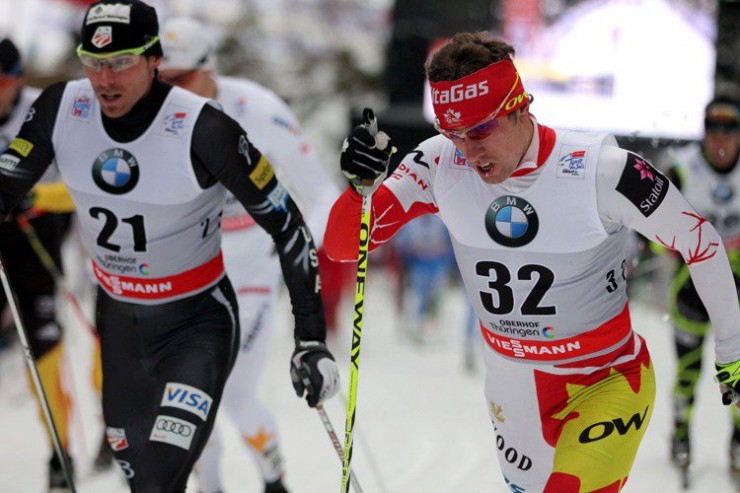
Canadian Ivan Babikov (32) works alongside American Andy Newell (21) in the Tour de Ski 15 k classic pursuit on Sunday in Oberhof, Germany. Babikov went on to place 19th and Newell was 74th. (Marcel Hilger photo) Coming off a personal-best prologue finish on Saturday, Canadian Ivan Babikov had another solid day Sunday, climbing from starting 32nd (40 seconds back from Northug) to finishing 19th (+1:44.4 overall).
For part of the race, Babikov skied with teammate Devon Kershaw, who moved up to 22nd around 7 k after starting 48th (+46.1). Kershaw finished 27th – a drastic improvement in placing – yet remained 2:10.4 minutes back in the standings through two stages.
“I’m doing everything I can, but it feels like I’m missing two gears out there; I’m not snappy,” Kershaw said. “I have no power at all and because of that I’m not really able to ski the way I normally ski and it’s super frustrating.”
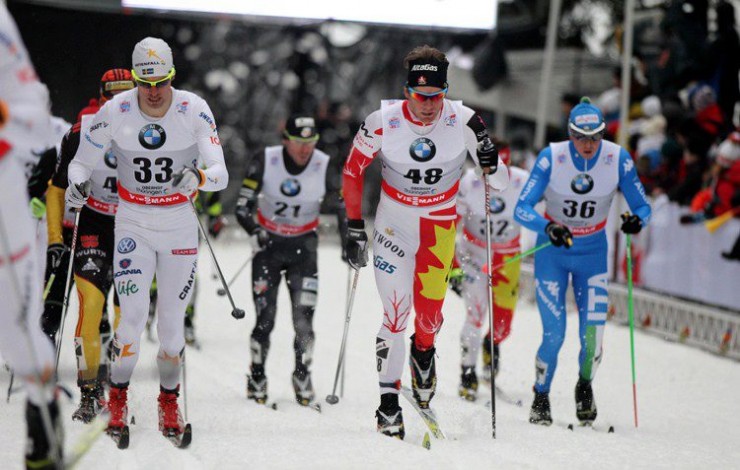
Devon Kershaw (48) skis with Sweden’s Johan Olsson (33) and Italy’s Dietmar Noeckler (36) out of the start in Sunday’s Tour de Ski 15 k classic pursuit in Oberhof, Germany. Kershaw ended up 27th. (Marcel Hilger photo) While the first three laps went pretty well, Kershaw said he struggled on the last two. Early on, he attacked with Johan Olsson (SWE) and Jens Filbrich (GER), who ultimately placed 10th and 13th, respectively, but couldn’t hang onto Babikov as he continued to make up ground.
“Babs’ group gapped me hard and I think Lenny [Valjas] probably put 30 seconds on me in the last 3 k,” Kershaw said with a laugh. “Just another really rough day at the office for me. … The Tour is overall looking grim unless I can have a big sprint.
“I just want one good race. I just want to feel good once,” Kershaw added. “These races I’ve been feeling so far from what my top form is. I know what I’m capable of and if I can have a race where I’m even 70 percent … that would be a bit of a success. I just haven’t felt good, not even once this whole season.”
In his first Tour, Valjas placed 33rd after starting 52nd. Heading into the third stage, skate sprints New Year’s Day in Val Müstair, Switzerland, the 24-year-old sprinter is 2:14.9 back.
“[Sunday] was really good for Alex. … Ivan also had a good day,” Wadsworth said. “Lenny had a solid race and I think Devon was OK. He’s disappointed for sure, but it was at least moving forward and not backward so you’ve gotta take the small things at this point.”
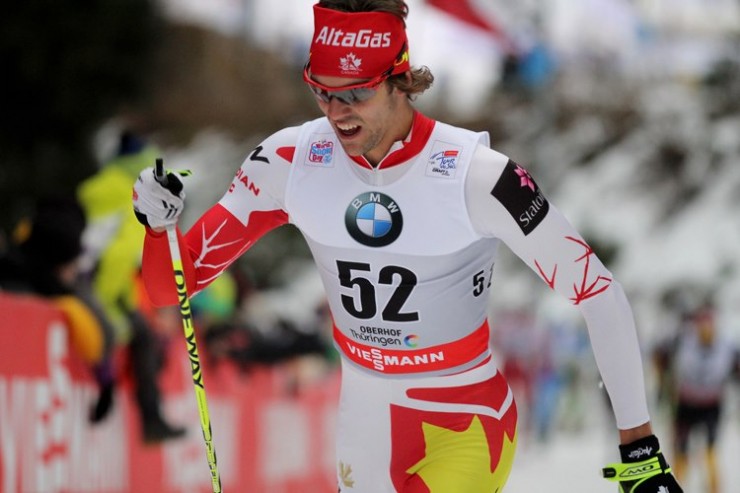
Lenny Valjas (CAN) skiing to 33rd in the second stage of the Tour de Ski on Sunday, 15 k classic pursuit in Oberhof, Germany. ***
-

Canadian Men Leave NZ ‘Feeling Good,’ Cracking Jokes

Canadian World Cup team member Alex Harvey crashes and burns during a head-to-head sprint with one of his teammates at the Snow Farm near Wanaka, New Zealand, where the team recently spent two weeks training. (Photo from XC Canada video: www.youtube.com/watch?v=8roNOx3M0dk) Just over two weeks ago, the Canadian men’s cross-country ski team made the long journey to New Zealand in search of some low-altitude, on-snow volume training. According to head coach Justin Wadsworth, they planned to work on intensity and climbing steep hills.
That was the plan, and after checking in with Wadsworth before the team left for home on Wednesday, he wrote in an email that all went well. In fact, he described the camp as excellent.
“Overall we are ahead in every aspect from where we were last year,” Wadsworth wrote. “So I’m very pleased.”

Lenny Valjas (l) and Alex Harvey while being filmed at the Snow Farm in New Zealand. (From: www.youtube.com/watch?v=8roNOx3M0dk) While the four World Cup teammates — Devon Kershaw, Alex Harvey, Ivan Babikov and Lenny Valjas — put in some long days at the Snow Farm near Wanaka, they also had some fun. The team posted a YouTube video called, “Snow Farm – New Zealand – August 2012” to sum up their time there, which was mostly a laughing matter.
In one scene, the four men stand stand on a treeless trail high above the landscape while taking a break during training. Valjas looks to his left.
“Pop questions for our teammate Ivan Babikov,” he says.
“Hey Babs, what’s your spirit animal?” Kershaw chimes in.
Babikov laughs. “Unicorn?”

Devon Kershaw (l) interviews Ivan Babikov in an XC Canada video at the Snow Farm in New Zealand. (From: www.youtube.com/watch?v=8roNOx3M0dk) The camera pans to Harvey: “Hey Babs, can you explain why we see the moon and the sun at the same time?”
Babikov pauses. “We’re way down deep south. That’s why.”
They all laughed, and then it was probably back to training. At least that’s what the videos shows. But between jumping out to scare Kershaw at surprising moments and doing penguin-like belly slides on skis, the Canadian men did have a productive camp. Wadsworth pointed out the quality of a couple speed sessions and hefty amount of technique work.
“Maybe one of the best days was a crust cruise up to the top of the Pisa Range [the plateau where the Snow Farm is located] on a bluebird day,” he wrote.
Snow conditions were good despite a thin snow year, he added. The team has also never skied in New Zealand this late in the season (they typically travel there about two weeks earlier in August for the Winter Games NZ races with other international skiers).
“Really the only hitch was 2 of the 4 guys got a 24 hour flu,” Wadsworth wrote about Harvey and Babikov’s illness about halfway through the camp. “This happened on the morning of the classic time trial we had planned, so we had to move things around a bit, Alex and Ivan bounced back quickly and even though they were rooming with Devon and Lenny the flu didn’t spread.”
Asked how he was feeling, Harvey responded in an email from the airport that he was doing well.
“I’m coming out of the camp not really tired,” he wrote. “It’s hard to know what [the sickness] was exactly. … It was quick but pretty intense. Probably something we caught down in town, in Wanaka. I was able to ski twice the next day so I didn’t loose any training really. I just ended up skipping a rest day later in the camp.”

View from the Snow Farm near Wanaka, New Zealand, in late August. (From: youtube.com/watch?v=8roNOx3M0dk) Harvey added that having the camp a bit later gave them more time to enjoy summer back in Canada. Once they arrived in New Zealand, he said the conditions were still good, just a bit more spring-like.
“But there was never a day were we couldn’t ski because of the weather, which is pretty good for the Snow Farm,” he wrote. “We usually get one or two days were we can’t ski up there so we were lucky this time.”
Just like other team training camps, Harvey focused on completing hard-intensity workouts with his teammates.
“The training camps are the only time I do Level 4 intensity in the summer so it’s good to be with the boys to do that,” he wrote. “We also worked a lot on technique, classic, skating, uphills, flats. Trying to improve a bit on all aspects. I feel like I was able to put a lot of hours on snow, maintain the strength training while doing 4 solid hard intensity sessions and training kind of at altitude.”
(Harvey trains at sea level near Quebec City and could feel the difference at the Snow Farm’s elevation at 1,500 meters.)
“I’m coming out of the camp fitter and faster that’s for sure,” he added. “I feel like the camp didn’t take too much out of me so I should ba able to get two more solid weeks of training before our next camp in Park City, Utah (from Sept. 23-Oct. 4).”
As for highlights, Harvey picked out three:
“1. The weather allowed us to ski everyday if we wanted to.
2. Settlers of Catan. It’s ‘The Game that Defines our Generation!’
3. Devon’s beard and hair combo. Skyping with my mom, she asked why he tried to look like a hobo and said that he’s a ‘complete disaster.’ “
-
Canadian Men En Route to New Zealand; Plan to Meet Hoffman and Freeman

The Snow Farm, as seen in July 2010, where the Canadian men’s team will be the lone North-American contingent training for nearly three weeks starting Aug. 22 near Wanaka, New Zealand. According to Canadian head coach Justin Wadsworth, U.S. Ski Team members Kris Freeman and Noah Hoffman will also be there. Scattered throughout Canada on Sunday, four World Cup team members and their coaching and support staff started their long journey to the land down under – that is, New Zealand.
Alex Harvey ate handmade chocolates and sipped a steamed drink while waiting for his 16-hour flight out of Québec International Airport, then got upgraded to business class, according to Twitter.
Meanwhile, his teammate Devon Kershaw tweeted that he was in coach on another flight, but didn’t mind.
“It’s awesome in the back,” Kershaw wrote. “Middle of the middle for 15 hours #decent?”
As head coach Justin Wadsworth stepped off the plane in Denver and awaited his departure for Los Angeles, he took the time to chat with FasterSkier on the phone. The entire Canadian men’s team – Harvey, Kershaw, Lenny Valjas and Ivan Babikov – will arrive in Queenstown, New Zealand, on Tuesday afternoon. They’ll start training Wednesday and spend about two and a half weeks on snow at the Snow Farm near Wanaka.
***
FasterSkier: Last year, you timed the trip with the New Zealand Winter Games so your skiers could race at the Snow Farm. Why did you schedule it later this year?
Justin Wadsworth: We have a lot of camps. In the summer, it works out to be almost two weeks out of every month the athletes are in camps. I thought this summer it might be nice to give everyone a six-week period with no camps. That’s basically what we did to try to create more of a stay-at-home and get back into a groove where everybody lives. Our last camp was up on the Haig Glacier, you know, as part of our Hawaii camp. [Note: The men’s team was in Hawaii from mid June to July 4, then skied on the Haig Glacier near Canmore, Alberta, from July 5-9].
It has been a nice break for everybody, including myself, and then it just worked out well. We usually have a two-week break before the Park City altitude camp in September [where both the Canadian men’s and women’s teams will train together in Utah from Sept. 23-Oct. 4].
FS: What are some training goals while in New Zealand?
JW: This is kind of a volume camp. We have other periods where we focus a little bit more on intensity. This one is volume-based and obviously on snow. It’s worked very well in the past few years [at creating a base for really good ski technique and working on climbing. We’ve been rollerskiing a lot and glacier skiing where there’s not a lot of opportunity for super-steep uphill training]. It’s just terrain that’s good to be on for working the steep uphill.
FS: Why else is it important to travel there for snow?

The men’s 15 k classic mass start podium from 2009 in New Zealand: Canadian winner Devon Kershaw (c) and teammate Ivan Babikov (l) and American runner-up Kris Freeman (r). JW: We have opportunities to ski in Canada and right behind Canmore on the glacier, but New Zealand provides us with straight-out-the-door, fairly low altitude, and just really, really good winter snow conditions to train from. I, personally, and I think the athletes really feel like this camp provides them something that a lot of their summer skiing doesn’t.
I know other North Americans are sort of straying away from going there, but … I think it is a super-high value for us to be down there, and it’s worth the trip even though it’s a long trip down there. It’s a really good place to get some quality training in.
[Note: For the first time in 10 years, the U.S. Ski Team will not be training in New Zealand this summer. Head coach Chris Grover cited the steep rise in airfare, lengthy travel and 16-hour time-difference adjustment as reasons for skipping the trip. Instead, the U.S. men recently skied in Austria and Germany, and the women just wrapped up two weeks of training in Sweden.]
FS: Which international skiers will still be at the Snow Farm?
JW: Right now, the Russians are down there and Justyna Kowalczyk and one other male sprinter from Poland [Maciej Kreczmer], and then Kris Freeman and Noah Hoffman [of the U.S. Ski Team] will be down there a little bit later. There’ll be a few other folks there.
FS: Do you plan to coordinate workouts with Freeman and Hoffman?
JW: Hoff gave me an email a couple days ago and asked me what our plan was down there. He said he’d like to at least hook up for some workouts. We’ll probably do a time trial down there so it might be nice to get those guys into that one and probably some intensity with them also. I mean, we’re happy to work with those guys and I’m sure they’ll ski a lot together in the distance workouts. The majority of the sessions down there are distance training.
FS: It seems like the North American women have been pushing particularly hard to train together. How would you describe the relationship between the Canadian and U.S. men?
JW: It’s a little bit different between men and women. I think the social aspect on the women’s side is so much more important, and I think that’s a big difference. It’s not that we don’t want to train with Hoff or Bird, it’s just guys in general do a little bit more on their own. We’re not going to force it, but definitely there will be some company on the long workouts that they’ll be welcome [to join at the Snow Farm]. It will be nice to have those guys there.
FS: Which of your staff members are going?
JW: Myself and [wax tech] Joel Jaques, [team physiotherapist] Shayne Hutchins, and then [men’s assistant coach] Louie Bouchard … so we have a pretty good staff-to-athlete ratio on this one.
FS: Will the training sessions be mostly structured similarly or individually?
JW: Occasionally, we’ll have different workouts, but [at] almost all the camps, guys do all the workouts together. We can vary the length of them and stuff individually, but they do all pretty much the same plan for the camp so it works out really nicely and I think it’s beneficial for all the guys.
You kind of see that now, Lenny’s coming up and I think Ivan’s doing really well right now. He’s focusing on some things for him on the side leading into this period, so I really feel good where he is and where Devon is, and I know Alex is doing well. Everyone’s doing great. They all train together and hopefully push each other a bit when we need to push.
[Note: Kershaw and Babikov have been training together throughout the summer in Canmore. In a recent blog post, Kershaw wrote: “After the momentum we gained during the Maui camp – Ivan and I have been working super well together under the watchful eye of Justin. It’s a different set up with the men and women training separately this year which is a big change, but things with the men’s team seem to be going splendid.”
FS: How are the team dynamics in general?
JW: We separated the men and the women this year and I think that’s been working well. We’re going to get everybody together in Park City. We’ll be doing slightly different things, but we’re going to be sharing some meals and stuff together.
The reports on [women’s national-team members] Chandra [Crawford], Dasha [Gaiazova] and Peri [Jones] have been really good, and the vibe on the guys’ team is always good. I’m feeling really good about how things are, and it’ll be good to get the team together in Park City because we’re going to be spending a lot of time together starting in November. It’s good to make sure we’re all on the same page.
FS: And that camp’s timed slightly before the USST training camp in Park City (from Oct. 8-18)?
JW: It just didn’t work out timing wise because we want to be back up in Canada for Frozen Thunder starting on [October] 15th. We wanted our men and women to be at the Park City camp together. The U.S. women will be in Canmore so that’s kind of the shared time when our ladies can train with their ladies during that period. It’s important to get the team together in Park City just to make sure we don’t lose contact with that.
-
Notes and Quotes from Sjusjøen: Canadian Edition
Following their first races of the season in Europe last weekend in Bruksvallarna, Sweden, many of the Canadian national team members were ready to get back at it. Saturday’s World Cup opener in Sjusjøen, Norway, seemed like the perfect place for redemption for a few of the men and continued improvement for others (the women did not race, instead training in Ostersund, Sweden).
Not all of the Canadians got their wish. In fact, few of the North Americans did in the men’s 15 k freestyle.
Alex Harvey was a bright spot, placing fifth in 32:49.9, 40.6 seconds behind Sweden’s Johan Olsson, the winner. Additional coverage of Harvey’s performance can be found in the main race recap here.
Devon Kershaw was 37th (1:37.1), a week after placing 28th in Bruksvallarna. Saturday’s finish wasn’t exactly the result he had hoped for, but it was an improvement from last year’s World Cup opener. A year ago in Gällivare, Sweden, he was 58th in the 15 k freestyle.
“After my disappointment in Bruks’ last weekend I really didn’t know what to expect for today,” Kershaw wrote in an email. “I was anxious to see how the body would be feeling – so ahead of the race I was a bit more nervous than normal – but once I started (ok, after I “really started” at around 2.5km, haha) those nerves went away.”
He wrote that he started “WAY too slow — which is WAY out of character for me,” and blamed his hesitancy to not trusting his body.
“So I regret that in a big way,” Kershaw wrote. “But there were a few laps in there that I was feeling ‘ok’ and skiing (I feel anyway) pretty well technically.”
Canadian head coach Justin Wadsworth said Sunday’s relay would include Kershaw, Ivan Babikov, Graham Nishikawa and Lenny Valjas. Harvey decided to rest up for next weekend’s mini tour in Kuusamo, Finland. With three races in one weekend, they could play a big role in Harvey’s and Kershaw’s run for the overall World Cup title.
“Alex feels right now, with the travel over last week and the mini tour coming up, it’s a bit too much to do race both races,” Wadsworth said. “I respect that decision. We’ll field the team we have.”
On Saturday, Babikov was 42nd (+1:41.3), Valjas was 64th (+2:11.1) and Nishikawa was 71st (+2:27.6).
Valjas on coming off his best distance race last weekend (18th in 15 k freestyle in Bruksvallarna):
“Coming off a pretty good distance result for me last weekend I was really hoping for a top 40 today,” he wrote in an email. “Unfortunately I wasn’t feeling it out there today.
“The first two laps were hot garbage for me. It felt like I was trying too hard to go fast, I needed to relax and let my skis glide out there. The last two laps really went well for me. I was skiing much more relaxed and my lap times improved big time. Overall I am not too upset about this result, for a tough 15km course it went well for me.”
On the team morale:
“We are all happy with the start of the season, even though some of us did not have the best day, we are still much improved from the start of last season.”
On Harvey’s performance:
“I am so pumped for Alex, that is a huge result considering he has never cracked the top 30 in an individual start WC. I am not surprised whatsoever, after watching him train in Quebec all fall, I knew he was in ridiculous shape this year.”
Nishikawa on Saturday’s race (after placing 45th in Bruksvallarna):
“I struggled from the gun. The season is long so I am going to shake it off and prepare for next weekend.
“Conditions and course were perfect. They were not a factor at all. The race showed who is fit, now.”
Wadsworth on individual performances:
“Alex had a great race,” he said. “You’d call it his weaker discipline. It shows how well rounded he is. We as a team worked hard on skating technique, and it’s working well for him right now. We’re excited.”
“Not a great race for (Kershaw). For him it kind of builds, but he’s been training a lot. … The good thing is he felt good and is pretty confident for the mini tour.”
Note: While the Canadian men raced in Norway, the team’s three women (Chandra Crawford, Perianne Jones and Alysson Marshall) and two development team members (Drew Goldsack and Kevin Sandau) finished their second week of training in Ostersund. Without enough members to field a relay, the women opted out of traveling to Norway for one race, and there were not enough entry positions for all the men.
When alternate plans to race in Rovaniemi, Finland, this weekend were canceled, the remaining Canadians chose to race against Swedish development team members and some university athletes in a classic time trial on Friday. On Saturday, they did team sprints and watched the guys on T.V.
Saturday night, Crawford tweeted that they were going out to dinner for her 28th birthday. “#soawesome,” she wrote.