From the FasterSkier archive — posts syndicated from athletes’ and coaches’ own blogs between 2004 and 2012, kept online as published. Current coverage is at fasterskier.com.
It’s worth asking this question: could an entire continent having a love affair with a sport that combines skate skiing and shooting be wrong? There’s the raw, heart-thumping power of the skiing mingled with the laser-focus almost the zen-like quality of shooting at a quarter-size target. Throw in a few thousand fans with cowbells, horns,and a long winter night’s worth of libations, and you’ve got a sport that either live in person or broadcast on a screen has captured the wintertime sport scene in Europe.
For the diehard nordic ski fan, International Biathlon Union (IBU) World Cups have for sometime been easily streamable on the Internet. If you were disinterested in the shooting, there’s obviously the skiing. But understanding the shooting process — where athletes immerse themselves in a mind-body flow shooting at small targets sandwiched between full-throttle ski laps — broadens one’s appreciation for the sport.
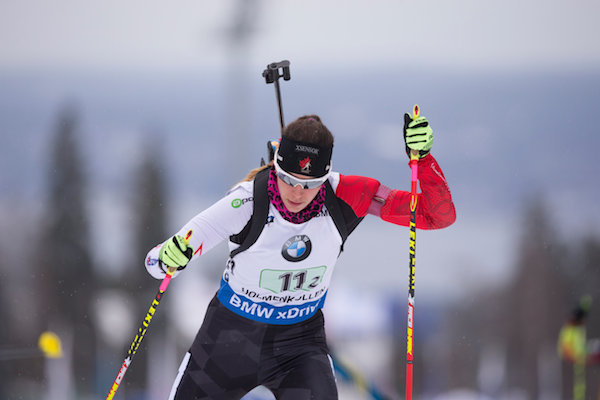
Rosanna Crawford (Biathlon Canada) skiing the second-fastest course time of second-leg relay skiers in the Oslo World Cup relay in February 2015. (Photo: Biathlon Canada/NordicFocus.com)
In this episode of Nordic Nation, Biathlon Canada veteran Rosanna Crawford brings listeners into the shooting range — in fact she debriefs her world champs personal-best race at the 2016 IBU World Championships in Oslo, Norway.
Hear those cheers roar after a target flips black with a direct hit? What’s not to love? Click the play arrow below to listen to the podcast. (To subscribe to the Nordic Nation podcast channel, download the iTunes app. If you have iTunes, subscribe to Nordic Nation here.)
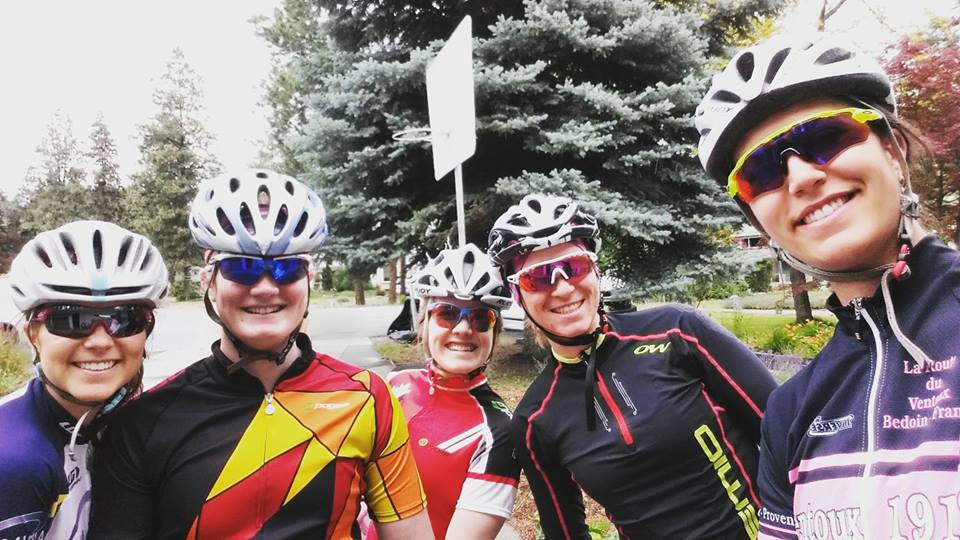
Four Canadians Julia Ransom (l), Sarah Beaudry (second from l), Emma Lunder (c), and Rosanna Crawford (r) with France’s Anais Bescond (second from r) during their first bike session of “Wine Camp” in Kelowna, British Columbia this June. (Photo: Rosanna Crawford)
Along with peeling off the layers, summertime ski training often entails guest-star appearances. Many college athletes depart school and return to club programs, clubs may combine training sessions or camps, and even internationally, skiers from different countries coordinate their training schedules. Given the choice, 2016 two-time World Championships silver medalist Anaïs Bescond of France didn’t need to think twice about her crossover team: Canada.
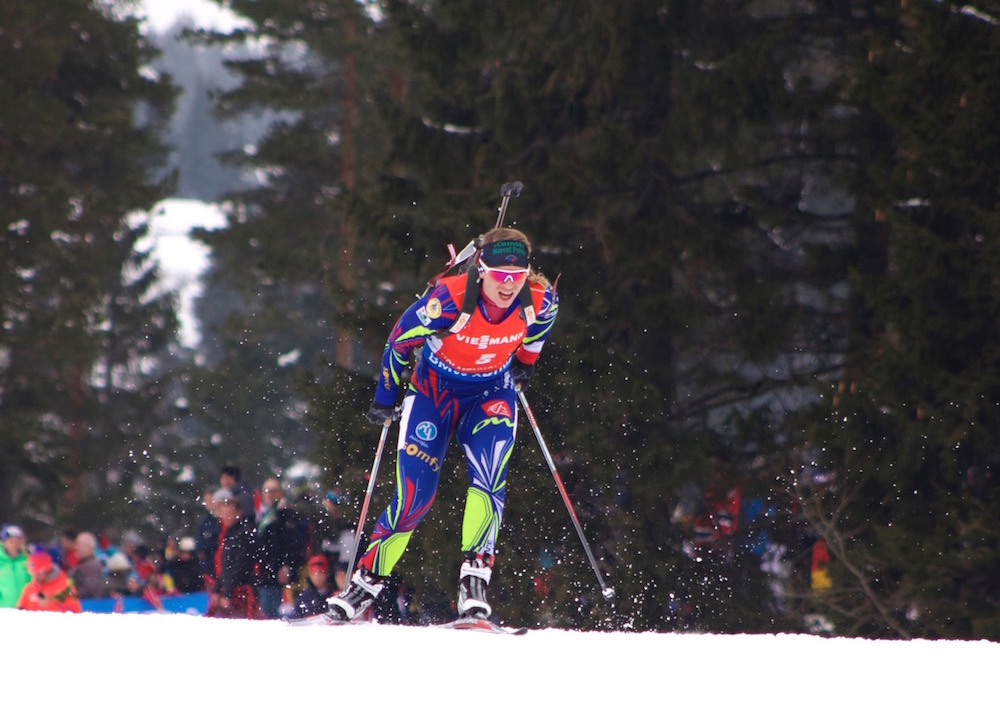
France’s Anais Bescond racing to fifth in the women’s 12.5 k mass start at 2016 IBU World Championships in Oslo, Norway. (Photo: JoJo Baldus)
After discussing the possibility of banding with the Biathlon Canada’s women’s team with Canadian head coach Matthias Ahrens and her friend Rosanna Crawford, Bescond bought a plane ticket to Kelowna, British Columbia, and arrived on June 14.
“It was just an easy decision,” Bescond, 29, said during a phone interview. “Because when I am coming in February for the World Cup I find Canmore and Canada people really nice … So, I asked to Matthias and Rosanna if it’s possible to plan to coming during the summer to train a little with the team and it was OK, so good for me.”
Bescond spent the past two weeks training with the Canadian team, taking part in their “Wine Camp” during her first week in Kelowna. With two more weeks of training left alongside her adopted Canadian teammates, Bescond can expect to also partake in the Biathlon Canada’s “Test-ival” — what Crawford described as “the festival of [training] tests” — the crew’s current undertaking this week in Canmore, Alberta.
“With Anais being from France, where they make delicious wine and Kelowna makes delicious wine, it just felt appropriate,” Crawford explained on the phone, referring to the Kelowna training camp name (she said the women also had to compete with the Canadian men’s camp names: “Beast Camp” and “Man Camp”). “We weren’t consuming as much wine as one might think, but we did have a couple glasses.”
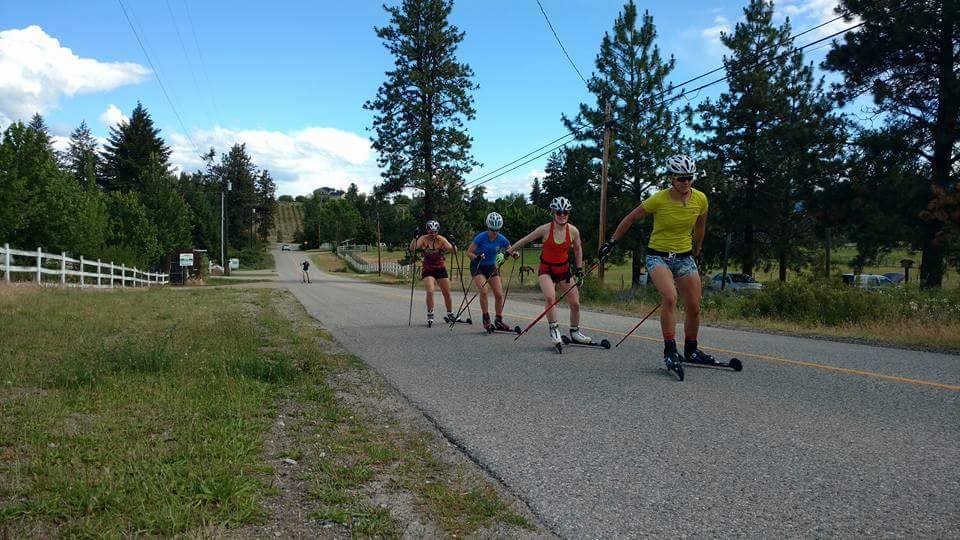
Rosanna Crawford leads her Canadian teammates Emma Lunder (second from r) and Julia Ransom, along with France’s Anais Bescond (l) during a rollerski in Kelowna, British Columbia. (Photo: Rosanna Crawford)
This summer, Bescond is one of a several international training partners in Canada. A few members of the Swiss men’s biathlon team, including Benjamin Weger, Serafin Wiestner, and his brother Till Wiestner, are also presently rollerskiing, running and biking in Canmore.
After Wine Camp, the Test-ival and a final week with the Canadian women’s team, Bescond will leave Canada on July 18 and fly to Norway. There, she will train with the Norwegian women’s biathlon team.
“I think what is really interesting for me is to share our different experience about training,” Bescond said. “Spend[ing] time with different people, it’s really instructive I think. With kind people, it’s always nice.”
“We weren’t consuming as much wine as one might think, but we did have a couple glasses.” — Rosanna Crawford, Canadian biathlete, on her team’s ‘Wine Camp’ earlier this month
Crawford, 28, also pointed out that international camaraderie is just as important as international competition. Their training sessions together afforded the two not only a chance for more tête-à-têtes, but also the opportunity to push each other.
“I speak French and we usually stay at a couple of the same hotels throughout the winter, so we’ll have a couple meals together,” Crawford said. “But this is definitely the most time we’ve spent together and we’ve gotten to know each other’s personal lives a little bit more. … The Canadian’s women team has been growing with Julia [Ransom], Emma [Lunder], Sarah [Beaudry] and myself, so having Anaïs train with us creates a nice opportunity to grow as a team and learn from her.”
“There’s so much more to sport than just exercising,” she added. “You spend so much time with these people, it’s important to get along with them.”
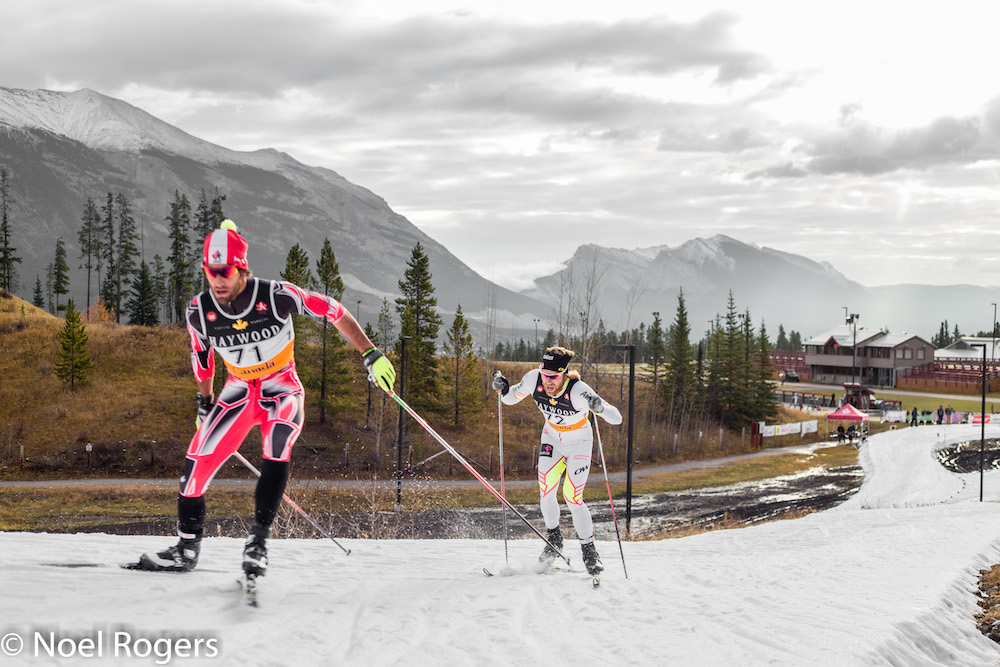
Devon Kershaw (r) chases down biathlete Scott Perras during Monday’s Frozen Thunder 10.8 k freestyle interval start at the Canmore Nordic Centre. Kershaw went on to win, and Perras placed third. (Photo: Noel Rogers/Bow Valley Photography)
A 1.8-kilometer loop can get crowded with 101 racers, especially when each competitor is racing anywhere from four to six laps.
Such was the case at Monday’s Frozen Thunder freestyle-individual start in Camore, Alberta. Jumping at the chance for on-snow training and racing in October, groups including the U.S. Ski Team and Canadian national cross-country and biathlon teams converged on the Canmore Nordic Centre.
In the men’s 10.8 k race, the good ol’ boys of North American nordic skiing came out on top.
Devon Kershaw of the Canadian World Cup Team skied his way to a win in the freestyle-interval start in Canmore, Alberta, with a time of 23:00.4.
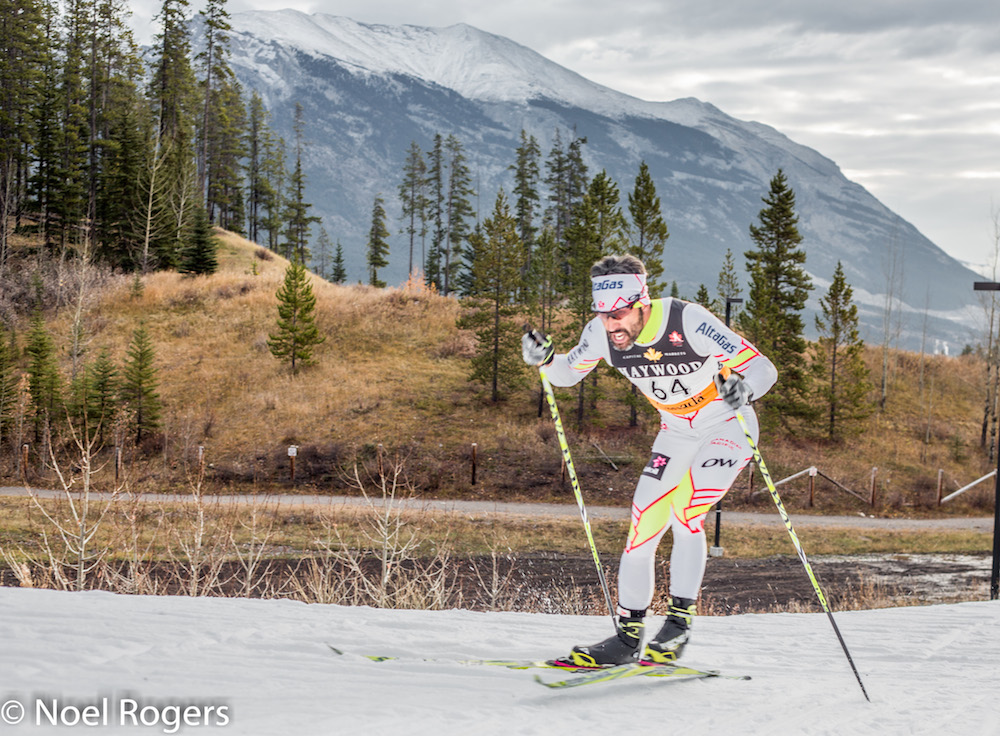
Canadian Para-Nordic Team veteran Brian McKeever placed eighth in Frozen Thunder’s 10.8 k freestyle interval start on Oct. 27 in Canmore, Alberta. (Photo: Noel Rogers/Bow Valley Photography)
Not far behind was U.S. veteran skier Kris Freeman (+5.1) of Team Freebird. After three laps, Freeman was roughly 13 seconds behind Kershaw but gradually erased the deficit as the finish inched closer.
Freeman’s final surge was not enough to overcome Kershaw, who clocked the fastest time in each of the first three laps.
Kershaw said that the crowded 1.8 k loop did little to distract him from his race. Comparing the conditions of the loop made of saved-snow to several past World Cups, Kershaw said that the busy Frozen Thunder track was nothing he hadn’t seen before.
“You just move around people that are slower than you and it’s actually pretty easy to not focus on that aspect of it. A busy track doesn’t bother me when I’m racing,” Kershaw wrote after his win.
Freeman agreed, writing that in the modern era of nordic skiing, short loops have become more abundant – even in the winter season. He said that while he was careful when overtaking his competitors, everyone he met on the course gave enough space for a fellow skier to pass.
Kershaw said that since its conception, Frozen Thunder has continued to get bigger and better. This year was no different.
“The Frozen Thunder races are getting more and more popular as the years go on,” he wrote. “The volunteers here in the Bow Valley that make events like this happen are just so incredible. When you’ve got athletes from the U.S. coming up, and training centres and clubs from across the country coming to compete and train here – it shows just how fantastic a success and how well received the whole Frozen Thunder project is.”
Third place was claimed by Biathlon Canada’s Scott Perras, who finished 30.8 seconds behind Kershaw.
For Perras, the race was an opportunity to ski with the Canada’s cross-country team. He said that Canadian biathletes and and cross-country skiers rarely interact due to the diverse schedules of each team.
“It was great to get to ski parts of a race with Kershaw,” he wrote. “I’ve never actually been in a cross country race when he was around. October really is the only time of year cross country and biathlon get to have some fun chasing each other.”
Perras and teammate Brendan Green wore one of each other’s skis so that they could compare their results without worrying about variation in ski speed. He was able inch past Green who finished 1.3 seconds behind. Perras said the laps he spent skiing with Kershaw made the all the difference.
Perras also noted that the top three men in Monday’s race were some of the oldest in the field of 64.
“As an ‘old guy’ this brings a smile to my face,” the 31 year old said. Kershaw is also 31 and Freeman is 34.
Further down the results sheet was Simi Hamilton of the U.S. Ski Team (USST). While the Stratton Mountain School (SMS) T2 skier finished 40th and roughly three minutes and 20 seconds behind Kershaw, his result is misleading. Hamilton recently suffered “a mild shoulder tweak” and skied the entire race with one pole.
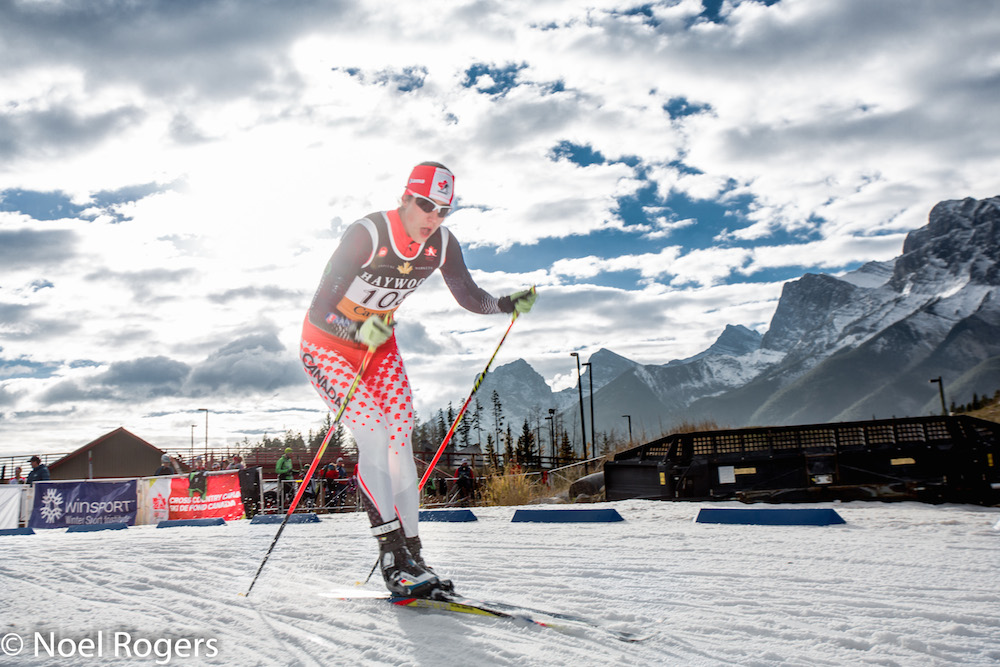
Biathlete Rosanna Crawford racing to the win in Monday’s 7.2 k freestyle women’s race at Frozen Thunder in Canmore, Alberta. (Photo: Noel Rogers/Bow Valley Photography)
In the women’s 7.2 k race, Rosanna Crawford (Biathlon Canada) bested a strong women’s field to take the win. After four laps around the Frozen Thunder track, she finished with a time of 17:39.2.
Despite soft conditions, Crawford explained she felt strong throughout the race and enjoyed starting near the back of the pack.
“Starting near the end meant there was a lot of girls I could chase down. I love having someone just within sight that I can try to chase down and pass!” she wrote in an email.
Crawford, who just completed a two-week block of treadmill rollerski intensity, explained that the race helped her begin the transition from dryland training to on-snow racing.
Coming in second for the women was USST member Liz Stephen (+3.6), who traditionally excels on hilly courses with long climbs. Monday’s race had no such climbs and was relatively flat.
Taking the final spot on the podium was Canadian biathlete Zina Kocher (+11.7). Kocher said that while she also favors hill-intensive courses, the Frozen Thunder distance race left her feeling technically and physically strong going into the final weeks of fall training.
Now that Frozen Thunder racing has concluded, the North American teams will part ways before they begin their final training blocks of the fall. The Canadian Biathlon Team will host a time-trail on the 1.8 k ski loop Friday, as part of their continued training camp.
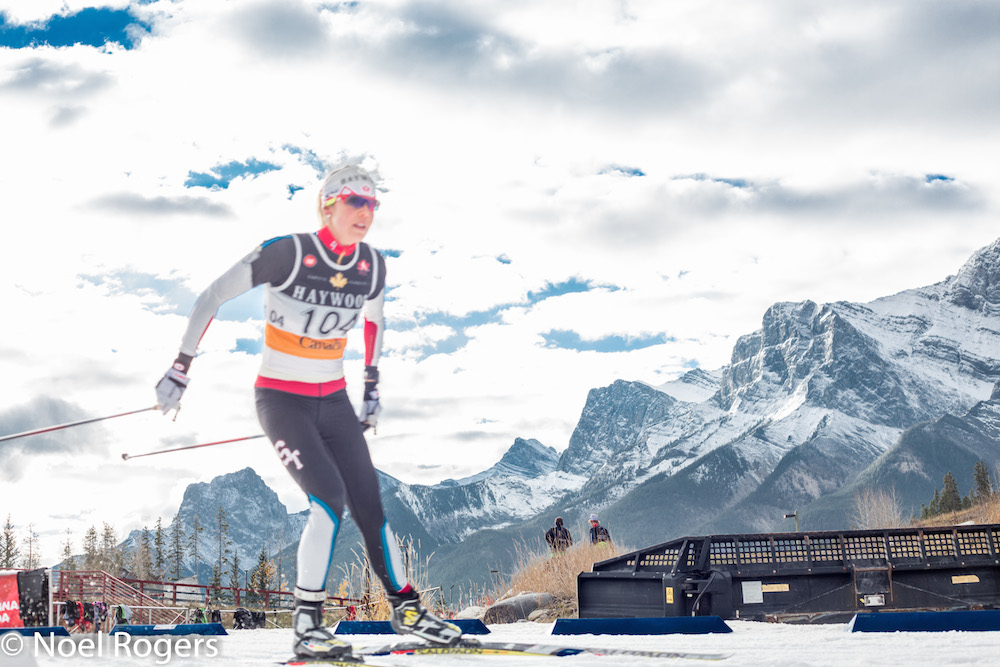
Heidi Widmer (AWCA/Canadian NST) racing to ninth in the women’s freestyle distance race at Frozen Thunder on Oct. 27 in Canmore, Alberta. (Photo: Noel Rogers/Bow Valley Photography)