From the FasterSkier archive — posts syndicated from athletes’ and coaches’ own blogs between 2004 and 2012, kept online as published. Current coverage is at fasterskier.com.

Tag: Canadian National Team

  • Alison Mackie Is Chasing the Speed She Doesn’t Have Yet

    Alison Mackie Is Chasing the Speed She Doesn’t Have Yet

    This article was made possible through the generous support of our voluntary subscribers. If you value coverage like this, please support FasterSkier with a voluntary subscription.
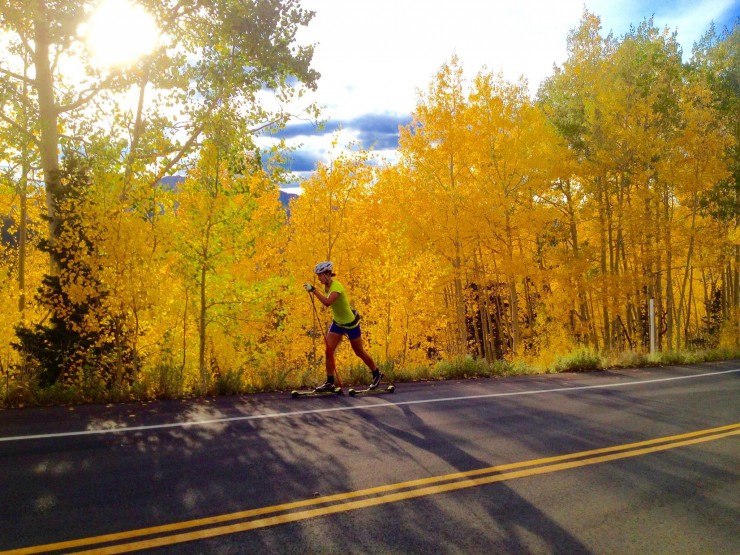
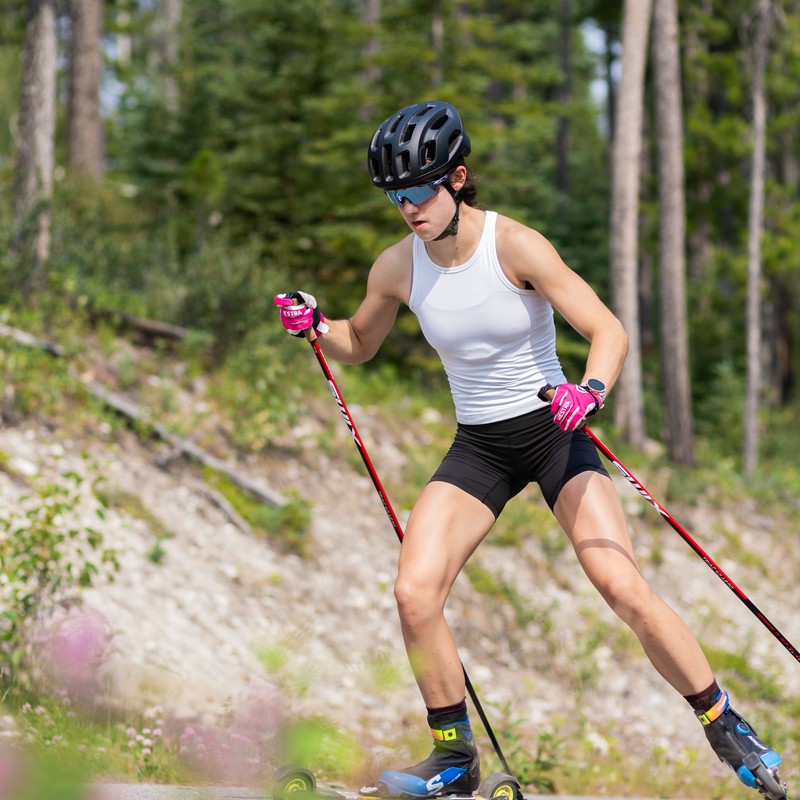
    Alison Mackie skate rollerskiing uphill on a paved forest road in a white training top and black helmet.
    Alison Mackie rollerskiing during summer training in July. She trains with the Alberta World Cup Academy in Canmore, Alberta. (Photo: Nathaniel Mah)

    For Alison Mackie, the 2024 Junior World Championships in Planica never really started.

    She had arrived in Slovenia with reason to expect something. A year earlier, at 17, she had finished 13th in the 20 k at the junior championships in Whistler, British Columbia, on home snow, in exactly the kind of long, grinding distance race that suits her. In Planica she missed the qualification in the opening sprint, fell ill, and watched the rest of the week from a hotel room. She was not on the tracks when her Canadian teammates made history either: Sonjaa Schmidt won the U23 sprint, and Canada won the U23 relay.

    Back at her base in Canmore, Alberta, at the end of that season, Mackie and her coaches set a target for the next one. Top five at the 2025 Junior World Championships in Schilpario, Italy.

    Privately, she wanted more than that.
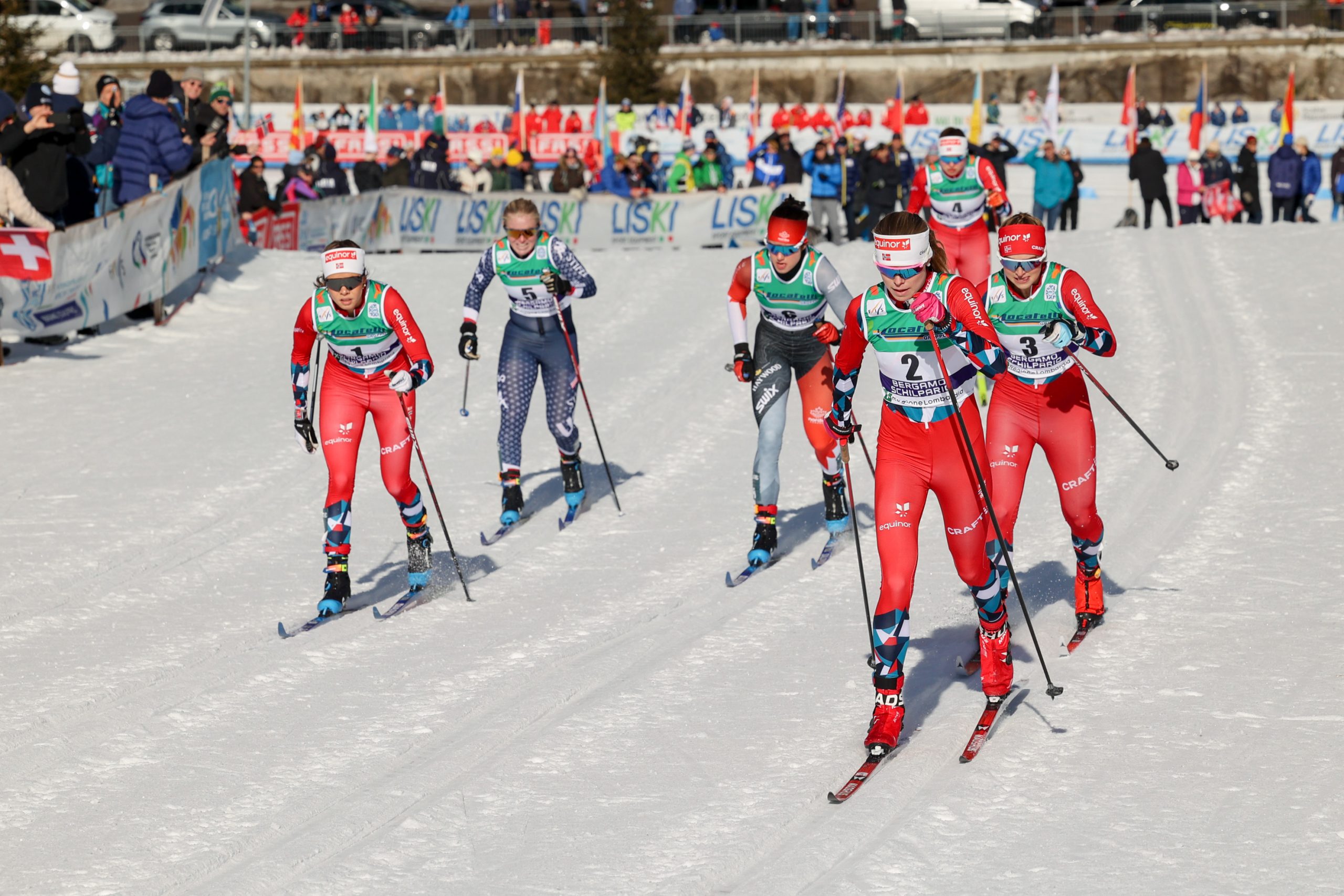
    Alison Mackie in bib 6 racing a classic sprint heat alongside Sammy Smith and four Norwegians.
    Mackie in bib 6 during the classic sprint at the 2025 Junior World Championships in Schilpario, where she finished fourth. Two bronze medals followed in the distance races. (Photo: Newspower.it)

    A Comeback in Schilpario

    “Yes, Junior World Championships in Schilpario were the main focus of my season that year,” Mackie said. “I trained specifically for that event to get my best shape there. But I wouldn’t say revenge, instead a kind of comeback because the year before in Planica I was pretty disappointed because I haven’t had the opportunity to race being sick.”

    On the Italian tracks she won bronze in the 20 k mass start classic, then bronze again two days later in the 10 k interval start skate. She was fourth in the classic sprint. They were the first junior world championship medals won by a Canadian woman since 1989.

    “I wanted a top five, and I finished with three top fours, including two medals,” she said. “The preparation we had put in proved to be correct, and I had a lot of confidence before starting the championships because I felt really good in the previous months leading up to my arrival in Italy.”
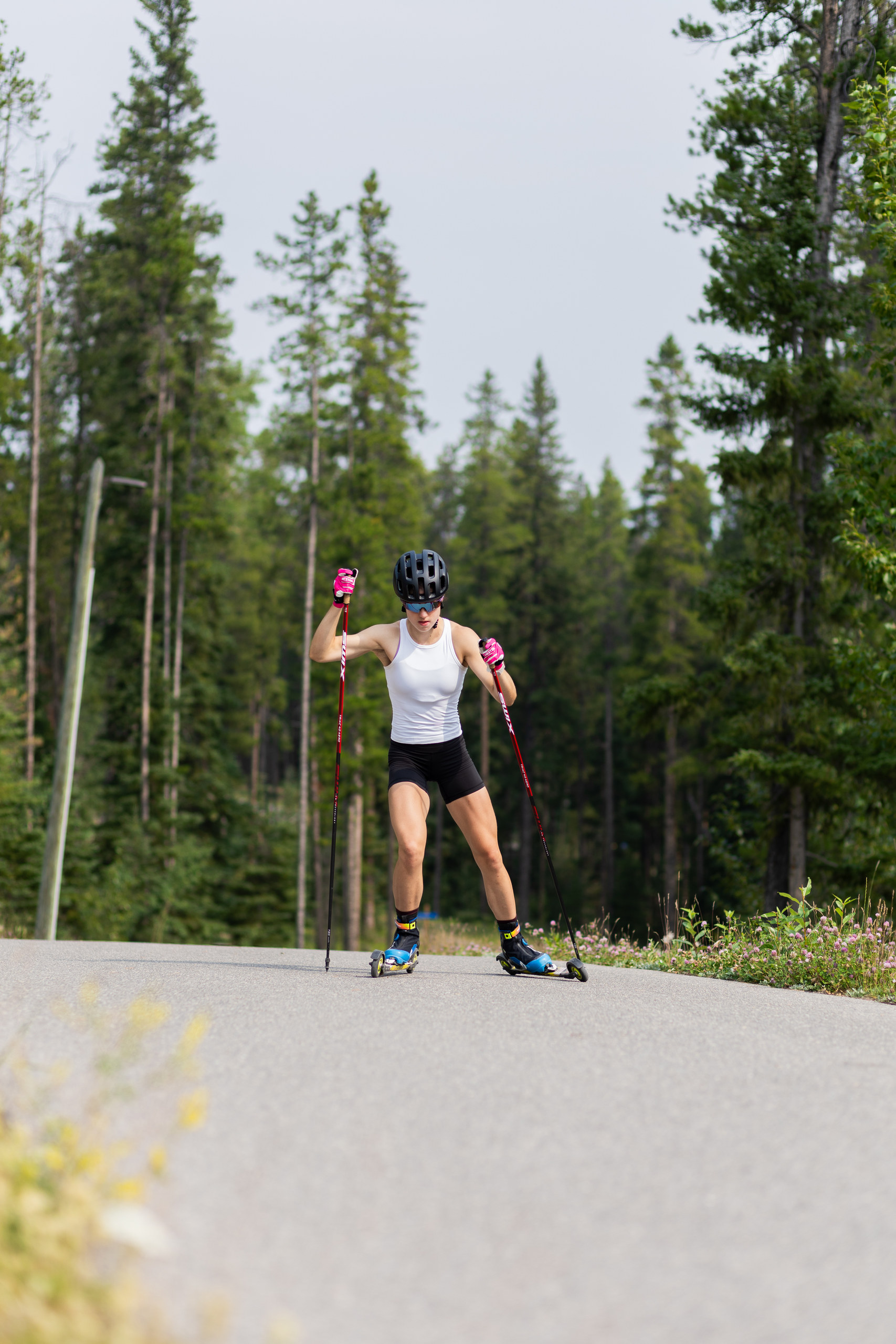
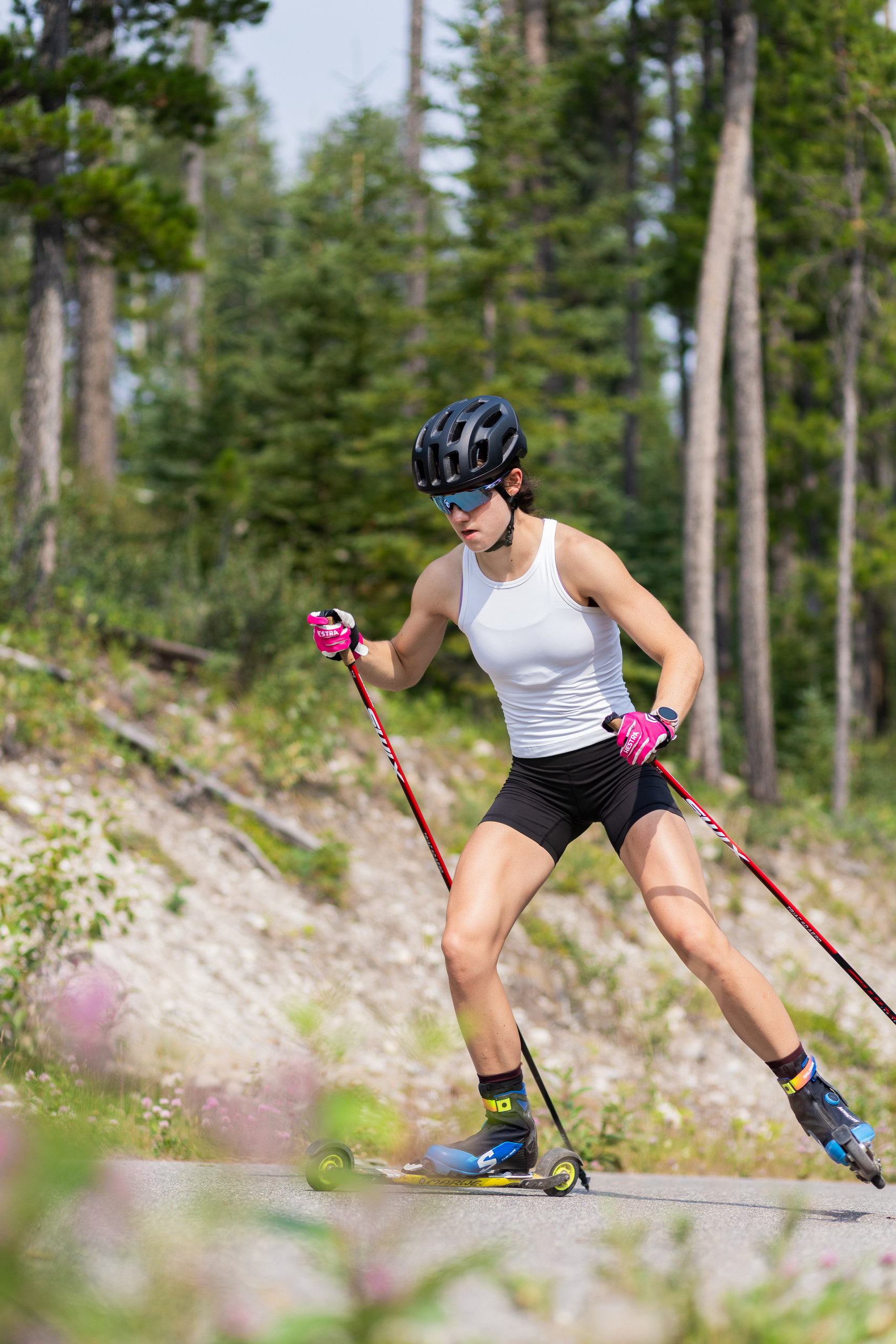
    Alison Mackie rollerskiing toward the camera on a paved road lined with evergreens.
    Mackie on a summer rollerski session in July. She started racing in Alberta as a teenager and won her first national title at 16. (Photo: Nathaniel Mah)

    Put on Skis Before She Could Walk

    Mackie was born in Montreal and raised in Edmonton, and she is 20 years old. Her mother, Jennifer, is a pediatrician. Her father, Andrew, is a pediatric cardiologist. Both of them ski, and both of them had her on skis before she has any memory of it.

    “My parents put me on ski as soon as I could walk,” she said. “So skiing accompanied all my childhood. Then I took real ski lessons and I started doing racing in my region of Alberta during my teenage times. That’s till Covid period arrived and with the restrictions I had nothing else to do others than training. But anyway, I really enjoyed myself during that period, developing my technique with my coaches at Edmonton ski club and when Covid finished my very first race that I won was our National title in March 2022 as a 16 year old.”

    Canada is known around the world as the home of ice hockey. Why did you choose cross-country skiing over hockey, freestyle, or swimming, following Summer McIntosh’s footsteps for example?

    “In parallel with cross-country skiing, I did a lot of other sports like cross-country track and field, rock climbing, mountain biking, swimming, soccer and in all of these sports I wasn’t as super competitive as I was in cross-country skiing. I did that only for fun as an opportunity to stay healthy during summer period. Cross-country skiing has been to me the only sport I competed at my best in my early ages and my favourite discipline. That’s why I chose it.”

    That first national title, won in Whistler in March 2022, is the race she keeps coming back to.

    “Yes, that race in Whistler BC was one of the first big races after the Covid pandemic,” she said. “I trained a lot during that period and didn’t have the opportunity to race and see my level, and when I went to my first National Championships and won the first race, it was a special moment and made me realize that I wanted to keep pursuing cross-country skiing for even better results and seeing how far I could get.”
    Alison Mackie racing the Olympic 10 k freestyle in Tesero, panned against a packed grandstand.
    Mackie racing to eighth in the Olympic 10 k freestyle in Tesero on Feb. 12, the best Olympic cross-country result by a Canadian woman. (Photo: Vanzetta/NordicFocus)

    Eighth at the Olympics

    The line has run one direction since. Two bronze medals at Junior Worlds. Her first World Cup top 10s, in Toblach and Val di Fiemme. Eighth in the 10 k free at the Milano Cortina Olympics in her first senior season. Gold in the 20 k mass start free at the U23 World Championships in Lillehammer in March. And at the end of that season, on 548 points, the FIS U23 overall World Cup title, the first won by a Canadian woman, with the finals held at Lake Placid.

    At the Milano Cortina Olympics you finished eighth in the 10 k free, after your first World Cup top 10s in Toblach and Val di Fiemme. What do you remember from those two weeks in Italy?

    “It was super cool being part of that multi sport event that the Olympic Games represent. It was my dream since I was a child watching Olympics on TV and having the opportunity to compete in high level in this huge event was really special to me. Definitely they have been long two weeks, also overwhelming at the time, but made me really happy how I performed overall and the 8th place I got in 10km skating has definitely been the highlight without any doubt. Entering the top 10 has been quite a surprise to me in that moment, because there were all the best skiers at the starting line. But now looking back at all the hard work I did during the whole season and the good results I got before that race in both World Cup and in under 23 World Championships, I wouldn’t say it was a huge surprise for me. Probably demanding Val di Fiemme’s track suited me very well, given that I finished as well 8th in Tour de Ski’s Cermis climb the month before.”

    What is the current situation in Canada for cross-country skiing, in terms of ski club membership, visibility in the national media, and financial support?

    “I would say the current cross-country skiing community in Canada is pretty small, if compared to other European power nations, but strong and with lots of passion in developing our discipline. There are a lot of young skiers coming up and I think it is very exciting for the great results to come in the future. Our National sports organization here in Canada are working really hard to make sure our National team can get all the support we need in order to achieve some World Cup podium with both boys and girls team during the seasons to come.”
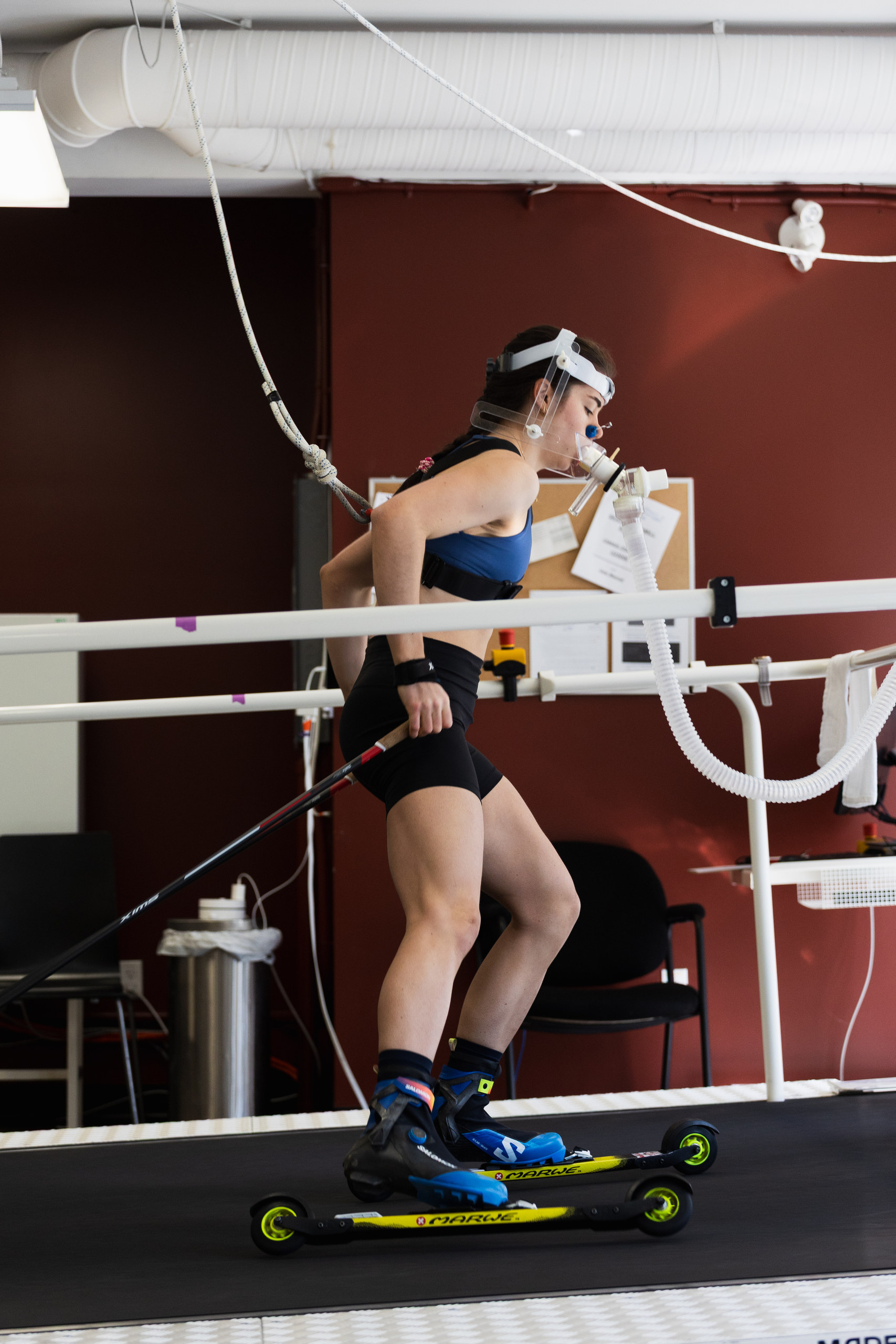
    Alison Mackie skate rollerskiing on a laboratory treadmill while wearing a metabolic mask.
    Mackie on the treadmill during a lab test in May. Distance racing is her strength, and finding speed is the summer’s assignment. (Photo: Nathaniel Mah)

    Distance Strength, Sprint Homework

    Describe yourself as a cross-country skier. What are your characteristics, your strengths, and the areas you are working on for the coming seasons?

    “I describe myself as a pretty strong skier in distance races, while I struggle a bit in sprint not to get through the top 30 and consequently not play the sprint finals, that is an element that I am working on in next seasons,” she said. “Between classic and skate I have found more success in free technique in the past seasons, but I enjoy training both classic and skate equally. Distance races are definitely my strength but I am working to improve my speed skiing as well so I could become a really strong overall skier in order, in the future, to fight for a higher overall spot in World Cup.”

    And the criticism you get from your coaches?

    “More than critics I would call special feedback from my coaches. Because sometimes I have a tendency to train too much and too hard that I need. That is something I am working on this summer, knowing when to push my body and when to give the correct time to rest and recover.”

    The World Cup calendar keeps skiers from outside Europe away from home for close to five months a season. How hard is that for you?

    “Personally I have spent on the road, following World Cup calendar, the past two seasons, but not the full European calendar. I really enjoy travelling and being on the road, so I don’t think it is a huge struggle for me. It is tough to not see friends and family for a long time but I am really lucky that I had friends and family came and watched me on tracks while I was in Europe a couple of time during season. Next season it will be quite different for me, because I am transitioning to attend the University of Utah so I will leave World Cup a bit because I do need to go to class and represent the University of Utah in North America as well.”
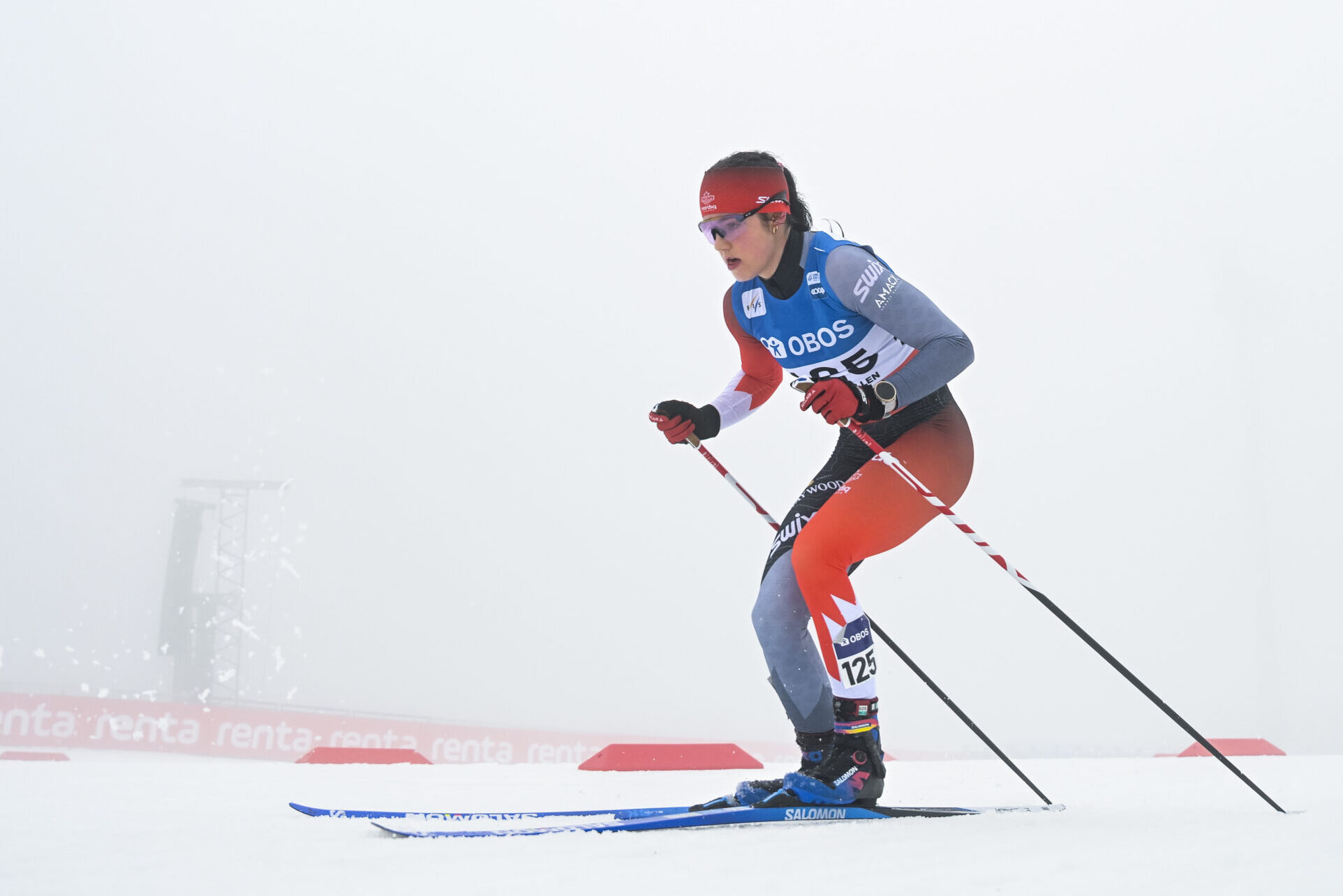
    Alison Mackie skiing in a Canadian race suit through fog at Holmenkollen.
    Mackie at the Holmenkollen World Cup in March, a week before the tour reached Lake Placid. (Photo: Authamayou/NordicFocus)

    A Winter Without Diggins

    The World Cup went to Minneapolis in the last two seasons, and Lake Placid hosted the finals in March in front of enormous crowds. Why not race in North America more often?

    “We do have actually Canmore scheduled for World Cup 2028, but realistically there are not so many resources for cross-country skiing in North America,” Mackie said. “It takes a lot of money and human power for the organization and preparation of those races. Of course, it will be amazing to have more opportunities to race in North America in the future but I have to be realistic and understand that organizing an event here in Canada, for example every four years, require lots of efforts and preparations from the local organization. Maybe we need more venues in North America that we currently have that are able to bring here World Cup events. I admit with huge pleasure that in the past seasons both Minneapolis and Lake Placid events showed how strong local communities are in terms of support and enthusiasm for cross-country skiing and those events have been a great boost for our discipline in North America, especially between young kids.”

    After fifteen seasons, this will be the first World Cup winter without Jessie Diggins, who clinched one more crystal globe in Lake Placid in March before retiring. Will she be missed outside the U.S. team as well? Did you ever get advice from her?

    “I definitely think Jessie’s presence will be missed in World Cup. Not only inside USA Team. I think she has always been a positive skier and a really amazing role model in so many ways. And 100% her presence, her ambitious way of racing and unique skiing spirit will be missed. That will definitely change some racing tactics as well. I had the opportunity to train together with Jessie in New Zealand last summer and it was a pretty cool experience and I wish all the best in her future.”
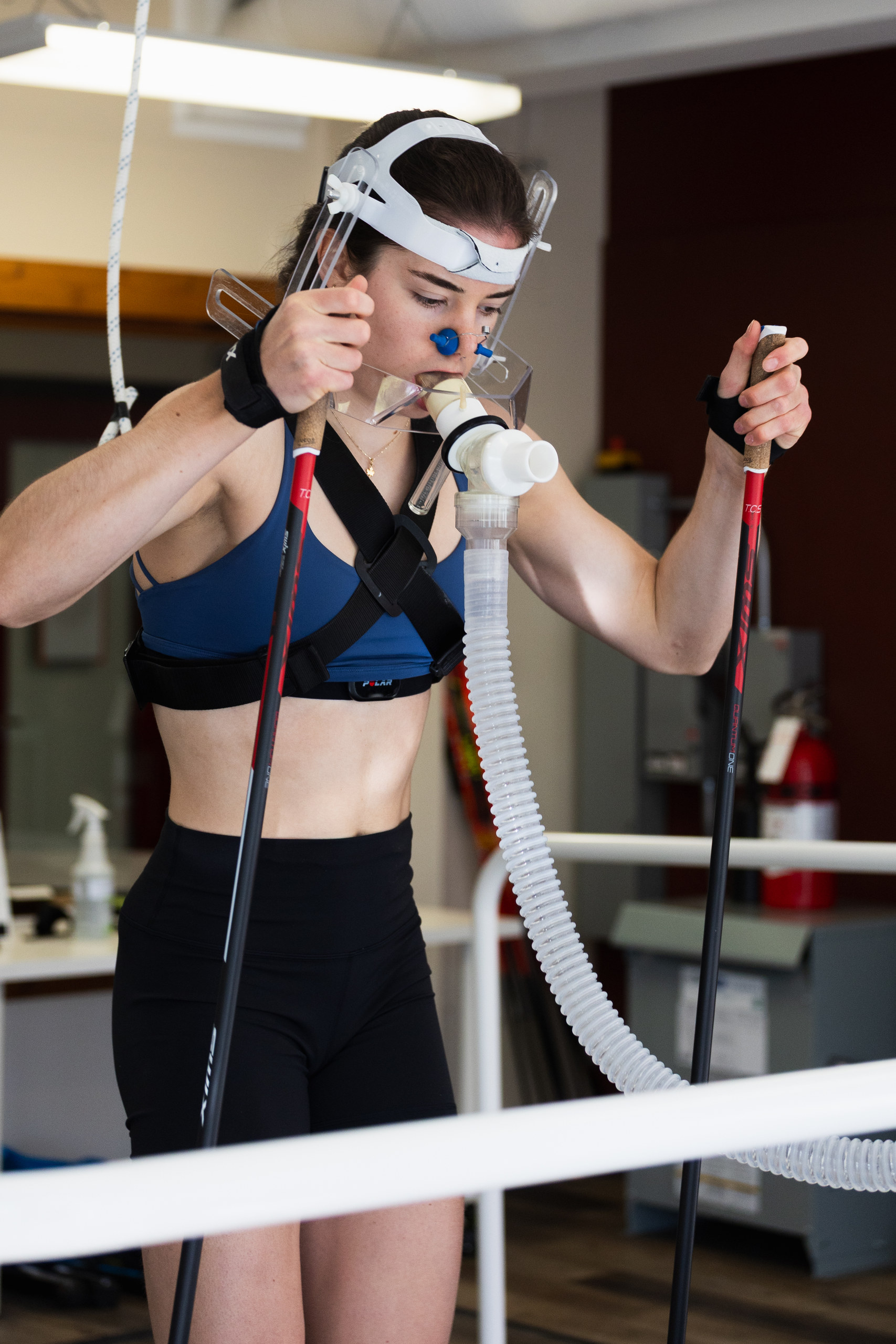
    Alison Mackie adjusting a metabolic testing mask while holding ski poles in a testing lab.
    Mackie fitting a metabolic mask before a treadmill test in May. She trains in Canmore and will study medical engineering at the University of Utah this year. (Photo: Nathaniel Mah)

    Canmore, Utah, and Life Off the Snow

    How is the Canadian team organized, and how is training divided between the women and the men at camps and at home?

    “I think Canadian skiing is gonna take a really exciting trajectory. I am really excited to work with our new Swedish coach Stefan Thomson over the next seasons but also in our group here in Canmore we have Norwegian Tormod Vatten as our assistant coach and with them we have a really strong support staff. For the Canadian National Team over the next seasons is going to be really exciting seeing where we all can go in World Cup and I am really proud to be part of this young but strong group of skiers that our Nordiq Canada are building now, under the [leadership] of former Olympic champion Beckie Scott and our amazing ski communities.”

    How do you manage your studies, at Queen’s University until last year and now at the University of Utah, with training and racing that run through most of the academic year?

    “I just make sure that I manage my schedule accordingly to have enough time for both my trainings and school throughout my day. I think having something other than skiing to focus on is really important for me. I was an online student at Queen’s University over the past two years and now I am transitioning to the University of Utah studying medical engineering. I think it is important the communication with the professors, making sure they know that my situation is a little bit different if compared to normal students, due to the fact that my training sessions, travels and races during winter season take my mind. But despite that my goal is to give my full focus during hours in classrooms too.”

    What kind of person are you away from cross-country skiing? Your personality, your interests, what you do on days off from training and racing?

    “Outside of cross-country skiing I am a pretty introvert person. I try to keep things on my own. I like studying and I really enjoy sewing clothes in my free time. I truly also love to learn new things and that is why I am excited to attend the University of Utah this year. I also love to spend time in the mountains nearby Edmonton where I grew up and in Canmore where I train myself with Alberta World Cup Academy and where I graduated in High school. Hiking, Mountain biking, running and skiing, of course, are my favourite activity when I can spend my time outside in the lush Canadian Nature.”

    In 10 to 15 years, at the end of your career, you will be proud of yourself if what?

    “I think, regardless of what I achieve in my future, I will be extremely proud of my career in addition to what I already accomplished. But really, my goal is just to ski because I love it and see where I can get of myself and also trying to inspire other young skiers. I think that there are a lot of young skiers in Canada right now, who have the potential to be amazing athletes. I really want to inspire them, showing them that anything is possible, it doesn’t matter what country you are from or how old you are. So regardless of what I achieve over the rest of my career I will always be proud of what I have already achieved.”

    Paolo Romanò is a freelance reporter based in Italy who covers cross-country skiing and Nordic combined.

    Help Support Our Coverage!

    If you value the thoughtful work and access FasterSkier provides, please consider becoming a Voluntary Subscriber. Your support directly fuels our work to cover the people, places, and moments that make our sport special.

    Join the FasterSkier community!
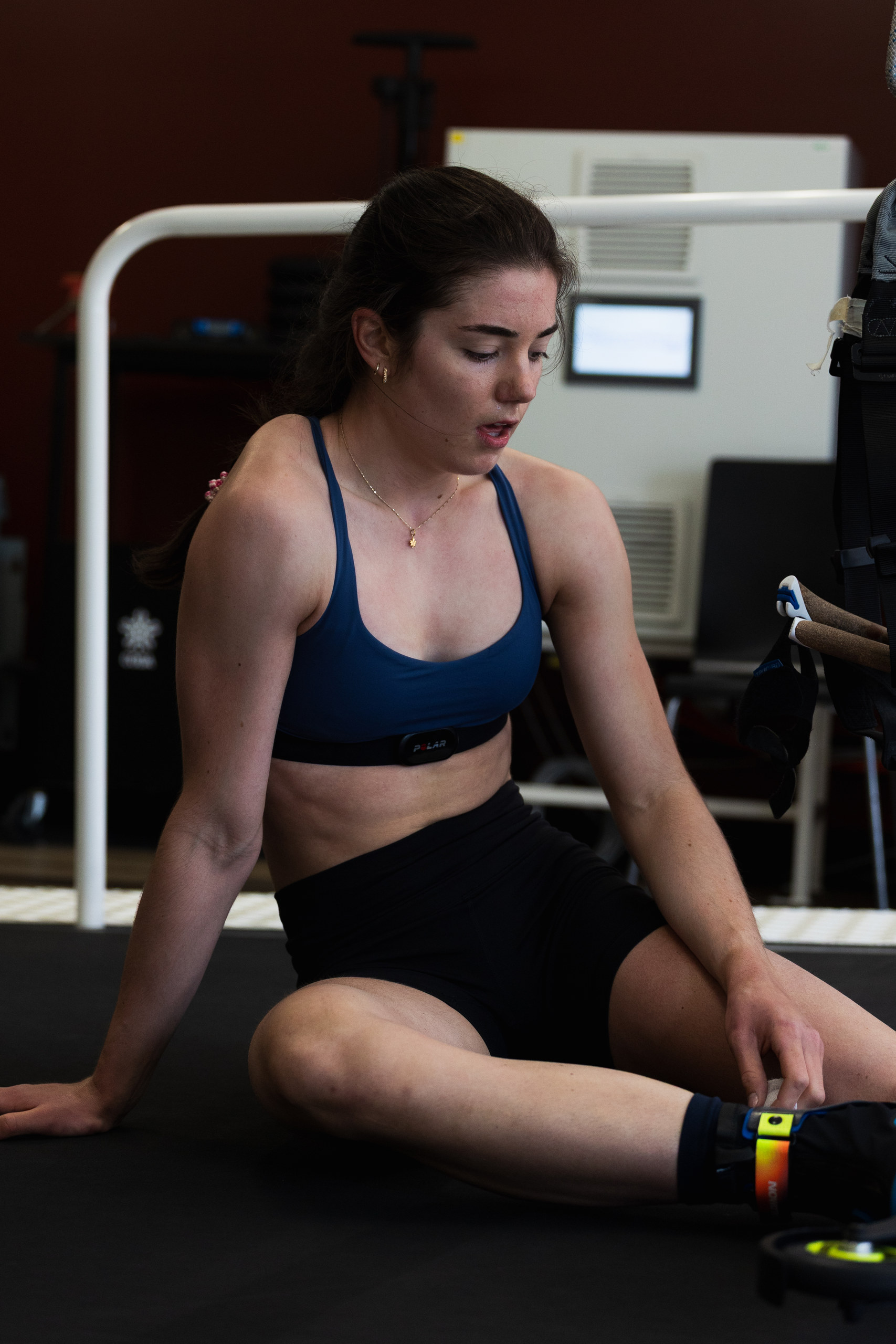
     

    Alison Mackie sitting on a laboratory floor catching her breath and unstrapping a sensor from her leg.
    Mackie catching her breath after a lab test in May. She races her first season for the University of Utah this winter. (Photo: Nathaniel Mah)
  • Canada Back at Tour de Ski

    Canada Back at Tour de Ski

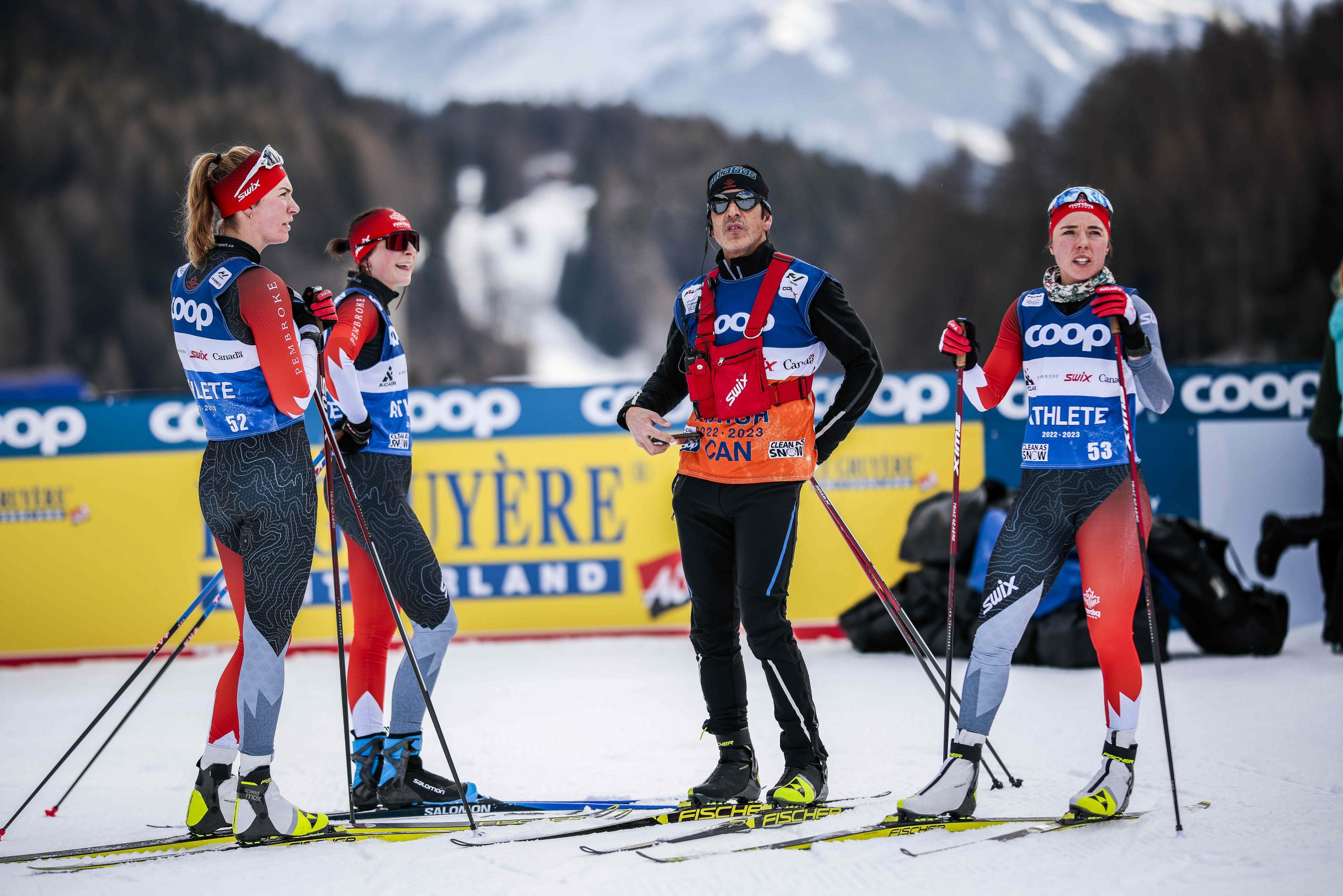
    Nordiq Canada is back at the 2023 Tour de Ski. L to R: Dahria Beatty, Liliane Gagnon, Robin McKeever, Katherine Stewart-Jones (Photo: NordicFocus)

    The world of skiing is changing and Canada is changing with it.

    This season, Canada has a new head coach and is hitting the Tour de Ski for the first time in four years.

    New head coach Robin McKeever is bringing nine athletes, five wax techs, an osteopath, a coach, and a wax truck to Val Mustair. This is less bodies than Norway’s wax team, but it is still a big commitment from a country that has traditionally brought smaller groups.

    “One, it’s not the same Tour de Ski that it used to be. Seven races in ten days versus a whole whack of them, and a lot shorter distance overall than what it used to be,” McKeever told FasterSkier during his Christmas break back home in Canmore.

    Devon Kershaw’s podcast has talked a lot about how much easier the current Tour de Ski is compared to the early days. It is now down to three venues, with only two short travel days that are also rest days, and the race days are much shorter. Gone are the days of Canada renting a rock star bus for Alex Harvey, Kershaw, Ivan Babikov, and Lenny Valjas so they could get massages while driving to the next venue. Gone are long races like 30km over the mountain pass from Cortina to Toblach, while the women raced the downhill half.

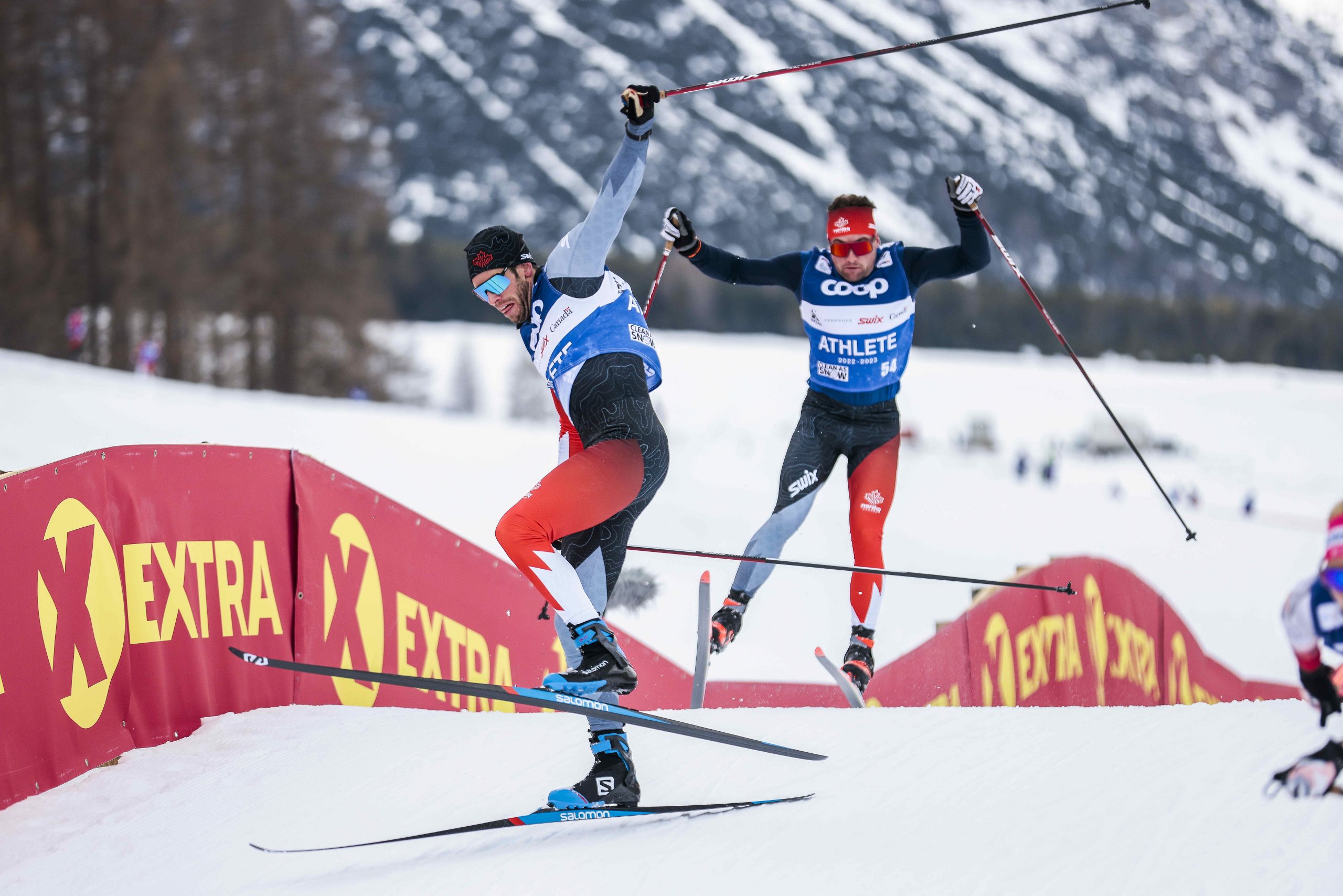
    Skiers like Russell Kennedy and Graham Ritchie (seen here “training” before Stage 1 of the 2023 Tour de Ski in Val Mustair, Switzerland) are bringing a whole new attitude—and a whole new level of potential to Nordiq Canada. (Photo: NordicFocus)

    McKeever’s second reason is the timing and the compact nature of the trip.

    “We have a lot of our top athletes in the NCAA program and the one time that they can potentially come and race and not miss that much school is this time.“

    Sam Hendry (U of Utah) and Rémi Drolet (Harvard) will take advantage of this for their first World Cup starts of the season.

    A possible third reason for Canada’s return to the Tour is cost.

    “It’s just expensive to compete against the best in the world and Norway showing up with two wax trucks,” McKeever said.

    While neither McKeever nor Nordiq Canada’s High Performance Director Chris Jeffries directly said that the trip cost to athletes and the National Ski Federation is lower than the trip cost of World Cup period 3, it is tempting to read between the lines of what they did say.

    McKeever: “We are not doing p3 unless we have red group qualified athletes, because we just don’t have the current funding levels to operate the entire year.”

    The free Thursday to Sunday accommodation and per-diem for red group athletes is a small thing to rich nations like Norway and Russia, but it is a game changer for Canada. And a game changer for athletes who have to pay trip fees. For a longer discussion on this topic, check out Kershaw’s podcast from the Davos weekend.

    Canada’s much-loved wax truck is distinctly smaller than either of Norway’s trucks, and was the Swedish truck until 2011. At that time, one Swede (name withheld to protect the guilty) said that this vehicle was ‘no longer useful’ at the World Cup level. It may not be ‘useful’, but it is hard to imagine producing competitive skis without the facilities it contains (vented wax benches, a grinder, ski storage).

    All nine Canadians will experience their first Tour de Ski: Dahria Beatty, Katherine Stewart-Jones, Liliane Gagnon, Antoine Cyr, Graham Ritchie, Olivier Léveillé, Russell Kennedy, Drolet, and Hendry. Six of these have a World Cup top 20 result on their palmares, while Hendry is getting his first World Cup start, and Gagnon got her first starts in Davos before Christmas.

    Long time ski fans will know McKeever from his athletes’ success as the head of Canada’s national Paranordic program, some skiers will remember his time as his younger brother’s guide, but you have to be Canadian to remember the junior who fought his way onto the National Team in 1990. Here is a teaser from an upcoming detailed look at Nordiq Canada’s direction.

    “My whole goal in coaching, and this was from my upbringing, is about not only trying to create Olympic champions, but it is about creating good people. And if we support the people for who they are, and how they are, and try to guide them through that, as well as get them to Olympic podiums, then I think we’re on the right track.” — McKeever

    Graham Ritchie on his way to qualifying 14th before finishing 21st on day one of the Tour de Ski. (Photo: NordicFocus)
  • The Devon Kershaw Show: Distract yourself with Drammen

    The Devon Kershaw Show: Distract yourself with Drammen

    There’s a war going on in Ukraine, and we touch on its impacts on the World Cup. But ski racing is also continuing, so we’re forging on, with respect for and acknowledgment of the tragedy that’s unfolding in Europe. For a few hours at least, on Thursday, the classic Drammen city sprint provided one heck of a distraction, and Devon and Nat are back to break down some performances for the ages by Norway’s Maiken Caspersen Falla, the French men and China’s Wang Qiang.

    You can email us at devon@fasterskier.com and nat@fasterskier.com. We’re still hoping to catch up with an Olympic mailbag episode soon once things settle down.

    Rosie Brennan leads her quarterfinal during Drammen’s classic sprint. (Photo: NordicFocus)
  • After a week of upheavals, the World Cup sprint show goes on in Drammen; France’s Jouve wins, while China gets its first podium

    After a week of upheavals, the World Cup sprint show goes on in Drammen; France’s Jouve wins, while China gets its first podium

    This World Cup coverage is made possible through the generous support of Marty and Kathy Hall and the A Hall Mark of Excellence Award.  To learn more about A Hall Mark of Excellence Award or to learn how you can support FasterSkier’s coverage please contact info@fasterskier.com.


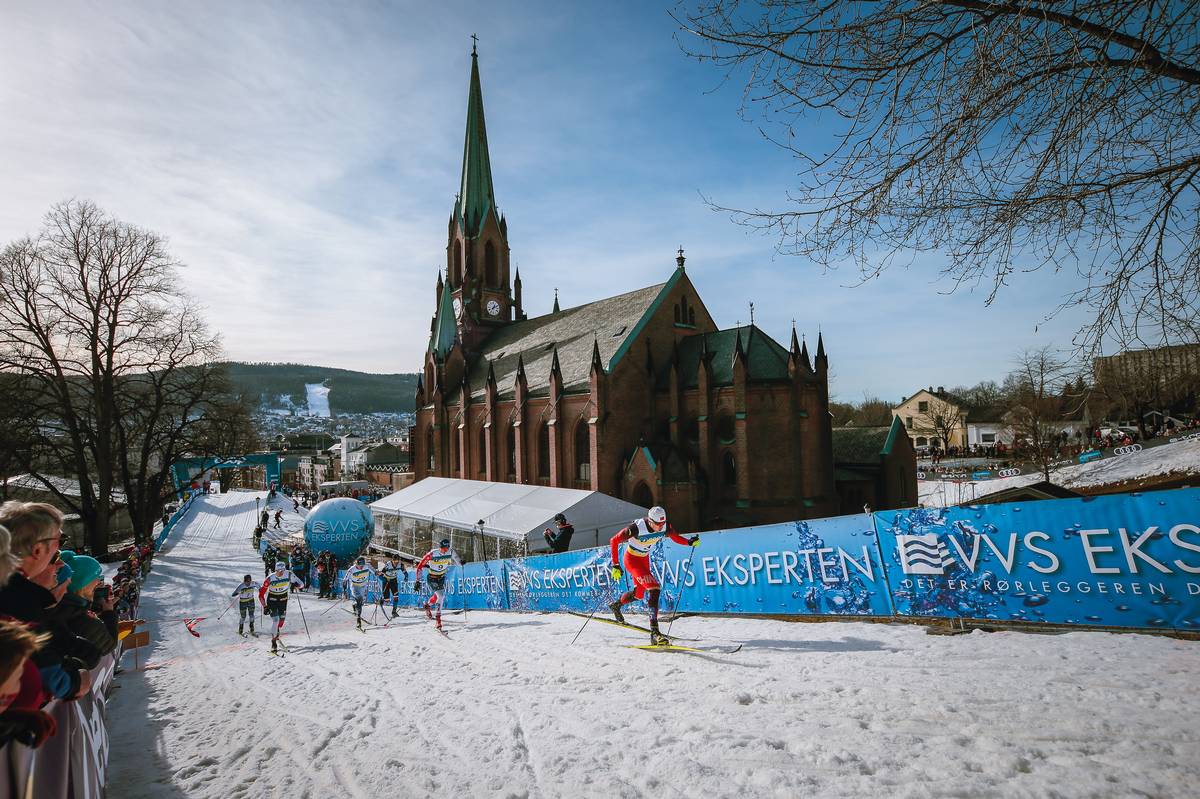
    Cross country skiing’s most ancient, classic, weekend of racing in Norway (the Holmenkollen ski festival) began with a sprint through the center of Drammen, about 45-kilometers (30 mi) south of Oslo, and despite its best efforts, got caught up in these confounding and confusing times.

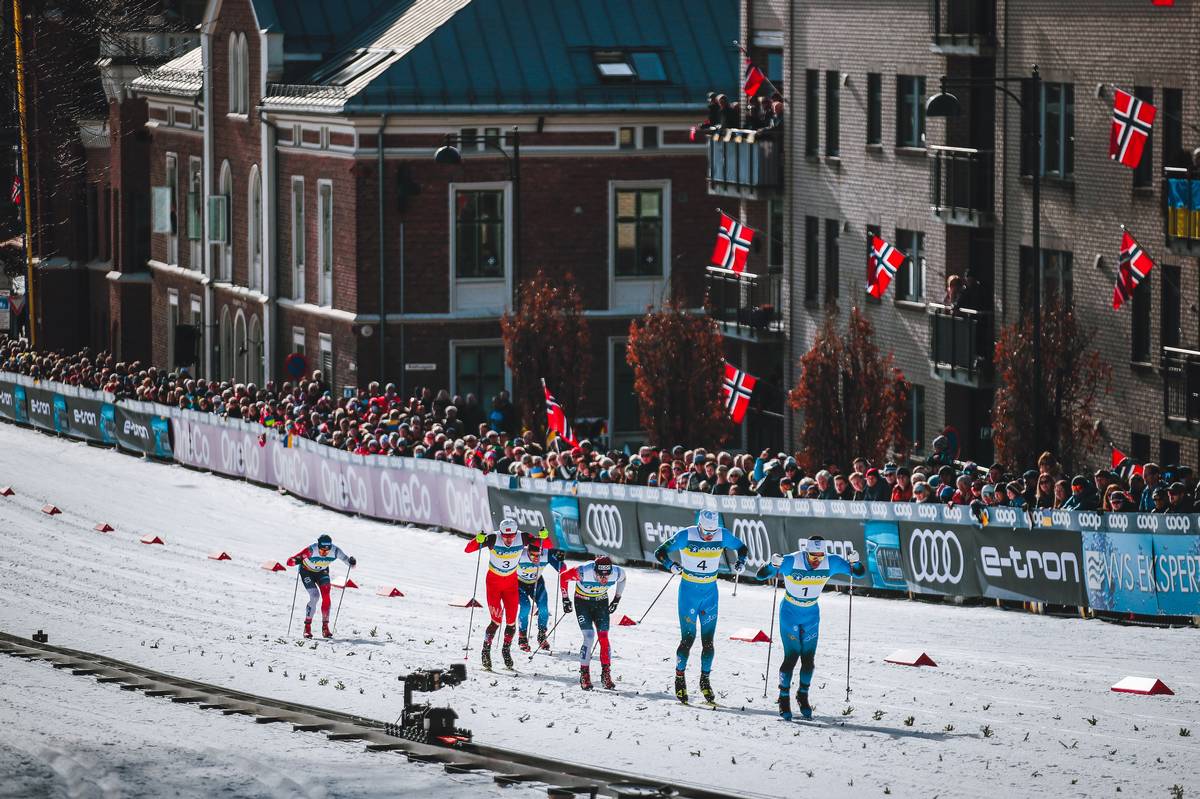
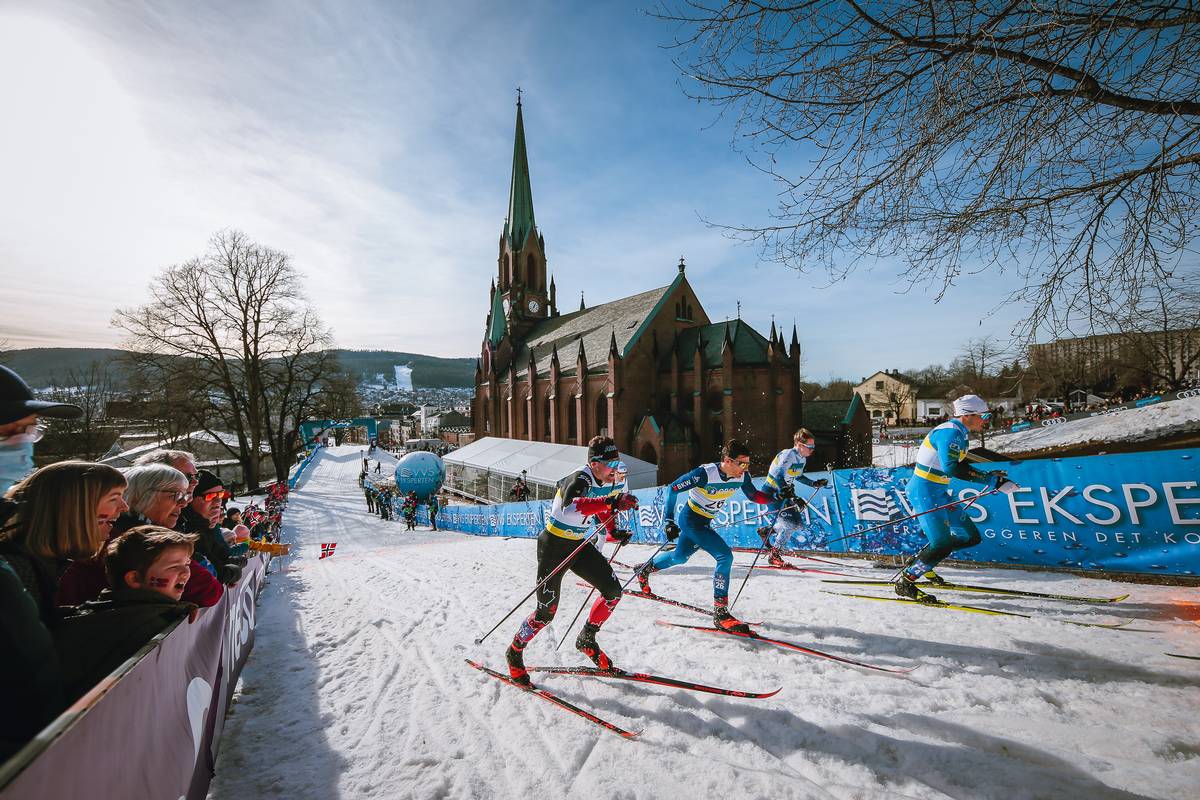
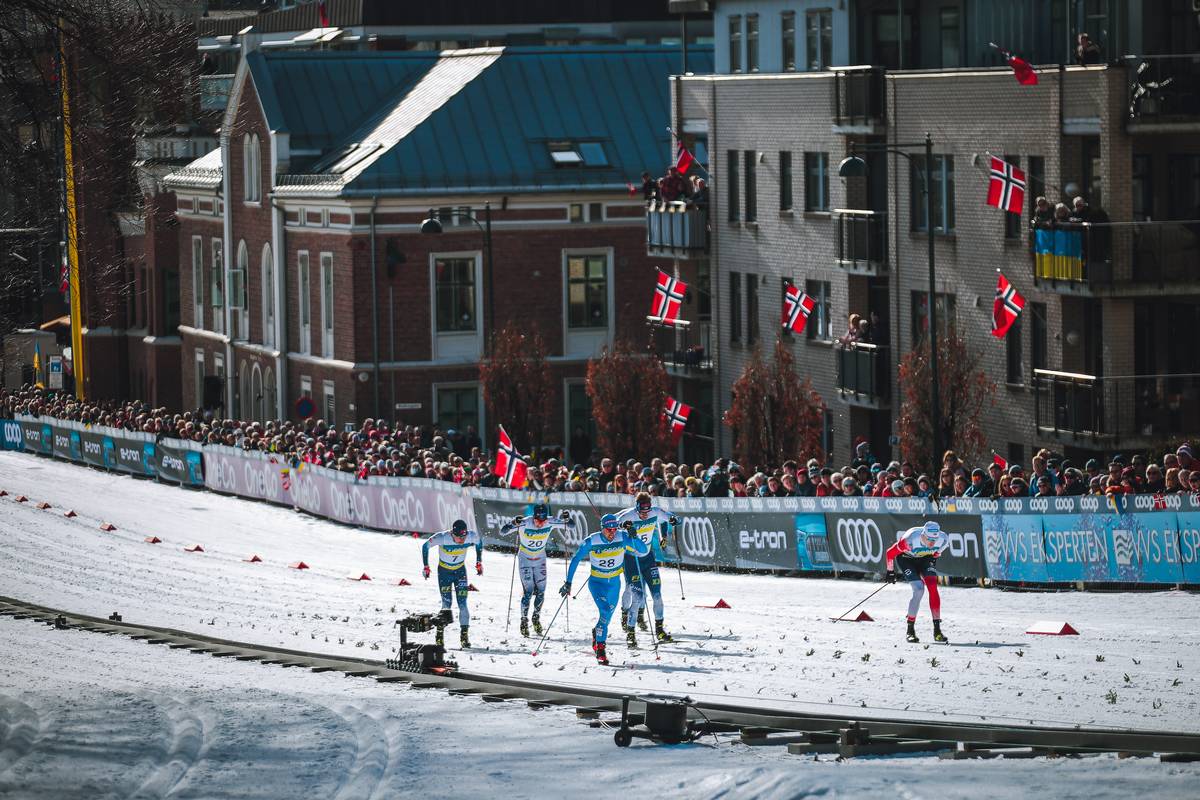
    If you didn’t focus in completely, the scenes in Drammen looked pleasantly familiar in a way that could keep you in the timeless state of mind associated with Holmenkollen. It was reassuringly nice to see sprint racing return, after two years, to the type of venue that led to its exciting, spectator-friendly, rise in the first place. A genuine town-center sprint, trucked in artificial snow and all, with a genuine (and very enthusiastic) crowd.

    Graham Ritchie (CAN) races in the second heat of the classic sprint quarterfinals in Drammen, NOR. (Photo: NordicFocus)

    Bring some focus into the racing though, particularly who was in the men’s field day, and you couldn’t help but see the upheaving forces of the moment doing their upheaving. COVID still had a heavy-hand in the field today, with the entire Norwegian men’s sprint team (who had raced in Lahti last weekend), including Johannes Høsflot Klæbo, having recently tested positive. Then, there was the FIS imposed ban on Russian and Belarusian athletes, which also went into effect this week in response to their government’s invasion of Ukraine. In all, 7 of the top 10 in the FIS Sprint Points Classification were absent from the field in Drammen. There was a spectral quality, something eerie, to just how much world events have managed to find and catch the quiet corner of nordic skiing in the past couple of weeks.

    For their part, the FIS decked out Drammen in blue and yellow in a sign of solidarity with Ukraine. From bibs, to fencing boards, to the souvenir flags held in the crowd. Idealists will note the poignant gesture, especially in a country where, in a friendlier geopolitical sense, blue and yellow are the colors of neighbor and rival, Sweden. Regardless, it was a stunning way for the FIS to symbolize the implied meaning surrounding the policies they implemented surrounding Russia this week. Cynics, on the other hand, could also read it as the FIS trying to stave off some of the pointed criticism that’s been directed at larger international sport’s governing bodies like UEFA, FIFA, and the IOC surrounding their handling of Russia.

    Logan Hanneman skis to 50th during the classic sprint qualifier in Drammen, NOR. (Photo: NordicFocus)

    No matter the forces affecting skiing, the fact remained that there was skiing to be had. And without Norway’s top squad and Russia, it brought out the interesting prospect of watching racers who have navigated tactically around them to podium finishes all season – Richard Jouve (FRA), Lucas Chanavat (FRA), Federico Pellegrino (ITA), and Joni Mæki (FIN) among them – now represent the top of the field themselves.

    In the qualifier, it was Jouve who took first place by an impressive margin, finishing in a time of 2:26.35, -2.07 sec over second place Ondrej Cerny (CZE). Following up on an impressive Olympic sprint in his home country, Chinese skier Wang Qiang took 3rd place (+2.66). Among North American athletes, the Canadian men had an impressive showing, sending three to the heats with Graham Ritchie qualifying 13th (+5.91), Antoine Cyr in 19th (+6.42), and Pierre Grall-Johnson 23rd (+6.85).

    Antoine Cyr (CAN) races to 19th in qualification in Drammen. (Photo: NordicFocus)
    Sun Valley’s Peter Holmes races the classic sprint qualifier in Drammen, NOR. (Photo: NordicFocus)

    The American men were just outside the top-30 mark necessary to race the quarterfinals, with Kevin Bolger just +0.7 off the last spot in 35th (+8.90), Logan Diekmann 39th (+9.40), Logan Hanneman in 50th (+11.19), Peter Holmes in 53rd (+12.05), and Zak Ketterson in 54th (+12.26).

    The heats then, were filled with a motley mix of familiar sprint stars and younger talent from the home country Norway.

    The course they raced was a classic town center sprint – a long gradual stretch going out from the start that narrowed as they hit two technique-zoned uphills leading into a hairpin. From there, it was a gradual downhill into another tight hairpin that opened up to a 4-track wide sprint finishing straight that allowed the best sprinters to open up and hit top speed.

    Despite his absence, Klæbo’s tactical maneuvering and push-and-pull with pace was still felt throughout the race. Richard Jouve raced out of the first quarterfinal, and the typically aggressive Frenchmen held steady at the front of the pack, before shooting around the first hairpin turn that returned to the stadium. From there, he held control of the race to advance comfortably to the semi-finals and win the heat (2:32.98). He was followed by Sivert Wiig (NOR) in 2nd (+0.61), who would escape a tangle earlier in the race that saw Canadian Pierre Grall-Johnson fall and break a pole.

    Canada’s Pierre Grall-Johnson (CAN) races the quarterfinal of Drammen’s classic sprint. (Photo: NordicFocus)

    The exception to the relative care in pacing that many of the racers showed in the quarterfinals came in the third heat, where Wang Qiang from China shot out of the gate and went full bore throughout the race. By the time they hit the first technique zone, he had a comfortable gap on his competitors, who wouldn’t come back to him. In the process of taking the field out fast, Qiang had also made it by far the fastest quarterfinal at a winning time of 2:30.94. Second place Lauri Vuorinen (FIN) (+0.72), third place Pål Trøan Aune (NOR) (+0.99), and fourth place Harlad Østberg Amundsen (NOR) (+1.08) all advanced to the semi-final with two lucky losers coming out of the heat.

    Wang Qiang (CHN) is off the front during the men’s quarterfinals in Drammen. (Photo: NordicFocus)

    The 4th heat saw Joni Mæki (FIN) and Federico Pellegrino (ITA) follow early moves from Renaud Jay (FRA) and Ludek Seller (CZE) before reminding observers of their well-earned reputations as two of the best top-end speed racers in a finishing straight. Mæki advanced in first place (2:34.44), with Pellegrino in second (+0.62).

    The semi-finals brought a similar field to the one that had advanced to the quarterfinals, with the familiar names of Richard Jouve and Lucas Chanavat joined by the young Norwegian pairing of Wiig and Amundsen, Swiss skier Jovian Hediger, and Wang Qiang.

    Qiang again attacked from the start, with a lesser, but still commanding, gap established by the time he hit the first corner to head back towards the stadium. Jouve was the only skier that covered the gap off of that corner, and was able to pull along his countryman and Wiig with him before they all came together for the final sprint. There, the Frenchmen both showed their sprinting prowess, with Jouve winning the heat in 2:31.94 and Chanavat in 2nd (+0.74). Qiang’s early attack again proved to shape the field beyond his own racing, again making sure that both lucky losers, he and Wiig, came from the first semi-final.

    Qiang’s attempts to force a semi-final with two lucky losers was aided by the way that the second semi-final raced, starting out at a steady pace before halting to a crawl around the first corner. George Ersson (SWE) got caught in front before Federico Pellegrino took charge on the downhill going into the stadium. By the time he rounded the corner into the finishing straight, he was in control of an otherwise tight pack. Pellegrino crossed the line in first (2:42.16) to advance to the finals, along with Norway’s Aune, who finished second (+0.16).

    Federico Pellegrino (ITA) and Pål Trøan Aune (NOR) lead in the final stretch during the men’s semifinal in Drammen, NOR. (Photo: NordicFocus)

    That set up a final with French pairing of Richard Jouve and Lucas Chanavat, the Norwegian pairing of Sivert Wiig and Pål Trøan Aune, Italian Federico Pellegrino, and Chinese Wang Qianq.

    Qiang was subdued in the final compared to his previous heats, but then again, Richard Jouve had also stepped up the pace earlier in the final. The result was a tight pack with Jouve and Qiang at the front, with a quick but controlled pace through the early two climbs on course. Jouve took the pack into the first corner, and it was there, again emulating the absent Klæbo, where he chose to shoot around, concealing his burst of speed from the back part of the pack so that by the time they knew they needed to respond Jouve was already well on his way down the long descent.

    Men’s final led out by the French pairing of Richard Jouve and Lucas Chanavat in Drammen on Thursday. (Photo: NordicFocus)

    Their positioning in second and third, respectively, allowed Wang Qiang and Lucas Chanavat to try and match Jouve’s move, but as the pack hit the final stretch it became clear that Jouve hadn’t just made a move, he had made a move and followed it up with a burst of speed that left him peerless on the day.

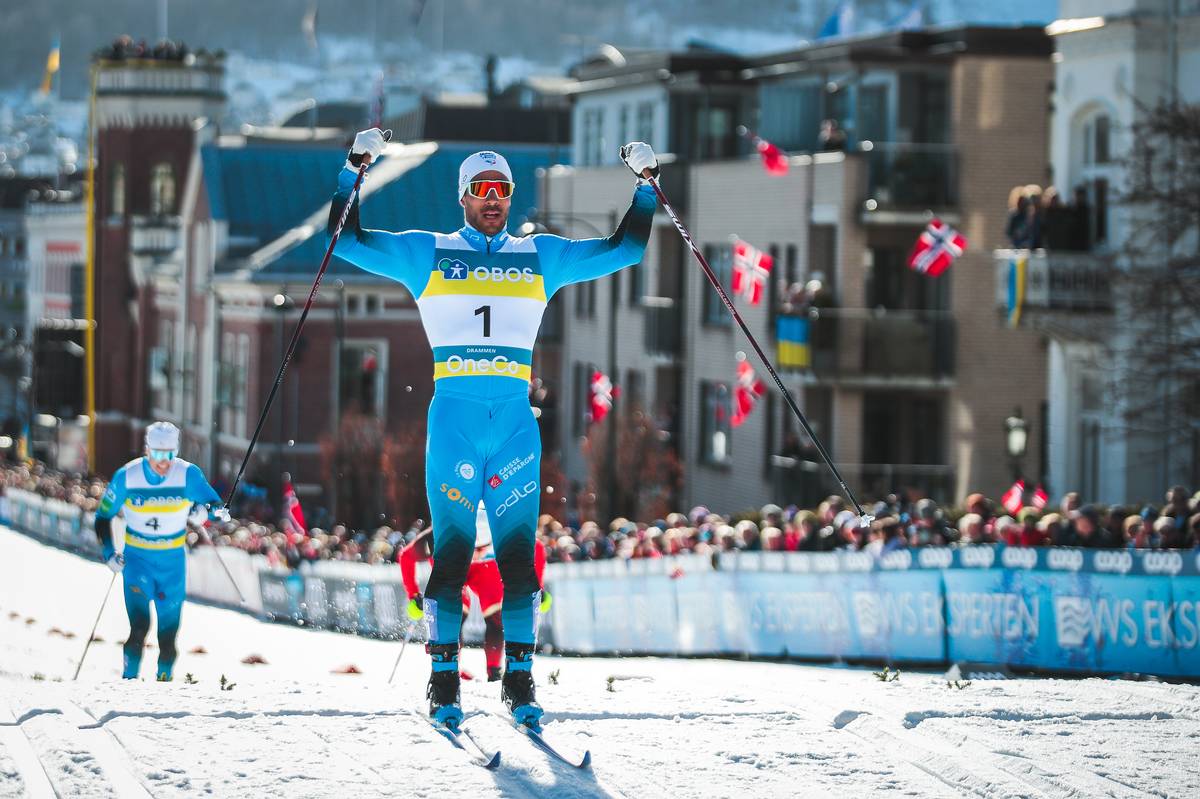
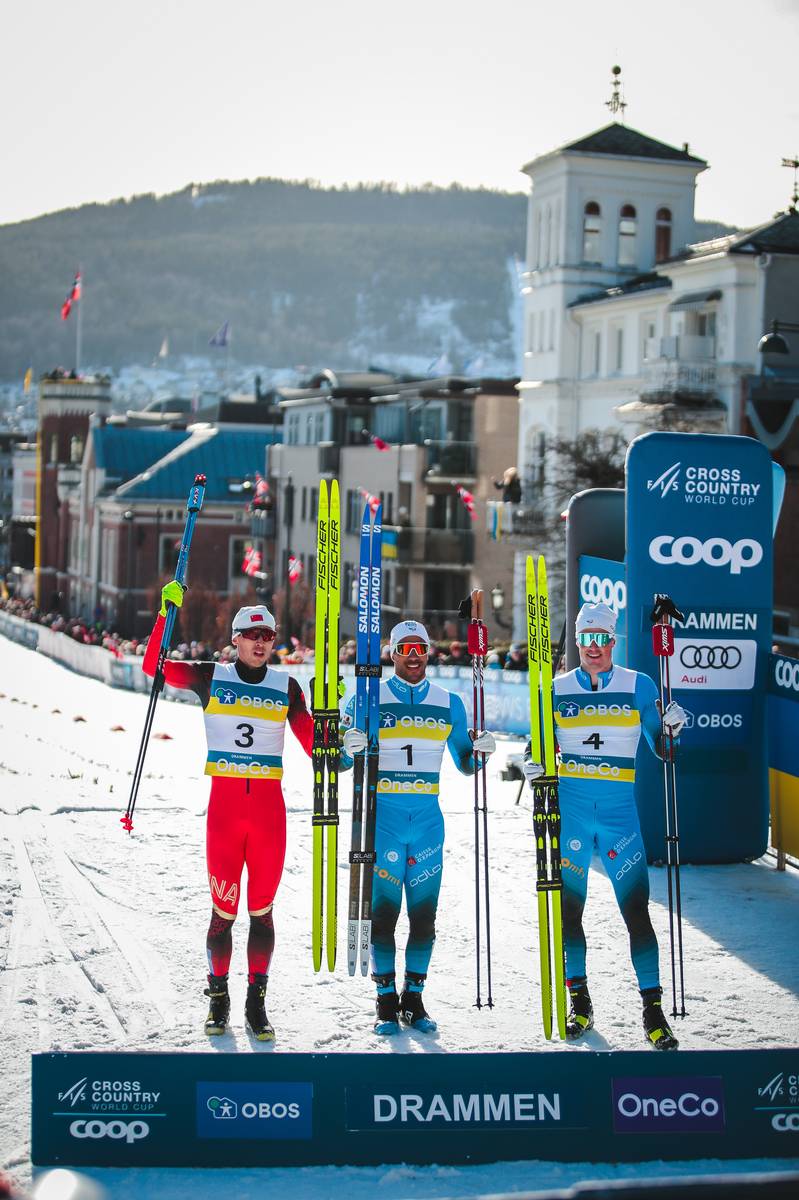
    Jouve crossed the line comfortably in first (2:32.84), with a lightly-packed sprint for the podium behind him.

    Richard Jouve takes the win in Drammen. (Photo: NordicFocus)
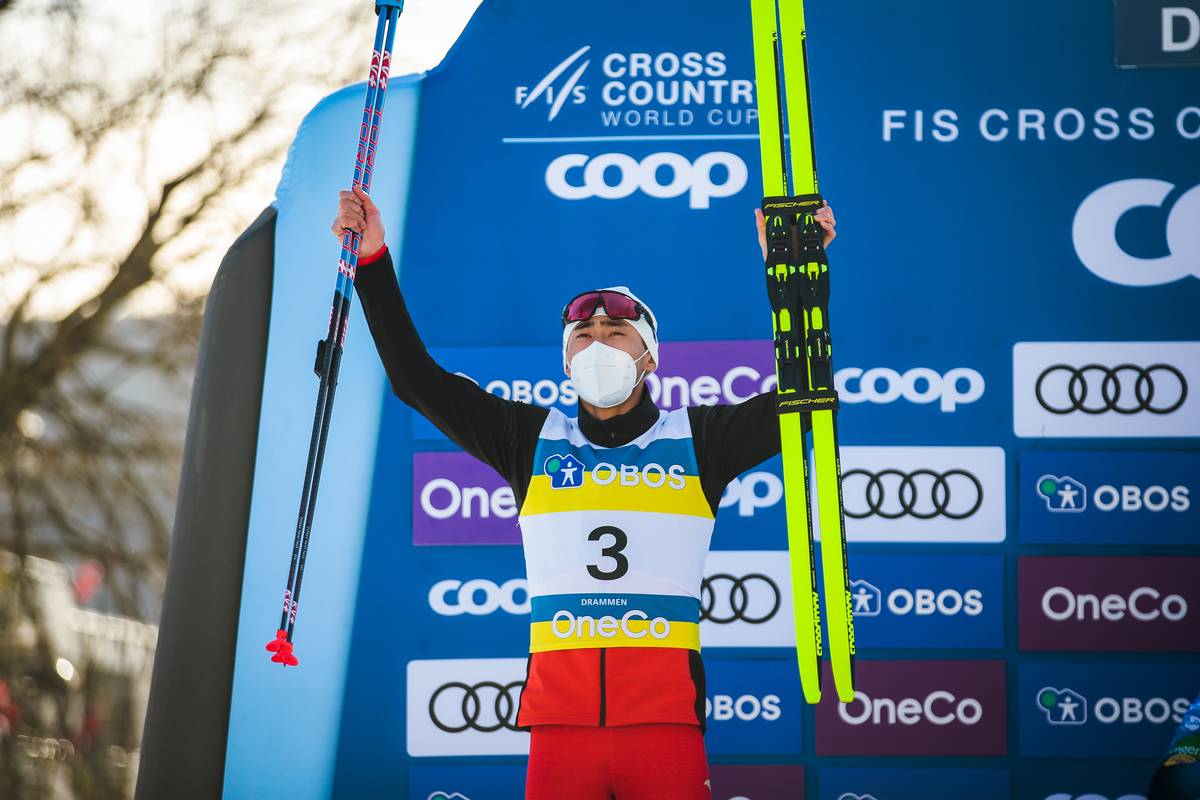
    Wang Qiang became the first Chinese athlete to podium in a World Cup, finishing 2nd in the classic sprint in Drammen. (Photo: NordicFocus)

    Leading that, after having shown tenacity and panache all day, was the Chinese skier Qiang Wang, who crossed the line in second (+1.59), with poles raised and a shout that stood at the end of a half-decade journey for his country. China, weeks off of having hosted the Olympic games, has earned a World Cup podium in nordic skiing, with Wang showing real promise for what may come from that country’s program.

    Lucas Chanavat crossed the line in third (+2.32) to round out the top 3, while Sivert Wiig finished in fourth (+3.14), Federico Pellegrino in fifth (+5.34) and Pål Trøan Aune in sixth (+11.25).

    Richard Jouve (FRA) takes the win in Drammen, NOR, with a first podium for China’s Wang Qiang, who took second ahead of Lucas Chanavat (FRA) in third. (Photo: NordicFocus)

    It was an appropriate podium for a particular moment in skiing where the world’s motion on all scales has upended the familiar rituals that come with the final stretch of the World Cup that Holmenkollen traditionally marks the beginning of. The world’s best skier out in quarantine, his closest competitors removed from the competition, and the schedule for the last month of the season in flux as we enter it.

    At once, we saw something familiar – Richard Jouve with a commanding performance alongside his countrymen – and something wholly new – a Chinese skier not only at a European World Cup race, but at the front. A strange, but moving race, for a strange and moving time.

    Once the final results were determined, Antoine Cyr led the Canadians in 19th after finishing fourth in quarterfinal four. His Olympic team sprint partner, Graham Ritchie, was next for Canada in 21st, with Pierre Grall-Johnson 27th.

    Full Results

    Qualifiers | Finals

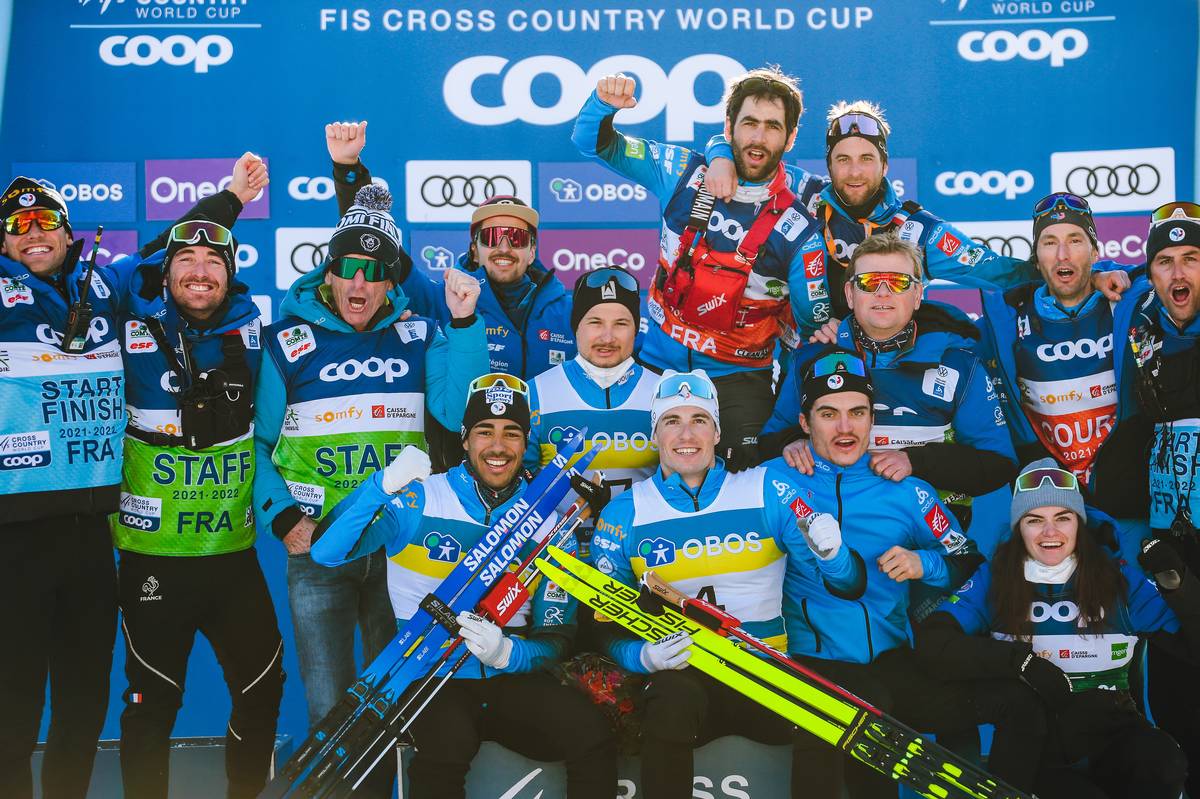
    French Team celebrates a podium fronted (Richard Jouve- 1st) and backed (Lucas Chanavat – 3rd) by their countrymen. (Photo: NordicFocus)
  • Settled in Canmore and Making Gains: Katherine Stewart-Jones

    Settled in Canmore and Making Gains: Katherine Stewart-Jones

    Katherine Stewart-Jones Trondheim, Norway during the Ski Tour 2020’s classic sprint qualifier. (Photo: NordicFocus)

    Win now? Win later? Or somewhere in between?

    A one year plan with a World Champs looming in 2021 or something befitting a six-year plan for capturing hardware at the 2026 Winter Games in Italy? Those are the strategies in play as national teams set budgets, rosters, and priorities. For countries like Norway and Sweden – at least on the Swedish women’s side – win now and later seems to be the constant background noise. For other nations like the U.S. and Canada, with smaller pools of championship medal pedigree, planning for the short, near, and long-term can be like juggling four different objects all of different masses. There’s almost too much to coordinate.

    Nordiq Canada made it explicit: medal potential at the 2026 Games was the end goal. With a solid second-place finish in the junior men’s 4 x 5 k relay at the 2020 Junior Worlds, Canada may be primed for a delayed gratification epiphany six years out. But translating that 2020 success, with a young corps of skiers, does not necessarily translate to World Champs or Olympic hardware. 

    When Katherine Stewart-Jones was initially not renamed to the 2020-2021 Canadian National Team, the news came as a thud to many Canadians following the sport. At twenty-five-years-old, Stewart-Jones doesn’t exactly trend towards ancient in ski racing terms. This season, she placed 29th overall, the fourth-best placed North American behind Jessie Diggins, Sadie Maubet Bjornsen, and Rosie Brennan (all of the U.S.) in the Ski Tour 2020. That series of six races split between Sweden and Norway featured a loaded field. A 29th overall was real. It was Stewart-Jones’s best World Cup result since her first World Cup race in Planica, Slovenia in 2016. 

    In Canada, skiers must qualify for each respective period of the World Cup. In years past, Stewart-Jones earned World Cup race starts after solid results on the NorAm circuit as the Continental Cup leader. Just this season, of the six NorAm races she contested, she won a 10 k classic, a 5 k skate, and a classic sprint. In her other three races, she was top Canadian at a NorAm/SuperTour weekend: Second in a skate sprint, third in a 5 k classic, and third in 10 k skate.

    She punched her ticket to Europe as the COC leader and guaranteed funding.

    Katherine Stewart-Jones of Canada skiing to 31st in the Oberstdorf, Germany 15 k skiathlon. (Photo: NordicFocus)

    Stewart-Jones skied for Thunder Bay NTDC for four seasons. Last spring, she relocated to Canmore with Erik Bråten as her only coach. She still represents Nakkertok, her home club, but does not belong to a training centre.

    Despite making career-best marks on the World Cup, she failed to meet the national team’s objective criteria: she needed to place in the top-20 twice on the World Cup, or a single top-12, or earn at least 22 World Cup Points. She fell short. The team selection criteria did not allow athletes born in 1995 (her birth year) or earlier to be discretioned.

    “I think it is important to support the top as well as the people that are coming up,” Stewart-Jones said. “I think most people would agree with that. It is a tough situation to be in.” 

    The national team skews young, with the oldest athlete on the senior team, Dahria Beatty, at 26, and the average age roughly 22.

    Nordiq Canada provides a national team selection appeals process that Stewart-Jones took advantage of. When the appeal was filed, a three-person panel approved by both Stewart-Jones and Nordiq Canada considered the case. The panel ruled in favor of Stewart-Jones, declaring that her 9th place time of day during the Ski Tour 2020’s 10 k classic pursuit counted towards the criteria. She was renominated to the 2020-2021 national team. (The original criteria did not specify time of day as a consideration for overall place.) 

    “I have had a lot of people ask me if the fact that you didn’t get renamed to the national team in the first place, is that extra motivation to race fast? And I don’t get that,” said Stewart-Jones. “To me, it would never be a motivation, because I am doing it because I really just want to be the best in the world and that is why I have done this for the last however many years. So, when it comes down to it, what motivates me is just improving and there is just always always always something to improve on. Which is what makes skiing so fun to me.”

    National team selection was critical for Stewart-Jones to maintain funding. As a member of the national team, she would be “carded”, and receive financial support from the government’s Athlete Assistance Program (AAP). For Stewart-Jones, the AAP helped offset the majority of her ski racing costs for the past five years.

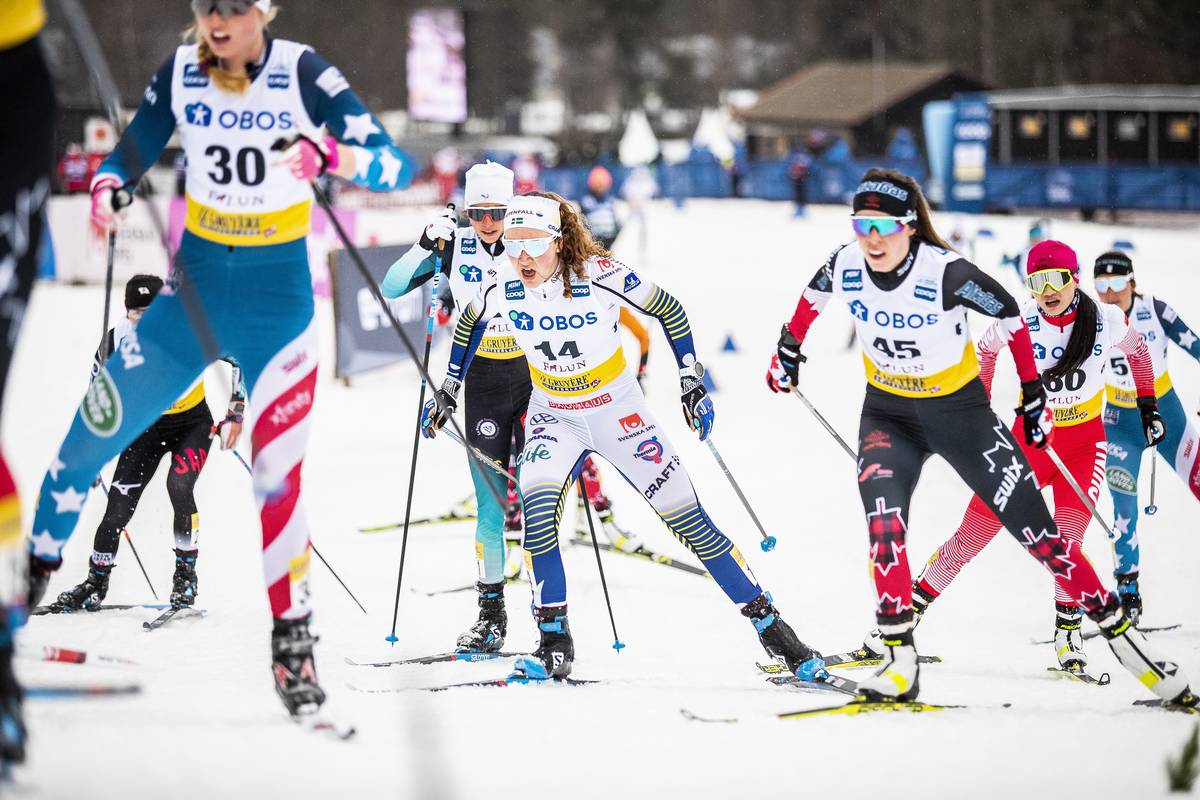
    Moa Lundgren of Sweden (bib 14), and Katherine Stewart-Jones of Canada (bib 45), during the 10km women mass start skate in Falun, Sweden. (Photo: NordicFocus)

    Coming into last season, Stewart-Jones understood meeting the objective criteria for renomination would have been a massive leap. With one eye on renomination, she felt the added pressure. Knowing the criteria’s benchmarks, she explained that although she made gains, in the back of her mind she understood some would percieve her results as underperforming.

    “I would still get disappointed even if I did improve a lot, which can be a good thing and a bad thing at the same time,” Stewart-Jones said. “For me it was important to make the national team so that was definitely a focus I had this season. Which, I think, is not the best when your focus is just the results that allow you to make the national team the next year.”

    If steady improvements are considered, then Stewart-Jones and her move to Canmore have paid off. Starting last year she began working with National Team coach Erik Bråten. As she upped her hours, which were considerable, she allowed herself more autonomy in creating her training plan while absorbing Bråten’s ideas.

    “I think that was the biggest factor with me improving so much was just that I was able to have more input on what I was doing,” said Stewart-Jones. 

    Along with the autonomy, she increased her training by roughly 150 hours total over the past two years. In Canmore, she’s part of a group of women a text away from a workout. There’s Dahria Beatty, Maya MacIsaac-Jones, and Annika Richardson among others who can push Stewart-Jones on any given day. 

    This season left many unknowns on the table. For North American skiers, the prospects for a home snow advantage were fleeting. The Canadian World Cup races were canceled while the World Cup family had already descended on Québec City. Stewart-Jones was slated for the distance races in Canmore. With the season aborted, she missed out on her two most important opportunities to make a statement and make the leap to meeting national team objective criteria.

    Cycling into the summer, the where and when for next season’s World Cup calendar is unsettled. Short-term or long-term, win now or later, Stewart-Jones is zeroing in on a 2021 World Championship run as Canada finds its footing with new leadership. 

  • Canadian Update: Shane Pearsall Resigns, Dave Dyer Retires, Athletes Protest Selections, Welcome to May

    Canadian Update: Shane Pearsall Resigns, Dave Dyer Retires, Athletes Protest Selections, Welcome to May

    The final climb of Nationals course at Sovereign Lake on April 2nd. The women would have finished in -6C air, -10C snow, about an hour before this photo was taken.
    This is the finish we all dreamed of. The final climb of the Nationals course at Sovereign Lake on April 2nd. The women would have finished the 30km in -6C air, -10C snow, about an hour before this photo was taken.

    The ski world has been rattled by COVID19 and Canada is no different. One thing hasn’t changed, the new year starts on May 1st and brings changes.

    Nordiq Canada’s CEO Shane Pearsall resigned effective May 22nd. In the press release below, Nordiq Canada (NC) describes ‘mixed emotions’ about Pearsall’s decision to focus on family time in the pandemic era.

    Stéphane Barrette, NC’s Directeur du développement des athlètes et entraineurs, will be acting CEO. Barrette’s work on a partnership with XC Ski Nation to produce a series of videos and his effort to start a new club, Ski de fond Montréal, are two visible projects from a person better known to coaches and clubs than to athletes and fans.

    Dave Dyer, who directed cross-country events for many years and shared the work with Jeff Ellis this past season, officially retired March 31st. Dyer was CCC Race Director for all of Ellis’ racing career and had several title changes during his 18 years in the role before ending as Events Director. Ellis is now in sole charge of event planning, which, Ellis said, will be a bit different this year.

    “This current crisis is a real opportunity to examine what it takes to put on an event.  Where can we reduce the financial risks for all while providing well run, efficient competitions?” — Ellis

    As is almost traditional in Canada, there are protests over the National Team Selection. The High Performance Committee (Joel Jaques for NC, Erik Bråten as head coach, two athlete reps, and 14 coaches from across the country) decided to use the original selection criteria despite the loss of the end of the season. This criteria was focussed on developing a team for 2026 and the HPC interpretation is summarized here.

    One of the results was that Katherine Stewart-Jones was dropped from the team. Stewart-Jones is the current COC leader after either winning or being top Canadian in six NorAm events in December, finished 29th overall in the Scando Tour from Sweden to Norway, earned a first and second at an OPA Cup in Italy, and was looking dialed-in for the World Cup Final in her new home of Canmore when FasterSkier saw her training in March. She was born in 1995, and that matters.

    “Discretion was available to athletes born in 1996 and after,” Pearsall told FasterSkier on May 2nd, and summarized the thinking behind it as “we’ve got an eye on 2026.” (Pearsall’s own retirement didn’t come up in the talk about what is new for the coming season, it would be announced six days later.)

    An athlete born in 1995 or earlier needed to score two WC top 20’s, or one WC top 12, or finish the season with 22 or more WC points. In the shortened season, only Dahria Beatty met this criteria with 23 points over five WC weekends. Cendrine Browne and Maya MacIsaac-Jones also earned WC points this season, but not enough to rejoin the National team.

    The social media storm on selection was inflamed when NC deleted the original posts to make a correction, which also deleted many highly emotional comments.

    Multiple athletes have protested the selections; FasterSkier will have more when the hearings are complete and athletes are free to talk. Maybe the Norwegian system of full coaches’ discretion, no protest process, would cause less controversy? Or maybe not, if you ask Martin Johnsrud Sundby fans. Either way, we can be sure that lots of people are passionate about the sport.

    Press Release: Shane Pearsall Resigns as CEO of Nordiq Canada


  • Kalla Continues to Dominate in Gällivare; Russia Sweeps Men’s 15 k Classic

    https://www.instagram.com/p/BbpElh6gxkx/?taken-by=kalla_87

    Note: This article has been updated to include comments from Sweden’s Charlotte Kalla.

    For the second day in a row, Charlotte Kalla, a name synonymous with the yellow and blue of Sweden, stood atop the podium, placing first in the women’s 10-kilometer classic International Ski Federation (FIS) race on Saturday in Gällivare, Sweden. On Friday, Kalla won another individual-start race, the 5 k freestyle, by a margin of 8.8 seconds. She more than doubled that time gap by the finish of Day 2, winning the 10 k classic in 27:55 minutes, 17.7 seconds ahead of Russia’s Yulia Tchekaleva in second place. Natalia Nepryaeva, also from Russia, skied to third, 40.9 seconds back of Kalla.

    “I am feeling good and I think I am where I should be at this moment,” Kalla wrote in an email. “I had a good feeling on the classic race and handle the condition well. On Friday I opened hard and tried to push hard all the way.”

    Known as a skate powerhouse, Kalla has improved her classic skiing and is now a double threat. “I have improved my classic technique the last years,” Kalla explained. “When I am in shape it doesn’t matter if it is skating or classic. I am glad I managed to ski well in the condition we had. It was a little bit soft because of the snowfall.”

    Although a home FIS event for Sweden, Russia secured six of the top-10 spots with Sweden settling for three. Japan’s Masako Ishida, the only non-Russian or Swede outlier in the top 10, placed fourth (+1:02.4). Russians Anna Zherebyateva raced to fifth (+1:08.8) while teammate Yulia Belorukova was sixth (+1:12.8).

    Sweden took the next two spots with Stina Nilsson in seventh (+1:20.9) and Anna Haag in eighth (1:20.9). Russia rounded out the top 10 with Anatasia Sedova placing ninth (+1:24.1) and Mariya Guschina in tenth (+1:25.0).

    Sweden’s Ida Ingemarsdotter, a World Cup regular, placed 11th (+1:30.6).

    Kikkan Randall was the only U.S. Ski Team member at the race, and a day after finishing eighth in the 5 k skate, she finished 15th (+1:48.1) on Saturday. In an email, Randall explained that snow had fallen continuously for the last 24 hours in Gällivare.

    “Conditions were pretty nice, the track was a little soft and a lot of racers here made the pole track a little punchy,” she wrote.

    Considering the massive time-zone shift from her home in Anchorage, Alaska, to Central European Time, it appears Randall is adjusting well.

    “I felt decent today, not too tired from the jet lag or yesterday’s race. I wanted two back-to-back races to get ready for next weekend’s triple World Cup opener,” she wrote, referring to the first three World Cup races in Kuusamo, Finland, starting Friday, Nov. 23.

    Throughout Saturday’s 10 k, Randall steadily improved her overall placing: she was 32nd at 4.2 k, 23rd at 6.8 k and locked into 15th by 9.2 k.

    “It was definitely good to race a 10km classic today,” Randall wrote. “I had trouble really digging into my race gear on the first lap today. I think I was skiing a little stiff and not carrying my momentum down the track. Nepryaeva [the third-place finisher] caught me going into the 2nd lap and that was the jumpstart I needed. I was able to match her pace for most of the rest of the race and it helped me find better technique and tempo.

    “I wanted to be a little stronger today but I got some really important feedback on where I’m at and what I need to work on as the race season progresses,” she added. “My fitness feels pretty good and now it’s just a matter of fine-tuning.”

    Emily Nishikawa was the only Canadian entered on Saturday and finished in 51st (+3:39.3). Sixty-nine women started the race, 38 from Sweden, 17 from Russia, seven from Japan, two from Switzerland and Estonia, and one each from the U.S., Canada, and Poland.

    Yesterday’s 12th-placed skier, Russian Evgenia Shapovalova, who was recently handed down a lifetime Olympic ban by the International Olympic Committee (IOC), did not start the race.

    Russia Sweeps

    In Friday’s 10 k skate in Gällivare, only Swiss star Dario Cologna kept the Russians from sweeping the top nine by placing third. In that race, Evgeniy Belov and Sergey Ustiugov of the Russian national team finished first and second, respectively.

    Saturday was a different race, a 15 k classic, but with a similar thread and no Cologna as a Russian foil.

    The Russian men finishing in unison to take first, second and third in the men’s 30 k skiathlon, the final race of 2017 U23 World Championships at Soldier Hollow in Midway, Utah. Alexander Bolshunov (8) was deemed the winner, Alexey Chervotkin (1) was second, and Denis Spitsov (11) third. (Photo: FlyingPointRoad.com)

    It was Russia, Russia, Russia.

    Alexander Bolshunov, winner of the 30 k skiathlon at 2017 U23 World Championships, won the race in 37:13, one second ahead of Maxim Vylegzhanin in second. Alexey Chervotkin was third (+5.1).

    Classic specialist, Kazakhstan’s Alexey Poltoranin finished fourth, 13 seconds off the podium, and Cologna placed fifth (+22.1).

    Despite being on Swedish soil, the rest of the top 10 became a mostly Russian affair. Russian teammates Alexey Vitsenko and Artem Maltsev placed sixth (+29.5) and seventh (+37.4), respectively, Sweden’s Calle Halfvarsson interrupted the trend by tying Russia’s Evgeniy Belov for eighth (+38.0), and Russia’s Alexander Bessmertnykh took 10th (+40.1).

    There’s a pattern: Russia took 14 of the top-20 places. Twenty-eight of 126 starters were from Russia, with the vast majority of the field being Swedish. Outside of the top 10, Sweden’s Daniel Rickardsson was the next-best Swede in 12th (+49.6).

    Devon Kershaw (World Cup Team), who finished 12th on Friday, once again led Canada in 20th (+1:06.7). At 6.8 k, Kershaw was ranked 15th, and at 9.6 k he was down one spot to 16th. By the 11.4 k checkpoint, he began slipping further in the standings.

    “Today was a tough one,” Kershaw wrote in an email. “I felt pretty good but conditions were soft, so you had to really feather it (the technique) – especially on the climbs.  Pacing wise I think I was doing pretty well, but in the last 2.5km today I was missing any semblance of a kick to the finish and ended up conceding a few seconds to those around me, knocking me from about 15-16 to 20th.”

    Although an interval start race, Kershaw never found a strong pacing partner. “I was skiing alone – no help at all today,” Kershaw wrote of his solitary effort. “It would have been so helpful! Especially that last lap when things get tough. But in individual start races, you need to learn to do it alone. So good to try and get used to that “time trial” feeling.”

    Three other Canadians competed, with Graeme Killick (World Cup Team) finishing 50th (+2:32.3), Jack Carlyle (Alberta World Cup Academy) 91st (+4:06.1), and Brian McKeever (Para Nordic Team) 110th (+5:16.0).

    As of press time, Fasterskier could not confirm if the International Ski Federation (FIS) held an emergency meeting to discuss the involvement of IOC-banned Russian skiers in FIS-sanctioned races. Of the six IOC-sanctioned Russian skiers, four are men: Belov, Vylegzhanin, Alexander Legkov, and Alexey Petukhov. All four skiers raced on Friday, however, Legkov and Petukhov (and Shapovalova, one of the two women sanctioned by the IOC) did not contest Saturday’s race.

    Racing continues in Gällivare on Sunday with classic sprints.

    Results: Women | Men

  • It’s Been a Bad Combo Out West: Wildfire Smoke and Training

    It’s Been a Bad Combo Out West: Wildfire Smoke and Training

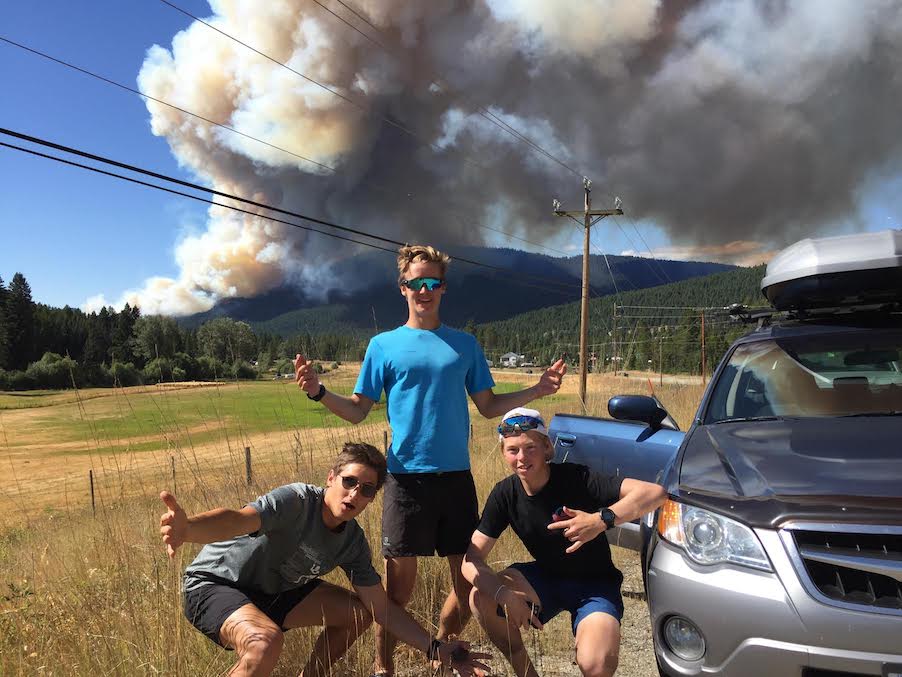
    Fran Vukonic, Tallon Noble, and Ian Williams pose at the end of a bluebird day trail run at Big White in front of the newest Kelowna fire, September 5, 2017. (Photo: Gareth Williams)
    Canadians Fran Vukonic, Tallon Noble and Ian Williams after completing a trail run on Sept. 5 at Big White in Kelowna, B.C.,with the backdrop of the newest Kelowna fire on an otherwise bluebird day. (Photo: Gareth Williams)

    This week’s featured articles are made possible thanks to the generous support of The Loppet Foundation, host of the Masters World Cup 2018. Registration opens in October.

    ***

    Beyond the hundredth meridian, a traditional geographic line demarcating where the West begins, it’s been a hot and dry summer. Wildfires have raged from Washington to California, the Intermountain West, and in western Canada. The conditions remain ripe for extreme fire danger. Even if a wildfire didn’t burn near you, odds are the smoke found its way there. 

    Across the board and across the U.S., it’s been an off-the-charts summer. While many Americans have been consumed with hurricane coverage and concerns over the last several weeks, fires have scorched more than a million acres in Washington and Oregon alone this year, according to Quartz Media. That’s up from 513,226 total acres in 2016, but in 2015 and 2014, more than a million acres were affected.

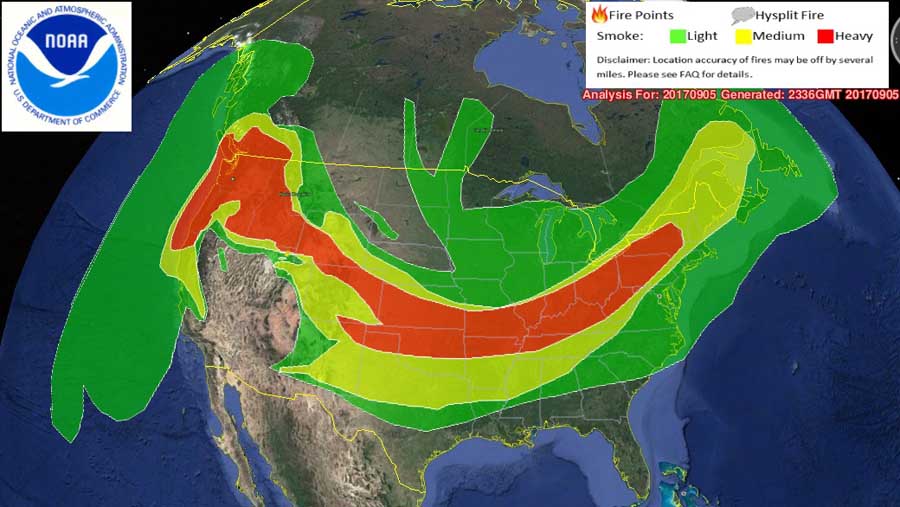
    NOAA wildfire smoke and the correlating Air Quality Index for Sept. 5, 2017. (Photo: NOAA)

    Along with the devastated landscapes and loss, the wildfires’ byproducts of smoke and ash have made for smoggy, poor air quality. We’re talking about seriously hazy days when visibility often wasn’t more than a mile or two.

    Training outside in less-than-ideal quality air can compromise an athlete. To better understand when it’s OK to go out or stay in, many skiers and coaches became intimate with the scientific benchmarks for air quality.

    “I sort of have this rule where if I can see the glaciers on the mountain, I would rollerski but not do intervals,” Dakota Blackhorse-von Jess, who’s based out of the Bend Endurance Academy in Oregon, said on the phone last Friday. “My personal limit for being outdoors is that 75 AQI limit. That’s the unhealthy or moderate zone.”

    Here’s a quick primer. The U.S. Environmental Protection Agency (EPA) has developed an user-friendly Air Quality Index (AQI). The index is color coded and provides a numerical value indicative of a region’s air quality. An AQI of 75 means the air has a PM2.5 concentration of 23.5 micrograms per cubic meter. Going further, PM2.5 refers to the size of particulate matter in the air. In this case, the 2.5 corresponds to particulate matter 2.5 microns or less in width. That’s small enough to penetrate deep into the lungs, even the bloodstream.


    U.S. Environmental Protection Agency Air Quality Index (Photo: EPA/AIRNOW.gov)

    That 75 Blackhorse-von Jess limit falls midway into the moderate zone on the AQI.

    “The higher end of moderate,” Blackhorse-von Jess clarified. “You see what the station says and then you walk outside and determine if it is going to work. Honestly, at this point, it’s been five weeks. I’ve done so much training indoors, that now it’s more of a mental break than a training deficiency.”

    In places like Bend, Ore., where Blackhorse-von Jess calls home, some athletes have ignored the warnings.

    “I saw guys out there riding today, I see them every time when I am looking for breaks in the smoke,” Blackhorse-von Jess explained. “I cannot believe that people are out there. I think people living in the smoke have accepted a lower standard and are going about their daily lives and actually, their daily activities in the smoke have come to accept the shittiness of the feeling they are experiencing. And for the professional athlete, it is something that you cannot afford, I don’t believe.”

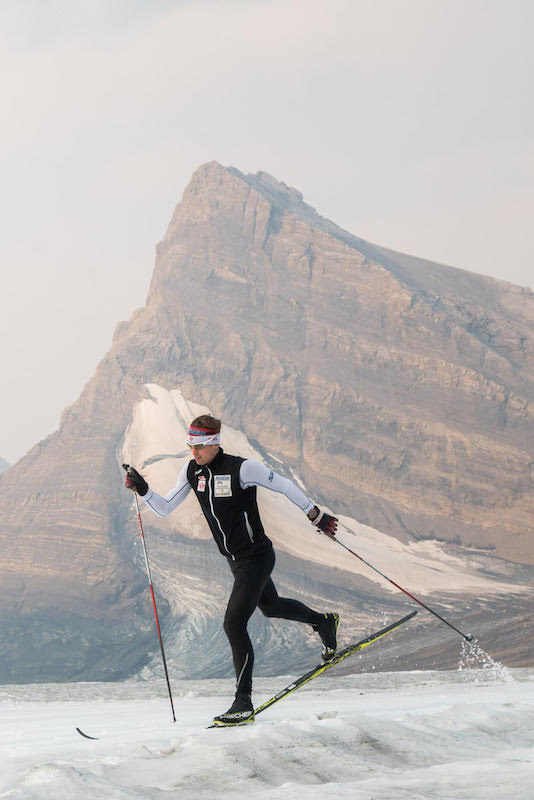
    BlackJack's Julien Locke training at a hazy Haig Glacier camp, August 2017. (Photo: Anthony Killick)
    Julien Locke (Canadian U25 Team) training at a hazy Haig Glacier camp in August. (Photo: Anthony Killick)

    While several fires continue to burn, the smoke cleared in Bend on Sept. 9. During much of August and into the beginning of September, Blackhorse-von Jess relied on a SkiErg, running treadmill and a stationary bike for much of his over-distance training.

    He is not alone.

    “Actually today, it was still dark when I woke up, but when the sun came up there was actually blue sky,” U.S. Ski Team member Liz Stephen said Friday from her home in Park City, Utah. “Where other days, you weren’t even sure the sun was up. It was really nasty.”

    Like other elite skiers across the West, Stephen had made use of indoor training opportunities. The day before Stephen spoke to FasterSkier, she logged four hours on a ski treadmill at U.S. Ski and Snowboard’s Center of Excellence (COE) in Park City.

    The AQI is also careful to note what are called “sensitive groups”. That can mean older adults, children, or people with lung or heart issues. Those populations must take precautions when high exertion exercise and poor air quality mix. Being responsible for junior athletes places a premium on being cautious. 

    For Leslie Hall, director of the Methow Valley Nordic Team in Washington state, dealing with smoke and subsequent air quality issues have been an on-and-off again affair.

    “We had a bad two week period at the beginning of August and it was leading into our annual Methow PNSA [Pacific Northwest Ski Association] Camp … so we had to make the call to move the camp,” Hall wrote in an email. “We ended up going to Oakridge, Ore., for the camp and had a great camp there with 32 kids but a fire started nearby there while we were there so we had one moderately smoky day and it has since gotten much worse there.”

    Like her athletic and coaching counterparts, Hall keeps an eye on air-quality websites to determine if a practice is indoors our out. But kids are kids.

    “It is quite hard to keep the kids motivated and they do not enjoy the gym workouts,” Hall noted. “But during the early smoke time, we knew we were going to go somewhere else to train fairly soon so we kept that in mind.  This past week was good because there are a variety of kids running and different coaches which help.  Also, intensity workouts on the exercise machines help the time go by quicker. There is plenty of complaining and calls to move East, but I think all the kids realize that we are very fortunate in general and it is hard to complain when the hurricanes are decimating the south and we just have bad air for a week or so.”

    Reports from Canada mirrored the smoke-filled experience of skiers in the Western part of the U.S.

    According to FasterSkier’s Gerry Furseth, on Sept. 7, British Columbia’s indices for air quality deemed Fort St John and Terrace as the only locations in the province “safe” for exercise. (The Canadian AQI is based on particulate matter 2.5 microns or smaller, but uses a 1-10+ scale with “1” being low health risk and “+” very high.)

    Air Quality Health Index 5 in Vernon. BC (Photo: Gerry Furseth)
    Air Quality Health Index 5 in Vernon. BC (Photo: Gerry Furseth)
    Air Quality Health Index 1, Vernon, BC (Photo: Gerry Furseth)
    Air Quality Health Index 1, Vernon, BC (Photo: Gerry Furseth)

    Gareth Williams, a member of Canada’s national U25 Team and a native of Kelowna, B.C., wrote in an email that the smoke was a near-constant companion this summer.

    Gareth Williams leads Fran Vukonic through an orange-tinted rollerski in Kelowna, BC. (Courtesy photo)
    Gareth Williams (Canadian U25 Team) leads Fran Vukonic during an orange-tinted rollerski in Kelowna, B.C. (Courtesy photo)

    “Summer has been great for me, I spent much of it on the Haig [glacier near Canmore, Alberta] in July,” Williams explained. “I’ve been in Kelowna the whole month of August and the smoke has yet to subside, it has actually gotten much worse recently. In past years the smoke has been bad, but I have never seen it like this. …  I think the smoke isn’t as bad as some people have suggested, for me it’s not the greatest worry. I will be happy once it is gone though, getting a little tired of the orange lighting and not being able to see the sun!”

    Michael Somppi, who trains with the Alberta World Cup Academy (AWCA) in Canmore, altered his plans depending on conditions.

    “Personally, I haven’t found the breathing to be too bad,” Somppi wrote. “That said, I am avoiding doing any hard intensity efforts on smoky days.  Today was the first day (in Kelowna) I was forced to alter my training plans, as I had planned to do a rollerski time trial, and instead opted to do zone 3 because of the smoke.  Even breathing semi hard felt sketchy with how bad the air quality is at the moment.”

    Another member of Canada’s U25 Team, Julien Locke has literally trained above the smoke on occasion.

    “I’ve been lucky in that the smoke hasn’t been too thick during most of the important training blocks so far,” Locke wrote. “I was at the Haig Glacier 4 times this summer and while we had some hazy days, for the most part, 2400m elevation was high enough to have clear skies.”

  • Hopes Dashed for Finland and Norway, Russia Claims Team Sprint Gold

    Hopes Dashed for Finland and Norway, Russia Claims Team Sprint Gold

    Russia’s Sergey Ustiugov out-duels Italy’s Federico Pellegrino for the men’s classic team sprint gold at 2017 Nordic World Championships on Sunday in Lahti, Finland. (Photo: John Lazenby/Lazenbyphoto.com)

    LAHTI, Finland — The breath taken out of a nation.

    Throughout the lifetime of a sporting fan, high-stakes races or games offer the chance for seared-into-the-neurons moments, things you remember for an eternity with the distinct recollection of where you were and what you were doing when the news came down.

    But those are exceptionally rare moments. And depending on what side of the equation you’re on, they can be mile high or a mile deep. It’s rendered down to the win or the loss.

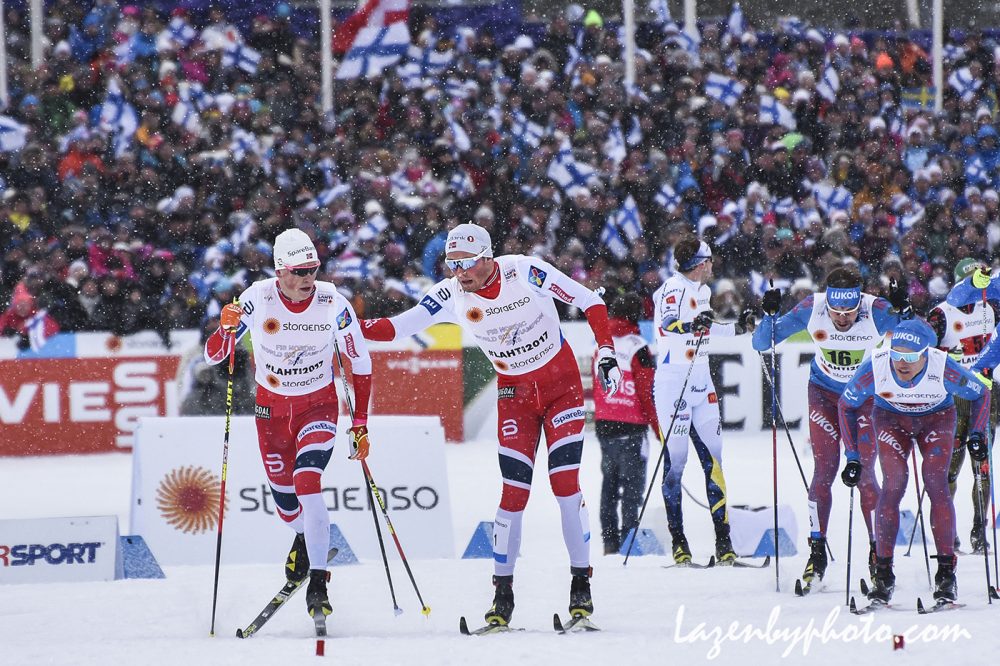
    Norway’s Emil Iversen tags teammate Johannes Høsflot Klæbo during the men’s classic team sprint final at the 2017 Nordic World Championships on Sunday in Lahti, Finland. (Photo: John Lazenby/Lazenbyphoto.com)

    For much of Sunday’s men’s 6 x 1.3-kilometer classic team sprint at the 2017 Nordic World Championships, it appeared to be a cruiser for team Norway, featuring Johannes Høsflot Klæbo and Emil Iversen. The ending to their gold-medal story seemingly written after the third exchange when Klæbo gifted Iversen and all of Norway a 5.38-second lead over the chasing Finns.

    5.38 seconds is a small duration. But when that time gap is illustrated as a distance gap in a sprint, the void looks immense: in this case the distance from Iversen to Finland’s chaser Iivo Niskanen was 45 meters. Even in the best of times, an often too-wide gap to close.

    The sprint course features a long but strideable climb right from the stadium’s steps. It then 180’s to the left and hits a steep headwall most skiers herringboned. Then it was a speedy descent into the hairpin known as “Lahti Corner”, and then stadium time —  a horseshoe-shaped venue of terraced stands filled to capacity with a mostly Finnish crowd.

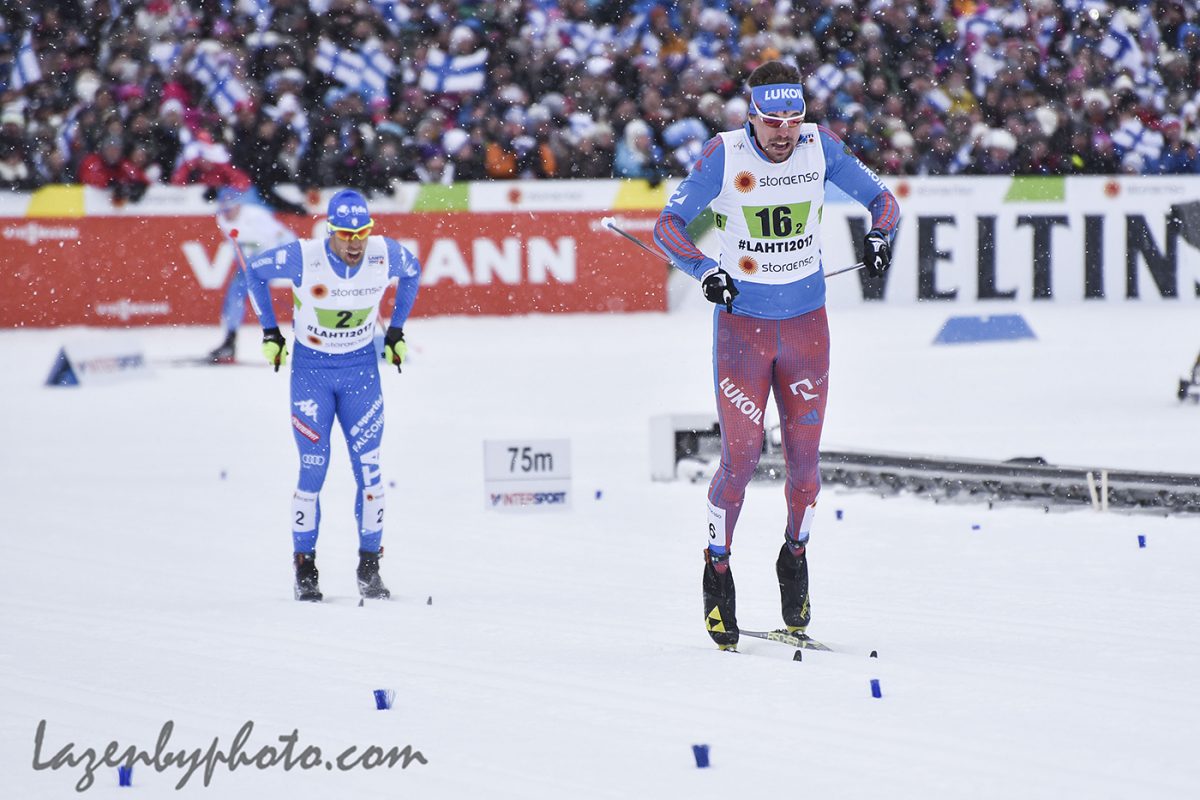
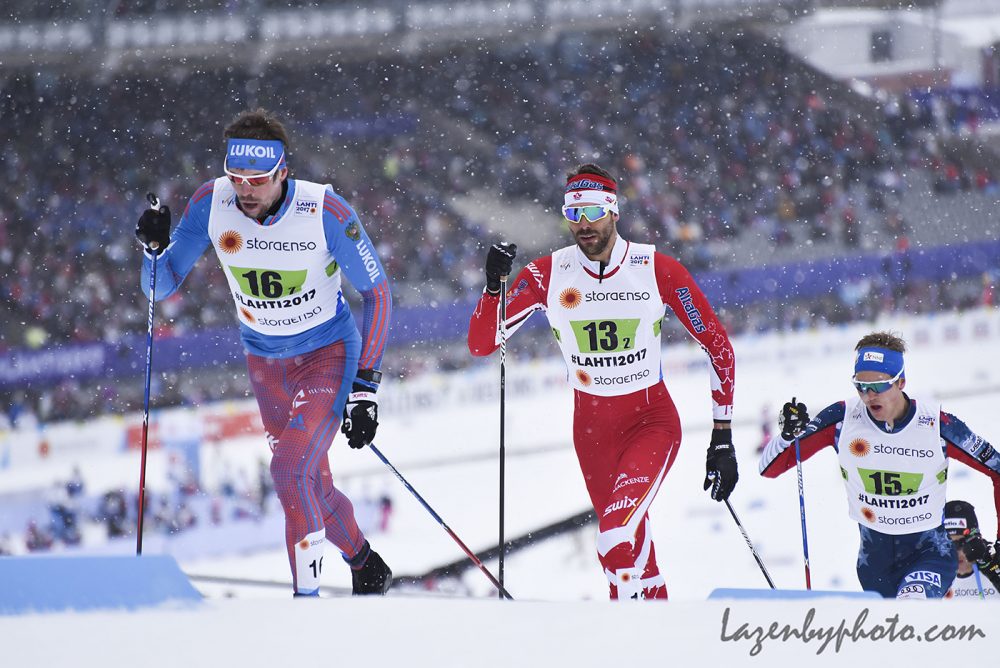
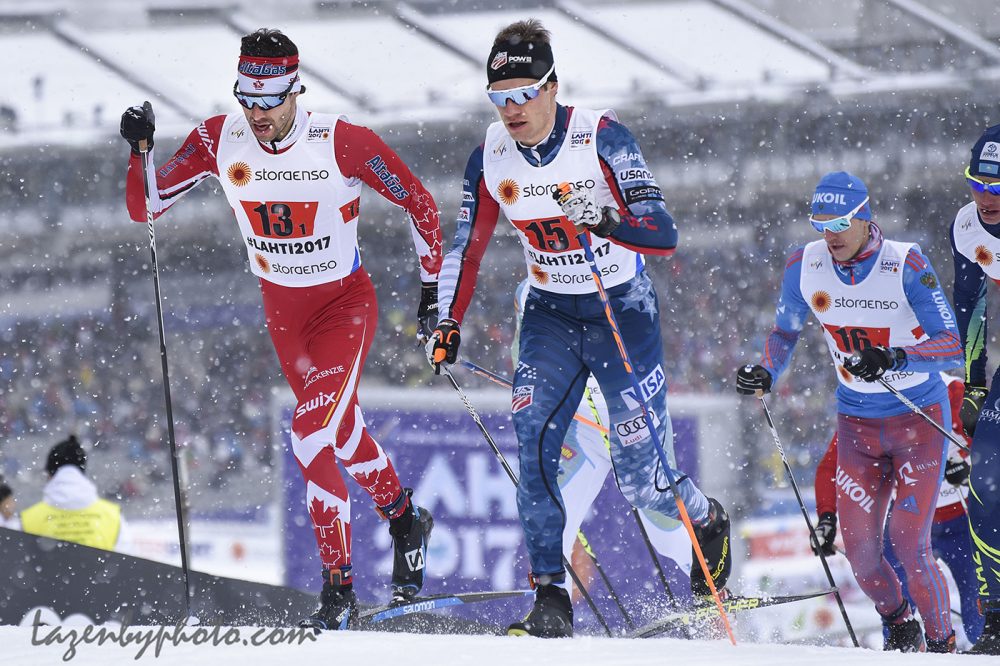
    Russia’s Sergey Ustiugov (16) leads Canada’s Lenny Valjas (13) and American Erik Bjornsen (15) in the men’s classic team sprint final at 2017 Nordic World Championships on Sunday in Lahti, Finland. (Photo: John Lazenby/lazenbyphoto.com)

    Chasing Iversen, frothing at his heels, were three skiers. There was Niskanen, and right behind him, matching stride for stride were Russia’s Sergey Ustiugov and Italy’s Federico Pellegrino.

    As Niskanen worked up the headwall and pushed over the top, he put some meters on Ustiugov and Pellegrino. After a powerful double poling section, Niskanen tipped on the fulcrum into a fast downhill towards Iversen. By “Lahti Corner”, Niskanen had caught the Norwegian.

    The Finnish frenzy that ensued was a roar. The crowd had sensed the Niskanen-Iversen link up.

    On the glide out from Lahti Corner, a 300-meter straight away, Iversen was set in the third of four tracks. One lane of tracks remained to the left — inside of the Norwegian.

    Niskanen, inches away from Iversen’s tails, slotted to his left to pass. There are many perspectives out there, and many depend on which flag you wave, but surely Iversen sensed Norway’s grasp on team gold weaken.

    Norway’s Emil Iversen skiing with a broken pole down the finishing stretch after tangling with Finland’s Iivo Niskanen (not shown) 200 meters from the line, which cost Norway gold in the men’s classic team sprint at the 2017 Nordic World Championships in Lahti, Finland. (Photo: John Lazenby/lazenbyphoto.com)

    Iversen moved to his left to shut down the Finn and immediately jolted backward as he tangled with Niskanen.

    Finland and Norway down. The Finnish cheers snuffed.

    In a blink, Ustiugov and Pellegrino zipped passed in what moments before had been a fight for bronze, into a sprint for gold.

    On this day, Ustiugov was the better closer. With teammate Nikita Kriukov, he anchored Russia to the team-sprint win in 17:40.69 minutes. It was the second race in a row in which Ustiugov earned gold due, in some part, to another skier’s misfortune. Italy’s Pellegrino and Dietmar Nöckler placed second (+2.14).

    Finland’s duo of Sami Jauhojärvi and Niskanen were third (+8.64), Norway fourth (+18.42). The race jury deliberated for a half hour before announcing that neither Norway nor Finland were relegated.

    “What can I do at that situation, when I see that my teammate is going to push for the gold, and then happens this unfortunate crash?” Jauhojärvi said during the press conference. “But it’s just a part of sports, and sports is just a small part of life. We need to be happy that we can pick up the medal in front of [a] home audience this evening.“

    After crossing the line Niskanen fumed and ranted.

    “Yeah, of course straight after the finish line I was very angry, and maybe it wasn’t the most cleverest thing to do with Emil in that last curve,” Niskanen said of his antics. “He lost a medal, and maybe we lost a gold medal. But it’s over now, we are in bronze, and the games are continuing. Just only thing we need to do about this is shaking hands with Emil. We have many years to compete together in the same arenas, and our careers are continuing, and the Lahti ski games are continuing, and we will have good days later.”

    A Norwegian journalist asked a pointed question of Niskanen. “Did you expect a rookie mistake from someone like Iversen?” he asked.

    “Emil has done many sprints, and maybe that move was the only thing to do if he wanted to fight for the gold medal,” Niskanen said in his response. “He really wanted to win, and we did. I came faster behind him and he changed the line, but… it’s a sprint.“

    Answering in English, Kriukov spoke to his lackluster early season results. “This season, yeah, not so good for me and my shape not so best,” he said. “But today I am liking the situation. And lucky for our team and I think there is a reason while our team is first today.”

    For Kriukov’s partner Ustiugov, it was his second gold and third medal overall in as many championship races.

    U.S. Fifth, Canada Sixth

    American Simi Hamilton (16) and Canada’s Alex Harvey (13) racing together ahead of Russia’s Nikita Kriukov (16) in the men’s classic sprint semifinal at the 2017 Nordic World Championships in Lahti, Finland. Both teams reached the final, where the U.S. placed fifth and Canada sixth. (Photo: John Lazenby/lazenbyphoto.com)

    U.S. Ski Team members Simi Hamilton and Erik Bjornsen skied to fifth place, 23.58 seconds behind Russia. For much of the race, Hamilton and Bjornsen remained in contact with the main group consisting of the podium countries: Norway, Canada, Germany, and Sweden.

    On occasion, Klæbo would try to break the race, but the integrity of the group remained for most of three laps. After the race, when asked how he managed Klæbo’s burst, Hamilton said his was a game of calculated risk.

    “I think it goes both ways. It’s one of those courses and one of those races where if you go too hard in the same spot then you’re going to pay for it later” Hamilton said. “But at the same time, you know, we’re at world champs, you have to take chances. I think you’re constantly sort of evaluating that risk versus reward the whole time you’re out there.”

    The risks for losing contact were a gassed slog playing catch up; the reward — opportunity. And lap after lap it was either Bjornsen or Hamilton deep in a tuck after rounding “Lahti Corner”, playing in a congested international game once reserved for the traditional nordic-ski nations.

    For the 25-year-old Bjornsen, it could have been a day of nerves instead of the calm and power with which he skied. Throughout the race, he posted the fourth- or fifth-fastest splits of the second-leg skiers.

    “We haven’t done a lot of team sprints together,” Bjornsen said about his experience teaming up with Hamilton. “The last one was in Sochi. I haven’t done a lot of them recently. So it was great. Going into the finals, it was like, the best teams in the world and the best dudes next to me.”

    Bjornsen skied the Americans from eighth into fifth on his second loop, and after Hamilton dropped two places to seventh by the last exchange, Bjornsen again rallied for fifth.

    At 29 years old, Hamilton remains humble and a student of continued improvement.

    “My classic skiing is still progressing,” Hamilton said. “And for someone like Erik, it comes so naturally for him, he’s such a beautiful classic skier, he’s so efficient. I just focused on putting myself in as much pain as possible to keep contact with that group that I was skiing with. I always have faith in him being able to dig to a place where not many people can dig too in order to come up with that result.”

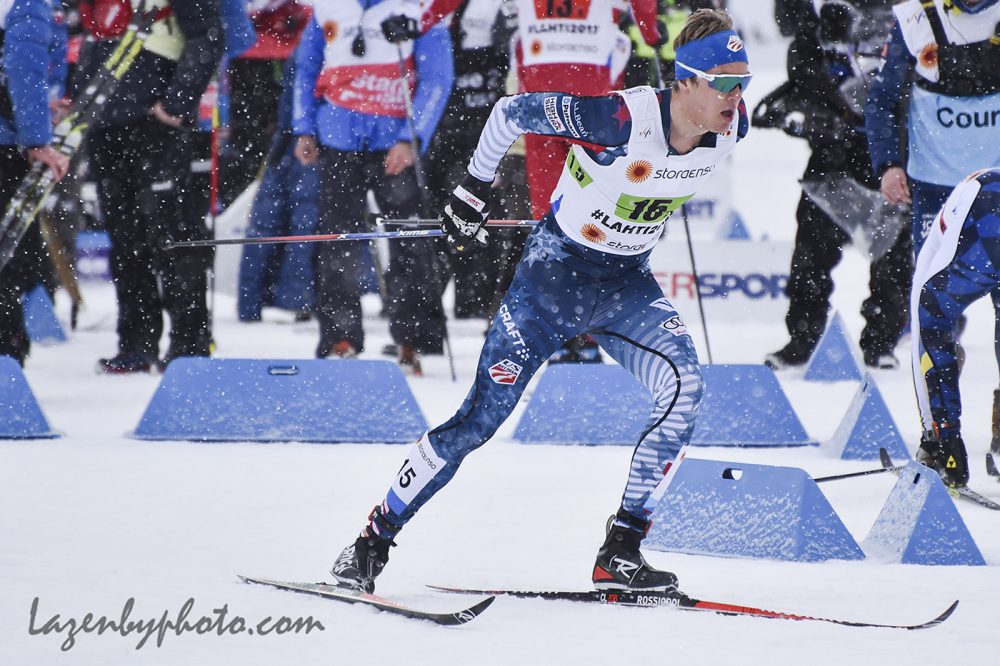
    Erik Bjornsen (U.S. Ski Team) racing in the men’s classic team sprint final at 2017 Nordic World Championships in Lahti, Finland. With teammate Simi Hamilton (not shown), the Americans finished fifth. (Photo: John Lazenby/lazenbyphoto.com)

    Heading into the last lap, Hamilton tagged Bjornsen in seventh, 10 seconds back from Russia, Italy and Finland. (After a Klæbo flyer, Norway was 16 seconds ahead of the U.S. as Bjornsen began the final lap.)

    “Simi handed off to me in a great spot on the last leg,” Bjornsen reflected. “I was fighting with a few other guys and it was just perfect. Super fun to be with the veteran here.”

    Bjornsen’s older sister Sadie captured her first career world-championship medal before the men’s team sprint final.

    “I actually didn’t know that she was on the podium until after [my] race,” Bjornsen admitted. “I was second leg so I showed up pretty late, kind of just when Simi was starting … So I was trying to stay pretty focused. I wasn’t even thinking about the fact – I actually glanced up at one point and saw a replay of her crashing, and so I was a little worried that they weren’t in it. But it was so exciting to see Sadie come up and get a podium here. This is her first race and I know she’s in good shape. It’s great. Nobody deserves it more than she does. I watched her over the years, just so focused and dedicated. There’s a reason she’s so strong.”

    Canada was represented by national-team members Alex Harvey and Len Valjas. In January, the duo won the World Cup season’s first team sprint. On paper they still remained a medal contender, in addition Harvey has come into the championships primed. However, Valjas has struggled with a health issue the last few weeks.

    “I’m better now, what I think we came to the conclusion with the doctors and everybody, two weeks ago in the gym in Davos I hurt my vertebrae a bit,” Valjas said after the race. “I don’t know how, but it totally affects my breathing, so [at the last World Cup in] Estonia and the sprint here, I felt like I was not able to breathe. The race starts well and I die immediately.”

    Valjas said he’s received treatment to alleviate the symptoms. “A couple days ago, I didn’t know if I’d even start because it was really actually hard to take a deep breath,” he elaborated. “It doesn’t feel like much but when you try to go at 100 percent, you cannot keep up and it’s frustrating. So I was just happy that I was able to ski with these guys, but when it got away on that second leg there, trying to catch Iversen kind of pushed me over the limit a bit.”

    Harvey initially skied the team into third by the first exchange, just 2.8 seconds out of first, and despite slipping to fifth on Valjas’s first loop, Harvey raced up to second by the third exchange, 4.9 seconds behind Norway. On Valjas’s second loop, he dropped to eighth. Harvey held that position on the second-to last leg and tagged Valjas with the same group containing the U.S. Valjas then picked off two places for sixth place.

    “I died a bit in the end, but I still had a lot of confidence in Len’s finish,” Harvey said. “We know in a high-speed finish like that, Len is maybe the best in the world so I was still confident that if I put him in the right situation, we still had a legitimate shot. We still believed in a podium finish and it’s just, you can’t have it every time. But I think it was a big improvement for Lenny, compared to the last two weeks and leading up to the relay.”

    The Canadians finished sixth, 27.02 seconds behind Russia and 3.44 seconds behind the U.S., in the final.

    Championship racing continues Tuesday with the women’s 10 k classic individual start.

    Results

  • Widmer Waits for World Cup Window, Shines With Swiss Status

    Widmer Waits for World Cup Window, Shines With Swiss Status

    Heidi Widmer, who lives and trains in Switzerland, racing to 15th in the women's 8 k classic preseason race on Nov. 19 in Davos, Switzerland. (Photo: NORDIC-ONLINE.CH)
    Heidi Widmer, who lives and trains in Switzerland, racing to 15th in the women’s 8 k classic preseason race on Nov. 19 in Davos, Switzerland. (Photo: NORDIC-ONLINE.CH)

    In 2015, Swiss-Canadian skier Heidi Widmer moved from Canada to Switzerland. In 2016, she moved between the World Cup and the lower-tier Alpen Cup. Now she’s trying to figure out what’s next, while left rueing the difference that four-tenths of a second can make.

    Widmer, now 25, skied strongly throughout the 2013/2014 season. She represented Canada in three races at the Sochi Olympics, won her first Canadian national championship, and won the season-long NorAm sprint title (Canada’s Continental Cup). But 2014/2015 was in many ways a step back for Widmer; her results suffered, and she failed to earn World Cup or World Championship starts.

    Heidi Widmer, a former Alberta World Cup Academy and Canadian national team member, racing a skate sprint at 2014 Canadian Olympic trials. (Photo: Angus Cockney)“I was under recovered” throughout that season, Widmer told FasterSkier in May 2015, “and when your body is run down, it leads to other problems such as low iron and ferritin as well as sickness.”

    Widmer was not re-named to the Canadian national team, but wanted to continue with high-level racing. Thanks to a Swiss-born father, and a sympathetic ally in coach Christian Flury (currently in Switzerland, but formerly with Widmer’s Canadian club, the Alberta World Cup Academy), Widmer successfully embarked on the process of using her dual citizenship to begin racing for Switzerland.

    Positive results soon followed. Widmer gained World Cup starts at several weekends in the 2015/2016 season, qualifying for the heats in two out of five freestyle sprints she entered. She consistently placed in the teens on the Alpen Cup, and on the podium in Swiss Cup races. The move to trade the red-and-white maple leaf for the white-and-red Swiss cross seems to have served her well.

    But vexillology aside, her most recent results are still somewhat vexing. Widmer finished 32nd in last Sunday’s skate sprint qualifier in Davos, 0.39 seconds away from making the heats and earning World Cup points. (Sprinting can be a cruel mistress: Widmer’s 32nd in qualifying placed her ahead of, among many others, Norway’s Heidi Weng, Ida Ingemarsdotter of Sweden, and American Kikkan Randall. All three have World Cup sprint wins on their résumés. Randall and Ingemarsdotter have World Championships sprint medals.)

    Objectively speaking, that’s almost nothing, the difference between 5.95 seconds back from the qualifying winner, Jonna Sundling, and 6.34 seconds back. The literal blink of an eye. Less time than it takes a Major League fastball to reach home plate. But when it comes to World Cup-level racing, tiny margins can have a big impact.

    “It’s really hard to say now” whether or not start rights for this year’s Tour de Ski are in her future, Widmer told FasterSkier in an in-person interview shortly after her qualifying effort. “Had I qualified today it would have been an easy decision, but who knows.”

    Widmer added that she had “no idea, to be honest,” where she would be racing this coming weekend.

    “I usually play my season one step in front of the other,” she said. “My first priority is to process today and if I am granted the opportunity and the privilege next weekend in La Clusaz for the relay I would be super stoked; I know that we want to start a team in the relay there so that is unfortunately not in my hands. If I don’t go there then I will be in Goms [Switzerland] again for COC Cup [Europa Cup], which is also super-good competition. So yeah … those decisions are above my reach. And then hopefully a Tour de Ski start.”

    Widmer was disappointed with her result in Davos, but clear-eyed about the implications of 0.39 seconds at this level of competition. “[I] had really good feeling in my legs today,” she said in Davos. “I lacked that last little [bit]. 99.9 percent was there, but I lost a little; a little snap was missing. So I need to be really happy with what I put on the line today, but obviously super disappointed at the same time.”

    She continued, “It’s the name of the game that we sign ourselves up for that all the ladies here are obviously super strong, and to know it can go one way” or the other. “Last year,” Widmer recalled, she was “so close on the other side of the fence in 29th qualifying … and I think there were more ladies on the start line this year, and that’s what we want to see.”

    Stepping back to consider her season as a whole, Widmer was pleased that her training “has been really good.”

    Heidi Widmer (c) with Swiss skiers Nathalie von Siebenthal (l) and Christa Jäger after rollerski intensity on Stelvio Pass in Switzerland in June 2013. (Courtesy photo)She added that she has found a challenging and complementary training group in her fellow Swiss skiers.

    “I can say confidently that I have never trained so hard in my life and never challenged myself so much. Training with Nadine Fähndrich and Nathalie von Siebenthal is an incredible opportunity, those girls train really hard and have an incredible work ethic and professional take on the game. … We are all completely different personalities and we gel together really well. I think we challenge each other in ways that the other person can’t take the lead in and vice versa.”

    In November, Widmer was getting in some early racing on farmed snow in Davos. She said at the time that her performance was “FAR off the mark!” and that “the fitness is not where it should be.” By early December, things had come around somewhat, and Widmer was winning the season’s first Swiss Cup race in Goms, posting the top qualifying time by 1.79 seconds in a three-minute sprint. But then came last weekend in Davos, and those missing 0.39 seconds.

    “We want it to be a close game,” Widmer graciously told FasterSkier immediately after her just-short qualifying effort, “because we always – we all work so hard to be here.”

  • Harvey Seeks More World Champs Hardware and a Possible World Cup Overall

    Harvey Seeks More World Champs Hardware and a Possible World Cup Overall

    Canada's Alex Harvey leads Norway's Martin Johnsrud Sundby during the men's 15 k freestyle pursuit at Stage 4 of the Ski Tour Canada in Quebec City. Harvey went on to place fourth, 1 second ahead of Sundby in fifth. (Photo: FlyingPointRoad.com/NNF)
    Canada’s Alex Harvey leads Norway’s Martin Johnsrud Sundby during the men’s 15 k freestyle pursuit at Stage 4 of the 2016 Ski Tour Canada in Quebec City. Harvey went on to place fourth, 1 second ahead of Sundby in fifth. (Photo: FlyingPointRoad.com/NNF)

    If you’re a fan of North American cross-country skiers, it’s likely you have an affinity for Canada’s Alex Harvey. Hailing from Quebec, he’s a marketable star in his home province. That may stem from his affability or his encroachment on Norway’s “stranglehold” on the World Cup overall.

    This year, for Harvey, his motivations are twofold. “The main goal is Lahti World Championship for sure, to be on the podium there,” Harvey said in a recent phone interview.

    Considering past performances, it’s not far-fetched to consider Harvey a contender for the overall: he was third overall in 2014, ninth in 2015 and seventh in 2016.

    “When Devon [Kershaw] was second in the overall in 2012, it was the first time I actually believed that a Canadian, or a North American man for that matter, could be on the overall podium,” Harvey said about his evolving aspirations. “Just because I saw Devon, one of my best friends, teammate, roommate from the last ten years, be on the top-three podium — that was the first year I believed it.”

    The belief in an overall podium and World Championships medal coming into the season is palpable, even realistic for the 28-year-old Harvey. He is a multiple World Championships medalist who can strike both in the sprints and distance events.  

    “But the championships medal is more important for me,” he said. “If I have to choose between say like championship gold and first place in the overall, I’d probably take first place on the overall. But I think championships are still a bigger deal to me than second or third [overall]. That’s why I put the focus still on the championship. The overall is still in the back of my mind and I am still doing every single weekend this year like previous years, other than the weekend after the Tour de Ski.”

     “Just because I saw Devon, one of my best friends, teammate, roommate from the last ten years, be on the top-three podium — that was the first year I believed it.” — Canadian Alex Harvey, on his overall World Cup aspirations

    Harvey noted that he will skip the pre-Olympic World Cup in PyeongChang, South Korea, to rest up for the late-February World Championships in Lahti, Finland. Harvey explained that a small contingent of Canadian coaches and athletes will take a quick trip after the World Cup season concludes to preview PyeongChang, the 2018 Olympic venue.

    With firm goals set, Harvey has been fastidious in his preparation. After the 2014/2015 season, Harvey underwent Iliac artery surgery to remedy a circulation issue in his legs. Last summer, although he felt better in certain running tests he’s used as historical benchmarks, his regiment deviated from his normal routine.

    Martin Johnsrud Sundby of Norway (right) training with Canadian athletes in Livigno, Italy, earlier this month. (Photo: Alex Harvey/Instagram)
    Alex Harvey snaps a photo of himself with Norway’s Martin Johnsrud Sundby (r), Devon Kershaw (l) and others while training in Livigno, Italy, this summer. (Photo: Alex Harvey/Instagram)

    “Because last year when I started training again I was coming off surgery, so I couldn’t do exactly what I was used to,” Harvey said of his 2015 dryland season. “I could not do strength or any intensity for two months. So this year I was back kind of doing what I was used to pretty much doing for my whole career before the summer of 2015. That’s just normal strength in the gym twice a week and a third time doing core and then intensity once a week for May, June and July. And then switching to twice a week after that. Some speed sessions, too: two speed sessions a week. There’s really nothing new for me. But it was kind of different from last year because I couldn’t do everything I wanted last year. I just went back to what I knew worked for me.”

    According to Harvey, it’s still working. There’s a five-minute double pole test, a six minute skating test, and a 25-minute running test that both Harvey and his coach Louis Bouchard have used as fitness barometers throughout his career.

    “I have improved all of them by ten full seconds each time,” Harvey said of his test times. “I mean, last year the big jump was on the running test because I was able to get out of threshold and push all out. And this year I was still able to improve a little bit on the running and  keep improving on the other aspects. Every year I think it is important to have some past kind of test, you need to know if things are working properly or not. We put a lot of focus on those test, but we have to keep a global perspective. But this year everything was improving, so that is good.”

    If the past is any guide, Harvey, racing in his maple-leaf-emblazoned lycra, should be high up on the leaderboards. And when it’s world champs time, Harvey believes the skiathlon is his best individual shot at medaling.

    Devon Kershaw (L) and Alex Harvey (R) with their World Championship gold medals
    Canadian teammates Devon Kershaw (l) and Alex Harvey (r) with their 2011 World Championship gold medals from the classic team sprint.

    “My favorite race is the skiathlon,” Harvey said when asked about his chances in specific World Championships races. “It’s the distance race, I think I have had the most success in my career. I have medaled in both World Junior Championships, U23 World Championship, and World Senior Championships … It is the race that for me is probably my best chance.”

    As mentioned, Harvey is an all-arounder. Along with his 2015 World Championships 30 k skiathlon bronze , there’s three total sprint World Championship medals accompanying the sole distance hardware.

    The Norwegian odds makers might just be hedging against their teams possible demise by picking Harvey as the spoiler.

    ***

    We asked Harvey to give our ’17 Questions for 2017′ a go. Here are his responses:

    1. Biggest change in your life in the last five or so months since the ski season ended?

    Not much…

    2. Biggest change in your training?

    This Spring I was able to start training like I did my whole career,which meant strength, intensity, speed and volume. Spring of 2015 I was only allowed volume until July!
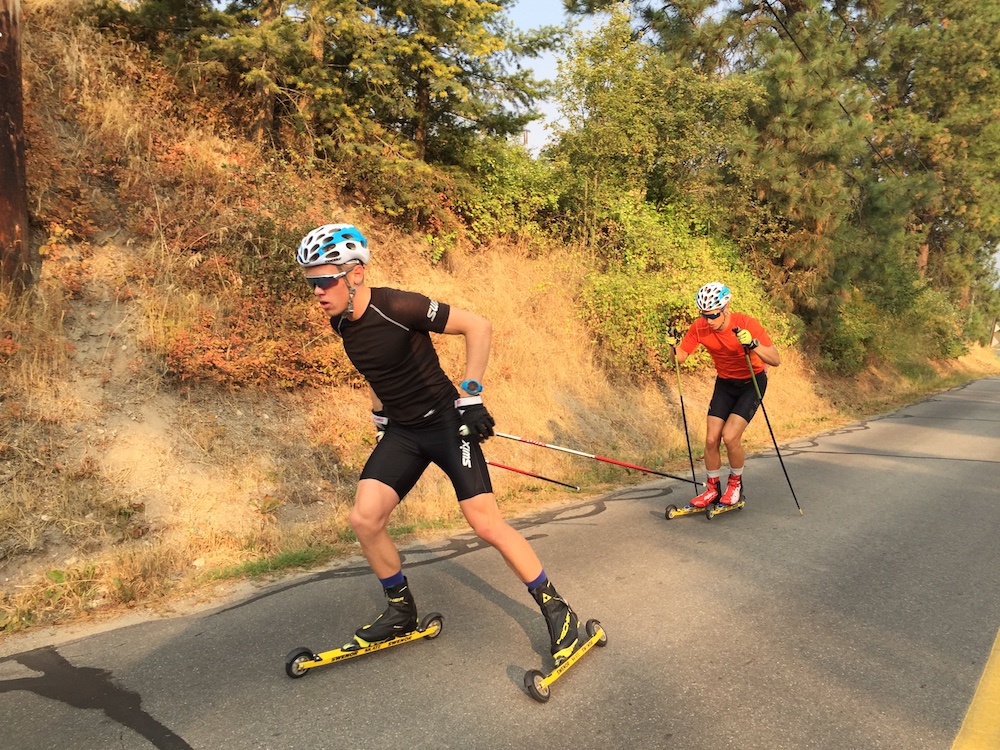
    3. Major areas of improvement you’ve seen so far?

    Nothing major…I’m looking for a few seconds here and there. Overall
    I’m just a bit stronger, a bit faster and a bit more endurance..but nothing major! Biggest difference from last Summer is strength is back to what it was prior to my surgery.
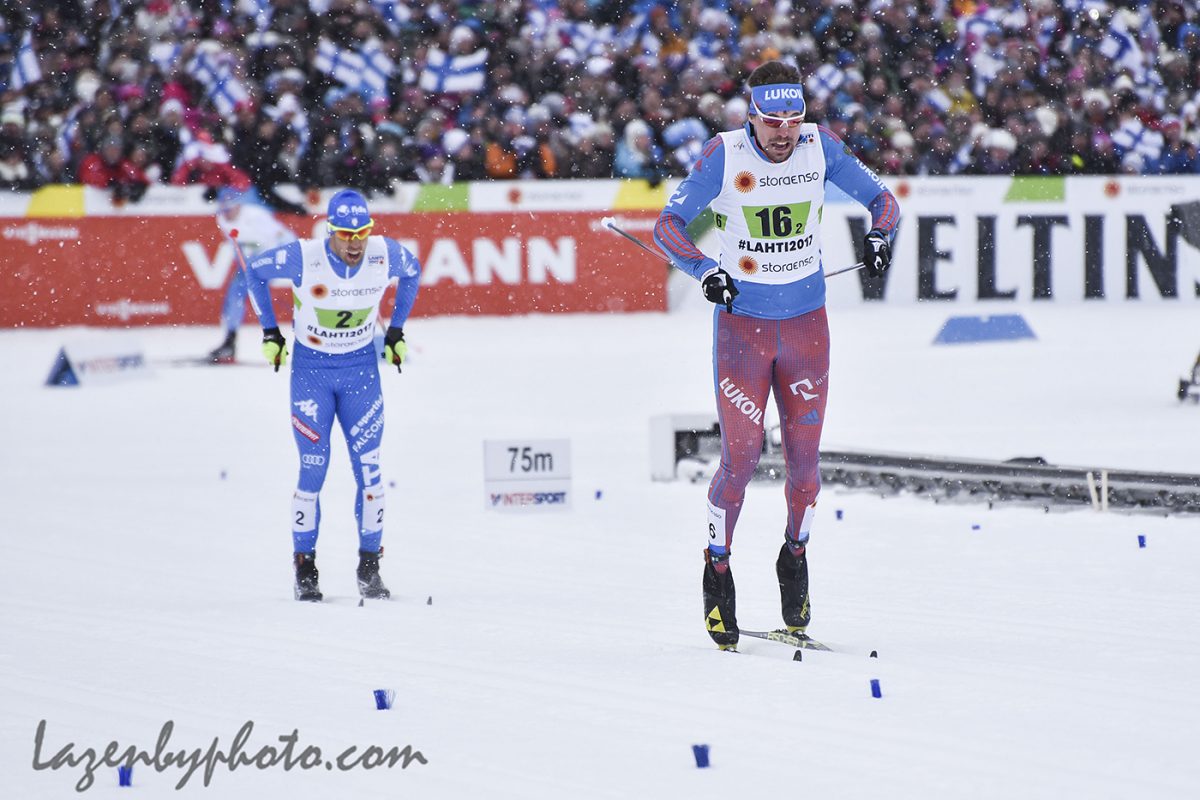
    4. Whom you’ve been working closest with this offseason (coaches or training partners)?

    Louis Bouchard is still my coach after 10 years! Our National team is pretty similar to previous year, other than Babs [Ivan Babikov] is now an assistant coach! The training group in Quebec has a few new guys that can challenge and beat me, mostly in sprint time trials.

    5. Best trip in the last five months (and why)?

    Hawaii. After no warm vacation in the Spring of 2015, it was nice to get back there. I also started the training season in the Islands so that was a nice change!

    6. Favorite cross-training?

    Mountain biking.

    7. Favorite non-athletic activity or pastime this summer?

    Home renovations/improvement.

    8. Song that was your jam this summer?

    Panda – Desiigner

    9. All-time favorite race moment?

    The sprint on the Plaines of Abraham in Quebec City last March. The crowd rushing over the fences to come to me after the race, it felt like a bunch of college students rushed the football field of their favorite team after a big win!

    10. First thing you pack in your bag when you leave for Europe?

    School books. I’m always afraid I will subconsciously leave them behind.

    Alex Harvey of Cananda before the start of the men's 30 k skiathlon on Wednesday in Canmore, Alberta. (Photo: Fischer/NordicFocus)
    Alex Harvey before the start of the men’s 30 k skiathlon at the 2016 Ski Tour Canada in Canmore, Alberta. (Photo: Fischer/NordicFocus)

    11. Venue/event you’re most excited to visit this season?

    Lahti, FIN. Been there before but Worlds in Scandinavia is always exciting.

    12. Who will win the men’s and women’s World Cup titles this year?

    Ingvild [Flugstad Østberg].

    13. Biggest sacrifice you feel you’ve made choosing this career path?

    Being away from family and friends for extended periods of time.

    14. If you could change one thing about your sport, what would it be?

    Doping.

    15. What did you have for breakfast this morning?

    Bagel with jam and brown cheese, scrambled eggs, strawberries, orange juice, coffee

    16. In 5 years, I’ll be ____?

    A lawyer.

    17. In 50 years, I’ll be ____?

    A psyched dad.

  • Sundby Seizes Stage 7, Solidifies Tour Lead; Harvey Seventh in 15 k Classic

    Sundby Seizes Stage 7, Solidifies Tour Lead; Harvey Seventh in 15 k Classic

    Norway's Martin Johnsrud Sundby (l) heads out in front of the 15 k classic mass start with Russia's Sergey Ustiugov (3), Switzerland's Dario Cologna (7), and fellow Norwegian Emil Iversen (r) during Stage 7 of the Tour de Ski in Val di Fiemme, Italy. Sundby went on to win ahead of teammate Niklas Dyrhaug in second and Kazakhstan's Alexey Poltoranin in third. (Photo: Fischer/NordicFocus)
    Norway’s Martin Johnsrud Sundby (l) heads out in front of the 15 k classic mass start with Russia’s Sergey Ustiugov (3), Switzerland’s Dario Cologna (7), and fellow Norwegian Emil Iversen (9) during Stage 7 of the Tour de Ski in Val di Fiemme, Italy. Sundby went on to win ahead of teammate Niklas Dyrhaug in second and Kazakhstan’s Alexey Poltoranin in third. (Photo: Fischer/NordicFocus)

    When it’s seven race days into something like the Tour de Ski, pushing oneself repeatedly to physical extremes isn’t as simple as “mind over matter.”  The basics: resting, recovery and more of the same, rules the day.

    The results don’t specifically quantify whether the Tour’s overall leader, Norway’s Martin Johnsrud Sundby, recovers the best, or is the most well rested, or can suffer the most. But in Saturday’s seventh stage, the men’s 15-kilometer classic mass start in Val di Fiemme, Italy, Sundby once again proved he might as well be — odds are he’s the winning bet to take this 10th edition of the Tour de Ski.

    Sundby won Saturday’s race in 39:55.2. Norwegian teammate, Niklas Dyrhaug placed second, 7.7 seconds back, while Kazakhstan’s classic specialist Alexey Poltoranin, finished third, 12.6 seconds from the win.

    Norway's Martin Johnsrud Sundby after winning the 15 k classic mass start at Stage 7 of the Tour de Ski in Val di Fiemme, Italy. (Photo: Fischer/NordicFocus)
    Norway’s Martin Johnsrud Sundby after winning the 15 k classic mass start at Stage 7 of the Tour de Ski in Val di Fiemme, Italy. (Photo: Fischer/NordicFocus)

    Heading into the race, Sundby led the Tour by 1:28.1 minutes over his Norwegian teammate Petter Northug in second, and 1:31.8 ahead of Russian Sergey Ustiugov in third. A third Norwegian, Finn Hågen Krogh, coming off a win in Friday’s Stage 6, entered the seventh stage in fourth (+2:07.5).

    By the end of Saturday’s 15 k, the race for second and third overall would reshuffle — with some skiers moving up the ranks, others down.

    Sundby set the pace early on — his reputation preventing any upstarts from leading out. On the downhills, a long slinky line of skiers extended back, while in the early going, the uphills provided a place for regrouping.

    Around 7 1/2 minutes into the race, Krogh took a strong pull up front. His move seemed for real, with a few-seconds gap forming back to Ustiugov, Northug and Sundby. But Krogh’s efforts were only part of his plan to ensure he was first to the first time bonus at 3.5 k.

    After 6.5 k, a group of approximately 25 skiers had firmly established in front, with Sundby again setting the pace for three columns of striders behind.

    Just before the second time bonus at 8.5 k, the race began to blow apart. Sundby, Switzerland’s Dario Cologna, and Italy’s Francesco de Fabiani, took the top-three bonuses, and Poltoranin followed close behind in fourth. Canada’s Alex Harvey, starting the day in bib 15, passed the time bonus in 14th, sixteen seconds after Sundby.

    At 12.5 k, the course looped through the stadium. At this point it was clear: this was Sundby’s race to lose as he led a glued-to-the -back-of-his-skis Dyrhaug through the remaining kilometers. Poltoranin, unable to match the duo’s pace, dangled 100 meters back. Beyond, that, it was a busy and clustered race for the remaining top-10 spots.

    Through the final kilometers and down the final stretch, it was a common scene: Sundby surging with an unmatched tempo and double poling for the win. Dyrhaug locked into second, nearly 8 seconds back.

    The results in Stage 7 shuffled the Tour’s overall standings. Sundby will head into the final 9 k freestyle climb up Alpe Cermis with a 2:51.5-minute gap on his nearest competitor. That’s still Northug, who finished Saturday’s race in a photo finish and ended up 17th (+51.4).

    Poltoranin jumped from fifth to third overall, 2:53 behind Sundby. That pushed Ustiugov into fourth overall, where he trails Poltoranin by 3.2 seconds. Krogh finished fifth (behind de Fabiani in fourth) to slip to fifth overall (+3:01.4).

    The slopes of Alpe Cermis should be a highlight as the difference between second to sixth place is only 10 seconds.

    In the post-race press conference, Sundby seemed grateful for his resurgence after the Stage 5 Oberstdorf 15 k classic mass start classic (the same format as Stage 7), where he finished 23rd.

    “It was the same distance and technique as in Oberstdorf, but totally different result,” he said. “I had amazing skis. The plan before the start to ski with the pack with the skis like I had to go for it. I am really happy for the victory and happy that Niklas is on the podium as well.” 

    Unlike Sundby back in Oberstdorf, Dyrhaug narrowly missed the podium, placing fourth in a super-tight finishing sprint, 0.7 seconds from first place.

    “I was close off the podium in Oberstdorf,” Dyrhaug said in the press conference. “It feels great to finish in second place. One of the goals today was to help other guys from Norway fighting for the overall. I had to be patient and follow the lead and go got the sprint. I tried to do as good job as possible. I started to be little bit tired in the second last lap.” 

    Alex Harvey (Canadian World Cup Team) racing to seventh in the 15 k classic mass start at Stage 7 of the Tour de Ski in Val di Fiemme, Italy. He's currently 12th heading into the final climb. (Photo: Fischer/NordicFocus)
    Alex Harvey (Canadian World Cup Team) racing to seventh in the 15 k classic mass start at Stage 7 of the Tour de Ski in Val di Fiemme, Italy. He’s currently 12th heading into the final climb. (Photo: Fischer/NordicFocus)

    Top North American, Harvey finished seventh (+31.3) for his third top 10 of the Tour (he was seventh in the 30 k classic mass start in Stage 2 and ninth in the 10 k freestyle pursuit in Stage 3). His rebound up the Tour standings saw him gain three spots heading into the last stage, and he now sits in 12th overall (+5:49.9).

    According to Canadian National Team Head Coach Justin Wadsworth, Harvey’s simply tired.

    “He is still is not feeling super good, and I think today … he probably would have been on the podium normally, had he felt really normal or good,” Wadsworth said on the phone after Saturday’s race. “It was a really satisfying race for him.

    “He really fought hard the whole race and was kind of back in 15th a lot of the race,” Wadsworth continued. “And then he just decided to start pushing it a little bit and the pace was also going hard after the bonus, and things were getting really spread out. He kind of kept on getting right on the edge of the back of the group and then he worked his way to manage to stay back in … Actually one of the gutsier races from him. When you don’t feel good, it’s hard to be in there like that.”

    Sunday’s epic stage will see Harvey with new legs, so to speak, following surgery this past spring that will allow him to complete the Tour. (In the past, Harvey has experienced blood-flow problems in his legs, particularly when skating on sustained climbs.)

    “He is excited to see how his legs are going do. It’s the first time he’ll have good legs going up that, without his artery issue,” Wadsworth said. “So I think it will be kind of a learning experience again for him to do it and actually have legs underneath him. That will be fun to see.”

    Ivan Babikov placed 30th, 1:59.3 after Sundby, and teammate Devon Kershaw finished 31st (+2:05.5). Heading into the final climb, Harvey will start 5:50 back in 12th, Babikov 12:30 after Sundby in 29th, and Kershaw 12:31 back in 33rd.

    American Noah Hoffman continued his top-30 streak, placing 23rd on Saturday (+1:37.1). He enters the last stage ranked 26th overall, and will start the final climb 9:48 out of first. The other U.S. male in the Tour, Erik Bjornsen, placed 46th (+3:25.3) for 42nd overall (+15:17).

    The Tour concludes Sunday with the final climb in Val di Fiemme.

    Stay tuned for a separate report on Hoffman.

    ***

    Of note: Dario Cologna, who skied at the front of the field for 10 k of the race, finished with an injury. He ended up 40th (+2:51), but dropped out of the Tour, seeking an MRI on his left calf muscle in Davos, Switzerland. Despite his result on Saturday, Cologna still ranked 13th overall heading into the final stage.

    According to Swiss team doctor Hanspeter Betschart, interviewed by Swiss TV broadcaster SRF 2, “Dario Cologna already felt his left calf a little bit before the race, then on the climb it really shot into it, an acute muscle injury in the left calf. We have to examine him for more details, we just looked at it briefly now.”

    Asked if it was likely the result of a slip during the race, rather than a lingering problem, Betschart said, “Yes, exactly. … There were no signs for something like this. This is an acute event.”

    Results |Tour standings (after stage 7) | Final climb start list

  • Krogh Rebounds to Win 10 k Skate; Hoffman Skis to 19th in Stage 6

    Krogh Rebounds to Win 10 k Skate; Hoffman Skis to 19th in Stage 6

    Norway's Finn Hågen Krogh (c) after winning his first race of the season, the 10 k freestyle at the sixth stage of the Tour de Ski in Toblach, Italy. He beat teammate Martin Johnsrud Sundby (l) by 3.6 seconds and France's Maurice Manificat in third by 14.6 seconds. (Photo: Fischer/NordicFocus)
    Norway’s Finn Hågen Krogh (c) after winning his first race of the season, the 10 k freestyle at the sixth stage of the Tour de Ski in Toblach, Italy. He beat teammate Martin Johnsrud Sundby (l) by 3.6 seconds and France’s Maurice Manificat in third by 14.6 seconds. (Photo: Fischer/NordicFocus)

    Finn Hågen Krogh knows enough about the topsy turvy nature of this year’s Tour de Ski to maintain his focus on the overall outcome, not his last worst race.

    “It’s ups and downs in the Tour, you just always have to look forward,” the 25-year-old Norwegian said in a post-race press conference following Friday’s 10-kilometer freestyle in Toblach, Italy. “There will always be some race that suits you. You just need to recover and move on.

    “I don’t like doing bad ski races. I’m a sore loser and hopefully a good winner,” he told FasterSkier last Sunday after Stage 3 in Lenzerheide, Switzerland. He had just placed third in the 10 k freestyle pursuit after posting the fastest time of the day. “I like to do my best so every time I feel that I didn’t race to my potential I feel a little sad.”

    Talk about high expectations.

    For Krogh, Wednesday’s fifth stage was one of those days to forget, after placing 25th in the 15 k classic mass start. He had been skiing in fourth around 8 k when suddenly, for reasons unbeknownst to him and his coaches and techs, both his skis popped off. Krogh put them back on, but found himself outside the top 30 and more than 30 seconds back by 8.75 k. He finished a minute and seven seconds behind the winner.

    Norway's Finn Hågen Krogh racing to his first World Cup victory of the season in Stage 6 of the Tour de Ski, the 10 k freestyle in Toblach, Italy. (Photo: Fischer/NordicFocus)
    Norway’s Finn Hågen Krogh racing to his first World Cup victory of the season in Stage 6 of the Tour de Ski, the 10 k freestyle in Toblach, Italy. (Photo: Fischer/NordicFocus)

    Krogh rebounded on Friday, and was a good winner. In the 10 k freestyle individual start, he bested teammate Martin Johnsrud Sundby with a winning time of 22:07.8. Sundby, also coming back from an uncharacteristic 23rd in Wednesday’s 15 k, took second, 3.6 seconds after Krogh. France’s Maurice Manificat finished third, 14.6 seconds back from the win.

    Heading into the last weekend of the Tour, including Sunday’s slog up Val di Fiemme’s Alpe Cermis, the Tour’s overall is still up for grabs. A bad day on Saturday or Sunday — which evidently is possible even for the best like Sundby — no skier has a lock on the Tour’s overall. That’s what made Friday’s race compelling.

    Krogh started in bib 54, a minute ahead of Sundby in bib 56. The split times reveal a tight race from the beginning.

    With a dusting of fresh snow on the trees and a slate-gray sky above, the two Norwegians hammered away. At the first time check at 1.7 k, Krogh and Sundby tied for third best time. At 2.1 k, the time difference between the two remained an eye-blink; Krogh bested Sundby by one tenth of a second. At 6.7 k, Sundby took Krogh by 1.8 seconds.

    No doubt, Sundby and Krogh received the stats from coaches along the course. Yet the duel seemed over by 7.1 k: Sundby led by eight seconds — a margin Sundby never seems to hand back in a race’s closing kilometers.

    However, in the final 2.9 k, Krogh gained enough speed to beat Sundby by 3.6 seconds at the finish.

    Russia’s Sergey Ustiugov, finished in fourth, 16 seconds back, and overall contender, Norway’s Petter Northug placed 15th (+34.5).

    Norway's Martin Johnsrud Sundby racing to second in the men's 10 k freestyle at the sixth stage of the Tour de Ski in Toblach, Italy. He remained in control of the overall Tour lead, 1:28.1 minutes ahead of fellow Norwegian Petter Northug in second. (Photo: Fischer/NordicFocus)
    Norway’s Martin Johnsrud Sundby racing to second in the men’s 10 k freestyle at the sixth stage of the Tour de Ski in Toblach, Italy. He remained in control of the overall Tour lead, 1:28.1 minutes ahead of fellow Norwegian Petter Northug in second. (Photo: Fischer/NordicFocus)

    After Stage 6, Sundby remains in the overall lead. Northug trails by 1:28.1, with Ustiugov right behind in third (+1:31.8). Krogh sits in fourth, where he can whiff the overall podium, 2:07.5 behind.

    During the press conference, Krogh expressed that he understood the stars had aligned. “Yeah, it’s always good when you beat Martin. He has been extremely good this season, so you have to do everything right to beat him. Today was a great victory for me,” Krogh said.

    Krogh saved enough energy during the race to prevent a pacing drop off.

    “They said I was leading by a few seconds only,” Krogh recalled. “The start maybe I started a little bit too hard. The middle of the race was maybe little bit slow for me, but in the end I knew maybe I could win. Then I just pushed with everything I had.”

    The ability to move beyond a poor result, as Krogh has done, remains a hallmark of successful skiers. Friday’s win sets him up for a possible two-day run at the overall podium.

    Norway's Finn Hågen Krogh pushing to the finish in the 10 k freestyle on Friday in Toblach, Italy. He won by 3.6 seconds for his first World Cup victory of the season in Stage 6 of the Tour de Ski. (Photo: Fischer/NordicFocus)
    Norway’s Finn Hågen Krogh pushing to the finish in the 10 k freestyle on Friday in Toblach, Italy. He won by 3.6 seconds for his first World Cup victory of the season in Stage 6 of the Tour de Ski. (Photo: Fischer/NordicFocus)

    “I just have to focus on doing good races in the end. Today and tomorrow, you just have to be in the top,” he explained. “The last day, maybe I can look if it’s possible to catch Ustiugov, but before today, I said it was impossible, but you never know. He can have maybe a bad tomorrow. So we will just have to see.”

    As for the Tour leader, Sundby also proved one poor race does not make or break him. His performance stumble during Oberstdorf’s Stage 5 mass start, where he placed 23rd, is only a transitory part of his Tour narrative.

    “It was relieving for my head to see that that thing that happened in Oberstdorf wasn’t like a total melt down physically. I am happy about this race,” Sundby said in the press conference.

    “I had the feeling like it was going to be a good day. I didn’t feel like at all like I did in Oberstdorf. That was good,” he continued. “I knew that Finn was going to do a good race … He is quite strange like that. When he has a bad day like in Oberstdorf, he also does good races just after. So the most important thing for me today was for sure to have Ustiugov and Petter in the distance. Nothing is sure in this Tour. Everything can happen. We saw that in Oberstdorf and again we have a new race tomorrow. I will not take anything for granted.”

    Hoffman’s First Top 20 of Season

    For the U.S., Noah Hoffman bested his 41st on Wednesday. He finished in 19th as the top North American, 42.5 seconds behind Krogh, for his best result of the season.

    Noah Hoffman (U.S. Ski Team) racing to 19th in the 10 k freestyle at Stage 6 of the Tour de Ski in Toblach, Italy. (Photo: JoJo Baldus)
    Noah Hoffman (U.S. Ski Team) racing to 19th in the 10 k freestyle at Stage 6 of the Tour de Ski in Toblach, Italy. (Photo: JoJo Baldus)

    After the race, Hoffman said his plan was basic. “My only goal was to keep it under control, and keep it clean … And I think I did that, so I’m happy,” he said.

    The minimalist strategy kept Hoffman within the top 30 for the race’s duration. At the second time check, 2.1 k in, he was 28th. At the last time check before the finish, his time ranked 13th.

    “I caught a nice ride early on, from one of the current leaders, [Russian Stanislav Volzhentsev], who was on his second lap and it was a good pace for me,” Hoffman recalled. “So I just stayed behind him, tried to keep it easy, and I tried to make it on my own on the last lap.”

    Asked about Thursday’s rest day, the last of just two in the 10-day Tour, Hoffman was appreciative. “It was really good,” he said. “Needed and really good.”

    With two stages remaining, Hoffman sits in 27th overall (+7:28).

    Harvey Slips to 15th Overall

    After beginning the day in 10th overall, Canada’s Alex Harvey hoped to move up, but instead, dropped back five places to 15th (+4:36.6).

    Finishing 37th in the 10 k skate, a rare day when he was outside the points in a distance race, Harvey said he lacked his normal power.

    “I felt good in the warm up. In the race, I had no power,” he said.

    Alex Harvey (Canadian World Cup Team) placed 37th in the 10 k freestyle at Stage 6 of the Tour de Ski to drop five places to 15th overall in the Tour. (Photo: Fischer/NordicFocus)
    Alex Harvey (Canadian World Cup Team) placed 37th in the 10 k freestyle at Stage 6 of the Tour de Ski to drop five places to 15th overall. (Photo: Fischer/NordicFocus)

    Harvey said his skis were good and the course was one on which he expected to excel. “It’s a lot of one-skate so it should be good for me,” he said.

    Asked about his pacing, “I have no clue, but I was just bad from the beginning,” Harvey responded.

    In a phone interview, Canadian National Team Head Coach Justin Wadsworth posits that Harvey is perhaps fatigued from a long, hard training season and grueling Tour.

    “He didn’t have any real pop today, so I think that was just the story,” Wadsworth said. “In this sport, there are a lot of variables and just talking with Alex and just seeing, I think on the days when he has been a little rested, he’s had decent races. I think it was the other day, he might have a little general fatigue, but again this is my speculation.”

    As for the Canadian team’s skis, Wadsworth said they were in the running.

    “Skis are good,” he said. “When you are in good shape you can make the skis go well. When you are not in that maybe as good of shape, it’s harder to push the skis and you are not pushing as hard over the top. It’s one of those things.

    “I mean, for sure when we are testing and everything, the skis feel good. They feel free and I think the speed was good on them,” Wadsworth added.

    Historically, the Canadian team has thrived at the Tour de Ski.

    “This team, we have had so much success in the past, especially in the Tour,” Wadsworth said of the core crew, with Harvey, Devon Kershaw, Ivan Babikov, and Lenny Valjas — the four members of the Canadian World Cup Team.

    “The Tour has been one of those places where we have always been the strongest and we’ve got a lot of medals and I think it is frustrating for our guys,” he added. “I don’t think for whatever reason we are in top shape right now. We are going to have to go back and dissect things and look at the reasons why.

    “It is not as fun and it puts pressure on everybody — from the wax techs, to myself, to the athletes,” Wadsworth continued. “Of course everything is sunshine and rainbows and unicorns when you are skiing well. And usually when you are skiing well, then it starts to reflect on the rest of the team. Right now we are definitely struggling a bit. But I do think coming out of the Tour if we do a good job resting and recovering, we are going to have good results this season. Now we can go for individual stages in the last two days and see what we get.”

    Canadian Ivan Babikov finished 41st on Friday, 4:18.4 behind Krogh, for 33rd in the Tour (+9:21.8), while teammate Devon Kershaw placed 46th (+4:19) for 36th overall (+9:44.8). The second U.S. male aiming to complete his first Tour, Erik Bjornsen skied to 56th (+ 4:14.6) for 44th overall (+11:10).

    Racing continues Saturday in Val di Fiemme, Italy, with the men’s 15 k classic mass start.

    Results | Tour standings (through Stage 6) | Stage 7 start list

  • ‘Catastrophic Mistake’ in Waxing Fells Canadians in Skate Sprint

    ‘Catastrophic Mistake’ in Waxing Fells Canadians in Skate Sprint

    Alex Harvey (Canadian World Cup Team) racing in Saturday's 1.3 k freestyle sprint qualifier at the World Cup in Toblach, Italy. None of the Canadians qualified for the heats, and he was the top Canadian in 62nd. (Photo: Fischer/NordicFocus)
    Alex Harvey (Canadian World Cup Team) racing in Saturday’s 1.3 k freestyle sprint qualifier at the World Cup in Toblach, Italy. None of the Canadians qualified for the heats, and he was the top Canadian in 62nd. (Photo: Fischer/NordicFocus)

    Note: The following article has been updated to clarify that Canadian Head Coach Justin Wadsworth watched Saturday’s sprint remotely from Canmore, Alberta, and the following observations are that of co-coach Louis Bouchard and the rest of the Canadian staff in Toblach, Italy.

    “The skis felt sticky,” is what Canadian National Team Head Coach Justin Wadsworth said about his team’s thoughts on their shortcomings on Saturday in the World Cup freestyle sprint in Toblach, Italy.

    He was in Canmore, Alberta, and had watched the athletes on television as they raced overseas, but noted that co-coach Louis Bouchard observed that their energy looked “way better than last weekend,” Wadsworth said in a phone interview on Saturday. Despite that, they bled time on the downhills, he said, and failed to break into the heats for the second week in a row in a skate sprint.

    Jess Cockney (Canadian Senior Development Team) placed 81st in the men's World Cup freestyle sprint qualifier on Saturday in Toblach, Italy. (Photo: Fischer/NordicFocus)
    Jess Cockney (Canadian Senior Development Team) placed 81st in the men’s World Cup freestyle sprint qualifier on Saturday in Toblach, Italy. (Photo: Fischer/NordicFocus)

    Their top finisher was Alex Harvey in 62nd, 8.9 seconds back from the qualifying winner, Norway’s Finn Hågen Krogh. He missed qualifying in the top 30 by 4.28 seconds. Also for Canada, Len Valjas placed 73rd (+10.55), Devon Kershaw was 76th (+11.95), Michael Somppi (NDC-Thunder Bay) 78th (+12.1), and Jess Cockney (Canadian Senior Development Team) 81st (+12.68).

    Despite a snowmaking loop with consistent conditions all week, the Canadian staff thought the liquid reacted with the powder after a certain amount of time left on the skis, producing “really sticky feeling skis,” Wadsworth said.

    In a U.S. Ski Team press release, head coach Chris Grover noted that Saturday’s sprint “was a very fair competition with easy waxing conditions and no nations seemed to struggle with skis.” He was not asked specifically about the Canadians.

    Looking ahead to Sunday’s 10- and 15-kilometer classic individual starts, the wax will certainly play a factor as certain skiers successfully doubled poled this course over this distance on skate skis last year. Wadsworth said that although the course is relatively flat, he “still feels like an athlete can do well tomorrow with good waxed classic skis for striding, but they’re going to need to be really good skis and the athletes going to need a really well-executed race to be in there against some of the guys double poling.”

    Sprint results

  • Kershaw Keeps on Track, 20th in Davos 30 k Skate; Harvey 22nd

    Kershaw Keeps on Track, 20th in Davos 30 k Skate; Harvey 22nd

    Devon Kershaw (Canadian World Cup Team) racing to 20th in the men's World Cup 30 k freestyle on Saturday in Davos, Switzerland.
    Devon Kershaw (Canadian World Cup Team) racing to 20th in the men’s World Cup 30 k freestyle on Saturday in Davos, Switzerland.

    DAVOS, Switzerland — Davos can be postcard-perfect. For spectators of the men’s World Cup 30-kilometer freestyle individual start on Saturday, it was one of those days; a bit of sunblock and trendy sunglasses would have come in handy.

    For the racers, on the other hand, much of the 5 k course climbed and descended in the shade, leaving the accoutrements of the glamourous life in the valley totally useless. For a little over an hour, the reality for 80 finishers was stripped to basic endurance-induced pain. The Davos course was either up or down, the lungs seared in what is considered a high-altitude course some 5,100 feet above sea level.

    Even Norway’s superman, Martin Johnsrud Sundby, was reduced to human-scale statements.

    “The races in Davos kill me every year,” Sundby told FIS.

    Davos didn’t exactly terminate Sundby’s reign. He bested the men’s field, finishing first with a time of 1:06.27.9. France’s Maurice Manificat placed second, 20.7 seconds behind, and Norway’s Anders Gløersen took the third podium spot in third (+28.6).

    The top 10 was a crowded affair for France and Norway. Those two countries occupied all of the top nine positions. Only Switzerland’s Toni Livers broke their stranglehold, he squeaked into 10th (+1:13).

    Canada's Devon Kershaw (c) skis with Sweden's Daniel Richardsson (27) and ahead of Japan's Akira Lenting during the World Cup 30 k freestyle individual start in Davos, Switzerland.
    Canada’s Devon Kershaw (c) skis with Sweden’s Daniel Richardsson (27) and ahead of Japan’s Akira Lenting during the World Cup 30 k freestyle individual start in Davos, Switzerland.

    That type of top-10 monopoly meant a less-than-stellar day collectively for the North American men. Yet Canada’s 32-year-old Devon Kershaw proved his World Cup ski career may just be on an upswing, skiing to 20th (+1:57.7) as the top North American in the men’s race.

    But since 2012, when Kershaw finished second on the overall World Cup standings, Kershaw has struggled to match his consistency. Those negative stats may only be a blip, not a trend.

    So far this year, Kershaw has placed in the top 30 in every distance race. If you like steady state, then the 24th, 23rd and 23rd he posted in Kuusamo, Finland, and Lillehammer, Norway, the two previous World Cup weekends could indicate an athlete building towards the positive end of the Red Group; the culmination of the four-monthlong season favors the tortoise not the hare.

    Historically, Kershaw has skied well in 30 k freestyle races, albeit mass starts. Dating back to 2006, he placed 22nd in a freestyle mass start in La Clusaz, France, 12th in a 2008 skate mass start in Rybinsk, Russia, 25th in La Clusaz in 2009, and 13th again in La Clusaz in 2010.

    However, Saturday’s 30 k skate in Davos was a different problem for Kershaw to solve.

    “It’s my first 30 kilometre individual start skate race since 2004, and on that day in Italy it was my worst-ever World Cup race of my life where I finished third last,” he said in a Cross Country Canada press release. “To have some good feelings 11 years later, in an event I’ve been avoiding, was nice.”

    Considering he started fourth, the fact that Kershaw ended up 20th was even more of a feat, with hardly anyone to gauge off ahead of him. Seeded skiers who started later, like Sundby, Manificat and Norway’s Petter Northug, could get splits from coaches knowing exactly how much harder they needed to push to secure a top 10.

    When the timing wand pushed forward, Kershaw raced off into the unknown.

    “My strategy was to start a little bit more relaxed because of the altitude,” Kershaw told FasterSkier in an in-person interview after the race. “We’ve been only been here for six days so I started a little relaxed and picked it up from there. My legs felt good. The body felt good for skating.”

    Race strategy matters, and in this case, Kershaw’s tempered pacing paid dividends. At 5 k his time ranked 49th (+38.7). By 10 k he had improved to 39th (+1:05.5) and at 20 k, he was up to 27th, then 21st with 5 k to go.

    Alex Harvey (Canadian World Cup Team) leads a train with Germany's Jonas Dobler (8) and Kazakhstan's Alexey Poltoranin (30) racing to 22nd in the men's 30 k freestyle at the World Cup in Davos, Switzerland.
    Alex Harvey (Canadian World Cup Team) leads a train with Germany’s Jonas Dobler (8) and Kazakhstan’s Alexey Poltoranin (30) racing to 22nd in the men’s 30 k freestyle at the World Cup in Davos, Switzerland.

    With little timing information to work with, Kershaw kept a quiet mind. Keeping his speed, he focused on technique.

    “I just had two technique cues, like really trying to stand up on the one-skate and the two-skate, and quick and light and even pushes, side to side on the climbs. I just kind of repeated that mantra over and over and over. The next thing you know, the race is done,” Kershaw said.

    Asked about Kershaw’s race, Canadian head coach Justin Wadsworth said on the phone he was impressed with Kershaw’s ability to stay in the moment and not get caught up in red-lining it.

    “I think he just paced the race really well — Davos being at altitude and the kind course it is, which is mainly climbing followed by a long downhill,” Wadsworth said. “Each lap you just climb up and then you come down and so it is really the pacing on that course that is really important. If you just push a bit too much on the climbing aspect, especially early in the race, it can make you pay for it later.”

    Kershaw kept his energy reserves balanced.

    “No highlights or low-lights, just kind of a solid race,” he said. “Nothing spectacular, nothing terrible. Just solid.” 

    As for Alex Harvey, who finished in 22nd (+1:59.7), Wadsworth guessed the thin air may have factored into his result.

    “I would expect with the way [Alex] was skiing in Lillehammer, how he skated in Ruka, I was expecting today to be a bit better,” he said. “But 30 k is a hard race, and it’s on a day at altitude. That result is not horrible by any means. We keep going towards the season.”

    Ivan Babikov (Canadian World Cup Team) racing to 36th in the Davos World Cup 30 k freestyle on Saturday in Switzerland.
    Ivan Babikov (Canadian World Cup Team) racing to 36th in the Davos World Cup 30 k freestyle on Saturday in Switzerland.

    A third Canadian World Cup Team member, Ivan Babikov was 25 seconds outside the points in 36th (+2:47.6). In his post-race interview with FasterSkier, he noted something important about the individual-start format.

    “It’s all about the rides. If you have good people around you, you might be good. Unfortunately I didn’t have anybody but myself for more than half of the race,” Babikov said.

    Canadian Senior Development Team skier Graeme Killick placed 46th (+3:59.9).

    “[The] 30 k skate really puts you in the hurt locker,” Killick said afterward. “Hard climbs that flood the legs and tricky icy downhills. [I had] hoped to make up time on flats and ease off on climbs to help keep legs fresh.”

    Michael Somppi of the Thunder Bay National Development Centre finished 68th (+6:18.4).

    Top American, Hoffman Takes a Gamble

    The U.S. Ski Team started three men in Saturday’s race, with distance specialist Noah Hoffman heading out in bib 63, 2 1/2 minutes after Sundby, the eventual winner. Sundby’s split times set the standard, but as Hoffman ticked by the timing intervals, something special seemed to be transpiring.

    “Hoff definitely got a lot of the fans excited today,” U.S. coach Matt Whitcomb said. “He started the race with a train that had just gone by that he had to chase down and catch.” 

    That train provided a ride — one that would help Hoffman reach the top end of the timing-interval splits. At 5 k, Hoffman posted the sixth-fastest time (+11.7). A third of the way into the race at 10 k, he sat in 15th (+41.6).

    Noah Hoffman (U.S. Ski Team) racing to 52nd in the Davos World Cup 30 k freestyle on Saturday in Switzerland.
    Noah Hoffman (U.S. Ski Team) racing to 52nd in the Davos World Cup 30 k freestyle on Saturday in Switzerland.

    “He took a gamble and came up a bit short. I think he had to go out a bit hard,” Whitcomb said. “Shortly after that lap, he lost contact with that group and things kinda popped open and he started bleeding time.” 

    In recent years, risk taking — the calculated kind — has been encouraged on the U.S. team. Whitcomb explained that’s a quality he admires.

    “He went for it and I love that in a racer.  You never win if you don’t send it, if you don’t try,” he said. “You do fail quite a bit but that is part of it.”

    “It’s a tough course,” Hoffman said after the race. “I started really hard to go get on [Norway’s Didrik] Tønseth and I thought he’d be a great ride for me and he was. I just wasn’t strong enough once I got on him to stick with him for more than a lap. A disappointing result for sure.”

    Brian Gregg (Team Gregg/Madshus) on his way to 65th in the Davos World Cup 30 k freestyle on Saturday in Switzerland. (Photo: Madshus/NordicFocus)
    Brian Gregg (Team Gregg/Madshus) on his way to 65th in the Davos World Cup 30 k freestyle on Saturday in Switzerland. (Photo: Madshus/NordicFocus)

    Hoffman finished as the top American in 52nd (+5:00.1). Brian Gregg (Team Gregg/Madshus), who joined the U.S. squad in Europe 10 days ago, finished his first World Cup race of the season in 65th (+5:43.7).

    Catching up with the whirlwind of a multiple-time-zone switch, Gregg remained positive about his first foray of the season into World Cup speed.

    “It was fun to catch a ride behind different people, but you had to make sure to keep your own pace and not get too excited,” Gregg said. “It’s good to cheer [my wife] Caitlin on to the top 20.”

    The third U.S. male racing, Kris Freeman (Team Freebird) finished 67th (+6:15.1).

    “We expected more out of today,” Whitcomb said. “We feel like our team is in better shape than our results expressed today, but we are very comfortable with where everybody is, even those who did not put races together today.

    “There is no deep fatigue across the team,” he added. “No injuries, just small, chronic things that are typical for elite athletes. It is going well, but it is one thing to be feeling good and well prepared and another thing to put big results together.”

    Racing continues Sunday in Davos with freestyle sprints.

    Results 

  • Déjà Vu All Over Again: Marty Hall Speaks His Mind About Doping (Podcast)

    Déjà Vu All Over Again: Marty Hall Speaks His Mind About Doping (Podcast)

    Marty Hall coached decade long turns with both the U.S. Ski Team and Canadian National Team.
    Marty Hall coached both the U.S. Ski Team (1968-1878) and Canadian National Team (1982-1992).

    Marty Hall, 78, often needs no introduction. He’s established a canon of strongly worded comments and articles about the past and current state of cross-country ski racing. If there’s an opinion to be had, he’s got one.

    Hall was interviewed for the FasterSkier podcast on Nov. 13. We spoke mainly about doping and sport in light of newly released WADA report. That report, The Independent Commission Report #1, was released Nov. 9. The interview was split into two segments; episode 1 and episode 2.

    When asked about his first reaction to WADA’s findings about systematic doping in Russian athletics, he seemed torn.

    “You know, I read this thing and I said, ‘Holy Cow,’ they got ‘em. They did it the right way,’ ” Hall said. “But you know what I’m worried about? They’ll let them off the hook. Everyone of those son-of-a-biscuits should be cooked. Out. Gone. That’s how I feel.”

    Marty Hall on Doping: Episode 1 

    Hall’s thoughts are based on experience. What may seem reactionary or knee-jerk is grounded in where he’s been and what he’s done. Hall’s relationship with cross-country skiing goes back decades. Having learned to ski as a child in the backwoods of New Hampshire — he move there at the end of World War II from New York City — Hall fell in love with the sport. From pine boards and toe straps, to composites and fluoros, Hall has seen and been a part of it all. He skied for the University of New Hampshire and eventually climbed the coaching ranks, spending a decade with the U.S. Ski Team (1968-1978) in a variety of roles. He led both the women’s and men’s squads and served as head coach. In 1982, he headed north to Canada where he became the Canadian National Team head coach. He remained in that role until 1992.

    Canada's 1992 Albertville Olympic team: (from left to right) Top: Alain Masson, Dave Wood (Wax Technician), Dany Bouchard, Yves Bilodeau, Darren Derochie, Al Pilcher, Wayne Dustin.  Bottom: Laurent Roux (Head Coach) Jane Vincent, Lucy Steele, Lorna Daudrich, Rhonda De Long, Marty Hall (NST Director),  absent Angela Schmidt-Foster. (Photo: Cross Country Canada)
    Canada’s 1992 Albertville Olympic team: (from left to right) Top: Alain Masson, Dave Wood (Wax Technician), Dany Bouchard, Yves Bilodeau, Darren Derochie, Al Pilcher, Wayne Dustin. Bottom: Laurent Roux (Head Coach) Jane Vincent, Lucy Steele, Lorna Daudrich, Rhonda De Long, Marty Hall (NST Director), Absent Angela Schmidt-Foster. (Photo: Cross Country Canada)

    He then helped revolutionize how cross country skiing is viewed in person and on television. When planning the 1995 Thunder Bay World Championships, rather than one long 25-kilometer loop, with skiers away in the woods for long periods, Hall suggested a smaller loop, around 5 k, which would regularly bring athletes through the main stadium. If you enjoy watching today’s easier-to-view international events, Hall had a hand in that.

    But his contributions to sport come with something Hall is comfortable with. He speaks his mind. That can be tough to digest for many.

    ““I’m a tough guy and you’ll hear it straight from me. … When you cross over and do something stupid you’re gonna hear about it,” he said.

    Marty Hall on Doping: Episode 2

    Back in 1988, as head of the Canadian National Team, a scandal erupted at the Calgary Winter Olympics. At a post-race press conference, he tacitly accused the Russians of doping. Although he’d been suspicious of dopers since 1974, he remained relatively quiet. Until Calgary.

    “How about the Sport Minister,” Hall said. “He told me to shut up! And he wrote me a letter and said, ‘Oh your venue up there is beautiful. I had a great day watching the race. But … Marty shut up. You’re in hot water.’ ”

    The fallout from those accusations took awhile to settle. And Hall didn’t step down until 1992, four years later. But it certainly left a few questions unanswered. Like how much doping was going on back then? Who was involved?

    As the WADA report and its implications play out, it doesn’t appear Hall holds a gripe. For him, it seems a matter of righting a wrong and serving his former athletes like Pierre Harvey, who Hall claims was robbed of a fair race at his home Olympics. Glad to see the report’s findings, Hall hopes the sport he loves benefits from the report in the end.

  • Oldies But Goodies: Canadians Talk About Their Beloved 1999 Fischer Classics

    Oldies But Goodies: Canadians Talk About Their Beloved 1999 Fischer Classics

    Devon Kershaw (r) lunges for a World Cup silver in the 2011 Tour de Ski classic sprint in Obertsdorf, Germany, 11 years after his Fischer classic skis were made. He placed second to Sweden's Emil Jonsson (l) and edged out Switzerland's Dario Cologna. (Photo: Devon Kershaw)
    Devon Kershaw (r) lunges for a World Cup silver in the 2011 Tour de Ski classic sprint in Obertsdorf, Germany, 11 years after his Fischer classic skis were made. He placed second to Sweden’s Emil Jonsson (l) and edged out Switzerland’s Dario Cologna. (Photo: Devon Kershaw/NordicFocus)

    At the elite level of endurance sport, most often it’s not about the gear. Everybody’s competing on the lightest, most highly engineered equipment available. But in the fickle realm of World Cup cross-country skiing, it can be about the equipment. Canadian National Team member Devon Kershaw says that’s a frustrating aspect of the sport.

    “Oh my gosh, when you miss the skis or the wax and [you’re] on the best day of your life, and you end up 35th! It’s gut wrenching,” Kershaw, 32, said in a recent phone interview. “It’s just about the equipment some days.”

    Cross-country skiing, like any gear-intensive sport, is caught in a constant cycle of innovation where weight, stiffness, and new color schemes, reveal product evolution and glossy rebranding. Yet, if you have maintained a keen eye on World Cup ski selection since 2008, you may have noticed Canadians Alex Harvey and Kershaw racing to podiums on what appear to be antiquated Fischer classic skis. The duo specifically raced on 1999 Fischer RCS classics; skis sporting a yellow top sheet and a fire-engine-red sidewall.  

    Devon Kershaw with his 1999 Fischer RCS classics after placing second  in the 2011 Tour de Ski classic sprint in Obertsdorf, Germany. (Photo: Devon Kershaw)
    Devon Kershaw with his 1999 Fischer RCS classics after placing second in the 2011 Tour de Ski classic sprint in Obertsdorf, Germany. (Photo: Devon Kershaw/NordicFocus)

    These old skis were a staple for the Canadians. A go-to ski on numerous World Cup weekends.

    For many on the World Cup, seeing Kershaw race around on the old-school skis became an eye roll moment.

    “People would say, still using those old skis from the Ramsau World Champs, eh?,” Kershaw said. “Everyone thought we were using the exact same pair, but we had a number of them for different conditions. Some were good in the cold, I mean ridiculously good in the cold.”

    Race after race, careers are on the line. A podium here, a World Championship medal there, translates into real sponsorship dollars and an extended athletic life. So the Canadians must of had good reason for using skis built the same year a Cher tune was an international hit.

    Kershaw explained the fleet of 1999 skis were slippery on the snow.

    “Man those skis. I’m telling you, it seems like superstition, but the free glide on those skis kept them in the mix on the World Cup,” he said. “The one characteristics across the board for all those skis, we call it free glide. You bring your foot through, a lot of classic skis, even ones that win a glide test, you can feel the kick wax under your foot. That’s what Alex and I look for a lot, when you can’t feel the kick wax when moving the foot through. They felt like they had no grip wax on them but they have locker kick. How is that possible?”

    That mystery — trying to determine how, when and why some things work and others fail — is an intriguing part of the sport. When it comes to race-day ski selection, Harvey, 27, is as fastidious as they come. He employs a personal ski tech he calls a “test pilot.” Together they test grinds, hand structure, waxes, top coats, and of course, skis. In a phone interview, Harvey explained it’s good to have an expert second opinion. In speaking about those 1999 skis, he said the skis began playing games with his mind.

    Alex Harvey finishing out his lap in the 15 k classic individual race on Friday at Sochi, Russia.
    Alex Harvey finishing out his lap in the 15 k classic individual race at the 2014 Olympics in Sochi, Russia. He did not finish the race, but his 15-year-old classic skis weren’t completely to blame. The team missed the wax.

    “They were great on hills and flat, but I’d be dropped on the downhills,” Harvey said. “They feel good when skiing, but when comparing objectively, they are not as good.”

    Those old skis did remain viable for years. At one point, Fischer asked why the Canadians were using older skis. Remember, a good ski is a good ski. So the fleet was returned to Fischer and refreshed with new bases and an up-to-date black top sheet. After the cosmetic upgrade, without handling the skis, there’s no telling the difference between those retrograde skis and a pair of the latest and greatest.

    The matchmaker between the Canadians and the 1999 “magic” skis was Micke Book, a former wax tech for the Swedish National Team. Book served as a Canadian World Cup tech for eight years. In an email, Book wrote that two pair belonged to him and he acquired the remaining four pair from Tobias and Mathias Fredriksson.

    As for Book’s thoughts on the magic attributes of these skis: “‘Well nothing is magic, they are good skis and well taken care of,” Book wrote in an email. Asked if the skis hold up in testing, Book explained,  “They are still in the Bag. So yes they match new skis very well.”

    The Canadians no longer have access to the skis as they remain with Book. This season, Book will serve as a personal ski tech for Kazakhstan’s top skier Alexey Poltoranin. He has no plans for Poltoranin to use the skis. Book also waxes for long-distance nordic team, Team Exspirit. Book explained that Sweden’s Daniel Rickardsson will test the 1999 fleet for the 2016 Ski Classics marathon series.

    According to Kershaw, the legend of Book’s skis remain alive. “If I see Poltoranin on those skis, that will weird me out big time,” he said.

    Italy's Marco Pantani riding to his 1998 Tour de France victory. (Photo: Tumblr)
    Italy’s Marco Pantani riding to his 1998 Tour de France victory. (Photo: Tumblr)

    Even Kershaw seemed dumbfounded by his use of the retro gear. He referenced Marco Pantani’s Tour de France win in 1998, pointing out the Italian cyclist’s rickety bike, once perceived as state of the art.

    Consider a YouTube clip of 1998 vintage Pantani. A few things remain the same: Paul Sherwen and Phil Liggett are stoked. The riders still gaunt and suffering in the Alps. But the bike frame tubes resemble toothpicks. Helmets? Not yet.

    “Yet I’m using skis from that era,” Kershaw said with a laugh. “Alex is hitting the podium on the World Cup.”

    Look at most skis used on the World Cup and it’s rare to see older skis. Like many industries, nordic ski manufacturing has become more controlled. With manufacturing tolerances measured in millimeters comes the ability to produce more consistent skis. U.S. Ski Team Head Coach Chris Grover wrote in an email that his team no longer carries old skis — the quality of new product available on the World Cup eliminates the need.

    “Some individuals have a few older go-to pair of skis, and occasionally we share them with other athletes on the Team, if the athlete who owns them is not using them an conditions are right,” he wrote. “However, many of the skis being made today are faster than the athletes’ older skis.”

    Canadian head coach Justin Wadsworth adds that not having the skis as part of the quiver is relieving.

    “You are always leary of going on a 15-year-old pair of skis,” he said. “You use those in the World Championships or something, are they going to break? At a certain point the material starts to break down even though they have been re-based and re-topsheeted.”

    “You are always leary of going on a 15-year-old pair of skis.” — Canadian National Team Head Coach Justin Wadsworth

    After a lifetime of racing, Kershaw understands quality. When the 1999 skis were available to him, Kershaw chose them because they were better. Because they were faster. Ski selection ultimately remains the athlete’s responsibility.

    “Just enjoy skiing because you never know when those magic skis will make it into your life,” he advised. “Who cares what they look like. As long as they are fast and they work well. We don’t discriminate based on age or cosmetics.”

  • Canadian Biathletes Pump the Volume with Park City Camp

    Canadian Biathletes Pump the Volume with Park City Camp

    Nathan Smith on a long classic rollerski to Mirror Lake. (Photo: Matthias Ahrens)
    Nathan Smith on a long classic rollerski to Mirror Lake. (Photo: Matthias Ahrens)

    If you already train in the Rockies, taking a 2-hour flight (or a heck of a long drive) to another part of the Rockies might seem a little nuts.

    But the Canadian biathlon team is getting used to doing an autumn camp in Park City, Utah – a jump south from their usual base in Canmore, Alberta.

    “My favourite workouts around Park City have always been the long climbs in the area,” wrote Brendan Green, a longtime national team member. “It’s so easy to get to a high altitude on really good quality roads and climbs which is awesome. This is definitely something we lack around Canmore, so I try to make the most out of every opportunity I have to climb.”

    And in terms of places you can go to get some solid rollerski and running climbing in, Park City is actually pretty convenient for the Canmore-based team.

    Coaches picked a steep hill for a joint ski bounding workout with the cross-country and biathlon teams. (Photo: Matthias Ahrens)
    Coaches picked a steep hill for a joint ski bounding workout with the cross-country and biathlon teams. (Photo: Matthias Ahrens)

    “It’s the same time zone, no jet lag, a 2 hour flight for the athletes, and the last sunny and warm period before winter starts,” Canadian Head Coach Matthias Ahrens wrote in an email.

    With that setup, the goal for the team was to get in a big block of volume training at altitude before heading towards race season.

    “It’s the last volume camp before intensity block in Canmore,” Ahrens explained. “There’s good altitude differentials with long sustained uphill climbs for rollerskiing.”

    They also took advantage of the Canadian cross-country team being in the same spot, and did a ski-bounding workout with the skiers early in the camp.

    “The joint session with XC was an uphill bounding / striding intensity session down in Salt Lake City,” Green wrote in an email. “Every workout we can do with XC I think is really beneficial for us – It’s great for us to be pushed by guys like Alex [Harvey], Devon [Kershaw], and Ivan [Babikov].  I really hope this is something we can do more of in the future.”

    While that was the only joint training session, the cross-country and biathlon coaches also did a mountain bike ride together on the athletes’ off day to chat and consider more joint planning.

    How many coaches does it take to read a map? (Photo: Matthias Ahrens)
    How many coaches does it take to read a map? (Photo: Matthias Ahrens)

    “Last year we had the opportunity to do some sessions with the U.S. biathletes but this year unfortunately they were not there at the same time,” Ahrens wrote.

    Besides the volume focus, Green was working on a few other issues stemming from a disc injury in his back a few years ago.

    “I’m still working through some issues with my back but I have been trying a few different treatments,” he wrote. “I hope that I’ll be able to manage the pain better in the upcoming season and I really hope to avoid another painful season of racing like last year. I have made a few small changes to my program and areas of focus for this season.  I think things are headed in the right direction but of course the real test will come when race season rolls around.”

    Most of all, everyone enjoyed getting some new scenery as they put in hour after hour of training.

    “We had incredible weather for almost the entire two weeks in Park City which always makes for more enjoyable training,” Green wrote. “It is nice to get out of Canmore once in a while to break up the training routine.”

  • More Than 40 Skiers ‘Align’ at First Camp of Its Kind in Canmore

    More Than 40 Skiers ‘Align’ at First Camp of Its Kind in Canmore

    The entire Alignment camp group shot in Canmore, Alberta  (Photo: CCC/Noel Rogers)
    The entire Alignment camp group, with members of the Alberta World Cup Academy, Thunder Bay and Pierre-Harvey national training centres, in Canmore, Alberta (Photo: CCC/Noel Rogers)

    The idea was simple: take your best athletes, put them in the same training space as your younger, developing skiers, and hope their talent rubs off. A group of coaches discussed that concept last fall at the Canadian National Team’s annual camp in Park City, Utah. But rather than talk about it, Justin Wadsworth, Louis Bouchard, Chris Jeffries, and Timo Puiras created a plan to make it happen.

    The first Alignment camp, held June 19 to July 3 in Canmore, Alberta, included about 40 skiers, mostly from Canada’s three national-training centres: Pierre-Harvey, Thunder Bay and the Alberta World Cup Academy, as well as some clubs. Coaches, strength training and physiologists came along, too.

    “It was an open camp…,” Wadsworth explained in a phone interview. “We had a big group of not only athletes, but of coaches and support staff around to make sure we’ll all doing the best thing we can for the athletes.”

    The national team head coach, Wadsworth credited the collective brainpower of the coaches at the Park City camp for the alignment idea, which was meant to unite the nation’s top talent for two weeks.

    “To get all the athletes together in one place and really push each other is really helpful,” he said. “I think that’s part of why the Norwegians are so good; they have so many athletes that are going for so few spots [on the national team] and the competition in training is so high. I’ve seen it firsthand, being part of their camps, and it’s a healthy thing. It brings out everybody’s ‘A’ game.”

    FasterSkier asked Wadsworth more about the domestic camp, and how it went in its first year.

    Athletes at the first-ever Canadian Alignment camp, from late June to early July, meet during a rollerski workout at the Canmore Nordic Centre in Canmore, Alberta. (Photo: Eric de Nys)
    Athletes at the first-ever Canadian Alignment camp, from late June to early July, meet during a rollerski workout at the Canmore Nordic Centre in Canmore, Alberta. (Photo: Eric de Nys)

    FasterSkier: What was the goal of the alignment camp, and how successful was it?

    Justin Wadsworth: It was really important, with that many people, to make sure that we were organized and executing the workouts well, so that’s where we really had a lot more preparation to really lay out each workout and the timing of it, how we were going to run it, and making sure we had enough eyes on all the groups. We had an anaerobic interval session out here and had almost 50 athletes so we had to be really on top of making sure that everyone had a good quality workout, but we also want our best athletes to make sure they’re not getting lost in the shuffle. I don’t think there was a single workout that we walked away from thinking, “Oh, that was just a sh*t-show.” It was all very well run and that was [because of] a lot of input from all the coaches working ahead of time. Overall, I think everyone came out of the camp feeling really good and having guys like [World Cup athletes] Alex [Harvey], Devon [Kershaw], Ivan [Babikov], and Len [Valjas] … they took the time to talk about their experiences before the workouts and give a little preamble. Other athletes could hear how the older athletes were going to execute [the workout]. That was really successful.


    FS: Why was Canmore picked as the camp venue?

    JW: For one, money. We have a lot of our resources here and the NST [national ski team] and the Alberta World Cup Academy are based here, and Canmore is a great place because we have a lot of housing available. Funding was a big part of it, getting everybody somewhere else [like New Zealand], we just don’t have the money for it right now. Our budget’s been cut half a million in two years, so we have to be really careful with our resources. The other reason we chose Canmore, we wanted to do testing for a lot of the out-of-town athletes. We basically had two or three days on the [rollerski] treadmill where athletes got tested from the different training centres. … Plus Canmore is a great place to train. Another part was the altitude; we did want to have some brief altitude exposure so we spent a couple days at Highwood Pass [the highest paved pass in Canada at 2,200 meters/7,240 feet] and a day at Sunshine Meadows [2.300 meters/roughly 7,500 feet].


    FS: Where is the national team headed next for camp? How has the budget this year affected your training destinations? 

    Note: Three members of the Senior NST — Alex Harvey, Devon Kershaw and Jess Cockney — are currently training at altitude in Livigno, Italy. A women’s camp is taking place in Quebec, starting Aug. 9, with Emily Nishikawa (NST), Dahria Beatty (NST/Alberta World Cup Academy) and members of the Thunder Bay and Pierre-Harvey training centres.

    JW: The only person funded for [the Livigno camp] is Alex. The cost of it is fairly prohibitive so only Devon, and Jess Cockney are joining Alex there, and they’re paying their own way. … We’re able to provide a little bit of funding for the national-team women to go [to Quebec] but basically we don’t have the money for a New Zealand camp this summer. We just have to get through and everyone has to keep training while on their own, or if they’re going to these camps, they’re paying for it. The next camp after that will be a camp that is funded and everyone will be going to — it’s our only real camp outside Canmore this year — and that’s in Park City. That’s an [eighteen-day] altitude camp in September and October. I’d love to have brought the team to New Zealand or to race in Norway, like the U.S. is doing, but we just don’t have the money.


    FS: How have the staffing changes at Cross Country Canada affected the team? 

    JW: The changes that have happened, which were basically losing Tor-Arne [Hetland], hasn’t changed much as Tor-Arne just came in for camps last year. I’m still here, Louis is still in Quebec and is leading the training camp in Livigno, and I’ll be going to the women’s camp in Quebec, and then we’ll both be in Park City. In the winter, we’re just going to flip flop in sections … Having one less staff is just [because of] less money [in] the budget. Maybe it isn’t the most ideal situation, but we just have to look at the positives of it and make it happen, and get the results this year.


    FS: How has the announcement of the 2016 Tour of Canada affected the team?

    JW: I think it has made a big impact on the athletes. It’s definitely the biggest goal of the year, to get as many podiums as we can there and also get a lot of good results from the younger athletes. You know, we always talk about how going to Europe is hard for people because of the time changes and here we have races that are going to be in our backyard so there are no excuses. We really need to perform as a team there at all the different levels. It’s exciting, and I can’t wait for it to happen. It’s going to be a pretty fun eleven days.

  • Marshall Retires from Racing, Preps for Medical School

    Marshall Retires from Racing, Preps for Medical School

    Alysson Marshall (c) with two other "retirees," Perianne Jones (l) and Brittany Webster (r) at their last race at 2015 Canadian nationals in March. (Photo: Russell Kennedy/alyssonmarshall.blogspot.com)
    Alysson Marshall (c) with two other “retirees,” Perianne Jones (l) and Brittany Webster (r) at their last race at 2015 Canadian nationals in March. (Photo: Russell Kennedy/alyssonmarshall.blogspot.com)

    After six years of skiing at the highest level — in more than 40 World Cup races, two U23 World Championships and Junior World Championships— Alysson Marshall announced on her blog this spring that she’s retiring from professional racing.

    The recently engaged, 27-year-old athlete from Salmon Arm, British Columbia, decided to start a new chapter in her life, with plans to start medical school in the next few years with a focus on biology.

    Alysson Marshall at age 4: "I did my first loppet at age 4 (6km) and apparently loved it!" (Photo: alyssonmarshall.blogspot.com)
    Alysson Marshall got started with the Larch Hills Ski Club. “I did my first loppet at age 4 (6km) and apparently loved it!” she wrote of this photo her blog. (Photo: alyssonmarshall.blogspot.com)

    She first took up cross-country skiing on single-track trails at Larch Hills, playing in the powder before making major strides in the sport. Her move to Sovereign Lake in Vernon, B.C., and subsequently the BC Ski Team marked her more serious introduction to racing. In 2008, when the Alberta World Cup Academy was established, Marshall was one of the first to join and she remained on the national-training-centre team until the end of her career.

    She was selected to the Canadian national team in 2009, after the disqualification of a Russian athlete for doping elevated her to a 12th-place result in the classic sprint at the 2009 U23 World Championships in Praz de Lys Sommand, France. She took her spot on the Senior Development Team, traveling in Europe and competing at nearly a dozen different World Cup venues over the next two years.

    Health issues during the 2012/2013 season derailed her preparation for the following Olympic year. After missing the cut for the 2014 Winter Olympics in Russia, she approached her final training year and race season differently, taking two months off from skiing in the spring of 2014. While December marked a positive start and encouraging results, Marshall struggled with fatigue and saw her performances slip later last winter.

    “While letting go of a dream is never easy I have come to terms with it,” Marshall wrote in mid-April. “The last few years of racing have been tough for me and although I’ve had glimpses of success, I am not consistent and there have been more tough races then good ones. I have struggled with my health and feel like I can no longer handle the level and quality of training necessary to achieve my athletic goals. I have truly learned so much from my time in the sport. The people, experiences and personal strength I have gained is invaluable and I feel like it has made me a better person.”

    In an in-person interview in June at Sovereign Lake and follow-up phone interview with FasterSkier, Marshall reflected on her ski career and shared her thoughts on retiring from racing and what’s next for her.

    Marshall was the BC team flag bearer at the 2011 Canada Games. (Photo: alyssonmarshall.blogspot.com)
    Marshall was the BC team flag bearer at the 2011 Canada Games. (Photo: alyssonmarshall.blogspot.com)

    FasterSkier: What was your favorite ski-related moment?

    Alysson Marshall: [Laughs] It’s a hard question to answer, but I think I’m going to go with the World Cup [classic] sprint in downtown Stockholm [in 2012], where I got my first World Cup points in front of the Royal Palace! I loved the city and it was my best result so far. [She placed 28th.]

    FS: When and how did you make the decision to retire?

    AM: I think I knew mid-winter. I wanted to give myself another year after the [2014] Olympics to try to come back and see if I could get myself feeling good again. By mid-winter, I realized that that wasn’t really happening. I definitely wasn’t where I needed to be to succeed internationally, so that made the decision. I was happy to complete the season with races in Europe and end it with Nationals.

    FS: You mentioned not feeling well two seasons ago — were you struggling with illness or fatigue or something else? How did you manage to recover from it?

    AM: I started having thyroid related health issues in the 2012/2013 season and I feel like I never fully bounced back from that. We put our bodies under a lot of stress and I think I hit a point where my body rebelled and my thyroid was my weakest link. I may have been able to come back from that if I had given myself enough rest after that season but the next season was an Olympic year and though we adapted my training I still pushed my limits and I wasn’t able to fully recover and race at my best.

    Alysson Marshall at the 2014 Canadian Eastern Championships in Cantley, Quebec. (Photo http://shootstories.smugmug.com/Canadian-Eastern-Championships/i-TdxGVQW
    Alysson Marshall at the 2014 Canadian Eastern Championships in Cantley, Quebec. (Photo: Canadian Eastern Championships)

    FS: How did you enjoy your last nationals?

    AM: It was fun! My fiancé [Chris Hamilton] was there so being with him was nice. Thunder Bay is such a great ski community. It was a great place to have my last nationals.

    FS: You’ve had a pretty long career, starting as a club skier and moving up. How was the experience of working your way up to the World Cup level?

    AM: It took a while for sure [laughs]. I wasn’t someone who came out immediately and was doing really well internationally. It took some time to get more confidence. I think we missed opportunities probably when I was a U23. We weren’t given as many opportunities then as we would have been today. It’s a point where I could of made a bigger jump, but with my fair amount of international experience afterwards, it was definitely a good run.

    FS: How did you get from being a skier with Larch Hills to being someone who got to go to U23 World Championships?

    AM: One step at a time I guess. I chose Sovereign Lake, then BC Ski team, climbing up the ladder one step at a time and kept focusing on the next big thing, whether it was nationals, world juniors or the World Cup. There was always something to go after.

    Alysson Marshall (r) racing in a World Cup sprint heat in 2012 in Stockholm, Sweden.
    Alysson Marshall (r) racing in a World Cup sprint heat in 2012 in Stockholm, Sweden.

    FS: You spent some time at various levels of the national team. How was that experience and how do you think it differed from other cohorts?

    AM: I was never really part of a stand-alone national team because my cohort was always embedded into the training centre. In 2012, we had the most camps with the national team. That probably wasn’t the best setup because it’s hard being part of two different programs and switching back and forth from different coaching philosophies. The national team was there for support, but not so much for day-to-day training. It was more the [Alberta World Cup] Academy filling that role.

    FS: The Alberta World Cup Academy looks like it changed a lot since last year, with people leaving, new coaches. Can you tell us anything about that?

    AM: I think it’s good to have a younger team. I’m not really a fan of the way it’s been the last few years … with the B-team training outside of the academy framework. … In terms of the other older athletes, that’s more a problem with the broader Canadian skiing situation going on right on. It’s very expensive for international opportunities, and I think people are debating whether it makes sense to continue racing when the focus is completely on the next generation of younger skiers. That’s why you see so many older athletes leaving.

    FS: The opportunities in Europe have changed a lot during your career, from not many to a lot, to more-again-but-you-have-to-pay. Which era do you think was working the best?

    AM: Honestly, we haven’t had any success transferring anyone on the World Cup, other than last year. But really, in the entire time I’ve been racing, it has been the same group of people on the World Cup, and we haven’t transitioned many others. We haven’t figured out the correct way of doing it, so it’s kind of a hard spot we’re in right now.

    FS: There was a time when senior racing really only existed on a self-funded basis. Do you see any way to get from here to a system where people can progress?

    AM: It’s hard to pinpoint what the exact problem is. I think we just need to get a strong group of people that are supported and given the time to develop, instead of always having that big crunch where you have to perform at this event this year, otherwise you’re going to loose your funding or your spot on the team. Honestly, it’s more a support culture that we need, where we really believe in our athletes and we provide the framework to let people succeed.

    FS: How difficult was funding your skiing career?

    AM: Not easy, that’s for sure [laughs]! My parents helped me out a lot. I had a few good sponsors, with Buff Canada being my best corporate sponsor. They’ve been amazing to me, but it still wasn’t an easy thing to do! It’s hard having to rely on the family to help pay the trips. It’s not a cheap sport, that’s for sure.

    FS: If you’re looking at the younger people just getting going to late teenagers, are you going to tell them to dive in and see what they can do, or start looking at the financials?

    AM: That’s a hard one! I’m a big believer in doing school while skiing and making that more possible and feasible. I think that’s a good way of doing it because then, you have a few more years to see if you really want to commit and you can actually get some education when you’re done, before fully committing to the expenses of the ski world. It’s not a very encouraging environment for a 18 year old looking to become a skier. It’s a little daunting looking at the potential costs for a ski career!

    FS: You headed up the Canadian Excellence Fund last season: how and why did you get involved, and how effective was it?

    AM: As the NST athlete representative, I was frustrated with the expense that was being put on development athletes. It was at the point where I felt like I couldn’t justifiably advise a  promising high school student to pursue skiing as the cost is so high for so long. I started the fund hoping to get community support for the development level. The fund had a late start and due to some charitable donation rules, it ended in December so we had a small window for last season. Hopefully the new marketing director for CCC will support it for next season as I think it has the potential to make a ski career more attainable for young athletes and help maintain a healthier base of strong skiers in Canada.

    FS: During your ski career, how much time were you able to dedicate to school? How do you feel about how the education component is set up within the training centres?

    AM: I was lucky in that I had a good setup in Vernon with their club team after high school so that when I moved to Canmore I had already completed two years of my degree at Okanagan College. I picked up some courses in Calgary in the early years on AWCA but the 1-and-a-1/4 hour  commute each way made it really difficult. I am grateful that I was able to do as much as I did early on. It was always positive for me to have another focus in addition to skiing. The Eastern training centres have been doing a good job encouraging academics and I hope that all the training centres continue to move towards facilitating school, especially for younger athletes.

    Marshall (second from l) with her support crew: her parents and fiance, Chris Hamilton (l). (Photo: http://alyssonmarshall.blogspot.com/2015/04/new-adventures.html)
    Marshall (second from l) with her support crew: her parents and fiance, Chris Hamilton (l). (Photo: alyssonmarshall.blogspot.com)

    FS: Who were some of the people who had the biggest impact on your career?

    AM: My parents and family, obviously! I’ve had many good coaches, from my club coach to Doug Egan in Vernon, and all the Academy coaches have been really great as well. They all had a big impact, playing a different role in my career. There’s not one that was more important than the other.
    FS: What are you going to do next?

    AM: I’m [taking the] MCAT [Medical College Admission Test] exam in June. I’m going back to school in Thunder Bay in September to keep working on my undergrad [in biology], and then I’ll try getting in medical school in the next two years.

    FS: What sort of medicine are you interested in?

    AM: Family medicine. I really like the idea of a relationship with people over their lives, rather than a specialist who doesn’t necessarily have as much follow-through with patients.

    FS: And you’re also coaching with the BC Ski Team this summer?

    AM: I’m planning to stay involved … I wouldn’t say I’d be coaching necessarily, but I definitely want to stay involved in the clubs, maybe at the provincial level programs. Growing up, I really appreciated having national-team athletes at training camps. That made a big impact on me, so I want to try getting more involved with the next generation, especially when B.C. got some really strong results at nationals, and there are strong athletes coming up. It’s nice to actually know them instead of just seeing their names on the results list.