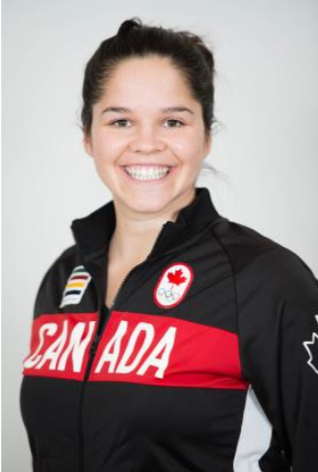
Biathlon Canada is pleased to announce Heather Ambery as our new General Manager. Heather will join the Biathlon Canada team starting mid-August 2018.
Heather comes to Biathlon Canada from the Canadian Olympic Committee (COC), where she was Program Manager, National Sport Federation Services. During her time at the COC, she helped manage the National Sport Federation Enhancement Initiative, which is a program designed to enhance business functions and build capacity in Canada’s National Sport Federations. Heather was also a member of the mission staff for the Rio 2016 Olympic Games and PyeongChang 2018 Olympic Winter Games.
“I am thrilled and honoured to be joining the Biathlon Canada team during such an exciting time for the organization,” says Ambery. “I look forward to collaborating with the Canadian biathlon community as we continue growing the sport at the grassroots level, succeeding on the international stage, and striving to be an exemplary sport federation.”
Heather’s background also includes experience working in major events and at the local level. She was the Competitions Manager at the Ottawa venue for the FIFA Women’s World Cup Canada 2015TM and played an integral role on the operations team at one of Canada’s largest soccer clubs, West Ottawa Soccer Club.
Biathlon Canada’s team is looking forward to building our sport under Heather’s leadership.
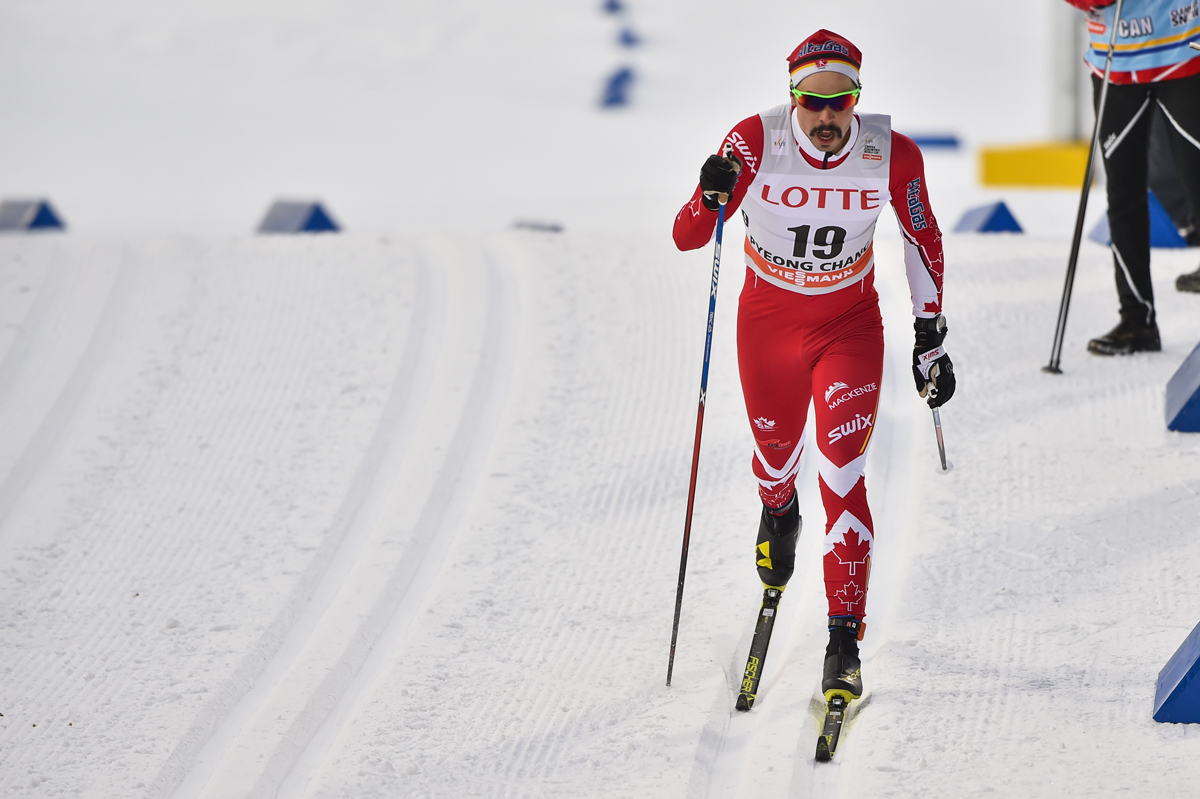
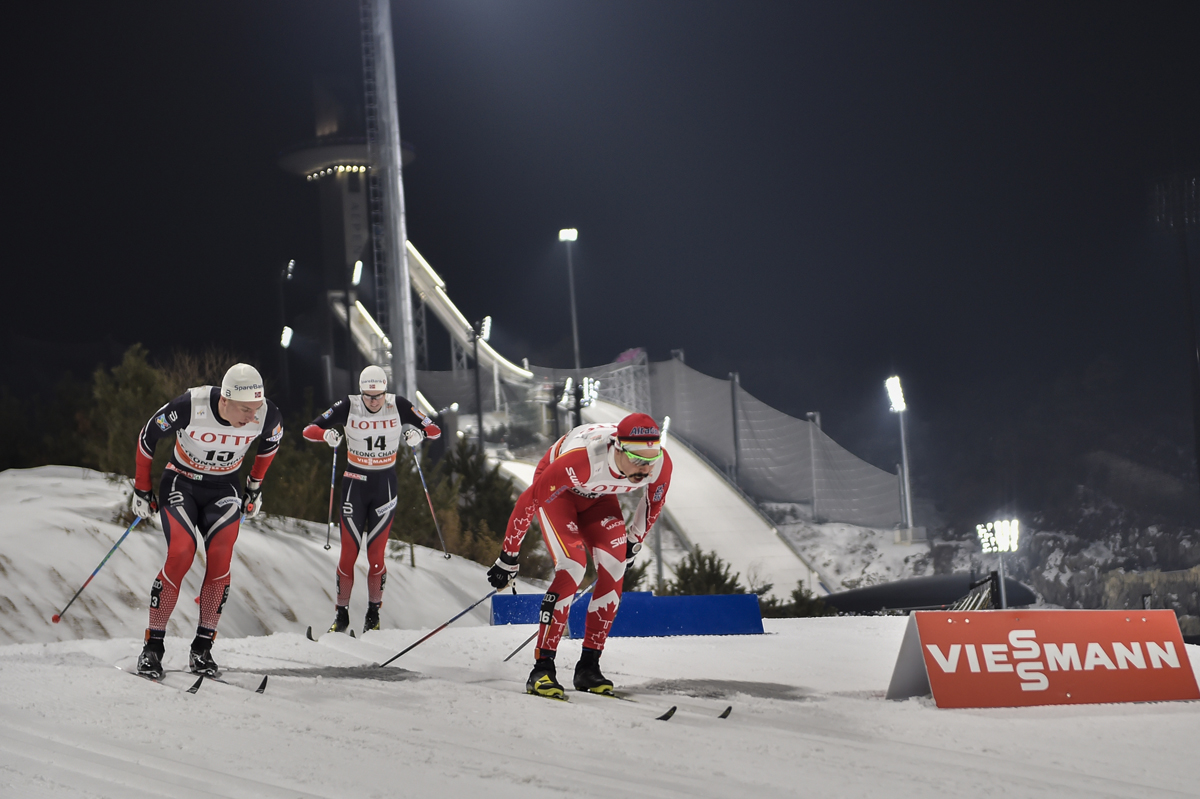
Canada’s Jesse Cockney (r) racing to first in his quarterfinal in the men’s classic sprint at the PyeongChang World Cup, while leading Norway’s Mathias Rundgreen and Daniel Stock. Cockney finished tenth on the day and the result was one of two which has put him on the shortlist for Canada’s Olympic team. (Photo: Fischer/NordicFocus)
But there are a few athletes with those results that don’t come up in conversation.
Simon Lapointe finished 27th in the sprint and Bob Thompson 31st in the World Cup sprint in PyeongChang, South Korea last season – a result that would be bumped up top top-30 status if the Olympic-style scoring employed by CCC for selection, which counts only the top four athletes from each country, removed “extra” Russians from the results.
Paralympic legend Brian McKeever finished 29th in the skiathlon in PyeongChang. And for the women, Annika Hicks and Sadie White finished 26th and 29th (out of 29) in the skiathlon, and 32nd and 34th in the sprint (in a field of 36) — which with Olympic-style scoring would become top-30 finishes.
By a provision in CCC’s criteria, these results won’t count towards nomination to the Olympic team.
“In order to maintain equity and fairness in this selection process, the HPC reserves the right to exclude, or to count only partially, the results of any World Cup event with a weak depth of field,” the criteria state. “The CCC Selection Committee will be charged with evaluating the depth of field in this circumstance based on comparative analysis of World Cups over two seasons (2015-16 and 2016-17). The CCC Selection Committee will bring forth to the HPC any such recommendation to exclude, in whole or part, a World Cup event. This analysis of depth of field will consider time behind the winner (FIS points), an analysis of the top 6, top 12 and top 16 individual athletes or team events in the race based on World Cup ranking, World Cup points, total FIS points of athletes in the race and any other factors that allow for a fair and equitable World Cup depth of field analysis.”
With such a criteria, it’s fairly clear that finishing last in a World Cup race with only 30 athletes would not count towards Olympic qualification.
But in terms of determining what would count, how CCC actually analyzes race results is multifaceted and not entirely transparent.
“It is always best to look at as many data factors as possible when analyzing depth of field – weak depth of field can vary at the same World Cup event depending on gender and type of race,” CCC High Performance Director Tom Holland wrote in an email.
He emphasized that the depth-of-field assessment is rarely used, citing PyeongChang as the only set of World Cups in the last Olympic cycle where results had been excluded for team qualification.
What Results Count as Competitive
Holland and the selection committee looked at different slices of the PyeongChang results. There are multiple ways to meet Olympic qualifying criteria: a top-six sprint result, a top-12 distance result, two top-16 World Cup results (all deemed “Primary Qualification Criteria”), or three top-30 World Cup results (deemed “Alternative Qualification Criteria”). The level of competition at each of these results cutoffs was considered.
And according to Holland, the men’s races were competitive at the top end but not in the middle or bottom of the fields. That’s why Jesse Cockney, who finished 10th in the PyeongChang sprint, can count that as one of his two top-16 finishes and meet CCC nomination criteria – but Thompson, for instance, can’t count the result as his second of three top-30’s.
“What would be looked at varies between the Primary and Alternate A Criteria,” Holland wrote. “For the Primary Qualifying Criteria, the depth of field analysis being considered is top 6–16; World Cup ranking of athletes, particularly the number of red group athletes in the race would be the critical starting point of analysis, next would be time behind these athletes compared to similar placing in other [World Cup] events.
“For the Alternate A Criteria, we are only looking at top 30 results counting top 4 per nation,” he continued. “The average top 30 [World Cup] FIS points over the past 2 seasons in that particular race distance per gender is a good indicator to start the analysis. Being in top half of the field (usually, but not always) and the number of top 30 ranked athletes in the race also need to be considered.”
When asked whether it was appropriate to apply a depth-of-field adjustment differently within the results of the same individual race, the Canadian Olympic Committee (COC) declined to address the specific situation.
“The COC provides national sport federations with a Guide to Drafting Internal Nomination Procedures (INP), which offers a framework, practical advice, and examples they can use in their drafting, interpretation, and implementation of their INP,” COC Manager for Corporate Communications Ricky Landry wrote in an email.
“The COC then reviews all INPs to ensure that they comply with the COC Team Selection Policy, the Olympic Charter and other applicable COC rules and policies. Also, the COC reviews INPs to ensure the qualification and nomination timelines fall within COC and Organizing Committee (OCOG) deadlines. In general terms, the COC Team Selection Policy recognizes the NSF’s authority in setting qualification criteria appropriate for its sport and in determining which athletes and support personnel will be nominated to the COC Team Selection Committee for selection to the Canadian Olympic Team.”
End result: for Lapointe, Thompson, and McKeever, their results were not enough to count towards Alternate Qualification Criteria. For Cockney, 10th was good enough for Primary Qualification Criteria.
“I’ve got the spreadsheet… there were only nine out of the top 30 sprint group [on the start line] at that event,” Holland said in an interview earlier this summer. “So the depth of field and if you look at FIS points, it wasn’t there. But if you look at the top 10, it’s a little more legitimate.”
There were only seven seeded World Cup sprinters on the start line in PyeongChang. All of them bested Cockney in qualification but he beat two of them, Baptiste Gros of France and Simi Hamilton of the United States, in the final results.
That might be important, as Holland indicated that qualification versus heats racing were not necessarily considered in the same way.
“If an athlete does well in the heats, I would be inclined to put more emphasis on the heats,” he wrote.
Transparency and Athlete Expectations
While it was clear to all that the depth of field in PyeongChang would be looked at carefully – Canada was not bringing most of its top athletes, and neither were other countries – the outcome of that analysis wasn’t known.
That marks a major difference from this aspect of the criteria to the rest of CCC’s criteria. It’s fairly clear what athletes have to do to meet World Cup-based criteria: they have to hit certain results, and after a race they can look at the results sheet and immediately know whether they can check that box or not.
At the end of that process, any remaining spots on the roster will be filled at Olympic Trials. Again, there it will be clear what finish is required to be named to the team.
Going into the PyeongChang World Cups, athletes knew that a top-30 might not cut it, but what exactly they would have to do to have a result count towards Olympic qualification was unclear.
“A lot of people didn’t go, so I believe they only counted a top 20 result,” Thompson said in an interview last week. “But I didn’t know that. There was a little bit of awareness that you had to do better than top 30, like maybe making the top 12 would be more respected.”
Likewise, because the method of assessing depth-of-field is not a single mathematical formula that is evenly applied, even glancing at the results after a race may not make clear which athletes in the field had attained qualification standards and which hadn’t.
“In the last few years, I haven’t paid so much attention to what selection criteria is worth in terms of specific scenarios,” Cockney said in an interview this week. “It’s not usually up to us what is deemed a usable race or a competitive race… I can’t decide who the competition is. I can just decide to ski. That’s the attitude I was taking in Korea – just to try to do my best and have a strong day, and thankfully I was able to put together a good day.”
That’s just part of the game, Holland seemed to suggest, saying in an interview that athletes “should have been aware” that normal qualification standards wouldn’t apply before even leaving on the trip to South Korea.
Canada recently launched a Report Doping Hotline though the Canadian Centre for Ethics in Sport. “Our Government is committed to eliminating doping in sport and ensuring Canadians athletes compete on a safe and fair field of play,” Canadian Minister of State (Sport) Bal Gosal said in a press release. “This increased contribution from the Government of Canada and our partners will enhance the Canadian anti-doping program by strengthening its testing and investigative capacity.”
“With increased intelligence we can test the right athlete, at the right place and at the right time. This is a huge win for fair and clean sport.” — Paul Melia, Canadian Centre for Ethics in Sport CEO and President, in a press release
On Nov. 5, the Canadian Centre for Ethics in Sport announced the creation of a new and anonymous Report Doping Hotline (1-800-710-CCES), funded by the Canadian government, Canadian Olympic Committee and the Canadian Paralympic Committee to the tune of nearly $1 million Canadian dollars.
According to the CCES website, the hotline came about as a result of public-opinion research commissioned by the CCES. According to its findings, “Canadian and athletes want clean sport.” The additional funding will ensure that all Olympic and Paralympic athletes will be tested during the months leading to the Sochi Olympics and provide a risk-free platform for reporting their peers.
Canada is not the first country to come up with a snitch line for doping accusations. The United Kingdom and Australia have similar hotlines, as well as the United States. Another endurance sport, cycling is also attempting to round up dopers through its Union Cycliste Internationale (UCI) Hotline. The UCI hotline, in place since January 16 records calls then forwards them to trained specialists in the anti-doping field who then decide what actions need to be taken to catch the suspected cheaters.
Established in 2004, US Anti-Doping Agency (USADA) Play Clean Tip Center (1-877-752-9253) invites callers to leave a message so that the USADA can contact the caller. It is also possible to email or physically mail a note.
“The line was designed as an avenue, for anyone, but especially for athletes, to contact USADA when they believe doping has compromised the integrity of sport,” USADA Media Relations Manager Annie Skinner wrote in an email. “Callers may choose to remain anonymous and all information is evaluated.”
According to Skinner, USADA also accepts tips about suspected cheaters outside of the U.S.
“It’s another step toward catching dopers. Testing does catch some people, but going ‘inside’ the sport and allowing an avenue for clean athletes to report suspicious activity is important.” — Justin Wadsworth, head coach of Cross Country Canada’s World Cup Team
Canada’s doping hotline seems to be getting some use, with an “all lines are busy” message frequently encountered by callers, as this FasterSkier reporter learned through a battery of calls over the course of several days.
An Olympic gold medalist from the 2002 Winter Games, Canadian Beckie Scott stands behind the new hotline. Initially third in the 5-kilometre pursuit, she became the first North American woman to earn an Olympic gold more than two years after the Games; the first- and second-place finishers were disqualified for testing positive for banned substances.
In an interview with CBC Radio’s “As it Happens,” Scott said she would have used the hotline had it existed when she was racing. She would have called about suspicious activity she witnessed, which didn’t include her Canadian teammates, who were 100-percent clean, she said.
Her husband and current head coach of the Canadian national cross-country ski team, Justin Wadsworth also supports the hotline.
“It’s another step toward catching dopers,” he wrote in an email. “Testing does catch some people, but going ‘inside’ the sport and allowing an avenue for clean athletes to report suspicious activity is important. I think the future of catching athletes and teams who dope is through more investigative work coupled with targeted out-of-comp testing. Either way, allowing an anonymous way to give testing agencies more info is a good thing.”
While Wadsworth hints at that doping is larger than isolated individual incidents, the CCES website comes right out and states: “Athletes who dope, rarely, if ever, act alone.”
Citing the Lance Armstrong doping scandal, CCES President and CEO Paul Melia wrote on his blog that doping riders were aided and abetted by coaches, trainers, doctors, and others. Catching and punishing those in the supply chain will put a dent in doping, he reasoned. Working with Border Services Agencies is a start. Much can be learned from intelligence gathering on the importation of banned substances and drug enforcement agencies can provide information on drug busts and seizures. Name gathering at the drug trafficking level can lead to names and destinations at the receiving end of the deal.
“Perhaps there is a more immediate and valuable source of information, that up until now has gone largely untapped,” Melia added. “That source is the athletes themselves.”
While the new World Anti-Doping Agency (WADA) Code gives caught dopers reduced sanctions if they provide information on others involved in banned behavior, the new code does not encourage clean athletes to share suspected doping activity.
“It is up to individual countries, their sports governing bodies and their national anti-doping agencies to come up with ways to do this,” Melia explained.
The plan is big in Canada and with nearly $1 million dollars behind it, it is clear that the nation intends to catch dopers before they get to Sochi in February. The first step might be to man the phone lines with actual people, rather than automated requests to leave messages.