From the FasterSkier archive — posts syndicated from athletes’ and coaches’ own blogs between 2004 and 2012, kept online as published. Current coverage is at fasterskier.com.

Tag: canadian para-nordic ski team

  • Coach McKeever on Canada’s Unprecedented Paralympic Success and the Future

    Coach McKeever on Canada’s Unprecedented Paralympic Success and the Future

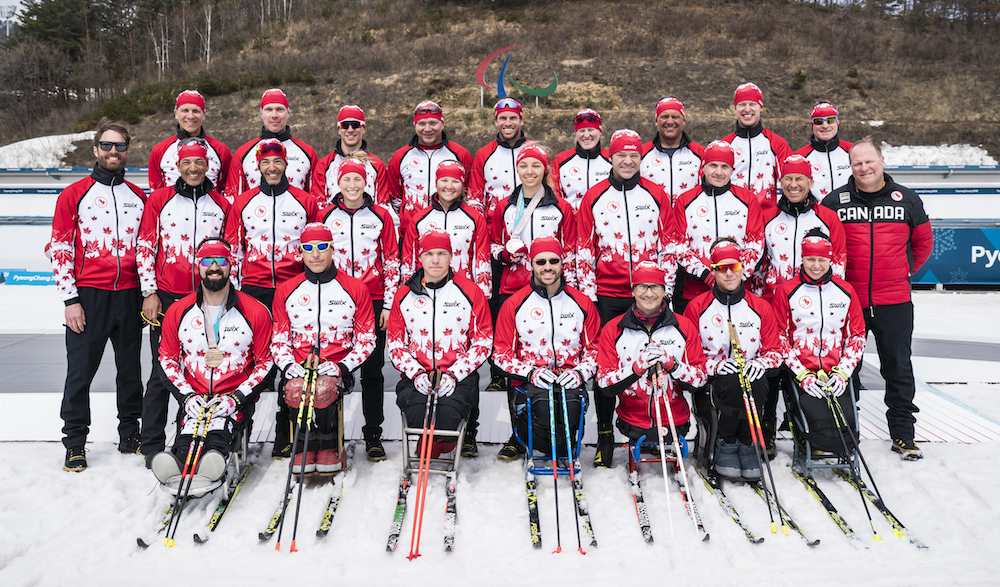
    Canada’s 2018 Paralympic cross-country and biathlon team at the Alpensia Biathlon Centre on the last day of the Games in Pyeongchang, South Korea. (Photo: Dave Holland/Canadian Paralympic Committee)

    The 2018 Winter Paralympic Games was one for the books for Team Canada. Its athletes racked up a total of 28 medals in PyeongChang, South Korea, surpassing its previous record of 19 in Vancouver 2010.

    Of those 28 medals, 16 came from Cross Country Canada’s (CCC) Para Nordic skiers (which includes both cross-country and biathlon). In comparison, five of the 19 medals Canada won in Vancouver were a product of a para-nordic team made up for two athletes: Brian McKeever and Colette Bourgonje.  

    Following the 2010 Games, Brian McKeever’s brother and guide at the time, Robin McKeever, became CCC’s Para-Nordic head coach in the fall of 2010. Around the same time Robin made the transition from athlete to coach, CCC experienced budget cuts that impacted its para-nordic program.

    “When the program came to me as head coach, it was a, ‘Hey, you’re going to have to take this and rebuild it, somehow,’ starting point,” Robin McKeever said during a recent phone interview.
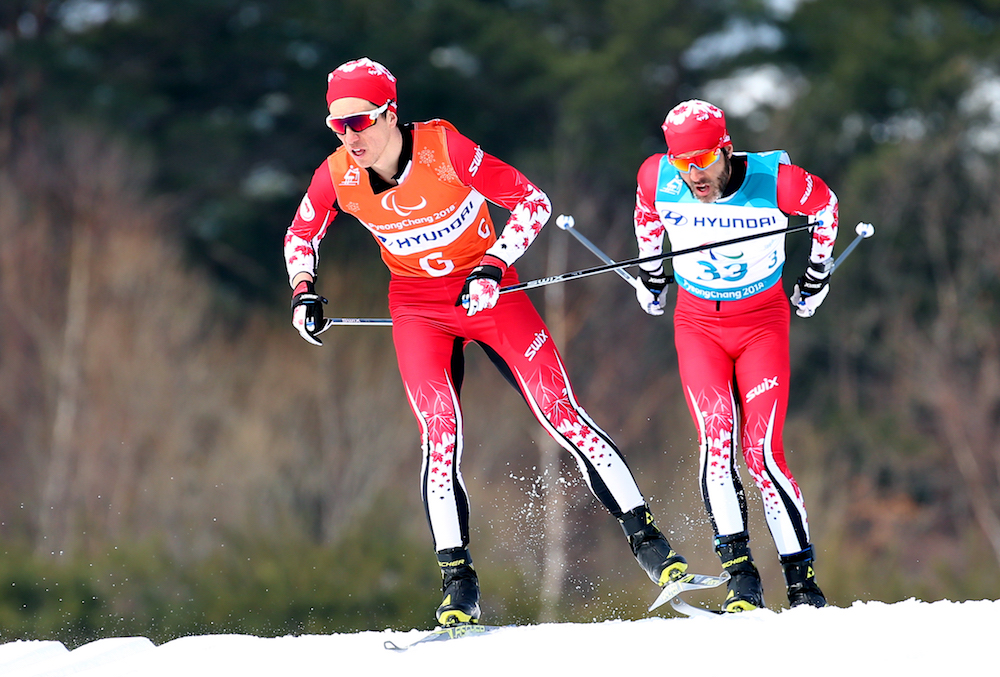
    Brian McKeever follows guide Graham Nishikawa during the men’s visually impaired 20 k freestyle at the 2018 Paralympics in PyeongChang, South Korea.  (Photo: Scott Grant/Canadian Paralympic Committee)

    Over the course of eight years, McKeever, 45, has guided the program into a international powerhouse, as evidenced by its unprecedented success and increased presence in PyeongChang.

    “It was a little bit of luck finding the right athletes at the right time, then it’s … working hard to keep them together as teammates who want to work and push each other to achieve their goals,” he explained.

    The mindset seemed to work well for his team; with 14 athletes, it was seven times the size of that in Vancouver. And its athletes brought home more than three times the hardware it did in 2010.

    “It’s attributed to having some pretty phenomenal athletes in the program, first and foremost,” Robin said, regarding the program’s surge in success. “Secondly, it’s attributed to having an awesome team supporting the athletes all working together … from medical staff to the physiologists to the development coaches to all of our wax team. They’re great people who love to be together. ”

    Four women and 10 men comprised the 2018 Paralympic team roster, with two of the men being Brian McKeever’s guides, Russell Kennedy and Graham Nishikawa. Brian, 38, has long been a longtime para-nordic force, and in PyeongChang he left no room for doubt that he pervades as the cross-country king. A visually impaired athlete, he won all three cross-country races in PyeongChang: the 20-kilometer freestyle, the 1.5 k classic sprint and the 10 k classic. He also raced to bronze in the 4 x 2.5 k open relay.

    With his performances in PyeongChang, Brian became Canada’s most decorated Winter Paralympian of all-time. Lana Spreeman, a para-apline skier, previously held the record at 13 medals, which she accumulated over the course of five Paralympics.

    Brian currently holds 17 Paralympic medals from five Paralympics, 13 of which are gold.

    “I wasn’t aware of this record, but it is pretty cool,” Brian said at the time, according to a Canadian Paralympic Committee press release. “I think for me more than anything is this is a testament to our entire program. We’ve had so many great skiers leading the way for me with my brother, Robin who is now coaching us, and Colette Bourgonje.

    “Now it is awesome for me to be a part of a new generation that has arrived in Mark [Arendz], Collin Cameron, and the young women like Emily [Young], Brittany [Hudak] and Natalie [Wilkie], who are ready to carry the torch. I’m so excited to be around all of them this week and to be there cheering them on,” he added.

    Also in PyeongChang, Canada’s Mark Arendz, Natalie Wilkie, Collin Cameron, Emily Young, Brittany Hudak, and Chris Klebl also earned their share of hardware on the Alpenesia ski trails.

    Prior to Pyeongchang, Arendz had competed in Vancouver and then Sochi, coming away from the 2014 Paralympics with silver and bronze finishes in biathlon events. Four years after he earned his first two Paralympic medals, Arendz tallied six more in South Korea, the most medals ever won by a Canadian at a single Winter Paralympics.
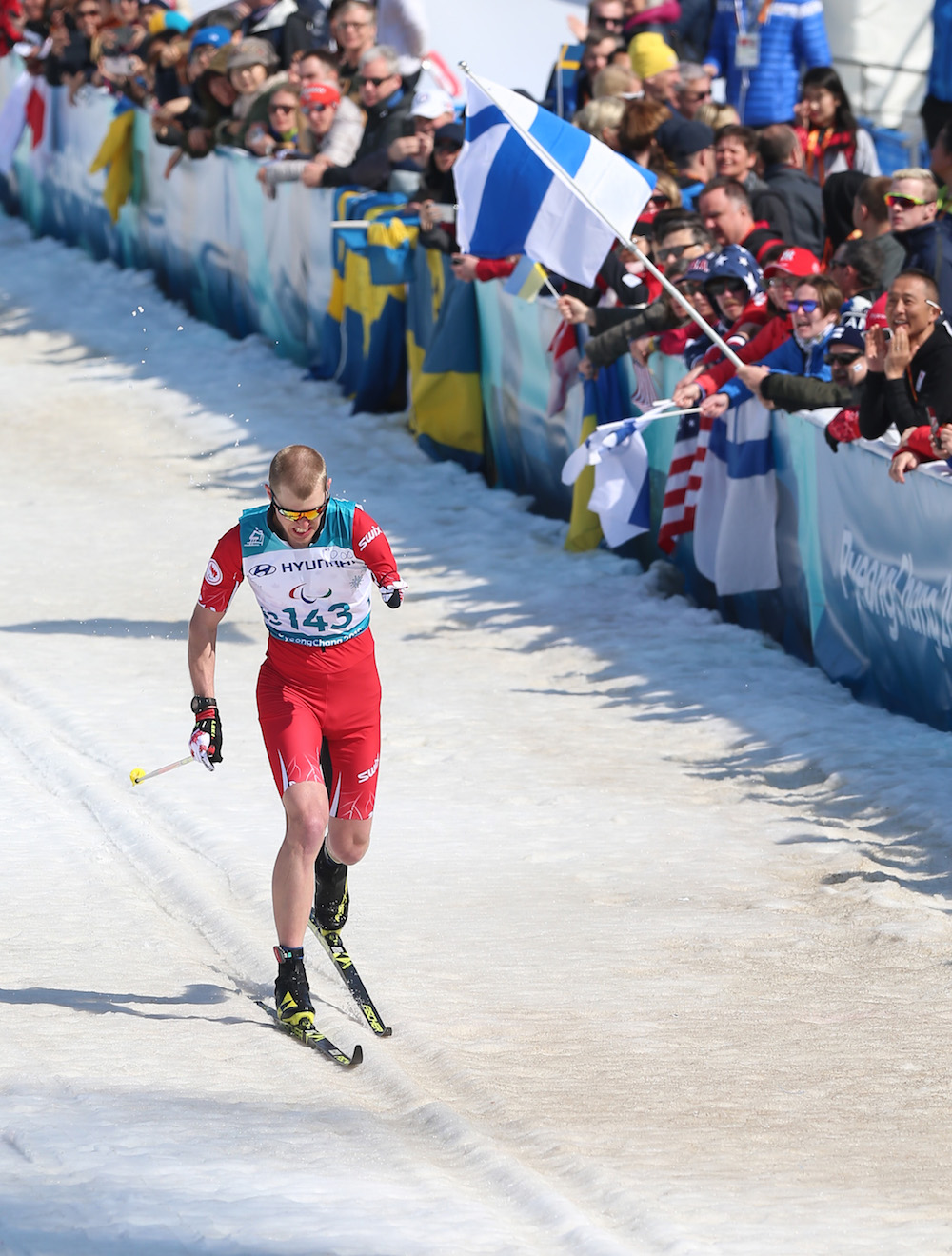
    Canada’s Mark Arendz en route to bronze in the men’s 1.5 k standing classic sprint at the 2018 Paralympics in PyeongChang, South Korea. (Photo: Scott Grant/Canadian Paralympic Committee)

    Arendz showed versatility and strength, as his medal winning performances came in both the biathlon and cross-country events over the course of nine days in PyeongChang. He won a gold in the 15 k standing biathlon event, followed by a silver in the 7.5 k standing biathlon, silver in the 4 x 2.5 k mixed relay, along with three bronze medals, one in the 12.5 k standing biathlon, one in the 1.5 k standing sprint and one in the 10 k standing competition.

    “Every time I stepped on the podium this week, I kept thinking I want to hear ‘Paralympic Champion’ and then my name announced,” Arendz, 28, told Cross Country Canada at the time, according to a press release. “I wanted nothing more than to hear my country’s anthem played. I’ve seen the maple leaf on top of the podium three times this week, but to finally have it behind the top step of the podium for me is an amazing feeling.”

    Canada’s success story in South Korea did not end there. In her debut Paralympics, 17-year-old Wilkie scored big, earning bronze in the standing sprint, silver in the mixed relay, and gold in the 7.5 k classic in PyeongChang.

    The youngest on her team, Wilkie was a skier before she lost four fingers on her left hand in a shop-class accident two years ago. 

    “Natalie was a medalist in able-bodied competition at Junior Nationals the year before,” Robin explained. “We knew that she was a strong skier that had an acquired disability and we knew that it was possible for her to race at the Paralympics one day if she wanted to. It’s a learning process and a real mental process to get over your injury and for her it was then also turned into an opportunity.”

    Yet another individual medalist in multiple events in PyeongChang, Cameron, now 30, brought his team another first. With his third-place finish in the 7.5 k sitting biathlon race, he became Canada’s first male sit skier to medal in biathlon. He later earned two more bronze medals, one in the 15 k and the bronze another in the open relay.

    Until four years ago, Cameron had been a sledge hockey player. He happened across his hometown’s para-nordic club by chance over the internet, joined that club and was later recruited to the national team.

    “Being a part of the open relay team with Brian, and his guides Graham [Nishikawa] and Russell [Kennedy], was something really special and I will never forget it,” Cameron wrote in a previous email to FasterSkier. “Getting my third Paralympic medal with those guys was pretty cool … just being a part of this amazing and successful team of athletes, techs, and coaches has to a favourite moment.”
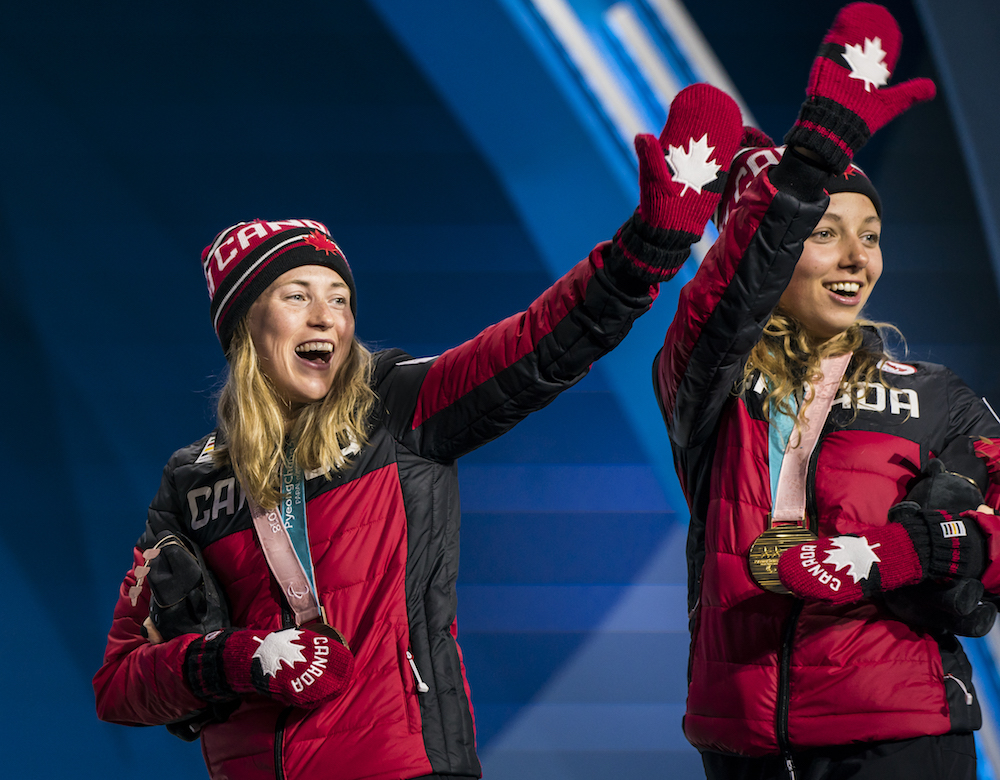
    Natalie Wilkie (r) and Emily Young at the 2018 Paralympic medal ceremony with their gold and bronze medals in the women’s 7.5 k standing classic race in Pyeongchang, South Korea. (Photo: Dave Holland/Canadian Paralympic Committee)

    Notably, every member of Canada’s seven-member Para-Nordic World Cup Team claimed a medal in  PyeongChang, with Young taking bronze in the 7.5 k classic standing for her first Paralympic medal followed by silver in the mixed relay, Hudak notching bronze in the 12.5 k standing biathlon, and Klebl helping the mixed relay to silver.

    Since the end of last season, CCC has undergone some changes that are affecting its Para-Nordic program. Both CCC’s para-nordic and able-bodied programs are tied under one organization, and Nic Lemyre was recently hired on as the new high-performance and development advisor for both programs. Previously, Mark Edwards served as the Para-Nordic high-performance director.

    “Cross Country Canada came under some very strategic shifts with the prior organization,” Robin explained. “We’re not sure exactly how that’s going to play out. That is still in the works. We get to deal with that as it comes around, but it’s about putting a sport pillar and business pillar under two different ones and so we’re working hopefully closer with the able-bodied program.”

    In terms of how CCC’s budget cuts are expected to affect its Para-Nordic program, CCC CEO Shane Pearsall expected the amount going to para-nordic to be “about the same as last year”. Asked how much of CCC’s roughly $4 million-dollar budget will go to the Para-Nordic national team’s elite programming, Pearsall estimated that amount to be about $600,000 dollars (comparable to between $500,000 and $600,000 for able-bodied national team programming).

    In Robin’s opinion, working closer with the able-bodied program means the transference of ideas and potential to strengthen each other through teamwork and communal outreach. Expanding to skiers of all abilities and levels may take work from the ground up, as well as the top down.

    buy antabuse online, buy tretinoin online

    “We need to be working together to rebuild that whole system,” Robin said, pointing out that currently, CCC’s able-bodied A-team consists of one member, Alex Harvey.

    This season’s Canadian Para-Nordic World Cup Team includes eight members, plus another six on the development team.

    “The whole focus of the [Para-Nordic] program is about the process,” he added. “For the athletes to have their best race on a given day, the team has to also provide the best skis on a given day, the best feeds, say or whatever that requires. It’s really more about the process.”
  • CCC Lays Off Four Staff Members, Including Babikov

    CCC Lays Off Four Staff Members, Including Babikov

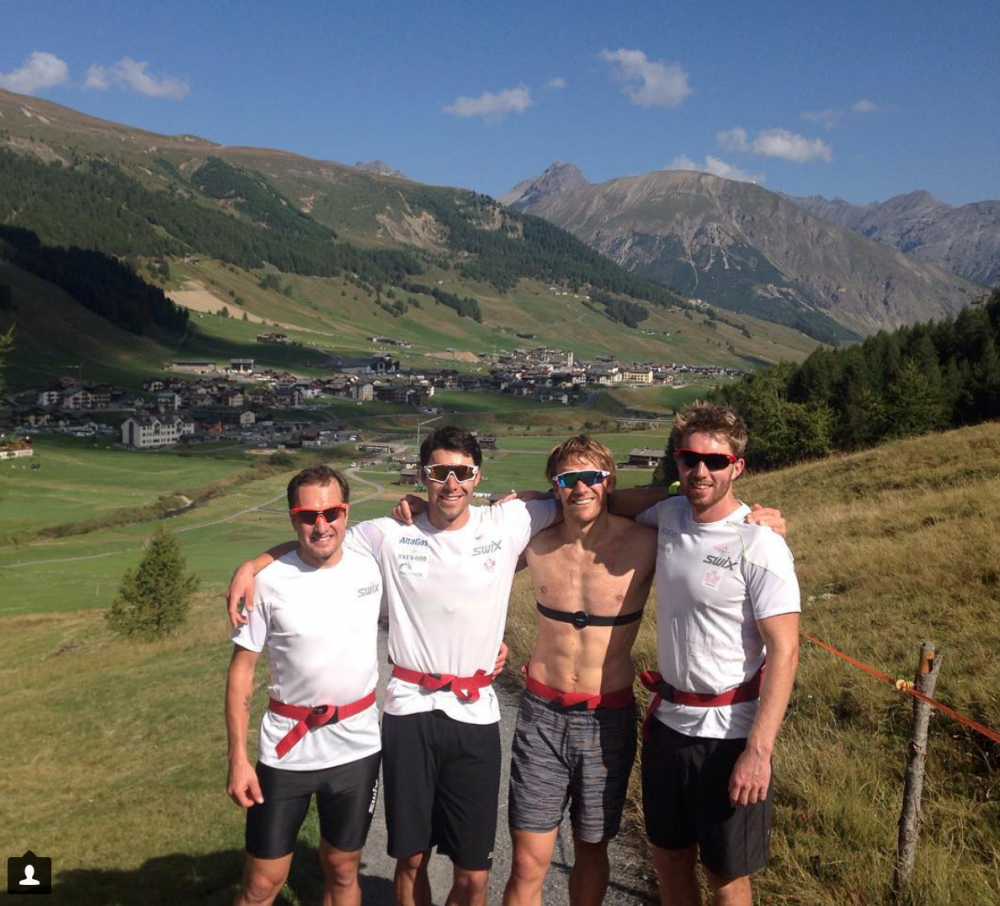
    Coach Ivan Babikov (l) at a 2016 fall training camp with Canadian World Cup Team members Alex Harvey, Devon Kershaw and Graeme Killick in Livigno, Italy. (Photo: Ivan Babikov/Instagram)

    Cross Country Canada (CCC) has appointed a new high-performance and development advisor, Nic Lemyre, and laid off four staff members, CCC Chief Executive Officer Shane Pearsall confirmed in a phone interview on Thursday.

    The news of Lemyre’s hiring came in the form of a press release Thursday morning, two days after four CCC employees — Ivan Babikov, Mike Edwards, Lisa Patterson, and Martine Zilligen — were informed of their release.

    Babikov has spent the last two seasons as a national team and World Cup coach, Edwards was the high-performance director for CCC’s Para-Nordic Ski Team, Patterson was a longtime high-performance development coach, and Zilligen has been communications and marketing manager since 2013.

    According to Pearsall, the layoffs were a direct result of CCC’s annual operating budget (which covers both able-bodied and para nordic skiing) decreasing from about $4.5 million dollars last year to what he anticipated to be $3.9 or $4 million dollars this year. The budget is not finalized, as CCC is waiting on the amount it will receive from Own the Podium (OTP), a government-backed nonprofit, which Pearsall estimated to be about 20 percent of CCC’s operating budget. That final amount is expected by mid-July, he said.

    Fifty percent of CCC’s budget comes directly from the government branch of Sport Canada, and that amount has been determined, Pearsall said. He explained that money is tighter on the whole for CCC as a result of decreased government funding and sponsorship revenue.

    One of CCC’s main sponsors, Mackenzie Investments, will no longer support nordic or four other snow sports as it had previously. Instead, the investment firm opted to stick with freestyle and alpine.

    “From the standpoint of a sponsor, they were one of our bigger ones,” said Pearsall, CCC’s CEO since November 2016.

    On the upside, he explained that another sponsor and investment firm, Haywood Securities, has agreed to sponsor the NorAm circuit as it has in the past.

    Asked if budget cuts were among the biggest challenges affecting CCC at the moment and the reasoning behind the latest layoffs, Pearsall said, “Yes. If things had stayed the same that would’ve been good, but obviously that’s not the case.”

    He added that CCC is faced with the ongoing challenge of competing with other sports for the support of “corporate Canada”.

    “At the same time, we continue to talk to people and try to get them on our side to become part of our programs,” Pearsall said. “There’s a part of it where it always will be the challenge. You’re always looking for money for places to spend the money, and we just continue on trying to get more money.”

    Asked specifically why CCC chose to release those four employees, Pearsall said, “Just trying to create a better future, efficiencies that we think we can find. It’s appropriate that at the end of the quad [Olympic quadrennial], you look at things and how to set the stage for the next quad. And even for us, we were looking at 2026. So we’ve decided this the way we’re going to go.”

    CCC now has a staff size of 12. Louis Bouchard retained his job and is listed on CCC’s website as its lone national ski team/World Cup coach. Bouchard is also Alex Harvey’s personal coach and head coach of the Pierre-Harvey National Training Centre (Centre National d’Entraînement Pierre-Harvey) in Quebec.

    Pearsall said he broke the news to Babikov, Edwards, Patterson, and Zilligen individually during one-on-one meetings on Tuesday.

    “It’s one of those things, when you do a change, you tend to want to something like this all at one time, and that’s the strategy we executed,” he said.

    CCC will be looking to replace Babikov’s position as co-World Cup coach through an “open job search,” Pearsall stated. As for Patterson’s role as a NextGen coach and development trip leader (for international competitions including U23 and Junior World Championships), Pearsall was unsure if CCC would fill that vacancy.

    “When something like this happens — I’ve been involved in the corporate sector — you do a bit of a reshuffle on responsibilities, so we’re working on those on how we’ll go about that,” he said. “At this point in time, I can’t say we’ll necessarily hire somebody in that specific area, but we’re looking at how we cover responsibilities.”

    As for the timing of these layoffs in early June, two months after the end of the season, Pearsall said that was a tough one.

    buy ventolin inhaler, buy nasonex online

    “Can you ever find perfect timing? There’s questions about that, but this is the way we decided to go, and we’re going to make the timing work,” he said. “… This is the way things lined up. This is the way we’ve gone about it.”

    According to Babikov, the layoff, which was effective immediately, caught him off guard.

    “I had no idea it was coming, and it didn’t cross my mind that something like this would happen because we had already started the new summer,” Babikov said on the phone on Thursday. “I just came back from training and our CEO just called me for a meeting, and I thought it was regarding our new HPD, if we hired somebody, but then he just handed me papers and I was told to leave my credit card and keys, and we go separate ways. And that’s all that was said.”

    Babikov, who’s been part of the Canadian national team for the last 10 years, first as a two-time Olympic athlete and then as a coach starting in June 2016, said there was no notice. “It was without a cause,” he said.

    Asked why Babikov was fired, Pearsall said he couldn’t comment.

    ‘The Rebuild’ 

    Lemyre as the high-performance and development advisor will fill the roles previously held by Edwards and Thomas Holland, the former high-performance director of able-bodied cross-country who retired at the end of last season. A Montreal native who is primarily based in Norway as a professor of sports psychology at the University of Oslo, Lemyre will work part time for CCC.

    He’ll be the head of one of CCC’s two new departments, Pearsall explained, overseeing the sport side of the organization while Pearsall and Megan Begley, CCC’s operations & strategic development manager, oversee operations. Lemyre will make decisions in his department, but Pearsall will have “final approval on all personnel decisions”, according to CCC media relations consultant Chris Dornan.

    Dornan clarified that Lemyre is “advising on the rebuild” and that CCC will communicate the structure of its high-performance department in the near future.

    “His role is going to be advising us, going forward, on how we should look at things, and develop things,” Pearsall said of Lemyre. “He’s going to be an integral part of the decisions we make, in different areas, in the high-performance area. He will be overseeing, in the re-org, I’ve basically created two departments. One is operations, and one is sport. He will be in the mix on the sport side. Under the old structure, there was a para-nordic [director] and there was an able-bodied [director], and I’ve brought those two together to gain efficiencies and exchange more knowledge, if you will, between the two sections of para and able.”

  • FasterSkier’s Para-Nordic Skiers of the Year: Oksana Masters and Brian McKeever

    FasterSkier’s Para-Nordic Skiers of the Year: Oksana Masters and Brian McKeever

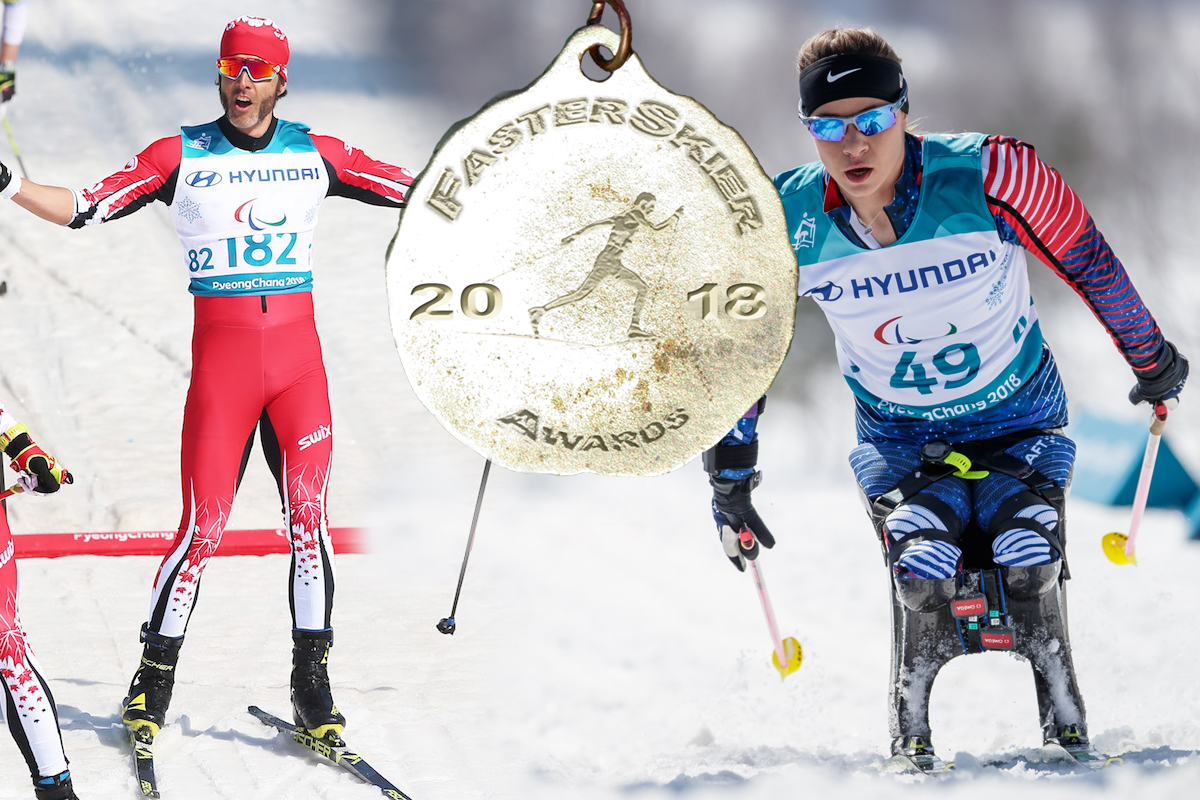
    Brian McKeever (l) and Oksana Masters (r) are FasterSkier’s 2018 Para-Nordic Skiers of the Year. (Photos: Scott Grant/Canadian Paralympic Committee & Joe Kusumoto/US Paralympics)

    With the 2017/2018 season officially in the rearview, FasterSkier is excited to unveil its annual award winners for this past winter. Votes stem from the FS staff, scattered across the U.S., Canada, and Europe, and while not scientific, they are intended to reflect a broader sense of the season in review. This set of honors goes to outstanding Para-Nordic skiers on the international circuit.

    Previous categories: Junior Skiers of the Year | Collegiate Skiers of the Year | Biathletes of the Year

    ***

    Oksana Masters, U.S. Paralympics Nordic

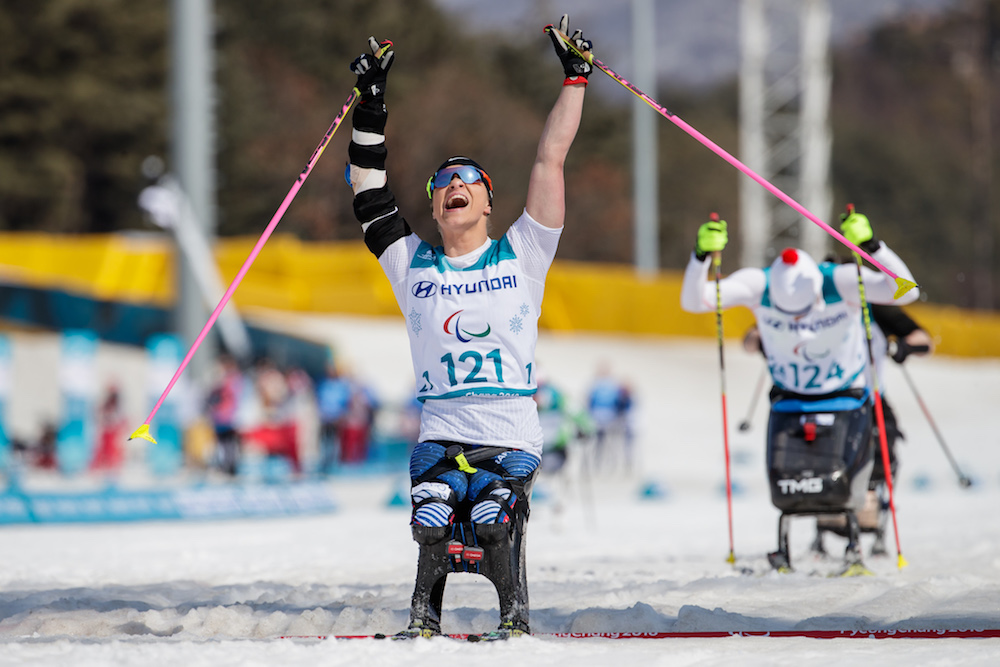
    American Oksana Masters reacting to her first gold medal in her third Paralympics, after winning the women’s 1.1 k sitting sprint in PyeongChang, South Korea. (Photo: Joe Kusumoto/U.S. Paralympics)

    Undefeated in this category for the last four years of the FasterSkier awards, Oksana Masters had her best Paralympics yet this winter and overcame a major setback to do so. Just two weeks before the 2018 Winter Paralympic Games in PyeongChang, South Korea, Masters slipped on ice, injured her elbow and had to get surgery. Then, entirely propelled by her arms as a sit skier, the 28 year old competed in all six individual races in PyeongChang and medaled in five of them (she fell in the other and pulled out of the race shortly before the finish). In total, she racked up the first two Paralympic gold medals of her career (in her third Paralympics) plus two silver medals in biathlon — her first biathlon medals — and a bronze.

    “I am absolutely truly speechless on this performance,” Masters told U.S. Paralympics after winning her second gold medal of the week in the women’s 5-kilometer sitting cross-country race (her first came in the cross-country sprint).

    “I thrive and love the athlete lifestyle of eat, sleep and train,” she continued. “To put yourself to the ultimate test on that start line and seeing all your hard work come through, and not just that, it’s a whole team effort. … It’s not a one-person show. It definitely takes a village and we have an incredible team.”

    Masters and her teammate Dan Cnossen accounted for 11 of Team USA’s 16 medals in nordic and biathlon in PyeongChang, which was more than five times the amount of medals the team brought home after Sochi in 2014.

    Overall this season in the World Para Nordic Skiing rankings, Masters ranked first in women’s sitting biathlon and tied Germany’s Andrea Eskau for first in cross-country. In the International Paralympic Committee (IPC) overall World Cup standings, Masters placed third in both cross-country and biathlon.

    Brian McKeever, Canadian Para-Nordic Skiing

    Also our award winner last year, Brian McKeever became Canada’s most decorated Winter Paralympian of all time this winter with 17 career medals, 13 of which are gold. Three of those golds came in PyeongChang, and he captured bronze there with his teammates on the final day of racing, in the open relay, when Canada placed second in the mixed relay and third in the open relay for its first Paralympic relay medals.

    Brian McKeever (r) follows guide Graham Nishikawa during the men’s visually impaired 20 k freestyle at the 2018 Paralympics in PyeongChang, South Korea. Along with guide Russell Kennedy, they won the race by over a minute for McKeever’s 14th Paralympic medal and 11th gold. (Photo: Scott Grant/Canadian Paralympic Committee)

    This marked the fifth Paralympics for McKeever, 38, and he was accompanied by two guides, Graham Nishikawa (whom he skied with at the 2014 Sochi Games) and Russell Kennedy (who joined the Canadian Para-Nordic Team this year). Together, they won all three visually impaired cross-country races they competed in: the 20 k freestyle, classic sprint and 10 k classic.

    In his first race of the Games, the 20 k distance race, McKeever, who was also Canada’s flag bearer for the PyeongChang Opening Ceremony, captured his 14th career medal — the most of any Canadian Winter Paralympian. In fact, he’s the most successful cross-country skier in Paralympic history, according to an IPC press release.

    “I wasn’t aware of this record, but it is pretty cool,” McKeever told Cross Country Canada after the 20 k. “I think for me more than anything is this is a testament to our entire program. We’ve had so many great skiers leading the way for me with my brother, Robin, who is now coaching us, and Colette Bourgonje. Now it is awesome for me to be a part of a new generation that has arrived in Mark [Arendz], Colin Cameron, and the young women like Emily [Young], Brittany [Hudak] and Natalie [Wilkie], who are ready to carry the torch. I’m so excited to be around all of them this week and to be there cheering them on.”

    Like the U.S., Canada tallied 16 medals between nordic and biathlon at the PyeongChang Paralympics.

    In an interview with CBC Sports during the Games, McKeever referred to his team as a “future superpower” in the sport, with every one of his World Cup teammates capturing at least one medal in PyeongChang. “It’s really exciting for me to watch and see something that I’ve been part of growing.”

    McKeever was also recently voted IPC Male Athlete of the Month for March. Masters, the IPC’s January Female Athlete of the Month, was nominated again for the Female Athlete of the Month for March. Voting closes April 16.

    Honorable Mentions: Mark Arendz (Canadian Para-Nordic) and Dan Cnossen & Kendall Gretsch (U.S. Paralympics)

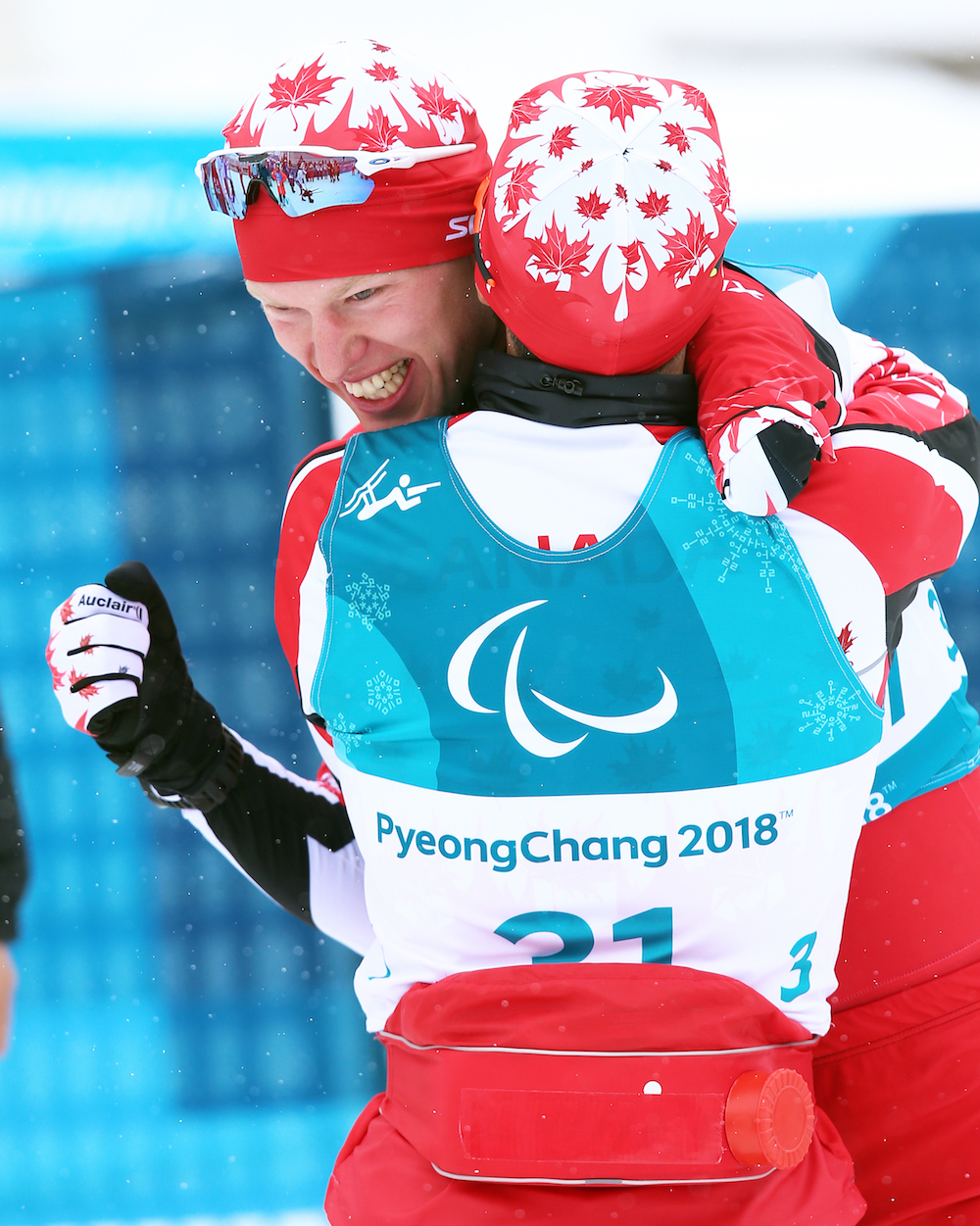
    Canada’s Mark Arendez gets a congratulatory hug after he won gold in the men’s 15 k standing individual biathlon race at the 2018 Paralympics in PyeongChang, South Korea. (Photo: Scott Grant/Canadian Paralympic Committee)

    While McKeever carried the Canadian flag at the PyeongChang Opening Ceremony, his teammate Mark Arendz was honored with waving it at the Closing Ceremony. In his third Paralympics, the 28-year-old Arendz had his best Games yet, taking a medal in all six events he competed in to make him the most successful Canadian at a single Winter Paralympics.

    Arendz captured five individual medals in the men’s standing races in PyeongChang, including his first-career gold in the 15 k biathlon, silver in the 7.5 k biathlon sprint, and bronze in the 12.5 k biathlon, as well as his first Paralympic cross-country medals: bronze in both the sprint and 10 k classic, and silver in the mixed relay. He sat out the only race he didn’t medal in: the long-distance cross-country race.

    “I came in here thinking I could get three medals, but to get six is incredible,” Arendz said on the last day of the Games, after his team placed second in the mixed relay for Canada’s first relay medal. “Today’s is a special one. I am happy we got this done, but there is no way I could do another race. I’m done.”

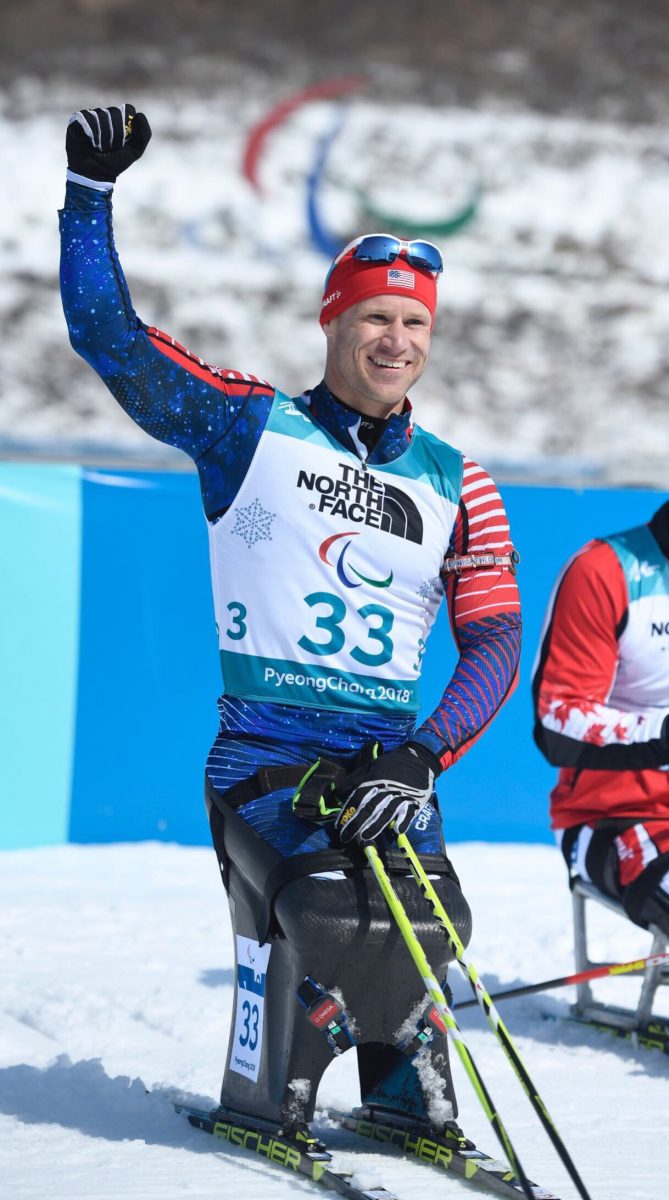
    We mentioned Dan Cnossen earlier, but he’s worth mentioning again. Cnossen, 37, opened his second Paralympics with his first career medal at the Games — gold in the men’s 7.5 k sitting sprint. The next day, he placed second in the 12.5 k biathlon race, and from there, he kept up his medal streak through all six  individual races. The total medal haul for the former Navy SEAL and current Harvard graduate student was one gold, four silvers, and one bronze.

    Dan Cnossen of the U.S. celebrates his win in the men’s sitting 7.5 k biathlon sprint on opening day of competition at the 2018 Winter Paralympics in PyeongChang, South Korea. (Photo: Mark Reis/U.S. Paralympics)

    It wasn’t an easy feat. Cnossen considered pulling out of the last biathlon race — the 12.5 k — in order to compete in the final 10 k cross-country race in PyeongChang.

    “I have an excerpt that says it doesn’t matter how you feel today, it doesn’t matter what your background is or where you’re coming from, all that matters is what you can do,” Cnossen told U.S. Paralympics after finishing second in the biathlon race. “I just tried to focus on what I could do today. Not the fact that I didn’t sleep well last night, that doesn’t matter. Just go out there and perform like I know I can.”

    In all, Cnossen raced about 60 k over eight days.

    “I came into the Games just trying to take it one race at a time and give it my all — each and every race — and not think too far ahead,” Cnossen said after placing second in the 10 k cross-country race the next day for his sixth-straight medal. “Just focus on the here and now, and soak up the moment and be in the present.”

    His teammate Kendall Gretsch, a triathlete who recently took up nordic skiing and biathlon, opened her first Paralympics with gold in the women’s 6 k sitting sprint in PyeongChang. Gretsch, who turned 26 earlier this month, also won the 12 k biathlon race the next day.

    In an interview with U.S. Paralympics, she described being “unsure” of how she’d stack up in PyeongChang. Days 1 and 2 of racing pretty much settled it.

    “I knew that since our last World Cup I had improved a lot, but you never know until you race,” she said after her second-straight gold. “It’s a very humbling experience being able to hear your anthem, puts everything into perspective. Knowing that you’re here not just here for yourself but for your country, it’s amazing.”

    Kendall Gretsch (r) and Oksana Masters at the 2018 Paralympics medal ceremony for the women’s sitting 6 k biathlon sprint after winning gold and silver, respectively, on the first day of competition in PyeongChang, South Korea. (Photo: Joe Kusumoto/U.S. Paralympics)
  • IPC Suspends Russia from Rio Paralympics

    IPC Suspends Russia from Rio Paralympics

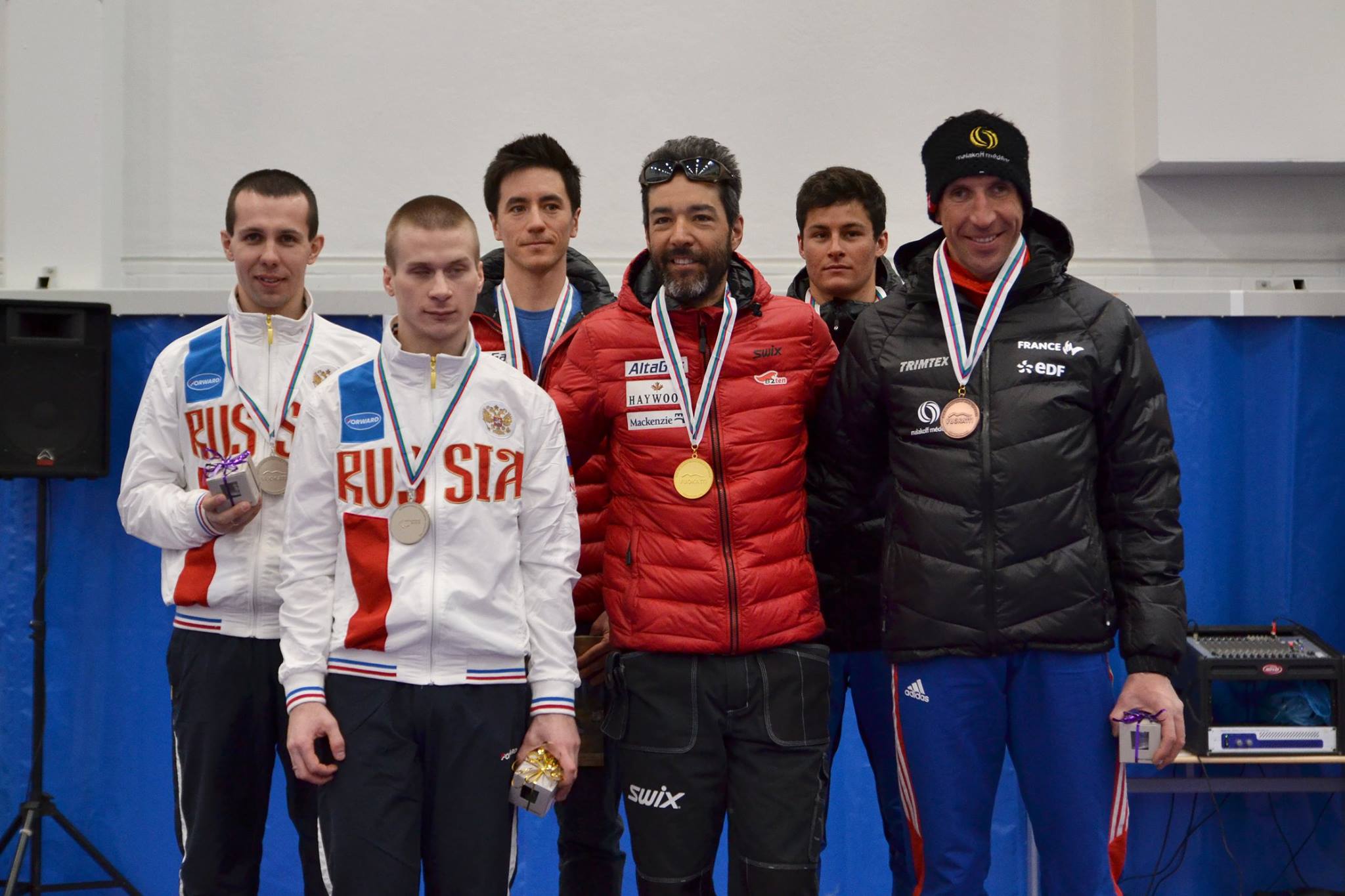
    Brian McKeever (c) and his guide Graham Nishikawa with their gold medals after the men's visually impaired 30 k at 2016 IPC World Cup Finals in Vuokatti, Finland. Russia's Alexsander Artemov (l) placed second and France’s Thomas Clarion (r) was third. (Photo: IPC Nordic Skiing/Facebook)
    Brian McKeever (c) and his guide Graham Nishikawa with their gold medals after the men’s visually impaired 30 k at 2016 IPC World Cup Finals in Vuokatti, Finland. Russia’s Alexsander Artemov (l) placed second and France’s Thomas Clarion (r) was third. (Photo: IPC Nordic Skiing/Facebook)

    As many athletes continue to prepare for the upcoming Paralympic Games taking place exactly one month from Sunday in Rio de Janeiro, Brazil, those sporting the white, blue and red flag of Russia will not. On Sunday, Aug. 7, the International Paralympic Committee (IPC) announced its decision to suspend the Russian Paralympic Committee from competition in Rio and upcoming IPC competitions.

    A press conference was held Sunday morning in Rio to announce the IPC Governing Board’s unanimous ultimatum that the Russian Paralympic Committee had failed its duties as an active member to the IPC in light of recent investigations. Namely, the Russian Paralympic Committee was found at fault in their inability to comply with sanctions set forth by the IPC Anti-Doping Code and the World Anti-Doping Code. Prior to any decision from the IPC Governing Board, the Russian Paralympic Committee was permitted to provide a written and verbal claim during the conference.

    The logo for the 2016 Summer Paralympic Games, which will be held Sept. 7-18 in Rio de Janeiro, Brazil.
    The logo for the 2016 Summer Paralympic Games, which will be held Sept. 7-18 in Rio de Janeiro, Brazil.

    The repercussions of the decision for the Russian Paralympic Committee include the suspension of its IPC membership rights and privileges. This means Russia is not allowed to vote at IPC member meetings nor enter athletes in IPC-sanctioned events, which includes the 2016 Summer Paralympics and IPC competitions (involving summer and winter sports) beyond that.

    Much of the decision, according to IPC President Sir Philip Craven, was based on the findings of the McLaren report. Within the report, “35 disappearing positive samples from Paralympic sport in 2012 to 2015,” were included in the report’s findings.

    “Since the publication of the McLaren Report on 18 July our priority has been to establish the full facts in respect of Para sport,” Craven stated in the press release.

    “In particular, we have taken the necessary time to ask further questions of Professor McLaren and his investigation team, to await the results of samples undergoing further forensic examination and to invite the Russian Paralympic Committee to present its case to the IPC and enter into dialogue with the IPC Governing Board. With the full facts to hand, we were deeply saddened to find that the State-sponsored doping programme that exists within Russian sport regrettably extends to Russian Para sport as well.”

    As head of the IPC, Craven maintains it is his and the governing body’s responsibility to ensure equity between all competitors. The motion to suspend Russia, he indicates, represents an attempt to create fair competition among all para-athletes.

    “Tragically this situation is not about athletes cheating a system, but about a State-run system that is cheating the athletes,” Craven said. “Our decision is driven by the need to hold our members accountable for their obligations. On the basis of the evidence we have, in the current environment our member the Russian Paralympic Committee cannot comply with the IPC’s Anti-Doping Code and the World Anti-Doping Code.  Those obligations are crucial to the IPC’s guarantee of fair competition for all.”

    “Tragically this situation is not about athletes cheating a system, but about a State-run system that is cheating the athletes.“– IPC President Sir Philip Craven on the decision to suspend Russia from the Rio Paralympics

    Also on Sunday, the World Anti-Doping Agency (WADA) announced its support of the decision.

    “WADA supports the decision taken by the IPC, which we believe is in the interest of clean athletes and the clean sport movement,” a WADA statement noted. “The IPC’s decision follows the WADA Executive Committee’s 18 July recommendation to the IPC that they consider declining entries of athletes by the Russian Paralympic Committee for Rio 2016 as a result of the McLaren Report.”

    Robin McKeever, head coach of the Canadian Para Nordic Ski Team, pointed that beyond the summer games in Rio, the decision will also impact the upcoming winter ski season.

    “It’s a very sad day for IPC sports and in the end, the athletes pay the heaviest price overall in sport,” McKeever wrote in an email to FasterSkier. “From what I read the entire RUS IPC is banned from competition so that includes winter sports for the upcoming season. Whether or not that changes in the coming days or weeks time will tell. This obviously will have a huge effect on the size of the IPC Nordic World Cup field for this winter…True Sport must prevail and the line between what’s fair or unfair has to be drawn. I only hope we can all play on an equal playing field and move forward from this point.”

    In a phone interview before the IPC decision on Russia, McKeever emphasized that the Russian doping scandal is rooted in far more than just the athletes themselves.

    “The opportunities that the paralympics provide for some countries athletes are astronomical,” McKeever said last month.  “Russian athletes winning a gold medal at the paralympics is 145,000 euros for athlete, guide — if there’s a guide involved — and the coach. All paid out by the state. So this is a huge, huge organization from the political side all the way down. There’s one Russian who won six medals in Sochi and that’s the difference between living life in a wheelchair — pretty much fighting day to day to have a meal — versus living life as a rock star.”

    With the present decision instated, the IPC is currently working to redistribute the 267 slots that had been given to Russian athletes for Rio 2016. No action will be taken, however, until the 21-day time period that the Russian Paralympic Committee has to appeal the decision is complete. The Rio Paralympics start in 31 days on Sept. 7.

  • Cross Country Canada Names 2016/2017 National Team

    Cross Country Canada Names 2016/2017 National Team

    Cross Country Canada logo

    (Press release)

    Olympic and Paralympic veterans lead next generation of elite skiers into new season

    CANMORE, Alta. — Focused on winning medals at all levels, Cross Country Ski de Fond Canada named its 2016-17 National Ski Team loaded with promise for 2018 & 2022 Olympics and Paralympics Games on Tuesday.

    Feeding off a successful ending to the inaugural Ski Tour Canada where the squad celebrated countless personal and season-best performances, seven Olympians, including six men and one woman, will lead the charge for the Canucks.

    Led by Alex Harvey (St-Férréol-les-Neiges, Que.), who captured two medals last season, a high-powered group of athletes including Len Valjas (Toronto), Ivan Babikov (Canmore, Alta.), and Devon Kershaw (Canmore, Alta.) will form the World Cup A Team. Two other athletes who posted breakthrough performances during the Ski Tour Canada, Jesse Cockney (Canmore, Alta.), and Graeme Killick (Fort McMurray, Alta.), will make up the World Cup B Team with Emily Nishikawa (Whitehorse) leading the Canadian women on the elite squad.

    World Cup A Team

    • Alex Harvey
    • Len Valjas
    • Ivan Babikov
    • Devon Kershaw

    World Cup B Team

    • Jesse Cockney
    • Graeme Killick
    • Emily Nishikawa

    With a focus on developing the next generation of elite skiers, Cross Country Ski de Fond Canada also selected seven athletes for its Under-25 Team who will split time racing World Cups, international development level races, and Haywood NorAms in Canada. Three athletes who cracked the top-30 on the World Cup last year while racing the Ski Tour Canada will headline this group of seven including Whitehorse skiers Dahria Beatty and Knute Johnsgaard, along with Maya MacIsaac-Jones (Athabasca, Alta.). They will be joined by Olivia Bouffard-Nesbitt (Morin Heights, Que.), Cendrine Browne (St-Jérôme, Que.), Katherine Stewart-Jones (Chelsea, Que.), and Julien Locke (Nelson).

    U25 Team

    • Dahria Beatty
    • Knute Johnsgaard
    • Maya MacIsaac-Jones
    • Olivia Bouffard-Nesbitt
    • Cendrine Browne
    • Katherine Stewart-Jones
    • Julien Locke

    The governing body for cross-country skiing in Canada also announced seven athletes who combined to win nine medals last year, will return to the Para-Nordic Ski Team. Athletes include: Brian McKeever (Canmore, Alta.) and his guides Graham Nishikawa (Whitehorse) and Erik Carleton (Canmore, Alta.); Mark Arendz (Hartsville, P.E.I.), Brittany Hudak (Prince Albert) and Paralympic champion, Chris Klebl (Canmore, Alta.). Emily Weekes (North Vancouver), who bolted onto the international para-nordic scene one year ago with multiple podium performances will continue her progression on the Development Team.

    Para-Nordic Ski Team

    • Brian McKeever (guides: Graham Nishikawa, Erik Carleton)
    • Mark Arendz
    • Brittany Hudak

    Para-Nordic Development Team

    • Emily Weekes

    “We obviously have a great line-up of athletes that combines veteran experience with youthful energy and drive,” said Tom Holland, high-performance director, Cross Country Ski de Fond Canada. “I think our elite athletes proved last year they have what it takes to continue delivering medal-winning performances, while our next generation of athletes are steadily developing and demonstrating a promising future for our program.”

    Holland and his high-performance selection team also identified one dozen athletes who will compete on the Junior National Ski Team. Athletes include:

    Junior National Ski Team

    • Marie Corriveau (St-Férréol-Les-Neiges, Que.)
    • Katie Weaver (North Vancouver)
    • Laura Leclair (Chelsea, Que.)
    • Annika Richardson (Vancouver)
    • Zoe Williams (Cantley, Que.)
    • Hannah Mehain (Vernon)
    • Ryan Jackson (Midhurst)
    • Philippe Boucher (Lévis, Que.)
    • Antoine Blais (Lévis, Que.)
    • Etienne Hebert (Varennes, Que.)
    • Gareth Williams (Kelowna, B.C.)
    • Antoine Cyr (Gatineau, Que.)


  • FasterSkier’s Para-Nordic Skiers of 2015: Andy Soule and Oksana Masters

    FasterSkier’s Para-Nordic Skiers of 2015: Andy Soule and Oksana Masters

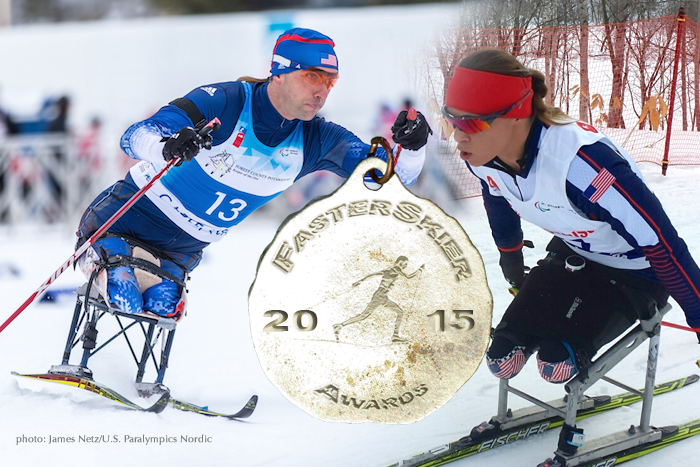
    Andy Soule (l) and Oksana Masters, both of U.S. Paralympics Nordic, are FasterSkier's 2015 Para-Nordic Skiers of the Year.
    Andy Soule (l) and Oksana Masters, both of U.S. Paralympics Nordic, are FasterSkier’s 2015 Para-Nordic Skiers of the Year.

    Andy Soule

    When you become the first American to rack up five medals in six individual events at World Championships, you’re essentially a shoo-in for Para-Nordic Skier of the Year. Andy Soule, a U.S. Army veteran and sit skier, did just that at the 2015 International Paralympic Committee (IPC) World Championships in January in Cable, Wis., taking silver in two biathlon events and the 10-kilometer cross-country race plus bronze in the cross-country 15 k and sprint.

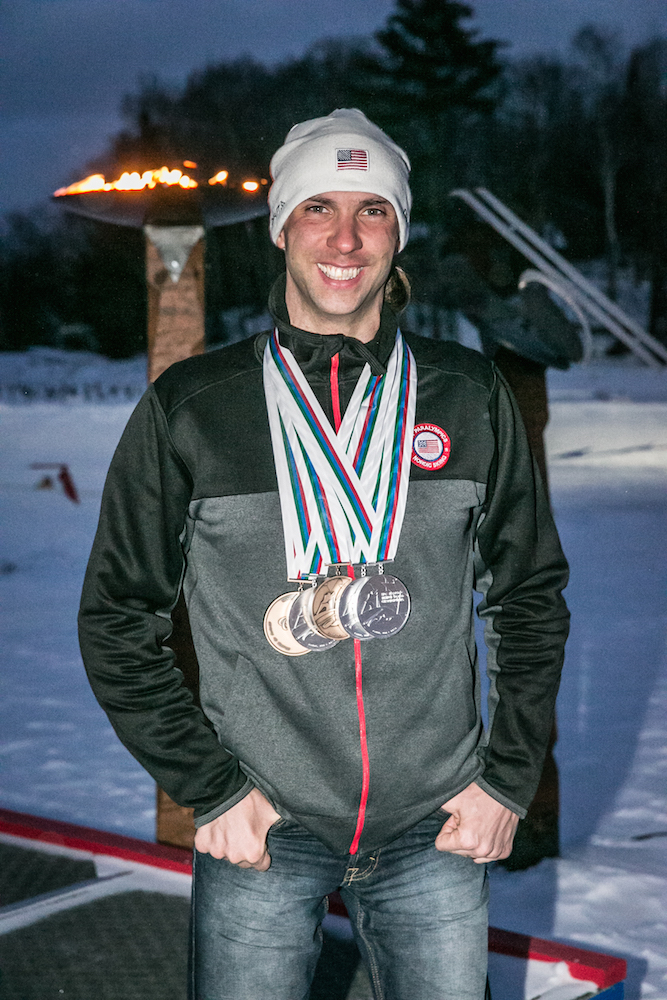
    Andy Soule and his hardware from 2015 IPC World Championships: five medals with three silvers and two bronze. (Photo: James Netz)
    Andy Soule and his hardware from 2015 IPC World Championships: five medals with three silvers and two bronze. (Photo: James Netz)

    “After the second podium, I just started feeling like that wasn’t a fluke,” Soule said in February.  “This isn’t just a one-time thing … I can come out and compete on a level with the top guys every day. It was a confidence builder as well when you have that feeling.”

    In his eighth year on the U.S. Paralympics Nordic Team, Soule, 35, was named IPC’s January athlete of the month. After World Championships, he improved to third overall in the World Cup and finished the season first overall in the cross-country standings.

    “It is a great feeling and a great finish to the season,” he said at World Cup Finals in Surnadal, Norway.

    In all, Soule tallied four World Cup golds — all of which came in Asahikawa, Japan — and a bronze during the 2014/2015 season.

    And all the success has led him to commit to another three seasons leading up to the 2018 Paralympics in Pyeongchang, South Korea. According to his teammate, Dan Cnossen, Soule considered retiring after 2013/2014.

    “I’m right at that age and I’m right at the point in my career where I’m in the prime of real top-performance potential,” Soule said. “I feel really great about what I have going forward and that I’ll be able to build on it and still improve on it.”

    Oksana Masters

    It got even better for U.S. Paralympics as Oksana Masters, another sit skier, also rose to the top of the 2014/2015 World Cup cross-country podium in her second year on the team.

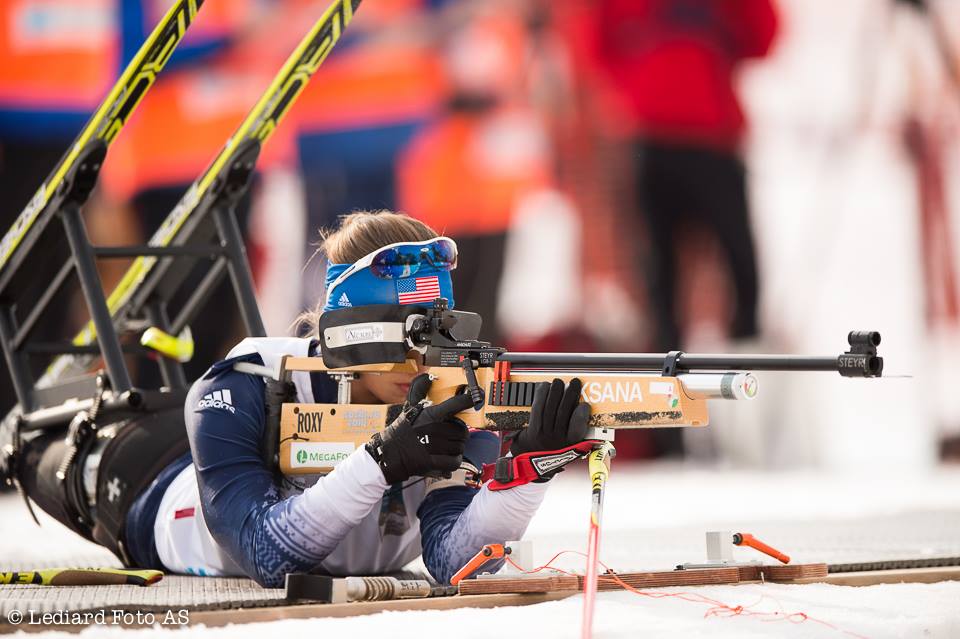
    Oksana Masters (U.S. Paralympics Nordic) in a biathlon competition at 2015 IPC World Cup Finals in Surnadal, Norway. Masters won Saturday's 5 k cross-country sitting to clinch the overall World Cup cross-country title for 2014/2015. (Photo: IPC Nordic Skiing/Facebook)
    Oksana Masters (U.S. Paralympics Nordic) in a biathlon competition at 2015 IPC World Cup Finals in Surnadal, Norway. Masters won the 5 k cross-country sitting to clinch the overall World Cup cross-country title for 2014/2015. (Photo: IPC Nordic Skiing/Facebook)

    A rowing convert, Masters, 25, earned two cross-country medals at 2015 World Championships — silver in the middle distance and bronze in the sprint — and won four out of five races in Japan this year. That put her on top of the IPC overall and she ended the season in first with a total of seven individual World Cup golds and two silvers.

    “I respect my competition, of the years they put in to be where they are now,” Masters said in February. “I’m playing catchup and I’m just doing what I can and focusing on myself. It just so happens to be putting me much higher than I ever could imagine being.”

    She explained that it took her 13 years to reach the Paralympic podium in rowing (she earned bronze in the double scull in 2012) and was humble about the strides she had made in skiing since starting the sport a year and a half ago.

    A silver and bronze medalist at the 2014 Winter Paralympics, Masters committed to skiing full time last spring, partially to alleviate a past rowing injury in her back. A training crash leading up to 2015 U.S. nationals re-aggravated the injury, forcing her to sit out the week.

    A week before World Championships, she got back on snow while fighting bronchitis and walking pneumonia.

    “World Championships was just more of a mental battle than … just a battle for getting medals, with one setback after another,” Masters said. “I didn’t really have much expectations for myself … so [I was] just basically trying to survive at that point.”

    The bronze medal she earned in Cable, her first of World Championships, brought her some serious relief.

    “[It] also just brought my focus more towards, OK, I had setbacks, but I still can be within the competition and hang with the field, so just believe in the previous training that I’ve done and what I do know and just do it,” she said.

    Masters made the nomination list for IPC athlete of the month in February.

    Honorable mentions: 

    Brittany Hudak

    Brittany Hudak (Canadian Para-Nordic Ski Team) at 2015 IPC World Cup Finals in Surnadal, Norway. Hudak won the 2014/2015 World Cup Overall Cross-Country title. (Photo: IPC Nordic Skiing/Facebook)
    Brittany Hudak (Canadian Para-Nordic Ski Team) at 2015 IPC World Cup Finals in Surnadal, Norway. Hudak won the 2014/2015 World Cup Overall Cross-Country title. (Photo: IPC Nordic Skiing/Facebook)

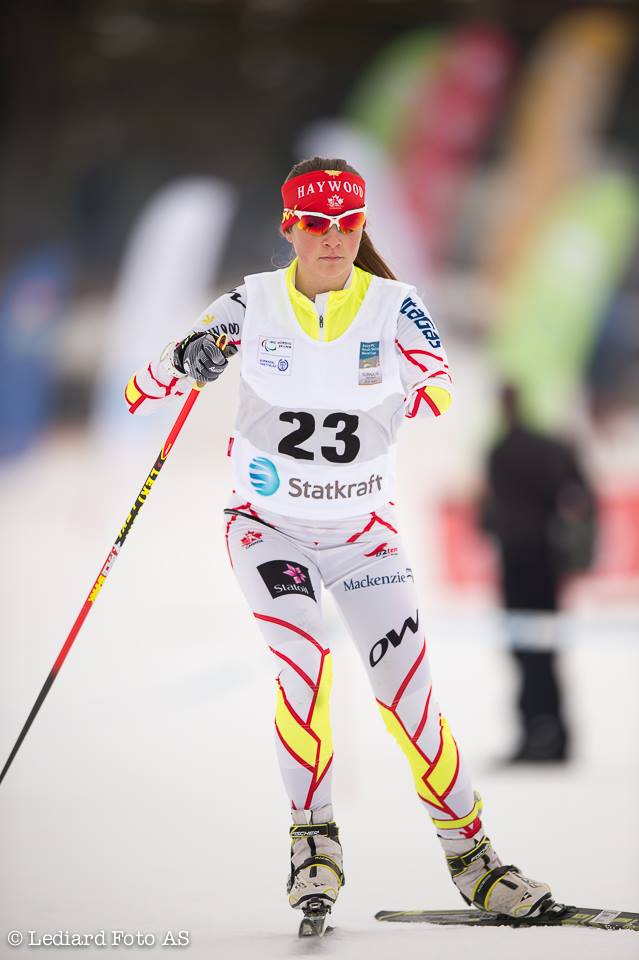
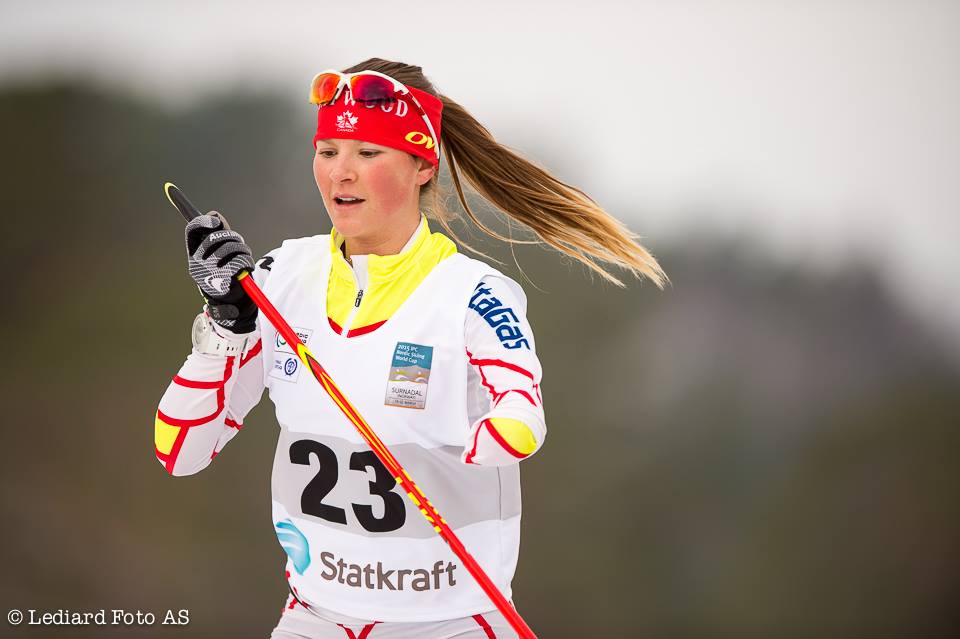
    The Canadian Para Nordic Ski Team had a banner season as well, with standing skier Brittany Hudak topping the overall World Cup cross-country podium in her first year on the development team.

    “The learning curve has been so huge for me,” Hudak, 21, said in a team press release after winning two consecutive races in Asahikawa.

    At the following World Cup Finals, she collected three medals: silver in the 15 k cross-country, silver in the 12.5 k biathlon and bronze in the 6 k biathlon.

    “Having the opportunity to attend national training camps … I have noticed a huge improvement in my technique,” she added. “It has been such an advantage for me to be in the same environment with the high-performance athletes, seeing how the train and learning from them.”

    Hudak wrapped up 2015 with two World Cup golds, two silvers and a bronze in cross-country, and a silver and a bronze in biathlon.

    Chris Klebl

    It’s a close call between several Canadian Para-Nordic teammates for the men’s pick for honorable mention, but Klebl tops the list as he placed third overall on the cross-country World Cup and is currently first in the IPC rankings. Standing biathlete Mark Arendz was was fourth overall in biathlon, and longtime team veteran Brian McKeever — a visually impaired distance specialist — won most of the races he jumped into for third overall in cross-country.

    Canada's Chris Klebl racing to gold in the last race of his third Paralympics on Sunday in the cross-country 10 k sit-ski  at the 2014 Paralympic Winter Games in Sochi, Russia.  (Photo: Matthew Murnaghan/Canadian Paralympic Committee)
    Canada’s Chris Klebl racing to gold in the cross-country 10 k sit-ski at the 2014 Paralympic Winter Games in Sochi, Russia. (Photo: Matthew Murnaghan/Canadian Paralympic Committee)

    In Asahikawa, both Klebl and Arendz notched back-to-back bronze medals before Klebl placed second in both the 10 and 15 k cross-country races. Klebl, a 2014 Paralympic gold medalist in the 10 k, went on to win the 15 k at World Cup Finals.

    McKeever won the 20 k that same day in Surnadal (he won the same event at 2015 World Championships; it was the lone race he competed in there) and took first in the 10 k classic in Japan as well.

    Arendz picked up two bronze medals at World Cup Finals in the biathlon sprint and following pursuit.

    Klebl edged American Dan Cnossen by 40 points for third overall on the World Cup, making Cnossen — who won his first World Cup in Japan and achieved multiple podiums later in the season — worthy of mention as well.

    ***

    Other 2015 Skiers of the Year (SOTY): Junior | Collegiate | Nordic Combined | Biathlon

  • Hudak, Masters and Soule End Season with Overall IPC World Cup Crowns

    Hudak, Masters and Soule End Season with Overall IPC World Cup Crowns

    Brittany Hudak (Canadian Para-Nordic Ski Team) at 2015 IPC World Cup Finals in Surnadal, Norway. Hudak took silver in Saturday's 5 k cross-country sitting to clinch the 2014/2015 World Cup Overall Cross-Country title. (Photo: IPC Nordic Skiing/Facebook)
    Brittany Hudak (Canadian Para-Nordic Ski Team) at 2015 IPC World Cup Finals in Surnadal, Norway. Hudak took silver in Saturday’s 5 k cross-country sitting to clinch the 2014/2015 World Cup Overall Cross-Country title. (Photo: IPC Nordic Skiing/Facebook)

    Three North Americans, count ’em, three, topped the 2014/2015 International Paralympic Committee (IPC) Overall World Cup cross-country podiums, ending their seasons on Sunday at IPC World Cup Finals in Surnadal, Norway.

    Canada’s 21-year-old Brittany Hudak tallied her third medal of the week on Sunday, taking silver in the women’s 12.5-kilometer biathlon race a day after clinching the women’s overall cross-country title in the standing division by 33 points over Russia’s Ekaterina Rumyantseva.

    Hudak placed fourth in Saturday’s 5 k cross-country race then finished second in Sunday’s biathlon distance race, 50.4 seconds behind Ukraine’s Oleksandra Kononova, who won in 39:46.2.

    While Kononova missed two — one in each of the last shooting stages — Hudak cleaned every stage except the first, in which she missed one.

    “The learning curve has been so huge for me,” Hudak said in a Canadian Para-Nordic team press release.

    Two years ago, Canada’s legendary (now-retired) sit skier Colette Bourgonje encouraged her to try skiing while Hudak was working at a Canadian Tire store.

    “Having the opportunity to attend national training camps, particularly the New Zealand camp this summer, I have noticed a huge improvement in my technique,” Hudak said. “It has been such an advantage for me to be in the same environment with the high-performance athletes, seeing how the train and learning from them.”

    In all, she racked up two golds, two silvers and one bronze medal in IPC cross-country events this season, plus a silver and bronze in biathlon at World Cup Finals.

    Oksana Masters (U.S. Paralympics Nordic) in a biathlon competition at 2015 IPC World Cup Finals in Surnadal, Norway. Masters won Saturday's 5 k cross-country sitting to clinch the overall World Cup cross-country title for 2014/2015. (Photo: IPC Nordic Skiing/Facebook)
    Oksana Masters (U.S. Paralympics Nordic) in a biathlon competition at 2015 IPC World Cup Finals in Surnadal, Norway. Masters won Saturday’s 5 k cross-country sitting to clinch the overall World Cup cross-country title for 2014/2015. (Photo: IPC Nordic Skiing/Facebook)

    Hailing from south of the Canadian border, two Americans topped the overall IPC World Cup sitting standings, with Oksana Masters and Andy Soule claiming the cross-country crowns on Saturday, which U.S. Paralympics dubbed as a “three-medal day for Team USA.”

    Masters and teammate Lt. Dan Cnossen won the women’s 5 k and men’s 10 k cross-country races, respectively, with the former capping her season with the overall win as well. Throughout this season, Masters earned seven World Cup golds and two silvers, plus a silver and bronze at IPC World Championships in January.

    “I felt really good today,” Masters told U.S. Paralympics on Saturday. “It was a hard race, but my skis were fast, and I felt good. This is a great way to end the cross-country season. Everything has been pretty perfect here.”

    A U.S. Army veteran, Andy Soule (U.S. Paralympics Nordic) at 2015 IPC World Cup Finals in Surnadal, Norway. Soule finished third in Saturday's 10 k cross-country sitting to clinch the overall World Cup cross-country title for 2014/2015. (Photo: IPC Nordic Skiing/Facebook)
    A U.S. Army veteran, Andy Soule (U.S. Paralympics Nordic) at 2015 IPC World Cup Finals in Surnadal, Norway. Soule finished third in Saturday’s 10 k cross-country sitting to clinch the overall World Cup cross-country title for 2014/2015. (Photo: IPC Nordic Skiing/Facebook)

    The 25-year-old former Paralympic rower won the women’s 5 k by 28 seconds over Norway’s Mariann Marthinsen in 14:19, and beat Marthinsen in the overall by 160 points.

    On Sunday, Masters placed fifth in the final biathlon event: the 12.5 k sitting. While Germany’s Anja Wicker missed two shots to win in 48:46.5, Masters had a total of eight penalties to finish 5:38.2 behind.

    Cnossen won Saturday’s cross-country 10 k sitting in 25:37, edging Russia’s Alexey Bychenok by 3.8 seconds. Soule finished third, 19.8 seconds back, to take the men’s overall cross-country title by 155 points over Bychenok. Cnossen ended up fourth in the overall cross-country standings.

    Lt. Dan Cnossen (U.S. Paralympics Nordic) at 2015 IPC World Cup Finals in Surnadal, Norway. Cnossen won Saturday's 10 k cross-country sitting to finish fourth in the overall World Cup cross-country standings. (Photo: IPC Nordic Skiing/Facebook)
    Lt. Dan Cnossen (U.S. Paralympics Nordic) at 2015 IPC World Cup Finals in Surnadal, Norway. Cnossen won Saturday’s 10 k cross-country sitting to finish fourth in the overall World Cup cross-country standings. (Photo: IPC Nordic Skiing/Facebook)

    “I was getting updates from the coaches during the race that it was a really tight race between Alexey Bychenok and myself,” Cnossen told U.S. Paralympics on Saturday. “I was really happy for Andy, who came in third and got the World Cup overall win — that is even better. Our team had a great performance today.”

    “It is a great feeling and a great finish to the season,” Soule, 35, said after his first podium at World Cup Finals. “This took a lot of hard work by myself, my teammates, my coaches and wax techs. This is just a great end to the season.”

    At World Championships, Soule racked up an unprecedented five medals for the U.S., three of which were in cross-country races. Adding to that haul, he totaled four World Cup golds and a bronze this season.

    On Sunday, he placed seventh in the 15 k biathlon race with six penalties (1+1+2+2), finishing 4:03.6 behind Germany’s Martin Fleig, who won in 49:32.1. Cnossen was 5.4 seconds off the podium in fourth with five misses (1+2+0+2).

    Canada’s Chris Klebl placed fifth in Saturday’s 10 k sitting, 51.3 seconds behind Cnossen. The result helped him secure third overall in the men’s cross-country sitting on the IPC World Cup,  40 points ahead of Cnossen. Klebl did not race on Sunday.

    Klebl’s teammate, Mark Arendz finished fifth in the men’s biathlon 15 k standing on Sunday, 3:23.2 behind Ukraine’s Ihor Reptyukh, who won in 42:17.6. While Reptyukh had three penalties (1+0+1+1), Arendz had five (1+1+1+2). The Canadian placed fourth overall in the biathlon World Cup, 161 points behind Reptyukh in third.

    Mark Arendz (Canadian Para-Nordic Ski Team) at 2015 IPC World Cup Finals in Surnadal, Norway. He placed fourth overall in the 2014/2015 IPC World Cup biathlon standings. (Photo: IPC Nordic Skiing/Facebook)
    Mark Arendz (Canadian Para-Nordic Ski Team) at 2015 IPC World Cup Finals in Surnadal, Norway. He placed fourth overall in the 2014/2015 IPC World Cup biathlon standings. (Photo: IPC Nordic Skiing/Facebook)

    Results:

    Saturday’s cross-country: Women | Men

    Sunday’s biathlon: Women | Men

    Overall World Cup standings

  • Hoffman Lone U.S. Ski Team Member to Train in New Zealand

    Hoffman Lone U.S. Ski Team Member to Train in New Zealand

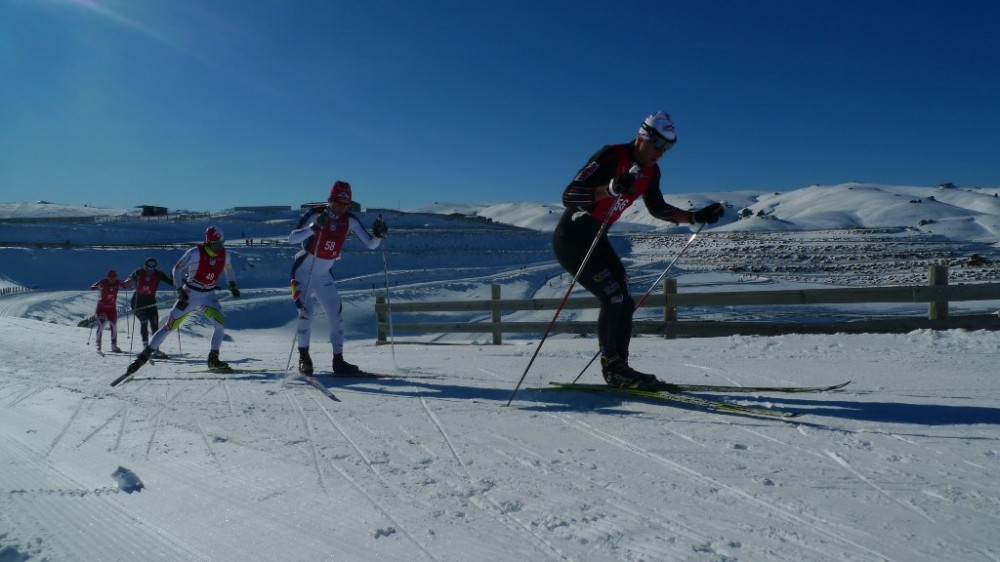
    Polish skier Maciej Kreczmer leads Noah Hoffman in the 2014 Merino Muster at the Snow Farm in New Zealand. Noah Hoffman spent roughly two weeks training at the Wanaka venue. (Photo: Noah Hoffman/NoahHoffman.Com)
    Poland’s Maciej Kreczmer (r) leads Noah Hoffman (c) in the 2014 Merino Muster at the Snow Farm in New Zealand. Hoffman spent roughly two weeks training at the Wanaka venue. (Photo: Noah Hoffman/NoahHoffman.com)

    Noah Hoffman isn’t one to take his training lightly. The way he sees it, a serious-and-dedicated plan will allow the the 25-year-old U.S. Ski Team (USST) member to achieve his lofty career goals, which include winning an Olympic gold medal and an FIS World Cup Distance Globe.

    Given his driven nature, Hoffman is willing to venture outside the standard USST plan in order to bolster his training and address what he’s identified as his weaknesses.

    This summer, that meant participating in a solo camp at New Zealand’s Snow Farm following the USST men’s camp in Alaska.

    From Aug. 9 t0 Aug. 25, Hoffman had 15 full days of on-snow training at the Snow Farm in Wanaka, New Zealand. Over the course of his camp, he trained more than 50 hours.

    For Hoffman, the decision to make the summer trip to New Zealand was easy. He’s been adding the trip to his training plan for the last three years and finds that the often-fast, hard snow is ideal for his technique work. This year, he said conditions were especially favorable.

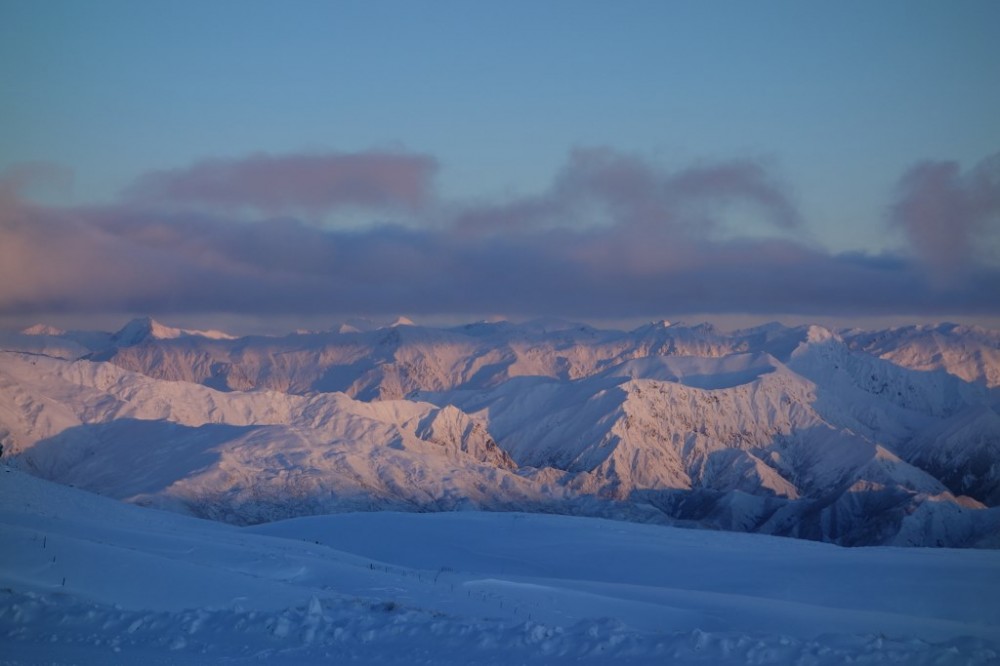
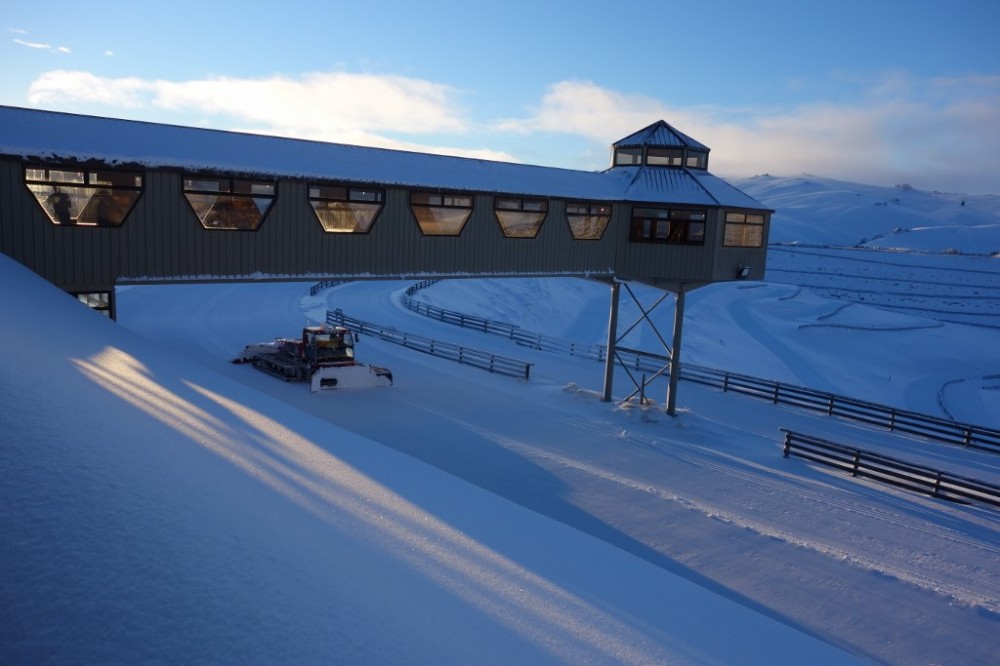
    The view from the Snow Farm in Wanaka, New Zealand. Accodring to Hoffman, the conditions were the best he's seen in five years at the venue. (Photo: Noah Hoffman/NoahHoffman.com)
    The view from the Snow Farm in Wanaka, New Zealand. Accodring to Hoffman, the conditions were the best he’s seen in five years at the venue. (Photo: Noah Hoffman/NoahHoffman.com)

    “I had the best snow conditions that I’ve seen in any of my five years going there,” he wrote in an email. “I was hard-wax skiing the entire time and had 14 days of beautiful weather.”

    Hoffman explained that his New Zealand trip served as an additional on-snow camp used to supplement the USST camp schedule. For the Colorado native, his continued on-snow training has helped him improve his technique.

    “I think the additional on-snow time has been essential to the technique improvements that I’ve made in the last two years and is critical to my technique goals for this summer and beyond,” he wrote.

    While Hoffman appreciates the value of North-American summer glacier camps, he found that New Zealand’s skiing better replicated winter World Cup conditions.

    “Training at the Snow Farm is significantly more valuable than on-snow time on a glacier in the Northern Hemisphere,” he wrote. “Glacier skiing is slow and soft. It is a different type of skiing than we see at most venues in the winter.”

    Often times during the race season, World Cup venues are hit with warm conditions and organizers salt the course to increase snow speed.

    Even though Hoffman was the sole USST member to travel to New Zealand this year, his coaches and teammates who remained stateside were extremely supportive.

    “They understand my goals and support the plan that my personal coaches and I believe is best for my training,” Hoffman explained.

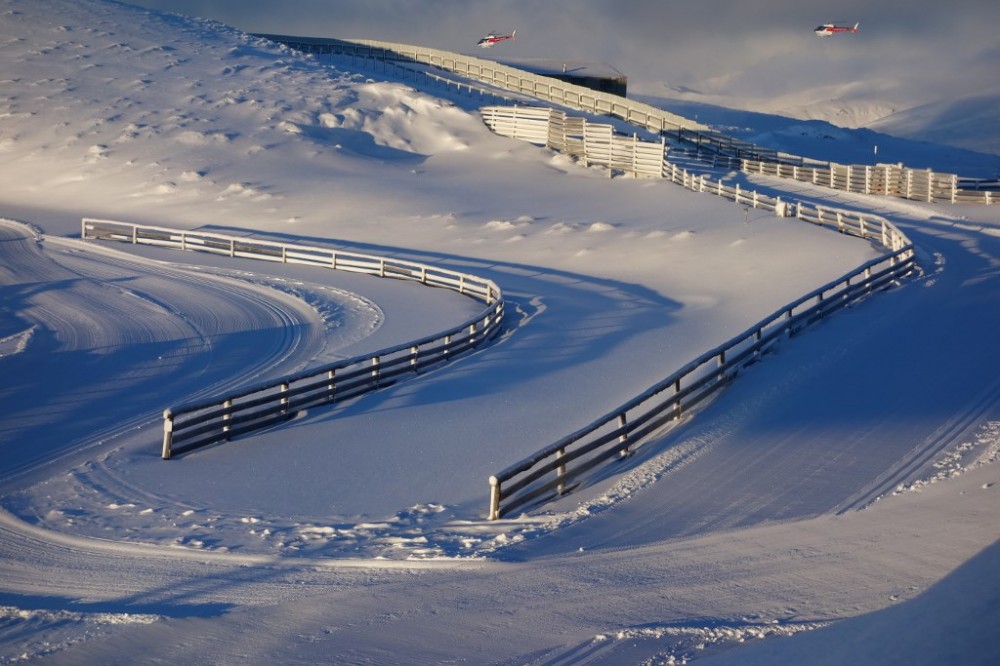
    The Snow Farm in Wanaka, New Zealand. (Photo: Noah Hoffman/NoahHoffman.com)
    The Snow Farm in Wanaka, New Zealand. (Photo: Noah Hoffman/NoahHoffman.com)

    While most of his training in New Zealand was spent alone, Hoffman was able to connect with Canada’s multiple-time Paralympic gold medalist Brian McKeever and one of his guides Graham Nishikawa for several training sessions. And when he wasn’t training, Hoffman spent meals with the Canadian Para-Nordic Team.

    “That social activity was critical for me to stay happy down there,” he wrote.

    Hoffman’s training also included the 2014 Merino Muster. The 42 k freestyle mass start took place on Aug. 16 and included several international competitors, such as Poland’s Justyna Kowalczyk.

    Hoffman placed second, 11 seconds behind Poland’s Maciej Kreczmer.

    While he would have liked to win the race, he wrote on his blog that he was happy with the outcome and that the race served as an excellent intensity workout.

    “The goal is not to be good in August,” he wrote. 

    Hoffman also allotted time for some lighthearted charity work. With the help of his Canadian counterparts, he participated in the Amyotrophic Lateral Sclerosis (ALS) Ice Bucket Challenge, a social-media phenomenon intended to raise awareness and research funding for the illness, also known as Lou Gehrig’s disease.

    Hoffman returned to the U.S. on Aug. 25, where he will continue the remainder of his summer training. This year he will sit out the USST Lake Placid camp in New York (taking place Aug. 26-Sept. 7), as his trip to New Zealand served as its replacement.

    Reflecting on his summer, Hoffman said his training was “almost ideal,” citing his health, happiness, and technique improvement. Looking ahead, he feels prepared for the season ahead.

    “I believe I’m really well set up to transition to higher intensity and more race-type fitness as the fall progresses,” he wrote. “I’m very happy and excited with the way things have gone.”

    The Snow Farm in Wanaka, New Zealand. (Photo: Noah Hoffman/Noahhoffman.com)
    The Snow Farm in Wanaka, New Zealand. (Photo: Noah Hoffman/Noahhoffman.com)


  • Canadian Para-Nordic Guide Carleton Prioritizes Alberta World Cup

    Canadian Para-Nordic Guide Carleton Prioritizes Alberta World Cup

    Erik Carleton (Canadian Para-Nordic Ski Team/Rocky Mountain Racers) on his way to a second-place finish in the 10 k classic individual start at Canadian Ski Nationals on March 19. The next day, he took seventh in the 15 k skate then flew to Finland with Brian McKeever to compete in the IPC World Cup Finals two days later.

    Entering his third straight season with the Canadian Para-Nordic World Cup Team, Erik Carleton has already made some big decisions this year. Among them, he had to choose whether to race the Alberta Cross Country World Cup in Canmore or go for gold at the International Paralympic Committee (IPC) World Cup opener in Vuokatti, Finland.

    It must be tough to be Carleton, a competitive-nordic racer who doubles as a Para-Nordic guide for Brian McKeever, arguably the best visually impaired skier in the world. While some Canadians are still stressing over their prospects of making the Canada World Cups (which starts with skate sprints in Québec Dec. 7-8, followed by a skate sprint and distance races in Canmore, Alberta, Dec. 13-16), Carleton was one of nine outside of the nation’s cross-country team that prequalified.

    With the option to race the 15 k classic mass start and 30 k skiathlon in Canmore, Carleton faced a bit of a dilemma. The IPC World Cup started just a few days before on Dec. 11 in Finland. Unlike the loaded cross-country calendar, Para-Nordic skiers have only one other World Cup (Jan. 20 in Cable, Wis.) before the World Championships started Feb. 21 in Sollefteå, Sweden.

    After a 10-day camp in Sante Fe, N.M., earlier this month, Carleton wrote in an email that he planned to compete in both the races he prequalified for in Canmore.

    “The IPC World Championships and the IPC World Cup in Sochi [March 14] will be the big priorities later in the season,” he wrote.

    Last year, he and McKeever, 33, swept the 2012 IPC World Cup Finals in Vuokatti just a few days after competing at Canadian cross-country nationals in Québec. At Mont Sainte-Anne, Québec, Carleton won an individual silver in the 10 k classic race and placed seventh in the 15 k freestyle before jetting with McKeever, his childhood friend, to Finland.

    There, they claimed three gold medals for a grand total of four last season.The only man that topped McKeever in 2011/2012 was Russian Stanislav Chokhlaev, who beat him to gold twice in World Cup skate races in Sjusjøen, Norway.

    This winter, Carleton and McKeever are aiming for continued success and IPC dominance at World Championships and Sochi in preparation for the 2014 Paralympics. But first, Carleton wants to start strong individually.

    “The main focus at the moment is to be in ‘best-ever’ shape for the December World Cups,” he wrote.

    To do so, he committed to the Para-Nordic Ski Team (PNST) training plan, following it more closely than in the past.

    “I have more confidence in the PNST program after my successes last season,” Carleton wrote. “My major goals are to enjoy what I do and to be smart at training and racing.”

    As for his training, Carleton explained that he’s “revamped” both his classic and skate techniques and already seen improvements in his efficiency. A few colds set him back this offseason, but he resumed strength training for the first time in eight years.

    “The idea was to build power without adding muscle, and to learn how to move properly to avoid injury,” he wrote.

    He’s done more rollerski intensity and less trail-running and mountain-bike racing. Rather than run on a treadmill, he and the team started using the new rollerski treadmill in the Bill Warren Training Centre in Canmore.

    “Overall my volume has decreased by about 10 percent, but the training load would likely amount to slightly more,” he wrote.

    This year, the team scheduled two trips to Sante Fe for altitude training up to 3,000 meters (10,000 feet) to get in prime shape for December. The did the first in September and the second Oct. 30-Nov. 8, which Carleton wrote was “a great camp with good weather” and apparently warmer than usual.

    ***

    Photos from the Canadian PNST camps in Sante Fe, provided by Carleton:

    For the IPC Nordic World Cup schedule, click here.