From the FasterSkier archive — posts syndicated from athletes’ and coaches’ own blogs between 2004 and 2012, kept online as published. Current coverage is at fasterskier.com.

Tag: canadian women’s team

  • Beatty Caps Season with 160 k Arctic Circle Race Victory

    Beatty Caps Season with 160 k Arctic Circle Race Victory

    Northern lights at camp on one of two nights during the 2018 Arctic Circle Race in Greenland. (Photo: Arctic Circle Race)

    Canada’s Dahria Beatty closed out her World Cup season with the rest of her international-racing peers on March 18 in Falun, Sweden. After three straight days of races, the 24-year-old Whitehorse, Yukon, native finished World Cup Finals in 54th overall.

    Five days later, she endured a three-day 160-kilometer classic race in Greenland, 65 kilometers north of the Arctic Circle. And Beatty didn’t just survive the 22nd-annual epic adventure, she won it.

    Canada’s Dahria Beatty racing to first among women and fifth overall in the three-day Arctic Circle Race in late March in Greenland. (Photo: Arctic Circle Race)

    In her first Arctic Circle Race, Beatty was the first woman to complete all 160 k in the backcountry near Sisimiut, Greenland, spending two nights in tents with temperatures below -28 degrees Celsius (-18 Fahrenheit) and fueling herself with dehydrated meals and a jar of peanut butter.

    The first woman and fifth overall across the line, she finished on March 25 with a total ski time of 14:19:15 hours. Her dad Craig Beatty completed the race as well, finishing 18th overall and second in his 50+ age group.

    “In 2005, my dad went with some of his friends to do this race and he just loved it,” Beatty told FasterSkier in a phone interview earlier this month. “At the time I was 11 years old and he came back and just thought Greenland was an amazing place, and a place that I should experience.”

    They decided that they would do the race together when she was old enough to compete, 18 or older by the race’s standards. When she looked at her race schedule this year, which kept her in Europe until late March, Beatty figured a stop in Greenland on the way home to do what organizers dubbed “the world’s toughest ski race” was a great opportunity.

    She arrived in Greenland two days before the race and spent two days there after, then recovered in Iceland for six days with her dad.

    Craig Beatty at the finish of the 2018 Arctic Circle Race in Greenland. He finished second in his age group. (Photo: Dahria Beatty)

    “It was really a great trip, to be able to be with my dad,” Beatty recalled. “We haven’t done a trip like that in a long time, so it was a lot of fun and I really enjoyed it.”

    The race itself entailed three back-to-back marathon distances of skiing 50 kilometers or longer, with the longest day being 57 k. Competitors crossed a finish line each day, with Beatty being the first woman on each day, and third overall on Day 1, fifth on Day 2, and finally fifth on Day 3. She noted that her dad, whom she met up with each night at camp, skied a more consistent race.

    “His time on the first day and the last day, which were similar distances, were only separated by 15 minutes or so, whereas I was over an hour slower the third day,” Beatty recalled. “I maybe went a little too fast off the gun, but other than that it was a ton of fun. The first day I was skiing in second and third the entire race, men included, and dropped off a little the second two days…

    “It’s definitely a totally different event than doing something that’s a one-day event, or something where you can go inside and sleep in the warmth at night,” Beatty added. “It definitely is more a test of survival, which is a cool thing to experience, and we were a little bit unlucky in the fact it was so cold.”

    At the same time, racers experienced abundant sun and “bluebird skies”, she said.

    “We had amazing views of the mountains, of the fjords, each day we were racing,” she said. “And at night the sky was lit up with northern lights.”

    Dahria Beatty at the start of the 2018 Arctic Circle Race in Sisimiut, Greenland. (Photo: Arctic Circle Race)

    At the end of each day, racers had access to two- or three-person tents with a thermal groundsheet for sleeping, according to the Arctic Circle Race website. They were provided with a saucepan, frying pan and matches to cook their own food, while organizers supplied hot and cold water as well as coffee and tea. Racers had to wax their own skis and use outdoor “earth closet” bathrooms. There were no showers, beds or cell service, but that all made it part of an experience Beatty won’t forget.

    “The volunteers in the race were absolutely incredible,” she said. “The second and third day, when I was absolutely exhausted, they were standing out there all day [at the feed stations] while we were racing, making sure we had food and hot beverages to drink, and cheering us on. 

    “On the second day, we skied down off the mountains onto a fjord, and at the bottom, my hands were so cold that I couldn’t get my gloves off myself,” she continued. “When I made it to the feed station, the volunteers were there and they helped me take off my wet, cold gloves, and grab my warm mitts out of my backpack and help me put them on. There’s just a really amazing atmosphere around the race. The entire community of Sisimiut looks forward to it each year, and it seems like half the community comes out to volunteer for this race … so that was really cool.”

    With a population of about 6,000, Sisimiut is both a small fishing town and the second-largest city in Greenland. It’s also the country’s most northern ice-free town in the winter and most southern town for dogsledding. In many ways, Beatty said it felt like home.

    inhalers online

    “It was really cool to experience their culture and see so many ties to the Canadian North,” she said. “… I would love to go back in the summer. I met some amazing people from there and they were telling me how different it is in the summertime. It’s definitely a place I’d like to explore more…”

    Going the Distance

    In her career, Beatty has completed four 30 k races, including a third place in the 30 k freestyle mass start at 2015 Canadian Nationals, 34th in the 30 k skate at 2017 World Championships, and 49th in the Holmenkollen 30 k skate at this year’s World Cup in Oslo, Norway. 

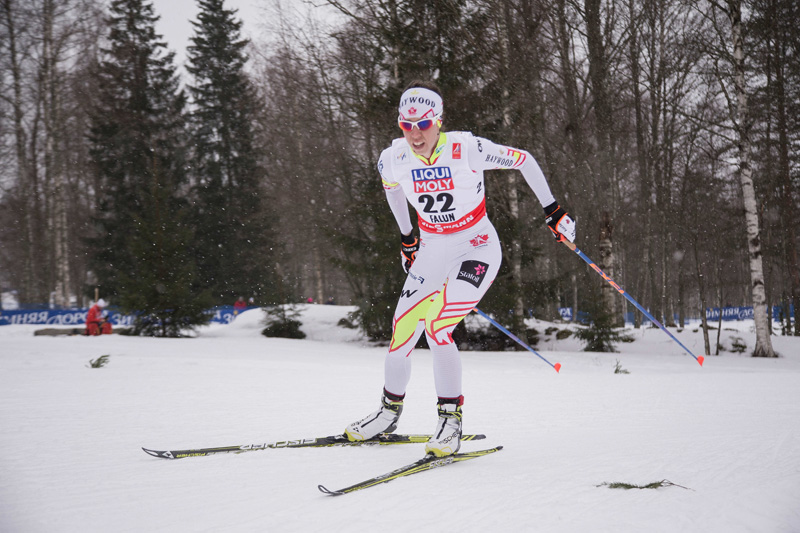
    Dahria Beatty racing the Holmenkollen 30 k freestyle mass start on March 11 in Oslo, Norway. (Photo: Fischer/NordicFocus)

    But 50 k? That’s something she’d like to do more of after completing distances of 52.2, 57.1 and 51 k on three consecutive days in Greenland.

    “I had a lot of fun racing this 50 k, and it was definitely slightly different than a 30 k, but I went at it with the same mentality,” said Beatty, who is best known for her World Cup top-30 (and even a top-15) sprint results. 

    “I mean, I’ve had better results internationally in sprint, but when I was a junior, I was always better at distance skiing,” she pointed out. “Right now I’d say I’m usually stronger in sprinting, but a lot of the times those long-distance races, especially in a loppet-style format lend themselves well to sprint athletes. I think there’s a lot of times you see people that are considered sprinters do well in 50 k and 30 k events, more so than they would in a 15 k. I think they kind of almost lend themselves to each other in a very strange way.”

    As she progresses as a skier, Beatty, who made the jump to Canada’s World Cup B-team last spring, said she’s aiming to be more of an “all-around athlete.”

    “I’ve scored World Cup points in a distance race once, and I’d definitely want to do it again, many times before my career is over so it’s definitely something that in my training. I’m not trying to train just to be a sprinter. I’d like to have a balance.”

    Last season, Beatty spent most of five months on the European World Cup circuit. Pre-selected to the 2018 Olympic squad, she returned to Canada in late December for training and racing in Mont Sainte-Anne, Quebec, where she won both sprints at the Canadian NorAm/Olympic trials. In January, she headed back to Europe.

    Dahria Beatty en route to 20th overall in the Seefeld World Cup freestyle sprint for her season-best result in 2017/2018. (Photo: Fischer/NordicFocus)

    On the World Cup, Beatty achieved her best individual result of the season — 20th — in the freestyle sprint in Seefeld, Austria. She competed in five events at the Olympics, placing 13th with her teammates in the 4 x 5 k relay as well as freestyle team sprint.

    Asked about the highlight of her first Olympics, she said it was that team sprint with Emily Nishikawa.

    “For me, the team sprint was more than just racing for Canada,” Beatty said. “Emily and I are both from the Whitehorse Cross-Country Ski Club and the Yukon Ski Team so I was racing for the entire country, but also for my hometown, my club, the roots of where I began skiing and that was really special, knowing I was tagging off to my teammate who grew up through the same program as me and we both could get to this point together was absolutely amazing. We had a good race, and for me, individually, I felt the best that day of the Games and was able to carry a lot of motivation through the race and it was really fun to tag off right in the mix.”

    Racing in the heats in Seefeld was another season highlight.

    “… The course in Seefeld is so much fun; it’s such a beautiful location,” she said. “We had a perfect sunny day and knowing that World Championships will be there next year, it was really fun to kind of prepare to figure out what tactics worked and didn’t, and look forward to the next season.”

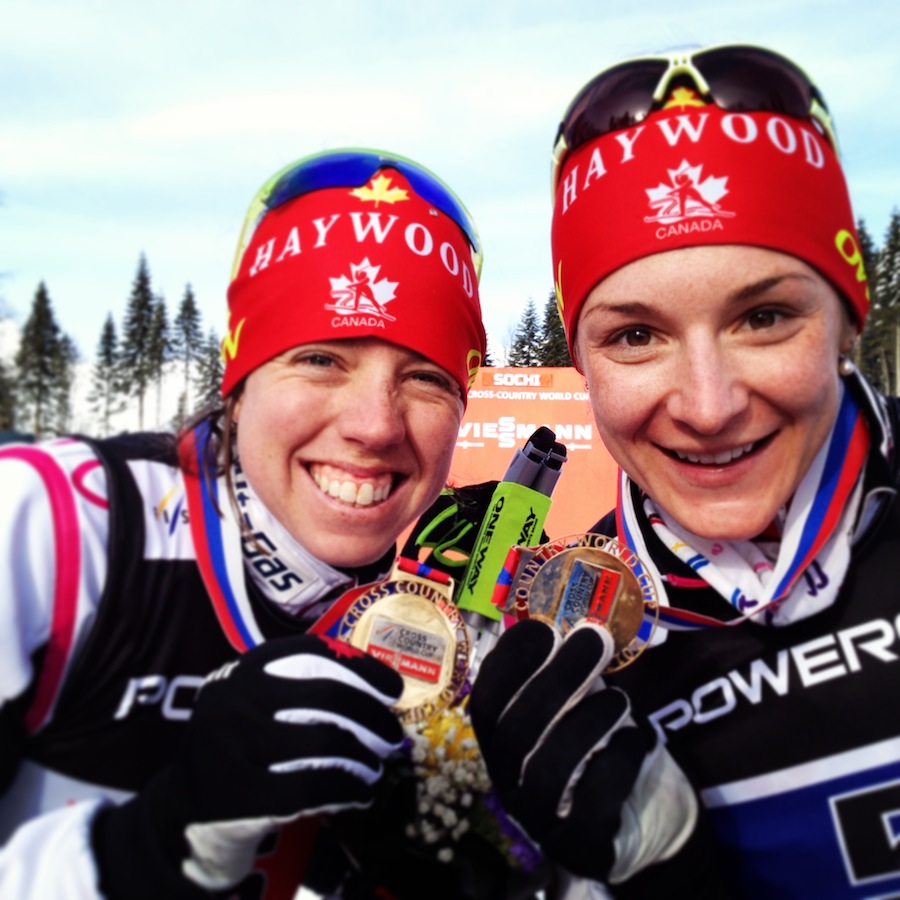
    Canada’s Dahria Beatty (l) and Emily Nishikawa after placing 13th in the freestyle team sprint at the 2018 Winter Olympics in PyeongChang, South Korea. (Courtesy photo)

    Under the guidance of Alberta World Cup Academy Head Coach Chris Jeffries, Beatty has typically spent most of her offseason training in Canmore, Alberta. While she said “there’s lots of change going on right now in Canmore” in terms of her training plans this year, Beatty was confident she’d be training with Nishikawa — as she has for the past five years. She also plans on having a strong training group of women, both national-team and non-national team members, to train with in Canmore.

    That group has been gaining momentum and traction on the World Cup scene, with Cendrine Browne scoring her first World Cup points in the last race of the season with the 27th-fastest time of day in Falun’s 10 k freestyle pursuit. Beatty observed that the cohesiveness of the Canadian women’s team has contributed to its growing success.

    “Having a belief in your teammates and being able to learn from your teammates and the strengths of you teammates is so important,” she said. “… I definitely think it’s something that all teams should strive for an strive to support and use each other’s strengths to build the most well-rounded team of teammates, and I definitely think the American women are wonderful role models and having the opportunity to get to know all of them very well over the winters and on the World Cup has been an absolute pleasure. I think we can learn a lot from them, and how they’ve built up their team.”

    At the moment, Beatty is enjoying some time at home with her family and new dog Ozzy in Whitehorse, where she estimates she spends about two months a year. Between spending about half the year in Canada and half the year on the road, she said she’s grateful for her teammates. 

    “Having roommates and having teammates to spend time with and just relax with, and support you on the good races and the bad races, and be out there on the race course with you, too, that’s a huge part,” Beatty said. “I haven’t ever experienced having to be there [on the World Cup] alone luckily, but I’m always grateful for my teammates, and we’re such a close group of friends, I can’t imagine it without them.”

    2018 Arctic Circle Race results

    — Gerry Furseth and Andrea Potyondy-Smith contributed

    From left to right: Canada’s Dahria Beatty, Emily Nishikawa, Zina Kocher, and Cendrine Browne at a late-season World Cup. (Photo: Dahria Beatty)
  • Last of Canada’s World Cup Female Veterans, Jones Plans Her Next Move

    Canada's Perianne Jones (Alberta World Cup Academy/National Development B-Team) racing to 32nd for her best World Championships distance result at 2015 worlds in Falun, Sweden. (Photo: Fischer/NordicFocus)
    Perianne Jones (Canadian National Development B-Team) races to 32nd for her best World Championships distance result at 2015 World Championships in Falun, Sweden. (Photo: Fischer/NordicFocus)

    For the last 12 years, Perianne Jones was more or less on autopilot, leading the life of a professional nordic racer in Canmore, Alberta, and giving little thought to what would come after skiing.

    The 30-year-old Canadian national-team member and Nakkertok Nordic prodigy had moved west from her hometown of Almonte, Ontario, immediately after high school. She immersed herself in full-time training and racing, and by 2009, made the Canadian World Cup Team.

    Two Olympics and five seasons later, Jones was inching toward retirement. Health issues stunted the start of her 2013/2014 season; she discovered in the fall of 2013 that she had hemochromatosis, a genetic condition that causes too much iron in the body. She spent the next few months working to manage her iron levels and returned to the World Cup circuit in late December 2013.

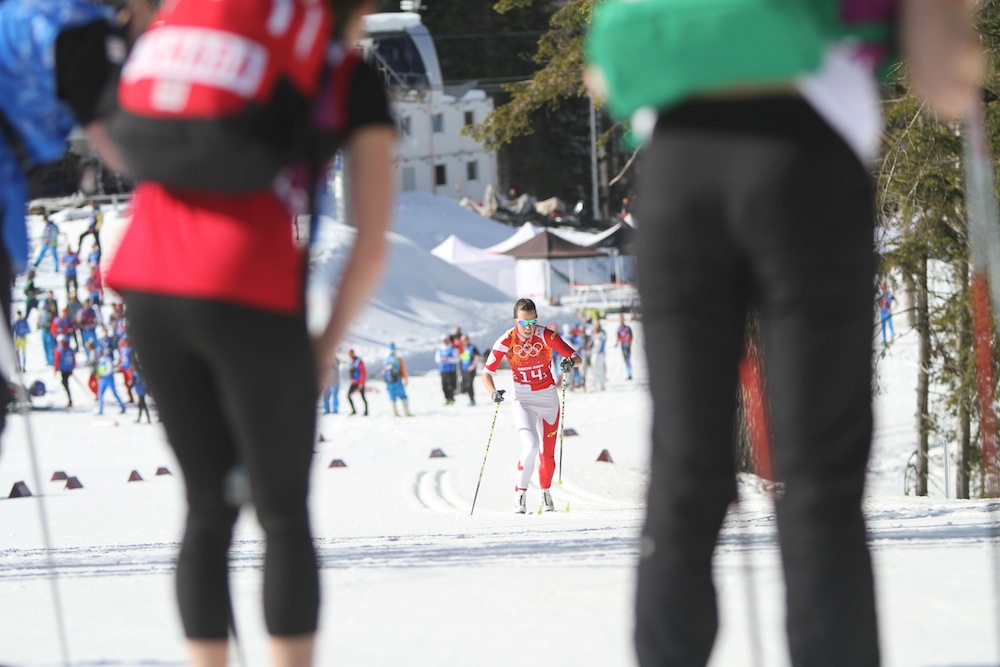
    Canadian biathletes and fellow cross-country skiers cheer on their own Perianne Jones on the first leg of the 4 x 5 k relay at the Sochi Olympics on Friday. Jones dropped to 14th and the team finished 14th, one place better than their finish at the 2010 Vancouver Games.
    Canadian biathletes and fellow cross-country skiers cheer on their own Perianne Jones on the first leg of the 4 x 5 k relay at the Sochi Olympics. the team finished 14th, one place better than their finish at the 2010 Vancouver Games.

    Two months later, she competed at her second Olympics in Sochi, Russia, placing 23rd in the freestyle sprint for her personal Olympic best. In the classic team sprint, she and teammate Dasha Gaiazova placed 11th after notching third in the same event at the 2013 Sochi World Cup a year earlier.

    Jones ended her season with a second-place finish in the freestyle sprint at 2014 Canadian Nationals in Corner Brook, Newfoundland, and was subsequently named to the national development B-team last May.

    Also last spring, her coach, Eric de Nys, left the national team to head up a new training program in Canmore: the WinSport Junior Cross Country Ski Team. Jones lost the bulk of the funding she had received as a World Cup Team member, yet decided to continue on for another season.

    “I, for sure, wanted to do another year after Sochi, and do things right,” she said on the phone from Canmore in early April. “… [Not making the World Cup Team] was a bummer, but at the same time, I know I didn’t make the criteria. I had one top-ten two seasons ago and you needed two top-twelves. I was put on the development team, so it meant that this past season cost me way more than it ever has…”

    “I, for sure, wanted to do another year after Sochi, and do things right.” — Perianne Jones

    As a development athlete, she said the costs amounted to $40,000 to $50,000, and that included government assistance as a carded athlete.

    “Even if you’re carded, you still have to pay for a place to live,” Jones said. “And living in Canmore is not cheap.”

    Carded athletes essentially receive an allowance each month, she explained. The government cuts qualifying individuals checks that could be used for anything — even a flat-screen TV — but the amount is generally considered a living allowance.

    “As a development skier, you have to cover housing and your team fee, which is around $10,000 and your winter expenses on the road, and then your flights to and from and around Canada,” Jones said. “It adds up.”

    Without stressing too much over finances, she focused on the 2014/2015 season and logged some of her career-best distance results, placing 32nd in the 10 k freestyle and 37th in the skiathlon at 2015 World Championships in Falun, Sweden.

    Canada's Perianne Jones raced to fifth place in her qualifier to finish 24th overall in the 1.4 k classic sprint in Falun, Sweden for the 2015 FIS Nordic World Ski Championships. (Photo: flingpointroad.com)
    Canada’s Perianne Jones racing to fifth in the 1.4 k classic sprint at 2015 World Championships in Falun, Sweden. She placed 24th overall. (Photo: flyingpointroad.com)

    Also in Falun, she finished 24th in the classic sprint and was 21st for a season best in the preceding World Cup classic sprint in Östersund, Sweden.

    “This past year I was healthy the whole season, which was quite an accomplishment for me,” she said. “It wasn’t my best season in terms of results, but health-wise it was really good. … I was pleased with both my sprints in Östersund and at world champs. It always can be better for sure, but I don’t have any regrets.”

    In Falun, she announced she would leave the international-racing scene at the end of the season. She capped off her career at 2015 Canadian Nationals in Thunder Bay, Ontario, winning the classic sprint, placing second in both the 5 k freestyle and 10 k classic individual races, and fifth in the 30 k freestyle mass start.

    In Thunder Bay, Nakkertok hosted a retirement dinner in her honor, complete with a video and several athletes and her brother Kieran Jones — Nakkertok’s head coach — speaking about the impact she had on their ski careers.

    “That was the only time I cried all week,” Jones said. “The ski club has been a huge part of my life and maybe I didn’t realize how I had been a part of them so much in the last ten years because I haven’t been around that much. I would totally love to go back to Ottawa and be a part of that some more.”

    She clarified that her involvement with Nakkertok would most likely be as a volunteer.

    “I have an interest in being involved, not necessarily in coaching at a high level, but when I was growing up with Nakkertok the ski club was entirely volunteer run,” she said. “I will be involved with a ski club wherever I end up. I will miss certain parts of skiing, but to have Joel still a part of the team will be an easier way to make that transition.”

    On Friday, Jones and her husband, Joel Jaques, a national-team wax technician, hopped aboard their 32-year-old Dodge getaway van and began a road trip to Ottawa. She guessed they might be gone for at least a month, with Jaques heading back to Canmore for a week in the middle of their trip for a training camp. How far they’d go depended on how the van ran. They bought it in February, about the time Jones knew her career was winding down.

    “We were just kind of joking about vans; there was one in Canmore and we offered the guy quite a bit less than he was asking and he said sure, and we’re like, OK, I guess we’re doing this,” she said.

    If they have time and the van makes it to Newfoundland, a friend offered to keep the van and buy their plane tickets back to Canmore. There, Jaques will go back to work with the national team and Jones will decide on her next move: she’s considering studying healthcare in Calgary or Ottawa.

    Meanwhile, she also planned to start working in Canmore to cover the cost of last season. While she essentially made up her mind to race one last season a year ago, the bill she received at the end of it ultimately solidified her retirement.

    “At the beginning of [last] season, I thought if I work and keep skiing, I would need to make the World Cup Team and need other women on the World Cup Team around me to keep going,” she reflected. “As the season kept going, I was realizing that even if all those things came into place, I wasn’t motivated to keep training for another year.”

    Perianne Jones (CAN) was 29th in the Canmore World Cup on Feb 5, 2010. Photo: Win Goodbody.
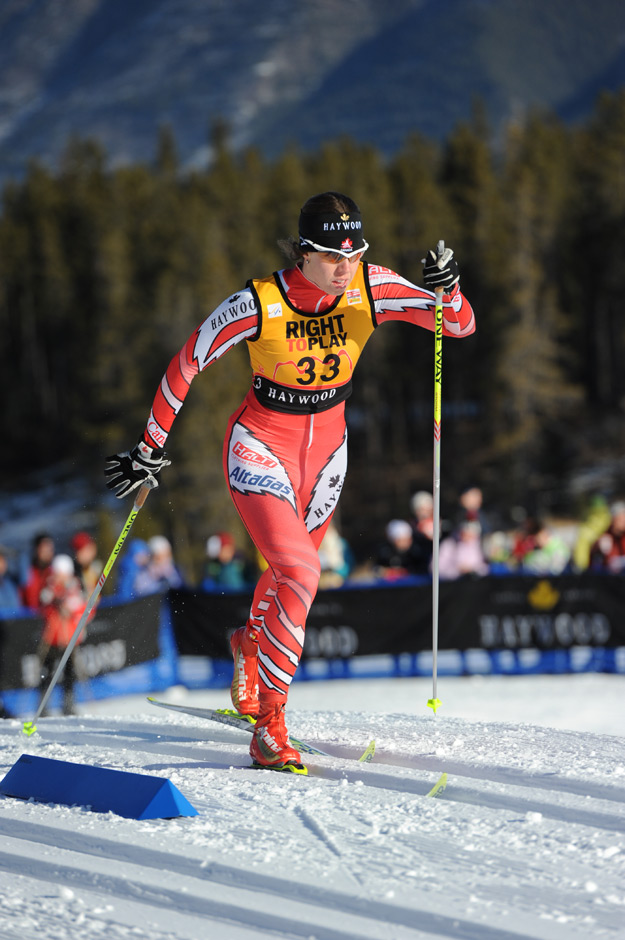
    Perianne Jones racing to 29th in the Canmore World Cup in February 2010. (Photo: Win Goodbody)

    After graduating high school, Jones started a fall term the University of Calgary, but found the commute back and forth from Canmore difficult. She took an online course at Athabasca University, but realized that didn’t work for her, either. Instead, she spent the next 12 years focusing on skiing.

    “I’m happy with the decisions I made and I’m sure my ski career was the best quality,” she said. “Hindsight’s twenty-twenty; there’s always things that could’ve gone better, but at the same time I was able to commit 100 percent to skiing. Although I’m not educated right now, I’m really looking forward to going to school and I can put 100 percent of my energy into school.”

    Jones and Jaques were also looking forward to having the freedom to visit friends this spring.

    “I’m looking forward to waking up and being able to what I want to do for exercise,” Jones said.

    “I will not be out on my rollerskis,” she added with a laugh. “So far it doesn’t feel a whole lot different. I feel pretty good about my decision, and I’m confident it was the right one. So many people say that it’s really hard [to retire] and some people say it’s awesome, but I think it depends on the person. I have enough plans to keep me busy; I don’t think I’ll be bored.”

    Looking back, she credited her two national-team coaches, de Nys and Justin Wadsworth, for the longevity of her career. She worked with de Nys, a development coach before he became the women’s national-team coach, for most of her senior years.

    “Eric really got to know me as an athlete and I got to know him as a coach, and I really trusted him and we were able to work well together,” Jones said. “And Justin, he’s been with the team since [2010] and he wasn’t my personal coach until this past year, but the transition was pretty seamless … I don’t feel like I lost Eric as a coach this year, but I feel like I gained Justin. Whenever we had a question about something, either of us could easily call Eric or visit him in his office.”

    In her career, Jones notched three top-15’s at both Junior World Championships and U23 World Championships, finishing eighth at 2008 U23’s in Malles Venosta, Italy.

    Canadians Perianne Jones and Dasha Gaiazova celebrate their first bronze of the season, and together, in the Sochi World Cup classic team sprint. (Photo: Chandra Crawford)
    Canadians Perianne Jones (l) and Dasha Gaiazova celebrate their first bronze together in the Sochi World Cup classic team sprint. (Photo: Chandra Crawford)

    “I had some really good World Junior experiences, some good results and some really fun times with the team,” she explained.  “For sure, the two medals that I won with Chandra and Dasha respectively in Milano and Sochi were highlights.”

    In 2012, Jones and Chandra Crawford teamed up for third in the World Cup freestyle team sprint in Milano, Italy.

    Jones also recalled making the 2010 Olympics in Vancouver, British Columbia, as a major high point. She qualified in 2009 when she and Sara Renner placed sixth in the World Championships classic team sprint in Liberec, Czech Republic.

    “That was the first time we got to go to the medal ceremony … and it was with Sara, who was a pretty big mentor,” she said. “I was actually never really on the team with Beckie [Scott] or Milaine [Thériault], but I traveled quite a bit with Sara. … Having them come before me and have the results that they did and just being the people that they are, they made it pretty appealing to chase after ski-related goals … Everything was so positive that I never I had any doubt that A.) I would enjoy it and B.) it would be possible.”

    The last of Canada’s three veteran females to retire — following the departures of Crawford and Gaiazova from the national team last year — Jones was excited to see what the next generation of women could accomplish.

    “I spent the majority of the season on the road with Emily [Nishikawa] and that was just awesome,” she said. “I’m glad I was there for that and able to witness her best season ever, and I think it’s a sign for really great things to come. There are younger women coming up, too, and they have Emily to look up to so there’s no doubt in my mind that they will do great things.”

    Regardless of where she attends school, Jones envisioned that she and Jaques would end up living somewhere in western Canada.

    “We don’t really want to leave Canmore,” she said.

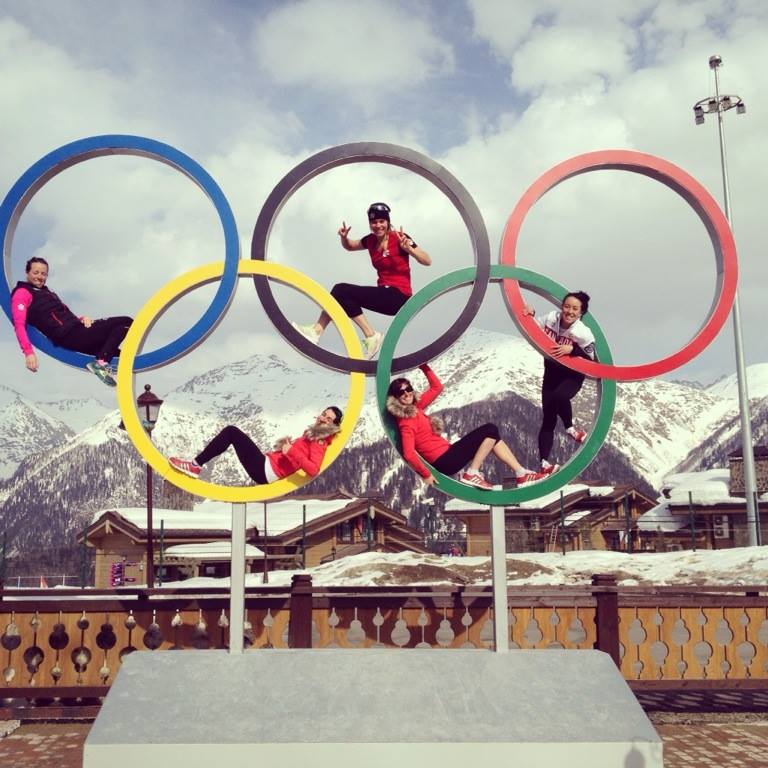
    Several members of the Canadian Olympic cross-country ski team get the perfect photo opp at the Olympic rings in Krasnaya Polyana, Russia. (From left to right): Perianne Jones, Amanda Ammar, Heidi Widmer, Brittany Webster, and Emily Nishikawa. (Photo: Emily Nishikawa)
    Several members of the 2014 Canadian Olympic cross-country ski team get the perfect photo opp at the Olympic rings in Krasnaya Polyana, Russia. (From left to right): Perianne Jones, Amanda Ammar, Heidi Widmer, Brittany Webster, and Emily Nishikawa. (Photo: Emily Nishikawa)
  • Nishikawa Cracks Top 30 in Falun 10 k, Jones Tallies Another Distance Best in Last Race

    Nishikawa Cracks Top 30 in Falun 10 k, Jones Tallies Another Distance Best in Last Race

    Canada's Emily Nishikawa (Alberta World Cup Academy/National Development Team) racing to 30th in Tuesday's 10 k freestyle for her best World Championships result at 2015 worlds in Falun, Sweden. Nishikawa led the Canadian women with the result and Perianne Jones placed 32nd. (Photo: Fischer/NordicFocus)
    Canada’s Emily Nishikawa (Alberta World Cup Academy/National Development Team) racing to 30th in Tuesday’s 10 k freestyle for her best World Championships result at 2015 worlds in Falun, Sweden. Nishikawa led the Canadian women with the result and Perianne Jones placed 32nd. (Photo: Fischer/NordicFocus)

    FasterSkier’s coverage of the 2015 FIS Nordic World Ski Championships in Falun, Sweden, is brought to you by the generous support of L.L. Bean, now featuring a complete line of Kikkan Randall training wear.

    FALUN, Sweden — With the pressure off, the Canadian women posted some career-best performances on Tuesday in the 10-kilometer freestyle individual start at 2015 FIS Nordic World Ski Championships.

    In Emily Nishikawa’s first race coming off illness, which kept her and fellow Canadian World Championships team member Olivia Bouffard-Nesbitt back in Östersund, Sweden, until Sunday, recorded her first top 30 at her second World Championships.

    “I was sick last week so I didn’t really know what to expect, how my body would react,” Nishikawa said after placing 30th, 2:20.5 behind Sweden’s Charlotte Kalla, who won the 10 k skate in 25:08.8. “It could’ve gone either way and it went well today, so I’m very happy with that.”

    Canada's Perianne Jones (Alberta World Cup Academy/National Development B-Team) racing to 32nd for her best World Championships distance result at 2015 worlds in Falun, Sweden. (Photo: Fischer/NordicFocus)
    Canada’s Perianne Jones (Alberta World Cup Academy/National Development B-Team) racing to 32nd for her best World Championships distance result at 2015 worlds in Falun, Sweden. (Photo: Fischer/NordicFocus)

    Meanwhile, team veteran Perianne Jones notched yet another best distance result at worlds in 32nd after placing 37th in Sunday’s 15 k skiathlon. And in what she anticipates to be her last season of professional racing, and ultimately her last races, Jones, 29, didn’t expect to do any of the distance races.

    “I had zero expectations going in,” Jones said after finishing 2:26.7 back from Kalla. “Coming into these championships, I thought I was going to do the sprint and the team sprint … and I ended up doing the sprint and the 10 k and the pursuit.”

    Even on the World Cup, Jones hadn’t done better than 32nd in a distance race since placing 30th two years ago in a 15 k classic mass start in Nové Město na Moravě, Czech Republic.

    And then there was Nishikawa, 25, who cracked the top 30 for the first time this season on the World Cup, placing 29th in the 10 k classic in December in Davos, Switzerland.

    The 54th starter out of 71, the Alberta World Cup Academy (AWCA) and Canadian National Development Team skier faced some of the toughest conditions of anyone in Tuesday’s race, skiing two different loops of a 10 k course in heavily falling, wet snow.

    “It was snowing pretty heavily, [but] my skis felt great,” Nishikawa recalled. “I pushed as hard as I could …  I was just dying to get here to Falun. I’m so happy to be here and to be racing is a real treat.”

    Nishikawa, Jones and Canada’s third woman at the championships, Bouffard-Nesbitt, warmed into their races, with Nishikawa’s 1.5 k time ranking 45th, followed by Jones in 46th and Bouffard-Nesbitt in 53rd.

    By 5 k, Nishikawa was up to 35th and 2.8 k later, 33rd, before closing hard for 30th. At the end of the day, she finished 3.1 seconds ahead of Norway’s star skier Marit Bjørgen, who placed 31st (for her first result outside the top 24 in a World Championships in at least 14 years).

    Jones, who sped up to clock the 34th-ranked 5 k time and 32nd 6.3 k time, finished 6.2 seconds behind Bjørgen, the 65th starter.

    “I was lucky I started early — I was number 22 so I have probably never been that close to Bjørgen in a skate distance race ever,” Jones said. “I just wanted to ski hard and pick a pace up those hills I could maintain. I was pretty sure the girl behind me [France’s Coraline Thomas Hugue] was going to catch me, so I just tried to stay with her for as long as possible.”

    While Hugue had a career-best day of her own in 12th, Jones said this race would go down as one she’d remember — and likely her last international race.

    “This was my final World Champs, probably my final international ski race,” she said. “After last year, I just kind of wanted to give it another shot, and it has been a good year in a lot of ways — I have been really healthy, more than I have been in the past. I think these last few distance races, too, I have surprised myself a little bit even though they weren’t in the plans.

    “This is the first time this week that I skied with teammates, so it is really nice to have the other girls here and for us all to come to the start line together and to have a teammate to hug at the finish line,” Jones added. “It has been a great year and I think there are lots of good ladies coming up and it has been fun to spend a year with them and hopefully pass some things on.”

    Canada's Olivia Bouffard-Nesbitt (Rocky Mountain Racers) racing to 52nd in Tuesday's 10 k freestyle, her debut race of 2015 World Championships in Falun, Sweden.
    Canada’s Olivia Bouffard-Nesbitt (Rocky Mountain Racers) racing to 52nd in Tuesday’s 10 k freestyle, her debut race of 2015 World Championships in Falun, Sweden.

    In her first World Championships, Bouffard-Nesbitt, of Rocky Mountain Racers, placed 52nd, 4:05.4 behind the winner.

    “Today was just a really cool experience,” she wrote in an email. “I was loving every second of it. The fans, the atmosphere, the location, the conditions, so many things that made today amazing and memorable.”

    Less than three weeks ago, Bouffard-Nesbitt earned her spot on Canada’s World Championships team with a 12th-place finish in the skiathlon at U23 World Championships in Almaty, Kazakhstan. Coming off that performance, she came down with a long-lasting cold.

    “The race itself wasn’t great,” Bouffard-Nesbitt wrote of Tuesday’s race. “My movements were lacking power, and I didn’t feel that race fitness that generally leads to good races. I was missing that ability to really push, my body just wasn’t really doing it today.”

    She hoped the effort would be good preparation for Saturday’s 30 k classic mass start.

    “I was dealing with pretty low energy and a cold last week, but I’ve bounced back from that and am healthy now,” the 22 year old wrote. “I’m not upset about my race. I just raced my first ever World Champs and I’m totally psyched about that. There isn’t much that can take away from how amazing it was to be on the start line! And there was so much to be stoked about today too.

    “Today wasn’t about me. I raced, and I was super pumped about being in the race, but I was also super excited for [American medalists] Jessie [Diggins] and Caitlin [Gregg] who had just mind blowing performances, and for Emily having her second top 30 of the year!” Bouffard-Nesbitt added. “It was a pretty great day!”

    With three women at World Championships, Canada will not field a relay for Thursday’s 4 x 5 k team event. Instead, Nishikawa and Bouffard-Nesbitt will likely focus on the final race in Falun: the 30 k classic on Saturday.

    Results

  • Canadians Bounce Between High and Low California Training; Kershaw Off to Norwegian Camp

    Canadians Bounce Between High and Low California Training; Kershaw Off to Norwegian Camp

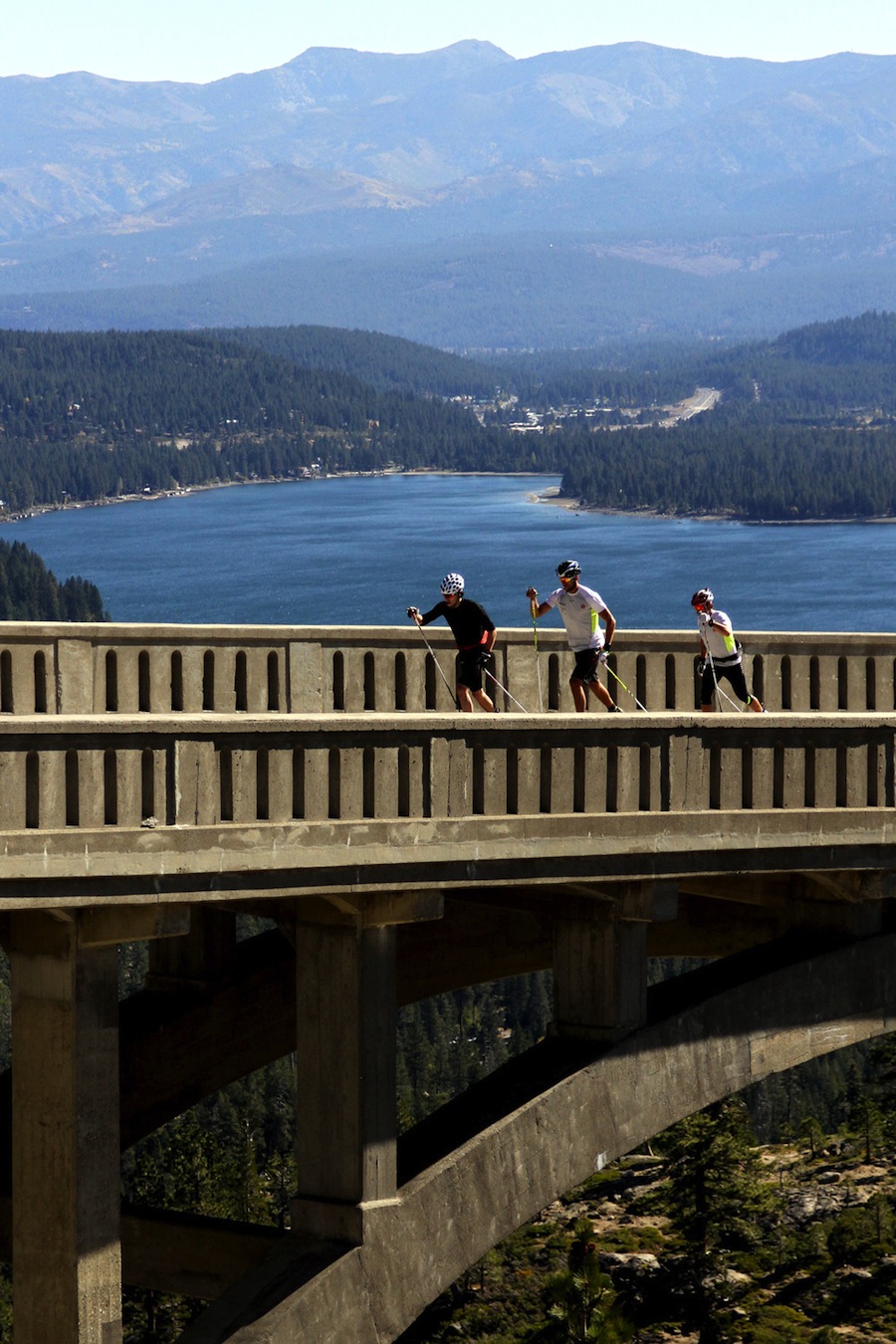
    The Canadian World Cup Men's Team during a rollerski at Donner Pass near Truckee, Calif. (Photo: Mark Nadell/MacBeth Graphics) http://macbethgraphics.smugmug.com/Training/CANADIAN-NATIONAL-TEAM-2013
    On Oct. 4, the Canadian World Cup Men’s Team rollerskis across the Rainbow Bridge toward Donner Pass near Truckee, Calif. (Photo: Mark Nadell/MacBeth Graphics)

    “The leaves crunch beneath my now worn running shoes as I negotiate the soft, pine needle infested single track above the Nor-Cal town of Truckee, CA. After days upon days of warm weather, blue skies and summer-like vibes, the jackets and long tights were thrown on – a rude reminder that even in California it’s approaching mid-October. As I weave between some seriously large pines and over the endless ridges, it feels as though I am literally running into winter.”  – Devon Kershaw, on his blog

    There’s no place like California. That’s what Canadian World Cup Team Head Coach Justin Wadsworth thought when he scouted the Truckee area in July. He stayed with a former teammate from the U.S. Ski Team, Marcus Nash, and spent two days exploring northern California and all the high-elevation ski town had to offer.

    What he found was seemingly endless roads covering technical terrain at elevations around 1,775 meters (more than 5,800 feet). About a 45-minute drive away, one could find themselves more than 1,000 meters lower in Nevada City (at 2,477 feet), which Wadsworth deemed perfect for harder efforts. Weather was good there in autumn: warm, sunny and dependable. And who on his team wouldn’t want to go to California for a change?

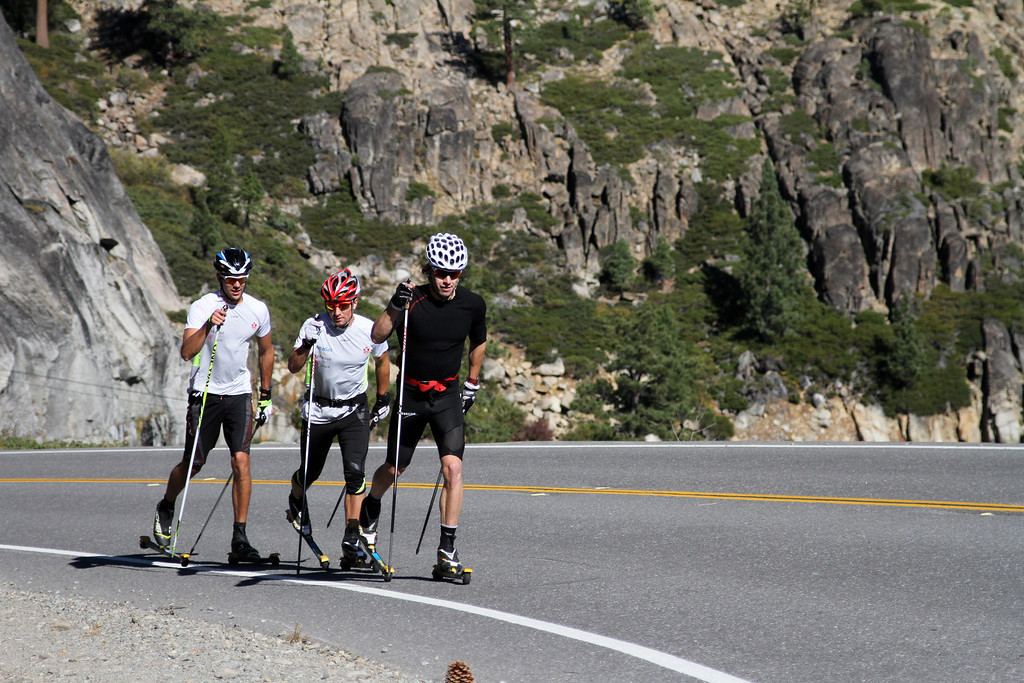
    The Canadian World Cup Men's Team during a rollerski at Donner Pass near Truckee, Calif. (Photo: Mark Nadell/MacBeth Graphics) http://macbethgraphics.smugmug.com/Training/CANADIAN-NATIONAL-TEAM-2013
    Alex Harvey leads Canadian World Cup teamamtes Ivan Babikov (c) and Lenny Valjas (l) during a rollerski on Old Highway 40 on Oct. 4 near Truckee, Calif. (Photo: Mark Nadell/MacBeth Graphics)

    “It’s been a really great camp; there’s been sunny, blue skies every day,” Wadsworth said on the phone from Truckee on Tuesday. “Everyone can train in shorts and a T-shirt or no shirt.”

    Not that Park City, Utah, where the team normally takes its final dryland camp of the season, is a bad place to be – especially for altitude training at 2,000-plus meters (6,500 feet). But after somewhat of a hold-and-cold season last year, in which some of his skiers reached career bests and others finished a little disappointed, Wadsworth decided it was time for change.

    Off to Truckee they went. Starting Oct. 1, the entire men’s and women’s World Cup team spent nearly three and a half weeks in California, wrapping up Thursday before heading home to Canmore, Alberta, for the opening of Frozen Thunder on Saturday.

    The men’s team – Devon Kershaw, Alex Harvey, Ivan Babikov, and Lenny Valjas – opted for RV dwelling, like their training camps in Hawaii. The women – Perianne Jones and Dasha Gaiazova – weren’t as into that, so they split their time between a Truckee hotel and a house the team rented in Nevada City, Wadsworth said.

    Between the mountain town and low-lying Nevada City, the Canadians divided their efforts accordingly, with sustained easy training in Truckee and more intensity at lower elevations.

    Wadsworth said the area offers some of the best roads and steepest hills he’s ever seen, quiet and ideal for training. He had been looking for rollerski terrain where he could push his men to work on their offset, or V1, for long stretches.

    “We’re so fit these days you have to get a really big hill to get these guys working continuously,” he said.

    California in autumn has been what I remembered it to be. Blue skies and sunny weather, vistas with apparent and looming granite monoliths, stellar soft single track running trails and long, winding (and climbing!), quiet roads. I remember all that from my years training in the fall both in the Mammoth Lakes and Truckee areas in the past. – Kershaw

    Among the skiers he works with directly on the men’s team, Wadsworth said Kershaw, Harvey and Babikov are in the best shape he had ever seen. Valjas was still recovering from his knee surgery in July. According to his blog, Valjas had done “almost no cardio” before the California camp, but Wadsworth said he was jumping into most workouts.

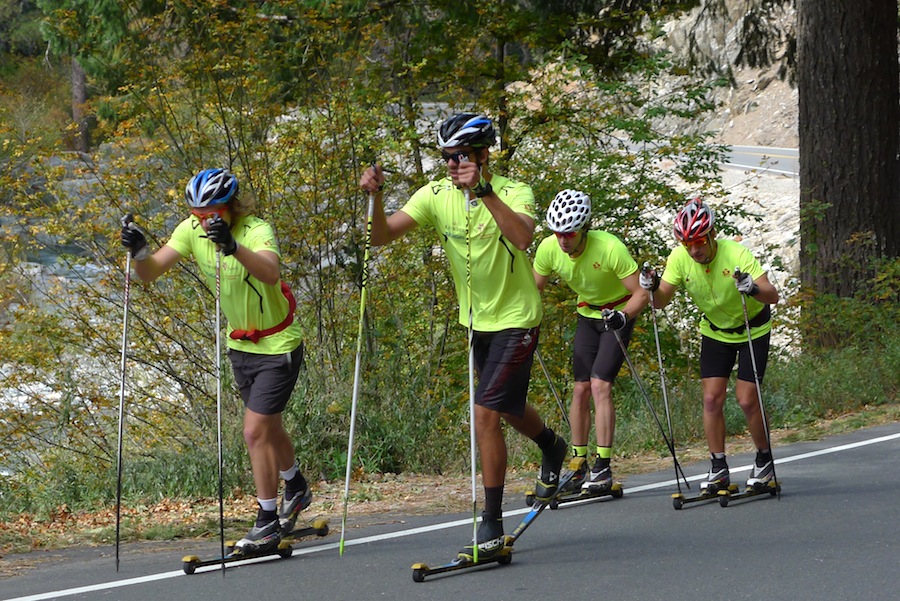
    The Canadian World Cup Men's Team during a four-hour rollerski from 1,000 to 7000 feet. (Photo: Justin Wadsworth)
    The Canadian World Cup Men’s Team during a four-hour rollerski from 1,000 to 7000 feet. From left to right: Devon Kershaw, Lenny Valjas, Alex Harvey, and Ivan Babikov. (Photo: Justin Wadsworth)

    “I was pretty happy he hopped right in and could hang with the guys really well,” Wadsworth said. “We have to make sure we’re not overdoing it with his knee.”

    Women’s coach Eric de Nys worked with the women separately on more sprint-specific training. Jones and Gaiazova left earlier to get on snow in Canmore, and Kershaw flew to Europe on Monday to train with the Norwegian men’s team on the glacier in Val Senales, Italy. Wadsworth will meet him over there later this month and said this was the first time the national team invited one of his athletes to such a significant training camp. It was a no-brainer for a couple reasons.

    “Devon came to me and needed a bit of a change,” Wadsworth said.

    The 30-year-old world champion had been touring North American training camps for his entire career, even before he started racing internationally in 2005. He was also dating Kristin Størmer Steira, who came to Canmore in July, but he hadn’t seen her since, Wadsworth explained.

    “I’ll be there for six days to make sure things are handled well,” Wadsworth said.

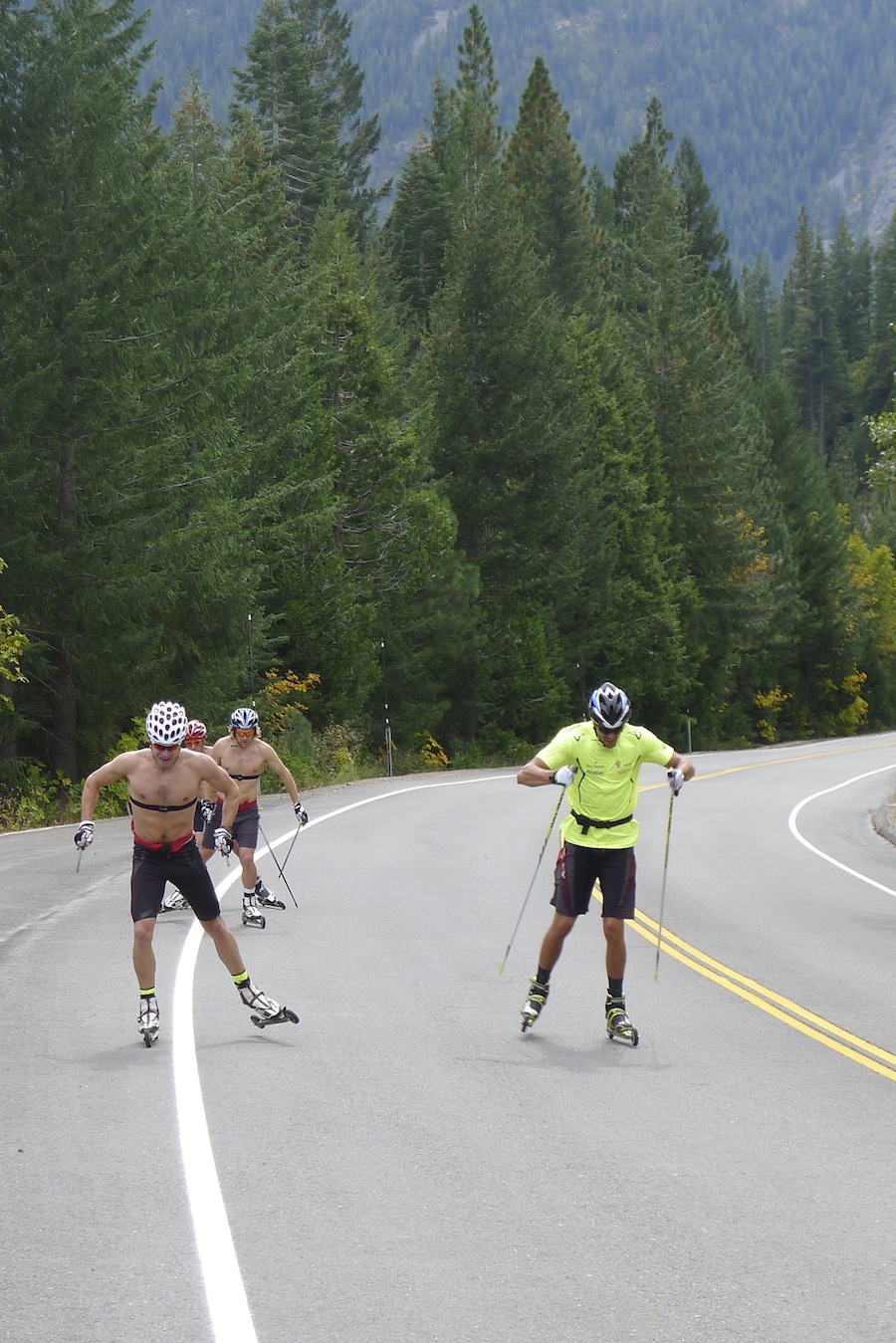
    The Canadian World Cup Men's Team hard at work near Truckee, Calif., during their final dryland camp from Oct. 1-17. (Photo: Justin Wadsworth)
    The Canadian World Cup Men’s Team hard at work near Truckee, Calif., during their final dryland camp from Oct. 1-17. (Photo: Justin Wadsworth)

    Mostly, he doesn’t want to blow all the work the team’s put into proper recovery this season. In retrospect, his athletes were a little too eager last summer and they paid the price during the race season, he said.

    “I think things got a little out of hand last year with the intensity,” Wadsworth said. “People being too fired up and doing intensity a bit too hard than what we should.”

    This spring, summer and fall, the Canadians have been more carefully monitoring each workout, placing some responsibility on the athletes. Heart-rate profiles could tell them a lot about where each individual was at with training, and they also tested a bit more this year.

    “After each period, we tested to double and triple check where the athletes were,” Wadsworth said. “That’s something we brought back more … [but] I get more from the actual workouts outside seeing their fitness. The tests give us more indicators of small nuances and changes in physiology. We want to see improvements obviously, but the testing looks at other things that would be red flags or other areas, if they’re missing, we want to see there.”

    Looking at his team’s training progress, Wadsworth said his athletes were right on track.

    “Everybody’s a little bit different, but as a whole I’m really pleased with where we are,” he said. “The main thing is people have been really consistent and doing what they need to do. There hasn’t been a lot of showy stuff; we’re just really, really trying to hit the markers in every training session.”

    Once they get on snow and start gearing up for the start of the World Cup late next month, they’ll have to be more diligent at keeping that in check, he added. The team will skip its typical warmup FIS races in Sweden and jump right in the World Cup opener in Finland.

    “We’re basically using Kuusamo [Nov. 29-Dec. 1] as the first racing that we’ll be doing,” Wadsworth said. “That’s on purpose to build through the season and not having too much hard intensity and save it for later on.”

    Jones and Gaiazova won’t go to Europe until mid-December for the third World Cup in Davos, Switzerland. Wadsworth said the entire goal of the season is a continual slope and gradual build up toward the Tour de Ski and, ultimately, the Olympics in Sochi, Russia.

    “When we get over there, we’ll be fit and ready,” he said.

    In Canmore, the women will have nearly two months at home on manmade snow at Frozen Thunder (Gaiazova will arrive there later this month after training in Montreal and Quebec). Harvey will stay in Quebec with coach Louis Bouchard and the Pierre-Harvey Training Centre.

    On Oct. 24, the rest of the Canadian World Cup Team will host a classic sprint race with the U.S. Ski Team and other elite skiers in town. From what he’s heard, Wadsworth said temperatures have been ideal for making snow, and he hoped they’ll be able to add a “few more meters” to the course.

  • Crawford Declines Nomination to NST in Effort to Bring Out Her Best

    Crawford Declines Nomination to NST in Effort to Bring Out Her Best

    Chandra Crawford racing to 37th in a classic-sprint qualifier at the Kuusamo World Cup in Finland on Nov. 30. (Photo: CCC/Nordic Focus)
    Chandra Crawford racing to 37th in a classic-sprint qualifier at the Kuusamo World Cup in Finland on Nov. 30. Midway through a tough season last year, Crawford, 29, decided to stop racing in February and returned home to Canmore, Alberta, to recharge before the 2014 Olympics. In April, she declined her nomination to the national team and will work with personal coach Peter Larsson this summer. (Photo: CCC/Nordic Focus)

    And then there were two.

    That’s how many women are on Canada’s World Cup Team after Chandra Crawford recently decided to train on her own with personal coach Peter Larsson for the next several months.

    Dasha Gaiazova is back in eastern Canada for the second-straight offseason, which makes Perianne Jones the lone World Cup female at the national team’s base in Canmore, Alberta, where she’ll work with women’s coach Eric de Nys.

    Crawford, a 29-year-old Canmore native and 2006 Olympic gold medalist, will be there, too, working independently with her technique and tactics coach of the last four years, Larsson, a Swedish sprint specialist who won six World Cups. Technically, she declined her nomination to the 2012/2013 national ski team (NST), but in an email last week, Crawford reiterated that she’ll be back onboard once the World Cup season starts in November.

    “After a solid burn out and overload I’m re-charged and keen to make the most of the days until Sochi,” she wrote of the pre-Olympic training phase. “I have to manage my energy and do things in ways that work for me so while it’s financially sketchy it is the best option.”

    Last season, she ended her season in early February after the World Cup in Sochi, Russia, citing the physical and mental toll of 13-plus years of international racing.

    “I’m just preparing to go into the Olympic year so rested and so calm from this time I took to step back and center myself and become so healthy and energized,” Crawford said at the time. “The system is overtaxed now and I need to be more honest about my skiing level and listen to my body better.”

    She spent the next few months recharging and catching up with family, friends and loved ones, “something I’ve missed for so long I didn’t even know to miss it,” Crawford wrote.

    “My weekdays were usually spent on self-improvement and appointments for all aspects of my physical and mental health,” she continued. “Weekends were enjoyed with friends – skiing in the mountains and dance parties. … April I made my decision early about my plans for the year and got to work communicating that out with everyone involved.”

    She based the move on her needs in an Olympic year. “I always give at least my best on race day and love big events so it’s a question of how good my fitness and ‘best’ can be on that day,” she wrote.

    The news didn’t necessarily surprise de Nys, but it was one that slightly complicated his team’s training plans.

    “I thought it was definitely conceivable,” de Nys said Monday on the phone. “I didn’t think she would choose that, but at the same time I totally understand why and totally support her in her decision. We wish her all the best in her training.”

    On Monday, he spoke with Crawford and other independent racers, Amanda Ammar, Zoe Roy and Alana Thomas, about the upcoming NST camp in Bend, Ore. Jones will be there, and de Nys invited them to coordinate workouts from May 19-29.

    “I’m not writing her plan or anything like that,” de Nys said of Crawford. “I’m just keeping the door open.”

    Canadian National Ski Team members Perianne Jones (second from left) and Chandra Crawford (second from right) go head-to-head in a Frozen Thunder time trial in late October. Crawford won by a toe, but Jones took top honors in the first World Cup of the season on Friday at the 1.4 k classic sprint in Kuusamo, Finland. (CCC photo)
    Canadian World Cup teammates Perianne Jones (second from left) and Chandra Crawford (second from right) go head-to-head at a time trial last October in Canmore, Alberta. (CCC photo)

    As for Jones, he’s in the process of lining up training partners for the 28-year-old Canmore-based skier. So far, he has mostly aligned schedules with Gaiazova, who trains with NST assistant men’s coach Louis Bouchard at the Pierre-Harvey National Training Centre in Quebec and B2ten in Montreal.

    De Nys will also invite foreign training partners to Canmore and explained that Jones has talented biathletes around town as well, like Zina Kocher, Megan Imrie, and Crawford’s younger sister, Rosanna.

    “I’ve also made the commitment to start to become in better shape so I’ll make her feel really good about herself as she drops me on the hills,” he joked.

    Looking at his team of three (technically two until Crawford proves she’s capable of racing internationally again in the fall), de Nys stressed the importance of end results – not how one gets there.

    “I don’t view it any different than how it works in the U.S. with Gus Kaeding coaching [national-team members] Andy [Newell] and Simi [Hamilton] in Vermont,” he said, referring to America’s elite-team system.

    “There’s more than one way to the top and the national ski team is one way and there’s other ways we can do it,” de Nys explained. “The important thing is you have a team that’s willing to work with each other. We do have a group of women, albeit a small one, that do want to work with each other.”

    He likened Crawford’s situation to that of an NHL player going down to a farm team. It’s unusual that one would do so by choice, but the athlete still has to show they’re worthy of playing at the highest level before getting bumped back up.

    “Chandra will have to undergo some testing and some evaluation,” de Nys said of her anticipated re-entry to the national team. “It’s one thing if you want to go off and do your own training, that’s all fine, but before we take someone to Europe, we want to make sure they’re physically healthy. … We’re not going to take somebody to Europe for vacation.”

    In Crawford’s case, he doesn’t expect that will be a problem.

    “Sometimes the environment or the pressure in whatever team you’re on doesn’t necessarily suit everyone,” he explained. “I think that’s the point Chandra is at in her life. … While we can’t necessarily support that, I understand why she chose that.”

    In July, Crawford plans to train in Alaska, he said. Meanwhile, Gaiazova and Jones will join the Canadian men’s team in New Zealand and also in Hawaii this summer. Separated for the first time last year, the men’s and women’s World Cup teams previously held camps at different venues. This year, de Nys said it made sense to combine overseas trips and share resources (i.e. physical trainers).

    With two women on its current World Cup squad, it raises the question what Canadian women’s skiing could look like in the future. De Nys expects some changes.

    “We anticipate that perhaps Dasha, Peri and Chandra will be done after this year so we have to start grooming the younger crowd as well,” he said. “There’s a fairly large gap from the World Cup level to the younger levels. … We have to make sure we keep building up this castle.”

    He pointed out talent in the junior- and senior-development ranks, especially with skiers like Anne-Marie Comeau, who made the top 50 in two debut World Cup races last season at the age of 16.

    “You just don’t show up and pull races out of your hat like that,” de Nys said. “Now we just have to make sure that we do the right things … bring in some of those girls, work with some of them.”

    After Bend, the NST will host a women’s camp on Canmore’s Haig Glacier with its World Cup, junior and senior development teams.

  • Crawford on Her Decision to Cut Season Short, What’s Next

    Crawford on Her Decision to Cut Season Short, What’s Next

    Canadian World Cup Team member and 2006 Olympic gold medalist Chandra Crawford in Chamonix-Mont-Blanc, France. (Courtesy photo)
    Chandra Crawford, Canadian World Cup Team member and 2006 Olympic gold medalist, in Chamonix-Mont-Blanc, France. (Courtesy photo)

    Countless times, Chandra Crawford relied on her upbeat attitude and incredible self-motivation to rise to the occasion. When it came to racing, there were no bad days, just a genuine love of the sport.

    At the age of 22, the always-smiling, wide-eyed girl from Canmore, Alberta, won gold in the freestyle sprint at the 2006 Olympics. She notched her first World Cup victory the following season in her hometown and won another gold in a World Cup skate sprint a few months later in March 2008 in Lahti, Finland.

    Falla Leads Chandra Crawford (CAN) and Randall in the semis.
    Canadian Chandra Crawford (3) follows Maiken Caspersen Falla of Norway with Kikkan Randall (USA) close behind in the Alberta World Cup freestyle sprint semifinals on Dec. 15 in Canmore.

    Now 29, Crawford’s no longer a girl, yet she still thrives off that same optimistic adrenaline that’s fueled her for the last 13 years. For instance, take the Canmore World Cup. Heading into the races two months ago, Canada’s leading national-team female hadn’t cracked the top 30 this season. In her signature event in front of thousands of fans, she qualified in third in Canmore and went on to place sixth in the World Cup final.

    After the holiday break, in which she spent time with her two teammates – Dasha Gaiazova and Perianne Jones – training and racing Alpen Cups in Germany, Crawford struggled to get back near the top. In mid-January at a World Cup skate sprint in Liberec, Czech Republic, she was 29th. She didn’t finish her next race, a 10 k classic mass start in La Clusaz, France.

    That’s when Crawford knew something was wrong. And unlike all the other times she had buried the bad feelings and triumphed, she took a hard look at the root of the cause.

    “I spend a lot of time with my training logs, analyzing a lot of what I’ve been up to and how I’ve been feeling over the last year, and there were just so many strong reasons in there for the state I’m in,” Crawford said on the phone Wednesday. “It just seemed clear to me that I was in a pretty good hole.”

    She wasn’t burnt out, sick of the sport or tired of racing, she said. Rather, Crawford realized she had done too much in the last year, which culminated into an overwhelming sense of mental and physical fatigue. Stress in the last year was a contributing factor, but moreover, that paired with a “super-hard” training sessions took a toll on her body.

    “I’ve been hammering for a lot of years now so to take a breather after 13 solid years of full-time training and racing at as high a level as my body can at all times, I don’t feel too bad about it,” Crawford said.

    On Tuesday, Cross Country Canada (CCC) issued a press release stating Crawford decided to end her season early to recover for next year’s Winter Olympics in Sochi, Russia. After prequalifying for the 2014 Games with her Canmore result, Crawford appeared to be in a safe spot. But what was next for Canada’s golden child? And what would become of the nation’s World Championships hopes with just two World Cup females racing in Val di Fiemme, Italy, later this month?

    A Little R & R

    According to Crawford, who flew home from Sochi on Monday, she’ll take some off before resuming training. She formulated a loose plan with Canadian women’s coach Eric de Nys before leaving after breaking the news to him last week.

    Nervous about the conversation, Crawford said she waited until she saw him in person to discuss it. After spending time with his family in Canmore, de Nys rejoined his team on the flight to Sochi for the pre-Olympic World Cup.

    “We were sitting on the plane together for a couple hours and then finally I just said, ‘I’m thinking about stopping the season,’ ” Crawford recalled. “And he said, ‘We’re on the same page,’ so then I was completely calm and I knew it was the right thing.”

    According to de Nys, Crawford’s only obligation is to be ready to go in May when the team starts training for the 2013/2014 season. He said her situation is much like that of a season-ending injury; she’s going to take time to recover, recuperate and follow a training plan in doing so.

    “We know she’s a performer so I don’t have any worries about her getting back into shape,” de Nys said on the phone from Valdidentro, Italy, where Gaiazova and Jones are training before the Davos World Cup.

    “Sometimes things go awry,” he added. “It might seem drastic midway through the season, but it happens quite often where athletes have to miss a couple months of racing.”

    De Nys used Lukáš Bauer, the Czech Republic’s famous World Cup skier, as an example. Bauer’s season was cut short in February last year when he discovered a fracture in his heel.

    “He couldn’t walk anymore,” de Nys said. “That’s not what he wanted to do, but in this situation it’s the same thing. Of course, Chandra wants to try to finish the season, but when we really thought about it, talked about it, it doesn’t make sense. I think she’s going to come back stronger from this.”

    Chandra Crawford (CCC photo)
    Chandra Crawford (CCC photo)

    Crawford does, too, but she’s a little unsure of the timeline required to get there.

    “I don’t know what to expect,” she said. “I don’t know how long this is supposed to take, but that’s why we’ve shied away a little bit from trying to put timeframes on it. In the past, when I make a goal I am going to do everything in my power to achieve it, which can sometimes lead to forcing it or maybe trying to fabricate a state that might not actually be happening.”

    Moving forward, she said there are two scenarios she’ll try to avoid. One, disappointment when she doesn’t meet her goals. And two, “acting fine because I decided I want to be fine at a certain time,” she said.

    “We’ve seen this past year that, although I have tremendous abilities to create an optimal state and that’s why I’ve raced well in the past, the system is overtaxed now and I need to be more honest about my skiing level and listen to my body better,” Crawford said.

    Making the decision to stop racing three weeks before World Championships wasn’t easy, especially given Crawford’s love of Italy. According to de Nys, it was better to make it sooner rather than later.

    “It’s no fun when you know you can be on the podium and you’re finishing 40th or 50th, you know something’s not going right,” he said. “When you just kind of get in the water and you’re spinning your wheels, you know that’s time to take a break and re-gather everything and come back fighting stronger.”

    Crawford said another factor in her decision was her experience with previous Olympic years – and the media attention leading up to it. Upon returning to Canada, she had four interviews on Tuesday and two that she moved to Wednesday.

    “The first question of the first interview of the Olympic countdown was, ‘Do you feel the weight of the nation’s expectations on you to win gold?’ ” Crawford said. “If I get drilled with that question the entire year, even with all my media training and whatever I do to deflect it or focus on the process, it’s still a thought that just comes up so much more often with the media presence.”

    After envisioning herself coming home and “crumpling onto the couch,” Crawford said she’s exhausted but happy. And while she was considering a two-week yoga retreat in Mexico to take her away from the temptation to ski, she wrote in an email Thursday that she might cancel the trip.

    “Just looking at enjoying home life and not running around so much,” Crawford explained.

    Whatever she ends up doing to unwind, Crawford said she doesn’t take anything for granted – not a vacation, her team or all the racing opportunities she’s been given.

    “I’m definitely spoiled rotten and I really appreciate everyone being behind me because I’m definitely putting my all into my pursuit of skiing,” she said. “It’s interesting that this time putting my all into it means taking a step back.”

    The founder of Fast and Female, Crawford will continue with her less-involved role, attending about two events per year and delegating responsibilities to her board and a new executive director. As the movement of empowering young girls keeps spreading across North America, Crawford said she’s thankful for the athletes, volunteers and regional coordinators behind it, especially Kikkan Randall and other US Ski Team members. Ultimately, Crawford wants to make more appearances in the future, but reasons, “my chance to pursue my dreams to the best of my abilities on the racing side is just a short time window right now.”

    As she embarks on a fresh start in racing, she’s looking forward to feeling regenerated for next season.

    “I’m just preparing to go into the Olympic year so rested and so calm from this time I took to step back and center myself and become so healthy and energized,” Crawford said. “There are just so many things I pour energy into that I really have to be really disciplined and prioritize for the Olympic year.”

    World Champs Outlook

    In Crawford’s absence at the upcoming World Championships, an additional female sprinter will not be selected, according to CCC High Performance Director Thomas Holland.

    When the team was named a week and a half ago, the selection committee extended its 11-person maximum for one additional distance woman on the squad. Without Crawford, the team was back to 11. Of the five women, three are sprinters.

    With the opportunity for one team sprint and one relay per gender at World Championships, Canada’s women appear to be in a good position for the former. Last weekend, Gaiazova and Jones teamed up to win bronze in the classic team sprint in Sochi. The Canadians will also field a women’s relay.

    “This is not an event we have done well in,” Holland wrote in an email, pointing out their 16th-place finish at the 2007 World Championships. They didn’t have a relay in 2009 and placed 14th two years ago. “It would be nice to see an upward improvement from the last 3 [World Championships].”

    De Nys explained Canada has been working to rebuild its women’s program for the last several years since Beckie Scott and Sara Renner captured silver in the team sprint at the 2006 Olympics.

    “Now, we’re very strong, but just in sprint so we’re trying to get some momentum behind distance skiing in Canada as well,” de Nys said. “Sometimes it takes a little while before you have the right horses in the stables, you know?”

  • Crawford Catches Jones, Lunges for Frozen Thunder Sprint Title

    Crawford Catches Jones, Lunges for Frozen Thunder Sprint Title

    Canadian National Ski Team member Chandra Crawford (r) beats teammate Perianne Jones by 0.2 seconds to win the inaugural WinSport Frozen Thunder Classic sprint on Friday in Canmore, Alberta. (Cross Country Canada/James Cunningham photo: cccski.com)

    There’s only so much warming up one can do on a 1.8-kilometer course with more than 70 other people using it. That’s why Chandra Crawford spent part of her 45-minute prep before the WinSport Frozen Thunder Classic at the Canmore Nordic Centre dancing with Jessie Diggins.

    While the first unofficial race of the season and certainly the largest sprint in North America so far tested both Canadian and U.S. national team skiers, it also brought them together.

    That energy – with Canadian women’s coach Eric de Nys commentating and Heidi Widmer of the Alberta World Cup Academy (AWCA) feeding him jokes — was what Crawford thrived off. On Friday, the Canadian World Cup skier and 2006 Olympic gold medalist soaked up her surroundings on the U.S. Ski Team’s last day in Canmore, Alberta, and pulled out a 0.2-second victory at the inaugural classic sprint.

    She edged teammate Perianne Jones – who won the qualifier by nearly four seconds – to do so, and couldn’t have asked for a better finish. In a phone interview after the race, Crawford said Jones was the only person she really compared herself to since they share a similar training plan and worked together throughout the offseason. With all of their race skis in Sweden (where the team will train in Östersund in early November), the two each found pair in the garage to use for Friday’s sprint.

    Jones (r) leading Stratton Mountain School T2 skier Sophie Caldwell (r), AWCA member Heidi Widmer (second from l) and Amanda Ammar in the quarterfinal of Friday’s Frozen Thunder Classic sprint. (Pavlina Sudrich photo)

    The even playing field made their battle to the finish that much more meaningful.

    “Peri has been really strong all training season and was great today,” Crawford said. “Her attack on the last climb was awesome. … Over the top I pushed really hard to close it back up and managed to sneak by her on the downhill, then she came back again right into the finish.”

    The two lunged at the line, and Crawford took the win. Ida Sargent, of the U.S. Ski Team (USST) and Craftsbury Green Racing Project, started out with the duo at the start of the A-final. Racing on klister training skis, the only classic skis she brought to Canmore, Sargent took the lead early, but fell behind on the final climb when Jones and Crawford went for it.

    Sargent finished third, 5.63 seconds behind Crawford, and Alysson Marshall of the AWCA/Canadian Senior Development Team was fourth (+16.22).

    “I was psyched to ski with [Crawford and Jones] for a lot of the race,” Sargent wrote in an email. “It’s a confidence booster for me to have a solid race under my belt for these last couple weeks of training before we head to Europe.”

    In the qualifier, Crawford finished second to Jones, Marshall was third and Sargent ranked fourth. All four won their respective quarterfinals, and Jones and Crawford came out on top of the semifinals. However, the first semifinal with Jones, Sargent, Liz Stephen and Widmer, was more than 10 seconds faster than the second.

    Crawford (l) leading USST member/SMS skier Jessie Diggins (second from l) and fellow Canadians Brittany Webster and Dahria Beatty (not shown) in the quarterfinal of Friday’s Frozen Thunder Classic sprint. (Gus Kaeding/SMS photo)

    Jones had no idea they went that fast.

    “Ida was right there [behind me],” she said. “I was just kind of skiing relatively controlled and doing what I had to do to make it into the next round.”

    Jones bested her qualifying time of 4:15.88 by more than two seconds in the semi (in 4:13.70), and Sargent finished 0.86 seconds back. In the second semifinal, Crawford clocked a 4:23.77 to top Marshall, one of her training partners, by 0.63 seconds.

    While the sprint, in which 25 women started, doesn’t bear much weight as an October race, it did indicate to Crawford and Jones that things were going in the right direction. They didn’t compare themselves to the Americans since the U.S. team did a speed workout the day before and was wrapping up a 2 ½ week camp, but they could step back and recognize their individual gains.

    “I think you’re going to see different things from the [Canadian] women this year,” Jones said. “We’ve done different training and I think more effective training than in the past, and I’m excited to see our distance results also, not just our sprint results.”

    Crawford was happy to see they shook the fatigue from their final dryland camp in Park City and St. George, Utah, which ended about two weeks ago. The Americans left Park City a week later and flew straight north to get on snow at Frozen Thunder.

    “The snow is amazing, it’s like mid-winter now,” Jones said. “I’d say we’re still not using great skis only because there were rocks on it earlier. I don’t think there were any rocks out there today. It’s amazing; best October skiing ever.”

    The conditions, which have been getting increasingly better throughout the week with more snowfall and colder temperatures, attracted another international competitor: Australian Esther Bottomley. She finished sixth in the qualifier and sixth overall after Stephen, who won the B-final for fifth place.

    Sprint brackets

    Qualifier results

  • Crawford on Joining the Americans in Sweden

    Crawford on Joining the Americans in Sweden

    Chandra Crawford taking a break from rollerskiing last week in Östersund, Sweden, where she met one of her Canadian national team technicians, Micke Book. Crawford is joining the U.S. women’s two-week joint camp with Sweden, which starts Aug. 6. (Courtesy photo)

    The first North American to arrive in Sweden last week, Canadian Chandra Crawford came two days earlier than everyone else, starting her journey Wednesday in Östersund near the Norwegian border. There, she visited Canadian national-team technician Micke Book and his family, and rollerskied before making her way 460 kilometers north on Friday.

    Crawford (l) with Canadian national team technician Micke Book in Östersund, Sweden. (Courtesy photo)

    Up in Torsby, the home of Sweden’s famous ski tunnel, she worked out alongside U.S. Ski Team members Kikkan Randall, Liz Stephen, Holly Brooks, Jessie Diggins and Ida Sargent on Saturday. It was her first time on snow since training with the American women in Alaska at the North American Women’s Training Alliance in late June.

    FasterSkier caught up with Crawford via email on Saturday following their tunnel session, which involved some equipment testing, according to tweets from Randall and Brooks. Crawford described the snow as smooth and enjoyed the feeling of getting some strides in. Later that day, the group picnicked outdoors before tuning into the Olympics.

    On Monday, the five Americans and Crawford will get down to business with the Swedish women’s team during its two-week camp, which starts about 150 kilometers north in Sälen. They’ll later head back down to the ski tunnel in Torsby, according to Canadian women’s coach Eric de Nys, for more skiing with the Swedes.

    While Randall and Stephen previously trained in Sweden with Anna Haag and her teammates, this marks the first large-scale joint camp between the different countries.

    ***

    FasterSkier: When did you start planning for this trip? How did it come about?

    Anna Haag (l), Emil Jonsson and Kikkan Randall on a trail run in Orsa, Sweden. Photo by Liz Stephen.

    Chandra Crawford: Like everyone who experiences the contagious enthusiasm of Kikkan and Liz, it’s not long before we are all swept up in the greatness and end up over here in Sweden. For me the balance between training with the American crew and doing good work back in Canada has been really great, and meeting up with these girls every second month is a real privilege. I’m grateful to all the support from CCC and the US team for this collaboration.

     (Note: Crawford is the lone Canadian World Cup team member in Sweden. Perianne Jones recently got married near the team’s headquarters in Canmore, Alberta, and Dasha Gaiazova is training with the Pierre-Harvey National Training Centre in Québec.)

    FS: What are you most excited for? What are some of your goals?

    CC: I’m most excited for the excellent training with a big group of top international skiers and to take home good info from comparing my strengths, weaknesses and training style to the other girls.

    FS: Where will you be staying?

    CC: The camp is in Torsby and there’s also dryland happening in Sälen, which sounds like a wilderness kind of place.

    ***

    Related: North Americans Off to Sweden | Randall and Stephen Tour Sweden (June 2011)

  • Canada Attracts Karlsen to Coaching Staff

    Canada Attracts Karlsen to Coaching Staff

    Torbjørn Karlsen (left) and Canadian gold medalist Beckie Scott during a September 2004 training camp in Bend, Ore. (Courtesy photo)

    In his first two years as Canadian national team head coach, Justin Wadsworth has set high goals for his skiers. Last season, he expected at least one of them to finish the World Cup in the top three overall – it could’ve been Devon Kershaw or Alex Harvey, he wasn’t sure, Wadsworth recently told FIS News.

    Kershaw exceeded the goal and placed second overall. Harvey placed sixth and another team member, Len Valjas, notched his first World Cup podium. Even after Canada’s best cross-country season on record, Wadsworth wants more. For one, he would like to see the women reach a similar level, which is why he split the team into men’s and women’s training squads.

    Separate teams require additional coaches so Wadsworth signed on Louis Bouchard of the Pierre-Harvey National Training Centre as an assistant men’s coach and Torbjørn Karlsen to help out on the women’s side. Still the head coach, Wadsworth decided he would lead the men this summer and made Eric de Nys the women’s coach.

    To understand the role of Karlsen, who was hired as a special consultant, it’s useful to rewind back to the 1990s, when Karlsen coached the U.S. Ski Team (USST) and started a long-lasting relationship with Wadsworth and his eventual wife, Beckie Scott.

    After all, Wadsworth knows what his Canadian World Cup team has going now is a good thing. You wouldn’t want to mess with that with just anybody.

    From One Coach to Another

    Right around the turn of the century, Wadsworth knew something had to give. He had spent most of the ’90s injured; in seven years leading up to the 1998 Nagano Games, the former U.S. Ski Team member was healthy for two of them.

    Justin Wadsworth (l) giving instructions to Lenny Valjas during a CNST training camp in September 2010.

    Still, Wadsworth made two Olympics that decade and with another on the horizon in 2002, he was eager for his third. He needed some help, and that’s where his coach came in.

    A Norwegian Sports College graduate who majored in cross-country skiing, Karlsen mentored USST athletes over three decades, starting in the 1980s. He accompanied racers like Wadsworth to the 1994 Lillehammer Olympics and Nagano Games. Afterward, Karlsen coached individuals out of Park City, Utah, keeping ties with Wadsworth who trained in Bend, Ore.

    That was about the time Karlsen helped salvage Wadsworth’s career, the Canadian national team coach said.

    “The last two or three years of my career, he just said, ‘Hey, what you’ve been doing isn’t really working. Let’s try something new because something has to change,’ ” Wadsworth said in a recent phone interview.

    In 2001, Wadsworth notched the best American result in 20 years, placing eighth in the pre-Olympics World Cup 30 k at Soldier Hollow, Utah. He skied so hard he suffered intestinal bleeding, but shrugged off the ailment and reveled in his accomplishment. At the Olympics a year later, Wadsworth made U.S. history in finishing fifth with the men’s relay.

    Meanwhile his soon-to-be wife, Scott, became the first Canadian and North American woman to medal at the Olympics, claiming gold in the 5×5 k pursuit. Her personal coach at the time, Karlsen continued to work with Scott after Wadsworth retired in 2003. They collaborated until nearly the end of her career, and at the 2006 Torino Games, she won silver in the team sprint.

    That kind of history with a coach – more than 10 years for Wadsworth and eight for Scott – doesn’t fade easily. The career paths of Karlsen and Wadsworth eventually shifted: Karlsen founded FasterSkier.com, sold ski equipment and delved into real estate in Park City, while Wadsworth took up adventure racing and accepted positions with the USST and later Cross Country Canada.

    Karlsen working with Scott in the summer of 2005 in Bend, Ore. (Courtesy photo)

    While working for the U.S. team in Utah, Wadsworth made a point to visit his old coach. Last fall, he thought about Karlsen during a Canadian camp in Park City, and invited him to training session. Karlsen showed up and took it all in.

    “I liked how Eric and Justin ran the workout, and the focus and effort of the skiers was great,” Karlsen wrote in an email. “They are technically good, showed up prepared and did the planned workout. … It was hard not to be impressed. It reminded me about some great workouts I did with Beckie Scott in 2005-06 that culminated with 4 World Cup victories in distance races that season.”

    Wadsworth noted Karlsen’s reaction and sensed something else from the recently retired coach. After working with U.S. and Canadian skiers for more than 35 years and helping them achieve a total of about 60 national titles, Karlsen had a little left in the tank. Wadsworth wanted to tap into it.

    “I could tell that the interest in skiing was really strong still with him,” Wadsworth said. “I think he really missed being out of the ski scene and he really has a lot to offer as a cross-country ski coach.”

    Wadsworth knew Karlsen possessed qualities that would be invaluable to his program. If Canada wanted to keep evolving as a world contender, they needed an extra edge.

    “He’s not just happy with the status quo or happy with how the Norwegians do things … it’s always just looking for new ways to do things,” Wadsworth said. “That’s why I wanted him around, to be that forward-thinking extra set of eyes just throwing out ideas and saying, ‘Maybe try this or try that.’ ”

    Still in Park City with no plans to move, Karlsen was intrigued by the job offer and its flexibility.

    “For Cross Country Canada, my consulting role again shows that the coaches are willing to think outside the box to get results,” Karlsen wrote. “There are no quick recipes to become World class. Look at Canada’s successful athletes. They’ve trained hard and well for many years and it’s really starting to pay off.”

    Sealing the Deal

    Despite Wadsworth’s persuasiveness, he wasn’t the first to recruit Karlsen. The 56-year-old said he turned down opportunities over the last decade in North America and abroad, but was never entirely out of the game. He coached Alaska Pacific University skier James Southam until the mid-2000s, and Southam went on to rack up four national titles. Karlsen also mentored masters and offered personal coaching for citizen racers.

    Five years after stepping away from international coaching, Karlsen said the opportunity to work with the Canadian team came at the right time. As a private coach, he spent decades working around a lack of money for camps, races and exploring new ideas, so the idea of belonging to a team again intrigued him. Cross-country skiing at the highest level today is also different than when he left it.

    “I’m really excited about the fact that we have a much cleaner sport,” Karlsen said. “I think it’s [different] to be an athlete and coach now than it was five or ten years ago. You are rewarded for your hard work in a different way, in a better way because the sport has been cleaned up.

    “It was very frustrating to look at the result list back then, suspecting that a high number of athletes ahead of your skiers were doping,” he added. “I’m not saying there’s no cheating going on, but the percent is a lot lower than it was.”

    While Karlsen took a break from coaching, he remained connected to skiing, creating the first nordic racing website in the U.S. and writing several articles a day to keep up. He and Cory Smith sold FasterSkier in 2008, and Karlsen also turned over the import rights to his wax and ski-product businesses, Solda and Pro-Ski.

    Of all of his endeavors, Karlsen said he enjoyed each, but felt it was time to move on. He moved with his family to California to give his daughters, Annika and Solveig, a unique opportunity at the former Global Tennis Academy.

    “We lived in Las Vegas for six months and southern California for a year and a half, in and around L.A., to be a part of the tennis community,” Karlsen said on the phone. “It’s kind of been an interesting learning experience for a cross-country coach to see the world of tennis and how that is being developed in the U.S.”

    Karlsen said he met Andre Agassi’s father, Pete Sampras’s coach and tennis stars that made it to the Australian Open finals. What he took from each was what it takes to be successful in any sport and the training that brought them there.

    “Any sport can usually learn something from how other sports are working out,” he said. “A lot of the weight-room exercises used by today’s national team skiers are similar to what you might see tennis players use. The need for power and explosiveness is similar. The specific sprint drills are different, but the principles are the same. Who knows, maybe I can convince some of the Canadian skier to try some tennis-specific speed work, at least for grins.”

    First Days on the Job

    At the Canadian team’s first summer training camp in Bend a few weeks ago, Karlsen met several athletes, and Wadsworth said the initiation was positive.

    Karlsen (left) weathering the sleet and snow with members of the Canadian women's World Cup team on Saturday in Canmore, Alberta. (Courtesy photo)

    “We’re a pretty tight group,” Wadsworth said. “So the introduction of a new person into that is always interesting, but that went really well. I think the time [in] Bend was more about … him getting to know the team and how we work and stuff, but I would say it was a real success.”

    With de Nys unable to make the first three days of camp, Wadsworth had Karlsen work on technique with Perianne Jones and Chandra Crawford. While he would mostly be used as an observer, talking to Wadsworth and de Nys before consulting athletes, Karlsen could also provide some valuable insight. Wadsworth believed he could mentor him and make sure the coaching staff wasn’t missing anything.

    “It’s always good to have an outside perspective,” Wadsworth said.

    Last week, Karlsen traveled north for five days of training sessions at the national-team headquarters in Canmore, Alberta. Wadsworth said he wouldn’t join the women’s upcoming camp in Alaska (June 16-July 3), but he would stay on top of their workouts throughout the summer and during the racing season.

    “Right now, we’re going to see how the summer goes and the fall and evaluate after that,” Wadsworth said. “But he’ll still be communicating with Eric and I, and also just reading the athletes’ training [logs] and monitoring their training from afar.”

    That’s why his consulting role was so important.

    “We’re on the ground with the athletes for a lot of the workouts, but we don’t necessarily read the training logs every day,” Wadsworth said. “We’re going to let him go through the training logs and hopefully get some feedback during times like that as well.”

    Next winter, Wadsworth will lead the team in Europe with the help of de Nys and Bouchard, potentially bringing Karlsen over to help run workouts.

    “There are periods where we still need a bit of support on the coaching side to give ourselves a break so we will probably use Torbjørn in that respect,” he said. “[We might] have him lead some periods of training in Europe, probably not any World Cups right away, but that is also not out of the question.”

    Regardless of how the arrangement plays out, Karlsen, a realtor in Park City for the last three years, is excited. He’s felt this way since he watched the Canadians’ stunning performances in live World Cup races, and since he and Wadsworth discussed a new kind of coaching relationship last year.

    “I like [Justin’s] coaching style,” Karlsen wrote in an email. “It reflects ‘a life as a racer’ and someone who learned a lot from his successes and failures. He wants to make sure that his skiers are not making mistakes he made or he knows can be made. … Justin knows me well and believes in input. That’s another sign that as a coach, he will continue to develop.”

  • Surrounded by Changes, Jones Keeps Her Cool

    Nove Mesto
    Perianne Jones skis to 30th place in the women's 15 k classic mass start on Feb. 11 at the World Cup in Nove Mesto, Czech Republic. The result tied her career best in a distance race, which she set nearly three weeks earlier in a 10 k classic race in Otepaa, Estonia. Photo: Fischer/NordicFocus

    Perianne Jones knows how to take advantage of time off when she can. With her wedding coming up in July, the Canadian World Cup team member recently spent a couple of weeks in France with her soon-to-be hubby Joel Jaques.

    One of the team’s year-round wax technicians, Jaques is pretty busy himself. The two spent the first half of their vacation visiting someone they saw all winter, head technician Yves Bilodeau, before heading south to the French island of Corsica.

    In late July, Jones and Jaques will reunite with more of their close friends in Canmore, Alberta, where they live and will be getting married. But first, they wanted to fit in some R and R before training consumes them this summer. Jones said they hoped to get away for a couple of days following the wedding, but their time will be limited by team obligations.

    As soon as Jones returned from her trip, the 27-year-old from Ontario said she renewed her contract with the Senior World Cup team before the May 4 deadline. Nearly two weeks later, the team roster had not yet been released and Jones remained the lone woman officially on the squad.

    Before leaving for the team’s first training camp of the season in Bend, Ore., Jones talked about the changes around her and how she’s looking out for herself. Coming off a year marked by personal bests, including her first World Cup podium in the team sprint with Chandra Crawford (they were third in Milan, Italy), Jones said she was looking forward to another summer of training before racing again this fall.

    FasterSkier: How did you react in March when you heard your team was going to be split into men’s and women’s training groups, with the women working with the Alberta World Cup Academy and its senior development skiers, Alysson Marshall and Emily Nishikawa?

    Perianne Jones: I was pretty excited about the idea, and with Emily and Alysson, to be able to build toward something. Who knows what will happen, but to have a women’s program would be a really good thing. It doesn’t mean that we won’t ever see the men. They’re still our teammates and we’ll see them at a lot of camps that we do together, but to have a women’s only program, I’m definitely excited about the prospect. It’s nice to have some more female teammates to train with.

    FS: Were you surprised?

    PJ: It was definitely something that we had talked about and said, ‘It would be really cool if we had a women’s team,’ but I didn’t know that it was actually a possibility because it takes more time and energy and resources to have two different teams operating all summer and fall. Not that we’ll be operating entirely separately, but we’ll have us in Alaska while the boys are in another camp [in Hawaii] and the coaches have to split up and organize two separate training camps. In some ways that’s harder, but I think it will be beneficial both for us and the boys because we have different physiologies and different needs also so we can’t do the same things all the time.

    FS: How will new setup affect you?

    PJ: For me, things wouldn’t change much because [women’s coach] Eric [de Nys] has been my coach for the last couple years anyways. He’s still my coach and that’ll just remain the same, but we will do more things with the World Cup Academy, which will be fun and just working on more specific things, which he will be talking about with [national-team special consultant] Torbjorn [Karlsen]. There’s some different things happening, which is exciting. You always need to improve on things and make changes to make things better.

    FS: Have you met Karlsen, the new women’s assistant (and former U.S. Ski Team coach and personal coach of Beckie Scott)?

    PJ: I don’t know him at all. I just know him through Beckie and he came to one of our workouts in Park City. … He’ll be almost a consultant for the coach so he kind of looks at things from a different perspective from an outside point of view and makes suggestions that way. It’s good sometimes to have a different set of eyes. The coaches see what they see every day, but sometimes someone coming in and looking at us once in a while can almost be more helpful.

    FS: What did you think you needed this season for support?

    PJ: I’m pretty happy with last year. For me, personally, I had a lot of what I needed. I think the hardest part is we were always trying to connect with Emily and Alysson and get workouts with the academy and have their girls train with us. It’s tricky because the academy would be at a ski camp while we in Canmore and we’d be at a training camp while they were here. Now that we’re going to be basically on the same camp schedule, we’re going to be able to train in Canmore together and just be able to line things up a little more easily.

    FS: What do you think about possibly being on a team of one or two people (with Crawford indicating she’d be back and Dasha Gaiazova pursuing other training options)?

    PJ: I think that’s something I realized, I just have to take care of myself and let the other things happen around me. I have the academy, and one of my best friends is Amanda Ammar and she’s on her own this year so she’s happy to join me in all or any of my workouts. It’s great to have her. Meagan Imrie, one of the biathletes also, we’re pretty keen to work together, especially do some intensity and stuff. I feel like I have everything I need kind of in place, and I’ve worked on that to make sure I have what I need if Chandra and Dasha end up doing other things.

    FS: How beneficial is it to train with the Americans in places like Alaska?

    PJ: Alaska was great last year. It’s just good when you join a group of 15 or 20 women, there’s so much you can learn from everyone. It’s just a positive environment, a great training environment. It’s pretty cool that we can all come together and do that in Alaska and we’ll be doing that in Bend, too.

    FS: So you’re going to women’s camps in Alaska and Whitefish, Mont., this summer while they guys go to Hawaii and New Zealand. How do you feel about that?

    PJ: For sure, it’s tough when I’m going to Alaska and they’re going to Hawaii. They’re kind of like different ends of the spectrum. I guess first and foremost I’m a ski racer so I need to do what’s best for ski racing and for me, going to Alaska is definitely the smarter, better choice, but Joel’s going to Hawaii with the boys. At times it feels like they’re rubbing salt in the wounds, but I’ll get over it.

    FS: Is Joel going to New Zealand, too?

    PJ: [I think so]. There’s more skis to wax in New Zealand that there are in Whitefish. … We’re all going to be down in Park City [Utah] in the fall.