From the FasterSkier archive — posts syndicated from athletes’ and coaches’ own blogs between 2004 and 2012, kept online as published. Current coverage is at fasterskier.com.
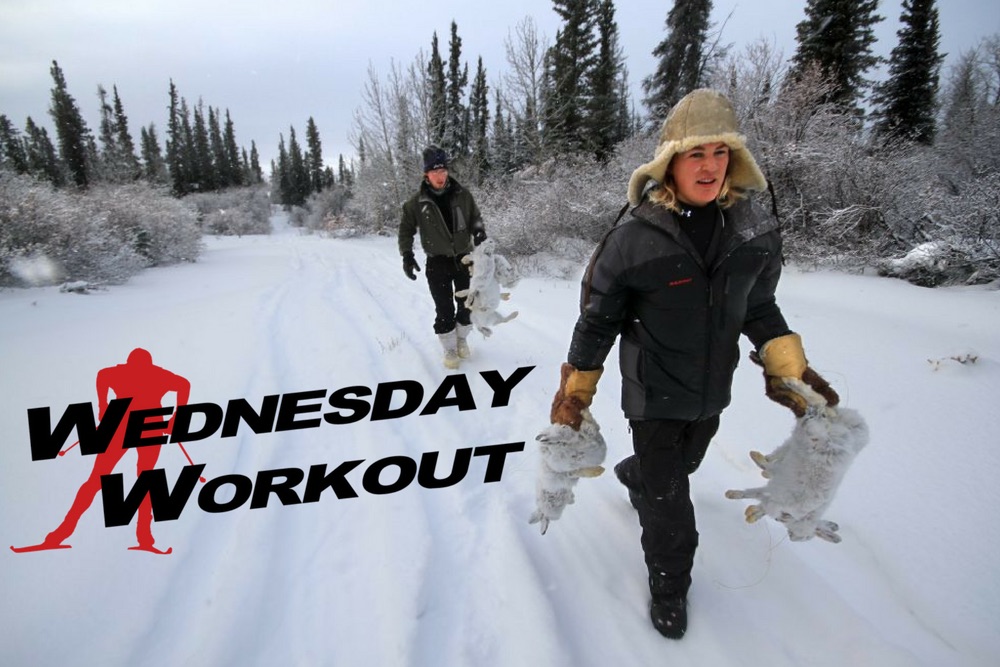
Canadian Knute Johnsgaard (r) after checking on rabbit snares on his family’s trapline in the Yukon. (Courtesy photo)
For this week’s Wednesday Workout (WW), FasterSkier is featuring Knute Johnsgaard, a native of Canada’s Yukon Territory. A 2018 Olympic cross-country skier and former Canadian World Cup Team member, Johnsgaard, 25, recently retired from professional skiing. With one of the more non-traditional ascents to the World Cup, Johnsgaard shared a workout that incorporates non-traditional training. The following assimilates chores and exercise into one, ideal for multitaskers everywhere.
***
The basement or garage might not be the first place most cross-country skiers visit before working out. For Knute Johnsgaard, however, there’s no better place to get started.
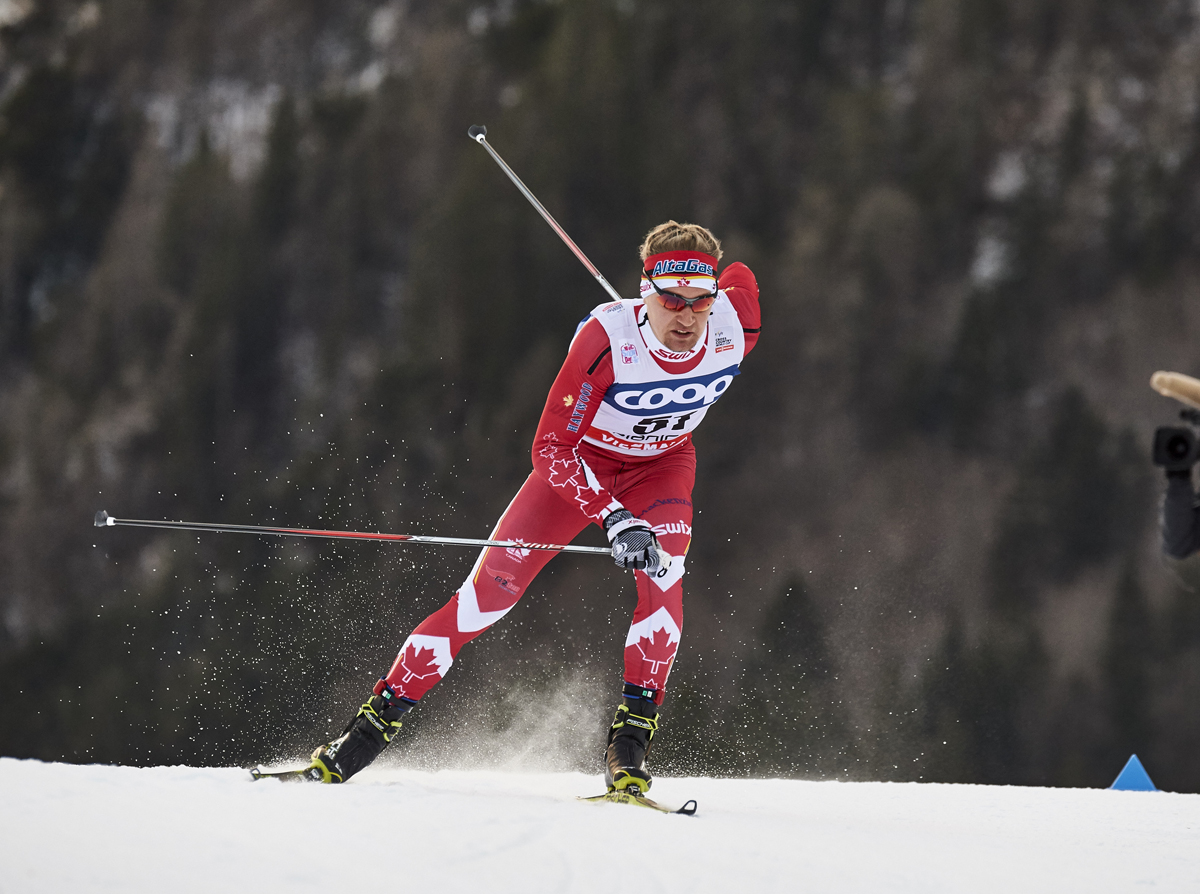
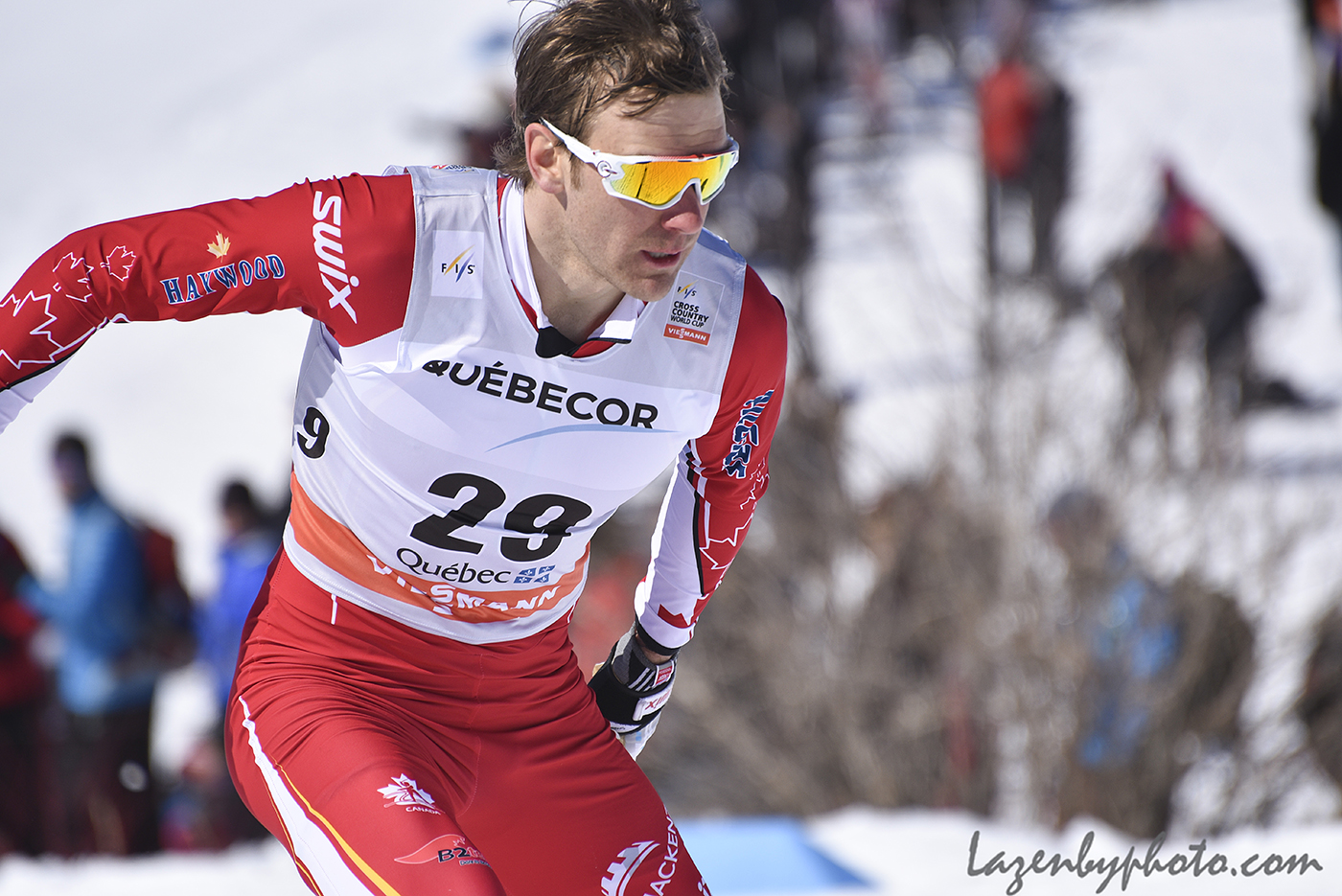
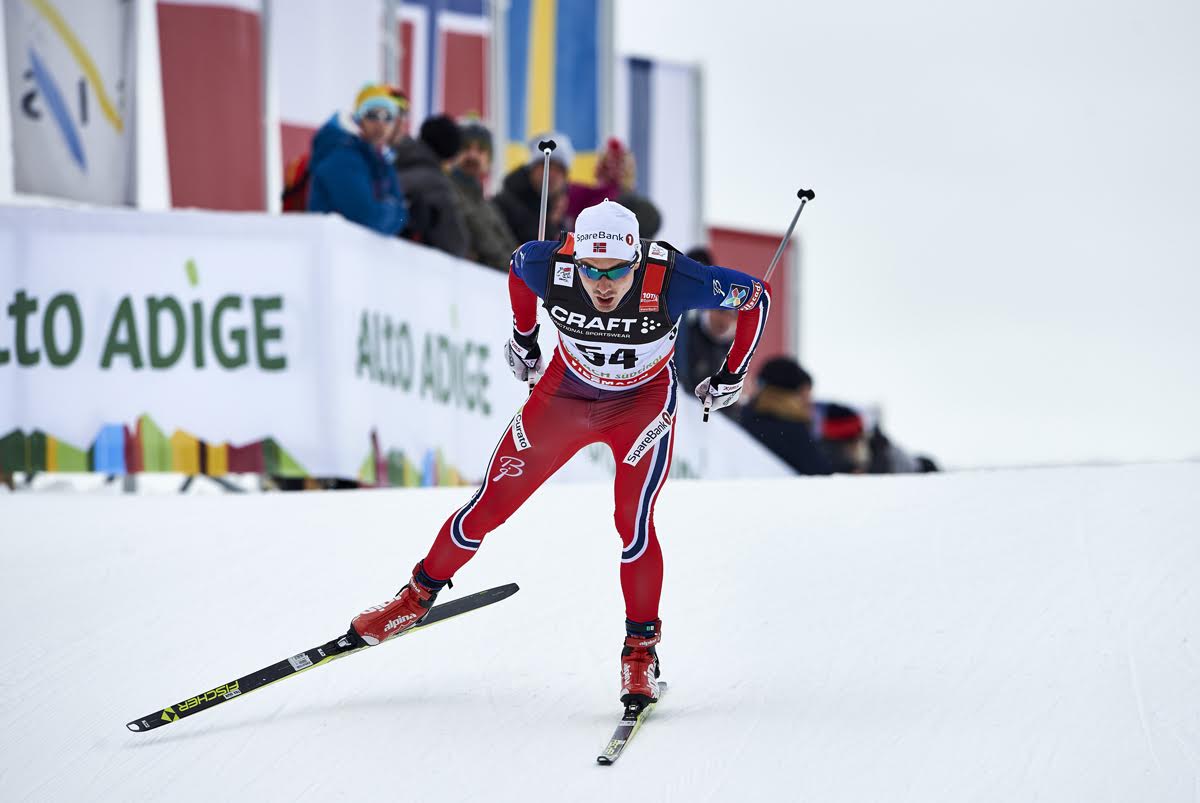
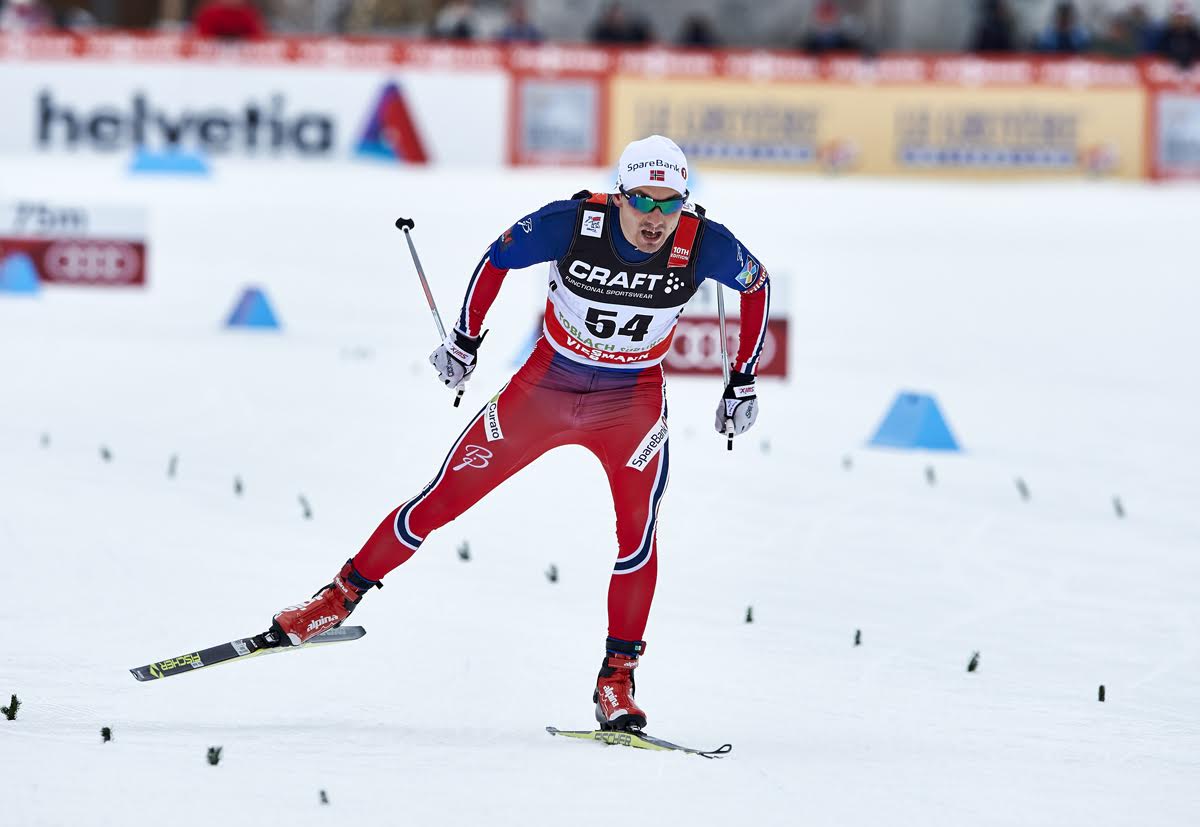
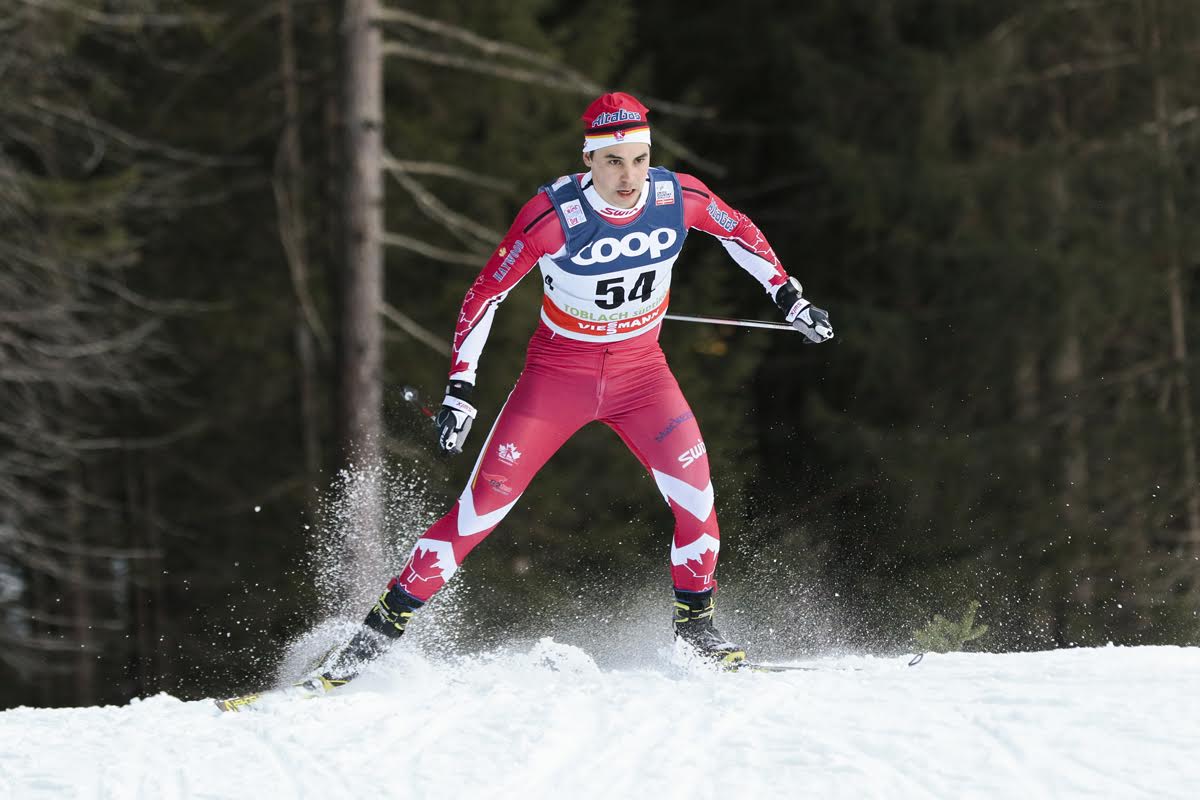
Knute Johnsgaard racing to 54th in his first international World Cup, a freestyle sprint in Planica, Slovenia, in January 2016. (Photo: Fischer/NordicFocus)
“I think athletes can benefit from doing some ‘real work’ now and then,” Johnsgaard wrote in an email. “It’s unfortunate that you don’t always get rewarded for the hard work that you put in to ski training. Usually you do see it down the road, but sometimes you may unknowingly be doing the wrong workouts at the wrong time or whatever–it just didn’t pay dividends like you thought.
“That’s why I’ve always enjoyed doing feel-good jobs or chores and treating them as a workout,” Johnsgaard explained.
His chores of choice include shoveling snow or splitting wood.
“It’s incredibly satisfying not only that you’re killing 2 birds with one stone (getting in a workout and getting chores done) but because you will always no matter what be rewarded for your efforts, especially if it’s a chore for someone else and you get to see their satisfaction as well,” Johnsgaard wrote.
So get to the garage, grab an axe or a shovel, and get to it.
The Workout: Real Work
Choose a physical task or job. Johnsgaard’s favorites include:
Shoveling snow
Splitting wood
Get the job done. Johnsgaard estimates 10.5 hours should do the trick.
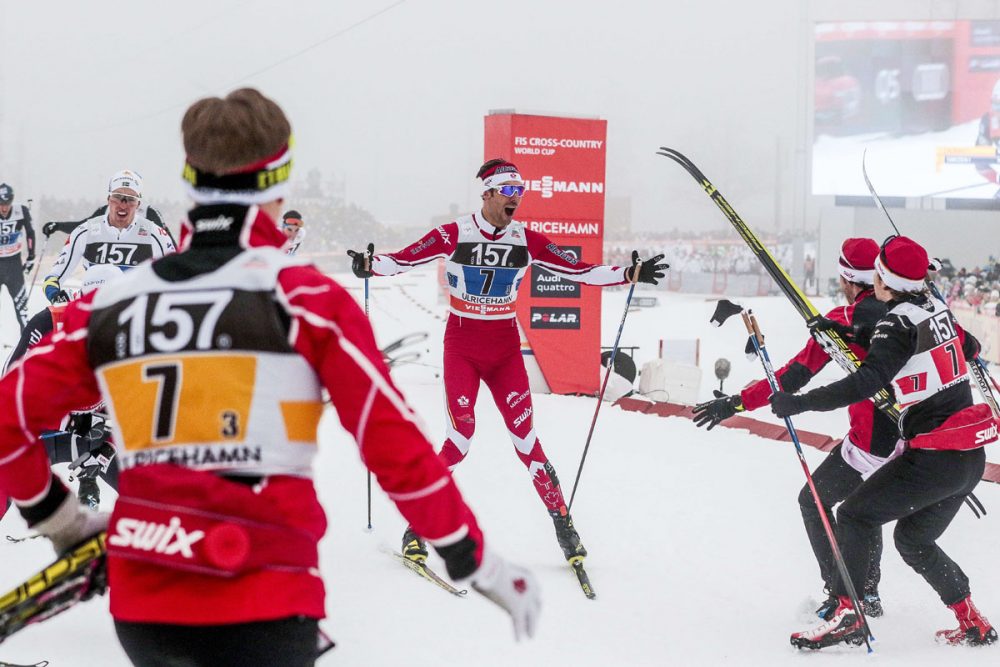
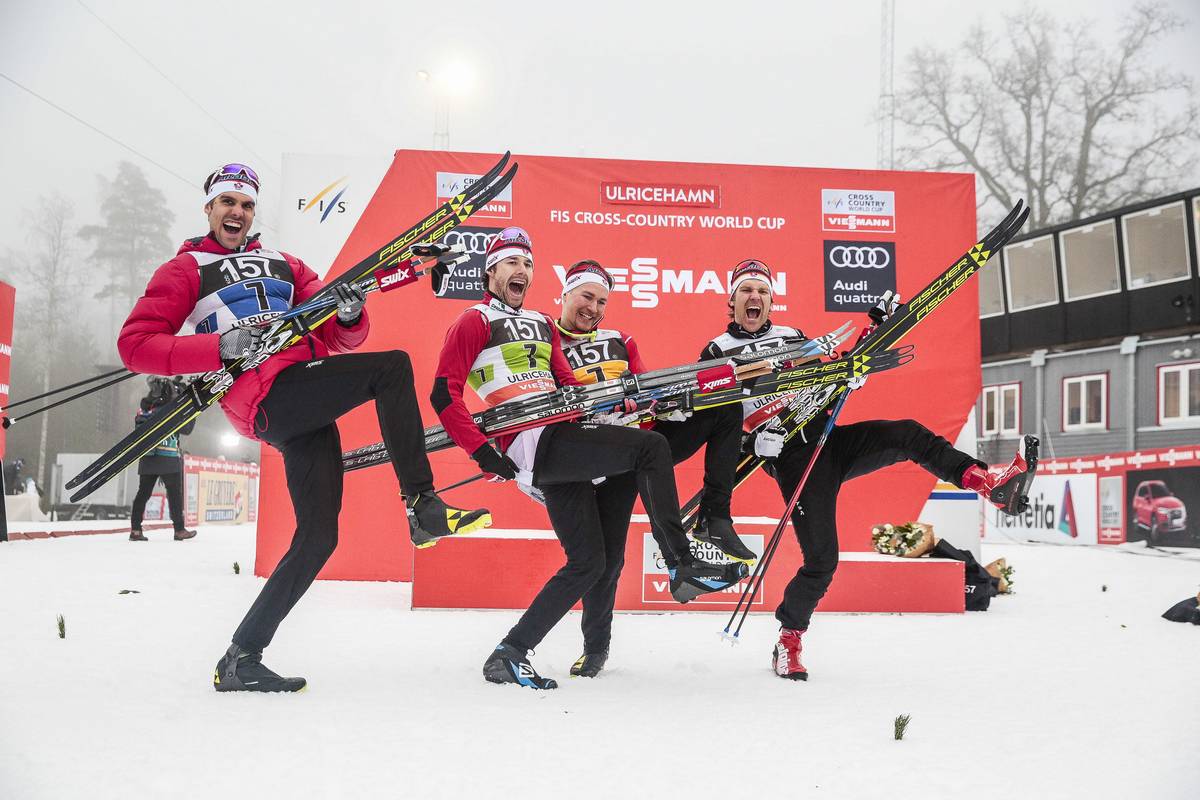
Len Valjas (c) spreads his arms to greet his teammates Alex Harvey (far right), Knute Johnsgaard (far left) and Devon Kershaw after he crossed third in the 2017 men’s 4 x 7.5-kilometer team relay on Jan. 22, 2017, in Ulricehamn, Sweden. (Photo: Fischer/Nordic Focus)
Back on Jan. 15, 2017, current Canadian World Cup B-team member, Len Valjas was beaming. Valjas, along with podium-regular teammate Alex Harvey, had won a World Cup team sprint in Toblach, Italy. The next weekend, Valjas and three teammates (including Harvey) rocketed to third in the men’s relay at the World Cup in Ulricehamn, Sweden. The results, at the time, looked to be a good indicator for the ensuing 2017 World Championships in Lahti, Finland.
Days before the Lahti events, during a gym session, Valjas felt his upper back between his shoulders give out. He felt little initial pain, but with compromised breathing, his results fell flat in Finland. As the remaining 2016/2017 World Cup season came to pass, Valjas hadn’t yet determined the exact cause of his physical ailments. His fitness and confidence suffered.
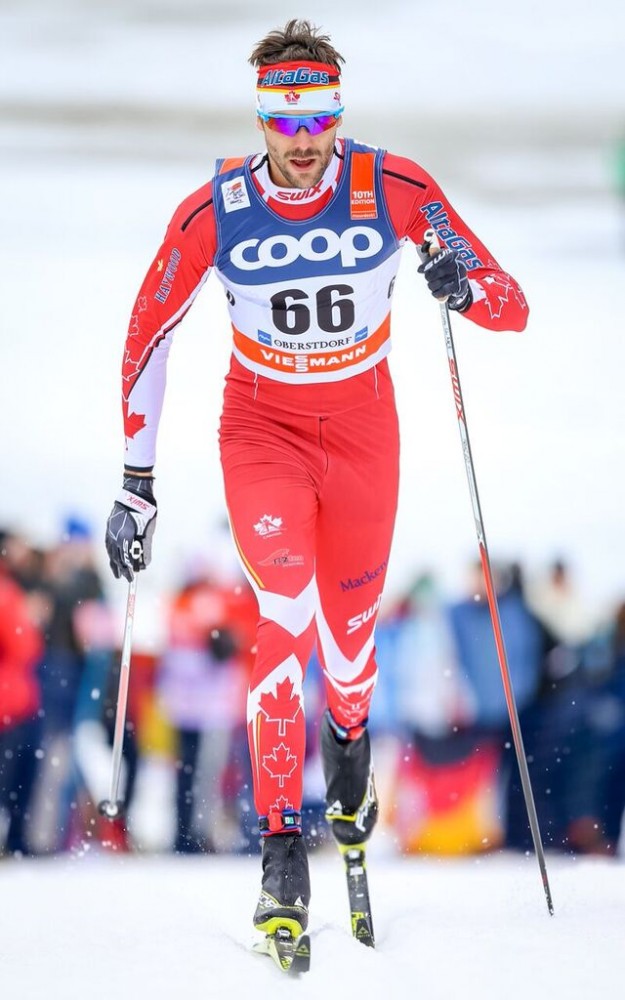
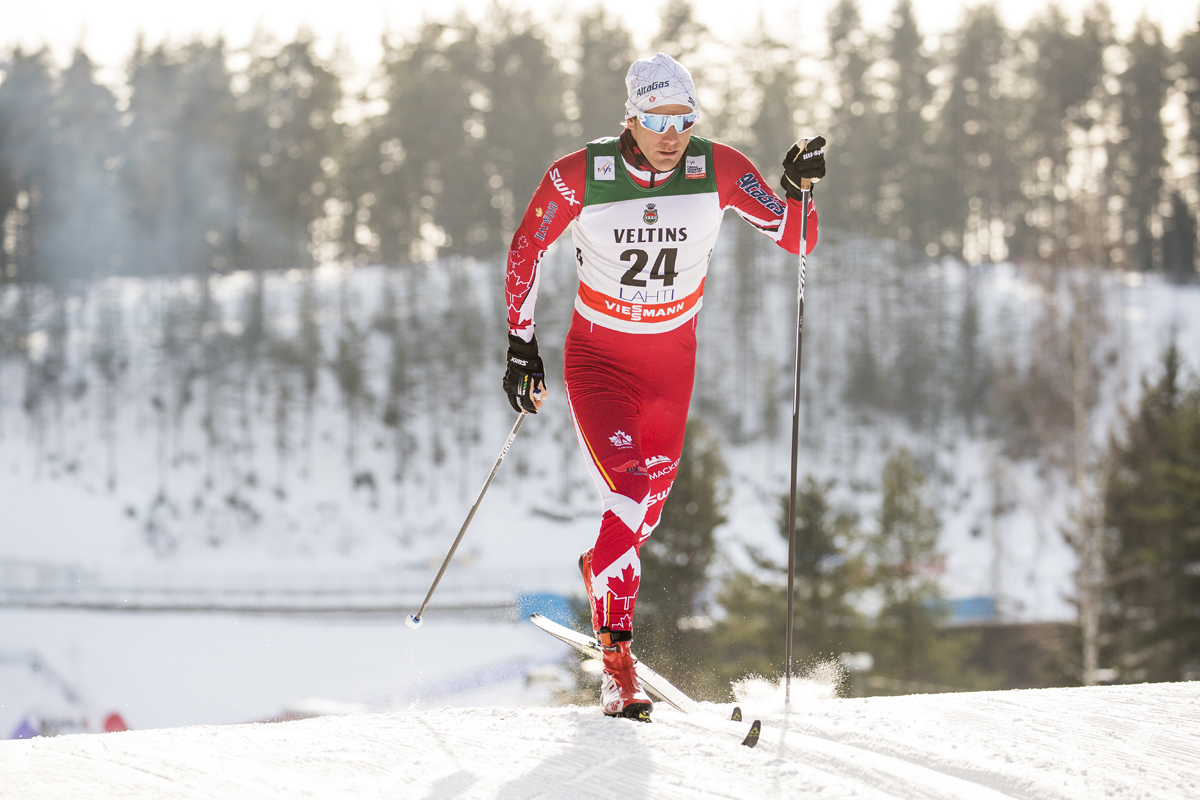
Len Valjas (Canadian World Cup Team) en route to 10th overall in a classic-sprint stage at the 2016 Tour de Ski in Oberstdorf, Germany. (Photo: Marcel Hilger)
Prior to Lahti, Valjas was ranked 13th overall on the sprint list. By season’s end, he had dropped to a very respectable 16th in the sprint standings.
Coming into the 2018 Olympic season, Valjas remained frustrated. He knew something was off. A pattern of poor performances continued through his most recent World Cup campaign. In the big picture, this past World Cup season left a bad taste for Valjas.
“Last year, I had so many bad feelings from the year,” Valjas reflected on the phone on May 22. “I could never train in the summer because I was always injured and compensating. I could not double pole on rollerskis. My back would hurt. All these little things … The last season obviously wasn’t by any means a good smooth season for me. I did have a good Olympic race which I am super proud of, but, overall, other than that one good day, I had one of my worst and least-fun seasons I have ever had. I was dealing with an injury for the last year and a half in my back.”
At the Olympics in PyeongChang, South Korea, Valjas reached the semifinals in the individual classic sprint and ended the day in seventh for his best result at his second Olympics.
Canada’s Olympic sport-funding system emphasizes championship medals and results. Harvey and Valjas set new Olympic benchmarks this February for Canadian men’s cross-country skiing, with Valjas’s contribution being seventh overall in that classic sprint.
“It is what they wanted,” Valjas said of Cross Country Canada’s priorities. “The end goal they wanted — Olympic results this season. Alex and I set records in the individual races anyway, three new Canadian records. Alex had two of them. I had one. It was one of our most successful Olympics ever. They should be extremely proud, especially when the season wasn’t going very well for a lot of us. We had an off-year and still were able to beat three of the Canadian records at the Olympics. I think they should have been very proud.”
Valjas, 29, hasn’t felt healthy since before Lahti 2017. The year and a half he endured at less than 100 percent has literally sapped him. During his most recent interview with FasterSkier, there was a tone of lament in his voice — not anger, just a simple melancholy from an athlete known to have a mellow demeanor. From Valjas’s telling, the wires between getting a full diagnosis from the Canadian team for his original back ailment and the pressure to continue training and racing got crossed.
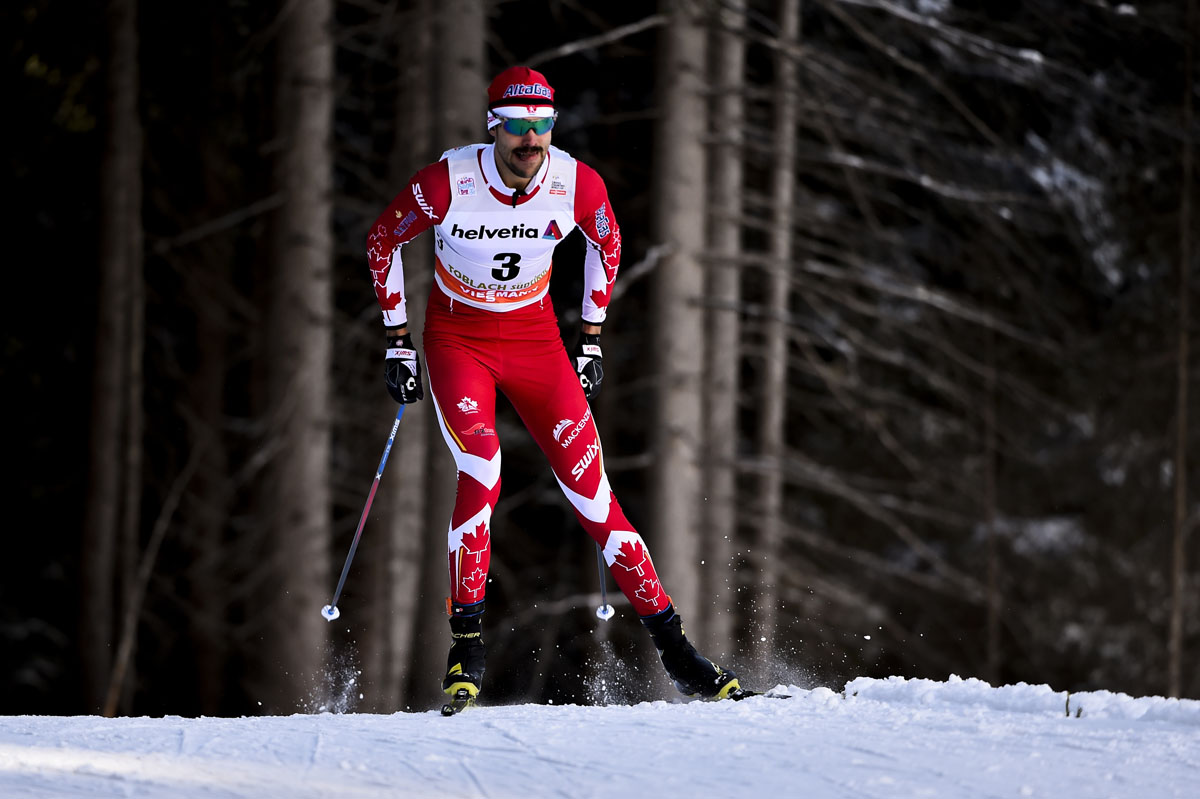
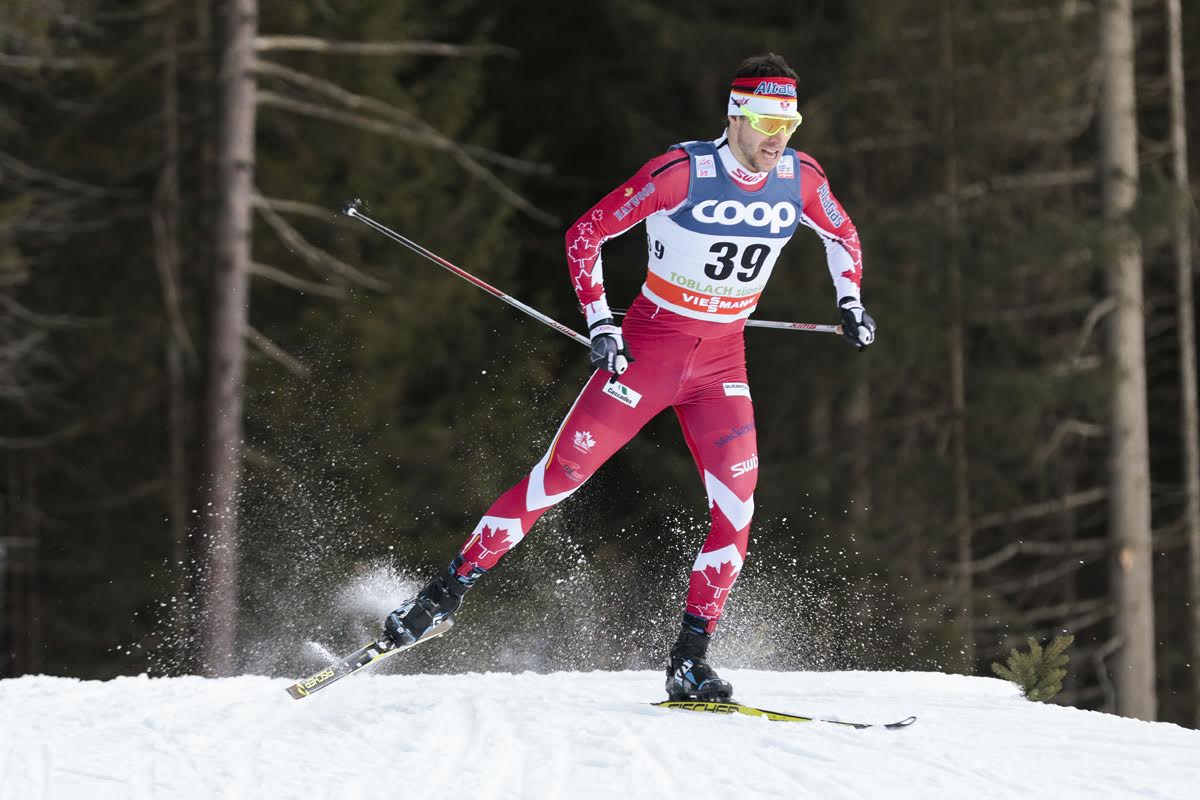
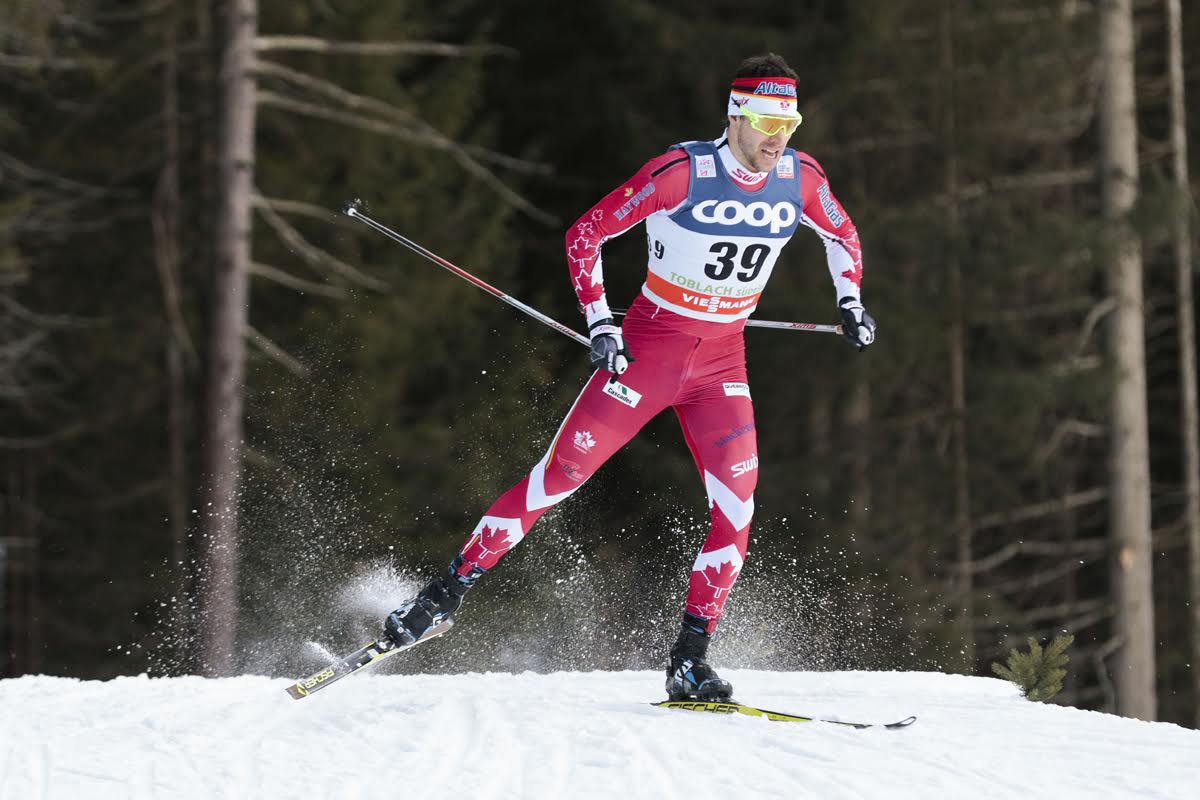
Canada’s Len Valjas on his way to 20th overall in a January 2017 World Cup freestyle sprint in Toblach, Italy. (Photo: Fischer/Nordic Focus)
“At World Champs [in 2017], I was begging for an MRI or some sort of check just to see what I did,” Valjas said. “But I kept getting turned down because my symptoms weren’t so bad. I didn’t have weird nerve feelings in my hands. It was kind of frustrating for the rest of that season.”
According to Valjas, he asked again in the spring of 2017 for an MRI.
“We should check to see if it is nothing, at least we will see that it is nothing,” Valjas remembered saying at the time.
Again, Valjas said, he was denied the test. He trained all summer with frequent setbacks. His 2017/2018 World Cup season began in Kuusamo, Finland, with him finishing 44th overall in the three-day mini tour. The next weekend he placed 59th in a classic sprint in Lillehammer, Norway. Valjas said he had been working with a U.S. Ski Team physiotherapist in Lillehammer due to shoulder discomfort and nerve pain.
The pair continued their work together through the rest of December 2017. After their conversations regarding the pain, physical limitations and sensations, they linked what Valjas was experiencing to the moment in the gym before Lahti 2017 when he felt the “pop” in his upper back.
“[The physio] said, ‘I don’t think this is a shoulder injury. I think this is in your back,’ ” Valjas recalled. “And that is when he kind of tied in my mind to, OK, we are dealing with the same thing when I hurt it before Lahti if he thinks it is in my back. It all made sense. … And finally, I told the team I am leaving. I am going home and getting this checked out myself.”
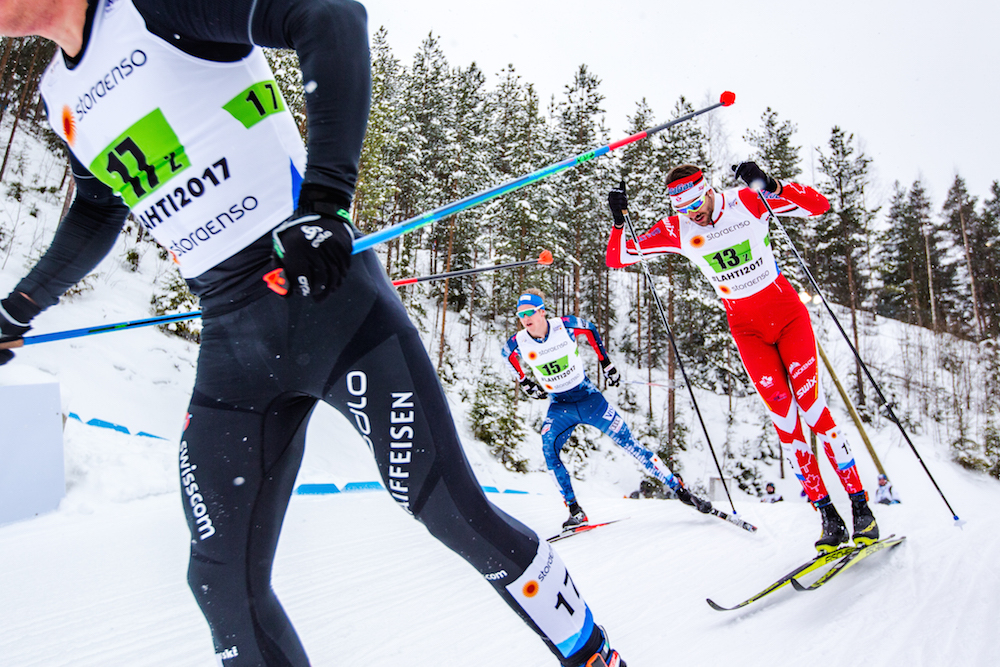
Switzerland’s Jovian Hediger leads Canada’s Len Valjas (r) and American Erik Bjornsen (c) during the classic team sprint at 2017 FIS Nordic World Ski Championships in Lahti, Finland. The U.S. men placed fifth and Canada finished sixth in that race. (Photo: John Lazenby/Lazenbyphoto.com)
Valjas clarified that the shoulder pain was in fact referred pain originating in his back.
Upon his return to Canada, Valjas received an MRI authorization from a trusted physician he had worked with in the past.
“Turns out it was a herniated disc at T2-T3. And I fractured a vertebra at T4,” Valjas explained. “So it was quite a bit worse than I thought at first.”
The T4 fracture Valjas incurred was not a threat to his spinal cord. The break occurred where the rib meets the vertebrae rather than along the spinal cord. The personal physician consulting Valjas also explained he had signs of arthritis in several joints around the injury zone. A consequence of working through the injury, Valjas was told, rather than taking time off. His doctor ultimately cleared him for racing since it was an Olympic year.
But, according to Valjas, it was a grim six-week buildup to PyeongChang. There was little effective training, scores of physio sessions, and the rare on-snow intensity effort to “salvage shape”. Then there was his seventh place at the Olympics. After his herculean effort in PyeongChang, he pulled the plug on the season. Time for rest, rehab, and reflection.
“To be totally honest, I kind of thought after the Olympic cycle I would be done, too,” Valjas said of the rumors swirling about his potential retirement. “That is why I probably started my own rumors, just saying that I was planning to retire.”
Several times Valjas mentioned how proud he was of his Olympic result. But the season-long canvas of results, he felt, was not reflective of his World Cup racing capacity.
“I just didn’t feel like I was finished this last year,” Valjas said. “I only raced, I don’t know, 13 races or something. Crazy low. I didn’t have the results I wanted in the end beyond the single Olympic one. It wasn’t the season I was hoping for. So I am hoping to get healthy and have a last season that I am proud of. I might not have the seventh-place result, but I just want to race well and be pain free.”
The path to pain-free racing will initially involve building up his strength while delaying his rollerski-specific training. With expected massive financial cuts looming across the board for Cross Country Canada (CCC), Valjas explained he will be based out of Canmore, Alberta, this summer with bare-bones support. Canadian World Cup coach Ivan Babikov will be writing his training plan, but according to Valjas, CCC has eliminated its physiologist and strength-trainer positions.
“It is me and Ivan, which, for what I am going through right now, is actually good,” Valjas said. “Through all this, he would fight for me. He believed me, let’s just say. There are only a couple of people who trusted what I said and the rest kind of left me out to dry there. I am happy to work with Ivan this year because, he actually knew all along. He did what he could. But at the same time, he doesn’t want to lose his job. He was working on my side for sure.”
Valjas is still processing how his medical condition was handled and how he responded. An athlete going against team wishes can have repercussions.
“It is hard to go against the team right away,” Valjas said. “If I got the MRI and there was nothing there, they might not be too happy with me either.”
Valjas hung on to the party line for months. Not exactly a “suck it up” directive, but messaging from the team that didn’t correlate with the distress and inability to rebound that Valjas experienced.
“When I told them my symptoms, the answer was always, ‘Oh, you have anxiety, your back is healthy. You have anxiety,’ ” Valjas said.
He also mentioned that he endured numerous back manipulations under the recommendation of team health care providers. Procedures, he said, that he’s now been banned from at the risk of inflaming his injury.
“It is just unprofessional how they just assume that it is anxiety and they get me manipulated probably 30 times in that year,” Valjas commented. “It could have been way worse. I feel lucky that … my spinal cord is totally fine.
“I am more worried about the future. If you break your leg, it is pretty obvious you broke your leg. It is more straightforward. If someone has a nagging spine injury, I hope that they learn from this,” he continued. “But so far I don’t feel like they have. I hope they learn you need to take these very seriously. Because you can have your athlete back in half the time if you don’t jeopardize their whole career over it. If I knew right away that it was herniated and broken, I probably could have taken a few months and gotten stronger. But the way I did it, it was a year and a few months of constant atrophy in my back and spine. I can feel it. I am weaker in the upper body than I have ever been.”
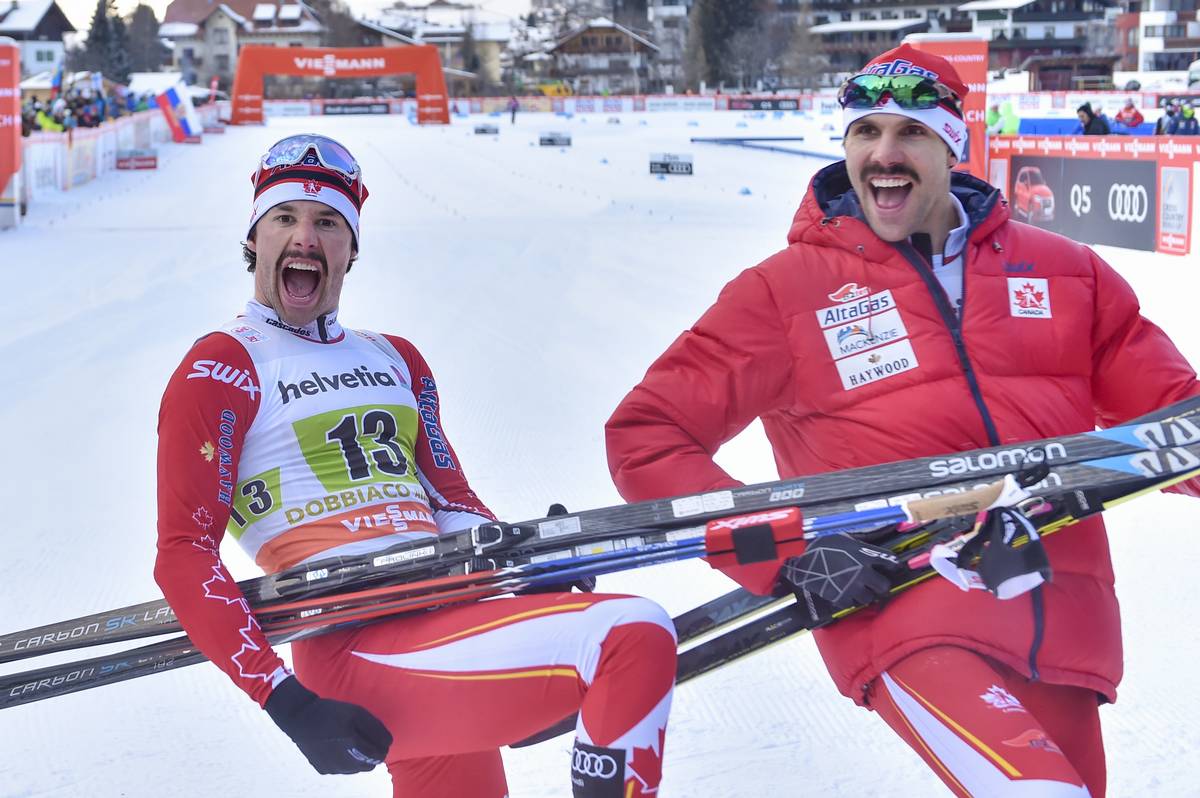
Canada’s Alex Harvey (l) and Len Valjas celebrate their 2017 World Cup freestyle team sprint win in Toblach, Italy. It was the first team-sprint victory for Canada since 2011 World Championships. (Photo: Salomon/NordicFocus)
Valjas remains focused. His new competition singularity is the upcoming freestyle team sprint at the 2018 World Championships in Seefeld, Austria. The plan is to contest the race with Harvey. A healthy Valjas could allow the tandem to revisit the emotions of their former World Cup team sprint win.
“I am doing it really just as much for me as I am for [Alex],” Valjas said of continuing in the sport and supporting his longtime friend and teammate. “It for sure helps to have a race to look forward to, even if it is a team race. It is going to help me in the rehab and the training to have something to train after, an end goal.”
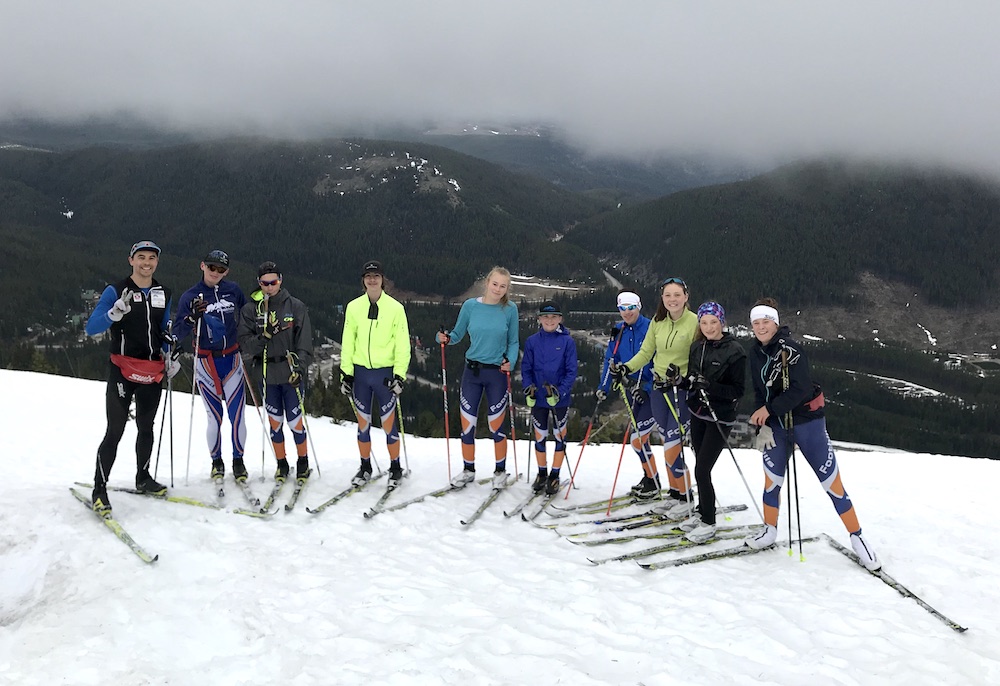
Jess Cockney (l) and Foothills Nordic skiers on top of Apex, outside of Penticton, British Columbia, on May 19. After retiring from professional skiing this spring, Cockney has been helping out as an assistant coach at Foothills Nordic. He’ll study full time at the University of Calgary this fall. (Courtesy photo)
Strength. Balance. Agility. Jesse Cockney had all of those qualities as a child growing up in Yellowknife, Northwest Territories — just like most Inuit kids — according to his father, Angus. But what he could do with that talent was what Angus hoped to nurture.
Since he had put his son on skis at age 3, Angus reflected in an email that he “knew then that [Jess] had incredible potential to succeed.”
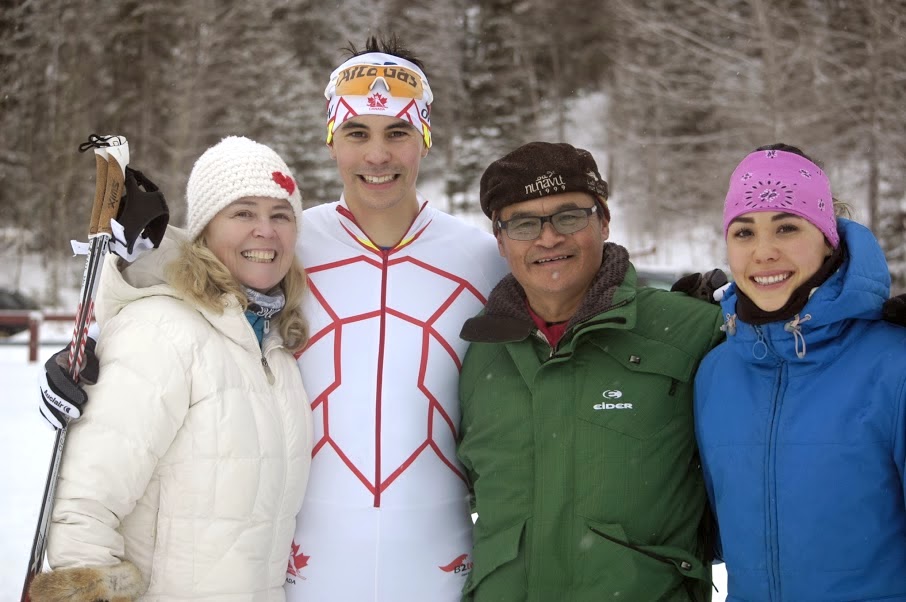
Jess Cockney and his family after the 2014 Olympic trials in Canmore, Alberta, with his mother, Trish, father, Angus, and sister, Marika. (Courtesy photo)
And so the Cockneys moved to Canmore, Alberta, when Jess was 7. That included Jess’s mother, Trish, and his sister, Marika. According to Angus, a former competitive skier and junior national champion in 1973, ’74 and ’75 (who spent two months skiing to the North Pole in 1989), the move was about giving Jess “a better opportunity to succeed as it had the right environment with the Nordic Centre and a community full of support with like-minded kids and parents. In other words, we wanted him around a healthy environment.”
It was an easy transition, Angus explained. Canmore was more conducive to training with milder temperatures than Yellowknife and a wealth of experienced coaches and athletes.
More than two decades later, Jess credited his dad for helping him reach the highest level of cross-country skiing. A two-time Olympian, Cockney, now 28, has spent 11 years on Canada’s senior national team and two more on the junior national team. He achieved a sixth-place finish in a classic sprint at U23 World Championships in 2011, as well as four individual top-10 finishes on the World Cup.
“The big reason that I have cross-country skied at this level and really understood at an early age what it meant to pursue racing at a high level was definitely because of Dad,” Cockney said on the phone in April. “He took skiing to a high level as a junior and didn’t carry on after his junior career but stayed really involved with the sport and with racing, too.”
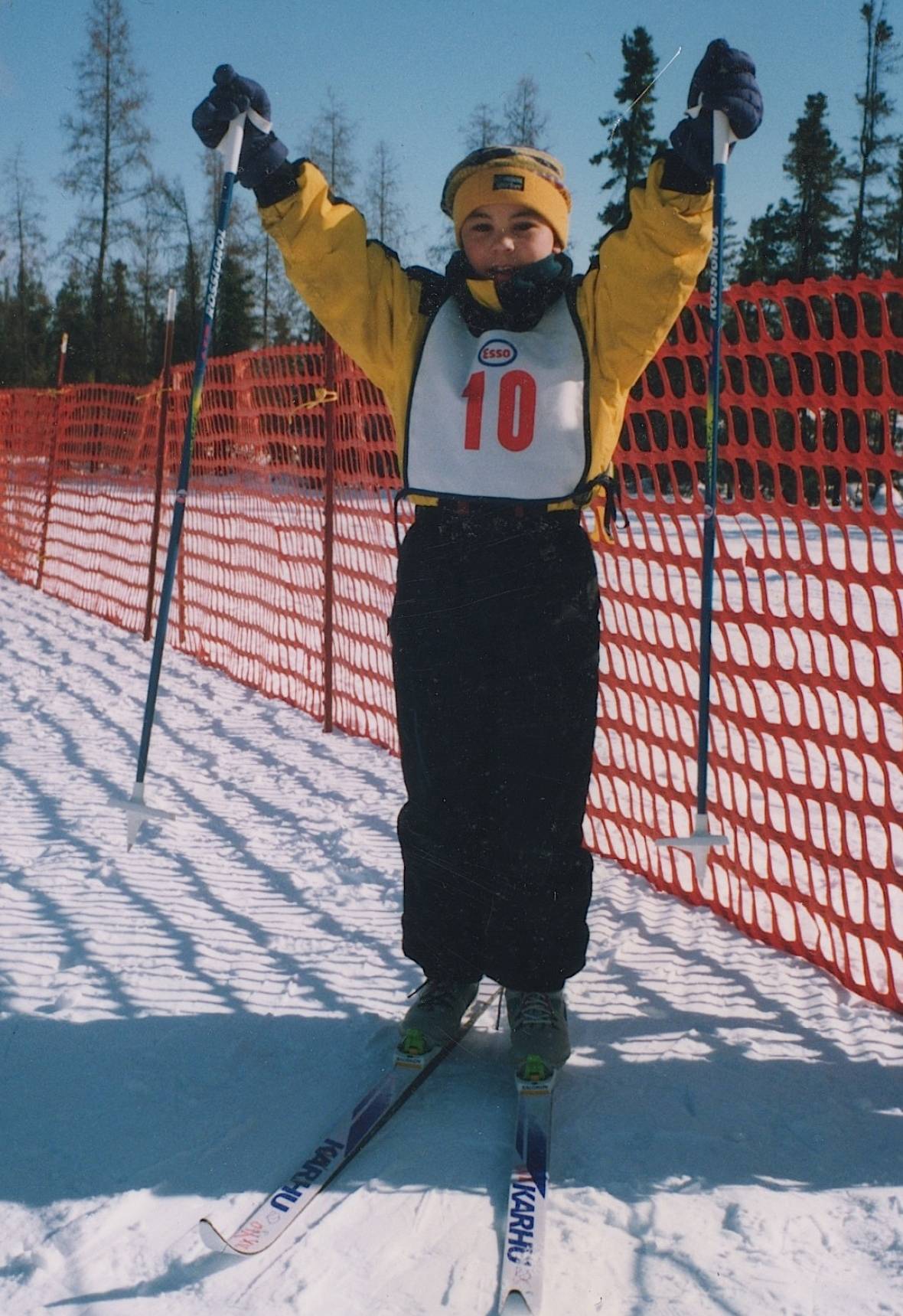
Jess Cockney enjoying some on-snow time as a youngster. (Courtesy photo)
He emphasized how special it was to share moments like shuffling on skis at a young age with his dad to seeing him on the side of a World Cup course, calling out splits and taking pictures.
“It’s pretty fun to be able to share that time together, because skiing means so much to both of us,” Cockney said. “I’m quite happy that my career has worked out as well as it has and that Dad has been able to be there for so many of the good days with it, too.”
After six years of traveling across Europe on the World Cup circuit (as well as to places like Sochi, Russia, and PyeongChang, South Korea, for the Olympics), Cockney retired from professional skiing this spring. It was a decision that had been on his mind for the better part of the last two seasons, he explained. Toward the end of the PyeongChang Olympics in February, he felt what he described as a mental “decompression” and a natural ending to his career, which solidified his decision.
“I know how much mental energy it takes to commit towards the training year and the travel for the racing season,” Cockney said. “I had a blast doing that for so many years and I just didn’t think that I was going to be sharp enough or motivated enough. I’m just happy to have such a great season as a final year with the Olympic team and being together with so many of my teammates from over the years at those Games. It just feels like the time is right and I’m excited to do something else.”
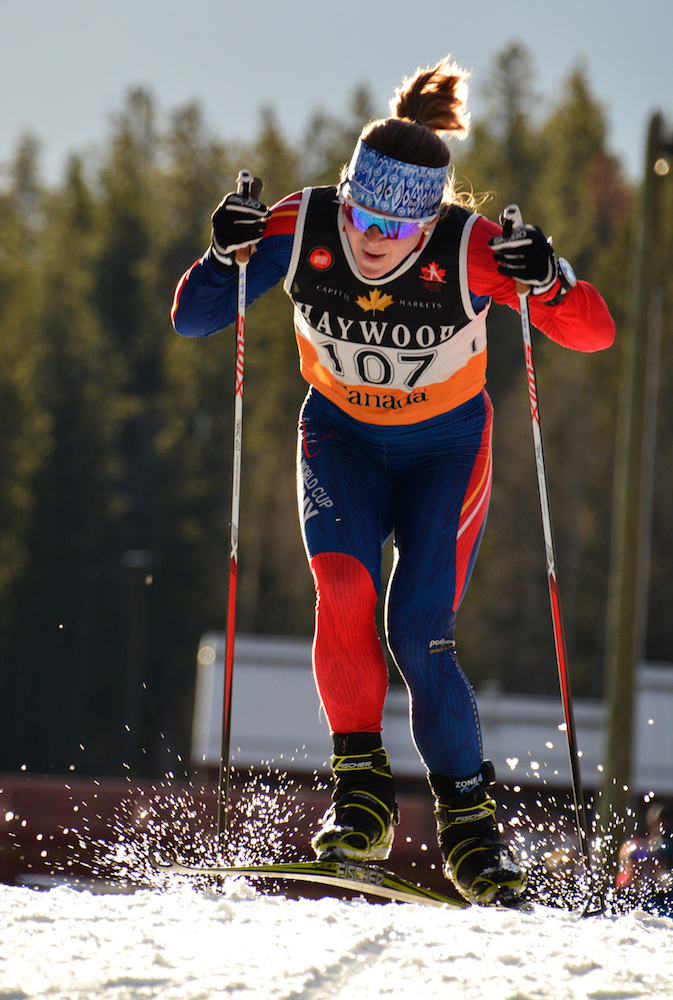
Annika Hicks (Alberta World Cup Academy) racing in the 2016 Frozen Thunder sprint qualifier in Canmore, Alberta. (Photo: Glen Crawford Production Services)
While currently renovating his home in Canmore with his girlfriend Annika Hicks (as well as his dad, skier Bob Thompson, and another friend) and assistant coaching at Foothills Nordic, Cockney plans to start classes at the University of Calgary this fall. He was accepted into the university’s political-science program this spring.
Hicks, who previously trained out of the Alberta World Cup Academy (AWCA) in Canmore, will also be studying full time at the University of Calgary. She is halfway through her studies there toward a science/kinesiology degree in exercise and health physiology. Like Cockney, she explained in an email that she’s been “on the fence” about continuing with skiing for the last two years.
“I wanted to stop skiing on my terms and with a healthy relationship with the sport,” Hicks, 26, wrote. “I have no regrets and am happy to have that closure. I’m grateful to have had the opportunity to ski race for so long.”
In her career, she started 15 World Cup races, competed at two U23 World Championships and 2011 Junior Worlds, tallied at least three podiums at Canadian senior nationals (including two second-place results at 2018 nationals in March), and ended this season as the second-ranked Canadian woman overall on the NorAm circuit.
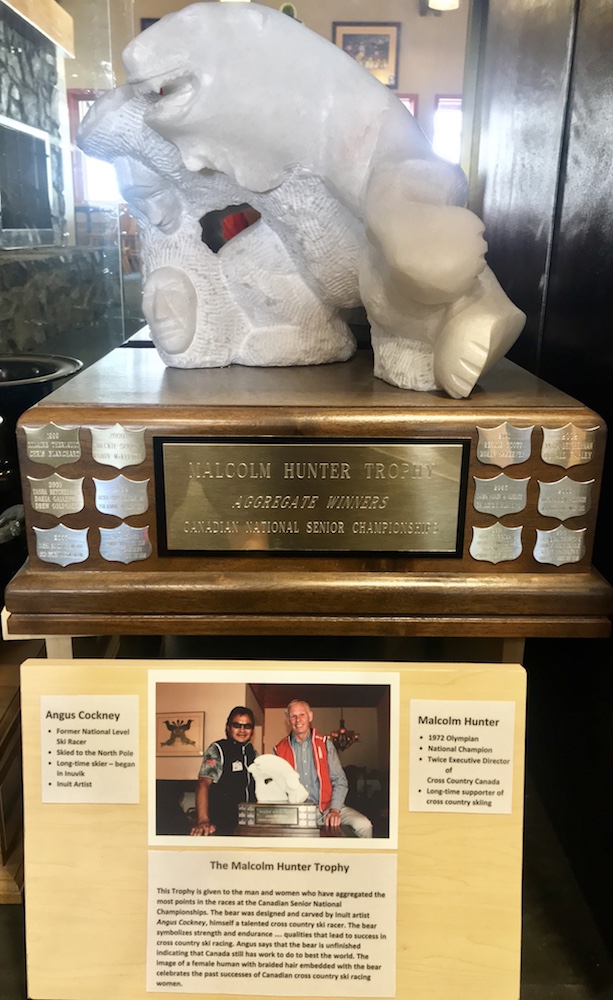
The Malcolm Hunter Trophy for aggregate winners of Canadian senior nationals, designed by Angus Cockney, as seen in the Canmore Nordic Centre day lodge. (Photo: Cross Country Canada)
Cockney also finished the second on the overall NorAm aggregate points list. After winning both the freestyle sprint and 15 k freestyle pursuit at this year’s nationals, he also was also awarded the Malcolm Hunter award — a trophy his dad made — as the aggregate male winner at nationals.
“It was a great way to end the season and end the career,” Cockney said. “I’d never won the nationals aggregate before so that was a big thing for me to do … To get that in my last stab at it was pretty sweet.”
Angus pointed out that his son’s aggregate win was also special because of where it took place.
“It was in Thunder Bay [Ontario] where Canada lost my good friend/foe in the late great Reijo Puiras,” Angus wrote. “He too was passionate for cross country and especially made time for and congratulated Jess whenever he could. And, Jess was presented the Malcolm Hunter trophy; a trophy I created and Malcolm was my former coach who brought me to victory in the stormy ice-cold 1975 Canada Winter Games. Therefore, it was very befitting for Jess to go out that way. He came back and told me, ‘Dad, I won the trophy you made.’ ”
Choosing nordic
Looking back, Angus explained that his proudest moment of Jess was was when his son consciously chose to pursue cross-country skiing at age 11.
“I believe he would have made the National Hockey League if he wanted to but I’m glad he picked the greatest sport in the world,” he wrote. “For Jess, I’m proud on how he has become well respected as a person in the community and abroad. Of course too, he showed he belonged on the world’s stage with a number of top ten finishes on the World Cup circuit but was especially proud of him as the second qualifier here in Canmore in 2012 sprints. He certainly had the community a buzz. As a Father/Son duo though, I’m proud too on how we are the only Father/Son duo to win our respective Canada Winter Games; 1975 and 2009.”
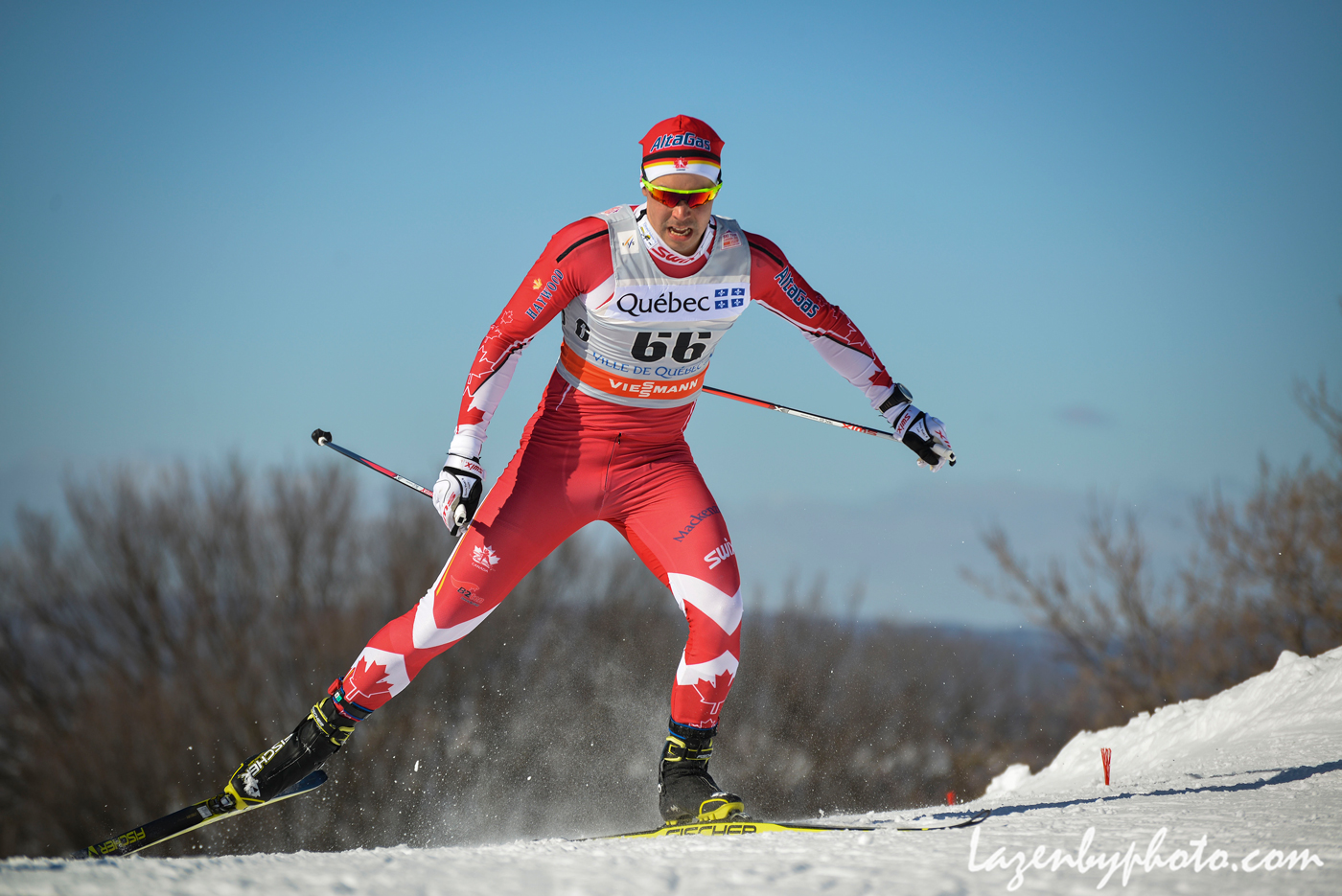
Jess Cockney racing to 29th in the freestyle sprint qualifier at Stage 3 of the 2016 Ski Tour Canada in Quebec City. He went on to reach the semifinals and finish the day in 10th. (Photo: John Lazenby/Lazenbyphoto.com)
Cockney had a number of standout moments at the World Cup level, the first of which came at home in Canmore in December 2012, when he placed ninth in a World Cup skate sprint. Then, late in the 2015/2016 season in Quebec City, he raced to 10th in the Ski Tour Canada’s skate-sprint World Cup stage. The next winter, he notched two more individual top-10 results: first in a classic sprint at the 2017 World Cup in PyeongChang and then in another skate sprint in Quebec City.
Those top 10’s effectively earned him a spot on Canada’s 2018 Olympic team as well as its 2017/2018 World Cup A-team.
“The time in Canmore, for sure, was such a special race for me,” Cockney reflected of his career-best World Cup result. “That was really big because it went well and my family was all there and it was just really a great surprise kind of day.”
Another race he’ll never forget was the 50 k mass start at the 2014 Sochi Olympics, a race he had never expected to enter.
“Just the way that people got sick and things don’t work out for other teammates, I was able to start it, and I was just so happy to be able to race that massive race at the Olympics,” he said. “That’s just such a big deal for me in my career, to have raced it and finished it.”
Phil Widmer (CNST/AWCA) leads teammate Jesse Cockney (second from l), Dakota Blackhorse-von Jess (Bend Endurance Academy) and Canadian Para Nordic skier Brian McKeever (r) in a classic-sprint heat at 2013 Frozen Thunder in Canmore, Alberta. (Photo: Pavlina Sudrich)
He recalled his time with the AWCA and transitioning from the NorAm to international racing with peers like Kevin Sandau, Michael Somppi, Chris Hamilton, Graeme Killick, Graham Nishikawa, Brent McMurtry, Drew Goldsack, and Phil Widmer.
“So many fun Phil battles,” Cockney reflected. “Now that that group is still there with Bob Thompson making his way — it’s great to see that group is still getting stronger with that tail end of younger guys in that group. … Probably my biggest highlight is the relationships that I’ve been able to foster and have come from skiing, for sure, is the people and the time that we’ve shared together.”
Besides his dad and his fellow competitors, he credited his high-school training group, the Banff Ski Runners, and its coach Anders Lenes, as well as Mike Cavaliere as major influences.
“We had so many good guys my same age, and really the time with friends was actually just time training so it was the perfect atmosphere for a couple of us to take it really far,” Cockney said of the Banff team.
“My coach right after Anders, Mike Cavaliere, definitely had a really big impact in fostering that next level of belief for me, from going from a good skier in Western Canada to trying to be the best that I could be in Canada,” he continued. “And then setting goals to reach potential in the international scene, too, with time together at World Juniors and Under 23’s and early in my World Cup and my first Olympics we were still working together.”
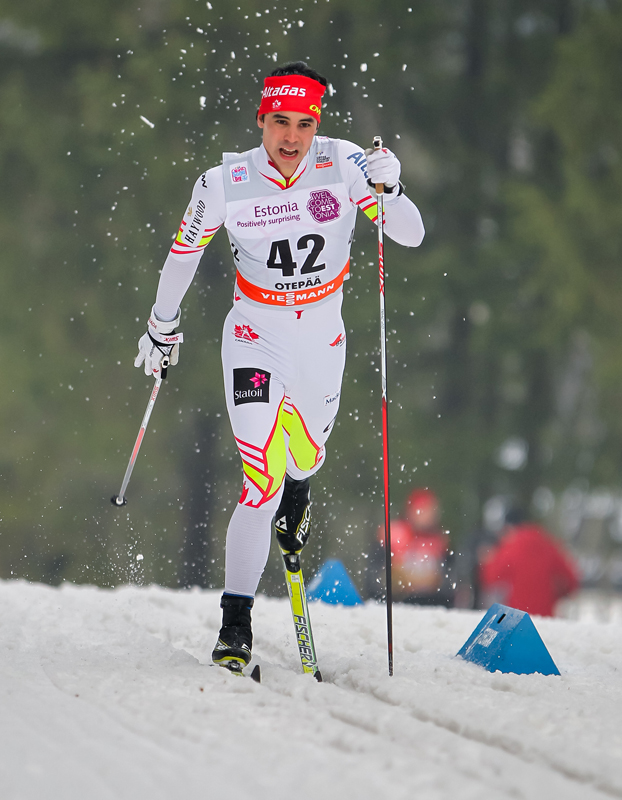
Jess Cockney racing in a 2015 World Cup classic sprint in Otepää, Estonia. (Photo: Fischer/NordicFocus)
Asked what it was like growing up on the national team and how the sport has shaped him, Cockney was introspective.
“I’m definitely softer spoken or maybe more considerate at this point,” he said. “Really what I’ve gotten to understand is respecting everybody’s hard work in sport and understanding what someone’s going through; we don’t really get it all the time.
“I’m a little bit more — I’d just say not as brash or just a little bit more reserved,” he continued. “I learned some hard lessons from being just a little bit too mouthy or a little bit too, maybe even arrogant. The time in sport has really shaped a lot of who I am, probably more than I realize. I’m super appreciative of the people who’ve been a part of that, just being such great people, and how they carry themselves, [and] emulating that where I can in life.”
A longtime member of Canada’s senior development team, Cockney was promoted to World Cup B-team status in recent years and spent his last season as an A-team member. So while funding has become tighter within Cross Country Canada (CCC) since 2014, Cockney said he had the unique experience of increased financial support in the last couple years.
“I started supporting myself for World Cup opportunities in 2014 and paying out of pocket for the whole thing, and then by this year I was getting more support from the whole team,” he explained. “My seasons have been consecutively getting more and more financially feasible, so I’m lucky it was trending in that direction and I was able to be a little bit better financially as the years went by.”
With further budget cuts for CCC expected, Cockney said his retirement wasn’t motivated by the prospects of self-funding. He is one of four men from last year’s Canadian World Cup Team who have decided to retire (the other three being Devon Kershaw, Knute Johnsgaard and Graeme Killick.) Alex Harvey and Len Valjas are the lone returners to the 2018/2019 World Cup A-team.
“Alex and Lenny and Graeme and I, we’ve been going to nationals together since I think, like, 2004,” Cockney reflected. “So it’s been a really long time together and more and more time with Devon at the top level of the sport. I was roommates with Knute for a while last year so we really felt like we’re a tight-knit group of guys and it was fun. They’re not just teammates, they’re friends that are now going to be part of our life for the rest of our time out of sport.”
The next steps
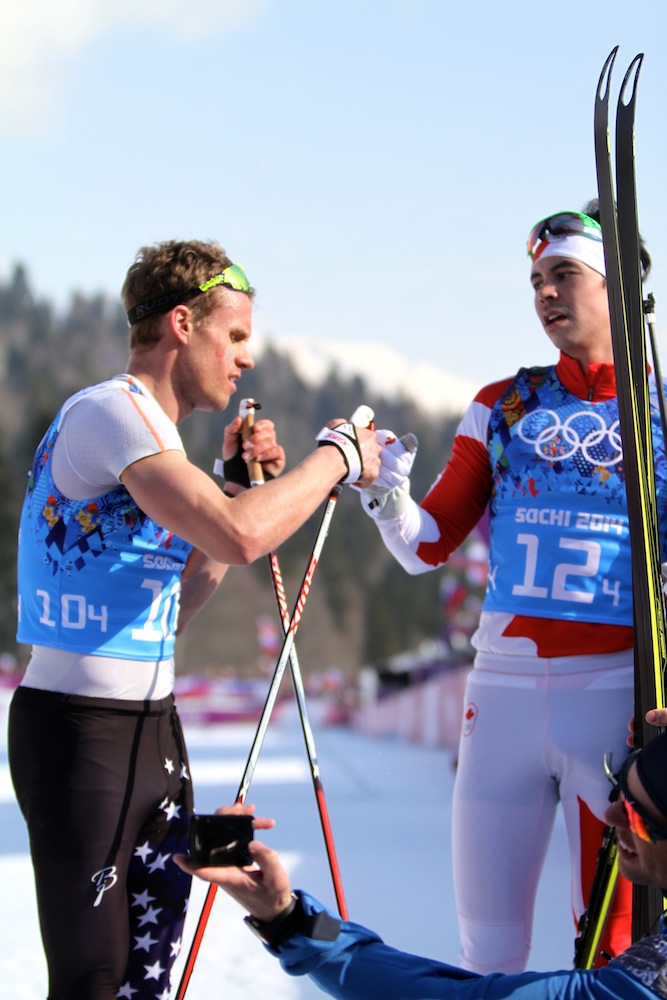
Canada’s Jesse Cockney (l) and American Simi Hamilton bump fists after anchoring their countries’ relay teams at the 2014 Olympics in Sochi, Russia.
In mid-April, Cockney said his permanent break from racing hadn’t really sunk in yet. A month later, he was coaching Foothills Nordic athletes at a training camp in Penticton.
Asked what piece of advice he’d give up-and-coming skiers, he said it was “cheesy”, but simply to be true to oneself.
“At the end of the day, it’s your name on the results and you’ve got to be able to be the one driving the train and figuring things out,” he said. “It’s a brutally honest sport, and we’re judged with a clock. It’s your name next to that time, so be true to yourself and enjoy the process so much. … In cross-country skiing, the process is 95 percent of the sport, and 5 percent of it is competing… Just having a real love for the training, the relationships, the places that you go, that’s the biggest thing.”
And as he parts ways with CCC, he stressed the importance of club programs in the development pipeline as they helped cultivate his career (Cockney grew up skiing with Foothills Nordic).
“The club systems were really strong in Canada and could provide athletes with a lot of support through different points in their career, and I think we’ve really put a big focus on the training centres, taking up the mantle with that,” Cockney said. “If clubs were able to be more supportive, be more things to athletes at different points in their career, I think that you would start to see an improvement in just the health of the sport across the country. The more places people can ski at a high level, or whatever level they feel they want to, without moving, without uprooting themselves, I think that’s the best thing. It’s not always feasible for someone to pick up and move to a training centre and change their life. If there’s a club in town that they can pursue their goals in sport, then that’s the best way to get people sticking with the sport.”
As for his future endeavors and adventures, Cockney predicted that he probably wouldn’t rollerski for fun. Rather, he was looking forward to mountain biking in the Bow Valley, going fishing and enjoying “a few more outdoor pursuits that are for myself” and a slower pace. “I think that will be good for me,” he said.
“[I’m] definitely keen to get going with something else in life,” he said. “It’s been an absolutely amazing time in sport for me and I achieved pretty much everything that I would’ve wanted to in a career and I had a great time doing it … but it’s going to be a challenge, for sure, because it’s been so long since I was doing school consistently. … Just looking forward to a new challenge.”
Canada’s Devon Kershaw racing at 2017 World Cup Finals in Quebec City, where he finished 26th in the 15 k freestyle pursuit and 19th for time of day in the last race of the 2016/2017 season. (Photo: John Lazenby/Lazenbyphoto.com)
On April 26, Devon Kershaw posted a photo on social media of Alpina boots hanging on a line. The next day, he spoke on the phone with FasterSkier from his new home in Lillehammer, Norway, after a day of running around outside with his 15-month-old daughter, Asta Isabel.
Kershaw was tired, but in a good way. For the first time in 17 years, he was ready for a new challenge, a new focus and much more time with his daughter and wife, Kristin Størmer Steira, a former standout Norwegian skier.
Three years after Steira left professional cross-country skiing and pursued a career in business, starting with her master’s degree in business management, Kershaw is following suit and headed back to school. The 35-year-old Canadian hung up his boots to quietly announce his retirement after about a month of deliberation.
“I was really keen to keep ski racing, to be honest,” Kershaw said. “I had the motivation to go one more year, and in my head, I wanted to race one more season, but as things progressed in the spring, there were a lot of different factors that just made it seem like, oh man, it doesn’t look like it’s gonna be super realistic at this point.
“I struggled with that, when you feel like you still have more in the tank,” he continued. “But at the same time, it’s a bit of a double-edged sword in the sense that it’s been a fantastic career.”
Kershaw was quick to reflect on his roots as a kid growing up in Sudbury, Ontario, “a mining town with a small but passionate skiing community,” as he put it. He also reiterated how proud he was to represent Canada for 17 consecutive seasons, first as a junior national team skier for two seasons starting in 2001, then as an under-23 national team member in 2003, and finally as a full-fledged World Cup Team member starting in 2004.
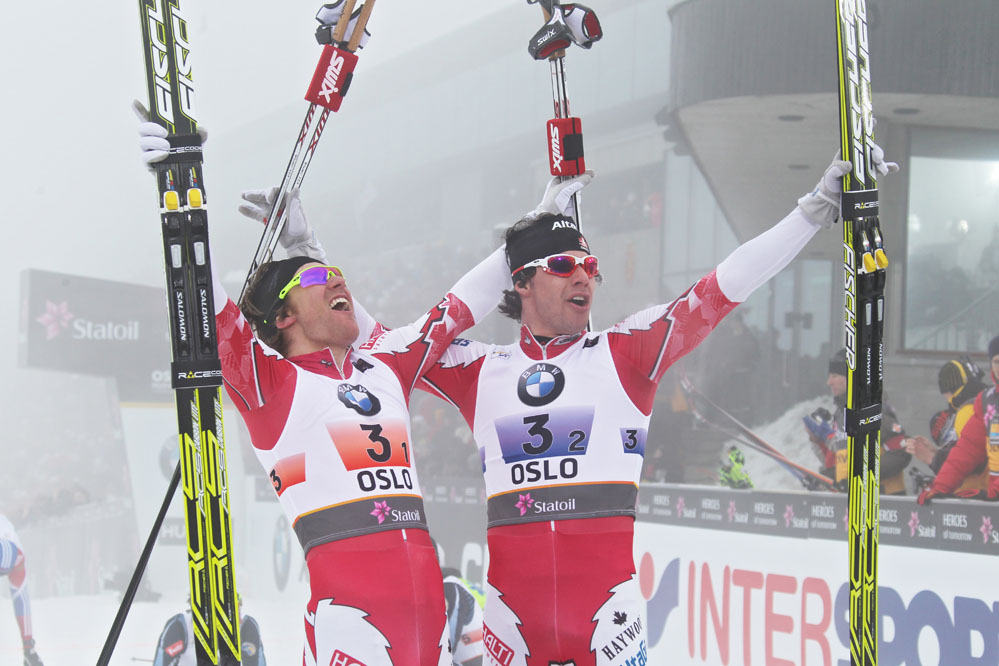
Devon Kershaw (l) and Alex Harvey celebrate their 2011 World Championships gold in Oslo, Norway. (Photo: Fischer/NordicFocus)
His career included three World Cup wins and 14 podiums, and a gold medal at 2011 World Championships with teammate Alex Harvey in the classic team sprint. Kershaw finished the 2011/2012 World Cup season ranked second overall and second in the distance rankings.
When he reflects on those accomplishments, he still has a hard time believing that all happened to him.
“So instead of focusing on being bummed at the situation or a bit frustrated with the state of things in Canadian skiing right now, I have to look back with a smile,” Kershaw said. “I feel just so privileged and grateful to have had the opportunity to be part of a real movement for men’s skiing in Canada.”
Kershaw said he was left with unanswered questions this spring during a transitionary period at Cross Country Canada (CCC). The team’s budget was undetermined, camps were not yet set in stone, and Kershaw said his decision — which he wanted to make by May 1, the start of the new training year — became about energy management.
“Part of managing your energy properly is putting all of your energy and focus into training, and if you’re being pulled with uncertainty or being stressed about uncertainty, that will come back, the World Cup will exploit that,” he said.
According to CCC Chief Executive Officer Shane Pearsall, High Performance Director Thomas Holland had planned to retire this past March, yet has stayed onboard as an advisor until CCC fills the position. Pearsall said the hiring process is still ongoing and will hopefully be wrapped up by next month. He confirmed that CCC has yet to finalize its budget and doesn’t anticipate being able to do so until a government minister signs off on the amount from Own The Podium (OTP), one of its primary funding sources, in July. Pearsall explained that they expect to have a better sense of national-team finances in mid to late June.
Typically, the team’s budget is determined in May, but because of necessary “quad reviews” following the Olympics, which took place before CCC met with OTP, the process was delayed by about a month. Pearsall did not elaborate on how significantly the budget would be decreased from last year, but said, “It’s certainly tighter than last year.”
Kershaw said he needed to pay about $25,000 Canadian dollars in team fees if he wanted to continue racing this year, up from $15,000 last year. That didn’t cover the cost of living, which he figured to be around $55,000 Canadian, for a grand total of $80,000.
“The financial burden is big, and moving forward the financial burden went from big to 100 percent paying for every cost,” Kershaw said. “So all travel, accommodations, everything. … I’ve just been in the sport a long, long time, and from a directional standpoint, I’m not sure we’re moving in a direction that will yield sustainable results at this point in time, but I understand it is difficult when you’re under such financial duress to create a sustainable program. But from a vision standpoint, I think there’s a lot of questions that remain unanswered, and it’s late in April. The fact of the matter is the rest of the world has all of the holes plugged — if they have holes in their boat — because May 1 is the new year of every ski program. And we’re just constantly slow and off the mark with that.”
Budget cuts had been expected as Canada’s World Cup Team missed performance benchmarks throughout last season. The team finished 2017/2018 with just two men scoring World Cup points (top 30) in distance races: Harvey and Kershaw. Two men (Harvey and Julien Locke) scored in World Cup sprints. On the women’s side, Dahria Beatty landed one World Cup sprint top-30 last season, and Cendrine Browne was the top Canadian woman in a distance race with a 27th place for time of day in the last race of the season.
Meanwhile, Alex Harvey led the team with four World Cup podiums, including third overall in the 2018 Tour de Ski, and a top result of fourth place at the 2018 Olympics. He finished his season in fourth in both the Overall and Distance World Cup standings. But Harvey’s results alone weren’t enough to buoy the whole team for another winter.
“Throughout my entire career, it’s almost unfathomable to think that the season ends and that’s the stat line,” Kershaw said of the team’s overall results. “It wasn’t so long ago that we had over 16 World Cup podiums in a season. The truth hurts, as [former Canadian coach] Tor-Arne Hetland once said, but things go in waves and this is the reality that we live in right now.”
Despite the prospect of self-funding, Kershaw didn’t feel pressed into retirement. Several of his teammates have decided to retire as well, including Graeme Killick, Jess Cockney and Knute Johnsgaard, but Kershaw said they weren’t forced, either.
“You can choose to work and you can choose to hustle for money; there are ways to make it,” he said. “No one’s forced into it. I could keep skiing if I wanted to, but I think the stark choice you’re faced with is, maybe perhaps some people are like, I can’t really see a path to international success currently, and that’s what I think is sad…”
‘A dream scenario’
When Kershaw moved to Canmore, Alberta, in 2001 and entered Canada’s elite skiing scene, Cross Country Canada (CCC) was entering a fruitful period. At the 2002 Olympics, Beckie Scott was proclaimed winner of the women’s 10-kilometer pursuit (now called the skiathlon), becoming the first North American woman to win an Olympic gold. At 2005 World Championships, Sara Renner earned a sprint bronze to become the first North American woman to medal at World Championships. Scott and Renner teamed up for silver in the team sprint at the 2006 Olympics in Turin, Italy, where yet another Canadian woman, Chandra Crawford, won the individual skate sprint for Canada’s second-straight gold in as many Winter Olympics. Scott finished that 2005/2006 season ranked second overall in the World Cup, just 16 points behind Norway’s Marit Bjørgen in first.
Devon Kershaw (r) with Graham Nishikawa in 2013. (Photo: Devon Kershaw)
Kershaw made his Olympic debut in 2006.
“Coming into Torino, we were quoted in the newspaper as being like the world’s most anonymous men’s ski team,” he said of the Canadian men’s team that year. “We weren’t really ‘on the map,’ but I’ve just been so grateful and lucky to have such a great group of guys around that really welcomed me in.”
He credited his former roommate and teammate Chris Jeffries as well as other Canadian competitors of his time, including George Grey, Gordon Jewett, Dan Roycroft, Sean Crooks, Dave Nighbor, Phil Widmer, Brent McMurtry, and Graham Nishikawa (who’s still racing), for having a major impact on the formative stages of his career.
“[There were] so many athletes in Canmore that tried hard, wanted it bad, and loved ski racing and training,” Kershaw reflected. “That’s a dream scenario for a young athlete to come into a community like that and be welcomed into that environment.”
Less than a month after the 2006 Olympics, he notched his first World Cup podium by placing third in the Borlänge, Sweden, skate sprint. In doing so, he became the first Canadian male cross-country skier to reach the podium since Pierre Harvey (Alex’s father) in 1988 and the first ever to medal in a World Cup sprint.
“I had no idea who Pierre Harvey was,” Kershaw said of his younger self.
Pierre Harvey had previously won the 1988 Holmenkollen 50 k as well as two other World Cup distance races and the Norwegian Birkebeiner, making him the most successful Canadian male skier before Kershaw.
“He could walk into the room and I would not recognize him,” Kershaw continued. “Even his results, I had heard that he had five World Cup podiums and that seemed pretty cool, but that’s all I knew about him.”
Kershaw’s second World Cup podium came early in the 2006/2007 season in a skate sprint in Munich, Germany. That same day, Crawford — whom he was dating at the time — placed third in the women’s sprint.
Devon Kershaw after being tagged by his Canadian teammate Alex Harvey (l) in the freestyle team sprint at the 2010 Olympics in Vancouver, B.C. They went on to finish fourth.
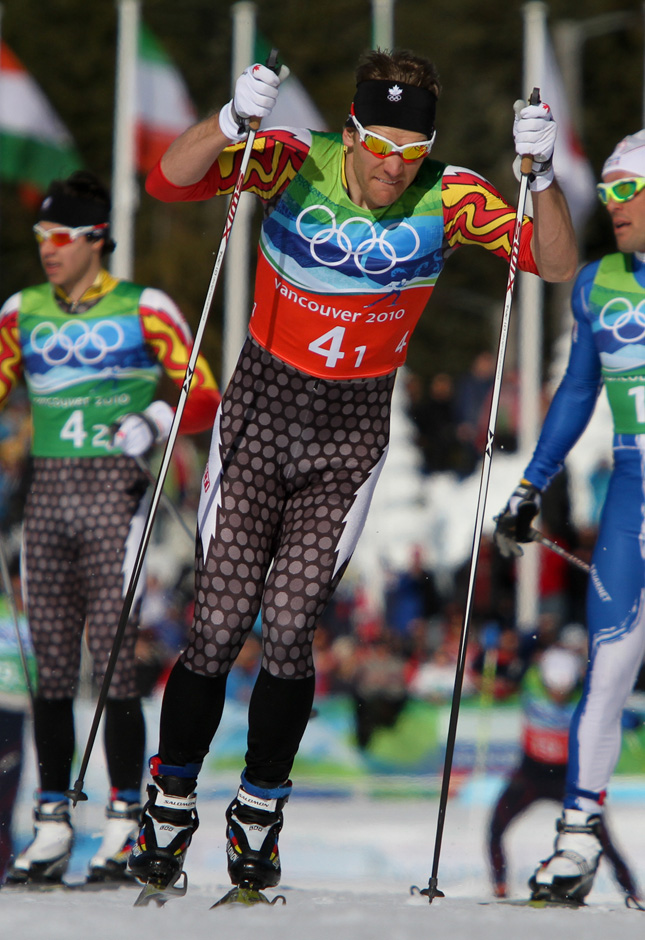
At his second Olympics in 2010, Kershaw finished fifth in the 50 k classic mass start for the best individual Olympic result for a Canadian male nordic skier. That record stood until Alex Harvey, who burst onto the World Cup scene in 2008, bested it with a fourth place in the 50 k classic at this year’s Olympics in PyeongChang, South Korea.
Kershaw and Harvey also teamed up to place fourth in the freestyle team sprint at the 2010 Olympics.
Kershaw’s first World Cup win came in a skate sprint during the 2011 Tour de Ski. He finished that Tour in seventh, and the next year, came back to place fourth overall in the 2012 Tour de Ski (TdS). Kershaw started all 12 editions of the TdS, a record he shares with France’s Jean-Marc Gaillard.
Harvey scored his first individual World Cup podium in a 50 k classic in 2009 and won his first World Cup race (a 3.3 k freestyle prologue) at the TdS in 2012.
“Then next thing you know, Alex and I are sharing a podium on some World Cups,” Kershaw reminisced. “Two Canadians on one podium in the World Cup, like, really? And then you win World Championships and I’m on the overall World Cup podium, and then next thing you know, Alex has been on the overall World Cup podium a few times and also now 50 k world champion. It’s crazy. It’s insane. From nothing. From no results. The journey has just been amazing. … I never would’ve thought Canada would, I mean, how could you? We had Pierre Harvey and that’s it in, like, a hundred years of international ass-kicking.”
Kershaw credited his initial World Cup breakthrough as a 23-year-old skier in Borlänge to Dave Wood, Canada’s national-team coach at the time.
“I came into a team with a coach that you could call at midnight. He’d do anything for you,” he said of Wood. “There was no way I would’ve stepped onto the podium in 2006 without him, and Mike Cavaliere, too, my first-year senior, Mike was my coach. We had staff that was just committed to the core for the cause and I’m incredibly grateful for that.”
‘A hell of a season’
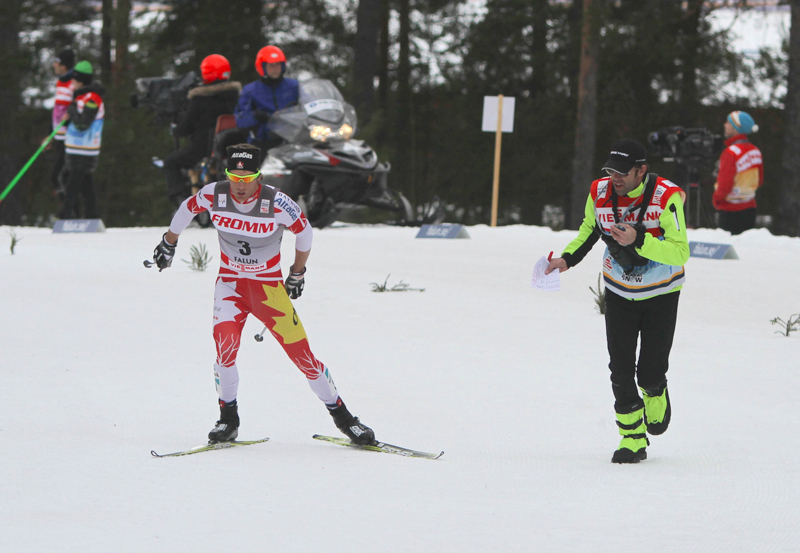
Canadian head coach Justin Wadsworth (r) giving splits to Devon Kershaw at 2012 World Cup Finals in Falun, Sweden.
Of his coaches, Kershaw gave special credit to Justin Wadsworth. A three-time U.S. Olympic cross-country skier who became Canada’s head coach in the spring of 2010, Wadsworth coached Kershaw for five seasons, and the two developed a close friendship.
“When Justin came into the national team, the level of professionalism and excitement and freshness that he brought … I don’t know if you call it luck or happenstance or just the right place, right time,” Kershaw reflected, alluding to his 2011 World Championships gold with Harvey and his 2012 Overall and Distance World Cup podiums. “Justin’s best results as a coach were me and my best results as an athlete were when I was coached by Justin. Talk about an amazing relationship there.”
“The main thing that I really appreciated with Devon, and I think he would say the same thing about me, is that we could be honest with each other and talk about hard things and enjoy the good times when we had them,” Wadsworth said on the phone last week. “… It’s cliche, but when I was talking to Devon the other day about his retirement, it’s not about the medals or the performances or whatever, it’s about your times together on the road.”
One of Kershaw’s biggest moments came at those 2011 World Championships in Oslo, Norway, where he and Harvey beat out Norway’s Petter Northug and Ola Vigen Hattestad by 0.2 seconds for gold on the Norwegians’ home turf. They had done so after Kershaw lost one of his skis early in the race, Wadsworth pointed out.
“His ski fully came off and he had to put it back on and get back into the race,” Wadsworth said. “Just the whole day was pretty incredible. That was a great, great opportunity for us, and the guys cashed in.”
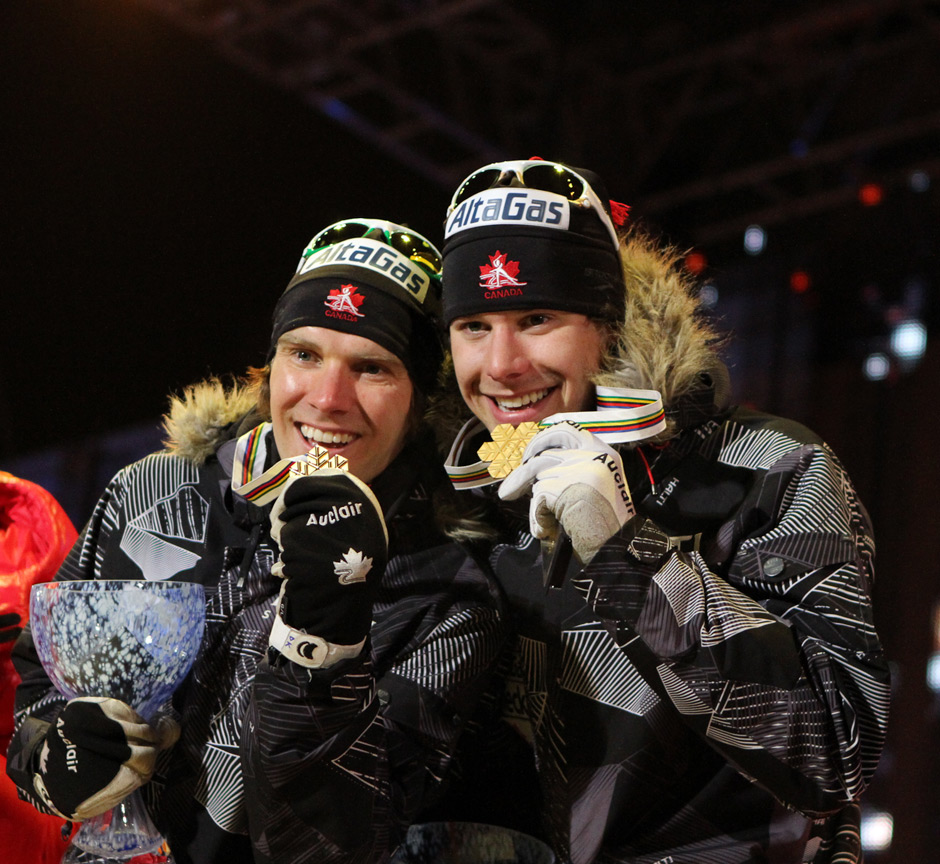
Devon Kershaw (l) and Alex Harvey with their World Championship gold medals at the 2011 World Championships in Oslo, Norway.
In a difficult-yet-strategic move to conserve for that race, Kershaw and Harvey both sat out the 15 k classic the day before.
“With anybody else running the ship, there’s no way I would’ve trusted that [decision],” Kershaw said of Wadsworth’s call. “But I trusted Justin’s leadership and we went all-in, and the next thing you know we won World Championships. I mean, are you kidding me? How can you get a better start to the next quadrennial? And Justin as a first-year head coach of a national team, that’s gotta go down as maybe the best season ever for a first-year North American coach of a national-team program.”
He and Wadsworth reiterated the crucial foundation that Wood had laid.
“Dave Wood had done a really good job with the athletes leading into that period, mainly focused on building a big base and doing a lot of hours and also doing a lot of time at altitude,” Wadsworth explained. “And when I took over the position, I saw that both Alex and Devon were really primed and had a really good response rate to altitude, and all we had to do was fine tune a little bit of strength training and intensity. I was really excited to work with both those athletes and saw that they had a lot of potential.”
For Kershaw, Wadsworth’s “American swagger … was magic for me,” he said. During the 2011/2012 season alone, he stood on the podium 10 times, with four top-three finishes in seven races at the 2012 Tour de Ski.
“It was a hell of a season for me,” Kershaw said.
‘Best sand-digger ever’
He went on to compete at two more World Championships and two more Olympics. This past season, Kershaw finished in the top 30 in eight World Cup distance races, with a top result of 19th in the 30 k skiathlon in Lillehammer, Norway. While struggling with lung issues, he finished 26th in the 50 k classic at the PyeongChang Olympics.
Devon Kershaw racing to 25th in the World Cup 15 k classic this past March in Lahti, Finland. (Photo: Fischer/NordicFocus)
“We worked to get that under control and it was manageable but it never felt good like it felt prior to 2015,” Kershaw said his health over the last three seasons. “In PyeongChang, it was a calamity of bad luck. When we got there it was minus 20 [Celsius], and this makes me sound so soft, because I’m from northern Ontario so you’d think I’d know, but it was really cold. I did some intervals and it aggravated my lungs and it was super windy and dirty and a lot of sand blowing around, and that really flared up my asthma to the point that I was wheezing badly.”
His breathing troubles also affected his sleeping and took most of the two-week Olympics to manage. At one point, he had a chest X-ray to make sure it wasn’t pneumonia.
“It was sporting asthma,” he said. “… It took all the way to the 50 k to kind of get it 70 percent.”
While he noted he was left wanting more from a performance standpoint at both his final Olympics and in his final season, Kershaw also acknowledged that he’s his biggest critic.
“That’s been probably the biggest detriment to my entire career; I’m the best sand-digger ever,” he said. “I am disappointed in the sense that I work really hard and I train hard and I prepare well, and it didn’t go exactly as planned. … When you’ve competed in the top 10 for as many years as I have and on the podium, of course that becomes your bar that you hope to achieve, but at the same time … when you’re in the top 30 in the results page, you’re in the race at least. And I’m proud of the fact that in almost all classic races, not every, but most, I was in the top 30 and ‘in the race’.
“Am I satisfied? In my life I’ll probably never be satisfied, that’s just how it goes,” he added with a laugh. “But am I somewhat proud of maintaining a fairly competitive level? Yeah, absolutely.”
Wadsworth reflected that Kershaw was one of the best athletes he had ever seen, even “physiologically as good as Alex [Harvey]” at the peak of his career.
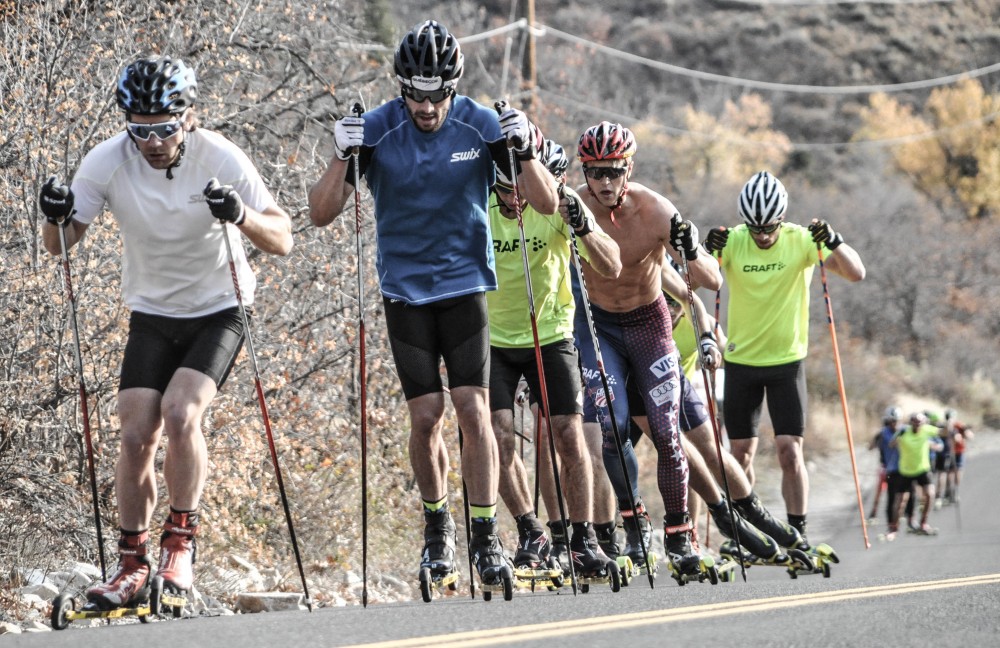
Left to right: Canada’s Devon Kershaw leads his teammate Alex Harvey and U.S. Ski Team members Noah Hoffman, Erik Bjornsen and Simi Hamilton during a Level 3 interval skate session up Snake Creek Canyon in Midway, Utah, during their respective teams’ 2016 training camps in Park City, Utah. (Photo: Matt Whitcomb)
“Devon’s a very intelligent person and sometimes he might’ve overthought things and lacked in confidence, and as a coach that’s really frustrating to see because you know how good they are physically,” Wadsworth said. “And when he was on mentally, too, in training, when he was at his very best, he had total confidence and could destroy anybody in any workout.”
He recalled a hill-bounding workout with the Norwegian team in which Kershaw was literally leaps and bounds ahead of everybody else — even Martin Johnsrud Sundby and Russia’s Ilia Chernousov, who joined the training session.
“He was just shelling everybody,” Wadsworth said. “So when Devon was at his best like that and mentally confident and relaxed, he was a real force of nature. Unfortunately that didn’t always translate into the racing season, but in 2012 he put it all together and had a tremendous year. … If he had the confidence the whole time, he would’ve been almost unbeatable, in my opinion, but it takes the whole package all the time, and he was among the greats there for a while.”
‘Younger, faster, better dog’
And then there was Harvey, another one Kershaw’s of his best friends and longtime roommates.
“I’ve spent more nights in a room with him than my wife or any girlfriend I’ve had,” Kershaw joked. “… He was eager to learn, he chased me for years, he was always a hard worker, too. He trained really hard, he believed in himself, and I still am in total awe of that. I’ve never met anybody as confident as him. It’s too bad that didn’t rub off on me, but that’s been great to be around.”
He likened Harvey’s addition to the team as a family adopting a puppy.
“You know when your parents get a puppy because your dog is 10 years old? He’s kind of slowing down a little bit and then you see that old dog get fired up and run again and jump around and play; that’s me,” Kershaw said. “And I’m so grateful that my owners got a younger, faster, better dog to hang out with because it was so inspiring.”
Several times over the last few years, Kershaw has said that witnessing Harvey make Canadian history has been one of his biggest reasons for staying in the sport.
“He, for sure, has kept me in this probably longer than I should’ve,” Kershaw said. “I just love traveling with him and seeing what he can accomplish and training with him and seeing that professionalism.
“There’s no question he’s the best Canadian skier ever, that’s not even close,” he added. “… I just feel so honored that I got the chance to see it all happen, from his last-year junior when he did his first World Cups and then all the way though I’ve been with him.”
The Canadian men’s relay after placing third in January 2017 in Ulricehamn, Sweden, for Canada’s best-ever World Cup result in the 4 x 7.5 k relay. From left to right: Lenny Valjas, Alex Harvey, Knute Johnsgaard, and Devon Kershaw. (Photo: Salomon/NordicFocus)
In an email, Harvey explained that he and Kershaw first met in the fall of 2005 at a training camp at Sovereign Lake, British Columbia. Harvey was on the junior team and Kershaw a senior, but the whole team stayed at the same hotel.
One morning, Kershaw accidentally took Harvey’s poles from the hotel. Harvey had to track him down on the ski trails to get them back.
“That was the first time I talked to him and to me it’s just perfect because that’s so Devon,” Harvey wrote.
Later that season on March 7, 2006, Kershaw made history with his first podium. That same day, Harvey won his first national title in the 10 k classic at Canada’s senior national championships as a 17-year-old junior.
“I guess our friendship was meant to be before we even knew it!” Harvey wrote.
When the two became teammates, Harvey immediately took to imitating Kershaw, both in training and racing.
“He took me under his wings and he has a big part in the athlete I became today,” Harvey wrote, likening Kershaw to a big brother. “I feel very privileged to have spent all that time with him. I think we became such close friends because we are both very driven athletes and we don’t accept any compromise. We’re both huge fans of our sport, ‘nor-dorks’, so we also love to talk about everything from altitude training to who is seeing who on Tour.”
Kershaw’s decision to retire didn’t surprise Harvey.
“I think it’s a mix of a few things,” Harvey wrote. “… Probably this biggest reason, he has a little girl at home. I know this winter was extremely hard on him. Not seeing Asta Isabel was pure torture, I think I would have done the exact same if I was him.
“I will miss a lot of things about Devon,” he added. “He’s always there to give good advice about everything and anything. He knows so much about all that is going on in the world, probably the most well-read person I know. He’s kinda my news source. I’m still amazed by how indecisive one can be. This brought a lot of laughter throughout the years. I have so many memories from the last 10 years with him. Seeing him dominate the World in 2012 was just amazing but also very eye-opening for me. He raised the bar for all North American skiers that year and I’m very thankful for it.
“We both lived great emotions in high accomplishments and huge disappointments. I’d like to think I helped him get through these upsets and I can say he definitively helped me get through mine. A page turns in the life of Devon Kershaw but knowing the man, I’m not worried about what’s gonna come next.”
Without Kershaw, Killick, Cockney, and Johnsgaard on the men’s team, Harvey acknowledged that next winter will be “very different” for him on the World Cup.
“All these guys are calling it a career and I’m super proud of what all my friends accomplished,” he wrote. “I’m excited to try to help the next generation step it up and fill the shoes of the previous generation. … Also, after 10 years on Tour I’ve made some friends on other teams so I’m not too worried. I’m just excited to step into a bit of a mentor role for our next generation.”
Onto the Next
As for Kershaw, he didn’t rule out coaching future generations of Canadian skiers, but he said he was focused on getting an education first. In just over a week, he’ll start a course that requires 20 hours of classes a week — all in Norwegian — for what he anticipates will take six months. The course is essentially an advanced version of Norwegian as a second language, and foreigners must pass it to pursue a degree in Norway.
After that, Kershaw plans to apply to universities “and hopefully study forever,” he said with a laugh. “Not forever, but study, and I want to stay involved in skiing in any way I can and I want to help the next generation get better.
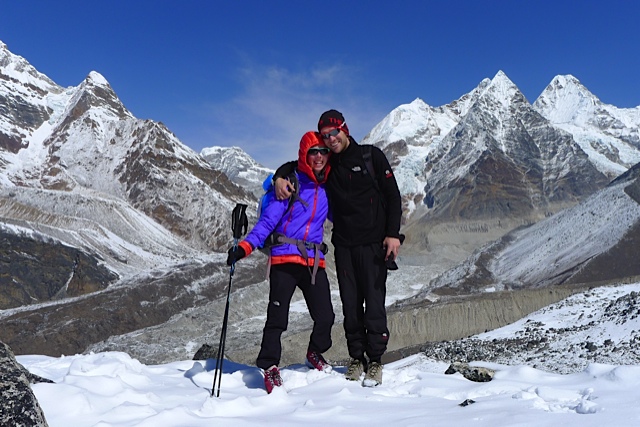
Kristin Størmer Steira (l) and Devon Kershaw during a day hike on one of their acclimatization days. The couple got engaged in 2014 after summiting Mera Peak during a three-week trek in Nepal’s Himalayas. (Photo: Devon Kershaw)
“First things first, I have to get my Norwegian at a level where I can sit through a lecture and write an essay at a decently good level, at least good enough that my wife doesn’t have to rewrite it, she can just correct it,” he explained.
Asked what he’d like to study, Kershaw said medicine, specifically orthopedic surgery, has always intrigued him. (As a junior skier, Kershaw took undergraduate classes at the University of Calgary until 2006, but those credits have since expired.)
“But now I’m 35 and I’m going to have to do all of this in my third language,” he acknowledged. “So for now, I’d say that that’s still my first choice and I’m exploring what it would take.”
If not medicine, he’d like to pursue a degree in “some kind of science physiology, and then in a totally shifted way, if I have a panic attack and be like, ‘Science is too hard after ski racing forever,’ then I am interested in economics and economic theory and business to some degree…”
Regardless of which path he choses, he’ll be doing it in Norway, Kershaw said.
“I don’t mind the challenge. … It’s intimidating in a way, but it’s also really exciting,” he said. “Kristin’s family [who lives in Lillehammer] is just so fantastic and to see how happy my daughter is here, to have her family, to have family around her and everything for the short term, and I hope to be educated in Norway.”
Asked if he’ll jump into any ski races this season, Kershaw was quick to respond, “No.” But he will continue skiing. The beauty of the sport and the struggle, as he put it, is what’s kept him in it so long.
“Imagine just having a singleness, a purpose, a goal that’s just there in your face and then you get to wake up every day and do the things you absolutely love to do,” he said. “… I adore cross-country skiing. I just think it’s such a peaceful, beautiful exercise, and the technique and the flow of it all. … You’re just skiing through the woods peacefully, gliding over snow, over all the terrain you can cover. It’s a beautiful, zen-like endeavor, and I think that’s what’s kept me in it this long. And the people, the Canadian ski community, the world ski community, really. I’ve met so many inspiring people and beautiful people and worked with a lot of absolute experts and I’ve had brilliant teammates and brilliant coaches.”
And because of skiing, he met his wife and started a family in Norway.
“I have a daughter with a woman that I love and respect and am in total awe of every day of my life and without ski racing there’s no way that would’ve ever come to fruition,” he said. “There’s the biggest gift right there, as cliche and Hallmark as that sounds, it’s true.”
Northern lights at camp on one of two nights during the 2018 Arctic Circle Race in Greenland. (Photo: Arctic Circle Race)
Canada’s Dahria Beatty closed out her World Cup season with the rest of her international-racing peers on March 18 in Falun, Sweden. After three straight days of races, the 24-year-old Whitehorse, Yukon, native finished World Cup Finals in 54th overall.
Five days later, she endured a three-day 160-kilometer classic race in Greenland, 65 kilometers north of the Arctic Circle. And Beatty didn’t just survive the 22nd-annual epic adventure, she won it.
Canada’s Dahria Beatty racing to first among women and fifth overall in the three-day Arctic Circle Race in late March in Greenland. (Photo: Arctic Circle Race)
In her first Arctic Circle Race, Beatty was the first woman to complete all 160 k in the backcountry near Sisimiut, Greenland, spending two nights in tents with temperatures below -28 degrees Celsius (-18 Fahrenheit) and fueling herself with dehydrated meals and a jar of peanut butter.
The first woman and fifth overall across the line, she finished on March 25 with a total ski time of 14:19:15 hours. Her dad Craig Beatty completed the race as well, finishing 18th overall and second in his 50+ age group.
“In 2005, my dad went with some of his friends to do this race and he just loved it,” Beatty told FasterSkier in a phone interview earlier this month. “At the time I was 11 years old and he came back and just thought Greenland was an amazing place, and a place that I should experience.”
They decided that they would do the race together when she was old enough to compete, 18 or older by the race’s standards. When she looked at her race schedule this year, which kept her in Europe until late March, Beatty figured a stop in Greenland on the way home to do what organizers dubbed “the world’s toughest ski race” was a great opportunity.
She arrived in Greenland two days before the race and spent two days there after, then recovered in Iceland for six days with her dad.
Craig Beatty at the finish of the 2018 Arctic Circle Race in Greenland. He finished second in his age group. (Photo: Dahria Beatty)
“It was really a great trip, to be able to be with my dad,” Beatty recalled. “We haven’t done a trip like that in a long time, so it was a lot of fun and I really enjoyed it.”
The race itself entailed three back-to-back marathon distances of skiing 50 kilometers or longer, with the longest day being 57 k. Competitors crossed a finish line each day, with Beatty being the first woman on each day, and third overall on Day 1, fifth on Day 2, and finally fifth on Day 3. She noted that her dad, whom she met up with each night at camp, skied a more consistent race.
“His time on the first day and the last day, which were similar distances, were only separated by 15 minutes or so, whereas I was over an hour slower the third day,” Beatty recalled. “I maybe went a little too fast off the gun, but other than that it was a ton of fun. The first day I was skiing in second and third the entire race, men included, and dropped off a little the second two days…
“It’s definitely a totally different event than doing something that’s a one-day event, or something where you can go inside and sleep in the warmth at night,” Beatty added. “It definitely is more a test of survival, which is a cool thing to experience, and we were a little bit unlucky in the fact it was so cold.”
At the same time, racers experienced abundant sun and “bluebird skies”, she said.
“We had amazing views of the mountains, of the fjords, each day we were racing,” she said. “And at night the sky was lit up with northern lights.”
Dahria Beatty at the start of the 2018 Arctic Circle Race in Sisimiut, Greenland. (Photo: Arctic Circle Race)
At the end of each day, racers had access to two- or three-person tents with a thermal groundsheet for sleeping, according to the Arctic Circle Race website. They were provided with a saucepan, frying pan and matches to cook their own food, while organizers supplied hot and cold water as well as coffee and tea. Racers had to wax their own skis and use outdoor “earth closet” bathrooms. There were no showers, beds or cell service, but that all made it part of an experience Beatty won’t forget.
“The volunteers in the race were absolutely incredible,” she said. “The second and third day, when I was absolutely exhausted, they were standing out there all day [at the feed stations] while we were racing, making sure we had food and hot beverages to drink, and cheering us on.
“On the second day, we skied down off the mountains onto a fjord, and at the bottom, my hands were so cold that I couldn’t get my gloves off myself,” she continued. “When I made it to the feed station, the volunteers were there and they helped me take off my wet, cold gloves, and grab my warm mitts out of my backpack and help me put them on. There’s just a really amazing atmosphere around the race. The entire community of Sisimiut looks forward to it each year, and it seems like half the community comes out to volunteer for this race … so that was really cool.”
With a population of about 6,000, Sisimiut is both a small fishing town and the second-largest city in Greenland. It’s also the country’s most northern ice-free town in the winter and most southern town for dogsledding. In many ways, Beatty said it felt like home.
“It was really cool to experience their culture and see so many ties to the Canadian North,” she said. “… I would love to go back in the summer. I met some amazing people from there and they were telling me how different it is in the summertime. It’s definitely a place I’d like to explore more…”
Going the Distance
In her career, Beatty has completed four 30 k races, including a third place in the 30 k freestyle mass start at 2015 Canadian Nationals, 34th in the 30 k skate at 2017 World Championships, and 49th in the Holmenkollen 30 k skate at this year’s World Cup in Oslo, Norway.
Dahria Beatty racing the Holmenkollen 30 k freestyle mass start on March 11 in Oslo, Norway. (Photo: Fischer/NordicFocus)
But 50 k? That’s something she’d like to do more of after completing distances of 52.2, 57.1 and 51 k on three consecutive days in Greenland.
“I had a lot of fun racing this 50 k, and it was definitely slightly different than a 30 k, but I went at it with the same mentality,” said Beatty, who is best known for her World Cup top-30 (and even a top-15) sprint results.
“I mean, I’ve had better results internationally in sprint, but when I was a junior, I was always better at distance skiing,” she pointed out. “Right now I’d say I’m usually stronger in sprinting, but a lot of the times those long-distance races, especially in a loppet-style format lend themselves well to sprint athletes. I think there’s a lot of times you see people that are considered sprinters do well in 50 k and 30 k events, more so than they would in a 15 k. I think they kind of almost lend themselves to each other in a very strange way.”
As she progresses as a skier, Beatty, who made the jump to Canada’s World Cup B-team last spring, said she’s aiming to be more of an “all-around athlete.”
“I’ve scored World Cup points in a distance race once, and I’d definitely want to do it again, many times before my career is over so it’s definitely something that in my training. I’m not trying to train just to be a sprinter. I’d like to have a balance.”
Last season, Beatty spent most of five months on the European World Cup circuit. Pre-selected to the 2018 Olympic squad, she returned to Canada in late December for training and racing in Mont Sainte-Anne, Quebec, where she won both sprints at the Canadian NorAm/Olympic trials. In January, she headed back to Europe.
Dahria Beatty en route to 20th overall in the Seefeld World Cup freestyle sprint for her season-best result in 2017/2018. (Photo: Fischer/NordicFocus)
On the World Cup, Beatty achieved her best individual result of the season — 20th — in the freestyle sprint in Seefeld, Austria. She competed in five events at the Olympics, placing 13th with her teammates in the 4 x 5 k relay as well as freestyle team sprint.
Asked about the highlight of her first Olympics, she said it was that team sprint with Emily Nishikawa.
“For me, the team sprint was more than just racing for Canada,” Beatty said. “Emily and I are both from the Whitehorse Cross-Country Ski Club and the Yukon Ski Team so I was racing for the entire country, but also for my hometown, my club, the roots of where I began skiing and that was really special, knowing I was tagging off to my teammate who grew up through the same program as me and we both could get to this point together was absolutely amazing. We had a good race, and for me, individually, I felt the best that day of the Games and was able to carry a lot of motivation through the race and it was really fun to tag off right in the mix.”
Racing in the heats in Seefeld was another season highlight.
“… The course in Seefeld is so much fun; it’s such a beautiful location,” she said. “We had a perfect sunny day and knowing that World Championships will be there next year, it was really fun to kind of prepare to figure out what tactics worked and didn’t, and look forward to the next season.”
Canada’s Dahria Beatty (l) and Emily Nishikawa after placing 13th in the freestyle team sprint at the 2018 Winter Olympics in PyeongChang, South Korea. (Courtesy photo)
Under the guidance of Alberta World Cup Academy Head Coach Chris Jeffries, Beatty has typically spent most of her offseason training in Canmore, Alberta. While she said “there’s lots of change going on right now in Canmore” in terms of her training plans this year, Beatty was confident she’d be training with Nishikawa — as she has for the past five years. She also plans on having a strong training group of women, both national-team and non-national team members, to train with in Canmore.
That group has been gaining momentum and traction on the World Cup scene, with Cendrine Browne scoring her first World Cup points in the last race of the season with the 27th-fastest time of day in Falun’s 10 k freestyle pursuit. Beatty observed that the cohesiveness of the Canadian women’s team has contributed to its growing success.
“Having a belief in your teammates and being able to learn from your teammates and the strengths of you teammates is so important,” she said. “… I definitely think it’s something that all teams should strive for an strive to support and use each other’s strengths to build the most well-rounded team of teammates, and I definitely think the American women are wonderful role models and having the opportunity to get to know all of them very well over the winters and on the World Cup has been an absolute pleasure. I think we can learn a lot from them, and how they’ve built up their team.”
At the moment, Beatty is enjoying some time at home with her family and new dog Ozzy in Whitehorse, where she estimates she spends about two months a year. Between spending about half the year in Canada and half the year on the road, she said she’s grateful for her teammates.
“Having roommates and having teammates to spend time with and just relax with, and support you on the good races and the bad races, and be out there on the race course with you, too, that’s a huge part,” Beatty said. “I haven’t ever experienced having to be there [on the World Cup] alone luckily, but I’m always grateful for my teammates, and we’re such a close group of friends, I can’t imagine it without them.”
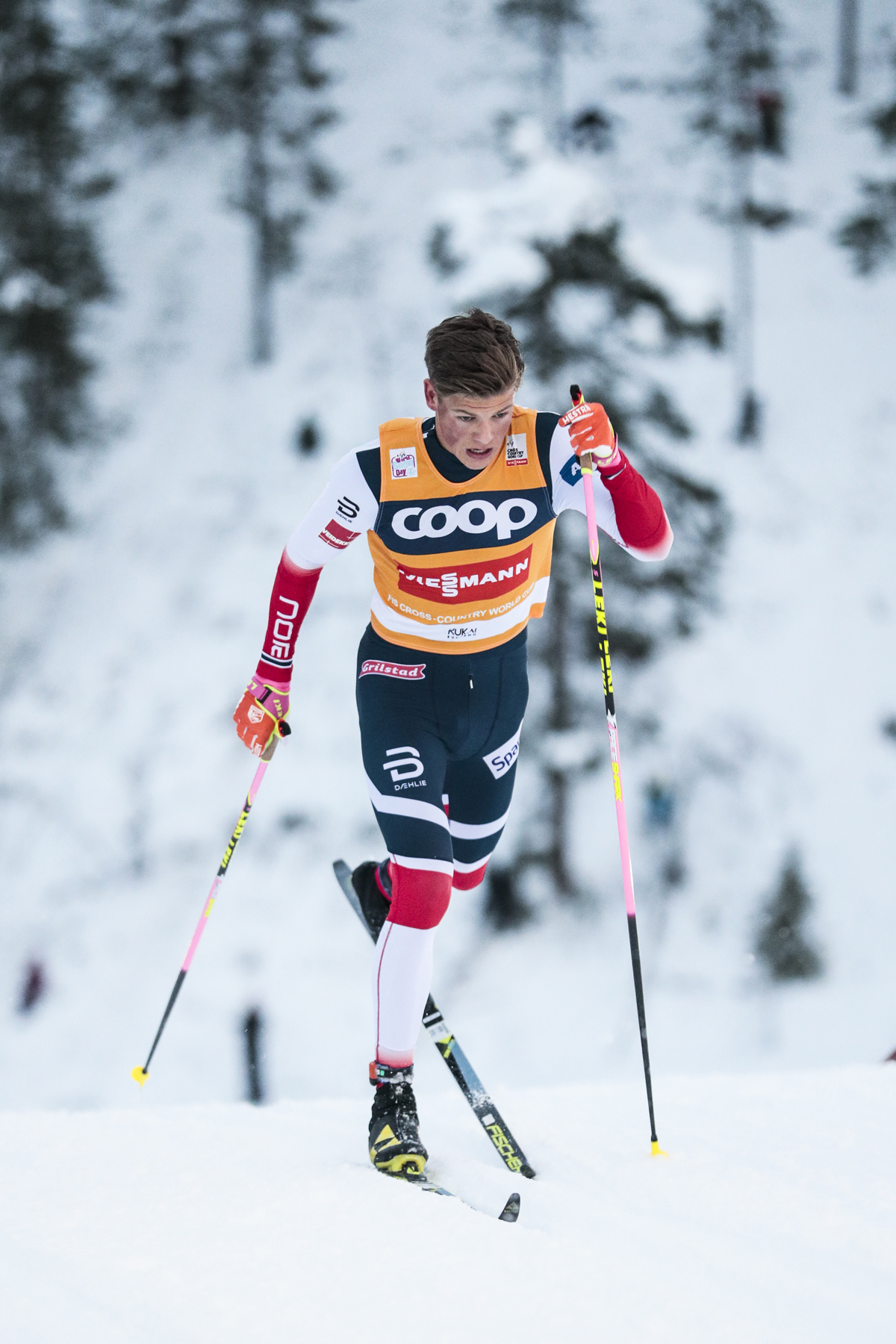
Norway’s Johannes Høsflot Klæbo racing to his second win in as many races at the Ruka Triple on Saturday in Kuusamo, Finland. He won the first distance race of the season, the men’s 15 k classic, by 15 seconds and will start Sunday’s freestyle pursuit with a 38-second head start on the men’s field. (Photo: Fischer/Nordic Focus)
Is Johannes Høsflot Klæbo better than Petter Northug* was at his age? It’s hard to say, reigning Norwegian World Cup winner Martin Johnsrud Sundby told NRK. But his performance in the last two days is pretty unheard of, Sundby said after Saturday’s 15-kilometer classic.
On both Friday and Saturday at the Ruka World Cup opener in Kuusamo, Finland, Klæbo (who’s still a U23 athlete at just 21 years old, although he’s on Norway’s exclusive World Cup Team) won both races to start the 2017/2018 season. He didn’t lose a round in Friday’s classic sprint, then came out to take a 15-second victory over fellow Norwegian Didrik Tønseth in Saturday’s 15 k classic.
“There’s no doubt he’s a phenomenon,” Sundby said after placing eighth on Saturday, 30.7 seconds off Klæbo’s winning time of 33:38.8 minutes, according to a loose translation. “To race like he did yesterday, then do the same today. No, that’s amazing.”
Klæbo ended last season as both season-long U23 (under-23) World Cup champion as well as the Sprint World Cup champion. He’s started this season without a loss, and he led at most parts of the race on Saturday, except for the 3.1 and 5 k checkpoints, where Russia’s Alexander Bolshunov clocked splits that were 0.9 and 4 seconds faster, respectively.
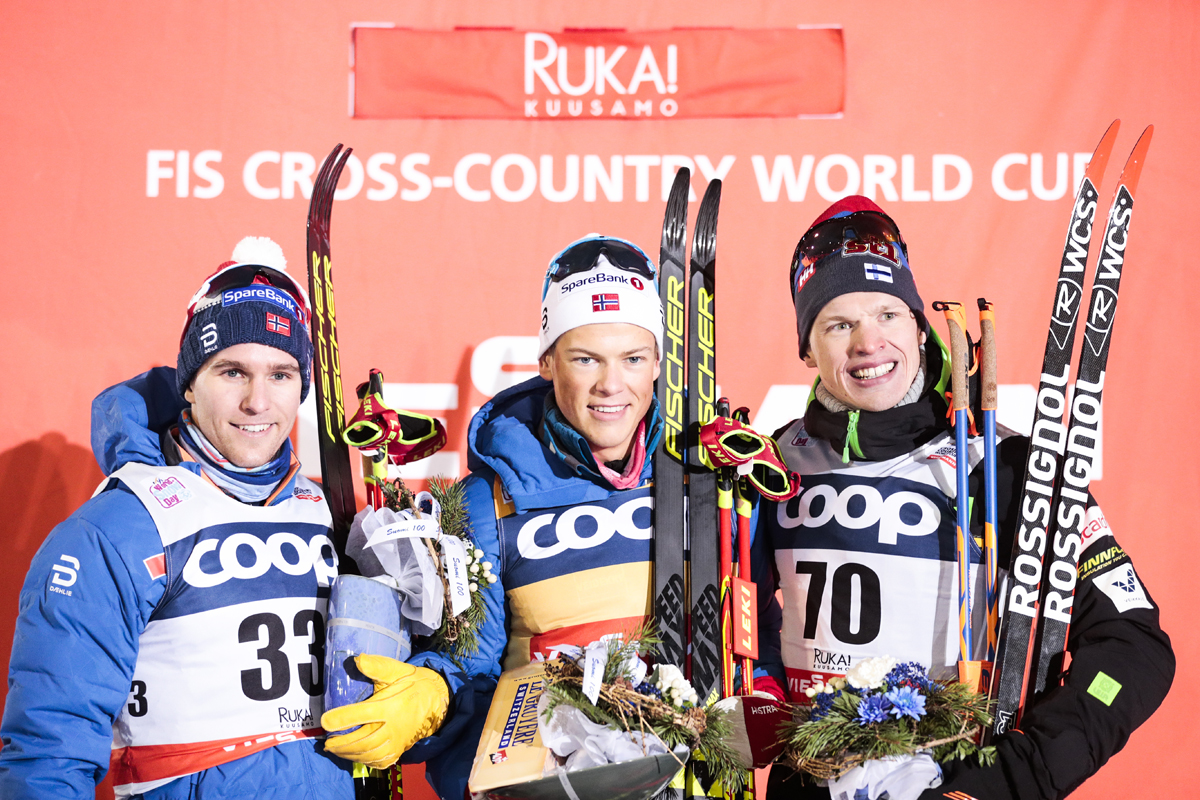
The men’s 15 k classic podium on Day 2 of the Ruka Triple in Kuusamo, Finland, with Norway’s Johannes Høsflot Klæbo (c) in first, Norway’s Didrik Tønseth (l) in second, and Finland’s Iivo Niskanen (r) in third. (Photo: Fischer/Nordic Focus)
But Bolshunov, who started 66th (out of 102) couldn’t hold it, and the young gun in bib 42 continued to hold his own in the leader’s chair at the finish. Klæbo ousted Tønseth from the top spot, putting Tønseth in second place. Finland’s Iivo Niskanen in bib 70 charged hard for the win, coming within three seconds of Klæbo around 6 k, but ended up 17.7 seconds short for third place.
“It’s unbelievable what Johannes did today, having raced four sprint rounds yesterday,” Tønseth emphasized, according to a International Ski Federation (FIS) press release.
“I was surprised myself,” Klæbo told FIS. “My plan was to open hard. When you fight for the World Cup victory, you try to give everything.”
As for his reaction to Sundby’s praise, Klæbo told NRK he was trying to remain focused.
“It’s just two races, so we’ll have to wait and see,” he said. “There is no one who is more of a favorite in the Tour de Ski than Martin. I will smile as long as I have the yellow shirt [as the overall Word Cup leader], but then he will get it in the end.”
Saturday’s 15 k classic, as Niskanen pointed out, wasn’t an easy one. New snow from overnight and the day before mixed with temperatures around freezing made for glazed tracks, where skis were prone to icing.
“It was a difficult competition and it was not easy to pick the right skis,” Niskanen told FIS. “Looking at the whole mini tour, third place today is good. I am still not where I would like to be, there are some good things but also some things I have to improve for the [Olympic] Games.”
He’ll start Sunday’s final race of the Ruka Triple, the men’s 15 k freestyle pursuit, in fifth place, 49 seconds behind Klæbo in first. Bolshunov, who finished fourth on Saturday (19.9 seconds behind Klæbo), will start the pursuit in second. And Klæbo will start first, 38 seconds ahead of the Russian.
Norway’s Pål Golberg will head out third, 6 seconds after Bolshunov, and Sweden’s Calle Halfvarsson will start fourth, another 4 seconds later and 1 second ahead of Niskanen. Tønseth is slated to start sixth (+0:57) just ahead of fellow Norwegian Emil Iversen and Kazakhstan’s Alexey Poltoranin (both 58 seconds back) in seventh and eighth, respectively. Russia’s Evgeniy Belov** is ninth in the tour standings (+1:05) and will start with Sundby in 10th (+1:05).
On Saturday, Poltoranin, an early leader in bib 12, placed fifth (+25.6) to move up the mini-tour ranks. He initially bumped Belov, who started 10th, out of the leader’s chair, and Belov ultimately slipped to sixth (+26.5), just ahead of Iversen in seventh (+30.2) and Sundby in eighth (+30.7).
Russian U23 skier Alexey Chervotkin placed ninth on the day (+31.2). Halfvarsson was 10th (+34.4) after coming within seven seconds of Klæbo’s time in the middle of the race but losing time on the last of three 5 k laps. For Norway, Golberg placed 11th (+38.1) and Hans Christer Holund 12th (+44.7), ahead of Canada’s Alex Harvey in 13th (+49.7).
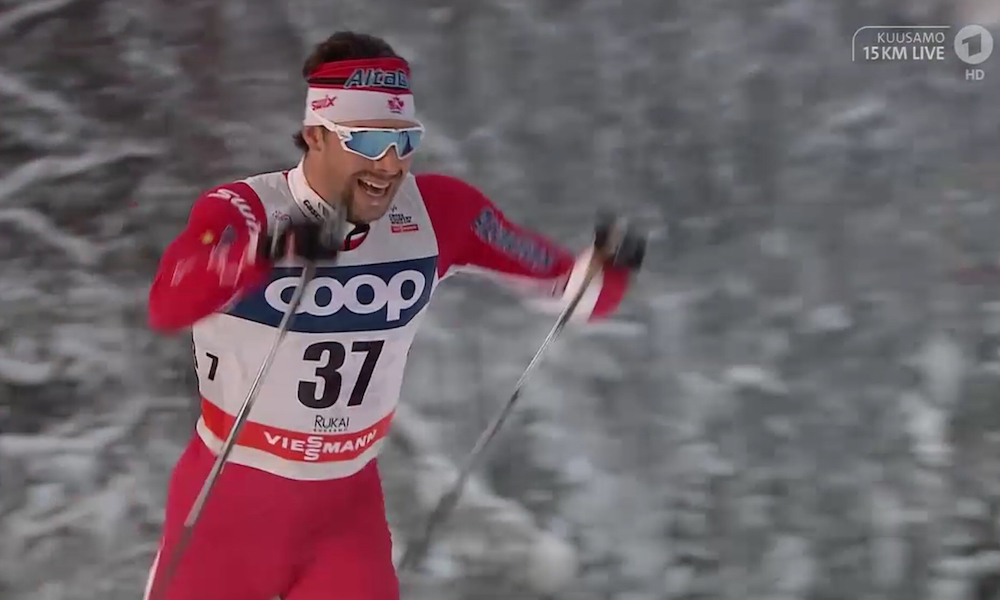
Canada’s Alex Harvey racing to 13th in the men’s 15 k classic individual start on Saturday at the World Cup in Kuusamo, Finland. (Screenshot: ARD)
Harvey, who started in bib 37, spent most of his race floating between 10th and 14th place, and did what he needed to get within striking distance of the top 10 for Sunday’s pursuit. He’ll start tomorrow’s race in 12th, 1:23 out of first and 9 seconds behind Chervotkin in 11th.
“I was just hoping to move forward a bit in the standings but more importantly to deliver another good race,” Harvey wrote in an email on Saturday. The day before, he reached the quarterfinals and finished 21st overall in the sprint.
“The conditions yesterday were quite different than today’s. Yesterday it was fresh falling snow and cold, then it warmed up quite a bit overnight so today was very glazy [sic] and shiny snow,” Harvey wrote. “Skis were good I think. Not the fastest but good kick in not-so-easy conditions to get grip.”
Like fellow Canadian World Cup Team member Devon Kershaw, who tied American Erik Bjornsen (U.S. Ski Team) for 26th (both 1:15.2 out of first), Harvey explained that he chose no-wax “hairies”, also known as “rub” skis.
(“I think a lot of guys went on rub skis,” Kershaw wrote in an email. “I went with rub skis and it was the right choice for me today. The techs were all pretty pumped because I have been very averse to rub skis in the past. The handful of times I’ve been ‘forced’ to race on them I’ve gotten completely destroyed, so today was fun to feel good and make the skis work for me.”)
Harvey recalled feeling strong on the climbs, using his grip to his advantage.
“From our more detailed splits it seems I was losing a bit on the flats which is usually my stronger terrain but nothing too dramatic,” Harvey wrote. “I’m happy to be within reach of the top ten, that was the goal for the weekend. Tomorrow I’m looking forward for 2 things. 1: chasing guys ahead of me. 2: skating!”
Kershaw, who started 13th and had fewer men to chase ahead of him, explained that he paced his first lap so that he’d catch someone like Harvey, and the plan worked.
“I was going to take my risk and start really slow. Almost level 3 effort,” Kershaw wrote of his pre-race strategy. “I knew I should be able to lap through with either Alex, [Finland’s Matti] Heikkinen, or Dario [Cologna of Switzerland] – and it just so happened that it was Alex. I ended up having great energy after my pedestrian start and was able to ski 10km with him, which obviously allowed me to ski into the points. Perhaps I should have been more aggressive out of the start, but I played it safe and it worked out decently well for me.”
“That was sweet to have someone there,” Harvey said in a Cross Country Canada press release. “It was good for both of us and really helped pull us both around.”
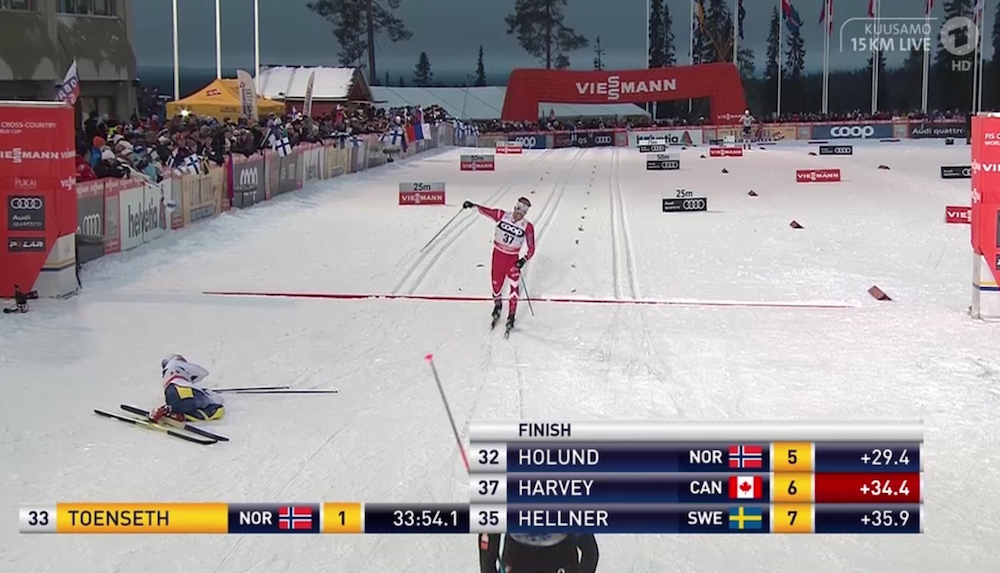
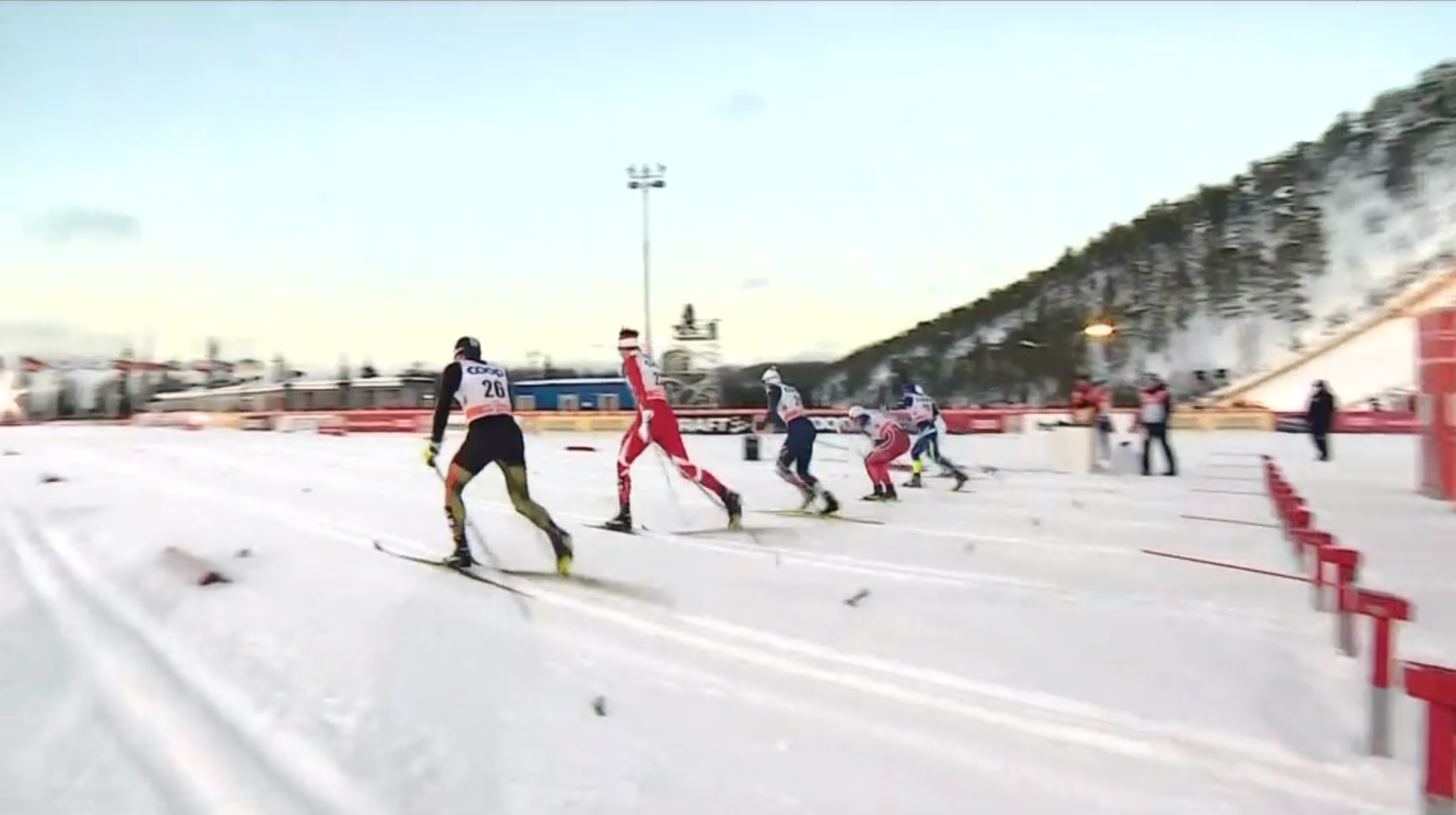
Canada’s Alex Harvey (in red) lunges at the finish of the men’s 15 k classic at the Ruka World Cup in Kuusamo, Finland. While he initially finished sixth, he ended up 13th on the day. (Screenshot: ARD)
Kershaw wrote that he was “decently happy,” with his race. “I know that 26th doesn’t sound earth shattering or anything, but to start the first distance race of the World Cup tour in the points is fine. I’m a notoriously slow starter throughout my career before Christmas, so I’m just looking for some solid races and to hit the points more often than missing them is good.”
On Sunday, he’ll start 28th, one second behind Cologna in 26th and Russia’s Andrey Larkov in 27th. Bjornsen, the U.S. Ski Team’s leading man in the Ruka tour, is 7 seconds ahead of him in 23rd.
“I think the celling is probably 20th,” Kershaw wrote of his aspirations for an overall finish for the mini tour. “We have a good group of about 10 guys all starting within 9 seconds of each other. I will hope to stay in that group and have the energy and punch to have a good last lap. You never know what happens in these pursuit starts too – so guys could blow up, but there’s a break at around 20, and then behind me there’s a break at around 30. Will be fun.”
Bjornsen, who placed 24th in Friday’s sprint, started Saturday’s 15 k in bib 69, just 30 seconds ahead of Niskanen. In an email, Bjornsen described catching a “great ride from Iivo” on the second lap.
“He’s just amazing here,” Bjornsen wrote. “I’m pretty sure he was disappointed with his result. He comes to Ruka with a mission. I jumped on him for a lap in the middle. It felt very controlled in the double pole sections but he was just striding up the hills no problem. The herring bone was not nearly as efficient. I had to let him go after skiing with him for 6kms.”
Bjornsen explained that he took a chance and went for glide over grip.
“I’ve only raced here four times but tricky classic conditions seem to be the norm. The hills are big and steep!” he wrote. “I had a pair of rockets under my feet but I didn’t stride in the tracks once. My double pole is feeling great right now so the tactic was to hammer double pole as far up the hill as I could, and then just get out of the tracks and run/herring bone.”
After finishing in the top 30 to score World Cup points in the first two races of the season, Bjornsen explained he was feeling “psyched”.
“I didn’t have the best feelings the last couple weeks, so I wasn’t expecting to be in the points right away,” he wrote.
“Of course yesterdays race was fun for me, but for sure the highlight of the day was watching Sadie absolutely dominate the heats!” he added of his older sister Sadie Bjornsen placing second in the women’s sprint. “She’s been looking great this year and I think she has a lot more success to come. Personally I believe she was strong enough to take the win, it’s only a matter of time before that happens..”
On Sunday, he hoped to chase a top-30 overall tour finish.
“I’m starting around some legends, so it will be a great experience!” Bjornsen wrote.
U.S. Ski Team coach Matt Whitcomb said he was impressed with Bjornsen’s ability to contend with “some of the best skiers in the world” on Saturday, including Niskanen.
“[He] kind of took the approach, ‘I am going to swing as hard as I can and hope to connect with the ball,’ and it worked for a large part of that race,” Whitcomb said on the phone. “He was skiing up into the top 20, and then Niskanen on the final lap turned things up a little bit and popped him off … It was a gutsy race, so psyched for Erik. It is so fun to watch him figure out a project, some sort of challenge in the race and go after it. … Twenty-sixth is a hell of a race in Finland.”
American Noah Hoffman raced to 43rd (+1:58.4) on Saturday, Andy Newell finished 59th (+2:29.6), Paddy Caldwell was 72nd (+2:53.5), Scott Patterson 86th (+3:17.7), and Simi Hamilton 96th (+3:43.4) for the U.S. Ski Team.
Five other Canadian national-team members competed, with Len Valjas finishing 48th (+2:08.0), Graeme Killick 58th (+2:23.4), Knute Johnsgaard 87th (+3:19.8), Julien Locke (U25 Team) 100th (+3:56.4), and Jess Cockney 109th (+5:20.7).
***
* Northug, 31, who made his World Cup debut in 2005/2006 and has since accumulated 13 World Championships golds and two Olympic gold medals, has started his season this weekend with non-World Cup International Ski Federation (FIS) races in Gålå, Norway, after skipping Norway’s opening FIS races in Beitostølen, Norway, last weekend. Per team rules, he was not allowed to start the Ruka World Cup as a result of that decision. So far in Gålå, Northug finished 17th in the 15 k freestyle on Friday and was eliminated in Saturday’s classic-sprint quarterfinals to place 19th in that race.
** Belov, 27 is one of six Russian skiers currently banned from competing at future Olympics as a result of doping at the 2014 Olympics. He and the five others are allowed to compete in FIS events, like the World Cup, unless FIS decides otherwise.
American Jessie Diggins (l) checks on Norway’s Ingvild Flugstad Østberg at the finish of the final climb up Alpe Cermis on Sunday. Østberg finished fourth and Diggins was fifth to end the 2017 Tour de Ski. (Photo: Salomon/Nordic Focus)
That’s a wrap, folks! With the 11th Tour de Ski coming to an end on Sunday with the infamous Alpe Cermis final climb in Val di Fiemme, we wanted to share some of the athlete and coach comments that didn’t make it into the race reports. Below are quotes from the last three stages of the Tour, all in Italy.
“I think nerves were a little higher, but not a lot higher. It was more just a feeling of belief and confidence: I’ve done it before, I can do it again type-thing. I was telling myself this was my course. This course was basically built for all of the things that I love to do, I think it’s very fun. I love it when it’s cold out, I loved everything about the day, and I was just letting that excitement and the joy of the sport kind of fill me up. I was pretty pumped, standing on the start time.”
— Jessie Diggins (U.S. Ski Team), after winning the women’s race that day
“I felt really tired yesterday and this morning on my run, but when I got on skis for the warm up today I felt like a different person! Lots of energy and feelings of fresh legs, which I was really excited about! I am always really excited for these last stages of the tour in Val di fiemme, as they are my favorite race courses on the circuit and the more racing we get to do the happier I am.”
— Liz Stephen (U.S. Ski Team)
On race goals:
“There’s always going to be a level of disappointment if you don’t perform to the level you know that you’re capable of. I knew I was capable of winning, so if I hadn’t [won], maybe I would have been disappointed. But it’s the same as if I finish in a 30 k classic below where I think I can, and that’s obviously not winning, I’d be disappointed with myself. If I knew I had more, and I didn’t give it, that’s when I’m disappointed. But if I go out there, and I give a race everything that I had, and I know that I held nothing back, then I’m not disappointed. All you can do is your best, I mean it’s mathematically impossible to give more than 100 percent, it’s all that you’ve got.”
— Diggins
“My goal was just to go out and lay down a hard final effort to finish off my tour. I have been strong at 5km skate races in the past and I was optimistic that I could have a strong performance today.”
— Kikkan Randall (U.S. Ski Team)
On American Sadie Bjornsen (who finished a career-best third):
“Sadie definitely flew under people’s radar, she really didn’t do the damage that she did until the final stretch of the race. Kind of in the last 1.6 k. She really surprised people. Incredibly fast.”
— Matt Whitcomb (U.S. Ski Team Women’s Coach)
On the weirdness of the Toblach course:
“Of course I was hoping to at least ski into the points. I have struggled at this venue for distance racing over my career for some reason which I can’t quite put my finger on, and today was no exception. There are no steep hills but the working sections are long and I guess that’s probably what kills me – especially in skating. Anyway, I wanted a little more than this today but the body feels good and it was a good wake up after the rest day if nothing else ahead of tomorrow.”
— Devon Kershaw (Canadian World Cup Team)
On interval-start racing:
“I skied a bit with [Norway’s Niklas] Dyrhaug on the first lap — but that didn’t turn out to be a good idea since he wasn’t having one. Alex caught me with about two kilometers to go, so I tucked in behind him for the last descents — which obviously helped — but with how I felt today I would have needed a proper ride to achieve anything. Of course I hoped that Alex would have a beast day and that if I could stay with that pace it could slot me in nicely — but Alex, while solid, wasn’t strong enough for me to get a good result gifted. I struggled to find that rhythm and speed today alone and while I felt fine — without finding that power (which for whatever reason eluded me today) you are bleeding time on such a gradual course.”
— Kershaw
On making the most of things:
“I’m still pretty happy with where I am, where I’m standing at the end of the day. But it was just not a great race. I kind of saved it, I guess. It was not great, but I limited the losses.”
— Alex Harvey (Canadian World Cup Team)
On deciding between the Tour or returning home for U.S. nationals in an effort to qualify for World Championships:
“I guess I thought about it a little bit, but I really wanted to do the Tour, and I felt like if I was skiing the way I thought I should, I would be able to get the points I needed during the Tour, and then it wouldn’t be a problem. Especially after having a good result in France, I felt really encouraged then, so I didn’t really question my decision to stay, at that point. I was sick for the whole time over Christmas, and only skiing a few times. Obviously the Tour has not gone the way I hoped, or the way I left off in France, so I think I had a really hard time killing this cold for good, and it’s like taken it’s toll on my body. I just hope that every day I get further away from that illness, the better I’ll start to feel and hopefully come back to the kind of results like today and the results I had in France, and more where I think I should be.”
— Rosie Brennan (U.S. Ski Team), after placing 23rd
On recovery:
“Last year [after winning this race], I was so thrilled, there was so much going on, there was a press conference, doping control, traveling, and I remember feeling so tired the next day. And this year, I’m just learning how to handle it a little better, in terms of just managing my energy. I think that’s helped a lot. We had a little less to deal with today, in terms of press things, I think was able to manage my energy. So I’m hoping for a solid day tomorrow.”
— Diggins
On going on a World Cup tour with a baby:
“It’s definitely been a little more challenging to travel the tour with a baby along but now I can’t imagine doing it any other way. We’ve tried to be respectful of the team and the rest for the other athletes, so we’ve been driving our own van and eating at a separate table. Breck has been a really good baby and after some sleep training over Christmas, he’s sleeping through the night and taking naps during the day. The support of my parents and Jeff’s parents have been invaluable and the team is also helping a lot too. It requires traveling with a lot more stuff and I can’t always follow the exact routine I’m used to but it’s surprisingly manageable and so wonderful to have such an amazing new part to my life. The baby rooms provided by the organizers have also been really helpful. I’m excited to stay in Toblach for the next week and a half and just get to enjoy some down time with Breck and recover.”
— Randall, who has a nearly 9-month-old infant
***
Stage 6 (Val di Fiemme, Italy): 10/15 k classic mass starts
On how the body’s feeling through six races in eight days:
“Felt good, yeah. Felt good in the morning, went for a jog. Felt good in the warmup, and early during the race. But then I just, I don’t know, couldn’t lay down a good race. So that was bad.”
— Harvey
On day-to-day strategy:
“I’m not like stressing about the final climb on Stage 2, and on Stage 3 I’m not going, ‘Oh, I’m here in the overall, and I need this and that.’ It’s just, go out every day and ski as hard as you can, ski each race as well as you can, and then, you know, if you get every step, eventually you’re climbing up, right? … I know that’s my strength, is I can dig really deep and I can deal with a lot of pain, and I can grind it out.”
— Diggins
On pack skiing and sketchy corners:
“Stuff happens in a race, and that’s why we practice for the unexpected. Practice agility, and our downhill skills, because you need ’em.”
— Diggins
On finishing in the top 30 for World Cup points:
“Even getting one point – I never complain when I’m in the points. And definitely moved up in the Tour to 30th, although it’s really tight in there with several of us. But, you know, tomorrow suits my strengths super well, and I’m looking forward to that. Definitely feel like it was another good step forward from where I was at the beginning of the Tour and for much of Period 1.”
— Noah Hoffman (U.S. Ski Team), 30th in the 15 k classic mass start
On staying focused late in the Tour:
“I think it becomes easier, you have so much clearer motivation. I mean, a regular World Cup, if you’re skiing, you know, 45th place in a mass start and a minute behind the top 30, like, that’s a challenging place to stay motivated. Because the difference between 40th place and 50th place is not very big. So in terms of getting yourself to fight for those places, it’s more challenging. … It’s quadruple points at the end of the Tour, so time is very important today.”
— Hoffman
On the second-to-last stage:
“A top 20 is always a top 20, but I was hoping for a bit more energetic feeling out there. Maybe my body knows what’s about to happen to it tomorrow.”
— Stephen
***
Stage 7 (Alpe Cermis/Val di Fiemme, Italy): 9 k freestyle pursuit climb
“At the moment I am feeling like a zombie. I’m really really tired. I think it will all sink in tomorrow, but as of right now I am ready for a break.”
— Diggins
“It’s just knowing that that’s it. Sometimes you can eke out more energy to get up the climb.”
— Brennan
On racing up an alpine mountain:
“I realize why we do it and it’s the real show and it’s a fitting end to a grueling week, but I absolutely hate monkey skating up an alpine ski hill. I have never been good at and even when I was fourth and seventh in Tour de Ski overall, I have had vicious times up it.”
— Kershaw
On being in the wave start, or not:
“Last year I had quite a good race up the hill and I was 19th [for time of day]. I was in the waves so that really helped, being packed in a group all the way down to the first 5 k. Today, [Sweden’s] Daniel Richardsson and I tried to work together but we were both just so shitty, and when you know you have two bad bodies trying to do something for the first 5 k, you are just bleeding time, and when you get to the hill you already lost a minute in that section. Then climbing the hill, we weren’t that much better so it was too bad because the Tour had some bright spots for me and but it was a really forgettable day today. One you have to throw over your shoulder and just keep telling yourself that you were better earlier.”
— Kershaw
“I kind of treat this as a time trial anyway. Usually I do start in the wave, but this year it was nice not to. I did have a Swedish skier on my tail for the flat part and I was hoping to be able to take turns and work together, but she was maybe not feeling the necessity to pull. But that was fine. I just kind of wanted to go fast along the flat, as fast as I could. And I think Hedi put quite bit of time into us, or into me, on the flat. So I have to work on that a little bit, too.”
— Stephen
“I don’t know. I’ve only ever done it in the wave, so I don’t really know what it’s like otherwise, but it’s probably a toss up.”
— Brennan
On pacing the flats before the climb:
“It’s such a different kind of skiing. I always feel like you can probably push it a little on the flats without having too much impact on your climb. It’s just narrow, and gradual terrain the whole time, so it’s a different kind of skiing.”
— Brennan
“I have always kind of pushed as hard as I can on the flat, because as hard as I can push on a flat is still not going to blow me up. It’s not where I can really hit my groove and be able to really put damage into people — I never feel like I have blown myself up even if I have a time trial on a flat course. I just can’t get to that mark yet with my technique. So yeah, I go as hard as I can on that flat part while trying to stay relaxed, because the less relaxed I am on flats the slower I go. I have to find that happy balance. I felt like I skied the flat as well as I could today, and then was just psyched to turn the corner and go up.”
— Stephen
On final placement in the Tour:
“I am happy to be in the top 15 because I didn’t think that was really a possibility for this tour when I looked at the standings last night so that was good… I am never going to be disappointed with a top 15, but also, it’s hard to come from knowing that I can be top five in this tour. So you always kind of want to get back to your best result and then try to beat that. 15th was not what I was hoping for this year, but at the same time, I am not disappointed with it.”
— Stephen
On the team:
“Our team lost a few people for sure due to illness, but it’s always so nice to celebrate with not only with the team that finished to the top fo the hill but also the wax staff and the coaching staff. This is such a taxing event for them and they are on it all the time. And their moods are always good. I don’t know how they do it — even when they are sick they still have a happy mood on. So that is so key for our performance. A huge thank you needs to go out them for all their work and their spirits.”
— Stephen
On teammates:
“Jessie and I are in a room together, and we have kept the same roommates the entire tour to minimize how many germs are being spread around. Sadie’s being quarantined, for sure. It’s heartbreaking, with her having such a good tour, but I think her [Toblach 5 k] result is still so fresh, that helps with having to make the tough decision to drop. The tour is so grueling, and I think you have to decide for yourself: how does my energy feel right now, and is this digging a hole that I can’t get out of? I think that it”s really mature and smart to think about the rest of the season now.”
— Stephen
“I am so proud of Jessie. To get fifth this year and have her best climb ever, and she told me she thinks she had her best classic race she ever had yesterday, it’s really fun to watch her mature as an athlete and be skiing so well. She is a force, as we all knew she would be. It’s really fun to see it all working out for her for sure. And Rosie in the top 30. And we have our fingers crossed here cheering for Noah on the climb — we are hoping he gets a top 20 on the day.” [Note: Hoffman’s time was 15th-fastest up the climb.]
Andy Newell (U.S. Ski Team) on his way to 40th in the men’s classic sprint qualifier in the first race of the 2016/2017 World Cup season in Kuusamo, Finland. “This is a serious situation that has affected our sport over the years and in a very negative way,” he said of the systematic doping of Russian athletes detailed in the McLaren report. (Photo: Fischer/NordicFocus)
DAVOS, Switzerland — The evening before the skate sprint in Davos – Andy Newell’s last World Cup competition of 2016 – the U.S. Ski Team veteran stood in the dark outside the temporary trailer his team was using as a wax cabin and talked about doping.
“It’s unfortunate,” Newell said. “You know that there are athletes who have been under suspicion from this McLaren report who are still racing both in biathlon and cross-country, and they are still on the World Cup. I think that is a shame because they are taking away valuable opportunities from other people.”
When Canadian law professor Richard McLaren filed his report on Friday, his team also posted online much of the evidence they had used to build their case.
The names of athletes were blinded in all the documents, replaced by alpha-numeric codes. But connecting the dots between different documents, it was easy to guess who some of the codes referred to.
For instance, A0467: probably Alexander Legkov. In a document listing Russian national team athletes competing in the 2014 Olympics in Sochi, A0467 is referred to as winning gold in the 50 kilometer mass start. That could only refer to one person.
In another document, athlete A0467 is listed as testing positive for the steroid budesonide. The document shows that the test was reported as “negative” in the World Anti-Doping Agency’s (WADA) test management database, ADAMS. If that’s true, it means that Legkov was never suspended after testing positive for a banned performance-enhancing drug.
Alexander Legkov of Russia leads Hans Christer Holund of Norway and Sergey Ustiugov of Russia in the 15 k classic mass start stage of the 2016 Tour de Ski in Oberstdorf, Germany. Legkov has been implicated in the Russian doping scandal since he was named in a New York Times investigation in May, 2016. (Photo: Harald Zimmer)
“I do still believe in some sort of rule by law,” Newell’s teammate Noah Hoffman had said just after placing 44th in that 30 k. “It needs to be consistent and transparent, and absolutely every athlete has a right to protest any findings. I can’t imagine anything worse than being accused of something that you didn’t do. As a clean athlete, being labeled a doper would be my worst nightmare. … but I want a commitment, I want a showing of support [in the investigation].”
Shortly after Hoffman was interviewed, Legkov walked through the mixed zone, where radio, newspaper, and online journalists clamored behind a makeshift fence, and did not take questions.
Many of the documents uploaded as part of the evidence packet contain inconsistencies. The documents were also uploaded without metadata, making it difficult to judge their provenance or reliability. When were they created, by whom and why? Were they planning documents or notes taken after the fact?
The documents, along with an index of which names correspond to which code numbers, were forwarded to relevant international federations (like the International Ski Federation, FIS). Those organizations will have their work cut out for them sifting through the evidence and trying to tease out unimpeachable facts.
If they find that anti-doping rule violations have occurred, they are responsible for determining the sanctions and consequences, amending results from international competitions, and redistributing prize money.
But regardless of whether an athlete such as Legkov doped or not – or whether that can be proven, which is a different question – he and others appear in the documents multiple times.
And more than any individual case, it’s the volume of athletes involved that impressed World Cup competitors interviewed last weekend. McLaren said that more than 1,000 Russian athletes across multiple sports benefitted from having their samples manipulated or their negative tests “disappeared” in recent years.
“I think a lot of us are surprised just by the sheer numbers of people involved,” Newell said.
“I’m not shocked to read that there’s cheating going on at the highest level,” Canadian World Cup Team member Devon Kershaw said. “To be honest, I think that anyone who is shocked hasn’t read the long list of athletes from certain countries that are busted for really, really bad drugs. I’d say the thing that really shocked me or disappointed me was really the depth of it, and how sophisticated it all was to cheat.”
The Ripple Effect
The implications of that number – 1,000 athletes — is huge.
“You have people out here that are racing– you know, the ripple effect is amazing,” Newell said. “There could be five or six skiers on the start list that shouldn’t be starting because they have made bad choices in the past.”
The emotional cost of an Olympic medal awarded too late, in a makeshift ceremony away from the cheering crowd, has been well documented, especially in light of the International Olympic Committee’s (IOC) re-testing scheme which has resulted in over 100 retroactive disqualifications from the 2008 and 2012 Olympics (not just of Russian athletes, either).
So, too, has the economic implication of missing a medal moment. The difference between being on the podium or not carries a high cost in terms of prize money and sponsorship. It may affect an athlete’s desire or even ability to continue their career, especially in less lucrative sports.
Beckie Scott with the gold medal she was awarded at a ceremony in Vancouver in June 2004. A former Canadian cross-country skier, Scott finished third in the 5 k pursuit at the 2002 Olympics but was later awarded gold when the two women ahead of her were disqualified for using performance-enhancing drugs. (Photo: Cross Country Canada)
But it’s not just the best of the best whose results will be altered should 1,000 athletes, including some who were juniors at the time, be cited for doping violations. It’s also the athletes finishing tenth, 20th, 30th, or 40th in a race.
“That affects people’s criteria,” Newell explained. “There are athletes that might miss a chance to race at World Championships because they didn’t achieve a certain result. So the ripple effect goes way down the start list. It’s really a big ripple effect, which is sad. That’s why I think athletes who are under suspicion shouldn’t be allowed to start these kind of races.”
Many teams use specific results as criteria for World Championships and Olympic selection, as well as national team nominations. For instance: the U.S. Ski Team’s 2016 national team criteria required a top-50 overall World Cup ranking, a top-30 Sprint Cup or Distance Cup ranking, or podiums at U23 or Junior World Championships.
And this season, a top-eight finish in certain race formats on the World Cup earns a spot at World Championships, regardless of how many athletes reach other criteria.
To score World Cup points requires a top-30 finish in a race. What if a 32nd-place finish was really a 28th-place finish, and points were scored where they weren’t before?
Even more points are awarded at the top of the result sheet. What if a 10th-place finish was really an eighth-place finish? Or fifth-place finish was really a third-place finish? How many careers would be changed?
A Silent Federation
Many skiers tried not to think about those questions over the weekend, or to wonder if the athlete in their sprint heat was connected to a particular alpha-numeric code in the McLaren report’s evidence packet.
“It doesn’t change how I feel, how I attack every weekend,” Newell said. “Every weekend that I come to a World Cup is an opportunity to do my best and an opportunity to win. I am not really thinking of my competition, whether that’s who is next to me on the start line, what country they are from, or whether they are a suspicious name or not. I’m not thinking about all that on race day.”
Alex Harvey of Canada leading Noah Hoffman of the United States in the 30 k skate in Davos, Switzerland. Both said they are hoping for a strong response from FIS on the doping situation.
“I’ve taken the attitude that I’m trying to be the best that I can, ethically and cleanly and taking care of me and my stuff,” Hoffman agreed. “And so, I encourage FIS and the IOC to be decisive and transparent and to take significant action to clean up sport. But it’s not my job. It doesn’t affect me.”
And yet, at a FIS-sanctioned World Cup, athlete after athlete voiced their desire for a strong response from the federation.
“It’s discouraging to me,” said the U.S. Ski Team’s Ida Sargent. “I kind of think of sport as this inspiring thing. So I think this is the moment that we need to take a stand and clean it up… it should be a very strong stance. This is the moment. I hope that those with the power will go where they need to go now.”
So far, FIS has not released any statement about the McLaren report via press release or any official channel. They emailed a statement to FasterSkier and other members of the media when specifically asked about the matter, but declined to answer follow-up questions.
“Until we have received this information and reviewed the report, we cannot give any indication of timelines,” FIS Secretary General Sarah Lewis wrote in an email on Friday. “By the end of next week we hope to have further information about our next steps, subject to when we receive the summaries from WADA.”
“There hasn’t been a FIS response so far, so it’s hard to be satisfied,” Kershaw said.
But then he capitulated, slightly.
“It’s only Day 2, and they are trying to get their ducks in order,” he continued. “But there’s some pretty damning stuff in there, and I hope FIS looks into it and makes appropriate recommendations… I was a little disappointed with Kasper’s comments at the end of November. That’s disappointing from a president. But, you know, it’s par for the course.”
He was referring to FIS President Gian Franco Kasper’s statement a few weeks earlier that anyone who assumed sport was clean was deluding themselves. Kasper had this to say about clean sport: “It’s a noble principle, but in practice? It’s entertainment. It’s drama.”
So were athletes confident that their federation would act on the information quickly?
“Pfffff,” was the response from Canada’s Alex Harvey. “Not super confident. I think there’s a chance, but I wouldn’t bet the house on it.”
In an interview after finishing fourth in the 15 k skate on Saturday, the U.S. Ski Team’s Jessie Diggins said that her own statement mirrored the statement of the petition.
Kikkan Randall (U.S. Ski Team) racing to 43rd in the women’s 10 k classic at the Ruka World Cup in Kuusamo, Finland. As the FIS athlete representative, she may play a key role in pushing the federation to respond to the crisis. (Photo: Fischer/NordicFocus)
“That’s probably the best thing we can do,” Harvey said. “It’s better when we do something collectively. As one individual I think you’re wasting more energy than anything else, but collectively it’s good. One athlete on your own, I don’t know how far you can go.”
As the cross-country athlete representative to FIS, American four-time Olympian Kikkan Randall is trying to organize some of the athlete responses and leverage the federation to act on the McLaren Report.
“There’s a lot of discussion,” Randall said. “Again, just everyone kind of saying, like, ‘We want to do something about this,’ and especially throw our support behind making WADA a stronger, more independent body. Everyone’s sad, but excited to try to figure it out… I hope this is an opportunity for the world to wake up a little bit, and recognize that a massive change needs to happen. You know, I think the athletes really want to all come together to find some positive solutions.”
Others, too, were more willing to spend some of their energy advocating for change.
“I think the power the athletes have– we want to make sure FIS and the IOC do what they need to do to make this a level playing field and a fair playing field,” Newell said. “You know it’s no secret that it is not in FIS’s best interest to make a big splash about this. That’s why those athletes are out there still racing when they are under suspicion. It’s because FIS doesn’t want to say no, we don’t want you out here. They don’t want to bring attention to the fact that there’s widespread cheating going on in the sport.”
Athletes speaking out could change that equation.
“I think if anything the athletes can just put pressure on FIS to actually, you know, to use the swift hand of justice when it needs to be used,” Newell said.
“I think we have to be honest and voice how we feel,” Kershaw agreed. “The sad reality is, yeah, they say it’s for the athletes. And it is fun. This is all for us. We get to put on a show. But it’s a business, too. And people are concerned with keeping sponsors and keeping a clean image, so every once in a while athletes can be sort of pawns in the whole game. So I think all we can do really is be true to ourselves and voice our opinions.
“Sport is a privilege,” Kershaw concluded. “It’s not your right to compete in sport. I think that until we have lifetime bans for things like EPO, human growth hormone, and blood doping, those sorts of things, I think we will see more of this, sadly. It makes me sick to my stomach.”
After winning Saturday’s 5 k freestyle World Cup race, U.S. Ski Team member Jessie Diggins (l) high fives Minnesota youngster Greta Stange, atop the shoulders of Diggins’s teammate Liz Stephen, on Dec. 3 in Lillehammer, Norway. (Photo: Aleks Tangen)
Three days of racing, more than a dozen North American skiers, and one FasterSkier on-site reporter was there to witness it all — including Jessie Diggins’s second-career win — in Lillehammer, Norway. We were also trailside at the first U.S. SuperTour races of the season in West Yellowstone, Mont., and provided remote coverage of the biathlon World Cup opener in Östersund, Sweden.
Here’s what we came out of last weekend with, in terms of what didn’t make it into the race reports.
Jessie Diggins (U.S. Ski Team) celebrating her second career World Cup victory after winning the women’s 5 k freestyle on Dec. 3 in Lillehammer, Norway. (Photo: Aleks Tangen)
[Asked whether she might consider targeting a top finish in the Overall World Cup, in addition to World Championships]
“She has obviously doesn’t talk about that and we’re not really talking about that either, but I think it’s for sure a possibility. She is really rounding out her ability, whether it’s sprint, distance, classic, or skate, and I think with her we will see continued improvements as we get into the season, in every discipline. She is the kind of skier that can and will be, in the future, an all-around threat for an Overall World Cup title, and she’s been kind of chipping away at it for some time now obviously, with a big step forward last season. … Right now she is planning on being at most World Cups, she is planning on skipping the World Cup weekend that is after the Tour de Ski the sprint, the sprint weekend, which has been a real smart strategy for her in the past. Right now she is not planning on being in Korea for that World Cup. We will kind of just take it race by race and see, and see what happens and see where we are.”
“Jessica can be either in the front or in the back when it comes to classic. I thought that if she has a good day, then we and Marit can try to chase Heidi, and that would be a really nice group. Or that she would be like the performance she delivered today and the she kind of falls through. But I was prepared to do most of the work myself, and it also turned out to be more than I was prepared for since Marit did not have her best day on the job.”
Ingvild Flugstad Østberg (Norway) after placing second in 10 k classic [Diggins placed eighth]
On progress:
“Today for me, I was maybe a little bit tired, and I was trying to ski with Ingvild [Flugstad Østberg] at the start… . So I know that there were a lot of things to improve on from today, but also some things to be proud of, like not totally losing it, because it was pretty stressful at the start.”
Jessie Diggins (USST) after placing eighth in 10 k classic pursuit
“There’s a certain time of the year where you feel just absolutely reckless, like you can push above and beyond, I haven’t yet found that place yet, but I am definitely really stoked with how things are going. I feel like each race I start, I am feeling better and better so it was definitely an encouraging thing on skate skis today, skiing like that on such a hilly course.”
Sadie Bjornsen (USST) after placing 14th in 5 k skate
“Today was better, it was a step in the right direction for sure. I got sick at the end of October and was sick for about 2 1/2 weeks, so I missed some of the hard intensity in preparation to get ready for the season and fortunately got healthy in time to come over here, but it’s just taking a couple of races for my body to come around. Today was the first time I felt like I was able to race and push hard, and it wasn’t perfect yet, but today was much better than I’ve felt so far.”
Eric Packer (Alaska Pacific University) after placing 78th in 10 k skate
“I’m still getting used to being on snow. I didn’t get enough opportunity to be on snow before starting racing, so arches on my feet and quads are pretty blown out. Yeah, it was pretty rough out there…
“I was able to dig pretty deep, and I extracted as much as I could out of the body, but again it wasn’t much, so it’s pretty disappointing that the season is off to such a rough start so far.”
Andy Shields (NTDC Thunder Bay) after placing 89th in 10 k skate
“A lot of lessons learned, but none of the races were quite what I wanted. But it was OK. It was a good first experience of a mini-tour.”
Caitlin Patterson (Craftsbury Green Racing Project) after placing 42nd in 10 k classic pursuit
On placing 17th in three-straight races:
“I know the 17th curse, holy cow. That’s what I was like, I was on the phone with [my coach Erik] Flora yesterday I was like, ‘What? No, 17th again. Well, I mean, that’s not bad, I would like to get a little better than 17th at some point that would be nice.’ ”
Sadie Bjornsen, after placing 14th in 5 k skate
On races beyond the race:
“I’ve been working on 5 k skate for the relay a lot this summer and the past years, so it was really nice to have a really hard and fun course to ski today and focus on the relay.”
Liz Stephen (USST) after placing 26th in 5 k skate
On Lillhammer’s big climb:
“I live for the long climb. That’s my favorite part on any course, I think, so for me, I love the uphills. This one out of the stadium, it just doesn’t ski great. Everybody does their testing there so it’s always the most chewed up…”
Stephen, after placing 26th in 5 k skate
On the conditions:
“The conditions were awesome, the corners were a little bit — you know, after all the boys went and stuff — they were a little icy, but nothing scary. Just had to have your feet under you.”
Liz Stephen (U.S. Ski Team) after placing 26th in 5 k skate
“They’re good. I really like the rolling hills and over the bridges here. It’s kind of a cool venue, the hills just feel really big racing, but they’re over pretty quickly. The trail was getting a bit churned up in places and little bit deeper and sugar than maybe I like … but overall I think it was really great skiing.”
Patterson, after placing 38th in 5 k skate
On having family there:
“Kristen came down on the last day to watch and her mom and her sister were there, too. It was fun to have some family cheering me on. Even the family dog came out. I didn’t hear her bark, she is really well trained, so it’s nice that that she could come watch, too.”
Devon Kershaw (Canadian World Cup Team) after placing 27th in 15 k classic pursuit
“On this course, the work is done on the transitions. It’s a very tough course with lots of climbing and minimal rest so it really takes a lot of strong skiing to have a fast time. That is what allowed me to slowly move up through the race.”
Bryan Fletcher (U.S. Nordic Combined) after placing ninth in the large hill/10 k individual
On the challenges of being a new working dad:
“With the wife and kid at home it’s a bit of a challenge. However I am managing by visiting when I can and with the help of family and friends we are able to make it work. She is working full time and caring for the baby so as you can imagine it’s challenging when I am not home. So it’s really helpful for me when I am performing well as it makes the trips more worthwhile in my mind. Certainly it would be easier if they could travel with me but that is not a realistic option. So as long as I have balance between training and family life, I am happy and the results will come.”
“It’s been hard to be away from them for these last two weeks, but I will meet them in Munich tomorrow [Monday] morning and drive down to Slovenia with them. They will be with me on the road for the next two world cups before we fly back to the States.”
Lowell Bailey (US Biathlon) after placing 15th in Sunday’s 12.5 k pursuit
On the races being moved from Bozeman to West Yellowstone, Mont.:
“I definitely have raced well in the past at Bohart, so I was kind of a little bummed [when the races were moved], but I was also excited to race [in West Yellowstone]… It’s definitely the best I’ve ever felt at west Yellowstone, usually it’s a bit of a struggle here.”
Kaitlynn Miller (Craftsbury Green Racing Project) after placing 3rd in Sunday’s 15 k classic
“I typically don’t do very well in West Yellowstone and so this year was by far the best first race I have had…the curse is broken!”
Annie Hart (Stratton Mountain School) after placing 3rd in Saturday’s 1.3 k freestyle sprint
On goals for the next month of racing:
“I am hoping for another few podiums in the next 2 races. It would be great to win if I feel good and have solid skis, but its a tough field with a lot of strong guys. We will see how it goes.”
Ben Lustgarten (Craftsbury Green Racing Project) after placing 2nd in Sunday’s 15 k classic
Dahria Beatty (Canadian U25 Team) celebrating a snowy peak during an overdistance run near Park City, Utah. (Courtesy Photo)
To kick off this World Cup season, Cross Country Canada (CCC) had planned to send four women for Period 1. After its men’s team has gathered most of the attention in recent years, the Canadian women are now in a position to develop depth at the top level of the sport.
In her third full World Cup season, Emily Nishikawa, of Canada’s World Cup B-team, will be joined for Period 1 by national U25 Team members Dahria Beatty and Cendrine Browne. Maya MacIsaac-Jones was scheduled to make the trip but a minor foot injury at the end of October turned into a longer recovery.
“Things have been going well,” MacIsaac-Jones wrote in an email last week, “And I’ve been able to ski pain free while still seeing improvement in my foot.”
Her plan to test her recovery from sesamoiditis, with pain at the forefront of her foot, in an Alberta Cup last Saturday was derailed by a minor cold, but she remained in good spirits.
“I used to race in triathlon competitively until I was around 14,” wrote MacIsaac-Jones, a 21-year-old Alberta World Cup Academy (AWCA) skier. “Having that background helped because it meant that I was able to start getting good quality training in the pool right away.”
For the women’s team, CCC’s primary goal this period is to get top-30 finishes and World Cup nation’s points to maintain its quota for World Cup starts. The Canadian women have four quota spots plus the Continental Cup (COC) leader this season. As Beatty is COC leader, there is one quota spot open. According to CCC High Performance Director Thomas Holland, the top choices for that spot are out: U25 Team member Olivia Bouffard-Nesbitt is “recovering from injury that kept her from doing any weight bearing training until this fall,” Holland wrote in an email. “Doing well in training/racing but not ready for the World Cup yet—needs to be cautious at this point.”
Then there’s another U25 Team member, Katherine Stewart-Jones, who declined the Period 1 trip to focus on selection trials for U23 World Championships.
“Our women’s team, they’re developing, but their best chance of getting nation’s points is in the relay, team sprints, those kinds of things,” Holland said in a previous phone interview in early November following CCC’s World Cup team trials. “But we’re not just going [to Europe] just to do the relay. It’s important [for skiers] like Dahria Beatty, who is more sprint-oriented and got her results there last year, they’re chasing World Cup points, is the primary goal.”
The World Cup is very much a European tour. North American athletes spend months in hotels scheduling calls home around the six- to nine-hour time difference. European athletes don’t just benefit by keeping the same mobile phone number on the road and avoiding jet lag. At the start of Ski Tour Canada, France’s Maurice Magnificat told FasterSkier that he went home after “every weekend” during the World Cup season. Last season, Nishikawa was the only Canadian woman racing World Cups in Europe for most of the season. While many of the European athletes recovered at their homes, Nishikawa spent time with the American women when possible.
Emily Nishikawa (42) and Canadian teammate Cendrine Browne (44) in the women’s 15 k skiathlon at the 2016 Ski Tour Canada in Canmore, Alberta. (Photo: Peggy Hung)
“It was not super-bad, but I’m excited to have Canadian women there with me,” Nishikawa said in a phone interview in October.
When she first spent a few months on the World Cup circuit following 2013 World Championships nearly four years ago, Nishikawa, now 27, had teammate Perianne Jones to look up to.
“That was great to learn from her and have her there showing me the ropes of World Cup racing,” Nishikawa said.
This season, she will be sharing her experience with the younger three.
“I really don’t know how [Nishikawa] did it,” Browne, 23, of the Pierre-Harvey National Training Centre, said on the phone.
All three said they view Nishikawa as a leader and mentor.
“She’s much more calm than we are,” Browne said. “We are still all excited and sometimes a little bit stressed out. She brings something else to the group, she tells us some tricks sometimes, or tells us stuff we should do.”
“Emily’s had a few years of experience now,” said Beatty, 22, of the AWCA. “And she’s been able to bring a wealth of knowledge of what we need to make that jump and help us with that.”
“To have enough women to fill a relay team is awesome,” Nishikawa said in October of her three teammates (before MacIsaac-Jones was injured). “To improve the women’s program in Canada, we need to have women there [in Europe]. I’m really excited about it.”
Preparing for Europe
For Canmore-based Nishikawa, Beatty and MacIsaac-Jones, elevation training is an everyday activity, with an elevation of 1,400 metres (nearly 5,000 feet) at the front door and 2,800-metre peaks (9,000+ feet) visible from the couch. For Browne, who lives and trains near sea level in Quebec, elevation trips are an important development step.
“This year is my third time in Park City, I feel already much better than the first year I was here,” Browne said during the team’s Utah camp in October.
She completed two elevation camps this season: first in Park City, Utah, and in mid-November, 10 days in Davos, Switzerland, before the World Cup opener in Finland.
There has been an increased emphasis on alignment camps this year, with more women training together. A two-week camp in Mont Tremblant, Quebec, was followed by two and half weeks at Park City in October. All the women were happy to spend more time with a bigger group.
“I would like to train more with them because they’re stronger than the people on my team,” Browne said.
An additional highlight from the Tremblant camp was the lake. “It was really nice to have the lake right there and go for a swim afterwards,” Beatty recalled. In and around Canmore, the water is colder, and “you just jump in and jump out,” she said.
Nishikawa, Beatty, and MacIsaac-Jones added a summer snow camp to their schedule, going to New Zealand for three weeks of skiing in August, which they paid for themselves.
Beatty and MacIsaac-Jones appreciating the ‘summer’ snow in New Zealand in August. (Photo: Emily Nishikawa)
“We rented our own car,” Beatty said. “We kind of were there without a coach, so it was a little bit scary thinking about it, but it went really smoothly and everyone was really helpful.”
The Canadian Para-Nordic and biathlon teams were also there and provided some external support. For all three women, it was a volume block. “Lots of skiing and less intensity than in a regular block,” Beatty explained..
“It was incredible,” MacIsaac-Jones reflected. “The conditions were amazing while we there and it was probably my best training camp of the season.”
“That was my first time to New Zealand,” Nishikawa said. “It’s like the perfect training setup […] staying at Snow Farm Lodge. It was a really successful camp and I definitely want to go back there next year.”
During the offseason, Beatty said she addressed an injury. She missed the final classic stage of Ski Tour Canada with back problems and worked through the summer realigning her classic posture to prevent a repeat.
“When I did a classic time trial in NZ, it came back a little bit, but I’ve been working a lot on trying to strengthen my core and the areas around it. It doesn’t bother me for everyday training,” she said.
The Park City alignment camp in October was fully supported by CCC, with 15 to 18 women training together when possible.
“It’s nice to have such a big group to train together,” Beatty said of the camp. “To have so many girls all in one place.”
MacIsaac-Jones made the biggest changes of the four this year, joining both the national team and, for the first time in her career, a training centre.
“I guess the biggest difference would be having such a big group of coaches and physiologists and strength coaches and people to help me with my training,” MacIsaac-Jones said of the World Cup Academy.
She estimated that her new program costs about the same as training with Rocky Mountain Racers, also based in Canmore, with the added national-team funding offsetting the higher fees for the Academy. But European travel adds to the costs as well.
“At this moment, I’m budgeting about, my guess is around $6,000 for the Period 1 World Cup,” MacIsaac-Jones said in October.
First Weekend
Canada’s Dahria Beatty racing to 50th in the classic sprint qualifier last Saturday at the first World Cup of the 2016/2017 season in Kuusamo, Finland. (Photo: Fischer/NordicFocus)
Beatty and Browne opened the season with the classic sprints in Kuusamo, Finland, last Saturday, Nov. 26, placing 50th and 62nd, respectively, in a stacked field.
After the qualifier, Beatty explained she was “a lot less nervous” and had a better sense of how European World Cup sprints work after experiencing it for the first time.
Now, “… I feel like I can treat these race starts more like any other race I would do!” she wrote.
The next day on Sunday, Nov. 27, Beatty described being less-than-satisfied with her 10-kilometer classic race, where she placed 74th. (Browne placed 58th, just ahead of Nishikawa in 59th.)
“The race didn’t going very well for me but my back’s not a problem, so that’s a big positive going forward,” Beatty explained. “At the start of the season one good race of two isn’t that unusual for me. I was happy with the sprint and I am really looking forward to the mini tour in Lillehammer.”
Last season at the Ski Tour Canada, which doubled as World Cup Finals, five Canadian women completed the eight-stage Tour. Nishikawa, Browne and MacIsaac-Jones were three of them, along with Bouffard-Nesbitt and Canmore’s Annika Hicks. Beatty didn’t complete the final stage, but she notched a career-best 15th in the Canmore classic sprint.
Asked how those World Cups starts affected her confidence for this season, Browne wrote, “I feel like I belong here and that I am a World Cup skier like all these other girls. I feel like I’m part of them now.”
Heading into this season, Browne had 17 World Cup starts to her name, ahead of Beatty with 16 and MacIsaac-Jones with 15. Despite their collective experience, Browne and Beatty were glad to have Nishikawa’s guidance in Kuusamo.
“I think the best thing Emily helped with this week was suggesting we get breakfast food to make in our condo,” Beatty wrote. “It definitely saves an extra stress on race mornings.”
Nishikawa skipped the sprint to focus on the 10 k classic the next day.
“It was great cheering on Dahria and Cendrine, and made me so excited to put a bib on!” Nishikawa wrote after watching the sprint. “It is lots of fun having them here and we are looking forward improving together as a team this season. We can’t wait for Maya to join us when her foot is healed up.”
Potential Outlook
All programs in all countries go through phases. Looking back a decade, the World Cup scene was very different.
In 2005/2006, Norway had a rough year, most notably placing fifth in both genders at the Olympic relays in Torino, Italy. Despite health struggles, Marit Bjørgen did win the Overall World Cup despite (by six points over Canada’s Beckie Scott), but the country was feeling pain after a disastrous Olympics. With his first World Cup podium (in a skate sprint in March of that season), Canadian Devon Kershaw helped elevate a men’s program that had been largely funded by the women’s success. Also that year in Borlänge, Sweden, in the same race that Kershaw broke through, Kikkan Randall recorded her first World Cup top 10, placing fifth in the skate sprint. At the time, she was the star of a tiny U.S. team. Then at the iconic Holmenkollen women’s 30 k freestyle, Italy was the only country with two athletes in the top 10.
Will 2016/2017 be the watershed year for the Canadian women’s team? As with the continuously emerging U.S. women’s team, we won’t know for a few years, but it will be fun to watch.
Canada’s Emily Nishikawa (42) and Cendrine Browne (44) on the heels of American Chelsea Holmes, followed by Sweden’s Hanna Falk (20) during the women’s 15 k skiathlon at the 2016 Ski Tour Canada in Canmore, Alberta. (Photo: Fischer/NordicFocus)
Alex Harvey (Canadian World Cup Team) striding to second in a men’s 10 k classic preseason race on Saturday in Davos, Switzerland. (Photo: NORDIC-ONLINE.CH)
(Note: This article has been updated to include comments from Heidi Widmer.)
This weekend’s races in Davos, Switzerland, aren’t the biggest, nor are they International Ski Federation (FIS) sanctioned. But if you ask Alex Harvey, the Swiss team organizers held them to the highest standard, complete with team meetings the night before, chip timing, bibs, a starting gate, and everything exactly on schedule, although “this part is to be expected in Switzerland!” Harvey wrote in an email on Friday.
A day after winning a low-key classic sprint, held in King’s Court format to allow racers more opportunities for head-to-head competition in the heats, Harvey, of the Canadian World Cup Team, placed second in the men’s 10-kilometer classic on Davos’s snow-farmed course, starting last in a field of 45 — right behind local favorite Dario Cologna of Switzerland.
“The Swiss team made the starting list according to FIS distance points to make it official like a real race, so I did start last,” Harvey noted on Saturday.
Over the first half of the course, the Canadian posted the fastest split times. On laps three and four, however, he relinquished the lead to Cologna and finished 4.4 seconds behind him. Cologna won the race with a time of 26:09.1, Harvey placed second, and Livio Bieler of Switzerland was third (+35.0).
“It’s always rough for me to race at altitude, so I was very pleased with the result and the way the body worked,” Harvey wrote in an email. At 1,560 meters (5,120 feet) above sea level, Davos is considered the highest “town” in Europe. “Looking back I might of started a bit too fast but it’s why we do those test races before the start of the World Cup…to get the nerves out!”
Switzerland’s Dario Cologna racing to first in the men’s 10 k classic preseason race on Saturday in Davos, Switzerland. (Photo: NORDIC-ONLINE.CH)
Harvey noted that some French long-distance team skiers double poled the entire race on skate skis, as did Russia’s Ilia Chernousov.
“Dario and I both thought this was a better option but [my coach] Louis [Bouchard] and the Swiss coaches had agreed that we would all go on classic skis with wax…after all the goal is to prepare for Kuusamo and Lillehammer which are some of the hilliest courses on Tour!” he explained.
“I couldn’t see Dario during the race since the course is pretty turny here but I was getting some splits from Louis,” Harvey added. “We were pretty close to each other for the whole race, it made it exciting!”
Asked about the spectator turnout, Harvey explained that the race was held on the upper part of Davos’s World Cup course, which was closed to the public.
“Tourists with purchased bibs were allowed on the track after the race was done [and] Swiss TV was there though along with some print media,” he explained.
Cendrine Browne (Canadian U25 Team) racing to 12th in the women’s 8 k classic preseason race on Saturday in Davos, Switzerland. (Photo: NORDIC-ONLINE.CH)
In the women’s 8 k, Cendrine Browne (Canadian U25 Team) placed 12th, 2:30.9 behind the Swiss winner Laurien van der Graaff, who won her second race in as many days. Van der Graaff started in the middle of the pack of 28 women and finished well ahead of anyone else, clocking in at 21:36.2, with runner-up Elisabeth Schicho of Germany 25.1 seconds behind her. All three of the women who podiumed in Friday’s classic sprint reached the podium again as Nadine Fähndrich (Switzerland) placed third (+26.3).
Heidi Widmer, born in Canada but competing for Switzerland while living in Davos, finished 15th (+2:54.1) after placing eighth in Friday’s sprint.
For the 23-year-old Browne, Harvey’s teammate at the Pierre-Harvey Training Centre in Quebec, Saturday’s distance race was her first race of the season.
In an email, Browne explained the training in Davos has been good and conditions are “fabulous.”
“I didn’t feel great out there today but it’s normal, it takes me a long time to get used to altitude,” Browne wrote. “My first lap felt good but then the altitude hit me and I was gasping for air in the 2nd and 3rd lap. I didn’t have any goals for today except to ski well and to use this race as an icebreaker for the season.”
At this point in the season, she’s confident in her fitness.
“I just need time to get adjusted to the jet lag and the altitude,” she wrote. “I think that the races next weekend [at the World Cup in Finland] will go better.”
Heidi Widmer, who lives and trains in Switzerland, racing to 15th in the women’s 8 k classic preseason race on Saturday in Davos, Switzerland. (Photo: NORDIC-ONLINE.CH)
For Widmer, her season will start in earnest in early December at the Swiss Cup in Goms, Switzerland, followed by the Davos World Cup Dec. 10-11. After that, she’s hoping to continue on the World Cup circuit and qualify for World Championships in February.
In an email, she explained that this weekend’s Davos races were “training opportunities” with a casual race-prep atmosphere.
“To sum these past two days of ‘test races’ in Davos up, it is FAR off the mark!” Widmer wrote of her performances. “We raced on training skis, but regardless, the fitness is not where it should be, but! I am healthy, happy and have a plan to get me back in the green. I’ve pushed my training this year, and I know I have fitness in the bank, but it is now a matter of resting up, keeping positive and allowing my hard work to sink so that I can put it on the line when it counts.”
With racing in Davos over, Browne, Harvey and Bouchard will leave Tuesday to join their team in Kuusamo, Finland, where the first races of the World Cup season will be held Saturday and Sunday, Nov. 26-27.
“That will be the next race for me! I’m looking forward to race on the World Cup and to see what I can do when I’m in a good shape!” Browne wrote.
“I think it’s a better start in classic than last year in Gallivare for me,” Harvey added. “I feel really solid technically and looking forward to Kuusamo and Lillehammer.”
Canada’s Alex Harvey leads Norway’s Martin Johnsrud Sundby during the men’s 15 k freestyle pursuit at Stage 4 of the 2016 Ski Tour Canada in Quebec City. Harvey went on to place fourth, 1 second ahead of Sundby in fifth. (Photo: FlyingPointRoad.com/NNF)
If you’re a fan of North American cross-country skiers, it’s likely you have an affinity for Canada’s Alex Harvey. Hailing from Quebec, he’s a marketable star in his home province. That may stem from his affability or his encroachment on Norway’s “stranglehold” on the World Cup overall.
This year, for Harvey, his motivations are twofold. “The main goal is Lahti World Championship for sure, to be on the podium there,” Harvey said in a recent phone interview.
Considering past performances, it’s not far-fetched to consider Harvey a contender for the overall: he was third overall in 2014, ninth in 2015 and seventh in 2016.
“When Devon [Kershaw] was second in the overall in 2012, it was the first time I actually believed that a Canadian, or a North American man for that matter, could be on the overall podium,” Harvey said about his evolving aspirations. “Just because I saw Devon, one of my best friends, teammate, roommate from the last ten years, be on the top-three podium — that was the first year I believed it.”
The belief in an overall podium and World Championships medal coming into the season is palpable, even realistic for the 28-year-old Harvey. He is a multiple World Championships medalist who can strike both in the sprints and distance events.
“But the championships medal is more important for me,” he said. “If I have to choose between say like championship gold and first place in the overall, I’d probably take first place on the overall. But I think championships are still a bigger deal to me than second or third [overall]. That’s why I put the focus still on the championship. The overall is still in the back of my mind and I am still doing every single weekend this year like previous years, other than the weekend after the Tour de Ski.”
“Just because I saw Devon, one of my best friends, teammate, roommate from the last ten years, be on the top-three podium — that was the first year I believed it.” — Canadian Alex Harvey, on his overall World Cup aspirations
Harvey noted that he will skip the pre-Olympic World Cup in PyeongChang, South Korea, to rest up for the late-February World Championships in Lahti, Finland. Harvey explained that a small contingent of Canadian coaches and athletes will take a quick trip after the World Cup season concludes to preview PyeongChang, the 2018 Olympic venue.
With firm goals set, Harvey has been fastidious in his preparation. After the 2014/2015 season, Harvey underwent Iliac artery surgery to remedy a circulation issue in his legs. Last summer, although he felt better in certain running tests he’s used as historical benchmarks, his regiment deviated from his normal routine.
Alex Harvey snaps a photo of himself with Norway’s Martin Johnsrud Sundby (r), Devon Kershaw (l) and others while training in Livigno, Italy, this summer. (Photo: Alex Harvey/Instagram)
“Because last year when I started training again I was coming off surgery, so I couldn’t do exactly what I was used to,” Harvey said of his 2015 dryland season. “I could not do strength or any intensity for two months. So this year I was back kind of doing what I was used to pretty much doing for my whole career before the summer of 2015. That’s just normal strength in the gym twice a week and a third time doing core and then intensity once a week for May, June and July. And then switching to twice a week after that. Some speed sessions, too: two speed sessions a week. There’s really nothing new for me. But it was kind of different from last year because I couldn’t do everything I wanted last year. I just went back to what I knew worked for me.”
According to Harvey, it’s still working. There’s a five-minute double pole test, a six minute skating test, and a 25-minute running test that both Harvey and his coach Louis Bouchard have used as fitness barometers throughout his career.
“I have improved all of them by ten full seconds each time,” Harvey said of his test times. “I mean, last year the big jump was on the running test because I was able to get out of threshold and push all out. And this year I was still able to improve a little bit on the running and keep improving on the other aspects. Every year I think it is important to have some past kind of test, you need to know if things are working properly or not. We put a lot of focus on those test, but we have to keep a global perspective. But this year everything was improving, so that is good.”
If the past is any guide, Harvey, racing in his maple-leaf-emblazoned lycra, should be high up on the leaderboards. And when it’s world champs time, Harvey believes the skiathlon is his best individual shot at medaling.
Canadian teammates Devon Kershaw (l) and Alex Harvey (r) with their 2011 World Championship gold medals from the classic team sprint.
“My favorite race is the skiathlon,” Harvey said when asked about his chances in specific World Championships races. “It’s the distance race, I think I have had the most success in my career. I have medaled in both World Junior Championships, U23 World Championship, and World Senior Championships … It is the race that for me is probably my best chance.”
As mentioned, Harvey is an all-arounder. Along with his 2015 World Championships 30 k skiathlon bronze , there’s three total sprint World Championship medals accompanying the sole distance hardware.
The Norwegian odds makers might just be hedging against their teams possible demise by picking Harvey as the spoiler.
***
We asked Harvey to give our ’17 Questions for 2017′ a go. Here are his responses:
1. Biggest change in your life in the last five or so months since the ski season ended?
Not much…
2. Biggest change in your training?
This Spring I was able to start training like I did my whole career,which meant strength, intensity, speed and volume. Spring of 2015 I was only allowed volume until July!
3. Major areas of improvement you’ve seen so far?
Nothing major…I’m looking for a few seconds here and there. Overall I’m just a bit stronger, a bit faster and a bit more endurance..but nothing major! Biggest difference from last Summer is strength is back to what it was prior to my surgery.
4. Whom you’ve been working closest with this offseason (coaches or training partners)?
Louis Bouchard is still my coach after 10 years! Our National team is pretty similar to previous year, other than Babs [Ivan Babikov] is now an assistant coach! The training group in Quebec has a few new guys that can challenge and beat me, mostly in sprint time trials.
5. Best trip in the last five months (and why)?
Hawaii. After no warm vacation in the Spring of 2015, it was nice to get back there. I also started the training season in the Islands so that was a nice change!
6. Favorite cross-training?
Mountain biking.
7. Favorite non-athletic activity or pastime this summer?
Home renovations/improvement.
8. Song that was your jam this summer?
Panda – Desiigner
9. All-time favorite race moment?
The sprint on the Plaines of Abraham in Quebec City last March. The crowd rushing over the fences to come to me after the race, it felt like a bunch of college students rushed the football field of their favorite team after a big win!
10. First thing you pack in your bag when you leave for Europe?
School books. I’m always afraid I will subconsciously leave them behind.
Alex Harvey before the start of the men’s 30 k skiathlon at the 2016 Ski Tour Canada in Canmore, Alberta. (Photo: Fischer/NordicFocus)
11. Venue/event you’re most excited to visit this season?
Lahti, FIN. Been there before but Worlds in Scandinavia is always exciting.
12. Who will win the men’s and women’s World Cup titles this year?
Ingvild [Flugstad Østberg].
13. Biggest sacrifice you feel you’ve made choosing this career path?
Being away from family and friends for extended periods of time.
14. If you could change one thing about your sport, what would it be?
Doping.
15. What did you have for breakfast this morning?
Bagel with jam and brown cheese, scrambled eggs, strawberries, orange juice, coffee
Babikov and Louis Bouchard to lead Canada’s World Cup athletes
CANMORE, Alta. — Ivan Babikov has officially closed the book on his successful cross-country skiing journey as an athlete, but is ready to write the first chapter of his new career as a coach with the National Ski Team, Cross Country Ski de Fond Canada announced on Friday.
The three-time Olympian will play a critical role with Louis Bouchard to help put the maple leaf back on the international podium while leading the World Cup Team on the tracks to the 2018 Olympic Winter Games and well beyond.
“Ivan was a tireless athlete who was known for his relentless pursuit of excellence throughout his 10 years on the Canadian National Ski Team. I expect the same drive and determination from him in his coaching career,” said Tom Holland, high-performance director, Cross-Country Ski de Fond Canada. “Trust and chemistry are key ingredients to any successful team. Ivan has always been one of the most respected athletes in our program. He brings tremendous experience and insight on what it takes to succeed on the World Cup. I believe that working alongside Louis (Bouchard), Ivan will be an extremely valuable tool to the success of our Team well into the future.”
Bouchard, who has been a World Cup Team coach over the lastsix years, will take the lead coaching role for the World Cup squad leading to PyeongChang 2018. Bouchard will also continue his role as head coach of Alex Harvey and the Pierre Harvey Training Centre in Quebec. Babikov will work specifically with Devon Kershaw and the men’s World Cup level athletes based in Canmore, Alta., while also serving as B-Team coach. He will also provide coaching support to the athletes in the Alberta World Cup Academy based at the Canmore Nordic Centre.
“I’m extremely excited. Coaching is something I have always targeted as a goal of mine when I was ready to stop competing,” said Babikov, who completed a high-level coaching diploma from a university in his hometown of Syktyvkar, Russia, before he immigrated to Canada. “It is my goal to share what I’ve learned and experienced throughout my career to help the younger athletes develop, and the top guys achieve excellence. I really care so much about all of the Canadian athletes – from the development to elite level – and the success of this program. I hope I can play a small role in this team of highly-dedicated coaches to help all of the athletes achieve their dreams.”
Canada’s cross-country ski athletes will continue to benefit from a national program structure, which will see a strong pool of coaches from across the country integrated into supporting World Cup coaching duties, while further strengthening the high-performance culture into the development team athletes.
Bouchard and Babikov will guide a talented group of four active coaches across the country whose focus will be on developing the next generation of Olympians from coast-to-coast. Charles Castonguay will also offer support on the World Cup, while coaching at the Pierre Harvey Training Centre.
A trio of coaches will focus on the developing women’s program. Chris Jeffries will take on the responsibility of National Ski Team Women’s Team coach, while serving as the high-performance program director of the Alberta World Cup Academy. Kathy Davies will be the technique coach for the Women’s Team, while Lisa Patterson will be the team coordinator.
“If we truly want to put Canada’s cross-country ski athletes on the Olympic podium in 2018, 2022 and beyond, then it is critical to put the Canadian system in the hands of coaches that are living and embedded in our training centres across the country,” said Holland. “A Canadian-based program brings greater stability and synergies in coaching philosophy and sport science approaches – and, ultimately, a stronger platform to breed medal-winning performances from our current- and next-generation high-performance athletes.”
Each of the coaches on both the National Ski Team will continue to report to Tom Holland who has been part of the national program since 1996 as a volunteer, and full-time with the team in 2006. Holland will play a critical role in creating a coaching environment that is seamless and integrated.
A career highlighted by a fourth-place finish at the 2013 World Championships, Babikov’s best result at the Olympics was a fifth-place result in the pursuit race at the 2010 Games in Vancouver-Whistler. He had one victory on the final stage of the Tour de Ski in 2009 to go along with two other World Cup podium finishes and three, fourth-place finishes and a handful of top-10’s on the World Cup. Babikov skis into the next stage of his life after rattling off three, top-15 finishes at the prestigious Ski Tour of Canada last March.
“Transition is never easy and I think it will be tough for me at first to be on the sidelines knowing I won’t be skiing, but I really can’t think of a better way for me to go out than having a really strong finish to the World Cup season on home snow at the Ski Tour of Canada and working with a group of athletes that have been family for me since coming to Canada,” said Babikov. “Coaching has always been in my blood. Throughout my career, I have always enjoyed spending time helping younger athletes. Realizing the end was near over the last year, I started providing more advice than normal to my teammates as well, which I think helped the guys with their preparation so I’m excited for this next challenge.”
Babikov immigrated to Toronto with his mother in the hopes of pursuing his ski career with the Canadian program in the spring of 2003. He moved to Canmore, Alta. that fall where he began racing domestically. Babikov dominated the domestic race circuit while wearing a Canadian National Ski Team uniform, but under a Russian FIS license – as part of a Canada/Russia agreement. He represented Russia at the 2006 Olympic Winter Games before competing for Canada at the 2010 and 2014 Games. He finally received his Canadian citizenship in 2007 and became a full Canadian National Ski Team member in 2009, living in Canmore with his wife and two children.
Babikov and Bouchard will lead the Canadian squad through their first training camp of the season this weekend in Mt. Tremblant, Que.
Norway’s Martin Johnsrud Sundby (l) heads out in front of the 15 k classic mass start with Russia’s Sergey Ustiugov (3), Switzerland’s Dario Cologna (7), and fellow Norwegian Emil Iversen (9) during Stage 7 of the Tour de Ski in Val di Fiemme, Italy. Sundby went on to win ahead of teammate Niklas Dyrhaug in second and Kazakhstan’s Alexey Poltoranin in third. (Photo: Fischer/NordicFocus)
When it’s seven race days into something like the Tour de Ski, pushing oneself repeatedly to physical extremes isn’t as simple as “mind over matter.” The basics: resting, recovery and more of the same, rules the day.
The results don’t specifically quantify whether the Tour’s overall leader, Norway’s Martin Johnsrud Sundby, recovers the best, or is the most well rested, or can suffer the most. But in Saturday’s seventh stage, the men’s 15-kilometer classic mass start in Val di Fiemme, Italy, Sundby once again proved he might as well be — odds are he’s the winning bet to take this 10th edition of the Tour de Ski.
Sundby won Saturday’s race in 39:55.2. Norwegian teammate, Niklas Dyrhaug placed second, 7.7 seconds back, while Kazakhstan’s classic specialist Alexey Poltoranin, finished third, 12.6 seconds from the win.
Norway’s Martin Johnsrud Sundby after winning the 15 k classic mass start at Stage 7 of the Tour de Ski in Val di Fiemme, Italy. (Photo: Fischer/NordicFocus)
Heading into the race, Sundby led the Tour by 1:28.1 minutes over his Norwegian teammate Petter Northug in second, and 1:31.8 ahead of Russian Sergey Ustiugov in third. A third Norwegian, Finn Hågen Krogh, coming off a win in Friday’s Stage 6, entered the seventh stage in fourth (+2:07.5).
By the end of Saturday’s 15 k, the race for second and third overall would reshuffle — with some skiers moving up the ranks, others down.
Sundby set the pace early on — his reputation preventing any upstarts from leading out. On the downhills, a long slinky line of skiers extended back, while in the early going, the uphills provided a place for regrouping.
Around 7 1/2 minutes into the race, Krogh took a strong pull up front. His move seemed for real, with a few-seconds gap forming back to Ustiugov, Northug and Sundby. But Krogh’s efforts were only part of his plan to ensure he was first to the first time bonus at 3.5 k.
After 6.5 k, a group of approximately 25 skiers had firmly established in front, with Sundby again setting the pace for three columns of striders behind.
Just before the second time bonus at 8.5 k, the race began to blow apart. Sundby, Switzerland’s Dario Cologna, and Italy’s Francesco de Fabiani, took the top-three bonuses, and Poltoranin followed close behind in fourth. Canada’s Alex Harvey, starting the day in bib 15, passed the time bonus in 14th, sixteen seconds after Sundby.
At 12.5 k, the course looped through the stadium. At this point it was clear: this was Sundby’s race to lose as he led a glued-to-the -back-of-his-skis Dyrhaug through the remaining kilometers. Poltoranin, unable to match the duo’s pace, dangled 100 meters back. Beyond, that, it was a busy and clustered race for the remaining top-10 spots.
Through the final kilometers and down the final stretch, it was a common scene: Sundby surging with an unmatched tempo and double poling for the win. Dyrhaug locked into second, nearly 8 seconds back.
The results in Stage 7 shuffled the Tour’s overall standings. Sundby will head into the final 9 k freestyle climb up Alpe Cermis with a 2:51.5-minute gap on his nearest competitor. That’s still Northug, who finished Saturday’s race in a photo finish and ended up 17th (+51.4).
Poltoranin jumped from fifth to third overall, 2:53 behind Sundby. That pushed Ustiugov into fourth overall, where he trails Poltoranin by 3.2 seconds. Krogh finished fifth (behind de Fabiani in fourth) to slip to fifth overall (+3:01.4).
The slopes of Alpe Cermis should be a highlight as the difference between second to sixth place is only 10 seconds.
In the post-race press conference, Sundby seemed grateful for his resurgence after the Stage 5 Oberstdorf 15 k classic mass start classic (the same format as Stage 7), where he finished 23rd.
“It was the same distance and technique as in Oberstdorf, but totally different result,” he said. “I had amazing skis. The plan before the start to ski with the pack with the skis like I had to go for it. I am really happy for the victory and happy that Niklas is on the podium as well.”
Unlike Sundby back in Oberstdorf, Dyrhaug narrowly missed the podium, placing fourth in a super-tight finishing sprint, 0.7 seconds from first place.
“I was close off the podium in Oberstdorf,” Dyrhaug said in the press conference. “It feels great to finish in second place. One of the goals today was to help other guys from Norway fighting for the overall. I had to be patient and follow the lead and go got the sprint. I tried to do as good job as possible. I started to be little bit tired in the second last lap.”
Alex Harvey (Canadian World Cup Team) racing to seventh in the 15 k classic mass start at Stage 7 of the Tour de Ski in Val di Fiemme, Italy. He’s currently 12th heading into the final climb. (Photo: Fischer/NordicFocus)
Top North American, Harvey finished seventh (+31.3) for his third top 10 of the Tour (he was seventh in the 30 k classic mass start in Stage 2 and ninth in the 10 k freestyle pursuit in Stage 3). His rebound up the Tour standings saw him gain three spots heading into the last stage, and he now sits in 12th overall (+5:49.9).
According to Canadian National Team Head Coach Justin Wadsworth, Harvey’s simply tired.
“He is still is not feeling super good, and I think today … he probably would have been on the podium normally, had he felt really normal or good,” Wadsworth said on the phone after Saturday’s race. “It was a really satisfying race for him.
“He really fought hard the whole race and was kind of back in 15th a lot of the race,” Wadsworth continued. “And then he just decided to start pushing it a little bit and the pace was also going hard after the bonus, and things were getting really spread out. He kind of kept on getting right on the edge of the back of the group and then he worked his way to manage to stay back in … Actually one of the gutsier races from him. When you don’t feel good, it’s hard to be in there like that.”
Sunday’s epic stage will see Harvey with new legs, so to speak, following surgery this past spring that will allow him to complete the Tour. (In the past, Harvey has experienced blood-flow problems in his legs, particularly when skating on sustained climbs.)
“He is excited to see how his legs are going do. It’s the first time he’ll have good legs going up that, without his artery issue,” Wadsworth said. “So I think it will be kind of a learning experience again for him to do it and actually have legs underneath him. That will be fun to see.”
Ivan Babikov placed 30th, 1:59.3 after Sundby, and teammate Devon Kershaw finished 31st (+2:05.5). Heading into the final climb, Harvey will start 5:50 back in 12th, Babikov 12:30 after Sundby in 29th, and Kershaw 12:31 back in 33rd.
American Noah Hoffman continued his top-30 streak, placing 23rd on Saturday (+1:37.1). He enters the last stage ranked 26th overall, and will start the final climb 9:48 out of first. The other U.S. male in the Tour, Erik Bjornsen, placed 46th (+3:25.3) for 42nd overall (+15:17).
The Tour concludes Sunday with the final climb in Val di Fiemme.
Stay tuned for a separate report on Hoffman.
***
Of note: Dario Cologna, who skied at the front of the field for 10 k of the race, finished with an injury. He ended up 40th (+2:51), but dropped out of the Tour, seeking an MRI on his left calf muscle in Davos, Switzerland. Despite his result on Saturday, Cologna still ranked 13th overall heading into the final stage.
According to Swiss team doctor Hanspeter Betschart, interviewed by Swiss TV broadcaster SRF 2, “Dario Cologna already felt his left calf a little bit before the race, then on the climb it really shot into it, an acute muscle injury in the left calf. We have to examine him for more details, we just looked at it briefly now.”
Asked if it was likely the result of a slip during the race, rather than a lingering problem, Betschart said, “Yes, exactly. … There were no signs for something like this. This is an acute event.”
Norway’s Finn Hågen Krogh (c) after winning his first race of the season, the 10 k freestyle at the sixth stage of the Tour de Ski in Toblach, Italy. He beat teammate Martin Johnsrud Sundby (l) by 3.6 seconds and France’s Maurice Manificat in third by 14.6 seconds. (Photo: Fischer/NordicFocus)
Finn Hågen Krogh knows enough about the topsy turvy nature of this year’s Tour de Ski to maintain his focus on the overall outcome, not his last worst race.
“It’s ups and downs in the Tour, you just always have to look forward,” the 25-year-old Norwegian said in a post-race press conference following Friday’s 10-kilometer freestyle in Toblach, Italy. “There will always be some race that suits you. You just need to recover and move on.
“I don’t like doing bad ski races. I’m a sore loser and hopefully a good winner,” he told FasterSkier last Sunday after Stage 3 in Lenzerheide, Switzerland. He had just placed third in the 10 k freestyle pursuit after posting the fastest time of the day. “I like to do my best so every time I feel that I didn’t race to my potential I feel a little sad.”
Talk about high expectations.
For Krogh, Wednesday’s fifth stage was one of those days to forget, after placing 25th in the 15 k classic mass start. He had been skiing in fourth around 8 k when suddenly, for reasons unbeknownst to him and his coaches and techs, both his skis popped off. Krogh put them back on, but found himself outside the top 30 and more than 30 seconds back by 8.75 k. He finished a minute and seven seconds behind the winner.
Norway’s Finn Hågen Krogh racing to his first World Cup victory of the season in Stage 6 of the Tour de Ski, the 10 k freestyle in Toblach, Italy. (Photo: Fischer/NordicFocus)
Krogh rebounded on Friday, and was a good winner. In the 10 k freestyle individual start, he bested teammate Martin Johnsrud Sundby with a winning time of 22:07.8. Sundby, also coming back from an uncharacteristic 23rd in Wednesday’s 15 k, took second, 3.6 seconds after Krogh. France’s Maurice Manificat finished third, 14.6 seconds back from the win.
Heading into the last weekend of the Tour, including Sunday’s slog up Val di Fiemme’s Alpe Cermis, the Tour’s overall is still up for grabs. A bad day on Saturday or Sunday — which evidently is possible even for the best like Sundby — no skier has a lock on the Tour’s overall. That’s what made Friday’s race compelling.
Krogh started in bib 54, a minute ahead of Sundby in bib 56. The split times reveal a tight race from the beginning.
With a dusting of fresh snow on the trees and a slate-gray sky above, the two Norwegians hammered away. At the first time check at 1.7 k, Krogh and Sundby tied for third best time. At 2.1 k, the time difference between the two remained an eye-blink; Krogh bested Sundby by one tenth of a second. At 6.7 k, Sundby took Krogh by 1.8 seconds.
No doubt, Sundby and Krogh received the stats from coaches along the course. Yet the duel seemed over by 7.1 k: Sundby led by eight seconds — a margin Sundby never seems to hand back in a race’s closing kilometers.
However, in the final 2.9 k, Krogh gained enough speed to beat Sundby by 3.6 seconds at the finish.
Russia’s Sergey Ustiugov, finished in fourth, 16 seconds back, and overall contender, Norway’s Petter Northug placed 15th (+34.5).
Norway’s Martin Johnsrud Sundby racing to second in the men’s 10 k freestyle at the sixth stage of the Tour de Ski in Toblach, Italy. He remained in control of the overall Tour lead, 1:28.1 minutes ahead of fellow Norwegian Petter Northug in second. (Photo: Fischer/NordicFocus)
After Stage 6, Sundby remains in the overall lead. Northug trails by 1:28.1, with Ustiugov right behind in third (+1:31.8). Krogh sits in fourth, where he can whiff the overall podium, 2:07.5 behind.
During the press conference, Krogh expressed that he understood the stars had aligned. “Yeah, it’s always good when you beat Martin. He has been extremely good this season, so you have to do everything right to beat him. Today was a great victory for me,” Krogh said.
Krogh saved enough energy during the race to prevent a pacing drop off.
“They said I was leading by a few seconds only,” Krogh recalled. “The start maybe I started a little bit too hard. The middle of the race was maybe little bit slow for me, but in the end I knew maybe I could win. Then I just pushed with everything I had.”
The ability to move beyond a poor result, as Krogh has done, remains a hallmark of successful skiers. Friday’s win sets him up for a possible two-day run at the overall podium.
Norway’s Finn Hågen Krogh pushing to the finish in the 10 k freestyle on Friday in Toblach, Italy. He won by 3.6 seconds for his first World Cup victory of the season in Stage 6 of the Tour de Ski. (Photo: Fischer/NordicFocus)
“I just have to focus on doing good races in the end. Today and tomorrow, you just have to be in the top,” he explained. “The last day, maybe I can look if it’s possible to catch Ustiugov, but before today, I said it was impossible, but you never know. He can have maybe a bad tomorrow. So we will just have to see.”
As for the Tour leader, Sundby also proved one poor race does not make or break him. His performance stumble during Oberstdorf’s Stage 5 mass start, where he placed 23rd, is only a transitory part of his Tour narrative.
“It was relieving for my head to see that that thing that happened in Oberstdorf wasn’t like a total melt down physically. I am happy about this race,” Sundby said in the press conference.
“I had the feeling like it was going to be a good day. I didn’t feel like at all like I did in Oberstdorf. That was good,” he continued. “I knew that Finn was going to do a good race … He is quite strange like that. When he has a bad day like in Oberstdorf, he also does good races just after. So the most important thing for me today was for sure to have Ustiugov and Petter in the distance. Nothing is sure in this Tour. Everything can happen. We saw that in Oberstdorf and again we have a new race tomorrow. I will not take anything for granted.”
Hoffman’s First Top 20 of Season
For the U.S., Noah Hoffman bested his 41st on Wednesday. He finished in 19th as the top North American, 42.5 seconds behind Krogh, for his best result of the season.
Noah Hoffman (U.S. Ski Team) racing to 19th in the 10 k freestyle at Stage 6 of the Tour de Ski in Toblach, Italy. (Photo: JoJo Baldus)
After the race, Hoffman said his plan was basic. “My only goal was to keep it under control, and keep it clean … And I think I did that, so I’m happy,” he said.
The minimalist strategy kept Hoffman within the top 30 for the race’s duration. At the second time check, 2.1 k in, he was 28th. At the last time check before the finish, his time ranked 13th.
“I caught a nice ride early on, from one of the current leaders, [Russian Stanislav Volzhentsev], who was on his second lap and it was a good pace for me,” Hoffman recalled. “So I just stayed behind him, tried to keep it easy, and I tried to make it on my own on the last lap.”
Asked about Thursday’s rest day, the last of just two in the 10-day Tour, Hoffman was appreciative. “It was really good,” he said. “Needed and really good.”
With two stages remaining, Hoffman sits in 27th overall (+7:28).
Harvey Slips to 15th Overall
After beginning the day in 10th overall, Canada’s Alex Harvey hoped to move up, but instead, dropped back five places to 15th (+4:36.6).
Finishing 37th in the 10 k skate, a rare day when he was outside the points in a distance race, Harvey said he lacked his normal power.
“I felt good in the warm up. In the race, I had no power,” he said.
Alex Harvey (Canadian World Cup Team) placed 37th in the 10 k freestyle at Stage 6 of the Tour de Ski to drop five places to 15th overall. (Photo: Fischer/NordicFocus)
Harvey said his skis were good and the course was one on which he expected to excel. “It’s a lot of one-skate so it should be good for me,” he said.
Asked about his pacing, “I have no clue, but I was just bad from the beginning,” Harvey responded.
In a phone interview, Canadian National Team Head Coach Justin Wadsworth posits that Harvey is perhaps fatigued from a long, hard training season and grueling Tour.
“He didn’t have any real pop today, so I think that was just the story,” Wadsworth said. “In this sport, there are a lot of variables and just talking with Alex and just seeing, I think on the days when he has been a little rested, he’s had decent races. I think it was the other day, he might have a little general fatigue, but again this is my speculation.”
As for the Canadian team’s skis, Wadsworth said they were in the running.
“Skis are good,” he said. “When you are in good shape you can make the skis go well. When you are not in that maybe as good of shape, it’s harder to push the skis and you are not pushing as hard over the top. It’s one of those things.
“I mean, for sure when we are testing and everything, the skis feel good. They feel free and I think the speed was good on them,” Wadsworth added.
Historically, the Canadian team has thrived at the Tour de Ski.
“This team, we have had so much success in the past, especially in the Tour,” Wadsworth said of the core crew, with Harvey, Devon Kershaw, Ivan Babikov, and Lenny Valjas — the four members of the Canadian World Cup Team.
“The Tour has been one of those places where we have always been the strongest and we’ve got a lot of medals and I think it is frustrating for our guys,” he added. “I don’t think for whatever reason we are in top shape right now. We are going to have to go back and dissect things and look at the reasons why.
“It is not as fun and it puts pressure on everybody — from the wax techs, to myself, to the athletes,” Wadsworth continued. “Of course everything is sunshine and rainbows and unicorns when you are skiing well. And usually when you are skiing well, then it starts to reflect on the rest of the team. Right now we are definitely struggling a bit. But I do think coming out of the Tour if we do a good job resting and recovering, we are going to have good results this season. Now we can go for individual stages in the last two days and see what we get.”
Canadian Ivan Babikov finished 41st on Friday, 4:18.4 behind Krogh, for 33rd in the Tour (+9:21.8), while teammate Devon Kershaw placed 46th (+4:19) for 36th overall (+9:44.8). The second U.S. male aiming to complete his first Tour, Erik Bjornsen skied to 56th (+ 4:14.6) for 44th overall (+11:10).
Racing continues Saturday in Val di Fiemme, Italy, with the men’s 15 k classic mass start.
Lenny Valjas (Canadian World Cup Team) missed qualifying by 0.01 seconds in 31st in Friday’s 1.5 k freestyle sprint qualifier at the first stage of the 2016 Tour de Ski in Lenzerheide, Switzerland. (Photo: JoJo Baldus)
In a World Cup sprint, 31st has a little extra bite. Ask Len Valjas. He’s been in that position twice in the last three freestyle sprints.
On Friday, the Canadian World Cup Team sprinter finished one-hundredth of a second behind 30th, which would have qualified him for the heats in the 1.5-kilometer skate sprint, the first stage of the Tour de Ski in Lenzerheide, Switzerland.
Just over two weeks ago at another Swiss race site in Davos, Valjas ended up 31st, four-hundredths of a second out of the top 30, in the first World Cup skate sprint of the season.
Back then, the 27-year-old Canadian clocked in 4.64 seconds behind the winner. On Friday, he was 6.86 seconds back from qualifying winner Federico Pellegrino, the Italian who went on to rack up his third-straight World Cup sprint victory.
“It’s two races that could have gone way better…,” Valjas told FasterSkier after Friday’s qualifier. “It’s almost harder than being far back when you can just accept that you sucked today. But 1/100th, that’s the difference between having a potentially sweet day here ’cause I love the heats. Qualifying is always hard for me; I’m just disappointed. I couldn’t see what I could have done today.
“It just shows I’m not exactly at the level I was, like, it used to be easy,” he added. “I know I’d be between 25th and 20th on any given day and now I’m between 25 and 35, so I need to get a little bit stronger and fitter so I don’t have this disappointment.”
Leading up to this World Cup season, all had gone according to plan, Valjas explained.
“I’m healthy, just need to get a little bit snap back, just a few parts of my skiing I just need to figure out,” he said, adding that he plans to race the Tour through the fourth stage, a classic sprint in Obertsdorf, Germany.
Just 0.15 seconds back from Valjas’s time, his teammate Alex Harvey placed 33rd (+7.01). Devon Kershaw was 9.72 seconds back from the qualifying winner in 60th, and Ivan Babikov finished 92nd (+18.92) of 100 men in the opening stage.
Two of four American men fared better, with Simi Hamilton and Andy Newell qualifying in 13th and 17th, respectively. Erik Bjornsen did not advance in 69th (+12.61) and Noah Hoffman was 85th (+16.44) in the qualifier.
Bjornsen called his qualifier “really bad,” while Hoffman, a distance skier, said he felt good.
“A tour with six distance stages and two sprints is a great tour for me,” Hoffman told FasterSkier. “Today is just something to get ready for tomorrow.”
Saturday’s second stage of the Tour holds a women’s 15 k and men’s 30 k classic mass start. Hoffman called the course “awesome” and especially opportunistic for him with a longer hill than previously used at the Tour two years ago.
“The weather should be a little interesting. It’s going to be a little mix of rain and snow and sun,” Hoffman said. “Obviously I was frustrated with Period 1, but I feel like I am ready to go. I will continue to take care of the things I can control, and hopefully it will come around.”
In the women’s 1.5 k qualifier, four of seven U.S. women qualified. Sophie Caldwell led the team in second, 2.98 seconds behind the qualifying winner Ingvild Flugstad Østberg of Norway. Sadie Bjornsen qualified ninth, Jessie Diggins was 14th and Ida Sargent 26th.
Rosie Brennan placed 47th, 3.44 seconds out of 30th and 13.03 seconds back from Østberg. Also for the U.S. Ski Team, Caitlin Gregg was 49th (+13.29) and Liz Stephen 68th (+19.24) of 71 finishers.
“This is straight-up my favorite race series of the year and time of year, and mentally I’m psyched to get going.” — Liz Stephen after Stage 1 of the 2016 Tour de Ski
Brennan explained that she’s mostly focused on classic races, and aims to complete the Tour.
“I would like to feel like I skied well to the end, not just like, ragged across the line,” she said.
Caitlin Gregg (U.S. Ski Team) finished 49th in the Tour de Ski freestyle sprint qualifier on Friday in Lenzerheide, Switzerland. (Photo: JoJo Baldus)
For Gregg, also programmed to finish the Tour, it was her first skate sprint in almost a year (since placing second to Brennan at 2015 U.S. nationals in Houghton, Mich.).
“It’s one thing to do a skate sprint at U.S. nationals and it’s one thing to do a skate sprint on the World Cup,” Gregg observed. “All said and done, I was like three seconds out of qualifying. It’s kind of a ways, still also … definitely as close as I’ve ever been. I think I felt great … I kind of wish the skate sprint was in the middle of the whole series.”
Looking ahead, she’s most excited for the 5 k races and the hill climb, which she has never done before on the World Cup.
“Just the whole thing, I think, it kind of suits when I am feeling good and I can kind of build throughout the series,” Gregg said. “The goal coming in was to be … maybe a little bit undertrained. I took a number of days off over the Christmas break, probably a total of four out of the 10 to kind of to reset, recharge the batteries and then come into this and be able to build instead of trying to hold on.”
For Stephen, who ended up fifth in the overall standings last year for the best-ever finish by an American in the Tour de Ski, it was just a matter of getting started.
“I feel like I’m in a good position, shape-wise for the rest of the Tour,” she said. “I mean, this is straight-up my favorite race series of the year and time of year, and mentally I’m psyched to get going. Tomorrow’s 15 k should be really awesome here.”
For that race, Stephen explained she’ll try to get toward the front of the pack within the first 2 k to avoid the “bottlenecking” effect on what she called a “steep kicker” shortly after the start.
“My plan is to get as good a start as I can possibly get and try not to get on the back end of that bottleneck,” she said. “Which generally tends to make you chase the rest of the race…”
U.S. women’s coach Matt Whitcomb was thrilled with the team’s start.
“This is a team that’s on the roll right now. I’m excited to see these four girls who did well sprinting today mix it up in the classic race, but I’m also excited to see Rosie and Liz and Caitlin get things going,” he said. “I’m excited to see our distance skiers start to mix it up too. Tomorrow is going to be a big day to hit the skis and I think our team is 100 percent ready to go.”
Norway’s Martin Johnsrud Sundby shows off his arm strength after double poling the entire 15 k classic at the World Cup in Toblach, Italy. He won by 12.6 seconds over Russian runner-up Alexander Bessmertnykh (l) and Norwegian teammate Sjur Røthe (r) in third. (Photo: Fischer/NordicFocus)
In an impressive display of strength and consistency, Norway’s Martin Johnsrud Sundby once again bested the men’s World Cup field by double poling on skate skis during Sunday’s 15-kilometer classic individual start in Toblach, Italy.
Just like Kazakhstan’s Alexey Poltoranin double poled to the win in last year’s 10 k classic on the same course in Toblach, Sundby opted for strictly glide wax and double poled all three laps of the 5 k loop. With slightly below freezing temperatures on artificial snow, the kick wax was fairly straightforward, but some racers figured they’d be faster by simply hammering the course with brute arm strength.
“I am incredibly happy. I have achieved a big goal, namely to win on shiny [skate] skis,” Sundby told NRK, according to a translation, after winning the 15 k by 12.6 seconds in 35:27.4.
No stranger to double poling classic races, Sundby drew widespread media attention at this year’s Norwegian season opener in Beitostølen, Norway, for setting the fastest time in the 15 k classic and subsequently being disqualified for skating.
Two of the top three used skate skis to reach the podium on Sunday. Sundby’s Norwegian teammate Sjur Røthe also opted to double pole and finished third, 48.6 seconds behind Sundby.
“I started quite early and I did not know how I was doing comparing to others,” Røthe said in a post-race interview with FIS. “In the last lap I learned that I was fighting for the podium. I felt great and very strong in the last kilometers.”
Røthe’s 5 k lap time ranked fourth, 20.8 seconds back. By 10 k, he was third, 38.2 seconds behind Sundby.
Norway’s Martin Johnsrud Sundby finishing the men’s World Cup 15 k classic on Sunday in Toblach, Italy, which he won by 12.6 seconds. (Photo: Fischer/NordicFocus)
Before ultimately placing second, Russia’s Alexander Bessmertnykh waited anxiously on the leader’s chair through 34 finishers before Sundby dethroned him. Bessmertnykh chose classic skis, as one of three in the top five and six of the top 10 on kick wax.
“I had a very good race and it was a good choice to go with kick wax,” he told FIS. “I had amazing skis. Our service team did a great job.”
After the first lap, both Sundby and Bessmertnykh’s times ran similar, with Sundby leading by 2.1 seconds. However, by 5 k, the two had already distanced themselves from the field with the next closest challenger, Norway’s Emil Iversen, 14.1 seconds behind Bessmertnykh.
At 10 k, the gap widened a bit, with Sundby opening his lead to 5.2 seconds on Bessmertnykh and 38.2 seconds on Røthe, who had moved into third. The finishing order would not change from there, although Bessmertnykh’s time at 12.1 k was within 2.7 seconds of Sundby’s.
“… I’ve got to throw some compliments to the Russian. He skied extremely well today,” Sundby told NRK. “It was a cool fight, but I’m glad it went my way of course.”
Sundby has now won all five World Cup distance races so far this season, including the Ruka Triple pursuit despite not being the winner of the day (which leaves some interpretation about whether Sundby has won four or five distance races this season). Last season, he won two non-pursuit distance races (plus two pursuits) and ended up winning the Overall World Cup crown.
For those keeping track at home, the male record for outright distance wins in one season is seven, achieved by Sundby’s teammate Petter Northug Jr. in 2009/2010, and Kazakhstan legend Vladimir Smirnov in 1993/1994.
In nine total World Cup races this season, Sundby has won six — including a relay as a member of the Norwegian men’s 4 x 7.5 k team.
Of 88 finishers, five were disqualified for skating: Kazakhstan’s Sergey Cherepanov and Nikolay Chebotko, Germany’s Andreas Katz, Austria’s Dominik Baldauf, and Korea’s Hwang Jun-ho.
Harvey 16th for Canada
Alex Harvey (Canadian World Cup Team) racing to 16th in the men’s World Cup 15 k classic individual start on Sunday in Toblach, Italy. According to coach Justin Wadsworth, it was the first time he double poled a World Cup distance race on skate skis. (Photo: Fischer/NordicFocus)
Leading the North American men on Sunday were Canadians Alex Harvey in 16th (+1:29.9) and Devon Kershaw in 28th (+2:14.7).
According to Canadian head coach Justin Wadsworth, who is in Canada but touched base with his team after Sunday’s race, this was the first time Harvey and Kershaw double poled a World Cup distance race on skate skis.
“They were satisfied with their race, happy with the skis,” Wadsworth said on the phone. “For double poling they’re both pretty satisfied.”
Also for Canada, Graeme Killick double poled to 54th (+3:39.7) while Michael Somppi and Len Valjas opted for classic skis with kick wax and finished 70th (+4:34.9) and 75th (+5:03.6), respectively.
Comparing Sunday’s classic distance race with the freestyle sprint the day before, where the Canadians all finished outside of the top 60, Wadsworth said his team showed resilience on Sunday.
“Definitely a solid effort by the guys and I think it shows they are good mentally to be able to bounce back after yesterday,” he said in a Cross Country Canada press release.
Devon Kershaw (Canadian World Cup Team) double poling to 28th in the World Cup 15 k classic on Sunday in Toblach, Italy. (Photo: Fischer/NordicFocus)
He added that Kershaw has landed in the points at every distance race this season, a potential first for him and a welcomed sign for the upcoming Tour de Ski, one of the team’s focuses going into the season. Wadsworth told FasterSkier that Canada’s starters for the upcoming 2015/2016 Tour de Ski will be announced on Tuesday, Dec. 22.
For the U.S Ski Team, sprint specialist Andy Newell was the team’s top finisher after double poling to 52nd (+3:32.9). He was followed by Noah Hoffman in 61st (+4:00.3), and Kris Freeman in 78th (+5:15.3). After placing second in Saturday’s sprint, Simi Hamilton did not race on Sunday.
Erik Bjornsen did not race as he was recovering from a cold and “playing it safe in order to be fully healthy for the [Tour de Ski],” according to U.S. head coach Chris Grover in an email.
World Cup racing will resume after the holidays with the Tour de Ski kicking off Jan. 1 with a freestyle sprint in Lenzerheide, Switzerland.
Alex Harvey (Canadian World Cup Team) racing in Saturday’s 1.3 k freestyle sprint qualifier at the World Cup in Toblach, Italy. None of the Canadians qualified for the heats, and he was the top Canadian in 62nd. (Photo: Fischer/NordicFocus)
Note: The following article has been updated to clarify that Canadian Head Coach Justin Wadsworth watched Saturday’s sprint remotely from Canmore, Alberta, and the following observations are that of co-coach Louis Bouchard and the rest of the Canadian staff in Toblach, Italy.
“The skis felt sticky,” is what Canadian National Team Head Coach Justin Wadsworth said about his team’s thoughts on their shortcomings on Saturday in the World Cup freestyle sprint in Toblach, Italy.
He was in Canmore, Alberta, and had watched the athletes on television as they raced overseas, but noted that co-coach Louis Bouchard observed that their energy looked “way better than last weekend,” Wadsworth said in a phone interview on Saturday. Despite that, they bled time on the downhills, he said, and failed to break into the heats for the second week in a row in a skate sprint.
Jess Cockney (Canadian Senior Development Team) placed 81st in the men’s World Cup freestyle sprint qualifier on Saturday in Toblach, Italy. (Photo: Fischer/NordicFocus)
Their top finisher was Alex Harvey in 62nd, 8.9 seconds back from the qualifying winner, Norway’s Finn Hågen Krogh. He missed qualifying in the top 30 by 4.28 seconds. Also for Canada, Len Valjas placed 73rd (+10.55), Devon Kershaw was 76th (+11.95), Michael Somppi (NDC-Thunder Bay) 78th (+12.1), and Jess Cockney (Canadian Senior Development Team) 81st (+12.68).
Despite a snowmaking loop with consistent conditions all week, the Canadian staff thought the liquid reacted with the powder after a certain amount of time left on the skis, producing “really sticky feeling skis,” Wadsworth said.
In a U.S. Ski Team press release, head coach Chris Grover noted that Saturday’s sprint “was a very fair competition with easy waxing conditions and no nations seemed to struggle with skis.” He was not asked specifically about the Canadians.
Looking ahead to Sunday’s 10- and 15-kilometer classic individual starts, the wax will certainly play a factor as certain skiers successfully doubled poled this course over this distance on skate skis last year. Wadsworth said that although the course is relatively flat, he “still feels like an athlete can do well tomorrow with good waxed classic skis for striding, but they’re going to need to be really good skis and the athletes going to need a really well-executed race to be in there against some of the guys double poling.”
Nathan Smith and Rosanna Crawford celebrate their second-place finish in the World Cup single mixed relay in Ostersund, Sweden. (Photo: Fischer/NordicFocus)
In the first race of the International Biathlon Union (IBU) World Cup season, Rosanna Crawford and Nathan Smith reached the podium, placing second in the single mixed relay in Östersund, Sweden. Three seasons after the event was introduced, Crawford and Smith made history for Canada on Sunday. It was Canada’s first relay podium, and it was also Crawford’s first time in the top three at the World Cup.
“It feels amazing,” Crawford said. “I feel so lucky to share the podium with my teammate who I’ve trained with for so long.”
On the same day, Canada’s four-person mixed relay — Julia Ransom, Zina Kocher, Scott Gow, and Brendan Green — finished ninth for Biathlon Canada’s best result in the event in four years. The U.S. placed 10th with Susan Dunklee, Annelies Cook, Leif Nordgren, and Lowell Bailey.
Meanwhile, some 1,000 kilometers north in Kuusamo, Finland, the International Ski Federation (FIS) Cross Country World Cup season kicked off with the Ruka Triple last Friday. In the classic sprint that day, U.S. Ski Team veteran Andy Newell rocketed to fourth, his best World Cup result in three seasons, and his teammate Ida Sargent placed seventh in the women’s sprint.
On Saturday, Canadian Alex Harvey placed second in the 10 k freestyle for his first-ever podium before Christmas. In the women’s 5 k freestyle, Americans Sadie Bjornsen and Jessie Diggins took 14th and 16th, respectively, to put themselves in 11th and 19th overall going into the final pursuit.
The first Nordic Combined World Cup of the season in Kuusamo was ultimately canceled after a string of postponements due to wind. They’ll start the season next weekend in Lillehammer, Norway.
Lenny Valjas (second from l, in red) heads out of the start of his quarterfinal during Friday’s 1.4 k classic sprint at the Ruka World Cup in Kuusamo, Finland. He placed fifth in his heat for 22nd overall in the sprint. He currently ranks 25th in the mini tour.
(Note: Based on two different formats of results on the FIS website, there was some discrepancy over whether Valjas placed 22nd or 25th. This article has been amended to show that he placed 22nd based on the PDF version of the final results.)
There are a couple reasons the cross-country World Cup starts in Kuusamo, Finland, each year. For one, it’s almost a sure-bet for snow in November. It’s also really, really hard.
“After training in North America all summer, this is the first chance that we have to compare against European athletes,” Canadian World Cup sprinter Lenny Valjas said on the phone after Friday’s 1.4-kilometer classic sprint — the first race of the World Cup season held annually in Kuusamo.
It’s also the first of a three-day mini tour, the Ruka Triple, and on Friday, Valjas was the lone Canadian to qualify and ended up 22nd on the day.
He was one of eight Canadians to race: after him, Alex Harvey missed qualifying in 47th, Jess Cockney was 65th, Devon Kershaw was 88th, Ivan Babikov 96th, last year’s NorAm leader Michael Somppi 97th, and Graeme Killick 103rd of 115 men. In the women’s sprint, Emily Nishikawa finished 58th of 86.
Canada’s Lenny Valjas during of the World Cup classic-sprint qualifier in Drammen, Norway. Valjas qualified 19th and placed 14th overall. (Photo: Fischer/Nordic Focus)
According to Canadian Head Coach Justin Wadsworth, with temperatures right around freezing, waxing difficulties were a factor in some of his athletes’ results.
“We went for a little more grip, which seemed to work for the most part, though there was a bit of icing up in the qualifier,” Wadsworth said.
Some skiers used klister and some went on hairies, U.S. Ski Team member Andy Newell explained. He went for a klister-covered wax and ended up fourth overall.
Valjas said he thought the Canadians has “the best grip of all nations.” The trouble was, they had to deal with hard, icy track, four centimeters of west snow from the night before, and windy, changing conditions throughout the day.
“Today’s goal was just to qualify and to make it into the points. There was no huge expectations,” he explained, adding that specific results are always a bit of an unknown at this point in the season.
He qualified in 22nd, 8.32 seconds behind Norway’s Pål Golberg, who won the qualifier in 2:32.62. In the quarterfinal, Valjas placed fifth, 4.61 seconds behind the winner of his heat, Norway’s Petter Northug. Northug went on to finish third in the final. Also in their quarterfinal, Sweden’s Teodor Peterson placed second (+0.2) and France’s Baptiste Gros was 0.52 seconds back in third.
“Len’s skis seemed to be slow in his quarterfinal,” Wadsworth observed.
Valjas said his race strategy included being quick off the start, staying in the middle of the pack and hammering up the last hill in order to advance to the semis. A quick start was essential.
“For me, it is difficult to pass from the back to the front,” he said.
On a downhill, he slipped from third to last, which may have been due to trouble with glide.
For Valjas, the Kuusamo course has been both “terrible and amazing,” he said. Slick conditions made it more difficult than usual, he said, with tracks that were “broken and wide, especially the downhill corners, which were icy and hard to get an edge on, just super sketchy.”
With the option to pick his quarterfinal heat, Valjas chose to race with Northug, figuring Northug would set a slower pace. Northug’s quarterfinal win ended up being the second slowest (Italy’s Federico Pellegrino was slower en route to the win), but that meant Valjas needed to be first or second behind him to advance to the semifinals.
While that didn’t happen and his race ended there, Valjas wasn’t too concerned. He said he was confident his form would progress according to plan. After dealing with injuries the last two seasons, he’s happy to be qualifying in the first place.
As for the rest of the weekend, Valjas will race the 10 k skate and 15 k classic pursuit “as long as I remain in good contention throughout the weekend,” he said.
According to Wadsworth, the rest of the Canadians also felt good on Friday, despite not having the quantitative results. Harvey was reported as feeling good, “but just not as sharp” at this point in the season, Wadsworth said. He added that Kershaw was frustrated with his skis as they seemed to be icing up on the hills.
Nishikawa told Wadsworth she felt good, “which is the main thing, as she’s a distance racer,” he said. He remained confident for Sunday’s overall mini-tour finishes as his athletes “don’t always perform well at this stage in the season, especially on a classic course like this,” he said.
“Ideally we would want a better start [to the season], but it is what it is, we have to be patient and we’re focusing on the positives for now,” he added.
All of the Canadians were expected to race in all three events this weekend, and Nishikawa will remain the lone women’s starter.
“We’d love to start more women in Kuusamo, but our funding is limited and only people who have been in the top 30 will be starting this [World Cup] period #1,” Wadsworth explained in an email. “However, we do have a trip racing WC period #2 where there are more women (4) selected then men (1) (as is the case with our development team that was named this year).”
Expanding on this, he said Knute Johnsgaard and four women from the national-development team (Olivia Bouffard-Nesbitt, Cendrine Browne, Dahria Beatty, Katherine Stewart-Jones) will race Period 2 World Cups in Slovenia and the Czech Republic. Nishikawa will also be part of that trip, while the Tour de Ski participants will be chosen based on World Cup points in Period 1.