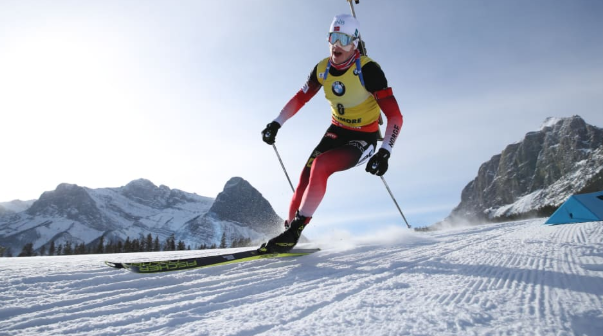
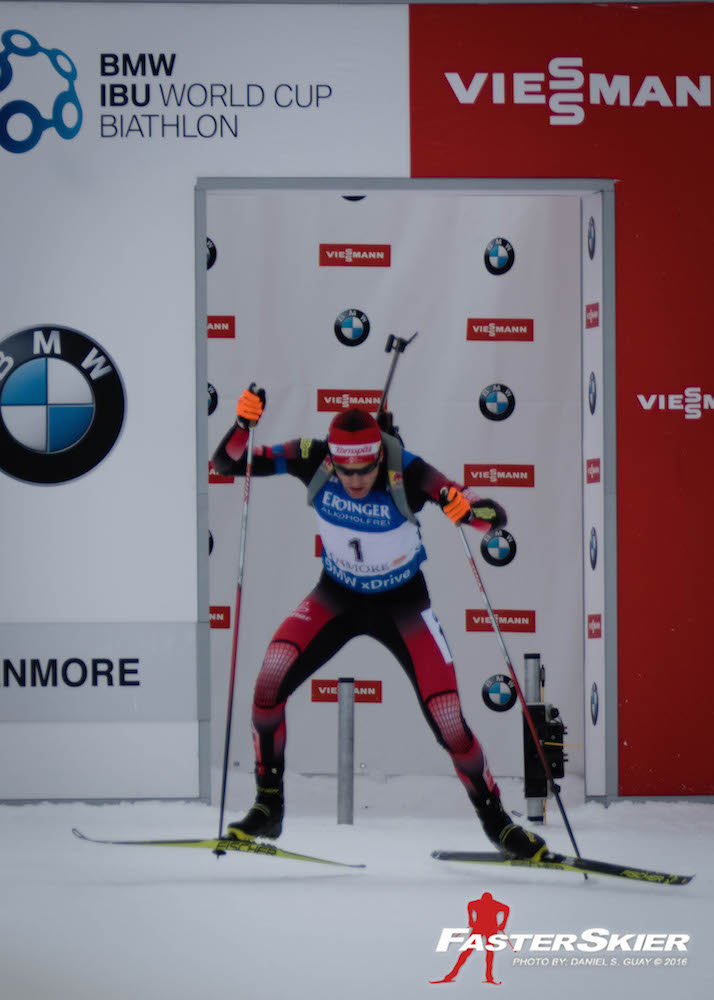
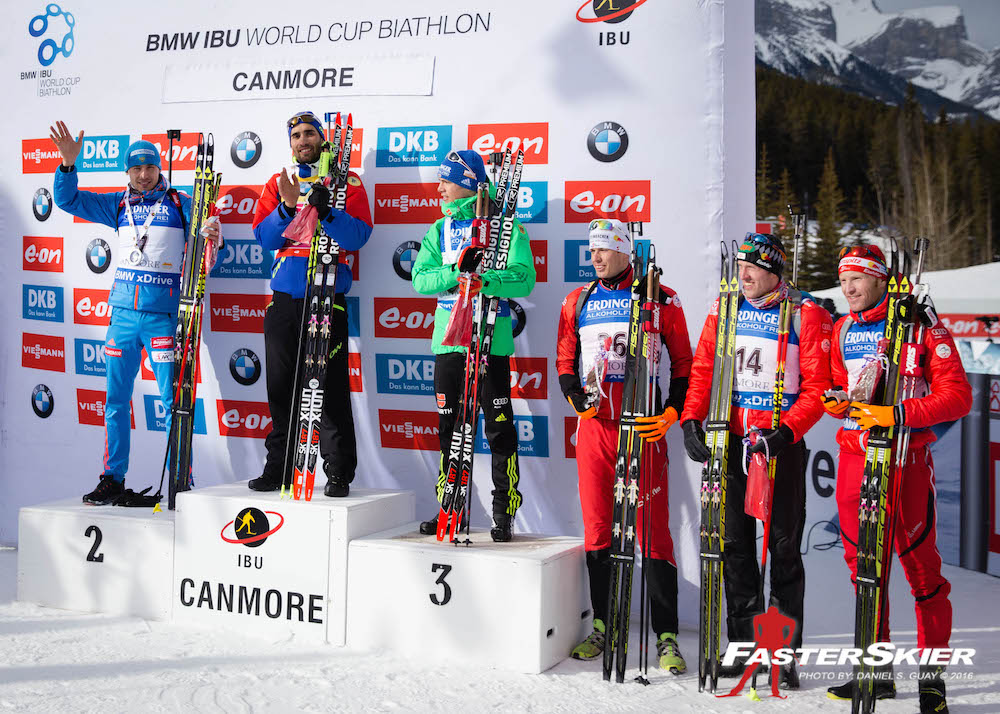
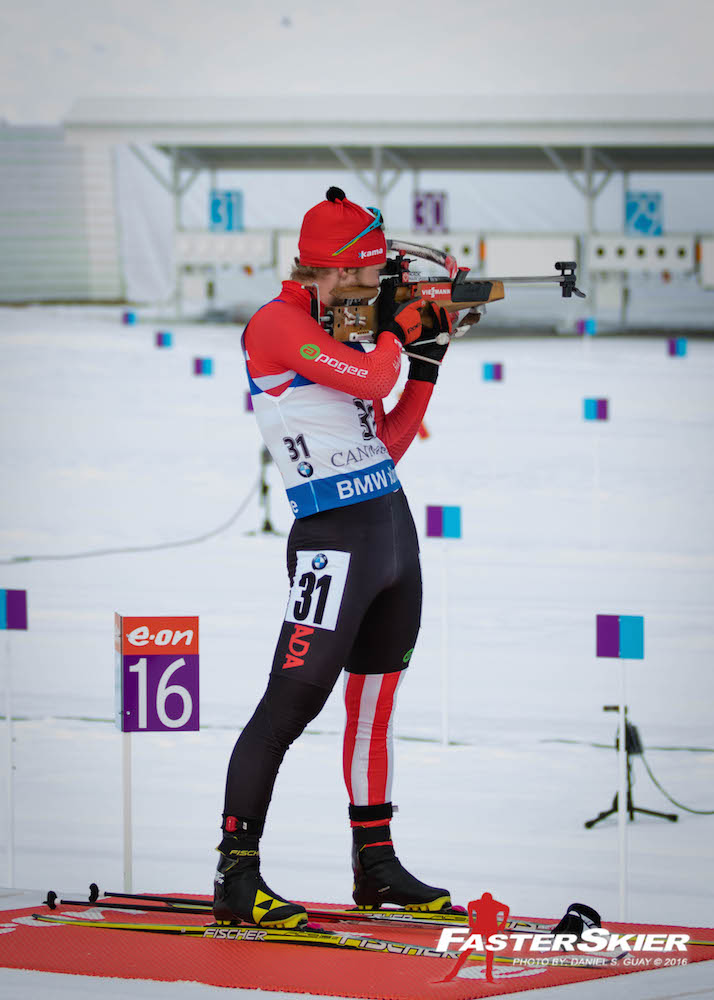
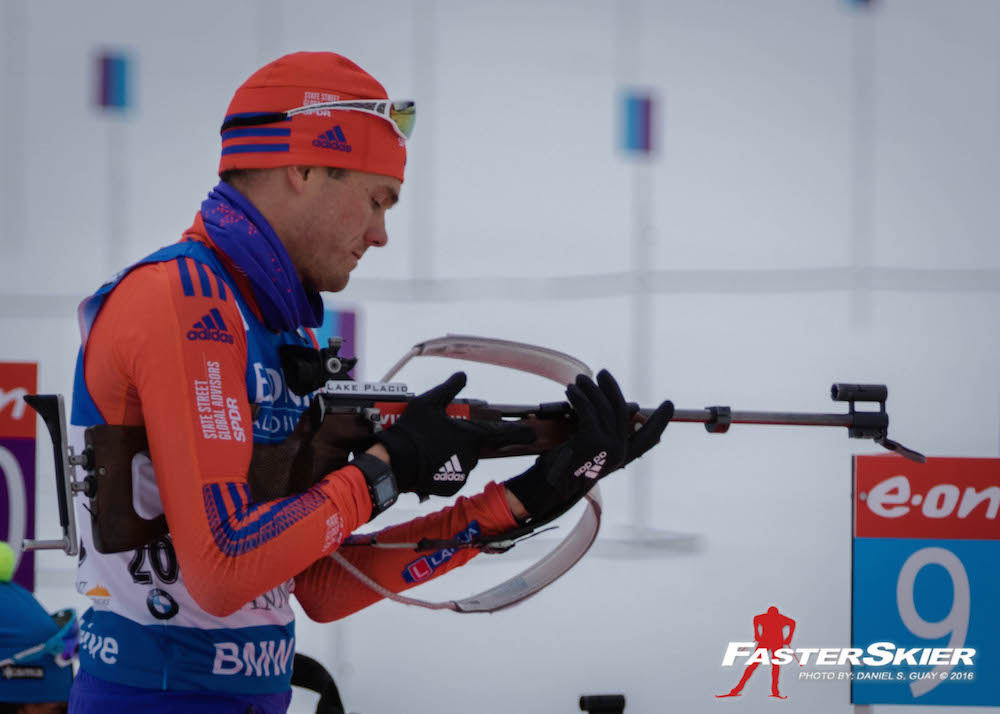
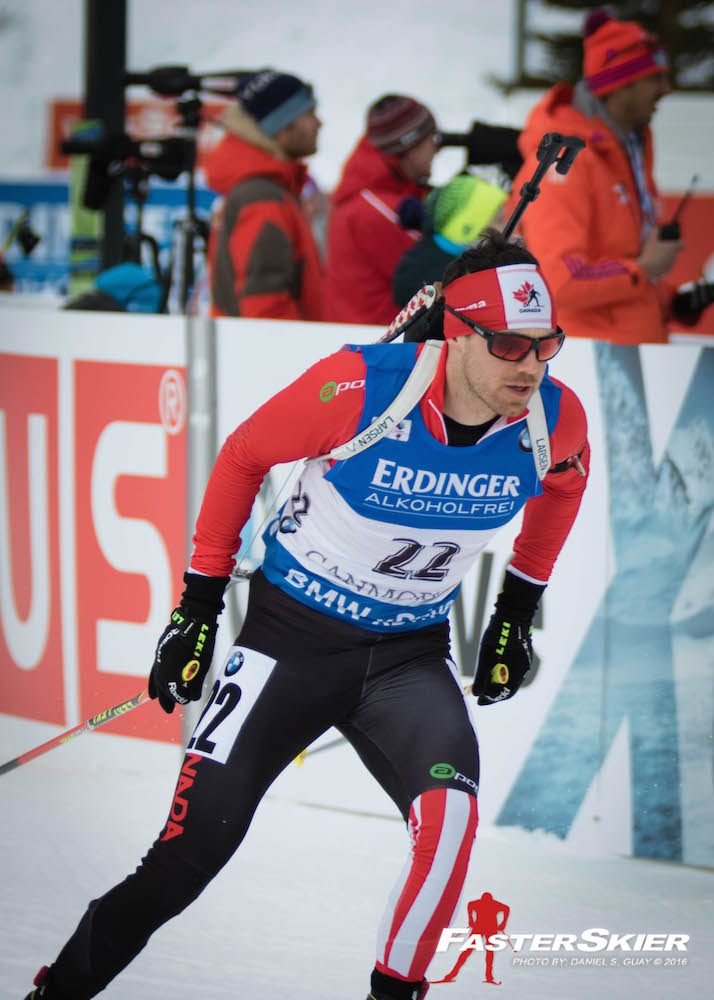
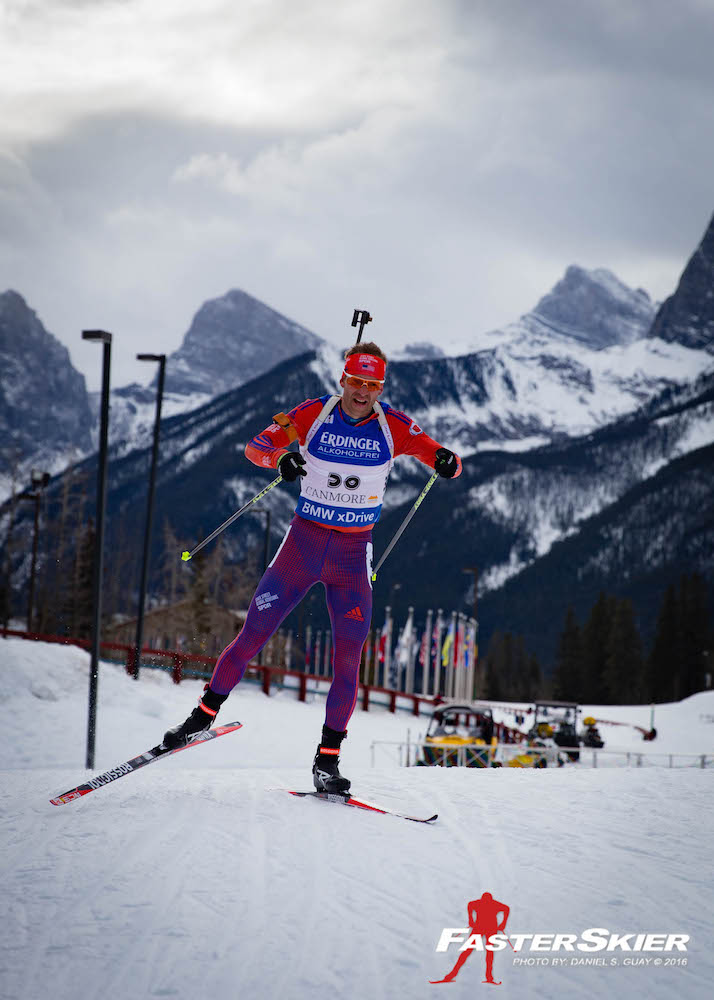
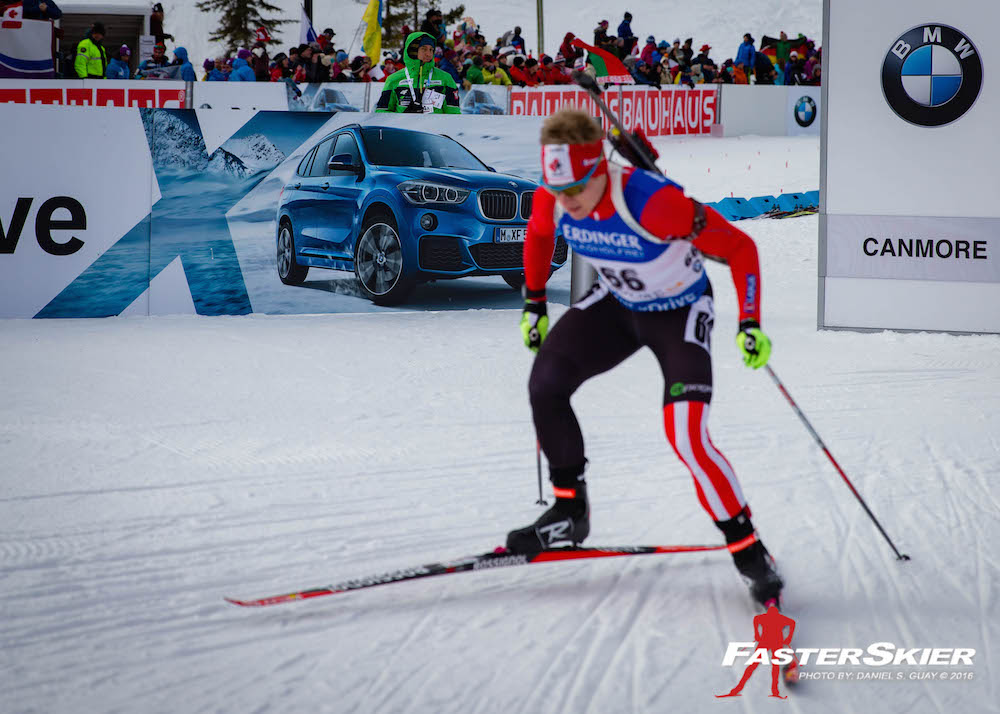
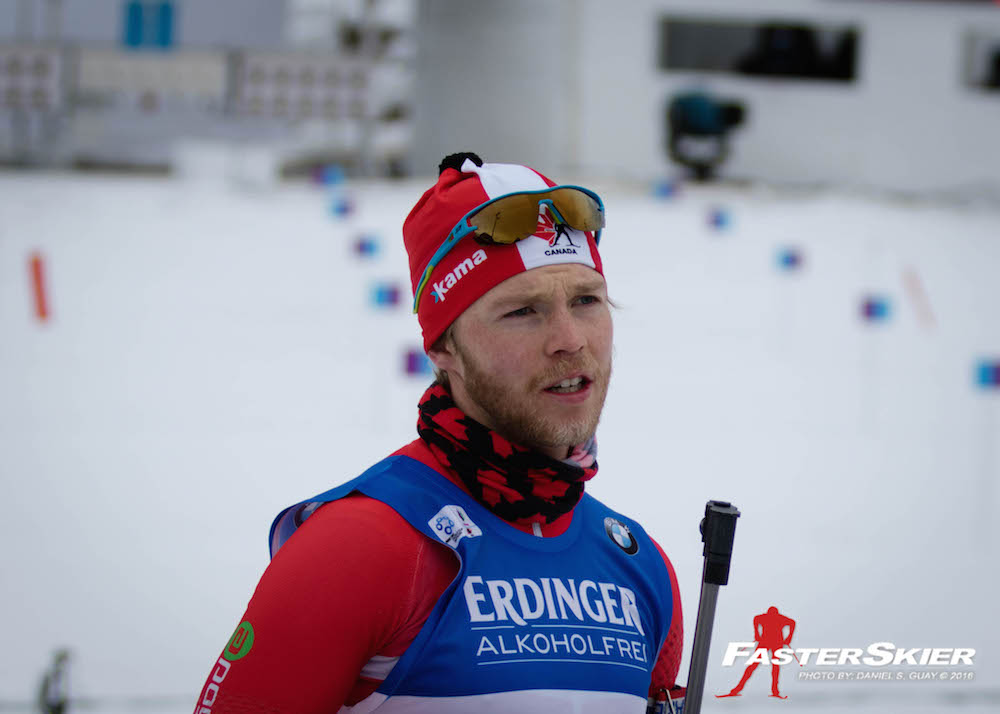
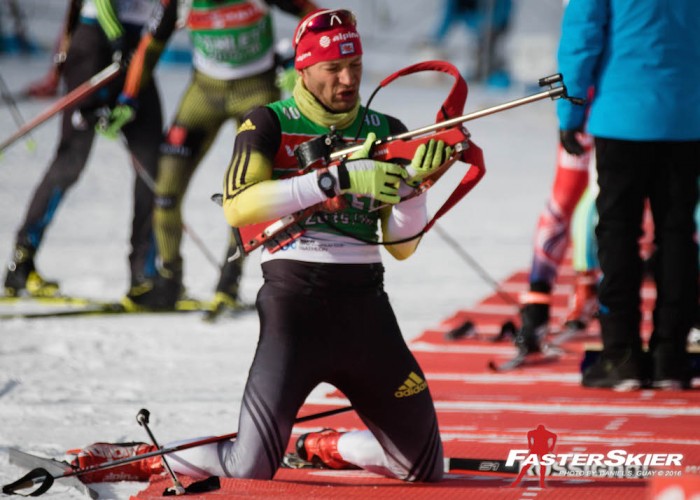
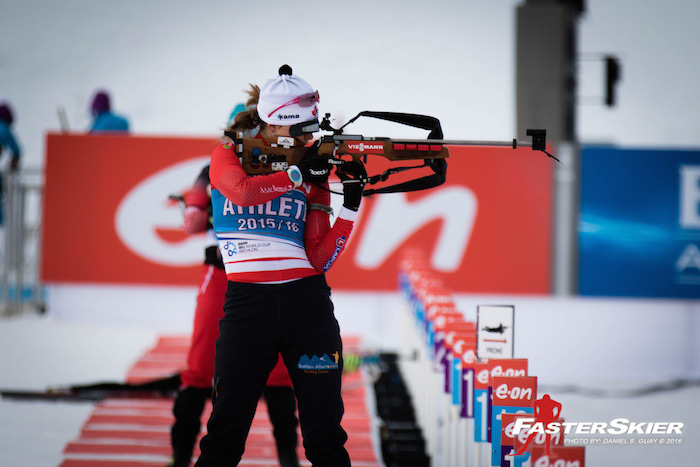
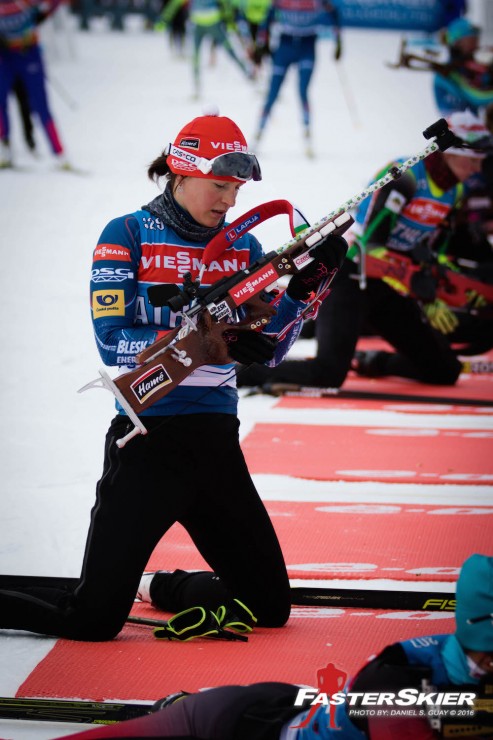
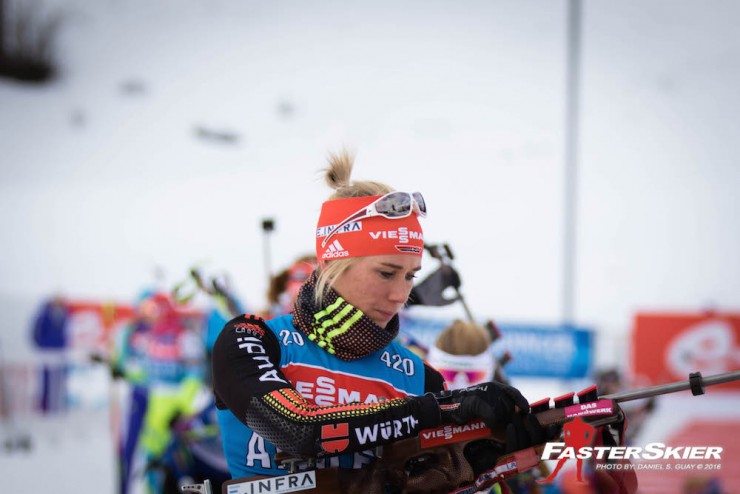
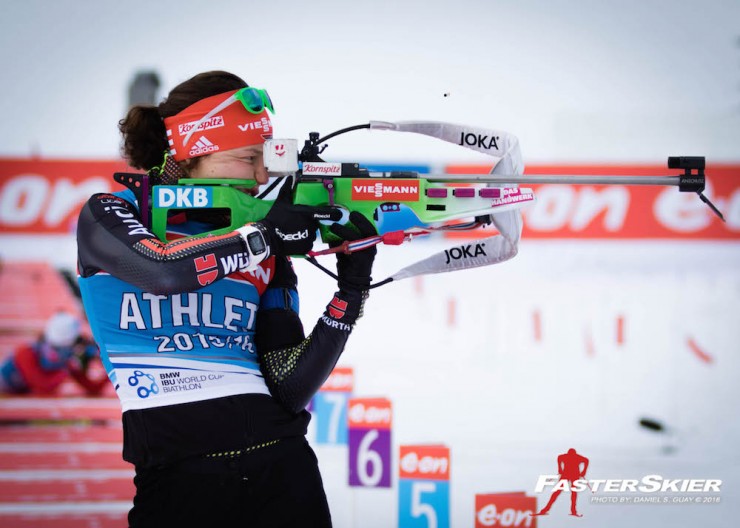
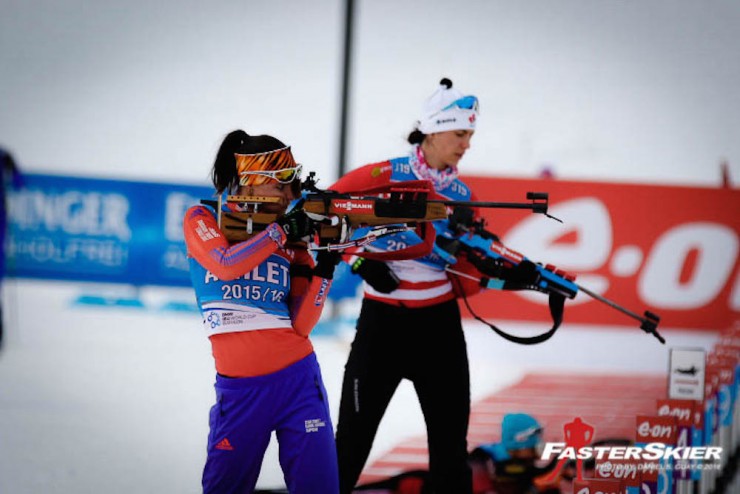
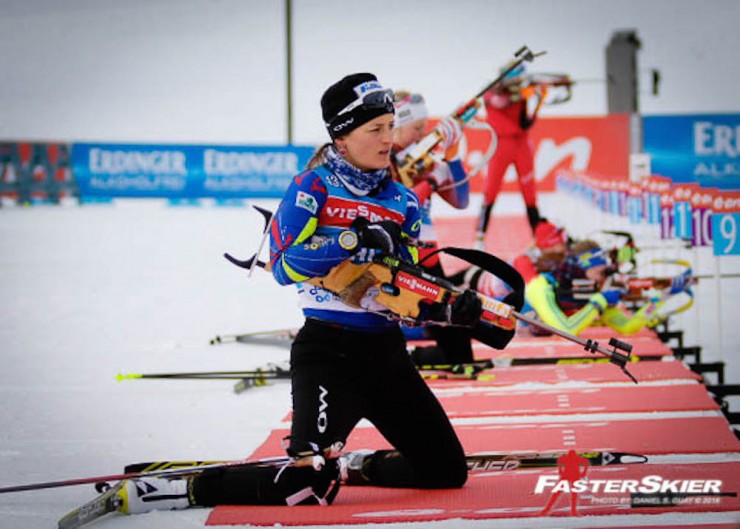
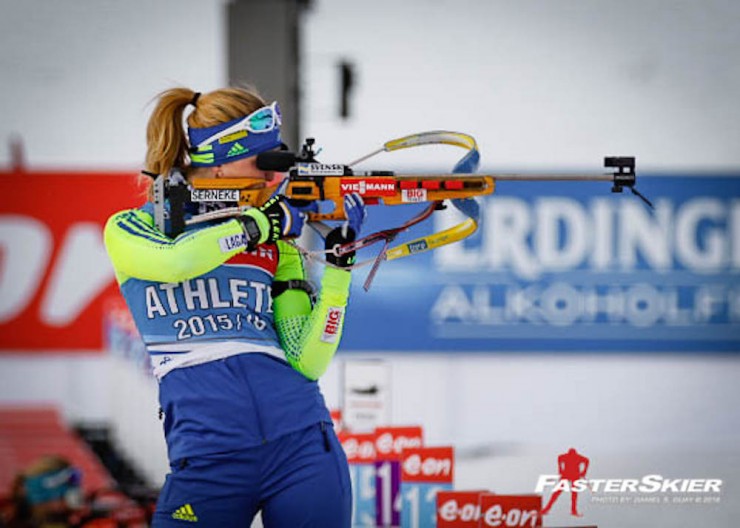
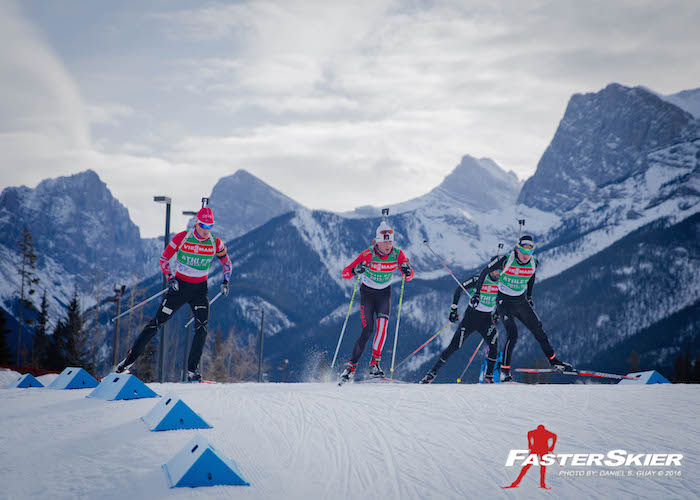
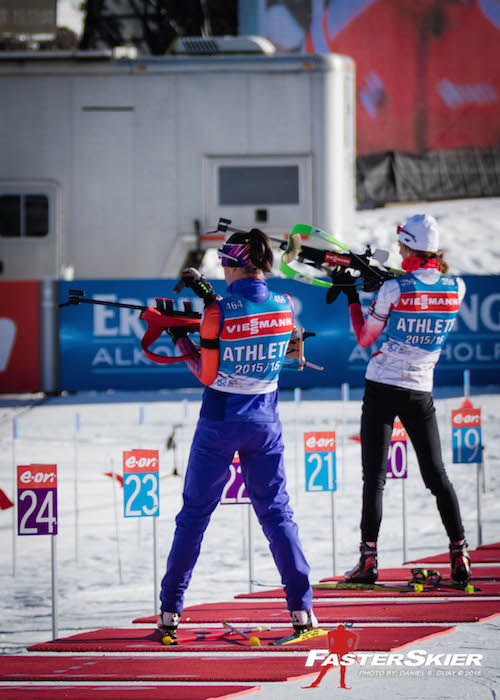
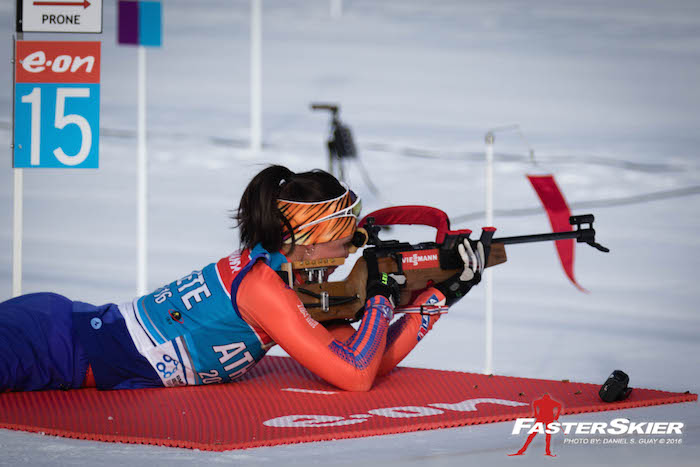
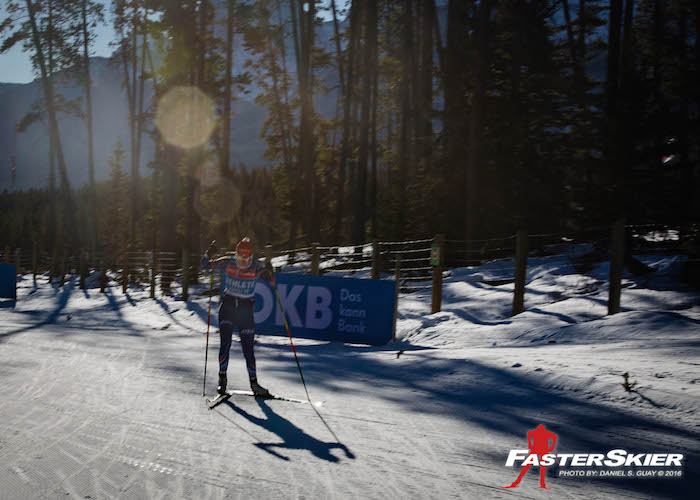
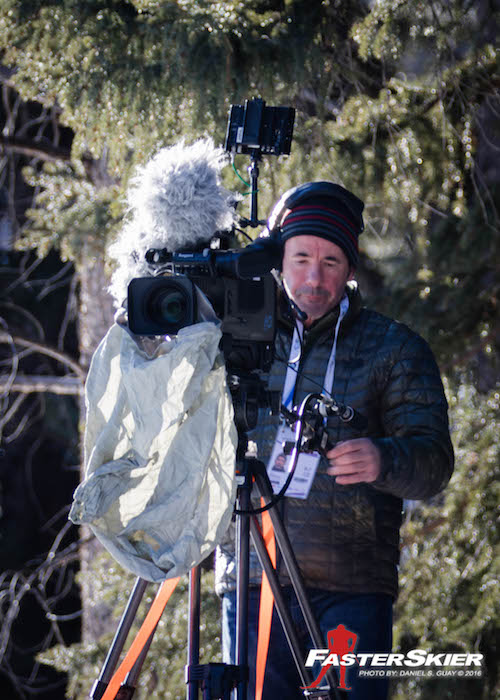
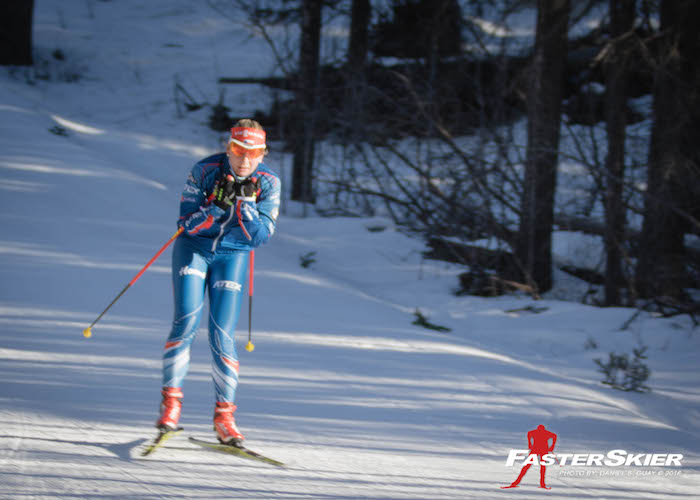
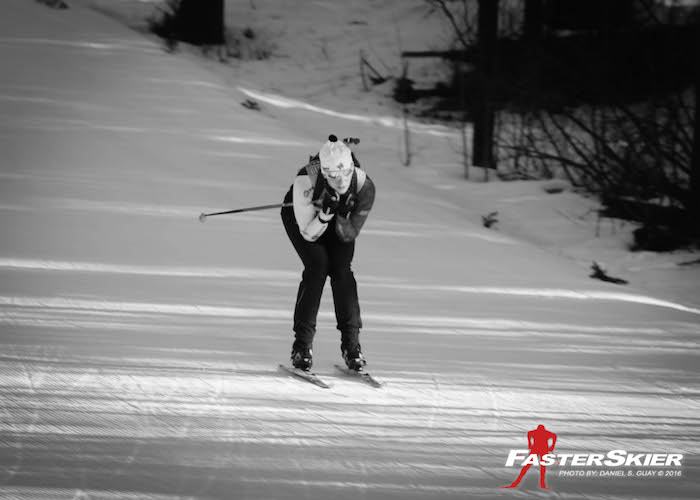
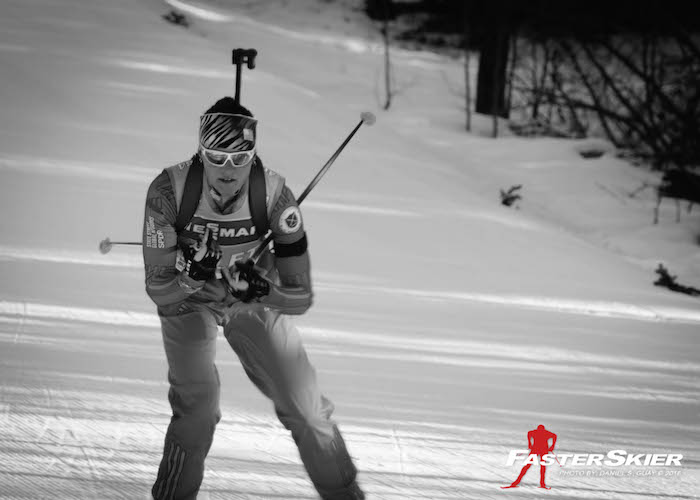
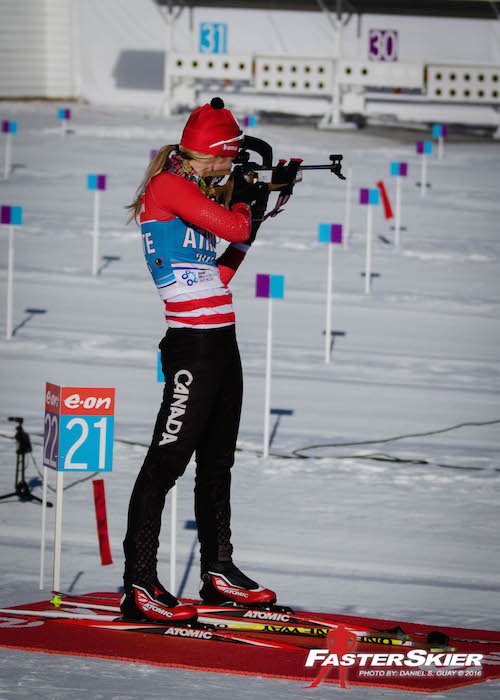
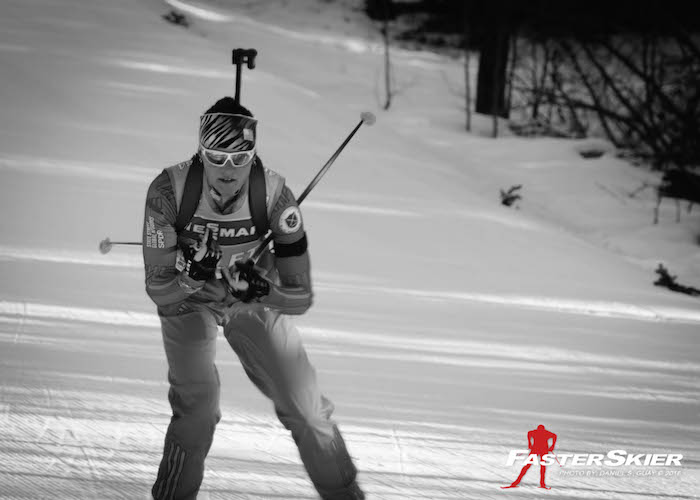
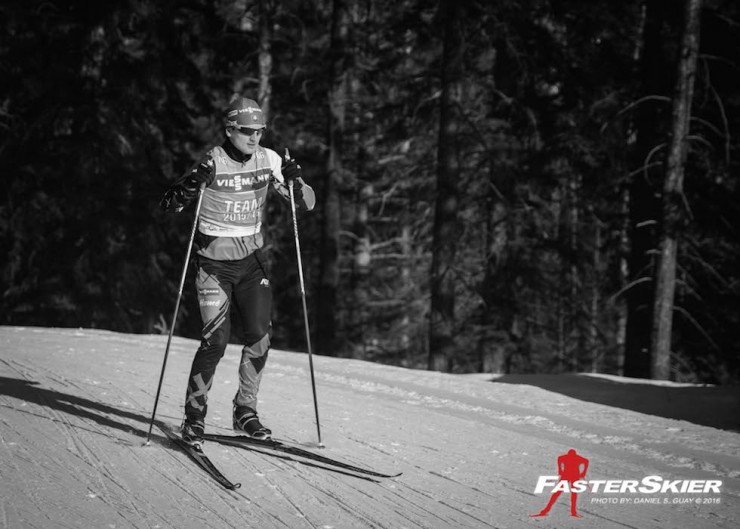
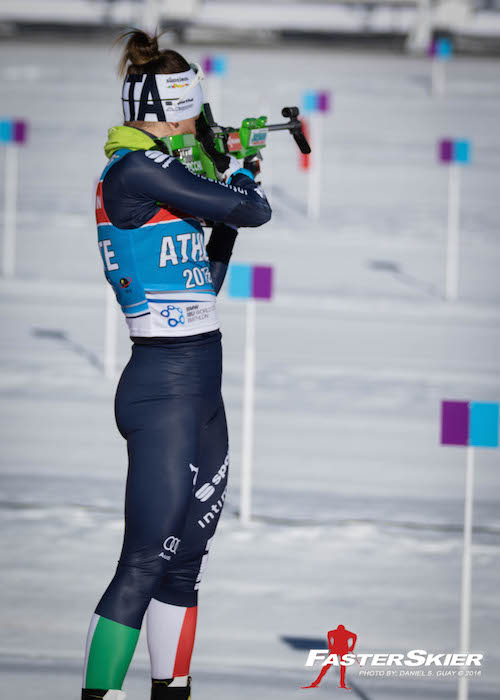
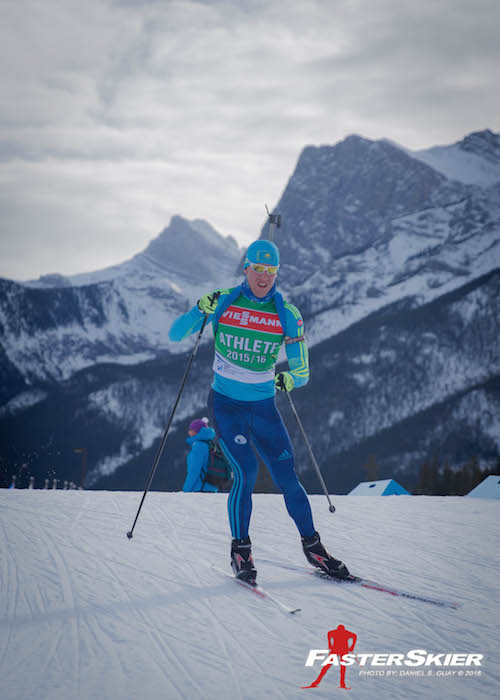
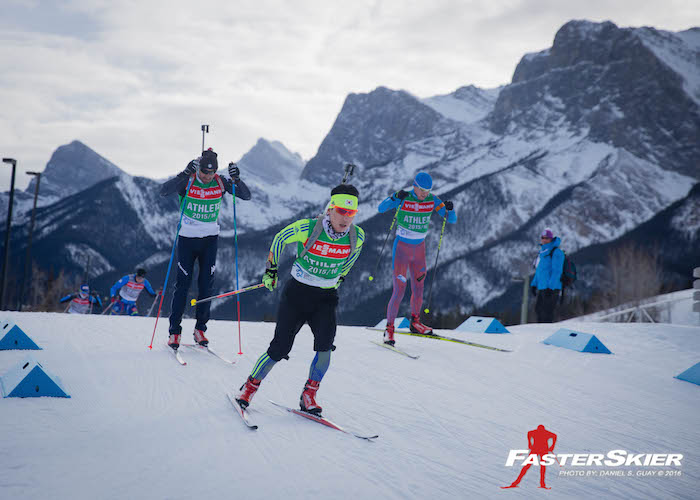
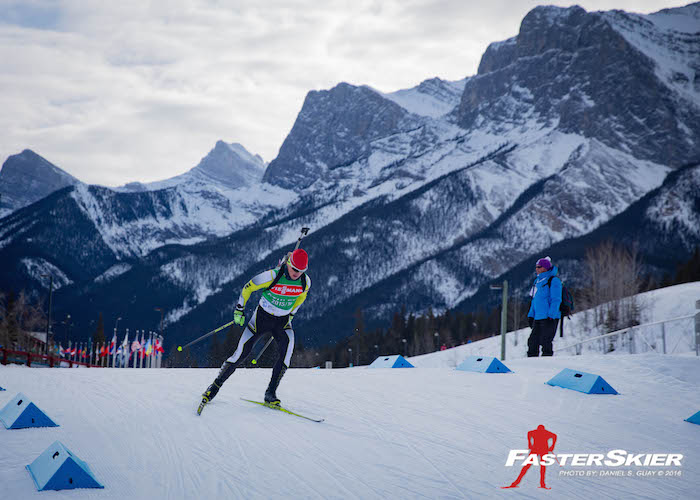
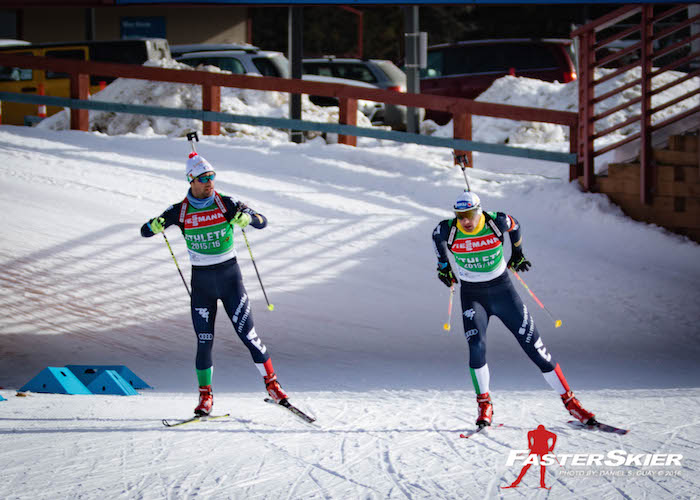
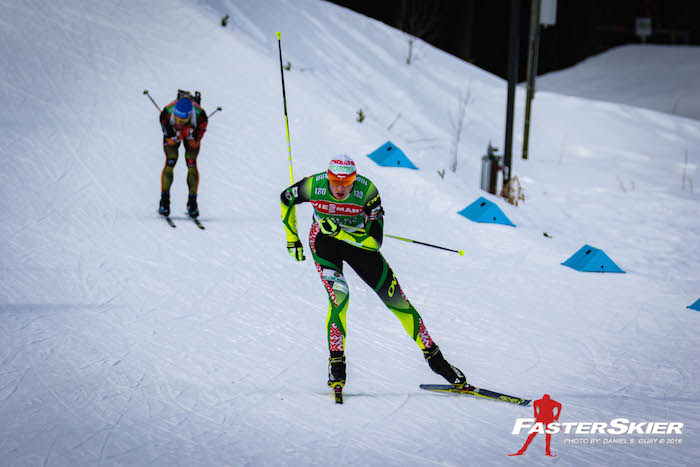
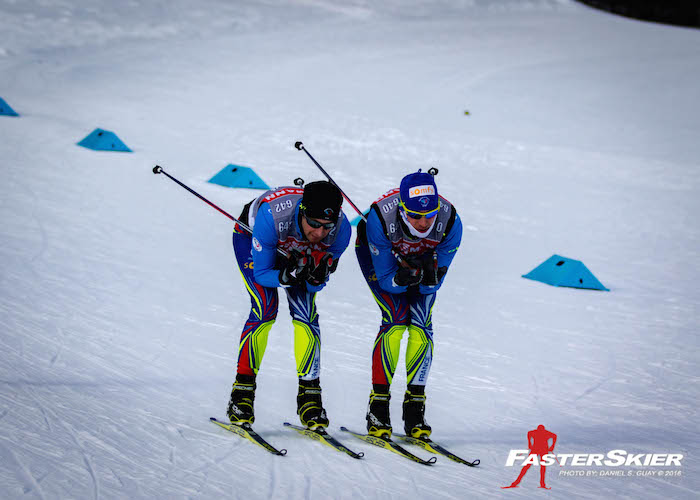
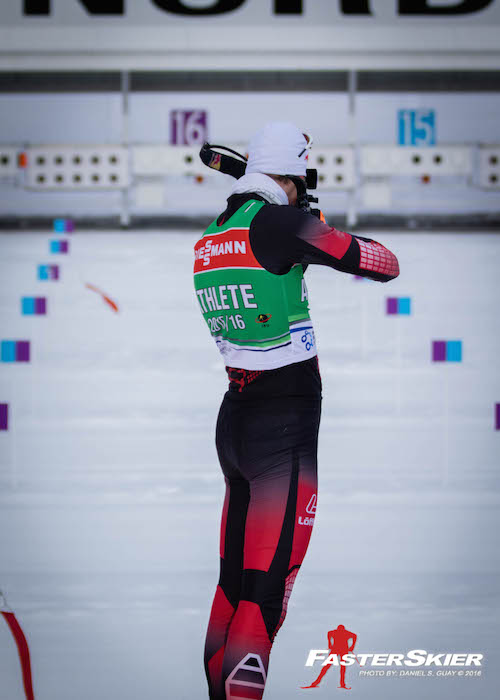
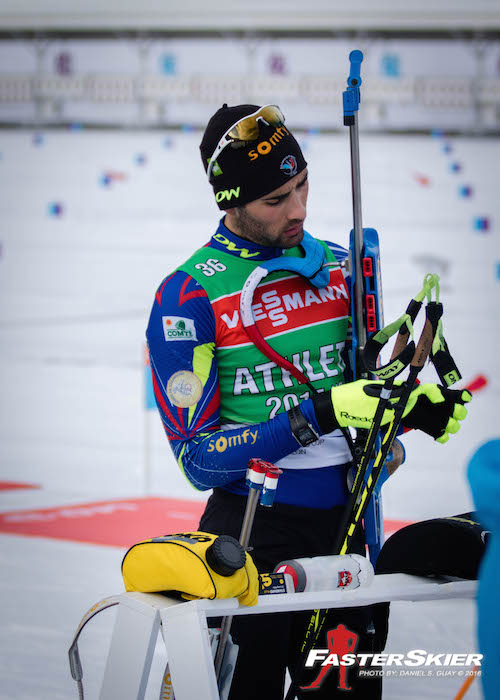
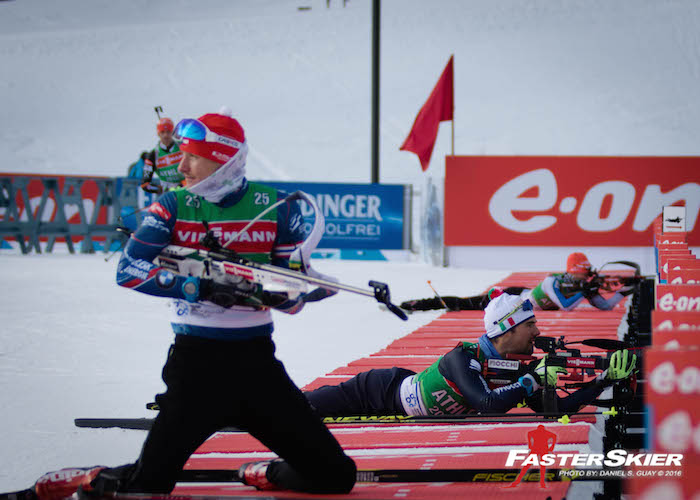
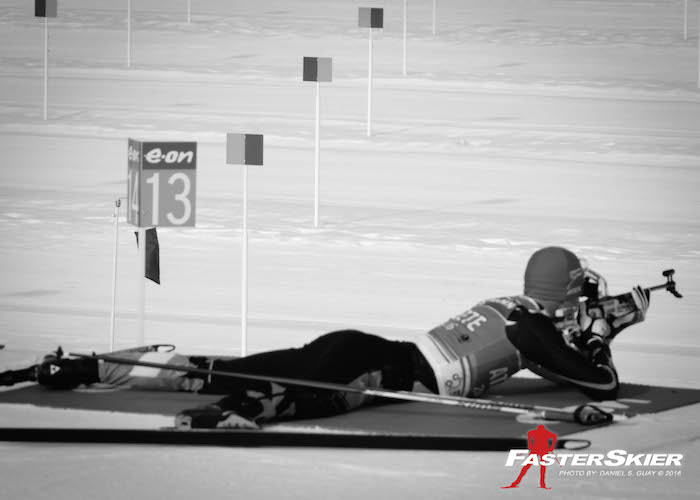
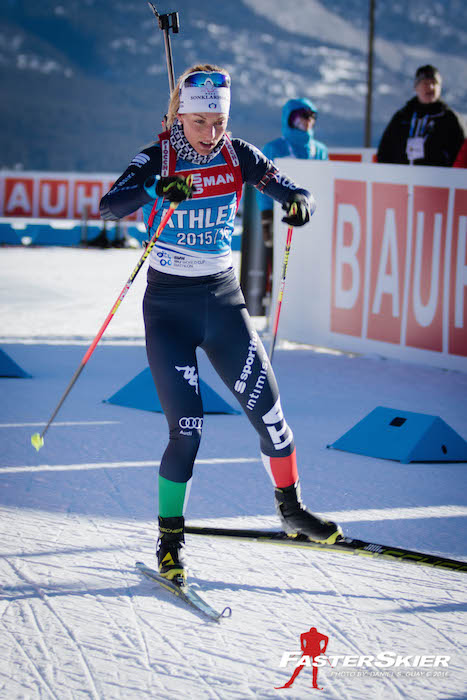
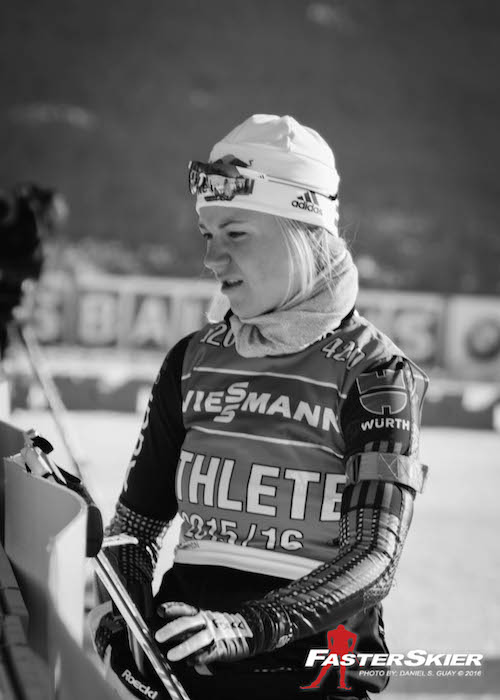
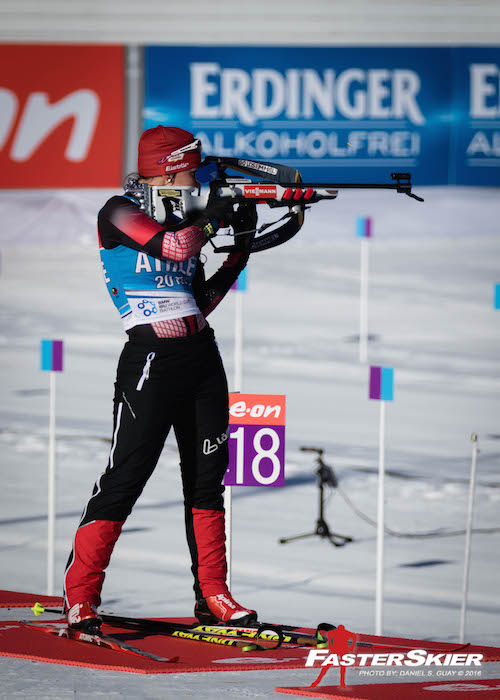
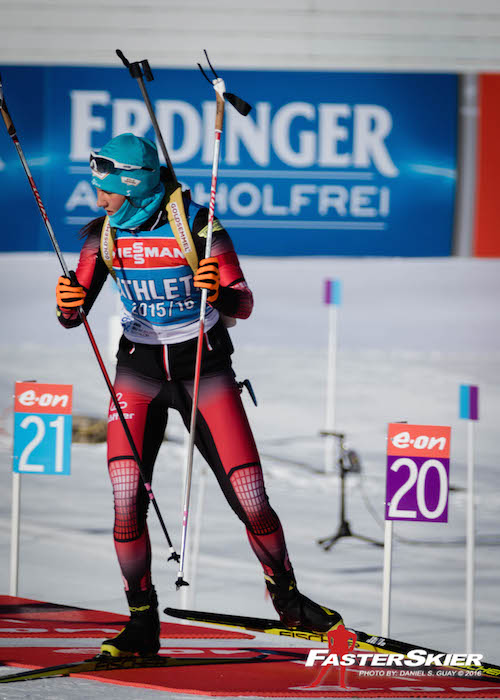
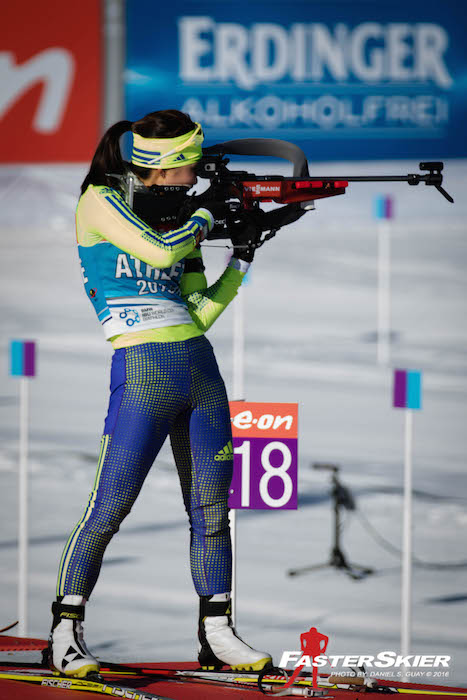
Johannes Thingnes Bø of Norway shot clean and skied fast in Canmore’s 15 k short individual race on Thursday. (Photo: biathlonworld.com screenshot)
IBU World Cup Canmore, Canada 15 k/ 12.5 k Short Individual Races
Sun, mountains, and what may have seemed like relatively warm temps allowed the IBU World Cup events to proceed on Thursday in Canmore, Canada. It’s been Polar Vortex cold in Canmore. Cold enough to thwart the original plans for traditional length 20-kilometer and 15 k individual races, for men and women respectively. With cold temperatures predicted all week, and a window of legal-limit warmer weather punching through on Thursday, the races were shortened to provide enough time during the warming window to hold both races.
For the men, this fill in the blank is easy: _________________ dominated the day in the men’s 15 k short individual race as he shot clean and skied faster than all the others.
Johannes Thingnes Bø of Norway did shoot clean. And he skied fast. And he won in a time of 35:27.9 minutes. For the twenty-four-year-old Bø, it was his 12th win of the season as he continues to cement his grip on the IBU World Cup overall.
His Norwegian teammate Vetle Sjåstad Christiansen, finished second (+2:10.2, 1+0+0+1), with Alexander Loginov in third (+2:41.0, 1+1+0+0).
Canada’s Chirstian Gow posted a career best 10th place. Gow stopped the clock 3:05.4 minutes after the winning time, as he went 0+1+0+0 for a single penalty on the shooting range.
“I didn’t treat the race any differently,” Gow emailed when considering the 15 k format. “It is still an Individual where each penalty is a major set-back so I knew I needed to keep the same focus for the race. It was something new, so a bit more of an unknown going in to it … I actually started a bit harder than I normally would. I wasn’t sure if I could keep the pace going, but in the end I managed it so I’m happy that it worked out!”
For the U.S., Sean Doherty was the second best North American in 27th. Doherty finished 4:29.0 minutes behind, and went 0+1+0+1 on the range.
“Today the shortened format was welcome as the snow conditions were very abrasive and slow. as far as a tactics go the shorter distance is just a bit more aggressive pacing but that’s about it,” Doherty wrote FasterSkier to explain how the shortened race might impact his race strategy.
Much of the past week was prohibitively cold for athletes. Some ventured outdoors for training, with many making due with local gyms and indoor training facilities.
“The cold temperatures as we are dealing with here have some added challenges,” Doherty added. “The biggest one being keeping your hands warm. Lots of people have their own tricks but you usually sacrifice some dexterity in the range but it is necessary because it is even harder to shoot with numb fingers. The other thing you see is the tape on our faces to try to protect frostbite prone areas. Then it’s all about layers and you end up doing a lot of fussing around with all the clothing you are wearing.”
For the U.S., Leif Nordgren raced to 43rd (+5:48.3, 0+1+0+1), Max Durtschi 71st (+7:52.5, 0+2+1+2), Travis Cooper 73rd (+8:01.0, 1+1+1+2).
Also for Canada, Scott Gow placed 40th (+5:42.6), Jules Burnotte 57th (+7:00.2, 3+1+2+0), Aidan Millar 81st (+8:34.0, 2+1+1+2).
The women’s 12.5 k short individual race was run with increasing cloud cover and temperatures hovering around 10 degrees Fahrenheit.
Norway’s Tiril Eckhoff took the win in 36:32.9 minutes with a single penalty. It was Eckhoff’s first career IBU World Cup win in the individual event.
The Czech Republic’s Marketa Davidova raced to second as she cleaned her shooting stages and finished 9.2 seconds back. Lisa Vittozzi of Italy was third, 20.9 seconds behind, while also shooting clean.
Megan Bankes was the top placed Canadian in 26th (+3:14.5, 1+0+1+0). Canmore’s local biathlete Rosanna Crawford was 29th (+3:21.7, 0+1+0+1). Sarah Beaudry was 34th (+3:36.5, 1+0+1+0), and Emma Lunder 63rd (+5:51.3, 1+0+4+1).
Clare Egan was he top American in 43rd (+4:17.5, 1+0+1+2). Joanne Reid skied to 64th (+5:55.9, 0+2+1+1), Emily Dreissigacker 66th (+6:07.1, 0+0+0+2).
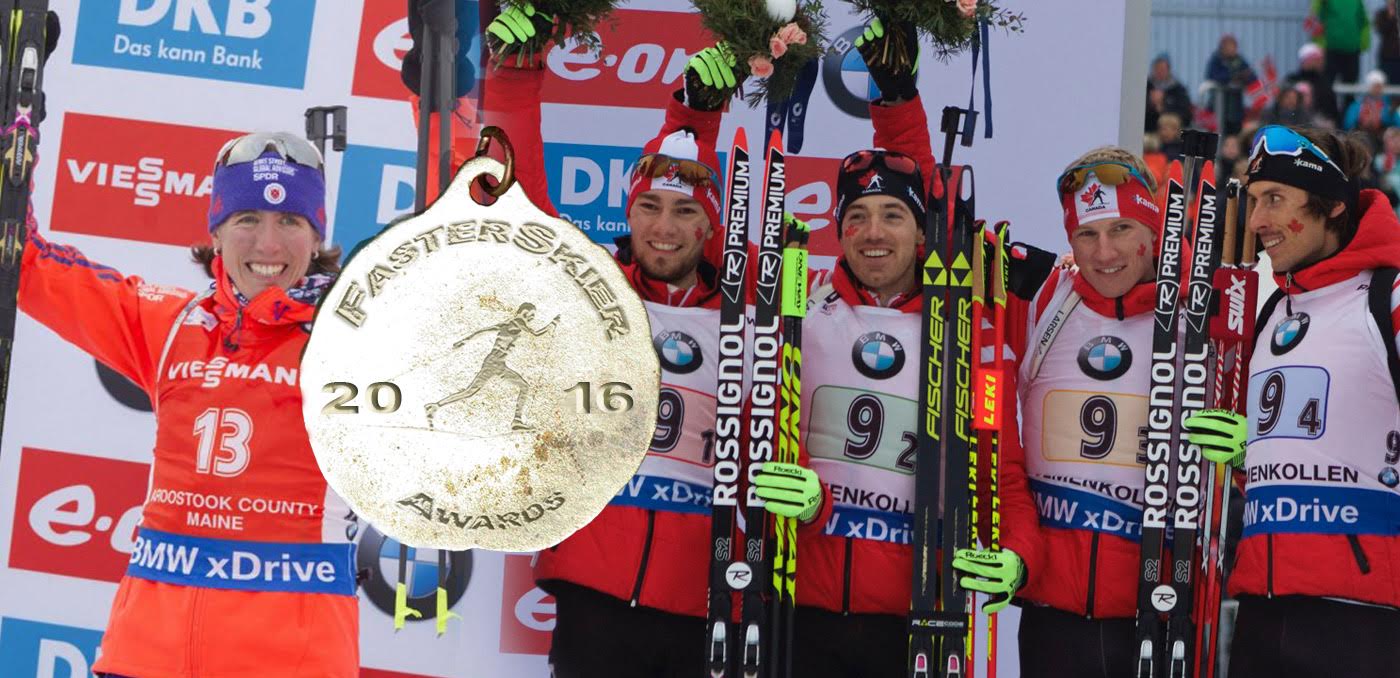
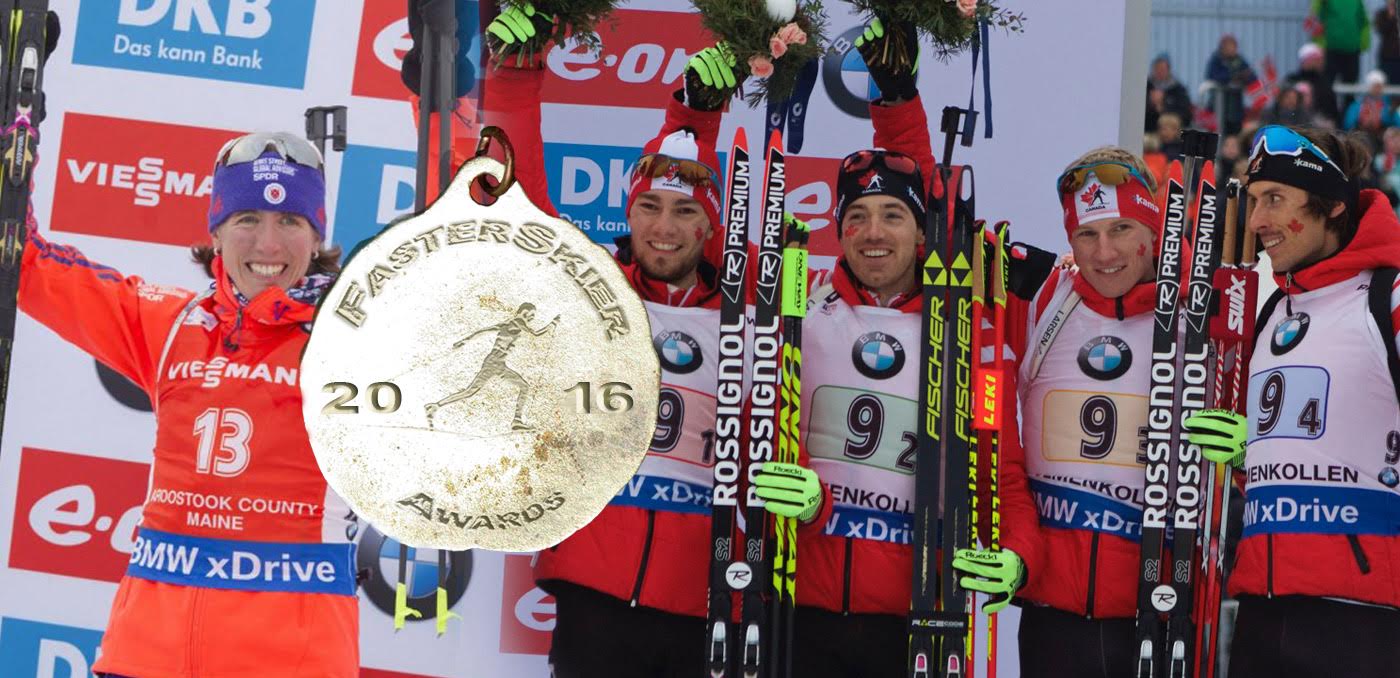
American Susan Dunklee (l) and the Canadian men’s relay, with (from l to r) Christian Gow, Nathan Smith, Scott Gow, and Brendan Green, earned FasterSkier’s biathlon performances of the year with their results at the Presque Isle World Cup and World Championships, respectively. (Photos: USBA/NordicFocus & JoJo Baldus)
We’re entering the homestretch for the 2015/2016 FasterSkier awards, chosen by our staff based on performances last season. While not scientific, these points of recognition are intended to reflect a broader sense of the season in review.
The following set of honors goes to outstanding North American male and female biathlon performances of the year. Cross-country performances of the year will follow.
Susan Dunklee (US Biathlon): Presque Isle World Cup 10 k sprint
Both Susan Dunklee and teammate Lowell Bailey seemed to have breakthroughs after the 2014 Olympics in Sochi, Russia: they had notched best-ever finishes for Americans, with Dunklee 11th in the mass start and Baily eighth in the individual, and then picked up their first World Cup podiums in the weeks post-Olympics.
Heading into 2015, the team (as well as its fans) was giddy with the possibility of more podiums. But none came.
Dunklee delivered this season in Presque Isle, Maine, exactly where those fans could most appreciate it. Shooting a perfect 10-for-10 in the 10-kilometer sprint, she sped past many pre-race favorites and finished second, 17.8 seconds behind Gabriela Soukalova of the Czech Republic (who later won the World Cup Total Score).
“I knew I probably had one of my best races in my life and I’d done it at home and my parents were there,” Dunklee said after the race. “I just felt really good about my performance. I was really happy.”
It was close, with second through fourth place separated by fewer than three seconds. But Dunklee, an early starter, got to watch her time hold despite challenges from the likes of Marie Dorin Habert of France.
“You still need to fight like hell,” Dunklee recalled of heading out on the final loop knowing that times were tight. “When you’re having that sort of race, you don’t want to lose a second anywhere … I’ve just got to fight for the next seven minutes or whatever it takes.”
Dunklee had a solid season, just as she has for each of the last several years; consistency on the World Cup circuit landed her in 14th place in the Total Score, the best ever for an American woman.
But consistency doesn’t breed excitement quite the same way that podiums do.
“It’s unbelievable,” U.S. women’s coach Jonne Kähkönen said. “Just to be able to grab the podium on the home soil, home World Cup, even if it’s not the hometown, but there’s a lot of friends and family and fans that are great support. The local community is just awesome, so it means the world to us.”
Dunklee is now tied for the best performance ever by an American, along with Tim Burke, Anna Sonnerup, Joan Smith, and Josh Thompson, all of whom also won silver at World Cup or World Championships events.
Next up? The U.S. is still waiting on a gold.
Canadian men’s relay team (Christian Gow, Nathan Smith, Scott Gow, and Brendan Green), World Championships men’s 4 x 7.5 k relay
While Dunklee’s second-place finish was historic, it didn’t send the same shock waves as another record-setting result which came a few weeks later: when the Canadian men’s team broke through for bronze in the World Championships relay in Oslo, Norway, earning their country’s first-ever relay medal.
“In a relay anything is possible,” anchor racer Brendan Green said at the time. “Today we all really put it on the line together. Every single one of us raced really well. When that happens, when things come together like that, it’s really incredible.”
It was easily the most surprising result of the championships, and the athletes themselves said that they hadn’t seen it coming – they had thought a top five was possible. The medal? Maybe in a few years, they had hoped.
Some aspects of the performance were predictable. The Canadians tied with Germany and the U.S. for the best shooting on the day – not surprising because they already were a great shooting team, with Christian Gow the fourth-most accurate shooter on the World Cup and Smith the fifth-fastest.
And seeing Nathan Smith bring the team to the front of the field? He has won an individual World Cup, so that wasn’t unusual.
Seeing Green anchor the team like a pro? He has done it dozens of times, and also has five individual top-10 finishes to his name – although shooting a perfect ten-for-ten when a medal is on the line is a whole different story. Green was stone-cold as the anchor even though he said his nerves were a nightmare.
Perhaps what fans hadn’t been expecting were the stellar performances of the Gow brothers, who are the younger members of the Canadian team. Christian Gow, then 22 years old, tagged off just 14.7 seconds behind the leaders on leg one, handing over to Smith, who skied into a more or less dead heat with the leaders on leg two.
Older brother Scott, 25, turned in one of the best ski performances of his career, casually hanging with Norway’s Johannes Thingnes Bø, a many-time World Cup winner who later went on to take gold in the 15 k mass start.
“Watching Christian tag off really close, and then Nathan obviously moved us right into contention… I thought, OK, I have to [stay with him], I don’t have a choice,” Scott said. “I don’t know if I believed I could, but I had to, to try and keep our team in it. I’m just happy that I was able to stay right behind Johannes for most of it and hang on.”
He did hang on, tagging off in third; Green sealed the deal; history was made.
“Every year you kind of think it’s coming,” National Team Coach Roddy Ward said. “It’s close, it’s close, and we’ve been close for a couple of years. We were close enough, I guess, that on the right day we were there.”
Maybe next time the commentators won’t be so surprised.
Honorable mentions:
Canadian mixed relay team (Rosanna Crawford and Nathan Smith), single mixed relay at Östersund, Sweden, World Cup
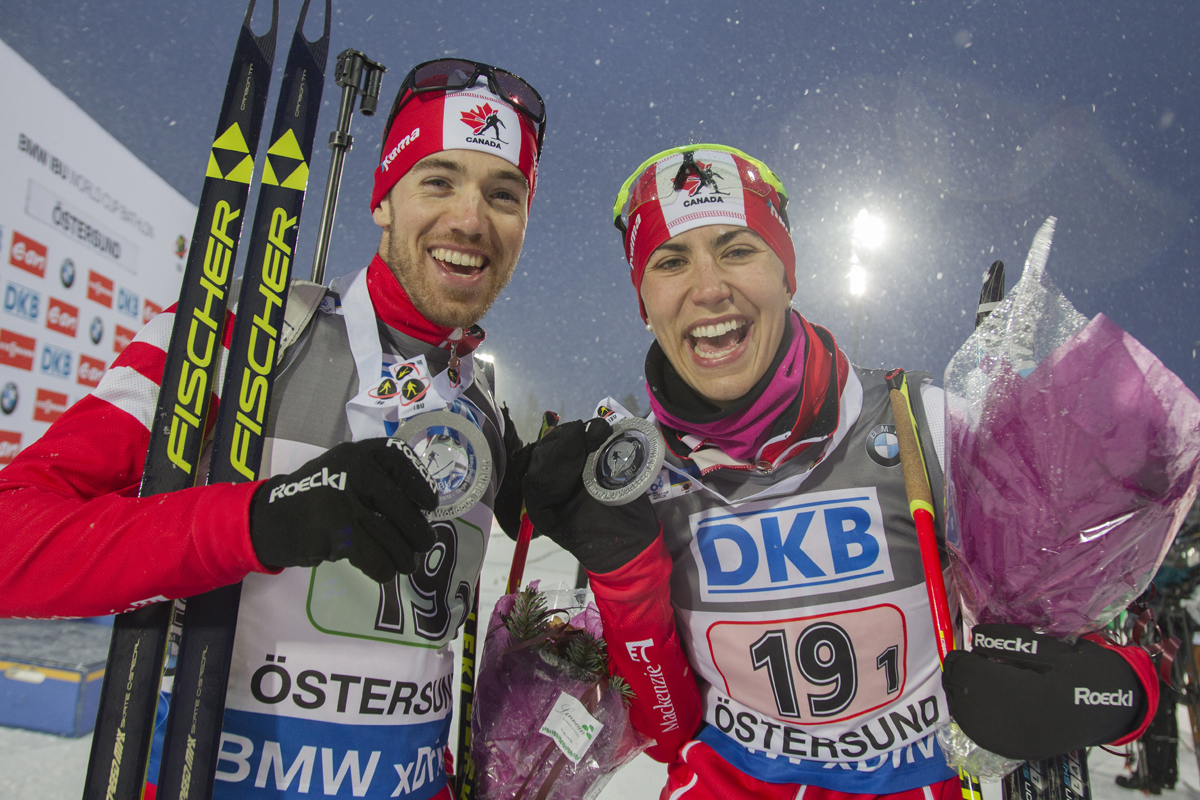
Nathan Smith and Rosanna Crawford celebrate their second-place finish in the World Cup single mixed relay in Östersund, Sweden. (Photo: Fischer/NordicFocus)
Canada had actually started the year off with a relay “bang”: in the very first World Cup competition of the season, Nathan Smith and Rosanna Crawford teamed up for silver in the mixed relay.
Despite a rocky start and nine spare rounds, they managed to avoid the penalty loop and finished 11.9 seconds behind Norway, claiming Canada’s first ever World Cup relay podium.
“It feels amazing,” Crawford said at the time, before pointing out that she’s still hunting for her first individual podium. “I don’t want to downplay it. Those team events, it feels so exciting and I feel so lucky to share the podium with my teammate who I’ve trained with for so long. But also, it’s probably not the same as an individual podium, which is definitely what I’m gunning for this year.”
U.S. (Susan Dunklee, Hannah Dreissigacker, Tim Burke, and Lowell Bailey) and Canadian (Rosanna Crawford, Sarah Beaudry, Macx Davies, and Brendan Green) mixed teams, Mixed relay at Canmore World Cup
Perhaps team events were just the thing for North American biathlon teams this season. In Canmore, Alberta, both the Americans and Canadians were in the hunt for the podium until late in the race. The U.S. ended up fourth, less than two seconds off the podium, and the Canadians ten seconds behind them in sixth.
The result was a best-ever mixed relay for the U.S., with Canada tying its previous best in the two-man, two-woman event.
“It’s easy to say, ‘Oh man, if I had known, I would’ve skied two seconds faster,’ but I really don’t think I could’ve,” U.S. anchor skier Lowell Bailey said of finishing less than two seconds out of third. “I put everything I could have into that last lap. It’s bittersweet, but it’s also our best result ever in the mixed relay. … Fourth is where we ended up, and I think we have to be satisfied with that and keep that momentum going forward.”
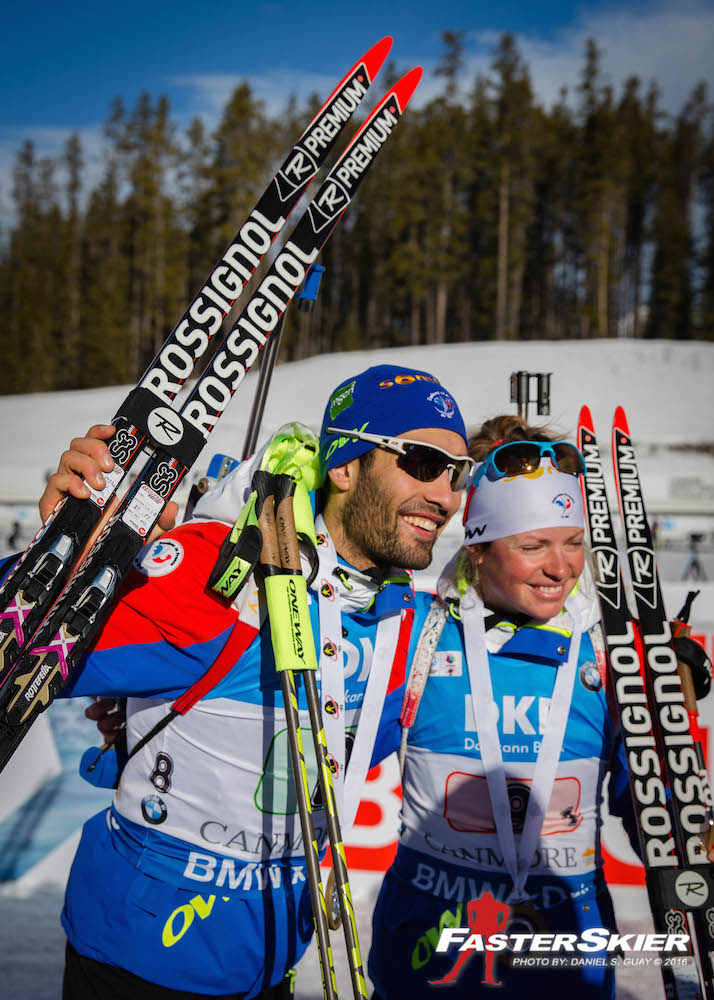
Teammates in the single mixed relay on Sunday, France’s Martin Fourcade and Marie Dorin Haber after winning the first of two relays on the last day of the IBU World Cup in Canmore, Alberta. (Photo: Daniel S. Guay)
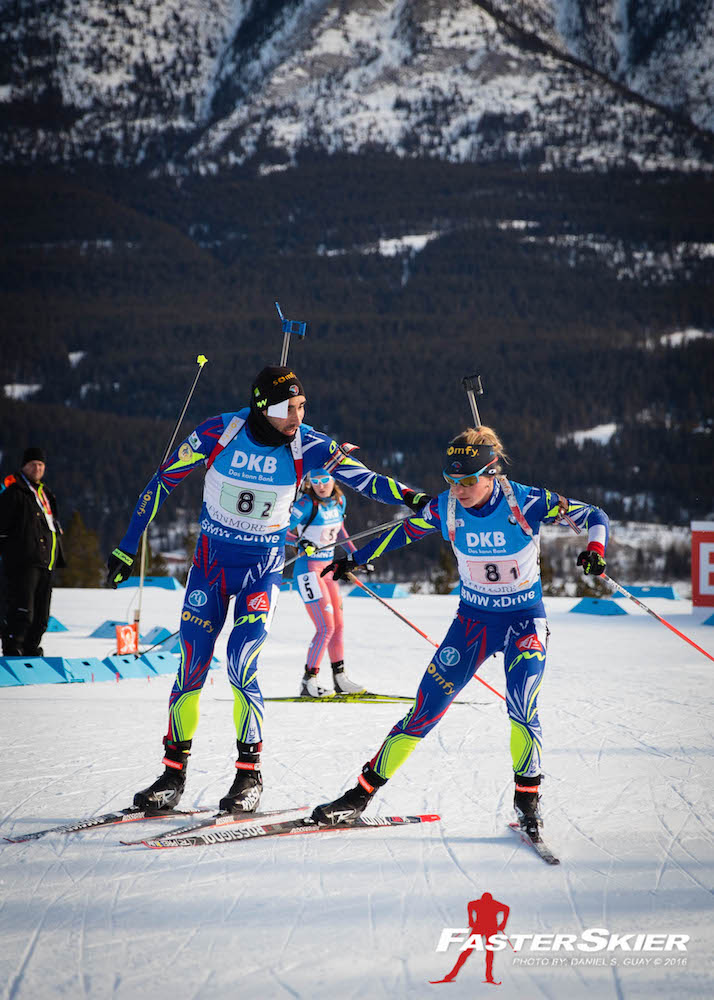
France was determined to win the International Biathlon Union (IBU) World Cup 13.5-kilometer single mixed relay on Sunday in Canmore, Alberta, using their best athletes with men’s overall World Cup leader Martin Fourcade and Marie Dorin Habert, who ranks third in the women’s standings. And they succeeded in convincing fashion, finishing first in 37:58.0 minutes, with four spares and no penalties.
The first time the new race format was on the calendar this season at the World Cup in Östersund, Sweden, the French duo of Dorin Habert and Martin’s older brother Simon Fourcade thought they had won the race, but because Fourcade had not fired a shot during the competition the team was slapped with a four-minute penalty, putting them back to 21st place.
On Sunday morning, France made no such mistakes and didn’t leave the other teams any chance in nearly a start-to-finish victory. Dorin Habert took the lead out of the arena, stayed there for most of her leg and tagged narrowly in first place, before both Fourcade and Dorin Habert expanded their lead on the next three legs with good shooting and fast skiing. Fourcade put an exclamation mark on the victory by sprinting into the finish despite knowing he had a comfortable lead of more than half a minute on the final loop.
“It was a really exciting race. I like these kind of short races. I tried to be as strong as Martin, it’s an honor to run with him,” Dorin Habert said at the post-race press conference. “It was in our head before the competition to win, but this is biathlon and everything can happen on the [shooting range].
“I tried to train the finish, I think that was a good opportunity,” Fourcade explained during the press conference. “But I actually didn’t compete the full last loop,” he added with a smile. “I only did for some parts, the ones in front of the TV.”
“Today I was satisfied even if I needed two extra shots, two too much,” Fourcade later told the IBU in an interview. “It was a good competition for both of us.”
France’s Martin Fourcade (l) tags teammate Marie Dorin Habert for her the third of four legs in the single mixed relay at the IBU World Cup in Canmore, Alberta. They ended up winning by 45 seconds. (Photo: Daniel S. Guay)
Second place went to the Austrian duo Lisa Therese Hauser and Simon Eder, 45.2 seconds back, with eight spares and no penalties. It was Hauser’s first World Cup podium.
Norway’s Hilde Fenne and Lars Helge Birkeland secured the third spot on the podium, 55.3 seconds back, with seven spares and no penalties. Birkeland defended his lead on the final loop, coming into the finish two seconds ahead of Russia’s Olga Podchufarova, who teamed up with Alexey Volkov to finish fourth (+57.3), with no penalties and just two spares.
New since the 2014/2015 season and only held for the third time at the World Cup level on Sunday, the single mixed format was established by the IBU to have another action-packed event and give “smaller” biathlon nations a shot at the podium. For some countries, it presented an opportunity to start a team event. It is not yet a part of Biathlon World Championships or Olympic Games.
“The single mixed relay is interesting for smaller nations, because they maybe don’t have five women and five men who can compete with the top, but maybe one or two,” Canadian head coach Matthias Ahrens told German TV broadcaster ZDF in an interview before the race. “Then you can use those in the mixed or single mixed relay, thereby potentially getting a chance to reach the podium, which worked pretty well for us at the season-opening in Östersund [where Canada placed second].”
On Sunday, some teams, such as France — though not an example for a “small” biathlon nation — Austria and Latvia (in eighth place), made use of that by putting their best racers in the event. Other teams decided to focus on the “normal” mixed relay, with two women and two men on each team, that followed later on Sunday in Canmore.
The single mixed relay features the shortest loops in biathlon, with the athletes skiing a 1.5-kilometer loop between each shooting stage, then immediately exchanging after the standing shooting. After the female team member starts and shoots one prone and one standing stage, she exchanges to her male teammate, then the woman gets tagged again to ski the third leg (six kilometers total), and the man closes out on the fourth anchor leg racing an additional 1.5 k after the final standing shooting, which adds up to the odd 13.5 k distance. The athletes are allowed to use three spare rounds per shooting like in a normal relay, and the penalty lap is also shortened to 75 meters (usually 150).
Thus the whole race is extremely fast-paced, and rather resembles a cross-country team sprint than a traditional biathlon or cross-country relay.
“This was a new start for me in the World Cup, because I never did a single mixed relay before,” Fourcade said at the press conference. “I already did it a lot during the show competitions like Schalke [World Team Challenge in late December] or Moscow or Tyumen [Race of Champions, another invitational at the end of the season]. I really love that. But it was different today … with the pressure of the World Cup… I think the single mixed relay is really good for biathlon.”
“The single mixed relay is a super fun race format, but you really have to shoot well to have a chance,” U.S. Biathlon’s Annelies Cook wrote in an email.
“Certain abilities are demanded, especially ‘shooting efficiency,’ ” Ahrens told ZDF. “That means you need athletes who, first of all, can shoot well and hit, but also shoot very fast.”
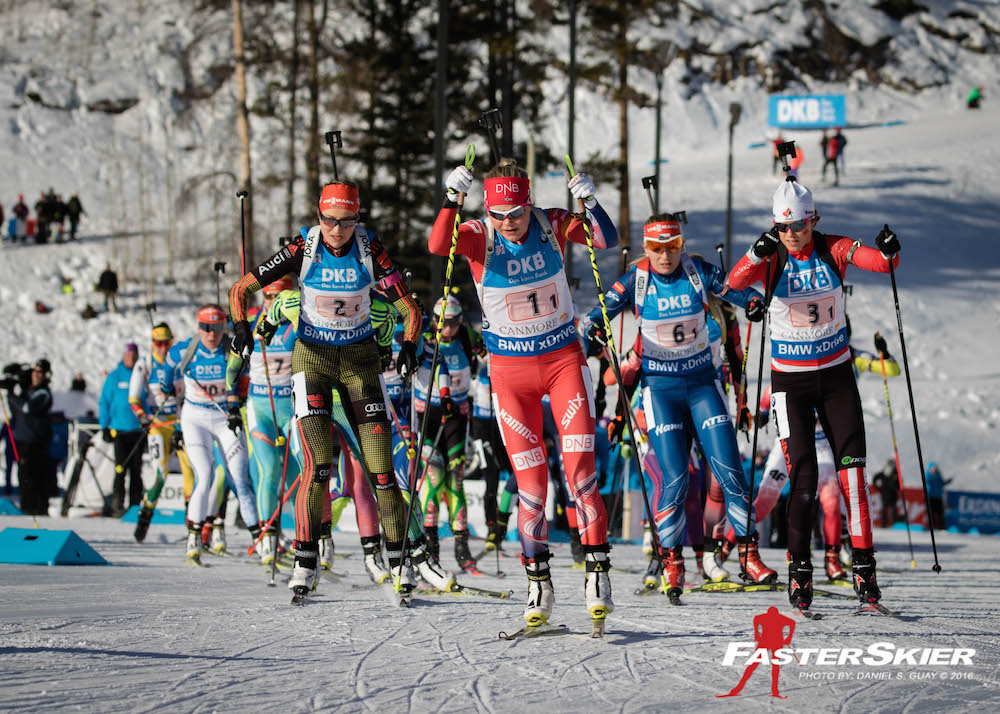
Germany’s Luise Kummer (2), Norway’s Hilde Fenne (1) and Canada’s Julia Ransom (3) early in the single mixed relay at the IBU World Cup in Canmore, Alberta. Norway went on to place third, Germany seventh and Canada finished 12th. (Photo: Daniel S. Guay)
Conditions on Sunday were good throughout the race, with calm winds and the sun shining in the Canadian Rocky Mountains, after the athletes had struggled with snowfall and strong gales in the previous days.
“I think we were all satisfied to know that it would be fair and beautiful conditions. It’s the [kind of] biathlon we love,” Fourcade said in an interview with the IBU.
“Today was the best snow conditions of the week. There was a light wind, but it seemed pretty consistent,” Canada’s Nathan Smith wrote in an email.
France steadily expanded its lead throughout the race. At the first exchange, Dorin Habert tagged Fourcade in first, just 0.4 seconds ahead of Sweden. Fourcade slightly expanded that lead to 6.5 seconds over Russia in second place by the next exchange, and then Dorin Habert cleaned both shooting stages on her second leg to balloon the gap to 50.1 seconds over Norway in second. Essentially, Fourcade just needed to go through the motions on his last leg to lock up first.
Before the final shooting, Germany’s Erik Lesser had been in second place behind Fourcade. But unable to clean his targets and running out of spares, Lesser incurred a penalty lap and ended up seventh (+1:29.6), as teams passed him with better shooting. Lesser and teammate Luise Kummer combined for one penalty and eight spares.
This brought back some painful memories from the first time a single mixed relay was held in a year ago in February 2015 in Nove Mesto, Czech Republic. Lesser and Kummer had been in the lead before the final shooting, then Lesser slipped into fourth with a penalty.
After Sunday’s race, suffice to say Lesser wasn’t happy.
“Does anyone still want to see that? I don’t!” Lesser quipped when the interviewer in the mixed zone asked him to take a look at a replay of his targets in the final shooting stage. “It really doesn’t matter where those [shots] went, I just didn’t hit, fired four really poor shots,” he added after taking a glance at the fairly close misses. “If Mark [Kirchner, men’s head coach] wants to chew me out for that, I hard-earned it.”
“On the first spare I was already thinking, ‘Oh great, this is going the same way as last year,’ ” Lesser continued. “On the second leg I struggled, I tried to keep the others at bay on the course so they would not catch up, but I somehow didn’t move well, got tense on the shooting range, and then the misses happened. I am completely annoyed, mega-disappointed… This is the World Cup level, so you should also be able to hit with tired legs.”
Kummer used four spares and was also disappointed, but didn’t pin the blame on Lesser.
“A [single mixed] relay is comprised of two people, everything has to work out, and that mistake can happen to everybody,” she told ZDF. “You are always happy yourself to get through [a relay shooting stage] unscathed, so that shouldn’t be a problem…. I still think it’s a very exciting competition for the spectators, very fast-paced exchanges. It doesn’t have the same standing as a relay or mixed relay yet, but one can see that it is developing.”
Lesser’s troubles allowed Austria’s quick-shooting Eder to pass him and secure second place, after he and Hauser had been just outside the podium ranks for most of the race.
“I am really happy about this podium today. It’s my first one. I dreamed about it, and today it worked,” the 22-years-old Hauser told reporters at the press conference. “My shooting was not so good especially in prone. Simon and I are both fast shooters and also good shooters, but today it was not the best.”
“I felt great on the course, I always could keep up or even close gaps,” Hauser added in an Austrian Ski Federation press release. “On the shooting range I let the stress get to me a little bit, that caused the spares. But of course I am overjoyed by the podium finish.”
“The first turn did not go according to plan on the shooting range. I had problems with my ski poles and used too many spares,” Eder, 32, said in the press release. “But the second turn went all the better, I could really push the tempo also on the shooting range. Finally we have a place on the podium also in a mixed relay.”
In the absence of their usual stars that are skipping the North American World Cups in the leadup to 2016 World Championships at home in Oslo, the Norwegians still reached the podium with Fenne and Birkeland, who both improved on their second legs to move from seventh at the first exchange to third at the finish. (Birkeland also won the first single mixed race of the season, though with Kaia Woeien Nicolaisen as his partner.)
“I am not sure why, we just always try to do good races,” Fenne said during the post-race press conference when asked why Norway seems to do so well in the single mixed relay. She added that the coaching staff picked the lineups for Sunday, so she didn’t know why she was put on the single mixed relay instead of the four-person mixed relay.
Canada 12th, U.S. 16th
Representing Canada at home in Canmore, Julia Ransom, who is competing in her first full World Cup season, teamed up with veteran Nathan Smith, who raced to second in the Östersund single mixed relay with Rosanna Crawford.
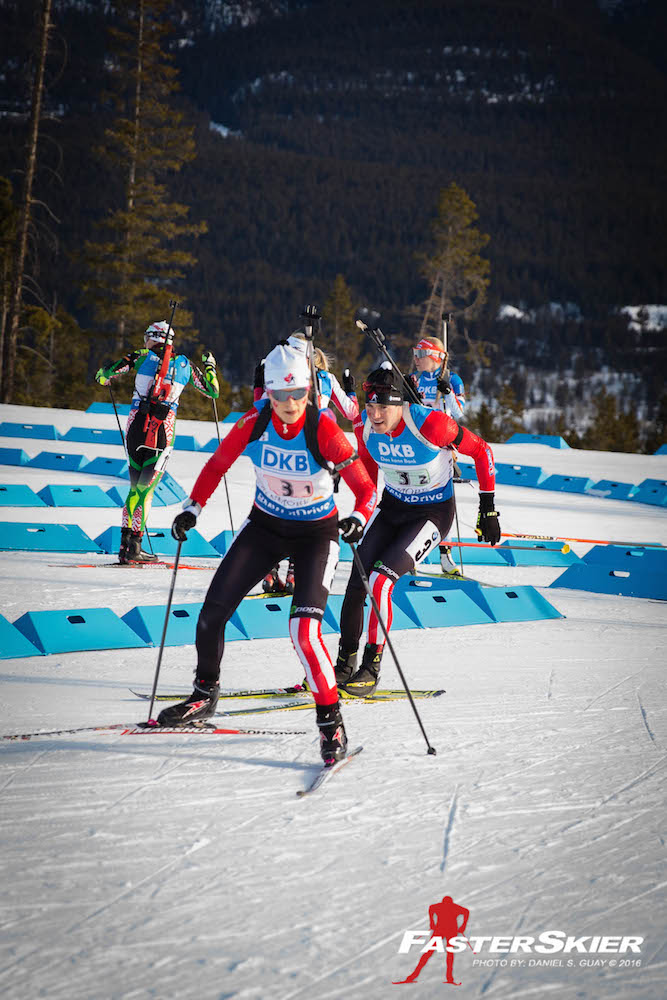
Canada’s Nathan Smith (behind) coming through the exchange zone to tag teammate Julia Ransom during single mixed relay at the IBU World Cup in Canmore, Alberta. (Photo: Daniel S. Guay)
This time, the Canadians ended up nearly two minutes off the podium in 12th (+1:54.3), with 10 spares and no penalties.
On her first leg, Ransom used one spare round in her first prone, but then required all three spares in standing to narrowly avoid a penalty lap.
“It was hard, very hard,” Ransom said in a Biathlon Canada press release. “I haven’t done that format before. I felt that one for sure. This is the first time I’ve done a relay with Nathan so it was lot of fun for me, and a great experience.
“I was bouncing around at the start and maybe nerves got to me a little bit because I didn’t know what to expect,” she added. “The techs just told me to ‘reel it in.’ ”
After the first 1.5 k, she tagged Smith 47.0 seconds behind in 19th of 23 teams. On his first leg, Smith cleaned prone without any spares and only required one spare in standing to keep his distance to the top, handing off to Ransom 49.2 seconds back in 11th.
“We unfortunately fell back pretty early in the race. Julia had some difficulty in the range,” Smith wrote in an email to FasterSkier. “The time lost loading spares is even more penalizing when the loops are so short. The format itself is pretty fun to race, and quite a bit different from traditional races. It’s almost more like two races back to back with a little break. It suits my quick shooting speed really well.”
Ransom cleaned her next prone stage as she had done repeatedly in recent weeks, but with two more spares in standing, she lost a minute to the top.
Still in 11th when he received the tag, Smith again hit all targets in his prone stage, but required three spares in his last standing to avoid the penalty lap, approximately holding his gap to the leaders.
“Other than my last standing my [two relay] legs went really well. Prone felt amazing. Probably almost the best ever. Just fast, easy and accurate,” Smith wrote. “I ended up battling a lot with [Latvia’s] Rastorgujevs. He surprised me by matching my shooting speed. He’s always one of the fastest out there. It was too much for me to hang on to on the last lap.”
“It was my best race this week. The legs felt a lot better today. Not amazing, but quite good until that last lap,” Smith said in the team press release. “One of the toughest things to do is race at home with the pressure we put on ourselves with our friends and family watching all the volunteers we know out here. I obviously wanted to peak here and do well but there are so many factors that come into play. It was a great experience racing at home that we’ll be able to take with us.”
For the U.S., Cook teamed up with Leif Nordgren. In Östersund, their teammates, Clare Egan and Sean Doherty finished 15th in the single mixed relay. This time, the Americans finished in the same range in 16th place (+3:20.1), with one penalty and 14 spares.
Annelies Cook (US Biathlon) during one of her two standing stages in Sunday’s single mixed relay at the IBU World Cup in Canmore, Alberta. She teamed up with Leif Nordgren to place 16th. (Photo: Daniel S. Guay)
After using just one spare in her first prone stage, Cook incurred a penalty in her first standing stage, quickly disappearing out of the focus of the TV cameras, tagging Nordgren in 20th, about 1:05 behind the leaders.
“I felt good on skis and was in the mix, but I had a hard time holding back in the skiing and was probably breathing too hard to shoot well in standing,” Cook wrote in an email. Her course time ranked seventh fastest of the first-leg skiers. “My penalty in standing took us too far from the top to have contact.”
Nordgren needed two spare rounds in prone and another one in standing, losing about another 30 seconds to the top teams on his leg (+1:41.3) as he tagged Cook in 18th.
“This format is for sure a little different than a typical relay,” Nordgren explained in an email. “The pace is usually fast right from the start, and because the loops are so short it really puts all the focus on the shooting since its hard to really break away on such a short loop. It’s nice to have that difference, but you really have to be on top of your game in the shooting to be competitive.”
On her second leg, Cook again emerged from prone with just one spare, but needed another three spare rounds to clean her final standing stage and avoid another penalty. When she exchanged back to Nordgren, the U.S. was 3:04.7 out of first in 20th.
“The race does feel like a cross country sprint. But what makes it hard is knowing that you still have to hit targets, and finding the balance between all out sprinting and going just at the level where you can manage to hit your targets is tricky,” Cook wrote. “I just tried to make up time lost on the range by catching up on skiing as best as I could. There were a few of us together each lap, so it felt like a competition between that group of people.
“I had a hard time holding back because I really love sprinting, and that probably kept me from hitting in standing,” she added. “That put Leif on a position where he had to try and chase people down. He did a really good job of that and I was proud of him for catching people in the last loop.”
On the anchor leg, Nordgren mirrored his performance from his first round, again requiring two spares in prone and one in standing, but only lost 15 more seconds to the leaders and leapt to 16th by overtaking Romania, Slovenia, Belarus and Finland.
“Today neither Annelies nor I really had a great day on the range so we had a hard time to stay with the top teams,” Nordgren concluded. “The tracks were in perfect shape today which is always nice. Our techs did a great job to give us fast material, but we weren’t able to put it to good use.”
Staying Warm
In the exchange zone, several teams could be seen using spinning bikes to keep warm and stay loose during their race breaks while their teammate was out on the course, something the Norwegians pioneered for the single mixed relay in Östersund, though the Americans and Canadians opted for a traditional warmup.
“I just ran around to keep warm,” Cook wrote. “It’s not a big break and we don’t have a team bike. But running was totally fine for me.”
“During the break both of us just opted to jog around, being that it’s such a short race, it’s more important to stay warm any way possible,” Nordgren wrote. “Today was the first day in a several that the wind was pretty low, so that made staying warm a little easier.”
“I just jogged around while Julia was doing her second leg,” Smith explained in his email. “I considered using a spin bike but decided it would be best to practice like at World Champs.”
Moving on to Presque Isle
Nathan Smith (Biathlon Canada) during Sunday’s single mixed relay at the IBU World Cup in Canmore, Alberta. He teamed up with Julia Ransom to place 12th. (Photo: Daniel S. Guay)
The IBU World Cup now moves east to Presque Isle, Maine, with sprints for the women and men on Thursday, followed by pursuit races on Friday, and traditional relays on Saturday (men) and Sunday (women).
“Today was the best I’ve felt in a couple weeks. I hope my shape continues to return to normal through Presque Isle,” Smith wrote.
While Smith continues to work to hold his own in the overall World Cup standings (he’s currently 19th), the rest of Canada’s A-team, those pre-qualified for World Championships, will skip the Presque Isle World Cup and train in Canmore until Feb. 22, according to Crawford. That includes Crawford, Ransom, Sarah Beaudry, Brendan Green, Scott Gow, Christian Gow, and Macx Davies.
Smith and a women’s contingent of Emma Lunder, Zina Kocher, Audrey Vaillancourt, and Erin Yungblut will head to Maine, and after those races, the Canadian team will select its fourth woman for World Championships.
“I think we’re … looking forward to racing next week on home soil in Presque Isle,” Nordgren wrote on behalf of the U.S. team. “I haven’t raced there for about 5 years, so it will be fun to be back!”
In the four-person mixed relay that followed Sunday afternoon, the U.S. notched a team-best fourth with Susan Dunklee, Hannah Dreissigacker, Tim Burke, and Lowell Bailey, while Canada tied its previous best of sixth, with Crawford, Beaudry, Davies, and Green. Stay tuned for a separate report.
Note: Presumably due to a software bug, the IBU’s competition analysis report for the single mixed relay contained erroneous ranks for data such as course and shooting times, with higher numbers than the 23 teams that started in this race, so no such information was used for this article.
Italy’s 26-year-old Dominik Windisch celebrates his first-career victory in the IBU World Cup 15 k mass start on Saturday in Canmore, Alberta. (Photo: Daniel S. Guay)
In a race affected by difficult conditions on the course and shooting range, Italy’s Dominik Windisch achieved the first victory and podium of his career in the International Biathlon Union (IBU) World Cup men’s 15-kilometer mass start on Saturday in Canmore, Alberta. In third place after the final shooting stage and despite four penalties in total, the 26-year-old Windisch finished first with a time of 40:37.1 minutes, after a strong last loop.
“It was amazing. I can’t believe it yet. A dream came true for me today,” Windisch said during the post-race press conference.
Asked how long he has been waiting for this moment, Windisch later told the IBU: “I think for over 20 years, since I was a child watching competitions of the World Cup in Antholz [Italy].”
Second place went to Germany’s Benedikt Doll, 4.1 seconds back with four penalties, for the third podium of his career. Doll also moved up on the final loop thanks to the fastest course time of all athletes. France’s Quentin Fillon Maillet, who led the pack after the last shooting, fell behind on the final loop and ended up third, 8.6 seconds after the Italian, with three penalties.
‘He puked all over my skis’
Latvia’s Andrejs Rastorgujevs (25) and Austria’s Dominik Landertinger (9) lead the race for fourth, which Landertinger took by 0.2 seconds. France’s Martin Fourcade (second from l) placed sixth in the mass start, 1.5 seconds ahead of American Tim Burke (behind) on Saturday at the IBU World Cup in Canmore, Alberta. (Photo: Daniel S. Guay)
U.S. Biathlon’s Tim Burke had the best day of the three North Americans in the race, finishing seventh, 23.8 seconds after Windisch with three penalties, and just 1.5 seconds behind the overall World Cup leader, Martin Fourcade of France.
It was Burke’s best result of the season in an individual race so far, and he last achieved seventh in a 2014 mass start in Pokljuka, Slovenia.
Burke raced under the watchful eye of his wife, Andrea Burke (formerly Henkel), an Olympic and World Championships gold medalist for the German biathlon team, who provided commentary and analysis with Chad Salmela for the IBU’s live stream of the North American World Cups.
“When your wife is commentating live it puts a little extra pressure on…,“ Burke said in a post-race phone interview with FasterSkier. “I think she’s having a lot of fun with it. It’s for sure a challenge to commentate in not your first language.”
Burke said the first prone shooting was the “trickiest stage” on Saturday, but he managed to keep the damage in check with just one penalty.
“It [was] changing so much shot to shot that I didn’t crack down my shots at all,” he said. “I would aim [left] off the target knowing that the wind would blow [really strong left to right]. I missed my first shot and I realized I wasn’t aiming far enough off.”
He left the range in 15th place, 41.8 seconds behind Austria’s Simon Eder in first, but still with several other athletes who had also missed at least one target.
“As I was skiing out of the range, just checking the targets, I could see there were quite a few mistakes. I knew that would keep me in the race,” Burke recalled.
In the second prone stage, Burke shot clean.
“It was really good conditions. The wind was down. It was a lot like I had zeroed for,” he said. “I hadn’t changed my sights at all so I was able to aim through and shoot fast.”
American Tim Burke (c) shooting with Russia’s Anton Shipulin (r) and Germany’s Arnd Peiffer (l) during the men’s 15 k mass start on Saturday at the IBU World Cup in Canmore, Alberta. Burke went on to place a season-best seventh. (Photo: Daniel S. Guay)
One lap later, the wind picked up for the third shooting (first standing stage).
“I just really took my time and was very happy to get out of there with one penalty. … When I left the range everyone except I think one person was in the penalty loop.”
He left the range in fourth, 17.5 seconds behind Fillon Maillet, 6.3 seconds after Latvia’s Andrejs Rastorgujevs in second, and 2.4 seconds behind Austria’s Dominik Landertinger in third.
Burke lost a few positions on the course, skiing in a group led by eventual third-place finisher Doll.
“At that point, I knew the win was still possible just because the conditions were changing so fast,” Burke said. “Anything is possible in a race like that.”
In the last shooting stage, Burke recorded another miss, skied a penalty loop and headed into the final loop in ninth place with competitive company around him: Fourcade, Landertinger, Ondrej Moravec of the Czech Republic, Slovakia’s Matej Kazar (the best shooter on Saturday with just one penalty), and Germany’s Arnd Peiffer.
“It’s not the best group to head out on the last loop with, so I knew it was going to be tough, but I hung in there,“ Burke said. “Fourcade and Landertinger got a gap with about a [kilometer] and a half to go. Then it was me and Peiffer … he was in front of me and unfortunately puked all over my skis.”
He estimated Peiffer got sick with about half a kilometer remaining in the, heading into one of the final climbs.
“I’ve heard of it happening, but that’s the first time I’ve ever seen it,” Burke said of someone throwing up during the race. “I was able to get around him after that. … Then I actually ended up catching back up to Fourcade because they started playing around, setting up for the finish … but as soon as I caught them they started sprinting, so I was pretty gassed.”
“It was a brutally difficult race,“ Landertinger, who placed fourth (+20.7) with three penalties, said in an Austrian Ski Federation press release. “On the one hand the course was extremely slow and strenuous, on the other it was difficult to assess the wind correctly on the shooting range. I had a strong final loop, where I was able to prevail against Fourcade and Rastorgujevs in the end. I am very happy with the race and the result.“
Overall, Burke skied the eighth-fastest course time, as well as the sixth-fastest final loop.
“I really like the course, that’s why I was disappointed with the sprint [on Thursday] because I feel like on a good day here I could have been one of the faster skiers,” Burke said. He placed 23rd in Thursday’s 10 k sprint with with 80 percent shooting.
“I was definitely really happy with the result. It was a crazy race with the conditions,“ Burke concluded. “[It’s my] best result this year. I feel like I can be up there more often and hopefully this will be a good step moving forward.”
Fast Skiing Wins The Race
A gust of wind blows snow during zero at the Canmore Nordic Centre on Saturday before the IBU World Cup men’s 15 k mass start.(Photo: Daniel S. Guay)
A blizzard in the early morning with strong snowfall that lasted for about 30 minutes was followed by dry strong winds which made ski preparation difficult, with a number of wax technicians reportedly already out on the course at night, working with headlamps to prepare optimal skis for the athletes.
“Today was really challenging for a lot of the technicians … I saw really big differences with the skis out there on the course,” Burke said. “We [the Americans] were in the mix.”
At the start of the race, the scenic Canadian Rockies were shrouded by thick clouds but without precipitation, although later it started to lightly snow. Wind conditions were difficult right out of the gate, and only four athletes out of 30 in the mass start managed to shoot clean in the first stage, despite a fairly slow pace on the loop with the field bunched together.
After the second shooting stage, Eder had been in the lead with clean and very fast prone shootings, but when he came back into the range the third time for his first standing stage, strong gusts of wind made it difficult for him — as well as the other top athletes — and three penalties set him back. Eder finished the race in 14th place (+57.3), with four penalties.
“Unfortunately I had no chance today. The wind in the third shooting decided the race, otherwise I would have been very well in the mix,” Eder said in the Austrian team press release. “I can’t help it. Just tick it off and look ahead.”
Fillon Maillet moved up from sixth to first place during the third loop and third shooting stage. After no athlete in the lead group was able to shoot clean in the last stage, either, the Frenchman headed out on the final loop in first, with Rastorgujevs 13.9 seconds behind. Meanwhile, Windisch, who was 14.3 seconds back to start the loop, and Doll, 20.7 seconds behind, came flying out of the penalty loop.
At the 13.4 k timing point, Windisch had taken the lead with the other three close behind him. Then at the last timing point 700 meters before the finish, Fillon Maillet still remained ahead of Doll, but into the final stretch, Doll pushed ahead of him.
Rastorgujevs, often one of the fastest skiers in the field but a somewhat shaky shooter, especially in standing, fell behind Doll and Fillon Maillet on the last loop and also lost the finish sprint to Landertinger by 0.2 seconds. He finished fifth place (+20.9), with three penalties, narrowly missing the first World Cup podium of his career.
“Last 1.5 kilometers I am empty, totally empty. No chance for fighting,” he said in a post-race English interview with the IBU. “My shooting today was good, but I am not so happy with [the] last shooting.”
Lowell Bailey (US Biathlon) leads Germany’s Benedikt Doll during the men’s 15 k mass start at the IBU World Cup in Canmore, Alberta. Doll went on to place second while Bailey finished 20th. (Photo: Daniel S. Guay)
Doll closed in on the victory, but partly due to the short finishing stretch in Canmore, he was unable to catch Windisch.
“My skiing was very good, and I really had great material,” Windisch said during the press conference. “I want to dedicate this victory to our wax men, they really did a great job.”
“It was not easy today because of the wind,” he added. “I think this shows what biathlon is [about], the field is so close and everybody can win.”
Asked about the final loop, Windisch recalled: “I just wanted to keep Rastorgujevs [behind me]. But I saw that I had faster skis, so I thought, ‘I have to take my chance now.’ I tried, and it finished well.
“Since I was a child I have watched the World Cup competitions in Antholz and saw my coach Andreas Zingerle [on the podium] there. He was an idol for me. Since this time I was dreaming of competing in the World Cup,” Windisch added
Asked about the successes of the Italian team this season, he said: “I think we are a good team, we are a young team, there is good harmony on the team, and we are good friends. It’s joy.”
“I had a bit of stitch on the last loop, breathing is still not easy,” Doll told German TV broadcaster ZDF immediately after the race, still gasping for air. “The snowfall that began during the race made an allegedly easy course very arduous.”
Doll recorded the fastest course time of all 30 athletes, but said he struggled especially on the last loop.
“I saw the guys ahead, but I have to admit my bigger fear was about those behind because there were seven or eight guys following me,” Doll said of the final 2.5 k. “So I said to myself that I have to go full-throttle right from the start so they never catch up. That worked well, but I didn’t expect to be able to make up two more positions. Quentin [Fillon Maillet] didn’t look so fresh anymore, and I made use of that.”
“After my bad sprint, I wanted to do a good shooting,” the 23-year-old Fillon Maillet said during the press conference, after notching his third-career podium. “Today the conditions were windy, very windy… Three mistakes is [usually] not very good, but today that was good shooting. Skiing was very hard on the last loop. But I am very happy for this race… I prefer racing in mass starts or pursuits, because we are all very close together…. Maybe I have more motivation for this [type of] race.”
The World Cup Leaders
It was also an uncharacteristically difficult race day for the leaders in the overall World Cup standings. Fourcade incurred six penalties, but was able to place sixth thanks to the second-fastest skiing time on the course. Russia’s Anton Shipulin finished 17th with six penalties, and Germany’s Simon Schempp in 21st place with eight. In the standings, Schempp moved into third, ahead of Norway’s Tarjei Bø, who is skipping the World Cup stages in North America, by one point.
Smith Frustrated with Ski Speed, Bailey with Shooting
Canada’s lone man in the mass start, Nathan Smith finished 16th (+1:12.1) with three penalties) and American Lowell Bailey placed 20th (+1:46.7) with five penalties. The field is limited to 30, with the top 25 in the World Cup standings and five others with the best sprint results in Canmore.
“On the first lap I thought this could be good,“ Smith said in a Biathlon Canada press release. “I’m still feeling kind of tired on the skis so I was making up some time on the range thankfully so I could maintain my placing in the middle of the pack.”
Nathan Smith (Biathlon Canada) racing to 16th in the men’s 15 k mass start at the IBU World Cup in Canmore, Alberta. (Photo: Daniel S. Guay)
Smith had one miss in the first prone stage and left the range in 12th place.
“Usually a miss in the first prone will put me off the back in 25th or so, but with the tricky conditions it was pretty much equivalent to 5/5,” Smith wrote in an email to FasterSkier. “At that point I thought I could still be in the mix through the whole race.”
In the second prone, he shot clean, improving to eighth, 33.5 seconds out of first, but lost positions on the course again with the 26th-ranked time on that loop. Overall, his course time ranked 24th.
“I knew my skiing was once again not good enough,” he wrote. “I was getting passed on course and couldn’t hang on. I knew today it would take perfect shooting for a strong result.”
He went on to record two more penalties in the standing stages.
“My standing actually felt amazing today,” Smith wrote. “I was kicking myself for missing one shot in each.”
“We are all shooting at the same time in a mass start so if it is windy, it is windy for everyone,” he explained in the press release. “There was a reasonable amount of wind in standing, but not so windy you couldn’t hold the rifle and focus on the target.”
On the final loop, three competitors passed Smith, and as he headed toward the finish to finish 8 seconds behind Russia’s Evgeniy Garanichev in 15th, Smith waived to his hometown crowd.
“I tried my best to maintain position on the last lap but just couldn’t hang on,” Smith wrote. “The crowd was so loud each time I came into or looped behind the stadium. I felt privileged to come ‘home’ to the finish with all that support.”
“16th is a good result for me,” Smith concluded. “I’m happy with where my shooting is at but am becoming more and more frustrated with my ski shape. I’m not sure what has gone wrong but I’m going to look for a solution.”
After a first loop in the top third of the pack, U.S. Biathlon’s Lowell Bailey had one more miss than Burke and Smith in the first shooting stage, setting him back to 21st place at the time.
“I didn’t take enough clicks [sight adjustments] to account for the wind change in the first prone,” Bailey wrote in an email. “You never want to start out a race with two penalties.”
With the help of his coaches, he made the necessary adjustments for the next prone stage, this time cleaning it.
“The coaches show you a board with all of your shots at some point on the foregoing loop,” Bailey explained. “After a 6-click wind in the first prone, the wind died back to calm by the second prone. This meant I could just aim for the center.”
In the third shooting, Bailey incurred two more penalties, dropping him back down to 21st and 1:13 out of first, and then he missed one more in the final shooting stage to leave the range in 20th, 1:37 behind the leader.
“There wasn’t much wind in the third shooting and I can only blame myself for those misses,” he wrote.
Overall Bailey recorded the 21st course time. “I felt fine,” he explained of his skiing. “It definitely wasn’t the ski course that was holding me back today. ”
“I’m disappointed with the race,” he wrote. “I put a lot of focus and effort into this world cup [in Canmore]. I came directly here in preparation following the Antholz World Cup and I really felt prepared for these races. Unfortunately, I wasn’t able to put it together on the range over the past two races. It’s frustrating, but you can’t go back and re-do it… you just have to focus on what adjustments need to be made going into the next races.”
He placed 24th in the sprint, just behind Burke with two penalties. Smith finished 31st in that race with one miss.
Mixed Relays
The World Cup in Canmore concludes with a mixed relay (2 women, 2 men) and a single mixed relay (1 woman, 1 man) on Sunday.
Burke and Bailey plan to race the mixed relay for the U.S., together with Hannah Dreissigacker and Susan Dunklee at the start, while Leif Nordgren and Annelies Cook will team up for the single-mixed relay.
“I just want to put together a decent performance on the range. That’s my goal,” Bailey wrote.
Biathlon Canada will aim for a podium at home this weekend; after Rosanna Crawford and Nathan Smith were able to achieve second place in the single mixed relay at the opening World Cup in Östersund, Sweden.
On Sunday, Smith will team up with Julia Ransom, while Crawford races the mixed relay with Sarah Beaudry, Macx Davies, and Brendan Green.
“Julia has been so strong lately, I know we will put on a good show for the home crowd!” Smith wrote.
Russia’s Anton Shipulin (2) leads early in the men’s 15 k mass start at the IBU World Cup in Canmore, Alberta. (Photo: Daniel S. Guay)
IBU World Cup men’s 15 k mass start in Canmore, Alberta. (Photo: Daniel S. Guay)
IBU World Cup men’s 15 k mass start in Canmore, Alberta. (Photo: Daniel S. Guay)
IBU World Cup men’s 15 k mass start in Canmore, Alberta. (Photo: Daniel S. Guay)
IBU World Cup men’s 15 k mass start in Canmore, Alberta. (Photo: Daniel S. Guay)
IBU World Cup men’s 15 k mass start in Canmore, Alberta. (Photo: Daniel S. Guay)
Overall World Cup leader Martin Fourcade of France after placing sixth in the men’s mass start at the IBU World Cup in Canmore, Alberta. (Photo: Daniel S. Guay)
Tim Burke (US Biathlon) after finishing seventh in the men’s 15 k mass start at the IBU World Cup in Canmore, Alberta. (Photo: Daniel S. Guay)
IBU World Cup men’s 15 k mass start in Canmore, Alberta. (Photo: Daniel S. Guay)
IBU World Cup men’s 15 k mass start in Canmore, Alberta. (Photo: Daniel S. Guay)
Italy’s Dorothea Wierer (2) leads out of the start of the women’s 12.5 k mass start at the IBU World Cup on Saturday in Canmore, Alberta, along with Gabriela Soukalova (1) in the World Cup leader’s bib. (Photo: Daniel S. Guay)
Let’s pretend, for a moment, that we’re in the gunslinging days of the Wild West — perhaps not so far off in Canmore, Alberta, where wide-brimmed cowboy hats are a trademark today.
You meet Italy’s Dorothea Wierer — sans the modern-day mascara, flashy sunglasses and questions of how she got to Canada in the late 1800s — on the dusty road and it’s time for a draw. Bottom line, you should put your hands up.
More than a couple times this season, the 25-year-old Wierer has proved that she can shoot under pressure. Just over three weeks ago, she cleaned the four-stage 15 k individual race at the IBU World Cup in Ruhpolding, Germany, to take the win. She pulled off a similar feat in the individual race at the early season World Cup in Östersund, Sweden, for her first career win.
So when France’s Marie Dorin Habert took an extra breath or two to clean her final shot in the third shooting stage of the women’s 12.5-kilometer mass start on Saturday, Wierer pounced. She had followed Dorin Habert into the range, just a few seconds behind but enough to give the French skier enough time to start firing first. Wierer proceeded to clean her five targets with the fastest range time for the second-straight stage, then sped out of the range before Dorin Habert could react.
The race leader’s in Saturday’s 12.5 k mass start during the third shooting stage, with France’s Marie Dorin Habert (r), Italy’s Dorothea Wierer (second from r), Germany’s Franziska Hildebrand (c), France’s Celia Aymonier (second from l), and Gabriela Soukalova of the Czech Republic (l). (Photo: Daniel S. Guay)
Wierer took the lead by 1.8 seconds, overcoming an early penalty in her first prone by cleaning the next two stages, while Dorin Habert chased her into the fourth of five loops. Over the next 2.5 k, the two race leaders skied together, exchanging a few words at one point. Dorin Habert, 29, hadn’t lost the race, but she had lost her edge over the gutsy Italian. A day earlier, Wierer placed third in the 7.5 k sprint with 9-for-10 shooting, and Dorin Habert finished 29th with four misses.
“I decided to attack today,” Dorin Habert told the IBU after the mass start. “My standing has not been very good at times this season, so I was more aggressive today.”
Meanwhile, she and Wierer skied about five seconds ahead of Gabriela Soukalova of the Czech Republic, who, like Dorin Habert, had cleaned all three stages up to that point to put herself in third.
The last time they entered the range, Wierer led Dorin Habert in to take the first shooting position. Dorin Habert stood on Point 2, and Soukalova on Point 3.
Bang-bang-bang-bang-bang! Wierer rattled off her shots, hitting all five targets with the fastest range time once again. She flew out of the range, again in first, but this time, Dorin Habert and Soukalova each missed one behind her. The penalty loop put Dorin Habert 30.6 seconds back in second while Soukalova followed about eight seconds later in third.
By that point, the race was essentially over. Barring any catastrophic last loop for Wierer, 30 seconds is simply tough for anyone to overcome in 2.5 k. And Wierer was racing to what ended up being the fourth-fastest overall course time.
While Dorin Habert reduced the deficit to 22.7 seconds with 0.7 k to go (while Soukalova skied 39.6 seconds back in third), Wierer raced to the finish uncontested for her third-career World Cup win in 36:50. Dorin Habert finished 20.8 seconds later in second, and Soukalova was 50.3 behind in third.
Italy’s Dorothea Wierer celebrating her third career World Cup win and first mass start victory on Saturday at the IBU World Cup in Canmore, Alberta. (Photo: Daniel S. Guay)
The win was Wierer’s best mass start result after placing sixth in the event two seasons ago in Pokljuka, Slovenia. An hour earlier, Italy’s Dominik Windisch won the men’s mass start in Canmore, and Wierer completed the Italian sweep with the women’s victory.
“I was so nervous for Dominik when I was watching his race,” Wierer told the IBU after her race. “This is a great day for the Italian team; this has never happened before. It is historic!”
While the winds were nowhere near as troublesome as during Friday’s sprint (nor were they as prevalent as during the men’s race earlier Saturday afternoon), the women’s mass start wasn’t without occasional gusts and light snow. Wierer explained she had trouble with zeroing before the race.
“I must have shot 10 times; I never do that, and it still was not very good,” she said. “So I went out there thinking it would either be good or horrible. I have never had a good mass start before, until today!”
Wierer led set the pace for the field early on, leading much of the first loop with Kaisa Mäkäräinen and Germany’s Miriam Gössner following close behind. On the first prone shooting, 13 women cleaned; Wierer was not one of them. She missed one and left the range in 14th, 15.8 seconds behind Germany’s Franziska Hildebrand in first. Austria’s Lisa Theresa Hauser trailed Hildebrand by 1.3 seconds and Russia’s Daria Virolaynen left the range 3.7 seconds back in third.
A color commentator for the IBU’s live online broadcast of the Canmore races, retired German biathlete Andrea Burke (formerly Henkel) noted that if you’re going to miss, it’s better to miss sooner than later.
By the next shooting stage, the number of athletes without a miss was down to six. Dorin Habert, Hildebrand, France’s Celia Aymonier, and Soukalova were among them.
Susan Dunklee (US Biathlon) finishing the women’s 12.5 k mass start on Saturday at the IBU World Cup in Canmore, Alberta. She placed 30th with 10 penalties. (Photo Daniel S. Guay)
Meanwhile, American Susan Dunklee fell out of contention and into 26th place (1:52 behind the leaders) with three penalties in the second stage (on top of one miss in the first prone). In the third shooting, she missed all five to drop to 30th and 4 1/2 minutes back.
“I’m not entirely sure what caused my shooting struggles today and why, but I don’t plan to analyze things too much yet,” Dunklee wrote in an email after finishing 30th, 6:24.9 back with 10 penalties (1+3+5+1). “Tomorrow is a new day and right now that is my focus.”
As she came through the finish more than a minute after Switzerland’s Selina Gasparin in 29th, she looked up at the crowd and shrugged.
“I was appreciative of all the North American fans still cheering me on as if I were winning the race,” Dunklee wrote. “It’s not every day that I get to race in front of a home crowd.”
The overall World Cup leader, Soukalova smiled as skied toward the finish in third, and had enough time to turn around and ski backwards over the line.
“A fairy tale,” she said of her season thus far. “I just try to focus on each race and have fun. That is the most important thing, to have fun.”
Mäkäräinen recovered from three early misses in the first stage and one more in the second prone to place fourth (+1:11) and Hildebrand missed one on each standing and finished fifth (+1:13.5). The German was less than a second ahead of France’s Anais Bescond in sixth (+1:14.4) with three misses (2+0+0+1).
For the final day of racing in Canmore, two different relays will be held: the single mixed relay (with Canada’s Julia Ransom and Nathan Smith, and for the U.S., Annelies Cook and Leif Nordgren) at 10:10 a.m. Mountain time, and the four-person mixed relay (with Canada’s Rosanna Crawford, Sarah Beaudry, Macx Davies, and Brendan Green; and for the U.S., Dunklee, Hannah Dreissigacker, Tim Burke, and Lowell Bailey) at 2:05 p.m. MT.
In the men’s mass start, Burke notched a season best in seventh, Smith was 16th and Bailey 20th. Stay tuned for a separate report on that race.
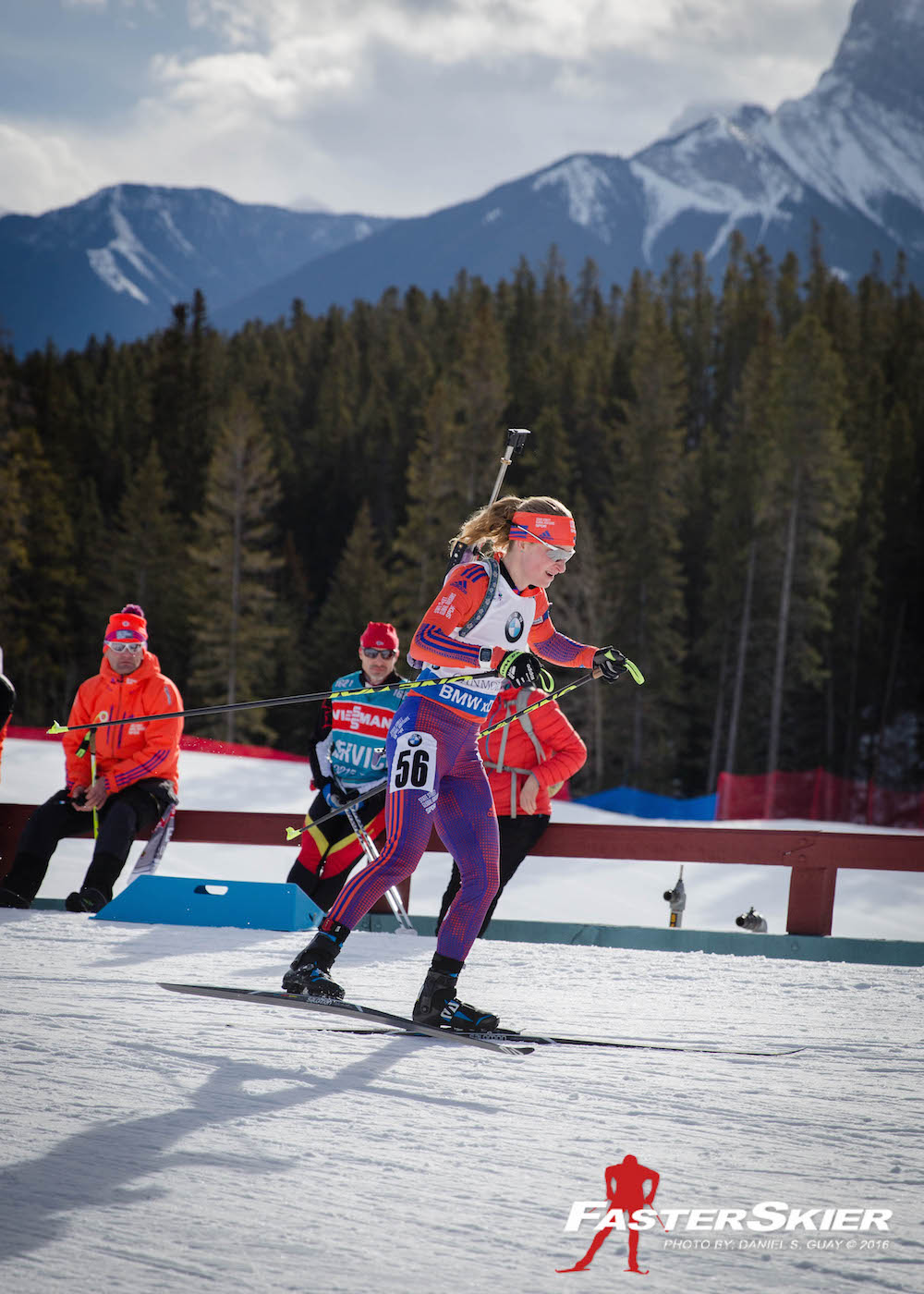
Canada’s Julia Ransom racing in front of a home crowd in Canmore, Alberta, to tie her IBU World Cup career-best 19th in the women’s 7.5 k sprint on Friday. (Photo: Daniel S. Guay)
The way some of the Canadians were tossing around the term “Chinook wind” on Friday, one might have thought that gusts hard enough to knock rifles off their stands was a regular occurrence in Canmore, Alberta. It wasn’t, according to one Canmore native, Rosanna Crawford.
“It was windier than I’ve seen it here in Canmore in a long time,” the 27-year-old Biathlon Canada veteran recalled in an in-person interview after the women’s 7.5-kilometer sprint at the IBU World Cup in Canmore. “So it was definitely luck of the draw if you were going to get a calm range or not.”
She wasn’t one of the lucky ones. Crawford started sixth and missed two off the bat in the first prone shooting stage. She wasn’t alone; most of the rest of the top-seeded skiers failed to hit all five prone targets as well.
Early on, it appeared that France’s Anais Bescond, in bib 8, and Italy’s Dorothea Wierer, bib 17, might be fighting for a podium. Both were the only women to clean prone through the first 24 starters.
Then Krystyna Guzik, a 32-year-old Polish biathlete who last reached the IBU World Cup podium two seasons ago in third in a pursuit in Hochfilzen, Austria, entered the mix. In bib 25, she cleaned prone to leave the range in first, 6.7 seconds faster than Wierer. Guzik went on to clean standing as well, while Wierer missed one, to hold a 7.3-second lead after the second shooting.
Poland’s Krystyna Guzik (l) trails France’s Marie Dorin Habert during the women’s 7.5 k sprint at the IBU World Cup in Canmore, Alberta. Guzik went on to place second while Habert finished 29th. (Photo: Daniel S. Guay)
On the final loop, Guzik stayed ahead of Wierer — who had initially finished first, 21 seconds ahead of Gabriela Soukalova of the Czech Republic— to bump the Italian to second place by 12.4 seconds at the finish.
Meanwhile, Bescond had missed two in standing to slip out of contention and nearly 1 1/2 minutes behind Guzik at the finish. It might not have been her fault; the winds were extremely variable — those Chinook (western interior) winds.
Canada’s Julia Ransom, who has lived and trained in Canmore for the last five years, started 38th and later said she felt the wind in prone and adjusted accordingly.
“I knew the wind. I know Canmore. I know how Chinook winds work and I did correct for prone, a lot,” she told FasterSkier afterward. “Really cranked the sights, and it wasn’t a hurricane for standing so maybe I lucked out a bit there.”
Ransom, who turned 23 on Thursday, cleaned both stages and was one of seven women in the field to do so. Initially 12th at the finish, she ended up 19th, 1:19 behind the winner and the top North American on the results sheet.
Moreover, Ransom tied her World Cup best, which she set two weeks ago in 19th in the pursuit at the last World Cup in Antholz, Italy.
Canada’s Julia Ransom racing to 19th in the women’s 7.5 k sprint at the IBU World Cup in Canmore, Alberta. (Photo: Daniel S. Guay)
“Double nineteenth!” she exclaimed upon realizing she had secured the result again on Friday.
While she cleaned the four-stage pursuit in Antholz on Jan. 23, this was the first time she hit all her targets in a World Cup sprint.
“I knew leaving standing that my family was in for an exciting race,” Ransom wrote in an email. “I was hoping to maintain 12th, but that rarely happens when you start in the earlier seeds. However I am very excited with another top 20. It is a confidence booster going into world champs. I’ve got my sights on those single digits now!
“19th at home is obviously amazing!” she continued. “It’s always nice sharing personal bests with the friends and community that supports me all year round.
Originally from Kelowna, British Columbia, Ransom celebrated her birthday the night before with “a little wine and some little minion cupcakes from my Dad,” she explained in a Biathlon Canada press release. “It was a perfect pre-race meal. … [On Friday] it was a balance between not being too anxious with everyone here to watch and being so excited I couldn’t even contain myself at the start.”
It appeared that most of the racers who started 25th or later, including Guzik, benefited from the sudden calm once the winds subsided considerably.
“It was crazy windy on my first loop,” Crawford recalled of the late-morning (11:15 a.m.) start. “The wind was so strong that I was almost at a stop on one of the uphills…”
She placed an uncharacteristic 72nd, with four penalties — two in prone and two in standing. But considering she’s been sick for the last week and a half, Crawford said she couldn’t completely blame the wind.
“I knew that today was not going to be my best race of the season, but it’s still hard to go out there and have a tough race,” she said.
Susan Dunklee (US Biathlon) had three penalties en route to 35th in the women’s 7.5 k sprint at the IBU World Cup in Canmore, Alberta .(Photo: Daniel S. Guay)
The first U.S. starter in bib 18, Susan Dunklee watched from the start pen while the winds blasted through the stadium.
“When I was in the start gate, the first [competitors] were coming through the range and there were some crazy gusts,” Dunklee said. “We were in the start pen and this huge gust comes up and the rifles started falling off the rack.” They were caught just before hitting the ground.
“I hear this is what they call a Chinook or something like that,” the American added. “It made things interesting…”
Personally, Dunklee found Canmore’s altitude challenging, about 4,600 feet above sea level. Not feeling her usual self skiing, Dunklee placed 35th (+1:58.9) with three misses (1+2). Typically one of the faster skiers in the field, her course time ranked 35th.
“It wasn’t great, but it was OK,” she said of her result.
“It’s pretty nice to be here. I really like being in beautiful places with mountains like this,” she added. “This is my first time racing in North America for a World Cup and that’s something special. I mean, I’ve been looking forward to it for years.”
Dunklee wasn’t alone: Canada’s 33-year-old Zina Kocher, of Red Deer, Alberta, had been waiting to race a World Cup in Canada for at least the last two years, since deciding to continue her career beyond the 2014 Olympics.
“It was a dream I always had to race here and I finally accomplished it,” Kocher said in the team press release. “I was looking for a little inspiration last night and I started pulling out newspaper clippings and looking at photo albums of my career.”
In 2006, she became the second Canadian to reach the IBU World Cup podium when she placed third in Östersund, Sweden.
“I realized I will just miss all of my teammates and coaches. We worked hard at this together, and we were a family,” Kocher said. “It is nice to see the program now getting the results.”
While she told FasterSkier she was “overall not very happy with today’s result,” in 56th with five penalties (2+3), Kocher said she felt good skiing and might have been affected by some nerves on the range.
“But it was awesome to race at home and be in front of the home crowd and have my friends and family out there,” she said.
(Story continues below)
Women’s 7.5 k sprint at the IBU World Cup in Canmore, Alberta. (Photo: Daniel S. Guay)
Women’s 7.5 k sprint at the IBU World Cup in Canmore, Alberta. (Photo: Daniel S. Guay)
Susan Dunklee (US Biathlon) during the Women’s 7.5 k sprint at the IBU World Cup in Canmore, Alberta. (Photo: Daniel S. Guay)
Women’s 7.5 k sprint at the IBU World Cup in Canmore, Alberta. (Photo: Daniel S. Guay)
Women’s 7.5 k sprint at the IBU World Cup in Canmore, Alberta. (Photo: Daniel S. Guay)
Women’s 7.5 k sprint at the IBU World Cup in Canmore, Alberta. (Photo: Daniel S. Guay)
Post-Retirement, Pidhrushna Takes the Win
While Guzik appeared to have locked up her first World Cup victory, several other surprises were making charges from behind. Ukraine’s Olena Pidhrushna, back after a one-year retirement, started 43rd and cleaned both stages to finish 7.5 seconds faster and seize the win in 19:56.9. She bumped Guzik to second and Wierer to third (+12.4).
For the 29-year-old Ukrainian, it was her second-career World Cup victory after winning a sprint in Nove Mesto, Czech Republic, four seasons ago.
“This is why I returned,” Pidhrushna told the IBU in a post-race interview through a translator. “A year ago, I couldn’t imagine being back here and being on the podium. Only at the beginning of this [season] I realized how much I miss biathlon and how I need it.”
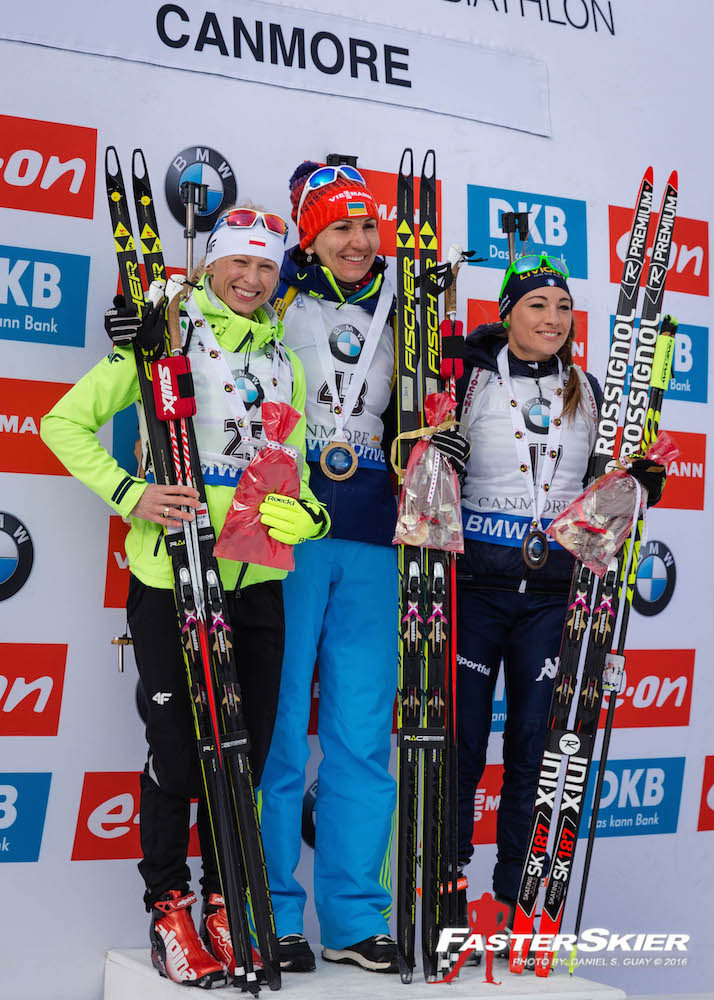
The women’s sprint podium at the IBU World Cup in Canmore, Alberta: with winner Olena Pidhrushna (c) of Ukraine, Poland’s Krystyna Guzik (l) in second and Italy’s Dorothea Wierer (r) in third. (Photo: Daniel S. Guay)
Behind her, some names of the past and future like Poland’s Monika Hojnisz (bib 65) and Latvia’s Baiba Bendika (bib 63) made a run for the podium to end up fourth (+14.1) and fifth (+23.7), respectively.
“Good joke, wake me up when this dream is over!” Bendika, 24, posted with a photo of Friday’s flower ceremony on Instagram. She had shot clean for her first individual top 40. “I guess there is not much to stay, it’s just- CRAZY!!”
Also 24, Hojnisz previously placed fifth in the 2014 Olympics mass start and took bronze in the pursuit at 2013 World Championships. On Friday, she had one prone penalty and cleaned standing en route to fourth, 1.7 seconds off the podium.
Germany’s Franziska Preuss in bib 40 rebounded from a broken tailbone to place sixth (+33.2) with a single standing miss, just 0.4 seconds ahead of Soukalova in seventh. It was Preuss’s second-best result of the season after placing fourth in the Östersund sprint. She crashed in a race there and missed much of the next two months of competition.
“It was the first race of the new year for me,” Preuss told German TV broadcaster ZDF. “I am just happy that it worked so well, that felt good for my psyche. Those were some hard weeks. … sitting in the gym on the ergometer and having to watch the others race. But you learn from every situation and get stronger. Of course you ask yourself, ‘Why does this have to happen?’ but yeah… tick it off and now I am happy that the re-entry went so well.”
“Itʼs just been a weird season for illness and injury,” Tandy said on the phone Friday. “In Pokljuka, I passed out on course, and I struggled over the next weeks to feel fit and energized again. Then in Antholz, I finally had a day where I was like, OK, Iʼm starting to feel back in shape, the ski speedʼs there,ʼ and then this happened.
“Iʼm making the best of it, or trying to,” she added.
Dreissigacker 28th; Beaudry in the Points
Sarah Beaudry, who shares Tandy’s hometown of Prince George, B.C., started the sprint and rose to the occasion in her absence. The 21-year-old Beaudry notched her first World Cup points in 38th (+2:02.3) with Canada’s second-best result after Ransom.
In her fifth-ever World Cup, Beaudry started 77th, cleaned prone and had one standing penalty to set a new career best by 16 places.
“I was happy that I managed to hit nine, especially on this windy day,” Beaudry said. “Overall I’m happy with how I performed and to get a personal best, first points at home, and especially when you never know when the next opportunity to race at home will be, it’s exciting to be able to do well.”
She’s lived in Canmore the last four years.
“I’m excited that Julia and Sarah were able to represent with some good shooting today,” Crawford said. “Overall, the team seems to be a little bit flat ski-speed-wise so that’s unfortunate. There’s so much excitement around these races…”
Next week, she explained that the B-team will represent Canada at the next Word Cup in Presque Isle, Maine, while most of the team’s World Cup regulars recover and train in Canmore.
Hannah Dreissigacker (US Biathlon) racing to 28th for her best IBU World Cup result of the season on Friday in the women’s sprint in Canmore, Alberta. (Photo: Daniel S. Guay)
The top American on Friday, Hannah Dreissigacker of US Biathlon’s A-team had received the call back up to compete at the World Cup in Canmore, where she placed 28th (+1:42.8) with one penalty in each stage.
“I got off to a really slow start this year, especially skiing-wise,” Dreissigacker noted. “I’ve been struggling to really get going on the course, and I think today I may have gone too fast on the first loop, but that’s better than never going fast at all.”
She spent the last several weeks racing the IBU Cup, where she’s been working to find her speed again.
“Today, two misses was good because it was windy and I got a little lucky with the shooting,” Dreissigacker wrote. “To be honest, I should’ve hit more than I hit. I gave one away in prone, my last shot, I just pulled the trigger too early I wasn’t even on the target. That was a bit of a bummer, but on the whole, I think 80 percent [shooting] was good today.”
Behind her, U.S. teammate Annelies Cook finished 47th with three penalties, all in prone.
“I’ve had a really rough string of racing so my confidence has gotten really low,” Cook said. “I missed three prone which was too bad, but for me, looking at how I shot, it was actually OK. I had a good group and I just didn’t take enough clicks that I needed. What was really important to me is that when I came back in standing, I cleaned and I cleaned fast, and that felt really, really good.
“I think three was kind of average shooting today,” she added. “It wasn’t great but it wasn’t terrible, either.”
Dabbling in biathlon for the first time this year, Joanne Reid of the U.S. explained she just learned how to “click,” or adjust the sights on her rifle, one day before the race.
“I’d love to blame it on the wind but … I think I got a little overexcited about clicking,” Reid said after placing 57th, exactly 5 seconds back from Kocher and 2:33.2 behind the winner. Aside from her six penalties (3+3), her overall course time ranked 16th.
On Saturday, men’s and women’s mass starts will be held (at 10 and 11:30 a.m. Mountain time, respectively) with Dunklee qualifying in the overall World Cup top 30. Crawford and Ransom were listed as reserve athletes based on a provisional start list.
— Seth Adams, Harald Zimmer and Chelsea Little contributed reporting
“I’m super happy that we can show the world how awesome Canmore is and hopefully be able to get more races of this caliber here,” she said. (Photo: Daniel S. Guay)
Women’s 7.5 k sprint at the IBU World Cup in Canmore, Alberta. (Photo: Daniel S. Guay)
Women’s 7.5 k sprint at the IBU World Cup in Canmore, Alberta. (Photo: Daniel S. Guay)
Beaudry finished 38th in the 7.5 k sprint at the IBU World Cup in Canmore, Alberta, in 2016, before making her first trip to World Championships. (Photo: Daniel S. Guay)
Joanne Reid representing the United States in the women’s 7.5 k sprint at the IBU World Cup in Canmore, Alberta. (Photo: Daniel S. Guay)
She posted the 16th fastest overall course time. (Photo: Daniel S. Guay)
Women’s 7.5 k sprint at the IBU World Cup in Canmore, Alberta. (Photo: Daniel S. Guay)
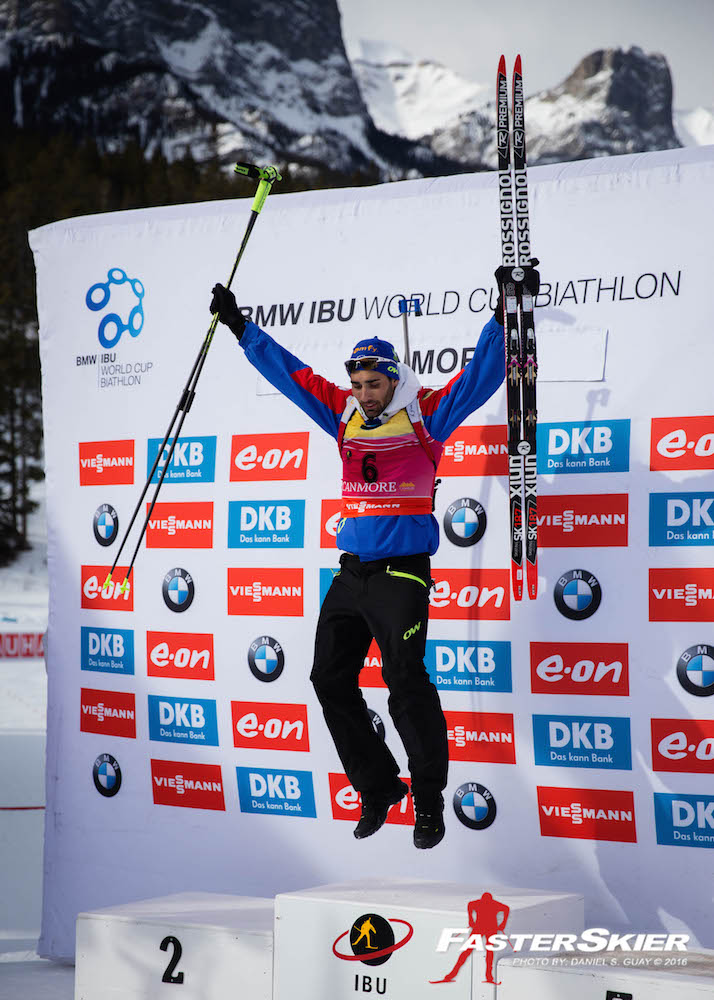
Still full of energy, Martin Fourcade celebrates his win on Thursday at the IBU World Cup in Canmore, Alberta, where he bested the field by more than 15 seconds in the men’s 10 k sprint. (Photo: Daniel S. Guay)
Two words: jet lag. Martin Fourcade had to deal with it, but so did the Canadians on their return trip to Canmore for the International Biathlon Union (IBU) World Cup Feb. 4 through 7.
The overall World Cup leader from France, Fourcade touched down in Calgary, Alberta, four days ago. On Instagram, he noted that it had been “5 years since the last time I competed in North America. Really happy to be here for 2 beautiful weeks of competition!” he wrote, according to a translation, referring to the World Cups in Canmore followed by Presque Isle, Maine, next week.
Like the rest of the field traveling to Canada from Europe, he was eight hours removed from Central European time, and it might have felt like he should be winding down for the evening when he stood on top of the podium Thursday afternoon in Canmore.
Regardless, he won, and did so without much trouble — at least by the looks of it. Fourcade hit all 10 of his targets in the men’s 10-kilometer sprint on Thursday and skied the fastest overall course time to win comfortably, by 15.7 seconds over Russia’s Anton Shipulin in second place.
But racking up win No. 43 wasn’t all that easy, Fourcade later explained.
“I was a bit nervous,” he told the IBU. “I was not satisfied with my shooting this week during training and today, I had some problems zeroing. But I was confident on my skis, I was clean and fast enough to win, so I am happy.”
Austria’s Simon Eder started first in bib 1 in the men’s 10 k sprint at the IBU World Cup in Canmore, Alberta, and he finished sixth with clean shooting and the 19th-ranked course time. (Photo: Daniel S. Guay)
The sixth starter, Fourcade took control of the race early, skiing through the first 1 k checkpoint 1 1/2 seconds faster than Austria’s Simon Eder, who started first. Both cleaned prone, and Fourcade left the range 0.6 seconds behind Eder. Shipulin in bib 7 blazed through the first shooting even faster, cleaning prone and leaving the range with a 3.6-second lead over Eder.
Shipulin held his own for most of the second loop as well, and just like Fourcade, cleaned standing, but left the range in second, 6.3 seconds behind Fourcade. Germany’s Simon Schempp (in bib 4) also hit 100 percent of his targets in both stages to move into third, 11 seconds behind Fourcade with one loop to go.
There, Fourcade extended his gap over Shipulin to 8.6 seconds early in the final loop. Schempp skied in third, nearly 15 seconds behind. The order held to the finish: Fourcade won in 23:51.5, Shipulin finished 15.7 seconds off his pace in second and Schempp 18.7 seconds behind in third.
“I spoke with Simon and Anton, and we all had the same feeling about the track,” Fourcade told German broadcaster ZDF in an English interview. “When we trained, we felt like it’s an easy track, but I knew it will be hard because of the altitude, and because the track is really wide you feel to be really slow. I think I had a good strategy keeping some strength on the first loop, and being as fast as possible on the last one.”
Canmore’s elevation is roughly 1,400 meters (4,600 feet).
“I really like this place; it is very friendly and I love the atmosphere with the teams and the local people,” Fourcade told the IBU. “If we are truly an international sport, we need to come to places like this out of Europe.”
“I really like this place; it is very friendly and I love the atmosphere. … If we are truly an international sport, we need to come to places like this out of Europe.” — Martin Fourcade, Thursday’s sprint winner and overall IBU World Cup leader
Schempp explained that the three podium finishers — all of which shot clean in the two-stage race — chatted while changing into dry clothes afterward.
“We all didn’t have a really good feeling out on the course because it’s relatively slow,” Schempp told ZDF. “You have to push all the time, you have very little time to relax because you pretty much ski from the lowest to the highest point. … So none of us felt they were skiing really fast, but the times are still good and I am very satisfied with the result.”
Asked what it was like to race overseas, Schempp told ZDF, “A little different, because your body is adapted to another time. At home it’s evening now. Of course, we had a little bit of lead time, three or four days, but … normally, you would sit on the couch or almost go to bed already right now, and instead you have to compete. That’s different, but the same for everyone.”
The men’s sprint podium at the IBU World Cup in Canmore, Alberta, with France’s Martin Fourcade in first (second from l), Russia’s Anton Shipulin in second, and Germany’s Simon Schempp in third. Austria took fourth through sixth with (from left to right, in red) Julian Eberhard in fourth, Dominik Landertinger in fifth and Simon Eder in sixth. (Photo: Daniel S. Guay)
Austria swept fourth through sixth, and while Eder cleaned both stages, he wasn’t the fastest of the three. Eder placed sixth, 47.6 seconds behind Fourcade and just behind his teammates, Julian Eberhard with a career-best fourth (+45.0) and Dominik Landertinger in fifth (+47.1).
“I already noticed during the last days that my body feels very good,” Eberhard said in an Austrian team press release.
He previously placed seventh in a sprint earlier this season in Hochfilzen, Austria. On Thursday, he had a single penalty in each stage and the second-fastest course time, 6.8 seconds slower than Fourcade.
“The course here suits me well,” Eberhard said of Canmore. “That makes every strength session in the summer pay dividends, because you can really put that on the track here. I am happy that my shape is trending upwards ahead of the World Championships.”
Landertinger cleaned prone and missed one standing. Seven of the top 11 men cleaned the sprint, including the top three.
Davies’ Dream Come True
While he didn’t clean, Tim Burke posted the 10th fastest overall course time to place 23rd, 1:44.8 behind Fourcade, with two standing penalties. He led the North Americans on Thursday, with U.S. teammate Lowell Bailey following in 24th (+1:45.2), also with two standing misses.
The top Canadian Macx Davies finished less than half a second farther back in 25th (+1:45.7), and the third American, Leif Nordgren placed 26th (+1:46.7).
Macx Davies cleaning his second-straight stage on his home course en route to 100 percent shooting and 25th overall, for his second-best result of his career at the IBU World Cup in Canmore, Alberta. (Photo: Daniel S. Guay)
Out of that group, Davies, 23, was the only one to shoot clean. In doing so, he posted his second-best World Cup result of his career — in his hometown.
“I started the day with the goal of being top 20 and after seeing the first few athletes in the range I knew that I would have to shoot clean to do that,” Davies, the 31st starter, wrote in an email. “And once I made that decision there was no other possibility.”
Knowing the course well, he decided to conserve for the final loop. Afterward, he reflected that he paced it well and “was able to give a good punch on the finishing climbs.
“I didn’t realize how good of a day it was until I was on my final loop and the coaches and wax techs were screaming at me, telling me that I was close to the top 20 and needed to ski faster!” Davies wrote. “My thoughts after I cleaned standing were accepting that I would have to ski very hard on my final loop if I wanted to stay with the people around me.”
Davies initially finished 19th, about a second back from Burke’s time. Bailey in bib 38 ended up between them, and all three slipped a few places outside the top 20, but it was enough for Davies.
“I am so happy to have had this race at home! It is truly a dream of mine to race well in front of my home crowd and I feel happy that I could show where Biathlon Canada is going, and it is only up!” Davies wrote.
“After seeing the first few athletes in the range I knew that I would have to shoot clean … And once I made that decision there was no other possibility.” — Macx Davies (Biathlon Canada) on shooting 10-for-10 in Thursday’s sprint to place 25th
As somewhat of an aside, his father is the chairperson of the event.
“It makes me realize how much effort from a few people it actually takes to make a World Cup event happen,” Davies noted. “I am proud to have him so closely tied to me and it doesn’t add any pressure, just makes the victory sweeter.”
While many of the Europeans chose to spend the bye week at home, Burke and several other North American flew directly to Canmore after the last World Cup two weeks ago in Antholz, Italy. That gave Burke 10 days to get his legs back under him.
Tim Burke (US Biathlon) en route to 23rd in the men’s 10 k sprint at Thursday’s IBU World Cup in Canmore, Alberta. He cleaned prone, but missed two standing and posted the 10th-ranked course time overall. (Photo: Daniel S. Guay)
“This was my first winter race in North America in 5 years! I feel like the Canadian crowd was also cheering for us, so it made the race a lot of fun,” Burke, who turned 34 on Wednesday, wrote in an email.
During the race, he started 20th and found himself in the top 10 with a clean prone, leaving the range for his second loop in ninth. After two misses in standing, he was down to 15th. While Burke initially finished 14th, nine men behind him bumped him into 23rd.
“I was not happy with my two standing misses but this simply happens in biathlon,” Burke wrote. “I was more frustrated with my skiing today. I feel like I had great preparation for these races and this course is perfect for my strengths. I’m not really sure why, but I just felt really flat today right from the start. I’m hoping that this effort was a wake up call for my body and that I will bounce back for the Mass Start on Saturday.”
Based on a provisional start list for Saturday’s mass start, which includes only the top 30 athletes, Burke, Bailey and Canada’s Nathan Smith are in (ranked 20th, 16th and 14th, respectively). On Thursday, Smith placed 31st (+1:52.7) with a single prone penalty.
Nathan Smith (Biathlon Canada) on his way to 31st in the men’s 10 k sprint at the IBU World Cup in Canmore, Alberta. (Photo: Daniel S. Guay)
“I have been struggling skiing for the last few weeks,” Smith, the second-best Canadian on Thursday, wrote in an email. “Before it could’ve been my back pain, but today I didn’t have any. Late last week in intensity I felt in top form, but then in race prep yesterday I just felt totally heavy. Unfortunately it was the same today.”
On the upside, “My shooting had been rock solid for the last two weeks,” he added. “No worries there. I’m hoping that today’s tough ski will have gotten me into better shape for the mass start and mixed relays this weekend.”
While Bailey was alternatively pleased with his clean prone stage, his two standing misses left him “extremely disappointed,” he wrote in an email.
“I missed both shots by a few millimeters,” Bailey explained. “I think it hurts a little more when you realize how close everything was.”
Asked about pacing on Canmore’s course, the 34-year-old US Biathlon veteran noted: “This course has a huge climb — perhaps the longest on the world cup circuit — so I really tried to work that climb so that I was able to push in the last part of the hill. I definitely felt fatigued by the last time up it, but I think a lot of athletes were feeling this way as well.
“I’m ok with a top-25 but I know I can do better than this,” Bailey added. “I just have to re-focus and set my sights on the next races. I’m confident in our preparation and I really feel like we can put together some quality results during the North American tour.”
Lowell Bailey racing to 24th in the men’s 10 k sprint at the IBU World Cup in Canmore, Alberta. (Photo: Daniel S. Guay)
Nordgren was disappointed to miss his last prone shot — his only penalty of the day. The 49th starter, Nordgren found himself in 41st initially after the first shooting. He then improved to 27th after the second shooting with a clean standing stage.
“I know I’m capable of more, and I showed it last season,” Nordgren wrote in an email. “… Missing the last shot in any stage is just painful. I haven’t raced here in a few years, but I remember going out too hard last time and blowing up pretty hard on the last loop. Today I tried to start pretty aggressive, while still leaving enough to ski a good last loop.
“The most disappointing thing is knowing I would have been in the mass start on Saturday had I hit that prone shot, which leaves a bitter taste in my mouth even though it was a fairly good race,” he added.
Before Canmore, Nordgren spent a few days at home in Minnesota.
“Since I wasn’t there for Christmas it was good to just relax at home, even if it was really short,” he wrote. “I traveled to Canmore Last Thursday in order to get a few days extra to adjust to the altitude. It’s been nice here in Canmore, the snow is in really good condition and the temps have been pretty mild.”
For the home team, the atmosphere was uplifting. A couple thousand spectators came out for the races, Smith estimated, and a large number of them were schoolchildren. Smith is originally from nearby Calgary.
“Maybe one day one of those students in the crowd will represent Canada at the Olympics,” he wrote. “At the start I felt really proud to be representing Canada at home, to be an ambassador for the sport, and knowing that I’m racing for something larger than just myself.”
Scott Gow (Biathlon Canada) racing to 34th, one of the best results of his IBU World Cup career, at the men’s sprint in Canmore, Alberta. (Photo: Daniel S. Guay)
In 34th, about three seconds behind Smith, Canada’s Scott Gow, 25, had one of his top-five best results. Like Davies, the Gow brothers also grew up in Canmore. Scott Gow had one prone penalty to finish 1:55.5 behind Fourcade.
In an email, Gow explained that his race started like any other: “There were a few nerves I needed to get out of my system but after 1km everything felt normal,” he wrote. “I got some splits saying my ski time was good, and the techs kept telling me throughout the race that I was maintaining good ski speed.”
While he wasn’t happy with his prone miss, his standing stage gave him “renewed motivation to really try and hammer out my last lap,” Gow added. “It was nice skiing by the stadium and having a few hundred people cheering me on, making sure I finish well. … I’m happy with my end result. I was hoping to feel better on skis and of course I would have liked to hit all my targets. Overall I’m very pleased.”
His brother, Christian Gow, and Brendan Green also had one miss each (both in standing) and ended up in 61st (+2:50.2) and 40th (+2:09.5), respectively.
The fourth American, Max Durtschi in his first-ever World Cup placed 85th with five penalties (2+3).
“Overall, I am disappointed with my performance today,” Durtschi, a 24-year-old former professional cyclist, wrote in an email. “I felt solid on skis, but my shooting was not up to standard. At the World Cup level you cannot shoot 50% and call it a good day. Representing the USA at this level is a big privilege, and I expect a much better performance out of myself in the range.”
A member of US Biathlon’s X-team, he is slated to join the World Cup team in Presque Isle next week.
“The next days I am focusing on training and improving!” Durtschi wrote. “I will remain open minded to whatever comes my way. For now, I need to continue to work on the fundamentals of the sport.”
Canadian biathlete Macx Davies raced to his second-best IBU World Cup result of 25th on Thursday in the men’s 10 k sprint in Canmore, Alberta. (Photo: Daniel S. Guay)
It’s been more than 20 years since the International Biathlon Union (IBU) World Cup last paid Alberta a visit. This week, the world’s best biathletes converged on Canmore, Alberta, the home base of Canada’s national team, for the seventh stop on the IBU World Cup — with races Thursday through Sunday.
Lake Superior Biathlon coach Daniel S. Guay snapped the following photos from the second official training day on Tuesday. For his complete gallery, click here.
It was another sunny one at the Canmore Nordic Centre for the final official training day before six competitions take place in a span of four days (Thursday through Sunday) at the International Biathlon Union (IBU) World Cup in Canmore, Alberta.
For the U.S., five men and five women were selected to compete in Canmore, but only eight of them opted to start, with Sean Doherty* and Clare Egan** choosing to train instead:
Lowell Bailey
Tim Burke
Leif Nordgren
Max Durtschi
Susan Dunklee
Annelies Cook
Hannah Dreissigacker
Joanne Reid
*Doherty is coming off three podiums in as many races at IBU Junior World Championships in Romania and will recover at home in Center Conway, N.H., before competing at the following World Cup (World Cup 8) next week in Presque Isle, Maine.
**Egan was selected based on her World Cup ranking, but “has opted to forego World Cup 7 in favor of more intense preparation for World Championships later this season,” according to US Biathlon Chief of Sport Bernd Eisenbichler.