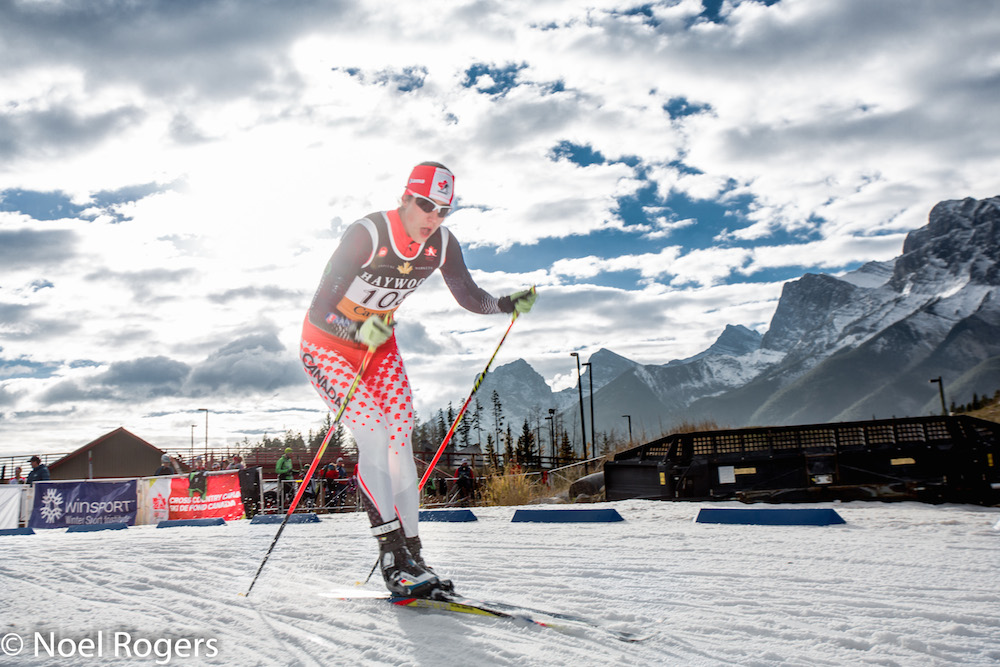
Rosanna Crawford racing to the win in the cross-country distance race on Oct. 27 at Frozen Thunder in Canmore, Alberta. She win on to win her second-consecutive race at Frozen Thunder on Thursday with a victory in the 7.5 k sprint at Canada’s IBU World Cup/IBU Cup trials. (Photo: Noel Rogers/Bow Valley Photography)
Day one of the Canadian World Cup and IBU Cup selections races took place at the Canmore Nordic Center on Thursday. The sprint race format consisted of three laps of the 3.4-kilometer Frozen Thunder loop for men, and three laps of the 2.4 k track for the women.
Cold temperatures dropping well below -20 degrees Celsius (-4 Fahrenheit) made the tracks hard packed and squirrelly for racers. The 10.2 k men’s race started at noon due to the cool morning with women’s 7.2 k following 45 minutes later.
In the men’s race, Biathlon Canada’s Nathan Smith claimed the first victory of the season, clocking in at 26:57 minutes. Despite two misses in his last bout of shooting, Smith maintained strong ski speed to land on top of the podium. Marc-Andre Bedard of Team Quebec was just 12 seconds with perfect shooting for second. Macx Davies (Biathlon Canada) rounded out the top three another 25 seconds back, with three penalties.
“Wasn’t looking for anything else than give my best and have fun!” tweeted Bedard after the race. The former Olympian has been focusing on obstacle racing for much of the year.
The women’s race saw national-team veteran Rosanna Crawford take the win, with just one miss and the fastest time of 23:35. Emma Lunder, a new member to Biathlon Canada and the Biathlon Alberta Training Center, also had one miss and fought to stay with Crawford on her final lap for second overall, 1:08 back. Audrey Vaillancourt, another national-team member as well as an Open European Championship winner, finished in third, 9 seconds behind Lunder, with two penalties.
“Chilly morning for our first of two races up at the Nordic Center, happy to hit 9/10 when it’s hard to feel your fingers!” Crawford posted on her facebook fan page.
Racing continues Friday with another set of sprints. Crawford, Smith and Brendan Green prequalified for World Cups 1, 2 and 3, and Scott Gow prequalified for IBU Cups 2 and 3 (although he’s aiming for a World Cup spot instead).
In all, Canada has eight male and eight female quota spots, with four from each gender being tapped for the World Cup and four selected to the IBU Cup after trials. Qualifiers are expected to have shot at least 80 percent in two races this year, and come within 90 percent of the average of the podium finishers’ times at trials. The high-performance committee will review all results and select the team based on results and consistency, with a major focus on trials but also including other considerations as well.
About the author: Evan Brian Paul Girard is a student, an athlete and an adventurer. He grew up in a small town in Saskatchewan called Oxbow with a population of about 1,200. Biathlon Saskatchewan’s provincial coach Doug Sylvester introduced him to the sport at age 17. Having never cross-country skied or shot a target rifle, Girard was nearly a decade of training behind his fellow competitors, and he spent the next two years training with Biathlon Saskatchewan. In the spring of 2013, he was accepted as a member of the high-performance team, Rocky Mountain Racers, based out of the Bow Valley in Canmore. In December 2013, he competed for Canada for the first time as a biathlete at the Winter Univerisade in Trentino, Italy.
For the second year in a row Canmore, Alberta, willhost the world’s best nordic skiers with six International Paralympic Committee (IPC) World Cups. Racing begins Monday December 9th and continues to December 17th. The entire series will be set at the renowned Canmore Nordic Center.
These World Cups are of huge importance to Canada’s Para-Nordic Team. They provide the athletes with an opportunity to compete on home turf but more importantly, the entire series serves as a qualifying event for the Paralympics in Sochi, March 7 to 16, 2014.
The Russians arecoming. Close to 120 athletes are expected including 40 from Russia alone. Canada and the United States will be out in force with about 20 athletesper nation. Up to 16 nations will be represented. Monday, December 9th, Tuesday December 10th and Thursday December 12th are the Cross Country world cups. Beginning Saturday, December 14th and then on the 15th and the 17th, many of the same athletes will be competing in the biathlon world cups.
Let’s make some noise out there and cheer on the athletes. Come to watch or be one of the 150 volunteers needed. Go to IPCVolunteers@albertaworldcup.com and chose your favourite volunteer position. Visit the event website at www.albertaworldcup.com.
***
Watch and share this great video produced by Glen Crawford at Glen Crawford Production Services, Canmore Alberta.
Tracks at the Canmore Nordic Center in Alberta, during the 2010 Pre-Olympic World Cup event.
Twenty-two years after the 1988 Winter Olympics, the Canmore Nordic Centre remains a model of legacy planning for Olympic cross-country venues.
When it was built in 1986, Canmore set a new standard for nordic facilities, and when it was refurbished in 2005, the ski area redefined that standard.
In his masters’ thesis, John-Christopher Reid called the 1988 Winter Olympics “…the single most significant precedent in terms of structuring Winter Olympic legacies in North America.” Canmore has shared in that legacy.
Like Utah’s Soldier Hollow, Canmore is a stand-alone facility. But unlike any other North American Olympic venue, Canmore, located in one of Alberta’s provincial parks, is government-owned and funded.
“It’s the most outstanding venue in the world, when you look at everything from A to Z. Nobody has done anything like it,” said former Canadian and American national team coach Marty Hall.
Beginnings
Canmore’s road to the Olympics started in 1956, when the Calgary Olympic Development Association (CODA) was founded to secure the Winter Games for the city. After missing out in 1964 and 1968, Calgary was finally awarded the 1988 Games, beating Falun, Sweden and Cortina d’Ampezzo, in Italy.
CODA’s winning bid cited Bragg Creek, 60 miles southeast of Canmore, as the cross-country venue, which had “excellent terrain,” according to Bjorger Pettersen, the chief of competition for Canmore’s cross-country events.
But Don Gardner, who collaborated with Pettersen on site selection, and later, trail layout, felt that Bragg Creek was too exposed to the Chinook, a warming wind that can raise temperatures as much as fifty degrees in a few hours.
Moreover, Gardner said he thought that Bragg Creek’s location wasn’t economically viable post-Olympics, since it wasn’t near a major road, and lacked infrastructure. And when
Southam racing at the Canmore World Cup
organizers deemed the installation of a snowmaking system too expensive, CODA expanded its search for a cross country venue.
After inspecting several sites, Gardner and Pettersen felt that Canmore had the best snow retention of all the sites they inspected. Work began on the venue in 1983.
The courses there were “definitely harder than anything that came before,” said Hall, who coached the 1988 Canadian Olympic cross-country team. “Both uphill and down. Particularly up.”
The trails were well-received, Gardner said, but he also acknowledged that some people thought they were too difficult. Intended to test both fitness and technique, Gardner said that he designed the trails to challenge the top 30.
“They were designed to test great skiers…not those that would finish in 60th place,” Gardner said.
“I thought this was the way the sport was [evolving],” said Pettersen of the famously big hills. At 104 meters, one ascent in particular exceeded the maximum for a single climb. “Somehow, Bjorger talked FIS [the International Ski Federation] into leaving it,” Gardner said.
Post-Games
Following the Games, CODA took over management of the Olympic ski jumping, sliding, and speed skating venues. But because Canmore was located in a provincial park, the government opted to manage the venue itself, rather than turn it over to CODA. (In 2009, CODA was renamed Canadian Winter Sport Institute, or WinSport.)
“The [province’s] operations of the center addressed the community’s desire for [it] to remain a public facility as well as meeting recreational and high-performance sport needs,” said Dan Huang, a spokesman for Alberta Parks, in an e-mail.
One of the benefits of provincial management was free skiing: for the first eight years after the Olympics, visitors didn’t have to pay a fee to use Canmore’s trails.
But in the early 1990s, collapsing oil and gas prices hobbled Alberta’s economy. Facing some $20 billion in debt, the province enacted broad budget cuts—including to its parks.
“There were budget reductions throughout the Alberta Parks system. At the Canmore Nordic Centre, capital reinvestment was limited,” Huang wrote.
While Canmore still received regular maintenance, the only major upgrade following the Olympics was CODA’s construction of the Bill Warren Training Centre in 1994, which offered facilities for weight training, performance testing and recovery on-site.
By 1996, Canmore had begun charging a trail fee to help defray expenses. Today, however, its $10 trail pass is still below the market rate for a top-end cross-country ski center.
“Historically, there’s been a reluctance to have fees at market level, due to the fact that it’s a public facility,” said Mike Roycroft, Canmore’s manager.
Renewal
Seeking more race starts for Canadian athletes, in 2002, Cross Country Canada (CCC) requested a spot for the country on FIS’s World Cup calendar.
According to Dave Dyer, CCC’s events planning director, one motivating factor for the bid was a presentation by athlete Beckie Scott to CCC’s executive committee and board of directors, in which she expressed her desire to compete in international events on home soil.
“We entrenched a planning principal at FIS that overseas nations would be able to hold World Cup races every second year,” Dyer said. 2005 would be the start of that cycle.
CCC solicited bids to hold World Cup events, and according to Dyer, “…Canmore was the site we thought could hold an event right off the bat.” Ultimately, Sovereign Lake, B.C. and Foothills Nordic in Calgary won the bids to host the races, and Foothills organized its event at Canmore.
As plans for the World Cups developed, the provincial government “rolled up its sleeves and
Women racing in the sprint in Canmore in February.
decided to look at reinvestment options in Canmore,” according to Glen Cowper, strategic development manager for the Alberta Ministry of Parks, Tourism and Recreation. By June, 2004, the province had “decided to invest, to bring Canmore up to current international standards,” he said—both for biathlon and cross-country skiing.
In just thirteen months, new competition trails were laid out to comply with current homologation rules. In addition to shorter and more spectator- and television-friendly loops, said Roycroft, acceptable climb criteria had changed significantly in the intervening sixteen years since the 1988 Olympics. The elevation profile and grade of the courses are now much different.
Gardner, one of the 1988 course designers, collaborated with John Aalberg on the changes to the trails. “The whole style is different, because of television and spectators,” Gardner said. “The courses are convoluted and back and forth. The climbs are shorter, but there are more of them.”
In addition to new trails, Canmore received a new cross-country stadium, a new snowmaking system and new wax facilities. Cowper characterized these as the minimum upgrades necessary to run the December, 2005 World Cup races.
After those events, work continued, with updated biathlon trails, a new biathlon stadium, an improved day lodge, and a paved rollerski trail added by 2008.
Thanks to the refurbishment, Canmore can now hold “simultaneous World Cup events, and still have 40 [kilometers] of trail open to the public for recreational skiing,” said Magi Scallion, Canmore’s events coordinator.
Training
Today, Canmore is the home of both the Canadian National Ski Team, and the National Biathlon Team. CCC’s headquarters are in the Bill Warren building, and the Alberta World Cup Academy, an elite club, also makes its home in Canmore.
Athletes use the ski and rollerski trails at the venue, then can head immediately to the Bill Warren center’s recovery facilities, like hot tubs and saunas, without having to drive anywhere, Roycroft said.
“You can live in Canmore and rollerski to the Canmore Nordic Center for some rollerskiing on the rollerski loop, or use the gym. In Whistler [BC], you would have to drive roughly 15 to 20 minutes to the site to begin quality training,” said Scott Perras, a Canadian biathlete, in an e-mail. “The staff in Canmore are very good, and are getting better every year at understanding our needs.”
Canmore is also creative in extending the ski season for local athletes. 2009 was a “trial year”
Stefan Kuhn in Canmore in February. Photo, Win Goodbody.
for an initiative that has since been dubbed “Frozen Thunder.” Temperatures were cold enough around Canada’s Thanksgiving, in October, that the nordic center opened a limited loop with snow they had harvested and stored under sawdust over the previous summer. With its success, they expanded the program for fall 2010.
According to Roycroft, last summer “probably double” the amount of snow, compared to 2009, was set aside. The preserved snow was laid over a one-kilometer loop, and some was saved to fill on thin spots.
Securing the Future
With experience and momentum gained since 2005, Gardner said he thinks that Canmore has a bright future.
However, he said he was also concerned, generally, about the sustainability of large, high-overhead ski venues—specifically in a tough economy. He cited the Ontario provincial government’s closing of Big Thunder National Ski Training Center in 1996, following the 1995 World Championships.
“Cross-country places are going to have to fight for their existence,” Gardner said.
Roycroft said that in a future economic downturn, there wouldn’t be the pressure to de-fund here as there might be at other park facilities in Alberta. The nordic center is “considered one of the top three [park] facilities in the province,” he said.
Compared to other legacy venues supported by endowment funds, Roycroft argued, “Canmore…has probably got the most stable funding model,” noting that an endowment fund’s value can fluctuate with the stock market. Currently, approximately 35 percent of Canmore’s operating budget is funded by trail fees, with the rest coming from general tax revenue.
By funding upgrades to Canmore earlier in the decade, the province “made a commitment to FIS and the International Biathlon Union,” Roycroft said. He described Canmore as a showpiece and an “economic driver” for the city and the province—a 24-hour mountain bike race alone generates $1 million in revenue, for example.
Dyer agreed, saying that the provinces are interested in the economic impact of World Cup races, which he characterized as “brand exposure.” Still, he added, if either the federal or provincial governments decided not to support future World Cup races in Canada, “we’d have a lot of soul-searching to do.”
It will be a little while before the Canmore Nordic Center has full coverage of its trails like in this mid-winter shot, but operation 'Frozen Thunder' will help the Canadians get on snow early. (Photo: Win Goodbody)
Early season skiing is always tough. A lucky few end up on glaciers or live in locations that benefit from early snowfalls, but the majority must make do on rollerskis.
However, Canmore, the epicenter of Canadian cross country skiing, has hit on a new way to get on snow early.
Beginning this weekend, staff at the Canmore Nordic Center (CNC) in Alberta will roll snow into a loop in an operation nicknamed ‘Frozen Thunder.’ The loop, which will be roughly one kilometer long, will even go through the biathlon range.
In an e-mail to FasterSkier, Magi Scallion, the CNC director of events, said that the CNC managed to store enough snow at the end of last season to cover roughly three kilometers of trails, but by October, the amount had been reduced to just enough to cover a kilometer to a kilometer-and-a-half.
To spread the white stuff, the CNC will be using large trucks, a back hoe and Pisten Bullys. “We’re essentially trucking it onto the trail we’ll be skiing on, and then pushing it out with our Piston Bullys,” said Scallion.
As Canmore is the base for the Canadian National Cross Country Ski Team, as well as the Canadian National Biathlon Team, both will be heavy users of the loop. According to Scallion, the national teams have limited their early season travel in order to take full advantage of the on-snow training opportunities at home in Canmore.
In addition to the Canadians, the U.S. National Biathlon Team is also planning on using the snow, as their World Cup selection races are slated for the CNC in mid-November.
At the local level, five or six clubs based in the area will be skiing on the loop, with several out-of-town clubs also expected to make the trip. In total, Scallion said she hopes for upwards of 100 users per day.
Despite unseasonably warm temperatures thus far in October in Canmore, Scallion’s hope is that ‘Frozen Thunder’ will be the start of winter at the CNC. “We fully expect this snow to last until we can produce snow with our snow making machines,” she said. “This is the beginning of the ski season for us.”
The cost? Scallion pegged the total for the project at roughly $6,000. The cost of the snow itself, because it was produced last winter as part of the CNC’s snowmaking program, was very little. About $2,000 has been allocated for the use of heavy machinery to move the snow, while the largest expenditure was for sawdust, which covered the snow during the summer to reduce melting. Some four loads of sawdust – at $1,000 bucks a pop – were used.
As for next year, plans are already underway to increase the amount of snow available to create early-season skiing. The CNC is investing another $10,000 this fall to renovate a section of earth to improve snow storage and reduce sawdust costs for next year, and its goal is to be able provide roughly five kilometers of “groomed snowfarm snow trail” at some point in the future.