From the FasterSkier archive — posts syndicated from athletes’ and coaches’ own blogs between 2004 and 2012, kept online as published. Current coverage is at fasterskier.com.
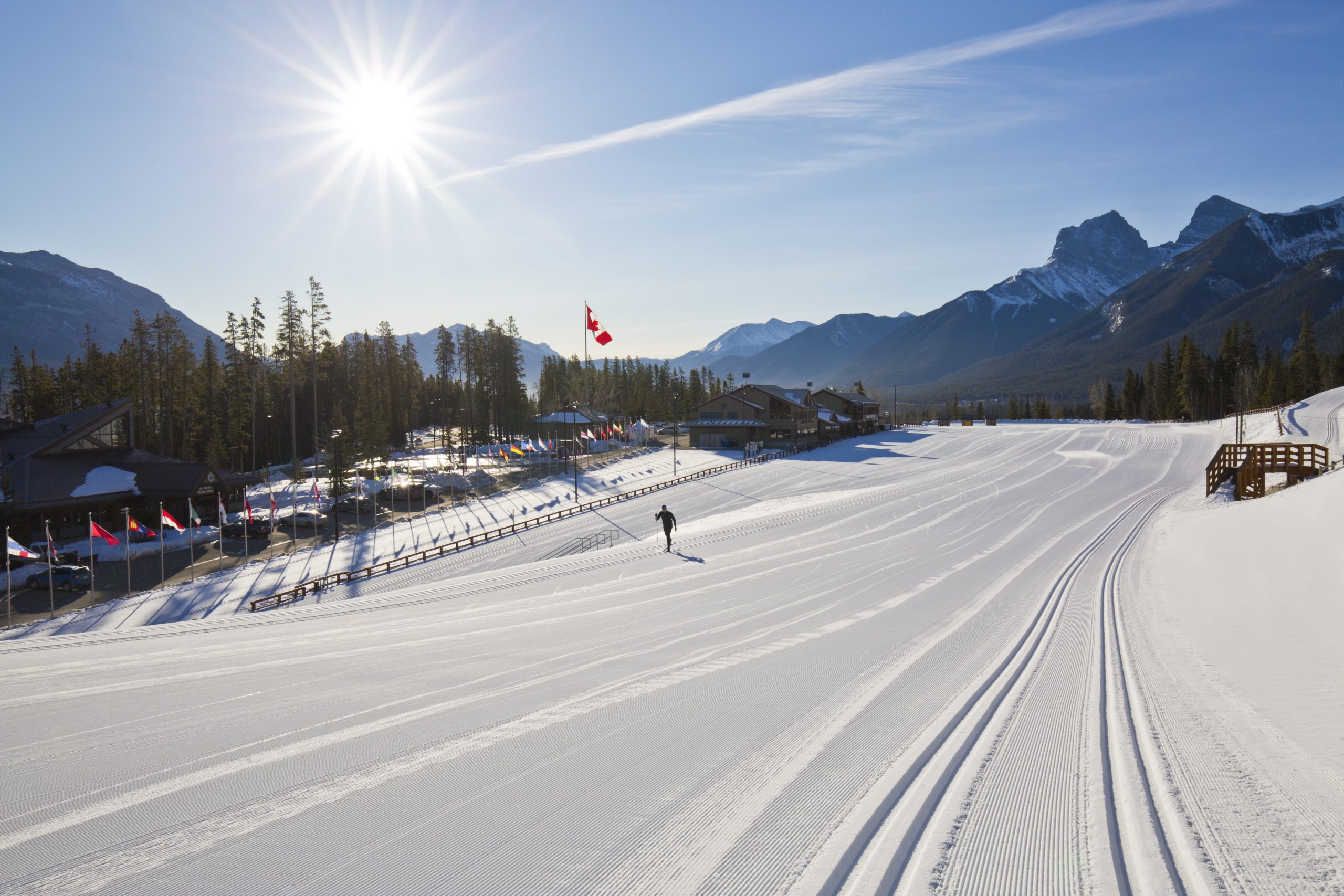
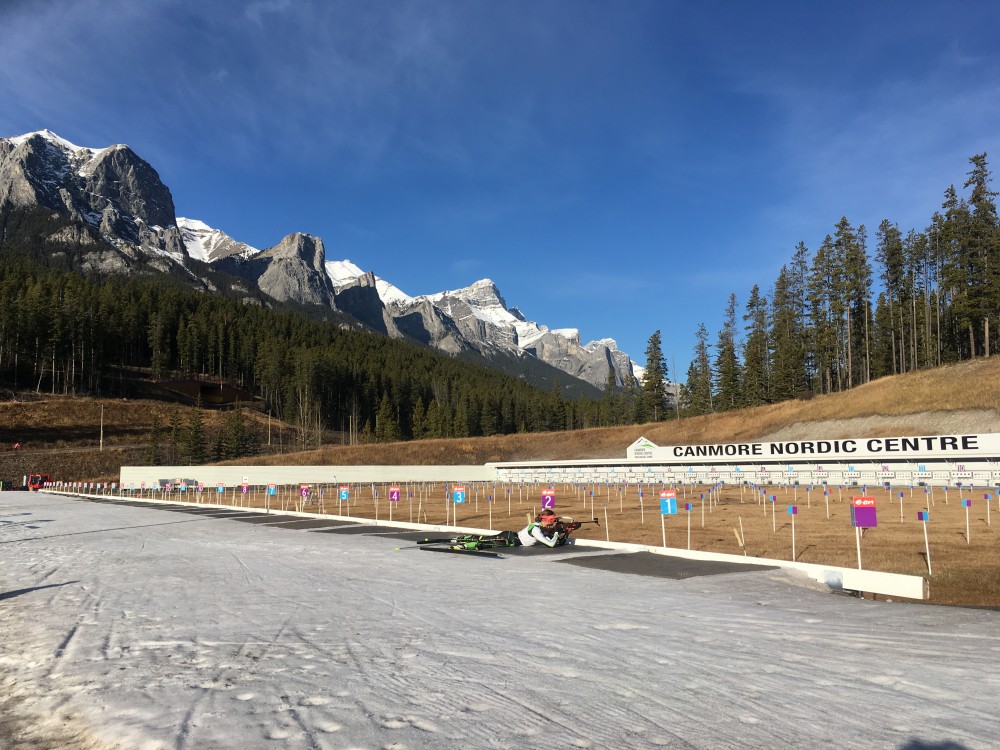
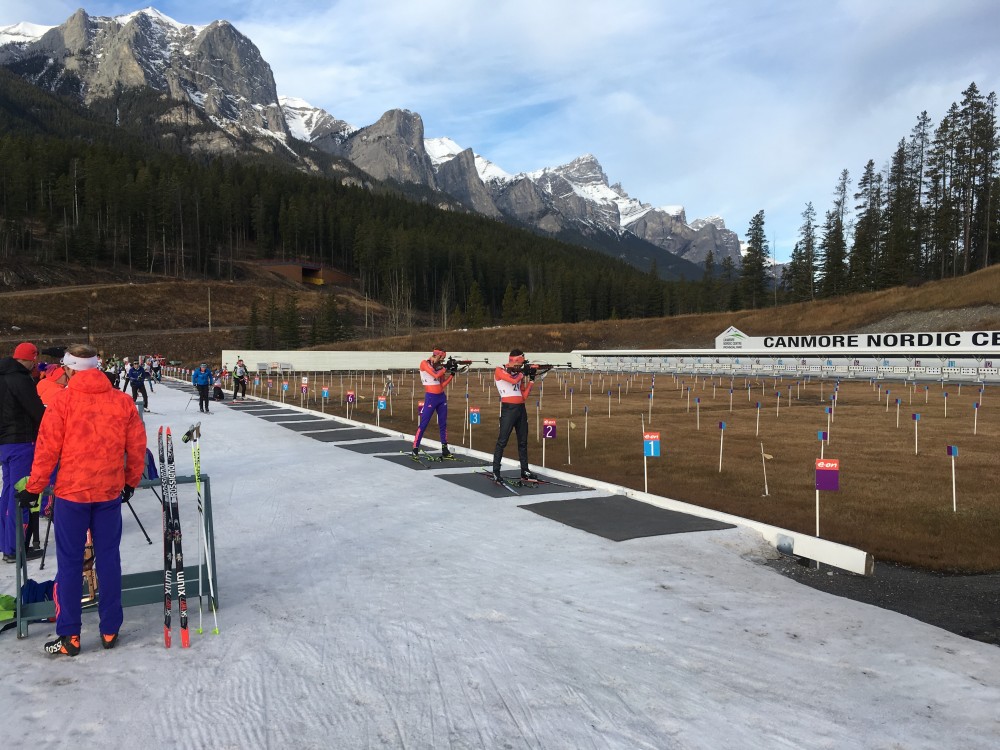
Canmore Nordic Ski Club is located in the beautiful Canadian Rockies and operates out of the Canmore Nordic Center, the site of the Nordic and biathlon events for the 1988 Winter Olympics. The center has received regular updates to its trails and facilities and hosts World Cup races for both cross-country skiing and biathlon.
The Canmore Nordic Ski Club strives to be one of the premier cross-country ski clubs in Canada and is now accepting applications for a full-time Cross Country and Biathlon Coach to lead the U14 program, co-lead the U16 program, and support the U18 athletes.
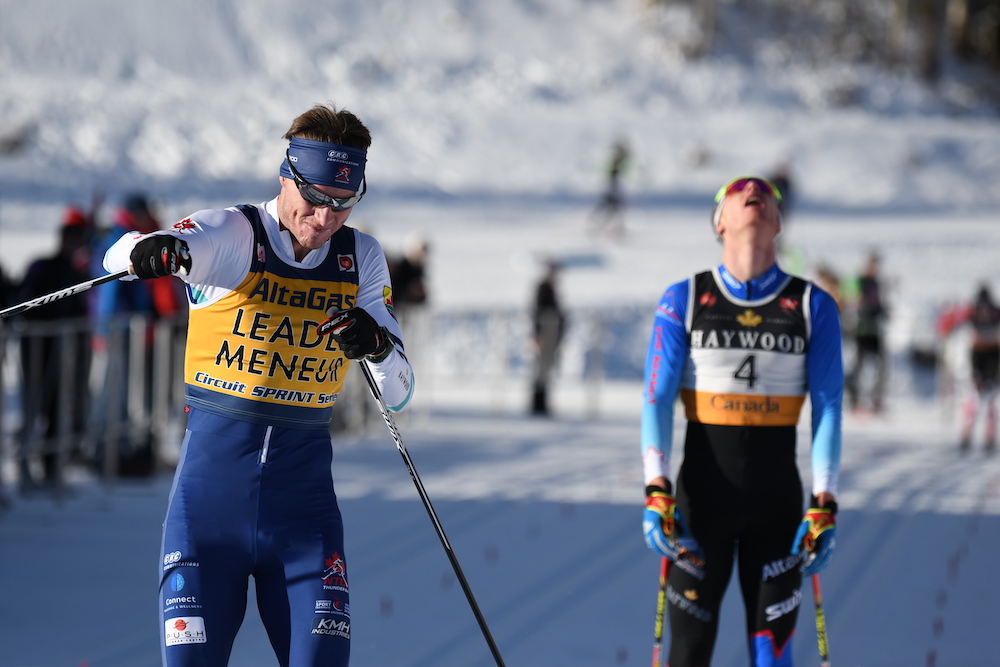
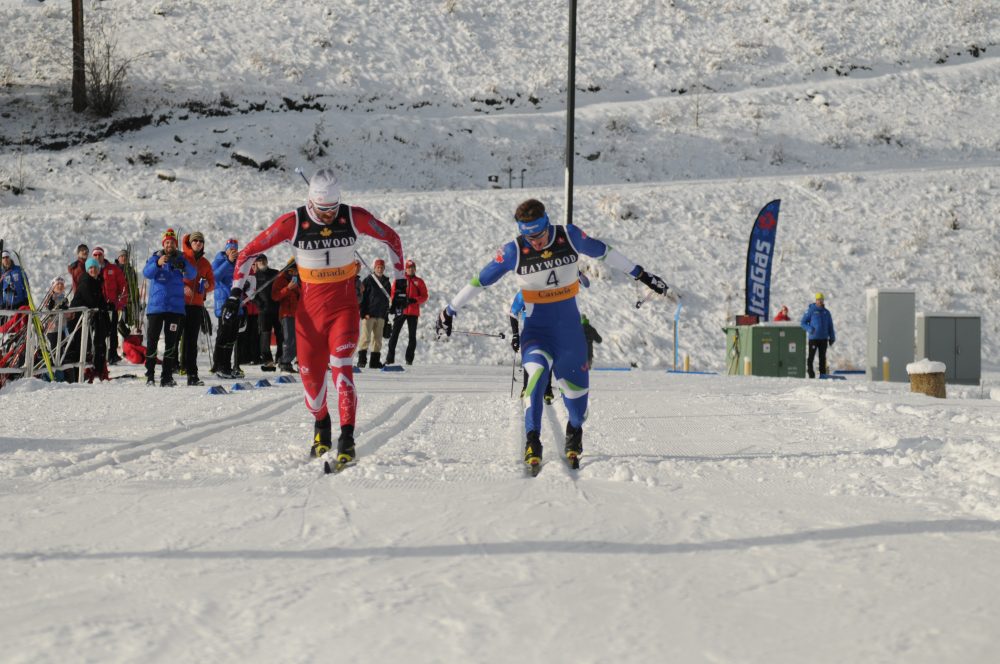
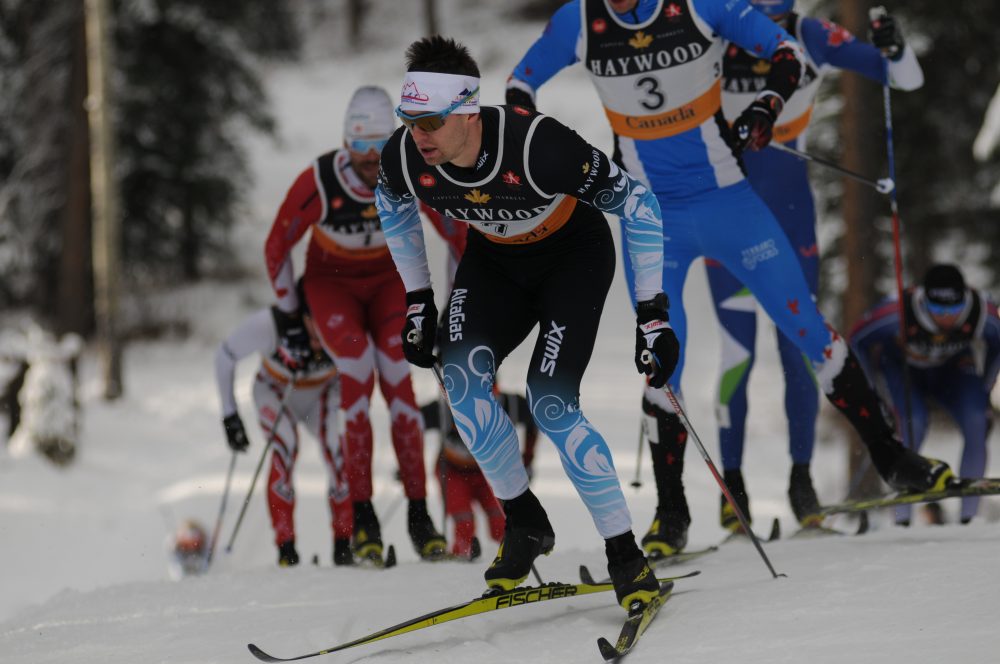
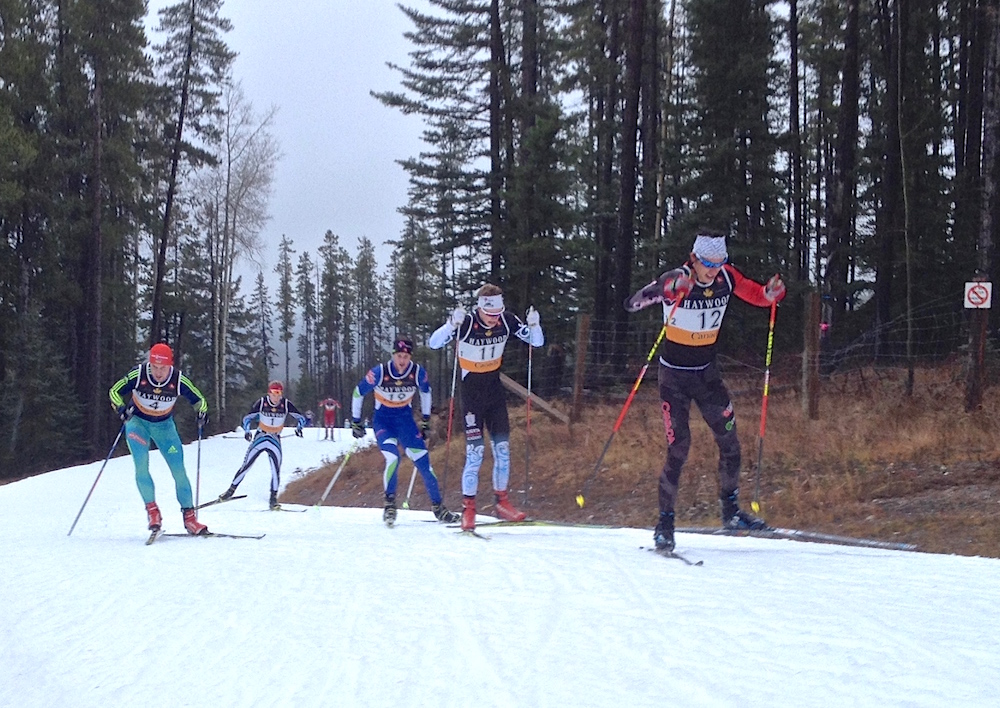
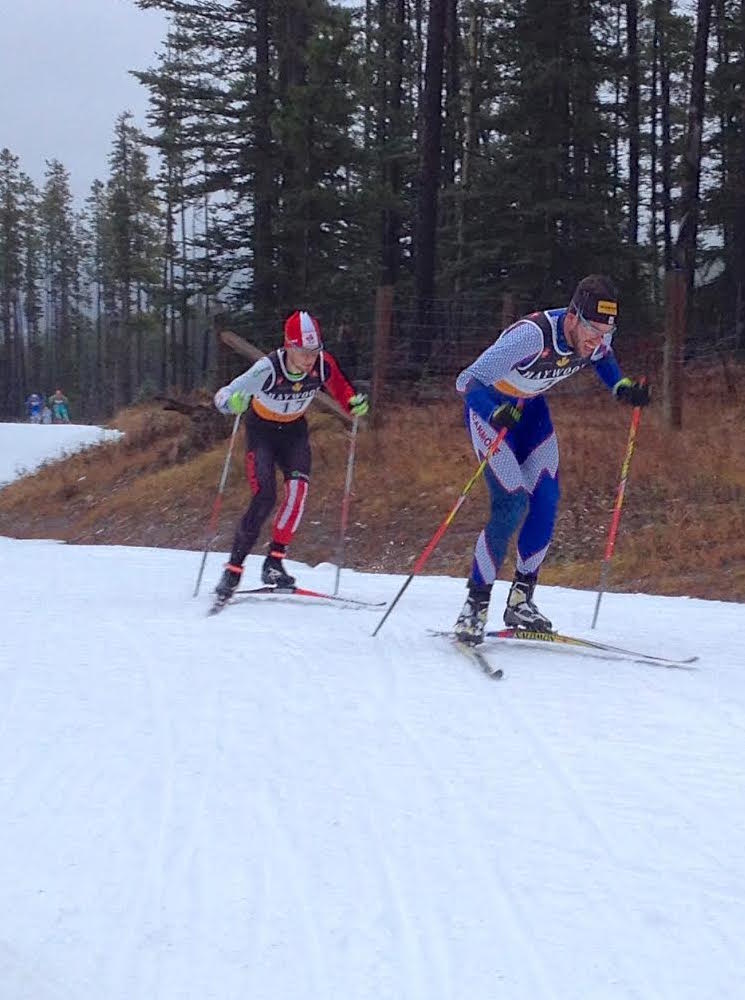
Junior Tyson Green (Caledonia) outsprints Mark Arendz (NPST) in a third round King’s Court heat. (Photo: @NordiqCanada instagram)
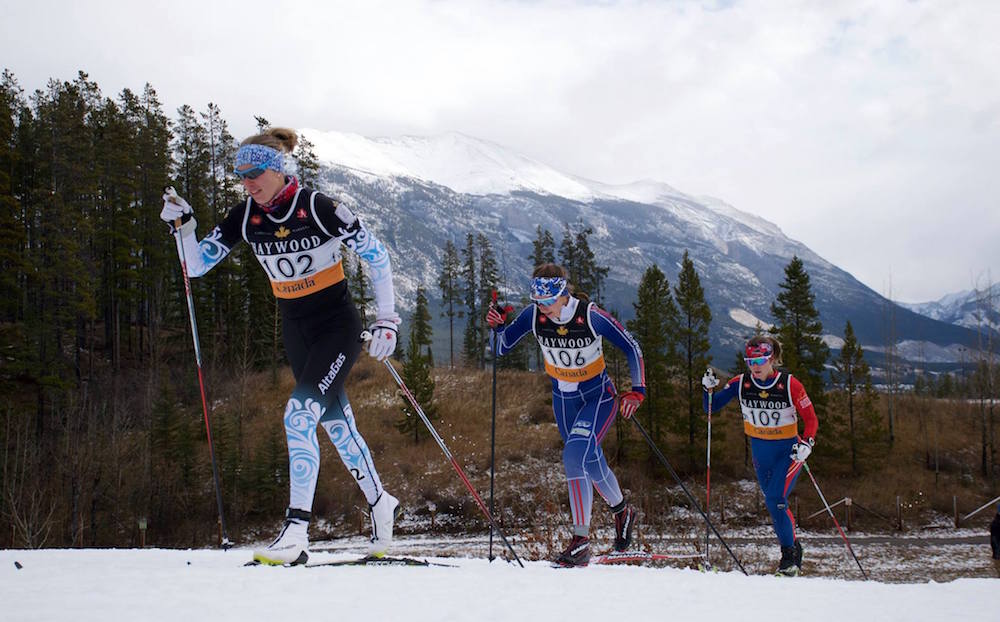
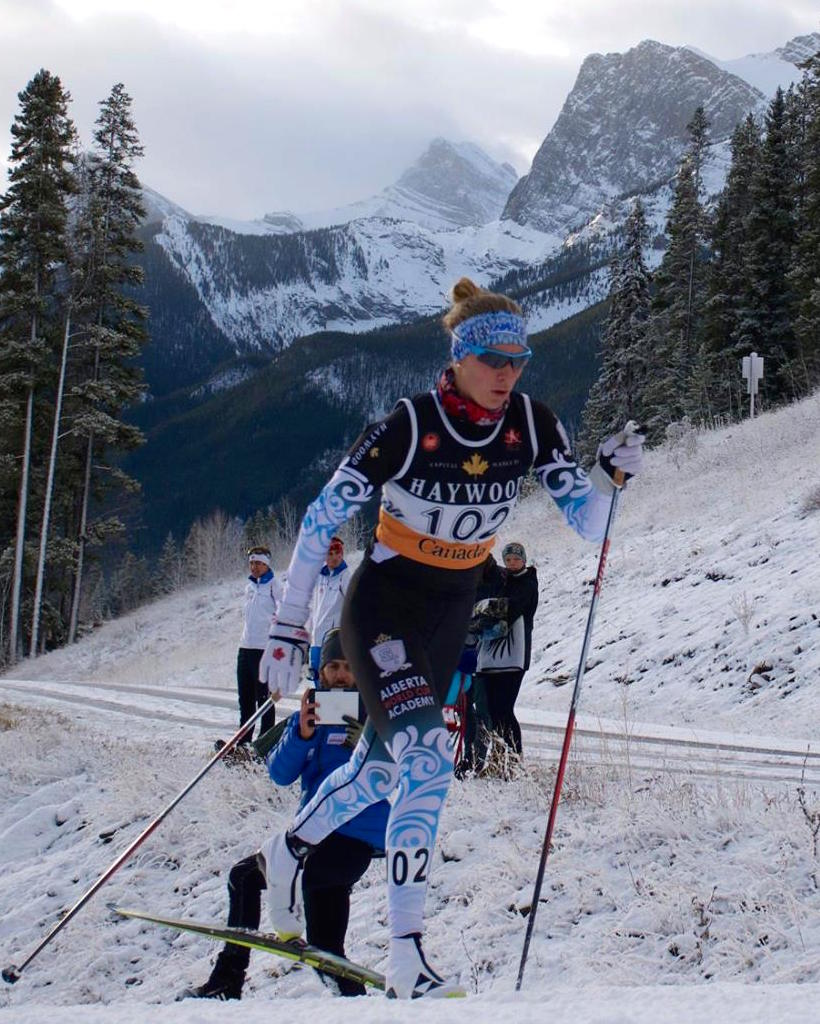
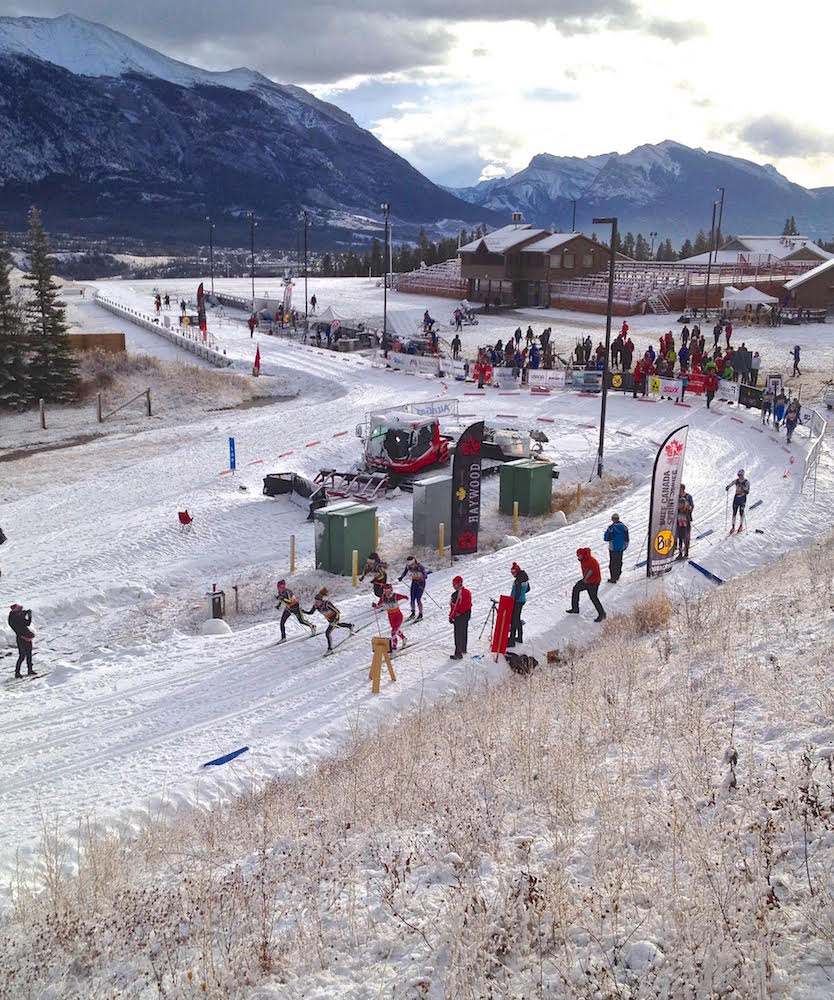
Nordiq Canada hosted the annual kick-off to the race season at Canmore Nordic Centre on November 13th. The ‘Nordiq Thunder’ races are an opportunity to put on a bib and test fitness and are not being used for trip selection this year. The full press release follows the two winner’s interviews, below. Results for both days are on zone4.ca
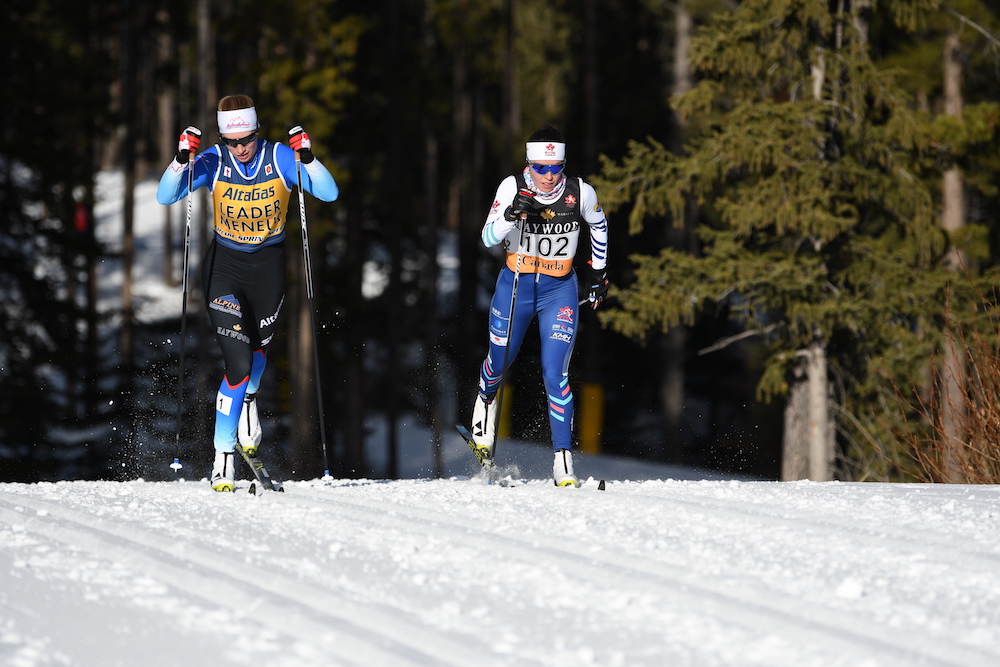
CANMORE, Alta.—Antoine Briand and Maya MacIsaac-Jones were crowned the king and queen of the annual Nordiq Thunder King’s Court Sprints on Wednesday in Canmore, Alta.
Born just two days apart, the 24-year-olds hammered the pace up and down hills on the challenging 1.4-kilometre track throughout the qualifying round, and in each of the three head-to-head heats, under a blue-sky morning at the Canmore Nordic Centre.
The unique King’s Court race is a no knockout format that gives athletes opportunities to race – handling category sizes of nine-to-24 racers in three rounds, with up to four athletes per heat. The goal of the format is to have athletes compete against a variety of similarly skilled racers, men and women mixed in each heat, that benefits skill development. By the final round, the fastest athletes are generally competing in the all men and all women’s final, with the slower athletes in the lower finals.
That certainly held true on Wednesday for both men’s and women’s brackets.
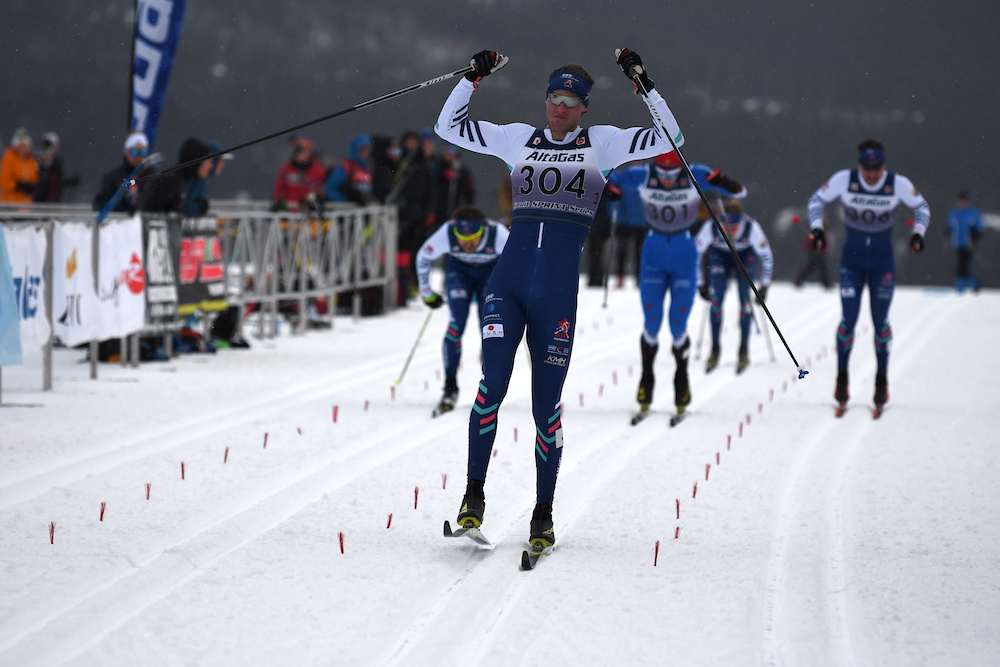
Racing on skate skis for the qualifying round and in the final, Briand of Sept-Iles, Que., was the fastest qualifier leading the men into the senior head-to-head heats. After struggling to find his top gear in the first round, Briand put the pedal down in the second and final heat where he edged out Olympian and three-time World Cup medallist, Andrew Newell of the United States, for top spot on the podium. Bob Thompson, of Thunder Bay, Ont., placed third.
“In some ways this means nothing and, in some ways, it means everything. I am happy to win today,” said Briand. “It was an interesting battle. I played it wise going fast on the flats and the downhill. I wanted to do good and win today. It was important for my confidence to get this one.”
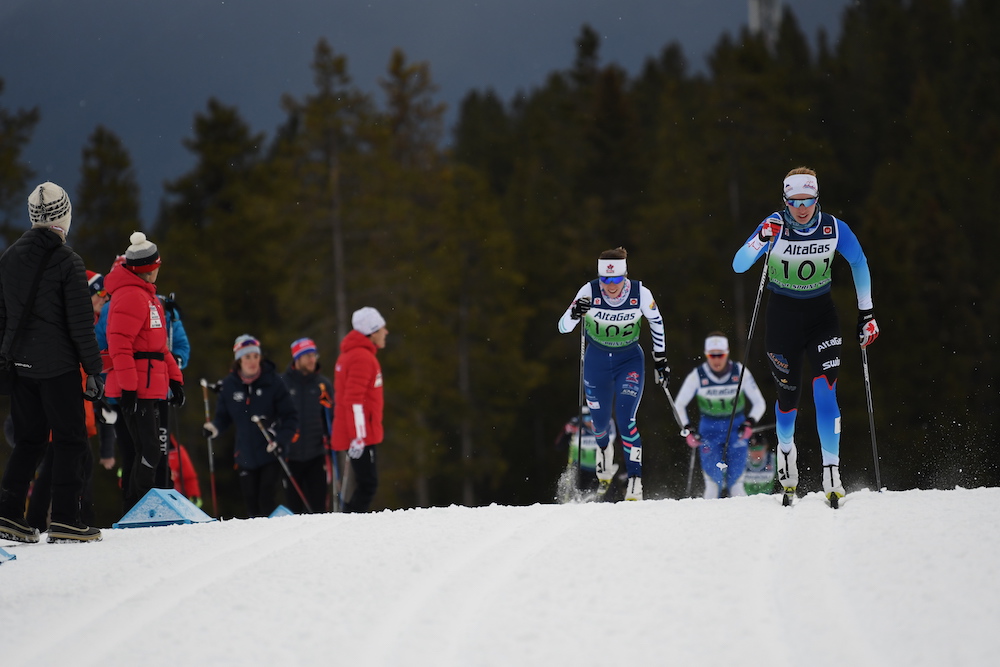
A motivated Maya MacIsaac-Jones was determined to kick her season off with a strong start. Qualifying in second spot, the Athabasca, Alta. resident put her summer training to the test with a hard-fought battle through the women’s heats where she went head-to-head with National Ski Team member, Dahria Beatty of Whitehorse, in the final two rounds.
While Beatty led the Canadian duo into the finishing stretch in the second round, it was MacIsaac-Jones who double-poled relentlessly to make up the ground and edge the Olympian at the line.
“That format is so great in terms of getting ready for the race season and having a good tune-up,” said MacIsaac-Jones. “I think it is one of the best formats for sprinting out there. You have to go as hard as you can in every heat, and you aren’t saving anything for the final. It is perfect.”
A rematch was set for the senior women’s final.
Beatty and MacIsaac-Jones were quick off the start line, darting up the steep climb out of the stadium. Playing chase around the rolling terrain, it was the determined MacIsaac-Jones taking the lead this time on the final downhill, and she never looked back, securing her spot on the golden step of the senior women’s podium.
“I had a lot of fire in me this training season. It definitely is what is keeping me in this racing season. Things have been feeling really good overall this year. Today is another check mark on everything that I’ve been doing in training is working so far.”
Joe Davies, of Whistler, B.C., was the top junior men’s sprinter. Jasmine Drolet, of Rossland, B.C., opened up a sizeable gap to handily win the junior women’s title.
Nordiq Canada is holding its annual season-opening race series for the majority of the nation’s male and female cross-country skiers, thanks to the Canmore Nordic Centre’s annual snow preservation project, Frozen Thunder.
In an effort to provide Canada’s Nordic athletes with the ability to train on snow at home in October and early November, the Frozen Thunder initiative stored enough snow under a thick layer of sawdust to insulate it over the summer months, allowing them to cover the 1.4-kilometre of trail.
Modeled after snow preservation projects in Europe, the Canmore Nordic Centre was the first to take on the project in North America – and is subsequently the first to open its trails on the continent each year – providing another critical resource for Canada’s high-performance Nordic sports.
Nordiq Canada is the governing body of para-nordic and cross-country skiing in Canada, which is the nation’s optimal sport and recreational activity with more than one million Canadians participating annually. Its 60,000 members include athletes, coaches, officials and skiers of all ages and abilities. With the support of its valued corporate partners – Haywood Securities Inc., AltaGas, Swix and Lanctôt Sports– along with the Government of Canada, Canadian Olympic Committee, Canadian Paralympic Committee, Own the Podium and B2Ten, Nordiq Canada develops Olympic, Paralympic and world champions. For more information on Nordiq Canada, please visit us at www.nordiqcanada.ca.
Cross Country Ski FIS World Cup on track for March 2020 Season Finale
The Season Finale to be held at the Canmore Nordic Centre Provincial Park will welcome the world’s best skiers from around the world to compete for 3 days in March 2020.
CANMORE, ALBERTA July, 22 2019 –The Alberta World Cup Society (AWCS) just completed a successful pre-World Cup site visit by FIS (Fédération Internationale de Ski), accompanied by FIS Marketing AG and Double Black Diamond – the TV producer engaged by the Alberta World Cup Society. “We are very pleased with the preparation from the Organizing Committee for the FIS Cross-Country World Cup Season Finale in Canmore and are looking forward to March 2020. The entire team around Greg Thompson did a great job and we feel very confident to see excellent competitions including the first ever mixed relay as well as great events around the competitions at the Canmore Nordic Center”said Sandra Spitz, Event Coordinator Cross Country, FIS.
FIS Site Visit: Craig Bullen (Sea to Sky Cable Cam), Nrobert Meier (AWCS), Chris Robinson (Double Black Diamond), Michal Lamplot (FIS), Sabine Mlekusch (FIS MAG), Greg Thompson (AWCS), Sandra Spitz (FIS) and Mike Norton (WinSport)
“Our Organizing and Competition Committees were well prepared to present our race plans to the FIS officials. The advance work done by our teams meant that we anticipated many of the FIS questions and I believe we’ve passed this test with flying colours”, commented Greg Thompson, Chairman Organizing Committee, AWCS.
The AWCS has been working on this world cup for the past three years and we are excited to look ahead to hosting yet another great set of FIS World Cup Cross-Country Ski races at the Canmore Nordic Centre Provincial Park. With the continued support of our community, businesses, volunteers, sponsors and the municipal, provincial and federal governments, we look forward to hosting a first-class event including numerous community activities.
The 2020 Season Finale will feature the first ever mixed relay race on Sunday, March 22, 2020. This ground-breaking event will be televised around the world and will feature 2 women and 2 men per nation racing in both classic and skating technique. It will make for exciting racing, great television and a most wonderful way to finish the 2019/20 Cross Country FIS World Cup season. The Crystal Globes trophies will be awarded at this event to recognize the Best Distance skier M/F, Best Overall skier M/F and Nations Cup for the season.
The AWCS has held Cross Country Skiing World Cup events at the world-class Canmore Nordic Centre Provincial Park since 2005. “We have an excellent track record of bringing World Cup Cross-Country Ski events to Canmore, having held 5 FIS World Cups and 2 Para-Nordic World Cups since the2005 Alberta Centennial World Cup. Our facilities continue to be among the best in the world and we appreciate the hard work done by the Canmore Nordic Centre Provincial Park staff working with our event team to achieve the highest international standard of hosting excellence.”, said Norbert Meier, Events Chair, AWCS.
Women’s Pursuit at the Canmore Nordic Centre, Ski Tour Canada 2016. (Photo: Pam Doyle Photography)
The Alberta World Cup Society continues to promote its mandate of developing and growing cross-country skiing in Alberta through hosting World Cup races and by providing resources for the development of officials, coaches and athletes. All these activities are accomplished with the involvement of tireless volunteers who dedicate their time in different capacities to make this possible.
If you would like to have more information on this topic, please contact Norbert Meier at 403-760-0633 or by email: nmeier@albertaworldcup.com
Bodensteiner Hired on with the Utah Olympic Legacy Foundation
Luke Bodensteiner left U.S. Ski & Snowboard as Chief of Sport on July 15, he was named the Soldier Hollow General Manager and Chief of Sport Development on July 17. Bodensteiner’s new positions are under the Utah Olympic Legacy Foundation umbrella.
As part of his duties, Bodensteiner will oversee daily operations at the Soldier Hollow (SoHo) venue. According to the July 17 press release announcing the hire, SoHo came under Utah Olympic Legacy Foundation direction back in 2016.
“I’m thrilled to be joining an organization that’s accomplishing so much in Olympic and Paralympic sport, and which has established such a unique and powerful legacy,” said Bodensteiner in the press release. “I feel very fortunate to be joining the effort at a time when the UOLF is moving aggressively to establish a leading edge winter sport culture in Utah, for the benefit of our communities, our youth, and our state’s long-term ambitions in winter sport.”
Bodensteiner’s position of Chief of Sport Development extends across all aspects of the Utah Olympic Legacy Foundation, not only cross-country skiing and biathlon. These include ice skating disciplines at the Olympic Oval, and summer facilities for freestyle skiing at the Utah Olympic Park. During the winter, the Utah Olympic Park houses a bobsled/luge track and ski jumps. The jumps can accommodate summertime jumping.
Canmore out of the Running to Host IBU World Cups for Three to Four Years
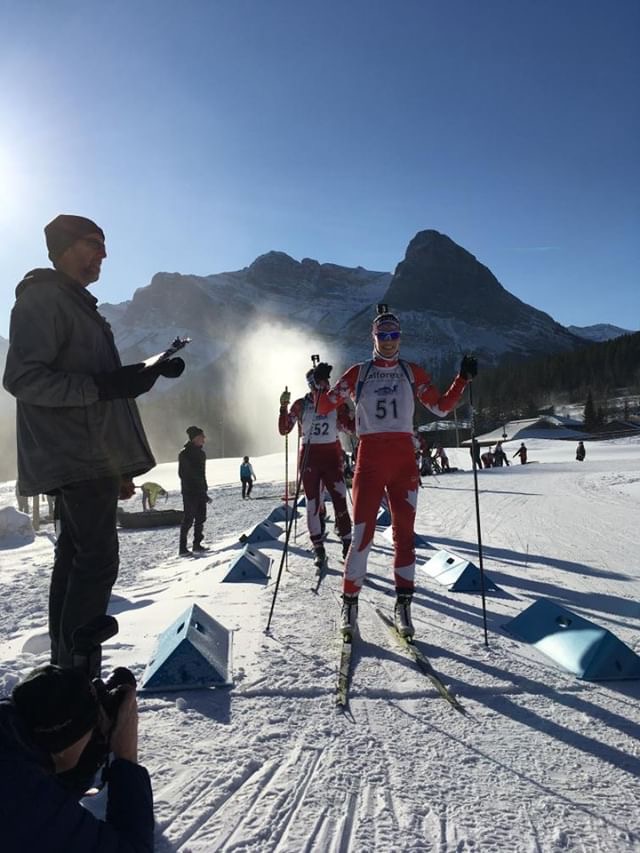
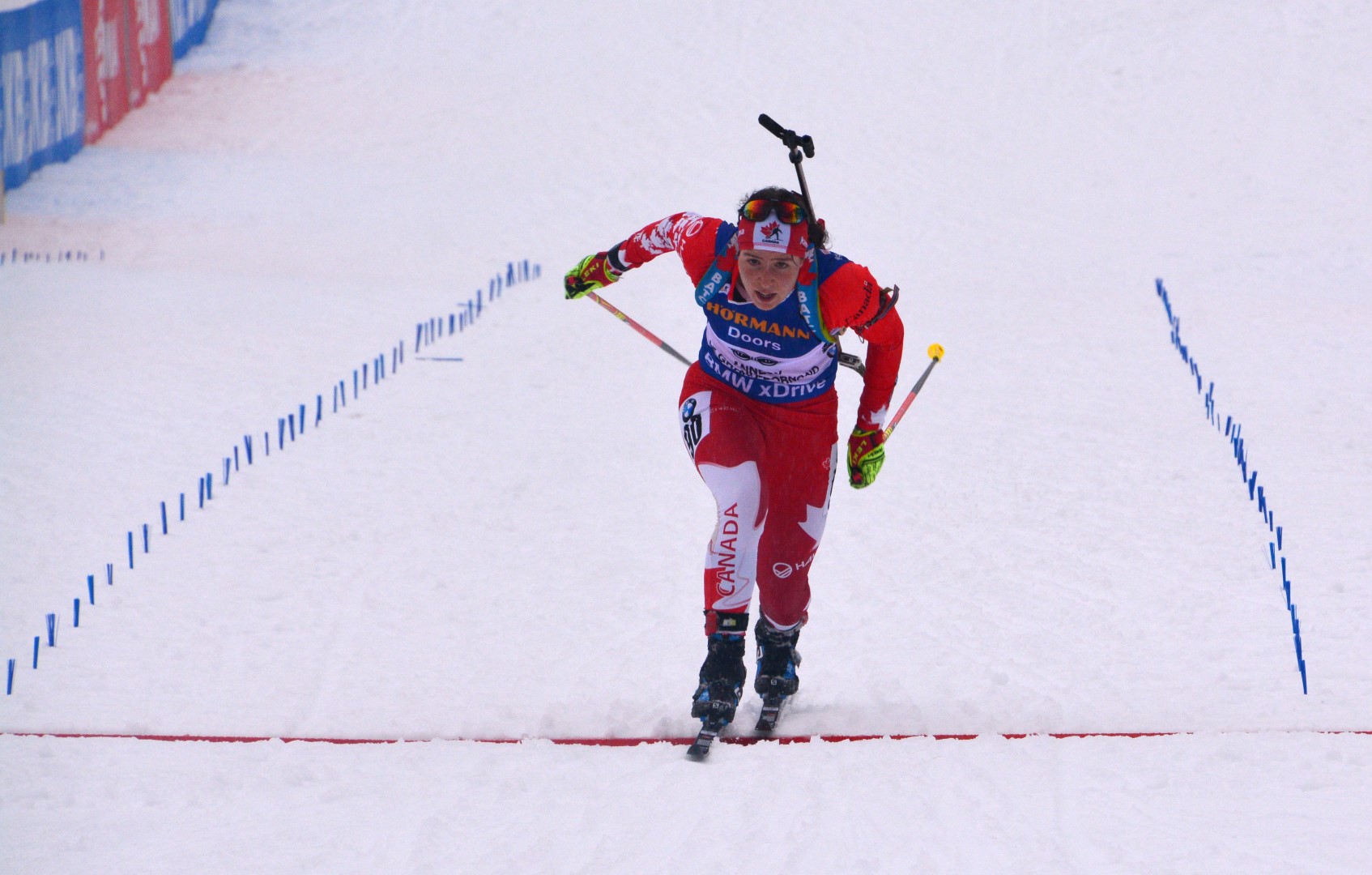
Megan Tandy (bib 51) racing in Canmore. (Photo: Matthias Ahrens)
After hosting IBU World Cup biathlon events in Canmore, Canada this past February, the Canmore Nordic Centre has been informed it will not be considered for future biathlon World Cups for the next three to four years.
Originally built to host the 1988 Winter Olympics, the Nordic Centre is need of updating to meet the IBU’s host site standards. According to a CBC News article, the venue has asked the provincial government for $13 million to modernize the facility and update the firing range.
In the article, Ken Davies, the chair of the Alberta Event Hosting Society, said the province missed the deadline for allocating the money to update the venue.
Currently, it appears the provincial government has set the nordic centre’s upgrades as low priority.
“While we recognize that Canmore Nordic Centre has a long-standing tradition of hosting World Cup biathlon ski events, $13 million in upgrades is a significant cost that must be measured against other pressing government priorities,” Jess Sinclair, press secretary to Minister of Environment and Parks, said according to the CBC article.
Borders Commission: An Independent Panel Chartered by the USOPC
This week, the Borders Commission released its 113 page report on reforming the United States Olympic and Paralympic Committee (USOPC). The USOPC was formally known as the USOC. The Borders Commission was organized to examine how the USOPC should reform.
If you follow Olympic sport in the U.S., the cultural norms and values as practiced at the grassroots, club, elite, and the highest bureaucratic levels have been questioned in recent years. The brave athletes who revealed sexual abuse in elite gymnastics are among the voices who have championed the reform movement. They remain a catalyst for the Borders Commision’s work.
The USOPC remains under the reform-minded microscope. Enter the Borders Commission. The recommendations in the newly released report are widespread.
The report states that an athlete first approach is paramount. “The USOPC and the NGBs and their Paralympic equivalents alike, must course correct, placing athletes and their well-being, at the center of all considerations and business operations,” states the report on page 31.
Other recommendations include modifying the USOPC Board to include better athlete representation, providing broader access to health care and mental health services for athletes, and more athlete-centric funding models. It is by all measures a comprehensive report aimed at creating cultural norms at all levels of sport that protect and support athletes.
“The USOPC has already made significant progress to strengthen protections and empower athletes, and we are grateful for the Borders Commission’s diligent and extensive work to ensure that progress continues,” said USOPC Chair Susanne Lyons according to the press release. “We look forward to reviewing the full report and taking appropriate actions to implement and reinforce meaningful reforms to create a culture and environment where athletes can achieve both personal well-being and competitive success.”
USOPC CEO Sarah Hirshland is quoted as recognizing that a cultural shift is due.
“As we remain laser-focused on prioritizing and supporting the needs of athletes and NGBs, we must set clear standards of organizational excellence and hold ourselves and all member organizations accountable,” said USOPC CEO Hirshland. “With changes to governance and personnel, policies and procedures – and most importantly, culture – we are a very different organization than we were one year ago, but we have more work to do. We remain committed to that reform process and will share information about additional actions we are taking as a result of these recommendations. We are grateful to the entire Commission for their dedication and hard work over these past months.”
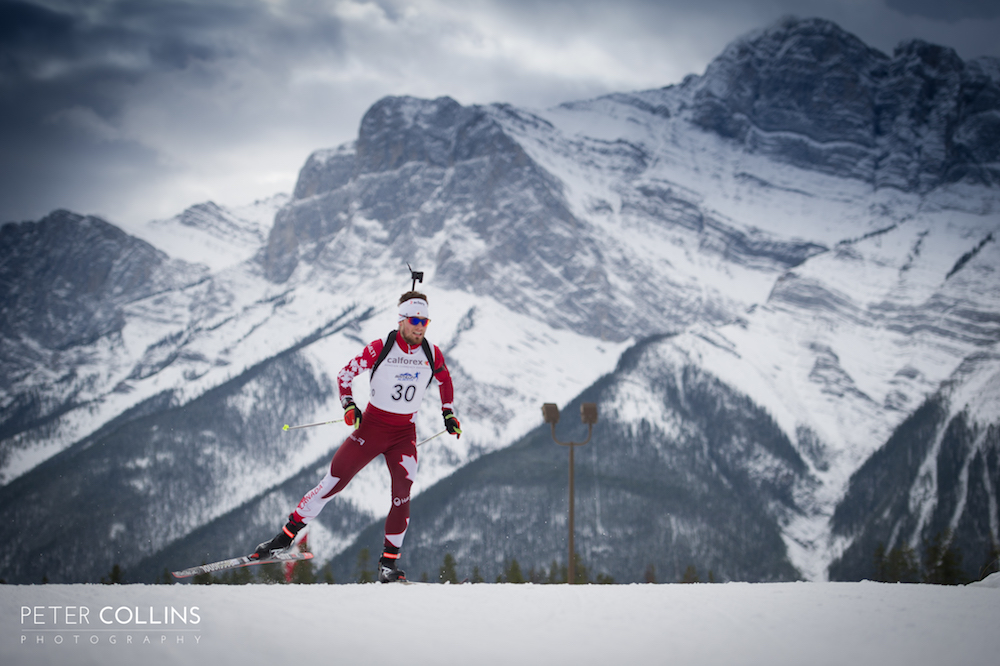
Christian Gow at the 2017 Biathlon Canada’s team trials in Canmore, Alberta. (Photo: Peter Collins/petercollinsphoto.com)
“Polar Vortex” has become part of the oh-so-cold vernacular when describing seemingly locked in place artic air. Last week’s weather-related news cycle was dominated by all things “Polar Vortex”. In Canmore, Canada, the term is still being thrown around: the cold temperatures have not abated.
On Thursday, the International Biathlon Union (IBU) is scheduled to begin its North American swing of races in Canmore with the men’s 20-kilometer and women’s 15 k individual races.
Hold onto your lobster mitts. Maybe secure a pair of bunny boots too.
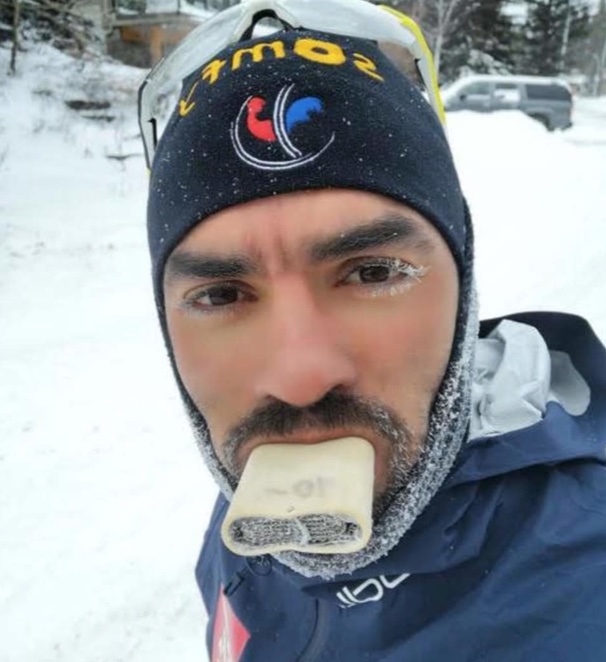
Simon Fourcade of France, out running in Canmore. Fourcade is using a humidity/heat exchanger to protect his lungs in the cold air. (Photo: biathlon world.com screenshot)
On Monday, the IBU reported nighttime lows of -23.8 Fahrenheit and an early afternoon high of -16.6 Fahrenheit at the Canmore Nordic Centre, site of Canada’s IBU World Cup races. Those temps have caught the attention of race organizers as they bump against IBU competition minimums for cold weather racing.
“Biathlon competitions must not be started if the air temperature is colder than minus 20 degrees Celsius measured at the coldest part of the site (range or course), 1.5 m above ground,” states the IBU’s competition manual.
That -20 Celsius equates to -4 Fahrenheit.
Today, as of noon in Canmore, temps were a crisp -6 Fahrenheit. Oh so close — but rules are rules.
On Thursday, the races are scheduled to begin at 10:00 AM and 2:10 PM local time.
“We have many options like start times, course adjustments that are available if necessary,” IBU World Cup Race Director Borut Nunar told the IBU. “Thursday looks like the best day of the week with the morning low at minus 18 [Celsius] and the high around minus 14 [Celsius]. After that, it warms up: most importantly there will be less wind. The wind makes the cold temperatures even worse. We will just see how things go and present any ideas to the coaches at our meeting on Tuesday. They all understand the conditions and like us, just want the most fair and safe conditions for the athletes.”
In extreme on-the-ground cases like the Organizing Committee and athletes are experiencing in Canmore, officials will also consider wind chill and humidity beyond the strict -20 Celsius cut off when deciding if conditions are suitable for racing.
“If it is colder than minus 15°C, wind chill and humidity must be considered before starting and during the competition. In the case of a high wind chill factor, the competition jury will decide whether to start or continue the competition, in consultation with the IBU Medical Delegate or the Competition Physician. The course to be skied may also be changed to avoid windy areas,” states the IBU Events and Competition Rules.
With a few days for Mother Nature to kiss the sky with slightly warmer temperatures, the IBU World Cup has a bit of time on its side.
And there is this from Nunar, “This is a winter sport”.
Bob Thompson outsprinted Jack Carlyle in the men’s 30km. (Photo: Doug Stephen)
Canmore hosted the second NorAm of the 2018/2019 season on December 13th, 15th, and 16th. The event also served as U23 and Junior World trials.
By the end of the weekend, starts at the U23/Junior World Championships and the World Cup’s Tour de Ski would be earned.
This event was originally scheduled for Whistler Olympic Park but had to be moved as a result of heavy rain and inclement weather forecasted into the immediate future. The Callaghan Valley Cross Country organization, the original bid-winner for this season’s trials, made the difficult decision to cancel on December 1st. The weather gods added one final insult on December 13th, when a major snowstorm ensued in the Callaghan Valley that would have made racing possible on the 14th.
Canmore’s cross-country community stepped in on December 2nd and was able to organize a successful race weekend with a few weeks notice.
The International Ski Federation (FIS) mandates that Continental Cup leaders for each period earn automatic start rights for the next World Cup period, including financial support from the event hosts. This season, Period 1 leaders get starts for Period 2 (Tour de Ski) and period 3 (Dresden, Otepää, and Ulricehamm) along with race support.
For the first time since Perianne Jones and Dasha Gaizova started in the 2014 edition, Canada will enter a woman in the Tour de Ski (TdS). The last female finisher was Sara Renner, who placed 16th overall in 2010.
This past weekend, Dahria Beatty won all three races in Canmore. Combined with her second place (and top Canadian result) in Sovereign Lake the previous weekend, Beatty is the COC leader and will leave for Europe on the 21st.
In an email to FasterSkier after Thursday’s sprint, Beatty wrote: “I think the first 3 stages of the Tour this year are my dream come true, 2 sprints and a 10km skate.” The day after sending the email, Beatty received the official news that her TdS dream would be a reality.
On the men’s side, Bob Thompson won twice in Canmore to lock down the male COC leader position.
As this event was also the selection trials for U23 and Junior World Championships, up to 12 athletes would automatically qualify for the Lahti, Finland championship races. The High Performance Committee met Sunday afternoon and will announce the final choices soon.
Weekend Results Summary:
Names in green earned automatic selection for Lahti.
Classic Sprint, Thursday:
Open Women: Dahria Beatty, Katherine Stewart-Jones, Maya Macisaac-Jones; Marie Corriveau (6th, U23)
Junior women: Anne-Marie Petitclerc, Molly Miller, Anna Pryce
Open Men: Bob Thompson, Angus Foster, Julien Locke; Graham Ritchie (4th, U23)
Junior Men: Remi Drolet, Tom Stephen, Xavier McKeever
Interval start freestyle, Saturday:
Open Women 10km: Dahria Beatty, Katherine Stewart-Jones, Frédérique Vézina; Sadie White (4th, U23)
Junior Women 5km: Molly Miller, Isobel Hendry, Elizabeth Elliot
Open Men 15km: Russell Kennedy, Evan Palmer-Charrette, Alexis Dumas; Gareth Williams (6th, U23)
Junior Men 10km: Sam Hendry, Remi Drolet, Tom Stephen.
Mass start classis, Sunday:
Men 30km: Bob Thompson, Jack Carlyle, Russell Kennedy; Sam Hendry (4th, top junior), Antoine Cyr (5th, U23)
Dahria Beatty leads Katherine Stewart-Jones. They would finish 1-2 all three races. (Photo: Doug Stephen)
“My tactics for every heat was to ski smooth and relaxed the first half and attack off the final two climbs into the finish. That worked out well for me today. I skied from the front and had control of the heats. The sprints were staged out of the biathlon stadium (hence why you couldn’t find them on the webcam) so it was an uphill finish, making for very fair racing.” — Beatty (1st)
“I was not happy with my qualifier but am really happy with how I skied the heats. Our staff did an awesome job with the skis today! The course was a lot of fun. Tactics essentially involved staying relaxed off the start, positioning well for the final climb and then hammering to the finish.” — Maya MacIsaac-Jones (CNST, 3rd)
“I feel pretty amazing about today’s race. 4th senior at a NorAm sprint is by far my best sprint result ever! My tactic was to have fun and just go like hell; I had a blast and I never went this fast before!” — Frédérique Vézina (CNEPH, 4th)
“I didn’t really have any tactics, I just wanted to go as fast as I could, ski well and try to stay with the leaders. I didn’t ask myself a lot of question, just ski fast!” — Marie Corriveau (MSA, 6th)
Bob Thompson wins the A final with three Thunder Bay teammates in the camera frame. (Photo: Doug Stephen)
“I am very happy with how today went. I found the finishing sprint gear I felt I was missing had the speed when I needed it.
Everyone was fairly relaxed for the first half of the final knowing it was important to have the energy for the gradual climb into the finish. My move was made coming up to the last short downhill and then on the short striding hill before turning into the finish. I had been feeling great in that section in every heat and made sure I was at the front to make the most of it.” — Thompson (1st)
“The group strung out a little bit going into the big downhill, I was back in 5th but had amazing skis and came back up to the group pretty easily. Everyone was really skiing together going into the last climb, and Bob just put down a mean last hill and got away from us. I jumped out from behind Julien Locke as we hit the finishing stretch and got up beside him as we got right down to the line, and just got him in a big lunge.” — Angus Foster (TBay, 2nd)
“The tactics worked out for me as well! I was planning on holding on to the leaders in the final for as long as I could, and then using my fitness to the best of my ability in the finishing stretch.” — Graham Ritchie (TBay, 4th)
Interval start free technique
Sadie White was fourth and top U23 on Saturday. (Photo: Doug Stephen)
“It was a hard race today. I had a good start but then got really stiff going into my second lap after the big climb. It took a lot of mental fight to regroup after I got really stiff on the second lap but I was able to ski out of it and push really hard on the final lap.
I am really happy with my fitness right now, my pacing was a bit off today but I think that fact that I am in good shape allowed me to bring it back.” — Beatty (1st)
“I felt better and better throughout the whole race today! I kind of wish we had more lap to go…” — Vézina (3rd)
Russell Kennedy descending to first place. (Photo: Doug Stephen)
“Pacing was important today: that being said I didn’t pace it that well. Was definitely fastest the first two laps. Skis for me were really good [as] the team did an awesome job on them.” — Russell Kennedy (Team R.A.D., 1st)
“The race today went alright, I tried to start hard and couldn’t quite get myself into a top end race gear. I skied relatively consistent and was able to find a better feeling on the last lap, but overall not the way I want to feel during a race, the result was a pleasant surprise.
I think pacing played a big role, I was pretty far back after the first and second lap but turned out to be less than some guys lost on the last lap and so I was able to move up quite a few places in the final kms.” — Evan Palmer-Charrette (Team R.A.D., 2nd)
“My race today was really good. I feel like I was able to push hard and keep a good technique. I think the key today was to get a good glide after each push because they were not a lot of easy part on this course and the downhills were fast so you needed to get recovery were you can.” — Alexis Dumas (CNEPH, 3rd)
“Today’s race was good, not amazing but I’m happy to come away with the top U23 spot which qualifies me for U23 World Championships.
Today’s weather was static and remained the same for the whole race. The race was decided on the last lap, that’s where I pushed my hardest. My plan for the race was to increase the speed as the race progressed, getting a bit faster each lap. I was getting splits and I realized I was off the pace on the first laps, so I just made sure to push as hard as I could on the final climbs.” — Gareth Williams (Telemark, 6th)
Mass start classic
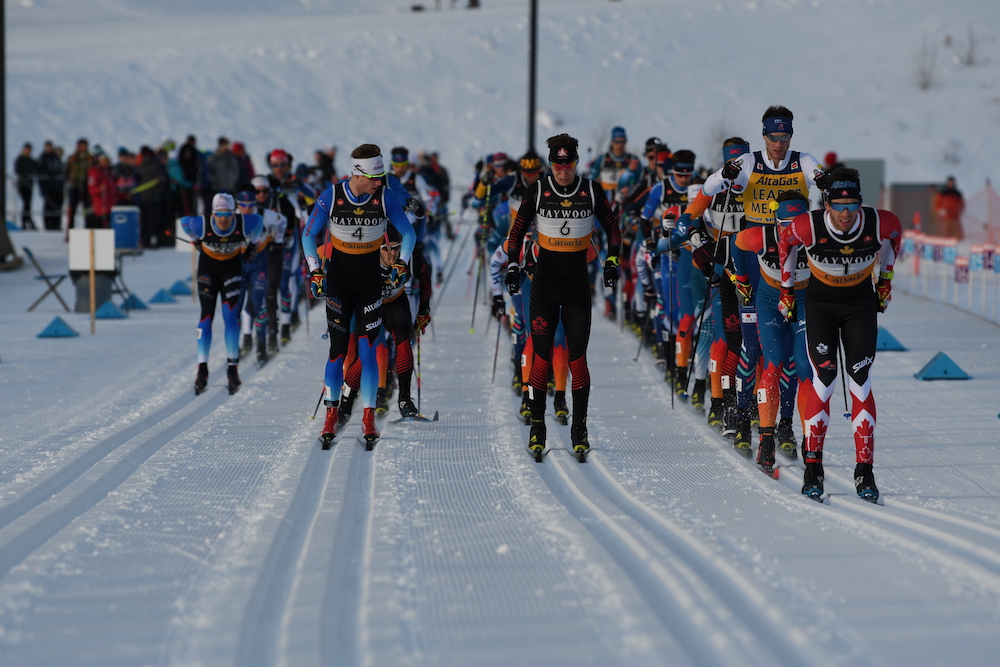
Russell Kennedy (bib #1) leads out the men’s 30km while Bob Thompson towers over the field in the leader’s bib. (Photo: Doug Stephen)
“Today’s race stands out as the most fun I’ve had in a 30k since the very first one I ever did at the Canmore Nationals in 2010.
The main group got smaller definitely through Russell pushing the climbs on most laps. We had the group of 6 for several laps and then the last 2 were really just the 3 of us with Russell pushing hard on the climb from the bottom of the course. Jack and I had faster skis and on the final downhills went by and then had a great sprint to the line.” — Thompson (1st)
“After a tough sprint day, it was great to bounce back with two super successful distance races. ” – Sam Hendry (Team R.A.D., 1st junior in 4th)
“Today was a fun race. A good battle between Katherine and me once again.
Katherine set the pace early and by the second lap, we were on our own. It was windy on course today, so it was hard to break from each other and after testing each other a few times on the last lap it came down to the finish sprint, which of course is my favourite.” — Beatty (1st)
“The race was really fun. I pushed the pace right off the start so Dahria and I made a break from the rest of the group after the first lap. We skied together the entire race, it was the type of course that made it difficult to break away because the hills were relatively short and there was quite a big drafting effect on the flats. It came down to the finishing stretch and Dahria was stronger on the double pole!” — Katherine Stewart-Jones (CNST, 2nd)
Selection
“At this point, if I am offered a start I will plan to race the first 3 stages and then reassess after that based on how I am skiing. The Dresden WC will also be a focus just after the new year so I want to make sure I am well prepared and have enough energy for those races as well.” — Beatty, on Thursday, before the Tour de Ski offer was made.
“Qualifying for world juniors has been a big goal of mine for many years and I am really excited to have achieved it this weekend.” — Hendry
Personal Highlights
“Most unusual part was getting to come home and lie in bed between the quali and heats.” — MacIsaac-Jones
“I am very very happy with my race today, I really surprised myself! It’s been a long time I didn’t feel good at racing so it was really fun to have good feelings again. Take the first spot for U23 world champ was the best way to start the season!” — Corriveau
“Getting to race the final with three of my NTDC Thunder Bay teammates was a blast, I was really proud of the way we skied out there today and think it reflects a lot of hard work by our team and coaches this year! I’m stoked for Graham and Julian go 1-2 in U23 with World Champs spots on the line, and we all owe a big thank you to our wax techs for some wicked boards all day.” — Foster
“It’s been really nice to race at home and sleep in my own bed, especially knowing I will be away a lot for the rest of the season.
Everyone in Canmore has done a great job organizing the races so last minute. I’ve been especially loving the chocolate medals!” — Beatty
“The highlight from this past weekend was hands down, getting to ski with my teammate and role model Russell Kennedy for almost all of the classic mass start on Sunday.” — Hendry
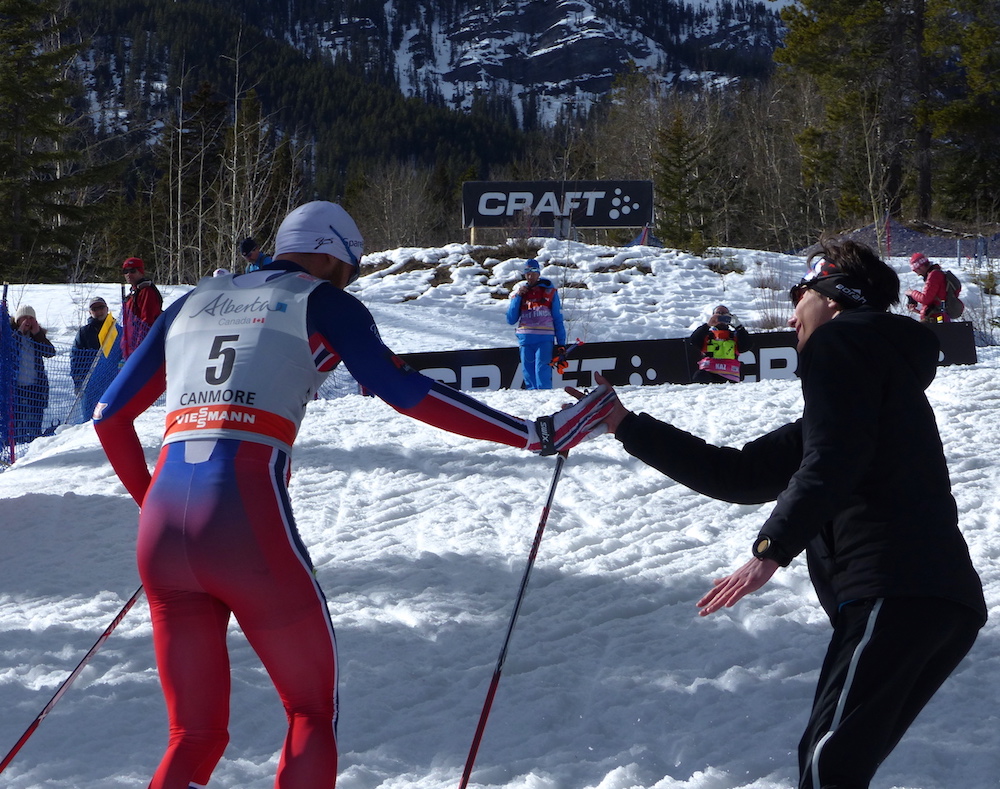
Remi Drolet has been in Canmore before: Petter Northug (NOR) (l) high fives Remi Drolet (spectator) as he finishes his final lap during the men’s 1.5 k classic sprint at the Ski Tour Canada on Tuesday in Canmore. (Photo: Peggy Hung)
Megan Bankes (Biathlon Canada) lunging at the finish of the IBU World Cup women’s sprint in Annecy, France. She placed 65th. (Photo: Glen Crawford)
Selection trials for Biathlon Canada began with a men’s and women’s sprint today in Canmore, Canada. Race results will help determine athletes representing Canada on the IBU World Cup’s opening races, and the first series of races on the IBU Cup and Junior IBU Cup.
Prior to Tuesday’s racing, only Scott Gow and Rosanna Crawford had prequalified for Canada’s IBU World Cup team based on a top-16 result last season.
Senior National Team member Megan Bankes won the overall women’s 7.5-kilometer sprint in a time of 21:43.2 minutes. Bankes missed one shot shooting prone and cleaned standing. Bankes’ teammate on the National Team, Megan Tandy, placed second (+22.8). Tandy cleaned her prone stage while missing one standing. Pre-qualified athlete Crawford took third (+52.4) while cleaning prone and missing two shots standing.
Women were penalized 24 seconds per miss due to insufficient snow for a penalty loop.
Christian Gow, a member of the Senior National Team won the overall men’s 10 k sprint in 24:39.5 minutes. He had no missed shots on the day. Older brother Scott Gow raced to second place (+47.9) while missing two shots, one prone one standing. Taking third place was U24 National Development Team member Jules Burnotte. Burnotte finished in 25:31.1 minutes and had two misses: one each in prone and standing.
With the course lacking a penalty loop, the men were penalized 22 seconds per miss.
Selection trials resume on Thursday with another sprint race.
With the reshuffling of Canada’s staff, up until today, CCC had not formally announced its World Cup coaching roster for the 2018-2019 season. Back on August 11th, CCC posted a job announcement for “Head Coach, Canadian Senior Cross Country Ski Team”. (Here’s a link to the formal job description.)
Today’s announcement came with news that longtime World Cup coach Louis Bouchard will be returning for another year. Bouchard leads the National Training Centre in Mont Ste-Anne, Québec and has worked closely with Alex Harvey for many years. According to the press release, Bouchard will be taking over head coaching responsibilities. Bouchard has been a World Cup Team coach for the last eight years.
CCC also revealed today that Norwegian Erik Bråten has been hired as a National Team Coach.
“Erik is a highly regarded young coach in Norway who is looking for an opportunity to contribute to our national program,” Lemyre is quoted as saying in today’s press release. “He is passionate, knowledgeable, dedicated, and driven to develop into a world-class coach. I believe he and Louis (Bouchard) will complement each other’s skillsets and will have a significant impact on the development and the performance of our nation’s best athletes. This is a dynamic duo who I believe is exactly what we need to build a medal winning program.”
Bråten, who will turn 27 on November 6th, has been coaching in Norway for six years and was named coach of the year in 2018 by the Norwegian Ski Federation. Bråten will be based in Canmore, Alberta. His duties will include monitoring athletes in western Canada, coaching Canada’s team at World Junior and U-23 World Championships, and assisting Bouchard with a portion of the season’s World Cups and the 2019 Seefeld, Austria World Championships.
FasterSkier has reached out to Bråten for comments.
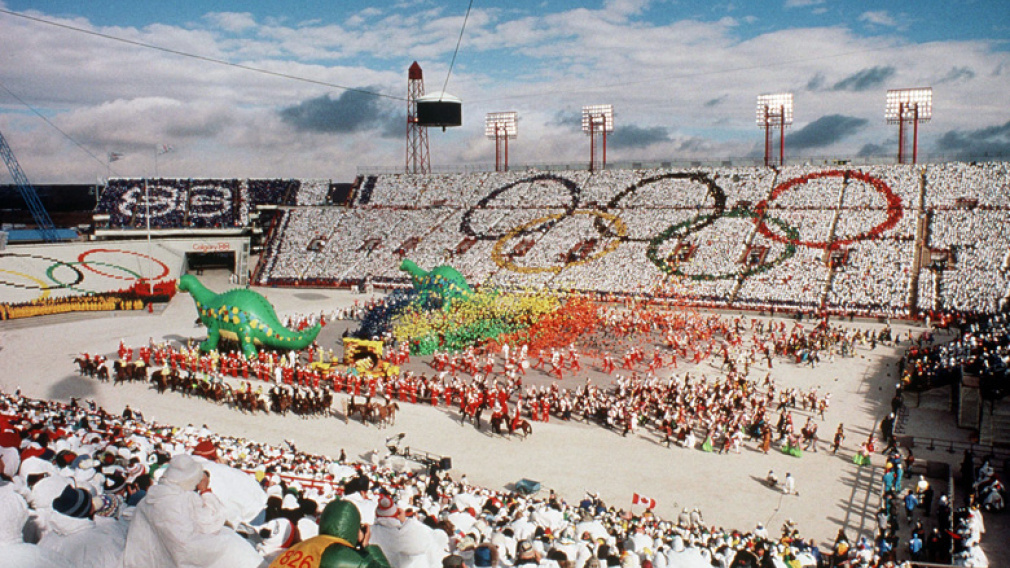
The Opening Ceremony at the 1988 Winter Olympics in Calgary, Alberta. Calgary is in the final three for hosting the 2026 Winter Olympics and Paralympics. (Photo: Olympic.ca)
The bidding process for the 2026 Winter Olympics and Paralympics is crawling forward, and when the International Olympic Committee (IOC) announced the shortlist last Thursday, Oct. 4, Calgary was in the final three.
Calgary, Alberta, is one of the final three in the running to host the 2026 Winter Olympics and Paralympics. (Photo: www.calgary2026.ca)
Much has changed since the last time Calgary, Alberta, hosted the Games in 1988 as well as since Vancouver, British Columbia, in 2010. The IOC is now in favour of joint bids, re-use of existing facilities and lower costs. These improvements have resulted in more competition for 2026 than for 2022 (which was awarded to Beijing), but each comes with challenges.
The increased interest in 2026 may turn out to be temporary. Sapporo, Japan, ended its bidding process after a major earthquake. Sion, Switzerland, dropped out after losing a referendum, and Graz, Austria, couldn’t get the support of its regional government.
Last Thursday, the IOC announced that Erzurum, Turkey, was out of contention. IOC Vice President Juan Antonio Samaranch, Jr., referenced telecommunications, transport and airports as concerns, but did not mention that there was no sliding centre (for bobsled, luge and skeleton). The Turkish government had previously declined the suggested use of Sochi’s sliding centre, some 650 kilometers away in Russia, which would likely have been unpopular with the IOC as well.
Calgary, Stockholm (Sweden), and Milano/Cortina d’Ampezzo (Italy) are still in the running, each with their own advantages and challenges. While most cost estimates are being disputed by local “experts”, comparing costs between bids remains difficult.
Bid books are to be delivered in January 2019 with a final decision announced in September 2019. The September announcement will be in Lausanne, Switzerland, replacing the originally planned meeting in Milano, as bidding countries are not allowed to host decision meetings.
Many of Calgary’s 1988 Olympic facilities are still in tact, the most visible being the 70- and 90-meter ski jumps. By the 1992 Winter Olympics in Albertville, France, the standard jump sizes were increased, replacing the 90-meter hill with the HS106 (K95) and adding a larger HS140 (K125) hill. Neither of the existing jumps, slated for closure this month, are suitable for upgrading.
The current proposal from Calgary is to maintain the jumps in Whistler, B.C., to current standards, allowing ski jumping and nordic combined events to be held in Whistler. This would save a great deal of money and avoid the construction of facilities that will get minimal use after the Olympics. The 11-hour drive and one-hour time difference between Calgary and Whistler is the largest separation of the remaining bids. The flying time from Calgary to Vancouver is about 90 minutes, but requires an additional 2 1/2 hours of driving to and from airports. The distance is not viewed as a problem in the IOC’s new vision. This is a big change from the 2010 bid process, when the two-hour drive from Vancouver to Whistler was originally seen as a deal-breaker. The cooperation between Whistler and Calgary makes financial sense for the local organizing committee, but will be difficult to achieve during the current economic battle between Alberta and British Columbia (see “The Alberta/B.C. Conflict” sidebar).
The Alberta/B.C. Conflict:
This is a very complicated and long-standing issue, but the conflict is currently front and centre in both provinces.
Alberta’s economy is almost entirely dependent on oil exports. Alberta is desperate to build a new pipeline to transport diluted bitumen to the coast for shipping. Alberta needs this export capability to restore its status as the richest province and re-employ laid-off citizens. The Alberta government needs the tax revenue from increased exports to function, let alone maintain support for expensive recreation facilities like Canmore Nordic Centre and Frozen Thunder.
B.C.’s economy depends on tourism, fisheries, and forestry, all of which would be seriously damaged by an ocean oil spill. A large increase in tanker traffic through the narrow and rock-infested passage to the open ocean is a serious concern, with the cleanup expected to be more difficult than the Exxon Valdez oil spill, with Vancouver, Victoria and Seattle all at risk.
The dispute between the provinces is unlikely to be solved quickly, unless the politicians of one province put their own voters’ jobs at risk to help the other province. The federal government is feeling the pain of Alberta’s tax revenue drop, but the Federal Appeals Court ruled that they must consider risks of an ocean oil spill before expanding their recently purchased pipeline to Vancouver. The Washington state government is concerned about the risk its state will face while Alberta reaps all the rewards, but it seems unlikely that it can interest the U.S. federal government in an environmental issue.
A natural gas (LNG) pipeline from Alberta to the coast is currently proceeding with support from the B.C. government as the risks to B.C. are much smaller. While the gas pipeline is in the news, it is unlikely to distract Calgary’s residents from viewing the 2026 plebiscite as a way to share their economic pain.
There is an idea that the Olympics should move around the world, and many feel that it is Europe’s turn. Calgary already hosted in 1988 and Vancouver in 2010. Asia has hosted since 2014 with Sochi in 2014, PyeongChang (South Korea) in 2018, and next up Beijing (China) in 2022.
Calgary has the most organized bid, having started the process three years ago.
The city of Calgary’s non-binding plebiscite is scheduled for Nov. 13. Voters will be considering their struggling economy, growing provincial debts, the disputed legacy from 1988, costs, and hitting back at B.C. against the possibility of a better legacy after 2026. While cross-country skiers wouldn’t doubt the value of the Canmore Nordic Centre to North American skiing, not all Calgarians are convinced about the value of hosting the Games.
The IOC is campaigning for Calgary to support the bid.
As a side note, in 2010, most Canadians saw the Vancouver Olympics as a two-hour event. The men’s gold-medal hockey game was what changed those Olympics from ‘disaster’ to ‘best-ever’ status.
Milano/Cortina d’Ampezzo
The Milano/Torino/Cortina d’Ampezzo bid briefly lost Milano in August before Italy’s differences were resolved. Then, when the national government confirmed that it would not support the bid financially, Torino dropped out, apparently for good. The Lombardy and Veneto regions are expected to provide funding, and considering that the two regions’ combined GDP is larger than Sweden’s, this may not be a problem.
This bid is very spread out, in European terms, with events in Milano, Cortina d’Ampezzo, Val di Fiemme, and Anterselva (“Anterselva” is the official Italian name for what the biathlon world and German-speaking locals call Antholz). Milano has excellent train service and two major airports, making it the most accessible host city. However, the mountain communities are served largely by bus and travel times can be as much as six hours from Milano. Express buses could reduce this to four hours.
Italy’s national political situation is always interesting, with short-lived coalitions running the country most of the time. This bid is dependent on the far more effective regional governments; while Lombardy and Veneto officially represent only 40 percent of Italy’s GDP, their influence is much larger.
Milano/Cortina, Italy, is among the final-three candidates in the running to host the 2026 Winter Olympics. (Photo: Neveitalia/Twitter)
Stockholm
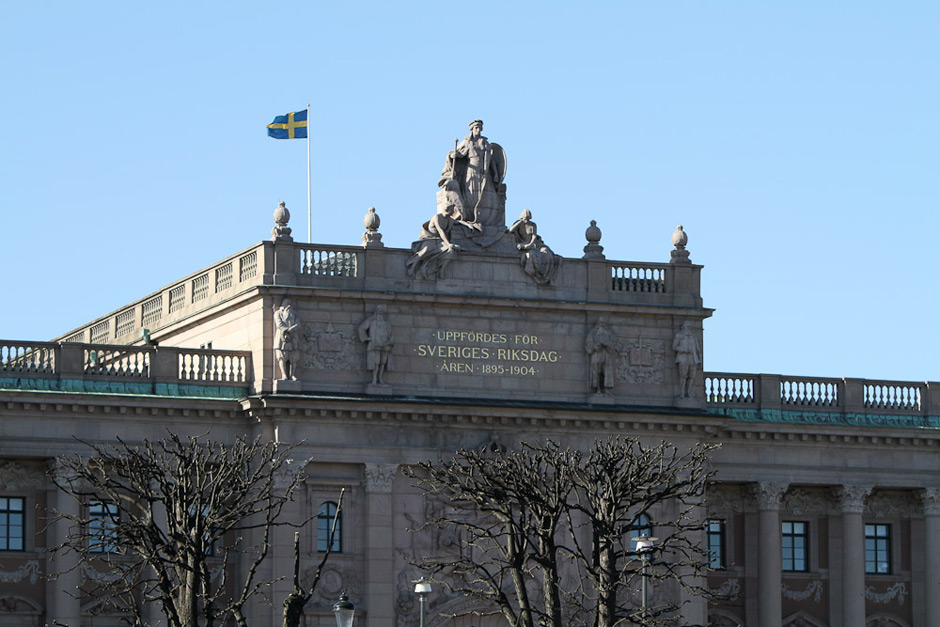
Stockholm’s Royal Palace as seen in 2012 during FIS Cross Country World Cup Finals.
Stockholm’s bid is moving along quietly, with Latvia planning housing for its existing sliding centre at Sigulda, 680 kilometers and a ferry ride away from Stockholm. Sweden has most of its facilities in place already and appears to have the least building costs of the candidates. Sweden’s bid currently has no official support from any level of government, which is partially why it’s been less visible. Sweden’s September federal election has added some uncertainty, with the far right making large gains and the prime minister losing a vote of confidence on Sept. 25. It is not clear that a stable coalition will form, which brings more uncertainty to the process of gaining political support and funding.
More on the 2026 candidates
Robert Livingstone of gamesbids.com wrote a good summary of bid politics before the announcement of the final three.
The Canadian Broadcasting Corporation (CBC) asked some experts to rank the three short-listed bids. The result is interesting, more for the reasoning that the ranking.
Author Everett Fee racing at his first Masters World Cup in 2008 in McCall, Idaho. (Courtesy photo)
(Note: The following workout was submitted to FasterSkier by Everett Fee of Canmore, Alberta. If you’d like to share a workout of your own and the story behind it, please email alex@fasterskier.com with the subject line: ‘Wednesday Workout submission’.)
***
Competitive cross-country skiing is a great lifelong sport. I came late to the party, skiing in my first Masters World Cup when I was 63. I am now 73 and looking forward to being in the thick of things in 2021 when the Masters World Cup races will be in my hometown of Canmore — I’ll be a youngster in the M10 (75-79) age class!
I got into both XC skiing and rock climbing soon after moving to Winnipeg in 1972. They were complimentary sports — we used skis to explore the SW margin of the Canadian Shield in search of unclimbed granite cliffs that we approached by canoe on climbing trips in summer.I enjoyed skiing the occasional loppet but, in truth, climbing was what I was keen on; when there was no snow on the ground I didn’t think about skiing.
((Some accounts of those days are available online (ELA climbing guide) or in the Canadian Alpine Journal (CAJ v. 65 (1982), p. 24; 66 (1983), p. 98).)
After a sabbatical year in 1979 in distant mountains (the Pyrenees, the Alps, Morocco, and Chile), the remainder of my Winnipeg years were focused on climbing trips: Mexico, Yosemite, the Red Rocks, the Dolomites, Ecuador, Nepal, and, most frequently, the Canadian Rockies.
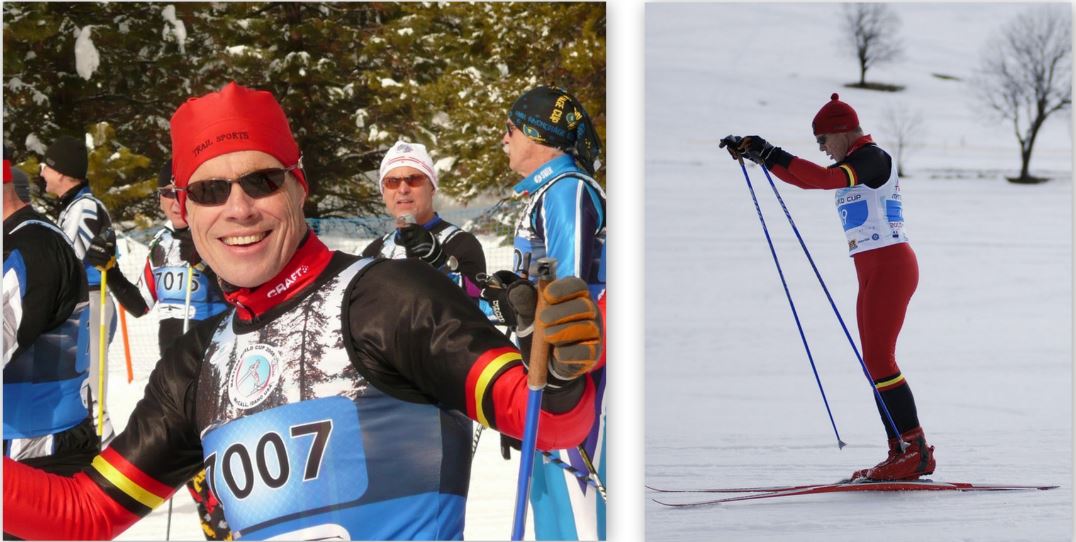
My two Masters World Cup experiences. Left: On the starting line in McCall, Idaho (2008). Right: Mid-race in Autrans, France (2009). (Photos: Dave Rees (l) and purchased/courtesy photo (r))
When I retired in 1997, moving to Canmore in the heart of the Canadian Rockies was a given. Now, 21 years later, the focus of my summers is training for and thinking about XC skiing. This transformation happened for several reasons. First, because I’m a lazy fun hog I couldn’t resist the five months of carved-in-marble grooming at the Canmore Nordic Centre, which is only 10 minutes from our house. The venue for the 1988 Calgary Olympics XC races and a regular stop on the World Cup XC circuit since 2005, it was so easy to ski there 100 days each winter. And all that skiing gave me the fitness I needed to tackle long-held climbing objectives such as Mount Alberta.
Another thing that drew me to XC skiing is the people I met on nordic-centre trails.A lot of them were masters skiers who trained seriously during the dryland months for racing in Canadian Nationals Masters and Masters World Cup in the winter. They encouraged me to dream big, too. In considering this, it became clear that I would have to seriously upgrade my haphazard approach to training (basically, a lot of random skiing in the winter and climbing in the summer).
Canada’s Graeme Killick representing the Banff Ski Runners at 2007 Canadian nationals. (Photo: Anders Lenes)
So in 2007 I joined the Banff Ski Runners (BSR), a small Norwegian-style club coached by Anders Lenes and signed up for the club’s six-days-per-week training program. Anders had skied on the Norwegian National Team for seven years, won Junior World Championships gold, silver, and bronze medals and had several top-10 finishes in World Cup races. He came to Canada in 1975 to prepare the national team for the 1976 Olympics and was on the Canadian national team coaching staff until 1984, during which time he worked with many great athletes, including Shirley and Sharon Firth, Burt Bullock, Esther Miller, and Angela Schmidt. He started coaching the Banff Ski Runners in 2000 and by 2007, the year I joined, he had transformed this small neighborhood Canmore club into a dominant force nationally. The juniors were ripping it up at Canadian nationals and shooting for the big leagues., and two of them (Graeme Killick and Jesse Cockney) went on to ski on the Canadian national team for two Olympic cycles.
It was a real treat to train year round with this small group of about a dozen elite juniors. Although I started training with BSR too late in life (at 62) and had too little natural talent to finish above the middle of the pack in my Masters World Cup races, training with BSR was essential to getting me to the starting line in those events.
Anders’s BSR dryland program was highly varied — we rollerskied, hiked, trail ran, road biked, and (my favorite) ski walked. The unquestioned heart of the program was weekly intensity workouts. Among the different intensity workouts that we did, the one that had the most positive effect on my fitness is what Anders called “Russian intervals”: three sets with each set having three approximately one-minute, maximum-effort sprints separated by 30-second rests. This workout builds lactate tolerance:
The workout: Russian Intervals
The course: A hill 45-60 meters high (or stairs if that’s all that’s available)
Warmup: 15 to 30 minutes of easy (Zone 1-2) jogging (striding hills to keep heart rate low) followed by a nonstop lap or two of the intervals course in Zone 2-3
The intervals: Three sets of 3 approximately 1-minute, maximum-effort sprints separated by 30 seconds of rest and a minimum of 2 minutes rest between sets
Warmdown: 30 to 45 minutes jogging at a very easy pace (zones 1 to 2)
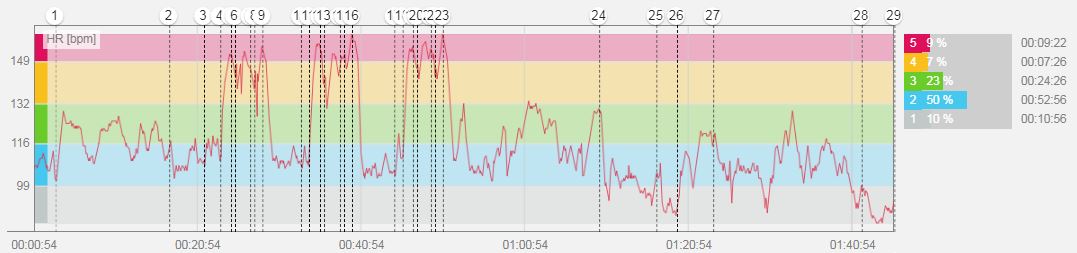
Here’s my heart-rate record in a typical Russian intervals workout.
The goal of this workout is to train the body (and mind!) to go hard when flooded with lactate. Done properly, this workout hurts (bent over gasping after each of the three sprints in a set).
Be aware that this is an extremely demanding workout that should be introduced into the dryland season only after building a solid aerobic base. When Anders retired from coaching in 2013, I decided that it was also time for me to move on and I’ve been training on my own since then. I generally follow the BSR dryland program, with a bit more rest to accommodate my aging infrastructure. I make sure to do an intensity workout every week and occasionally make a mistake. Last year, overly keen to get started, I started doing Russian intervals in May and was ambushed in mid-summer when my iliacus hip muscle seized up so bad that just walking was a problem for most of a week! This year, the first third of the dryland (May and June), I’ve been doing “building intervals” as recommended by Olivia Bouffard-Nesbitt in another Wednesday Workout.
This fun workout, which just tickles the AT threshold, really hits the easily neglected, sub-threshold AT zone. The past month’s three-, four-, five-, and six-minute building interval workouts have me to the point where I now feel it’s time to start doing Russians.
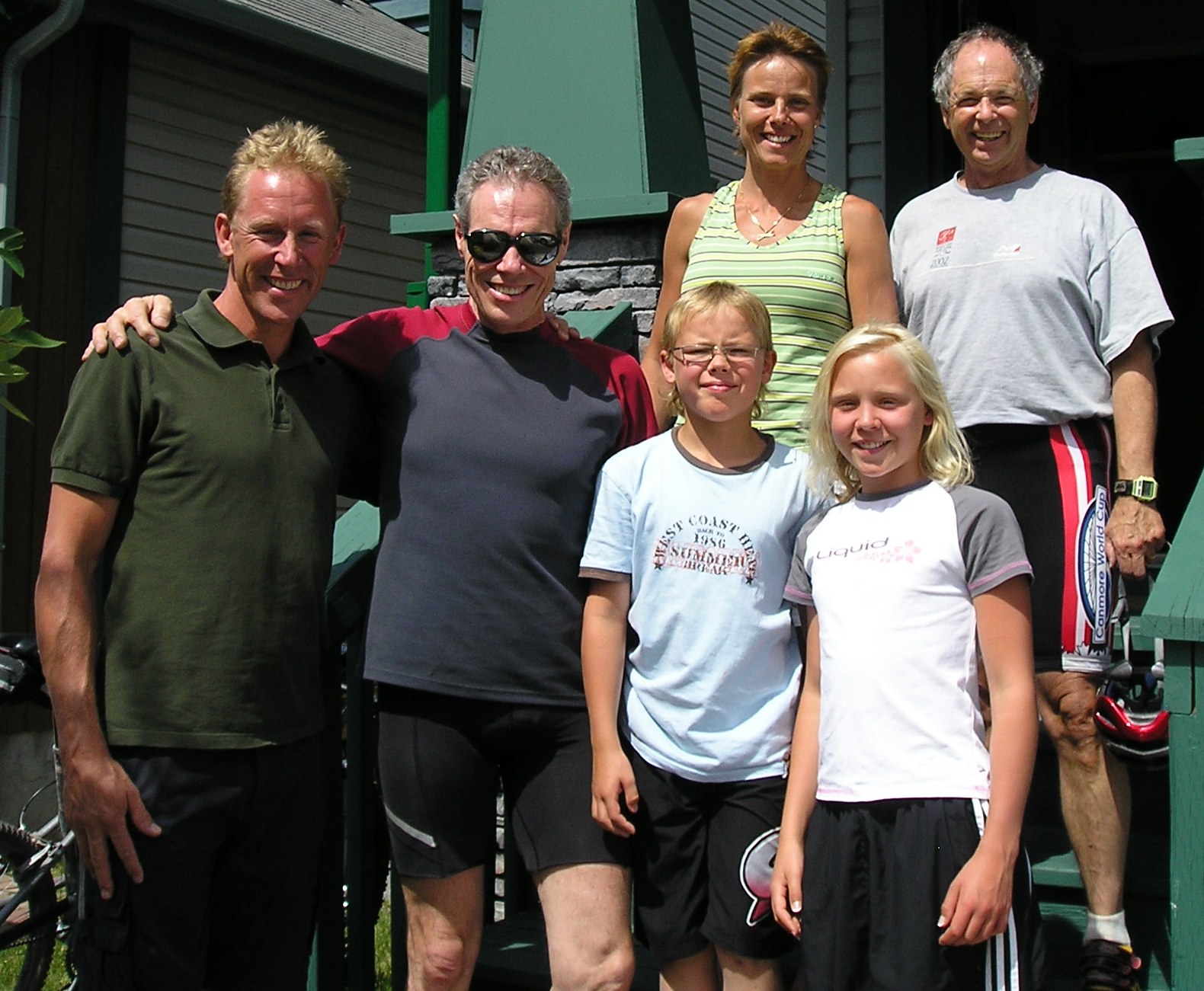
Left to right: Gunde Svan, me (even standing on a step I’m shorter than Gunde!), Mari, Rob Mackenzie, and the Svan kids, Ferry and Julia, in Canmore in 2006. (Courtesy photo)
[As an aside, the great Swedish champion Gunde Svan brought his family to Canmore for the summer in 2006. Through my friend Rob Mackenzie, who had met Gunde during the 1988 Olympics, I was able to spend most of a day hanging out with Gunde and his family. This amazing experience added fuel to the fire building under my growing passion for XC skiing.]
Canadian World Cup Team member Len Valjas (1) and Bob Thompson (NTDC Thunder Bay) lunge to the line during Wednesday’s Frozen Thunder classic sprint at the Canmore Nordic Centre in Canmore, Alberta. (Photo: Doug Stephen)
Clouds heavy with building snow and a winter-storm warning already in effect cast a second anticipatory shadow over a jittery group of racers gathered on Wednesday for the first Frozen Thunder race of the season at the Canmore Nordic Centre in Canmore, Alberta.
At stake for some of the top Canadians participating in the day’s classic sprint was the opportunity to secure the final spot on the men’s World Cup team for the first period of World Cup racing starting later this month. Nearly 12 centimeters of snow had fallen the night before on the two-lap race track, and for many stepping out onto the freshly groomed trails, months upon months of training prep was in the barn.
“That World Cup spot. That has been a goal for pretty well the whole year,” said Bob Thompson, who trains with the Thunder Bay National Team Development Centre (NTDC), on the phone after Wednesday’s races.
Thompson, 26, was not the only one hoping to book a plane ticket for World Cup Period 1, which starts Nov. 24 in Kuusamo, Finland, and continues through December. Sixty-six skiers started Wednesday’s men’s sprint qualifier and anyone in the hunt for that World Cup spot would have to outperform them all, excluding the Americans and Canadian World Cup Team member, Len Valjas, who was prequalified for the World Cup.
Even with the competition’s added edge, many racers went about business as usual on race day and in the days leading up to the event, Thompson explained.
“It’s been fairly carefree the week we’ve been here,” said Thompson, who arrived in Canmore with his NTDC teammates on Oct. 23. “The morning [of the sprint] I wouldn’t say things were a bleak atmosphere or super serious, it was just kind of everyone was doing their thing.”
Thompson went about his warmup the way he normally would on race day. In retrospect, he saw his plan as well-executed and his warmup as strong, despite breaking a pole during his intensity segment. For him, the qualifier went “really well,” he said.
Julien Locke (Canadian U25 Team/Black Jack) after winning the men’s classic sprint qualifier at Frozen Thunder in Canmore on Wednesday and securing the final spot on the Canadian men’s team for World Cup Period 1. (Photo: Cross Country Canada)
But Julien Locke, of the Canadian U25 Team and Black Jack Ski Team, was the fastest man in the open men’s qualifier and thus earned that coveted World Cup spot. Locke, 24, posted the top time of 3:37.81 minutes, nearly a second ahead of Valjas in second (+0.97) and 3.57 seconds ahead of the third qualifier, Dominique Moncion-Groulx of the Alberta World Cup Academy (AIAWCA). Thompson qualified fourth, 4.15 seconds off of Locke’s winning time.
“I didn’t have regrets or second thoughts on how I raced,” Thompson said. “Julien had a great race, props to him. I’ll just have to come back next time.”
Locke could not be reached at press time, but he spoke with Cross Country Canada (CCC) in a video posted on Twitter after the race.
“I’m really excited to have won the race this morning and qualified for Period 1 World Cup, but the Olympics is the big goal this year,” Locke said. “It’s super important to go get results on the World Cup, and I’m excited to have a chance to do that.”
According to CCC High Performance Director Thomas Holland, Locke and the rest of the World Cup Team (excluding Alex Harvey and Cendrine Browne) will head to Gällivare, Sweden, on Nov. 10, where they’ll compete in a weekend of International Ski Federation (FIS) races from Nov. 17-19. Meanwhile, Harvey and Browne, who train out of the Pierre Harvey National Training Centre (CNEPH) with coach Louis Bouchard in Quebec, will train in Davos, Switzerland, in advance of the World Cup opener in Finland.
But let’s get back to Frozen Thunder. With the qualifier behind them and the heats slated to take place in a zero-elimination King’s Court format, many racers approached the rest of Wednesday adamant on getting in some solid race efforts.
“The King’s Court format that we use in the heats was a great showcase for athlete development whereby every athlete entered in the race gets to race all 3 heats,” Holland explained in an email. “The format sees men and woman and para-skiers in some of the same heats – super fun event for all the athletes.”
In the first heat, Thompson, Locke, Valjas, and Moncion-Groulx went head to head, yet with the heats starting one minute apart on the two-lap track, there was a constant influx of skiers and some overlap.
“I think comments were made that we were dogging it a little bit,” Thompson said of that initial round. “There were other heats that we were basically skiing in the first lap with that were going faster than us … they were running pretty quick through the starts.”
Dominique Moncion-Groulx (Alberta World Cup Academy) leads Julien Locke (3), of Canada’s U25 Team and Black Jack, and Len Valjas (l), of the Canadian World Cup Team, during a Frozen Thunder classic sprint heat on Wednesday at the Canmore Nordic Centre in Canmore, Alberta. (Photo: Doug Stephen)
In the second heat, Locke and Valjas paired up with Knute Johnsgaard (Canadian World Cup Team/AIAWCA) and American Cole Morgan, of the Sun Valley Ski Education Foundation (SVSEF). Thompson and Moncion-Groulx faced another American SVSEF skier, Kevin Bolger, as well as NTDC Thunder Bay’s Andy Shields. Four men advanced to the senior men’s final: Bolger, Thompson, Locke and Valjas.
In the final, Thompson recalled creating what he saw as “a bit of a gap” between himself and Valjas, yet Valjas, a seasoned World Cup sprinter, caught him in the lunge to the line for first. Overall on the day, Valjas placed first, Thompson second, Locke third, and Bolger fourth.
With the King’s Court format, female racers competed in the same same qualifier as the men, with Dahria Beatty (U25 Team/AIAWCA) emerging as the fastest female qualifier in 4:20.66. Her time was 8.56 seconds clear the second woman, American Chelsea Holmes, of Alaska Pacific University (APU), and 10.03 seconds ahead of Katie Weaver (Hollyburn Ski Club) in third. The third-placed Canadian woman in the qualifier, Annika Hicks (AIAWCA) clocked in fourth (+13.25).
In the heats, the women continued to race with the men. In the all-women final, Maya MacIsaac-Jones (U25 Team/Rocky Mountain Racers) took the win, Hicks placed second, Holmes third, and Frédérique Vézina (CNEPH) fourth.
Frozen Thunder racing continues Friday with men’s 10 k and women’s 7.5 k distance races, starting at 9 a.m. Mountain time. In a press release, CCC anticipated a turnout of 115 participants.
Macx Davies, Christian Gow, and Scott Gow of Biathlon Canada training at the Canmore Nordic Centre last weekend in Canmore, Alberta. (Photo: Matthias Ahrens)
Frozen Thunder is back, but it’s not the same Frozen Thunder you knew before.
Every year, snow is stored all summer at the Canmore Nordic Centre in Canmore, Alberta, and rolled out in October to provide local ski and biathlon teams with on-snow training opportunities. This year, the loop has changed.
“It feels good to be back on the snow after such a long time away,” Biathlon Canada’s Nathan Smith wrote in an email. “The loop has been lengthened and improved. There is a steeper climb now, which means mandatory offset.”
“They’ve set a new track compared to previous years which is much better for training,” Cross Country Canada’s Jesse Cockney agreed.
Biathlon Canada Head Coach Matthias Ahrens explained that the changes were needed to make the loop more comparable to courses used in international competition. National teams for both biathlon and cross-country skiing will be using competitions on Frozen Thunder to pick their World Cup teams, so they wanted the course to be difficult.
“We were doing intensity Monday,” Ahrens wrote in an email. “The athletes started skiing on Saturday and have not really experienced much challenge to adapt from rollerskiing. We are in the last preparation phase before the first World Cup happens in four weeks, and the training volume is reduced now, but the intensity increased to do the final race sharpening.”
The Space Dogs Ski Club out in force on Frozen Thunder. (Photo: Bob Truman/www.skierbob.ca)
Aside from national team athletes and World Cup hopefuls, the loop has been home to high school racers, families and masters teams.
“The reason you will see a lot of athletes wearing bibs is actually that we have training times for elite athletes from 8-noon,Monday–Friday, since the National and Development Teams have a big stake in funding Frozen Thunder as early season training venue,” Ahrens explained. “Only those who have contributed money to Frozen Thunder get bibs and are allowed to ski in the mornings, just a way to control who is on it. On weekends and afternoons it is open to the public.”
“It was a quiet start to Frozen Thunder with a lot of teams away, so that was lovely to enjoy the new track (a fun turn and more climbing) and not play Rush Hour,” wrote Erin Yungblut, a Canmore-based biathlete. “I think it’s really exciting to have so many teams and talented athletes out… I love being able to ski behind others and learn from as many as I can.”
Among that group is the Space Dogs Ski Club masters team.
Canadian biathletes training on the shooting range in Canmore. (Photo: Matthias Ahrens)
“For our masters performance group, getting on early snow is probably equal parts technical advantage and motivation/excitement,” wrote Dasha Gaiazova, a Space Dogs coach and former Olympian. “We are grateful that we, and many other skiers of all abilities have an opportunity to train on early snow so close to home. I also believe it makes the Frozen Thunder project more self-sustainable, through sale of general public ski passes, early season ski lessons, and providing great visibility for the sport of cross-country skiing in Canmore.”
Frozen Thunder is getting busier. The Canadian National Ski Team returned from a training camp in Park City, Utah — Cockney had done a shorter camp, thus returning home and getting some extra time on snow. The Canadian biathlon squad already had its first time trial on the course on Thursday. The U.S. biathlon team is also in town now for an on-snow training camp, and the two teams will have joint competitions on Nov. 7-10. Meanwhile, next Wednesday and Friday the cross-country team will hold a classic sprint and skate distance race.
Below, a roundup of some more reactions to getting back on snow before the start of the season:
“It is super fun to be back on snow – rollerskiing is great training, but it simply isn’t the same! I am here in Banff to spend time with my husband before I hit the road for winter racing. I would love to be training with my APU crew in Alaska (there really is no place like Alaska… and yes I am biased as it has and will always be home), but I have been super busy going between Alaska and Banff this summer and I felt it was more important to have this short time with my husband and limit travel these last couple weeks. Not to mention, the Bow Valley is very close to my heart. The terrain in Canmore is great training, lots of transitions and a new stair-stepping climb – they fit a lot into that 2 k loop.”
— Chelsea Holmes, Alaska Pacific University
“Getting on snow the day after returning home from Park City camp was an awesome transition, but I’m quite tired after the time at altitude so I’ll take a couple easy days to get energy back now. I wasn’t so much planning my shorter camp around more time on snow, I was just being careful with energy this late in the training season. As it turns out I may have overdone it anyway in Park City, but it was a really good call to come home and try to recover a bit sooner than the rest of the gang.”
— Jesse Cockney, Canadian National Ski Team
“It’s so amazing to be back on snow again; I still can’t get over how lucky we are to live and train in Canmore with such an epic facility. The transition back to snow has been pretty quick and easy for me as I did a lot of yo-yo camps up at the Haig Glacier this year, so I’m used to icy starts/soft sugar underfoot. Racing definitely feels closer now, and I couldn’t be more excited. I literally have zero pressure or expectations on myself, as I’ve come to realize I’m pursuing biathlon because I love the challenge of it… and the results will be what they are. I don’t think I’ve ever expanded this much [as a person] so quickly. It sounds corny, but I’m finally starting to figure out how to control the controllable and forget the rest of it.”
— Erin Yungblut, Rocky Mountain Racers
“Being on snow as much as possible is one of our priorities for Space Dogs members for a number of reasons:
1. Master skiers usually have full-time jobs, and families to look after, so their training schedules are compressed, and the workouts have to be as specific as possible.
2. Many masters have old injuries and accumulated damage to their knees / back / hips, which makes it impossible for some to run, or to do other dryland-type workouts. The more they can ski, the more training is accomplished pain-free.
3. Training around high-performance athletes allows for learning through watching, and through imitating. Sometimes, seeing someone ski with good technique is a lot more powerful than having it explained in concept terms.
4. Skiing in crowded spaces is beneficial for loppet racing practice. We purposely arrange some of our workouts around busy trail times, so that our skiers are more comfortable skiing on crowded trails, which is what a loppet race experience usually feels like.”
— Dasha Gaiazova, coach, Space Dogs Ski Club
“I’d say the transition had gone smoothly and no different than previous years. I’m careful not to adapt my technique in the summer for rollerski efficiency. I’m feeling pretty strong and have been performing fairly well vs. my team mates in time trials. Of course, that is just a sample of 5 athletes. I think it’s dangerous to proclaim that everyone is fit and crushing it before the reality check of World Cup. I’ve seen that this can build up unrealistic expectations. That being said, I’m feeling confident and have a good feeling that things are going to work out well. I will be in top fitness when the time comes in Europe and Korea.”
— Nathan Smith, Biathlon Canada National Team
“With not getting onto the Haig Glacier because of snow melt, our team hasn’t been on snow since May. The transition was easy for me this year and it feels like second nature to be back on snow. I will admit to the first couple of strides feeling like skis are quite long, but that didn’t last long… It was a bit sad while they were pushing out Frozen Thunder, because we had about three days of rain. So far it is holding up nicely and we just have to hope that colder temps are in the forecast.”
Early season skiing at the Sovereign Lake Nordic Centre on Oct. 14, 2017. (Courtesy photo)
When you think of skiing in Canada in October, Canmore’s Frozen Thunder is probably one of the first places that comes to mind. There are more options and some snowmaking that might surprise you.
This month, Canadians are skiing on natural snow, machine-made snow and farmed snow. We know skiers are already out and about in Alaska and other parts of the U.S. as well, which is why we want this year’s early season “Where The (Skiable) White Stuff Is” to compose of reader submissions. If you know where there’s November or even October skiing in the U.S. or Canada, please write us with details (When does it open or how long has it been open? How many groomed kilometers are there? Is there snowmaking? Any special events planned, like American Thanksgiving camps? Anything else we should know?)and original photos at info@fasterskier.com with the subject line: “Fall Skiing”. Deadline for submissions is Nov. 3.
To get the ball rolling, FasterSkier’s Gerry Furseth checked in with several nordic venues across Canada. They’ve already celebrated Thanksgiving, and full-on skiing is just around the corner.
Frozen Thunder
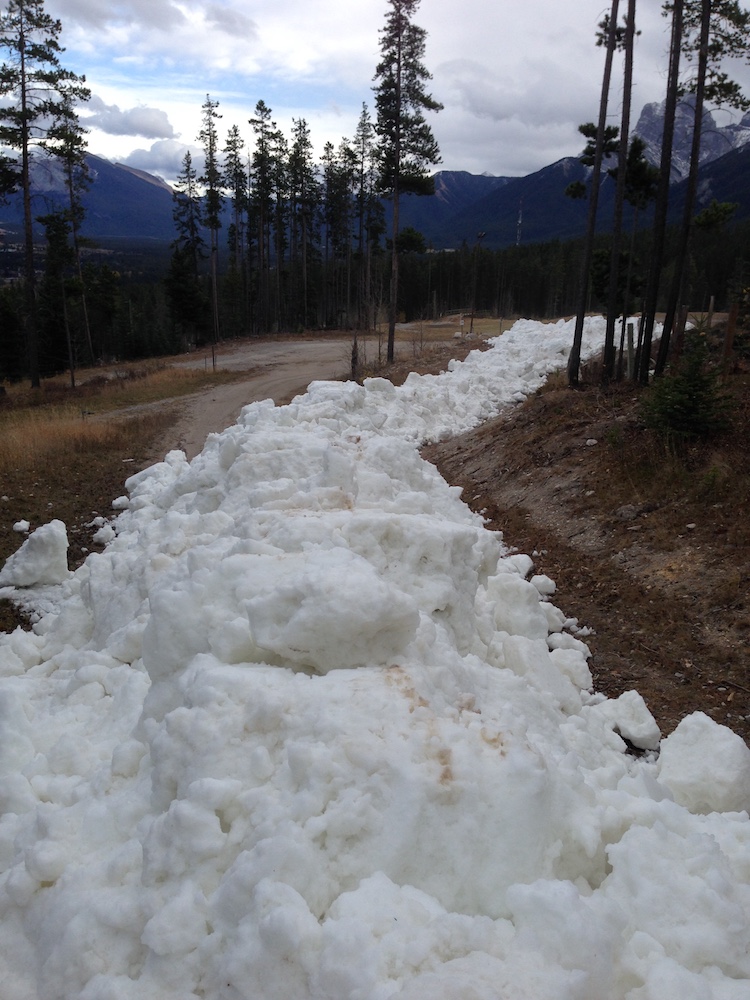
Canmore has started building Frozen Thunder for 2017. This is what it looks like with five days to go. (Courtesy photo)
The action starts on Oct. 21 with some changes for the eighth season. There will be a bigger hill as requested by the national teams and a new emphasis on avoiding exposed south-facing slopes.
The Canmore Nordic Centre (in Canmore, Alberta) is an unusual venue, one of the select few that has machine-made snow, farmed snow and natural snow.
“There is obviously an issue [with manmade snow] around warmer temperatures,” Area Manager Michael Roycroft told FasterSkier. “Last year is a good example where most of November was too warm to make snow, and that’s where Frozen Thunder comes in. That’s why we have our storage option, that allows us to essentially have snow no matter what.”
Frozen Thunder is funded mostly by national and provincial ski organizations and the focus is on providing training opportunities for high-level competitors. The snowmaking has a broader focus.
“The natural snow is obviously helpful, and it covers the rest of our trail system that’s further to the west and higher up, but it wasn’t for machine-made snow in Canmore and the nordic centre, we simply would not be able to run as a nordic facility,” Roycroft said.
Machine-made snow covers 30 kilometers, leaving 40 k dependent on natural snow.
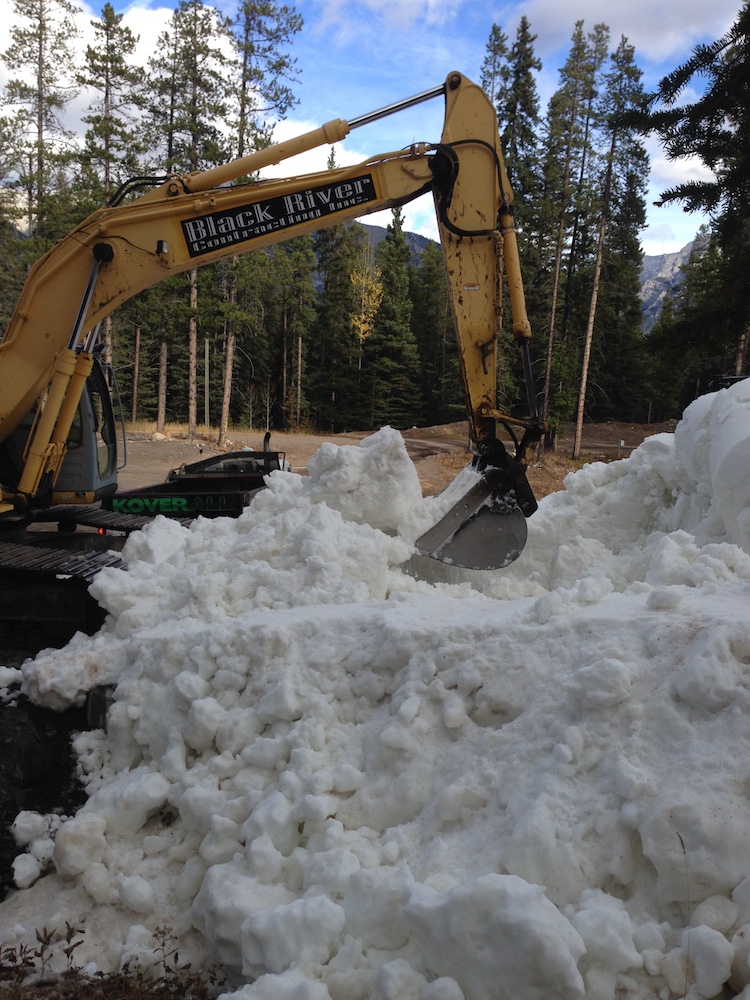
A big job requires big machinery. (Photo: Canmore Nordic Centre)
Whitehorse
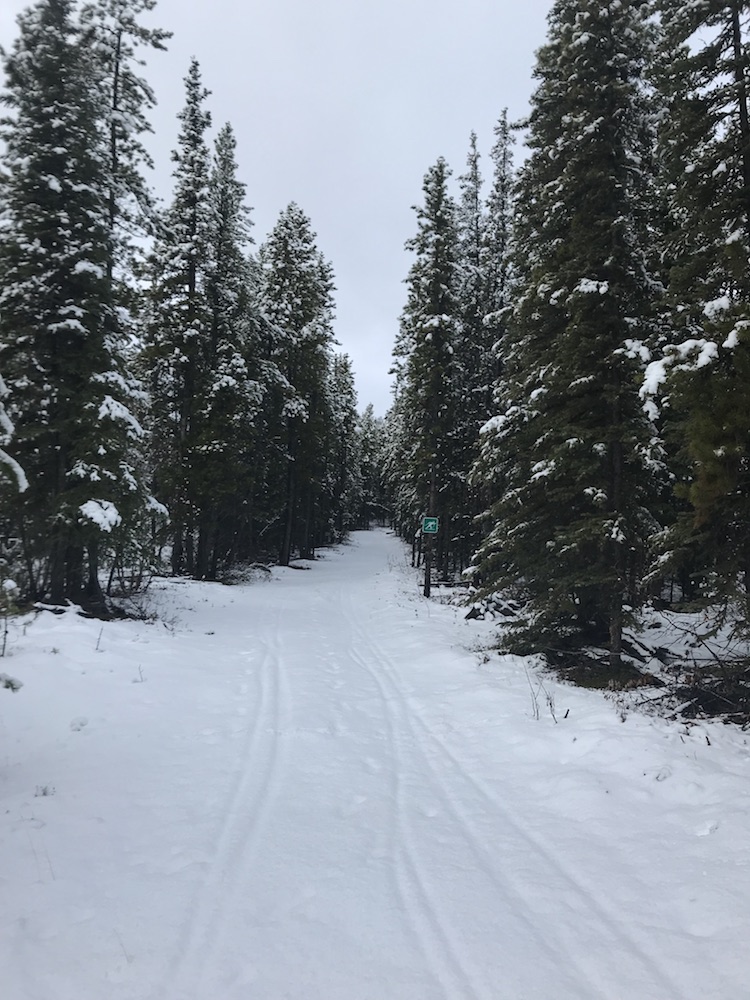
Whitehorse ski trails on Oct. 15, 2017. Another 5 centimeters was needed to set track. (Photo: Alain Masson)
When you think of Whitehorse, you probably don’t think of snowmaking. But Cross Country Yukon’s Alain Masson does.
“In the past, we often had snow available for skiing for our more advanced skiers, but it was not available to everyone,” Masson wrote in an email. “This year, our developing skiers will all have access to some early skiing in good man made snow conditions a month earlier than usual.”
Much of the early season skiing in Canada is not intermediate friendly. Thin snow, tripping hazards and travel to elevation create a barrier to less advanced or less committed skiers. The Whitehorse Cross Country Ski Club is using snowmaking to make the early season more inclusive.
The new snowmaking equipment will be used for the first time on Oct. 22.
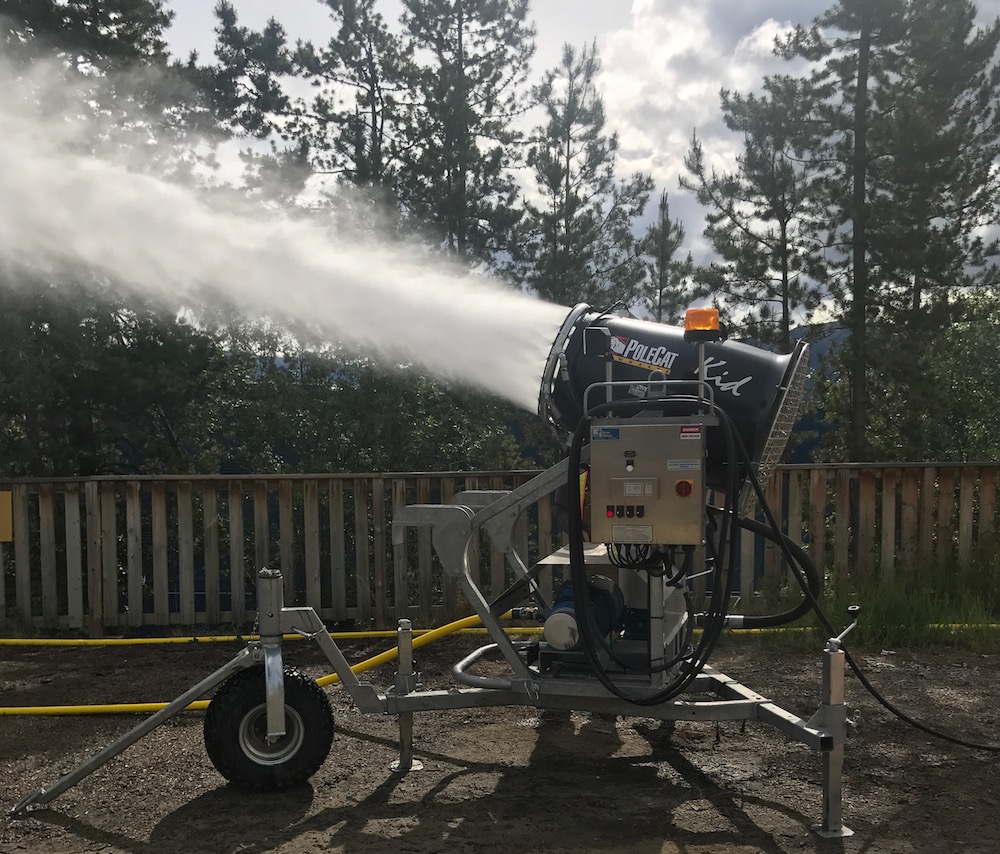
Testing the new gun in June 2017. (Photo: Alain Masson)
Sovereign Lake
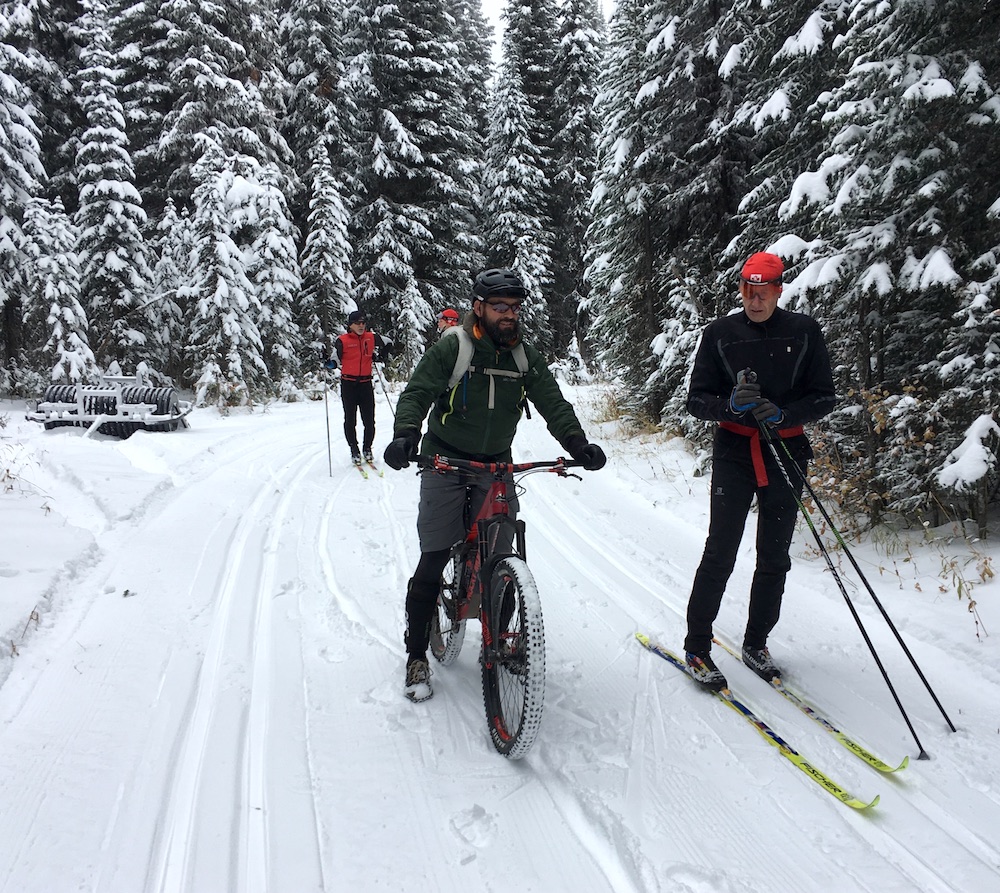
There is a difference of opinion on what season Oct. 14 belongs to. The bikers might have chosen fat bikes over plus bikes if they had realized how much snow they would see on their epic ride from Vernon to Lumby, B.C. (Photo: Gerry Furseth)
The Sovereign Lake Nordic Centre (near Vernon, British Columbia) is well known for November skiing and NorAm races. The season is limited not by loss of snow, but by biking conditions in the valley below.
“As soon as Sovereign gets snow in the fall we want to conserve as much as possible by rolling and track setting,” General Manager Troy Hudson wrote. “All of our early season grooming is done with Quads and snowmobiles to ensure a firm and supportive snowpack for the remainder of the season. Our high elevation (1,680m) and typical higher humidity in late October provides unpredictable weather that can often result in snowstorms of 10-15cm at a time.”
With 20 centimeters of fresh snow, the club set about 5 k of classic track on Oct. 14. While certain trails are open for preseason skiing, the nordic centre officially opens Nov. 10 for pass holders and day ticket sales.
Menihek Nordic
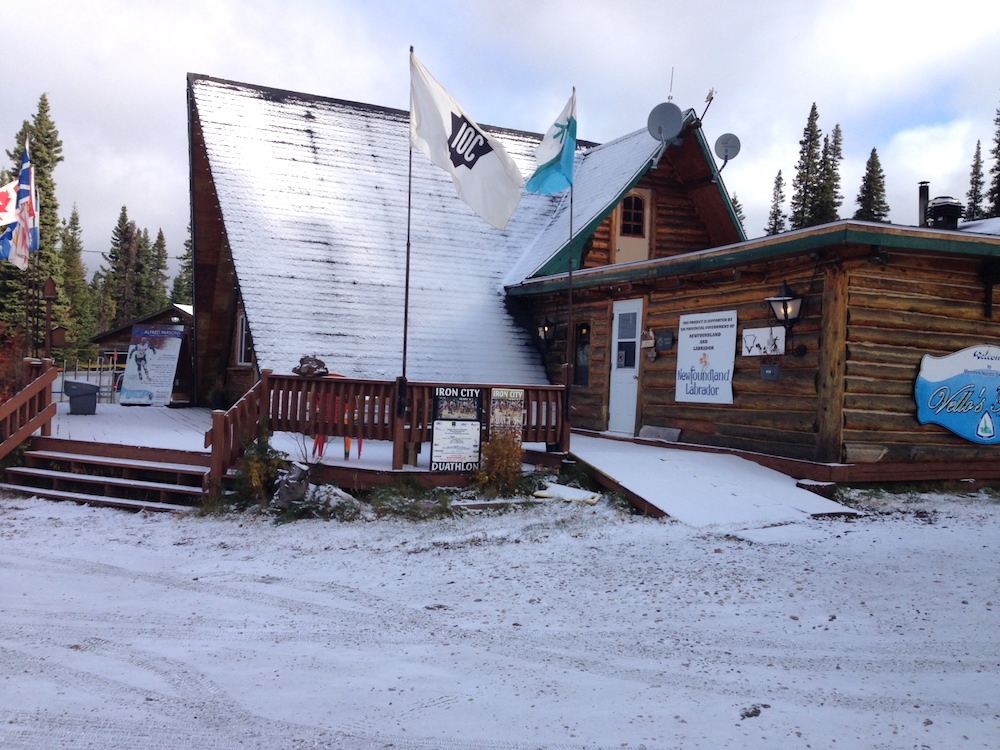
Menihek is another former national-team favourite destination that has since been replaced by Frozen Thunder. Located near Labrador City, Newfoundland and Labrador, it is a less-visited gem. While the Menihek Nordic Ski Club hasn’t received much snow to date, it is a safe bet that by the end of October they will be setting upwards of several kilometers of track.
On Oct. 12, a dusting of snow was seen at the lodge. (Photo: Gerry Rideout)
The start of the men’s 50 k freestyle mass start last week at Canadian Ski Nationals in Canmore, Alberta, with Graeme Killick (1) at the front (Photo: W. James MacLean).
CANMORE, Alberta — Canadian Nationals went to Canmore for 2017 and Canmore delivered. Famous for challenging courses, well-trained volunteers, and erratic weather; the Canmore Nordic Centre showed all three at their best during the eight-day event.
Each day delivered warm sun, cold winds, snow flurries, and warm winds (often all occurring in a single race lap) to more than 600 racers. The first races each morning were held on fast, transformed snow that transitioned to slow and soft in the afternoon. While 30 of Canada’s top skiers missed the first two days of racing, with a new relay cross event and freestyle interval starts, while competing at World Cup Finals in Quebec City, the real action was in the younger categories with more than 100 racers in each.
Retired biathlete Zina Kocher and Para-Nordic Ski Team guide Graham Nishikawa collected the open category national titles, while the University of Denver’s Moritz Madlener, a U.S. student from Germany, won the overall.
On Tuesday, March 21, most of the World Cup Finals racers arrived in time to compete in the 10/15 k classic interval starts, with Devon Kershaw and Emily Nishikawa recovering to take the open-category gold medals.
The next day, Emily Nishikawa took her second-straight title in the classic sprint, despite being visibly tired in her fifth race in six days. All six women in the A-final had completed in Quebec three days earlier. While the three medalists were posing for a photo, one was overheard saying, ‘We have two days off!’
In the men’s A-final, Madlener took the overall victory ahead of his University of Denver teammate Dag Frode Trollebø. Evan Palmer-Charrette placed third overall, and as the top Canadian, he earned the national title.
Thursday held classic sprints for the younger categories and Friday was a rest day for the volunteers.
Saturday, March 25, brought the 30/50 k freestyle mass starts, with Emily Nishikawa completing her hat trick and another World Cup Team member Graeme Killick showing off some little-known sprinting talent to win his first 50 k.
(See also: the race analysis link for each day. Want to know who was climbing fastest? Descending fastest? Slowest? Won the climbing prime? It is all here for the distance day.)
Quotes
On the importance of nationals
“When I was a juvenile, I just had learned so much meeting the national team skiers, seeing them ski around, see what they do for warmups, how they race. … So I just want to be here for the next generation and be able to meet anyone who wants to say hi.” — Emily Nishikawa (Canadian World Cup Team)
“We had 110 girls at the Fast and Female event yesterday. It was really amazing to see so many girls out there. I hope that everyone’s enjoying their nationals and gets some inspiration from watching myself, and Emily, and Graeme, and everyone else who’s been racing overseas race. Especially, too, some of those juniors who had the opportunity to do the World Cups in Quebec. For everyone else in Canada to be able to race them and see where they end up and have that as a marker is really exciting.” — Dahria Beatty (AWCA/National U25 Team)
“We use these as training races, we need to stay competitive with the best in the country, and that’s what we’re here to do.” — Graham Nishikawa (Canadian Para-Nordic Ski Team guide for Brian McKeever)
On winning a national championship
“It’s my fifth race in six days, so I’m really tired, but I couldn’t be happier right now. To win two back-to-back national titles yesterday and today is really cool.” — Emily Nishikawa, after the sprint
“It was a tough end to the season, but nice to finish on a positive note here. It is incredible to win all three.” — Emily Nishikawa, after two rest days
“Awesome to be Canadian champion, surprise for sure in a classic sprint for me. Definitely not quite the Canadian field you’d see at a lot of Canadian nationals, a lot of guys sick and injured after World Cups on the weekend, but awesome nonetheless.” — Evan Palmer-Charrette (NTDC Thunder Bay)
“I’ve never won the 50 before. I’ve have medals in the other races … I’m super happy to get a 50 k win, that’s something that’s been a big goal of mine. I didn’t feel so good coming into this week, so I’m just really happy that it worked out today.” — Killick (World Cup Team)
“It feels great. Super good race for me on Sunday [March 19] and I’ve had a great week overall.” — Graham Nishikawa
On the races
“I wouldn’t say I’m a sprinter, but today with these soft, slushy conditions, it kind of played into my favour. I love classic sprinting, I always have.” — Emily Nishikawa, after winning the sprint
“I had a good tactic for the final downhill, I found some faster snow outside the track. I did a little slingshot off Dahria. She’s usually so good at tactics, I was thinking, ‘What would Dahria do today?’ and did what she would normally do.” — Emily Nishikawa, after the sprint
“The prologue was really tough. We had a very tough race yesterday, so the prologue was just getting through it. And then I recovered better than I thought, it got better from each heat to the next.” — Moritz Madlener (University of Denver), after winning the men’s sprint A-final
“The prologue was very tough. I had a good one, but it was definitely easier in the semifinal. Actually, at the end of the final it was more of a distance race than a sprint race. I think people were hurting a lot, there were very tough conditions, we had sugar snow up our legs, and I was just trying to get up the hill as fast as possible.” — Dag Frode Trollebø (University of Denver), who placed second overall in the sprint A-final
“I tucked in behind the two guys from Denver. I knew they were going to put in a surge on the climb. I went inside to try and go past them, but they were smart, took the two outside tracks which were still there, inside was really soft. I cut over to get behind them, but I lost a couple metres and just wasn’t able to get that back.” — Palmer-Charrette, after placing third overall in the sprint, first Canadian
“I double poled the qualification, it was a good decision for me, I ended up ninth. Very good quali for me. I just can’t describe the heats, it was so perfect for me today. It was perfection, from the start to the end.” — Antoine Briand (CNEPH), after placing fourth overall in the sprint, second Canadian
“Canmore is one of the toughest places to race. The hills are relentless and it suits my skiing. I attacked on the wall of the last lap, which is the toughest part of the course. I was trying to save some energy before that. I just went for it, and didn’t look back.” — Emily Nishikawa
“Emily won in the end going up the wall. She put on a hard sprint, and I, well, I haven’t really been training [laughs]. My legs seized halfway up and I was like, OK, let’s just get to the finish line.” — Zina Kocher (former Biathlon Canada national team member), after placing second to Nishikawa in the 30 k freestyle mass start
“Six [races] in eight, nine days. I’m pretty tired, I had no idea how my legs would react to the race, but I allowed myself to surprise myself, and better than I thought. The legs were good.” — Frédérique Vézina (CNEPH), after placing third in the 30 k
“Probably shouldn’t have started. I went hard off the start, tried to stay with the group, and was absolutely exhausted today. I was already dropped off the pack by the sprint prime, so I tried to go for it. After that, I just skied out the course, I wasn’t really racing anymore, I didn’t have anything left. I just tried to finish it, it’s never fun to drop out at the end of the season, so I thought it was worth skiing it out. It’s a nice day at least to ski, so many people cheering me on.” — Beatty, who placed 12th overall in the 30 k freestyle, and second in the “Queen of the Wall” climbing prime, behind Sophie Carrier-Laforte
“I don’t think I’ve ever beaten Andy [Shields] in a sprint. He’s got some speed. I knew it was my only shot, I tried attacking a couple of times and never really had the energy to go away with it, so I just decided to sit in and see what happened. Luckily, Shields had a good attack on the last climb there [pointing] and I was able to, he pulled us away from third place. It was just between us on the finish. I wasn’t counting on myself in the sprint, for sure.” — Killick, after outlasting Shields for the 50 k win
“I’m happy with how it ended up, but I felt pretty not in control the whole way. Early on, I had some energy so I tried to push it and then that was maybe a bit much. It’s hard to break away when the group comes back on the downhills, so it’s kind of tough for that. I’m just happy with how it ended up.” — Killick
“Graeme, he’s got some good chops [in sprinting]. That’s not the first time he’s outsprinted me to the end. He had the jump on me with the draft, and his skis were a little quicker than mine as well. I’m happy to be on the podium, would have been nice to get the win, but G-Kill had the tactics and he had the jam to stay with it when I pushed it on the last two climbs. He skied the tactics a little better than I did, I guess, and got the win.” — Andy Shields (Lappe Nordic), after placing second in 50 k freestyle
NTDC Thunder Bay’s Evan Palmer-Charrette racing to third place in the A-final to collect the national title as the first Canadian. (Photo: Peggy Hung)
The start of the men’s 50 k freestyle mass start last week at Canadian Ski Nationals in Canmore, Alberta, with Graeme Killick (1) at the front.(Photo: W. James MacLean)
Emily Nishikawa leads the pack out of the start in the women’s 30 k freestyle mass start (Photo: Peggy Hung)
NTDC Thunder Bay’s Michael Somppi leads the way after one lap in the men’s 50 k freestyle mass start. (Photo: W. James MacLean)
Graeme Killick pushing the pace as the lead pack approaches the wall climb in the 50 k freestyle mass start. (Photo: Peggy Hung)
Graeme Killick with the big prize. (It isn’t enough to have the strength to win a 50 k. You have to be able to lift the trophy at the end!) (Photo: Peggy Hung)
After six races in nine days, Jess Cockney is pressed into service to keep the prizes from blowing away. (Photo: Peggy Hung)
CNEPH’s Frédérique Vézina taking the bronze medal in the 30 k freestyle mass start. (Photo: Peggy Hung)
The eventual podium finishers on lap two of the men’s 50 k freestyle, with Graeme Killick (1), Andy Shields (2), Michael Somppi (3), who went on to finish in that order. (Photo: Peggy Hung)
Zina Kocher leads Emily Nishikawa in the 30 k freestyle mass start at the 2017 Canadian Ski Nationals. (Photo: Peggy Hung)
In contention for the junior men’s classic sprint title, AWCA’s Michael MacIsaac-Jones’s (second from left) crashed just before the finish of the A-final. (Photo: Peggy Hung)
Moritz Madlener (University of Denver) powers through the slush to defeat teammate Dag Frode Trollebø while Evan Palmer-Charrette finished as the top Canadian in third. (Photo: W. James MacLean)
Emily Nishikawa takes the sprint title ahead of Dahria Beatty (centre) and Katherine Stewart-Jones. (Photo: W. James MacLean)
Young skiers came from all over the country to represent their clubs and test their progress. Whitehorse’s Natalie Hynes is following the tracks of Emily Nishikawa and Dahria Beatty. (Photo: W. James MacLean)
Nationals is a club event. In the 50 k, the first and last finishers were both Ptarmigan Nordic members. Phil Meagher and Graeme Killick are all smiles afterwards (Photo: Gerry Furseth)
Graeme Killick (r) and Andy Shields (l) pushing to the finish in a race for first place in the men’s 50 k freestyle mass start at Canadian Ski Nationals on Saturday in Canmore, Alberta. Killick took it by 0.22 seconds. (Photo Peggy Hung)
2017 Canadian Ski Nationals (Canmore, Alberta): 30/50 k freestyle mass start
On the final day of racing at 2017 Canadian Ski Nationals, the men’s 50-kilometre freestyle mass start came down to a two-way battle for first and the women’s 30 k win went to the champion of two other individual races this week — Emily Nishikawa — on Saturday at the Canmore Nordic Centre.
Graeme Killick, of the Canadian World Cup Team, outlasted Andy Shields (Lappe Nordic) by 0.22 seconds at the line to win his first national title at that distance in 1:56:40.21. Shields placed second and Michael Somppi (NTDC Thunder Bay) finished another 6.28 seconds back in third.
“I’m super happy to get a 50 k win. That’s something that’s been a big goal of mine,” Killick, 28, told FasterSkier during an in-person interview. “I didn’t feel so good coming into this week, so I’m just really happy that it worked out today.”
Last year at nationals in Whitehorse, Yukon, he finished second to teammate Alex Harvey in the 50 k classic mass start.
“I don’t think I’ve ever beaten Andy in a sprint. He’s got some speed,” Killick said on Saturday. “I knew it was my only shot. I tried attacking a couple of times and never really had the energy to go away with it, so I just decided to sit in and see what happened. Luckily, Shields had a good attack on the last climb and he pulled us away from third place. It was just between us on the finish. I wasn’t counting on myself in the sprint, for sure.”
Emily Nishikawa (Canadian World Cup Team) celebrating her decisive victory in the women’s 30 k freestyle mass start at Canadian Ski Nationals on Saturday in Canmore, Alberta. (Photo: Peggy Hung)
The defending champion from last year’s 30 k classic mass start in her hometown of Whitehorse, Nishikawa (World Cup Team) rocketed to a 47.5-second victory over retired biathlete Zina Kocher in Saturday’s 30 k skate. She crossed the finish line first in 1:21:50.2 for her third victory in as many races she’s competed in at this year’s nationals.
“I had three good races this week,” Nishikawa, 27, told FasterSkier. “It was a tough end to the season, but nice to finish on a positive note here. It is incredible to win all three.”
According to a Cross Country Canada (CCC) press release, Nishikawa controlled the pace throughout Saturday’s race with Kocher before accelerating over the last three kilometres.
“Zina was really strong and we were taking turns leading and pushing each other,” Nishikawa said. “Canmore is one of the toughest places to race. The hills are relentless and it suits my skiing. I attacked on the wall of the last lap, which is the toughest part of the course. I was trying to save some energy before that. I just went for it, and didn’t look back.”
While Kocher finished 47.5 seconds back in second, Frédérique Vézina (CNEPH) followed in third (+2:29.81).
“The 30 kilometre is the hardest race all week. It is so tough,” Nishikawa said. “It is such a sense of accomplishment just to cross the line let alone to win, so it feels amazing.”
In the junior men’s 30 k, Gareth Williams (Junior National Ski Team/Telemark Nordic) won by 1 1/2 minutes in 1:23:19.10. Philippe Boucher (Junior NST/CNEPH) placed second (+1:30.98) and Thomas Manktelow (AWCA) reached the podium in third (+3:25.44).
“It was a great experience to learn from the best in the country in Quebec,” Williams told CCC. “It is a big step to get to the next level. It will be a lot of work, but I’m willing to take it on and see how the next couple of years go. I’m really happy with the results here [in Canmore]. It was a really good week.”
Annika Richardson (Junior NST/NTDC Thunder Bay) racked up her second-straight title of the week, after winning Wednesday’s junior sprint, with the women’s 20 k skate victory in 1:04:36.92 on Saturday. Richardson finished 52.09 seconds ahead of her NTDC teammate Lisle Compton in second, and Zoë Williams (Junior NST/Nakkertok) placed third (+1:12.45).
Left to right: Biathlon Canada’s Rosanna Crawford, Julia Ransom, Megan Tandy, and US Biathlon’s Susan Dunklee at the start of the women’s 7.5 k sprint on Wednesday, Nov. 9, at this year’s Biathlon Canada team selection time trial races at Frozen Thunder in Canmore, Alberta. (Photo: Matthias Ahrens)
(Note: Biathlon Canada’s World Cup team trials wrapped up last Thursday, but selections had not been publicized as of Monday. Stay tuned for the final team selection details.)
While pushing past the overgrown, browning grass lining the Canmore Nordic Centre’s shooting range last Wednesday, Rosanna Crawford could feel the pressure.
Not pressure to qualify for a team, pressure to prove she deserved her preselected spot on Biathlon Canada’s A (officially “Eh!”) squad.
The 28-year-old team veteran did just that by the end of Biathlon Canada’s two-day team selection races, which ran this year from Wednesday, Nov. 9 to Thursday, Nov. 10 at Frozen Thunder in Canmore, Alberta. Crawford took the wins in both women’s sprint events. However, even after winning Wednesday’s 7.5-kilometer sprint by more than 30 seconds, Crawford wanted more from her shooting after she missed three shots (2+1).
Biathlon Canada High Performance Director Eric de Nys (l) with US Biathlon’s Susan Dunklee (c) and Biathlon Canada’s Sarah Beaudry (r) at the start of the women’s 7.5 k sprint on Thursday, Nov. 10, at this year’s Biathlon Canada team selection time trial races at Frozen Thunder in Canmore, Alberta. (Photo: Matthias Ahrens)
“With being pre-qualified you always want to prove that you deserve to be pre-selected,” Crawford wrote in an email on Wednesday. “I had high focus and expectations for shooting and am really disappointed with 3 misses, that won’t do on the World Cup. I have been training quite a bit leading into these races, so I am looking at it as a good chance to practice pushing hard while tired and shooting well. Today was a mentally and physically draining race, but conditions that we might encounter in the winter.”
Crawford explained that Wednesday’s conditions were particularly challenging, with a fair amount of wind and temps hovering above 16 degrees Celsius, turning the 2.6 k race loop into slush.
“It was quite windy and not really consistent which definitely hurt people on the range,” Crawford wrote. “My race started off with a good first lap and then it turned into a slow crawl by the finish, it just got slower and slower as the sun beat down on the tracks. We did the same race [format] on November 4th which took 21 minutes, and today [Wednesday] was 27 minutes!”
US Biathlon national-team members Joanne Reid and Susan Dunklee also competed in Wednesday’s competition, finishing second and third, respectively. Reid clocked in 34.4 seconds back from Crawford’s time with three misses (1+2) and Dunklee also finished with three misses (2+1), 35.5 seconds behind Crawford. Reid explained that for the U.S. women, competing in the time trial provided an opportunity to fine tune their racing prior to the official start of the IBU World Cup season.
US Biathlon’s Susan Dunklee shooting prone during the women’s 7.5 k sprint on Thursday, Nov. 10, at this year’s Biathlon Canada team selection time trial races at Frozen Thunder in Canmore, Alberta. (Photo: Matthias Ahrens)
“Since our trials races are over and the women’s team is already selected, there is no results pressure for us. Instead we are focusing on getting all the pieces together to launch into a successful first period of the World Cup,” Reid wrote of herself, Dunklee and Clare Egan, all on the U.S. women’s biathlon team, in an email on Wednesday. “All three of us are still adapting to some changes, different trigger weights, entirely new actions, sight risers, that sort of thing, so these time trials were just about practicing these new developments in a race environment.”
In Thursday’s women’s 7.5 k sprint, Crawford repeated with another victory, completing the course in a time of 22:08.2 with three misses (2+1). While desiring better shooting, Crawford remained optimistic about being able to hone in on her accuracy within the next few weeks.
“Today was a lot better than yesterday, I think it went below freezing and conditions stayed pretty hard and consistent through the women’s race,” Crawford wrote in an email on Thursday. “Still really frustrated with my shooting, prone has actually been quite good this summer and fall, so not sure what has changed. But I’ve got 3 weeks to get things back to normal, and feel confident that things will be better come the race season.”
Finishing 3.5 seconds off the winning time, after cleaning prone but missing two standing shots (0+2), was Crawford’s teammate Julia Ransom in second place. Following Ransom, 8.2 seconds back from Crawford with one miss (0+1), was Megan Tandy (also of Biathlon Canada) in third.
In the men’s 10 k sprint, Volodymyr Siemakov of Ukraine took first on Wednesday, finishing the 10 k in a time of 28:36.0 with one miss (1+0). Finishing 4.5 seconds behind Siemakov in second after shooting clean was US Biathlon’s Lowell Bailey. In an email, Bailey explained that even with temperatures better saved for summer, Wednesday’s race was a good start to his on-snow season.
“I think of these competitions as a ‘test-run’ for the upcoming world cup,” Bailey wrote on Thursday. “These races are a good chance to try out all of the new elements I’ve been working on throughout the training year. After two races, I’ll analyze the weak points of those performances and focus my energy on those areas in the lead-up to Östersund.”
In third, 8.9 seconds behind Siemakov was another Ukrainian skier, Artem Pryma, with two missed shots (0+2).
Canada’s top man on Wednesday was Biathlon Canada’s Scott Gow in sixth, 45.5 seconds behind Siemakov with one miss (0+1). Gow indicated that given Wednesday’s conditions, he was satisfied with his performance and the direction his summer and fall training have taken him prior to the start of the ski season.
US Biathlon’s Tim Burke and Leif Nordgren zeroing their rifles prior to the start of the men’s 10 k sprint on Thursday, Nov. 10 at this year’s Biathlon Canada team selection time trial races at Frozen Thunder in Canmore, Alberta. (Photo: Matthias Ahrens)
“It was a very warm morning with very slushy, slow snow so it was a challenge to push through and stay motivated,” Gow wrote in an email on Wednesday. “It was also tricky wind conditions during zero, and there were gusts of wind during the race. Being able to shoot 90% and suffer through the skiing was a big plus for my confidence…I don’t think I will change very much heading into the next few weeks. I’m happy with my prep and performances at this point and I don’t want to mess with a good thing.”
Gow was also the leading Canadian man on Thursday, placing third, 1 minute and 8.6 seconds behind US Biathlon’s Tim Burke, who won in 24:38.9. Burke shot clean, while Gow had four misses (0+2+2+0). Finishing in second again was Bailey with two misses (1+0+1+0), 44.5 seconds behind Burke.
“It was great to start the winter season off with two races in Canmore, but I am definitely not reading too much into the results,” Burke wrote in an email on Friday. “Most athletes are training through these races and everyone is in different stages of preparation for the season. I am happy with my execution on the shooting range [Thursday]. The conditions were a bit tricky, with some wind gusts, so I was happy with a clean race. ”
Gow explained that, as an athlete who is already prequalified for Canada’s World Cup team, the races offered him the chance to experiment with his racing tactics prior to the start of another season.
“I didn’t have to worry about the pressure of needing to perform and instead could focus on using these races as a tune-up,” Gow wrote. “My main goals were to push the ski speed and race right near the line where I am almost out of control, but also be able to come in to the range with a clear mental focus. I accomplished that [Wednesday], which makes me happy … I was definitely able to push the ski speed again [Thursday] … Now the key is to maintain confidence without becoming too over confident.”
Friday night, Oct. 28, after the freestyle distance interval starts on Day 1 of Frozen Thunder racing at the Canmore Nordic Centre in Canmore, Alberta. (Photo: Russell Kennedy)
For most racers, Frozen Thunder is about getting quality hours on snow. Below is what several athletes had to say about the trails, the snow and the experience of racing in Canmore, Alberta, last week. For details about the races, see distance, classic sprint, and skate sprint recaps. For the photos, keep scrolling down.
***
“Frozen thunder has been warm but with solid snow of course and it’s always great coming out to the early snow. With my southern Ontario background, I still don’t get tired of snow in October when I used to have to wait until well into December to be able to ski at home.” — Bob Thompson (NDC TBay)
“This is my first year coming to Frozen Thunder! It is so incredibly beautiful up here, so that makes it worth it even without the great skiing. I think it has been really beneficial to get some big hours on snow before we start traveling to races. We’re lucky because we had the month of August on snow as well and now we have this big week to add to that. This is the most time I’ve had skiing on snow in the offseason ever, which is pretty cool! We’ll see if I can tell the difference once we get into the race season.” — Kelsey Phinney (SVSEF)
“The track had broken down and was soft where the guys had skied, but there were a few sections of fast, firm snow to be found near the edges of the trail.” — Olivia Bouffard-Nesbitt (AWCA/NST U25 Team), on the skate-sprint conditions Nov. 3
“Frozen Thunder has been an awesome opportunity so far this year! I have been able to test most of my new skis already, work on technique, get in some high intensity on snow intervals and now have a couple of race starts behind me! It’s also been great to be surrounded by so many high level athletes everyday. I have learned a lot by just following other athletes throughout the loop.” — Caitlin Gregg (Team Gregg/Madshus)
“Frozen Thunder is not looking so good right now. It’s been quite warm in Canmore, with some rain and no temps below zero at night, so it is for sure hurting! The weather forecast doesn’t look very promising either. So everyone get out there and do your cold and snow dance please! This time last year we had a big dump of snow around the start of November and the temperatures during the day were about -5, so there snow guns were going. So things look very different this year. Might have to pull out the roller skis for a few afternoon workouts for sure.” — Dahria Beatty (AWCA/NST U25 Team) on Nov. 3
“It’s a huge help to be on snow this early for us and the fact that it’s available in my hometown is incredibly lucky.” — Jess Cockney (Canadian World Cup B-team)
“CCC did a great job running the races and it was nice to see nearly 100 skiers out on course. For the first time that I have seen in Canada, they had a TV crew on-site broadcasting the races live. Great work Shaw [TV Calgary]!” — Julien Locke (Black Jack/NST U25 Team)
“The conditions were slow but everyone was on the same wax, at least for the qualifier so we all suffered together!” — Knute Johnsgaard (AWCA/NST U25 Team) on the classic sprint.
“Frozen Thunder is such a good way to enter the season. Every year they have made improvements on laying it down and its nice to have the ability to mix up workouts with rollerskiiing and on snow training.” — Graeme Killick (Canadian World Cup B-team)
“Being able to have Frozen Thunder and be back on snow is a huge benefit as we prepare for the season. Having already done two races in the past week and with another race and a time trial coming up later this week it is a great bonus to be able to do this prep period on snow instead of roller skiing.” — Beatty
“These races are really good for figuring out what work still needs to be done before the start of the season. I can take a few lessons from today to feel better prepared come December. I’m really excited to get things going now because it’s been a really great summer and fall of training.” — Annika Hicks (AWCA)
“We had fantastic conditions… it was a little bit like the APU summer training grounds on Eagle Glacier :), couple inches of wet corn snow! With the rain the last two days- they did a great job with the courses. Course crowding was definitely not a problem, and it is always fun to have more people on course!” — Chelsea Holmes (APU)
“I am so grateful that Frozen Thunder and the organizers of the training ground as well as the races. I love skiing exponentially more than roller skiing so I couldn’t be happier to not only have the opportunity to be skiing but also to be able to put a bib on and kick start the year.” — Holmes
“The conditions were great practice today! It was pretty soft but I tried to figure out how to maintain speed by playing around with my power, tempo and technique. I find myself racing some softer loop courses during the year and wishing I had more practice for those conditions so today was a great learning day! The wax was PRE-set for everyone so that made waxing super easy (although I do have fantastic skis) and a non-factor.” — Caitlin Gregg on the Oct. 28 distance race
“This is my first couple of days on snow since last March! I spent my summer and fall training with my local Loppet Nordic Racing (LNR) in the Midwest and focused on my dry land fitness. I love coming to Canmore, AB and look for any excuse to spend as much time as possible here 😉 The scenery is gorgeous, the training is fantastic and most importantly the training partners are amazing! [My husband] Brian and I skipped Frozen Thunder last year and I have been looking forward to coming back for another fall! I am very grateful to my sponsors and community for the opportunity to be here training again!” — Gregg on the experience
“The organizers behind Frozen Thunder do an incredible job and the skiing is fantastic! The coverage is great and you can expect most days to be firm skate skiing and toko blue/red klister in the morning and softer skating and Toko yellow klister classic skiing in the afternoon.” — Gregg
“We spent 3 weeks in New Zealand this summer, which was a great way to get on snow. I think it’s really great that Canmore puts in so much effort to ensure we have this early season snow. It can take a bit of time to get that snow feeling back! It’s also really great that we no longer need to do roller ski trials in the summer/early fall. Roller skiing is quite different from snow skiing, some athletes can be quite fast on roller skis and then not have that transfer over to snow.” — Rosanna Crawford (Biathlon Canada)
“Frozen Thunder has only been open for a week, but this year our team spent 3 weeks training at the Snow Farm in New Zealand earlier this summer. This training season encompassed the most time I’ve ever spent on snow, and I think this has been really positive for me.” — Brendan Green (Biathlon Canada)
“Getting on snow at this point in the season is crucial. It is important to enter the first race series in December with as much immediate on snow time as possible. An extra week of skiing at the end of October goes a long way towards being prepared to race well in early December. I went to Australia for the month of August to ski- the SVSEF Gold Team organized a training trip and we got 4 weeks of skiing at Falls Creek. The trails and snow were great and it was a very productive trip, so I have had a substantial amount of ski time on the last 2.5 months.” — Matt Gelso (SVSEF)
“Conditions have been good up here. Although the rain has soaked the snow through, the water has been draining out well, keeping the snow icy and fast. In the mornings when the snow is very firm it is great, and as it softens throughout the day it is a little challenging to ski in at times but still solid skiing. It is nice to have the full loop open this year as well.” — Gelso
“Frozen Thunder is definitely a huge asset to western North America. There is no doubt that it helps get you into ski shape long before the season starts.”– Russell Kennedy (AWCA)
“The conditions have been unreal this year! Until yesterday when it started raining haha. It has been really excellent though most days firm and fast!” — Kennedy
“Since April, I had one 7 day camp of skiing on the Haig Glacier [near Canmore] in June/July. I tried to get up on the Eagle Glacier too but there was no space available. I love skiing on snow! The setup on Frozen Thunder is fantastic too as it offers the ability to easily test skis in a variety of snow conditions. Although it is unique to be on snow that has been saved all summer, we are finding ourselves racing more and more on transformed man made snow. This is a great time of year to get to understand the different characteristics of each of our skis. It is also great to have many other strong skiers training in the same place. As you can see the Biathletes skied well today, as they usually do and it has been good to train beside them. The US Biathlon team is here as well and I have a lot of respect for those guys. Skiing on snow is a real treat, but it is also really good to be in a camp environment. Caitlin and I love being able to spend so much time with the community and many of our camps have been with our LNR Club this year. Our camp here at Frozen Thunder is important time for us to be able to focus on our personal preparation.” — Brian Gregg (Team Gregg/Madshus) on all the topics
Caitlin Gregg sprinting to third in the Frozen Thunder skate sprint qualifier. (Photo: Glen Crawford Production Services)
Len Valjas sprinting to victory in the skate sprint qualifier at Frozen Thunder on Thursday in Canmore, Alberta. (Photo: Glen Crawford Production Services)
Brendan Green leads a group with Olexandr Zhrynyi (#4), Jack Carlyle, Soo Finish, #11), Bob Thompson (NDC TBay, #19) and Gareth Williams (Telemark, #1) (Photo: Matthias Ahrens)
Rosanna Crawford on her path to victory in the Frozen Thunder 2016 skate sprint (Photo: Glen Crawford Production Services)
Olivia Bouffard-Nesbitt sprinting at Frozen Thunder 2016 (Photo: Glen Crawford Production Services)
Canmore Nordic’s Jonah Steinberg pushes across the finish line. (Photo: Matthias Ahrens)
The start of an all-women’s heat at the 2016 Frozen Thunder classic sprint, which followed King’s Court format. (Photo: Matthias Ahrens)
Russell Kennedy in the classic qualifier at Frozen Thunder 2016 (Photo: Jenn Jackson)
The Ladies A final at Frozen Thunder 2016 (Photo: Jenn Jackson)
(From left to right) Bob Thompson (NTDC Thunder Bay) chases Lenny Valjas (Canadian World Cup A-Team), Graeme Killick (AWCA/NST B-team), and Knute Johnsgaard (AWCA/NST U25 Team) at the start of a classic sprint heat at 2016 Frozen Thunder in Canmore, Alberta, on Nov. 1. (Photo: Jenn Jackson)
A truck out on the 2-kilometer trail at the Canmore Nordic Centre. (Photo: Bob Truman)
Christian Gow in the skate sprint qualifier (Photo: Matthias Ahrens)
Scott Gow and Brendan Green at the biathlon range after the skate sprint. (Photo: Matthias Ahrens)
Len Valjas on his second lap as Russell Kennedy starts the classic sprint qualifier. (Photo: Martine Zilligen)
Len Valjas (#1), Graeme Killick (#14), and Knute Johnsgaard (#2) lead Bob Thompson in a classic sprint heat. (Photo: Martine Zilligen)
Jess Cockney (Canadian World Cup B-team) racing to first in the men’s classic sprint qualifier at Frozen Thunder on Tuesday in Canmore, Alberta. The win should secure his spot with the Canadian national team at World Cup Period 1. (Photo: Jenn Jackson)
Update: Early Thursday, Cross Country Canada (CCC) announced that Jess Cockney has been selected for World Cup Period 1, referencing both his Olympic history and last season’s World Cup top-10 result.
***
For most of the 88 racers at the Canmore Nordic Centre on Tuesday, it was a chance to train with a race bib on. But for some top male sprinters seeking World Cup starts, it was already one of the most decisive days of their season.
The Frozen Thunder classic sprint followed a King’s Court format, a more casual approach that guarantees all racers three heats. After the qualifier, competitors were divided into groups of four based on their finish times, regardless of gender or category. In each heat, the top two moved up one group and the bottom two moved down one group.
As an example, Canadian Para-Nordic standout Mark Arendz qualified 64th and shared his first heat with three junior women. After winning two heats, Arendz reached the final, where he lined up alongside Friday’s female distance winner Chelsea Holmes and two junior men.
The format resulted in a relaxed day for most, with evenly matched heats. As with Friday’s 7.5- and 12-kilometer freestyle interval starts, everyone used the same wax for qualification. The addition of a no-double-pole zone for the qualifications ensured that everyone chose grip.
For the Canadian male sprinters who hadn’t already qualified for World Cup Period 1, the pressure was on. For the winners of the sprint qualifiers on Tuesday and Thursday (with a freestyle sprint qualifier only on Thursday at 9 a.m. Mountain time), they would each be rewarded with one of two remaining World Cup spots.
Len Valjas (Canadian World Cup A-team) racing to second in the men’s classic sprint qualifier on Tuesday at Frozen Thunder in Canmore, Alberta. Valjas is pre-selected for World Cup Period 1. (Photo: Jenn Jackson)
On Tuesday, Jess Cockney of the Canadian World Cup B-team staked his claim, winning the classic-sprint qualifier in 3:51.66, 4.09 seconds ahead of World Cup A-team sprinter Len Valjas. Distance specialist Graeme Killick posted the third-fastest qualifying time, 6.98 seconds back and 0.49 seconds ahead of fourth-place finisher Knute Johnsgaard, completing a top-four sweep for the Canadian national team.
“It’s a huge help to be on snow this early for us and the fact that it’s available in my hometown is incredibly lucky,” Cockney, who trains in Canmore, wrote in an email about the Frozen Thunder trials races.
The other favourites for the remaining World Cup spot finished fifth through seventh: Bob Thompson, of the Thunder Bay National Development Centre (NDC), who was 9.12 seconds behind in fifth; Simon Lapointe, of the Pierre-Harvey Training Centre (CNEPH) in sixth (+9.95), and Julien Locke (U25 Team/Black Jack) in seventh (+10.26).
After Tuesday’s races, Cockney explained that he expected to be chosen for the first World Cup period as a result of his qualifying win.
“I haven’t heard anything official but that was the understanding I had of the criteria,” Cockney wrote.
According to Cross Country Canada’s published criteria, sprint selections for World Cup Period 1 “may be made” based on the race winner or winners in each of the two Frozen Thunder sprints. If unable to select the winners (i.e. pre-selected athletes win), second-place finishers may be chosen. There were other possibilities, in less preferable order, and ultimately, a five-person selection committee will determine who gets to go.
Cockney skipped the heats, explaining that he felt “under the weather a bit [Monday] and I’m trying to make sure I don’t make it any worse.” Killick and Valjas skied two heats before ending their days early due to similar concerns.
In the heats, Locke, a national-team rookie, won all three of his heats to take the overall victory. Brian McKeever of the Para-Nordic Ski Team placed second and John Hegman of the Sun Valley Ski Education Foundation (SVSEF) in Idaho was third.
“I was happy to see my teammate Jess Cockney ski very well and make the criteria,” Locke wrote in an email. “Personally, I had a subpar ski in the qualifier but everything went well in the heats. I felt that I was skiing well technically in the soft snow and I’m satisfied with where the shape is at right now. I am looking forward to the final selection on Thursday.”
Locke was one of several skiers excited by live TV coverage: “For the first time that I have seen in Canada, there had a TV crew on-site broadcasting the races live. Great work Shaw [TV Calgary]!”
Canadian television stations typically edit and delay broadcast of nordic races.
(From left to right) Bob Thompson (NDC Thunder Bay) chases Lenny Valjas (NST A-team), Graeme Killick (AWCA/NST B-team), and Knute Johnsgaard (AWCA/NST U25 Team) during a classic sprint heat at Frozen Thunder in Canmore, Alberta. (Photo: Jenn Jackson)
“These races are a fun way to get into the racing spirit!” McKeever wrote in an email. “Other than that, I don’t put any importance on them seeing as how it’s October and the big races are a long ways off.”
He appreciated the casual-sprint format for training purposes.
“King’s Court is a good way for every starter to get a full set of rounds in a sprint, regardless of qualification time,” he wrote. “It also pits people against others of similar ability which can be fun instead of getting shelled by the top guy/girl in the quarterfinal as happens sometimes. However, it does take a lot of time to get through the series of races and it makes for a lot of fatigue. I think I’m more tired after today than after a long Ski Classics race!”
Fatigue was a common theme among the racers as most are in the middle of a high-volume, on-snow block. Johnsgaard finished sixth in the A-final after qualifying in fourth.
“I feel really good about my race today,” Johnsgaard wrote. “I’m fortunate to already be qualified for Period 1 on the World Cup, so I can focus on the road ahead rather than the races this week. The conditions were slow but everyone was on the same wax, at least for the qualifier so we all suffered together!”
In addition to Johnsgaard, of Canada’s U25 Team and Alberta World Cup Academy (AWCA), pre-selected skiers for the World Cup Period 1 include Valjas, Killick, Alex Harvey, Devon Kershaw, and Andy Shields.
“It’s a great chance for me to practice going fast on snow but to me it’s not nearly as important as to the guys trying to nab the last World Cup spots,” Johnsgaard added.
Killick was also in training mode, but as with most elite athletes, the competitive urge is always there. “I took the qualifier pretty seriously,” Killick wrote. “It’s a good chance to gauge my speed with all the top guys competing for a spot over-seas.”
Pre-selected Beatty Top Female Qualifier; Phinney Wins Final
Dahria Beatty (102) leads Kelsey Phinney (106) and Annika Hicks (109) in the women’s final at the Frozen Thunder classic sprint on Tuesday in Canmore, Alberta. (Photo: Jenn Jackson)
With all of the national-team senior women prequalified for World Cup Period 1, the women’s qualifier and heats had a more relaxed feel, especially for an American like Kelsey Phinney. The Sun Valley skier won her final and explained in an email that she’s enjoying her first visit to Frozen Thunder.
“King’s Court sprinting was really fun! I liked that it allowed the women and men to do heats together, and that it gave the day a relaxed feel,” she wrote. “I’ve done King’s Court sprints in training before, and I like that everyone gets the experience of racing a full round of heats. I was skeptical at first with so many racers, but Zone4 did an incredible job timing and it ran really smoothly. The big difference between regular heats and King’s Court is that your qualification place matters more because there are only a couple heats to move up to get into the A final.”
Phinney qualified 49th in 4:40.40, 4.14 seconds behind Canadian U25 Team member Dahria Beatty, who was the first woman in 44th. Annika Hicks (AWCA) qualified in 47th as the second woman, 1.57 seconds back.
Dahria Beatty (AWCA/NST U25-team) was the fastest woman in the classic sprint qualifier on Tuesday at Frozen Thunder in Canmore, Alberta. (Photo: Jenn Jackson)
In the third heat, the organizers pulled the top women together for their own A-final. There, Phinney beat out Beatty and Hicks.
“I’m happy with today!” Phinney wrote. “I love racing heats, so I’m always happy to get a full day of heat racing with speedy competitors. We’ve put in a big volume week on snow and so it was good to end this block with a fun day of sprinting. I was pleasantly surprised that I felt pretty fast despite being tired from a big week of training. Also there was fresh snow on top of the man made loop, so we had some tricky conditions. It was definitely a good day to work on skiing in tough conditions.”
“My race was alright,” Beatty wrote in an email. “I definitely feel like I am still missing my top speed but that’s what these races are for. They are the perfect opportunity to get tuned up for the race season and remind the body how to move really fast.”
Hicks rounded out the podium with enthusiasm. “I felt strong today and it was a good confidence booster going into the start of the season,” she wrote. “Qualifying second behind Dahria was a huge surprise though! I’m usually not a strong qualifier but felt like I skied really well today.”
Biathlon Canada’s Brendan Green (r) leads Ukrainian biathlete Olexandr Zhrynyi (4) and Canadians Jack Carlyle, (11), NDC Thunder Bay’s Bob Thompson (19) and Gareth Williams (1) during the men’s 12 k freestyle interval start on Friday at Frozen Thunder in Canmore, Alberta. (Photo: Matthias Ahrens)
On Friday, the Canmore Nordic Centre celebrated Day 7 of Frozen Thunder with freestyle interval-start distance races, Canada’s first unofficial on-snow races of the 2016/2017 season. As with previous years, the nordic community has been out in force on Alberta’s early season ski trails.
Local skiers include members of Canada’s cross-country, biathlon and Para-Nordic teams as well as three larger clubs. The U.S. and Ukrainian biathlon teams are also in Canmore, along with a salting of top cross-country skiers from the western U.S.
With no points or selection opportunities on the line for Friday’s race, most considered it a training race. A second day of rain led some athletes to drop out or skip the distance race altogether, leaving a grand total of 97 finishers, all using the same low-fluoro wax.
Chelsea Holmes of Alaska Pacific University (APU) won the women’s 7.5 k freestyle in 18:18.6.
“We had fantastic conditions,” she wrote in an email. “It was a little bit like the APU summer training grounds on Eagle Glacier :)”
The men started first, leaving the women with a chewed-up surface of a few inches of wet, corn snow on a firmer base. Regardless, conditions remained mostly consistent from the first to last female starter.
Holmes explained she came to Canmore to spend time with her husband, who works in nearby Banff, and “to get in a race effort with a bib on and try to get my body going” before heading back to natural snow in Alaska.
Caitlin Gregg (Team Gregg/Madshus) placed second, 6.3 seconds off of Holmes’s winning time.
“I was pretty happy with my race today,” Gregg wrote. “It was honestly one of those days when I didn’t feel great (energy-wise) on course but I skied well and the result was quite good. I raced on a new pair of my Madshus skis and felt like they were a huge part of my speed out there when I was a bit off ;)”
Whereas Holmes had four weeks of glacier skiing in the summer, Gregg hadn’t been on snow since March.
Biathlon Canada’s Rosanna Crawford (113) racing to third in the women’s 7.5 k freestyle on Friday at Frozen Thunder in Canmore, Alberta. (Photo: Matthias Ahrens)
“It was pretty soft [conditions] but I tried to figure out how to maintain speed by playing around with my power, tempo and technique,” Gregg wrote. “I find myself racing some softer loop courses during the year and wishing I had more practice for those conditions so today was a great learning day!”
Biathlon Canada’s Rosanna Crawford, who lives and trains in Canmore, was the top Canadian, placing third, 42 seconds back from Holmes.
“Today was not great for me,” Crawford wrote in an email. “Definitely didn’t feel great on the skis. Heavy legs. We are at the end of a pretty tough intensity block with 5 sessions on the roller ski treadmill that can leave you feeling pretty drained. The soft slushy snow also doesn’t work great for a tall girl like me!”
Crawford spent three weeks of August skiing in New Zealand with the national team and is excited to be wearing a bib on snow again.
“I love sprints and wish that I could race more of them!” she wrote. “We did a prologue in our fall Testival this year, a 3km race and that went really well for me, so hopefully I can transfer that over to snow for the skate qualifier next week!”
Like the other racers, she didn’t take the race results too seriously.
“These races don’t mean much […] because you don’t know how loaded or tired athletes are going into them. It’s just fun to get back on snow and feel the race vibes and nerves!”
Olivia Bouffard-Nesbitt of the Alberta World Cup Academy (AWCA) and U25 national team placed seventh (+1:14.7), behind her teammate on both teams Dahria Beatty in fourth, Julia Ransom (Biathlon Canada) in fifth, and Mary Rose, of the Sun Valley Ski Education Foundation (SVSEF) Gold Team, in sixth.
Biathlon Canada’s Julia Ransom racing to fifth place in the women’s 7.5 k freestyle on Friday at Frozen Thunder in Canmore, Alberta. (Photo: Matthias Ahrens)
“I was very happy with the race today, Bouffard-Nesbitt wrote in an email. “I had a tough summer, spending 3 months on crutches due to a foot injury. My first real intensity session was only a couple of weeks ago, so I really had no expectations going into the race today. I’m happy with my decision to race because; it felt good to push hard and I was happy to see that I hadn’t lost too much fitness over the summer. This was definitely a training race for everyone, not much ski testing was done and everyone was on the same wax (LF6).”
She added that snow skiing caused less pain in her foot than rollerskiing, and Frozen Thunder marked the first time she had been on snow since March.
“[That’s] probably the longest I’ve gone off snow for the last 5 or 6 years, so it feels really good,” Bouffard-Nesbitt wrote.
Green Edges Gelso
Another leading member of Biathlon Canada, Brendan Green won the men’s 12 k, completing the six laps in 23:11.2 to edge out Matt Gelso (SVSEF Gold Team) by 4.6 seconds.
“All in all I think I raced well,” Green wrote in an email. “This was our first hard effort on snow and I feel like I was able to put in quite a good effort. There are still areas for me to work on but today was a good test.”
Green is seeing value from three weeks of New Zealand snow and the first week of Frozen Thunder. “This training season encompassed the most time I’ve ever spent on snow, and I think this has been really positive for me,” he wrote.
After ideal snow at New Zealand’s Snow Farm and first five days at home in Canmore, Green explained he was happy to race in trickier conditions.
“The course was soft but not unlike conditions we often face while racing in Europe, so in that regard it was good practice,” he wrote, adding that the Frozen Thunder course has been holding up well.
“Honestly I felt a little slow motion out there today, but that is pretty standard for an early season effort like this,” Gelso wrote in an email. “It certainly feels great to have performed as well as I did today, but the races that count begin in December and that’s when I want to be skiing fast.”
Gelso saw having bib 16 of 65 as an advantage.
“Conditions did change throughout the men’s race with much later starters seeing a pretty soft and chopped up course for their whole race instead of just the last 4 laps or so,” he wrote.
Despite four weeks of skiing in Falls Creek, Australia, with his team this summer, “an extra week of skiing at the end of October goes a long way towards being prepared to race well in early December,” Gelso noted.
Third place went to Ukrainian biathlete Olexandr Zhyrnyi, who finished 8.1 seconds back. Para-Nordic star Brian McKeever placed fourth, 4.3 seconds behind Zhyrnyi and 1.3 seconds ahead of Russell Kennedy (AWCA).
Russell Kennedy (AWCA) leads Christian Gow (Biathlon Canada) in the men’s 12 k freestyle on Friday at Frozen Thunder in Canmore, Alberta. (Photo: Matthias Ahrens)
“I felt good about my race today,” Kennedy wrote in an email. “It’s always good to start the season on a positive note!”
Kennedy didn’t travel for summer snow, which made local skiing more important to him.
“Frozen Thunder is definitely a huge asset to western North America. There is no doubt that it helps get you into ski shape long before the season starts,” he wrote.
Brian Gregg (Team Gregg/Madshus) was a bit disappointed with his 14th place, 39.2 seconds back, but is more focussed on preparing for future races.
“It is nice to not have to worry about the wax component of the race,” he wrote after Friday’s race. “30 second intervals gave plenty of room on the course and the course is at least two skiers wide. The organizers and volunteers have a dialed operation.”
With only a week on snow in summer at Haig Glacier, Gregg is enjoying the chance to learn about his skis and be surrounded by elite skiers.
“I love skiing on snow!” he wrote. “The setup on Frozen Thunder is fantastic too as it offers the ability to easily test skis in a variety of snow conditions. Although it is unique to be on snow that has been saved all summer, we are finding ourselves racing more and more on transformed man made snow.”
Racing continues with a classic sprint on Tuesday, Nov. 1 and a freestyle sprint on Thursday, Nov. 3, both starting at 9 a.m. mountain time. Two Canadian men will be selected for the World Cup Period 1 based on the qualifying results. If you live in the region, Shaw TV Calgary will have live coverage of the classic sprint from 10 a.m.
FasterSkier is seeking photos from the 2016 races at Frozen Thunder. Please email submissions with caption and credit info to info@fasterskier.com.
Building the biathlon range for Frozen Thunder 2016 at the Canmore Nordic Centre in Canmore, Alberta. (Photo: Matthias Ahrens)
Frozen Thunder officially opened this Saturday, Oct. 22, after an estimated 400 truckloads of snow were distributed onto a 1.3-kilometer groomed-and-trackset loop at the Canmore Nordic Centre. Another roughly 700 meters were expected to be added on Sunday making the loop a full 2 k long. Thanks to Bob Truman of SkierBob.ca for the photos.
Racing will begin Friday, Oct. 28, with 7.5/10 k freestyle individual starts. Two sprints on separate days will be held, with Frozen Thunder’s typical “King’s Court” format classic sprint on Tuesday, Nov. 1, and freestyle qualifier (no heats) on Thursday, Nov. 3.
According to a race notice, the sprint qualifiers on Nov. 1 and 3 will be used for selecting male skiers to the early season (November-Decemeber) World Cups.
The first truckload of snow being used to make a 2-kilometer loop at Frozen Thunder this past Monday, Oct. 17. (Photo: Bob Truman)
Trucks dumped snow from Monday Oct. 17 until Friday Oct. 21 in order to cover 2-kilometers of trails at the Canmore Nordic Centre. (Photo: Bob Truman)
Canmore Nordic Centre blogger Bob Truman (not shown) estimated that it would take 400 truckloads to fully cover the Frozen Thunder 2-kilometer loop (Photo: Bob Truman)
Snow being trucked this past Monday, Oct. 17 to make a 2-kilometer loop for the Frozen Thunder races taking place at the Canmore Nordic Centre. (Photo: Bob Truman)
A patch of dirt waiting to be covered on Tuesday Oct. 18 in order for Frozen Thunder to be ready for skiers by it’s official opening on Saturday Oct. 22. (Photo: Bob Truman)
The Canmore Nordic Centre projected having 2-kilometer loop of snow ready for skiing by Saturday Oct. 22. (Photo: Bob Truman)
A truck out on the 2-kilometer trail at the Canmore Nordic Centre. (Photo: Bob Truman)
Snow covering the start of a 2-kilometer loop at Frozen Thunder on Tuesday Oct. 18. (Photo: Bob Truman)
Snow covering one section of a 2-kilometer loop at Frozen Thunder on Tuesday Oct. 18. (Photo: Bob Truman)
A groomer gets started on the 2-kilometer loop being made at the Canmore Nordic Centre for Frozen Thunder. (Photo: Bob Truman)
A groomer smoothing out the snow chunks on Frozen Thunder’s 900-meter loop this past Thusday Oct. 20. (Photo: Bob Truman)
A view of the Canmore Nordic Centre’s biathlon range sans snow on Tuesday Oct. 18. (Photo: Bob Truman)
Brian Gregg (r) heads out onto Frozen Thunder’s 1.3-kilometer loop on Saturday Oct. 22. (Photo: Bob Truman)
Skiers getting solid time on snow while skiing on Frozen Thunder’s 1.3-kilometer loop on Saturday Oct. 22 (Photo: Bob Truman)
Two skiers spend a little time enjoying the classic tracks set on the Frozen Thunder ski trail this past Saturday Oct. 22. (Photo: Bob Truman)
A group of happy skiers on snow this Saturday Oct. 22 while training at the Canmore Nordic Centre. (Photo: Bob Truman)
A group of skiers convene for a water break on Saturday Oct. 22 while training at Frozen Thunder (Photo: Bob Truman)
A view of one of the Frozen Thunder loop’s hairpin turns on Saturday, Oct. 22. The loop is projected to be a total of 2-kilometers by Sunday Oct. 23. (Photo: Bob Truman)