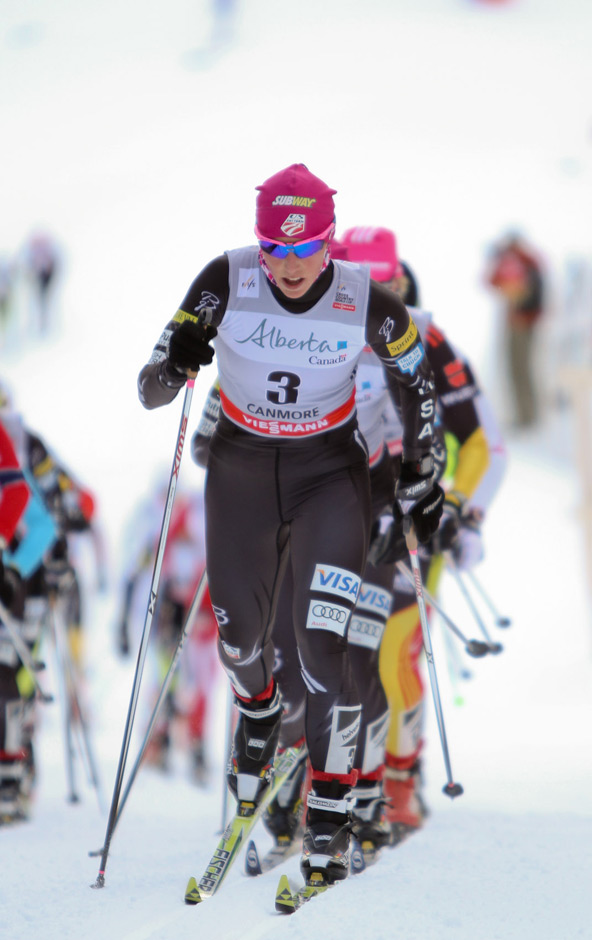
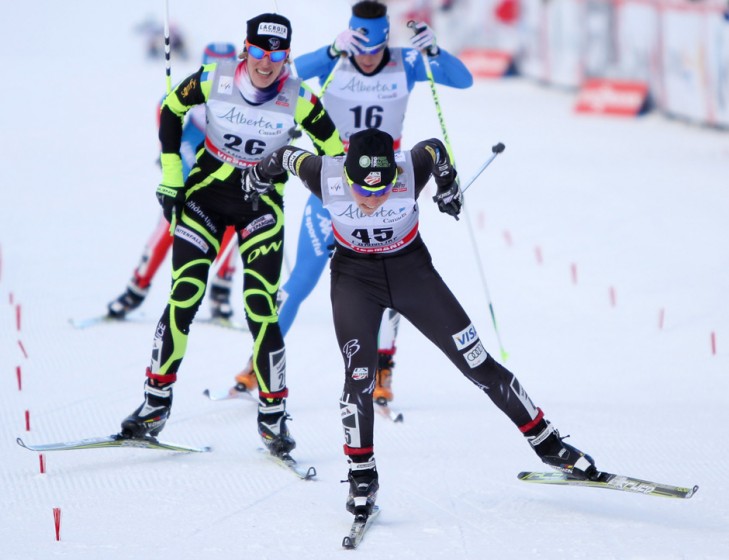
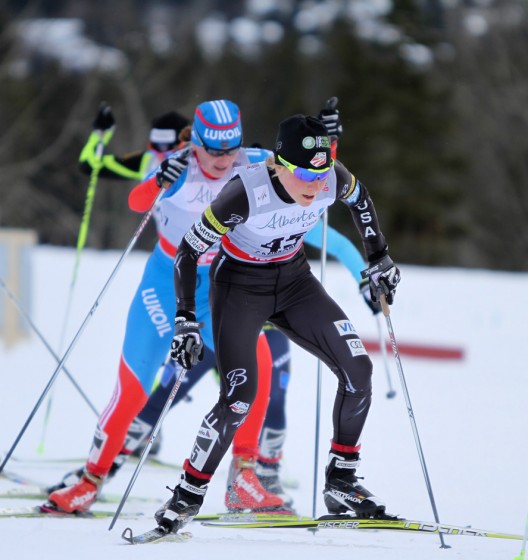
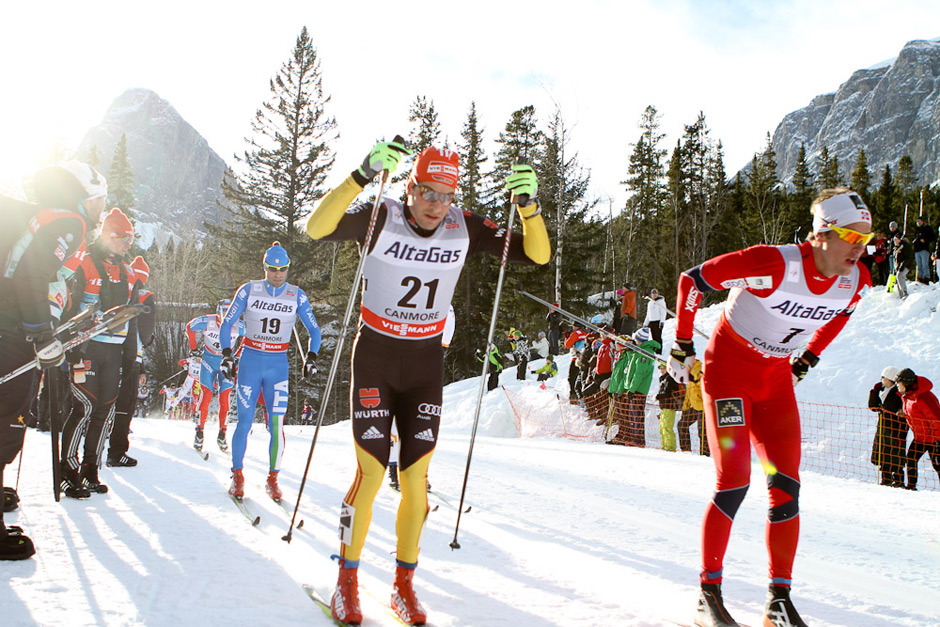
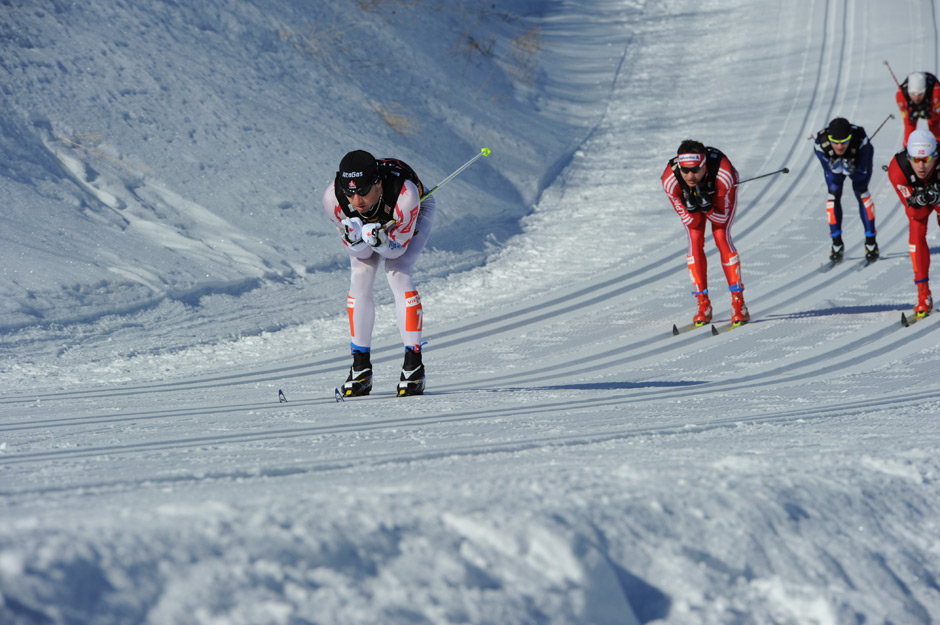
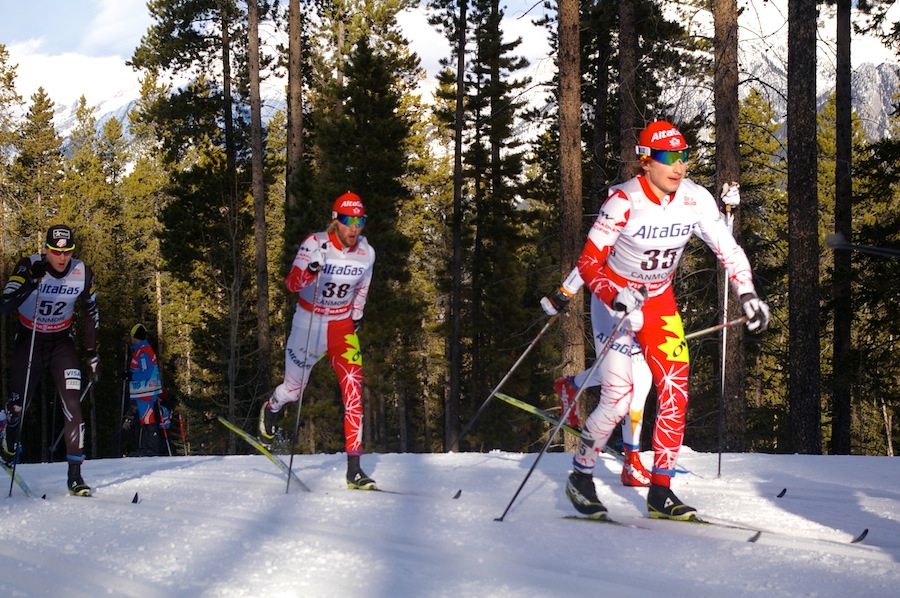
Tag: Canmore World Cup

  • Jack Young: Against the Template

    Jack Young: Against the Template

    On the Wednesday before the World Cup season opens in Ruka, Jack Young sits in a small condo, looking out at over a foot of new snow that’s been drifting down all morning. The air is much warmer today than it was before he and the U.S. Ski Team loaded onto a six-plus hour bus ride yesterday — “Muonio was friggin’ cold,” he says — and the mood is calmer, quieter, the way he wants it. This is his final runway before an Olympic year truly begins, and he is spending it doing almost nothing.

    Not nothing-nothing, of course. But nothing extra. No bonus minutes, no filler skis, no threshold for confidence, no volume for psychological reassurance. “The biggest thing right now is taking these two weeks absolutely as seriously as possible with rest and just not doing anything extra training-wise that I do not need to be doing,” he says. “I’m training so little right now because of how important Ruka and Trondheim are for me.”

    Growing up in Northern Vermont, Jack Young had an All-American childhood. (Photo: Courtesy Photo)

    Outside, the classic sprint course cuts through the forest — the first of two classic sprints in Period 1. They matter—more than they ever have. To make the Olympics, he must qualify. To qualify, he must have transformed himself into something he has never consistently been: a classic sprinter capable of making heats on the hardest stage in the world.

    That he is even here, on the cusp of an Olympic selection fight, is strange enough. Stranger still is the way he got here — not built from the standardized American skiing pipeline but stitched together from its edges. A football quarterback. A baseball outfielder. A skier whose parents “didn’t know what Nordic skiing was.” A D3 athlete who reverse-engineered sprint training out of 800-meter track plans and the writings of a Swedish speed skater. A young man who kept such detailed training logs that, by the time he made the World Cup, he could begin writing his own plan.

    In a sport that often rewards conformity, Young’s ascent is something close to a jailbreak.

    Jack Young as he started his racing for Craftsbury. (Photo: Courtesy Photo)

    A Vermont Childhood Without the Usual Skiing Script

    “Neither of my parents knew what Nordic skiing was,” he says with a laugh. They loved the outdoors, yes — mountain biking, alpine skiing, the typical northern Vermont mélange of mud, woods, and winter — but their son’s athletic identity formed somewhere else entirely. “I played every sport. I loved baseball. I played basketball through elementary school. I started football as soon as I was allowed to, which I think was in fourth grade.”

    He became the kind of athlete rural towns understand intuitively: the quarterback on fall afternoons, the center fielder chasing down balls in the summer dusk, the kid who could pick up anything and find competition in it. Skiing entered sideways, almost accidentally, through his sister Callie. She joined the small Nordic program in Newport, and he was brought along because that’s what families do — pack the car, hand over snacks, make it work.

    “I immediately fell in love with racing,” he says. “I just love the competition.” Running around on skis made sense to him. Movement, speed, chaos — he could do that. But even with training days at Craftsbury beginning around sixth grade, he didn’t think of skiing as his primary outlet. “I wasn’t as focused as my sister was, but I would still get dragged along,” he says. “I loved skiing, but I loved football and baseball just as much.”

    The irony — one he now sees clearly — is that he was training for skiing without realizing it. “All summer was spent doing fun things in the woods. We’d go to Craftsbury a couple of times per week. But I never thought of skiing as my main sport. I weighted those sports equally, even though I was putting a lot more time into skiing.”

    If northern Vermont had offered a travel football club or competitive baseball without days of driving south, the story may have gone a different way. But mountain running and biking were nearby, and elite baseball diamonds were not. “I’d so much rather go for a long run in the mountains or go mountain biking than I would hit on the tee for two hours,” he says.

    Sometimes this is what talent looks like in real time: a kid choosing the fun version of hard work without realizing he’s choosing a future.

    When we spoke, Jack Young sat in a small condo in Ruka wearing a Boston Red Sox baseball hat, just added evidence for how important the game has been for him since he was a boy. (Photo: Courtesy Photo)

    The Late Bloom: A Breakthrough and a Decision

    He kept skiing in the winter, of course. Not obsessively. Not in the way some junior skiers live their lives by FIS points before they have a driver’s license. But enough to stay close. Enough to remain good. Then came the summer after his sophomore year of high school — the first time he trained like someone who had decided to see what was possible.

    “I put a good summer of training in,” he says. “Had a bad football season… but that was the first time I was really starting to push the limit on what I could do training-wise while in season for football.”

    He mountain-biked in races on weekends, squeezed workouts around football practices, and tried to make the whole geometry hold together. Then came Junior Nationals, and with it, proof. “I had a pretty good result in the sprint. I think I was like 18th or something… and that was the moment where I was like, okay. I am decent at least at this sport. I’m doing a lot better than I’ll ever be at baseball.”

    That spring, Young emailed coaches — the NESCAC schools, Dartmouth, and UNH. Bowdoin and Dartmouth joined Colby on his shortlist. Colby won on something less quantifiable: belief.

    “Tracy [Cote] was very excited about me,” he says. “And I think that resonated with me. Maybe it’s my ego, but it was nice to hear.”

    He would later call it “a perfect decision.”

    Jack Young enjoying some backcountry skiing in Jay. (Photo: Courtesy Photo)

    Colby: Building an Athlete in a Place That Shouldn’t Have Worked

    Winters in college can blur into one another — classes, training, snow, the strange mix of exhaustion and euphoria that defines 19-year-old life. But Young remembers his freshman fall with clarity: meeting people, finding balance, doing “good, not great” training, and then, once the season started, traveling west for Senior Nationals.

    There, in Soldier Hollow, everything sharpened. “I think I qualified in the top 20 in the skate sprint,” he says. “That was an absolutely massive result for me. I never had anywhere near that level of success on the national level.”

    He didn’t transform overnight — not yet. His sophomore season brought a “fine college season,” a top-30 at NCAAs in the 10k skate, and the sense that distance skiing was finally, mercifully making progress. But the turning point came not in results but in imagination. He learned that the U.S. would receive twelve start spots for the Canmore World Cup the following year. Twelve starts. “I was like, 12 starts… that’s not that far off,” he says. “I kind of feel like I’m in contention for that.”

    To chase it, he would need to master something specific: the sprint qualifier.

    And this is where the story breaks from the template completely.

    Jack Young hits some big lactate numbers during a hard training session. (Photo: Courtesy Photo)

    Reinventing Sprinting from Scratch

    “I’ve always thought that sprint qualifiers were really similar to an 800-meter race on the track,” he says. Physiologically, mechanically, conceptually — they looked more alike than different. So he dug into 800m training. He looked for the extreme version, the distilled essence of what sprinters do when they train specifically for the thing that matters. Qualifiers are discrete. Defined. Precise. Why train them like a generalist?

    Then he read Nils van der Poel.

    The legendary Swedish speed skater’s manifesto, How to Skate a 10k, isn’t a skiing manual, but to Young, it may as well have been scripture: the idea of building huge aerobic capacity, then sharpening with brutally specific intervals at exact race pace. “He wants to skate as many possible laps at world record pace as possible,” Young says. “And that really struck me. I’m like — I can apply this to skiing.”

    He wasn’t going to become a single-event specialist, not in college. But he could take the principle and adapt it. So he built a sprint-qualifier program composed of things like:

    • 6 × 1 minute
    • 4 × 90 seconds
    • 10 × 30 seconds
    • 8 × 45 seconds

    All at precisely what he believed to be his sprint qualifier pace.

    “That was the bread and butter,” he says. “I’d do those workouts once or twice a week. I didn’t actually find them that strenuous, but I was accumulating a good amount of time at exactly what I thought sprint qualifier pace was.”

    He went completely dry that fall — no beer, no casual nights out, nothing that compromised sleep. “I was just recovering a lot better all the time,” he says. “I didn’t get sick at all.”

    Meanwhile, Colby head coach Tracy Cote allowed him to blend his ideas into the fall plan. “We were working together. I think we ended up writing the training plan together that fall,” he says. “She was pretty stoked about the focus on recovery… and she’d let me get away with doing things a bit more geared towards sprinting.”

    He trained more overall, too — a heavy summer that gave him the resilience to handle so much intensity once fall arrived. “My freshman year, I trained a little under 600. Sophomore year was around 650. My junior year I trained like 750 or something.”

    This was not an American development pipeline approach.

    It was an experiment.

    A smart one.

    A successful one.
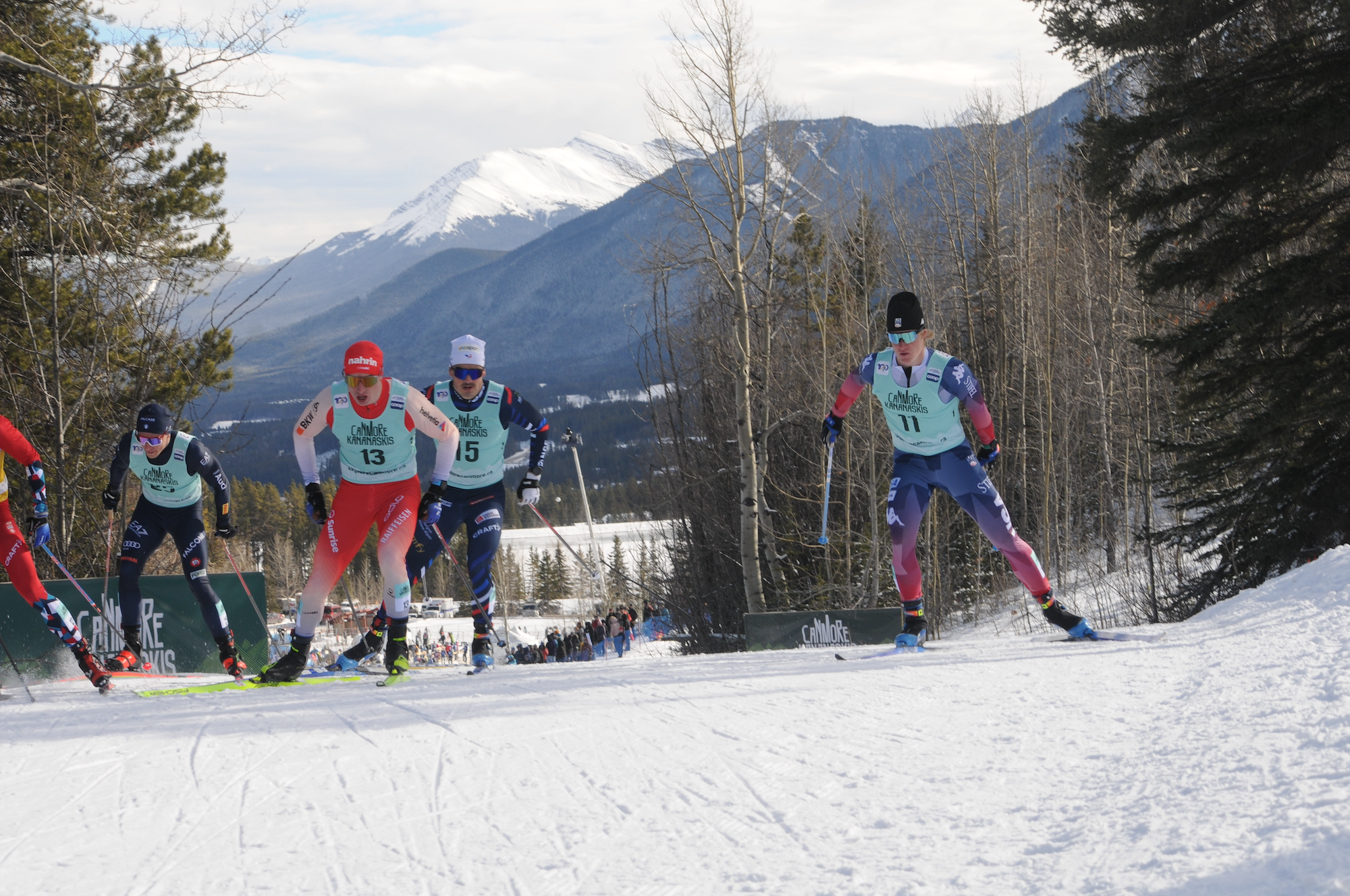
    Jack Young, who a week earlier had a 3rd and 5th place in the EISA college races for Colby College delivered the 11th fastest qualifying time in the freestyle sprint at the Canmore World Cup in 2024. (Photo: Cockney/FasterSkier)

    Anchorage, SoHo, Canmore — and the Race That Changed Everything

    He targeted Anchorage for his first chance at the Canmore World Cup spot. He knew what he had to do: fly across the country in the early winter, race well, then perform at Senior Nationals in Soldier Hollow. Anchorage was the linchpin.

    “I went into Anchorage with a lot of confidence,” he says. “I won that qualifier; it was such a surprise.”

    He didn’t replicate the magic at Soldier Hollow — “I think I got like 11th” — but the Anchorage win held. He made the Canmore start list.

    And then came the race of his life.

    “That’s still my lowest FIS points ever,” he says. “I didn’t match that last year.”

    When he crossed the line, something shifted internally. “Once I did that in Canmore… that was the first time I really thought I wanted to keep skiing after college,” he says. “That was the moment I realized how good I thought I could get.”

    Call it the ignition point, the place where belief calcified into ambition.

    Where a multi-sport kid from a non-skiing family, attending a D3 school, doing self-designed intervals, suddenly saw himself in a World Cup heat map and thought: Yes. Here.

    Jack Young training on Eagle Glacier this past summer. (Photo: Courtesy Photo)

    Writing His Own Plan on the World Cup

    Two years later, he is living in Europe, often for months at a time. He is in his second year of racing full-time on the circuit. He is older, stronger, and more certain. And he is, in many ways, coaching himself.

    “For this time of year, it’s entirely guided by what I’ve done the last two years,” he says. “Which workouts worked in which places, which workouts didn’t… the comments are much more important than the hours.”

    He still works closely with Pepa Miloucheva at Craftsbury — “She’s the number one on that” — but when he’s on the World Cup, he is the primary author of his training. He reads his patterns. He analyzes sensations. He looks for the combinations of stress and stimulation that make him feel dangerous on race day.

    He isn’t reinventing his body now — he’s listening to it.

    The independence he cultivated at Colby has become his competitive advantage.

    With the Olympic sprint being in the classical technique, Jack Young (USA) hopes to find the form he has historically shown in freestyle sprinting during the early season World Cup stops. (Photo: Modica/NordicFocus)

    The Classic Sprint Problem — and the Olympic Dream

    To make the Olympics, the math is simple, even if the execution is brutal.

    “The simplest answer is: make a big jump in classic sprinting,” he says. “If I can start qualifying for classic sprints consistently, I have a very clear path to making the Olympics.”

    Last year’s results would meet the published criteria — “hypothetically, if I had the exact same season… I would technically make the team,” — but this year is different. The Olympic sprint is classic. Period 1 has two classic sprints and only one skate sprint. Some of the contenders for Olympic spots are stronger in classic than he is.

    So the path is narrow: qualify in Ruka. Qualify in Trondheim. Hold form in Davos. Don’t step back. Don’t stagnate.

    At the philosophical level, the criteria are simpler still.

    “It’s all about execution at this point,” he says. “A good season is continuing with progress I’ve made… scoring more World Cup points than I did last year. Anything else is a step back.”

    He knows progress isn’t linear. He knows failure is part of sport. But he also knows what a step backward would feel like. “I’d be lying if I said I could look at this season as successful if I don’t maintain what I’ve been doing in skating and at least make a little bit of progress in classic skiing.”

    It is clear-eyed. Unsentimental. The kind of assessment you get from someone who has built his career on self-honesty.

    Jack and his sister Callie after winning a slow pitch softball tournament. (Photo: Courtesy Photo)

    What It Means to Make It This Way

    There’s a certain poetry in the fact that Young’s rise mirrors the very way he races: a precise, deliberate accumulation of moments. Nothing in his career came from the prescribed steps, the standard routes, the familiar trophies of a groomed junior-star life. Instead, his path looks more like a map drawn after the fact — connecting points that didn’t seem aligned until the picture emerged.

    A sister’s Craftsbury workouts.

    A baseball-heavy early adolescence.

    Mountain biking and football collisions.

    A D3 program that let him try things.

    A manifesto by a Swedish speed skater.

    A dry collegiate fall at age 20.

    A logbook of sensations.

    A day in Canmore.

    A belief.

    There is no template for this. There never was.

    But here he is anyway — on the World Cup, in an Olympic year, taking the biggest swing of his life.

    And as he sits in a Ruka apartment, resting more than he ever has before a race that matters more than most, he reflects not on what’s missing from his résumé but on what got him here in the first place: a way of building a skier that is his alone.


    Love Stories Like This? Help Keep Them Coming.

    Feature interviews like this one take time, access, and care to produce. If you value thoughtful storytelling and independent ski journalism, please consider becoming a Voluntary Subscriber. Your support directly fuels the work we do to cover the people, places, and moments that make our sport special.

    Join the FasterSkier community!


    Jack Young enjoying some orange juice on the Maine seacoast. (Photo: Courtesy Photo)
  • Inspired: Canmore’s 2020 Art Walk in the Woods

    Inspired: Canmore’s 2020 Art Walk in the Woods

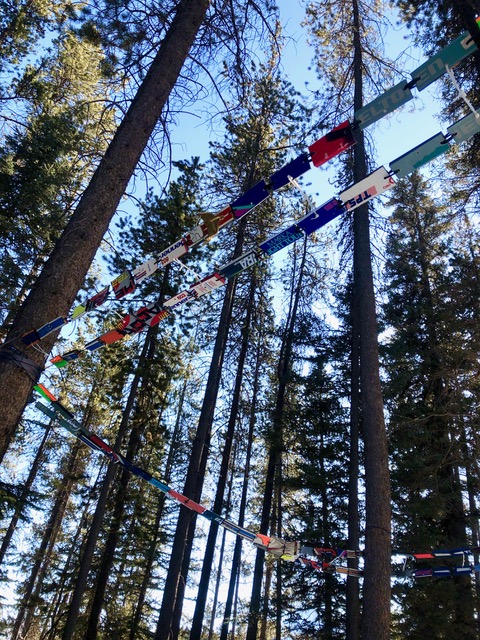
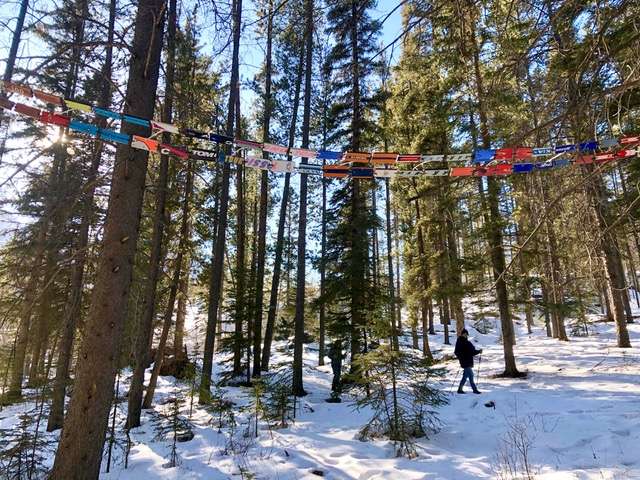
    Nordic Blessings (Fast Track) by Michelena Bamford. (Photo: Michelena Bamford)

    The cowbells, lycra, and the spine of the Northern Rockies as the serrated backdrop would have been part of the World Cup scene in Canmore, Alberta this past March. We all know the story: the global pandemic became a whip crack. The racing was canceled. Now, imagining the scene in Canmore, it’s easy to become wistful. Beyond the racing, visitors to Canmore missed an opportunity to experience six temporary art installations near the World Cup, all part of the 2020 Art Walk in the Woods

    The Art Walk in the Woods was a collaborative project between the Town of Canmore and the Alberta World Cup Society — part of supporting the World Cups from an arts and culture perspective. Canmore recently completed a new path connecting the town center to the Nordic Centre Provincial Park called the Legacy Trail Extension. The paved path extends roughly 1.8 kilometers. 

    “One of our goals was to encourage people to walk up to the Nordic Centre to watch the World Cup races,” said Nicky Pacas, the Arts and Culture Coordinator for Canmore. “We encouraged people to either walk up and take public transit down or vice versa, take public transit up and walk down to get from the Nordic Centre down to the Bow River Trail in town.” 

    Part of the incentive to walk along the newly minted trail were the six temporary art pieces, all installed prior to the World Cup, and intended to be removed this past April.

    A map of Canmore’s 2020 Art Walk in the Woods. (Map: City of Canmore)


    “When the World Cup was canceled we didn’t know what that was going to look like for the artwork,” said Pacas. “As it turned out, people started walking that trail system more and more. Because we are all isolated ourselves and people are exercising now more than ever, they are getting out of their houses and not flocking towards spaces where people are gathering but are using trail systems and getting out at different times of the day. We saw an increase in usage of that trail system and an increase in the number of people who were going past the art installations.”

    With Alberta Parks shuttering provincial land, on which the art was installed, the artist and town had no reasonable way to remove the installations. The town worked out an agreement with Alberta Parks to keep the artwork in place through early July. 

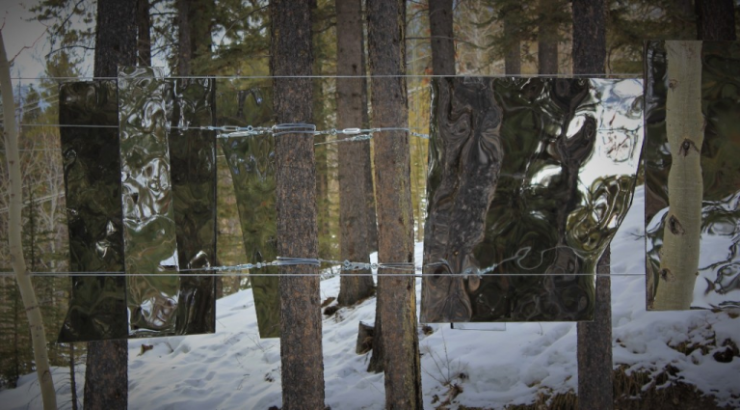
    Which brings us to the art itself. The call for art proposals asked for installations that repurposed materials and kept disruption to the local environment to a minimum. One art piece by Calgary based artist Michelena Bamford speaks to nordic sport and the ephemeral way many of us travel on skis through the woods. 

    Nordic Blessings (Fast Track) – by Michelena Bamford hangs as part of Canmore’s 2020 Art Walk in the Woods. (Photo: Michelena Bamford)

    “My art practice fosters objects of meaning and memory; the sentimental tesserae of our human experience; that I reclaim and repurpose in new ways through an ancient mosaic lens. Within the context of the Nordic World Cup, skis are the perfect medium – a vibrant symbol of our human journey in the mountain wilderness,” Bamford wrote of her installation, Nordic Blessings (Fast Track).

    Bamford’s installation was initially inspired by the scores of international flags lining Canmore Nordic Centre’s stadium. “That resonated with me and I wanted to reflect that color and that sort of global diversity, and that coming together of everyone at the World Cup,” said Bamford. 

    After walking the grounds of the race venue and the proposed art sites, she landed on an idea of using old nordic skis in her piece. With each ski being graphically unique and possessing a personal story, she intended the repurposed skis to serve as a blessing of sorts strung in the woods like Tibetan prayer flags. 

    “There is so much meaning and memory tied to objects, this what I love about mosaic work, it is called tesserae, the little pieces that you use. You essentially break down and deconstruct materials and then rebuild them in a new way,” said Bamford. “Those skis just have so much meaning, there are all these memories. That is why people have skis hanging around their garages forever. They just cannot let go of them. They hold this memory or they represent this place in time.”

    Ski segments for the project. (Photo: Michelena Bamford)

    Bamford and her assistants on the project cut through 80 different skis, drill pressed holes on each side of the six-inch pieces, and linked them together in varying length parallel segments. Suspended in the woods above Canmore, Nordic Blessings resembles colorful parallel ski tracks. 

    Hanging the piece required no permanent fixtures but did call for a minimum height of roughly nine feet to accommodate the passing of antlers underneath the artwork; Canmore remains a place with a healthy elk and moose population.

    Skis are everyday objects for many of us. There’s a child’s first pair. An old-timers last pair. Interspersed in between are the favorite pairs. Favored, maybe, not for their speed, but due to their value as an everyday object recording our memories. Bamford has hit on something with her Nordic Blessings. And it resonates. 

    (You can find information on Covid-19 and Canmore’s restrcitions here. The Town of Canmore website states, “the restriction on non-essential travel remains in place.”)

  • Canadian Nationals Canceled (Press Release)

    Canadian Nationals Canceled (Press Release)

    Below is the press release from Nordiq Canada regarding the cancellation of the 2020 Canadian Ski Championships from March 25-April 2.

    CANMORE, Alta.—In support of Canadian efforts to minimize the transmission of the Coronavirus (COVID-19), Nordiq Canada in consultation with the local organizing committee at the Sovereign Lake Nordic Ski Club, have chosen to cancel the 2020 Canadian Ski Championships, scheduled for March 25 to April 2.

    The safety and health of athletes, coaches, volunteers and staff is, and always will be, our top priority. COVID-19 is a fast-evolving situation globally and we believe this decision is in the best interest of our broader sport community with regards to handling the situation we are all facing.

    We are grateful to the significant amount of preparation work invested by the Organizing Committee – a volunteer group assembled with the Sovereign Lake Nordic Ski Club – who were excited to welcome the nation’s best skiers back to their trails near Vernon, B.C.

    An annual stop on the Haywood NorAm circuit each December, Sovereign Lake Nordic Ski Club has a rich history in hosting world-class events such as the 2005 World Cup and 2011 World Masters Championships, in addition to the 1995 Canadian Ski Championships.

    We look forward to working with the club on staging future events.

    Nordiq Canada is the governing body of para-nordic and cross-country skiing in Canada, which is the nation’s optimal sport and recreational activity with more than one million Canadians participating annually. Its 60,000 members include athletes, coaches, officials and skiers of all ages and abilities. With the support of its valued corporate partners – Haywood Securities Inc., AltaGas, Swix and Lanctôt Sports– along with the Government of Canada, Canadian Olympic Committee, Canadian Paralympic Committee, Own the Podium and B2Ten, Nordiq Canada develops Olympic, Paralympic and world champions. For more information on Nordiq Canada, please visit us at www.nordiqcanada.ca.

  • Bits from Canmore: Athlete Notes and Quotes (+Video Montage)

    Bits from Canmore: Athlete Notes and Quotes (+Video Montage)

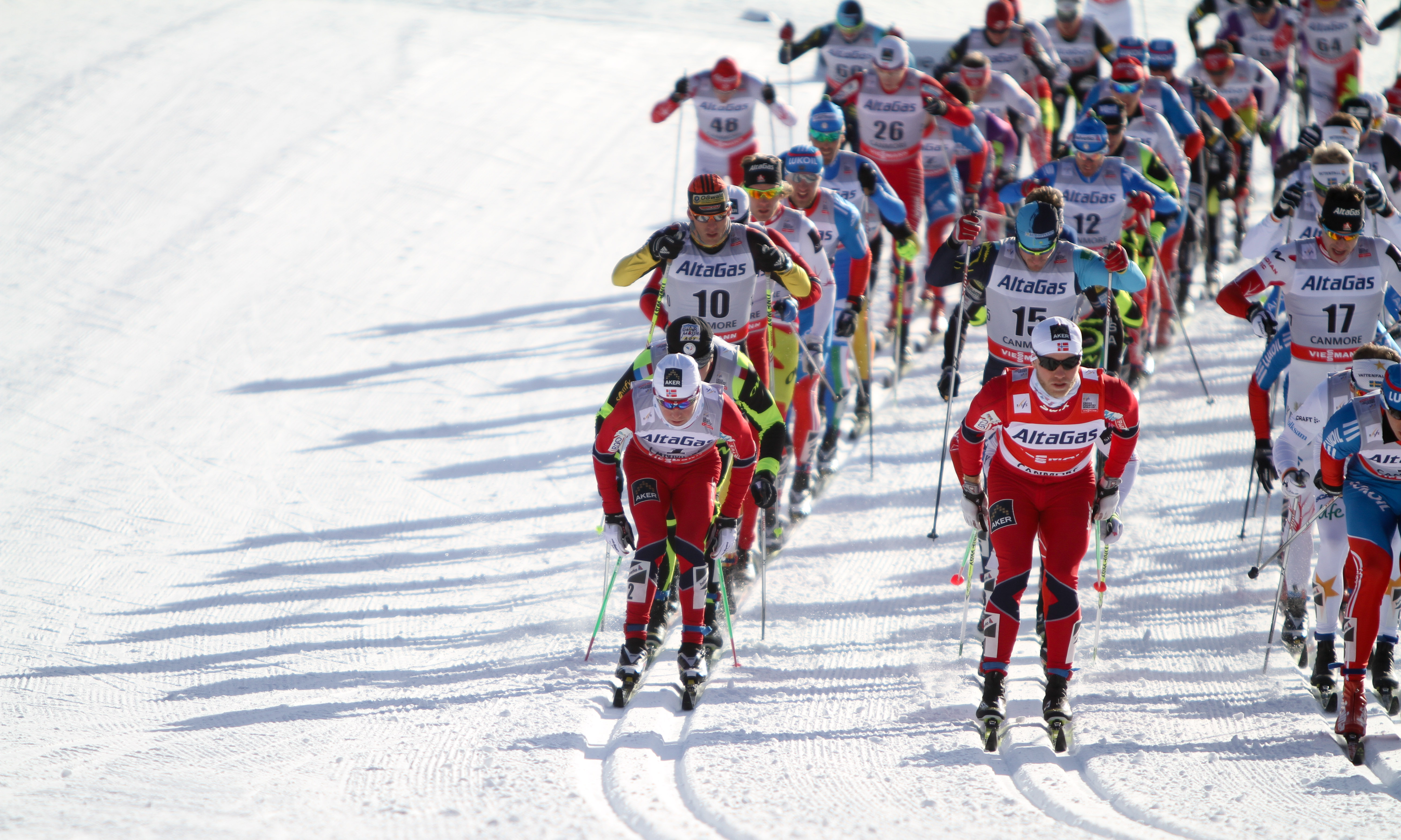
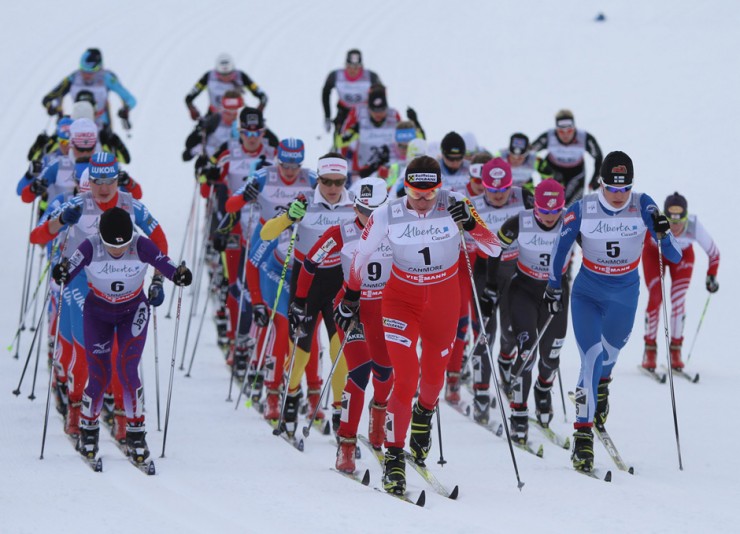
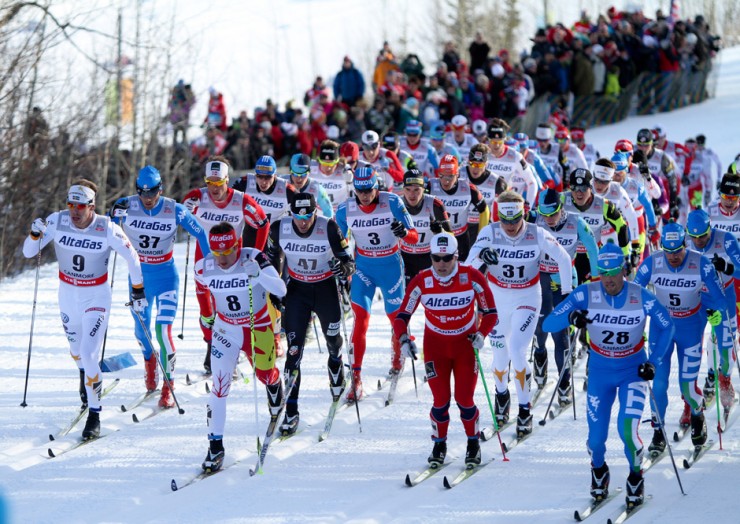
    Start of the Alberta World Cup 15 k classic mass start on Dec. 13 in Canmore, Alberta.

    CANMORE, Alberta – With the holidays heralding a rest period for many, Canmore might be in the back of many racers minds, but we haven’t forgotten about several of the athletes we interviewed there. Here are some of the highlights, and be sure to check out our video montage with several Canadian nation’s group skiers.

    Déjà vu?

    It was good until the top of the hill and just complete lactate at the top, just really heavy. We knew it was going to happen so we tried to forget about it and keep skiing well. – Alysson Marshall, Alberta World Cup Academy (AWCA), on sprint qualifier

    Canadian National Team member Perianne Jones attacks the hill in the 1.3 k freestyle sprint in Canmore, Alberta. She was 11th overall for an individual World Cup best.

    The top piece always feels like you should’ve went harder, but I’m pretty happy. – Andrea Dupont, Rocky Mountain Racers (RMR)

    I wanted to ski my own race and make sure that I pushed over the hills well. – Paul Kovacs, Australian NST

    It’s tough but it’s really just one climb, it’s pretty short. – Mikey Sinnott, Sun Valley Ski Education Foundation (SVSEF) on sprint course

    It’s not that long but there’s no forgiveness on it. It’s like, ugh. – Patrick Stewart-Jones, AWCA

    Those hills are so tough … They really burn you. – Michael Somppi, AWCA

    It’s a big opportunity to get to race in a world cup at home so I just went all in and it was good. I did the best I could so I’m happy. – Marlis Kromm, AWCA 

    There’s still some big opportunities for us for the rest of the winter, just race, move onto the next race. – Matt Wylie, AWCA 

    Newbies

    Before doing the World Cups, people would tell me that’s what it’s going to be like, but you could never actually like feel like what it is, I couldn’t have guessed what it was going to feel like. It’s such a cool feeling. – Corey Stock (Cambridge Sports Union)

    It was pretty fun to see all those people cheering for us at home, well it’s not really home, but it’s still in Canada and to see all those fast skiers too. We see that nothing is impossible. – Frédérique Vézina (CNEPH)

    I’m still really nervous every morning, but hopefully it gets normal by the end of the year. I’m just getting used to that level. Hopefully in a couple years, everything is gonna be fast. – Alexis Turgeon, Pierre-Harvey NTC (CNEPH)

    Improvement’s always good. I think I can do better but I couldn’t have done any better today. – Russell Kennedy, AWCA (42nd in skate sprint qualifier)

    It’s really an honor to be able to race in these world cups. It’s amazing to be able to race these and get some experience racing against international athletes. – Maya McIsaac-Jones, Rocky Mountain Racers

    It’s pretty awesome to represent Canada. – Zoe Roy, RMR

    It was fun for me, a good experience to ski with the fastest so I appreciate. – Anne-Marie Comeau (CNEPH)

    It’s a great experience just to race against these guys. It’s so different than any NorAm you could ever do. – Knute Johnsgaard, Yukon Elite Squad

    Ready or Not, Go!
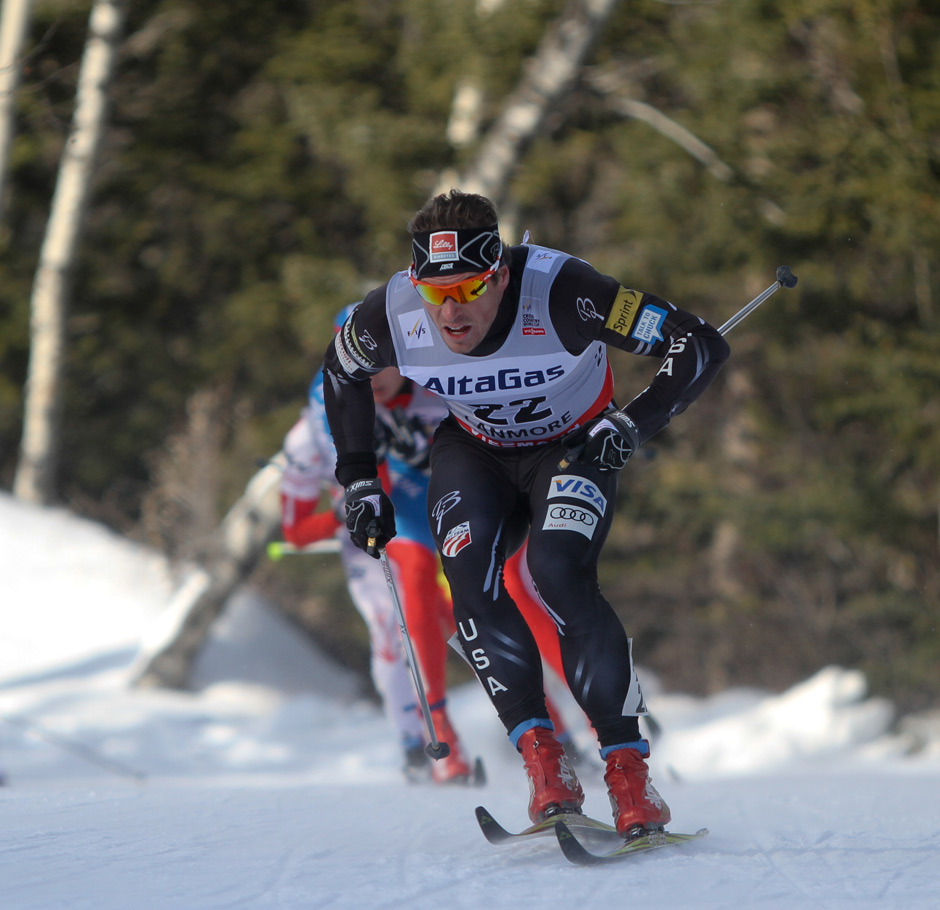
    I think I found some parts of my lung that I haven’t felt before. It felt pretty horrible … You feel like you’re at the end of the sprint, but you’re only a third of the way through. – Reese Hanneman, Alaska Pacific University (APU) on sprint qualifier

    I didn’t know I was racing until 8 this morning. [US Ski Team member] Simi [Hamilton] was sick or something so they knocked on my door, they were like, ‘Hey, you want to do a hot lap?’ I was like, ‘What do you mean, like, drive you to the venue right now?’ And they’re like, ‘No you want to race? Simi’s out and Freeman didn’t want to race.’ So it kind of fell to me. I’m glad I skied the course like once [the day before] and kind of learned it. I wasn’t sure how I’d be able to ski the course. … I was kind of excited just to get to go out there. – Mikey Sinnott, SVSEF

    I was awake at 4:30 this morning. It’s hard to expect a similar performance to yesterday, just because it’s a completely different race, but I’m happy. A 30 k is usually quite a pain train for me so I think I got better at it today and I’m still learning. – Jesse Cockney, AWCA

    I felt pretty flat. I think six days of not doing anything, it makes sense. I wasn’t really expecting to do much today [Saturday], just use [the sprint] as a good warmup for [Sunday], but yeah, it’s a tough course. A minute and a half of climbing and then shoot down to the finish. – Sylvan Ellefson, Ski & Snowboard Club Vail (SSCV)/Team HomeGrown

    I don’t think the shape is right there for this weekend. It was tough. – Graeme Killick, AWCA

    I wish I wasn’t tired but I think I am a little bit tired. I guess maybe traveling or something, but altitude I think takes it out of you, too. – Caitlin Patterson (Craftsbury Green Racing Project)

    Happy Thoughts

    This is such a beautiful day. The course was just perfect, great snow and it was so awesome to hear so many fans. I know my parents are out there and tons of my friends from the Yukon are here, too, which is super cool. I couldn’t have asked for a better day. – Emily Nishikawa, AWCA (34th in skiathlon)

    There’s so many awesome fans here and I have so many family and friends. I’m out here to just hopefully have a good result, but mostly have a good time and just race well. – Sylvan Ellefson, SSCV/Team HomeGrown

    Canmore fans are the best fans especially when you’re from here. I think we’ve got such a great community supporting cross-country skiing and the national ski teams, it’s just a fantastic place to train and race and we’re very, very proud to be a part of this community. – Brian McKeever, Canadian Para-Nordic Ski Team

    I think it’s so cool to have the best in the world come to our home course. I see them walking around downtown and it’s pretty neat. – Marlis Kromm, AWCA

    Outside Skiing

    [Note: Sylvan Ellefson dedicated his races on Saturday and Sunday to those affected by the Connecticut school shooting]

    When I’m not ski racing I’m in the fourth grade classroom at my old elementary school and my mother-in-law is a kindergarten teacher. I just can’t even imagine having her be in those teachers’ positions or even the families’ positions in Connecticut. – Ellefson 

  • Randall, Sargent Pick Off the Places to Soar to Skiathlon Top 14

    Randall, Sargent Pick Off the Places to Soar to Skiathlon Top 14

    Ida Sargent (USST/CGRP) pushing to secure 14th in the Alberta World Cup 15 k skiathlon, ahead of Aurore Jean (FRA) and Virginia De Martin Topranin (ITA) on Sunday.

    Coverage of the Alberta World Cup made possible through the generous support of Travel Alberta and Tourism Canmore.

    CANMORE, Alberta – From the back, it was easy to get panicky in Sunday’s mass start. Poland’s Justyna Kowalczyk went out hard in the 15-kilometer World Cup skiathlon without even meaning to, taking a couple Norwegians with her. Less than halfway into the first lap, she and sixth others were breaking away.

    Almost 20 seconds back, U.S. Ski Team members Kikkan Randall, Holly Brooks and Ida Sargent skied methodically just outside the top 20. With more than 13 kilometers to go, they weren’t going to blow it. For all but one, that restraint would be their ticket to a top 14.

    Kikkan Randall (USST/APU) en route to placing eighth in the Alberta World Cup 15 k skiathlon on Sunday, the last of three days of racing in Canmore, Alberta.

    But Randall wasn’t feeling all that great to start. The classic leg was a bit of a struggle, she said, and by the halfway point, she trailed Kowalczyk in first by more than a minute and 12 seconds. Sargent was one place ahead of Randall in 20th, just 0.4 seconds ahead. Brooks entered the transition in 24th.

    For Randall, the skate leg was significantly better. On the first of two laps, she climbed to 13th while Kowalczyk simultaneously extended her lead. The Alaska Pacific University (APU) skier wasn’t trying to make up a minute and a half on her, but she continued to pick off the places.

    With two kilometers to go, Randall led the second chase group while skiing in eighth, and knew it was going to take all the strength she had left to hold the five others off. Three races in four days had taken its toll on her, and she had little left to give.

    To the surprise of few, she found some extra energy and outsprinted Ingvild Flugstad Oestberg (NOR) to the finish. Randall also edged her Swedish friend Anna Haag and Katerina Smutna of Austria to place eighth (+1:18.4).

    “The classic part was really hard for me; my body’s just so sluggish,” Randall said. “Those first couple hills are so aerobic and you really just have to be able to kick into that high-end gear. I found the same thing in the classic race [on Thursday]. Just the first lap I didn’t feel like I could get into that gear, but then once my body warms up, I find it a little bit later on.”

    She found it in Thursday’s 10 k classic mass start, where she placed sixth, just as she found it on Sunday. Randall’s result rivaled that of her seventh-place skiathlon showing in last season’s Tour de Ski. She later finished 12th in a 15 k skiathlon in Lahti, Finland, despite a nagging Achilles pain that turned out to be an injury.

    For the first lap of Sunday’s skate leg, Randall tried to focus on her rhythm and immediate positioning rather than worry about what place she was in.

    “Once I did that, I looked up and saw that some skiers were starting to come back to me,” she said. “Coming into that second lap, I knew that next pack was right there and I really wanted to close up to them. It was nice, I got up to them, got to rest a little bit and then make one more push.”

    On the final stretch into the stadium, she pushed and beat them all.

    “Skating is just feeling so much more natural to me right now,” Randall said. “All the distance races this season I’ve been in the fight, so to feel like I’m just a little out of it was tough.”

    She thought of its as a hard workout in preparation for the upcoming Tour, and in doing so, kept herself in contention for the overall World Cup lead. Kowalczyk’s win and bonus points put her in first, 33 points ahead of Randall in second. Reigning World Cup champ Marit Bjørgen, who opted to skip the Canadian World Cups before the Tour, trails Randall by 32 points in third.

    “I’m definitely getting a little tired,” Randall said. “[Saturday’s sprint] was a lot, but I’m happy I responded over the second half [Sunday] and really looking forward to a nice little break. Then we’ll do it all over again.”

    Ida Sargent leads a chase group in the skate leg of the Alberta World Cup 15 k skiathlon on Sunday. She went on to place 14th for her best distance result.

    Just 16.5 seconds behind Randall, Sargent placed 14th for her best result in a distance race, second-best in Canmore. The Craftsbury Green Racing Project member was 10th in Saturday’s skate sprint and used what she learned there on Sunday. Instead of leading into the final downhill, she tucked in around second or third.

    It worked as she beat Aurore Jean (FRA), Irina Khazova (RUS) and Virginia De Martin Topranin (ITA) to the line.

    “I just tried to be patient, move up when I could but not freak out ’cuz I knew it would be a long race,” Sargent said. “I was kind of picking off people in the classic, then in the skate, packs kind of formed and I was worried about going too hard too soon, so I skied with the pack, which was pretty fast, and just knew how to ski the finish.”

    While some might pin the 24-year-old as a sprinter, Sargent was 18th in a 10 k classic race in Kuusamo a few weeks ago.

    “I look to Kikkan a lot and find inspiration from her,” she said. “She started out being more of a sprinter. I don’t want to be a sprint specialist. Sprinting comes more easily to me and I’ve taken advantage of that, but I’d really like to improve my distance skiing.”

    An all-around skier, Brooks (APU) wasn’t thrilled with placing 28th, nearly three minutes back from the winner. She remained close with Sargent and Randall through the transition, but fumbled her skate pole and had to turn around to retrieve it. That wasn’t really a big deal, she said. Feeling tired was.

    “I’m just really fatigued for some reason,” Brooks said. “I’m having hard time with the altitude, which is crazy ’cuz normally I really love racing at altitude.”

    After skiing a relaxed classic leg, she expected to have more left for the skate.

    “My legs just felt dead,” she said. “Just didn’t quite have it today and need to take some rest the net couple days and need to regroup.”

    Leading the Canadians, Emily Nishikawa of the Alberta World Cup Academy achieved as personal best of 34th (+3:39.2). Realizing her strength in skating, the 23-year-old tried to save something for the second half of the race, especially the hills.

    “Those girls are fast,” Nishikawa said of the frontrunners. “I wasn’t able to stay with that pace off the start, but I kept my own rhythm going and I think it worked for me. I was able to pick off a lot of girls in the skate.

    “I had a great race and I’m thrilled to get in the 30s,” she added. “I’m one step closer to my goal of getting in the top 30 and in the top 15, so I think it’s a good start and I’m looking to improve on this for sure.”

    Canadian National Team members Dasha Gaiazova and Chandra Crawford placed 37th and 46th, respectively. Gaiazova said she was “fairly satisfied” with her result after feeling good for the start of her classic leg, then backing off on the end of the second lap.

    “I started to feel like woah this is maybe a little too hard,” she said. “Up to that point I was still in one of the chase groups and it was going well. It’s just at that 6 ½ k, I felt like I started to fall off a little bit, and then by the time I got into the skating, I’d already lost that group. … It was just short of a fight for the whole skate leg and that was really tough. I pushed really hard so that’s good.”

    After falling behind early, Crawford said she gave it her all, which is what she set out for.

    “It’s a treat for me any time I get to race,” she said, after placing sixth in Saturday’s sprint. “I want to get out there, struggle, push through the rough patches, dig deep, try and stay on girls, push the pace, do good technique even when I’m exploded in my muscles. I accomplished all those things, and I’m really impressed with our younger girls coming on strong like that.”

    Crawford was also excited to discover her sixth-place finish prequalified her for the 2014 Sochi Olympics. Her teammate, Perianne Jones also secured a spot with two top-12s this season.

    “This weekend was a blast,” Crawford said. “I really enjoyed racing today. I knew it was going to be tough and super hard. We were skiing up mountains up there. It’s what I grew up doing and it doesn’t get any easier.”

    — Topher Sabot and Gerry Furseth contributed reporting

    Women’s results


  • Weekend Roundup: Period One and Done

    Weekend Roundup: Period One and Done

    Justyna Kowalczyk (POL) leads the women’s 15km skiathlon out of the start.

    On the heels of a hugely successful World Cup in Quebec City, Canmore had some big shoes to fill in the second act of the Canadian tour this weekend. Organizers did not disappoint — in the shadow of the picturesque Three Sisters, Canmore set the stage for six exciting races to wrap up Period 1 of the World Cup before the holiday break.

    If Quebec City belonged to Kikkan Randall, Canmore was Justyna Kowalczyk‘s. The Polish star seemed to struggle in November, but with two distance wins in one weekend by a cumulative 49 second margin, Kowalczyk is back in the yellow leader’s bib. Whatever you think of her, she is nothing if not dominant when she’s on form. Her solo breakaways may have taken some of the thrill out of watching the women’s mass starts, but you have to appreciate the athleticism behind the feat.

    Kowalczyk didn’t completely own the corduroy in Canmore, of course. The freestyle sprint went to Maiken Caspersen Falla (NOR), who skied a tactically sound race in order to beat Randall and earn he second career sprint victory.

    The men’s races proved to be nail-bitingly close. The unrelenting Canmore terrain stymied many an attempted break; the victors in both the 15 k classic and the 30 k skiathlon were patient in the pack and capitalized on the draft. Germany’s Tim Tcharnke earned his first career victory (on his birthday, no less), Emil Jönsson (SWE) continued his winning streak in the sprint and Maurice Manificat (FRA) came from behind to take the skiathlon.

    In nearly every event it seemed that one or more North Americans had career-best performances. To name a few, Noah Hoffman (USA) popped his first top-10 with an eighth in the skiathlon, Jesse Cockney (CAN) wowed his coaches by qualifying for the sprint in second and going on to place ninth, Ida Sargent (USA) continued her impressive season with a tenth in the sprint and 14th in the skiathlon and Skyler Davis (USA) earned his first sprint points in 20th. Though the fields were missing some top performers, these breakthrough required a greater effort than each athlete had ever made in a World Cup before.

    In Slovenia the biathlon World Cup wrapped up its final pre-holiday races. Jakov Fak (SLO) had his first win in front of a home crowd, Andreas Birnbacher (GER) won the first mass start of the season, the circuit saw some new names at the top of the podium in Gabriella Soukaleva (CZE) and Miriam Gössner (GER) and Tim Burke (USA) landed on his first podium since 2010.

    The nordic combined World Cup continued in Ramsau, Austria, this weekend. Norway won both the Saturday and Sunday competitions — Magnus Moan on Saturday and Mikko Kokslien on Sunday — and Bryan Fletcher led the way for the Americans with an eighth and 17th.

    In case you missed any of that, here is a recap of our coverage:

    Cross-Country World Cup — Canmore, Alberta

    10/15 k Classic: Men’s and women’s international reports | U.S. & Canadian menAmerican women | Canadian Notes & Quotes | Results

    Freestyle Sprint: Video course preview | Race preview | Men’s and women’s international reports | American men | American women | Canadian men|  More on Cockney’s qualification | Results

    15/30 k Skiathlon: Kershaw and Harvey sit out | Men’s and women’s international reports | North American women’s report | Results

    Biathlon World Cup — Pokljuka, Slovenia

    Sprint: Men’s and women’s international reports | Men’s and women’s North American reports | Men’s and women’s results

    Pursuit: Men’s and women’s reports | Men’s and women’s results

    Mass start: Men’s and women’s reports | Men’s and women’s results

    Nordic Combined World Cup — Ramsau, Austria

    Saturday and Sunday recap | Results

    Also: OPA, Marathon and Scando Cup Recap

  • Valjas Solid in Seventh, Cockney Surprises in Ninth in Canmore World Cup Sprint

    Valjas Solid in Seventh, Cockney Surprises in Ninth in Canmore World Cup Sprint

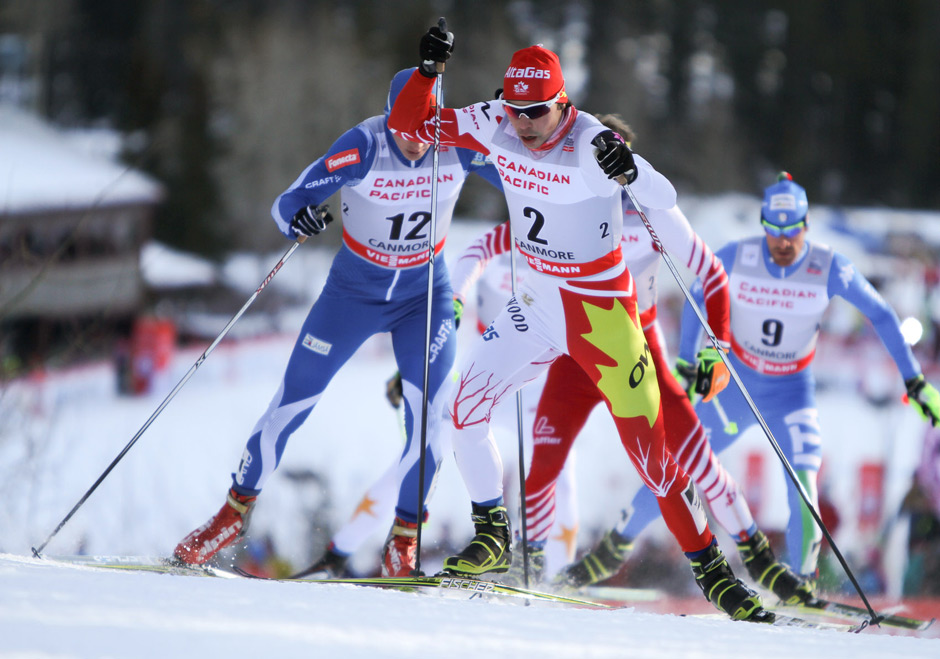
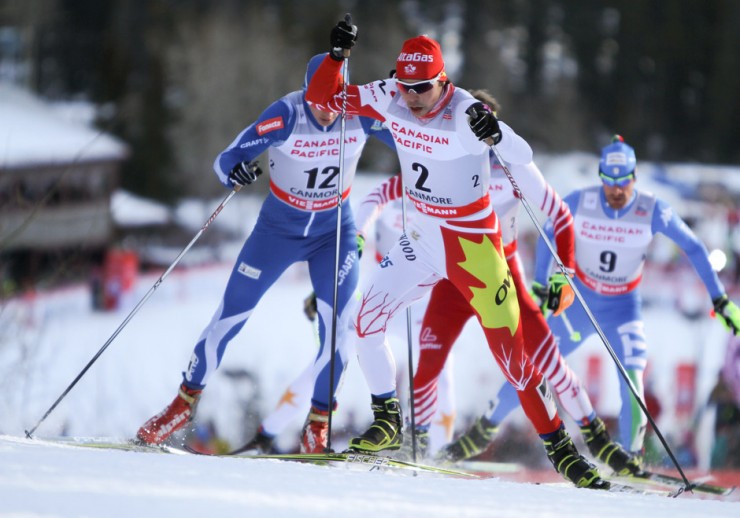
    Canadian Jesse Cockney of the Alberta World Cup Academy and Senior Development Team (2) leads Finland’s Anssi Pentsinen (12) and the rest of his quarterfinal in Saturday’s World Cup 1.3 k skate sprint in Canmore, Alberta. Cockney won the heat and went on to place ninth overall for a personal best in his fifth World Cup start.

    Coverage of the Alberta World Cup made possible through the generous support of Travel Alberta and Tourism Canmore.

    CANMORE, Alberta – On Saturday, Jesse Cockney pretty much did the unthinkable, leading his 1.3-kilometer freestyle sprint quarterfinal from start to finish. And he tried to do the same in his semifinal.

    Big deal. Actually, it is, especially for someone who’s never made the heats in a World Cup sprint to do so on one of the more difficult courses on the circuit.

    Few dared to try it; most knew the last few hundred meters down into the stadium decided the race. If you were in front the whole time, up the long climb and down the hill, you might as well be toast.

    Anders Gloeersen (NOR) and Andy Newell (l) lead their semifinal in the final stretch of the Alberta World Cup 1.3 k sprint. Canadians Lenny Valjas (second from left) and Jesse Cockney (r) ended up third and fifth in the heat, respectively, for seventh and ninth overall.

    Cockney, 23, didn’t care. Strong feelings of self belief lifted the Alberta World Cup Academy/Canadian Senior Development Team skier to the second-fastest qualifying time in his third World Cup sprint.

    He was only slower than one man, eventual winner Emil Jönsson of Sweden. The surprising start fueled his adrenaline in the ensuing rounds, where Cockney ultimately placed ninth.

    His previous World Cup best was 32nd in last weekend’s skate sprint in Quebec City. Before that, he achieved sixth in the U23 World Championships classic sprint two seasons ago in Otepää, Estonia.

    “It’s bittersweet right now,” Cockney said Saturday. “I’ve never skied this well in my life and there’s a lot more days like this to come, but right now, I’m a little upset that I maybe wasted a great day. It’s a really fantastic day, but still I feel like I was pretty close.”

    After winning his quarterfinal in a photo finish (and leading the entire way), Cockney decided to go for it again in the semifinal. He charged out of the gate with Canadian National Team member Lenny Valjas close behind, and the two skied abreast ahead of the group to the height of the land. The pace slowed at the top as the Canadians tried to pick their position – preferably not in front – on the downhill. Both knew what was coming: a game-changing slingshot that could swallow them at the finish.

    The tactics didn’t quite work out to their liking, and Valjas moved ahead down the hill to try to gap the field. When he looked back before the finishing straight, he realized he hadn’t created enough space. Cockney attempted to hold his own on the outside lane and ended up straddling a v-board. Valjas sunk to third as Norway’s Anders Gloeerson and Andy Newell of the U.S. flew by.

    Canadian National Team member Lenny Valjas narrowly qualified in 28th for the Alberta World Cup 1.3 k skate sprint heats on Saturday. He went on to place seventh for his best result of the season.

    Cockney settled for fifth in a photo finish with Austria’s Harald Wurm, and neither Canadian advanced to the final. It was a tough way to end a good day for both Valjas and Cockney, with Valjas notching a season best of seventh.

    “That was fun, like a roller derby out there,” said Valjas, who qualified in 28th. “A lot of pushing and shoving. It was awesome to ski with my teammate Jesse. He had an unbelievable day. It’s a really wide course, but on this kind of a downhill course you almost need it wider.”

    Valjas played his tactics near perfectly in his quarterfinal, sitting tight then accelerating in the final stretch to advance in second behind Newell. The semifinal was a bit dicier, and Valjas knew what was in store when he glanced back and saw four men behind him.

    “The attack didn’t work,” he said. “Maybe I should have stood up, let a few people by, but I’m happy. This is my first real race [coming off my] hand injury and I’m super happy.”

    About a month ago, Valjas broke a bone near his pinky finger and has been healing it since. Thursday’s 15 k was his first without a cast. While his result on Saturday showed rapid improvement, Valjas said he and his teammates were looking for more after Devon Kershaw and Alex Harvey failed to qualify in 50th and 52nd, respectively.

    “None of the guys are happy with the start of their season,” Valjas said. “They’re missing one gear. For Alex to be in the top 11 [Thursday] missing that gear … I was skiing behind him and it wasn’t the Alex of late last year. It’s coming. It’s part of our training. To have these results, still missing our top gear, we’re happy.”

    Cockney was also excited about his future prospects, especially in potentially securing a World Championships spot in February.

    “I hope that the coaches see that I’ve improved on a lot of things over the summer and the last year and I belong with these guys,” said Cockney in his second year on the national development team. “I beat everyone except one guy in the qualifier.”

    After placing 63rd in Thursday’s 15 k mass start, Cockney said he used his frustrations to motivate him for the sprint. He also changed his mental approach to sprint qualifiers this year.

    “I’m an emotional guy,” he said. “I feed off myself and feed off all of the race emotion. There was a lot of positive energy around.”

    Canadian head coach Justin Wadsworth wasn’t surprised by his performance. He had seen Cockney hang with Kershaw during intensity workouts in Canmore throughout the summer.

    “You just don’t see that, when we do longer intensity, for anyone to be able to stay with him, and Jesse has done it a few times,” Wadsworth said. “So I’ve always been impressed by him. I didn’t think he had the qualifying speed like that so I was really impressed today and I hope it gives him the boost to take his skiing to the next level.

    “Qualifying that high up shows he can do it on this kind of skate course and we will just have to evaluate where he is and what races are coming up and the courses and if they kind of suit him,” he added. “My guess is we are definitely going to give him some opportunities. He’s young.”

    Alberta World Cup Academy skier Phil Widmer (r) and Switzerland’s Christoph Eigenmann (l) leading their quarterfinal in the Alberta World Cup 1.3 k sprint in Canmore on Saturday. Widmer edged Eigenmann to place third in the heat, but failed to advance.

    Another Canadian who made the heats, Phil Widmer (AWCA) placed 15th for his second-best result in 23 individual World Cup starts.

    He qualified in 24th and was third in his quarterfinal (in a photo finish with the top three), but failed to advance based on time.

    “I knew in the back of my mind the heat wasn’t fast so lucky loser wasn’t going to play a factor,” Widmer wrote in an email. “I was gunning for top 2 in the heat.”

    Switzerland’s Christoph Eigenmann set the pace for the quarterfinal from the start, which it was considerably slower than other heats. Widmer tucked behind, and by the top of the climb, it became evident that nobody wanted to lead. Russia’s Anton Gafarov eventually went ahead on the downhill, followed by Frederico Pellegrino (ITA) and Widmer, and it came down to an all-out sprint to the line (which Simon Persson of Sweden won after waiting in fourth).

    “The last dowhill is so fast and the finishing straight is quite long, so for me it was about using the rest of the course to get set up for the last downhill and finishing straight,” Widmer wrote. “It’s a lot of fun to get to race in front of the home crowd!! The community is so supportive of these races, it’s a rush to get to compete in front of friends and family and in our own back yard.”

    Summing up the day, Wadsworth said it was the best so far this season.

    “We really needed a day when the team skied better on a whole,” he said, pointing out the high points, which included Chandra Crawford in sixth and Perianne Jones in 11th as well. “It has been the best weekend of the year, the best day of any weekend so far this year.”

    As for the rest of the Canadian men, AWCA skiers Russell Kennedy and Michael Somppi were 42nd and 55th, respectively. Alexis Turgeon of the Pierre-Harvey Training Centre (CNEPH) was 56th, Patrick Stewart-Jones (AWCA) 58th, Matt Wylie (AWCA) 59th and Andy Shields (Thunder Bay) 61st, Raphaël Couturier (CNEPH) 62nd and Ian Murray (Rocky Mountain Racers) 64th.

    — Gerry Furseth contributed reporting

    Men’s results

  • Cockney Rises to the Occasion, Second in Sprint Qualifier

    Cockney Rises to the Occasion, Second in Sprint Qualifier

    Jesse Cockney on his way to qualifying second in the 1.3 k skate sprint qualifier in at the Alberta World Cup in Canmore on Saturday.

    Coverage of the Alberta World Cup made possible through the generous support of Travel Alberta and Tourism Canmore.

    Note: This article has been corrected to reflect the number of FIS points Jesse Cockney received for placing second in Saturday’s qualifier.

    CANMORE, Alberta – That feeling of placing dead last on Thursday haunted Jesse Cockney. Sure, the 23-year-old Alberta World Cup Academy and Canadian Senior Development team skier was only in his sixth World Cup (with previous appearances in Quebec last weekend and Estonia two seasons ago).

    But 63rd in the 15-kilometer classic mass start wasn’t going acceptable. At the time, Cockney said he’d toss that one in the trash and move on. Saturday, he stormed out of the gates in the 1.3 k freestyle sprint qualifier in the second race of the Alberta World Cup, posting the second-fastest time, 1.26 seconds behind Sweden’s Emil Jönsson (who won in 2:31.12).

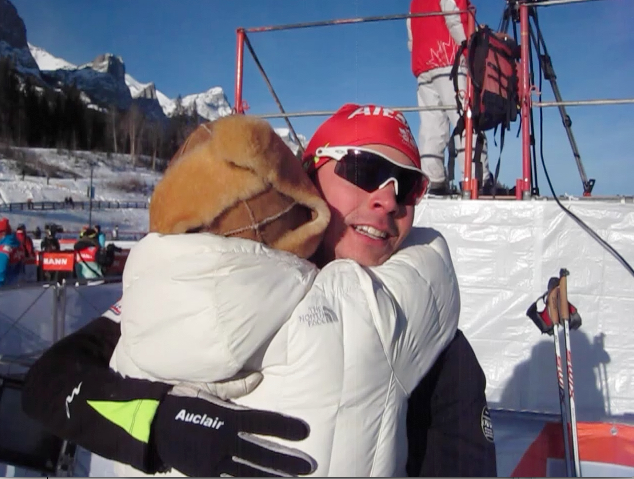
    Jesse Cockney (Alberta World Cup Academy/Canadian Senior Development Team) gets a hug from his mom after placing second in the Alberta World Cup 1.3 k skate sprint qualifier on Saturday in Canmore.

    Cockney celebrated upon realizing his feat at the finish, throwing his arms up and yelling. A few moments later, his mom came over to give him a hug. She was ecstatic and so was Cockney.

    Regardless of the outcome up the upcoming heats, Cockney wouldn’t likely forget that moment. His previous best in a World Cup individual sprint was 32nd last weekend in Quebec. Saturday’s result gave him 10.01 FIS points before the heats even started.

    “A lot of work left to do, but pretty happy right now,” Cockney said.

    What was his secret? “Being confident and being pissed off after Thursday,” he said. “I was pretty down after Thursday, but you need the valleys to feel the peaks. This feels pretty awesome.”

    At the top of the long climb that summed up this sprint course, Cockney’s father, Angus, a former top Canadian cross-country skier, said he clocked him in fourth. He was excited after the qualifier, as was Cockney’s mom, Trish.

    “Feeling nervous. Excited, happy,” she said. “He had challenges on Thursday. Better today. I just hope he can keep it together … and do well.”

    “I gotta calm down,” Cockney said. “Now I gotta relax.”

    — Gerry Furseth contributed reporting

    Men’s qualifier results

  • New Sprint Course Welcomes World’s Best in Canmore (with GoPro Video)

    New Sprint Course Welcomes World’s Best in Canmore (with GoPro Video)

    Coverage of the Alberta World Cup made possible through the generous support of Travel Alberta and Tourism Canmore.

    Click here for a video of the new sprint course (embedded below)

    CANMORE, Alberta — When Hanna Falk of Sweden kicks off Saturday’s freestyle sprint qualifier, she will christen the third course variation in as many events.

    Back in 2008, hometown favorite Chandra Crawford won the race on a loop that Canmore’s current chief of competition Mike Norton described as “way too short and too easy.”

    In 2010, the sprint was classic, and that course came in at the other end of the spectrum. Post-season surveys yielded a consistent response from athletes — too long, and according to Norton, “hard.”

    For this year’s edition, changes were necessary, both due to homologation standards and the desire of organizers to put on a top-notch event.

    After examining data on other World Cup sprint courses, Norton said the decision was made to make the Canmore version harder and longer than 2008, but shorter than 2010.

    Chandra Crawford celebrates her Canmore sprint victory in 2008.

    The loop climbs fairly steadily out of the stadium to a high point, and a table-top flat, before descending to the classic Canmore finish — fast downhill to the homestretch.

    The total length is 1.3k, longer than the 2012 1.2k World Cup average that Norton calculated, but definitely not one of the longest.

    “I’ve had a couple athletes say it was the hardest short sprint course they’ve ever done,” Norton said.

    A NorAm event just two weeks ago served as test-run, and with the presence of the top Canadian domestic racers and the Switzerland’s sprint squad, competition was appropriately fierce, and Norton said athlete response was positive.

    The 2010 version featured two 180-degree turns, both of which have been removed, hopefully resulting in fewer tangles and crashes while creating better flow.

    U.S. Ski Team coach Matt Whitcomb expects the course to ski “really fast,” with the working time from the start to the descent being “really short.”

    But Whitcomb cautions not to discount the difficulty. He describes the first climb out of the stadium as “deceptively difficult,” and points to the technical aspects of several sharp corners as an added challenge.

    Norton confirmed the potential for brevity, noting that that course “doesn’t have a lot of total climb,” just 37 meters in fact.

    Skiers make their way across the top flat section of the sprint course in Thursday’s classic race.

    It isn’t all about climbing, however. The top of the course, which features several hundred meters of flat before skiers can gain a little respite prior to a sweeping right-hand turn under a bridge.

    “The legs will be feeling it at the top of that course,” said Esther Bottomley, an Australian who has spent time training in Canmore and raced the NorAm two weeks ago.

    “If you’ve gone too hard up the climb and can’t ski hard on the flat section before dropping back down…you could lose a lot of time,” Bottomley added.

    The run-in to the homestretch, however, is still the key.

    Whitcomb hesitated to make predictions, but agreed that the descent and ensuing 200 meters would be the crux.

    “I would have to say it will probably be won or lost in the final homestretch,” he said.

    Norton said many people state that whomever has the fastest skis will rule the day, a claim he disagrees with.

    The Swiss men were able to ski away on the climbs, creating an insurmountable gap in the NorAm race, and with a gradual grade up to the finish line, Norton says it isn’t only about skis.

    Stefan Kuhn leads his heat into the finish stretch in the 2010 Canmore classic sprint. Despite the gap, he ended up 5th in the heat. (Photo: Win Goodbody)

    “Even the fastest skis in the world, you still have to work to get up that last 100 meters,” he said, but did admit that it’s “not ideal.”

    A World Cup race is not a NorAm, so breaking away will be much harder. Whitcomb points to the myriad strategies that can be employed approaching the final third of the race.

    “There are some awesome tactics to be found on this final stretch here,” he said, specifically mentioning the varying options of line through the last corner, and when to pull out of a tuck.

    U.S. coaches have worked with athletes individually to discuss tactics. Each skier has certain strengths and weaknesses that will influence approach, Whitcomb explained.

    And ultimately, racers need to respond to the immediate situation.

    “You can come up with all these plans and sometimes you end up with the one you planned on, and sometimes it is the opposite of what you planned on,” Whitcomb said.

    There is danger in trying to execute a specific strategy at all costs, and the key, Whitcomb said, is envisioning various scenarios and being prepared for all of them.

    “There is a lot to think about here. It is a really good course … really fun,” Whitcomb said.

    — Alex Matthews contributed reporting

    Note: Some web browsers are not displaying the video properly. Use the link below to view the video directly in youtube.

    Click here for a video of the course

  • Notes and Quotes: Canadian Edition from Day 1 in Canmore

    Notes and Quotes: Canadian Edition from Day 1 in Canmore

    Coverage of the Alberta World Cup made possible through the generous support of Travel Alberta and Tourism Canmore.

    Alberta World Cup Academy/Canadian Senior Development Team members Kevin Sandau (r) and Graeme Killick (c) and Erik Bjornsen (U.S. Ski Team) charge up a climb about halfway through the Alberta World Cup men’s 15 k classic mass start on Thursday.

    CANMORE, Alberta – Twenty-nine Canadians, count them, put their bodies to the test Thursday in the first of three races at the Alberta World Cup. On tap was the 10- and 15-kilometer classic mass starts – not the easiest format to start with, especially not on Canmore’s challenging mini loops.

    The women worked their way around the stadium three times and the men did four loops, and by the end, some slurred their speech, others didn’t want to rehash the suffer-fest, and guys like Devon Kershaw had a hard time seeing.

    But the course was the same for everybody, and just think of how some of those nation’s group skiers felt. Even though several of the Canadians hail from Canmore, it didn’t make it much easier out there, certainly not for some in their first World Cup races (or first in a few years).

    “Rough day to have a rough day,” said 21-year-old Patrick Stewart-Jones of the Alberta World Cup Academy (AWCA), which is located on-site at the Canmore Nordic Centre, after finishing 58th in his first World Cup.

    “There is no forgiveness in the World Cup,” he added. “I felt decent at the start, but after that, the wheels came off a little. I can’t be too disappointed, I just did a World Cup and I finished, and it was a beautiful day.”

    His teammate, Graeme Killick, who is on Canada’s Senior Development Team (NST) as well, had done two World Cups in Otepää, Estonia, two seasons ago. Those didn’t really count, he said, after placing 40th on Thursday.

    “I look on this as kind of my debut,” Killick said. “I’ve only done one World Cup, it was before U23s in Estonia, it wasn’t the greatest for me. … [Today was a] good experience, for sure. Couple things I might improve on. All in all, it was good.”

    Something out of his control was breaking a pole on the first lap. After the finish, he still had one labeled “Newell.”

    “Someone’s leg went through [my pole at] the bottom on the first lap,” Killick explained. “Luckily I got a pole pretty quick.”

    Anne-Marie Comeau (Pierre-Harvey National Training Centre) en route to placing 46th in her first World Cup on Thursday in Canmore, Alberta. The 16-year-old was the second top Canadian female in the 10 k classic mass start.

    The youngest of the Canadian bunch, Anne-Marie Comeau of the Pierre-Harvey National Training Centre (CNEPH) had one of the best results in 46th. She was just over a minute behind the top Canadian female, Brittany Webster (Highlands Trailblazers) in 38th, and Comeau’s only 16. (She turns 17 on Jan. 6).

    “It is hard, but I like the trails here,” Comeau said. “It is bonne [French for ‘good’] to race against the best in the … countries.”

    As for the 15 k skiathlon she plans to start Sunday: I don’t expect anything,” Comeau said. “I just want to have fun and no stress.”

    Far more experienced as a former Canadian National Team member, Webster, 25, said she felt the same.

    “It’s great to be able to get this one out of the way,” Webster said in her first World Cup since racing in Canmore in February 2010. Back then, she placed 57th in a 10 k skate race.

    “What I really like about this, too, is they made all [the distance races] mass start,” Webster added. “I think for Canadians and the U.S. Ski Team, it’s really good for us to have that opportunity because if you’re doing an individual start, you don’t get to see the pace as much. You’re kind of skiing your own race more so. It’s great to be able to ski with a whole crowd of girls and sort of see where they’re at, see how they climb the hills and see how they double pole and everything like that. It helps you race faster.”

    Emily Nishikawa (AWCA/NST), who was 48th, said the spectators also helped.

    “It was a great experience, really cool to have so many fans out here,” she said. “It was just so loud with all the crowd cheering.  It was really cool to race on our home turf.  I was really happy about that.”

    In terms of racing, she’s hoping for a better result in Saturday’s skate sprint or Sunday’s skiathlon.

    “I started a little bit fast … but my body was a little tired today and I lost a little on the last two laps,” Nishikawa said.

    Another AWCA and Senior Development skier, Kevin Sandau placed 39th and said he was happy with how his body felt considering.

    I was able to really push over the hills so that was good for me,” he said. “I was hoping to be a bit closer to the leaders. Kind of midway through the race, I made a few bad tactical choices just with lane choices on the hills, so learn from that for the 30k. … If I can build on today, that should be a better day.”

    Eighteen-year-old Frédérique Vézina (CNEPH) simply followed the lead of others in her first World Cup, putting her 51st.

    “It was pretty tough, but really nice to see how fast those girls go,” she said. “The fastest in the world are here, it was nice to complete against them. … It was just a good experience.”

    One spot behind her, 19-year-old Julia Ransom of the Biathlon Alberta Training Centre in Canmore was somewhat surprised with placing 52nd.

    “I think it was a little better than I was expecting actually. I am happy with how I placed, in terms of Canadians,” she said. “I was so excited just to race. Getting onto the top uphill I just realized how much fun skiing is, how much fun racing is.  I went in with no expectations and just went out and had fun.”

    Back in the game, Frédéric Touchette (CNEPH/NST) placed 54th in his first World Cup since 2009 in Vancouver, British Columbia (where he was 21st in a 30 k pursuit and 33rd in a classic sprint).

    “I haven’t raced much in the last two years because I was injured,” he said. “I am kind of getting back in the racing mode. I am not in as good shape as three years ago, but it is getting back. It is fun.”

    — Gerry Furseth contributed reporting

    Canadian women’s results | Canadian men’s results


  • Led by Harvey and Freeman, Canadian & U.S. Men on the Upswing

    Led by Harvey and Freeman, Canadian & U.S. Men on the Upswing

    Coverage of the Canmore World Cups was made possible through the generous support of Travel Alberta and Tourism Canmore.

    Italy’s Roland Clara (l) and Noah Hoffman (r) among the leaders on the second of four laps in the Alberta World Cup 15 k classic mass start Thursday in Canmore. Hoffman went on to place 22nd and Clara was 15th.

    CANMORE, Alberta – A lot can happen in a four-lap mass start around the Canmore Nordic Centre. Just ask American Andy Newell, who collided with Norway’s Martin Johnsrud Sundby at the end of the first lap. Or Newell’s teammate Noah Hoffman, who worked his way from 30th to lead halfway through, then faded back to 22nd.

    Add two sprint bonuses to the mix and you’ve got one unforgiving 15-kilometer classic race on arguably the toughest courses on the World Cup circuit. Having a bad day? Good luck.

    Canadian National Team members Alex Harvey (17) and Ivan Babikov (8) skiing together early in the Alberta World Cup 15 k classic mass start in Canmore.

    Alex Harvey thought just that as he warmed up Thursday. The top Canadian at last weekend’s Québec World Cup sprints in 21st, Harvey had less pressure riding on him in Canmore, but was still hoping to perform after a less-than-satisfactory start to his season.

    But in training, he just wasn’t feeling it. Four days after arriving in Canmore, about 1,400 meters (4,600 feet) above sea level, he was still trying to transition from the 70-meter-high sprint course in Québec City.

    “It’s either the third or the fourth day that it really hits you at altitude,” Harvey said. “I guess for me it was the fourth day.”

    Regardless, he put himself in position to contend and hung on to finish a season best 11th on Thursday. It wasn’t easy to do in Canmore, and he thought hard about his strategy beforehand.

    “I was like, ‘Hey, I’m gonna have to ski smart the first couple laps, kind of drift a bit on the uphills, let other guys go by me and then work my way back in the group on the flats,’ which is what I did,” Harvey said. “I think it paid in the end. First time up the incline I was feeling pretty tired already.”

    Just 20.2 seconds back from the winner, Tim Tscharnke of Germany (who won in 41:14.8), Harvey had started in bib 17 and stayed patient while hanging around the top 10. He followed the lead of teammate Ivan Babikov, who pushed hard out of the start with the first seeded group. The two skied together early in the race and remained within the top 20 for most of it.

    Meanwhile, Newell worked his way toward the front of the first lap right behind Babikov, but fell out of contention on the downhill into the stadium. Harvey continued to pace himself while several others blew up.

    “Coming from sea level, it felt really fast. It felt hard,” Harvey said. “It was really painful the whole way … [but] I think the body needed a hard workout. We didn’t do any intensity workouts since Québec just because it was a such a short time between the races. Still, 11th is my best race of the season so I’m happier.”

    Freeman (USA) skiing to 14th place in the Alberta World Cup 15 k classic mass start on Thursday in Canmore, Alberta.

    Another North American notching a season best, U.S Ski Team veteran Kris Freeman (Maine Winter Sports Center) tallied 14th, 33.9 seconds back, for his top Canmore World Cup finish (he was 18th in a 15 k skate in 2005).

    After skiing within or close to the top 10, the 32-year-old Freeman dropped off the pace slightly on the last gradual uphill. He had worked hard to get his own track and contend with the leaders, and had little energy left on the multi-tiered climb.

    “I hate saying that it’s still early in the season; hopefully that last gear will come around,” Freeman said. “The good news is I blew up with two k to go and only dropped from 10th to 14th so that’s OK, I guess.”

    Without an individual top 30 this season before Thursday, Freeman said this result was a good sign.

    “It was … important to get in the top 15 today and prove to myself that I belong here and get some confidence rolling,” he said. “It’s a solid race. I would’ve loved to have been able to hang with the leaders, but just that last little bit wasn’t there.”

    U.S. head coach Chris Grover said the team didn’t have its best day Thursday, but several athletes scored individual victories: Hoffman (Ski & Snowboard Club Vail/Team HomeGrown) learned what it was like to lead a World Cup and Erik Bjornsen (Alaska Pacific University) tallied his top individual result in 36th.

    “I’m proud of him for regrouping,” Grover said of Hoffman, who lost contact with the leaders after the first sprint bonus around 6 k. “He was definitely hurting on the third lap, but he pulled it back together and hung on for quite a good finish. That was great for him and nice to see Freeman kind of back in the mix. Really excited also to see Erik Bjornsen having a strong race for a young guy. He’s going to be one to watch for the future.”

    While Hoffman was disappointed with his result, stating “I just blew to pieces the third time up the big hill,” he wouldn’t have changed much except maybe letting a few guys go ahead for the preem rather than try to stick with them.

    Ivan Babikov (second from l) and Andy Newell (directly behind) up front shortly after the start of the Alberta World Cup 15 k classic mass start on Thursday in Canmore.

    “I spent what I had too early,” Hoffman said.

    On the other end of the spectrum, Bjornsen smiled broadly after racing for the first time Canmore. He said he struggled on the third lap, but caught a second wind on the fourth.

    “I was super excited my first couple laps, skiing with the group and stuff and feeling comfortable,” he said. “They kind of made a kick at the top of the hill for the BMW points and I think that’s kind of where I dropped off.”

    Regardless, he skied with and passed iconic skiers like Maurice Manificat of France (who started in the first group in bib 4 and ended up 44th).

    “It was just fun to ski with some World Cup guys,” Bjornsen said. “Saw Manificat in the group and I said, ‘All right, I’m tucking behind this guy,’ so I skied behind him for a lap, like, this is nuts. It was a blast.”

    Canadians Make Progress

    Among the more seasoned racers closer to the front, Canadian Devon Kershaw wasn’t particularly pleased with placing 17th. On the flip side, his all-time best in Canmore was 16th, he said.

    “I know this course like the back of my hand, but man, it smacks me pretty good every time I race here,” Kershaw said. “I’ve just never been able to translate it to a great race.

    Devon Kershaw (CAN) rounding a corner in the Alberta World Cup 15 k classic mass start on Thursday in Canmore. Kershaw placed 17th.

    “I gave it everything I could and that’s all you can do,” he added. “Am I happy with 17th? Absolutely not. This is my favorite race, 15 k classic, and I wanted to feel better than that today.”

    A hefty amount of racing and traveling had taken its toll on Kershaw, and he was looking forward to getting away for two weeks of distance training in Europe before the Tour de Ski.

    “It’s an energy drain for sure to race at home, but at the same time, I’d rather be here than northern Scandinavia where it’s not even light, quotation marks, for three hours a day,” Kershaw said. “It’s a beautiful place to race and a beautiful place to come home to.”

    Babikov, who was 20th (+59.1) said he lost contact with the group around the same time Hoffman charged for the bonus (where Hoffman was fourth for eight bonus points). Before that, Babikov said he felt good on the first and second laps. His body just didnt’ respond at the end.

    “It’s just the beginning of the season or the third weekend,” Babikov said. “For now it’s just a matter of the shape, who’s where, like who’s feeling what, and we just try to ski smooth. Just trying to relax and ski in the points.”

    A cast-free Lenny Valjas (CAN) racing to 24th in the  15 k classic mass start on Thursday in Canmore. It was his first time not wearing a brace since breaking a bone in his hand in November.

    Not far behind, Canadian sprinter Lenny Valjas notched a notable distance result in 24th (+1:20.5). It was his first race without wearing a cast for his injured hand, and he said he felt great.

    “It was a tough course, tough day, but I am happy with the result,” Valjas said. For this weekend, that’s it for distance races. He’ll do the freestyle sprint on Saturday but skip the 30 k skiathlon on Sunday.

    “I will be watching and cheering,” Valjas said. “Too long for me.”

    As for what happened to Newell, who placed 59th of 63, he explained the poorly timed pile up.

    “I was feeling great for the first part if the race and somehow moved up into the top 3 or 4 without even trying too hard,” he wrote in an email. “Martin Sundby just kind of jumped in front if me on the big downhill into the stadium and we had a long slide together and hit really tangled up. So we went from the top few skiers to the very back and lost a ton if time.

    “We both tried to catch back up and ski back to the pack but it was tough to bridge the gap,” he added. “In the end Sundby ended up pulling the plug. I tried to hang in there and ski it in the last two laps but was not moving quickly.”

    Canadian Jesse Cockney (Alberta World Cup Academy) said he’d put this race far behind him after placing 63rd. His teammate Graham Nishikawa called it downright hard after placing 38th (+2:22.7).

    “I tried to hang with the lead group for as long as possible, but blew up on the third lap,” Nishikawa wrote in an email. “Overall I am happy, I went for it.”

    Other top Canadians include Kevin Sandau (39th), Graeme Killick (40th), David Greer (47th) and Brian McKeever (49th). Tad Elliott was 46th for the U.S. men and David Norris (Montana State University) placed 48th to make the top 50.

    — Topher Sabot and Gerry Furseth contributed reporting

    ***

    Men’s results | International recap

  • Kowalczyk Crushes Canmore Classic Sprint; Canada’s Renner Takes Third

    Kowalczyk Crushes Canmore Classic Sprint; Canada’s Renner Takes Third

    In the men’s classic sprint in Canmore on Saturday, there were all kinds of tactics in play. In the women’s version, there was just one: go like hell, and leave everyone else in the dust.

    That was Justyna Kowalczyk’s M.O. today. Using the massive engine she’s developed by racing every event in her path, the Polish dynamo crushed her competition in every single heat she skied on Saturday. In the final, she had more than seven seconds on her nearest challenger even after an easy cruise over the last hundred meters—enough time, in the words of the announcers here, to eat a sandwich before crossing the finish line.

    “There is only one tactic, and that is Kowalczyk going,” said Jochen Behle, the head coach of the German team.

    Ida Ingemarsdotter of Sweden was second, edging hometown hero Sara Renner (CAN), who took the final podium position. But the big story today was Kowalczyk—or, more specifically, the degree of domination she demonstrated.

    Her first two heats unfolded identically: get off the start first to stay out of trouble, build a big lead over the first two hills, and then continue to open the gap before cruising easily into the finish. The closest anyone came in either of those heats was three and a half seconds.

    Canada’s Dasha Gaiazova had the misfortune of drawing Kowalczyk in her semi.

    “She’s been crazy fast this year, and just shows no sign of fatigue,” Gaiazova said. “Just superhuman powers.”

    The Canadian ended up thirteen seconds down in that heat for a twelfth-place finish—and that was on a good day.

    In the final, Kowalczyk had just one small hitch—she was slow off the start. After trailing going up out of the stadium, she quickly passed the leaders on the outside going over the top of the first hill, then put it into overdrive on the course’s main climb. She came into the finish with a gap of what looked to be thirty meters—made all the more impressive by the fact that it only took her half a lap to build it.

    Canadian Sara Renner captures the final step on the podium.  Photo: Philip Bowen
    Canadian Sara Renner captures the final step on the podium. Photo: Philip Bowen

    Renner, who lives in Canmore, took advantage of a little home course knowledge to help garner her first World Cup podium in four years. There was a tricky righthand corner on the final descent into the stadium—which claimed favorite Petra Majdic (SLO)—and each time through it, Renner found the perfect line around the ice patch in the middle.

    In the final, she moved into third on the last big climb and stayed there until the finish. On the home stretch, it looked like she might be able to claw her way back to Ingemarsdotter, but she couldn’t quite do it, even buoyed by the boisterous crowd here.

    Those fans got to cheer on a grand total of four Canadian women in the heats—Perianne Jones and Chandra Crawford qualified in addition to Renner and Gaiazova, though neither advanced out of the quarters.

    Out in droves on another crystal-clear Canmore day, the Canadian spectators packed the stadium and lined the switchbacking sprint course, clearly giving their women a boost. Renner acknowledged them by skiing back out into the middle of the stadium for a bow after the finals.

    While the Canadians were able to mix it up with the Euros here, the gap to the Americans was a little wider. After a sub-par qualifying heat left her in 22nd, Kikkan Randall struggled through two heats, advancing to the semifinals as a lucky loser. Though she ended up with a respectable tenth place, she still seemed to be missing the top gear she had at U.S. Nationals in early January.

    Alaskans Kikkan Randall (10th place) and Holly Brooks (28th place) enjoy the sun in Canmore.  Photo Philip Bowen.
    Alaskans Kikkan Randall (10th place) and Holly Brooks (28th place) enjoy the sun in Canmore. Photo Philip Bowen.

    While it’s a tough place to be psychologically—Randall looked very disappointed after her qualifier—her club coach, Erik Flora, said that the Alaskan is still not quite at her peak. According to Flora, these races are still just preparation for the Games for Randall, after a block of altitude training here in Canmore.

    “A little bit of the training camp is still in her,” Flora said.

    The rest of the U.S. women were further back. Holly Brooks was the only other to make the heats, and she finished fifteen seconds behind Kowalczyk in her quarterfinal—a stern reminder of the distance between even the strongest American women and the rest of the world, and one that Flora said he’d be taking home with him.

    “Every time we come here, we leave with a lot of good ideas,” he said. “To be here and to look and watch and feel it—it’s great.”

    As the circuit moves from Canmore to the Olympics, the question that must be on the minds of the top international women is whether Kowalczyk can be stopped.

    She was untouchable Saturday, but there were a few women missing who could challenge Kowalczyk in Whistler. The Finns and the Norwegians took a pass on the Canmore races, and though Majdic was M.I.A. in the finals today, she will be a force to be reckoned with in the Olympic sprint. And Kowalczyk said that the Canmore course is one of her favorites.

    But after today, the Pole looks like she will be tough to beat. Ultimately, it comes down to the fact that she’s racing more and training harder than everyone else, according to Behle, the German coach.

    “She’s doing more than the rest,” he said.

    —With reporting by Topher Sabot

  • Where Were the Norwegians?

    Where Were the Norwegians?

    Justyna Kowalczyk (POL) was training five to six hours a day for the past few weeks
    Justyna Kowalczyk (POL) has been training five to six hours a day for the past few weeks

    For the last few weeks, Justyna Kowalczyk of Poland has been training five to six hours a day.

    Seriously. We asked her four times, just to be sure. Granted, she said that only three to four of those hours were skiing—the rest were in the gym. But it’s still a lot of volume in advance of a World Cup.

    Kowalczyk’s approach to her training underscores athletes’ varying strategies during this final period leading up to the 2010 Olympics in Whistler. Some see the World Cup races in Canmore as a throwaway—just a small stepping stone on the path to a medal—but for others, it’s the last opportunity to test out the motor in a competitive field, and to make some final adjustments.

    A good chunk of the World Cup field is racing in Canmore, but of those, very few are shooting to have their best results here. And others, like the Norwegian Olympic team, decided to skip the races altogether, opting instead for an altitude camp in Sun Valley, Idaho.

    “Less distraction, less traveling—we just want to make sure that we have all the power for the Olympics,” said Vidar Lofshus, one of the coaches of the Norwegian B-team competing in Canmore.

    Lofshus said the elevation in Sun Valley was significantly greater than that in Canmore, and that the Norwegian athletes want to stay at that higher altitude for as long as possible. And avoiding the additional travel, too, puts the team at a lower risk of getting sick.

    In addition to the Norwegians, the other conspicuous absences include the Estonians, the Czechs, the French men, and the Finnish women.
    Of those athletes that have chosen to race here, most are still at the tail end of some big training blocks.

    Their plans are tailored towards a peak at the Olympic events that take place in a couple of weeks, and the athletes won’t put too much stock in their results here.

    “”I’m pretty wasted….It beat me up badly,” said Canadian Devon Kershaw, referring to his last three weeks of training. He said before Friday’s race that he expected very little to show for his efforts, and that indeed was the case, as he struggled to 37th in the 15k skate.

    But according to coaches, the Canmore races are close enough to the Olympic venue that it’s still worth the trip for a chance to test the legs, especially given the reliable conditions with the man-made snow here.

    “It’s the last chance before the Olympics to have a competition on a high level…and to get in the normal rhythm,” said Jochen Behle, the coach of the German national team. “Therefore we do the races.”

    For some countries with large Olympic teams, like Germany’s, coaches will be parsing the results from Canmore to guide their selection of starters for the first races in Whistler.

    René Sommerfeldt's (GER) 11th place finish today could impact his plans for the 2010 Olympics
    René Sommerfeldt's (GER) 11th place finish today could impact his plans for the 2010 Olympics

    Behle said that he will be looking at them carefully—especially since Friday’s distance skate races will be replicated at the Games in just ten days.

    The two efforts should also provide a good gauge for coaches to judge how the last month of training has affected each skier.

    “After this race, then we know if we must go a little bit harder with some training, or if we have to be a little bit softer—exactly where are the athletes standing?” said Joakim Abrahamsson, the Swedish head coach. “From now on until the Olympics, you can only make little small changes, but it can be very important.”

    Abrahamsson said that his staff would be shooting video out on course this weekend, which will be used to help athletes make some last refinements with their technique.

  • Italy Strong at “Home Away From Home” – Top 2 in Men’s 15km

    Italy Strong at “Home Away From Home” – Top 2 in Men’s 15km

    Canmore, Alberta – Italian Pietro Piller Cottrer wouldn’t mind moving his family to Canmore.  “I just need to teach them English and we can come,” he said following his 2nd place finish in today’s 15km individual start freestyle.  According to Piller Cottrer, Canmore is very similar to his home in the Italian Dolomites.  “I have always raced very well here, and have now finished 1st, 2nd, 3rd and 5th in Canmore.”

    Piller Cottrer joined teammate Giorgio DiCenta on the podium.  DiCenta won his first ever World Cup race after nearly 200 starts.  “I now feel like a complete athlete,” DiCenta told the media, explaining that he has now won at the Olympics, World Championships, and now the World Cup.

    The men’s race was extremely close with Piller Cottrer leading at every time check in the first 10km.  “After watching the women’s race, Giorgio and I decided to start slowly.  We just finished two hard weeks of training in Italy, and didn’t know what to expect.”

    But the Italians had very fast skis, and both men were posting very fast times.

    Giorgio DiCenta (ITA) lunges across the line, taking the victory in the men's 15km (Photo: Win Goodbody)
    Giorgio DiCenta (ITA) lunges across the line, taking the victory in the men's 15km (Photo: Win Goodbody)

    Despite the fact that the Canmore course is known as one of the toughest on the World Cup, the top finishers, with one exception, were all at the top of the standings early in the race, perhaps an indication that most skiers started conservatively.

    Favorites Dario Cologna (SUI), Marcus Hellner (SWE), Johan Olsson (SWE) and Sergei Shiriaev (RUS), along with the Italians, were clustered within ten seconds of the lead over the first 5 kilometers. But as the race progressed, each time check showed another skier unable to keep pace.

    Shiriaev was the first to go, fading slowly at first, and then completely falling apart.  In the second 5km loop, he lost 20 seconds to the leaders, before dropping a full minute over the last 5k, slipping to 26th overall.  While his fade was the most impressive, he was not alone in failing to match the Italian duo.

    Piller Cottrer managed to extend his lead to 7.4 seconds over DiCenta at the 10km mark, but his teammate began to slowly reel him in.  As the minutes passed the stadium announcer became more and more excited.  Over the next 2k, DiCenta not only erased the gap, he pulled ahead by two seconds.  Piller Cottrer stopped the bleeding and was still just over one second back with 2.3 kilometers to go.  Piller Cottrer, starting at bib 68 finished first, remaining in the finish corral, good naturedly accepting the teasing of the announcer.  “Pietro is nervous now!” famed World Cup announcer Kjell Erik Kristiansen shouted over the PA, while Piller Cottrer grinned and shook his head.

    Pietro Piller Cottrer (ITA) (Photo: Win Goodbody)
    Pietro Piller Cottrer (ITA) (Photo: Win Goodbody)

    DiCenta, in bib 72 was soon spotted on the final long gradual approach.  As he charged to the line, it became clear he would have enough to claim the victory.  He slid across the line 5.1 seconds faster than his teammate.  The two men embraced as they were swarmed by jubilant coaches and service staff.

    Said Piller Cottrer after the race “I am very pleased with my result, and am very happy for Giorgio.  I know how much he wanted this first victory.”

    The Italians were not worried that they were peaking too early.  “We were not expecting to be in very good shape right now – our goal was the top-10 – this was a surprise” said Piller Cottrer,  adding “someone had to win…”

    The Race for Third

    Dario Cologna (SUI) speeding to 3rd (Photo: Phil Bowen)
    Dario Cologna (SUI) speeding to 3rd (Photo: Phil Bowen)

    The top two spots may have been decided, and only a handful of skiers on the course, but the race was not over.  Toni Livers (SUI) had been hanging in the top-5 all race.  He held the lead until Piller Cottrer came in and was sitting in 3rd with only teammate Cologna still a threat on course.  As with the race for the win, it wasn’t clear until the final 100 meters what would happen.  Cologna used a strong last lap, and a consistent race, to squeeze ahead of Livers by just 3.1 seconds, his best result ever in the 15km freestyle.

    “It is a good sign for me to be on the podium in this race,” he said. “It shows I am in very good form.” Like the Italians his plan was to start slowly, but again, like the Italians, he had fast skis and fast splits from the start.

    Livers just missed out on his 2nd career World Cup podium and posted his best result since winning this same event in Davos in 2007.  All four of his 4 top-10 World Cup finishes have been in the 15km skate.

    His position was not as secure as expected.  While the crowd anxiously awaited Cologna, Axel Teichmann (GER) hammered across the line, stunning Kjell Erik in the announcers booth as he moved into 4th.  After Cologna bumped Livers, Teichmann was still solidly in the top-5.

    And why is this so impressive for an athlete who is a regular at the top of the results sheet?

    Teichmann had fallen off the radar as a potential factor in the race by the halfway mark.  He always starts very slowly, and following that pattern was in 26th nearly 30 seconds back at 5km.  But over the course of the next loop he did not move up much – at 10km he was 17th, 41 seconds down on Piller Cottrer.  With 2.3 kilometers to go, he was still a full 20 seconds behind Livers in 10th.  When all was said and done, he stood gasping at the finish, just 7.4 seconds out of 4th.

    The German head coach Jochan Behle was very pleased with Teichmann’s race.  “It is 10 days before the Olympics, and this was his 1st race since the Tour de Ski, so it was important to have these races here and get in the rhythm.”  He added that the result was fine, but not the goal for the day.

    Behle also noted that Teichmann prefers gradual terrain to the steep climbs of Canmore.  The Whistler Olympic courses are well suited to his strengths.

    Italy – Four in the Top-13

    Italy had the best day of any nation, placing four in the top-13, no doubt due in part to the the “rockets” (in the words of Piller Cottrer) that the service staff prepared for the skiers.

    Thomas Moriggl finished 9th and Valerio Checchi 13th.  Chechhi reaped the benefits of Piller Cottrer’s strong performance, catching a ride for 3.5km after being caught by his teammate.

    Babikov 10th, Freeman 20th

    Ivan Babikov (CAN) led the North American with a solid 10th place finish.  Babikov, an excellent climber, favors the challenges of the brutal Canmore course.  His teammate, Devon Kershaw, predicted a podium finish for him today.  It wasn’t  to be but he still turned in one of his best results so far this season.

    Matt Leibsch (USA) with a strong race
    Matt Leibsch (USA) with a strong race (Photo: Phil Bowen)

    “My legs felt a little bit heavy today, but I am exactly where I want to be one week away from the Olympics,” said Babikov. “We have been doing a lot of training so I am a little tired, but we will be ready for the Games and I’m looking forward to it.”

    Kris Freeman led the US in 20th place.  The 15km is by far his strongest race, and will be his best chance for a medal at the Olympics.

    USST Coah Matt Whitcomb was not overly concerned with Freeman’s performance.  “Kris didn’t have anything when he tried to put the hammer down today.  But the good news is that he didn’t die on the last lap.  He skied a consistent race.”

    Freeman was disappointed in his race, but short of a podium, little will please the fiercely competitive American star.  He finished the day 1:09 behind winner Piller Cottrer.

    George Grey also had a solid race.  Grey has been rounding into form in recent weeks, and took 17th today.  A good result, and likely good for a top-30 in a full World Cup field – the A-team Norwegians and French were both absent.

    Matt Liebsch finished just inside the points, taking 29th, good for 34.22 FIS points – easily his best performance, and an important result for his future.

    Junior Cracks the top-10

    Petr Sedov, the Russian force of nature who won 20km pursuit at World Juniors, showed he is a legitimate threat on the World Cup, placing an impressive 8th in his pre-Olympic warm-up.  Sedov, who has excellent technique according to US coach Matt Whitcomb, skied a smart race, starting conservatively and accelerating in the 2nd loop.  Just 19, he will compete for Russia in Vancouver.

    Another Beautiful Day

    The weather was perfect, with sunny skies and temperatures rising into the 30’s.  Given the success of the Italians and Swiss service teams, there was clearly room to gain an advantage with the wax, but overall it was not challenging in that respect.

    Racing continues tomorrow with a classic sprint.  Check back later for a complete preview as well as additional reports on today’s races.

    Men’s 15km Freestyle – Complete Results

    Nat Herz contributed reporting.

  • In Canmore, World Cups Set to Start Under an Olympic Shadow

    In Canmore, World Cups Set to Start Under an Olympic Shadow

    Training, testing, loosening up the legs...(Photo: Win Goodbody)
    Training, testing, loosening up the legs…(Photo: Win Goodbody)

    For the first time in five years, a true world-class field will toe the line tomorrow for a race in North America.

    While there’s no Northug in town, a solid international field is in Canmore for this weekend’s distance skate and classic sprint World Cup races. Cologna, Teichmann, Legkov, Kowalczyk, Majdic—the gang’s all here. Not to mention full rosters of Americans and Canadians jazzed to throw down in front of their home crowds.

    Dario Cologna (SUI) being interviewed at the venue
    Dario Cologna (SUI) being interviewed at the venue

    But while it’s the biggest event on North American soil in eight years, the shadow of the 2010 Olympics hangs over these races. Nobody will be dogging it out on the courses this weekend, but many of the athletes have their eyes set eleven days in the future—the date of the first of six races in Whistler.

    A tune-up? While it doesn’t do justice to the excitement and energy filling the venue here, it’s probably an apt description of Friday and Saturday’s races. Slovenia’s Petra Majdic is competing just 48 hours off the airplane from Europe, while Canadian Devon Kershaw said that he’s just coming from a couple of 22-hour training weeks.

    “I’m pretty exhausted from all the hard training I’ve been doing,” he told FasterSkier on Thursday. “A lot of the events I want to do well in are at the end [of the Olympics], so I’m pretty wasted.”

    In the weeks leading up to the Canmore World Cups, many athletes have been doing some high-volume and altitude training. The Canadians have spent stints at 6,000 feet the Mt. Engadine Lodge near Canmore, while a large group of Americans have been training in town here for the past few days, at 4,000 feet. Majdic said that she’d been training up high both in Slovenia and Italy.

    As the sun shone down out of a cloudless sky with temperatures in the thirties, athletes and coaches basked in a festive atmosphere here today, testing skis and waxes while also fielding a small onslaught of attention from the press.

    The athletes aren’t the only ones tuning up for the Olympics. With around 160 accredited media on site, the excitement surrounding the Games is palpable, as a scrum of 15 or 20 reporters descended on an informal press conference with the Canadian team Thursday morning.

    Alex Harvey, another Canadian athlete, said he was doing two to three interviews a day after coming home from the Tour de Ski in January. And at a local race he did in Quebec before traveling to Canmore, he signed upwards of 100 autographs and took fifty photos with fans.

    “It’s crazy,” he said, adding that he has enlisted the help of a media assistant in Quebec (his home) to help manage all the requests. “Without that, it would have been overwhelming for sure, because it’s hard to say no when you’re the athlete.”

    In the frenzy surrounding the Games, one could almost forget that there are actual races happening in Canmore. But a 10/15k individual-start skate race gets things going tomorrow.

    Snow conditions here are adequate—a hard-packed base of mostly man-made snow, perhaps a foot deep. The course sends the athletes around a hilly 5k loop—three laps for men, two for women. Watch FasterSkier’s course preview here.

    Brian Gregg (USA/CXC Team Vertical Limit) training in Canmore (Photo: Phil Bowen)
    Brian Gregg (USA/CXC Team Vertical Limit) training in Canmore. He will race the 15k (Photo: Phil Bowen)

    With home field advantage and hilly trails that suit him, tomorrow could be a day for Canada’s Ivan Babikov, who lives here in Canmore—Kershaw said that he’d be “surprised” if his teammate wasn’t on the podium. Kris Freeman, who is focusing on the 15k skate for the Olympics, is also worth watching in the men’s event. But more likely it will be one of the Europeans taking the race here—Germany’s Axel Teichmann, perhaps, or Sweden’s Marcus Hellner.

    As for the women, it looks to be a duel between Majdic and Justyna Kowalczyk of Poland. Russia’s Irina Khazova, who won a 10k skate in Davos earlier this year, is also starting. Top North Americans in the race are the U.S.’s Kikkan Randall and Canada’s Sara Renner, but neither should crack the podium.

    A large group of Americans and Canadians will be racing this weekend as part of the “nations group.”

    Unlike for the Olympians using the races as a tune-up, this weekend is one of the most important of the year for the nations group. And while all of the altitude and volume training by those headed to Whistler mean that tomorrow’s results should be taken with a grain of salt, they’re not totally meaningless.

    Chris Grover, one of the American coaches here, said that these races are key for building athletes’ confidence in the lead-up to the Games—and his athletes echoed that today.

    “Mentally, I’m getting after it,” said James Southam, an American Olympian racing the 15k skate. “If I can throw down a good performance, it can only bode well for my future.”

    Topher Sabot contributed to this report