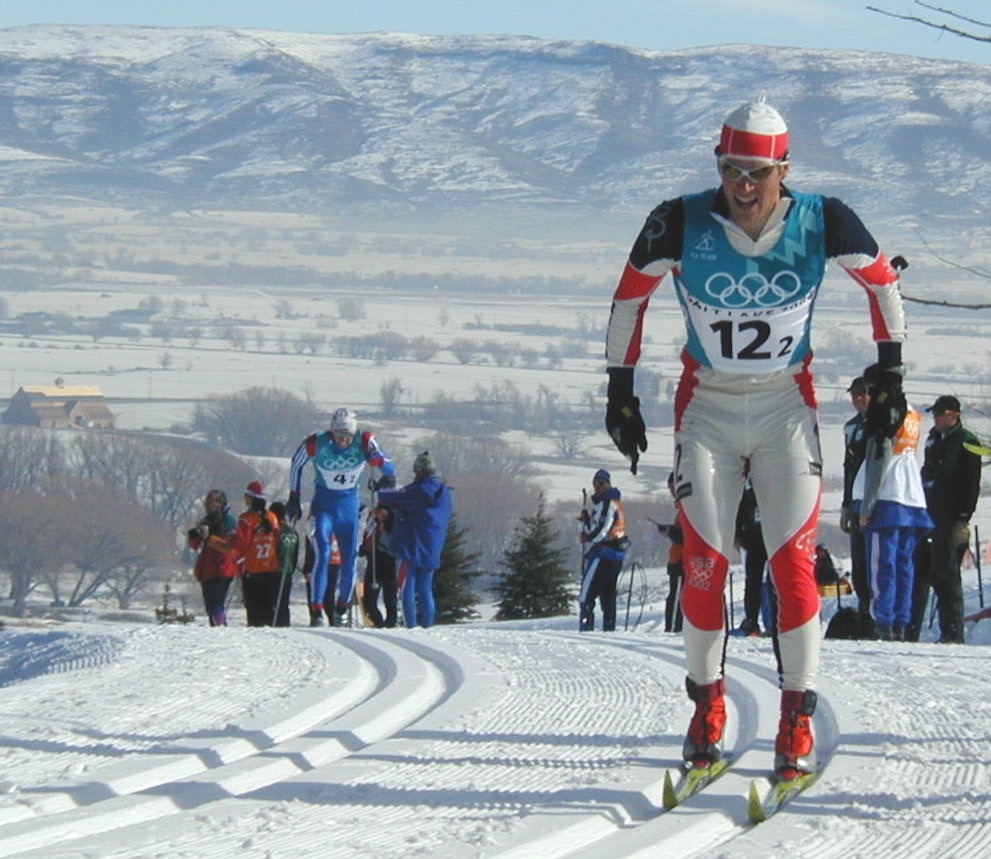
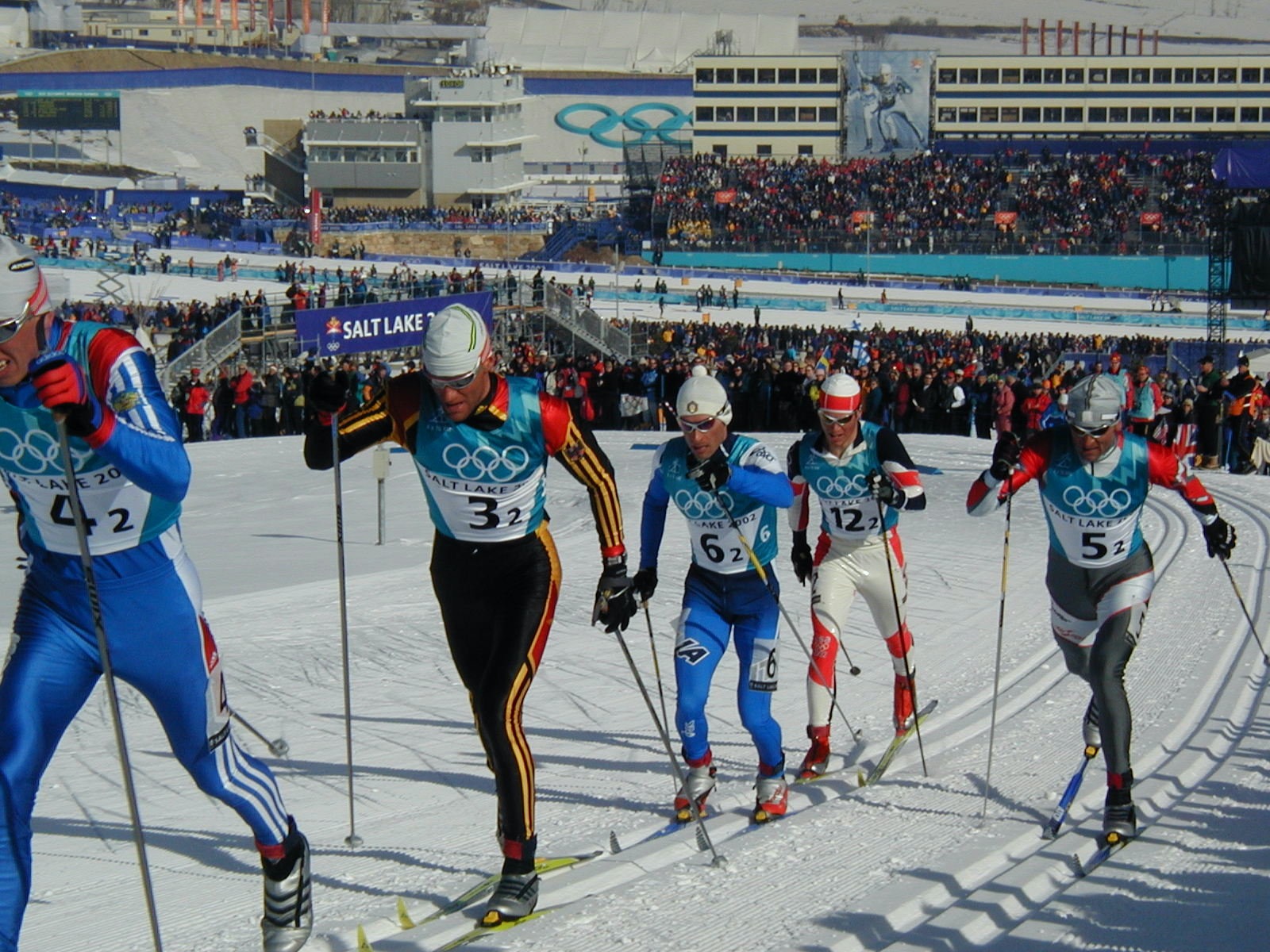
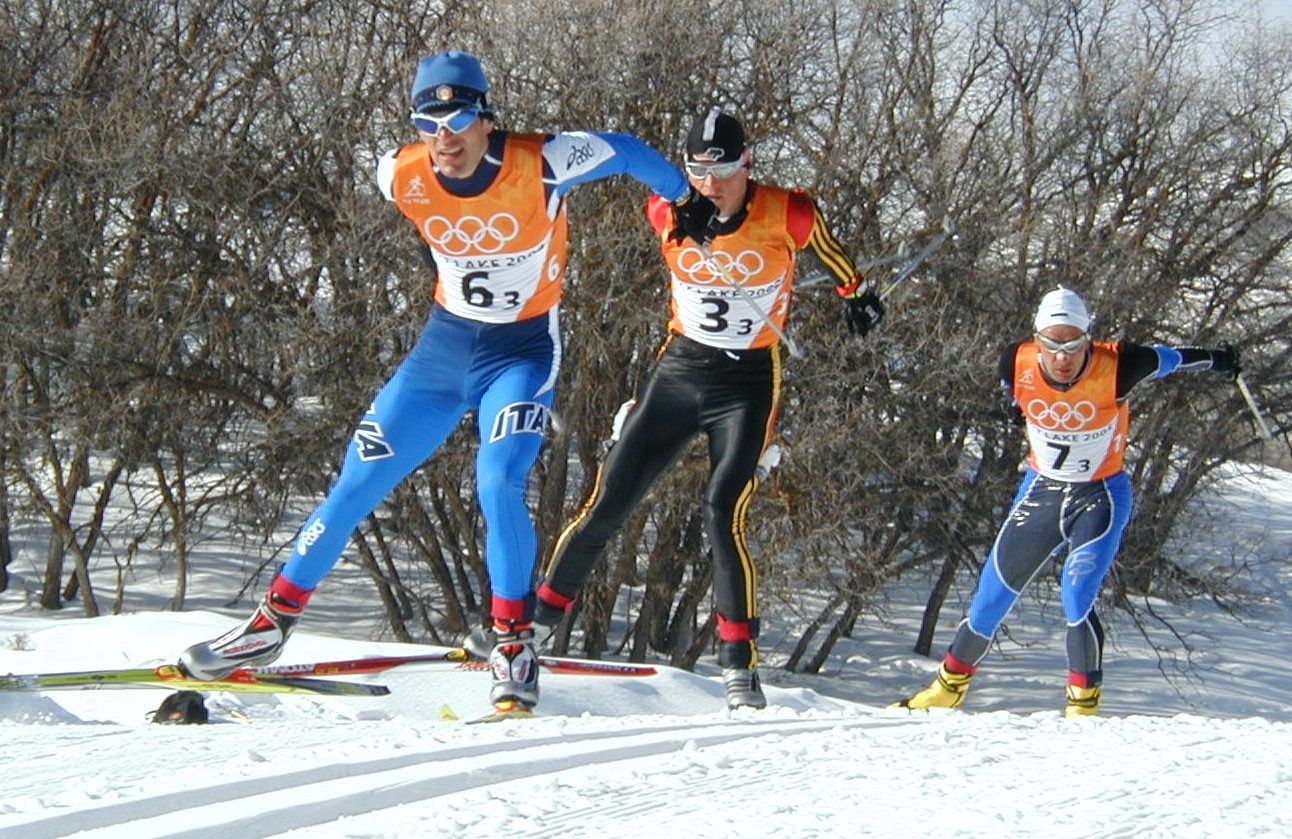
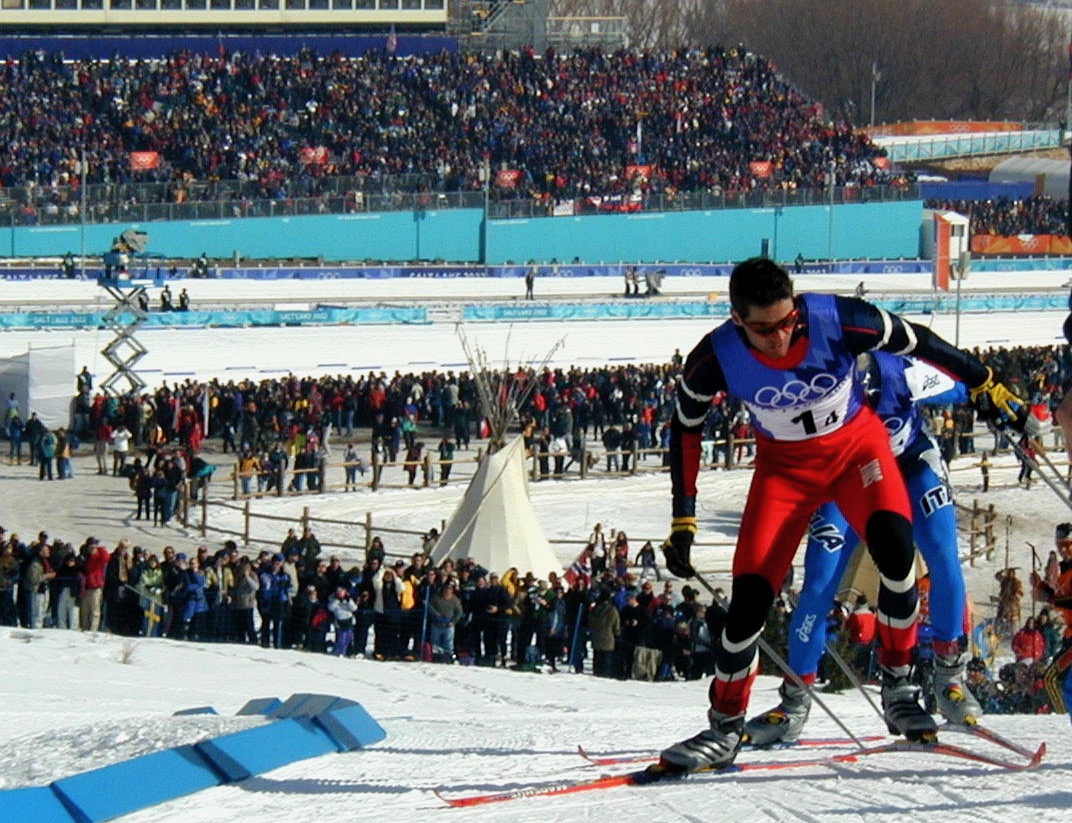
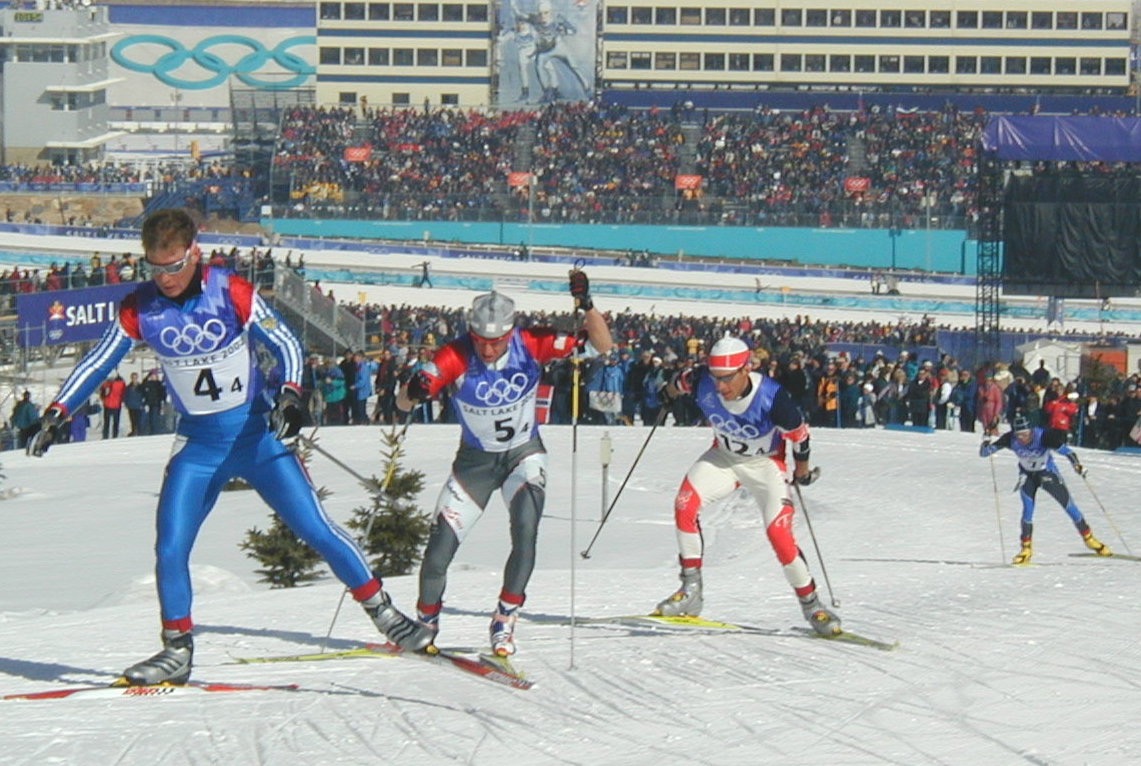
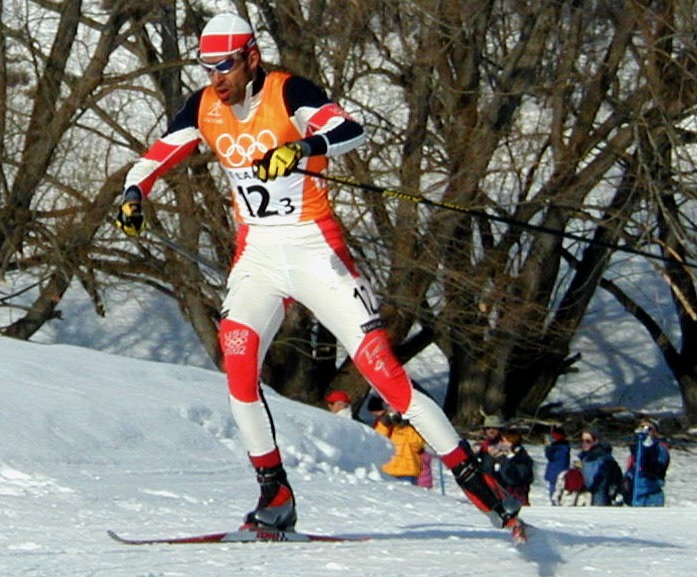
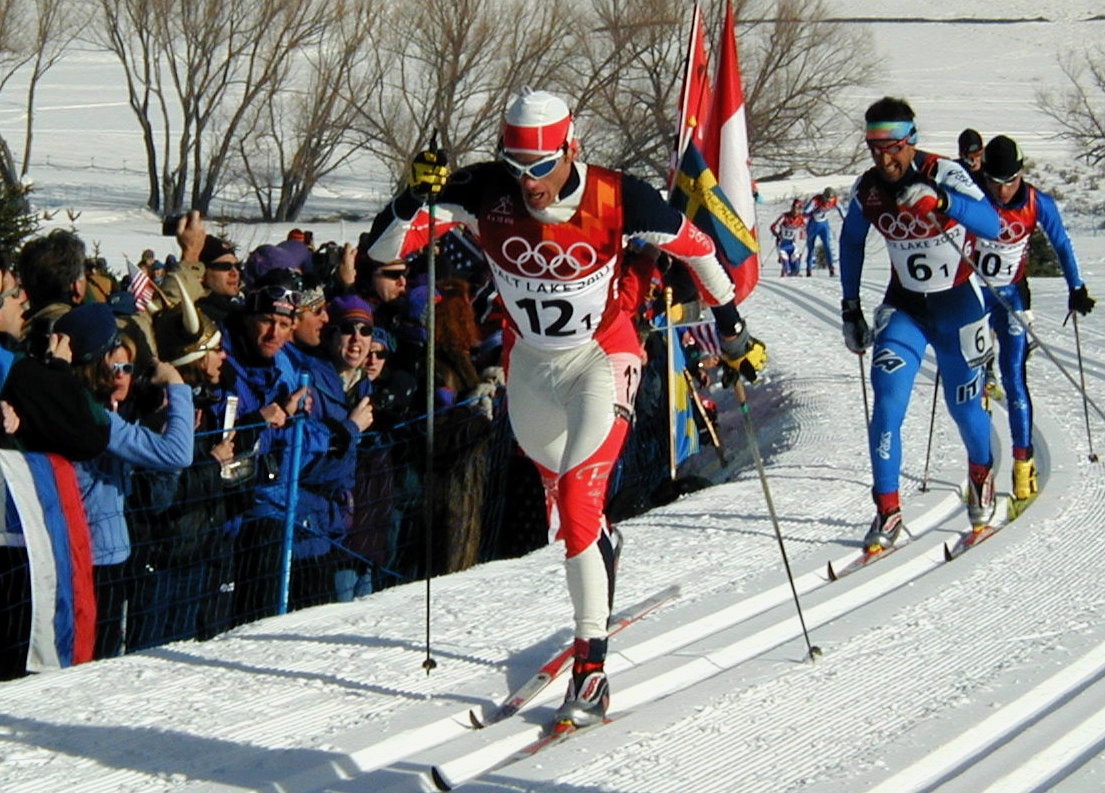
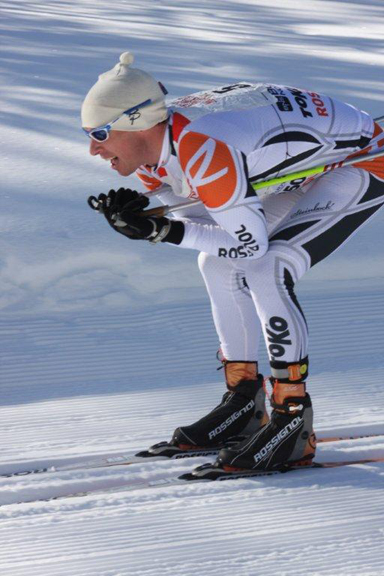
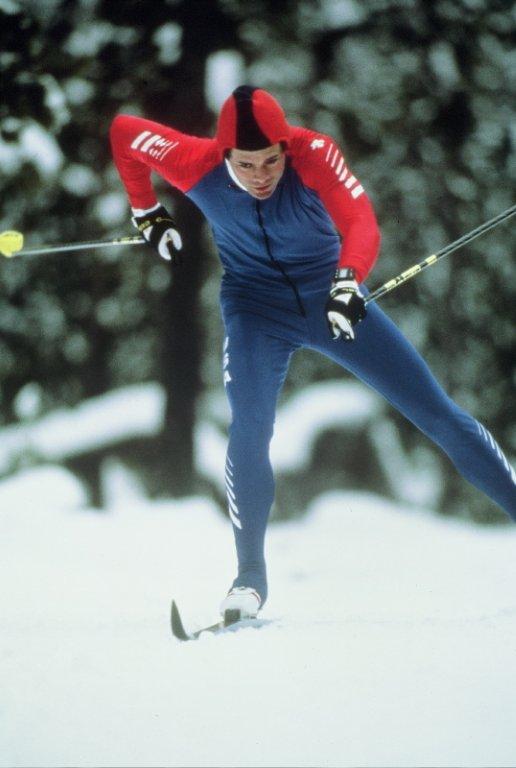
A 21-year-old Kris Freeman skis leg two of the men’s relay for the U.S. at the 2002 Winter Olympics at Soldier Hollow. (photo: Cory Smith)
This humble website went live twenty years ago today. (How long ago was that? Pretty long, judging from this recent Buzzfeed listicle.) As a later retrospective on this site would explain, “FasterSkier was founded in January 2002 by Torbjœrn Karlsen, Cory Smith and Erik Stange. FasterSkier.com was launched on February 1, 2002 and quickly grew to become one of the most trusted sources for Cross-Country skiing information in the United States … .”
The ur-articles from February 1, 2002, have sadly been lost to the ravages of time; the switch to the “modern” CMS interface has not been kind to content from the site’s first year. Early coverage presumably included a “Hello, World!” introduction, while the substantive focus was likely on the 2002 Winter Olympics, which began in Salt Lake City one week later.
Happily enough, the site’s Olympics coverage is preserved in its entirety, thanks to the intercession of the Internet Archive’s Wayback Machine. You can find a roundup of all 2002 Olympics coverage here, and a link to all compiled Olympic race reports here.
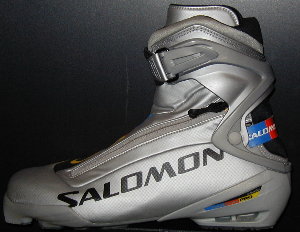
Coming soon to a store near you! Salomon Carbon Pro skate boot (photo: Cory Smith)
The articles are, collectively, a heck of a period piece, and are worth your time, particularly if you have been reading this site for years and would like to see how far the technology has come. You may also be interested in the gear reviews, of, for example, the new, all-gray Salomon Carbon Pro. “I think that they are a real improvement over the Pilot Racing Skate 9,” our reviewer wrote, in a comparison to the product better and more universally known as “bumblebee boots.”
It was tough to choose just one article from an embarrassment of historical riches to reprint for today, but this piece, a race recap of the men’s 4 x 10-kilometer relay, feels appropriate. Thomas Alsgaard; Cristian Zorzi; Anders Aukland; John Bauer; Kris Freeman. This was a long time ago.
(The writeup of the women’s relay, from four days later, may be found here; it ends, “The Americans finished a disappointing 13th,” and says little more than that about the American team composed of Wendy Wagner, Nina Kemppel, Barbara Jones, and Aelin Peterson.)
This article was written by site co-founder Cory Smith, and was originally published on February 17, 2002. Photos and captions, both also by Smith, are reprinted as they originally appeared. A few bonus race photos are appended at the bottom, thanks to Smith’s impressive archives.
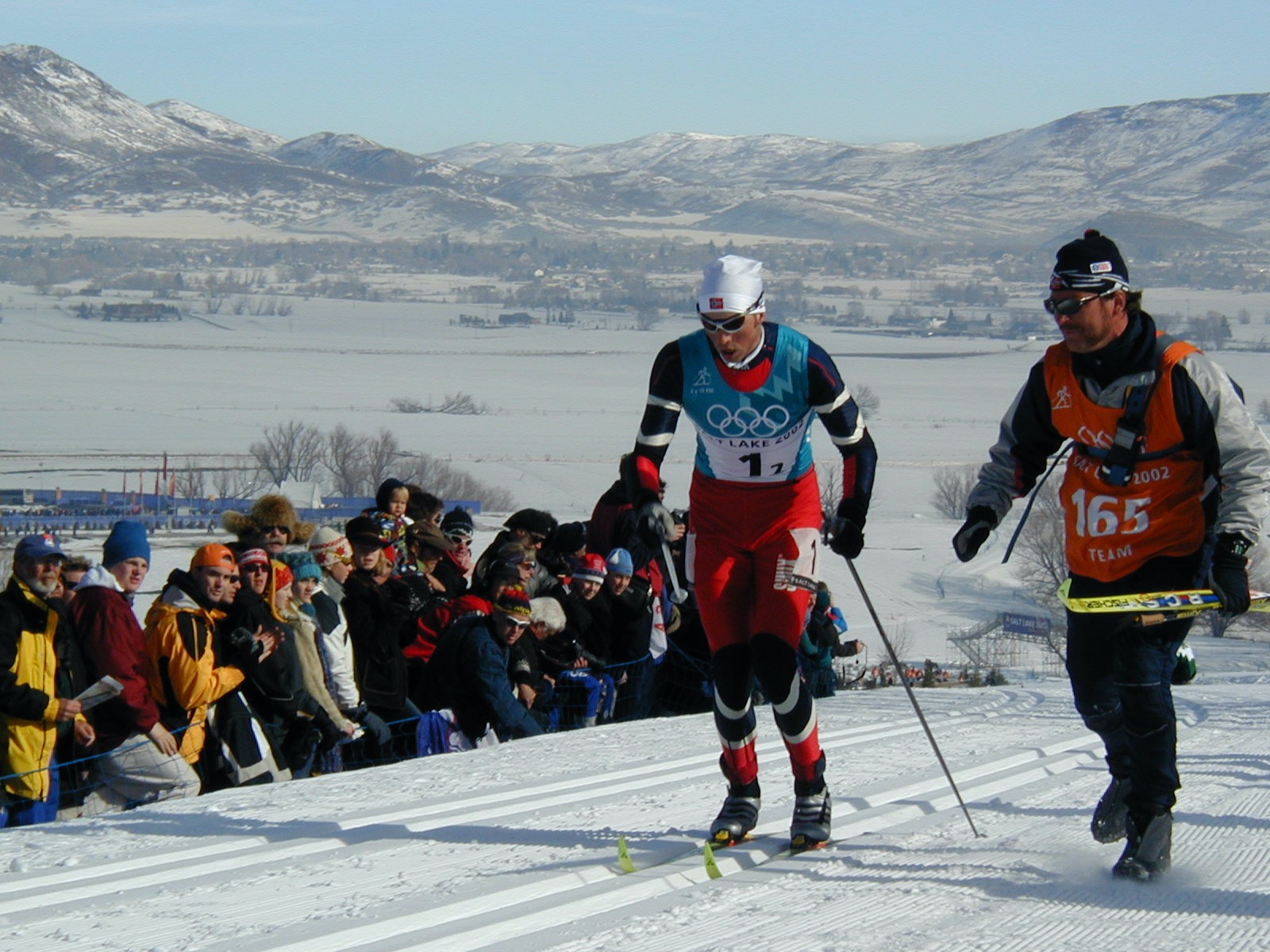
A Norwegian athlete skis in the men’s relay at the 2002 Winter Olympics at Soldier Hollow. (photo: Cory Smith)
Norway Beats Italy in Sprint to Finish (again), US Men’s Relay Team Posts Best Result Ever
By Cory Smith
By the length of one ski, Thomas Alsgaard brought order back to the cross country ski world. In today’s Men’s Cross Country 4 x 10K Relay race, the Norwegian team proved that even without an individual gold medalist in these games, they are still the best team in the world. Thomas Alsgaard outsprinted Cristian Zorzi in the final 100 meters to take home the gold for Norway.
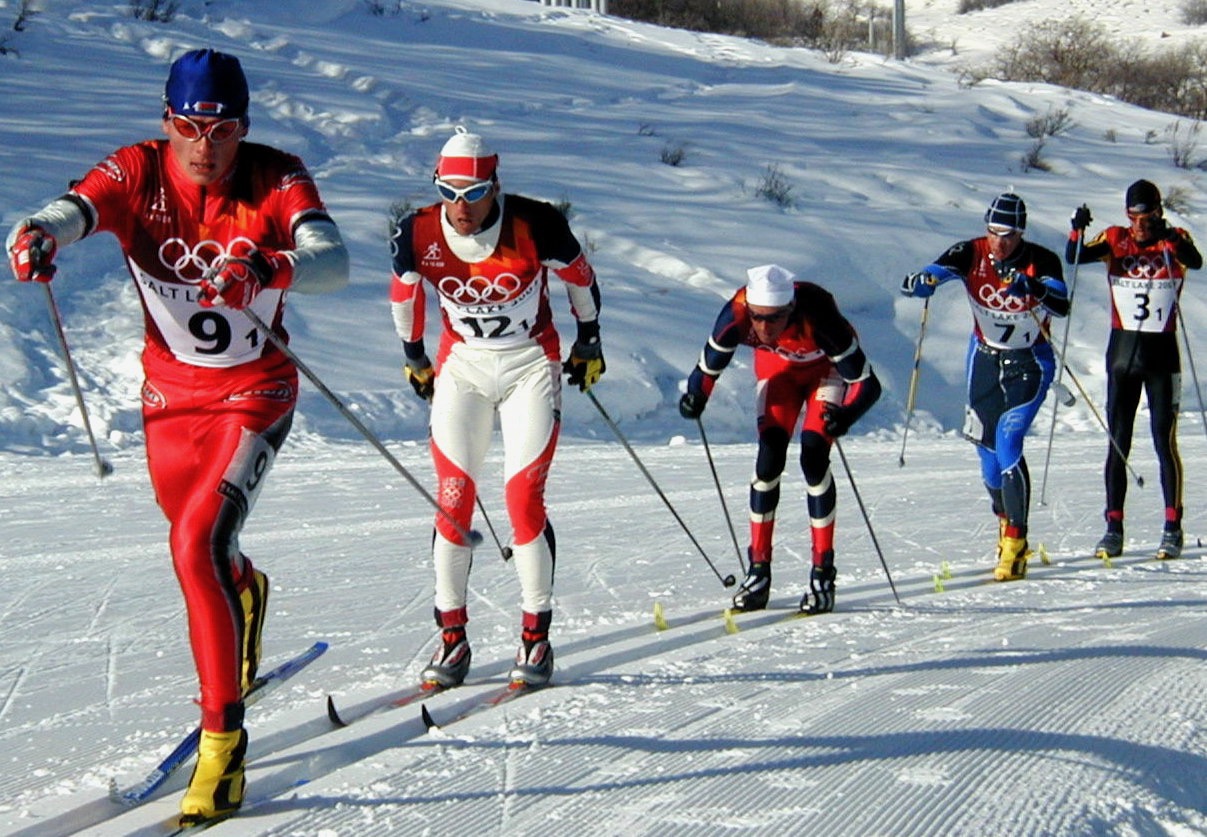
John Bauer (USA, bib 12) and Anders Aukland (NOR, bib 9) follow Belarus’s Roman Virolainen in the men’s relay at the 2002 Winter Olympics at Soldier Hollow. (photo: Cory Smith)
In a week that has seen more men’s gold medals for Estonia and Spain* than for Norway, and even a Canadian woman winning a medal, Sunday’s race was also extremely memorable, but with a more familiar outcome. The entire country of Norway was able to breathe a sigh of relief after their relay team put them back on top of the nordic world.
Meanwhile, the US men’s team, in the top five for most of the race, posted their top Olympic relay result by finishing a very impressive 5th. All four US skiers skied very fast and very smart to come within seconds of a medal for the first time ever.
Norway showed their dominance of the classic technique right from the start. After letting Belarus’s Roman Virolainen lead for much of the first lap, Norway’s Anders Aukland took control on his second 5K loop and opened a 10 second lead. Meanwhile, John Bauer, after a slow start that had him in last place out of the stadium, had moved up to the front of the pack and was actually leading the chase of Aukland. Bauer lost a few places gliding through the stadium, but he finished his excellent scramble leg in 5th place, right with Italy, Kazahkstan, and Germany, only 13 seconds off the lead.
Kris Freeman (bib 12) stays right with the lead pack. (photo: Cory Smith)
On the second leg, Norway’s Frode Estil build the lead up to a maximum of 24 seconds while Kris Freeman (USA) jumped in behind Germany, Italy and Kazahkstan in the pursuing pack. As the leg went on, Estonia’s Andrus Veerpalu bridged up to the pursuing pack, as did Russia’s Mikhail Ivanov and Austria’s Mikhail Botvinov. This pack of six strong skiers started to cut into Estil’s lead, but as the leg came to an end, the pack began to break up. At the end of the second leg, Norway had an 11 second lead over Russia and Estonia. Kris Freeman skied an amazing strong race to stay in the thick of it, coming in right behind Italy’s Giorgio di Centa, in 5th place only 25 seconds off the lead. Halfway through the relay and the US men were only 14 seconds from a medal!
Pietro Piller Cottrer (ITA) charges towards the lead with Tobias Angerer (GER) in tow. (photo: Cory Smith)
The clear standout on the third leg was Italy’s Pietro Piller Cottrer. He started his leg in 4th place, then quickly passed the Russian and the Estonian and after about 5K, he was right with Norway’s Kristen Skjeldal fighting for the lead. The two of them skied together the rest of the leg, setting up yet another epic final duel between Italy and Norway. Justin Wadsworth looked to finally be over the head cold that had hindered him all week. He was smart enough to not try to stay with Piller Cottrer, but instead skied a very solid leg all on his own, until he was caught by Austria’s Gerhard Urain, whom he latched onto and followed until blowing by him near the end of the leg to finish in 5th place. In between the leaders and Wadsworth, Germany and Estonia came in together in 3rd and 4th.
Alsgaard leads Zorzi into the stadium to sprint for all the marbles. (photo: Cory Smith)
On the final leg, it became obvious that Alsgaard’s strategy was to try and shake Italy’s Zorzi, one of the best sprinters in the world, early. Alsgaard led most of the leg, but Zorzi held tight. Meanwhile, Germany’s Rene Sommerfeldt had pulled away from Estonia to assure a bronze medal. Carl Swenson jumped in behind Russia’s Nikolaj Bolchakov and Austria’s Christian Hoffman and they quickly passed the Estonian team. With the top three significantly ahead, Swenson was skiing strong and relaxed, as is his trademark, and was clearly gearing up for the finish. Along the way, they dropped the Russian, setting up a duel between Hoffman, who outsprinted Alsgaard in the 1999 Relay to win the World Championship, and Swenson.
Speaking of duels, Alsgaard and Zorzi were putting on a tactical clinic. Going up the last big climb at 9K, Alsgaard had the lead and tried on a couple of occasions to put on a kick and lose the Italian. But Zorzi held tight and made a pass just before the top of the hill. Just before the downhill, Zorzi dropped into a tuck and slowed way down, obviously trying to get Alsgaard to pass, so that he could draft.
Alsgaard wanted nothing to do with that plan and instead of passing, he pushed on the back of Zorzi’s ski with his pole to speed him up. Then Zorzi pulled over and nearly stopped. Alsgaard did the same. They were a kilometer from the finish and they were standing still arguing about who was going to lead!
Alsgaard eventually took the lead reluctantly. They went stride for stride up the short hill by the stadium and then dropped down to prepare for the sprint. On the gradual downhill, Zorzi freeskated hard to take the lead, and had about 5 meters on Alsgaard as they rounded the turn. Alsgaard then kicked it in and began gaining on Zorzi. With 50 meters to go, they were dead even, but it was clear that Alsgaard had greater speed. Alsgaard got a slight lead and held it. It was a very close finish, but there was no doubt that Norway had won.
Carl Swenson and Christian Hoffman pass the Russian team. (photo: Cory Smith)
Germany’s Sommerfeldt finished all alone in a surprising 3rd, and was mobbed by his bronze-winning teammates as he crossed the line. The battle was now for 4th. Swenson was up against formidable competition in Hoffman, but if any American could outsprint him, it would be Swenson and that’s why he was in the anchor position. Hoffman had the lead around the corner and they went toe to toe down the line.
For a moment it looked like Swenson would catch him, but there just wasn’t enough distance left. Another 20 meters and he would have had it. But instead Austria took 4th and the US maintained its 5th place on all four legs to post its best relay result ever.
The US skiers skied very, very well, both physically and tactically. But none of them skied unbelievably well, they all simply skied strong like they have all week. What I am trying to say is that this was no fluke. They finished right where they belong. They have been one of the top five teams on these trails all week and today they certified that. What is even more amazing is that there were two other American skiers, Pat Weaver and Andrew Johnson, who could have filled in and skied just as well. The US now has at least six World Class skiers. Don’t look now, but the United States is a force to be reckoned with.
20,000 people cheer wildly at Soldier Hollow. (photo: Cory Smith)
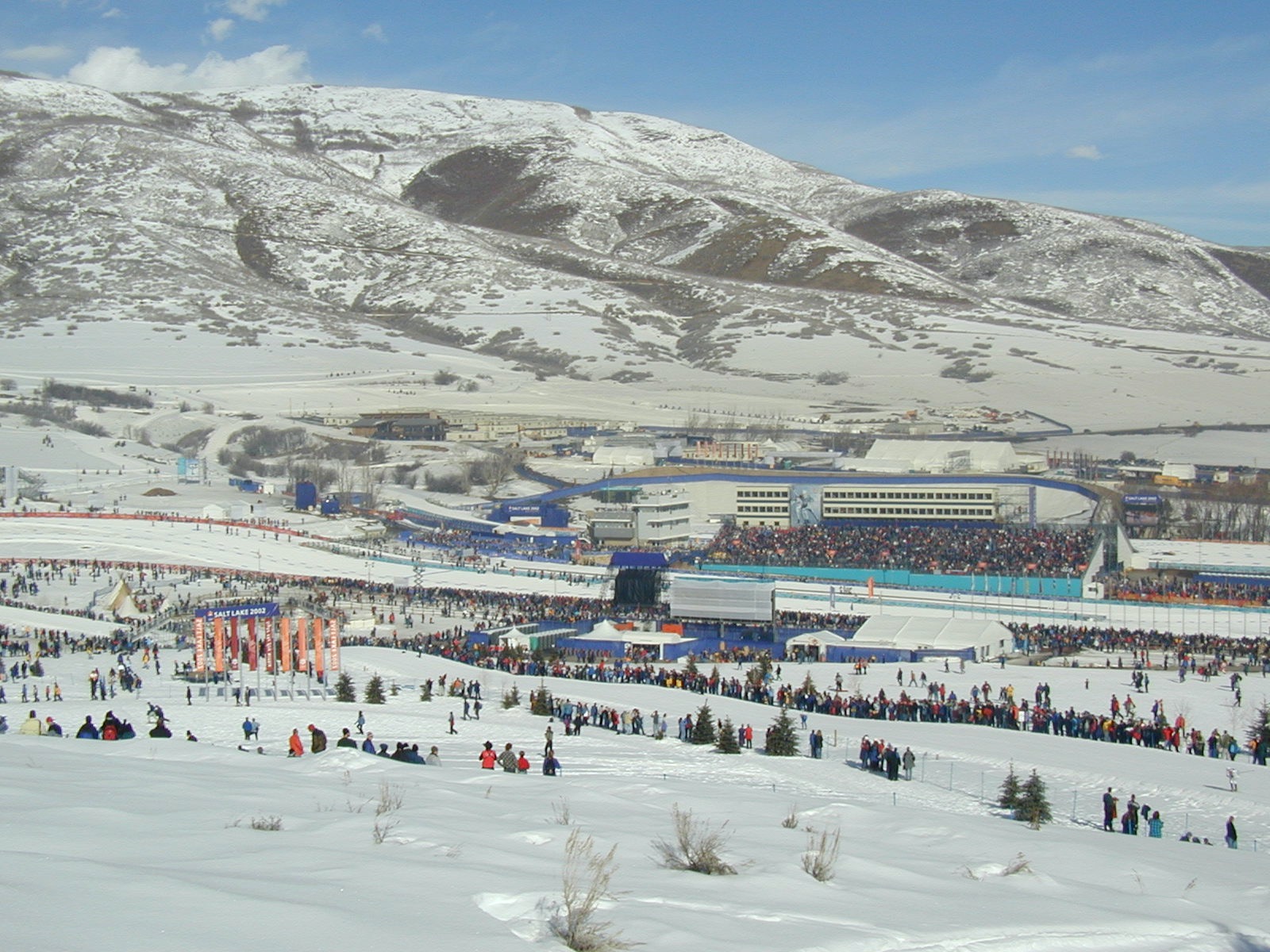
Just as amazing as the race itself, was the crowd. Soldier Hollow was sold out for the first time ever, with 20,000 people watching a cross country ski race in this country for the first time ever. The crowd was loud and energetic. It was a sight that warmed the hearts of all Nordic die-hards on hand. Today, our little sport took a huge step forward in many ways.
[* Modern-day footnote: This statement, while accurate at the time, was ultimately belied by history, as the three gold medals that Johann Mühlegg won for Spain at these Olympics (in the 30-kilometer skate, 50-kilometer classic, and 2 x 10-kilometer pursuit) were subsequently rescinded following his disqualification for a positive darbepoetin test.]
Some additional photos from this race:
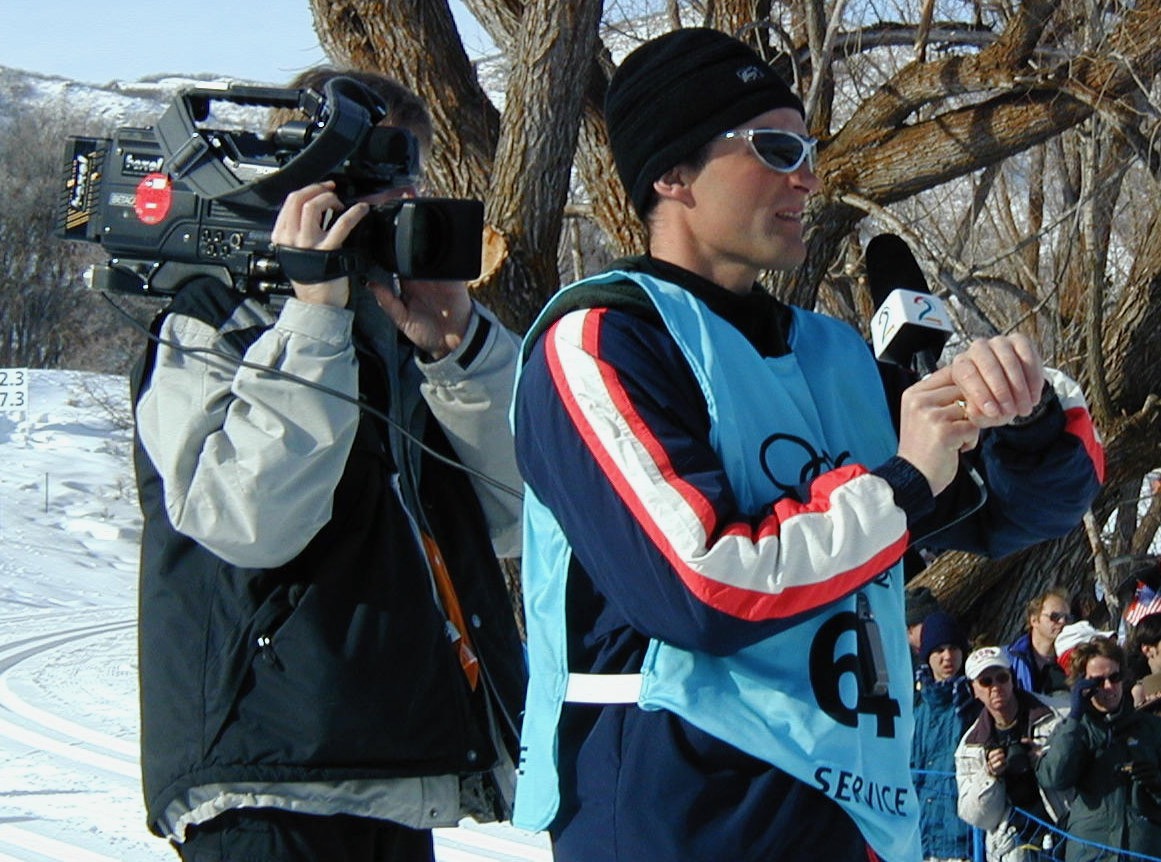
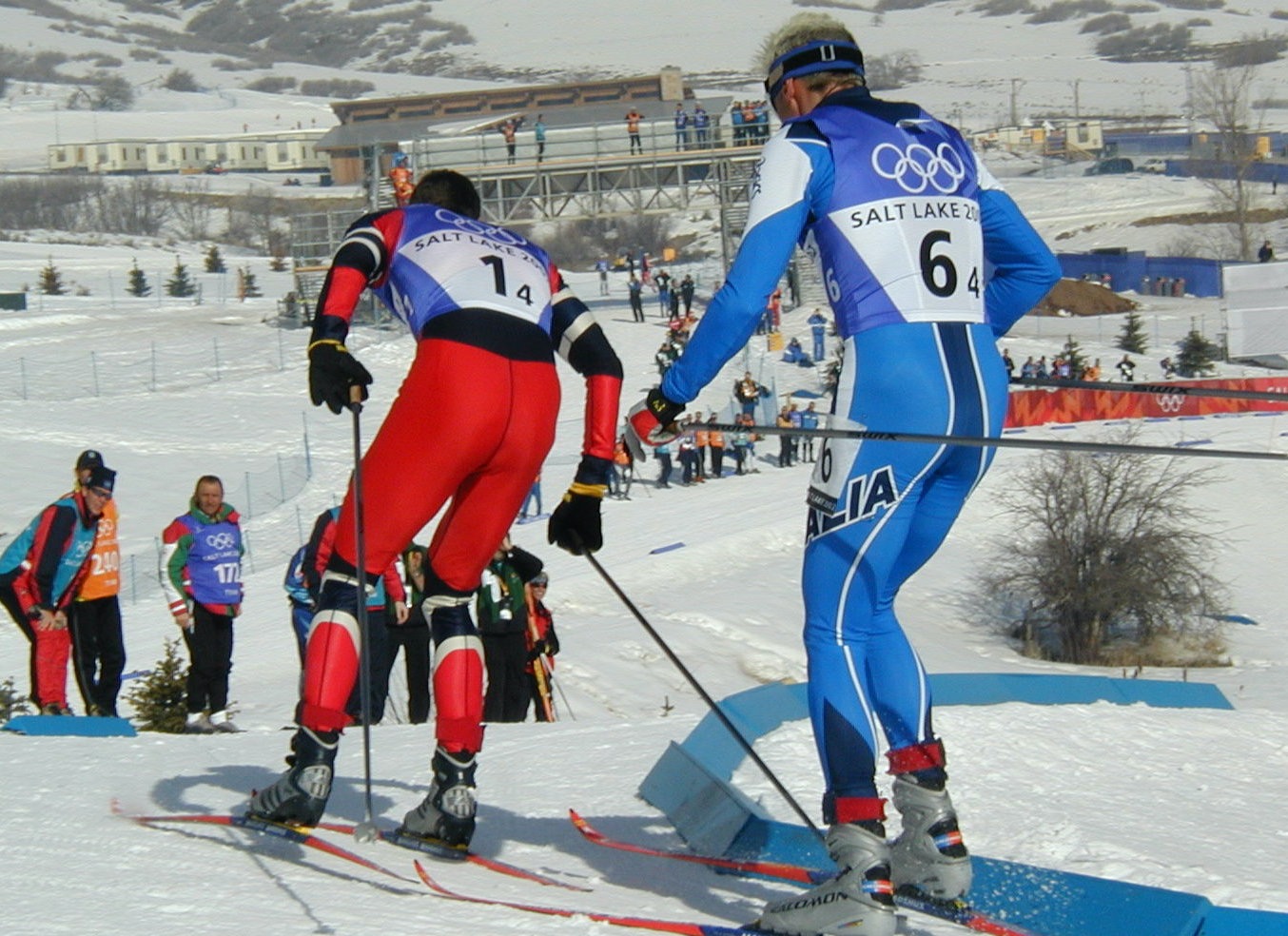
Vegard Ulvang serves as a commentator for Norwegian television at the 2002 Winter Olympics at Soldier Hollow. (photo: Cory Smith)Thomas Alsgaard leads Cristian Zorzi in the men’s relay at the 2002 Winter Olympics at Soldier Hollow. (photo: Cory Smith)Justin Wadsworth skis leg three of the men’s relay for the U.S. at the 2002 Winter Olympics at Soldier Hollow. (photo: Cory Smith)John Bauer skis leg one of the men’s relay for the U.S. at the 2002 Winter Olympics at Soldier Hollow, slightly ahead of Fabio Maj of Italy (bib 6) and Andrei Golovko of Kazakhstan (bib 10). (photo: Cory Smith)
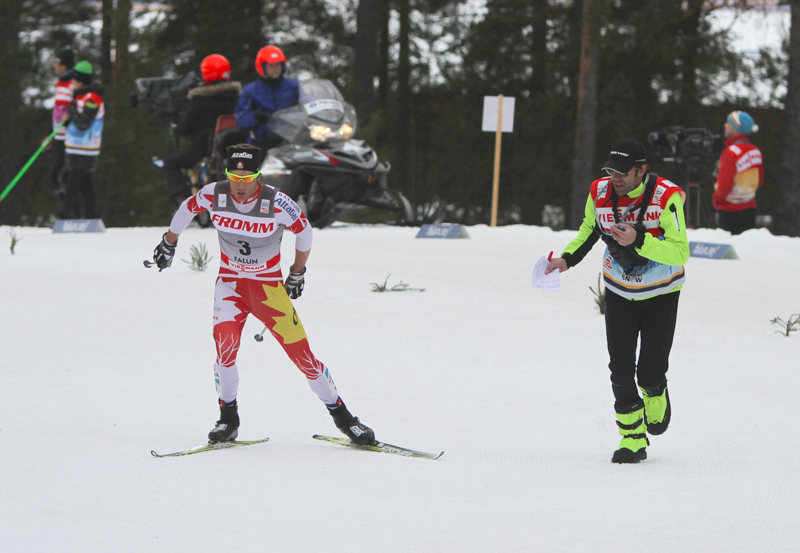
Canadian National Team Head Coach Justin Wadsworth (r) giving splits to Devon Kershaw at 2012 World Cup Finals in Falun, Sweden.
Last week, Biathlon Canada announced Justin Wadsworth as the Head Coach for the 2019-2020 season. In April, 2019, Wadsworth took on a temporary role as the team’s summer coach. That fill-in-the-gap stint will extend through this season’s racing. Wadsworth joins Canadian biathlon at a challenging time, with limited funding and after the retirement of many top athletes.
“My job is really just for the national team — we have 12 athletes and I would say that is my mandate to get those athletes working at their personal best and a world leading direction.” — Justin Wadsworth
Biathlon combines shooting accurately, skiing fast, and finding mental strength. Wadsworth has his focus on the ski speed. Pavel Lantsov, who joined the program part way through the 2018-2019 training season, will continue as shooting coach. Roddy Ward leads the development effort.
Wadsworth will make two trips to Europe during the season. As his wife’s career involves extensive travel, he has to manage his time away from the kids. Wadsworth took a five week summer break from coaching to get some quality family time. He has agreed to travel for the first IBU World Cup first period from November 17th to December 8th and then again for World Championships that will include a February pre-camp.
So how does a life-long cross country skier become not just a biathlon coach, but a national team head biathlon coach?
“That is a fine question because about six months ago I had no plan to coach anything let alone biathlon,” Wadsworth told FasterSkier on the phone last week from a Park City training camp. After originally agreeing to three months, he started work with the athletes on training and ski technique.
“Those three months kind of flew by and I had a lot of fun with the team.”
The 2019-2020 team is younger than in the recent past, with Emma Lunder, Scott Gow, and Christian Gow showing the most success in the last season.
“My main philosophy with training,” Wadsworth said of his focus with the young biathlon team, “is really just consistency. We don’t need to do the real radical things to get the extra one percent at the end of the day going into the season. We need consistent training with good technique and staying injury free and being healthy and that is going to bring this team the biggest rewards for this next coming year or two.”
Wadsworth ran the Canadian cross country team during the best funded period of its history, thanks to Vancouver 2010 and solid racing results. During his own racing career, he had a front row seat to watch the Canadian cross country team rebuild after Nagano 1998. While the latter has more obvious relevance in the current state of Canadian biathlon, he showed an ability to use money well [link to Canadian ski truck] when it was available. As he immerses himself in Biathlon Canada’s rebuild, he’s facing a stark reality when it comes to funding.
“I have never seen a team with a budget as small as this. Our athletes right now at this camp in Park City are paying for everything. No funding.”
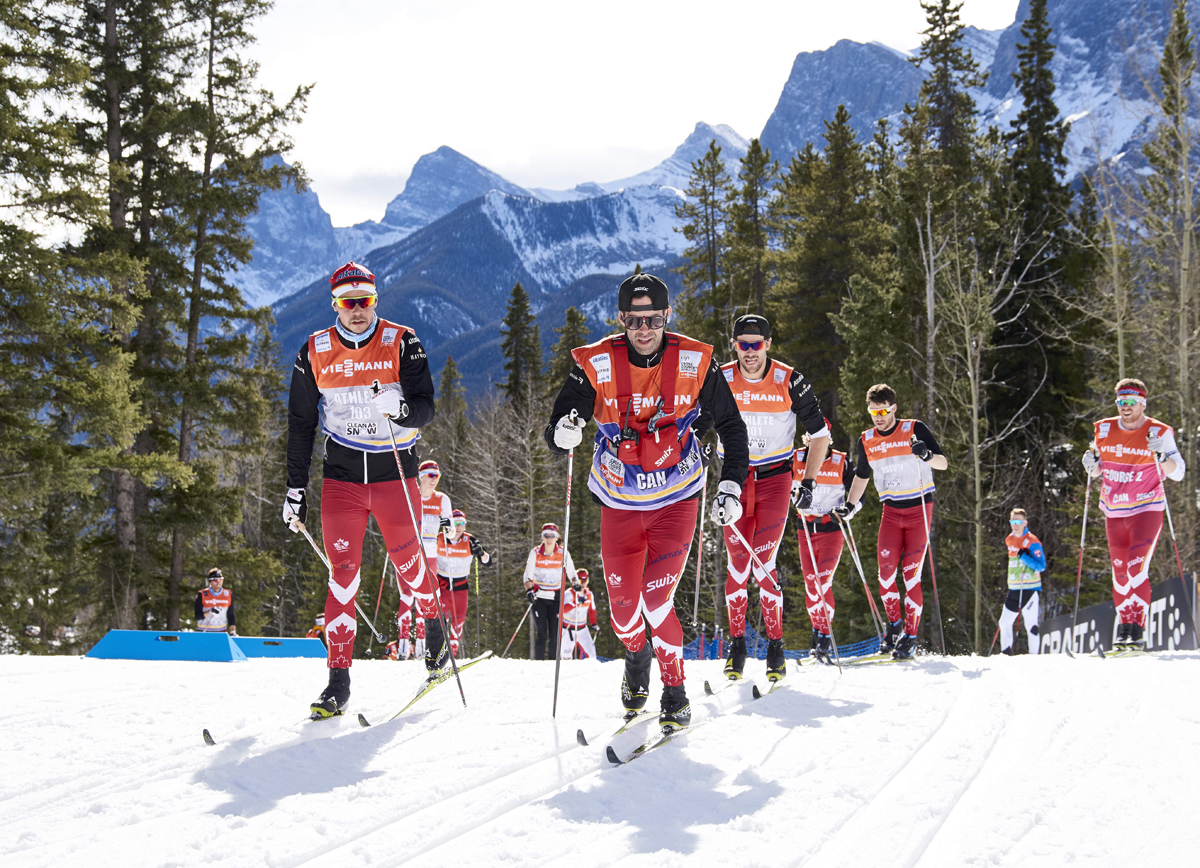
Canadian head coach Justin Wadsworth leads his team during a training session at the 2016 Ski Tour Canada in Canmore, Alberta, including athletes Jess Cockney (l), Len Valjas, and Alex Harvey. (Photo: Fischer/NordicFocus)
Who is Justin Wadsworth?
Wadsworth spent five years as the Canadian National Cross Country head coach and is often thought of as one of the most outspoken Canadian officials on the topic of doping in sport.
He presided over some of Canadian skiing’s ‘golden era’, including the arrival of Alex Harvey on the world stage, Devon Kershaw’s second overall in the 2012 World Cup, and Canada’s first World Championship gold. None were Wadsworth’s personal highlight, however.
“I would say the whole team during that 2012 season, where every member, male or female, of our national team, had a top three result on World Cup. That to me was the highlight. It was amazing. We had Perianne [Jones], we had Dasha [Gaiazova], we had Chandra [Crawford], we had all the guys. Everyone had been on the podium. A few podiums, like the girls, were double-podium with Peri and Chandra, or Chandra and Dasha in the sprint. The team energy was amazing. We went through the whole season and everyone was so focused and having so much fun. Really just a really strong team. Everyone thinks back to the guys, but before Christmas that year, Chandra, I think, was fourth on the overall sprint World Cup going into the Tour de Ski, and we had other great results. Lenny [Valjas] later that year had a podium in distance. Everything was just firing on all cylinders. That to me is what I remember. To me as a coach that felt the best and was kind of the highlight. Not just for the results, but the whole team really worked together hard, and everyone was accountable to everybody else. When that all clicked, and everybody got on the podium that year, it was really special.”
There is more to Wadsworth than coaching, as older ski fans may remember. He was a pivotal member of the U.S. Ski Team (USST). He competed at the most recent U.S. World Cup, producing the top American result with 8th in the 30-kilometer at Salt Lake City in 2001.
In 2002, he was sick at the start of his home Olympics before recovering to be part of the 5th place men’s relay (the best U.S. result ever, matched by the women in PyeyongChang 2018). He quarantined himself from his then-girlfriend to help her remain healthy and have the best chance at her own Olympic dreams.
On a call with FasterSkier shortly before the announcement of his new title, Wadsworth doubled down on the difficulty and importance of being a team player.
“Those are words that come out of my mouth with our current team here. If anyone gets sick, you have to pony up early on. Don’t be afraid about it. It’s one of the hardest things to say, ‘I might be getting sick’, early enough to prevent the whole team from getting sick.”
Wadsworth passed that test in 2002. He did, however, start his target event, the 30 k mass start freestyle.
“I should have not started, but I felt it was my best chance at a great result, and I started even though I was sick,” Wadsworth confirmed in an email about that DNF. “I wish someone had helped me to not start….”
When Wadsworth talks to athletes about trusting the process, they know that he has both lived it as an athlete and lead it as a coach. Wadsworth didn’t reach the top instantly himself, missing Albertville 1992 before qualifying for Lillehammer 1994, five years after his first World Cup start.
“Oh, I raced [a U.S. World Cup] one other time in 89 right here, down the road from where I am right now [Park City]. It was a Salt Lake World Cup, but it was held at a place called Mountain Dell. I think it was Bjørn Daehlie’s first ever World Cup, or first ever World Cup win.”
(FIS records are a bit sketchy that far back, but it was Daehlie’s first win.)
You might think Wadsworth’s strong opinions on cheating in sport come from being at Beckie Scott’s side through years of her very public challenges, but he does have first hand experience with dopers. When asked about his 2001 World Cup race, he said “I think [Johan] Mühlegg might have been ahead of me, but I always take him out [of the results].”
In that 2001 30 k, Mühlegg won as a Spanish athlete, having left the German team over a dispute about his personal doctor. Mühlegg would be banned after failing a doping test at the 2002 Olympics. The second place finisher, Christian Hoffman of Austria, was implicated in a different Olympic blood doping scandal in 2002, but wouldn’t be banned until 2009 after he was caught at Torino 2006.
If you take out the known cheaters, the upgrade to 6th place would give Wadsworth one of the best U.S. World Cup men’s results in history. By extension, Hoffmann wouldn’t have out-sprinted the U.S. closer Carl Swenson for fourth place at the 2002 SLC relay.
Wadsworth’s wide ranging experience as an athlete and coach leaves him with diverse tools to help Canada’s national biathlon team rise up.
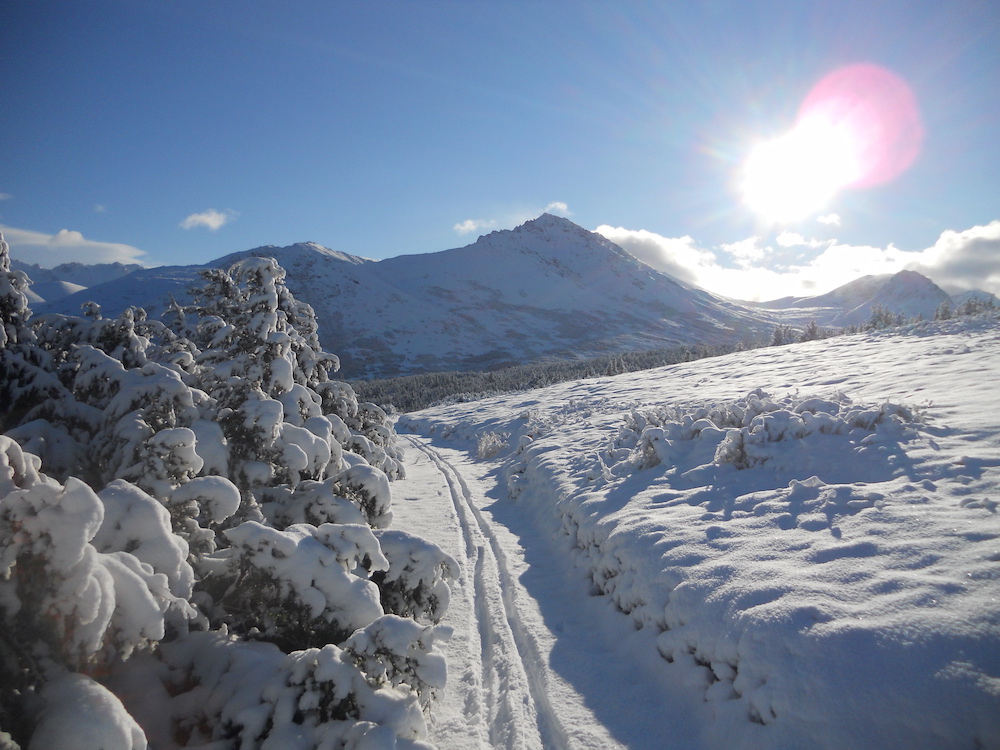
Early-season snow: first tracks in Chugach State Park, above Anchorage, Alaska, on Sept. 18, 2015. (Photo: Gavin Kentch)
Twenty years ago today, on Nov. 2, 1996, a ski race sanctioned by the International Ski Federation (FIS) was held in Fairbanks, Alaska, on the trails at Birch Hill. It appears to be the earliest FIS race ever held on natural snow in the Northern Hemisphere. This is a look back at that race, and at the significance it has, or does not have, for some of its participants.
Setting the stage
It was the final days before a hard-fought presidential election. Clinton was widely expected to prevail over the Republican candidate, although a strong third-party showing and voter dissatisfaction with the two major parties were complicating the electoral calculus. The Alaska Republican Party was running newspaper ads promising to “defend State’s rights.” And people were skiing in Fairbanks. Plus ça change.
There were also some differences. The front page of the Fairbanks Daily News-Miner on Nov. 3 ran an article headlined “Dole hoping for an upset” over, of course, Bill Clinton. Then on Nov. 4: “Perot plans last-minute television blitz.”
Elsewhere in the paper, movie listings included the Leonardo DiCaprio vehicle Romeo + Juliet. Agate type in the sports section recounted promising rookie Ray Allen leading the Milwaukee Bucks to a victory over the Boston Celtics. (It was the second game of Allen’s career. He would go on to play 1,298 more games after that.) And an ad for an ISP, or internet service provider, explained to potential customers the appeal of “the Internet.” You could “interact with people from around the world,” it promised, or, “Find answers and advice in newsgroups.”
In Fairbanks, meanwhile, it was winter, and it had been winter for a long time. The News-Miner reported that October had seen record-breaking cold, even for Fairbanks, with an average temperature for the month of 13.6 degrees. Through Nov. 3, it had snowed 22 inches so far that winter; given those temperatures, and the relative lack of solar radiation in Fairbanks in winter, most of it was presumably still on the ground.
The Nanook Challenge
Given this weather and snow conditions, it hardly seems newsworthy that a ski race was held. Plus several members of the U.S. Ski Team (USST) had been in town for early-season training, so the skiers were there.
The field for the 10-kilometer classic interval start – official title the “Nanook Challenge: FIS Series Race No. 1” – was small but distinguished. There were 10 women and 18 men entered. At least four current members of the U.S. Ski Team competed, along with several former USST members.
The top-five finishers in the men’s race were Ben Husaby, Marcus Nash, Patrick Weaver, Scott Loomis, and Carl Swenson, respectively, a bevy of elite skiers that would not have been out of place at a mid-1990s national championship race. (Indeed, all five men would place in the top seven in the 15 k skate race at U.S. nationals later that winter in Bend.)
The women’s podium was headed up by USST skiers Laura Wilson and Suzanne King. Third place went to Julie Southwell, described by the News-Miner as “a national team contender who trains in Fairbanks.” (Five years later, a profile of Southwell by Inge Scheve in The Bulletin of Bend, Ore., would call her “a former Colorado resident who says she sort of follows the snow.”)
Wilson’s winning time was 33:28 for 10 k. Husaby finished the same course in 27:56. Conditions were described in the News-Miner as “near-perfect,” with an 11 a.m. race temperature of “20 degrees under a pale white ceiling of clouds.” (The season’s second FIS race, a 15 k skate, was held the following weekend, in arguably less perfect conditions. The high temperature for Fairbanks on November 9, 1996, was –1°. The low was –26°.)
(Story continues below)
The Fairbanks Daily News-Miner’s 1996 story on a Nov. 2 cross-country ski race, the earliest FIS-sanctioned event ever held in the Northern Hemisphere.
The Fairbanks Daily News-Miner’s 1996 story on a Nov. 2 cross-country ski race, the earliest FIS-sanctioned event ever held in the Northern Hemisphere.
The Fairbanks Daily News-Miner’s 1996 story on a Nov. 2 cross-country ski race, the earliest FIS-sanctioned event ever held in the Northern Hemisphere.
The Fairbanks Daily News-Miner’s 1996 results from the second race on Nov. 9.
Looking back
Swenson, the fifth-place finisher in the opening 10 k classic, has fond memories of Fairbanks as an early-season training destination generally, though scant recollections of this race specifically. When asked about this race in a recent phone interview, following his workday doing indigent defense for the New Hampshire Public Defender, Swenson began by musing, “I’m just trying to place what year that would have been,” and attempting to reconstruct whether World Champs had been held that spring or the year before. “We’d always have a race real quick after we got there,” Swenson continued. “And we’d get to Fairbanks in mid-October.”
In a race of more recent vintage: Carl Swenson, competing for Steinbock Racing, made the trip from southern New Hampshire for the 2010 Boulder Mountain Tour in Sun Valley, Idaho. (Photo: Toko)
“I remember it fondly,” Swenson, now 46, says of Octobers and Novembers spent in the Golden Heart City. “Not a lot of sunlight, lots of skiing.” He adds that “everyone was so excited be on snow again; I always looked forward to it. I don’t know if everyone looked forward to it, but I always did.”
“We were always able to ski” somewhere in or near Fairbanks, Swenson notes, “but sometimes it was really thin. … There could be pretty bad skiing, but I always remember we skied.” They would – much like modern-day juniors competing in the Besh Cup series – stay at the Wedgewood Resort, and “we’d all pile up and drive to Birch Hill. When it was a bad snow year, we’d all drive up to an elementary school” that had trails (Salcha Elementary), “and it would be ridiculously cold.”
Swenson’s lack of specific memories may be attributable not only to the passage of time and multiple fall trips to Fairbanks, but also to the fact that Nov. 2 was early in the season for him in more ways than one. “I probably hadn’t done much rollerskiing” at that point, Swenson candidly admits. “I was still catching up.”
(Uniquely among top-level cross-country skiers, Swenson had “made the bold decision to pursue a professional mountain-bike career and continue to ski race internationally in the winter,” FasterSkier previously wrote. 1996 was his first summer of pro mountain biking in the “offseason.”)
When asked whether he had simply kept the rollerskis in storage through September or had at least gotten out a few times a week during the summer, Swenson at first suggests digging up an old training log from storage, then says, “it would depend on if I went to late-season mountain bike races that year. Sometimes I would be – World Championships are at the end of the season in mountain biking. In ’96, I think I would have been in Boulder. And maybe I would have started doing some rollerskiing in the summer – not much, if any.”
Swenson was clearly unconcerned about his results in a November race two months before U.S. nationals and more than three months before World Championships. He recalled that his focus for his first two weeks back on snow would have been volume, and guessed that he would have logged approximately 20 hours of skiing per week while in Fairbanks. “I’m sure everybody up there was concentrating on volume, and things like that,” Swenson notes. “There would be people chasing points, to make an early trip – but I doubt anyone was doing that up there.”
Swenson improved his position with a third-place finish in the 15 k skate a week later, suggesting that he may have been racing his way into skiing shape.
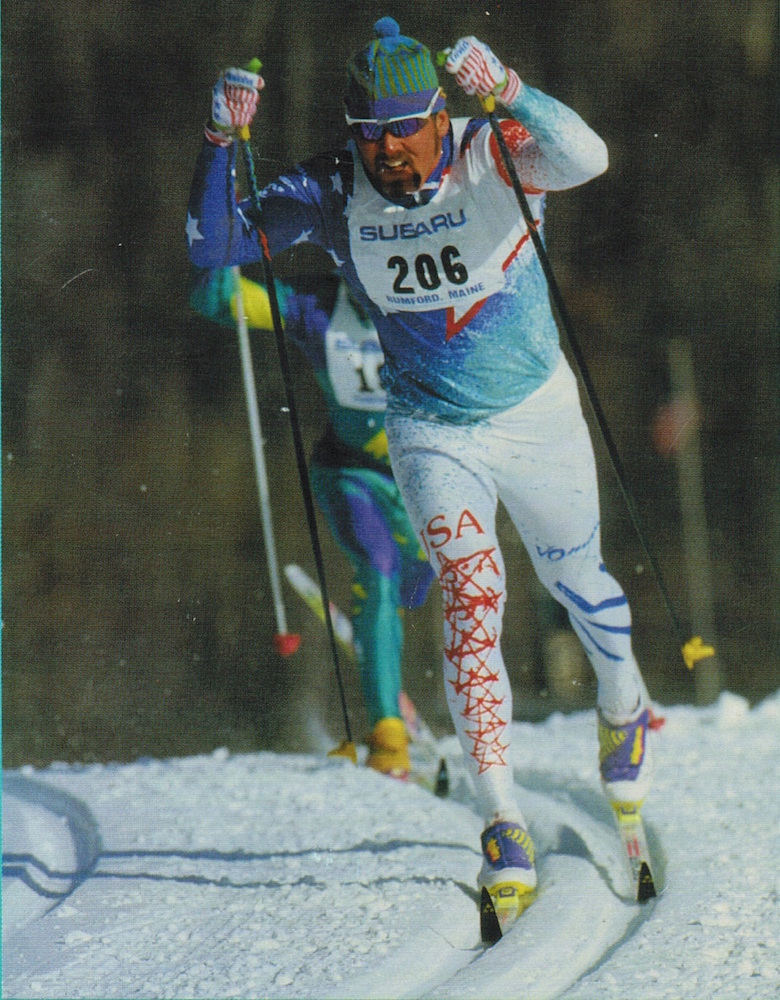
The ’90s force is strong: Ben Husaby (USST) racing at 1993 U.S. Nationals in Rumford, Maine. (Courtesy photo)
At the top of the results sheet, Husaby won both races, the 10 k classic on Nov. 2 and the 15 k skate on Nov. 9. His memory of that fateful week in Fairbanks borders on the eidetic. “That weekend actually stands out for me as one of the more memorable ones in my ski career,” Husaby recently said when cold-called about a race from the Clinton administration.
Husaby, who turns 51 next month, spoke with FasterSkier by phone from Bend, where he works as executive director of the Bend Endurance Academy. (Husaby once cracked that he enjoys being a ski coach because “I get to drive a Ford Econoline van down winding roads in inclement weather.”) Husaby clarified that in his current job he coaches only one skier, national-class athlete Dakota Blackhorse-von Jess; he assists nordic director Bernie Nelson and will go out with other athletes, but says that he is following Nelson’s lead.
Husaby still recalls how fast he skied, but poignantly acknowledges that his timing was somewhat suboptimal.
“I’ll just say, it was the fastest I’ve ever skated, for sure,” Husaby declares. “And you certainly don’t want that to happen in the first week of November, but it did. It’s bittersweet, because it’s the wrong time, but it was amazing. Those two races, they were effortless.”
Husaby speaks with evident emotion about the sensation of skiing so easily:
“So, nobody wants to be a Christmas star, and I was a November star. But, the race course [in Fairbanks] was a very challenging race course, and I blew around that course effortlessly. And that was a really, really cool feeling. I had traditionally struggled in tough skating race courses, and, you know, I walked all over everybody. And so, you know, that was exciting. And one of the things I remember is, how cold I felt being as quote-unquote ‘skinny’ as I was. I was in the low 180s. And I was colder than I had normally been.
“I also remember feeling really light and fleet and dynamic. I remember – and it’s always weird, because when we got back to the hotel – you know, those first races of the year, people are always talking about how they’re going to get better, where they made mistakes… generally everyone wants to downplay their early races. And here I was – I’m looking in retrospect in terms of how fast I really did ski. At the moment I didn’t realize that that was probably as fast as I had ever gone, but in retrospect, I realize, wow.
“There were a couple of World Championship results, there were a couple World Cup results where I was competitive, and probably moving along at the same speed – but this particular weekend, it was completely effortless.”
Husaby had been a member of the U.S. Ski Team from 1991 through 1995, but in fall 1996 was training solo. But he finished ahead of all current USST members in both races in Fairbanks.
“Particularly the skate race,” Husaby enthuses, “I mean, for me to beat everybody by over a minute – I think it was a minute and change – in a 15 k skate. I mean, I never did that. I’m not really sure why.” (Husaby correctly recalls that he beat second-place John Bauer by 1:04 in the skate race.)
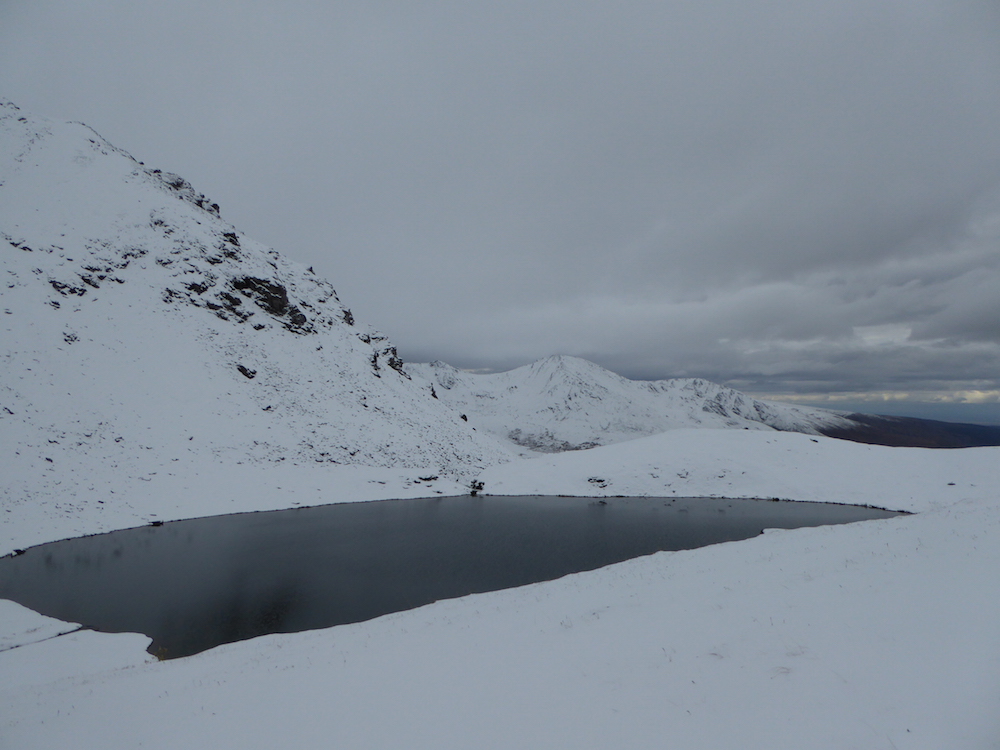
Early-season snow: skiing past Summit Lake, in Hatcher Pass above Palmer, Alaska, on Sept. 23, 2016. (Photo: Gavin Kentch)
At the time, Husaby felt strongly that his performance merited selection for bigger stages: “I do remember being like, ‘God, I wish they would have selected me to go back to the World Cup.’ Because they sent Marcus [Nash]. They took Marcus, not me. And I do remember being like, ‘Dangit, I killed everybody, they should be taking me.’ But it’s always like that – you always think that you should be the one that’s named.”
But he now waxes much more philosophical about the vagaries of team selection. “I’ve had 20 years to think about it,” Husaby now analyzes, no regret or animosity in his voice. “There are a lot of arguments why I should have been chosen for it, and a lot of arguments why I shouldn’t have been chosen for it. It’s just the nature of sport.”
As he left Fairbanks in November 1996, Husaby had high hopes that these results presaged a breakthrough season for him.
“Like any athlete, you think, ‘Oh my gosh, this is the start – it’s really going to happen here.’ Particularly when you’ve had five years of mediocre racing on the World Cup, right? … In the previous five years, I had everything [in World Cup results] from low 20s to, you know, 112th place. And so all of a sudden a result like this comes along early in the season, and I’m thinking to myself, ‘Man, if this is the start of things to come, this year is going to be totally lights out.’ ”
Husaby did not receive World Cup start rights that season, and in fact never raced on the World Cup again. He spent the 1996/1997 season on the domestic Yoko Cup, an inchoate version of the national-level race series that ultimately became the SuperTour.
Despite – or maybe because of – the fact that the Fairbanks races ultimately proved to be a highwater mark of the season rather than a springboard to successful European racing, Husaby frequently uses the experience as a teaching moment for his athletes.
“As much as we really think that we have our finger on the pulse,” Husaby theorizes, “and that we can really dial in when we’re going to be fast, and really pick and choose the big events, and how it’s all going to play out – you never really know when you’re going to have your moment. You don’t know. The body and the mind are really – sometimes they’re diametrically opposed, sometimes they’re incredibly in sync, sometimes one is lined up and the other one’s not. And a huge part about athletic growth is just realizing that you never really know when you’re going to have your moment. So when you do have your moment, hopefully you get something from it, you gain something from it. For me, this was an indicator that my training, the change in training, had an effect, the weight loss had an effect, maybe the release of not being on the ski team any more had an effect.”
“I guess the moral is to pull something positive out of a good race, regardless of when it happens.”
When asked about his strongest memories from his time in Fairbanks, Husaby mentions two things. First, despite the subzero temperatures for the skate race, “I remember that that climb – I felt like Superman going up that far outer climb [on the race course]… I remember charging up it. It’s got like three rises in it.”
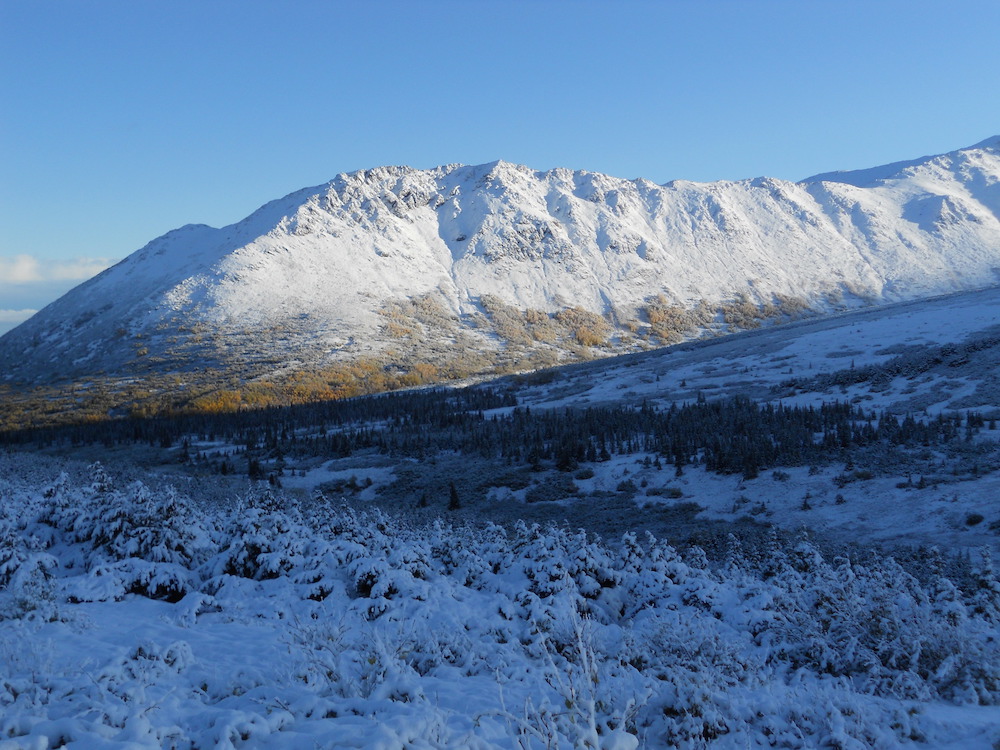
Early-season snow: fresh snow on top of fall colors in Chugach State Park, above Anchorage, Alaska, on Sept. 18, 2015. (Photo: Gavin Kentch)
And second, “I remember that being a very cold week. … I wasn’t a ‘do a loop many times’ kind of guy. I was always an explorer. Well, I spent most of my training time in Fairbanks actually out on the White Bear [Trail] and out on the military roads. I used to bring really crappy skis, just so I could ski on the military roads. But I recall that week being incredibly cold. And my motivation was to ski out to the end of White Bear, look at the thermometer, and then ski back in. Just to reaffirm how cold it really was. That was it. Besides that race, that was my memory of that week.”
In addition to multi-time Olympians, other notable names on the results sheet include “Jason Cork, UAF, 34:23.3,” in 12th, surrounded by several of his teammates from the University of Alaska Fairbanks ski team. Cork was born and raised in Alaska, and graduated from North Pole High School in 1995. He skied for UAF before embarking on a coaching career that ultimately brought him to his current position as Assistant Men’s Coach for the U.S. Ski Team.
Early-season history
The participants may not have realized it at the time, but they were, in the world of high-level ski racing, making history. The race remains the earliest FIS-sanctioned race ever held on natural snow in the Northern Hemisphere, according to the FIS database.
(A FIS-sanctioned race is one whose results can be used to help calculate a skier’s FIS points, “theoretically a universal ranking system for skiers around the world who have never competed against one another.” Generally speaking, a FIS race is held on a course with climbs of specific height differential and grade, as well as a total climb requirement. A FIS race is held on a relatively challenging course, and attracts a relatively high caliber of skiers.)
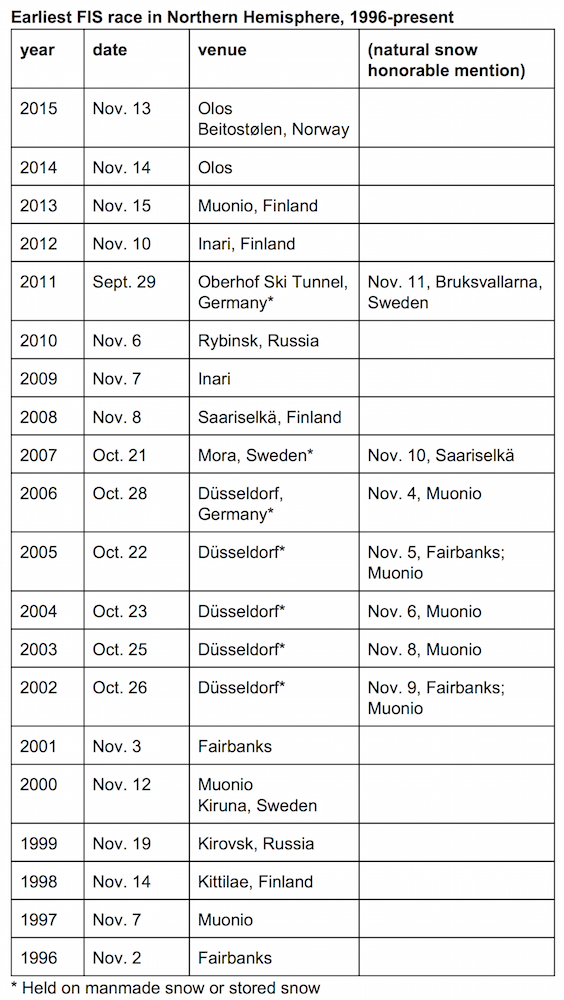
Here are the earliest FIS races from 1996 to present, as listed in the online FIS results database. Amidst a host of early-November dates from several venues across northern Scandinavia, November 2, in Fairbanks, Alaska, stands out as the earliest by a small margin. But Fairbanks shares one significant thing in common with the other names frequently occurring on this list: a far northern latitude. Fairbanks is at, in round numbers, 65 degrees north latitude; Olos and Muonio, 68°; Inari, 69°; Beitostølen, a downright tropical 61°. (The Arctic Circle is at 66°34′.)
Table of year’s earliest FIS race, 1996-2015. (Source: FIS database)
As FasterSkier wrote over a decade ago, Fairbanks in early winter presents a “surreal setting. … The air is still, day after day, and the temperatures hover around zero even though it is barely November.”
(The table distinguishes between natural snow races and artificial snow loops when relevant – it is truly impressive that Mora had a sprint race on a stored ribbon of snow on October 21, but it makes for an apples-to-oranges comparison to Fairbanks or Muonio. Also note that the 1996 cutoff for this table is not artificially hiding an earlier race out there. The earliest FIS race from any of 1990-1995 was held on November 6, 1993 (also in Fairbanks, also the Nanook Challenge). And by the 1990/1991 season, there are only a dozen races listed for the entire season (down from hundreds for 2015/2016), underscoring the limitations of the otherwise remarkable FIS database.)
All that said, simply skiing in Fairbanks in November is a news story on the level of “dog bites man.” September snowfall in Fairbanks is not unusual. Groomed (or at least dragged) skiing in October is expected. Throughout the 1990s, Birch Hill was a mecca for early-season training for high-level skiers from across the country. (The second FIS race of 1996, the 15 k skate a week later, boasted a top-8 of Husaby, John Bauer, Swenson, Loomis, Weaver, Todd Boonstra, Adam Verrier, and Audun Endestad. That’s a lot of good skiers. And a combined 15 Winter Olympics.)
Ken Leary is a longtime Fairbanks local who oversaw the low-key Wednesday Night Race Series ($20 for eight races!) for many years. In an email to FasterSkier, Leary wrote that “the first Nordic ski race of the season in Fairbanks is the annual Wednesday Night Halloween race held on the Wednesday nearest to Halloween.”
Leary added, “To my knowledge, Fairbanks has never had a Nordic ski race in the month of September, but it would have been possible in years 1992, 1993, 1996, and 2015 because of early snowfall.”
(In Anchorage, which like Beitostølen is situated at a balmy 61° north latitude, early high-level ski races on record include “a 15 km APU race that [then Alaska Pacific University head coach] Jim Galanes held on the Spencer Loop on October 25, 2001,” as recounted on local skier Tim Kelley’s blog. More recently, the University of Alaska Anchorage ski team held a time trial on the Spencer Loop a week ago today.)
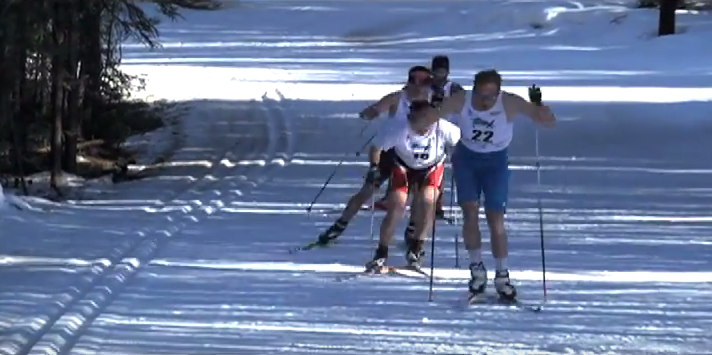
Max Olek (University of Alaska Fairbanks), No. 22, leads eventual winner Lex Treinen (also UAF), No. 18, in a ski race held at Birch Hill in Fairbanks, Alaska, on May 8, 2013. (Photo: YouTube screenshot)
And at the other end of the season, following a winter of roughly average snowfall but then a spring of record-breaking cold, Leary once hosted a race at Birch Hill on May 8, 2013, when the 6:45 p.m. start time occurred a full four hours before sunset. (The YouTube video is worth a quick watch (and not only because a cross-country ski race leads the sports news on local CBS affiliate K13XD Channel 13). It shows racers in shorts on what can only be described as close to 100 percent snow coverage on a 50-degree day. Many skiers have raced in midwinter in far worse.)
What it all means
There is an undeniable draw to being on snow – especially when you’re not supposed to be. (Or maybe especially when others are not, and you can brag on social media that you are.) Rollerskiing is good as far as it goes, but Annie Pokorny once credibly likened it to a rebound girlfriend, writing, “Every spring, Nordic skiers must undergo a reluctant breakup with the perfect girl” and console themselves with mere rollerskiing.
As Chelsea Little previously wrote in a lyrical piece on FasterSkier, she clings to the idea that, “at any given moment, somewhere in the world, there’s great skiing. If I can’t be back home and if it’s not December through March, then a corner of my mind is occupied wondering where that snow is and whether I can get there.” For Swenson, Husaby and a handful of other elite American skiers throughout the 1990s, the answer to “where the snow is” in October and November was consistently Fairbanks, Alaska.
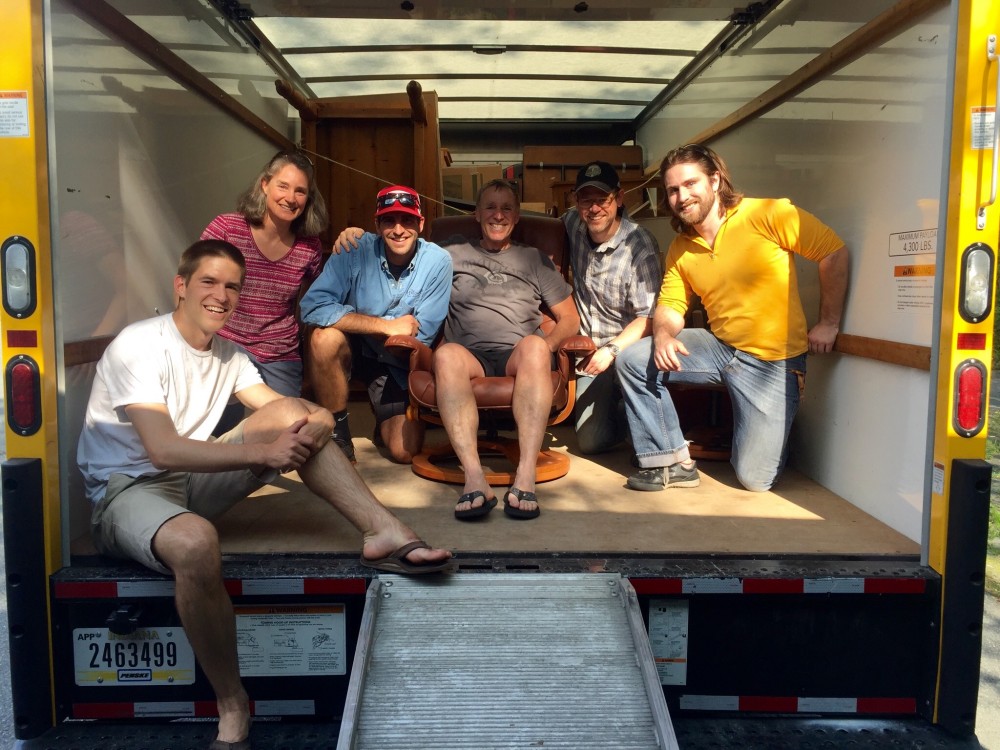
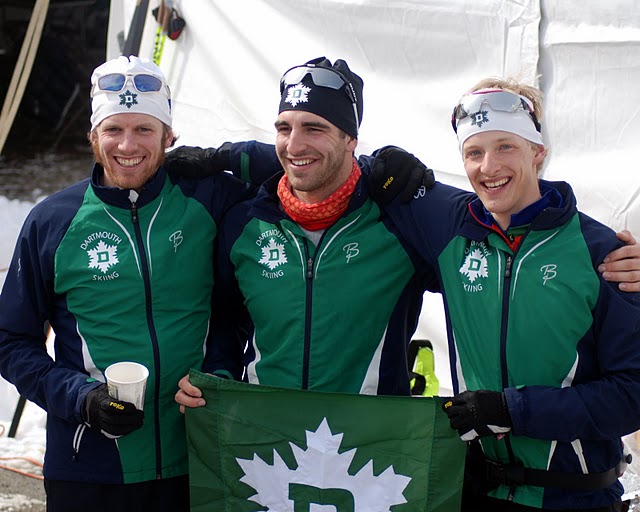
(From left to right) Austin Caldwell ’14, Scottie Eliassen ’90, Sam Tarling ’13, Ruff Patterson, Erik McEwen, and Leif Johnson ’13 in the back of Patterson’s U-Haul last Tuesday, May 24, prior to Patterson’s departure west. (Photo: Sam Tarling)
In late March, Ruff Patterson, 61, announced he was stepping down as head coach of the men’s nordic team at Dartmouth. This is a story of his impact and legacy as a coach, first as a U.S. Ski Team assistant and later at Dartmouth in Hanover, N.H.
“There were no non-heroes out there today.” — Ruff Patterson, after a four-hour rainy run with the Dartmouth men’s nordic team, circa 2007
***
Twenty-seven years ago, a group of men convened in the basement of Robinson Hall, home of the Dartmouth Big Green ski team. Veteran faces intermingled with those of eager newcomers — including the likes of current U.S. Ski Team Head Coach Chris Grover.
Wisecracks and an accompanying chorus of chortles percolated amongst those assembled, drifting up into the stairwell. A few shuffled their feet as they awaited their coach’s arrival for the first fall practice of the ski season.
However, the figure that eventually greeted the gang beneath the building’s floorboards was not that of John Morton — the coach who recruited Grover the prior spring and whom Grover expected to work with during his four years of undergraduate study at Dartmouth.
That autumn afternoon, September 1989, the individual who approached the group was as novel to the Dartmouth ski team as any of Grover’s fellow freshman teammates. With time, however, he would become synonymous with the school’s ski program.
“This was all happening pre-internet, pre-email, pre-mobile telephones,” Grover on the phone of his recruiting process to Dartmouth. “There was never any sort of news release or anything that went from Hanover to where I grew up in Anchorage, that would’ve said, ‘Hey, by the way, John Morton quit and there’s a new coach named Ruff Patterson and he’s going to be taking that coaching place.’ So here I was that following September, expecting to see John Morton show up for practice, when Ruff Patterson rolls in … That was an interesting transition. We were all getting to know somebody new on the first day.”
The Patterson Siblings, Sun Valley and the USST
“You gotta love it!” — Ruff Patterson on skiing, racing and training with the Dartmouth men’s nordic ski team, circa 2013
Situated nearly 6,000 feet above sea level, the city of Sun Valley, Idaho, holds a unique history as one of the first destination ski resort areas in America. Famed names such as Dick Durrance, Ernest Hemingway and Picabo Street have carved the region’s mountainside slopes and the locals’ love for skiing, particularly alpine, goes almost unparalleled.
Ruff Patterson coaching with the U.S. Ski Team in the 1980s. (Photo: Gordon Vermeer and Eric Packer)
This held especially true for Susie, Pete, Barbie and Matt Patterson, Ruff Patterson’s four younger siblings. Surrounded by Idaho’s Sawtooth Mountain Range, and with support from their parents Joannie and Jim Patterson, all five developed a deep devotion to skiing. To many in the community, they became known as Sun Valley’s “First Family” of skiing.
In a way, however, Ruff was the ‘black sheep’ of the household. Susie became a two-time national champion alpine skier, Pete qualified for the Winter Olympics in downhill skiing twice, and both Barbie and Matt established themselves as adept alpine skiers. Meanwhile, Ruff chose a slightly different ski path than his siblings. He chose cross-country.
“[In] high school, I had a brother and sister who were both traveling, very young, for the national alpine team and I was kind of the guy in the background helping them get through school and fixing skis and stuff like that,” Ruff said in a phone interview in April, shortly after he announced his retirement from Dartmouth. “Contact with people, having to deal with traveling and and competing started really young for me, but [ski coaching] was not something I planned on doing after college.”
As a student enrolled at the University of Colorado Boulder (CU), Ruff originally intended to become a doctor. He placed himself on the pre-med track and graduated with a degree distributed in the fields of biology, chemistry and psychology. Ruff also competed for the Buffs’ ski team. During his undergraduate years, CU won four NCAA Championship titles — though in his senior year the title, ironically, ended in a two-way tie with Dartmouth.
Despite his initial plan, post-grad life did not leave Ruff pouring over MCAT entrance exams or medical-school applications. Instead, he found himself back in his beloved hometown, ski coaching with Rob Kiesel, the founder of the Sun Valley Ski Education Foundation (SVSEF) nordic program.
The first few years of coaching for Ruff were far from glamorous. He spent most of his time supporting the SVSEF junior racing team and acting as a professional porter and nordic roadie for the U.S. Ski Team (USST).
“Rob hired me as the national team coach, and you know when you start out, you’re carrying a lot of ski bags and traveling a lot,” Ruff said. “Those first years I was traveling internationally with the team and just doing a lot of the groundwork. I don’t think a lot of the groundwork has changed for those poor guys. They earn every cent.”
Kiesel, the man who hired Ruff, influenced Ruff’s path into coaching. As Ruff put it, Kiesel was more than just a family friend. Kiesel was Patteron’s role model and mentor.
“I wouldn’t be coaching today, nor begun coaching if it weren’t for Rob,” Ruff previously wrote in an email after Kiesel passed away in 2011. “Both my sister Susie and brother Pete wouldn’t have had the Alpine skiing careers they had if it weren’t for Rob. My brother Pete wouldn’t be guiding in Greenland or Nepal if it weren’t for Rob. More importantly, Rob was an integral part of our family.”
As Patterson’s grip on the nordic race world grew, he began to move up in position and expertise. For 10 years, he worked for the USST, a better part of those alongside Mike Gallagher. While co-coaching with Gallagher, Ruff assumed the role of “primary assistant” coach to the USST, often working with the women.
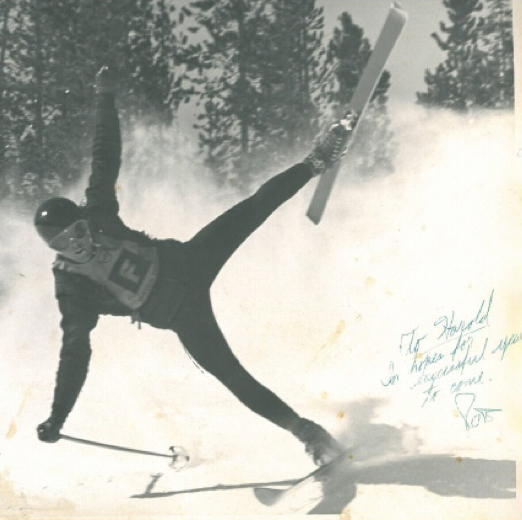
Rob Kiesel, Patterson’s coach, showing off his downhill skills at Winter Park in 1964 (Photo: Harald Bjerke)
“[Mike Gallagher] and I would worked really closely together and I was sort of his primary assistant as the year grew on,” Ruff said. “When we’d split up, I would end up taking the women and there were a few years where I was actually labeled the women’s coach. But for the most part, he and I were more of a team and I was more of his assistant during my primary coaching year.”
Ruff’s stint with the USST brought him to the Olympics, alongside Kiesel at the 1980 Winter Olympics in Lake Placid, N.Y., and with Gallagher at the 1984 and 1988 Games in Sarajevo, Yugoslavia and Calgary, Alberta, respectively. He mentioned working alongside U.S. Ski Team coaches Torbjørn Karlsen and Peter Ashley as major influencers in his career as well.
His work for the USST helped women like current Methow Valley Nordic Team head coach, Leslie Hall –the sister of Patterson’s future Dartmouth College co-coach, Cami Thompson-Graves — to the Olympics.
“He was one of the main coaches at the 1988 Olympics, my first Olympic experience and the main memories that stick with me are his smile, laugh and bad jokes!” Hall wrote in an email. “My relationship with Ruff has evolved so much over time, from being an admiring junior who wanted his attention and help, to being a friend on mountain biking trips to Moab, to being the sister of his co-coach at Dartmouth.”
He also helped current Middlebury College assistant coach and University of New Hampshire alum Patty Ross, and Bates College alum Nancy Fiddler to Olympic levels of racing.
“Ruff was always there with a joke or someway to diffuse a tense situation,” Fiddler said on the phone. “Everybody gets so caught up in [skiing] and if you were feeling kind of involved in a way that wasn’t healthy, he just brought you back and reminded you that, ‘Hey it’s ski racing it’s supposed to be fun, and if you’re not having fun, what the hell are we doing.”
Changes To Hold Onto: Skating and the Mental Breakthrough
“Weight shift, weight shift, that’s the key.” — Ruff Patterson during a skating technique workout with the Dartmouth men’s nordic ski team, circa 1989
Little did Bill Koch know that when he entered Sweden’s 1980 Worldloppet marathon, he would rock the ski world forever. During that winter’s fated 50-kilometer ski race, Koch witnessed what has since become a staple in cross country skiing: the skating technique.
After Koch began to implement skate skiing into his own national and international races, the sport changed forever — a change Patterson perceived first-hand.
U.S. cross-country legend Bill Koch pioneering the skating/freestyle technique in the ’80s. (Photo: Peter Ashley)
“I was incredibly fortunate to live through the skating revolution,” Patterson said. “To see the live world change, everybody else’s world change and how people react to that, that whole thing was, man, something to live through.”
“You can sort of compare it to — right now there’s this big double poling thing,” he added. “Skating was very much the same thing. It was a complete unknown. So for everybody, including sports staff like myself, it was like, ‘What’s going to happen here?’ ”
What happened was rattling to some and rectifying for others. Patterson pointed out that he saw many attempt to prevent the change, but the skating technique, ultimately was here to stay.
“You know, they were trying to do everything possible to make it less possible to skate,” Patterson said. “A lot of the controls they tried were almost laughable now.”
As Patterson sees it, there are certain circumstances when evolution of the sport is inevitable. Occasionally, adaptation outweighs resistance.
“What I’ve discovered during those periods is … if you’re here to play the game, you have to figure out a way to go with it,” he said.
Skating and double poling aren’t the only areas Patterson says he has seen development in skiing. To Patterson, the mentality of American ski racers is what has changed the most. Especially for the U.S. women.
“When Kikkan [Randall] opened the door, the barrier, for Americans to do well in Europe, I think the whole mental game changed,” Patterson said. “I’m hoping that this mindset moves into the boys’ group [in the U.S.], that mentality of just, ‘Hey, we can compete and win against the big boys and the big girls.’ That’s probably one of the most significant changes I’ve seen since I’ve started coaching.”
Dartmouth Dudes and Loving What You Do
“Boys, I want medals!!” — Patterson to the Dartmouth men’s nordic ski team, circa 2012
Freezing rain. Mosquitoes. Heavy, humid heat. The Northeast Coast makes many westerners go weak in the knees. Patterson was one of them. Located in the heart of Hanover, N.H., a move to Dartmouth promised Patterson the very bipolar weather, bug bites,and Vitamin-D deficiency he dreaded the most.
Ruff Patterson discovered that the eastern biking may make up for his dislike of East Coast climate. (Photo: Dartmouth Ski Team Facebook)
“When I first took the job I was a western guy and I thought, if I lasted three or four years I’m going to be lucky,” Patterson said. “I was terrified of bugs and humidity and once I got here the bugs and humidity were terrible, but then I realized that the road biking and other stuff in the East were just incredibly great. But I never planned on being here as long as I did.”
Patterson’s original estimated three-to-four-year window turned into seven, soon 11, and eventually 27. Overcoming his fear for East Coast climate was only part of it. His deepening devotion to the Dartmouth men’s team also drew him to stay.
“I just kept saying over and over again ‘I love what I do,’” he said. “Just absolutely love what I do and I just felt that it stayed like that all the way through.”
Patterson’s philosophy to love what you do and see it through transferred to his athletes. During his 27 years at Dartmouth, he coached three men to individual NCAA Championship titles — Glen Randall in 2008, Sam Tarling in 2011, and Patrick Caldwell in 2015 — and he also helped Dartmouth to an NCAA team title in 2007, with All-American athletes Mike Sinnott and Ben True.
“When I came in as a freshman, I was very hesitant to fully buy into his philosophy of training,” Tarling, a 2013 grad, wrote in an email. “After my first year working with Ruff, our relationship strengthened and I decided to stay in Hanover for the summer and work with him. I discovered that some of the silly things we did in training had the most influence on my performance, and that what seemed like random workouts and drills had a purpose. I ended up staying every summer after that to work with Ruff.”
Tarling was not the only athlete who at times questioned some of Patterson’s practices. Both Grover and Carl Swenson, a 1992 graduate and three-time Olympian, recalled recovery runs with Patterson as conclusively easy, in spite of athletes’ attempts to do otherwise. Patterson wanted his skiers to be fast when they needed to be and to step back and enjoy training the rest of the time.
“We’d go out for a ‘Ruff Waddle’ recovery run,” Swenson said. “Ruff would make us run behind him. It was to teach us to go easy … because all we wanted to do was race every workout.
“He was just the right coach at the right time for me,” Swenson added. “He kept me at it, really. I think it’s a period where a lot of people get interested in other things and, as everybody knows it takes some time to develop as a distance athlete, and he really kept me on track as best as anybody could have in a period when I was not on track by any means.”
Gaining credence with athletes like Tarling and Swenson and witnessing their progress, for Patterson, was another piece of what made college coaching worthwhile.
Just a few of “the kids” as Ruff Patterson (not shown) calls them (left to right): Nils Koons, Sam Tarling, and Eric Packer (Photo: Ruff Patterson)
“Winning over athletes and gaining their trust, I can’t tell you the rewards behind something like that,” Patterson said. “That’s just another piece of this overall puzzle, but sort of everything. Once again, it’s the people and stories behind them that have made it for me.”
Though Tarling, who is now working as a software engineer in Denver, Colo., indicated he’s “happily enjoying being a recreational athlete for a change,” he still feels indebted to Patterson for all that he’s helped him achieve.
“Our relationship began with many conversations about how we could best work together to help me achieve my goals in ski racing, but progressed to the point where Ruff was much more than my ski coach,” Tarling wrote. “He was – and is still – my mentor, my confidant, my hero, my friend.”
Patterson was much more than a coach to many of his athletes. He was a pillar, the adviser and ally searched for not only on the trails, but off them as well. He did not force his athletes to grow. He fostered them to take the steps on their own. As numerous athletes indicated, his door was always open to whoever happened his way.
“Ruff impacted my life on so many different levels beyond skiing,” Patrick O’Brien, current head coach for Stratton Mountain School T2 Team and 2010 graduate, wrote in an email. “He wanted you to grow as an athlete and an individual. He was always there for support when you needed him but understood many decisions or choices had to be yours alone to make. He asked for, and brought out the best people had to offer.”
Patterson did bring out the best people had to offer, but in ways beyond just results. He saw value in every athlete, carnival circuit caliber ski racer or not.
“The guy who never makes it, the ones who just make these incredible strides … the really talented guys,” Patterson said, “All athletes are rewarding.”
Ruff Patterson on Mt. Moosilauke in New Hampshire’s White Mountains with the Dartmouth team (Photo: Gordon Vermeer and Eric Packer)
Patterson’s ability to work with athletes of all kinds, stems from his coaching style. Passionate, patient, perceptive, he held the unique capacity to turn the complexities of cross country skiing into common sense.
“Ruff has that elusive quality you see only in the very best of coaches — he makes skiing seem simple,” Packer, who graduated in 2012 and is now racing for Alaska Pacific University (APU), wrote in an email. “He has the ability to use just a single suggestion to make really dramatic improvements in your skiing.
“Hand in hand with that, Ruff really believes in the importance of building a quality training group, and holds that at the core of his coaching philosophy,” Packer added. “You learn from the group, push the group, and rely on the group. In an atmosphere like that, when everyone is working together, pushing each other in a competitive but also fun atmosphere, everyone improves.”
Humor and having fun was also a training philosophy greatly prized by Patterson.
“I call them the kids.The gang. The team. I’ve been so lucky to be able to work with these guys. Even the ones that have been nightmares, looking back that’s what’s kept me here. The people, for sure.” — Patterson on his 27 years as the Dartmouth men’s nordic head coach
“One of my favorite memories started about midway through my time at school when he would finish every pre-race meeting with a story from his previous coaching experiences,” O’Brien wrote. “All would have you rolling over laughing and reminding you that although the sport may change over the years, the spirit of it never did. It made you feel connected the people who have come before you, understanding the challenges they faced were the same as the ones in front of you now.”
However, Patterson’s impact on the nordic community cannot be pinned solely to skiers he worked with directly. As Sinnott pointed out, numerous of individuals have been influenced by the former Dartmouth head coach, whether he realizes or not.
Ruff Patterson
In two words or less… “A Mentor” — Thompson-Graves “Unassuming” –– Tarling “Wise” — Tarling “Passionate”— O’Brien “Remarkable”— Sinnott “Solid”— Grover “Supportive”— Grover “An Icon”— Packer
“You go through his office and he’s got handwritten thank you notes from John Nystad from when John Nystad was skiing for UVM [University of Vermont],” Sinnott said on the phone. “Ruff had these powerful impacts on skiers that he wasn’t even mentoring or that weren’t in his program.”
With the women too, Patterson was — and still is — a hit.
“Ruff used to get more Valentine’s Day cards than anyone else on the team,” Sinnott reflected, referring to the Dartmouth Carnival tradition of ‘Carni Crush.’ “Everyone on the circuit felt the warmth and the magnitude of Ruff. And that’s the cool thing. It’s not just the people that are obvious on a piece of paper, but it’s everyone else that might have glossed by him.”
While many of Patterson’s athletes cite him as the reason they are where they are today, Patterson is adamant that his athletes are the ones who’ve kept him in the game.
“I call them the kids,” Patterson said. “The gang. The team. I’ve been so lucky to be able to work with these guys. Even the ones that have been nightmares, looking back that’s what’s kept me here. The people. For sure.”
Dartmouth’s Dynamic Duo: Patterson and Cami Thompson-Graves
“Are we having fun yet?” — Patterson to the Dartmouth men’s nordic ski team, circa 2010
Bonnie and Clyde. Ernie and Bert. Starsky and Hutch. Cami and Ruff. While not many modern day duos find themselves in competition with the infamy of the previous pairs, Cami Thompson-Graves and Patterson are two that do.
In a coaching partnership that’s lasted longer than some marriages, the two have carried each other through the numerous highs and lows of coaching a Division I college ski program.
“We’ve been together longer than most people have been married,” Patterson said. “We’ve definitely had our ups and downs, but because of it, the two of us have become incredibly close.”
Though the two admit they’ve spat like siblings at times, they also agree that what they have gained out of their 27 years together is irreplaceable.
“She’d be the first one to tell you, it’s not like it was all wine and roses the whole time,” Patterson said. “ It’s just we’ve been through a lot together.”
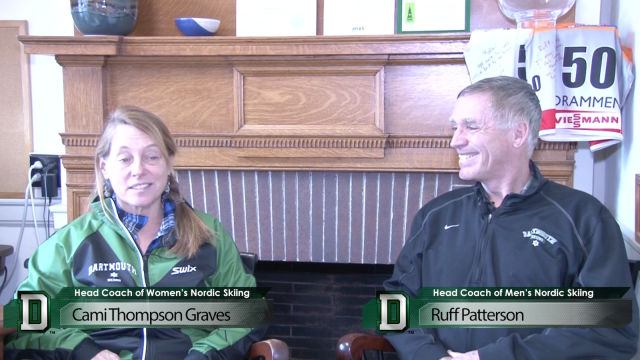
Dartmouth’s longtime duo Cami Thompson-Graves (l) and Ruff Patterson during a 2015 interview .(Photo: DartmouthSports.com)
The two have also supported each other — and their teams — through the loss of Dartmouth athlete, teammate and friend, Torin Tucker. Tucker, who died of a heart anomaly while competing at the Craftsbury Marathon two years ago, was also from Sun Valley and described by many as having a similarly contagious smile.
A rare verve to come across, no loss the magnitude of Tucker’s is easy. For Patterson, learning to live in the memories and moments of Tucker as the epic adventuring, intellectually curious and compassionate mountain town-er he was, no matter the time it took to get there, helped he and the Dartmouth community move forward with Tucker in their hearts.
“There’s no way you can tell somebody to get over stuff,” Patterson said. “You just have to deal one day at a time, one minute at a time.”
The support and history between Thompson-Graves and Patterson, therefore, goes far beyond just van rides, wax benches, and debates over who’s who.
“We had some great moments, talked about skiing endlessly and also fought and bickered like siblings at times,” Thompson-Graves wrote in an email. “But, along the way, there were many fun race days where we worked hard, shared our nerves, and when things had to come together, they did!”
More than anything during their time together, Thompson-Graves was a firsthand witness to the dedication Patterson put towards his athletes and coaching.
“Ruff loved his guys, they meant everything to him,” Thompson-Graves wrote. “He was there, day in and day out and knew them all well. Some of them might have driven him crazy but, even with the frustrations, he loved the times when it all came together for them.”
All in all, it takes a special circumstance for two individuals to work together toward a common goal for that length of time.
“When you sum it up, I wouldn’t have traded that for anything,” Patterson said. “Because being able to figure out a way for two quite different people to work together and do as well as we have done together … boy, that doesn’t happen very often in life.”
What’s Next?
“Don’t overthink it.” –Ruff Patterson to the Dartmouth men’s nordic ski team, circa 2006.
Forty years ago, Patterson — clad in a black graduation cap and gown — strolled across the CU stage to receive his diploma. Like many of the student athletes he would eventually coach, he had post-college plans that would inevitably change, a passionate fervor for cross country skiing, and an anything but linear trajectory ahead.
Forty years later, with his final cohort of college senior skiers before him, not much has changed. As Patterson departs Dartmouth, there is a piece of him that feels as if he is once again striding across the graduation stage, leaving school behind to discover what’s next.
“It wasn’t until the day before I resigned that I actually knew I was going to do it,” Patterson said. “I didn’t sleep that night, I can tell you that much.”
“It sort of feels like I jumped off a cliff doing this,” Patterson said of his resignation. “I was in a little bit of a shock for a few days, but I’m going to sell my place here, pack up a U-Haul and return west, which I’ve been wanting to do forever. And then stir the pot up a little bit and try to find something else to do. I have no idea what that’s going to be. I feel like a college kid again.”
2015 NCAA Champion Patrick ‘Paddy’ Caldwell (l) with coach Ruff Patterson. (Photo: Dartmouth Ski Team Facebook)
Even if Patterson is now physically distanced from Dartmouth — he headed west last week Tuesday — his legendary role and presence is not. His impact extends beyond Dartmouth, into the lives of past, present and future mentees — some of which he will never meet in person. Many he will have infiltrated with his coaching philosophy alone.
“Ruff was really responsible for creating that atmosphere with the [Dartmouth men’s] team, in terms of camaraderie he created in the group,” Grover said. “And certainly, as you know, that’s a big thing for us these days with the USST. The team and the athletes are quite successful on an individual basis because we tend to try to build a family atmosphere around the team. Ruff really did the same.”
Patterson’s stamp survives in the USST, the skiers who are now software engineers, lawyers, coaches, writers and more.
“You know, I came into a great group early on,” Patterson said of his first few years coaching at Dartmouth. “It took a while to establish my own style. It doesn’t mean that the style that Mortie [John Morton] had way back when was, there’s no way you could say it was bad or good … I absolutely know that the next person that’s going to come in in my place is going to be exactly the same; have their own style … I got to put my stamp on things and the next person here is going to put their stamp on things.”
Semi-uncertain of what his future holds beyond bike trails, mountain towns, and some RV roaming, Patterson is certain that Dartmouth has green grass ahead and he, a wanderlust for western blue skies.
“I know they’ll find somebody good,” Patterson had said of prospective coaches for the Dartmouth head coaching position, prior to the hiring of Brayton Osgood in May. “And I know that the school will always support skiing … My personal opinion is that they’re going to just keep going and there’s nothing wrong with that … Field of dreams.”
Two years ago, Austrian cross-country skier Christian Hoffmann removed himself from the international-racing scene by retiring. That didn’t keep him out of headlines.
On Monday, Austria’s anti-doping agency, NADA, handed the world champion a six-year ban from the sport. The decision was retroactive from 2009, in which Hoffman had been suspended two years for being associated with a Vienna blood bank, Humanplasma.
NADA most recently found the 36-year-old Hoffmann guilty of having his blood taken for doping purposes at the Vienna lab between 2003 and 2006, and tagged on a ban of four years for co-owning a centrifuge for blood enrichment.
Hoffmann’s lawyer, Hans-Moritz Pott, told reporters they would fiercely fight the verdict. He reiterated that Hoffmann never tested positive for a banned substance, and said they would appeal the case to an independent arbitration committee, and ultimately, the Supreme Court of the civil-court system.
“Not one violation of the rules has been proven,” Pott told the Austria Press Agency. “(Hoffmann) says has he has competed cleanly for 23 years and he can’t let them do this to him.”
After prosecutors insisted they wanted to keep Hoffmann from competing in the 2014 Olympics, Hoffmann told the Upper Austrian News they had been trying to take him down for years.
“They wanted to make sure that I never absolve (to) race,” Hoffmann said, according to a translation. He has not indicated he would like to make a comeback.
In 1999, Hoffmann was part of Austria’s world-championship winning relay. He took gold at the 2002 Salt Lake Olympics in the 30 k, after the initial winner, Johann Mühleggof Spain, failed a doping test.
Ten Austrian cross-country skiers were tested at the Salt Lake Games for using illegal substances, but all tested negative. Hoffman’s former coach, Walter Mayer, received a 15-month jail term in August for his connection to doping activities.
Hoffmann and teammate Roland Diethart, who received a lifelong Olympic ban after Turin (2006), were supposed to appear at the Mayer’s hearing. They did not show up, along with biathlete Wolfgang Perner, who was also banned from the Olympics.
A former ski official, Johannes Obererlacher, claimed to have walked in on Mayer while he was giving Hoffmann a blood transfusion at the 2002 Games. The International Olympic Committee questioned Hoffmann and cleared him of the accusation, the AFP reported.
Most known for his Olympic medal, Hoffmann anchored the Austrian men’s relay that edged the Americans for fourth by six-tenths of a second. Carl Swenson raced him to the finish.
In February 2002, Swenson told ESPN he was excited to hang with Hoffmann and test him in the final stretch.
“I wish I had a little fresher legs. I think I could have pushed him all the way to the finish,” he said.
Now a member of the U.S. Anti-Doping Agency, Swenson is committed to cleaning up the sport. While the USADA board member couldn’t comment on behalf of the agency, he offered his reaction to Hoffmann’s ban in an email.
“It’s good news when a doper gets caught,” Swenson wrote. “It’s sad to think of the people that were cheated out of a better result.
“There will always be racers who try to cheat, personally I don’t give much thought to what they got away with,” he added. “I get some satisfaction knowing that every cheater walks away worried that he will be exposed one day.”
So far, Hoffmann spent some $14,000 euros — about $18,800 dollars — on legal fees. His attorney said the money didn’t matter.
“We benefit from everything, even if the costs are huge,” Pott said.
Finances may not be a concern for Hoffmann, who shared the cost of a $100,500 blood centrifuge. Athletes testified he lent the centrifuge to them, which is a criminal offense under Austrian anti-doping laws.
Based on his offenses, the NADA Law Commission gave Hoffmann the minimum sentence of four years. He could have received a life in jail.
In a press release, the Law Commission stated its decision considered World Anti-Doping Agency standards. Citing WADA code, the Austrian disciplinary commission decided not to cancel all of Hoffmann’s results.
Tracing the first “material time” in which Hoffmann’s performance was affected and voiding his results accordingly would be “an impermissible double possible punishment,” the NADA press release stated.
The head coach of Canada’s national cross-country ski team, Justin Wadsworth was also on the American’s fifth-place relay at the 2002 Games. He thought the Austrian’s ban was a bit comical, considering Hoffmann retired from the sport in 2009.
“We knew he was doping,” Wadsworth wrote in an email. “I mean we had no hard evidence as athletes, but we knew it that same way we knew Mühleggand others were doping as well.”
Around that time, several cross-country skiers were convicted. In 2001, six Finish skiers were caught using a banned substance: Jari Isometsa, Harri Kirvesniemi, Janne Immonen, Myka Myllyla, Milla Jauho, and Virpi Kuitunen.
“It sucked then, and it still sucks now,” Wadsworth wrote. “It really takes the purity and beauty of sport and diminishes it to the greed and other things in life that plague our society today.
“I guess as a clean athlete you must ski for the love of the sport and let the chips fall where they may,” he wrote. “I take pleasure watching clean athletes win today, because I know there’s still doping going on, and when you can win clean there’s another reason to celebrate.”
A current U.S. Ski Team member, Kris Freeman competed on the men’s relay in his first Olympics in 2002.
“Everyone who watched Hoffmann ski knew he was doped to the gills,” Freeman wrote in an email. “(The ban) should have been handed down a decade ago.”
He pointed to the case of Estonia’s Andrus Veerpalu, who retired from the sport in January and received a three-year ban for doping in August. The International Ski Federation (FIS) decided to bar the 40-year-old from competing until Feb. 23, 2014, the last day of the Sochi Winter Olympics.
“(The FIS) waited until one of their stars was effectively retired before handing down a statement punishment,” Freeman wrote.
Until a cheating star is penalized in his or her prime, Freeman said he wouldn’t be satisfied.
Because the FIS wasn’t involved in Hoffmann’s case, Sarah Fussek, assistant to the secretary general, couldn’t comment on specifics. She wrote in an email there was no indication the FIS would be involved in an appeal.
While Hoffmann’s case wasn’t final, Fussek wrote it could not be compared to others, but she referenced a few instances in which an athlete never failed a drug test yet was convicted. In 2011, the FIS handed Nikolay Pankratov (RUS) a two-year ban for possessing drug-injecting equipment. Denis Vorobiev (BLR) received a similar ban in 2005 when human growth hormone was found in his waist bag.
Swenson wrote that “more sophisticated dopers” often caught with evidence besides a positive drug test.
“The more difficult it becomes to dope, the more people must be involved, and the more likely that someone will talk,” he wrote. “I don’t know the specifics of this case, but it sounds like expensive equipment, technicians and doctors must have been involved. That is hard to hide.”
This article is the second installment of the ‘Where Are They Now’ series, made possible through the generous support of Fischer Sports. Learn more about their products at www.fischersports.com.
Three-time Olympian Carl Carl Swenson made the trip from southern New Hampshire to the 2010 Boulder Mountain Tour in Sun Valley, Idaho, where he finished eighth competing for Steinbock Racing. Swenson hopes to return to the race this winter. Photo courtesy of Toko.
More than 100 miles from New Hampshire’s White Mountains, Carl Swenson sat in his office in Dover, N.H., pouring over sexual-assault statutes on a recent November afternoon.
It wasn’t the most glamorous task — figuring out how to defend his clients as a criminal-defense lawyer for the New Hampshire Public Defender agency — but he knew it was important to represent those who could not afford an attorney.
After decades of high-level racing, with trips to three Olympics as a cross-country skier and several Mountain Bike World Championships, Swenson chose the new career for several reasons. For one, he needed another challenge.
The studying, preparation and performance side of being a public defender fulfilled that need. He also wanted to shift his focus, and after 15 years of essentially living out of a duffle bag, he wanted to belong to a community.
Upon graduating the S.J. Quinney School of Law at the University of Utah three years ago, Swenson landed a job in Strafford County in his home state of New Hampshire.
Swenson after winning the first Kismet Cliff Run, a five-mile trail race in North Conway, N.H., in September 2009. Photo courtesy of Kismet Rock Foundation.
Driving home from work to his apartment in downtown Portsmouth, the 41-year-old Swenson spoke on the phone about how he ended up on the seacoast. Born in Corvallis, Ore., he grew up in North Conway, N.H., in the heart of the White Mountain National Forest.
There in the Whitaker Woods area behind his house, he won the state nordic skiing title as a ninth grader at Kennett High School. He spent his junior and senior years a little farther south at the Holderness School in Plymouth, where shared a dorm with Tour de France star and recently self-proclaimed doper, Tyler Hamilton. (Swenson said they weren’t close).
Swenson attended Dartmouth College in Hanover, N.H., where he was a two-time ski team captain and political philosophy major. Upon graduating in 1992, he headed west to Colorado and also lived in Utah before retiring from the sport in 2007.
Coming back east wasn’t exactly the plan, Swenson said, but he had no complaints.
“The whole goal here is to serve my clients,” he said of his life as a lawyer. “I’m part of a system that has all kinds of problems and issues, but it’s very engaged in real life and the community. I do find that rewarding, that I’m able to be effective in something and it’s not about how fast I can ski and ride my bike.”
Like many athletes who find a new career after sports, Swenson said he wanted to work in a field that was both exciting and self-driven — not necessarily self-centered, like racing was.
At the same time, performance remained key. Swenson said he appeared in the courtroom almost daily, which required tons of preparation and a constant, all-out effort.
“It’s almost like preparing for a big race, but much more nerve-wracking,” he said. “You have to get up, or in a sense, compete against someone in the courtroom. … It’s a good sign when you care enough to get anxious about something, and at the end of it, it definitely feels better to have gone through all that.”
Swenson usually starts his days with an appearance, which can last anywhere from a half hour to all afternoon. When he gets out around 4:30 p.m., it’s usually all he can do to take his mind off work.
While he tried to run or road bike daily and lift weights a few times a week, Swenson said his job sometimes infiltrated his home life and consumed his weekends with research. Fortunately, his girlfriend Katie Gould, a Tecnica Outdoor product and marketing manager, helped him get out.
Trips are harder to plan now, Swenson said, yet he managed to swing a recent mountain bike trip in Burke, Vt. There, he had to borrow a bike and explained that he never replaced his old ride after it broke when he was in law school.
For many, that might seem logical — good mountain bikes are expensive — but for a former pro who now likely made at least three times what he did during his summer-mountain-bike/winter-skier career?
“I never got around to buying a mountain bike out here,” Swenson said. To him, Portsmouth was better for road riding.
Better in Time
When Swenson made up his mind to retire after the 2006 Winter Olympics in Turin, Italy, he had an idea what his future would hold. He applied to law school before the start of the season, and at 36, knew he would be older than most students.
That bothered him about as much as it did when he raced: hardly.
The oldest member of the U.S. Ski Team, Swenson was a pedigree all his own. In 1996, he made the bold decision to pursue a professional mountain-bike career and continue to ski race internationally in the winter.
Former USST teammate Patrick Weaver said Swenson’s love of training and the lifestyle made that possible. He was a hard worker who wanted the year-round rigors, whereas most elite athletes wouldn’t consider putting themselves through 300 days on the road a year.
“You’re never really sleeping in the same place for more than a week or so, and after a while, you start to question why you do it,” said Weaver, now the head nordic coach at the University of Vermont.
While Swenson’s schedule was about twice as packed as most skiers, he thrived off it, keeping some belongings in a storage closet near the USST headquarters in Park City, Utah.
“For a while there Carl was a minimalist,” Weaver said, with a laugh. “(He) didn’t want a computer or a cellphone or an address … whatever most normal people had.”
When Weaver decided to buy a house in Bend, Ore., Swenson couldn’t understand why. About 30 at the time, Weaver felt it was natural to think about life after skiing, as did other teammates who were about the same age.
Not Swenson.
Two years after he became a professional mountain-bike racer — at the ripe age of 28 — Swenson placed 31st at Worlds. The next year, he won silver at the 1999 Pan Am Games and was the 2000 national champion.
While the transition between sports wasn’t initially easy (he noted several weeks of muscular awkwardness at the beginning of each season), Swenson said competing in both absolutely helped him.
“It always kept me fresher for both sports,” the 11-time national nordic champion said. “I like the variation and the change. I think if anything, it kept me more rested and eager.”
In 2002, Swenson anchored the Americans’ fifth-place relay at the Salt Lake City Olympics. A year later at age 32, he finished a career-best fifth at the FIS World Championships in the 50 k freestyle — without a pole for at least a kilometer.
There in Val di Fiemme, Italy, Swenson went down with the pack in a downhill crash and emerged from the pile with a broken pole. According to a story on Ski Racing.com, a Spanish coach eventually handed him a usable replacement. In second place before the crash, he ended up fifth and considered it his best race regardless.
Moments like those stood out, Swenson said, but he also remembered the bad races. In many cases, he used those to propel himself toward better results in the next.
His former teammate and roommate Pete Vordenberg, now a national team coach, said that was one of Swenson’s greatest strengths.
“He could bounce back from setback almost instantly,” Vordenberg wrote in an email. “Terrible race one day, top 10 the next. Well, that and smarts. And a hell of a sense of humor. Humor mostly.”
Swenson leads the men’s pack at the 2009 Boulder Mountain Tour in Sun Valley, Idaho. He finished eighth and plans to ski the 32-k marathon again this year. Photo courtesy of Saab Salomon Factory Team.
His Own Drummer
While many of his teammates kept in touch with significant others while travelling, Swenson avoided such interactions, which he saw as unnecessary distractions. In a 2006 interview with the Summit Daily News, his older brother, Pete, a randonee national champion and three-time ski mountaineering world competitor, teased Carl about not having a cellphone.
“I do have a computer now,” he responded.
“That’s big for Carl. Really big,” said Pete, now 43. “He’s hard to reach.”
Swenson was the guy on the team that enjoyed sitting down with a good book, magazine or copy of The New York Times. Weaver said that wasn’t particularly surprising because he was an “Ivy Leaguer,” but he never flaunted his intelligence.
“He was pretty unique that way,” Weaver said. “He had his opinions and he wasn’t afraid to express his opinions, (but) you had to bring it up for him to talk about things.”
His training was similar. He usually went about it his own way, Weaver said. Without being cocky, he also wasn’t seeking too much outside advice.
Back when Weaver was in ninth grade, he recalled first noticing Swenson as an eighth grader.
“He was small for his age,” he said. “I remember this little tiny kid going really, really fast.”
While his results turned heads, they were also hot and cold through the years, especially in his early 20s.
“He’d win a race and he was just Carl or he’d have the worst race of his life and he was still Carl,” Weaver said. “There wasn’t much difference in his demeanor. I gave a lot of respect for guys like that.”
Perhaps that’s why Swenson — nicknamed “Plucky” in college for his dogged determination — lasted so long in the sport.
A skier first, Swenson picked up mountain biking after college while living with his brother, then a pro cyclist. Fortunately for Swenson, Pete was also a bike mechanic.
“The guys at the shop called me ‘The Mangler,’ ” Carl told the Summit Daily News. “I would destroy every bike that I’d take. I didn’t even have my own bike.”
Great Expectations
Swenson’s decision to spend about eight years of his ski career chasing mountain-bike aspirations wasn’t exactly a coaches’ dream, but he said it was financially necessary.
According to a 2006 Wall Street Journal article on Swenson, he made about $2,500 a month in the summer while racing for Ralph Lauren’s RLX Polo Team. If not for his mountain bike career and ability to expense most everything, he wasn’t sure how he could have afforded skiing for some 15 years after college.
“I knew it would not last forever so I enjoyed every minute,” he wrote in an email.
In 2005, Swenson drove across northern Europe alone — about 500 miles — after choosing to do two early-season World Cup races. When he reunited with his team in North America, he was sick and his 11th and 12th finishes in Norway turned out to be his best results of the season.
Looking back, Swenson recognized that wasn’t the best move, but it was how he did things. Usually, he just ignored illness.
Asked if the USST had higher expectations and more support today, he said he wasn’t sure. Caliber-wise, he was impressed with the results of its top athletes.
“I think it’s healthy to have expectations and those pressures on athletes,” he said of the national desire for medals and podium appearances. “I keep waiting for those breakthrough moments. I also think we’re always going to have those opportunities … hopefully it’s sooner than later.”
In an effort to maximize his chances for podiums, Swenson tried to qualify for the 2004 Summer Olympics in mountain biking. When he wasn’t able to crack the top-2 national slots, he put down the bike and committed himself entirely to skiing.
By the time he wrapped up in the spring of 2006 — after helping the men’s 4 x 10 k relay finish 12th at the Winter Olympics — Swenson was ready to move on. Law school seemed like fun since he liked studying, and he knew it would keep him busy.
“I didn’t realize it at the time, but practicing was a lot harder than law school,” he said.
An athlete representative for North America, Swenson served on the International Ski Federation board from 2004-2006. The following year, he was the cross-country ski rep for the United States Ski and Snowboard Association.
Accolades aside, Swenson said his work with the U.S. Anti-Doping Agency was a particularly good fit. He was elected to the Board of Directors in the fall of 2007, when he was completely retired and free of conflicting interests. His experience in two sports made his perspective even more valuable.
With about two terms left, Swenson said anti-doping efforts worldwide had made significant headway since many of the competition scandals broke out around 2000.
“People get caught and then it comes out, and people get disgusted by it,” he said.
As an athlete, Swenson knew about the prevalence of cheaters in skiing and especially in bike racing, but he used it as motivation to beat them.
“It’s still just kind of sad to think of all that was going on,” he said, pointing out the case of Beckie Scott, Canada’s first Olympic medalist in cross-country skiing.
Third in the 5 k pursuit at the 2002 Games, Scott finished behind two women who were later found guilty of using performance-enhancing drugs. She received her gold medal almost 2 ½ years later.
“That’s heartbreaking; she was robbed of that moment,” Swenson said.
Life After Skiing
With a short walk to the ocean, Swenson said he sometimes longed to get to the mountains. On weekends he occasionally tries to, whether that means racing a hill climb or a ski race of some sort or visiting his parents, Sally and Steve, in North Conway.
In the meantime, he enjoys the coast — running along the beach and taking short dips in the summertime. Next year, he intends to try paddle boarding.
His work schedule has limited Swenson before, but this winter, he plans to travel. After placing 14th at the Bretton Woods 40 k last year, he wants to keep racing ski marathons and hopes to revisit the Boulder Mountain Tour this season.
At the same time, his profession is demanding with an especially steep learning curve, which makes coming up for air difficult.
“That’s the thing I probably miss the most (about racing),” Swenson said. “I didn’t realize how experienced I was at what I did. … There’s days where I just feel like an idiot, but that’s natural.”
Tad Elliott racing at the 2011 World Ski Championships in Oslo.
Nordic skiing already claimed the talents of one dual-sport prodigy five years ago, when Canadian Alex Harvey gave up a promising mountain biking career to focus on cross-country.
Now, it has gained another: American Tad Elliott says he’s also making a shift away from mountain biking, and will put more of an emphasis on skiing this coming off-season.
“That’s kind of the focus now, is putting more chips into skiing, and wanting to do World Cup skiing, wanting to do World Champs,” Elliott said after last weekend’s 50 k freestyle in Oslo. “I think there’s a bright future in skiing now, and I want to be a part of it.”
Elliott, 22, a two-time U.S. national champion in skiing, is also an accomplished cyclist. He owns multiple U-23 U.S. mountain-biking titles, and last year, he raced domestically and in Europe for a professional squad, Team Sho-Air.
But after one of his best ski seasons ever, Elliott says that he’s not going to go back on the international circuit. Instead, he’ll compete for a local team, working as a mentor for junior riders and competing in his home state of Colorado.
In the past, Elliott has made a quick transition from skiing to mountain-biking, and back again. This spring, for example, he won the U.S. title in the 50 k freestyle in Maine in late March before competing in the Sea Otter Classic in California in mid-April.
Elliot racing in a World Cup in Norway in February.
This coming season, though, he said that mountain biking will play a smaller role.
“I just get to race some local races, and use it as a building block for my skiing,” Elliott said. “My season starts late, and is over early, and it’s perfect.”
Currently, Elliott is competing with Central Cross Country’s (CXC’s) elite team. But this coming year, Elliott said that he hopes to attend more camps with the U.S. Ski Team (USST)—and he also said that securing a nomination to the latter squad was something that motivated his move. (Despite a strong campaign from Elliott during the 2010 ski season, he was left off the 2010-2011 USST, and Head Coach Chris Grover cited Elliott’s mountain biking schedule as a factor in the decision.)
“I’d love to get on that team some day. I’d love to ski for them, but that’s up to those guys, if they want to bring me,” Elliott said. “Everyone’s really positive about it—seems like a great plan. [CXC Head Coach Jason] Cork says he’s into whatever I decide, and whatever those guys decide.”
There have been a number of successful skier-cyclists competing internationally in the past, most notably Harvey’s father, Pierre, a road biker who competed in the Summer and Winter Olympics in the same year, 1984. More recently, American Carl Swenson raced on the skiing World Cup during the winter, and the professional mountain bike circuit in the summer.
Neither of those men ever won a major championship medal,though Pierre Harvey was certainly successful, winning the prestigious Holmenkollen 50 k World Cup in Oslo in the late 1980’s.
Alex Harvey was also an elite mountain bike racer when he was younger, and a very good one—he competed at the World Junior Championships two times.But faced with a difficult transition to the senior level five years ago, just as his ski results were improving, he decided to pursue the latter sport full time.
“It was more of a natural decision—it was just good timing,” he said last week.
For Elliott, at 22, the shift is coming five years later. He said he was motivated by a desire to do more international racing, and he also noted his performance in the American 4×10 k relay squad at the World Ski Championships in Oslo last week, when he teamed up with Andy Newell, Kris Freeman, and Noah Hoffman to finish 14th.
“The result wasn’t there, [but] the group is there,” Elliott said. “That’s a group that could be there for a while, and I want I want to put more focus in it.”
Irina Khazova racing at the Olympics. Photo: Bjarte Hetland
Do cheaters deserve a second chance? Gerhard Urain thinks so.
And since Urain is the nordic race director for Fischer Skis, that means that his company is willing to sponsor athletes who have returned from serving two-year doping suspensions, like Russian Olympic medalist Irina Khazova.
“I always try to compare it with normal life,” Urain said. “If you sent somebody to prison…and the punishment is finished, then everyone is having a resocialization program.”
In an interview from Europe, Urain made it clear that whenever any of Fischer’s athletes are caught doping, their contracts are immediately cancelled. And he said that his company does not actively pursue sponsorship deals with formerly suspended athletes. But if they are approached, “there is a chance that we will give them equipment,” Urain said.
“There’s a second chance for everybody,” he said.
In the small industry of cross-country ski producers, Fischer’s stance is not unique. While neither Atomic or Madshus will sign formerly suspended skiers, Rossignol inked Finland’s Virpi Kuitunen to a deal in 2004—two years after she was caught using a blood-boosting drug at the World Championships in Lahti, Finland.
Both Urain and Yann Vallet, Rossignol’s nordic manager, said that they thought that a change in their policies would have little impact on athletes’ behavior. The incentive to use drugs, they say, is connected to the prestige and money that accrues with success on the trails—and the risk of losing access to equipment, or to a relatively small contract with a ski sponsor, would have minimal influence.
“The major reason why somebody’s cheating—it’s always linked to success and money,” Urain said. “It’s not that somebody would be afraid to not get equipment…You can also go to a shop and get equipment to quite high standards.”
Madshus and Atomic, however, have opted for more stringent policies. According to Madshus Global Marketing Manager Per Wiik, his company goes to great lengths to ensure that athletes returning from suspensions are not supported.
Madshus has contracts to provide equipment to entire national teams, like in Russia or Norway, but if there’s an athlete on one of those squads who has ever been caught doping, the company will force them to pay for their skis.
“We don’t give the material for free,” Wiik said.
All four companies—Rossignol, Fischer, Atomic, and Madshus—have firm stances on the consequences when skiers are busted. Existing contracts are cancelled, and some of the manufacturers will demand that their equipment be returned.
Virpi Kuitunen with a pair of Atomic skis, before she switched to Rossignol
Madshus and Atomic have also introduced schedules that delay their payments for wins or retainer fees, in case a drug test from later in the season shows up positive. That way, the companies don’t have to go through the painful process of trying to recover money that they’ve paid out. (Fischer also makes its payments late in the season, but for reasons unrelated to doping. Rossignol did not respond to a question on its payment schedules.)
Carl Swenson, an former American cross-country skier who serves on the board of the U.S. Anti-doping Agency, said that the most important thing a ski company can do is to make sure that it doesn’t sign anyone suspect to begin with.
As for athletes that are coming off of a doping suspension, he said that companies should approach them on a case-by-case basis—in some cases, Swenson said, they can be the most effective spokespeople against the use of drugs.
“There’s people who have come out of being caught doping…and have been great anti-doping advocates,” he said. “I would love to embrace or encourage anyone who’s open and outspoken about the problems and how to deal with them.”
While the ski companies may have a modicum of influence over the behavior of athletes, Swenson said that the real power lies with consumers.
“I don’t think you would be realistic to think that a company’s going to answer to anything else,” he said. “If people went out and said ‘I’m not going to buy skis because they signed so-and-so,’ that would be pretty powerful.”
Sun Valley, ID — Zack Simons successfully defended his Boulder Mountain Tour title, while Evelyn Dong improved on her third place finish in 2009 to take the title in 2010.
Simons captured the title in a tight race that saw the top four places separated by less than three seconds. Edged to second place was Didrik Smith, finishing just three-tenths of a second behind Simons. Marshall Greene, 1.4 seconds off Smith’s pace, finished third.
The Steinbock Racing Team had reason to celebrate, placing three athletes in the top eight with Simons in first, Andrew Johnson in fifth, and Carl Swenson taking eighth.
In the women’s race, Dong skied away from the field, putting a 27 second gap on second place finisher Zoe Roy at the finish. Chelsea Holmes finished third, eight seconds off Roy’s pace.
In both the men’s and women’s races, three junior racers skied to solid results in the top ten. 19-year-old Erik Fagerstrom, originally from Eden Prairie, MN, found himself just short of the podium with a fourth place finish, while Marshall Opel, 18, from Bozeman was nipped at the line by Swenson and took ninth. Liza Goodwin, 19, from Keene, NY skied to an impressive sixth place result in a competitive women’s field.
The 30km Boulder Mountain Tour is one of the classic American ski races. Starting up at Galena Lodge, the point-to-point course winds for 32km down the valley to finish at the Sawtooth National Recreation Headquarters, 1100 feet lower. Because the significant elevation drop makes for fast skiing, the field usually stays tightly bunched, with a large pack of elite skiers at the front.
Nearly 700 racers completed the 35th Boulder Mountain Tour, with an additional 130 racers taking part in the “Half Boulder” 15k event.