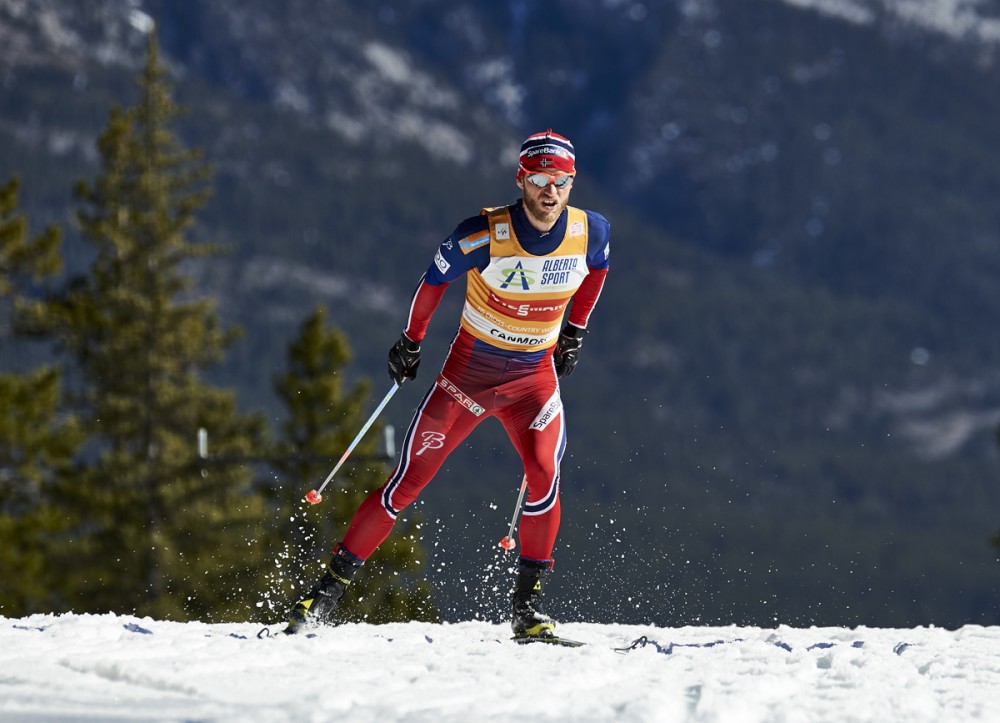
Norway’s Martin Johnsrud Sundby during the men’s 15 k skate leg of the Ski Tour Canada in Canmore, Alberta. Sundby may not be the only Norwegian athlete who used a nebulizer to take asthma medication — even healthy athletes were allegedly recommended to do so. (Photo: Fischer/Nordic Focus)
As Norwegian skier Martin Johnsrud Sundby has decided to appeal his doping ban to the Swiss Supreme Court, stories have emerged suggesting that the Norwegian Ski Federation recommended that healthy skiers use salbutamol nebulizers – the same drug and method Sundby was issued a two-month ban for – as preventative therapy to maximize performance.
But what of the past? Norway’s TV2 talked with several cross-country skiers who say they were told by the national team to use nebulizers, even though they did not have asthma. A nebulizer delivers beta-2 agonists, drugs which help relax muscles in the airways. Such medications are banned for use by athletes up until a threshold dose.
In the same piece, national team director Vidar Løfshus said that this constituted “preventative care” to make sure that no athletes had airway obstructions.
The Norwegian Ski Federation announced on its website that it would be conducting a full review of medication use policies in the wake of the scandal.
Erik Røste, the president of the federation, said that he expected that healthy athletes would not have been prescribed medication, but sought to clarify whether his assumption was true. The investigation will be carried out by people not affiliated with the federation in order to maintain independence. Anti-Doping Norway has been consulted about assisting.
Røste also said that he was concerned that the stories could damage the reputation of the federation.
That seems to be already happening. Swedish national team doctor Per Andersson told Swedish media that prescribing medication to healthy athletes was a “dangerous path”.
Meanwhile, Sundby had been sanctioned for using high concentrations of salbutamol via a nebulizer. FIS had initially not suspended him, but the World Anti-Doping Agency (WADA) appealed the case to the Court of Arbitration for Sport (CAS), which banned him from competition for two months. Because some results were invalidated, Sundby lost his 2015 overall World Cup title as well as the overall Tour de Ski win.
CAS is the highest governing body in sports, and decisions cannot be appealed or overturned. However, Sundby decided to appeal the case to a non-sports body, the Swiss Supreme Court, because he felt that the judgement was unfair. He told Norwegian media that he was “not guilty.”
Based on WADA rules, the maximum amount of salbutamol that is allowed to be inhaled is 1600 micrograms over 24 hours. Sundby’s samples taken Dec. 13, 2014 after the 15-kilometer classic in Davos, Switzerland, and Jan. 8, 2015 after the 25 k freestyle pursuit at the Tour de Ski in Toblach, Italy, and analyzed by a WADA accredited laboratory exceeded those limits.
His case hinges on a few words, as Sundby and the Norwegian medical team believe that the WADA limit applies only to medication taken in an inhaler, while Sundby used a different device, a nebulizer.
As an athlete with a documented history of asthma, Sundby likely could have received a therapeutic use exemption (TUE), which may have allowed the nebulizer use. But he did not apply for one, and such exemptions cannot be obtained retroactively.
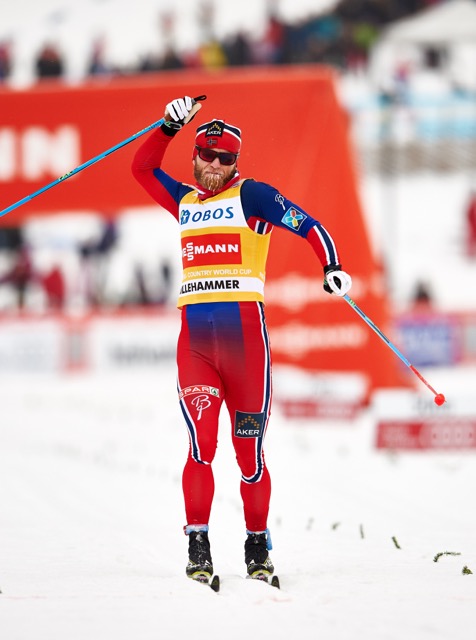
Martin Johnsrud Sundby (Norway) after winning the men’s 15 k classic pursuit for the overall Lillehammer mini-tour title in December 2014 in Norway, following the Davos World Cup. (Photo: Fischer/NordicFocus)
Norway’s Martin Johnsrud Sundby has been stripped of his 2015 Tour de Ski and 2014/2015 overall World Cup titles after the Court of Arbitration for Sport (CAS) upheld an appeal by the World Anti-Doping Agency (WADA) against him and the International Ski Federation (FIS).
The reigning three-time overall World Cup champion, Sundby, 31, was penalized for twice exceeding the amount of salbutamol, also known as albuterol and a “standard therapy against asthma symptoms,” according to a FIS press release, allowed in an athlete’s system and not possessing the necessary medical exemption when he was tested.
Based on WADA rules, the maximum amount that is allowed to be inhaled is 1600 micrograms over 24 hours. Sundby’s samples taken Dec. 13, 2014 after the 15-kilometer classic in Davos, Switzerland, and Jan. 8, 2015 after the 25 k freestyle pursuit at the Tour de Ski in Toblach, Italy, and analyzed by a WADA accredited laboratory exceeded those limits.
“While the medication is normally applied by a handheld metric dose inhaler (MDI), the athlete used a nebulizer to administer the prescribed salbutamol for the treatment of his asthma, which requires a higher labelled dosage than the MDI and thereby exceeded the allowed maximum dose,” FIS stated in its press release on Wednesday. “The FIS Doping Panel had therefore found that the athlete had not committed an anti-doping rule violation when he used a nebulizer as a legitimate means to administer salbutamol instead of a metric dose inhaler (MDI).
“The CAS found however that the epithet ‘inhaled’ was meant to distinguish inhalation from other mechanics of inhalation like ingestion or injection and did not refer to the stage of administration (e.g. the amount that comes out of the device or which was eventually delivered to the athlete’s mouth or lungs),” the release continued. “The allowed dose must be understood as the dose prescribed by the doctor, i.e. the ‘labelled’ or ‘nominal’ dose. Any higher dose, e.g. because of the need to use a nebulizer, requires a Therapeutic Use Exemption (TUE). When the tests were conducted in December 2014 and January 2015, the athlete was not in possession of a TUE and therefore found guilty of an anti-doping rule violation.”
WADA appealed the FIS Doping Panel’s decision, made Sept. 4, 2015, which defended Sundby. The CAS upheld WADA’s appeal and, effective July 11, 2016, sanctioned Sundby for two months. FIS announced this decision in its press release.
“I was at the store when the team doctor called. I was told that I had been over the limit twice,” Sundby said at a press conference as reported by NRK, according to a direct translation. “There and then it felt like the sky came crashing down. I could not believe it. I have never ever used an asthmatic dose that hasn’t been prescribed.”
“It felt like the sky came crashing down. I could not believe it. I have never ever used an asthmatic dose that hasn’t been prescribed.” — Martin Johnsrud Sundby
According to FIS, while CAS “acknowledged in the athlete’s favour that he had not intentionally broken the rules, that has a medical condition requiring the administration of salbutamol and that he had used salbutamol by nebulizer as prescribed by his team doctor, as he had done so before without any problems,” they also noted that anti-doping rules must be strictly adhered to and “that the prescription of the team doctor as to the use of the nebulizer to administer salbutamol outside of a hospital was arguably questionable from a medical point of view as well as the fact that the athlete and his team doctor had not made any enquiry of WADA, FIS or the manufacturer whether inhalation by a nebulizer would still require a TUE under the revised anti-doping rules.”
Sundby’s win on Dec. 13, 2014 in Davos (where he edged his teammate Didrik Tønseth by 6.6 seconds) and third-place finish in the Toblach 25 k (behind teammate Petter Northug and Sweden’s Calle Halfvarsson, respectively) have been nulled. In addition to being disqualified from those races, Sundby is no longer listed as the overall champion of the 2015 Tour de Ski, after he initially won the final hill climb by 34.5 seconds over Northug in Val di Fiemme, Italy. Northug is now listed as the winner and Sundby is not on the final results. Sundby is also no longer the 2014/2015 overall World Cup champion, Switzerland’s Dario Cologna is.
In a separate press release, FIS announced the recalculated results and standings from 2014/2015:
“The impact on the 2014/15 FIS Cross Country Cup World Cup standings and FIS Tour de Ski standings are as follows:
– Sundby forfeits the 143 points he earned for the two races where he has been disqualified – 100 World Cup points for the victory in Davos and 43 points for his third place finish in Toblach.
– With the Sundby disqualification on the 13th December 2014, the podium for the 15 km classic in Davos (SUI) is now as follows: 1. Didrik Toenseth (NOR); 2. Dario Cologna (SUI); 3. Sjur Roethe (NOR).
– With the Sundby disqualification at the 8th January 2015 in the 25 km pursuit in Toblach (ITA), the podium for that race is now as follows: 1. Petter Northug JR. (NOR); 2. Calle Halfvarsson (SWE); 3. Evgeniy Belov (RUS).
– In accordance with the Tour de Ski regulations, Sundby also forfeits his overall 2015 Tour de Ski victory and 400 World Cup points he earned for it as well as prize money of CHF 108’000. The new standings for the 2015 Tour de Ski are as follows: 1) Petter Northug JR. (NOR); 2. Evgeniy Belov (RUS); 3. Calle Halfvarsson (SWE).
– The breakdown of prize money from the Tour de Ski 2015 that Sundby has to return for redistribution to the newly ranked athletes is as follows: CHF 90,000 or first place in the Tour de Ski, CHF 2,000 from the third place of the Tour de Ski sprint standings and the World Cup earnings for the two races, CHF 15,000 for the victory in Davos and CHF 1,000 for the third place finish in Toblach.
– Additionally, Sundby forfeits the World Cup points and prize money from the remaining Tour de Ski races after Toblach, namely the last two stages in Val di Fiemme in which he finished 8th and 3rd. This amounts to a further 73 World Cup points and CHF 1,000 in prize money.
– The final 2014/15 FIS Cross Country World Cup standings have also been recalculated and are as follows: 1. Dario Cologna (SUI) – 1103 points; Petter Northug JR. (NOR) – 1047 points; Finn Haagen Krogh (NOR) – 897 points. Sundby moves down to sixth place in the overall World Cup standings with 748 points and forfeits CHF 22,275 in the overall World Cup prize money standings.
– In total, Sundby forfeits 616 World Cup points for the 2014/15 season and CHF 131,275 in prize money. This includes all races directly and indirectly affected by the CAS decision.”
“I was sure that the case would be dropped quite fast, but then it turned out that WADA didn’t understand the rules in the same way as the whole Norwegian medical team,” he continued. “When WADA appealed, I thought it was a formality. I went into the 2015/2016-season knowing I was innocent, and also that I was acquitted. I think the verdict is totally unreasonable. I have to live with it, and I will stay strong knowing I have done nothing wrong.”
“FIS fully shares the view of the CAS that Martin Johnsrud Sundby is not to be considered as an intentional doping offender but that his sanctions result from the strict application of the anti-doping rules and the WADA Prohibited List as a consequence of his reliance on questionable medical advice to administer salbutamol outside a hospital,” FIS concluded.
“I am pleased that the Norwegian Ski Association so firmly takes responsibility for what happened, and that they so firmly emphasize that I personally have not tried to do anything illegal in this case,” Sundby said in the team press release, according to a direct translation. “Of course, I understand that this case is of public interest, and that’s why I come to this press conference and reply to media inquiries. However, I ask for understanding that I will return to the two most important things in my life after this: my closest family and my career as a ski racer.
“The situation I am in currently is any athlete’s nightmare. I’ve always competed clean. I hope and believe this case will not have further consequences for my future career or my preparation for the upcoming season.”
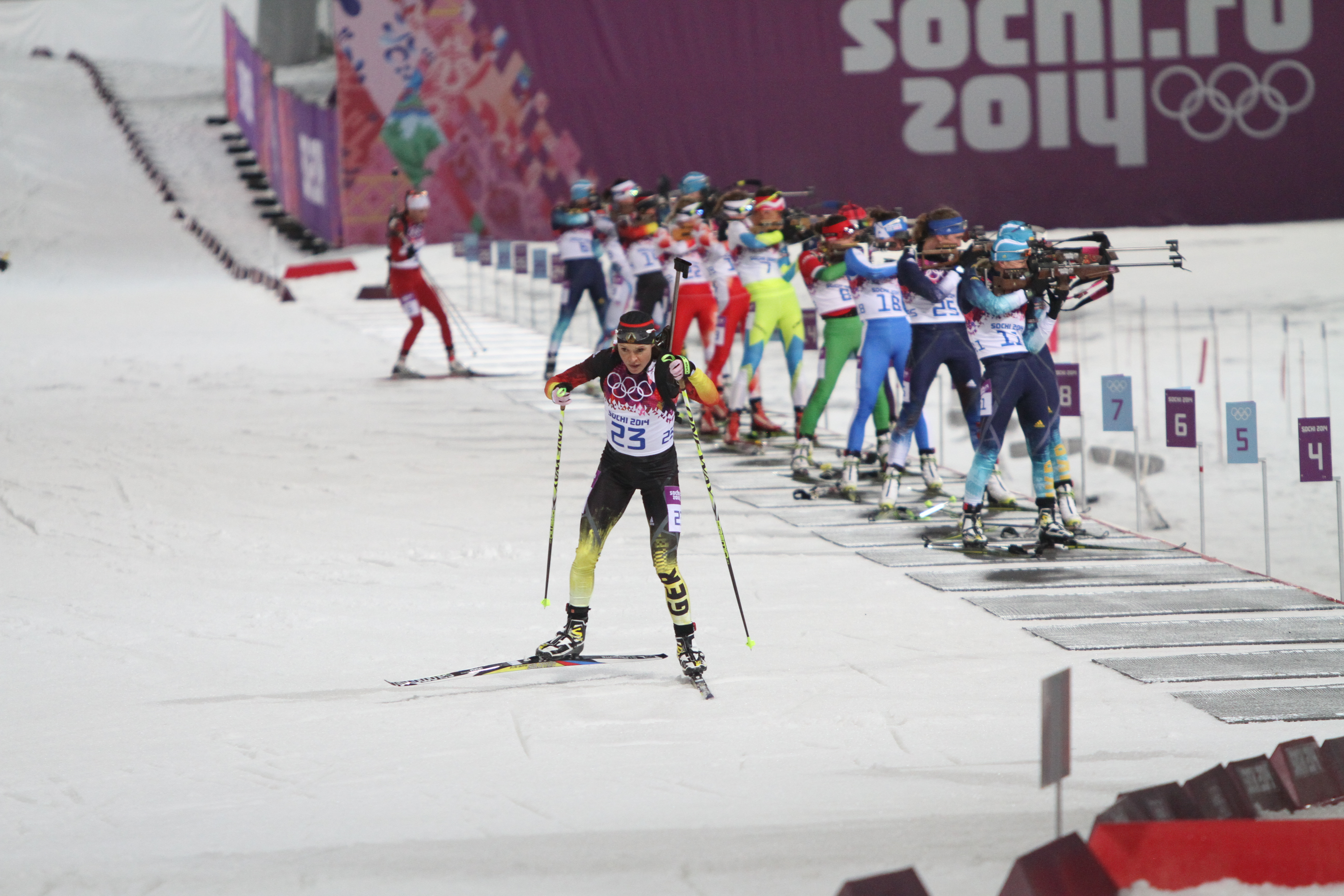
Germany’s Evi Sachenbacher-Stehle leaving the range during the 2014 Olympic mass start race. She placed fourth, but was later disqualified after testing positive for a prohibted stimulant. Her ban was reduced from two years to six months, so she will return to competition.
Evi Sachenbacher-Stehle was banned from competition for two years by the International Biathlon Union (IBU) for testing positive for the stimulant methylhexanamine at the 2014 Olympic Games in Sochi, Russia.
Sachenbacher-Stehle claimed from the beginning that she ingested the banned supplement accidentally in one of her several herbal supplements, and in her hearing with the IBU presented test results obtained after the fact to show that, indeed, one of her supplements did contain the substance. Methylhexanamine has been the culprit in many accidental-positive cases across sports. However, the IBU had little sympathy and still applied the maximum ban possible, the same amount of time it doled out to a Russian who tested positive for the blood-doping drug recombinant erythropoetin.
Sachenbacher-Stehle was disappointed with the ruling, and appealed to the Court of Arbitration for Sport (CAS). Their board, headed by Italy’s Luigi Fumagalli, ruled that the ban should be only partially upheld: they reduced the sentence to six months.
Since Sachenbacher-Stehle began her suspension at the Olympics, more than six months have now passed.
“She is therefore eligible to start again in the coming season,” IBU Communications Director Peer Lange wrote in an email to the media this afternoon.
CAS also ruled that the IBU owes Sachenbacher-Stehle 7,500 Euros to cover her legal fees.
The specific reasoning for the decision is not currently available, but Lange wrote that more details would be released soon.
The ruling is in line with many past decisions by CAS and individual federations in methylhexaneamine cases, where sentences for tennis players, swimmers, and track athletes among others have often reduced to six months or one year as opposed to two years.
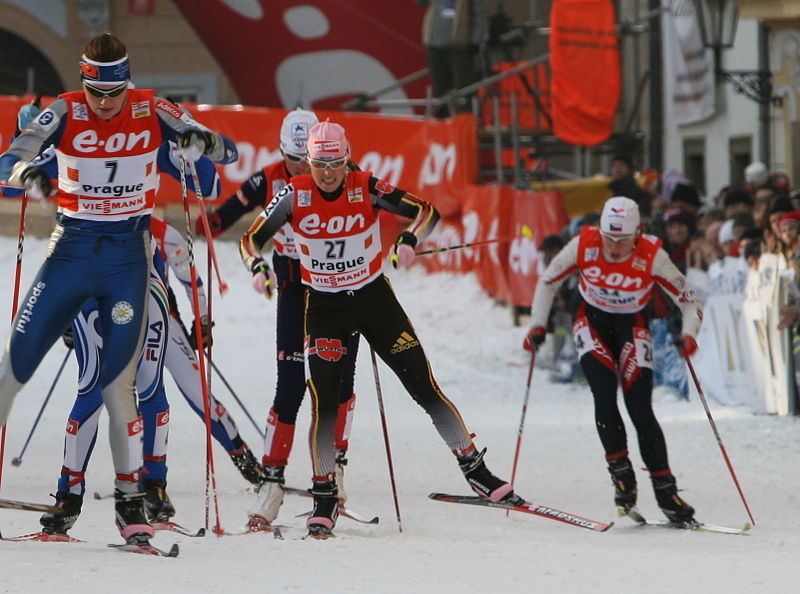
Germany’s Evi Sachenbacher-Stehle (27) in the quaterfinals of the 2007 Tour de Ski in Prague. (Photo: Wikimedia Commons/Petr Novák)
At 33, German biathlete Evi Sachenbacher-Stehle might have been ruled out of the game by some, considering she was banned from competing for two years after testing positive for the stimulant methylhexanamine at the Sochi Olympics.
But she said then that she would seek a reduced ban, one less harsh than the two-year ban the International Biathlon Union (IBU) Anti-Doping Panel simultaneously handed down to two other female biathletes who tested positive for EPO, recombinant erythropoietin.
She took a tea powder.
“I took a dietary supplement that was contaminated … I did not want to cheat,” she recently told a publication called the Star, according translated article by T-online. “Fact that I will now [be] cast with criminal dopers, with people, for example, that inject EPO into their veins … that’s almost worse when the two-year ban.”
Sachenbacher-Stehle, a former cross-country skier who won two Olympic gold medals and three silvers before switching to biathlon in 2012, placed fourth in the mass start in Sochi. Her results in Sochi were later nulled.
According to the Associated Press, the Court of Arbitration for Sport (CAS) says she’s seeking a three-month ban instead — which she’s already served. The retroactive suspension started Feb. 17, 2014. She would need her appeal to be processed on a fast-track basis, which the IBU must approve first.
“Although I am already 33 years old, and time is running [out], I do not want to cede as a doping sinner,” she said, according to a translation. “This is not to be the last picture of me.”
In similar cases, the CAS shortened suspensions of two Jamaicans track stars, Asafa Powell and Sherone Simpson, who also sought reduced bans of three months — down from the original 18 months they were sentenced to.
In a landmark decision on Tuesday, the Court of Arbitration for Sport upheld the appeal of Andrus Veerpalu, an Estonian skier who had tested positive for recombinant human growth hormone. In condemning WADA’s method for setting decision limits – the value in a sample which separates a positive test from a negative one – the court effectively made it impossible to prosecute any other cases based on the same test and same decision limits.
Although the appeal was against the International Ski Federation (FIS), which had banned Veerpalu for three years after February, 2011, test, the main question of the case was not for FIS but instead for WADA. How did they set those limits? The group’s mandate is to be 99.99% certain that a positive test is not a false positive. While the court did not dispute the test’s ability to detect ratios of different isomers in a blood sample, or that these ratios indicate use of recombinant hGH, they said that WADA did not accurately determine that 99.99% confidence level.
The limits chosen by WADA, for men, were 1.81 for kit 1 and 1.68 for kit 2; anything higher was considered a positive test. Veerpalu’s A-sample values were 2.62 for kit 1 and 3.07 for kit 2; the B-sample was 2.73 and 2.00.
The outcome is already being used by the NFL Players’ Association, among others, to decry the use of hGH tests as inaccurate and unusable, but anti-doping administrators aren’t changing their line.
“WADA is deeply disappointed with this situation, but acknowledges the CAS authority and understands that the panel was not comfortably satisfied with the decision limits currently applied to the hGH test,” WADA said in a statement on its website. “WADA will immediately engage in a process to re-establish these limits taking into account the remarks expressed in the CAS award… WADA will therefore encourage Anti-Doping Organizations (ADOs) to continue collecting samples for analysis pursuant to the hGH test and will, based on the larger number of samples now available, advise on revised decision limits shortly.”
FasterSkier talked with Sarah Lewis, the Secretary General of FIS, about how the case proceeded from the federation’s point of view, and what it means for federations prosecuting future doping cases.
FasterSkier: Although the appeal was against FIS, many of the witnesses were from WADA. How did that work?
Sarah Lewis: It has to be that way. The whole point is that WADA doesn’t carry out results management. You have a bunch of different organizations that carry out doping controls. You have the major events organizers, you have international federations, you have national bodies, those are in principal the major anti-doping organizations. And you have WADA, which carries out testing.
But in terms of results management, that’s clearly specified… this was actually a WADA out-of-competition test, but then the results management defaults to FIS. Obviously for us, we carry the responsibility for doing that. Any mistakes carried out in terms of sample collection, analysis done by the laboratory, things that are relevant to the international standards for testing – that’s all defined in the rules.
But when it actually comes to the test itself, basically what the labs are doing is carrying out the analysis in accordance with the WADA standards for laboratory. From an international federation’s perspective, we are relying on the fact that all of the prohibited substances and methods on the WADA list, that they have been scientifically validated and that aspect is not going to be challenged. So that when we receive an Adverse Analytical Finding from a laboratory, we proceed on that, on the basis that the science behind the test is not in dispute.
There are of course other things that can go wrong, with the collection or storage or transportation, or the athlete’s right to be heard, which are contained in the rules. But that’s all very clear in the rules. The one thing that we have no control over whatsoever, because it’s not our business, we’re a sports organization, is the doping tests.
FS: So were you prepared to have the science come under question, or was it surprising?
SL: Well, it had already come up. What happens is the first thing when the appelant makes an appeal, they have to submit their written submissions so that you have an overview of what their case is, why they are appealing the decision. Then the respondent will give its version of events. Then there’s a hearing and both sides have to nominate their experts. But you only know who those will be based on the written submissions, when you have an understanding of what the arguments are.
FS: Did you feel that the WADA experts who were brought in to defend how they set the limits – did you feel like they did a good job, or how did you feel they presented their work?
SL: I’m not really sure that’s something I can comment on, to be honest. Without sufficient expertise, it’s not really possible to say. It all sounded very compelling and convincing and very scientific, and Veerpalu’s experts were countering them. It was a boxing match between both sides. And the panel decided to give the athlete the benefit of the doubt.
In layman’s terms, it’s possible to describe the situation as that Veerpalu was caught doing 180 kilometers an hour, and the speed limit was 120. Then when they checked out the machine to measure speed, they showed that it may not have been accurate between 118 and 119, and at that speed it could be a case that there would be a false positive. And consequently, even though he had done 180 and that’s not disputed, he was nevertheless given the benefit of the doubt because there was a fault in the machine.
FS: Thinking into the future—
SL: We haven’t gotten that far yet.
FS: Okay. But thinking about WADA guidelines and whether they are correct, will this affect your strategy in the future? Is there anything you can do about this sort of thing?
SL: This was the first time this test has been challenged, and it took quite a long time to get there anyway with this test. I think WADA will respond very quickly. They already put a statement up yesterday about it. The point is that the panel confirmed the test itself, and so what do they need to look at? They need to look at the decision limits.
From the time they designed the original decision limits, there have been many, many, many more samples carried out. They have a whole stack more data, which they can use to reassess what the decision limits should be. Presumably, that’s what they’ll do.
They actually brought that into the trail, they said, in the meantime, this is what we have assessed, and I think it was something like 10,000 samples. So it’s a very different situation now… it’s just a question of WADA going through the process and formalizing that.
FS: It seems so unusual for an appeal like this to succeed – do you think that this will embolden athletes in the future to appeal based on the science?
SL: Well, obviously if it’s going to make them challenge the science of every test, then it will get to the stage that nobody will be able to afford to do anti-doping work, and that would not be very funny. But you know, it’s not the first time that the science has been challenged. Each times there seems to be this reaction, like, is this the end of anti-doping as we know it? And of course it isn’t.
Perhaps with this test, there may have been a deadline of wanting to get it done very quickly, namely for the Vancouver Olympics I think it was. In any case, there was a certain deadline that they were really pushing for. Perhaps that influenced the amounts of data they had for the whole process. But it’s a one-off situation.
Of course everybody needs to be sure that the substances and the methods on the list have been properly validated, and that really is the job of their scientific and legal groups and specialists. And this can be just a little bit of a signal that, yes, we have to check and make sure that’s all okay. Sometimes it takes that little reminder or kick to do that, and I’m sure WADA will react in that way to make sure in case there are any other, especially new, developing tests.
With pretty much everything else, there’s so much jurisprudence, there’s so much on-the-record decisions that have been taken, and backed up with admissions. But with a new test, that would be the moment that it could be challenged. So as they come forward with new tests, they have to be sure that every step of the way, this level of documentation is followed.
FS: I can imagine that it probably is a difficult job to have to define that thin line between a negative and a positive test.
SL: I guess it is. It’s like alcohol, drinking and driving. That’s got a different level, and it’s even different in different nations. In some you’re deemed to be over the limit with anything over 0.00, and in others you’re over the limit with considerably more than that.
Epilogue: Luckily for anti-doping agencies and federations like FIS, a new hGH test, using biomarkers instead of the isomers described in our previous article, was debuted at the 2012 Olympics in London, where it caught two Russian Paralympic powerlifters. But was it, too, rushed through the validation stage for a big event? Time will tell…
Natalia Matveeva of Russia (left) racing in Whistler in 2009.
The Court of Arbitration for Sport (CAS) recently reached a decision which could drastically change the competitive landscape at the Sochi Olympics.
“I can not describe in words how happy I will be able to defend the honor of Russia in Sochi,” Russian skier Natalia Matveeva told skisport.ru.
Matveeva has stood on the World Cup podium ten times, and recently finished a two-year doping ban after testing positive for EPO. But even though she had completed her penalty, until last week Matveeva believed that she would be unable to represent her country at the 2014 Olympic Games on home turf.
That’s because in 2008, the International Olympic Committee (IOC) amended Rule 45, which defines Olympic eligibility, to state that the Games weren’t open to athletes who had doped.
“Any person who has been sanctioned with a suspension of more than six months by any antidoping organization for any violation of any anti‐doping regulations may not participate, in any capacity, in the next edition of the Games of the Olympiad and of the Olympic Winter Games following the date of expiry of such suspension,” the rule read.
CAS, however, deemed the rule “unenforceable” on October 4th – and as a result, Matveeva and several other athletes will be able to return to Olympic competition after all.
Headaches and Frustration
Back in 2008, the IOC explained its new rule by saying that it encouraged clean competition and created an added incentive to avoid using performance-enhancing drugs.
But it created a confusing situation for athletes returning from doping bans. While they could return to their national teams and compete at World Cups, World Championships, and almost every other race or match at sport’s highest levels, when it came time for their countries to name the Olympic squads, they would be left off.
And the Olympics are a pretty big deal.
“It is clear that the emphasis in the country is on the Olympics in Sochi,” former world champion Dimitry Yaroshenko told skisport.ru in an interview earlier this month.
The Russian biathlete, who is returning from a two-year doping ban, wondered if the rule would affect his ability to receive funding and coaching for even longer than the actual ban.
“On the one hand, if I have the same results as before this winter, I will need a team,” Yaroshenko said. “But if I will have no opportunity to represent Russia at the Games in 2014, the question arises: how is it worthwhile to invest in the national team biathletes who cannot compete in these home Olympics?”
It is believed that none of the athletes shooting for the 2010 Olympics in Vancouver were affected by the IOC rule; they were either still serving out their doping bans, or had been banned before the new rule went into effect. But with the 2012 Olympics in London looming, athletes and national governing bodies alike were scratching their heads.
For the national governing bodies, the rule created a legal catch-22. The American Arbitration Association ruled in the case of LaShawn Merritt, a U.S. sprinter and former 400 meter World Champion, that U.S.A. Track and Field was actually legally obligated to nominate Merritt to their Olympic squad if he met the qualifying criteria. And yet if the United States Olympic Committee (USOC) did so, the IOC would reject the nomination.
While none of the governing bodies portrayed themselves as eager to add cheating athletes to their rosters, they did want clarity. The World Anti-Doping Code actually states that an athlete cannot be separately sanctioned by more than one organization for a single doping violation, but the governing bodies believed they were being asked to do just that.
When the USOC raised this concern, the IOC fired back that its rule was merely an extension of selection criteria, not a second disciplinary action.
After months of bickering over Merritt’s Olympic future, the two organizations finally agreed to submit the case to the Court of Arbitration for Sport. The USOC was joined by the U.S. Anti-Doping Agency and organizations from Britain, Denmark, Norway, New Zealand, Japan, and South Africa ,who were similarly perplexed about whether and how to apply the new language in Rule 45.
A Change in the Game
In the CAS hearing, the IOC defended itself by saying that the new rule was all part of the Olympic spirit.
“[The IOC] has a wide social mission, which transcends the governance and administration of sport and aims to educate the youth of the world,” the IOC argued according to the hearing minutes, which are available from the CAS website.
“The objective of the IOC Regulation is to protect the values of the Olympic movement and the Olympic Games from the threat and scourge of doping and to encourage potential participants in the Olympic Games to adhere strictly to the applicable anti-doping programmes.”
The organization admitted that it had no right to sanction athletes for doping offenses. But while the IOC argued again and again that the new rule was a selection criteria rather than a sanction, the three-member CAS panel did not agree.
“The IOC Executive Board’s June 27, 2008 decision prohibiting athletes who have been suspended for more than six months for an anti-doping rule violation from participating in the next Olympic Games following the expiration of their suspension is invalid and unenforceable,” the panel concluded in their ruling.
They noted first that the rule did not comply with the World Anti-Doping Code, which states that no other organization can make rules which change the length of a doping ban. Then the panel pointed out that the IOC adopted the Code as one of its statutes, and that its subsequent contradiction made the new rule unenforceable.
Most administrators breathed a sigh of relief.
“This decision does not diminish our commitment to the fight against doping, but rather ensures that athletes and National Olympic Committees have certainty as they prepare for London,” USOC chief executive Scott Blackmun told Reuters.
The IOC, however, was not pleased with the ruling.
“We were disappointed of course because the rule was meant to protect the clean athletes,” IOC President Jacques Rogge said in a statement. “So we’re a little surprised, disappointed.”
The decision also means that several other rules may be deemed unenforceable in the future. For instance, the British Olympic Association currently enforces a lifetime ban on athletes who have been caught doping; although they can return to competition, they can never again represent Great Britain at the Olympics.
Who Can Compete In Sochi?
The IOC will have to revise its rules in response to the ruling, and a number of skiers and biathletes are among those who woke up to find they were actually eligible for Sochi. Most are Russian, which made the realization particularly sweet.
“This happens once in a lifetime, having the Olympics are at home,” Matveeva said. “Not every athlete can take advantage of this opportunity during his sporting career.”
Yaroshenko was likewise thrilled by the decision, which he had previously said he did not expect.
“I have been longing for this decision,” he said. “I even lit a candle in church and asked the priest to pray for us. It’s great that I can compete.”
The Russian recently won three gold medals at Summer Biathlon World Championships in the Czech Republic, and is clearly regaining his previous form.
Another racer who will be returning to competition is Yevgeny Dementiev. The 2006 Olympic gold medalist in the 30 k pursuit reportedly decided six months after his ban that he would return to elite racing once it was complete. While he hasn’t spoken to the press since the CAS decision, he said in an interview on the Russian Ski Federation website in August that he hoped that CAS would rule in the Americans’ favor.
But neither Dementiev, Matveeva nor Yaroshenko are to be on the line in Sochi. First, they have to convince their federations that they are not only competing clean, but skiing fast.
“Now the main thing is to earn a place on the team in the Olympic selection process,” Matveeva said.
While the trio, along with former world champion biathlete Etkaterina Iourieva have been trying – with varying degrees of success – to regain their spots on Russia’s national teams, other athletes who have completed their bans have been less visible. Olympic gold medalist Julia Tchepalova, for instance, retired from competition after she was banned for using EPO. But with three years before the Olympics, Tchepalova could change her mind.
Regardless, the Russian ranks just got deeper, meaning that the fight for start rights at the Olympics will be even more fierce and the country will be more likely to field a successful team.
Is Another Revision Coming?
What neither Matveeva nor Yaroshenko mention is that it is still possible that they will be excluded from the Sochi races.
In its ruling, the CAS panel did not actually disagree with the IOC’s desire to keep convicted dopers out of the Olympics; they merely decided that the organization’s chosen mechanism was unenforceable.
In fact, CAS went so far as to suggest a better way for the IOC to meet its objectives.
“The CAS Panel also emphasized that if the IOC wanted to exclude athletes who have been sanctioned for doping from the Olympic Games, it could propose an amendment to the World Anti-Doping Code, which would allow other Signatories to consider such an amendment and possibly to adopt it,” CAS said in a press release. “If so, no ne bis in idem issue (prohibition against double jeopardy) would be raised, as the ineligibility would be part of a single sanction.”
Rogge and the IOC have vowed to use this strategy to try to reinstate the rule, and the World Anti-Doping Agency said on its website that it would consider adding the revision when it reviews its Code in 2012-13.
So while Merritt and his other summer competitors can represent their countries at the 2012 Olympics in London, winter athletes who don’t compete until 2014 may have to endure another emotional roller coaster before they find out if they will ultimately be able to call themselves Olympians.