From the FasterSkier archive — posts syndicated from athletes’ and coaches’ own blogs between 2004 and 2012, kept online as published. Current coverage is at fasterskier.com.
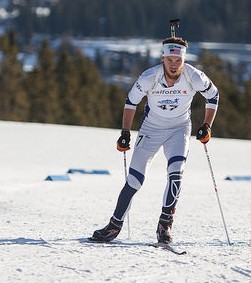
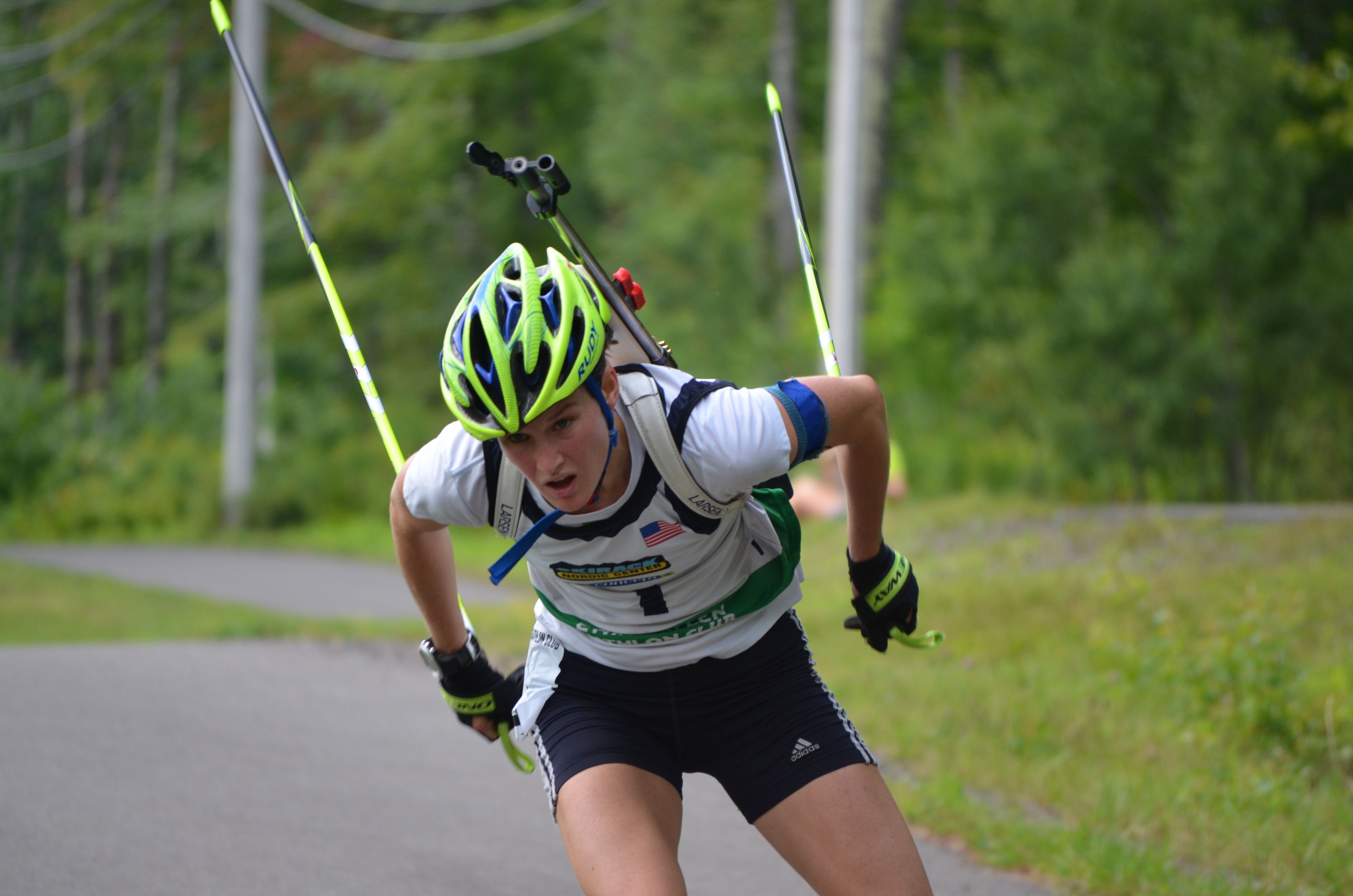
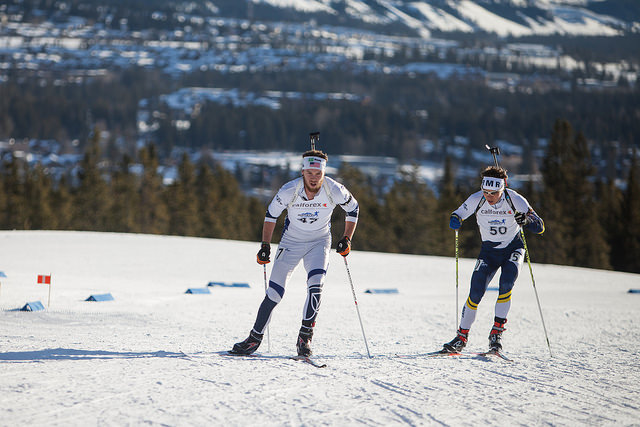
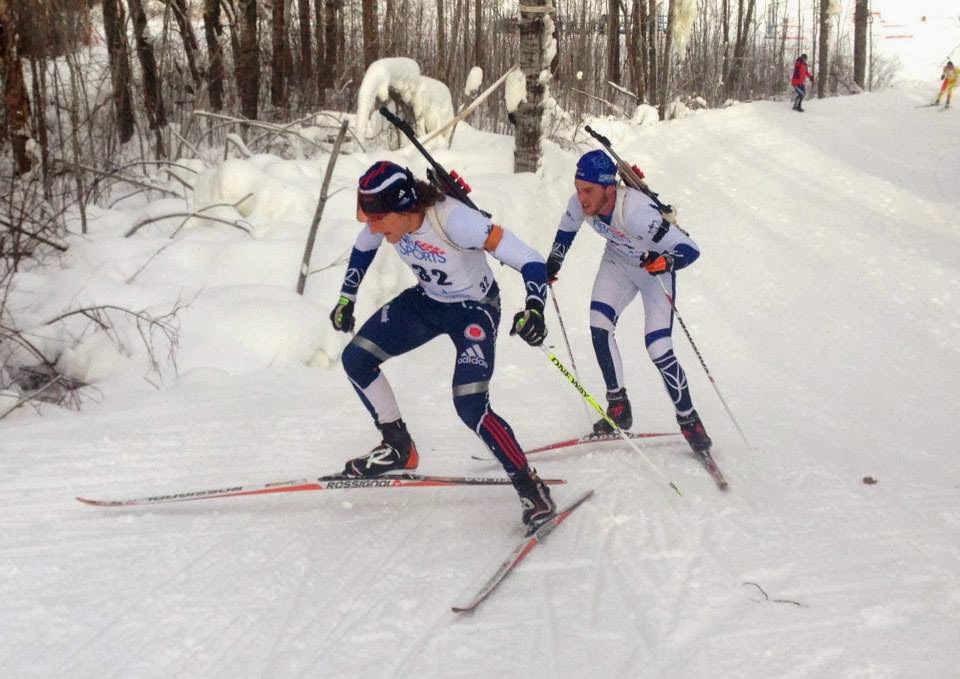
Casey Smith (Maine Winter Sports Center/U.S. Biathlon B-team) on his way to placing second in a NorAm mass start in Canmore, Alberta, in December 2014. (Photo: Jake Ellingson)
Casey Smith has endured a few things that would cause any athlete to question whether to continue with their professional career.
In February 2015, the Washington biathlete crashed hard while training in Canmore, Alberta, before the International Biathlon Union (IBU) Cup races to be held a few days later. He was knocked unconscious, broke ribs, a shoulder blade, and bones surrounding his vertebrae, and punctured a lung.
But Smith – using the physical and mental endurance he had cultivated in biathlon – persevered, joining the Craftsbury Green Racing Project (CGRP) in Vermont and returning to international competition in the 2015/2016 season.
“It definitely [felt sweet],” he said of a few good races last season. “It was really cool to be able to – I got back to the same level I was at before. In Europe this year I didn’t have quite as good results as the year before, but also the first week I got food poisoning really bad. That took a pretty big toll on me, and didn’t have anything to do with the crash.”
Come spring, the 24 year old decided to call it quits with his biathlon career and return to Bozeman, Mont., to finish a degree at Montana State University. He had enrolled after high school before transitioning to being a full-time athlete.
His decision was unrelated to the ordeals of the year before. It came down to something much simpler: joy.
“The whole year of the training season and racing season, I wasn’t feeling as motivated,” he explained on the phone from his home in Washington’s Methow Valley. “I said that I wanted to do this as long as I was having fun, but it was turning into more of a job kind of thing. It was getting to the point where it wasn’t as much fun anymore. So I thought it was time to move on.”
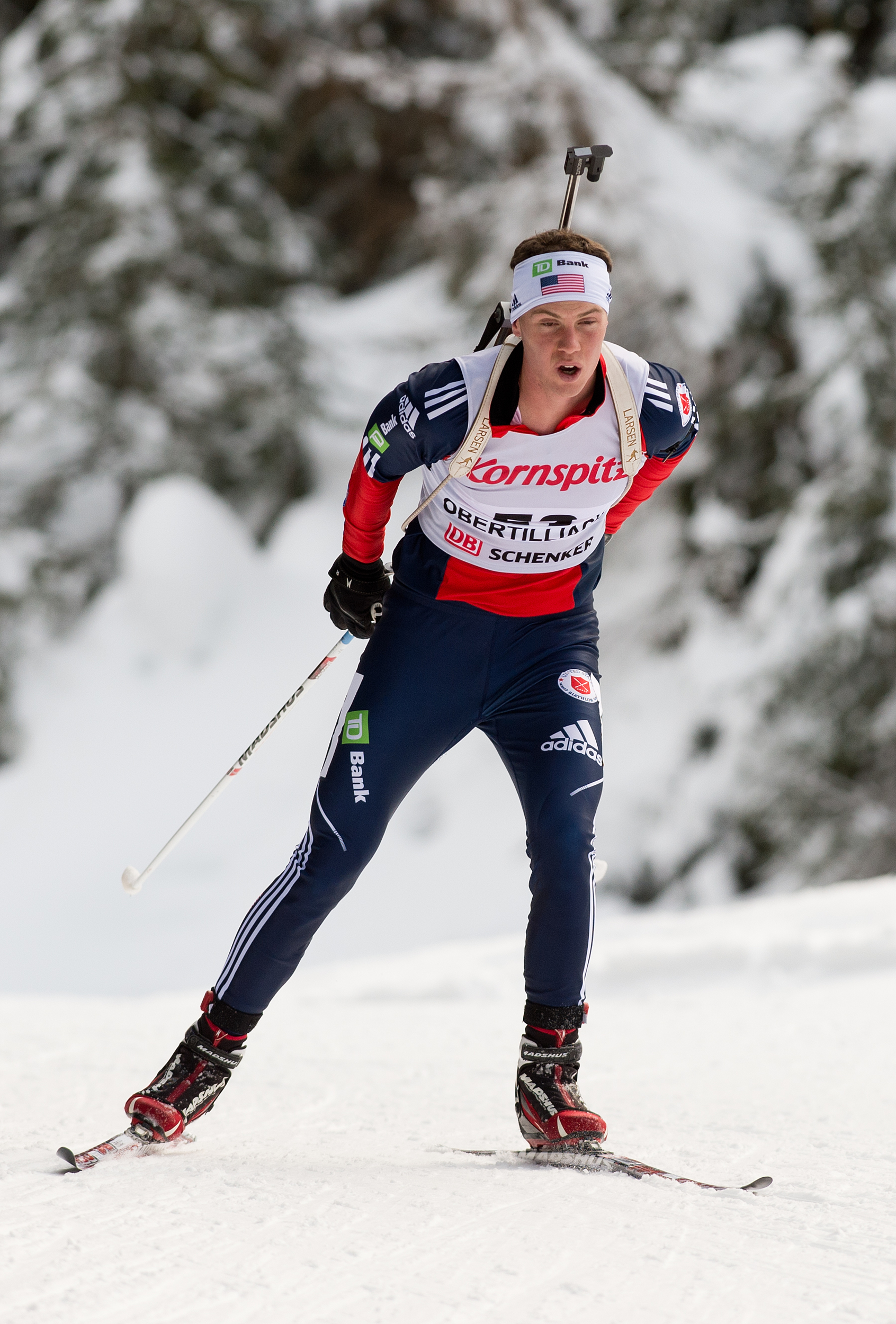
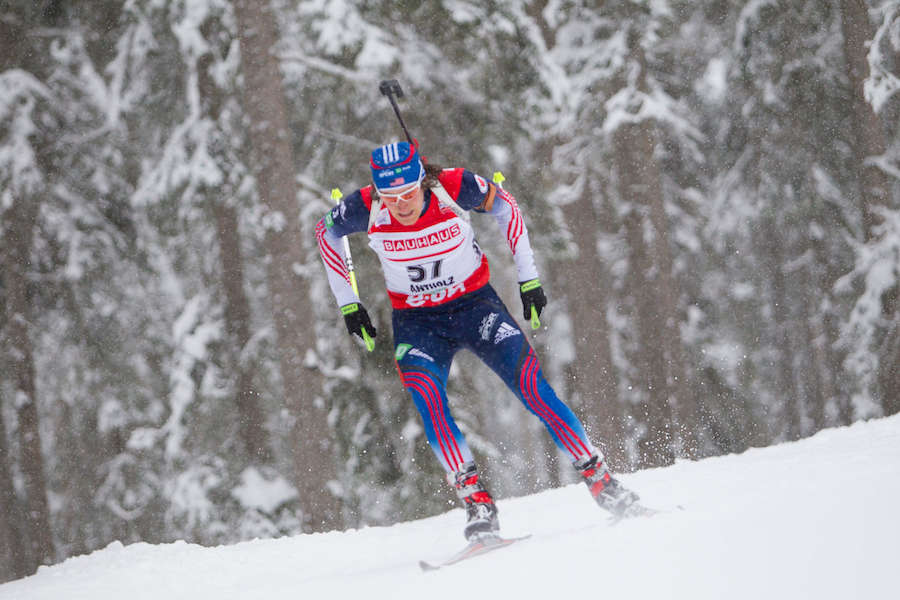
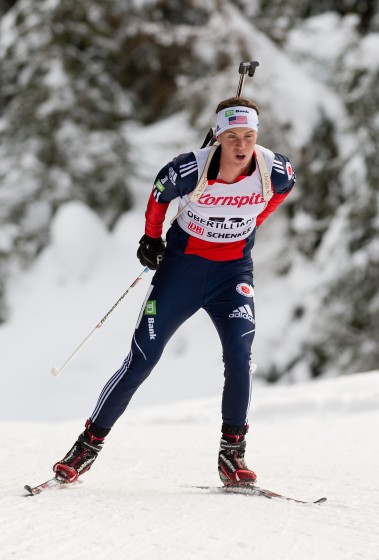
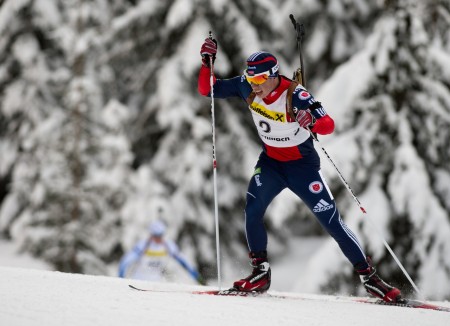
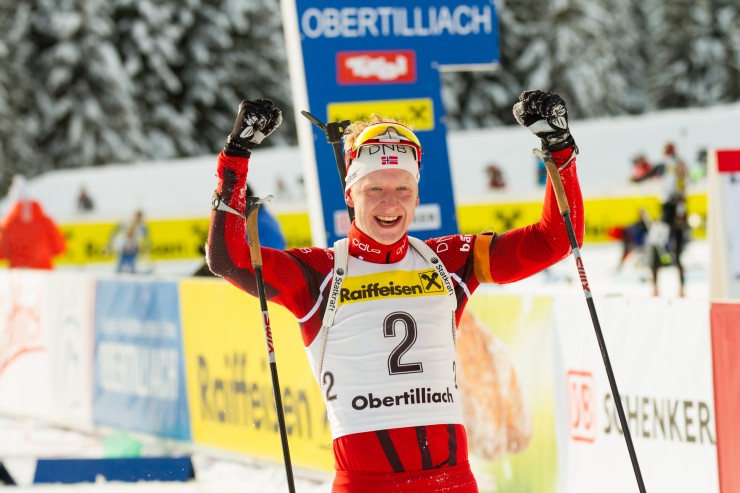
Casey Smith (USA) en route to 37th place in the junior men’s individual at 2013 World Junior Championships in Obertilliach, Austria. He had his career-best finish of 23rd place in the pursuit there. (Photo: US Biathlon/NordicFocus.com)
Smith was a top junior for the U.S. before and during his first stint in Bozeman. He had top-30 finishes at World Youth and Junior Championships in 2011 and 2013, as well as two apiece at Open European Championships in the junior races in 2012 and the senior races in 2014.
“It was great having other guys to train with,” he said of his time in Vermont. “I really hadn’t had too much of that, at least when I was in Maine. So that was really nice, and I really enjoyed working with Pepa [Miloucheva]. It helped me with my ski technique a lot, for sure.”
Looking back, he said having the chance to travel the world was one of the best things the sport had offered him.
“The last several years we would always go to Canmore over Thanksgiving, and so I could build relationships with people there,” he said. “Then when you land in Europe at competitions you run into them again, and I was able to make friends from all around. That was pretty cool.”
There were results highlights from this season, too.
“At [U.S. National Championships], it was really cool that all the national team was there [after the World Cup finished],” he reminisced. “It made it real races. In the sprint I had a pretty good race, and right in the mix. Also in Canmore at the trials it was a little bumpy the first few, but the last race I was finally able to pull it together and have a really good race.”
After the injuries sustained the year before, Smith had attacked training and racing with a new direction, and it worked.
“It was a traumatic experience, but I felt like I was able to bounce back from it miraculously quickly,” he said. “It almost helped me a little bit because I was so much more focused on being perfect on my physical therapy and being super diligent every single day. So I had to be really focused in general.”
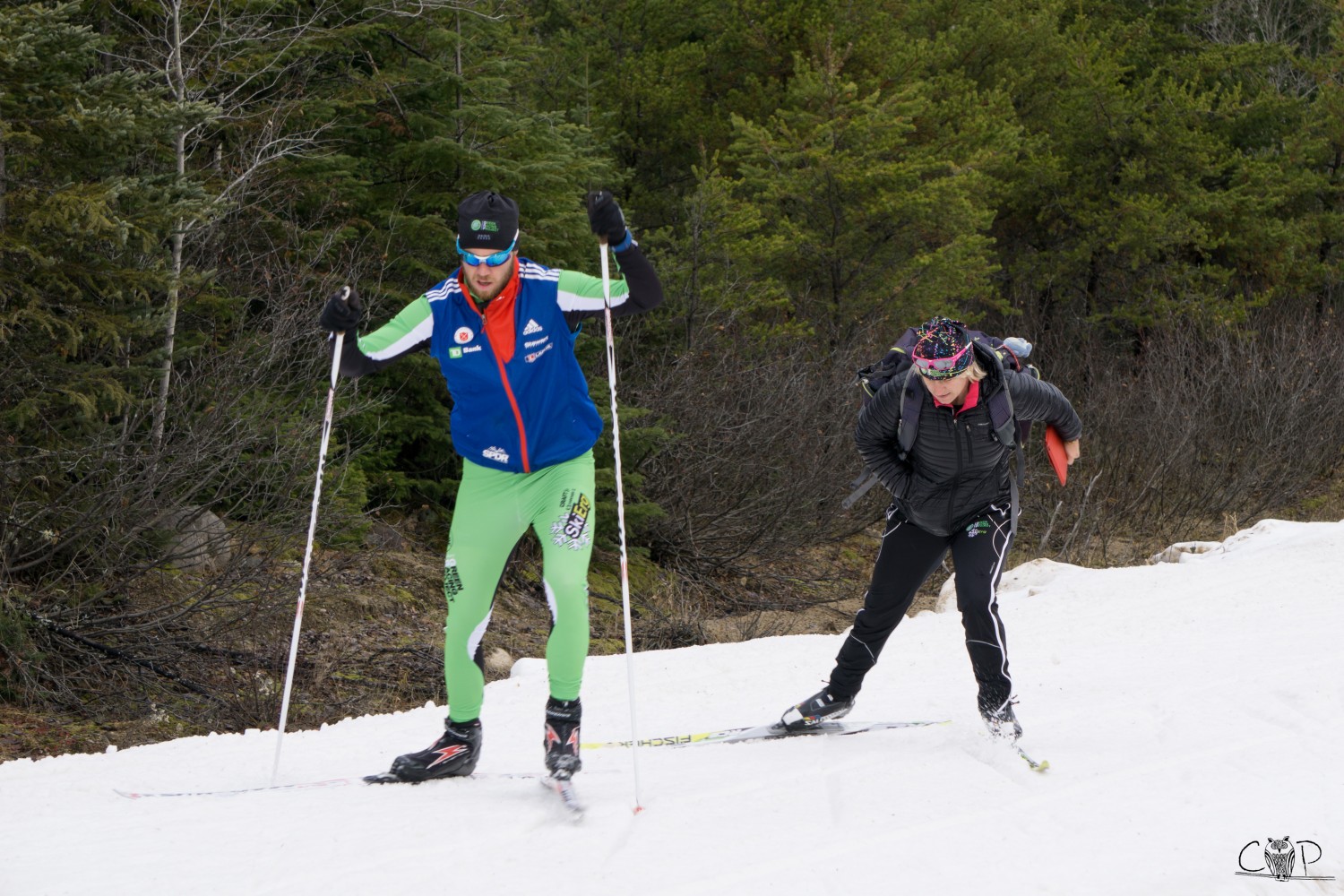
Casey Smith leads Craftsbury Green Racing Project Head Coach Pepa Miloucheva at a training camp at La Forêt Montmorency, Quebec, in November 2015. (Photo: Caitlin Patterson)
And yet, he became aware that he wasn’t as fired up to keep it up for years. He decided that he would return to Bozeman for the fall semester. Smith initially told himself that he would return home to Washington and mull over whether to continue to compete while he finished his degree, or to call it quits on biathlon altogether.
The latter won out, and now he’s fully invested in school and his future outside of sport.
“I’m going to be in the animal science program,” he explained. “My plan is that my family has a small sheep farm here in Washington, and I’d like to come back and grow that bigger… and live in the Methow and have that lifestyle.”
Most of the friends he started school with at Montana State years ago have graduated, but that didn’t concern Smith.
“I feel like now I’m going to school because I want to learn, and before I was there because I wanted to do biathlon and train and there was other people doing that there, and by the way I was going to school on the side,” he said. “Now I’m going there because I really want to go to school.”
Until the fall semester begins, he’s helping his family and uncle out on their farms and doing odd jobs in the Methow Valley.
He may help with biathlon in the Bozeman region, and will definitely help his mother, Betsy Devin-Smith, who is the head coach of the Methow Valley Nordic Ski Education Foundation’s biathlon team.
“I’m sort of stuck helping her with that, like it or not,” he joked.
Of the life transition, Smith said that everything was feeling good so far.
“I don’t really miss it now,” he said of biathlon. “The opportunity to ski as often, maybe I’ll miss. I’m sure I’ll still ski a lot, but not every day for hours.”
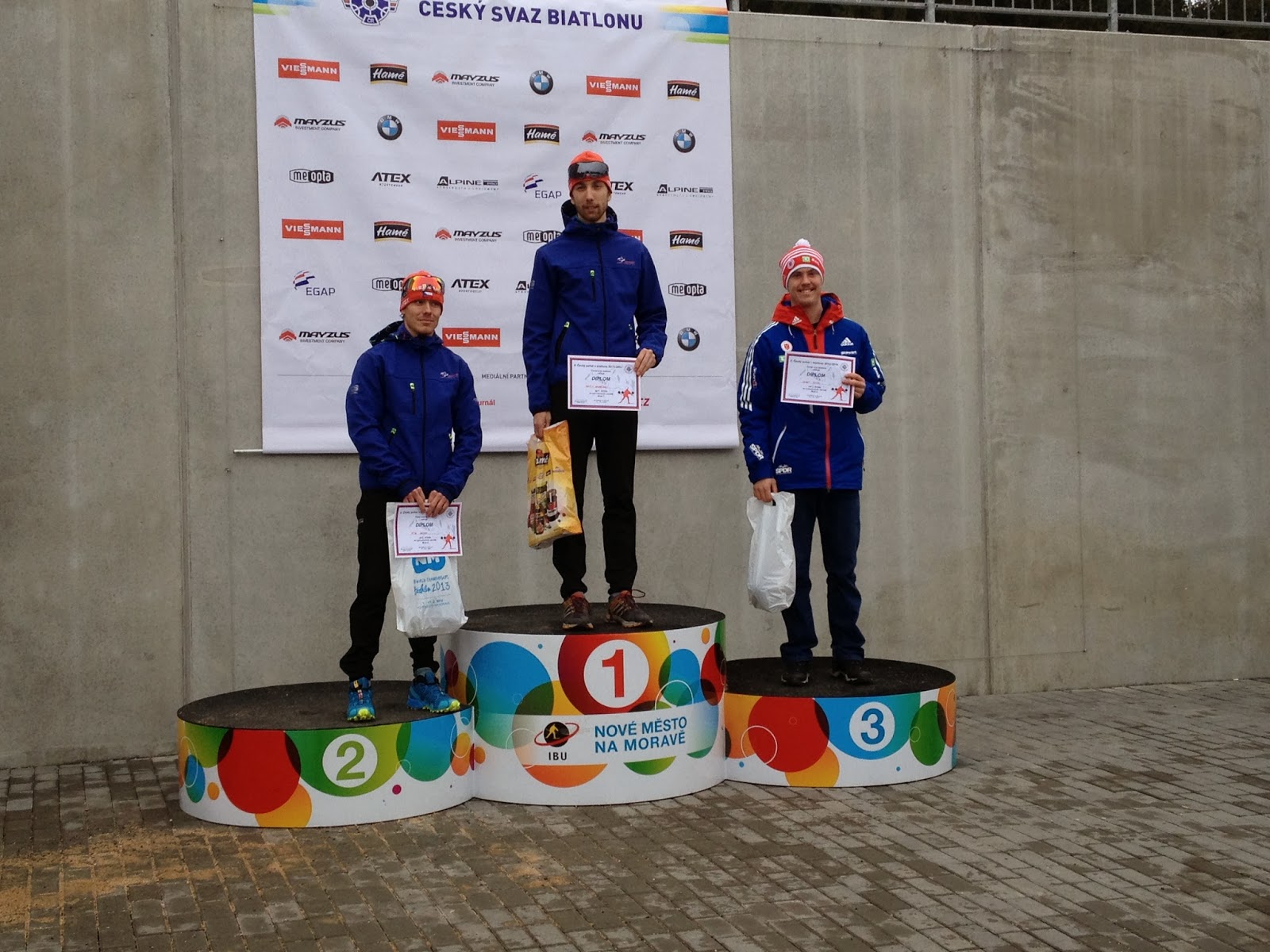
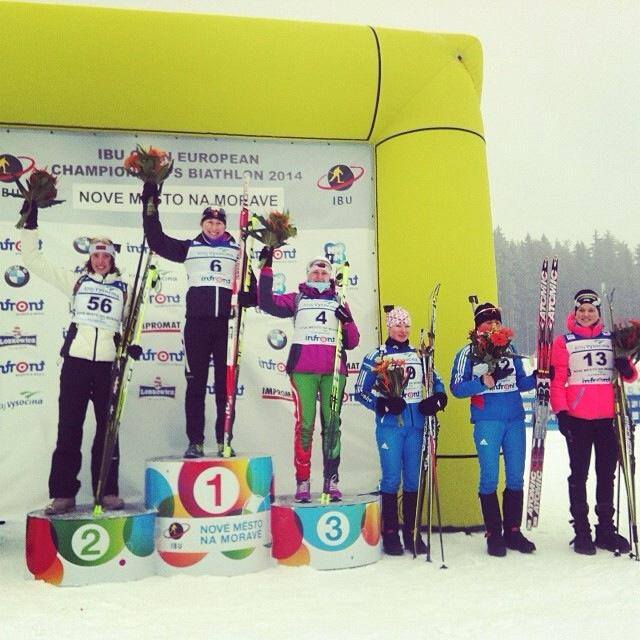
Casey Smith (right) on the podium at a Czech Cup biathlon race in 2014. (Courtesy photo)
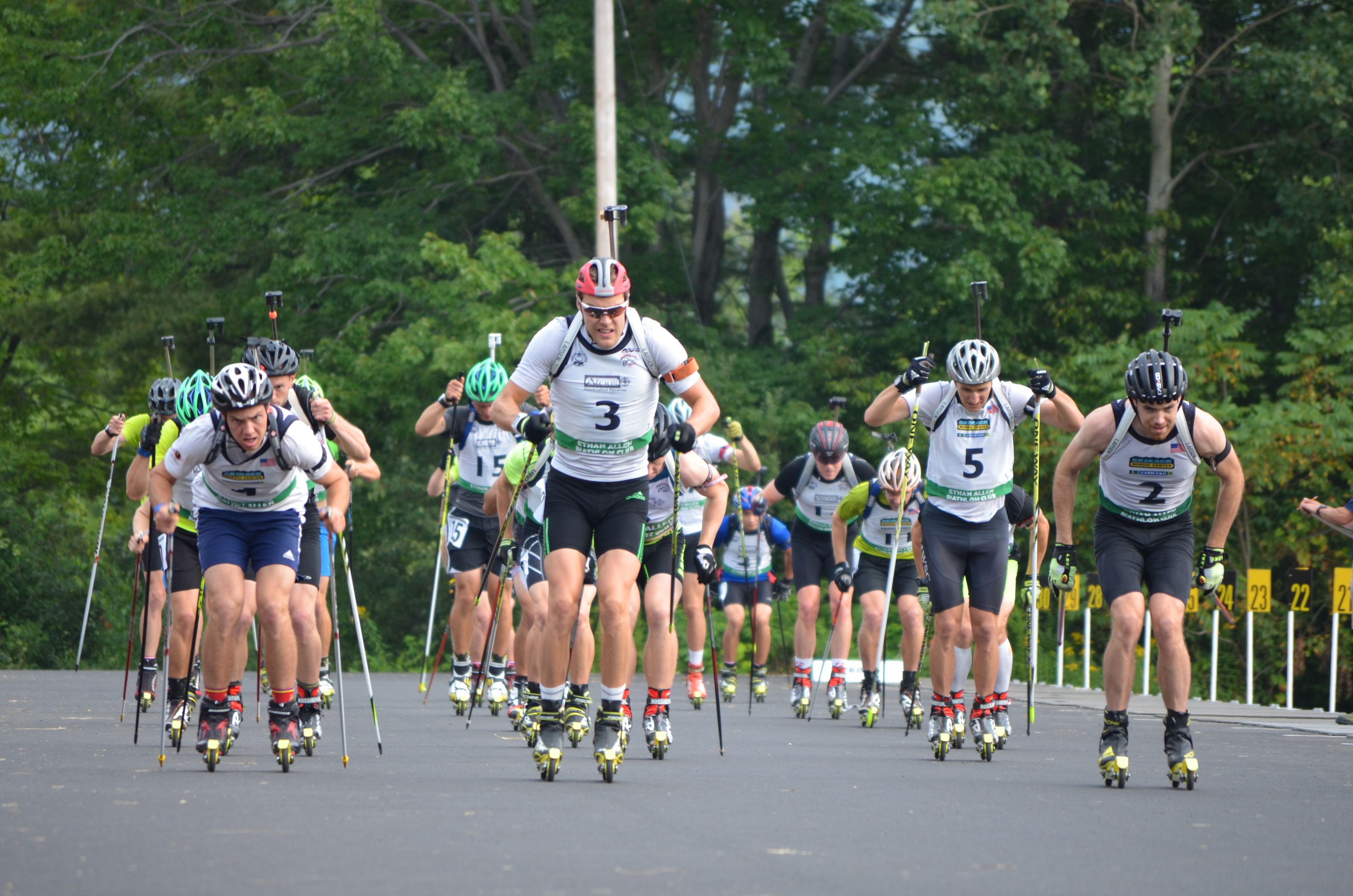
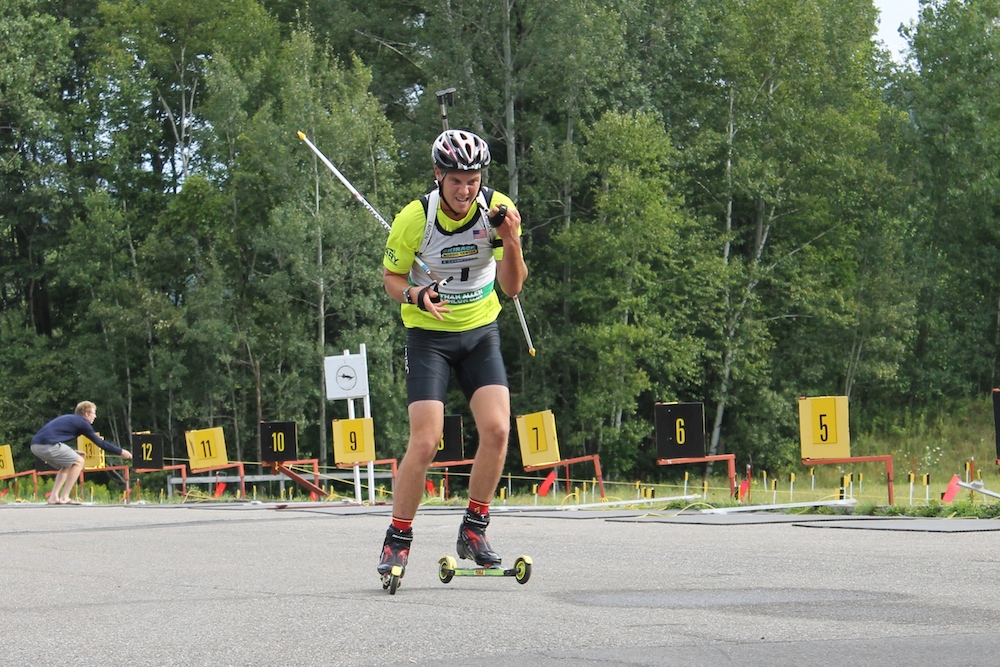
American Leif Nordgren (3) and Canadian Nathan Smith (2) are among the leaders of the men’s mass start at the 2015 North American Rollerski Cup and US Biathlon National Rollerski Championships in mid-August in Jericho, Vt. Smith ended up winning, ahead of Jakob Ellingson in second, Sean Doherty in third, and Nordgren in fourth. (Photo: Paul Bierman)
For the second time in two months, several top U.S. biathletes are headed to Jericho, Vt., for back-to-back rollerski races this weekend — except instead of August weather, they could see frost, and instead of a mass start and a sprint, they’ll compete in sprints both Saturday and Sunday.
The races mark the second set of trials for US Biathlon, which holds them annually in August and October to determine the final spots for its early season World Cup team.
“We have 4 start spots for women and 4 for men the entire season,” Bernd Eisenbichler, US Biathlon Association (USBA) chief of sport, wrote in an email. “And we [are] always looking to keep one spot open before the season, so that is an open chance for anyone to qualify through trials.”
This year, they have one opening on the men’s side and two for the women. USBA A-team men Tim Burke, Lowell Bailey and Leif Nordgren prequalified for the International Biathlon Union (IBU) World Cups 1, 2 and 3 with top-20 results on the circuit last season, as did A-team women Susan Dunklee and Hannah Dreissigacker.
USBA A-team rookie Clare Egan competing at the 2015 North American Rollerski Cup and US Biathlon National Rollerski Championships in mid-August in Jericho, Vt. (Photo: Paul Bierman)
Annelies Cook, Clare Egan and Sean Doherty made the USBA’s A-team standard this year, but without a World Cup top 20 last season, they have to prove themselves at trials and in training camps.
“The naming to the A Team gives you the right to train in [Lake Placid] and be part of the camps,” Eisenbichler explained. It doesn’t automatically qualify an athlete for World Cups.
After this weekend’s races, the USBA staff will decide whom to invite to its Utah training camp, in addition to its five prequalified World Cup skiers, Oct. 18 through Nov. 1. After that camp, they will name the final spots for World Cups 1-3.
Heading into the weekend, Cook, Egan and Maddie Phaneuf had the best chances for the two women’s positions based on their results at the August trials, according to Eisenbichler. Doherty, Jakob Ellingson, Russell Currier, and Casey Smith are all vying for the lone men’s spot.
As for what the national-team coaches are looking for, Eisenbichler stressed progression over a long period of time rather than “peaking” for a single race. This extended trial format gives a sense of progression over a longer block of time, and can be a good indicator of what to expect for the winter, he added.
Rollerski competitions make for “fair and consistent conditions,” he wrote, and eliminate the angst of searching for snow just before the start of the season.
The format also allows for more time for coaching input “to guide the athletes on the right track,” Eisenbichler explained, and another month of preseason training after trials.
In August, more than 80 biathletes from North America and Sweden participated in the first set of races, the North American Rollerski Cup and US Biathlon National Rollerski Championships. Burke won the men’s sprint, Canadian Nathan Smith topped the men’s mass start, and Dunklee won both women’s races.
This weekend’s races at the Ethan Allen Firing Range are open to participants outside of the USBA as well, and results will be posted at http://www.eabiathlon.org/results.html. Racers will likely compete in temperatures ranging from the low 40s to 50-degrees Fahrenheit.
Russell Currier competing in a World Cup sprint in Antholz, Italy, in 2014. An Olympian in Sochi and a two-time sixth-place World Cup finisher, Currier had his worst season in years and was cut from the U.S. National Team. Paired with funding cuts to his home club, the Maine Winter Sports Center, Currier and his teammates are trying to pick up the pieces. (Photo: USBA/NordicFocus.com)
For a group of biathletes based in Maine, two painful announcements came in the last few weeks: first, the news that their home base, the Maine Winter Sports Center (MWSC) would be drastically reducing the support offered to its Olympic Development Team (ODT), and secondly, that many of them did not get re-named to teams by the United States Biathlon Association (USBA).
When the team nominations came out, neither Russell Currier nor Casey Smith were back on the B-team, and Brian Halligan and Kelsey Dickinson were not re-named to the National Development Group. Only one MWSC athlete, Maddie Phaneuf, retained her spot, in her case on USBA’s upper-tier development squad, the X-Team. Phaneuf, still a junior, got her first World Cup start this past season.
Smith, Currier and Dickinson had represented the United States at IBU Cup competitions, the circuit one tier below the World Cup. Halligan, a first-year junior, had competed at World Youth and Junior Championships. All four are now struggling to decide whether to stay in Maine for the upcoming training year, and if so how to support themselves both financially and with coaching at trials competitions, since MWSC will no longer send staff to out-of-region races.
USBA Chief of Sport Bernd Eisenbichler heard about the cuts and has talked to the athletes, but it did not affect the national team selections. He said in a phone interview that while he wishes that he could support the struggling MWSC athletes more, it’s not the job of the federation to take over for the clubs.
“Maine Winter Sport is a great partner for us,” Eisenbichler said. “Together we must see what we can do for the athletes. But it is also clear that the federation cannot take care of all biathletes in America. So we have to have criteria and we have to have a qualification system to get more funding, resources, and coaching attention along the way. There are not a lot of clubs out there with lots of resources, so it’s not really good for us what happens there right now, I have to say honestly. But I also really want to speak to [MWSC President] Andy [Shepard] to hear more details about it.”
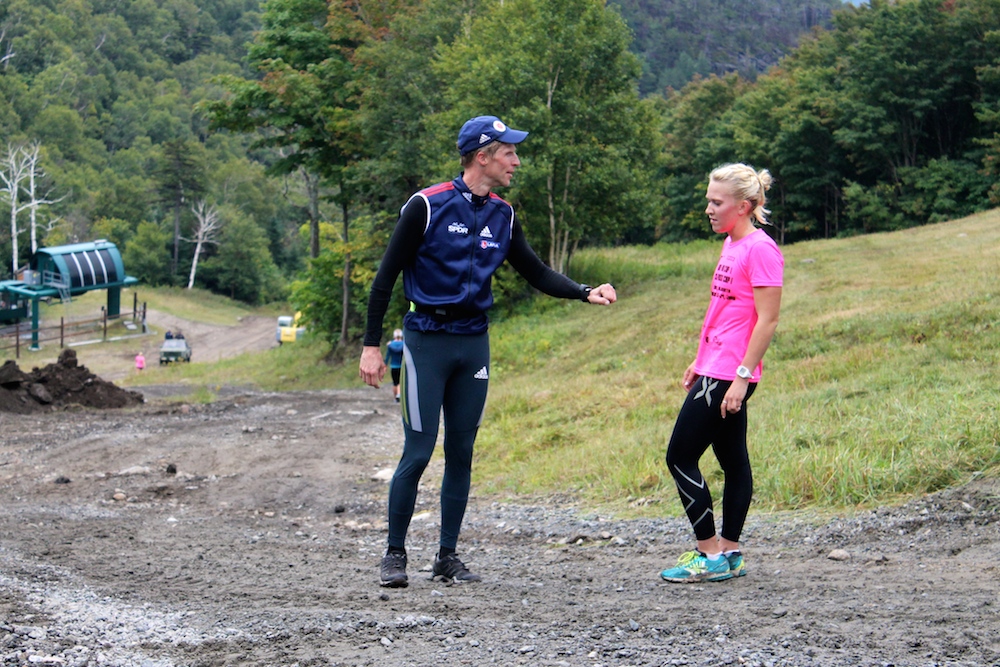
Kelsey Dickinson talking to U.S. Women’s Coach Jonne Kähkönen at USBA’s Talent ID Camp last year. Dickinson was selected to be part of USBA’s Development Group last season.
At the time of his interview, Eisenbichler emphasized that he had not yet spoken with the MWSC CEO, Shepard, who made the decision.
“I don’t want to talk about inside things as I don’t know,” Eisenbichler said. “I just can say that I know Andy and his team did a great job over the last decade being a great development resource for us and our athletes, and getting them ready for the next level. I feel very thankful for that. If there are changes now, there will be a good reason for it. I want to talk to him in more detail.”
For Dickinson, though, that support from MWSC just gave her a painful taste of what she could have had, before it was taken away.
“People don’t realize necessarily the commitment that it takes to be a senior level biathlete that’s not getting massive amounts of support from U.S. Biathlon,” she said. “It’s heartbreaking to be in this place where I’m looking at next year and trying to make it work because I want to pursue biathlon. A lot of people are feeling that right now. I’m not the only one.”
Not Quite Good Enough
In most cases, the athletes saw it coming that they wouldn’t get re-named to the USBA teams. Currier, a 2014 Olympian who has two previous World Cup top 10’s to his name, had his worst season in several years..
“The season started out pretty well but by January I was mentally and physically exhausted,” he explained. “Since then I have felt a little better. For me it was a good summer with some big improvement. I just got really stressed out on race day and couldn’t put it together on the shooting range, and that spilled over into the skiing. I never really got going the way I wanted things to go. It just sort of snowballed.”
Casey Smith (left) on his way to placing second in a NorAm mass start in Canmore, Alberta, in early December. (Photo: Jake Ellingson)
Neither he nor Smith made the criteria to get re-named to the national B-team. The objective criteria would have been two top-35 performances on the World Cup or at World Championships. While Currier raced the first period of World Cups, with a top finish of 61st, Smith did not appear at the sport’s highest circuit. His top IBU Cup finish was 38th in a sprint in Ridnaun, Italy; Currier placed consistently in the high 30’s in early January.
While the USBA rules allow for discretion in naming the B-team, Eisenbichler said that none of the athletes made a compelling case for themselves with their non-World Cup results.
“The B-team for us is really a team that we really want to have people who when they come to the World Cup they would be really competitive there,” Eisenbichler said. “And unfortunately nobody really made the criteria, and for nobody was there an outstanding result where you can say, okay, this is a discretionary thing. We know that all these athletes, Casey Smith, Russell Currier and Wynn Roberts, have the potential to be there, and have already showed that they can be at a much higher performance level than they were at this year. But unfortunately this year was not their strongest year.”
Roberts, a 2010 Olympian who is a member of the National Guard biathlon program, also had his hat in the ring. He placed in the top 30 of the IBU Cups in Canmore, Alberta, in three different races. But the fields were not deep, with just 45 or 46 finishers, and even when he placed 22nd in a sprint, he was 1:41 back in a race that took the winner just over 24 and a half minutes, or about 6% slower than the winner.
Smith, an Under-26 athlete and younger than Currier and Roberts, could have also qualified for the B-team by placing in the top third of the field at Open European Championships. But his best finish, 61st out of 98, did not come close.
Brian Halligan (Maine Winter Sports Center/USBA Development Team) competing in the NorAm mass start in Canmore, Alberta, on December 7. Halligan later swept all three junior men’s races at World Youth and Junior Trials in Mount Itasca, Minnesota. (Photo: Jakob Ellingson.)
Still, Smith, who crashed hard while training on course at the final IBU Cups of the season in Canmore, believes that if he hadn’t had to abandon the rest of his season he could have turned in results that would have netted him a nomination. As it was, he was laid up with broken ribs, bones in his back, and a punctured lung, and will be recovering for a long time before fully resuming training.
And he also believed that domestic results should have spoken in his favor.
“I would have thought that after winning the IBU trials two years in a row they would see more potential in me,” he wrote.
The USBA criteria note that winners of the National Championships – which Smith missed with his injury – would be invited to a summer training camp and evaluated for eventual inclusion on the B-team or another team, although such a naming is not guaranteed. The double victor at nationals, Patrick Johnson of the Auburn Ski Club, was named to the X-team, an intensely-focused training group based in Lake Placid, N.Y., for outstanding juniors and cross-country skiers converting to biathlon. A standout skier, Johnson has been doing biathlon for roughly a year.
As for why Halligan and Dickinson were not re-named to the Development Group – a lower-tier, non-residential program below the X-team – both understood that they hadn’t raced as well as they had hoped this season. Halligan, for instance, said that he had overtrained.
“By the time I got to Europe my body was just exhausted and I didn’t have too great of a result,” he said. “So I honestly didn’t expect to get called back to the Development Team this year.”
As a first-year senior, Dickinson was thrilled to have made the IBU Cup team, a goal she said she hadn’t been confident she could achieve. She hoped that that accomplishment would have been recognized, but at the same time understood why the results themselves were not. She got to race in Poland and Italy, where she had a top finish of 68th, as well as in Canmore, where she twice placed 28th out of 36 women.
Kelsey Dickinson competing at the 2014 North American Rollerski Championships at Ethan Allen Firing Range in Jericho, Vermont.
“There are criteria,” she said. “I didn’t do well when I was over in Europe. It was a bit of a rough trip. The new levels that they have are pretty tough especially because it’s mostly the A1, A2, and A3 teams now I think. I understand… I get why I didn’t get named.”
In order to be a better biathlete in the future – and biathlon is the sport she intends to follow long-term – she has read the criteria and, metaphorically, the writing on the wall. Incidentally, what she needs to do may not in the long term be incompatible with a return to the College of Saint Scholastica, where she was enrolled before spending a year at MWSC to focus on biathlon full-time.
“My goal this year is to ski faster,” she said. “That’s why they didn’t name me to anything. It was because I wasn’t skiing fast enough this year. Skiing for the NCAA circuit and skiing for [coach] Chad Salmela, I think I could make some of those advances.”
Cuts on the Home Front
Between the dual cuts, the four athlete are looking at a loss of opportunities to train in Lake Placid with other top-level biathletes, reduced contact with national team coaches and other support staff, like sports psychologists, and, perhaps most significantly to their chances of getting re-named to a national team down the road, a cut in both funding and coaching support for national trials races in the summer, fall, and winter.
That also affects other biathletes, like Katrina Howe, who also represented the U.S. at IBU Cups in Canmore but hasn’t been a member of their development program since 2010, the year after she graduated from the University of Vermont.
Maine Winter Sports Center athletes and friends enjoying Lake Tahoe on their trip to U.S. National Championships in March. There, Dickinson, Phaneuf and Katrina Howe shuffled back and forth between places two and four in the combined junior/senior women’s results. (Photo: Katrina Howe/Facebook)
“Last year our trips, like to Canmore and Minnesota for trials, were all covered by Maine Winter as part of being on the team,” said Halligan, who paid to be part of MWSC’s postgraduate training program for the last two years. “This year the trip to Junior World trials will be covered. But all the others, like for rollerski races and IBU Cup trials, you have to cover those on your own. And also since Seth [Hubbard] is the only coach at the moment, they won’t be sending a coach out there either. So you’ll have to go at it alone, or have to hook up with another team.”
Hubbard did not return a request for comment.
The financial stretch seemed to trouble some athletes more than others; Halligan didn’t seem overly concerned with the increase in tuition of the postgraduate program, although covering travel expenses was a stressful prospect. For the senior athletes, however, who had not been paying program fees, the vastly increased expense seemed devastating.
“For me it’s a financial thing,” Dickinson said in an interview. “I can’t afford to fund myself and be completely unsupported next year.”
With Will Sweetser leaving as the head of MWSC’s cross country skiing program, Hubbard’s responsibilities in northern Maine have changed and increased. Not having him with the team on the road is one of the most daunting changes for the biathletes: there’s additional components to preparing for a biathlon race compared to a ski race, like zeroing on the shooting range.
Casey Smith competing in the men’s 10 k sprint at the 2014 North American Rollerski Championships.
“With me the biggest thing was even if we could hire a part time coach to come with us to Canmore, Minnesota and those different places, it’s a little different in biathlon especially because when you’re working with someone through the whole year they really understand your shooting,” Dickinson said. “It’s harder to just jump in with someone else.”
Halligan and Smith both said that the support changes are making them look at other clubs and doing some cost analysis. Smith wrote that the change “makes me question if [MWSC] will continue to be the best option for me.”
For Dickinson, the financial aspect as well as the coaching support is what is making her contemplate a return to college.
“I qualified for World Juniors in Presque Isle basically training [at College of Saint Scholastica] and doing biathlon on my own,” Dickinson said. “I didn’t have a coach. I was shooting on my own – there’s a range, although I don’t know what the status of it is now that I’m going back. I had a little help from Chad [Salmela, the CSS coach and a former biathlete] but not really because he’s so busy with the team. He supported me going to different races. The problem is that I made this really big jump last year as a first year senior with qualifying for the IBU Cup and that level of training does require have a coach and having higher level opportunities. I see that a little more difficult for me to make that happen on my own in Duluth while I’m going to school. It would just require so much more.”
While all lauded the training group atmosphere in Maine, which will remain despite the funding changes, Currier is the only one who seemed to be definitely staying, although he said that he is still working out the details of how that can be compatible with international competition.
Currier at the finish of the Nove Mesto sprintin 2012, where he came from bib 103 to place sixth. (Photo: USBA/NordicFocus.com)
“For me, it still makes sense to be there because nobody knows training in the area like I do,” the 2014 Olympian explained. “I know where all the good roads are. For me it’s home, really. From a training perspective that’s a big advantage.”
An Open Door?
Eisenbichler said that just because athletes were not named to the national team in the spring did not imply that they would never be named again. In a new strategy, USBA expanded their national team by nominating or promoting six athletes in November last year. According to Eisenbichler, the same thing could happen this year as early as the end of August, after national rollerski championships in Jericho, Vermont.
“It’s first of all good to have rewards on the way for athletes who are developing in a fast way,” Eisenbichler said. “But also to use the opportunity to say okay, we add an athlete who shows a good performance level right now to the team and make the [national] training group even stronger, so everyone can capitalize on that.”
For Currier, “that’s the plan,” he says, in terms of getting his national team creds back and all of the coaching and supplementary support that entails. He hopes to still talk to national team coaches in the coming months about changes he is thinking of making to his training, and wishes that he could maintain his relationship with the team’s psychologist and other staff.
“We’ve talked to all of them individually and it’s really important for me to be clear, and say that the door is not shut for any of the teams during the training period,” he said. “If you show a really good development, or show a really good performance marker during the [rollerski] nationals compared to our A team who are really World Class performers… you have a really good chance to get named to the ‘B’ team end of August, or be invited to some camps in the fall.”
Smith is more cynical about the offer.
“With adding people to the ‘B’ team, they said the same thing last year, that there would be more opportunity for training and coaching in Lake Placid after the rollerski races in August,” he wrote in an email. “This turned out true only for athletes trying biathlon for the first time, not existing athletes. I am not holding my breath that this will actually happen and think that it is more just to pacify us for the summer.”
Dickinson, meanwhile, said that she applied to be a part of the Talent ID Camp for a second year, hoping that by competing with other junior-level biathletes and elite cross country skiers she can prove that she deserves funding or at least the invitation to some national team camps. She indicated that USBA staff had encouraged this move.
“I had hoped to get more opportunities to work with Jean [Paquet, USBA’s Head Development Coach] this year,” she said. “For people like Maddie who have had complete access to the national team resources, you look at the jump that she’s made this year. It really does make a difference. It’s going to be really hard for all of us that… aren’t getting anything.”
Members of the Maine Winter Sports Center cross-country and biathlon teams on one last ski of the 2014/2015 season in early April in Fort Kent, Maine. (Photo: Facebook/Katrina Howe)
Earlier this month, Will Sweetser, competitive sports director at the Maine Winter Sports Center (MWSC), revealed on his Facebook page that his 15-year term with the program had drawn to a close:
“I can’t thank all of you who’ve made Maine Winter Sports Center and Maine Winter Sports Center Athletes such a success enough. Wish that I could give another 15 years to establishing my dream in Maine,” he wrote.
“Don’t know yet where I’ll be,” Sweetser, 44, added in a comment. “Sudden news.”
While the Maine native said in a phone interview he wasn’t able to elaborate on the departure at the time, he noted, “The leadership of Maine Winter Sports Center is shifting a little and we’re moving a different direction. I’m on to my next adventure; I have no idea what that’s going to be be…”
On April 13, Sweetser was vacationing at a family residence in Florida with his wife Sarah Dominick, an assistant nordic coach at Bowdoin College in Brunswick, Maine. The two live nearly 300 miles north of Brunswick in Stockholm, Maine, between the MWSC’s base in Caribou and Fort Kent.
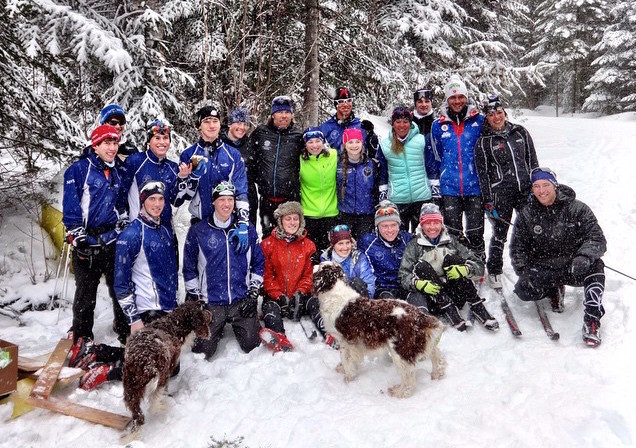
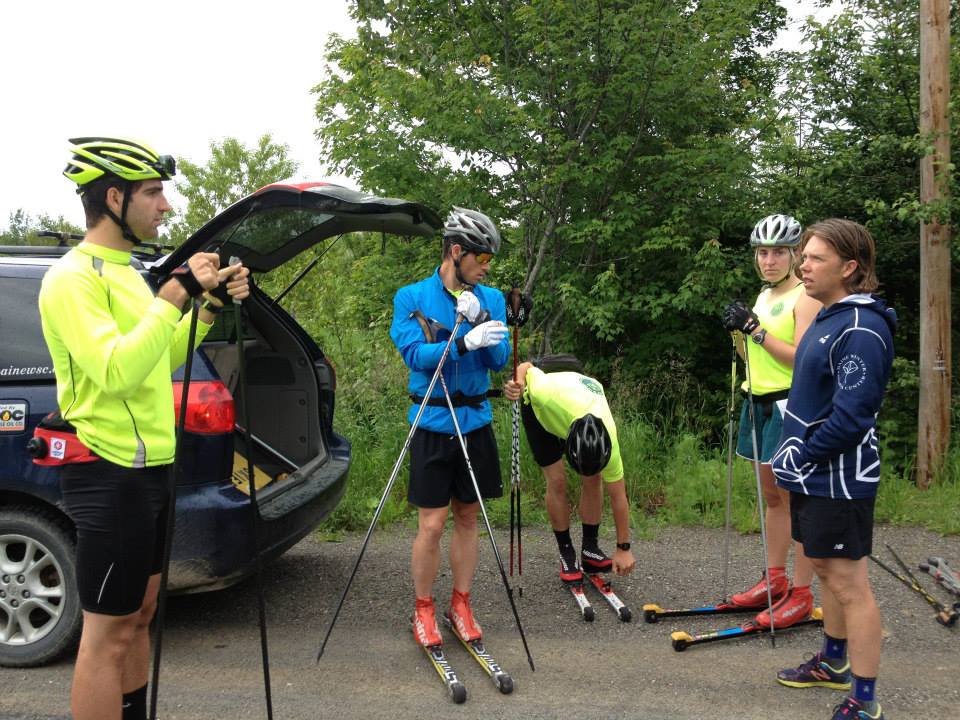
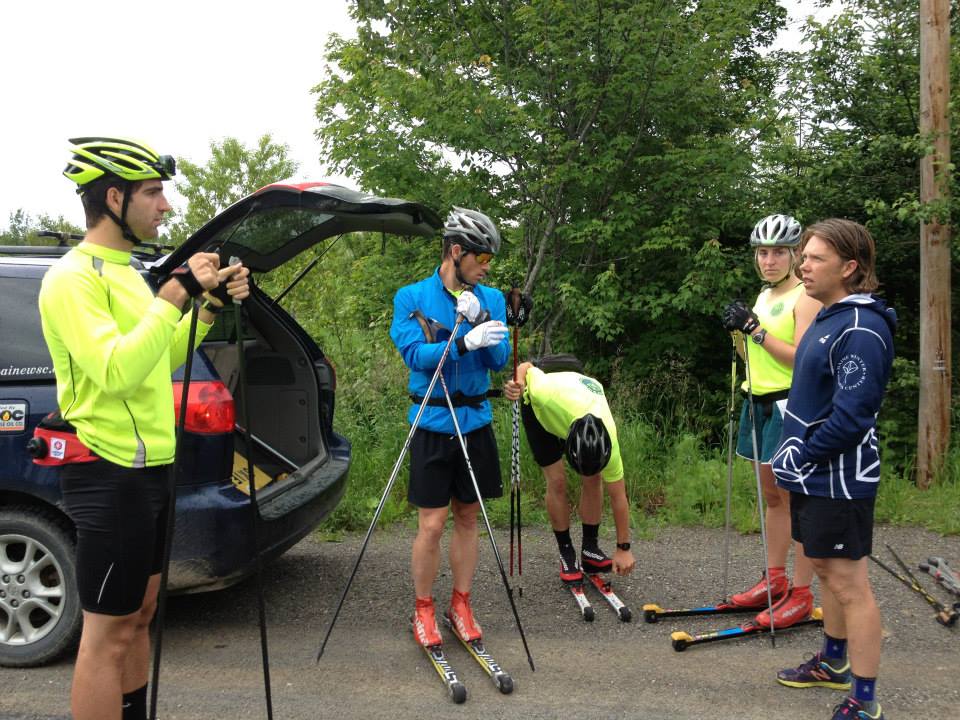
The Maine Winter Sports Center Cross-Country Olympic Development Team (ODT) getting ready for a rollerski in northeastern Maine in 2013, with Kris Freeman (in blue), Welly Ramsey, Hilary McNamee and competitive programs director Will Sweetser (r). (Photo: Facebook/MWSC)
Originally from Auburn, Sweetser skied for Dartmouth, and Dominick was an All-American skier at Bates College and former MWSC coach. Sweetser has coached at Bates, the Jackson Hole Ski Club in Wyoming, and Carrabassett Valley Academy and Rangeley Lakes Ski Club in Maine.
“We were committed to raising a family in Maine and it came as a surprise,” Sweetser said of the recent news, adding that he and Dominick “will be searching for something new to do while we’re expecting a baby.”
Their first child is due in October.
“I’m really proud of the work that the organization has done in the field of competitive skiing [and] biathlon and I’m very thankful for all the time that I had with fantastic young athletes in the state of Maine,” Sweetser added.
He started the position as head of the cross-country team in 2000. Along with Sweetser’s departure, the Olympic Development Team (ODT) program is being restructured, according to MWSC President and Chief Executive Andy Shepard.
That means that ODT athletes, including Welly Ramsey, and biathletes Casey Smith, Russell Currier and Katrina Howe, will have to finance their travel for the coming 2015/2016 season.
“In the short term — this coming season — the program will be more of a Training Center program,” Shepard wrote in an email. “We will continue to offer coaching for the athletes who want to train with us. We are also looking at opportunities to provide part-time coaching positions to provide some funding for them.”
For the coming season, the MWSC, which has an annual total budget of $1.1 million, according to Shepard, will shift its focus to its junior and postgraduate programs. In 2013/2014, the center operated with about a $1.4 million dollar budget, supplied by the Libra Foundation.
“The staffing structure we have had historically is set up to support those [junior and postgraduate] programs effectively,” Shepard wrote. “We have had a lot of success over the years placing kids from our programs on Olympic Teams. We are very proud of that heritage and are committed to continuing that tradition in the future. We just need to find a way to do so in a sustainable way. We hope to have a coach on board soon and will work with that coach to create a new vision for that program.”
He explained that they were looking to fill Sweetser’s position in the “next couple weeks.”
“While racing is a part of a much larger outdoor education program structure, we’re very proud of our role in racing in Maine and it will remain a critical part of our programming moving forward,” Shepard wrote. “Maine has some of the top skiers and biathletes in the country and we want them to be able to stay at home to pursue their Olympic dreams.”
Currier described the ODT cuts as “unfortunate, but it isn’t necessarily unfair,” he said in a phone interview. “Getting athletes on the World Cup is a goal for MWSC, but it’s not the primary goal. If anything, it’s sort of an indirect goal. … Ultimately, the primary goal is to build a skiing community, not just a few fast athletes. So when the budget got stretched a little thin, they had to re-prioritize what is important.
“While we still have training sessions for really good athletes, most of the resources and development will go toward that younger, local group,” he added. “It’s kind of a double edged sword. It’s fair, but it’s difficult for me.”
Cash Flow
In February 2014, MWSC discovered it would lose its funding from the Libra Foundation in April 2014. The program immediately launched two fundraising efforts, the first of which involved asking Maine-based foundations and corporations for three years of support with a goal of raising $550,000 by March 2014. The second spawned from an initial matching gift from Presque Isle native Mary Barton Smith, who pledged $100,000 plus a $400,000 matching grant.
A few months later, Smith donated another $2 million with an additional $3 million in matching to kick off the program’s $20-million endowment campaign for the long-term sustainability of the MWSC.
In the last 14 months, Shepard noted that the center has made “significant progress in our fundraising,” raising $3.9 million dollars. Two million of that was toward the program’s $20-million endowment and another $3 million would come from Smith’s pledged matched funding.
“We still have a lot of work to do, but we are off to a great start,” he wrote.
This season, the MWSC is increasing its Adventure Initiative Program from five sessions last year to 10 sessions this year, “including the possibility of a month-long program in the Patagonia region next fall,” Shepard explained. “We are increasing our budget for the Junior Race program and we are working on an exciting new biathlon program that we plan to announce in May. We have also launched a new initiative, collaborating with land trusts in Maine to provide trail design, programming, gear and leadership development.”
But for the program’s highest-level skiers, funding cuts to the ODT (specifically to travel outside the East) and the cross-country coaching void have led many to reconsider their futures at Maine Winter Sports.
The Initial Shock and What’s Next
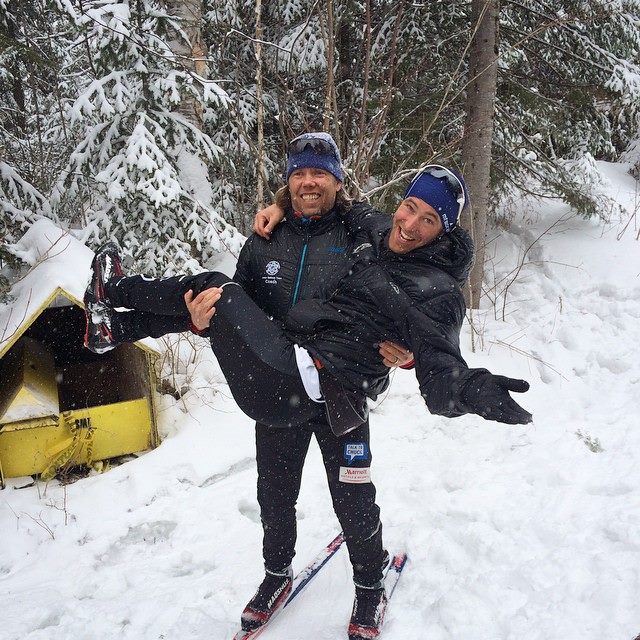
Will Sweetser, former competitive programs director at the Maine Winter Sports Center (MWSC), holds athlete Welly Ramsey during a season-ending team ski in early April in Fort Kent, Maine. Sweetser had been Ramsey’s coach for the last six seasons. (Photo: Facebook/Welly Ramsey)
“We came close to a breakthrough this season, and I hope any future success of mine will be rightfully attributed to him,” he wrote. “The man has had an amazing impact on my life, playing coach, friend, co-worker, mentor, employer, disciplinarian, and much more. He always went the extra mile and I can unequivocally say that I wouldn’t be here without him.”
Ramsey added that Sweetser was “responsible for nearly every Maine skier developed in the past 15 years,” and helped propel MWSC’s junior team to one of its most successful seasons last winter despite the loss of its development coach, Amber Dodge. In an email, Dodge explained that she took a job as youth program manger with the New England Nordic Skiing Association (NENSA) last fall after moving in with her boyfriend and ski racer Kris Freeman in Thornton, N.H., last summer.
“I learned so much as a coach, thanks to Will and [biathlon director] Seth [Hubbard],” she wrote of her three years with the MWSC. “I miss the athletes I worked with dearly as we were able to spend so much time with them year round.”
Ramsey explained he was “currently in negotiations with the Maine Winter Sports Center about my future with the program, and have contacted other clubs with whom I can see my career excelling.”
He would like to stay in Maine “and continue helping develop the next generation of athletes, but I do need to make the choices which are best for my career,” he added. “Whether I stay or go will hinge largely on how effectively I fundraise this spring. Later this month, I’ll lay things out and assess my move based on fundraising potential, race and wax support, and training group. I have a big year of training planned and I’m excited for the opportunities this seemingly precipitous event has yielded, both in Maine and elsewhere.”
His teammate, Austin Huneck described the news about Sweetser as “a huge shock to everyone.” Huneck started as a postgraduate under his guidance two years ago and felt he had made major gains in the time since.
“It’s very sad for me to see him go after everything he has done to help MWSC and athletes across the state,” Huneck wrote in an online message. “It’s hard to put into words how much Will has done for the ski community during his years with Maine Winter. He has helped me grow so much as an athlete and a person, and I’m not sure I would be were I am today without him. I know whatever he goes on to do next will be a great adventure. I’m grateful to have known him as not only my coach but as my friend.”
While he had initially planed to return to MWSC for his third season, Huneck explained that his plans are “very up in the air.”
“Will being gone does have an impact on my decision to return, but I know Seth Hubbard and [program director] Mike Smith at Maine Winter will do a great job to hire a new coach to fill his shoes,” he wrote. “MWSC has seen a loss of funding for the elite level athlete support going into next year, and this is also going to have a big impact on my decision. I am currently looking into attending college next season, and speaking with coaches at other clubs around the country. But at this time, I cannot say what my plans are for sure.”
“Will Sweetser is a great coach, without him in my corner the year before the Sochi Paralympics I don’t think I would have been as happy as I am with my performance and progression in the sport of Cross Country skiing,” Bermejo, a MWSC cross-country team member, wrote in an email. “It was a shock to me and to other athletes the sudden departure of Will from MWSC.
“As far as my career, I had spoken to Will about the possibility of returning to MWSC this year but I will not be going due to his departure,” he added. “Lucky for me he will be moving closer to me here in Wyoming, where I intend to seek his help to improve my technique.”
Sweetser did not say whether he and his wife planned to move from Maine.
Howe, a biathlete with the program, wrote in an email that she was “devastated to hear about his departure from MWSC. Although he wasn’t my coach … I got to work with him quite often and thoroughly enjoyed it. I haven’t worked with many coaches who love skiing as much as Will does.
“For Will and his wife Sarah it’s truly a lifestyle, not just a job,” she added. “They will be sorely missed at MWSC … As with the departure of any coach, good or bad, it’s an opportunity for growth and change in the program. Hopefully the position will be filled by someone who shares the love and enthusiasm for skiing that Will has.”
In the aftermath of the ODT cuts, Howe explained she was unsure of her plans going forward.
“Ideally I’ll be in a position to continue with biathlon but if that doesn’t happen my backup plan is to get reacquainted with my classic skis and jump into some cross country races this coming winter,” she wrote. “At some point I see myself becoming a coach, but I can’t say how soon that will be.”
Casey Smith (Maine Winter Sports Center/U.S. Biathlon “B” Team) competing in a NorAm in Canmore, Alberta, in early December. (Photo: Jake Ellingson)
It was the last Friday in February and U.S. biathlete Casey Smith was training in Canmore, Alberta. The Canadian venue was about to host the first of several IBU Cup races, the second-tier circuit of the International Biathlon Union.
After a season which he described as a learning process, but lacking any spectacular results, the first-year member of the U.S. National Team was excited to be racing against international competition but on more or less home turf.
“In Europe I didn’t really have any outstanding races, I would say,” he said in an interview on Tuesday. “I was really looking forward to racing in Canmore because it’s almost like a home course. I spent a month there in November, and in years past I’ve spent a lot of time there too.”
Smith, who is based at the Maine Winter Sports Center, had already been cruising the trails and was doing his final race prep before the initial sprint race to be held Saturday. Part of race prep entails thinking about how, technically, to ski each section of the course: uphills, downhills, terrain and corners.
“There was a downhill corner that I had been sliding into to check my speed and then stepping the rest of the way around,” he said. “I decided to try to step all the way through the turn to see if it was faster.”
With snow conditions as they were – all manmade snow, with a layer of sugary corn snow on top of an icy, hard, frozen base – that turned out to be a dangerous move.
“As I was going around the corner, my skis just slipped out from underneath me, like when you’re falling on an ice skating rink,” he remembered. “The trail was all manmade snow, so it was kind of built up and the hill dropped away from the trail. I flew off the trail and down about four meters into a tree. I was flying through the air and the first thing I hit was the tree, on my back. It was like I was standing up and down in the air as I hit it.”
Smith was knocked unconscious by the impact and woke up to his friend Ethan Dreissigacker, who had been following him around the course, standing over him asking if he was okay.
The answer? No. As medical staff and paramedics came to the scene (including Smith’s mother, who was there as a coach but has also been an EMT for years), it was obvious that he needed to be moved to nearby Calgary, and fast.
It sounds like a routine now when Smith lists off the injuries the doctors eventually catalogued.
“I broke all by two of the ribs on my left side and one rib on my right side,” he begins. “I broke my shoulder blade in multiple places. On my back there’s little bones [called transverse processes] that stick off the side of your spine. I broke seven of those. Nothing into the spinal column luckily. I punctured my left lung.”
Smith would not be competing in the IBU Cup. Instead, he spent 11 days in the hospital and another three outside of it in Calgary before finally being able to head home to Winthrop, Washington, to recuperate.
“I’m home in Washington now, so it’s pretty nice to just relax and recover here,” he said.
Looking back, it seems obvious that the corner was dangerous – the race organizers have apparently since put up a snowfence on the downhill where Smith crashed – but at the time, it didn’t seem like anything unusual.
“There’s lots of corners on any ski course where you could potentially go flying off,” Smith said. “So I don’t really know. The day before I had skied around that corner and kind of glanced off the trail and thought, ‘wow, it would suck to go off the trail there, it’s a long way down and not a lot to stop you.’ But I didn’t think twice about it.”
Tracy Lamb, a former biathlete and national team coach who is now the director of the U.S. Olympic Training Center in Chula Vista, California, was the Technical Delegate for the competitions.
“Let me just say how concerned I have been about Casey’s recovery and how glad I am to know that he has been making good progress,” Lamb wrote in an email. “I am also grateful for the care he was given in Canada and very glad that his mother was there to be with him. Course safety is a priority for every organizing committee in Biathlon. Extra steps were and are taken to safeguard against athlete accidents. This was truly an unfortunate accident.”
Smith had his rifle on his back at the time of the crash, and says it’s hard to whether that added to the list of injuries or not.
“My rifle stock is snapped in half,” he said. “We don’t know if the rifle helped or hurt me more. I’d like to think it helped me in kind of absorbing some of the impact, by breaking the stock, and acted as almost something of a back brace so I didn’t curl around the tree as much when I hit it. But who knows.”
While most of his injuries have a six- to eight-week recovery time, and Smith is already walking for ten or fifteen minutes at a time “slower than I’d walk with my 80-year-old grandpa,” he plans to return to biathlon. Six weeks will likely not be enough time to get back to training speed, is the message he has been given.
“For the lung, that’s one of the more major things,” he explained. “It had some pretty bad bruising and a tear. Obviously you use your lungs a lot in an endurance sport. So that could be up to six months maybe. But it depends on how quickly it heals. You just kind of go with the flow.”
Before the crash, Smith was working his way up the U.S. biathlon ladder. As part of his position on the national team, he had spent several weeks in Lake Placid this summer.
“That was really beneficial, first of all just for having the national team coaches to give me lots of insight and pick up on details,” he said. “And also just being around Tim [Burke] and Lowell [Bailey] and training with those guys some. They know what they’re doing. It’s beneficial being at that higher level and having it at your fingertips to soak in everything.”
Smith’s top international finish this season was 43rd in an IBU Cup pursuit in Ridnaun, Italy. With a little more international racing under his belt and the kind of experience he had in Lake Placid over the summer, Smith is certain he’ll be back at biathlon soon – as soon as is responsibly possible.
“I don’t want to push it too much so I overdo it before I’m recovered, but I’m definitely planning on making a full recovery, coming back to biathlon, and getting better,” he said.
Casey Smith (right) on the podium of a Czech Cup race in Nove Mesto, Czech Republic, this season. Photo courtesy of Casey Smith.
It’s been a while since the U.S. Biathlon Association (USBA) team nominated a new member to the national team. Last year, with the focus on an upcoming Olympics, the squad was focused solely on veterans; the previous time around, the only new naming was Hannah Dreissigacker, who already had an elite career as a cross-country skier behind her.
So when Casey Smith’s name showed up on the national team roster which was announced earlier this month, it represented a significant move toward development for the USBA. Smith raced for the Maine Winter Sports Center last season, and as a first-year senior placed 22nd in the sprint at Open European Championships.
“The fact that Casey made really good progress last year in a short amount of time as a first-year senior, we are excited,” USBA High Performance Director Bernd Eisenbichler told FasterSkier. “For Casey it was really a good result at the European Championships, and he qualified for the Olympic trials and the IBU Cup. He had the exposure to international racing. For sure he still needs improvement to be on the World Cup level, but it’s positive signs.”
Smith received a “B” team nomination based on USBA criteria. He is the youngest addition to the senior national team in years, and will be tapped to fill roles vacated by retiring veterans Jeremy Teela and Jay Hakkinen in the future. Eisenbichler admitted that with a successful Olympic Games behind them, it was time for the team to start looking forward – starting with athletes like Smith, who has been in the USBA pipeline for years.
“If you look at our team structure, that’s what we have to do because for sure there’s a little bit of a break behind Tim [Burke] and Lowell [Bailey] on the age side, so for sure we have to work hard to fill that,” Eisenbichler said. “We’re doing all possible efforts to do that, with recruiting and with developing our own athletes.”
Smith is a four-time World Youth and Junior Championships competitor who notched finishes in the low 30’s in each of those appearances. After finishing high school in the Methow Valley region of Washington, he attended Montana State University and trained as a biathlete. After finishing his junior career, Smith decided to focus even more on biathlon and moved to the Maine Winter Sports Center (MWSC).
“Last year when I joined MWSC my goal was to make the Olympic team,” Smith wrote in an e-mail. “I knew that the first three spots were pretty much set, but I thought that the last two spots were pretty wide open. I know from where I was to making the Olympic team would be a huge step but if you want to make big gains you need to set even bigger goals.”
Smith certainly made a splash as he set out on his Olympic hunt: he won a series of trials races at Mount Itasca in Minnesota, earning selection to an IBU Cup tour where the international competitions would also serve as the final selection trials for the Olympic team.
They were Smith’s first appearances on the competitive international circuit, which is like a second-tier World Cup. He collected two finishes in the mid-40’s and was ultimately not picked for the Games. But Smith doesn’t consider it a failure – he stayed in Europe for Open European Championships and some other small races as well.
“The IBU Cups were cool because there were so many competitive athletes and several of the people I was racing there went on to place in the top of World Cup events,” Smith wrote. “Even though I did not accomplish my main goal of making the Olympics, I was still very happy with what I was able to accomplish. Not only did I race in my first IBU cups and qualify for the national B-team from my results at the European Champs, but I had an excellent early season as well, I was the overall Noram leader until I left for Europe, and I won the US IBU Cup trials.”
He got used to a higher level of competition as well as the craziness of life on the road in Europe: for instance, competitions he was slated to race with a teammate in Slovenia were canceled because there was so much snow that the shooting range was buried. Among Smith’s other accomplishments were two third-place finishes in Czech Cup races in Nove Mesto.
Seth Hubbard, the biathlon coach at MWSC, said that Smith was an apt pupil in his first season of full-time training.
Casey Smith chasing Russell Currier in the mass start competition at IBU Cup trials in Mount Itasca, Minnesota in December. Photo courtesy of Casey Smith.
“He is a very enthusiastic biathlete and is really wanting to be doing the work to get to the next levels in the sport,” Hubbard told FasterSkier. “For Casey, having a season where he was focused on his development as a biathlete was great. A few important pieces for athletes transitioning from school into full time sport are to be focused on why you are taking the time to be an athlete, and to also leave a little time for life outside of sport. Casey did a great job of balancing these two items.”
And Smith found MWSC a rewarding place to train. He was challenged by Russell Currier, a World Cup veteran who ultimately earned the Olympic nomination.
“Compared to years past while I was in school I did not make a super large jump in hours, but I think that the quality of my training improved dramatically,” Smith wrote. “One, I was able to do specific combo training at the 10th Mountain Ski Center in Fort Kent and two, I had individual coaching for most workout sessions. I think both of these factors contributed to my success this season.”
Smith will be joined on the “B” team by Currier, as the only two men to receive that nomination. No women will be on the “B” team. What that means is that the pair will stay largely in Maine, and attend a few camps with “A” team athletes Burke, Bailey, and Leif Nordgren throughout the season.
“It’s a couple of camps, time in June in Lake Placid, and then again in August in Lake Placid, and they have the nationals where they meet up and see where their performance level is against the big guns,” Eisenbichler explained. “Then they have the Utah camp and the testing week. That was the idea behind it, that we need them to get ready for the next level, expose them to the big guns when it’s right, and they can still work on their own development and progress in a calm environment.”
To some extent, the theory seemed to be: if it ain’t broke, don’t fix it. Smith improved steadily last season, and Eisenbichler thought Maine was likely a big part of that change.
“The idea is that they are up in Maine and can profit from each other in training,” Eisenbichler said. “Casey is a really good shooter and Russell is for sure a really good [skier], so they can profit from the other’s strengths and weaknesses and work together on this. It’s really good to be up in Maine with Seth Hubbard because he’s really with our philosophy of training.”
Hubbard agreed, and was happy to keep the two men around on his team.
“This made the most sense as far as being able to provide as much support from a financial, coaching and training group perspective,” he wrote in an e-mail. “With these two athletes as well as some of the older junior biathletes and nordic athletes we are fortunate to have a strong and diverse training group in Maine. In the past year it had worked well through different portions of the season when Russell was able to spend more time with the team.”
Smith and Currier’s training will be overseen jointly by Hubbard and the national team staff, an additional piece that Smith welcomed (other than a conference call at the beginning of the season, he said he had little oversight from USBA last year).
“Besides attending these camps I will be able to consult with the national team coaches,” he wrote.” I am excited about being invited to these camps because it will be more national team coaching support then I have ever received.”
MWSC recently lost its title sponsor, but through fundraising has made significant steps towards recovering its budget. As of May 1, MWSC had raised over $350,000 and had received about $450,000 from Mary Barton Smith, primarily through an ongoing matching challenge.
Smith said that there was still a bit of uncertainty, but that he hadn’t heard any way that the funding situation would directly affect him.
“I know that I will be primarily based in Fort Kent, and will have housing thanks to the Phyllis Jalbert biathlete house,” he explained.
Eisenbichler was also unconcerned about the potential changes to MWSC.
“I’m not worried about Maine Winter Sports Center,” he said. “They have a strong leader there and he is doing everything in his power to keep that program going. We’re really happy to have this program in place and I think it’s a great program.”
Audrey Vaillancourt of Canada atop the Open European Championships podium in Nove Mesto, Czech Republic today. Photo: Emma Lunder/Eat Sleep Train.
Audrey Vaillancourt has had a pretty crazy season so far: two IBU Cup tours, a few appearances on the World Cup, and possibly more travel than anyone following just one of those circuits would expect. Heck, the Canadian made trips to both the IBU Cup and the World Cup in a single weekend in January.
But all of the hustle paid off in Nove Mesto, Czech Republic, today, when Vaillancourt won gold in the Open European Championships 15 k individual race. With two penalties, the best shooting of the entire 58-woman field, Vaillancourt eked out a 2.1-second victory over Natassia Kalina of Belarus. It was the first time a Canadian has ever won gold at the event.
On her blog, Vaillancourt wrote that individual races are the ones which most frequently have surprise winners, since missed shots carry a one-minute penalty, heftier than in other formats. That means that clean shooting can get many different athletes to the top.
That creates pressure to shoot well, but Vaillancourt wasn’t feeling it.
“Shooting conditions were really tough today, the wind was gusting and swirling, but I still felt quite confident on the start line,” she told FasterSkier. “After all, it’s the same conditions for everyone! I was really focused every time I entered the shooting range, but I didn’t want to overthink it either. I think individuals should be approached the same way as other races. Otherwise you put too much pressure on yourself to shoot well and the opposite happens in the end.”
Vaillancourt started in bib six, so she didn’t have much information out on course.
“I don’t really like starting this early, because you don’t get a lot of splits, but the others do!” she said.
However, Iryna Kryuko of Belarus set a blistering pace early in bib four. When Vaillancourt left the final standing stage, she had a 26-second lead on Kryuko, and also some information about competitors who were earlier in their own races.
“I had a good last lap, especially after one of our waxtechs told me I could be in top three,” she said. “I have to say I didn’t expect to win though!”
As more and more racers trickled in, Vaillancourt’s time held up, as did Kryuko’s. Kalina was one of the latest starters in bib 56. She left the final standing stage in third place and was able to charge past her teammate Kryuko, but despite the information and splits wasn’t quite able to Vaillancourt.
Another secret for the Canadian was shooting speed. She had consistently some of the fastest times on the range, which gained her more than 30 seconds on Kalina over the course of the race. That helped her fend off the competition, although she had only the 21st-fastest ski time.
Vaillancourt said that the recent instability in her schedule had not affected her too negatively. At the second World Cup weekend after Christmas, she replaced Zina Kocher, who was at home racing Canadian ski team trials. The next weekend in Antholz, she was called up from the IBU Cup to fill a spot on the relay after a team member got sick, but the World Cup race was called off halfway through due to heavy fog obscuring the targets, so she ended up with no race start at all that day.
“The instability did make my preparation harder, but at the same time I learned to adapt to these kind of situations, so it doesn’t bother me that much. I’d rather be the one who fills in the World Cup spots at the last minute then never go at all!”
While European Championships is always a big event, functioning as the championships of the second-tier IBU Cup circuit, the field was particularly deep this year. The World Cup has been on break for over a week now, and won’t resume until after the Olympics are over. With teams unable to take their entire teams to Sochi due to limited starts, a number of World Cup athletes turned to European Championships to fill out their schedule.
That included Galina Nechkasova of Russia, who is expected to fill Irina Starykh’s place in Sochi after the top-ranked Russian had a positive doping test. Kechkasova placed fourth. Other World Cup stalwarts included Fanny Welle-Strand Horn of Norway in seventh and Sophie Boilley of France in eighth.
“I genuinely think the field is stronger this year,” Biathlon Canada High Performance Director Chris Lindsay told FasterSkier. “I suspect many of the names we are seeing will be making up 2018 Olympic teams… The location in Nove Mesto is helping this too. It is easier for “western” teams – France, Italy, Netherlands, USA, CAN, Germany, Austria, et cetera – to attend when it’s not held deep behind the old iron curtain.”
It’s a good sign for Canada as the “A” team heads to Sochi. Vaillancourt was competitive to get World Cup starts this fall, where she could have worked towards Olympic qualification.
“We are very happy with Audrey’s result,” Lindsay said. “She had a third place earlier this season in the IBU Cup so we know she is capable of podiums at that level. Certainly the ‘A’ team women at the Olympics take this as a positive sign: if our fifth-place female athlete is winning medals then they should feel confident in their abilities at Sochi.”
And Lindsay fully expects Vaillancourt to be among those who will be named in 2018.
“We are very excited to see Audrey continue to sharpen her racing skills on the IBU Cup this season in preparation for the 2015 Canmore IBU Cup, 2016 Canmore World Cup, and 2018 Olympics,” he said.
As for Vaillancourt? After making her first World Championships appearance last year, not making the Olympics was a bit of a bummer. But she’s moving on. A gold medal just might help.
“It was very disappointing not to make the Olympic team, but those who made it earned their spot, so there is nothing I can do about it now,” she said. “I am also still young!”
* * *
Also in the women’s 15 k, Vaillancourt’s teammates Emma Lunder and Emma Lodge placed 38th and 55th.
In the men’s 20 k, Scott Gow represented Canada well with a ninth-place finish. With two penalties, he finished 2:50 behind Andrrejs Rastorguvevs of Latvia, who routinely has some of the fastest ski times on the World Cup and has earned his first top-ten results this season. Even more than the women’s race, the men’s race was packed with World Cup talent.
Vincent Blais placed 63rd for Canada, Andrew Chisholm 69th, and Jasper Mackenzie 71st. For the United States, Casey Smith of the Maine Winter Sports Center led the way in 22nd with two penalties, and Wynn Roberts placed 68th.
The Maine Winter Sports Center Cross-Country Olympic Development Team (ODT) gets ready for a rollerski in northeastern Maine, with Kris Freeman (in blue), Welly Ramsey, Hilary McNamee and competitive programs director Will Sweetser (r). (Photo: MWSC/facebook.com/maine.Winter.Sports.Center)
Note: This is the sixth preview in our series on U.S. elite teams, which we’ve dubbed the “The 12.” We asked coaches to tell us what’s new and whom to look out for in the coming season and will publish additional previews in the coming weeks in no particular order.
Cross-Country Olympic Development Team (ODT): Kris Freeman, Sam Tarling, Welly Ramsey; Hilary McNamee, Anna Van der Rhee (trying to qualify for Sochi Olympics for The Netherlands). According to Sweetser, McNamee is focusing on finishing her studies at Dartmouth and will race primarily in New England.
XC Post-Grads: Emily Ramsey (New Sharon, Maine), Zoe Chase-Donahue (Freeport, Maine), Sarah Becker (Yarmouth, Maine), Abby Popenoe (Portland, Maine), Austin Huneck (Clifton Park, N.Y.)
Collegiate Summer Program: Nick Michaud (Bates College), Gabby Naranja (Bates).
Biathlon ODT member Katrina Howe during skate hill workout. (Photo: Seth Hubbard)
Who’s new: Tarling (2013 Dartmouth graduate), Smith (formerly of Montana State University), Bermejo (Grand Rapids, Mich.), all post-grads except Emily Ramsey (second year).
Who’s missing: None.
Top results last season: Sweetser intends to send a minimum of four athletes to the Olympic Winter Games or in Bermejo’s case, the Paralympics. The most-obvious four that could make that goal a reality are Freeman, Currier, Cook, and Bermejo. But look out for the new guys, including Tarling and Smith, training with the Caribou-based MWSC on the northeastern tip of Maine.
A three-time Olympian, Freeman, 32, was not renominated to the U.S. Ski Team for the first time in a decade. He won his 16th national title last January in the 50 k classic, but finished the 2012/2013 World Cup season with with three top-30 results. Sweetser said Freeman and Ramsey have had some very productive training sessions this summer.
“[Freeman] is nowhere near the crazy specific fitness he had late last summer, however, he is lighter, faster [ran fastest 5 k (15:53) since 2004 in June] and happier than he’s been in years,” Sweetser wrote in an e-mail.
Sweetser added that Tarling has been an “instant plus” in MWSC’s community programs, which include juniors, high-school skiers and adults. He was a presenter at the Maine Team Camp in Fort Kent earlier this month, which hosted 43 of the state’s best high school skiers.
MWSC teammates, biathlete Raleigh Goessling leading cross-country skier Welly Ramsey during bounding intervals in northeastern Maine. (Photo: Seth Hubbard)
The 2011 NCAA 10-kilometer freestyle champion won twice on the Eastern Intercollegiate Ski Association (EISA) circuit in his senior season at Dartmouth and finished fifth in the 30k classic at U.S. nationals.
“(Tarling) is very professional in his approach to creating a career as a ski racer,” Sweetser wrote. “He is gelling well with our entire team and is a fantastic addition at junior training camps.”
Van der Rhee (formerly Sprague), a native of Stockholm, Maine, and Utah alum, married a man from The Netherlands and has since established citizenship there. To qualify for the Olympics, she needs World Cup starts, which may be earned with either a sub 100-point distance race or sub 120-point sprint in International Ski Federation (FIS) competition. Last year, in returning to racing after a seven year hiatus, Van der Rhee had one sub 150-point race.
Cook leapt 38 spots (83rd to 45th) in the biathlon world rankings last year. She tallied her first World Cup top 20 in Italy and two more in the pre-Olympic races in Sochi, Russia. This will be her second year with MWSC.
Currier, 26, is trying for his first Olympics as a returning member of the U.S. Biathlon Team. The MWSC veteran pulled out a pair of sixth-place finishes on the World Cup in 2012 and was a critical component of the U.S. relay team that finished fifth in January in Oberhof, Germany.
Smith, 21, is one of the most promising young biathletes in the country. He competed in the International Biathlon Union (IBU) youth and junior World Championships four times each, with his best junior-world finish coming last January in the 12.5-kilometer pursuit, where he was 23rd. Smith got a feel for northern Maine when he competed at U.S. Biathlon Nationals in Fort Kent last March.
“As expected, Casey has been a great fit with our program,” Hubbard wrote in an e-mail. “He has great energy and focus.”
Coach’s comment:
“From my perspective as director, this group is more of a team than we’ve ever had,” Sweetser said of the multi-tiered elite team, now in its 11th year. “We are prioritizing group training twice each week with biathletes and XC skiers together. There is no doubt that our program will have one of the best men’s distance teams in U.S. XC. These guys could easily meet all of their goals this year given the progress we’ve seen thus far.”
Casey Smith (USA) en route to 37th place in the junior men’s individual in Obertilliach. He had his career-best finish of 23rd place in the pursuit on Sunday. Photo: US Biathlon/NordicFocus.
With the U.S. bringing just two junior men and one junior woman to the World Youth and Junior Championships in Obertilliach, Austria, relay day isn’t going to mean much for the oldest athletes on the team.
Instead, Casey Smith, Jake Dalberg, and Tara Geraghty-Moats had their last crack at the Championships on Wednesday, competing in the 12.5 / 15 k individual races: four shooting stage, a minute time penalty per missed shot.
After an impeccable pursuit race that saw just one penalty in four stages, Smith couldn’t quite keep pace in the individual, collecting one missed shot in each of the first three stages and then two in the last stage. Nevertheless, he was able to move from 42nd as he left the range the final time up to 37th by the finish.
“The individual went okay, it was not a great race but not bad either,” he wrote in an e-mail to FasterSkier. “Especially in an individual, with five misses you can’t expect to do great. Of course I would have like to hit more, but that is part of biathlon and what makes it fun and exciting.”
Teammate Jake Dalberg actually shot much better, collecting only three penalties, but was hampered by an early crash. As he spun around in the snow, he managed to lose all four bullet-filled magazines that usually tuck into a rifle stock. Arriving at the range, he realized he had nothing to shoot with, and had to wait for about 45 seconds while an official brought him new ones.
Dalberg ended up 52nd, but with the 45 seconds subtracted he would have been about even with Smith.
Jake Dalberg competing in the sprint. Photo: US Biathlon/NordicFocus.
“I shot that prone really fast, and honestly I am a little surprised that I hit 4 of 5,” he wrote in an e-mail. “So I was not so focused in that shooting, but the next three I was locked in and just paused too long on the last shot of each standing. I think as I have become more and more comfortable with the range I have been improving my averages in both training and obviously today in the race.”
Geraghty-Moats faced bigger challenges on the range, where she missed a painful 11 shots and wound up 63rd, over 13 minutes behind the winner, Laura Dahlmeier of Germany.
Like Geraghty-Moats, Dalberg failed to qualify for the pursuit race on Sunday, leaving him with just two starts in the series. He wasn’t exactly frustrated, but had hoped to gain one more race-worth of experience out of the trip.
“I wouldn’t say that I am disappointed with these races too much, but I definitely was hoping to make the pursuit,” he explained. “My ski speed overall just was not there I felt like, just kind of missing that top end. It may be the altitude, or the fact that I had a pretty intense cold in between trials and coming here.”
It’s Dalberg’s first trip to World Juniors, although he has international race experience as part of the National Guard biathlon team competing at military events. Those past races helped him prepare for this event – to an extent. Racing a military event in Italy still isn’t the same as World Juniors in Austria, with fans loudly cheering and booing in German for each shot on the range.
“Having been to Europe to race before definitely helped, but I still had some nerves going into the sprint,” Dalberg said. “I think too some days training on the range it was so busy, that I lost some focus while shooting at certain points.”
Staff Seargant Sarah Lehto, Dalberg’s coach, was nonetheless impressed at his performances this week.
“This is by far the biggest international race series for Jake in his career,” she told FasterSkier. “He’s competed internationally for the past two seasons but nothing at this
level. I’m extremely pleased that he was able to qualify for the team after narrowly missing the youth qualification last year and how he performed in such an atmosphere like these World Championships in Obertilliach… he’s now gained a ton of experience at this level which will help his development and expectation level for future racing.”
She also acknowledged that Dalberg’s skiing wasn’t up to his usual level, but that she hoped he wasn’t too disappointed. The racer himself is hoping to get back into shape next week, when he heads over the border to Italian Military Championships.
“For my first World Juniors, I would say I am happy with it, but felt like I could have had some better ski times,” he explained. “The competition was very tough, I knew it would be but the top several juniors I believe have been competing on the World Cup/IBU Cup, so I felt like the top end was very competitive, and I think overall the fields were pretty large this year compared to past years.”
Smith is also hoping to carry on in the coming weeks; he’s waiting to hear whether he is accepted to a trip to U26/Open European Championships, where he thinks he can keep up this level of racing.
“My skiing is feeling good,” Smith said. “I think that my training for the past few weeks leading up to now went well my coach had a pretty specific plan written out for me and I tried to follow it as close a possible which really helped me.”
But unlike Dalberg, who has one more year of junior eligibility, Obertilliach was truly the end of the road for Smith. A four-time World Youth and Junior Championships competitor, he looked back on both this and other editions with fond memories.
“I am happy with the Championships as a whole, like I said the other day I had my best ever Junior Worlds finish here in the pursuit which I was really happy about,” he said. “It is nice to see that I am continuing to improve especially since I am moving up into the senior ranks next year… I have definitely enjoyed all of my Junior Worlds and had fun at them, but I am ready to move on and continue.”
Johannes Thingnes Bø of Norway skied deliberately early in the junior men’s pursuit, then capitalized on shooting errors by the Russian leaders to take the win. Photo: Mario Danzl/Obertilliach 2013.
This is a continuation of reporting on the third day of biathlon World Youth and Junior Championships; for part one, on the women’s races, click here.
* The transition to men’s racing in the afternoon was exciting as Russians Maxim Tsvetkov and Alexandr Loginov, both very successful in last year’s Championships in different divisions, took control early and duked it out as Norway’s Johannes Thingnes Bø tried to play catch-up. But in the final stage, the Russians faltered, each collecting several penalties. That left Bø a fighting chance, and he came onto the range, cleaned his targets with impeccable efficiency, and left with the lead, which he never relinquished.
Behind them, Christian Gow was chasing hard. Starting 14th after the pursuit, he had a shot at moving into the top ten. But the field continued to stratify and with five penalties, he slipped to 16th.
“There are some big gaps in the category, mainly because the top four guys are almost out of the rest of the competition’s league,” Gow told FasterSkier. “The gaps have not made it harder to achieve better results, for me all it would have taken was a few more targets. I was in the top 10 for awhile today, but really fell back with some poor standing shooting.”
Gow believes that he has a good chance to improve in the individual race, where each missed shot accrues a one-minute time penalty.
“The top guys are fast, but with one minute penalties there is a lot more room for guys to break in to the top three,” he wrote in an e-mail.
Overall, he was pleased with his race, but knows that he needs to improve on the range for the rest of the week.
“My shooting was a bit of a disappointment,” Gow wrote. “I had a miss in each prone, but one of them I rushed a lot which I could have easily avoided. My first standing was terrible, but I brought it back for the last one which I’m happy about.”
Behind Gow, teammate Macx Davies also had a shot to move up after starting 31st. But despite making it into the top 25 in the middle of the race, three penalties in the final stage bumped him back down to 33rd. Despite the 21st-fastest ski time, seven penalties were too many for the Canadian.
“Coming into the last standing with my legs were aching and my heart rate was high, but not too different from the first standing bout,” Davies explained. “However I got a bit excited after my first hit and failed to maintain a good sight picture for the rest of the shooting. The shooting conditions are not difficult looking at the range, little to no wind and light isn’t affecting the shots, but the mats are a slippery, especially standing, and the course allows little recovery time with all the flat terrain and quick down hills.”
Davies said that his skiing was “at an amazing level,” so he hopes to improve in the upcoming competitions. Both he and Gow are from Canmore but on separate teams, although, as Gow said, “we have been racing together forever though and if our schedules mesh we will often ski together.” Despite the different training schedules each has seen a similar ramping-up of training this year.
“The biggest difference in my training was the volume of hours and the focus that I brought to each session,” Gow said of his improvement on skis.
Finally, American Casey Smith started behind the Canadians in 43rd.
“After the sprint race I was defiantly disappointed with my standing shooting,” he told FasterSkier. “My prone went alright with only one miss and that one was a split. Then in my standing I was not very settled and should have paused for a second to get things right, but I didn’t. I felt that my skiing went well though, that it was good enough that if I hit my targets I could be right in the mix.”
With an obvious goal for the pursuit, Smith set about achieving it. His single penalty was only matched by two other competitors and he moved all the way up to 23rd – the second-biggest move of the day. That result represented Smith’s best finish ever in a total of four World Championships appearances.
“With my shooting I was just thinking about taking good shots and making sure my mechanics were correct,” he said. “I don’t think that the conditions were tricky at all. There was no wind and everything was pretty consistent. There is an uphill range approach which I think could easily throw you off if you are not paying enough attention… I was very happy with my pursuit race it is my best Junior Worlds finish ever and I also moved up 20 places which is a good feeling.”
* Finally, it was Sean Doherty’s turn – and Stuart Harden’s. The Canadian, who like Doherty had competed at the Youth Olympic Games with great results, had placed 20th in the sprint and was looking to move up.
“I wasn’t totally satisfied with my sprint performance, my shooting wasn’t where it needed to be both accuracy and time wise,” Harden told FasteSkier. “My skiing was enough to get me into the top 20, but I’ve felt better in earlier races so far this season.”
Luckily, he had a plan for the pursuit.
“I knew I had to speed up my range times a bit, and I hoped my steady shooting would cope,” he explained. “I had a vague plan to stick with the guys around me off the first few loops, because I know from the Youth Olympics and WYJCH last year that we have close ski speeds. After that, I was banking on staying out of the penalty loop and seeing how much left I had for the last lap. Sometimes plans don’t work out unfortunately.”
With one penalty in the first prone stage and then a clean second stage, Harden did move into the top ten. But then the wheels came off, and he picked up three more penalties in the next two standing stages. That left him in 18th – still an improvement, but not what he was hoping for.
“It was a hilly loop, but a quick one as well so I made sure to keep the pressure on each loop – it’s pretty obvious from my lap times that my shape wasn’t good enough to make that happen today,” Harden wrote. “I was in more of a ‘limit your losses’’ mindset, which can’t happen if I want to do well.”
Like Davies, he noted that the mats in Obertilliach were especially slippery, which was a challenge in standing and provided “less stability that I’m used to,” Harden said. In the television broadcast of the junior races, the men could be seen coming into standing much more slowly and deliberately than usual, and taking their time setting their position on the mats.
But all excuses aside – even the reasonable ones – Harden says that he’s just not where he was hoping to be this year. At the Youth Olympic Games, Harden had moved from fourth in the sprint to first in the pursuit, but had missed a penalty loop and was penalized by two minutes, dropping him to seventh; excruciatingly, his 38-second lead at the finish would have still left him with the win even if he had done the extra loop.
Knowing what he was capable of left him with high hopes for 2013.
“I set higher goals for myself this year without a doubt, which I could justify with my results from last season,” Harden wrote. “A place on the podium in Obertilliach isn’t unreasonable I think, but I’m re-evaluating the rest of my week based on how I’ve been feeling on and off the skis for the past few weeks.”
Canadians also had their hopes pinned on Carsen Campbell, who had placed 30th in the sprint. But eight penalties were too many and the Prince Edward Island native fell to 42nd in the pursuit.
“In the sprint my focus was good and the shooting went pretty well as planned,” Campbell wrote in an e-mail. “This was not the case today, I just couldn’t get my head in the right place. I am a bit disappointing with my race today, my skiing felt really good and I had great skis but with eight misses you don’t get very far here.”
After three misses in the first prone stage, Campbell turned his skiing up a notch to try to compensate, turning in the tenth-fastest second-loop time and jumping back into the 30’s. But another penalty in the second stage, then two in each standing, tired him out. At 150 meters apiece, Campbell skied a full 1.2 k more than the course length itself.
Still, he’s not discouraged for the rest of the Championships.
“I am feeling a lot stronger than last year, my form is better am I am mentally much better prepared and the adjustment to Europe was pretty easy this year,” he said. “I feel confident that it will be back in order for the individual… [but] the competition is really stiff, in the sprint the top 30 were all within 1:30 so there is no room for error.”
The third Canadian in the youth pursuit, Arthur Roots, finished 60th.
Overall, the youth category is a tough place to race, as athletes are generally talented, but not used to the world stage.
“For the [less experienced] of the crew, this is a big eye-opener, but very important for their next development,” Canadian team leader Richard Boruta said. “Back home, you finish in top four and it is very easy to start thinking that you are one of the best, but than you come here and you realize that within the minute or two between you and the next Canadian guy ahead could be easily 20 or 30 other athletes.”
As we’ve discussed on FasterSkier before, U.S. and Canadian teams have the added challenge of developing strong juniors despite the fact that many don’t take up biathlon, or even skiing, at a particularly young age.
“Especially for the youth athletes as well, the performance is somewhat dependent on their biological age and number of years in a regular training program,” Boruta said. “Most of the North American are late-starters, so they are catching up in later age.”
Even for experienced athletes like Harden, there are challenges that can be chalked up to simply growing up.
“I think a more experienced athlete may have done that sooner, but I’m just confronting it now,” he said of the realization that he’s not where he wants to be. “Regardless of my ranking in each race, I’m still really happy to be here, I’m really happy for Sean [Doherty] and all the other athletes I’ve raced and gotten to know, and I’m looking forward to the rest of the week.”
American biathlete Casey Smith at 2011 World Youth and Junior Championships in Nove Mesto, Czech Republic. Smith, one of the top U.S. juniors, is a student at Montana State University. Photo: Judy Geer.
Note: This is the last piece in a three-part series following several groups of biathletes as they negotiate the college question. Part one featured five top juniors who took a detour through college before returning to the international stage, whilepart two looked at USBA’s 2007-2010 Development Team.
In November, 2011, Casey Smith was named Junior Biathlete of the Year for 2011 by the United States Biathlon Association (USBA). In a European country, that might mean a pat on the back from a coach at practice, perhaps an honorary celebration thrown by an athlete’s club, or maybe an added bargaining chip in sponsorship negotiations.
Smith, though, barely even has a club. The Winthrop, Washington, native, who turned 20 in February, was in the midst of his sophomore year at the Montana State University (MSU), where he jumps in time trials with the college’s ski team and otherwise trains primarily by himself. There is no coach, and “practice” doesn’t seem like the right word for a solo rollerski.
“[The award] helped me do some more fundraising, I guess, because it adds something else to your resume,” Smith told FasterSkier in an interview this spring.
That fundraising, along with lots of planning and motivation, helped Smith get to Europe three times during the 2011-2012 season. Once there, Smith is finally part of a team – Team USA.
“There’s lots of support from USBA and the coaches,” he said.
First, Smith raced in the junior division of Open European Championships in Brezno, Slovakia, where his best finish was 15th in the individual. A few weeks later he competed as a junior for the first time at World Youth and Junior Championships (he had twice represented the U.S. as a youth), notching a top finish of 31st. At the end of the season, Smith made one more trip for Swedish National Championships and to do an exchange at the National Sports Academy in Ostersund.
“The kids there were surprised that [some of us] don’t really have teams that we train with regularly,” Smith said after talking with the Swedes. “They definitely have a lot more opportunities. They had three biathlon coaches, so for one thing they have coaches to work with at the range every day.”
Not only does Smith not have a coach to work with in Bozeman, but he estimates that only about half of the targets at Bohart Ranch’s range are actually functional (a local masters group, headed by Madshus rep Peter Hale, is helping fix it up). In 2012 he did, however, have more company than before: World Junior teammates Sam Dougherty and Kelly Kjorlien enrolled at MSU and trained through their freshman year The three traveled together to this year’s Championships in Kontiolahti, Finland.
“I like it here in the West, and I think I’m doing okay with what I’m working with,” Smith said. “I have a couple of coaches that I work with here in Washington, for my training plan and my skiing technique, so that helps a lot.”
Smith plans to continue training at MSU for another season, his last as a junior. Once a senior, he hopes to make the national team outright, although he admits it might take a few years. Still, he thinks he can do it.
But even if Smith’s training is working, it’s certainly not the ideal situation – and the lack of options available to even juniors identified as the very best highlight a struggles both USBA and the athletes themselves face in trying to develop internationally-successful seniors.
Kids These Days
While not going to college may once have been the norm for American juniors, times have changed. USBA no longer supports a development team, meaning that the transition to senior status can be tough. And the junior national team is no longer well-funded, either.
“There’s a few camps that I can go to,” Smith said of what he earned by being named to the junior national team. “But you don’t have to be on the junior national team to do that. That’s about it, really. There’s not a whole lot of benefits, I don’t think, other than that you’re named to the team.”
He is not, for example, has provided with either funding or coaching. The team has a Midwestern Regional Coach, Vladimir Cervenka, who is based out of Grand Rapids, Minnesota. It also has an Eastern Regional Coach in Olympic gold medlaist Algis Shalna, who lives in Burlington, Vermont. There is no Western Regional Coach to provide support for Smith either at home in Washington or at school in Bozeman, or for anyone in the Rockies or Alaska.
Cook, who spent several years at the University of Utah. Photo: NordicFocus/USBA.
And there’s no suggestion that juniors to move to a central location to train together, as has sometimes been the case in the past. For instance, current senior national team member Annelies Cook remembers making her own decision about college. She said she had a lot of options.
“I went through this process of, am I going to go to college?” she told FasterSkier last fall. “Do I do a postgrad at some place like the Green Mountain Valley School? I decided that it would be pretty cool to go be with the junior biathlon team in Duluth. They had started a new thing where they split the men and the women up, so there was a group of us [girls] who ended up moving out to Duluth to train.”
These days, there’s no residential program in Duluth, and there’s also not a biathlon coach at Green Mountain Valley School. The only real program accepting postgraduate biathletes is the Maine Winter Sports Center.
As a result, a large number of top juniors from the past few years’ World Youth and Junior Championships teams have chosen the college route: Ethan Dreissigacker, Hilary McNamee, and Carly Wynn are at Dartmouth College, Addie Byrne is at Harvard, Meagan Toussaint skied for the University of Maine Presque Isle, and Brynden Manbeck for Saint Scholastica, to name a few, in addition to the crew in Bozeman.
“I never really considered deferring from college to focus on biathlon, frankly because I didn’t think there was enough competition in the U.S. to make it worth focusing just on biathlon,” said Dreissigacker, who has competed in several more World Junior Championships as a college student. “I was mostly just planning on skiing in college. The great thing about biathlon is that it is skiing – you just get to shoot also! So it never made sense to me that one might be required to ‘not focus on skiing’ in order to focus on biathlon.”
Dreissigacker did take a winter term off of Dartmouth, but it wasn’t to race in the U.S. – he spent a large chunk of that season traveling in Europe, competing against superior athletes and gaining experience. With Smith’s three trips across the Atlantic this past season, the Montana-based junior has a similar goal.
“If you want good competition for biathlon, there’s not really any in the U.S.,” Smith said. “There’s two or three other good kids that you’ll go race against at a NorAm, but they’re the same ones every time, and you can pretty much know where you’re going to place. But you go over to Europe and there’s fifty kids, and five seconds can be a couple of places, rather than a minute at some of the races over here. I’ve tried to get over to Europe and do as many races as I can.”
Why Not Skip Class?
But not all of Dreissigacker and Smith’s compatriots see college as the best springboard for their flight to Europe. Despite the lack of resources, a number of athletes have found a way to dedicate themselves to biathlon.
They are following in the steps of recent Olympians Jay Hakkinen, Jeremy Teela, and Tim Burke, who between them have several World Cup podiums, dozens of top-tens, and Burke’s stint in the yellow leader’s bib in December 2009. Tracy and Lanny Barnes followed similar paths, with Lanny placing 23rd at the 2010 Vancouver Games for the best Olympic result ever by an American woman.
“I’m of the mindset that if you want to be a world-class biathlete or skier, it pays to put school on the side for at least a little while,” 23-year-old national team member Leif Nordgren told FasterSkier in the fall.
He’s one of a group of young biathletes who went full bore through their junior years and into the senior ranks. That includes Wynn Roberts, who made the 2010 Olympics at age 21; Roberts has since lost national team status and is now supported through the National Guard. It also includes 24-year-old Russell Currier, who has raced for the Maine Winter Sports Center throughout his career. In 2012, Currier had two sixth-place finishes on the World Cup, and has since joined Nordgren on USBA’s “A” team.
It was a surprising path for Nordgren, who didn’t make the first World Youth and Junior Championships squad until his senior year of high school. He had been touring colleges and planning to ski race, but after the trip to Martell, Italy, he decided to focus on biathlon full-time for a year and see what happened.
Nordgren (L) with Lars Berger of Norway at 2011 World Championships. Photo: NordicFocus/USBA.
“At first my parents were shocked that I’d even consider skipping school,” he said. “I started training with the junior national team all summer, thinking I was just going for a year. That winter I won a bronze medal at Junior World Championships in Ruhpolding, Germany, and I figured that I could actually be good at biathlon if I continued.”
Nordgren received a few World Cup starts in each of the next two seasons, and then had his first full season on the circuit in 2011. He doesn’t think that he could have made it to the sport’s top level so fast, scored World Cup points that season, or had his three top-30 finishes at World Championships if he had gone to college.
“I guarantee that both skiing and school would have suffered,” he said. “Now, I can put all my energy into being a world class biathlete. The ages from 17 to 25 are some of the most important ones for physiological development.”
Fellow Minnesotan Raleigh Goessling hasn’t made it to the World Cup yet, but he agreed with Nordgren that delaying college had made a difference in his career.
“I realized that I was very motivated to train for biathlon and not motivated to attend class,” he said of his senior year in high school. “If I went directly to school, I would have compromised my academic performance and college experience. I know this isn’t the case for everyone, but I’m very happy with my decision. During my two postgraduate years at the Maine Winter Sports Center I learned a lot about what it means to be an athlete, how to function independently, and how to conduct myself professionally.”
A College Coach’s Dream
Each of the more than a dozen biathletes contacted by FasterSkier for this series – some of whom don’t have degrees, others who went straight to college, and still others who postponed school for several years but now have diplomas – said, like Goessling, that they knew they had made the right choice.
They suggested that it was an individual choice, and that different athletes need different environments to succeed. With only a minority of top juniors taking postgraduate years to focus on biathlon (Goessling was joined by Ben Greenwald and Andrea Mayo), more and more biathletes seem to be comfortable with the challenges of combining education and athletics – parly because the vast majority of teams available to older junior skiers and biathletes are associated with colleges.
“Now with the lack of support at the national level, it might become more of an important question,” former University of Utah coach Eli Brown said in an interview. “There’s a huge resource in college skiing. It’s always a drive of mine to stick that almost, but not quite, perfect puzzle piece into the development pipeline.”
Ethan Dreissigacker racing at 2012 World Youth and Junior Championships. Photo: Judy Geer.
College coaches have in many cases welcomed biathletes with open arms; Brown, who coached Annelies Cook during her college years, was speaking about nordic sports in general, not only nordic skiing. Part of Brown’s enthusiasm came from a certain amount of selfishness. He wanted to recruit the fastest team that he could, and adding a high-level biathlete to his roster helped with that goal.
“I knew Annelies, I’d seen her ski,” he said. “I’d been around biathlon [at the] Maine Winter Sports Center and I knew her attitude and work ethic would rub off on the group. She’s literally – well not literally, I guess, because of NCAA rules, but unofficially – a professional athlete, and brought that lifestyle to the whole group, which I think raises the level a little bit.”
Former University of Vermont coach Al Serrano said the same thing of Lowell Bailey, who earned two NCAA podiums during his time as a college skier: “He is a huge asset to any team and a coach’s dream.” And Dartmouth coach Cami Thompson, who worked with Olympians Carolyn Bramante and Laura Spector, had the same sentiment, despite the fact that the pair focused on biathlon during the winters; Bramante raced one full season of carnivals, while Spector did just half a season (in her first race, she was third).
“The pros are that when you have a high-level athlete, anytime they’re training with your team it’s a good thing, whether it’s how they ski technically or that they’re pushing your team in workouts, or just that they’re thinking outside of what we’re normally doing,” Thompson said. “It gets people thinking about what else is out there in skiing.
“And from the con side I’m not even really sure there’s really that much of a con.”
Embracing the Challenge
But as longtime observers of cyclical changes in development funding, coaches have a different perspective on how their programs can help athletes into their 20’s, and see that college can be a benefit for the athletes, not just for the teams. Serrano, for example, discussed how Bailey had been able to forget about the long-term pressures associated with the Olympic cycle and focus on smaller, incremental goals and having fun with his sport.
“Mix it up for a little while,” Brown agreed. “As we all know it’s a game of attrition. If you can still be doing it when you’re 30, you’re probably going to be doing all right. There’s a value to having balance in your life, being part of a team, training hard, and using [a college team] as a stepping stone.”
And just as elite biathletes can be assets to a college team, there is plenty the shooters can learn from their skiing teammates as well; the exchange goes both ways, and both Cook and 2006 Olympian Carolyn Bramante said that they had gone to school with the deliberate intention of gaining ski speed.
“I didn’t think that I was a fast skier,” Cook said looking back at her 2006 decision to go to Utah. “I felt like shooting was my strength, and I thought, well maybe if I just ski for a while, I will become a better skier, and then I can come back and be a better biathlete all around.”
It worked, and she suggested that biathletes should have no qualms about picking a fast college ski team and trying to learn as much as they could.
Kelly Kjorlien, now at MSU, representing the U.S. last season. Photo: Judy Geer.
“I know there’s the whole European/American college debate, but the way that it affected me was really positive,” she said. “I had experienced athletes to train with and they were good, and fast, and I had someone to chase and really good people around me to watch and learn from. So I’ve benefitted a lot from that.”
Coaches and athletes alike admit that the college route can be tough. For instance, only a few universities have access to a range, and in many places shooting practice requires a long drive.
“The biggest challenge is getting in combo workouts, with shooting and skiing,” Dreissigacker said. “There’s a place to shoot and a place to ski, but there’s no place in the Hanover area to do both together. There is a great biathlon venue in Jericho, Vermont that’s about 80 minutes away, so I can train there occasionally on weekends.”
In Bozeman, the trio of racers has to drive 16 miles to the range, which Dougherty said adds a lot to the time commitment of a normal college skier. Both athletes said that UVM would probably be the best location to be a biathlete – and regional coach Algis Shalna does work with a number of college-aged athletes there – but it’s difficult to sync with the varsity team, which is small and focused on winning races.
“Their ski team doesn’t seem to have the flexibility that we have at Dartmouth,” Dreissigacker said. “I think that maintaining a flexible connection with skiing is key for developing biathletes in the U.S., because in order to compete with the Europeans in biathlon you have to have to be one of the faster skiers in the U.S. as well. Luckily I get great support from [Dartmouth coach] Ruff Patterson and Algis Shalna, and both are flexible enough to let me work with the other.”
With so few biathlon races on the calendar, travel to competition can be even more arduous, especially during an academic term. Biathletes even describe the question of whether a campus is gun-friendly or has easily available off-campus housing as considerations. And, of course, there’s the lack of institutional support for biathlon.
But the benefits, such as scholarship money, may equal or outweigh those costs – if an athlete is prepared to work hard and plan carefully.
“You can definitely be competitive [as an American], you just have to be self-motivated,” Smith said of his current situation. “There are more people [in European programs], especially in the youth category, so the athlete doesn’t have to have as much self-discipline to go out and train on their own every day… they just have to show up.”
That discipline, he said, can be an advantage.
“I think in the long run, if you can keep going and keep up your motivation, it will make you a better athlete in the end.”
After years as a careful observer of the sport, Brown agreed.
“We operate in sports where there’s not much depth at all, especially compared to Europe,” he said. “In the U.S., [biathlon] results are separated by minutes. I think it was a really smart move by Lowell and Annelies to get in a place where they can really be pushed.”
Is Montana The New Biathlon Mecca?
Recently, it seems that another option is emerging for biathletes who are leaving high school: already at three, the Bozeman biathlon scene appears to expect more growth. Althogh elite nordic athletes have flocked to Bozeman for years, it’s still a surprising place for a biathlon boom. Bohart’s ten-point range is only open two days a week at this point, and the always-available two-point range is squirreled away in the “back forty,” according to Smith.
But a number of biathletes already had connections to the area, and others are making some. Corinne Malcolm, who spent two years at MSU before beginning biathlon and making it onto the national team, is reportedly considering a returning to Bozeman in some capacity. 2010 Olympian Laura Spector is taking organic chemistry there this summer. And the group has a fledgling website, Biathlon Elite, which lists Kyle Rutar of Casper, Wyoming, and Erik Rupert of Duluth, Minnesota, as team members.
It’s a bid to market themselves and snag some more resources – perhaps club funding from the university, to start with – and if they succeed, it will be an significant development in the short history of collegiate biathlon.
Sam Dougherty shooting in the youth men's individual race at 2011 World Junior Championships. Photo: Judy Geer.
But even if it doesn’t, the athletes know that they are lucky to have training partners, something that most of their predecessors who went to college lacked. Even at Dartmouth, Dreissigacker is currently the only one pursuing biathlon seriously, despite the presence of McNamee and Wynn.
“We don’t have a local shooting coach per se, but we try and stay in close contact with our hometown and national coaches for advice,” Dougherty said of the Montana group. “Both Casey and Kelly have been on the national and international biathlon circuit much longer than I have, and it’s great to be able to learn from them and apply their knowledge and experience to my biathlon training.”
Smith appreciates the company: “It is way better than the [first] year, because there’s people to go shooting with, and it’s easier to motivate yourself when you have others,” he said.
Both Smith and Dougherty touted the involvement of Hale, the Madshus representative, who spent five years on the U.S. biathlon team when he was himself a competitor. Hale’s main role in the scene is to organize a masters group in Bozeman, but he has also helped galvanize support for range improvements.
“Mr. Hale has been really great to us, and wants us to get the most out of biathlon while we’re here,” Dougherty said. “We feel like there are a lot of people here in our corner, which makes everything much more pleasant and feasible.”
What Does the Future Hold?
Several of the country’s most promising biathletes – Sean Doherty, Anna Kubek, and Tara Geraghty-Moats – are actually still youths, meaning that they don’t have to make the college decision quite yet. But when they do, will they have any more options than today’s juniors?
Maybe, or maybe not. Given current conditions in the biathlon world, today’s youth competitors may find themselves at UVM, Dartmouth, the growing MSU training group, or somewhere that offers scholarship money. The other options are limited to the Maine Winter Sports Center and going it alone.
“I feel like the junior programs are a little bit weak around the country right now, and that’s a major problem,” said Cook. “How do you develop young biathletes and how do you keep them interested, and how do you give them a coach and a place to live? I definitely think that’s a reason for biathletes to turn to college.”
Geraghty-Moats, who focused on nordic combined as a younger athlete and has been homeschooled for most of her career, isn’t on a standard path, but she thinks that college may factor in at some point.
Geraghty-Moats on the range at Swedish Nationals. Photo courtesy of Per Nilsson.
“At the moment I’m working on getting my Associate’s Degree at Community College of Vermont,” she said. “It’s possible I’ll transfer those credits and do my last two years of college years at UVM. “But for next winter I plan on keeping biathlon as my main focus. I’ve gone from never having shot a rifle to being 18th at World Juniors in not quite two years. I’m big on short term goals and taking things one step at a time – I’ll figure out how I can gracefully transition from being a junior a to a senior in a few years.”
For young biathletes who choose the college route, there may be another powerful ally in their corner: USBA President and CEO Max Cobb, a Dartmouth graduate himself who said that being a student-athlete was a formative experience. While acknowledging that his organization isn’t doing the best job with development – with their small budget, the team has chosen to focus on high performance – he said he hoped to make college an easier option for biathletes who want a degree.
“Being able to pursue sport and college together is fantastic,” Cobb told FasterSkier. “I think that’s a great opportunity for every young, talented athlete that’s coming along, and the important thing is to try to find that balance, to have your eyes wide open as to how your commitment to college academics does or does not affect your Olympic aspirations… The question for us is, how do we make the next Lowell Baileys better in terms of the kinds of training they can keep up with while they’re studying? It’s a long-term push for us. It’s not something we’re going to solve in the next six months.”
And in the end, doing so would give his athletes more long-term career options. Today’s juniors mostly say that they are committed to getting an education – “if I took time off from college, it would be too hard for me to return and finish my degree, which is very important to me,” Dougherty said – which USBA understands. Cobb pointed out that the average medalist at the 2006 Olympics was 32 years old, and most people don’t want to start college after they retire in their mid-30’s.
“That a college education is widely known to be a really important part of one’s preparation for life, whether you’re a full-time athlete on a track to make the Olympic team or not,” he said.
USBA’s commitment to that talking point will likely be tested in the next two years. Spector, who after competing in the Vancouver Olympics went on to have a breakthrough season in 2011 and collect her first World Cup top-20, has said that she “plans to not ever in the future be just solely an athlete.” Though still a member of the national team, she will not attend any camps this summer, and has not decided the extent of her involvement the rest of the year; the women’s coach, Jonne Kahkonen, has expressed frustration with the inability to work with Spector when she is outside the national team system.
But in the end, say some, if athletes are talented and motivated, all roads just might lead to Rome.
“The big question you have to go back to is to compare Lowell and Tim [Burke], in terms of development and making that choice or not making that choice, and then compare Andy Newell and Torin Koos,” said Brown. “They’re almost the same athlete in the end, totally different path. It’s hard to really quantify if those decisions were negative or positive in terms of just results.”
(l-r) American junior biathletes Casey Smith, Sean Doherty, and Tara Geraghty-Moats at Swedish nationals. Photo courtesy of Per Nilsson.
By the time Casey Smith, Tara Geraghty-Moats, and Sean Doherty reached U.S. Biathlon National Championships in March, they thought their seasons were coming to an end.
All three were finishing an intensive race tour which had begun at World Junior Championships in Finland, continued a few days later at cross country Junior Nationals in Soldier Hollow, and then swung north to West Yellowstone for more biathlon. Doherty had also competed overseas at the Youth Olympic Games in Innsbruck, Austria, and Smith at the Open European Championships in Brezno, Slovakia.
As they completed their victory laps in Montana – the two boys swept their respective age groups, while Geraghty-Moats won one title – they learned that they weren’t done yet.
“[Coach] Algis Shalna said, ‘Oh, you’re going to Swedish nationals,’” Geraghty-Moats said in an interview. “So we thought, okay. We knew we were staying with host families and that we were competing at Swedish nationals, but we didn’t get too many details ahead of time. We were definitely a little raced out and beginning to get in ‘racing almost over’ mode, but I was super excited.”
The three athletes were soon on a plane headed for Scandinavia as part of an exchange organized by U.S. Head Coach Per Nilsson, who lives in Sollefteå, Sweden, and had previously coached at the National Sports Academy “skidgymnasium” there. Swedish athletes will visit the U.S. this summer for a camp in Jericho, Vermont.
It turned out that as full-blown exchange students, the three Americans didn’t focus on racing as much as on the cultural lessons from the trip.
“I think the most important thing this time is the exchange, and for the athletes to get a perspective how it works in another country,” Nilsson told FasterSkier.
Life at the Skidgymnasium
Casey Smith rounding a corner at Swedish nationals. Photo courtesy of Per Nilsson.
For the first week in Sollefteå, the Doherty, Smith, and Geraghty-Moats simply followed the schedule of all the other biathletes at the skidgymnasium. The reported for school at 8 a.m., either for class or a morning workout, and proceeded from there.
Aspects of the trip could have been difficult; for instance, none of the Americans spoke any Swedish before arriving at the skidgymnasium. Geraghty-Moats admitted that she was apprehensive. Luckily, the Swedes were welcoming, helpful, and, importantly, spoke English well.
“It turned out to be really fun and easygoing,” Geraghty-Moats said. “They just sort of took us under their arms and let us hang, so that was cool.”
In terms of biathlon, the match with the Swedes was very apt – the Swedish junior national team certainly has talent, and their youth men’s and youth women’s relay teams both won silver at this year’s World Youth and Junior Championships. But they are also at a surprisingly similar level to the Americans in some regards. The Swedes had only two individual top-tens in twelve races at the Championships; the Americans had zero, but Doherty twice placed 13th and Geraghty-Moats finished 18th in the sprint.
Training, then, was not intimidating.
“Nordic ski training is really pretty much the same wherever you go, except that you have your own sort of local flavor to it,” Geraghty-Moats said.
She had the chance not only to train with top junior biathletes, but also to do intervals with Sofia Henrikkson, a skier who was part of Sweden’s silver-medal team at this year’s World Junior Championships in Turkey and placed fourth and seventh in the distance races there.
“It was definitely like, oh, these girls are human, they have their fast days and their slow days just like everyone else,” Geraghty-Moats said. “It was eye-opening to see that.”
The Americans continued to hold their own when it came time to race at nationals; Doherty swept the sprint and pursuit in his age division, while Geraghty-Moats placed fifth in the sprint and fourth in the pursuit. Smith moved up from eighth after the sprint to place sixth in the pursuit.
Perhaps the biggest surprise came not at the U.S. success in their age divisions – they had proved that potential at World Youth and Junior Championships – but when Doherty and Smith teamed up for the first two legs of the senior relay and Smith tagged off to a Swedish teammate in second place.
“Sean made a big impression on everybody here,” Nilsson told FasterSkier at the time. “And Tara was one of the strongest ones on the course all day.”
Developing Differently
Geraghty-Moats on the range. Photo courtesy of Per Nilsson.
With gracious, enthusiastic hosts – “they were just really excited to show us the town and their school and let us integrate with their whole system,” Geraghty-Moats said – the Americans were able to dig in and observe how differently Scandinavians approach biathlon.
“It’s a bit of a difference for sure, and if you ask the athletes they probably have both pros and cons about the setup if you compare U.S. and the Swedish system for this age group,” Nilsson said.
The differences start, of course, in culture. Not only are there simply more biathletes in Sweden, but there is a history to how they develop.
“The gymnasium here in Sollefteå has a long tradition and started 1978,” Nilsson told FasterSkier. “It has developed a lot of good cross country skiers and biathletes during the years. For example, this year at the World Championships in Ruhpolding, you had six athletes representing Sweden who had studied at this school.”
That’s quite different from the U.S. team, which has only one residential program for junior biathletes (at the Maine Winter Sports Center) and no program that tightly coordinates training and education. Ski academies, mainly in New England, offer an American take on the concept of the ski gymnasium, but none of them offer biathlon – and they have price tags.
“Being a biathlete was more integrated into school,” Geraghty-Moats said of Sweden. “You get grades on being a biathlete, that help you get into college. You don’t have to shell out huge bucks for the sports academy. It’s definitely more along the lines of doing football here, if you know what I’m saying. It’s more respected in the community, which is always helpful.”
Without the cultural support and central development hubs seen in Scandinavia, young Americans are left with a program that Geraghty-Moats described as “scattered.” The U.S. junior national team holds a few training camps throughout the year, but many of the country’s biathletes have scant company where they live.
Doherty en route to a win. Photo courtesy of Per Nilsson.
“We’re definitely fighting geography,” she said.
They’re also fighting with their checkbooks. Geraghty-Moats said that the Swedes were surprised to hear that in the U.S., junior champions still had to pay their race entry fees and pay to be on club teams.
She thought, however, that U.S. athletes turn those challenges into strengths.
“I feel like American kids have to sacrifice more if they want to go into full-time racing,” she said. “So in a way American kids are a little bit more focused.”
That didn’t change the fact that she was jealous of a few things.
“The Swedish kids have a huge amount of opportunity and a huge depth of field right there, so it’s easier for them to get better faster. And if they want to go to competitions out of the country they just get on a bus. It’s not that hard.”
Looking Towards Jericho
The U.S. trio is looking forward to seeing their new friends in Vermont this summer.
“I think they’ll be intrigued by the [U.S. system],” Geraghty-Moats said. “I certainly hope they’ll enjoy training at our facilities, and I’ll enjoy getting to see them too.”
As for the Swedish leg of the exchange, Nilsson thought that the Americans enjoyed themselves, and also said that he appreciated the chance to work with them. As a senior national team coach who travels to the U.S. primarily for periodic training camps with his own athletes, it was nice for him to have a chance to get to know the juniors.
That wasn’t the most important thing, though. Nilsson again stressed the importance of the education that the Americans received in Sweden.
“We think this was good for the athletes for sure,” Nilsson said. “They have been introduced to the Swedish system with the ski gymnasium, and have participated both in the ‘normal’ school as well. One of the goals was to see and feel how it works with this system.”
Sean Doherty out front in the Swedish national championship youth men's pursuit. Photo courtesy of Per Nilsson.
The biathlon season may have ended in North America a few weeks ago, but that hasn’t stopped a group of U.S. juniors from racing their way from to the top. Sean Doherty (Saratoga Biathlon), Tara Geraghty-Moats (Craftsbury Nordic Ski Club/Ethan Allen Biathlon Club), and Casey Smith (Methow Valley Biathlon) flew to Solefteå, Sweden as part of an exchange organized by U.S. Head Coach Per Nilsson.
While the main focus on the stay was more to train and familiarize the young athletes with the structure of the sport in European programs, the trio also competed in Swedish national championships while they were there.
Doherty had the most success. After winning the opening youth men’s sprint by 38 seconds, he extended his lead to almost three and a half minutes in the pursuit and picked up his second win of the series, sweeping the individual races in the 27-man field.
“Sean made a big impression here on everybody,” Nilsson wrote in an e-mail after the Sunday pursuit. “Two victories: today he won the pursuit by 3:24!”
Doherty’s closest competitors from the sprint, Victor Olsson and Martin Ponsiluoma, each struggled mightily in the pursuit, racking up ten penalties apiece in the 20-shot race and slipping to fourth and fifth, roughly five and six minutes back. Instead, Fredrik Ögren and Robert Sjöström stepped up to fill the podium. But after starting in fourth and sixth position, more than a minute behind Doherty, they couldn’t come close to the win.
Part of their difficulty came on the range, where they were unable to best the New Hampshire native: Doherty and second-place Ögren each missed four shots and Sjöström five.
But more than that, Doherty outpaced them on the trails, putting another two minutes into Ögren despite having identical shooting scores. Nilsson wasn’t surprised given the American’s speed earlier in the series.
“Yesterday Sean had fifth-fastest leg time in the relay for seniors,” Nilsson explained.
U.S. Biathlon Association staff were universally pleased to see Doherty’s success.
“Not too shabby,” Athlete Development Director Piotr Bednarski said of the relay effort. “And Sean kicked some butt again in the pursuit.”
In the youth women’s pursuit, Geraghty-Moats moved from fifth up to fourth thanks mostly to strong skiing; that race was filled with shooting errors. The sprint victor, Hanna Öberg, missed nine shots, and ended up third; Geraghty-Moats matched that performance but gained 20 seconds on Öberg. Anna Magnussen moved from fourth up to the top with just three penalties, followed by Emma Nilsson, who maintained her second-place position with four. The sprint bronze medalist, Sofia Henriksson, slipped to seventh with a devastating 14 misses.
“Tara was one of the strongest women on the course all day,” Nilsson said of Geraghty-Moats’ skiing after the race.
In the junior men’s race, Smith moved from eighth up to sixth with only six penalties, the second-best shooting in the race.
Nilsson said that the high point of the championships for the lone junior came in the relay, when he used just a single spare round over two stages to clean his ten targets – and that helped the Americans make an even bigger impression than they had from Doherty’s wins alone.
“After two legs, Sean and Casey were the second team in the senior relay,” he wrote.
After sightseeing in Stockholm, the juniors are returning to the States on Wednesday.
“I think and hope that they learned and enjoyed the exchange here,” Nilsson concluded.
Sean Doherty (center) shooting during a prone stage of tthe Youth Olympic Games pursuit earlier this season.
Conditions for the first race of Swedish Biathlon National Championships weren’t exactly wonderful in Solefteå, Sweden on Friday.
“The weather has been really bad with warm temps and wind,” U.S. National Team Head Coach Per Nilsson told FasterSkier. “It was on the edge to hold the races… today was deep slush, gusty wind and challenging conditions for everybody.”
It showed: in the senior division, Helena Ekholm and Carl Johan Bergman took the sprint titles with three and two penalties, respectively. Ekholm has been one of the World Cup’s most accurate shooters for years, and the two ended up ranked fifth and sixth in the World Cup total score this season. If they struggled on the range, then who wouldn’t?
Luckily, the three U.S. juniors who were competing in Solefteå as part of an exchange program arranged by Nilsson, who is Swedish, had a secret weapon.
“It seems to be the same on your side of the pond,” Nilsson said.
That was true, said Tara Geraghty-Moats of the Craftsbury Nordic Ski Club, who is the lone girl on the trip.
Geraghty-Moates competing at this year's World Junior Championships in Kontiolahti, Finland. Photo: Judy Geer.
“Conditions were a bit windy but not bad,” she explained. “The course was basically in the same condition that Casey, Sean and I have been racing in for three weeks now, at [cross-country] junior nationals and biathlon nationals, super soft and warm. I think it might have given us a little edge over the home teams because we are just used to the slow conditions.”
Sean Doherty, a New Hampshire native who races for the Saratoga Biathlon Club and trains with Algis Shalna in Jericho, Vermont, led the pack by posting a 38-second win in the youth (17- to 19-year-old) sprint. That came despite having four penalties in the two shooting stages – and the fact that he won’t turn 17 until June.
“Sean did a really good race,” Nilsson said. “He was strong and had good technique in these conditions.”
Success isn’t new for Doherty, who represented the U.S. at the Youth Olympic Games in January, where he turned in a pivotal leg in the bronze-medal mixed relay. He has competed in two World Junior Championships, and at junior nationals for cross country he placed fourth in the mass start skate and skied a leg on New England’s silver-medal J1 relay team.
Doherty relied on that ski speed on Friday; he left the field in the dust even though the next three finishers had fewer penalties than he did.
Geraghty-Moats, racing in the same age division, finished fifth in the women’s race, 41 seconds behind Hanna Öberg. With five penalties, the Vermonter told FasterSkier that she was not satisfied with her performance.
“I wasn’t very happy with my shooting – the range approach here is the hardest I’ve skied all year,” she said. “You come off a long hard hill and go straight into shooting. I think I might have taken the last hill a little too hard, and paid for it with 50% misses.”
Nilsson agreed that the range approach was tricky, saying the “approach here is tough.”
But despite Geraghty-Moats’ struggles on the range, he was impressed.
“Tara was one of the fastest females out there today,” he said.
The last U.S. racer, Casey Smith of Methow Valley Biathlon, raced in the 20- to 21-year-old junior division, where he placed eighth with four penalties.
In Saturday’s relays, Geraghty-Moats teamed up with Swedish national team member Anna-Karin Strömstedt and Estonia’s Regina Oja to place sixth in the senior women’s division. Smith and Doherty joined Erik Ögren to place fifth in the senior men’s relay.
Racing continues on Sunday with a pursuit based off of Friday’s sprint.
“Hopefully I’ll be able to move up in the results a little more, but I’m pretty happy with my fith place,” Geraghty-Moats said.
Aaron Gillmor on the way to 19th place in the junior men's 15 k individual race. Photo: Judy Geer.
With Canada’s Kurtis Wenzel winning gold in the junior men’s 15 k individual, it was easy to overlook the other North American performances at biathlon World Junior Championships on Tuesday. But there were several other notable finishes in Kontiolahti, Finland, including top-20’s from Wenzel’s teammates Aaron Gillmor and Audrey Vaillancourt.
Biathlon Canada, it appears, is on its way up.
“It was certainly a welcome surprise to hear that Kurtis was in the lead after his third shooting,” Gillmor told FasterSkier. “The whole team is extremely happy for Kurtis and we will all continue to push each other to find similar results; however it is business as usual and all the athletes are staying very focused on improving and repeating. The reason I think Canada is improving across the board on all levels of biathlon is we are getting more experience at the IBU Cup, World Cup and the Youth and Junior World Championships.”
Vaillancourt was the best of the rest of the North Americans, placing 15th in the junior women’s 12.5 k individual with four penalties. Her effort put her 4:50 behind winner Chardine Sloof of the Netherlands; the time gaps were large due to the format, where each missed shot is penalized by a minute of added time. Fourth place was already over a minute behind Sloof.
“Today I had four misses, which was actually among the best shooting scores of the day,” Vaillancourt said, noting the strong and shifting winds at the venue. “In Kontiolahti not only the wind is difficult, but the course is very hard as well! Skiing today didn’t feel as good as I would have wanted to, but since shooting is the most important part in an individual, I’m still very satisfied with my performance.”
Vaillancourt, who won a bronze medal at 2009 World Junior Championships, was actually hoping for a top-ten finish, but came up short. A stronger shooter than skier, she sees the individual as one of her best disciplines.
“I hope to get back in better physical shape before the sprint and the pursuit next week-end,” Vaillancourt said.
Gillmor almost matched her performance, placing 19th in the junior men’s 15 k individual. This is Gillmor’s third trip to the championships, and today he produced his best result ever.
“I think better races this year have come mainly from being consistently dedicated over the years and always trying my best to get faster,” Gillmor said of his performance in the individual.
“Honestly, this season I have been sick for most of the competition season and was unable to race during my first IBU Cup tour,” he continued. “I am focusing on making these races the best I can with the health I have at the moment. So the most definitive thing that I can say has helped my year is keeping myself honest and just stay focused on having good races and not worry about what place I might come.”
Like Vaillancourt, Gillmor had four penalties; his 22nd-fastest ski time of the day plus the four added minutes of time put him 4:43 behind Wenzel.
“I was able to focus on my shooting for the most part,” Gillmor explained. “The shooting is very interesting here as it really depends on when you arrive in the range, as sometimes are near your zero and other times it is a full blown gust. I am more confident that with this race under my belt I will be able to ski harder coming up and I will also be able to trust my shooting more in the races to come.”
For Canada, Macx Davies and Jasper Mackenzie placed 72nd and 75th in the men’s race while Emma Lodge finished 30th, Emma Lunder 47th, and Keeley Macculloch 50th in the women’s race.
The Americans didn’t have such strong results, and universally struggled on the range. Casey Smith led the men in 31st with six penalties. Smith is actually the least experienced of the American junior men, but after competing in the junior races at Under-26 Open European Championships in January he was ready for this competition.
“I think that the field here is a little bit stronger than at U26’s,” Smith wrote in an e-mail. “There are more nations and that always brings better competition. But I think that already having international racing this year helped me out – I feel like I have a better idea of what I have to do in order to place well.”
Half of Smith’s penalties came in the last stage, and until then he was well within the top thirty. Still, he wasn’t disappointed.
“I felt good about my race today,” he told FasterSkier. “Of course I could have always placed better, but I felt like I was skiing well and the shooting was also going well until the last stage where I missed three shots. But thats biathlon and what makes it so exciting.”
Raleigh Goessling and Ethan Dreissigacker, each in their fifth and final year of World Junior competition, placed 53rd and 74th.
Kelly Kjorlien was the top U.S. woman, placing 39th with six penalties.
“I think my misses were not due to the wind, they were just bad shots,” she lamented. “I was hoping for some better shooting in the individual, but I’m looking forward to the rest of the week.”
Kjorlien, like Smith, is in her first year as a junior competitor after representing the U.S. in years past as a youth. She’s also now a college student, which she said made her biathlon career less predictable.
“Being a full time student at Montana State University has made training more difficult than I expected,” she said. “I came into the season knowing that I hadn’t put in nearly enough hours to get any sort of results. Now that I’ve experienced being a student, I have huge amounts of respect for successful student athletes!”
The final two Americans, sisters Kimberly and Amanda Del Frate, placed 54th and 55th with ten and eleven penalties.
Casey Smith competing at U.S. National Championships last year. Photo: Gregory Haugen.
Thursday night, the Slovakian town of Osrblie kicked off the 2012 Open European Championships of biathlon with an elaborate ceremony featuring athletes from 32 different countries. On Friday, racers flooded past on the trails and hundreds of shots were fired on the range, by the best field the venue has hosted since its last World Cup in 2005.
What are the Open European Championships? The event, which lasts a week, actually serves several purposes. It’s designed for athletes under the age of 26, which in many ways makes it a championship of biathlon’s second-tier circuit, the IBU Cup. But because this year the races fall on an off-week for the World Cup, several racers from the very top of the biathlon hierarchy will be competing as well, including Valj and Vita Semerenko of Ukraine and Alexey Volkov of Russia, who have stood on the World Cup podium already in their young careers. For the U.S., Russell Currier and Leif Nordgren will be spending their “rest week” racing in Slovakia.
Competitions opened on Friday with junior sprints. The first winner, Norway’s Vetle Sjastad Christiansen, had picked up five individual podium finishes in international competition as a youth, but was surprised to find that moving up an age class brought him his first win – by exactly one second over Alexandr Loginov of Russia.
“Maybe it helped me that nobody was looking at me,” he said in a press conference.
Christiansen’s big challenge was expected to come from fellow Norwegian Johannes Bø, younger brother of last year’s overall World Cup leader Tarjei Bø. But Bø missed four shots and even with one of the fastest ski times over the 10 k course finished over a minute behind Christiansen, who had missed only one shot.
“Normally, Johannes is better than me, but he missed a few too many today,” Christiansen.
He then faced a late challenge by Loginov, who started several bibs earlier and whose split had been 20 seconds back at the last shooting. Loginov said that he started slowly on purpose, and had saved his energy for the last lap; Christiansen, meanwhile, had attacked from the start. As he tired on his final 3.3 k loop, he began hearing the difference to Loginov shrink and shrink.
“I thought I would lose this gold medal, but in the finish I won by one second,” Christiansen said.
The pair will have just over a 30-second lead on third-place Maxim Tsvekov of Russia when they start Sunday’s pursuit.
The lone North American athlete, Casey Smith, missed two shots and finished 31st, 2:46 behind Christiansen. Smith is two-time World Junior Championship competitor as a youth and spent part of last season competing around Europe, so experience isn’t something he’s lacking. But this was his first international race as a junior, and it was a step up.
“I think that the field is fairly comparable to World Juniors,” he told FasterSkier in an e-mail. “Most of the big nations are here, like the Norwegians and the Russians. It feels pretty similar… it is defiantly a high caliber race. It’s pretty cool to be with all of the seniors knowing that some of them are racing on the World Cup.”
Smith’s ski time was not among the fastest, but his shooting times were, something that surprised him.
“For the past week or so I have really been working on my shooting, but not really speed, more mechanics,” he wrote. “Today I didn’t feel like I was shooing fast. I just came in to the range thinking about what I have been working on. After the race I found out… [it] was just a nice side effect of everything else that I have been working on.”
With only six men in the 67-athlete field shooting clean, Smith’s marksmanship was definitely a strong point. His times tied him for tenth-best in the race; he was more than 20 seconds faster than Loginov, for example.
In Sunday’s pursuit, Smith will start about two penalty loops out of the top twenty. And with four, instead of two, shooting stages, he may have a better chance to move up.
The junior women’s 7.5 k sprint saw a fresher face take the win: 18-year-old Niya Dimitrova of Bulgaria. Despite still being a youth, Dimitrova is currently in her third season on the World Cup, where she is her team’s fastest woman. Usually, that doesn’t mean much; her top finish so far has been 46th. On Friday, however, she was afforded a rare chance to compete against her peers, and made the best of it, shooting clean for a 15-second win over Iryna Varvynets of Ukraine. Elisa Gasparin of Switzerland was third.
Danika Frisbie (Vermont Collegiate Biathlon) and Tara Garaghty-Moates (Vermont Biathlon/Craftsbury) in line to start. Photo: Judy Geer.
The format and selection procedures at World Youth/Junior Biathlon Championships Team Trials were explained in Wednesday’s report on the sprint races.
A new day, a new format, and only one of four winners was able to remain at the top of the podium in the second day of competition at World Youth/Junior Biathlon Championships Team Trials in Anchorage, Alaska.
Andrea Mayo, 4th place junior women. Photo: Judy Geer.
That biathlete, Kimberly Del Frate of Alaska Nordic Racing and Alaska Biathlon, did so with aplomb, too: she finished more than three minutes ahead of second-place racer Danika Frisbie of Vermont Collegiate Biathlon in the junior women’s 10 k pursuit. Del Frate was by far the fastest skier in the field, and also had among the best shooting; her six penalties over four stages tied her with Frisbie and Silke Hynes, also of Vermont Collegiate Biathlon.
In a true pursuit, athletes start in the order that they finished in the previous sprint, with time gaps maintained from the final results, and shoot two prone stages and then two standing stages for twenty shots total. As in a sprint, missed shots mean a trip to the penalty loop. In selection races, the U.S. Biathlon Association jettisons the start order and time gaps, maintaining only the distance and shooting format.
So rather than extend an already minute-plus lead from the sprint, Del Frate started 18 of 20 bibs in the youth and junior women’s field, and instead worked her way through her competitors to be the third girl across the finish line. Del Frate’s twin sister Amanda placed third for the second race in a row.
“We’re pretty even,” Kimberly Del Frate said of her sister in a recent profile in Alaska’s channel 11 news. “Sometimes I tend to be a faster shooter, but not necessarily more accurate. I get more nervous when she’s shooting next to me than when other people are because she’s my sister and that competitive sister thing.”
Ruzich on course. Photo: Judy Geer.
In the youth women’s 10 k race, Wednesday’s winner faced some challenges that ultimately dropped her to last in the field. Tara Geraghty-Moates of Vermont Biathlon and the Craftsbury Nordic Ski Club was having the best pursuit of her life until she cross-fired, or shot on the wrong “point” on the shooting range; she was assessed four penalties for missing her own target, but did not realize that she needed to ski penalty loops because she had hit the targets on the other point.
“This resulted in me getting a two minute penalty [per loop] for the loops I didn’t do, because I thought I had hit four out of five, not none out of five,” Geraghty-Moats told FasterSkier.
“Whoops,” she concluded.
Without the eight minute penalty, the Vermonter would have won handily – by a big enough margin that if she had skied four penalty loops, which typically take 20 to 25 seconds apiece, she still would have chalked up her second victory.
Instead, Vermont Academy racer Mikaela Paluszek picked up her first victory despite missing nine shots, which meant shooting just 55 percent. She edged Nisswa NW’s Jenna Ruzich by twelve seconds; Ruzich had only six penalties. Third place went to Melissa Manning of the Maine Winter Sports Center.
Near-perfect Smith. Photo: Judy Geer.
In the junior men’s 12.5 k pursuit, the sprint victor also suffered on the shooting range, although from more usual errors. Geraghty-Moats’ teammate Ethan Dreissigacker racked up ten penalties; while he shot just 50 percent, fellow junior national team member Casey Smith of Methow Valley Biathlon had a nearly perfect day, missing only two shots and collecting a two-and-a-half minute victory. Smith’s huge victory is all the more impressive because it is his first year as a junior, while the next three finishers are in their last year in the age bracket.
Maine Winter Sports Center athletes Raleigh Goessling and Ben Greenwald, both of whom represented the U.S. at last year’s World Junior Championships, finished second and third with seven and five misses, respectively.
The final race, the youth men’s 10 k, was the only one that proved to be a nailbiter. Throughout his race, Sam Dougherty of Alaska Biathlon held the lead. As the previous day’s winner, it didn’t seem surprising – but one minute and two bibs later, Nick Proell of Minnesota Biathlon hit the trails. Both skiers missed two shots in each prone stage, and then Dougherty had one penalty in the initial standing stage while Proell was perfect. In the final stage, Dougherty missed two shots, hit the penalty loop, and jetted off to the finish.
By the time Proell came into the range, he was leading based on splits. If he had cleaned, he would have had an easy victory – but he missed a shot and had to make a pit stop at the penalty loop before finishing.
In the end, the Minnesotan, who is set to compete at the Youth Olympic Games in January, was able to squeak out a five-second win over Dougherty thanks to superior shooting. Jake Prince of Alaska Biathlon finished third with four penalties and a time that was just 22 seconds behind Dougherty’s. All three men were repeat podium finishers for the sprint, meaning that they are virtually guaranteed spots on the World Youth Championships team – unless another racer can pop a big win in Friday’s culminating competitions, another set of sprints.
Biathletes on the Kincaid Park trail system. Photo: Judy Geer.Raleigh Goessling, Maine Winter Sports Center – 2nd place junior men. Photo: Judy Geer.Ben Greenwald, Maine Winter Sports Center – 3rd place junior men. Photo: Judy Geer.
The leadoff skiers in the youth men's relay await their start. All photos by Judy Geer.
After a World Junior Championships where it has already proven dominant in the medal counts, Russia sealed the deal by winning both the youth men’s and women’s relays in Nove Mesto, Czech Republic on Friday. And it wasn’t even close: both teams won by more than a minute, the men over Italy and the women over Ukraine.
Exhaustion at the finish of the youth men's relay.
Elena Badanina, the leadoff skier for the Russian women’s team, doesn’t see herself as becoming a star, despite having medaled in all eight World Junior Championship races she has started in her career. For a country as large and full of talent as Russia, things can change a lot from year to year.
“I know that this here were mere ‘children’s competitions’ and that I still have a long way to go and a lot of hard work to do before arriving at the top,” she told IBU News.
While her competitors might resent being called children, she has a point. With the World Cup currently in North America, the very fastest juniors are for the most part not contesting this year’s World Junior Championships.
And as Russian Maxim Tsvetkov, who won his third gold medal of the week today, pointed out, even medals at World Juniors don’t guarantee success.
“There were so many athletes who won medals at the Youth and Junior World Championships and then could not make it on the World Cup level,” he told IBU News. “I don’t want to be one of these athletes.”
Davies.
The Canadian youth men had the top performance of the day, finishing seventh in the 3 x 7.5 k relay. Leadoff skier Stuart Harden, who has raced to 18th and 23rd place finishes so far in Nove Mesto, used only a single spare round to clean two shooting stages, and tagged off in fifth place.
“I’m happy with my leg of the relay,” he told FasterSkier. “As a team we chose me to start because of my consistent shooting. I definitely achieved that today by using one spare round, and I managed to leave team Canada within 30 seconds of a place on the podium. My legs didn’t feel great on the skis, but being the last race of World Championships the whole team pushed as hard as we could for our respective legs.”
The Canadians missed just seven targets in six shooting stages, which represented the second-best shooting in the field, and skied only one penalty loop. But for Harden, Christian Gow, and Macx Davies, it wasn’t enough to meet their high expectations.
“Unfortunately we didn’t perform as well as we had hoped on the shooting range and that was reflected in the result,” Harden said. “We had hopes for a better result, but Christian and I will be youths at next year’s championships, and are looking forward to the relay as another great chance for a Canadian medal.”
The U.S. team also shot well; they missed nine shots over the course of the relay and avoided the penalty loop entirely, one of only six teams to do so. But they still ended up in 12th place, over four minutes off the podium.
“I thought that our shooting was very good,” leadoff skier Casey Smith said in an e-mail. “Shooting is something that can slip easily, but we held it together. If we had been skiing a little faster then I think that we could have done really well. This year’s relay was an improvement from last year, which I think we were all happy about. All in all I thought that it was a good race for us.”
Garaghty-Moates.
In the women’s race, the Canadians again bested their southern neighbors. The team of Rose-Marie Cote, Julia Ransom, and Sarah Beaudry finished eighth. Cote matched Harden’s performance, using a single spare round to tag off in fifth place.
“My race was really good,” Cote told FasterSkier. “I am proud of my performance. I had a fast skis and I only used one spare bullet, so I gave the second leg the tag in fifth place. Also, I was really happy to be the first leg of my team because I love mass starts. I am aggressive and have the speed to do well in mass starts, so I was really confident at the start line. In the double poling zone, I fell because I poled on my ski – but I stood up fast so I wasn’t really behind the leaders!”
Like the Canadian men, the women had high expectations, which weren’t quite matched in this Championships series. But the relay, while it didn’t produce a medal, seemed to satisfy the team.
“My team is happy with our eighth place because of the level of the competition,” Cote said. “My expectations were higher than what I achieved, but I really appreciate and learn from this experience. The best athletes know how to get back up, to learn and come back stronger.”
The American women struggled mightily, hitting the penalty loop more than any other team. As has been the case for most of the Championships so far, Carly Wynn and Tara Garaghty-Moates skied fast while shooting poorly – Wynn skied three penalty loops and Garaghty-Moates four. And also as usual, Silke Hynes shot well, using one spare round to clean each stage, but was unable to make up any ground on the trails.
Competition continues on Saturday with the junior men’s and women’s relays.
When the World Youth and Junior Biathlon Championships kick off in Nove Mesto, Czech Republic on Saturday, both the U.S. and Canadian teams will have high hopes.
How high?
Grace Boutot (USA) racing in Nove Mesto this weekend. All photos courtesy of Judy Geer.
In 2010 in Torsby, Sweden, Canadian Rose-Marie Cote won a bronze medal in the youth 10 k individual. In 2009 in Canmore, Canada, American Grace Boutot won silver in the same event, and Canadian Yolaine Oddou was one spot behind her. That was a banner year for the home team: Audrey Vaillancourt won bronze in the youth 6 k sprint, and the youth men took silver in the relay. That’s to say nothing of the multiple top-10 finishes by these and other athletes in the last two years.
The good news is that all of the medal-winning athletes are returning this year except for Canada’s Kurtis Wenzel, who is focusing on skiing with the Alberta Ski Team.
And they’d better not rest on their laurels, because their own teammates are gunning for the podium as well. For instance, Boutot finished second at the U.S. trials, behind Corrine Malcolm, a freshly converted skier who is in her first year of training as a biathlete.
To understand the event, if you’re a ski fan, think of the youth division as more like World Juniors for skiing (athletes are born in 1992 or later) and the junior division more like Under-23 Championships (athletes are born in 1990 or 1991). The junior division is incredibly competitive and often includes a significant number of World Cup athletes.
For instance, Leif Nordgren, the top American junior last year, recently contributed a stellar relay leg to the 9th-place relay at the Antholz World Cup. And in Canmore just two years ago, podium finishers included Miriam Gossner and Simon Schempp of Germany and Benjamin Weger of Switzerland – all of whom have stood on the World Cup podium – as well as current overall World Cup leader Tarjei Boe of Norway.
This year, it may be slightly less competitive because the World Cup circuit has moved across the pond to Aroostook County, Maine. As a result, it will be hard for top juniors to split their time between the World Cup and World Juniors.
The Americans
Juniors
Goessling.
Boutot (Maine Winter Sports Center/Fort Kent ME) is the most successful of the American biathletes, but she’s joined by Ethan Dreissigacker (Craftsbury Nordic Ski Club/Morrisville VT) and Raleigh Goessling (Maine Winter Sports Center/Esko MN) in having the most experience: the trio has been teammates since the 2008 Championships in Ruhpolding, Germany.
“I’ve been on teams with Ethan for a couple of years, and I think that both of us have the potential for some very respectable results,” Goessling told FasterSkier after the trials races in Jericho, Vermont in December.
As noted, Boutot has some competition in Malcolm (Maine Winter Sports Center/Hayward WI). Last year, Malcolm qualified for NCAA Championships racing for Montana State University, and she was on the podium in the sprint at junior nationals for the past two years. At the end of last winter she jumped in a biathlon race and never looked back.
This weekend, the athletes had a chance to race on the Nove Mesto trails in a series of warm-up races with a few of the other junior national teams. Malcolm and Boutot each raced once: Malcolm finished seventh in Saturday’s sprint race and Boutot eighth in Sunday’s relay-format sprint.
For Malcolm, the experience was quite valuable.
Malcolm.
“As far as my first international race goes, I kind of gave myself a pep talk at the starting gate that went something like this, ‘Corrine Malcolm settle the f&*! down…” and then the lady started to count me down in German,” she said in an e-mail.
“The last few days going into a big race kind of reminds me of studying for college exams. I always felt like if I didn’t know it the night before I wasn’t going to get any smarter in the next eight hours anyway, so I’m trying to stay relaxed. The work is done. We put in the hours all summer and fall and knowing that I worked really hard is all I have to rely on. I’m excited and it’s only going to amp up as we get closer to the weekend. I really have no idea what to expect… I just expect myself to ski hard and shoot just like I’ve practiced. That’s all I can really ask for.”
Boutot didn’t need the experience as much, as she had raced in Nove Mesto before.
“I knew what to expect this year coming into World Juniors since I was able to race in Nove Mesto in the IBU Cup last year,” Boutot told FasterSkier. “I had a top 30 finish in the IBU Cup, and that has encouraged and motivated me for this upcoming weekend.
Dreissigacker.
“I wasn’t able to train very well [this year],” she continued. “Because of that my expectations are not quite as high as I had previously set, but I know that I am still capable of having some good finishes. My goal now is to get a few top 20 results and qualify for Under-26 Championships in Italy in February. I’m excited, I’m going into these races to have fun and with no pressure on my shoulders.“
In the junior men’s division, Dreissigacker and Goessling are joined by Ben Greenwald (Maine Winter Sports Center/Saint Paul MN). The three have been very competitive with each other so far: Greenwald and Dreissigacker both won races at junior trials, but Goessling was never far behind.
This weekend it was the same as ever. Greenwald and Dreissigacker finished 15th and 16th in the men’s sprint race, separated by only 0.3 seconds, and Goessling was 23 seconds back in 18th. In the relay format, they opted to race as juniors, and improved their placings. Dreissigacker led the way in eighth, followed by Greenwald and Goessling in 11th and 12th.
Youth women
Silke Hynes (Vermont Collegiate Biathlon/Burlington VT) and Kelly Kjorlein (Mount Itasca/Grand Rapids MN) are returning for a second year representing the U.S. as youths. In Torsby last year, Kjorlein moved up from 58th place in the sprint to finish 40th in the pursuit. And in Sunday’s relay-format race, Kjorlein led the group with a tenth-place finish.
Kjorlein.
“I’m feeling pretty confident going into the races,” Kjorlein said in an e-mail. “Unfortunately I just came down with a pretty nasty cough but hopefully it will clear up by Saturday. But it was really nice to have the chance to get used to the trails and venue before the important races. I’ve been lucky enough to have plenty of time to get adjusted to the new surroundings. The trails here are fantastic, the crew out at the venue has been doing a wonderful job laying down snow and keeping things groomed nicely.”
Hynes has experience, but she is more of a shooter than a skier. Her best chance of a good result will be in the individual race, where each missed shot comes with a one-minute penalty.
Hynes and Kjorlein are joined by a pair of newcomers. Carly Wynn (Saratoga Biathlon/Queensbury NY) was the top qualifier at junior trials, and undoubtedly the fastest skier on the squad. Just before leaving for Europe, she finished 13th in the Lake Placid SuperTour 10 k skate – the top result by a high school skier. Wynn has good shooting days and bad shooting days, so she’s something of an unknown quantity.
But her unpredictability is nothing compared to the other newcomer, Tara Garaghty-Moates, a former medalist at the junior national sprint. Shooting isn’t Garaghty-Moates’ strong point – in the races this weekend she shot 30% and 25% – but if she has a good day on the range, she could have a very good day indeed. As it is, she beat Kjorlein by 35 seconds in the sprint on Saturday, so despite a few trips to the penalty loop she’s capable of leading the team.
“Even though our youth team is a little less experienced, I’m looking forward to seeing what kind of results we can post,” Kjorlein said. “Carly and Tara are both very experienced in the nordic world, so they’ve been doing a great job transitioning over to biathlon.”
Smith.
Youth men
The youth men’s squad features only one returning member – Casey Smith (Methow Valley/Winthrop WA), who finished 32nd in the sprint last year in Torsby. There, he was the junior member of the team behind Dreissigacker and Goessling. But now, he is undeniably the leader of a young, inexperienced squad. In the races this weekend, he finished fourth and fifth.
“I felt that my races this weekend went well,” Smith told FasterSkier. “They were for sure not perfect, but that is okay because there is still a few more days before the world junior races start. Those races were very beneficial to help prepare for World Juniors.
“I feel prepared for the upcoming races,” he concluded. “I am adjusting pretty well, I have finally adjusted to the time difference, and the food is good so I don’t have to worry about that. The trails are nice.”
But Smith’s experience is the only reason he is the squad’s leader. He was actually the fourth qualifier at junior trials, which were won by a pair of young biathletes with similar names: Sam Dougherty (Alaska Biathlon/Anchorage AK) and Sean Doherty (Saratoga Biathlon/Conway NH). And Doherty bested Smith in Sunday’s relay-format sprint, finishing fourth.
Doherty.
They are joined by Dougherty’s teammate Ray Wonders (Alaska Biathlon/Anchorage AK).
“I think that the youth men’s team will be able to hold their own as long as the shooting stays good,” Smith said.
The Canadians
With five returning medalists, it’s hard to pick out just a few Canadian athletes to focus on.
One athlete, however, has already had some experience racing in Europe this year. Scott Gow, who has competed in four Junior/Youth World Championships already and has three individual top-10 finishes and one relay medal, was part of Canada’s IBU Cup squad in December. His top finish was 15th place in the individual in Martell, Italy.
“I am confident going into Worlds after racing the IBU Cup earlier this season,” Gow told FasterSkier. “I had good results before Christmas and I know that if I can put out a good race I will be able to place within the top twenty and hopefully within the top ten. I am still very focused on making sure my skiing is in good form and that my shooting is still on target.”
In the junior men’s division he is joined by David Gregoire, Aaron Gillmor, and Vincent Blais. Gillmor has the next most international experience: it’s his third trip to the Championships, and he joined Gow on the silver-medal relay team in Canmore. Gregoire competed in Torsby last year with a top finish of 30th in the individual.
The youth men’s squad also has a Gow on it – Scott’s brother Christian.
“Christian and I started biathlon at the same time around ten years ago at a summer camp at Canada Olympic Park,” Scott Gow said. “We both did a biathlon demo and loved it, so we signed up for the biathlon bears program and soon after joined Rocky Mountain Racers. Christian and Stuart [Harden] will be good ones to watch in the Youth Men category.”
Christian Gow finished 16th in the sprint in Torsby last year. He is joined by Harden, Macx Davies, and Albert Bouchard.
The youth women’s squad is led by Cote and Julia Ransom, who finished 11th in the individual in Torsby and was part of the fourth-place relay team. They are joined by Danielle Vrielink and Sarah Beaudry.
And finally, the junior women are led by former medalists Oddou and Vaillancourt, and rounded out by Emma Lunder, who competed in Torsby last year with a top finish of 30th in the individual.
“Look out for the Quebec girls: Yolaine, Rose Marie, and Audrey,” Gow advised.