In this episode of Nordic Nation, we review November and December racing on the World Cup with Justin Wadsworth.
A former U.S. Olympian and coach as well as Canadian head coach, Wadsworth will be doing on-air commentary during the 2018 Olympics for the Canadian Broadcasting Corporation (CBC).
This season, there’s much to discuss with Wadsworth.
Ten races into the World Cup, the racing so far has seen an unsettled women’s side and a lopsided men’s field. Charlotte Kalla has renewed the premise that Sweden can produce a formidable nordic-ski powerhouse as she leads the overall World Cup standings by 98 points over a quartet of Norwegians — specifically, Ingvild Flugstad Østberg, Heidi Weng, Marit Bjørgen and Ragnhild Haga, respectively. Americans Jessie Diggins and Sadie Bjornsen follow in sixth and eighth.
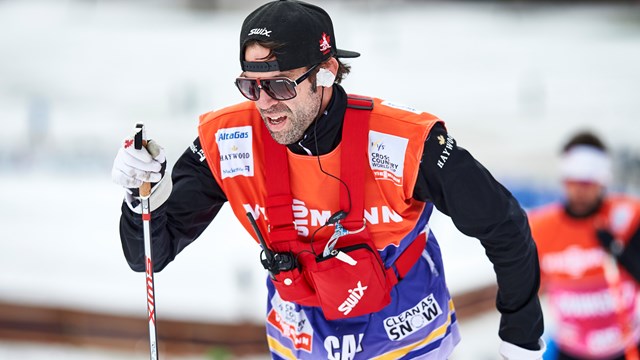
Former Canadian national team head coach Justin Wadsworth (Photo: FIS/NordicFocus)
Kalla remains a beacon of blue-and-yellow Swedish hope as she won the Ruka Triple, the Lillehammer skiathlon, and the 10-kilometer freestyle individual start in Toblach.
On the men’s side, Johannes Høsflot Klæbo is the story. The upstart Norwegian has entered eight races and won seven — a record number of races won by a male World Cup skier before Jan. 1. Early on, it appears to be Klæbo’s Crystal Globe to lose in a season where it might just be in with the new and out with the old.
Yup, the Tour de Ski is about to begin on Saturday, Dec. 30, time to brush up on what went down during World Cup Period 1.
Kent Gordis, a freelance TV production director for Radio-Canada/CBC, inside his mobile office, a tractor trailer parked in downtown Québec City, on Thursday.
QUEBEC CITY — It’s not brain surgery, or so Kent Gordis says. With about 35 employees and 13 cameras working within a relatively small space in front of Québec’s Parliament building, covering the World Cup cross-country ski races Friday and Saturday won’t be any small feat, either.
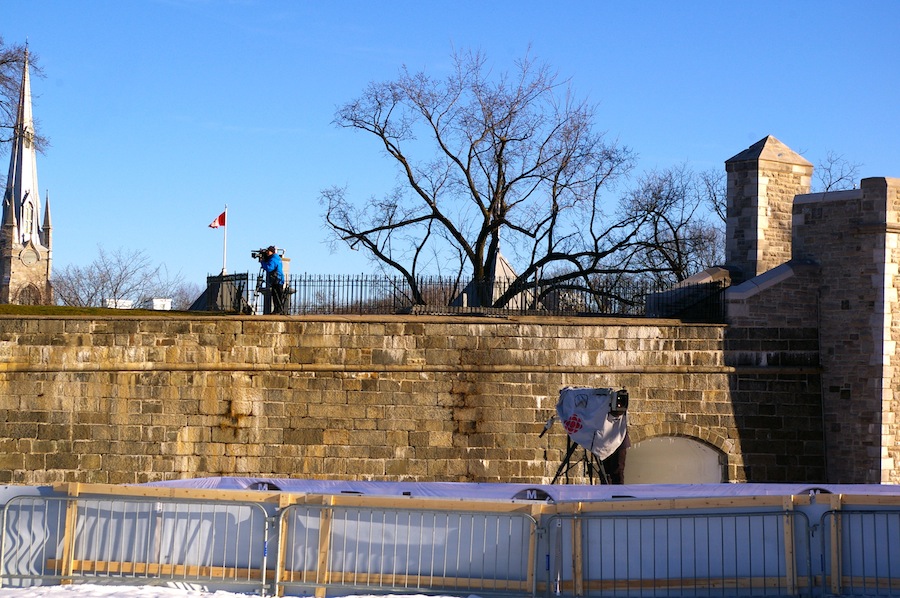
A Radio-Canada cameraman in position near the start and final curve of the 860-kilometer World Cup sprint course in Quebec City on Thursday.
That’s why Radio-Canada/Canadian Broadcast Company (CBC), the primary broadcasting service of the Québec World Cup sprints, hired Gordis, a freelance TV production director from Brooklyn. With nearly 25 years of experience in broadcasting nordic sports (mostly biathlon), Gordis knows how to tell a story while filming a ski race. At least that’s what he aims for.
A quick glance around the 860-meter course Thursday revealed cameras on every turn. Big cameras, many of which had operators behind them testing.
On Friday, all the preparation will give way to the main show with the two-person team freestyle sprints starting at noon. Saturday will begin with international skiers racing the qualifier in the individual freestyle sprint and progressing to the heats if they’re lucky (or especially talented).
If Gordis is lucky, his crew will be able to illustrate what’s happening solely through images they produce. Commentators from networks like CBC and Québec’s TVA will commentate remotely, according to Gordis. Meanwhile, it’s Radio-Canada’s job to provide an international feed.
Catering to a world audience leaves little room for bias. The exception is that the International Ski Federation (FIS) allows host nations to provide slightly more local content (i.e. Québec native and national-team member Alex Harvey).
“For example, Alex Harvey shows up and we’re all hoping that he wins, but if he doesn’t win, we’re still going to show shots of Alex Harvey,” Gordis said from inside Radio-Canada’s mobile headquarters, a suped-up tractor trailer parked on the side of the street. “But otherwise we’re really here servicing the world so we have to be neutral. The only exception to that is the Canadian content.”
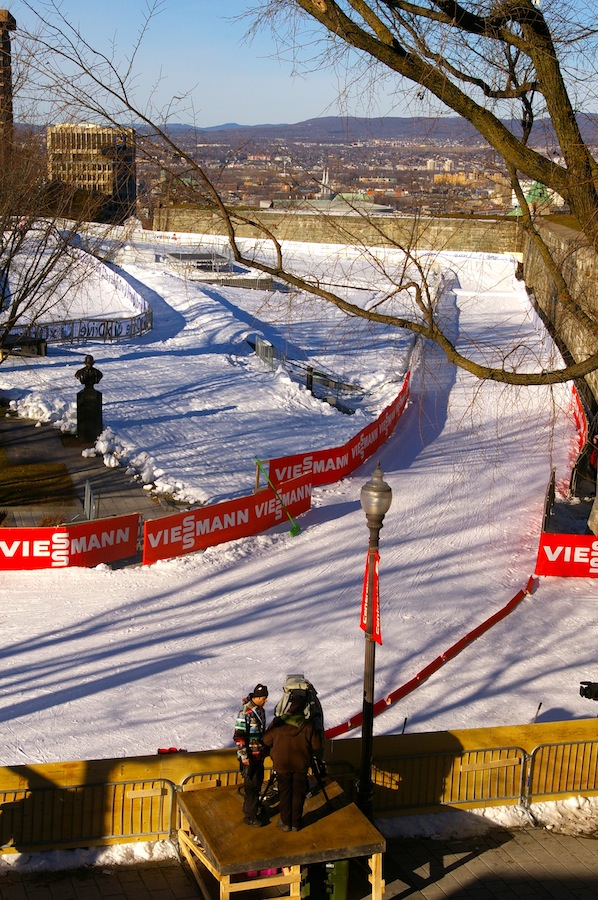
Two cameramen fine-tune their equipment on the World Cup sprint course in downtown Quebec City on Thursday.
The bigger challenge is actually catching individuals action – and seeing them all at once. FIS essentially hands the host-broadcasting company a map of camera positions, and directors like Gordis slightly tweak it. Even though the best shot tends to be on the outside corner of each turn, he likes to put a few on the inside for closer profile images..
At the same time, he tries to balance close ups with wider-angle shots so as not to focus too much on one person.
“Especially in North America, the tendency is to get the good, sort of dramatic shot of the leader,” Gordis said. “It’s a good shot, but the problem is any race is a competition between the athletes so you don’t want to stay always tight because then you don’t see the rest of the race.”
Think about how hockey or football is televised, he said.
“When the play starts you show this wide shot of the whole field and the team because that’s what you’re showing. If you stay too tight then it’s as if you’re shooting hockey with only one team on the ice and there’s no competition.”
Gordis treats cross-country ski races the same way. Although this is the first time a sporting event of this caliber is being held in front of Quebec’s Parliament, it’s not overly complicated.
“The story ultimately is who’s likely to win, but it’s not always so obvious,” he said. “Sometimes it’s somebody who starts in fifth or sixth place and they get lucky or they’re just skiing faster or whatever it might be. We can’t predict the future, but we try to tell as many stories as possible.”
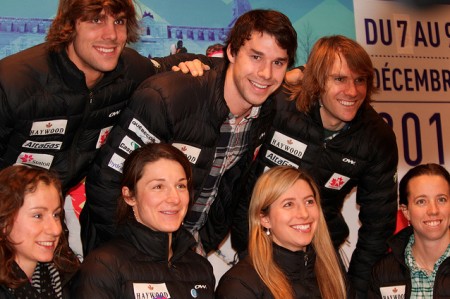
The Canadian World Cup Team, with Alex Harvey at top center.
So for the last nine months, that’s what Gordis has been working on, and Friday it will all come to fruition.
“It’s intense, that’s for sure,” he said of city sprints after covering some in Stuttgart, Germany. “The individual [race] is a little more challenging in a sense that it’s a lot of heats, but the team sprint is more challenging because it’s more people on the course, and also the [exchanges] come pretty quickly. Every other lap is quick.”
Asked about the anticipated Canadian viewership of these races, Gordis said the details were out of his realm. One thing he’s sure of: “Alex Harvey helps a lot.”
“[In the U.S.] for an emerging sport like bike racing or nordic skiing to break through is almost impossible because you’re competing with cable TV … you’re competing with video games, people have so many choices,” he said. “You really have to have an incredible story to really break through. Canada’s a little bit less like that.”
***
On Thursday afternoon, a six-winged drone hovered above parts of the course. Two independent operators from KoptR Image, Inc., brought it to the venue to test and pitch their flying robot (with a range of up to a mile) to Radio-Canada/CBC.
“The drone is something that has been proposed to us,” Gordis said. “I haven’t seen it yet. It sounds like a great idea but it wasn’t part of our original plan.”