From the FasterSkier archive — posts syndicated from athletes’ and coaches’ own blogs between 2004 and 2012, kept online as published. Current coverage is at fasterskier.com.
With the reshuffling of Canada’s staff, up until today, CCC had not formally announced its World Cup coaching roster for the 2018-2019 season. Back on August 11th, CCC posted a job announcement for “Head Coach, Canadian Senior Cross Country Ski Team”. (Here’s a link to the formal job description.)
Today’s announcement came with news that longtime World Cup coach Louis Bouchard will be returning for another year. Bouchard leads the National Training Centre in Mont Ste-Anne, Québec and has worked closely with Alex Harvey for many years. According to the press release, Bouchard will be taking over head coaching responsibilities. Bouchard has been a World Cup Team coach for the last eight years.
CCC also revealed today that Norwegian Erik Bråten has been hired as a National Team Coach.
“Erik is a highly regarded young coach in Norway who is looking for an opportunity to contribute to our national program,” Lemyre is quoted as saying in today’s press release. “He is passionate, knowledgeable, dedicated, and driven to develop into a world-class coach. I believe he and Louis (Bouchard) will complement each other’s skillsets and will have a significant impact on the development and the performance of our nation’s best athletes. This is a dynamic duo who I believe is exactly what we need to build a medal winning program.”
Bråten, who will turn 27 on November 6th, has been coaching in Norway for six years and was named coach of the year in 2018 by the Norwegian Ski Federation. Bråten will be based in Canmore, Alberta. His duties will include monitoring athletes in western Canada, coaching Canada’s team at World Junior and U-23 World Championships, and assisting Bouchard with a portion of the season’s World Cups and the 2019 Seefeld, Austria World Championships.
FasterSkier has reached out to Bråten for comments.
(CANMORE, Alberta) — Rundle Sport Inc. and Cross Country Ski de fond Canada (CCC) have announced that Rundle Sport will be an Official Equipment Supplier of CCC. As a Canadian company with world-class products, Rundle Sport is a perfect fit for the Canadian National Ski Team and is excited that the National Ski Team athletes have put their trust in Rundle Sport roller skis.
Of the new partnership, Cross Country Canada stated, “CCC is thrilled to announce Rundle Sport as an official equipment supplier of the Canadian National Ski Team. After excellent feedback from several Olympic and Paralympic athletes, CCC will be distributing Flex Skate roller skis to all Senior National Team athletes, U25 National Team athletes, and National Para-Nordic Team athletes. The athletes who have been on the Flex Skate roller skis tell us the roller skis’ smoothness, reliability, and on-snow feel will allow them to optimize their roller ski training and transition from roller skiing to snow skiing.”
Partnering with CCC will allow Rundle Sport to continue its history of product development and technical innovation while improving the roller ski training of Canada’s top athletes. Rundle Sport looks forward to supporting CCC and watching Canadian athletes reach their potential while training on Rundle Sport products.
About Rundle Sport Inc.: Rundle Sport is an athlete driven company whose mission is to give athletes an edge over their competition. Rundle Sport was launched in 2013 with the release of TrueSki™ Technology, the world’s first and only rubber-damped roller ski suspension system. TrueSki™ Technology is found exclusively in Rundle Sport Flex Skate roller skis and is the smoothest roller ski technology available. Rundle Sport’s product line has grown to include an assortment of professional level and value-oriented roller skis ensuring all skiers have the opportunity to make the most of their roller ski training. Quality, performance, value, and competitive creed make Rundle Sport the choice of dedicated athletes.
Martin Benes, who has coached at Sugar Bowl Academy for the last seven years, was recently hired as head coach of U.S. Paralympics Nordic. (Photo: U.S. Paralympics)
(Note: This article has been updated to include the hiring of Miles Havlick as the University of Utah’s head nordic coach, which was announced Monday afternoon.)
There have been several notable career changes in North American nordic skiing this summer. Here’s a quick look at who moved where:
Robert Lazzaroni, the nordic director at U.S. Ski & Snowboard, will soon begin his new role as Salomon’s nordic regional commercial manager for the Americas. (Photo: Salomon)
Robert Lazzaroni:from U.S. Ski & Snowboard to Salomon. Last week, Salomon announced via a press release that Lazzaroni, of Park City, Utah, will join its staff as nordic regional commercial manager for the Americas, starting Aug. 27. For the last three years, Lazzaroni served as nordic director at U.S. Ski & Snowboard in Park City. Before that, he was program manager at Utah Olympic Park, and before that, a nordic division manager for Rossignol and later One Way Sport. Asked about his new job at Salomon, Lazzaroni told FasterSkier he’d be willing to talk more in depth after he starts. Until then, he’s still employed at U.S. Ski & Snowboard.
According to U.S. Ski & Snowboard’s Chief of Sport Luke Bodensteiner, many of Lazzaroni’s duties as nordic manager “have been or will be distributed across existing staff, and we’re taking the opportunity to re-align our staffing positions to make sure that we have an efficient structure that supports our priorities of athlete development, coach education, and strong domestic competition,” he wrote in an email to FasterSkier. “This will likely require hiring an additional position, but the nature of that job is TBD based upon where we determine that we need the human resource to support those priorities.” Bodensteiner expected to know more about the shift in staff responsibilities later this month.
Martin Benes:from Sugar Bowl Academy to U.S. Paralympics Nordic. Also last week, the U.S. Olympic Committee announced the hiring of Martin Benes as its new head coach of U.S. Paralympics Nordic Skiing. He replaces Eileen Carey, who was promoted to program director following the departure of John Farra (to USA Triathlon) this spring. Benes began coaching as an assistant ski coach at Bates College, then spent the last seven years as head nordic coach and director at the Sugar Bowl Academy near Truckee, California, according to his LinkedIn profile. As head coach of the U.S. Paralympics program, he will “lead the development of annual and seasonal training plans for the national team, track athlete performances, workout data, sport science data and annual progress reports, contribute to the U.S. Paralympics athlete identification and development strategy, and assist in planning travel and logistics for the Nordic skiing program to competitions, camps and events,” according to the press release.
“It’s an incredibly exciting time to join the program following such a successful performance in front of the world at the Paralympic Winter Games PyeongChang 2018,” Benes stated in the press release. “I’m eager to get started in my role so we can continue to strengthen the program and win medals on the international stage.” He’s set to begin on Aug. 20.
Fredrik Landstedt:from the University of New Mexico to the University of Utah. Late last month, the University of Utah announced it had found a new director of skiing to replace Kevin Sweeney. Landstedt had been a staple on the University of New Mexico (UNM) Ski Team for the last 21 years, spending the last 11 years as head coach of both the nordic and alpine programs (and 10 years before that as head nordic coach). His decision to take the job at Utah came less than 24 hours after the UNM Board of regents unanimously approved a proposal to eliminate four sports starting in the 2019/2020 season, according to the Albuquerque Journal. Those sports are men’s and women’s skiing, men’s soccer, and women’s beach volleyball. The proposal would also significantly impact funding for cross country and men’s track and eliminate the women’s diving program. In the meantime, UNM announced assistant coach Joe Downing will assume the role of interim head skiing coach.
“I am honored to have the opportunity to lead a program with such a rich history,” Landstedt stated in the Utah press release. “Utah has a strong winning tradition and the support that the University provides its ski team is incredible. I look forward to bringing NCAA titles back to Utah!”
Miles Havlick in November 2015 in West Yellowstone, Montana.
Also at the University of Utah, Miles Havlick: new head nordic coach. In a press release on Monday, the university announced that Havlick, one of its former skiers and a two-time NCAA champion (2012 and 2013), was hired to head up its nordic team for the coming season. Havlick, 28, skied for the the Sun Valley Ski Education Foundation Gold Team after college and won the 42-kilometer Australian Hoppet Worldloppet last August. He delved into coaching last summer in Australia with the Birkebeiner Nordic Ski Club and Victorian Junior cross-country ski team, and last winter, was an assistant coach and wax technician for the Australian junior national team at Junior World Championships. Havlick also waxed for the Australian national team last March in China. He has also assisted the Utes ski team, most recently as an assistant coach at 2018 NCAA Championships.
Eliška Hájek Albrigtsen:from Central Cross Country to the University of Alaska Fairbanks. After spending the last year filling multiple roles with Central Cross Country (CXC) out of Madison, Wisconsin (including CXC Team head coach and junior development coach), Albrigtsen has accepted an assistant-coaching position with the University of Alaska Fairbanks Ski Team, replacing Josh Eide. Albrigtsen was a four-time All-American skier for the University of Colorado Boulder and an NCAA champion in 2011.
Cross Country Canada seeks senior national team coach: Two days ago, the CCC headquarters in Canmore, Alberta, put out an announcement for applications for a full-time senior national team coach. The position indicated it requires both domestic and international travel. “Reporting to the HPD [high-performance director], the Senior National Team Head Coach (NST Head Coach) is responsible for leading the technical delivery and alignment of Senior National Ski Team (Senior NST) programs in order to achieve podium performances at Olympic Games and FIS World Championships,” the job description stated. “The NST Head Coach will have the responsibility to plan, coordinate and monitor the training and competition of NST athletes in line with CCC’s collective goals.” CCC’s senior team includes 10 athletes, five of which are on the World Cup Team. The other five are on the U25 (under-25) Team. View the job posting here.
Ontario’s Jennifer Tomlinson Named New Chair of the Board of Directors for Cross Country Ski de fond Canada
Tomlinson to lead Board of Directors committed to excellence, and sport development
CANMORE, Alta.—Jennifer Tomlinson will become the first woman ever to serve as chair of the Board of Directors for Cross Country Ski de fond Canada.
An energetic leader and strategic thinker in her professional career, who brings a lifelong passion for skiing and coaching, Tomlinson was acclaimed to the position for a two-year term during the organization’s Annual General Meeting in Canmore, Alberta, over the weekend.
“Cross country-skiing is deeply rooted in our family, and I’m extremely proud to carry the torch in our sport’s quest towards the future building on the success in our past,” said Tomlinson. “I am excited to have the opportunity to work with a Board of experienced professionals, that is national in scope and representation, who are committed to guiding our sport.”
An engineering major who went on to complete her MBA at Queen’s University, Tomlinson has been an Associate Partner with Avenai since 2014. She brings both experience and critical skills needed in her new role with the national sport body: vision; strategic thinking; relationship building; and strong governance experience and knowledge.
The Ottawa resident gained experience in leading, developing and implementing business strategies that build and transform organizations with her government clients over the last three decades, serving on Boards in non-profit sport, and in her coaching roles.
“Be it sport or business, the goal in my mind is the same – set aspirational goals and deliver excellence by building a team of professionals who are united under a vision they believe in,” said Tomlinson, who has served on Cross Country Ski de fond Canada’s Board of Directors since 2014 and takes over as chair from Jamie Coatsworth who served two, two-year terms.
“Our sport has had tremendous success over the last 10 years and we now have an opportunity to learn from that success and build towards our future. It is an absolute honour and privilege to bring my experience to the leadership team at Cross Country Ski de fond Canada in an effort to shape a new era for our sport in Canada.”
A skier, coach and official over the last 45 years, cross-country skiing is in Tomlinson’s blood and the sport has shaped her personality and character. As a leader, she values perseverance, respect and teamwork.
“I was never one of the best athletes, or the smartest people on my teams, but my skiing coach Dave Mallory taught me that when you put in the effort and commit to yourself and your team, you never know what you might achieve,” added Tomlinson. “Not losing sight of this mindset, my goal will be to enable a culture that is focused on investing in each other, improving communications with all of our stakeholders, establish programs that are sustainable, and most importantly, ensure our athletes know they have a team of supporters behind them who are creating an environment that will lead them to success on the ski trails.”
Having been a volunteer at the national, provincial and club level, Tomlinson has chaired several committees as a member of Cross Country Ski de fond Canada’s Board of Directors, including the Governance Committee, where she led the re-creation of the governance policy, the Education Committee, which she co-chaired, and the Human Resources Committee, responsible for the hiring and review of the organization’s chief executive officer.
“Jennifer Tomlinson is committed to excellence at the elite level, but also understands the importance of forging relationships with the divisions and clubs from coast-to-coast-to-coast if Canada is going to continue to develop Olympic and Paralympic champions in cross-country skiing,” said Shane Pearsall, chief executive officer. “Not only does Jennifer understand our sport in the boardroom, but as a skier and coach herself, she understands what our athletes require and deserve to achieve their goals.”
Tomlinson will lead a mix of new and familiar faces on the Board including: Angelo Cristofanilli; Sarah Daitch; Ryan Jackson (Athlete Director); Ted Kalil; Patricia MacDonell; Jeff Sim; Bruce Simms; and Jo Wolach (DCC Chair).
CCC is the governing body of cross-country skiing in Canada, which is the nation’s optimal winter sport and recreational activity with more than one million Canadians participating annually. Its 60,000 members include athletes, coaches, officials and skiers of all ages and abilities, including those on Canada’s National Ski Teams and Para-Nordic Ski Teams. With the support of its valued corporate partners – Haywood Securities Inc., AltaGas, Mackenzie Investments, Swix and Lanctôt Sports– along with the Government of Canada, Canadian Olympic Committee, Canadian Paralympic Committee, Own the Podium and B2Ten, CCC develops Olympic, Paralympic and world champions. For more information on CCC, please visit us at www.cccski.com.
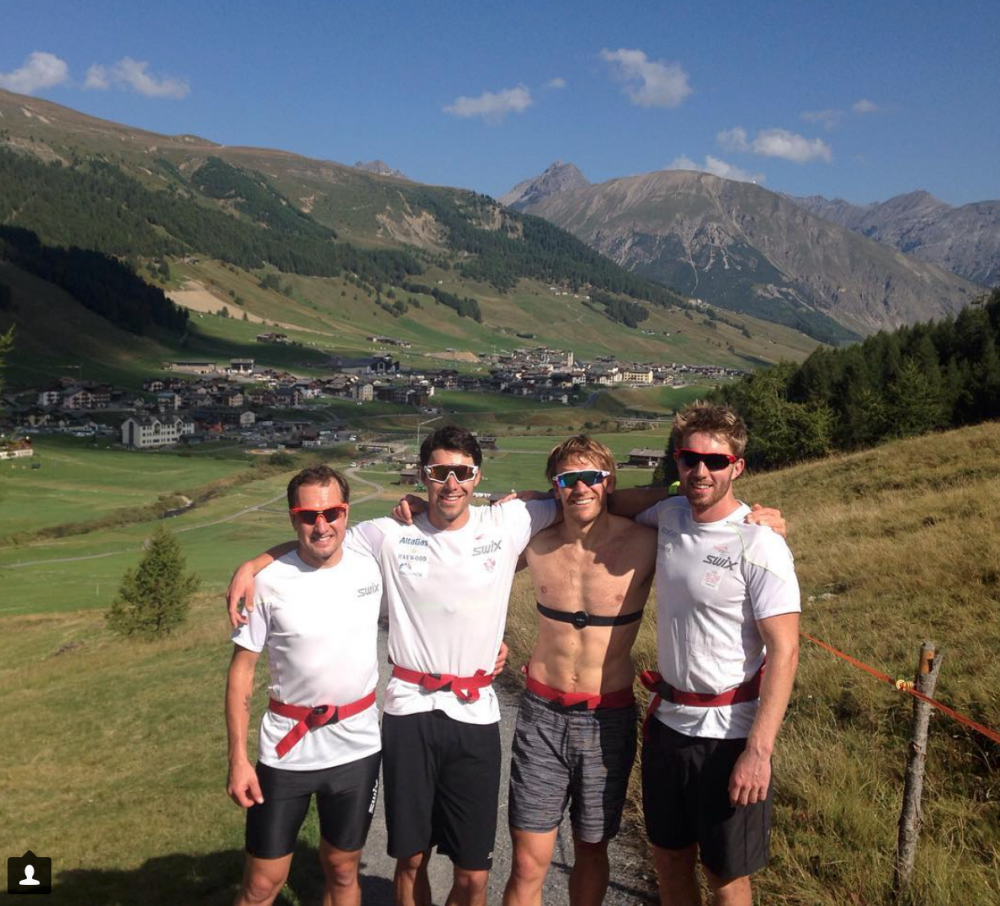
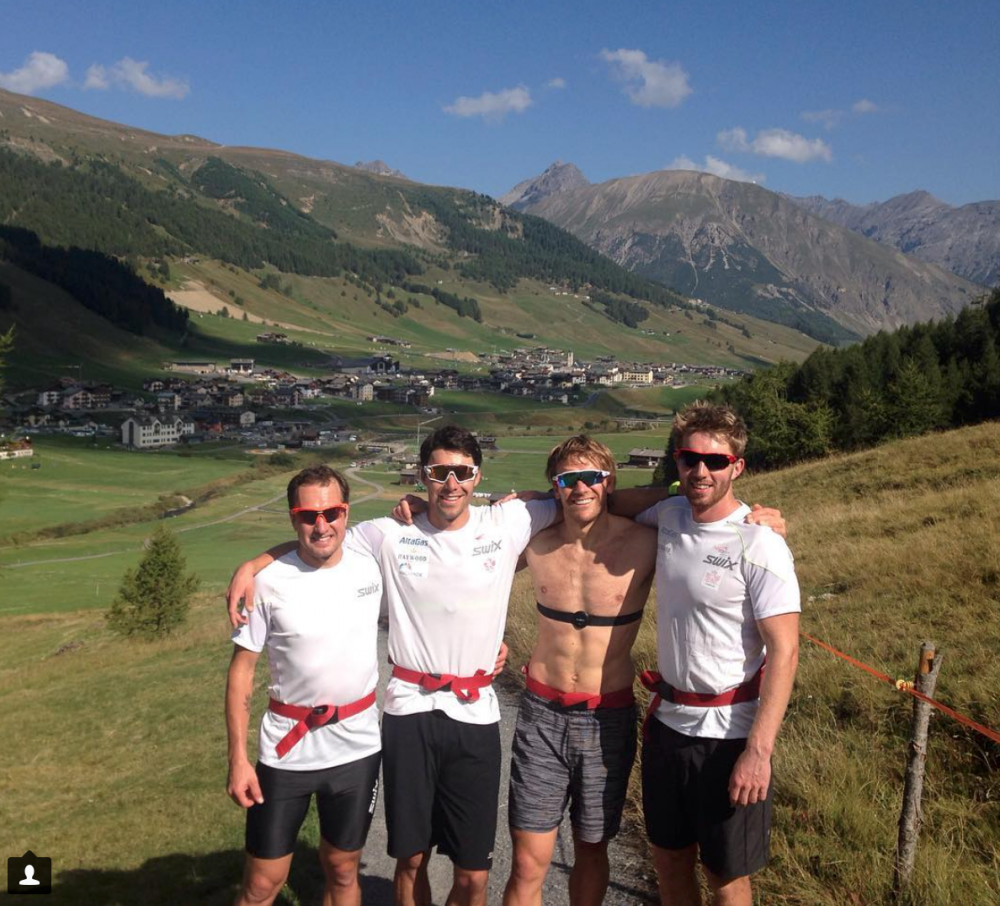
Coach Ivan Babikov (l) at a 2016 fall training camp with Canadian World Cup Team members Alex Harvey, Devon Kershaw and Graeme Killick in Livigno, Italy. (Photo: Ivan Babikov/Instagram)
Cross Country Canada (CCC) has appointed a new high-performance and development advisor, Nic Lemyre, and laid off four staff members, CCC Chief Executive Officer Shane Pearsall confirmed in a phone interview on Thursday.
The news of Lemyre’s hiring came in the form of a press release Thursday morning, two days after four CCC employees — Ivan Babikov, Mike Edwards, Lisa Patterson, and Martine Zilligen — were informed of their release.
Babikov has spent the last two seasons as a national team and World Cup coach, Edwards was the high-performance director for CCC’s Para-Nordic Ski Team, Patterson was a longtime high-performance development coach, and Zilligen has been communications and marketing manager since 2013.
According to Pearsall, the layoffs were a direct result of CCC’s annual operating budget (which covers both able-bodied and para nordic skiing) decreasing from about $4.5 million dollars last year to what he anticipated to be $3.9 or $4 million dollars this year. The budget is not finalized, as CCC is waiting on the amount it will receive from Own the Podium (OTP), a government-backed nonprofit, which Pearsall estimated to be about 20 percent of CCC’s operating budget. That final amount is expected by mid-July, he said.
Fifty percent of CCC’s budget comes directly from the government branch of Sport Canada, and that amount has been determined, Pearsall said. He explained that money is tighter on the whole for CCC as a result of decreased government funding and sponsorship revenue.
One of CCC’s main sponsors, Mackenzie Investments, will no longer support nordic or four other snow sports as it had previously. Instead, the investment firm opted to stick with freestyle and alpine.
On the upside, he explained that another sponsor and investment firm, Haywood Securities, has agreed to sponsor the NorAm circuit as it has in the past.
Asked if budget cuts were among the biggest challenges affecting CCC at the moment and the reasoning behind the latest layoffs, Pearsall said, “Yes. If things had stayed the same that would’ve been good, but obviously that’s not the case.”
He added that CCC is faced with the ongoing challenge of competing with other sports for the support of “corporate Canada”.
“At the same time, we continue to talk to people and try to get them on our side to become part of our programs,” Pearsall said. “There’s a part of it where it always will be the challenge. You’re always looking for money for places to spend the money, and we just continue on trying to get more money.”
Asked specifically why CCC chose to release those four employees, Pearsall said, “Just trying to create a better future, efficiencies that we think we can find. It’s appropriate that at the end of the quad [Olympic quadrennial], you look at things and how to set the stage for the next quad. And even for us, we were looking at 2026. So we’ve decided this the way we’re going to go.”
CCC now has a staff size of 12. Louis Bouchard retained his job and is listed on CCC’s website as its lone national ski team/World Cup coach. Bouchard is also Alex Harvey’s personal coach and head coach of the Pierre-Harvey National Training Centre (Centre National d’Entraînement Pierre-Harvey) in Quebec.
Pearsall said he broke the news to Babikov, Edwards, Patterson, and Zilligen individually during one-on-one meetings on Tuesday.
“It’s one of those things, when you do a change, you tend to want to something like this all at one time, and that’s the strategy we executed,” he said.
CCC will be looking to replace Babikov’s position as co-World Cup coach through an “open job search,” Pearsall stated. As for Patterson’s role as a NextGen coach and development trip leader (for international competitions including U23 and Junior World Championships), Pearsall was unsure if CCC would fill that vacancy.
“When something like this happens — I’ve been involved in the corporate sector — you do a bit of a reshuffle on responsibilities, so we’re working on those on how we’ll go about that,” he said. “At this point in time, I can’t say we’ll necessarily hire somebody in that specific area, but we’re looking at how we cover responsibilities.”
As for the timing of these layoffs in early June, two months after the end of the season, Pearsall said that was a tough one.
“Can you ever find perfect timing? There’s questions about that, but this is the way we decided to go, and we’re going to make the timing work,” he said. “… This is the way things lined up. This is the way we’ve gone about it.”
According to Babikov, the layoff, which was effective immediately, caught him off guard.
“I had no idea it was coming, and it didn’t cross my mind that something like this would happen because we had already started the new summer,” Babikov said on the phone on Thursday. “I just came back from training and our CEO just called me for a meeting, and I thought it was regarding our new HPD, if we hired somebody, but then he just handed me papers and I was told to leave my credit card and keys, and we go separate ways. And that’s all that was said.”
Babikov, who’s been part of the Canadian national team for the last 10 years, first as a two-time Olympic athlete and then as a coach starting in June 2016, said there was no notice. “It was without a cause,” he said.
Asked why Babikov was fired, Pearsall said he couldn’t comment.
‘The Rebuild’
Lemyre as the high-performance and development advisor will fill the roles previously held by Edwards and Thomas Holland, the former high-performance director of able-bodied cross-country who retired at the end of last season. A Montreal native who is primarily based in Norway as a professor of sports psychology at the University of Oslo, Lemyre will work part time for CCC.
He’ll be the head of one of CCC’s two new departments, Pearsall explained, overseeing the sport side of the organization while Pearsall and Megan Begley, CCC’s operations & strategic development manager, oversee operations. Lemyre will make decisions in his department, but Pearsall will have “final approval on all personnel decisions”, according to CCC media relations consultant Chris Dornan.
Dornan clarified that Lemyre is “advising on the rebuild” and that CCC will communicate the structure of its high-performance department in the near future.
“His role is going to be advising us, going forward, on how we should look at things, and develop things,” Pearsall said of Lemyre. “He’s going to be an integral part of the decisions we make, in different areas, in the high-performance area. He will be overseeing, in the re-org, I’ve basically created two departments. One is operations, and one is sport. He will be in the mix on the sport side. Under the old structure, there was a para-nordic [director] and there was an able-bodied [director], and I’ve brought those two together to gain efficiencies and exchange more knowledge, if you will, between the two sections of para and able.”
Originally from Montreal, Lemyre takes on the role of high performance and development advisor with clear goals in mind – to break barriers and establish Canada as a strong Nordic nation with multiple male and female athletes performing at the highest level, while providing our nation’s best cross-country skiers with the means to be back on the Olympic podium in 2026 and ensure the Para-Nordic program remains a dominant force for future generations.
“We are standing on the shoulders of a group of athletes and staff who have accomplished great things for our sport in Canada over the last two decades. Together, we have to understand and identify what has led to these exceptional performances and provide the same opportunities for the next generation to succeed,” said Lemyre.
A former skier in the 1990s, Lemyre moved to Norway 21 years ago where he has applied his academic and administrative skillsets as a sports psychologist to a variety of roles in the Norwegian sport system. He has worked within the support team for the world-leading Norwegian cross-country ski squad as a sport psychologist since 2011. Lemyre will split his time advising Cross Country Ski de fond Canada’s high-performance program, while continuing his role as a professor of sports psychology at the University in Oslo over the next year.
“Cross-country skiing is a passion of mine. Things have come full circle for me since I left for Norway in 1996, and I’m very humbled to have this opportunity now to contribute to the growth of the Canadian program,” said Lemyre, who takes over from Tom Holland, who retired from the position of high-performance director following the PyeongChang Games. “I am ecstatic to be able to bring my knowledge and skills back to my sport roots at home in Canada.”
Holding a Ph.D in sport and exercise psychology from The Norwegian School of Sport Sciences, Lemyre has been the head of the school’s department of coaching and psychology since 2008. He has been the sports psychology consultant for the Norwegian Men’s Cross-Country Ski Team and the Norwegian Cycling Team from 2012-17. He has also accompanied Norway’s Olympic Team as a sport psychologist at the 2010 and 2014 Games, and worked with the Norwegian Women’s Biathlon Team between 2009-2015. Lemyre has also provided support to Norway’s alpine skiing, swimming and ice hockey programs.
“Nic is a highly-motivated professional who knows what it takes to win,” said Shane Pearsall, chief executive officer, Cross Country Ski de fond Canada. “He has been through the peaks and valleys of a respected program, while working closely with a number of accomplished high-performance directors who have achieved excellence on the biggest stage. As a result, he understands the patience and time investment required to build a medal-winning program. I am confident he can transfer this knowledge to help build a strong support team to ensure Canadian athletes and coaches achieve their performance goals.”
Canada’s cross-country ski program has made steady progress over the last two decades developing generations of Olympic, World Championship and World Cup medal-winners. While Lemyre takes over the leadership of a Para-Nordic National Team who achieved an unprecedented 16 medals at the 2018 Paralympic Winter Games, the World Cup Team has delivered impressive results on the Olympic stage but has not won a medal since the 2006 Games.
“The sport in Canada has established itself on a tradition of excellence with Pierre Harvey, Beckie Scott, Sara Renner, Brian McKeever, Chandra Crawford, Devon Kershaw, Alex Harvey, Len Valjas, and Mark Arendz leading the charge, but it is clear our National Ski Team is now at a crossroads,” said Lemyre. “It is important for us to reflect and act on what has, and has not, worked. We can learn a lot from the success of our past, and from the strength of the para-Nordic program.
“There is a lot of talent out there – good kids skiing right now. Our job is to create a Canadian-made system with our partners that will deliver a pool of resources for our athletes and coaches to develop to their full potential – from the junior to elite level – and help them achieve our collective performance goals.”
Lemyre will be based in Canmore, Alberta, throughout the summer months before returning to Norway. His first order of business will be to do a complete evaluation of the program and initiate the implementation of a plan with a focus on investing in the next generation of athletes and coaches.
“There is no doubt we have some challenges, as well as some great opportunities, ahead of us. We can’t promise things that aren’t reasonable, and this will take time, but I’m committed to working with the talented staff at CCC and our partners to get the right people in place within a structure that will provide both the able-bodied and para- women’s and men’s athletes the structure and resources they require to fully develop and excel internationally long-term,” added Lemyre, who added that sport science and innovation will be an important tool for Canadian coaches in his planning.
“The goal is to create a strong base for the next generation of athletes, while developing a culture from the ground up that prides itself on sharing knowledge, information and skillsets to succeed in building a tight-knit program across the country that pushes each other to be better every day. To me that is what it takes to win.”
Lemyre will begin to roll out the new high-performance structure in the coming weeks.
CCC is the governing body of cross-country skiing in Canada, which is the nation’s optimal winter sport and recreational activity with more than one million Canadians participating annually. Its 60,000 members include athletes, coaches, officials and skiers of all ages and abilities, including those on Canada’s National Ski Teams and Para-Nordic Ski Teams. With the support of its valued corporate partners – Haywood Securities Inc., AltaGas, Mackenzie Investments, Swix and Lanctôt Sports– along with the Government of Canada, Canadian Olympic Committee, Canadian Paralympic Committee, Own the Podium and B2Ten, CCC develops Olympic, Paralympic and world champions. For more information on CCC, please visit us at www.cccski.com.
(Note: This article has been updated to reflect that Len Valjas was nominated to the B-team, rather than the A-team as previously stated.)
On Thursday, Cross Country Canada (CCC) announced its national-team nominations for the 2018/2019 season via a press release.
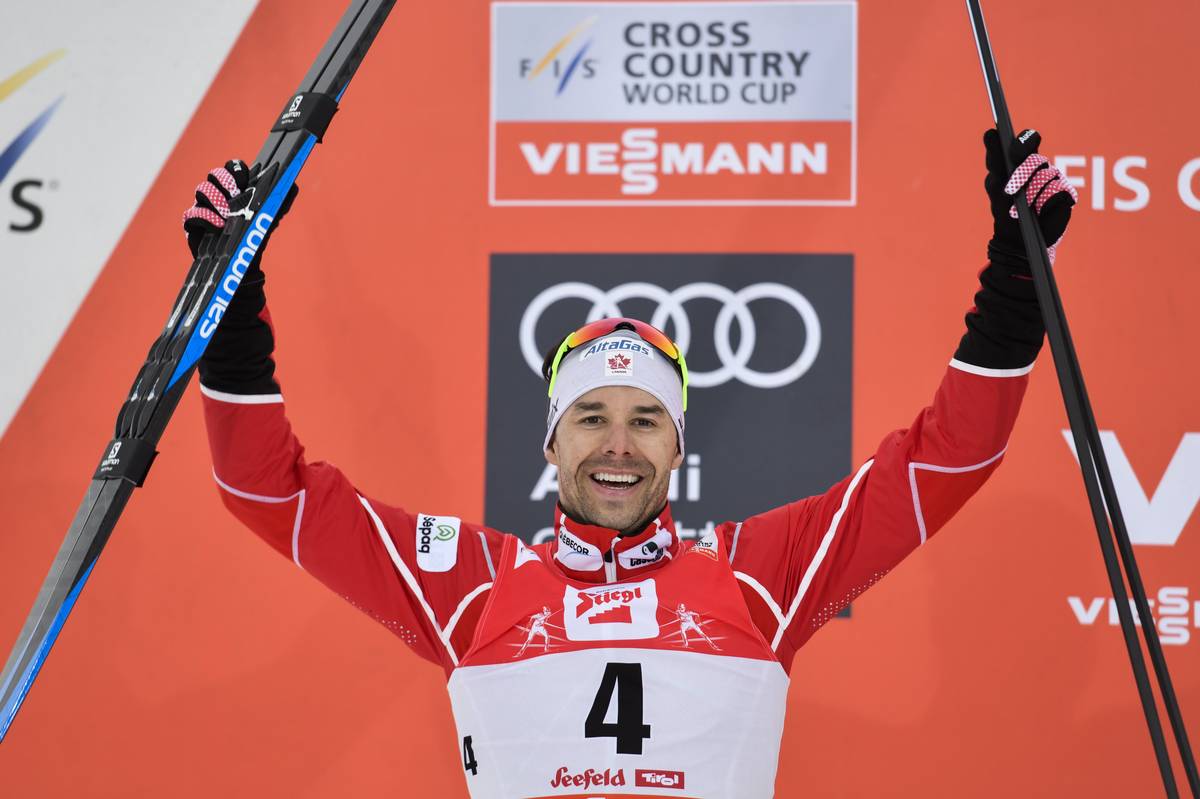
Canada’s Alex Harvey celebrating on the podium after placing second in the World Cup men’s 15 k freestyle mass start in Seefeld, Austria, last season. (Photo: Salomon/NordicFocus)
Notably, the World Cup A-team is made up of one man — Alex Harvey — after three athletes from last year’s World Cup A-team retired (Devon Kershaw, Jess Cockney and Knute Johnsgaard). Graeme Killick, of last season’s World Cup B-team, also retired. Len Valjas was nominated to the B-team, a demotion, he said, that was a result of him ending his season immediately after the PyeongChang Olympics.
“The reasoning is that I … didn’t show up to [the World Cup in] Drammen, is that I didn’t follow what the team said,” Valjas told FasterSkier on May 22. He explained he had a broken spine, which required rest and rehabilitation.
On the women’s side, Dahria Beatty was renominated to the World Cup B-team, while Emily Nishikawa and Olivia Bouffard-Nesbitt were not.
All five of last year’s U25 Team were renominated to the national team, with Cendrine Browne and Julien Locke making the jump to the World Cup B-team, while Katherine Stewart-Jones, Maya MacIsaac-Jones and Gareth Williams were renominated to the U25 Team. Also on the U25 development squad, Antoine Cyr was promoted from the junior national team, and Graham Ritchie earned his first national-team nomination.
The World Cup team will once again be led by co-coaches Ivan Babikov and Louis Bouchard.
On the Para-Nordic side, the World Cup Team grew by one despite the retirement of Chris Klebl. Six athletes and two guides were nominated to the Para-Nordic World Cup Team, while two were renamed to the Development & Prospects Team. Four other athletes round out the team as part of the Prospects Team.
Cendrine Browne (CNEPH/Canadian National U25 Team) celebrates her 11.9-second win in the women’s 15 k skiathlon on Jan. 8 at Mont Sainte-Anne NorAm Trials in Quebec. (Photo: Mario Walker/NorAm MSA 2018 Facebook)
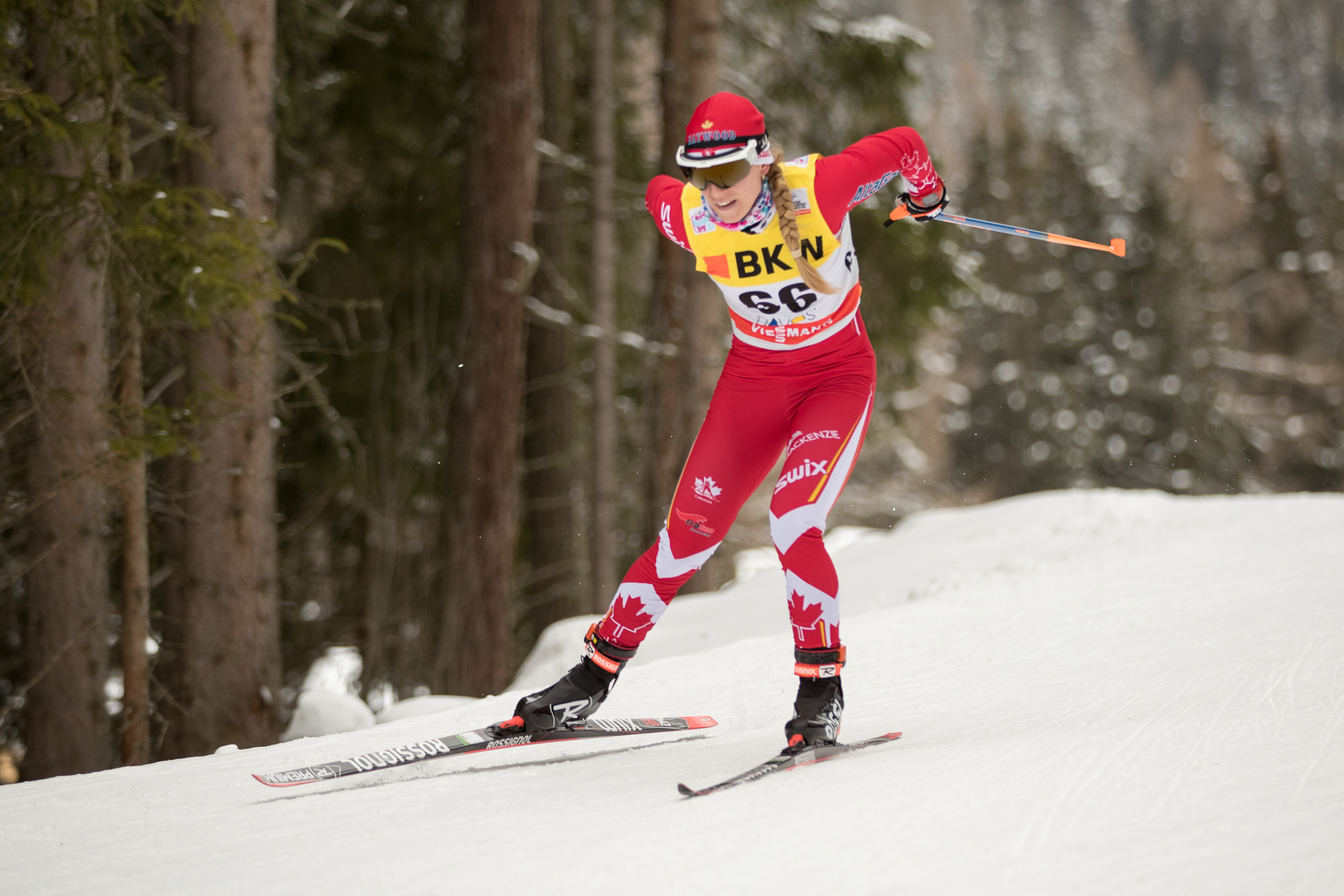
Since March of last year, Cendrine Browne has been waiting and trying, with all her might, for another top 30. She achieved it twice last season, placing 26th in the World Championships 30-kilometer mass start and 35th in the World Cup 10 k skate in Ulricehamn, Sweden (30th with Olympic-style scoring, which counts the top-four athletes for each nation in a given race).
To meet Cross Country Canada’s (CCC) alternate qualifying criteria for the 2018 Olympics, Browne, who turned 24 this past September, needed one more top 30 at the World Cup with the same type of scoring.
She had four weekends to give it her all in late November and December.
Browne, of the Canadian National U25 Team and Centre National d’Entraînement Pierre Harvey (CNEPH), a.k.a. Pierre-Harvey National Training Centre, finished the 2017/2018 season-opening World Cup mini tour in 72nd overall with the 62nd-ranked pursuit time in Kuusamo, Finland.
“That was my first [weekend of racing] so it was tough,” Browne recalled on the phone in early January. “But the last race of the mini tour went much better. I started to have good race feelings so I knew I was going in the right direction. The next weekend was Lillehammer [Norway] and I performed pretty well there in the skiathlon.”
She finished 45th to lead two Canadian women finishers. With Olympic-style scoring, she was 31st.
“To qualify for the Olympics I had to do a top 30 so 31st was a little frustrating, but I knew I was able to do a top 30,” Browne said. “I knew I could do a real top 30, not only a four per nation top 30. But I only had four weekends to do a top 30 and I was down to two.”
Cendrine Browne racing in the World Cup 10 k freestyle on Dec. 10 in Davos, Switzerland. She placed 45th for the second World Cup distance race in a row. (Photo: Reese Brown / U.S. Ski & Snowboard)
In Davos, Switzerland, she tied her season best of 45th in the 10-kilometer freestyle and led four Canadian women, but she was still outside the top 30 with Olympic scoring. Her result at altitude (about 1,560 meters above sea level) was promising, she said, but still not quite there in terms of what she needed.
One weekend later, it all came down to two races in Toblach, Italy. There, she finished 55th in the 10 k skate and 66th in the 10 k classic pursuit.
“Maybe I had put some pressure on myself, but I felt pressure from my federation and pressure to do that top 30, and I don’t work very well with pressure,” she said. “So unfortunately when we went to Toblach, I didn’t perform at all. I was so stressed out that I didn’t even have fun racing, and I just felt awful the whole skate race. I cried a lot.”
With Period 1 of the World Cup behind her and Christmas break on the horizon, she told herself it wasn’t over yet. But she was still disappointed.
“I was supposed to stay [in Europe] for Christmas … I was so focused on Plan A that I didn’t even think about Plan B,” she said.
On the bright side, “Plan B” involved races in her home province of Quebec at Mont Sainte-Anne (MSA), where she trains with CNEPH. And she got to spent time with her family and boyfriend in her hometown of St-Jérôme, about 50 kilometers northwest of Montreal, as well as reset mentally for NorAm Olympic trials starting Jan. 5.
“I was so focused on Plan A that I didn’t even think about Plan B.” — Cendrine Browne, Canadian National U25 Team and Pierre-Harvey National Training Centre, on qualifying for the Olympics
“I was really really stressed out the week before the first race [at trials] and I was feeling the pressure again, and I really didn’t want to react the the same way as I did in Toblach so I went to see my sports psychologist,” Browne said. “She explained some stuff to me, like instead of thinking that the pressure is bad and instead of trying to run away from it, she said I have to try to accept it, and if I accept it, it would help me to go faster.”
With that in mind, Browne tried to keep everything in perspective. Then, she came out at full steam for the classic sprint on Jan. 5, the first day of MSA NorAm trials.
“I think it really worked well because I managed to sleep better the night before the race, and the morning of the race I was feeling like myself again,” she said. “I was skiing and just loving the glide as I usually do when I’m having a good day. I was smiling … and I felt free and I felt like myself. I feel like when I’m stressed out, I’m not having fun any more and that day I was having fun again.”
A self-described freestyle distance specialist, she placed second in the classic-sprint qualifier then fourth overall in the final. As the top-performing woman between the qualifier and final, excluding fellow national-team member Dahria Beatty (who had previously met Canada’s alternate qualifying criteria for the Olympics), Browne effectively secured one of Canada’s coveted quota spots at the 2018 Olympics in PyeongChang, South Korea.
While that wasn’t a done deal until a few weeks later, when CCC named its 11-athlete Olympic team, that result put Browne in the best place any Canadian Olympic hopeful would want to be.
“I can’t say I’m qualified yet because it’s kind of complicated,” Browne said on Jan. 7. “… We can only say, like Daria, Emily [Nishikawa] and I, that we have reached an Olympic criteria and that we’re in good position to go to the Olympics.”
Beatty and Emily Nishikawa, members of Canada’s World Cup Team, met CCC’s “Alternate Qualifying Criteria A” (three top-30 results) last season. According to CCC’s Olympic selection criteria, one female sprinter and one female distance skier would be selected to the Olympic team based on trials. So Browne effectively secured the female sprint spot, and as the rest of the week at MSA played out, she ended up being the top distance skier at trials as well.
On Jan. 8, Browne won the women’s 15 k skiathlon on Day 2 of the trials. Two days later, she won the 10 k classic interval start as well. In the event that the trials sprint leader was the top distance skier as well, as was Browne, the criteria was written so that the second-ranked distance skier in those two distance races would be selected.
That spot went to Anne-Marie Comeau, Browne’s former teammate. The two trained together at CNEPH three years ago, before Comeau left skiing due to an injury and concentrated on running. At last month’s trials, Comeau placed second in the skiathlon, about 12 seconds behind Browne, and third in the 10 k classic, about a minute and 5 seconds back. Browne won the classic individual start by 39 seconds over Katherine Stewart-Jones, who had previously placed fifth in the skiathlon.
“I know she has a huge VO2 max,” Browne said of Comeau, a student at the Université Laval. “She has a huge cardio and these courses were perfect for her, so I knew she could do well, but I’m really surprised that she could actually be on the Olympic team, just because she wasn’t sure she wanted to ski anymore, so that’s really a big surprise for everybody. She trained for running for two years almost, and we didn’t think she would be such a big comeback.”
(Browne is also enrolled at Laval, where she takes classes toward a bachelor’s degree in sports intervention in the fall, as well as HEC Montréal, a university business school where Browne is pursuing a certificate in administration during the summer and winter terms. “It’s important to prepare my post-career now,” she said during another interview this summer.)
While both Browne and Comeau were named to the Olympic team on Jan. 29, along with Beatty and Nishikawa on the women’s side, Browne said her results at trials gave her confidence moving forward.
“I was surprised because classic sprints usually are not my best race at all,” she said of her result in the classic-sprint qualifier to start the trials. “But I think I’m in good shape right now and that’s why I managed to do so well. Also the sprint course is really hard here, it’s like a World Cup course, so it’s made for distance skiers, I would say. Pure sprinters get tired on that course, it’s so hard. So I think it was a good course for me.”
Going into the races at MSA, Browne had been on the NorAm podium 12 times since 2013. Two of those races were sprints (both in 2015).
“I’m definitely more of a distance skate skier, without a doubt,” she said.
Four Races, Four Big Results
The MSA classic sprint marked Browne’s first time skiing heats since last year’s U.S. nationals in Utah, where she qualified fifth in the classic sprint and went on to finish 22nd after being eliminated in the quarterfinals.
On Jan. 5, she clocked the second-fastest qualifying time on MSA’s 1.2 k course, 3.13 seconds behind Beatty, who won the qualifier in 3:41.55. Olivia Bouffard-Nesbitt, of Rocky Mountain Racers (RMR), qualified third (+8.08) and Maya MacIsaac-Jones (Canadian U25 Team/RMR) qualified fourth (+8.49). Taking Beatty out of the equation, that meant Browne needed to place fourth or better in the final to lock up that women’s sprint spot. According to the CCC sprint selection process, a given athlete’s result in the qualifier and final were scored equally (one point per place, lowest points win). So Browne had 2 points after qualifying and MacIsaac-Jones had 4. In the final, MacIsaac-Jones placed second to Beatty and Browne finished fourth, bringing both of their point totals to 6. The tiebreaker, according to the criteria, was the top qualifying result, which Browne had.
Asked about home-course advantage on the trails she’s skied on for the last six years with CNEPH, Browne said the sprint course was brand new and specifically designed for the 2018 trials.
“I hadn’t tried those yet, but they’re great. They’re really hard,” she said.
In the heats, she made a point to lead early in her quarterfinal and semifinal in order to set the pace.
“The course was so hard that you couldn’t start too fast, so I went in front of everybody and didn’t go too fast on the first uphill,” Browne recalled. “My race really started at the top of the first huge pitch, and at the top of that big uphill, that’s when I started to go faster and that’s where I created a little gap.”
She won both her quarterfinal and semifinal to advance with ease to the heats, 1.5 seconds ahead of Annika Hicks, of the Alberta World Cup Academy (AWCA) in the quarter and 2.81 seconds ahead of Hicks again in the semifinal.
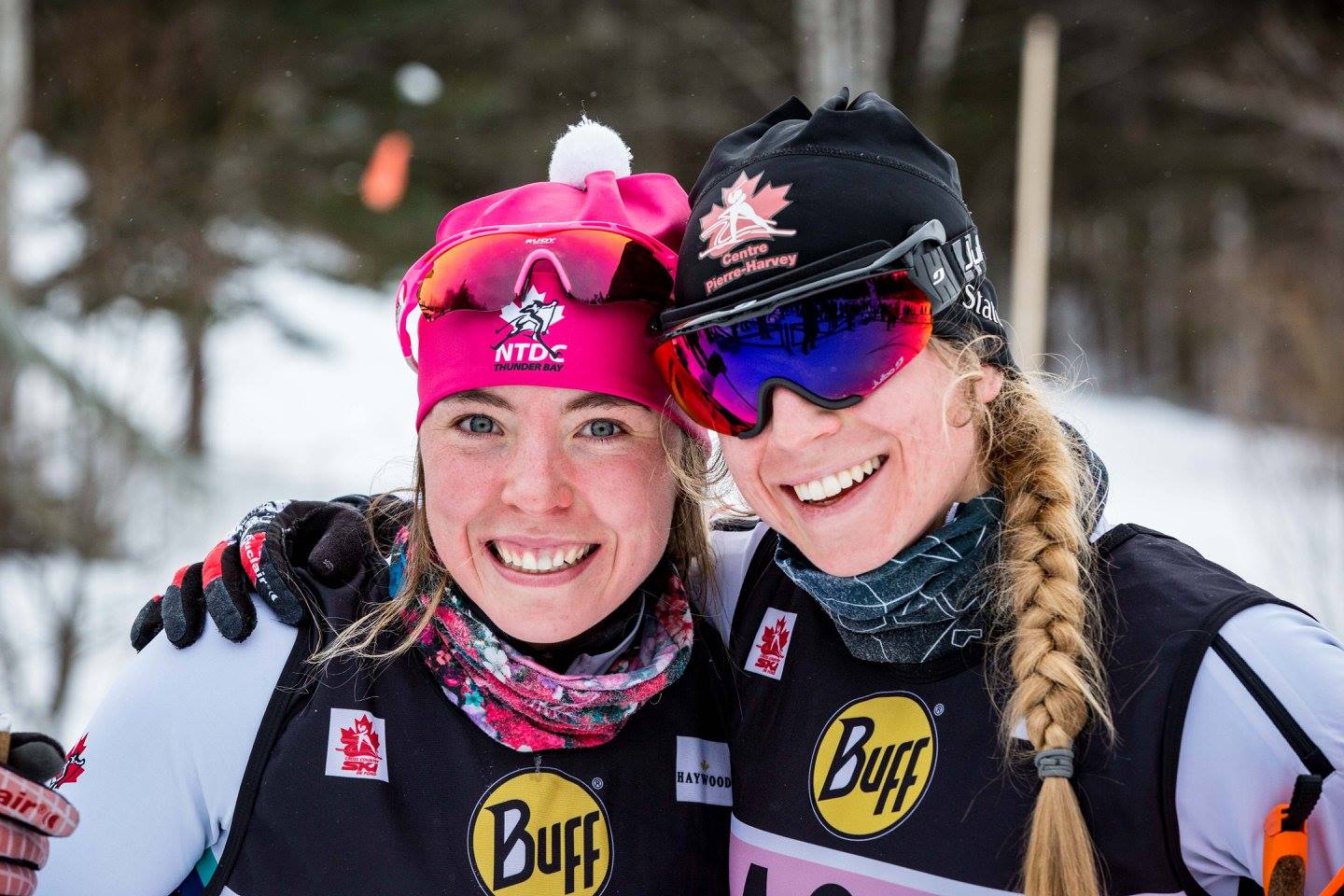
NTDC Thunder Bay’s Katherine Stewart-Jones (l) and CNEPH’s Cendrine Browne, both the Canadian U25 Team, after the NorAm Trials classic sprint on Jan. 5 at Mont Sainte-Anne, Quebec. (Photo: Mario Walker/NorAm MSA 2018)
In the final, Browne found herself behind Beatty (also of AWCA) and Stewart-Jones, of the Canadian U25 Team and National Team Development Centre (NTDC) Thunder Bay, at the top of the last major climb. They jumped in the tracks on either side of her, and Browne found herself without a track for the downhill.
Beatty crossed the finish line first once more (after winning both her quarterfinal and semifinal as well), finishing in 3:45.02, while MacIsaac-Jones followed 0.64 seconds later in second place. Stewart-Jones was 1.2 seconds back in third, and Browne 4.5 seconds behind in fourth. Hicks placed fifth (+10.21) and Andrea Dupont (RMR) rounded out the women’s final in sixth (+12.18).
Going into the final, Browne wasn’t aware she needed to finish fourth or better.
“I don’t really like thinking about criteria before I go into a race so I had no idea what I had just done,” she recalled. “A friend [Alexis Turgeon] told me when I crossed the finish line, he said, ’I think you got that Olympic spot!’ I was like, ‘What?’ and then the rumors started to spread and then my coaches told me it was true, I had made it. It was pretty great.”
One of those coaches was her coach, Louis Bouchard, head coach at CNEPH, also a Canadian World Cup coach and Alex Harvey’s personal coach, who attended the classic sprint at NorAm trials then left for Europe on Sunday.
“He said he was almost as stressed out as I was and he didn’t sleep before the first race,” Browne said. “It’s a relief for him as well.”
As for the distance races at trials, Browne said she had been targeting both.
“I really didn’t expect to qualify in a sprint race,” she said on Jan. 7. “I was hoping to win those [distance] races and do a spectacular criteria, so I still want to do really well in those races. I don’t want to think about the result because I only want to think about what I can control, which is my movements and how I ski, but I want to have great feelings during this race and ski really well.”
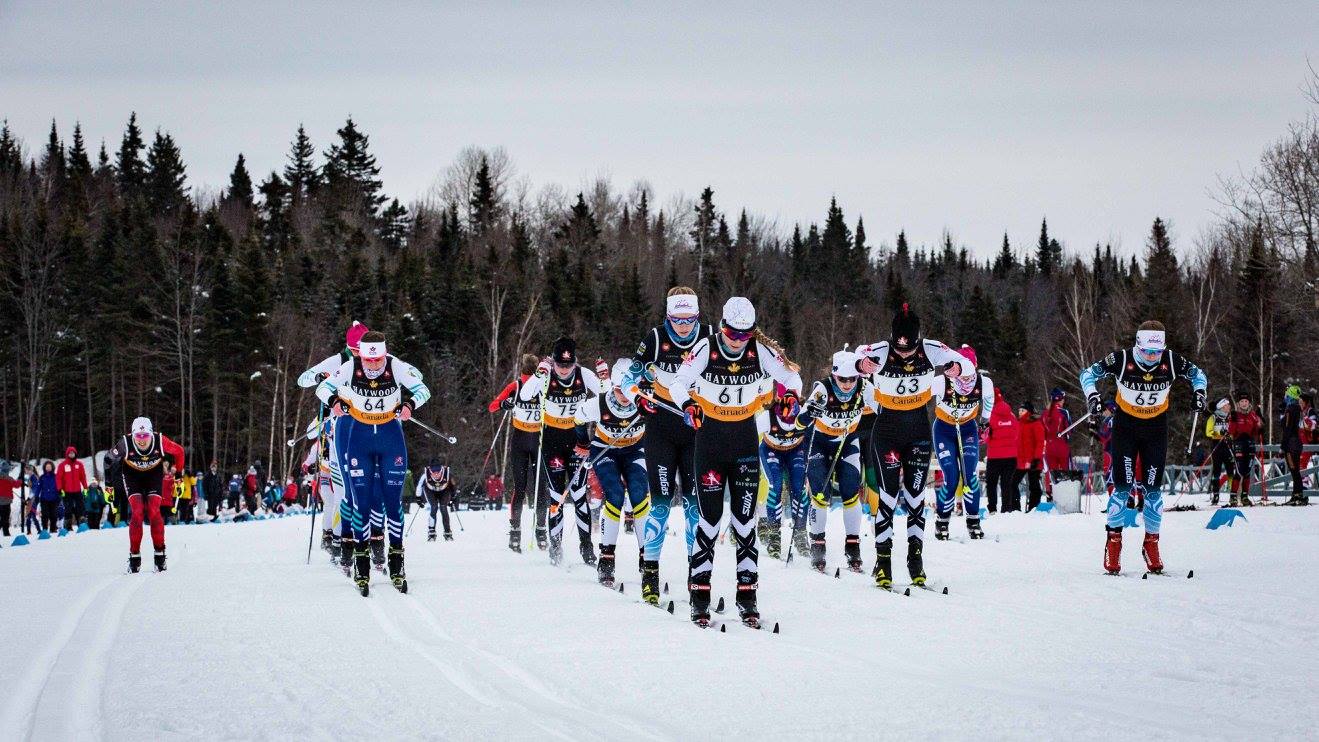
Cendrine Browne (61) leading the women’s 15 k skiathlon on Jan. 8 at Mont Sainte-Anne NorAm Trials in Quebec. She went on to take the win by 11.9 seconds over Anne-Marie Comeau (Université Laval). (Photo: Mario Walker/NorAm MSA 2018 Facebook)
On Monday, Jan. 8, she went on to win the 15 k skiathlon by almost 12 seconds after leaving the pack toward the end of the first 7.5 k classic leg.
“My goal was to start really hard and try to break away right at the start,” Browne recalled.
But she wasn’t able to shake skiers such as Beatty, MacIsaac-Jones, Comeau, or Stewart-Jones as quickly as she’d hoped. She built a small gap on the others around 6 k, but Comeau caught her before the transition to skate and Browne fell on the final climb before the exchange.
“I fell right before the downhill so I lost my gap,” Browne recalled. “And then we headed towards the ski exchange and I had some trouble with my binding and I couldn’t clip it on. It didn’t work, so I lost like another five seconds there. Anne-Marie was at the ski exchange before [me], and it took me like 2.5 k to catch up to her.”
After catching Comeau about a third of the way into the skate leg, Browne said she took the lead in an effort to drop Comeau over the next 2.5 k.
“I thought I could gap her, but I couldn’t,” Browne said. “And so on the last 2.5 k, I thought about my tactic. I saw how she skied, and I saw where I could pass her, so I stayed behind her and waited for the last big uphill, and I passed here there. … I knew I had faster skis and I knew I’m better on sections that need more power.”
With about a kilometer to go, Browne skied away to an 11.9-second victory. The next day, she raced to second in the freestyle sprint (a NorAm race but not an Olympic trials event) after qualifying in third.
She hadn’t planned on racing that second sprint of trials (and her third race in five days), but her coach, Bouchard, encouraged her to use it as intensity training before the Olympics.
“At first I wasn’t supposed to do that sprint, but … I had to race as much as I could before leaving [for Europe],” she said. “After the qualifier, I asked Louie, ‘I’m feeling really tired. Should I race in the heats?’ and he said, ‘Yeah, you should.’ … I didn’t know how it would turn out, but it turned out pretty well.”
The next day, she woke up for her fourth race of the week, the 10 k classic, not feeling as fatigued as she had on some of the previous days.
“Of course, I was tired, but I was telling myself everybody’s really tired,” Browne recalled. “My goal was to push as hard as I could during the whole race because I had to prepare as well as I could for the Olympics.”
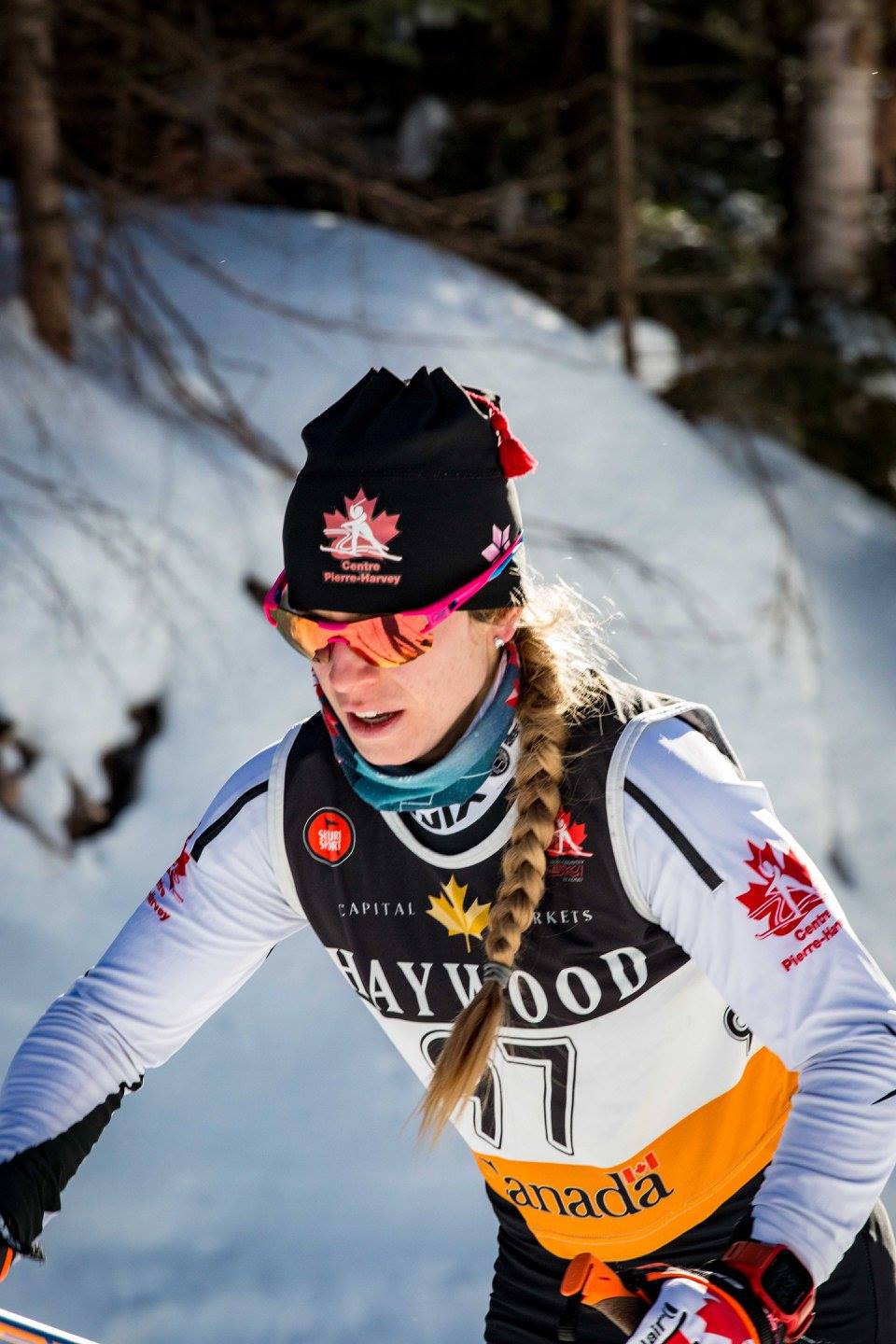
Cendrine Browne racing to first in the women’s 10 k classic on Jan. 10 at Mont Sainte-Anne NorAm Trials in Quebec. (Photo: Mario Walker/NorAm MSA 2018 Facebook)
Despite being one of the last starters in that race, she said she wasn’t quite sure where she stood during it, so she simply pushed as hard as she could.
“It was like, I don’t wanna be second … and then it turned out that I had a really big gap,” she said. “I felt so good during that race. You don’t feel that good that often in races during the year, so I think I’m in really good shape leading towards the Olympics so that’s really exciting and it’s great news.”
Before leaving Quebec for a mid-January training camp in Livigno, Italy, Browne summarized her trials performance.
“I really wanted to show that I deserved my spot,” she said. “I qualified in a sprint race, but I really wanted to show that I was that I was good in distance racing, too, because I am a distance racer. … I guess you could say I qualified in all the events, but I just wanted to show Cross Country Canada that I that I deserved my spot and I really wanted to be safe. I think that’s what kept me going.”
And while qualifying domestically was her last resort to get to her first Olympics, Browne said it all worked out in the end.
“‘Actually I’m kind of happy I was in Mont Sainte-Anne; it gave me confidence that I really deserve my place and it was really nice to ski at home, well, kind of at home,” she said. “My boyfriend was there, my family was there, and lots of friends and everybody was cheering … it was really fun. Great atmosphere and the races were really well-organized.”
“You don’t feel that good that often in races during the year, so I think I’m in really good shape leading towards the Olympics so that’s really exciting…” — Browne
Browne and the rest of the Canadian World Cup team returned to World Cup racing Jan. 27-28 in Seefeld, Austria. There, she placed 54th in the freestyle sprint then 37th in the 10 k freestyle mass start. She was the second Canadian in the 10 k, after Nishikawa in 35th, and with Olympic-style scoring, Browne would’ve been 33rd.
“I think us three girls did really well today, considering we are just coming back from a training camp,” Browne said after the mass start, referring to Nishikawa, herself, and Beatty, who placed 45th. “So it’s really looking good for the Olympics.”
Path to PyeongChang
Last summer, Browne worked to rehab back tension and knee tendonitis. Those injuries only set her back about two weeks in July, she said, and she attended all training camps, including the Canadian women’s team camp in New Zealand in late July and early August.
“I did a total of 60 hours of training in just under three weeks and realized that despite my small injuries my shape was intact; I was as much in my place as before among these girls,” Browne said in August.
As of early January, she said she was injury free.
With more than 40 World Cup starts currently behind her, Browne said she’s reached a new level with her racing. Last year was about understanding “the importance of self-confidence,” she said last summer, “but also that the most important thing is to have fun.
“It’s easy to forget when you’re at the top level,” she continued. “When I was stressed before the start of a race, I would ask myself, ‘Why are you doing this?’ Because I like it.”
Initially, it was lining up against the best skiers in the world that intimidated her.
“In the beginning, you reach the highest level, you face the best in the world. It’s intimidating being new to the field, but I’ve learned to master this stress throughout the season,” she said. “At the end, I felt in my place.”
— François Léger Dionne, Andrea Potyondy-Smith and Gabby Naranja contributed
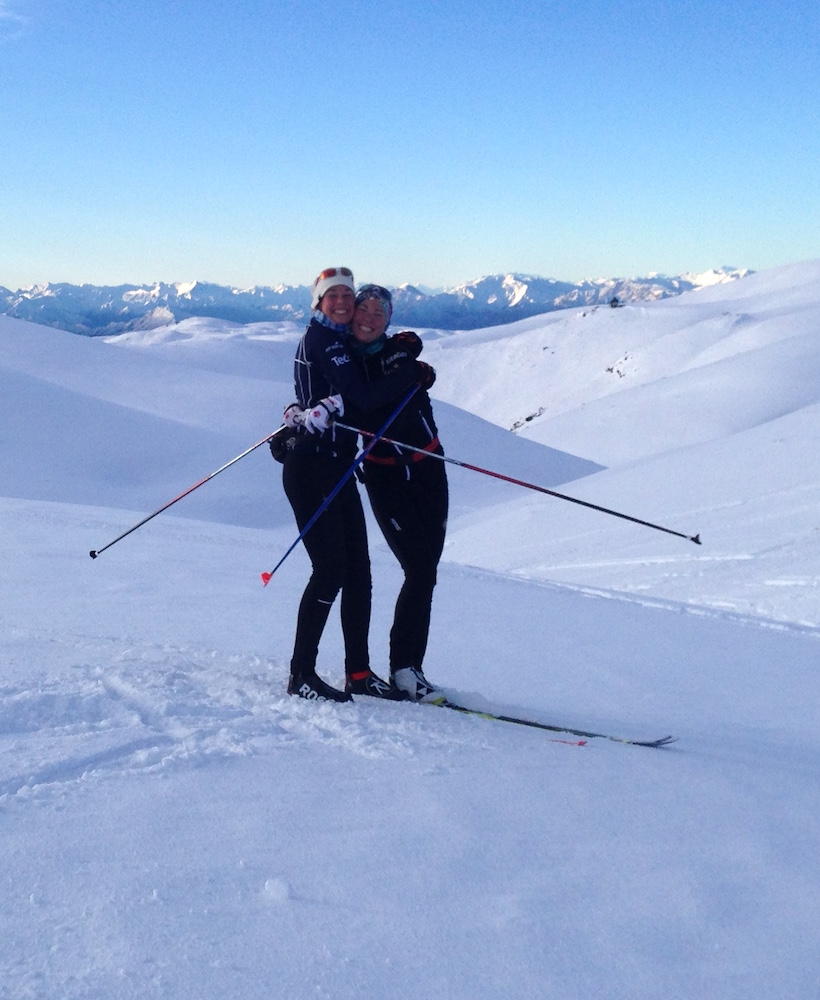
Canadian national-team member Cendrine Browne (r) hanging with her teammates Katherine Stewart-Jones (l) and Dahria Beatty at a training camp in Tremblant, Quebec, in May. (Photo: Dahria Beatty) La membre de l’équipe nationale canadienne Cendrine Browne (D) en compagnie de ses coéquipières Katherine Stewart-Jones (G) et Dahria Beatty lors d’un camp d’entraînement à Tremblant, Québec, en mai. (Photo: Dahria Beatty)
On Monday, Cross Country Canada announced its 2018 Olympic cross-country ski team for the upcoming Winter Games in PyeongChang, South Korea. The team includes 11 athletes: seven men and four women.
According to the press release, “each of the 11 athletes met the standard for nomination to the Canadian Olympic Committee under Cross Country Canada’s Internal Nomination Procedures for the 2018 Olympic Games, and in the process form a talented squad replete with veteran leadership and podium potential.”
“This is a team that has evolved from a group of talented athletes excited to be on the start line into a group of determined high-performers focused, and confident, in their ability to achieve international podium results,” Cross Country Canada (CCC) High Performance Director Tom Holland said in the press release. “Led by our men’s team of Devon, Alex and Lenny over the last two quadrennials, we are in the podium hunt, and will continue to push towards getting Canada back on the Olympic podium at the Nordic venue.”
As the press release points out, Canada has three Olympic medals in cross-country skiing, starting when Beckie Scott earned the gold medal at the 2002 Salt Lake City Games. She added a silver Olympic medal to her collection in 2006, placing second in the team sprint with Sara Renner. Also in 2006, Chandra Crawford won gold in the Olympic skate sprint in Turin, Italy.
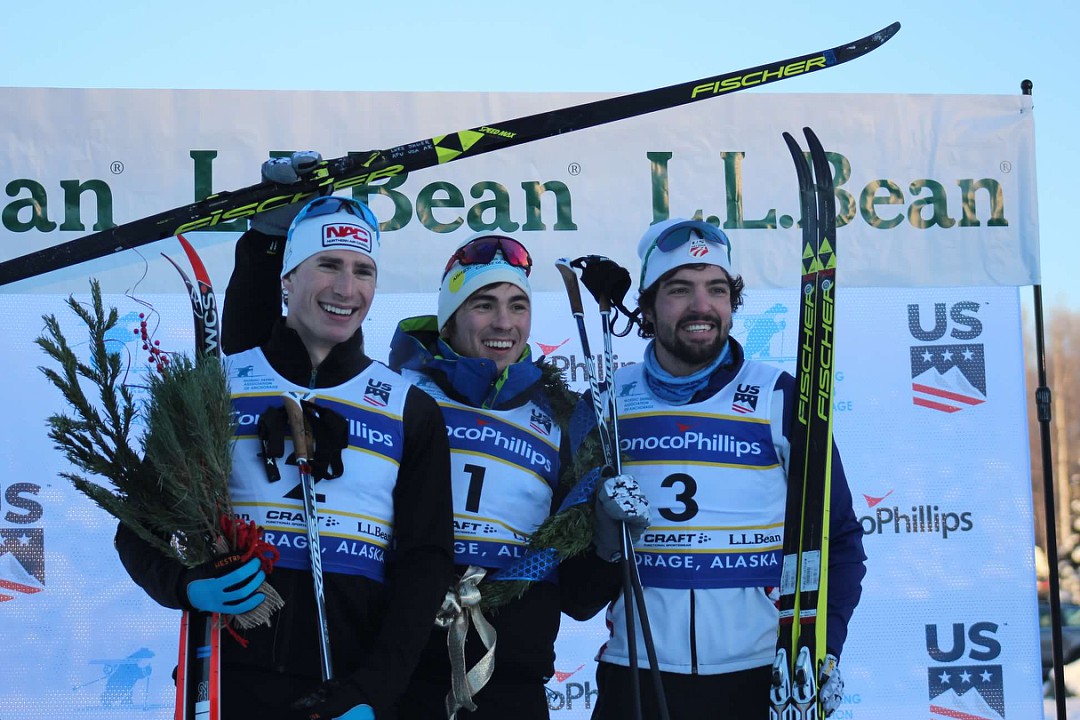
Left to right: Tyler Kornfield (APU), Reese Hanneman (APU) and Ben Saxton (SMS) the top three Americans in the men’s 1.6 k classic sprint final on Monday, the last day of 2018 U.S. Cross Country Championships in Anchorage, Alaska.
U.S. Cross Country Championships (Anchorage, Alaska): Classic sprint
Caitlin Patterson did it. With a classic-sprint win on Monday, she successfully capped off an undefeated 2018 U.S. Cross Country Championships, as the top American woman in all four races over the past week in Anchorage, Alaska.
Patterson, of the Craftsbury Green Racing Project, qualified seventh then won the women’s 1.5-kilometer final by more than 2 seconds in 3:39.58 minutes. Finland’s Jasmi Joensuu, a junior at the University of Denver (DU), won the qualifier and ultimately finished second in the final, 2.36 seconds behind Patterson.
Craftsbury once again had two on the podium with Kaitlynn Miller placing third overall (+3.9) as the second American. Becca Rorabaugh, of Alaska Pacific University (APU), was the top American in the qualifier in second overall, then placed fourth in the final (+9.92) and reached the U.S. podium in third.
Petra Hyncicova, a University of Colorado Boulder (CU) senior from the Czech Republic, placed fifth overall (+10.03), and Lydia Blanchet, a Dartmouth College U23 skier, finished sixth (+11.21) and was the fourth American woman.
Joensuu, 21, of Kuortane, Finland, started the day by winning the qualifier in 3:41.4, while Rorabaugh followed in second, 1.31 seconds back. Hyncicova qualified third (+1.85), CU’s Hedda Bångman (who won Sunday’s 20 k classic) qualified fourth (+2.92), and Miller qualified fifth (+2.93). Anne Hart of the Stratton Mountain School (SMS) Elite Team clocked the sixth-fastest qualifying time (+3.88), and Patterson followed in seventh (+4.77).
From there, Patterson won both her quarterfinal and semifinal, besting Miller and Joensuu in the latter by 0.66 seconds and 2.63 seconds, respectively. Blanchet placed fourth in that same semifinal (+5.15) and advanced to the final as a lucky loser with a fast-enough time, along with Joensuu (Patterson and Miller automatically advanced in first and second).
With her 4-for-4 record at 2018 nationals, Patterson is the most successful woman at U.S. Cross Country Championships since U.S. Ski Team member Jessie Diggins was the top American in all four races at 2012 nationals in Rumford, Maine.
In the men’s classic sprint final, Reese Hanneman (APU) captured his second title in as many sprints this week (after winning the freestyle sprint on Friday). He won the qualifying round by 2.84 seconds in 3:21.93, and later the final by a 0.2 seconds in 3:20.62. Kornfield placed second, and Ben Saxton (SMS Elite Team) rounded out the podium in third (+4.78).
Logan Hanneman, the winner of Friday’s freestyle-sprint qualifier, finished second to his older brother Reese in Monday’s classic-sprint qualifier, then went on to reach the final and place fourth overall (+5.42). Kevin Bolger (Sun Valley Ski Education Foundation) placed fifth (+5.52), and Zak Ketterson (Northern Michigan University) was sixth (+6.83).
NorAm Trials (Mont Sainte-Anne, Quebec): 15/30 k skiathlons
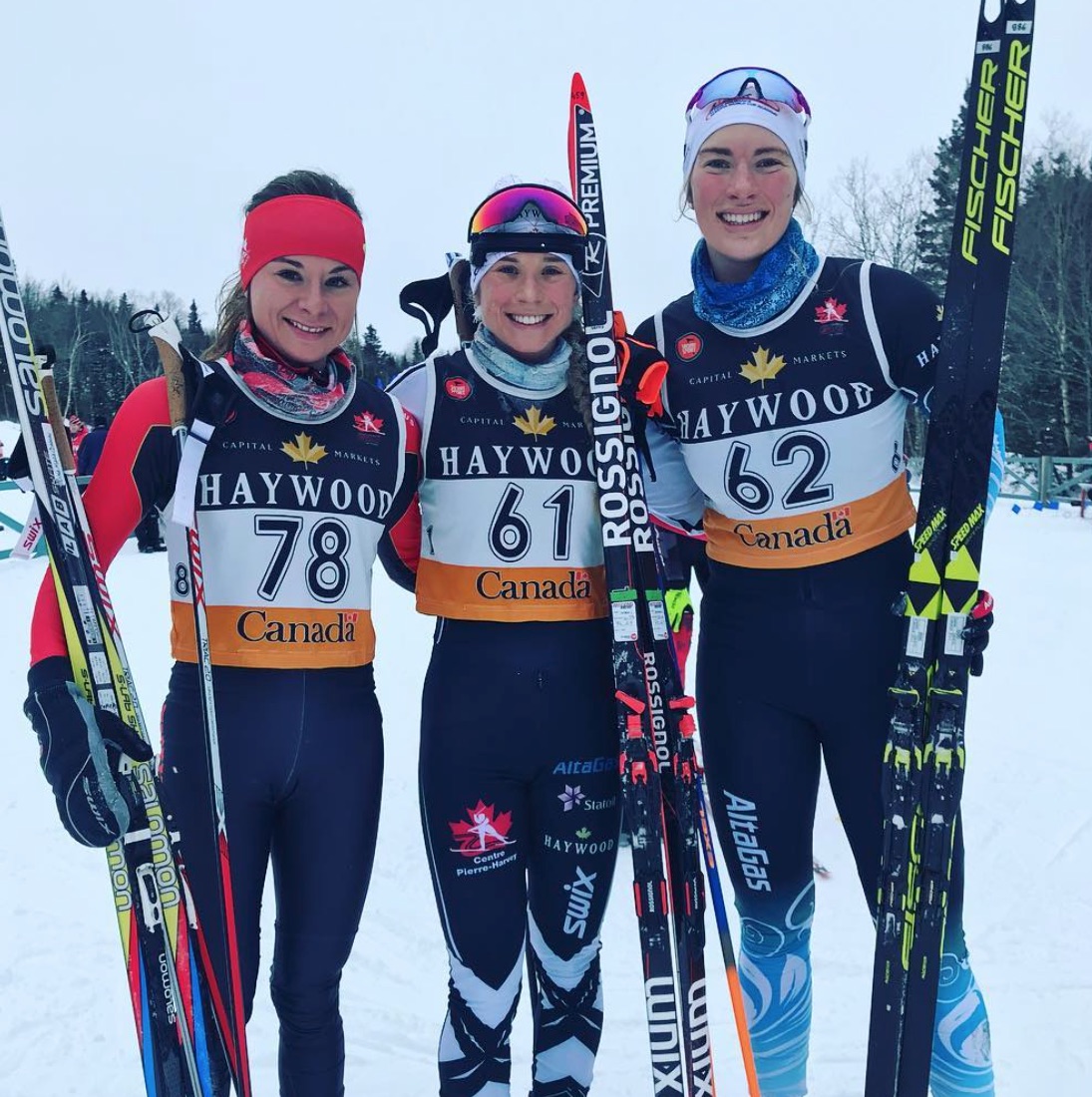
The women’s 15 k skiathlon podium on Monday at NorAm trials at Mont Sainte-Anne, Quebec, with Cendrine Browne (c) of the Pierre-Harvey National Training Centre (CNEPH) and Canadian U25 Team in first, Anne-Marie Comeau (l) of Laval University in second, and Dahria Beatty (Alberta World Cup Academy/Canadian World Cup Team) in third. (Photo: Cross Country Canada/Instagram)
Cendrine Browne won the women’s 15-kilometre skiathlon in 43:01.9 minutes on Monday at the Mont Sainte-Anne (MSA) ski trails to put an exclamation point on her presumptive selection for the PyeongChang Olympics. Browne, of the Centre National d’Entraînement Pierre Harvey (CNEPH)/Pierre-Harvey National Training Centre, which is based in nearby Saint-Ferréol-les-Neiges, broke away with Laval University’s Anne-Marie Comeau during the classic leg to take a 20-second lead that she held to the finish.
Comeau faded slightly to take second, 11.9 seconds back, qualifying for U23’s and putting her name in the hat for the upcoming 2018 Olympics. Either Comeau or the winner of Wednesday’s classic interval start should take that potential Olympic berth as Canada’s top female distance skier not already qualified. Browne has theoretically earned a spot as the top women’s sprinter, besides Dahria Beatty, who won the sprint and already met Canada’s Olympic qualifying criteria.
“It now has to go before the selection committee,” Cross Country Canada’s High Performance Director Thomas Holland wrote in an email on Friday.
After trials races were shuffled around due to extreme cold, with temperatures near -20 Celsius on Sunday at MSA, it warmed up to a balmy -8 degrees Celsius (17 Fahrenheit) by mid-afternoon on Monday. Both the women’s and men’s skiathlons were held, which not only served as one of two distance races for Olympic selection, but for Junior and U23 World Championships as well.
In the race for third place,Beatty outsprinted a group of four to take the final podium spot, 19.9 seconds behind Browne and 0.3 seconds ahead of their fellow Canadian National Team member Maya MacIsaac-Jones, of Rocky Mountain Racers (RMR) and U25 Team. Just 0.2 seconds out of fourth, Katherine Stewart-Jones, of the National Training Development Centre (NTDC) Thunder Bay and national U25 Team, placed fifth (+20.4) and CNEPH’s Laura Leclair was another second back in sixth (+21.4).
Almost 55 seconds passed before the seventh-place finisher came across the line, which was Zina Kocher (Foothills Nordic) skiing alone (+1:15.8). Another 49 seconds later, Jaqueline Mourao of Brazil’s national team placed eighth (+2:04.9), ahead of Zoë Williams (Carleton University) in ninth (+2:11.3), and Andrea Dupont (RMR) in 10th (+2:11.5).
In the junior women’s 10 k skiathlon, Whitehorse’s Natalie Hynes won in 30:19.8 to punch her ticket to Junior Worlds in Goms, Switzerland, from Jan. 28-Feb. 3. India McIsaac (RMR) finished 0.7 seconds back in second and Orford’s Alexandra Racine completed the podium in third (+32.8).
The men’s 30 k skiathlon podium at NorAm trials at Mont Sainte-Anne, Quebec, on Sunday, with Knute Johnsgaard (c) of Canada’s World Cup Team in first, Graham Nishikawa (r) of the Canadian Para-Nordic Team in second and Gareth Williams (Telemark Nordic/Canadian U25 Team) in third. (Photo: Cross Country Canada/Instagram)
On the men’s side, Canadian World Cup Team member Knute Johnsgaard, who met qualifying criteria for PyeongChang last season, shook off a slow start to the World Cup season with a win in the NorAm trials men’s 30 k skiathlon, finishing in 1:13:30.9.
Graham Nishikawa, who’s already destined for the PyeongChang Paralympics as a guide on the Canadian Para-Nordic Ski Team, finished 1 second back for second place. The 34-year-old Nishikawa edged out first-year senior national-team member Gareth Williams, 20, of Telemark Nordic and the national U25 Team, by 0.5 seconds. Williams was the top U23 athlete to qualify for this year’s U23 World Championships.
The top 6 finished within 41 seconds of the podium, with Jack Carlyle (AWCA) in fourth (+5.8), Philippe Boucher (CNEPH) in fifth (+13.9), and Scott Hill (BXC) in sixth (+40.7). World Cup Team member Len Valjas led the next group across the line in seventh (+1:28.6), followed by Bob Thompson (NTDC Thunder Bay) in eighth (+1:29.4), Alexis Dumas (CNEPH) in ninth (+1:35.5), and Ricardo Izquierdo-Bernier (CNEPH) in 10th (+1:35.7)
CNEPH’s Antoine Cyr won the junior mens 15 k skiathlon in 50:13.1 to earn a spot at Junior Worlds. Félix Longpré, of the local M.S.A. ski club, finished second (+15.7) and Thomas Manktelow was third (+49.0), just ahead of his Alberta World Cup Academy teammate Étienne Hébert in fourth (+49.3).
After Sunday’s racing was postponed due to temperatures well below the legal race limit, the remaining trials schedule includes freestyle sprints on Tuesday (for Junior and U23 World Championships qualifying purposes only), and classic interval starts on Wednesday.
Canada’s Cendrine Browne finished 26th in the women’s 30-kilometer freestyle mass start at the 2017 Nordic World Championships in Lahti, Finland. She will be racing later this week more or less on her home turf at Mont Sainte Anne, Quebec, to try to secure her spot on the Canadian Olympic Team. (Photo: John Lazenby/Lazenbyphoto.com)
But in fact, that might be too many. Cross Country Canada (CCC) learned that they currently stand to receive a quota of nine team members (men and women combined) for PyeongChang, based on Canada’s recent international results. That is two quota spots less than at the similar time before the 2014 Olympics in Sochi, Russia.
The quota is likely to increase, as some of the teams given the largest roster possibilities will probably not use all of their roster space. If that happens, the free quota spots will be redistributed, although just how many additional spots Canada will receive depends completely on the actions of other teams.
Regardless, the current small roster size means that qualification will shake out differently than the national team had thought it would, CCC High Performance Director Thomas Holland said in a recent phone interview.
Canada’s Alex Harvey celebrates his victory in the men’s freestyle sprint at World Cup Finals in Quebec City. “I mean, it’s all about the Games and you know Alex is a big contender. We’re putting everything behind him, and making sure he’s got what he needs to get the job done in PyeongChang,” said Cross Country Canada High Performance Director Tom Holland.
“We based our criteria on what we had in Sochi,” Holland said of designing CCC’s selection process. “In Sochi, we had 11 [athletes initially], and with the reallocation we ended up with 13, so we kind of used that [to develop] the criteria. I guess our results aren’t where we would like them to be [this year] so we have nine, less than we expected.”
As a result, a revision of the Olympic qualification criteria has specified who is guaranteed a spot, which types of athletes will be picked at trials, and which athletes will be added later if Canada benefits from quota reallocation.
Specifically, Harvey, Valjas, Kershaw, Johnsgaard, and Cockney are definitely going, as they have met the “Primary Qualifying Criteria” by dint of a third-place World Cup relay or, in Cockney’s case, two 10th-place finishes in sprints, or in Harvey’s case, a whole lot of different top results.
The next priority is to field a four-woman team, so Nishikawa and Beatty are in, as the only two women to have achieved “Alternative Qualifying Criteria A” of three top-30 results. The trials will determine who will join them. The new amendment specifies that one female sprinter and one female distance skier will be selected.
That brings the team size to nine. If an additional quota spot materializes, Killick will get the call; he met “Alternative Qualifying Criteria A,” the only Canadian man to do so aside from those who met the primary criteria.
Should even more quota spots arrive, they would go to, in order, a male sprinter and a female distance skier. CCC has said for months that team size would be capped at 12 no matter how many quota spots are allocated to the team.
Race Formats and Qualification Scoring
The Olympic selection races will be held this Friday through next Tuesday, Jan. 9, in Mont Sainte-Anne, Quebec, as part of major competitions with NorAm points on the line and selections being made for Junior and U23 World Championships teams being done at the same time.
Among those racing at the trials will be Knute Johnsgaard, even though he is already qualified for the Olympics. (Photo: Fischer/Nordic Focus)
Some of the athletes already qualified for the Games will also be there competing as a tune-up: only one athlete, Harvey, is currently competing in the Tour de Ski, with Kershaw having intended to but falling sick after the first stage. Killick and Nishikawa are racing in Continental Cup races in Europe.
For the rest of the hopefuls, classic sprints will be contested on Friday, Jan. 5; 10/15 k classic interval starts on Sunday, Jan. 7; and 15/30 k skiathlons on Tuesday, Jan. 9.
(There will be an additional skate sprint on Monday, Jan. 8, but it will not figure into Olympic qualification. And a forecast of cold weather for Sunday means that more modifications still may come, although the organizing committee is sticking to the planned distance races on Sunday for now.)
While the distance interval-start race at the Olympics will be skating, Holland said that it would be a classic competition at the upcoming trials for several reasons, the main one being a time constraint that prevented the staging of every possible kind of race.
Former biathlete Zina Kocher likes skate distance more than classic sprints, and the selection race schedule might not work in the current NorAm leader’s favor. (Photo: Peggy Hung)
“We have a couple things going on at the same time,” he explained. “We have probably 18 athletes who will qualify for the World Juniors/U23 teams. We couldn’t get that [series] in any earlier, so we have about four days to do all the races… there is classic racing at the Olympics in the relay, in the 30k, that kind of thing, so that was the best scenario we could come up with.”
That is definitely a blow to skate-specialist athletes looking for an Olympic berth – in particular Zina Kocher, a former biathlete who currently leads the NorAm series (more on that later). But Holland says there hasn’t been much pushback on the classic-heavy schedule.
“I think they have known, and accepted it,” he said. “You have to ski both techniques at the Games, if you want to maximize the the number of races [an athlete can do]… It’s not ideal, but I guess, you know, we get to look at the skate race in the skiathlon.”
Sprint and distance ranking lists will be kept separately for men and women, although the distance list for men is something of a moot point as there are no additional male distance skiers set to be added to the team.
In each case, the list will be made up of only the athletes who have not met qualification criteria in that discipline – so, for example, Johnsgaard, who has met the distance but not the sprint qualification criteria, can be scored on the sprint list, while Cockney, who has met the sprint but not the distance qualification criteria, could be scored on the distance list.
“[If Johnsgaard qualified] for the sprint spot… the outcome would be that we would have four sprinters (Harvey, Valjas, Cockney, Johnsgaard) and the sprint quota would be full at four athletes,” Holland wrote in an email. “We would move onto a distance athlete as per the ranking in Amendment #2.”
That said, once at the Olympics, any team member could start any race regardless of whether they qualified via sprint or distance results.
“Once the athletes are at the Games it is the purview of the coaches and High Performance Director as to who starts in which races – there are no limitations; we will try to fill start positions,” Holland wrote. “Meeting the nomination procedures/criteria is another matter. Qualifying in a distance or relay event should not give an athlete the automatic right to take a sprint quota spot at the Games.”
For the female sprinter and the potential additional male sprinter to be selected in Mont Sainte-Anne, the requirement is clearly to “win” the classic sprint on Jan. 6, or at least be the top athlete who wasn’t already qualified for PyeongChang.
Sophie Carrier-Laforte charging the downhill on her way to third place in the NorAm women’s 5 k classic in Rossland, B.C. Carrier-Laforte has also had excellent sprint results so far this NorAm season. (Photo: Mark Richards)
But winning is a bit complicated: with only one spot up for grabs, CCC wants to consider both qualifying speed and final placement at the end of the heats. Thus, a combined score will be made, with 50 percent of points coming from qualifier position and 50 percent of points from final position. For each, one point will be given to the winner, two to the second-place finisher, three to the third-place finisher, etc. The athlete with the lowest combined point score from the day “wins”.
For female distance skiers, both the 10 k classic interval start and the 15 k skiathlon will be scored. If they are won by the same athlete, then it is clear that this woman will be named to the Olympic team. If two different women win the two races, then the woman with the better result in the race she didn’t win will be picked.
And if the same athlete tops both the sprint and distance list, then they will be given the designated sprint spot, and the second-ranked distance skier will also be selected for the team.
An “alternate” sprinter and “alternate” distance skier for both men and women will be named, who will go to the Games only if one of the qualified athletes becomes sick or injured and can’t compete.
Canada has a scary preview of that at the moment, as Valjas – who stood on the World Cup podium several times last season – returned to Canada in December to deal with injury issues.
Canada’s Len Valjas racing to second in the men’s classic sprint qualifier at the World Cup in PyeongChang, South Korea, last season. Values left the World Cup Period I early this year to deal with a neck injury, and will be racing at the selection races as part of his return to competition. (Photo: Fischer/Nordic Focus)
“He injured his shoulder, but it’s an injury that he had last year at the World Championships and it goes much deeper. It really felt like a shoulder injury, but until he came back this time and had an MRI, spent more time with doctors, we really got to the root of the cause,” Holland said. “It’s something that’s going to be there and has to be managed now. At least he knows what it is, and with therapy he can keep it under control. We’re just playing it safe at this point.”
He anticipates that Valjas will be back in more than enough time for PyeongChang.
“Now that we know what it is and that he knows how to treat it, with the exercises he has to do on an ongoing basis, and just the right therapy on an ongoing basis, he should be fine,” Holland said. “He’s pretty confident.”
Who To Watch For
Depending on quota reallocation, it’s not clear that any more men will be added to the Canadian Olympic team. From that perspective, some attention will be on who wins the men’s sprint – with Julien Locke and Bob Thompson perhaps the favorites to earn it if that quota spot opens up.
Julien Locke finished 36th in the skate sprint in Davos, Switzerland, tying his second-best World Cup result ever. (Photo: Reese Brown / U.S. Ski & Snowboard)
And for both men and women, it’s also an opportunity to see how the athletes who returned from World Cup Period 1 with somewhat disappointing results compete, as Holland expects their race fitness to be improving. Beatty, Cockney, Valjas, and Johnsgaard are all registered for the races, as are Locke and Russell Kennedy, who raced Period 1 via a Frozen Thunder sprint win and NorAm leader status, respectively. Finally, there’s Brian McKeever racing, who is always a possibility of shaking up the podium as he prepares for the PyeongChang Paralympics.
But in the selection races, most of the attention will be on the women.
Returning from the World Cup are Cendrine Browne, who was two-thirds of the way to her “Alternative Qualifying Criteria A” selection but never notched her third top-30, and Katherine Stewart-Jones. Browne finished 45th in both the 15 k skiathlon in Lillehammer, Norway, and the 10 k skate in Davos, Switzerland, in December.
“I think she didn’t race to her potential in December for whatever reason, but I expect her to come around here in Mont Sainte-Anne and be off to the Olympics,” Holland said of Browne.
Then there is fellow 2017 World Championships team member Stewart-Jones, who suffered a concussion in mid-September and had to miss more than a month of training. She jumped back onto the World Cup in Lillehammer and had a top finish of 55th in the Davos sprint.
Katherine Stewart-Jones has tried to continuously improve her results since rehabbing from a concussion. (Photo: Reese Brown / U.S. Ski & Snowboard)
“With the concussion she had — sometimes you have to make a decision,” Holland said of her return to racing. “Maybe it was too soon for the World Cup, but you know, [she had a] good training season, and there are more races. I expect her to come around. She has goals for the Olympics, but she’s still a U23 so she has some goals/objectives there as well. We’ll see what she does at the trials.”
Then there is Kocher, who has rarely competed against the previous two. A several-time Olympian for Biathlon Canada and previous World Cup podium finisher in biathlon, she also won the 5k skate at Canadian Ski Nationals last season and finished second to Nishikawa in the 30 k skate. She was the Canadian champion in the same event in 2013, where she finished behind Switzerland’s Bettina Gruber in the race.
Kocher is the current NorAm leader, but that has come on the strength of her skating: the top Canadian (in eighth) in the 10 k skate at the Sovereign Lakes NorAm, third in the skate sprint in Rossland, second in the overall minitour after a strong skate pursuit. But in the 5 k classic at the Rossland NorAm, she finished just 12th. A major question is whether he 20 k skiathlon gives her enough room to make up for her classic skiing, and whether she can do well enough in the 10 k classic compared to, say, Stewart-Jones, to earn a nod.
Second place in the NorAm standings belongs to Andrea Dupont, who finished second, and the top Canadian, in the Rossland skate sprint. She also won the qualifier there, which is an important skill given the sprint scoring system at Olympic trials.
First-year senior Maya MacIsaac-Jones (r) with her Rocky Mountain Racers teammate Andrea Dupont, currently second in the NorAm standings, after the two placed first and second in the NorAm freestyle sprint at Sovereign Lake. MacIsaac-Jones won for her first NorAm victory. (Photo: Gerry Furseth)
Annika Hicks was the first Canadian in the classic race in Rossland, and finished third overall in the minitour. She has had a strong start to the season and is currently third in the NorAm rankings, just a few points behind Dupont.
Sophie Carrier-Laforte, Frédérique Vézina, Maya MacIsaac-Jones, Laura Leclair, Anne-Marie Comeau, Alannah MacLean, and juniors Hannah Mehain and Lisle Compton also have top-five Canadian finishes from individual NorAm races.
“Maya MacIsaac-Jones, she’s had a rough time with injuries over the last year, but she might surprise us at trials, in sprinting,” Holland said.
Another racer who has had a tough time with injuries: 2015 World Championships team member Olivia Bouffard-Nesbitt, who hasn’t competed since sustaining a serious neck injury in February. But she’s on the start list for the trials races.
In the joint NorAm/SuperTour weekend in Sovereign Lake, Carrier-Laforte was the only Canadian to make the sprint final, surrounded by five Americans, after having qualified fourth (again the top Canadian); Dupont was the only other Canadian to finish in the top 10. The pair, along with MacIsaac-Jones, are perhaps the favorites to go up against Stewart-Jones in the classic sprint.
Canadian World Cup Team member Len Valjas (1) and Bob Thompson (NTDC Thunder Bay) lunge to the line during Wednesday’s Frozen Thunder classic sprint at the Canmore Nordic Centre in Canmore, Alberta. (Photo: Doug Stephen)
Clouds heavy with building snow and a winter-storm warning already in effect cast a second anticipatory shadow over a jittery group of racers gathered on Wednesday for the first Frozen Thunder race of the season at the Canmore Nordic Centre in Canmore, Alberta.
At stake for some of the top Canadians participating in the day’s classic sprint was the opportunity to secure the final spot on the men’s World Cup team for the first period of World Cup racing starting later this month. Nearly 12 centimeters of snow had fallen the night before on the two-lap race track, and for many stepping out onto the freshly groomed trails, months upon months of training prep was in the barn.
“That World Cup spot. That has been a goal for pretty well the whole year,” said Bob Thompson, who trains with the Thunder Bay National Team Development Centre (NTDC), on the phone after Wednesday’s races.
Thompson, 26, was not the only one hoping to book a plane ticket for World Cup Period 1, which starts Nov. 24 in Kuusamo, Finland, and continues through December. Sixty-six skiers started Wednesday’s men’s sprint qualifier and anyone in the hunt for that World Cup spot would have to outperform them all, excluding the Americans and Canadian World Cup Team member, Len Valjas, who was prequalified for the World Cup.
Even with the competition’s added edge, many racers went about business as usual on race day and in the days leading up to the event, Thompson explained.
“It’s been fairly carefree the week we’ve been here,” said Thompson, who arrived in Canmore with his NTDC teammates on Oct. 23. “The morning [of the sprint] I wouldn’t say things were a bleak atmosphere or super serious, it was just kind of everyone was doing their thing.”
Thompson went about his warmup the way he normally would on race day. In retrospect, he saw his plan as well-executed and his warmup as strong, despite breaking a pole during his intensity segment. For him, the qualifier went “really well,” he said.
Julien Locke (Canadian U25 Team/Black Jack) after winning the men’s classic sprint qualifier at Frozen Thunder in Canmore on Wednesday and securing the final spot on the Canadian men’s team for World Cup Period 1. (Photo: Cross Country Canada)
But Julien Locke, of the Canadian U25 Team and Black Jack Ski Team, was the fastest man in the open men’s qualifier and thus earned that coveted World Cup spot. Locke, 24, posted the top time of 3:37.81 minutes, nearly a second ahead of Valjas in second (+0.97) and 3.57 seconds ahead of the third qualifier, Dominique Moncion-Groulx of the Alberta World Cup Academy (AIAWCA). Thompson qualified fourth, 4.15 seconds off of Locke’s winning time.
“I didn’t have regrets or second thoughts on how I raced,” Thompson said. “Julien had a great race, props to him. I’ll just have to come back next time.”
Locke could not be reached at press time, but he spoke with Cross Country Canada (CCC) in a video posted on Twitter after the race.
“I’m really excited to have won the race this morning and qualified for Period 1 World Cup, but the Olympics is the big goal this year,” Locke said. “It’s super important to go get results on the World Cup, and I’m excited to have a chance to do that.”
According to CCC High Performance Director Thomas Holland, Locke and the rest of the World Cup Team (excluding Alex Harvey and Cendrine Browne) will head to Gällivare, Sweden, on Nov. 10, where they’ll compete in a weekend of International Ski Federation (FIS) races from Nov. 17-19. Meanwhile, Harvey and Browne, who train out of the Pierre Harvey National Training Centre (CNEPH) with coach Louis Bouchard in Quebec, will train in Davos, Switzerland, in advance of the World Cup opener in Finland.
But let’s get back to Frozen Thunder. With the qualifier behind them and the heats slated to take place in a zero-elimination King’s Court format, many racers approached the rest of Wednesday adamant on getting in some solid race efforts.
“The King’s Court format that we use in the heats was a great showcase for athlete development whereby every athlete entered in the race gets to race all 3 heats,” Holland explained in an email. “The format sees men and woman and para-skiers in some of the same heats – super fun event for all the athletes.”
In the first heat, Thompson, Locke, Valjas, and Moncion-Groulx went head to head, yet with the heats starting one minute apart on the two-lap track, there was a constant influx of skiers and some overlap.
“I think comments were made that we were dogging it a little bit,” Thompson said of that initial round. “There were other heats that we were basically skiing in the first lap with that were going faster than us … they were running pretty quick through the starts.”
Dominique Moncion-Groulx (Alberta World Cup Academy) leads Julien Locke (3), of Canada’s U25 Team and Black Jack, and Len Valjas (l), of the Canadian World Cup Team, during a Frozen Thunder classic sprint heat on Wednesday at the Canmore Nordic Centre in Canmore, Alberta. (Photo: Doug Stephen)
In the second heat, Locke and Valjas paired up with Knute Johnsgaard (Canadian World Cup Team/AIAWCA) and American Cole Morgan, of the Sun Valley Ski Education Foundation (SVSEF). Thompson and Moncion-Groulx faced another American SVSEF skier, Kevin Bolger, as well as NTDC Thunder Bay’s Andy Shields. Four men advanced to the senior men’s final: Bolger, Thompson, Locke and Valjas.
In the final, Thompson recalled creating what he saw as “a bit of a gap” between himself and Valjas, yet Valjas, a seasoned World Cup sprinter, caught him in the lunge to the line for first. Overall on the day, Valjas placed first, Thompson second, Locke third, and Bolger fourth.
With the King’s Court format, female racers competed in the same same qualifier as the men, with Dahria Beatty (U25 Team/AIAWCA) emerging as the fastest female qualifier in 4:20.66. Her time was 8.56 seconds clear the second woman, American Chelsea Holmes, of Alaska Pacific University (APU), and 10.03 seconds ahead of Katie Weaver (Hollyburn Ski Club) in third. The third-placed Canadian woman in the qualifier, Annika Hicks (AIAWCA) clocked in fourth (+13.25).
In the heats, the women continued to race with the men. In the all-women final, Maya MacIsaac-Jones (U25 Team/Rocky Mountain Racers) took the win, Hicks placed second, Holmes third, and Frédérique Vézina (CNEPH) fourth.
Frozen Thunder racing continues Friday with men’s 10 k and women’s 7.5 k distance races, starting at 9 a.m. Mountain time. In a press release, CCC anticipated a turnout of 115 participants.
On July 1st, 2017, Thunder Bay, Ontario will be hosting its first ever Cross Country Canada sanctioned rollerski race. The race will feature more than 50 of Canada’s top nordic skiers racing around the closed streets of downtown Port Arthur. The race will start and finish at the corner of Court and Van Norman, commencing at 2:00 pm and finishing with awards at 6:00 pm.
The event is organized by Lakehead Superior Nordic Association, Big Thunder Nordic Ski Club, Lappe Nordic, and the National Team Development Centre (NTDC) Thunder Bay.
This event has been organized to coincide with the other exciting Canada Day celebrations planned for the downtown core.
Among the racers will be top local skiers, Junior National Team members and other elite skiers who have come to Thunder Bay from across Canada for a training camp hosted by NTDC Thunder Bay. The field will include athletes who potentially will represent Canada in the upcoming Winter Olympics.
Race format will include an interval start individual time trial with each competitor completing two laps of the course. Then the athletes will be seeded into waves of closely matched competitors. Each wave will complete a 12 to 20 lap race on the same circuit. Waves will progress from the slower competitors to the faster, with the top ranked skiers racing at close to 4 pm.
Date: Saturday July 1st 2107 Time: 2:00-6:00 PM
Location: Start/finish at corner of Court and Van Norman (see attached map of race course)
ContactTimo Puiras (NTDC Thunder Bay Head Coach) at ndctimo@gmail.com for further information
On Friday, Cross Country Canada (CCC) released its national-team nominations for the 2017/2018 season. The senior team includes 14 athletes, just one of which is a newcomer: 19-year-old Gareth Williams, who was on the junior national team last season.
In an Olympic year, Jess Cockney and Knute Johnsgaard made the jump up to A-team status, joining three other men (Alex Harvey, Len Valjas and Devon Kershaw), four were nominated to the B-team, and another five (including Williams) made the U25 (Under-25) Team.
The Para-Nordic Ski Team expanded from four official team members last year to 11 this year. Joining Brittany Hudak, Mark Arendz, Chris Klebl, Brian McKeever and his guide Graham Nishikawa on the World Cup Team are Collin Cameron and Emily Young (formerly Weekes).
Below are the senior, junior and para-nordic team nominations:
Devon Kershaw (589) leads University of Denver skier Eivind Romberg Kvaale during the men’s 15 k classic interval start on Tuesday at Canadian Ski Nationals at the Canmore Nordic Centre in Canmore, Alberta. Kershaw went on to win and Kvaale placed sixth. (Photo: W. James MacLean)
2017 Canadian Ski Nationals (Canmore, Alberta): Days 1, 2 & 3
On the third day of Canadian Ski Nationals in Canmore, Alberta, World Cup skiers Devon Kershaw and Emily Nishikawa — both fresh off World Cup Finals in Quebec City — picked up victories in the men’s and women’s classic interval starts on Tuesday.
Kershaw won the men’s 15 k in 45:05.3 minutes, 44.6 seconds ahead of two University of Denver (DU) skiers Dag Frode Trollebø and Moritz Madlener.
Both of Tuesday’s second- and third-place men’s finishers reached the podium at NCAA Skiing Championships earlier this month. On Tuesday, Trollebø, who’s originally from Norway, finished second, 44.6 seconds behind Kershaw. Madlener, of Germany, was another 2.2 seconds back in third (+46.8). World Cup skier Graeme Killick was the second Canadian in fourth overall (+1:09.2), and David Palmer, of the Black Jack Ski Club, placed fifth (+1:22.5).
“It was so hard, hot, and the conditions were vicious,” Kershaw said, according to a Cross Country Canada (CCC) press release. “I cramped up with five kilometres to go. It was a really hard day. But this is my home. I love Canmore and I think it is important for the kids to see that even after a hard World Cup season you should come and support the national championships.”
“That was a massive effort for me,” he added. “The conditions were just really, really slow, but I wanted to do this race to end the season.”
Nishikawa won the women’s 10 k classic by nearly 1 1/2 minutes in 29:07.6. American Mary Rose, of the Sun Valley Ski Education Foundation (SVSEF) finished second (+1:24.8), Katherine Stewart-Jones (NTDC Thunder Bay/Canadian U25 Team) was the second Canadian in third overall (+1:27.9) and Frédérique Vézina, of the Pierre Harvey Training Centre (CNEPH), placed fourth (+2:44.7).
“It was great to be back racing today in Canmore and see so many friendly faces out there,” Nishikawa said, according to CCC. “It was tough racing today, having raced three races last weekend in Quebec and then travel, but I was so happy to be able to race.
“I had great skis and was able to have another solid race,” she added. “It is always an honour to win a National Title. I love racing at Nationals.”
“I think it is really important for the next generation to get a chance to compete against, and meet National Team athletes,” she continued. “When I was a juvenile racing at Nationals, I was so inspired to be able to meet some of my idols who were on the National Team, so it’s important to me that I am here.”
While many of the 30 Canadians that competed at World Cup Finals last Friday through Sunday flew directly to Canmore for nationals, the races started without them, with a brand-new collegiate relay cross event on Saturday, March 18, and 10/15 k freestyle interval starts (for the open class) on Sunday, March 19.
The relays put university teams head to head on obstacle courses, with two skiers per team.
The women’s relay win went went to the University of Alberta’s Ember Large and Kathryn Stone, with a team name of “Largely Stoned” as a play on their last names. They won in 13:05.1, just 1 second ahead of Jenn Jackson and Makaila Hudson, representing Lakehead University, in second. The Rouge et Or (University of Laval) first team of Christel Pichard-Jolicoeur and Camille Burbidge Izquierdo placed third, 15.3 seconds back.
In the men’s relay, Rouge et Or/University of Laval, with Alexis Turgeon and William Dumas, took the win in 10:36.7, 17.5 seconds ahead of Lakehead’s first team, Noah Thompson and Gavin Shields, in second. Christopher Weller and Carrington Pomeroy of Carleton University’s first team reached the podium in third (+33.5).
On Sunday, Madlener won the men’s 10 k skate by 6.8 seconds over Graham Nishikawa, a guide for the Canadian Para-Nordic Ski Team, in 23:58.0. Another DU skier, Eivind Romberg Kvaale placed third (+13.4), ahead of Jack Carlyle (Alberta World Cup Academy) in fourth (+20.3). Michael Somppi (NTDC Thunder Bay) was the third Canadian in fifth overall (+25.3).
Retire biathlete Zina Kocher won the women’s 5 k skate by 14.6 seconds over Jenn Jackson (Lappe Nordic) in 13:08.7. Sun Valley took third through sixth with Deedra Irwin in third (+34.1), Kelsey Phinney in fourth (+35.2), Annie Pokorny in fifth (+38.6), and Rose in sixth (+41.7).
Racing continues at the Canmore Nordic Centre on Wednesday with classic sprints. The sprints on Wednesday and Thursday will be streamed live on YouTube. Details here: skinationals2017.com.
Left to right: Canada’s Len Valjas, Alex Harvey, Knute Johnsgaard, and Alex Harvey after their historic third place finish in the men’s 4 x 7.5-kilometer team relay last month in Ulricehamn, Sweden. All four were named to the 2017 World Championships team. (Photo: Fischer/Nordic Focus)
Earlier this week, Cross Country Canada announced its team for the upcoming 2017 World Championships in Lahti, Finland. The following athletes (six men and five women) were also selected to the Feb. 18-19 Otepää World Cup, the weekend before the championships.
Alex Harvey (CNEPH/World Cup A-team)
Devon Kershaw (World Cup A-team)
Len Valjas (World Cup A-team)
Jess Cockney (World Cup B-team)
Graeme Killick (World Cup B-team)
Knute Johnsgaard (AWCA/NST U25 Team)
For non-traditional cross-country ski nations like the U.S. and Canada, bringing home Olympic hardware is the benchmark for success. The World Cup, although prestigious among fans and athletes, doesn’t share the same fanfare. And just below Olympic success, and again, off the general public’s radar are World Championship results. Canada has Olympic nordic sport hardware: Beckie Scott’s 2002 gold, Chandra Crawford’s 2006 gold, and the duo of Scott and Sara Renner winning silver in in the team sprint also in 2006. Recent World Championship awards include Alex Harvey and Devon Kershaw winning team sprint gold in 2011. Harvey followed that up with more world-champs hardware: a sprint bronze in 2013, a sprint silver in 2015, and bronze that same year in the 30 k skiathlon.
Shane Pearsall will take over as CEO of Cross Country Canada starting Jan. 1, 2017. (Courtesy photo)
Canada’s cross country scene is not lacking for international medals. Yet in recent years, the sport has received a smaller piece of the sports funding pie from government entities like Own The Podium (OTP), and from independent sponsors. Canada is now emerging into the women’s World Cup ranks again, Dahria Beatty recently advanced to the sprint quarterfinals in Davos, Switzerland — she finished 25th on the day. But for many years as the men’s team was loaded with Harvey, Kershaw, and Valjas, on and off the record the sense was that the women’s side of the equation languished. The responsibility for developing the sport in Canada ultimately falls to Cross Country Canada (CCC), the national governing body for the sport.
CCC’s most recent CEO, Pierre Lafontaine, remained in the job for a year. Starting Jan. 1, 2017, the CEO role will belong to Shane Pearsall.
Sound like a new name in cross-country ski circles? It is. Pearsall, 58, does come to the job with administrative experience in sport, for three years he served as Bobsleigh Canada Skeleton’s (BCS) chief operating officer. In terms of connection to potential sponsors, Pearsall also worked in the oil and gas industry for 25 years including a long stint with AltaGas, a primary sponsor of CCC and its World Cup team. As an athlete, Pearsall was an elite hockey player and was a member of the 1980 Canadian men’s national team.
In this Nordic Nation episode, Pearsall answers questions about his vision for CCC and how he’ll measure success.
Dahria Beatty (Canadian U25 Team) celebrating a snowy peak during an overdistance run near Park City, Utah. (Courtesy Photo)
To kick off this World Cup season, Cross Country Canada (CCC) had planned to send four women for Period 1. After its men’s team has gathered most of the attention in recent years, the Canadian women are now in a position to develop depth at the top level of the sport.
In her third full World Cup season, Emily Nishikawa, of Canada’s World Cup B-team, will be joined for Period 1 by national U25 Team members Dahria Beatty and Cendrine Browne. Maya MacIsaac-Jones was scheduled to make the trip but a minor foot injury at the end of October turned into a longer recovery.
“Things have been going well,” MacIsaac-Jones wrote in an email last week, “And I’ve been able to ski pain free while still seeing improvement in my foot.”
Her plan to test her recovery from sesamoiditis, with pain at the forefront of her foot, in an Alberta Cup last Saturday was derailed by a minor cold, but she remained in good spirits.
“I used to race in triathlon competitively until I was around 14,” wrote MacIsaac-Jones, a 21-year-old Alberta World Cup Academy (AWCA) skier. “Having that background helped because it meant that I was able to start getting good quality training in the pool right away.”
For the women’s team, CCC’s primary goal this period is to get top-30 finishes and World Cup nation’s points to maintain its quota for World Cup starts. The Canadian women have four quota spots plus the Continental Cup (COC) leader this season. As Beatty is COC leader, there is one quota spot open. According to CCC High Performance Director Thomas Holland, the top choices for that spot are out: U25 Team member Olivia Bouffard-Nesbitt is “recovering from injury that kept her from doing any weight bearing training until this fall,” Holland wrote in an email. “Doing well in training/racing but not ready for the World Cup yet—needs to be cautious at this point.”
Then there’s another U25 Team member, Katherine Stewart-Jones, who declined the Period 1 trip to focus on selection trials for U23 World Championships.
“Our women’s team, they’re developing, but their best chance of getting nation’s points is in the relay, team sprints, those kinds of things,” Holland said in a previous phone interview in early November following CCC’s World Cup team trials. “But we’re not just going [to Europe] just to do the relay. It’s important [for skiers] like Dahria Beatty, who is more sprint-oriented and got her results there last year, they’re chasing World Cup points, is the primary goal.”
The World Cup is very much a European tour. North American athletes spend months in hotels scheduling calls home around the six- to nine-hour time difference. European athletes don’t just benefit by keeping the same mobile phone number on the road and avoiding jet lag. At the start of Ski Tour Canada, France’s Maurice Magnificat told FasterSkier that he went home after “every weekend” during the World Cup season. Last season, Nishikawa was the only Canadian woman racing World Cups in Europe for most of the season. While many of the European athletes recovered at their homes, Nishikawa spent time with the American women when possible.
Emily Nishikawa (42) and Canadian teammate Cendrine Browne (44) in the women’s 15 k skiathlon at the 2016 Ski Tour Canada in Canmore, Alberta. (Photo: Peggy Hung)
“It was not super-bad, but I’m excited to have Canadian women there with me,” Nishikawa said in a phone interview in October.
When she first spent a few months on the World Cup circuit following 2013 World Championships nearly four years ago, Nishikawa, now 27, had teammate Perianne Jones to look up to.
“That was great to learn from her and have her there showing me the ropes of World Cup racing,” Nishikawa said.
This season, she will be sharing her experience with the younger three.
“I really don’t know how [Nishikawa] did it,” Browne, 23, of the Pierre-Harvey National Training Centre, said on the phone.
All three said they view Nishikawa as a leader and mentor.
“She’s much more calm than we are,” Browne said. “We are still all excited and sometimes a little bit stressed out. She brings something else to the group, she tells us some tricks sometimes, or tells us stuff we should do.”
“Emily’s had a few years of experience now,” said Beatty, 22, of the AWCA. “And she’s been able to bring a wealth of knowledge of what we need to make that jump and help us with that.”
“To have enough women to fill a relay team is awesome,” Nishikawa said in October of her three teammates (before MacIsaac-Jones was injured). “To improve the women’s program in Canada, we need to have women there [in Europe]. I’m really excited about it.”
Preparing for Europe
For Canmore-based Nishikawa, Beatty and MacIsaac-Jones, elevation training is an everyday activity, with an elevation of 1,400 metres (nearly 5,000 feet) at the front door and 2,800-metre peaks (9,000+ feet) visible from the couch. For Browne, who lives and trains near sea level in Quebec, elevation trips are an important development step.
“This year is my third time in Park City, I feel already much better than the first year I was here,” Browne said during the team’s Utah camp in October.
She completed two elevation camps this season: first in Park City, Utah, and in mid-November, 10 days in Davos, Switzerland, before the World Cup opener in Finland.
There has been an increased emphasis on alignment camps this year, with more women training together. A two-week camp in Mont Tremblant, Quebec, was followed by two and half weeks at Park City in October. All the women were happy to spend more time with a bigger group.
“I would like to train more with them because they’re stronger than the people on my team,” Browne said.
An additional highlight from the Tremblant camp was the lake. “It was really nice to have the lake right there and go for a swim afterwards,” Beatty recalled. In and around Canmore, the water is colder, and “you just jump in and jump out,” she said.
Nishikawa, Beatty, and MacIsaac-Jones added a summer snow camp to their schedule, going to New Zealand for three weeks of skiing in August, which they paid for themselves.
Beatty and MacIsaac-Jones appreciating the ‘summer’ snow in New Zealand in August. (Photo: Emily Nishikawa)
“We rented our own car,” Beatty said. “We kind of were there without a coach, so it was a little bit scary thinking about it, but it went really smoothly and everyone was really helpful.”
The Canadian Para-Nordic and biathlon teams were also there and provided some external support. For all three women, it was a volume block. “Lots of skiing and less intensity than in a regular block,” Beatty explained..
“It was incredible,” MacIsaac-Jones reflected. “The conditions were amazing while we there and it was probably my best training camp of the season.”
“That was my first time to New Zealand,” Nishikawa said. “It’s like the perfect training setup […] staying at Snow Farm Lodge. It was a really successful camp and I definitely want to go back there next year.”
During the offseason, Beatty said she addressed an injury. She missed the final classic stage of Ski Tour Canada with back problems and worked through the summer realigning her classic posture to prevent a repeat.
“When I did a classic time trial in NZ, it came back a little bit, but I’ve been working a lot on trying to strengthen my core and the areas around it. It doesn’t bother me for everyday training,” she said.
The Park City alignment camp in October was fully supported by CCC, with 15 to 18 women training together when possible.
“It’s nice to have such a big group to train together,” Beatty said of the camp. “To have so many girls all in one place.”
MacIsaac-Jones made the biggest changes of the four this year, joining both the national team and, for the first time in her career, a training centre.
“I guess the biggest difference would be having such a big group of coaches and physiologists and strength coaches and people to help me with my training,” MacIsaac-Jones said of the World Cup Academy.
She estimated that her new program costs about the same as training with Rocky Mountain Racers, also based in Canmore, with the added national-team funding offsetting the higher fees for the Academy. But European travel adds to the costs as well.
“At this moment, I’m budgeting about, my guess is around $6,000 for the Period 1 World Cup,” MacIsaac-Jones said in October.
First Weekend
Canada’s Dahria Beatty racing to 50th in the classic sprint qualifier last Saturday at the first World Cup of the 2016/2017 season in Kuusamo, Finland. (Photo: Fischer/NordicFocus)
Beatty and Browne opened the season with the classic sprints in Kuusamo, Finland, last Saturday, Nov. 26, placing 50th and 62nd, respectively, in a stacked field.
After the qualifier, Beatty explained she was “a lot less nervous” and had a better sense of how European World Cup sprints work after experiencing it for the first time.
Now, “… I feel like I can treat these race starts more like any other race I would do!” she wrote.
The next day on Sunday, Nov. 27, Beatty described being less-than-satisfied with her 10-kilometer classic race, where she placed 74th. (Browne placed 58th, just ahead of Nishikawa in 59th.)
“The race didn’t going very well for me but my back’s not a problem, so that’s a big positive going forward,” Beatty explained. “At the start of the season one good race of two isn’t that unusual for me. I was happy with the sprint and I am really looking forward to the mini tour in Lillehammer.”
Last season at the Ski Tour Canada, which doubled as World Cup Finals, five Canadian women completed the eight-stage Tour. Nishikawa, Browne and MacIsaac-Jones were three of them, along with Bouffard-Nesbitt and Canmore’s Annika Hicks. Beatty didn’t complete the final stage, but she notched a career-best 15th in the Canmore classic sprint.
Asked how those World Cups starts affected her confidence for this season, Browne wrote, “I feel like I belong here and that I am a World Cup skier like all these other girls. I feel like I’m part of them now.”
Heading into this season, Browne had 17 World Cup starts to her name, ahead of Beatty with 16 and MacIsaac-Jones with 15. Despite their collective experience, Browne and Beatty were glad to have Nishikawa’s guidance in Kuusamo.
“I think the best thing Emily helped with this week was suggesting we get breakfast food to make in our condo,” Beatty wrote. “It definitely saves an extra stress on race mornings.”
Nishikawa skipped the sprint to focus on the 10 k classic the next day.
“It was great cheering on Dahria and Cendrine, and made me so excited to put a bib on!” Nishikawa wrote after watching the sprint. “It is lots of fun having them here and we are looking forward improving together as a team this season. We can’t wait for Maya to join us when her foot is healed up.”
Potential Outlook
All programs in all countries go through phases. Looking back a decade, the World Cup scene was very different.
In 2005/2006, Norway had a rough year, most notably placing fifth in both genders at the Olympic relays in Torino, Italy. Despite health struggles, Marit Bjørgen did win the Overall World Cup despite (by six points over Canada’s Beckie Scott), but the country was feeling pain after a disastrous Olympics. With his first World Cup podium (in a skate sprint in March of that season), Canadian Devon Kershaw helped elevate a men’s program that had been largely funded by the women’s success. Also that year in Borlänge, Sweden, in the same race that Kershaw broke through, Kikkan Randall recorded her first World Cup top 10, placing fifth in the skate sprint. At the time, she was the star of a tiny U.S. team. Then at the iconic Holmenkollen women’s 30 k freestyle, Italy was the only country with two athletes in the top 10.
Will 2016/2017 be the watershed year for the Canadian women’s team? As with the continuously emerging U.S. women’s team, we won’t know for a few years, but it will be fun to watch.
Canada’s Emily Nishikawa (42) and Cendrine Browne (44) on the heels of American Chelsea Holmes, followed by Sweden’s Hanna Falk (20) during the women’s 15 k skiathlon at the 2016 Ski Tour Canada in Canmore, Alberta. (Photo: Fischer/NordicFocus)
Skiers on the Rendezvous Ski Trails in West Yellowstone, Mont., during last year’s Yellowstone Ski Festival. (Photo: 2015 YSF)
Note: This article has been updated to reflect a more accurate elevation difference between the trailheads at Bohart Ranch and the Rendezvous Ski Trails.
The opening U.S. SuperTour races of the 2016/2017 ski season scheduled to take place next weekend, Dec. 3 and Dec. 4 in Bozeman Mont., at Bohart Ranch were recently canceled and rescheduled for West Yellowstone, located 90 miles south and at roughly 600 feet higher in elevation in Montana.
Due to lack of snow at Bohart, the races were called off on Thursday and moved to West Yellowstone as of Friday, where there is approximately 25 kilometers of trails open at the Rendezvous Ski Trails. Though the Bozeman-based Bridger Ski Foundation (BSF) said it was ready to host the races, not enough snow coverage caused the organization to cancel.
“We wait to postpone the decision until yesterday, Thursday, but didn’t get the snow we expected from that last storm,” Dragan Danevski, BSF’s head nordic coach and program director, said on the phone Friday.
Danevski indicated that BSF and West Yellowstone race organizers communicated after the cancelation regarding potentially moving the races.
“We were working back and forth with their organizing committees and ours,” Danevski said. “I just officially heard that West Yellowstone organizing committee agreed to host the SuperTours we couldn’t.”
Skiers at the trailhead of the Rendezvous Ski Trails in West Yellowstone, Mont., on Monday, Nov. 21, 2016. (Photo: FBD)
The races will keep the same format and remain on their scheduled dates, with freestyle sprints on Saturday, Dec. 3, and 10/15 k classic on Sunday, Dec. 4.
In terms of the U.S. Ski Team using these races for scoring and consideration purposes for 2017 World Championships, it doesn’t appear this will change anything.
“West Yellowstone just agreed to take the weekend of SuperTour racing today. Same formats,” U.S. Ski Team Head Coach Chris Grover wrote in an email on Friday night.
Asked how this affects out-of-town athletes’ travel plans, Alaska Pacific University (APU) skier Reese Hanneman said that aside from “the logistical headache,” it’s not too different.
“Big thanks to the people in West Yellowstone for taking them over. From a racing standpoint, not what we were expecting but nothing we haven’t seen before,” Hanneman, last season’s SuperTour sprint leader, wrote. “I personally think it’s a pretty solid sprint course, I have had good results there so I am stoked!”
On the Canadian side, it’s taken a bit more reshuffling. Cross Country Canada (CCC) intended to use Bozeman as its NorAm opener as well as selection races, but West Yellowstone’s altitude of nearly 6,700 feet is “too high to use it as a selection race for the Canadian team – will not count for the FIS COC series,” CCC High Performance Director Tom Holland wrote in an email Friday night.
Now instead of considering an athlete’s best three results out of seven race days, CCC will consider three out of five races to help select its World Championships team and Continental Cup leader World Cup spots.
“Bozeman was going to be a really fun race series I am a little bummed because I thought it was good to have two races that were points for both Canada and USA it would have been an amazing field,” Russell Kennedy of the Canmore-based Team R.A.D. wrote in an email on Friday night.
“That being said it was pretty easy for me to cancel my plans and put my focus to [the second NorAm in] Silver Star [Dec. 10-11]. I have also been focusing on getting everything prepped for this weekend of racing so it hasn’t sunk in too much,” he added. “The selection looks like it is changed slightly but it shouldn’t impact us too much. I am super pumped to get my season underway and look forward to all the American competition in Silver Star.”
“I feel bad even though it’s just weather,” Danevski said. “I feel bad that we had to cancel because we were so excited to have the SuperTour in Bozeman and whole club and volunteers were excited, but the weather didn’t cooperate.”
Katharine Ogden (SMS/USST) racing to an 11-second win in the women’s 5 k freestyle FIS race on Friday in West Yellowstone, Mont. (Photo: Ian Harvey/Toko)
The first official cross-country ski races of the season in the Lower 48 were held Friday in West Yellowstone, Mont., and for the first time in a long time, they weren’t U.S. SuperTour races.
But they were International Ski Federation (FIS) sanctioned and once again a big part of the West Yellowstone Ski Festival, which has been known to attract 3,500 skiers and has been an early season tradition for more than 30 years.
Paddy Caldwell, of the U.S. Ski Team’s D-team, Dartmouth College and the Stratton Mountain School (SMS) T2 Team, won the men’s 10-kilometer freestyle on Friday at the Rendezvous Ski Trails. He bested nearly 90 in the men’s race, putting down the fastest time in 20:32.4 minutes, which was 26.7 seconds ahead of runner-up Rogan Brown, of the Sun Valley Ski Education Foundation (SVSEF). Mads Strøm, a Norwegian-born University of Colorado-Boulder (CU) senior and two-time NCAA champion, placed third, 31.1 seconds behind Caldwell.
Just 0.2 seconds off the podium, Sun Valley’s Jack Hegman placed fourth (+31.3), and Ben Lustgarten, of theCraftsbury Green Racing Project (CGRP), was close behind in fifth (+32.4), as was Silas Talbot, of the Bridger Ski Foundation (BSF) Elite Team, in fifth (+37.4).
Rounding out the top 10, Karsten Hokanson (Montana State University) placed seventh (+53.6), Patrick Johnson (Far West) was eighth (+56.7), and Norway’s Petter Reistad (CU) and Welly Ramsey (Farmington Ski Club) tied for ninth (+57.6). Oscar Ivars (University of Utah) took the next spot in 11th (+1:01.5).
In the women’s 5 k freestyle, Katharine Ogden, another U.S. Ski Team (USST) D-team member who trains with SMS, took the win. She beat out CU’s Petra Hyncicova, originally from the Czech Republic, by 11.8 seconds with a winning time of 11:45. One of Ogden’s training partners, Erika Flowers (SMST2) placed third (+13.3).
Craftsbury’s Liz Guiney took fourth (+19.4), Jennie Bender (BSF) was fifth (+22.4), Mary Rose (SVSEF) sixth (+27.0), Anne Hart (SMST2) seventh (+32.8), Christina Rolandsen (CU) eighth (+34.7), Kaitlynn Miller (CGRP) ninth (+36.5), and Hannah Halvorsen (Sugar Bowl Elite Team/USST D-team) 10th (+36.8) in a tighter women’s field, which included 76 finishers.
FIS racing continues at the Rendezvous Trails on Saturday, with 5/10 k classic races scheduled.
In related news, the first SuperTour races of the season — which were supposed to take place next weekend, Dec. 3-4 — were canceled. At the top of the Bridger Ski Foundation’s SuperTour event page, it now reads: “Bozeman SuperTour Cancelled: Due to lack of snowfall the races are not able to be run.” The SuperTour opener doubled as the first races of the Canadian NorAm season as well.
Just like in the U.S., Cross Country Canada (CCC) intended to use Bozeman as part of its selection races for 2017 World Championships and the Continental Cup leader (COC) World Cup spots. Now instead of considering an athlete’s best three results out of seven race days, CCC will consider three out of five.
“Bozeman was part of our NorAm COC series selection process; however now that Bozeman is cancelled it’s not in the picture,” CCC High Performance Director Thomas Holland wrote in an email to FasterSkier on Friday night.
“Are you ready for some more West Yellowstone fun? ‘Cuz we’re hosting the SuperTour next weekend December 3 & 4,” the post read. “Saturday Freestyle Sprints, Sunday 15k/10k Classic; 5k U16 Classic. Registration site is in progress but will be on ysfraces.athlete360.com. And can you volunteer? Send us a message at info@skirunbikemt.com to give us your info. Thanks!”
“The altitude at West Yellowstone is too high to use it as a selection race for the Canadian team – will not count for the FIS COC series,” Holland wrote.
We’ll post more information as it becomes available.