From the FasterSkier archive — posts syndicated from athletes’ and coaches’ own blogs between 2004 and 2012, kept online as published. Current coverage is at fasterskier.com.
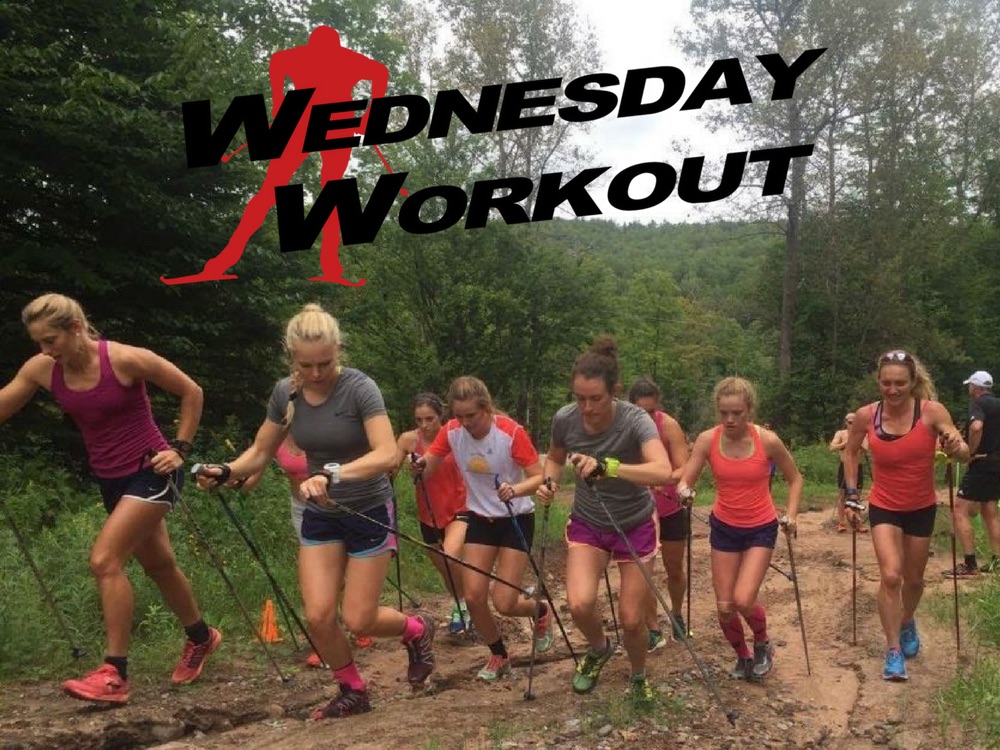
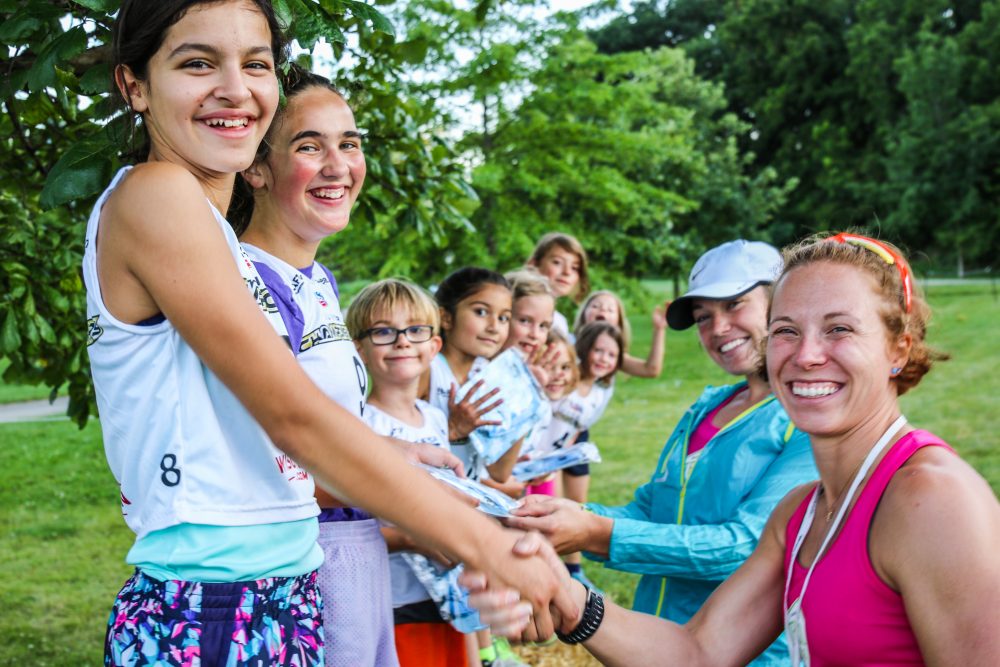
NMU alumnae Felicia Gesior (far left) and Caitlin Gregg (far right, blue shoes) during a fall training session with the Northern Michigan University (NMU) women’s ski team in 2016. (Courtesy photo)
This week’s Wednesday Workout comes from Central Cross Country (CXC) Team member Felicia Gesior. In her second year with CXC, Gesior, 24, is currently working on coordinating the Bergkönig Trail Run, an annual event that began six years ago to raise money for post-collegiate CXC skiers. Race registration and information can be found here.
***
Bergkönig. In German, it translates to “mountain king”. In 2011, it translated to the perfect name for the trail run Northern Michigan University (NMU) alums Maria Stuber and Bryan Cook were launching in an effort to fund their ski racing with Central Cross Country (CXC).
Both Stuber and Cook had been brainstorming a name to make the event, with 5- and 10-kilometer races, stand out from others in the mid-eastern Wisconsin area. Intending to email her brother for an outsider’s opinion, Stuber explained she accidentally sent a message to a “random guy” by the name of Thomas Stuber hailing from Germany. Thomas immediately informed Maria that she had the incorrect Stuber, but not before suggesting the trail run be called Bergkönig. In lieu of the erroneous email, the Bergkönig bank account and Bergkönig Trail Run began.
“Our goal was to give back to the local community, raise money for our winters, and create some awareness for the sport,” Stuber explained in an email to FasterSkier. “After a few years it became a big race and we felt fortunate to be able to rely on it for financial support every year. It was one of the factors that allowed up to keep ski racing as long as we did … something we are really proud of. We didn’t want to see it go away after we were done racing so we kept doing it for a couple years and put the money in a bank account to help future skiers with similar aspirations that needed funding.”
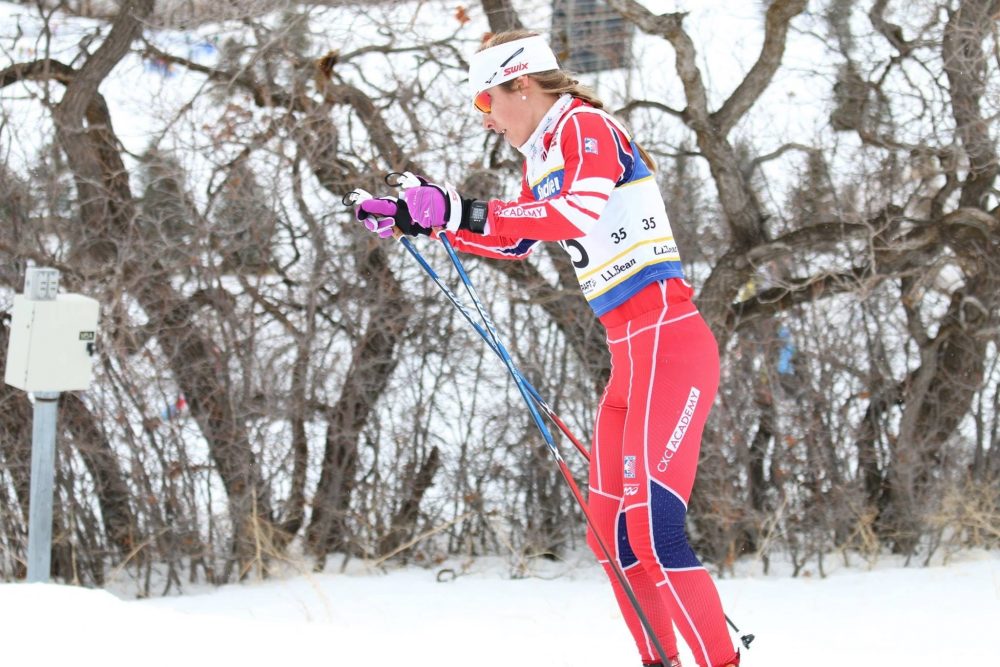
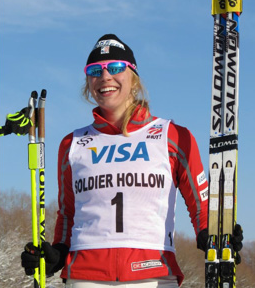
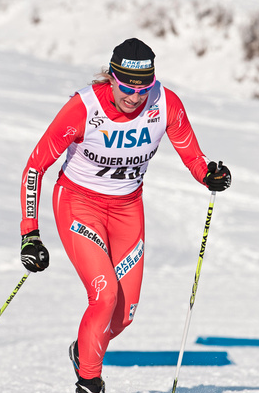
Felicia Geisor (CXC Team) at 2017 U.S. nationals in Soldier Hollow in January. (Courtesy photo)
One of those future skiers included CXC’s Felicia Gesior. Five years after the inaugural Bergkönig, Gesior, originally from Waukesha, Wisconsin, qualified for the 2016 U23 World Skiing Championships in Rasnov, Romania, and the Bergkönig extended its connections beyond Germany and the continental U.S. That year, it granted Gesior a round-trip plane ticket to get her to Romania.
“It was SO COOL for us to be able to send Felicia that check!” Stuber wrote.
This year, Gesior, a 2016 NMU graduate now in her second season with CXC, will be in charge of coordinating the very race that helped her get to U23 Worlds. Proceeds from this race will help cover her travel and ski expenses as well as go toward that “Bergkönig Scholarship Fund that will assist future generations of Wisconsin Skiers pursuing Olympic dreams after college,” the event’s website states.
Stuber, head nordic coach at the College of St. Scholastica, and Cook have stepped back this fall, though they both plan to drive down from Duluth, Minnesota, for the event. The race is scheduled for Nov. 11 in Delafield, Wisconsin, on the hilly trails of Lapham State Park, a course Gesior, Stuber and Cook all trained on as Peak Nordic skiers in high school.
“Many of the [Peak Nordic] coaches are the same today as they were when I was in high school and they went way above and beyond to support me throughout my entire career,” Stuber noted. “We are all so proud of this place that we would go to great lengths to see Felicia represent us at the highest level of U.S. skiing.”
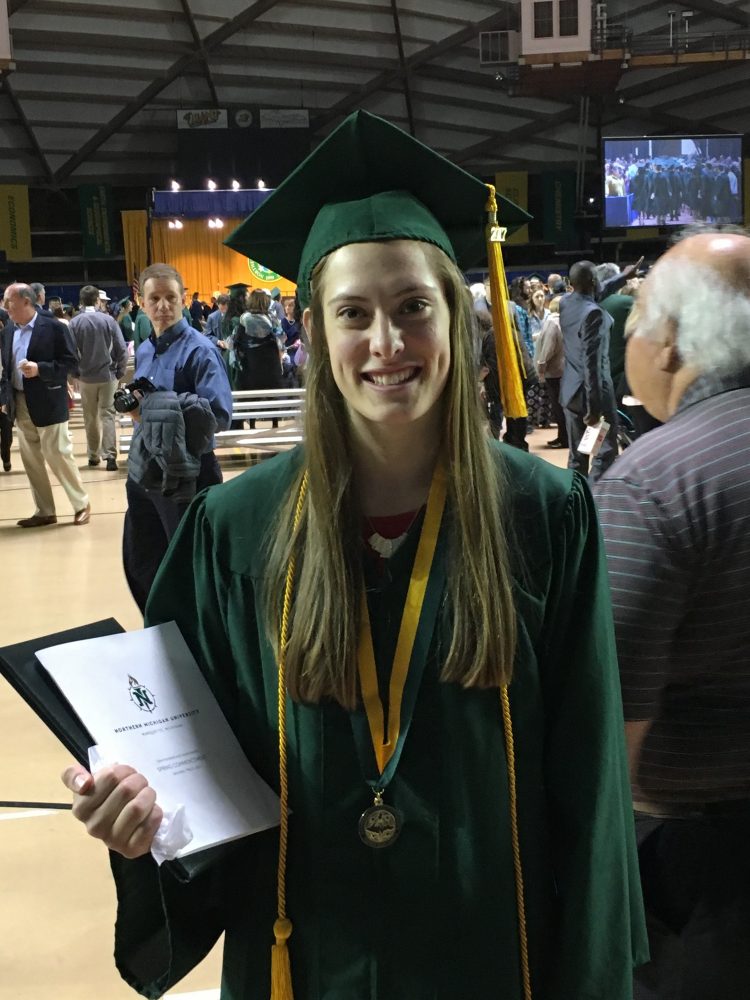
Felicia Geisor on graduation day at Northern Michigan University in the spring of 2017. (Courtesy photo)
Gesior has been training in Marquette, Michigan, this summer and fall under the guidance of the CXC Team’s new head coachEliška Hájek Albrigtsen. Most of Gesior’s goals revolve around U.S. SuperTour races and U.S. nationals in January. She views being an American woman on the domestic race circuit as “an exciting time” with “everyone pushing to new levels.”
“Every time I have the opportunity, like at U.S. nationals, to race against those elite girls that’s just excellent because they’re pushing the whole field,” Gesior said on the phone last month.
When she isn’t training, Gesior substitute teaches at local schools in Marquette. The work not only serves as a supplemental income, but also as way for her to stay connected to her post-skiing career — she has a degree in education from NMU. She also plans to help with CXC’s ‘Nordic Rocks’ for Schools program, an initiative that aims to get more youth involved with nordic skiing.
“That’s one of CXC’s major goals is to get Nordic Rocks in more of the schools. My relationship is getting it into Marquette this year,” Gesior explained, adding that the program has donated up to 30 pairs of nordic skis to more than 200 elementary schools.
“Kids can put them on with their snow boots and then they can walk literally from the gym outside to the door … You can imagine all these little kids, it’s hilarious,” she said. “So that’s just another side thing where I can connect my two passions together.”
Beyond training and teaching, the Bergkönig will be the most forthcoming of Gesior’s fall focus, along with the Level 4 ski-walking intervals she recommends as race prep for the Bergkönig trail’s hills. May the best Mountain King win.
The Workout: “Marquette Mountain Repeats”
Type: Level 4 Ski Walking Intervals
The workout should be hard to complete with a focus on an elevated heart rate and mental fortitude. Gesior usually incorporates this workout into her plan towards the end of her summer training cycle and and continues doing it once a week through the fall.
She suggested doing this workout without ski poles to prevent building up too much lactate while climbing.
“The best part about this workout is that you do not get as much lactate build up as you might on a bounding workout because you don’t have poles in your arms,” Gesior wrote in an email. “Instead, you can push your heart without building up too much lactate. This is a good workout during a week that you don’t want to necessarily build lactate but still want to get in a hard effort.”
Terrain: Small alpine hill (should take 4-5 minutes to ascend; Geisor recommends no more than 6 minutes)
Warmup: 20-25 minutes jogging with a couple minutes of Level 3 toward the end of the warmup followed by strides
The set: 5-8 x 4-minute ascents; off time is amount of time it takes to descend the hill
The first 4-minute set should be done at the high end of a Level 3 pace. Each consecutive set should be done slightly faster.
“This workout is an interval ski walking workout so you ski walk up the hill swinging your arms as if you are classic skiing and you should be going at Level 3-plus into Level 4,” Gesior explained.
Cool down: 20-30 minutes easy jogging
Total time: 1.5 to 2 hours
Gesior’s Golden Rules:
Record; don’t get wrecked. Since each ascent should be faster than the previous one, Gesior indicated that recording times should not be overlooked, nor should going to hard from the start. “It is important to keep track of your times on each interval because you want to have your last ones be faster than your first ones,” she wrote. “You want to do the first one starting in L-3 and then you go for a faster time on each consecutive interval. The majority of the intervals are done in Level 4 and you should strive to push the pass towards the end of each interval as well as the last few intervals in your set.”
Make mental note. Don’t be afraid to use the intervals as practice for pushing past negative thoughts that might pay visit during competitions. “You should be focusing on your mental toughness that you tap into during races,” she wrote. “You should remember to use good ski walking technique in your legs as well as using your arms as if you were striding.”
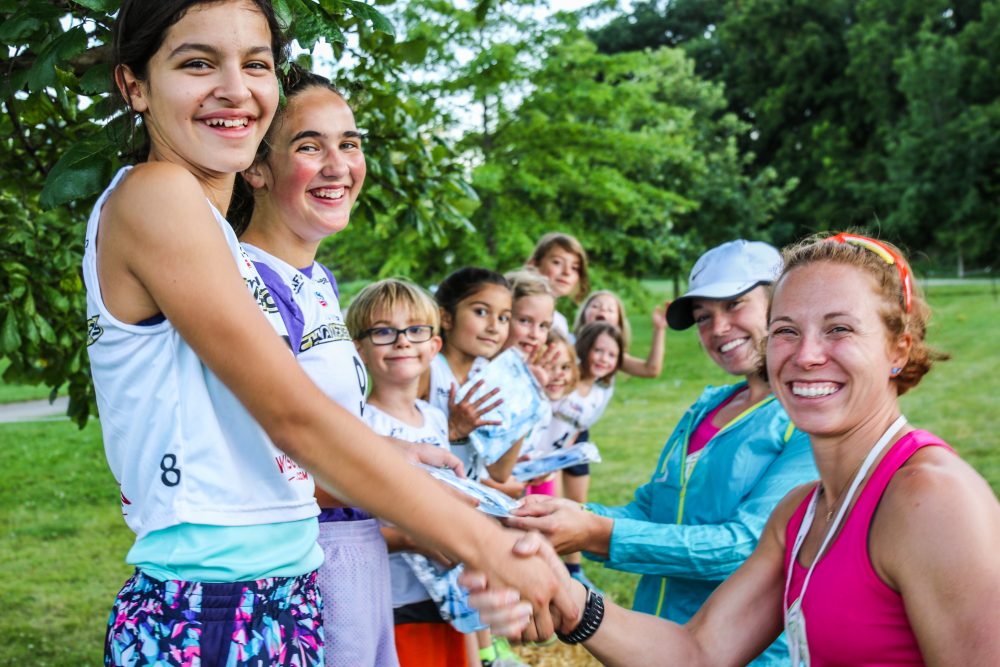
Eliška Hájek Albrigtsen (formerly Hájková, front right) with Madison Nordic Ski Club’s Trail Kids this summer.(Photo: Tobias Hájek Albrigtsen)
Many mornings, Eliška Hájek Albrigtsen’s husband, Tobias Albrigtsen, has to peel her out of bed. Living the life of an early bird like her spouse is nowhere near the top of her list — partly because she spends most nights prodding her hubby awake as he finishes his work, partly because she is strung out between four jobs of her own.
Being in charge of three ski programs while assisting a fourth is not where the 29 year old envisioned herself when she moved to Madison, Wisconsin, this past June to work for Central Cross Country (CXC). But a lot can change over the course of a summer and for Albrigtsen (formerly Hájková), a lot did.
After relocating to the Badger State’s capital from Lake Tahoe, California, to serve as CXC’s Community Olympic Development Director, Albrigtsen’s responsibilities began to accrue.
It started with the addition of coaching CXC’s online master’s program. Then she had an interest in helping with CXC’s Paralympic and adaptive athletes. Finally, in late August, Andy Keller left his head-coaching position with the CXC Team to join Northern Michigan University (NMU) as an assistant coach, and Albrigtsen was in a prime spot to take over the reins.
“When Andy took the assistant coaching job at NMU, it was kind of natural that I got the CXC Team head coach position,” Albrigtsen, a Czech Republic native, said during a recent phone interview. “For me, it’s not like a big promotion, it’s just more stuff to do while I still do all the stuff I was doing before. I have a lot of responsibilities all of a sudden that I didn’t start with.”
Among those responsibilities, she has been busy making informative videos for CXC Academy under the job title of Community Olympic Development Coach.
While attending the University of Colorado-Boulder (CU), she finished in the top 10 of 45 out of 48 races over the course of her college career, according to a CU press release, all while maintaining above a 3.5 grade-point average.
Eliska Hajkova (CU), racing against Sophie Caldwell (Dartmouth) and Corey Stock (CSU) during a sprint semifinal in 2012. Hajkova graduated in 2013 and after marrying, changed her last name to Hájek Albrigtsen. (Photo: James Doucett)
After three seasons coaching the BNJRT in Colorado, Albrigtsen moved to Kings Beach at the north end of Lake Tahoe last year, where the juggling act continued. There, she served as the head coach for Tahoe XC, while also volunteering with the Auburn Ski Club’s elite athletes, taught private ski lessons for Tahoe Donner, coached an online master’s program, and once again raced U.S. nationals, placing 12th in the 20 k classic mass start.
She’s also raced more than two dozen World Cups, most recently in 2014.
Though Albrigtsen indicates that she “never stops officially training or racing” this year might be a little different as it will be her first season coaching senior elite skiers. Still, the idea of more challenging practice sessions is enough to draw her in, even if it means scaling back her training a bit. As a coach she brings not only race experience, but the empathy and understanding of an athlete.
“With U14 kids, I mean, I was challenging them, but I was not getting challenged,” she reflected. “I think being challenged as a coach, being able to hang out with your athletes, you really see and you can really feel their pain. When you’re right on their butts and doing every exercise, you can see, ‘OK, I know that in the Level 4 on the fifth minute, during the sixth interval you died, so let’s figure that out.’ I think that’s one of my powers, that I can really be there when it’s happening.”
When asked of her strengths as a coach, CXC Executive Director Yuriy Gusev was quick to respond.
“Her racing experience, number one,” he said on the phone. “And [she’s] just very energetic and hardworking and organized.”
Albrigtsen will work with three CXC Team skiers this winter: Felicia Gesior, Kyle Bratrud and Sam Elfstrom. All three graduated from NMU, are currently based out of Marquette, Michigan, and will set their focus on the first few SuperTour races and U.S. nationals before re-evaluating their season goals. The fourth CXC Team member, Nichole Bathe (who graduated from the University of Alaska Fairbanks) remains on roster, but headed to Europe earlier this fall to train in Norway with a goal of making the 2018 Winter Olympic Games for Great Britain’s national team.
Until the first week of SuperTour racing in early December, the amount of time the other three CXC elite skiers and Albrigtsen work together will depend on the athletes. Albrigtsen wanted to keep the summer and fall schedule fairly flexible so her athletes would not feel restricted in the amount of paid work or fundraising they could accomplish while training for the upcoming season.
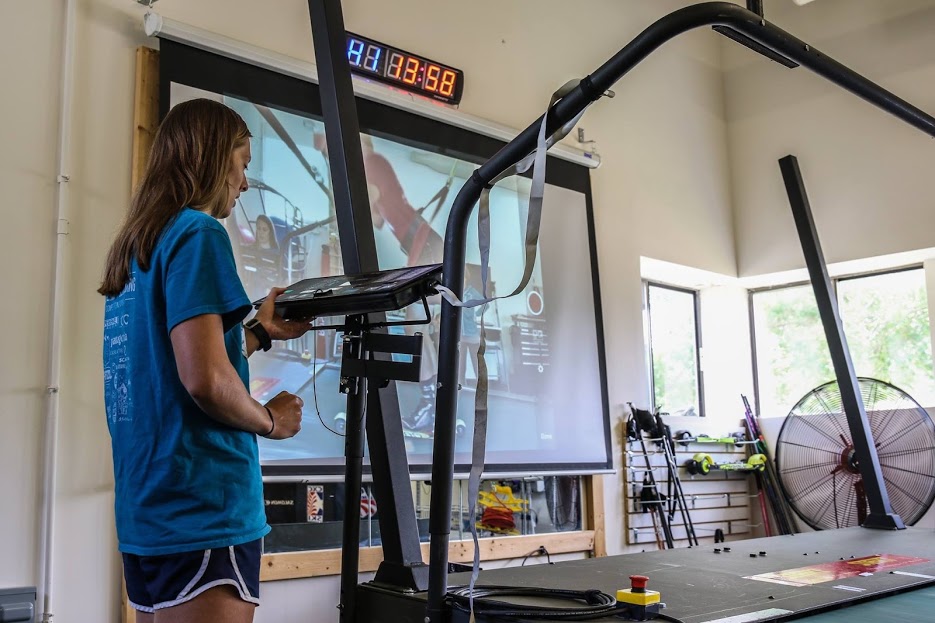
For example, Gesior made a trip to Madison earlier this fall for a training session on CXC’s rollerski treadmill with Albrigtsen, but will spend most the next few weeks training in Marquette and preparing for a fundraiser she’s organizing: the Bergkönig trail run on Nov. 11. The event features 10 k, 5 k and 1 k races and was originally created by Maria Stuber and Bryan Cook in an effort to raise money for local cross-country skiers looking to continue their ski careers post-college.
Gesior also works as a substitute teacher in Marquette, and most of her training this summer and fall has been with the NMU women’s team. Similarly, Bratrud and Elfstrom train with the NMU men’s team.
Felicia Geisor of the CXC Team prepares to hop on the treadmill in early September. (Courtesy photo)
“I think that’s OK that they follow [NMU],” Albrigtsen said, “That’s kind of the program that really took them where they are and they have something to top it. They don’t train like college skiers; I mean, it’s their job right now so they do train more. But the base is very similar and [NMU Head Coach] Sten [Fjeldheim] is being really nice about allowing them to train with them. Not all college coaches are that way, so we’re definitely really lucky.”
According to Gusev, partnerships like the one CXC has with NMU and other programs in the Midwest are the reason for CXC’s expansion. Over the last decade, he said CXC has grown from a $50,000-dollar organization to a million-dollar one.
“It’s all of those partnerships,” Gusev said of the CXC programs’ continued growth. “They’re incredible organizations so we’re able to work with all of them together and help them work together.”
The organization hopes to continue its expansion with the addition of a $12-million-dollar training complex just outside the Madison suburb of Middleton, Wisconsin, which is currently in the planning stages. The facility would not only include a competition venue, but snowmaking equipment, a lit rollerski loop, and 30,000-square-foot facility open for recreational use as well.
The idea behind the complex, Gusev indicated, would be to provide CXC athletes with a training venue, while simultaneously encouraging community members to get outside and active, using skiing as an example. The center already has one complex, the CXC Center of Excellence in Madison, complete with rollerski treadmill. “With the CXC Team, our number-one goal is to support the athletes that need the support. That’s as simple as that,” Gusev said. “But overall, our goal as an organization is to grow the sport at all levels.”
To Albrigtsen, the new facility is another reason Madison and CXC seemed like a good choice for her and her husband, Tobias, who is CXC’s media and communications coordinator, when moving from Tahoe to the Midwest. That, and the cost of living.
“We always talk about what can Midwest offer that other regions can’t. We don’t have the mountains, we don’t have the best winters, but what we really have is the best quality of life,” Albrigtsen said.
“You can live much cheaper here than anywhere else in U.S. and still make somewhat good money,” she continued. “Not everybody, especially in the U.S., there’s maybe 10-15 people who can do this professionally and get paid being skiers, otherwise you have to work and that’s something Midwest does have to offer. You can have a normal life and be a skier. You can do it here.”
While Albrigtsen’s “normal life” is somewhat busier than others might prefer, she is in no way deterred.
“I am a total sport addict, and I think every coach has to be, otherwise it’s not really worth it,” she said. “Tobias and I, we’re just trying to do what we love and give something back.”
Give something back, and get a little training in at the same time, even if it’s in between her multiple jobs.
“My motivation is also to fit in my jeans, wearing tight dresses,” Albrigtsen added with a laugh. “I have a five-year-younger husband so I have to take care of myself.”
Eliska Hájek Albrigtsen (formerly Hajkova) leading a Fourth of July run with Madison Nordic Ski Club’s Trail Kids this summer. (Photo: Tobias Albrigtsen)
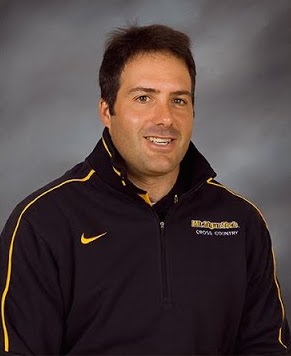
Michigan Tech Ski Team Head Coach Joe Haggenmiller as pictured before the start of last season (Photo: Michigan Tech University)
Organizers in Ishpeming, Mich., had everything in place to host the 2003 U.S. SuperTour Finals and Distance Nationals. Everything but snow. The area had encountered a heat wave and with barely any coverage, the competitions needed to be moved.
The chief of competition and the organizing committee for the weeklong event, Joe Haggenmiller had his hands full in finding a new venue. A little more than an hour northwest was his answer.
Houghton, located in Michigan’s Upper Peninsula, had plenty of snow and had reconfigured its trail system three years earlier. What began as a headache for Haggenmiller would become a defining moment for the next 14 years of his life.
While organizing that SuperTour event, Haggenmiller fell in love with Houghton, particularly the newly developed trails maintained by Michigan Technological University (MTU). When Michigan Tech advertised an opening for a head ski-coaching position a couple months later, Haggenmiller decided to apply.
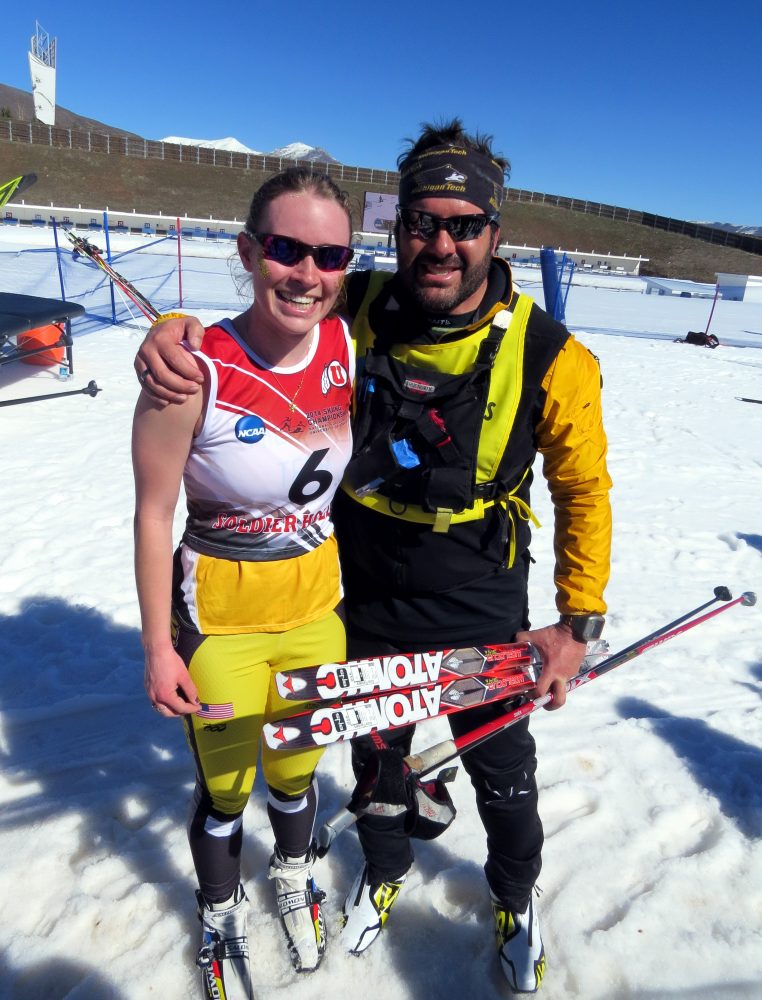
Joe Haggenmiller (r) with All-American Alice Flanders after the 2014 NCCA Championsips in Middlebury, Vt. (Courtesy photo)
“After spending a week up there, I was really intrigued by the opportunity to train on that trail system,” Haggenmiller reflected on the phone earlier this week. “Before that I hadn’t really had a chance to get to know the Houghton area. Then when the position opened two or three months later, it really seemed like an exciting opportunity.”
He got the job — his first within the National Collegiate Athletic Association (NCAA), though he had been involved in coaching beforehand for eight-plus years — and for the next 14 years, Haggenmiller led the Huskies’ cross-country skiing and running programs.
During his tenure, scholarships were introduced and his position became full-time for the first time in the university’s history. The resources to build a high-caliber college program were surfacing, and Haggenmiller was at the helm.
“The administration and I worked together in the early years to change the level of commitment the university was putting into the program,” he explained. “All those factors contributed to going from, ‘Boy, if we just get someone to NCAAs [Skiing Championships] to ‘Boy, if we don’t get four people to NCAAs who are going to compete well, then we haven’t really done our job for the year, we had an off-year as far as NCAA qualifying goes.”
Under Haggenmiller, MTU’s Division II ski team produced not only national-level competitors, but adept ones. More than 40 of his athletes qualified for NCAAs, and seven of those finished in the top 10 at the championships to become All-Americans. In 2010, Haggenmiller coached the men’s to team Central Collegiate Ski Association (CCSA) championship title. Two years later, he did the same for the women.
“Regionally, getting one skier to the NCAA’s was a successful year, whereas I think now with Joe we’re looking at two three or four skiers being successful here,” Joel Isaacson, Michigan Tech’s associate athletic director for external relations, said of the changes he witnessed with Haggenmiller as head coach.
“Joe definitely pushed our program to be better as an institution,” Isaacson continued. “That’s with quality of the student athlete that we’re bringing in, the competitiveness of our program, pushing our department to start hosting events and do that on a continuous cycle. He was a big advocate in our department to make sure that we were show casing our premier trails.”
Beyond helping improve individual performances, Haggenmiller also helped bring U.S. Cross Country Ski Championships to Houghton (first in 2007), as well Junior Nationals Qualifiers. U.S. nationals would come to Houghton three more times: in 2008, 2015 and 2016.
“That’s definitely something that bittersweet about moving on,” said Haggenmiller, who recently resigned from his role as MTU head coach. “I built up some great relationships with the people who really were the movers and shakers and the race organizing committee, and not only is it a great course, it’s a great group of people.”
While he enjoyed his time at Michigan Tech and the opportunity to develop its program, a restructuring of the position last season prompted him to seek new opportunities. His wife took a job in Duluth, Minn., and after spending a year four hours away from his family (including two daughters, ages 10 and 14), the 48-year-old Twin Cities native decided to return to his home state.
“I have accepted a position with Central Cross Country (CXC) skiing,” Haggenmiller said.
He’ll mostly work in the realm of athletic development and organizing CXC’s race series, as well as with clubs, he explained. His official first day on the job was Monday, May 1, and though the position is new to the CXC program and doesn’t have an official title, his future in the skiing world continues, now in athlete-and-program development instead of college coaching.
“I certainly wouldn’t be opposed to getting back into NCAA coaching,” he added. “At this point I also don’t know what the future might hold.”
Michigan Tech is currently in the hiring process for a new head cross-country skiing and running coach.
“A key for Michigan Tech is finding a candidate that is going to make our student athletes not only successful on the trails and in the classroom, but also going to make good men and women. Good husbands, good wives, good moms, good dads,” Isaacson said.
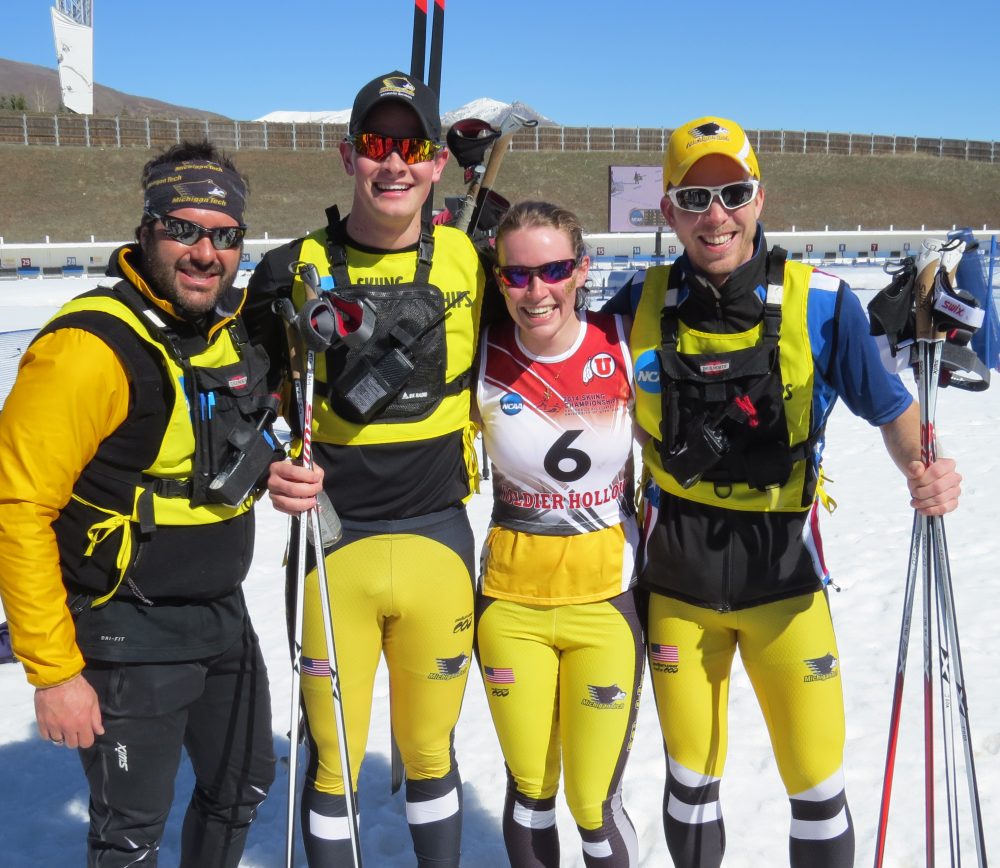
Left to right: Joe Haggenmiller, Mike Fleming, Alice Flanders, and Andrew Joda after Flanders’s 10th place finish at 2014 NCAA Skiing Championships. (Photo: Joe Haggenmiller)
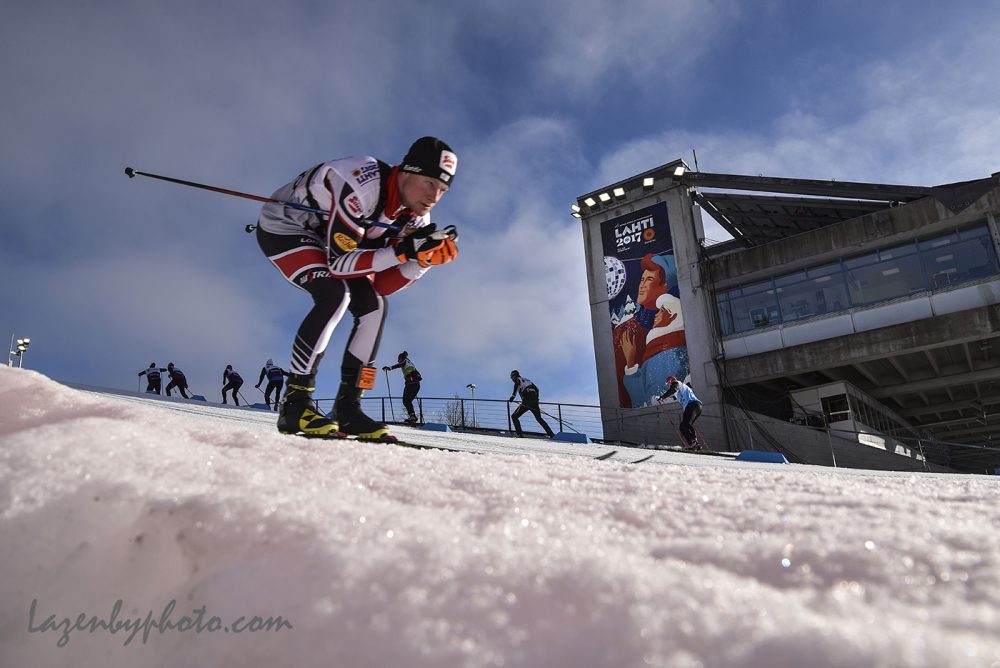
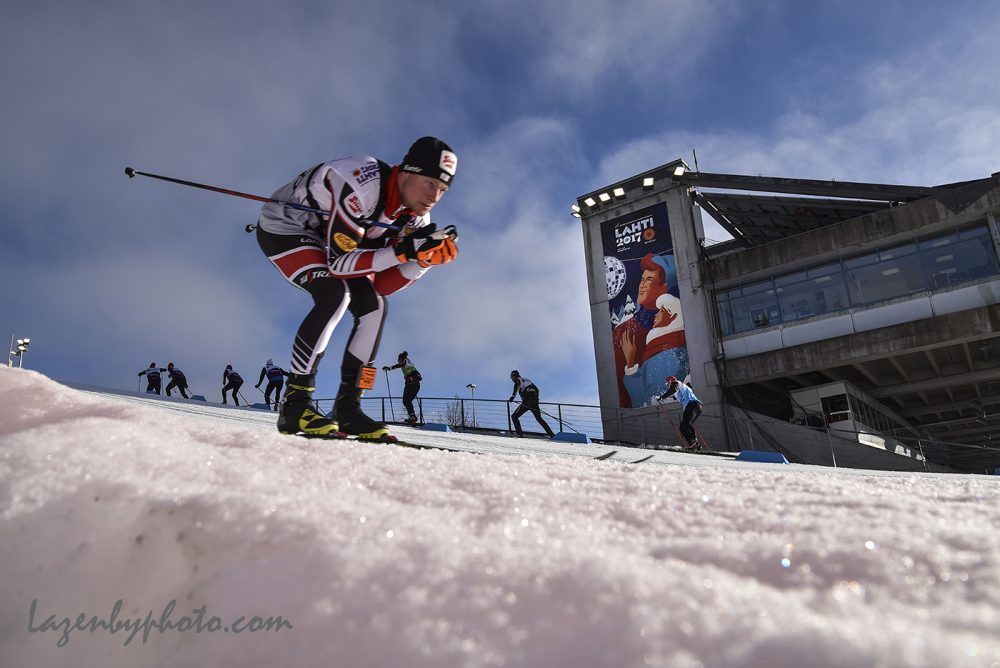
An Austrian athlete tests skis as he glides back into the main stadium. (Photo: John Lazenby/Lazenbyphoto.com)
LAHTI, Finland — Tuesday at Lahti’s venue for the 2017 Nordic World Ski Championships, the sun sets early. Although technically sunset was 5:22 p.m., the sun on this clear-sky day was still wintertime reluctant. It seemed too short a time for the sun’s transect to thaw Lahti. Temps were in the mid-to-low 20 degrees Fahrenheit. But a brisk wind called for down coats and insulated pants for those not actively skiing — in the shade, it felt like the teens.
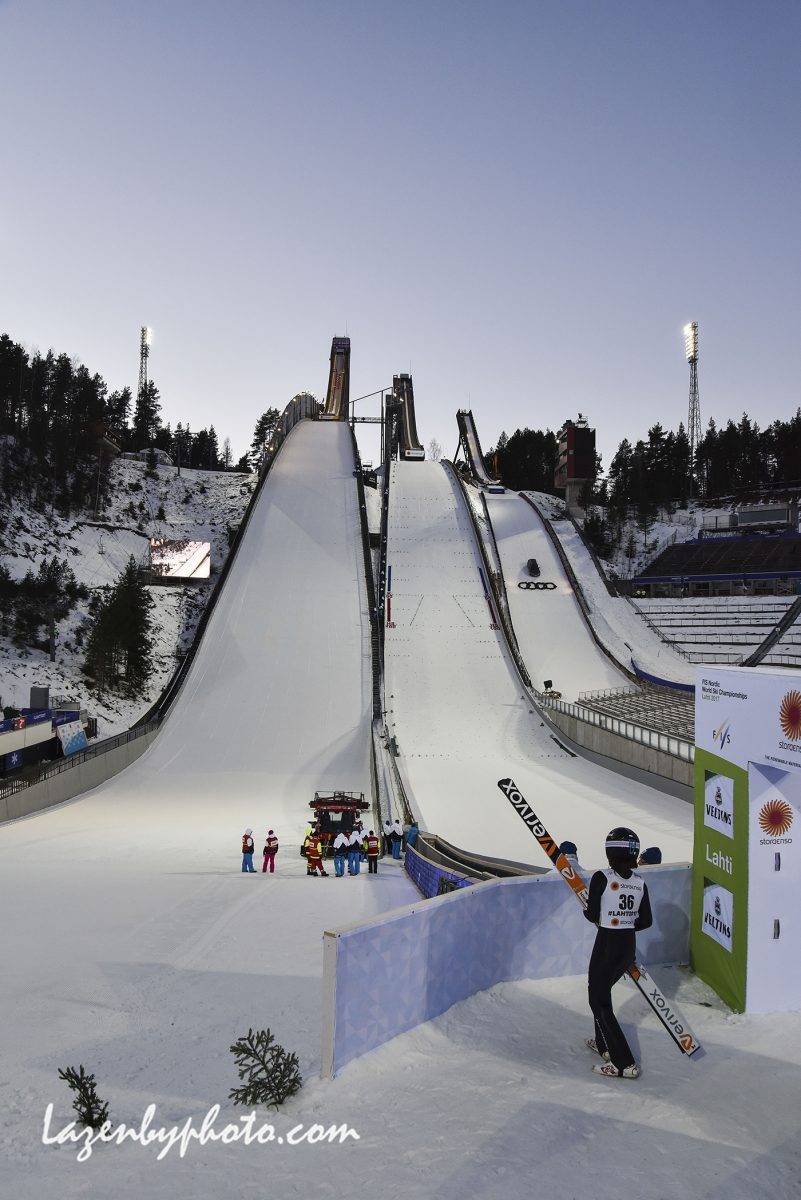
Basked in an early evening glow, Lahti’s three iconic ski jumps dominate the 2017 Nordic World Championships venue. (Photo: John Lazenby/Lazenbyphoto.com)
For athletes, it was a day of pre-competition ski and wax testing on bulletproof tracks that gradually deteriorated on the steeper climbs. The ski loops have good coverage. The snow remains coarse, as the tracks are covered with predominately manmade snow with trace amounts of natural snow tilled in.
Lahti’s most dominant feature are its ski jumps, which are among the first objects to catch morning light. The surrounding landscape isn’t marked by serrated mountains, but by subtle hills that make the venue’s three domineering jumps (a K 116, K 90, and K 64), that much more ominous. First nordic-combined skiers then women’s ski jumpers had an opportunity for test flights off the K 90.
On the non-skiing side of things, the venue was abuzz of last-minute prep: television cables being covered for protection before the onslaught of spectators, event producers testing the stadium’s Skycam, sponsors unpacking schwag, and media arriving to pick up credentials. Like the athletes fine tuning before the competition begins, Lahti’s organizers are near set for the big show.
On Wednesday, two qualification races will ensue: the women’s 5-kilometer classic and men’s 10 k classic individual starts. These races are for athletes from “non-skiing” nations who have not met the FIS-point benchmark to participate in the championships. Start rights to Lahti’s distance races are granted to the top-10 male and female finishers. (All skiers are granted start rights for Thursday’s freestyle sprint regardless of their results in Wednesday’s qualifier.)
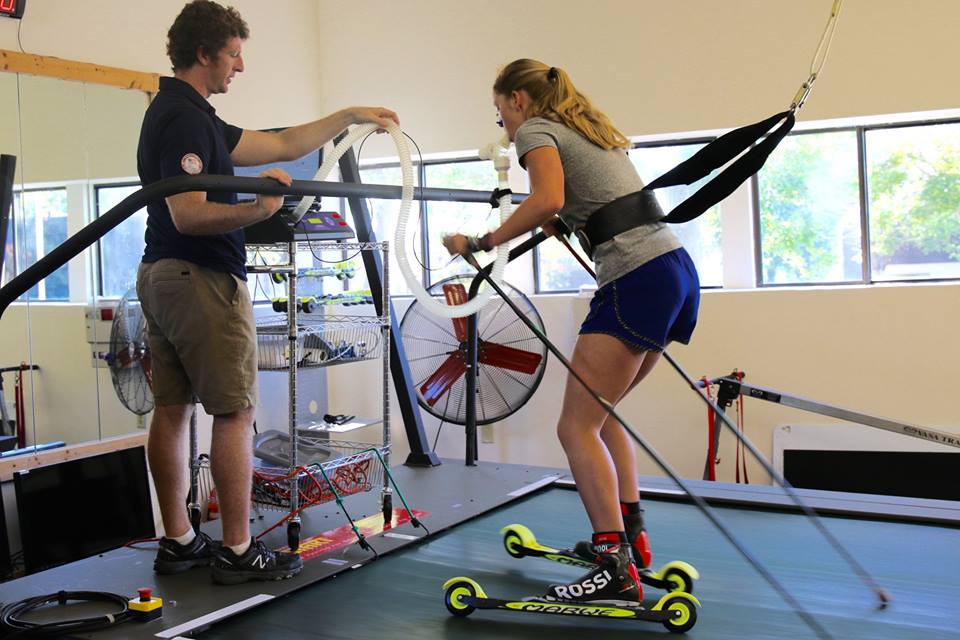
Central Cross Country (CXC) junior development skier Siri Martin (r) gets a mid-summer VO2max test on the rollerski treadmill at CXC’s Center of Excellence in Madison, Wis., in late July (Photo: CXC Facebook)
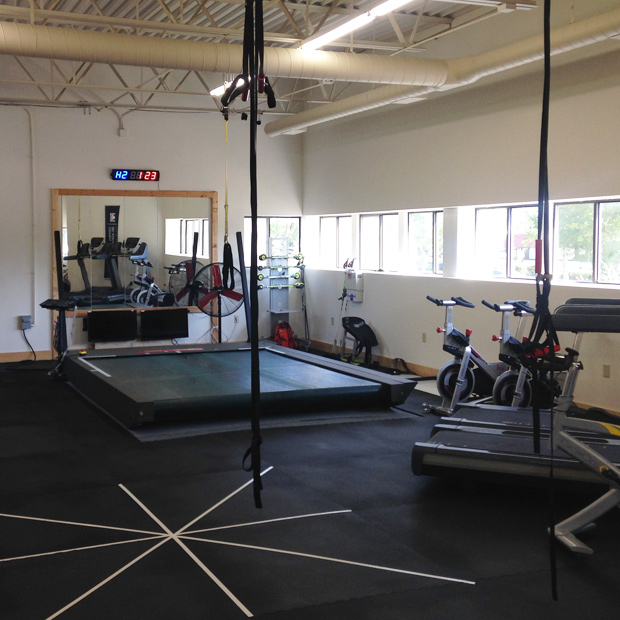
A glance into any one of the glass windows lining the east side of Central Cross Country (CXC) Academy’s Center of Excellence building might give the impression of the average athlete gym. But if you step across the front threshold or take a peek at the academy’s 360-degree virtual online tour and sport science page, you’ll find much more than treadmills, stationary bikes and medicine balls.
Located in Madison, Wis., the CXC Center of Excellence also houses a 10-by-12-foot rollerski treadmill, SkiErgs, and an in-house-made, power-pole machine. For many, though, equipment is not the most powerful tool in the center. Rather, it’s the center’s capacity to evaluate and educate its members and non-members alike about nordic skiing.
Currently, the Center of Excellence offers performance evaluations, as well as fitness testing for lactate and VO2max using the oversized treadmill. Recorded and individualized technique coaching sessions on the rollerski treadmill are also available for those willing to pay $150 dollars per hour. To help athletes gain a better understanding of their body within sport, the center is also presently working on developing a biomechanical analysis software.
The rollerski treadmill at the CXC Academy Center of Excellence (Photo: cxcacademy.com)
And CXC recently hired a sport development and education director, Egor Akimov, CXC head coach Andy Keller explained on the phone.
“He’s got a bachelor’s and PhD from the Russian State University in physical education and sport, so he majored in human physiology, he’s competed over in Russia and then he served on the Moscow Center of advanced sports technology as the head of the science department,” Keller said. “So he’s done a lot of research over in Russia on the biomechanics and stuff like that. He’s kind of leading our center [in Madison], doing a lot of the sessions down there and the technique work.”
According to the CXC Executive and Athletic Director Yuriy Gusev, the Center of Excellence is approximately 90 percent complete. Anyone from CXC club members, to donors, to CXC team members, and the general public, can access the center at no cost. Rollerski treadmill evaluations cost CXC clubs $250 per day, $150 per hour for all others.
“We are finalizing a few more partnerships on the sports science program and equipment but will start performing studies in cross country skiing this coming fall,” Gusev wrote in an email. “Our goal is to have top sports science facility to study latest innovations in the sport, potential application in cross country skiing to improve training, recovery and performance.”
While the CXC elite team, known as the CXC Team, uses the center for testing, its current base in Marquette, Mich. has also led the team to seek out other partnerships. This included collaborating with the Northern Michigan University (NMU) Olympic Training Site, allowing CXC Team members to use the school’s facility and other amenities.
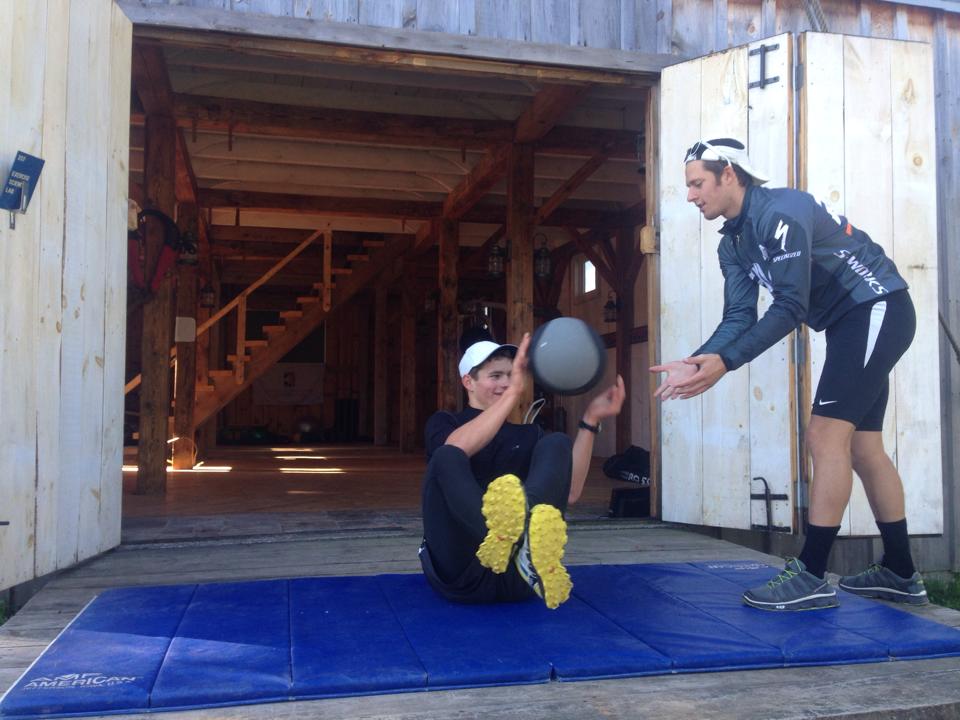
CXC Team Head Coach Andy Keller (r) works on strength with Scott Harrison outside a barn near the team’s former home base in Cable, Wis., in 2014. The team is now based in Marquette, Mich. (Photo: CXC/Facebook)
“This year we moved up to Marquette partly because a lot of the athletes have come from Northern Michigan, but also because there’s quite a bit of opportunity up here,” Keller said. “We’ve kind of partnered up with the Olympic training site located here. So we’ve been able to use the dorms on campus, offer schooling, have a training room and weight facilities available. … [The move to Marquette] has given us a lot more freedom with athlete housing and training opportunities.”
At present, the CXC Team has three full-time athletes and two part-time collegiate skiers. Kyle Bratrud returned to the CXC elite team for his second year; new full-time members include Dartmouth graduate Oscar Friedman and NMU grad Felicia Gesior. Jan Ketterson, a Dartmouth student currently taking the fall and winter trimesters off to focus on skiing, plans to race for CXC along with Nicole Bathe, presently a student at University of Alaska Fairbanks.
The growing numbers on the CXC Team was one reason CXC also recently decided to nix its marathon team, Keller explained.
“That was kind of another thing with refocusing with the marathon team, just my role and what resources I can put out just being by myself,” Keller said. “The main reason why we [ended our marathon team] is we’re trying to make a big push to promote club development.”
By discontinuing the marathon team, CXC saw an opportunity for athletes to return to their home clubs and promote racing on a more local, community-based level.
“The athletes that were on our team last year, both our current athletes and our previous athletes that we don’t have on the team anymore, we encouraged them this upcoming year to be a part of the clubs in their local area,” Keller said. “From what I heard in talking to them, most will continue to race in some facet.”
Chris Pappathopoulos won the men’s overall CXC Marathon Cup last season while competing for the CXC marathon team. (Photo: CXC)
He added that the team’s reigning CXC Marathon Cup winner Chris Pappathopoulos would likely be supported by companies like Rossignol and Boulder Nordic Sport.
While former CXC marathon team members like Pappathopoulos will look to return to their local clubs, Keller looks to expand the CXC Team program and podium at U.S. nationals with the athletes he’s currently working with.
“For a couple years [CXC] was really down and out from the years when we had Jessie [Diggins], Caitlin [Gregg], and Jennie [Bender], all those strong athletes,” he said. “So we definitely want to get back to fighting for SuperTour podiums, fighting for World Cup spots … and in this next year, I think there’s athletes who are on our team that are capable of it.”
With access to the NMU Olympic Training Site, CXC’s Center of Excellence and new scientific research taking place this fall, Keller doesn’t doubt CXC as a force to be reckoned with this season and seasons to come.
“We have the training group, we have the structure and the facilities,” Keller said. “And I think the more excitement we got here, the more we can achieve those goals of being at the top level.”
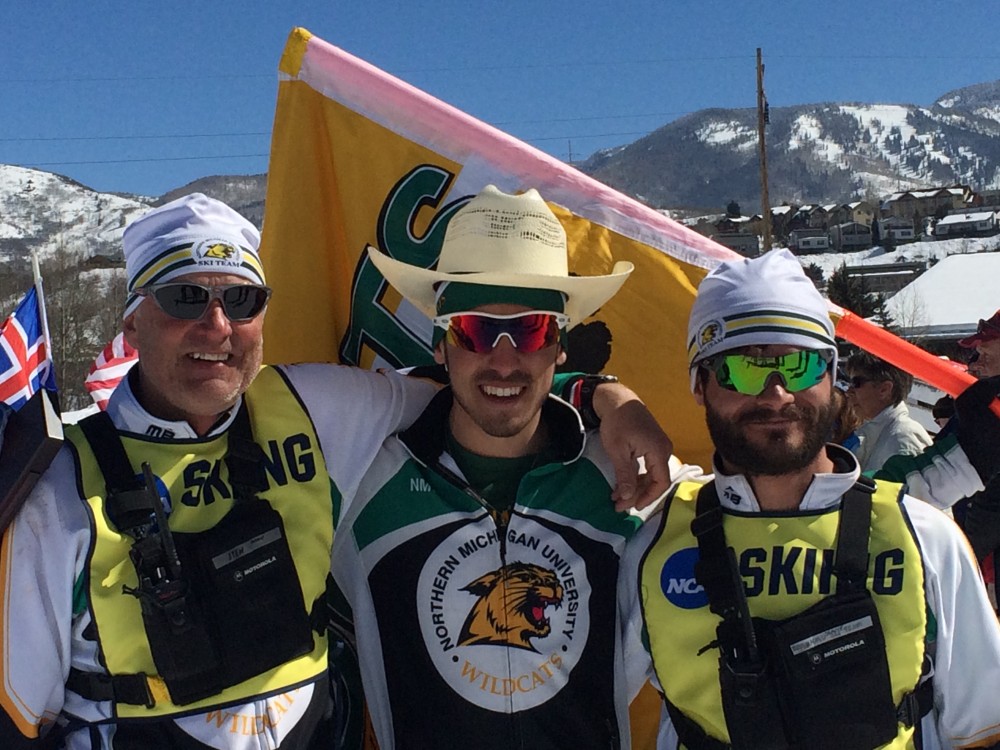
Ian Torchia (c) with Northern Michigan University Head Coach Sten Fjeldheim (l) and assistant coach Shane MacDowell after Torchia placed second in the men’s 10 k freestyle at 2016 NCAA Championship in Steamboat Springs, Colo. He went on to place fourth in the 20 k classic mass start. (Courtesy photo)
As the youngest in a family of five, it’s no wonder that Ian Torchia, an incoming junior at Northern Michigan University (NMU), considers himself “scrappy.” It’s also no wonder that, when it comes to sport, Torchia takes on skiing with tooth-and-claw grit. Within the first few hours of being a freshman on the NMU ski team, the Rochester, Minn., native established himself as tenacious if nothing else.
“Watching him ski on the treadmill the first time I worked with him, he was just raw,” Sten Fjeldheim, head coach of the NMU men’s and women’s nordic teams reflected in a phone interview. “His technique was, well, not pretty, but I knew he had a heck of an engine from his running times.”
After Torchia finished his freshman year just outside qualifying for NCAA Skiing Championships, he made it a goal to reach the championships the following year. As a sophomore, he not only qualified for NCAA’s, but he went on to place second in the men’s 10-kilometer freestyle and fourth in the 20 k classic mass start at the 2016 championships in Steamboat Springs, Colo.
By the end of his first two years at NMU, the 20-year-old Torchia had also tapped into another tool: technique. He asked his college coaches ceaseless questions, watched countless ski videos and began to implement what he saw on the screen into his own skiing.
“He’s just really good at being a student of his own sport: skiing,” Fjeldheim said of Torchia’s technical improvements.
However, the sophomore’s upward climb last season didn’t end with his work on the NMU ski team. In January, he won the junior men’s 10 k freestyle at U.S. nationals in Houghton, Mich. Also at nationals, he placed seventh among seniors in the men’s 15 k classic, and at 2016 Junior World Championships in Romania, he raced to 15th in the junior men’s 15 k freestyle.
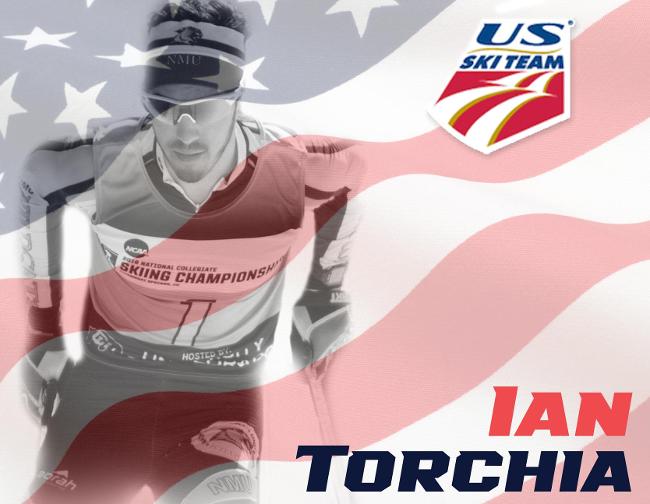
NMU designed the above image for a press release after Ian Torchia was nominated to the U.S. Ski Team D-Team. (Photo: NMU Wildcats)
Most recently, Torchia discovered he was among 16 athletes nominated to the U.S. Cross Country Ski Team.
“I was on my way to go cliff jumping when Bryan Fish [U.S. Ski Team development coach] called me,” Torchia said on the phone. “The celebratory back flip didn’t go too well.” (According to Torchia, the backflip was more of a “back flop.”)
Though perhaps brazen when it comes to black flips and Lake Superior bluffs, the main sentiment Torchia spoke of was that of humility. In his eyes, the opportunity to ski for U.S. Ski Team ‘D’ (or development) Team is an opportunity to once again put his tenacity to the test.
“You know, there’s still two more levels of the U.S. Ski Team to go,” Torchia said of the ‘A’ and ‘B’ team levels. “If anything, [the nomination] just motivates me to train harder. I mean, the way I see it, it’s an honor to be named. I get invited to the camps and I get the uniform. It puts a bigger target on my back, but I’m OK with that.”
U.S. Ski Team (USST) Head Coach Chris Grover explained in an email that the team was “looking for athletes who can deliver big results in Europe against tough fields,” he wrote. “Ian was the standout USA male once again at World Juniors and posted his second consecutive top-15 result there.”
At the 2015 Junior World Championships in Kazakhstan, Torchia notched 11th in the 20 k skiathlon.
Moving forward, Torchia plans to accept the nomination and attend the two USST summer training camps, the first one taking place in Bend, Ore., this month and the second in Anchorage, Alaska. According to Fjeldheim, not much will change for Torchia in regards to training.
“He’ll pretty much be on the same training plan that he’s been on,” Fjeldheim said. “But I think the opportunity for him to ski with some other national-team skiers is going to be good.”
Along with accepting the nomination, Torchia also plans to continue attending NMU as a full-time student and eventually earn a degree in exercise science.
Ian Torchia (c) with his parents Mike (l) and Patricia after this year’s U.S. nationals in Houghton, Mich. (Courtesy photo)
“I think my mom would kill me if I wasn’t in school,” Torchia said.
But his reasons for staying in school extend beyond his so-called death sentence, even if it means suffering through organic chemistry finals. To Torchia, continuing his education sends a broader message to other nordic athletes, especially those trying to determine whether skiing in college can lead to a ski career.
“One of the main reasons why I wanted this to happen is to show that you can do it while you’re in college,” Torchia said of his national-team nomination. “It is hard to balance school and skiing, but it’s doable. [College skiing] is a pipeline.”
School, Torchia insisted, also gives him options outside of skiing.
“Make sure to have balance in your life between skiing and make sure skiing isn’t the only thing in your life,” Torchia said of how he found success in sport. “We kind of take that mentality here at NMU. We have the top GPA of all the sports teams here, so it’s both skiing and school. It’s a lifestyle and we love it. It’s hard, but you got to go for it.”
Beyond the importance Torchia finds in education, his NMU teammates and coaches also played a large role in his decision to continue his ski career on the college path. He cited post-practice conversations and training plans his coaches provided as a staple to his success.
“I could not have done this without Sten and [NMU assistant coach] Shane MacDowell,” Torchia said.
“Ian always shows up with a smile on his face,” Fjeldheim said. “Yeah, he like to pull pranks on me and his teammates every now and then and we prank him back, but he’s a great kid to have on your team as far as sportsmanship goes and manners. He’s very humble.”
“It’s a lifestyle and we love it. It’s hard, but you got to go for it.” — Ian Torchia, NMU junior and U.S. Ski Team rookie
With teammates like Adam Martin and Jake Brown, both first-team All Americans at this year’s NCAA Championships, Torchia views his peers as motivation and proof of where they, too, are headed.
“You can never get too big of a head around here because there will always be someone to serve you a piece of humble pie,” Torchia said. “I can say that I won’t be the last one to be named [to the U.S. SKi Team] out of NMU.”
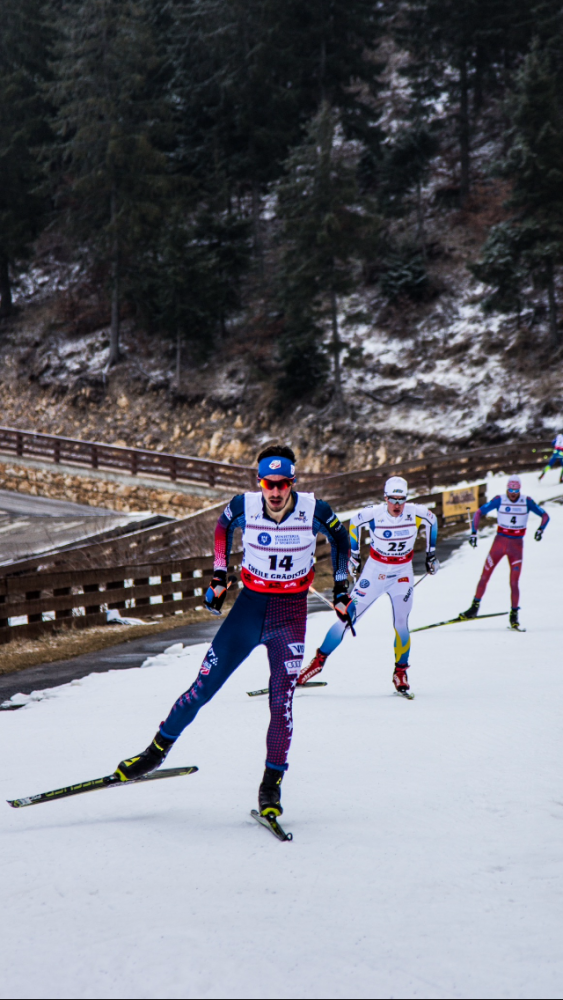
Ian Torchia (14) racing to 15th in the men’s 15 k freestyle at 2016 Junior World Ski Champioships in Rasnov Romania. (Photo: Thomas O’Harra)
With the nomination, Torchia is undecided as to where his ski career will be drawn after graduation day. Though not currently on the CXC team, joining the program is one potential route for him post-college.
“Kind of this past year, I guess I really thought about skiing after college,” Torchia said. “Right now, Kyle Bratrud is [in Marquette] skiing for [Central Cross Country] and we’re getting [Dartmouth grad] Oscar Friedman up here. I think we’re going to make a return to the days when CXC was a really a powerhouse. I can see myself here. We’ll see. It’s still a long way away.”
While Torchia’s five-year plan remains flexible, his 14 weeks of summer are at least set to go. This includes attending the two USST training camps, training in Marquette, Mich. (potentially with the likes of Kris Freeman, he said), and wedding crashing.
“I’m going to go home, surprise my mom on Mother’s Day and then head out to Bend for the camp there,” Torchia said. “Then I’ll come back [to Marquette] for June and then go out to Anchorage for that camp. And then it’s my sister’s wedding in Colorado. So it should be a fun summer.”
Particularly fun due to the training crew he plans to surround himself with.
“Basically the entire [NMU] guy’s team is going to be [in Marquette] this summer,” Torchia said. “We call it the Marquette Training Group: MTG. So, MTG 2.0 is kicking off this summer. We’re hoping that a few guest stars show up; there’s rumors that Bird [Kris Freeman] and Tad Elliott and Paddy Caldwell and Brian Gregg might be up here. So it’s going to be pretty kickass.”
While the USST nomination makes him a new training target to many, Torchia remains humble of where he’s been and where he’s headed. For now, he appears to prefer taking it one step at a time up the ski ladder — even when it comes to housing.
“I’ve got the Trailer Park Room,” he said, indicating that as one of the younger athletes, it may have fallen on him to take on the tiny living quarters in the NMU men’s ski house for the summer. “It’s the smallest room in the house, but I kind of like it. It doesn’t have a closet, very narrow and small, but I don’t know, I like it.”
Northern Michigan University’s Ian Torchia celebrating his nomination to the U.S. Ski Team D-Team this spring with a cliff jumping back-flip. According to Torchia, it ended as more of a “backflop.” (Photo: Abby Cook)
Kyle Bratrud of Central Cross Country competing during U23 World Championships.
With spring in full swing, FasterSkier presents a workout from Central Cross Country (CXC) skier Kyle Bratrud, who finds making like former NBA Los Angeles Lakers star Kobe Bryant is not only important for switching up regular ski-training routines, but also working in early season coordination, competition and college-style fun.
***
Free throws, foul lines, farcical slights? Though streetball-court commonalities such as these don’t often make their way into nordic workouts, there are occasions when it’s acceptable for them to be a part of the training plan.
According to CXC’s Kyle Bratrud, spring ski training is sometimes best achieved by making it swish.
After graduating from Northern Michigan University (NMU) last year and joining the CXC program for the 2015/2016 season, Bratrud, who currently lives in Marquette, Mich., frequently finds himself on the NMU basketball court, gearing up for a game of “21” against a few of his former college ski-team teammates.
“It’s spring time so we try to do stuff a little different than ski training,” Bratrud explained on the phone. “After a strength session in the spring, we will finish by going back to our ski room and there are basketball courts right outside of our ski room so we play there; it’s pretty convenient.”
For Bratrud and his NMU basketball ski buddies, the game of choice is “21”. In Bratrud’s version, each player is his/her own ‘team’ and in order to win, an individual player must score 21 points. Much of the rest of the rules are the same as regular basketball, with the exception of what Bratrud called ‘tips.’
“If you shoot and the ball goes off the rim, [another player] can shoot it — they have to be off the ground, [the player] can’t be standing on the ground when they shoot it — but if they shoot it back in and make it, then you get tipped and you go back to zero points,” Bratrud explained.
Essentially, the ‘tips’ rule follows that, if an individual misses a shot and another individual rebounds the shot in, any points the original shooter had accumulated are reduced back down to zero.
“In that way, the game can take anywhere from an hour to many hours,” Bratrud said. “Sam [Elfstrom] and I are often on the basketball court an hour after everyone else. There are days where we’re in there and we have to get kicked out.”
As indicated by Bratrud, having players around like Elfstrom, an incoming senior on the NMU ski team, is motivating for many reasons.
“We’re both the most competitive,” Bratrud said of Elfstrom. “He knows that I hate losing to any of them and especially to him … There are a lot of times where Sam and I play this game or a few games, for two to four hours.”
While not many are easily enticed by a four-hour game of basketball 21, Bratrud points out that there are benefits for those who hold out for the last few hoops.
“I think the game is really good,” Bratrud said. “Whenever we go to any camps where [U.S. Ski Team Development Coach] Bryan Fish is playing, he always goes extremely hard and he always likes to talk about how the mobility and the hand eye coordination is good for us because it’s not something that a lot of skiers necessarily do.”
Bratrud also finds that taking a mental break from ski training by playing hoops in the spring, is well-justified.
“It’s something nice in the spring where if the weather kind of sucks and you don’t really want to go out and train, you can just play basketball inside,” Bratrud said. “This way, you can still get a workout in and not feel like you had to apply any mental effort to training.”
The Workout:
– Find a group of nordic skiers (or any athletes) with some knowledge of basketball and a decent amount of competitive spirit
– As a precursor to hitting the court, hit up the gym
– Savor competing with fellow cross-country skiers in something other than skiing
Total Workout Time: Depends on the competitive level of other players, but Bratrud says if they’re anything like Elfstrom, expect a two- to four-hour game
Bratrud’s Top-Two Tips for Spring Basketball
Don’t Shirk the Right Shoes. The right footwear, Bratrud indicates, can make or break a spring basketball experience. “A lot of us start out by running around in Nikes or running shoes, but the traction isn’t great,” he said. “Basketball shoes definitely help.”
Test your ‘Trash-Talk’. Sharp shooting isn’t quite complete without witty wisecracks. “We have music in there sometimes,” Bratrud said. “But generally, it’s just trash talking basketball. That’s a good time.”
Position Activities:Writing – Developing impactful and targeted written communications content
Data Management – Management of data of communications audiences and messages
Content Distribution – Innovative management and operation of content distribution systems including
Website, email, blogs and other means
Web Management – Management of communications on CXC’s Web site, providing leadership and
guidance to all CXC staff, plus integration with third-party sites, especially social networking and partner sites.
Planning – Assisting department leadership in developing strategic and operational plans
Support – Provide general support in all areas for department as needed including support at major CXC events and other large scale organizational activities
Interested candidates should direct cover letter, resume, list of references and salary history to yuriy.gusev@cxcskiing.org or mail to: CXC Skiing, P. O. Box 930442, Verona, WI 53593
First a bit of background, tell me about your skiing background please.
I started skiing as a child. By the time I was in first grade, my brother and I had a 5k loop we skied two or three times after school.
There was no grooming machine, so we had to make the trail ourselves each time it snowed, first ski the main track, then for the poles, before we could start training. We skied to school often. On the wall of each classroom, there was a bar chart of each kids km skied that was updated weekly. Watching my bar towering over the others as a result of all the 5k laps was a source of pride. Each school then submitted their average km skied for a national competition. By age 9, we started racing in the “point race” every Wednesday night in the lit trail 200 meters from our house. The point race was a great way to get the kids to race every week with a year-end award party at the ski club hut. Our family also had a mountain cabin and we went there most weekends and skied for 2-3 hours at a time. By age ten we started weekend racing county wide and went through the “system” to race regionally and nationally by age 14. I came to the University of Utah on an NCAA scholarship, where we won the NCAA and I became the women’s coach the last two years there. After college I only skied occasionally until I started racing the Birkie in my late thirties.
What was the path you took to your business?
I have been in several businesses. A few years back, I started a construction company with an office five minutes from our farm which is five minutes from the Greenbush ski trails. The idea was to work a bit less and train more. It didn’t quite work out that way as far as working less, but I try to keep up with the training reasonably well.
And now you are President of CXC, how do you see the organization and its growth?
The mission of CXC is simple: “To grow the sport of XC skiing”. The strategy to achieve this however is quite complex. For the sport to grow, there needs to be the synergy between high performing elite athletes and youth recruitment. Ultimately, I dream of a seamless system with strong youth programming throughout the Midwest, a funnel based junior development system that feeds the US Ski Team. CXC is working hard to support club programs and to introduce kids to the sport through offering skis to school classes. I believe the growth of the sport depends on substantially increasing this level of activity. We of course have many levels in between, and the Masters Team is a key element. Not only do the Masters Skiers offer direct funding for us, they are also leaders and trend setters in their communities. I think another key element to the growth of the sport is to have core venues where we offer early man-made snow and trails that follow international specs. I think this is especially key for our junior program, where we aim to supplement clubs’ programs and provide the best technical input possible to juniors who then move on the be world class athletes such as Jessie Diggins who had the benefit of our junior program. Masters Skiers are the backbone in so many ways because the sport today is “top heavy” age wise. I believe CXC can be ten times its current size in ten years based on this approach.
What are your most important goals to achieve?
First, we are working to increase our kids introductory program tenfold over the next five years. We purchase skis and distribute them to schools in partnership with local clubs who provide the coaching expertise. Last year we introduced 2,477 kids, this year it should be close to 6,000, and we hope to increase this each year moving forward so that in five years we will cover 25,000 per year.
Second, we want to substantially increase youth events and race programs throughout the Midwest by working with and helping developing local clubs’ programming. We aim to have a vibrant, wide spread club program with an extensive schedule that allow kids to compete close to their local environment. Another part of this goal is to host more national and international races / championships and roller ski races in the Midwest so young people can get first hand visibility of and inspiration from top level athletes.
Third, we have an ambitious goal of mirroring our able-body programming with adaptive athlete programming for youth and at the highest competition level. Our work with Veterans through our VA partnership; the distribution of sit-skis to ski venues throughout the Midwest; hosting the IPC World Championship this winter with four of our own athletes participating are great strides toward this goal.
Fourth, we believe it is critical to have venues with reliable man-made snow starting early November every year and trails with topography that allow for FIS and IPC homologated trails. We are aiming to have an Olympic and Paralympic Training Site with two satellite locations geographically distributed. These locations will be used for training camps and regional, national and international races.
Fifth, we are working toward a clear, visible and seamless talent development pipeline. We are want to streamline our regional junior athletes so that it is “the next level” for the best kids in the Midwest. We then aim to coordinate with the other regional organizations and the USSA so there is a well-functioning national system perhaps akin to that of US Swimming.
Sixth, but not least, we want the CXC Team racing program to partner with clubs to produce the best recruitment for the US Ski Team so we can all watch other athletes like Jessie Diggins, who developed through CXC’s talent development system, become international stars who serve to motivate our youths and Masters.
How would you like to see CXC five years down the road?
I hope to see CXC having developed the sport in the Midwest to be much more mainstream by achieving the goals discussed before. I am inspired by the progress we have made so far and this makes me believe that we can truly develop each element of CXC. A great testament to CXC’s success in regional development is our certification of 200 coaches over the past three years. Coach certification is an important example of our work that enhances each skiing community in their efforts to provide XC skiing venues and programming.
Raising funds to do all this work is very important, how do you do it?
CXC has developed a broad range of fundraising capabilities. I suppose I can take a little credit, but truly it is Yuriy’s tenacity, talent and creativity that is driving the fundraising today. We have key donors, grants, industry sponsors, on-line fundraising and a very strong and loyal group of Master Skiers who contribute directly and spread the word in their local communities.
In many ways CXC is like a public trust — it belongs to the people — it’s a mission that must keep expanding and growing to meet the needs of all levels of skiing.
Yuriy is the ultimate go-getter, he works so hard and never tires, what are your impressions of him?
I first got involved in CXC because a supporter of Yuriy and CXC, Kine Torinus, insisted that I meet him. I was impressed right away, and Yuriy has continued to develop his leadership abilities along with growing CXC. We are so fortunate to have him. He is so unique because he is a rare combination of a successful entrepreneur and a selfless and passionate leader in the ski community.
Why do you believe so much in cross-country skiing?
I believe endurance training, at any level, is key to health. Skiing is a great way to get outdoors in the winter, when biking and running is not so attractive. It also offers a great challenge to always improve technique, so it is never boring. For families, it is a terrific way to be out in nature together, and allow kids to develop a relationship with nature and exercise at a young age. I of course also love the elegance and athletic abilities of the world’s best skiers, and believe it is great to have top performing athletes serve as inspiration for the rest of us to stay fit and improve.
End of the Year Drive
This is a 1:2 challenge grant, we need to raise $30,000 to leverage the $60,000 from our generous benefactors. This donor opportunity provides a way for anyone to give back to our sport through CXC Programs.
The newly appointed CXC Team Head Coach Andy Keller (r) works on strength with postgrad Scott Harrison outside a barn near Cable, Wis. (Photo: CXC Skiing/Facebook)
Three years ago, Andy Keller was a college kid looking for an internship toward his exercise-science degree at Michigan Tech. He knew a girl, who knew Jason Cork, and he used the connection to land an apprenticeship at the Central Cross Country (CXC) Ski Association in Cable, Wis.
At the time, Cork was heading up the CXC Team, which executive director Yuriy Gusev established in 2006 to support promising skiers striving for top national and international performances. Keller, who grew up just outside Minneapolis in Chanhassen, Minn., became Cork’s intern assistant.
Andy Keller started as an intern, then an assistant, and finally a junior coach before being promoted to CXC Team head coach this month, following the departure of Bill Pierce. (Photo: CXCnewsfeed.wordpress.com)
Months later, before Keller began his senior year, Gusev offered him a job.
“I said, ‘I kind of want a degree so I’ll talk to you in a little less than a year,’ ” Keller reflected on the phone last week.
He skied for four seasons at Michigan and graduated in 2012, then asking Gusev if there was still a spot for him. There was, though Keller’s job title and responsibilities changed three times before he officially got started, he said.
First, he was hired as sport-development manager, tasked with connecting CXC to youth clubs and high-school programs in the Midwest. Then, CXC’s assistant coach Gus Kaeding left to head the Stratton Mountain School (SMS) elite team in Vermont. Cook needed an assistant, and CXC’s board decided Keller would be it.
“Then there was a little bit of [difference] with coaching styles and athletes on the team, so Bill [Pierce] got brought on to work alongside Igor [and] I took more of a dedicated role to the junior program,” Keller said of last season. “This year started off the same way … I was focused more on the junior program.”
For the next several months, Badamshin oversaw the program and Pierce worked as the elite head coach. In late January, Badamshin died unexpectedly of a heart attack while skiing the Birkie trail between Cable and Hayward, Wis. He was 47, and his passing left CXC and the surrounding community stunned.
“A guy that works his ass off and is willing to do anything for his program … his passion truly lied with working with athletes,” Keller reflected. “[I] was just trying to carry on his legacy — inspiring kids to ski and getting them excited to be out there. If there’s one thing he was good at, it was definitely that, and also carrying on his work ethic. The guy wouldn’t complain. He’d be out there skiing 50 k and waxing…
“There was definitely big shoes to fill when he passed away,” CXC Team’s new head coach continued. “As I’ve come through, I’ve been working under a ton of coaches; my philosophy is I can always learn something. When I was interning under Jason and Gus that was what I loved to do — learning and listen.”
“There was definitely big shoes to fill when [Badamshin] passed away. … As I’ve come through, I’ve been working under a ton of coaches; my philosophy is I can always learn something.” — Andy Keller, CXC Team Head Coach as of September 2014
Keller Becomes Head Coach
That’s right, Keller, in his third season as a CXC coach, was recently promoted to head of its elite team following Pierce’s decision to accept a job in Colorado (he’s becoming nordic director of the Snow Mountain Ranch YMCA near Winter Park this fall) earlier this month.
But “elite” is a term Gusev and several other U.S. nordic directors like to stay away from: it’s about development and helping athletes reach their higher-competition goals. The CXC Team became Team Vertical Limit in 2009 as part of a sponsorship deal, and a year later it had 18 athletes, including a couple Olympians (Garrott Kuzzy and Caitlin Compton — now Caitlin Gregg).
The New: 2014/2015 CXC Team
CXC Team:
Cory Ellertson
Bjorn Batdorf
Bill Bowler
Chris Pappathopoulos
Hilary Patzer
Andrew Brown
Scott Johanik
Natalia Naryshkina (lives in Russia, plans to compete in western SuperTours and U.S. nationals)
Postgrads: (living in Cable this fall/winter)
Scott Harrison
Sam Boardman
College Summer Residency Group:
Nichole Bathe (University of Alaska Fairbanks)
Nicolette Reker (now at Winona State University, competing for CXC Team)
Tom Bye (Postgrad last year, now at Michigan Tech)
Thomas Kendrick (Michigan Tech)
Will Frielinghaus (St. Lawrence University)
Seth Mares (Gogebic Community College, plans to transfer to Michigan Tech)
International Training Partner:
Leandro Lutz (living in Cable this fall, plans to travel to Europe for international races in an attempt to qualify for World Championships; may stay in Cable and race U.S. circuit)
The CXC Team currently has eight members, most of which will be focused on top-10 results in Midwest marathons to attract sponsors. In addition, Keller is overseeing two postgrads, about 10 juniors and an international guest skier.
“All the coaches agreed, the team needs to get back to the roots of developing athletes,” Gusev explained on the phone. “You would have never called our team the CXC Elite Team, it just came later when this word became very popular.
“We always see our team as a development tool for that higher step,” he added. “We don’t see this team as full of stars, but we want to have a team open to athletes of that level. If it can help them great … It’s just like having a child: at some point you need to let them go and see if they can stand on their feet.”
Considering that, Gusev is encouraged by the direction his program is headed, especially with a homegrown coach at the helm.
“It’s exciting to see somebody who went through the original pipeline and became a coach,” he said. “And that’s a goal from the time he applied from an internship.”
Still, the last few weeks — and months — have been busy at CXC, to say the least. Following Badamshin’s passing, Gusev said the organization interviewed a couple people to hire in his absence, but ultimately, Pierce and Keller stepped up and said they could handled the added responsibilities without another coach.
“It was probably more emotional for some of us, but you just move on,” Gusev said. “The programs needed to move on as well and … we had to adjust right away.”
It didn’t take long for everyone to get back “in the groove,” he added. Pierce continued to serve as head coach and Keller as his assistant and junior coach.
Last Friday, Keller drove 300 miles southeast to Madison to test about 10 juniors at a weekend camp at CXC’s administrative headquarters. The group meets about once a month in various places, holding camps with other Midwest clubs, like Loppet Nordic Racing (LNR), May through December, Keller said.
He also helps host monthly CXC master’s camps, and while he’s not scheduled for every single one, he led a recent camp under Pierce’s guidance earlier this month.
“I made Andy run over half the sessions, and I watched him and helped him a little bit,” Pierce said. Then he told him and the rest of CXC about his decision to leave.
“I saw it coming,” Keller reflected. “Bill did talk to me as he found out more about the new position he was taking.”
In Cable, where Keller lives in a condo on the Telemark property, he spent the summer working with six athletes in CXC’s new college summer residency program, which Pierce initiated.
“That overlapped with what you would call our team now, more of a marathon team,” Keller said of his previous and current responsibilities, coaching juniors and now seniors as well. “The athletes that we’ll have competing on the SuperTour is relatively small.”
Those skiers include two postgrads from LNR — Scott Harrison and Sam Boardman — who plan to live and train full time in Cable this fall and winter. Their main races include western SuperTours, U.S. nationals, and the Midwest Junior National qualifiers .
“We don’t see this team as full of stars, but we want to have a team open to athletes of that level. … It’s just like having a child: at some point you need to let them go and see if they can stand on their feet.” — CXC Executive Director Yuriy Gusev
With an overall emphasis on regional competitions, CXC is looking to assemble the best skiers in the Midwest.
The Old: What happened to last season’s CXC Team?
Not returning: Karl Nygren, Eric Wolcott, Dmitriy Ozerski (was flying back-and-forth from Russia for races)
With a single returner from last year’s CXC Team (college skier Tom Bye), Keller explained what happened:
“When Igor [Badamshin] took over there was little bit of communication issues … a little bit of discontent,” he said. Athletes like Karl Nygren, who might have had as many as five coaching changes in seven years, ultimately decided to leave the program.
“If there’s anything the program needs is some stability,” Keller said.
“As the coach now, I’d love to build the program back up to how it was when I interned,” he said, referencing past CXC standouts like Jessie Diggins, Caitlin Gregg, Brian Gregg, and Jennie Bender. “…That was the year they won the NNF Cup so that’s the level I’d like to bring it back to.”
One of Gusev’s priorities is hiring another coach focused on sport development to further connect CXC with grassroots organizations and schools throughout the central U.S. Looking at the big picture, it’s about promoting the sport and coaching development. In the long run, CXC is hoping that will translate into athlete retention.
“Regardless whether the athletes come to us directly or not … it’s a matter of whether we have consistent, easy to follow progressions, like soccer does or swimming does,” Gusev said of two sports he considers domestic successes in the U.S. “[Those sports outline the] steps to high school, college and beyond, which doesn’t exist really in cross-country skiing. We have all the pieces in place, and we can communicate that to parents.”
For Keller, his goal is to help grow the base and competitive nature of skiers in the Midwest, which includes Illinois, Indiana, Iowa, Kansas, Michigan, Minnesota, Missouri, Nebraska, North Dakota, Ohio, South Dakota, and Wisconsin.
“It’s where I grew up,” he said. “[We’re] trying to make the Midwest more of a ski powerhouse, and that’s definitely happening. We’re developing athletes, but we’re having a hard time getting them to stay around.”
He counted eight skiers in elite programs outside their region, including Jessie Diggins (SMST2), Anne Hart (SMST2), Ben Saxton (SMST2), Gordon Vermeer (Craftsbury Green Racing Project), and Rosie Frankowski (Alaska Pacific University).
“It seems like everybody wants to go somewhere else and I’ve got to figure out why,” Keller said. “I think the level of support CXC gives is among the best … It’s just we’re not in the mountains and we don’t have a glacier to [train on]…
“The Midwest might not be the most sexy training site as a Sun Valley or something like that,” he continued. “… [But] it’s not that we’re not producing the athletes.”
“It seems like everybody wants to go somewhere else and I’ve got to figure out why. I think the level of support CXC gives is among the best … It’s just we’re not in the mountains and we don’t have a glacier to [train on]…” — Keller
In terms of coaching styles, Keller said he gained a lot from working with Cork, Kaeding, Pierce, and Badamshin.
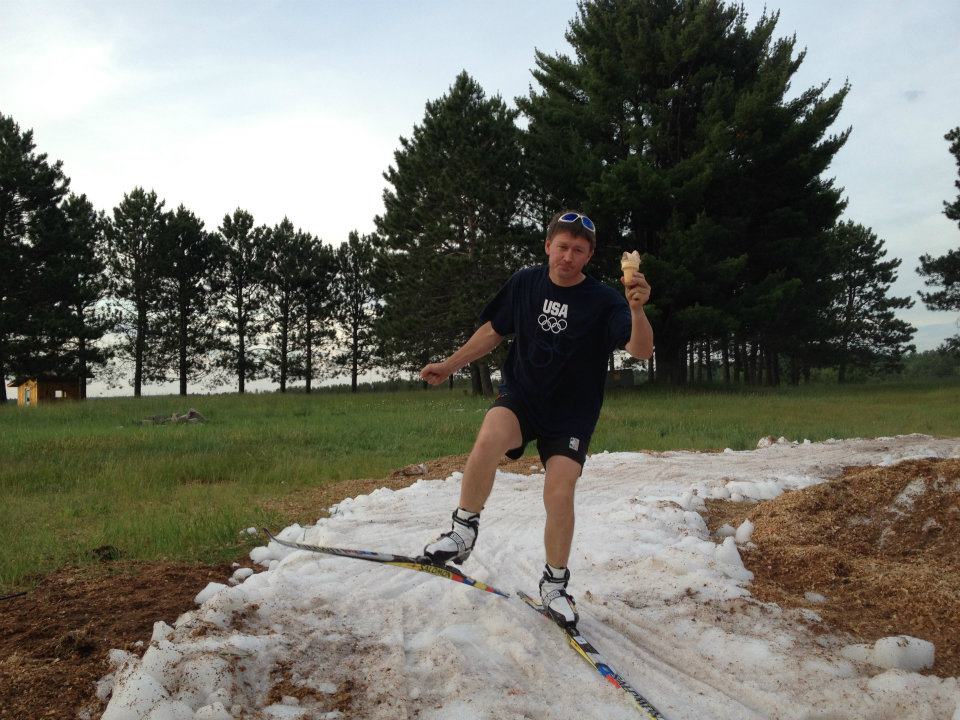
Coach Igor Badamshin having some fun on a few patches of snow. Photo is titled “Snowflakes, ice cream and Igor,” by former CXC Team elite coach Bill Pierce. Badamshin was the CXC program head coach until his unexpected death in January 2014. (Photo: cxcnewsfeed.wordpress.com)
“I’d hope I’d be maybe as analytical [as Cork],” he said. “I’m hoping I can be half as enthusiastic and motivating as Igor … I try to pull from all those guys and find out what works for myself and what doesn’t fit my personality. I would say I’m relatively soft-spoken and sometimes it’s a little bit harder for me to put myself out there. I hope I’ve gotten better at that.”
When it comes to managing athletes, Pierce will continue to write training plans for those that started with him at the beginning of the season, including Cory Ellertson, Chris Pappathopoulos, Andrew Brown, and Scott Johanik.
Keller said he’ll take on those that joined the team more recently and will be in Cable the next several months: the two postgrads and guest skier Leandro Lutz from Brazil, who plans to travel to Europe to try to qualify for 2015 World Championships.
As for coaching and waxing for 18 or so skiers throughout the season, Keller said that working alongside other Midwest clubs at races, especially at main events like U.S. nationals, should help. And not all the athletes will compete at the same events, given their varied focuses — from marathons to junior-qualifying races.
At the same time, Keller said he’s looking forward to having an assistant or some kind of helper in the future. Gusev said the new hire would largely help with junior camps.
In the last month since Pierce’s decision, he said he’d been working with Keller on the transition and will continue to offer assistance beyond his final day at the end of September.
CXC Team’s fall/winter crew during a recent workout in Cable, with postgrads Scott Harrison and Sam Boardman, and guest skier Leandro Lutz from Brazil, who will be joining the team for the next couple months. (Photo: CXC Skiing/Facebook)
“I’ve basically given [Keller] my daily responsibilities,” Pierce said earlier this month. That included even the little stuff, like “teaching him how to smooth out a trail and pick rocks and seeds.”
“There’s definitely a lot to catch up on as far as ski selection and things like that,” Keller observed. “Working with Rossignol, getting in contact with those guys, getting up to speed with things Bill might’ve taken care of as far as a team aspect and getting [ready] to compete.”
He’s also tasked with attracting sponsors through top results in Midwest marathons.
“We’ll do fine with that,” he said of his mostly marathon-focused team. “Our postgrads have goals of trying to make World Juniors … definitely a big one is qualifying for Junior Nationals and trying to make top-20 [there]. The goals for the marathon team is being on the podium or top 10 … that should be no problem.”
He’d also like to bring the CXC Team back to an “elite, elite” team, he said, by recruiting recent graduates.
CXC Para Nordic Team member Steve Baskis training with U.S. Paralympics Nordic Program in the ski tunnel in Torsby, Sweden, earlier this month. (Photo: CXC Skiing/Facebook)
According to Gusev and CXC’s mission statement, the 2,000-member organization has four straightforward goals: to build its base, promote the sport, achieve competitive success, and create partnerships through collaborations. The way he sees it, member athletes are part of that as well.
“[The CXC Team] athletes are in a community to be motivation to adult athletes at clinics, to be role models and whatever else comes with it,” Gusev said. “With competitive excellence, we hope to get them to the level [of someone like Garrott Kuzzy or Tad Elliott, who made the U.S. Ski Team]. We hope the athletes that come through our program will eventually contribute to international success…”
Emerging Adaptive Team
CXC is also focused on building its adaptive program under coach Andrew Poffenberger, another Minnesota native who skied as a junior and studied health fitness at Gustavus Adolphus College in St. Peter, Minn.
Augusto “Goose” Perez (sit-skier, cancer survivor, 2014 Paralympian)
John Oman (standing athlete, 2014 Paralympian)
“Emerging Talent” Program:
“People who have tried nordic skiing on several occasions and show promise, interest in competition, and commitment to the sport,” Poffenberger wrote. “This is an area where I am looking to grow in the next few months as people turn their attention from fall sports to winter.”
Junior Para Development: Focused on youth development and coaches interested in instructing adaptive skiers in high schools. “Our annual coaches clinic and certification will include a few sessions on adaptive nordic skiing for those interested this year,” he wrote.
This year, the CXC Para Team has expanded to include five elite athletes, four of which went to the 2014 Sochi Paralympics: Aaron Pike, Travis Dodson, Augusto “Goose” Perez, and John Oman. Its fifth member, Steve Baskis, a blind athlete and veteran, recently joined the U.S. Paralympics Nordic Team at an on-snow camp in Sweden.
Poffenberger also works with three “emerging talent” adaptive skiers — those “who have tried nordic skiing on several occasions and show promise, interest in competition, and commitment to the sport,” he explained in an email.
In addition, he coaches about four or five junior-development skiers, athletes that “can sit ski for 10 to 15 k in a session,” Gusev said. “Andrew’s done an amazing job with them.”
“Ideally we would like to mirror the development structure of able-bodied skiing,” Poffenberger explained. “Possibly the most important component of that structure is youth development. If we expect to be competitive at the highest level, we need to start developing young athletes.”
Among their efforts: CXC has submitted a proposal to include adaptive nordic at the Wisconsin state meet.
“We are also seeking out coaches who are willing and able to coach adaptive nordic skiing at the high school level,” he added.
Last week, Poffenberger attended a conference with The United States Association of Blind Athletes at the Olympic Training Center in Colorado Springs.
“I love working with these athletes because they have perspective of the entire picture, and don’t let small things stand in their way,” he said, now in his second season with the team.
“I hope we can keep having more and more individuals like [Poffenberger and Keller] that get involved with a sport as a profession,” Gusev said. “They understand the way athletes move from one stage to another stage and it’s easier for them to communicate with athletes at the younger level what expectations are. That’s really the goal.”
WAUSAU, WI (December 23, 2013) – A large turnout of top notch regional talent attended the Aspirus Nordic Challenge hosted by Knicker Nordic Ski Club over the weekend in Wausau, WI most to attend a Midwest Jr. National Qualifying event. In many cases the field sizes were good in each category, clearing a great sign for the continued development of the sport. Races were held at the Greenwood Hill Country Club. The series moves to Telemark Chase (Cable, WI) on January for the next races.
HIGHLIGHTS
In the 1km sprints Hannah Rudd (U16 Category, Loppet Nordic Racing, Plymouth, MN) and Mattie Watts (U18/20 Category, Endurance United/SISU, New Brighton, MN) took the women’s title with Henry Gore MadNorSki (U16 Category, MadNorSki/CXC, Madison, WI) and Matt Nichols (U18/20 Category, UW Green Bay, Wausau, WI) grabbing the crown in the men’s event.
Winners included in the Boys 5km event Michael Jarzin (U16 Category, Ashwaubenon, Green Bay, WI), while Hannah Rudd (U16 Category, Loppet Nordic Racing, Plymouth, MN), Vivian Hett (U18 Category, Loppet Nordic Racing, Burnsville, MN) and Nicolette Reker (U20 Category, Endurance United/SISU, Little Canada, MN) took top honors in the girl’s 5km event.
In the men’s 10km race Ian Torchia (U18 Category, Rochester, MN) and Jan Ketterson (U20 Category, Dartmouth, Bloomington, MN) took the win.
QUOTES
“Nice to see the Midwest Juniors skiing very competitive with the top college skiers, both days.” – Kevin Brochman, SISU Director of Athlete Performance and Coach
“I’m really proud of the way Henry raced today. It’s nice to see the hard work that he did over the summer and fall start to pay off.” – Andy Keller, CXC Junior Development Coach
“We had a great time. We get few sprint weekends and it’s great this time of year to get a sprint distance weekend in just for the high intensity. I think the whole team had fun.” – Chad Salmela, Saint Scholastica Coach
“Organizers did an outstanding work in all aspects of the event and it was also great to see club, high school and college teams competing last weekend. CXC had an opportunity again to test live streaming of the event both days. It was exciting to see number of live and on-demand viewers considering we did not promote it. We will continue with this project and hope to increase the quality of webcast. The next event is coming up in January on Telemark trails.” – Yuriy Gusev, CXC Executive Director
John and Leslie Taylor have challenged CXC with a matching grant to develop and promote Nordic skiing for all ages and abilities in the Midwest. This is a 2:1 matching grant, so we need to raise $40,000 to leverage the $20,000 from our generous benefactors.This new donor opportunity provides a way for anyone to give back to our sport through CXC Programs. These CXC programs are the backbone of ski development and promotion in the Midwest. Click here to learn more and show your support!
Jennie Bender at 2013 U.S. Nationals, where she won the classic sprint. Photo: Bert Boyer.
On the last day of the season in April, national champion Jennie Bender finished dead last in a race. Out of the 33 women who contested the 30 k classic at U.S. Distance Nationals, Bender crossed the finished line over nine minutes behind the second-to-last athlete and a full 30 minutes behind the race-winner.
“I never want to see myself last ever again,” Bender said in a recent phone interview. “That was horrible and embarrassing. The good thing is, now I know I can…do better and I know I have things I haven’t tapped into yet.”
For Bender, 25, finishing last in California taught her once more how to swallow her pride in a season filled with both trying and triumphant moments. She won her first national championship, the classic sprint, and dropped out of her first race in the span of the same week in Soldier Hollow, Utah. The summer before, she missed months of training while she fought off lyme disease and mono at the same time. At Canadian Nationals in the spring she got strep throat and entered SuperTour Finals on fumes.
Despite the setbacks, the win at nationals taught Bender never to count herself out. That lesson is coming in handy now that she’s facing another physical hurdle: a herniated disk in her back. She thinks the misalignment may be the result her fall in the finish lanes at U.S. Nationals in 2012 and two years of subsequent overcompensation. After making several trips to the doctor, Bender decided not treat the injury with surgery and will instead bring herself back to fitness with physical therapy.
“Obviously it’s disappointing and I’d rather not have this, but it could be a lot worse, I guess,” Bender said. “I’m just going to have to deal with it.”
She can’t run or rollerski at the moment, so Bender is doing the majority of her endurance training on an elliptical, in the pool and with nordic walking. She doesn’t know exactly when she can return to rollerskis, but is confident the problem can be fixed in time to be ready to race in November as long as she’s careful with her physical activity throughout the summer.
The uncertainty comes at a time of transition for Bender. At this moment, she is driving from her home of the past three years with Central Cross Country (CXC) in Minneapolis, Minn., to Bozeman, Mont., to begin skiing for Dragan Danevski’s program at the Bridger Ski Foundation (BSF).
Bender, a Vermont native and University of Vermont graduate, says her decision to leave the Midwest was motivated in part by her unpredictable season and a need for something new.
“I’ve thought a lot this summer about where I want to be and why I’m doing what I’m doing, and I realized that the fire is burning very strongly still,” she said. “I still don’t feel like I’ve reached my potential, which bothers me. It all comes down to personal drive, which is what kept me going this year. Everyone is like, ‘I don’t know how you did what you did this winter,’ and I’m like, ‘I don’t really know, either.’”
At BSF, Bender hopes to reenergize her training.
“I’m excited, because I think…the Bridger Ski Foundation seems to be a very big organization with lots of supporters and it’s a big, enthusiastic ski community with one club,” Bender said. “I’ve only heard good things about the program and about Dragan.”
In addition to Bender, BSF is growing by two other women this season. University of New Hampshire graduate and NCAA All-American Anya Caldwell Bean is headed for Bozeman soon and MSU’s Cambria McDermott will ski in the BSF suit while she red-shirts a year from the NCAA.
“Dragan Danevski is very happy with the acquisitions, and combined with a great group of Post Graduate skiers, is excited about the future of BSF skiing at the top level,” said BSF assistant coach Tim Baucom.
With three elite women on its roster, BSF carries a bigger women’s squad into next season than it’s ever seen.
“It’s bigger than we have had in the past, and the first time that we feel we have several women who will be competitive nationally and internationally,” Baucom said. “Besides Kristina Trygstad-Saari, we have not had many senior women who have been competitive.”
On the men’s side, Torin Koos will again be on the BSF squad and is joined by NCAA All-American Tyler Reinking from MSU. Leif Zimmermann, four-time national champion and 2006 U.S. Olympic team member, is retiring from competition after 15 years of racing.
Bender in Soldier Hollow waiting to climb the podium at 2013 U.S. Nationals with men’s classic sprint champion Torin Koos. Bender and Koos will be teammates at the Bridger Ski Foundation next season.
For Bender, the move to BSF gives her more group training opportunities, as her workout partners in Minneapolis last year often included masters and juniors.
“I’ve been training a lot on my own in Minneapolis and I think I’ll be around more girls my age who will be eager to go out and rollerski,” Bender said.
“It’s important to be around, in general, a really active environment and that’s what Bozeman is. It’s very outdoorsy, very active, people are always doing something even if it’s not nordic skiing. As long as there’s people willing to go outside and do something active, that’s very motivating for me to go do the same.”
Bender’s back injury will limit her training options as she settles into her new life in Bozeman. Injured is not the ideal way she would like to be joining a new team, but she is enthusiastic about the change of scene.
“It’s hard to leave the midwestern ski community and the friends I’ve made there the last three years, for sure,” she said. “Developing a healthy environment is all part of life; all part of being a successful athlete is surrounding yourself with positivity. But this is a change I think will be good and I’m excited for some mountains.”
Bender’s goals, she added, are the same as they ever were.
“The moral of the story is, you never know what’s going to happen,” she said. “Obviously my hopes are still high; I [am] out to make the next Olympics… [I’m] strongest in classic sprinting and the [U.S. Ski Team] is already heavy on sprinters, but because women’s sprinting is a big focus this year I think I could contribute to an already stellar lineup.”
And after a rollercoaster season, Bender thinks her inconsistency in the past might work to her advantage in the future.
“It’s a new year; you never know what I’m going to do,” she laughed.
Jennie Bender (CXC) while training for the 2012 Telemark Forest Mountain Bike Race in Cable, Wis. Upon discovering she had both Lyme disease and mono, she wasn’t able to compete in the 28.5-mile race on July 14. (CXC courtesy photo)
The symptoms started at a July training camp with Central Cross Country (CXC) in northern Wisconsin. The runner-up from last year’s SuperTour series, Jennie Bender, 24, wasn’t feeling well.
For two to three days at a time, she’d experience bouts of nausea. Then her neck felt sore, along with her jaw and teeth. One night, she tossed and turned with cold chills, and feared that she’d wake up a leper. The next day, she pushed on with her team during dryland training. Bender didn’t know what was wrong, but was sure she’d muscle through it.
Things got worse. Bender’s eyes started to get puffy and dry, she felt an unusual frequency of headaches, and finally, fatigue set in.
She went to the doctor and learned she had Lyme disease, a bacterial infection caused by a tick bite. When Bender called back for more information, they told her she also had mononucleosis, a viral infection commonly known as mono. She cried at first, but the second diagnosis made her laugh out loud.
“Like … seriously? You’re just messin … ” Bender recalled in a blog entry.
Left with one option, she chose to rest.
“I have never had either before,” Bender wrote in an email to FasterSkier. “So I had to stop cold turkey for a solid month [starting July 21], which needless to say was not easy. My legs felt like Jello and I had a lot of practice sitting.”
While absorbing all this during her three-hour drive back to Minneapolis, Bender had a bit of a scare. About 2 ½ hours in, she started singing to herself. That wasn’t the scary part.
“Suddenly I realized my speech was slow, and I couldn’t formulate my words very well,” she wrote on her blog. “My upper lip was also curling up in an abnormal way as I spoke (to myself), and I was trying to figure out if this was in my head, or actually happening. It lasted about 5-8 minutes, then slowly started to change back. This was followed by brief leg and forearm/hand tingling.”
Jennie Bender working out during a CXC training camp earlier this summer at Telemark Resort in Cable, Wis. (CXC photo)
She called several friends, which were doctors, and they advised that she go to the emergency room. She did so at 5 p.m. on a Saturday, and seven hours later, left the ER with little information.
“They concluded I didn’t have a tumor, or MS, or a slew of other worst case scenarios,” Bender wrote. “I keep thinking, what if they DID find something like that? My first reaction was that I would have had a better excuse than Mono for not doing the strength test during camp. Then, I would have freaked the heck out. Probably run around the hospital naked looking for that sheet cake to ape throw at bystanders.”
Since then, Bender has run through a roller coaster of emotions this offseason. She’s hated Facebook at times for photos of people training and been frustrated with herself for working out too soon. After making the podium at both U.S. and Canadian nationals last season, she’s had to reconsider her goals this year and be her biggest advocate in achieving them.
“This whole process has been a learning experience of how to trust myself,” she wrote. “After numerous blood tests, the Dr (correction many Drs) couldn’t tell me when to train or when not to, and neither could a coach. I was the only one who knew how I felt. I had to cancel many camps, convince people I shouldn’t do races or events, change my diet, disregard my yearly training plan, and change my mindset.
“I have no doubt in my mind. I will come back just as strong,” she added. “And I will be ready to slay. Just a speed bump.”
***
Here is the rest of FasterSkier’s interview with Bender, who is picking up the intensity in Canmore, Alberta:
Bender scrambling up the East End of Rundle (also known as EEOR) with former teammate Sara Hewitt (not shown) in Canmore, Alberta. (Courtesy photo / jenniebender.com)
FasterSkier: How’s Canmore?
Jennie Bender: I arrived in Canmore [Oct.] 11th to hang out with [former CXC teammate] Sara Hewitt before the team arrived on the 13th. We started skiing the 14th around the rolled out loop, and the snow has been holding on thus far. We had a warm spell with rain and I thought it was a goner, but it’s doing OK.
The team started out the week getting used to the altitude, so we have been doing mostly distance, but [Wednesday] the men started intensity, which will be the theme of the rest of the camp. The mens team up here consists of Eric Wolcott, Karl Nygren, Adam Martin, and Doug Debold, and they are looking really strong. Last year our woman’s team was a force, and now this year I have a feeling the men are going to shine.
FS:How’s your recovery and transition back to training been?
JB: I have been working on technique a lot this summer, and it really feel like I have made some improvements. I just need to transfer them to on snow. [New CXC head coach] Igor [Badamshin], along with some other positive influences, have opened my eyes to some big changes.
Technique wise, I am working on relaxing into the motions more. I muscle a lot of skiing, and I would like to take advantage of natural movement more so than in the past. … When I am healthy, I will do intensity. That should be soon.
FS:How long were you on medications?
JB: The doctors told me to take two weeks of antibiotics, but I heard so many horror stories from fellow friends and athletes who have had Lyme before, that I requested three weeks. I think I caught it early, but I don’t know if I picked it up in June or July. I don’t remember finding a tick on me, it was sort of ironic because I was the most paranoid athlete at camp towards tick prevention. Warning to others, Deet does not ward off ticks, only Permethrin, which can’t be sprayed on skin.
“I actually was just going to slow ride the race because I felt bad about skipping it,” Bender wrote on her blog. “Then I finally put together that I probably shouldn’t. Yes, it was actually a decision that was stressing me out, and not an obvious ‘No F-ing way’ for the normal, logical brain. You would be surprised how many hopeful ‘Are you going to race still?’ that I received.”
FS: How did you spend the rest of the summer?
JB: I had to miss the CXC altitude camp in Colorado, so I went to Vermont to visit home in late August and early September. There, I had a few setbacks, trained, then had to rest again. I would think I was easing into it, then realized just how little reserve to recover I had in me.
When I came back to Minnesota end of September, I finally started to get in some consistent training. Now I am here in Canmore, which feels really good. I still haven’t done much intensity, and of course picked up a slight cold right when I was going to lay it on, but I have been rolling with the punches thus far … so I just have to deal.
FS: What’s your outlook for the season ahead?
JB: My goals are still the same. I just have plan A, B, and bah humbug C. I want to race in the Canmore and Quebec World Cups, I want to race well at Nationals in Soldier Hollow, and I want to race spring in Europe. We’ll see how far my stubbornness and new technique gets me.
Through all of this, I have learned and reiterated three important things. 1) It’s important to know how to make yourself happy and laugh on your own. That being said, those who reach out to you when you start to fall off the map really mean a lot. 2) This summer, I have had the least amount of structure given to me since high school. Igor has urged us to know how to lead our own way, and at first I fought it, but now I understand its importance. You are your best coach, and confidence is key. 3) Every great athlete needs to have a setback story, so I am hoping this is mine, and now I can move on and ski fast.
CXC teammates Jennie Bender and Nichole Bathe pose in front of Telemark Resort during a workout on Friday in Cable, Wis. While Bathe is new to the senior team, Bender is a seasoned veteran with multiple SuperTour wins and podiums at U.S. and Canadian nationals last season. (CXC photo)
Note: This is the fourth preview in a quick-and-dirty series on U.S. elite teams. We asked coaches to send their 2012/2013 rosters and tell us what’s new for the coming season. We will be publishing additional reports over the next few weeks. Teams are presented in no particular order.
Team: Central Cross Country, known as CXC Team
Coaches: Igor Badamshin (head coach), Andy Keller (assistant)
Karl Nygren, Doug DeBold and Eric Wolcott of the CXC Team during a workout at Telemark Resort on Friday in Cable, Wis. (CXC photo)
Roster: Karl Nygren, Brian Gregg, Doug Debold, Adam Martin, Eric Wolcott;
Jennie Bender, Caitlin Gregg, Nichole Bathe
Who’s new: Debold returns to the squad after placing third in classic sprint qualifier at 2012 U.S. nationals in Rumford, Maine, where he finished eighth overall. Bathe, 17, is moving up from CXC’s development ranks after being one of the leading Americans on the J1 Scando trip last season, placing eighth in a sprint in Estonia. Another 17-year-old former junior racer for CXC, Martin posted a 12th-place sprint finish on the J1 Scando trip.
Who’s missing: “We have several athletes that are not back on the team,” CXC Executive Director Yuriy Gusev wrote in an email. Among them are Jessie Diggins, who was recently promoted to the U.S. Ski Team’s A-team and decided to join the new Stratton Mountain School (SMS) Elite Team. Santi and Carolyn Ocariz rollerskied across the country and moved west to join XC Oregon, and Canadian Sara Hewitt also left CXC.
Former head coach Jason Cork also parted ways to accept the U.S. Ski Team men’s coach position. That followed the departure of CXC’s assistant coach Gus Kaeding, who is heading up the new SMS Elite Team.
Gusev wrote that CXC has been transitioning this spring, making Badamshin head coach after three years with the junior development team. Anticipating the departure of certain athletes, CXC made sure to support juniors like Bathe and Martin last year similar to how they worked with Diggins over the last two years.
Gusev added that they decreased the roster size to provide more athlete support, especially at international competitions.
“The most notable [skier] we’ll miss this year is Jessie Diggins,” Gusev wrote. “Athletes have to do what is the best for them and we 100% support their decision. We had similar situations in the past with Matt Liebsch and Tad Elliott. It’s about athletes and we need to support what is the best for their performance. We are proud that we played important role in getting those athletes where they are right now.”
Top results last season:
According to Gusev, CXC tallied:
Bender working out during a CXC training camp on Friday at Telemark Resort in Cable, Wis. (CXC photo)
• 80 top-three finishes in World Cup, US SuperTour and major marathon races
• 31 wins in US SuperTour and major marathon races
• 10 top-30 results in World Cup Races (by Jessie Diggins)
• 5 top-10 ranked skiers ranked in U.S.
• 5 skiers in the top-three of each gender in SuperTour final standings
• 4 national championship titles
• 3 skiers in the top three in the women’s freestyle sprint at US Nationals
• 2 top-10 World Cup results (Diggins)
• A silver medal in World Cup team sprint (Diggins with Alaska Pacific University’s Kikkan Randall)
Coach’s comment: After two summer training camps at Telemark Resort in Cable, Wis., Gusev complimented the team’s working atmosphere.
“There are few changes with training and workouts compared to the past, but the athletes are responding well to them and eager to try different ideas,” he wrote.
Caitlin Compton is a fan of a high-low approach to periodicity, as opposed to the more traditional four-week progression
Bryan Fish is the former CXC Team Vertical Limit head coach, and now coaches for the U.S. Ski Team. FasterSkier approached Fish about CXC’s unique approach to periodicity–the sequencing of hard and easy blocks in a training plan–and this was his response.
We got an e-mail from a reader with a story idea—he mentioned that CXC takes a different approach to periodicity, alternating hard weeks with easy weeks rather than doing the typical three-week progression.
A majority of the CXC Team Vertical Limit athletes have selected a monthly progression with alternating harder then easier weeks, although it is not the only periodization model that CXC athletes use. A couple of the CXC athletes have a low-high-high-low plan (similar to the typical model), because this allows them to train more in camps and work/recover more out of camp.
The alternating high-low weekly training plan aligns well with the principle of super compensation. The general premise of super compensation is that the body needs a slight elevation in effort and then recovery for positive adaptation to occur. This logic is used by virtually everyone with the implementation of hard days followed by easy days. We expand that out to our 4 week progression. (A better explanation is at cxcacademy.com)
Personally, I had grown up and trained under the typical model of 23%-26%-29%-22%. It was successful, but I was certainly willing to try something different. The 28%-22%-35%-15% periodization plan was selected in 2006 due to three reasons:
1. It made common sense, for it aligned with the principle of super compensation & we wanted to start with a plan that included more stress and recovery cycling then the typical plan prescribed.
2. This periodization model was a published method, although practical application trumps print.
3. Igor Badamshin (CXC High Performance Advisor – at the time) had personal experience of a number of periodization models, and he thought this progression was the best in practical application.
Personally, I think there is a great deal more discovery that can be done on this topic. The “typical” periodization plan was made popular in the US by Rob Sleamaker’s book – Serious Training for Serious Athletes, and Dr. Tim Noakes references this periodization from Sleamaker in his informative book–The Lore of Running. I have yet to witness factual data on the “best” practice for monthly periodization other than these books and the Russian text that required translation.
I also think it is important to apply general training principle theory with scrutiny. Every athlete responds differently, so individual athlete experience is important. We start with the 28-22-35-15 as a base line and tweak it a bit to fit an athlete’s training and lifestyle. We actually work backwards, sometimes, with the most seasoned CXC Team Vertical Limit athletes. For example, Caitlin Compton likes this high-low periodization process very much, but I actually asked her what number of hours per week over a 4-week-cycle she would think would be best. The flow remained identical, but the percentages changed about two percent each week (plus and minus).
I think the most important point I could convey on CXC’s search and discovery of our own 4-week periodization process is developing a comprehensive planning process:
1. Sets up a baseline (evaluate athlete fitness level and training history).
2. Records the data (execution of the plan, feedback from the athletes and success in competition).
3. Evaluates the plan versus the actual execution of the plan.
CXC creates training plans from a four-step process. The year is built into 13 periods of 28 days, making for equity between periods rather than periodizing off of the calendar, where some months have more days and more weeks. The four-step training plan process is as follows:
1. Overall yearly overview – outlining the general flow of the whole year
2. Month and weekly – general monthly goals and weekly/daily objectives – every training session should have a purpose.
3. Athlete training logging – there is a plan and there is what the athlete ultimately executes. Sometimes the plan is executed 100 percent in hours, but often there are subtle differences. Successful athletes are mindful in their training and deliberately execute. They also make modifications on the fly when necessary. The “what” and “why” of the training modifications should be recognized by the athlete and communicated to the coach. The log is a great means of tracking and communication. Sometimes modifications are subtle from day to day, yet consistent throughout the year. The logging process helps point those out.
4. Evaluation – It is always good to evaluate the planning design to the actual execution, so that the training plan for the upcoming year is continually tailored to the individual athlete. This “tailoring” is often a result of how a specific athlete adapts to training, the general emphasis of the upcoming year, as well as daily habits like their work/school schedule.