From the FasterSkier archive — posts syndicated from athletes’ and coaches’ own blogs between 2004 and 2012, kept online as published. Current coverage is at fasterskier.com.
Green Racing Project (GRP) Ski & Biathlon teams are now accepting applications for the 2024-25 training year. Applications will be due by the end of day March 24 and decisions will be made by April 10. (U23 skiers’ and biathletes’ summer program is its own program for 2024. Find information about U23 programming here.)
GRP is looking for skiers and biathletes who have shown good ski speed over the past couple years. Skiers who have not yet tried biathlon will be given the opportunity if they’re interested.
In exchange for coaching, use of training facilities and travel support, GRP year-round athletes are asked to do work that contributes to the mission and operation of the Center. Projects include coaching youth and masters in skiing, biathlon, and mountain biking; managing and improving the trail system; growing vegetables for the Dining Hall; organizing events and programs at the Center; assisting the Communications Team with writing, blogging and social media.
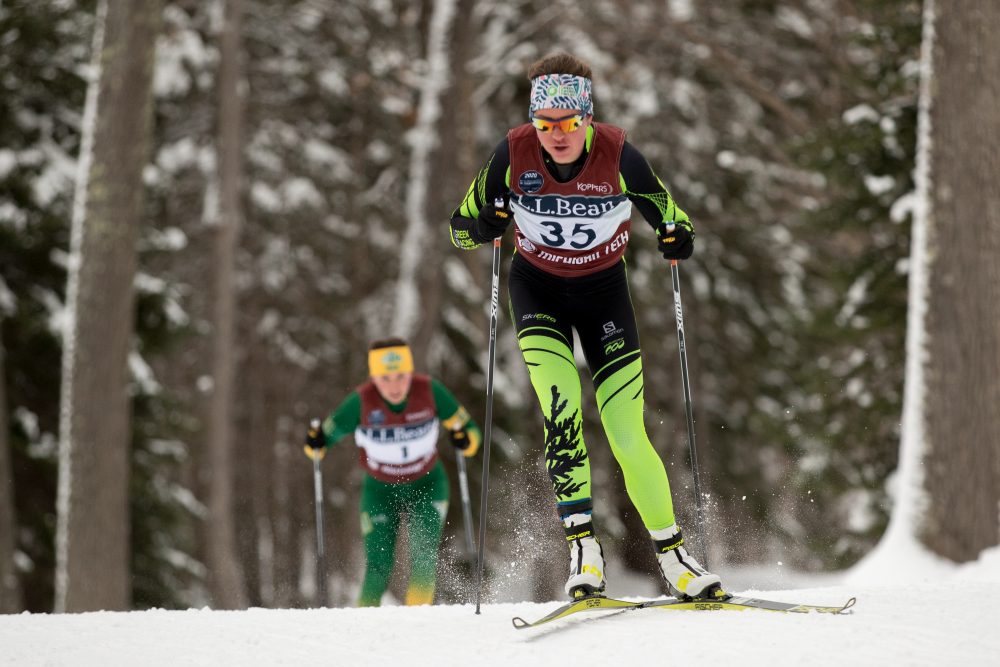
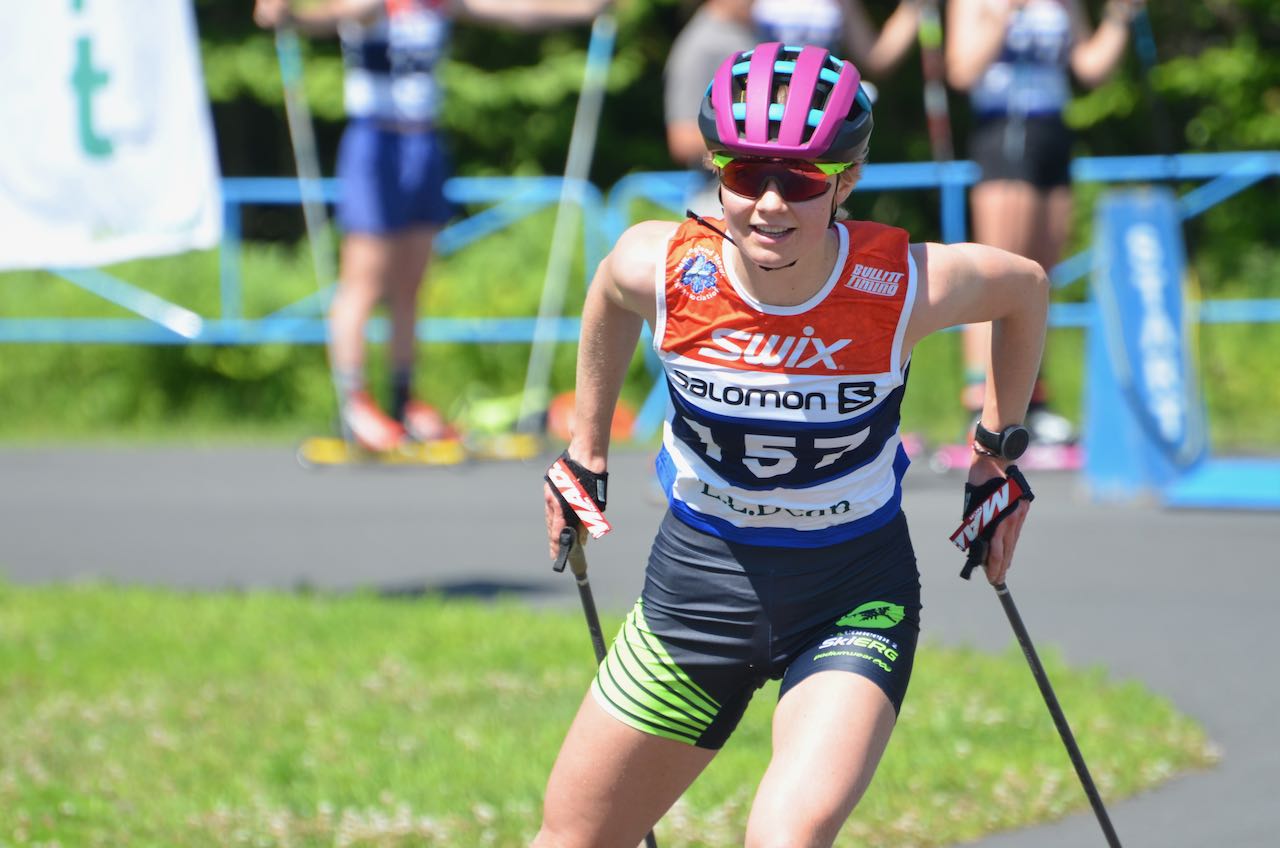
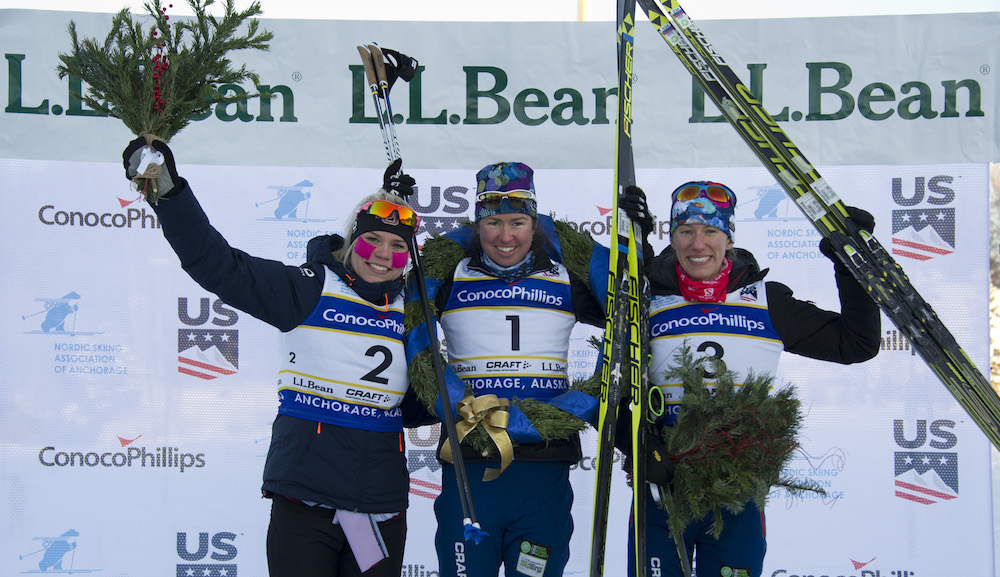
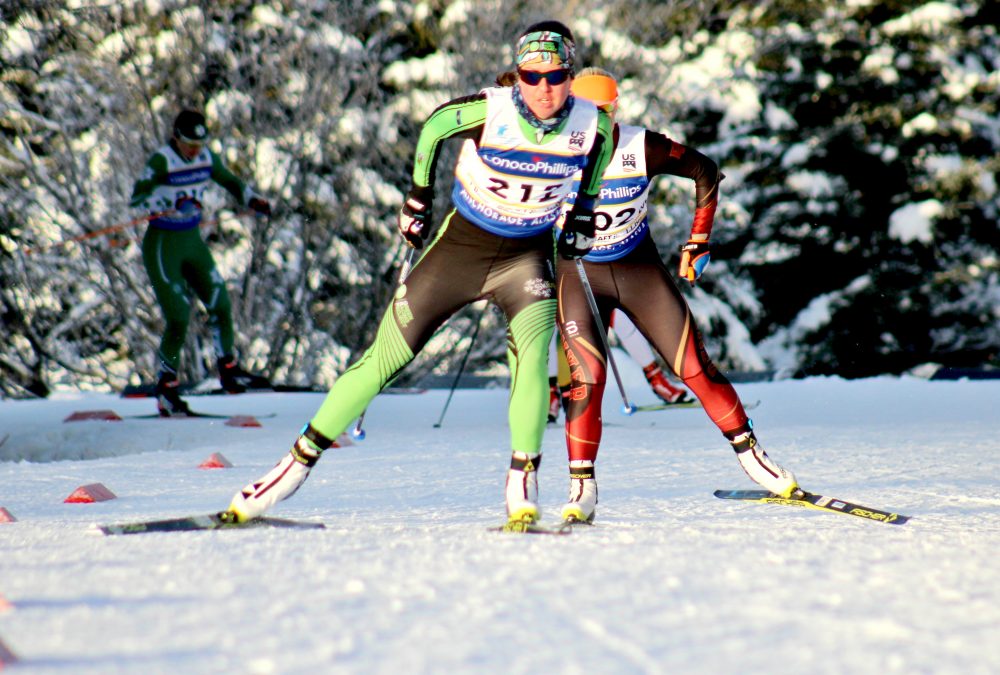
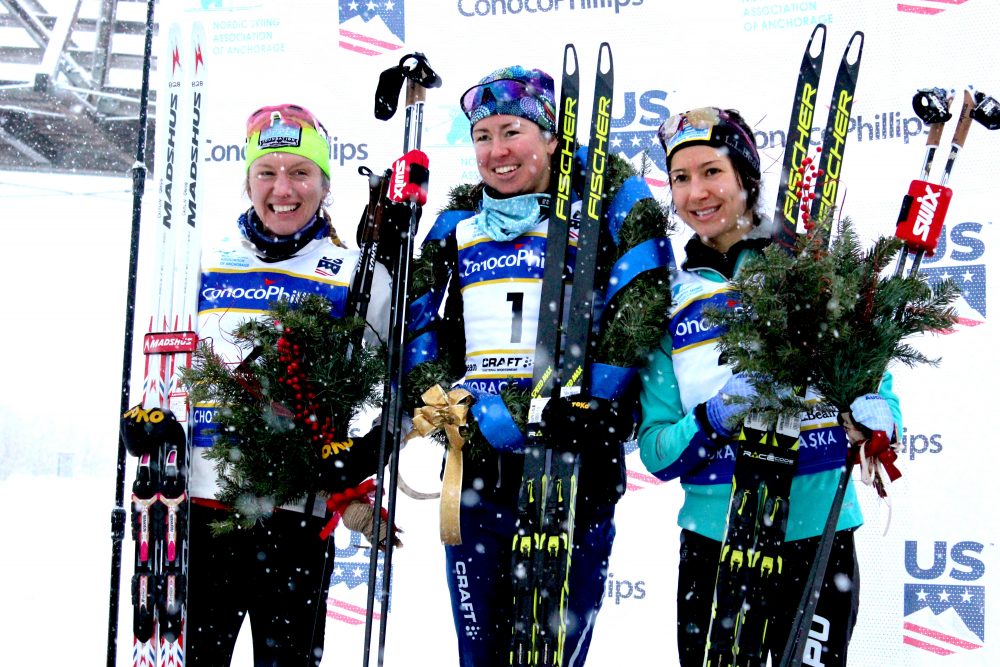
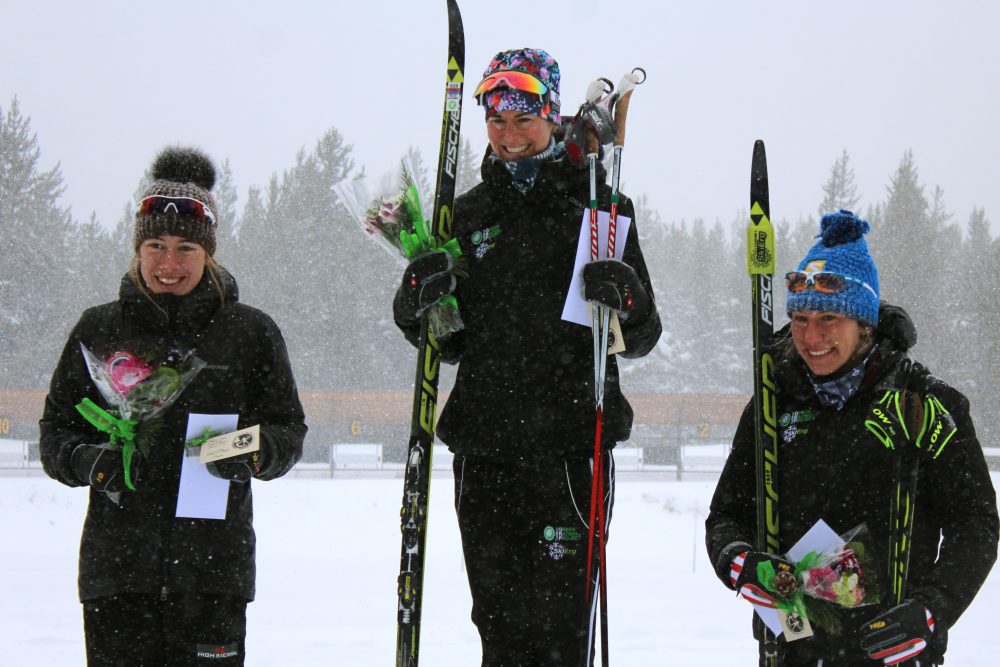
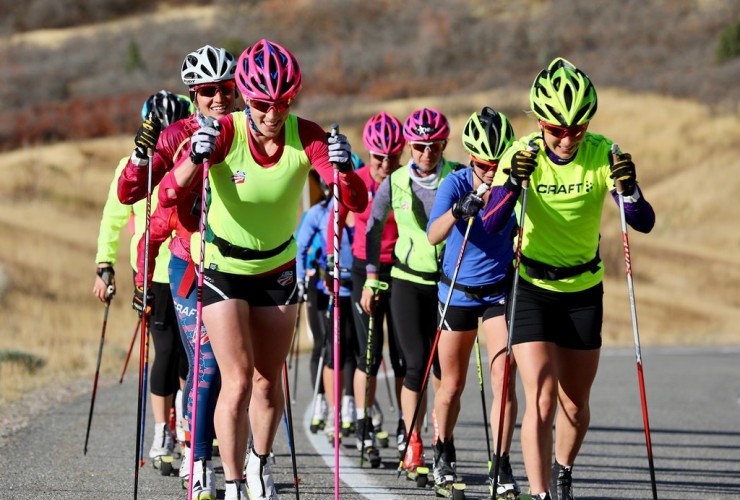
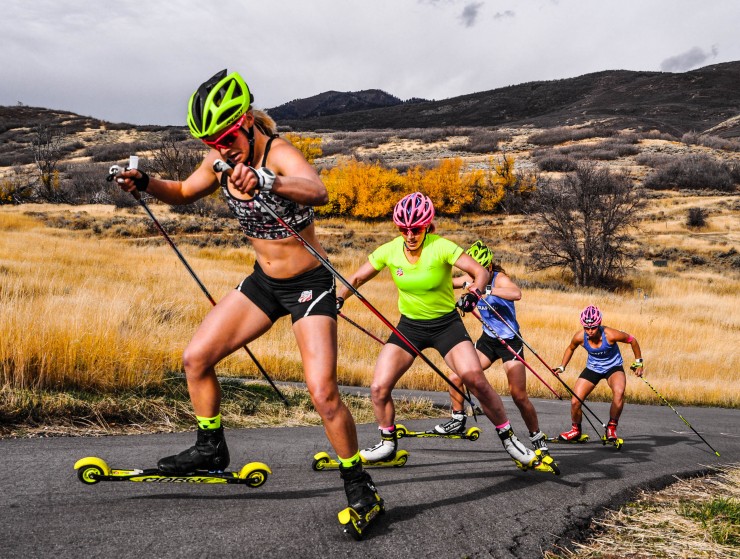
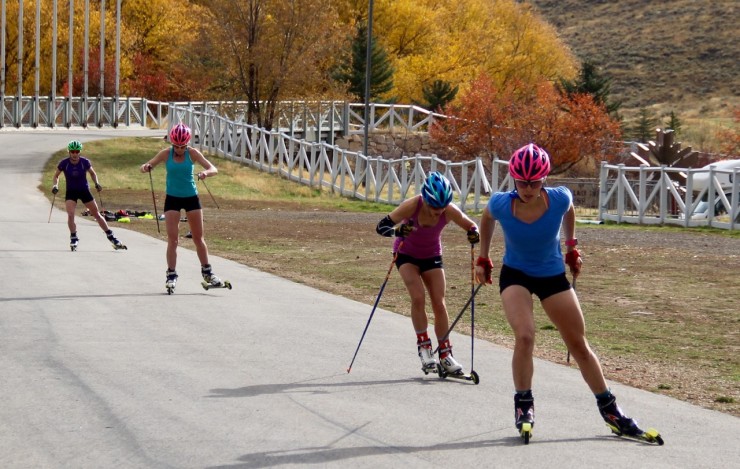
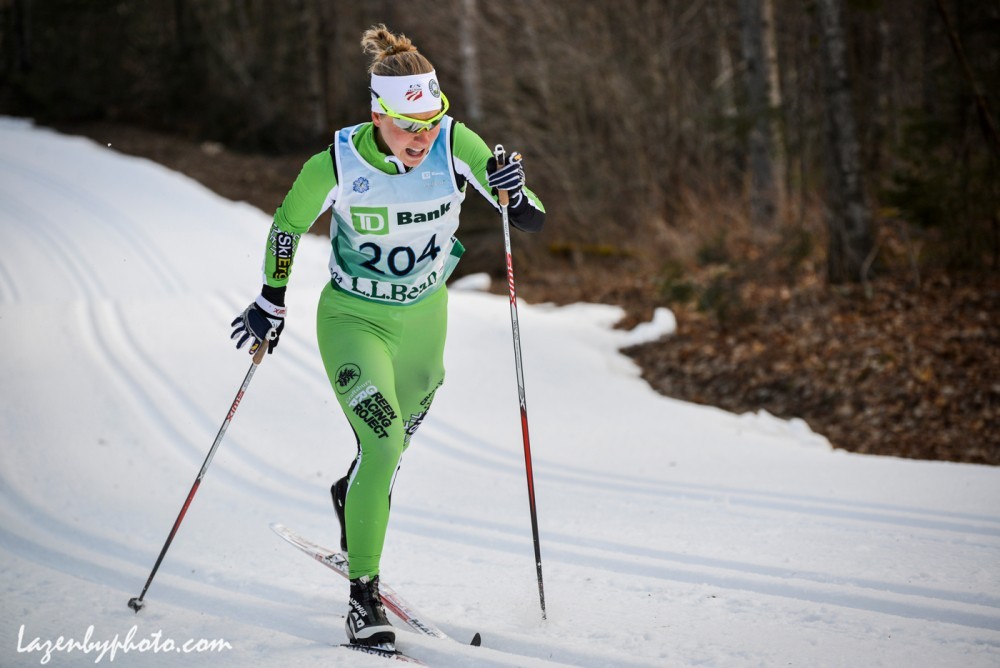
Margie Freed (CGRP) topped the podium in the Lost Nation Roll 10 k (Photo: Paul Bierman)
If this sounds like work you would enjoy, while taking your skiing and/or biathlon to the next level, then you may be a good fit. Read more about the team at their website: www.greenracingproject.com. The application is available here for year-round, residential training and you will find FAQs for biathlon and skiing. Any remaining questions may be addressed to grpski@craftsbury.com and grpbiathlon@craftsbury.com.
Athletes applying, or thinking of applying, should talk with Head Coaches Pepa Miloucheva (ski) and Mike Gibson (biathlon) at season ending races or email and schedule Facetime or a Zoom call.
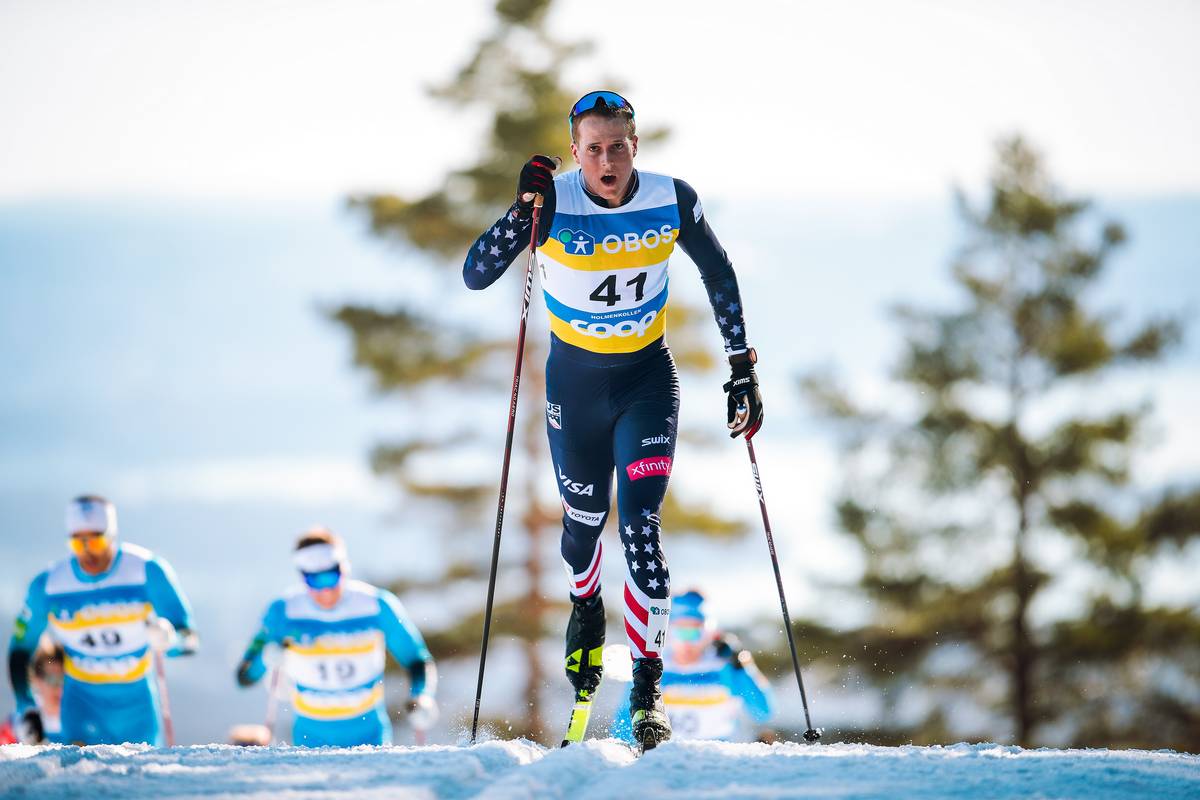
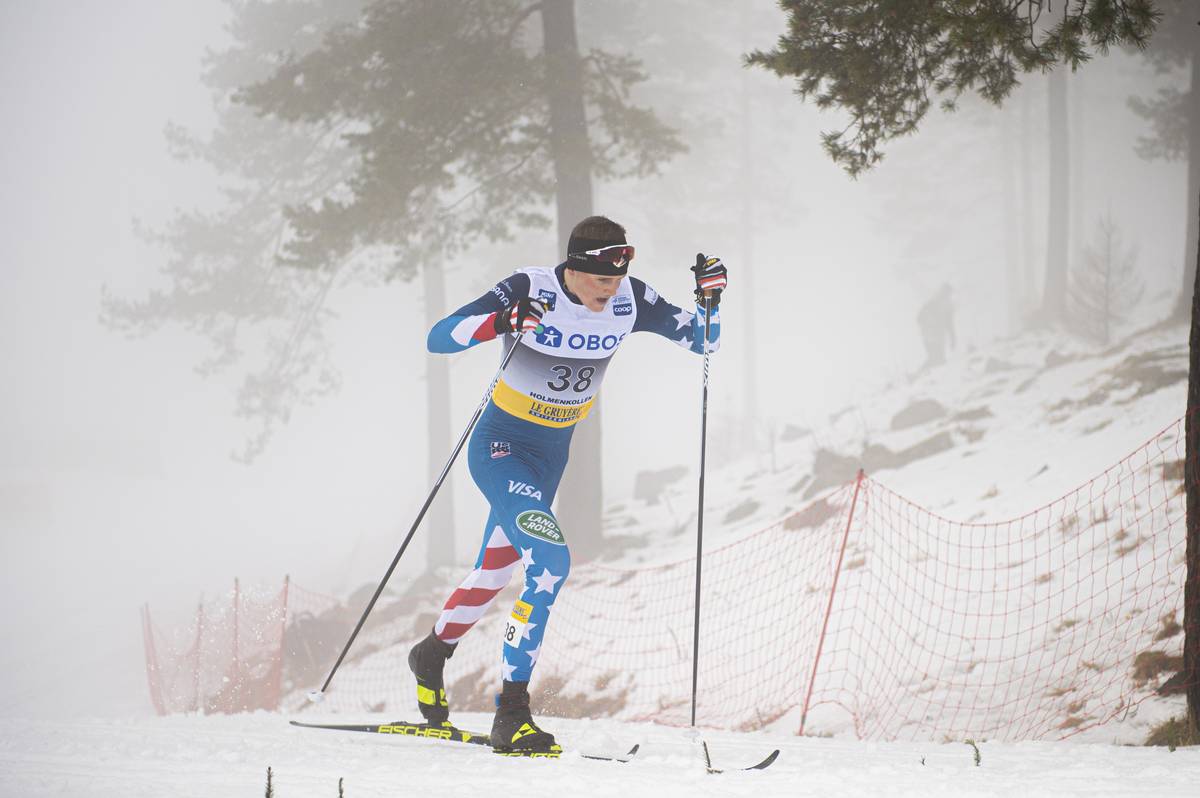
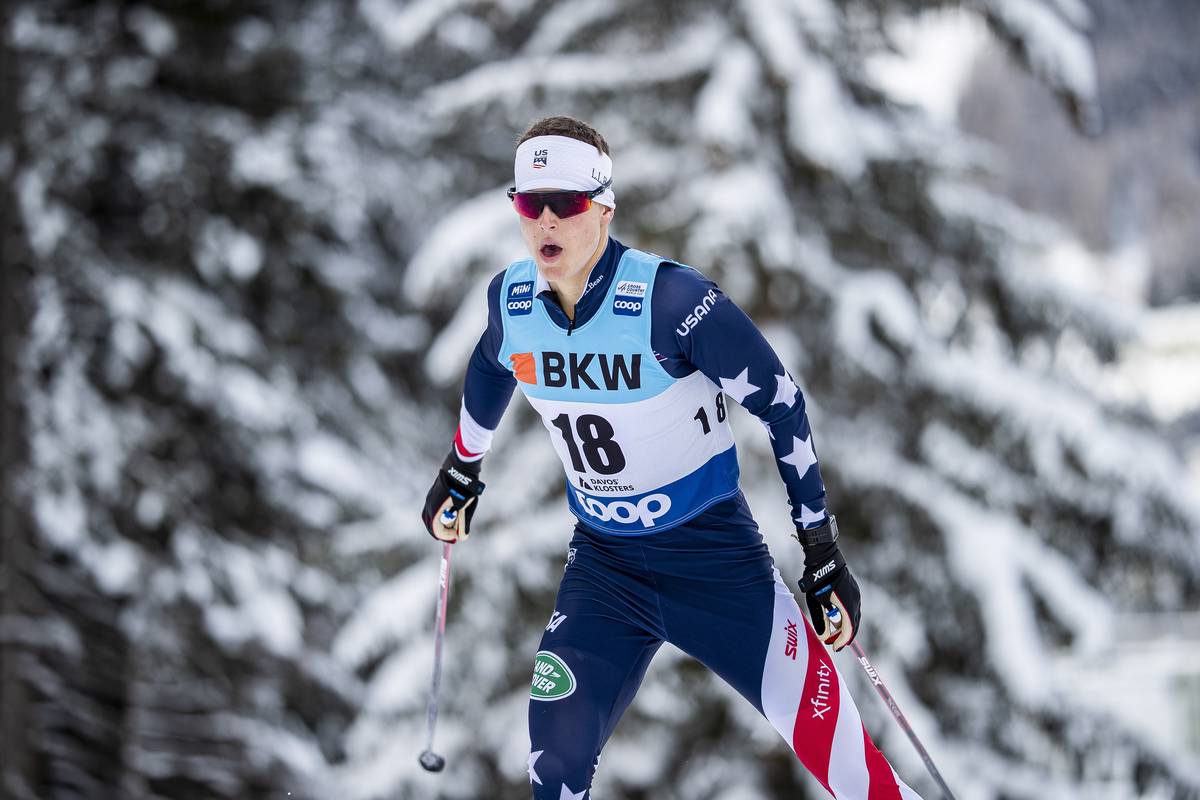
Adam Martin strides at the 2022 Holmenkollen 50 k classic in Oslo, Norway. Martin finished 26th in his third Holmenkollen in March, and recently announced his retirement. (Photo: NordicFoucs).
Adam Martin’s skiing has always tended to be best described in conjunctions rather than disjunctions. He could do this and he would do that.
Or, that’s always how his mentors looked at it. My most distinct memory of Martin is from a CXC (Central Cross Country Skiing) camp about a decade ago when Sten Fjeldheim, then Martin’s coach at Northern Michigan University (NMU), gathered a group of us J2s (U16) around in the lobby of the old Telemark Lodge and said, “there’s proof you can be an All-American caliber skier and have a 4.0 GPA too,” pointing to Martin as the example.
That stuck with me as I watched him as a US skiing fan for years. Martin was giving it everything he could in everything he did, and the juxtapositions that produced were inspiring in their absurdity.
He would run a combined bike/run hill climb andbeat all but one of the cyclists. He would win a local 5 k while pushing for pro runner–caliber paces (seriously, he ran a14:34). He would compete on the World Cup, and his best result would consistently come at its longest and hardest race – theHolmenkollen 50 k.
That pattern strung along almost a decade from his high school career to its final, most striking juxtaposition: Martin had his best season ever in 2021/2022, and now he will retire from professional skiing.
The pattern held all the way through. He gave it all, in every way, and at everything the ski world had to offer.
It was exemplary of his philosophy of inclusiveness, of an and; a persistence in bringing in others’ ideas, their accomplishments, their experiences in skiing, learning what he could, andchanneling it all into his performance out on the course.
That stance towards thoughtfulness and inclusion could be figured as an essence to Adam Martin the skier. Something that reached all the way back and followed him all the way through. When we spoke a couple weeks after his retirement, that was the timescale he reached for. “I was lucky to grow up in the nordic skiing community that I did, with a lot of great people helping me in the sport, both getting into it and supporting me today,” Martin said.
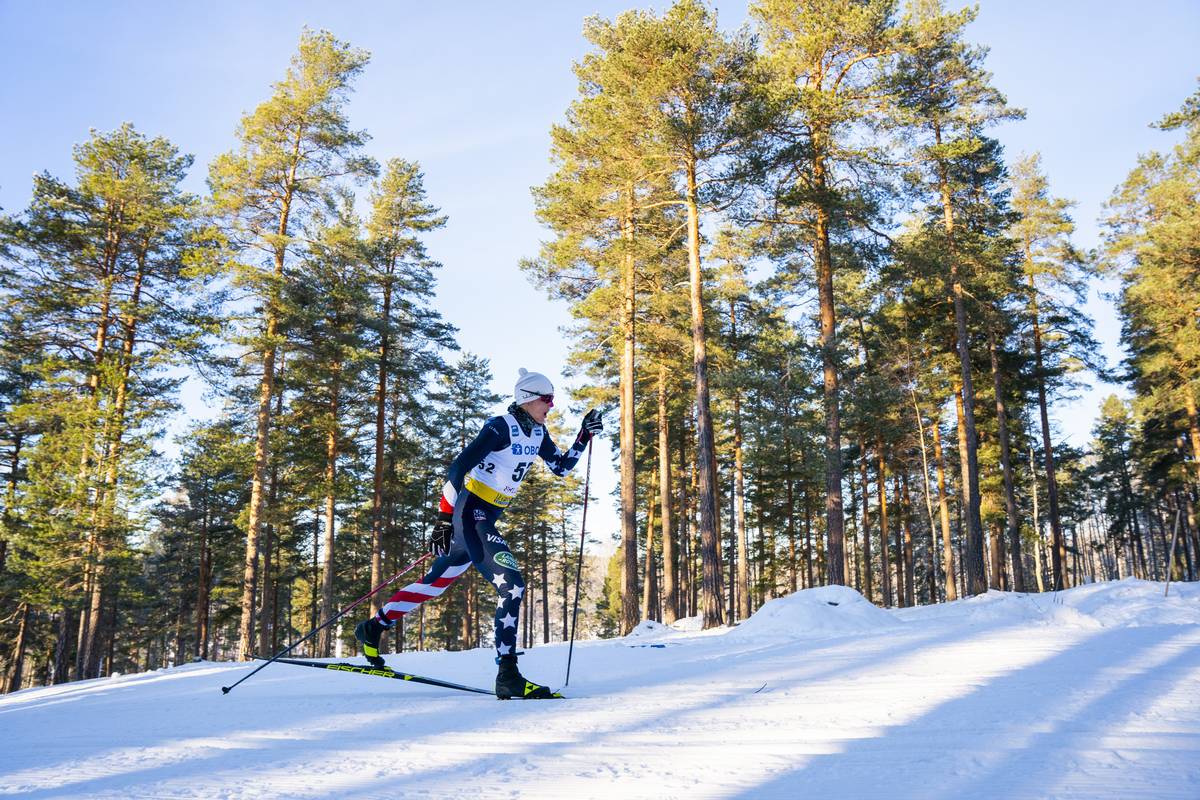
Adam Martin strides through the woods in Falun, Sweden, during a 15 k classic in January 2021. (Photo: NordicFocus)
That nordic community was the one in Martin’s hometown of Wausau, Wisconsin. He first came to skiing as a 10-year-old there – venturing out on skis after the local skating rink shut down and left his then favorite sport, figure skating, an impossibility. “It was a good winter so there was good skiing at 9-mile (Wausau’s trails) for all of March. My mom took me out once or twice a week for a whole month and I think we progressively worked up to 20 k at the end of the ski season. And that was big for me. I didn’t think about figure skating after that.”
It was an understated but persistent start in the sport that matched the ski community that Martin would grow up in. An old timber-boom relic in Wisconsin’s Northwoods, Wausau hums along as a city of 38,000 marked most prominently by Rib Mountain, an erratic that signals that glaciers crept across the land there, carving up knolls and hills under the forests that now surround it. It is as perfect ski terrain as you’ll find in the Midwest. Granite Peak, one of the oldest lift-served ski hills in the country, calls one side of Rib Mountain home. Characteristically of Martin, when I asked him if he skied there as a kid he replied “Never downhill. I used to ski up it after the lifts closed in high school though.” Martin was instead drawn into skiing by the rolling terrain at Nine-Mile County Forest, a network of trails a mile south of Rib Mountain that had already been home to a couple generations of nationally competitive skiers .
Before he joined those ranks though, Martin signed up for the Wausau Night Gliders, the community’s youth program coached by Rachel and Greg Kresse. “We met twice a week, and I was just so excited to see and learn different things in the sport. I remember the first time we learned to skate, and was like thinking, ‘could you V2 in a race?’ Because at that point I was just doing one technique. That was the clincher, I decided I wanted to race. I wasn’t even doing particularly well in the beginning, and getting extremely nervous, but I do remember one race at 9-mile where I had one of my experiences hitting the ‘flow state’ and that was it after that. I was totally hooked on that experience.”
From there, Martin started to look down the road at skiing. Standing there metaphorically, he saw skiers doing what he would one day hope to do. “[In Wausau] the Hugus brothers were three or four years older than me. When I was in 8th grade Ben [Hugus] won the state Championship. One of them was getting top 10s at Junior Nationals, and then I was good friends with Matt and Chris Nichols who were around my age. I had a lot of great competition in Wausau, and in Wisconsin too. I remember Dylan McGarthwrite (from Hayward) making the Scando (Nordic Nations U18) trip when I was a freshman in high school, and I was really hyped up about that.”
After gaining that preview of the Wisconsin nordic world, Martin would chase down each and every one of those goals reached by his role models. By the time he was a freshman in high school, he was qualifying for Junior Nationals. Then, he won the Wisconsin high school state meet, and then qualified for the U18 Scandinavian Cup trip with US Ski & Snowboard. With dreams realized and only good things ahead, Martin decided to go all in on skiing.
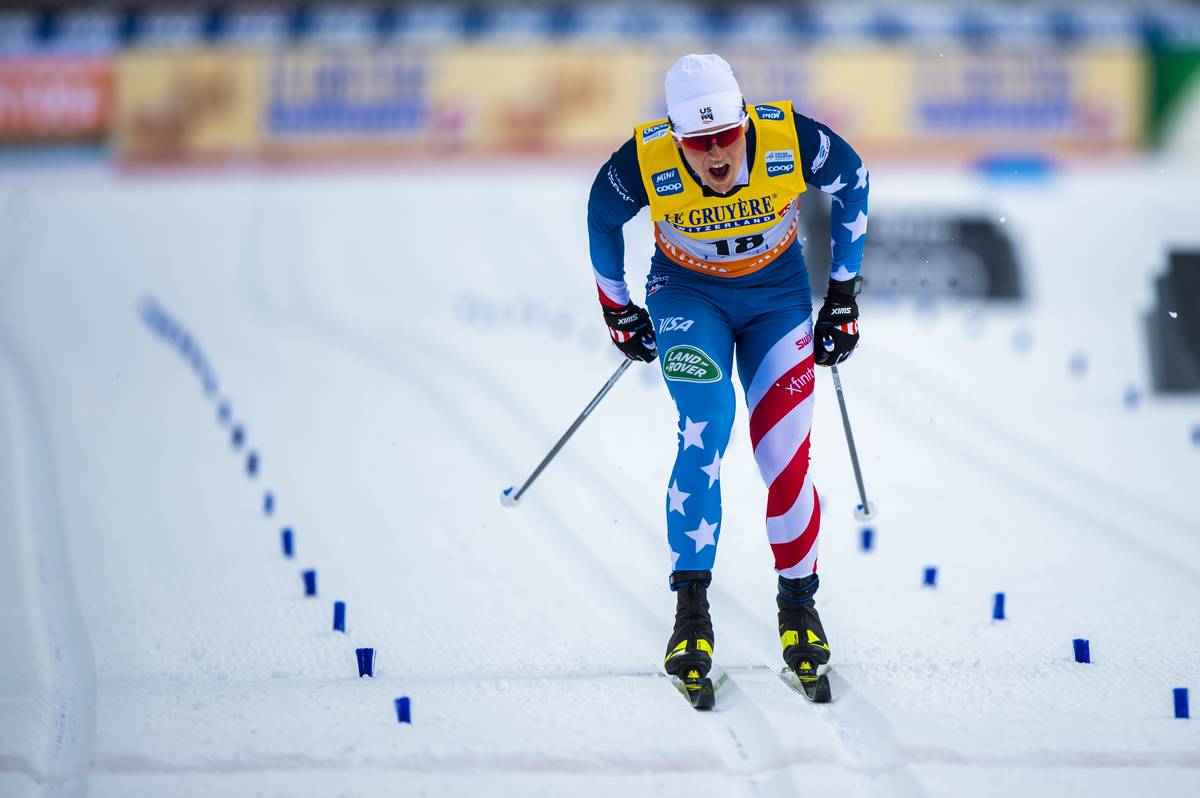
Adam Martin pushes over the line during a 15 k classic in Falun in February, 2020. (Photo: NordicFocus)
His time, and his place in Wausau, were serendipitous in presenting a ready-made opportunity in his own backyard. In the early 2010s, the Midwest was home to a grouping of skiers who would go on to define their generation of American skiing. Martin headed to the CXC Elite Team, where an orbit of skiers that included Jessie Diggins and Kevin Bolger, along with coaches like Jason Cork, Igor Badamshin and Bryan Fish, were all forging the philosophies and approaches to skiing that would eventually influence the direction of US skiing for years to come.
That it was happening was almost hidden by the shabby surroundings in which they were pushing forward. After joining up with CXC, Martin split his time between Wausau, and CXC’s main training site at the Telemark Lodge in Cable, WI. The training environment was spartan, but the facilities couldn’t even strive for that aesthetic – they were just run down. The VO2Max-fitted treadmill hung out in what used to be a shop floor in the Lodge’s old mall, most athlete accommodations still donned the dull color tones of the 1970s, and the old Telemark World Cup trails were overgrown and uncut.
It was out of the way, but it was also all about skiing, which let Martin fully lean into his developing thoughtfulness towards his technique and his training. “I took a lot of cues from Igor [Badamshin] there. The thing that stood out for me was that he was so joyful about skiing, and that joy could extend to looking at every little aspect of things. He’d point out a little thing in technique, and would get incredibly excited about it, and that was contagious.” (Badamshin passed away in 2014; read a FasterSkier tribute to him here).
That attitude extended to new areas of interest too for Martin, who began to take an amateur’s interest in the sports science behind cross-country skiing. “I just bought a standard exercise physiology textbook and think I like read it cover-to-cover. … I started reading all sorts of exercise physiology, and still do.”
Martin’s post-grad year was a fruition and a starting point. Going into a year at CXC, Martin was a skier whose results indicated a huge amount of physical talent and mental intelligence. Then, somewhere in the Wisconsin Northwoods, they melded together, and Martin formed a full-on focused approach to skiing.
But there was a paradox at play too. In developing this holistic approach to skiing, Martin realized he had let go of fitting skiing into his holistic approach to life. “Just focusing on skiing and putting all that pressure on one avenue of my life did not work for me. I really needed to challenge myself mentally and take the pressure off skiing after that post-grad year.”
That led Martin to another natural stopping point in his skiing career, college skiing at Northern Michigan University (NMU) under coach Sten Fjeldheim. “I really fell in love with the sport again under the tutelage of Sten, and with the incredible team environment there.” NMU had long been a waypoint for talented Midwestern juniors – the path that stemmed from JNQ wins to Marquette seemed almost ubiquitous. That meant Martin joined up with a group of teammates that could help him push and be pushed by him.
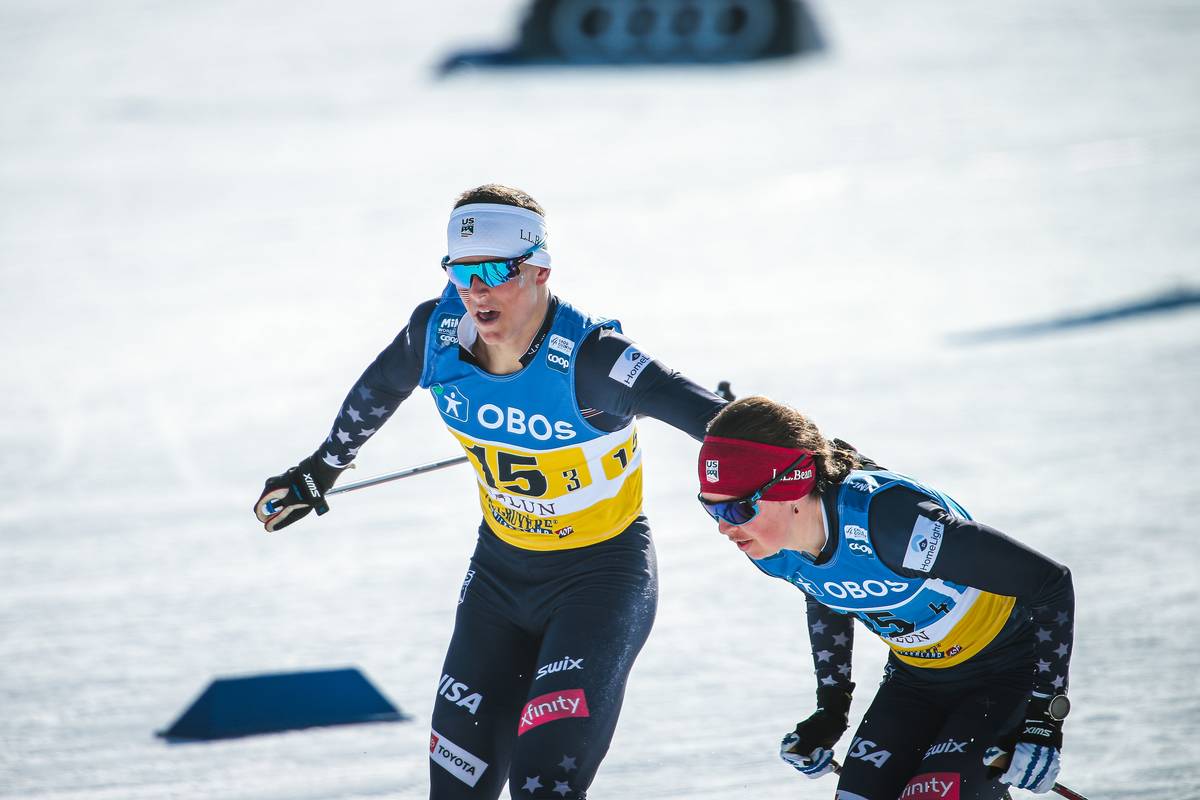
Adam Martin tags Craftsbury Green Racing teammate Caitlin Patterson during a March, 2022 4 x 5 k mixed gender relay in Falun, Sweden. (Photo: NordicFocus)
Like he had when he was a young skier in Wausau, he looked ahead to see what and where his teammates were achieving results, and found cues he could take, saying that “When I was a sophomore, Kyle Bratrud won the15 k skate at Nationals in Houghton. He was a year older than me and that really opened my eyes to say ‘ok, we can do this. That level is achievable.’”
With that long view of what he wanted to accomplish, Martin also found in Sten Fjeldheim a coach perfectly matched to the detailed approach to skiing he had formed. Fjeldheim at the time was somewhere between elder statesmen and guru in his career, which meant that the years that Martin was beyond in his skiing knowledge had found a home. “Oftentimes, before a workout, [Sten] would explain exactly why we were doing it, why we needed to execute it a certain way, and what the physiological effect would be for doing that. That was exciting to me, and it worked really well with how I looked at ski training.”
As important as his coach was the skiers that Martin called teammates during his time at NMU. “That was a rare team environment, we were all super competitive with each other but in a super constructive manner.” During his four years, Martin was part of teams that included former, present, and future US ski team members with Ian Torchia, Zak Ketterson, Kyle Bratud, and biathlete Jake Brown. At the NCAA Championships in 2016, he, Torchia, and Brown combined to put NMU at the top of the team scoring – all earning All-American status in the process. Across both the 10 k Classic and 20 k Skate races, he and Torchia were the top American-born athletes in collegiate skiing.
When Martin graduated in 2017, it was also with a distinction that marked a whole other focus during his time at NMU. He hadtwo degrees – one in mathematics and one in computer engineering. He had taken what he learned about himself during those post-grad days in Wisconsin, moved on up to the U.P., and nailed it.
Adam Martin (NMU) racing to a American-leading 23rd in men’s 15 k classic at 2016 U23 World Championships in Rasnov, Romania. (Photo: Pete Leonard)
With a 23rd in the 2016 U23 World Championships 30 k Freestyle, there were plenty of professional clubs that were interested in seeing Martin continue his skiing career. And he was up for it, if he could continue to take the holistic approach that had seen skiing not be “the only thing” in his life. From a far-flung corner of Vermont’s Northeast Kingdom, a call came in from Pepa Miloucheva, the coach atCraftsbury Outdoor Center’s Green Racing Project. The GRP was a top-level, proven club, and also one uniquely structured to have its athletes take an active role in the sustainability and outdoor recreation–focused activism of the Outdoor Center. “It just made sense,” said Martin on his decision to head to Vermont after graduating. “I was getting into a program that was more than just training…I was able to work with them, take the GRE, take grad school classes, and make it feel like NMU where I was very challenged.”
Again, Martin had put himself in a place where skiing was the thing. A small pocket of rolling hills that were a little bigger than the ones he started out on in Wausau, but rolling, nonetheless.
On the skiing front, things continued to progress for Martin after joining the CGRP. He made his World Cup debut at the 2018 openerin Ruka, where he placed 51st in the 15 k Classic. That season he also notched a pair of 2nd places at US Nationals in the 15 k Classic and the 50 k Classic, while earning consistent World Cup starts throughout that 2018-19 season. Those World Cup appearances culminated in a season-high31st place at the Holmenkollen 50k marathon in March 2019. It was Holmenkollen that year which provided another one of Martin’s realizations about himself as a skier. “I started to learn that my strength as a cross country skier is that my physiology is really geared towards distance – it’s definitely not speed or transitions. Holmenkollen specifically has these grinding features that make you get to your VO2 max and have to stay there for a long time. It’s almost a perfect physiological stress for me.”
Adam Martin during the Holmenkollen 50 k in 2020. (Photo: NordicFocus)
That further stuck out to Martin especially when he returned to the Holmenkollen race the next season, in 2020. “In 2020, it was a low snow year, so we had to do a different course than the traditional 8 k, and it was more focused on transitions. I just learned again, in one race, a lot about myself as a skier. I was just happy to finish.”
That Holmenkollen marathon also marked the end of normalcy in skiing for the next couple of seasons to come. “That was my last race on the World Cup before the pandemic, and then I came home to do the SuperTour in Minneapolis right before the World Cup, and I won. It was my first SuperTour win, and then the pandemic happened.”
Martin was in a weird spot. The markers that he had traditionally used to gauge and reach for new heights in his skiing career would suddenly disappear over the course of the next season. He was making progress, but the road didn’t have as many markers as it did before.
“[The pandemic] was something everyone dealt with differently, right? But I think for me, the big challenge was that the Craftsbury program is traditionally very communal and very close knit. It’s a big group of athletes – like 30 between our skiers and rowers – and traditionally we’re eating in a dining hall, working together, working out together, and sharing the same gym. That was a super vulnerable situation to COVID, so we went from super communal to basically not going into public buildings for that first year.”
Adam Martin races a frosty 15 k in Falun, Sweden in January, 2021. (Photo: NordicFocus)
It was as if someone flipped a switch on the type of training environment that Martin had been in since his days at CXC. His training grounds had always been out of the way geographically, but always included the ability to bounce ideas off his teammates and coaches, to try out new things, and to get feedback then and there. They also had always included a full race schedule, which due to a combination of the COVID situation locally in Craftsbury and Vermont state safety policies, became an impossibility the next season.
When Martin could race, it was internationally. “I was lucky to get a start on the World Cup at Davos in December, but while I was gone, the state of Vermont changed the rules around COVID travel. (At the time, COVID cases were undergoing a spike.) I got back and I couldn’t be on the ski trails in Craftsbury while I quarantined unless it was like before 7am or after 6pm at night. I knew I was lucky to be getting racing in, but it brought restraints that forced you to adapt your training.”
Martin credits the imperatives surrounding COVID compliance with giving him a new adaptability to his training approach, even if the changes he made were more informed by what they always had been – his coaches, his intuition, and his constant searching for knowledge that would lead to improvement. “I think there was some changes in those two years that helped me make some big improvements that were probably independent of COVID, but came about because I felt like the pressure was off again for the first time in a while.”
That intermittent COVID season’s lessons would all come to a fruition in Martin’s skiing at the start of the 2021-22 season. Martin started his season on the US SuperTour circuit, and the SuperTour circuit was to begin in the Midwest. That, for Martin, brought back an extra level of familiarity to the return of a regular racing schedule in 2022. “I was so happy to win that first SuperTour in Cable (in the15 k Classic).”
The early part of the season also saw him call to mind some of the moments that he had once seen teammates achieve back when he was based in his home region. When he came out of the first SuperTour period in 2nd place overall, behind former teammate Zak Ketterson and barely missing out on the automatic World Cup start Ketterson earned, Martin turned towards US Nationals in Soldier Hollow in January.
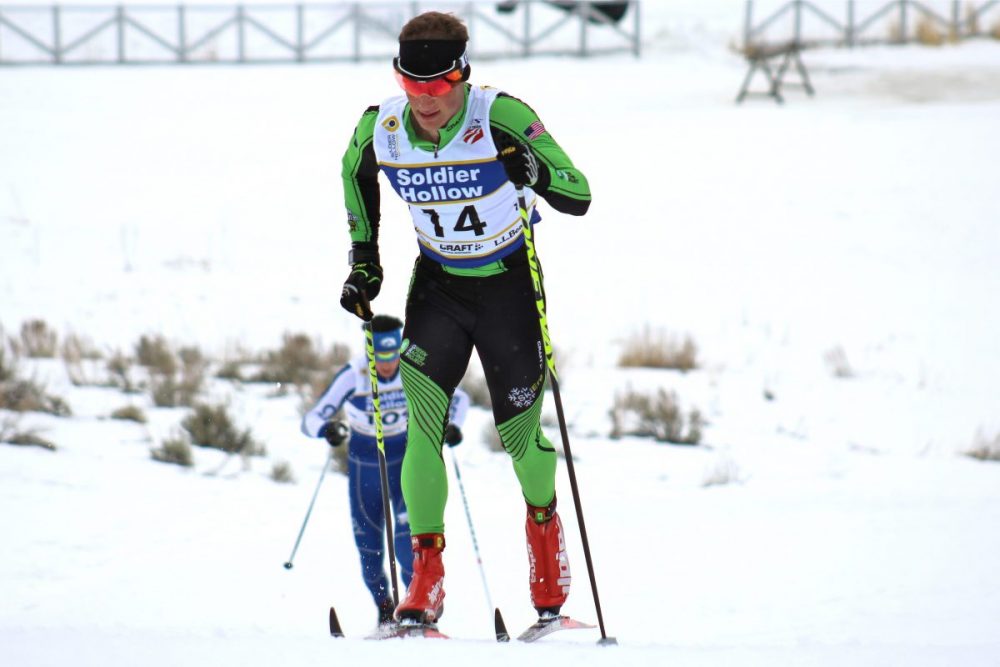
There, on a sunny Utah day, he won the 15 k Classic, a moment that was “particularly awesome, since it was what I watched Kyle Bratrud do at Houghton.” Over seven years, Martin had had the revelation about who he skied with, and then chased down that moment for himself.
Adam Martin at 2022 Nationals in Soldier Hollow. Martin would become a National Champion in the 15 k Classic, a goal he set 7 years earlier after watching then NMU teammate Kyle Bratrud accomplish the feat. (Photo: Tobias Albrigtsen / @untraceableg)
His National Championship and SuperTour results would, in nearly any other season, have seen him shortly to the start line of a World Cup. But for a second winter in a row, COVID was surging (this time as part of the Omicron wave). A slate of World Cups were canceled in January, and the Olympics in February took out any flexibility in the US Ski Team’s lineup. In the Olympic qualifying period, Martin was just behind Scott Patterson for 2nd place in the standings. With a more competitive field than ever before, Martin just missed out on qualifying for the 2022 Beijing team.
From there, he would continue to race the SuperTour, with his consistency throughout the whole season earning that series’ overall title, which he capped off with a win in the15 k classic at SuperTour finals in Whistler. He also would get the nod to race the final World Cup period in March. A period that included, once again, the Holmenkollen marathon.
Martin had a memory and a goal. “I had been 31st there my first time, so I wanted to notch a top-30 finish. I looked at the points list and my bib and knew it was going to be a challenge, but the way the race went out I felt like I could hang onto the pack a little longer than I had before, and with the course being one I knew I liked, I just skied with a confidence that I might not otherwise of had.” That effort and that approach, as it had throughout his career, saw him through to accomplishing his goal. Martinfinished in 26th.
Martin could continue like that – setting goals that, through the constant refinement of his approach to skiing, he would surely accomplish. But that’s where the paradox of his approach comes in again. In powering his skiing through a fine-tuned balance between focus on skiing and focus on other aspects of life, there came a time when the balance would shift towards life. For Martin, that moment is one he says has come:
“What was important to me in professional skiing is giving it everything I have, and that requires a lot of sacrifices. It’s important to me that I’m giving my best effort, and now I give that to other things in my life. I had so much fun this season, and don’t have to step away with any bitter taste in my mouth. Skiing will always be there – I’ll be doing the Birkie or the Noquemanon next year I’m sure, but I’m ready to push myself in a different sense.”
Precipitation was no longer a threat for the final day of racing in Soldier Hollow on Friday, a 1.5-kilometer classic sprint offered alongside the 2022 U.S. Cross Country Championships, yet classified as SuperTour only. However, athletes still faced unseasonably warm weather as blazing sun brought temperatures into the low 50’s on course during the midday heats.
Howling wind and rippling bibs could be heard as background noise as Adam Verrier called the event on the livestream, creating extra work for the athletes who would fight through degrading course conditions throughout the heats. This extra work showed in the times on course; with the combination of freestyle technique and significantly faster course conditions, Sunday’s sprint races featured times over a minute faster on average. A similar difference was seen even between the qualifier today at 9 a.m., when temperatures were still colder and tracks firmer, and the heats which began at 12:30 p.m.
Warm temperatures, degrading tracks, and loose granular spray set the stage for a challenging classic sprint in Soldier Hollow. (Photo: Tobias Albrigtsen / @untraceableg)
“Sprint” seemed to perhaps be a misnomer, as times in the women’s heats climbed over five minutes and were well above four minutes in the men’s heats. Combined with a qualifier, this meant athletes who raced through the final saw between 16 and 20 minutes of racing, testing their endurance and fitness differently from the average sprint event.
Women’s Race: Katharine Ogden on Top from Qualifier to Final
On the heels of a second place finish in yesterday’s 15k classic, Katharine Ogden (USST/SMS T2) set the bar in the qualifier, finishing in 3:51.79.
Julia Richter (U of Utah) was the second fastest qualifier (+0.77), ahead of Lauren Jortberg (BSF Pro) in third (+1.48). Both Ogden and Jortberg won their quarterfinal to advance comfortably into the semis, however, Richter took fifth in Heat 4 and did not advance.
In the first semifinal, two Craftsbury teammates Annika Landis and Caitlin Patterson led the way in the opening climb, with Ogden and Sydney Palmer-Leger (USST/U of Utah) sitting in third and fourth a few strides behind. Descending from the high point, a third Craftsbury racer, Michaela Keller-Miller, had pulled to the front, but was quickly overtaken by Patterson and Ogden as the pack headed into the final short herringbone climb before the long descent toward the stadium. Patterson and Ogden sat in low tucks, letting their fast skis glide as long as possible before transitioning to doublepole as they headed over the bridge and into the finish.
Sydney Palmer-Leger heads out for the 10k interval start classic race during the 2022 U.S. Cross Country Championships in Soldier Hollow. (Photo: John McColgan)
Upping the power in the final 200m, Palmer-Leger accelerated to make contact with Patterson as the women crossed over the bridge, but Patterson had better glide in the quick descent from the bridge’s exit, maintaining an advantage as they headed into the final stretch. Patterson tucked in on the tails of Ogden in the left-most track to go one-two in the heat, with Palmer-Leger not quite in the fight for an automatic qualifier spot finishing 1.5 seconds behind Patterson in third.
In the second semi, Bridger Ski Foundation (BSF) Pro Team members, Lauren Jortberg and Hannah Rudd lead the charging, looking as if their skis were gliding well as they pushed the downhills, perhaps with compromised kick as both showed signs of slipping in the final punchy climb.
In the long glideout, Lauren Jortberg moved from the far left side of the course outside of the track into the second track, losing some time on Rudd who had stuck with the second track from the start. Nevertheless, both held a significant gap over the remainder of the heat as they doublepoled over the bridge and into the finish lanes. Rudd took the win in 4:55.52, roughly +0.7 seconds ahead of Jortberg in second.
A few meters behind, Craftsbury teammates Margie Freed and Alexandra Lawson raced side by side to third and fourth, and as the heat proved to be seven seconds faster on average than the first, both advanced to the final.
As the women’s final headed out of the stadium and toward the first climb, Lauren Jortberg who was the first in a train of two BSF skiers, had her ski stepped on as she was switching from doublepole to a run outside the track. This caused Jortberg to stand up, spin sideways and crash in slow motion. Rudd, who was just behind, quickly moved around Jortberg without going down, soon taking the lead charging up to top of the first climb with Patterson, Freed, and Ogden close behind.
Patterson looked strong with solid kick as she chased a slipping Rudd up and over the final long climb, but it was Ogden on fast skis who quickly moved into second on the subsequent downhill.
Over the last punchy climb the women ran. Heading into the long glideout, Ogden was off the front in the left-most track, but Rudd and Patterson remained within reach a few ski lengths behind. Descending off the bridge, the top three accordioned together, all choosing the same track with Ogden confidently leading the way to the finish. Patterson, who was in third, moved into her own lane to the right, slowly gaining ground on Rudd as they headed to the line.
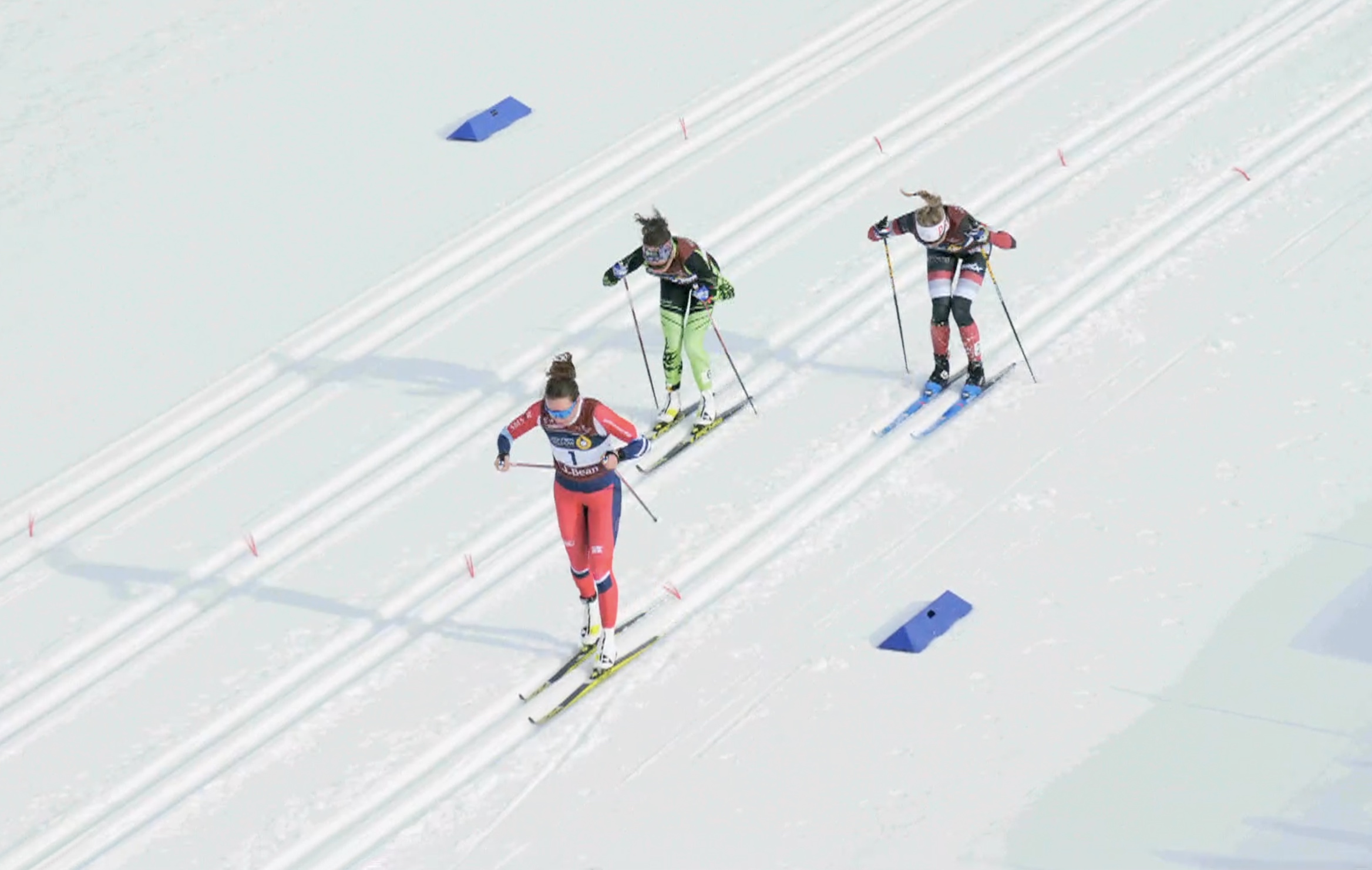
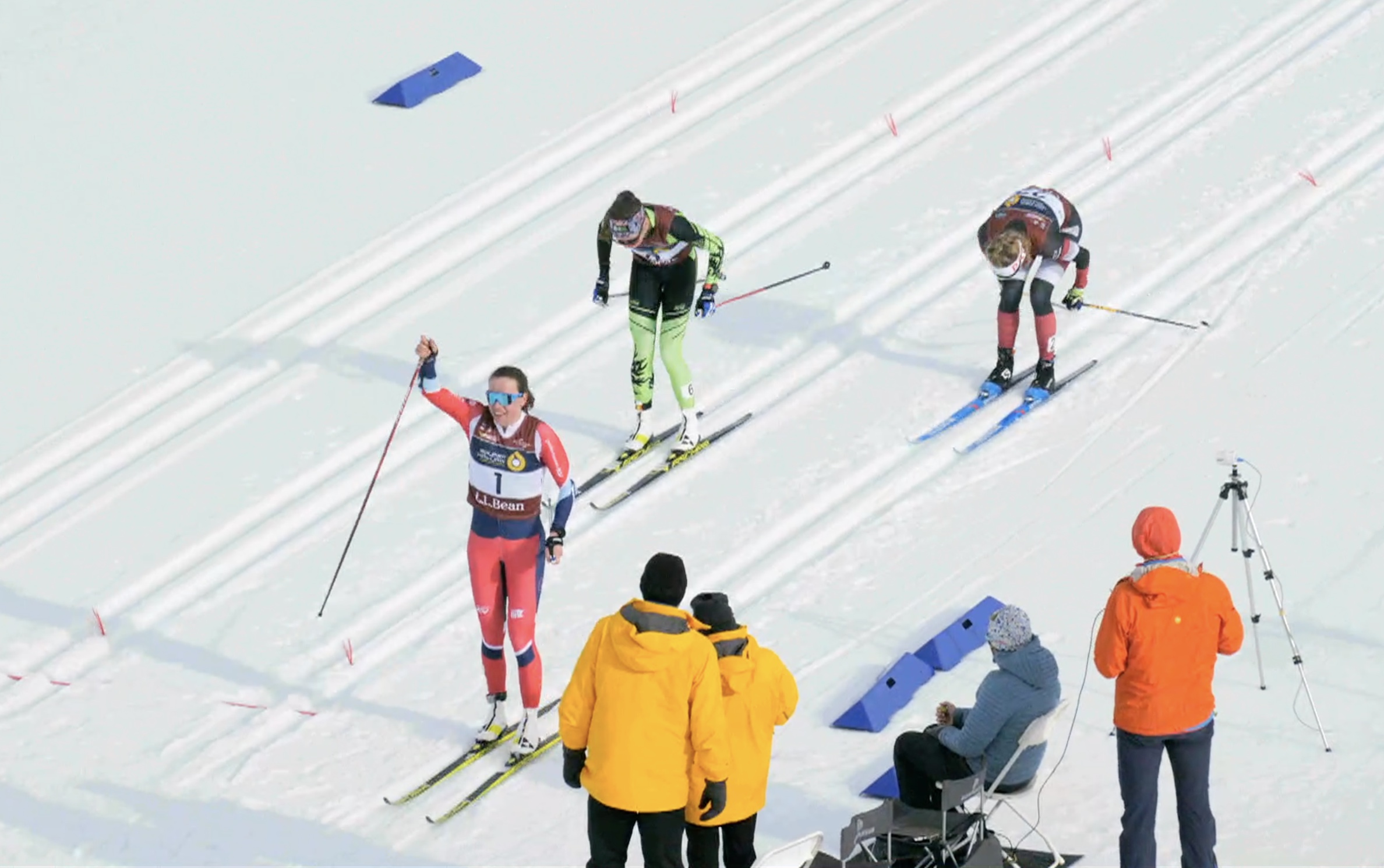
Katharine Ogden leads Caitlin Patterson and Hannah Rudd to the line during the SuperTour classic sprints in Soldier Hollow. (Photo: Livestream Screenshot)
Ogden maintained her lead to stop the clock in 5:01.63, while Patterson edged out Rudd for second (+0.98) and third (+1.53), respectively. After regaining contact with the pack following her crash, Jortberg finished fourth (+6.64), with Lawson fifth (+7.11), and Freed sixth (+21.55).
“I was having a lot of fun out there today!” Ogden wrote to FasterSkier after the race. “The sprint was definitely on the long side, especially late in the day, but that did not significantly affect my strategy; I am confident in my endurance as well as my short duration power. I was really excited to have fast skis from Pat [O’Brien] and it was fun to experience the high level of sprinting in the U.S. currently. I also haven’t really done a full sprint day in a while so that was a lot of fun! It was also so impressive to see Caitlin get her fourth podium in as many races and to see Hannah Rudd have an incredible breakout performance today!”
Katharine Ogden celebrates her win in the classic sprint while Caitlin Patterson edges out Hannah Rudd for second and third. (Photo: Livestream Screenshot)
In a post-race email, Patterson reflected on her experience racing through the heats.
“My racing today went fairly well, and it was a beautiful day to be out skiing and spectating,” wrote Patterson. “The sun-warmed snow became quite wet and broken apart for the heats, and combined with the wind, it certainly made a long sprint with plenty of herringbone and some sloppy tracks. I tried not to really think about the time duration much, it was mostly about getting from start to finish, however long it would take. All of the heats required some scrappy skiing, moving around through the slush and timing the length of the tuck. Now I’m really looking forward to some recovery after a good week!”
Patterson also spoke to the week of racing in Soldier Hollow, where she finished on the podium four times in as many races, including wins in both the 10k individual classic and the skate sprint. But she was not the only person in a green suit putting together a successful week. Yesterday, she shared the distance classic podium with teammate Adam Martin. On Tuesday, Crafstbury went 3-4-5 in the 20k skate, with Lawson and Freed leading a chase group behind Frankowski and Patterson. And today, five CGRP women raced in the semis, with three advancing to the final.
“Everyone at Nationals is really feeling the fatigue, and myself and my team were no exception out there today. The race coughs are becoming quite terrible from so many days of racing at altitude, which is not the most fun to be coughing uncontrollably in this time of COVID. However, I was really proud of our whole team, with 5 women in the top 10! We have a really strong group, as evidenced by the performances in the distance races too; it came as no surprise to me that the women were awesome today, because training and doing intervals all summer and fall we’ve been neck-in-neck and pushing each other.”
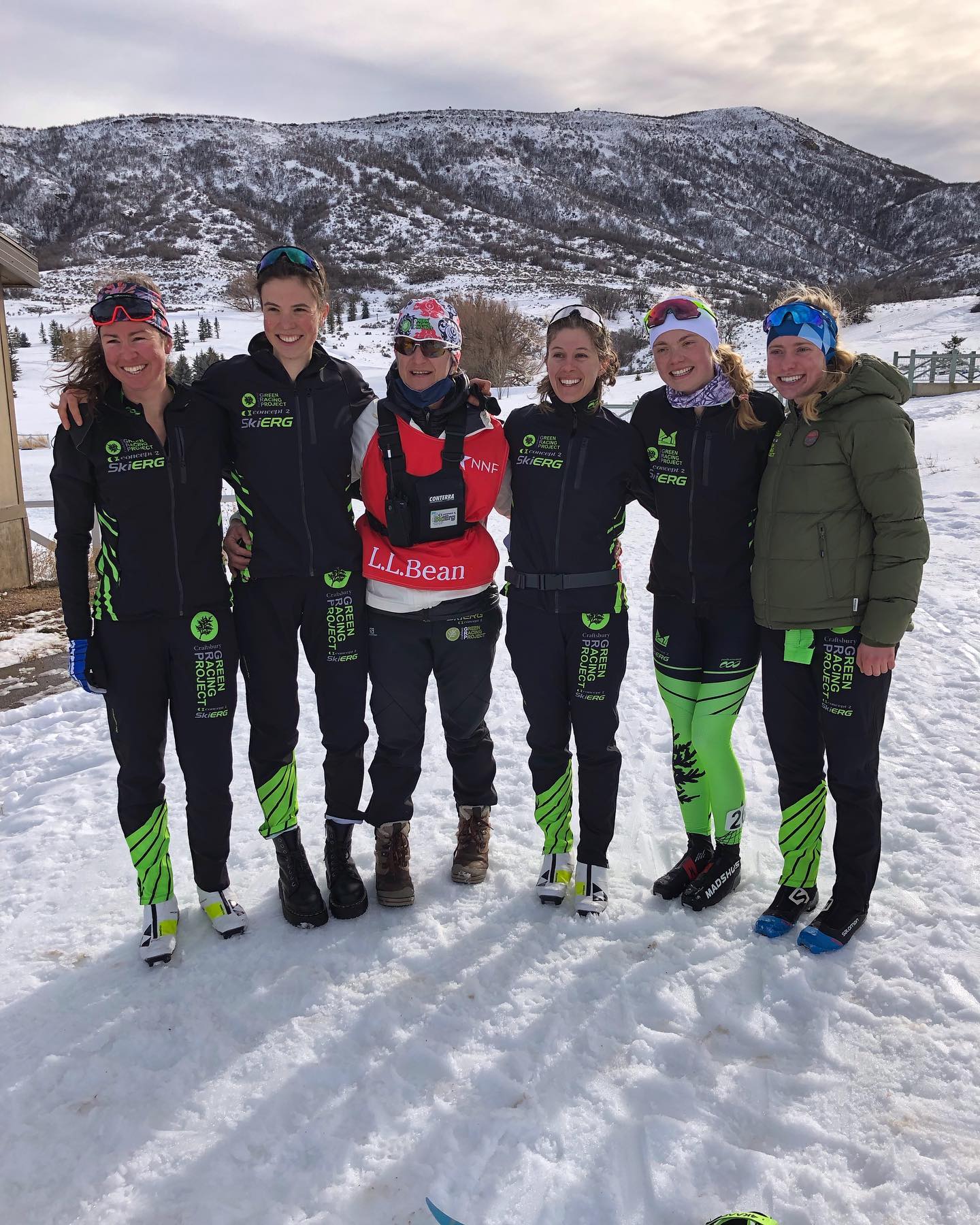
The women of Craftsbury with coach Pepa Miloucheva. CGRP put five women into the semifinal and three into the final of the SuperTour classic sprint in Soldier Hollow. (Photo: Facebook Crafsbury Green Racing Project)
For Rudd, this was her first career SuperTour podium. Originally from Plymouth, MN, she graduated from University of Alaska Anchorage (UAA) in May, 2020 before heading to Bozeman to join the newly minted BSF Pro Team. Placing in the top-10 in each of the three stages of the 2022 U.S. Cross Country Championships, Rudd has steadily worked her way up the results list, finishing 10th in Sunday’s freestyle sprint, 8th in the 20k mass start free, and 6th in the 10k interval start classic. She ends her week in Soldier Hollow on a podium high note.
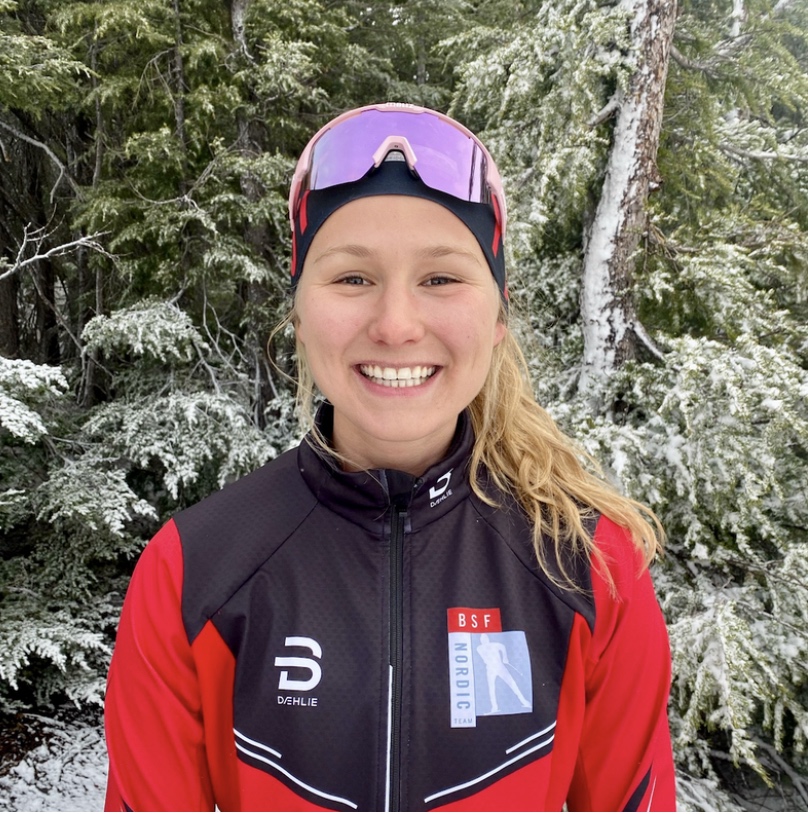
Hannah Rudd is a member of the BSF Pro Team based in Bozeman, MT. (Photo: bridgerskifoundation.org)
“Yesterday was a pretty exciting day for me!,” Rudd wrote to FasterSkier after the race. “The sprint course at Soldier Hollow this year was very challenging as it included three solid climbs. During the qualifier, the course remained very firm and fast. However, the temperature quickly began to rise throughout the day, and by the time the quarterfinals began, the sun was baking the course, the wind was blowing, and temps were nearing 50 degrees. This made the snow begin to transform and slow down and turned the tracks into mashed potatoes in some sections.
“I woke up in the morning feeling quite tired from the past week of racing so I was not sure how the day was going to play out,” Rudd continued. “I ended up qualifying in 22nd, so it was clear that I had some work to do in the heats. I felt like I was able to gain momentum and energy throughout the day, and progressed through the quarters, and semis and onto the final. Going into the final, I knew that my team’s skis were running really well so I tried to ski big and relaxed and put myself in a good position for the last downhill. It was pretty neat to be in a final with my BSF teammate Lauren Jortberg, who is an incredible sprinter and someone that I have learned a lot about sprint racing from over the past few years. I was extremely excited to land myself a spot on the podium and think it will help me to continue building momentum and confidence for the rest of the season!”
The podium ceremony for the women’s final following the SuperTour classic sprint in Soldier Hollow. Katharine Ogden took the win ahead of Caitlin Patterson and Hannah Rudd, with Lauren Jortberg 4th, Alexandra Lawson 5th, and Margie Freed 6th. (Photo: Facebook Craftsbury Green Racing Project)
Men’s Race: Colorado’s Magnus Bøe Upsets Schoonmaker in the Final
In qualifying, JC Schoonmaker (USST/UAA) showed why he has been the U.S. Ski Team’s most reliable fixture of World Cup Classic heats this season, winning the qualifying with a time of 3:08.43, 6.42 seconds ahead of 2nd place Peter Holmes (Sun Valley SEF). Andreas Kirkeng (University of Denver) rounded out the top 3 (+6.57), in a field where the top 30 were all within 20 seconds of each other.
With a dominant performance in qualification, the racing throughout the day always seemed to have one eye on where Schoonmaker was in the field. In his quarterfinal, Schoonmaker looked to start conservatively from the back of the field, which led the whole heat to sit back as well. When he moved to the front at the beginning of the first climb, the race surged forward with him. No one could match him, however, and he finished with a comfortable lead, with Kjetil Bånerud (NMU) taking the 2nd semifinal spot (+1.02).
JC Schoonmaker prepares for a sunny and warm classic sprint in Soldier Hollow. (Photo: Tobias Albrigtsen / @untraceableg)
The following two quarterfinals also previewed the competitors, and their preferred way of attacking the course, that would define the semifinal and final racing later on.
The second heat set a stark contrast in pace to the previous heat, with Noel Keefe (U of Utah) and Bill Harmeyer (SMS T2) leading the field out hard from the gun. Hunter Wonders (APU) and Johnny Hagenbuch (SVSEF) were able to keep with the pair though, and ended up out-sprinting Keefe and Harmeyer going into the finish. Still, the duel between Keefe and Harmeyer led to a blistering pace for the heat overall, and they would claim the lucky loser spots for the semifinals.
Then came the 3rd quarterfinal, featuring winner of today’s most aggressive racer award (unofficially handed out here, by Fasterskier), Ian Torchia (SMS T2), who in every heat he was in today would hammer out to the front of the pack while others seemed content to let the field play out. He was joined in the heat by Magnus Bøe (U of Colo.), who made his move on the first climb, stayed out in front, and came through in first place. Torchia, meanwhile, held onto second to advance automatically to the semifinal.
The semifinals marked more an amalgamation of race strategies than anything unique. But it was an amalgamation – which requires multiple parts. And indeed, on a course known for rewarding smart-racing, and in conditions – above freezing, on man-made, wind-swept snow – that reward smart waxing as well.
Magnus Bøe and JC Schoonmaker are off the line during the 2022 U.S. Cross Country Championships freestyle sprint stage. (Photo: Tobias Albrigtsen / @untraceableg)
The first semifinal featured Schoonmaker and Bøe, both of which stayed back in the back during the early part of the course. Going into the first climb, Bøe took a look back, saw Schoonmaker and Harmeyer were sitting in fifth and sixth place, respectively, and decided to attack. He led over the top, into the downhill, and up the final climb. Schoonmaker successfully did maneuver through the pack to counter the move, and on the final climb took the outside line up, cutting in to tuck behind Bøe going into the final downhill. When they came up, Schoonmaker had used the draft to put himself out front, while Bøe held off a late-surge from Hunter Wonders (APU) to take the second qualifying spot into the finals.
The second semifinal was again led out by Ian Torchia, who was then followed by former sprint National Champion Tyler Kornfield (APU). Kornfield seemed content to sit behind Torchia until the first climb, when he put in a burst of speed and broke open the field. The smartest racer, however, may have been Karl Schulz (SVSEF), who rode Kornfield’s attack, and then drafted, to go into the final climb with speed. By the time he hit the downhill, he had a gap which would remain unclosed. Kornfield, who had gone into the downhill in second, found himself joined by Noel Keefe and Ian Torchia into the final sprint for the second spot. As it would happen, all three would make it through to the finals, with Kornfield in second, and Keefe and Torchia being rewarded for their efforts early in the race by claiming the two lucky loser spots to the final.
The A-final then looked like this: JC Schoonmaker, Magnus Bøe, Karl Schulz, Tyler Kornfield, Noel Keefe, and Ian Torchia.
JC Schoonmaker races the qualifier during the SuperTour classic sprints in Soldier Hollow, UT. (Photo: Tobias Albrigtsen / @untraceableg)
With memories of Schoonmaker’s dominating qualifier in mind, it seemed like the field orbited around him off the line. Schulz found himself in front, but not going full bore to open the field up. Even Torchia, when he did make a move to the front, didn’t seem to do so with the same force that had marked his quarter and semifinal attacks. Schoonmaker waited until the first climb to move to the front, and then the final really was on. Schultz seized on the attack, and then put an extra-push into the downhill to try and open up an unclosable gap like he had in his semifinal. It was a good move, but one that didn’t prove to have the same force as his previous attack, and going into the final climb he was joined up with Bøe and Schoonmaker.
Then, Schoonmaker’s pace seemed to drop-off, with a few noticeable slips that progressed into a herringbone. Bøe, meanwhile, went for the herringbone from the get-go. He was the one that made contact with Schulz before the course gave way to a final downhill on the day. Schultz held a gap on the field through the glideout and over the bridge, but it proved not to be enough of a margin to feel comfortable in the final stretch. Meanwhile, Schoonmaker had fallen back to fifth.
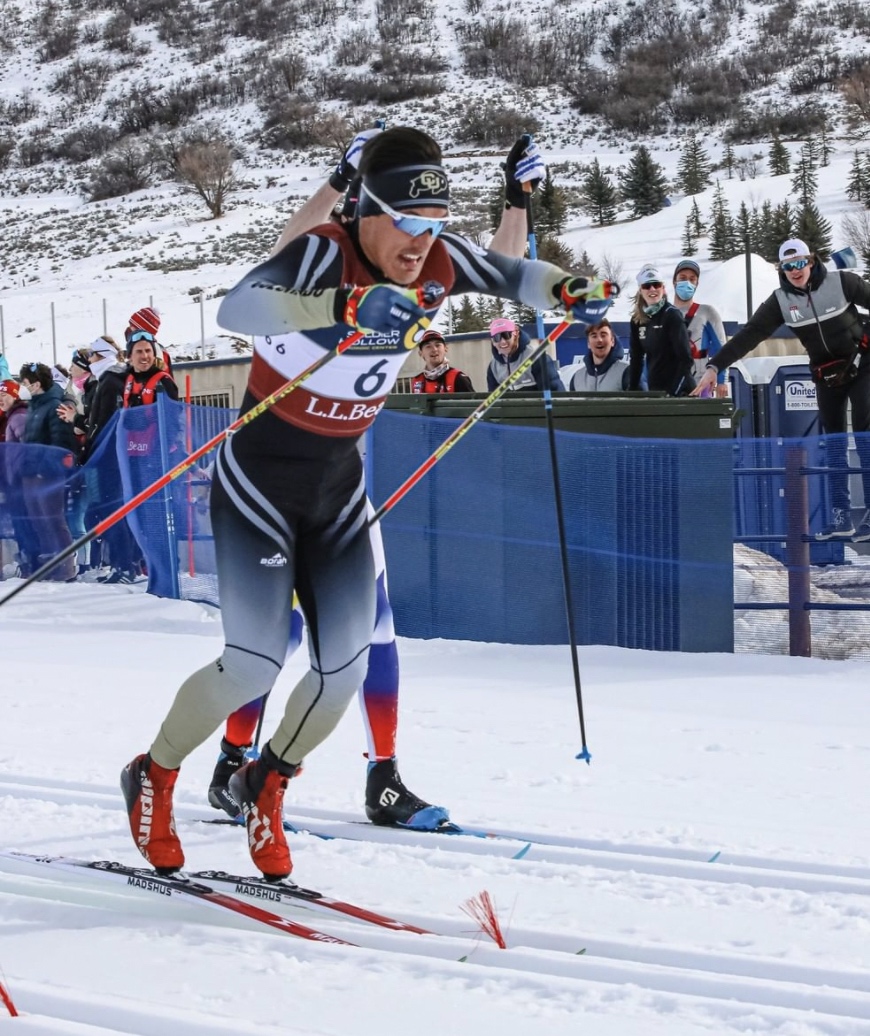
Utilizing his dominating doublepole sprint, when they hit the final 100m it was all Bøe, who closed a significant gap to catch Schulz in the final 50 meters. Looking as if he was leaping forward with each push, Bøe switched lanes, overtaking Schultz just before the line and letting out a fist pump as he realized a SuperTour – and collegiate – victory in a time of 4:08.28. Pushing to the line, Schulz was a close second (+0.35). (Video clip here.)
Magnus Bøe overtakes Karl Schultz just before the finish of the men’s classic sprint final. (Photo: Instagram @cubuffs)
After a gap, Schoonmaker, who was fighting for the final podium spot alongside Kornfield and Torchia, crossed the line outside of the track in third place (+4.53). Kornfield was a half second back from Schoonmaker for fourth (+5.10), with Torchia fifth (+5.64), and Keefe sixth (+11.02).
After the race Bøe explained that he changed his tactics in the heats relative to Sunday’s freestyle sprint, though he joked he thought it wise not to reveal everything.
“Today was a windy and slow-condition day,” Bøe wrote in an email. “There was headwind in the first half, and tailwind in the second half. Hence, pulling during the first half would be pointless. Furthermore, the second half, particularly for the last downhill there was very little to gain on the slipstream, due to the low speed and the ‘suctiony’ snow (cold conditions create better glide for the person coming behind on ‘heated tracks’). Therefore during all my heats I pretty much went all out from the top of the last uphill all the way to the finish, which on sunday would’ve been a suicide.”
Bøe walked through the final, including how he reacted to lead changes and adjusted his strategy when the race began to play out differently than anticipated.
“The final started off very slow, but then the positioning battle developed gradually from under the bridge. My main focus was to keep my eyes on JC, since he was clearly the favorite of the day, and I knew I would do well if I laid it up to beat him. Hence I never fell for the temptation of passing him, even though I had many chances of doing so. However, he did get tired during the last climb and tried to get others to pass him. This is when Karl took off and gained a massive gap that at first seemed too late to close. As soon as I realized that JC might not be able to catch up, I committed to catching Karl by myself. I made sure to put in a great push before the downhill straight, and did the ‘supertuck’ to gain every single inch I could. Once I started double poling towards the last bend it was just heads down and maximum effort. Was never certain I would catch Karl, I thought maybe he’d have something left at the very end. But lucky for me he didn’t and I had just enough to pull it off.”
University of Colorado’s Magnus Bøe heads out for the men’s 30k mass start free during the 2022 U.S. Cross Country Championships in Soldier Hollow. (Photo: Tobias Albrigtsen / @untraceableg)
A dual citizen of Korea and Norway, 23-year-old Bøe has already built a robust resume in international ski racing, including competing for Korea during the 2018 Olympics in Pyeongchang. Earlier this week, Bøe was fifth in Sunday’s freestyle sprints and finished 11th in the 15k classic. His only down race of the series happened in the 30k mass start freestyle, where he finished 43rd (+12:30.9).
“This week of racing has been up and down, from a miserable 30km where I got lapped, to today’s win. It’s been a lot of fun, and not least has been helpful for my shape. Next up is the Super Tour in Sun Valley, which I am looking forward to. Think I would be able to build on top of what I gained during this week.”
For Schultz, today also marked a career-first SuperTour podium. The 23-year-old Lake Placid, NY Native raced for the University of Vermont (UVM) until graduating in May, 2020, then heading to Sun Valley. Schultz had a podium just-miss earlier this year in a freestyle sprint where he finished fourth during the opening weekend of SuperTour racing in Duluth, MN.
“I was pretty fatigued from the three races prior,” Schultz wrote after the race. “I knew there was a decent headwind on that first climb, so I decided I’d tuck in behind up and over the first climb. I figured I’d need to save my strength for the final climb and long finishing straight, so I played my cards well and pushed where I needed to, and it just worked perfectly. I’ve learned sprinting is about preserving energy for critical parts of the course, it couldn’t have gone better.”
“And I won’t lie,” Schultz continued. “The spectators and everyone cheering allowed me to find another gear, especially up the last climb. I dug deeper than I have before.”
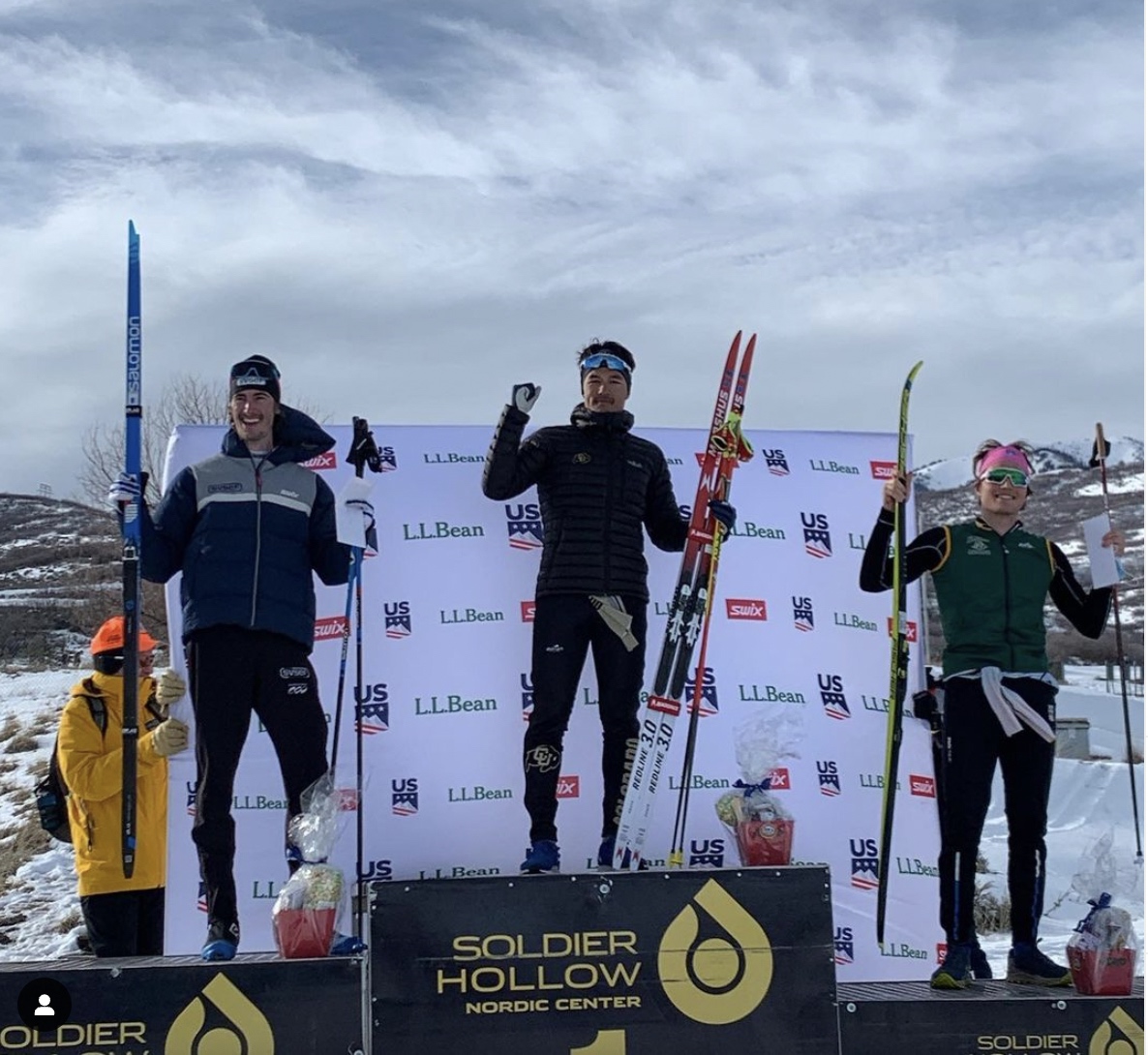
The men’s podium of the SuperTour 1.5k classic sprint in Soldier Hollow: Magnus Bøe took the win ahead of Karl Schultz and JC Schoonmaker. (Photo: Instagram @nysefnordic)
Writing to FasterSkier after the race, Schoonmaker explained how changing conditions forced athletes to make tough decisions about skis as well as tactics.
“It was a pretty crazy difference from this morning to the afternoon,” Schoonmaker explained. “The morning was icy and fast and the heats got really sloppy and slow. I had amazing skis in the morning and in the heats I struggled a bit with choosing whether to go for more kick or glide. I ended up asking for less kick to free the ski up a bit and I’m still not sure what was the right call. It was just really challenging conditions.”
Schoonmaker also explained that he had made fewer adjustments to the technique he had found such success with in Sunday’s skate sprint, however, the final proved to break the mold of what has historically proven to be the recipe for Soldier Hollow sprint racing.
“For this course I tried to take a somewhat similar approach as in the skate race by respecting the draft on the last downhill and trying to be careful about the guys behind me there. In the quarterfinal I felt I was able to ski away and create a big enough gap so that I couldn’t get sucked back in by the draft. In the semifinal, I tried to stay more in the pack and use the draft for myself. The final was tricky because I was going to try and use the draft again but Karl put in a really good move on the last hill that I couldn’t match. Then I was leading the rest of the pack and I decided to push over and try to catch Karl rather than go to the back to find the draft. It ended up not working out so great, but I’m happy with the day and the tough effort.”
We conclude a week of racing at Soldier Hollow, then, with a race that highlighted the strength and depth of the domestic circuit of U.S. skiing at present. Variable conditions on a technical course, which racers approached with tactics as diverse as the regions they hail from, indicated that this is a field that represents top-level racing. It was a testament to the development and growth of the sport in this country that a top-level racer like Schoonmaker can come off the World Cup and find a field where every heat is raced with closeness and intensity in his own country. That bodes well, and is a great place to leave the last national gathering of the US ski racing community before its best representatives look to take a crack at the Olympic Games in Beijing next month.
The spirit of the sport captured at the finish line as Alaska Winter Stars athlete Meredith Schwartz embraces her coach at the finish of the classic sprint in Soldier Hollow. (Photo: Tobias Albrigtsen / @untraceableg)
FasterSkier extends congratulations to all athletes who competed in Soldier Hollow this week, commending their efforts in a fiercely competitive field through a variety of race formats and course conditions. Also, a big thank you to Tobias Albrigtsen and John McColgan, who generously shared their photos with us throughout the week. Stayed tuned for an upcoming gallery highlighting many of the fantastic images that were not included in our reports.
Coaches: Pepa Miloucheva (head coach); Michael Gibson (biathlon coach); Nick Brown (assistant coach and wax tech); Ethan Dreissigacker (assistant biathlon coach)
Current roster (skiing and biathlon): Braden Becker, Adam Martin, Akeo Maifeld-Carucci, Caitlin Patterson, Michaela Keller-Miller, Margie Freed, Annika Landis, Alex Lawson (skiing); Jake Brown (Luke’s brother), Raleigh Goessling, Hallie Grossman, Susan Dunklee, Kelsey Dickinson, Tara Geraghty-Moats, Clare Egan, Luke Brown (Jake’s brother) (biathlon)
Who’s new: Luke Brown joins the team for biathlon, coming from Crosscut; Carsen Campbell joins the team for biathlon, coming from Rocky Mountain Racers; Tara Geraghty-Moats rejoins the team for biathlon, coming from nordic combined; Annika Landis joins the team for skiing, coming from Sun Valley; Alex Lawson joins the team for skiing after graduating from Middlebury this spring
Who’s still on this team, or otherwise involved in American skiing, from when we did this in 2012: Caitlin Patterson (athlete, skiing); Susan Dunklee and Clare Egan (athletes, biathlon); Maria Stuber (head nordic coach, St. Scholastica); Patrick O’Brien (head coach, SMS Elite Team); also, former CGRP teammates Pat O’Brien and Ida Sargent got married this summer
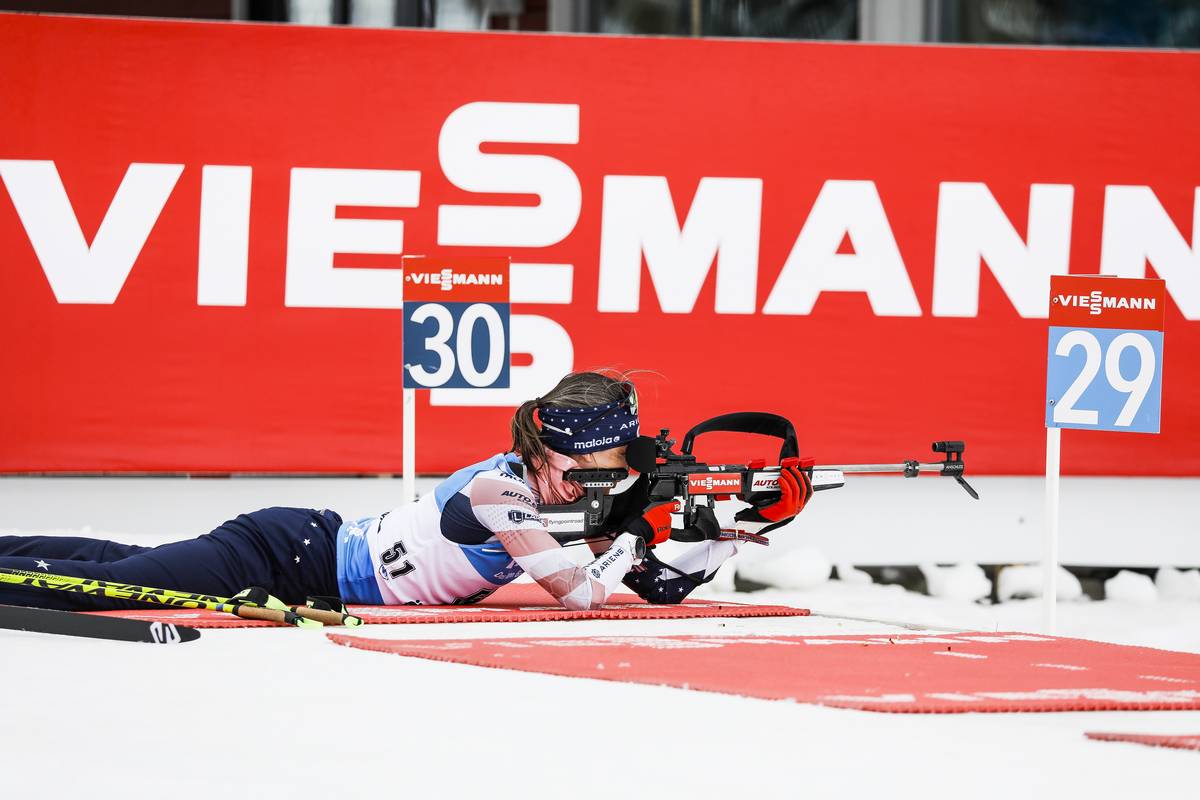
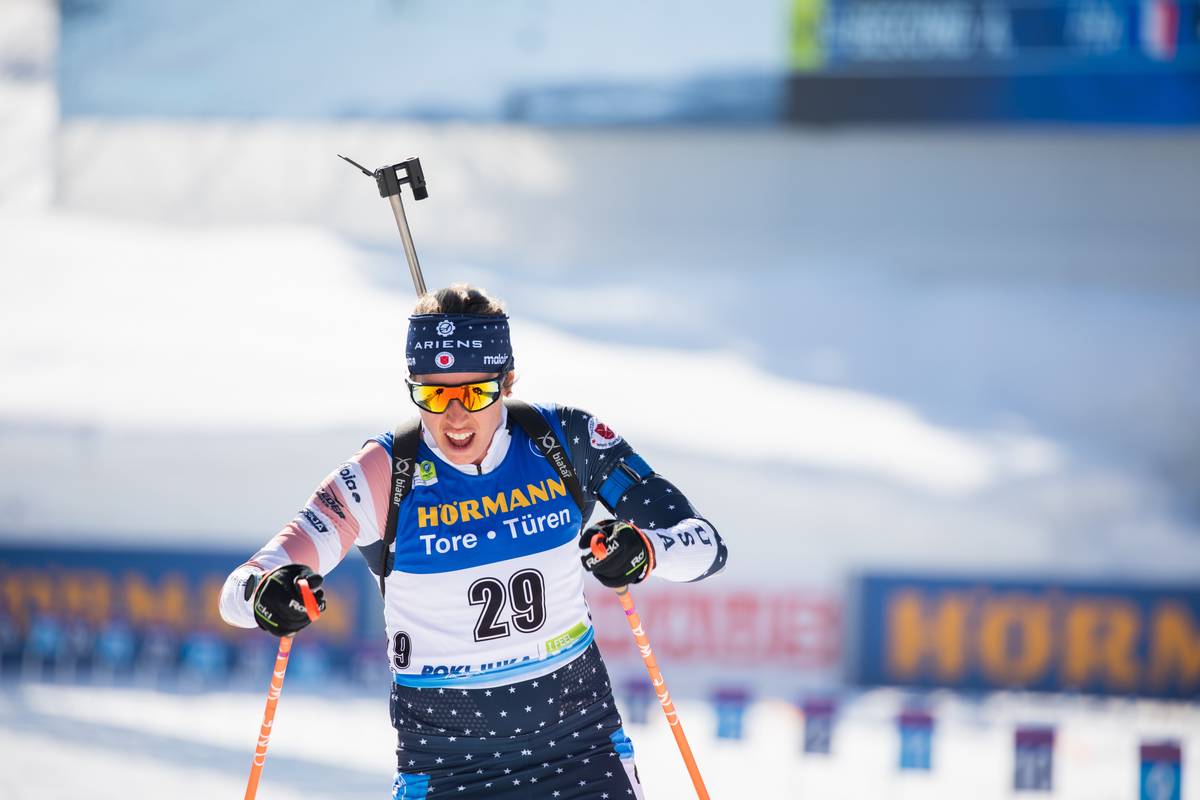
Susan Dunklee in Pokljuka, Slovenia, February 2021. (photo: Manzoni/NordicFocus)
Top results last season: Starting with biathlon: The redoubtable veteran Dunklee finished last season on a strong note with two individual eighth-place finishes in Nové Město, one in sprint and one in the pursuit. She teamed up with Sean Doherty for the country’s first single mixed relay World Cup podium since Lowell Bailey and, well, Dunklee, in 2017. Egan had a pair of top-10 finishes, 9th and 10th in Hochfilzen, and was a member of two sixth-place relay teams. Dunklee and Egan are both already qualified for the Beijing Olympics. Jake Brown was on a sixth-place mixed-relay team in Nové Město and had a season’s best of 12th in individual races, in the sprint in Pokljuka.
Moving on to nordic combined: Geraghty-Moats won the only regular-season women’s noco race that was able to be held last year, in Ramsau, to take the inaugural overall title, while garnering praise as a trailblazer for women’s sports. She was fifth at World Champs in Oberstdorf.
And finally, on the nordic trails: Patterson raced on the World Cup from Ruka through the end of January, including finishing 34th overall in the Tour de Ski. She was on a fifth-place relay team in Lahti, and had individual World Cup bests of 27th, 29th, and 30th. Martin had three World Cup starts in distance races, with a best of 44th in Davos. Lawson was 24th at World Juniors in the 10 k skate.
Tara Geraghty-Moats racing at World Champs in Oberstdorf, February 2021. (photo: Modica/NordicFocus)
Coach’s comments: Pepa Miloucheva writes, “Summer and fall training for GRP was good and mostly went as planned. This spring we officially added Alex Lawson, although she was here last year too and the only other addition was Annika Landis, who joined us after a year in Sun Valley.
“The whole team stayed and trained in Craftsbury through August. Waverly Gebhardt and Rena Schwartz trained with us as part of the summer U23 program and with our GRP biathletes here we had a really solid training group.
“Michaela had a setback early summer, broke her ankle and had to have surgery, but she kept really good fitness by spending hours on the SkiErg and was able to join the rest for the ski camp in September.
Adam Martin racing in Davos, December 2020. (photo: Modica/NordicFocus)
“Early September we went to Oberhof, Germany, for just over two weeks of training in the ski tunnel. This was our first trip since the pandemic, so I was little nervous, but everything worked out really well. The first few days the focus was on technique, transferring on-snow improvements athletes worked on during the summer. Second part was a solid speed block. Luckily there ware only a few other skiers [in the tunnel] at this time so we ware able to have really high quality intensity sessions.
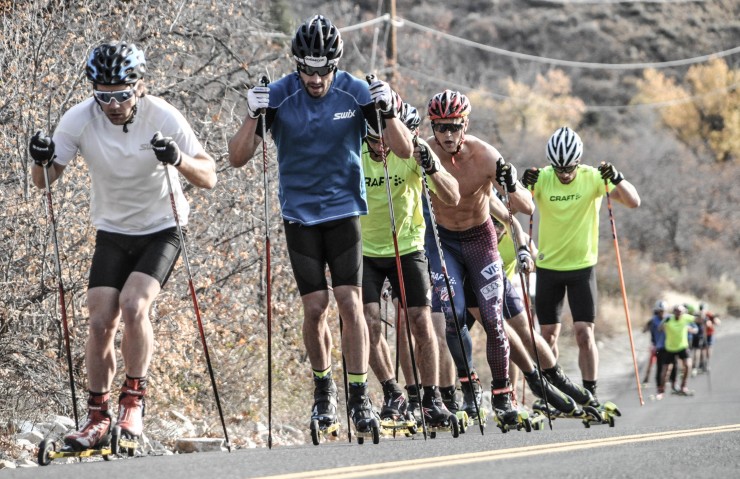
“After a few weeks training at home and having incredible fall weather we packed up bags again and went to Park City for two weeks of elevation training. First part of the camp was lots of volume, some L3, a few athletes even hopped in a rollerski race at SoHo for fun. Second week we lowered the volume, had a couple mellow days, and finished the camp with a couple solid TT efforts to gain some experience racing at this elevation in preparation for Nationals.
“Back home athletes took a few easy days post-Utah. I did some testing, where a few records were broken, which was exciting to see, and now we are concentrating on race prep. Caitlin Patterson left for Europe [on Nov. 17], she will race the first WC period and in less than two weeks we all are about to hit the road for a month and a half.
Caitlin Patterson racing in Lahti, January 2021. (photo: Vianney THIBAUT/NordicFocus)
“Last year we were totally sheltered here at the center, didn’t travel at all, didn’t go to any camps, didn’t go to any races outside Craftsbury. Although we had everything we need here and the outdoor center staff was incredible, taking really good care and keeping us safe and healthy, it was mentally very hard on the athletes not to be able to race against the other regions. So this year I’m excited for this team to have a more normal race season and to see what they can do, as they worked really hard for it.”
The 2021 Bridger Ski Foundation squad. (photo: courtesy BSF)
We tend to highlight World Cup races on this website, but those results, and those athletes, don’t happen in a vacuum. Skiers are made in the summer, as the well-worn saying accurately has it, and summer training means time spent with a domestic ski club. So we’re going to be highlighting the athletes on several prominent American ski clubs over the next few weeks, only a small portion of whom will be starting on the World Cup this fall.
If World Cup skiers are the pinnacle of a pyramid, then their club teammates are the indispensable supporting layer just beneath them. Go back and peruse one of Jessie Diggins’s multiplepostshighlightingthe importance ofherteam. Diggins doesn’t say, “I’d like to thank my teammates who ski with me on the World Cup, and only those teammates.” Diggins instead, of course, just says, “I’d like to thank my teammates.” There’s not much place for pedigree when you’re digging deep in bounding intervals in July, months and miles away from snow-covered European race courses.
Stratton Mountain School athletes, including Alayna Sonnesyn, far right, rollerskiing in Vermont in summer 2021. (photo: courtesy SMS)
This isn’t just an attempt to make club skiers feel good, either. Consider Caitlin Gregg’s World Championships bronze in 2015, Chelsea Holmes’s 13th in the 2017 World Championships 30km, Rosie Frankowski’s 21st in the 2018 Winter Olympics 30km. None of them was on the national team at the time of this breakthrough result; all of them were “just” club skiers. There are larger, complicated questions here about the interplay between the domestic race circuit and the World Cup when it takes so much time and money to travel between America and Europe, and World Cup–based skiers seldom race SuperTour-based skiers head-to-head, but it seems fair to say that some Americans racing at home are comparable to some Americans racing overseas.
(It also seems fair to say that the fact that Holmes was the third alternate on that memorable day, and got the start only after two U.S. Ski Team athletes, who were also her club teammates, turned it down, speaks to some of these larger questions.)
All that said, please enjoy our preview of six domestic ski clubs and their athletes, starting tomorrow and continuing over the next several weeks.
APU athletes maintaining early-pandemic social distancing, Hatcher Pass, May 13, 2020. (photo: courtesy Sadie Maubet Bjornsen)
This is not the first time that FasterSkier has written such a preview, but it is the first time in a few years. And compared to prior installments in this series, the ecosystem of American skiing has become notably more homogenous, at the same time that American skiing has become more successful. Here are the six clubs that we will preview this fall:
Alaska Pacific University Nordic Ski Center
Bridger Ski Foundation
Craftsbury Green Racing Project
Stratton Mountain School
Sun Valley Ski Education Foundation
Team Birkie
And here are the twelve clubs featured in, for example, summer 2012 (links to the whole series are at the bottom of this article from November 2012, if you’d like to really go down memory lane for a bit):
Alaska Pacific University Nordic Ski Center
Bend Endurance Academy
Bridger Ski Foundation
Craftsbury Green Racing Project
Central Cross Country (CXC)
Far West Farm Team
Maine Winter Sports Center
Methow Olympic Development
SMS T2 Team
Ski and Snowboard Club Vail Team HomeGrown
Sun Valley Ski Education Foundation (SVSEF) Gold Team
XC Oregon
Twelve is, obviously, more than six; spare a thought for Bend Endurance Academy, Far West Farm Team, Maine Winter Sports Center, Methow Olympic Development, Team HomeGrown, and XC Oregon as high-level American club teams (and, sort of, CXC Elite, though Team Birkie is in many ways its spiritual heir, with Caitlin and Brian Gregg as the through line).
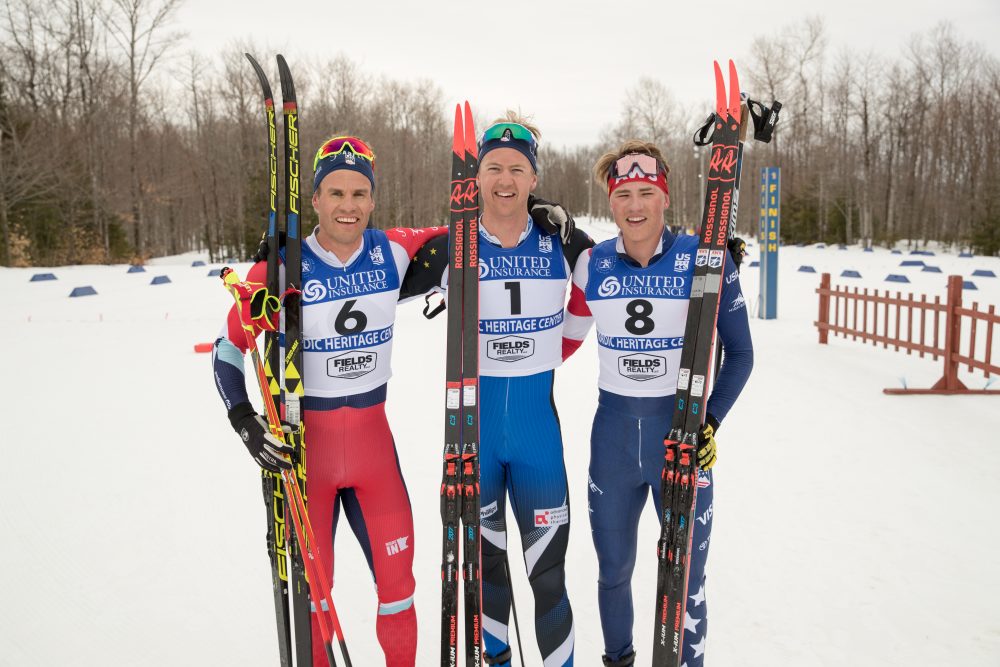
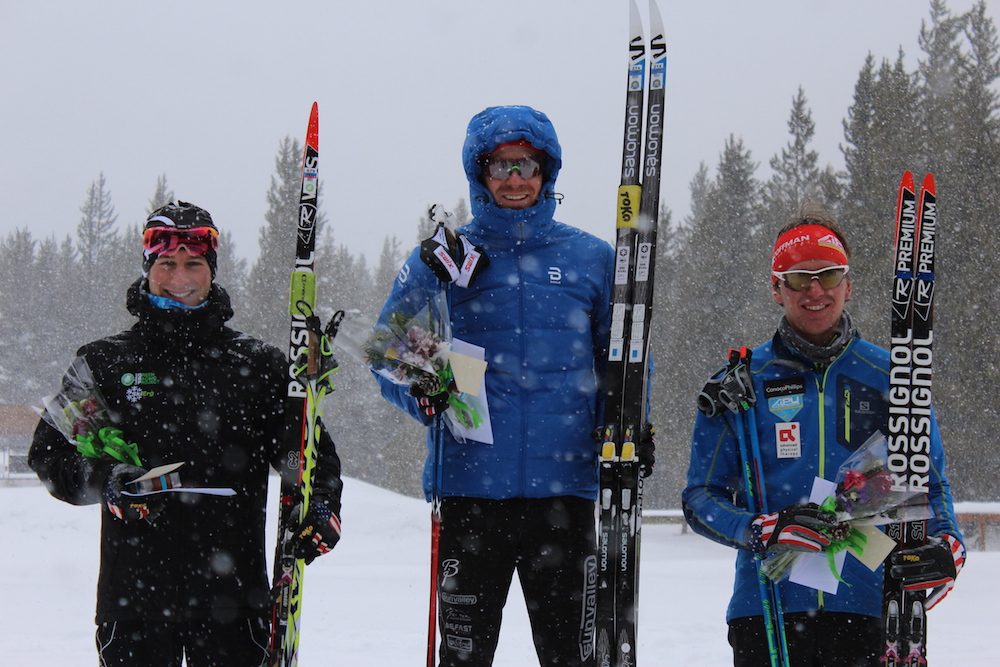
The men’s podium for the 2019 15-k mass start classic during the Super Tour Finals in Presque Isle, Maine. Erik Bjornsen (USST/APU, center) took the win ahead of Simi Hamilton (USST/SMST2, left) and Gus Schumacher (USST/Alaska Winter Stars, right). (Photo: U.S. Ski & Snowboard – Reese Brown)
We’ll leave it to you to debate whether this is “good,” “bad,” or neutral – whether it is good that more high-level skiers are training in consort in larger groups; bad that fewer coaching ideas or philosophies may have the chance to be heard, and that athletes outside four regions of the country have to travel to find a team (those members of the U.S. Ski Team A-Team who originally hail from Utah, Colorado, California, or Minnesota, for example, which currently describes four-fifths of the A-Team, had to leave home to find a club team); or neutral because improved American results justify a homogenization of the domestic training landscape, regardless of what might have been lost along the way. Maybe some of all of the above.
But regardless of the merits of this shift, it’s worth noting that things change. At the turn of the century, the best ski program in Alaska was the college team at University of Alaska Anchorage. In summer 2010, an ascendant Diggins was the nucleus of a strong CXC team, alongside Caitlin Compton (now Gregg), Jennie Bender, Tad Elliott, Garrott Kuzzy, Brian Gregg, and Matt Liebsch. In fall 2012, this site wrote, surveying the prior season’s SuperTour racing, “Central Cross Country (CXC) was indisputably the best all-around team last year.” And it alluded to the potential of a new group forming at Stratton Mountain – which was at that point still just potential, because the team had officially formed only earlier that year. Indeed, this article, entitled, “With Elite Team, Stratton Aims To Create ‘Hotbed of Skiing’ in Southern Vermont,” was published in 2012. (Spoiler alert: this worked.)
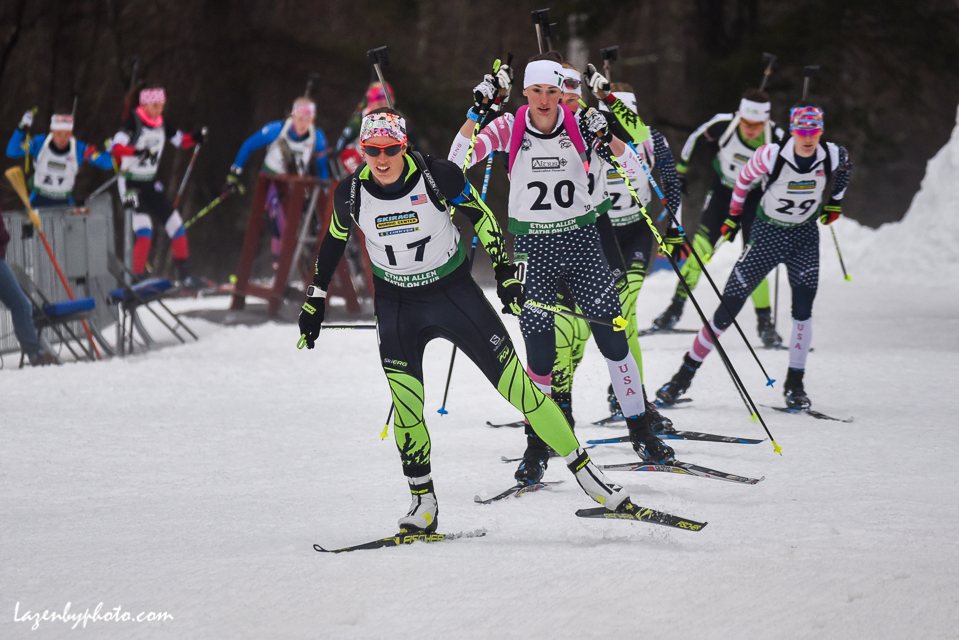
Craftsbury Green Racing Project athlete Susan Dunklee (bib 17) leads a pack including multiple CGRP suits at USBA Nationals in March 2019. (Photo: John Lazenby/lazenbyphoto.com)
Now we’re at a point where APU* or SMS frequently send six athletes each to a World Cup race or global championship, where there are currently eight national team athletes in one club alone (APU), and no current U.S. Ski Team members primarily based in the Midwest. No one knows what this list will look like in another decade, but for the time being, six clubs is decidedly fewer than twelve clubs.
Please enjoy the first preview, coming tomorrow.
* Disclaimer: I live in Anchorage, and have trained with the APUNSC Masters program for eight seasons and counting. On the one hand, the Masters group has been an important part of my personal and athletic life for many years now; on the other hand, on a day-to-day basis the Masters team has little to do and no overlap with the APU Elite Team, and is not coached by Elite Team Coach Erik Flora. I don’t receive free gear from APU or easier interval assignments from my Masters coach, or anything in that vein, in exchange for writing about the APU Elite Team.
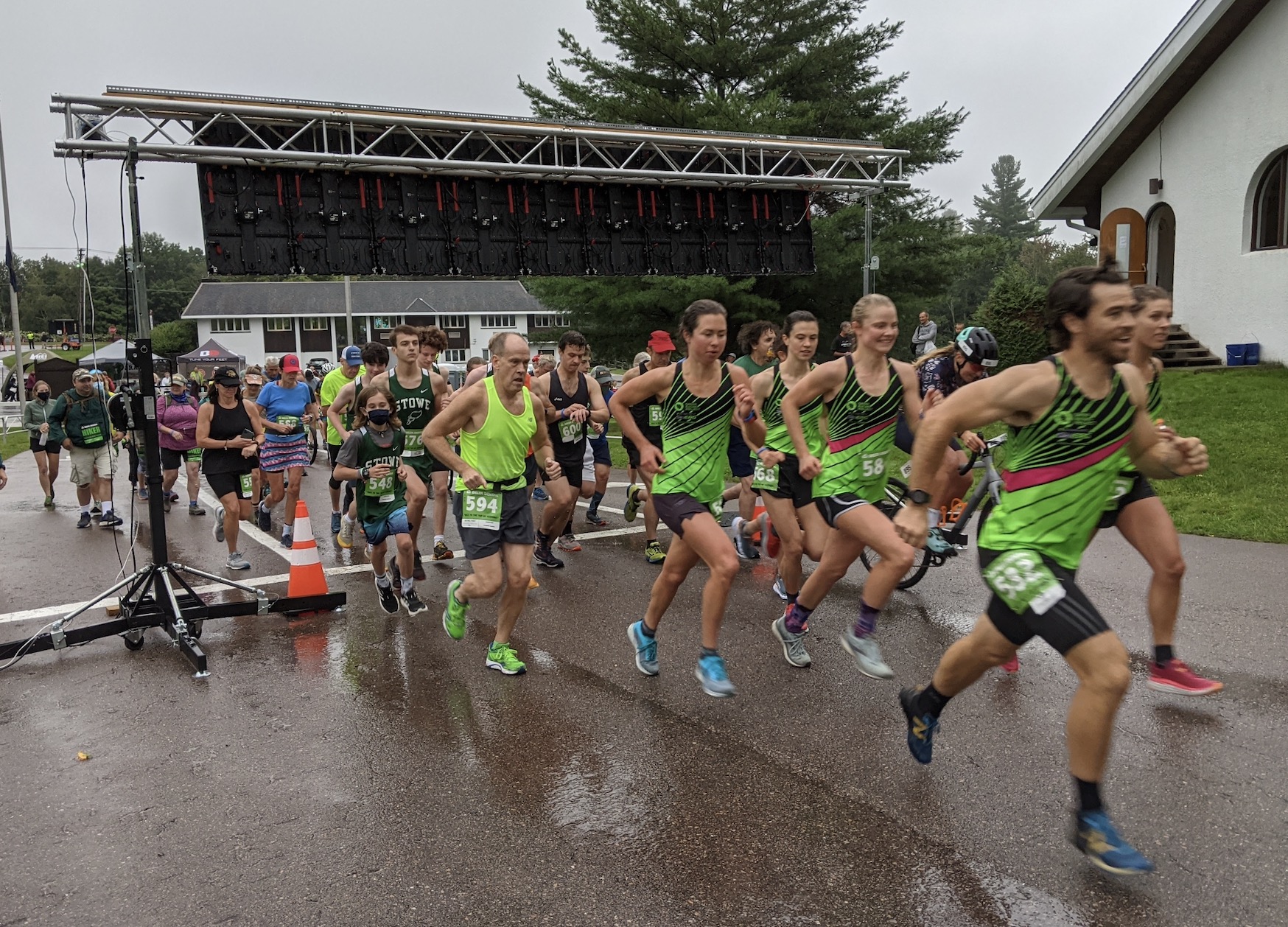
Racers take off to climb the Mount Mansfield service road in the 2021 Race to the Top of Vermont. (Courtesy photo)
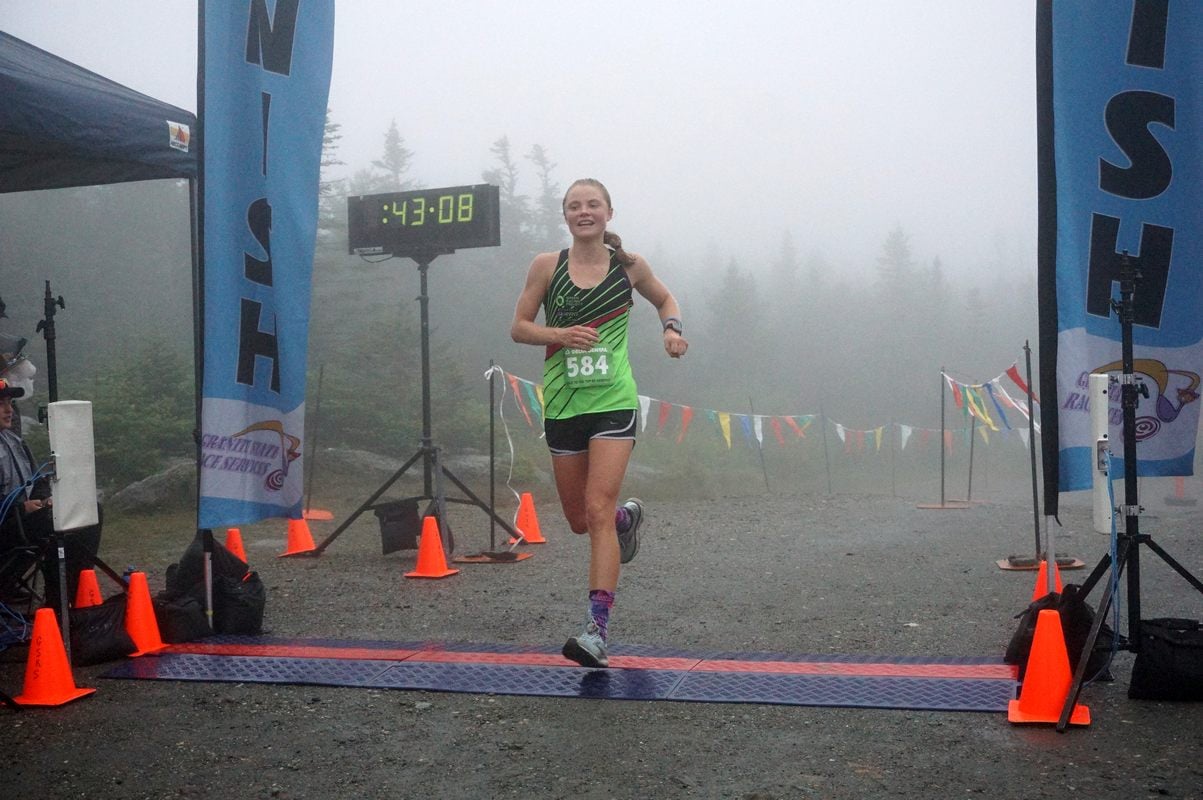
Under gray skies, runners and bikers lined up on Sunday, August 29th in Stowe, VT, to “Race to the Top of Vermont.” The 4.3 mile race climbs over 2,500 vertical feet up the Mt. Mansfield Toll Road at roughly an 11% average grade, this year finishing inside a cloud with wind whipping the finish line flagging. The event drew in nearly 300 participants with 215 runners taking on the focal challenge of making their way up the mountain on foot. The event is a fundraiser for the Catamount Trail Association (CTA), which maintains a 300 mile long backcountry ski trail through the heart of Vermont, from the Massachusetts border to the south and ending on the Canadian border at its northern end.
According to CTA events director Greg Maino, “[The CTA] focuses on developing backcountry ski terrain, conservation in the state of Vermont, and increasing access to the outdoors for everyone.”
Topping the results list were several members of the Craftsbury Green Racing Project (GRP), including winners Adam Martin and Caitlin Patterson. FasterSkier connected with Martin and Patterson via email as they prepared to travel across the pond to spend time on snow.
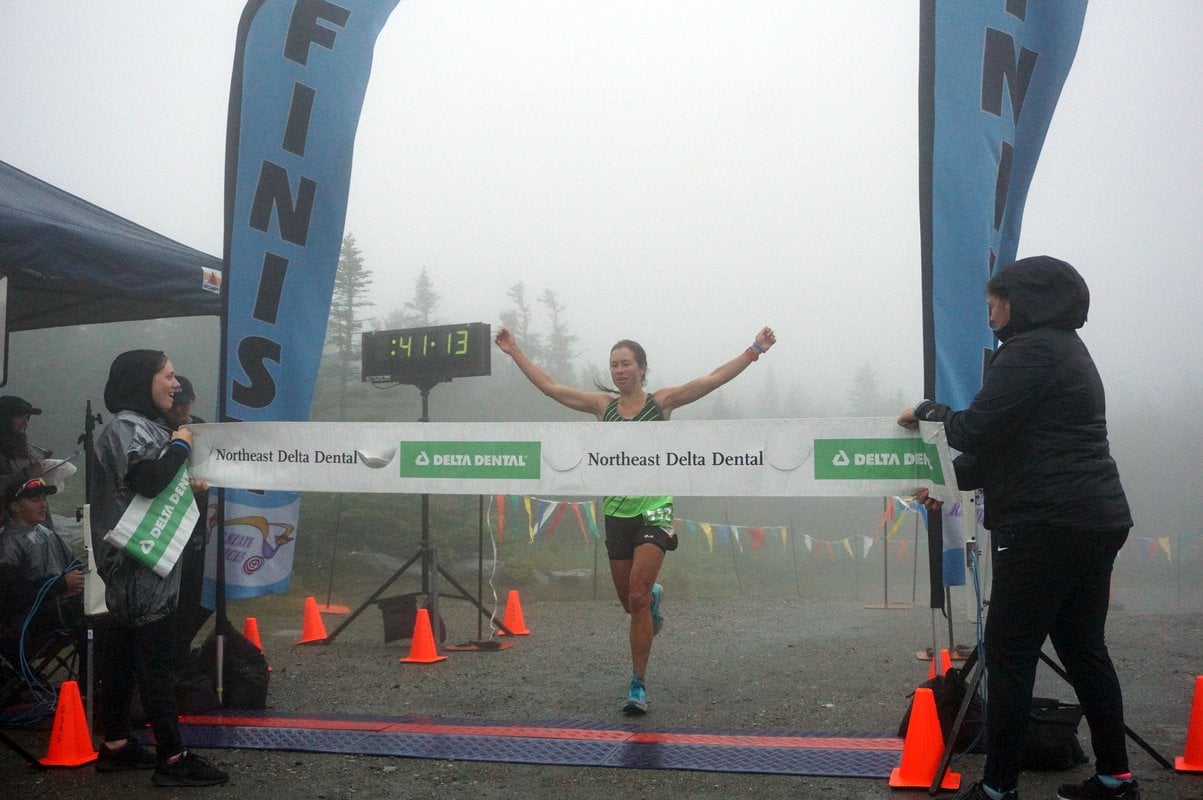
Martin expressed that his summer training has been “going great”. Crossing the line as the first runner to the top — he was beaten by just one cyclist — Martin stopped the clock at 34:11.5, nine seconds off his fastest time. In his email, he explained how this race fits into his ski training regimen.
Adam Martin breaks the tape (and stops his watch) at Race to the Top of Vermont. (Photo: Granite State Race Services)
“This year my big focus is on prioritizing intensity workouts, and so far, I think my body has been responding well. We’re planning on heading to Germany [to get on snow in] the Oberhof ski tunnel this week, so last week I backed off a bit ahead of the race and upcoming travel. Across the GRP, I think we were all coming in at varying levels of fatigue.”
It’s no secret that Martin has got some wheels. He’s got a 1:06:18 half marathon PR (5:03 per mile), and caught our eye for running a 14:34 5k in 2019 (4:41 per mile). While uphill is a different ballgame for some runners, ski training lends itself well to the challenge.
“Sunday the race was great – and hard. Early on I broke away from the rest of the field and tried to embrace the grind for the remaining 30+ minutes of the race. I really like this event, specifically how it’s a huge climb on an easy running surface, and I’m really happy to come away with the win.”
All five of the men of Crafsbury landed in the top-eight, with biathlete Raleigh Goessling taking third (37:10), Luke Brown fourth (37:45), Akeo Maifeld-Carucci seventh (38:28), and Carsen Campbell eight (39:14).
Caitlin Patterson takes the win at Race to the Top of Vermont. (Photo: Granite State Race Services)
Female cross country skiers have a history of breaking the tape at this event. Queen of the hill climb, Liz Stephen holds the course record of 37:15.9 set in 2014. This year, Patterson set a new personal best of 41:14 for tenth place overall.
Making a clean sweep for Crafsbury, Alex Lawson took second place in 41:42, with Margie Freed following for third in 43:09. Both women are new to the GRP this season after graduating from Middlebury College and the University of Vermont, respectively.
Hallie Grossman took fourth in 45:25, and Annuka Landis rounded out the GRP results in sixth 47:23.
Margie Freed finishes third at Race to the Top of Vermont. (Photo: Granite State Race Services)
“Race to the Top of VT is always a fun one, and I’ve done it enough past years that it’s a bit like a fitness-check time trial for me,” wrote Patterson after the race. “I was looking forward to it as a hard effort and chance to put on a bib – I’d hoped to have done some running races earlier in the summer, but I strained a tendon in my foot in July so have hardly run at all during August. Of course I’ve been doing plenty of other ski training and all of that is going well, but I was very pleased with the Race to the Top, to win it and to run a fast time. In fact this year was my fastest time ever, helped I’m sure by the nice cool misty weather conditions.”
Patterson also sent the following comment about her racing strategy, which she initially shared with a local newspaper covering the event.
“Alex and I ran together for at least the first 3 miles, and she was really strong today too. We’ve been doing running workouts together for our ski training and I had an idea that Alex would be fast today. So we ran together for much of the race, and then I very gradually pulled ahead in the last mile or 1.5 miles or so, but Alex was not far back at all. In an uphill race like this, I think we were just enjoying the company in suffering, keeping moving, but not doing anything drastic. My race strategy was basically just to run smooth and efficiently, to breathe well, and be ready to dig in and make it hurt especially towards the top. So I was pleased with how the race went and I enjoyed running with Alex while it lasted because otherwise I did not see many people at all.”
The SMST2 squad led by Jessie Diggins pushes the pace in a double pole interval workout during a fall 2019 training camp in Lake Placid, NY. (Photo: Matt Whitcomb / smseliteteam.wordpress.com)
It’s May. Yes, really.
For most skiers, the new page on the calendar also marks the beginning of a new training year. Dust off your rollerskis, locate your heart rate strap and drink belt, and make sure your running shoes have plenty of life in them.
With the country still predominantly on public health orders to stay close to home, avoid groups, and keep at least six feet of distance from those outside your home, kicking off a new cycle is happening without hugging our training partners, post-workout high fives, or otherwise gathering to ring in the new season. There also remains abundant uncertainty regarding the feasibility of racing during the upcoming season from the World Cup level to the junior and collegiate circuits to popular skiing. Nonetheless, we open our training logs and carry on.
Last season ended abruptly and the off season may have looked different than anticipated. We may have put our energy into homeschooling children, sourdough baking, binge-watching Tiger King, connecting virtually with our family and friends, or otherwise remaining largely homebound and less active than we’re accustomed. On the flip side, maybe the change in schedule has freed up additional time for long adventures and you’ve logged more hours in April than ever before.
Either way, at the onset of a season, you may be interested in checking in on your fitness and strength, looking for metrics to track improvement over time and to guide your pacing or heart rate zones during future workouts. FasterSkier reached out to Pepa Miloucheva, head coach of the Craftsbury Green Racing Project, to discuss fitness testing that could be done without the support of a facility or coach, making it accessible to any level skier as they begin the new year.
Miloucheva provided the disclaimer that she relies on advanced metabolic testing with her athletes to determine VO2 Max and lactate threshold levels to assess fitness and heart rate zones, and then prescribes training based on this information. With that caveat, Miloucheva holds a masters degree in Sport Science with a focus on physiology and biomechanics and has been coaching for over 20 years, over a dozen of which have been spent with the CGRP elite program.
Before jumping into assessing fitness and blowing up trying to hit a new PR on the SkiErg, Miloucheva emphasized that the most important thing an athlete can do at the beginning of a new cycle is to have a training plan and to understand how the periodization targets different areas of athletic development. This might be a plan from a coach or one found online.
“If someone really wants to establish a baseline and monitor, then they have to have a training plan,” said Miloucheva in a call. “I think everything else is kind of pointless, because all of these tests won’t give you anything if you don’t know what you’re looking for. In general, everything starts with first having a good training plan.”
Once a clear plan is established and you have taken time to understand it, then decide which part of the training process you would like to test.
“If you have 2-3 months of high volume, you want to test your basic aerobic improvement. You do the test, you see if you’ve actually improved. When you start doing a little bit more speed, you want to see if you’ve improved your speed. So you really have to schedule these tests based on your training plan.”
As the typical periodization of the year for skiers focuses on aerobic development during the spring and summer, a good starting place could be an uphill run test, possibly combined with a rollerski or SkiErg time trial, if those are available to you.
Traditionally, a 3000 meter run on the track was commonly used as an aerobic benchmark, but the results can be skewed based on individual running economy. Athletes with more running experience and better form often fare better than those with comparable or potentially better fitness. As such, most ski programs have transitioned toward an uphill run test, as it tends to level the playing field in terms of the impact of running efficiency on results.
In addition to being a good indicator of aerobic capacity, Miloucheva explained that the test has the added benefit of being easily repeatable with relatively few outside variables that might impact performance.
“The uphill running test is probably the most standard around the world. Simply, it’s easier to repeat. It’s a little bit less affected by the weather, but there are still a lot of elements and it is hard to keep it consistent.”
Craftsbury Green Racing Project Head Coach Pepa Miloucheva (l) and Stratton Mountain School T2 Team Head Coach Pat O’Brien (center) assist athletes with lactate testing after the U.S. Ski Team’s rollerski team sprint on July 15, 2018 in Lake Placid, N.Y.
If you’re looking to track your own progress on an uphill course, Miloucheva recommends finding a stretch of road or trail with little traffic that takes roughly 10-12 minutes. The effort should be steady throughout the test and you should finish feeling completely spent.
Be careful not to start out too fast as you want your heart rate to increase throughout the test, rapidly at first then gradually continuing to rise toward your lactate threshold heart rate, which can be estimated as the average heart rate sustained over the last five minutes of the test assuming it was well-paced. (TrainingPeaks has a deep dive on blood lactate and lactate threshold here, or you can read this description of lactate threshold training by Len Kravitz Ph.D., Exercise Science professor at the University of New Mexico.)
As for the course, you’re looking for terrain that is runnable, meaning you won’t need to resort to walking or hiking, and a relatively consistent grade.
Miloucheva later added that many veteran athletes have their own aerobic fitness test piece, which is also perfectly sufficient.
“I’m an old lady and I have this loop around the lake I do every year and I measure my time just for fun. So in general, everybody who has been training for years, they have a place where they can run the test.”
Miloucheva has also used a 1-kilometer uphill double pole test on rollerskis with some of her athletes. Her course starts relatively flat, climbs gradually, then levels off at the finish.
“The biggest thing is that [athletes] need to keep moving, so it cannot be very steep because strength and the resistance become the issue [rather than fitness].”
She has found this test harder to standardize than the run test, meaning results must be taken with a grain of salt.
“The problem using it year to year is that [the athletes] don’t always use the same rollerskis, they change wheels, cold weather and cold pavement changes a lot. So you have to consider all these details with the results.”
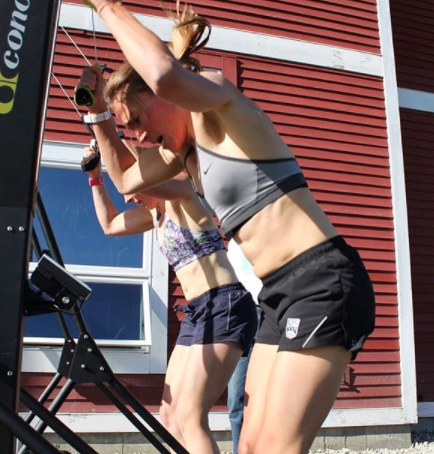
Sophie Caldwell and Annie Hart square off for a SkiErg time trial during a week of testing with the SMST2 team in 2017. (Photo: Instagram @sophiecaldwell(
Because of the ease of standardization, Miloucheva prefers using SkiErg time trials, as athletes can repeat the test indoors with a fixed resistance. Her junior athletes complete 1 and 2 k time trials, and her senior athletes additionally complete a 5 k test. The CGRP athletes complete the tests while hooked up to a VO2 Max testing equipment. If these are available to you, these tests could also serve as a benchmark for aerobic fitness with some ski specific strength indicators.
As for strength, Miloucheva is working on developing a test she feels is informative and can be standardized, as she is not satisfied with other tests used previously. She has historically used a version of the Canadian Strength Test (outlined here by Jackson Hole Ski & Snowboard Club), which counts the number of pull-ups, sit-ups, push-ups, box jumps, and dips an athlete can do in one minute with one minute rest between each exercise. Some differences in Miloucheva’s version include the use of single leg squats within a 30 second time period and measures pull-ups to exhaustion.
If you’re completing this test from home, ask a member of your household to help time, count, and keep your form honest so the data reflects your current strength accurately.
Okay, you’ve done an initial test of your aerobic fitness and/or strength. Now what? How soon should you repeat the test to check for improvement?
Miloucheva reiterated that it is essential to plan testing between training blocks to assess whether the block had the intended impact on fitness. She explained that her testing weeks are written into her general yearly plan for athletes at the beginning of the season.
When considering your own plan, space the tests out roughly 6-10 weeks to give the body time to absorb and respond to training. In addition to striving for a faster time, you can also consider trends in heart rate, as more time during the test spent closer to the lactate threshold heart rate is also an indicator of improved aerobic capacity.
To get the most information from a testing period, it is essential that each round is approached the same way, including how the training looks in the days prior and the warm-up performed before beginning the tests.
“You want to have a standard approach into the test, because you don’t want to do the first test after a very exhausting week and the second after an easy week, because it will affect the results.”
For CGRP athletes, this typically looks like one or two days of rest or easy training prior to a test.
There you have it. If you’re looking to assess and monitor progress in your fitness, first select and understand a training plan. Then, determine what factors of your fitness you’d like to assess and decide when a set of tests might fit best between different blocks within the training plan. Finally, do what you can to ensure that when the tests are repeated, the environment is as controlled as possible and your approach is the same so improvement (or lack thereof) between tests provides accurate insight into how your body is responding to training.
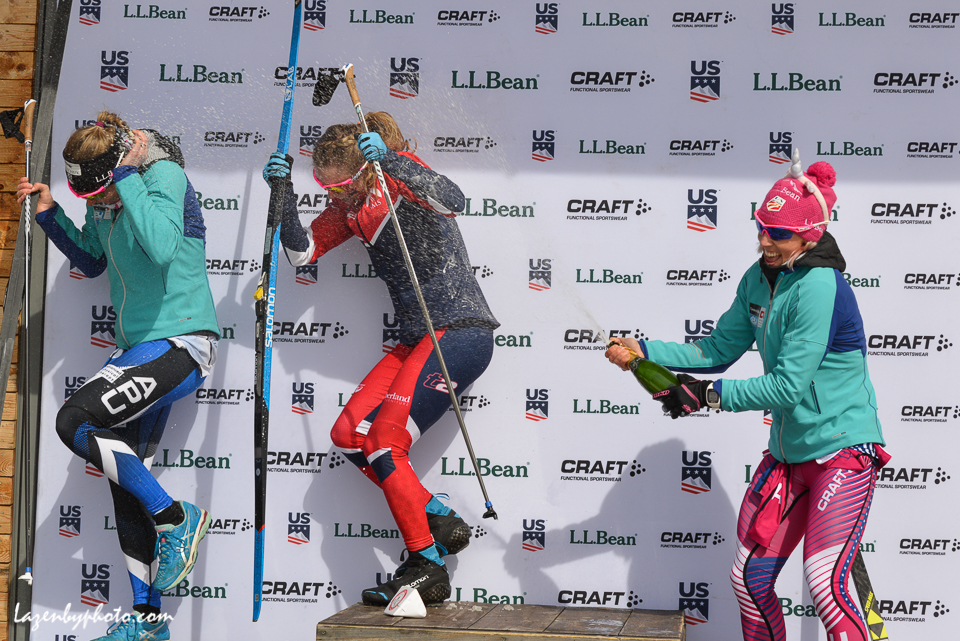
Kikkan Randall (r) sprays her U.S. Ski Team teammates Jessie Diggins (c) and Sadie Bjornsen (l) with champagne on the podium of the 30 k classic mass start at U.S. Distance Nationals in Craftsbury, Vt. Diggins won, Bjornsen placed second and Randall finished third. (Photo: John Lazenby/Lazenbyphoto.com)
2018 U.S. Distance Nationals (Craftsbury, Vermont): 30 k classic mass start
Jessie Diggins swept SuperTour Finals once again, after doing so last year in Fairbanks, Alaska, and winning every individual race at 2016 SuperTour Finals the year before in Craftsbury, Vt.
Back in Craftsbury on Tuesday, and coming off three-straight victories in the classic sprint, 10-kilometer freestyle mass start and mixed relay with her Stratton Mountain School (SMS) T2 Team teammates, Diggins, 26, pulled out her fourth-straight win in her last race of the season: the women’s 30 k classic mass start, which is part of U.S. Distance Nationals.
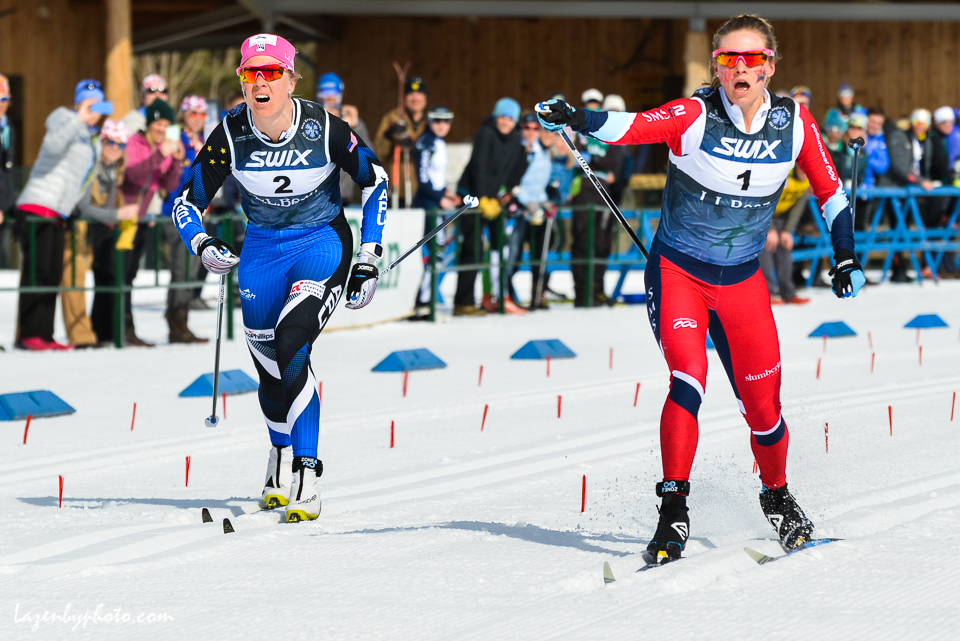
Jessie Diggins (r) edging her U.S. Ski Team teammate Sadie Bjornsen at the line for the win in the women’s 30 k classic mass start at 2018 U.S. Distance Nationals in Craftsbury, Vt. (Photo: John Lazenby/Lazenbyphoto.com)
She did so in an all-out effort to the line, beating her fellow U.S. Ski Team (USST) member Sadie Bjornsen by just 0.4 seconds in 1:25:27.2 hours. Diggins, Bjornsen of Alaska Pacific University (APU), and another USST member Sophie Caldwell (SMST2) broke away from the pack on the first of five laps at the Craftsbury Outdoor Center. Caldwell dropped off the pace around 10 k and skied on her own for the next 15-plus kilometers before being caught by a chase group of six, led by Kikkan Randall (APU/USST), on the final lap.
Meanwhile, Diggins and Bjornsen skied together, trading the lead for the rest of the race. On the final short climb up to the stadium, Diggins pulled ahead slightly then extended her lead in the finishing straight. After finishing first and second, respectively, Diggins and Bjornsen laid on the ground for what seemed like a long time, particularly spent from the effort, before congratulating each other. Behind them, Randall outlasted the chase pack for third (+2:21.7), Caldwell followed just behind her in fourth (+2:23.1), Ida Sargent of the Craftsbury Green Racing Project (CGRP) and USST placed fifth (+2:26.5) and Rosie Frankowski (APU) finished sixth (+2:29.2).
Also in the top 10, Liz Stephen (USST) finished the last race of her professional career in seventh (+3:10.9), Caitlin Patterson (CGRP) eighth (+3:27.2), Kaitlynn Miller (CGRP) ninth (+3:56), and Chelsea Holmes (APU) 10th (+4:45.3).
Stratton had two wins on the day with Charlotte Ogden (SMS) winning the junior women’s 20 k classic mass start in 1:04:33.9. Canada’s Catherine Reed-Metayer (Skibec Nordique) placed second (+11.8), Waverly Gebhardt (Steamboat Springs Winter Sports Club) finished third (+33.8), and Phoebe Sweet (Craftsbury Nordic) was the third American junior in fourth overall (+1:10.2).
Spring Series concludes with the men’s 50 k classic mass start on Wednesday, starting at 9 a.m. EDT. Watch the races live on the SuperTour live stream.
The start of the women’s 30 k classic mass start at 2018 U.S. Distance Nationals in Craftsbury, Vt. (Photo: John Lazenby/Lazenbyphoto.com)
Jessie Diggins (1) leading the women’s 30 k classic mass start at 2018 U.S. Distance Nationals in Craftsbury, Vt. (Photo: John Lazenby/Lazenbyphoto.com)
Sadie Bjornsen (2) leading the women’s 30 k classic mass start at 2018 U.S. Distance Nationals in Craftsbury, Vt. (Photo: John Lazenby/Lazenbyphoto.com)
Sadie Bjornsen (2) leading the women’s 30 k classic mass start at 2018 U.S. Distance Nationals in Craftsbury, Vt. (Photo: John Lazenby/Lazenbyphoto.com)
Sadie Bjornsen (2) leading Jessie Diggins (c) and Sophie Caldwell (l) during the women’s 30 k classic mass start at 2018 U.S. Distance Nationals in Craftsbury, Vt. (Photo: John Lazenby/Lazenbyphoto.com)
Ida Sargent (15) leads Kikkan Randall. Caitlin Patterson, Liz Stephen (yellow bib) and others in a chase pack during the women’s 30 k classic mass start at 2018 U.S. Distance Nationals in Craftsbury, Vt. (Photo: John Lazenby/Lazenbyphoto.com)
Sadie Bjornsen (2) and Jessie Diggins (1) racing for first in the women’s 30 k classic mass start at 2018 U.S. Distance Nationals in Craftsbury, Vt. (Photo: John Lazenby/Lazenbyphoto.com)
Kikkan Randall (3) racing for third place in the women’s 30 k classic mass start at 2018 U.S. Distance Nationals in Craftsbury, Vt., ahead of Sophie Caldwell (second from l), Ida Sargent (second from r), and Rosie Frankowski (r). (Photo: John Lazenby/Lazenbyphoto.com)
Jessie Diggins (l), Liz Stephen (c) and Rosie Frankowski (r) at the finish of the women’s 30 k classic mass start at 2018 U.S. Distance Nationals in Craftsbury, Vt. (Photo: John Lazenby/Lazenbyphoto.com)
Jessie Diggins with a photo of her retiring U.S. Ski Team teammates Kikkan Randall and Liz Stephen on her cheek at 2018 U.S. Distance Nationals in Craftsbury, Vt. (Photo: John Lazenby/Lazenbyphoto.com)
Kikkan Randall (l) and Liz Stephen after the last race of their professional careers, the 30 k classic mass start at 2018 U.S. Distance Nationals in Craftsbury, Vt. (Photo: John Lazenby/Lazenbyphoto.com)
The women’s 30 k classic mass start podium at 2018 U.S. Distance Nationals in Craftsbury, Vt., with Jessie Diggins (c) in first, Sadie Bjornsen (l) in second and Kikkan Randall (r) in third. (Photo: John Lazenby/Lazenbyphoto.com)
APU’s Forrest Mahlen (5) winning his semifinal ahead of Ben Saxton (second from l) in second, Eric Packer (l) in third, and Canada’s Evan Palmer-Charrette (10) in fourth on Friday, Feb. 26 at the Craftsbury SuperTour classic sprint in Craftsbury, Vermont. (Photo: John Lazenby/Lazenbyphoto.com)
Two and a half weeks after U.S. nationals in Anchorage, Alaska, the SuperTour picked back up again on the East Coast in Craftsbury, Vermont, with two race days over a three-day span.
The Craftsbury SuperTour opened Friday, Jan. 26 with classic sprints, then took a break on Saturday for the Craftsbury Marathon. SuperTour racers were back on course at the Craftsbury Outdoor Center on Sunday, Jan. 28 for the 5- and 10-kilometer freestyle individual starts. Between the two days, Alaska Pacific University (APU) won three out of the four races and Craftsbury’s own Kaitlynn Miller (Craftsbury Green Racing Project) stood atop the podium in the women’s 1.4 k classic sprint.
Forrest Mahlen, 24, kicked off the APU win streak by winning his first SuperTour in the men’s 1.4 k classic sprint final. He bested Ben Saxton, of the Stratton Mountain School (SMS) T2 Team, by 0.55 seconds and Kevin Bolger, of the Sun Valley Ski Education Foundation (SVSEF), by 0.58 seconds.
Miller won everything from the women’s qualifier, her quarterfinal, semifinal and ultimately the final, winning the latter by 0.63 seconds over Kelsey Phinney (SVSEF) in second. Felicia Geisor, of the Central Cross Country (CXC) Team, reached the podium in third (+1.67).
On Sunday, APU swept the individual starts, with Becca Rorabaugh winning the 5 k skate by 2.2 seconds over her teammate Rosie Frankowski in second and 4.6 seconds over Erika Flowers (SMST2) in third.
David Norris won the men’s 10 k skate by 6 seconds flat, ahead of Canadian Andy Shields (Lappe Nordic) in second, while Bolger repeated in third place, 15.8 seconds back.
Most of the SuperTour regulars headed north of the border earlier this week to prepare for this weekend’s Eastern Canadian Championships, a NorAm that doubles as a SuperTour, at the Nakkertok Nordic Ski Centre in Gatineau, Quebec.
Those races kick off Friday with classic sprints, followed by 10/15 k freestyle races on Saturday and 10/15 k classic pursuits on Sunday.
Here are some quotes from last weekend’s winners:
Kaitlynn Miller (Craftsbury Green Racing Project) racing to first in the women’s 1.4 k classic sprint qualifier on Friday, Feb. 26 at the SuperTour in Craftsbury, Vermont. (Photo: John Lazenby/Lazenbyphoto.com)
On racing in Craftsbury:
“I haven’t raced a SuperTour in Craftsbury in three years so I was really looking forward to this weekend. It’s always inspiring and fun to have our BKL/Junior skiers either racing with us or cheering on the sidelines. And I always find it impressive how many community members come out to volunteer.” — Kaitlynn Miller, 1st in classic sprint
“I came to Craftsbury itching to race. I was sick during nationals and competed in the 30km because I had to if I wanted a chance to earn an Olympic spot. I came up shy, but I know I that I am in good shape. After nationals I took another ten days easy to fully recover from illness so that I could come into Craftsbury and Canada healthy.” — David Norris
On the sprint qualifier:
“The course at Craftsbury and the conditions on Friday favored strong double-polers like me so I went into the day with high hopes, but 5th was a new personal best sprint qualifier in a Supertour Field for me.” — Forrest Mahlen, 5th in the men’s classic-sprint qualifier, 1st in the final
On home-course advantage:
“I think the course really played to my strengths which helped. It’s also beneficial to be racing on my home course so I know the trails very well. I really like the striding climb up Moss Run and the double pole finish. It was a tight A-final with a strong group of women. Kelsey and I were battling it out right to the line which was exciting.” — Miller
On strategy:
“After watching quarterfinals one and two being won in the final 200 meters with strong finishes, I decided the winning strategy for the day was to be patient and make decisive moves on the final climb into the stadium. After winning my quarter and semi against guys I have a lot of respect for in classic sprints I was super pleased to have met my goal of making it into my first A final.” — Mahlen
“The qualifier went really well Friday and I believe I can make it into the final heat. I think I was 0.4 sec from lucky loser for the final. Strategy is tough on this course for me because of the design- fast start and finish with not too much in between to stretch out the pack. I got caught up in traffic in the semi final and struggled to close on the leaders in the last third of the race.” — Norris, 3rd in the qualifier, 7th in the final
On the men’s final:
“The final played out in much the same way as both my semi and quarter with all five Americans [Mahlen, Saxton, Bolger, Kris Freeman, and Eric Packer] coming into the final hill together. I took the only open track on the far outside of the final corner and was able to carry a little more speed into the last 100 meters and pull away from the field. I was taken a little by surprise to come out with the win but our solo APU ski tech on the trip, Dylan Watts, put some amazing skis on the ground and my strategy on the final climb played to my strengths as a strong double-pole finisher.” — Mahlen
On sprint-course conditions:
“it was a nice day and the conditions were firm and fast. I like it when we do the full sprint loop in Craftsbury, instead of shortening the women’s course because the full hill flows well and it definitely tests your re-acceleration at the top. This race was fantastic practice for spring series, where we’ll be sprinting again in a few weeks.” — Becca Rorabaugh, 7th in classic sprint
(Article continues below)
APU’s Becca Rorabaugh (c) and Rosie Frankowski (third from l) on the top two steps of the SuperTour podium after placing first and second, respectively, in the women’s 5 k freestyle on Sunday, Feb. 28 in Craftsbury, Vt. Erika Flowers (SMST2) placed third. (Photo: Becca Rorabaugh/Instagram)
On attacking Sunday’s individual start:
“I wanted to ski as powerfully as I could, knowing that the conditions were fast. My main goal was to have big and smooth movements because frantic tempo really doesn’t pay off on icy courses. I felt pretty smooth for the first two kilometers and knew that my split at the bottom of the hill was good, but I was surprised that I was able to hang on after all the climbing later in the course. When I heard that I was leading early, I knew that Rosie and others were going to be hammering the uphills and that I had to really lay it down at the end.” — Rorabaugh, 1st in 5 k
“My goal Sunday was to work the terrain that I often get lazy in. I knew I had to keep relaxed because the pace was going to be pretty high due to the terrain, fast snow, and the race being a 10km compared to 15km. I did not know my placing throughout the race. The girls on the team gave some specific splits off of a few competitors, but it was not against the entire field. I felt like I was racing well enough to fight for a win.” — Norris, 1st in 10 k
On trying a new course:
“Craftsbury put together a new homologated course which we raced for the first time on Sunday. It was certainly harder with more sustained climbing, but I enjoyed racing the new course and felt like I put together a strong performance. It was a fast and furious race with hard-packed conditions. And despite the overnight rain, the groomers had the course in mint condition.” — Miller, 4th in 5 k
On the weekend overall:
“I’m very happy with my weekend because I haven’t won a skate race in a very long time, and it was fun to feel strong in a short distance like that again. My sprint could have been better, but overall I was happy with my technical gains even having barely missed being lucky loser. Plus, it was just a fantastic couple of races for my teammates and I! Having Forrest win his first Super Tour really set the mood for the skate race, and David and I kind of followed that positive energy.” — Rorabaugh
Forrest Mahlen (APU) racing to fifth in the men’s 1.4 k classic sprint qualifier on Friday, Feb. 26 at the SuperTour in Craftsbury, Vermont. (Photo: John Lazenby/Lazenbyphoto.com)
On season thus far:
“This winter my racing has been improving weekend to weekend. I dealt with a season of sickness my senior year at Montana State, 2015-2016, that according to my doctor was a viral infection inside a heart valve. After losing half a year of consistent training that winter and following summer it has been really good to put in some quality training over the past year with a strong men’s team at APU and finally have the racing form start to come back.” — Mahlen
“Over the past month I’ve had shining moments, like the classic sprint prelim at Nationals, but I’ve also had a few unlucky races. My fitness seems good, and I’m excited to see where the next few races take me.” — Rorabaugh
“Before Craftsbury I had only raced nine times so the season has felt anticlimactic up to this point. I am really bummed out that I got sick and could not compete in all the races at Nationals. I am in good shape and things have been going well other than Nationals. I have shifted my focus to just the races ahead and making the best of the spring. I plan to do Gatineau, Ishpeming, and the Birkie. After the Birkie I might race in Europe until Spring Series.” — Norris
On making the Olympic team:
“I found out I made the team the afternoon of January 24th. No part of me expected the call so I was incredibly surprised in the best possible way. … If I get a start at the Olympics, it will be in the 30k classic mass start. Classic distance races are my favorite so I’m really looking forward to that possibility.” — Miller
Craftsbury’s Kaitlynn Miller (l) hugs Kelsey Phinney (Sun Valley Ski Education Foundation) after Miller won the SuperTour classic sprint on Friday, Feb. 26 in Craftsbury, Vermont. (Photo: John Lazenby/Lazenbyphoto.com)
Caitlin Patterson (c) atop the podium for the fourth-straight race of the week at 2018 U.S. Cross Country Championships in Anchorage, Alaska, joined by Finland’s Jasmi Joensuu (l) of the University of Denver, in second and Patterson’s CGRP teammate Kaitlynn Miller (r) in third. (Photo: Michael Dinneen Photography)
Note: This article has been updated to reflect the fact that U.S. Ski Team member Jessie Diggins was the top American in four consecutive U.S. nationals races in 2012, winning the freestyle sprint, 10 k skate and 20 k classic mass start outright and placing second to Canada’s Dasha Gaiazova in the classic sprint (but topping the podium as the first American). This week, Caitlin Patterson, of the Craftsbury Green Racing Project, became the first woman since Diggins to be the top American in four U.S. national races as well.
***
ANCHORAGE, Alaska — Maybe there’s something to be said for growing up in Alaska. Or maybe there’s something to be said about the mystique of Kincaid Park, its surrounding Tordillo, Chugach and Alaskan mountain ranges all bathed in sunlight at the start on the last day of 2018 U.S. Cross Country Championships during the women’s 1.5-kilometer classic sprint.
Caitlin Patterson (Craftsbury Green Racing Project) approaching the finish line of the women’s 1.5 k classic sprint final on Monday, the last day of 2018 U.S. Cross Country Championships in Anchorage, Alaska. She won the final for her fourth-straight national title of the week. (Photo: Michael Dinneen Photography)
Be it either of those, Caitlin Patterson became the first woman since U.S. Ski Team (USST) member Jessie Diggins, to earn four consecutive titles at a single U.S. nationals. Diggins did it in 2012 in Rumford, Maine, two years after Kikkan Randall, a USST member who trains with Alaska Pacific University (APU), swept four races outright at Kincaid. (Both Randall and Patterson grew up in Anchorage; Randall was born in Salt Lake City, born in McCall, Idaho. Patterson, 27, attended South Anchorage High School while Randall, 35, went to East Anchorage High).
Even if Patterson, who’s currently based out of Vermont with the Craftsbury Green Racing Project (CGRP), had not won the final event of 2018 nationals, she had already posted a banner week. She started it by racing to first in the opening women’s 10 k freestyle individual start last Wednesday, amidst slushy ski trails, falling wet snow and a standard dark Alaskan winter morning sky.
After a training day on Thursday, she returned to the Kincaid trails on Friday — which had transformed from 48 hours before — racing once again to first, this time in the women’s freestyle sprint for her first sprint title.
Hedda Bångman, a Swedish freshman at the University of Colorado at Boulder (CU), racing to fourth in the qualifying round of the women’s 1.5 k classic sprint on Monday at 2018 U.S. Cross Country Championships in Anchorage, Alaska.
Up against Sweden’s Hedda Bångman, a University of Colorado at Boulder (CU) freshman, and Rosie Frankowski (APU), the two of whom led much of Sunday’s four-lap race, Patterson had met her match. However, Frankowski’s fall on the final hill paired with Patterson’s strong skiing led Patterson to finish as the day’s top American. Bångman took the outright win while Patterson placed second overall, ahead of Frankowski in third. The two were first and second on the U.S. podium.
If she had left it at that, Patterson would have tied Rosie Brennan — of the U.S. Ski Team and APU — who won three out of four U.S. nationals races in 2015.
But Patterson took it one step further.
With no training or rest day in between, the CGRP skier joined the remaining U.S. nationals field on Monday. Some skiers had already left, including Australian and APU skier, Jessica Yeaton, who flew out Monday morning to prepare for next weekend’s World Cup in Dresden, Germany.
Based on her qualifier alone, it might have seemed Patterson was beginning to feel the effects of four days of racing since last Wednesday. She qualified seventh, 4.77 seconds behind the fastest qualifying time of 3:41.40, posted by Finnish skier and University of Denver (DU) junior Jasmi Joensuu.
“Today qualification was really good, I felt really good,” Joensuu said after the race. “But then, my throat is really sore after the qualification … so I didn’t know if I could race actually. But I decided to race, I knew that I could win this race. I knew that there were some good girls but they also had 20 k yesterday, which I didn’t race, so that was good for me.”
With Joensuu, 21, having sat out Sunday’s mass start and Patterson having expended herself over 20 k, the Finn may have had a leg up on the American.
What Joensuu had not counted on was Patterson’s familiarity with the course and what the American had learned from Friday’s freestyle sprint.
“I think that bottom corner was a really good one for me all week and in the skate sprint I figured out how to ski it with good momentum,” Patterson said after Monday’s race, referring to the slightly inclined corner about 100 meters before the finish. “Even with that big gap that she put on the hill, I think just knowing how to ski the hill here at Kincaid … the finish stretch was mine.”
Craftsbury’s Caitlin Patterson (207) and Kaitlynn Miller (second from r) and Jasmi Joensuu, of the University of Denver, lead their semifinal during the women’s 1.5 k classic sprint on Monday at 2018 U.S. Cross Country Championships in Anchorage, Alaska.
In their semifinal, though Joensuu had gapped both Patterson and and another CGRP skier Kaitlynn Miller at the top of Gong Hill — the sprint’s final major climb — both Craftsbury skiers had caught Joensuu by the bottom of the descent’s corner back towards the finish.
A similar scenario played out in the final.
“In the final I did a tactic, I would ski the uphill as fast as I can, I don’t save anything and that almost worked,” Joensuu recalled.
Joensuu and Petra Hyncicova, a CU senior from the Czech Republic, had pushed hard out of the start of the final, followed by Patterson and Miller, as well as Dartmouth skier Lydia Blanchet and APU’s Becca Rorabaugh.
“I tended to lose time in the beginning of the race and then catch back up,” said Blanchet, who had to catch a plane within an hour of finishing the final. “I had great skis and downhills are one of my strengths.”
While the two non-Americans raced to the front halfway through the course’s major climb, Blanchet, Rorabaugh, Miller, and Patterson hung behind. Then halfway through the final hill, Joensuu attacked, attempting to distance herself from the pack.
By the top of the hill, she had done just that, with 4 meters separating her from the rest of the field. Miller and Patterson followed, tucked into the downhill swooping curve.
As Joensuu disappeared behind the trees blocking the corner from spectator’s view, Miller and Patterson were already hot on her heels. Using her momentum, Patterson swung around Joensuu and emerged from the corner first, double poling with a sizeable lead to her fourth victory in a row in a time of 3:39.58.
“It felt surreal coming down the finishing stretch today, realizing that I couldn’t hear people behind me and realizing that it was going to be number four,” Patterson said. “I could not have imagined this if I tried, but I’ve just had really good feelings all week. Great support from the staff and waxers and everything, and it’s fun being back here in Anchorage, especially.”
The fifth women’s classic sprint quarterfinal heat on Monday at 2018 U.S. Cross Country Championships in Anchorage, Alaska, with CXC/Peak Nordic’s Felicia Gesior (208) leading with Corey Stock (213) of the Bridger Ski Foundation, and Northern Michigan’s Nicole Schneider (223), the University of Colorado Boulder’s Christina Rolandsen (218) and Petra Hyncicova (203), and Mae Chalmers of SMS (228) chasing.
Finishing second, 2.36 seconds behind Patterson, was Joensuu. Capturing third for her third American podium this week was Miller (+3.9). Miller finished second to Patterson in Friday’s freestyle sprint and was the third American in Sunday’s 20 k.
“I’m really pleased with how everything panned out,” Miller said. “To me the big sign of improvement has been in my skating and I was really excited with my skate sprint and obviously really excited with yesterday and today as well, but it’s nice to see my skating moving up a little bit.”
Despite being the 2016 national classic sprint champion, Miller, of Elmore, Vt., explained she entered Monday’s race with nothing held over her head.
“I don’t ever go into a race expecting a certain result,” she said. “Anything can happen, even to strong, very experienced skiers … [but] it is exciting to be in the mix.”
Though Miller also explained she “felt pretty tired” by the time she lined up for the final on Monday, she also acknowledged that she was, in all likelihood, not alone.
“I think that was the situation for all of the women out there today, after the 20 k yesterday. It was sort of like, well, the snap isn’t there, the energy isn’t quite there, but everyone was in the same boat,” she said. “Everyone’s making the best of it, and your body knows what to do once you get to the start line.
“All things considered, I felt great, had a really great result, and I’m very happy with it,” Miller added.
Becca Rorabaugh (APU) during the women’s 1.5 k classic sprint on Monday at 2018 U.S. Cross Country Championships in Anchorage, Alaska. After finishing second in the qualifier (as the top American) she finished fourth overall in the final and was the third American on the day.
Rorabaugh finished fourth overall (+9.92) and was the third American. The Fairbanks native, who has spent the last 10-plus years living and training in Anchorage, was the top American qualifier on Monday, 1.31 seconds behind Joensuu in first overall.
“I was extremely excited with my qualifier,” Rorabaugh said. “It was rather unexpected. I was the first American and I had one really good qualifier in West Yellowstone this year but the other two so far have been pretty medium for me, so I was really excited really happy with this morning.”
Though the qualifier is what counts for the Olympic points list, Rorabaugh indicated that was of less importance to her than just “getting her qualifier back.”
“It’s been a couple years since I’ve been having a very strong qualification in sprint racing so I was just trying to work on having enough energy and having enough heat pumped to really crush a qualifier first thing in the morning,” she said.
“I wanted to have something special at home,” she added, referring to the friends and family that came to Kincaid to watch her race. “So it was good to have something at the end of the week.”
With firm tracks, cold temperatures reading around 10 degrees Fahrenheit and a low sun in the sky, Rorabaugh described the final U.S. nationals event as “a quintessential Alaskan day.”
“That was quite nice,” she added.
Rounding out the final was Hyncicova in fifth (+10.03) and Blanchet in sixth (+11.21).
“Today I was kind of tired. I finally hit the jet lag over the weekend,” Hyncicova, the two-time defending NCAA champion, said. “But … making the final, and even being third in the quarterfinal is awesome. It’s just proving that I am kind of in good shape so that’s a good start of the season.”
Rounding out the remainder of the women’s top 10 was Bångman in seventh, Sun Valley Ski Education Foundation skier, Kelsey Phinney in eighth, Central Cross Country’s Felicia Geisor in ninth and Stratton Mountain’s Erika Flowers in tenth.
In the junior women’s classic sprint, Wasatch Nordic’s Sarah Morgan took the win in 3:54.93. Novie McCabe (Methow Valley Nordic) placed second (+1.5) and her teammate teammate Ella-Sophie Kuzyk placed third (+6.66).
Left to right: Tyler Kornfield (APU), Reese Hanneman (APU) and Ben Saxton (SMS) as the top three finishers in the men’s 1.6 k classic sprint final on Monday, the last day of 2018 U.S. Cross Country Championships in Anchorage, Alaska.
ANCHORAGE, Alaska — No two races are exactly alike, the saying goes, and there’s a lot of truth to this cliché. But if you step back just a little bit, two race days can start to look awfully similar to one another.
For example, for the second time this week, a Hanneman brother won the sprint qualifier, Reese Hanneman won the final, and Alaska Pacific University (APU) put three athletes in the final and two on the podium on a perfect day for sprinting at Kincaid Park. That was the story on Monday, when Reese Hanneman led teammate Tyler Kornfield and Ben Saxton of the Stratton Mountain School (SMS) Elite Team across the line in the men’s classic sprint at 2018 U.S. Cross Country Championships. But it was also the case on Friday, when Reese was first and Kornfield was third in the freestyle sprint. It’s been a good week for the Hanneman family.
The classic sprint, the final race of this year’s U.S. nationals, had a slightly more subdued feel than the three that preceded it.
The fields were 50 percent smaller; a combined 160 athletes skied in the qualifier on Monday compared to 337 on Friday, as many juniors opted out of a race whose results did not bear on qualification for international trips and championship teams, and some athletes had already left town. The spectator numbers were smaller, measuring in the dozens rather than the hundreds after three days of packed parking lots and raucous crowds, as the first day of school following winter break sent local students back to the classroom. And the athletes were tired, too, after a full week of racing.
“I was just running on fumes out there, especially after the 30 k yesterday,” fifth-place finisher Kevin Bolger, of the Sun Valley Ski Education Foundation (SVSEF) told FasterSkier after the men’s final.
But cross-country skiers are nothing if not resilient, and so, just after 10 a.m., Dakota Blackhorse-von Jess (Bend Endurance Academy) once again led 95 men out onto the qualifying course at 15-second intervals. The temperature was 10 degrees Fahrenheit, according to the display on the stadium scoreboard. The sun had yet to rise and start burning off the morning’s dense fog. It felt cold.
“It’s a very quintessential Alaskan day,” women’s domestic podium bronze medalist Becca Rorabaugh (APU) said after. “It’s like an Alaska temperature, and I feel like a lot of the Alaskan teams have great skis, it’s hard-wax skiing, and it’s just a classic race day. It’s very Alaskan.”
Hanneman Brothers Headline Qualifier
https://www.instagram.com/p/BdsyQTkB945/
APU skiers did very well in the time-trial portion of the morning, which has added, if not exclusive, significance for Olympic qualifying purposes slightly a month before the 2018 Winter Olympics begin in PyeongChang, South Korea.
Reese Hanneman, 28, who grew up in Fairbanks, covered the brand-new, 1.6-kilometer sprint course in 3:21.93, a time good for the fastest qualifying mark on the day. And he did so by nearly three seconds. Next best was his APU teammate and younger brother, Logan Hanneman, 2.84 seconds back. Third was his APU teammate Tyler Kornfield, 4.23 seconds off Reese’s mark.
Alaska Pacific University’s Reese Hanneman during the men’s 1.6-kilometer classic sprint heats on Monday at 2018 U.S. Cross Country Championships in Anchorage, Alaska. Hanneman won the qualifier and eventually, the final for the national title.
In light of the bonus points awarded for U.S. nationals podium performances, FasterSkier’s unofficial calculations put Logan first on the 2018 Olympic Winter Games domestic sprint qualifying list, with 80 points (45 for first at U.S. nationals and 35 for second), and Reese second, with 71 points (45 for first and 26 for third).
In Monday’s classic sprint, Benjamin Ogden (SMS) was fourth in qualifying, 5.12 seconds back. Blackhorse-von Jess was fifth (+5.16), Zak Ketterson of Northern Michigan University sixth (+7.56), Cole Morgan (SVSEF) seventh (+7.61), David Norris of APU eighth (+7.85), Saxton ninth (+7.88), and Bolger tenth (+9.09).
Just like the skate sprint, Brian Gregg, of Central Cross Country (CXC), Loppet Nordic Racing (LNR) and Team Gregg, was the final athlete to make the heats, 16.53 seconds back in 30th.
“I would say all the top sprinting guys, everyone’s focusing kind of on the qualifier, more so than normal,” Reese said on Friday after he had qualified third in the skate sprint. “There’s no margin for error, and you just have to ski it absolutely as fast as possible. It’s definitely different tactics than in the heats… but if you’re fast, you’re fast.”
Reese Hanneman Wins Everything En Route to Final
On Monday, Reese was pretty darn fast. He won his quarterfinal, the first of the day, as well as his semifinal, the first of the day, to make the final with the maximum amount of rest possible. And then, of course, he won the final as well for his fourth national title — and second of 2018 nationals.
In the day’s first quarterfinal, Reese was in the lead by the first turn at 200 meters, followed closely by Bolger. The two of them had a big lead by the time they were coming off Gong Hill. The rest of the field caught up to them somewhat by the finish, but Reese and Bolger still took the top two spots with relative ease.
In the second quarterfinal, U18 skier Ogden led the field into the first turn, with Morgan and Bill Harmeyer, of the University of Vermont, right behind. Ogden was still into the lead coming back into the stadium, but Kris Freeman (Caldwell Sport) had caught up into third. Coming into the finish, Freeman won a four-way lunge for second over Thomas O’Harra (APU), Ben Lustgarten (CGRP), and Harmeyer. O’Harra’s third place in a fast heat was good enough to send him on to the semifinals with the day’s first lucky loser spot.
In the third quarterfinal, Andrew Egger (Colby College) took the lead out of the stadium, but it was Blackhorse-von Jess in the top spot by the time they came back. Blackhorse-von Jess entered the finishing stretch with a 10-meter lead. Ketterson took second, 1.2 seconds back, with Egger another second back by the finish.
From left to right: Logan Hanneman (APU), Like Jager (APU), Ben Saxton (SMS Elite Team) Nick Michaud (BSF), Scott Patterson (APU), and Jack Hegman (SVSEF) at the start of their quarterfinal in the men’s 1.6-kilometer classic sprint on Monday at 2018 U.S. Cross Country Championships in Anchorage, Alaska.
In the fourth quarterfinal, Saxton and Logan Hanneman left the stadium with the early lead, alongside a quick-starting Luke Jager (APU), one of three U18 skiers who made the senior heats. It was Saxton in the lead coming back to the stadium two minutes later, with Logan leading Jager. Saxton came into the finishing stretch with a healthy lead, but Logan made a powerful move to pull around him and come alongside. Saxton won the heat by 0.37 seconds over Logan. Yesterday’s medalist, Eric Packer (APU), was out in third.
The fifth quarterfinal was heavy on local pride, with three APU skiers and a fourth from University of Alaska Anchorage. Erik Axelsson (Montana State University) led Kornfield and Logan Diekmann (University of Utah) into the first uphill. But two minutes later it was all APU, with Kornfield, David Norris and Forrest Mahlen with a sizeable lead on the rest of the field. Kornfield took the win; Mahlen came around Norris for second, but Norris moved on with the day’s other lucky loser spot. Axelsson was nearly five seconds back of Norris in fourth.
In the first semifinal, Blackhorse-von Jess flashed his ski speed and momentum by dropping into a tuck within the first 200-meter straightaway in the stadium, then still led the field over the top of the first, smaller climb. Ogden and Reese Hanneman were nearby. When they returned to the stadium, Reese had a 20-meter lead over Ogden on the downhill. As happened throughout the day, though, that lead shrank to half that size by the time the skiers entered the finishing stretch. But Reese still had the lead, which he held to the finish. Bolger was second, 0.32 seconds back. Ogden was relegated for obstruction.
The second semifinal featured a predominantly blue color scheme, between four suits from APU and the blue accents on Saxton’s SMS suit. Saxton again led out of the stadium, with Ketterson and Kornfield close by. By the time they came off Gong Hill two minutes later, it was Kornfield in the lead, with Ketterson close behind him. Kornfield led into the finishing stretch, but Ketterson overtook him to place first in the heat.
Behind them, Logan Hanneman made a strong push for third. He closed down Saxton, edging him by 0.04 seconds for third behind Ketterson and Kornfield. In practice, both Logan and Saxton advanced to the final as lucky losers; Norris’s fifth place in this heat would have won the day’s first semifinal by nearly a second.
Reese Hanneman Wins Final, Again
Slightly after 2 p.m., six men lined up in the south end of the Kincaid Stadium. From racer’s left to right, it was Logan, Kornfield, Ketterson, Reese, Bolger, and Saxton in the starting blocks. The sun was out, the temperature was in the high teens, and the course was firm and fast. There was no wind. Conditions were once more basically perfect.
The field had a clean start at the sound of the starter’s pistol, double poling in six separate lanes over the first 200 meters slightly downhill through the stadium. As the racers turned right to go up the first hill it was the Hanneman brothers in the lead, with Kornfield immediately behind them and Ketterson to Kornfield’s right. The pack double poled up the first part of the climb, then strode up and over the top of the hill.
A quick descent followed, then a high-speed, double-pole section leading to the start of the course’s main hill. Reese pushed the pace going up the hill, and not everyone was able to respond.
“I basically started at the base of the big climb,” Reese recalled of the 24-meter vertical gain B-climb in the middle of the sprint course. “I just kind of led in the climb and then just threw down the hammer and just tried to drop everyone going up that thing, and just continue to pound it over the top and take it all the way home.”
The largest climb on the course is “tough for classic skiing,” Bolger explained. “That hill definitely adds a different dynamic to your whole approach to every heat you do. To be able to ski up that hill four times, strong, it’s a challenge.” (Bolger added that he didn’t think anyone would have attempted to double pole a hill of that size, saying that “it’s a challenging enough hill to where it’s going to rule out double poling for anyone.” But just to be sure, race organizers placed a no-double-pole technique zone up the entire length of the climb for both the qualifier and the heats.)
By the time the field descended the waterfall downhill back into the stadium, Reese had a substantial gap over Kornfield, who in turn had a sizeable lead over Ketterson.
Kornfield made up some of this gap going down and around the final 180-degree turn, but Reese still entered the final straightaway with a sizeable lead. Saxton had moved into third, ahead of Ketterson, by the time they reached the 100 meters to go mark.
Reese Hanneman (1) of Alaska Pacific University celebrates his second sprint title of the 2018 L.L.Bean U.S. Cross Country Ski Championships on Monday with a win in the classic sprint final, just ahead of teammate Tyler Kornfield (r) in Anchorage, Alaska. Ben Saxton (SMS Elite Team) rounded out the podium in third. (Photo: Michael Dinneen Photography)
Kornfield barreled down the slight uphill of the finishing straight with grace and fury, closing in on Reese with each extension of his lanky frame. But he was still in the same finishing lane as his APU teammate, getting closer to Reese, but still immediately behind him. With roughly 20 meters to go, Kornfield moved one lane to his left, then lunged as he approached the finish. But Reese’s lead was still too much, and he crossed the finish with his second sprint national title of the week.
Reese’s time for the final was 3:20.62. Kornfield was 0.2 seconds back in second.
Some distance behind them, Saxton crossed the finish line in third, 4.78 seconds back of Reese, with a slight lead over Logan and Bolger. Ketterson finished sixth, 6.83 seconds back, in his second sprint final of the week.
“He is obviously on super-good form right now,” Reese continued. “I just have to know that I have a little more speed than he does. … But he’s really cranking right now. He is skiing great, but it definitely motivated me to know to just drive that thing so hard in the final.”
The second national title in as many races was “an answer to a lot of prayers from this morning and in the heats,” Reese said. “I just feel really lucky and stoked that I could put it together and be in such good form right now in January. It was a great day, an amazing day.”
Tyler Kornfield leads his APU teammate Forrest Mahlen in the men’s 1..6 k classic sprint on Monday at 2018 U.S. Cross Country Championships in Anchorage, Alaska.
Although Kornfield was second today, he “probably got the all-around performance of the week for the men,” Reese said of his teammate. Kornfield reached the podium in every race this week save the opening 15 k freestyle individual start, where he was 14th.
Kornfield’s race series was “a dream come true a little bit,” Kornfield told FasterSkier, “a little unexpected, but I knew I had it in me. The start of the season didn’t go as planned, I got sick for a month before it started, I also sprained my wrist for another month and so I was pretty frustrated with the lack of performances, but I knew there was something there and it was just a matter of time.”
“In this sport there are a lot of ups and downs,” he continued, “and it’s really easy to get caught up in the downs and not realize that just because you have a few bad races doesn’t mean you lose your ability to succeed, so just have to keep your head up and keep trying and hoping for the doors to open.”
When it comes to possibilities for potential Olympic selection, “I don’t know anything,” Kornfield said. “I can let you know in a couple weeks.”
Mathematically speaking, Kornfield currently ranks second to APU teammate Scott Patterson on the most recent version of the Olympic selection distance points list, which reflects both distance races from U.S. nationals.
For now, Kornfield plans to leave Alaska on Tuesday (that is, today) for a previously planned trip to Austria. He plans to work out precisely what races he will contest soon; he had planned on racing a Ski Classics marathon, but is currently uncertain where he will be racing next.
While Kornfield’s week at U.S. nationals exceeded his expectations, Monday’s third-place finisher, Saxton, didn’t have the week he was hoping for.
“I came here, like many people, with goals of heading to Korea and representing the country racing in the Games,” Saxton said after the final. “I fell short of that this week and that’s nothing to be ashamed of, but I was really disappointed I wasn’t in the mix as much as I would have hoped to be. This week was difficult because I don’t feel like I put forth a representative effort.”
Saxton was quick to offer sincere congratulations to the skiers who had had more success this week.
“I am incredibly proud to know and am happy for Logan and Scott and Reese and all of the other champions from this week,” he said, “and incredibly happy that those are going to be the skiers going to over to represent us. I think it’s just, from a personal standpoint, people can understand I was disappointed not to feel like I had my absolutely best days out there, but I am really proud to end the day on a podium, representing the hard work that all my teammates and my coach and the program at Stratton have done all year, and to reward them for that work and that effort is a great feeling.”
Saxton also enjoyed the “playground mentality” of the sprint day.
“I think a lot of the times racing we can get lost in the technical aspects of it,” he mused, “but one of the reasons I love racing heats so much is, it just kind of reminds me of being back in elementary school and pointing to something in the far end of the playground, basketball hoop, or whatever it is, and just saying, ‘Let me race you there.’ And there’s no rules, there’s no anything, it’s just the feeling of you and the other person just going all out, and that’s a beautiful way to live and that’s a beautiful way to compete, and sprints are a wonderful thing like that.”
Strong Alaska Performances Throughout the Week
What a difference a year makes. One year ago this week, in the classic sprint at Soldier Hollow, APU didn’t put any athletes into the heats for the first time in at least a decade, done in by a combination of illness, seeding, weather conditions, and wax choice. This time around, head coach Erik Flora’s squad sent eight men through to the heats, six to the semifinal, three to the final, and two to the podium.*
The classic sprint capped a successful week for APU, and for Alaskan skiers more generally. Caitlin Patterson, who skis for CGRP, took all four gold medals for the women. Then APU skiers took all four golds on the men’s side, between Scott Patterson on Wednesday, Reese on Friday and Monday, and Kornfield on Sunday. Chelsea Holmes, Kornfield again, Hannah Halvorsen, Rosie Frankowski, Eric Packer, Becca Rorabaugh, and Kornfield again also stepped on the domestic podium for APU. All told, that’s 15 out of a possible 24 medals going to athletes who hail from or ski in Alaska.
(Although if you slice the data another way, there were also seven out of 12 possible medals in women’s races won by CGRP, between Patterson’s quadfecta and Kaitlynn Miller’s trifecta.)
This week’s results “just show the depth” of the team, Reese told FasterSkier after his race. “It speaks to the hard work of our coaches, especially Erik Flora. That guy will not be outworked, he just puts so much into us. I’m just really happy that we can have a week like this and go four for four in the men’s with APU, just to show that what he is doing works and how hard he works for us. … To get to this point that we can do that and crush all week and just give them a good show is really rewarding.”
“We’re all Alaska born-and-raised,” Reese added of the APU men. “Can’t beat that.”
*(Full disclosure, this reporter skis on the APU Masters team, and receives direct coaching from Flora roughly once a year at Masters Camp.)
The top-three Americans in the women’s 20 k classic mass start on Sunday at 2018 U.S. nationals in Anchorage, Alaska, with Caitlin Patterson (1) of the Craftsbury Green Racing Project (CGRP) in first, Rosie Frankowski of APU (l) in second, and Kaitlynn Miller (r) of CRGP in third.
ANCHORAGE, Alaska — It turns out that Caitlin Patterson does have a weakness: Swedes. The 27-year-old Craftsbury Green Racing Project (CGRP) skier was denied her first outright victory of the week when she crossed the finish line second to Hedda Bångman, a former member of Sweden’s U23 National Team who now skis for the University of Colorado Boulder (CU), in the women’s 20-kilometer classic mass start at the 2018 U.S. Cross Country Championships on Sunday morning at Kincaid Park. But as the first American, Patterson captured her third national title in as many races.
Rosie Frankowski, of Alaska Pacific University (APU), was the third athlete across the line and second American. She was followed by Jessica Yeaton, who competes domestically for APU, but is an American-Australian dual citizen and competes internationally for Australia. Kaitlynn Miller, also of CGRP, was the fifth athlete across the line to round out the domestic national championship podium.
Bångman crossed the finish line of the four-lap, technically 22-kilometer course in 1 hour, 55.3 seconds, 15.9 seconds clear of Patterson in second. It was the first time all day that Bångman had enjoyed such an edge.
CU’s Hedda Bångman on her way to win the women’s 20 k classic mass start at 2018 U.S. Cross Country Championships on Sunday in Anchorage, Alaska.
The field of 42 skiers left the Kincaid Stadium at 10 a.m. on another perfect race day, the temperature around 16 degrees Fahrenheit and an approaching sunrise about to reveal mountains shimmering in all directions.
Wednesday’s fresh snow had allowed race organizers to come up with a compromise between the snowmaking loop and the full International Ski Federation (FIS) distance courses, a 5.44-k loop that began with an A-climb up Elliott’s Climb, descended most of the way back to the stadium, covered all the hills on the snowmaking loop, then traversed the 1.5 k Lekisch Loop before finishing in the stadium. The hills on the course were relatively front-loaded, with the single largest climb coming in the start of the loop and smaller (but still steep) hills over the final four-plus kilometers. The final kilometer was predominantly downhill from the high point of the 1.5 k Lekisch into the finish.
Snow coverage off of the manmade loops appeared to be good to very good, albeit with a relatively abrasive and icy base in the bottom of the tracks.
The first time up Elliott’s, Frankowski led a large group of 30-plus women (effectively the entire field) up to the top of the A-climb roughly 1.3 k into the race. She was closely followed by APU’s Chelsea Holmes to her left, and Bångman and Miller to her right.
The second time up Elliott’s, little had changed. Frankowski led a group of 10 women, with Bångman, Yeaton, and Holmes immediately behind her, and Patterson a few strides farther back.
The third time up Elliott’s, it was yet again Frankowski in the lead, followed yet again by Bångman, Yeaton and Holmes, with Patterson yet again appearing to lag back slightly on the uphill.
“Rosie Frankowski definitely deserves a shout-out for leading the train a whole lot out there and really pushing the pace,” Patterson told FasterSkier in a finish-line interview.
Four kilometers later, the athletes lapped through the stadium a final time as they headed out on their fourth loop. At this point, Frankowski, Bångman and Patterson, in that order, were still within one second of each other, with Yeaton around seven seconds back in fourth and Miller in fifth 12 seconds behind Yeaton.
APU’s Rosie Frankowski (6) and CU’s Hedda Bångman (11) leading the charge up Elliott’s Hill in the women’s 20k classic mass start at the 2018 U.S. Cross Country Championships in Anchorage, Alaska.
If the lead pack was going to avoid a three-woman sprint to the finish, something was going to have to give. And the final time up Elliott’s, it did.
“The fourth lap is where it really splintered apart,” Patterson said. “At the top of Elliott’s, that last really kicker hill, the herringbone hill.”
At that point, Patterson, who grew up in Anchorage, recounted that Bångman had “really good skis, like stay-in-the-track that whole way up good. All the rest of us were running outside [the tracks] flailing around a bit, so she gapped us there. And she skis the downhills very well, so she closed a gap there across the World Cup [start area] flat out there, and we never closed that down. Frankie and I were chasing her on Rollercoaster, but I think she held her gap about the same from there all the way to the finish.”
As Bångman, 22, told FasterSkier after the race, “I didn’t have a plan before [the race], but I knew I was the strongest. So when we went out on the last lap, then I realized, ‘I can really make this race.’ So in the first hill on the last lap, I started to push harder, and then I left the others behind me. And then it was just to push as hard as I can to the finish line.”
By the time the three-woman lead pack came around the edge of the stadium again, midway through their final lap, Bångman had a significant lead, roughly 12 seconds. She stretched it to 15.9 seconds by the finish, finally allowing herself to slow slightly, look around, and celebrate in the final meters before crossing the finish line.
Behind her, a battle for top American was shaping up between Frankowski, who had never stood on a national championships podium, and Patterson, who had been there twice already this week.
Coming through the edge of the stadium, Patterson held a lead of two to three seconds over Frankowski as the two of them approached the wall-like climb up the Gong Hill for the final time. Patterson began heading up on the left side of the trail, Frankowski a few meters behind her on the right, herringboning with stunning alacrity for being 20 kilometers into a 22-kilometer race.
Then Frankowski caught a pole tip on her ski and fell into the sugar snow on the uphill. It took her several seconds to get up. While she extricated herself, Patterson skied away and up and over the top of the Gong Hill.
“The real cool thing that came out of that fall,” Frankowski told FasterSkier after, “was that I actually had my pole stuck under my ski, and I had to literally think, ‘Relax, and figure this out and stand up.’ While in the past I would have been so frantic I probably would have dropped more places than I did.”
“So I basically was just trying to get up,” recalled Frankowski, a 26-year-old Minneapolis native. “And when I got up someone yelled, ‘Don’t give up.’ And immediately I felt like, well, I am going to try to catch Caitlin, and if I could I would, but I didn’t. She is so strong right now; I tried and got close, but I didn’t do it.”
Frankowski’s travails were news to Patterson when told about this after the race.
“I had no idea,” Patterson said of her fall. “But that makes sense because it confused me because I was certain that as I ran up on the wall on the left side I was certain that there was someone just by me on the right side. But then I could hear on the downhill that there was no one close and then people were cheering for her 10 meters back, so I didn’t see that during the race.”
Frankowski’s fall came midway through the last lap, roughly 2.1 kilometers before the end of the race. After giving chase over the Lekisch Loop, she made up roughly the time she had lost in the fall before running out of real estate, crossing the finish line 3.7 seconds after Patterson for third overall and second American.
Rosie Frankowski (APU) leads CU’s Hedda Bångman (11) up Elliott’s Hill in the women’s 20 k classic mass start at the 2018 U.S. Cross Country Championships in Anchorage, Alaska.
Yeaton, 26, who was born in Perth, Australia, and moved to Alaska at age 12, skied into the finish alone 24 seconds later for fourth overall. Miller followed another 29 seconds later for fifth overall and third American. Alayna Sonnesyn, a University of Vermont junior, was the second college skier and second U23 skier in the top six.
“I felt so strong today,” said overall first-place finisher Bångman. “It was a so-good race, I’m so happy. My skis were perfect, and my body felt so good.”
Patterson is now three-for-three for national titles this week, but this one didn’t come easy.
“I am pretty excited about this third one, but it was the toughest of them all,” she said.
“It was a real struggle to hang with the people who were pushing the pace today,” she added, crediting Frankowski for her work at the front.
“I know especially how I am racing right now that I just need to hang on and the end can be good, and it was fairly good today,” Patterson added. “So I am really happy with the national title.”
Patterson said that she had opted to prioritize glide over kick on Sunday in light of the course profile, “because I feel like a lot of those walls are steep enough where I would be running anyway.”
“I probably erred a little too much on the glide side,” she continued. “Which is my fault with some testing … so I was herringboning like every single one of those technique zones, every kind of big hill, just had to keep moving. And luckily because the skis were so fast and I know these downhills so well, I was able to catch up on a lot of the downhills when I did get gapped on several uphills, almost every lap.”
Each lap featured three of the technique zones that Patterson had mentioned, in which doublepoling was forbidden. For the Anchorage readers, or anyone else familiar with the Kincaid trails, one was at the top of Elliott’s Climb; one was at the southern end of Dark Alley, approaching the lower tunnel; and one was the entire climb up to the Gong Hill from the north/back side of the snowmaking loop just a few hundred meters later.
(There had been a fourth zone marked during Saturday’s course preview, Patterson recounted, in the first uphill on the Lekisch Loop, which features a stair-step climb with a slight saddle or depression between the two steps. “There was a technique zone that they tried to put there,” she said, “and it literally had a downhill in it, but luckily the coaches protested that and they took it out.”)
After 22 k of skiing and 12 careful trips through each technique zone, Frankowski finished 3.7 seconds behind Patterson. It was the first national championships podium of her career.
Her sole strategy coming into the start of the race had been to “push every uphill,” Frankowski explained. “I have raced at Kincaid enough to know that you recover at every single downhill, and so for someone who doesn’t have a sprint at the end, I needed the pace to be hot at the beginning. So right when we started, immediately out of the start I realized that our skis were incredibly fast, and honestly comparable to or better than anyone else’s in the field, and so I felt, well I am going to doublepole as much as I can and then every downhill, especially the ones I struggle on, just tuck behind and try to be relax and know that I can catch back up.”
Craftsbury skier Caitlin Patterson (l) with APU’s Chelsea Holmes during the the women’s 20 k classic mass start at the 2018 U.S. Cross Country Championships in Anchorage, Alaska.
Frankowski made clear that, like Patterson, she had gone thin to win when it came to choosing how much kick wax she wanted. “The course here,” she said, “except for maybe Elliott’s, all these hills are running hills so you really had to Klæbo it up or herringbone and just know that you are not going to have perfect striding today, and if you do, your skis are going to be too slow through the stadium to be in the mix.”
Frankowski, whose public social media profile frequently features paeans to the consumption of Thai food, also clarified, “I would say the key to success is that last night I had Tom Yum soup and Pad Thai for dinner, and lots of cookies, so I think that helped also.”
Fellow APU skier Yeaton was the fourth skier across the finish line, 24.5 seconds behind Frankowski and 44.1 seconds back from Bångman.
Yeaton pulled no punches when asked if she had been expecting this result.
“No,” she said. “Not even close. Nowhere in the ballpark. … I was hoping, like on a great day, maybe I’d get top 10. I never thought I’d get fourth.”
Yeaton’s fourth wrapped up a strong week of domestic racing for the Australian-American dual national, who is known more as a sprinter rather than a distance skier. Indeed, her next races will be Dresden, Germany, to compete for Australia at next weekend’s sprint-centric World Cup stop. Yeaton is presumptively qualified for the Australian Olympic Team in the latest FIS Olympic Points List simulation.
29.4 seconds behind Yeaton came Craftsbury’s Miller in fifth overall, but the third American across the line after Patterson and Frankowski. She had been “in contact with the lead group until about the third lap when a gap formed on Elliott’s [Climb] that I was unable to bridge,” Miller wrote in an email to FasterSkier after the race.
“I’m very pleased with my race and it was very exciting to see my teammate, Caitlin Patterson, place second,” she added. “I was very impressed with the 5k course that the organizers put together for the event. It was a fun course to race on.”
Sunday marked Miller’s fifth time on a national championships podium, and second in this week, following a second on the American podium in Friday’s freestyle sprint.
Sonnesyn filled out the rest of the top six. The 21-year-old Vermont college skier identifies as a distance skier and had been hoping for a better result in Wednesday’s 10 k skate, she told FasterSkier at the finish.
“I was excited for that, but unfortunately I didn’t have the race I was hoping for,” Sonnesyn said. “But I came back with a really strong sprint, which kind of surprised me. And I was feeling so great that I came into this race today pretty confident. So I was excited for it this morning, and I’m really happy with the way it went.”
Hannah Halvorsen Wins Junior Race
While junior women (U20 skiers and under) raced alongside the senior/master field in Wednesday’s 10 k freestyle individual start, Sunday saw the juniors get their own starting time and course for the 5-kilometer classic mass start race. One lap, 92 starters, 5.5 kilometers, go!
Before long, a pileup ensued. But “I only heard about it from quite a few girls,” junior winner Hannah Halvorsen, of APU and the U.S. Ski Team, told FasterSkier after. “I was right in front of it; I got lucky.”
Halvorsen, 19, covered the one-lap course in 15:07.8. Second place went to Hailey Swirbul, a University of Alaska Anchorage sophomore, 10.4 seconds back.
Third place on the all-Alaska podium went to an athlete with four years’ less experience and one fewer Junior World Championships medal to her name, U16 athlete Kendall Kramer. Kramer, who finished 4.4 seconds behind Swirbul, skis for the Nordic Ski Club of Fairbanks/Fairbanks XC (NSCF-FXC), as well as West Valley High School. She had competed in only one other FIS race in her life before this week.
Halvorsen was second on the junior girls podium in Wednesday’s distance skate race, and third overall among American women in Friday’s sprint race. Swirbul was the top junior woman on Wednesday and reached the quarterfinals of the senior women’s sprint on Friday.
Halvorsen had high praise for Sunday’s race course: “Super-fun course, up and down, kind of rolling,” she said. “Good places to find speed and carry momentum, time to rest and do different transitions. Just, like, a fun course.”
It probably doesn’t hurt that she won. “It felt good,” said Halvorsen, who grew up in Truckee, California. “I was tired this morning, but it doesn’t really matter how you feel, you just get out there and go for it. I had really good skis, really good support; my dad’s here, my brother’s here. It’s a beautiful day to be racing; really fun racing out there.”
— Gabby Naranja and Ian Tovell contributed reporting
Caitlin Patterson of the Craftsbury Green Racing Project leads Jasmi Joensuu (University of Denver) during their semifinal of the women’s 1.5-kilometer freestyle sprint on Friday at the 2018 U.S. Cross Country Championships in Anchorage, Alaska.
ANCHORAGE, Alaska — For the throng of spectators who lined up along the colorfully flagged sprint course at Kincaid Park on Friday, Mother Nature had donned a new look: an earl-gray sky and a rising sun, making the white snow-dusted base of the state’s Tordrillo Mountains (known locally as the “Ghost Range”) if ever so faintly distinguishable to the southwest.
Less than 48 hours had passed since the opening race of the 2018 U.S. Cross Country Championships at Kincaid Park, but the slushy trails and snowy skies that had prevailed Wednesday were tucked away in the closet.
The second day of racing found athletes and onlookers embracing the end of the sun’s bereavement; a few blinking in wonder and questioning if it was indeed, the same place they had ventured to two days before.
While the weather had transposed into an alter ego, one competition-day facet remained virtually unchanged: the name of the eventual winner.
Caitlin Patterson, who races for the Craftsbury Green Racing Project (CGRP) and grew up in Anchorage, is proving herself a force to be reckoned with this week; the event weather and discipline may change, but her desire to finish first apparently does not.
From left to right: Kaitlynn Miller (Craftsbury Green Racing Project), Caitlin Patterson (CGRP) and Hannah Halvorsen (APU) on top of the American women’s 1.5-kilometer freestyle sprint podium on Friday at the 2018 U.S. Cross Country Championships in Anchorage, Alaska.
The 27 year old won Friday’s 1.5-kilometer freestyle sprint final in a time of 3:20.9 minutes and now holds four U.S. national titles. One of those came in Wednesday’s 10 k freestyle and the other two from 2016 U.S. nationals, in the 10 k classic individual start and 20 k freestyle mass start races. Friday’s victory was her first sprint national title.
Though she has been on a U.S. nationals sprint podium once before — she finished third in the 2016 freestyle race — Patterson was slightly surprised with the margin by which she won Friday. She finished the final with a definitive win, the next closest finisher 3.56 seconds behind.
“I expected, especially in the final, that someone would really have a push on the top of that hill, but maybe everyone was getting a little bit tired or maybe I just went for it a little harder than I realized I could,” Patterson reflected after.
But she was especially wary of Finland’s Jasmi Joensuu, the University of Denver junior who had finished second right behind Patterson in both the quarterfinal and semifinal.
“In our quarterfinals [Joensuu] was extremely strong at the top of the major uphill, hop skating, really putting a push over that I could barely match,” Patterson said.
Joensuu, 21, had been punching the pace in the front through the first climb for most of the day, leading Patterson out during both their quarterfinal and semifinal. In the early heats, the CGRP skier tended toward the back through the first third of the course.
“I was really strong in the uphill. That’s what I think was my strength today,” Joensuu said after.
“I’m a slow starter,” Patterson explained. “In the semifinal I found myself in the very back of the heat.”
It was in the downhill returning to the stadium and the final uphill hook back toward the finish that Patterson tended to regain ground; that is how she held off Joensuu in the finish of both the quarterfinal and the semifinal (they went one-two in both heats, respectively).
The final was not much different. Joensuu was still at the front of the charge off the start, but this time alongside the University of Colorado Boulder (CU) senior Petra Hynčicova, a 2017 NCAA double champion, who hails from the Czech Republic.
The University of Colorado Boulder’s (CU) Petra Hynčicova leads Craftsbury Green Racing Project (CGRP) skier Kaitlynn Miller back into the stadium during their semifinal of the women’s 1.5-kilometer freestyle sprint on Friday at the 2018 U.S. Cross Country Championships in Anchorage, Alaska.
“The first part was definitely the best part for me,” Hynčicova said after. I knew I had really good skis … I tried to go in the beginning. I think it was the right move.”
The two international college skiers continued in the front through the first descent running along the backside of the course. There, Patterson made her move. Tucking for speed, she slungshot her way from fourth to second, moving around Joensuu and her CGRP teammate Kaitlynn Miller, heading into the major climb side-by-side with Hynčicova.
Through the climb, Patterson tried to stay as quick as possible, reaching the top before the rest of the finalists. Pressing to keep up were Joensuu, Hynčicova, Miller, Hannah Halvorsen, of Alaska Pacific University (APU) and the U.S. Ski Team D-team, and Kelsey Phinney of the Sun Valley Ski Education Foundation (SVSEF).
“I was pretty tired by the final and didn’t have the legs to vie for a top spot but so it goes sometimes,” Phinney wrote in an email.
“I’ve still got to work on getting my extra sprint gear,” Phinney continued. “But it was great to have a really competitive final with everyone holding their own and jockeying for spots at different parts of the course, that’s always fun!”
As Phinney and the rest raced to catch up, Patterson focused on maintaining a gap. Now that she was in front, there was no turning back.
“I could feel people behind me but I was never looking back,” Patterson said. I knew that since I was going to be in front, I was not going to be drafting anyone on the downhill, so I better get out of there as fast as I could and then I just sent it on the downhill.”
Patterson cruised down back toward the stadium, Joensuu now the only one within proximal striking range, about five meters behind. Following Joensuu was Hynčicova and Halvorsen, then Phinney and Miller. The group looped into the final incline to the finish Patterson still leading the way, Miller having moved around Halvorsen during the course of the corner.
“I think you can always look at where you can improve and a lot of those girls were skiing that final U-turn a lot better, carrying more speed out of it than I did, so I’d like to work on that in the future,” the 19-year-old Halvorsen said.
Joensuu and Hynčicova had carried speed, but not enough to catch Patterson. The Finn claimed second 3.56 seconds behind, while Hynčicova earned third, 4.19 seconds back. In fourth, was Miller as the second American, 4.35 seconds out of from the win and 0.16 seconds out of third.
“It’s always exciting in the heats to keep moving up, especially when you feel like you gave it your all in the qualifier,” Miller said after the final.
Stratton Mountain School (SMS) Elite Team member Anne Hart (201) leads her teammate Erika Flowers during their quarterfinal of the women’s 1.5-kilometer freestyle sprint on Friday at the 2018 U.S. Cross Country Championships in Anchorage, Alaska.
“I definitely tend to have better results in classic, so for me, I just like to see improvement in my results, feel like I’ve done well,” added Miller, who was the 2016 classic sprint national champion and placed third in last year’s classic sprint. She also placed second in the 2016 classic 10 k individual start.
“I’m pretty happy with it,” she added of earning her first freestyle podium as the second American woman across the line.
Just missing the final and the winner of Friday’s qualifier was Anne Hart of the Stratton Mountain School (SMS) Elite Team in seventh. Earlier this season, Hart raced the opening International Ski Federation (FIS) races in Beitostølen, Norway, where she finished in the top 20 in the 10 k freestyle. She also won this year’s opening SuperTour freestyle sprint in West Yellowstone, Montana.
“I’m feeling overall good about the race, with a little bit of regret for what could have been.” Hart wrote in an email. “I had a really disappointing 10 k skate race for me — I had been hoping for a much better result, but unfortunately the course and conditions ended up not suiting my style of skiing.
“Both Pat O’Brien (SMS coach) and Max Lipset (strength coach) were talking to me after the 10K, and encouraging me to bring my best possible self to today’s effort, and throw a metaphorical punch that I would be proud of,” Hart continued. “With that mindset, some good energy, and great skis I was able to put together probably my best qualifier to date. I’ve never won a high-level full field qualifier, so while they don’t give flowers for that I am counting it as a definitive personal victory, and an affirmation in the training I’ve done.”
Hart won the qualifier in a time of 3:22.10 (Patterson qualified in 12th, 5.76 seconds back, and later won in a time of 3:20.9). The SMS skier advanced to the quarterfinals before getting eliminated in her semifinal after finishing third behind Miller and Hynčicova.
“My quarterfinal was good, although in retrospect I think I may have burned a little too much energy early on leading from start to finish,” Hart wrote. “I took a different tact in the semi-final to try and utilize the draft into the finish, but unfortunately followed the wrong person up the big hill and got a little further back than I would have liked to be.”
“So I put in my best effort to close the gap to the top two women, and came up less than a hundredth of a second short.” Hart continued. “So that stings a little bit to be so close to the final on a day when I know I could have been competitive in that last effort, but that is ski racing— for better or for worse— and I’m excited for the two races yet to come!”
Two races remain with a 20 k classic mass start on Sunday and a classic sprint on Monday.
In the junior women’s freestyle sprint on Friday, the win went to Sydney Palmer-Leger (SVSEF) in a time of 3:36.05. Callie Young of the Craftsbury Nordic Ski Center claimed second, while Kathleen O’Connell skiing for Montana State University took third.
Also in the junior’s final was Annika Hanestad in fourth, Sarah Morgan of Wasatch Nordic in fifth, and Kelly Koch of Loppet Nordic Racing in sixth.
The women’s 10 k freestyle podium on Wednesday at Day 1 of 2018 U.S. Cross Country Championships in Anchorage, Alaska, with (from left to right) Caitlin Gregg (Team Gregg) in second, Caitlin Patterson (Craftsbury Green Racing Project) in first, and Chelsea Holmes (Alaska Pacific University) in third.
ANCHORAGE, Alaska — It was what most locals, or those familiar to the area, referred to as standard Anchorage weather: heavy, wet snow, temperatures reading around 31 degrees Fahrenheit, and a darkened sky that seemed to be brooding over whether or not to let the sun out of bed — the sky covered in a shroud of gray.
With the Pacific Ocean just 600 meters to the southwest and Kincaid Park’s nordic venue, the host of this year’s 2018 U.S. Cross Country Ski Championships, nestled in the state’s gulf socket, low-visibility and unpredictable weather was, ironically, a foreseeable factor to Wednesday morning’s women’s race.
After all, during the first week of January, sunrise in Anchorage is scheduled around 10:15 a.m. and the opening race of this year’s championship event, a women’s 10-kilometer freestyle individual start, was not slated to get underway until 15 minutes before then. The internal dialogue for a few early starters was whether a personal light might be a good addition to the commercial ones dotting the four-lap, 2.5 k manmade loop.
“For a moment while I was warming up, I was wondering if I’d have to wear a headlamp,” Rosie Frankowski, who skis for Alaska Pacific University (APU) and started in bib number 20, said after the race. “But that’s Anchorage.”
By the time the first women’s starter, Becca Rorabaugh, also of APU, departed the start gate, the continual glow from a few stadium lights outshone the dim carpet-colored sky. Close to half an inch of slushy snow covered the trail and more was well on its way.
Skiers would not be deterred, however, as potential spots for the U.S. 2018 Olympic team were on the line.
“I haven’t skied up here in a few years, but Alaska is sort of always unpredictable — this weird combo of manmade and freshly falling snow with bad visibility,” said Caitlin Patterson, who grew up in Anchorage, went to college at the University of Vermont, and currently trains and races with the Craftsbury Green Racing Project (CGRP) in Vermont.
“Until yesterday, I’d never skied that wall hill before; we’d always used that as a downhill, but otherwise I’m pretty familiar with [the trail],” the 27 year old continued. “The loop in the stadium and all these things were ones we used for Alaska State over the years, so even when I couldn’t see through my glasses, to know the corners and so forth was good.”
Caitlin Patterson (Craftsbury Green Racing Project) racing to first in the women’s 10-kilometer freestyle on Wednesday at the 2018 U.S. Cross Country Championships in Anchorage, Alaska.
Familiarity with the course wasn’t the only edge Patterson had heading into the race. She also entered Wednesday’s 10 k as the overall SuperTour leader, an honor garnered thanks to her win in the 10 k freestyle at Sovereign Lake, British Columbia, and her second- and third-place finishes in the 10 k classic mass start and freestyle sprint qualifier, respectively, in West Yellowstone, Mont.
The victory was her third national title. In 2016, she won both the 10 k classic and 20 k freestyle mass start.
Combined with her World Cup performances in previous seasons, Patterson was a prime candidate for Wednesday’s win, which she claimed in a time of 27:09.1, though there were moments on course when she questioned the outcome of her race.
“I wasn’t sure if it was going to turn into a win even midway through the race,” Patterson said.
Patterson was the fourth starter to push past the wand and by the time she looped through the stadium for her second lap, APU’s Chelsea Holmes (bib 16) and Team Gregg’s Caitlin Gregg (bib 17), were starting their first laps. Though she was ahead of Gregg, Patterson received what she called “backwards splits”: Gregg’s pace on laps that Patterson had already completed.
“I could see Caitlin [Gregg], see how the gap was progressing, and I also got some splits … how her first and second lap were comparing to my first and second, and I think I was running a few seconds down at that point,” Patterson recalled.
Caitlin Gregg (CXC/Loppet Nordic Racing/Team Gregg) racing to second in the women’s 10 k freestyle on Wednesday at 2018 U.S. Cross Country Championships in Anchorage, Alaska.
Gregg was also getting splits off Patterson, most of which informed her that the two were on par. It was in the final kilometer and half that Gregg learned she was losing time.
“I was getting splits and I was pretty even for it seemed like three and half laps,” Gregg said after. “Then that last little bit she put a bit of a gap on me.”
Patterson’s final half lap was fast enough to put close to 20 seconds on Gregg, and Gregg finished 19.7 seconds back in second. Having felt like she put in a solid race effort, Gregg was slightly surprised by the time gap, though quick to acknowledge Patterson’s strength on course.
“I thought it was going to be really close there, but obviously she skied super strong,” Gregg said.
Gregg, 37, who earned an individual bronze medal in the 10 k skate at 2015 World Championships and is aiming to qualify for her second Olympics (after making the Olympic team in 2010) holds high regard for the current women’s U.S. race circuit. Even after 19 years of U.S. nationals racing, the veteran skier is not immune to competition-day nerves.
“I still get nervous,” Gregg said. “The weight of these races are super high and I think we have a lot of really fast domestic women right now, I mean Chelsea Holmes has been top 30 on the World Cup and last year Caitlin Patterson was in the top 30, so I’m really hoping that we get a good domestic representation at the Olympics.
“We’re doing our part; working hard and skiing fast,” Gregg added. “Hopefully that gets recognized.”
Chelsea Holmes (Alaska Pacific University) racing to third in the women’s 10 k freestyle on Wednesday at the 2018 U.S. Cross Country Championships in Anchorage, Alaska.
Rounding out the women’s podium on Wednesday was APU’s Chelsea Holmes, 24.4 seconds back in third. Holmes raced World Cup Period 1 this season, with a season-best of 29th in the 10 k freestyle last month in Davos, Switzerland.
“My body didn’t have quite what I wanted today, but that’s OK,” Holmes, 30, who grew up just south of Anchorage in Girdwood, Alaska, wrote in an email. “I actually don’t mind the short course, the race felt like it blew by and it was fun to get to lap by friends and family.”
Also a hopeful for the 2018 U.S. Olympic team, Holmes indicated she would be leaving no race unanswered at this year’s U.S. nationals. She plans to compete in both sprints over the next week as well as the 20 k classic mass start, which she won last year.
“I’ve been working on my ‘Klaebo’. It’s pretty legit,” she wrote.
Pressure can encroach upon many athlete’s performances this week, especially with Olympic spots on the line. Processing that pressure, for Holmes, came in the form of the season’s preparation.
“As for the pressure, for sure it is there — even if it’s only from myself. How could it not be? Certainly I care immensely and I will do my best when the time comes to race, but between now and then I won’t be doing anything special,” she wrote. “I’ve prepared the best I know how and hopefully that is good enough. If not, I’ll still be me.”
Finishing in fourth (+41.7), 17.3 seconds off the podium, was Frankowski.
“I am definitely satisfied with my result today. Honestly, the new snow played into my hands as I like mushy, soft courses,” Frankowski wrote in an email. “On the other hand, a course with no A climbs and only two uphills that take 30 seconds to a minute, is not a course I’d tend to excel on. So I was quite surprised with being that close to a US Nationals podium, especially when the podium is made up of three ladies who I believe could score World Cup points on any given day (as Chelsea proved multiple times in Period 1).”
Frankowski, 26, who was born and raised in Minneapolis, Minnesota, indicated that her next target would be the 20 k classic (though she also maintains a ritualistic “season-long goal” of being in the top four of the SuperTour rankings to, as she puts it, “get free race entries.”)
“In all seriousness, I do hope they can find a way to add some longer and more grinding climbs to the 20k classic course with all the fresh snow Anchorage received today,” Frankowski wrote. “I believe it is important to have a race that is even slightly comparable to the Olympic or a World Cup venue, and although the organizers did a good job with what Mother Nature dealt earlier last December, I hope the priority is on utilizing the new snow to create a course that challenges racers who will be representing our country on an international level.”
Also in the top 10 were three University of Colorado Boulder (CU) skiers, with Petra Hyncicova of the Czech Republic in fifth (+56.7), Norwegian Christina Rolandsen in sixth (+1:02.4) and Swedish freshman Hedda Bångman in 10th (+1:37.8). Erika Flowers of the Stratton Mountain School (SMS) Elite Team placed seventh (+1:26.0), the University of Alaska Anchorage’s Hailey Swirbul placed eighth (+1:30.2), and Becca Rorabaugh (APU) finished ninth (+1:36.5).
U.S. nationals continues Friday with classic sprints at Kincaid.
Swirbul Top Junior in Eighth
https://www.instagram.com/p/BdgT2kzhNtr/
Hailey Swirbul, a U20 skier for the University of Alaska Anchorage, led a strong showing by several junior girls in eighth overall. Hannah Halvorsen (U20, APU) was 14th overall, with Novie McCabe (U18, Methow Valley Nordic) one spot back in 15th.
“I’m really pleased with how my body felt today,” Swirbul wrote to FasterSkier after the race, “and the result I was able to pull off with the help of fast skis (thanks to my coaches) and pacing from the skiers around me. I think the key today was to not stress about whatever the weather was doing and be light and quick through the slushy sections. It was important to pace the race well for me, because the conditions were slower than what we all were expecting after skiing on the race course the previous few days. My main goal was to qualify for World Juniors, and shoot for notable results compared to the western NCAA Division skiers. Overall, I can’t complain about how my first race of the week went!”
Swirbul almost wasn’t on the starting line in UAA green and gold. 14 months ago, she called it “ridiculous” and “outrageous” that the college ski team in Anchorage had been cut when U.S. nationals were on the horizon, and lamented that no UAA race suits were going to be at the starting line. But the decision was ultimately reversed, the ski team was reinstated, and six UAA skiers raced on Wednesday.
Northern Michigan University senior Adam Martin (l) receiving the 2017 NCAA Elite 90 award for having the highest cumulative grade-point average (4.0) at this year’s NCAA Skiing Championships. (Photo: Flyingpointroad.com)
On the eastern side of the Northern Michigan University (NMU) campus, where Fair Avenue and Presque Isle Ave intersect, a righthand turn presents visitors with a view of the Berry Events Center and the school’s 26-year-old Superior Dome — a semi-Star-Trek-like outcropping in an otherwise conventionally secular setting. Between the two recreational buildings sits another building, the college’s Physical Education and Instructional Facility (PEIF). Designed predominantly as a practice venue for basketball players, the complex attracts other NMU athletes: nordic skiers.
Skiers who crossed the PEIF threshold glanced fleetingly at the fluorescent-lit, green-and-white basketball courts before heading toward the real reason they’d entered the building’s glass doors, the nordic-ski room.
Like any ski room, wax benches line the walls and the slight smell of particle board hangs in the air. Skis from the 1970s wait on one wall in an eternal yearning for snow. Certificates honoring the school’s former and current All-American athletes create a collage with newspaper clippings taped here and there. Race bibs and posters scrawled with faded signatures from national champions and graduated NMU Olympians cover any remaining open space.
Adam Martin racing at 2010 Junior Olympics in Presque Isle, Maine. (Photo: FlyingPointRoad.com)
As a prospective student sitting on one of the couches that corners the room, Adam Martin was struck by the number of athletes’ names honored and the extent to which many of them took their cross-country careers. An 18 year old in the midst of training with the Central Cross Country (CXC) post-grad program at the time, Martin’s visit was the result of a scouting search by NMU Head Nordic Coach Sten Fjeldheim, the ski room an auspicious scene to any dedicated skier.
Still, Martin never guessed that three years after enrolling at the university, he would be an adorned member of its accolades — earning four All-American National Collegiate Athletic Association (NCAA) results before graduating in 2017. The results weren’t what he’d expected, nor were they even really part of his plan.
“I’m not totally into setting very specific outcome goals,” Martin, a Wausau, Wisconsin, native, explained on the phone from New Zealand in late August. “I try to focus a lot more on becoming a better skier, becoming more fit and really focus more internally on improving myself and then seeing where that puts me at the end of each year.”
That being said, by the end of his junior year at NMU, Martin had earned All-American status in both classic and freestyle races. He also competed at the 2016 Under-23 World Championships in Rasnov, Romania, leading the U.S. junior men in 23rd in the classic distance race. To top it all off, earlier that same season he raced to third place in the 15-kilometer classic at the 2016 U.S. nationals in Houghton, Michigan.
Before that nationals podium, Fjeldheim tallied Martin’s on-snow time as minimal. The team had not skied on snow until the week competitors arrived in Houghton. In all likelihood, the top contenders Martin faced had logged anywhere from two to three times as much — many of them had already raced two SuperTours, one in West Yellowstone, Montana, and the other in Sun Valley, Idaho.
“I really feel like a lot of athletes these days, they’re distracted,” Fjeldheim said during a recent phone interview. “I think you need to have a lot of mental energy to be a ski racer and you’re getting it sucked out of you by reading all this, I’m not talking about scientific research, I’m talking about stuff. You know, so and so is doing this, so and so is doing that. … You’re not thinking about it in terms of what you need to do and what works for you … It’s not about being able to be on a glacier 24/7. It’s not about being able to be on snow … a lot of U.S. skiers can’t.
“Adam had his best U.S. nationals when he had five days on snow,” Fjeldheim continued. “How do you explain that? Because it’s from May through December that matters.”
Martin spent his summers training in Marquette, Michigan, with his then-teammates Kyle Bratrud (now a member of the CXC Team coming off a 2017 national championship), Ian Torchia (now a senior at NMU and a second year nominee to the U.S. Ski Team D-team), and Sam Elfstrom (a 21 Title Defender), among others. Martin turned down internships so he could ski. He made skiing his life, not his results.
Adam Martin at a Glance: Name: Adam Martin Nickname: Marty Age: 22 Hometown: Wausau, Wisconsin When I’m not skiing I’m most likely:
-Working on a computer project for the Outdoor Center
-Gaming with the boys Most Bad A** Moment: Going for a 3-hour run with my Dad, Fredrik Schwencke, and Ian Torchia at 4:30 am before college graduation. Most Embarrassing Moment: Showing up at college graduation sweaty. Self-Identified Spirit Animal: A Marten Favorite Music Genre: Game of Thrones Soundtrack Superpower: I can eat a large Little Caesars pepperoni pizza in under 4 minutes. Most Influential Mentor: Sten Fjeldheim
In his senior year, he once again earned All-American (top 10) honors in both the NCAA classic and freestyle competitions, and competed at the 2017 U23 World Championships in Midway, Utah.
“From a dedication standpoint, I think I pursued skiing as well as I could, had I set that goal [of a nationals podium or an All-American finish],” Martin said. “Had I really said specifically that I wanted to do those, I don’t think it would have changed anything in a positive manner.”
Fjeldheim reflected that any time Martin walked into his office, he knew a slew of questions would follow. Martin regularly prodded him, researched Fjeldheim’s answers and returned with more questions. The curiosity stemmed from a desire to not only understand his training, but arm himself for the future.
“Never a lack of questions from Adam, he really dug into it,” Fjeldheim said. “He empowered himself with a pretty big body of knowledge about physiology, technique and race strategy.
“It was enlightening for me,” Fjeldheim, an NMU staple for the last 31 years, continued. “Having this young whippersnapper, can-do, nothing-can-stop-me type of kid.”
As a kid himself, Martin, who turns 23 next month, began skiing at an early age with his parents, not getting competitively involved until his middle-school years. By the time he reached high school his skiing only got stronger, his interest in it as well. He was the state champion his senior year, before taking a gap-year in Hayward, Wis., training partially with the CXC team.
“I didn’t race very well that year,” Martin reflected. “In terms of putting things in perspective, and maybe even maturing a little bit, though, I’m very glad I did it.
“Somewhat ironically, because I think most people consider taking time off just to ski as giving up a part of your academic career, I think for me it had quite the opposite effect,” Martin continued. “I really appreciated academics more and put a tremendous amount more time into my academics in college than I did in high school.”
Adam Martin, a recent graduate of Northern Michigan University, racing to 15th in the men’s 30 k skiathlon at 2017 U23 World Championships at Soldier Hollow in Midway, Utah. It was his first top 20 in two U23 Worlds appearances. (Photo: Flyingpointroad.com)
While at NMU, Martin studied mathematics and computer engineering, eventually earning degrees in both. Along with being a double major, Martin’s four-year grade point average topped out at 4.0, earning him a nomination from the College Sports Information Directors of America’s 2017 Academic All-America First Team and the 2017 NCAA Elite 90 Award.
Still, even if Martin made his studies look easy, they took effort on his part. His missed many classes for training, 10 alone this past spring for U23 World Championships (which he jocosely pointed out in a FasterSkier profile was still less than last year). He met with instructors outside of class, making his skiing work in large part due to his diligence and his rapport with professors.
“I was very fortunate at NMU,” Martin explained. “The math department is pretty small and I knew all my professors on I’d say on a personal level, so they were extremely understanding of me going to ski races. I developed a certain amount of respect from them. They let me [leave class] because they trusted that I’d figure things out.”
Martin’s skiing would not be bogged down by school, and vice versa. The two went hand-in-hand, he could keep his mind off one and become consumed by the other. If Martin’s situation was unique, it wasn’t because of the subject he studied.
“Find a situation where you have a good relationship with your professors and they’re more than just a person in a lecture hall. I think that’s super important,” Martin said of balancing academics with skiing.
Adam Martin (2) racing to sixth in the men’s 20 k freestyle mass start at 2017 NCAA Championships on March 11 in Jackson, N.H. (Photo: Flyingpointroad.com)
In deciding his next steps after college, Martin decided that if he were to pursue a profession in skiing, it would be now rather than later. In his search for a ski program, the inquisitive nature that guided his undergraduate years directed him once again: Where would he see himself get the most out of his skiing? What did he need as a skier and what did each program have to offer?
Last winter, he found his answer. Nestled in northern Vermont, the Craftsbury Green Racing Project (CGRP) presented itself as a clear solution. Not only did he connect with CGRP Head Coach Pepa Miloucheva, but the program was also financially favorable to him. Under the CGRP, his lodging and food would be covered by the Craftsbury Outdoor Center (COC) and much of his training and race travel by Concept2.
“I looked at a couple different programs and talked to Pepa in the winter and was very impressed with what she had to say in terms of what she thought I needed to do to get better, how perceptive she was of where I was at without me explaining very much, just from watching me race,” Martin said.
“Additionally, the Green Team is incredibly well funded. It’s one of the most professional ski teams I think you’ll find in the U.S. and it’s pretty cool to be on a team like that, to feel like you’re absolutely taken care of,” he continued. “That’s a large amount thanks to [COC owners] Dick Dreissigacker and Judy Geer and their support with the Outdoor Center and Concept 2.”
Four years of college tuition in the back of his mind, CGRP offered not just security, but independence. He would not need to turn to his parents nor spend all his spare time working a second and third job, though he currently works on small-scale computer projects for the Outdoor Center.
Craftsbury Green Racing Project teammates Adam Martin (r) and Ben Lustgarten during a summer track workout. (Courtesy photo)
“Obviously my parents are extremely supportive, they have to be for me to have made it this far in skiing, but after graduating college, it’s not really an ideal situation for me to have to ask for a ton of support from them,” Martin explained. “So finding a team that covers all this was a huge help and pretty important in terms of not having to worry about that on top of training.”
Most recently, Martin made the trek to New Zealand for a month-long on-snow camp with the CGRP. He has been working with Miloucheva as well as his Craftsbury’s teammate Ben Lustgarten, who joined the CGRP at the start of last season. On its website, the team lists 12 athletes, four of which are men.
“He is really great to work with,” Miloucheva wrote of Martin in an email. “Very motivated, works really hard to improve every detail of his technique and fitness, asks lots of questions and always the right ones, which means he thinks about what I say and what I ask him to do. And he is genuinely nice person.”
While Martin acknowledges that many U.S. skiers are aiming for the 2018 Winter Olympics in PyeongChang, South Korea, his skiing goals, like the equations he works with, tend toward the conceptual as opposed to concrete.
“I have not set that specific goal, although I certainly will try to be in my best shape during the qualifying period … and give myself as good of a chance as I can,” he said. “Beyond that, while I’m pursuing skiing, I think my goal would be I would like to strive to be a competitive World Cup distance racer … whatever avenues would lead towards that.”
Craftsbury’s Ben Lustgarten (4) dueling with Stratton’s Ben Saxton (l) during the men’s classic sprint final at the SuperTour at Auburn Ski Club on Jan. 21 near Truckee, Calif. Lustgarten won the race, ahead of Saxton in second and and APU’s Reese Hanneman (r) in third.
For much of the U.S. nationals men’s 30-kilometer classic mass start on Jan. 11, Ben Lustgarten of the Craftsbury Green Racing Project (CGRP) seemed very much in control. Never too full-throttle, never too tempered; not a quick-strike performance but a methodical, boa-like squeeze with a sizable result: an off-the-front solo win. A few weekends later, the Vermont native struck again at the Truckee SuperTour. There, Lustgarten revealed his mastery of up-tempo classic sprinting as he won the day.
Before we get to Lustgarten’s ski-imitation workout prescribed by CGRP Head Coach Pepa Miloucheva, here’s a questions-and-response with Lustgarten. FasterSkier reached out to the 24-year-old Lustgarten via email to get his thoughts on how he’s developed and raced with powerful and economical classic skiing.
FasterSkier:Can you describe how you managed to keep such fluid and smooth technique during the 30 k classic at U.S. nationals?
Craftsbury Green Racing Project’s Ben Lustgarten on his way to winning the 30 k classic mass start at U.S. Cross Country Championships on Jan. 11 at Soldier Hollow in Midway, Utah.
Ben Lustgarten: I focused really hard on skiing smooth and not wasting any energy in the 30km classic. To be honest, I did not feel amazing during my warm up, so I figured I shouldn’t waste any energy during the race until I absolutely needed it. I wanted to feel out the race, and see what people would do. My kick was very good around the whole course, but a bit slick on the first 1/4 mile climb (the track was a bit more glazed there). I focused on transfering my weight completely over each ski, and throwing my foot out in front of me and kicking sharply but smoothly in order to get full purchase from the ski and not wasting energy slipping. I also tried to relax my arms, swing them naturally, which helped to lengthen my stride and combined with throwing my foot forward, getting more glide. The steeper hills I tried to have a good short impulse and also throwing my foot ahead of me and running lightly. Staying light and smooth was key, and I saved a lot of energy for the last two laps.
FS:How might you attribute your consistent classic technique during something like the 30 k classic to the workout you will describe?
BL: I think that ski imitation, or skipping with poles, trains the body to mimic and be able to handle the impulse and load that goes with classic skiing. When I got tired my muscles still remembered and could have a good sharp impulse without even thinking about it. Ski imitation also mimics the timing of classic skiing, so my arms would swing in time with my kick, and there is a glide phase (or when you are in the air skipping). Focusing on staying relaxed really helped keep my skiing consistent. My skis and great kick also kept my skiing consistent. I did not have to alter my technique too much throughout the race because my skis kicked well the whole time. I think my increased endurance, strength, and technique work along with my consistent skis allowed me to keep a solid relaxed technique for the whole 30k. Saving energy through technique allowed for increased energy expenditure for the last 7.5km.
FS:Do you have an internal mantra or a physical cue you use to maintain your classic technique at race pace?
BL: I do not necessarily think too hard during my best races. However, I personally use a lot of positive self talk, especially when things hurt. I tell myself “I can do this,” “I can keep going,” “I can hurt more than this,” “I can go faster,” or “I got this” over and over again. But as for skiing smooth, I just focus on technique and kicking the skis well and getting as much glide as physically possible. Sometimes I think about trying to get even just another few inches more with each glide, which helps keep my technique long and relaxed. Of all of the best races of my life, I usually can’t remember what I was thinking about because I was just so focusing on skiing as fast as possible.
FS:In Truckee, you were exposed as a classic sprinter as well. What are the connecting points between maintaining good classic technique at 30 k pace and sprint pace? And how might this be associated with Pepa’s ski imitation?
BL: We did a speed workout a few days before the sprint including an uphill running speed. The video analysis looked almost comical as I had such incredibly high tempo but wasn’t really moving that fast. Pepa told me to bound as long as possible and stay long, which is what I did in the sprint. I brought the intensity down from 100% to 90% and skied longer and smoother, and I ended up winning the race! I think technique is truly important for speed at sprinting or distance. I probably used about 70% of the energy with a long bound up steep hills in the sprint than going as fast as I could running with high tempo. On skis technique means you ski faster, longer, and more relaxed. More watts does not directly correlate to faster speed in skiing, unlike other sports. Obviously being fit and strong is useful, but applying proper technique with less energy can make you go much faster. I saved a ton of energy during the sprint day just staying relaxed, punching it a few times where I needed some speed, staying long and getting good glide and distance. The ski imitation trains the impulse and timing, on skis the glide phase is longer than skipping, but the impulse is there. The quick second step during a skipping motion is when you kick the ski into the snow, followed by a bound or glide phase. That really helps with classic skiing.
***
Remember Lustgarten’s ski-imitation workout is a dryland endeavor. Even though it’s full-on winter in most places, keep this workout in your back pocket when you’re thinking about how to improve the classic striding as hard wax morphs to klister morphs to rock skis morphs to rollerskis — it’ll happen.
And here’s a direct disclaimer from Lustgarten to differentiate bounding from ski imitation: “Ski imitation trains endurance and motion good for distance skiing while explosive ski bounding more accurately represents the long bound technique of classic sprinting up steeper hills.”
And what is classic “ski imitation”?
“Classic ski imitation is essentially skipping with poles,” he wrote. “While using short bounding-length poles, the upper body mimics a classic stride rhythm in sync with the skipping motion of the lower body.”
The Workout: Classic-Ski Imitation with Lustgarten
Throw speeds in maybe every 10 minutes if you feel good, but it’s not mandatory. Mostly, try to maintain good Level 1 distance training.
Find terrain similar to a ski-race course such at the Craftsbury 5 k race course. Get ready for many laps of ski imitation on a hilly course
The workout just takes the place of a standard distance workout, usually between 1.5 – 3 hours in the summer and fall, instead of just doing a run or rollerski or bike ride.
On the hills you can continue to skip or do uphill lunges with good depth to load the muscles more. Lustgarten worked up to skip all the flats and downhills, but because of the demand on the calves from the impulse, some people may want to start with jogging the downhills. Lustgarten also recommends adding in a skate specific version where you jump side to side and use your poles in a V2 style of poling on the uphills — on his 5 k Craftsbury loop, Lustgarten sometimes mixes in 30m of classic imitation followed by 30m V2 imitation.
Lustgarten explained the workout won’t feel incredibly taxing. But be warned. “A few hours later you will feel more drained than just a bike ride or distance run, similar to the first on-snow ski workouts of the year because it takes more energy. Expect your calves to be sore the next day or two,” Lustgarten added.
After winning Saturday’s 5 k freestyle World Cup race, U.S. Ski Team member Jessie Diggins (l) high fives Minnesota youngster Greta Stange, atop the shoulders of Diggins’s teammate Liz Stephen, on Dec. 3 in Lillehammer, Norway. (Photo: Aleks Tangen)
Three days of racing, more than a dozen North American skiers, and one FasterSkier on-site reporter was there to witness it all — including Jessie Diggins’s second-career win — in Lillehammer, Norway. We were also trailside at the first U.S. SuperTour races of the season in West Yellowstone, Mont., and provided remote coverage of the biathlon World Cup opener in Östersund, Sweden.
Here’s what we came out of last weekend with, in terms of what didn’t make it into the race reports.
Jessie Diggins (U.S. Ski Team) celebrating her second career World Cup victory after winning the women’s 5 k freestyle on Dec. 3 in Lillehammer, Norway. (Photo: Aleks Tangen)
[Asked whether she might consider targeting a top finish in the Overall World Cup, in addition to World Championships]
“She has obviously doesn’t talk about that and we’re not really talking about that either, but I think it’s for sure a possibility. She is really rounding out her ability, whether it’s sprint, distance, classic, or skate, and I think with her we will see continued improvements as we get into the season, in every discipline. She is the kind of skier that can and will be, in the future, an all-around threat for an Overall World Cup title, and she’s been kind of chipping away at it for some time now obviously, with a big step forward last season. … Right now she is planning on being at most World Cups, she is planning on skipping the World Cup weekend that is after the Tour de Ski the sprint, the sprint weekend, which has been a real smart strategy for her in the past. Right now she is not planning on being in Korea for that World Cup. We will kind of just take it race by race and see, and see what happens and see where we are.”
“Jessica can be either in the front or in the back when it comes to classic. I thought that if she has a good day, then we and Marit can try to chase Heidi, and that would be a really nice group. Or that she would be like the performance she delivered today and the she kind of falls through. But I was prepared to do most of the work myself, and it also turned out to be more than I was prepared for since Marit did not have her best day on the job.”
Ingvild Flugstad Østberg (Norway) after placing second in 10 k classic [Diggins placed eighth]
On progress:
“Today for me, I was maybe a little bit tired, and I was trying to ski with Ingvild [Flugstad Østberg] at the start… . So I know that there were a lot of things to improve on from today, but also some things to be proud of, like not totally losing it, because it was pretty stressful at the start.”
Jessie Diggins (USST) after placing eighth in 10 k classic pursuit
“There’s a certain time of the year where you feel just absolutely reckless, like you can push above and beyond, I haven’t yet found that place yet, but I am definitely really stoked with how things are going. I feel like each race I start, I am feeling better and better so it was definitely an encouraging thing on skate skis today, skiing like that on such a hilly course.”
Sadie Bjornsen (USST) after placing 14th in 5 k skate
“Today was better, it was a step in the right direction for sure. I got sick at the end of October and was sick for about 2 1/2 weeks, so I missed some of the hard intensity in preparation to get ready for the season and fortunately got healthy in time to come over here, but it’s just taking a couple of races for my body to come around. Today was the first time I felt like I was able to race and push hard, and it wasn’t perfect yet, but today was much better than I’ve felt so far.”
Eric Packer (Alaska Pacific University) after placing 78th in 10 k skate
“I’m still getting used to being on snow. I didn’t get enough opportunity to be on snow before starting racing, so arches on my feet and quads are pretty blown out. Yeah, it was pretty rough out there…
“I was able to dig pretty deep, and I extracted as much as I could out of the body, but again it wasn’t much, so it’s pretty disappointing that the season is off to such a rough start so far.”
Andy Shields (NTDC Thunder Bay) after placing 89th in 10 k skate
“A lot of lessons learned, but none of the races were quite what I wanted. But it was OK. It was a good first experience of a mini-tour.”
Caitlin Patterson (Craftsbury Green Racing Project) after placing 42nd in 10 k classic pursuit
On placing 17th in three-straight races:
“I know the 17th curse, holy cow. That’s what I was like, I was on the phone with [my coach Erik] Flora yesterday I was like, ‘What? No, 17th again. Well, I mean, that’s not bad, I would like to get a little better than 17th at some point that would be nice.’ ”
Sadie Bjornsen, after placing 14th in 5 k skate
On races beyond the race:
“I’ve been working on 5 k skate for the relay a lot this summer and the past years, so it was really nice to have a really hard and fun course to ski today and focus on the relay.”
Liz Stephen (USST) after placing 26th in 5 k skate
On Lillhammer’s big climb:
“I live for the long climb. That’s my favorite part on any course, I think, so for me, I love the uphills. This one out of the stadium, it just doesn’t ski great. Everybody does their testing there so it’s always the most chewed up…”
Stephen, after placing 26th in 5 k skate
On the conditions:
“The conditions were awesome, the corners were a little bit — you know, after all the boys went and stuff — they were a little icy, but nothing scary. Just had to have your feet under you.”
Liz Stephen (U.S. Ski Team) after placing 26th in 5 k skate
“They’re good. I really like the rolling hills and over the bridges here. It’s kind of a cool venue, the hills just feel really big racing, but they’re over pretty quickly. The trail was getting a bit churned up in places and little bit deeper and sugar than maybe I like … but overall I think it was really great skiing.”
Patterson, after placing 38th in 5 k skate
On having family there:
“Kristen came down on the last day to watch and her mom and her sister were there, too. It was fun to have some family cheering me on. Even the family dog came out. I didn’t hear her bark, she is really well trained, so it’s nice that that she could come watch, too.”
Devon Kershaw (Canadian World Cup Team) after placing 27th in 15 k classic pursuit
“On this course, the work is done on the transitions. It’s a very tough course with lots of climbing and minimal rest so it really takes a lot of strong skiing to have a fast time. That is what allowed me to slowly move up through the race.”
Bryan Fletcher (U.S. Nordic Combined) after placing ninth in the large hill/10 k individual
On the challenges of being a new working dad:
“With the wife and kid at home it’s a bit of a challenge. However I am managing by visiting when I can and with the help of family and friends we are able to make it work. She is working full time and caring for the baby so as you can imagine it’s challenging when I am not home. So it’s really helpful for me when I am performing well as it makes the trips more worthwhile in my mind. Certainly it would be easier if they could travel with me but that is not a realistic option. So as long as I have balance between training and family life, I am happy and the results will come.”
“It’s been hard to be away from them for these last two weeks, but I will meet them in Munich tomorrow [Monday] morning and drive down to Slovenia with them. They will be with me on the road for the next two world cups before we fly back to the States.”
Lowell Bailey (US Biathlon) after placing 15th in Sunday’s 12.5 k pursuit
On the races being moved from Bozeman to West Yellowstone, Mont.:
“I definitely have raced well in the past at Bohart, so I was kind of a little bummed [when the races were moved], but I was also excited to race [in West Yellowstone]… It’s definitely the best I’ve ever felt at west Yellowstone, usually it’s a bit of a struggle here.”
Kaitlynn Miller (Craftsbury Green Racing Project) after placing 3rd in Sunday’s 15 k classic
“I typically don’t do very well in West Yellowstone and so this year was by far the best first race I have had…the curse is broken!”
Annie Hart (Stratton Mountain School) after placing 3rd in Saturday’s 1.3 k freestyle sprint
On goals for the next month of racing:
“I am hoping for another few podiums in the next 2 races. It would be great to win if I feel good and have solid skis, but its a tough field with a lot of strong guys. We will see how it goes.”
Ben Lustgarten (Craftsbury Green Racing Project) after placing 2nd in Sunday’s 15 k classic
Matt Gelso (SVSEF) topping the SuperTour podium for the second-straight day on Sunday in West Yellowstone, Mont. Joining him on Sunday’s 15 k classic podium: CGRP’s Ben Lustgarten (l) in second and APU’s Scott Patterson (r) in third.
WEST YELLOWSTONE, Mont. — It was the type of day every alpine enthusiast dreams about: fresh powder snow that keeps falling down.
For cross-country skiers gearing up to race the first classic distance races of the SuperTour season, it was the type of day that creates questions: more or less kick? Chance a step out of the track or stay settled in? To double pole or not to double pole?
With nearly an inch of fresh snow covering much of the 5-kilometer race loop by the time the men’s field hit the Rendezvous Ski Trails on Sunday for the 15 k classic event, a few skiers opted to forego kick wax altogether and pole through the powder.
Matt Gelso (SVSEF) racing to his second-straight victory at the West Yellowstone SuperTour on Sunday in the men’s 15 k classic. In two SuperTour races this season, he’s undefeated.
Scott Patterson of Alaska Pacific University (APU) was one skier who saw kick wax as costing him seconds. The 28th skier out of the start, Patterson proved his double-pole strength, catching his APU teammate Logan Hanneman — who started 30 seconds ahead of him — within the first 2 k.
However, by the second time Patterson reached the high point of the course, another blue-suited skier was closing in. Matt Gelso, of the Sun Valley Ski Education (SVSEF) Gold Team, who started 30 seconds after Patterson, was now striding within 15 meters of the APU skier.
“I didn’t know how the [other] double polers were doing because the only double poler I saw was Scott,” Gelso, 28, told FasterSkier after. “Anybody could have a bad day at anytime, so I was like ‘OK, maybe Scott is having a bad day or maybe double pole wasn’t the right call.”
Still a fairly early starter in the field, Gelso didn’t see the gap he was closing between himself and Patterson as a sign of securing the win. He continued to drive through the blowing snow, even after passing by Patterson.
“It was hell of a day out there,” Gelso added. “On that third lap I came through … passed a few people and then it was like the track was blown in and it looked like no one had skied by in like 15 minutes.”
Completing his third and final 5 k lap, Gelso finished in a time of 42:57, taking the top spot with a little over half the men’s field still on course. As each consecutive skier completed the 15 k, Gelso’s only challenger came from Ben Lustgarten, of the Craftsbury Green Racing Project (CGRP), who finished 32.2 seconds back in second.
“Baring being super blown out from yesterday[’s sprint], I was expecting to be up there, in the top fighting for it with some guys because I knew my fitness was good,” said Gelso, who also won Saturday’s 1.3 k freestyle sprint. “But … I didn’t realize I had a lead like that.”
With his back-to-back wins at this weekend’s SuperTour opener, Gelso sees his season and training as heading in the right direction.
Ben Lustgarten (CGRP) racing to the highest point of the course during the men’s 15 k classic on Sunday in West Yellowstone, Mont.
“I always want to be up there, you don’t train to come in 10th,” Gelso said. “World Cup starts are always a goal …i t’s [also] a World Championship year. … I am sure not the only person out here whose overarching goal for the season is to go to world champs. I went two years ago and it would be pretty cool to go again.”
In second place on Sunday, Lustgarten also hopes to earn World Cup starts. With that in mind, he will focus in on the upcoming Canadian NorAm/SuperTour races taking place this upcoming weekend at the Sovereign Lake Nordic Centre in British Columbia.
“As of now Matt has a great start to the season, so I will need a great few races next weekend to make Period 2,” Lustgarten wrote in an email. “If not I always have Nationals to do well at.”
Rounding out the men’s podium in third was Patterson, 1:16.8 seconds back from Gelso.
“The third time I double poled up Telemark Hill I looked over at some of the guys striding and thought I wouldn’t have minded trading with them,” Patterson reflected. “But you know, whatever you decide, you have to go to the start line and have the confidence you made the right choice.”
About two seconds behind Patterson, Kyle Bratrud (CXC Team) placed fourth (+1:18.9), and Kris Freeman (Team Freebird) finished fifth (+1:40.2). Completing the top 10, David Norris (APU) placed sixth, Brian Gregg (Team Gregg) was seventh, Ben Saxton (SMST2) eighth, Tyler Kornfield (APU) ninth, and Rogan Brown (SVSEF) 10th.
(Article continues below)
The women’s 10 k classic podium at the SuperTour in West Yellowstone, Mont., with (from left to right) Katharine Ogden (SMS) in second, Liz Guiney (CGRP) in first and Kaitlynn Miller (CGRP) in third.
Guiney Gets the Ball ‘Rolling’ with First SuperTour Win
In the women’s 10 k classic on Sunday, Craftsbury’s Liz Guiney (CGRP) took first, claiming her first ever SuperTour victory.
Guiney covered the two-lap 10 k in a time of 33:52.8, besting second-place finisher Katharine Ogden, of the Stratton Mountain School (SMS) and U.S. Ski Team D-team, by 7.7 seconds.
Craftsbury Green Racing Project (CGRP) skier Kaitlynn Miller leading Caitlin Gregg (Team Gregg) during the women’s 10-kilometer individual start classic race on Sunday in West Yellowstone, Mont.
“Obviously there’s an opportunity to lead the SuperTour,” the 25-year-old Guiney told FasterSkier on Sunday. “[But] I’m kind of just taking it one race at a time … I’m happy with where my fitness is right now and am just going see if I can keep it rolling.”
Ogden, who recently turned 19, saw her performance as a sign of improvement in her classic skiing.
“I struggled a little bit with classic racing last year so this is a really encouraging result for me,” Ogden said after. “I actually love West Yellowstone … I was petty excited, psyched [when the races were moved here].”
The second Craftsbury GRP racer on the podium, Kaitlynn Miller placed third, finishing 28.4 seconds behind Guiney. While many racers may not have been rejoicing over Sunday’s snowy conditions, Miller explained that a 10 k classic individual race in fresh powder primed her performance.
“This is kind of my favorite race format and favorite race conditions,” Miller said after.
Miller, who started 30 seconds behind Caitlin Gregg (Team Gregg), had caught Gregg by the start of the second lap, and the two skied together for the rest of the race.
“Honestly, I didn’t get a single split during the whole race,” Miller said. “I heard like, Craftsbury’s doing really well and some enthusiastic cheering so I figured things were going well, but mostly I was just out there going for it and having fun.”
Gregg finished fifth, 1:01.1 behind Guiney and 32.7 seconds behind Miller. Saturday’s skate sprint winner, Jennie Bender placed fourth, 42.4 seconds out of first. Rounding out the top 10, Petra Hyncicova of the University of Colorado-Boulder (CU) placed sixth, Merete Myrseth (University of Utah) was seventh, Christina Rolandsen (CU) eighth, Erika Flowers (SMST2) ninth, and Guro Jordheim (Utah) 10th.
With her first SuperTour win packed away, Guiney is excited to get the rest of the season ‘rolling’, especially the upcoming U.S. nationals, which will be held in Park City, Utah, from Jan. 7 to Jan. 12, 2017.
“Soldier Hollow is kind of my home course, having grown up in Park City,” Guiney said. So I’m excited to race in front of my family and friends and hopefully have some fast races.”
The U.S. Ski Team wrapped up its final dryland training camp of the season in Park City, Utah, on Monday, Oct. 31. Athletes arrived on Oct. 17, with skiers from Alaska Pacific University (APU), the Craftsbury Green Racing Project (CGRP), Stratton Mountain School T2 (SMST2) Team also in attendance, along with a development group contingent. Cross Country Canada’s national team (NST) also spent most of the month in Park City, with developing and World Cup athletes alike training at Soldier Hollow (SoHo) from Oct. 7 to Oct. 24.
Here are some of the best photos FasterSkier could obtain. (We’re still seeking Canadian photos; send submissions with captions and credit information to info@fasterskier.com.)
Left to right: Cross Country Canada’s Devon Kershaw and Alex Harvey along with U.S. Ski Team A-team members Noah Hoffman, Erik Bjornsen and Simi Hamilton during a 4 x 10 min L3 skating session up Snake Creek Canyon in Midway, during their respective teams’ training camps in Park City, Utah. (Photo: Matt Whitcomb)
Right to left: Canadian National Team members Alex Harvey and Jess Cockney during a classic ski at their team’s training camp in Park City, Utah, this Ocotber. (Photo: Ivan Babikov/Instagram)
Canadian National Team athletes during a classic ski at their team’s training camp in Park City, Utah, this October. (Photo: Ivan Babikov/Instagram)
Canadian National Team athletes during a classic ski at their team’s training camp in Park City, Utah, this October. (Photo: Ivan Babikov/IInstagram)
Front R to L: U.S. Ski Team A-team members Jessie Diggins and Kikkan Randall (Back R to L):
U.S. Ski Team A-Team member Simi Hamilton during a 15 k classic ski in Soldier Hollow at the USST’s annual training camp in Park City, Utah, which ran this year from Oct. 17 until Oct. 31. (Photo: Matt Whitcomb)
U.S. Ski Team A-Team member Paddy Caldwell during a 15 k classic ski in Soldier Hollow at the USST’s annual training camp in Park City, Utah, which ran this year from Oct. 17 until Oct. 31. (Photo: Matt Whitcomb)
U.S. Ski Team A-Team member Noah Hoffman during a skate sprint in Soldier Hollow at the USST’s annual training camp in Park City, Utah, which ran this year from Oct. 17 until Oct. 31. (Photo: Matt Whitcomb)
U.S. Ski Team A-Team member Liz Stephen during a 5 x 8 minute L3 classic ski up East Canyon at the USST’s annual training camp in Park City, Utah, which ran this year from Oct. 17 until Oct. 31. (Photo: Matt Whitcomb)
Right to left: U.S. Ski Team A-Team member Jessie Diggins, Kikkan Randall, and Liz Stephen during 6 x 3 minute max effort double pole intervals at the USST’s annual training camp in Park City, Utah, which ran this year from Oct. 17 until Oct. 31. (Photo: Matt Whitcomb)
Left to right: U.S. Ski Team member Noah Hoffman chases Gus Schumacher during a skate sprint in Soldier Hollow at the USST’s annual training camp in Park City, Utah, which ran this year from Oct. 17 until Oct. 31. (Photo: Matt Whitcomb)
Left to right: U.S. Ski Team A-team members Sophie Caldwell, Andy Newell, Kikkan Randall, and Liz Stephen during a 15 k classic ski in Soldier Hollow at the USST’s annual training camp in Park City, Utah, which ran this year from Oct. 17 until Oct. 31. (Photo: Matt Whitcomb)
Left to right: Jessie DIggins leads her U.S. Ski Team teammates Kikkan Randall, Ida Sargent and Julia Kern during a skate sprint in Soldier Hollow at the USST’s annual training camp in Park City, Utah, which ran this year from Oct. 17 until Oct. 31. (Photo: Matt Whitcomb)
Wyatt Gebhardt during a skate sprint in Soldier Hollow at the USST’s annual training camp in Park City, Utah, which ran this year from Oct. 17 until Oct. 31. (Photo: Matt Whitcomb)
Front L to R: U.S. Ski Team members Andy Newell, Erik Bjornsen chased by (Back L to R): Ben Lustgarten and Paddy Caldwell during a skate sprint in Soldier Hollow at the USST’s annual training camp in Park City, Utah, which ran this year from Oct. 17 until Oct. 31. (Photo: Matt Whitcomb)
U.S. Ski Team member Erik Bjornsen during a 15 k classic ski in Soldier Hollow at the USST’s annual training camp in Park City, Utah, which ran this year from Oct. 17 until Oct. 31. (Photo: Matt Whitcomb)
Left to right: Bridger Ski Foundation’s Jennie Bender and Stratton Mountain School skier Erika Flowers during a skate sprint in Soldier Hollow at the USST’s annual training camp in Park City, Utah, which ran this year from Oct. 17 until Oct. 31. (Photo: Matt Whitcomb)
Ben Saxton (SMST2) during a 15 k classic ski in Soldier Hollow at the USST’s annual training camp in Park City, Utah, which ran this year from Oct. 17 until Oct. 31. (Photo: Matt Whitcomb)
Ben Saxton (SMST2) skis with a junior athete during a skate ski at the USST’s annual training camp in Park City, Utah, which ran this year from Oct. 17 until Oct. 31. (Photo: Liz Arky)
Left to right: Hunter Wonders and Luke Jager during a skate sprint in Soldier Hollow at the USST’s annual training camp in Park City, Utah, which ran this year from Oct. 17 until Oct. 31. (Photo: Matt Whitcomb)
Left to right: U.S. Ski Team (USST) D-team members Julia Kern, Katharine Ogden and Hannah Halvorsen jump for joy after the USST’s sprint time trial training session in Park City, Utah, on Oct. 28. (Photo: Erika Flowers)
Right to left: U.S. Ski Team (USST) athletes Ida Sargent and Jessie Diggins along with teammates Julia Kern and Kikkan Randall during a sprint time trial at the USST’s annual training camp in Park City, Utah, which ran this year from Oct. 17 until Oct. 31. (Photo: Bryan Fish)
Right to left: U.S. Ski Team (USST) A-Team athletes Ida Sargent and Jessie Diggins along with USST Development Team skier Julia Kern, and USST A-Team member, Kikkan Randall during a sprint time trial at the USST’s annual training camp in Park City, Utah, which ran this year from Oct. 17 until Oct. 31. (Photo: Bryan Fish)
Stratton Mountain School T2 (SMST2) skier Anne Hart (c) challenges her teammate Erika Flowers (l) and U.S. Ski Team member Liz Stephen during a sprint time trial at the USST’s annual training camp in Park City, Utah, which ran this year from Oct. 17 until Oct. 31. (Photo: Bryan Fish)
Right to left: Stratton Mountain School T2 (SMST2) skier Anne Hart, along with U.S. Ski Team A-Team member Liz Stephen, SMST2 athlete Erika Flowers, and Bridger Ski Foundation skier Jennie Bender during a sprint time trial at the USST’s annual training camp in Park City, Utah, which ran this year from Oct. 17 until Oct. 31. (Photo: Bryan Fish)
U.S. Ski Team D-team skier Katharine Ogden (r) during a sprint time trial at the USST’s annual training camp in Park City, Utah, which ran this year from Oct. 17 until Oct. 31. (Photo: Bryan Fish)
U.S. Ski Team D-tem athlete Hannah Halvorsen (r) during a sprint time trial at the USST’s annual training camp in Park City, Utah, which ran this year from Oct. 17 until Oct. 31. (Photo: Bryan Fish)
U.S. Ski Team D-team athlete Hannah Halvorsen (r) during a sprint time trial at the USST’s annual training camp in Park City, Utah, which ran this year from Oct. 17 until Oct. 31. (Photo: Bryan Fish)
U.S. Ski Team D-team athlete Paddy Caldwell (r) during a sprint time trial at the USST’s annual training camp in Park City, Utah, which ran this year from Oct. 17 until Oct. 31. (Photo: Bryan Fish)
A train of women during a classic ski at the U.S. Ski Team’s annual training camp in Park City, Utah, which ran this year from Oct. 17 until Oct. 31. (Photo: Bryan Fish)
Athletes during a skate session at the USST’s annual training camp in Park City, Utah, which ran this year from Oct. 17 until Oct. 31. (Photo: Bryan Fish)
Right to left: U.S. Ski Team (USST member Jessie Diggins and Julia Kern during a skate session at the USST’s annual training camp in Park City, Utah, which ran this year from Oct. 17 until Oct. 31. (Photo: Bryan Fish)
Left to right: U.S. Ski Team (USST) D-team members Katharine Ogden, Hannah Halvorsen and Julia Kern during a skate session at the USST’s annual training camp in Park City, Utah, which ran this year from Oct. 17 until Oct. 31. (Photo: Bryan Fish)
Right to left: Stratton Mountain School T2 (SMST2) skier Anne Hart, followed by her Stratton teammate and U.S. Ski Team D-team athlete Julia Kern as well as Erika Flowers (SMST2) during a skate session at the USST’s annual training camp in Park City, Utah, which ran this year from Oct. 17 until Oct. 31. (Photo: Bryan Fish)
Right to left: U.S. Ski Team A-Team athletes Liz Stephen, Jessie Diggins, Sadie Bjornsen during a skate session at the USST’s annual training camp in Park City, Utah, which ran this year from Oct. 17 until Oct. 31. (Photo: Bryan Fish)
U.S. Ski Team D-team athlete Julia Kern (r) during a skate session at the USST’s annual training camp in Park City, Utah, which ran this year from Oct. 17 until Oct. 31. (Photo: Bryan Fish)
U.S. Ski Team A-Team member Andy Newell striding it out during a classic training session at the USST’s annual training camp in Park City, Utah, which ran this year from Oct. 17 until Oct. 31. (Photo: Andy Newell)
Left to right: U.S. Ski Team A-team member Sadie Bjornsen, Julia Kern, Katharine Ogden, and Liz Stephen during a classic ski at the USST’s annual training camp in Park City, Utah, which ran this year from Oct. 17 until Oct. 31. (Photo: Sadie Bjornsen)
Ida Sargent (front) during a trail run in Washington’s Cascade Mountains with her siblings, Elsa and Eben, and her brother’s girlfriend. (Courtesy photo)
At 28 years old, Vermont native and U.S. Ski Team A-team member Ida Sargent comes with a well-rounded perspective and end-game. Her results from last season’s final leg of domestic racing in at her home course in Craftsbury, Vt., speak to that premise. In a loaded field, Sargent placedsecond in the 1.5-kilometer classic sprintand second in the 30 k classic mass start.
On the World Cup, Sargent ended the 2015/2016 campaign ranked 23rd overall on the final sprint list. (Her best-ever overall final ranking on the World Cup was 22nd in 2013.) Since 2012, she’s earned 14 individual top 10’s.
Reached by phone in Craftsbury, Sargent, of the Craftsbury Green Racing Project (CGRP), said she has focused her energies on high-quality training sessions this year, sounding like a mature athlete able to monitor when to rest and when to push.
“Just really doing a good job monitoring my recovery, making sure that I’m paying attention to how my body feels and when I can push it a little bit more and not being afraid to just doing a little more and knowing when to back off. Paying attention to those things,” Sargent said. “I am starting to have a much better read on my body and I am able to figure out what I need and trying to have the confidence to do those things and really focus on what I need myself.”
With experience, Sargent explained she believes she’s less likely to get mired in the training-numbers game.
“I think it is always something that is hard. You want to always do more and more and more and … you get this this feeling, but it’s just kind of like it’s easy to fall into the trap that more is better. And I think I’ve done decent amount of intensity and trying to really hit those and when its not working anymore I’m taking a break with that.”
Vermonter Ida Sargent stacks wood for the upcoming winter. (Courtesy photo)
This coming season, Sargent explained she is emphasizing the sprints but with an eye toward improving her distance skiing. She also thought of how to best position herself for the long World Cup calendar.
World Cup racing begins Nov. 26 in Kuusamo, Finland, and runs through March 19 with World Cup Finals in Tyumen, Russia.
“I am going to go home before Christmas which I am really looking forward to,” Sargent said. “Having a little time at home for Christmas this year to get that recharge, which is really important for me mentally. I will start the Tour de Ski [which begins Dec. 31 with a freestyle sprint in Val Mustair, Switzerland] but will probably drop out after a stage or two.”
Also on Sargent’s radar is a master’s degree in public health. She started her studies this summer through an online program at the University of Vermont.
“At first when I completed my undergrad at Dartmouth, it was great, but at the end, I was ready to just ski full time. And was very excited to do that,” Sargent said of her motivation to pursue another degree (in addition to her bachelor’s in biology and physiology). “I think it always gets to me, especially later in the winter when you get towards the end of the season, and you aren’t training as much and you are peaking for races, and you are training only for an hour or an hour and a half a day — and when we are on the road during that time, it’s a lot of time to spend sitting in a hotel room. And, I’m not a big fan of TV and don’t watch that much of it. I do a lot of reading. I kind of felt like, I love ski racing and I love this lifestyle, there are so many other things I want to be doing. If I have the time, why not do some of it at the same time? So I think I’ll keep it very part time, especially during the fall when the training is a little bit more intense, … in the winter, when I am settling into hotel-room life. I think it will keep me stimulated to have something else going on.”
CGRP skier and U.S. Ski Team member Ida Sargent striding to second in the classic-sprint qualifier SuperTour Finals in Craftsbury, Vt. She went on to place second in the final. (Photo: John Lazenby/Lazenbyphoto.com)
It’s also worth mentioning Sargent’s more elaborate response to question 14 listed below: If you could change one thing about your sport, what would it be?
Like many endurance athletes across generations, Sargent was motivated by others chasing athletic dreams. Her’s was a perspective where doping wasn’t part of what she was witnessing on the ski tracks or athletic fields.
“When I was younger it was really just always so inspired by all the different role models that were competing and chasing their dreams and setting new records, chasing Olympic medals,” she said. “I was just continually inspired by one athlete after another. And wanting to be like that, it never crossed my mind. Maybe I was just really naive, but I always the last one to pick up on the potential dopers. I used to watch the Tour de France, and I was obviously very naive, but I was a Lance [Armstrong] fan to the end. I was like, this is such a great story.
“For me, sport has always been this inspiring pursuit and it’s only recently I’ve started to question,” she continued. “And seeing incredible performances like watching the 2016 [Summer] Olympics — it’s one of true, first times I would see an incredible world-record performance and the first thought through my mind wasn’t just, ‘Wow! Isn’t that amazing?’ but, ‘Hmmm, I wonder if that one is questionable?’ And so I just think it is really unfortunate that can even happen and I hope it doesn’t continue to a place where it becomes more commonplace and kids that are following in our footsteps and coming up to the junior ranks, are not seeing the sport as tarnished cheating and instead are filled with inspiration and passion and hard work.”
***
We asked Sargent to give our ’17 Questions for 2017′ a go. Here are her responses:
1. Biggest change in your life in the last five or so months since the ski season ended?
I started working towards my Masters in Public Health. I will be taking a couple online classes through UVM so while my focus will still be on skiing I’m looking forward to having some mental balance and using my brain again after a four year break from school. I was inspired by [U.S. teammate] Sadie [Bjornsen] who went straight from her undergraduate to masters classes and I’m looking forward to having some study hall time with her this year on the road.
2. Biggest change in your training?
I’ve focused on recovery this year in many different forms, from technique changes allowing me to find a relaxation phase, to better pacing and race strategy, to overall better recovery between training sessions through HRV monitoring. I usually am in go mode all the time but trying to maximize my recovery and improve efficiency this year which has already allowed me to train more than ever before in a way that I think is also improving the quality of the training.
3. Major areas of improvement you’ve seen so far?
I’ve made some big technique changes which will hopefully allow me to have more energy left later in the races.
4. Whom you’ve been working closest with this offseason (coaches or training partners)?
I’m a homebody so I like to spend as much time as possible at home in Craftsbury, VT. I spend enough time on the road in the winter so during the summer and fall, I like to be at home. I train most of the time with my Craftsbury Green Racing Project teammates and Craftsbury coach Pepa Miloucheva. I’ve broken up the time at home, though, with all of the US Ski Team camps. When I’m travelling with the USST, I work most closely with Matt Whitcomb, the US women’s team coach.
5. Best trip in the last five months (and why)?
New Zealand with my USST teammates was incredible again this year. A little dose of winter in the middle of summer is always a bonus as a skier and NZ did not disappoint. The Snow Farm had awesome skiing conditions, good food, a very welcoming staff, and living right on the ski trails makes it very easy to train a lot.
6. Favorite cross-training?
Mountain biking!!
7. Favorite non-athletic activity or pastime this summer?
Reading, drinking coffee, paddle boarding on the lake in the evening, gardening.
8. Song that was your jam this summer?
Summer time is the best for cruising the back roads, listening to country with the windows down.
9. All-time favorite race moment?
World Champs in Oslo in 2011 was my first World Champs and having thousands of people lining the courses for those races was unreal. I was totally blown away and loved every minute of it!
10. First thing you pack in your bag when you leave for Europe?
It used to be maple syrup but after it spilled in my bag a few times I’m a little more hesitant towards traveling with it. So now it’s probably my aeropress and coffee but some comfy sweat pants and my kindle are a close second and third.
11. Venue/event you’re most excited to visit this season?
I’m very excited to race in Lahti next winter. Anytime World Champs are in a Nordic country it’s certain to be a big show with tons of spectators and great racing. I’m also looking forward to racing the World Cups in Peyong Chang, South Korea. It will be very interesting to see a new part of the world and to get a feel of the area as we all prepare for 2018.
12. Who will win the men’s and women’s World Cup titles this year?
First names that come to mind are Charlotte Kalla and Alex Harvey.
13. Biggest sacrifice you feel you’ve made choosing this career path?
I sometimes wish I had a more normal job but I think I have plenty of time to be working a 9-5 so I’m going to embrace every moment of this wonderful lifestyle for the time being.
14. If you could change one thing about your sport, what would it be?
Make sport a level playing field with everyone competing clean.
15. What did you have for breakfast this morning?
Green Mountain Creamery Greek Yogurt with granola and berries and maple syrup on top. And of course a very strong cup of coffee on the side.
16. In 5 years, I’ll be ____?
Way too far ahead for me to plan. I’m just trying to figure out what is happening tomorrow!
17. In 50 years, I’ll be ____?
Hopefully healthy, active, and fit and still able to get outside to hike, bike, and ski with my friends!