From the FasterSkier archive — posts syndicated from athletes’ and coaches’ own blogs between 2004 and 2012, kept online as published. Current coverage is at fasterskier.com.

Tag: Chad Salmela

  • ‘Let Your Ego Go’: Lars Dewall on the Ski Training Behind a 2:12 Marathon

    ‘Let Your Ego Go’: Lars Dewall on the Ski Training Behind a 2:12 Marathon

    This article was made possible through the generous support of our voluntary subscribers. If you value coverage like this, please support FasterSkier with a voluntary subscription.
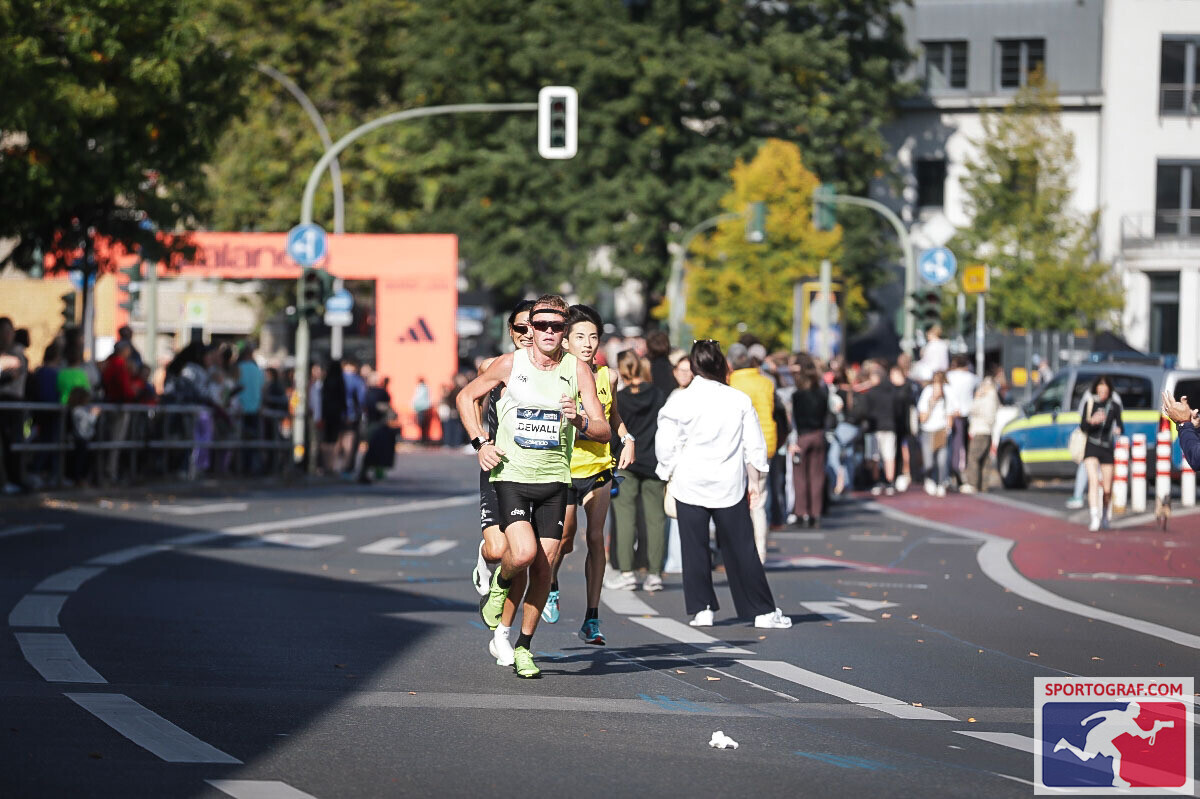
    Lars Dewall in a lime green Puma singlet, headband and sunglasses running at the front of a small group on a Berlin street, with spectators and a police van behind.
    Lars Dewall leads a small group through Berlin on September 27. He finished the BMW Berlin Marathon in 2:12:13, third among the Americans. (Photo: Sportograf)

    The summer before he started college, Lars Dewall ran his easy miles at a nine-minute pace.

    He had run 4:26 for the mile in high school. He had been an all-state skier at Stillwater Area High School in Minnesota, the same school Jessie Diggins skied for. And the coach waiting for him at the College of St. Scholastica in Duluth had given him one rule for his easy days: keep his heart rate under 140 beats per minute.

    For a runner like Dewall, on the road, that was a jog.

    “That’s how slow I was going,” he said. “It just doesn’t feel fun, and it takes a long, long time.”

    People tell him now that he runs his easy days fast.

    “I’m like, yeah, five years ago I was running nine-minute pace, though,” he said. “I had to be so disciplined about that for so long.”

    On September 27 he ran 2:12:13 at the BMW Berlin Marathon, 31st overall and third among the Americans, behind Charlie Sweeney and Will Nation. It was his fourth marathon and his fourth personal best. He debuted with 2:22:57 at Grandma’s in June 2025, ran 2:14:15 at the California International Marathon that December, comfortably under the 2:16 standard for the 2028 Olympic Marathon Trials, and then ran 2:12:30 at Boston in April. In between, back in Duluth, he won the Park Point 5-Miler and broke a race record that had stood since 1975. It belonged to Steve Hoag, who finished second at Boston that spring.

    Earlier this month his college coach, Chad Salmela, made the case in these pages for what American distance runners could learn from cross-country skiers, and called Dewall “my living thesis.” Salmela, who also calls cross-country skiing for NBC, describes his role these days as a sounding board on broad direction.

    Dewall teaches sixth, seventh and eighth graders in San Diego and trains with a group called Lane Zero Athletics. When we spoke on a Sunday in October he had already done his long run with the team, slept for about an hour, and was getting the coffee going at one in the afternoon.

    “It’s kind of like the day’s actually starting,” he said.

    He talked for most of an hour and needed very few questions to do it. Nearly every answer came back around to the same place. The hardest thing a distance runner has to learn is how to go slowly, and skiers worked that out a long time ago.
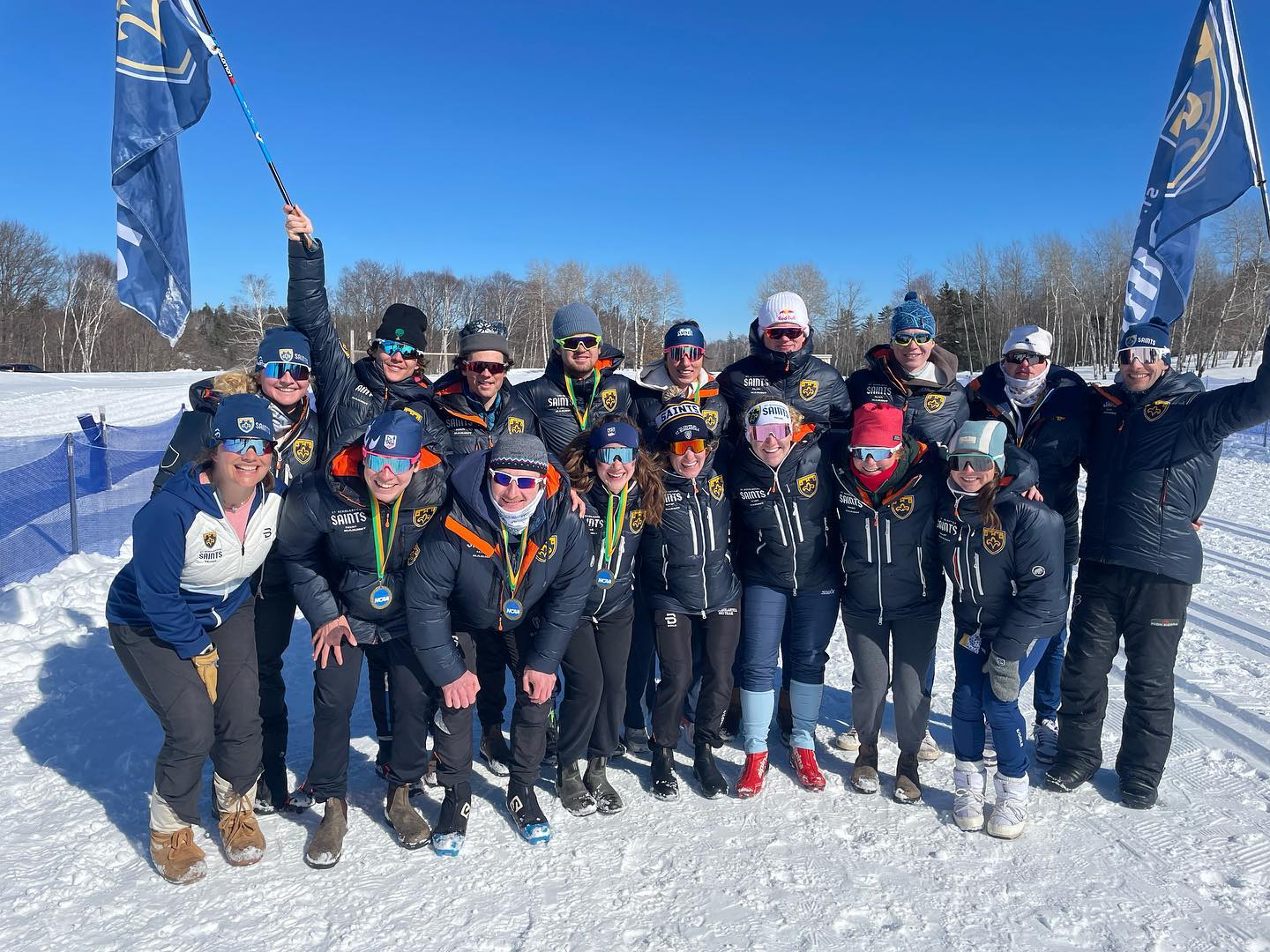
    The St. Scholastica ski team in navy Saints jackets and sunglasses posing on snow under blue sky, several holding NCAA medals, with two blue team flags raised behind them.
    St. Scholastica’s skiers after the men’s team won the NCAA Central Region team title in 2023, a first for the program. Dewall raced for the Saints on snow as well as on the track and the cross-country course. (Courtesy photo)

    Lying down in the tracks

    Skiing came first, in a way, and he did not care for it.

    His father was a serious skier, good enough to have raced against Salmela at some point, though Dewall is not sure exactly when. He took his son out on snow when the boy was small.

    “I just didn’t really like it that much, and it was kind of painful,” Dewall said and continued in his father’s voice. “He always describes it. He’s like, yeah, I’d take you out and you’d just go a little bit and lay down in the tracks or in the snow and just kind of goof around.”

    Football was the thing. He ran cross-country and track in middle school, but he cared more about football than any of it. In seventh grade he took track seriously and ran somewhere around 5:15 for the mile. In eighth grade, still a middle schooler, he trained with the high school team.

    “I look back on that and I’m like, that was a pretty big turning point, because you’re putting yourself in a situation with older guys,” he said. “I remember learning a lot more, and that, looking back on it, I feel like was more important than how I performed at that age. Although I performed well.”

    He planned to play football as a sophomore. That fell through, which he calls “a whole nother story,” and he abandoned ship for cross-country after the season was already underway. He was “aerobically pretty naturally talented,” he said, but there was not enough time left to get fit.

    Nordic skiing started around eighth or ninth grade, and it humbled him.

    “You can be really fit, but that doesn’t make you good at skiing,” he said. “It’s very, very different.”

    The technique took a couple of years. By his senior winter he was all-state, and he remembers finishing 22nd or 23rd at the state meet, which was enough to make him consider skiing in college. The trouble was that he had already committed to run at Western Washington University in Bellingham.

    After that ski season he toured St. Scholastica and met Salmela, who had been the school’s first nordic head coach for ten years before taking over cross-country running in 2016. Dewall would not have to choose.

    “I was really into the idea of being able to both nordic ski and run,” he said. “Especially at that age, I think it was really good for me to continue to do both for some years, because I didn’t know which one I really wanted to do at that point. And looking back on it now, they both really complemented each other for a really long time.”
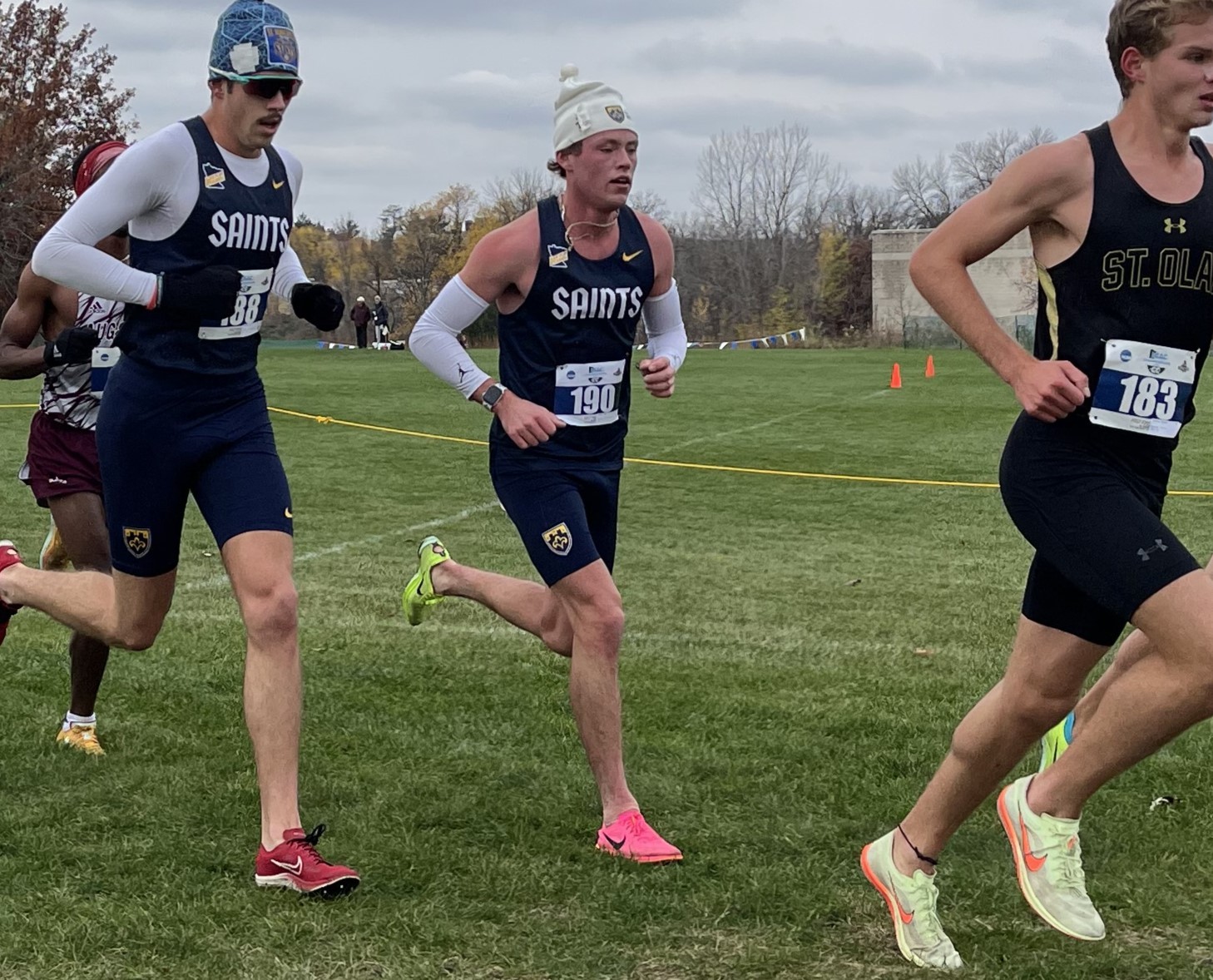
    Three college runners on a grass course, the one in the middle wearing a white knit hat, a St. Scholastica singlet and bib 190.
    Dewall (190), center, racing cross country for St. Scholastica. Under the 140-beat rule, his easy runs on Duluth’s trails went as slow as 10- and 11-minute pace. (Courtesy photo)

    The ‘Under 140’ Rule

    The running in high school was built for the mile and the two-mile. His coach at Stillwater was Scott Christensen, whose program produced four sub-four-minute milers by 2012, the most of any American high school at the time. Dewall puts the number at four or five.

    “My training was very VO2 max centered,” he said. “We’re running the mile and two-mile. There was no 5K.”

    Most of the rest of his running, he said, sat in “that level two zone, which at the time I didn’t even really know what that meant.”

    His best times were good and, he will tell you himself, not extraordinary: 4:26 for the mile, around 9:40 for two miles, 15:55 for 5,000 meters. He graduated in 2019 and doubts those marks would get him in the door at Western Washington now.

    “I guarantee those times would not,” he said. “They’d be like, nah, sorry.”

    What he remembers from those years is not a time.

    “I was running faster on my recovery or easy days in high school than I am now,” he said.

    The easy runs went at 6:30 to 7:15 a mile, with his heart rate at 150 to 160.

    “You’re in that zone where you’re just burning glycogen,” he said. “You can’t call it recovery, because you’re not recovering. You’re just burning through your tank every day, and you might get fit pretty quickly.”

    He has nothing against that kind of training. He just thinks it answers a different question.

    “If you gave me an athlete and were like, okay, we need to get this athlete as fit as possible in two to three months, you’re gonna do a lot of that zone two, because it’s gonna have the most bang for your buck,” he said. “But if you were to give me an athlete and say, we need to make this athlete the best version of themselves, and we have eight years to do it, well, you’re gonna do things a lot differently in terms of the intensity on your easy days.”

    Zone two sits well below threshold but above the genuinely easy work of zone one. On the Olympiatoppen scale most skiers know, the Norwegian system, it runs from roughly 72 to 82 percent of maximum heart rate. It builds fitness quickly. Plenty of coaches believe it also costs more recovery than easier efforts without giving much more back, and that is the trade Dewall is describing.

    He also thinks, looking back, that he was never really a miler.

    “I think I was a true distance runner who had the ability to run well at the mile and two-mile still, just by default almost,” he said.

    In Duluth, Salmela made it simple. Keep the heart rate around 140 or below on easy days. Dewall did not buy in right away.

    “It took me a little while to buy into it, and I was kind of half in, half out for a while,” he said. “But eventually I started taking it very seriously.”

    His first college cross-country season started well and ended with an illness and a disappointing finish. The principle held anyway. The nine-minute miles on the road were the hard part. Duluth had trails, and the trails helped.

    “The trails made it easy to really soak up, let’s just say, two hours at 135 BPM, but we were running maybe 10-, 11-minute pace on technical trails,” he said. “It made it mentally easy to let your ego go and just accept that it’s going to be a slow run and low heart rate, and that’s okay.”

    The return took years. When he is fit now he can run 6:45 a mile with his heart rate close to 130. He measures that against the high schooler who ran his easy days at about the same pace and 25 beats higher.

    “It’s huge,” he said. “It’s everything.”

    By the time he carried that discipline onto snow, the skiers around him already had it.

    “The skiers have a much better concept and notion of easy training than runners,” he said. “I would say it’s not even close. I feel like I’ve done more running than I have skiing, but I’ve done enough skiing to confidently say that the skiers are much more on top of their intensities, and cognizant about what they’re doing every day.”

    He has a theory about why.

    “Maybe it’s just the simple idea that you’re skiing, the terrain is varying,” he said. “Skiing feels a little bit more social to me than running does, because you’re out there and it’s different all the time. But running, I think people just get way too caught up in the pace per mile and all of that.”
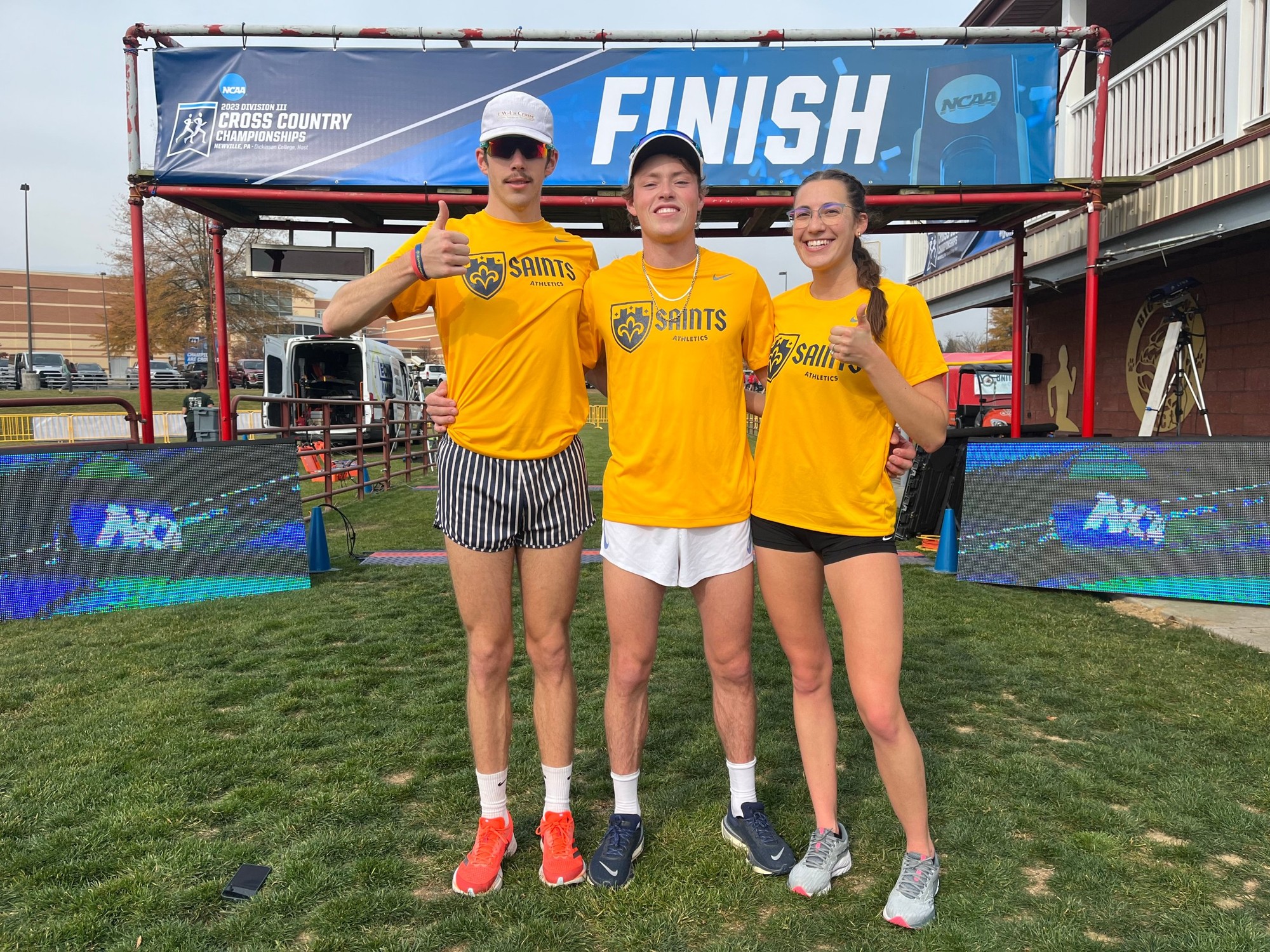
    Three St. Scholastica runners in gold Saints shirts smiling and giving a thumbs up beneath an NCAA cross country championships finish banner.
    St. Scholastica runners, Dewall among them, under the finish banner at the 2023 NCAA Division III Cross Country Championships in Newville, Pennsylvania. (Courtesy photo)

    Eight hundred hours

    In college he stopped counting miles and counted hours: run, ski, bike, lift. Some years, he said, came out between 800 and 900.

    “I was pushing it pretty heavy,” he said. “And again, obviously a lot of that is cross-training and not running.”

    Not all of it paid right away, even in a college career that included All-America honors in cross-country in 2023. The 5,000 and 10,000 meter results did not match the workload, and the skiing never got where he wanted it. He still turns that over.

    “I felt like I was decent at skiing, but I don’t know what it was, and I still think about it sometimes. I felt like it just couldn’t push to that top level,” he said. “I felt like I maybe didn’t start early enough, or maybe naturally just didn’t have it in that sport, and that’s okay. But I still really enjoyed it, and I think there was a huge payout later on in the running world with all the skiing.”

    The year had a rhythm. Winter was mostly skiing, with a little running. Cross-country season was a mix. In the spring he let the volume slide so he could sharpen for track.

    “You’re not going to run well in track if you’ve got heavy ski legs,” he said.

    What he and Salmela watched was the line from one year to the next, not any single season. It has only gone one way.

    “There hasn’t been a year since I started working with Chad where I haven’t gotten better, like PR’d in something or seen improvement in some way or another,” he said. “There were some years where maybe a nordic ski season or a track season or even a cross-country season didn’t go perfectly, and that’s sport. But across the board, since 2019, I can confidently say there hasn’t been a year where I haven’t gotten better.”

    He plans to do this for a lot more years and sees no reason for the line to bend. “I haven’t dramatically changed anything,” he said.

    The volume is lower now, because a runner cannot absorb hours the way a skier can.

    “You can try, but something’s gonna give at some point,” he said. “You’re gonna get hurt, essentially.”

    What crossed over intact was the mindset.

    “I’m really good about training like a skier, in the mindset of, I go out there and I know exactly what intensities I need to hit every day,” he said. “And I’ve done a really good job of letting the ego side of running go.”

    That means running alone, often. If the group heads out on a recovery day at 6:45 pace and his heart rate says no, he lets them go.

    “I have no issue going out and letting people go too fast, and I won’t go with them,” he said. “I’ll run alone. But that takes a lot of discipline.”

    He is not perfect at it. Where he still slips is in workouts, when somebody wants one more fast rep.

    “I can look back even at my block going into Berlin, and look at a couple workouts and be like, did I really need to do that?” he said. “Did that really help me more than it hurt me? But I think just being critical about all that helps you prepare for the future too.”

    The culture of the sport pulls the other way, he thinks, and social media has made it worse, especially for younger endurance athletes.

    “I feel like there’s also a side of them that’s chasing likes on Strava, or a fast run, or an Instagram post,” he said. “All that stuff is great, but if you’re skewing your training around social media, that’s no good.”

    His advice to the younger ones is short.

    “Wait for the race to do that,” he said. “Put the race down. The training is just the building blocks.”

    Every day should have a reason, a purpose.

    “Look at every day and be like, what am I going to do to get better today?” he said. “Instead of just kind of hither and yon, like, oh, let’s show up and run.”
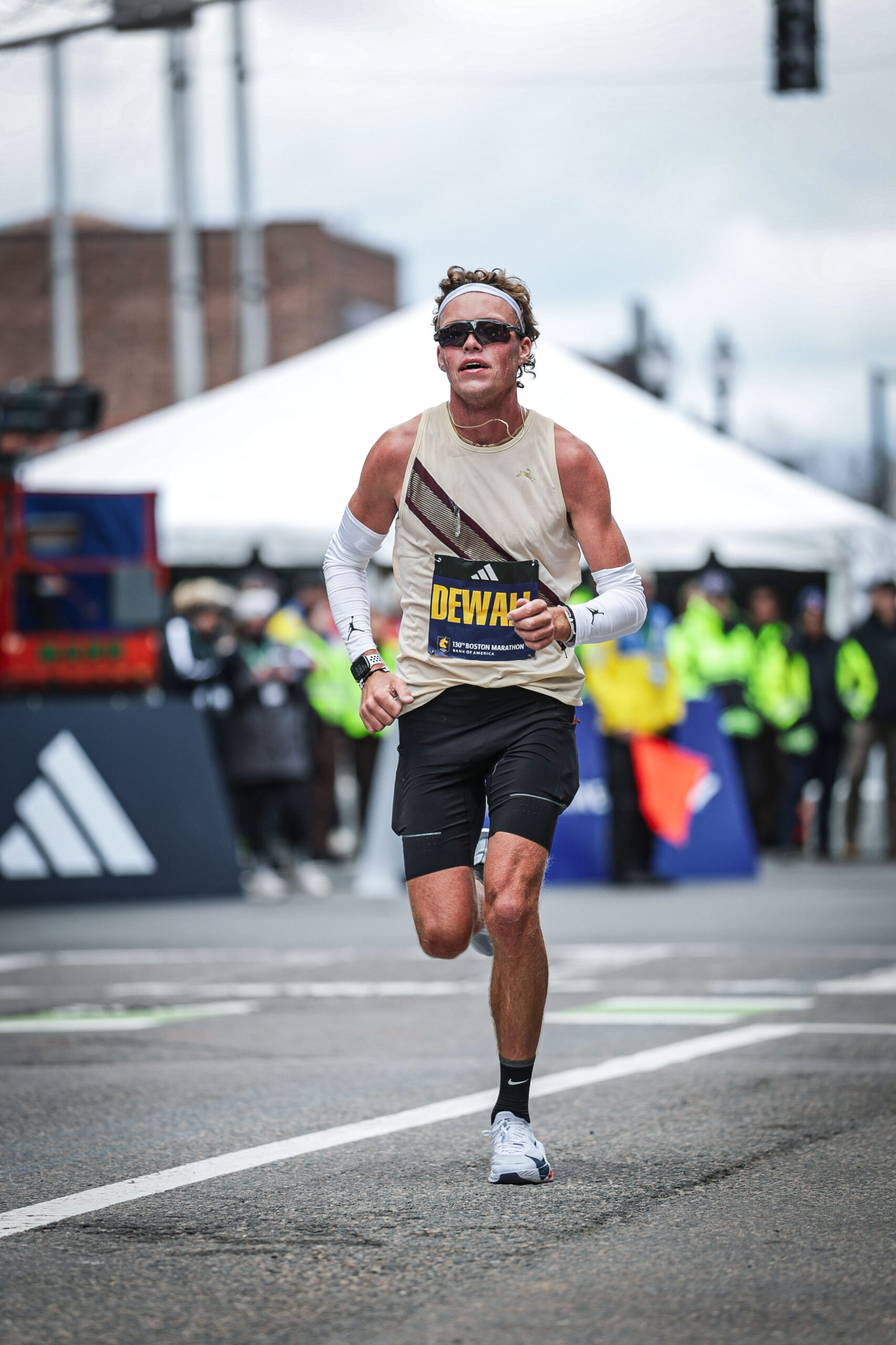
    Lars Dewall in a cream singlet with a maroon sash, white arm sleeves, headband and dark sunglasses running toward the camera at the Boston Marathon, a white tent and race volunteers behind him.
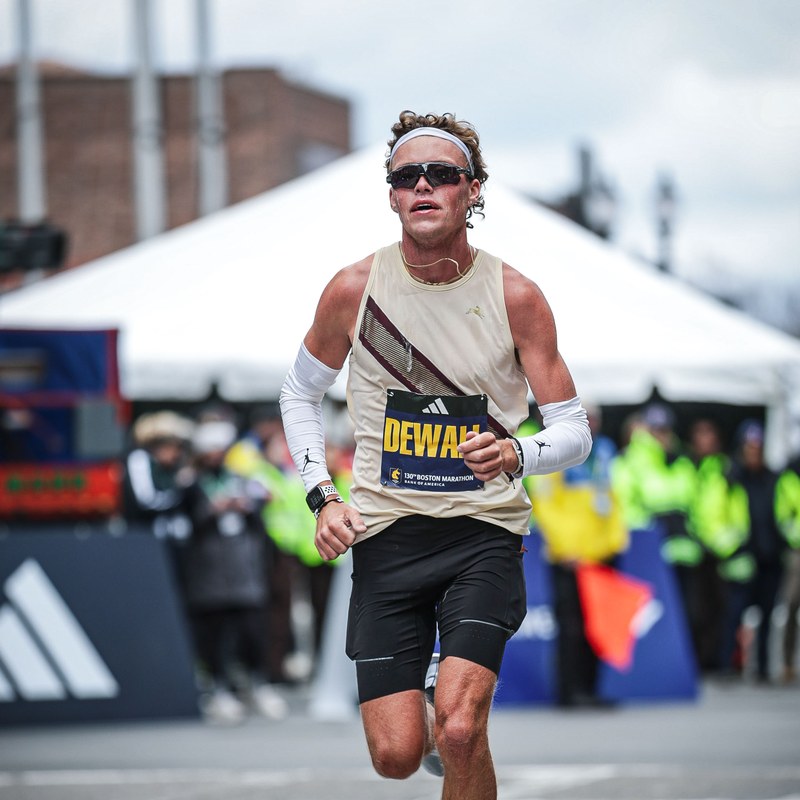
    Dewall at the 130th Boston Marathon on April 20, where he ran 2:12:30 off a build with no double threshold sessions in it. (Courtesy photo)

    Boring on purpose

    Ask what a skier’s background gives a marathoner that most marathoners do not have, and his first answer is something he does less of.

    “I’ve always found that I do a lot less VO2 max than most people, and I’ve been asked why,” he said. “The answer is always, VO2 max has a place. You have to touch VO2 max to be able to race well. But it’s less of a factor in the marathon.”

    When he leaned on it in high school and college, he would string together a couple of great weeks and then slide.

    “I felt like the engine would get flat,” he said. “And it’s so much harder to recover from a hard VO2 max session than a threshold session that’s done very well.”

    So he replaced some of it with threshold and what he calls efficiency work. He is sure he does more threshold than the average marathoner. The gap can look small on paper, maybe one session in fourteen days, and he thinks it compounds.

    “It’s hard to weigh how much even one workout every 14 days makes over the course of an eight to 12 week training period,” he said. “It adds up.”

    The second answer is strength, and with it the ability to carry mileage. He has gone from about 100 miles a week to about 135.

    “I don’t want to say that for sure, but I definitely think that the skiing background, the strength, the amount of volume that I was doing all those years has helped me being able to go from, okay, I was running 100 miles a week, that’s a lot. But to be able to jump from that to 135 and still feel pretty dang good,” he said. “To be able to make jumps like that, I feel like the ski background definitely is a part. Someone will go, oh, it’s just 35 more miles. But that jump in your nervous system and fatigue and all of that, it’s an exponential number. It’s hard to even measure.”

    The odd part is that in college he barely lifted for running at all.

    “I really did none,” he said. “I just didn’t really want to. I was just kind of lazy, and I didn’t believe that it would make me better at running.”

    What he did in the weight room was for skiing: upper body, core, pull-ups. For about a year now he has followed a running strength program built to take 20 minutes. Heavy half squats. Step-ups holding about 60 pounds. A Bulgarian split squat done as a jump, with no weight. Romanian deadlifts. Two sets of eight of each, three minutes between, and he spends the three minutes stretching, on core, or on whatever is sore. He lifts two or three times a week, soon after a workout or a long run once he has refueled, and never on a recovery day.

    “It comes at a cost, and strength is strength,” he said. “You’re still adding fatigue.”

    Then there is the session everybody in marathoning is arguing about. He ran 2:12:30 at Boston with no double threshold days in his build. He ran 2:12:13 in Berlin after a lot of them.

    “It’s hard to weigh,” he said. “If I would’ve ran 2:10 in Berlin, would I answer that question differently? Maybe. I just need more races to be able to answer that question. I think they’re both good.”

    His complaint is with how a lot of people do it.

    “You want fatigue to be the thing that’s stopping you, not lactate being too high,” he said. “People are like, oh, I’m done, my lactate’s high. And most people aren’t even monitoring that. I just like to let time be the thing that makes you tired. Time on feet.”

    Going into Berlin, where the goal was to break 2:10, the pace for it, around 4:57 a mile, felt easier than it ever had in his career. He gives double threshold some of the credit and plans to keep it, perhaps every other week instead of every week.

    “It’s taxing,” he said.

    After the first story ran, Salmela wrote that Dewall was basing most of his current training on cutting-edge running technology. Dewall found the phrase funny.

    “I would say that a lot of my training looks pretty boring, because it’s a lot of the same stuff over and over and over,” he said. “But the consistency is there, and the focus and discipline and being a mature runner is there.”

    Lactate testing and heart rate data matter, he said. But he thinks what Salmela meant is simpler than any of the gadgets.

    “In the running world specifically, people aren’t out there constantly monitoring heart rate and all that data, and getting useful information from it,” he said. “Even in the pro world in running, there are people who are doing a really good job of it, but there’s people out there who are just showing up, like, let’s go run.”
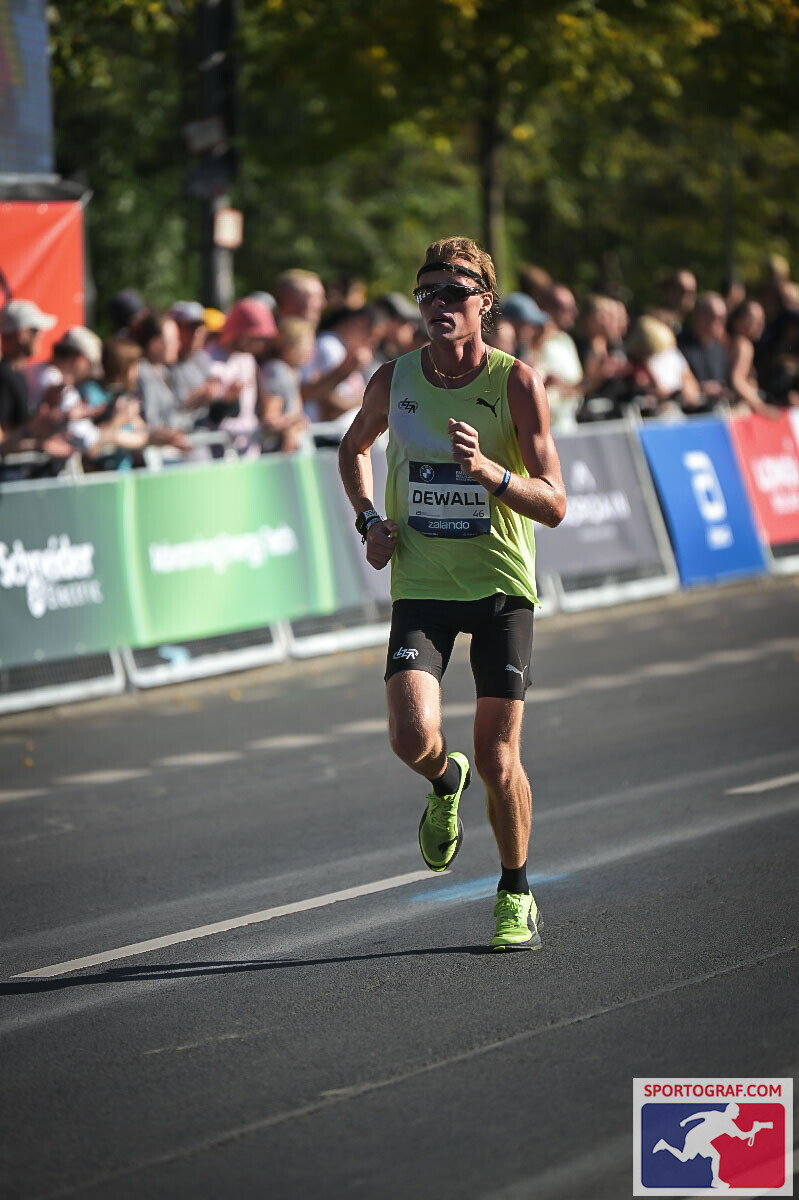
    Lars Dewall in a lime green singlet and bright yellow shoes running alone down a sunny road lined with barriers and spectators.
    Dewall on the road in Berlin, his first race in Europe. He called it the most organized and efficient race he has been to. (Photo: Sportograf/courtesy photo)

    The road to St. Louis

    The Olympic Marathon Trials are in St. Louis on March 25, 2028. Dewall has had the qualifying time since CIM, and he is not alone at home. Three or four of the Lane Zero runners, Dewall included, have met the 2:16 standard.

    “Although San Diego’s a big city, that’s a lot of qualifiers for even a big city,” he said. “Those are the guys that can push me in workouts and really make me better in workouts.”

    Puma backed him through Berlin under its PROJECT 3 program for sub-elite marathoners, and after the race the company told some of those athletes it would support them through the Trials. He does not yet know what that will look like. He doubts it will be money.

    “But free gear and travel and stuff like that, and that’s pretty huge,” he said. “So I’m stoked about that.”

    He knows where the next line is.

    “Two-ten is the number that most of these companies are looking at to be like, okay, let’s get you on an actual contract,” he said.

    For now he is letting his body decide what comes next. Berlin was three weeks old when we spoke, and the job was to recover without giving back fitness. There might be a race before the end of the year. He expected to know soon.

    Early 2027 is for going shorter: road 5Ks and 10Ks, maybe a 3,000 or a mile, even a time trial. His 5,000 best is 14:37, and he thinks 14:10 is there at the least. He would like to get under 29 minutes for 10K. His mile best is 4:10 from college, and before Berlin he ran 4:22 at the end of a workout without trying very hard.

    “I was like, to my buddies, I think I could have PR’d in the mile right now at the end of this workout if I would’ve went for it,” he said. “Who doesn’t want to have a faster mile PB, even if you’re a marathoner?”

    The bigger target is the half marathon standard for the Trials, 1:03:00. The window for half marathon qualifiers opens January 1, 2027. His best is 1:04:06, from the Garry Bjorklund Half Marathon at Grandma’s in June, in conditions he called humid-ish. He is already qualified for St. Louis, so the half would change nothing about his place there. He wants it anyway, and he is looking at a half in March.

    “It’s a nice accolade to have,” he said. “It’s no gimme. That’s gonna take some really specific prep.”

    He expects to run one marathon in 2027. Boston again, maybe London, maybe Chicago, nothing later in the year than that. He would think about Berlin again if teammates were going, because of how well the race took care of its elite field.

    “That was the most organized and efficient race I’ve ever been to,” he said. “And that’s worth a lot.”

    He wonders whether getting there three or four days earlier would have bought him something. He does not know. He also admits he remembers very little of the course.

    “I always laugh when people ask me about the course in those races, and I’m like, I don’t even know,” he said. “You’re going pretty fast, but you’re also in a group like that, and the only thing you’re looking at is just the person in front of you.”

    On Monday mornings he is back in front of his middle schoolers. He is not a morning person, which makes running before school a grind in the long weeks.

    “I wish I could start my teaching day at 9 or 10 a.m., but that’s not how the real world works,” he said.

    He would not trade it.

    “When you don’t have that job, it’s easy to get almost obsessed with the training and the running,” he said. “As much as that’s great and it’s exciting, I think it’s good to have something to force me to not think about running.”

    The classroom gives some of it back.

    “It’s fun teaching kids and making a difference in their life,” he said. “I feel like they take interest in the marathon stuff too, and ask questions, and always want updates.”

    He wants to coach someday, probably once his own career is over, and he knows which sport.

    “I think I’d like coaching running more,” he said. “A little more straightforward. Less variables, less factors.”

    No wax, no kick, no temperatures, as he put it.

    The 2:10 is still out there, and he knows how close 2:12 is.

    “I’m scratching,” he said. “I just gotta connect on the right day.”


    Help Support Our Coverage!

    If you value the thoughtful work and access FasterSkier provides, please consider becoming a Voluntary Subscriber. Your support directly fuels our work to cover the people, places, and moments that make our sport special.

    Join the FasterSkier community!
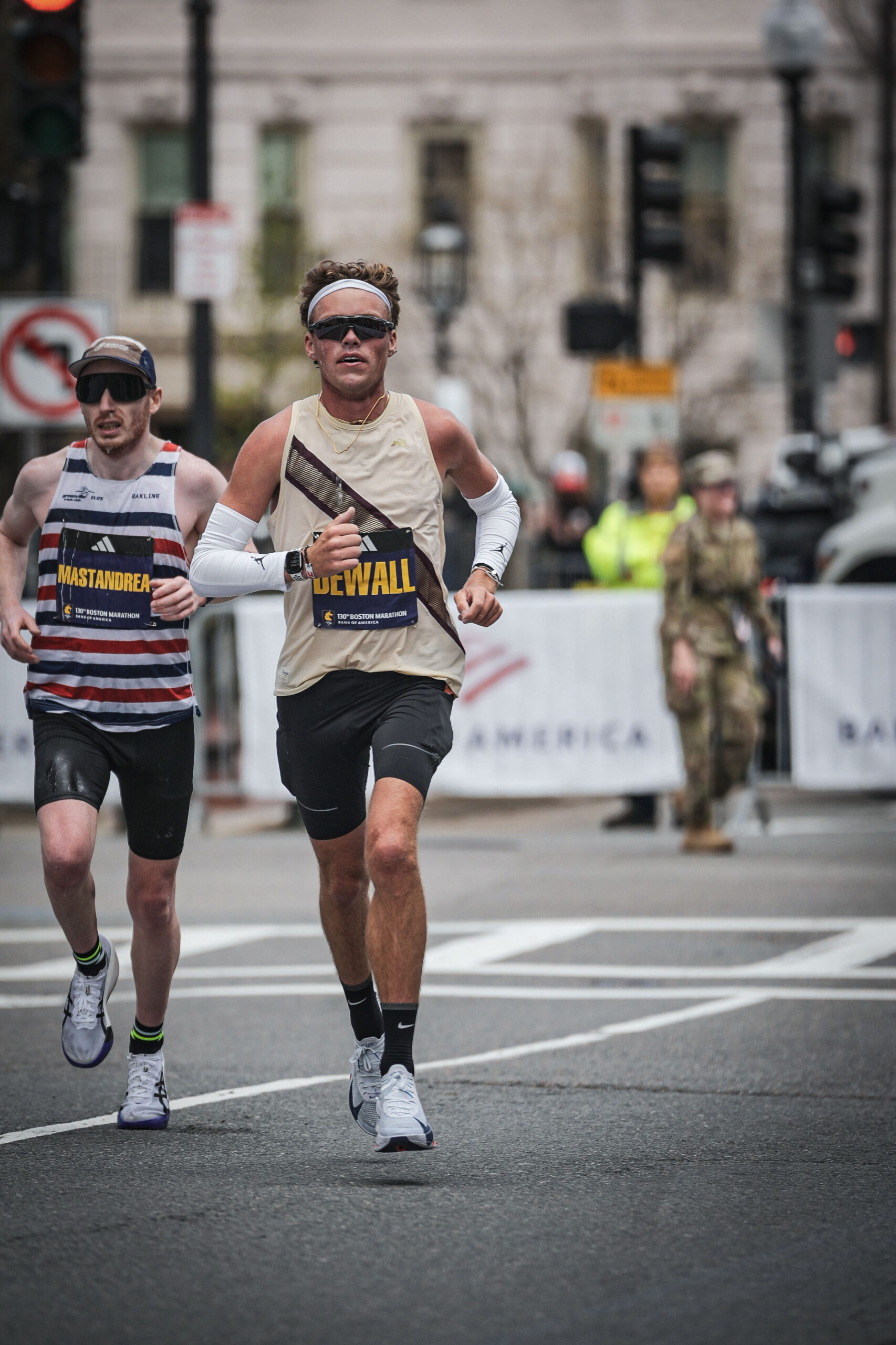
     

    Lars Dewall in a cream singlet and white arm sleeves running a city street at the Boston Marathon, a runner in a striped singlet a step behind him.
    Dewall at Boston in April. He expects to run one marathon in 2027, and Boston is on the list. (Photo: T. Wherry)
  • ‘Mileage Is a Distance, Not a Volume’: Chad Salmela on What Runners Can Learn From Cross-Country Skiers

    ‘Mileage Is a Distance, Not a Volume’: Chad Salmela on What Runners Can Learn From Cross-Country Skiers

    This article was made possible through the generous support of our voluntary subscribers. If you value coverage like this, please support FasterSkier with a voluntary subscription.

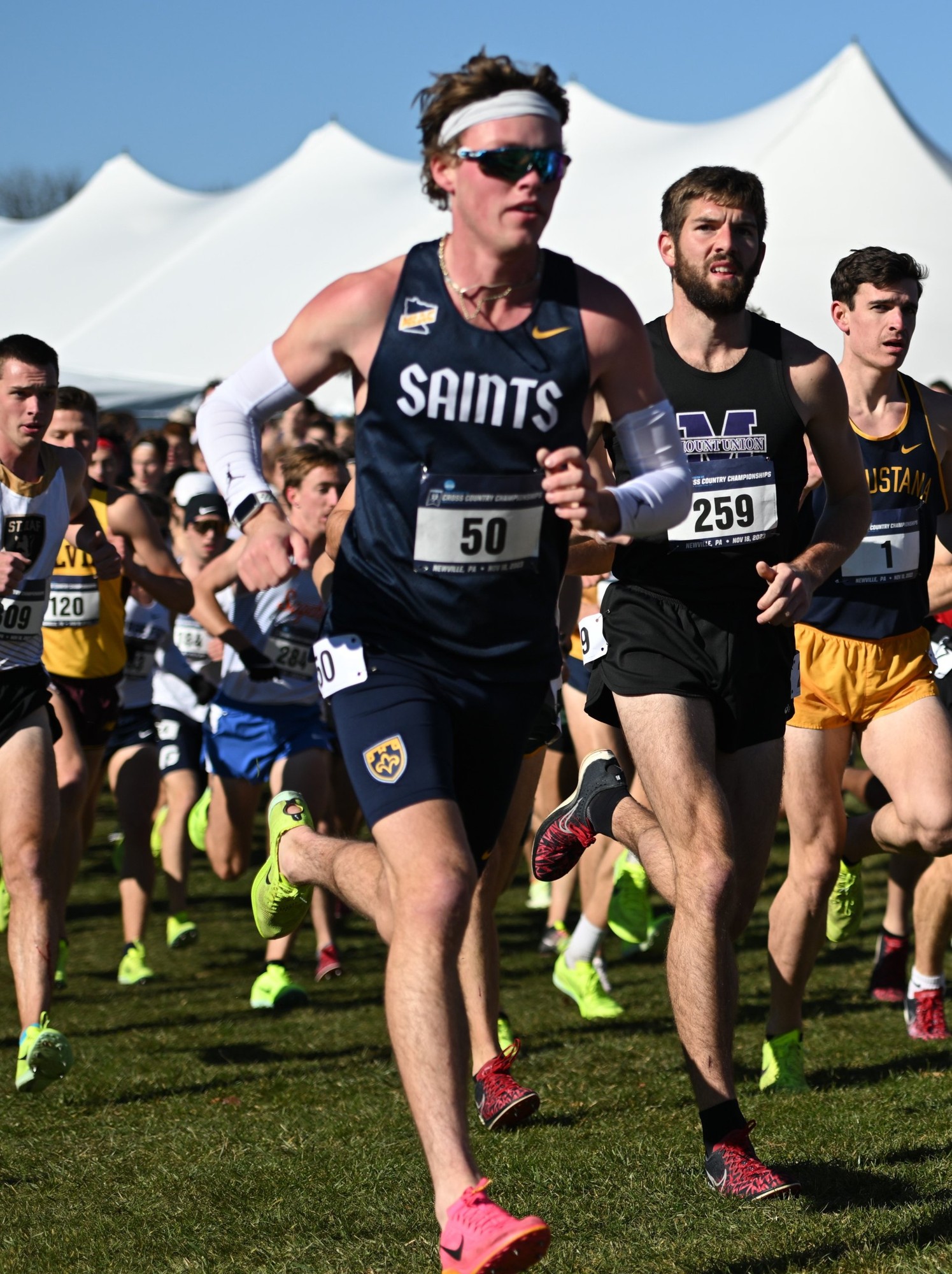
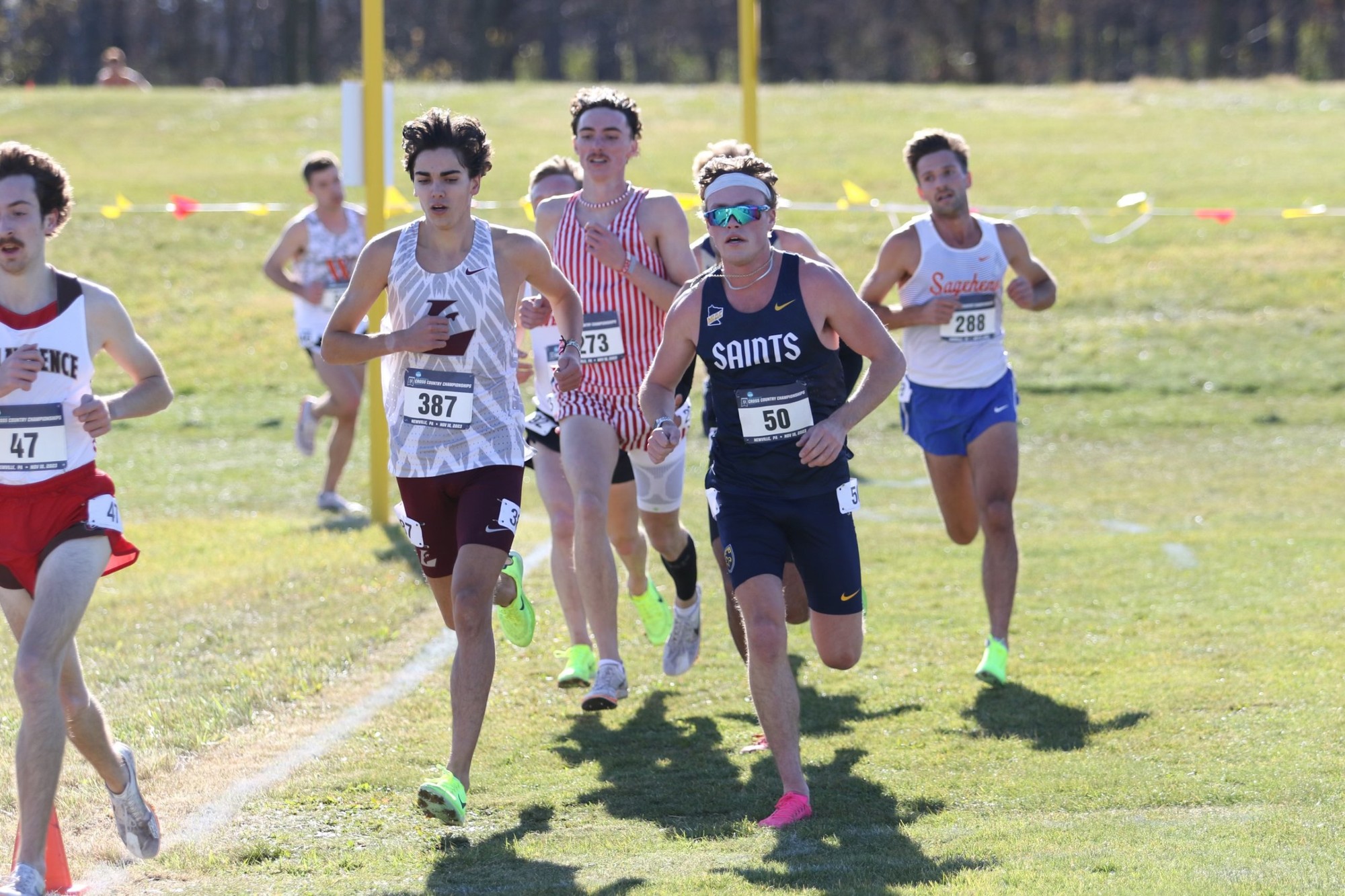
    Lars Dewall in a navy St. Scholastica Saints singlet and bib 50 running in a pack of college runners on a grass cross country course.
    Lars Dewall (50) races for St. Scholastica at the 2023 NCAA Division III Cross Country Championships in Newville, Pennsylvania. (Courtesy photo)

    Lars Dewall has run four marathons and he has never run a slow one.

    The debut was Grandma’s in June of last year, 2:22:57. Then California International in December, 2:14:15. Then Boston in April, 2:12:30. Then Berlin in September, 2:12:13, third American across the line. Four races, four personal bests, each one faster than the last, which is not how marathon careers usually go.

    Dewall came out of Division III. He ran at the College of St. Scholastica in Duluth and was an All-American there in 2023, one of the first two the cross-country program ever produced. He now teaches middle school social studies in San Diego. His training sounding board on broad direction is his college coach, Chad Salmela, who coaches cross-country at St. Scholastica, called the women’s team sprint in PyeongChang for NBC, and spent eight years on the US biathlon team before either of those things.

    Salmela has a theory about why Dewall keeps getting faster, and it is not a comfortable one for American distance running. He has been making the argument for most of two decades, in a sport that was not his first one, and until recently he did not have a runner fast enough to make anybody listen.

    “He’s like my living thesis right now,” Salmela said. “He’s actually texting me as we’re talking.”

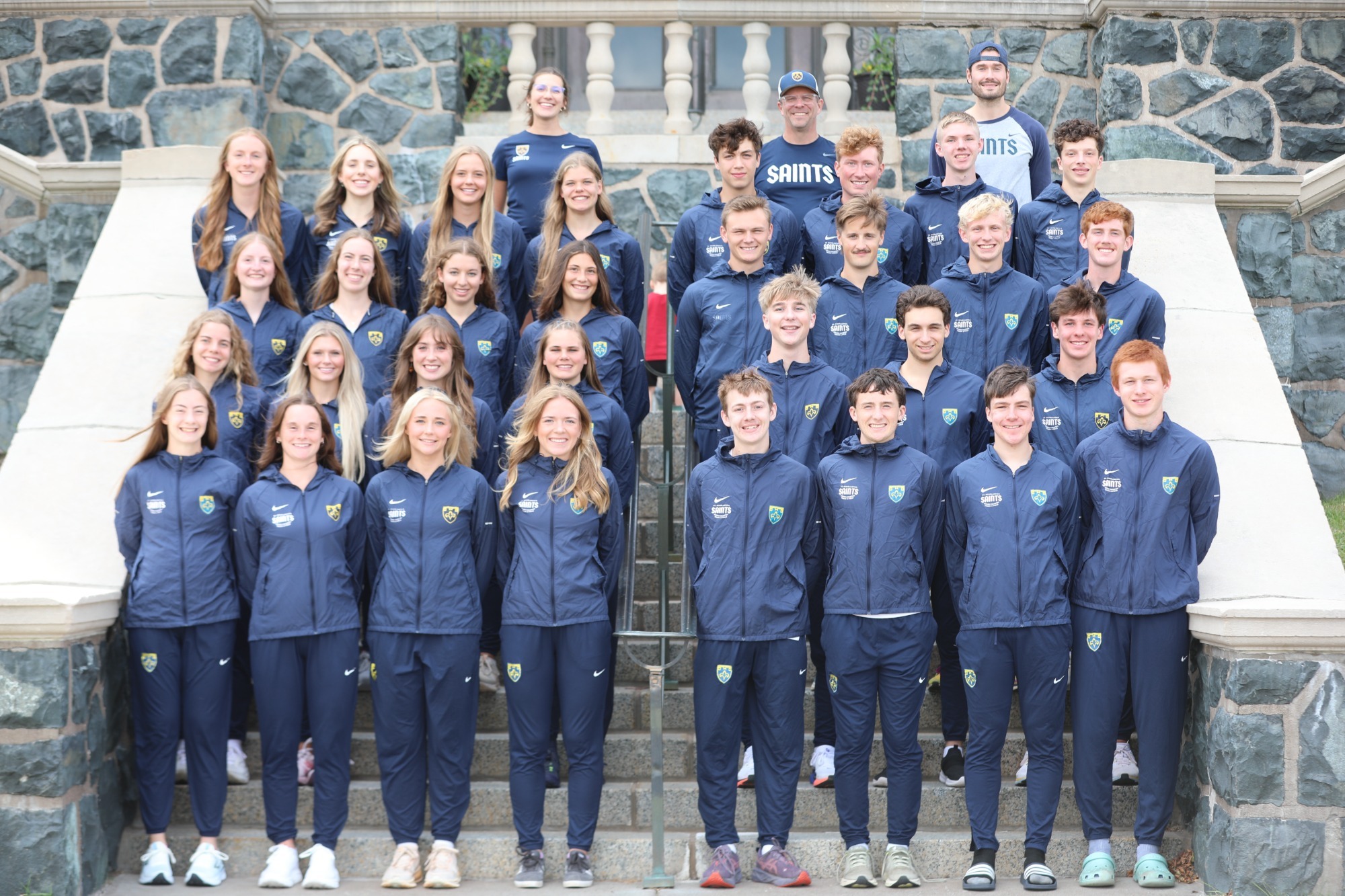
    The St. Scholastica cross country team in navy warm-ups posed in rows on stone steps, women on the left and men on the right, with the coaches standing at the top.
    Chad Salmela, back row center, with the 2026 College of St. Scholastica cross country team. In more recent years, Salmela has given up the nordic coaching role to concentrate on broadcasting during the ski season, which we will cover soon in part two of this series. (Courtesy photo)

    Mileage is a distance, not a volume

    The sentence above is his, written rather than spoken. It appears in the letter he sends to recruits, which is less a sales pitch than a seven-paragraph argument about exercise physiology, and it is the cleanest statement of the thing he believes.

    “Mileage tells you how far you’re running,” he said. “It doesn’t break down what you did in that distance.”

    He has been resisting the number for years and he still resists it.

    “You can have a huge mileage week on threshold. You can have a small mileage week on relatively aerobic,” he said. “Two to three two-hour-plus workouts, that’s going to be fewer miles than three threshold workouts. So that mileage metric, I feel like it kind of misshapes things in people’s minds.”

    Ninety-mile weeks are not the problem, in other words. What is in them is.

    “Ninety-mile weeks at a lactate of 2.5 as opposed to a lactate of 1 is going to have a way bigger consequence down the road,” he said.

    This is where the skiing comes in, and it is worth being precise about the lineage, because Salmela is. The interval sessions he leans on are not his. The one he uses the day before a race, a minute on and thirty seconds off, he calls “a complete ripoff from the Ingebrigtsens,” though the session appears in Marius Bakken’s own published account of the Norwegian model, as does the 45-seconds-on, 15-off session Salmela started using this autumn. Bakken, a Norwegian physician and former 13:06 5,000-meter runner, built the method out of more than 5,500 lactate measurements and mentored Gjert Ingebrigtsen (Jakob’s father) directly between 2011 and 2013. The family made it famous. Bakken wrote it down first.

    What Salmela did was carry it sideways, out of a sport where lactate testing has been routine for forty years into one where it mostly has not. He is blunt in the recruiting letter about why that gap exists and what it costs: the discovery was “established decades ago in the early 1980s, and has been adjusted in many other endurance sports, yet somehow continues to evade American distance running.”

    His own estimate of what the ceiling looks like is deliberately large.

    “If you can train as a runner seven or eight hundred hours of aerobic training, it doesn’t have to all be running; you can improve way more than you think as a runner,” he said. “But how do you get those 800 hours? You can’t do it running. You’re probably going to start having a limitation there.”

    That is a skier’s number, and he knows it. It is also the number he says Dewall has been running at for two years.

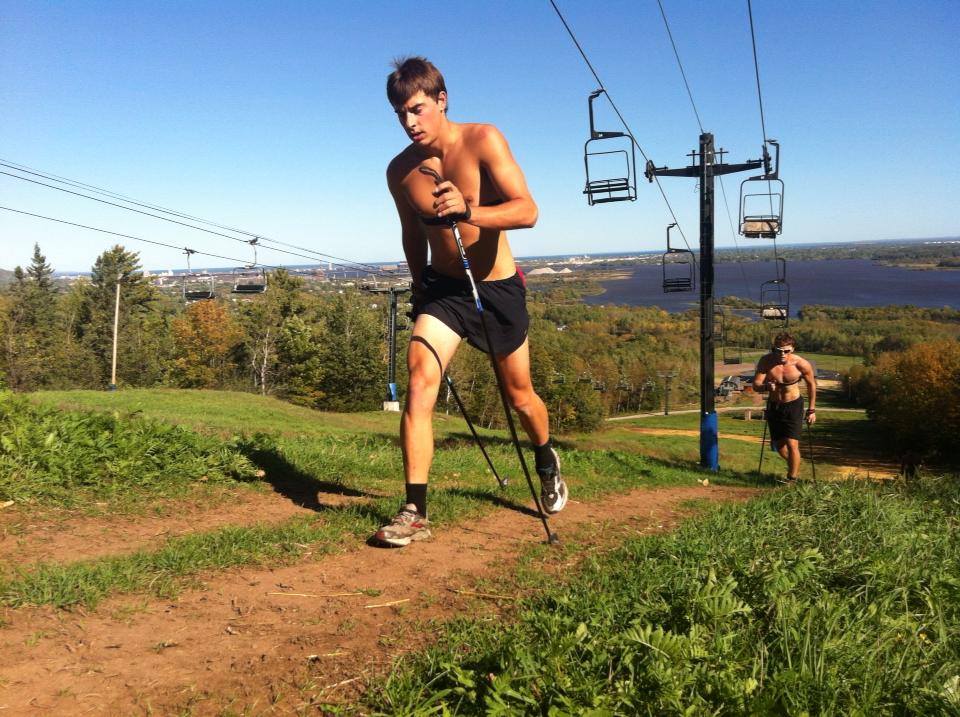
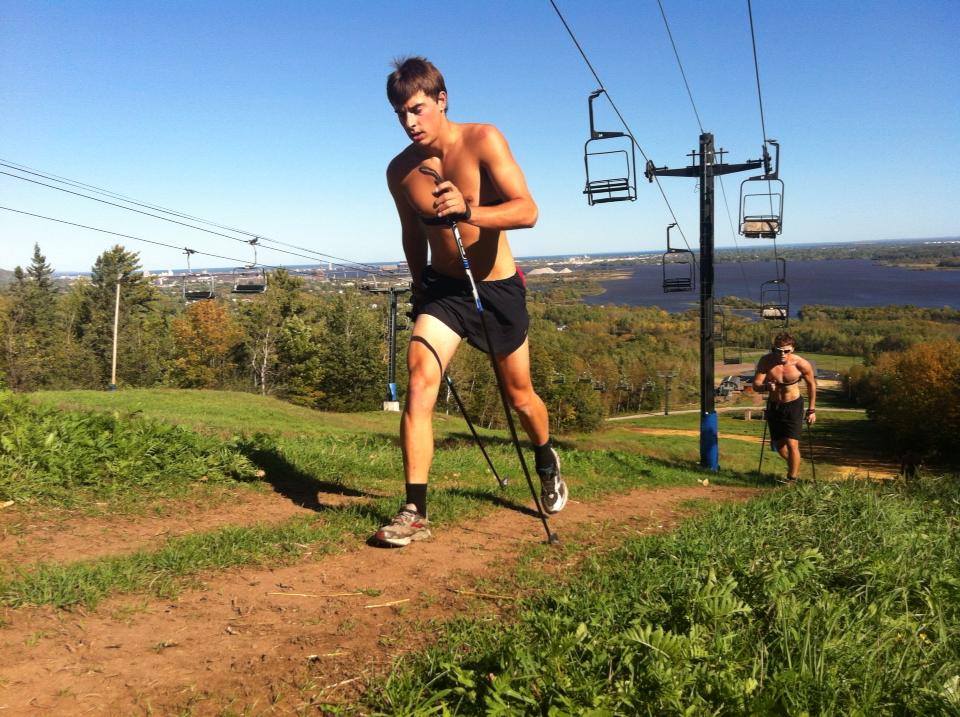
    A runner bounding uphill with ski poles beneath a chairlift, a second runner far behind him.
    St. Scholastica’s Paul Schommer, foreground, and Joe Dubay bounding up Spirit Mountain in Duluth, Minnesota, in the fall of 2014. (Photo: Chad Salmela)

    Injury is not the cost of doing business

    The recruiting letter contains three words in capitals: “Injury is NOT necessary.” He gets more animated about this than anything else in our ninety-minute conversation.

    “The first thing that always drove me nuts as a skier coming into the running world, before I even started coaching, was just the acceptance of injury as part of the deal,” he said.

    He is careful to say he might be wrong, and then says why he does not think he is.

    “Anytime you’re asking your body to do something it’s not able to do, you’re doing something wrong,” he said. “I think that’s a very important thing to remember. If you build the strength and you build the motor to handle it, you can pretty much avoid injury.”

    Then the qualifier, offered without being asked for, which is the mark of someone who has actually thought about the limits of his own claim: “maybe I’ve just never taken anybody to their very maximal capacities so far, and that could be it.”

    The mechanism he proposes is fuel. His argument is that a runner who has never taught their body to burn fat at easy intensities is spending glycogen on workouts that were supposed to be building aerobic efficiency, and that the bill arrives later.

    “You’ve got to define where your aerobic threshold is running, and you have to make sure that you’re burning fat there,” he said.

    He has a blunt way of describing the high school runner doing it wrong.

    “You can’t be running 6.5-minute miles and you got a PR at 15:30. That doesn’t even compute. It’s not easy enough,” he said. “You’re still going to have better immediate success. But somewhere down the road, if you don’t learn how to burn fat, you’re going to probably get hurt.”

    The same protectiveness shows up somewhere less expected, which is how he handles a team that is getting sick. Two weeks before we spoke, a freshman turned up to a threshold session with a sore throat and told nobody until afterwards. Three of the four men in his suite went down. By Thursday the squad was, in Salmela’s description, a shell of itself, and on Saturday fourteen of thirty made the workout.

    The athlete who did not get sick was the fittest one in the room, and Salmela pulled him out of the hard session anyway.

    “I’m not putting you through a level four workout right now when you’re rooming with three guys who probably are carrying the bug, because you’ll be sick by Saturday if we do it,” he said. “He was pissed, but I didn’t let him do it.”

    The rule for everyone else is not negotiable and the arithmetic behind it is simple.

    “If you’re sick today, you’re not training tomorrow,” he said. “The best case scenario is you catch it, you stop, and you have four days that you’re not training. That’s going to be the minimum.”

    Against that he sets what a season costs. His athletes are chasing a minute off an 8k, and he does not think a sick athlete who races anyway gets it.

    “They’re not running a minute faster in 8k this year, and they will not do it if they get sick,” he said. “They won’t do it.”

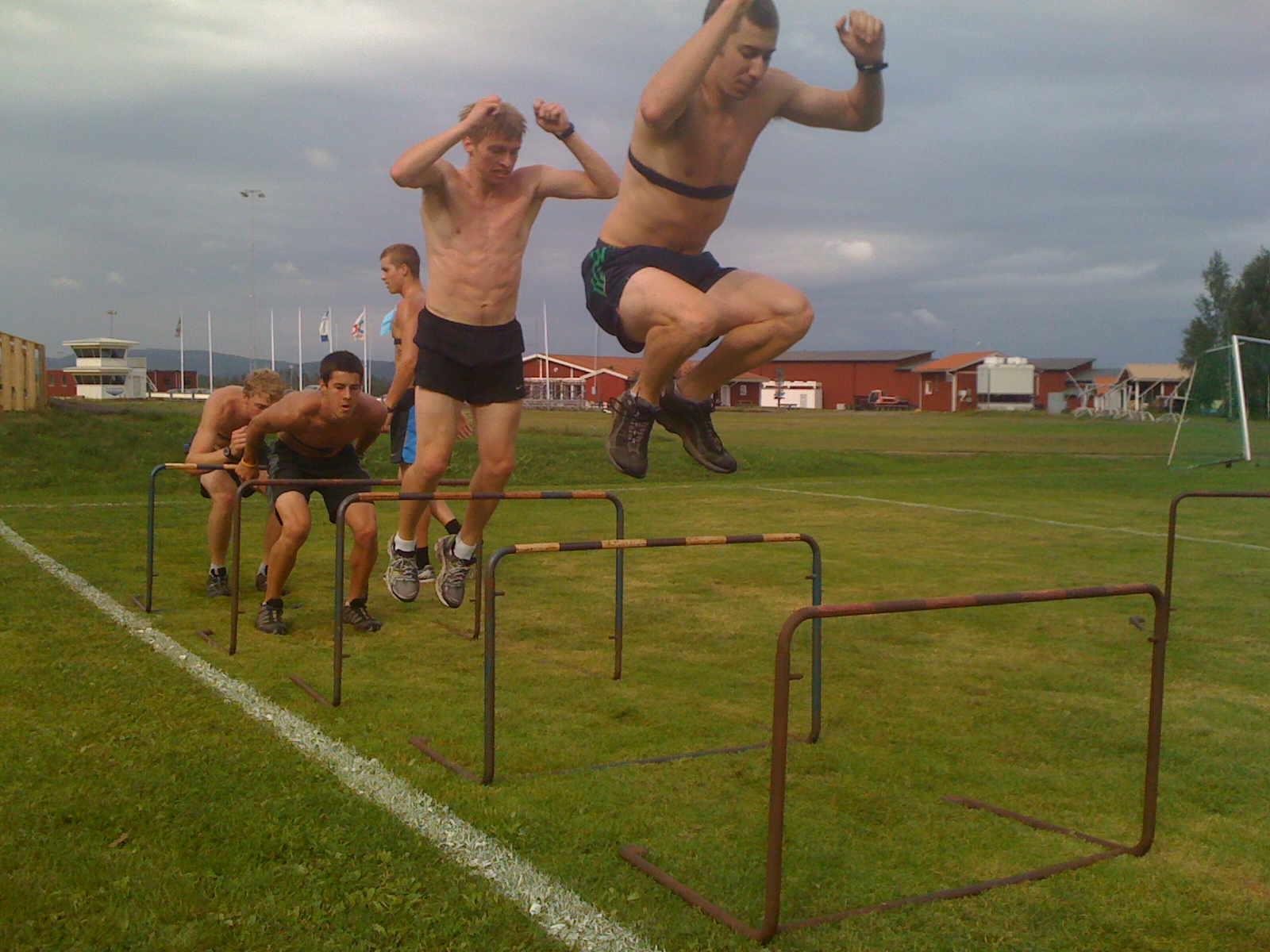
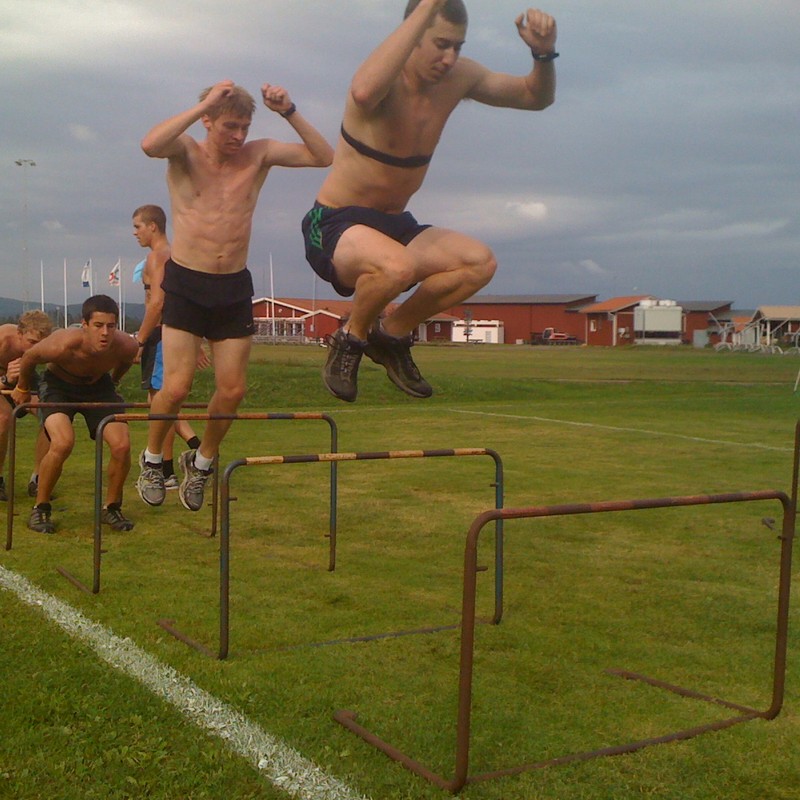
    Five athletes bounding over low hurdles on a grass field under a grey summer sky.
    Hurdle bounding at a St. Scholastica dryland session. Salmela believes in the work and is his own cautionary tale about too much of it; a winter of jumps in his last season as a biathlete left him convinced he had compartment syndrome. (Photo: Chad Salmela)

    What he got wrong first

    Salmela is a strength evangelist who will tell you, unprompted, about the year he ruined a team with it.

    “I loaded too much strength on some of my early teams coaching, and they got flat,” he said. “They got super slow, didn’t stay quick.”

    What he settled on instead is periodized and, more importantly, individual. December is a strength block for everybody. In season it drops to maintenance and bodyweight work. Beyond that he decides person by person, and he is explicit that the people who say runners need strength and the people who say they do not are both partly right.

    “You need a minimal amount of strength just to stay healthy,” he said. “And then some people need strength to be stronger, to be faster as a runner. They actually need strength to be a part of the catalyst that makes you your best.”

    He has a sophomore who worked this out for herself before he did. She ran in high school, never lifted, went through the Air Force, got strong there, and arrived at the conclusion that the strength was the thing she had been missing all along. She now does three sessions a week on her own, more than Salmela gives anyone else on the roster.

    Plyometrics get the same treatment, and the same warning, which comes from his own body. In his last season as a biathlete he loaded up on jumps and spent January and February convinced he had compartment syndrome.

    “Really what it was is I had incredible anaerobic power and the racing season just kind of started having catabolic reactions in my shins,” he said. He credits Dave Bacharach, the exercise physiologist at St. Cloud State, with talking him out of the diagnosis: a lot of type 2 fibre, suddenly drowning in lactate every weekend.

    “You have to be careful with plyos for aerobic sports because it’s anaerobic work, and it’s going to steal some of it,” he said.

    The archaic notion

    Ask him about tapering and he does not hedge.

    “I think the taper is an archaic notion,” he said. “I think some people need a taper. You have to find the person who needs a taper. And there are some people out there, but I’d say they’re the minority.”

    His team runs six to nine hours a week regardless of where the season is. The reasoning is that fitness is the thing being protected, and that the races themselves do the damage a taper is usually blamed on.

    “Great races kick your ass, man,” he said. “They are hard to recover from. So if you want to have two or three great races in a row, you better watch that.”

    When he does drop volume it is recovery, not peaking, and he says so. The most persuasive evidence came from a senior who diagnosed her own pattern and brought it to him: three straight years of running a personal best at conference and then one of her worst races of the season at regionals a week later.

    “She goes, can we fix that? And I’m like, yeah,” he said. “We’re going to keep the volume high. We’re not going to taper.”

    What replaces the taper is a race week with a shape to it, and this is the most directly usable thing he says all afternoon. A maximal effort five days out, long enough to spend real time at max heart rate. Then the Bakken session the day before.

    “The reason I think you need that is because your heart will not be ready to respond to the work if you don’t do that,” he said of the hard day. “And if you do it any closer to the race, you’ll still be trying to recover from it.”

    The day before, he keeps it short: five to eight repetitions of a minute on, thirty seconds off, in the tempo zone, perhaps five minutes of actual work.

    “It’s the best pre-race workout I’ve ever found. Works almost universally,” he said. “Up until that point, I had found some workouts that work for some people and not for others.”

    He does not prescribe the number. He hands the athlete a rule instead, and it is a small masterpiece of coaching.

    “As long as the one you did last feels better than the one you just did before that, do the next one,” he said. “As soon as you feel like you’re working at all, you’re done.”

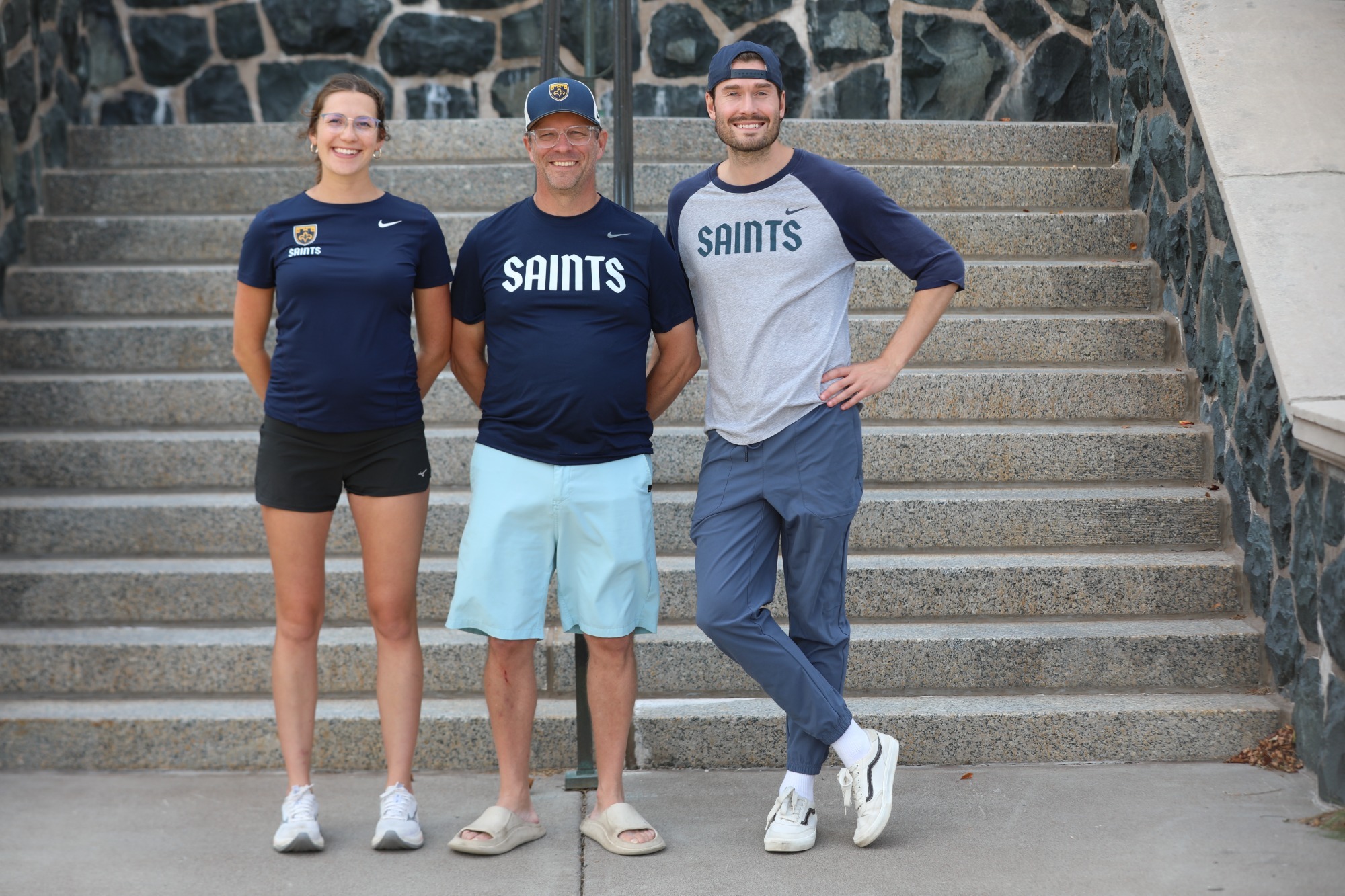
    Three St. Scholastica coaches in Saints shirts standing at the foot of a wide stone staircase, Chad Salmela in the middle in a cap and light blue shorts.
    Salmela, center, with his St. Scholastica cross country coaching staff in August 2026. (Courtesy photo)

    Leave the gait alone

    There is one more piece, and it runs against most of what a modern running program sells.

    “Meddling with natural biomechanics is kind of a no-no in my book,” Salmela said.

    His most successful runner, he said, had a gait nobody admired and plenty of people wanted to correct. She was never injured until she stopped doing strength work.

    “Her gait wasn’t pretty, but it worked, you know, and I recognized that,” he said.

    His evidence for leaving well alone is a runner who arrived last year from a small high school program, had not scored for his team, and spent his first season trying to prove he belonged by going too hard at everything. It did not work. Salmela sent him away for a summer with an instruction to run more, at the intensity he was told and no harder.

    “He comes in here, he looks so good. All the coaches are like, man, his running has improved a ton,” he said. “He had clodhopper feet last year, because he wasn’t a real runner. He hadn’t run enough yet. Comes in this year and he just comes off the ground, he looks natural, he looks like a runner now.”

    Then the part he seems to enjoy most.

    “And I did nothing,” he said. “I didn’t have to tell him anything other than follow the right intent.”

    Lars Dewall in a St. Scholastica singlet, headband and sunglasses running at the front of a large field, with white event tents behind.
    Dewall early in the race at the 2023 NCAA Division III Cross Country Championships, the fall he became one of the first two cross country All-Americans in St. Scholastica history. (Courtesy photo)


    Which is more or less the argument in miniature. Dewall ran 110 to 130 miles a week building for Berlin, more than he had ever run, a third of it on soft surfaces, the intensity governed by lactate rather than by what the paces are supposed to look like. He got support from Puma’s PROJECT 3 program for the race. He went 2:12:13 and took seventeen seconds off a personal best he had set five months earlier in Boston. Salmela is careful not to claim all of it. Dewall now builds most of his training around cutting-edge running technology that Salmela admits he is “not terribly well-versed” in. “Still, I think the thesis IS a huge reason he is blowing minds, and why he can do these workloads,” Salmela wrote after our interview. “But not the only.”

    Salmela has been saying for years that nordic volume would do this to a distance runner if anyone ran it properly. It took him until his fifties to find the runner who would.


    Help Support Our Coverage!

    If you value the thoughtful work and access FasterSkier provides, please consider becoming a Voluntary Subscriber. Your support directly fuels our work to cover the people, places, and moments that make our sport special.

    Join the FasterSkier community!
     

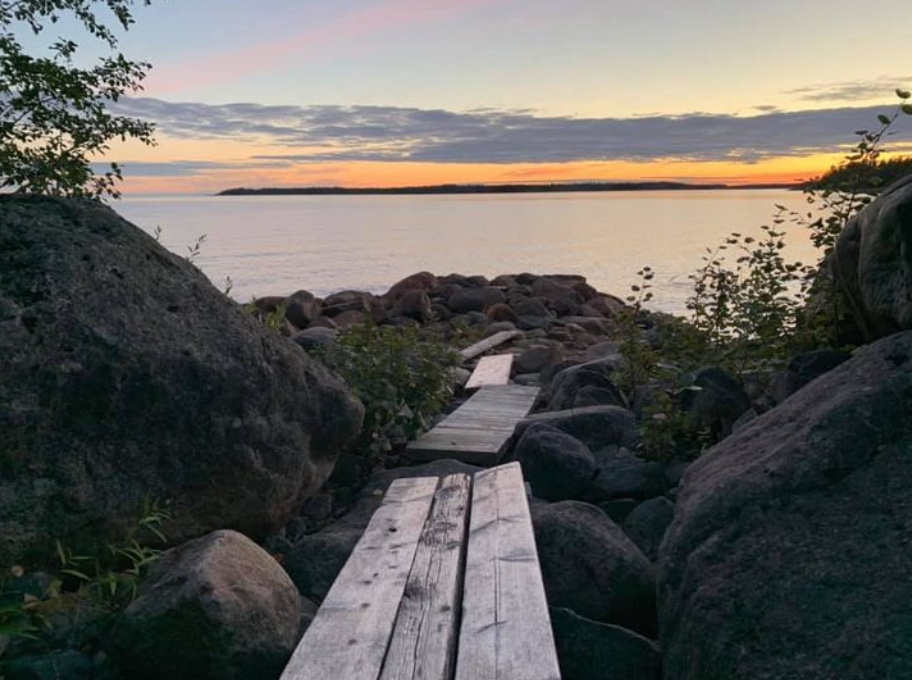
    A wooden plank walkway running between boulders toward a calm sea at sunset.
    A path to the Gulf of Bothnia near the Salmela family farm in Finland. The training ideas he has spent most of two decades carrying into American running came out of that part of the world. (Photo: Chad Salmela)
  • Outside Olympic glamour, cross-country skiing’s broadcasters face late nights and solo calls

    Outside Olympic glamour, cross-country skiing’s broadcasters face late nights and solo calls

    This article was made possible through the generous support of our voluntary subscribers. If you value coverage like this, please support FasterSkier with a voluntary subscription.

    Andrew Kastning is one of a small crew of Americans who work as commentators on late-night broadcasts of European cross-country ski races. He works from laptops and a television in his home in Anchorage, Alaska, and says he draws energy from a jumpsuit donated by a local U.S. Ski Team member.

    PREDAZZO, ITALY — By day, Andrew Kastning’s life sounds conventional: He’s a father of three, with a desk job in Alaska doing permitting work for a federal agency.

    During the winter? It’s another story. 

    On periodic Friday and Saturday mornings, you’ll find Kastning awake at 1 a.m., 2 a.m. or 3 a.m., standing in his living room in a sports jumpsuit, wearing a headset and delivering a monologue while watching his television.

    Welcome to the strange world of being a North American television announcer of Olympic-level cross-country skiing. 

    With nearly all of the sport’s premier races taking place at European venues, those following cross-country from stateside have to pull overnight shifts to catch the events on an internet livestream.

    Kastning, who’s paid by the International Ski Federation to call an English-language broadcast, has outfitted his wife with earplugs and a face mask that plays white noise so she can sleep through his calls. But he still woke his family up with some particularly enthusiastic play-by-play two weeks ago, when a fellow Alaskan, Gus Schumacher, cracked the podium in two World Cup races in Switzerland.

    “My oldest daughter said she dreams sometimes and hears me calling the race, like: ‘Jessie Diggins!’” said Kastning, referring to the U.S. Olympic medal-winning skier.

    Other regular cross-country broadcasters include Chad Salmela, a former competitive biathlete and veteran analyst from Minnesota, along with Kikkan Randall, the retired Olympic gold medal winning cross-country skier, who lives in Anchorage. 

    Both Randall and Salmela also pull the weekend wee-hours shifts as regular hosts of the English language livestream. And the pair will be featured this month as commentators on NBC’s national Olympics broadcast — though rather than being on site in Italy, they’ll be working out of an office complex in Connecticut.

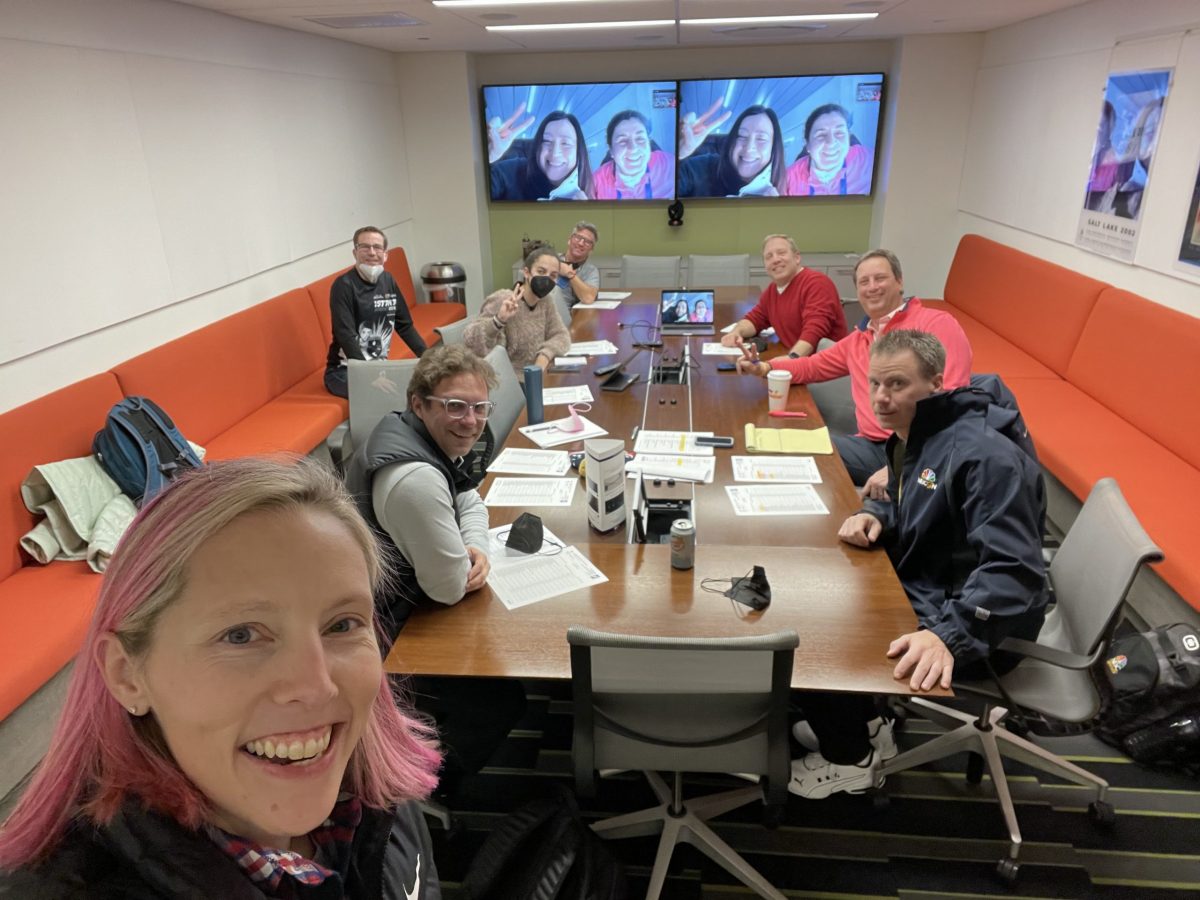
    The NBC Olympic cross-country broadcast team of Chad Salmela, right, Kikkan Randall and Steve Schlanger prepared for the first event at an office complex in Connecticut. (Courtesy photo)

    Still, the setup will be an improvement over the 2022 COVID Olympics, when the broadcasters were at the same complex but sealed into individual booths connected by plexiglass windows — so they wouldn’t be sharing the same air. 

    It’s also the first time cross-country skiing will have Olympic commentary from announcers who are working consistently together in the leadup to the Games, with a U.S. Ski Team donor helping to boost Salmela’s and Randall’s pay in recent years to keep them on the livestream for non-Olympic World Cup races.

    Cross-country athletes, coaches and boosters say regular television coverage of the sport could ultimately help make the U.S. more competitive with traditional ski powerhouses like Norway and Sweden.

    “An underappreciated role of the TV product is how it builds kids’ dreams of being future champions,” Randall said in an interview. “This can actually be an important piece of developing our pipeline for the future.”

    Randall’s own experience shows how much more accessible cross-country skiing has become for American spectators in recent years. A digital platform, Ski and Snowboard Live, now allows consumers to pay to stream international races while they’re happening or on tape delay.

    When Randall, 43, was in high school, she said, “I remember sending in a check via mail to the National Ski Education Foundation to get VHS tapes of the World Cups of the year before.” 

    Kikkan Randall competing during her World Cup career in Estonia. (Fischer/Nordic Focus)

    “Outside the Olympics, that was the only way to see World Cup level skiing,” she said. It was “pretty much completely inaccessible,” she added.

    Randall has now fully embraced her role translating cross-country skiing’s sometimes-complicated race formats to a mass audience.

    “I was curious: Am I going to know what to say? It’s one thing to have lived it, and it’s another to be able to talk about it,” she said. “But it’s come to me more naturally than I thought it would, and I really enjoy it. I get, kind of, a thrill from it — and it makes me happy to still feel that connection to the sport.”

    With two kids and a full-time job leading Anchorage’s ski association on top of the commentary gig, Randall said she has to weigh opportunities carefully. It’s helped that the ski team donor, a strategic consultant named Liz Arky, offered to bump up the pay rate for the core broadcast team of Randall and Salmela — who now earn more than the few hundred dollars a night Kastning gets when he fills in.

    “They can hook you, because they’re such good storytellers, and they’re so immersed in it, and they’re so passionate about it — and I just feel like that’s infectious,” Arky said in an interview. “It’s incumbent on us to grow our community and grow the audience.”

    Salmela, meanwhile, pulls double duty as a commentator for both biathlon and cross-country races that are nearly all in Europe. The repeated early morning wakeups are a grind, and Salmela said his doctor has questioned whether it’s worth the cost.

    “It’s a hard existence for a guy who’s 54 and dealing with Parkinson’s,” Salmela said. “It’s a tough call, because I recognize that it’s important for the sport.”

    Salmela’s looking forward to the Olympic broadcasts on NBC, though, as they offer the commentators substantially more support than they get for the World Cups during the rest of the season: statistics researchers, a producer, a sound assistant. Salmela also said he’s enjoyed the partnership with Randall, who he called a “natural analyst.”

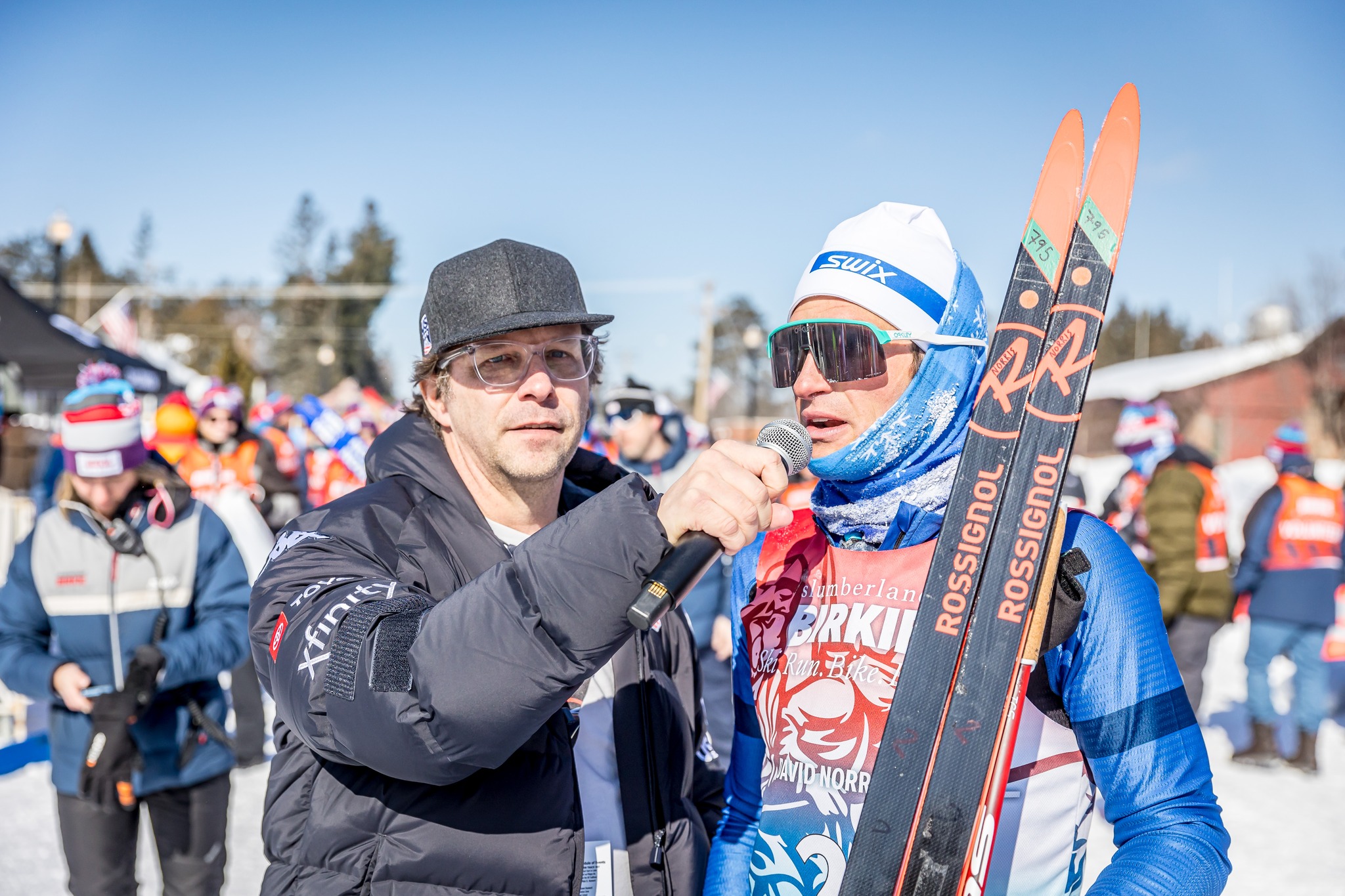
    Chad Salmela interviews cross-country skier David Norris at the American Birkebeiner in 2023. (American Birkebeiner Ski Foundation)

    “Her content is superb,” he said. “Because she’s smart, and she’s been one of the best at the sport — so, her perspective is well-spoken and legitimate.”

    Kastning’s job can be tougher: He’s a solo practitioner for all his broadcasts, with no other analysts to banter with or riff on his takes.

    He spends lunch breaks in the days before the races looking for storylines and fiddling with an Excel statistics spreadsheet. He’ll try to nap a bit in advance, then wakes up, closes his sleeping kids’ bedroom doors and heads into the living room for a sound check that takes place an hour before the start.

    The toughest nights are when he’s calling two separate races, one for men and one for women: There’s generally an hour, sometimes two, between them.

    “It’s really tempting to take a nap in between, because we’re talking like 2 to 3 a.m.-ish,” he said.

    Kastning draws energy, he said, from his jumpsuit, which was donated by Alaska Olympic cross-country skier JC Schoonmaker. 

    After the soundcheck, Kastning said, “I’m kind of waiting until 10 minutes out — the countdown begins.”

    “And then I’m off and running,” he said.


    Help Support Our Olympic Coverage!

    FasterSkier has our own Nat Herz on the ground at the Olympics, which is a significant financial lift for us. If you value the thoughtful work and access FasterSkier provides at championships like this one, please consider becoming a Voluntary Subscriber. Your support directly fuels our work to cover the people, places, and moments that make our sport special.

    Join the FasterSkier community!
     

  • The Coach with the Voice: Conversations with Chad Salmela

    The Coach with the Voice: Conversations with Chad Salmela

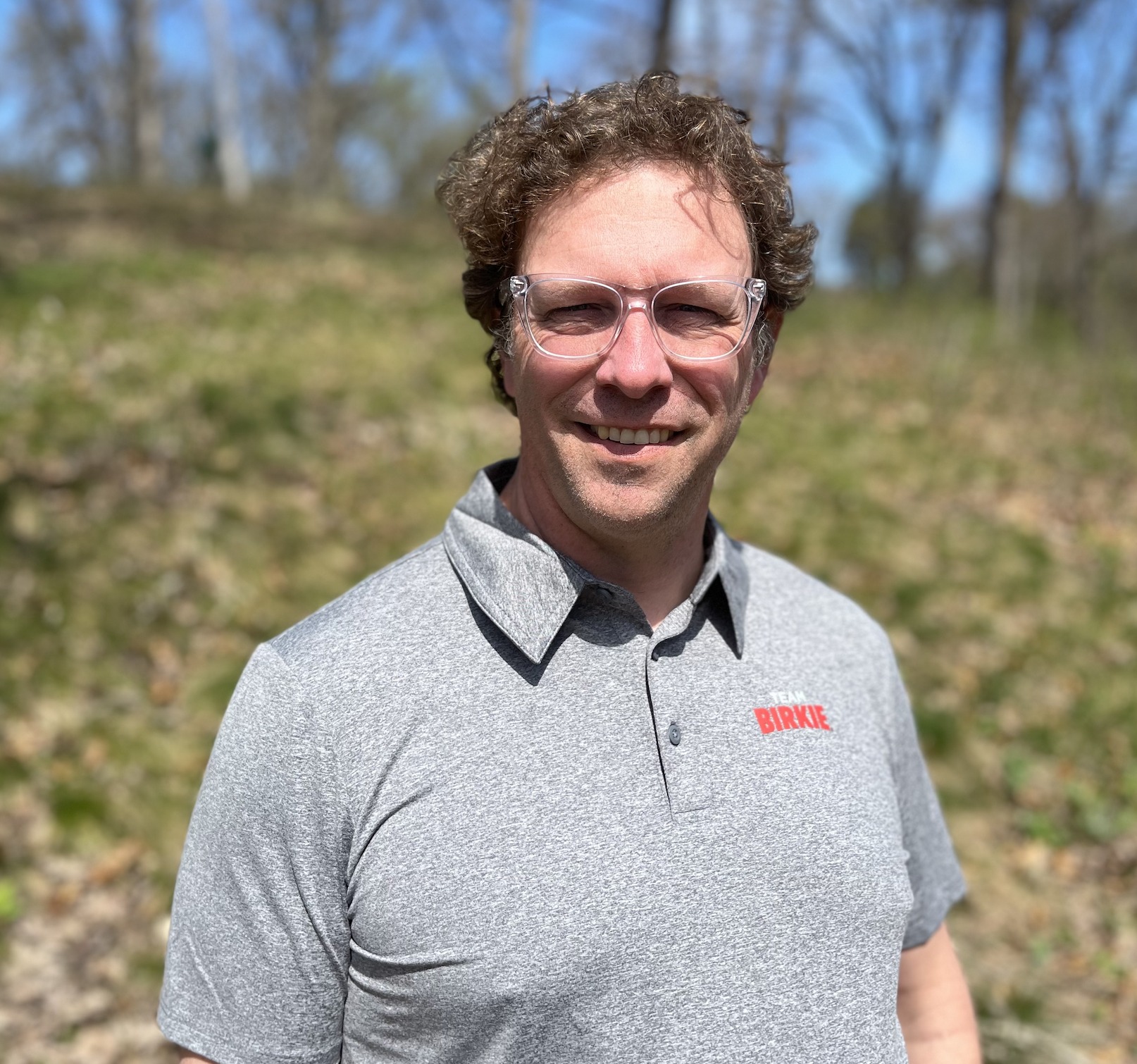
    Newly appointed Team Birkie Head Coach, Chad Salmela. (Photo: Team Birkie)

    Chad Salmela has a gift for pinpointing the critical characteristics of a moment and building something special from it. See “Here Comes Diggins,” the emphatically shouted announcement of an historic performance in American skiing, one that defined the careers of Olympic champions Jessie Diggins and Kikkan Randall, and of Salmela, himself. When it comes to Nordic skiing, Salmela knows what to say, how to put analysis into a context that audiences will understand, how to involve both enthusiasm and nuance. Now, as he takes on a new role deeply rooted in the Midwest ski community, he understands the nuance through-and-through.

    Salmela has been named new Head Coach of Team Birkie, marking the latest milestone in his long and varied journey as one of American skiing’s renaissance characters. He has been a top junior, US Biathlon team member, US Biathlon coach, successful college program-building coach at St. Scholastica in skiing and (in his current day-job) running, Threshold podcaster (current side gig), American Birkebeiner finish-line announcer (current side-side-gig), a Duluth nordic skiing fixture, sometime Fasterskier contributor, occasional pop culture zeitgeist, and yes, “the voice of the Olympic cross-country skiing on NBC.” The ski community possesses a special commitment, passion, and thoughtfulness towards the sport, but rarely does a single individual in it have all those dials turned to the max. Chad does. And so, when people go looking for all those things that make the sport great, they find them reflected in Chad.

    At his core, though, Chad Salmela is a coach; one stepping back into skiing seven years after his last coaching job. During the interim, he has been a full-time running coach. In fact, in his new role at Team Birkie, he will still be a full-time running coach. Salmela is stepping in as Head Coach with Team Birkie part-time. Which begs the question, what is Team Birkie going to look like?

    It’s all part of the plan to innovate and develop the elite club model: more coaches, enmeshed in the wider Midwest ski community, with backing from Central Cross-Country Skiing (CXC), the Loppet Foundation (the Loppet), and the American Birkebeiner Ski Foundation (the Birkie). All of it is going towards a “commitment to the idea of elite team in the Midwest.”

    The plan will require some hammering out: that’s where Chad Salmela steps in, thinking through—and putting into action—much of what goes into US Skiing. Which made for an opportune time for FasterSkier to catch up with Salmela for a conversation that captured his thoughts on the vision for Team Birkie, how coaching philosophy has developed over the years, and what excites him about jumping back into practicing as a coach after years spent analyzing an evolving sport.

    Chad Salmela (far left) at the 2016 NCAA qualifiers with College of St. Scholastica (CSS) skiers Reitler Hodgert and Kelsey Dickinson as well as assistant nordic coach, Josh Tesch. Seven years on, Salmela is stepping back into coaching skiing with Team Birkie. (Courtesy Photo)

    This interview has been edited for length and clarity.

    Ben Theyerl/FasterSkier (FS): How did you end up in the role of Head Coach for Team Birkie?

    Chad Salmela (CS): It’s been a long process. I told Yuriy Gustev (CXC Skiing Executive Director) flat out no when he first approached me. But as most people who know Yuriy know, he has a good way of getting you to say yes.

    I quit coaching skiing seven years ago at the St. Scholastica for a lot of really good personal reasons. Skiing is uniquely demanding to coach on any level. The deciding factor to go ahead here was that I can manage Team Birkie time-wise, from Duluth, and I do not have to leave my job coaching running at St. Scholastica. That is not something I could not have done when I first switched from coaching skiing to coaching running. My training plans are templated, recruiting systems are in place, the budget is workable year-to-year.

    When it comes to why Team Birkie? It isn’t something that the Midwestern ski community really wants to see fizzle out again.

    I think I see stepping in as stepping into a positive trend in program development for US Skiing. I think we’ve got away from “guru-ism,” where one coach has all the answers. I used to want that as an athlete. We all want that. But the idea here is that athletes won’t be working with one coach, they’ll be working with a whole bunch of coaches. At its core, we are looking to do this collaboratively.

    FS: Before we dig into the details of that structure, what are the aspects of nordic skiing that you’ve missed?

    CS: Coming back to a sport you’ve spent a lot of your life in is a joyful experience on its own. I still am not ready to hop into a wax trailer or follow the circuit, but I’m at a stage as a coach where I’ve not only gone through being an athlete and then coming back to the sport as a coach, but have also gone through the sport as a coach, left, and am now coming back again. That’s quite the journey.

    I also have really missed the technical aspects of this sport. Which is funny, I used to get dinged as a ski coach because my athletes felt like I didn’t spend enough on technique. The technical complexity of skiing tough; it’s been ingrained in me as an observer of skiing. I got my start coaching when I was brought in to the US Biathlon program in 1998 to work with their athletes on technique, because at the time, there was a perception that we were way behind the Europeans. Back then, I was essentially pulling from stuff I was seeing watching Thomas Alsgaard or Ole Einar Bjørndalen in Europe, and back here it called into question some of the really common things we were talking about in America. I guess that’s when I got a reputation for being a coach with an opinion.

    Fast-forward to today. I’ve been following skiing as a commentator, and the appeal is still the same. In the last seven years, freestyle technique has changed a lot. Where power is going and when has changed a lot. That is all stuff I’ve gotten to watch, but not work with athletes on. Last week, Zak sent over some of his clips from Bend Camp and it was really fun to start digging in on.

    FS: Is the structure of Team Birkie going to undergo any wholesale changes?

    CS: I don’t entirely know what it is going to look like yet. I don’t have any plans to make wholesale changes to the program, but I think those decisions will emerge as the we start to get going.

    It’s a decision not to change. Like Zak; I don’t really want to mess with what Zak is doing. I don’t have a lot of experience coaching elite athletes at his stage of development. I have a lot of experience developing them to the elite level. Zak already has a system that has got him 98% of the way to where he wants to be. His best friend, Leo Hipp, has been writing his training plan, and it has worked. I see my job as coming in and just seeing if there are little things to poke at in his process and provide an extra person to review what went well and what went bad. I hope I can help him find the 2%, right? At his level, that is the difference between being hoping to qualify for a sprint heat and putting yourself in the mix to make the Final every week.

    Coaching is always a mix of art and science. I recognize that I am not the answer. I am a possible collaborator to get to an answer. That’s the important tone that I’m trying to set as a coach.

    FS: There is a diverse set of coaching talent working with Team Birkie. What value do you see in pulling together a lot of coaches from across the Midwest together, versus, say, you doing it all yourself?

    CS: I think it’s primarily out of necessity. The constraints on my time made me open to the the idea that putting a good group of people together would make the team stronger.

    I feel really fortunate to have younger coaches to work with who I think all have great experiences, but maybe aren’t ready to take on a whole program like this. I feel like I want to approach this role as more the “high performance director” or whatever you want to call it. Let the younger coaches who are excited to be on the circuit be at the races, living and breathing the coaching experience, and I can help them put all those things into a perspective that will create a cohesive program for our athletes to follow throughout the training year.

    FS: Do you feel like the profession of ski coaching is any more complicated these days than it was when you first started?

    CS: No, I just think we understand more than we did thirty years ago. Back then, we didn’t know what we didn’t know.

    I think we’ve all come into a tighter orbit around some basic truths about training that we can abide by. To pick things up as a coach has gotten simpler as a result. You need to work hard. You need to be consistent. You need to be focused. You need to do a lot of it. Do that, and you are 95% to the elite level. The extra 5% is technical knowledge and experience. That is what coaches can bring to the table. It also happens to be where the difference is on the international stage.

    FS: When it comes to implementing the vision you have for Team Birkie with the coaching staff you have, what does it look like day-to-day?

    CS: It still is kind of impossible to tell because we haven’t started the programs yet. I would describe it as “fuzzy but coming into view.” I am ok leaving it there at this stage. I’d rather design the program in a way that is going to work for what we have. I don’t want to retrofit. Most of our athletes have a way and a place they’re comfortable with training right now as it is. So like Zak, right, is probably going to end up training mostly in Norway this summer. We have athletes who are coaching or working with Loppet Nordic Racing. Again, we don’t want to be intrusive into the basic building blocks of what they are doing.

    FS: You’ve returned a couple of times to Zak Ketterson in talking about getting this program rolling. He has been a strong advocate for Team Birkie and the idea of professional skiing while based out of the Midwest. Does it feel like he is a kind of co-creator in what Team Birkie is going to look like in the future?

    CS: The elite program as it stands is basically Zak. If he hadn’t said that we should keep this going, I don’t know if it would. His desire has brought us Midwesterners into focus though. Simply, he is a good example that we are not doing all we can to support developing athletes here. If they don’t have a place to ski after college, then we can’t expect them to stay in the region. If Zak wants it, then others probably do too, and we should be stepping up and doing it. Our collective commitment is to the idea of an elite team in the Midwest. That is what we want to create going forward.

    As for the coaching, based on our first interactions over the past couple of weeks, I think we’re off to a really good start. Zak is probably more respectful of what I have to say than I feel I’ve earned with him, which is a testament to his character.

    FS: There have been a few iterations of an elite Midwest team in the past, and you’ve been around to see them all. There was the original Team Birkie (which existed ~1990-95) and then notably, the CXC Elite Team that included Jessie Diggins, Adam Martin, Bryan Fish and Jason Cork, among others. When you look back at those, are there any lessons learned about creating something that is truly sustainable for a longer period of time?

    CS: It’s a great question that I’m not sure I have a clear answer to. I wasn’t really around for the original Team Birkie idea, but I was very familiar with the CXC Elite Team. Why did that go away? It was a victim of its own success, mostly. Bryan Fish and Jason Cork both went from CXC directly to the US Ski Team, and US Skiing has benefitted immensely from it. There was talented coaches who could have continued that CXC Elite Team, but the timing just kind of snapped the whole thing. You have to develop key people before they become your key people.

    If you wanted to identify why the Midwest has had a harder time re-establishing something since the CXC Team, I think there is a kind of paradox at play. Our strengths, when they aren’t focused, become weaknesses. The Midwest has more developing athletes racing than any other region in the country, but we have always been more dispersed than other regions. We have a lot of talent in a lot of different places and different programs. Once we focus some of that energy, good things happen. We’ve also had kids growing up here and having to leave to do the next level of skiing for a long time. Whether it was college or club, we would keep a relatively small portion of the talented skiers from the Midwest staying in the Midwest. They were, and still are, going to New England, Alaska, or the West. That is a pretty large logistical hiccup in supporting our homegrown skiers. So, if anything, what we’re now trying to do is focus up our energy again. We want kids from the Midwest to feel like we have their backs.

    FS: At the “elite” club level, there are a lot of different models to make things sustainably successful. Is there something about the challenge of coming up with that which is exciting to you, versus, say, a college program?

    CS: I think it’s more about where the program is and where I can take it. That’s been a fixture of my coaching career. I’ve always walked into “underdog” programs. I’ve never inherited the Green Bay Packers, you know?

    FS: (As a Packers fan) I don’t know if you would want that mess right now…

    CS: Yes. But like, the Scholastica program didn’t exist when I was hired. US Biathlon was on the fringe of the sport when I was there. There are a lot of challenges that come with picking up a kind of fixer-upper, but there are also a lot of opportunities to do things creatively.

    FS: Are there natural strengths for Team Birkie that you can see building on?

    CS: I think those are really clear. This is the only ski program in a major metropolitan area. For some, that is an absolute turn-off, but for others, it is really exciting. There is a draw; there’s a reason why the World Cup is coming here next year, right? Our athletes who have left still feel connected too. Jessie Diggins has been based out of Vermont for a decade and she is still gunning relentlessly for a World Cup here. That is something genuinely special, and so for me, is the energy in which a program like Team Birkie needs to exist in. The Midwest, especially this year, is the hub of American excitement around skiing, and that gives us a platform to build on that draw.

    FS: Has the excitement around the recent milestones in American skiing, a lot of which you have been the voice for, motivated you to return to coaching at all?

    CS: I really don’t know. I think the key thing is that I wasn’t looking to get back into coaching. I understood why Team Birkie reached out to me though, and so now, I am willing to give it a shot. The most telling thing was when I laid it out to my wife, she just shrugged and went, “yeah, it sounds like the perfect thing for you.”

    Chad Salmela in another of his varied roles, interviewing David Norris after his win in the 2023 American Birkebiener. (Photo: (c) 2023 American Birkebeiner Ski Foundation)

    FS: I suspect a lot of our readers know you first and foremost through your commentary work for NBC and Ski and Snowboard Live. Both there, and in this conversation, we’re hearing from a guy who has been thinking about this sport for a long time in a thoughtful, sustained, and focused way. As you hop into coaching and developing the sport again, how do you think we are doing on that front?

    CS: I think the US is doing a relatively good job. The biggest thing we are doing now compared to thirty years ago is keeping talent in the sport long enough to make the decision that they truly want to go for the top level. We have never done that at as high a hit rate as we are now. That speaks to a huge amount of time and focus by a lot of people to get the sport in the United States organized. You couldn’t even list all the names that were important, it was a huge effort. There are old timers and people younger than me who have all contributed.

    FS: Where do think the domestic circuit you are stepping into plays in that?

    CS: I think the pro teams are a good thing. Strong investment in the circuit they compete in is good too. It’s not all straight-forward. As the US Team on the World Cup has become one of the best programs in the world, the gap between the two circuits has grown. There’s also, the, for lack of a better word, “pay-to-play” problem. I think the clubs provide a way to help mitigate that slightly, we have to provide a way for the people who want to pursue the sport to the highest levels to afford it.

    FS: In the Press Release from Team Birkie, you are quoted saying that you “look forward to working with athletes and coaches to find their pathways to success—to base those pathways in scientific principles, sound methodology—but most importantly, finding the creativity necessary to become their best selves.” That strikes me as a very holistic look at the role the sport plays in informing an athlete’s life. Is that an outlook that has always been there for you as a coach, or one you feel you’ve had to develop over time?

    CS: I have had to learn and develop, for sure. I was a brash kid when I was say, a 20-year-old kid. When you are brash, you are hiding insecurities. Age and attitude go hand-in-hand. I think as I matured, I found ways to manage my insecurities better, and in that respect, have become a better coach.

    Improving as a coach requires you to ask what you are missing in your own motivations. The need to be competitive comes naturally. Thinking about the science and philosophy around being competitive does not always. A lot of growth comes simply because the ultimate arbiter in a sport like this is performance. You are kind of, what I call, scrubbing yourself on the washboard of the sport, physically and emotionally, and there is a lot of value to that. What I worry most about as a coach is that you might lose the meaning of doing the sport in just focusing on winning. That is so easy to do when you are in your 20s or 30s, and now as a father, it is the biggest thing I think about getting my kids into the sport.

    Coaching-wise, when you first start out a program, you aren’t as preoccupied with winning, but more so performing at a level that people are going to want to be part of the program going forward. That can cause you to hold on too tight. I definitely said things that were a little more callous than needed to be said because if you are putting everything into it, you will get tired, and you will get frustrated. You learn from making mistakes like that. For every two athletes who like what I have done as a coach for them, there are probably a dozen that do not feel that way. That is one of the laws of coaching. It is not because you are setting out to make someone upset. It’s that you are a little too focused on the wrong things with that athlete.

    That, if anything, is what has helped me grow as a coach. I have gotten better at really focusing on what matters to everybody on a team, so that people get something out of it that isn’t frustration. This sport is hard enough that there will be plenty of frustration over the course of your career, no matter who you are.

    More than anything, I want people to get a great experience from being on a team. They should have a great experience that makes their lives better. You are not going to get good out of bad. You are going to get good out of good and finding that tone from everyone involved is how the strongest programs are built.

  • Nordic Nation: Inside the booth with Chad Salmela and Kikkan Randall, NBC’s Olympic cross country ski analysts

    Nordic Nation: Inside the booth with Chad Salmela and Kikkan Randall, NBC’s Olympic cross country ski analysts

    In this episode, we’ve got Chad Salmela and Kikkan Randall on to discuss the experience of calling the 2022 Beijing Olympic Winter Games, live from a booth in Stamford, CT. The duo worked as cross country analysts, alongside long-time NBC play-by-play announcer Steve Schlanger. While Chad is a veteran in the role, this was Kikkan’s first Olympics inside the booth.

    Kikkan Randall snaps a selfie with Chad Salmela and the NBC production crew during the 2022 Olympic Winter Games. (Courtesy photo)

    During the call, Kikkan and Chad field a variety of questions on their experience – everything from staying fresh while calling races in the middle of the night for two weeks straight, to maintaining professional composure while watching your former teammates and long-time friends win Olympic medals – or come up short – and even, why are you suddenly pronouncing the Norwegian distance champion’s name “You-haug”? 

    Full of insights and laughs, this conversation was a treat, and it’s clear that both Chad and Kikkan are deeply invested in growing and serving the cross country ski community in the US.

    Thanks for listening, and thanks to this week’s podcast sponsors Boulder Nordic Sport and New Moon Ski & Bike. 

    Kikkan Randall and Chad Salmela discuss their experience as NBC’s cross country ski analysts during the 2022 Beijing Olympic Winter Games. (Courtesy photo)
  • (Press release) U.S. Women’s Relay Heads into Beijing with Best Finish in 28 Years

    (Press release) U.S. Women’s Relay Heads into Beijing with Best Finish in 28 Years

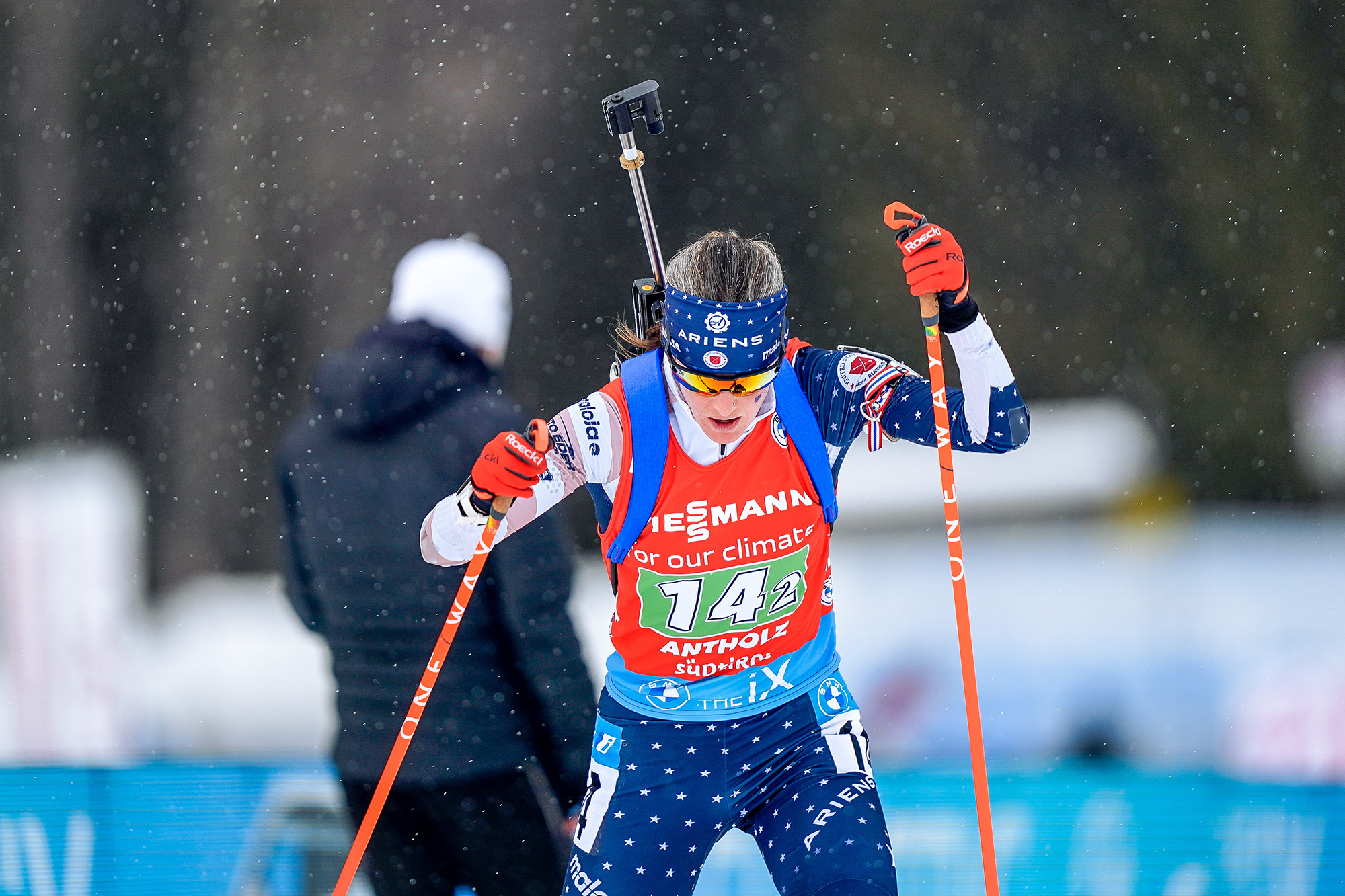
    Joanne Reid (USA) celebrates historic relay result in Antholz (ITA). (Photo: NordicFocus)

    In the final women’s relay competition before the Beijing 2022 Olympic Games, the 14th ranked U.S. Women’s Biathlon Team raced to a fifth-place finish in Saturday’s 4×6-kilometer event at the BMW IBU World Cup in Antholz. It marked the best relay finish for the women’s team in a World Cup since 1994 when the U.S. took the silver medal in Canmore, Alberta, Canada. However, today’s performance bettered that race 28 years ago in terms of time behind as they finished 50.1 seconds back of first place today compared to 57.3 seconds behind in 1994.

    “I’ve dreamed of a top-5 women’s relay for over a decade,” three-time Olympian Susan Dunklee (Craftsbury, Vt./Craftsbury Green Racing Project & USBA) said after the race.

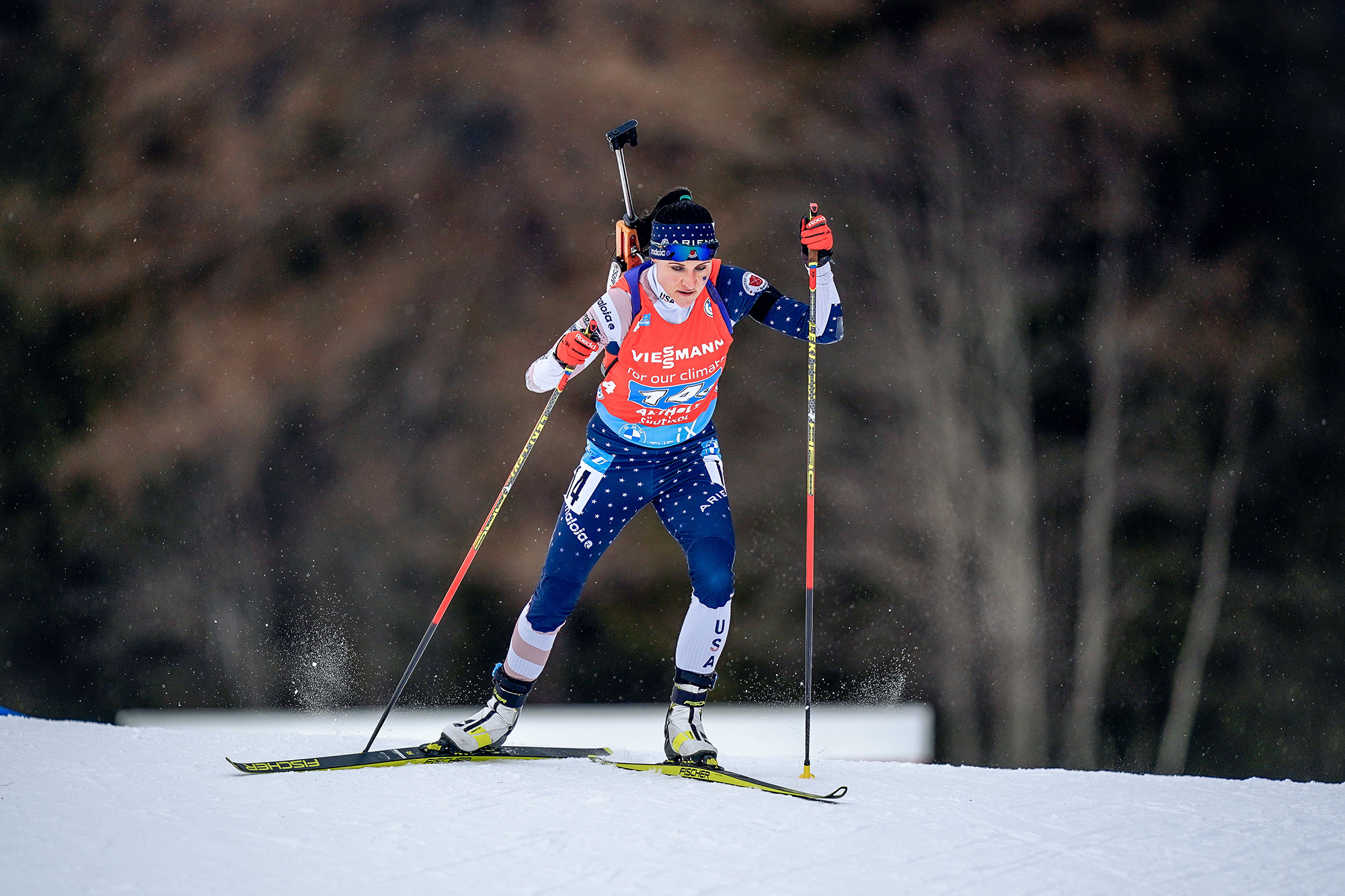
    Susan Dunklee (USA) keeps the United States in it during the first leg of the relay in Antholz (ITA). (Photo: NordicFocus)

    Dunklee kicked off the relay using one spare round in prone and two spares in standing. She made the first exchange with 2018 Olympian Clare Egan (Cape Elizabeth, Maine/Craftsbury Green Racing Project & USBA) with the U.S. team in 12th place, 41.6 seconds back of the leader.

    Clare Egan (USA) holds strong during the second leg of the relay in Antholz (ITA). (Photo: NordicFocus)

    Egan, heading into her second Olympic Games, brought the American squad up to 10th place after needing three spares in prone and two in standing on her second leg.

    “It’s great to improve on our sixth-place from last winter as we head into the Olympics,” said Egan, referring to last season’s World Cup relay performance in Nove Mesto, Czech Republic.

    Deedra Irwin (USA) keeps the US team within striking distance during the third leg of the relay in Antholz (ITA). (Photo: NordicFocus)

    Deedra Irwin (Pulaski, Wis./National Guard Biathlon & USBA), the lone rookie on this year’s Olympic team, went clean in prone and used three spare rounds in standing to vault the team into medal contention at the final exchange. Irwin tagged off the anchor leg to Joanne Reid (Grand Junction, Colo.) in seventh place, a mere 27.6 seconds out of first.

    Joanne Reid (USA) anchors the US to 5th place in Antholz (ITA). (Photo: NordicFocus)

    Reid, a 2018 Olympian, was solid on the range needing just one spare in prone and another in standing. She brought the team home in fifth place, 50.1 seconds back of gold-medal winning Norway. Russia took second and France edged Italy for third in a photo finish.

    “I think it’s really encouraging that we were within 20 seconds of Italy and France – two of the top teams – with the same shooting,” added Egan.

    Joanne Reid and Deedra Irwin (USA), (l-r) celebrate at the finish in Antholz (ITA). (Photo: NordicFocus)

    Earlier in the day, Paul Schommer (Appleton, Wis./Team Crosscut & USBA) finished 22nd in the men’s 15km mass start, the first mass start of his career.

    The World Cup in Antholz wraps up Sunday with the men’s 4×7.5km relay followed by Egan competing in the women’s 12.5km mass start on the heels of her fourth-place finish in Friday’s 15km individual.

    Catch the action live on Peacock with Chad Salmela and USBA President & CEO Max Cobb commentating live from Antholz. Download the IBU App to keep track of all your favorite athletes!
    BMW IBU World Cup – Antholz, Italy (all times Eastern)

    Sunday, Jan. 23

    6:15 am – Men’s 4×7.5km relay
    9:15 am – Women’s 12.5km mass start

    https://www.teamusa.org/US-Biathlon/Events/2022/January/19/Watch-IBU-Biathlon

    https://apps.apple.com/app/official-ibu-app/id1581415457?l=en
    https://play.google.com/store/apps/details?id=at.ibu.app

    Women’s 4x6km relay results
    1. Norway (1:12:54.1/1+10)
    2. Russia (+24.6/3+12)
    3. France (+32.6/0+13)
    4. Italy (+32.6/0+13)
    5. USA (+50.1/0+13)

    Men’s 15km mass start results
    1. Benedikt Doll (GER) 37:14.9/+1
    2. Johannes Thingnes Boe (NOR) +31.3/+3
    3. Sturla Holm Lagreid (NOR) +1:28.8/+3
    22. Paul Schommer (USA) +3:36.5/+6

  • All the Lightness as they Rotate Towards Winter: Chad Salmela and the Family in Finland

    All the Lightness as they Rotate Towards Winter: Chad Salmela and the Family in Finland

    FOMO: Fear of missing out. FOMO through the lens of envy is probably not the way to thrive. FOMO through the lens of seizing the day, on the other hand, has a lovely ring to it.

    Chad Salmela: biathlete, skier, running coach, forever linked with “HERE COMES DIGGINS”, husband, and parent. He is also the lone member of his family of four without a Finnish passport, although he has Finnish ancestry. His wife, Mimmu, hails from Finland, son Taavi (11), and daughter Iita (9) are all Finnish citizens. Prior to this year, Salmela said on a recent call from Finland, they had visited his in-laws for roughly three weeks each summer. Time. But not enough time.

    Then COVID. No in-person school last spring. Online learning to begin the school year in Duluth, Minnesota, Salmela’s hometown. With collegiate sports canceled in the spring, Salmela’s coaching position as a running coach at The College of St. Scholastica became hands-off in the extreme. Speaking of time, now the family had more of it. The family began to embrace the seize-the-day kind of FOMO.

    In July, they jetted off for what they thought would be a semi-extended stay in Finland. With schedules in flux, the prospect of extending their Finland visit beyond a month remained in play. Salmela admitted they prepared their home in Duluth to be rented just in case the pull towards Finland, during what has already been the mother of all disruptive years, was too great. 

    The pull was too great. 

    Biking in Finland: Taavi and Iita Salmela. (Photo: Chad Salmela)

    Finland’s schools are open for in-person learning. A huge plus to any child craving a social life away from caregivers. And the Salmela children, although emerging Finnish speakers, have been exposed to the language since they were infants. Although this was their second language, communicating verbally in Finnish remained within their grasp. Add to the mix a set of grandparents keen on spending time with grandchildren and you can see how the scales were tipped.  

    Mimmu left her job this past spring, and Salmela worked out plans to coach remotely until at least early winter.  

    “I had to talk to my employer and my boss about it and they have had a lot of understanding about this,” Salmela said from Finland. “I think my wife and my own ability to probably withstand it is one thing, but if you can get your kids to a place to go to a school, where they can go to school without masks on, and it is friendly, and they are learning and they interacting with kids, and playing their sports, that is huge. That is huge any way you slice it. That alone is worth any pain and suffering and stress that my wife and I had had to handle.”

    As graceful as living life in a foreign country sounds, the realities are rawer. There’s the possibility Chad has placed his coaching job in jeopardy. He had to think about the running program, and how he could effectively recruit from abroad. Then there’s leaving friends and neighbors. All practical considerations. Salmela is also one of the voices for NBC Sports cross-country and biathlon coverage. Initially, he was unsure if he would return to Stamford, Connecticut where NBC Sports’ studios are located, or if he could broadcast remotely from Finland. (For now, it appears Salmela will broadcast remotely from Finland.)

    According to Salmela, returning back to Duluth after four weeks in Finland was always an option. “We had a month while we were here to pull the trigger on this fully,” Salmela said. “In that month it just became clearer and clearer. I think I wrote in my blog, the third base coach is waving you home.”

    Fourth Generation First World Immigrant – Musings on culture, lifestyle, and sport, from a Finnish-American living in Finland, the name of Salmela’s blog, is his contribution to our Covid-19 isolation. The blog is many things: pithy, earthy, sharp-eyed. If you have the good fortune of pulling the plug and relocating a family, this blog might convince you it’s the right thing to do. It makes you realize how adaptable kids are. The blog provides a glimpse into Salmela’s life as he pens a near real-time memoir. It’s a welcome escape.

    There’s his earnest entry written on Sept. 26 titled “Into The Darkness”. Salmela and his clan know what’s coming. He writes that on their first day in Finland, July 20, the sun rose at 4:22 a.m. and set at 10:22 p.m. Sunsets that far north in latitude linger. The murky dusk fades over hours into an inky black.

    It is Finland. Relatively close to the arctic circle – darkness comes. 

    Here are some words from Salmela describing the phenomena.  

    “The first I actually thought about it for us this winter was at the end of August. We were still having nice days, but temps started to dip more regularly, and we were consistently twenty degrees cooler than Duluth. Duluth has since started to catch up, but I realized the time frame between the solstice and the equinox are exactly the same everywhere. Up here, the change is more drastic though. Not so drastic that you wake up one day and say, ‘Hey, what gives on this fall-back crap?!’ The change here is hard enough that they don’t need a day each year to mess with a savings of or returning of daylight. It happens quickly enough on its own. Just since September 1 the day has 2 hours and twenty minutes less daylight, and that’s just a running start to what October and November are going to bring us—longer and longer stretches of inescapable darkness.”

    Salmela, in his blog, does not dwell on impending doom, as the loss of daylight might suggest. He dives into the quotidian. Things like bathroom squeegees, the loveliness of Finland’s trails, the virtues of rye bread, and life as a wanderer when you’re a kid from the Iron Range of Minnesota. 

    A path leading to the Gulf of Bothnia, near the traditional Salmela farm in Finland. (Photo: Chad Salmela)

    Salmela, Mimmu, Taavi, and Iita are settled in Jyväskylä, where the kids attend school, and life rolls on. Speaking to Salmela, I found him, not so unexpectedly, vibrant. After all, he and his wife had executed something that they had discussed for years – an opportunity for their children to break away from much of what they have known. 

    “You cannot help but have a sense of pride as a parent,” Salmela said. “That you were able to pull this off somehow because it is so good for them. They don’t know how it feels politically or socially in the United States right now, with so much uncertainty. There is a lot of uncertainty here too, but it is not the same level, it is a shade of it. But in their daily lives, they are engaged in communicating in a completely foreign language and they are feeling proud of that. You can tell that they like that their Finnish is getting better.”   

    This piece originated with the idea that I would simply check in with Salmela and get some thoughts about the nuts and bolts of swapping time zones and making it work. But the more I read Salmela’s blog, the more I am reminded that each day, despite the head-spinning news cycle, brings tidy positive lessons. For now, we have this window into the Salmela clan’s life. Something wide open as the northern hemisphere revolves towards a frozen ground, snow, and darkness.

    It’s clear, Salmela knows what is coming too.  

    “It’s easiest to fall for something in its best light. The rates of divorce these days are a testament to that notion. For the most part, Finland for me and my kids has been from its best side—the side that says, ‘I think I want to marry this.’ It’s easy to be happy and love anything when it’s easy and lovely. Not that late fall and winter will be horrible here, but we’re going to get very familiar with it without its makeup on, when it needs to bathe, do its laundry, brush its teeth, comb its hair, and perhaps not be quite as jolly as when times are the best.  We’re going to get ‘more intimate’ with Finland than we’ve ever been. Mimmu hasn’t lived this far north through a winter since 1999. The kids and I never have. Most humans on earth have never done it. It’s probably not that scary, but it is an unknown, and it’s not Finland’s best side. I think addressing that up front is a wise strategy.”


  • Nordic Nation: Relative Energy Deficiency in Sport (RED-S) and the Climate in High Performance Skiing

    Nordic Nation: Relative Energy Deficiency in Sport (RED-S) and the Climate in High Performance Skiing

    In this episode, hosted by FasterSkier contributor Rachel Perkins, we dive into the issue of Relative Energy Deficiency in Sport (RED-S). This condition was formerly known as the female athlete triad, which was described as inadequate energy intake, the loss of menstruation (amenorrhea), and decreased bone mineral density. The name was changed to include males, who are also affected, and to expand beyond the three symptoms originally included. Though not quite the same, the condition is closely linked with eating disorders.

    This topic has seen a lot of buzz following a November opinion piece in the New York Times where former high school running phenom Mary Cain shared her story of abuse by her coach, Alberto Salazar, at the Nike Oregon Project. While trying to get down to the weight he deemed optimal for her, she lost her period, her performance decreased, and she was littered with stress fractures.

    Further concerns arose a few weeks later when Ingvild Flugstad Oestberg and Frida Karlsson were pulled from their World Cup starts after not meeting team health standards for BMI and bone density, presumably due to under eating. 

    We speak with licensed professional counselor and two-time Olympian Holly Brooks, registered sports dietician and author of “Finding Your Sweet Spot: How to Avoid RED-S (Relative Energy Deficit in Sport) by Optimizing Your Energy Balance” Rebecca McConville, and long-time coach turned voice of World Cup cross country skiing and biathlon, Chad Salmela. 

    This panel unpacks the misunderstanding that RED-S is an exclusively female phenomenon and how the climate in sport influences the prevalence of this condition, and offers suggestions to shift from a results focused climate in sport to a positive, informed, healthy, and athlete centric program. 

    Here are links to the resources and articles mentioned in this episode:

    Jessie Diggins Eating Disorder Activism

    Lauren Fleshman’s New York Times Opinion Piece “I Changed My Body for My Sport. No Girl Should.” and letter to her younger self, which was posted to MileSplit.

    The WithAll Foundation and the “What To Say” campaign, which  offers suggestions for talking to food and body positive phrases to include in conversations with kids and athletes. 

    HBO Documentary “The Norwegian Way” which details the Norwegian development program, in particular the omission of results in youth skiing before the age of 12.  

    The IOC Periodic Health Evaluation statement regarding more regular health screenings, including bone density measurement and blood laboratory work. 

    The National Eating Disorder Association (NEDA) “Coaches & Trainers’ Toolkit”

    The Opal Treatment Center and Podcast

  • Op-Ed by Chad Salmela: Saturday’s Men’s Skiathlon and Why I Think it Matters

    Finland’s Iivo Niskanen (bib 5) dictating the pace and ultimately the race during Saturday’s Men’s skiatlon at the 2019 World Championship in Seefeld, Austria. (Photo: John Lazenby/lazenbyphoto.com)

    This Op-Ed comes from Chad Salmela, the commentator for World Cup nordic skiing and IBU Biathlon at NBC Sports. Salmela also coaches running at the The College of St, Scholasticia. 

    ***

    Saturday’s Men’s Skiathlon and Why I Think it Matters

    I don’t have a blog and I didn’t get to call the race Saturday,  but I thought it was compelling on a couple levels. (Disclaimer: You may have figured all this out without me, so my apologies if this is all too obvious)

    Level 1:  The lessons of Northug

    Iivo Niskanen has clearly cracked the code on Klaebo that a generation of skiers never cracked on Petter Northug.  It took a tough-ass, gritty Finn to say enough is enough on hanging back and getting out-sprinted in long distance races.  Iivo re-wrote the modern playbook on mass start distance races in the 50k in Pyeong Chang and he was rewarded, after a long hard battle with Bolshunov, with the Gold.  Today, Iivo didn’t dink around waiting to be pummeled by the likes of Iversen or Klaebo after a promenade to the ski exchange, a few more laps of taking stock, then racing 3-5 km in earnest. He immediately got to work on the hard job of ski racing, and in so doing, reminded everyone in the field of their chosen profession, and that it isn’t pretty-boy flash if you don’t let it be.  In fact, it probably shouldn’t be, and the workhorses who were having a good enough day to keep the pace were rewarded with a chance at the gold, silver, and bronze. I LIKED that, even if Niskanen, the impetus of it all, was rewarded with the wooden medal. What I saw today was the old school grit of a long ski race against the clock, played out head to head. I found it gripping. From Iivo forcing everyone to get uncomfortable 4 minutes into the race, to the relatively slow final climb “move” by Sundby, this was a heck of a heavyweight bout!  Think those guys were fresh? Watch that final hill again. When was the last time we saw a “sprint” like that? PyeongChang 50k, that’s when. Thanks Iivo.

    buy tizanidine no prescription

    I tweeted something relatively implicit during the race like, Klaebo doesn’t have it as easy as Northug did.  I believe this to be true even if I confused a friend as to what I meant. Klaebo will live in the shadow cast by and in comparison to Northug. He can’t avoid it, it’s not his choice, and it’s inevitable.  So he’s got that to deal with. But worse for Klaebo, the mass start era under Northug was one in which real old school ski racing of grinding out 30 and 50 K’s against a clock—the grit that defined the sport for most of its history—was left behind for “modern” ski racing in which everyone cruised along eyeing each other up and down, then the field was baffled as to how to beat Petter in the last few km’s.  It became a formula that wasn’t getting challenged enough. Now, I’m not saying the others didn’t try hard enough. I’m just saying with hindsight of today’s 30k skiathlon and the Pyongyang Chang 50k, that the Northug mass start narrative has been challenged by the likes of Niskanen and Bolshunov, and it’s working. Sort of. Because Sundby and Harvey had to race Northug in the height of the invincible Northug narrative years, it’s not like they were asleep that whole time.  But I think they inherently sensed the risk of taking the bull by the horns in the manner Iivo did Saturday and in PyeongChang—you may do all or the lion’s share of the work of a long hard race and be left without the glory. But medals aren’t the only glory and Iivo’s 4th, and particularly Parisse’s 5th are glorious performances in my book, and they left a LOT of stars out of the race early with their test.

    Back in his nordic coaching days. Chad Salmela, now, at 47, coaches running at The College of St, Scholasticia and is the commentator for World Cup nordic skiing and IBU Biathlon at NBC Sports. (Photo: Courtesy Chad Salmela)

    Regardless, I don’t see Iivo changing and I think we have a new ball game.  I didn’t see Iivo eyeballing anyone or anything but the track in front of him most of the race.  And he only missed a medal by 12 seconds. After his digger in the feed zone at the start of lap 2, he trailed by 12.  Chew on that piece of cowhide a while before you decide it didn’t work…

    Level 2:  Norway can cover all plays

    If you avoid the Norwegian press’s calculated outrage of not starting the Olympic skiathlon champion Simen Hegstad Krüger, you see they had a brilliant line up based on what they have seen this winter from their boys.  They had two grinders—the two best this season, Sundby and Røthe—and two flashy sprinters who can hang in a Northug scenario—Iversen and Klaebo. They had a double shot at both types of races. You replace any of those with Krüger, you don’t play the odds like you can.  I love Krüger and it is a shame he didn’t get a start, but what I’m saying is, the Norwegian staff is frigging brilliant in the face of public outrage. Further, the personnel chosen, raced SMART! When it became an Iivo grind, how many times did you see Røthe or Sundby force the pace before it became a 3-man race for the medals?  Zero. That’s how many. (Take note Mussy. I want you to win one before I die.). Game, set, match. Gold and Bronze.

  • Nordic Nation: The Calling it as He Sees it Episode with Chad Salmela

    Nordic Nation: The Calling it as He Sees it Episode with Chad Salmela

    Long before the “Here comes Diggins” call by 47-year-old Chad Salmela at this season’s Olympics, he was already known throughout the ski world as an athlete and sports commentator. Let’s just say since the now famous call, Salmela’s announcing talents have become more well known. In what now may be considered his spare time, Salmela is a varsity cross country running coach and assistant track and field coach at The College of St. Scholastica in Duluth, Minn. For ten years he was the head coach of St. Scholastica’s nordic ski team. Salmela began the cross-country program before stepping down in 2016.

    Back in his nordic coaching days is Chad Salmela. Now, at 47, he coaches running at The College of St. Scholastica and is the commentator for World Cup nordic skiing and IBU Biathlon at NBC Sports. (Photo: Courtesy Chad Salmela)

    This winter season, Salmela will be the voice of nordic sport for NBC Sports: He’ll be calling both the cross-country World Cup and biathlon’s IBU World Cup. 

    As an athlete, Salmela was a member of the U.S. Biathlon team from 1990-1998. He still skis and enjoys the sweet outdoor access Duluth affords.

    The selfie. Chad Salmela in his Sweden hockey jersey. He’d been rooting for Sweden while watching the IIHF worlds a few years back.

    In this episode, we talk about the “Here comes Diggins” call, why he stepped away from coaching nordic skiing, and how he prepares for the grind of announcing World Cups. If you’d like to hear a solid interview of Salmela and his experience at the 2018 Winter Games by a great cast of mainstream sports writers and podcasters, you can check that out here.

    And if you have no idea what we are referring to when we bring up the “Here comes Diggins” call, you should click here.

    (To subscribe to the Nordic Nation podcast channel, download the iTunes app. If you have iTunes, subscribe to Nordic Nation here.)

  • 2018 Olympics Viewing Guide: When and How to Watch

    2018 Olympics Viewing Guide: When and How to Watch

    Canada’s Ivan Babikov (18) leads American Noah Hoffman (26) and Canada’s Alex Harvey (4), among others, in the men’s 30 k skiathlon at the 2014 Winter Olympics in Sochi, Russia.

    This article has been edited to include a link to an updated and more detailed guide to NBC’s television coverage.

    You may have heard that the Olympics are coming up soon. Your favorite athlete’s social media platform is probably showing them sitting on an airplane, going through Olympic processing, or wearing Those Gloves right about now. Plus Noah Hoffman is blogging again, which is the surest sign yet that the Games of the XXIII Winter Olympiad are nearly upon us. (Seriously, though, Noah’s blog is not to be missed for any ski fan; the man’s output is prodigious and his insight keen, and he provides a perspective that you will find literally nowhere else.)

    When are the races?

    First off, when are the cross-country ski races? Surprisingly late, if you’re an athlete on the ground in PyeongChang starting a sprint qualifier at 5:30 p.m. local time (!) or a sprint final at 9:30 p.m. (!!). Surprisingly early, if you’re on the East Coast of this country and weren’t planning on waking up at 4:30 a.m. to watch the women’s relay. And at surprisingly humane late evening times, if you live in Alaska and may actually get to watch skiing at 9 or 10 p.m. for once rather than the 2 to 3 a.m. time slot that typically characterizes European World Cup races.

    Here is the master schedule for all of the cross-country ski events. Note that South Korea is an impressive 18 hours ahead of Alaska, and 14 hours ahead of the East Coast, and so any event starting before 6 p.m. local time in South Korea will occur on the preceding day in Alaska.

    The schedule linked above should automatically update the “My Time” entry to show the event time relative to your time zone. That said, here is FasterSkier’s reading of the master schedule for cross-country, keyed to the two extremes of the Alaska Time Zone and Eastern Time Zone (with apologies to readers in the Hawaii–Aleutian, Pacific, Mountain, and Central time zones, you should be able to extrapolate from these readily enough):

    • Women’s skiathlon: 10:15 p.m. Feb. 9 Alaska time / 2:15 a.m. Feb. 10 East Coast time
    • Men’s skiathlon: 9:15 p.m. Feb. 10 Alaska / 1:15 a.m. Feb. 11 East Coast
    • Classic sprint: 11:30 p.m. Feb. 12 (qualification), 2 a.m. Feb. 13 (heats), 3:25 a.m. Feb. 13 (finals), Alaska / 3:30 a.m. Feb. 13 (qualification), 6 a.m. Feb. 13 (heats), 7:25 a.m. Feb. 13 (finals), East Coast
    • Women’s 10 k skate: 9:30 p.m. Feb. 14 Alaska / 1:30 a.m. Feb. 15 East Coast
    • Men’s 15 k skate: 9 p.m. Feb. 15 Alaska / 1 a.m. Feb. 16 East Coast
    • Women’s relay: 12:30 a.m. Feb. 17 Alaska / 4:30 a.m. Feb. 17 East Coast
    • Men’s relay: 9:15 p.m. Feb. 17 Alaska / 1:15 a.m. Feb. 18 East Coast
    • Freestyle team sprint: 11 p.m. Feb. 20 (semifinals), 1 a.m. Feb. 21 (women’s final), 1:30 a.m. Feb. 21 (men’s final), Alaska / 3 a.m. Feb. 21 (semifinals), 5 a.m. Feb. 21 (women’s final), 5:30 a.m. Feb. 21 (men’s final), East Coast
    • Men’s 50 k classic mass start: 8 p.m. Feb. 23 Alaska / 12 a.m. Feb. 24 East Coast
    • Women’s 30 k classic mass start: 9:15 p.m. Feb. 24 Alaska / 1:15 a.m. Feb. 25 East Coast

    Here’s the comparable schedule for biathlon:

    (all times EST)

    • Feb. 10: Women’s 7.5 k sprint (6:15 a.m.)
    • Feb. 11: Men’s 10 k sprint (6:15 a.m.)
    • Feb. 12: Women’s 10 k pursuit (5:10 a.m.) + men’s 12.5 k pursuit (7 a.m.)
    • Feb. 14: Women’s 15 k individual (6:05 a.m.)
    • Feb. 15: Men’s 20 k individual (6:00 a.m.)
    • Feb. 17: Women’s 12.5 k mass start (6:15 a.m.)
    • Feb. 18: Men’s 15 k mass start (6:15 a.m.)
    • Feb. 20: Mixed relay (6:15 a.m.)
    • Feb. 22: Women’s 4 x 6 k relay (6:15 a.m.)
    • Feb. 23: Men’s 4 x 7.5 k relay (6:15 a.m.)

    And for nordic combined:

    (all times EST)

    • Feb. 14: Individual normal hill/10 k Gundersen (jumping at 1 a.m./skiing at 3:45 a.m.)
    • Feb. 20: Individual large hill/10 k Gundersen (jumping at 5 a.m./skiing at 7:45 a.m.)
    • Feb. 22: 4 x 5 k team event (jumping at 2:30 a.m./skiing at 5:20 a.m.)

    And how to watch them?

    There’s a simple answer if you’d like to watch the races live, and potentially a simple answer if you’d like to watch them after the fact.

    If you want to watch live coverage, and you have a current cable subscription that includes the networks of NBCUniversal (CNBC, NBCSN, USA, and NBC), then use your cable subscriber email and password to log into the relevant NBC livestream website or NBC sports app (NBC iOS App / NBC Android App / NBC Roku App). Probably do this first on a dry run ahead of time in order to make sure that the technology works.

    (You could also, theoretically, watch this on the actual NBC “channels” currently “broadcasting” on your actual old media “television.” However, this assumes that NBCSN will actually be broadcasting cross-country skiing at that time, as opposed to, say, figure skating reruns or alpine skiing. That may, sadly, be a somewhat charitable assumption, and even if it’s not it’s difficult to get specific programming info from the general NBC site – although this more detailed updated schedule from NBC is far more helpful. You could also look for an online NBCSN/CNBC/USA stream somewhere like here, but your viewing experience is still subject to that same assumption even if you’re watching the NBCSN television broadcast on your computer screen.)

    Jessie Diggins winning a 10 k freestyle mass start at the last World Cup race Jan. 28 in Seefeld, Austria. (Photo: Salomon/NordicFocus)

    If you’re willing to wait – and particularly if you live in the Eastern time zone, and are unable or unwilling to forego sleep for two weeks to watch live – then “Skiing Vinnie” has been doing yeoman’s work for the past few years in putting up complete broadcasts of World Cup races within a few hours after they end. Find his eponymous YouTube channel here, or his website here. While Vinnie has to get creative during the Games, he has a “Plan B”. Check out his website for links to videos as we closer to the races; this is a great, hassle-free way to watch the races over breakfast the next morning, or in your office when you’re supposed to be working.

    Moving farther afield, both geographically and technologically speaking, you can also use a Virtual Private Network, or VPN, to access online streams provided by a broadcaster in another country. Using a VPN generally lets you avoid geo-restrictions placed on content, and so, for example, access BBC videos even though you’re not in England, or NRK skiing coverage even though you’re not in Norway.

    As general tech site Lifewire points out in its “how to stream the Olympics” guide, “By and large, access to VPNs is not free. Yes, you can obtain some access during free trials but eventually, you’ll need to register and pay. Those that do charge a fee, however, are usually less expensive than what it would cost you to have even a single month’s access to cable or other television providers.” Roughly $10 dollars should get you a month of access to a high-quality VPN service.

    Here is one overview of VPN sites out there. Here is another. You might also be able to achieve the same thing via a simple browser extension (maybe).

    The technology involved in setting up and operating a VPN is remarkably user-friendly. Once you’ve purchased a service (or found a free one whose allocated bandwidth you intend to use up during the first part of the Games before moving on to another free service’s trial offer), using it is actually quite straightforward. Once you’ve got it up and running, try setting your location to Great Britain and availing yourself of the Eurosport Player. Italy, Germany, and all of Scandinavia should also be viable options for coverage, although the commentary there may not be in English.

    (Jessie Diggins recently called out Eurosport for saying that she couldn’t win a mass start sprint finish… before a race in which she won a mass start sprint finish… so if you tune into Eurosport you can stay up on all the good bulletin-board material. And of course you can always listen to the seasoned Chad Salmela of NBC Sports; he’ll probably be less likely to write off Diggins’s sprinting abilities.)

    The opening ceremonies for the 2018 Winter Olympics begin on Friday, Feb. 9. Notwithstanding all of the above, you should be able to watch those on any TV with a broadcast antenna. If anyone still has those anymore.

  • From Biathlon to College and Back Again, Dickinson Eyes Olympic Berth

    From Biathlon to College and Back Again, Dickinson Eyes Olympic Berth

    Kelsey Dickinson during the women’s mass start at the 2016 US Biathlon National Rollerski Championships on Aug. 14 in Jericho, Vt. (Photo: Katrina Howe)

    Two and a half years ago, Kelsey Dickinson was wondering how she could keep doing biathlon.

    The Washington native had been training at the Maine Winter Sports Center (now the Outdoor Sports Institute), and had been a member of the U.S. Biathlon Association’s development team. But when team nominations came out in the spring of 2015, she wasn’t on them. At the same time, the Maine Winter Sports Center cut most funding to its senior teams.

    With few options, Dickinson headed back to the College of Saint Scholastica, where she had done one year of college already.

    “When I left biathlon, part of it was because I just wasn’t skiing fast enough,” Dickinson said in an interview this month. “So I asked how I could keep skiing, one, but also how could I get faster. I realized that going back to college was going to be the best way to do that, but I wasn’t going to be able to go back to college, and do biathlon, and get better at skiing. I decided that I would just ski in college and finish out my eligibility.”

    Dickinson still has one year of that eligibility left, but her biathlon career has come back sooner than expected. After strong college results last season, she was accepted into a summer training program at the Craftsbury Outdoor Center in Vermont. This summer, she spent time training with some of the country’s best cross-country skiers as well as having dedicated biathlon training and easy access to a shooting range.

    The result: she performed so well in rollerski trials in August and October that she automatically landed a spot on the U.S. World Cup squad for December.

    “Our goal for her this year is to make that Olympic team, for sure, but she’s really four years ahead of schedule with it,” Dickinson’s ski coach at Saint Scholastica, Maria Stuber, said.

    “Nothing about what’s going on right now is what I expected to happen,” Dickinson, a double-major in philosophy and natural science, said. “I thought that I would make it through this semester and not have to be traveling that much. I’m just going by communicating with my professors on a day-by-day basis and playing it by ear.”

    Kelsey Dickinson (St. Scholastica) racing to 26th in the women’s 15 k freestyle mass start at 2017 NCAA Skiing Championships on March 11 at the Jackson Ski Touring Center in Jackson, N.H. (Photo: flyingpointroad.com)

    Stuber had only positive things to say about Dickinson’s work ethic and professionalism.

    “She was really clear about her goal to be a biathlete, and she has not wavered on that at all,” Stuber explained. “We said, okay, if you want to be a biathlete at the end of college, what needs to happen for you to be in the top few women, not a bubble skier but someone who is going to be on the World Cup? The bottom line was that she needed to ski a lot faster.”

    The work Dickinson put in paid off, and last season she ended up ranked sixth in the Central Collegiate Ski Association rankings, the top woman not from perennial powerhouse Northern Michigan University. She has now represented her team at NCAA Championships twice.

    “She made some big technical improvements last winter,” Stuber said. “But she was sick from early January, for over a month. She had some really good races but I don’t know if either of us felt like she really got to show her stuff last winter like we thought she could… I think mainly we just made it apparent that she had it in her to go even faster.”

    That was enough to get her to Craftsbury. Dickinson had applied to the summer training program the previous year but not gotten in.

    “I had a really good summer of training,” Dickinson said. “I’m really grateful to be able to have gone to Craftsbury and trained with the team there. That made all the difference for me, just to be around a lot of high-level athletes.”

    At Saint Scholastica, she is the one leading the team. One of the big focuses of going to Vermont was to get Dickinson used to seeing how more efficient technical skiers moved.

    Kelsey Dickinson representing the Maine Winter Sports Center at NorAms in Canmore in December, 2014. Her last international biathlon races were at IBU Cups in Canmore in March, 2015, where she twice finished 28th.

    “She could sit behind someone and try to figure out how to make skiing easy, instead of always trying to think in intervals of how to make it hard, and how to go harder,” Stuber said. “There’s this awesome mindshift when you’re going hard but trying to make it easy, which you don’t get to do when you are leading so much.”

    Stuber herself was a senior athlete at Craftsbury at one point, so she knew head coach Pepa Miloucheva well and was not worried that there would be any problems with Dickinson adjusting to the training approach. (“She was my coach before and I have a ton of respect for what she is doing there — so to be able to work with Pepa as a peer was really cool for me,” Stuber said.)

    In addition, Dickinson knew Sam Dougherty, the biathlon coach at Craftsbury.

    “Sam and Pepa work together to build the plan depending on what the biathlon schedule requires and what the cross-country athletes are doing,” Dickinson explained. “They try to make it comprehensive so people can train together… I have known Sam for a while because of we overlapped racing a little bit back when I was a junior. And Pepa, her philosophy is very similar to Maria’s. I get along great with Pepa and she has been an amazing coach. I’m lucky that the transition was really easy.”

    Dickinson turned in two third-place finishes at rollerski biathlon races in August.

    Kelsey Dickinson (Craftsbury Collegiate Summer Team) picking out rollerskis for the women’s mass start on Aug. 13, at USBA Rollerski Championships in Jericho, Vt. She placed third on both days of the two-day championships. (Photo: John Lazenby/Lazenbyphoto.com)

    “I knew I was feeling good and that if I put all the pieces together then things could go well, but I wasn’t quite expecting that for sure,” she said.

    That put her in a good position to fight for a World Cup spot. Susan Dunklee, who was pre-qualified for the World Cup, had won both races. Dickinson could even afford one less-stellar race when the qualification series wrapped up with two more competitions in October.

    Because she was still in school and had options for how to spend her race season – including competing domestically in December, in an attempt to qualify for the IBU Cup in January and from there trying to make the Olympics – she didn’t feel pressure.

    “I think actually having school was a little bit helpful in that way,” she said. “I just was looking at the weekend as an opportunity. If things went well then that would be great, but if things hadn’t gone well then I still had a lot of great things going on back at school with the team there… I was in a good place emotionally, just happy to be there.”

    At those last two trials races, Dickinson finished second and fifth, and locked up the World Cup spot.

    Her goal is still the Olympics. As such, when she gets to the World Cup later this month – she has to first go to the second-tier IBU Cup in Sjusjøen, Norway, and score qualification points – she will focus mainly on process.

    While at least one more woman will be added to the Olympic roster based on December World Cup results, the team won’t be filled until January, when several athletes will be sent to the IBU Cup to fight for the last spots. That means that Dickinson can focus on performing well in January, when the season is in full swing and she has some races under her belt, and fight for an Olympic berth there.

    “Her process is going to be the most important thing,” Stuber said. “I don’t think she needs to be concerned with what her results are at those first World Cups… if she can use these World Cups to get a really good process dialed in, then when she goes to the IBU Cup she will be really ready to do what she needs to do there to secure an Olympic spot.”

    “It was such a huge goal just to get to this point,” Dickinson agreed. “Looking forward I’m just going to approach things as an opportunity. It’s an opportunity for learning, it’s an opportunity to race, to do what I love to do. So I think that in that sense, I obviously want to do well and I want to hold myself to a high standard. But I am just very grateful that I can have this opportunity and I’m very open to what it will bring.”

    In the past two seasons, Dickinson bought into college racing completely.

    “She tries really hard to be a good captain and sometimes I think that adds to her stress level,” Stuber said. “She just tries to do everything that she commits to, to do it really well.”

    But now, she’s back to biathlon.

    “If I could come across saying anything, I just want to express how grateful I am to all the people who have supported me,” Dickinson said. “Like Maria and Chad [Salmela], and Pepa, and everyone thoughout the years who have allowed me to get to this point. Because it has been a really long journey.”

  • St. Scholastica to Contribute to Grand Avenue Nordic Project

    (Press release)

    DULUTH, Minn. (csssaints.com) – The College of St. Scholastica will invest in the city of Duluth’s Grand Avenue Nordic Center project; the school announced on Wednesday.

    The College will contribute $20,000 to the Duluth XC Ski Club’s capital campaign toward the project. The center is a city project in conjunction with Spirit Mountain and DXC to bring state of the art snowmaking for cross country skiing to Duluth. It will be a 5+ kilometer trail development with 3.3km of snowmaking infrastructure and lights at the base of Spirit Mountain.

    “This project really captures a modern development in cross country skiing infrastructure the likes of which the city hasn’t addressed since the 1980s,” said current St. Scholastica cross country coach Chad Salmela, an ex-board member of Duluth XC ski club. “In supporting the project, the college acknowledges its role as a community player and the role healthy lifestyles for a winter city plays in the lives of their students. It aligns the college with meaningful community initiatives of the city and its civic organizations. It’s a win-win.”

    St. Scholastica has the only varsity college ski team in the area, and this project will make it the only Midwestern NCAA ski program with snowmaking near campus, and one of less than a handful nationally. The guarantee of snow for at this facility will change the game for skiing in the city, and subsequently be a huge draw for the college’s competitive ski team.

    “World class athletes walk through these doors and now they will have a world class facility to call home,” said St. Scholastica Nordic Ski Coach Maria Stuber. “The GANC partnership between the City of Duluth, DXC and the college makes us feel like we are a major part of the community, something we cherish. Together, we are raising the bar for our sport with this facility and we have raised it higher than most DI and DII ski teams with bigger budgets. We are so proud of this project.”

    Stuber said she plans on using the Grand Avenue Nordic Center as a centralized ski hub that will allow CSS student-athletes to interact with community members and youth skiers on a regular basis.

    Project construction is slated to begin this winter with completion in fall 2018.

  • 17 Questions for 2017: Paul Schommer

    17 Questions for 2017: Paul Schommer

    Paul Schommer shooting in Jericho, Vermont, at rollerski trials this fall. (Courtesy photo)
    Paul Schommer, of US Biathlon’s National Development Group, shooting in Jericho, Vt., at rollerski trials this fall. (Courtesy photo)
    Welcome to “17 Questions for 2017″, where we are catching up with American and Canadian national-team members before the beginning of the winter season. 

    ***

    After graduating from the College of St. Scholastica in 2015, Paul Schommer was identified as a potential biathlon talent by the US Biathlon Association. He has been going full bore in his new sport ever since and was recently invited to the national team’s pre-World Cup camp in Canmore, Alberta. Part of US Biathlon’s senior national development group, the 24-year-old Schommer was on the short list for a World Cup starting spot which he ultimately lost out on to Russell Currier, but proved that he’s getting close to the top level of American biathlon just a short time after switching sports.

    1. Biggest change in your life in the last five or so months since the ski season ended?

    I would have to say the biggest change in my life has been moving out to Lake Placid full time. Training in Hayward was great, but coming out to Lake Placid and having all the resources here has been an amazing opportunity. The staff here really makes it possible for us to concentrate on becoming a better athlete by taking care of simple daily tasks. For example, I step out the door and roller ski to the range, which is already set up by all the coaches, and do my workout. When I return back my room has been cleaned by a housekeeping staff member and I head to the cafeteria where food is hot and ready. To me, that’s just amazing and it’s because of all the awesome people here at the OTC that make it happen. It’s also incredible to have world class coaching day in and day out. It really makes a huge difference and am stoked to be able to be here training with the team.

    2. Biggest change in your training?

    Paul Schommer (left) after the Climb to the Castle rollerski race in September, where he placed third. (Courtesy photo)
    Paul Schommer (left) after the Climb to the Castle rollerski race in September, where he placed third, in Wilmington, N.Y. (Courtesy photo)

    I would say sheer volume and intensity has increased in the past year. My coach at St. Scholastica Chad Salmela and I have been working on increasing my aerobic efficiency ever since I got to Duluth, and I am now starting to reap the benefits of that training. My ability to come back day after day and train at a higher level has allowed me to increase my quality training. In conjunction with this, I have not been working a part-time job like in years past. Due to my financial situation in the past, I have always had to work a part-time job to support myself. However, this year I decided if I was going to do biathlon, I would have to do it right. Money is always tight but thankfully God has put a lot of people in my life that have helped out a ton. The increase in training is definitely a result of the work done with Chad while at St. Scholastica, but being able to recover properly between workouts also makes a huge difference.

    3. Major areas of improvement you’ve seen so far?

    I touched briefly on my physiological improvement in the previous question, but biathlon is two sports in one. As my ski performance has continued to improve, so has my shooting performance from day to day. The first year of biathlon is an up and down roller coaster, have good days only to be followed by terrible days. The key is to find consistency, which is coming around more and more. As I have become more and more comfortable on the range, I am able to hit more targets consistently. A lot of this has come from lots of dry fire in the past year and shooting more rounds this summer than last year.

    4. Whom you’ve been working closest with this offseason (coaches or training partners)?

    Schommer competing at rollerski trials in Jericho, Vermont, this fall. (Courtesy photo)
    Schommer competing at rollerski trials in Jericho, Vt., this fall. (Courtesy photo)

    While I was in Hayward this summer, I was all by myself. It was awesome to have that time to myself, work through things on my own and not have to rely on anyone else. However, being able to come to Lake Placid for camps made a huge difference and always helped keep me stay motivated. When in Lake Placid, I worked with Jean Paquet most the time, the head Development Coach at USBA. Working with Jean has been great and I’ve always jived well with him. For a training partner, Jake Brown and I do most of our workouts together. We have a really healthy competitive relationship with each other which allows us to push each other in workouts but still have fun. We are great friends and having him in Lake Placid makes things enjoyable both during and after training.

    5. Best trip in the last five months (and why)?

    Most my traveling is for training purposes, and I don’t have much expendable income for travel beyond that. So when I do have a few days off, I tend to use it to see those I love, whether that be heading home to see family or meeting up with friends. It’s hard to pick on specific trip that means more than another as each one holds its own special meaning. I mean, The Bjorn Bakken Ski Championships of America are a huge deal, the biggest deal, and I had a blast, but also moving my younger brother into college this fall was also awesome, but in a totally different way. So simply put, I’ve had a lot of awesome trips in the past five months and I can’t really say one was better than the other. And what made them all awesome wasn’t because of where I went, but because of the people that were there.

    6. Favorite cross-training?

    Schommer competing at U.S. National Championships in Maine in March. (Courtesy photo)
    Schommer competing at U.S. National Championships in Maine in March. (Courtesy photo)

    Normally I would say mountain biking but this summer I did a lot of paddling in a surfski and really grew to love it. There are so many lakes in the Hayward area and I had a blast going and exploring these on days where it was too hot to double pole, or just wanted a break from the usual training grind. I had a few evenings where I was the only one on the lake with the sunset reflecting of the glassy water and all seemed right in the world.

    7. Favorite non-athletic activity or pastime this summer?

    Probably the exact opposite of that, just sitting around doing nothing. Where I live this summer I didn’t have internet or phone service so I spent a lot of time just sitting around reading and praying, and it was awesome. When I would be in Lake Placid and have internet, I would start to miss the disconnected life I had back in the woods of northern Wisconsin. I loved just hanging out on the porch in the evening just chilling. It was so peaceful and relaxing. It makes me sound old and boring but I loved it.

    8. Song that was your jam this summer?

    King of My Heart by Steffany Gretzinger. There were a lot of times I was out skiing or doing a workout and this song would just be playing in my head and would just bring a smile to my face.

    9. All-time favorite race moment?

    Paul Schommer (l) and Jake Brown doing high-five partner burpees during a strength workout at the U.S. Biathlon development camp in Jericho, Vermont. (Photo: Katrina Howe)
    Paul Schommer (l) and Jake Brown doing high-five partner burpees during a strength workout at the U.S. Biathlon development camp in Jericho, Vt. Find their workout here. (Photo: Katrina Howe)

    I would have to say the Minneapolis SuperTour at Wirth in 2010. I was a senior in High School and it was my first year ski racing competitively. I was having a bit of a rough season and was having trouble putting together a good race. Before the race my older brother Philip told me, “Paul, if you’re flowing keep it going, if you’re pressin’, you’re messin’.” I took his advice and for the first kilometer or two just tried to flow. As the race continued, I just kept passing people so just kept it flowing. At the finished I was the fastest J1 of the day, which even took me by surprise as my best finish prior to that had been 12th. The best part was at this time absolutely no one knew who I was as I just started competing. When I was looking at results a kid next to me turned to his friend and asked, “Who the heck is Paul Schommer?”

    10. First thing you pack in your bag when you leave for Europe?

    Positive attitude.

    11. Venue/event you’re most excited to visit this season?

    Anywhere I get to race and haven’t been to already. I love going to new places and meeting new people so I hope I have the opportunity to go to new places and meet new people this season. When the season concludes, I always look forward to heading back to the Ski Haus for the Bjorn Bakken Ski Championships of America, the greatest backyard ski race on the planet. They always have a great course to really test the skills.

    12. Who will win the men’s and women’s World Cup titles this year?

    On the women’s side I’d have to go with Marie Dorin Habert. On the men’s side, I think it’s going to be a tight race between Martin Fourcade and Johannes Thingnes Boe.

    13. Biggest sacrifice you feel you’ve made choosing this career path?

    I don’t really feel like I have sacrificed much. Right now, I am thankful to have this opportunity and don’t have any regrets.

    14. If you could change one thing about your sport, what would it be?

    Have people know what it actually is. Haha, this is a blessing and a curse at the same time. Not many people in the US know what biathlon and right off the bat guess it is biking and running. However, this also gives me an opportunity to introduce people to the sport and in turn help grow it. Biathlon is a very spectator friendly sport, which is evident by the fact that it is the most watched winter sport in central Europe. Talking with some people of USBA it sounds like they are going to be doing a few things in the coming year to help bring biathlon to Americans which is pretty exciting.

    15. What did you have for breakfast this morning?

    I’m on this new diet so I had an orange peel, half a banana, and a peanut. I’m only kidding, I had oatmeal.

    16. In 5 years, I’ll be ____?

    Thinking about the Birkie.

    17. In 50 years, I’ll be ____?

    Training for the Birkie.

  • Stuber Takes Over at St. Scholastica: Program is ‘On the Verge of Something Huge’

    Stuber Takes Over at St. Scholastica: Program is ‘On the Verge of Something Huge’

    Maria Stuber has spent the last three years coaching at the Aspen Valley Ski and Snowboard Club in Colorado. (Courtesy photo)
    Maria Stuber has spent the last three years coaching at the Aspen Valley Ski and Snowboard Club in Colorado. (Courtesy photo)

    Ever since the College of St. Scholastica began its NCAA ski team, the face of the program has been one man: head coach Chad Salmela. Over the last decade, his squad notched its first men’s and women’s team wins and saw its first NCAA Skiing Championship qualifiers. And on the way, he changed the lives of dozens of young athletes.

    Now Salmela is shifting roles at the college and will coach the cross-country running team. Taking the reins of the ski team is a new coach coach who is just as excited to build on the program’s burgeoning legacy in Duluth, Minn.

    Maria Stuber, a Wisconsin native, has developed her coaching chops over several assignments, most recently in Colorado with the Aspen Valley Ski and Snowboard Club (AVSC). In three seasons with the club, Stuber increased the size of the team and worked with a variety of athletes, from those who just picked up skiing in high school to those who competed in Europe.

    “At AVSC, coaches made sure we were encouraging brand new skiers to jump into the sport at any age,” she wrote in an email. “If you decided to join our high school team you get to train right alongside the best athletes in the country… This environment gives every athlete the opportunity to make a quick jump and be the best skier they can be. It can be so fun when it works, as our top male skier last year didn’t get into the sport until he was a sophomore in high school.”

    Stuber (second from left) with AVSC athletes. (Courtesy photo)
    Stuber (second from left) with AVSC athletes. (Courtesy photo)

    That attitude seems to be a perfect match for the College of St. Scholastica (CSS), a school which sent two men to NCAA’s in 2012 and two women in 2015 – but which also has a development team and provides growth opportunities for skiers coming in with a variety of backgrounds.

    “Chad didn’t really impact my ski career, he started it,” Paul Schommer, an NCAA All-American in 2014 now pursuing elite biathlon, told FasterSkier this spring.

    “CSS is unique in that it has a development team serving this purpose at the college level,” Stuber wrote. “Kids with college skiing aspirations that are not quite ready to make that jump can come and work hard, get faster, and have the opportunity to reach the same level as the top junior national athletes we recruit.”

    Taking athletes from those two tracks, Saint Scholastica has built teams that compete with the best in the NCAA Central division.

    And international success is on the radar too: grad Anita Kirvesniemi made the sprint heats in season-opening FIS racing in Muonio, Finland, last season; Schommer has caught the eye of the U.S. biathlon team; and current team member Kelsey Dickinson, who pursued biathlon full time for a year at the Maine Winter Sports Center, was back competing again at U.S. Rollerski Biathlon Championships.

    “CSS wants to be a competitive team in the Central Collegiate Ski Associaion conference,” Stuber explained. “In order to do that, we need to be competitive at the national level. What’s really cool about skiing in 2016 is that you need to have international ambitions to be competitive at the national level.”

    Salmela used sports science and lab testing to make that happen, and it’s one of the opportunities that drew Stuber to the program. She received a masters degree in exercise science from Northern Michigan University and relishes a data-based approach.

    Tuber with the rest of the AVSC staff last year. "I love these people!" she wrote. (Courtesy photo)
    Stuber with the rest of the AVSC staff last year. “I love these people!” she wrote. (Courtesy photo)

    “I love that St. Scholastica’s training is all based on science and sound research,” Stuber wrote. “The college has an exercise science lab and the professors are willing to share the space and knowledge with coaches to give the student-athletes more opportunities for success.”

    But more than anything, she is pleased to be part of a framework which will make it possible to integrate running and skiing into a cohesive college athletic career. In explaining his job shift, Salmela was clear that he wanted to see more – and smoother – crossover between the two sports at St. Scholastica, for those athletes who have dual ambitions.

    “The biggest program draws for me at CSS are Chad & Don Olson’s (athletic director’s) vision to create a collegiate endurance sport epicenter where student-athletes can choose to pursue xc running, skiing or both at a very high level,” Stuber wrote. “Linking endurance sports together will create well rounded, big picture athletes that have the support of a bigger peer group and more coaches and resources. I think CSS is on the verge of something huge.”

    Stuber has seen how a variety of teams achieve success. First, as an athlete: she captained the Northern Michigan University (NMU) ski team for three years.

    “My time at NMU had a huge impact on my life path and decision to pursue a career in ski coaching,” Stuber explained. “The running and skiing coaches there, Sten Fjeldheim and Jenny Ryan, have both contributed significantly to my coaching philosophy, training methodology and personal values. They have continued to be mentors, advocates and references for me as I find my way. I will feel extremely proud to consider Sten and Jenny peers and to go up against the Wildcats in December and I hope that they feel like a part of our success at CSS. They both know me well enough to not expect any mercy from us on the trails.”

    Hailey Swirbul of the Aspen Valley Ski Club races the anchor leg while guiding the American team to eighth place in the 4 x 3.3 k relay at the Junior World Championships in Almaty, Kazakhstan, in 2015. (Photo: Logan Hannneman)
    Hailey Swirbul of the Aspen Valley Ski Club races the anchor leg while guiding the American team to eighth place in the 4 x 3.3 k relay at the Junior World Championships in Almaty, Kazakhstan, in 2015. (Photo: Logan Hannneman)

    After college, Stuber raced for the Central Cross Country (CXC) Elite Team and then the Craftsbury Green Racing Project. In her senior career, Stuber was a runner-up at U.S. National Championships in 2009.

    But since retiring from competition, Stuber has been consumed by coaching. She began her career at Alverno College in Wisconsin, before taking over as head men’s and women’s cross-country running coach for Southern Vermont College for two years. Under her leadership, the men’s squad had their best team results ever.

    At AVSC, where the roster eventually neared 200 skiers, Stuber led a team of other coaches. Every year the club sent skiers to Junior National Championships as well as to World Junior Championships or the J1 Scandinavian Cup trip.

    “I will never forget our amazing coaching staff at AVSC that welcomed me to the community that they had carefully built over the past 20+ years,” Stuber wrote. “There is no other ski club in the country with the amazing mix of background, knowledge, energy, perspective and compassion. Working with this group of people will be a life-long career highlight for me… I am so proud of the club’s growing numbers and participation in Carbondale, Glenwood Springs and Aspen.  The way these three communities work together towards a common goal in Nordic skiing is phenomenal.”

    AVSC runs summer training programs and last season organized an end-of-winter race event called Tour de Sea which drew junior skiers from all over Colorado, as well as rave reviews.

    Stuber and Cook (second and third from right) with AVSC staff at a competition this winter. (Courtesy photo)
    Stuber and Cook (second and third from right) with AVSC staff at a competition this winter. (Courtesy photo)

    It was difficult for her to decide whether to uproot herself from the Roaring Fork Valley, where she and husband Bryan Cook had just bought a condo. They had been “very happy” in the Elk Mountains.

    “We were not feeling 100% certain that we had made the right call until Monday when the CSS announcement was made,” Stuber wrote. “For days straight my phone and email were pinging and beeping non-stop with messages from friends, family, former teammates, fellow coaches and upcoming Midwest skiers and parents from clinics past. The Midwest ski community is a truly special group of people that we are incredibly proud to be a part of. During our racing careers, we leaned on this community for support and they delivered for us big time. I think we missed the Midwest ski culture more than we knew.”

    The couple will move in the first week of September and Stuber is looking forward to getting started with her new team; Cook will enter an MBA program at St. Scholastica.

    And besides the general homecoming, Stuber knows that the athletes she will be working with in Duluth – as well as those on the teams her skiers compete against – embody the same characteristics of the community which is welcoming her back.

    “The CCSA is definitely a powerhouse Nordic conference…. consistently dominating at the US National Championship and NCAA Championship,” Stuber wrote. “The CCSA attracts down-to-earth athletes that want to be great skiers and are willing to work hard to get there. This intrinsic motivation is a recipe for making fast cross country skiers. Midwest kids are tough and they are backed by outstanding club coaches that are looking at the big picture. I can’t imagine a better atmosphere for athlete development.”

  • St. Scholastica Coach Salmela Swaps Skis for Running Shoes: ‘It Almost Seems Nuts’

    St. Scholastica Coach Salmela Swaps Skis for Running Shoes: ‘It Almost Seems Nuts’

    Chad Salmela (r) and Anita Kirvesniemi of Finland. (Courtesy photo)
    The College of St. Scholastica’s nordic head coach for the last decade, Chad Salmela (r) with Saints skier Anita Kirvesniemi of Finland. (Courtesy photo)

    The sound of a Gator utility vehicle heading out to one of the race-course checkpoints. The long lines to the port-a-potties. The tribes of teams stretching in the shade of tree trunks near the white, spray painted start-line boxes.The smell of dirt and sweat. For Chad Salmela, a former high school cross-country runner and coach, nothing compares to the sensory mélange of a cross-country running meet.

    With that in mind, when the head running coach for The College of Saint Scholastica (CSS) for the past 26 years, Steve Pfingsten, decided to retire in mid-February, Salmela — in his 10th year as the CSS nordic head coach — saw an opportunity. He approached the CSS Athletic Department with an idea: if given Pfingsten’s position, using his background and knowledge in both skiing and running, Salmela could work to bring the two CSS endurance sport programs closer together.

    Chad Salmela in Saint Scholastica gear during a ski at Lake Louise. (Courtesy Photo)
    St. Scholastica Head Coach Chad Salmela during a ski at Lake Louise near Canmore, Alberta. (Courtesy photo)

    Three-and-half months later, Salmela, a Virginia, Minn., native, is the new head coach of the Saints’ cross-country team and assistant distance coach for track and field. His dream to integrate the two programs will take teamwork and communication between himself and the new nordic coach — still to be determined. While he plans to help interview and mentor the new nordic hire as needed, he is most excited about the chance to once again discover himself amidst the fall running season.

    “I can’t wait for that first meet where we get off the bus and the sights and the sounds and the nerves,” Salmela said during a recent phone interview. “There’s something majestic to me about cross-country running … as a coach, there’s just so much more to do the morning of an event in cross-country skiing. You don’t ever get to just revel in the atmosphere quite like you do in cross-country running.”

    Eliminating some of the elements involved with being a nordic ski coach on race day — waxing, testing, wax station set up and break down — doesn’t just afford more time for existential reverie. In Salmela’s eyes, it also creates more opportunity for coaches to engage with their athletes.

    “In cross-country skiing, waxing and ski preparation is important,” the 45-year-old coach said. “I’ve made it important and [the Saints] program has succeeded on the waxing for sure … but there’s a cost to that. The cost is you don’t get to interact with the athletes and really engage with them as well as you could. That’s the one big upside to people starting to limit the fluoro carbon use. I think it will get coaches back in touch with their athletes and sport again.”

    Getting back to basics of athlete-coach interaction is not the only thing Salmela hopes to achieve by making the switch. Though he started the Saints’ ski team in 2006 and has since helped the school develop the competitive Division III program it has today, the key for Salmela as a coach is staying challenged and open to change. Even if that change is a little uncertain.

    “It was not easy for me to leave the ski team,” he said. “I created the program. It’s not just that I was there 10 years, it’s that I was there 10 years and it was nothing when I started. It didn’t exist … and as a DIII program in 10 years of existence, [CSS] is pretty good … we were as good as we’ve ever been two years ago. We had more talent and better results. We won the conference championship, we did well against NMU [Northern Michigan University] and NMU is awesome. So to walk away from all that, it almost seems nuts.”

    The CSS nordic program’s growing success over the years under the guidance of Salmela is evident, with Bjorn Bakken’s first NCAA qualification in 2008 (the team’s second year in existence), Tyler Kjorstad’s second NCAA qualification in 2009, the men’s first team win in 2012, Paul Schommer and Jeremy Hecker’s 3rd and fourth NCAA qualifications in program history in 2012, followed by the Saints women’s first team win in 2014, Schommer’s All-American finish in 2014, and the first dual-female NCAA qualifiers in 2015.

    As Salmela explained, doing so took 10 years’ time and patience, occasionally working with athletes who had been injured or were just beginning their ski careers.

    “Chad didn’t really impact my ski career, he started it,” Schommer, a 2015 grad and now an aspiring Olympic biathlete from Appleton, Wis., wrote in an email. “Without him, I wouldn’t of had the career I’ve had and hopefully will have … I think a lot of athletes overlooked the amount of time Chad put into their training plans, time analyzing lab tests, and preparing skis for race weekends. Chad doesn’t take shortcuts … He cares about more than performance. He cares about the whole picture knowing that to be a high level athlete it’s all the little things that add up.”

    “Chad doesn’t take shortcuts … He cares about more than performance. He cares about the whole picture..” — Paul Schommer, former St. Scholastica skier and All-American on his college coach Chad Salmela

    As Salmela looks to swap skis for running spikes, he explained he is not leaving athletes like Schommer behind. He is discovering ways empower more. After returning from a TED Talk in his hometown presented by the former mayor of Duluth on vulnerability, Salmela realized one reason for the career is change is to ensure that not only is he challenging his athletes, but he is being challenged by his work with them.

    “It does feel like I’m stepping down the rabbit hole into a whole new world,” he said. “[But] I like challenges … and maybe that’s the essence of my coaching, is that I am vulnerable and that there’s some genuineness to being vulnerable and opening yourself up to vulnerability. I’ve certainly made mistakes with athletes, and I’ve certainly taken wrong paths in training. So I’m far from perfect, but I think the search for being a little more perfect is always good. You’re never going to get there, but the destination of trying is pretty powerful.”

    A Change of Pace and Salmela’s Next Steps

    Tempo runs. Hill workouts. Steady states. Strides. When it comes to running, there are quite a few workout sessions that are considered a standard in the sport. Lab testing is not one of them.

    Chad Salmela (far left) with 2016 NCAA qualifiers Reitler Hodgert and Kelsey Dickinson as well as assistant nordic coach, Josh Tesch at 2016 NCAA Championships in Steamboat Springs, Colo. (Courtesy Photo)
    Chad Salmela (far left) with 2016 NCAA qualifiers Reitler Hodgert and Kelsey Dickinson as well as assistant nordic coach, Josh Tesch at 2016 NCAA Championships in Steamboat Springs, Colo. (Courtesy photo)

    However, athletes who run for the St. Scholastica cross-country and track teams — Salmela predicts around 50 cross-country and 65 to 90 track and field athletes (20 distance runners) will join the program this upcoming season — can expect these tests to become a staple in their training plans.

    A US Biathlon National Team competitor for two years after high school, a US Biathlon assistant coach from 1998-1999 during his undergraduate years at Middlebury College, and the National Junior Development Program Director in 2000 — during which he helped render three future Olympians, Tracy and Lanny Barnes and Annelies Cook — along with seven years of coaching running, Salmela has a wealth of experience with high-end performance training plans. Using his knowledge on physiology primarily from nordic skiing, such as monitoring athletes’ aerobic efficiency in the lab, he hopes to bring a new perspective to the American populist running culture.

    “I don’t think there are a ton of Division III running programs who are bringing athletes into the lab,” he said. “My feeling is that there could be more emphasis generally placed [in running] on aerobic efficiency … I think that if you are strong enough and if you implement the right kinds of stress loads on runners, you can vastly increase the aerobic volume training of a runner, beyond what is commonplace today.”

    While increased aerobic volume training may be novel to many of Salmela’s future runners, he sees change as an imperative part of being an athlete, skiers and runners alike.

    “The one thing 20 years of coaching has taught me is that, for any single person, doing the same thing forever is never the most optimal way to go,” he said. “You have to change. Your body changes and you have to change.”

    Chad Salmela (grounded) and his team of Saints. (Courtesy Photo)
    Chad Salmela (below) and his Saints ski team. (Courtesy photo)

    A fresh start, fall racing and forfeiting long winter van drives are not the only things Salmela is embracing as he passes the CSS nordic team torch to the next coach. The switch also opens up the the opportunity for him to further establish himself as cross-country skiing’s garrulous nordic guru.

    “I don’t have any contracts of anything right now, but it frees up the potential to do more T.V. work or commentary work,” said Salmela, who’s been a color commentator for NBC at the last three Winter Olympics, as well as a biathlon and cross-country World Cup commentator. “It’s nice to be able to have that freedom. I certainly thought of that in this process … That’s definitely a factor, but more than anything, I needed a career change.”

    With a career change still steeped in coaching, Salmela does not relinquish the chance to spark and inspire.

    “I can’t travel as many people in skiing just because budget-wise and the number of skis I have to pack,” he said. “So I’m really excited that I get to coach a sport where I get to load a bus full of kids and I get to inspire them all to run the best they can.”

  • Changing Times and NCAA’s: (Part II) Women, Men and the Distance Debate

    Linn Eriksen of Denver University captures the women's 15 k classic mass start title race at the 2016 NCAA Skiing Championships in Steamboat Springs, Colo. (Photo: Jamie Schwaberow/NCAA Photos)
    Linn Eriksen of the University of Denver celebrates her win in the women’s 15 k classic mass start at the 2016 NCAA Skiing Championships in Steamboat Springs, Colo. (Photo: Jamie Schwaberow/NCAA Photos)

    In March, FasterSkier recently published an article (Part I) on college ski racing in the U.S. and what a change to National Collegiate Athletic Association (NCAA) Championships might require in regards to adding a sprint race. In the second part of the series, we explore why men’s and women’s race distances are different at the collegiate and World Cup level and whether this constitutes a need for change.

    ***

    Men | Women. Women | Men. Scanning the athletics webpage for an American institution of higher education that boasts a varsity sports team becomes a sail down the Casiquiare canal, with gender bifurcation an obligatory outcome. 

    Resting under the canopy of NCAA sports, however, nordic skiing presents itself as somewhat of an anomaly. Shared race days. Shared coaches. Shared course site. Shared team. At the surface level, gender in collegiate nordic skiing is almost arbitrary.

    Olivia Amber (r) of Colby College and teammate Amy Bianco celebrate their top twenty finishes in the women's 15 k classic mass start at the 2016 NCAA Skiing Championships in Steamboat Springs, Colo. (Photo: Colby.edu)
    Olivia Amber (r) of Colby College and teammate Amy Bianco celebrate their top-20 finishes in the women’s 15 k classic mass start at the 2016 NCAA Skiing Championships in Steamboat Springs, Colo. (Photo: Colby.edu)

    Yet, closer inspection reveals one particular area in collegiate cross country skiing where the genders differ: Race distance. In most individual nordic events at the college level, the course length of women’s and men’s races are not the same. The trend is a 5-kilometer deficit for women’s race events in comparison to men’s events.

    For Molly Peters, the head nordic coach at Saint Michael’s College and former NCAA All-American in nordic skiing for Middlebury College, this is a problem.

    “We’re sending a message to all the young women who have a goal to ski in college,” Peters said in a phone interview. “I just can’t imagine that they feel like their equal as people or athletes when they look and they see, ‘Oh, look every single race I’m going to be skiing 5-kilometers less.’ How are men every going to look at women equally and how are women ever going to look at themselves as being equal if you’re always skiing 5-kilometers less?”

    With that in mind, Peters promised herself to reshape the sport.

    “It had to be my mission in life to get it changed,” Peters said. “I feel like my best bet to get it changed is to change the NCAA Championships because everyone bases all their racing off of what the NCAA does. Every EISA [Eastern Intercollegiate Ski Association] Carnival is basically not equal because they follow whatever the NCAA does. It all trickles down.”

    The Trickle Effect: One Theory on Why Race Distances Differ

    A single change can create countless more. When Title IX was passed in 1972, a change was instituted in the treatment of both genders by federally funded college institutions. Within the realm of campus athletics, the alteration brought about numerous others, including an increase in the number of women participating in college sports, the scope of sports available to women and men (in certain instances, harmfully so), and perceptions of women who choose to ‘play.’

    Recent Middlebury College returnee, Annie Pokorny, points out that this sort of ‘trickle down’ change should not be looked at lightly.

    “When women entered sport, some rules were tweaked to account for physiological differences, but also to support the idea that athletics could be harmful to women, (particularly their reproductive systems,” Pokorny wrote in an email.

    Pokorny is completing her undergraduate senior thesis on feminist philosophy and the philosophy of sport. While she admits she is not an expert, her studies and experience in nordic skiing quantify her knowledge on the subject.

    Pokorny explained that myths surrounding the female body and exercise in the 20th century, caused men “to adjust sport to make it safer and more “womanly”), which turned into a conceptual connection between women and the need to protect them.”

    “That conception turned into tradition, one that still thrives today in the form of shortened distances for female endurance athletes,” Pokorny added.

    The women's top ten for the women's 5 k freestyle race at the 2016 NCAA Skiing Championships in Steamboat Springs, Colo. (Matt Johnson/MSU Courtesy Photo)
    The top 10 in the women’s 5 k freestyle race at the 2016 NCAA Skiing Championships in Steamboat Springs, Colo. (Photo: Matt Johnson/MSU)

    For Pokorny and Peters, these types of traditions were made to be broken.

    “The best things that have ever happened are from people changing tradition,” Peters said. “My purpose is to get the NCAA Championships changed to be the same distance for men and women because that will trickle down to the smaller races.”

    But implementing change in the NCAA Championship event and NCAA skiing is no easy task.

    “NCAA skiing is comprised of a wide variety of institutions: Division I, II and III; private and public; and large and small,” Dave Stewart, head nordic coach at the University of Denver, wrote in an email. “Any choices about race format, distances, etc. must take into consideration the perspectives of this diverse group and, ideally, the decisions should be made with the goal of broadening participation at the NCAA level and increasing competition.”

    If Stewart is right, the question becomes: Would making race distances equal between men and women broaden participation and increase competition?

    A Second Theory & the Distance Debate: Should Men Race Shorter or Women Race Farther?

    When it comes to long distance endurance events, some research argues women fare better than men.

    “Women can race just as long as men,” Montana State University (MSU) incoming senior Anika Miller said on the phone. “If [the NCAA] wanted us to do a 50 k in college, sure we could do it, but it wouldn’t make any sense athletically.”

    Montana State University's Anika Miller (l) with nordic head coach, Matt Johnson after Miller took the title in the women's 5 k freestyle race at the 2016 NCAA Skiing Championships in Steamboat Springs, Colo. (Courtesy Photo)
    Montana State University’s Anika Miller (l) with head coach Matt Johnson after Miller took won the women’s 5 k freestyle at the 2016 NCAA Skiing Championships in Steamboat Springs, Colo. (Courtesy photo)

    Miller — a native of McCall, Idaho, and this year’s NCAA champion in the 5 k  freestyle — doesn’t doubt the ability of women to race the same distance as men.

    What she questions is whether it’s necessary for women to do so.

    “It’s kind of a hard conversation to have as a female athlete because you don’t want to say that women are inferior,” Miller said. “My opinion on it is that the race distances are good as they are as far as women doing a shorter distance than the men. Because time wise … for the 15 k versus the 20 k at least, sometimes the guys only race it five minutes different than the women, which isn’t really that large of a margin, [meaning] effort wise, it’s more equal.”

    The point Miller makes is that women and men are currently racing equal. Equal amounts of time on course, at least in the 15 k and 20 k events (*see men’s and women’s course times).

    Oscar Friedman, coming off his senior season at Dartmouth where he was a captain of the men’s nordic team, also argued that close to equal amounts of time on course is more important than equal course distances between men and women.

    “The point of having those different race distances was to make the men’s and women’s races equally competitive,” Friedman said on the phone. “That being said, if women are internalizing it, then that’s a bigger issue. If there’s a push from within the sport, women should be the ones deciding the race distances.”

    The push from women within the sport varies, but much revolves around whether women race longer or men race shorter distances. Kelsey Phinney, coming of her senior season and also a captain at Middlebury, admitted that originally the idea of equal distances didn’t appeal to her because she assumed women would be required to race farther.

    **Check out more Championship archives and race results
    **For more Championship archives and race results, click here

    “I think the misconception has been that equal distances meant that women had to race longer,” Phinney on the phone. “But it doesn’t mean that women have to go 10 k and 20 k it could mean that men go 5 k and 15 k. Or that the races range from sprints to 30 k.”

    Rachel Hampton, an incoming senior at Harvard University, advocated that while women are capable of racing men’s distances, men would benefit from racing shorter lengths.

    “There’s a feminist side of me that wants to say that girls can do anything boys can do and there’s no theological reason why we shouldn’t be able to race the same distance as them,” Hampton said on the phone.

    “I will say I sometimes feel bad for the guys because it seems like they only race long races. I think if we added sprinting and a few 5 k races for the guys and did a wider range of distances, that would be better for them. And I think if the men were on that plan, the women could then get on the same distance plan.”

    However, when men competing in college were asked if they would be willing to race the same length as women, responses were often shaped by race distances at other levels of nordic competition.

    “Shortening the men’s distances would be a huge disservice because as I see it, the goal of NCAA skiing is to make American skiers as competitive as possible on the World Cup,” Friedman said. “I would be completely against shortening the men’s races. But if women want to make the call and race longer, they should fully be able to do that.”

    For a few women, however, simply adjusting the women’s race lengths to match those of the men sends a certain message: Women have to be like men to be equal.

    “I think the message it sends depends a lot on whether you shorten the distance of men or you increase the distance that women have to race,” Bates College ’16 grad and skier Britta Clark said on the phone. “Trying to increase the distance that we race in the name of equality, but at the same time really just saying that equality is women doing what men do, I don’t think it’s necessarily speaking to the issue.”

    Clark’s point is supported by Dartmouth College Women’s Head Nordic coach and Director of Skiing Cami Thompson-Graves, also a member of the NCAA Men’s and Women’s Skiing Rules Committee, chair of the USSA Cross Country Committee, and most recently, a member of the International Ski Federation (FIS) Ladies’ Cross Country Committee.

    “I don’t feel the need for women to do men’s distances,” Thompson-Graves said on the phone. “Why don’t we just do women’s distances? Why can’t we just be different … I’m a big believer in being proud to be a woman, and not a little man.”

    Harvard's Rachel Hampton leads Dartmouth skier during the 2016 Colby Carnival. Hampton went on to compete at the NCAA Skiing Championships in Steamboat Springs, Colo. (Photo: flyingpointroad/Harvard Facebook)
    Harvard’s Rachel Hampton leads a Dartmouth skier during the 2016 Colby Carnival. Hampton went on to compete at the NCAA Skiing Championships in Steamboat Springs, Colo. (Photo: FlyingPointRoad.com/Harvard Facebook)

    Increasing women’s distances strikes some as a forfeiture of female identity for one that is male. Which is one reason Peters more strongly advocates for decreasing men’s distances to be the same length as women’s.

    “In skiing, I think the men should come down,” Peters said. “The 20 k is really irrelevant, even at the international level. I see nothing wrong with the 5 k, I think men should do 5 k. Five k is super exciting and can be a great race. I think it should be 5 k, 10 k, 15 k, and then add in the relays and sprints.”

    However, a men’s 5 k race doesn’t appear on numerous nordic race calendars — national or international — either. 

    “I don’t think at the national or international level men race 5 k so maybe that’s a distance skill set that would only be applicable to college skiing in the U.S.,” Raleigh Goessling, coming of his senior season at the University of New Hampshire, said on the phone. “If the race distances were changed, I feel like the distances that are contested at other levels of the sport and other formats should also play into it.”

    The Window Between U.S. College Racing and the World Cup

    At the international level, women and men rarely race the same distance. FIS course lengths — like the NCAA — are designed around the gender of the athletes competing.

    FIS Cross-Country Committee Chair and Norwegian Olympian Vegard Ulvang indicated that similar to college racing in the U.S., FIS race distances have been different for decades. One potential reason for these differences aligns with Porkorny’s findings. According to Ulvang, how female athletes were viewed in endurance sports when they started ski racing influenced the original length of women’s race courses. 

    “The history behind the differences comes from the time where the nations believed that women were weaker — [with the] first female race in 1952,” Ulvang wrote in an email to FasterSkier. “Today we of course know better. Female athletes are better prepared for longer distances than men, so principally the distances should be equal.”

    Principality does not always equal response. Ulvang indicated that even if the race distances should principally be equal, one major driving force for the committee to keep women’s race distances shorter than men’s rests on the race experience for spectators.

    “The argument has been that the time gap between the 20 best women is bigger than that of the men,” Ulvang wrote. “Longer distances would create a ‘worse TV product’ — with one racer skiing alone [during the race].”

    T.V. time does not strike Peters as an excuse for NCAA Championships and U.S. college cross-country ski schedules to follow the same format as the World Cup. 

    The men's 20 k classic race at the 2016 NCAA Skiing Championships in Steamboat Springs, Colo. (Photo: Jamie Schwaberow/NCAA)
    The men’s 20 k classic mass start at the 2016 NCAA Skiing Championships in Steamboat Springs, Colo. (Photo: Jamie Schwaberow/NCAA)

    “A lot of people will say well, look at what they do at the Olympics, and look at what they do at the World Cup — it’s vastly different,” Peters said. “The women do so much less. But that doesn’t make it right. That’s a reason why NCAA follows it and EISA follows it, but that doesn’t make it right.”

    Stewart, who has helped the Denver Pioneers achieve five NCAA Championship titles, supports the idea that NCAA skiing in the U.S. could act as a catalyst for change.

    “As long as FIS schedules longer races for men than for women in international championships, there will be some resistance to equal distances at other levels, but I see no reason why the NCAA should not be a trendsetter and work to turn the tide on this,” Stewart wrote in an email.

    He supports equal distances in cross-country skiing, seeing it as a statement that should be sport-wide, not just within NCAA nordic skiing.

    “Equal distances for men and women should be implemented in our sport, both at the NCAA and international levels,” Stewart wrote. “We have had equal distances in the sports of swimming and track and field at the international and collegiate levels for many years. Equal distances would reinforce gender equity and would send the right message about our sport.”

    Yet, when it comes to World Cup race lengths versus those contested at the NCAA, some argue the Championship event is already sending a message to other levels of cross country competition.

    “I actually think that NCAA’s, where the women race 15 k and the men race 20 k, is much more equal than on the World Cup when the women race 15 k and the men race 30 k,” Rosie Brennan, Dartmouth grad and current U.S. Ski Team (USST) member, said on the phone.

    Brennan is not opposed to a more balanced race length distribution between men and women. Her concern with changing race distances at the World Cup and NCAA collegiate level is ensuring that the racers’ performance and perspective are taken into account. 

    “I think it would be nice if they tried to make the [race distances] a little closer,” Brennan said. “I also think the reason the distances were different in the first place was the idea that the time the race takes should be fairly equivalent, so the effort is the same. If the time differences [between men and women] are getting to be much greater, to the point that the races are no longer requiring the same amount of effort, then I think it’s worth proposing some sort of a change and [is] something to re-visit over time.”

    Brennan’s suggestion to visit the race experience for athletes doesn’t go unsupported. Men’s and women’s race distance differences have been discussed at the collegiate and World Cup level. But the actual number of times the topic has been statistically ‘re-visited’ remains a bit blurry.

    Regarding conversations within the college circuit, Peters indicates that implementing changes to men’s and women’s race distances has been thrown around for some time.

    “Patty Ross, who coaches at Middlebury, she’s been fighting it for 25 to 30 years and she’s had no success,” Peters said.

    Ross could not be reached for comment.

    Within the FIS Cross Country Committee, Ulvang indicated that the turn of the millennium was when most conversations regarding the different course lengths at the World Cup level of racing began.

    “[The] question has been discussed in the FIS committee a few times the last 15 years,” Ulvang wrote.

    Beyond that, four-time Olympian, USST member, Fast and Female USA President, FIS athlete rep, and now a new mother Kikkan Randall revealed that World Cup athletes have also had at least one opportunity to make their opinion about equal distances known.

    Kikkan Randall leading Fast and Female in Bend, Or. as part of the Annual Bend training camp in May. (Photo: Matt Whitcomb)
    Fast and Female USA President Kikkan Randall leading a Fast and Female session two years ago in Bend, Ore. (Photo: Matt Whitcomb)

    “It’s an interesting topic that actually comes up quite often on the World Cup,” Randall said. “As the athlete rep to FIS, I do a survey at the end of each season and couple years ago, as part of the survey, I sent out that question [of equal distances].”

    The responses Randall received found most women on the World Cup circuit — at least a few years ago — did not want to race the same distances as men.

    “The majority of women actually said that they were not interested in racing the same distances as the men,” she said. “I’m considering putting that same question on the survey again this year because the comment was brought up a couple times this spring.”

    And how might women racing on the World Cup respond to shortening men’s distances to make the lengths equal? The question has not been posed, but Randall may incorporate it into her next athlete poll.

    “That would be another interesting take on the same question,” Randall said. “This year on the World Cup I feel like the distances were reduced a little bit with so many tour [multi-stage] events, so again it’d be an interesting time to poll the athletes and see how they feel.”

    Conclusion: Connecting Part I and Part II

    As long as there is snow around, colleges with nordic programs in the U.S. will continue to attract a cohort of cross-country skiers looking to compete, while simultaneously continuing their education. For many, choosing college over a club team is not the end of a cross-country skier’s long term career. It is also the potential beginning.

    “The way our country is, you’re always going to have athletes choosing to go to college after high school no matter what path they’re on,” Brennan said. “So I think the more that that can be facilitated, the better it is. I mean there are a lot of good club programs that offer alternatives for people who choose that, but I think the NCAA can provide a route as well.”

    Some individuals also see the NCAA as an opportunity for Americans to attend college in the U.S. and potentially compete against athletes from other countries.

    “As a venue for athletes to develop into international level skiers, [the NCAA circuit] is a great place because there are really high-level skiers from all over the world in the small microcosm of NCAA skiing,” Chad Salmela, outgoing nordic coach of the College of St. Scholastica, said on the phone. 

    With an assured influx of athletes choosing skiing and school — and the opportunity for some to race international athletes at ‘home’ — many don’t deny the difficulty of disconnecting U.S. collegiate racing and higher levels of nordic competition.

    “From a purely objective standpoint, I would say that a junior athlete who chooses to skip college (at least until they are completely done with their racing career, whenever that may be) and pursue ski racing full-time starting at age 18, is much better set up to ski faster on the World Cup level later in their career,” current USST member and former Middlebury skier Simi Hamilton wrote in an email. 

    “However, because of the small numbers of junior skiers we have in our country (relative to all the other skiing powerhouse nations), college is a great way to keep kids engaged and in touch with racing during a period of their lives when they may have decided they want to do something completely different,” he added.

    Yet, if NCAA racing is to preserve itself as one potential path for athletes looking to make professional steps in the sport, college and World Cup racers alike agree that conversations about change — be those for adding sprinting or making race distances equal between men and women — need to continue. 

    “I think incorporating sprints at the NCAA is definitely worth talking about and pushing forward because that’s at least one-third of the races we do [on the World Cup], if not more,” Brennan said. “I think trying to stay current is a valuable thing.”

    Ida Sargent, a Dartmouth grad and current USST member, agreed that sprinting deserves spotlight attention in present-day skiing.

    “I can obviously only speak for the women’s distances but I liked how there was a short and a longer distance race,” Sargent wrote in an email regarding NCAA race distances. “I think a more important change would be adding in more sprint races. We race a sprint almost every weekend on the World Cup and when I was in college we would have one a year at the most.”

    With one more year of college racing left at MSU, Miller also pushed adding more sprint races to the college race circuit to foster cross country skiers’ development.

    “I think it’s unfortunate that we don’t have sprinting,” she said. “Because that’s such a great development tool.”

    Though Miller and Sargent are at odds with Pokorny’s press for equal distances, all three do seem to agree that changing customs can create better opportunities and a better outlook for cross-country skiers.

  • Changing Times and NCAA’s: (Part I) Could Sprinting Become a College Thing?

    Changing Times and NCAA’s: (Part I) Could Sprinting Become a College Thing?

    Mads Strøm of the University of Colorado racing to a first place finish in the men’s 10 K freestyle race at the 2016 NCAA Skiing Championships in Steamboat Springs, Colo. (Photo: CUBuffs/Buffzone.com)
    Mads Strøm of the University of Colorado racing to first place in the men’’s 10 k freestyle at 2016 NCAA Skiing Championships last week in Steamboat Springs, Colo. (Photo: CUBuffs/Buffzone.com)

    Note: This article has been updated to include comments from Ethan Townsend as of Thursday, March 17. 

    With the conclusion of the collegiate season taking place at the 2016 NCAA Skiing Championships in Steamboat Springs, Colo., last week, FasterSkier provides a look at the some of the latest involving school, sport and the Championship races. Part I examines the tradition behind the NCAA Skiing Championships format, and what it would take to change it.

    A Brief History of NCAA Skiing Championships

    5 k/10 k. 15 k/20 k. Scrolling through the archives of the National Collegiate Athletic Association (NCAA) championship events for nordic skiing is akin to strolling through a 1950s U.S. ‘Levittown’ neighborhood: Variation zero to none. Another online record for the past 16 years of NCAA Skiing Championships provides a similar finding. Nordic races at this event are traditionally two races for each gender: women race 5 kilometers and 15 k, while the men race 10 k and 20 k. Though the discipline alters between freestyle and classic, the distances for each respective gender remain the same.

    A phone conversation earlier this season with Cami Thompson-Graves, Dartmouth College women’s head nordic coach and director of skiing, NCAA Men’s and Women’s Skiing Rules Committee member, Chair of the USSA Cross Country Committee, and most recently, a member of the International Ski Federation (FIS) Ladies’ Cross Country Committee, revealed a similar story.

    Dartmouth head coach, Cami Thompson-Graves (r) at 2016 U.S. nationals in Houghton, Michigan.
    Dartmouth women’s coach Cami Thompson-Graves (r) at 2016 U.S. nationals in Houghton, Mich.

    “So as long as I can remember, [the championships] have been two races,” Thompson-Graves explained. “Way back when … it was an individual race and a relay. But then when skating came along, we went with one classic race and one skate race. Pretty much for the last 25 years, we’ve alternated every two years and done a long mass start of one and a shorter of the other.”

    So what if the championship races have stayed the same for the past 25 plus years? Why should anyone in or out of the college-race scene care?

    “I skied in the East and tradition is a big deal in the East,” Chad Salmela, head nordic coach of The College of St. Scholastica in Duluth, Minn., said on the phone. “People like tradition, but at the same time, tradition can limit your outlook as to what the future could possibly hold.”

    Coaches, Committee Members and Athletes on Change

    According to Salmela, the championship event controls quite a bit of what events college racers will compete in during the regular season. 

    “Let’s face it, the championships really drive what happens in the regular season because everybody is trying to qualify,” Salmela said.

    That’s certainly the case for the 2016 Rocky Mountain Intercollegiate Ski Association (RMISA) nordic race schedule, with all but one weekend following the 5 k/10 k and 15 k/20 k format.

    “It varies from region to region,” Thompson-Graves said of the 5 k/ 10k and 15 k/20 k race distances in the Eastern Intercollegiate Ski Association (EISA) schedule. “If those are the [championship] events, we’ll try to do those races one weekend back to back early in the season and our regional championship is usually similar to the NCAA Championship.”

    This year, the EISA schedule included a men’s and women’s 1.5 k classic sprint, as well as a men’s and women’s sprint relay event.

    Kelsey Phinney, a senior at Middlebury College from Boulder, Colo.
    Kelsey Phinney, a Middlebury College senior from Boulder, Colo. competing at 2013 NCAA Skiing Championships at the Rikert Nordic Center near Middlebury, Vt.

    Still, a few individuals question if this is enough and whether the current NCAA Championships nordic skiing schedule necessitates change. 

    “I love sprinting and I would love to see it in the championship events for college races,” Kelsey Phinney, a senior at Middlebury College, said on the phone.

    “I think sprinting is a really good development tool in terms of gaining speed and applying tactics during your races. It’s such an exciting part of our sport right now and it has such a presence on the World Cup that in terms of development, it makes a lot of sense to include it,” Phinney added.

    Raleigh Goessling, a senior at the University of New Hampshire (UNH), agrees.

    “I think that sprinting is already a really big part of nordic skiing at every other level, except the college level,” Goessling said on the phone. “I think that college programs should get on board with that.”

    Goessling’s point was bolstered further by Salmela.

    “I’m very much in favor personally of adding sprinting to the championship,” Salmela said. “I think it modernizes the sport and it’s inevitable. The question is when and how.”

    Attempting to Answer ‘How’ 

    In an effort to resolve the question of ‘how,’ Salmela — whose four year term on the NCAA Men’s and Women’s Skiing Rules Committee expired this past September — and committee members created a proposal for the 2016/2017 race season.

    The proposal, submitted last spring to the NCAA for review, included a menu offering championship race organizers the opportunity to select the race lengths and format, based on the courses and course crews available to the championship event host-site.

    “What we proposed to the NCAA put the onus on the organizer of the championships to decide on a menu of FIS distances and disciplines,” Salmela said. “The idea was to leave it up to the committee to steer it in a way that sprinting becomes a part of NCAA skiing, but is not necessarily a mandated thing every year.”

    Thus, any International Ski Federation (FIS) event, from a sprint to a 30 k, had the potential to show up at a championship race series.

    However, the proposal was returned this past fall to the NCAA Men’s and Women’s Skiing Rules Committee for further review.

    Ethan Townsend (l) current chair for the NCAA Men’s and Women’s Skiing Rules Committee and Saint Lawrence University nordic head coach, congratulates Mads Strøm  of the University of Colorado after he won the men's 10 k freestyle race at the 2016 NCAA Championship races in Steamboat Springs, Colorado. (Photo: CUBuffs/Buffzone.com)
    Ethan Townsend (l), chair of the NCAA Men’s and Women’s Skiing Rules Committee and St. Lawrence University head nordic coach, congratulates the 2016 NCAA 10 k freestyle champion, Mads Strøm of the University of Colorado. (Photo: Joel Riechenburger/Daily Camera via CUBuffs/Buffzone.com)

    “It’s not been denied,” Ethan Townsend, chair of the NCAA Men’s and Women’s Skiing Rules Committee and St. Lawrence University head nordic coach, explained on the phone prior to the championship. “It’s just kind of a big change and the NCAA wanted us to vet it out a bit more.”

    The most recent discussion regarding the proposal took place last week in Steamboat Springs, Colo. at the 2016 NCAA Championships.

    “I think we are looking to re-propose what the skiing committee approved this past summer with some changes,” Townsend wrote in an email post-2016 NCAA’s. “I’m not really confident we will get that change through but we are going to try.”

    With the next NCAA Men’s and Women’s Rules Committee meeting taking place in early June, Townsend predicts changes to the NCAA Championship event won’t be implemented for another season or two.

    “Any changes will take at least until 17/18 I think,” Townsend wrote, “it’s too late to have this in place for next season.”

    While select coaches from the east, west, and central locations convened last week to go over a number of NCAA issues–including the proposition of holding NCAA Championships in Alaska, a topic Townsend described in an email as “more concerning in the immediate term for a variety of reasons”–athletes remained topics of conversation, but not contributors to the dialogue.

    At some levels, the lack of voice is not a deliberate choice. Currently, there is no athlete representation on the NCAA Men’s and Women’s Rules Committee.

    “That’s not our call,” Salmela said. “The committee makeup is entirely driven by the NCAA … I think it would be awesome to have an athlete or a couple athletes on each sport committee, but that’s not a skiing issue, that’s an NCAA sport-wide issue.”

    That doesn’t mean that student athletes’ don’t have plenty to say. 

    “Although I’m personally not a sprinter, I think it is a good move if we want to develop competitive skiers to race on the World Cup,” Dartmouth senior Oscar Friedman said on the phone. “That being said, I would probably support a calendar that more closely mirrors the World Cup. If there’s only two races at NCAA’s, I don’t think it makes sense to have a sprint. I would prefer there be three races; one can be a sprint and two distance races.”

    While many might agree with Friedman, financial restrictions decrease the feasibility of adding another race day.

    “We are only funded by the NCAA for 5.5 days and we currently have four races days, alternating Nordic and Alpine events,” Fredrik Landstedt, the secretary-rules editor for the NCAA Men’s and Women’s Skiing Rules Committee and head nordic coach for the University of New Mexico, wrote in an email. “It is very unlikely that the NCAA will increase their spending on the Skiing Championships to add extra days.”

    Landstedt also extrapolated that the the duality of NCAA skiing — shared scoring between alpine and nordic, as well as combined points between men’s and women’s teams in order to win a championship title — makes bringing a sprint into the championship particularly complicated.

    Fans at the 2015 NCAA Championships.
    Fans at the 2015 NCAA Skiing Championships in Lake Placid, N.Y.

    “A sprinter can be tripped or obstructed and your entire team can lose the Championship because of something that was not related to the strength of the skiers on your team,” Landstedt wrote. “This happens all the time in sprinting. When it is an individual race for individual glory, it is very different compared to when it affects not only the rest of the Nordic team, but the Alpine team as well.”

    Instead, Landstedt suggested that an “Individual Sprint Championship” be incorporated into NCAA Championships.

    “I believe that we could add an Individual sprint championship race where the winners will be recognized by the Collegiate Ski Coaches Association as the NCAA Sprint Champions,” Landstedt explained. “It might mean that there are 3 Nordic races in a 4 day span but if the sprint race is an individual race, slow sprinters and some skiers from the teams that are competing for the team trophies might chose to skip this race.”

    A Way Out of the NCAA’s Quagmire?

    A change to NCAA Championships is particularly complex.

    “We’re basically only going to be allowed to have two races at the championships and so how are we going to pick those two races and make it fair for everyone?” Thompson-Graves questioned.

    “… Program budgets are probably all over the map and we all have to follow different rules,” she pointed out. “[Dartmouth has] to follow Ivy League rules and Division I rules, Middlebury, Colby, Bates, and Williams are following NESCAC [New England Small College Athletic Conference] rules and Division III rules. We’re all trying to compete head to head and yet we face a lot of different kinds of issues.”

    School budgetary divides and division differences are just the beginning.

    Landstedt also wondered whether adding sprinting will encourage sprint racers to become more specialized in college racing and if schools with larger budgets will be at an advantage to recruit and travel to sprint venues for training.

    “Major concerns include how to fit sprinting in to a team format, having highly educated officials and a jury that can handle lots of protests and rule correctly on obstruction and interference issues common in sprint races, limited number of race venues with good sprint courses, expense related issues, recruiting,” he explained. “I also believe that sprint racers will become more and more specialized and that it will be harder and harder for distance skiers to compete in sprints and vice versa.”

    “People like tradition. But at the same time, tradition can limit your outlook as to what the future could possibly hold.” — Chad Salmela, College of St. Scholastica head coach and former member of the NCAA Men’s and Women’s Skiing Rules Committee

    All of these concerns compressed into two days of competition makes for a challenge. But it’s a challenge that Salmela feels cannot go untouched.

    “If you look a the repertoire of what FIS has for nordic skiing right now, it’s a multitude of events,” he said. “To cap for that in two days is probably one of the greatest challenges the committee faces in trying to be a relevant piece of ski racing — not just American ski racing — but ski racing. And I think that’s why sprinting needs to be looked at. The sport has to be relevant.”

    An Issue of Relevancy: College Racing and The World Cup

    How much focus should college skiing in the U.S. place on preparing athletes for higher levels of nordic competition? How many skiers move on past college to ski professionally? Would this number grow if changes were made to NCAA Championships?

    “There’s a very tenuous argument, I feel, that NCAA skiing is the best path for the top talent in the country to develop into World Class skiers,” Salmela said. “I think that it’s a wonderful and lucky mechanism for retaining athletes who maybe don’t progress at the international pace for their age.

    “From a U.S. Olympic Committee perspective, the NCAA is a safety net that you don’t have to fund to keep talented skiers developing,” he added.

    From 2005 to 2009, Simi Hamilton, 28, raced for Middlebury, where he was a three-time NCAA All-American, before he made the leap to the U.S. Ski Team. Hamilton nabbed two individual podiums this season on the World Cup, first in a freestyle sprint in Toblach, Italy, and again at the freestyle sprint earlier this month in Gatineau, Québec.

    “When the question comes up of how college ski racing affects/overlaps with the overall development of a racer that wants to race full time (World Cup or domestic circuit) after school, it’s always tricky to answer,” Hamilton wrote in an email. “I don’t think there’s any way one person can say, ‘Yes, it fits in great’ or ‘no, the two don’t mesh at all.’ If I were answering the question based on what it did for me, I would definitely say that it helped. Skiing throughout college gave me an opportunity to stay in touch with racing, while giving me enough space from the sport to become more mature as an athlete and as an adult.”

    Sophie Caldwell soaks up her first World Cup win on Tuesday at the Tour de Ski Stage 4 classic sprint in Oberstdorf, Germany. (Photo: Fischer/NordicFocus)
    Sophie Caldwell soaks up her first World Cup win at the Tour de Ski Stage 4 classic sprint in Oberstdorf, Germany. (Photo: Fischer/NordicFocus)

    Caldwell, a 2012 Dartmouth graduate and five-time NCAA All-American, who won her first individual World Cup in January at the the women’s classic sprint in Obsterdorf, Germany, also explained college ski racing was the right decision for her.

    “I don’t think I was mature enough or mentally ready to ski full time right after high school, so I think having the balance of skiing and school in college worked out really well for me” Caldwell wrote in an email. “By the time I graduated from Dartmouth, I was four years older and more experienced, and ready to give professional skiing a stab.”

    Though both have seen recent success on the World Cup and both agree that development varies from person to person, they also confer on the point that perhaps it’s time to re-evaluate race distances at NCAA’s.

    “Sprinting is becoming more popular and almost half of the World Cup races are now sprints, so it definitely would be worth considering for college racing,” Caldwell wrote. 

    Hamilton pushed the point even further.

    “I think that NCAA needs to do some serious restructuring of their planning and scheduling in college xc ski racing,” he wrote. “It’s crazy to me that athletes still go to the championships and only race one middle distance race and one long distance race.

    “It’s hard to be too critical about the current system that is in place now because I am successful at what I do and I think I have quite a few years left of skiing successfully on the World Cup circuit, but that shouldn’t be an excuse for the NCAA to keep things exactly the way they have been for the last 30+ years,” he added.

    In conclusion, Hamilton added two primary goals college skiing should strive for within the U.S.

    “The first is giving young athletes a chance to be a part of something in college that is great,” he wrote. “The importance of being part of a team, no matter what kind of team, cannot be overstated. Regardless of whether an athlete wants to ski after college or not, college skiing should provide every xc athlete with a really fun chance to work hard at something and focus on achieving goals beyond the classroom.”

    While Hamilton’s first objective of college skiing revolved around teamwork and team skiing, his second goal emphasized individual aspirations.

    “The other goal that college ski racing should strive for is giving young races a chance to develop into the kind of athlete they want to become after college, if that is something they are serious about pursuing,” he wrote. “Personally speaking, if I had been given more opportunities while I was in school to focus on sprinting, there’s no doubt that I would have entered the World Cup circuit with more confidence and better prepared.”

    “Personally speaking, if I had been given more opportunities while I was in school to focus on sprinting, there’s no doubt that I would have entered the World Cup circuit with more confidence and better prepared.” — Simi Hamilton, U.S. Ski Team sprinter and former Middlebury skier 

    As a place where athletes have the opportunity to compete and train at a relatively low cost, college does seem to provide a great opportunity to further develop nordic skiers and skiing in the U.S.

    “Most of these college programs are providing coaching and transportation and waxing and all those things to make it easy for athletes to race, which they maybe don’t appreciate until they’re out of school and trying to do it on their own,” Thompson-Graves said.

    Yet, lumping U.S. college racing and the World Cup all in one does not appear to be the answer, either.

    “I think the challenge is that we’re trying to accommodate a lot of different kinds of athletes in college racing,” Thompson-Graves added, pointing out that “some programs are just happy to race carnivals,” while other U.S. college programs “challenge [athletes] to think bigger and do more if that’s what they want to do.”

    Ultimately, however, most believed that it should be a priority that skiing in the U.S. stays relevant.

    “I guess I fall into the camp that would like to see us doing, in college skiing, races that are sort of done in the national and international calendar,” Thompson-Graves said. “To me, it’s important that our athletes are learning to race whatever the current races are throughout the world. That’s important to me.”

  • Wednesday Workout: The ‘Death Blow’ with Chad Salmela

    Wednesday Workout: The ‘Death Blow’ with Chad Salmela

    Former St. Scholastica skiers doing coach Chad Salmela's "Death Blow" workout, running then bounding uphill without poles at the Saints 2010 Scandinavian summer camp in Torsby, Sweden. (Courtesy photo)
    Former St. Scholastica skiers doing a version of coach Chad Salmela’s “Death Blow” workout, running then bounding uphill without poles at their 2010 Scandinavian summer camp in Torsby, Sweden. (Courtesy photo)

    This week’s workout comes to us from Chad Salmela, head coach of The College of St. Scholastica in Duluth, Minn. Last month, Central Collegiate Ski Association (CCSA) coaches voted Salmela Women’s Coach of the Year. While the collegiate season is on hiatus, this “Death Blow” maximal-anaerobic-output-capacity workout remains one of Salmela’s favorites.

    ***

    The concept is an old Finnish “peaking” workout I used to do as an athlete to bring on my best performances.  I believe my old coach, John Underwood, fed me the parameters of this workout when I was a junior athlete.  I did this kind of workout a lot at home over Christmas before going to world team/Olympic trials events when we used to pick international teams that way.

    What I love about this workout is the raw intensity and guts required while doing it.  It is very challenging done right, and the psychological challenge is superb for competitive toughness while having clear physical adaptation goals.  Most of all, it’s low tech with great built-in monitoring requiring no gadgets, so technology isn’t necessary for effective feedback as a coach.

    As I came to understand the workout and cause-and-effect of training, I have used and continue to use this workout, adjusting it within approaches to individual athletes in my current coaching practice. Really what it does is it spurs on anaerobic power when the adaptation clearly isn’t developed to the point it needs to be for top performance.  It probably isn’t applicable as much to modern elite ski racers’ models of training, but it might be in some cases.

    Background:

    St. Scholastica's Paul Schommer and Joe Dubay digging deep up Spirit Mountain in the fall of 2014 in Duluth, Minn. (Photo: Chad Salmela)
    St. Scholastica’s Paul Schommer and Joe Dubay digging deep up Spirit Mountain in the fall of 2014 in Duluth, Minn. (Photo: Chad Salmela)

    The name stems from when I coached the Marshall School High School cross-country running team in Duluth in the early 2000s, coupled with my love and frequent watching of Seinfeld at the time.  In one episode, Jerry and Kramer were getting fired up to go see a movie called Death Blow. Speaking in movie trailer schtick, Kramer says, “Death Blow!  Not because of who you are, but for different reasons entirely!” or something absurd like that.

    I wanted this workout to be our Excalibur—our weapon.  I wanted this workout to have a life and culture of its own, and eventually with my running teams, it did.  It became and remains the Death Blow — in how it felt, and how it effectively crept up on our competitors at the end of the season.

    Marshall was not a running powerhouse, but the kids were awesome and fun.  They would come in to the first practice late summer in all sorts of physical disarray save one or two fired up kids.  These were not “athletes” by and large, though what kid in a singlet and shorts with their school’s name on them isn’t an “athlete” at that age?

    I spent the first half of the 12 weeks I had with them, building aerobic efficiency, using every ounce of their limited physical energy just to be able to move some oxygen through their bodies at an effort that wasn’t herculean so that later, the herculean effort were wicked fast by comparison to Week 1 ability.  With this approach, we would really get slaughtered in the first few races of the year, but the Death Blow took care of all that later.

    Racing and an increase in controlled Level 3 (L3) intervals on a standard loop, would slowly bring the athletes to better running performances as the season progressed.  But when we’d get close to the section meet to try to qualify for the state championship, we went to a cycle of death blows, and the kids would improve in two weeks so profoundly I almost never had so much fun as a coach.  Almost.

    If we qualified for state, it was a shocker to everyone in our section and almost to me.  Almost.  But with this approach, we were definitely as ready for a state meet as we’d be with any other should we surprise and qualify.  The momentum worked perfectly.

    Today, I use it with my skiers, who have a much more thorough training trajectories, aerobic development, and have much more comprehensive systems of bringing on their anaerobic power, primarily for athletes who have raced a bunch but still haven’t seemed to reach into their anaerobic bag of tricks fully.

    St. Scholastica senior Sharmila Ahmed, one of the Saints' best responders to the Death Blow workout, during the Central Collegiate Ski Association (CCSA) Relay Championships on Feb. 7 at Spriti Mountain in Duluth, Minn. (Photo: Chad Salmela)
    St. Scholastica senior Sharmila Ahmed, one of the Saints’ best responders to the Death Blow workout, during the Central Collegiate Ski Association (CCSA) Relay Championships on Feb. 7 at Spriti Mountain in Duluth, Minn. (Photo: Chad Salmela)

    In early February of this year, I stood out on the slopes of Spirit Mountain alpine area at the crack of dawn in 0 degrees Fahrenheit before the hill opened, urging on one of my skiers to go further and dig deeper, and reeeeeach!  Four reps was all she needed.  That athlete raced pretty awesome after that morning and felt the bump of the Death Blow.

    The Workout:

    • Get warmed up well, however long that takes, but be ready to throw down for real when you start the reps.  Throw some L3 pickups into the warmup to open up your heart’s ability to do maximal work.
    • On undulating terrain, ski like you’re in a race.  Use the time to ski perfectly, but ski like you’re nearing go time at the end of a 10-kilometer race.  Do this for 2 minutes.
    • At the end of 2 minutes and continuing the rep, be at the bottom of a very tough, long uphill and have a clear mark in the snow at the bottom of that hill where 2 minutes is.
    • At the mark, either have a watch set for 1 minute to count down or have a coach time you for one minute.  Run, bound, or ski as absolutely all out and as far up the hill as you possibly can.
    • At the end of a minute, mark your progress in the dirt, grass or snow, after you’ve arisen from the heap on the ground you became.  That mark now becomes the goal.
    • Recover fully for the next repetition.
    • Do the exact same process after full recovery.
    • Mark the distance up the hill again.  If you drop more than 30 meters from the original mark, the workout is over.  If you are within that distance, and ESPECIALLY if you exceed it, repeat.
    • If you keep meeting the mark and are exhausted, stop and do the workout again in the future when you are physically ready to do it again.
    • In all my years and all the athletes I’ve coached, I’ve only seen one athlete do as many as eight reps with this workout and we called it after that eighth rep. This athlete was categorically put together by a lot of slow-twitch muscle fiber and only did half that the next time, showing progress.

    The Analysis:

    • It is important not to get hung up on how many reps of this nature you can do.  The goal is to ensure you have peak anaerobic output.
    • If you can continue to come close to the first mark even if you lose a little distance, you are not yet at your maximal anaerobic output capacity.
    • If your second interval is already at 30 meters back or further, STOP!  And never do this workout again in that season.
    • More reps = less anaerobically developed  at the time of the workout.  Fewer reps = well anaerobically developed, and you don’t need to continue the stress.  End the workout.
    • Without gadgetry, this workout gives me a clear picture of where we are in the spectrum of an athlete being anaerobically fit.

    When to do it:

    • When you know your athlete(s) need some sort of strong anaerobic power boost (high schoolers who need to giddy up and go) and you’ve done about as much aerobic training as you can with the season you have left.
    • An athlete who takes longer than most to “come around” with racing, and you’re running out of time to “the big one.”
    • Advanced and elite athletes who have been racing well for a while but don’t feel like they can really “go to the well” yet.
    • Advanced and elite athletes coming off a re-build of base during the long race season and need very quickly to get into top race output mode again.  Might only take 2 reps to be a great stimulus.

    Warning:

    While it sounds awesome and hard core, the Death Blow can backfire, particularly when an athlete is past peak fitness but believes they haven’t hit an anaerobic output peak yet.  This workout can bury an athlete’s season in such a case.  I speak from experience on this issue.

    So be honest with yourself or your athlete if you are a coach trying this.  Always stop after the second rep if you fall way off the mark!  It’s a sign you can already do what the workout is trying to develop.

  • In Cutting Ski Team, Gustavus Adolphus Discounts High-Achieving Students, Alumni – And Risks Losing Future Enrollees

    In Cutting Ski Team, Gustavus Adolphus Discounts High-Achieving Students, Alumni – And Risks Losing Future Enrollees

    The Gustavus Adolphus College ski team out training. Photo courtesy of Tyler Gustafson.
    The Gustavus Adolphus College ski team out training. Photo courtesy of Tyler Gustafson.

    Note: This is a more in-depth analysis of the situation at Gustavus Adolphus College, which we announced with a previous report last week. You can read the initial article, with ski team coach Jed Friedrich, here.

    When Gustavus Adolphus College announced late last week that its varsity ski program was going to shifted to club status, the news came as a shock. Of course, it was devastating to Gustavus Adolphus skiers, both current and past: the team was their life while they spent their four years at the small liberal-arts college.

    “The alumni were shocked when we heard that the team had been cut,” Kathleen DeWahl, a 2008 graduate of Gustavus Adolphus, wrote in an e-mail. “I remember talking with someone in the administration when I was in school, and they made a comment that Gustavus was 100% behind the team and that it would never be cut because the team was such a great representation of what Gustavus was about.”

    But it wasn’t just Gusties themselves who expressed surprise. Even from the outside looking in, the program just didn’t seem like something you’d want to cut.

    “I don’t think anybody, anybody expected this,” College of Saint Scholastica head coach Chad Salmela told FasterSkier. “I certainly didn’t… This year alone, they were competitive. We went head to head with them at the Minnesota championships, and they beat our women’s team. Our women’s team beat Northern Michigan this season! It’s not like they are bad.”

    Students, alumni, and ski enthusiasts around Minnesota and the rest of the country have been trying to mobilize to engage the Gustavus Adolphus administration in a dialogue about why the decision was made and whether there’s any way to undo it, but it hasn’t been easy.

    The athletic department has not picked up the phone any of the times that FasterSkier has tried to contact them, and alumni have had no better luck.

    “Last Thursday I got a text from a college teammate that the team was being dropped,” former Gustavus Adolphus skier Jens Brabbit told FasterSkier. “Then it went viral on facebook. From there, they made the official announcement on the website. In that time, everyone was sending out e-mails to the athletic director, the president, and the board members, trying to tell them how we feel. That was alumni, and the ski community as a whole.”

    On Tuesday Brabbit told FasterSkier that they had yet to hear any response from the administration, but later e-mailed to say that a meeting had been set up with the president.

    There has been an outpouring of support, including a petition that has garnered, at the time of publication, 2,627 signatures (you can find it here). The Gustavus Adolphus student body is roughly 2,600 students, with 19 of them on this year’s ski team.

    “We feel like that’s a pretty powerful message,” Brabbit said. “When you have a petition on such a small campus, where it’s larger than the campus as a whole, it’s such a huge message.”

    Brabbit, who competed at NCAA championships in 2010 and 2011, is one of the alumni heading up the effort to get administrators to come to the table.

    “We were trying to get a meeting with all the alumni and the decisionmakers to see if we can discuss and have a negotiation,” he explained. “We are hopeful we can try to get that set up. We feel we should be owed at least that opportunity to talk to them… We’ve had lots of academic and athletic successes in that program. We feel like we’ve always been a good ambassador of Gustavus Adolphus and we haven’t done anything to ruin that reputation.”

    “The Gustavus Nordic team is one of the most dedicated, hardest-working teams I have ever known. We train countless hours each year, we boast the highest average GPA out of all teams here at Gustavus, and we are all heavily involved in activities both on and off campus. It saddens me to think that an entire team full of exemplary student-athletes won’t, according to the Gustavus administration, “benefit the future of Gustavus”… it has cut a team of some of the greatest student-athletes, and has eliminated its chance of receiving similar students in the future.”

    —Tyler Gustafson, Gustavus Adolphus junior and Biathlon World Junior Championship competitor

    Brabbit said that he had heard “through the grapevine” that the college president Jack Ohle was out of the country and that athletic director Tom Brown would not consider making a decision without him.

    When they do get their chance to speak, they will lay out a number of arguments about why the ski team is worth keeping. One is its tradition of excellence. While it’s true that Gustavus Adolphus, a D-III school, has not sent a skier to the NCAA Championships in a few years, they have in the past, including in 2008 when they sent a full squad of three women – a high mark for a midwester D-III school – and Laura Edlund finished 18th in one of the races.

    DeWahl, one of that year’s NCAA competitors, believes that the team is absolutely capable of repeating the feat.

    “I know I had it in my head that I wanted to qualify for NCAA’s, and so did Laura Edlund and Kelly Chaudoin,” DeWahl wrote in an e-mail. “And that was the thing that allowed us to get three women to Nationals my senior year. We had a group of women who were serious about training and competing and about getting everyone on the team to compete on a higher level… I definitely think that it would be possible for the team to get there again, with the right combination of people and support from the school.”

    Salmela, a longtime observer of college skiing, pointed out how remarkable this is in the central division, where there are currently very few quota spots for NCAA’s. Other recent team cuts have come from teams in very different positions from Gustavus Adolphus. For instance, the University of Nevada Reno in the western conference had much higher expenses as a D-I team with scholarship athletes.

    And the colleges of Saint John’s and Saint Benedict’s, also in Minnesota, canceled their teams, which were also D-III. However, they had nowhere near the success of Gustavus Adolphus.

    “Saint Johns and Saint Bens never had a full time coach,” Salmela said. “I think it’s safe to say, they had never truly invested in success as a ski program… The coach was a really good guy and worked hard, but he was still part-time, so he was at a huge disadvantage to the rest of us who are full-time. That cancelation didn’t surprise anybody that much. Gustavus on the other hand is really heavily invested and they have a robust and passionate alumni group. They have had way, way, way higher success rate.”

    Brabbit points out that as a D-III school, this success rate – every once in a while sending a team to NCAA’s – comes at a very low cost, so he is not sure what the cost-cutting benefit is to the school of eliminating the team.

    “We never had a crazy college budget like the big D-I schools,” he said. “We never asked for much. We were a very, very small-budget team and the cost of going to that school is so large, we feel like it does more bad publicity for the school than anything [to cut the team].”

    The ski team has brought the college other good publicity, too. For instance, this year, college junior Tyler Gustafson took a break from the college racing circuit to compete at World Junior Championships for biathlon. He was the top American in the junior age category with a string of mid-40’s results.

    Of course he had to find time to go to the shooting range himself, but the ski team made the results possible, said Gustafson, who was the subject of a glowing feature on the college’s website.

    “I can honestly say I would not have qualified for and achieved the results I did in the recent World Junior Championships if it weren’t for the support of my fellow teammates and coach,” Gustafson said. “They are and have been incredibly supportive of my biathlon ambitions… If I didn’t have my teammates training and pushing alongside me this entire season, I can’t say I would have had the results I did. One would hope that the school would take pride in such results that not only I, but other biathletes have achieved through help by the Gustavus Nordic program.”

    “Even outside of season and out of school, the team still stays together. In school, we’d have pancake breakfasts after long Sunday rollerski sessions all spring. We still get together at races during the winter and to train in the summer when folks are in the same town, state and continent, and the alumni know the skiers who are on the team now.”

    —Kathleen DeWahl ’08, NCAA Championship qualifier

    Plus, there are other advantages to the team. It’s a close-knit community that allows students navigating how to live away from home for the first time to form strong bonds and find positive role models. DeWahl talked about how Chandra Daw, an upperclassman when she arrived at Gustavus Adolphus, inspired her to take skiing seriously. That type of interaction hasn’t disappeared.

    “One of the benefits of having a small team is that it allows us to bond and form relationships like no other,” Gustafson said. “And, as we constantly push one another and support one another, our team continually becomes closer and stronger.”

    DeWahl described the team atmosphere and the fact that she’s still friends with almost all of her old teammates.

    “As a D-III school, academics were still expected to take precedence over sports, so if someone needed a hand with homework or a project there was someone on the team who was willing and able to help,” DeWahl wrote. “And if you had a lab or class during practice, there was always someone who was happy to get up early to go train with you, so you weren’t alone.”

    It has also allowed students in Minnesota, a part of the country where many people descended from Scandinavian and central European immigrants, a way to connect to their heritage. Gustavus Adolphus emphasizes this in other aspects of campus life: the King and Queen of Sweden came to the university a few years ago, and the college runs an exchange program to Sweden. In 2009, several participants went to the Vasaloppet.

    “Gustavus takes pride in its Swedish heritage, yet, in a short-sighted decision, has cut a sport that is central to the lives of so many Swedes both past and present,” Gustafson marveled.

    “I don’t think the people making the decision are Swedes. Whether the connection between cross country skiing and Swedish heritage ever-I can’t say I was there, but my hunch is that it never even entered the conversation,” Salmela said.

    “There’s a good strong grassroot community of skiing in Minnesota. Programs are getting bigger and it’s an important part of Minnesota. There’s a lot of MIAC schools, but now there’s only one other MIAC program that has an NCAA team. It makes the decision even easier. A lot of people who are skiing in Minnesota are going to not look at Gustavus because of that. It’s a lifelong sport, so we need to keep it going.”

    —Jens Brabbit ‘11, two-time NCAA Championship competitor

    Plus, it’s not like skiers are causing trouble at the school. Everyone involved pointed out that the cross country ski team often has the highest GPA of any team on campus and go on to productive and in some cases high-profile careers.

    “Those kids are smart kids,” said Salmela. “They’re the kind of kids who people are fighting for to get into their colleges.”

    So finally, the biggest reason that Gustavus Adolphus may want to continue a varsity program is to be able to grab those students away from the likes of Salmela’s College of Saint Scholastica program, or rival Saint Olaf. Both alumni and current skiers confirmed that the ski team was a major reason that they chose Gustaus Adolphus over other options.

    “Personally, I would not have looked at it without a NCAA program,” said Brabbit.

    “When I was looking at colleges, skiing was a major part of my decision,” said DeWahl, who had competed at junior national championships all four years in high school. “I only applied to two schools, both with good physics programs, the subject I planned to major in. Gustavus had a ski team and the other school didn’t, and when I visited GAC, it was skiers who showed me around campus, took me to their classes and talked to me about the school. In the end, my decision to go to Gustavus was very easy because of the team and the people on the team.”

    “When I searched for colleges, I did so with every intention of skiing,” said Gustafson. “That was my first priority. I also knew that I wanted to stay in Minnesota in order to further pursue my biathlon goals (the World Junior Championships). Gustavus was the ideal place for me because it offered not only a great ski program, but great academics as well… Coming to Gustavus, my goals were to ski as competitively as I could, while having fun doing it.”

    The school said in its announcement that they were cutting the varsity team because they were choosing to focus only on Minnesota Intercollegiate Athletic Conference sports – only teams which could bring them home a trophy. Skiing used to be one such sport, but in 2004 MIAC rules changed to require six colleges to take part in a sport if it was going to be a championship event. Skiing fell below that mark.

    But to the skiing-crazy Minnesota community, the current and former students suggested, lack of a MIAC trophy might not matter. They know all about the Central Collegiate Ski Association, and about NCAA Championships and the honor of even competing in such an event.

    “If you’re looking for a D-III skiing experience in the Midwest, it just dropped by 33%,” Salmela said. “Your options are down to two schools. It’s not a healthy marketplace – I mean, three is barely healthy…. We need them. College skiing needs as many programs as we can get. And with a roster of 19, there’s no doubt that the market is there.”

    Skiing brings in not only good students who become good ambassadors for the school but also tuition money, pointed out Salmela, who is familiar with the situation at his own college.

    “Take what the college considers to be the net income they get from a student, and multiply it by the number of people on the team,” he said. “Or just multiply it by the number of people who wouldn’t be at Gustavus if it didn’t have a ski team. I’d be really surprised if they were losing money on skiing… To piss off 19 people and hundreds of alumni to save not much money, it just seems crazy. If they had eight skiers, I could totally get that. But they had 19 skiers.”

    “Gustavus is a D-III school competing against D-I schools, so attracting all-stars to the team is always going to be tough and we don’t have the option to allow skiers a red-shirt year to develop or to get over an injury. So having the school’s backing, in terms of coaching, facilities, transportation, and just general confidence, is imperative to developing a team that can be successful.”

    —DeWahl

    Although Brabbit was enthusiastic about the chance to have a meeting with the administration, and explained that the team also had one of the college’s board members on their side trying to improve the situation, he was realistic about the chance that the team might be reinstated: it was probably low.

    And although President Ohle is retiring at the end of this year, Brabbit didn’t feel that waiting until the autumn and appealing to the incoming president would be any better.

    “Personally I feel that the longer it drags out, the less likelihood there is of changing the decision,” Brabbit said. “A friend of ours tried to already e-mail the new president with no response. They weren’t even a skier, just an endurance athlete who supports all endurance sports.”

    Nevertheless, the fight will go on.

    “I wouldn’t say that we’re optimistic since no [other university] ski team has made it back to varsity after being moved to club status, and the administration has been vague about the reasons for the decision, but we plan on fighting the decision and supporting the team, no matter what the final outcome is,” DeWahl wrote.

    As for the current members of the team, the uncertainty is throwing them for a major loop.

    “Because of the positive environment I, along with the rest of my team, continually improve year after year,” Gustafson said. “It’s truly disappointing that all this progress we’ve worked towards has been in vain… In regards to skiing for Gustavus next year, I was extremely excited. Our team had great results this season, and next year looked even more promising. It’s devastating for anyone to have their senior year of competition taken away from them – especially when the sport has been a part of their life for so long.”

    Salmela wasn’t hopeful about the team being reinstated either, but he said that he and the rest of the Midwest ski community would do whatever they could do help.

    “My team, yesterday they put together a picture of the team, and sent them supportive messages and trying to rally around them and get the decision overturned,” he said over the weekend. “It’s kind of like getting news that one of your loved ones has passed. It’s a little bit like sending flowers – I would love to see them reinstate the team as a NCAA varsity sport, and I don’t know how realistic that is.”

    What can the ski community do to help? Brabbit said that besides signing the petition, calling and e-mailing administrators was extremely important. The alumni group has chosen three administrators to focus on:

    Brownie@gustavus.edu (Tom Brown, AD)
    GACTrustee@gustavus.edu (George Hicks, board of trustees)
    President@gustavus.edu (president Ohle’s office)