From the FasterSkier archive — posts syndicated from athletes’ and coaches’ own blogs between 2004 and 2012, kept online as published. Current coverage is at fasterskier.com.
Moving abroad during the best of times can be a challenge. Doing so during a global pandemic is at best, a questionable decision, at worst, a disaster. Thankfully my experience thus far has fallen mostly under the former category. At the age of twenty-two, after eight months of living at home in the Methow Valley with my parents, when the opportunity to move to France presented itself, I seized it. After a frantic month of visa applications, numerous COVID tests, and endless paperwork, I landed in Lyon on October 18th. This would provide a time-cushion before beginning my job as an English teacher at the Université Lumière Lyon 2 in November.
Things did not go as planned.
While I struggled through making coffee orders in rusty French (Je voudrais un café au lait, s’il vous plait) and attempting to understand the exhaustive requirements of opening a French bank account, COVID cases in France and throughout Europe were climbing. Within a week of my arrival, there were rumors of a second lockdown. Ten days after I had landed the country entered its second confinement. President Emmanuel Macron announced the lockdown at 8 pm on Wednesday, October 27th, saying the restrictions would begin the following day at midnight.
For me, the intervening 28 hours involved shedding tears, multiple frantic phone calls, a falling out with my Airbnb host, a four-hour train ride, and the lucky chance of finding an apartment in the village of Les Houches located in the Chamonix valley to endure the lockdown.
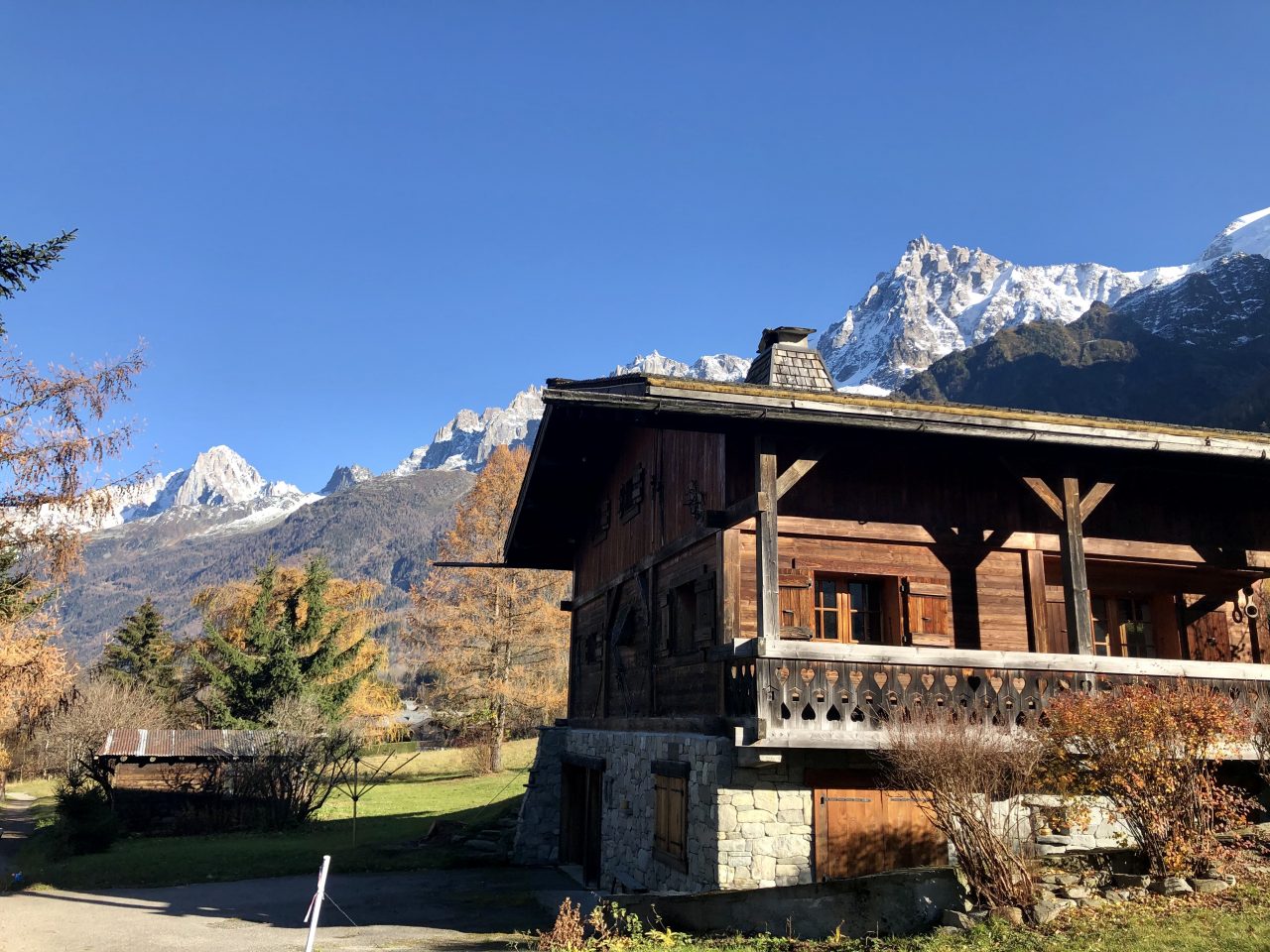
Thanks to some good friends and a fair bit of good fortune, I arrived in Les Houches on Thursday afternoon, immediately awed by the cracking glaciers visible from my doorway, the unlikely cable-car to the summit of Aiguille du Midi (12600 ft) and the formidable massif of Mt. Blanc.
The view from my driveway looking east. From left to right: Aiguille de Midi, Glacier de Taconnaz, Montagne de Taconnaz (foreground), Mont Blanc.
Growing up in the foothills of the North Cascades in Washington state, I feel most at home in the mountains. If I was to spend a month or more on my own in a foreign country during a global pandemic I wanted it to be somewhere I was comfortable and happy to be. As an outdoor enthusiast and a lover of great views (who doesn’t?), this proved to be an excellent opportunity.
Les Houches is a small community located just 6 kilometers from Chamonix-center. Interestingly, it is “twinned” with the Russian villages of Sochi and Krasnaya-Polyana and thus was chosen to help with the organization of the 2014 Winter Olympics.
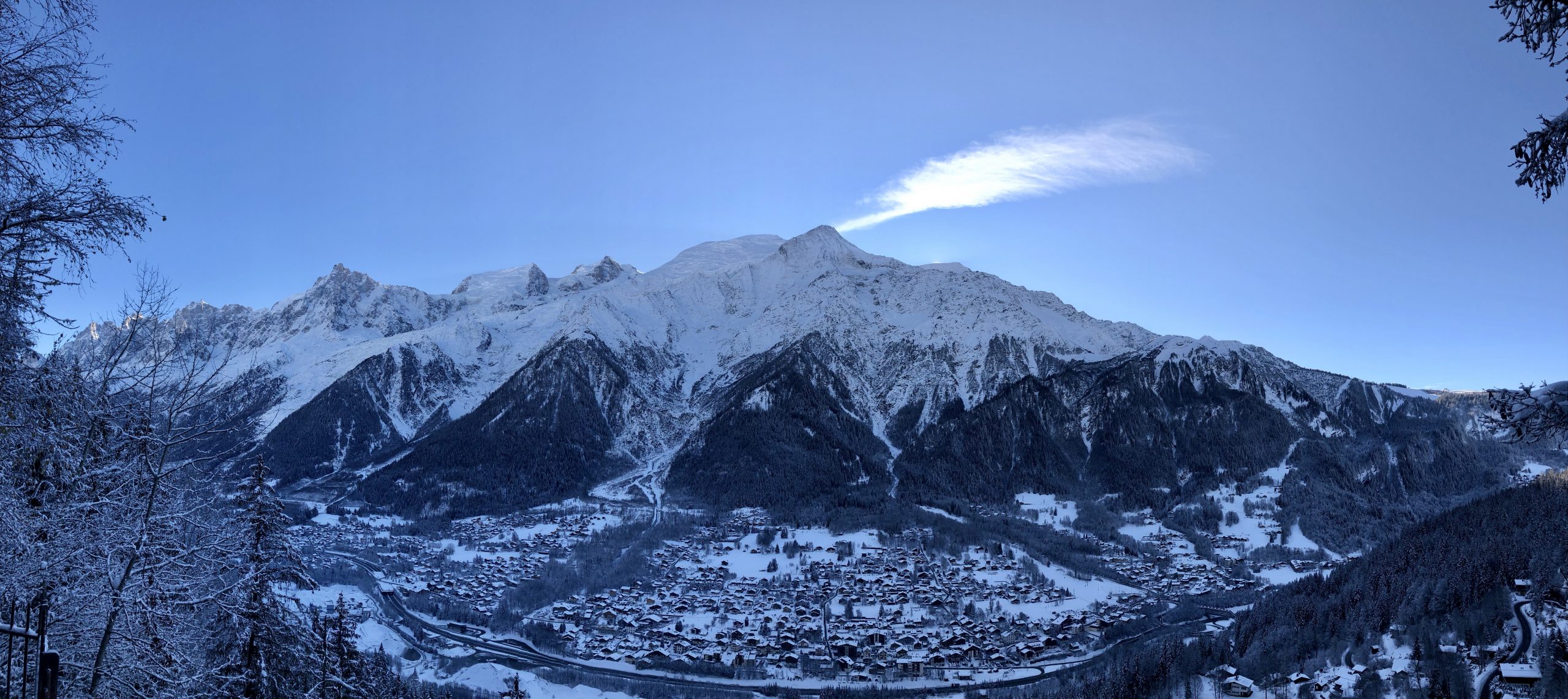
Looking down on the neighborhoods of Les Houches and the Chamonix valley.
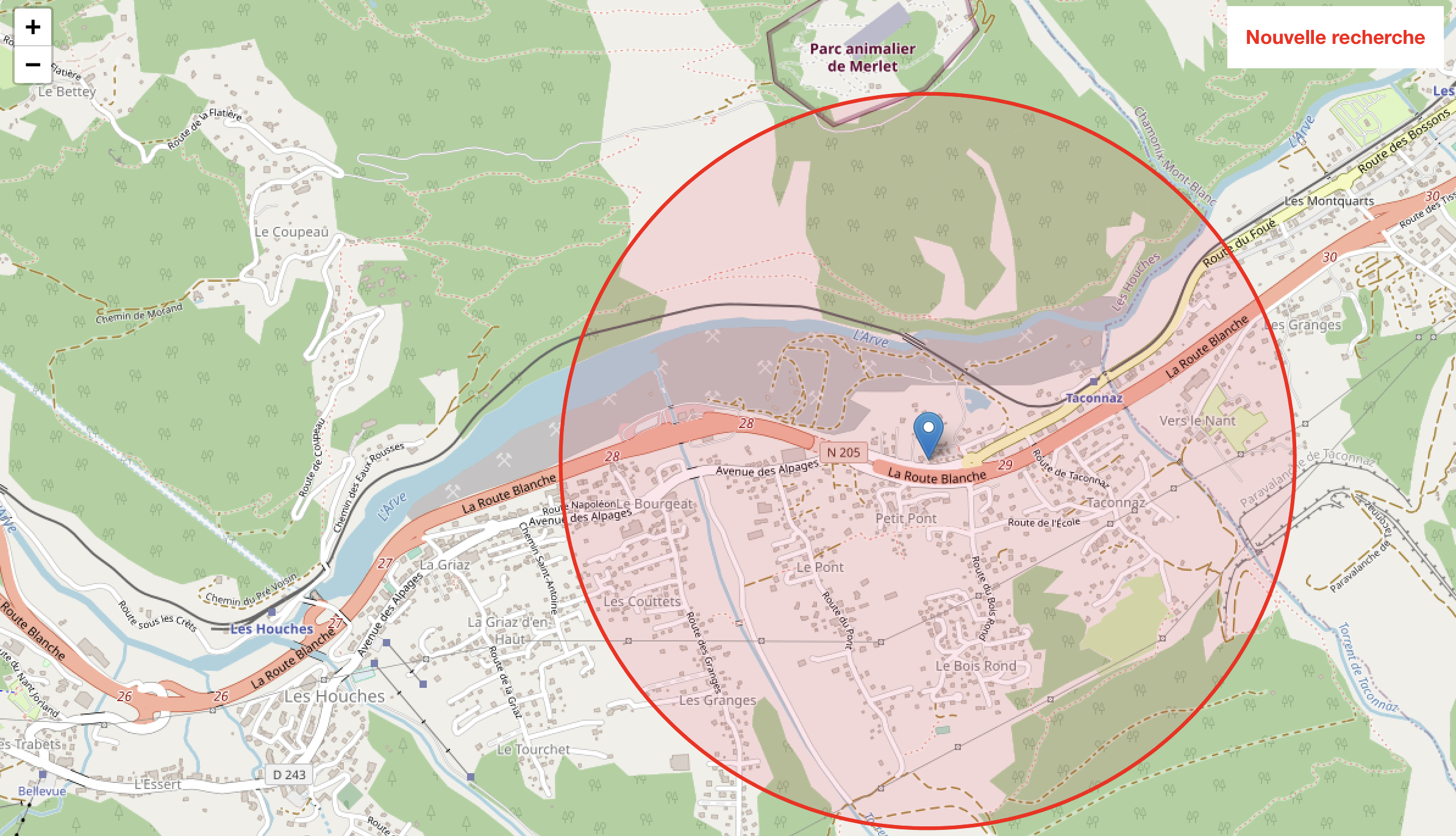
For the first month of lockdown, the restrictions were similar to those of the spring, though I heard from several locals that this time around things were much more relaxed. To go out required an attestation, either a physical piece of paper or a digital version with your name, address, and one of six or so selected reasons to leave, detailing your destination and time of departure. Exercise was limited to within a one-kilometer radius of your home and not to exceed one hour in duration. Upon initial exploration, I believed I could not have found a better one-kilometer bubble to be confined to. It seemed that any direction or turn I took led to some new trail or pathway that criss-crossed the hillside and provided ample views and exercise opportunities.
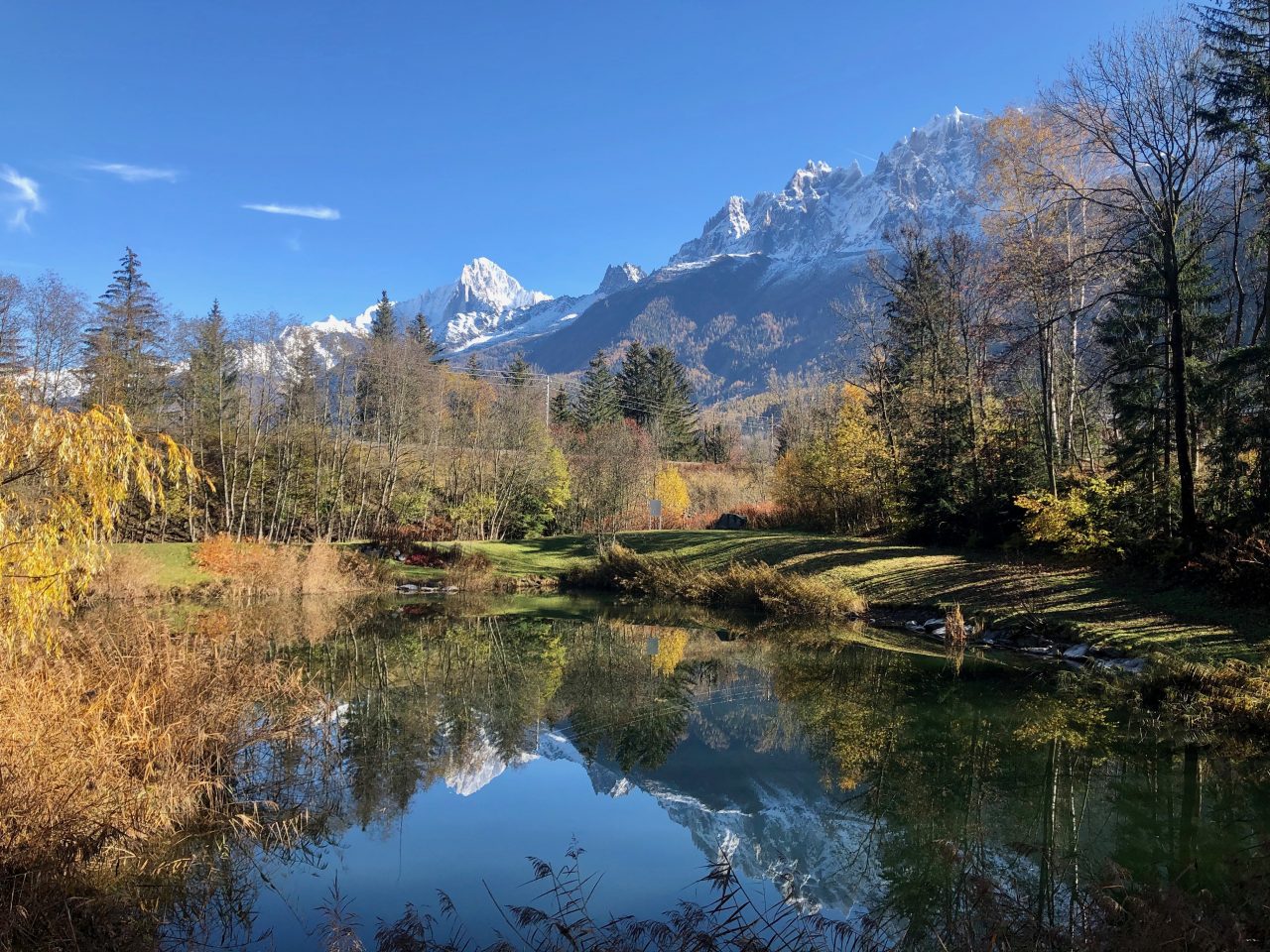
Lac de Clair Temps located within my radius.
Mid-run views.
In little time, I felt quite comfortable in my little bubble and found it easy to stretch the rules here and there. However, I was stopped by the gendarmes to present my attestation towards the end of a run in mid-November which provided a bit of a wake-up call though thankfully I was not in violation of any rules at the time.
The one-kilometer radius from my apartment. The blue pin shows my apartment location, the red dashed lines show trails and the brown dashed lines show dirt roads.
The month of restrictions proved effective at curbing the spread, and COVID cases declined, yet the threat of upcoming holidays coupled with increased travel proved daunting. As restrictions loosened, the government deicided that alpine ski areas would remain closed until January 2021. Naturally, there are numerous implications for resort towns such as Les Houches or Chamonix but not all of them may be negative.
When one hears “Chamonix” thoughts initially jump to feats of alpinism, luxury hut tours, and over-priced hot chocolate. Generally, Nordic skiing is not top of the mind. For a nordic-lover such as myself, however, the news of closed lifts did not deter me and despite the official end of confinement on December 15th, I chose to remain in the valley through the end of the year.
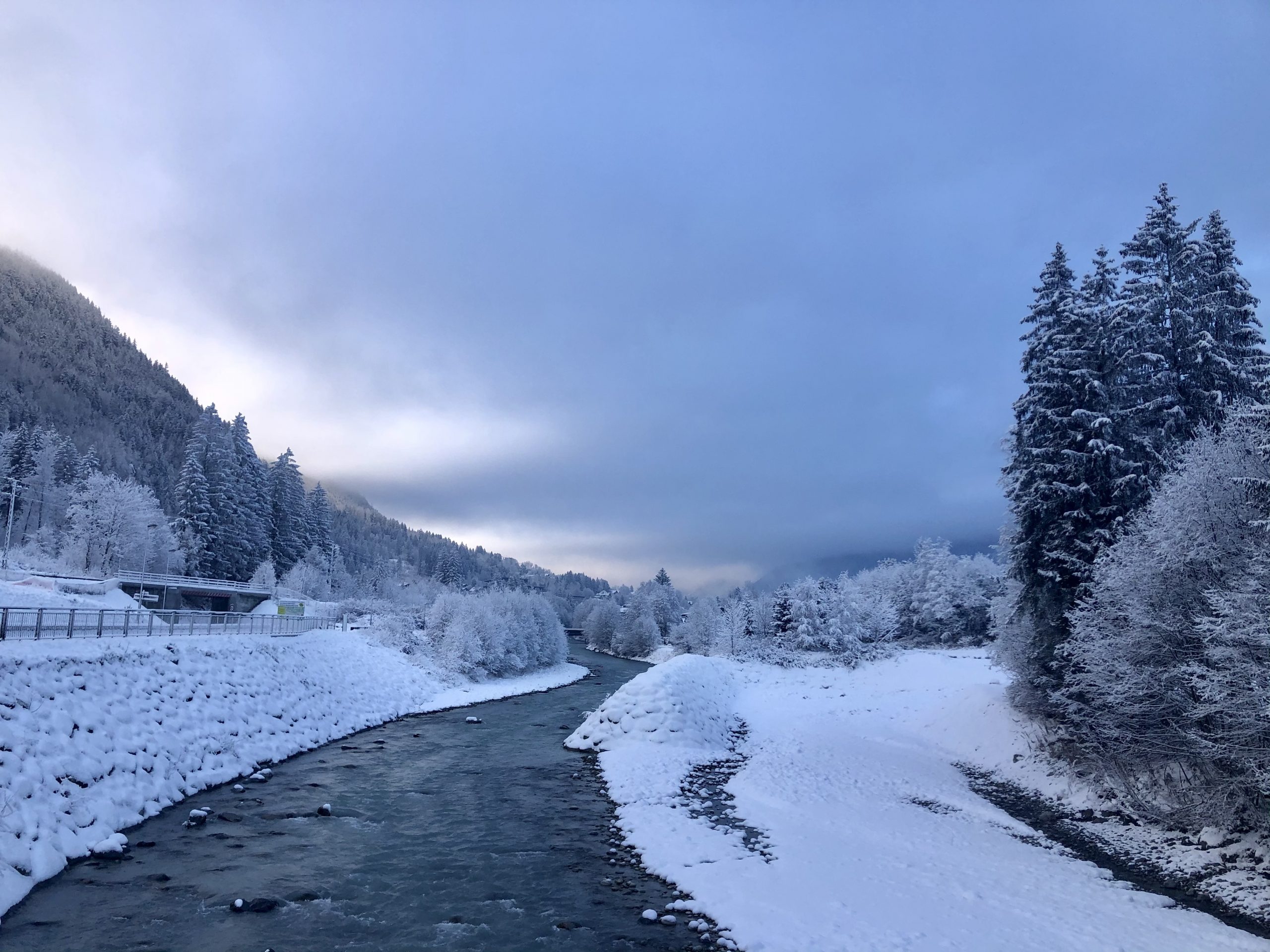
Arve river, en route from Les Houches to Chamonix.
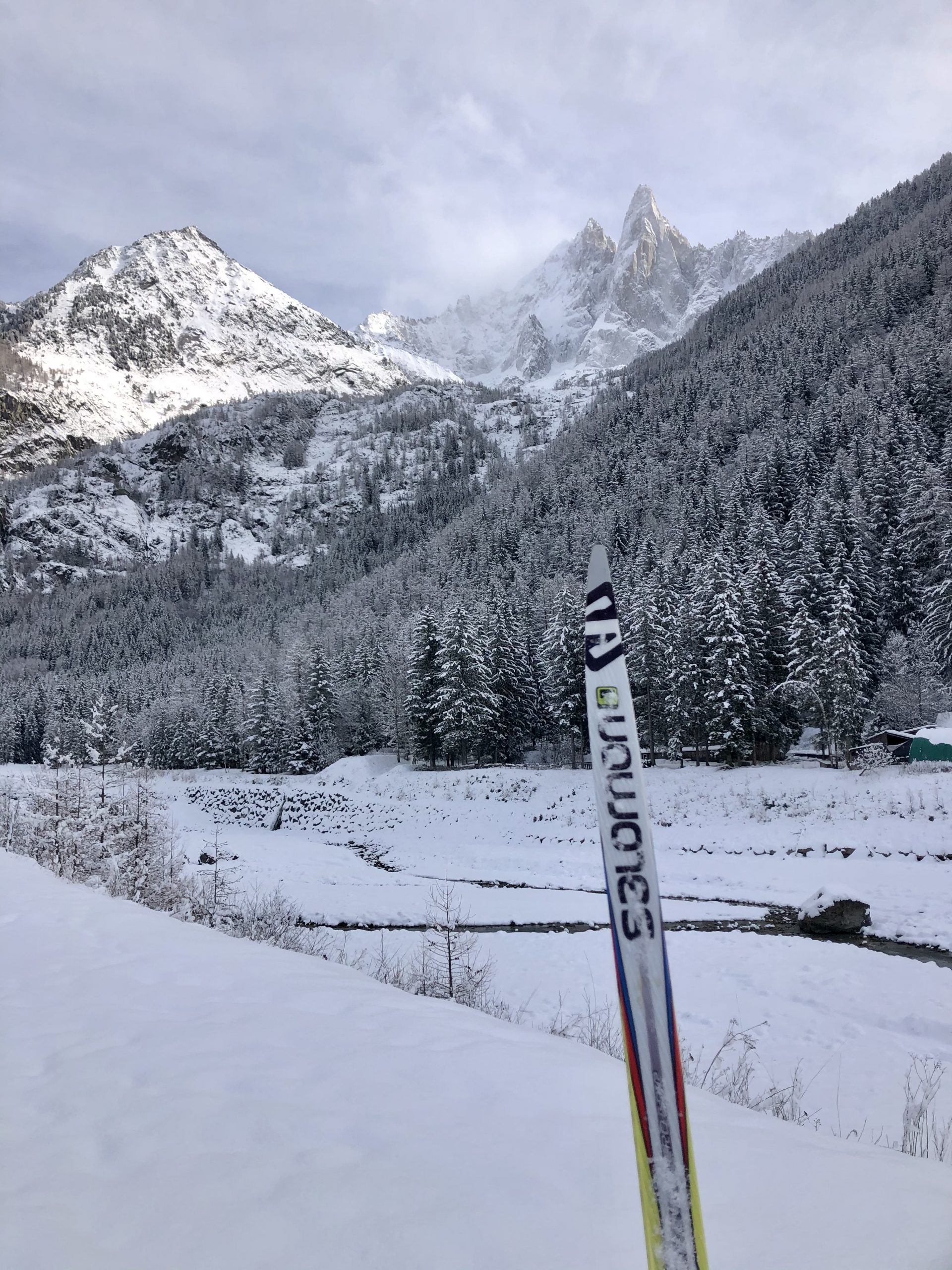
Ready to give my shins a break from the pounding of daily runs and always eager to glide on snow, I ventured to the Chamonix Nordic Center as soon as I judged there to be sufficient snow for grooming. With snow-making to augment an initial one-kilometer groomed loop and natural snow on the outer trails, I first skied on December 6th. I have since gone skiing as often as possible and each time more trails are groomed and I see more skiers out on the tracks.
Since I am solo, I enjoy people-watching while out and about. It seems that the composition of nordic participants here in Chamonix is not so different from what I might find on my home trails in the Methow Valley. I’ve spotted instructors giving lessons to young and old skiers alike. I’ve seen the Club de Ski Nordique de Chamonix out for afternoon practice. I’ve seen some shufflers on classic skis and some tippy skate skiers. I’ve seen some folks out for a quick round of exercise during lunch and others out for a long weekend tour.
It is comforting to know that while I may be 8,324 k from home, I can still encounter familiar scenes out on the ski trails. For now, I plan to ski as much as possible before heading back to the city in January. But, as we have all learned this past year, nothing in the future is certain so who knows what might actually happen. If I end up being here longer, I won’t complain.
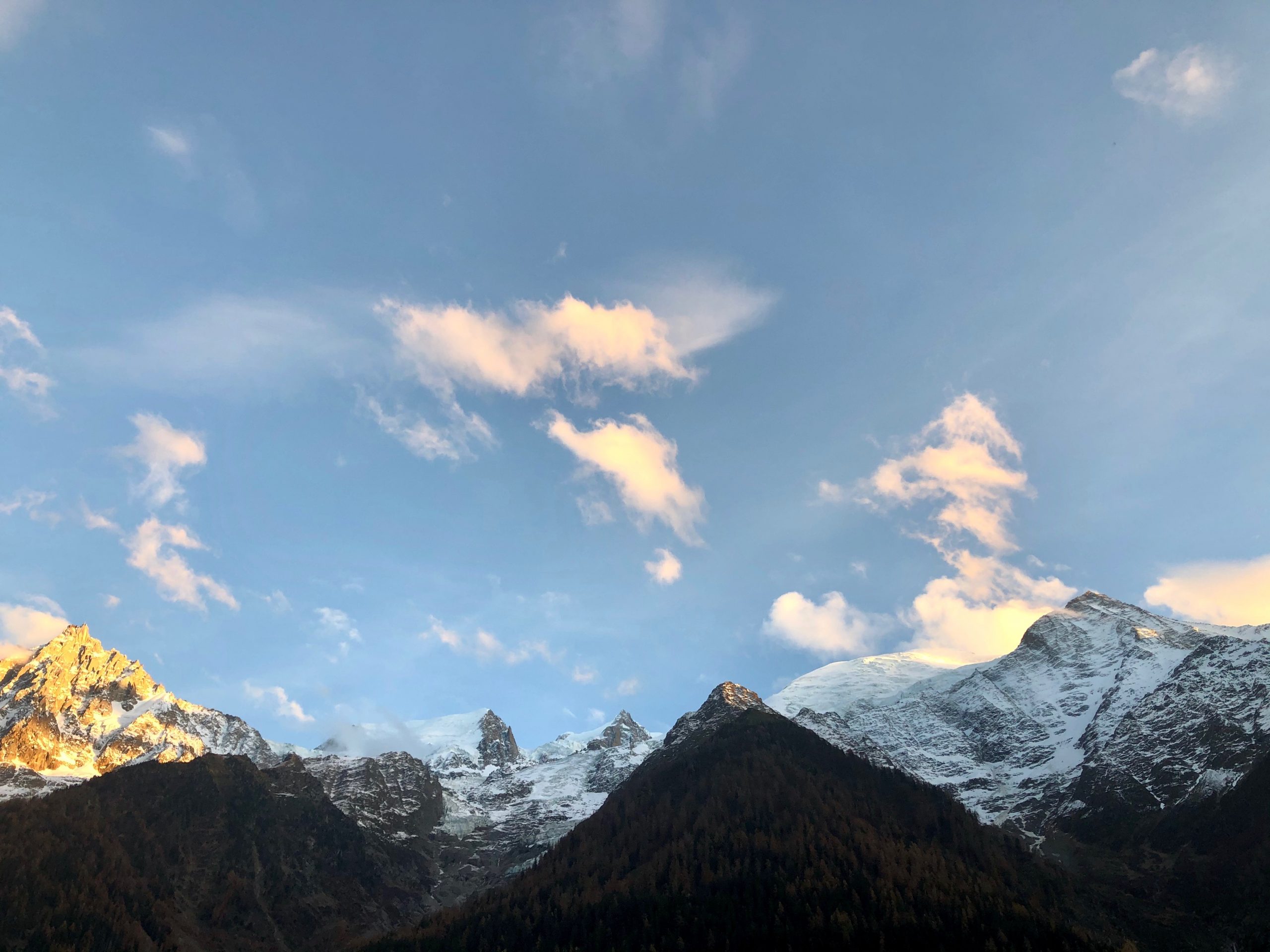
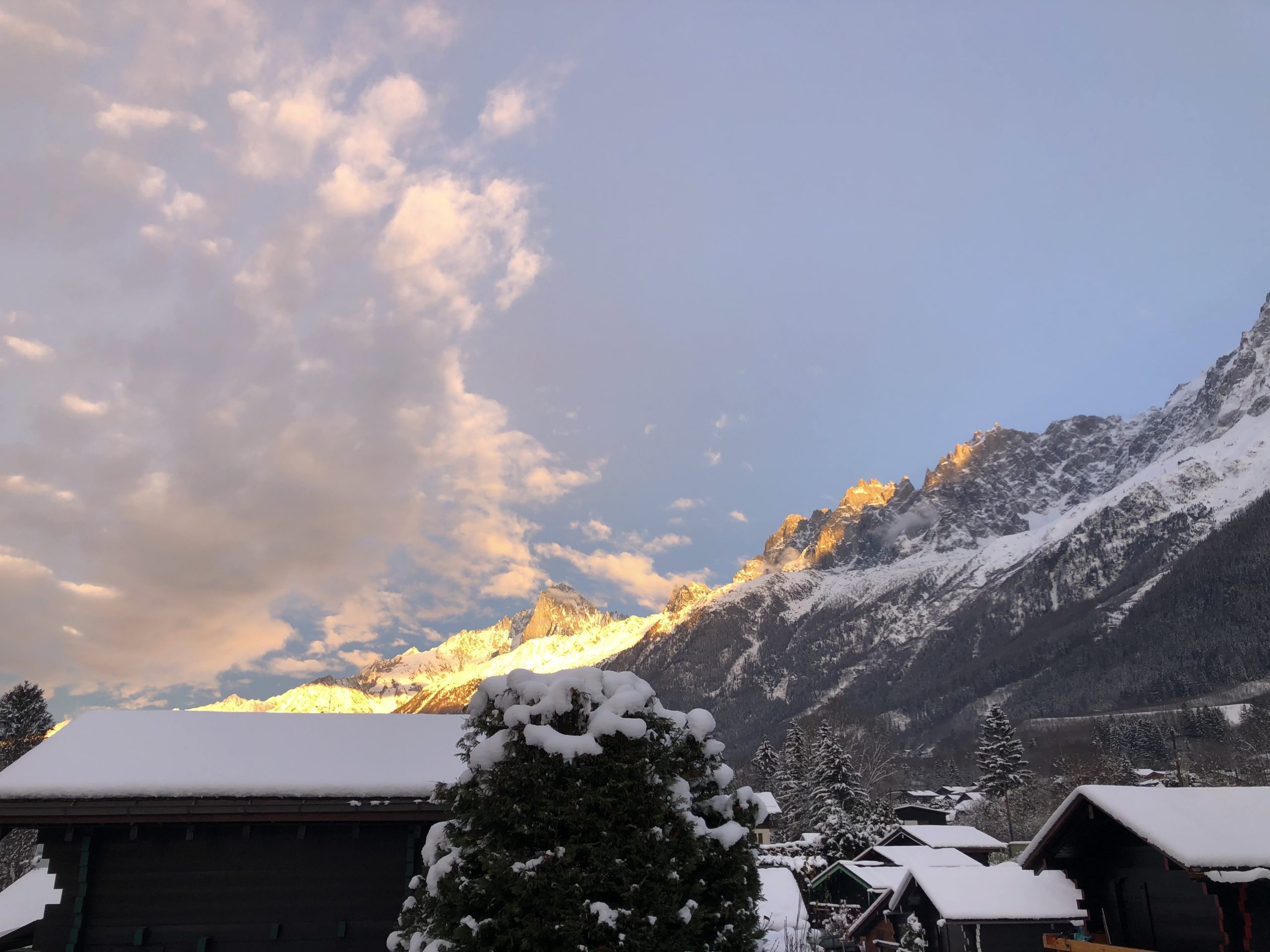
Can’t complain about the view from my doorstep. Looking NE at sunset.
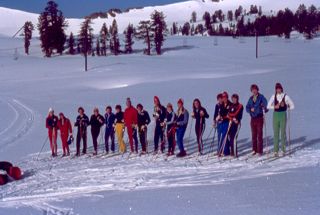
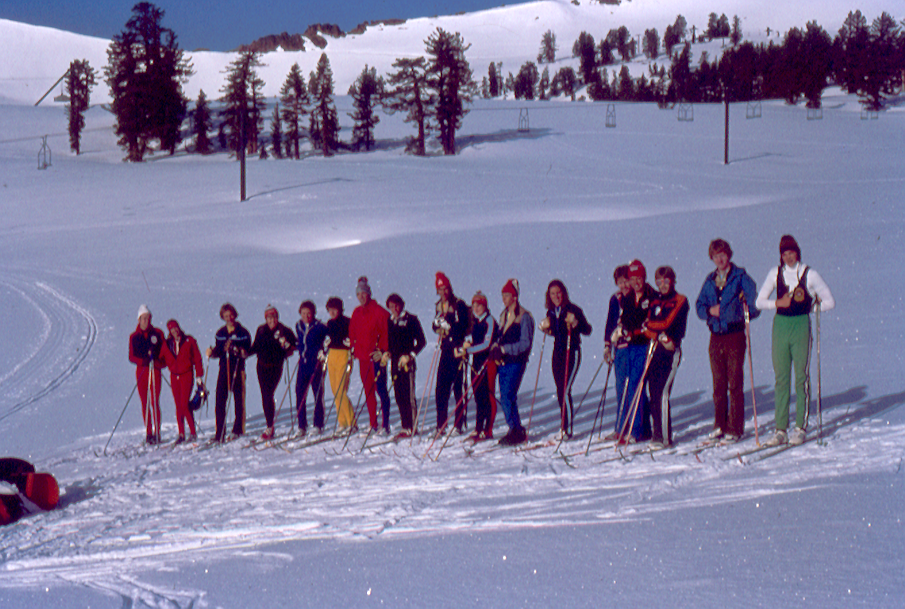
The U.S. biathlon team at a training camp in Squaw Valley, California, in the spring of 1981. Photo courtesy of Art Stegen.
This article is part of FasterSkier’s ‘Where Are They Now’ series, made possible through the generous support of Fischer Sports. Learn more about their products at www.fischersports.com.
It was originally posted in January 2014, but in light of Susan Dunklee’s silver medal in the mass start at 2017 World Championships, we thought we would revisit the last time the U.S. won a World Championships biathlon medal, back in 1984.
“I am so thrilled for Team USA,” Kari Swenson wrote in an email this week. “To have two individual world championship medals is historic. Susan Dunklee’s silver medal is inspiring and will create movement and motivation among young female biathletes in America. She’s in a position to elevate our development programs throughout the country to the next level. Her silver medal means that the USA will be taken seriously by international biathlon programs and fans. Susan and Lowell [Bailey] are now the faces of the USA Biathlon. They will be able to promote Biathlon nationally and in small local clubs. I hope that we can get both of them to travel the country to inspire up and coming biathletes. I am trilled to have Lowell committed to helping our local Bridger Biathlon program in Bozeman, Montana.
“I have cheered, watched and hoped for another medal for the American women since I helped win a relay bronze medal at the first Women’s World Championship in 1984 Chamonix Franc,” she continued. “The program has come a long way since that medal and I am so proud that Susan was able to have her personal best race at the World Championships.”
Going into the 2014 Winter Olympic Games in Sochi, Russia, the U.S. women’s ski team has a very real shot at a relay medal – either in the team sprint or the 4 x 5 k relay competition. That’s backed up by World Championships gold in the team sprint last season in Val di Fiemme, Italy, by Kikkan Randall and Jessie Diggins.
Before their win and Randall’s silver in the 2009 World Championships skate sprint, it had been nearly three decades since and American women’s team in the nordic sports world stood on a championship podium. In 1984, the biathlon team of Julie Newnam, Kari Swenson, and Holly Beattie won bronze in the relay at World Championships in Chamonix, France.
The results were comparable in many ways: it was a landmark moment, an astonishing accomplishment for a U.S. team that had never been expected to do much by the international establishment.
But both in Val di Fiemme and the upcoming Olympics, the favored U.S. women’s team might be a little more prepared for the big stage. After all, back in 1984, it was the very first World Championships female biathletes had ever had – and the first races in Europe for the members of the American team.
“We went over and that was our first-ever experience,” Swenson said in an interview last month. “We went into Chamonix cold, not knowing what our competition was. Maybe that was a good thing, not knowing. We had no idea where we would finish up.”
It had been a long road to Chamonix for Swenson, who started doing biathlon pretty much as soon as women were invited to join U.S. training camps back in 1977. You might not know it now, but biathlon was a male-only sport for far longer than many, in part because it was usually associated with the military.
Then a freshman in high school in Bozeman, Montana, Swenson had skied at U.S. junior nationals, where the biathlon team had set up a demonstration to try to attract interest from young skiers. The demo culminated in a fun race where biathlon team members helped the new skiers set up and shoot their rifles, aiming at balloons rather than targets. Swenson was hooked.
“They decided that they were thinking about starting a women’s development team, and would a couple of us be interested?” she recalled. “We were like, sure! We didn’t really know what that meant. So we started to get invited to the fall camp in West Yellowstone. All of us were skiers but we had to learn how to shoot, because none of us really knew how to handle a gun. It was an interesting time.”
For several years, Swenson and other women honed their shooting skills as they all also improved at skiing. There was no international circuit to speak of for women’s biathlon, so they competed domestically. Swenson finished high school and enrolled at Montana State University, where she also competed on the ski team.
Finally, in the 1983-1984 season, the women got their chance. The U.S. had been training women for seven years, and so, Swenson thought, had other countries. The problem had never been a lack of women interested in competing; it had been an unwillingness by others to allow them to do so.
“There was a lot of, I hate to say it, but male chauvinism, in this sport,” she said. “Because it involves shooting, and they didn’t think that women should be shooting rifles… I mean, Italy was way behind, just because of the male chauvinism aspect of it. Biathlon started way back in the military, so it was male-dominated because it was military based.”
But that season, a World Cup circuit was set up, although the Americans did not attend. They stayed home and trained until the end of February, when they headed to Chamonix for the World Championships.
“[The other teams] had been over there competing against each other all year, so they kind of knew each other,” Swenson said. “So we came in as dark horses. They had no idea who we were or how we would compete. I think we might have had a little bit of an edge there.”
The first race on the schedule was a 10 k individual competition with three shooting stages. With a single penalty, Swenson placed fifth out of the 35 competitors, landing just under a minute and a half behind the winner.
“Four Russians and then me,” Swenson laughed. “It was really quite interesting, exciting, and eye-opening to be over there and see how the athletes were actually involved. How many countries there were.”
After a 5 k sprint, where Swenson again led the U.S., this time placing 13th, it was time for the final event of the Championships: a relay. The Americans placed third, behind Russia and Norway.
Their experience was something akin to when the U.S. women’s ski team placed third in a World Cup relay in Gällivare, Sweden, in 2012. Those women will feel plenty familiar in Swenson’s description of what happened next.
“First of all, we couldn’t believe it that we actually won a medal, and nobody else could either!” she said. “All of the other competitors and coaches were coming up and saying congratulations and hugging us. It was a pretty big deal… To have the Russians come up and say ‘congratulations,’ it was just amazing because they were such a powerhouse.”
For Swenson, the World Championships opened up a whole new realm of sport. She was amazed at how popular biathlon was in Europe, and it energized her even more to keep racing.
“Competing in Europe was so different than competing here,” she marveled. “It’s an actual sport over there. Seeing all the people who would come out, it was an event. The grandstands were full of people cheering, and they’re all drinking their Schnapps or whatever, and it was just a festive atmosphere. And here you’re lucky just to have 15 or 20 people show up.”
Championships complete, the U.S. women’s biathlon team was born. Swenson and the other women went on to compete in not only World Championships, but the actual World Cup circuit as well during the next few seasons.
Swenson was temporarily derailed by tragedy as she was abducted by two men while out on a training run in Bozeman. She ultimately was escaped, but one of her rescuers was killed by her abductors during a rescue attempt, and Swenson herself had serious injuries after being shot through the lung. The event gained national media attention, although Swenson just wanted to put it behind her.
By that winter, she was back competing again, and soaking up more of the international competition experience. It was a heady time to be a woman in the world of biathlon.
Swenson remembers mostly positive things – like the community of women competing together on the international circuit.
“There was never any politics involved with biathlon,” she recalled. “It was almost like it wasn’t important. It was just an athletic event and we were all there to compete, trying to do our best and it wasn’t political. Everybody cheered for everybody, and nobody cared who won as long as everyone competed their best.”
Along the way, she chalked up the milestones that many World Cup racers keep track of: top tens, appearances in different foreign countries. As for many, one highlight was in Oslo, Norway.
“It’s this huge bowl for ski jumps,” she said, fondly recalling the atmosphere in the stadium. “The king was there! The king and queen were there, and I was just floored. I mean, talk about stress! How can I compete in front of all these people, and do halfway decent? I actually placed fourth, and I was just so excited to have placed so well at the Holmenkollen.”
On the other side of the spectrum, it was eye-opening to travel to East Germany after the Berlin Wall had fallen. Swenson remembers one very grey, depressing trip where she could still see fences and guard houses. She and her teammates were glad to head west when the races were over.
The main negative experience that Swenson and her teammates faced again and again was spectators who didn’t think that women should be doing the sport.
“The first year that we went over to Europe, we had a lot of older citizens that would come to our practices and our races and tell us that we should not be doing that,” she explained. “That it was just too hard on women. That women shouldn’t be skiing and carrying a rifle, that this was just too hard on women. And that it was not ladylike to be shooting rifles.”
That would be enough to get any athlete down – how hard is it to stay mentally focused and positive when you’re being told that you shouldn’t even be competing? But Swenson says that the U.S. women didn’t take it too seriously.
“It was hard, but at the same time, we just kind of laughed it off,” she said. “Like, ‘oh, women can have babies, and it’s okay to go through childbirth, but it’s not okay to put a rifle on your back and go skiing?’ We kind of thought it was funny. We nodded our head and skied on by. We were very nice to them, and they had their opinions, and it was okay.”
(When told that Magalena Neuner, a German woman, was the most popular athlete in biathlon for a number of years, Swenson practically cackled with glee: “Oh is that right! I love it!”)
It also helped that the men on her own team were considerably more open-minded. Because biathlon was a fringe sport in the U.S., the men’s team was quite small too, and all of the athletes banded together.
“They were very very supportive,” Swenson said of her male teammates. “They were a great help in getting it started. When we started we were very small, men and women, so we had a very close-knit and supportive group of people. We helped each other in all aspects, skiing, shooting, and just keeping a positive attitude no matter what.”
The two teams also trained together, which made everyone involved sharper and faster.
“The hardest part for the men, and I’m sure they would argue this point with me over and over, but that we could shoot as fast and as accurately as they could,” Swenson laughed. “Shooting is not a sport where you have to be big and strong. Shooting is all about accuracy, so the women’s team often outshot the men’s team. There was some contention there. We’d have shooting competitions, and often times we won.”
After a few years, though, Swenson decided to call it quits. She had graduated from Montana State and spent two years pursuing biathlon full-time. She still dreamed of going to the Olympics, but there was no Olympics in sight for women – after giving ladies their own World Championships, the biathlon establishment hadn’t taken any further steps towards equality.
Swenson had always wanted to go to veterinary school. She was afraid of waiting too long.
“I thought that I just couldn’t waste my time – I love biathlon, but I can’t just wait for the Olympics,” Swenson said. “So I retired in 1986 to go to veterinary school. The first Olympics for women’s biathlon wasn’t until 1992, so I thought it was good that I went on and did something with my life!”
She is now back in Bozeman, where she is a veterinarian and also owns horses. She says that she spend more time with her horses, often taking them to Yellowstone National Park, than she does with endurance sports.
“I’ve sort of lost touch,” she says of her current relationship with biathlon.
But she still exercises and stays in shape. She goes to the West Yellowstone Ski Festival, where it’s “like a reunion” with old friends and teammates. And she’s looking to be involved in a new biathlon club starting up in Bozeman.
“Here in Bozeman we had a very large number of skiers who went on to become skiers and biathletes on the national team,” she said. “But then it tapered off and we had this huge emergence of just nordic skiing here in Bozeman… We have a great range, a permanent range up at Bohart Ranch. I’m like, this is so silly we have a permanent range with metal targets, and we don’t use it! So we’re going to try to get a club started and get kids interested in the sport. It will be fun.”
Although Swenson hasn’t been involved in all of the planning meetings for the new club, she plans to be involved with coaching.
“I love to help kids,” she said. “I think it’s really fun because they have that inquisitiveness, and that energy. It’s really fun to watch a child enjoy something, and progress, and eventually reach their goals, whether it be shooting five out of five targets, or skiing a certain pace on a course. So I’m hoping to be involved in whatever capacity I can be.”
For young racers in Bozeman, that’s a lucky thing indeed. Although she has a different life now, Swenson remembers her days of competing at the very top of the sport with fond memories. The next generation of Montana biathletes might be able to look back on the sport with her same attitude. Hopefully, the current crop of U.S. Olympians will too.
“I still have my rifle,” Swenson says. “People laugh and ask why I still have it, and I say, ‘well it’s my baby! I can’t let it go!’ And I have my old skis with all the little stamps on them from my international competitions, and I have all my medals up. It’s still part of my life, definitely.”
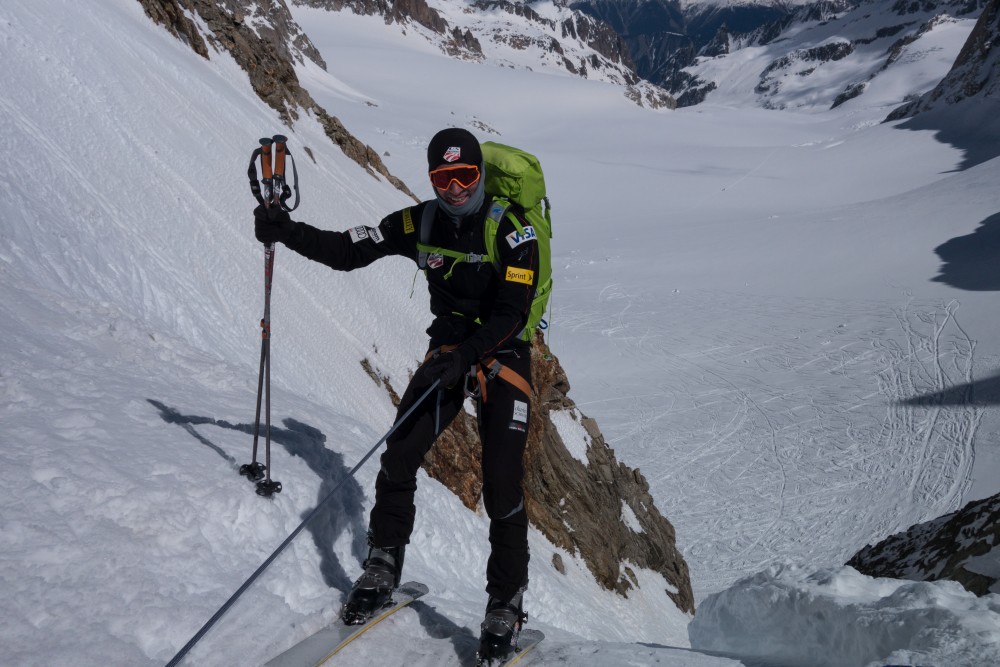
Josh Smullin lowering off the Col du Chardonnet. (Photo: Nick Pope)
“At some point late in the season, when skiing around on small groomed loops becomes a chore, rather than a passion, it’s time for an adventure where you are going out of your comfort zone,” Josh Smullin, head coach of the U20/U18/U16 teams at the Steamboat Springs Winter Sports Club, said of his decision to ski the classic Verbier Haute Route this past March. “I am pretty comfortable in pretty much anything cross-country skiing, but this was a way to go on a ‘bigger adventure.’ ”
That big adventure took Smullin from the whirlwind of coaching and klister at Junior Nationals and SuperTour Finals to a place more sublime — a place where, functionally speaking, a climbing rope, crampons and ice axe are a skier’s best friend: Chamonix, France. It’s there, in arguably the world’s alpine climbing epicenter, that Smullin set off on a planned seven-day, six-night ski tour from Chamonix to Zermatt, Switzerland. On the way, Smullin, 34, would immerse himself in a cycle of rustic fondue meals and ski belays.
He explained the nuts and bolts of the trip require a 35-liter pack, warm and cold weather clothing, and a willingness to be in your ski boots most of the day. Mind some mild discomfort and possible blisters and this hardcore Euro-tour becomes accessible. (Smullin decided to rent boots and skis in Chamonix rather than travel with his personal setup.) The adventure entails long grinds across vast glaciers, boot packing up chutes, and if it’s your first night on the Verbier route, a night’s rest in the classic Trient Hut. Smullin said the Trient was no exception — each hut seemed like a secluded James Bond lair hanging on a precipice.
But before you think it’s a posh cruiser, to those new to exposed sidehill skinning and switching from ski crampons to boot crampons and back again, it’s a headfirst plunge into ski mountaineering.
“There is a lot of switching back and forth, transitioning between all that stuff,” Smullin said.
Beyond the stellar big alpine-wall vistas, Smullin was there to grow as a skier. “I’m scared of heights,” Smullin remarked of his willingness to tempt himself with big vertical voids. “I’ve repelled two hundred feet. I’ve bungee jumped 134 meters in New Zealand. I’m not paralyzed by height, but for me this stuff was pretty big exposure and I did something that scared me everyday. Something that took me out of my comfort zone.”
Among the objective hazards one might reasonably fear are avalanche terrain, crevasses, high-angle skiing and the likelihood of low-visibility navigation. So that’s where the guide came in — Smullin says the guide made the unsettling and exposed situations tolerable.
“I’m glad that I had a guide, Smullin reflected. “I certainly wouldn’t have been able to go all of places we did, or ski the lines I did by myself.”
Admittedly, Smullin says he’s become a bit of a snow snob back in Steamboat Springs, Colo.
“I’m a fair-weather skier and I go when its powder in Steamboat and that’s about it,” he said. “There [on the Haute Route], you have to be ready for all the conditions.”
In other words, in the likely event you’re not “slaying” powder, you take what you get in the mountains. That could be ice, breakable-crust, corn, navigating through avalanche debris, or unbelievable powder. Expect the full package of snow types — other than at the resort in Verbier, which the group skied during their tour, there’s no grooming along the route.
Beyond the point-to-point ski touring, Smullin craved turns. So having a guide who knew the prime ski lines amongst the maze of couloirs was critical.
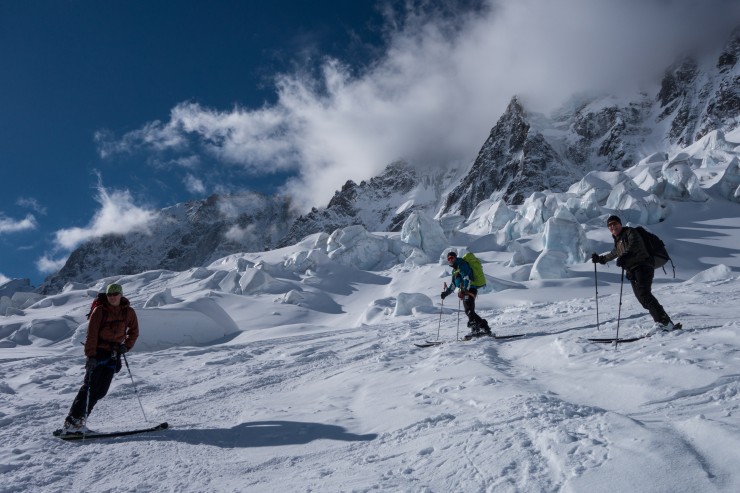
“For me, the main reason I had the guide was the actual skiing we were doing in the afternoon,” he explained. Wake up time each morning was a brisk 6 a.m. or earlier, with the day’s tour to the next hut beginning an hour later. Smullin’s group, including a total of three clients and a guide, would arrive at the next hut expecting to make a quick turnaround. “We would not rest for very long. We would get in there, eat something, and then scope out whatever the sweetest line was and give it a go.”
This is where a season’s worth of cross-country ski fitness paid dividends.
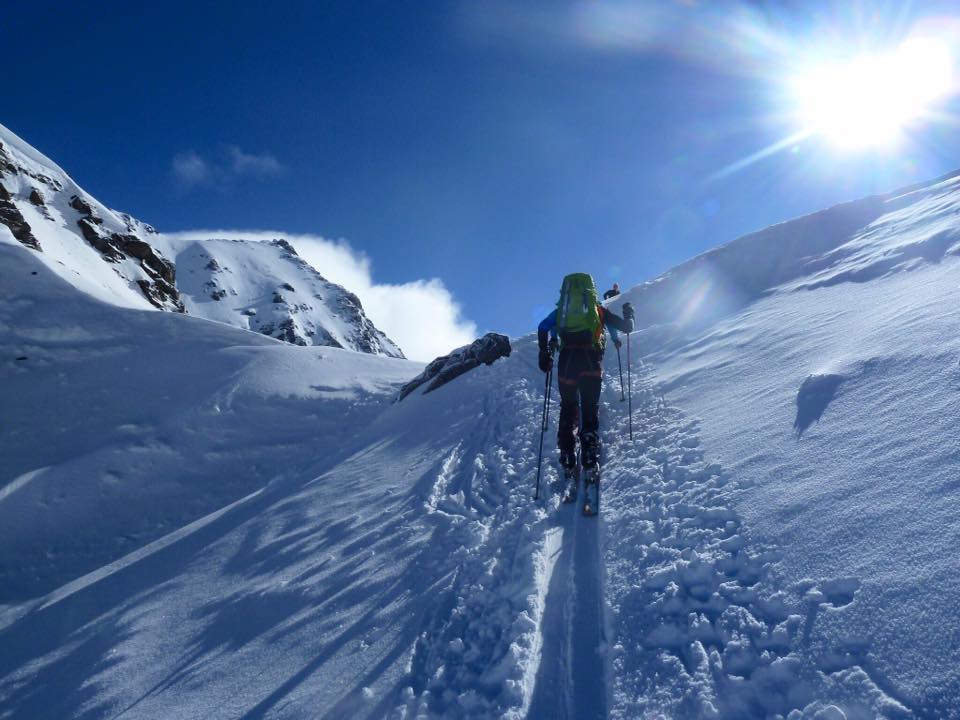
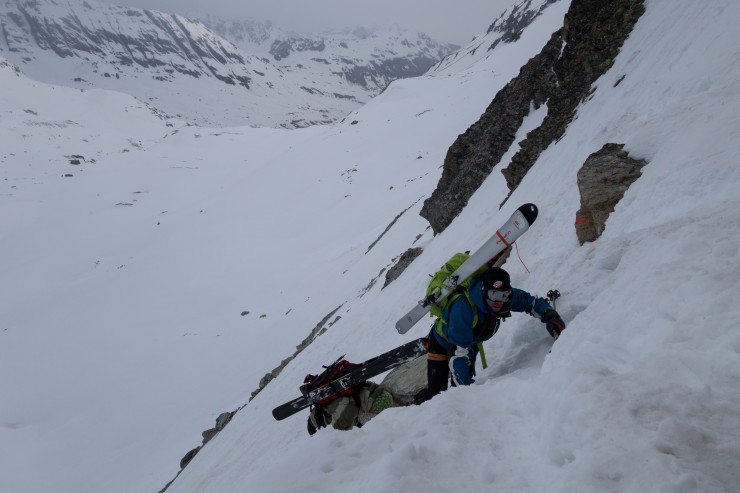
Steep skinning up to a col on the Verbier Haute Route (Photo: Josh Smullin)
“Being fit you have more options to do more things,” Smullin said. “The majority of people on these trips get to the hut, sit down and get a bottle of wine plus a fondue or a rosti, and chill the rest of the evening. We were in the minority.”
On a cloudless day, with the group scanning the craggy panorama from a hut balcony, Smullin got what he came for: a one-stop shop for fear induced butterflies and Steamboat-like powder.
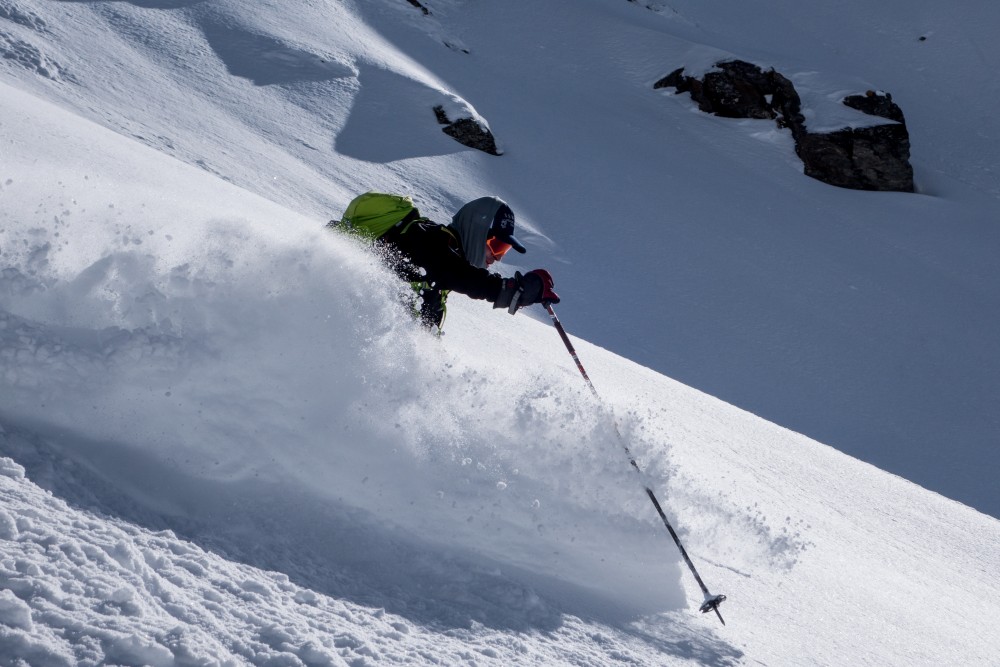
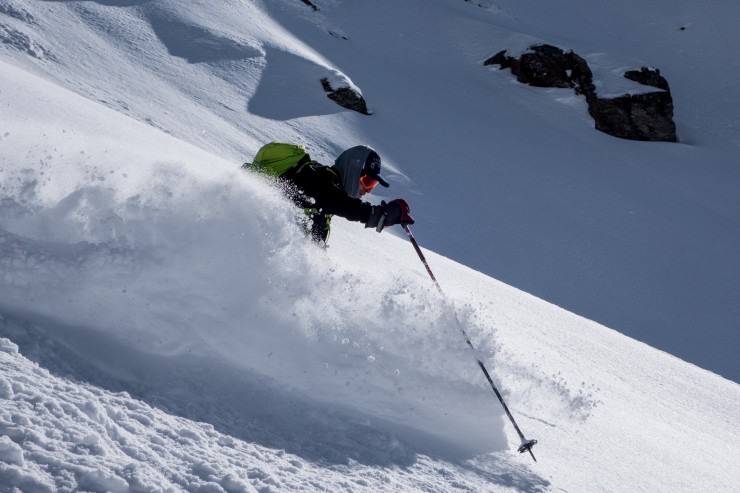
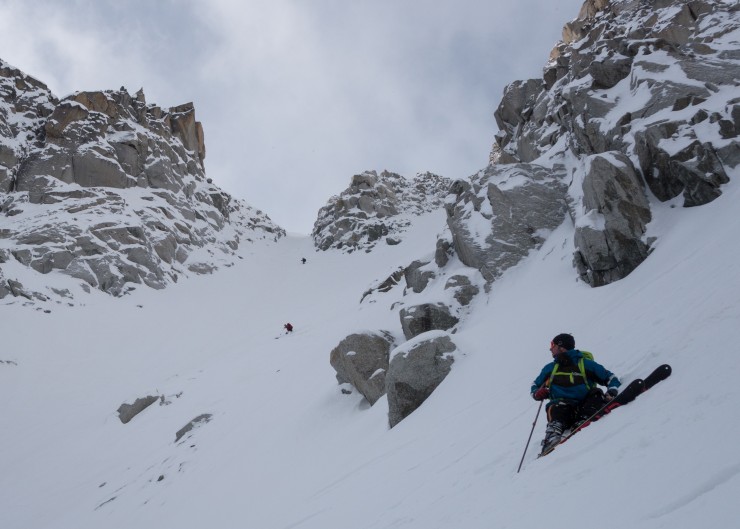
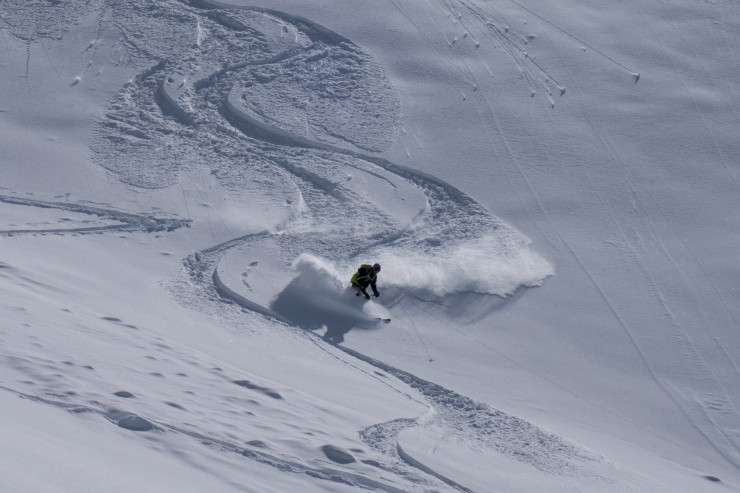
“We got to the hut and the guide pointed up to the highest peak in front of us,” he recalled. “I wasn’t sure if he was being serious … but he was! We arrived at the spine of the summit and it was a steep drop off on both sides. We were traversing across to get to the tight entrance of this couloir. I was pretty nervous and it was probably the steepest longest powder run I’ve ever done. As I committed to dropping in and made the first turn, my mood shifted from terror to shear joy.”
Two thousand feet later, Smullin was all grins.
Part of maintaining that grin is knowing what you signed up for Smullin said. If you plan on taking Smullin’s lead and booking a post-race season trip next spring, here’s a few key pieces of info.
First, the huts have bunk style rooms and can be a bit noisy. Bring industrial strength ear plugs.
Second, decide if you are willing to join a group made up of strangers, as Smullin did.
“That is a consideration for people. There are some guides that won’t take people that don’t know each other,” he explained. “You have to decide if are you willing to pay more for that and have a group of people that you know their speed, their goals, and are all working together towards that? Or if you go with an unknown group, you have to be OK with going whatever speed the other people in your group are. There can be vast differences in fitness, goals and ski ability, so that is a gamble.”
“The majority of people on these trips get to the hut, sit down and get a bottle of wine plus a fondue or a rosti, and chill the rest of the evening. We were in the minority.” — Josh Smullin
Either way, the Alps’ hut system offers a way for adventurous skiers to move light and fast. The huts are staffed and serve hot meals and drinks. Ski packs along the Haute Route can remain light as the hut’s provide bedding and the next day’s lunch can be purchased along the way.
The Verbier Haute Route isn’t exactly a 20-kilometer skate loop or even a day’s long tour in the Colorado backcountry. It’s part high-mountain culture, part steep skiing, part touring and sight seeing, and a whole big part of living the skiing life.
“I guess, I have skied in some respect nearly everyday of the winter from October on,” Smullin said. “So I could have gone somewhere else, for warmer weather. But, certain times of the year are ideal for some adventures and not ideal for others. The end of the cross country race season matches up quite well with the ideal time to ski the Haute Route. In my mind, skiing the Haute Route is about being a complete skier. It’s an activity where you get the exercise, learn new skills and get the payoff for your hard work with the powder turns!”
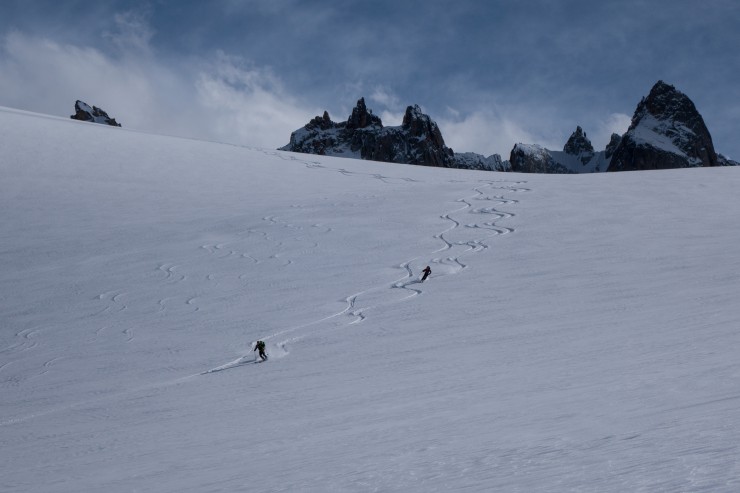
Afternoon lap #2. (Photo: Nick Pope)
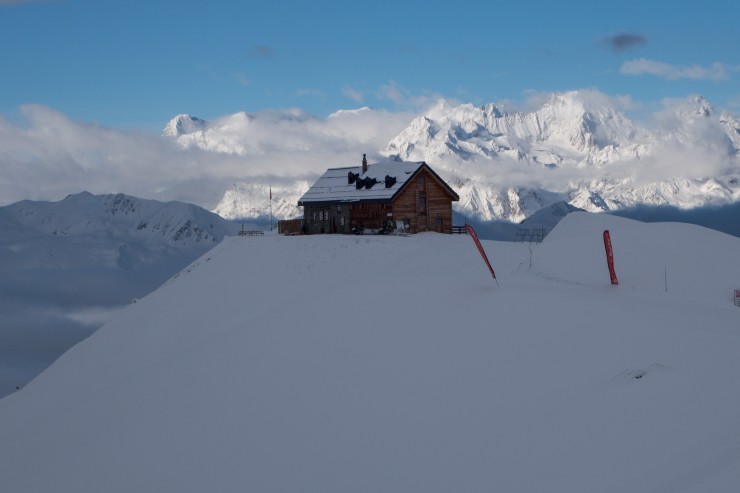
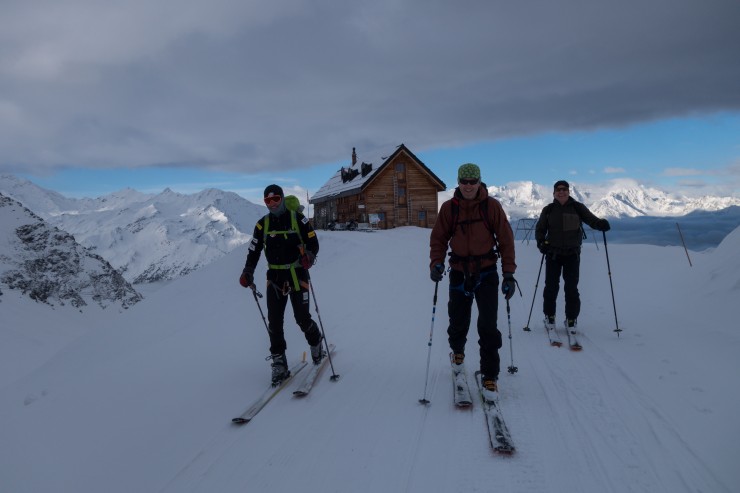
Cabane du Trient. (Photo: Nick Pope)
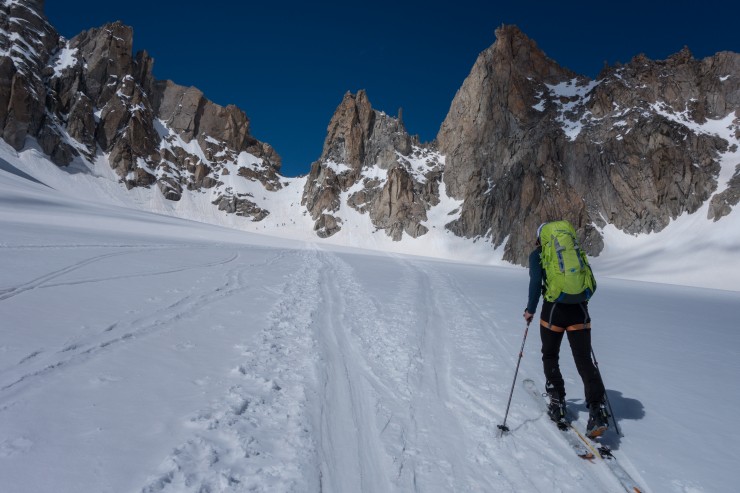
Day 4. Skinning out of Cabane du Trient. (Photo: Nick Pope)
A party approaches the Cabane du Trient. (Photo: Nick Pope)
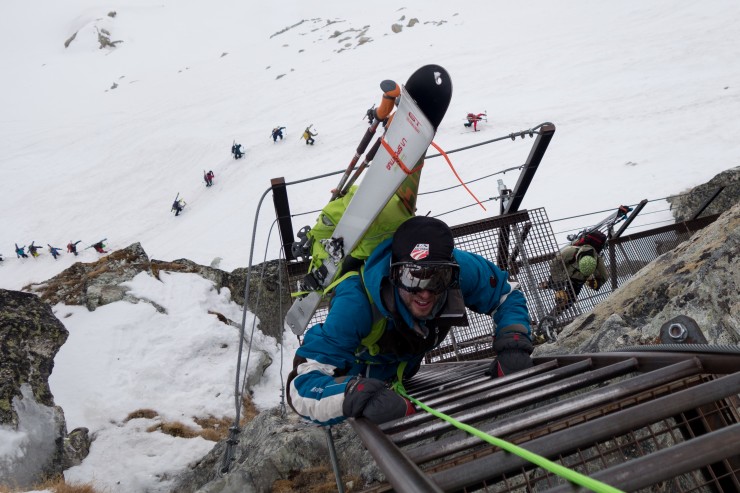
Final ladder on the Pas de Chêvre. (Photo: Nick Pope)
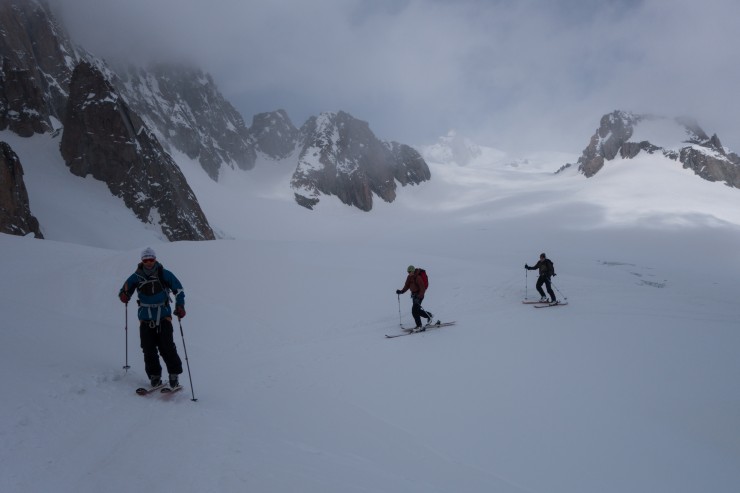
Skinning into the clouds. (Photo: Nick Pope)
Climbing towards the Fenêtre du Saliena. (Photo: Nick Pope)
Descending the Glacier d’Arpette. (Photo: Nick Pope)
Heading for the mogul stash in Verbier. (Photo: Nick Pope)
Afternoon lap #1. (Photo: Nick Pope)
Skiing down from Grands Montets. (Photo: Nick Pope)
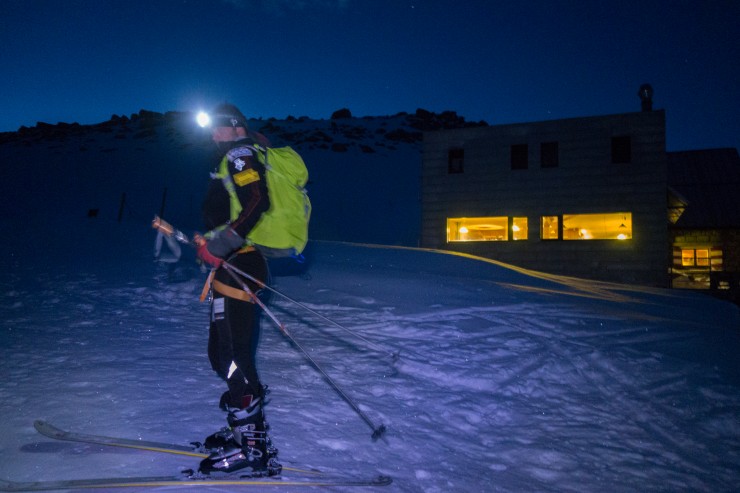
Day 3. 5:48 departure for dawn patrol before breakfast. (Photo: Nick Pope)
Booting up towards the Pas de Chêvre. (Photo: Nick Pope)
Evening powder run down from the Col des Plines. (Photo: Nick Pope)
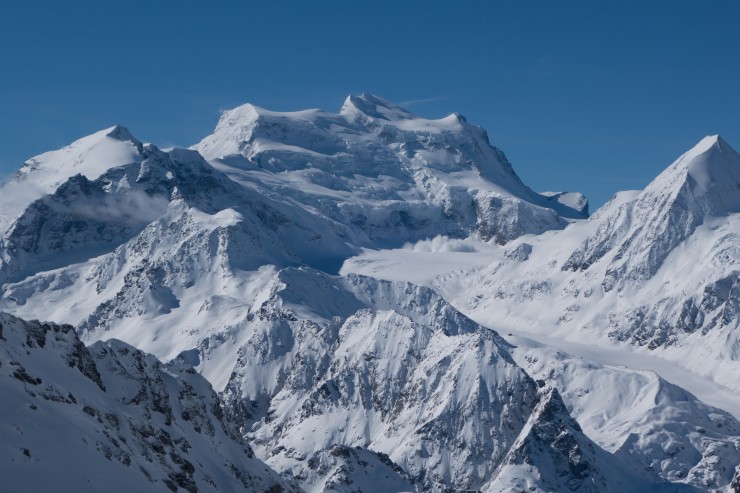
The mighty Grand Combin. (Photo: Nick Pope)
Ready to dig into rösti at Cabane des Dix. (Photo: Nick Pope)
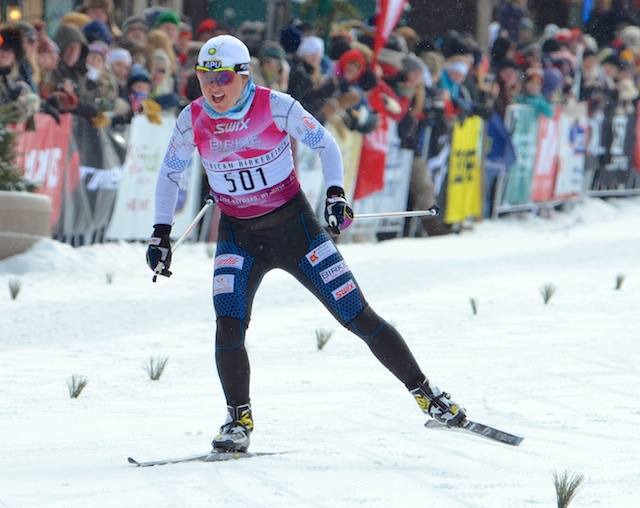
Holly Brooks (Alaska Pacific University/Salomon) racing to her second Birkie victory in Hayward, Wisconsin, in February. On April 11th, Brooks will try to wrap up the FIS Marathon Cup crown in Khanty-Mansiysk, Russia. (Photo: Darlene Prois/ABSF)
ZÜRICH, Switzerland– American racers might think the ski season is over, but not so for Holly Brooks.
“I think I might be the only North American skier who is still competing,” she laughed on Sunday. “Maybe someone else is out there, but I know a lot of people are heading to the beach.”
The Alaskan made the FIS Marathon Cup her season goal, and is about to fly to its last competition, the Ugra Ski Marathon in Khanty-Mansiysk, Russia. She currently leads the standings by four points over Tatjana Mannima of Estonia, with Aurelie Dabudyk of France only 41 points behind as well. With 100 points going to the winner, 80 to second place, then 60, then 50, any of the women could conceivably win the Cup.
That is, if any of them wins the actual race. Last year, marathon favorites Riita-Lisa Roponen of Finland and Seraina Boner of Switzerland finished second and third in the Ugra, minutes behind relative unknown Ekaterina Rudakova of Belarus. The podium finishers were the only non-Russians in a field of fast women.
In their head to head meetings, APU’s Brooks has beaten Mannima three times and Mannima has beaten Brooks twice, but both were in classic races. The Ugra is a 50 k skate, the technique which Brooks favors. FasterSkier caught her for an interview before she flew to Russia.
FasterSkier: What have you been up to for the last few weeks?
Holly Brooks: I’ve been country hopping, as per usual. Or, as usual for me this winter. The last week I spent in Chamonix, which sounds really exciting but it was gray and raining and I didn’t do a whole lot of skiing.
The week before that was kind of a Scandinavian tour. I spent the week in Trondheim with Anders Haugen, a Norwegian-Alaskan who just moved there. The snow wasn’t great there either. That was the week leading up to the Årefjällsloppet, the final of the Swix Ski Classics in Sweden. It was not a great race for me, but I was really happy to be there to experience and hang out with my team, Team Santander, who took the overall win. So that was really fun.
And then the week before that was the Norwegian Birkie. Which was great. You always have to check that off your bucket list as a cross-country skier.
FS: Your last FIS Marathon Cup race was a while ago at this point. How has it been trying to stay motivated?
HB: It’s really wild that the penultimate FIS Marathon Cup was the Engadin, which was March 8th, and the final, the Ugra Ski Marathon, is April 11th. So there’s more than a month there.
I have had a good month in between. I went to Holmenkollen and cheered on teammates there in the 30 and 50 k’s. I had some good racing – the Norwegian Birkie was a really fun experience. I actually cooked dinner for the head of the Norwegian Labor Party, who is potentially going to be the next Prime Minister of Norway. So I cooked his pre-Birken dinner, which was really fun. I’ve just gotten to see a lot more of Europe and of Scandinavia and places that are off the beaten path of the World Cup. And I’ve made a lot of new friends in the last month too.
FS: Now you’re off to Russia. You’ve had plenty of challenges this year with logistics, but how much harder is it with Russia?
HB: I don’t think I’ll believe I’m in Russia until I’m actually in Russia. It has been extremely hard. The logistics around this race have been a total bear. I will say that the people on the organizing committee have been really helpful and really welcoming.
But the visa alone, being a solo show I’ve had to do all the organization myself. For the visa alone I probably sent over 150 emails and made 30 calls. Put hours and hours and hours of time into that. And then figuring out the tickets and who will wax my skis, and all the normal solo stuff.
It will be a long journey to Khanty-Mansiysk. I didn’t even know where it was until I googled it. Siberia is quite far away. I think it’s five time zones away from central European time. I was definitely watching with interest when the biathletes ended their season there a couple of weeks ago. So yeah, I’m excited to get there.
FS: You’ve spent time racing in Russia before, on the World Cup and at the Olympics. Do you think that will help you deal with some of the unfamiliarity of things?
HB: I know that the only thing you can expect is that you have no idea what’s going to happen. You just have to be ready to roll with the punches. I definitely also know that you also have to be extremely patient, because things don’t necessarily happen in a timely manner or how you would expect them to happen.
The food could be great or it could be horrible. I’m definitely taking peanut butter, instant coffee, and instant oatmeal, amongst other things, just in case. And I’m supposed to be able to walk from my hotel room to the start/finish of the race. I’m hopeful that everything will go smoothly.
FS: In the beginning of the season you got a little cushion of time before you started racing, compared to the last couple of years and the World Cup crew. Now you’re going much later than them. What’s harder?
HB: This year has been interesting because I spent all of November and half of December in Alaska, studying. It was actually really hard being at home watching everybody kick off their season. Now I’m on the opposite end. Everyone’s done, they are headed to the beach, and I’m still going. Essentially my season is the same length, it’s just shifted back three weeks to a month.
I think this is a little harder. It was hard watching them race and I wanted to race at the beginning, and now I’m really tired and I’d like to be done. Everyone else is done and I have to stay focused and stay strong. I think the way I’ve done it this year is a little bit harder, but I’m hoping it will pay off.
FS: What’s the race preview?
HB: Well, I have a four point lead going into this race. It’s pretty crazy after an entire season of marathons in eight different countries, to have it be this close at the end is quite exciting but also a little stressful. The girl in second, Tatjana Mannima of Estonia, is only four points behind me and it’s the same as World Cup scoring so if I beat her, then I win the FIS Marathon Cup. If she beats me, then she wins. There’s a lot at stake here. I’m really just trying to stay focused for April 11th.
FS: And then what will you do?
HB: And then it will take me three days to get home [laughs]. I’m already having nightmares about potentially having to check four pieces of luggage on an international flight to Alaska! I’m really really excited to go home.
US Ski Mountaineering member Nina Silitch on the podium after placing third in her age group at the CCC Ultra Trail du Mont Blanc on Aug. 31 in Chamonix, France. (Courtesy photo/ninasilitch.com)
In late May, weeks after Nina Silitch finished her last race of the season, loads of her ski-mountaineering equipment still occupied more than half the space in her bedroom.
Her husband, Michael, couldn’t understand why, after six months on the World Cup and international circuit, she wasn’t ready put it away.
At 39, Silitch was coming off a career-best season in most respects – she became the first American to earn World Cup gold in ski mountaineering after winning a sprint, finished eighth overall in the World Cup and placed fifth in the Grand Course championship series, a two-year culmination of some of the toughest mountaineering races.
In 2011, Silitch teamed up with Lyndsay Meyer and Valentine Fabre to place sixth in The Italian Trofeo Mezzalama, a high-altitude ski mountaineering competition in the region of Cervinia. The race was part of the two-year Grand Course race series. (Courtesy photo)
In 2011/2012, she racked up nearly 30 starts, many of which included three- to four-day stage treks across technical, high-altitude terrain. Other distance races took an average of six to ten hours, and then there were team events.
Silitch ended the season on a high note, placing seventh with two of her US Ski Mountaineering teammates – Sari Anderson and Lyndsay Meyer – at the Patrouille des Glaciers in Switzerland. Typically 53 kilometers long with 4,000 meters of climbing, the team race in early May was cut short around the halfway point because of dangerous winds and unstable snowpack. Silitch, Anderson and Meyer combined to finish strong, physically tying themselves together at times to avoid falling into glacier crevasses.
Once that was over, one would think Silitch would want to move on, spend time with her 6- and 8-year-old sons, and enjoy spring at their home in Chamonix, France.
Of course she wanted all that, but Silitch had one more ski-related task on her “to-do” list. The view from her home reminded her of it almost daily. No sooner had she finished racing in Switzerland that Silitch decided to ascend Mont Blanc, the highest mountain in the Alps and 11th tallest in the world (4,810.45 meters, or 15,782 feet, above sea level).
The view of Mont Blanc from Silitch’s home in Chamonix, France. (Courtesy photo)
About 500 meters short of the summit, high winds forced Silitch and her climbing companion to turn back. Two weeks later, the ski gear remained where she left it, sprawled across her bedroom.
Since moving to Chamonix in 2006, Silitch had summited the mountain twice. Both times, she packed up and skied down its North Face, but this time she wanted to do it in a day. It took most people two or three. It didn’t take long before she enlisted a guide friend to join her on another attempt.
“I wanted to do something, just to have a completion of something and put my season to end that way,” Silitch said during an online chat while visiting family in Maryland. “So that’s what I did this year, Mont Blanc from my house.”
At precisely 2:20 a.m., Silitch turned on her headlamp and left home. She had about 12 hours before she needed to pick up her boys, Birken and Anders, from school.
“Mont Blanc is big undertaking and … one that I by no means take lightly,” Silitch wrote on her blog.
It involved a tricky ascent of 3,375 meters (12,385 feet) and an equally challenging descent. There was altitude sickness to be wary of along with unknown weather elements near the top.
“The challenge of the Mont Blanc summit for me embraces much that one needs in journey of daily life whether you are a mom, dad, athlete, anyone finding their path,” Silitch wrote. “Breathe, endurance, perseverance, confidence, fortitude, grace, energy, vision, attentiveness, awareness, caution, respect, experience, tenacity, commitment, presence.”
Silitch remained focused for the duration, meeting her goal in fairly favorable conditions. After arriving at the top, she took a moment to admire the view, then locked her boot heels in place and started back down.
“I returned home safe, after a successful summit day, with some tired legs, a little nauseated stomach from altitude, but very happy to pick up my boys at school at the end of the day,” she blogged. “Now, finally the overflow of ski gear in my bedroom can be put away. Operation summer mode!”
Championing Her Sport
For Silitch, that meant fewer offseason races and more time with family. A few days after arriving in Maryland for a month-long visit with her in-laws in July, she put her 6-year-old, Anders, in front of the computer during a Skype chat.
Nina Silitch with her 8-year-old son, Birken, who helped pace her at the CCC Ultra Trail du Mont Blanc on Aug. 31 in Chamonix, France. (Courtesy photo)
“Hi,” he said politely, then took off.
“We were just out at the pool,” Silitch explained.
After she and Michael moved to France 11 years ago, had their children while living in Switzerland then returned to Chamonix, they made a point to return to the states periodically. Both American citizens living abroad on visas, they had raised their sons to speak French as well as English.
In Maryland, where they spent a few weeks before visiting Silitch’s parents in Carrabassett Valley, Maine (she’s originally from Shaftsbury, Vt.), the boys had signed up for swim team, tennis and triathlons.
“They’re very active,” Silitch said. She wasn’t much different.
During her 2012/2013 campaign, Silitch knocked off most every goal she set out for. On April 14 in Tromsø, Norway, she claimed gold at a SkiMo World Cup sprint, which combines kicking and gliding, kick turns, boot packing (carrying one’s skis) and often some skating. The race includes a qualification round and heats, and typically takes 3 ½ to 4 minutes to complete the course.
Silitch (center) on the sprint podium after becoming the first American to win a ski mountaineering World Cup on April 14 in Tromsø, Norway. With Anna Figura of Poland in second and Emilie Gex-Fabry of Switzerland in third. (Photo by Alex Lugger)
The final race of the World Cup season, it was only Silitch’s second sprint of the year (one other on the circuit was canceled, and Silitch did another at French nationals, where she finished second).
“It’s kind of been an event that I’ve fallen in love with,” she said. “It’s been a combination of my cross-country skiing background [at the Holderness School and Dartmouth College], but also just the event itself, combining all the aspects of ski mountaineering. You need to be very efficient in transitions … you can’t make a mistake. So it was really special that it came together.”
Next year, there are three sprints in the International Ski Mountaineering Federation series, which consists of more than 20 races in France, Switzerland, Italy, Spain, Poland and Norway. Silitch was excited that, for the first time, points awarded at sprints will be equal to those earned in longer races. The shorter format was adopted to broaden the sport’s appeal, and with several races in downtown venues, it’s become more accessible to spectators.
“They actually created the sprint to grow the sport more and hopefully someday it will become an Olympic sport,” Silitch said. “They’re trying to do more TV coverage next year so we’ll see.”
When she’s not gutting for a win, Silitch is the president of the volunteer-driven Chamonix Ski Alpinisme Club. She founded the ski-mountaineering group three years ago, and has since seen its membership grow from about five to 70 members.
Women’s ski mountaineering World Cup sprint semifinal on April 14 in Tromso, Norway. (Nina Silitch courtesy photo)
“That’s something I’m really trying to do, help grow the sport and bring it more to women especially,” she said, “and also to the younger kids as well, the youth. In the U.S., I think that’s where we need to target, those kids that don’t necessarily find their way in alpine skiing or cross-country or even those cross-country skiers that want to try something a little different.”
One can compete in ski mountaineering as early as 14, which is the age group Silitch would like to draw in. “That’ll be my next step after competing,” she said.
For now, she’s mostly focused on the season ahead.
“I think I’m just going to give it one more year of World Cup skiing,” Silitch said. “Hopefully from that I’ll move into other things with my experiences in the World Cup and apply that to whatever I do next.”
Her husband, an internationally certified mountain guide, is interested in moving to Norway to teach. Silitch ran a female outdoors program at Aiglon College in Villars, Switzerland, while they lived there for four years, then committed to full-time racing when she made the US team in 2008.
Finances, however, remain a stumbling point for most American competitors in the sport.
“We don’t really have any funding. It’s up to everyone to get their own sponsorships and everything,” Silitch said. “All the European teams are nationally funded. They’ve got coaches and all their events are paid for and their travel expenses. For me, [it’s] from my heart and passion. … It’s definitely a big commitment, but we feel like it’s such a great experience for me and also for my family, that it’s really worth it even if it can be a little tight at times.”
In December, she’ll turn 40, yet Silitch remains relatively new to ski mountaineering after trying it for the first time in 2005. It wasn’t until two years later at a night uphill race that she decided to pursue it more seriously.
“It’s funny that I didn’t really fall into this until after my kids were born,” she said. “So that’s been a whole new experience for me, a whole new challenge. I think because it combines so many of the different things I love, the endurance, the kick and glide cross-country skiing, but also being in the mountains and the mountaineering aspect of it. I’m also a huge downhill skiing fan, and just being able to combine those things, it just kind of creates a sport that’s really fun and challenging.”
Frame of Mind
After a long season, which started in mid-December and wrapped up in early May, Silitch took about three weeks off to regenerate with some fun and loose training. She planned to slowly build into a ski-specific dryland routine while staying away from trail racing until the end of summer.
Primarily concerned about past injuries, she worked with her coach, Adam St. Pierre, a cross-country ski coach with the Boulder Center for Sports and Medicine in Colorado. With his help, she developed the strength to compete in the one summer event she set her sights on: the CCC Ultra Trail Mont Blanc. One again, it was an objective viewed from her backyard.
Nina Silitch during the first climb up to Bertone before the cold and wind set in at the CCC Ultra Trail du Mont Blanc on Aug. 31 in Chamonix, France. (Courtesy photo)
In late August, she completed the 90-kilometer race (slightly altered from the original 100 k), finishing third in her age group and 15th among women.
“My biggest goal of the summer is now behind me,” Silitch wrote on her blog. “1800 runners withstood rain, wind, snow, sleet, mud. Temperatures plummeted on the high cols and runners ran through passes with 10-20cm of snow. … It got to points on the course where it was merely about survival and being well prepared in the conditions with not only the right gear & clothing for but the right mental attitude.”
That was where her other summer training came in. While in France this year, she’s been working with sports-performance and mental-training coaches, one of which mentored Rafael Nadal, formerly the top-ranked tennis player in the world.
“It’s helped me tremendously,” she said of learning how to motivate herself through her sport’s toughest moments, no matter how fatigued or bad she feels.
“Usually I have little mantras like, ‘Go mommy go,’ … or ‘fast and light,’ ” Silitch said. “If I ever have a negative thought come into my head I try to have two positives. Like, ‘Oh my legs feel so heavy,’ ‘No, your legs are really light,’ and ‘Think about your quickness or your cadence,’ and those things really help. I’m really interested in that and it’s a neat thing to apply to coaching, for sure.”
For Silitch, instructing could her next step, especially as she and Michael plan their next move.
“We’re not sure if we’ll eventually work our way back to the states,” she said. “We both really love teaching, so maybe we’ll explore.”