From the FasterSkier archive — posts syndicated from athletes’ and coaches’ own blogs between 2004 and 2012, kept online as published. Current coverage is at fasterskier.com.
Just over a month after hosting the International Ski Federation (FIS) Cross Country World Cup, the Canmore Nordic Centre is pulling out all the stops and showcasing its brand-new biathlon facility as the host of the International Biathlon Union (IBU) World Cup Finals from Thursday, March 14 to Sunday, March 17.
The world-class venue amid Canada’s Rocky Mountains is no stranger to World Cup nordic and mountain bike events. It hosted 2016 and 2019 IBU World Cups and, as recently as last year, eight IBU Cup events in advance of the 2024 Biathlon World Cup Finals.
Two years ago, Alberta’s provincial government granted the Canmore Nordic Centre $17.5 million to upgrade and enhance its biathlon building, stadium, snowmaking, and range. According to Ken Davies, the Canmore IBU World Cup event chair, they broke ground in May 2022 and have nearly completed the project as of this March.
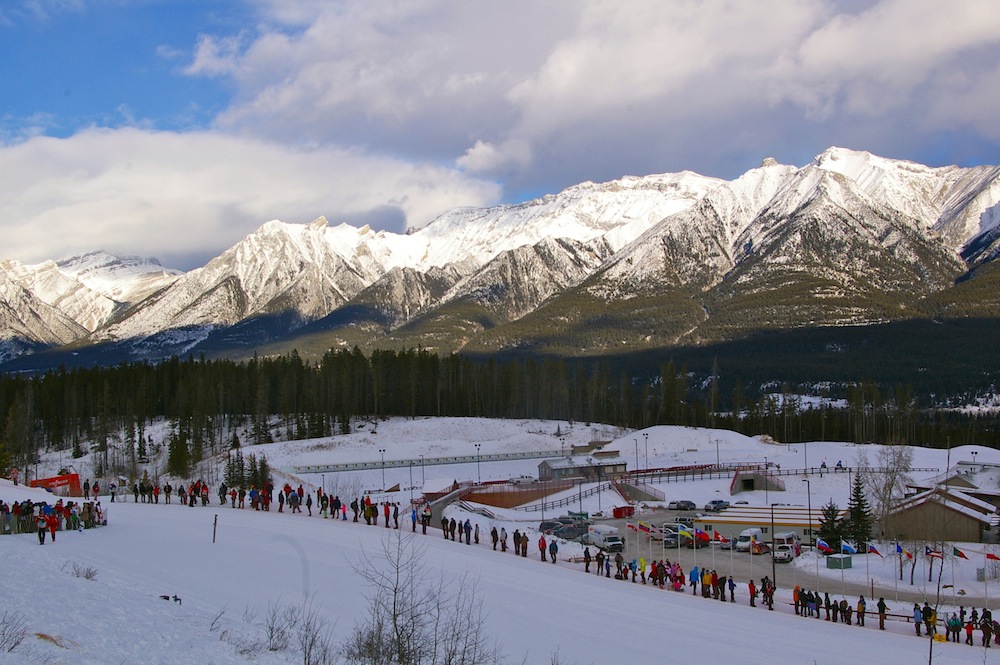
New biathlon building at the Canmore Nordic Centre. (Photo: Biathlon Canada/Pam Doyle)
“It’s huge,” he said. “We sort of stirred the pot initially seven years ago to get them to reinvest in the nordic centre, and the Alberta government followed through, so credit to them.”
In 2017, the Canmore Nordic Centre requested improvements to its biathlon facility, which hadn’t been updated since 1986, when it was built for the 1988 Olympics. The biathlon stadium needed to be widened to meet IBU regulations and continue to host World Cups. The nordic centre also wanted to replace its undersized timing building and wax facilities, expand its snowmaking, and modernize its shooting range.
Just three days before the start of the IBU World Cup Finals, the Canmore Nordic Centre is ready to show the world its fresh new look. According to Davies, the father of Olympic biathlete Macx Davies and a Canmore World Cup organizer since 2005, the biathlon course has been “turned upside down.”
“When you come in and shoot, we now do a 180-degree turn in the stadium so the spectators can see the athletes for longer,” he explained. “We used a lot of the same course, but how we start and finish is completely different.”
Situated between 1,425 and 1,550 meters (4,675 and 5,085 feet) above sea level, the Canmore Nordic Centre is one of Canada’s highest cross-country ski areas, and it has a deceivingly challenging World Cup course.
“The trails are so well maintained, and they’re wider, so they look like highways, [but] they’re sort of sneaky hard,” Davies said. “People forget we’re at 1,400 meters of elevation. … We’re as tough as most places, and the racers all realize that when they come here.”
Rosanna Crawford (Biathlon Canada) racing to 26th in the women’s 7.5 k sprint at the 2017 IBU World Championships in Hochfilzen, Austria. (Photo: Glen Crawford)
According to Rosanna Crawford, a three-time Olympic biathlete based in Canmore, the approach to the range has changed. On each lap, racers must climb up to the stadium before shooting.
“I’m curious to see how the athletes will like it,” said Crawford, who lives in Canmore with her husband, Brendan Green, also a Canadian Olympic biathlete. “Before, you had a somewhat easier range entry, but now, especially for the men’s sprint, they’re going to climb right up into the range, so I think they’ll be pretty gassed.”
On the range, she said changing conditions can cause the wind flags to change immediately.
“It’s a tricky range. The wind can really rip through there,” she said. “So I’ll be curious to see how the athletes handle that.”
While Crawford has never watched a Biathlon World Cup in person since retiring from racing in 2019, she is excited to spectate with Green and her family this weekend. (Crawford is the younger sister of Olympic cross-country skier Chandra Crawford.)
“Seeing it in person is going to be special because we are huge biathlon fans. We don’t miss a race, and we try to stay off social media until we can get home and watch the races on Eurovision,” Rosanna explained.
Brendan Green racing to sixth for Canada in the men’s 4 x 7.5 k relay at the 2017 IBU World Cup in Hochfilzen, Austria. Sixth place matched the Canadian men’s previous best relay result. (Photo: Biathlon Canada/NordicFocus)
“Brendan retired in Canmore [in 2019], so it was really special having his family there in the crowd,” she added. My cousin made some funny signs, like those face ones, so my whole family had my face on a stick that they were holding up. … Canmore’s just so special. I’m looking forward to being a number-one sports fan during the races.”
When she’s not at the races hanging out in the Rocky Mountain Club and grandstands, she can tune in while working as a dental hygienist in town.
“In my dental office, there’s a TV, and I’m able to stream from my computer,” she explained. “Luckily, I had some ski fans in my chair [during Canmore’s Cross-Country World Cup], and they would tell me when to look because you can’t clean teeth and watch TV at the same time.”
USBA arrives in Canmore after stellar results at their home races in Soldier Hollow, Utah, led by Campbell Wright (USA), who finished in sixth place in the men’s 10km sprint. (Photo: NordicFocus)
With more than 240 athletes from 25 countries, the Biathlon World Cup Finals are expected to draw 3,000 to 5,000 spectators for the Thursday and Friday events and up to 10,000 on the weekend days. Additionally, more than 50 million viewers are expected to watch remotely via Eurosport. According to Davies, Canmore sold out of VIP and grandstand tickets within 36 hours, 70 percent of which were purchased by Europeans.
General admission to the races is free and doesn’t require a ticket. In addition to the indoor Rocky Mountain Club VIP zone and bleacher (grandstand) seating, the venue can accommodate 10,000 non-paying spectators.
Spectators are encouraged to use the courtesy shuttles between downtown and the venue, or take the scenic route by foot and enjoy an Art Walk in the Woods along the way. The Canmore Nordic Centre is 3.5 k west of Canmore, about a 30- to 40-minute walk from downtown. Crawford recommended bringing YakTrax or traction cleats for walking, just in case.
In late February, a snowstorm brought about a foot of fresh snow to Canmore, which made everything look wintery again after an up-and-down winter. Davies said the biathlon loops have been ready since early December, and with expanded snowmaking, the Canmore Nordic Centre can open at least 10 kilometers of trails in mid-October.
“We had a weird winter,” he said of the 2023/24 season thus far. “We had a really hot spot in January, but we also had a really cold spot. So there has been natural snow since November, but [the February storm] helped. .… It didn’t help me with organizing the event as far as digging everything out, but it helped what it looks like. It’s a winter wonderland right now.”
This week, the forecast in Canmore called for sunny weather with daytime temperatures between 5 and 10 degrees Celsius (mid to high 40s Fahrenheit). During the last two IBU World Cups in Canmore, which were held in February of 2016 and 2019, many races were either shortened or canceled due to frigid temperatures.
According to Davies, average temperatures for early March are a pleasant 3 degrees during the day and -5 at night. After the races, 12 Crystal Globes will be awarded to the top-ranked athletes in each discipline for their season-long performances. The competitions include sprints, pursuits, and mass starts over four days, and other spectator activities are being offered in town and at the venue, including an indigenous kickoff party on Thursday night.
“Like Soldier Hollow, we have the benefit of not being in Europe. We have the benefit of being at a high enough elevation. We have winter, and we have snow,” Davies said of Canmore’s attraction. “We’re in the mountains, and it’s pretty easy to get an audience to watch races in that environment. The skiers love it. We have 70 kilometers of non-race trails that are groomed and ready to go. It’s all part of the same facility.”
This week in Canmore, the Bow Valley will host about 200 athletes from 19 countries at the International Ski Federation (FIS) Cross-Country World Cup, the 11th stop on the international docket and the first time in North America in eight years.
The races include 10 k freestyle individual starts on Friday, freestyle sprints on Saturday, 20 k classic mass starts on Sunday, a day of rest, then classic sprints on Tuesday, Feb. 13, at the Canmore Nordic Centre Provincial Park.
Two women who know the courses well there — Olympians and former Canadian National Team members Chandra Crawford and Dasha Atkins (formerly Gaiazova) — will also be at the races as spectators and commentators, respectively.
Crawford will juggle her time between the VIP Suite and a Fast & Female event in Canmore. At the same time, Atkins will call the races with longtime Canadian World Cup, World Championships, and Olympics announcer Randy Ferguson.
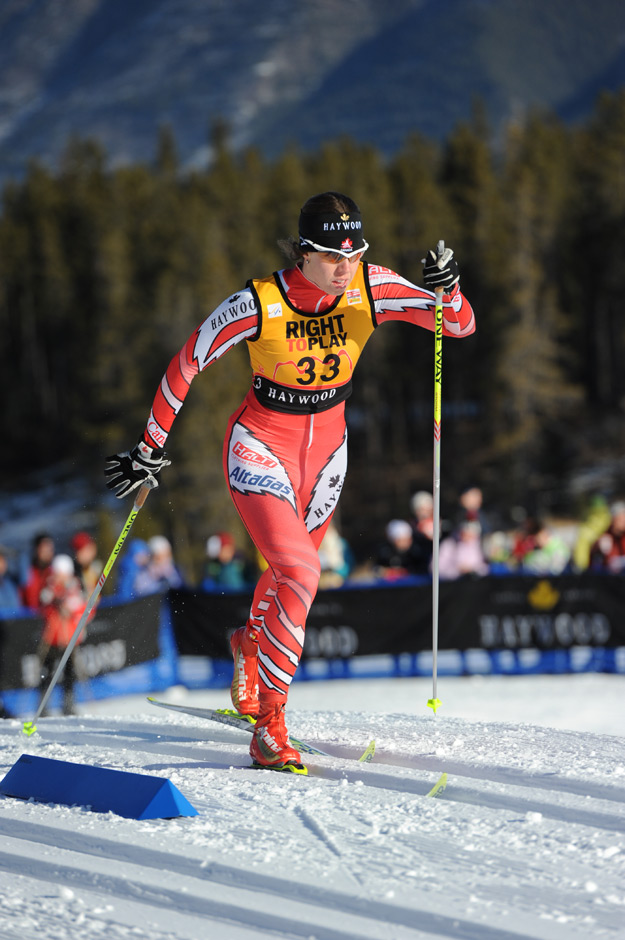
Chandra Crawford celebrates her Canmore sprint victory in 2008. (Photo: FasterSkier)
Chandra Crawford: Mom, Keynote Speaker, and Business Connector
Sixteen years ago, Crawford entered the 2008 Canmore World Cup with an Olympic gold medal from the 2006 Torino Games. Born in Canmore, she had high hopes for her hometown races. Some could call it pressure, but she made a point of relaxing and having fun. Easier said than done, but a friend and fellow ski racer named Magda Genuin helped.
Genuin was from Agordo, Italy, a tiny town surrounded by the mighty Dolomite Mountains. Like Canmore, a mountain town in the Canadian Rockies, it was the home to three peaks called the “Three Sisters” — tre sorelle. In Canmore, these mountains are called Big Sister, Middle Sister, and Little Sister.
“Magda and I just felt like we resonated on this level that we are mountain people,” Crawford recalled. “Ski racing is great, but if you can get out in the mountains for days and days, that’s the best.”
The two skiers didn’t speak much of each other’s language, yet they laughed and chatted over two pots of tea at Communitea Cafe in Canmore, with American Kikkan Randall joining them for some of it.
“I just felt so relaxed and happy with my friends,” Crawford said.
The next day, she felt at ease entering her signature race: the World Cup freestyle sprint.
“I felt just felt full of peace and love and excited to do my absolute strongest strides, my process goals, take turns better, and hammer the snow like my legs were like a staple gun,” she recalled. “I had my own goals, and my intensity was intrinsic without pressure from the outside.”
“I managed my tactics and passing on the downhill and got to the finish line first,” she added. “Magda got a bronze medal and got to be on the podium. I only had less than ten trips to the podium in my career, and she had a handful, but it was a pretty special day to be up there together in Canmore.”
Former Canadian National Ski Team member Chandra Crawford (r) beats teammate Perianne Jones by 0.2 seconds to win the inaugural WinSport Frozen Thunder Classic sprint in 2012 in Canmore, Alberta. (Cross Country Canada/James Cunningham photo: cccski.com)
Retired from ski racing since 2014, Crawford is a keynote speaker with an MBA from the University of Calgary. She’s married, has four kids ranging from age 2 to 7, and is involved with the Canmore World Cup through a contract with the Alberta World Cup Society, which is hosting the races. She has been supporting business development and marketing of the World Cup by connecting corporate Calgary contacts with VIP opportunities at the races. As the founder of Fast & Female, a Canadian charity, she remains connected to its mission of keeping girls healthy and active in sports.
Crawford started competing at age of 16 in 2001. Over the next 13 years of professional ski racing, she learned to control her mindset and make the most of her career. She remembered looking at the 2006 Olympic schedule and asking her sports psychologist how to prepare for her race—the skate sprint—on Day 12 of the Olympics.
“I raced a distance race at the very start of the Olympics, and then I was just staring at the days like, ‘There’s way too many of them!’ ” she said.
Her sports psychologist advised that she have fun and enjoy a meal with her family, which she did. They laughed over a “giant Italian meal and were tourists for a few hours,” she recalled. “That helped me to relieve so much stress, to not just be sitting in my hotel room getting too worked up.”
Her tips for racers in Canmore, some of whom may be in North America for the first time, included maintaining perspective. She emphasized that “mental toughness is mental preparation,” meaning that if everything goes haywire and not as planned, you can still give your absolute best. For her, it helped to visualize all the things that could go wrong before a race and plan for it.
She established her own process goals and focused on what she could control, including how she refocused and relieved stress.
“I just went through that experience [in Canmore] with so much love and gratitude for being there with a perspective of, I’m not my results; I’m a community member,” she said. “My identity is bigger than my results.”
For spectators, she said it’s going to be a blast.
“You’re going to fit right in and have a great time in Canmore. This is a pocket of the world that is extraordinarily fit and forever young,” she said.
My mom has always been my #1 cheerleader, no matter what sport I was doing. Chandra’s mother (l) with her sister and Olympic biathlete, Rosanna Crawford (r). (Photo: Chandra Crawford)
Crawford’s mother used to make alliances in the stands, cheering for another family’s skier in exchange for them cheering for hers. Crawford urged spectators to forge similar friendships.
“My mom has always been my #1 cheerleader, no matter what sport I was doing she was so supportive in me following my dreams. Driving me to nowhere’sville Alberta for a ski or biathlon race. Watching me swim back and forth in a pool. Chasing a soccer ball across a field, she was always there with a hug on the good and bad days! My parents were both really active and had a passion for the outdoors, and our adventures were always filled with great stories and good snacks to keep the kids entertained! Hiking around Lake O’Hara or back country skiing at Mosquito creek, there was always some outdoor activities on the weekend and through the summer. Even now my mom has been setting an example that at any age you can achieve great things. Taught me to be a strong women who isn’t afraid to stand up for her self. Love you mom!”
“The town loves to welcome you, host big events, and show off our local goods,” she added. “Enjoy the massive nature, and let your full passion for cross-country skiing out. This is the place. These are your people. It’s going to be so fun.”
Dasha Gaiazova (CAN) during the Alberta World Cup sprint qualifier in 2008, where she made the cut in 29th and advanced for the first time in a World Cup skate sprint in Canmore, Alberta.
Dasha Atkins: Mom, Coach, Professor, Financial Planner, and World Cup Commentator
Also a professional Canadian skier from 2001 to 2014, Atkins lives in Calgary and is a mother of two children, ages 6 and 2. A wealth manager and financial planner, she teaches finance at the University of Calgary during the week and coaches masters skiers with the Space Dogs Ski Club, which she founded in 2016, on the weekends.
After retiring from ski racing, she earned an MBA from HEC Montréal, during which time she stayed with her friend, Randy Ferguson.
Ferguson had announced at many of her races during her career. In 2020, she was asked to commentate with him at the Cross-Country World Cup Finals in Canmore. The races were called off a week before due to the pandemic, and her gig was canceled.
Two years later, Atkins got another opportunity as an announcer at the 2022 Masters World Cup in Canmore.
“That was intense because they have, like, a million categories, a million races, so it was a whole week, pretty full on,” she recalled. “I was there for nine days commentating, and it was so much fun; it was great, I really enjoyed it, and they called me back, so I must not have done the worst job ever.”
This will mark her first time commentating with Ferguson.
“I’m very excited because I’m going to be with someone I know really well who knows the sport well,” Atkins said of the four-day schedule. “We can talk in French, especially given how well the French team is doing. I’m like, ‘Yes! I can speak in French.’ It’s going to be great.”
She noted the difficulty of the race courses in Canmore, which include 1.3-kilometer sprint and 5-kilometer distance loops.
“It’s the same course that I used to race many, many times, so I can sympathize a lot with how hard it will be,” she said. “It’s going to be a nice contrast to Theodore [Wirth] Park, where they’re racing in Minneapolis [the following weekend], so it will be interesting to see how that works to a lot of skiers’ abilities. Can they shine in both? That’s the question.”
Conditions could be fast and firm, especially in the mornings, as temperatures had been warmer than usual in Canmore in January.
“There’s enough snow—it’s great, but it’s really transformed … it’s been T-shirt weather,” Atkins said on Jan. 31, about a week and a half before the races.
Over the weekend, Canmore received more than 10 centimeters (4-5 inches) of fresh snow and had its snowmaking machines blowing.
“The new snow should give everything a shiny new look. Our trails are holding up well thanks to the snow we made in Nov/Dec,” Norbert Meier, the events chair of the Alberta World Cup Society, wrote in an email on Feb. 2. “We also hope Minneapolis has a successful weekend. The excitement building there can almost be felt here in Canmore!”
“Honestly, the fans are going to be crazy,” Atkins said. “I’m sure the same in Minneapolis. So what we don’t have in snow, we’ll make up for in cheering spirit and party atmosphere. I’m sure about that.”
Dasha Atkins (l) snaps a photo with Johannes Klaebo (r) and her Space Dogs Ski Club masters skiers at the Canmore Nordic Centre on February 3rd. (Photo: Dasha Atkins)
On Saturday, Feb. 3, Atkins and her Space Dogs masters skiers coincidentally met with Norwegian standout Johannes Høsflot Klæbo and Swedish superstar Linn Svahn on the trails and got photos with them.
As for her tips for athletes, she said, “Just enjoy the culture. It’s a very friendly, athlete-friendly town. Everybody loves skiers and gets excited seeing all the jackets from other countries in town. It’s going to be a really cool experience for Europeans who are in North America for the first time.”
The Swedish team in the stadium on February 4th at the Canmore Nordic Centre. (Photo: Angus Cockney)
Chandra and Dasha’s Favorite Canmore Hot Spots
Best meal of your life: Crazyweed (Chandra and Dasha)
Best for spicy tuna: Wild Orchid Bistro (Dasha)
Best takeout: Arashi Ramen and Communitea (Chandra)
Best café and coolest vibes: Communitea and Harvest, very hippy/ski vibes in both (Dasha); Bicycle Cafe has the best coffee, plants, and people (Chandra); Eclipse Coffee Roasters, supports skiers through flexible work opportunities (Dasha)
Best croissants: Le Fournil Bakery (Dasha)
Best pizza: Rocket Pie (Dasha)
Gear and shopping: Trail Sports. “Maybe you don’t want to bring all your stuff, you want to buy World Cup branded gear, or you want to rent a sled to pull a kid out to the Chandra Crawford Meadow Hut at the Canmore Nordic Centre and eat your snacks there. Maybe your friend wants to level up their game, and you don’t want to teach them; how about they just buy a ski lesson from the pros? Maybe you lost your sunglasses or need new ski pants… Trail Sports is fantastic.” (Chandra)
Jessie Diggins prepping on February 4th at the Canmore Nordic Centre. (Photo: Angus Cockney)
Bar at which to meet your future life partner: The Drake* (Chandra) (*Where Chandra met her husband, Jared Poplawski, who is the cousin of Jessie Diggins’s husband, Wade Poplawski; does this make Chandra and Jessie cousins?!)
Best WOW factor: Cliffhouse Bistro has tasty eats and mid-century modern decor and is located up a chairlift 2400 feet above Banff townsite. Access from Mt Norquay. (Chandra)
Best steak or burger: Anywhere in Canmore! “Alberta is the land of beef. If you want the best steak of your life, this is probably the best place to have that.” (Dasha)
Best local souvenirs: Rocky Mountain Soap Co, with made-in Canmore soaps, Alberta’s Own, Project A, or Tin Box for touristy gifts, all locally owned businesses (Dasha)
Best long ski and views: Drive 1 hr from Canmore to Lake Louise and ski the 20km gentle terrain of the Great Divide or “old 1A” and then take some pics on Lake Louise in front of the iconic Chateau Lake Louise. (Chandra)
Best scenic, leisurely walk: The 2km Bow River Loop boasts absolutely stunning views and, although not cleared of snow, is generally packed down and relatively accessible due to its flat profile. (Chandra)
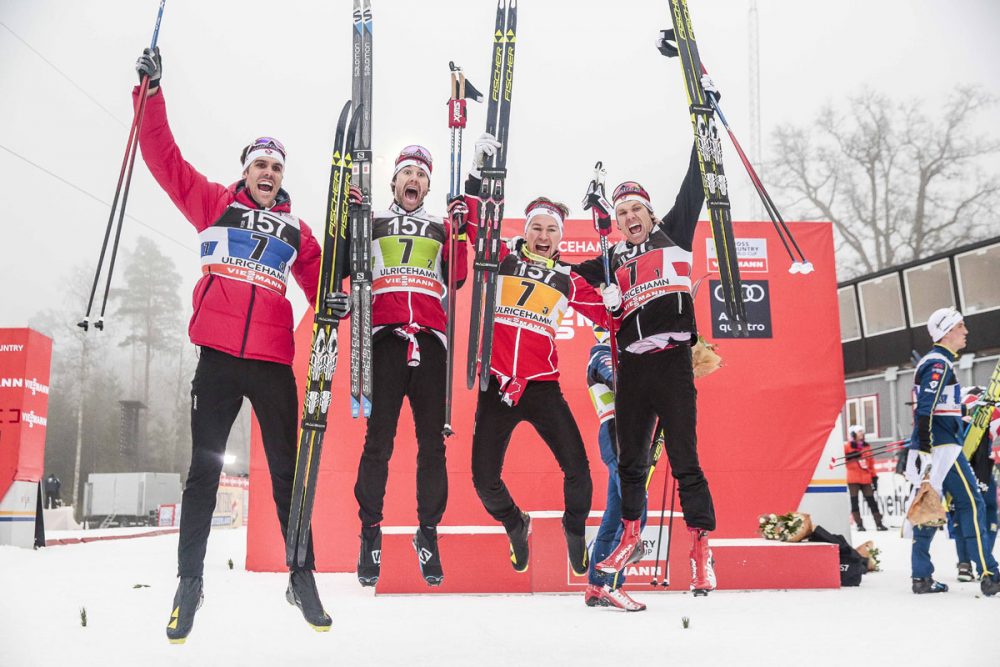
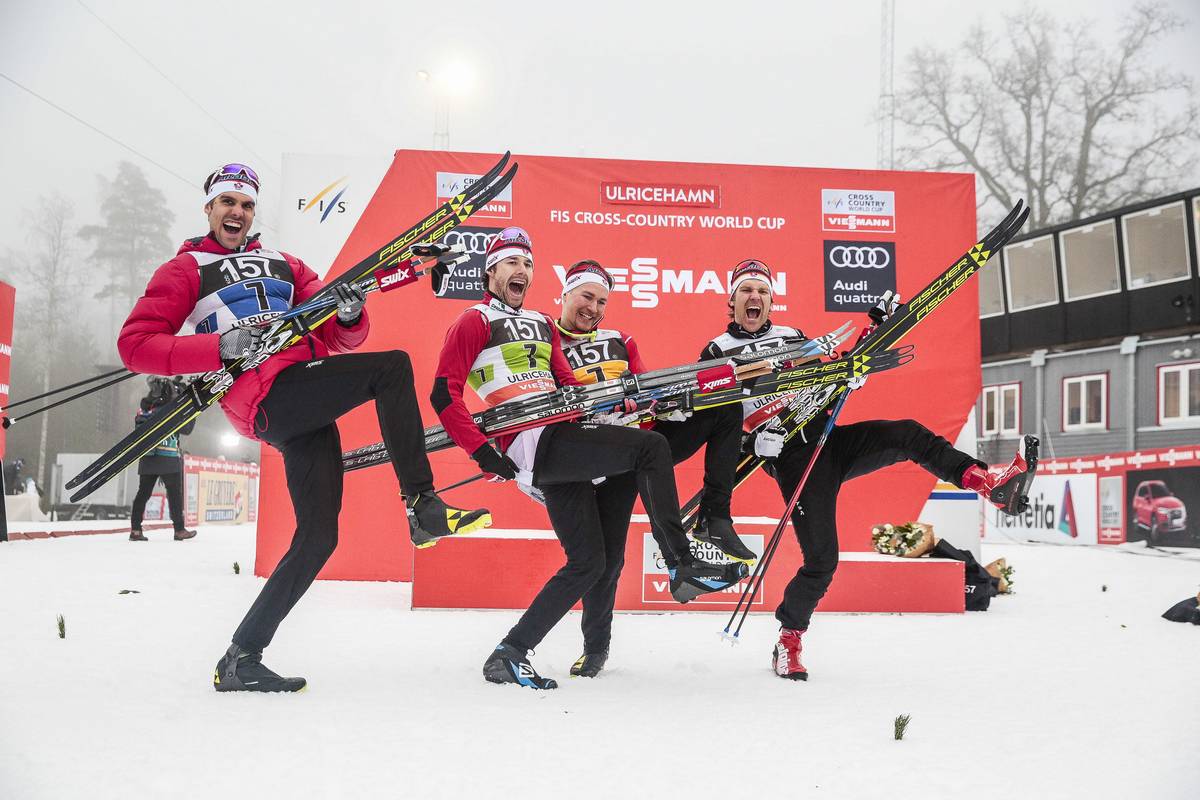
Left to right: Canada’s Len Valjas, Alex Harvey, Knute Johnsgaard, and Devon Kershaw after their historic third place finish in the 2017 men’s 4 x 7.5-kilometer team relay in Ulricehamn, Sweden. (Photo: Fischer/Nordic Focus)
This is the second part of FasterSkier’s report on the state of high performance cross-country skiing and athlete development in Canada. You can read part one here.
Cross Country Canada (CCC), as the national governing body for cross-country skiing in Canada has the difficult task of steering a rather large ship. The idea in steering the ship is to maintain a path requiring little quick and nimble maneuvering. Survey the landscape, mine the data, set a course, and sail. Along the way, there’s the ability to make slight adjustments for efficiencies, accommodate unforeseen changes.
Nic Lemyre (Photo: Norges Idrettshøgskole/Norwegian Sports Academy/)
“We’re thinking our starting point is to build a really strong relay team, on both the women’s and the men’s side,” Lemyre told FasterSkier. “We want to have five athletes, so that we can rotate with the fifth athlete and we’re never in a situation where we can’t field a strong team because one athlete’s injured or sick.”
According to Lemyre, the composite team must be derived of skiers who can hit specific individual benchmarks “[When] we have athletes that can start scoring points in every race they enter on the world cup, that’s a medium term goal,” Lemyre said. “From there, we start aiming for the top-15 for all athletes that are identified in that group.“
Part of the reasoning behind the relay vision is that for a skier to get a permanent spot on the World Cup, the athlete not only has to reach a high level, but also help raise four other Canadians up to that level. Lemyre believes this should foster cooperation and team spirit.
“It helps us meet goals of performance,” Lemyre added. “But also it helps us meet goals that are related to how to build a strong performance culture, where the athletes need to support each other, to learn from each other. They need to push each other. They need to push each other beyond limits they may have experienced before.”
How do we get there?
After PyeongChang, CCC appeared to have both the political will to start the painful process of another re-invention. However, that will came with a reduced budget with which CCC could support its future options.
The simplified model of corporate restructuring begins with terminating certain roles and concludes with creating new roles filled by new individuals near the top of the organizational pyramid. Often, in a medium or large corporation, most people will be shuffled around and only a few near the top will lose their jobs. The final step is to find a quick win to help the newly reshaped organization gain morale and unify.
In a small organization like CCC, everyone is near the top. While the process works well for the survival of the organization, it can be hard on individuals.
The change at CCC began with long-time High Performance (HP) director Tom Holland’s planned retirement. Lemyre was hired as a consultant to oversee the restructuring of the HP group. Shortly before Lemyre’s hiring, CCC eliminated some positions.
As Joel Quenneville’s recent firing demonstrates, proven ability and past success is not enough to provide job security during a reboot. (Quenneville was the NHL’s Chicago, Blackhawk’s head coach since 2008. During his tenure Quenneville lead the team to three Stanley Cups.)
On November 1st, CCC hired Erik Bråten as a new national team coach and modified Louis Bouchard’s title. Bouchard remains head of the National Training Centre in Mont Ste-Anne, Québec, with the added title and responsibilities of World Cup Head Coach.
Bråten, a recent Norwegian School of Sports Science graduate with a specialization in cross-country skiing, won the 2018 coach of the year award from the Norwegian ski federation. This hiring didn’t happen as quickly as some had hoped, but is considered the first win for CCC’s new structure.
“Erik has a strong sports science background applied to cross-country skiing,” Lemyre said on the phone. “His profile is unique in our environment. The fact that he’s young is really positive for us, because he’s open to this new experience. He comes with a solid base, and his excitement and his motivation, I think, will be great assets in applying that knowledge in the right culture in Canada. At an individual level, Erik is unique in working one on one with athletes. I think our athletes are going to really appreciate that.”
Along with bringing in new personel, Lemyre aims to improve sharing of training information in Canada. In Norway’s organizational structure, athletes and coaches are able to log hours and training plans on an interface organized by the Norwegian National Ski Federation. It’s a model and template Lemyre is intimate with.
“The fact is that we have a large country, and we can’t be with athletes every day of the year following them on site,” Lemyre said. “Now the technology is there to pool [training data] in a way that our coaching staff and the local coaches can communicate really well, But also as we’re building up our science team, we also have interaction with our different people involved in helping the athletes develop.”
Dahria Beatty racing the 2018 Holmenkollen 30 k freestyle mass start in Oslo, Norway. (Photo: Fischer/NordicFocus)
Another planned shift is to interchange athletes between Europe and Canada more often. For example, Dahria Beatty will start the season in Canada — a change encouraged by her coach Chris Jeffries and supported by Lemyre.
“This summer my coach Chris and I came up with a plan that allowed me to stay in Canada to start the season to build into the race season and then head over the Europe and race on the World Cup circuit leading up to World Championships in Seefeld,” Beatty said. “With this being the first year of the new quadrennial, it is the perfect time to fine tune some of those race details domestically before leaving for Europe mid-December. I am looking forward to racing part of the Tour de Ski then period 3 and hopefully finding my peak for World Championships and World Cup finals in Quebec.”
Lemyre’s concept is to allow athletes like Beatty to build into the early part of the season domestically and arrive in Europe at a higher level of race fitness.
“The way we scheduled the trips this year, giving some athletes the chance to prepare very well before they race on the World Cup,” Lemyre added. “I think some of them will be stronger when they show up on the World Cup, and also they’ll be able to sustain that level of performance over the time period they are on the World Cup. We will try to be a little more selective and well prepared when we show up, and then post really good results when the athletes are racing the World Cup.”
Jeffries stated that the stress of living abroad, a dynamic known all to well by North American World Cup skiers, can be counterproductive to a developing athlete.
“The last few years, our top athletes spent the majority of their time in Europe,” Jeffries said. “I think it stalled our development a little bit, because we’re always living out of a suitcase, and we’re always having to ski races where we’re trying to perform.”
Dave Wood spent 18 years as a national team coach. His time leading the team included the post-Nagano rebuild and managing athletes at the Olympics in Vancouver. His vision includes giving skiers more time to develop and less emphasis on being fast all season.
“Sara [Renner] had far less World Cup starts before she was top-15 at the Olympics than the people of today,” Wood said. “I think that this big argument about experience is valuable when you are looking for seconds. When you are looking for minutes, [World Cup experience] makes no difference.”
Will it Work?
The U.S. has been able to develop a strong women’s team built off Kikkan Randall’s determination to drag U.S. skiing to the top. Randall took inspiration and knowledge from Canada’s post-1998 rebuild where Scott, Renner, Milaine Thériault, Jamie Fortier and Amanda Fortier decided it was time to lead the charge.
American Kikkan Randall tucking during the women’s 10 k classic mass start at 2018 World Cup Finals in Falun, Sweden. (Photo: Fischer/NordicFocus)
In both cases, the athletes didn’t succeed alone. The “fantastic five” got the support of Holland, Wood, and many others. Randall also collected a large supporting cast, well documented by Peggy Shinn’s book ‘World Class’.
Laura McCabe, now a Methow Valley coach and two-time Olympian, spent most of her free time in Nagano with the Canadian women’s team because it felt like a group that had a vision and a willingness to support one another to collective success.
“It just shoots you up the ladder when you come back and you feel like you have a very safe place, you’re working on this goal together, you’re all in it together, and you’re there for each other all the time,” McCabe told FasterSkier. “I felt like the Canadian women were doing that. And now I feel like Matt Whitcomb has led that charge for the American women.”
While crediting Randall for starting the process, McCabe feels that the team’s work to be a team is the critical factor.
“They have goals, team goals and they have personal goals,” McCabe said. “They are always there for each other. One of their biggest goals is to basically keep their relationships positive and keep everybody moving forward. I think that is one of the number one reasons that team is doing well.”
In a conversation last May with FasterSkier, Yukon coaching icon Alain Masson spoke of the complexities of achieving success on the international stage. Simply possessing physical gifts, the aerobic capacity, the predisposition to tolerate and absorb high training loads, is no guarantee of success.
There’s the behind the scenes unglamourous work of nurturing athletes, remaining true to organizational core values, and feeding the system with money, intellect, and vision.
“Definitely, there’s a minimum set of physical characteristics that you need to perform at that level,” Masson explained to FasterSkier. “But you also need many characteristics, personality characteristics, that are vital. What Alex showed, and Sara Renner, and Chandra [Crawford] and Beckie [Scott]. I think athletes that combine both the physical and the mental characteristic at a time when the program works together, and everything lines up with the funding, good leadership, and everybody working together. That’s the difficulty, this is the issue, trying to get all of that together. As the women in the U.S. have demonstrated, when you have all of that lining up, it’s amazing what you can do.”
Canada’s Alex Harvey celebrating on the podium after placing second in the men’s 15 k freestyle mass start in Seefeld, Austria, for his best result of the 2018 World Cup season. (Photo: Salomon/NordicFocus)
Cross Country Canada (CCC) has begun a reboot process as the new Olympic cycle starts. Corporations call this a reset, a rebranding, a new direction, restructuring, and various other names that try to disguise the challenges and issues that come with enacting real change.
The reboot process traditionally starts with an acknowledgement that the current level of success, and that of the foreseeable future, doesn’t align with the goals or the potential of the organization.
Canada left PyeongChang with no medals at three consecutive Olympics, only one skier in the World Cup red group, and a perception that there was no obvious successor to Alex Harvey.
There are many people who, with the benefit of hindsight, believe that CCC allowed itself to be trapped by a combination of success and the Own The Podium (OTP) funding model.
The process of assigning blame for the past, called “blamestorming”in the corporate world, is one of the most effective ways to waste time and destroy morale without doing anything to improve the future. The “best practices” approach to a reboot starts with four apparently simple questions: How did we get here? Where are we now? Where do we want to be in five years? How can we get there?
While CCC does many things as a national sport body, this article will focus on high performance and the development system.
How did we get here?
After a disastrous 1998 Olympics in Nagano, CCC shrank to a full-time staff of five and endured a forced re-invention. Four years later, in 2002 at Salt Lake, Beckie Scott won all three medals in the skiathlon after the initial silver and gold medalists were caught doping. Sara Renner missed the B final in the sprint for 9th place.
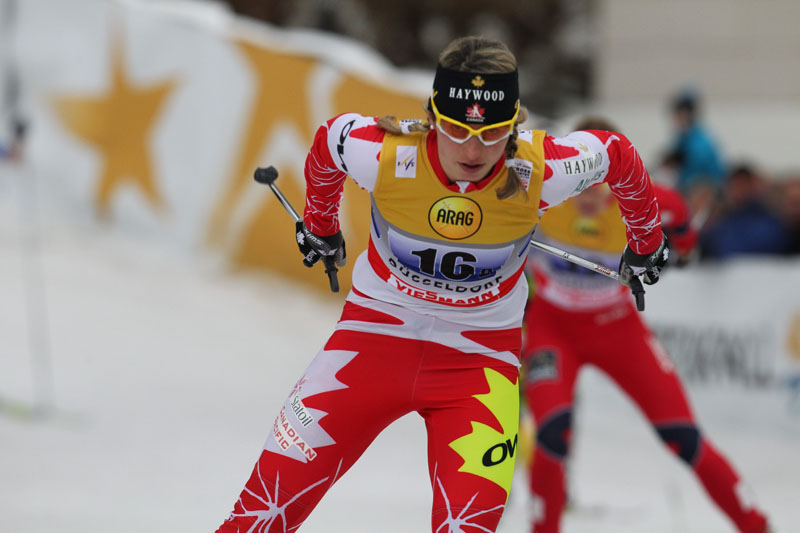
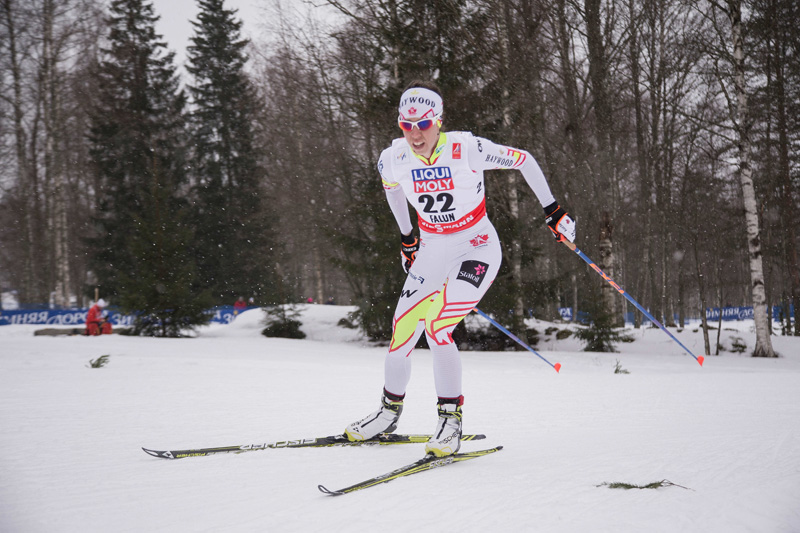
Canadian Chandra Crawford in the 2011 team sprint in Dusseldorf, Germany. (Photo: Fischer/NordicFocus)
In 2006 in Torino, Chandra Crawford earned a surprise gold in the sprint while Scott finished fourth. Scott had earlier teamed up with Renner for a team sprint silver medal.
In 2010, there were no Canadian cross-country medals. However, there were signs of promise. Renner skied to her fourth Olympic top-10 finish. All four Canadians competing in the men’s skiathlon finished in the top-15. Devon Kershaw lost out in final kilometer of the 50 k to finish fifth, 1.6 seconds away from gold.
That post-Vancouver glow was possibly the point where CCC temporarily slid off the rails.
A number of Canadian sports fell victim to OTP incentives. A sport qualifies for OTP funding by having good prospects for a medal in the next Olympics. The money comes with strings attached, to ensure that resources are spent on improving the probability that specific individuals will podium. For smaller sports where the OTP money is a significant proportion of the sport’s annual budget, it is hard to make choices that put that money at risk. Choices like balancing the emerging athletes in the pipeline, while simultaneously supporting those athletes already at the top-end of the sport.
As a result, many sports have lost their OTP eligibility by losing the focus on development and the vision that qualified the sport for OTP in the first place. Some people put cross-country skiing in the list of sports that fell into this trap.
After 2010, the future looked bright. Harvey and Kershaw were World Champions in the 2011 team sprint. Kershaw was second overall in the 2011/2012 World cup. (A feat only equaled in North America by Scott and Jessie Diggins).
Harvey arrived at Sochi in 2014 as a medal favorite. He was fresh off a World Cup podium in Toblach the weekend before the 2014 Games began. Sochi ended poorly when Canada, along with Norway, couldn’t solve the difficult waxing conditions.
The results in PyeongChang were similar to 2002 numerically: Harvey was close to a medal in multiple races and Lenny Valjas collected 7th in the classic sprint. A medal would have changed the mood, but not overall situation.
Where are we now?
Post-PyeongChang, CCC believes Canada is not achieving the international results a country with plentiful snow and 37 million people is capable of.
The development system in Canada consists of the National Team, the official training centers (Centre National d’Entrainment Pierre Harvey (CNEPH), Thunder Bay National Team Development Centre (TBay), and the Alberta World Cup Academy (AWCA)), and the clubs. The ten provinces and three territories have teams, but don’t have a formal place in the development system as each of the thirteen regions approaches development support differently. In the last few years, the number of clubs actively recruiting and developing athletes while supporting a high performance team has increased. For our purposes, as no official name has been affixed to these clubs, the term ‘elite club’ will be used here.
In the past, all national team members were required to belong to a training center while developing athletes were encouraged to join.
“I can speak for many of the athletes, they thought that if they didn’t go to a training centre, then they might as well quit skiing,” Telemark’s coach Adam Elliot said. “It was that broad of a choice, they felt they had to choose between skiing and school immediately.”
The landscape is more diverse now, with more options. The examples that follow skew to Western Canada, largely because the coaches quoted brought teams to Sovereign Lake snow camps in May and November and were available for in-person interviews. Eastern Canada remains equally diverse in terms of its club offerings.
A common theme among the coaches and athletes is that each athlete’s needs are different, and he or she needs to find an environment that fills those needs. FasterSkier asked AWCA’s head coach Chris Jeffries how an athlete should choose his or her path to success.
“It’s such an individual, case by case thing,” he said. “I don’t have an answer.”
In 2017, a shift to allow more development paths resulted in new senior National Team member Gareth Williams staying at his home club, Telemark, in Kelowna, BC. Elliot described how it came about.
“Tom Holland approached us, for Gareth, and said we like what you’re doing in the Okanagan, and we want to keep Gareth there. We’re going to support you and your program to be able to support Gareth.”
Also in 2017, Julien Locke returned to his home club Black Jack while Russell Kennedy shifted to the new Team R.A.D., part of the Canmore Nordic Club.
To further illustrate the spectrum of options and pathways, FasterSkier contacted three Canadian athletes, each with a history of NorAm podiums and some international success, to discuss their ski-training choices. Dahria Beatty started at AWCA and has remained there, Evan Palmer-Charette started at TBay then recently moved to Team R.A.D., and Andy Shields has gone rogue.
Dahria Beatty en route to 20th overall in the Seefeld World Cup freestyle sprint for her season-best result in 2017/2018. (Photo: Fischer/NordicFocus)
“For me, I’ve been working with Chris [Jeffries] for six years,” Beatty told FasterSkier in November. “It works really well for me, and I have a good group of training partners where I am, that can push me everyday in training.”
AWCA is also the home training group for National Team skier Emily Nishikawa and two junior national team skiers. AWCA also benefits from its close proximity to a number of other training groups.
“For me, Canmore’s a location where I want to be training, where I want to be based out of,” Beatty said. “All the pieces fit well together for [me], it’s somewhere I think I can keep improving.”
Palmer-Charrette made a summer-time decision to change things up by finding a fresh environment in Team R.A.D.
“I think the best part of being on a training centre is the entire program is based around a small group of athletes of similar age which makes for a great training and racing environment,” Palmer-Charrette wrote. “I feel training centres, as they are, are best-suited for junior/u23 athletes and especially great for athletes who are a bit late to the game like I was at the end of high school and will really benefit from learning from other athletes on the day to day training life.”
Shields is no longer affiliated with an official team. He funds his skiing by painting houses in the summer and representing ski wax companies in the winter. Although he refers to ski racing as a hobby, he did end the last season as COC leader and will race period 1 of the World Cup.
“I don’t think I could have done this straight out of junior,” Shields wrote. “My time on Tbay is still having a huge positive effect on my ski career. Being on a team through my early years as a senior made it much easier to get a decent training base and set a couple good habits in place which are paying dividends.”
Shields did reflect and offer an alternative to how he might have changed his path to elite level skiing.
“If I could go back in time I would have gone the NCAA route straight out of junior,” Shields added. “College skiing in the States is a much better deal than a training center for people in their early twenties. You can go down to the States, get a degree, not pay a dime, and come out the other side with plenty of time to have a full-time ski racing career. I would have joined a training centre upon finishing with NCAA.”
The Canadian university system differs from the U.S. model, offering little money for sports. Heading south to the U.S. as a student-athlete remains an option for some Canadian skiers. Most athletes remain in the Canadian system to develop. With that in mind, FasterSkier asked why some athletes had chosen some of the Western based training centres.
Jeffries, who leads the AWCA, also noted how his program has evolved. There appears to be room at the AWCA for those with concurrent goals. The AWCA has partnered with the University of Calgary to allow AWCA athletes to work towards degrees.
“We’re always evolving our programming, and what it entails, and how we package it,” Jeffries said. “That’s why we have this new university program this year, because you just look at the popular decision making of graduated high school athletes.”
Elliott, based in the Okanagan, said his program offers athletes a well rounded experience too.
“You’ve got the trifecta,” Elliot said. “You’ve got access to education opportunities for post-secondary. We’ve got the university, UBC Okanagan, and the college. Most of the people who’ve moved here have gone to school. Secondly, it’s the Okanagan. Which is probably the best place to ski in North America, with skiing up and down the valley –with Nickel Plate, Telemark, [Kelowna] Nordic, Sovereign, and Larch Hills. The third is that you’re moving into a community of skiers: family, volunteers, everybody trying to make a go of keeping people in sport.”
Clearly the times have changed from a programming perspective and the past’s financial windfall for Canadian cross-country skiing.
“Probably the quad between 2010 and 2014, CCC had more money almost than it knew what to do with, ” Dave Wood, former National Team head coach, told FasterSkier in May as he finished up a long ski day. “Now, I think the budget’s still three and a half million. While it’s maybe low compared to what it has been, it’s a hell of a lot higher than it was in ‘99, by about four times.”
Former CCC High Performance Director Tom Holland spoke of those larger commitment from clubs during the Frozen Thunder races in October.
“There’s a lot more resources,” Holland said, referencing the increased numbers of coaches attending Frozen Thunder with their athletes. “One of the reasons clubs are more important now is that there are paid coaches at the clubs. That’s why training centres started in the 90’s, because you’ve got to have a coach, full-time.”
Thee deep question remains: what next for Cross Country Canada as it ponders a post-Alex Harvey scene? Better and more diverse options for Canadian skiers, like those modernizing their offerings to connect with the student-athlete, is a step forward. But fans of the sport, and of course Cross Country Canada, have short-term and long-term goals. No one wants to see another Olympic quadrennial transpire without the glimmer of medal potential at the international championship level.
“I think when Alex Harvey retires, mostly likely after next year with Lenny Valjas, it will be the end of an era having athletes being able to finish on the podium at World Cups, World Championships, said Alain Masson, Whitehorse head coach. “So definitely, the program is going to go into a real rebuilding phase with lots of young athletes, but no guarantee of success in the near future.”
Canada’s Devon Kershaw racing at 2017 World Cup Finals in Quebec City, where he finished 26th in the 15 k freestyle pursuit and 19th for time of day in the last race of the 2016/2017 season. (Photo: John Lazenby/Lazenbyphoto.com)
On April 26, Devon Kershaw posted a photo on social media of Alpina boots hanging on a line. The next day, he spoke on the phone with FasterSkier from his new home in Lillehammer, Norway, after a day of running around outside with his 15-month-old daughter, Asta Isabel.
Kershaw was tired, but in a good way. For the first time in 17 years, he was ready for a new challenge, a new focus and much more time with his daughter and wife, Kristin Størmer Steira, a former standout Norwegian skier.
Three years after Steira left professional cross-country skiing and pursued a career in business, starting with her master’s degree in business management, Kershaw is following suit and headed back to school. The 35-year-old Canadian hung up his boots to quietly announce his retirement after about a month of deliberation.
“I was really keen to keep ski racing, to be honest,” Kershaw said. “I had the motivation to go one more year, and in my head, I wanted to race one more season, but as things progressed in the spring, there were a lot of different factors that just made it seem like, oh man, it doesn’t look like it’s gonna be super realistic at this point.
“I struggled with that, when you feel like you still have more in the tank,” he continued. “But at the same time, it’s a bit of a double-edged sword in the sense that it’s been a fantastic career.”
Kershaw was quick to reflect on his roots as a kid growing up in Sudbury, Ontario, “a mining town with a small but passionate skiing community,” as he put it. He also reiterated how proud he was to represent Canada for 17 consecutive seasons, first as a junior national team skier for two seasons starting in 2001, then as an under-23 national team member in 2003, and finally as a full-fledged World Cup Team member starting in 2004.
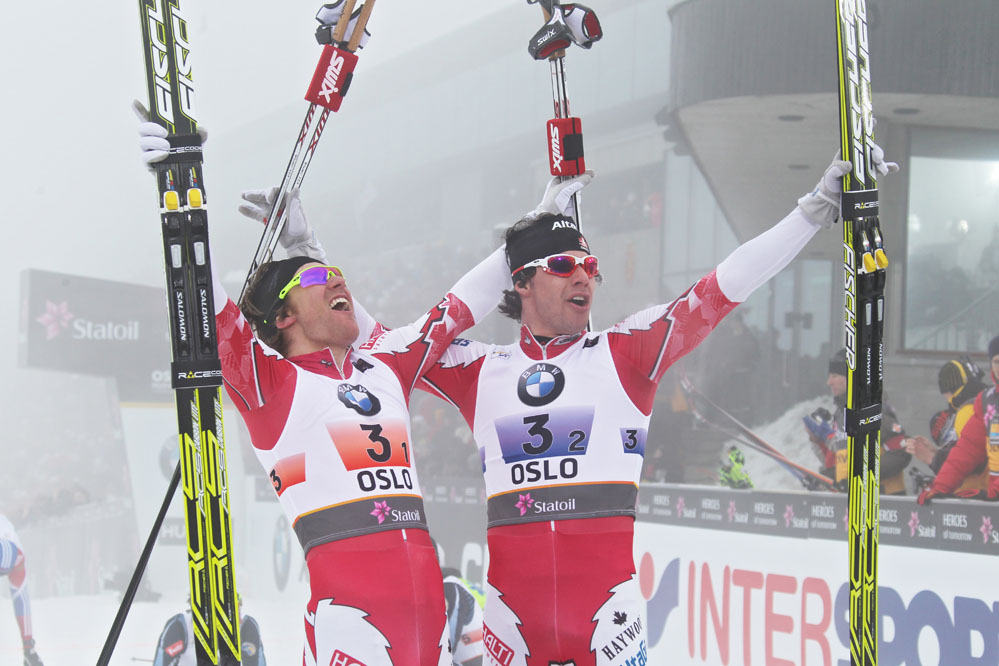
Devon Kershaw (l) and Alex Harvey celebrate their 2011 World Championships gold in Oslo, Norway. (Photo: Fischer/NordicFocus)
His career included three World Cup wins and 14 podiums, and a gold medal at 2011 World Championships with teammate Alex Harvey in the classic team sprint. Kershaw finished the 2011/2012 World Cup season ranked second overall and second in the distance rankings.
When he reflects on those accomplishments, he still has a hard time believing that all happened to him.
“So instead of focusing on being bummed at the situation or a bit frustrated with the state of things in Canadian skiing right now, I have to look back with a smile,” Kershaw said. “I feel just so privileged and grateful to have had the opportunity to be part of a real movement for men’s skiing in Canada.”
Kershaw said he was left with unanswered questions this spring during a transitionary period at Cross Country Canada (CCC). The team’s budget was undetermined, camps were not yet set in stone, and Kershaw said his decision — which he wanted to make by May 1, the start of the new training year — became about energy management.
“Part of managing your energy properly is putting all of your energy and focus into training, and if you’re being pulled with uncertainty or being stressed about uncertainty, that will come back, the World Cup will exploit that,” he said.
According to CCC Chief Executive Officer Shane Pearsall, High Performance Director Thomas Holland had planned to retire this past March, yet has stayed onboard as an advisor until CCC fills the position. Pearsall said the hiring process is still ongoing and will hopefully be wrapped up by next month. He confirmed that CCC has yet to finalize its budget and doesn’t anticipate being able to do so until a government minister signs off on the amount from Own The Podium (OTP), one of its primary funding sources, in July. Pearsall explained that they expect to have a better sense of national-team finances in mid to late June.
Typically, the team’s budget is determined in May, but because of necessary “quad reviews” following the Olympics, which took place before CCC met with OTP, the process was delayed by about a month. Pearsall did not elaborate on how significantly the budget would be decreased from last year, but said, “It’s certainly tighter than last year.”
Kershaw said he needed to pay about $25,000 Canadian dollars in team fees if he wanted to continue racing this year, up from $15,000 last year. That didn’t cover the cost of living, which he figured to be around $55,000 Canadian, for a grand total of $80,000.
“The financial burden is big, and moving forward the financial burden went from big to 100 percent paying for every cost,” Kershaw said. “So all travel, accommodations, everything. … I’ve just been in the sport a long, long time, and from a directional standpoint, I’m not sure we’re moving in a direction that will yield sustainable results at this point in time, but I understand it is difficult when you’re under such financial duress to create a sustainable program. But from a vision standpoint, I think there’s a lot of questions that remain unanswered, and it’s late in April. The fact of the matter is the rest of the world has all of the holes plugged — if they have holes in their boat — because May 1 is the new year of every ski program. And we’re just constantly slow and off the mark with that.”
Budget cuts had been expected as Canada’s World Cup Team missed performance benchmarks throughout last season. The team finished 2017/2018 with just two men scoring World Cup points (top 30) in distance races: Harvey and Kershaw. Two men (Harvey and Julien Locke) scored in World Cup sprints. On the women’s side, Dahria Beatty landed one World Cup sprint top-30 last season, and Cendrine Browne was the top Canadian woman in a distance race with a 27th place for time of day in the last race of the season.
Meanwhile, Alex Harvey led the team with four World Cup podiums, including third overall in the 2018 Tour de Ski, and a top result of fourth place at the 2018 Olympics. He finished his season in fourth in both the Overall and Distance World Cup standings. But Harvey’s results alone weren’t enough to buoy the whole team for another winter.
“Throughout my entire career, it’s almost unfathomable to think that the season ends and that’s the stat line,” Kershaw said of the team’s overall results. “It wasn’t so long ago that we had over 16 World Cup podiums in a season. The truth hurts, as [former Canadian coach] Tor-Arne Hetland once said, but things go in waves and this is the reality that we live in right now.”
Despite the prospect of self-funding, Kershaw didn’t feel pressed into retirement. Several of his teammates have decided to retire as well, including Graeme Killick, Jess Cockney and Knute Johnsgaard, but Kershaw said they weren’t forced, either.
“You can choose to work and you can choose to hustle for money; there are ways to make it,” he said. “No one’s forced into it. I could keep skiing if I wanted to, but I think the stark choice you’re faced with is, maybe perhaps some people are like, I can’t really see a path to international success currently, and that’s what I think is sad…”
‘A dream scenario’
When Kershaw moved to Canmore, Alberta, in 2001 and entered Canada’s elite skiing scene, Cross Country Canada (CCC) was entering a fruitful period. At the 2002 Olympics, Beckie Scott was proclaimed winner of the women’s 10-kilometer pursuit (now called the skiathlon), becoming the first North American woman to win an Olympic gold. At 2005 World Championships, Sara Renner earned a sprint bronze to become the first North American woman to medal at World Championships. Scott and Renner teamed up for silver in the team sprint at the 2006 Olympics in Turin, Italy, where yet another Canadian woman, Chandra Crawford, won the individual skate sprint for Canada’s second-straight gold in as many Winter Olympics. Scott finished that 2005/2006 season ranked second overall in the World Cup, just 16 points behind Norway’s Marit Bjørgen in first.
Devon Kershaw (r) with Graham Nishikawa in 2013. (Photo: Devon Kershaw)
Kershaw made his Olympic debut in 2006.
“Coming into Torino, we were quoted in the newspaper as being like the world’s most anonymous men’s ski team,” he said of the Canadian men’s team that year. “We weren’t really ‘on the map,’ but I’ve just been so grateful and lucky to have such a great group of guys around that really welcomed me in.”
He credited his former roommate and teammate Chris Jeffries as well as other Canadian competitors of his time, including George Grey, Gordon Jewett, Dan Roycroft, Sean Crooks, Dave Nighbor, Phil Widmer, Brent McMurtry, and Graham Nishikawa (who’s still racing), for having a major impact on the formative stages of his career.
“[There were] so many athletes in Canmore that tried hard, wanted it bad, and loved ski racing and training,” Kershaw reflected. “That’s a dream scenario for a young athlete to come into a community like that and be welcomed into that environment.”
Less than a month after the 2006 Olympics, he notched his first World Cup podium by placing third in the Borlänge, Sweden, skate sprint. In doing so, he became the first Canadian male cross-country skier to reach the podium since Pierre Harvey (Alex’s father) in 1988 and the first ever to medal in a World Cup sprint.
“I had no idea who Pierre Harvey was,” Kershaw said of his younger self.
Pierre Harvey had previously won the 1988 Holmenkollen 50 k as well as two other World Cup distance races and the Norwegian Birkebeiner, making him the most successful Canadian male skier before Kershaw.
“He could walk into the room and I would not recognize him,” Kershaw continued. “Even his results, I had heard that he had five World Cup podiums and that seemed pretty cool, but that’s all I knew about him.”
Kershaw’s second World Cup podium came early in the 2006/2007 season in a skate sprint in Munich, Germany. That same day, Crawford — whom he was dating at the time — placed third in the women’s sprint.
Devon Kershaw after being tagged by his Canadian teammate Alex Harvey (l) in the freestyle team sprint at the 2010 Olympics in Vancouver, B.C. They went on to finish fourth.
At his second Olympics in 2010, Kershaw finished fifth in the 50 k classic mass start for the best individual Olympic result for a Canadian male nordic skier. That record stood until Alex Harvey, who burst onto the World Cup scene in 2008, bested it with a fourth place in the 50 k classic at this year’s Olympics in PyeongChang, South Korea.
Kershaw and Harvey also teamed up to place fourth in the freestyle team sprint at the 2010 Olympics.
Kershaw’s first World Cup win came in a skate sprint during the 2011 Tour de Ski. He finished that Tour in seventh, and the next year, came back to place fourth overall in the 2012 Tour de Ski (TdS). Kershaw started all 12 editions of the TdS, a record he shares with France’s Jean-Marc Gaillard.
Harvey scored his first individual World Cup podium in a 50 k classic in 2009 and won his first World Cup race (a 3.3 k freestyle prologue) at the TdS in 2012.
“Then next thing you know, Alex and I are sharing a podium on some World Cups,” Kershaw reminisced. “Two Canadians on one podium in the World Cup, like, really? And then you win World Championships and I’m on the overall World Cup podium, and then next thing you know, Alex has been on the overall World Cup podium a few times and also now 50 k world champion. It’s crazy. It’s insane. From nothing. From no results. The journey has just been amazing. … I never would’ve thought Canada would, I mean, how could you? We had Pierre Harvey and that’s it in, like, a hundred years of international ass-kicking.”
Kershaw credited his initial World Cup breakthrough as a 23-year-old skier in Borlänge to Dave Wood, Canada’s national-team coach at the time.
“I came into a team with a coach that you could call at midnight. He’d do anything for you,” he said of Wood. “There was no way I would’ve stepped onto the podium in 2006 without him, and Mike Cavaliere, too, my first-year senior, Mike was my coach. We had staff that was just committed to the core for the cause and I’m incredibly grateful for that.”
‘A hell of a season’
Canadian head coach Justin Wadsworth (r) giving splits to Devon Kershaw at 2012 World Cup Finals in Falun, Sweden.
Of his coaches, Kershaw gave special credit to Justin Wadsworth. A three-time U.S. Olympic cross-country skier who became Canada’s head coach in the spring of 2010, Wadsworth coached Kershaw for five seasons, and the two developed a close friendship.
“When Justin came into the national team, the level of professionalism and excitement and freshness that he brought … I don’t know if you call it luck or happenstance or just the right place, right time,” Kershaw reflected, alluding to his 2011 World Championships gold with Harvey and his 2012 Overall and Distance World Cup podiums. “Justin’s best results as a coach were me and my best results as an athlete were when I was coached by Justin. Talk about an amazing relationship there.”
“The main thing that I really appreciated with Devon, and I think he would say the same thing about me, is that we could be honest with each other and talk about hard things and enjoy the good times when we had them,” Wadsworth said on the phone last week. “… It’s cliche, but when I was talking to Devon the other day about his retirement, it’s not about the medals or the performances or whatever, it’s about your times together on the road.”
One of Kershaw’s biggest moments came at those 2011 World Championships in Oslo, Norway, where he and Harvey beat out Norway’s Petter Northug and Ola Vigen Hattestad by 0.2 seconds for gold on the Norwegians’ home turf. They had done so after Kershaw lost one of his skis early in the race, Wadsworth pointed out.
“His ski fully came off and he had to put it back on and get back into the race,” Wadsworth said. “Just the whole day was pretty incredible. That was a great, great opportunity for us, and the guys cashed in.”
Devon Kershaw (l) and Alex Harvey with their World Championship gold medals at the 2011 World Championships in Oslo, Norway.
In a difficult-yet-strategic move to conserve for that race, Kershaw and Harvey both sat out the 15 k classic the day before.
“With anybody else running the ship, there’s no way I would’ve trusted that [decision],” Kershaw said of Wadsworth’s call. “But I trusted Justin’s leadership and we went all-in, and the next thing you know we won World Championships. I mean, are you kidding me? How can you get a better start to the next quadrennial? And Justin as a first-year head coach of a national team, that’s gotta go down as maybe the best season ever for a first-year North American coach of a national-team program.”
He and Wadsworth reiterated the crucial foundation that Wood had laid.
“Dave Wood had done a really good job with the athletes leading into that period, mainly focused on building a big base and doing a lot of hours and also doing a lot of time at altitude,” Wadsworth explained. “And when I took over the position, I saw that both Alex and Devon were really primed and had a really good response rate to altitude, and all we had to do was fine tune a little bit of strength training and intensity. I was really excited to work with both those athletes and saw that they had a lot of potential.”
For Kershaw, Wadsworth’s “American swagger … was magic for me,” he said. During the 2011/2012 season alone, he stood on the podium 10 times, with four top-three finishes in seven races at the 2012 Tour de Ski.
“It was a hell of a season for me,” Kershaw said.
‘Best sand-digger ever’
He went on to compete at two more World Championships and two more Olympics. This past season, Kershaw finished in the top 30 in eight World Cup distance races, with a top result of 19th in the 30 k skiathlon in Lillehammer, Norway. While struggling with lung issues, he finished 26th in the 50 k classic at the PyeongChang Olympics.
Devon Kershaw racing to 25th in the World Cup 15 k classic this past March in Lahti, Finland. (Photo: Fischer/NordicFocus)
“We worked to get that under control and it was manageable but it never felt good like it felt prior to 2015,” Kershaw said his health over the last three seasons. “In PyeongChang, it was a calamity of bad luck. When we got there it was minus 20 [Celsius], and this makes me sound so soft, because I’m from northern Ontario so you’d think I’d know, but it was really cold. I did some intervals and it aggravated my lungs and it was super windy and dirty and a lot of sand blowing around, and that really flared up my asthma to the point that I was wheezing badly.”
His breathing troubles also affected his sleeping and took most of the two-week Olympics to manage. At one point, he had a chest X-ray to make sure it wasn’t pneumonia.
“It was sporting asthma,” he said. “… It took all the way to the 50 k to kind of get it 70 percent.”
While he noted he was left wanting more from a performance standpoint at both his final Olympics and in his final season, Kershaw also acknowledged that he’s his biggest critic.
“That’s been probably the biggest detriment to my entire career; I’m the best sand-digger ever,” he said. “I am disappointed in the sense that I work really hard and I train hard and I prepare well, and it didn’t go exactly as planned. … When you’ve competed in the top 10 for as many years as I have and on the podium, of course that becomes your bar that you hope to achieve, but at the same time … when you’re in the top 30 in the results page, you’re in the race at least. And I’m proud of the fact that in almost all classic races, not every, but most, I was in the top 30 and ‘in the race’.
“Am I satisfied? In my life I’ll probably never be satisfied, that’s just how it goes,” he added with a laugh. “But am I somewhat proud of maintaining a fairly competitive level? Yeah, absolutely.”
Wadsworth reflected that Kershaw was one of the best athletes he had ever seen, even “physiologically as good as Alex [Harvey]” at the peak of his career.
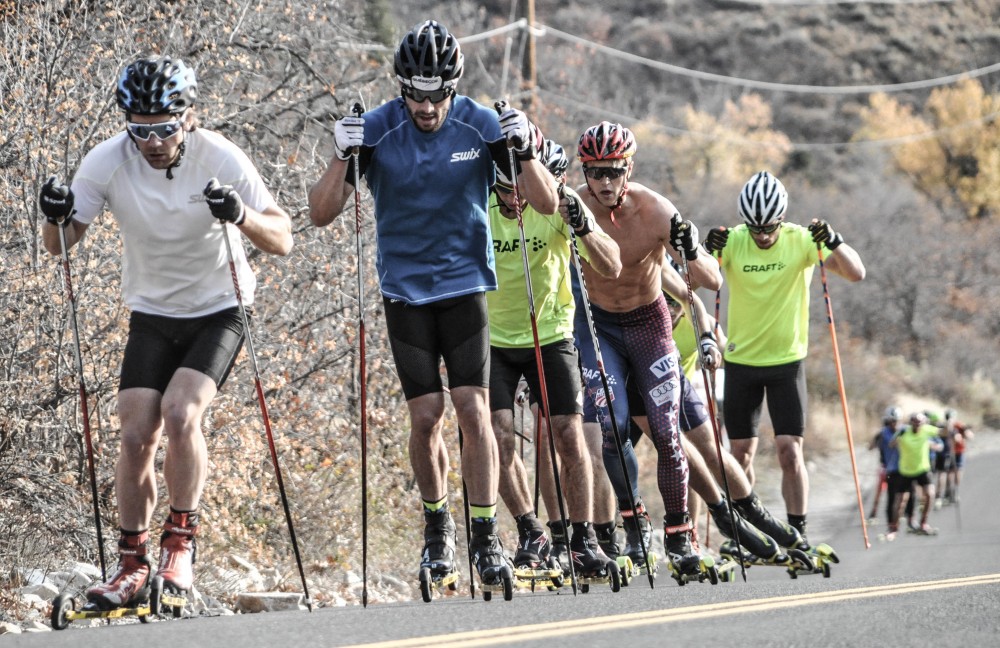
Left to right: Canada’s Devon Kershaw leads his teammate Alex Harvey and U.S. Ski Team members Noah Hoffman, Erik Bjornsen and Simi Hamilton during a Level 3 interval skate session up Snake Creek Canyon in Midway, Utah, during their respective teams’ 2016 training camps in Park City, Utah. (Photo: Matt Whitcomb)
“Devon’s a very intelligent person and sometimes he might’ve overthought things and lacked in confidence, and as a coach that’s really frustrating to see because you know how good they are physically,” Wadsworth said. “And when he was on mentally, too, in training, when he was at his very best, he had total confidence and could destroy anybody in any workout.”
He recalled a hill-bounding workout with the Norwegian team in which Kershaw was literally leaps and bounds ahead of everybody else — even Martin Johnsrud Sundby and Russia’s Ilia Chernousov, who joined the training session.
“He was just shelling everybody,” Wadsworth said. “So when Devon was at his best like that and mentally confident and relaxed, he was a real force of nature. Unfortunately that didn’t always translate into the racing season, but in 2012 he put it all together and had a tremendous year. … If he had the confidence the whole time, he would’ve been almost unbeatable, in my opinion, but it takes the whole package all the time, and he was among the greats there for a while.”
‘Younger, faster, better dog’
And then there was Harvey, another one Kershaw’s of his best friends and longtime roommates.
“I’ve spent more nights in a room with him than my wife or any girlfriend I’ve had,” Kershaw joked. “… He was eager to learn, he chased me for years, he was always a hard worker, too. He trained really hard, he believed in himself, and I still am in total awe of that. I’ve never met anybody as confident as him. It’s too bad that didn’t rub off on me, but that’s been great to be around.”
He likened Harvey’s addition to the team as a family adopting a puppy.
“You know when your parents get a puppy because your dog is 10 years old? He’s kind of slowing down a little bit and then you see that old dog get fired up and run again and jump around and play; that’s me,” Kershaw said. “And I’m so grateful that my owners got a younger, faster, better dog to hang out with because it was so inspiring.”
Several times over the last few years, Kershaw has said that witnessing Harvey make Canadian history has been one of his biggest reasons for staying in the sport.
“He, for sure, has kept me in this probably longer than I should’ve,” Kershaw said. “I just love traveling with him and seeing what he can accomplish and training with him and seeing that professionalism.
“There’s no question he’s the best Canadian skier ever, that’s not even close,” he added. “… I just feel so honored that I got the chance to see it all happen, from his last-year junior when he did his first World Cups and then all the way though I’ve been with him.”
The Canadian men’s relay after placing third in January 2017 in Ulricehamn, Sweden, for Canada’s best-ever World Cup result in the 4 x 7.5 k relay. From left to right: Lenny Valjas, Alex Harvey, Knute Johnsgaard, and Devon Kershaw. (Photo: Salomon/NordicFocus)
In an email, Harvey explained that he and Kershaw first met in the fall of 2005 at a training camp at Sovereign Lake, British Columbia. Harvey was on the junior team and Kershaw a senior, but the whole team stayed at the same hotel.
One morning, Kershaw accidentally took Harvey’s poles from the hotel. Harvey had to track him down on the ski trails to get them back.
“That was the first time I talked to him and to me it’s just perfect because that’s so Devon,” Harvey wrote.
Later that season on March 7, 2006, Kershaw made history with his first podium. That same day, Harvey won his first national title in the 10 k classic at Canada’s senior national championships as a 17-year-old junior.
“I guess our friendship was meant to be before we even knew it!” Harvey wrote.
When the two became teammates, Harvey immediately took to imitating Kershaw, both in training and racing.
“He took me under his wings and he has a big part in the athlete I became today,” Harvey wrote, likening Kershaw to a big brother. “I feel very privileged to have spent all that time with him. I think we became such close friends because we are both very driven athletes and we don’t accept any compromise. We’re both huge fans of our sport, ‘nor-dorks’, so we also love to talk about everything from altitude training to who is seeing who on Tour.”
Kershaw’s decision to retire didn’t surprise Harvey.
“I think it’s a mix of a few things,” Harvey wrote. “… Probably this biggest reason, he has a little girl at home. I know this winter was extremely hard on him. Not seeing Asta Isabel was pure torture, I think I would have done the exact same if I was him.
“I will miss a lot of things about Devon,” he added. “He’s always there to give good advice about everything and anything. He knows so much about all that is going on in the world, probably the most well-read person I know. He’s kinda my news source. I’m still amazed by how indecisive one can be. This brought a lot of laughter throughout the years. I have so many memories from the last 10 years with him. Seeing him dominate the World in 2012 was just amazing but also very eye-opening for me. He raised the bar for all North American skiers that year and I’m very thankful for it.
“We both lived great emotions in high accomplishments and huge disappointments. I’d like to think I helped him get through these upsets and I can say he definitively helped me get through mine. A page turns in the life of Devon Kershaw but knowing the man, I’m not worried about what’s gonna come next.”
Without Kershaw, Killick, Cockney, and Johnsgaard on the men’s team, Harvey acknowledged that next winter will be “very different” for him on the World Cup.
“All these guys are calling it a career and I’m super proud of what all my friends accomplished,” he wrote. “I’m excited to try to help the next generation step it up and fill the shoes of the previous generation. … Also, after 10 years on Tour I’ve made some friends on other teams so I’m not too worried. I’m just excited to step into a bit of a mentor role for our next generation.”
Onto the Next
As for Kershaw, he didn’t rule out coaching future generations of Canadian skiers, but he said he was focused on getting an education first. In just over a week, he’ll start a course that requires 20 hours of classes a week — all in Norwegian — for what he anticipates will take six months. The course is essentially an advanced version of Norwegian as a second language, and foreigners must pass it to pursue a degree in Norway.
After that, Kershaw plans to apply to universities “and hopefully study forever,” he said with a laugh. “Not forever, but study, and I want to stay involved in skiing in any way I can and I want to help the next generation get better.
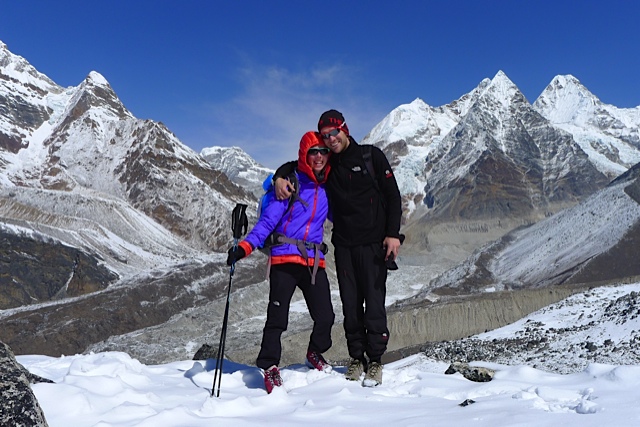
Kristin Størmer Steira (l) and Devon Kershaw during a day hike on one of their acclimatization days. The couple got engaged in 2014 after summiting Mera Peak during a three-week trek in Nepal’s Himalayas. (Photo: Devon Kershaw)
“First things first, I have to get my Norwegian at a level where I can sit through a lecture and write an essay at a decently good level, at least good enough that my wife doesn’t have to rewrite it, she can just correct it,” he explained.
Asked what he’d like to study, Kershaw said medicine, specifically orthopedic surgery, has always intrigued him. (As a junior skier, Kershaw took undergraduate classes at the University of Calgary until 2006, but those credits have since expired.)
“But now I’m 35 and I’m going to have to do all of this in my third language,” he acknowledged. “So for now, I’d say that that’s still my first choice and I’m exploring what it would take.”
If not medicine, he’d like to pursue a degree in “some kind of science physiology, and then in a totally shifted way, if I have a panic attack and be like, ‘Science is too hard after ski racing forever,’ then I am interested in economics and economic theory and business to some degree…”
Regardless of which path he choses, he’ll be doing it in Norway, Kershaw said.
“I don’t mind the challenge. … It’s intimidating in a way, but it’s also really exciting,” he said. “Kristin’s family [who lives in Lillehammer] is just so fantastic and to see how happy my daughter is here, to have her family, to have family around her and everything for the short term, and I hope to be educated in Norway.”
Asked if he’ll jump into any ski races this season, Kershaw was quick to respond, “No.” But he will continue skiing. The beauty of the sport and the struggle, as he put it, is what’s kept him in it so long.
“Imagine just having a singleness, a purpose, a goal that’s just there in your face and then you get to wake up every day and do the things you absolutely love to do,” he said. “… I adore cross-country skiing. I just think it’s such a peaceful, beautiful exercise, and the technique and the flow of it all. … You’re just skiing through the woods peacefully, gliding over snow, over all the terrain you can cover. It’s a beautiful, zen-like endeavor, and I think that’s what’s kept me in it this long. And the people, the Canadian ski community, the world ski community, really. I’ve met so many inspiring people and beautiful people and worked with a lot of absolute experts and I’ve had brilliant teammates and brilliant coaches.”
And because of skiing, he met his wife and started a family in Norway.
“I have a daughter with a woman that I love and respect and am in total awe of every day of my life and without ski racing there’s no way that would’ve ever come to fruition,” he said. “There’s the biggest gift right there, as cliche and Hallmark as that sounds, it’s true.”
Kikkan Randall (l) and Jessie Diggins after being awarded their gold medals from the freestyle team sprint at Thursday night’s Olympic medal ceremony in PyeongChang, South Korea. (Photo: FlyingPointRoad)
After the U.S. women’s historic gold medal on Wednesday, we wanted to try something a little different and invite a few prominent members of the North American ski community to a roundtable discussion. Contacted via email, they each weighed in on the following questions with an interactive Google doc, where they could view others’ written responses and build on the conversation.
In no particular order, we’d like to introduce our special guests:
Holly Brooks, former U.S. Ski Team member and two-time Olympian (2010 and 2014)
Pete Vordenberg, former U.S. Ski Team head coach (from 2002-2012)
Nancy Fiddler, former U.S. Ski Team member and two-time Olympian (1988 and 1992)
Chandra Crawford, former Canadian National Ski Team member, three-time Olympian (2006, 2010 and 2014) and, before Wednesday, the last North American to win Olympic gold in cross-country skiing (in the freestyle sprint in 2006 in Turin, Italy)
*John Caldwell, 1952 Olympian and one of the founders of the U.S. women’s cross-country program who coached the U.S. Ski Team through five Winter Olympics (1960, 1964, 1968, 1972, and 1984), was also invited to the discussion and opted to respond with a mini essay on the subject, which was posted separately.
Roundtable Q & A
Q: Where and with whom did you watch today’s race?
Chandra Crawford: In my living room at 3 am with my husband Jared. 1.5 year old Kyla was crying a bit upstairs but she had to wait for the race to finish to be over-enthusiastically consoled. She was probably wondering what her mom was so excited about.
Nancy Fiddler: Today is my birthday, and I got up to find text messages on my phone with birthday greetings and news of the gold medal (I didn’t stay up to watch it). I played and re-played the final moments over and over again. I was not prepared for my physical reaction to watching Jessie cross the finish line; I was overcome with emotion and the tears flowed. I showed the final moments of the race video to everyone at the hair salon where I got my hair cut this afternoon. Watched the entire race again this evening with my husband.
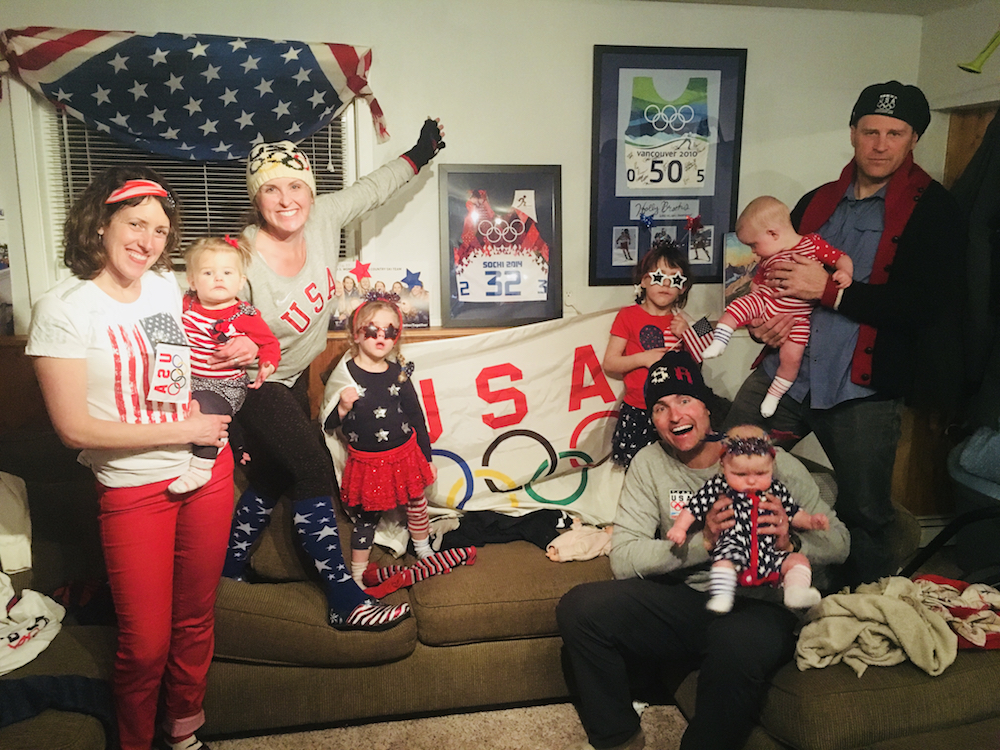
Olympic women’s relay viewing party last Friday, Feb. 16, at the Brooks/Whitney house in Anchorage, Alaska. (Courtesy photo)
Holly Brooks: After hosting a festive viewing party for the 4x5k complete with USA-themed food and 5 kids ages 5 months to six years old in flare head to toe we decided to have a low-key night for sprint relay. I watched LIVE with my husband Rob (wouldn’t miss it for the world) and my twin 5-month old twin infants were asleep in their respective cribs wearing their homemade relay socks. I was sitting in front of the TV on my knees yelling words of encouragement and affirmation when the internet connection died one minute into Jessie’s final lap — talk about WORST TIMING EVER. After what seemed like the longest Coca Cola commerical of my life we reconnected to see the final downhill, turn and finishing straight. For the final sprint I remember yelling, “YOU’VE OUTSPRINTED HER BEFORE!” reminiscing about World Champs last year. Once it was clear they won it was tears upon tears of joy!
Pete Vordenberg: My wife Barb was Kikkan’s Olympic roommate in 2002. And Barb grew up just miles from where Jessie grew up. We’re big fans. We watched in bed on a laptop – like modern Americans do.
Q: What do you think has been the most important cultural shift in recent years to bring U.S. Skiing back to a place where today was possible?
Chandra: Incredible, second-to-none dedication to a positive and supportive team environment.
Nancy: I agree with Chandra! The shift began with Kikkan’s initial success, when Americans saw the possibility of our athletes being able to compete on the international stage. But the team spirit that was cultivated around this tangible success is what changed the look of U.S. women’s nordic skiing. I know I got caught up in it and knew it was just a matter of time before the Olympic medal ceiling was smashed.
Holly: Kikkan’s unfathomable faith lead the way….. Then I believe it was a matter of getting the right people into the right place at the right time. The coaching staff and their ability to look at us as people, beyond simply results is crucial. I think that unconditional love and support is/was essential to a positive team environment, sustainability, and keeping people engaged and interested in supporting one another. People always ask us (I use the present tense because these girls will always be my teammates!) how did you do it? We took what was originally an individual approach and applied a team approach to it. Rather than being preoccupied with beating eachother we understood that we could collaborate and band together to beat the world. Which tonight, resulted in an Olympic GOLD MEDAL.
Pete: The quality of work being done, day-to-day and year-to-year training by coaches and athletes across the country is the reason we are where we are. How that improved is a rise in development efforts and programing at team/club, regional and the national level. All of it is tied together.
Luke, Farra, Wadsworth and I all raced together at the national team level in the late 80’s through late 90’s early 2000’s. These were hard and lean years that came on the tail of more hard and lean years that followed the successful Koch years. That we all (Luke, etc) ended up working in US Skiing is not an accident — we all wanted more and saw a way to do it. Bodensteiner began to build a consistent domestic and North American race circuit that really enabled US racers to compete at the right level and build from there. This was the start of a good pipeline for racers to develop. Chris Grover and Miles Minson started a development team. It was a small team, but it was a development team – the work they did was back to the basics, build from where you are not from where you wish you were.
Very importantly around this time a few junior programs added senior programs to build a link from junior to senior level racing. We were all working to developing skiers along a pathway, the pipeline – not just taking skiers to the World Cup, most of whom had not really developed enough to be at that level even if they were the best in the US. Somewhere in here better drug testing plays a role and more dopers are getting caught and then fewer are doping. This is a factor that is hard to quantify. There is still doping. But it seems less prevalent and this is an advantage to us as clean racers.
This development system was capitalized on by Trond Nystad and built and improved upon by myself, Trond, Grover and Vidar Lofshus. At this time Luke helped us build an actual team. We began to put together a national team program, a consistent staff, a more complete wax team and continued to focus on development (today Bryan Fish runs much of the USST’s development efforts and he does amazing work).
Kikkan Randall (l) with her fourth-career World Cup podium after placing second in a freestyle sprint in December 2010 in Düsseldorf, Germany, behind Italy’s Arianna Follis (c) in first and ahead of Slovenia’s Vesna Fabjan (r) in third. (Photo: Pete Vordenberg)
That is the beginning of the shift — a real focus on the development pipeline. But one thing I think is important to point out is that this effort across local, regional and national teams also changed the tone of US Skiing –- the tone is now one of preparing to win. We began to work together across the whole country to win at the international level. That is huge. This is probably the biggest thing – a ground swell of collective effort toward a shared goal. The number of people who played a specific, vital role are too numerous to name. Erik Flora at APU who is Kikkan’s coach and Jason Cork with the USST who is Jessie’s coach both deserve mention, but who coached and mentored Cork and Flora? They also deserve mention. I mean, I still teach classic the way Nancy Fiddler showed me how to teach classic! It is all interwoven. Before Erik and Cork, Kikkan and Jessie were coached by their youth coaches, their high school coaches, they were supported by race course volunteers, people handing out orange slices after races, parents driving to practice, club organizers and regional leaders and national team coaches like Whitcomb… That support network, that development pipeline, that nationwide effort is what got this medal.
I do want to point out the role of Andy Newell was the first one to get a World Cup podium after two generations of skiers struggled to crack the top 30. Newell was the tip of the spear. The 2002 team was awesome, Freeman got very close (and was robbed of medals by dopers) but it was spring, 2006 when Andy got a WC podium that the possibilities became more real. Kikkan’s podium in Russia was a huge moment for us as a country too and since then, well, here we are.
Q: What made the biggest difference in today’s race?
Chandra: Jessie’s ability to go beyond her limits is truly on another level, and they both rose to the occasion as game-day champions in terms of mental state.
The entire team keeping everything positive through the exhausting, media-intensive lead up to these games. And a gold old 15-year “overnight success story” led by Kikkan Randall’s belief in teamwork and profound humility and caring.
Nancy: Today it was about the combination of Jessie’s heart and Kikkan’s ability to perform under immense pressure. This was the American combination I picked to win a medal, and my intuition proved correct! They did it at Worlds and knew they could do it again if each one of them performed at their top ends. I do not think Jessie ever doubted that she wouldn’t get by Stina for one moment when she rounded that last turn.
Holly: Belief, experience, support from the “team behind the team” and the fact that the course played to their individual strengths. Kikkan is one of the best uphill, V1 jump skaters in the world and Jessie is one of the best downhiller/overspeed, “finishers when a teammate is waiting at the finish line!”
Pete: Today’s race was just one race, the fitness, the program, the team, the work, it has been done and rehearsed, and done again and rehearsed again, built up over years. It is everyone playing their role from massage therapist to waxer to club volunteer, club fundraiser, NNF fundraiser, youth coach to parents and friends, to athletes who were not chosen to race but still played their role as teammate… Today’s race is not a culmination, it is just another race and as long as there is still snow, the framework for more great races is in place. There is more to come.
Q: Which specific moment in the race did you think was most impressive?
Jessie Diggins as a junior training at Soldier Hollow in Midway, Utah. (Photo: Pete Vordenberg)
Chandra: Kikkan, despite her injuries in the lead-up to the games, hanging with Marit and Charlotte and making it look like no problem and Jessie keeping calm cool and collected on the skittery downhill and then pumping out huge power in the finishing one-skate. Sorry, that’s not one thing!
Nancy: Again, I agree with Chandra that Kikkan notched her game up to match Marit and Charlotte’s and made it look easy. And The Moment for me was when Jessie gave those 3-4 hard skates to give her the momentum that would ultimately send her past Stina at the finish line.
Holly: I don’t really believe in perfection but almost every once of this race was perfect and thank goodness, there were NO BROKEN POLES this time! (Thanks Diggy!) For five and a half laps it is all about staying in contact but when that is accomplished it is all about the finishing tactics and kick. There are so many things that could wrong is this situation but Jess set up her slingshot perfectly and her kick was world class. As the saying goes, it takes two to tango!
Pete: Every moment presents a challenge and an opportunity. Each exchange is both a challenge to get through safely and also an opportunity to gain a few meters. Every slick downhill presents the same challenge/opportunity. Each opening you see in the pack and can squeeze through could end in a fall, a broken pole or a great move up, and of course every uphill gives you the test of fitness and grit that makes our sport so hard and so cool. It was so fun to see all challenges met and opportunities capitalized on.
Q: Should casual ski fans be surprised by this result or was it only a matter of time?
Chandra: Be surprised and amazed! There’s quite a bit of luck involved in the Olympics! No matter how prepared or amazing people are it’s truly insane how much each micro-moment is weighted and placing a ski an inch to the left or right could cause a trip and effect things.
Nancy: I actually don’t think casual fans really expected the gold medal outcome. I was out skiing today at our local area and everyone I saw stopped me and wanted to talk about it. Those who follow World Cup skiing closely could see how the possibilities were shaping up.
Holly: Casual ski fans are surprised. Hard core ski fans should not be surprised. My suite mate at work today told me he was surprised and I found my hackles up, (AK moose reference) ….. I was actually offended. Kikkan and Jessie have done it before and the USA arguably has the best sprint team in the world. It’s sport so anything can happen but this is the outcome I knew was possible.
Pete: Are there casual ski fans? I thought either you don’t even know about skiing or like all of us, you bleed for it. If you have paid attention you should know we are contenders, and can no longer enjoy the status of underdog.
Though we have come far, it is still important to celebrate small successes and not just Gold, Silver and Bronze. Even if as a country we don’t celebrate a top 30 any more, for developing athletes a top 30 on the World Cup is really something to celebrate, as is a great training session, a single great interval workout up your local hill is a success, a long run in the woods is a joy in itself as well as a step forward. Those daily successes are the steps toward medals and there will always be more steps than medals.
Q: What does this mean for the US ski team’s status internationally?
Kikkan Randall (l) and Jessie Diggins listening to the U.S. national anthem after being awarded their gold medals from the freestyle team sprint at Thursday night’s Olympic medal ceremony in PyeongChang, South Korea. (Photo: FlyingPointRoad)
Chandra: I have never seen the ENTIRE field hug the winner. This team is so open, friendly, inspiring and well-loved. They are great people first and foremost, and that goes for the women’s team, men’s team, coaches, techs and support staff.
Nancy: RESPECT. I think the U.S. women have been getting noticed more and more the last several years, especially now that the team has so much depth. In addition to the successes of Kikkan, Jessie, and Sophie, Sadie has turned heads with her consistent results, and now Ida and Rosie are making their way into the top 20 in the world. It is apparent that even the toughest competitors out there genuinely like the American girls. Even without the gold medal, I would say that the American women have been accepted as challengers on any race day. And at the same time, they are friends with everyone. Watching every competitor congratulate Kikkan and Jessie after their win was just as satisfying as watching the race for me.
Holly: I would echo what Chandra said – if the skiers from other countries couldn’t win they were happy that we did. I’ve never seen so many genuine smiles or congratulatory hugs at a finish line. It was same in 2012 when we had our first relay podium. Our competitors were genuinely happy for us and as Marit Bjorgen said, it is “healthy for the sport.” Also of note would be the sportsmanship that Kik and Diggs displayed on the venue podium. Past races winners have been happy but remained on their podium block. In contrast, Kikkan and Jessie hugged their competitors to the right and to the left. I have witnessed our team spearhead a cultural shift on the entire World Cup. I think people have realized that we can be competitive as hell but be friends once the races are over. We have lead by example that you can be fun AND successful at the same time!
Q: What does this mean for the development of cross-country skiing in the U.S.?
Chandra: Get ready for the inspirational boost to our sport to last several hundred years, I reckon!
Holly: I think this is a watershed moment. The floodgates are open, the Olympic glass ceiling is shattered. This might be the “first – historic” medal but I expect more to come. We have some promising juniors in the pipeline and they should hold their heads high at international races. They are part of team USA and we mean business! Watch out world.
Nancy: I have seen huge leaps and bounds in the development of our sport since I was a racer back in the 70’s-90’s. There was no national picture to junior development, our international results were sporadic, and it seemed like there was no pipeline to success. I began coaching juniors soon after I retired in 1993, and shortly thereafter, I began to see some direction. The groundwork was being laid in the form of USST outreach to regional coaches. Coaches were becoming educated, regional camps started happening, and there was a whole lot of sharing of ideas across the country. Junior competition showed just how many kids were benefiting from the better system. I watched Sophie and Kikkan race at JN’s and was impressed by their technique and speed; I knew that this was the beginning of a better U.S. SkiTeam. With all the REG and U-16 camps, support from the NNF, strong clubs, and better coaches education, we have created a base of competitive skiers who grew up in this improved system. We have had success on the World Cup, at World Championships, and now a gold medal. The gold medal is going to stimulate our base of junior skiers to even more success. Seeing Jessie and Kikkan win that medal is BELIEVING that it is possible.
Pete: It means we are on a good path. But it doesn’t mean we can relax. If we want to win, and win even more frequently then the work, the innovation and collaboration, the learning, and failing and trying again must be on-going.
I would actually love to hear some history on how US Skiing entered that long period of drought after the Koch era. I think there could be some important lessons for us to keep in mind as we move forward from here.
If this success shows us anything it is a matter of working together across the entire country, pulling people together and working hard toward a shared goal. Maintaining, even improving on the positive and cohesive team and US xc community atmosphere supports this. Positive and solution-oriented work, action and words are the path to success.
One more specific thing is that I would like to see some of these women assume regional and national team leadership roles. For me this is the next step to build on our success.
***
Thank you to everyone who participated in this conversation.
Kikkan Randall (l) and Jessie Diggins after winning a historic gold for the U.S. in the women’s freestyle team sprint at the 2018 Olympics in PyeongChang, South Korea. (Photo: FlyingPointRoad)
Norway’s Astrid Jacobsen (r) leads Liz Stephen (U.S. Ski Team), Switzerland Bettina Gruber, and U.S. Ski Team members Jessie Diggins, Holly Brooks and Ida Sargent during threshold intervals at the 2013 North American Women’s Training Alliance (NAWTA) camp in Anchorage, Alaska. (Photo: Matt Whitcomb)
For this week’s workout, we bring you one of the best threshold workouts U.S. Ski Team Women’s Coach Matt Whitcomb said he’s ever seen — back in 2013. That’s not to say this workout is outdated, and the kind of training environment nearly a dozen top-level athletes created at the 2013 North American Women’s Training Alliance (NAWTA) camp in Anchorage, Alaska, was one other teams and clubs can try to emulate. All it takes is a quality all-around effort and well-thought-out terrain choices. Read original article here.
***
[circa July 2013]
The third-annual North American Women’s Training Alliance (NAWTA) camp began this week in Anchorage, Alaska, and on Tuesday morning they completed a threshold workout that ended with a lot of high-fives in the van and left U.S. Ski Team women’s coach Matt Whitcomb pretty happy.
“Today’s threshold workout was the best threshold workout I’ve seen out of this group of women since I’ve been working with the team,” he said on the phone, as the group began their afternoon strength session.
Kikkan Randall, Jessie Diggins, Liz Stephen & Co., are joined at this camp by Alaska Pacific University skiers, National Training Group athletes, and decorated Norwegian Astrid Jacobsen, Switzerland’s Bettina Gruber and Canada’s Chandra Crawford. The workout is one that Whitcomb and APU head coach Erik Flora have repeated over the last few years in order to work specifically on high-speed skiing in the middle of a threshold session.
The keys to accomplishing this goal are two-fold: the choice of terrain, and the presence of a group to ski with. It was his team’s skilled pack skiing that Whitcomb thinks set Tuesday’s session apart from the rest, but the rolling hills are a critical ingredient to the goal of the entire workout.
“It’s not so much emphasizing going harder, it just emphasizes patterning your muscles, neurally, to fire faster,” Whitcomb explains. “I think a lot of times, certainly my tendency as been to prescribe intervals that are a bit too slow. We might be nailing the percentage of your max heart rate and the proper lactate right on the money, but the pace is just too slow — you’re going uphill, uphill, uphill, and a lot of times when we find hard terrain we go hit intervals there.”
To encourage speed variation while staying within threshold, the workout should be done on a stretch of pavement that includes gradual uphills, flats and gradual downhills, which “systematically [builds] some pace development intervals into your session,” Whitcomb says.
“It doesn’t need to be incredibly hard — today was roughly threshold and above during bursts of speed — but it was about the terrain that helped push the pace for us.”
The Workout:
20-30 minute warm up*
4-6 x 7-10 minute L3 intervals (3 minutes rest) on fast terrain that incorporates gradual uphills, flats and gradual downhills. Most interval sessions use hard and grinding terrain, great for building capacity but not so great for higher pace development. The key to this workout is in the choice of terrain.
20-30 minute cool down*
*Do a warm up and cool down that allows you to focus on the intervals. “Sometimes a mistake can be made where people are going after volume in addition to high intensity on interval days,” Whitcomb says.
Don’t do try to multi-task for this workout. “Warm up only the minimum that your body requires,” he continued. “You want to make sure your muscles are ready to go, and build into the intervals if you have to — you don’t want to pull any muscles or get injured — but a 45 minute warm up is too long, as is a 45 minute cool down. Keep them concise and focus more on the on-time.”
Frequency:
Every two to three weeks in the summer, with increasing frequency to every 10 days as fall approaches. “A workout like this is in addition to L4 intervals, time trials, speeds, ODs,” Whitcomb said. “It’s just another small component, another ingredient to throw in the bag and mix it up.”
Variations:
Shorter recovery time as the season goes on, or longer recovery when at altitude — “just to make sure the on-time is what’s being emphasized,” Whitcomb says.
Pre-determined sprint preems that accomplishes a similar break from straight threshold, forcing athletes to go from threshold, into race pace, then back into threshold when they cross certain preem markers in the interval.
On Tuesday, the women did this session on a stretch of bike path in Anchorage’s Kincaid Park. They chose a section of rolling terrain that was about 7-10 minutes long going either way. The group started their first interval in one direction, which took about nine minutes, took their three-minute recovery, and then skied back the other way to the start, which took about seven minutes.
The 2013 North American Women’s Training Alliance group after a well-executed workout in Anchorage, Alaska. (L to R) Kate Fitzgerald, Kikkan Randall, Liz Stephen, Astrid Jacobsen (NOR), Ida Sargent, Holly Brooks, Bettina Gruber (SUI), Jessie Diggins, Emily Hannah, Annika Miller. (Photo: Matt Whitcomb)
From a coaching perspective, this workout shows Whitcomb things that don’t surface in regular threshold intervals.
“I think when we started doing this it taught us that the speed didn’t really change as much as we thought it would when the terrain asked for higher speed,” he said. “You try and go faster and your muscles simply didn’t want to move faster. It wasn’t a matter of being at your max heart rate, people were well within threshold, but they just didn’t want to fire those muscles faster. But the body fortunately adapts pretty quickly to a group session like this and you see pretty notable progress in your speed in just a few weeks.”
So what made Whitcomb call Tuesday’s workout, in particular, the best threshold session he’s ever seen from his team?
In addition to their raw speed — “they were really flying” — Whitcomb noticed they skied better together within the pack than they have before.
“Everyone spent some time leading, some time sandwiched cycling in the spin wash in the middle of the pack, and it was really unlike this group perhaps in the past — you know, you establish a pecking order and somebody’s out there hammering off the front all day, maybe somebody switches out if they get tired, somebody is flying off the back all day because they’re struggling,” he said.
“And today instead it was much more this series of incessant attacks at the front where you’d recover a little bit, spend some time in threshold in the pack, and then you’d work your way to the front and use your good feelings and your recovered state to push the pack and pull everybody along at a faster rate. It looked more like watching a cycling race today, to be honest, and that’s kind of a new thing particularly in girls skiing, I think. The mass starts [sometimes] just getting strung out from 100 m into the race, and I think we’re moving in the direction of more pack skiing. And as we can improve our skills within the pack were going to be better suited for those days when the women’s pack does stay together.”
The view from a high point at the Canmore Nordic Centre during the 2012 Alberta World Cup. The venue will serve as one of five stops on the new Ski Tour Canada in 2016.
When Ski Tour Canada 2016 was announced as the finale to the 2015/2016 cross country World Cup season last year, North American fans were excited at the prospect of the first race of its kind taking place this side of the pond. At the recent 2015 FIS Calendar Committee meeting in Varna, Bulgaria the Tour’s dates and races were confirmed giving fans a better idea of what to expect come spring of 2016. Starting with a freestyle sprint in Gatineau, Quebec and concluding with 10 and 15 k classic pursuits in Canmore, Alberta the eight-stage Tour will take place over the course of the first 12 days of March.
Ski Tour Canada 2016 at a glance:
Gatineau, March 1: Freestyle Sprint
Montréal, March 2: 13/22 k Classic Mass Start
Québec City, March 4: Freestyle Sprint
Québec City, March 5: 10/15 km Freestyle Pursuit
Canmore, March 8: Classic Sprint
Canmore, March 9: 15/30 km Skiathlon
Lake Louise, March 11: 10/20 km Freestyle Individual Start
Canmore, March 12: 10/15km Classic Pursuit
Early on in the planning process, Ski Tour Canada (originally billed as Tour du Canada) was set to take place in mid-February. However, the prospect of hosting the tour on North American soil in the middle of the season was too complex, and the event was moved to the end of the season.
According to a press release by Cross Country Canada, the next step for tour will be a list from FIS technical and marketing officials to examine and approve each venue’s stadium and courses. “The next major milestone includes a visit in August by the FIS technical staff and marketing representatives to approve tracks and stadium layouts used on each stage of the tour,” Dave Dyer, director of events at Cross Country Canada, said in the press release. “With under a year to go before the Tour gets underway, we’re really excited about the project and can’t wait for the 2015-2016 season to start!”
The organizing committee behind Ski Tour Canada recently unveiled a website for the event along with a new logo. Check out the tour’s first promotional video, featuring retired skier and Olympic gold medalist Chandra Crawford, below.
Perianne Jones (Canadian National Development B-Team) races to 32nd for her best World Championships distance result at 2015 World Championships in Falun, Sweden. (Photo: Fischer/NordicFocus)
For the last 12 years, Perianne Jones was more or less on autopilot, leading the life of a professional nordic racer in Canmore, Alberta, and giving little thought to what would come after skiing.
The 30-year-old Canadian national-team member and Nakkertok Nordic prodigy had moved west from her hometown of Almonte, Ontario, immediately after high school. She immersed herself in full-time training and racing, and by 2009, made the Canadian World Cup Team.
Two Olympics and five seasons later, Jones was inching toward retirement. Health issues stunted the start of her 2013/2014 season; she discovered in the fall of 2013 that she had hemochromatosis, a genetic condition that causes too much iron in the body. She spent the next few months working to manage her iron levels and returned to the World Cup circuit in late December 2013.
Canadian biathletes and fellow cross-country skiers cheer on their own Perianne Jones on the first leg of the 4 x 5 k relay at the Sochi Olympics. the team finished 14th, one place better than their finish at the 2010 Vancouver Games.
Two months later, she competed at her second Olympics in Sochi, Russia, placing 23rd in the freestyle sprint for her personal Olympic best. In the classic team sprint, she and teammate Dasha Gaiazova placed 11th after notching third in the same event at the 2013 Sochi World Cup a year earlier.
Jones ended her season with a second-place finish in the freestyle sprint at 2014 Canadian Nationals in Corner Brook, Newfoundland, and was subsequently named to the national development B-team last May.
Also last spring, her coach, Eric de Nys, left the national team to head up a new training program in Canmore: the WinSport Junior Cross Country Ski Team. Jones lost the bulk of the funding she had received as a World Cup Team member, yet decided to continue on for another season.
“I, for sure, wanted to do another year after Sochi, and do things right,” she said on the phone from Canmore in early April. “… [Not making the World Cup Team] was a bummer, but at the same time, I know I didn’t make the criteria. I had one top-ten two seasons ago and you needed two top-twelves. I was put on the development team, so it meant that this past season cost me way more than it ever has…”
“I, for sure, wanted to do another year after Sochi, and do things right.” — Perianne Jones
As a development athlete, she said the costs amounted to $40,000 to $50,000, and that included government assistance as a carded athlete.
“Even if you’re carded, you still have to pay for a place to live,” Jones said. “And living in Canmore is not cheap.”
Carded athletes essentially receive an allowance each month, she explained. The government cuts qualifying individuals checks that could be used for anything — even a flat-screen TV — but the amount is generally considered a living allowance.
“As a development skier, you have to cover housing and your team fee, which is around $10,000 and your winter expenses on the road, and then your flights to and from and around Canada,” Jones said. “It adds up.”
Without stressing too much over finances, she focused on the 2014/2015 season and logged some of her career-best distance results, placing 32nd in the 10 k freestyle and 37th in the skiathlon at 2015 World Championships in Falun, Sweden.
Canada’s Perianne Jones racing to fifth in the 1.4 k classic sprint at 2015 World Championships in Falun, Sweden. She placed 24th overall. (Photo: flyingpointroad.com)
Also in Falun, she finished 24th in the classic sprint and was 21st for a season best in the preceding World Cup classic sprint in Östersund, Sweden.
“This past year I was healthy the whole season, which was quite an accomplishment for me,” she said. “It wasn’t my best season in terms of results, but health-wise it was really good. … I was pleased with both my sprints in Östersund and at world champs. It always can be better for sure, but I don’t have any regrets.”
In Falun, she announced she would leave the international-racing scene at the end of the season. She capped off her career at 2015 Canadian Nationals in Thunder Bay, Ontario, winning the classic sprint, placing second in both the 5 k freestyle and 10 k classic individual races, and fifth in the 30 k freestyle mass start.
In Thunder Bay, Nakkertok hosted a retirement dinner in her honor, complete with a video and several athletes and her brother Kieran Jones — Nakkertok’s head coach — speaking about the impact she had on their ski careers.
“That was the only time I cried all week,” Jones said. “The ski club has been a huge part of my life and maybe I didn’t realize how I had been a part of them so much in the last ten years because I haven’t been around that much. I would totally love to go back to Ottawa and be a part of that some more.”
She clarified that her involvement with Nakkertok would most likely be as a volunteer.
“I have an interest in being involved, not necessarily in coaching at a high level, but when I was growing up with Nakkertok the ski club was entirely volunteer run,” she said. “I will be involved with a ski club wherever I end up. I will miss certain parts of skiing, but to have Joel still a part of the team will be an easier way to make that transition.”
On Friday, Jones and her husband, Joel Jaques, a national-team wax technician, hopped aboard their 32-year-old Dodge getaway van and began a road trip to Ottawa. She guessed they might be gone for at least a month, with Jaques heading back to Canmore for a week in the middle of their trip for a training camp. How far they’d go depended on how the van ran. They bought it in February, about the time Jones knew her career was winding down.
“We were just kind of joking about vans; there was one in Canmore and we offered the guy quite a bit less than he was asking and he said sure, and we’re like, OK, I guess we’re doing this,” she said.
If they have time and the van makes it to Newfoundland, a friend offered to keep the van and buy their plane tickets back to Canmore. There, Jaques will go back to work with the national team and Jones will decide on her next move: she’s considering studying healthcare in Calgary or Ottawa.
Meanwhile, she also planned to start working in Canmore to cover the cost of last season. While she essentially made up her mind to race one last season a year ago, the bill she received at the end of it ultimately solidified her retirement.
“At the beginning of [last] season, I thought if I work and keep skiing, I would need to make the World Cup Team and need other women on the World Cup Team around me to keep going,” she reflected. “As the season kept going, I was realizing that even if all those things came into place, I wasn’t motivated to keep training for another year.”
Perianne Jones racing to 29th in the Canmore World Cup in February 2010. (Photo: Win Goodbody)
After graduating high school, Jones started a fall term the University of Calgary, but found the commute back and forth from Canmore difficult. She took an online course at Athabasca University, but realized that didn’t work for her, either. Instead, she spent the next 12 years focusing on skiing.
“I’m happy with the decisions I made and I’m sure my ski career was the best quality,” she said. “Hindsight’s twenty-twenty; there’s always things that could’ve gone better, but at the same time I was able to commit 100 percent to skiing. Although I’m not educated right now, I’m really looking forward to going to school and I can put 100 percent of my energy into school.”
Jones and Jaques were also looking forward to having the freedom to visit friends this spring.
“I’m looking forward to waking up and being able to what I want to do for exercise,” Jones said.
“I will not be out on my rollerskis,” she added with a laugh. “So far it doesn’t feel a whole lot different. I feel pretty good about my decision, and I’m confident it was the right one. So many people say that it’s really hard [to retire] and some people say it’s awesome, but I think it depends on the person. I have enough plans to keep me busy; I don’t think I’ll be bored.”
Looking back, she credited her two national-team coaches, de Nys and Justin Wadsworth, for the longevity of her career. She worked with de Nys, a development coach before he became the women’s national-team coach, for most of her senior years.
“Eric really got to know me as an athlete and I got to know him as a coach, and I really trusted him and we were able to work well together,” Jones said. “And Justin, he’s been with the team since [2010] and he wasn’t my personal coach until this past year, but the transition was pretty seamless … I don’t feel like I lost Eric as a coach this year, but I feel like I gained Justin. Whenever we had a question about something, either of us could easily call Eric or visit him in his office.”
In her career, Jones notched three top-15’s at both Junior World Championships and U23 World Championships, finishing eighth at 2008 U23’s in Malles Venosta, Italy.
Canadians Perianne Jones (l) and Dasha Gaiazova celebrate their first bronze together in the Sochi World Cup classic team sprint. (Photo: Chandra Crawford)
“I had some really good World Junior experiences, some good results and some really fun times with the team,” she explained. “For sure, the two medals that I won with Chandra and Dasha respectively in Milano and Sochi were highlights.”
In 2012, Jones and Chandra Crawford teamed up for third in the World Cup freestyle team sprint in Milano, Italy.
Jones also recalled making the 2010 Olympics in Vancouver, British Columbia, as a major high point. She qualified in 2009 when she and Sara Renner placed sixth in the World Championships classic team sprint in Liberec, Czech Republic.
“That was the first time we got to go to the medal ceremony … and it was with Sara, who was a pretty big mentor,” she said. “I was actually never really on the team with Beckie [Scott] or Milaine [Thériault], but I traveled quite a bit with Sara. … Having them come before me and have the results that they did and just being the people that they are, they made it pretty appealing to chase after ski-related goals … Everything was so positive that I never I had any doubt that A.) I would enjoy it and B.) it would be possible.”
The last of Canada’s three veteran females to retire — following the departures of Crawford and Gaiazova from the national team last year — Jones was excited to see what the next generation of women could accomplish.
“I spent the majority of the season on the road with Emily [Nishikawa] and that was just awesome,” she said. “I’m glad I was there for that and able to witness her best season ever, and I think it’s a sign for really great things to come. There are younger women coming up, too, and they have Emily to look up to so there’s no doubt in my mind that they will do great things.”
Regardless of where she attends school, Jones envisioned that she and Jaques would end up living somewhere in western Canada.
“We don’t really want to leave Canmore,” she said.
Several members of the 2014 Canadian Olympic cross-country ski team get the perfect photo opp at the Olympic rings in Krasnaya Polyana, Russia. (From left to right): Perianne Jones, Amanda Ammar, Heidi Widmer, Brittany Webster, and Emily Nishikawa. (Photo: Emily Nishikawa)
Fast and Female founder/president Chandra Crawford retired from competitive-nordic racing this spring after 14 years in the sport (and five more in biathlon). She was recently accepted into the University of Calgary’s business school. (Photo: Chandra Crawford/chandracrawford.com)
Chandra Crawford knows a thing or two about headspace, and as she smiled at the program director for the University of Calgary’s Executive MBA (Master of Business Administration) program as the they reviewed admission requirements, the director told her she’s never met anyone so excited to take the GMAT (Graduated Management Admission Test).
Born and raised in nearby Canmore, Alberta, Crawford, now 30, finished high school 14 years ago and catapulted into competitive nordic racing. Before that as a junior, she had been a biathlete for five years, but by age 22, she was known on the world scope as one of the most promising cross-country sprinters — a surprise gold medalist in the skate sprint at the 2006 Torino Olympics.
Crawford celebrating her gold medal in the freestyle sprint at the 2006 Olympic Winter Games in Turin, Italy.
That moment changed her life forever, defining her career and who she was as a skier.
Crawford put off education in pursuit of loftier goals in skiing — but after a gold medal, where does one go from there? She went on to win her first World Cup gold in Canmore in 2008 and repeated the feat two months later at a World Cup sprint in Lahti, Finland. She competed at two more Olympics in Vancouver in 2010 and most recently in Sochi, Russia.
In her blog, Crawford recalled her former teammates and Canada’s gold and silver medalists, Beckie Scott and Sara Renner, saying it would take “ten years to get good.” That kind of commitment is was kept Crawford onboard through the Sochi Games, after she opted to train apart from the national team last spring and spent much of last season playing catchup.
Gold medals six years ago weren’t enough to secure her international starts this past season without first proving herself, and Crawford went through the process just as any Canadian not on the World Cup Team would — by giving it all she had at trials. In January at the Canadian Olympic trials in Canmore, Crawford won the freestyle sprint to earn her trip to Sochi. She had previously raced two World Cup sprints in December in Davos, Switzerland, and Asiago, Italy, placing 43rd and 45th, respectively.
Back on the World Cup in February in Toblach, Italy, she finished 34th in the freestyle sprint, just shy of the top 30 needed to make the sprint rounds. Crawford went on to race one event at the Olympics — the skate sprint — where she placed 44th.
“Looking back on it now, it seems like things never really came around physically,” she said on the phone from Canmore in late April. “How much I had burned out from my tough years — I didn’t really have the time to recover from it.”
Two seasons ago in February 2013, Crawford had put racing on hold after the pre-Olympic World Cup in Sochi — flying home to Canmore to recover before her last season-long Olympic push. She didn’t race again that 2012/2013 season, and resumed training last spring as a member of the newly formed Team Ninja, a band of four independent female racers in Canmore.
Crawford in what would be the final race of her career, the Sochi Olympics freestyle sprint qualifier, in which she placed 44th. (Photo: Fischer/Nordic Focus)
While she had always hoped for a comeback story, it didn’t come to fruition. Her energy levels went through highs and lows, something she attributed to thyroid and iron issues, which she explained as a direct result of overtraining.
“It’s not bad luck, it’s just what happens,” she said of her underactive thyroid, which doctors discovered last fall. “Your endocrine system just gets blown out.
“The energy was different at different points throughout the normal training and racing year, but I never really got going fast,” she explained. “I was always working hard, but I was never really [skiing] hard. I was maximizing other aspects, like am I doing everything I can technically? … I always came out that I’m going 10 out of 10 on the process. This normally works.”
Come spring, she was about ready to be finished altogether.
“I was on the fence if I would continue through Sochi or not,” Crawford said. “I redefined success into my own terms. That’s what enabled me to carry on and ski through Sochi. It was a great feeling, like the feeling you get from the last rep and last international race of a career — everything leading up to it was my last taper or my last World Cup…”
Crawford was optimistic at the Olympics, and she enjoyed what turned out to be the final race of her career while back with the national team.
“This year was amazing,” she said. “The less I needed from the team, the more I enjoyed it.”
“It was a great feeling, like the feeling you get from the last rep and last international race of a career — everything leading up to it was my last taper or my last World Cup…” — Chandra Crawford, on ending her racing career with the Sochi Olympics
Rosanna (l) and Chandra Crawford on one of their bike outings during the Gold Medal Plates trip last month in Provence, France. (Photo: Rosanna Crawford)
Crawford spent the rest of the Olympics cheering on her younger sister, Rosanna, a Canadian biathlete in her second Olympics. There, Rosanna posted her Olympic best of 25th in the 7.5-kilometre sprint.
“Chandra has been one of the major factors in my career, watching her get her gold medal when I was 18 really helped motivate me to strive for the Olympics,” Rosanna, 25, wrote in an email. “It was always a dream of mine to go but once I saw her go and win it made me realize that if she can then I could too! She has always been my biggest fan and always rooting for me.”
The sisters recently spent two weeks wining, dining and biking in Provence, France, with Gold Medal Plates (GMP). The foundation auctions exotic destinations as a fundraiser for Own The Podium and to support “Canadian Excellence in cuisine, wine, the arts and athletic achievement,” according to its website. This marked the Crawford sisters’ second-straight trip overseas with GMP; last year they visited Tuscany, Italy. Chandra was on year No. 6 with the program.
“I feel so lucky to have such an awesome sister that’s taught me it’s ok to be strong and powerful and to follow your dreams,” Rosanna added. “Her work with Fast and Female has also motivated me to be a good role model and know that there are always people looking up to you.”
Nearly nine years ago, Crawford founded Fast and Female, a series of sports-based events designed to empower females ages 9 to 19, with the help of her teammates on the Canadian National Team in 2005. The concept took off and spread throughout the nation by 2007, at which point the program became a registered-nonprofit corporation with a board of directors. Crawford became president, overseeing the nonprofit’s mission and vision while focusing on her job as an athlete — which Fast and Female championed front and center.
It wasn’t long before the series caught on the U.S. and other countries overseas. According to Crawford, Fast and Female had 105 ambassadors in 24 sports as of April, and was on track for a record-smashing 3,000 participants this year.
“Fast and Female really took itself internationally,” she said, pointing out events in Sweden and Norway this past winter, and a presence in Australia. “We’re running with a lot of volunteer-based energy. We’re a really small team based here in Canada with how big we are.”
Looking forward, she’s like to make the series “more profound,” extending beyond sport experience to working together to “create solutions in the environment,” she said. “I just can’t say enough about the American program and how I learned from everything Kikkan [Randall] and [U.S. women’s coach] Matt Whitcomb and the American team create.”
Chandra Crawford during a Fast and Female event in 2009.
Fast and Female celebrates its nine-year anniversary in November. While Crawford will remain president/founder, she’s going to spend the next two years learning how to be a better business leader and generate more revenue for her program moving forward.
That’s right, Crawford go into Calgary’s Haskayne School of Business, scoring a 540 on the GMAT “with about 25 hours studying math and by being a positive game-day performer,” she wrote in an email.
“It was so fun to wake up on test day with the exact feeling of a race morning: ‘Today is the day I get to do the thing I prepared for!’ she recalled. “ ‘Right on!’ ”
In addition to a score of at least 500, she needed 10 years of work experience to get in (without a university degree). Everything she learned with Fast and Female — from brand marketing to relationships — qualified, she explained.
“It’s going to be extremely challenging to do two years of business school, but I’m ready to get growing way out of my comfort zone and am at a great time in my life to invest in my skills through education,” she added.
“It was so fun to wake up on test day with the exact feeling of a race morning: ‘Today is the day I get to do the thing I prepared for! Right on!’ ”
Her goals with the program include becoming a better leader for Fast and Female and a more-effective motivational speaker for business groups, all while staying open to possibilities “because at least half of the amazing things in anyone’s life could not have been predicted,” she said.
“It’s great to see Chandra so excited about this next phase of her life,” her father, Glen Crawford, wrote in an email. “I think I can speak for both Louise & myself when I say, as a parent, our biggest priority was giving our 3 children the opportunity to experience many things. We started doing that really early on. I think it was a good move because it seems that with kids, by the age of about 5 or 6, they already know what they like and what they don’t like.”
The key was choosing activities they had fun with at an earlier age.
“The other thing that was key was raising our kids in Canmore,” Glen added. “I think Chandra & Rosanna are testament to the fact that if you build facilities, you will train Olympians. Without the ’88 Olympics and the Canmore Nordic Centre, I’m sure our girls would have still gone on to do great things, but it probably wouldn’t have been Nordic ski racing.”
The owner of his own media-production business, Glen made the following video for Chandra’s retirement party last month, which highlights some of the great moments he shared with her as a cameraman at many of her races.
Team Ninja last season in Canmore, Alberta (from l-r) Chandra Crawford, Amanda Ammar, Alana Thomas, and Zoe Roy (Courtesy/Facebook photo)
With Chandra Crawford, Alana Thomas, Zoë Roy, and team founder Amanda Ammar all bowing out of competitive cross-country skiing this year, Team Ninja only existed for a season, but what a season it was.
FasterSkier recently checked in with each of the Ninjas, including Thomas, Ammar and Roy, to talk about the independent team and discuss what each of them intend to do as they turn the page to a post-ski racing chapter of life.
Training with Team Ninja
“Once you get to a certain age, I don’t think you should be on a generic program. We all had our own focuses and goals and we didn’t hold hands the whole time but we came together for key workouts where we’d push each other hard.” — Amanda Ammar, two-time Olympian, former Canadian National Team member and Team Ninja founder
Thomas (left) and Roy, training “Like A Boss” (Courtesy photo)
One of the features that set Team Ninja apart from other ski teams is that there wasn’t a single coach responsible for guiding all four athletes’ training regimens. Ammar was coached by Chris Butler, Crawford by Peter Larsson, Roy developed her own training program with help from several coaches, and Thomas worked with Jack Sasseville. This approach allowed each member to focus on their own strengths and weaknesses and helped them to work their training around work and injuries. Both Thomas and Ammar were plagued with lower-back issues, common among nordic skiers.
Ammar tried upping her running hours to take strain off her upper body, only to develop a foot injury from too much running. With advice from U.S. Ski Team member Sadie Bjornsen, Ammar switched her training to swimming for a week and a half and soon after, she posted a personal best in a time trial up the Mt. Norquay access road in Banff, beating her previous best by two minutes.
Thomas’s back pain stemmed from disc issues and affected her for a large portion of the year.
“From July on through to January, training was really tough because of my back,” she said.
For Thomas, it was Team Ninja’s support and positive attitude that motivated her to stick with it.
While the Ninjas trained hard, it was their desire to have fun first and foremost that defined their training season. They had filled up Sriracha Hot Sauce bottles with a sport drink for “Ninja Juice” feeds on long runs, worn “Like A Boss” T-shirts for every workout at their training camp in Invermere, B.C., and had a blast while mountain biking on trails in Bend, Ore.
An Olympic Year
“I had a really solid race season, but it wasn’t quite good enough for the Olympics. I think it was a pretty good ratio having half our team going to the Olympics though! I was really happy to help along my teammates and be part of building their success.” — Zoe Roy
Ammar leads Brittany Webster in the 15 k skiathlon at Olympic Trials (Photo: Angus Cockney)
When the dust settled after Canadian Olympic trials, two of the seven women on the Olympic team were Ninjas: Crawford and Ammar.
For Ammar, qualifying for the Olympics was the big goal and, according to her, her team was instrumental in getting her to Sochi.
“I needed those girls this past year,” she said. “They brought a whole new element of fun and working with them challenged me to push out of my comfort zone. That extra diversity of not having to train by myself really helped me raise the bar. Without them there was no way — plus we had so much fun.”
Ammar described her Sochi experience as more or less an uphill battle. She and Brittany Webster, of Team Mito Canada, were added to the Olympic team after the official team naming, and as a result, prepared separate from the rest of the team.
“It was really rough going to the Olympics, having to fight so hard to get there and then have my skis broken in transit,” Ammar said. “I felt like it wasn’t a really fair shot against the world.”
Aside from the Olympics, Team Ninja made every stop of the NorAm circuit except Westerns. At the first NorAm of the season, they “Christmas-tree bombed” trees at the SilverStar venue. Roy posted two podiums, including a win, at Canadian Eastern Championships in February, and Ammar finished her season with the first national title of her career in the 30 k classic event at Canadian Nationals in March.
The Future of Team Ninja
After Nationals, Ammar, 28, was debating continuing her career.
“At the end of the season it was almost hard for me to retire, I’m in the best shape of my life right now,” she said. “Mentally and physically I’ve never felt stronger than this season.”
But having spent over 13 years racing competitively (her first nationals was Thunder Bay in 2000), and after having injury continually crop up, she decided it was time to move on.
Reflecting on her final season, she was content with meeting her two big goals of qualifying for Sochi and winning a nationals distance race. Ammar plans to begin studying Chinese medicine at a Calgary acupuncture school this fall and has already been offered a position, upon the completion of her studies, at the Canmore Alberta clinic where she currently works as an administrative assistant.
In terms of milestones, 2014 was it for Ammar. The weekend after her return from Sochi, her boyfriend of five years as well as her coach, Chris Butler took her backcountry skiing and proposed to her on top of a mountain.
“All the Ninjas were betting that it [the proposal] would be at Christmas but when it didn’t happen I thought it’d be next fall,” she said. “I was surprised when he proposed right after the Olympics!”
She said yes.
Roy, 26, was happy to finish her career with a solid race season, ranking sixth overall on the NorAm circuit without racing at Nationals. Having raced on the U.S. collegiate circuit with the University of Utah, to the Scandinavian Cup, Roy says it’s time to try something new.
“I’m moving on to different things,” she said.
She’s currently the assistant manager at the Paintbox Lodge, owned by 2006 Olympic silver medalist Sara Renner and her husband Thomas Grandi, an alpine Olympian, in Canmore. Roy works with former Alberta World Cup Academy skier Kate Brennan.
That’s her “summer plan,” she said, explaining she’d like to go into business with her brother.
“My brother has started a backpack company so I’m thinking of going back to Bend to help him with that in the future,” she said. “This is still in the works but that’d be my plan in the fall.”
After coping with injury for the last year, Thomas, 26, finally stepped back from skiing in January.
“On any other team I would have quit earlier, but I wanted to be with the Ninjas and support their races, that was really what kept me around,” she said. “The other Ninjas were really successful and I’m very happy to have been part of it. … I had hoped that I could finish it off strong, but injury ended things a couple months earlier than expected.”
With a degree in economics under her belt, Thomas will be working this summer at the CIBC bank in Canmore and shredding mountain bike trails in her free time. She plans to return to Ottawa, where she completed her undergrad, to start work on her master’s in the fall.
The Ninja Spirit
One thing that each of the Ninjas are adamant about is that, while Team Ninja may have raced its last Canadian Nationals, the team itself is not a thing of the past.
“The team is retired, but anyone can think of themselves as a Ninja,” Thomas said. “We hope that the idea of team Ninja will live on.”
The Ninja spirit created by the four athletes has inspired many younger skiers and has the potential of growing into something even bigger than the team that conceived it.
“I’ve had a couple coaches approach me to keep it going,” Ammar said. “I didn’t realize we had connected with so many younger athletes, but I’d like to share this with younger generations of girls and boys. I’m just trying to figure out how to do this right now.”
The Ninjas are entertaining the idea of starting an outreach camp for young skiers but for now, with limited time on their hands, they plan to start off small, stepping in to help coach the occasional practice with the Canmore Nordic junior team.
The Canadian women’s team before the Closing Ceremony in Sochi, Russia: (from left to right) Heidi Widmer, Perianne Jones, Amanda Ammar, Brittany Webster, Emily Nishikawa (Photo: Emily Nishikawa)
KRASNAYA POLYANA, Russia — One by one, the four Canadian women in the 30-kilometer freestyle mass start last Saturday, their final race of the Olympics, walked away from the finish line and into the media corrals, assembling as a unit to be interviewed.
Without watching the race, one might’ve guessed they missed the relay; that’s how much of a team these women appeared to be.
Two were teammates on the Alberta World Cup Academy and Canadian Senior Development Team: Emily Nishikawa and Heidi Widmer, both in their first Olympics.
The other two were independent racers, Amanda Ammar, 28, of Team Ninja, and Brittany Webster, 26, of Team Mito.
All had finished within seven places of one another in the 30 k finale, with Webster notching the top result of 46th and Widmer, the youngest on the team at 22, placing 52nd. (On Friday, Widmer turned 23.)
Without the team’s three World Cup sprinters in Perianne Jones, Dasha Gaiazova and Chandra Crawford in the race, the group provided a glimpse of the future of Canadian women’s skiing.
Each had taken different roads to get there — Nishikawa and Widmer more traditionally through the Olympic Team Trials in January, and Ammar and Webster through an appeals process soon after the trials. The latter two, both former national-team members, were in their second Olympics since semi-retiring from the sport a few years ago. Ammar cited injuries and burnout; Webster had gone to the 2010 Vancouver Games but did not compete, then in 2011, decided her slip in results stemmed from a lack of enjoying the sport.
Ammar returned to racing in late 2011, Webster in 2012.
Come the next Winter Olympics, here they were, with two newcomers in Nishikawa, 24, and Widmer as teammates.
Several members of the Canadian Olympic cross-country ski team get the perfect photo opp at the Olympic rings in Krasnaya Polyana, Russia. (From left to right): Perianne Jones, Amanda Ammar, Heidi Widmer, Brittany Webster, and Emily Nishikawa. (Photo: Emily Nishikawa)
Together, the team had its best results of 11th in the classic team sprint with Jones and Gaiazova, 14th in the 4 x 5 k relay with Jones, Gaiazova, Nishikawa, and Webster, and a top individual result of Jones’ 23rd in the freestyle sprint, just ahead of Gaiazova in 25th.
The 30 k wasn’t a personal best for any of the Canadians, but it was a capstone in their respective careers.
Aside from her result of 49th, Ammar called it her most memorable part of the Sochi Games.
“I’m so proud of these girls — I mean 30 k is so hard,” she said, fighting tears while looking at her teammates. “I know we were all a little terrified, maybe, excited, but anyone who does this race is a hero in my eyes.”
Of her teammates, Ammar said she started the fastest and paid the price. Webster and Nishikawa passed her, and like Widmer, Ammar said that gave her motivation to push harder.
“A 30 k is just an abundance of walls and when you’re going to hit it you never know,” she said.
Webster said it was funny because the ended up within places of one another, but didn’t ski together. Only Ammar changed her skis, which she called “a mistake.”
“They got slower, but so did everyone else’s, I felt like,” Webster said.
Widmer was hoping the competitor she was skiing with would go in for a fresh pair.
“I was secretly like, ‘Please change, please change. OK, we’re not changing, we’re gonna do it,’” she recalled. “But my skis were fast, so I was like ‘If they change, I’ll change,’ but mine were faster so I was like … ‘Maybe I’ll just go chill.’ ”
Widmer went on to beat Croatia’s Vedrana Malec by nearly two seconds in what she called a “slow-motion sprint” to the finish. She had been skiing with Kazakhstan’s Tatyana Ossipova in front of her and Malec behind her for most of the race.
“The last 5 k, the Kazakh broke me and the [Croatian] chick passed me on the last uphill, and then I passed her back,” Widmer said. “I was like, ‘I will stay in front of her if it’s the last thing I do,’ so that was the sole victory.”
The four women laughed together, snapped a group photo and hung out under the sunny and warm skies. They were in no rush, despite being indescribably tired.
After finishing 33 seconds behind Webster in 47th, Nishikawa reflected on her first Olympics.
“From the start of my first race, the pursuit was an incredible feeling — ‘Oh my God, I’m an Olympian!’ ” Nishikawa said. “It was just really cool to realize, ‘Oh, I’m here,’ and I had a great race that day. I’ve had an incredible time here, so I’m incredibly fortunate and just feel incredibly grateful that I had the opportunity to get three Olympic races in.”
“The two words that stick out right now are how proud I am and how inspired I am that you get to represent your country and then you get to race against the best in the world,” Widmer said. “That has inspired you to be that much better, come back stronger.”
Webster praised her teammates after spending three weeks with them at a hotel in the valley town of Rosa Khutor. “It’s been nice to become close to everyone and feel like … for the first time in my entire ski career, I feel we have a great team,” she said. “I’ve never really felt that before.”
The Post-Olympic Period
After the Games, some team members, like Gaiazova, went home.
According to Cross Country Canada, Widmer will join other NorAm leaders, including Andrea Dupont and Alysson Marshall, in the March World Cups, which start this weekend in Lahti, Finland. Jones is the lone woman on the Canadian World Cup team who will be racing there, and Cendrine Browne was also called up for the races based on her results at U23 World Championships.
While Gaiazova could not be reached for comment, she tweeted on Feb. 23, the day after the 30 k: “Really sad to be going home instead of the World Cup races in Scando. Such is life… @cccski good luck to those racing!!!”
Head coach Justin Wadsworth said Gaiazova wanted to leave after she was done racing at the Olympics.
“We did tell her that she’s not welcome on the rest of the World Cup,” he said. “She broke all our team policies and code of conduct.”
After Gaiazova placed 44th in the 10 k classic, her second of four races at the Olympics, Wadsworth said she had “been out partying” the night before.
“We had talked about it at our Olympic briefing, that there’s no partying at the Olympic Games [before your races are over],” Wadsworth said, adding that Cross Country Canada had the paperwork to back that contract up. “She’s appealing it.”
On Feb. 17, Crawford tweeted that she was on her way back to Canmore.
Since the beginning of the season, there have been indications that this would likely be the last Olympics for Jones, Gaiazova, and Crawford, although when each plans to retire has not been publicly laid out.
“I will definitely race ’til 2015 at World Champs in Falun,” Crawford told FasterSkier more than a year ago. “It’s just set in my mind as a for sure, but I’ll probably reevaluate after the Olympics the feasibility of another quadrennial.”
Gaiazova said she’d make a decision after Sochi.
“When I ski race, I put my 100-percent effort into it, and as long as I’m able to do that and as long as there’s desire and determination I think I would be thrilled and honored to continue,” she said around the same time. “And if my priorities shift and something else comes up or for whatever reason I’m not able to perform at 100 percent then, you know, you sort of reevaluate and see if you want to commit to more.”
Canada’s Chandra Crawford racing in the 1.3 k freestyle sprint qualifier on Tuesday in Sochi, Russia.
FasterSkier’s coverage is made possible through the generous support of Rudy Project.
SOCHI, Russia — Eight years ago, Chandra Crawford skied her first Olympic skate sprint and outsprinted Germany’s Claudia Künzel for a surprise gold medal.
Today, Crawford was back in the Olympic sprint, and ran into Künzel (now Nystad) at the end again – but under slightly different circumstances. After a tough qualifier that saw close times but also many crashes from top competitors and developing nations skiers alike, Nystad finished 35th and Crawford 44th, just outside the top-30 cutoff for the quarterfinals. Neither would have the chance to pursue one more Olympic medal.
Canada’s Chandra Crawford racing to 44th in the 1.3 k freestyle sprint qualifier on Tuesday in Sochi, Russia.
“I chatted in the tent with Claudia for a good 15 minutes, and we took a historic eight-year anniversary photo,” the 30-year-old Canadian said. “It’s pretty crazy.”
Crawford certainly hasn’t shown the form this season which would suggest she could win another Olympic gold. She came into today’s race with an optimistic sense of realism.
“I was feeling about half of the form and confidence I was hoping for,” Crawford said. “I just resolved to be as positive as I could coming in. Especially in the last couple of weeks there wasn’t much time to completely overhaul my fitness. I just stayed positive, got excited, and it turned out to be a great day.”
After all, anything can happen in a sprint. Crawford was excited that it turned out to be a two-and-a-half minute race, as she prefers shorter courses, and that the organizers salted the uphills to make them a bit less slushy (other parts of the course, including the stadium and the downhills, developed deep sugar snow and ruts).
Without being able to up her fitness, she instead focused on process goals and technique and decided to see where it could take her.
“I went out at ten-second sprint pace,” Crawford explained. “I was a little disappointed in Toblach [at the World Cup last weekend]. I thought I was a little in that dream state, after not racing very much, so I resolved to do my best and go for ten out of ten on process focus. I said if I go all out, sprint the corner, blast the uphill, sprint the downhill, I’ll be happy with the result.
“There’s be nothing worse than being too conservative,” she added.
44th place wasn’t the way she thought things would turn out, though, if she executed her race plan.
“I was very optimistic,” Crawford said. “I thought it was going to happen. I don’t know exactly where I lost the time… I’m not happy with the result. That is so disappointing. But I’m happy with the effort.”
Further analysis led her to guess that maybe the final finishing stretch – skiers have to loop through the stadium before finish straight, which is long in and of itself – did her in.
“The finishing stretch could have been where I really lost time,” Crawford admitted. “It is long, slushy, and slightly uphill. But that’s what we train for: being completely exploded phsycially and still doing great maximum technical moves with good body position. That’s what I’ve worked on my whole life and I was confident that that would be the way to approach it.”
Although her day of racing was over, Crawford couldn’t leave the Laura venue quite yet. Her sister Rosanna Crawford is starting the 10 k biathlon pursuit tonight in bib 25; she’s already surpassed her previous best Olympic finish of 72nd by leaps and bounds. Chandra now has to coordinate handing off a lucky family ring to her sister before the biathlon race begins.
“I think when she’s warming up from six to seven, I’ll be right here, and I’ll hand her the lucky rings,” Crawford said. “She’s doing awesome. I’m really excited to have the opportunity to cheer for her and enjoy the Olympics that way.”
Kikkan Randall racing to 15th in Saturday’s World Cup 10 k classic individual start in Toblach, Italy. On Sunday, she placed fifth in the 1.3 k freestyle sprint. (Photo: FlyingPointRoad.com/Proceeds go to the National Nordic Foundation)
Note: This article has been updated to include quotes from U.S. Ski Team Head Coach Chris Grover, Kikkan Randall, Simi Hamilton, Andy Newell, and Alaska Pacific University coach Erik Flora.
TOBLACH, Italy — Of the 18 North Americans that competed in Sunday’s 1.3-kilometer freestyle sprints at the Toblach World Cup, nine made the rounds: six Americans and three Canadians.
Kikkan Randall led the U.S. Ski Team in the women’s qualifier, clocking the fourth-fastest time behind qualifying winner Ingvild Flugstad Østberg of Norway, who completed the course in 2:55.07. Randall was 3.3 seconds off the pace, and three other U.S. women joined her in the qualifying top 30: Sophie Caldwell (in 19th), Jessie Diggins (21st) and Holly Brooks (27th).
Canada’s Perianne Jones and Dasha Gaiazova made it in 28th and 30th, respectively.
Simi Hamilton (U.S. Ski Team) in Sunday’s World Cup 1.3 k freestyle sprint in Toblach, Italy. (Photo: FlyingPointRoad.com/NNF)
Andy Newell was the top North American qualifier in the men’s sprint, advancing in eighth — 1.46 seconds behind qualifying winner Jovian Hediger of Switzerland, who clocked 2:36.56. Teammate Simi Hamilton was one-hundredth of a second behind in ninth.
The top 30 men all came within four seconds of the leader, and included Canada’s Alex Harvey in 22nd (+3.14).
Onto the quarterfinals, Randall was the lone North American to move on, winning her quarterfinal by 0.25 seconds of Maiken Caspersen Falla, a Norwegian that would advance with her all the way to the final.
Randall went on to win her semifinal as well, topping Østberg and Falla by 0.15 seconds and 0.16 seconds, respectively. In the final, the three squared off against another Norwegian, Marit Bjørgen, who relied on fast skis and energy-saving tactics to win overall, beating out Germany’s Denise Herrmann by 0.43 seconds, then Østberg and Falla, who placed third and fourth. Randall finished fifth, after missing out on the slipstream toward the finish.
FasterSkier was on site for the last World Cup weekend before the Olympics, and while Gerry Furseth caught up with most of the North Americans, he wasn’t able to get everyone (and a couple technical difficulties prevented some from making it to print). Below is a compilation of notes and quotes from Sunday’s sprint.
5. Kikkan Randall (U.S. Ski Team):
“It was a strong day all around. Unfortunately in the final round when it really counted didn’t quite execute the strategy as well as I would have liked. Feelings were still good, but I tried to make a move and didn’t commit to it enough and then I found myself getting sucked up at the end there.
“Today was great to go through all four rounds, the feelings are really good. I did a strong qualification; it was a pump up for me. I felt really strong. It’s a different course in Sochi so things are still looking really good.”
14. Simi Hamilton (U.S. Ski Team): Third in his quarterfinal, 0.39 seconds behind Sweden’s Emil Jönsson in first and 0.17 seconds behind Switzerland’s Joeri Kindschi, who advanced in second. At the back of the pack early, Hamilton moved to second by the second of three climbs, skiing even with Jönsson up front over the top. Freeskating into the finish, Hamilton was the odd man out in the final sprint to the line.
“I felt like I skied well in the qualification. I didn’t feel fully 100% sparky, but felt strong and skied relaxed. It was a really fun course, kind of unusual course.
“Quarterfinal was a little frustrating, got off to a bad start, made up some good ground. Kind of a spilt second decision at the top of the second hill, when Emil and I were right together. He kind of shut it down right at the top and I thought my best option was to push really hard but they got the draft off me. I felt really strong and had a good effort today. I feel like things are definitely feeling good for the progression towards the sprint in Sochi in 12 days.”
Andy Newell (U.S. Ski Team) in Sunday’s World Cup 1.3 k freestyle sprint in Toblach, Italy. (Photo: FlyingPointRoad.com/NNF)
17. Andy Newell (U.S. Ski Team): Fourth in his quarterfinal, missing out on third by 0.01 seconds to Italy’s Federico Pellegrino. Despite being within 0.45 seconds of the heat’s winner, Norway’s Pal Golberg, neither Newell nor Pellegrino advanced. Leading early and within the top three heading toward the finish, Newell fell behind on the final corner as others — like Pellegrino — took advantage of the slingshot.
“I felt good, but it wasn’t a great result. I felt fine in qualification and felt like I skied a pretty good heat tactically. I tried to tuck in and position to slingshot on the downhill, but I just couldn’t quite get the speed. I am not the best slingshotted, you know, I’m pretty light so in the end it had to come down to the lanes, which wasn’t great either. It was not a great tactical race, but the good news is … the sprint course isn’t very much like Sochi. Sochi is another minute long and much more climbing, which I think is good.”
19. Sophie Caldwell (U.S. Ski Team): Fourth in her quarterfinal, 0.75 seconds behind Herrmann in first. Slovenian finalist Katja Visnar advanced in second and Finland’s Anne Kyllönen took third (+0.33).
Sophie Caldwell (U.S. Ski Team) in Sunday’s World Cup 1.3 k freestyle sprint in Toblach, Italy. (Photo: FlyingPointRoad.com/NNF)
20. Alex Harvey (Canadian World Cup Team): Fourth in his quarterfinal, 0.76 seconds behind Jönsson in first and 0.37 seconds behind Hamilton in third. Hanging in the middle of the pack for most of the race, Harvey couldn’t quite make up ground in the final straightaway on the three frontrunners, Jönsson, Kindschi and Hamilton, respectively.
25. Dasha Gaiazova (Canadian World Cup Team): Fifth in her quarterfinal, 3.13 seconds behind Østberg in first. Sweden’s Ida Ingemarsdotter advanced in second, and Norway’s Heidi Weng made the semifinals with a fast-enough time in third (+0.4). Germany’s Lucia Anger was fourth (+1.3), and Gaiazova finished 0.95 seconds ahead of Diggins in sixth.
“It was a challenging course for me; it is not for me. It seems like whenever we have to do laps around the stadium, I struggle finding my speed on the flats and the long downhills. So I was happy today qualifying, I qualified in 30th and was really happy I did. I had a crazy cool heat, lots of strong skiers in my heat and it went a lot better than my qualifier so I am happy.”
28: Jessie Diggins (U.S. Ski Team): Sixth in her quarterfinal, 4.08 seconds behind Østberg in first, and 3.68 seconds behind Weng, who advanced in third.
29. Holly Brooks (U.S. Ski Team): Sixth in her quarterfinal, 8.98 seconds behind Randall in first.
“I kind of got gapped right at the start, hesitated at one point so as not to crash … and just got gapped right from the start, and you have to be in there for all the drafts. I feel like I skied the heat by myself, which was unfortunate, but I’m happy to have qualified because it’s a really competitive sprint field, all the sprinters are here and they have their top game getting ready for Sochi, so I have to be happy with it.”
30. Perianne Jones (Canadian World Cup Team): Sixth in her quarterfinal, 1.56 seconds behind Herrmann in first and 0.81 seconds behind Caldwell in fourth. In third behind Kyllönen and Caldwell down the backside of the second hill, Jones fell behind over the top of the third-and-final climb. There, Herrmann attacked and took the lead, leaving everyone else chasing her to the finish.
“I wanted to get a good start and [it] was just a tricky course because there’s so many corners and so much happening, I kind of lost my position coming up over the bump there. If I could do it again that’s what I’d go back and do.
“Despite the result, I think this is the best I’ve felt all year. It’s coming, just little by little. I have to be patient. It’s just really good timing to be feeling the best right now.”
33. Ida Sargent (U.S. Ski Team): Missed qualifying by 0.55 seconds.
34. Chandra Crawford (Canadian World Cup Team): Missed qualifying by 0.7 seconds.
“My weekend did not meet my goals. I wanted to do the 10 k and get top-30 in the sprint, but I didn’t do that either. It was really fun out there though, so fast, the course was awesome. I visualized it about a 100 times and sometimes I do that and I still feel like I am in the dream and kind of attack the second half better.
“Sochi is here, another week, so it’s really a good time to not over think it, get excited, stay positive until crossing the finish line at the Olympics. All I can do now is stay in a positive state of mind and go for it.”
35. Torin Koos (U.S. Olympic Team/Bridger Ski Foundation): Missed qualifying by 0.46 seconds.
“I think it was pretty OK … It’ll be better for me when it’s a four-minute qualification. Obviously I wanted to get in the rounds, but I think the body is coming around I did some heavy training the last couple weeks so I think it feels pretty good for that.
“I’m looking forward to Sochi, should be a good challenge. That’s why I was doing a little bit more of the heavy training to get ready for the Sochi hill and the longer qualification. I think it’s going to be about four minutes, which is about 40 percent longer than here.”
37. Sadie Bjornsen (U.S. Ski Team): 1.45 seconds from the top 30.
“It wasn’t great. I haven’t been doing any speed workouts for five weeks now so I was learning to get back into the groove today. You have to start somewhere and figure it out and so today I was learning some stuff for sure.
“Today was a little disappointing, but we’re jumping into the next thing. You can’t focus on anything too long. You just figure out what you can do better.”
38. Heidi Widmer (Alberta World Cup Academy/Canadian Senior Development Team): 1.89 seconds from the top 30.
“It’s already over, it’s too bad. It was really fun. I risked in some spots and I was pretty squirrely in other spots, but overall I gave it my best shot and came up a little bit short, but I was super close and that just gets you all the more motivated for Sochi.”
41. Caitlin Gregg (Team Gregg/Madshus): 3.96 seconds from the top 30.
“It’s quite a big difference; I can win the domestic sprints, the qualifiers at least, pretty handily, but it’s just another world on this level. I would say most of my sprints are distance pace for 1 k. I’m definitely a distance skier.”
47. Jesse Cockney (Alberta World Cup Academy/Canadian Senior Development Team): 1.3 seconds from the top 30.
“It was frustrating … I felt strong, felt like I skied it well. I did everything I could.
“Goals are still to fight for medals [at the Olympics]. It’s been my goal my whole life.”
60. Devon Kershaw (Canadian World Cup Team): 3.76 seconds from the top 30.
“Yesterday in the 15 k, I actually felt really good I just didn’t have a few of the pieces you need to be skiing fast and today I was horrendous, just really flat, no jam in the muscles, a bit tired from the training camp obviously, and just not where near where I needed to be qualifying.
“I felt like I was skiing fairly well technically, I just did not have any power in the muscles and that is not good on a sprint qualifier.
“You want to have better feelings, but I felt really good during the distance race yesterday. Results aside, I have been feeling really good in training … The Olympics are 16 days long and if you keep your focus and you keep your shoulders down and your head up there are a lot of opportunities for one or two great races. So I still feel good. It’s not my first rodeo, it’s my third Olympics so I know what to expect and the feelings in the body have been better aside from today.”
64. Lenny Valjas (Canadian World Cup Team): 5.13 seconds from the top 30.
“Not as good as I wanted, but I felt OK skiing so I’m happy about that. I’m not in as much pain as I was.”
On his knee after taking a month off the World Cup to rehab it following surgery this summer:
“Just a ton of pain under the patella. I’m having a lot of trouble skating and twisting. It’s just a lot of pain we’re trying to manage. … We’re doing lots of strength, and I’m still giving it a good shot. I’ll be back, I’m just off a plane. I felt good skiing and I know the fitness was there [at home] in Canmore. It was good to clear the system here and I’m excited to race [in Sochi].”
Chris Grover (U.S. Ski Team head coach):
“We had a few breakthroughs on some athletes out there. For us I’d say was kind of just an average sprint day. I have a feeling that the team is still a little bit flat after coming down from Seiser Alm [Italy], and I expect when we’re in Sochi, we’re going to be able to start fresh on all cylinders.
“We had our usual qualifiers in there. Andy Newell, Simi Hamilton, Kikkan, Jessie, Sophie, and it was cool to see Holly Brooks get in there. I believe those may have been her first World Cup sprint points of the year so it’s always nice to have another athlete get in there. Overall on the weekend I was really excited about the breakthrough performance by Erik Bjornsen in yesterday’s 15k classic. Those were his first World Cup points and to do so by going in there and ending up 18th really shows, I think, what his future potential is. He’s going to be a very accomplished World Cup skier here in a few years.
“It was of course exciting to have so many athletes in the top 22 yesterday. Six athletes in the top 22. Really solid classic day for us. I think overall the team is feeling a little bit of, perhaps, some fatigue and perhaps some flatness after coming down from altitude. There’s other teams here that are in the same situation but I know that everybody has a good plan going to the games to be, to really get that spark back by the time we start competing in Sochi.”
Erik Flora, Alaska Pacific University Elite Coach:
“It was good, a solid day. I think Kikkan looked like she was skiing really well today. A little bit of tactical thing there in the finish. Holly qualified, so that was really good. Sadie, a little bit mixed today. An okay day.
“I think we’re in a great place coming in to Sochi. The most important thing today is that all the ladies were running strong. You could see it when they were climbing, they are all in a great place, so really good prep for Sochi.”
— Matt Voisin and Peggy Hung contributed reporting
The finishing stretch of the men’s freestyle sprint after Widmer’s fall. (l-r) Bob Thompson, Graham Nishikawa, Julien Locke, Jesse Cockney, Phil Widmer. (Photo: Kathy Wylie).
Canada’s Olympic Trials kicked off on Wednesday at the Canmore Nordic Centre with the first of two freestyle sprint races. With perhaps only two spots per gender on the Olympic team up for grabs, there is little room for errors for racers wanting to qualify for the Olympics.
Freestyle Sprint
Chandra Crawford of Team Ninja and the Canadian National Team was dominant in the finishing stretch of the women’s final, taking the win with a 2.4 second gap on the rest of the field. Crawford is prequalified for the Olympic team, but has struggled with health issues over the past year. She told Cross Country Canada that,
“To be able to put it all out there and charge your way to the finish line is what it is all about. It has been a huge effort this year for me to this point, and I’m excited with how today went. I just love racing and it is fun to win today.”
Heidi Widmer and Emily Nishikawa embrace after the women’s sprint final. (Photo: Kathy Wylie).
Finishing behind Crawford was Heidi Widmer of the Alberta World Cup Team (AWCA) and the Canadian National Team (NST). Widmer qualified in first, and looked strong in finishing. Canada is planning to choose one athlete solely off of sprint results, and one from distance results. Crawford’s prequalification puts Widmer in strong position going into the second round of freestyle sprinting on Saturday.
Rounding things up for the women’s podium was biathlete Zina Kocher of Red Deer, Alberta. Kocher has already qualified for Sochi in biathlon, but is also trying to qualify for the cross-country team. Incredibly, she finished in third in an event that she has rarely, if ever, competed in. In an email, she wrote that,
“For my first experience, my heats went great. I love hill climbing so this course is fantastic for me!
My strategy was really just to completely enjoy the day, be challenged by a new experience and do intervals with fast skiers [and] friends! Every heat required a little bit different mindset before starting and thinking about what strategy was needed. I didn’t have any expectations since this was new for me so I just focused on givin’er!”
Jesse Cockney and Phil Widmer collide in the finishing stretch of the men’s sprint final. (Photo: Kathy Wylie).
On the men’s side of things, the results were equally interesting. Up-and-comer Bob Thompson of Thunder Bay had a stellar day to take the win after qualifying in 18th place.
According to Jesse Cockney (AWCA-NST), the heats were slow on the day, and coming down the finishing stretch all the racers were in a big pack. A tangle in the last 100 meters between Cockney and Phil Widmer (AWCA-NST) left the win up for grabs, and Thompson snagged it. Cockney held on for second, and Graham Nishikawa (NST) ended up in third.
Classic 15/10 K
Racing continued on Thursday with 15/10 k interval start classic racing for the men and women, respectively.
Brian McKeever of the National Para-Nordic Ski Team eked out the win for the men, starting slowly and building into the four lap race.
Brian McKeever in Thursday’s classic distance race. (Photo: Kathy Wylie).
“I could see my splits throughout the race and knew what I had to do. My strategy going in was this is a four-lap race. It is not over after two,” McKeever told Cross Country Canada. “I wanted to get into a good rhythm and keep the pace throughout all four laps. I like to be the guy moving up as the race goes along rather than falling back. It feels very rewarding to know I was able to stick to the plan and it worked out. ”
McKeever is legally blind and, in 2010, was a member of both the Paralympic and Olympic team for Canada in Vancouver. However, he did not get to start any races at the Olympic Games.
Following closely behind McKeever were Graeme Killick (AWCA) and Kevin Sandau (AWCA-NST), 1.5 seconds and 18 seconds back, respectively. Both racers were strong early in the race and then faded a bit as McKeever made his surge. Sandau wrote in an email that,
“Since only race winners are only considered in the final selection, everything is on the line for Sunday[‘s distance race]. But the top [five] from today were relatively tight so anything could happen in the skiathlon. For me, the longer the better so looking forward to Sunday!”
Alysson Marshall, who finished fourth in the classic 10 k, in Wednesday’s sprint race. (Photo: Kathy Wylie).
The women’s race, on the other hand, was not nearly as close. Emily Nishikawa (AWCA-NST) showed early on that she was in top form, dominating the race throughout to win by nearly a minute. Keeping her enthusiasm in check, she told Cross Country Canada that,
“I have put in the work and now put it together for the races and that feels incredible,” said Nishikawa. “The wax was amazing and my skis were incredible today. I’m not going to celebrate just yet. I am going to recover and get ready for Sunday’s race.”
Runner-up Brittany Webster (Mito Canada) was jubilant, however, after being hobbled last season by sickness and early this season by a training plan designed to produce better mid-to-late season results. Using a race strategy that focused on skiing her own race, Webster wrote that,
“Whoo, I am not gonna lie it is nice to have that over with! Honestly, I am not even sure where the time went on that course. I remember every second of it and yet I remember nothing of it too. Is that even possible?” She added, “Emily skied fantastic. She started quite [far] back from me so I had no idea what my back splits were to her. All I focused on was keeping it together and standing up on my skis, and the finish result was the finish result.”
Rounding out the podium for the women was Ninja Zoe Roy. After using the qualifier of Wednesday’s freestyle race as a warm-up for today’s race, Roy skied to a strong third place finish, 1:23 back from Nishikawa.
The Canadian Olympic Trials, which also serve as selection races for U23 World Championships and World Junior Championships, will continue on Saturday with a second round of freestyle sprinting.
Dasha Gaiazova competing in the classic sprint at the 2012 U.S. Cross Country Championships. In today’s classic World Cup sprint she placed 14th. (Photo: Flying Point Road)
Dasha Gaiazova was once again Canada’s lone star in today’s World Cup in Asiago, Italy. After qualifying in 28th in the classic sprint, she was the only Canadian to move on to the heats and ended her day in 14th. She was followed by Chandra Crawford in 45th and Perianne Jones in 54th.
Chandra Crawford on her way to 45th in today’s World Cup classic sprint in Asiago, Italy. (Photo: Fischer/NordicFocus)
Gaiazova, who was unavailable for comment, placed third in her quarterfinal, which was good enough to rocket her into the top 15, Canada’s best result in a World Cup sprint this year.
Crawford, who has struggled to find her stride this year, was pleased that she was able to improve on her World Cup results this year.
“I felt great heading into today and was really excited because when I really hit my stride on those perfectly waxed skis, classic racing is an absolutely amazing feeling,” she wrote in an email.
After this weekend she plans to head back to Canada and compete in domestic races, while training in Canmore, Alberta.
“With this heart, these lungs and my diamond-cut focus on the Sochi sprint, I could prepare anywhere and turn it into my advantage,” she wrote.
Jones, in her first World Cup race of the season, gave a strong performance despite some health issues that have prevented her from joining the team in Europe earlier this season.
On the men’s side, Devon Kershaw was 33rd, Len Valjas was 70th, and Jesse Cockney was 77th. Alex Harvey was disqualified after the jury ruled that he skated up one of the hills on the course.
Kershaw, who was 0.37 seconds out of the top 30, said he was happy to see some improvement in his racing despite failing to reach the heats. After feeling weary from the journey from Davos, he was excited and energized to have a course that suited him – it was both double pole friendly and long.
Devon Kershaw missed the heats by 0.37 seconds and placed 33rd overall. (Photo: Fischer/NordicFocus)
Even with the improvement Kershaw was still disappointed. “Today I was ‘almost’ in,” he wrote in an email. “[It was] bad in the fact that in a sprint if you aren’t in the top 30 you really didn’t ‘race’ the sprint competition.”
Harvey, who clocked the 13th fastest time of the day was surprised to hear of his disqualification. “Based on that video, it didn’t seem like much skating and much advantage was gained,” he wrote in an email.
Disqualification aside, Harvey felt good about his race and was “super happy” with his time.
Canadian Head Coach Justin Wadsworth, who was spending the holidays with family in Bend, Ore., said on the phone he pleased with the effort overall but acknowledged that the team needed to improve.
“At this point honestly, we’re on our plan, not that our plan is to be skiing like this,” he said. “But we try to keep the focus on later on. It was still a step in the right direction today.”
“It’s still a work in progress,” he added. “We’ve just got to keep trying.”
They’ll have a chance to continue their upward trend in tomorrow’s classic team sprint, where Gaiazova and Jones will pair up for the women’s race, and Harvey and Kershaw will ski for the men.
For the men it was an easy choice to put Harvey and Kershaw together. The pair won the World Championship team sprint in 2011 and they were fourth in the skate team sprint at 2013 World Championships in Val di Fiemme, Italy.
The decision for women’s team was harder, with Crawford and Jones vying for the second spot on the sprint team. In the end, however, Wadsworth believes that the combination of Jones and Gaiazova will work well. “We don’t know where Chandra is with her fitness and we know that Peri is trying to come back,” he said.
Dasha Gaiazova racing at 2013 World Championships. In Davos yesterday, she was the top Canadian finisher in the 1.5 k sprint, placing 42nd.
DAVOS, Switzerland – After Dasha Gaiazova finished the 1.5 kilometer freestyle World Cup sprint qualifier on Sunday, she hovered at the finish line. In bib 29, she ranked 24th when she crossed the line. But a few minutes later, more racers had finished their qualifying laps and Gaiazova was bumped out of the top 30. Without making the quarterfinals scheduled for a few hours later, her day was over.
And so it went for the Canadian national team. One by one, they learned that they just weren’t fast enough on this particular day.
“None of us are in,” said Devon Kershaw, one of the last team members to go through qualifying. “It’s inexcusable. If you’re not top 30, it doesn’t matter if you’re last or you’re 31st … I’m really disappointed none of the other guys got in.”
Gaiazova ended up 42nd and Chandra Crawford 43rd on the women’s side, while Alex Harvey led the men in 45th place. Lenny Valjas placed 61st, Kershaw 69th, and Jesse Cockney 82nd.
“I didn’t feel that bad, but I skied like a bag of shit,” Kershaw said. “It didn’t feel good, but it didn’t feel as bad as it was.”
For some members of the team, like himself and Gaiazova, it was unclear exactly what had gone wrong. (“You just go as fast as you can,” Gaiazova shrugged of pacing in the qualifier.)
But for others, it was not necessarily a surprise – for instane, Chandra Crawford and Lenny Valjas, who are coming back from tough off-seasons and want to know first and foremost how they stack up.
Valjas had knee surgery this summer to address some nagging problems that had prevented him from doing any real leg strength for several years. He lost weeks and weeks of training when recovery didn’t go as well as planned, but now he has at least made it back on the circuit.
“The knee is getting a little better,” he said. “It’s still a problem, but right now it’s the shape more than that. Taking 18 weeks or whatever off. I can’t do anything out here. I’m trying my hardest and not going fast. I’m missing – the effort is there, I’m just missing a little bit of speed.”
He hopes that next weekend’s sprint in Asiago, Italy, will go better – it’s classic, which he favors. In the opening sprint of the season in Kuusamo, Finland, he was 39th. Again, not in the heats, but at least closer than he was in Davos.
“So far, I don’t notice that I’m making progress, but I’m sure that I am,” he said. “I’m finally able to do some intensity. These races have to help the shape.”
Despite technically being Olympic qualified, Crawford is also on the comeback trail. She ended her season early and then controversially left the national team this off-season. (Since then, Canadian coaches said they needed to see her race before they’d commit to taking her to the Olympics.) Things got more complicated when she discovered a thyroid problem and low iron levels.
She started the season in Scandinavia, competing in FIS skate sprints. The Davos World Cup is her first race back on the circuit.
“Goals for today, just to see where I’m at in the world,” she explained. “I’ve done three warmup races, I’ve got my health under control, it’s solid, I feel happy and great. So I wanted to see where I would rank. I’m making gains every weekend using benchmarks like Hanna Falk and Dasha. I was keen to see if I could improve my time behind again, and make gains every week.”
Finishing 0.14 seconds behind Gaiazova, she has caught up – even if her fellow Canadian wasn’t psyched with her own race.
“It’s 60 days now until the Sochi race, so I’m spending each of those days getting closer to Sochi,” Crawford said. “And today is a great day to get closer to my Sochi goal of being fit and fast and ready, no matter how it goes. It can go bad like this, or it can go really well, it’s still a useful day.”
As was clear to everyone on the Canadian team, though, improving so that they have their best Olympics ever might not be a straightforward process. They know they have their work cut out for them.
“We were bad today,” coach Eric de Nys said in a tersely-worded Cross Country Canada press release. “There is no excuses and no two ways about it, but it was not for lack of trying and the team skiing their butts off.”
In Crawford’s case, the pain it will take to get that gain is quite literal.
“I feel like I just did 300 burpees and tuck jumps in a row,” she lamented at the finish line. “I’m in so much pain.”
Alex Harvey (l) and the Canadian World Cup Team are hoping for more moments like this, when Harvey captured bronze in the 1.5 k classic sprint at 2013 World Championships in Val di Fiemme, Italy. Russia’s Nikita Kriukov (c) won, and Norway’s Petter Northug (r) was second. (Photo: Fiemme2013)
The Canadian World Cup Team plans to approach this season with a bit of a reserved fire, and who could blame them? This time last year, Devon Kershaw was sucking it up after tearing a ligament in his foot while running down stairs in Bruksvallarna, Sweden – a week before the World Cup started in Gällivare.
His teammate, Lenny Valjas sat out the team’s first FIS races in Bruksvallarna to give his broken pinky finger more time to heal. He broke it two days before flying to Sweden while tossing a football at home in Toronto. The recovery was expected to take up to six weeks; Valjas was racing in just over two.
Yet still the team pressed on, posting a solid opener in Bruks, where Chandra Crawford notched second in the freestyle sprint and eighth in the 5-kilometer classic, Ivan Babikov tallied third and Alex Harvey took fourth in the 10 k classic. Harvey placed eighth in the skate sprint, and Kershaw finished 10th in the 15 k skate.
The next weekend wasn’t so hot. Babikov was the lone Canadian World Cup skier (out of seven) to break through the top 30 individually. He placed 14th in the 15 k skate, and the next-best result from Harvey was 36th in the same race.
“I think having all that stuff happen last year – I am glad it is not happening right now,” Canadian World Cup Team Head Coach Justin Wadsworth said on the phone two weeks ago.
The Canadian World Cup Men’s Team, including Harvey (r), Babikov (c) and Valjas during a rollerski at Donner Pass near Truckee, Calif., this fall. (Photo: Mark Nadell/MacBeth Graphics)
Valjas was rebounding from knee surgery in July, but able to keep up with his teammates in most of the workouts at their fall dryland camp in Truckee, Calif., Wadsworth said.
“We downplayed a lot of it [last year],” he added. “I think everyone forgets … they didn’t know how bad Devon’s ankle really was, and Lenny’s broken hand – he went through all the early season skiing with one pole and skiing in a cast after that. All those things, I think really added into the mojo, the overall lack of results last year.”
The team’s showing in Kuusamo, Finland, on the second World Cup weekend was better, with Perianne Jones pulling out 12th in the classic sprint and Gaiazova finishing one spot back in 13th.
But the small group was generally down a notch, playing catchup after a summer of training too aggressively and feeling slightly sluggish (even battered) coming into the 2012/2013 race season. Less than a month after arriving in Europe, the team jetted back to Canada for their home World Cups in Quebec and Canmore last December.
Expectations for the seven were high, with the entire team racing and a zealous crowd at both venues to back them up. Quebec’s pride and joy, Harvey produced the best Canadian individual result in Quebec City of 21st in the skate sprint, and was fifth in the freestyle team sprint with Kershaw. A week later, Harvey and Kershaw didn’t make the top 50 in the Canmore World Cup skate sprint and skipped the skiathlon there as a result.
The season was not lost, with Harvey coming back from a shoulder injury sustained in Sochi, Russia, to win bronze at World Championships in the classic sprint in Val di Fiemme, Italy. Babikov racked up another Canadian-male record there, placing fourth in the 15 k freestyle. Valjas finished the season stronger than ever, ranking eighth in the overall Sprint World Cup, and Babikov finished 20th overall – his best on the World Cup in eight seasons.
“We had a lot of stuff that happened last year,” Wadsworth said of the injuries and sicknesses that plagued his team throughout the season, including Kershaw’s stomach bug from mid-January to mid-February and Valjas’ strep throat throughout World Championships.
“When walking down icy stairs, I think they have a little tighter grip on the railing now,” Wadsworth added. “And just being a little more clear-headed so we don’t make any mistakes that might lead to an injury. At the same time, you can’t just be so cautious and tense all the time. I really like where we are right now. Everyone seems pretty loose and pretty focused on what they need to do, and that’s the main thing.”
The Game Plan
On Nov. 17, most of men’s team flew to Davos, Switzerland, to train for a couple weeks before the first World Cup races in Kuusamo this Friday through Sunday. In search of snow, the Quebec-based Harvey arrived Nov. 11 with his coach and the team’s assistant, Louis Bouchard, and enjoyed a week of good skiing in Davos with about four kilometers of natural snow until a thaw. The area expected more snow when the rest of the crew – Kershaw, Babikov, Valjas and last year’s NorAm leader Jess Cockney – arrived.
Chandra Crawford (r) skis alongside Sophie Caldwell of the U.S. Ski Team at Frozen Thunder in Canmore, Alberta, in October.
According to Wadsworth, Gaiazova planned to meet them in Kuusamo for her first races of the season, and Jones would fly over later, likely in mid-December. Crawford would open with three weekends of FIS races in Sweden (first in Bruksvallarna last weekend, Idre this weekend, and Östersund Dec. 7-8).
Crawford, who turned 30 on Nov. 19, declined a spot on the national team in April after choosing to end her World Cup season early last February.
“After a solid burn out and overload I’m re-charged and keen to make the most of the days until Sochi,” Crawford wrote in an email in May. “I have to manage my energy and do things in ways that work for me so while it’s financially sketchy it is the best option.”
She planned to work with personal coach Peter Larsson and joined Team Ninja, a band of four female nordic skiers in Canmore, Alberta. Technically prequalified for the Sochi Olympics (after notching sixth in the Canmore skate sprint last December), the 2006 Olympic gold medalist has to meet certain standards to prove she’s at World Cup and Olympic level again.
In three FIS skate sprints, Crawford must make “the basic criteria of top 12,” according to Wadsworth. She was 19th last Sunday in Bruksvallarna.
“If she does that, we’ll bring her on the World Cup, starting in Davos [Dec. 14-15],” he said.
In an email, Jones explained she won’t start the World Cup until probably Asiago, Italy, Dec. 21-22 after recent tests revealed she has hemochromatosis, a genetic condition that causes too much iron in the body. She was feeling fatigued as a result and spent the fall trying to figure out what was wrong.
“We are just taking some time to figure out how to manage it (blood letting is how to do that) but I can’t just dump a lot of blood, cause in this business blood volume is important also!” Jones, 28, wrote. “So my departure to Europe might be a little bit delayed, but I’m confident things are getting back on track.”
Team Ninja (from l to r): Zoe Roy, Alana Thomas, Chandra Crawford, and Amanda Ammar
The reigning women’s NorAm leader, Amanda Ammar declined her Period I World Cup starts in an effort to recover from injuries in her back and foot. Her back has been bothering her for years, but a new kind of pain in her foot – caused by Morton’s neuroma (a nerve injury between the toes) – put her in the pool this summer. In an email, she explained her flat feet and tight ski boots were likely the culprits.
“Surgery is the solution to get rid of it, but I obviously can’t do that now,” the Team Ninja leader and former national-team skier wrote. “So we opted for a cortisone shot in the area. It seemed to help, and I’ve been able to train with no foot pain for at least a month and a half! ! We’re hoping that I won’t need any more cortisone shots this season, but I’m prepared to get another one if need be.”
She’s been maintaining both injuries since September, receiving prolotherapy in her back and seeing about six doctors about her foot. Unable to run, Ammar can ski and has the added bonus of being on snow in Canmore.
“I opted to not go to the early world cups because A.) Injury. I wanted to be close to my doctors and physio. I sometimes feel like I’m riding a very fine line,” she wrote. “Plus, going to Europe makes it an early season, and I just wasn’t feeling prepared after all my injuries [and] B) … My main focus is Olympic trials this year, and I want to do everything I can to be prepared and confident when I hit that start line.”
For Ammar, that means racing the NorAm openers in British Columbia (first at Sovereign Lake Dec. 7-8, and then in Rossland Dec. 14-15). Trials will take place in Canmore Jan. 8-12, and the Olympic qualifying period will end Jan. 18. Skiers can make the Olympic team by meeting various criteria, but the most surefire way to get in is top 12 in a World Cup distance race or top six in a sprint. Three World Cup top 30’s is another method.
Based on last season’s results, all seven World Cup members technically prequalified for the Sochi Games, but “they still have to show this year that they are going to be relatively competitive at the World Cup level,” Wadsworth explained.
In terms of discretion: “That’s pretty loose,” he said. “As long as they’re not, like, 60th in every single race on the World Cup and just bombing out, then we’ll take them. We expect that won’t be a consideration.”
Canada will field a team of 11, which will be decided internally, he said.
“[It] can be any combination – it can be six men, five women. It can be seven men, four women. It can be six women, five guys. We’ll just see how everybody’s racing and where our strengths and weakness are,” he added. “We want to take a competitive team.”
Wadsworth and the rest of the Cross Country Canada (CCC) staff decided on 11 to make the most of their athlete-to-staff ratio at the Olympics. Like the 2013 World Championships, Canada will have three coaches (Wadsworth, women’s coach Eric de Nys and Bouchard), seven waxers, a couple massage therapists and a doctor and physiologist in Sochi.
One of the first issues from last season that the team addressed was to improve race-day protocol to minimize waxing fiascos. Athletes are expected to arrive earlier for their races to work with their techs, Wadsworth explained. Having a brand-new wax truck to hang out inside “and be a little more tied to the waxing team” should also help, he said.
“We’ve also changed some of the roles of the waxers to get them out on the tracks more and closer to the track,” Wadsworth said. “Instead of being back in the wax room and making decisions from the wax room, there has been some small tweaks there that hopefully will pay off.”
An Olympic Year
After a rockstar season two years ago – in which Kershaw was the overall World Cup runner-up to Switzerland’s Dario Cologna – and a 2011 World Championships classic team sprint gold (won by Kershaw and Harvey), the Canadians are looking to break new ground at the 2014 Winter Games in Sochi.
The team has a published goal of two medals at the Olympics and eight World Cup podiums, but Wadsworth said the emphasis is definitely on the former. At the very least, he expects at least five World Cup podiums; in non-Olympic years, that goal is closer to 15.
Canada’s Beckie Scott (r) and Sara Rennner celebrate their silver medal in the team sprint at the 2006 Olympics in Turin, Italy.
As for Olympic medals, Canada has not won seen any since 2006, when Crawford won the skate sprint in Turin, Italy, and Beckie Scott (Wadsworth’s wife) and Sara Renner teamed up to win silver. Scott was the nation’s first nordic skier to win gold at the 2002 Olympics in the 10 k skiathlon.
This time around, the men’s team is especially hungry.
“No Canadian man has ever stepped on the podium and that sucks,” Kershaw said on the phone last month while training in Davos. “Were better than that and the time is now.”
In late October, Kershaw joined the Norwegian men’s team at a camp in Val Senales, Italy, and spent the rest of November in Norway with his girlfriend, Kristin Størmer Steira, before the start of the season on Nov. 29.
In what could be Kershaw’s last Olympics (although he’s not entirely sure, and he plans to race through 2015), the 30 year old said his main goal is to bring an Olympic cross-country medal home. “I don’t care where it comes from,” he said.
Overall, Canada is hoping for a golden season with a team of mostly veterans (with the exception of Harvey and Valjas, both 25).
“We anticipate that perhaps Dasha, Peri and Chandra will [retire] after this year so we have to start grooming the younger crowd as well,” de Nys said on the phone in May. “There’s a fairly large gap from the World Cup level to the younger levels. … We have to make sure we keep building up …”
Dealt a seasoned squad – with everyone but Valjas racing at the 2010 Vancouver Olympics – Wadsworth wouldn’t have it any other way.
“Everyone on our World Cup team has medaled on the World Cup,” he said. “That’s huge. That feels good to know that everyone is pretty solid and can produce a result on the right day. … We were three inches away from getting two medals at the World Championships last year, which was our goal there.”
Kershaw and Harvey placed fourth in the freestyle sprint in Val di Fiemme, missing third by three-hundredths of a second.
“We feel realistic about two medals at the Games, should be pretty much doable,” Wadsworth added. “I’m really satisfied where everyone is right now.”
Playing to Harvey and Kershaw’s favor, the Olympic team sprint is a classic race.
In an email, Harvey wrote that he was healthy: “no illness, no injury. Knocking on wood!” As for goals, he’s ultimately eyeing the Olympics.
“Getting up to speed as the season progresses is the plan but it’s always motivating to race fast, no matter what the time of the year it is,” Harvey wrote. “So being in the fight for top spots early on would be nice too!”
That said, Wadsworth isn’t stressing early results; he’d like to see his athletes ease into the season. Last year, he felt their eagerness to race got the best of them and recovery lacked as a result. This season, they’ve been careful to manage that.
“It is a good place to be coming from when you don’t have too much confidence coming into a season like this,” he said. “Everybody’s careful along the way and just trying to do the best they can, and not just thinking we can do everything we want and still roll over everybody on the weekends. I think this is a cautiously optimistic team and we are going to start the season nice and controlled and relaxed, no panic, and know that the big prize is in February.”
The Canadian Ski Team’s “Tour” bus. (Photo: Alex Harvey)
In preparation, the whole team plans to race at least part of the Tour de Ski.
“Some athletes and maybe teams are wanting to stay away from the Tour this year, but I look at it as the opposite,” Wadsworth said. “Only seven days of racing in that period, it is actually the perfect tuneup for us leading into the Olympics. The guys will be there and the women will be there for the first two stages. It’ll be nice to have everybody there racing.”
Another incentive to participate in the multi-stage event is work on recovering between races, and the Canadians have a Greyhound-size bus to help them with that. “We do the recovery aspect of it so well during the Tour,” Wadsworth said.
Regarding Olympic pressure, Wadsworth said the stakes are higher because the development of Canadian skiing depends on their success.
“I don’t feel like there is pressure; I know the reality of the situation,” he said. “A lot of people have invested in our team, from Own The Podium to all of our sponsors, and we have performed at a high level and kept a lot of our partners and people happy and showed that the ski community in Canada that there’s a great program and we can develop athletes.
“I think that’s really good, for younger skiers coming up, to see that” he added. “It started with Beckie and Sara, that generation, and we are kind of continuing that. But if the results aren’t there, expected with the program and the talent we have, then there will be some questions to answer and a lot of them will have dollar signs attached to them.”
In the end, “a lot of the future of our program hinges on the balance of these Games,” he said. “If we come out of it with really disappointing results, I think we are going to see a big shift in our overall programming. We are really going to have to go back to the drawing board and make sure we are developing the development team now, and there will be a lot of resources lost at the high end.
“If we do get our medals and our top results that we want there, it is going to be a big boost for the program … [and] at the same time get more resources for our developing athletes.”
The season starts Friday in Kuusamo with the World Cup 1.4 k classic sprint.
The North American Women’s Training Alliance converged again this week in Anchorage for their third annual camp, this time with a few more foreigners than usual. (L to R) Kate Fitzgerald, Kikkan Randall, Liz Stephen, Astrid Jacobsen (NOR), Ida Sargent, Holly Brooks, Bettina Gruber (SUI), Jessie Diggins, Emily Hannah, Anika Miller. (Photo: Matt Whitcomb)
The joint women’s training camp between the U.S. Ski Team and Alaska Pacific University began this week in Anchorage, Alaska, bringing many of the nation’s top female skiers together for the first time in a month along with a few special foreign guests. According to USST women’s coach Matt Whitcomb, training has been going well so far.
“It’s nice to have the band back together up here for the third annual NAWTA camp,” he said on Tuesday. “We had a killer session [on Tuesday] with some Level 3 pace development intervals, and we’re gearing up for a great couple of weeks here.”
The pack of Americans once again includes Canada’s Chandra Crawford, whose participation in the camp since its iteration in 2011 inspired the name North American Women’s Training Alliance, or NAWTA. But the group might have to change its name soon if it keeps attracting so many European athletes; this year decorated Norwegian skier Astrid Jacobsen and top Swiss national team member Bettina Gruber joined its ranks to experience the group’s training environment.
“We’re in really good company this week,” Whitcomb said. “Just the day in, day out training situation resulting from such a high caliber group is where we get most of our benefit from.”
The group training is precisely what brought Jacobsen says brought her to Alaska.
“For me it is exotic to travel here to see Alaska,” Jacobsen told FIS in a recent interview. “Most importantly though it was the opportunity to go and train with Kikkan [Randall]. For me she is the best skate sprinter we have. I felt that we could challenge each other. We each have different qualities.
“Also, if you look at how the American women’s team has developed in the last couple of years it is a really interesting team with a good spirit. I was curious to come here and see how they work as a group.”
In return, the Americans hope to benefit from the new perspective a foreign athlete brings to the table.
“I got this descriptor from Rikard Grip, the Swedish head coach: he talked about the Americans adding just the right spice to training, so I’ve taken the word spice and have really appreciated the spice that it does add, having Bettina and Astrid and Chandra,” Whitcomb said. “It’s just a nice simulation for everybody, including the guest athlete. We’re going to be watching these girls and their strengths closely, and we hope they can pull something out of this camp and have a better shot at a medal in Sochi, as well.”
If it surprises anyone that the U.S. national team has opened up its training to foreigners, particularly before an Olympic year, Whitcomb says this is simply part of how they operate.
“One of the philosophies of the team is we’re very open,” he said. “We share any secrets we might have, and in doing that we end up learning much more. So it’s an open environment and the more we can share the more we can learn.”
The first week of the camp is being spent dryland training in Anchorage during a higher-intensity block, and next week athletes and coaches fly up to Eagle Glacier for more volume-specific training on snow.
Thus far, Whitcomb has been happy to see his athletes looking strong in workouts and staying healthy while managing mild injuries.
“We have a couple mild injuries being nursed along but nothing major this season,” he said. “I think everybody has their little tendonitis issues, little things here and there, and as a team we’ve gotten things much better under control this season. Through working with a physical therapist and setting up better injury management system than we’ve had in the past.
“The key is just smart, varied training,” Whitcomb continued. “When you do varied training it allows the body to recover in sneaky ways, so we’re doing a lot of that to be preemptive. They’re doing a much better job as athletes, we’re doing a better job paying attention and being strict when needed as coaches, but everybody’s doing great and hitting the ground running here.”
When the group moves to the glacier this weekend they’ll spend about six days on snow for between 23 and 30 hours of volume on skis. The team has both individual and group-specific goals for the entire camp; as athletes work on personal technique or equipment-based goals, the team aims to continue operating better together as they live and train together on Eagle Glacier.
“It’s just a great opportunity to get out there and get on skis,” Whitcomb said. “Learning to kick a ski on sloppy snow — mornings are firm and fast for skating, focusing on something similar to our workout [from this week]… Whether you’re socializing on a long easy ski or going head to head in a speed workout, we really run everything as a group at this camp.”
Canmore’s renegade crew: Team Ninja (from left to right) Zoe Roy, Alana Thomas, Amanda Ammar, and Chandra Crawford (Photo: Amanda Ammar)
It all started as a running joke. Amanda Ammar wasn’t actually a ninja, people just thought she was.
Two seasons ago, the 2006 Olympian and former Canadian National Ski Team member decided to return to competitive nordic skiing after a year-and-a-half hiatus. She did so cautiously, balancing training with a secretarial job at the Rocky Mountain Rehab and Sports Medicine Clinic in Canmore, Alberta.
“I want to get to a certain level again, but I can’t force it,” she said at the time. “I just have to do what I love doing.”
That meant working out at odd hours with her boyfriend and coach, Chris Butler.
“My first year back I was working every day,” Ammar said on the phone last week of her 2011/2012 season. “Me and Chris, we’re like, ‘Yeah, we’re just gonna do ninja training and keep it fun.’ ”
That winter, she grabbed four NorAm podiums. Friends were supportive, but they didn’t quite understand. When did she train? They never saw her.
“I was like, ‘Yeah, I’m a ninja,’ ” the 27-year-old said.
That season, Ammar’s friend Anna Schappert made her a headband with a lightning bolt. She asked for another one – with a ninja – and raced in it last season, ultimately capturing the overall NorAm title.
The appeal of Ammar’s independent and unorthodox method quickly caught on in Canmore. Friends Alana Thomas and Zoe Roy, formerly of training centres and clubs, joined her at Western Canadian Championships in Grande Prairie, Alberta. There, Ammar and Thomas each won a race and placed second in another, and Roy finished fourth twice at the three-day mini tour.
Ninjas Amanda Ammar (l), Alana Thomas (c) and Zoe Roy having some fun with training. (Photo: Amanda Ammar)
Not bad for a band of ninjas.
The three made the bond more concrete this spring, naming themselves “Team Ninja” and vowing to work hard while always having fun. It wasn’t long before they added a fourth member: Chandra Crawford, who decided to train independently of the Canadian World Cup Team in April.
According to Ammar, Crawford asked her if she could join. The 29-year-old Olympic gold medalist had her own training plan and coach, Peter Larsson, but wanted some training partners.
“I said, ‘Yes, but we have some big ground rules,’ ” Ammar said. “We have no bullsh*t on this team. We’re gonna have a ton of fun, be competitive, get together and have really good workouts.”
Among the rules, as listed on Thomas’s blog: “You must swear to always have fun,” and “only be competitive at the appropriate times.”
Rules of Team Ninja: You must:1. Swear to always have fun2. Promise to only be competitive at the appropriate times3. Be ready to throw down at all workouts3. Keep grumpiness to a minimum
4. Never laugh at a teammate for wearing makeup during workouts
5. Always wear your team bling proudly
“You don’t need to win lunch,” said Thomas, who left the Alberta World Cup Academy early last winter in her first season with the national training centre.
Like Roy, who raced for the University of Utah before pursuing a professional career with Rocky Mountain Racers last season, Thomas said the team structure wasn’t the right fit. With her own coach, Team Hardwood’s Jack Sasseville, writing her training plan out of Toronto, Thomas said the Ninjas’ work-hard-play-harder approach makes the arrangement work.
“We’re all on the same page,” she said. “We’re all focused on skiing for at least one more year and skiing at a high level but we also need more flexibility. We each have our own coach so our training plans aren’t identical; we’re not going out holding hands every day.”
Earlier this week, Thomas rollerskied with two other Canmore-based women, Brittany Webster and Rebecca Reid. There are times when her workout doesn’t jive with her teammates’ or anyone else’s, and she said that’s OK.
“It’s kind of nice to go by yourself a few days a week,” Thomas said.
So what makes the four independent skiers a team?
“We genuinely want each other to succeed,” Thomas explained.
If one of them makes the Olympics next year, Ammar, Thomas and Roy all said they’d be ecstatic for that person.
“I don’t think you could really ask for better Canadian girls to train with,” said Roy, who’s in the process of finding a coach. In the meantime, she’s enjoying training with close friends.
On Saturday, all four will compete in the 5 Peaks Trail Run at the Canmore Nordic Centre. They recently trained together at their first training camp in Bend, Ore., staying at Roy’s mom’s house to cut down on expenses. They’ve planned camps in Osoyoos, British Columbia, and potentially St. George, Utah, where they also have places to stay.
“Being independent doesn’t mean it’s going to be more expensive by any means,” Ammar said. “A lot of ways you’re going to spend less money. … Non-carded athletes have team fees and a lot of those fees don’t cover travel, so they’re paying rent and team fees on top of it. We’re doing camps in places we have hookups.”
“You just make it work,” she added. “Chandra’s so used to being on the national team. I said to her, ‘Dude, this is the great thing bout not being on a team. We don’t need to have camps all the time!’ Canmore is awesome. We have a sick setup.”
And she’s thrilled her approach is affecting others.
“For so long, I was on a structured program,” Ammar said. She moved to Canmore for her last year of high school, spent three years on the junior national team and three more on the senior squad.
“It’s hard to work and do all that other stuff,” she added. “I think I just got too focused on one thing, and once I stepped back and I wasn’t skiing at all, I realized that if you have the right boss and setup like we have, you can have a life. I just had to see it for myself.
“For me, just to go to work, it’s just something else other than skiing and it makes me appreciate skiing even more,” she added. “Mentally I think that all of us need that.”
In addition to working at the clinic, Ammar has her own cleaning business. Thomas is the retail and event manager for Crawford’s company, Fast and Female, and works at the OutSide Bike & Ski shop. Roy splits her time between working at a coffee shop and the Paintbox Lodge, where she babysits for Sara Renner and Thomas Grandi in exchange for rent.
As busy as they are, they’re still training full time.
“We’re not just out here messing around,” Ammar said. “We have fun every day, but we’re working hard. We want to keep it how sport should be; sport should be fun.”
According to Roy, the community’s already noticed.
“It’s kind of funny how much it has grown,” she said. “We’ll hear people talking about it, like, ‘There are the Ninjas!’ We’ve got some really nice emails that, ‘You girls are inspiring to our kids on this junior team.’ … Those things make me happy.”