
Tag: Charlie Renfro

  • Alaska Skiing Saved: Local Supporters Gather at Suddenly Joyous Rally

    Alaska Skiing Saved: Local Supporters Gather at Suddenly Joyous Rally

    A supporter holds an updated sign at the #savealaskaskiing rally in Anchorage, Alaska, on Nov. 10, 2016. (Photo: Gavin Kentch)
    A supporter holds an updated sign at the #savealaskaskiing rally in Anchorage, Alaska, on Nov. 10. (Photo: Gavin Kentch)

    ANCHORAGE, Alaska – Thursday morning, University of Alaska (UA) President Jim Johnsen announced that the NCAA had declined to reach the school’s waiver request that could have led to the end of NCAA skiing in both Anchorage and Fairbanks. Thursday afternoon, the UA Board of Regents officially voted to support the president’s recommendation to leave both schools’ athletics teams intact.

    Thursday evening, it was time to celebrate. The previously scheduled #savealaskaskiing rally in Midtown Anchorage quickly became rebranded as something more jubilant. The food trucks were still there, the DJ was still there, and the supporters were still there, a cross section of the Alaska skiing community past and present. But the mood was suddenly upbeat rather than funereal.

    The Alaska Dispatch News reported that a crowd of “about 250” gathered on the lawn outside the Anchorage public library. FasterSkier estimates the crowd size as closer to one third of that. But no matter their numbers, they were there, and they were happy.

    “This is a huge relief for all of us [on the University of Alaska Anchorage (UAA) ski team],” said Charley Field, a junior alpine skier from Pemberton, B.C., addressing the rally. “I’ve never felt so relieved.”

    Field recounted that she had applied to only a single school, UAA, when making a college choice, and was thrilled to be able to continue there. “I’ve always wanted to graduate as a Seawolf,” Field said.
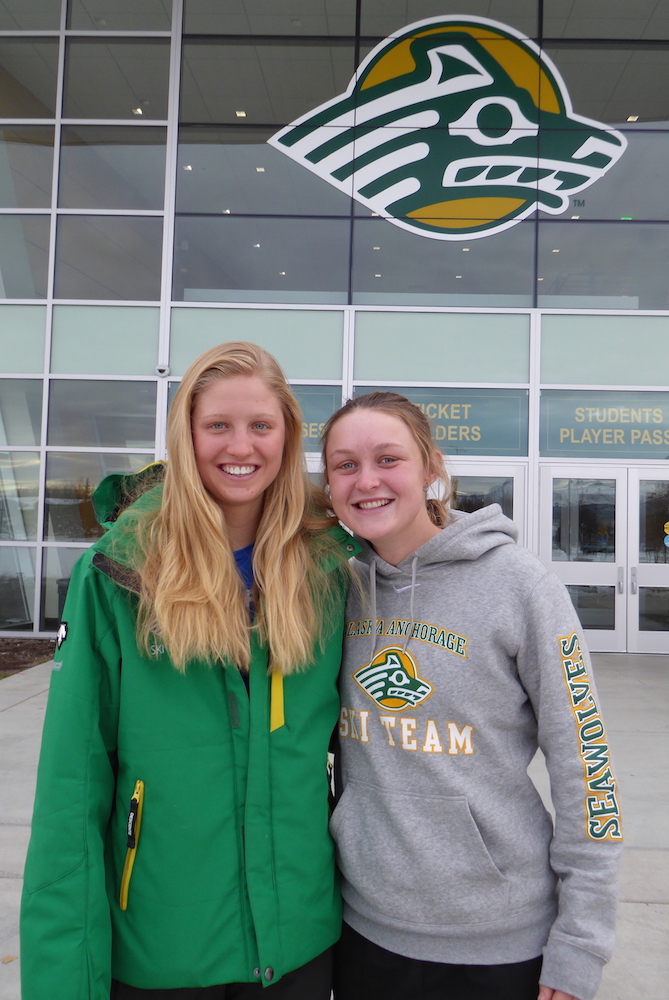
    University of Alaska Anchorage Seawolves skiers Hailey Swirbul (l) and Casey Wright (r), photographed on the UAA campus in Anchorage, Alaska, in October 2016. (Photo: Gavin Kentch)
    UAA skiers Hailey Swirbul (l) and Casey Wright (r), photographed on the UAA campus in Anchorage, Alaska, in October 2016. (Photo: Gavin Kentch)

    Another athlete, nordic skier Casey Wright, also spoke. The junior skier and Australian national had been defiant even in the face of adversity, telling FasterSkier two weeks ago – the day after news first broke of the ski team’s apparent demise – that “we’re going to rally together, and we’re going to have a memorable season.”

    Wright was happier at the rally, but no less confident. “We’re all going to try our absolute best to kick some butt” this year, she told the crowd, “and show everyone what it means to be a Skiwolf.”

    A common theme among all the speakers was heartfelt gratitude at the groundswell of support from across the state and around the world.

    “I can’t say thank you enough to all the people who wrote letters and signed the petition,” Field said. “We’re so blessed.”

    The UAA ski team released a video earlier Thursday thanking supporters for their help.

    André Horton, an Anchorage native, former member of the U.S. Alpine Ski Team and one of the guiding forces behind the formal #savealaskaskiing movement, expressed similar sentiments.

    “At one point yesterday,” Horton said, “the Board of Regents was getting one email [from #savealaskaskiing supporters] every two minutes. … I think if I were them, I would be uninstalling Outlook right now.”

    Horton audibly choked up as he addressed the assembled crowd. “They say there’s a rivalry,” Horton said, in reference to perhaps exaggerated antagonism between Anchorage and Fairbanks, “but when someone threatens our sport, we all pull together.”

    (A contemporaneous march in Fairbanks also featured strong turnout, including at least one marcher dressed as a polar bear in homage to the University of Alaska Fairbanks mascot, the Nanooks.)

    Another speaker, Anchorage’s Holly Brooks, echoed Horton’s reaction to the rapid rise of #savealaskaskiing.

    “It’s amazing how fast this community came together,” Brooks said from stage. The sheer numbers of people who signed the petition (over 5,000 as of Thursday evening) show “how amazing this small ski team is.”
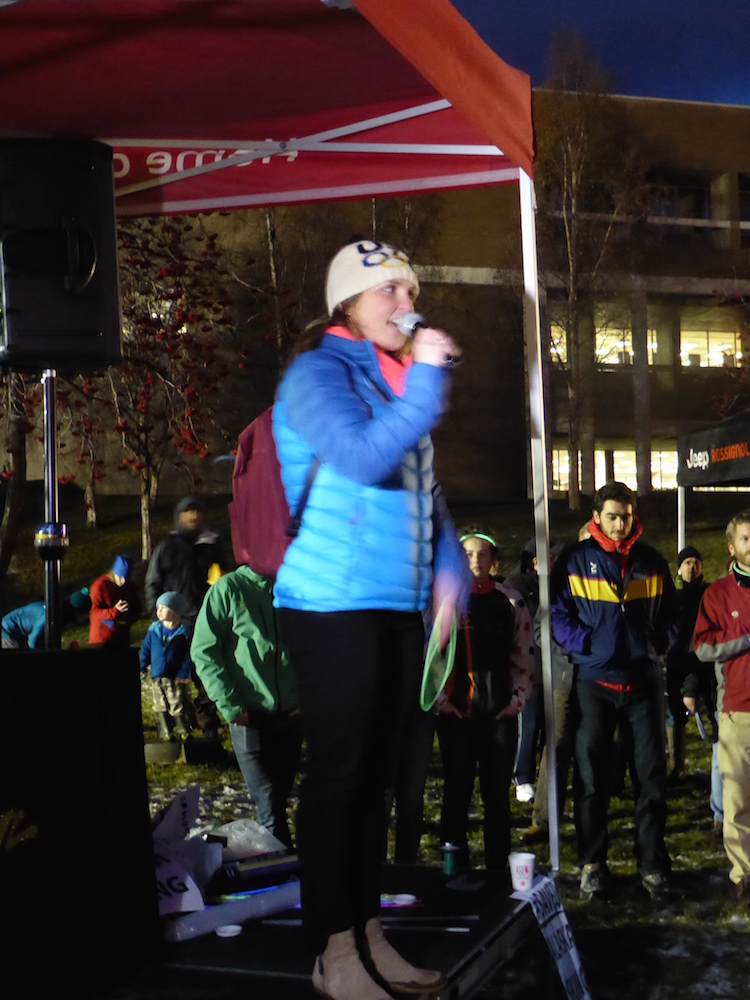
    Former Whitman College and USST skier Holly Brooks addresses the crowd at the #savealaskaskiing rally in Anchorage, Alaska, on Nov. 10, 2016. (Photo: Gavin Kentch)
    Former Whitman College and USST skier Holly Brooks addresses the crowd at the #savealaskaskiing rally. (Photo: Gavin Kentch)

    Brooks attended Whitman College in the early 2000s, and skied collegiately there. But the Whitman ski program was cut a few years after she graduated. “That pulled at my heartstrings,” Brooks recounted, “and I wanted that not to happen again.”

    Brooks recounted that if she hadn’t skied in college, she wouldn’t have come to Alaska, wouldn’t have coached high school skiing, let alone for Alaska Pacific University, and never would have made two Olympic teams. NCAA skiing was very important to her in her journey to the Olympics, Brooks said, her relatively lackluster results as a college racer notwithstanding.

    “It was a really important time for me, even though it was not my fastest time as a skier.”

    Current UAA skier Hannah Rudd, a freshman from Plymouth, Minn., is working on becoming a faster skier right now.

    “Right now, we’re just really focusing,” Rudd told FasterSkier in an in-person interview when asked about the current priorities of the nordic team. “We’re getting into a lot of intensity right now. For sure, we’re going to keep on fighting for the team, but we are really focusing on our skiing and trying to have the best year that we can possibly have, so we can really prove ourselves.”

    Recounting recent events, Rudd said, “This whole last week has been quite, like, an emotional rollercoaster. But we woke up this morning, just thinking it was a regular day. We went to practice, and we could see, like, a big smile on our coach’s face, and he was like, ‘We have been saved!’ And it was one of the most exciting things that has happened.”

    Rudd said that it had been “amazing” to see 5,000 people sign a petition and stand up for college skiing in Alaska. “I come from Minnesota,” Rudd said, “where it’s a pretty big ski community, but Alaska – the ski community is just phenomenal. It’s been just so good to hear everyone’s responses and support. It feels good to have someone behind us.”

    Charlie Renfro, a lifelong Alaskan and former UAA skier, helped to organize the #savealaskaskiing movement and provide an avenue for that support. He was unapologetic about doing all this work even when college skiing – even in Alaska – typically suffers from a low profile within the American ski community.

    “I think it’s just really important to this community to have skiing be really visible,” Renfro told FasterSkier in person. “We’re a winter city, Fairbanks is a winter city, we believe in skiing. I think as long as there’s snow on the ground here, and as long as people are recreating outside, I think skiing needs to be represented at the university.”

    Renfro was optimistic about the next steps for this cause.

    “I think just figuring out how to harness this momentum that we’ve got going [will be the next challenge],” Renfro said, “and to be able to really get this group of people that’s supporting skiing to be able to reach out and fund the cause monetarily. And we’re not totally sure how we’re going to do it yet, but we’re just really happy that we’ve been able to unify, and hopefully moving forward we’ll be able to mobilize monetarily like we have for this.”

    Horton sounded similar notes, in an in-person interview before the rally, when asked what happens next year.

    “That is a 50-million dollar question,” Horton said, referring to the total amount cut from UAA’s budget this year alone.

    UAA assistant nordic coach Sara Studebaker-Hall (center, white hat) at the #savealaskaskiing rally in Anchorage, Alaska, on Nov. 10, 2016. Former UAA skier and current USST member Sadie Bjornsen (pink jacket) is to her left. (Photo: Gavin Kentch)
    UAA assistant nordic coach Sara Studebaker-Hall (center, white hat) at the #savealaskaskiing rally. Former UAA skier and current USST member Sadie Bjornsen (pink jacket) is to her left. (Photo: Gavin Kentch)

    “I think today’s success was very exciting for the community, yes, but I told everyone it should be a scaled success,” Horton said. “Meaning, we know cuts are going to be inevitable in the future. But what this has done is it’s galvanized very disparate communities of skiers all into one group. So I think, going into the future, we’re going to have a unified group of people able to make corrections in our spending, so that we can actually afford skiing the way we should.”

    Horton also addressed the question he had occasionally received over the past few weeks – why did someone who didn’t even ski for UAA care about this program?

    Horton’s answer was instantly relatable to any nordic skier who has ever pored over a USSA points list or sought out an event with a more favorable race penalty: “I’m very thankful, because I would have never made the national team [without UAA], because I utilized UAA’s points base,” Horton said. “Meaning like, without their rankings, I would not have been able to go to the Lower 48 and actually have a chance. So there are several races I know that were key, where I could ski fast enough against UAA guys that, by the time I got to the Lower 48, my rankings were there.”

    From a less utilitarian perspective, Horton also addressed the importance of visible role models. “As a younger kid even,” Horton continued, “you look up to these, like, really fit ex-World Cuppers that are at UAA, and that was pretty cool. And to go further with that even, if UAA goes away, I feel for the younger base of athletes. They won’t have that base I did. And you can’t replace it. If you rebuild a program, it takes years.”

    Horton’s views on the role of college skiing in developing American athletes were readily applicable to either nordic or alpine skiing. “I always told people this analogy,” Horton recounted: “For every one college athlete, you have 200 juniors. Just how the funnel works, how the pipeline works. So it’s like a pyramid, you know. You got your World Cuppers, your U.S. Ski Teamers, and your college skiers at the top. So every one of those you lose, you lose that junior base.”

    In the rally itself, Adam Verrier, a local longtime volunteer assistant coach for the UAA nordic team, closed by acknowledging future budget cuts and the need for secure funding moving forward. “This isn’t over,” Verrier said.

    The rally’s final speaker, Tlisa Northcutt, the development director for UAA Athletics, was glad to share the link to the Annual Fund to support UAA sports. The comparable site for UAF Athletics is here.

    Soon after Northcutt finished speaking, the rally dispersed. Junior skiers from local training group Alaska Winter Stars flocked to the waffle truck. Happy Skiwolves danced in front of the stage. The next morning, they would wake up and go to training.


  • Questions Swirl Over University of Alaska’s Waiver Requests to NCAA

    Questions Swirl Over University of Alaska’s Waiver Requests to NCAA

    The Alaska Airlines Center, home to the University of Alaska Anchorage Seawolves athletics program in Anchorage, Alaska, photographed last month. (Photo: Gavin Kentch)
    The Alaska Airlines Center, home to the University of Alaska Anchorage Seawolves athletics program in Anchorage, Alaska, photographed last month. (Photo: Gavin Kentch)

    The University of Alaska system structured its recent waiver requests to the NCAA partially around a presidential directive to preserve men’s hockey at any cost, then backed away from that suggestion in a public explanation of its actions, an analysis of the school’s official waiver documents suggests.

    University of Alaska Anchorage (UAA) Athletic Director Keith Hackett and President Jim Johnsen announced last week that men’s and women’s skiing at both UAA and the University of Alaska Fairbanks (UAF) were among the sports targeted for elimination in a waiver request submitted to the relevant NCAA membership committee. At the time, Johnsen told the Alaska Dispatch News that “hockey survived largely because the NCAA requires a school to offer two men’s team sports and two women’s team sports,” and that the only men’s team sports at both UAA and UAF are basketball and hockey. (NCAA bylaws consider cross-country skiing to be an individual sport.)

    But the official waiver requests submitted to the NCAA were somewhat less circumspect. “The President of the University System has stated that Alaska Anchorage shall make every effort to retain men’s hockey,” UAA’s waiver request stated. And “the President of the University System has stated that Alaska Fairbanks shall make every effort to retain men’s hockey,” UAF’s waiver request stated in near-identical language.

    (The waiver requests are substantively identical, but were written, or at least edited, by different people. Run-on sentences, typographical errors, and citations to nonexistent bylaw provisions that are present in the UAA waiver request were corrected in the UAF version of the same document.)

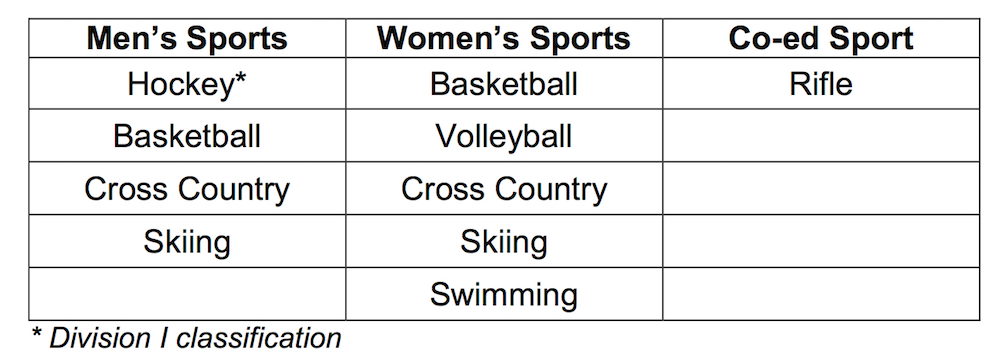
    The 13 sports currently sponsored at UAA are as follows:

    Table of 13 sports currently offered at University of Alaska Anchorage (UAA), prior to its waiver request to the NCAA in November 2016. (photo: screenshot from UAA waiver request)
    Table of 13 sports currently offered at UAA, prior to its waiver request to the NCAA this month (Screenshot from UAA waiver request)

    The 10 sports currently sponsored at UAF are as follows:

    Table of 10 sports currently offered at University of Alaska Fairbanks (UAF), prior to its waiver request to the NCAA in November 2016. (photo: screenshot from UAF waiver request)
    Table of 10 sports currently offered at UAF, prior to its waiver request to the NCAA this month. (Screenshot from UAF waiver request)

    The team sports offered at UAA, according to NCAA Division II Bylaws Section 20.10.3.3, are men’s basketball, men’s ice hockey, women’s basketball, and women’s volleyball. This bylaw defines all other sports at UAA (cross-country running, skiing, indoor and outdoor track, and gymnastics) as individual sports.

    At UAF, the team sports are men’s hockey, men’s basketball, women’s basketball, and women’s volleyball. Cross-country running, skiing, swimming, and rifle (riflery) are all defined as individual sports.

    UAA and UAF are currently both members of the Great Northwest Athletic Conference, or GNAC. UAA and UAF both wrote in their waiver requests that they must sponsor basketball, volleyball, and cross-country running in order to remain a member of GNAC.

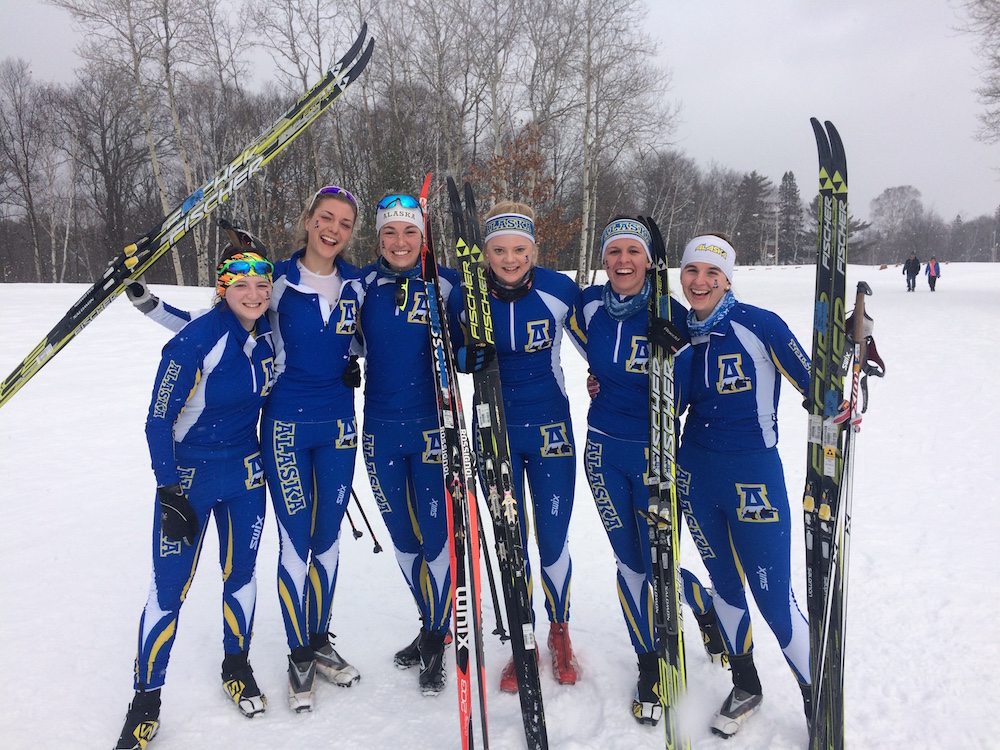
    University of Alaska Fairbanks women's nordic-team skiers get together for a photo last season: (from left to right) Hannah Rowland, Anne-Tine Markset, Nichole Bathe, Martina Himma, Ann-Cathrin Uhl, and Sarissa Lammers. (Photo: Nick Crawford)
    University of Alaska Fairbanks women’s nordic-team skiers get together for a photo last season: (from left to right) Hannah Rowland, Anne-Tine Markset, Nichole Bathe, Martina Himma, Ann-Cathrin Uhl, and Sarissa Lammers. (Photo: Nick Crawford)

    Waiver options

    UAA and UAF are both seeking relief from the requirements of Bylaw 20.10.3(a), which states that a Division II member school “shall sponsor” a minimum of “Five varsity intercollegiate sports, including at least two team sports, based on the minimum requirements of Bylaw 20.10.3.3 and involving all-male teams or mixed teams of males and females; and five varsity intercollegiate sports, including at least two team sports, based on the minimum requirements of Bylaw 20.10.3.3 and involving all-female teams.”

    There are therefore two parts to this bylaw: the requirement that a school have at least 10 sports, and the requirement that a school have at least two team sports per gender.

    Both UA schools are seeking a waiver solely of the 10-sports-total provision of this bylaw. It is unclear how much attention was paid to the possibility of seeking a waiver of the two-team-sports provision, in addition to or instead of the 10-sports-total provision. Gaining some leeway with regard to the two-team-sports requirement would potentially allow either school to look anew at hockey or basketball, the two most expensive sports at UAA by a substantial margin, as a potential target for cuts.

    Hackett, the UAA athletic director, was asked by email, “Did UAA consider seeking a waiver of the two-team-sports requirement, in addition to or instead of the ten-sports-total requirement?” He wrote back, “Yes, many months ago as part of Strategic Pathways. The answer is NO to the second part of your question.”

    Hackett was also asked whether men’s hockey could be said to be receiving special treatment from Johnsen, the UA President, when men’s basketball is also a team sport (as well as one required for GNAC membership).

    Hackett wrote, “Both waivers stated the same thing with regard to making every effort to retain Hockey at both Institutions as directed by President Johnsen. Both UAA and UAF are members of the GNAC and we wanted to be sure we would be able to maintain our Full membership with our primary Division II Conference. Men’s Basketball was not part of any discussion.”

    The budget for the UAA hockey team for the 2016/2017 season is, in round numbers, $1,347,000 dollars. The budget for the men’s basketball team is $467,000. The budget for the women’s basketball team is $446,000. The budget for each of the men’s and women’s ski teams (at UAA, this includes alpine as well as nordic) is $280,000.

    While direction from President Johnsen features as a significant part of the official waiver request that was submitted to the NCAA on behalf of both schools, this presidential involvement is not mentioned in the Frequently Asked Questions document posted on the Strategic Pathways website.

    “In the waiver application why was hockey named specifically as a sport to keep when it is the most expensive sport?” asks question 2 of the FAQ document.

    The answer given there is, “In making these decision [sic], cost was a driving factor, but it was not the only one. We applied a set of reasonable criteria that included keeping specific sports required by GNAC in order to keep our membership in that conference, making sure we are adhering to the gender equity requirements of Title IX, keeping the strong instate rivalry between UAA and UAF and cost.”

    Additional surprises?

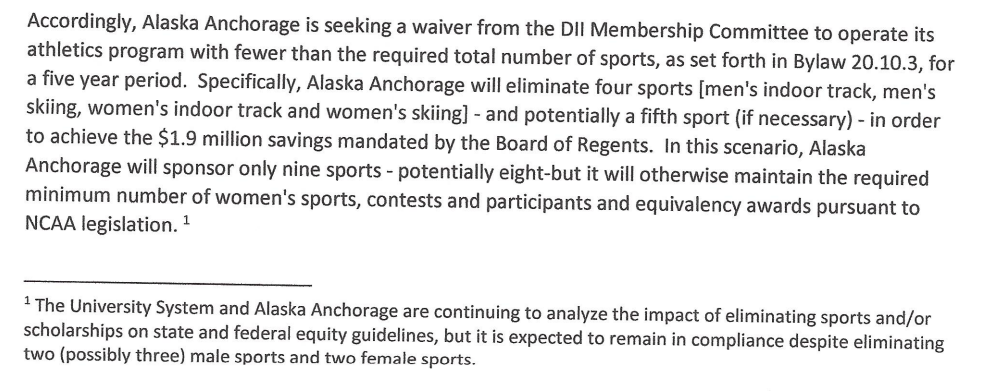
    While all previous reporting on this story, in FasterSkier, the Alaska Dispatch News and elsewhere, has focused on UAA’s announced plan to eliminate four sports (men’s and women’s skiing and men’s and women’s indoor track), the official request submitted to the NCAA actually mentions the possibility of cutting a fifth sport if financially necessary:

    Detail from waiver request by University of Alaska Anchorage (UAA) to NCAA in November 2016. (photo: screenshot from UAA waiver request)
    Detail from waiver request by University of Alaska Anchorage to NCAA this month. (Screenshot from UAA waiver request)

    The language in the footnote – “two (possibly three) male sports and two female sports” – suggests that, if a fifth sport were to be cut, it would be a third men’s sport. Assuming for the moment that basketball and hockey are “protected” (by virtue both of being team sports and of UAA not having sought a waiver to the two-team-sports requirement), that leaves men’s cross-country running and men’s outdoor track potentially vulnerable as a fifth sport to be eliminated.

    (Analogous language in the UAF waiver request mentions cutting only two sports, men’s and women’s skiing, alongside reducing scholarships among the remaining eight sports.)

    Furthermore, both schools’ waiver requests seek a waiver of the 10-sport requirement for a set period, five years, and promise to “evaluate its options to return to the 10-sport minimum required for compliance with Division II membership criteria” at the start of the 2021/2022 season.

    When asked whether he thought that elimination of a fifth sport would be necessary, Hackett wrote, “I certainly hope not. I am not sure there is a timeline in place for making any further team decisions. I have not spent any time considering additional sport team reductions.”

    When asked whether he expected that any eliminated sport would be able to return after having been cut for five years, Hackett wrote, “It would be difficult to ascertain.”

    Recent developments

    Since news of the waiver request first broke last week, supporters of the #savealaskaskiing movement have been busy. There is a website. (The team behind the website includes André Horton, currently a consultant with a lobbying and campaign management group but formerly a member of the U.S. Alpine Ski Team, as well as UAA head ski coach Sparky Anderson, Horton told FasterSkier in an email.) There is a march and public protest planned for Fairbanks next Thursday afternoon, Nov. 10, in connection with the upcoming Board of Regents meeting. And there are alternative budget proposals being advanced that claim to save an equal amount of money through administrative restructuring, while leaving academics and athletics programs unscathed.

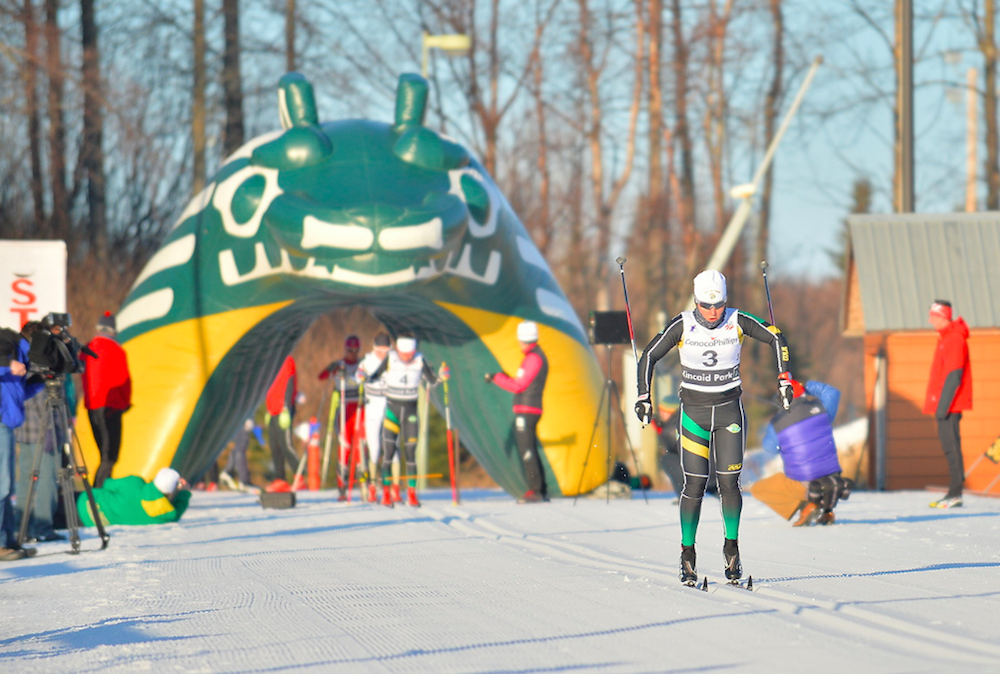
    Manon Locatelli of the University of Alaska Anchorage double poles out of the start of the 2015 Seawolf Invite at Kincaid Park in Anchorage, Alaska. (Photo: Sam Wasson Photography / http://portfolio.samwassonphotography.com/about)
    Manon Locatelli of the University of Alaska Anchorage double poles out of the start of the 2015 Seawolf Invite at Kincaid Park in Anchorage, Alaska. (Photo: Sam Wasson Photography / http://portfolio.samwassonphotography.com/about)

    The University of Alaska Board of Regents heard public testimony for two hours on Monday afternoon. While the teleconference window was technically open to anyone who wanted to testify on any subject, firsthand reports from people who listened to the testimony suggest that the focus was overwhelmingly UAA and UAF skiing, and that all testimony on this subject was in favor of preserving the program.

    Nearly all “of the comments were regarding skiing,” wrote third-generation Alaskan, former UAA skier, and former Alaska Pacific University ski coach Charlie Renfro in an email to FasterSkier. The only exceptions were “a couple comments about other university programs that were/are on the chopping block.”

    “Something like 50 people were able to comment,” Renfro continued, “and I would say about 48 of them were very constructive and from people who are all very knowledgeable regarding the UAA/UAF programs – both nordic and alpine. Nearly everyone that called in, I knew personally from either nordic or alpine, past, present, athletes, coaches and parents. One girl, a ski alum who said she was calling from Copenhagen (it was 2am there) gave an incredibly concise, heartfelt speech. It was very moving. I hope the [Board of Regents] felt the same way.”

    Anchorage resident Ira Edwards, who previously skied on the UAF nordic team and currently works for the State of Alaska, Department of Natural Resources (ski fans may recognize Edwards’s name from his side job – he spent many years as Rossignol’s U.S. race service manager), expressed similar sentiments.

    Rossignol tech rep Ira Edwards provides race support at a race at Kincaid Park in Anchorage, Alaska.
    Rossignol tech rep Ira Edwards provides race support at a race at Kincaid Park in Anchorage, Alaska.

    “I have called into these before, for various other reasons” unconnected to athletics, Edwards told FasterSkier in a recent phone interview. “Generally, they have an hour and a half for testimony, or sometimes only an hour – they anticipated a higher call volume, so I think they bumped this one up – but I don’t think I’ve ever heard more than five or six people ever call in.”

    But on Monday afternoon, Edwards called in roughly a half hour after the public comment window opened, and was caller number 41 in the telephonic queue. He was the last person to be able to speak on Monday; the Board closed testimony immediately after he had finished speaking, after hearing two hours’ worth of comments. Edwards personally knew of a friend who was caller number 91 – that is, there were at least 50 more people after him who had hoped to speak – and suspects that there were a total of “well over 100 people” on the line who called in in an attempt to testify.

    Edwards recalls a total of three comments that were not about skiing (and one of those concerned the school’s running program). “There was not a single negative comment [about skiing],” Edwards said.

    Next steps

    Two things would have to happen for either or both of the UA system’s waiver requests to be approved: (1) first the NCAA Division II Membership Committee must approve the request, and (2) then the University of Alaska Board of Regents must approve the request.

    The membership committee holds a regularly scheduled in-person meeting in Indianapolis on Tuesday and Wednesday of next week, Nov. 8-9. Committee chair Kevin Schriver told FasterSkier on Monday that the committee “will see if that [the UA waiver requests] will be a part of our agenda.” An agenda for next week’s meeting is not yet posted online.

    The University of Alaska Board of Regents meets the following two days, Thursday and Friday, Nov. 10-11, in Fairbanks. The agenda for that meeting “has not yet been posted,” a Board of Regents representative told FasterSkier in a Thursday afternoon phone call. They said it would be posted on Friday, Nov. 4.

    The Board of Regents agenda and related materials should be accessible from here once they have been posted. Information about a live stream of next week’s Board of Regents meeting is available on the same page.

    Differing perspectives

    While many Alaskans are banding together in support of the ski program at both schools, the specific mood on both campuses seems somewhat different, reflecting differing circumstances and divergent views of the possibility of the NCAA granting the relevant waiver request.

    In Fairbanks, ski team supporters are holding out hope that the NCAA 10-sport rule will operate as a bulwark to keep UAF from cutting the relatively low-profile sport of skiing.

    Nick Crawford, 28, who headed the Bogus Basin Nordic program as well as the Lathrop High School ski team, will assume the role of head coach of the University of Alaska Fairbanks nordic and cross-country running teams in July. (Courtesy photo)
    UAF head nordic coach Nick Crawford. (Courtesy photo)

    As UAF head nordic coach Nick Crawford wrote to FasterSkier last week, “For UAF specifically, I don’t think skiing will be cut as I don’t think the NCAA will grant the waiver to the ‘10 sport minimum requirement.’ One of the NCAA’s core values is to provide sporting opportunities from athletes of many different sports and the 10 sport rule is in effect to protect small sports like skiing. It’s a slippery slope to allow Alaska to cut ‘less well known’ sports like skiing and indoor track to continue to fund their more popular sports,  If the NCAA grants this waiver, it sets a precedent to eliminate non-revenue generating sports across the country with fewer and fewer sports offerings and that is not a direction I think the NCAA wants to go in.”

    One of Crawford’s athletes, sophomore skier Conner Truskowski, expressed similar sentiments and included a call to action, writing to FasterSkier, “When we first got the news we were all pretty bummed out and mad that something as Alaskan as skiing was being considered for cuts. However, now that we have had time to process what could happen, we are all motivated to prove to the NCAA and everyone else that we are willing to fight for the sport we love and prove that the ski community benefits from having us as a team here. I want to stress that no decision has been made yet and there is still time to let everyone in the decision making process [know] that skiing is valuable. We believe that the waiver will not pass because the NCAA does not generally allow exceptions to their rules. Because of all that has happened, we are training harder than ever to make our season the best one we’ve ever had. Again, I really want to make it clear that no decision has been made yet and to let everyone know that their voice can be heard in the decision. Let the NCAA know that Alaska skiing is valuable to the ski community, both locally, nationwide, and worldwide.”

    But at UAA, head nordic coach Andrew Kastning sounded somewhat more resigned, as if the NCAA were less of a bulwark and more of a Maginot Line.

    In a recent phone interview, Kastning told FasterSkier, “Ultimately, I have a sliver of hope that the waiver doesn’t pass, that the Regents can be swayed and decide that skiing has to be saved and they need to make another decision. So I feel like there’s a tiny chance for UAA to survive at this point. But it’s obviously a giant hurdle to clear when the athletic director and the president have publicly recommended that this is the route to go to save the school money.”

    While Kastning was clearly saddened, he saved his strongest disappointment for his athletes. “I ache the most for my athletes,” Kastning said, “the ones that I’ve coached and the ones that know how special the situation and an experience it is to go to UAA and ski race in Alaska, and travel around the American West. And also for the current team, that has just gotten here and has only been here for a year at most, and they’re really bonding well and working really hard to reach their goals. And because of some short-sighted decisions and a tough budget situation, are faced with having to find another path.”

  • Remembering Anchorage Ski Association President Lars Spurkland

    Remembering Anchorage Ski Association President Lars Spurkland

    Lars Spurkland skis to second-place in the 100-kilometer Homer Epic in 2013. (Photo: Don Pitcher)
    Lars Spurkland skis to second-place in the 100-kilometer Homer Epic in 2013. (Photo: Don Pitcher)

    A towering bundle of energy was extinguished on Dec. 12, when Nordic Skiing Association of Anchorage (NSAA) President Lars Spurkland died of an aneurysm.

    Spurkland, 39, was known widely throughout the Anchorage outdoors community for his towering physique (he was 6-foot-7), good nature and boundless energy.

    “‘What didn’t he do?’ might be a better question to ask,” his younger brother, Jan Spurkland, wrote in an email to FasterSkier. “Lars coached high school kids, taught beginner ski lessons, served as a race volunteer, and jumped in any race that he was in town for. ”

    Jan recounted a story of skiing at National Masters Championships this past spring, when his older brother spent the day setting up the race, did the race, and then, while everyone else was resting after the race, jumped on a snowmachine and picked up the course markers.

    But within the greater Anchorage community, Spurkland was known for much more than being a cross-country skier. When the Alaska Dispatch News published an article about his death, it featured a photo of him carving a telemark turn at Turnagain Pass.

    The long comment thread on the article is filled with remembrances of his skill as an engineer (Spurkland was owner and principle engineer at Spurkland Engineering, which was founded by his father, Tobben Spurkland); his grace and skill as a competitor, going all the way back to his junior career and racing at Dimond High School in the early 90’s; his skill as a telemark skier; and the effect he had on young peoples’ lives as a ski coach.

    East High School Coach Lars Spurkland carves a telemark turn at Turnagain Pass in January 2012, on a ski day with APU Coach Charlie Renfro and then East High Assistant Coach Corky Still. (Photo: Charlie Renfro)
    East High School Coach Lars Spurkland carves a telemark turn at Turnagain Pass in January 2012, on a ski day with APU coach Charlie Renfro and Corky Still, who was Spurkland’s co-coach at East High at the time. (Photo: Charlie Renfro)

    “He had a passion for skiing that covered all disciplines,” his brother explained. “He never seemed to worry about his fitness, or where he would place on a result sheet, he simply loved to be out there skiing.”

    ‘Tele skiing was his identity’

    “Lars was a tele skier born and bred,” Jan continued. “He tried to get out on his tele boards several times a week, with a short list of local backcountry runs that he could steal in after quitting work early. It was also through tele skiing that he met his future wife, Raye Ann.”

    “Lars is so exceptional,” Spurkland’s wife, Raye Ann Neustel, wrote in an email.

    Neustel and Spurkland traveled extensively, going on backcountry ski trips in British Columbia, Colorado, the Sierras, the Mt. Blanc massif and other areas in Europe. They took peak-bagging trips to Mexico, Peru and the Himalayas. In 2010 they summited and skied Denali together.

    “Lars’ priority was to recreate,” she continued, alternating between present and past tense when discussing Spurkland. “[He] was an exceptional athlete.”

    “I really do believe that Lars enjoyed himself the most high in the mountains, and he spent as much time there as he could,” Jan wrote.

    “He had a passion for skiing that covered all disciplines. He never seemed to worry about his fitness, or where he would place on a result sheet, he simply loved to be out there skiing.” — Jan Spurkland, about his older brother Lars

    Alaska Dispatch commenter Billy Finley posted about a day of after-work backcountry skiing in bad conditions in the Chugach Front Range, just outside Anchorage. He wrote about what Spurkland did while Finley tentatively made his way down steep, icy terrain.

    Lars waited patiently,” he wrote, “and when I was settled he slid off the top onto solid 40 degree ice. He took two turns and then spun around backwards and skied the rest of the run. Backwards. In tele skis. Perfectly.”

    Spurkland wasn’t just a skier. Longtime friend and noted-Anchorage mountaineer Sam Johnson recounted in a recent Facebook post the grim tale of a 2003 attempt on Mt. Foraker early in their climbing careers. He and Spurkland were trying to climb a ridge on the giant mountain, but during the ascent a massive cornice broke underneath Spurkland, sending him tumbling into space. Johnson leapt off the other side of the ridge, a desperate maneuver known as the “Fairbanks belay.” Only the counterbalance of the two men’s weight with the rope over the ridge held them on the mountain.

    I knew, just knew, that we were both going to die, and I imagine Lars did too,” Johnson wrote.

    But Spurkland was unhurt in his massive, upside-down fall off the mountain and was able to climb back up to the ridge.

    “Thanks Lars for changing my life,” Johnson concluded. “I’m glad you got another 11 years.”

    Lars Spurkland (l), Jan Spurkland (r), and Fischer Spurkland, Lar's nephew, at the Friends and Family Relay at Kincaid in 2012. (Photo: Megan Spurkland)
    Lars Spurkland (l), Jan Spurkland (r) and Fischer Spurkland, Lars’s nephew, at the Friends and Family Relay at Kincaid in 2012. (Photo: Megan Spurkland)

    ‘I wish I knew how to inspire the next generation to be more like him’

    Spurkland’s legacy, however, will not just be memories of days in the mountains, but also in the way he shaped the lives of others.

    As is the case for so many people, Tamra Kornfield did not consider the influence Spurkland had on her life until this week.

    Lars has, unexpectedly, been one of the most influential people on where my professional life has taken me,” she wrote in an email. “I met Lars when we volunteered together at U.S. Nationals helping set up the course. … The next fall I was in grad school and ran into Lars who said he was desperately seeking a female assistant coach for the East High Ski Team.

    “I said, ‘Absolutely not, I don’t have time for that,’ ” Kornfield continued. “And he said I could be the ‘fun’ coach and that it would be a good time and an easy gig. So I said yes, and never regretted it for a moment. Coaching with Lars at East was hands-down the BEST ‘job’ I’ve ever had.  Lars was the most easy-going coach who loved what he was doing. I never once saw him fazed or stressed out about anything, from wax to missed starts. He simply went with the flow and encouraged everyone to have as good a time as he was having.”

    Spurkland’s influence on Kornfield’s life did not stop there, however. She admired the flexibility he had in his engineering work.

    “There were plenty of days when Lars would go out for a back country ski and still make it to practice at East by 2pm. I coached for two years and then decided it was time to get an engineering job,” she wrote. 

    However, after a couple of years of work as an engineer, Kornfield wasn’t sure it was for her. Spurkland continued to to encourage her to pursue what made her happy, offering her a position as program director at the NSAA.

    “I had a serious talk with him about ruining my chances at becoming an engineer. He said he too had taken a break from engineering and still earned his [professional engineering license] after returning to work. He added that I would be building excellent skills that would be beneficial to any future work I chose to do. I think he also knew how much I would enjoy working at NSAA,” she wrote.

    “He was probably the best person I’ve ever met at balancing fun and work. Once I began working at NSAA I realized how many hours he actually put into the Ski Club. I wish I knew how to inspire the next generation to be more like him.”

    ‘A MOUNTAIN of a man’

    "The Big Guy doing his thing."  Spurkland at Spring Nationals at Kincaid in 2014. (Photo: Charlie Renfro.)
    “The Big Guy doing his thing.” Spurkland at Spring Nationals at Kincaid in 2014. (Photo: Charlie Renfro.)

    But in the weeks before his death, Spurkland had not been feeling like himself. In a blog post titled “#larswouldgo” sister-in-law Megan Spurkland wrote that Spurkland’s illness came to a head on Wednesday, Dec. 10:

    “On Wednesday morning, for the first time, Lars didn’t go. I woke up with an urge to talk to him. I couldn’t picture sitting in a room to talk, so I invited him for a ski.”

    Spurkland didn’t go, saying he had a doctor’s appointment, and didn’t feel well. That same day a blood vessel in his brain ruptured, causing a massive intracranial bleed.

    “The doctor would [have called] on Friday afternoon to tell Lars that he had Leukemia,” Megan wrote in her blog post. “On Friday morning Lars’ family would be holding vigil around him as his heart slowly came to a stop.”

    The acute myeloid leukemia likely caused the aneurysm, according to Megan. The pressure from the bleeding put pressure on Spurkland’s brain stem, stopping his heart.

    ‘Just about the most likable guy out there’ 

    Kathy Sarns had been Spurkland’s coach in Junior Nordics in the 1980s, and when she recently needed her well and septic tested, she hired Spurkland’s engineering firm. When she got the invoice, she was surprised to see that Spurkland had deducted the “Anchorage Junior Nordic League Coaches Discount.”

    “This kind gesture brought tears to my eyes,” she wrote in an email, “[I was] moved that he remembered those JN days from when he was a kid — so many years ago.”

    As an adult, Spurkland worked hard for the ski programs he grew up with. The day after his death, an impromptu high-school ski race was organized after a sanctioned race was canceled. It was called the Lars Spurkland Scramble.

    “Lars did so much for our Nordic community up here in Anchorage,” according to his friend Charlie Renfro. “Because of his high school coaching, race organization and his involvement with NSAA, he was interacting with a huge number of people almost every day during the winter — and everyone liked him.”

    “He [interacted] with a huge number of people almost every day during the winter — and everyone liked him.” — Charlie Renfro, about Lars Spurkland

    “Lars would always want a community of amazing skiers to inspire each other and create new skiers,” Neustel wrote of her husband. “Lars found humor in every situation, and had a graceful way of not ever coming close to having an ego.”

    “He never let anyone anger him,” she continued. “[Never] did he ever consider anything other than instant forgiveness. He was the gentle giant, many people have referred to him as such.”

    “He was a great friend to many of us and he will be dearly missed by all who knew him,” Renfro said of his friend.

    “When someone leaves,” Sarns concluded her email, “what we remember most ‘is the way they made us feel,’ and that is a gift that no one can take. Thank you Lars.”

  • NANANordic Grows Into New Name: Skiku Reaches More Than 3,000 Students

    NANANordic Grows Into New Name: Skiku Reaches More Than 3,000 Students

    Nick Treinen works to keep up with the kids in Shishmaref. (Photo: Brice Habeger, Piksik)
    Nick Treinen works to keep up with the kids in Shishmaref. (Photo: Brice Habeger, Piksik)

    “It’s not about skiing,” Shungnak School Principal Roger Franklin wrote in an email to FasterSkier. “It’s much more, and it’s saving lives daily.”

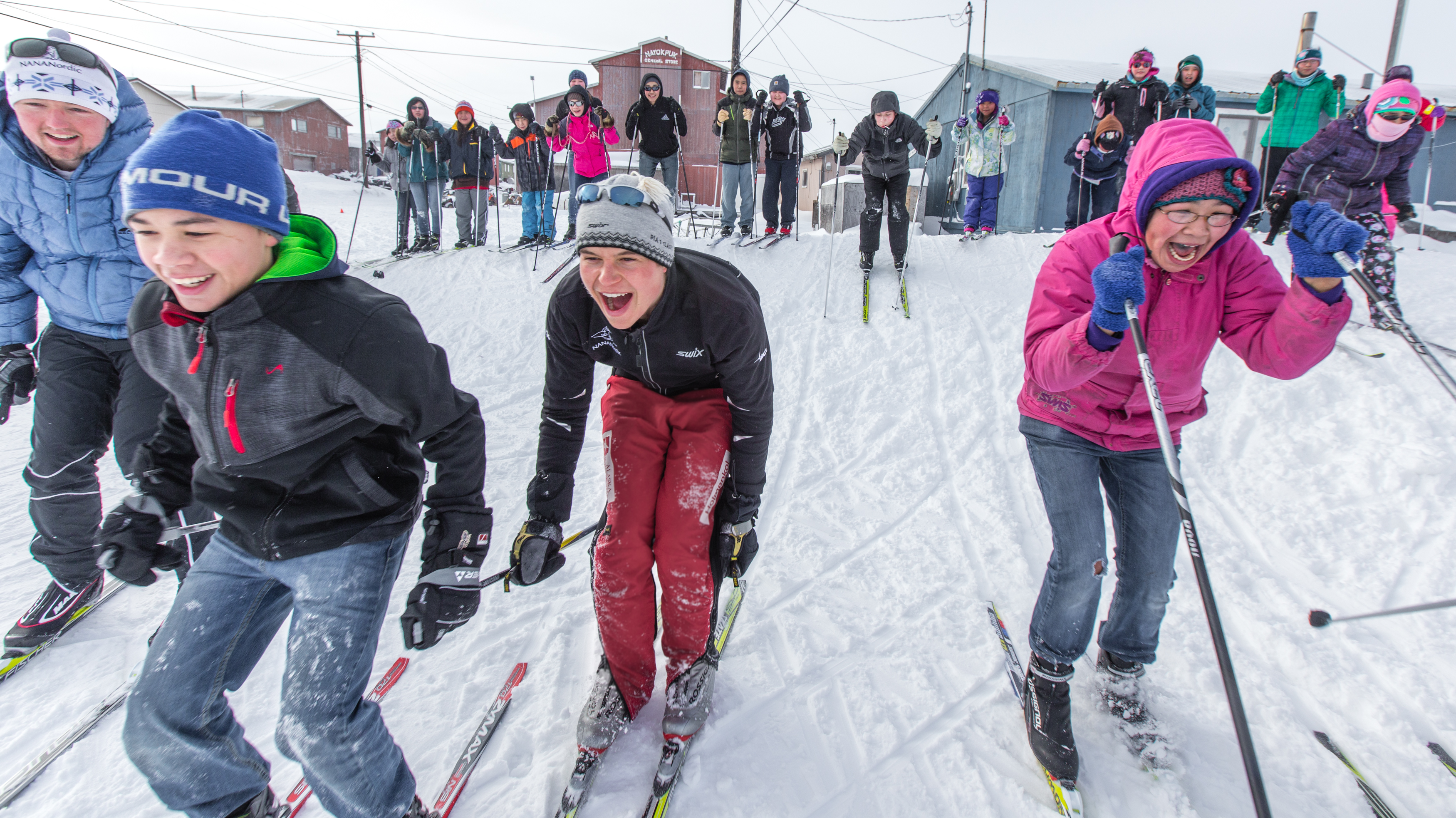
    Just don’t tell the kids that. The hundreds of them skiing and laughing and jumping and falling down might think you were crazy.

    The Shungnak School is 150 miles east of Kotzebue on the Kobuk River. Shungnak is one of 27 communities that received ski instruction through Skiku, known in the Northwest Arctic region as NANANordic. The program brings world-class ski racers, elite high-school racers, and community coaches to rural Alaskan schools each spring, along with ski equipment and enthusiasm for teaching the students to ski.

    NANANordic was covered by FasterSkier in 2012, the program’s first year, and in 2013 with the addition of biathlon to the program. FasterSkier also compiled links to videos made about the program in 2013 and 2014.

    “NANANordic has bought a positive trend to this region and our little village,” Franklin continued. “This program helped our kids find different ways to find a positive outlet than a negative one. It has given our students a chance to live a healthier life style and much more. It also has a component for family time spent skiing and understanding their kids’ struggles in life. It also has helped our students to stop thinking about suicides and other harmful things.”

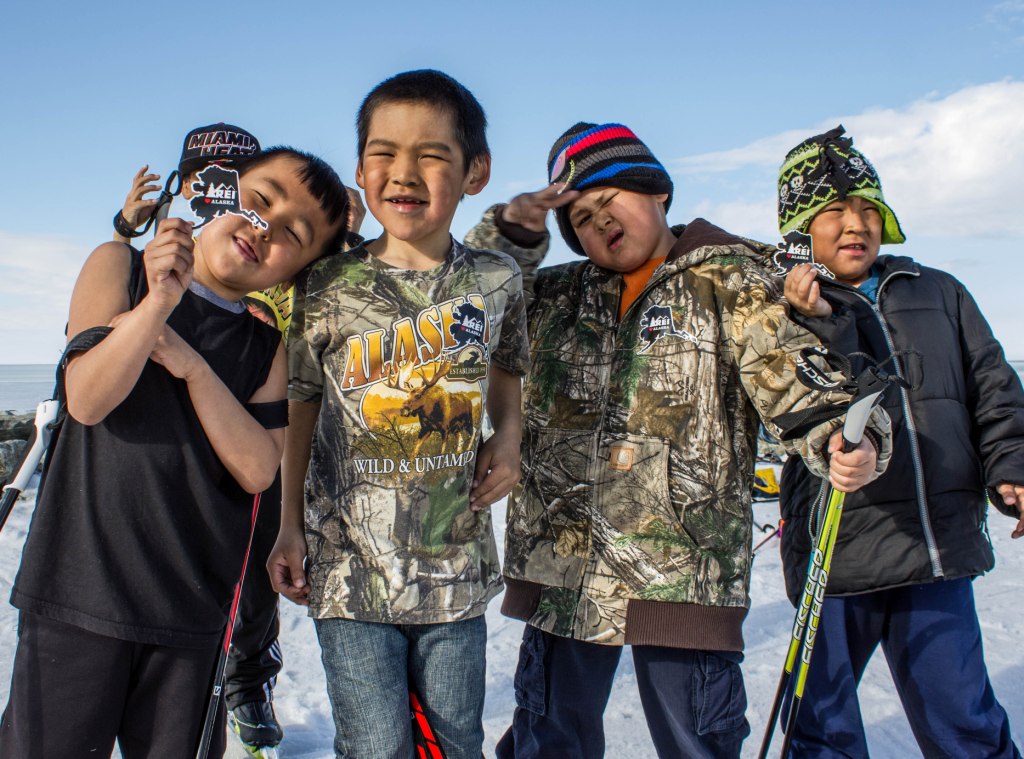
    Kids in Kivalina.
    Kids in Kivalina. (Photo: Reese Hanneman/Skiku)

    The statistics on rural Alaska are heartbreaking: rates of alcoholism, sexual violence and teen suicide are many times the national averages. In many areas the rates are so high that it constitutes a public-health emergency. So when Franklin says that NANANordic/Skiku is “saving lives daily,” it’s not merely hyperbole.

    History

    The program was started in 2012 by Lars Flora (a former elite racer and brother of Alaska Pacific University Head Coach Erik Flora), with the help of Robin Kornfield (who works for NANA Development Corporation), and Scott Warren, an educator with the Northwest Arctic Borough School District.

    That first year, NANANordic visited four villages — Kiana, Noorvik, Selawik and Kotzebue — in the NANA region in northwest Alaska. The following year it expanded to all 11 villages in the Northwest Arctic plus Anaktuvuk Pass, located in the Brooks Range, Alaska’s northernmost mountain range.

    As NANANordic grew and expanded into other regions, with the door open to further expansion, they needed a name that would be inclusive of the entire state. The directors settled on Skiku, a play on the word “siku,” the Iñupiaq word for ice. Within the NANA region the program is still called NANANordic, but for the sake of clarity both will be referred to as Skiku in this article.

    As NANANordic grew and expanded into other regions, with the door open to further expansion, they needed a name that would be inclusive of the entire state. The directors settled on Skiku, a play on the word “siku,” the Iñupiaq word for ice.

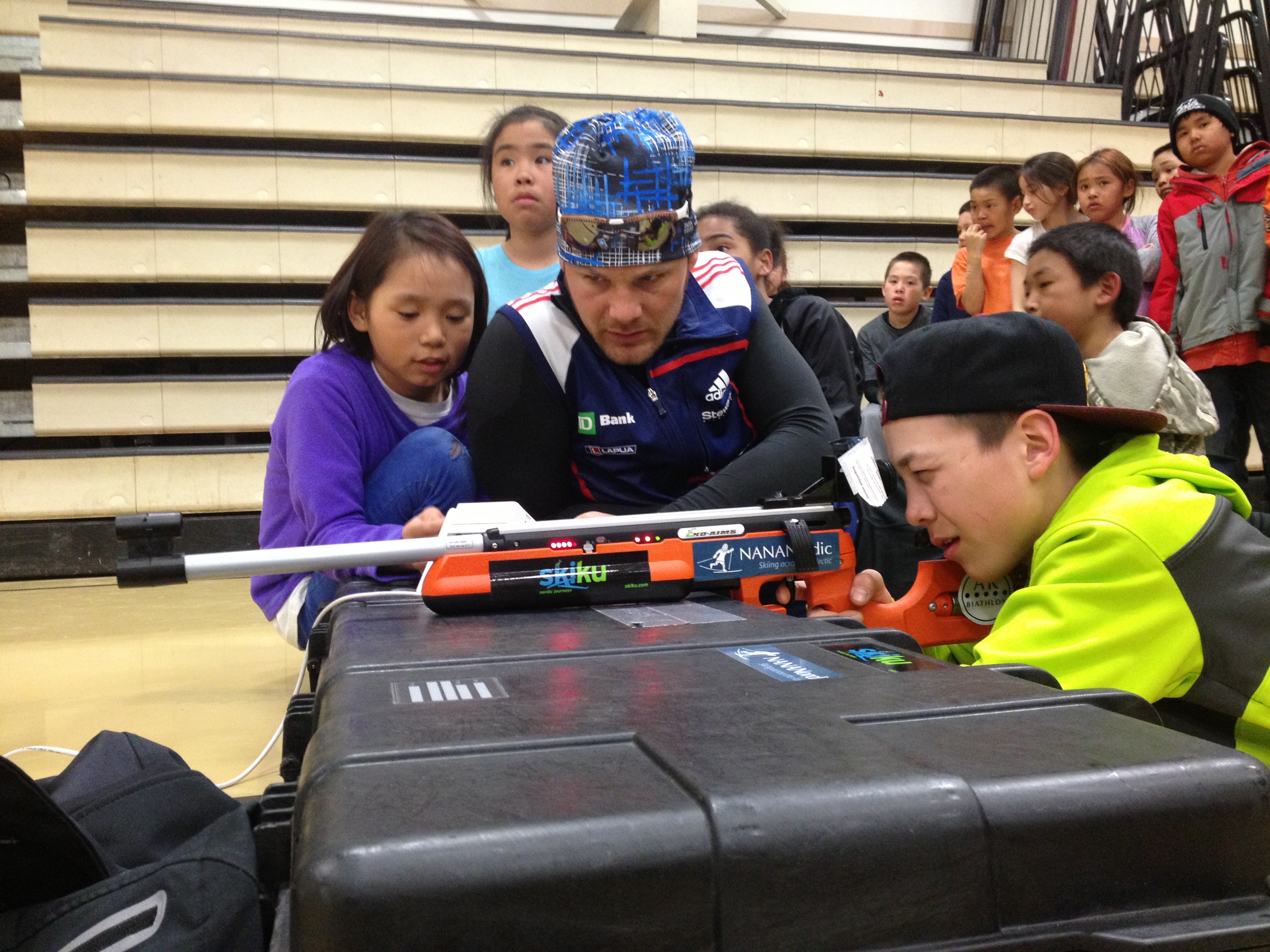
    This year, Flora and a veritable army of volunteer coaches — 80 in all — helped to bring skiing to over 3,000 kids, spending a week in each village, with many students skiing during school and again afterwards. The program has also begun a push to bring biathlon to village schools — a logical sport for the students, given the strong tradition of hunting in rural Alaska. They founded AK Biathlon as a sister organization to Skiku, brought on Zach Hall as the coach, and were able to purchase four infrared rifles to use with the kids.

    Zach Hall teaches shooting skills at an indoor range in Kotzebue. "Biathlon is a huge component of the program that makes cold days manageable since we stay inside shooting biathlon infrared systems," says Flora.
    Zach Hall teaches shooting skills at an indoor range in Kotzebue. “Biathlon is a huge component of the program that makes cold days manageable since we stay inside shooting biathlon infrared systems,” Flora says. (Photo: Skiku)

    Future of the Program

    After the 2013 season, Flora became the full-time director of Skiku, allowing him to push the expansion of Skiku into more than twice as many communities in 2014. Such rapid expansion is complicated for a small nonprofit, and Flora plans to expand more in 2015, looking to Bethel, in the Yukon-Kuskokwim region in southwestern Alaska.

    “A lot of activity directors across the state are a little worried about our expanding to so many places,” Flora said. “What [they’re worried about] is that you put the focus on teaching kids how to ski, and then what happens is that your websites aren’t polished. We could easily pull back and keep it at 27 for next year and make sure we have everything perfect in the office, but among everyone involved we just want to keep going getting the program into more places.”

    When asked about his priorities for future funding, Flora said that, in addition to expanding into more areas, he’d like to find a way to keep coaches in the communities longer.

    “In the very rough draft we made up, we put [next year’s volunteers] at about 110,” Flora said. “But the time spent in villages is a key piece. You can’t just dump ski equipment at a school and think that the teachers or the admin will run a ski program for you. It’s been done before, and what we’ve learned is that a lot of those kids don’t really know how to ski. At the end of the day we want to make sure that they actually learn how to ski at the places we go.”

    Community Support

    Photographer Brendan Smith joined the program in 2012 and 2013 as part of Healthy Portraits, an initiative by the Alaska Native Tribal Health Consortium, a native-owned public health consortium. Healthy Portraits focuses on success stories stories in rural Alaska, celebrating those who are taking steps to improve themselves and their communities. Smith produced a video about his involvement with NANANordic.

    27 Villages Visited in 2014:
    Barrow, Kotzebue, Kiana, Ambler, Anaktuvuk Pass, Noorvik, Shungnak, Deering, Noatak, Atqasuk, Kaktovik, Nuiqsut, Kobuk, Kivalina, Selawik, Buckland, Aniak, Sleetmute, Stony River, Crooked Creek, Nome, Shishmaref, Koyuk, Gambell, White Mountain, Unalakleet, and Pathway Home in Anchorage  
    The observations of the volunteers support the idea that the kids are enthusiastic about picking up the sport.
    “I guess the part that has surprised me the most how quickly the kids have learned to ski,” Alaska Pacific University (APU) coach Charlie Renfro wrote in an email about his experiences. “I take a lot of video footage of the kids each year and this year was crazy. Kids are V2-ing and hitting jumps and just making it look easy. All with pretty minimal time on skis. They aren’t afraid to fall, they aren’t afraid to look silly, they aren’t really afraid of anything. I think that is such an awesome way to learn. As a result they are getting pretty proficient quickly and they all really seem to like it, which makes it super-fun for all of the coaches. The kids can feel themselves improving too, and, I think that is a big motivator.
    “The NANA/Kobuk River Region is so vast and beautiful,” Renfro continued. “That, combined with the incredible people and of course the awesome interactions with the kids, has kept me coming back year after year.”

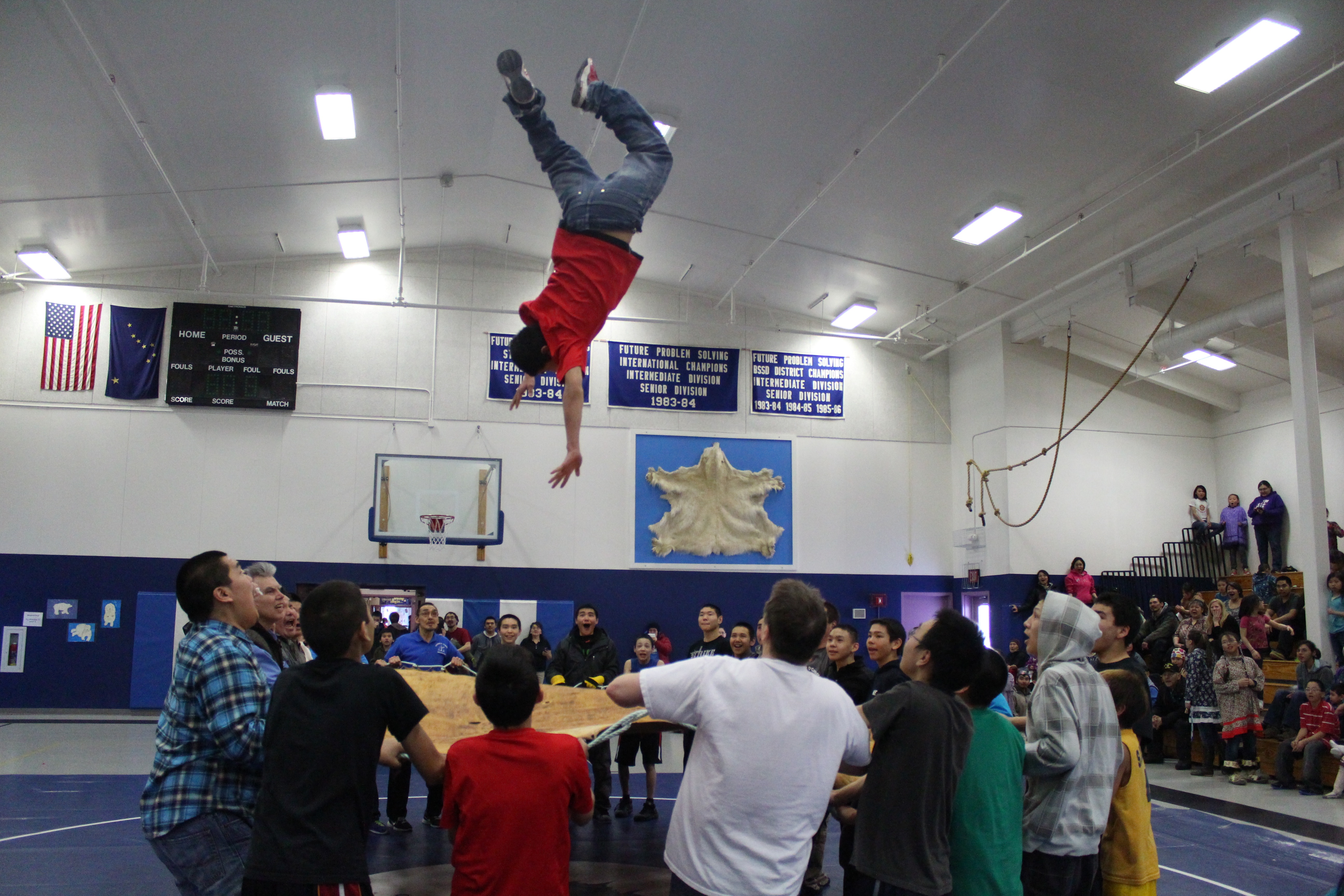
    A student is thrown into the air as part of the traditional blanket toss - using a walrus hide - in the school gym in Gambell. (Photo: Skiku)
    A student is thrown into the air as part of the traditional blanket toss — using a walrus hide — in the school gym in Gambell. (Photo: Skiku)
    Renfro was not alone in his enthusiasm for the program. Husband and wife Brian and Caitlin Gregg of Team Gregg/Madshus participated this year for the first time.

    “The whole experience was amazing,” Caitlin Gregg wrote in an email. “I really liked learning about the strong cultural history that the villages retain and teach all the youth. I left the NANANordic trip with so much excitement. The energy of the kids was amazing and I can’t believe how excited the towns were for us to be there! I look forward to spending even more time with the program next spring!”

    APU Elite Team member Lex Treinen participated in NANANordic this year as an envoy of a club called club called K’enaanee Kkaazoot — a similar program started by former University of Alaska Fairbanks skier Heidi Rader in 2011.

    “She had been doing gardening workshops in the villages on behalf of UAF’s Cooperative Extension Service and Tanana Chiefs Conference (the Interior non-profit native organization) and had always brought her skis,” Treinen explained in an email. “She saw that the kids were always interested. So I got to be part of the first K’enaanee trip in spring of 2012 and we went to Fort Yukon, Venetie, and Arctic Village. The next year we did a three-day trip to Ruby.

    “This year Heidi decided to work through NANANordic,” Treinen continued. “Since they were expanding to regions outside of the NANA region, and got a grant that she could give to UAF students.”

    Treinen went to the village of Nuiqsut, a village founded in 1974 in response to oil development on the North Slope. Treinen wrote about his experiences in UAF’s student newspaper, the SunStar.

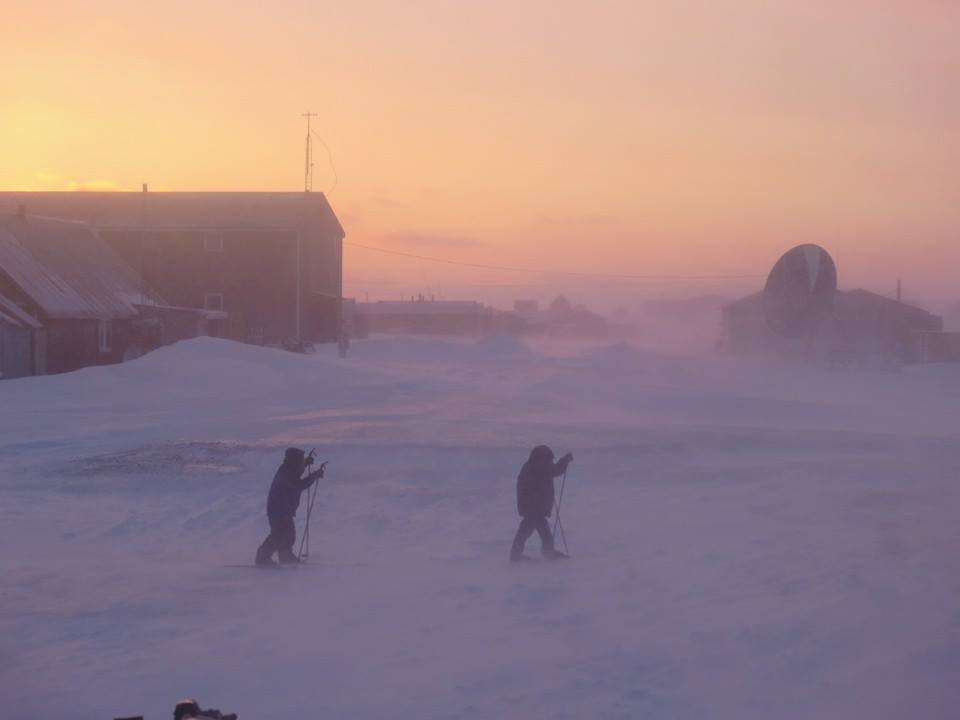
    Kids brave a ground blizzard, caused by high winds, in Gambell. Gambell is on St. Lawrence Island, in the Bering Sea.
    Kids brave a ground blizzard, caused by high winds, in Gambell. Gambell is on St. Lawrence Island, in the Bering Sea. (Photo: Skiku)

    A Rewarding Experience

    All those interviewed for this story had positive things to say about the innate ability and enthusiasm of the students for skiing in a region typically dominated by basketball and snowmobiles. The volunteers couldn’t help but be caught up in the excitement, many getting so much more from the experience than just the typical rewards of coaching.

    Even Flora, who has been Nordic skiing nearly his whole life, feels the experience has changed him. In 2012 he had just finished a tough season of  racing and immediately began NANANordic’s debut season.

    “It was the perfect transition out of ski racing,” he wrote in an email. “It kept me involved with the ski world but opened my eyes to this amazing world that had nothing to do with ski racing. There was this deep rich Alaska Native culture that we got thrown into the first year and the NANA values started influencing our ski program in more ways than I can express.

    “Basically this whole program has brought me back to my childhood memories of chasing around my two older brothers on skis and going on family ski trips,” Flora remembers. “I was so fixated on performance the last few years of my career, my performance started influencing my choices and decisions in a negative way. … My perspective on sport has changed. As a ski community we can learn a tremendous amount from villages in Alaska that can help us grow as teams, communities, and individuals. Skiku is as much about teaching kids how to ski as it is about our volunteers learning about a new culture, which can impact our own goals and dreams in life. ”

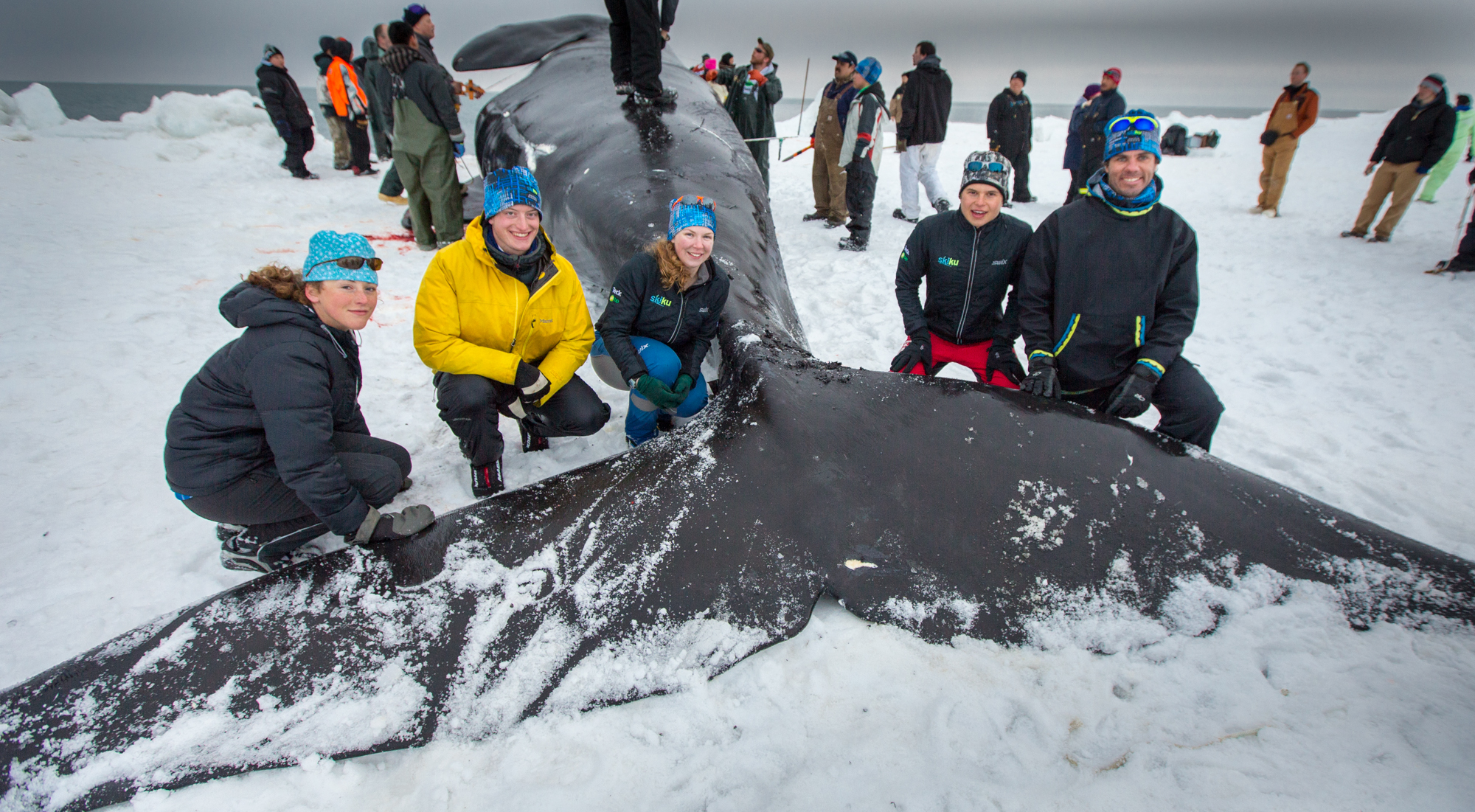
    The Skiku Crew and a humpback whale in Barrow. Photo: Brice Habeger, Piksik.
    The Skiku Crew and a bowhead whale that was taken during the traditional spring whale hunt in Barrow. (Photo: Brice Habeger, Piksik)

    2014 Volunteers: Aimee Demientieff, Alice Knapp, Allison Phillips, Amanda Del Frate, Ana Jager, Andrew Kastning, Andrew Dougherty, Anna Rix, Annie Connelly, Bailey Arend, Bre Donovan, Brian Gregg, Caitlin Gregg, Caitlin Patterson, Carlin Rauch, Carly Craig, Catie Bursch, Celia Haering, Charles Renfro, Conner Truskowski, Dana Tower,Dave Stamp, David Apperson, Deland Anderson, Donny Donovan, Dylan Watts, Emily Decker, Eric Packer, Erik Bjornsen, Fischer Heimburger, Frances Pillifant, Galen Flint, Gigi Banas, Greg Jernstrom, Greta Anderson, Ian White, Jaime Bronga, Jan Spurkland, Janey Hoefler, Jarrid Huckfeldt, Jasmine Neeno, Jeffery Fox, Jim Oksotaruk, John Farr, Jonas Loeffler, Josh Smullin, Julie Truskowski, Kathleen Rehm, Keri Hull, Lars Flora, Laura Pillifant, Lauren Fritz, Lauren Hess, Lex Treinen, Libby Kugel, Marie Steringer, Marine Dusser, Megan Spurkland, Michael Sinnott, Molly Schouweiler, Nancy Hanneman, Nick Treinen, Odin Brudie, Paul Kovacs, Peter Madsen Kling, Rachelle Kanady, Reese Hanneman, Robert Rosser, Rosie Brennan, Ryan Terry, Sadie Fox, Samuel Dougherty, Sara Studebaker, Sikulik Johnson, Tamra Kornfield, Taryn Hunt Smith, Tully LaBelle-Hamer, Tyler Kornfield, Will Mans, Zach Hall

  • NANANordic on Film: Four Videos from 2013 & 2014

    NANANordic on Film: Four Videos from 2013 & 2014

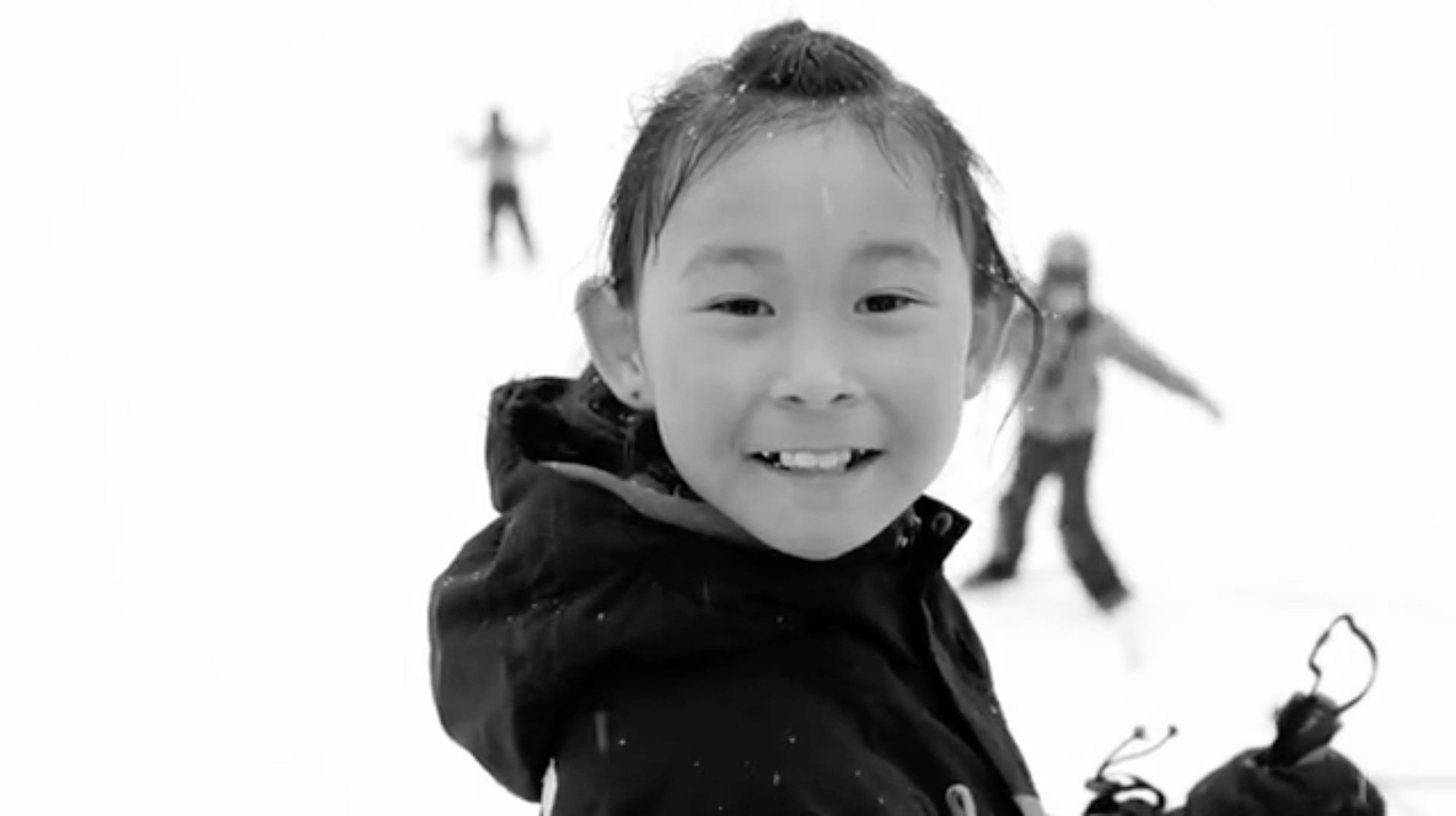
    A student of the NANANordic program, which visited Kobuk, Alaska, in April 2013. (Photo: NANANordic video/Charlie Renfro)
    A student of the NANANordic program, which visited Kobuk, Alaska, in April 2013. (Photo: NANANordic video/Charlie Renfro)

    Two NANANordic videos from last year’s trips to Kobuk and Shungnak, plus two more from the program’s most recent visits to AmblerKiana and Noorvik earlier this month, all of which show enthusiastic young skiers and spring skiing at its best in Northwest Alaska.

    “We would take footage in each village and present the movies at the end of the week to the kids in an assembly,” wrote Charlie Renfro, producer of the Kobuk, Shungnak and Ambler videos, in an email. “So fun.  Lots of smiles and excitement:)  When I watch the Shungnak one I almost cry for some reason..Weird:)”

    University of Alaska-Anchorage Head Coach Andrew Kastning filmed and edited the video on Kiana and Noorvik.

    For more information, visit nananordic.com and read FasterSkier’s recaps from last year: Part  I | Part II

    Kobuk School from Charlie Renfro on Vimeo.

    Shungnak Mini Vid from Charlie Renfro on Vimeo.

    NANANordic AMBLER 2014 from Charlie Renfro on Vimeo.

  • Anchorage Community Rallies for Critically Injured APU Skier

    Anchorage Community Rallies for Critically Injured APU Skier

    Nearly 500 Anchorage community members gathered at the start of Mary’s Fun(d) Run at APU on Sunday on behalf of Mary Robicheaux. The 13-year-old APU skier was hit by a car while bicycling on Aug. 28. and suffered a fractured scull, broken back and broken legs. After nearly two months in the hospital, Mary was expected to be released Tuesday from the Children’s Hospital in Denver, Colo. (Charlie Renfro courtesy photo)

    Holly Brooks felt like she had been punched in the stomach when she heard the news from Alaska Pacific University (APU) development coach Charlie Renfro. One of their skiers, 13-year-old Mary Robicheaux, had been hit by a car while riding her bike the night of Aug. 28, and it was unclear whether she was going to survive.

    A driver ran a stoplight and struck the eighth grader, who was in a crosswalk with the traffic signal in her favor. She was wearing a helmet, but knocked unconscious when she flipped onto the vehicle and rolled off. Mary was rushed to the hospital in Anchorage with a fractured skull, broken back and two broken legs.

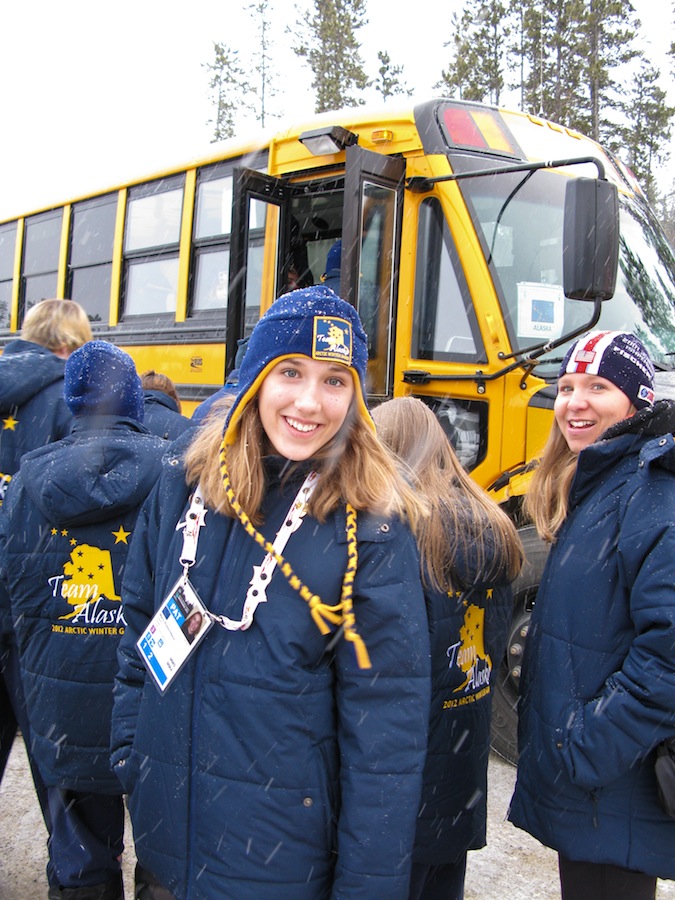
    APU development skier Mary Robicheaux at the Arctic Winter Games last season. (Charlie Renfro photo)

    Her APU teammate and close family friend, Luke Jager received a similar phone call about Mary’s critical condition. At 12, he hadn’t dealt with anything like that before, and neither had his friends.

    “We didn’t really know any details,” Luke said in a phone conversation. “We weren’t even sure she was going to live at first. … We’ve heard of stuff like this happening, but it was the first time it ever really happened close to home for us.”

    Renfro wrote in an email that the next day at practice was “really hard, but I knew I had to be positive for Mary’s teammates and coaches.”

    The development, or devo, group of 12 to 14 year olds spent the first half hour talking about what happened and answering questions. Then they made banners for Mary’s room at the hospital.

    “That was a hard practice,” Renfro wrote. “Team moral was at an all-time low.”

    While Mary was a top-10 skier in Alaska in her age group and a strong skate sprinter, Renfro explained she was also extremely fun and lighthearted.

    “She is one of those athletes that you look forward to seeing at every practice, and you notice when she isn’t there,” he wrote.

    Without much information to go off (Mary had surgery three days later to put titanium rods in her left femur and right tibia, and was on a respirator for five days), Luke and his teammates figured she’d be OK, so they started brainstorming how to help her recover. When they learned a medical-transport flight to Denver, Colo., ran upwards of $20,000 dollars, they really hit the drawing board.

    Initially, Luke’s father, Jim Jager, said the parents of these youngsters put their fundraising ideas on hold to get a better sense of Mary’s prognosis. Once they read on her family’s update website that she was improving, they gave their kids the go-ahead.

    Luke had already planned a 5-kilometer running course at APU’s University Lake Park.

    On Sunday, his vision came to life at Mary’s Fun(d) Run and far surpassed his expectations. An estimated 500 people from the ski community and her school and dance club came together for the benefit and raised more than $15,000 dollars in the process. Jager and Rob Whitney (Brooks’ husband) helped organize the event, and Luke set an initial goal of about 100 runners. Once they saw the race was gaining steam via Facebook and word of mouth, they printed 500 place cards to be safe.

    “We basically took our wildest expectations and doubled it,” Jager said.

    They weren’t far off with their high-end estimates; the run attracted more than 300 participants.

    All proceeds went to Mary, who was expected to leave the Children’s Hospital in Denver, Colo., on Tuesday to fly back to Anchorage. It would be her first time home in nearly two months.

    Holly Brooks (r) with others at Mary’s Run on Sunday, holding a sign she made for the injured APU junior. (Calisa Kastning courtesy photo)

    On Monday, race coverage and Brooks’ homemade banner, which read “We (heart) Mary,” made the front page of the Anchorage Daily News.

    “Not in my wildest dreams did I think we’d pull in 15+ K of funds,” Whitney wrote in an email. “I was gonna be happy if we brought in 7500!  Was I ever wrong!

    “Think about it … how can anyone not smile when they see some high-school aged kids doing something good for one of their own wounded soldiers?” he added. “Many kids would just sit on their fanny and play video games  (sorry for the cynicism…but it’s true!), but not xc skiers!”

    Every nordic club in Anchorage was represented, including the Alaska Winter Stars and Nordic Skiing Association of Anchorage (where Luke, Mary and most of their friends started as Junior Nordic skiers).

    APU development skier Luke Jager, who innovated Mary’s Fun(d) Run. (Charlie Renfro photo)

    APU enlisted members from its entire program, from the elite to the development levels, to help out. Outside of the ski center, the university itself also showed support with its president, Don Bantz, running the challenging course.

    “It was about as far as you can get from a road race,” Luke said. “We added some log jumps on the trail that [racers] could jump over and some pretty gnarly single-track sections and brutal hills.”

    Some of the inclines were 65 to 70 degrees, Jager said. On a chilly morning with frost lining a grassy finish, racers were slipping all over the place and laughing about it.

    “I feel very comfortable saying that nobody ran a PR 5 k yesterday,” Jager added. “Everybody was having a great time.”

    As the day wore on, it became clear how big this fundraiser was.

    “I was getting interviewed or something, and I came back and I was talking to Brett Renfro, Charlie Renfro’s wife, and she was like, ‘Yeah, did you hear? We’re at $13,000 dollars right now!’ ” Luke said. “I couldn’t really believe it. I had told a Daily News reporter before that, ‘I’d be happy if we raised $4,000 dollars,’ and the fact that we more that tripled that, I don’t know …”

    APU devo skiers Jager (l) and Max Robicheaux, Mary’s brother, at the 5 k benefit run for Mary. (Charlie Renfro photo)

    Without any expenses and every dime going to Mary, they squeezed everything they could out of the event. Luke did pushups for each additional dollar and emceed a final effort by Andy Rogers, who offered to match $20-dollar donations.

    “We were making sure that Luke knew what to say because he had the mike,” Brooks wrote in an email. “His response was, ‘I listen to NPR … I KNOW what a matching donation is!’ We just about died laughing!

    “He’s 12 with the wit and confidence of a 40 year old,” she added. That’s what made the fundraiser a success.

    Paired with a “Change for Mary” coin drive held last Friday, in which APU juniors raised more than $3,700 dollars by rolling coins, the grand total reached nearly $19,000 dollars. Luke hadn’t spoken with Mary as of Monday, but based on her thank-you comments on Facebook, he could tell she was happy.

    She had come a long way since he first saw her about a week after the accident, when she was still unconscious.

    “You could tell it was Mary but she just looked really beat up,” he said. “The worst part … it was really shocking seeing so many tubes in her body.”

    Robicheaux (center) at the start of the junior-high championships in Anchorage. (Charlie Renfro photo)

    He visited her again the day before she left Providence Alaska Medical Center in Anchorage for Colorado in early October. This time, she was conscious and “in a better mood than we were,” Luke said. “It was good to see that.”

    In describing Mary, he said she’s “the epitome of happy. She’s always smiling no matter what we’re doing at practice, and she has a lot of friends. She’s a really friendly person in general and really tough.”

    Looking back, Luke was excited about what they accomplished for her.

    “It’s kind of cool because we saw this and we wanted it to happen,” he said. “We wanted it to be put on by a group of Mary’s friends and all of us are kids. … We had a group of middle schoolers and high schoolers put on a race that raised $15,000 dollars with a couple of adults.”

    The event not only raised money for an injured local teen, it also brought awareness to the community about what happened.

    “I think that everyone in one way or another could identify with Mary’s story,” Brooks wrote. “It could easily happen to anyone. She was doing everything right — she had the right away on her bicycle. Thank goodness she was wearing her helmet. There is NO DOUBT that it saved her life.

    “This entire experience has impacted all of us – Rob & myself, the entire APU community & the entire Alaska endurance community,” she added. “The accident was a prime example of how 10 seconds can substantially alter someone’s life.”

    Whitney was impressed with how the community rallied, much like it did to support the seriously injured runner, Matt Kenney of Anchorage, who fell off a cliff during the Mount Marathon race earlier this year.

    “The AK ski community is a small group, so I think regardless whether or not you know someone personally, because we all share the same love of a similar sport, that creates a bond,” he wrote.

    While he hadn’t met Mary, his wife used to coach her.

    “Support from a community to help someone in need not only helps Mary, but brings everyone together,” he added. “Lots of energy channeled in synergy can lift up the deserving … and in this case, this fundraiser did just that.”

    Runners having fun at Mary’s Race on Sunday. (Charlie Renfro photo)
    Kinsey Denton (l), Magdalen York (second from l) and other APU juniors celebrating their teammate Mary Robicheaux at Mary’s Run. (Charlie Renfro photo)
  • Flora Brings Skiing to Northwest Alaska

    Flora Brings Skiing to Northwest Alaska

    Lars Flora stands behind a drying rack of sheefish, a popular springtime fish in Northwest Alaska, while Elvina, an Selawik eighth-grade skier in his NANANordic program, looks on. (Photo by Charlie Renfro)

    While most of his cross-country skiing brethren kicked up the last bits of snow at Spring Series in Craftsbury, Vt., Lars Flora was hard at work at home in Anchorage, Alaska, crunching numbers and finalizing details of his upcoming trip.

    It would have been easy if he had been the only one traveling to Northwest Alaska, but Flora had 17 volunteer coaches and two doctors to accommodate, the NANA Development Corporation to run by, and about 650 kids waiting for him in four different villages.

    NANANordic took all the focus and logistical smarts the two-time Olympian could muster. Yet every morning, the program’s potential in providing youngsters with cross-country skis was what excited him most.

    A couple of schoolchildren ski below Rainbow bridge in Selawik in Northwest Alaska. Without any roads in town, Selawik is mostly made up of boardwalks and bridges and built on the Selawik river. (Photo by Reese Hanneman/Engine Room Media)

    For three weeks from April 9 to May 1, Flora and a crew of peers and supporters visited schools in the Northwest Arctic, about 550 miles northwest of Anchorage by air. Slightly bigger than the state of Indiana, the region has an estimated 7,000 people living in 13 villages.

    Last year, Flora made it his mission to bring skiing to each town.

    Similar initiatives, such as the RurAL CAP Ski Go Club program founded by Jennifer Johnston, introduced students in the Northwest to nordic skiing in the past. The program fell by the wayside a few years ago following Johnston’s election as Anchorage assemblywoman, and Flora saw a need to pick up the pieces. His program, he decided, would be even bigger and most importantly, sustainable.

    “I felt [it] was a really good fit for the region and there’s no reason there can’t be ski programs up there,” Flora said in a phone interview from Anchorage. “It’s something they can [do] outside and go do something active somewhere. A lot of times, there’s no one taking them anywhere.”

    Like many city-dwellings Alaskans, Flora, 34, had always dreamt about seeing “real” Alaska, that rural part of the state where natives speak Iñupiat Eskimo and live off the land in often brutally cold conditions. He made the two-stop, two-hour flight to the region’s hub in Kotzebue for the first time last fall, where he watched the community assemble for a high-school running race.

    People drove up on boats and flew in on planes to see the event. Flora stood back amazed.

    “Spending time up there, you learn the people are super-warm and nice,” he said. “And when there’s a sporting event or any type of event, the whole community comes together.”

    Basketball was king, he said. Everybody played and followed its superstar athletes. But for some reason, skiing wasn’t ingrained in their culture. Flora wanted to change that.

    “The interesting thing about it is these kids are super active,” he said. “They were just so eager to ski. Every day, the questions would be, ‘Where are we skiing today?’ We did afterschool sessions and we ran out of equipment most of the sessions. Kids would be lined up at the door pushing down the door.”

    After a whirlwind winter, in which Flora started off on the World Cup circuit, placed fourth at U.S. Nationals in the 30-kilometer classic and suffered some unlucky crashes in two ski marathons, the Alaska Pacific University racer said there was nothing he looked forward to more than seeing his program, NANANordic, come to life.

    Since convincing the NDC native corporation to sponsor him last spring, Flora made it his priority. He partnered with the Northwest Arctic Borough School District, rounded up influential athletes, attracted volunteer doctors and donations from one of his sponsors – the Asthma and Allergy Foundation of Alaska – and arranged to have food and transportation paid for through NMS Food Services, Alaska Airlines and Bering Air.

    Flora stands behind some students ready to go skiing in Kiana in Northwest Alaska. (Photo courtesy of NANANordic)

    Fischer and Rossignol combined to donate 70 sets of equipment. Flora had the whole fleet transported between the four villages they visited – Kotzebue, Kiana, Noorvik and Selawik –and eventually left 20 sets in each.

    Flora skied between the towns for a total of about 135 miles. After 3 ½ weeks up there, Flora said he was a little tired.

    Each week, he and a few other coaches stayed at a given school, cooking in home-ec rooms and cozying up into sleeping bags at night. By day, Flora and about five members from his loaded staff, which included U.S. national team biathletes Sara Studebaker and Zach Hall,  APU skiers Reese Hanneman, Charlie Renfro, Greta Anderson and Dylan Watts, and University of Alaska Anchorage ski coach Andrew Kastning, taught 100 to 150 students per day.

    “Our first session was at nine o’clock and we were coaching all day,” Flora said. “[The kids are] basically all big hitters. They had been classic skiing on no-wax skis, but no one really knew how to skate ski so it was starting from the beginning, showing them how to put bindings on, put pole straps on, really starting with the basics.”

    Most of his volunteers stuck around for about six days, coaching during gym classes and after school with students in kindergarten through 12th grade. Children played games, asked questions, laughed and caught big air on skinny skis. Flora said their enthusiasm was overwhelming, and many coaches noted that children in Anchorage or other ski communities didn’t get that excited about skiing.

    Next year, Flora hopes to double the amount of villages and visit eight. Ultimately he wants to reach all 13.

    “I was totally unfamiliar what it was like to be up in the villages and just getting to know the logistics part of running a program [there],” he said. “The dynamics between the school district and the native corporations, the teachers and the local community, it’s been a huge learning curve. It’s been really fun.”

    A Balancing Act

    The amount of work involved is what kept Flora from the SuperTour Finals in Craftsbury in late March. He had to decide whether he wanted to race there or in the Norwegian Birkebeinerrennet, one of the most challenging marathons on the Worldloppet circuit. On March 17, he ended his season in Norway placing 59th despite a tough wax day.

    In all, Flora completed four marathons last season. He was third in the Gatineau Loppet after a crash near the finish, sixth in the American Birkebeiner after a tangle around 40 k, and 31st in the Swiss Engadin.

    Asked whether he chose the marathon route this season to prepare for trekking between villages in Northwest Alaska, Flora laughed.

    “It wasn’t totally planned out,” he said. “Coming into the season, you always put the goal out there and once you commit to it, it’s like, ‘OK, you get to go to the World Cup and see what happens, right?’ I got through the first period and realized I missed some big training periods so that’s when I started thinking that the marathons were going to be my main thing. By the time I did all those marathons, I was in great shape. I had a blast.”

    His desire to do more Worldloppets had been on his mind – that and what would be required up north. After their first stop in Kotzebue, Flora and Dylan Watts skied 75 miles to Kiana. They planned to cover the distance in one day, but teachers warned them otherwise.

    On the Trip:
    Sara Studebaker, Zach Hall (US Biathlon); Andrew Kastning (U of Alaska Anchorage); Reese Hanneman, Charlie Renfro, Greta Anderson, Dylan Watts (APU); Crystal Pitney (U of Alaska Fairbanks); Tamra Kornfield (formerly of UAF); Evelyn Dong, Katy Rehm, Rachel Samuelson, Danielle Hess (elite racers); Forest Tarbath, John Glen, Hugh Cosgrave (Service High School); Mariah Cooper (of Ojibwe band in Hayward, Wis.); Dr. Demain & Dr. Rathkopf (Asthma & Allergy Foundation of Alaska)

    “You’re going out on terrain you’re not familiar with and you’re right on the Bering Strait so the weather can chance in a second and can be blowing 60 to 70 miles an hour,” Flora said. “So we got a little nervous.”

    They packed a sled with food and camping and safety equipment, including a radio, and pulled the 30-40 extra pounds behind them. They split the trip into two days, skiing five hours on the first and three on the second.

    After that, Flora completed a 25-mile solo ski from Kiana to Noorvik in one day, and skied with Kastning, Renfro, Hanneman and Evelyn Dong for his last journey between villages.

    Along those final 35 miles, Flora said he experienced the highlight of the trip when they came upon a herd of about two thousand caribou.

    “I looked at Andrew and I was like, ‘I think I’m just going to ski right up to them,’ ”Flora said. “Andrew’s like, ‘So you’re going to be that guy? They guy who just splits the whole herd?’ Right when he said that, our friend Charlie came up and skied right through. He was like, “Let’s go!’ ”

    With each skier approaching at a different angle, the herd spooked and ran by Renfro, who was ready with his camera.

    “He had, I don’t know, two hundred caribou running right through him,” Flora said. “It was pretty cool.”

    Skiing through about 2,000 caribou on the way to Selawik in Northwest Alaska in late April. (Photo by Charlie Renfro)

    A day after returning from the region, Flora said they would immediately launch into planning for next year. At this point in his career, after some 17 years of elite racing, it was exactly what he needed.

    “When I would wake up, this was the stuff that got me excited,” Flora said. “I lost that excitement to get out there and train, and once you lose it, it’s hard to get back sometimes.”

    Last year was essentially an evaluation period in his ski career. He said it went “OK” considering the high he came off in 2011 with two top-40 finishes at World Championships, but in the end, he lacked training. At the Teva Winter Mountain Games in February, he suffered what he called “the worst bonk of his career.”

    Three months later, Flora still has a strange sensation in his fingertips. His friend, ski racer and ER doctor, Adam Swank told him to give it a few weeks and see if the effects of dehydration, altitude and cold wore off. They didn’t, and Flora said he was going to work with a physical therapist on what he thought was a pinched nerve.

    “My body doesn’t respond well going up and racing at eleven thousand feet,” Flora said. “That was brutal.”

    As for next season, Flora said he’s still undecided as to whether he will continue racing or pursue a career in coaching. One thing’s for sure: he’ll be back in the Northwest Arctic with skis in tow next spring.

    “When I started to see how much excitement and how much fun it was to pull this off with NANANordic, it was a good sign that I needed to move on and do something else,” he said.