From the FasterSkier archive — posts syndicated from athletes’ and coaches’ own blogs between 2004 and 2012, kept online as published. Current coverage is at fasterskier.com.

Tag: Charlotte Kalla

  • Saying Goodbye to Some Big Names in Cross-Country: an International Retirement Roundup

    Saying Goodbye to Some Big Names in Cross-Country: an International Retirement Roundup

    Each year at the conclusion of the race season, there are always a few athletes who hang up their skis and step away from professional racing. The end of the four year Olympic cycle inevitably means a higher concentration of such announcements. Whether it was a fourth or a first appearance at the Games, or a near miss, the Olympics are always a target and their completion provides a good moment to move on. While the retirement announcements will likely continue into the spring, here is a roundup and recognition of the international athletes who have shared the news that they will be ending their ski careers. 
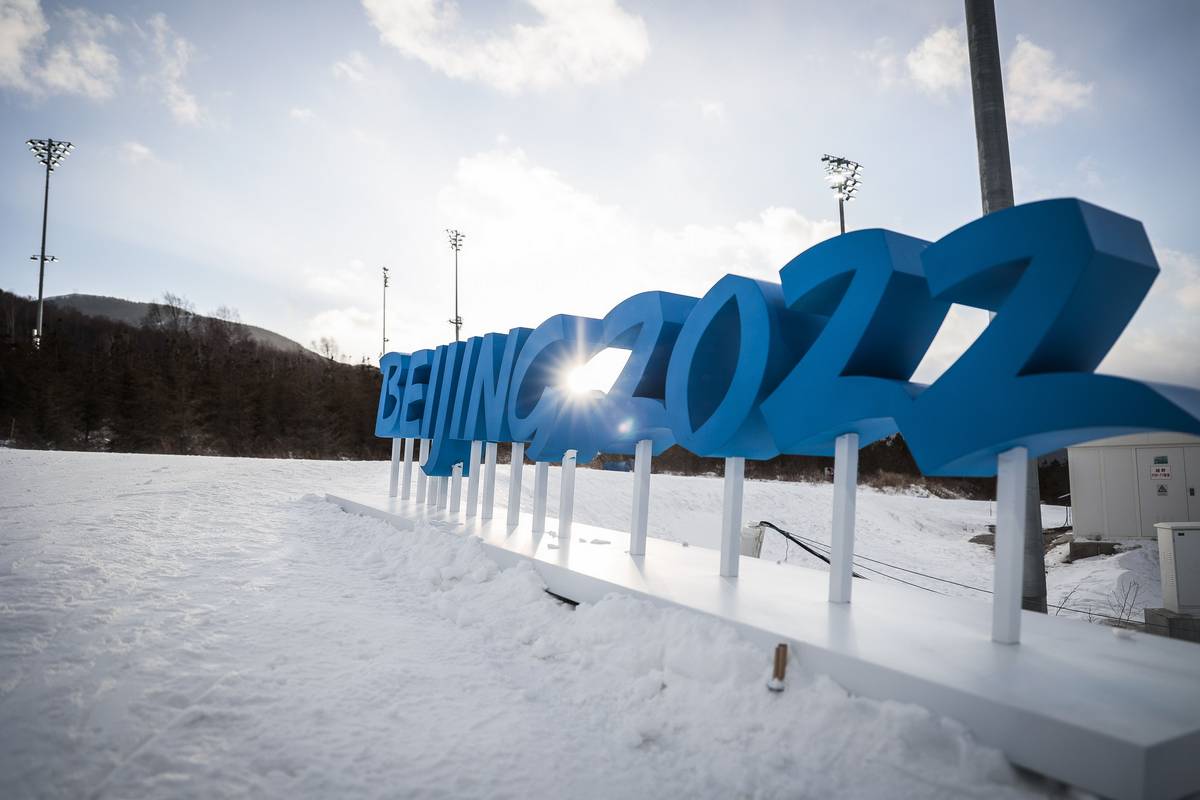
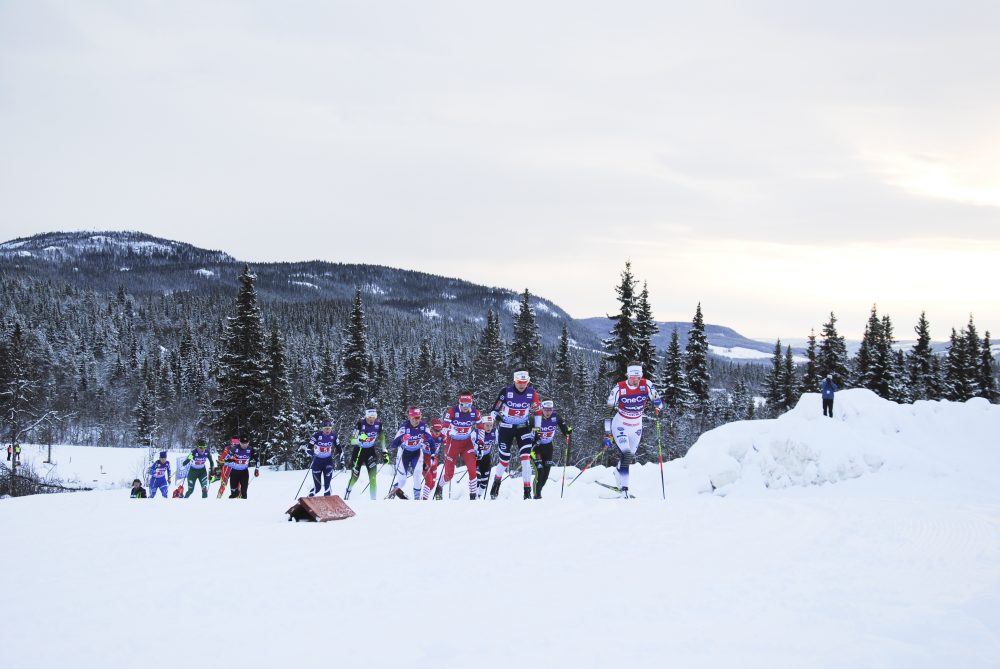
    A scene from the cross country venue in Zhangjiakou, China, host to the 2022 Olympic Winter Games. (Photo: NordicFocus)

    Four athletes from the Swiss team have announced that they will be moving on, chief among them – the king of the 15 k, Dario Cologna. At the age of 36, Cologna released his decision before the 2021/22 season even began, saying, “the decision came within the last months and after the Olympics, it will be the perfect timing for me. I have achieved everything I ever dreamed of in the sport.”
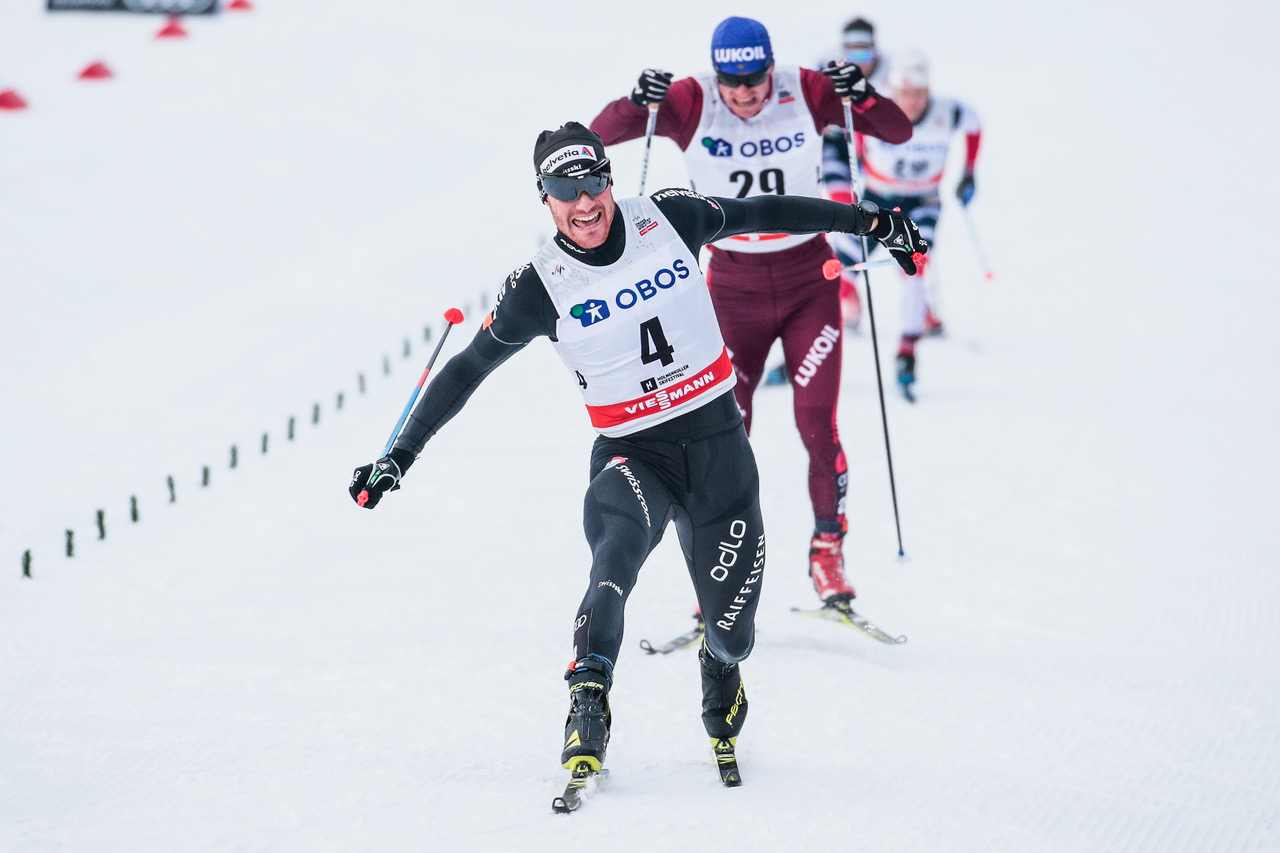
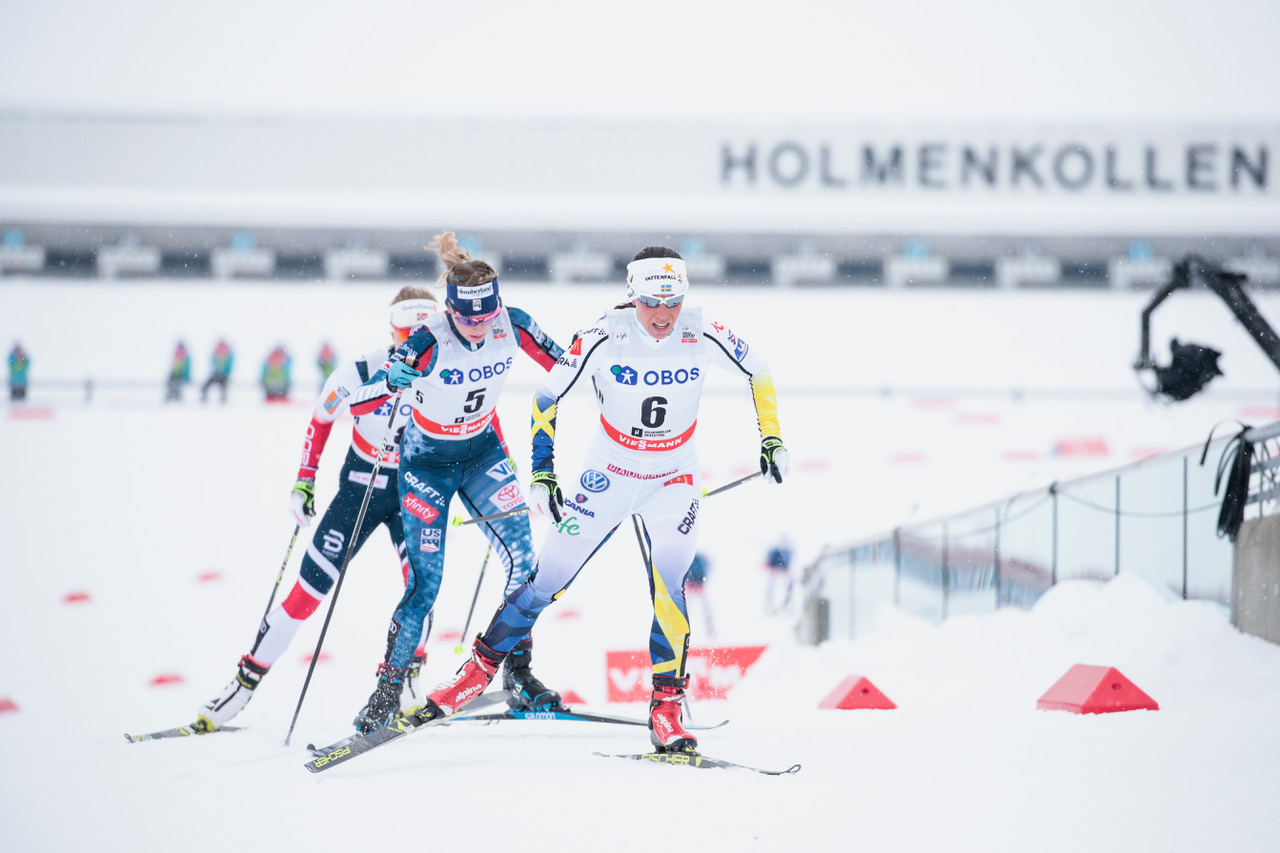
    Switzerland’s Dario Cologna lunges to the line at the 2018 Holmenkollen 50-kilometer freestyle race in Olslo, Norway. (Photo: NordicFocus)

    Cologna had his World Cup debut in 2006 and his first Olympic start came in 2010 in the 15 k skate event, where he finished first. This victory crowned him as the first Swiss cross-country skier to earn an Olympic gold medal. He went on to win three additional golds, in the 2014 Sochi Games he won both the skiathlon and the the 15 k classic, and in 2018 in PyeongChang added a gold in the 15 k skate. All told, Colgona had eighteen Olympic starts at four different games.

    In between Olympic years, he was equally successful. He won the Overall World Cup globe four times, first in the  2007/08 season, again in 2010/11 and 2011/12 and a few years later in 2014/15. In the 2007/08 season he also earned his first Tour de Ski victory, in spite of the fact that he never took a stage win that year. He won the grueling event three more times, in 2010/11, 2011/12 and again in 2017/18. 
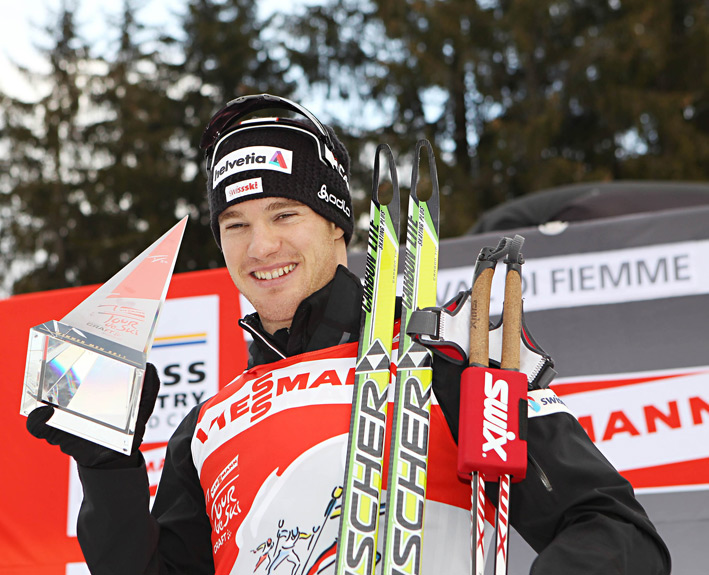
    Dario Cologna (SUI) with his trophy after winning the Tour de Ski in 2011 (Photo: Fiemme2013)

    After his final outing in the legendary Holmenkollen 50 k, Cologna wrote on Instagram, “I look back on a beautiful and successful career. 15 years ago I never dared to dream that one day I would be a four-time Olympic champion, World Champion, multiple Tour de Ski- and overall World Cup winner. In addition, I was privileged to travel to places I would never have seen and met great people, who became good friends.” 
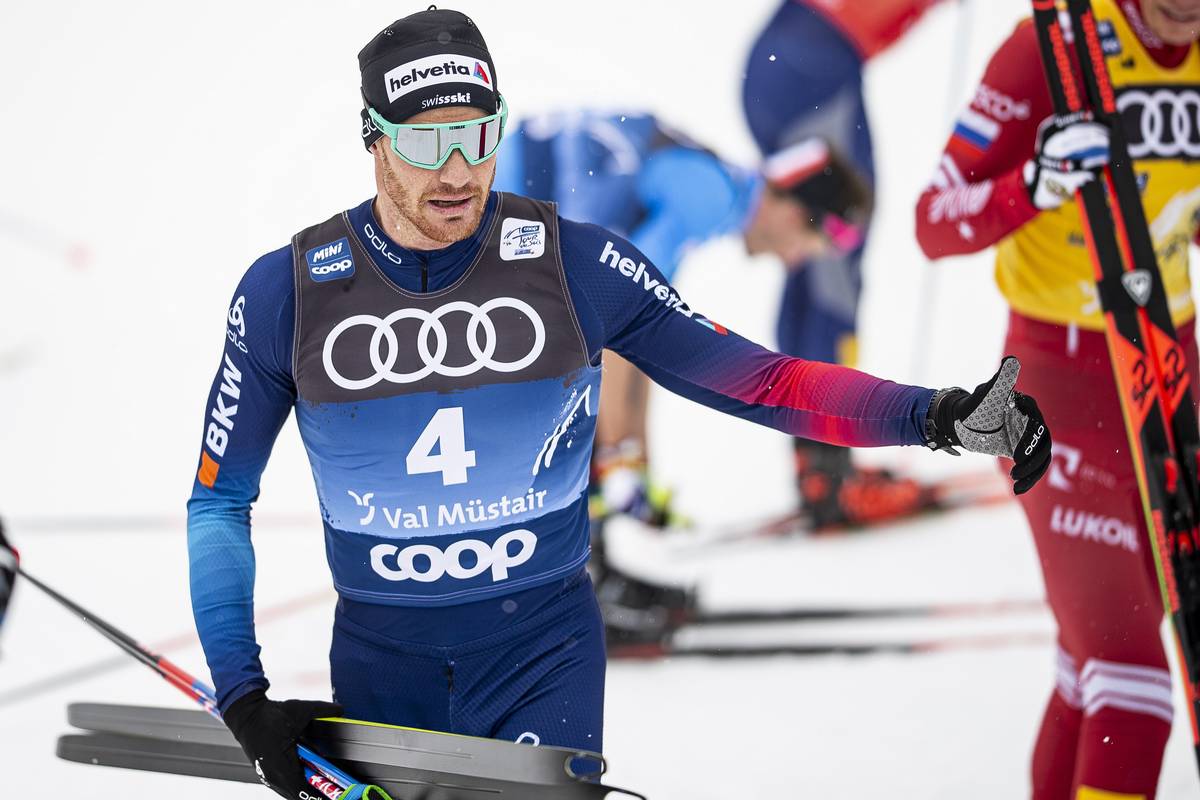
    Dario Cologna (SUI) after a 6th place finish in Val Mustair during the 2021 Tour de Ski. Photo: Nordic Focus

    Cologna’s teammate, Jovian Hediger, also announced his retirement prior to the start of this season. Hediger was known as a sprint specialist and has 107 World Cup starts to his name, having made his debut in 2009. His first and only podium appearance came in 2021 during the team sprint event in Ulricehamn, Sweden, where he and Roman Furger finished second. Hediger represented Switzerland at three Olympic games, beginning with Sochi in 2014 and ending most recently in Beijing (2022). 
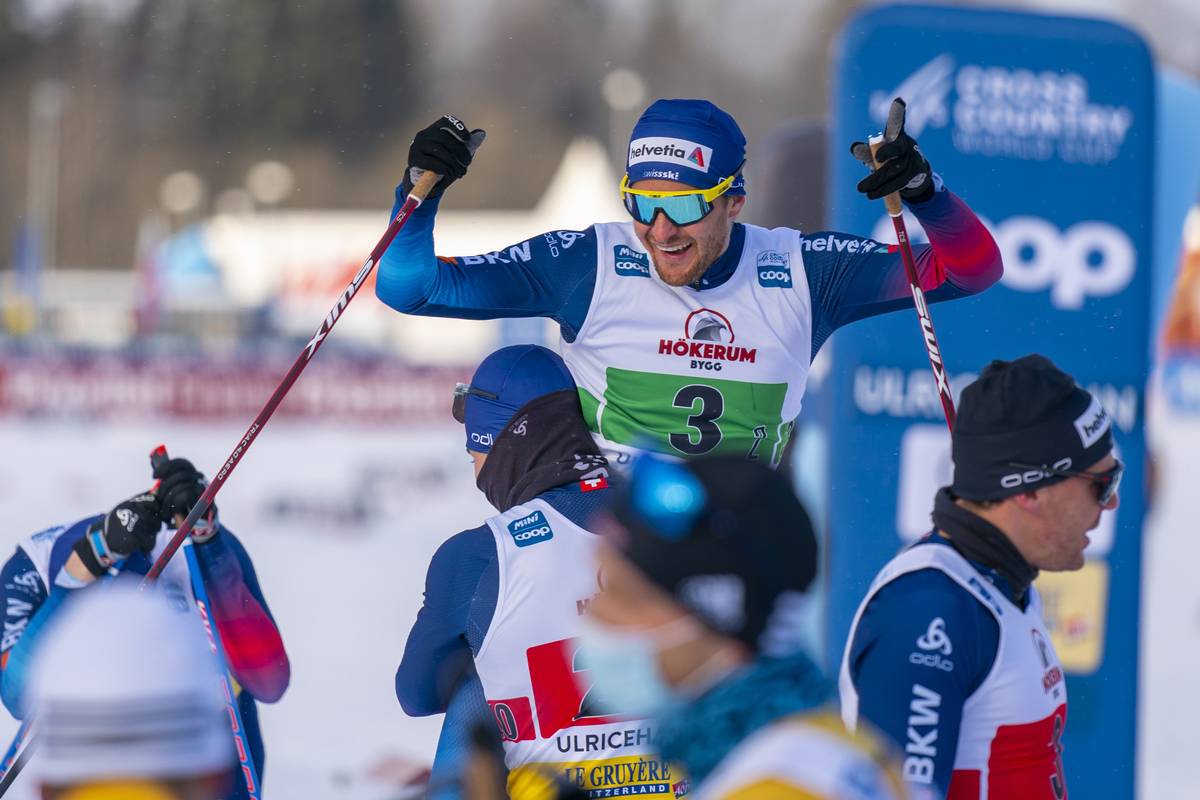
    Jovian Hediger (SUI) gets a boost from some happy teammates at the finish line in Ulricehamn Sweden. (Photo: Nordic Focus)

    Ueli Schnider of Switzerland is also stepping away from elite competition. Schnider has 62 World Cup starts and made two Olympic appearances, both in 2018 in PyeongChang where he finished 37th in the classic sprint and 41st in the 50 k classic mass start. 

    On the women’s side, Laurien Van Der Graaff of Switzerland is moving on. Van Der Graaff has long been a staple in women’s sprinting, beginning in 2011 with her first World Cup podium in Duesseldorf, Germany. In doing so, Van Der Graaff became the second Swiss female athlete ever to reach the podium and over the years she continued to pave the way for young Swiss female athletes. Her first victory came in 2017 in a skate sprint Tour de Ski stage race on home ground in Lenzerheide, Switzerland. 

    The women’s sprint podium in Rybinsk Russia, 2015 (from l-r): Natalia Matveeva (RUS) second, Jennie Öberg (SWE) first, and Laurien Van Der Graaff (SUI) third.

    Van Der Graaff partnered up many times with Nadine Fähndrich in team sprint events, resulting in four World Cup podium finishes. At the World Championships in Oberstdorf, Germany (2021), Van Der Graaff and Fähndrich teammed up again, earning a silver medal when they finished just hundreths of a second behind team Sweden. 

    Van Der Graaff shared with FIS, “for some time I was convinced that I would not continue skiing until Beijing 2022, but I made it and I am very proud of what I have achieved. However, now my time has come and I am excited for everything that is coming my way in this new chapter.”
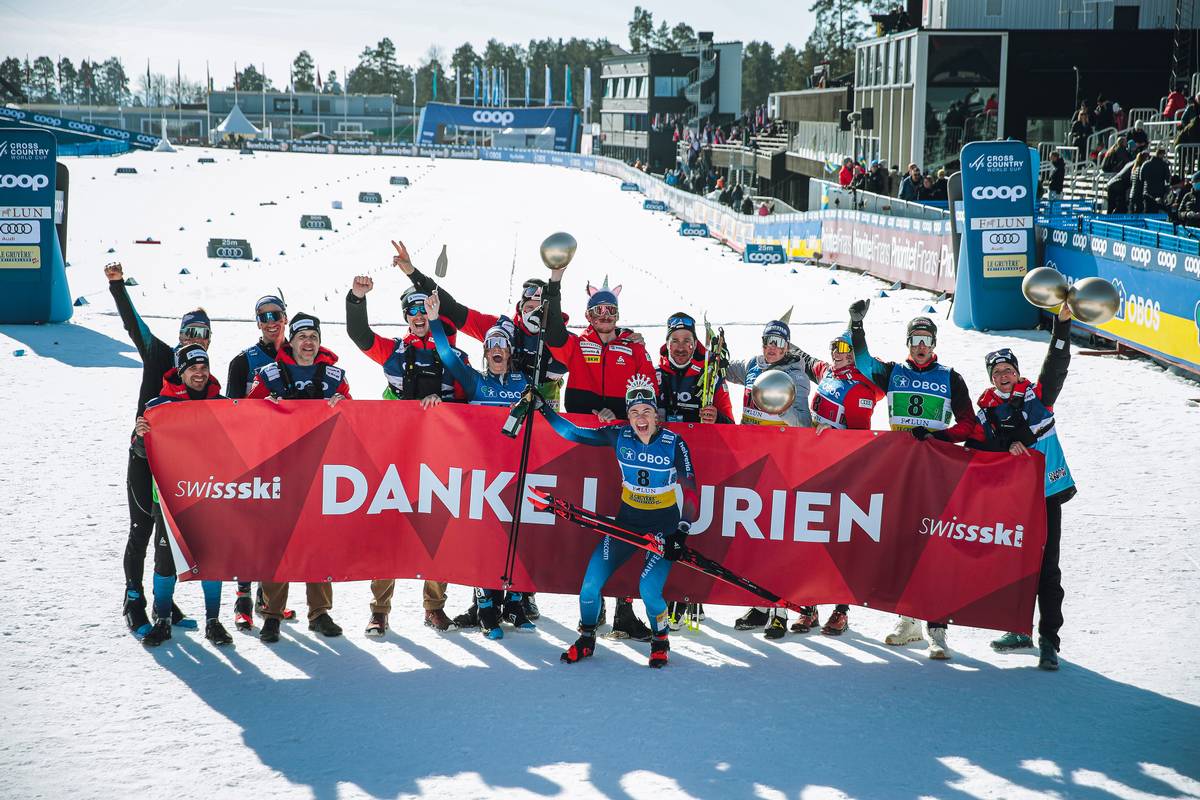
    The Swiss program celebrates the retirement of Laurien Van Der Graaff at the finish of the 4 x 5 k mixed relay in Falun. (Photo: NordicFocus)

    While some athletes knew from the outset of the season that this would be their last, others only recently came to the decision. Such was the case for Swedish star, Charlotte Kalla, who just announced her intentions within the last month. The 34-year said, “the curiosity about life outside of elite sports weighs heavier than what a continued investment would entail.”

    Kalla burst onto the World Cup scene at the age of eighteen. She earned her first victory in the next season, taking a stage win in Nove Mesto (2007) in the 10 k skate pursuit. In her first individual World Championships appearances, coming in Sapporo, Japan in 2007, Kalla finished 7th and 5th. To give you a sense of her consistency from then on, of the 34 World Championship events Kalla completed spanning 2007-2021, she finished in the top ten in 30 of those appearances with the exceptions being three 11th place finishes and one 18th. 

    Charlotte Kalla of Sweden on her way to Olympic gold in Vancouver 2010 (Photo: FS archives)

    Kalla represented Sweden at four different Olympic Games, Vancouver 2010, Sochi 2014, PyeongChang 2018, and Beijing 2022. She came away from these events with five individual podiums, including two gold medals and three team medals including her jaw-dropping relay performance in the relay in 2014 when she made up a 25 second deficit to bring the Swedish women their first Olympic relay gold since 1960. 

    Since then, the Swedish women’s team has come to dominate the World Cup circuit and Kalla has taken on a mentorship role within the team. “It’s an inspiring team to be a part of and many girls who have the right mindset to do their very best every day,” said Kalla in 2020. On March 22, 2022, Kalla announced on Instagram that the Swedish national competitions would be her last as an elite athlete. She wrote, “here I took my first [steps] as a seven-year old and it feels nice to end my career here.” 
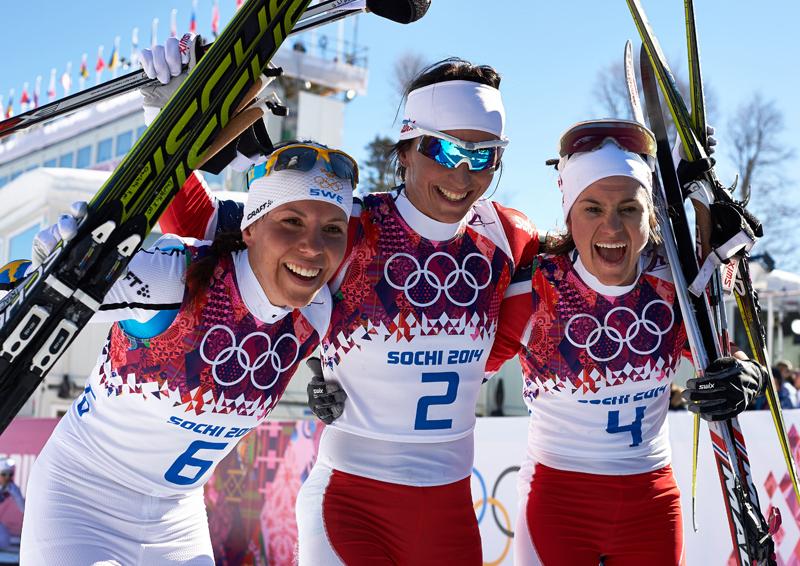
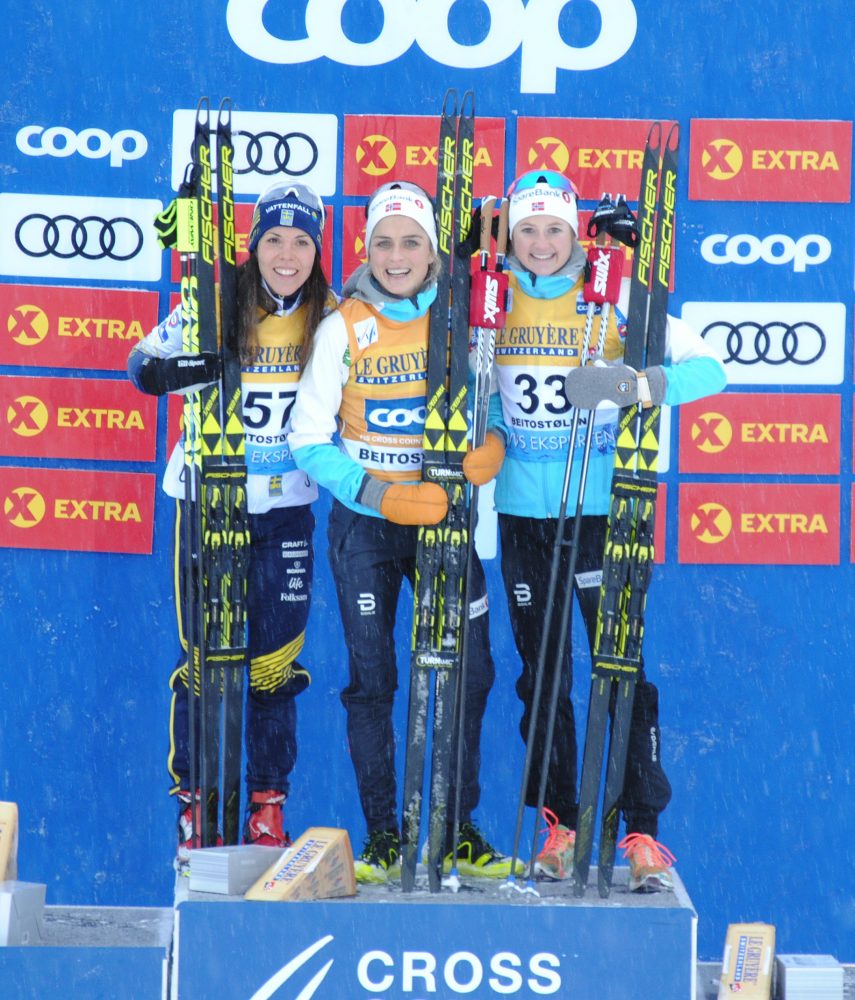
    Charlotte Kalla (SWE), Marit Bjoergen (NOR) and Heidi Weng (NOR) claim the podium in the women’s Olympic skiathlon, Sochi 2014.  (Photo: Fischer / Nordic Focus.)

    Elisa Brocard of Italy is ending her ski-racing career at the age of 37. Brocard had her first World Cup start in 2006 and went on to contest 162 World Cup events. She represented Italy in three Olympic Games, beginning in Vancouver 2010, through PyeongChang in 2018. Her best season came in 2018 when she finished in the top-30 distance World Cup rankings and 38th overall. 

    Nadine Herrmann of Germany is leaving elite competition as well. She is the younger sister of Denise Herrmann who raced the cross-country World Cup circuit until she transitioned to biathlon in 2017 where she went on to win gold in the individual event at the 2022 Beijing Olympics. Nadine Herrmann finished in the top-thirty in her maiden World Cup appearance in 2018 in the Dresden city sprints. She went on to earn a number of top-thirty finishes, including a personal best individual finish of 18th in Dresden in 2020. At the age of 26, Herrmann has decided to move on, she wrote “My active sporting career is coming to an end. The last 14 years of performance sports have shaped me into the person who today can say in the best of my conscience, I gave it my all.” 

    Adrien Backsheider of France has also announced his retirement. Backsheider began racing on the World Cup circuit in 2013. He earned six World Championships starts and helped propel team France to a bronze medal in the men’s 4 x 10 relay in Falun in 2015 and again in Seefeld in 2019. Backsheider also has four Olympic starts, as he represented France in Sochi 2014, PyeongChang 2018, and Beijing 2022. He was a member of the bronze medal relay team in PyeongChang when the French again earned a podium spot in the 4 x 10 relay. Backsheider’s personal best individual World Cup finish came in Östersund, Sweden in 2020 when he finished 7th in the 15 k skate stage race during the Tour de Scandinavia. 

    The men’s 4 x 10 k relay at 2015 World Championships in Falun, Sweden, Norway with gold, Sweden with silver, and France with bronze . (Photo: Fischer/NordicFocus)

    Cendrine Browne of Canada is saying goodbye to professional ski racing as well, having concluded her career with a national title in the 45 k skate in Whistler, Canada. Browne made her World Cup debut in 2012 and went on to start 76 World Cup races. She made the Canadian Olympic team in 2018 and 2022 and also posted thirteen World Championships starts. Browne finished 16th in the 30 k skate mass start in Beijing, a personal best individual finish for her. In a statement to Nordiq Canada after the 45 k race, Browne said, “thank you to everyone in the ski community who has believed in me and cheered for me over the last ten years.” 
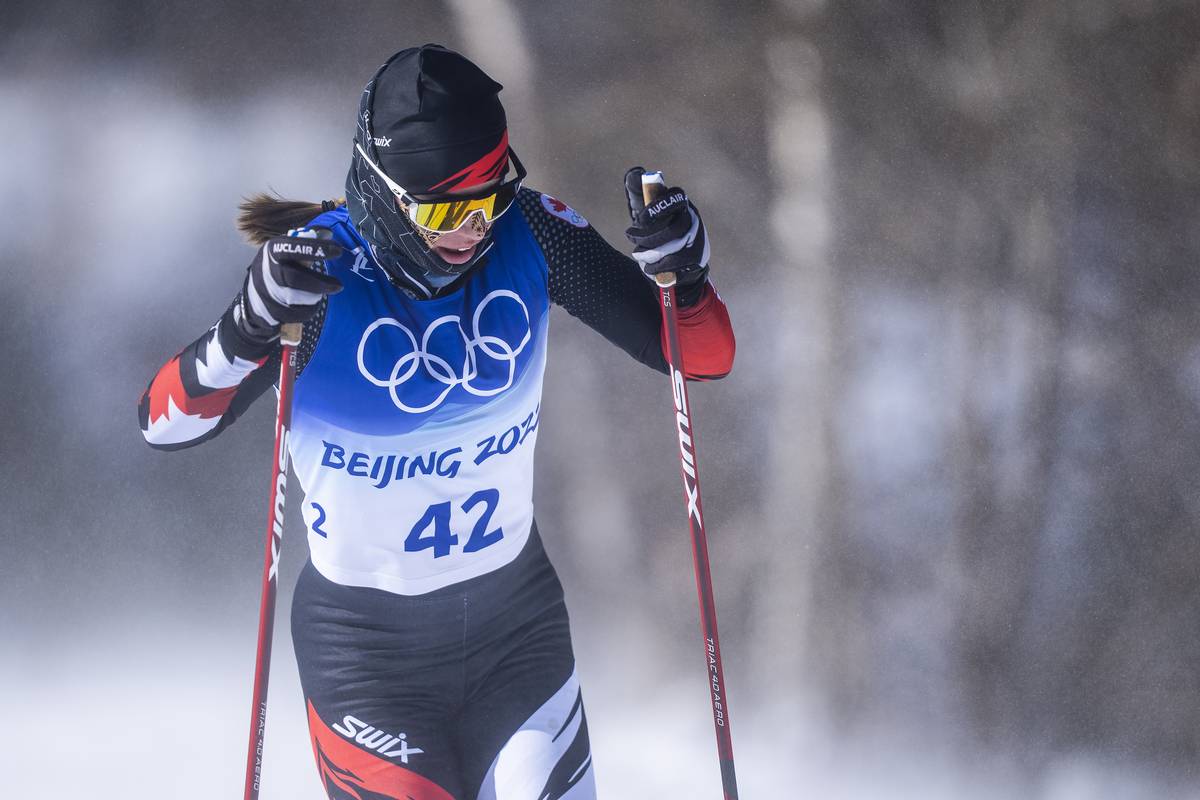
    Cendrine Browne reached a new personal best with her 16th place finish in the 30 k skate mass start in Beijing 2022 (Photo: NordicFocus)

    The notable retirement of the extremely successful, Therese Johaug of Norway has not been missed but will be receiving its own feature from FasterSkier in the coming weeks. Additionally, US Ski Team members Katharine Ogden, Hannah Halvorsen, and Caitlin Patterson have all shared news of their retirement, in addition to top SuperTour athletes Ian Torchia and Adam Martin. (Read Torchia’s retirement story here.)

    Stay tuned for more in-depth reporting on those athletes from FasterSkier.
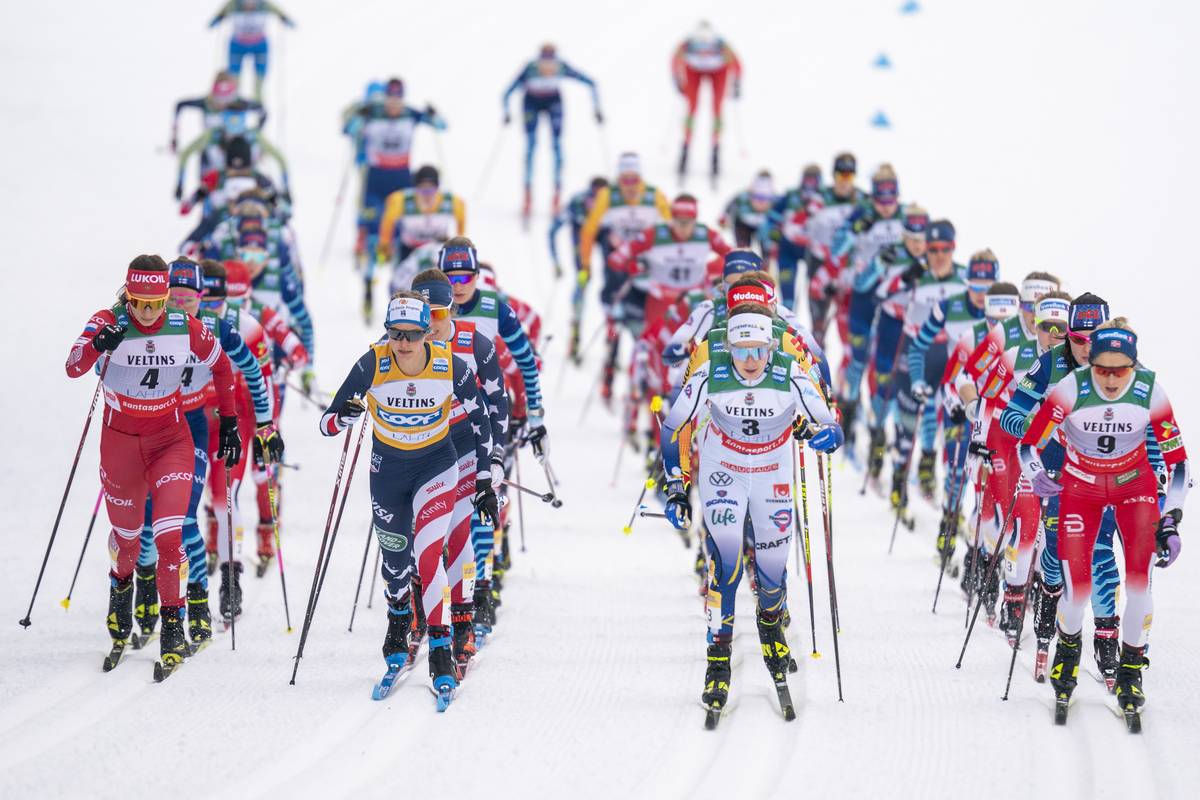
  • Norway Returns with Gusto, Sweeping the Women’s Podium in the 7.5/7.5 K Skiathlon; Diggins 5th

    Norway Returns with Gusto, Sweeping the Women’s Podium in the 7.5/7.5 K Skiathlon; Diggins 5th

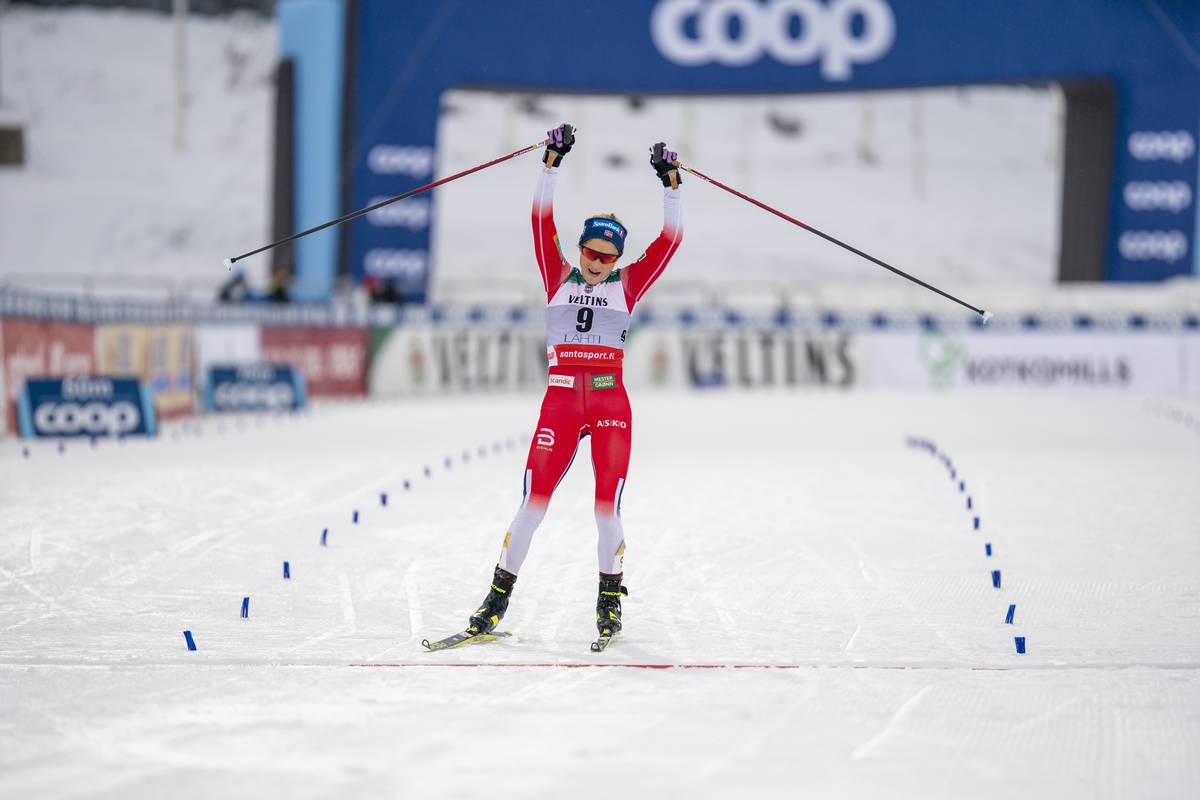
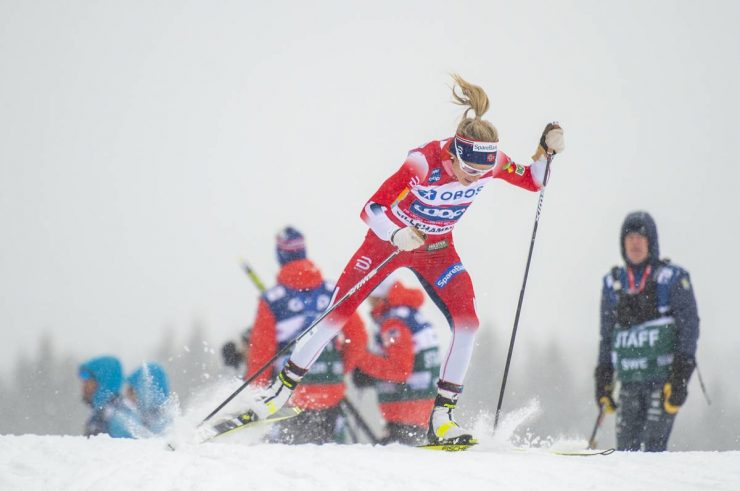
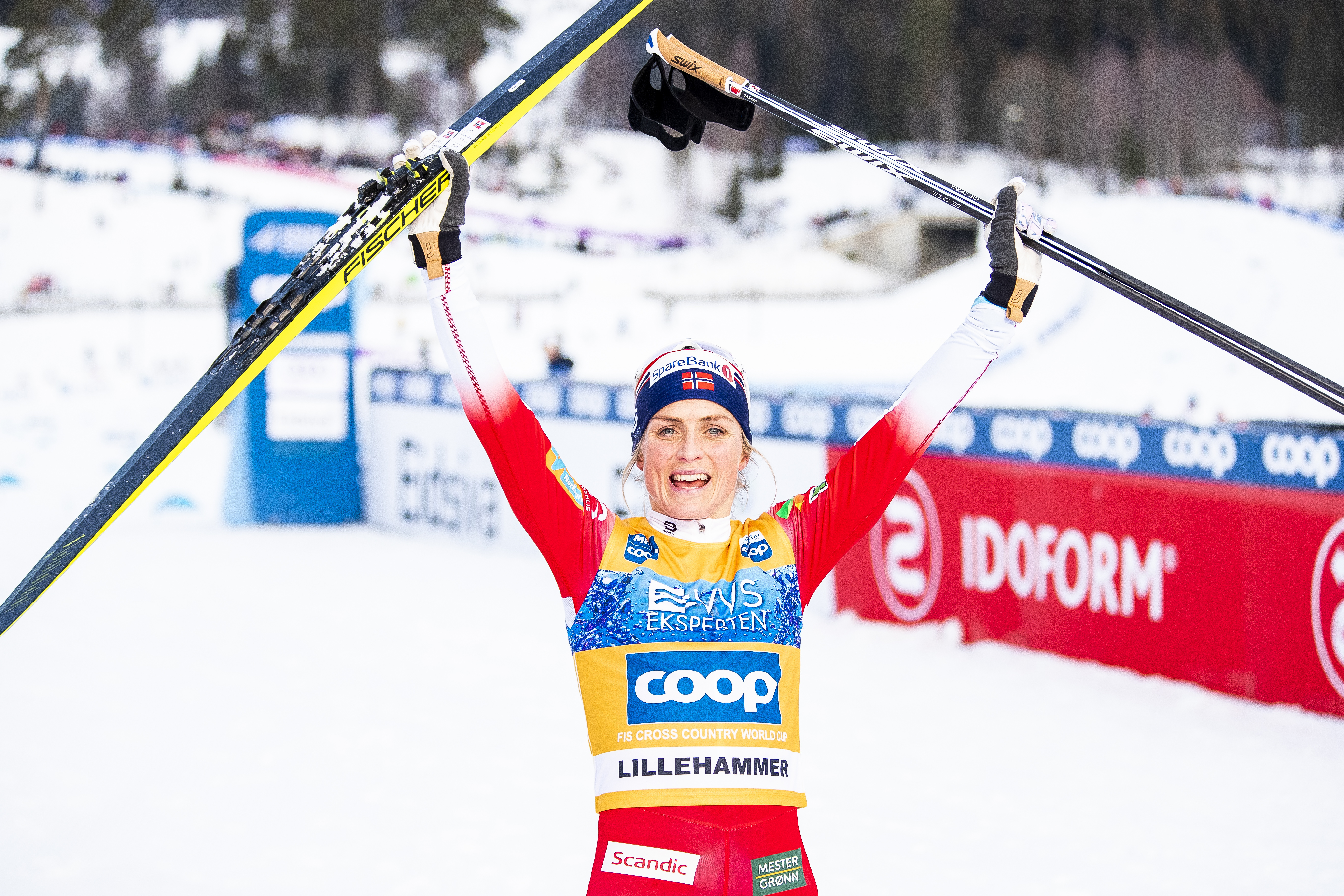
    Same as it ever was – Therese Johaug with the off the front win. (Photo: NirdicFocus).

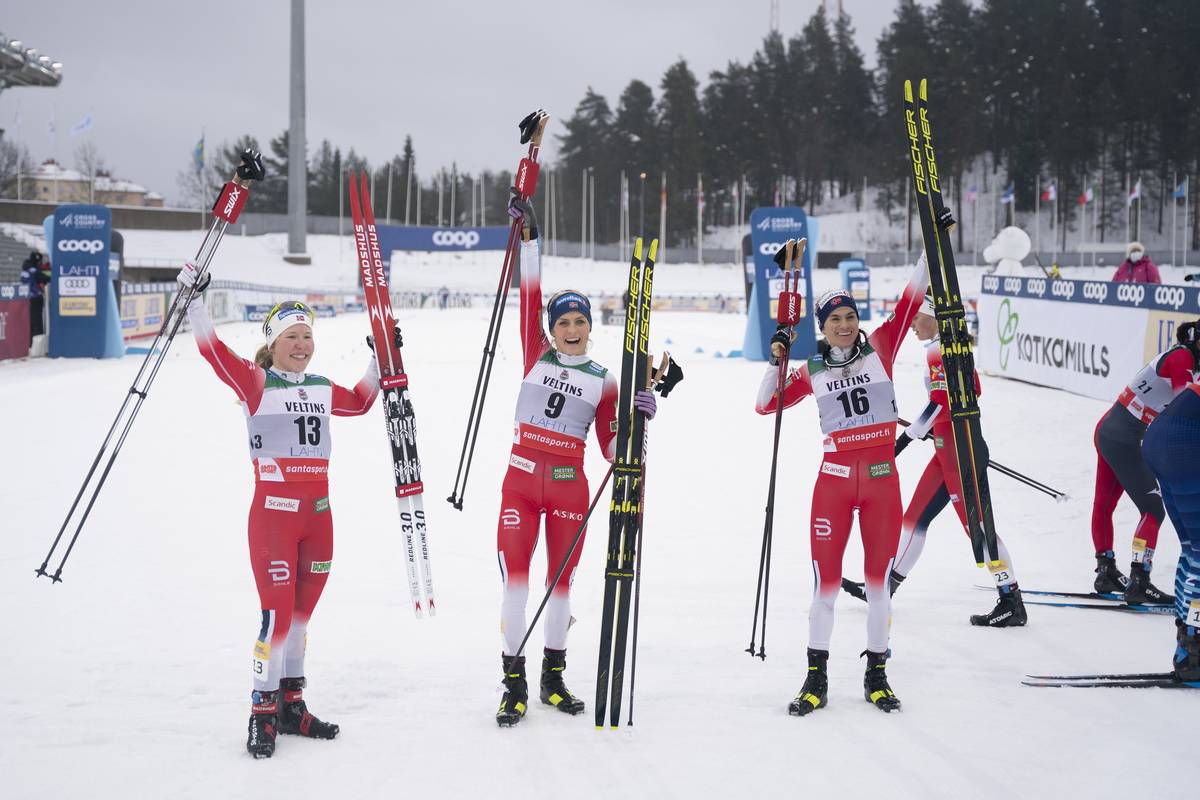
    In case you missed the discussion on the Devon Kershaw podcast, the Norwegian team made its World Cup return today in Lahti, Finland after nearly two months of training and competing domestically. As predicted, neither their form nor racing gears have not been from this decision. The women in red went 1-2-3 in the 7.5/7.5-kilometer skiathlon, led by powerhouse Therese Johaug who notched her third consecutive win in the event and third career skiathlon win on the tracks in Lahti. Her total of nine career skiathlon wins is a women’s record, surpassing Johaug’s former teammate and one of the most decorated skiers of all time, Marit Bjørgen.

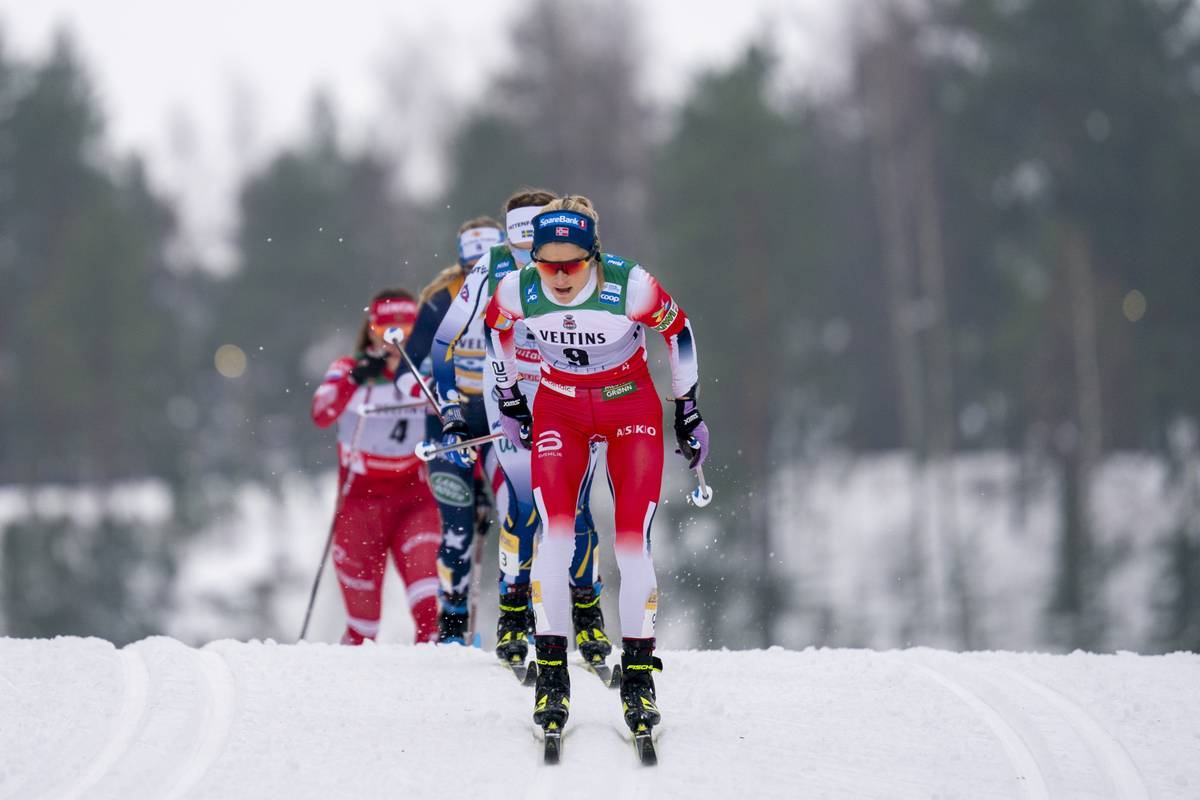
    In her usual style, Johaug took command from the start, skiing away from the pack displaying remarkable precision in her technique and metronomic tempo, stopping the clock at 37:45.1.

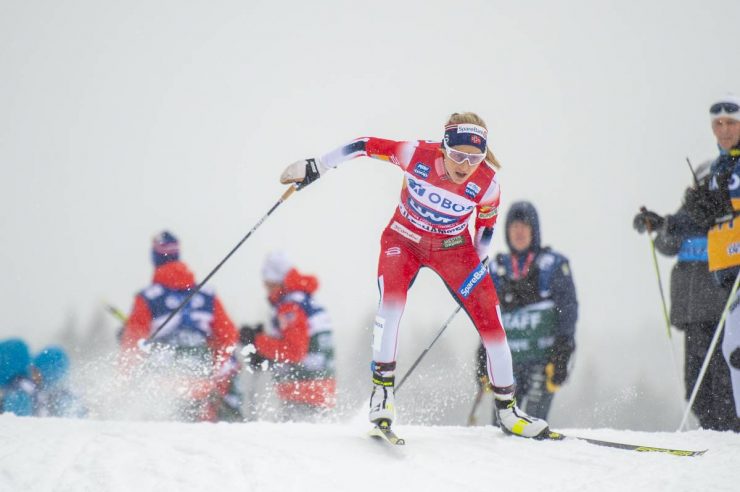
    Therese Johaug drives the pace during the classic leg of the Lahti skiathlon. (Photo: NordicFocus)

    As has been remarked before, with the lack of spectators and commentary overlaying the live stream, it’s hard not to be struck by the intensity of the athletes’ breathing. As they kicked, glided, and skated six laps of the 2.5 k course, their lungs pumped at a rate and effort that seemed impossible to sustain. Yes, Johaug had a gap to the chasers from early on, but like the others, her rapid breathing made it abundantly clear that she did not simply walk away with the victory.

    “It was so fun to be on the World Cup again,” Johaug told FIS after the finish. “It has been a long time since I was in Kuusamo [for the opening World Cup races in Ruka, FIN], so it’s really good to race here and see all the people in the cross country family again.”

    Unlike the teams coming off a two-week break following the Tour de Ski, the Norwegian squad made a quick turnaround from their National Championships, which wrapped up just five days ago in Trondheim. Today’s skiathlon is the second this week that Johaug has raced and won. In fact, with only minimal rearrangement for the second and third spots, the podiums in the two events were identical.

    The women’s 15 k skiathlon podium in Lahti, Finland: Helene Marie Fossesholm (NOR) second, Therese Johaug (NOR) first, and Heidi Weng (NOR) third, (l-r). (Photo: NordicFocus)

    “My shape has been really good, now and the last weekend. Today, I know that I was starting in the line, so I knew to take it a little bit easy in the first lap and then go hard from the second and the third. I felt really strong today, and of course, I had to do all the job alone, and especially then, it’s really good to stand on top of the podium.”

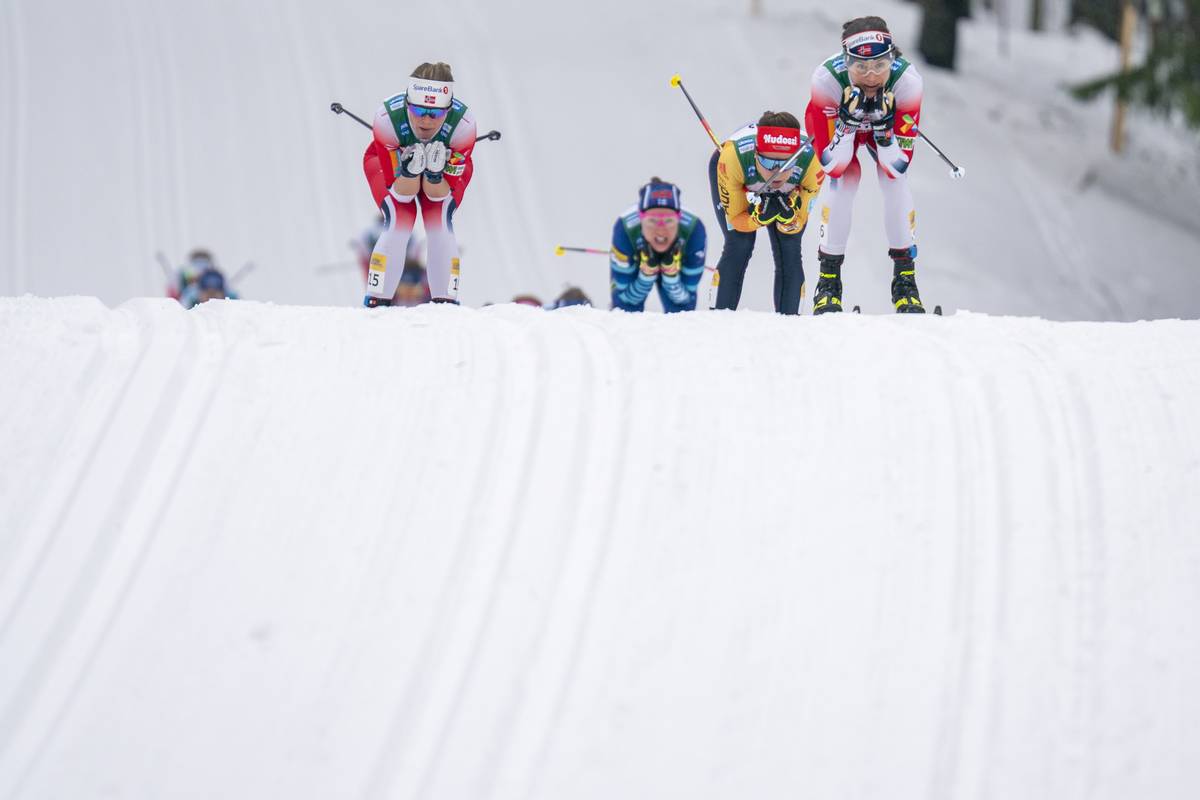
    Norway’s Heidi Weng and  Helene Marie Fosseholm – lead the chasers during the skiathlon in Lahti, Finland. (Photo: NordicFocus)

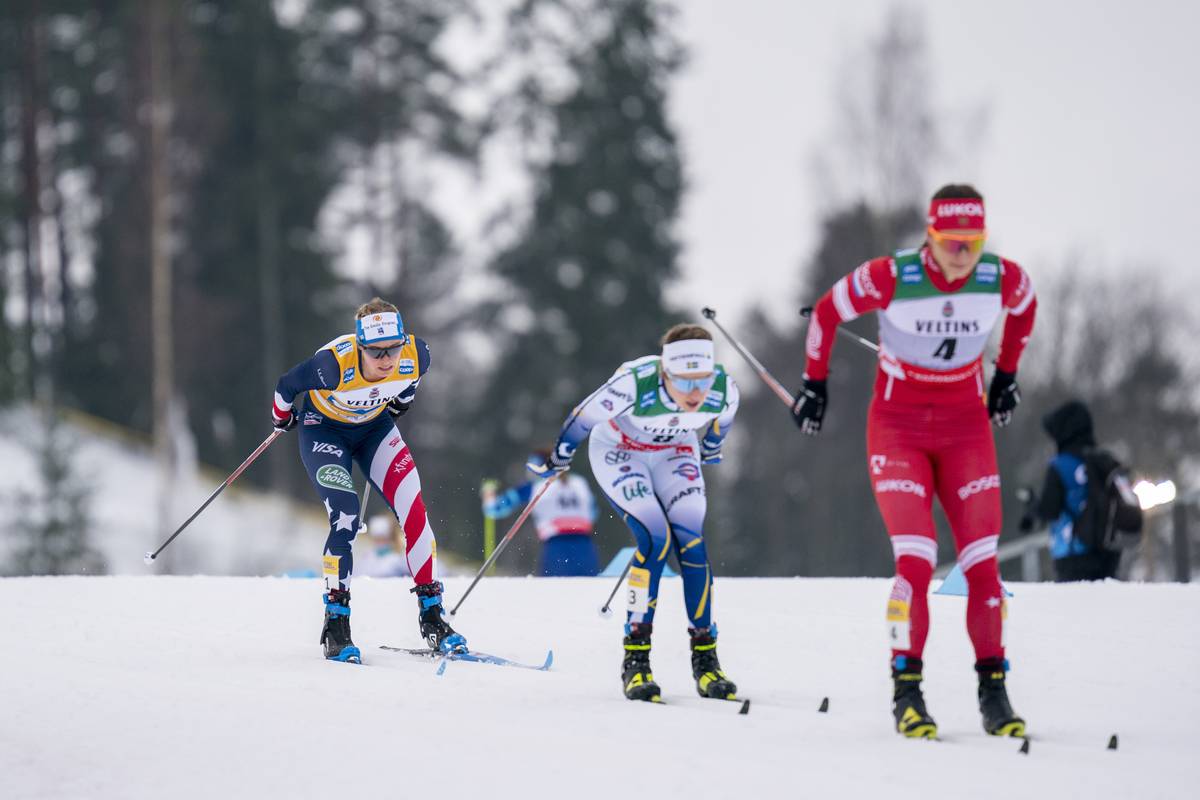
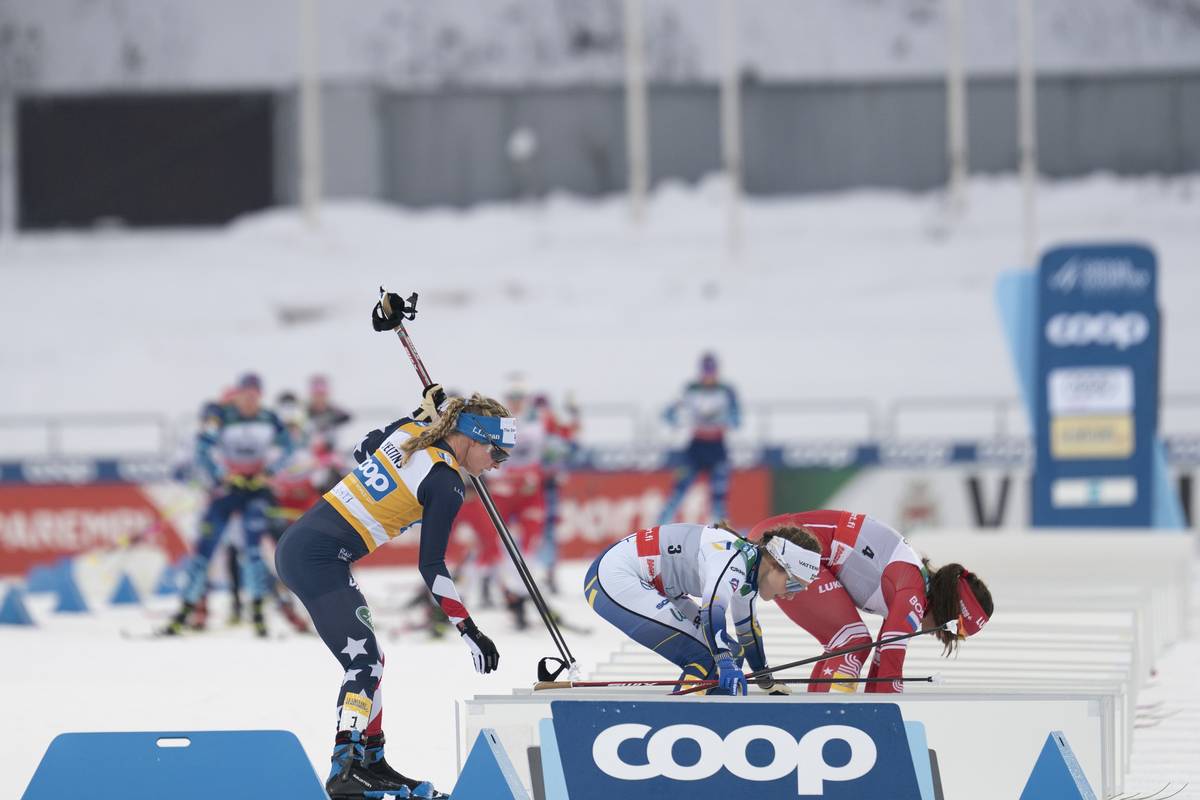
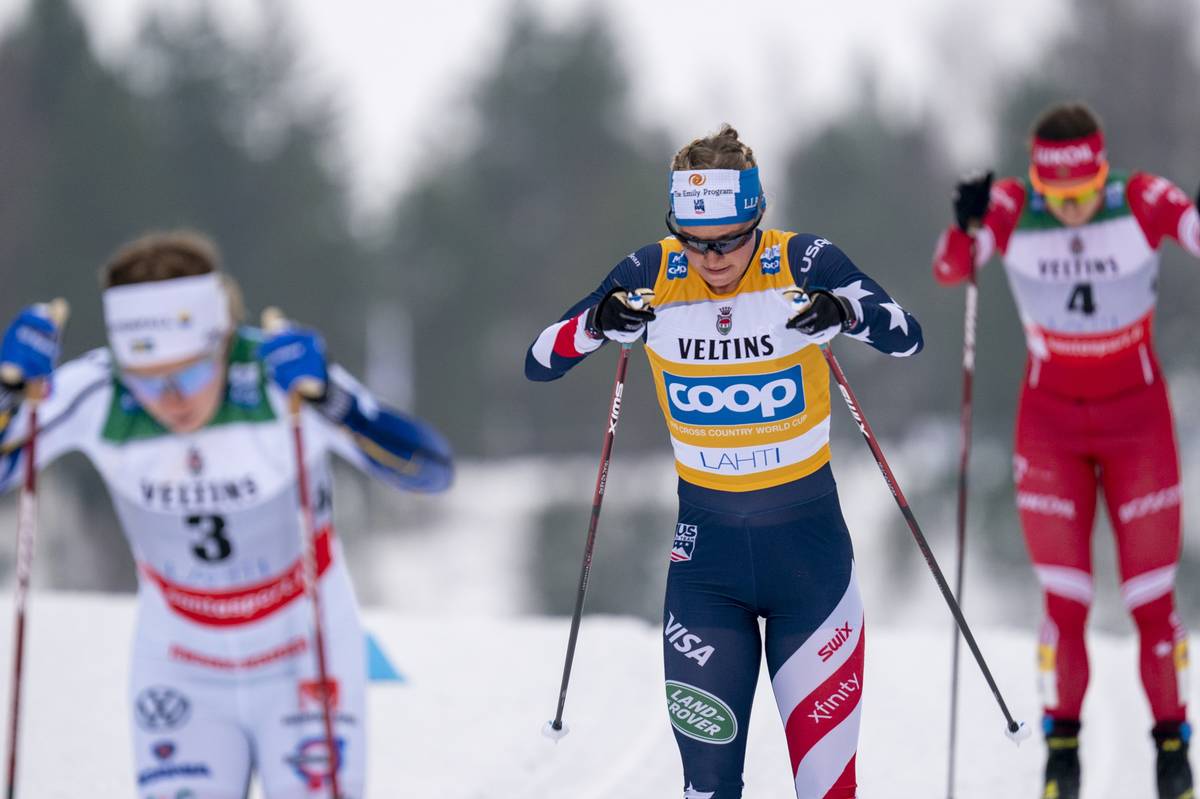
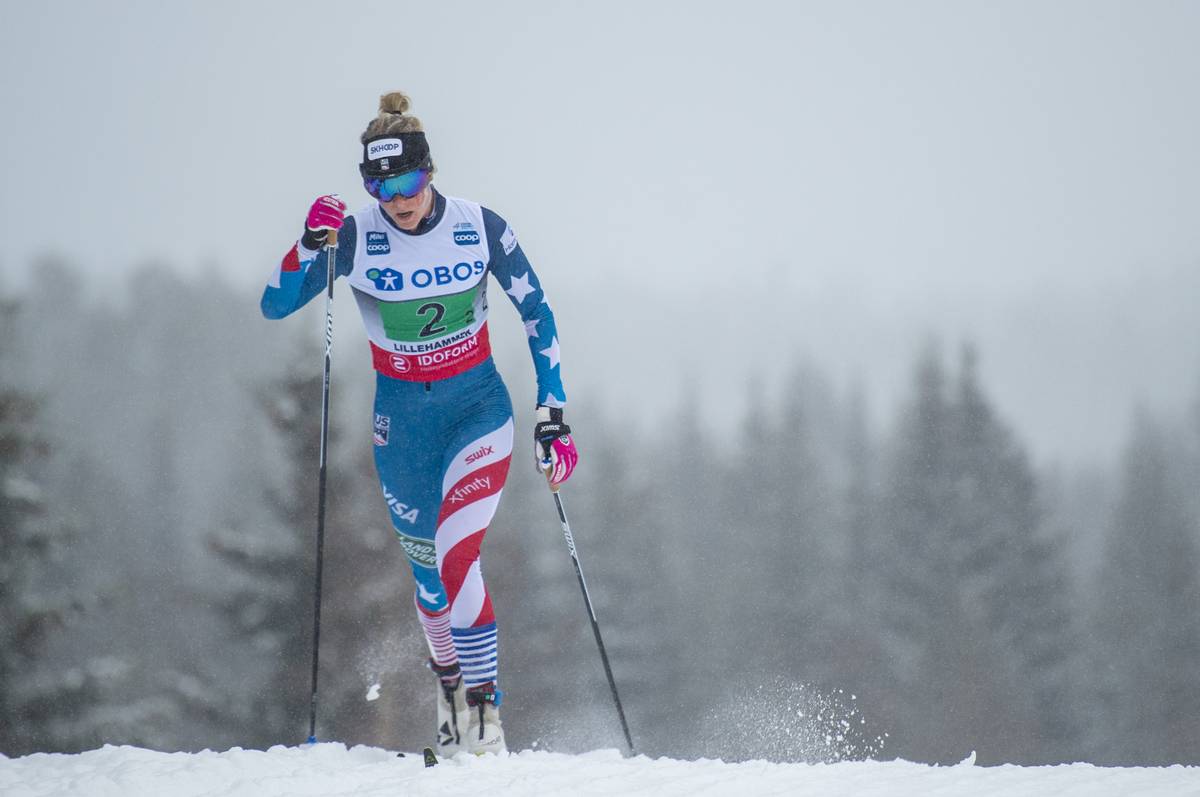
    Perhaps the more interesting race to watch unfold happened behind Johaug. When the Norwegian began to pull away in her second classic lap, a small chase pack emerged in her wake, containing Russia’s Natalia Nepryaeva, Sweden’s Ebba Anderson, and Jessie Diggins in stars, stripes, and the yellow overall World Cup leader bib. Diggins striding was strong and confident, as she tucked in behind the other two racers, entering the exchange zone at 7.5 k on their tails and smoothly switching into her skate skis and poles. 

    The eventual second and third-place finishers, Helene Marie Fossesholm of Norway followed by teammate Heidi Weng apex a corner during the skate leg. (Photo: NordicFocus)

    As the first skate lap unfolded, Norway’s Helene Marie Fosseholm and Heidi Weng began to ski off the front of the second group of chasers, which contained names like Olympic champion in the Skiathlon Charlotte Kalla of Sweden and bronze medalist Krista Pärmäkoski of Finland. Wearing the red World Cup distance leader bib, Rosie Brennan also sat comfortably in this group.

    Though only 29-years-old, Weng is a veteran compared to Fosseholm, who is only 19. Her results this season indicate she is a name to get to know; she finished 6th overall in the Ruka Triple, and proceeded to earn four podiums during her subsequent time racing on home turf, including a Johaug-like victory in the 10 k skate last week during the Norwegian National Championships, winning by a margin of over 30 seconds. Johaug did not contest this event. 

    By the 10 k mark, Fosseholm and Weng had caught the group of Andersson, Nepryaeva, and Diggins. The Russian began to fall off the pace, but Diggins was not about to follow suit. The women skated as a unit through the next lap, never separated by more than a second or two. 

    Jessie Diggins (USA) skiing behind Sweden’s Ebba Andersson and Russia’s Natalia Nepryaeva on Saturday’s 15 k skiathlon in Lahti, Finland. (Photo: NordicFocus)
    Jessie Diggins (USA) at the ski exchange 7.5 k into the women’s skiathlon alongside Ebba Andersson of Sweden and Natalia Nepryaeva of Russia. (Photo: NordicFocus)

    As they left the stadium for their final lap, Fosseholm made a surge, testing her mettle against her more seasoned pursuers. With just over a kilometer to go, she had nearly a seven-second gap, which dissolved much faster than it was formed. 

    Andersson, Weng, and Diggins powered through the back half of the lap, steadily closing in on Fosseholm. Aerial shots showed the women charging up the final climb, still able to jump skate after nearly 40 minutes of exertion. They V2’ed over the top of the climb, all cylinders firing as they dropped back toward the stadium, around a couple of tight curves and toward the lanes.

    Fosseholm could be seen taking nervous glances over her shoulder, knowing the other women had zeroed in their sights and there was no room for error. Luckily for Fosseholm, she had maintained enough real estate to enter the lanes with a clear path to second place (+28.1).

    Behind her, it was still anyone’s game. Weng was first into the lanes, but Andersson was by her side and charging, Diggins just behind. With a furious throw of boots at the line, Weng snagged the third spot on the podium (+29.6) with Andersson centimeters behind in fourth (+29.7) and Diggins in 5th (+30.1). 

    Yellow bibbed Jessie Diggins double poles during the first leg of the 7.5 k / 7.5 k skiathlon. (Photo: NordicFocus)

    In a post race interview, Diggins shared insights into the conditions in Lahti and how bomber kick on klister allowed her to ski what she identifies as one of her best classic races on the World Cup. With suboptimal glide in skate, Diggins had to shift her tactics so she could stay in the draft of those in front of her and ultimately left a final slingshot around Andersson and Weng to fight for the podium just out of reach. 

    “I was excited to dare greatly and try to stay with Johaug as long as possible, just to see and to really push it… In the skate half, it was nice to have those girls to work with. I had to keep adjusting my strategy as I realized how our glide stacked up to their glide. I had to keep changing it around, and I played the only card I had, tactically speaking. It didn’t really work, but it was the only thing I could do in the situation that I was in. I was really proud of that and I think I skied as smart of a race as possible.”

    Jessie Diggins leaves everything on the course to finish 5th in the 15-kilometer skiathlon in Lahti, Finland. (Photo: NordicFocus)

    Diggins also discussed the team recovery camp in Seiser Alm, Italy, how she manages the balance of increased media attention with training and recovery and her desire to support meaningful causes like the Emily Program, and how “new blood” on the World Cup squad re-energizes the veteran members of the American team.

    Maintaining her position in the second group of chasers, Brennan skied to 11th place (+1:07.6), ending her race just ahead of Kerttu Niskanen in a photo finish.  

    In focus and red bibbed as the World Cups leading distance skier, Rosie Brennan near the start of the 15 k skiathlon in Lahti, Finland. (Photo: NordicFocus)

    “It’s always hard to know how the body is going to bounce back from an event like the Tour de Ski,” wrote Brennan in an email after the race. “As a result, I decided to start controlled and then see what I had when I switched to skating. I felt much stronger in classic than I have all season and as a result maybe should have been more aggressive in the classic leg, but hindsight is always 20/20. After the transition to skate, my muscles struggled a bit, but I found better movements and strength as the skate portion went on. There wasn’t much space to move in the skate portion and I feel I missed some moves that I shouldn’t have, but had a strong final climb to move up a bit. In all, I feel this race was a really good step in the right direction for me as I am now focused on preparation for the World Championships.”

    Rosie Brennan finishes strong in the chase pack for 11th place in the 15-kilometer skiathlon in Lahti, Finland. (Photo: NordicFocus)

    A quick look to the overall World Cup ranks. With today’s results, Diggins remains at the top of the overall leaderboard with 991 points and also ties Brennan for the top spot in the distance standings with 401 points. Brennan remains in second place overall with 824 points, followed by Russia’s Yulia Stupak with 802 points. 

    In her first World Cup start, Sophia Laukli (USA) skis to 33rd in the Lahti, Finland skiathlon. (Photo: NordicFocus)

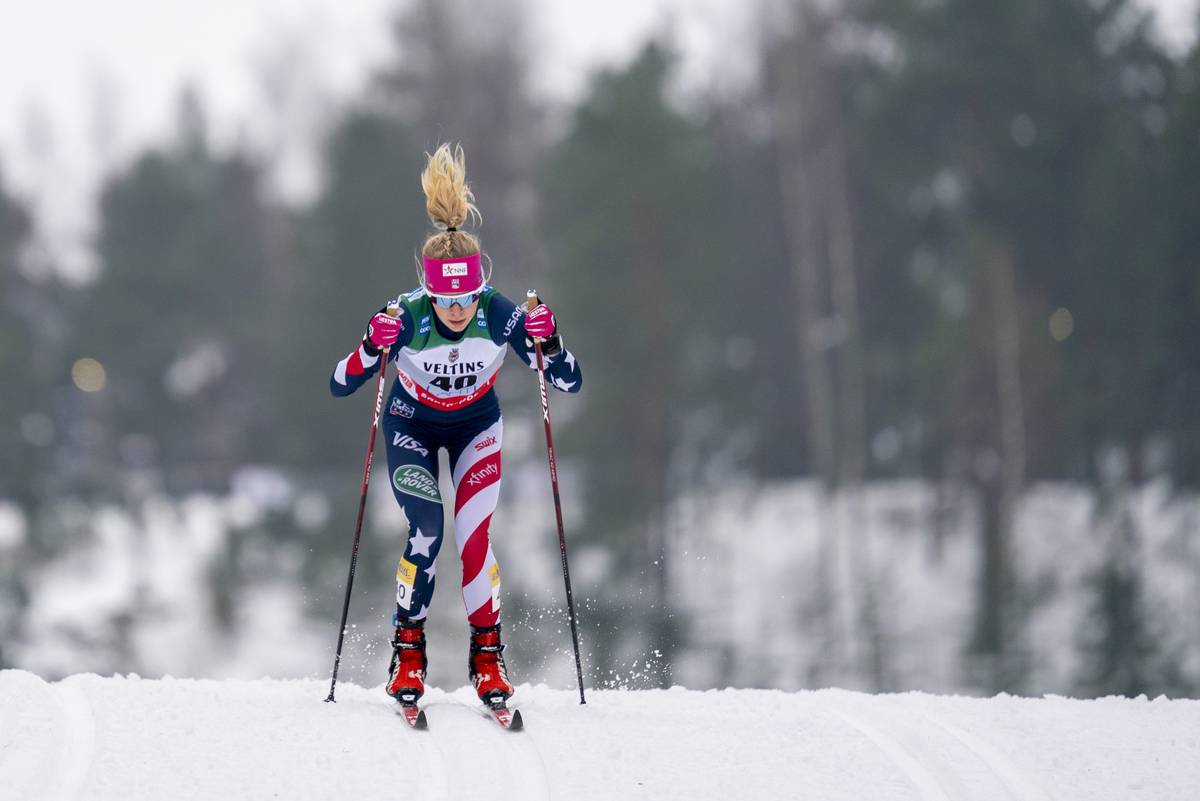
    Also for the U.S., Sophia Laukli in her first World Cup start raced to 33rd (+3:54.8). Laukli is a member of the US Cross Country D-Team and is a sophomore at Middlebury College in Vermont. Caitlin Patterson was the next American in 37th (+4:33.8), Julia Kern 40th (+6:31.3), and Alayna Sonnesyn 43rd (+6:41.1). Forty-eight skiers finished the race. 

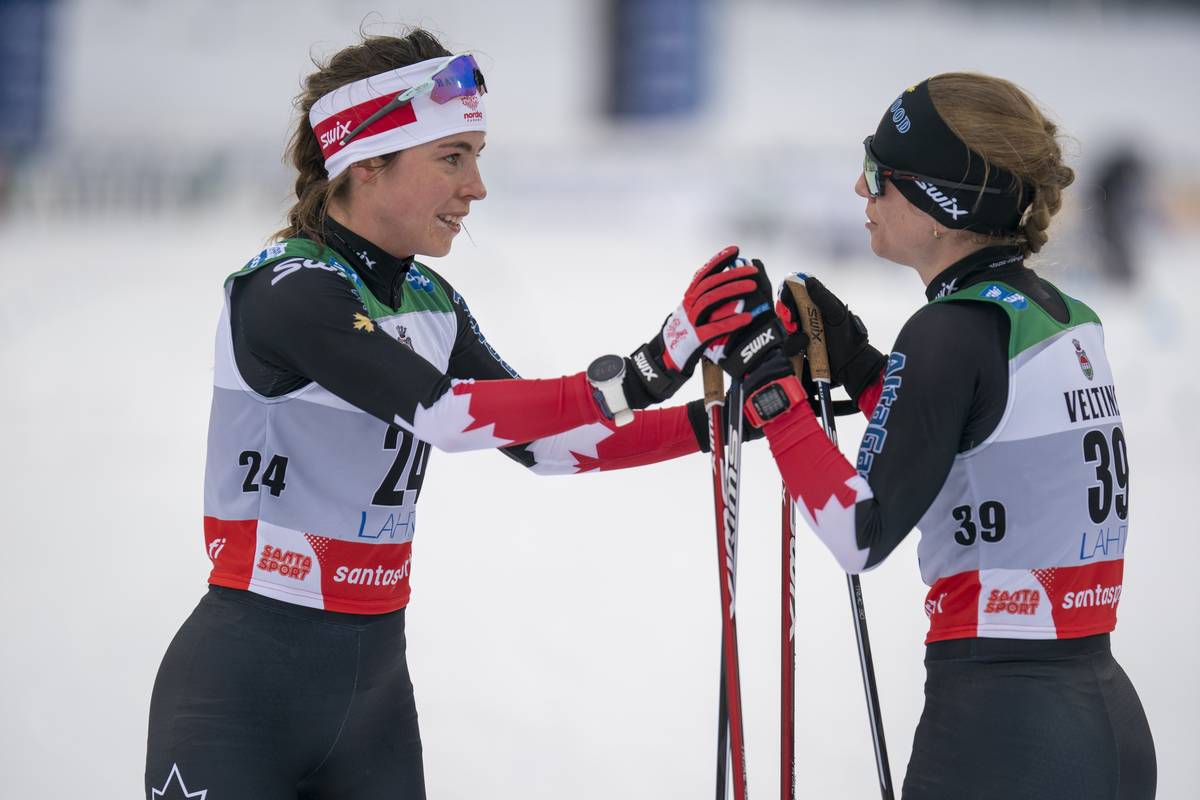
    This was Canada’s first World Cup appearance this season. Two athletes scored points, Katherine Stewart-Jones in 24th (+3:23.5) and Cendrine Browne in 27th (+3:44.9). Laura Leclair skied to 44th (+6:41.7).

    Katherine Stewart-Jones (CAN) and Cendrine Browne (CAN) (right) at the finish of the 15 k skiathlon. (Photo: NordicFocus) – FIS world cup cross-country, skiathlon women, Lahti (FIN). www.nordicfocus.com. © Vianney THIBAUT/NordicFocus. Every downloaded picture is fee-liable.

    7.5/7.5-kilometer Skiathlon Results  

    World Cup Standings: Overall | Distance 

  • Sans Fans, Sweden’s Karlsson Takes Johaug at the Holmenkollen Line

    Sans Fans, Sweden’s Karlsson Takes Johaug at the Holmenkollen Line

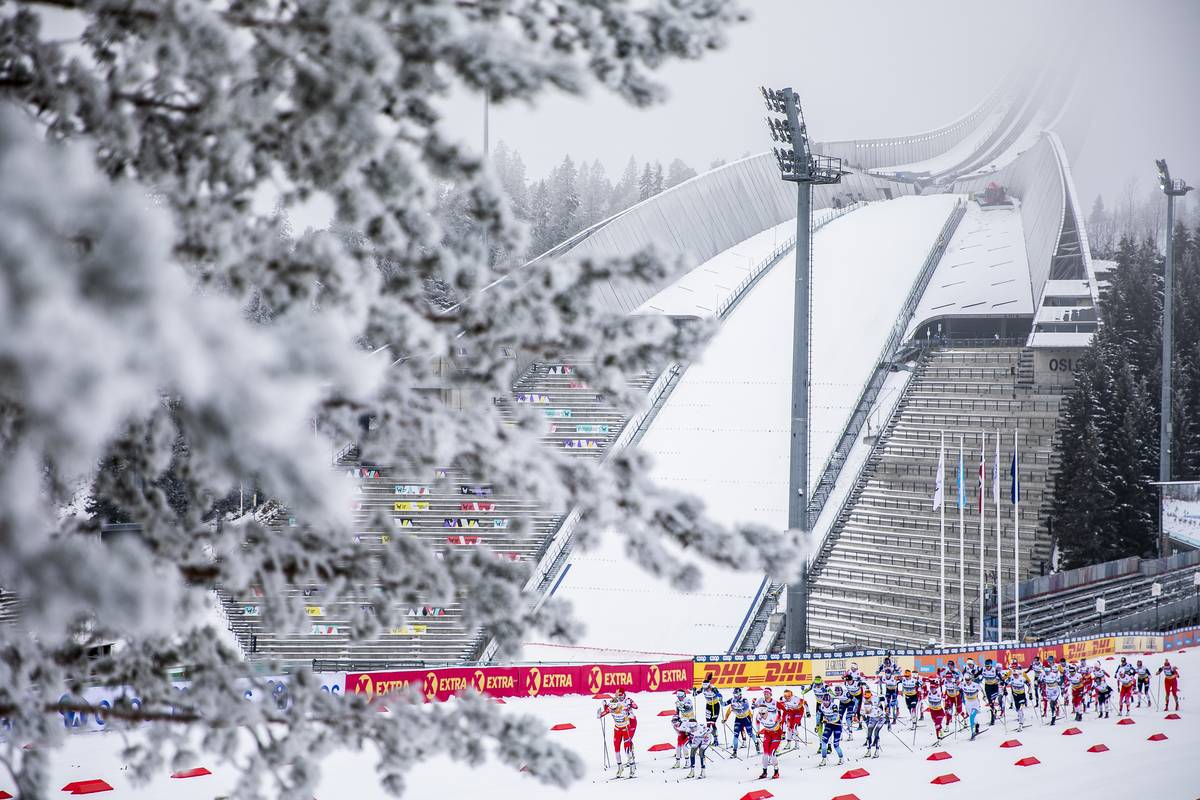
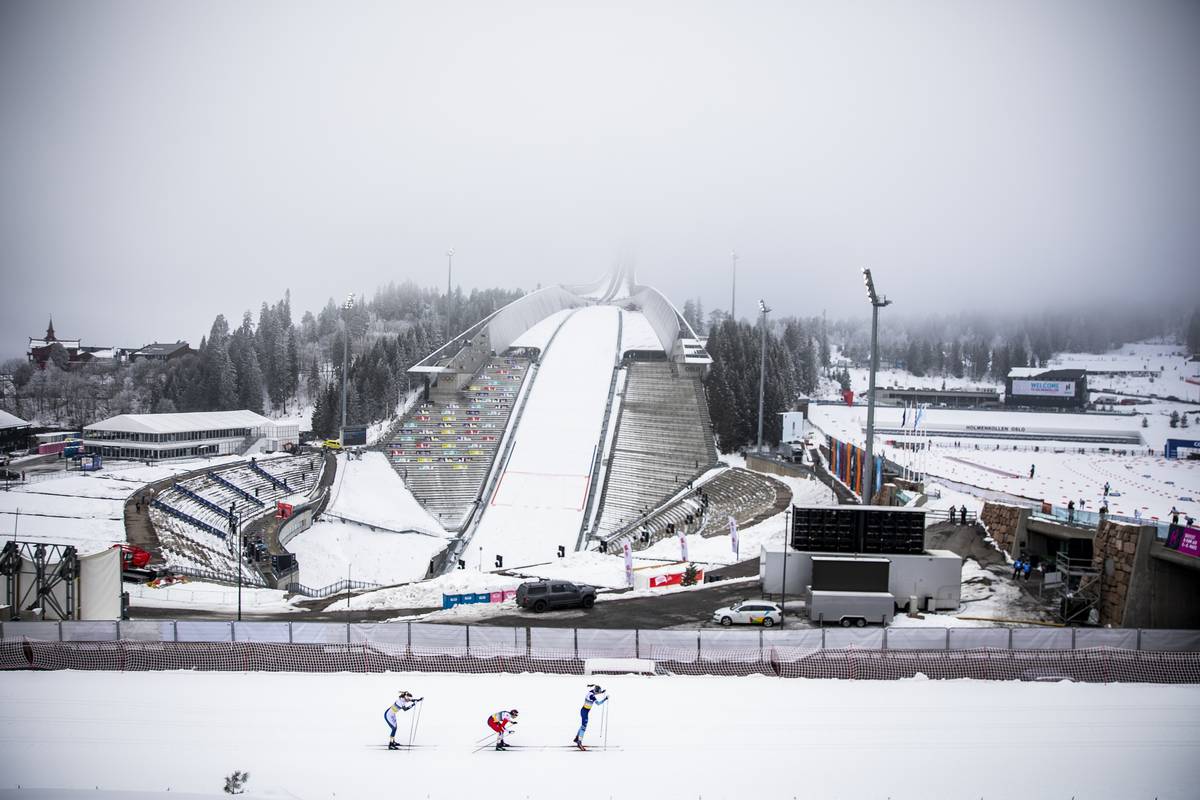
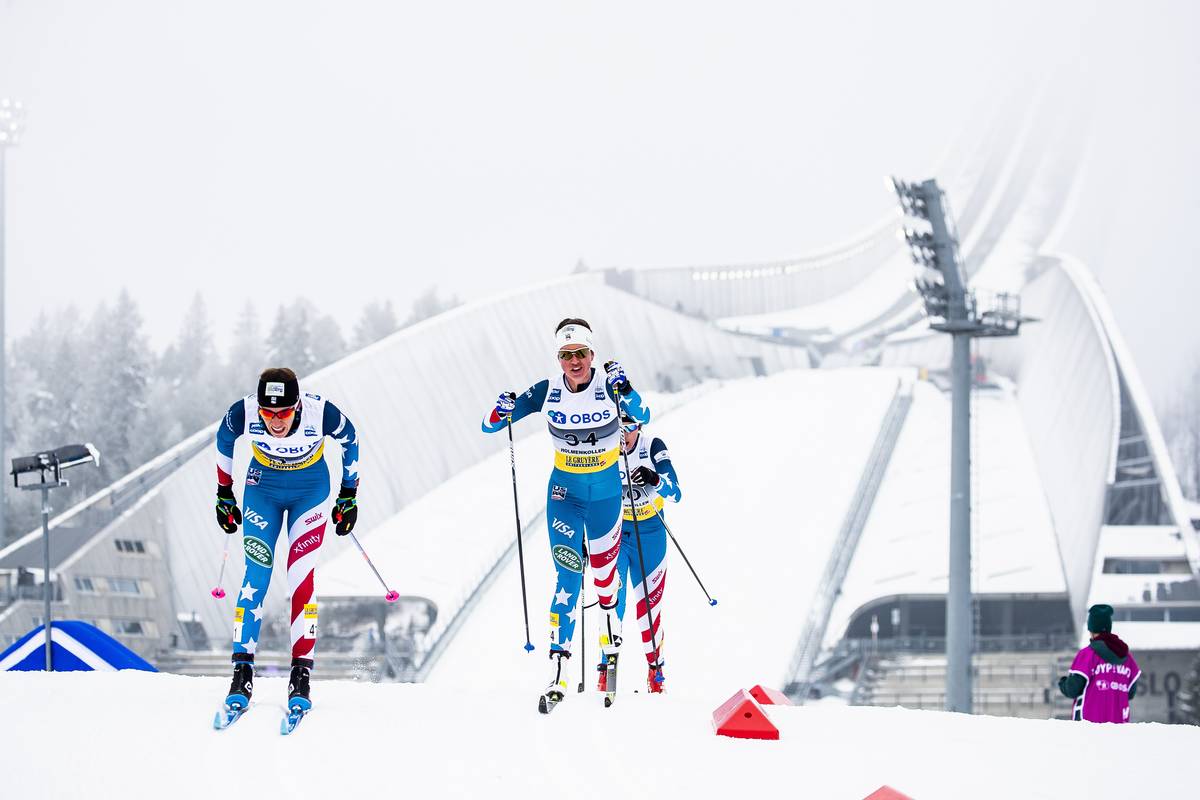
    A quieter and more serene Holmenkollen stadium area with fans banned from much of the course. (Photo: NOrdicFocus)

    Racing the Holmenkollen without spectators is a bit like not getting a white Christmas. It does not change the end result, here racing a 30-kilometer mass start classic race on the famed tracks above Oslo, Norway. But the experience loses some of the magic.

    Race organizers announced Thursday that spectators would not be allowed to attend the race due to the increased risk of spreading COVID-19. On a typical year, crowds in numbers up to 100,000 per day take the tram from the city center to the venue, where they either pay to sit in the grandstands or they post up in the woods, often drinking and cooking over a fire. 

    Though the stadium was empty, some spectators did choose to watch the event from the woods, but their numbers were not close to the norm.

    Matt Whitcomb, U.S. World Cup Coach, however, wrote this in an email, “The Holmenkollen stadium, which can at times boom so loudly we can’t hear our own shouts to the athletes, was a ghost town today. But the people did not stay home; they moved to the forest. The woods were as loud as I can remember. It was a great fan turn-out.”

    A empty feeling through the main stadium. (Photo: NordicFocus)

    If you’ve ever skied the tracks at the Holmenkollen, you’ve probably uttered a humbled and exhausted expletive somewhere along the way. The climbs are long and unforgiving, and the downhills can be lightning fast.

    Unsurprisingly, Norway’s distance champion Therese Johaug looked to be running away with the race. Within the first 10 k, Johaug gapped the field with flawless technique by 25 seconds. She took the maximum of 15 bonus points at each checkpoint, which happened at 3.7, 9,9, 16.1, and 22.3 k.

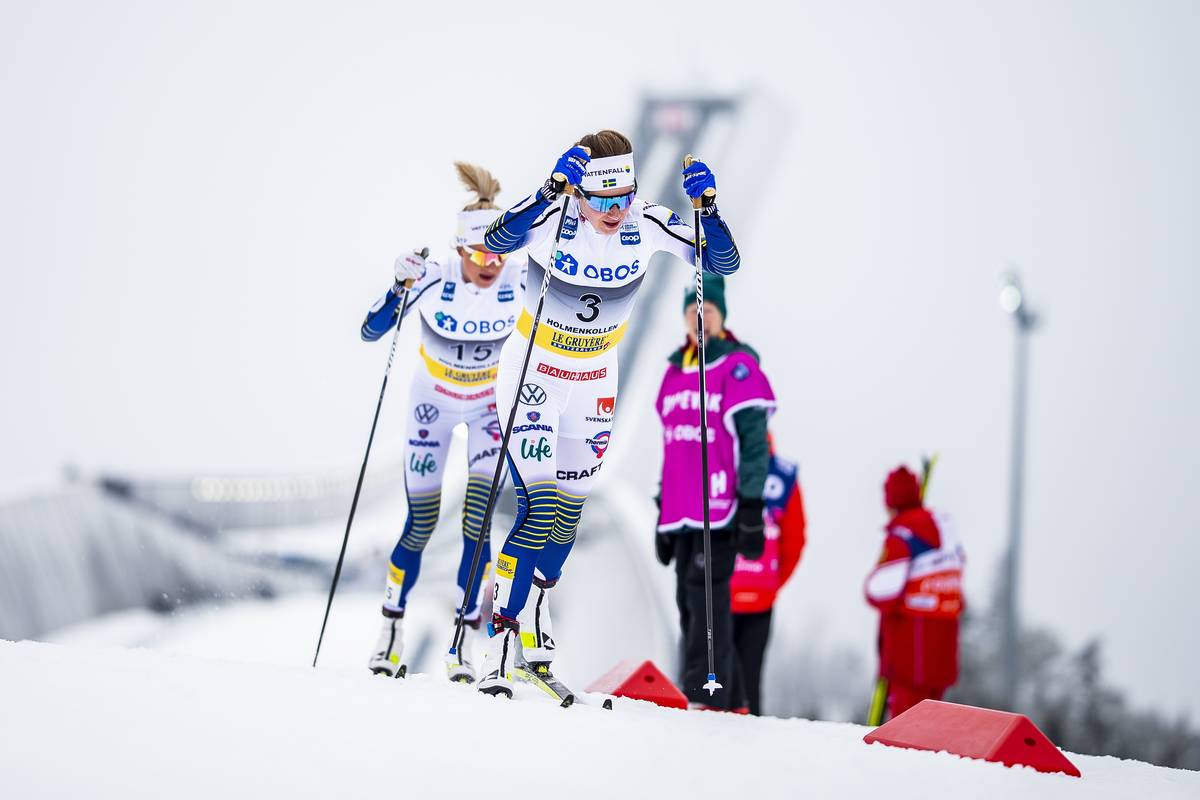
    Behind her, a large chase pack worked together in a race for second place. With less than ten k to go, the top-20 were within 8 seconds of one another. As the final round of bonus points drew near, Sweden’s Ebba Andersson and Frida Karlsson surged to the front and broke away, steadily cutting Johaug’s lead in half by the 26.3 checkpoint. 

    They had chosen to switch skis before the final lap, and it was evident that their kick and glide were superior to those around them. Johaug, however, had not changed skis or taken her last opportunity for a feed.

    Ebba Andersson (front) and Frida Karlsson chasing Johaug. (Photo: NordicFocus)

    This is where things got interesting. After skiing alone for 28.5 k, suddenly a figure appeared in the screen with Johaug. That figure was Karlsson who was closing hard from less than ten seconds behind. 

    It became a matter of real estate. After another kilometer, Karlsson was only five seconds behind. But there were only 2 k left. 

    Up the final long climb and inside the final k, Karlsson marked Johaug from the tails of her skis, switching lanes near the crest of the hill and dropping into a tuck to take advantage of the speed of her skis. Johaug stayed in her draft, sneaking back around before the final roller. 

    But Karlsson had the superior speed in the final sprint, leapfrogging the Norwegian and creating a gap in the lanes to win the race in 1:22:19.1. Johaug crossed 1.9 seconds behind and immediately congratulated her young opponent  on her effort. 

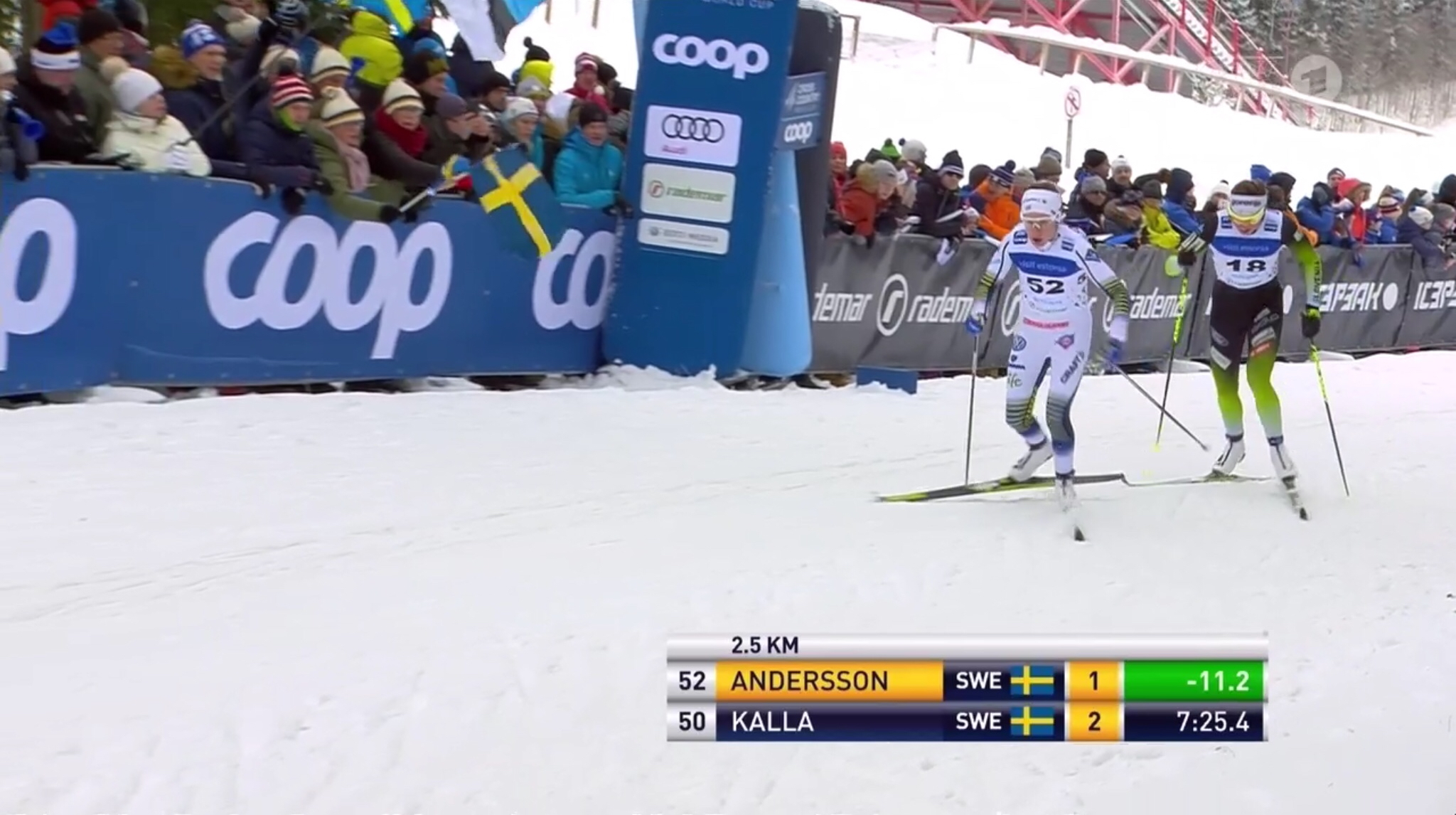
    Andersson, who had fallen off of Karlsson’s pace, took third (+20.9), followed by teammate Charlotte Kalla (+40.5) and Natalia Nepryaeva in fifth (+43.1). 

    Karlsson’s excitement about her performance was clear as the 20-year-old hugged her teammates and jumped into a coach’s arms, somewhere between laughing and crying.

    “I felt so good today,” Karlsson told FIS emphatically. “I had great skis and I think it was a winning concept to change skis and have new fresh ones. I felt so strong in the end and I was hunting and heard I was taking time on Therese. In the end, I felt like ‘now I am going all the way’ and it was a success.”

    Women’s Oslo 30 k classic podium: Therese Johaug (NOR) second , Frida Karlsson (SWE) first, and Ebba Andersson (SWE) third, (l-r). (Photo: NordicFocus)

    Racing for North America, Caitlin Patterson was the top finisher in 47th (+!0:15.1), followed closely by her CGRP teammate Kaitlynn Miller in 48th (+10:37.5) and APU’s Becca Rorabaugh in 49th (+12:26.4).

    Results

    Caitlin Patterson (USA), Kaitlynn Miller (USA), Becca Rorabaugh (USA), (l-r). (Photo: NordicFocus)

    Below we have included a post-race interview with Caitlin Patterson in which she discusses some frustrations with her race.

    Post-interview with Caitlin Patterson

  • Johaug Tops an All-Norwegian Podium; Diggins 8th, Brennan 9th

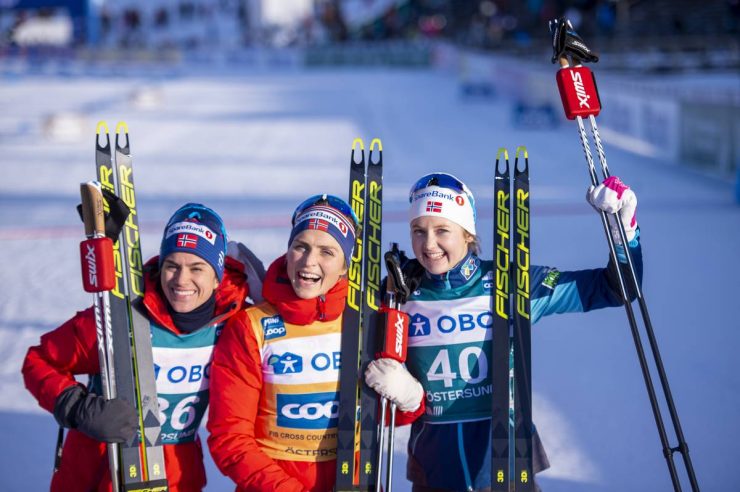
    An all-Norwegian podium in Östersund, Sweden. Therese Johaug won the day ahead of Heidi Weng and Ingvold Flugstad Østberg. (Photo: NordicFocus)

    Here we go again. A new Scandinavian Ski Tour takes the spot of a World Championship or Olympic Games during this off-cycle year. Six stages working east from Östersund, Sweden to Trondheim, Norway, beginning with today’s 10-kilometer individual start freestyle event. 

    Under clear skies, light fading and shadows lengthening as the sunset looms just a few hours away, the women time trialed through the tall conifers to set the tone of the overall tour standings. Crowds arrived in droves to line the course and fill the stadium, a cacophony of cheers creating the soundtrack to the stage. 

    Today’s format suits the Tour favorite, Therese Johaug, who has expressed that mass start events do not suit her as well. This season, Johaug won the Tour de Ski and has taken the top spot in each of the last ten individual start distance skate events. 

    Her story today essentially wrote itself. In Devon Kershaw’s words: “Gun to tape annihilate.”

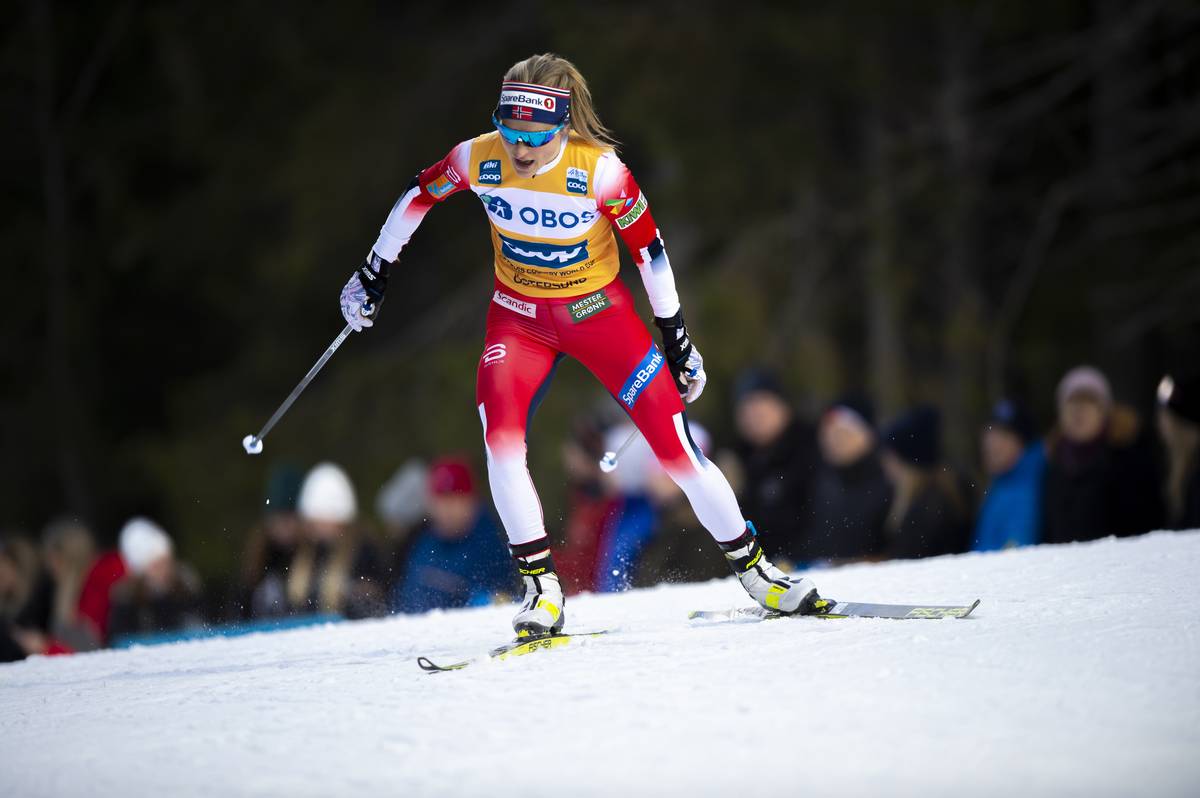
    Therese Johaug (NOR) dominates the first stage of the FIS Ski Tour 2020. (Photo: NordicFocus)

    Johaug hammered out of the start gate and did not slow down until she crossed the line, her grimacing face making clear the unmatchable power and tempo she was forcing herself to maintain. Stopping the clock at 21:49.7 and raising her arms briefly in the air before collapsing over her poles, Johaug sealed the deal on best in show. 

    Her time gap on her competitors increased in an almost alarmingly linear fashion throughout the stage. 12.8 seconds at 2.6 k increased to 20 at the halfway mark, growing to 45.6 seconds at the finish. 

    Victorious in Östersund, Therese Johaug has a strong start to the FIS Ski Tour 2020. (Photo: NordicFocus)

    “Oh yes, I could never get a better start than this,” a glowing Johaug told FIS at the finish. “I feel that it was my best skating distance in my career, so I am really happy with the skis and with the shape. It was an amazing race today… It’s good to start the Tour and I’m looking forward to the next races.”

    Here’s what else went down.

    Racing in bib 27 amongst the first wave of 30 skiers, Rosie Brennan set the bar high for the seeded group of  top-ranked skiers who followed in bibs 32 – 60, posting some of the fastest time through each checkpoint. Although she faded into the results as the seeded group came through, it was still a noteworthy performance, placing her 9th for the day (+1:25.7) and second American.

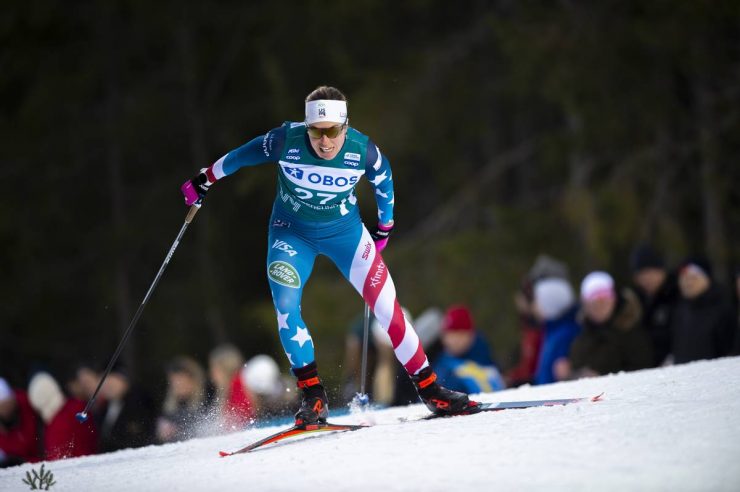
    Rosie Brennan sets the bar, racing to 9th in the first stage of the FIS Ski Tour 2020. (Photo: NordicFocus)

    Of other skiers in her group, Brennan was only challenged by Norway’s Ragnhild Haga and Sweden’s Frida Karlsson, who was recently cleared to return to World Cup competition. Karlsson sat out the majority of the season after failing to meet team health standards for body composition and bone density. 

    Karlsson took the pace out hot, clearly gunning for the win, or at least for the bonus points available at the 2.6k checkpoint. She had the second fastest overall time there, then she attacked the steady climb with high tempo. But she was unable to hold the effort, fading back into the ranks as the race went on. She ended her day in 19th (+1:46.0).

    After a fast start, Frida Karlsson falls to 19th in the 10 k skate. (Photo: NordicFocus)

    Among the first starters of the seeded group in bib 36, Heidi Weng (NOR) went hunting. From 4.2 k onward, she knocked down the previous best time, setting a new and short-lived time to beat, as Johaug chased from two bibs behind. Weng, the 2017 and 2018 Tour de Ski winner who is currently ranked third in the overall World Cup standings hung on to take the second podium spot. 

    Next over the line was Ingvild Flugstad Østberg in third (+47.3), who hovered a few seconds behind Weng at each checkpoint. The trio sealed the deal on an all-Norwegian podium. 

    Ebba Andersson of Sweden interrupted the string of Norwegians in fourth (+53.1), followed by Haga (+1:04.3) and Astrid Urenholdt Jacobsen (+1:05.0).  

    Leading the Tour for North America, Jessie Diggins skied to 8th (+1:18.1). Diggins currently sits 5th in both the distance and overall World Cup standings. 

    Jessie Diggins skates to 8th in the first stage of the FIS Ski Tour 2020. (Photo: NordicFocus)

    In a post-race call, Diggins described the track in Östersund as a “thinking course”, full of swooping turns that kept athletes focused and on their toes. Diggins explained that she has been experiencing an abnormal amount of fatigue over the last few weeks, but felt some encouraging sensations in today’s event and has a plan in place to optimize her recovery between stages so she can keep going hard. 

    She also shares insight about some of Tour’s sustainability initiatives to decrease the environmental impact of such an event, and weighs in on the energy generated from a large American team. 

    Post-race interview with Jessie Diggins.

    Jessie Diggins leads the way for Team USA after the first stage of the FIS Ski Tour 2020. (Photo: NordicFocus)

    Just behind Diggins, Brennan was the next American. It was the APU/USST athlete’s third top-10 result of the season. Her last two were also earned in stage events; she was 9th in the 10 k skate during the third stage of the Tour de Ski in Toblach, Italy and 6th in the 10 k classic in Ruka. She also skied the 7th fastest time of day up the Alpe Cermis in the final TdS stage. 

    “It was a good opening day of the Ski Tour 2020 for me,” Brennan wrote in an email to several news outlets. “After a frustrating weekend last week, I was ready to try to turn things around. The course here is hard and has lots of climbing so I felt it suited my strengths. It was fast conditions but there was also little rest so it was a tricky pacing game. I didn’t perfectly pace it and lost a little in the closing kilometers but I had much improved race feelings so I am very satisfied and hope I can continue this way throughout the tour.”

    Sadie Maubet Bjornen was the next American in 22nd (+1:51.4), followed by her APU teammate Hailey Swirbul in 36th (+2:09.3). Caitlin Patterson was next for the U.S. in 40th (+2:19.1),  Alayna Sonnesyn 43rd (+2:27.3), Julia Kern 50th (+2:38.0), Sophie Caldwell 51st (+2:39.3), Katherine Ogden 53rd (+2:48.0), and Rosie Frankowski 56th (+2:50.0). 

    In a post-race call, Matt Whitcomb sheds light on how the team is approaching the Tour in comparison to the Tour de Ski or a ski tour at the end of the season. Whitcomb explains that a major focus leading into the week was recovery and mental preparation.

    “We didn’t focus to much on performance — that’s never a great way to go. We work on the process and getting people psyched by giving them the confidence to know that they’re recovered. Whether or not they’re sharp on the first day or two, they should be sharp by the end. Whether that ends up happening or not, we’ll see. But believing in it is the key.”

    Whitcomb explains further how he gages how tired or recovered his athletes are and provides further insight into the women’s performance. Lastly, Whitcomb comments on Swirbul’s noteworthy rise in the ranks this year, attributing it to her fun but focused mental approach and the effect of the strong APU women’s training group.

    Post-race interview with Matt Whitcomb.

    On the Canadian side, Emily Nishikawa was the top finisher just outside the FIS points in 32nd (+2:05.0). She started one bib ahead of Sweden’s Charlotte Kalla, who she marked and followed to the finish once caught. 

    Emily Nishikawa leads the Canadian team in 32nd in Östersund, Sweden. (Photo: NordicFocus)

    Next up was Cendrine Browne in 35th (+2:09.0), followed by Katherine Stewart-Jones in 46th (+2:29.8).

    The tour is young. Racing continues tomorrow with a 10 k pursuit start classic on the tracks in Östersund.

    Final Results | Distance World Cup Standings 


  • Johaug Takes the Lead in Nové Město Pursuit; Diggins 4th

    Johaug Takes the Lead in Nové Město Pursuit; Diggins 4th

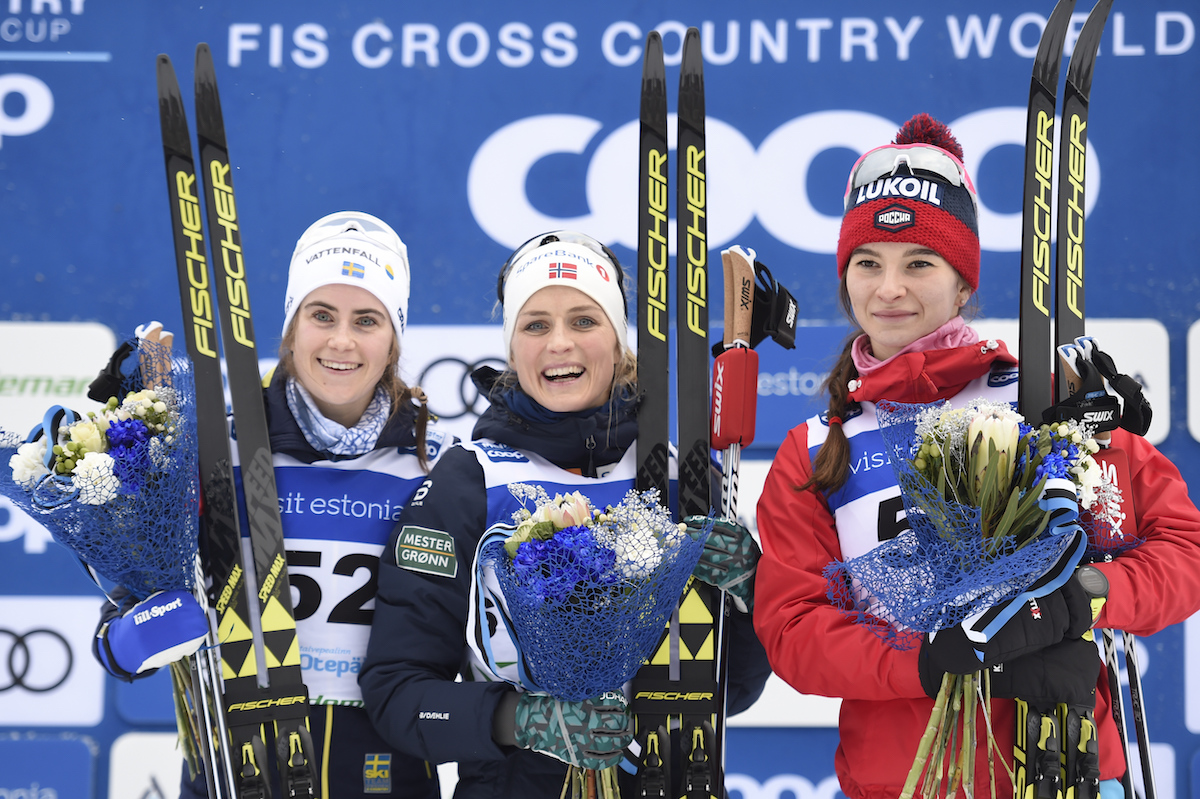
    The women’s podium inNové Město. Therese Johaug (NOR) took the win ahead of Natalia Nepryaeva (RUS) and Heidi Weng (NOR). (Photo: NordicFocus)

    “It has everything,” Sweden’s Charlotte Kalla told FIS before the start of the 10-kilometer interval start skate in Nové Město, Czech Republic. Though she was describing the steep uphills and working downhills, found along the 5 k track, it might have also been an apt description for what the weather had in store. As athletes headed out on course, the light icy precipitation transitioned into chunky white flakes accumulating on the deteriorating ribbon of man made and farmed snow. 

    The course profile of the 5-kilometer lap in Nové Město, Czech Republic. (Photo: Screenshot FIS broadcast)

    The two distance stages in Nové Město mark the start of Period III and the midpoint of the World Cup season, the tenth and eleventh of twenty one races. It also marks the return of the the squads of distance athletes who sat out last weekend’s city sprints in Dresden, Germany to recover from the compounding effect of their efforts in the Tour de Ski (TDS). Who made it through unscathed and who begins the second half of the season with lingering fatigue? Nothing like a two-day pursuit to find out.

    By 3 k, it was evident that Norway’s Therese Johaug, Tour de Ski winner and leader of both the World Cup overall and distance standings, was feeling on form. From the start, she unleashed her usual high tempo attack, clocking the fastest splits at each checkpoint. She stopped the clock at 23:31.1, over 30 seconds ahead of the next fastest time.

    “It was an amazing race today,” Johaug told FIS at the finish. “My shape and my body was really good. I have been a little bit tired after the Tour de Ski and I had some good sensation and bad sensations, but today it was a good day. Of course, the tracks out here and the snow was perfect for me, so I am really happy.”

    Johaug was chasing the ghost of her teammate, Heidi Weng, who started two bibs prior at the front of the seeded group. Leading the race for second place, Weng time-trialed through the wooded course, setting splits that were just faster than her peers’. At the half, she trailed Johaug by 17 seconds with four women within ten seconds of her: Natalia Nepryaeva of Russia, Moa Lundgren of Sweden, Jessie Diggins, and Ingvild Flugstad Østberg of Norway.  

    Soaring, Natalia Nepryaeva (RUS) powers to a second place finish in the 10-kilometer individual start skate inNové Město, Czech Republic. (Photo: NordicFocus)

    During the second lap, Nepryaeva closed the gap to Weng’s times, matching her with roughly two K’s to go, then pulling ahead by a few seconds. Throwing her boot for the second fastest time of the day, she knocked Weng back to third on the podium. Nepryaeva finished 32.7 seconds behind Johaug, and Weng was 40.3 seconds back.

    Weng is now batting 70 percent for podium finishes; she has only missed the top-3 in three of the ten stages, with her lowest rank of 8th occurring in the final stage of the Tour de Ski.

    Eyes locked on the task at hand, Heidi Weng skis to third during the 10-kilometer skate in Nové Město, Czech Republic. (Photo: NordicFocus)

    Diggins started third in the seeded group behind Johaug and Weng. After hovering in the top 5 throughout the race, she was next across the line in fourth (+48.5), with Ragnhild Haga of Norway just behind (+48.8). Østberg rounded out the final spot in the top five (+49.7).

    When asked for a preview of tomorrow’s pursuit, Johaug commented on this strong group of women who would be chasing her.

    “Of course, I’m really happy that I have 30 seconds, but I know that it’s a big group behind me and they can do work together and I’m going to be in the front alone,” Johaug said. “I have to work hard to have the first position in the finish, but I will do my best and we will see tomorrow how it ends.”

    The women of Nové Město. Therese Johaug (NOR) led the day, followed by Natalia Nepryaeva (RUS) and Heidi Weng (NOR). (Photo: NordicFocus)

    Due to poor WiFi connection, Diggins chose to share her post-race comments via email.

    “Today was a good race for me, although it was kind of funny because with the super deep, sugary snow, it never felt like I was moving very fast, especially stepping through the sugar on the uphills! But overall I’m happy with where my body is after the Tour de Ski, and I’m working on training as smart as I can to find that balance between racing and training hard and finding good recovery after such a big effort.” 

    After today’s result, Diggins is ranked third in the World Cup distance standings behind Johaug and Weng. She is ranked 5th in the overall standings. Diggins commented on how this plays into her tactics in the second half of the season.

    Glitter, snow. and grit. Jessie Diggins takes 4th in Nové Město. (Photo: NordicFocus)

    “In terms of overall ranking, there isn’t really a plan because it’s out of my control – as we saw during the TDS, a few tough waxing days can make a huge difference, and you obviously have no control over how other athletes are performing. With that in mind, I don’t worry about the overall and instead focus on making every race I do a complete effort, training and racing it to the best of my ability, only worrying about the things I can control like my race effort, technique and pacing. If I can do that well, then it sets me up as best I can for the overall.”

    After the Tour, Diggins headed to the Dachstein glacier in Austria, where she was joined by her boyfriend, Wade, for a block of recovery and training. 

    “My post-TDS training camp was really awesome, and I felt so lucky to have my boyfriend there with me! It’s very important to me to find a healthy life/skiing balance, in order to be happy and want to continue racing on the road for years to come. So my main focus during that time was simply happiness, as well as quality rest and recovery after the huge effort of the Tour.”

    Diggins closed with optimistic remarks heading into tomorrow’s classic pursuit. 

    “I had great skis today and I’m very thankful to our hardworking staff! Tomorrow should be an exciting pursuit start and I’m excited to ski with so many speedy ladies.” 

    Rosie Brennan (USA) during the women’s 10 k skate in Nové Město. (Photo:NordicFocus)

    Following Diggins, Rosie Brennan was the second fastest American, finishing 17th (+1:35.3), followed by Sadie Maubet Bjornsen in 26th (+1:51.1), and Julia Kern in 30th (+2:03.3). 

    “We faced some challenging conditions today,” Brennan emailed to several news outlets. “With no [natural] snow on the ground, the course was made up of all man made or saved snow, which didn’t adhere well to itself so it was deep, sugary, and dirty. The course was challenging in the sense of the amount of transitional skiing.  I wasn’t sure how I would feel after the Tour de Ski but tried to stay optimistic that my break was good and I would be back where I left off. I started well and was happy with my first lap. I faded much more than I had hoped in the end and think I am still feeling a bit of fatigue from the Tour. Overall, it was a solid day and I hope I can find another gear tomorrow.”

    Alayna Sonnesyn skis to 46th in Nové Město. (Photo: NordicFocus)

    Fresh off of U.S. Nationals in Houghton, Mich., Caitlin Patterson finished 39th (+2:17.7), and UVM graduate Alayna Sonnesyn (SMST2) rounded out the American squad in 46th (+2:38.1).

    “I’m really happy with my race today,” Sonnesyn emailed about her race. “I feel like I skied well and was consistent through the whole thing. I think I will learn a lot each day and hope to keep improving in the next few weeks!”

    New to this level, Sonnesyn begins her second set of World Cup starts, which she earned from her position as SuperTour points leader. Her first World Cup starts took place at the World Cup finals last spring in Quebec City, where a string of bad luck kept her from performing at her potential: illness, followed by three crashes and two broken poles, resulting in a DFL — “dead freaking last.” 

    “I was really excited about those starts [in Quebec City], but by mid-March I had traveled around the world (literally, I went from the Birkie to China to Germany and back to the US) all in about 2 weeks and I was totally wiped,” Sonnesyn explained. “I knew I didn’t have the kind of energy to have races that I was truly capable of but I still wanted to start them to gain that experience.

    “This year, I was slightly more comfortable showing up at a World Cup race and didn’t have to waste a ton of energy fan girling (too hard),” she wrote with a wink. “That being said, the field is so deep here and going into the race I wanted to focus on my own skiing, without worrying about results. That’s the really nice thing about being SuperTour leader right now; I didn’t need to “prove myself” in this first race. I have six races over 4 weeks to grow accustomed to racing at this high level and hopefully keep building on a race like today.

    In a post-race call, Chris Grover shared additional insights into the womens’ performances, including how Maubet Bjornsen is feeling after the Tour de Ski, and Patterson and Sonnesyn’s results fresh off the plane.

    Post-race interview with Chris Grover.


    Results | World Cup Overall Standings | World Cup Distance Standings


  • Tour de Ski Short List

    Tour de Ski Short List

    Early goings of the mass starts classic in Val di Fiemme, 2018-2019 Tour de Ski, (Photo: Fischer/Nordic Focus)

    The Tour de Ski begins with a mass start bonanza on Saturday. In this non-championship year, the TDS takes on marquee status as one the season’s premier prizes. Seven stages with a variety of disciplines, this 14th edition promises a loaded field of skiers.

    For the women, Therese Johaug of Norway is the easy favorite. Johaug appears programmed for dominance — the TdS features five distance stages.

    Norway has been well suited for the TdS. They’ve captured the women’s overall in six straight editions. Johaug claimed the wins in 2013-2014 and 2015-2016. She has also won every distance event this season setting her up as the run away favorite. But Johaug is beatable. In Québec last season, the site of the World Cup final, Stina Nilsson of Sweden foiled Johaug in a 10 k mass start classic and 10 k skate pursuit. We also saw Nilsson go head-to-head and take Johaug in the 2019 World Championship 4 x 5 k anchor leg.

    Johuag can have her off days.

    In an event like the TdS with so many variables, its semi-tough to fathom all the overall contenders. A single bad day, some mixed wax, and a TdS leader can lose valuable time. Jessie Diggins of the U.S. Ski Team should be counted in the top-tier mix. She placed third overall in 2017-2018. Last year Diggins wore the TdS leader’s bib for a stage before losing time on a tough-to-hit kick wax day.

    Jessie Diggins (U.S. Ski Team) racing to third in the women’s 10 k freestyle pursuit at Stage 3 of the 2018 Tour de Ski in Lenzerheide, Switzerland. On the first day of the new year, it was her first podium of the season. (Photo: Salomon/NordicFocus)

    There’s Norway’s Heidi Weng in there too. It’s been a resurgent year for the two-time TdS winner. And the true unknown is Norwegian Ingvild Flugstad Østberg. Due to undisclosed health concerns, Østberg was withheld from competition by team doctors for Period I on the World Cup. Saturday’s mass start skate will be Østberg’s first World Cup start of the season. She is the defending TdS champion.

    For Russia, Natalia Nepryaeva and Finland’s Krista Pärmäkoski, who finished second and third respectively last year, add depth to the field of challengers. Last season’s Swedish phenom, Frida Karlsson, remains out of competition and is not expected at this TdS. However, teammate Ebba Andersson, who has yet to compete this season on the World Cup, is slated to race as is Charlotte Kalla, a former TdS winner, and Nilsson.

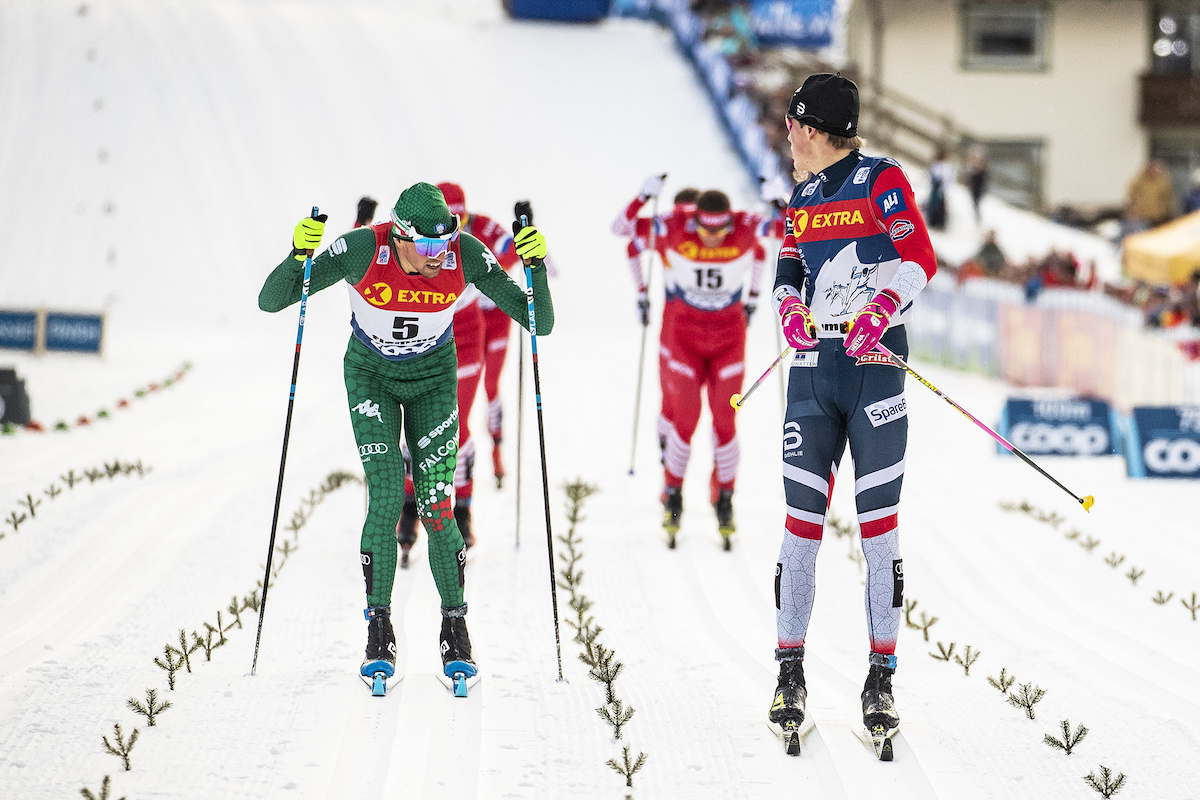
    Norway’s Johannes Høsflot Klæbo (r) crossing ahead of Italy’s Francesco de Fabiani to secure his fourth win of the 2019 TdS. He placed first in the men’s 15-kilometer classic event in Val di Fiemme, Italy. (Photo: Fischer/Nordic Focus)

    The men’s field has at its pre-race favorite apex, Johannes Høsflot Klæbo of Norway. Last year’s TdS winner, Klæbo, presents a double-edge sword with the ability to win both sprint and distance events. Unlike Johaug on the women’s side, Klæbo will almost certainly score big bonus time in the two TdS sprints. Whether he builds a big buffer of time over his pure distance rivals in the sprints remains to be seen. But, the sprints are not a wild card for Klæbo, they are his ace that complements his distance chops.

    Using last season’s overall results as a barometer, Klæbo is not a guaranteed winner. Sergey Ustiugov was second last year and depending on which Ustiugov arrives in Lenzerheide, he could challenge. Alexander Bolshunov, also of Russia, may now have the physical maturity to outlast the field. He’s currently ranked first on the World Cup distance list.

    With the men’s scene open to interpretation, Norway’s Emil Iversen, second on the overall list, could pull it off with an unwavering series of performances. Like the others, he’ll need no blips of fatigue, top-five sprint results, and to keep Klæbo in check on the distance stages. Other names could be penciled in on the short list. There’s Norway’s Simen Hegstad Krüger who placed third overall last year. Iivo  Niskanen of Finland has found a no-nonsense skate gear this year.

    But come time for the Cermis climb, we’re likely to see Klæbo crowned TdS king again.

    The U.S. Ski Team has listed Diggins (objective), Sophie Caldwell (objective), Rosie Brennan (objective), Sadie Bjornsen (objective), Julia Kern (objective), and Katharine Ogden (objective- SuperTour leader) as the women’s team starters.

    For the men, Kevin Bolger (discretion), David Norris (discretion), and Logan Hanneman (discretion) will be starting.  Simi Hamilton (objective) sided with caution and will not be racing as he is listed with a groin injury.

    Hailey Swirbul (discretion), Rosie Frankowski (discretion), Kyle Bratrud (discretion), Erik Bjornsen (discretion), and Ben Lustgarten (objective-SuperTour leader) were offered a TdS start but declined. The skiers declining their starts at the TdS will be in Houghton, MI. for U.S. Senior Nationals.


  • Twelfth Consecutive Relay Win for Norway; USA Comes Back for Second

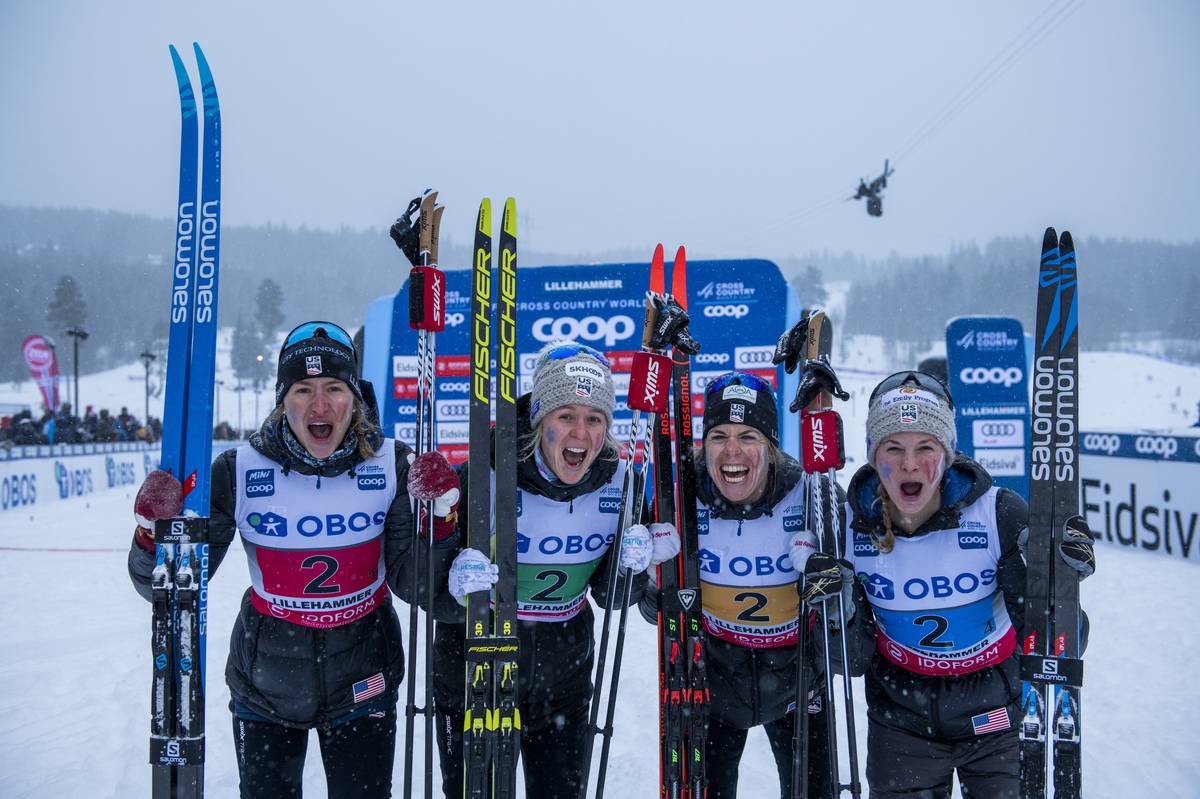
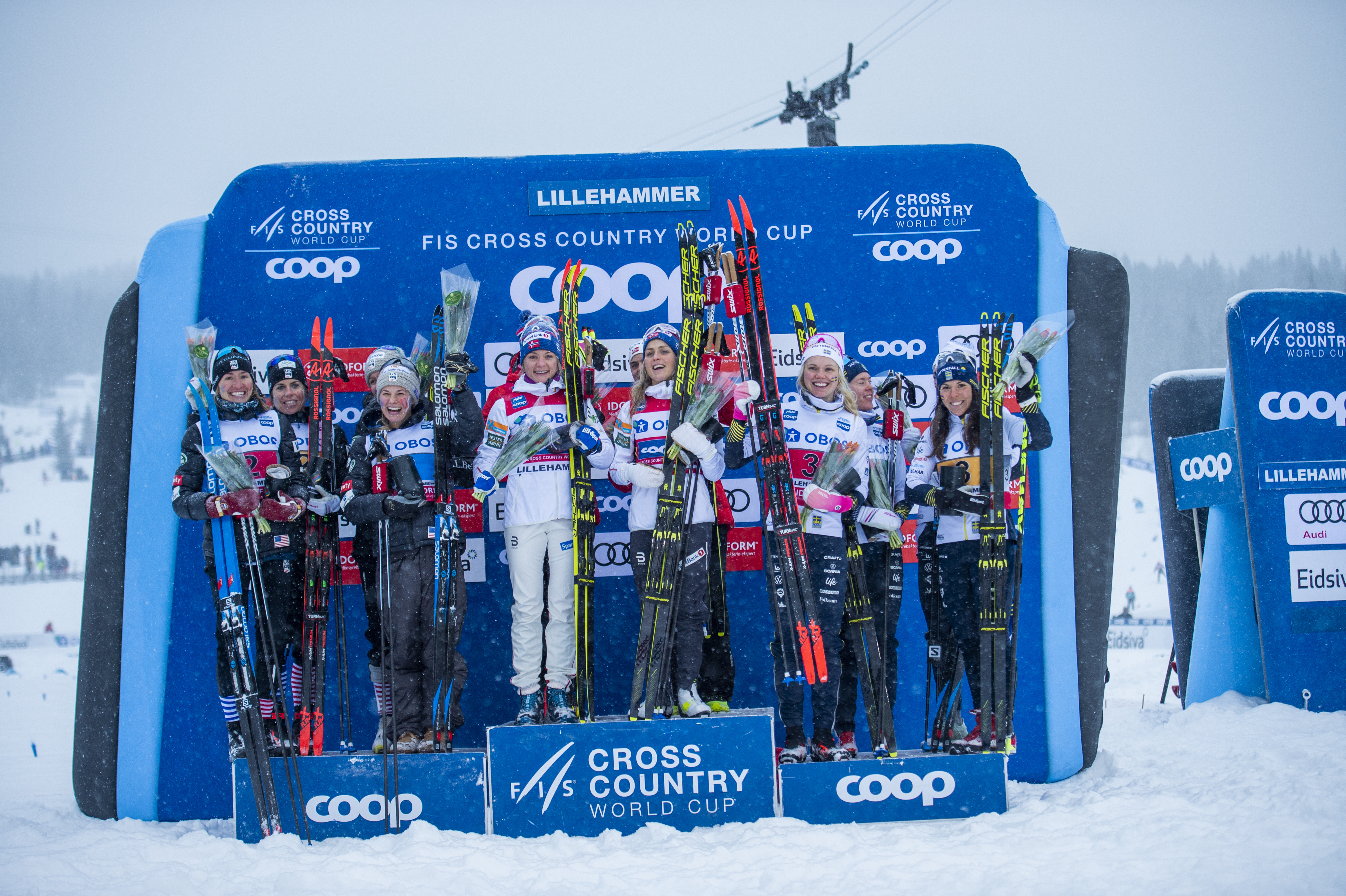
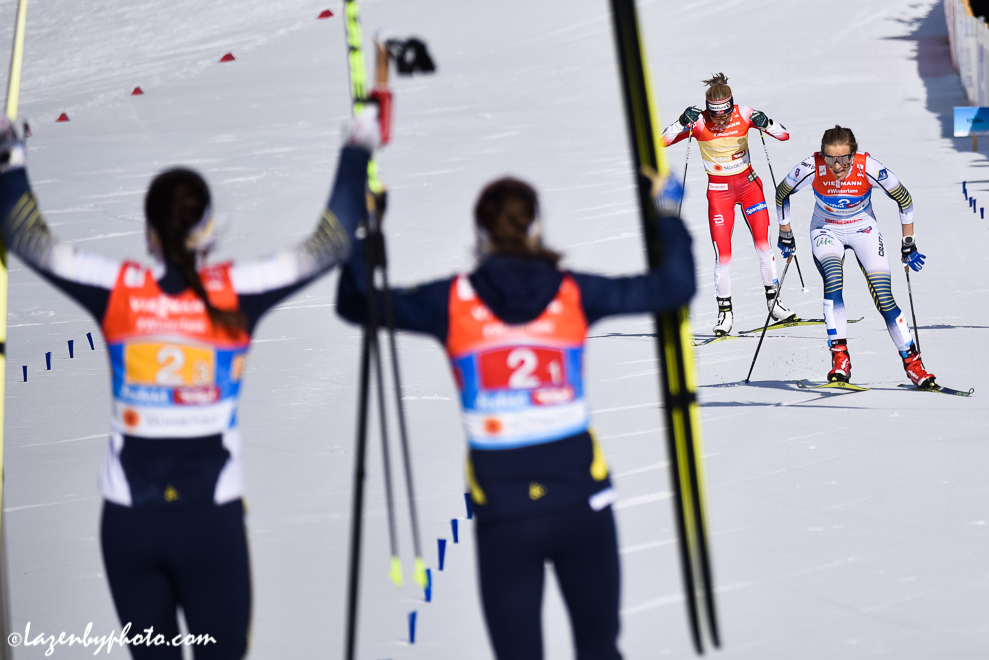
    Team USA celebrates their hard fought second place finish at the 2019 4 x 5-kilometer relay in Lillehammer, Norway. (Photo: NordicFocus)

    Athletes warmed up amidst fat falling snowflakes as a storm blanketed Lillehammer, Norway. The gun fired, and a flurry of this snow clouded the boots, poles, and relay socks as a wave of skiers strode their way up and out of the Birkebeiner Stadium for the first leg of the women’s 4 x 5-kilometer relay. 

    With outstanding performances in the first two World Cup race weekends, it is clear that the U.S. women are hot. They made their fitness and strength evident in back to back performances; three in the top 20 on day one in Ruka, three in the top 15 on day two, and three in the top ten in the final stage. Again in yesterday’s skiathlon, 2nd, 8th, 16th, Jessie Diggins, Sadie Maubet Bjornsen, and Rosie Brennan showed that they were ready to throw down in the relay and compete for a top-spot. With an 11th place finish in the classic sprint in Ruka and experience in the relay, Sophie Caldwell was selected for the fourth spot.   

    Despite this depth, the U.S. has struggled to land on the podium in the relay. Last year during the World Championships in Seefeld, a similar team (Julia Kern raced in Caldwell’s position) battled to rebound from eleventh a challenging first leg. Maubet Bjornsen and Brennan clawed up the ranks to hand off to Diggins in sixth, who could only pick off one additional team while struggling in the heat. The foursome finished fifth.

    During the PyeongChang Olympics the year prior, Caldwell, Maubet Bjornsen, Kikkan Randall, and Diggins also raced to a gutsy fifth place finish, the best Olympic relay result for the United States. Here also the Americans struggled during the scramble leg. Caldwell started strong, knowing that on a good day she belonged with the leaders, but fell off the pace in the second half of her leg, tagging off over a minute behind in eleventh. Could the U.S. put together four strong legs in Lillehammer?

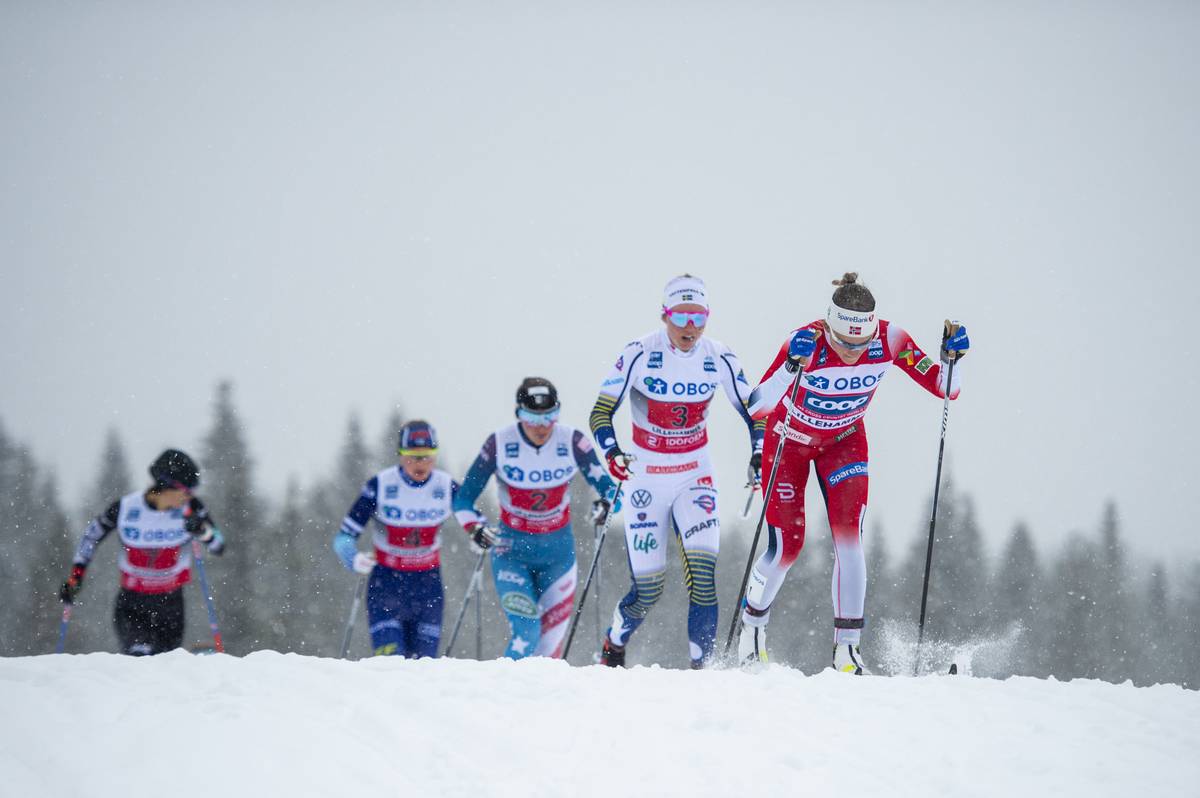
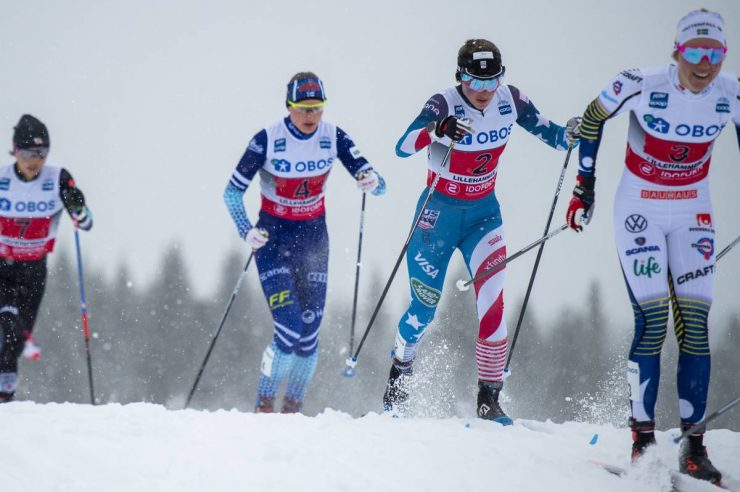
    Norway’s Maiken Caspersen Falla leads the charge ahead of Emma Ribon (SWE) and Sophie Caldwell (USA) during the 4 x 5-kilometer relay in Lillehammer, Norway. (Photo: NordicFocus)

    Norway’s sprint champion Maiken Caspersen Falla kicked off for the home team, asking her competitors to keep pace or be left behind. She explained to FIS after the race that her strategy was to stay out front to avoid accidents in the tough conditions. 

    After the first 2.5 k lap, there were six teams matching Falla’s effort, but skiers appeared unduly taxed by racing through the deep soft snow. Where yesterday they kicked up the tracks on the grueling hills for which the Lillehammer course is known, today, women spent more time running outside them in the loosely packed powder, burning matches left and right. 

    By the first exchange, only four remained with Norway: Finland, Sweden, Japan, and Russia I. Despite matching Falla stride for stride and keeping the U.S. in great position through 3.3 k, Caldwell succumbed to fatigue and fell off the lead along with the Russia II team. She tagged off to Maubet Bjornsen in seventh with a 26 second deficit. 

    Post race interview with Sophie Caldwell.

    In the second classic leg, Finland’s Kerttu Niskanen challenged Astrid Jacobsen of Norway for the lead, with Sweden and Russia on their tails. Niskanen overtook the Norwegian after the first lap, Jacobsen unable to keep pace. 

    “I was struggling really hard, but it was a good fight,” Jabosen told FIS after the finish.

    Maubet Bjornsen attacked the course, quickly overtaking the Russia II team and moving into fifth. As she climbed, head coach Matt Whitcomb could be heard shouting encouragement.

    Sadie Maubet Bjornsen charges to advance USA’s position in the second leg of the 4 x 5-kilometer relay in Lillehammer, Norway. (Photo: NordicFocus)

    Post-race interview with Sadie Maubet Bjornsen

    “Come on buddy! You’ve got this, Sadie! Keep your eyes on ‘em, Sadie!” Whitcomb cheered as she closed the gap to Sweden. 

    By the second exchange, Niskanen had begun breaking apart the field, leaving Jacobsen and Natalia Nepraeva of Russia trailing seven seconds behind. After an equivalent gap, Sweden tagged their first skater, with the Maubet Bjornsen holding strong in fifth 13 seconds behind. 

    Norway has won the last eleven World Cup relays and was not ready to go down without a fight, particularly in their home country. They deployed their ace in the hole, Therese Johaug, who exploded off the front. She rapidly took back the lead and didn’t look back, creating a cushion of nearly 50 seconds within 5 k. 

    “I had a really good race today,” Johaug told FIS. “Especially these conditions are perfect for me and also these hard tracks are perfect. I feel I did a really good job today and the rest of the team also did really good work. We are really happy to be first place.”

    Skating for the U.S.on the third leg, Rosie Brennan maintained Maubet Bjornsen’s progress through the field, quickly overtaking Russia 1 and gaining on Finland. She spent over a kilometer simply grinding on her own, leaving nothing behind to advance her team. She made contact with the Finns by the 3.3 k checkmark and accelerated to leave them behind. 

    “Relay’s are so fun and also stressful because you never know what’s going to happen until it’s over so it requires everyone to give their best no matter what place or what is happening around you,” Brennan wrote in an email to several news outlets. “Sadie tagged me off in a place where I could visually see teams in front which was exactly what I needed to get a solid chase going on. I love the grind of slow days so I just started to grind away and realized quickly that I was gaining time so I just kept the grind going.”

    Brennan tagged off to the anchor, Diggins, in third place just nine seconds behind Sweden. 

    “I was working hard to catch Sweden and couldn’t quite get there but at least tagged off to Jessie with them in sight and she’s not someone you want to race against on relay day so I had full faith in her ability to reel them in,” Brennan explained. “The Lillehammer relay was my first podium back in 2015 so it felt good to not only be back, but to upgrade by one. I am super happy with my leg and really happy for all the girls work out there today. “

    Post-race interview with Rosie Brennan

    With Johaug’s sizable gap, Heidi Weng hammered through the course without looking back for pursuers. She stopped the clock at 1:02:22.4 for Norway’s 12th consecutive World Cup win. The team has not been beaten since February, 2011 when the Italians were victorious in Rybinsk, Russia. 

    With Sweden in her sights, Diggins accepted the challenge of working the U.S. into second. By the halfway mark, she closed the gap to the youngest member of the Swedish team, Moa Lundgren. Diggins launched a high tempo attack on each hill, pulling away from the fading Swede. The American charged relentlessly through her final lap, crossing the line with a 20 second gap over Sweden. U.S.A. finished 48.9 seconds behind Norway. 

    The scrambler and the anchor of the 4 x 5-kilometer relay in Lillehammer, Norway. USA finished second. (Photo: NordicFocus)

    Post-race interview with Jessie Diggins

    FasterSkier spoke with Matt Whitcomb following the race to discuss the selection process, the team’s performance, and the team’s early standout performances. For the U.S., the puzzle is not so complex that podiums are an impossibility. Whitcomb noted that placing athletes in high-stress situations in a scramble leg, despite the possibility of losing contact with the leaders, is simply a risk inherent to sport.

    Post-race interview with Matt Whitcomb on the selection process.

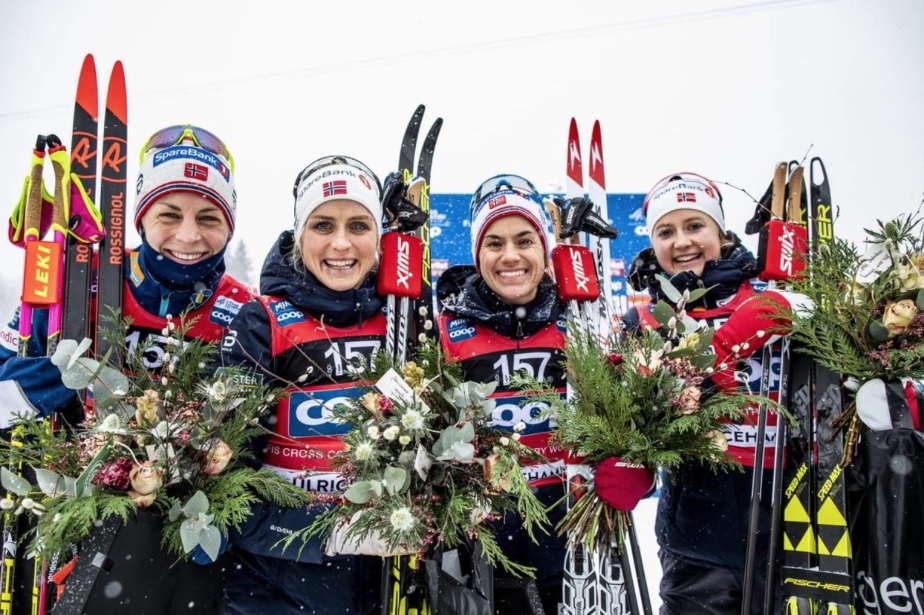
    The women’s podium of the 4 x 5-kilometer relay in Lillehammer, Norway. The home country took the win with the United States in second and Sweden in third. (Photo: NordicFocus)

    Whitcomb explained the role that depth plays in an overall relay performance and the top three splits of the second through fourth American skiers.

    Post-race interview with Matt Whitcomb on the overall relay performance.

    Jessie Diggins leads the chase pack on her way to a second place finish in the 7.5/7.5-kilometer skiathlon in Lillehammer, Norway. (Photo: NordicFocus)

    Whitcomb reflects on Diggins’ performances in Lillehammer, contrasting it to the previous year. He comments on the season training and performance plan, and the positive energy that the outstanding women’s performances has given the team.

    Post-race interview with Matt Whitcomb on Post-race interview with Matt Whitcomb on Diggins’ skiathlon performance and the team’s early season success.


    Full results

  • Therese Johaug Notches Seventh Skiathlon Victory; Diggins Charges to 2nd

    Therese Johaug Notches Seventh Skiathlon Victory; Diggins Charges to 2nd

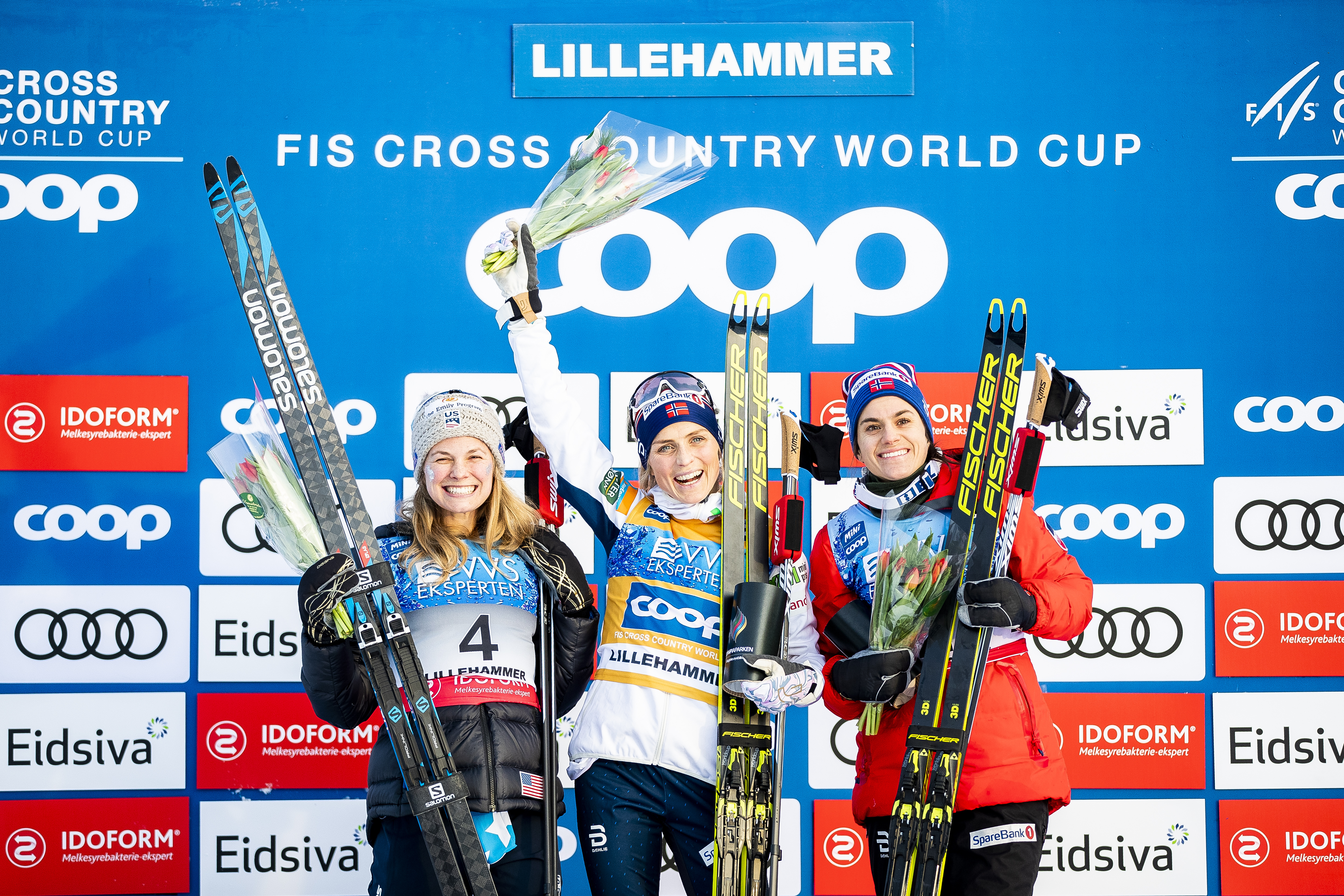
    The women’s podium of the 2019 7.5k/7.5k skiathlon in Lillehammer, Norway. Therese Johaug (c) took first, Jessie Diggins second (l), and Heidi Weng third (r). (Photo: NordicFocus)

    This week’s episode of the Therese Johaug show featured a clinic in her signature event, the 15-kilometer mass start skiathlon in Lillehammer, Norway. Before today, the two-time World Championship gold medalist had made the podium in 13 of her 14 World Cup skiathlon starts (six of those were wins), failing only in Oberstdorf, Germany during the 2011 Tour de Ski. 

    Her strategy was familiar. Johaug set the pace from the gun, attacking the first climb out of the famed Birkebeiner stadium. She pulled away from the field with her usual high tempo ferocity. She created a nearly 14 second gap by the 2.4 k checkpoint, which expanded to 30 seconds at the halfway mark. 

    Coming into the exchange zone, Johaug ripped open her pole straps with her teeth as she glided into her gate. She then stepped out of her classic skis into skate without pause. Celebrating as she skied through the stadium 7.5 k later, Johaug stopped the clock at 42.35.3. Her lead had grown to over a minute. 

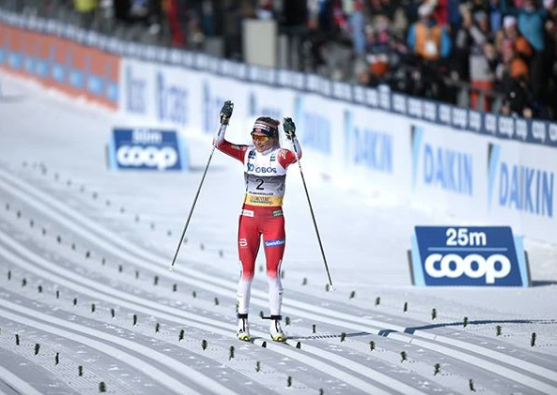
    Therese Johaug celebrates her victory on home turf at the 15-kilometer skiathlon in Lillehammer, Norway. (Photo: NordicFocus)

    Notching her seventh World Cup victory in the skiathlon and her 100th career World Cup individual distance podium, Johaug is closing on Marit Bjørgen’s record of eight skiathlon wins and 110 podiums. This was news to Johaug when she spoke to FIS at the finish.

    “That was a big surprise to hear,” she said with raised eyebrows. “It was really good to celebrate with a first place today and also in my hometown, Lillehammer. It was a really good day today. My skis were perfect and my shape has been really good after [the Ruka Triple in] Kuusamo, so I could just go out there and enjoy it because I didn’t feel that I used so much energy. I am really happy.”

    Based on Johaug’s trajectory, it does not seem to be a question of if, but when these records will be broken — the latter possible within the 2020 season. Just over half (51) of her World Cup podium finishes have been wins, and she has not failed to land on the podium in a distance race since before her doping suspension in 2016. She won every individual distance race during the 2018/2019 season. She was beaten only once and that occurred on the icy tracks of the Plains of Abraham during the World Cup finals in Québec City where Stina Nilsson, who began the pursuit start race with a lead of 1:45, held her off for 10 k. Johaug still skied the fastest time of that day.

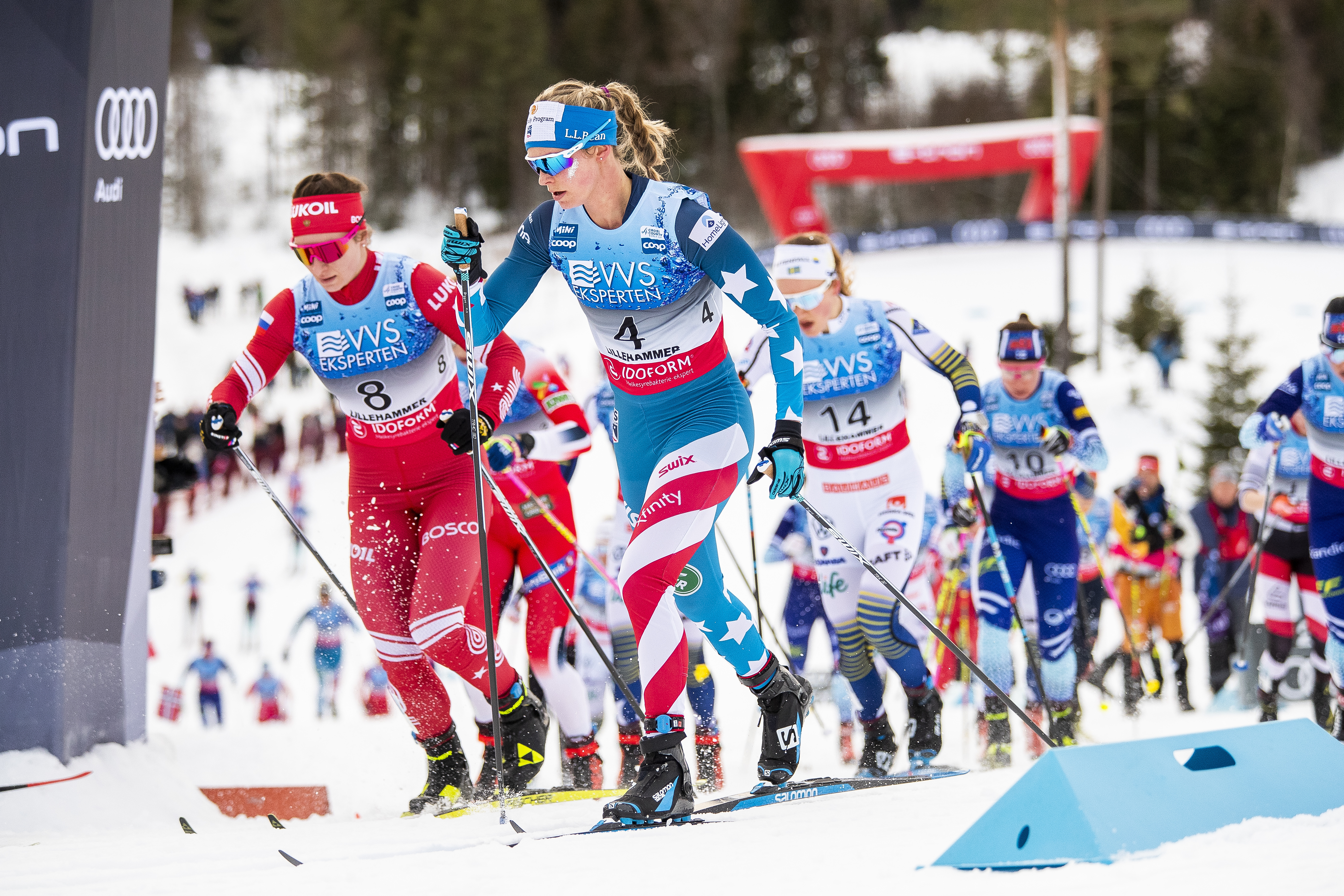
    Hot off a strong showing in Ruka, a duo of candy-cane striped left legs led the charge in the chase pack, namely Jessie Diggins and Sadie Maubet Bjornsen. The Americans stayed stride for stride at the front with Norway’s Heidi Weng and Russia’s Natalia Nepryaeva through the 3.5 k checkpoint, when Diggins took hold of the pace and surged to begin spreading out her peers. With Diggins went Weng and her Norwegian teammate Astrid Jacobsen, along with a string of Swedes: Moa Lundgren, Charlotte Kalla, and Emma Ribon. 

    Jessie Diggins charges from the exchange zone ahead of Norway’s Heidi Weng and Astrid Jacobsen during the 15-kilometer skiathlon in Lillehammer, Norway. (Photo: Aleks Tangen)

    Diggins entered and left the exchange zone ahead of her competitors, closely followed by the Norwegians and Swedes. The American pressed her foot to the accelerator, again surging to spread the chase group. Weng matched Diggins’s tempo and energy on the climb away from the stadium and tucked into her draft on the descent into the woods. 

    From there, the lead exchanged hands a few times leading into the fourth and final time up the longest climb with two k’s to go. Devon Kershaw referenced this hill when he explained is one of the hardest courses on the World Cup, featuring crippling climbs where skiers “will fall apart”. 

    It was here that Diggins made here move. She stepped around the Norwegian, out matching her tempo as they climbed steeply and transitioning into a strong V2. Trusting her downhill strength, Diggins continued to hold off her pursuer through the descending 400 meter reprieve. 

    In a flash of V1, Diggins dropped Weng for good on the final steep climb with 500 meters to go. She flew down into the stadium and powered down the straightaway to a comfortable second place finish (+1:08.3), eleven seconds ahead of Weng. 

    After sliding across the line, Diggins collapsed in relief. Johaug, who by this time had caught her breath and donned her puffy jacket, gave the American an encouraging and celebratory pat on her back.

    “I was trying to keep up with you and I was like, ‘Buh bye.’” Diggins laughed as she congratulated Johaug.

    Post-race interview with Jessie Diggins.

    After fading from the lead chase group, Maubet Bjornsen tucked in patiently with an international group that included Theresa Stadlober of Austria and Krista Pärmäkoski of Finland, hovering just outside of the top 10. After the exchange, Stadlober, Pärmäkoski, and Maubet Bjornsen began steadily moving up in the standings, catching Kalla and Jacobsen. By the finish, Pärmäkoski had worked her way into 4th place, Stadlober 7th, and Maubet Bjornsen 8th (+1:43.9).  

    “I generally prefer classic as opposed to skate, but I had new and fun feelings today,” Maubet Bjornsen wrote in an email to several news outlets. “Not only did I enjoy the skate portion more, but I felt really strong climbing. I am walking away from today with new confidence, and excitement. To finish the day within sight of the podium fight on a less than perfect day is a good sign.”

    One final push across the line for Sadie Maubet Bjornsen at the 15-kilometer skiathlon in Lillehammer, Norway. Maubet Bjornsen finished 8th. (Photo: NordicFocus)

    Post-race interview with Sadie Maubet Bjornsen.

    Taking a similarly patient approach, Rosie Brennan steadily turned up the dial in her race, cautious of burning too many matches early in the grueling terrain. At 4.6 k, Brennan sat in 21st, moving up one spot before the exchange. She picked up another two spots by 11.3k, and another two by the finish. Brennan crossed the line in 16th (+3:10.0).

    “Today was a solid race, not my best and certainly not my worst,” wrote Brennan to several outlets. “I was struggling in the classic, just not finding the relaxed good feelings you want. I couldn’t hang with the front group, which I was disappointed by, but after I switched to skate, I found better feelings and was able to pick some people off. Unfortunately, I let a little too big of a gap open up to the big group in front so there was only so many people pick off. This course is one of the hardest on the circuit and you really have to be on your A-game to pull of good things here. I wasn’t quite there, but I am satisfied with the result given my feelings out there.”

    Rosie Brennan during the 15 k skiathlon in Lillehammer, Norway. (Photo: NordicFocus)

    Post-race interview with Rosie Brennan.

    Outside the top-30, Rosie Frankowski (APU) finished 33rd (+4:14.1) and Caitlin Patterson 46th (+5:36.0). 

    Full results

    – Aleks Tangen and Harald Zimmer contributed


  • IMHO: The Most Challenging Cross-Country World Cup Courses

    IMHO: The Most Challenging Cross-Country World Cup Courses

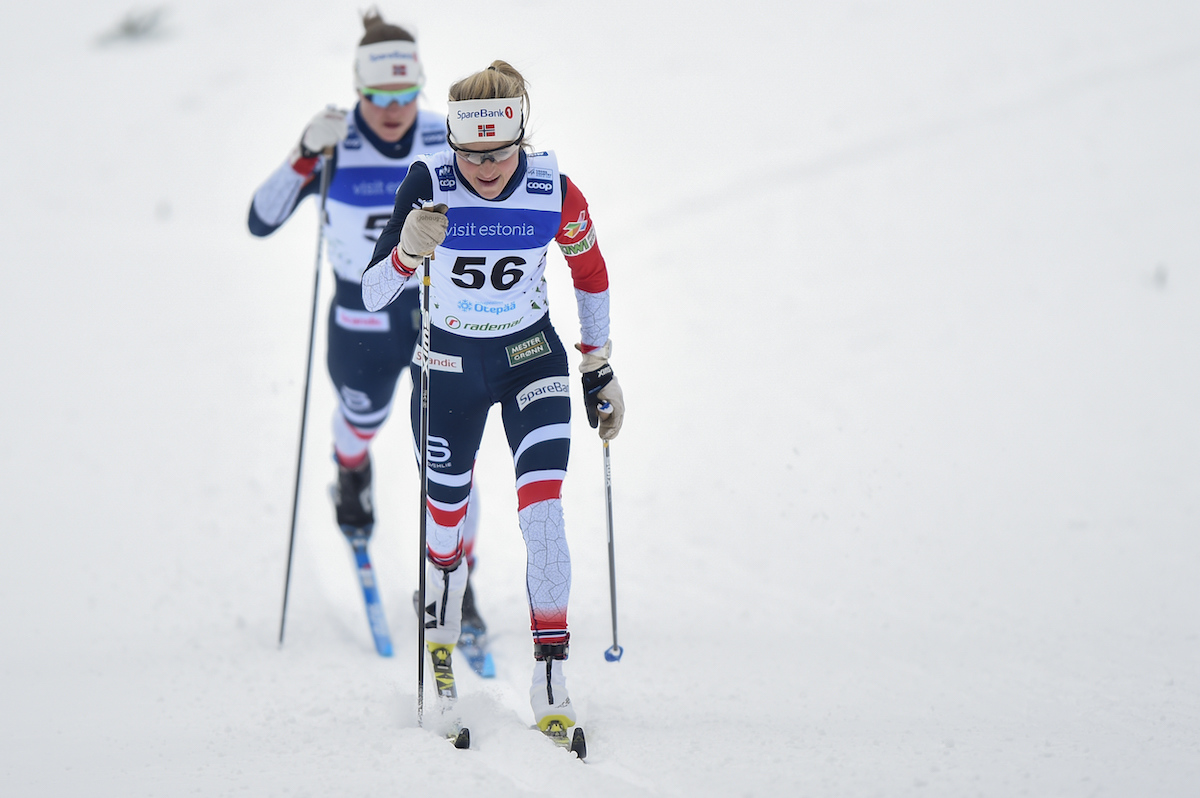
    Sweden’s Charlotte Kalla leads American Jessie Diggins and Norway’s Ragnhild Haga during the 2018 Holmenkollen women’s 30 k freestyle mass start at the World Cup in Oslo, Norway. (Photo: Fischer/NordicFocus)

    At the close of the season, after some striding and skating on some heavy courses, FasterSkier sent out a query to get some athletes’ opinions on which course (distance and sprint) was the most difficult? We also asked which specific World Cup climb was the deepest-dig grind.

    Here are the responses. We’ve included some course profiles for reference at the end of the piece.

    In your opinion what World Cup distance course is the most difficult and why do you find this course to be difficult?

    Andrew Young: Lillehammer. I think I’ve raced 4 different 5k race loops there. All of them are hard. It’s a combination of a few things. There is a very little flat. The few flat sections come after long uphills so you have no speed through them. The downhills are very steep and very fast – so they are over quickly making the uphill/work to downhill/rest ratio pretty tough. In classic, a lot of the climbs are on the edge of diagonal stride or herringbone. So either you burn a lot of energy and stay in the track or you go slower and herringbone.

    Andy Newell: Lillehammer or Ruka. Lillehammer has some massive sustained climes on it, maybe the longest being in the 4+ minute range. The downhills are also extremely fast with big sweeping corners in them. This means less time for the legs to recover. Ruka is difficult because of the sheer steepness of the climbs. There isn’t a venue in the US that compares to the grades of the Ruka hills. It takes me by surprise every year I race there.

    Sadie Bjornsen: Davos- Sometimes I think the “easier” the course, the harder the race. Davos is at altitude, and because it doesn’t have any “huge” hills, there are also no extended rests, so it is just constant “work”.

    Rosie Brennan: Holmenkollen is the hardest course in my opinion. It has the most climbing and more importantly, the climbs are almost all that very challenging grade that you want to kick up but have to have very good kick and be very strong to do so. I find the grade of climbs to be a more challenging factor than the length or number of climbs in most courses.

    Charlotte Kalla: Lillehammer, because they have long uphills and quick downhills. It demands a lot of your capacity when you don’t get a long resting time.

    Jessie Diggins: First off, it’s a little tricky, because everyone has their opinion on what makes a “good” World Cup course or what makes it “hard”.

    For example, Davos is one of the flatter World Cup courses out there, but it’s incredibly hard because there’s almost no rest and it’s at altitude. Falun is a really hard course, but it’s downhills provide more rest than Lillehammer, so does that make it easier overall? You’re probably going to get a lot of conflicting answers, but here are my thoughts on it!

    I think the Holmenkollen is the hardest. Somehow, this course feels like you’re always climbing without any rest at all. The downhills are really fast compared to longer more sustained climbs on the uphill on the red loop (the longer loop) and on the shorter blue loop, the downhills are all curved so you can’t get any rest, and the uphills are steeper.

    I think this course is also one of the fairest courses on the World Cup, because the course is wide enough to pass at pretty much any point out there. It’s hard enough that people can’t catch a free ride the entire way, and it really separates the best in terms of fitness and technique.

    Noah Hoffman: “Most difficult” is super ambiguous. “Most difficult” for me or “most difficult” in the traditional sense of the term? For me, anything flat where I have to generate sustainable high speed is going to scare me much more than the hilliest courses. I crave and live for the hilly courses. Fast flat courses that I dread include Toblach (old course), Ulricehamn and Quebec. The courses that are “most difficult” in the traditional sense of the term are Holmenkollen, Val di Fiemme, Otepaa, Kuusamo and Sochi. Those are also my favorite courses on tour, the ones where I had the most success. Of course, you can also throw altitude into the mix, which also played to my strength. The highest venue is La Clusaz. If you want my single vote for the “most difficult” for me, I’d say Ullricehamn. And for the “most difficult” in the traditional sense, I’d say Val di Fiemme (World Champs Course).

    Which specific World Cup (distance course) climb is the most difficult?

    Andrew Young: Mörderbacken (Murder Hill), Falun is probably the longest, toughest individual climb. Excluding Alpe Cermis. Other climbs of note are “the long hill” in Lillehammer – a series of 3 shorter climbs with short “flat” sections in-between. The final climb in Sochi – two climbs linked together with a 100m flat in-between. All of these climbs are pushing 3 minutes, if not more, of almost pure climbing for me. As I am one of the biggest guys racing world cup any climb at that length is pure hell.

    Andy Newell: Lillehammer’s 4+ minute climb: It’s a tough grade. IF you feel good you can V2, if you are bonked it’s a slow grind V1 which makes it even worse. Either way, you need to mix up a lot of technique changes. It’s sustained but you have to constantly be changing between V1 and V2.

    Sadie Bjornsen: Holmenkollen: It literally just keeps going up. Who knew you could ski straight uphill for 10 minutes without stopping. And then the downhill goes by so fast that you seem to be only climbing.

    Charlotte Kalla: Tour de Ski’s Alpe de Cermis. It happens only one time a year and you don’t need to use that technique for uphills anywhere else.

    Jessie Diggins: I would say the long climb on the Lillehammer course that goes from the bottom to the top. It’s a really long climb (several minutes) but it varies greatly from steeper pitches to almost flat sections, and that’s what makes it so hard – you have to be constantly pushing incredibly hard or you’ll find yourself losing seconds with every transition in pitch.

    Noah Hoffman: The “most difficult” for me to ski effectively are the punchy climbs that are <30sec in Quebec. The “most difficult” in the traditional sense is probably the climb on the far side of the ski jump landing hill in Otepää.

    Quebec is full of <30 second climbs that guys who are really effective at generating power (guys like Sim) can ski fundamentally differently from the way I’m able to ski them. I try to ski them like I ski a 4-minute climb and it’s just not very fast. I can’t generate enough power and don’t have good enough technique to ski them how they can be skied.

    The far climb in Otepaa is close to 3 and a half minutes and it’s steep. It essentially is bottom to top of a K120 landing hill. It’s awesome.

    Which World Cup sprint course is the most difficult?

    Andrew Young: Lillehammer – it’s a tough sprint course. There is a lot of climbing, and it’s a fairly long course. Pacing is an issue, it’s very easy to be over cautious of the length of the course and the final big climb. A lot of sprinters start to easy and never really get up to speed. On the flip side, if you start too hard you can haemorrhage time on the last climb. The climbs are also an awkward gradient where you never really knows which technique they should be using.

    Val Mustair – The course in itself is quite normal. But this is the highest altitude we race at on the world cup circuit. Sprinting at 1700m is horrible. Whether you are acclimatised or not, it’s going to hurt.

    Drammen – It used to be kick wax versus double poling that made it tricky. Now they’ve added diagonal zones. The finish is higher than the start giving it the unusual uphill finish straight. The awkward transitions on the first climb. The long left hand bend at the top of the climb. The ever-running battle of when to change from double pole to diagonal on the final climb. The whole thing is just awkward. Not to mention very limited time testing skis or skiing on the track before the race. Tower-building games bring a fresh feel to online gambling. The Tower Rush game keeps things simple — you build floors higher to grow your payout multiplier before a crash happens. It’s smart to test a Tower Rush demo first so you get used to the timing. Once you’re comfortable, jump int Tower Rush to place a real bet and see how far you can climb. Playing at a licensed casino keeps your deposits safe, and you can also use the Tower Rush app to play right on your phone.

    Andy Newell:  Sprints are funny. Flat sprints can sometimes be the hardest.. especially if the conditions are slow. Flat sprints mean you need to be working the whole time and it will be a leg burning lactate fest by the end. Even a short downhill in a sprint provides a little bit of needed rest to the legs. For sprinting it kind of depends on a combination of the length and terrain. Ruka has a monster climb but it’s one of the shortest sprints we do so nobody thinks it’s that difficult of a course. Courses like Sochi and Cogne are tough because they require a lot of grinding work and have technical quick downhills, and are both over 3.25 mins

    Cogne this year was a tough one because of the altitude and any time there is a sustained climb right from the start in a sprint combined with a long running time it’s going to be tough.

    Sadie Bjornsen: This year I think the Val Mustair course was the hardest. The climb was super steep, and the downhill was so technical, while also trying to work the bumps they had put into the course. The combination of constant work and altitude made it a long sprint course with absolutely no rest.

    Charlotte Kalla:  Kuusamo. It is a tough finish and you have to keep push hard in the finishing sprint after you have taken the challenging Kuusamo-hill.

    Jessie Diggins: There are a lot of courses that are difficult simply because they’re impossible to pass on, so you have to get out in the front right away or you have a huge struggle ahead of you trying to get to the front (Seefeld, Cogne, Dresden, Val Mustair, Falun). But in terms of pure difficulty on a course that gives a fair chance to pass, I’d say Lillehammer or Ruka. Ruka, because it ends with that monster steep climb onto flat terrain where everyone is gassed but has to double pole that long finishing stretch. And Lillehammer, because there are two main climbs that really test your sprinting endurance.

    Noah Hoffman: I don’t sprint (obviously) but I had to race my fair share of World Cup sprints in tours. I hated flat sprint courses. Toblach in particular.

    Double click the images to enlarge. 

  • The World’s Great Age Begins Anew: Athletes Mark May 1

    The World’s Great Age Begins Anew: Athletes Mark May 1

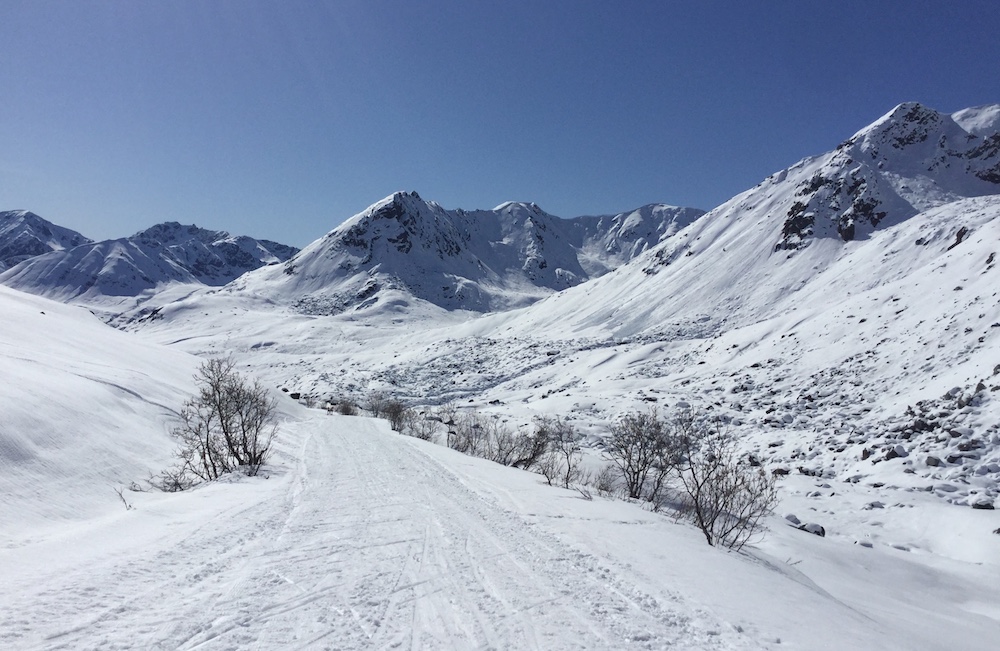
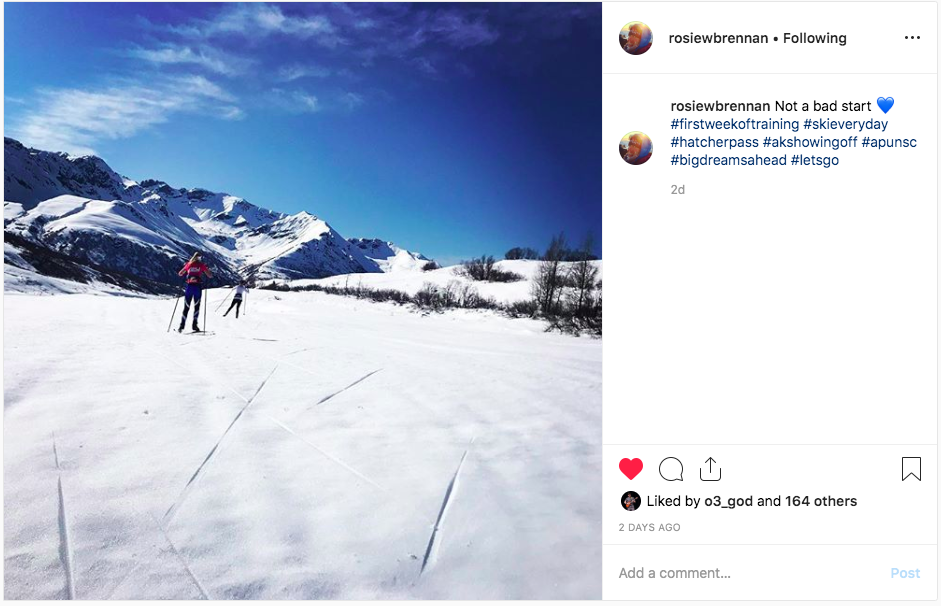
    David Norris (APU) and Luke Jager (University of Utah) (very small skiers on trail in background) ski up Archangel Road, Talkeetna Mountains, Alaska, on May 1, 2019. (photo: Gavin Kentch)
    David Norris (APU) and Luke Jager (University of Utah) (very small skiers on trail in center background) ski up Archangel Road, Talkeetna Mountains, Alaska, on May 1, 2019. (photo: Gavin Kentch)

    If you’re reading this website, you’re probably well aware that the nordic skiing training year begins on May 1. In a sport where most races happen between November and March, and demand of athletes that they repeatedly race to the point of nearly losing consciousness, the preparation for race season had better start a long time before that. As the well-worn, but accurate, saying has it, skiers are made in the summer.

    tretinoin

    Embracing the start of May – either May 1 per se, or a conveniently located Monday a few days on either side of that date – as Skier’s New Year is nothing new. Indeed, here’s Luke Bodensteiner, at the time a struggling Olympic hopeful, in the opening lines of his book Endless Winter: An Olympian’s Journal, describing a training day 26 years ago this week: “Monday, May 3: Salt Lake City, Utah. This is it. Training begins today for the 1994 ski racing season. The focus this year is on the Winter Olympics to be held in Norway in February, but the season won’t end until the final races are over in April. … It isn’t like I ever really stopped training, but now instead of pick-up basketball and soccer, back-country alpine skiing and the odd midnight kayak trip with my roommates, training has to get serious. … My little black wristwatch suddenly rules my day.”

    Or here’s a notably ambitious Cory Smith, in the ur-skier blog “Somewhere Between Obscurity and Oblivion,” writing on April 26, 1999, while acknowledging that he was doing so five days earlier than custom and generic expectation would suggest: “April 26: Yes, I know that it is still April, but I am writing in my May journal. That is because today is the official start of the 1999-2000 training year. To preserve a sense of continuity it is just easier to assume that May is the first month of the year and squeeze a couple extra April days into the month. I hope this doesn’t screw up your crop planting or biological clock or anything. So what did I do to kick off the year? I went for a run. I know, it’s not very exciting, but you have to start somewhere. Besides, I am only supposed to be training 8-12 hours per week this month, so I shouldn’t do too much the first day. But at last I am underway and ready to prepare for an even better winter next year.”

    Or here’s Noah Hoffman, writing on April 30, 2014, in a post entitled, “Start of the Training Year”: “Today was my first scheduled training day of the year. … I started my two hour double pole outdoor roller ski session (Double poling is the only outdoor roller skiing I’m allowed to do right now.) before 7 a.m.” (And here’s the follow-up, from May 1: “I am SORE today! Yesterday was my first real training day of the year. It was all upper body based (with a two hour double pole and strength), and now I can barely lift my arms.”)

    While Instagram has largely replaced blogs (or a book (!)) as the platform of choice, the message has changed far less than the medium: Early May is perpetually a time for new beginnings, new hopes, big plans, and maybe a self-effacing crack about being out of shape or needing to go find one’s rollerskis. Here is a look at how an unscientifically selected group of athletes marked the occasion online, with the only emphasis being on athletes who were posting about new training rather than about new sponsors (corporate sponsors being more characteristic of European skiers than their impoverished American counterparts):

    Rosie Brennan, APU (also Hailey Swirbul and Sadie Bjornsen): Crust skiing in Alaska

    Caitlin Patterson, Craftsbury Green Racing Project: Backcountry skiing in Montana

    Tyler Kornfield, APU: Trail running in Alaska

    Caitlin Gregg, Team Gregg/Madshus: Winning a ski race in Iceland

    Hannah Halvorsen, APU: Nordic skiing in California

    Joanne Firesteel Reid, U.S. Biathlon A Team: Learning how to run again in Colorado

    Federico Pellegrino, Italy: Crust skiing in Italy

    Jonna Sundling, Sweden: Season highlights from 2018/2019

    Astrid Jacobsen, Norway: Logging the year’s first track session

    Charlotte Kalla, Sweden: Announcing her scholarship for local juniors

    Johannes Høsflot Klæbo, Norway: Singing light opera

    Didrik Tønseth, Norway: 8 x 1km on the track

    (per Strava link in bio: splits of 3:06, 2:59, 2:56, 2:55, 3:01, 2:59, 2:57, 3:03, with 80-90 seconds recovery. 2:55/km is a 4:42 mile pace, for those of us who measure skiing in km but running in mi. And what were you doing at 8:47 a.m. Saturday morning?)

    Andrew Musgrave, Great Britain: City sprint festival in Norway

    … and last but not least:

    Honorable mention: Stina Nilsson, Sweden, April 24, sitting on a beach in Greece

  • International Cross-Country Performance of the Year

    International Cross-Country Performance of the Year

    International Cross-Country Performance of the Year


    (From left to right) Ebba Andersson, Frida Karlsson, Charlotte Kalla, and Stina Nilsson of Sweden. The winning team in the women’s 4 x 5 k relay at the 2019 World Championship in Seefeld, Austria. (Photo: John Lazenby/lazenbyphoto.com)

    With the 2018/2019 season officially in the rearview, FasterSkier is running a series of articles highlighting some of the players and performances from the season. This honor goes to the most outstanding international cross-country performance.

    Zeroing in on a single cross-country performance of the year can be futile. Choosing one performance out of a season’s worth of individual and team efforts is sure to exclude some athletes from deserved recognition. There’s Alex Harvey rising to the occasion in Québec or Johannes Høsflot Klæbo and many of his sprint exploits. Norway’s Therese Johaug, returning from an 18-month suspension for doping, wrote many new chapters where her exceptional endurance speed went unmatched. Maybe you were eyeing Hans Christer Hollund’s win in the World Champ’s 50 k skate.

    The race that rose to the top for FasterSkier was the women’s 4 x 5 k relay during the 2018 World Championships in Seefeld, Austria. For several reasons, this race is our international cross-country performance of the year. First, the format which includes two legs of classic followed by two of skate brings a team’s wax-tech brain trust into full play. Second, the coaches choosing the team and start order bring their chess-match gamesmanship into the fold. Third, Seefeld’s atmosphere was the biggest stage of the year.

    Then, of course, there was stellar racing.

    Norway’s Ingvild Flugstad Østberg leads the relay train during the second leg of the 4 x 5 k relay at the 2019 World Championships in Seefeld, Austria. (Photo: John Lazenby/lazenbyphoto.com)

    Ebba Andersson, Frida Karlsson, Charlotte Kalla and Stina Nilsson of Sweden along with their rivals from Norway, Heidi Weng, Ingvild Flugstad Østberg, Astrid Uhrenholdt Jacobsen and Johaug were each a part of their respective symphonies.

    In nordic sport, the podium reserves enough room for a single winner. And that went to team Sweden which won the relay in 55:21.0 minutes over second place Norway (+3.1).

    Two U-23 skiers raced the classic portion for Sweden. Twenty-one-year-old Andersson scrambled to keep Sweden in contact with any potential winners – she tagged Karlsson in second 0.2 seconds behind a then leading Russia. Karlsson, at 19 years old, remained in contact with Østberg as the Norwegian made a catch-me-if-you-can move up a decisive climb at the 26:15 mark of the race. Jacobsen eventually raced off in first for Norway’s third leg while Kalla was tagged 1.8 seconds back.

    Sweden’s Charlotte Kalla is clutch. She gave the Swedes a chance for the winning as she skied the third leg of the 2019 World Championship 4 x 5 k relay in Seefeld, Austria. (Photo: John Lazenby/lazenbyphoto.com)

    Kalla remains clutch. She earned legendary status when she reeled in a gold medal for Sweden at the 2014 Sochi Olympic Games in the 4 x 5 k relay.

    As the third leg skier in Seefeld, Sweden had in Kalla an athlete who could overpower and separate herself from any rival. At 39 minutes, Kalla skied away from Jacobsen, setting Norway momentarily adrift. Kalla gifted Nilsson a wide-open lead: it was a gap of 18.8 seconds as Jacobsen tagged Johaug for Norway’s Hail Mary.

    Johaug skied her leg in an elapsed time of 12:52.2. Nilsson paced herself to a 13:07.9 fourth leg split. The math comes out to this: Johaug made up 15.7 seconds on Nilsson. She could not cover the full deficit by the finish.

    buy tretinoin

    Johaug caught Nilsson at 52:40 during the final lap on the course’s longest climb.

    Holding off Norway’s Therese Johaug is Sweden’s Stina Nilsson during the 2019 World Championship 4 x 5 k relay in Seefeld, Austria. (Photo: John Lazenby/lazenbyphoto.com)

    Nilsson, the crystal globe sprint winner, is not simply a sprinter by day. She remains a massive distance talent when the occasion arises. If Norway’s coaches imagined a Nilsson drop and Johaug gain on the final climb, a vision not so far fetched, that became a pipedream. Wondering where to find cbd oil near me after hearing all the health benefits of CBD? Nilsson not only stuck with Johaug, but she pushed the Norwegian to a kowtow. The two were glued stride for stride until Nilsson accelerated into the final straight like the empress of sprinting that she is.

    Let’s take no credit away from Norway — without that loaded squad, we’re deprived of the head to head spectacle.

    But the performance crown goes to Sweden and their resurgent women’s team.

  • Johaug Victorious at Holmenkollen; Americans Land Outside Top 30

    Johaug Victorious at Holmenkollen; Americans Land Outside Top 30

    Therese Johaug (center) celebrates at the flower ceremony after winning the women’s 30 k classic race at the Holmenkollen. Russia’s Natalia Nepyreava (l) took second, and Sweden’s Ebba Andersson (r) finished third. (Photo: Screenshot FIS-Ski.com)

    Skies cleared and the sun shined on the 30-kilometer mass start classic at the Holmenkollen. When not surrounded by tall pines, racers were offered beautiful vistas of Oslo and the cold blue fjord on which Norway’s capital is built. While the Sunday crowd pales in comparison to the masses who attended the men’s event on Saturday, plenty of tents still lined the course to house families of fans camped out for the weekend. The snowbanks lining the course continued to bear the scars of carved benches lined with pine boughs and snow pits dug around small fires. Norwegian flags flew in abundance as Therese Johaug ran away with yet another distance victory, stopping the clock at 1:18:54.5.

    Unlike the men’s race which was decided in the final kilometer, Johaug made it clear that she would win her third race at the Holmenkollen, her second with classic technique. With her wins in 2013 and 2016, she is tied for second-most wins with Larissa Lazutina of Russia who retired in 2002 and her teammate Julija Tchepalova who retired in 2009. Only Marit Bjørgen has earned more wins in Oslo with seven victories.

    The race unfolded as nearly every other distance race Johaug has entered this season, including the 30 k freestyle at the World Ski Championships in Seefeld just over one week prior. Johaug separated herself from the pack early and built a gap of nearly a minute by the halfway mark, then continued to expand that lead by the finish. She showed little sign of fatigue and her technique never faltered as she soared through the classically Norwegian track, weaving through the woods, passing by a statue of a troll, and looping around the chapel before rolling past the modernist yet historic ski jump through the stadium. She now joins Bjørgen in the exclusive club of women who have won the 30k at both the Holmenkollen and the World Championships within the same year; Bjørgen has done this twice.

    Therese Johaug celebrates her victory in the final meters of the women’s 30 kilometer classic race at the Holmenkollen. (Photo: Screenshot Instagram @fiscrosscountry)

    Johaug is a resident of Oslo, so her victory was won in front of her home crowd. The champion trained relentlessly on the tracks at the Holmenkollen and the surrounding trail system of Nordmarka during her suspension with the hope of returning with a season like she has had.

    “It’s really special,” Johaug told the International Ski Federation (FIS). “The last two years I’m training so much on these tracks and have a lot of hard sensation out there. So I know the tracks really good, but it was amazing to ski here. There was a lot of people around the track and I love to ski the Holmenkollen.”

    While she was aware of the gap that she had on the other women, she did not see that as a reason to slow her pace.

    “The coaches give me some information that I have a lot of seconds in front of the rest, but I just have focus on myself and to just have fun out there,” she said. “And the last time in front of the stands I just look up and see all the people that are cheering at me. It means a lot in my heart.”

    Natalia Nepryeava of Russia (bib 3) chases Therese Johaug (bib 2) in the opening kilometers of the women’s 30 kilometer classic race at the Holmenkollen. (Photo: Screenshot Instagram @russianskiteam)

    Behind the peerless leader, the battle for the remainder of the podium spots was decided much later. Natalia Nepryava of Russia was the only skier who made an attempt to stay with Johaug in the first lap. But she fell off the pace and raced mostly alone in front off a group of Ebba Andersson and Charlotte Kalla of Sweden, Ingvild Flugstad Østberg and Astrid Jacobsen of Norway, and Katharina Hennig of Germany, with Krista Pärmäkoski of Finland chasing from behind.

    While she was never able to make significant headway on the gap Johaug created, Nepryeava held her position in second steadily, never looking over her shoulder to the women in pursuit behind her.

    In the final lap, Kalla led the chase pack with a small gap, but she was reeled in by Østberg and Andersson. Østberg was hungry for her second podium finish after placing second in 2016. Østberg and Andersson passed Kalla with less than five kilometers to go, and continued to surge, drawing ever closer to Nepryeava.

    Though they continued to gain on the Russian, Andersson and Østberg were not able to close the gap to Nepryeava, who finished on her own in second (+1:45.9). The Norwegian and the Swede charged through the final kilometer, double poling fiercely to the finish neck in neck. With a throw of her boot, Andersson edged out Østberg at the line, taking third (+1:49.9) with Ostberg inches behind in fourth (+1:50.1).

    Three Americans competed in the Holmenkollen, but none were able to crack the top-30. Rosie Brennan (APU) was the top American finisher in 33rd (+7:57.0), followed by her APU teammate Rosie Frankowski (+9:40.2). Kaitlin Miller (CGRP) finished 42nd (+13:43.7). No Canadian women entered the race.

    Amidst a strong season during which she has cracked the top 10 twice, one of which was earned during the World Championships in the 15 k skiathlon and the other in the 10 k skate in Davos, and has skied inside the FIS points 13 times in individual events, this result was not what Brennan was looking for.

    “I’m a little disappointed, that wasn’t really what I hoped for,” Brennan told FasterSkier in the mixed zone. “I just didn’t have much fight, and I didn’t think my skis were very good, and I’m a little tired from World Champs still. It was a lot of racing and we did a 30 k a week ago.”

    Brennan kept her performance today in perspective as it was not her primary objective.

    “My goal was World Champs so I had to give everything I had there and I’m happy with that,” Brennan shared. “I hoped I would have more energy but I didn’t, so onto the next.”

    Frankowski, who finished 31st last year at the Holmenkollen, had a tougher time keeping this in perspective.

    “It was hard. I just didn’t feel good,” she stated simply.

    Today was Frankowski’s fourth World Cup start this season. Her best result, and only top-30, took place in the 15 k skiathlon at the World Championships. The 27-year-old Minneapolis native took 21st in the 30k classic race during the 2018 Olympics in PyeongChang.

    “The climbing was good for me,” Frankowski commented on the highlights of a tough day. “I like the long climb better than the church loop, the church loop is always really hard. I wish it was skating.”

    As the race strung out, Frankowski lost contact with the skier ahead of her, but remained several seconds ahead of the women behind. With the exception of passing a few competitors, she remained largely in no man’s land, a tough position to be in during a long race where drafting and working off of others can be so valuable.   

    “I didn’t ski with – literally no one,” expressed a frustrated Frankowski. “After the first 5 k, I couldn’t even – I saw like two girls the whole time in front of me…The crowd’s always good here, so at least you get a lot of cheers which is cool.”

    She added that skiing alone is not always bad, but today it was not in her favor.

    “Most of the time I like it, but today, I think I just was battling my own head, so it made it harder than if you could ski with someone and be distracted,” she explained. “Every person that I caught, which was only two, but they were going so slow that – I passed them on the long climbing section, so we weren’t skiing together at all.”

    Both Brennan and Frankowski felt that their wax techs were not able to find the “magic balance”, as Brennan called it, when it came to kick and glide on the frozen tracks in Oslo. Both felt their skis were average and despite the ability to exchange for a new pair, never had an optimal pair that allowed sufficient kick up the long climbs without sacrificing glide on the equally long descents.

    https://www.safecuring.net


    “30k is weird, especially classic,” Frankowski concluded. “I feel like sometimes you’re battling your skis, so you can’t go as hard as you want. I gave everything I had today, so that was good.”

    While originally hailing from Perth, Australia, Jessica Yeaton has been primarily based in Alaska for the last 15 years. She is a teammate of Frankowski and Brennan at APU, but also skis for the Australian National Team. Yeaton has primarily raced in the Super Tour circuit this season, heading to Europe to race in Lahti in preparation for the World Championships. Yeaton raced in the individual sprint, the 15 k skiathlon, the 10 k classic, and the 30 k skate in Seefeld, with her best result taking place in the skiathlon where she placed 22nd, just behind Frankowski.

    “My rest and recovery since Seefeld has gone well so I was really looking forward to racing today, and I am super happy to have made the top 30,” wrote Yeaton in an email. “My wax techs did a great job with the skis, and I was very fortunate that Madshus helped me with a second pair of skis for the exchange- so I had competitive skis for the whole race.

    “It was a gorgeous, sunny day with tons of fans cheering out on course – this will definitely be a venue to remember!” she concluded.

    Racing in Norway continues Tuesday on the streets of Drammen with a classic sprint.

    –Aleks Tangen and Harald Zimmer contributed

  • An Iconic Women’s Relay as Sweden Holds off Norway; U.S. in Fifth

    An Iconic Women’s Relay as Sweden Holds off Norway; U.S. in Fifth

    Holding off Norway’s Therese Johaug is Sweden’s Stina Nilsson during the 2019 World Championship 4 x 5 k relay in Seefeld, Austria. (Photo: John Lazenby/lazenbyphoto.com)

    The beautiful chess match on snow came down to the wire in Thursday’s 4 x 5-kilometer relay at the Seefeld, Austria World Championships. The chaser was Norway’s Therese Johaug, hustling to close an 18.8-second gap to Sweden’s Stina Nilsson. Known as a sprinter who comes to distance events with aerobic chops, Nilsson, who won bronze in the 2018 Olympic 30 k classic mass start, couldn’t be rattled as Johaug lurked ever closer as the 5 k leg ticked down to the final straight.   

    For the closing kilometer, it was Johaug, the consummate endurance animal, against Nilsson, the consummate sprint closer, as they played check mate skiing for the win. 

    Let’s take a step back to when the sharp end of the race began to form in earnest. Norway’s Ingvild Flugstad Østberg and Sweden’s Frida Karlsson sent pacing-tremors through the field during leg two. Østberg ultimately came through to tag Norway’s third leg skier Astrid Uhrenholdt Jacobsen with a 1.4 second lead on Sweden’s third skier Charlotte Kalla. Russia and Germany trailed by more than ten seconds.

    Sweden’s Charlotte Kalla is clutch. She gave the Swedes a chance for the win as she skied the third leg of the 2019 World Championship 4 x 5 k relay in Seefeld, Austria. (Photo: John Lazenby/lazenbyphoto.com)

    With the freestyle legs in play and 10 k of skiing to go, Sweden was able to lean on a reliable closer in Kalla. She skied big and bold, sitting on the tails of Jacobsen for much of her race. In this 4 x 5 k hunt, Sweden tried to bag the big-game of Norway with a little less than 1.5 k to go in Kalla’s leg – at the 39:20 minute mark Kalla sent it.

    Up the course’s most notable climb, Kalla’s formidable V1 put 15 then 20 meters between herself and Jacobsen. In the last four World Championship 4 x 5 k relays, Sweden has played runner-up. As if fueled by that burden, Kalla handed Nilsson the gift of those previously mentioned and oh so precious 18.8 seconds as Sweden’s anchor leg sped away to find her own defining 5 k moment.

    Norway came into the race with an untested line-up. In the early season World Cup 4 x 5 k relay in Beitostølen, Norway Johaug skied Norway’s second classic leg. Back then she did not irreparably smash the race apart. She added enough spicy tempo to give Norway a lead of 9.8 seconds as she tagged off. And Ingvild Flugstad Østberg skied the anchor when Norway won by 37.3 seconds.

    We do not often consider Norway as the chasers in a women’s relay. So often they are off the front. On Thursday, as Johaug’s double-time turnover inched her incrementally closer to Nilsson, the race was wrought with tension. Nilsson skied in control, with a slower cadence than Johaug but generating a near equal amount of power with each cycle.

    Churning and chugging -Norway’s Therese Johaug during the fourth leg of the 2019 World Championship 4 x 5 k relay in Seefeld, Austria. (Photo: John Lazenby/lazenbyphoto.com)

    There was no doubt Johaug was at or near her limit. Nilsson too was pushing, but she appeared willing to eventually be caught by Johaug as the racecourse real estate dwindled.

    The Johaug-Nilsson link-up came at 52:40 minutes, near the apex of the last lap’s decisive climb. A meter separated a wind breaking Johaug from a drafting Nilsson as they descended. Nilsson skis gave her the lead as they glided and free skated into the final bump before the finish. Johaug pushed again. She could not surge as a red-suited Norway paced side by side with a white-suited Sweden.

    Nilsson took the lead over the top. Now it was Johaug in the draft as they schussed into the straight. But with Nilsson’s big lever V2 engaged, Johaug’s sprint couldn’t deliver. She drifted off the back as Nilsson played her winning hand to win for Sweden in 55:21.0 minutes.

    For Ebba Andersson, Frida Karlsson, Charlotte Kalla, Stina Nilsson and all of Sweden the wait for a World Championship 4 x 5 k relay was over. 

    Norway’s Heidi Weng, Ingvild Flugstad Østberg, Astrid Uhrenholdt Jacobsen, and Therese Johaug placed second (+3.1).

    Russia came on strong in their fourth leg to take third (+2:03.8) over a once close Germany in fourth (+2:46.3).

    “It is a dream coming true because we have been working hard all summer and fall and it has been a great effort from the whole team,” Kalla told FIS after the race.

    “The conditions were tough out there,” Nilsson said. “It was a real struggle to push hard. And I was so hunted by Theresa [Johaug] so that was a bit stressing but I am so happy the girls gave me a big advantage because I needed it today to be first on the finish line.”

    Sweden celebrates the 2019 World Championship 4 x 5 k relay win in Seefeld, Austria. (Photo: John Lazenby/lazenbyphoto.com)

    A New Look for the U.S.

    The U.S. finished in fifth with a line-up of Julia Kern, Sadie Bjornsen, Rosie Brennan, and Jessie Diggins. Relay socks and glitter adorned the foursome as they navigated a warmed-up slushy course in Seefeld.

    For U.S. Ski Team Head Coach Chris Grover, along with his longtime coaching partners Matt Whitcomb and Jason Cork, determining the U.S. relay roster is no plug and play task. As witnessed in the Sweden vs. Norway race, parsing out the strengths and weaknesses of every athlete comes with a cost-benefit analysis worthy of hiring a PhD. in probability theory.

    “It was a difficult task in terms of figuring out how to put together this relay team a couple of days ago after we had seen the women’s 10 k,” Grover said in a phone call. At that point, we knew we wanted to have Sadie and Rosie Brennan and Jessie going to the race. I had a really robust discussion around Julia and Caitlin and even potentially Rosie Frankowski in a skate leg. She had a great skate portion of her skiathlon the other day but also had a short illness after that. In trying to figure out the right way to put together the team, Julia has been feeling so good this week and skiing so well that we tried to do something a little bit different.”

    In doing something different, Grover stated that the landscape within which the U.S. operates has changed. With Norway a known quantity and still a force, other nations like Sweden and Russia have built consistently strong 4 x 5 k relay teams. Concurrent with the rise of other nations is the continual development and support for U.S. athletes to determine a podium combination.

    “We have had moments where all the women have skied great classic legs but we just need a little bit more flexibility, we need another woman or two in there that can be top ten or top fifteen on the World Cup on a given day to just fill out that roster,” Grover explained. “With relays, I think ideally you need, we have talked about it before, you need six athletes so that when you come to a championship you can pick the four that are in the best shape and you can use their technical strengths in the right places. I think at the same time, the other thing we have really seen is some of these other nations have raised their game in the meantime. … You have Sweden that is having an outstanding year with their women’s program. Across distance and sprint everyone has really taken a step forward within the Swedish team. They just don’t have weak legs anymore. There used to be a time when once in a while maybe we could really threaten Sweden but they are so strong across the board. And Russia too.”

    Julia Kern of the U.S. (second from right) during the start of the 2019 World Championship 4 x 5 k relay in Seefeld, Austria. (Photo: John Lazenby/lazenbyphoto.com)

    For Kern, who has raced numerous relays at the Junior National and World Juniors level, this was her biggest relay scene yet.

    “I was excited about going into today relays, they are my favorite day,” Kern said in a call. “I love 5 ks and I love mass starts. I have scrambled a lot in relays in the past and at JNs and World Juniors, I was really psyched to be in that position because usually, it is a good place for me to start and I have had some of my best races in relays as well. So I was really psyched to be on this team with these older girls and I was feeling good.”

    At 3.5 k Kern maintained pace with the 17 team field. She passed through the time check 3.2 seconds behind. At that point, Kern said she began to feel the combo of heat, wet tracks, and a championship level pace.

    “I felt like I was doing a lot of work there from 2.5 to 3.5 k and everything was feeling awesome and then I just kind of blew up a little bit,” said Kern. “I never experienced something like that before or that extreme but I really sent it and gave it my all. I just went for it because that is what you have to do in relays.”

    The twenty-one-year-old Kern noted she had been balancing the teeter-totter of effort between full-send mode and just under the red line.  

    “The pace was fast, but I felt in control and I don’t know if it was the heat or what happened,” Kern added. “But it was a reminder that in relays it is hard because you have to ride that balance between sending it and risking it and trying to go with the leaders and  also race your own race. In a mass start event that is really hard. I think my takeaways were to remember to ski your own race but also I think you don’t want to walk away at the end of the day wishing you could have gone harder. All you ask is that you went for it.”

    Kern tagged to Bjornsen for the second classic leg in 11th (+44.2).

    Sadie Bjornsen of the U.S. during the second leg of the 2019 World Championship 4 x 5 k relay in Seefeld, Austria. (Photo: John Lazenby/lazenbyphoto.com)

    Bjornsen strode off with a gap of 20 seconds on 12th place Kazakhstan and seven seconds behind 10th place Czech Republic. With no team to ski behind, Bjornsen forged ahead in slow snow and towards a divided field.

    “Out of the start I tried to get that first group and then I as soon as got to the hills I started attacking,” said Bjornsen in a call. “But it was remarkably hard to close gaps out there when there are groups working together. When you are working alone there is no rest. It is 5 k of full work.”

    In the second half of her leg, Bjornsen’s pulse of effort paid dividends. She bridged up to and passed the Czechs, Japan, Canada, and France to leapfrog into sixth place.

    “When I finally caught that group in front of me I tried to not to sit behind them in the draft which felt very comfortable,” Bjornsen said. “I reminded myself that every second counts. I have got to keep powering past.”

    Rosie Brennan of the U.S. during the third leg of the 2019 World Championship 4 x 5 k relay in Seefeld, Austria. (Photo: John Lazenby/lazenbyphoto.com)

    She tagged Brennan in sixth, 34 seconds down on fourth-place Finland. Brennan has proved an integral part of the U.S. World Cup presence this season. Her presence on the relay team in Seefeld comes as no surprise. Although earlier prognostications would have predicted her as a classic leg selection.  

    “I have never done a skate leg in a relay at this level so I was excited to try something new and I’ve had such an improvement in skating this year so I was kind of excited to put that to use,” Brennan stated over the phone.

    Ahead of Brennan was Riitta-Liisa Roponen of Finland, thirty-five seconds out. Close behind was a  three team cluster all within fifteen seconds.

    buy baclofen online


    “I didn’t want to give them a free ride so I tried to start off really hard to open up that gap enough that they didn’t get any ideas,” Brennan said of her quick start. “Then I could see Finland in front, and it was so deceiving because the snow was so slow that you could see the person in front of you for quite a ways. … I just kept my eyes on Finland and kept trying to ski strong, and ski to my strengths and just try to make that gap as small as possible”

    Brennan’s push created some sixth place breathing room for the U.S. She closed down on the Finns. Roponen tagged Evelina Piippo with a diminished buffer of 13.3 seconds as Diggins was tagged.

    By 17.5 k, a no-fan of hot weather skiing Diggins had passed Piippo and placed the U.S. in fifth by 10.5 seconds. With the Diggins anchor leg and a rookie scrambler in Kern, the U.S. placed fifth overall (+3:06.0).

    Custom race suit for Jessie Diggins of the U.S. She anchored the fifth place U.S. team during the 2019 World Championship 4 x 5 k relay in Seefeld, Austria. (Photo: John Lazenby/lazenbyphoto.com)

    As the U.S. women’s 4 x 5 k roster evolves they will continue to find themselves in a hyper-competitive field with three teams in a Norway, Sweden, and Russia as a winning threat. If cross-country skiing were a salary cap sport, those three nations would have incurred a massive luxury tax.   

    But you cannot buy moxy when it comes to the bury-yourself athlete.  

    Bjornsen noticed a trait today about Kern which can also be attributed to the day’s collective U.S. effort.

    “I was proud of [Julia Kern] today,” Bjornsen said. “As I told her after my race, I think guts is something that you cannot necessarily train into somebody. And when I see someone explode in a race like that the first thing that comes to my mind is that girl has got guts.”

    The work-from-the-back fifth place was a collective gutsy affair for the U.S.

    Canada’s Katherine Stewart-Jones, Emily Nishikawa, Cendrine Browne, and Dahria Beatty were 12th on the day (+5:02.7).

    Results


     – David Brown contributed


  • Thursday Race Rundown from Seefeld: Sweden in a Nail-biter

    Thursday Race Rundown from Seefeld: Sweden in a Nail-biter

    (Front row l-r) Ebba Andersson and Charlotte Kalla (back row l-r) and Frida Karlsson and Stina Nilsson winners of the 2019 World Championship 4 x 5 k relay in Seefeld, Austria. (Photo: John Lazenby/lazenbyphoto.com)

    FIS Nordic World Ski Championships Seefeld, Austria Women’s 4 x 5 k Relay

    The race pack held together until the 3.5-kilometer mark of the scramble leg during the women’s World Championship 4 x 5 k relay in Seefeld, Austria. A bit over three seconds separated the top-six teams through the time check.

    gel

    voltaren gel

    By the time the third leg began, Sweden and Norway had surged and defined the race as a two team competition for first. That fate began to change as Sweden’s third skier, Charlotte Kalla, surged to a 18.8 second lead over Norway as she tagged to the team’s anchor, Stina Nilsson.

    With Norway’s anchor Therese Johaug, it appeared inevitable she would catch Nilsson. The high-turnover Johaug, mouth agape, churned up the hills and did eventually secure the Swede’s draft. But Nilsson’s long-gliding effort in the finish straight gave Sweden the edge and the win.

    Spent fuel: Norway’s Therese Johaug cooling off after her team’s second place in the 2019 World Championship 4 x 5 k relay in Seefeld, Austria. (Photo: John Lazenby/lazenbyphoto.com)

    Ebba Andersson, Frida Karlsson, Kalla, and Nilsson of Sweden won in 55:21.0 minutes. Norway’s Heidi Weng, Ingvild Flugstad Østberg, Astrid Uhrenholdt Jacobsen, and Johaug placed second (+3.1).

    Russia’s  Yulia Belorukova, Anastasia Sedova, Anna Nechaevskaya, and Natalia Nepryaeva skied to third (+2:03.8).

    The U.S. foursome of Julia Kern, Sadie Bjornsen, Rosie Brennan, and Jessie Diggins placed fifth (+3:06.0). Canada’s Katherine Stewart-Jones, Emily Nishikawa, Cendrine Browne, and Dahria Beatty were 12th on the day (+5:02.7).

    Results

  • After a Long Wait, Johaug Wins Second Gold Medal in the World Championship Skiathlon; Brennan 10th

    After a Long Wait, Johaug Wins Second Gold Medal in the World Championship Skiathlon; Brennan 10th

    Therese Johaug of Norway taking the women’s World Championship 15 k skiathlon win in Seefeld, Austria. (Photo:John Lazenby/lazenbyphoto.com)

    An emotional Therese Johaug of Norway stood atop the podium after the 15-kilometer skiathlon in Seefeld, Austria. While the race seemed to be decided during the second of two classic laps where Johaug began to pull away, the title has taken much longer to achieve. This moment was one she has been hoping for since she last earned the title during the 2015 world championships in Falun, Sweden. Johaug was unable to compete in the 2017 championships in Lahti or the 2018 Olympics in PyeongChang as she was serving an 18 month suspension after using a medicated lip balm containing the banned steroid clostebol.  

    “It’s been a big dream for me to come here to Seefeld for a long time now,” Johaug told the International Ski Federation (FIS) as she held back tears. “I’m looking forward for these championships for two years. The last time I was in the World Championships was in Falun, it’s four years ago now. I’m training so much and working so much for this. All the team around me have helping me everytime, so I’m really happy. The waxer team they were awesome today, I had so good skis, I could just fly out there.”

    This victory was not unexpected; the well-decorated Norwegian has won each of the eight distance race that she has entered this season by a large margin and has over 50 world cup victories to her name. She adds this gold medal to a collection of three others in the skiathlon, a gold in 2015, silver in 2013, and bronze in 2011, and is now tied with her former teammate, Marit Bjørgen, for the most world championship medals in the event.

    The day’s winner, Therese Johaug of Norway, at the start of her second classic lap during the women’s World Championship 15 k skiathlon in Seefeld, Austria. (Photo: John Lazenby/lazenbyphoto.com)

    Johaug commanded the race from the gun, her powerful and flawless technique driving her ahead at a pace no other skier could match. At the exchange, she switched into her skate skis calmly and confidently, exiting the zone smoothly in just seconds. At this point, Johaug had nearly 30 seconds on the women chasing her, and 7.5 k later when she stopped the clock at 36:54.5, she was nearly a minute ahead.

    Behind her also wearing red lycra was a battle for silver and bronze as a group containing Ingvild Flugstad Østberg and Astrid Uhrenholdt Jacobsen of Norway, and Natalia Nepryaeva of Russia chased the leader. When Johaug took the race out fast, the threesome went with her in the first kilometers of the race, separating themselves from the larger chase pack behind. When Johaug began to pull away, the three women stayed together, exchanging the lead frequently as they covered ground.

    Therese Johaug of Norway during the skate leg of the women’s World Championship 15 k skiathlon in Seefeld, Austria. (Photo:John Lazenby/lazenbyphoto.com)

    It was not until a final climb brought the trio to a hairpin turn before descending into the stadium for the final sprint that Østberg moved to the front and began to make her run for second place. She crested the hill with a small gap ahead of Nepryeava, with Jacobsen not far behind. Østberg flew into the stadium in a no pole skate, switching to V2 as she clinched her position in second place (+57.6). She crossed the line and into the awaiting arms of her teammate, Johaug, where she collapsed and began to let out shrieks of joy and relief. Her silver is her first individual world championship medal.

    Nepryeava crossed the line in third (+58.7), Jacobsen fourth (1:02.0).

    Rosie Brennan of the U.S. placed 10th in the women’s World Championship 15 k skiathlon in Seefeld, Austria. (Photo:John Lazenby/lazenbyphoto.com)

    Three of the four American competitors landed in the top 30 with Rosie Brennan in 10th (+2:01.8), Julia Kern 19th (+2:55.5), and Rosie Frankowski 24th (+3:00.6). Caitlin Patterson finished just outside in 34th (+3:54.5).

    With added variables and little experience in the event, it can be difficult for athletes to set expectations in a skiathlon. Today’s outstanding results came as a bit of a surprise to the American women who went in optimistic, but without positive experiences to look back on.  

    “Skiathlons are tricky because we just don’t do that many so you never really know what’s going to happen or how you’re going to feel, especially once you switch skis,” Brennan told FasterSkier in a call. “Last year the skiathlon at the Olympics was literally the worst race of my life, so it’s been a while since I’ve had a good one, so I was a little nervous.”

    Julia Kern in bib 35 during the classic leg of the women’s World Championship 15 k skiathlon win in Seefeld, Austria. Kern placed 19th overall. (Photo:John Lazenby/lazenbyphoto.com)

    It was the second skiathlon Kern had completed; she was not happy with her result in the first and in the most recent one she entered at U23’s, she had to drop out due to illness. Her top-20 finish exceeded her expectations today.

    “I had no idea what to expect, but I was really excited,” said Kern in a call. “My goal was top-40 and on a good day maybe a top-30, but I didn’t really know what to expect and my goal for today really was just to ski hard and see what I could do.”

    Brennan found herself amidst a larger chase pack behind the threesome of Østberg, Nepryeava and Jacobsen. This group worked together through the 7.5 k classic half, then began to spread after the exchange.

    “My goal was just to stay in the pack and be as relaxed as possible and see what else was left once we switched [to skating],” Brennan shared. “I’m really happy with how I skied tactically, I think it was one of the better races I’ve done tactically, that’s not usually my forte.

    “The only regret I have is that I kind of forgot that in skiathlons, once you switch skis, that first k or so it’s super important to find the right group, but it’s also the most nerve-wracking k because you never know how your legs are going to feel once you switch skis,” she continued. “And I actually felt pretty good, so I wish I had pushed that first k in the skate a little harder to be in the front end of that chase group instead of the back end because I kind of wasn’t paying attention when that pack broke up. And the skate leg was a lot faster and flatter, so it was a little challenging to ski away from people, so the group you got in in that first few k really determined where you would be in the end.”

    After the split mentioned, a group containing 2018 Olympic gold medalist Charlotte Kalla and Frida Karlsson of Sweden, Heidi Weng of Norway, Krista Pärmäkoski of Finland, and Anastasia Sedova of Russia pulled ahead of the remainder of the pack. These women finished fifth through ninth.

    “I found myself in still a good group, and so I realized pretty quickly that it was going to be hard to ski away,” Brennan explained. “But I didn’t really want to sprint with four people, so I tried to make a move on the far hill and I think it dropped one girl, but it wasn’t really what I hoped for. So then I decided that then I would settle and have faith in my sprint finish. And I had really great skis, so I was able to draft well off the sprint downhill into the stadium and kind of play a good tactic into the finish and bust a move on that last little climb. So I was really psyched with how that worked out and how I skied that section.”

    Brennan’s result is her second top 10 finish of the season, her first coming in the 10k freestyle race in Davos. The APU skier also raced in the World Championships in both 2015 and 2017, but today was her best result in an individual race. This progress is especially rewarding after a season hampered by illness. Brennan was diagnosed with mono at the end of the 2018 race season after a slew of less than satisfying results.  

    “I’ve been really psyched. After last year, I didn’t know if I would ever be able to ski fast again or even if I was going to keep skiing,” Brennan reflected. “So it was kind of an interesting summer, but I was able to have a really good training group at home and just focus in on what I needed to do, and that was really successful. I started feeling better and better as the summer went on and started getting more and more confidence and hopes for what the season to come would bring.

    “And knowing that I was not on the national team and had to earn all my start spots, I wanted to come into Period 1 ready to race,” she continued. “I was really happy with that [plan], I did that really well and each weekend got better in period 1, so that was super successful. Then, because I had done that, I felt like I needed to take a break and do another training block to be ready for the championships since they were so late [in the season]. So I took some time and did quite a bit of training. I think that made me a little flat in the first two world cups when I came back, so I was a little nervous that my form had left me, but I was feeling good and my training had gone well, so I guess I had a hint of optimism. But I’m glad to feel like my form did come back and I’m racing at the level that I was in Period 1, so I think my plan worked really well. I’ve been really excited with all of that.”

    Kern started the race with a slightly different plan than Brennan. The beginning of the race played out differently than she anticipated, but she quickly adjusted her tactics.

    “I had a feeling it was going to start out pretty hot since I figured that Johaug would push the pace early, so things would string out,” explained Kern. “My plan was to start out fast and settle in, but I ended up – it was hard to pass people in the start, so I kind of just stayed relax the first climb, then in the second lap began to push the pace a bit. Once I got through the transition, I saw it as a new race, just skating.”

    The start of the women’s World Championship 15 k skiathlon win in Seefeld, Austria. (Photo:John Lazenby/lazenbyphoto.com)

    While her start was not as fast as she expected, she took advantage of her confidence and speed on downhills to move ahead in the second half.

    “I had the absolute fastest skis out there –  they were insanely fast, the techs did an amazing job,” she said gratefully. “So even on the uphills if I would get dropped a little, I skied the downhills super well. A lot of people were skiing the downhills scared and my skis were so fast that I would catch and pass people every downhill. So it was this sort of cat and mouse game where on the uphills I would try to hang on and keep it as close as possible, then on the downhills just shoot by people. So it was really fun skiing knowing I had insanely good skis and that the techs had given us the best skis out there, so I could just focus on hanging on as long as I could on every climb.”

    It was Frankowski’s first start in a World Championships. Earlier in the season, Frankowski won a pair of 10k’s while racing domestically on the Super Tour, one in classic and one in skate, and took second at the 20k skate at US Nationals.

    “It was fun out there today,” wrote Frankowski in an email. “I felt much better in the skate portion of the skiathlon, but would have preferred a but slower conditions – there were some scary downhills. A big thank you to the techs for some good skis and the weather gods for bringing out the sun again for the race.”

    Canada’s Katherine Stewart-Jones skied to 39th (+4:19.8), Cendrine Browne 40th (+4:25.2), and Maya Macisaac-Jones 54th (+8:53.4).

    Racing continues tomorrow with a classic team sprint.

    Results

  • Norway Wins 11th Consecutive 4 x 5 K Relay; U.S. in Sixth with a Diggins Charge

    Norway Wins 11th Consecutive 4 x 5 K Relay; U.S. in Sixth with a Diggins Charge

    The women’s 4 x 5 k relay winners from Ulricehamn, Sweden’s World Cup. From left to right, Norway’s Astrid Uhrenholdt Jacobsen, Therese Johaug, Heidi Weng, and Ingvild Flugstad Østberg (Photo: Fischer/Nordic Focus)

    “We have a strong team, many girls are going fast. We do this together so we are really happy,” Therese Johaug told the International Ski Federation (FIS) after Sunday’s 4 x 5-kilometer relay in Ulricehamn, Sweden. With wind, snow, and crowds lining the course the 4 x 5 k women’s relay appeared to simply be an illustration of Norway’s astounding plug-and-play depth. Sunday marked Norway’s 11th 4 x 5 k consecutive relay win dating back to 2011.

    When Johaug makes a move expect gaps to form. Norway’s Therese Johaug, making her move during the women’s 4 x 5 k relay in Ulricehamn, Sweden. (Photo: Fischer/Nordic Focus)

    Earlier this season, Norway bested Russia in Beitostølen, Norway for the win. Back in that December race, Norway’s winning lineup featured Heidi Weng, Therese Johaug, Haga Ragnhild, and Ingvild Flugstad Østberg. Employing their luxury of depth on Sunday, Norway simply swapped an in-form Astrid Uhrenholdt Jacobsen for Ragnhild. Jacobsen placed second in yesterday’s 10 k skate.

    Whether the race is tight, or a runaway, Norway’s benchmark is the win. In 57:06.3 minutes, the winning time on Sunday, Norway I illustrated that over four legs of skiing, they remain peerless.

    At the first tag after 5 k, Weng came in among a cluster of nine teams all within 8.1 seconds. Russia I was first, Norway I second (+0.5). The gift that is Johaug took over for Norway I on the second classic leg. Nothing earth-shattering, but Johaug kept the pace high enough to tag Jacobsen for a 9.3 second lead on chasers Russia I. A bit more than 15 seconds back were Sweden I and Finland I.

    Sweden’s Charlotte Kalla during the women’s 4 x 5 k relay in Ulricehamn, Sweden. (Photo: Fischer/Nordic Focus)

    With Kalla taking over for Sweden I on the initial skate leg, empowered by the frenzied crowds, one could envision a Kalla-catch where she powers and glides into contact with Norway I. That simply did not happen.

    Kalla’s magic was subdued on Sunday. Jacobsen added more time to Norway I’s lead. As Jacobsen tagged Østberg skiing the anchor leg for Norway I, Jonna Sundling waited 21.4 seconds for Kalla to come through.

    Five k later, Østberg came through for the win and a comfortable 37.4-second gap on second place Sweden I.

    Sweden I’s team consisted of Evelina Settlin, Ebba Andersson, Charlotte Kalla, and Jonna Sundlin. In third was Finland with Laura Mononen, Krista Pärmäkoski, Riitta-Liisa Roponen, and Evelina Piippo. Finland was 41.2 seconds behind Norway I’s winning time.

    For the U.S., Sadie Bjornsen, Rosie Brennan, Caitlin Patterson, and Jessie Diggins finished in sixth (+1:26.6). The order of the U.S. lineup was a carbon-copy of December’s 4 x 5 k team in Beitostølen. Back then, the foursome placed fifth, 48 seconds back, in what was a tighter race for second and third place. In that race, the U.S. was 10.7 seconds from the podium’s second step.

    Sunday in Ulricehamn, Bjornsen kept the U.S. in contact, tagging Brennan in fourth, 4.5 seconds behind. Brennan lost some ground, losing contact with chasers Finland, Sweden I, and Russia I. She tagged Patterson in fifth place, 44.9 seconds behind  Norway I in the lead.

    In bib 4- the U.S Ski Team’s Sadie Bjornsen is locked on during the women’s 4 x 5 k relay in Ulricehamn, Sweden.( Photo: Fischer/Nordic Focus)

    “I knew that it was going to be challenging to break the race up,” Bjornsen emailed to several outlets. “That said, I was going to do my best to do so. On the two climbs, I moved to the front, and tried to push the pace. On the flat section following the second climb, I was doing my best to push the double pole, but the draft seemed to keep the race as one. As we rounded a corner into the stadium, suddenly six people passed, and I was stuck back in the pack. With little room to move, I felt like a tiger in a cage as I was trying to make my way back to the front in the final 1.3k loop. Unfortunately, I got stuck behind Germany and Norway team 2  when those front two girls made a small break, so I wasn’t able to respond as I would have liked. With two tracks, and v-boards on both sides of those tracks, it is way too easy to get stuck at the wrong place at the wrong time.”

    Patterson found herself in that place of fending off skiers from behind and attempting to gap up to those in front. She tagged Diggins at 15 k in seventh, with a 1:20.3 deficit.

    Diggins kept firing as she skied the anchor leg. Even if a podium spot was out of reach, the immediate task of catching Russia II was her carrot. At the 15 k mark, when Diggins took the team on her own 5 k journey, Russia II has already tagged off roughly 18 seconds ahead of the Americans. By 17.2 k, Diggins had Russia II almost in contact, and by a kilometer later, she had passed Russia II to gain sixth place.

    The U.S. was able to put nearly 20 seconds on Russia II, who placed seventh overall, by the finish.

    “I’m so proud of my teammates for going out there and fighting as hard as they can!” Diggins emailed to FasterSkier. “I had fun hunting down Russia and practicing my tactics, all-out race effort, and pacing and I’m really looking forward to the World Champs relays! I’ve been feeling great this weekend and finally absorbing the fitness boost from doing the tour de ski, so I’m happy with where I’m at as we ramp up preparations for the Seefeld.”
    The relays are a moment to assess a team’s collective standing on the World Cup — to find areas to improve upon during the podium quest.

    “Rosie [Brennan], I think she’s wishing she pushed a little bit harder at some points in her race; I haven’t had time to talk to Caitlin [Patterson] or Jessie [Diggins] after the race but I think we had a little bit of what we had at Beitostølen, which was two really strong legs and then two decent legs, medium legs, but we just don’t have quite the four extraordinary legs to put together right now to stay in the mix as long as we need,” U.S. Ski Team Head Coach Chris Grover explained in a post-race phone call.

    Caitlin Patterson for the U.S. during the women’s 4 x 5 k relay in Ulricehamn, Sweden. (Photo: Fischer/Nordic Focus)

    The nature of powerhouses like Norway in the women’s field is that reality reveals itself with large sample size datasets. Eleven wins in a row are, within the world of World Cup skiing, statistically significant. Even more, all four members of Sunday’s relay team for Norway I placed in the top-8 in Saturday’s 10 k skate. In the quest for relay podiums, none of this is lost on Grover, who remains optimistic and grounded in the U.S. quest to remain podium viable in the 4x 5 k relay.

    Asked if Norway’s power comes into the calculus when planning for relay day, the longtime coach kept the tangible goal of catching second and third place as the benchmark.

    “We’re always trying to put together a team that might be third, on the right day if everything could come together,” Grover added. “We’re trying to compete for a medal spot, but we don’t feel like we have the team to win that race, and I think other nations are probably looking at it in a similar way.”

    The World Cup takes a break from racing and will commence again in Lahti, Finland on Feb. 9.

    -David Brown contributed

    Women’s Results


  • Sunday Race Rundown: Ulricehamn, Antholz, and Lake Placid (Updated)

    Sunday Race Rundown: Ulricehamn, Antholz, and Lake Placid (Updated)

    The winners of the 2019 4 x 5 k relay in Ulricehamn, Sweden: (l-r) Norway’s Astrid Uhrenholdt Jacobsen, Therese Johaug, Heidi Weng, and Ingvild Flugstad Østberg. (Photo: fis-ski.com screenshot)

    FIS World Cup Ulricehamn, Sweden 4 x 5 k / 4 x 7.5 k relay

    The sun rises, the sun sets, and Norway wins the women’s 4 x 5-kilometer relay in Ulricehamn, Norway on Sunday. For the 11th time in a row, a Norwegian women’s team bested the world in the storied race format.

    Heidi Weng, Therese Johaug, Astrid Uhrenholdt Jacobsen, and Ingvild Flugstad Østberg won in a time of 57:06.3 minutes. For the first tag, nine teams came in separated by 8.1 seconds. Johaug, skiing the second leg for Norway, opened a gap of 9.3 seconds over Russia I by the 10 k mark.

    The time back to second-placed Sweden I stretched to 37.4 seconds by the finish.

    Sweden I’s team consisted of Evelina Settlin, Ebba Andersson, Charlotte Kalla, and Jonna Sundling.

    Finland I placed third (+41.2) wth Laura Mononen, Krista Pärmäkoski, , Riitta-Liisa Roponen, and Evelina Piippo.

    The U.S. team of Sadie Bjornsen, Rosie Brennan, Caitlin Patterson, and Jessie Diggins finished in sixth (+1:26.6).

    Women’s Results

    In the men’s 4x 7.5k relay, Russia II and Russia I came away in first and second place respectively.

    Russia II’s team of Evgeniy Belov, Alexander Bessmertnykh, Denis Spitsov, and Artem Maltsev won in a time of 1:17.53.2 hours.

    Russia I’s Andrey Larkov, Alexander Bolshunov, Andrey Melnichenko, and Sergey Ustiugov finished 20.8 seconds back.

    In third was Norway, 35.8 seconds behind. Hans Christer Holund, Didrik Tønseth, Sjur Røthe, and Simen Hegstad Krüger, Norway’s foursome, were 35.8 seconds back. On the first leg, at 9.7 k, Norway was in ninth place, with a 43.1-second deficit.

    The U.S. team of Erik Bjornsen, Scott Patterson, David Norris, and Ben Lustgarten placed 13th (+4:10.8).

    Men’s Relay Results


    ***

    IBU World Cup Antholz, Germany 12.5 k / 15 k Mass Start

    On Sunday in Antholz, home country athlete Germany’s Laura Dahlmeier won in 35:32.8 minutes while skiing a single penalty lap during her first prone stage. The Czech Republic’s Marketa Davidova placed second (13.1, 0+0+1+0), with Vanessa Hinz of Germany in third (+16.4 1+0+0+0).

    “It’s a fantastic feeling to be right at the top again,” Dahlmeier told the IBU. “I started very badly and I felt slow. But I came back strongly and I remained virtually without error in the shooting. It was a good weekend for me.”

    US Biathlon’s Clare Egan raced and shot to 15th overall, 1:05.8 back, with two penalties in her first prone stage, otherwise she shot clean.

    Rosanna Crawford of Canada placed 28th (+3:50.2, 0+1+3+1).

    Women’s Results

    In the men’s 15 k mass start, there was one new development: Johannes Thingnes Bø of Norway did not win.  He did, however, place second to France’s Quentin Fillon Maillet. He won the race in 34:39.4 seconds while shooting clean in all four stages. Depositing between PLN 60 and PLN 199, we will receive a bonus of 125% of our deposit (a maximum of PLN 1,600), as well as a package of 50 free spins Vulkan Bet on the Doom of Dead slot machine. On the other hand, if we deposit at least PLN 200, we will get 100 free spins after the game as a reward, as well as a bonus of as much as 200% of our own deposit (a maximum of PLN 2,800 to visit).

    Bø was 14.3 seconds back in second place, with a single miss in each of his standing stages. Germany’s Arnd Peiffer was third (+24.6, 0+0+0+0).

    Christian Gow of Canada was the sole North American in the race. He placed 27th (+3:22.5, 1+1+0+1).

    Men’s Results

    ***

    Lake Placid SuperTour 10 k/15 k mass start classic

    Kaitlynn Miller (CGRP) won the women’s 1o k classic mass start in 36:12.7 minutes. Coming in 2.9 seconds back was Jessica Yeaton (APU/Australian National Team) in second place. In third, skiing for Dartmouth, was Katharine Ogden (37:27.8).

    Women’s Results

    Kyle Bratrud (SMS T2) won the men’s 15 k classic mass start in 46:41.3 minutes. In second place was Adam Martin (CGRP) who raced to a time of 46:55.0. Canada’s Andy Shields (Lappe Nordic) placed third in 47:41.6.

    Men’s Results


  • Johaug Returns With Win in Typical Fashion; Diggins 13th

    Johaug Returns With Win in Typical Fashion; Diggins 13th

    Norway’s Therese Johaug (bib 56) strides powerfully to another victory by a large margin in the 10-kilometer interval start classic race in Otepää, Estonia. (Photo: Fischer/Nordic Focus)

    In the first distance race after the Tour de Ski, it remained to be seen whether Norway’s Therese Johaug, undefeated in distance events, would be able to pick up where she left off in December. As Johaug sat out the TdS, her teammate Ingvild Flugstad Østberg entered the 10-kilometer interval start classic race with momentum, having taken the win in four distance stages of the Tour, including two 10 k classic victories. Østberg also posted the fastest time of the day on the 9 k hill climb to the top Alpe Cermis, a feat that could benefit her on the course in Otepää, Estonia which featured two brutal climbs in each 5 k lap.

    Appearing at the 2 k and 7 k mark, the largest uphill of the course pushed the limits of the climbing distance allowed in a FIS homologated course. It was too steep for skiers to remain in the track, forcing them into an energy sapping herringbone for the 400-meters toward the top. Adding to the challenge of the terrain were tricky waxing conditions, as light blowing snow fell throughout the race.

    Sweden’s Ebba Andersson (bib 52) races the clock as she herringbones up the course next to the ski jump in the 10-kilometer individual start classic race in Otepää, Estonia. (Photo: Screenshot ADN/FIS Broadcast)

    Known as a classic specialist, Krista Pärmäkoski of Finland was another favorite for the win. Last season, the Finn won three World Cup 10 k classic races during the season making her, according to an FIS press release, the only woman to win multiple 10 k classic events.

    As skiers entered the course, Pärmäkoski, who started in bib 30, raced conservatively in her first lap, then progressively set the bar higher at each checkpoint. In the second half of the race, Pärmäkoski’s pace reserved her the leader’s chair where she watched the remaining skiers fight for her coveted spot.

    Sweden’s Charlotte Kalla made an early push for the podium, skiing faster than Pärmäkoski in the first 5 k, but fell back in her second lap. Likewise, Østberg and her teammate Astrid Jacobsen, bested the Finn in the first half, falling behind in the second.

    However, three skiers starting behind the Finn wearing bibs in the 50’s were able to best Pärmäkoski, one in her usual supremely dominant fashion. As Johaug attacked the long climbs, powering her way seamlessly through the course with an unmatched tempo, it became clear that the break from racing has not slowed the distance champion.

    While Natalia Nepryeava of Russia and Ebba Andersson of Sweden, who started one and two minutes ahead of Johaug, respectively, were knocking down Pärmäkoski’s splits at each checkpoint, the Norwegian was chasing fiercely, gaining steadily on the other skiers.

    As Johaug double poled powerfully to the finish, reeling in Nepryeava, her victory was indisputable. The Norwegian ran away with the win with a time of 29:53.7, crossing the line 48.4 seconds faster than second place Andersson, and 56.7 seconds ahead of third place Nepryeava.

    “My shape is really good at the moment,” Johaug told the International Ski Federation (FIS) on Sunday. “I had a really good rest at home when the other girls were at the Tour de Ski. But after the break, I was really motivated to come back.”

    Pärmäkoski ended the day in fourth (+1:14.0), followed closely by Østberg in fifth (+1:14.8), Kalla in sixth (+1:19.9), and Jacobsen in seventh (+1:26.5).

    The women’s podium in the 10-kilometer interval start classic race in Otepää, Estonia. Therese Johaug of Norway (c) took the win ahead of Ebba Andersson of Sweden (l) and Natalia Nepryeava of Russia (r). (Photo: Fischer/Nordic Focus)

    On the American side, Jessie Diggins posted the best result with 13th (+2:26.0). Rosie Brennan (APU) finished next in 27th (+3:09.9), followed by Sadie Bjornsen in 29th (+3:11.3), Caitlin Patterson (CGRP) in 39th (+3:50.9), and Ida Sargent (CGRP) in 41st (+4:17.2).

    Diggins, who finished in sixth place in the Tour de Ski, now sits also in sixth place in the overall standings. Most often thought of as a skate specialist, Diggins has earned three top ten finishes in distance skate races outside of the TdS this season. However, she has steadily improved as a classic skier in the past few seasons and also cracked the top ten this year in the Val di Fiemme 10 k classic race.

    “Today was a really interesting and tricky waxing day out there, with variable conditions and snow blown in the tracks in many sections of the course,” Diggins wrote in an email. “I was really happy with my kick and I know I lost a lot of time on the flats, but I was happy with how I raced my race. I was in the zone, pushing as hard as I possibly could and skiing technically better than years past. I’m still carrying some fatigue from the Tour so I need to rest a little more in the next few weeks, but I’m happy with where I’m sitting right now.”

    “I was really impressed with Jessie’s result today,” Matt Whitcomb told FasterSkier in a call. “She works endlessly on her classic skiing, and this condition would’ve eaten her up just a couple years ago because of technique alone. She was skiing very well today.”

    After racing as a discretionary pick in Period 1, Brennan declined her spots in the Tour de Ski and headed back across the pond. Because of her strong results in Period 1, Brennan was offered Period 3 starts as well. She returned to Europe for the races in Otepää and Ulricehamn, Sweden in hopes of qualifying for the World Championships in Seefeld, Austria. After today’s finish, Brennan is ranked 22nd in the overall distance World Cup standings.

    “It was tough conditions this weekend in Estonia,” said Brennan. “I didn’t have too many expectations after suffering some illness and not racing for a little while. I had good feelings in the sprint, but not the speed I needed for the result I wanted. It left me optimistic for the distance race, however.”

    “I was pleased to wake up to new snow as I love slow, tough races, however, I really struggled to find skis that worked well on the uphills and were still fast on the downhill,” she continued. “I made the choice I thought was best, but it wasn’t quite what I needed to be competitive today. I am happy to be back racing and my shape feels good so I am hopeful that things will improve from here.”

    Dahria Beatty, the only Canadian to enter Sunday’s 10 k, finished 43rd (+4:42.5).

    Results

  • Sunday Rundown: Beitostølen, Pokljuka (Biathlon), and Sovereign Lake (Update 4x)

    The women’s field cresting a hill during the scramble leg of the World Cup 4 x 5 k relay in Beitostølen, Norway.

    FIS World Cup Beitostølen, Norway 4 x 5 k / 4 x 7.5 k Relay

    Sunday in Beitostølen, Norway the women raced a 4 x 5-kilometer relay on firm tracks and under partly cloudy skies — Saturday’s races featured fresh snowfall.

    Norway I took the win in a total time of 57:23.6 minutes. In order of relay legs, Heidi Weng, Therese Johaug, Ragnhild Haga, and Ingvild Flugstad Østberg comprised the team that raced at the sharp end of the race for all but the first leg.

    Weng, the first leg skier for Norway, tagged Johaug in fourth, 7.3 seconds behind Russia’s Yulia Belorukova who scrambled for Russia I. From then on, Norway I set the speed benchmark. 

    Despite Russia I’s star power, it was Russia II that took second place Sunday. Lidia Durkina, Anna Zherebyateva, Mariya Istomina, and Elena Soboleva, having been gapped by Norway I, could pack-ski until the final stretch to slot over the line .5 seconds ahead of third place Finland I. (Russia II finished 37.3 seconds behind Norway I.)

    Russia I’s anchor, Anna Nechaevskaya, fell in the final downhill turn losing several places for her team.

    minocycline buy online, vteabp.org

    Finland I, the third-place team on the day, featured Johanna Matintalo, Krista Pärmäkoski, Ritta-Liisa Roponen, and Eveliina Piippo. Finland I finished 37.8 seconds behind winner Norway I.

    The U.S. I team placed fifth (+48.0) in a performance that saw them out dual Sweden and Norway II in the closing moments of the race. Sadie Bjornsen, Rosie Brennan, Caitlin Patterson, and Jessie Diggins skied for the U.S. on a roster absent some names that were longtime staples of the U.S. team’s relay quartet — both Kikkan Randall and Liz Stephen retired from racing last season.

    The U.S. had planned on fielding a second team featuring the U.S. Ski Team’s (USST) Sophie Caldwell (USST), Ida Sargent (USST), Kelsey Phinney (SMS T2), and Kaitlynn Miller (CGRP), however, they did not start.

    Canada did not enter a team.

    Women’s Results

    Norway I held on for the win in the men’s 4 x 7.5 k relay today in Beitostølen in a time of 57:23.6 minutes. This was head-to-head racing at its finest. After 30 k of racing, the final standings came down to a lunge at the finish between Norway I and Russia I. Russia I placed second (+0.7).

    Emil Iversen, Martin Johnsrud Sundby, Sjur Røthe, and Finn Hågen Krogh formed the Norway I team. The Russia I team included Evgeniy Belov, Alexander Bolshunov, Denis Spitsov, and Andrey Melnichenko.

    Norway II’s Didrik Tønseth, Hans Christer Holund, Magne Haga, and Simen Hegstad Krueger placed third (+53.4).

    The U.S. team of Erik Bjornsen, Kevin Bolger, Scott Patterson, and Simi Hamilton placed 12th (+3:22.7).

    Canada did not enter a team.

    Men’s Results


    ***

    IBU World Cup, Pokljuka, Slovenia 7.5 k / 12.5 k Pursuit

    Looking smooth across the finish line, Norway’s Johannes Thingnes Bø, won the men’s 12.5 k pursuit in Pokljuka, Slovenia in a time of 30:20.4 minutes. That smoothness was matched in a photo finish with France’s Quentin Fillon Maillet who placed second, 0.1 seconds behind Bø. Maillet cleaned his four shooting stages.

    Bø looked in control for the last portions of the race. His strong skiing gave him a 50-second lead as he began his final shooting stage. There, the Norwegian missed two targets, allowing the chasers to latch back on during the final lap. In total, Bø missed three targets, one during his first prone stage, and two during his second standing stage.

    Russia’s Alexander Loginov was third in the sprint, finishing 1.9 seconds back. Loginov missed one target in his first standing bout, otherwise, he shot clean.

    Canada’s Christian Gow placed 14th (+1:09.1) while shooting clean. No other Canadians qualified for the pursuit.

    For the U.S., Leif Nordgren was the best placed American in 33rd (+2:39.1, 0+2+1+0). Sean Doherty was 39th (+3:07.9, 0+0+2+2),

    Men’s Results

    Kaisa Mäkäräinen of Finland won the women’s 10 k sprint in a time of 29:16.9 minutes. Mäkäräinen shot clean during the competition. Italy’s Dorothea Wierer was second, finishing 41.3 seconds behind while also shooting clean during all four shooting bouts.

    Third place went to Paulina Fialkova of Slovenia. Fialkova finished 59.2 seconds back and shot clean for the day.  

    Clare Egan after placing sixth in the IBU World Cup’s 10 k pursuit in Pokljuka, Slovenia. (Photo: Biathlonworld.com)

    For the U.S., Clare Egan placed a career-best sixth (+1:22.4, 0+0+1+0). Egan missed a single target during the race.

    “I knew the pieces were there,” Egan told IBU TV after the race. “I had clean shooting in a [preseason] race at the Austrian trials before the World Cup. And then I had just awesome ski times this week, so I knew it was coming. I just had really good focus today, and I love competing head to head, so pursuit is a great race for me. I thought I was… I wasn’t sure if I was in fifth or sixth, and this Norwegian skier [Marte Olsbu Røiseland], really good, just got me at the finish. So I was so happy when I looked up and saw that I was in sixth in the flower ceremony.”

    Also for the U.S., Susan Dunklee placed 39th (+3:36.3 0+1+0+1), and Joanne Reid 43rd (+3:51., 0+0+1+0).

    No Canadian women qualified for today’s pursuit.

    Women’s Results

    ***

    CNST teammates Dahria Beatty (l) and Katherine Stewart-Jones charge the last hill of the 10km on their way to 6th and 1st respectively. (Photo: Peggy Hung)
    CNST teammates Dahria Beatty (l) and Katherine Stewart-Jones charge the last hill of the 10km on their way to 6th and 1st respectively. (Photo: Peggy Hung)

    Sovereign Lake NorAm/SuperTour 5k/10k Classic

    The Sovereign Lake weekend wrapped up with individual start classic distance races and a more neighbourly distribution of results.

    buy nizoral online vancomycin

    Katherine Stewart-Jones (CNST) won the women’s 10km in 31:48.4, hanging on in the last lap to finish ahead of APU’s Becca Rorabaugh (+7.1) and SMS’ Julia Kern (+7.8). APU’s Hailey Swirlbul snatched 4th at 10.9 seconds with Dahria Beatty (CNST) in 5th, 26.7 seconds back.

    Kyle Bratrud on his way to victory in the 15km (Photo: Peggy Hung)
    Kyle Bratrud on his way to victory in the 15km (Photo: Peggy Hung)

    Kyle Bratrud (SMS T2) won the battle in the men’s 15km in 41:59.3, 3.8 seconds ahead of Ben Lustgarten (CGRP) and 34.7 seconds ahead of Ricardo Izquierdo-Bernier (NMU/CNEPH). Sam Hendry (CJNST) edged out Andy Newell (SMS T2) for fifth.

    Individual start results are here with the full weekend here. Photos and interviews are coming in the Noram/SuperTour wrap-up.

  • Johaug Wins in Beitostølen; Diggins Eighth, Bjornsen 13th, Brennan 15th

    Johaug Wins in Beitostølen; Diggins Eighth, Bjornsen 13th, Brennan 15th

    The Women’s podium from the World Cup 15 k freestyle in Beitostølen, Norway. Norwegian Theresa Johaug (center) was first, Sweden’s Charlotte Kalla (left) second, and Ingvild Flugstad Østberg (right) of Norway third.


    “I feel like the shape was really good today,” Norway’s Therese Johaug told the International Ski Federation (FIS) after Saturday’s 15-kilometer freestyle individual start race in Beitostølen, Norway.

    On a day when winter felt like winter, snow fell throughout the race and temperatures hovered around 20 degrees Fahrenheit, Johaug’s shape was never in doubt. Absent two seasons from the World Cup after testing positive for banned steroids in her system, Johaug is back with a vengeance. And when the shape is good for the now 80-time podium finisher in World Cup distance races, we all know how the results look.

    Johaug took her fourth win on Saturday in as many distance races this season on the World Cup. In Kuusamo, Finland, Lillehammer, and Beitostølen, Norway, Johaug crushed. Her tempo and raw fitness are leaving only second and third places on the podium to be decided as the season’s distance races unfold.  

    Her winning time in Beitostølen’s 15 k skate was 38:39.8 minutes. Sweden’s Charlotte Kalla paced third (+1:05.9), and Norway’s Ingvild Flugstad Østberg was third (+1:06.1).

    “I think that was my best race this season,” Johaug said to FIS. “I had good energy all the way. I am really happy to be atop the podium here again in Beitostølen. I think this is my place.”

    If each time check today were a microcosm, the gains on the would-be-podium placers only increased at every checkpoint. Johaug never let up, the field could only attempt to temper the damage.

    At 5 k, Johaug was up 26.1 seconds on Sweden’s Ebba Andersson who marked the second fastest split. At 10 k, the start of lap two of three, the gap to second place skier Andersson was 47.8 seconds. (Andersson faded slightly in the final 2.8 k to place fourth, 1:08.8 minutes back.) For now, at least, Johaug appears to be racing against her own benchmarks of fitness while the remaining stars of the sport minimize time back to a runaway skier.
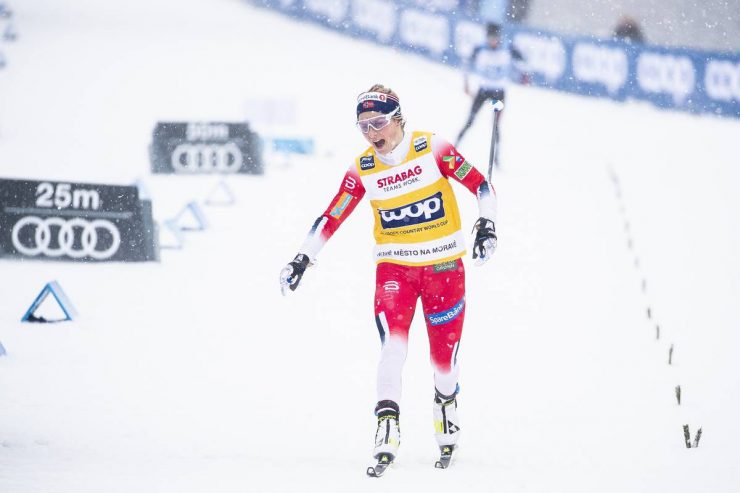
    Johaug is on a record-setting pace. During her last full season on the World Cup, 2015/16, Johaug won a record 12 individual races. We are starting to see this season that unless Johaug withers from an early season fitness peak and the chasers come into form later this season, she could simply run away with a few World Cup globes. She leads the distance and overall World Cup standings.

    For Kalla, her second place in the 15 k skate was her best ever in the discipline. Back in 2013 in Davos, Switzerland she finished third in the 15 k skate. Kalla sits second in the overall World Cup with 369 points, trailing Johaug by 131 points. Today was Kalla’s third podium of the season. She finished fourth on one other occasion.

    U.S. Ski Team skier Jessie Diggins at the start of the World Cup 15 k freestyle individual start in Beitostølen, Norway. Diggins placed eighth.

    The U.S. Ski Team’s Jessie Diggins had her best result of the season finishing in eighth place, 1:29.6 minutes behind the day’s winner, Johaug. From a pacing perspective, Diggins was consistent. At the 6 k, 10 k, and 12 k marks, she was locked in seventh place. Coming off a cold that affected her performances last weekend in Lillehammer, Norway, Diggins told FasterSkier in Beitostølen that her sensations were coming around.

    “I felt better than last weekend, Diggins said. “I started to feel more like myself. Which is nice because I was definitely still sick last weekend, so feeling healthy was really nice and I felt like I could really breathe out there. That was really positive and I had some really good skis and I just went out there and I kept trying to focus on skiing every part of the course as smart and as good as I could. And focus on my technique and so I was happy with it. It was a step in the right direction. … We are still in period 1. I think I am in a pretty good place right now and I am where I need to be.”

    Diggins had her first podium last season, a season when she placed second in the overall World Cup, on January 1, during the Tour de Ski’s third stage 10 k skate pursuit in Lenzerheide, Switzerland.

    Sadie Bjornsen (USST), finished 13th (+(+2:22.9) for her sixth top-15 of the season on the World Cup. Bjornsen’s best finish thus far was a third place in Lillehammer’s skate sprint.

    “I feel worked,” Bjornsen said in the mixed zone. “That was definitely a very very challenging race out there today. I think what makes it challenging [for me] is the flat terrain. There’s just no recovery out there and especially with falling snow it is extra difficult to move across the snow and so today was just race of toughness for 15 k.”

    Of the tough conditions due to the freshly fallen snow, Bjornsen noted her skis felt solid. Her legs, on the other hand, were fatigued. Additionally, Bjornsen, who lives in Anchorage, Alaska, a community that suffered a major earthquake last week, has had home on her mind.

    “I felt like my legs were particularly tired today,” Bjornsen said. “I think it has just been a long week with a lot of things going on. So I think I have to set a goal next week to not have any stress or my mind on anything about home, so I can truly recover.”

    U.S. Ski team athlete Sadie Bjornsen (bib 37) at the start of the World Cup 15 k freestyle individual start in Beitostølen, Norway. Bjornsen placed 13th.

    Bjornsen is ranked ninth overall on the World Cup.

    Also for the U.S., Rosie Brennan has proved the U.S. pool of women remains deep. Skiing for Alaska Pacific University (APU), Brennan’s renewed prowess earned her a fifth top-30 this season, which includes three top-15s.

    In Beitostølen Saturday, Brennan placed 15th (+(+2:33.9).

    “I am definitely getting a little tired from all the racing, especially after the mini-tour last week,” Brennan said after the race. “But I am happy with my shape and I think I can hold through one more weekend and then I will get a little rest.”

    Despite earning the 15th best time after two laps, and maintaining that position at the finish, Brennan explained, like many skiers, the third lap was difficult.

    “I was really happy with my first and second lap but I wished I would have had a little bit more energy to give on the last lap,” Brennan said. “I just tried to keep a steady pace and always be trying to make up a little time here and there. I mean it is slow out there so there is just more work. It is the same for everybody.”

    Caitlin Patterson, skiing for the U.S. and training with the Craftsbury Green Racing Project (CGRP), placed just outside the points in 32nd (+3:46.0).

    “It was a good fight,” Patterson told FasterSkier in Beitostølen. “This is a fun course. I liked a lot of the working gliding sections and I think I skied the transitions better than I have in other races. I am feeling fairly solid about it. I was getting some good reinforcing splits out there.”

    Patterson explained she is feeling good while still adjusting her skiing and looking for that top-end World Cup gear.

    “I am smoothing out the way I am racing with better transitions now,” Patterson said of her racing. “The fitness still feels like it is coming around. Last year, I felt like I had a little more than a top gear than I have tapped into this year. It’s still coming around.”

    Also for the U.S., Kaitlynn Miller placed 50th (+5:02.8).

    Emily Nishikawa of the Canadian National Team (CNT) was the best placed Canadian in 34th (+4:01.6). Cendrine Brown (CNST) was 38th (+4:16.4). This was the first World Cup of the season in which Canada has entered a women’s team.

    “I am happy with this start to the season,” Nishikawa wrote in an email. “I am encouraged by my race and know that I have some room for improvement next weekend in Davos.”
    Both Nishikawa and Browne spent time in Davos, Switzerland, the site of next weekend’s World Cup, prepping with a pre-race season camp.

    Racing continues on Sunday in Beitostølen with a women’s 4 x 5 k and men’s 4 x 7.5 k relay.

    The U.S. has eight women in Beitostølen and will field two women’s teams in Sunday’s relay. Team one will consist of Bjornsen, Brennan, Patterson, and Diggins.  The second team will feature Sophie Caldwell, Ida Sargent, Kelsey Phinney, and Kaitlynn Miller.
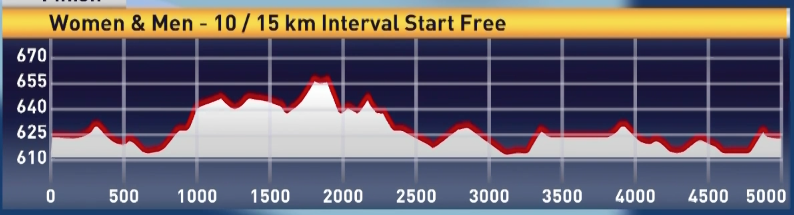
    Women’s Results | Distance World Cup Standings | Overall World Cup Standings