From the FasterSkier archive — posts syndicated from athletes’ and coaches’ own blogs between 2004 and 2012, kept online as published. Current coverage is at fasterskier.com.
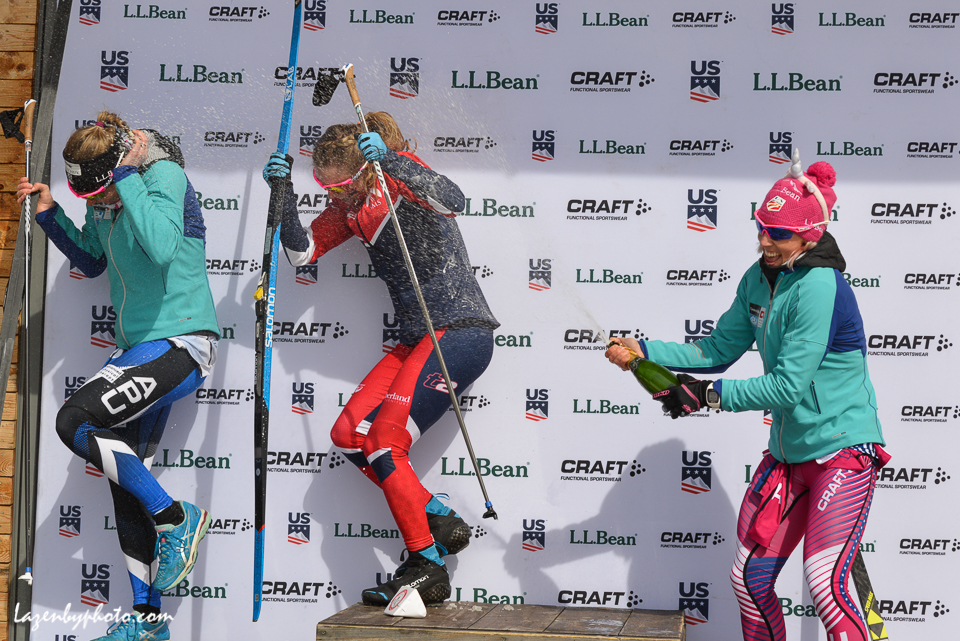
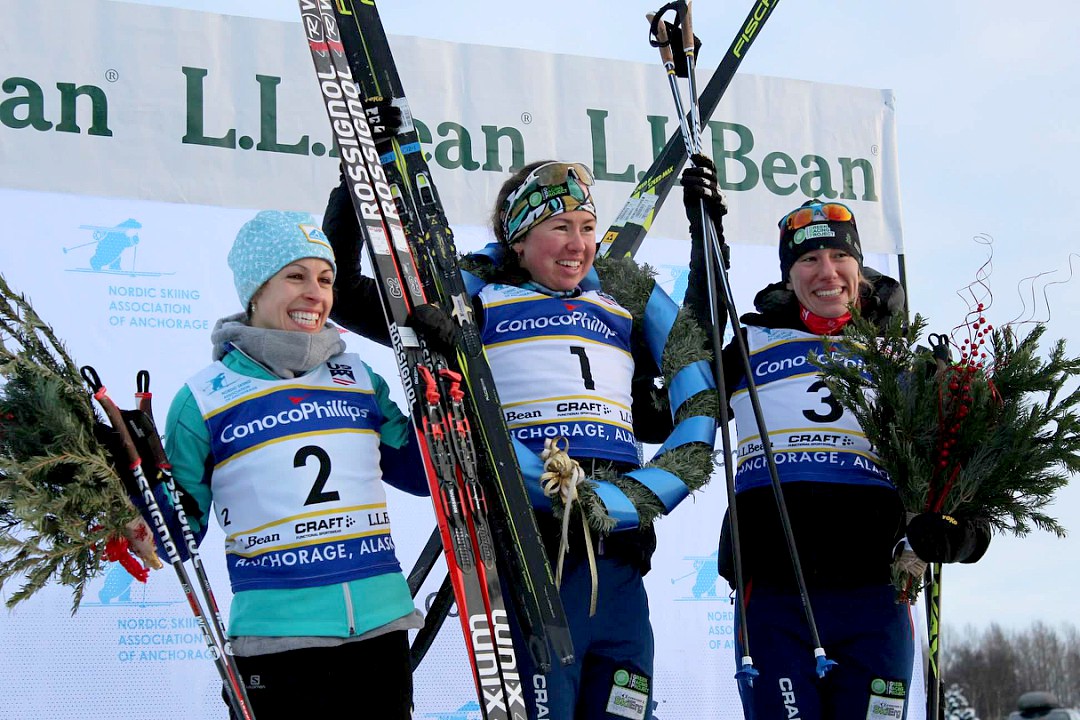
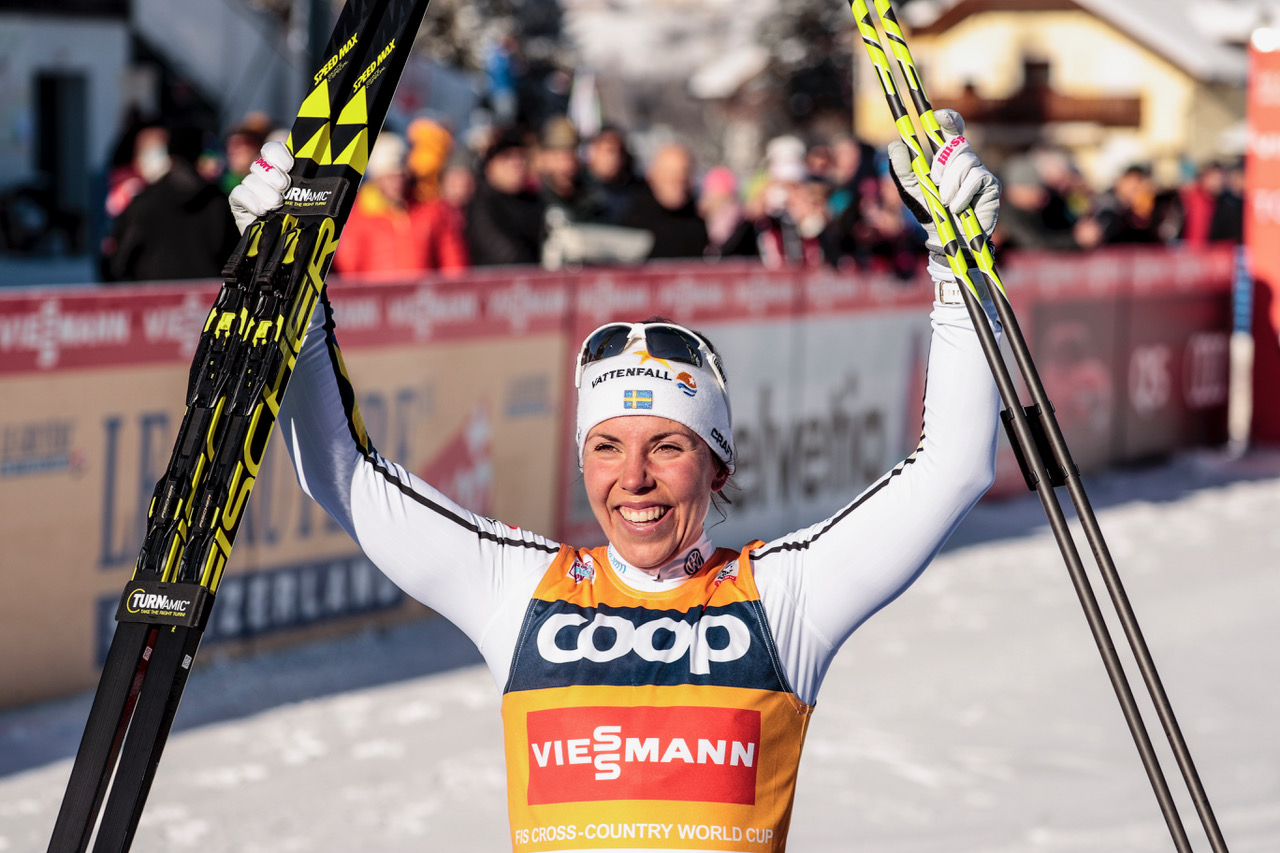
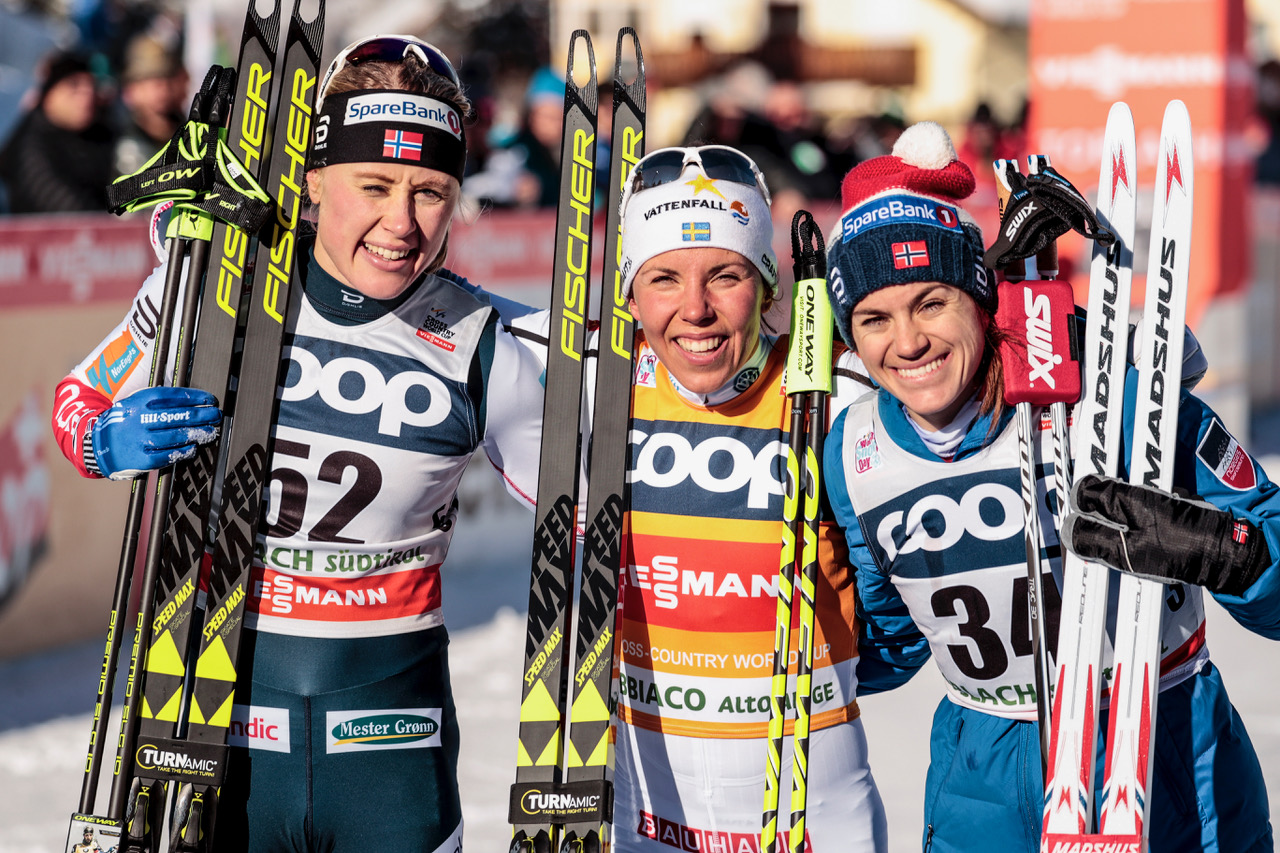
Kikkan Randall (r) sprays her U.S. Ski Team teammates Jessie Diggins (c) and Sadie Bjornsen (l) with champagne on the podium of the 30 k classic mass start at U.S. Distance Nationals in Craftsbury, Vt. Diggins won, Bjornsen placed second and Randall finished third. (Photo: John Lazenby/Lazenbyphoto.com)
2018 U.S. Distance Nationals (Craftsbury, Vermont): 30 k classic mass start
Jessie Diggins swept SuperTour Finals once again, after doing so last year in Fairbanks, Alaska, and winning every individual race at 2016 SuperTour Finals the year before in Craftsbury, Vt.
Back in Craftsbury on Tuesday, and coming off three-straight victories in the classic sprint, 10-kilometer freestyle mass start and mixed relay with her Stratton Mountain School (SMS) T2 Team teammates, Diggins, 26, pulled out her fourth-straight win in her last race of the season: the women’s 30 k classic mass start, which is part of U.S. Distance Nationals.
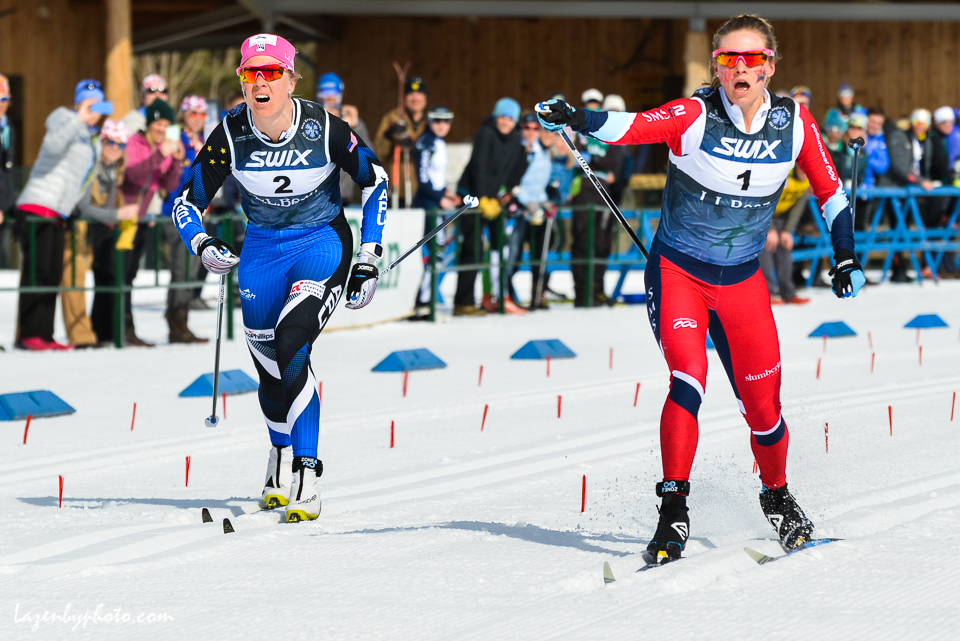
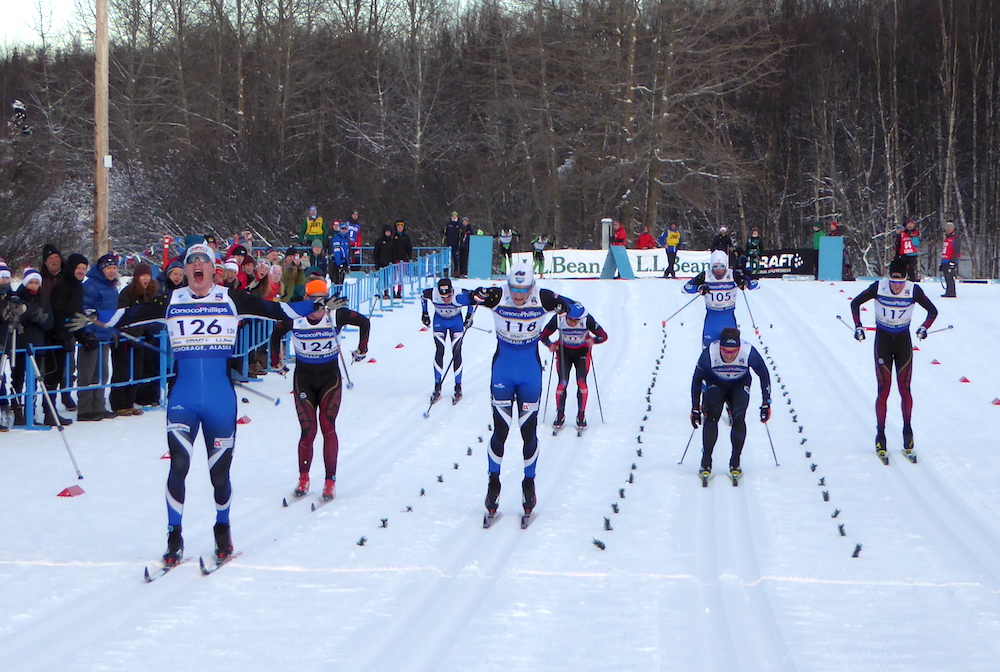
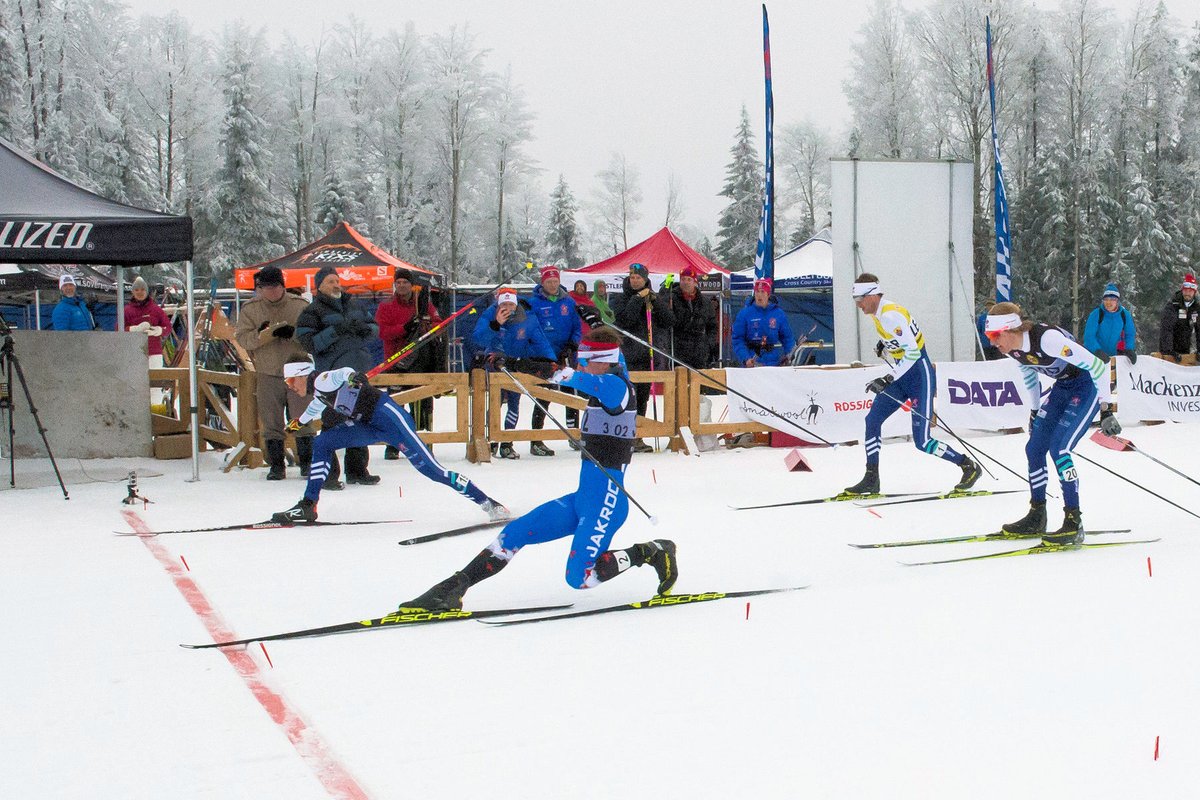
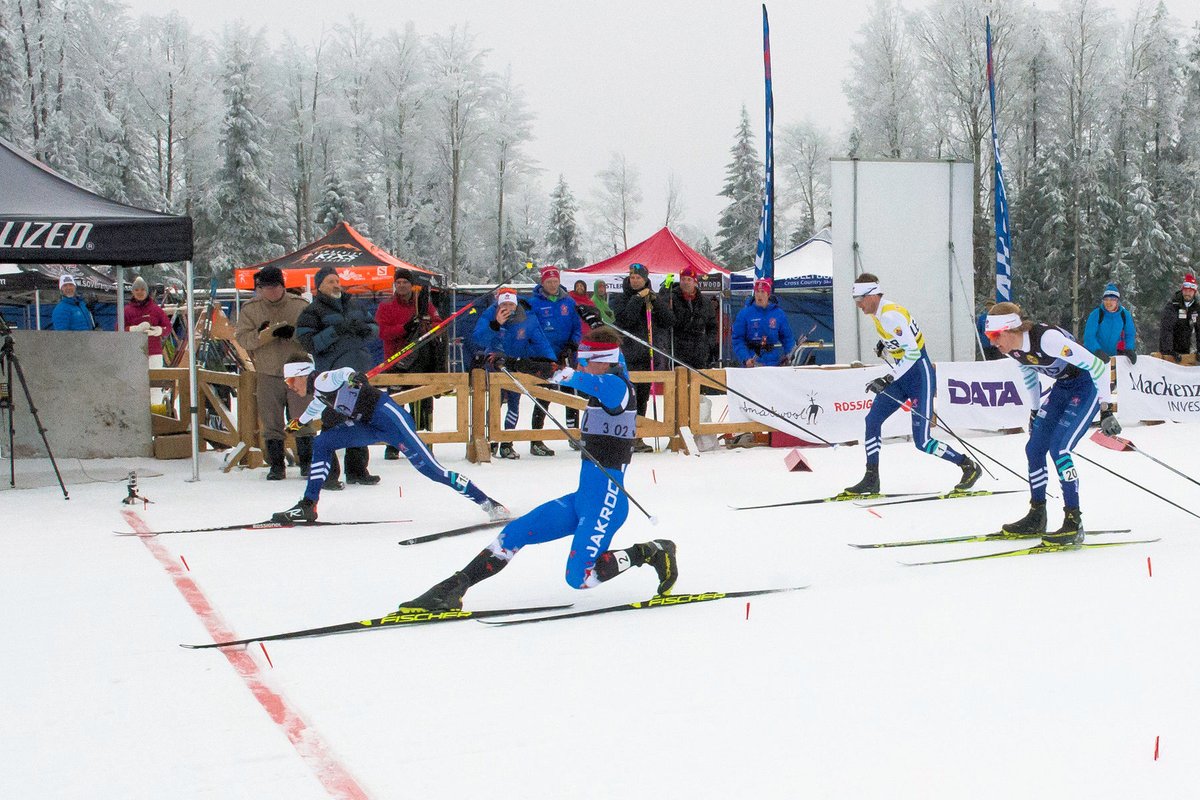
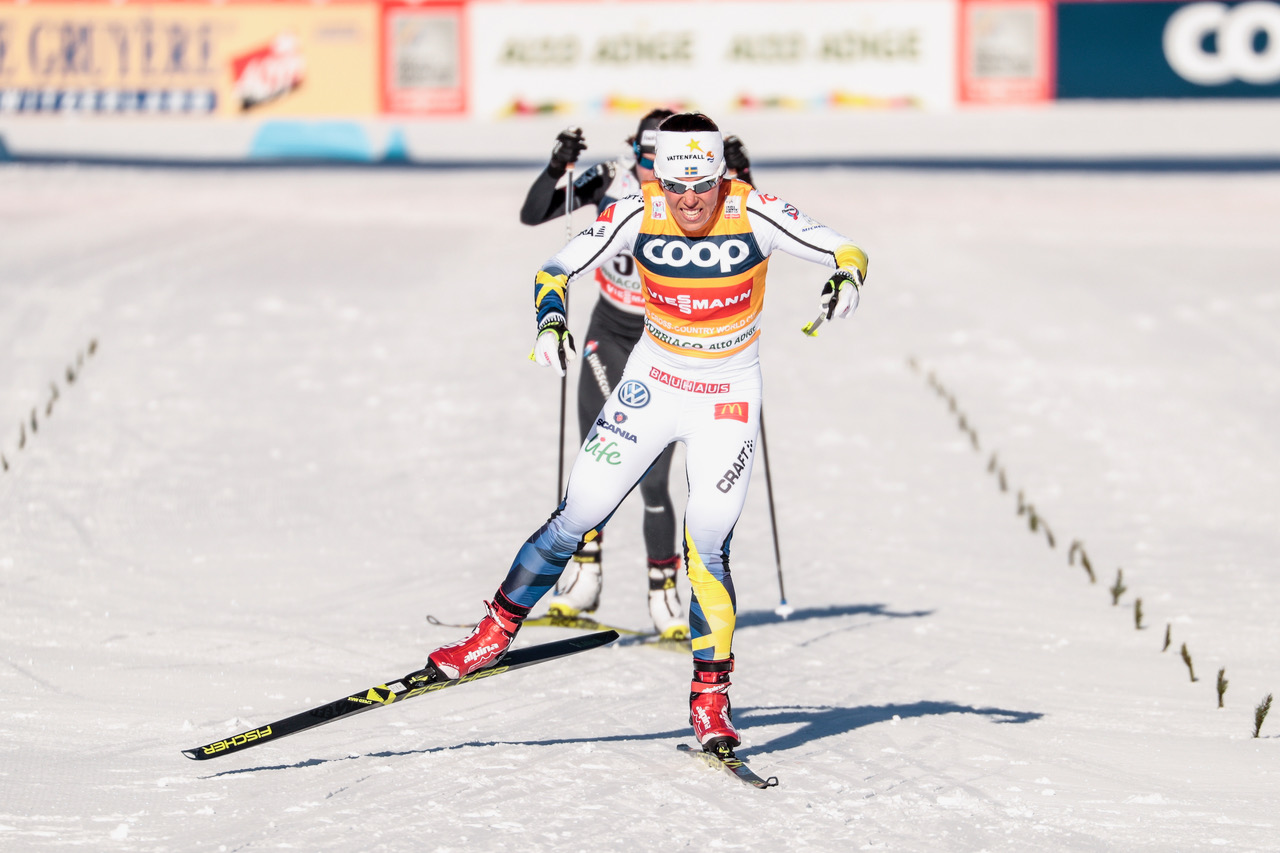
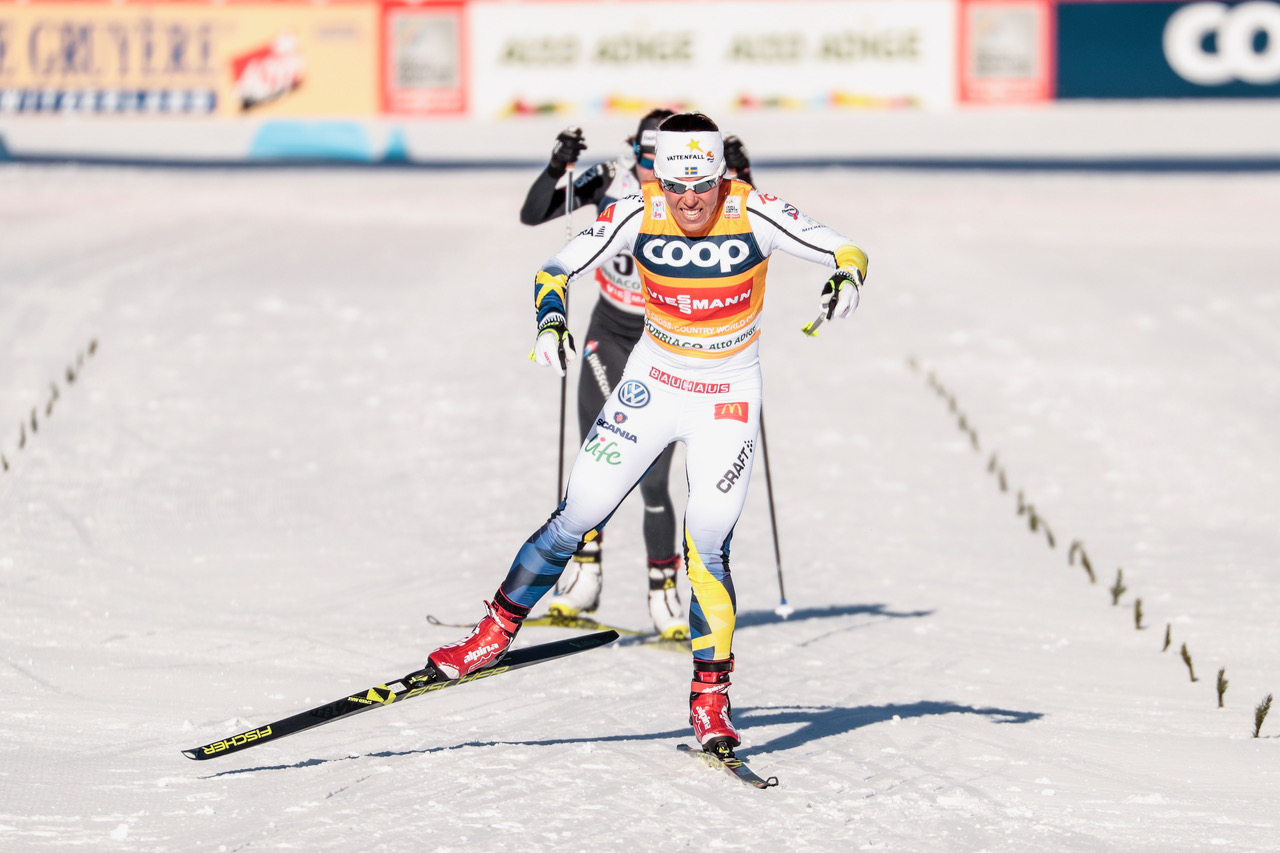
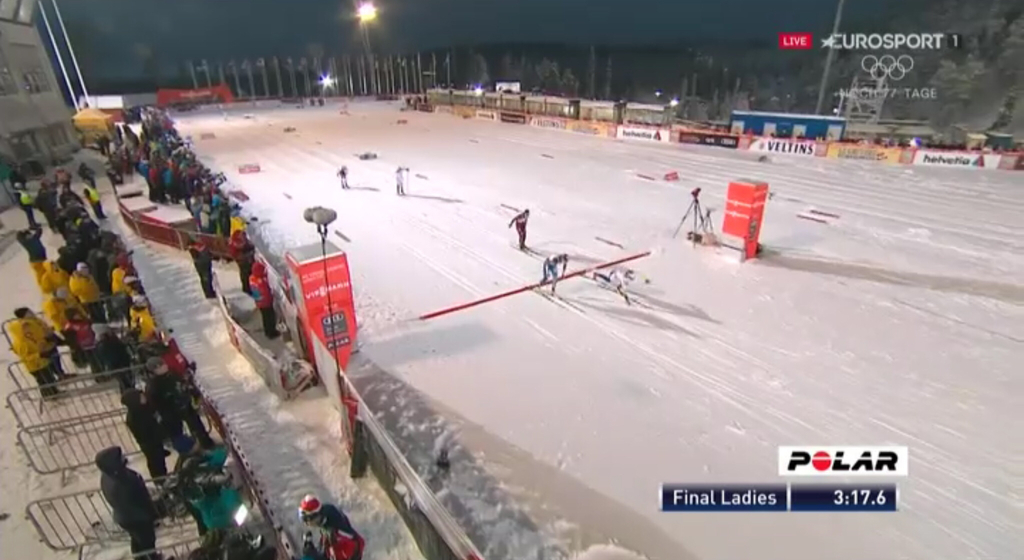
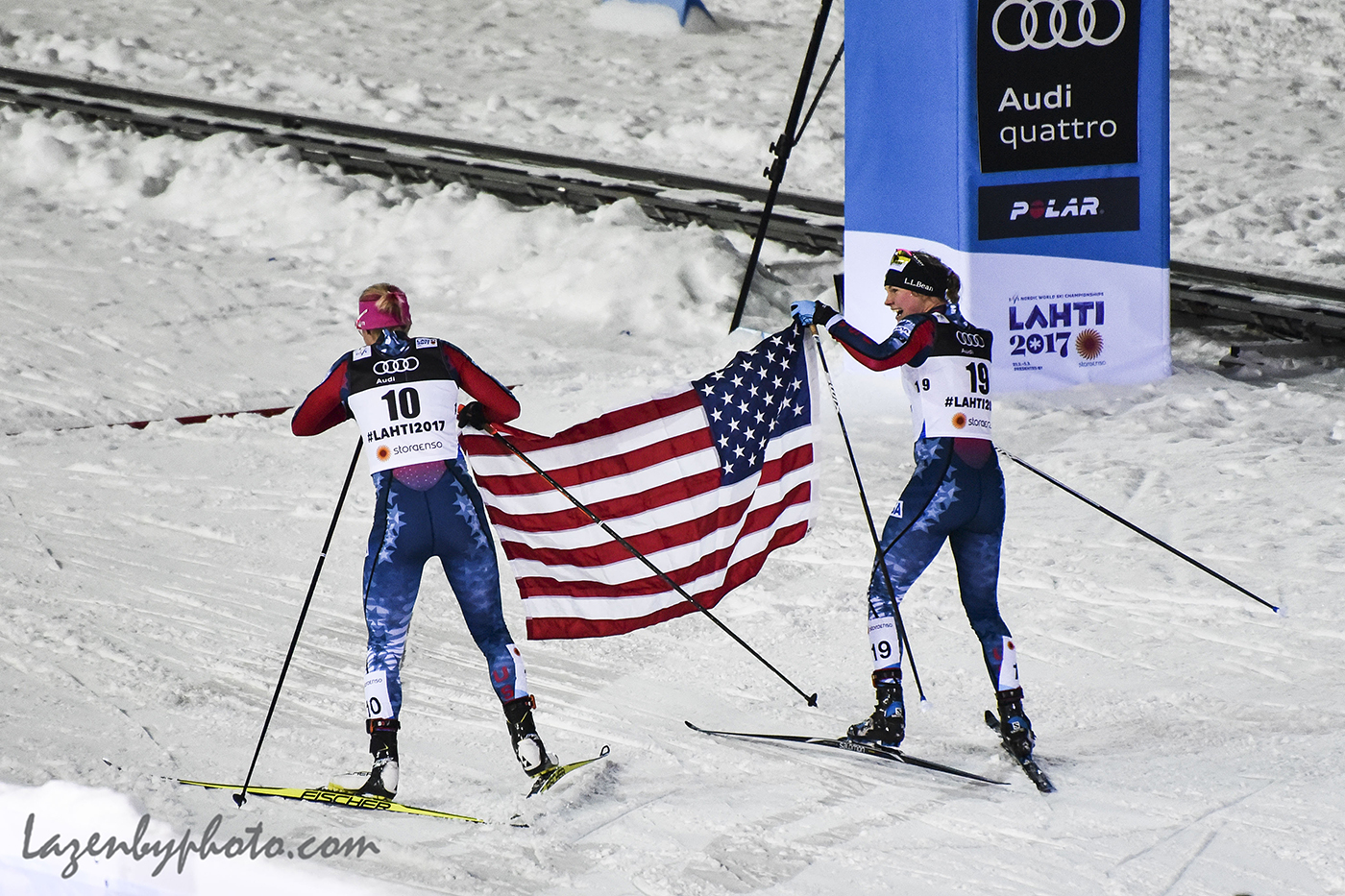
Jessie Diggins (r) edging her U.S. Ski Team teammate Sadie Bjornsen at the line for the win in the women’s 30 k classic mass start at 2018 U.S. Distance Nationals in Craftsbury, Vt. (Photo: John Lazenby/Lazenbyphoto.com)
She did so in an all-out effort to the line, beating her fellow U.S. Ski Team (USST) member Sadie Bjornsen by just 0.4 seconds in 1:25:27.2 hours. Diggins, Bjornsen of Alaska Pacific University (APU), and another USST member Sophie Caldwell (SMST2) broke away from the pack on the first of five laps at the Craftsbury Outdoor Center. Caldwell dropped off the pace around 10 k and skied on her own for the next 15-plus kilometers before being caught by a chase group of six, led by Kikkan Randall (APU/USST), on the final lap.
Meanwhile, Diggins and Bjornsen skied together, trading the lead for the rest of the race. On the final short climb up to the stadium, Diggins pulled ahead slightly then extended her lead in the finishing straight. After finishing first and second, respectively, Diggins and Bjornsen laid on the ground for what seemed like a long time, particularly spent from the effort, before congratulating each other. Behind them, Randall outlasted the chase pack for third (+2:21.7), Caldwell followed just behind her in fourth (+2:23.1), Ida Sargent of the Craftsbury Green Racing Project (CGRP) and USST placed fifth (+2:26.5) and Rosie Frankowski (APU) finished sixth (+2:29.2).
Also in the top 10, Liz Stephen (USST) finished the last race of her professional career in seventh (+3:10.9), Caitlin Patterson (CGRP) eighth (+3:27.2), Kaitlynn Miller (CGRP) ninth (+3:56), and Chelsea Holmes (APU) 10th (+4:45.3).
Stratton had two wins on the day with Charlotte Ogden (SMS) winning the junior women’s 20 k classic mass start in 1:04:33.9. Canada’s Catherine Reed-Metayer (Skibec Nordique) placed second (+11.8), Waverly Gebhardt (Steamboat Springs Winter Sports Club) finished third (+33.8), and Phoebe Sweet (Craftsbury Nordic) was the third American junior in fourth overall (+1:10.2).
Spring Series concludes with the men’s 50 k classic mass start on Wednesday, starting at 9 a.m. EDT. Watch the races live on the SuperTour live stream.
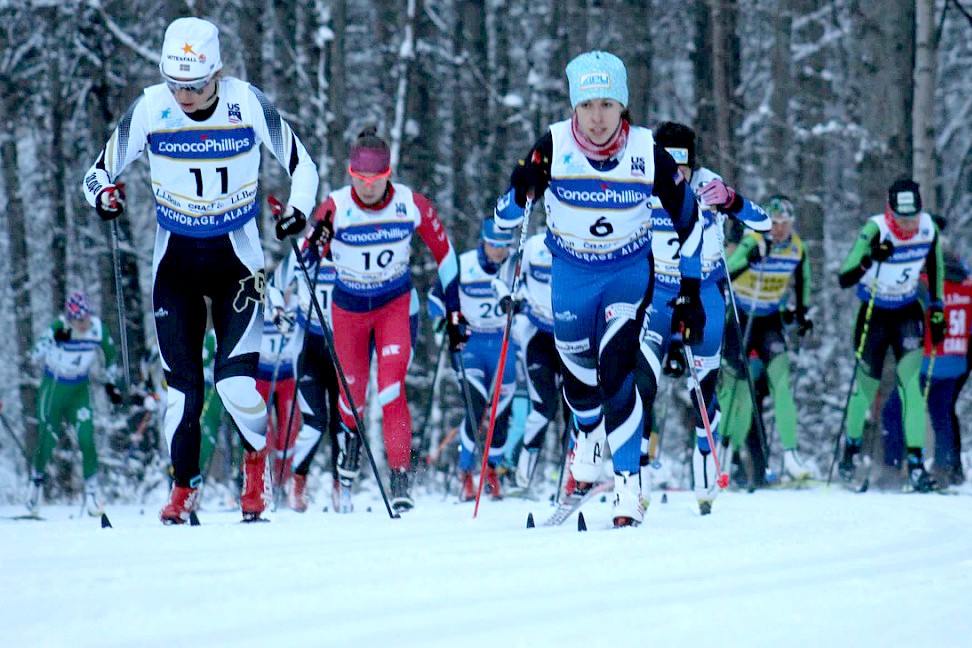
The start of the women’s 30 k classic mass start at 2018 U.S. Distance Nationals in Craftsbury, Vt. (Photo: John Lazenby/Lazenbyphoto.com)
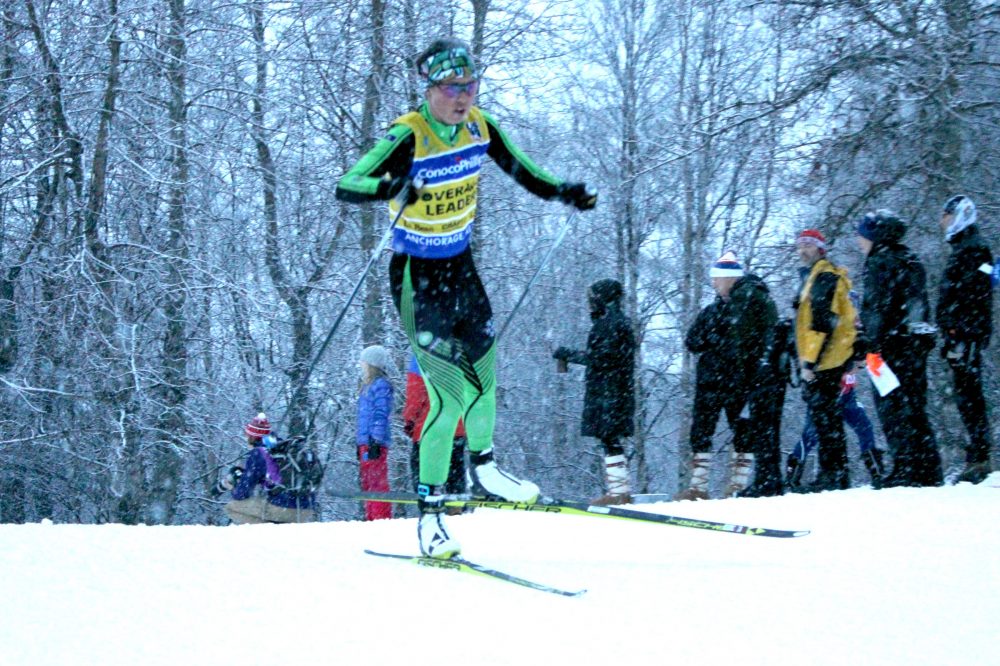
Jessie Diggins (1) leading the women’s 30 k classic mass start at 2018 U.S. Distance Nationals in Craftsbury, Vt. (Photo: John Lazenby/Lazenbyphoto.com)
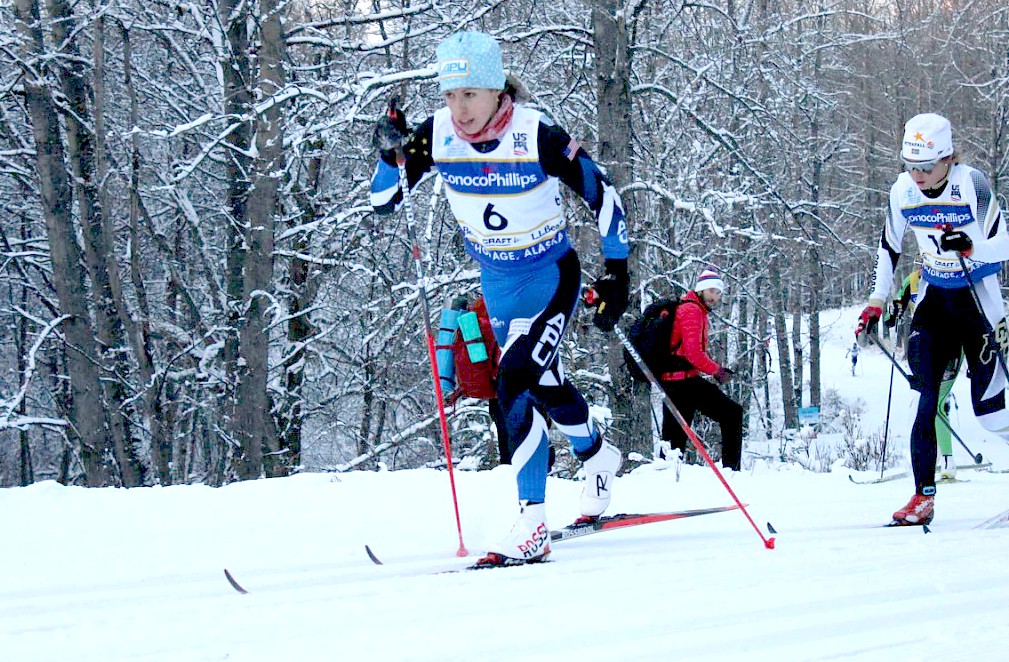
Sadie Bjornsen (2) leading the women’s 30 k classic mass start at 2018 U.S. Distance Nationals in Craftsbury, Vt. (Photo: John Lazenby/Lazenbyphoto.com)
Sadie Bjornsen (2) leading the women’s 30 k classic mass start at 2018 U.S. Distance Nationals in Craftsbury, Vt. (Photo: John Lazenby/Lazenbyphoto.com)
Sadie Bjornsen (2) leading Jessie Diggins (c) and Sophie Caldwell (l) during the women’s 30 k classic mass start at 2018 U.S. Distance Nationals in Craftsbury, Vt. (Photo: John Lazenby/Lazenbyphoto.com)
Ida Sargent (15) leads Kikkan Randall. Caitlin Patterson, Liz Stephen (yellow bib) and others in a chase pack during the women’s 30 k classic mass start at 2018 U.S. Distance Nationals in Craftsbury, Vt. (Photo: John Lazenby/Lazenbyphoto.com)
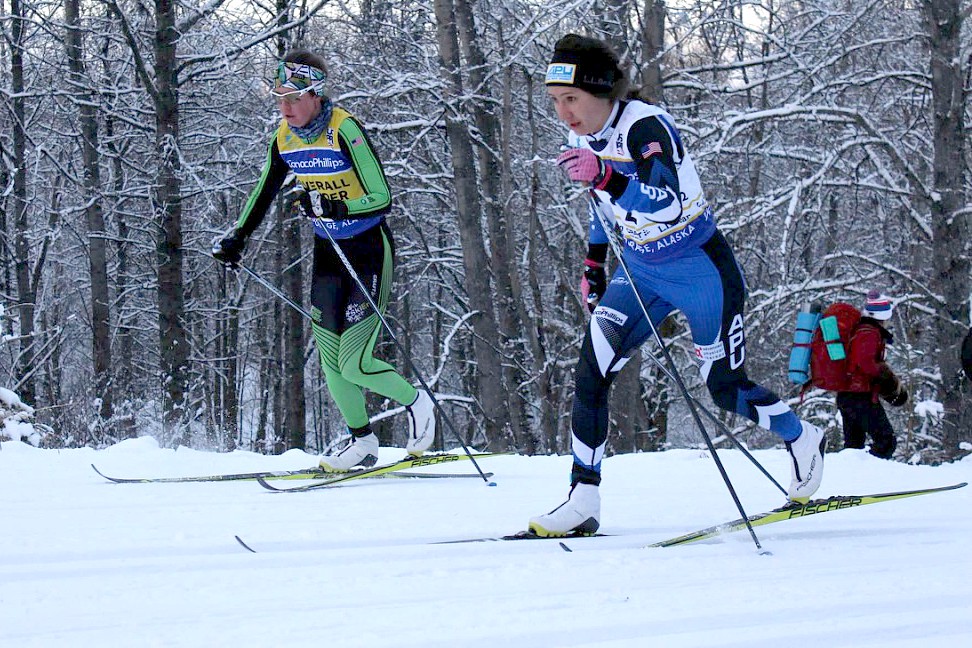
Sadie Bjornsen (2) and Jessie Diggins (1) racing for first in the women’s 30 k classic mass start at 2018 U.S. Distance Nationals in Craftsbury, Vt. (Photo: John Lazenby/Lazenbyphoto.com)
Kikkan Randall (3) racing for third place in the women’s 30 k classic mass start at 2018 U.S. Distance Nationals in Craftsbury, Vt., ahead of Sophie Caldwell (second from l), Ida Sargent (second from r), and Rosie Frankowski (r). (Photo: John Lazenby/Lazenbyphoto.com)
Jessie Diggins (l), Liz Stephen (c) and Rosie Frankowski (r) at the finish of the women’s 30 k classic mass start at 2018 U.S. Distance Nationals in Craftsbury, Vt. (Photo: John Lazenby/Lazenbyphoto.com)
Jessie Diggins with a photo of her retiring U.S. Ski Team teammates Kikkan Randall and Liz Stephen on her cheek at 2018 U.S. Distance Nationals in Craftsbury, Vt. (Photo: John Lazenby/Lazenbyphoto.com)
Kikkan Randall (l) and Liz Stephen after the last race of their professional careers, the 30 k classic mass start at 2018 U.S. Distance Nationals in Craftsbury, Vt. (Photo: John Lazenby/Lazenbyphoto.com)
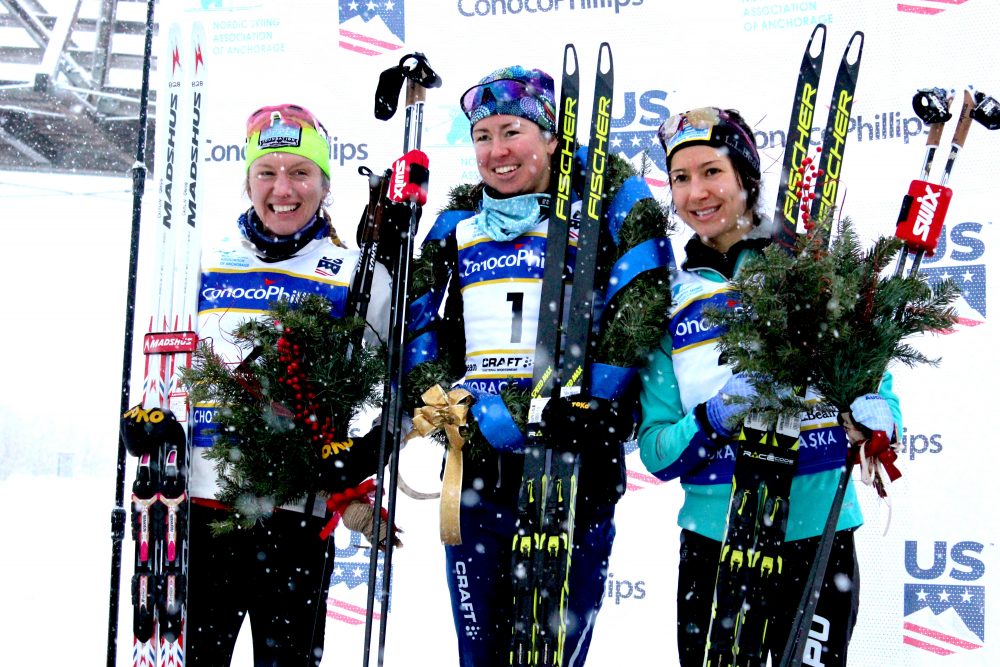
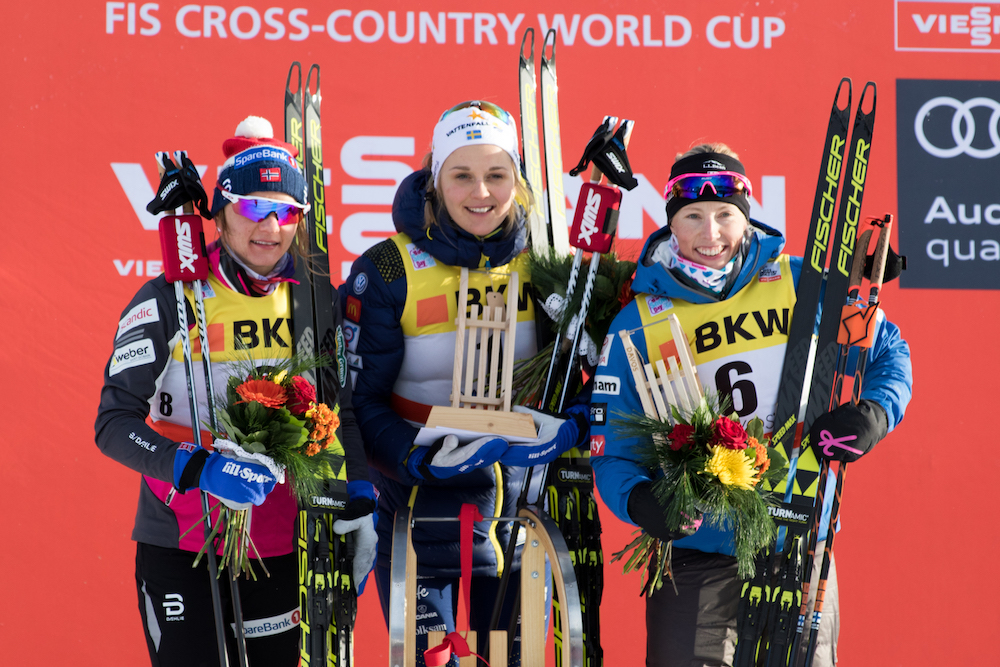
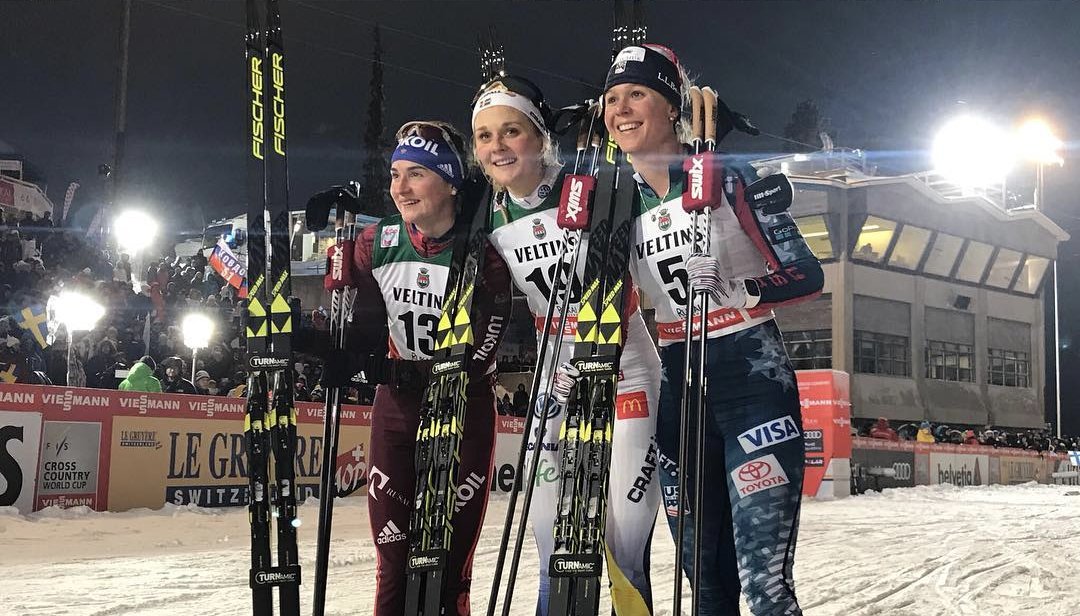
The women’s 30 k classic mass start podium at 2018 U.S. Distance Nationals in Craftsbury, Vt., with Jessie Diggins (c) in first, Sadie Bjornsen (l) in second and Kikkan Randall (r) in third. (Photo: John Lazenby/Lazenbyphoto.com)
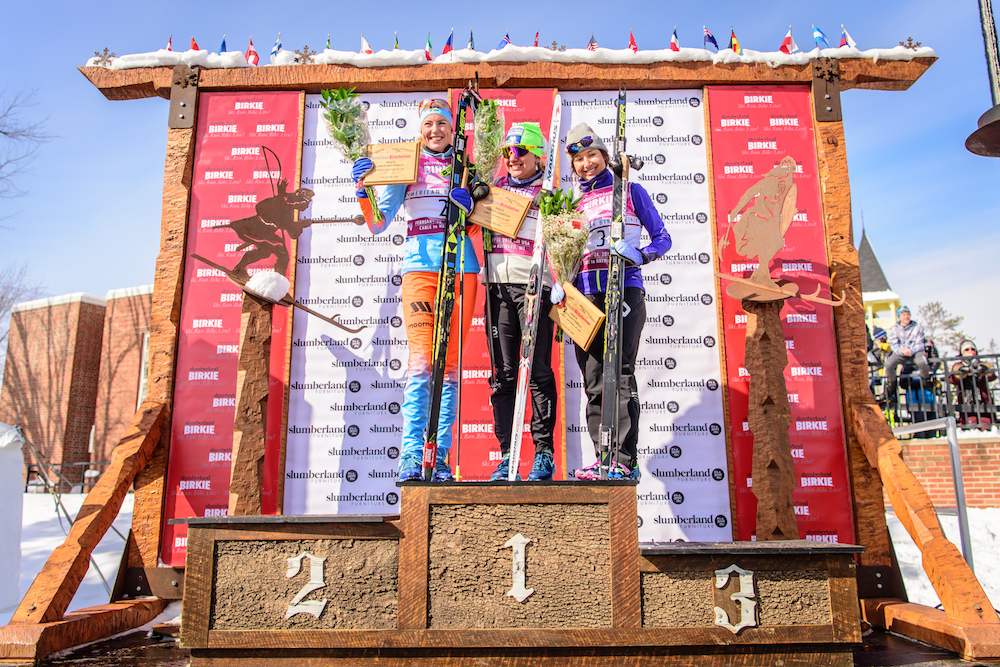
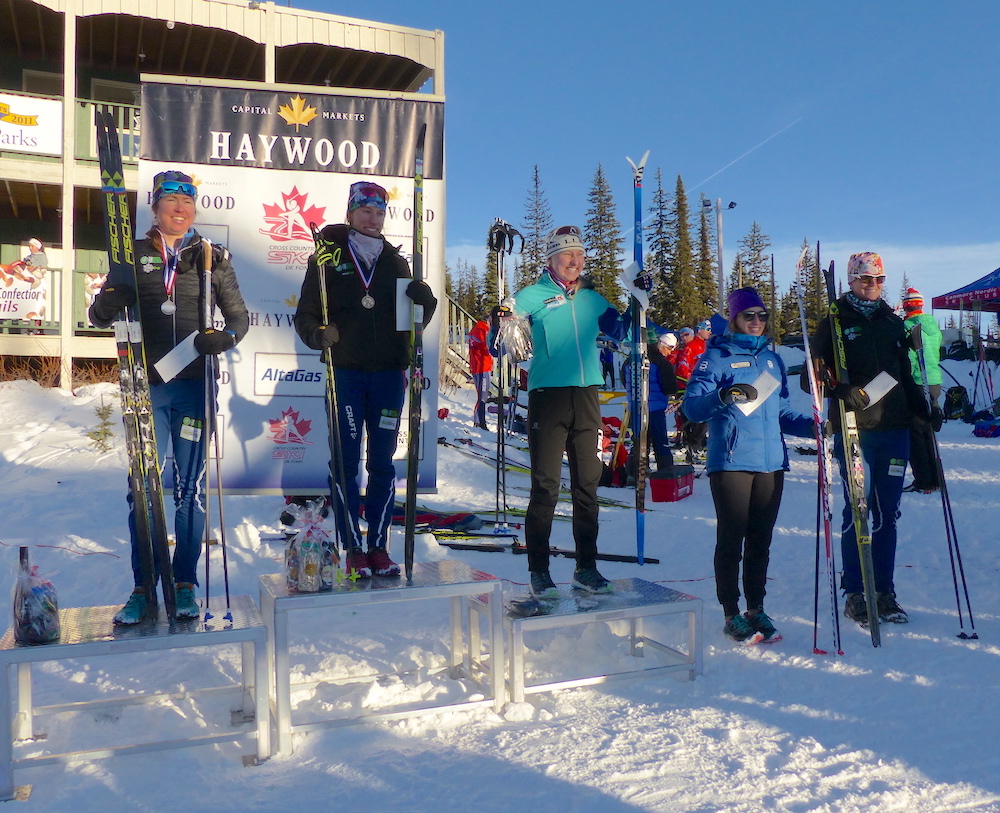
The elite women’s skate podium at the 2018 American Birkebeiner on Saturday in Hayward, Wisconsin, with Caitlin Gregg (c) in first, Sweden’s Maria Gräfnings (l) in second and Chelsea Holmes (r) in third. (Photo: American Birkebeiner Ski Foundation 2018)
Caitlin Gregg has raced the American Birkebeiner enough times — and won it more than anyone else — that she’s got the course down pat. Powerline, Big Bertha, High Point, Heckler’s, OO, Gravel Pit, Mosquito Brook, B*tch Hill, Hatchery, the lake, the bridge, the Main Street finish.
But the conditions and the competition, that’s something that changes from year to year. The elite racers were among the first to start the 50-kilometer American Birkebeiner (“Birkie”) skate races on Saturday, giving them the edge in terms of firmer conditions over nearly 13,000 other racers behind them, but it was still not the fastest Birkie on record after six inches of new snow had fallen the day before.
But away they went, jetting out of the Birkie’s new start line and embarking on the 50 k point-to-point course from Cable to Hayward, Wisconsin. The elite women’s skate race started at 8:30 a.m. followed by the elite men 20 minutes later.
While the women remained in a large pack for the first 15 k or so, according to Gregg, they were down to six around 20 k.
“I think this is one of the strongest fields that I’ve ever seen at the American Birkebeiner for the women,” Gregg recalled in a post-race press conference. “A lot of really fast ladies, a lot of depth, and so it was a pretty high-paced race the whole time. There were definitely five of us in that top six group taking leads and doing pulls, and we definitely worked together to kind of separate ourselves from the field behind us.”
Three of those racers fell of the pace, which left Gregg, Sweden’s Maria Gräfnings, and Chelsea Holmes contending for the win. Gregg, 37, races for the Central Cross Country (CXC) Team, Loppet Nordic Racing and Team Gregg. Gräfnings, 32, is a former University of Utah skier, and Holmes, 31, races for Alaska Pacific University (APU).
Just over 2 kilometers before the finish, as the three were skiing across Lake Hayward, the elite men’s race leaders caught them. Typically, the top elite women finish before the men.
“I could hear another snowmobile, and I knew what that meant, and I kind of looked around at the women and I said, ‘Oh, the men are coming,’ ” Gregg reflected. “… When they caught us, it was actually kind of a surprise because a couple went by, and then they just kept coming.”
The lead pack of men was still close to 30 strong at that point, just 2 k before the finish.
“It was the weirdest thing I’ve even experienced in a race, where you just have this consistent line of guys coming and it was actually, really great,” Gregg continued. “Because the women, we raced our own race, we jumped in towards the back of that pack, but we stayed in our own pack.
“At one point, I suggested maybe we should move over for the men,” she added. “I like these ladies; they were like, ‘NO. They can go around us. They can figure it out. We’re doing our own thing.’ So I thought that was pretty cool.”
Gräfnings had been leading when the men caught them.
“And then I thought ‘Now I can go with them,’ but, no, they were going really fast,” Gräfnings said at the press conference. “So, then I was leading the pack, the women’s, and I guess I was getting really tired when I was doing that…”
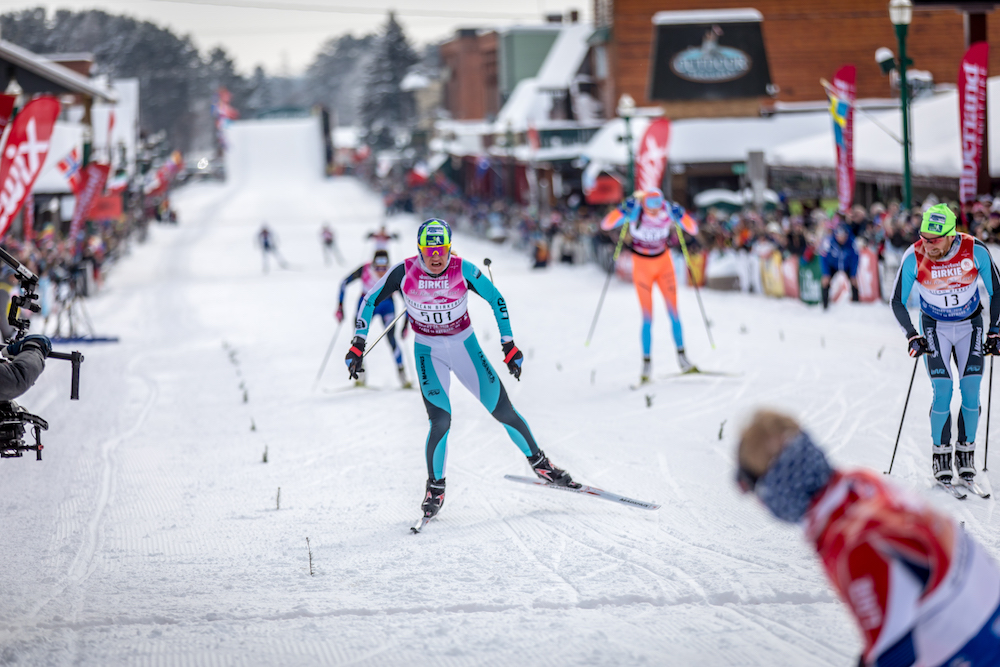
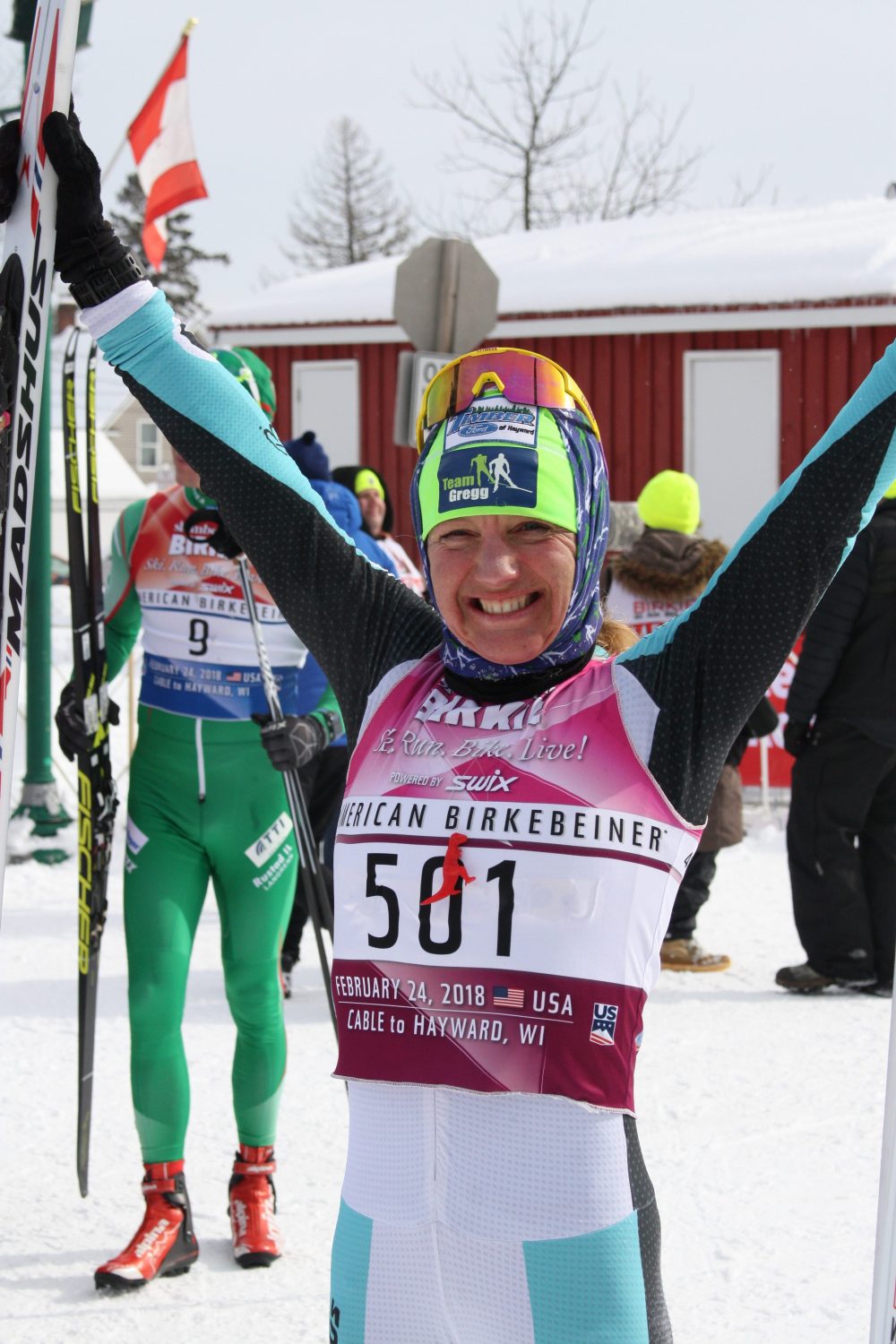
Caitlin Gregg (501) winning her fifth American Birkebeiner on Saturday in Hayward, Wisconsin, while skiing alongside her husband Brian Gregg (13), who placed 22nd in the elite men’s skate race. (Photo: American Birkebeiner Ski Foundation 2018)
Gregg took the lead just before the Birkie’s International Bridge and went on to hold off Gräfnings and Holmes for the win in 2:23:30.3 hours. Gräfnings finished second, 2.5 seconds back, while Holmes placed third (+3.8).
“I was like, ‘No, I can’t give up this. I have to really try to sprint then,’ ” Gräfnings recalled. “I’m glad I could get the second place.”
Gregg won the last American Birkebeiner contested in 2016 (last year’s race was canceled due to low snow) in 2:22:44. With Saturday’s win, she has most Birkie wins of any racer, male or female, with five victories (2011, 2013, 2014, 2016, and 2018).
“I’m trying to set the bar pretty high for the next person to come along and break that [record], so it feels amazing to win my fifth,” said Gregg, who lives in Minneapolis, Minnesota. “The conditions were absolutely perfect today. The course was just in amazing shape and just beautiful out there, and this is definitely one of my favorite races, that’s why I keep coming back. Everything about it, between the organization and the volunteers makes this a special event for so many people, but, for myself, especially. So yeah, I was really happy year to be able to race again and feel good and really fight for the win.”
Gräfnings said was pleased with her own race and glad to return to the U.S.
“I was studying in the University of Utah and now I’m back in America and it’s so fun to meet a lot of friends and it’s really special for me,” she said.
Holmes had previously raced the Birkie in 2014 and placed fifth, 3:45 minutes behind Gregg. She struggled with the cold and suffered in that race, she explained at the press conference.
Caitlin Gregg celebrates her fifth American Birkebeiner win on Saturday after winning the women’s 50 k skate race by 2.5 seconds over Sweden’s Maria Gräfnings in second place. (Photo: RJ Ochmann)
“I was very worried today about surviving with enough feeds and being warm enough,” Holmes said. “In the beginning, it’s a strange feeling because it always feels a little bit slow, like a very different race pace than even a 30 k that you do at other times, and especially with less climbing, which, I miss the hills a little bit … so that’s a little bit hard for me sometimes to sit in. But I think we shared the lead fairly well.
“It was … good for me always to remember to relax and be patient because even when you have 25 k, you’re only halfway there,” Holmes continued. “So it’s a unique experience, the 50 k, because sometimes it feels like you’re not working that much, and I felt quite good. And then when I got five meters from the finish line, my legs just, I basically walked across the line. So, clearly I was very tired, but that’s how it goes.”
France’s Aurelie Dabudyk was the fourth woman across the line, 28.7 seconds behind Gregg, Anja Gruber of Bozeman, Montana, placed fifth (+2:44.6), and Erika Flowers of the Stratton Mountain School (SMS) T2 Team finished sixth (+3:30.1). Also in the top 10 were Liz Guiney of the Craftsbury Green Racing Project (CGRP) in seventh (+5:33.8), Hallie Grossman (CGRP) in eighth (+8:03), Hannah Bettendorf of Duluth, Minnesota, in ninth (+8:19.2), and masters skier Laura McCabe of Winthrop, Washington, in 10th (+8:20.6).
The Birkie is the fifth of seven races on the 2018 FIS Worldloppet Cup calendar. Dabudyk now leads the overall standings by just 10 points over Gräfnings in second. In her first Worldloppet race of the year, Gregg ranks seventh.
In the men’s overall standings, France occupies the top four with Gerard Agnellet in first, just 1 point ahead of Ivan Perrillat Boiteux in second, and 120 points clear of Loic Guigonnet in third. Adrien Mougel ranks fourth, another 2 points behind, and Norway’s Anders Gløersen breaks up the French sweep in fifth, 3 points behind Mougel.
Norris Makes the Move, Gløersen Takes the Win
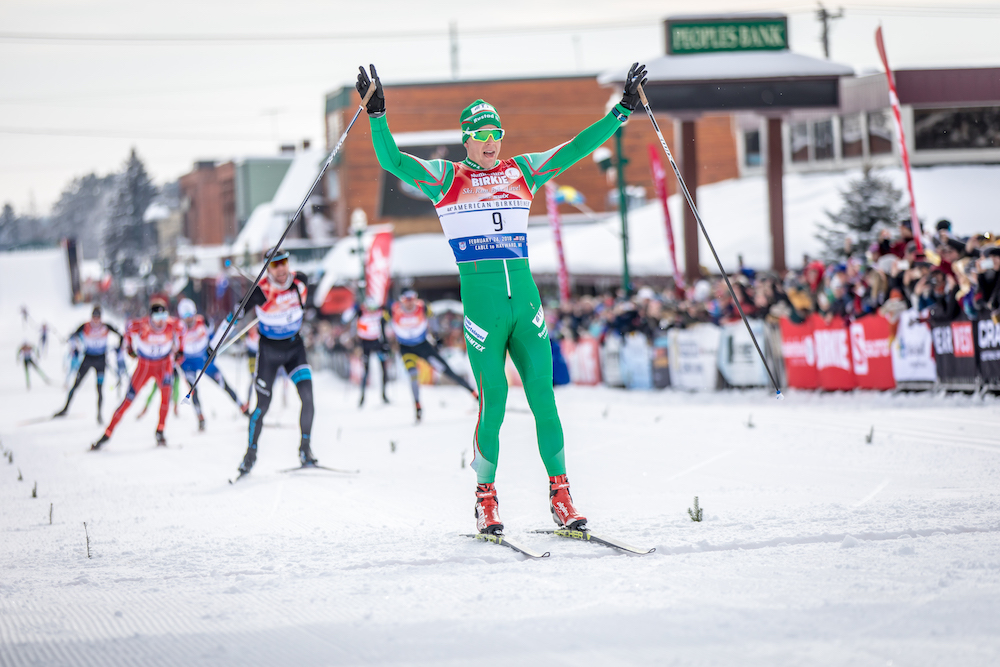
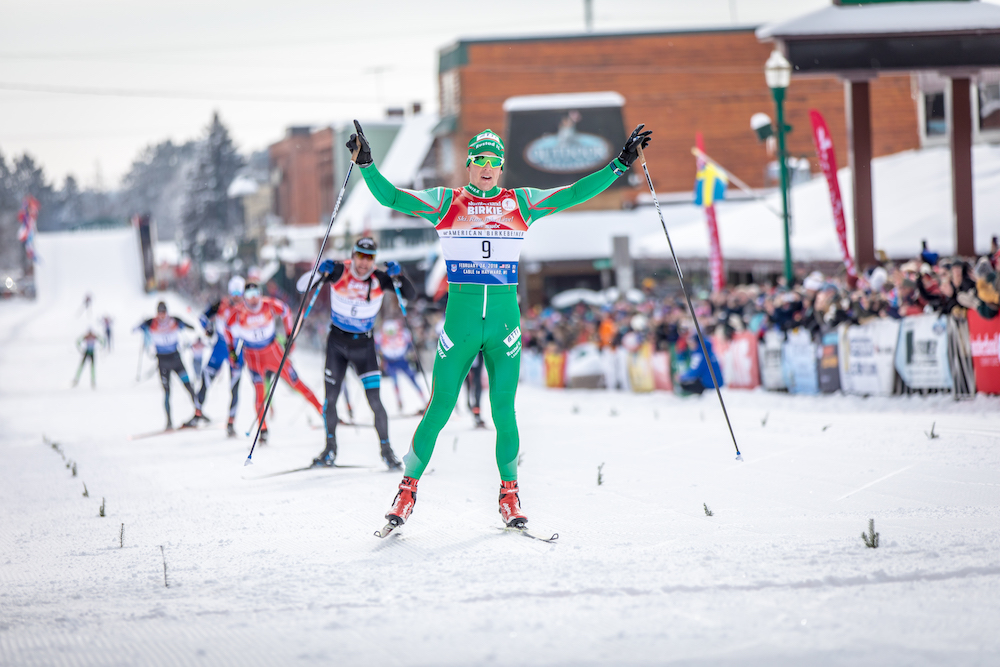
Norway’s Anders Gløersen winning the American Birkebeiner elite men’s 50 k skate race on Saturday in Hayward, Wisconsin. (Photo: American Birkebeiner Ski Foundation 2018)
Gløersen won the Birkie elite men’s skate race on Saturday in 2:02.29.6, just 1.9 seconds ahead of Perrillat Boiteux in second and 3.4 seconds ahead of American Kyle Bratrud (CXC Team) in third.
After as many as 30 men stayed together up until the last 2 kilometers, the men’s pack began to string out after coming off the lake. According to Bratrud, it was David Norris who made the defining move at that point in the race. Norris had launched a similar attack two years ago, just before the bridge, to win the 2016 Birkie.
“He started to string it out a bit and six or seven of us started to pull away from a line of about 30 of us,” Bratrud recalled at the press conference. “That’s kind of what led us to the break and ultimately to the sprint.”
The top-10 men were within eight seconds of first, with Mougel finishing fourth (+4.4), Norris losing his lead and ending up fifth (+5.1), France’s Bastien Poirrier placing sixth (+5.5), and Agnellet following in seventh (+5.7). France had six in the top 11 with Guigonnet in eighth (+6.6) and Benoit Chauvet in 11th (+13.3). Americans Ben Lustgarten (CGRP) finished ninth (+7.0) and Jack Hegman of the Sun Valley Ski Education Foundation (SVSEF) placed 10th (+7.2).
“It was a great race,” Gløersen, 31, said at the press conference. “Perfect conditions and nice weather. And it was a difficult to know how to do because I don’t know so many of the American skiers here, and I know the French guys … I had to watch out for them. So I just tried to stay in front of the big group to be ready if someone made an attack. It seemed like it was difficult to get away, and I was just glad when it was one kilometer left.”
After Norris’s attack, Gløersen made a point to follow him.
“I got the perfect position on the bridge here, just was number two and then had the perfect position going into the final 300 meters,” he said.
Asked about passing the women late in the race, he said it didn’t affect the men’s race too much.
“If it’s snowing, then it could make a difference because then you have the women making way, and when you pass them it’s going to be slower,” Gløersen said. “But today was quite good conditions so it was just fun to see when they catch them and to see who was in the group, but other than that, it doesn’t affect us much.”
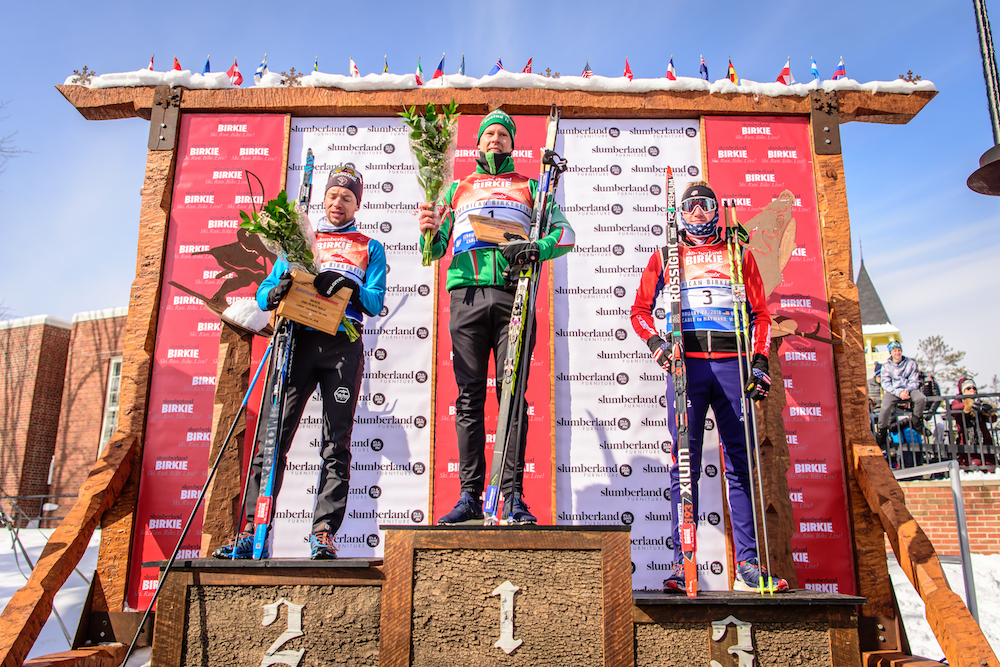
The elite men’s skate podium at the 2018 American Birkebeiner in Hayward, Wisconsin, with Norway’s Anders Gløersen (c) in first, France’s Ivan Perrillat Boiteux (l) in second and American Kyle Bratrud (r) in third. (Photo: American Birkebeiner Ski Foundation 2018)
While both Gløersen and Perrillat Boiteux are marathon regulars, this was the first American Birkebeiner for both of them.
“The Birkie was a great race, well organized, and I loved it,” Perrillat Boiteux, 32, said through a translator at the press conference.
Bratrud, 25, was born in Eden Prairie, Minnesota, and attended Northern Michigan University, yet this was his first Birkie. According to the FIS database, it was also his first marathon. Asked about skiing in such a large group for most of the 50 k race, he said it was a new experience, but it was likely because the field was so competitive.
“There’s a ton of strong guys there and no one really wanted to pull the other person to a victory,” Bratrud said. “So it was a lot of kind of cat and mouse and looking at each other and people made moves, but with so many strong skiers, it was hard for anyone to get away.”
In the 55 k Birkie Classic, Minnesota native Ben Saxton (SMST2) edged Cole Morgan (SVSEF) by 1.5 seconds at the finish for the win in 2:47:35.9. Mathias Rolid of Marquette, Michigan, followed in third (+6.1).
Wisconsin native Felicia Gesior (CXC Team) won the women’s classic race by more than 10 minutes in 3:08:07.3. Brandy Stewart of Bozeman placed second (+10:54.8) and Josie Nelson of Medicine Lake, Minnesota, reached the podium in third (+11:20.9).
$$$
While the Birkie’s 50 k skate race is part of the FIS Worldloppet Cup and reserves most of its prize money for first- through sixth-place finishers in both the elite men’s and women’s skate races (with $7,500 dollars for each winner), the 55 k Birkie Classic awards $1,000 to its men’s and women’s winners.
This year, there were also two $500 sprint bonuses in the Birkie skate race, which were awarded to the first male and female competitors to reach the intermediate sprint checkpoints. According to Gregg, the first “prime” was about 2 1/2 or 3 kilometers into the race, and the second came just before 20 k.
“I was curious how aggressive the women would be to go for those [sprint] primes and they were very aggressive, very fun,” Gregg said. “I think the first prime kind of set the tone and kind of strung things out a little bit.”
Caitlin Gregg (501) winning her fifth American Birkebeiner on Saturday in Hayward, Wisconsin, while skiing alongside her husband Brian Gregg (13), who placed 22nd in the elite men’s skate race. (Photo: ABSF/James Netz)
2018 American Birkebeiner (Hayward, Wisconsin): 50 k freestyle
The 44th annual American Birkebeiner took place Saturday on the world-famous course from Cable to Hayward, Wisconsin, with Minneapolis’s own Caitlin Gregg (CXC Team/Loppet Nordic Racing/Team Gregg) and Norway’s Anders Gløersen racing to victories in the elite women’s and men’s races, respectively.
Norway’s Anders Gløersen (9) winning the American Birkebeiner elite men’s 50 k skate race on Saturday in Hayward, Wisconsin. (Photo: ABSF/James Netz)
Gregg finished in 2:23:30.3 hours, just 2.5 seconds ahead of Sweden’s Maria Graefnings in second and 3.8 seconds over Chelsea Holmes, of Alaska Pacific University (APU), in third.
The Birkie win was Gregg’s fifth after taking the title in the 2011, 2013, 2014, and 2016 editions of the race as well. She won the last American Birkie contested in 2016, with a broken toe, in 2:22:44. (The race was canceled last year.)
Gløersen was the first across the line, after passing the entire elite women’s field, with a winning time of 2:02.29.6. France’s Ivan Perrillat-Boiteux finished 1.9 seconds back in second, and Kyle Bratrud (CXC Team) was the first American in third overall (+3.4).
The defending Birkie champion from 2016 (who won it in 2:05:35), David Norris (APU) placed fifth (+5.1).
In the 55 k Birkie Classic, Minnesota native Ben Saxton, of the Stratton Mountain School (SMS) T2 Team, edged Cole Morgan, of the Sun Valley Ski Education Foundation (SVSEF), by 1.5 seconds at the finish for the win in 2:47:35.9. Mathias Rolid, of Marquette, Michigan, followed in third (+6.1).
Wisconsin native Felicia Gesior (CXC Team) won the women’s race by more than 10 minutes in 3:08:07.3. Brandy Stewart, of Bozeman, Montana, placed second (+10:54.8) and Josie Nelson, of Medicine Lake, Minnesota, reached the podium in third (+11:20.9).
The SuperTour men’s 20 k freestyle podium on Saturday, Feb. 17 in Ishpeming, Michigan, with David Norris (c) in first, Kevin Bolger (l) in second, and Brian Gregg (r) in third. (Photo: APU)
U.S. SuperTour (Ishpeming, Michigan): Friday, Saturday and Sunday
The SuperTour circuit ventured to the Al Quaal Recreation Area in Ishpeming, Michigan, this past Friday, Saturday and Sunday for three days of racing Feb. 16-19.
Day 1
In Friday’s 1.6-kilometer freestyle sprints, Kevin Bolger of the Sun Valley Ski Education Foundation (SVSEF) posted a 2.69-second victory in the men’s final over his teammate Jack Hegman in second and 3.02 seconds ahead of David Norris of Alaska Pacific University (APU) in third.
Bolger started the day by qualifying first in 3:43.04 minutes (2.41 seconds ahead of Hegman in second). Eighteen men entered the race, all of which advanced to four quarterfinals. Bolger went on to win his quarterfinal and semifinal before ultimately winning the final in 3:38.45.
Kris Freeman (Caldwell Sport) finished fourth in the final (+6.4), Forrest Mahlen (APU) took fifth (+10.07), and Eric Packer (APU) was sixth (+10.1).
In the women’s sprint, Northern Michigan University (NMU) sophomore Anikken Gjerde Alnæs edged Erika Flowers of the Stratton Mountain School (SMS) T2 Team by 0.1 seconds for the win in 4:09.87. Alnæs, of Norway, had previously won the qualifier in 4:22.88, 1.72 seconds ahead of Flowers in second.
With 10 women entering the qualifier, all 10 were seeded in two semifinals. Alnæs won the first semi in 4:20.24, and APU’s Chelsea Holmes won the second semi in 4:14.18.
In the final, Alnæs shared the podium with Flowers in second and Kaitlynn Miller of the Craftsbury Green Racing Project (CGRP) in third (+6.75). Holmes placed fourth (+7.49), Liz Guiney (CGRP) was fifth (+2.13), and Canada’s Sophie Carrier-Laforte finished sixth (+7.3).
Day 2
The SuperTour women’s 15 k freestyle podium on Feb. 17 in Ishpeming, Michigan, with Chelsea Holmes (c) in first, Caitlin Gregg (l) in second and Erika Flowers (r) in third. (Photo: APU)
On Saturday, APU reigned, with Holmes winning the women’s 15-kilometer freestyle and Norris topping the men’s 20 k skate.
In the women’s race, Holmes and Caitlin Gregg (CXC Team/Loppet Nordic Racing/Team Gregg) broke away from the field and duked it out for first, with Holmes taking it by 5.9 seconds in 42:37.1. Almost two minutes back, Flowers placed third (+1:58.4) to return to the podium. Kristen Bourne (NMU) placed fourth (+1:59.7), Miller was fifth (+2:01.2), Guiney sixth (+2:01.6), and NMU had two more in the top eight with Nicole Schneider in seventh (+2:02.5) and Alnæs in eighth (+2:07.5), respectively. Carrier-Laforte finished ninth (+2:25.3) and another Canadian Alannah MacLean (NTDC Thunder Bay) was 10th (+2:45.7) out of 43 women.
In the men’s race, the top-eight finishers were separated by less than 10 seconds, with Norris taking the win by 2.9 seconds over Bolger in 50:01.7. Brian Gregg (CXC Team/LNR/Team Gregg) placed third (+5.9), 1 second ahead of Ben Lustgarten (CGRP) in fourth (+6.9). In a photo finish for fifth (+7.2), Tad Elliott (Ski Club Vail) took it by 0.1 seconds over Adam Martin (CGRP) in sixth (+7.3) and Hegman in seventh (+7.3). Ian Torchia (NMU) finished eighth (+9.9), Canada’s Evan Palmer-Charrette (NTDC Thunder Bay) was ninth (+16.0), and Kyle Bratrud (CXC Team/LNR) 10th (+18.1) out of 62 finishers.
Day 3
On Sunday, Norris raced to his second-straight win (and third in as many distance races since winning the 15 k classic pursuit on Feb. 4 at the NorAm/SuperTour in Gatineau, Quebec). With a time of 24:42.7, Norris skied 28.2 seconds faster than Lustgarten in second place, and Freeman joined them on the podium in third (+32.4). Martin followed in fourth (+34.5), Hegman was fifth (+35.9), Bolger sixth (+39.3), Zak Ketterson (NMU) seventh (+42.5), Bratrud eighth (+42.8), Elliott ninth (+1:00.5), and Torchia 10th (+1:02.2).
Miller won the women’s 5 k classic on Sunday in 14:53.9, just 2.7 seconds ahead of her Craftsbury teammate Guiney in second. Holmes returned to the podium in third (+7.8), and was followed by Felicia Gesior (CXC Team/Peak Nordic) in fourth (+32.4), Vivian Hett (NMU) in fifth (+36.5), Flowers in sixth (+46.5), Bourne in seventh (+58.5), MacLean in eighth (+1:00.8), Alnæs in ninth (+1:05.3), and Carrier-Laforte in 10th (+1:05.3).
Sweden’s Charlotte Kalla winning gold in the first race of the 2018 Winter Olympics in PyeongChang, South Korea, the women’s 15 k skiathlon, on Saturday ahead of Norway’s Marit Bjørgen (behind, in red) and Finland’s Krista Parmakoski, respectively. (Photo: FlyingPointRoad)
PYEONGCHANG, South Korea — Hot from the start, the expected Olympic-opening pace in the women’s 15-kilometer skiathlon on Saturday was a blistering tease. With the U.S. Ski Team’s Jessie Diggins, Norway’s overall World Cup leader Heidi Weng and Sweden’s Charlotte Kalla striding three abreast on the opening climb, the tactics were clear: hang with chargers from the get-go. That’s the blistering part.
Much is at stake on the Olympic stage and making the cut with the skiers up front on Saturday’s skiathlon required high-rev, keep-in-contact speeds with just enough pedal off the gas to keep hopes alive. On a course built into a golf course that would seem to require golfers to be marathon-fit — the hills are for real — the attrition from the back was steady. Yet at 3.75 k into the classic leg, the race hadn’t been decisively shattered. There was still a semblance of an organized field of skiers. Twenty-four skiers ranging from Germany’s Victoria Carl in first to Finland’s Laura Mononen in 23rd, were separated by 4.3 seconds at 3.75 k. That part was the tease.
Germany’s Victoria Carl (front), followed by Sweden’s Charlotte Kalla and American Jessie Diggins, leading the women’s field on a downhill during Saturday’s 15 k skiathlon at the 2018 Winter Olympics in PyeongChang, South Korea. (Photo: FlyingPointRoad)
Although it may have appeared like it could have been any one of those skier’s race, that was only a mirage. Already the skiathlon champ from the 2010 and 2014 Olympics, Norway’s Marit Bjørgen, had moved into the front. Her control move wasn’t decisive, but it was a reminder to the young corps of racers in her midst that her final Games wasn’t a farewell tour.
Bjørgen skied in front, but the likes of two Swedes, Charlotte Kalla and Ebba Andersson, kept a checkmate-type watch on the venerable queen of international cross-country skiing. Also on Bjørgen’s flanks were teammates Weng and Ingvild Flugstad Østberg, Finland’s Krista Pärmäkoski, Switzerland’s Nathalie von Siebenthal, and Austria’s Teresa Stadlober. And right in there, for moments in contact, then out of contact, then right there again, was perhaps the most tenacious in the bunch, Diggins.
Weng was the first out of the ski exchange at 7.5 k followed in order by Østberg, Bjørgen, Kalla, Pärmäkoski, Andersson, Stadlober, Russia’s Natalia Nepryaeva, Diggins and von Siebenthal.
Jessie Diggins (standing, in blue) in the ski exchange while Norwegians Heidi Weng (r) and Ingvild Flugstad Østberg (second from r) prepare their departure at the halfway point of the women’s 15 k skiathlon on Saturday at the 2018 Olympics in PyeongChang, South Korea. (Photo: FlyingPointRoad)
Immediately after the exchange, a long grinder of a hill kicks up out of the stadium. And it was not as if Kalla played her full house of a hand at the start of the skate portion, but she certainly made it clear her fitness and motivation were no bluff.
From 9 k to 11.5 k, the race was all about gamesmanship. At moments, Kalla and Andresson appeared to be setting the pace in an attempt to prevent others from upping the tempo. The two Swedes slowed around 26:40 minutes, and allowed Bjørgen to take over the pace-making. Although Bjørgen’s limited World Cup run this year has shown a smidge of mortality — she’s won two of 10 World Cup races entered — one couldn’t help but think that Bjørgen would simply pull away after some herculean effort and dust the field.
Around 12 k into the race, roughly 32:40 minutes in, Kalla dug into a powerful V2 and sure enough gapped the lead group by five then ten meters. With 1.5 k to go, Kalla had a 9.6-second lead on Bjørgen in second. Bjørgen led the chase, with Andersson, Pärmäkoski, von Siebenthal and Diggins close behind her.
The women’s 15 k skiathlon medalists on Saturday at the opening race of the 2018 Olympics in PyeongChang, South Korea, with Sweden’s Charlotte Kalla (c) in first, Norway’s Marit Bjørgen (l) in second and Finland’s Krista Parmakoski (r) in third. (Photo: FlyingPointRoad)
“I knew that she was trying to attack in that area, so I was looking for her,” Bjørgen said of Kalla during a post-race press conference. “We had a downhill and then she attacked when we were down. I tried to follow her, but we were too many girls and I didn’t get her back like I wanted to. So she got some meters early in the attack, and then I knew that it was hard. I tried and pushed hard to attack her, but she was too strong.”
Kalla’s version of her winning move illustrates the singular focus with which she’s skied on the World Cup this season. The 30-year-old Swede has entered eight races, winning three and placing second twice.
“I didn’t know exactly where Marit was,” Kalla recalled in the press conference. “I knew that she was in the front somewhere, but I just tried to focus on my performance when I increased the speed and not what the others did. … Yes, there were thoughts about what are the others doing but I just tried to focus on my performance all the time and just look forward and I knew that I have been in pain many times during the summer.”
Kalla’s victory, however, never really seemed certain with Bjørgen chasing — as if the 37-year-old Norwegian could simply roll back the years and gobble up meter after meter until she clung to Kalla’s tails.
Only after Kalla had gone up and over the steep final climb and came bolting down a sweeping banked turn close to the stadium’s straightaway finish, was her win assured. With enough distance on the chasers, Kalla raised her arms in victory and scored gold.
Winning the skiathlon in 40:44.9 minutes, Kalla became the first Swedish women to have won three gold medals at the Olympics. The victory is her second in a non-relay event at the Games, with her last individual gold coming in the 10 k freestyle back in 2010 in Whistler, British Columbia. Her second gold came four years ago at the Olympics in Sochi, Russia, where she anchored Sweden’s 4 x 5 k relay team to the win.
Bjørgen pulled slightly ahead of Pärmäkoski and Andersson to place second, 7.8 seconds behind Kalla. Before the descent into the stadium, Pärmäkoski passed Andersson on the last climb stayed just ahead of her to the finish, toeing for bronze (+10.1), while Andersson, a 20-year-old first-time Olympian, placed fourth (+10.9). Diggins pushed for fifth (+14.7), which stands as the best Olympic finish by an American female cross-country skier.
Norway’s Marit Bjørgen (r) leads the pack through the stadium heading into the second lap of the skate portion in the women’s 15 k skiathlon at the 2018 Winter Olympics in PyeongChang, South Korea, while Sweden’s Charlotte Kalla (5) and Ebba Andersson (16) and Switzerland’s Nathalie von Siebenthal (10) follow. (Photo: FlyingPointRoad)
Bjørgen remarked at the press conference that her years racing at the sharp end of the World Cup has allowed her to fully understand how to peak for the big events.
“Since before Sochi, I was doing actually the same, competing before Christmas and then not competing so much before the Olympics,” she said of her established tapering plan. “I have been training and not doing the Tour de Ski, so that has been good for me, and I really wanted to do the same this year.”
One race into the Olympics, that recipe has worked. But Bjørgen knows, too, her time is divided with caring for a young child, and afterall, she is Marit, so a limited World Cup race schedule might not be such a big deal.
“Things are different for me now, to be a mom also it’s harder to do every race,” Bjørgen said. “And of course I am 37 years old … I think that’s not good for me to do every race. And also, I don’t need so many races to do a good race.”
So while it was an all-Scandinavian podium (or more accurately, all-Nordic nations podium) on Saturday, Diggins is knocking.
During the classic portion of the skiathlon, there were moments when it appeared the U.S. Ski Team (USST) member would pop just enough off the lead pack to acquiesce the ground lost. But that is not her style. She skied fierce.
Diggins (near) and Kalla racing during the women’s 15 k skiathlon at the 2018 Winter Olympics in PyeongChang, South Korea. (Photo: FlyingPointRoad)
The splits on the results sheet don’t indicate what was evident. Diggins willed herself to keep in the bronze-medal hunt. On the last hill before the finish, Diggins went for it. Whatever fumes were left gave the momentary appearance that just maybe she could close the gap to Pärmäkoski and even Bjørgen. To say the American skier came up short is to get it wrong. She has proven she’s in the Olympic medal hunt. This athlete came through.
“I am really psyched with today,” Diggins told FasterSkier after the race. “It was a really good race. It was not my best race, but in terms of skis, tactically, physically, mentally, that was a really really good race for me. I was just struggling with some cramps out there, like my triceps were twitching on me and I couldn’t quite feel my legs. And so when I was trying to go and make my move, I just … I was pushing so hard and my body wasn’t quite responding the way I was hoping it would.”
Diggins went on to explain that she’ll focus on her race hydration and fueling to temper the prospects of cramps.
A fifth place for Diggins in a gutsy performance was a confidence boost.
“Being seconds out of a medal is so exciting because I know it’s possible,” she added. “I have the belief, I have the confidence, and I have the love and support from home. And I definitely have the boards, oh my gosh, our techs did such a good job, my skis were so fast. So I am really happy with it.”
Canada’s 24-year-old Cendrine Browne, of Cross Country Canada’s National U25 Team, was the next best-placed North American, finishing in 33rd (+3:17.0). In her first Olympics, Browne explained that her pre-race nerves were settled after an anxious Olympic-qualifying series before the Games.
Cendrine Browne (Canadian U25 Team) racing to 33rd in her first Olympic race, the 15 k skiathlon at the 2018 Winter Olympics in PyeongChang, South Korea. (Photo: FlyingPointRoad)
“I was really calm actually, I was more stressed out for trials [in early January] before coming here because I really wanted to be here,” Browne said. “So now that I’m here, I just want to enjoy and race and do my best. I just want to finish every race and tell myself, yes, I did everything I could today.”
American Caitlin Patterson (also in her first Olympics) skied to 34th (+3:30.0). U.S. Ski Team member Kikkan Randall placed 40th (+4:02.3).
In her fifth Olympics, Randall explained after the race that she still felt those pre-race nerves.
“Just because you’ve done it more times doesn’t mean it gets any easier,” Randall, 35, explained. “I definitely was nervous. It helped to walk in the Opening Ceremony last night because that’s always such a highlight. I’ve been having a really good time with the girls.”
Randall knows the pulsing nature of race dynamics and that the scorching pace someone like Bjørgen, Kalla or Diggins can throw down isn’t insurmountable if it’s your day.
“I was definitely nervous coming into today just because I knew when I ski well and ski in the pack, I can have a really good performance,” Randall said. “But it’s always kind of a critical point out there when the pace is high and whether or not you can hang with it. So I wanted to try and be able to hang with that pace today and that was my goal. I did it for about 2 k and then I kind of fell apart. It’s just how it goes.”
Randall admitted she was surprised she didn’t have better sensations during the race after what she stated was a solid week of training.
Canadian World Cup Team member Emily Nishikawa finished 44th (+4:31.7), Canada’s Anne-Marie Comeau (a Laval University student at her first Olympics) finished 48th (+4:57.9), Australia’s Jessica Yeaton (who trains with Alaska Pacific University) was 50th (+4:59.9), Canada’s Dahria Beatty 52nd (+5:32.4), and American Rosie Brennan 58th (+6:51.1).
“It wasn’t a great day for me as I’ve been struggling with some illnesses the last month and it’s kind of just left me a little bit of an empty feeling,” Brennan told FasterSkier after the race. “I was hoping that it would have turned around by now but I wasn’t quite there so I’m happy to be here and happy to have finished my first Olympic race and I’m hoping I still have some time to turn things around in the coming weeks.”
The men’s 30 k skiathlon is the next cross-country event on the schedule in PyeongChang, set for Sunday at 1:15 a.m. Eastern Standard Time.
— Harald Zimmer, Alex Kochon and Aleks Tangen contributed
The finish of the women’s 15 k skiathlon, with (standing, from left to right) Sweden’s Charlotte Kalla, her teammate Ebba Andersson and Norway’s Marit Bjørgen looking on, while American Jessie Diggins (near) recovers on the ground with Austria’s Teresa Stadlober (4) and Switzerland’s Nathalie von Siebenthal after the first race of the 2018 Olympics in PyeongChang, South Korea. (Photo: FlyingPointRoad)
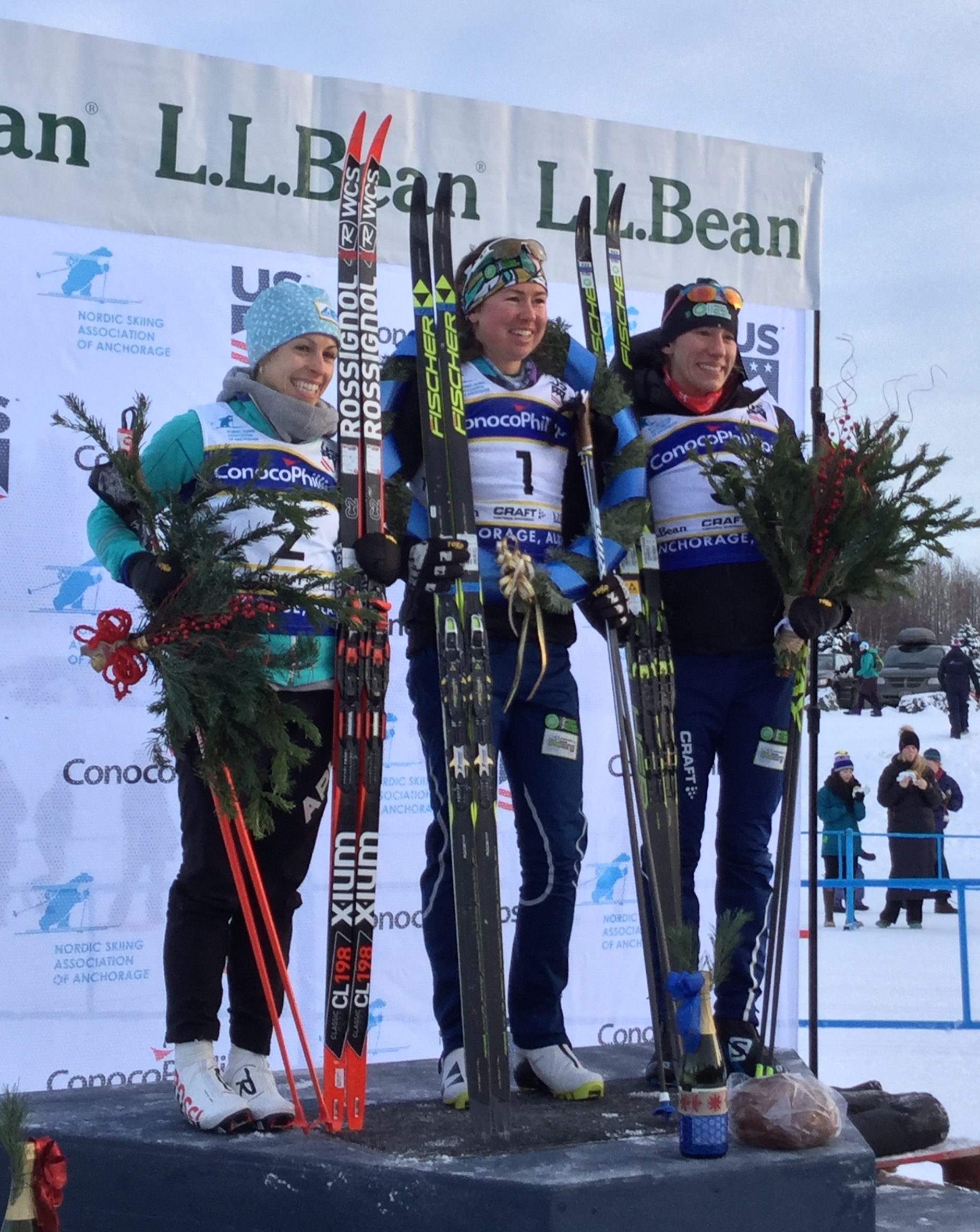
The top-three Americans in the women’s 20 k classic mass start on Sunday at 2018 U.S. nationals in Anchorage, Alaska, with Caitlin Patterson (1) of the Craftsbury Green Racing Project (CGRP) in first, Rosie Frankowski of APU (l) in second, and Kaitlynn Miller (r) of CRGP in third.
ANCHORAGE, Alaska — It turns out that Caitlin Patterson does have a weakness: Swedes. The 27-year-old Craftsbury Green Racing Project (CGRP) skier was denied her first outright victory of the week when she crossed the finish line second to Hedda Bångman, a former member of Sweden’s U23 National Team who now skis for the University of Colorado Boulder (CU), in the women’s 20-kilometer classic mass start at the 2018 U.S. Cross Country Championships on Sunday morning at Kincaid Park. But as the first American, Patterson captured her third national title in as many races.
Rosie Frankowski, of Alaska Pacific University (APU), was the third athlete across the line and second American. She was followed by Jessica Yeaton, who competes domestically for APU, but is an American-Australian dual citizen and competes internationally for Australia. Kaitlynn Miller, also of CGRP, was the fifth athlete across the line to round out the domestic national championship podium.
Bångman crossed the finish line of the four-lap, technically 22-kilometer course in 1 hour, 55.3 seconds, 15.9 seconds clear of Patterson in second. It was the first time all day that Bångman had enjoyed such an edge.
CU’s Hedda Bångman on her way to win the women’s 20 k classic mass start at 2018 U.S. Cross Country Championships on Sunday in Anchorage, Alaska.
The field of 42 skiers left the Kincaid Stadium at 10 a.m. on another perfect race day, the temperature around 16 degrees Fahrenheit and an approaching sunrise about to reveal mountains shimmering in all directions.
Wednesday’s fresh snow had allowed race organizers to come up with a compromise between the snowmaking loop and the full International Ski Federation (FIS) distance courses, a 5.44-k loop that began with an A-climb up Elliott’s Climb, descended most of the way back to the stadium, covered all the hills on the snowmaking loop, then traversed the 1.5 k Lekisch Loop before finishing in the stadium. The hills on the course were relatively front-loaded, with the single largest climb coming in the start of the loop and smaller (but still steep) hills over the final four-plus kilometers. The final kilometer was predominantly downhill from the high point of the 1.5 k Lekisch into the finish.
Snow coverage off of the manmade loops appeared to be good to very good, albeit with a relatively abrasive and icy base in the bottom of the tracks.
The first time up Elliott’s, Frankowski led a large group of 30-plus women (effectively the entire field) up to the top of the A-climb roughly 1.3 k into the race. She was closely followed by APU’s Chelsea Holmes to her left, and Bångman and Miller to her right.
The second time up Elliott’s, little had changed. Frankowski led a group of 10 women, with Bångman, Yeaton, and Holmes immediately behind her, and Patterson a few strides farther back.
The third time up Elliott’s, it was yet again Frankowski in the lead, followed yet again by Bångman, Yeaton and Holmes, with Patterson yet again appearing to lag back slightly on the uphill.
“Rosie Frankowski definitely deserves a shout-out for leading the train a whole lot out there and really pushing the pace,” Patterson told FasterSkier in a finish-line interview.
Four kilometers later, the athletes lapped through the stadium a final time as they headed out on their fourth loop. At this point, Frankowski, Bångman and Patterson, in that order, were still within one second of each other, with Yeaton around seven seconds back in fourth and Miller in fifth 12 seconds behind Yeaton.
APU’s Rosie Frankowski (6) and CU’s Hedda Bångman (11) leading the charge up Elliott’s Hill in the women’s 20k classic mass start at the 2018 U.S. Cross Country Championships in Anchorage, Alaska.
If the lead pack was going to avoid a three-woman sprint to the finish, something was going to have to give. And the final time up Elliott’s, it did.
“The fourth lap is where it really splintered apart,” Patterson said. “At the top of Elliott’s, that last really kicker hill, the herringbone hill.”
At that point, Patterson, who grew up in Anchorage, recounted that Bångman had “really good skis, like stay-in-the-track that whole way up good. All the rest of us were running outside [the tracks] flailing around a bit, so she gapped us there. And she skis the downhills very well, so she closed a gap there across the World Cup [start area] flat out there, and we never closed that down. Frankie and I were chasing her on Rollercoaster, but I think she held her gap about the same from there all the way to the finish.”
As Bångman, 22, told FasterSkier after the race, “I didn’t have a plan before [the race], but I knew I was the strongest. So when we went out on the last lap, then I realized, ‘I can really make this race.’ So in the first hill on the last lap, I started to push harder, and then I left the others behind me. And then it was just to push as hard as I can to the finish line.”
By the time the three-woman lead pack came around the edge of the stadium again, midway through their final lap, Bångman had a significant lead, roughly 12 seconds. She stretched it to 15.9 seconds by the finish, finally allowing herself to slow slightly, look around, and celebrate in the final meters before crossing the finish line.
Behind her, a battle for top American was shaping up between Frankowski, who had never stood on a national championships podium, and Patterson, who had been there twice already this week.
Coming through the edge of the stadium, Patterson held a lead of two to three seconds over Frankowski as the two of them approached the wall-like climb up the Gong Hill for the final time. Patterson began heading up on the left side of the trail, Frankowski a few meters behind her on the right, herringboning with stunning alacrity for being 20 kilometers into a 22-kilometer race.
Then Frankowski caught a pole tip on her ski and fell into the sugar snow on the uphill. It took her several seconds to get up. While she extricated herself, Patterson skied away and up and over the top of the Gong Hill.
“The real cool thing that came out of that fall,” Frankowski told FasterSkier after, “was that I actually had my pole stuck under my ski, and I had to literally think, ‘Relax, and figure this out and stand up.’ While in the past I would have been so frantic I probably would have dropped more places than I did.”
“So I basically was just trying to get up,” recalled Frankowski, a 26-year-old Minneapolis native. “And when I got up someone yelled, ‘Don’t give up.’ And immediately I felt like, well, I am going to try to catch Caitlin, and if I could I would, but I didn’t. She is so strong right now; I tried and got close, but I didn’t do it.”
Frankowski’s travails were news to Patterson when told about this after the race.
“I had no idea,” Patterson said of her fall. “But that makes sense because it confused me because I was certain that as I ran up on the wall on the left side I was certain that there was someone just by me on the right side. But then I could hear on the downhill that there was no one close and then people were cheering for her 10 meters back, so I didn’t see that during the race.”
Frankowski’s fall came midway through the last lap, roughly 2.1 kilometers before the end of the race. After giving chase over the Lekisch Loop, she made up roughly the time she had lost in the fall before running out of real estate, crossing the finish line 3.7 seconds after Patterson for third overall and second American.
Rosie Frankowski (APU) leads CU’s Hedda Bångman (11) up Elliott’s Hill in the women’s 20 k classic mass start at the 2018 U.S. Cross Country Championships in Anchorage, Alaska.
Yeaton, 26, who was born in Perth, Australia, and moved to Alaska at age 12, skied into the finish alone 24 seconds later for fourth overall. Miller followed another 29 seconds later for fifth overall and third American. Alayna Sonnesyn, a University of Vermont junior, was the second college skier and second U23 skier in the top six.
“I felt so strong today,” said overall first-place finisher Bångman. “It was a so-good race, I’m so happy. My skis were perfect, and my body felt so good.”
Patterson is now three-for-three for national titles this week, but this one didn’t come easy.
“I am pretty excited about this third one, but it was the toughest of them all,” she said.
“It was a real struggle to hang with the people who were pushing the pace today,” she added, crediting Frankowski for her work at the front.
“I know especially how I am racing right now that I just need to hang on and the end can be good, and it was fairly good today,” Patterson added. “So I am really happy with the national title.”
Patterson said that she had opted to prioritize glide over kick on Sunday in light of the course profile, “because I feel like a lot of those walls are steep enough where I would be running anyway.”
“I probably erred a little too much on the glide side,” she continued. “Which is my fault with some testing … so I was herringboning like every single one of those technique zones, every kind of big hill, just had to keep moving. And luckily because the skis were so fast and I know these downhills so well, I was able to catch up on a lot of the downhills when I did get gapped on several uphills, almost every lap.”
Each lap featured three of the technique zones that Patterson had mentioned, in which doublepoling was forbidden. For the Anchorage readers, or anyone else familiar with the Kincaid trails, one was at the top of Elliott’s Climb; one was at the southern end of Dark Alley, approaching the lower tunnel; and one was the entire climb up to the Gong Hill from the north/back side of the snowmaking loop just a few hundred meters later.
(There had been a fourth zone marked during Saturday’s course preview, Patterson recounted, in the first uphill on the Lekisch Loop, which features a stair-step climb with a slight saddle or depression between the two steps. “There was a technique zone that they tried to put there,” she said, “and it literally had a downhill in it, but luckily the coaches protested that and they took it out.”)
After 22 k of skiing and 12 careful trips through each technique zone, Frankowski finished 3.7 seconds behind Patterson. It was the first national championships podium of her career.
Her sole strategy coming into the start of the race had been to “push every uphill,” Frankowski explained. “I have raced at Kincaid enough to know that you recover at every single downhill, and so for someone who doesn’t have a sprint at the end, I needed the pace to be hot at the beginning. So right when we started, immediately out of the start I realized that our skis were incredibly fast, and honestly comparable to or better than anyone else’s in the field, and so I felt, well I am going to doublepole as much as I can and then every downhill, especially the ones I struggle on, just tuck behind and try to be relax and know that I can catch back up.”
Craftsbury skier Caitlin Patterson (l) with APU’s Chelsea Holmes during the the women’s 20 k classic mass start at the 2018 U.S. Cross Country Championships in Anchorage, Alaska.
Frankowski made clear that, like Patterson, she had gone thin to win when it came to choosing how much kick wax she wanted. “The course here,” she said, “except for maybe Elliott’s, all these hills are running hills so you really had to Klæbo it up or herringbone and just know that you are not going to have perfect striding today, and if you do, your skis are going to be too slow through the stadium to be in the mix.”
Frankowski, whose public social media profile frequently features paeans to the consumption of Thai food, also clarified, “I would say the key to success is that last night I had Tom Yum soup and Pad Thai for dinner, and lots of cookies, so I think that helped also.”
Fellow APU skier Yeaton was the fourth skier across the finish line, 24.5 seconds behind Frankowski and 44.1 seconds back from Bångman.
Yeaton pulled no punches when asked if she had been expecting this result.
“No,” she said. “Not even close. Nowhere in the ballpark. … I was hoping, like on a great day, maybe I’d get top 10. I never thought I’d get fourth.”
Yeaton’s fourth wrapped up a strong week of domestic racing for the Australian-American dual national, who is known more as a sprinter rather than a distance skier. Indeed, her next races will be Dresden, Germany, to compete for Australia at next weekend’s sprint-centric World Cup stop. Yeaton is presumptively qualified for the Australian Olympic Team in the latest FIS Olympic Points List simulation.
29.4 seconds behind Yeaton came Craftsbury’s Miller in fifth overall, but the third American across the line after Patterson and Frankowski. She had been “in contact with the lead group until about the third lap when a gap formed on Elliott’s [Climb] that I was unable to bridge,” Miller wrote in an email to FasterSkier after the race.
“I’m very pleased with my race and it was very exciting to see my teammate, Caitlin Patterson, place second,” she added. “I was very impressed with the 5k course that the organizers put together for the event. It was a fun course to race on.”
Sunday marked Miller’s fifth time on a national championships podium, and second in this week, following a second on the American podium in Friday’s freestyle sprint.
Sonnesyn filled out the rest of the top six. The 21-year-old Vermont college skier identifies as a distance skier and had been hoping for a better result in Wednesday’s 10 k skate, she told FasterSkier at the finish.
“I was excited for that, but unfortunately I didn’t have the race I was hoping for,” Sonnesyn said. “But I came back with a really strong sprint, which kind of surprised me. And I was feeling so great that I came into this race today pretty confident. So I was excited for it this morning, and I’m really happy with the way it went.”
Hannah Halvorsen Wins Junior Race
While junior women (U20 skiers and under) raced alongside the senior/master field in Wednesday’s 10 k freestyle individual start, Sunday saw the juniors get their own starting time and course for the 5-kilometer classic mass start race. One lap, 92 starters, 5.5 kilometers, go!
Before long, a pileup ensued. But “I only heard about it from quite a few girls,” junior winner Hannah Halvorsen, of APU and the U.S. Ski Team, told FasterSkier after. “I was right in front of it; I got lucky.”
Halvorsen, 19, covered the one-lap course in 15:07.8. Second place went to Hailey Swirbul, a University of Alaska Anchorage sophomore, 10.4 seconds back.
Third place on the all-Alaska podium went to an athlete with four years’ less experience and one fewer Junior World Championships medal to her name, U16 athlete Kendall Kramer. Kramer, who finished 4.4 seconds behind Swirbul, skis for the Nordic Ski Club of Fairbanks/Fairbanks XC (NSCF-FXC), as well as West Valley High School. She had competed in only one other FIS race in her life before this week.
Halvorsen was second on the junior girls podium in Wednesday’s distance skate race, and third overall among American women in Friday’s sprint race. Swirbul was the top junior woman on Wednesday and reached the quarterfinals of the senior women’s sprint on Friday.
Halvorsen had high praise for Sunday’s race course: “Super-fun course, up and down, kind of rolling,” she said. “Good places to find speed and carry momentum, time to rest and do different transitions. Just, like, a fun course.”
It probably doesn’t hurt that she won. “It felt good,” said Halvorsen, who grew up in Truckee, California. “I was tired this morning, but it doesn’t really matter how you feel, you just get out there and go for it. I had really good skis, really good support; my dad’s here, my brother’s here. It’s a beautiful day to be racing; really fun racing out there.”
— Gabby Naranja and Ian Tovell contributed reporting
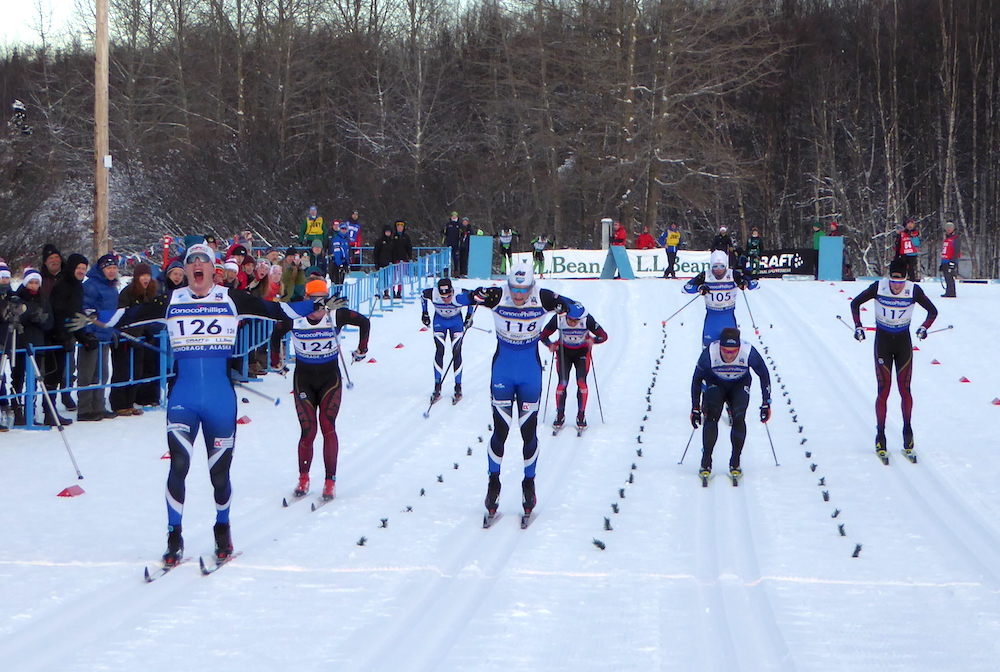
APU’s Tyler Kornfield (126) leads APU’s Eric Packer (118) and DU’s Eivind Romberg Kvaale (124) to the line in the men’s 30 k classic mass start at 2018 U.S. Cross Country Championships on Sunday in Anchorage, Alaska. Kornfield, Packer, and Kvaale finished first, second and third, respectively. Kris Freeman (10, second from left) was fourth overall and the third American.
U.S. Cross Country Championships (Anchorage, Alaska): 20/30 k classic mass starts
Sweden’s Hedda Bångman denied Caitlin Patterson of her first outright victory of the week at 2018 U.S. Cross Country Championships, but Patterson as the first American racked up her third-straight national title in the women’s 20-kilometer classic mass start at Kincaid Park on Sunday in Anchorage, Alaska.
The top-three Americans in the women’s 20 k classic mass start on Sunday at 2018 U.S. nationals in Anchorage, Alaska, with Caitlin Patterson (1) of the Craftsbury Green Racing Project (CGRP) in first, Rosie Frankowski of APU (l) in second, and Kaitlynn Miller (r) of CRGP in third.
Bångman, a 22-year-old freshman at the University of Colorado Boulder (CU), pulled off a 15.9-second win in the mass start, crossing the line in 1:00:55.3 hours. Patterson, of the Craftsbury Green Racing Project (CGRP), finished second, but was the top American in the event for the third time this week, and Rosie Frankowski, of Alaska Pacific University (APU), notched third (second American), 19.6 seconds back.
Rounding out the top 10 was Jessica Yeaton, who trains with APU and races for Australia, in fourth (+44.1), Kaitlynn Miller (CGRP) as the third American in fifth overall (+1:13.5), Alayna Sonnesyn of the University of Vermont (UVM) in sixth (+1:25.3), Chelsea Holmes (APU) in seventh (+1:55.4), Norwegian CU skiers Christina Rolandson and Anne Siri Lervik in eighth (+1:55.7) and ninth (+1:56.1), respectively, and Erika Flowers of the Stratton Mountain School (SMS) Elite Team in 10th (+2:14.6).
The men’s 30 k classic mass start was incredibly close, with APU’s Tyler Kornfield taking his first-ever distance national title (he was the 2012 classic sprint national champion) in 1:21:43.6. He edged his teammate Eric Packer by 0.7 seconds at the line, and Eivind Romberg Kvaale, a sophomore at the University of Denver (DU), finished 1 seconds back in third.
Kris Freeman (Caldwell Sport) was just off the overall podium in fourth (+1.6), but was the third American. Another DU skier, Dag Frode Trollebø, also from Norway, finished fifth (+2.0), and APU had three in the top six with David Norris in sixth (+2.5). Noah Hoffman (Ski & Snowboard Club Vail) finished seventh (+2.6), Scott Patterson (APU) eighth (+3.6), and Craftsbury’s Adam Martin and Ben Lustgarten followed in ninth (+14.7) and 10th (+14.9), respectively. With Brian Gregg (CXC/LNR/Team Gregg) in 11th (+16.1), the men’s top 11 were separated by less than 17 seconds.
IBU World Cup (Oberhof, Germany): Men’s and women’s relays
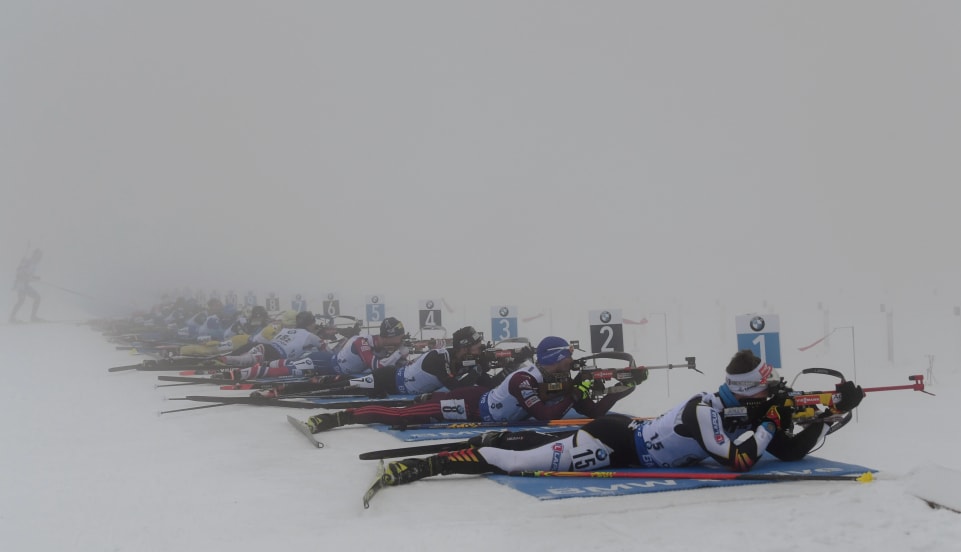
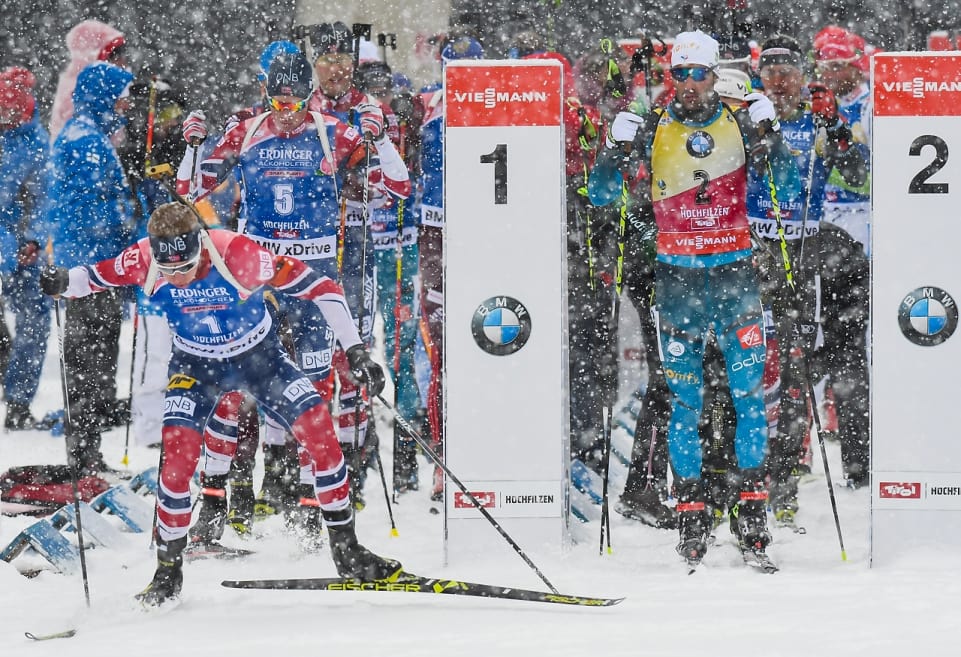
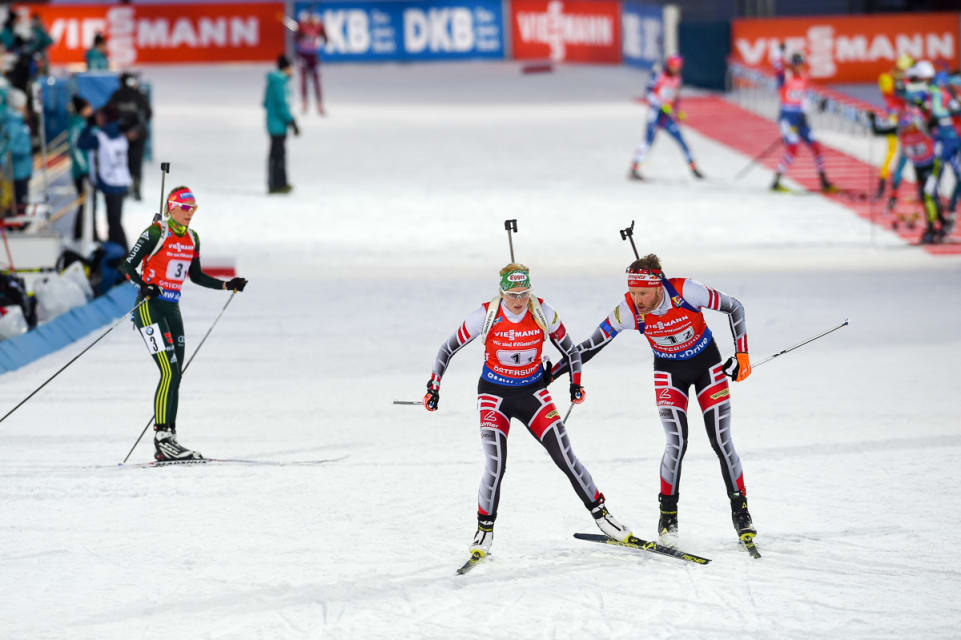
Racers on the range during the men’s 4 x 7.5 k relay on a foggy Sunday at the IBU World Cup in Oberhof, Germany. (Photo: IBU/Biathlonworld)
The Swedish men’s team and French women won the second relays of the International Biathlon Union (IBU) World Cup season on Sunday, with Sweden winning the men’s 4 x 7.5 k relay by 1:10.8 over Italy, and France besting Germany by 32.4 seconds.
Notably, most of the top teams didn’t start all of their “A” teamers.
In the men’s race, Sweden’s Martin Ponsiluoma, Jesper Nelin, Sebastian Samuelsson, and Fredrik Lindström combined for their first win together — and the first win for most of the members on the team.
“It is a dream when you are a kid to compete in a World Cup,” Samuelsson said, according to an IBU press release. “To have a win is really amazing!”
The Swedish women’s team also landed on the podium in third (+48.2).
“What a race by the whole team,” said Lindström, who also has one non-relay World Cup win (from 2012) to his name. “It could not be better.”
Conditions could not have been much more difficult for shooting on Sunday, with the fog that had descended early in the day for the women’s race worsening for the men’s race. When there wasn’t fog, there was wind.
Misses were common throughout the two races, and even with racers being able to use three spares per shooting stage to clean, there were a high number of penalty laps.
But the Swedish men kept their penalties to a minimum, with just one for the entire team and a total of nine spare rounds used among them. After Ponsiluoma came through the first exchange in sixth, Nelin skied them into third, Samuelsson picked off another place despite skiing a penalty after his standing stage to put them in second, and Lindström anchored them to first.
“The conditions today were so special. Somehow I felt not so nervous, I was calm and had luck on my side,” Lindström said at a post-race press conference about his nearly flawless shooting (0+0; 0+1).
“I have never [been first] before,” he added. “Not like this in a relay at least. That’s really fantastic.”
“I had to look up to see if I was aiming the right way,” Nelin said after cleaning prone (0+0) then using two spares to clean standing (0+2). “I had no idea where I was aiming, so it was really difficult. But I hit, and it was good. Maybe these conditions fit me and I should never see anything.”
Italy placed second with Thomas Bormolini, Lukas Hofer, Dominik Windisch, and Thierry Chenal combining for two penalties and 11 spares. Hofer had skied them up from eighth to second, and Windisch then took the lead on the third leg to put them in first at the final exchange, 1 minute ahead of Sweden. But Chenal slipped with the seventh-fastest last leg time and a penalty after standing.
“Being on the podium with the team is always a special feeling,” Hofer said at the press conference. “For Thierry, it’s the first year in the World Cup, and he does a really good job, not just today. I am really happy that he could close out this relay. Second place is like a win for us.”
Norway placed third (+2:04.6) with Vetle Sjåstad Christiansen, Henrik L’Abée-Lund, Lars Helge Birkeland, and Tarjei Bø. Together, they had three penalties (two from L’Abée-Lund and one from Birkeland) and 14 spares.
“I grew up on Holmenkollen so I practiced a lot there [in fog],” L’Abée-Lund said. “But today was really really hard, I didn’t see anything in prone. Standing was OK, but prone was really difficult.”
“It’s great to be on the podium,” Christiansen said. “Of course Norway always wants to win, but today we are very happy for our brothers in our neighbor-country Sweden.”
The Canadian men placed 10th (+6:23.1) out of 25 teams with Christian Gow, Scott Gow, Brendan Green, and Carsen Campbell having a combined six penalties and 20 spares. Three of those penalties came on Scott Gow’s second leg, two from Campbell’s anchor leg, and one on Christian Gow’s first leg.
After a penalty on his first prone stage (1+3), Christian cleaned standing with a spare (0+1) and tagged Scott in 11th, 53 seconds out of first. Scott then had two penalties in prone and three in standing, but managed to improve to eighth given how much everyone else was struggling with the shooting as well. Green kept them in eighth with two clean stages (0+2, 0+3), and Campbell, in his first World Cup relay, cleaned prone (0+2) but had two standing penalties (2+3) to put the team in 10th at the finish.
In an interview with German broadcaster ARD halfway through the race, Canadian coach Matthias Ahrens called the range conditions, which ranged from thick fog to unpredictable wind, “very hard to assess.”
“… To be honest, the good thing was that conditions were very bad,” he later added. “So regarding visibility, almost everyone was on the range at the same time [with the same irregular conditions]. They had to wait very long, and of course had bad conditions to shoot, but much of the field was there at the same time.”
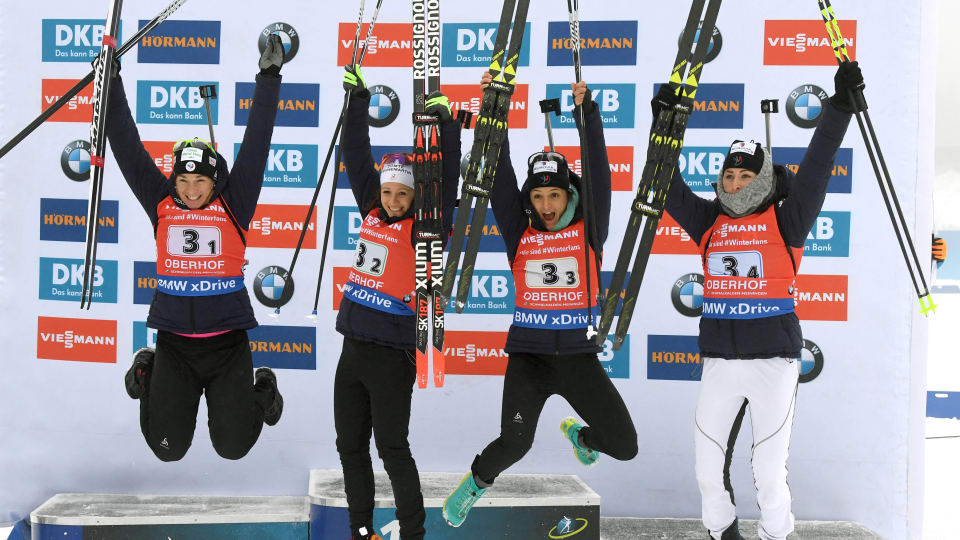
The French women’s team, of Anais Bescond, Anais Chevalier, Celia Aymonier, and Justine Braisaz, celebrate their relay victory on Sunday at the IBU World Cup in Oberhof, Germany. (Photo: IBU/Biathlonworld)
In the women’s race, with better shooting visibility, France’s Anais Bescond, Anais Chevalier, Celia Aymonier, and Justine Braisaz took the win in 1:12.42.4, with one penalty and 10 spares. After Bescond put them in first through the first exchange, 6 seconds ahead of Italy in second, Chevalier had to ski a penalty loop after prone but cleaned standings (1+3, 0+0) and tagged off in second, 23 seconds behind Italy, now in first.
One loop later, France was back in first thanks to Aymonier, who cleaned with just two spares (0+0, 0+2), and they extended their lead from 0.8 seconds at the last exchange to 32 seconds at the finish with Braisaz, who shot 0+1, 0+3, and skied the fastest anchor leg.
“I know that it’s always good for Justine to start in the first position, so I really wanted to pass the relay to her in that,” Aymonier said in a press conference after.
“I was nervous, too,” Braisaz said. “That kind of shooting turned my mind upside down, actually. The crowd was very loud, and … I wasn’t very focused on what I did. It was a bit foggy, too, so that made it harder. But finally it was a French day, maybe.”
“In my mind the whole team is really strong, and really able to get the first place,” Bescond said. “After years and years and years behind Germany’s team we finally did it. So just Oberhof spirit I think.”
Germany placed second with Vanessa Hinz, Denise Herrmann, Franziska Preuss, and Maren Hammerschmidt. They combined for two penalties and 13 spares; with a penalty on Hinz’s first leg and one more on Hammerschmidt’s last shooting. After being tagged in 14th, Herrmann skied them into fourth, 40 seconds out of first, and Preuss elevated them to second, which Hammerschmidt held onto.
“I was struggling a little bit in the prone shooting,” Herrmann said. “But the skiing was good today, and also the standing [shooting]. I tried to go fast on the track and catch some girls.”
Sweden, with Linn Persson, Anna Magnusson, Elisabeth Högberg, and Mona Brorsson, avoided the penalty loop and used eight spares to reach the podium for the first time in six seasons. In sixth place at the first exchange, they slipped one place to seventh on the second leg, but Högberg raced them up to fourth with near-perfect shooting (0+0, 0+1) with one leg to go. Brorsson then anchored them to third with clean shooting (0+2, 0+1) and the third-fastest last leg.
“It’s just super nice for us! I am super happy,” Magnusson said. “We were very emotional at the finish.”
When Brorsson was asked if she believe she could fight for the podium, she responded, “Not really. But I said to Linn, ‘Maybe it is our day today. Please let it be our day today.’ ”
The Canadian women finished 14th (+6:37.5), out of 20 teams, with two penalties and 13 spares. Sarah Beaudry initially put them in 15th after shooting 0+1, 0+2, then Julia Ransom had a standing penalty (0+2, 1+3) to slip one place to 16th. Megan Tandy picked off three places with clean shooting (0+0, 0+2) and tagged Emma Lunder in 13th, and Lunder had a penalty in prone but cleaned standing (1+3, 0+0) to finish in 14th.
The men’s overall 2018 Tour de Ski podium atop Alpe Cermis after the final Stage 7 hill climb: with Switzerland’s Dario Cologna (c) in first, Norway’s Martin Johnsrud Sundby (l) in second and Canada’s Alex Harvey (r) in third. (Photo: FIS Cross Country/Twitter)
Dario Cologna of Switzerland added a fourth Tour de Ski (TdS) title to his list of accolades on Sunday, winning the 2018 edition of the race in dominant fashion, with a 1:26.5-minute win over Norway’s Martin Johnsrud Sundby. And Canada’s Alex Harvey scored his first TdS overall podium in third.
The 31-year-old Cologna started the 9-kilometer freestyle pursuit up Alpe Cermis 1:15 ahead of Kazakhstan’s Alexey Poltoranin in second. Russia’s Sergey Ustiugov, slated to start third, did not start due to a back injury. Thus Harvey was the third man off the start line, 1:23 behind Cologna.
(Sweden’s Marcus Hellner, 13th after Saturday’s Stage 6, also did not start the Tour’s final stage.)
Early on, Cologna started putting time into his competitors, extending his lead on Poltoranin to 1:20.5 and Harvey to 1:24 at 1.8 k.
By 4 k, however, Harvey had used his speedy skiing on the flatter portions of the race leading up to the climb to catch Poltoranin, and the two clocked through that checkpoint 1:19.4 behind Cologna. Behind them, Russia’s Alexander Bolshunov skied just ahead of Sundby, another 21 seconds and 22 seconds back, respectively, in fifth and sixth.
While Harvey clawed back a few more seconds on Cologna, he was still 1:17.8 back at 6.2 k, with Poltoranin just 0.7 seconds behind him in third.
Harvey remained in second until around 8.5 k; with just a half kilometer to go, Sundby had caught both Poltoranin and Harvey, passing them both. Sundby held that position and finished second, 1:26.5 behind Cologna, who won in 28:52.1.
Harvey stayed strong for third (+1:30.6) while Poltoranin dropped off the Canadian’s pace in the final half kilometer and finished fourth (+1:41.7). Norway’s Hans Christer Holund placed fifth (+2:17.8), Bolshunov lost a spot to finish sixth (+3:09.7), France’s Jean-Marc Gaillard finished seventh (+3:16.7), Sweden’s Daniel Rickardsson eighth (+3:20.8), and Russia’s Alexey Chervotkin and Andrey Larkov took ninth (+3:33.5) and 10th (+3:37.8), respectively.
France’s Maurice Manificat, known for his strength in freestyle hill climbs and pursuit races, rose from 14th to 11th (+3:45.7) with the second fastest time of day, 12.8 seconds slower than Sundby as the time of day winner in 28:36.4. Cologna’s time was fourth fastest (+15.7), behind Russian U23 skier Denis Spitsov in third (+14.3) (Spitsov started 20th and finished 13th). Holund’s time ranked fifth (+20.6) and Harvey’s time was sixth fastest (+23.6) of the 43 men that finished the race.
The lone American man to complete this year’s Tour, Paddy Caldwell (U.S. Ski Team) skied the 22nd fastest time of day for 38th overall (+11:54.8).
Heidi Weng (center) celebrates her second Tour de Ski victory, with teammate Ingvild Flugstad Østberg second and the U.S. Ski Team’s Jessie Diggins third. (Photo: FIS Cross Country/Twitter)
In the women’s hill climb that kicked off the day, Heidi Weng raced to her second consecutive TdS title. The Norwegian started the day within two seconds of teammate Ingvild Flugstad Østberg, and the two skied together for the flat section of the nine-kilometer stage of the competition. But when the climbing got steep on Alpe Cermis, Weng left her teammate behind and eventually racked up a 48.5-second win.
The battle for third was less predictable. Jessie Diggins of the United States started the day in fourth, but made up the ten seconds to third-place KristaPärmäkoski of Finland in the first few kilometers. The pair climbed together for a while before Diggins attacked. Pärmäkoski tired on the final sections of the Alpe Cermis and Diggins took the podium in definitive style, 2:23.2 behind Weng and 24 seconds ahead of Pärmäkoski. It’s the first overall Tour de Ski podium for Diggins or any American athlete.
Teresa Stadlober of Austria finished fifth (+3:09.4), Kerttu Niskanen of Finland sixth (+4:17.0), Russia’s Anastasia Sedova seventh (+4:49.6), and Switzerland’s Nathalie von Siebenthal eighth (+4:56.1).
Sadie Bjornsen started eighth and slipped one spot to finish ninth (+6:15.0), giving the U.S. two top-ten finishers in the Tour de Ski for the first time. Liz Stephen finished 16th (+8:25.8) and Rosie Brennan 24th (+10:59.6).
En route to her win, Weng notched the fastest time of the day on the 9 k stage. Stadlober’s time was second, Diggins third, Østberg fourth, and Stephen fifth.
32 women finished this year’s edition of the Tour de Ski.
The women’s 10 k freestyle podium on Wednesday at Day 1 of 2018 U.S. Cross Country Championships in Anchorage, Alaska, with (from left to right) Caitlin Gregg (Team Gregg) in second, Caitlin Patterson (Craftsbury Green Racing Project) in first, and Chelsea Holmes (Alaska Pacific University) in third.
ANCHORAGE, Alaska — It was what most locals, or those familiar to the area, referred to as standard Anchorage weather: heavy, wet snow, temperatures reading around 31 degrees Fahrenheit, and a darkened sky that seemed to be brooding over whether or not to let the sun out of bed — the sky covered in a shroud of gray.
With the Pacific Ocean just 600 meters to the southwest and Kincaid Park’s nordic venue, the host of this year’s 2018 U.S. Cross Country Ski Championships, nestled in the state’s gulf socket, low-visibility and unpredictable weather was, ironically, a foreseeable factor to Wednesday morning’s women’s race.
After all, during the first week of January, sunrise in Anchorage is scheduled around 10:15 a.m. and the opening race of this year’s championship event, a women’s 10-kilometer freestyle individual start, was not slated to get underway until 15 minutes before then. The internal dialogue for a few early starters was whether a personal light might be a good addition to the commercial ones dotting the four-lap, 2.5 k manmade loop.
“For a moment while I was warming up, I was wondering if I’d have to wear a headlamp,” Rosie Frankowski, who skis for Alaska Pacific University (APU) and started in bib number 20, said after the race. “But that’s Anchorage.”
By the time the first women’s starter, Becca Rorabaugh, also of APU, departed the start gate, the continual glow from a few stadium lights outshone the dim carpet-colored sky. Close to half an inch of slushy snow covered the trail and more was well on its way.
Skiers would not be deterred, however, as potential spots for the U.S. 2018 Olympic team were on the line.
“I haven’t skied up here in a few years, but Alaska is sort of always unpredictable — this weird combo of manmade and freshly falling snow with bad visibility,” said Caitlin Patterson, who grew up in Anchorage, went to college at the University of Vermont, and currently trains and races with the Craftsbury Green Racing Project (CGRP) in Vermont.
“Until yesterday, I’d never skied that wall hill before; we’d always used that as a downhill, but otherwise I’m pretty familiar with [the trail],” the 27 year old continued. “The loop in the stadium and all these things were ones we used for Alaska State over the years, so even when I couldn’t see through my glasses, to know the corners and so forth was good.”
Caitlin Patterson (Craftsbury Green Racing Project) racing to first in the women’s 10-kilometer freestyle on Wednesday at the 2018 U.S. Cross Country Championships in Anchorage, Alaska.
Familiarity with the course wasn’t the only edge Patterson had heading into the race. She also entered Wednesday’s 10 k as the overall SuperTour leader, an honor garnered thanks to her win in the 10 k freestyle at Sovereign Lake, British Columbia, and her second- and third-place finishes in the 10 k classic mass start and freestyle sprint qualifier, respectively, in West Yellowstone, Mont.
The victory was her third national title. In 2016, she won both the 10 k classic and 20 k freestyle mass start.
Combined with her World Cup performances in previous seasons, Patterson was a prime candidate for Wednesday’s win, which she claimed in a time of 27:09.1, though there were moments on course when she questioned the outcome of her race.
“I wasn’t sure if it was going to turn into a win even midway through the race,” Patterson said.
Patterson was the fourth starter to push past the wand and by the time she looped through the stadium for her second lap, APU’s Chelsea Holmes (bib 16) and Team Gregg’s Caitlin Gregg (bib 17), were starting their first laps. Though she was ahead of Gregg, Patterson received what she called “backwards splits”: Gregg’s pace on laps that Patterson had already completed.
“I could see Caitlin [Gregg], see how the gap was progressing, and I also got some splits … how her first and second lap were comparing to my first and second, and I think I was running a few seconds down at that point,” Patterson recalled.
Caitlin Gregg (CXC/Loppet Nordic Racing/Team Gregg) racing to second in the women’s 10 k freestyle on Wednesday at 2018 U.S. Cross Country Championships in Anchorage, Alaska.
Gregg was also getting splits off Patterson, most of which informed her that the two were on par. It was in the final kilometer and half that Gregg learned she was losing time.
“I was getting splits and I was pretty even for it seemed like three and half laps,” Gregg said after. “Then that last little bit she put a bit of a gap on me.”
Patterson’s final half lap was fast enough to put close to 20 seconds on Gregg, and Gregg finished 19.7 seconds back in second. Having felt like she put in a solid race effort, Gregg was slightly surprised by the time gap, though quick to acknowledge Patterson’s strength on course.
“I thought it was going to be really close there, but obviously she skied super strong,” Gregg said.
Gregg, 37, who earned an individual bronze medal in the 10 k skate at 2015 World Championships and is aiming to qualify for her second Olympics (after making the Olympic team in 2010) holds high regard for the current women’s U.S. race circuit. Even after 19 years of U.S. nationals racing, the veteran skier is not immune to competition-day nerves.
“I still get nervous,” Gregg said. “The weight of these races are super high and I think we have a lot of really fast domestic women right now, I mean Chelsea Holmes has been top 30 on the World Cup and last year Caitlin Patterson was in the top 30, so I’m really hoping that we get a good domestic representation at the Olympics.
“We’re doing our part; working hard and skiing fast,” Gregg added. “Hopefully that gets recognized.”
Chelsea Holmes (Alaska Pacific University) racing to third in the women’s 10 k freestyle on Wednesday at the 2018 U.S. Cross Country Championships in Anchorage, Alaska.
Rounding out the women’s podium on Wednesday was APU’s Chelsea Holmes, 24.4 seconds back in third. Holmes raced World Cup Period 1 this season, with a season-best of 29th in the 10 k freestyle last month in Davos, Switzerland.
“My body didn’t have quite what I wanted today, but that’s OK,” Holmes, 30, who grew up just south of Anchorage in Girdwood, Alaska, wrote in an email. “I actually don’t mind the short course, the race felt like it blew by and it was fun to get to lap by friends and family.”
Also a hopeful for the 2018 U.S. Olympic team, Holmes indicated she would be leaving no race unanswered at this year’s U.S. nationals. She plans to compete in both sprints over the next week as well as the 20 k classic mass start, which she won last year.
“I’ve been working on my ‘Klaebo’. It’s pretty legit,” she wrote.
Pressure can encroach upon many athlete’s performances this week, especially with Olympic spots on the line. Processing that pressure, for Holmes, came in the form of the season’s preparation.
“As for the pressure, for sure it is there — even if it’s only from myself. How could it not be? Certainly I care immensely and I will do my best when the time comes to race, but between now and then I won’t be doing anything special,” she wrote. “I’ve prepared the best I know how and hopefully that is good enough. If not, I’ll still be me.”
Finishing in fourth (+41.7), 17.3 seconds off the podium, was Frankowski.
“I am definitely satisfied with my result today. Honestly, the new snow played into my hands as I like mushy, soft courses,” Frankowski wrote in an email. “On the other hand, a course with no A climbs and only two uphills that take 30 seconds to a minute, is not a course I’d tend to excel on. So I was quite surprised with being that close to a US Nationals podium, especially when the podium is made up of three ladies who I believe could score World Cup points on any given day (as Chelsea proved multiple times in Period 1).”
Frankowski, 26, who was born and raised in Minneapolis, Minnesota, indicated that her next target would be the 20 k classic (though she also maintains a ritualistic “season-long goal” of being in the top four of the SuperTour rankings to, as she puts it, “get free race entries.”)
“In all seriousness, I do hope they can find a way to add some longer and more grinding climbs to the 20k classic course with all the fresh snow Anchorage received today,” Frankowski wrote. “I believe it is important to have a race that is even slightly comparable to the Olympic or a World Cup venue, and although the organizers did a good job with what Mother Nature dealt earlier last December, I hope the priority is on utilizing the new snow to create a course that challenges racers who will be representing our country on an international level.”
Also in the top 10 were three University of Colorado Boulder (CU) skiers, with Petra Hyncicova of the Czech Republic in fifth (+56.7), Norwegian Christina Rolandsen in sixth (+1:02.4) and Swedish freshman Hedda Bångman in 10th (+1:37.8). Erika Flowers of the Stratton Mountain School (SMS) Elite Team placed seventh (+1:26.0), the University of Alaska Anchorage’s Hailey Swirbul placed eighth (+1:30.2), and Becca Rorabaugh (APU) finished ninth (+1:36.5).
U.S. nationals continues Friday with classic sprints at Kincaid.
Swirbul Top Junior in Eighth
https://www.instagram.com/p/BdgT2kzhNtr/
Hailey Swirbul, a U20 skier for the University of Alaska Anchorage, led a strong showing by several junior girls in eighth overall. Hannah Halvorsen (U20, APU) was 14th overall, with Novie McCabe (U18, Methow Valley Nordic) one spot back in 15th.
“I’m really pleased with how my body felt today,” Swirbul wrote to FasterSkier after the race, “and the result I was able to pull off with the help of fast skis (thanks to my coaches) and pacing from the skiers around me. I think the key today was to not stress about whatever the weather was doing and be light and quick through the slushy sections. It was important to pace the race well for me, because the conditions were slower than what we all were expecting after skiing on the race course the previous few days. My main goal was to qualify for World Juniors, and shoot for notable results compared to the western NCAA Division skiers. Overall, I can’t complain about how my first race of the week went!”
Swirbul almost wasn’t on the starting line in UAA green and gold. 14 months ago, she called it “ridiculous” and “outrageous” that the college ski team in Anchorage had been cut when U.S. nationals were on the horizon, and lamented that no UAA race suits were going to be at the starting line. But the decision was ultimately reversed, the ski team was reinstated, and six UAA skiers raced on Wednesday.
Caitlin Patterson of the Craftsbury Green Racing Project (CGRP) earned a national title on Wednesday with a win in the women’s 10 k freestyle at 2018 U.S. Cross Country Championships in Anchorage, Alaska. (Photo: Instagram/US Nationals 2018)
2018 U.S. Cross Country Championships (Anchorage, Alaska): 10/15 k freestyle
The Patterson siblings are crushing it on Day 1 of the U.S. Cross Country Championships at Kincaid Park in Anchorage, Alaska.
Scott Patterson (APU/USST) racing to a 55-second win in the men’s 15 k freestyle on Wednesday at U.S. Cross Country Championships in Anchorage, Alaska. (Photo: Jim Jager/US Nationals 2018 Instagram)
Scott Patterson raced to a 55.2-second victory over Noah Hoffman in the men’s 15-kilometer freestyle individual start on Wednesday. Patterson is an Anchorage-based U.S. Ski Team (USST) member who trains with Alaska Pacific University (APU). Hoffman is a former USST member who raced Period 1 of the World Cup with Patterson. Matt Liebsch, of Pioneer Midwest, placed third, 1:16.5 minutes off of Patterson’s winning time of 36:33.7.
Patterson’s older sister, Caitlin Patterson, of the Craftsbury Green Racing Project (CRGP) won the women’s 10 k freestyle earlier on Wednesday by 19.7 seconds over Caitlin Gregg, who’s affiliated with Central Cross Country (CXC), Loppet Nordic Racing (LNR) and Team Gregg. APU’s Chelsea Holmes, who raced World Cup Period 1, placed third, 24.4 seconds off Patterson’s winning time of 27:09.1.
Also in the top 10 in the women’s race were Rosie Frankowski (APU) in fourth, University of Colorado Boulder (CU) skiers Petra Hyncicova and Christina Rolandsen in fifth and sixth, respectively, Erika Flowers of the Stratton Mountain School (SMS) Elite Team in seventh, Hailey Swirbul (University of Alaska Anchorage) in eighth, Becca Rorabaugh (APU) in ninth, and Hedda Bångman (CU) in 10th.
In the men’s top 10 were Rogan Brown of the Sun Valley Ski Education Foundation (SVSEF) in fourth, Tad Elliott (Ski & Snowboard Club Vail) in fifth, Gus Schumacher (Alaska Winter Stars) in sixth, Brian Gregg (CXC/LNR/Team Greg) in seventh, Jack Hegman (SVSEF) in eighth, Benjamin Ogden (SMS) in ninth, and Adam Martin (CGRP) in 10th.
Norway’s Marit Bjørgen (5) winning the World Cup women’s 10 k classic pursuit for her second win of the season, ahead of fellow Norwegians Ingvild Flugstad Østberg (l) in second and Heidi Weng (r) in third. (Photo: Fischer/NordicFocus)
No, this was no ordinary dream.
If you woke Sunday to watch the women’s World Cup 10-kilomeer classic pursuit in Toblach, Italy, it was a bit of a nightmare if you were rooting for Sweden’s Charlotte Kalla wearing the yellow bib as the Overall World Cup leader.
Kalla began the day with a five-second micro-cushion as the first skier out of the gate after her win in Saturday’s 10 k freestyle individual start in Toblach. Her coaches might have urged her to keep the tactics simple and warn her to not look back — just go and go and wait for the eventual catch.
Five seconds behind at the start was Norway’s Ragnhild Haga, 13 seconds back Norway’s Heidi Weng, 18 seconds back Norway’s Astrid Uhrenholdt Jacobsen, 22 seconds back Norway’s Marit Bjørgen as the fifth starter, and sixth off the line and 25 seconds back, another Norwegian Ingvild Flugstad Østberg.
A pretty basic sport fable playing out on a 2 x 5 k loop: the chased fox in Kalla and the win-starved Norwegian queen, Bjørgen, along with an all-star Norwegian lineup as the pursuers.
Toblach’s pursuit was an anomaly on the World Cup. According to the International Ski Federation (FIS), of the last 31 pursuits on the World Cup, all were part of mini tours, typically three days long. March 2002 would have been the last time a non-tour pursuit was run with a 5 k pursuit in Falun, Sweden. And yes, as if 2002 doesn’t sound prehistoric when it comes to nordic sport, Bjørgen was hunting back then, too, and placed 26th in that race.
Kalla kept her distance for a time. At 3.5 k, Bjørgen led the Norwegian chase group which strided 8.3 seconds behind. As the skiers pulled through on the undulating flats into the stadium and readied for the course’s two major climbs on Lap 2, it was no longer Kalla leading out.
Marit Bjørgen leading her Norwegian teammates Heidi Weng (3), Ingvild Flugstad Østberg (6) and Ragnhild Haga (2), among others, during the World Cup women’s 10 k classic pursuit in Toblach, Italy. (Photo: Fischer/NordicFocus)
The race soon resembled a high-tempo Norwegian-only threshold session. With the occasional lead swap, Bjørgen, Weng, Jacobsen, Østberg and Haga — the Norwegian train came through the 5 k checkpoint in that order — were as formidable pack as any to state that Norway was still queen of this Toblach hill.
At 6.4 k, Kalla still matched the pace, but she could be seen sliding slightly back in the scrum of Norwegian suits. As Østberg led through at 7 k, Kalla began her modest fade: she was 6.2 seconds back.
Bjørgen then took the throttle’s control and made it a three-skier race. At the 8.5 k mark, Bjørgen, Østberg and Weng separated themselves in a 1-2-3 break.
Jacobsen was 9.5 seconds back, Haga 13.4, while Kalla must have been feeling the residue of her champion’s effort Saturday and skied 25 seconds behind.
Although Weng and Østberg have had their days as sprint winners, Bjørgen charged down the final stretch for another World Cup win, finishing in 25:29.3 minutes. Østberg was three-tenths of a second behind in second and Weng 0.8 seconds back in third. Jacobsen skied to fourth (+21.5), Haga fifth (+31.8) and Kalla sixth (+41.9).
“After my performance yesterday I was not quite sure where my shape was,” Bjørgen said, according to a FIS press release. “But my plan was to close the gap on Charlotte by the end of the first lap, which I did. It is great to win again and head to Christmas break with a victory. I will not compete until the Norwegian championships.”
In skipping the Tour de Ski, which starts at the end of this month, Bjørgen will have nearly four weeks off until Norwegian nationals Jan. 11-14, 2018.
As far as the Overall World Cup standings after the conclusion of race Period 1, Kalla still leads by 98 points over Østberg in second, while Weng remains in third, 104 points out of first. Bjørgen moved up to fourth, 117 points back.
The USST Chase
The U.S. Ski Team (USST) had two skiers in the top 10 on Saturday: Jessie Diggins placed seventh while Sadie Bjornsen was ninth. Diggins began the race 40 seconds after Kalla while Bjornsen left the start four seconds behind Diggins.
With the front lead group well-established and working together to reel Kalla in, the Diggins-Bjornsen pack, which included Russia’s Natalia Nepryaeva, Austria’s Teresa Stadlober and Finland’s Kerttu Niskanen, had also taken form by the 2 k mark. At that point, the five-strong group was 46 seconds behind Kalla in first.
U.S. Ski Team members Jessie Diggins (7) and Sadie Bjornsen (9) skiing with Austria’s Teresa Stadlober (11) during the World Cup women’s 10 k classic pursuit on Toblach, Italy. (Photo: Fischer/NordicFocus)
The group of five worked together to ward off any challengers skiing up from behind. At times during the race, with the camera lenses pulled back and the wonders of lens optics, it appears Diggins and Bjornsen were right there and potentially able to bridge up to Bjørgen and the Norwegian cohort.
By the race’s midpoint at 5 k, Nepryaeva pulled the group, 38 seconds behind the leaders. That time gap held as Diggins spearheaded the five skiers through the 7.1 k mark.
When the Bjørgen-Østberg-Weng surge went down around 8.5 k, the time back to Diggins and Bjornsen inflated to approximately 50 seconds. Kalla was falling back off the leaders as well, yet remained 23 seconds ahead of Diggins and Bjornsen.
“Initially I was trying to bridge up to Ingvild but she had an awesome and impressive race so when I realize we wouldn’t be able to bridge the gap, I was still skiing really hard but also preparing mentally for the final sprint-out. Which came as predicted – the final 2km felt like an all-out sprint!” Diggins emailed.
The group trying to lock in seventh through 11th place came into the finishing stretch as if it were simply the fiery endpoint of a Toblach drag race.
Channeling her double-pole sprinting chops, Diggins was the first of the group to the line placing seventh, 53.6 seconds behind Bjørgen in first.
Nepryaeva skied to eighth (+54.2), Bjornsen ninth (+55.2), and Stadlober took 10th (+55.6) in a photo finish with Niskanen, who placed 11th (+55.6).
“Pursuit races are pretty fun – I love being in the hunt!” Diggins wrote. “I had an awesome pack of girls to ski with and everyone took turns pulling at the front so we were moving along at a good pace. I just love that feeling when everyone is still racing each other, but also working hard and taking their turn so that the pack is ripping along the course! The race felt like it flew by.”
“Big shoutout to our techs for having given us great skis today,” she wrote. “That was really important on a course with so much glide but also some crucial climbs.”
Diggins will spend the holidays in Seefeld, Austria, as she rest and preps for the Tour de Ski which begins on Dec. 30 in Lenzerheide, Switzerland. Diggins plans to complete the Tour.
Bjornsen also conveyed that she’s pleased with the way the Toblach weekend unfolded.
“Exciting, and wild day 2 of this weekend! It was a fun day of skiing, with a little different feeling than normal,” Bjornsen wrote in a mass email to media outlets. “It was kind of hard to feel strong and in control on that course, but I gave it my all, and was again happy with the finish. I can feel my brain needs some rest right now. Period 1 is an intense block, with a lot of travel, and a lot of excitement for me. I felt today that my mind and body were digging deep down for the final fumes in the tank… so I’m excited for some holiday time!”
Rosie Brennan (USST) scored in World Cup points for the third-straight race after starting 19th and finishing 25th (+2:14.6).
Starting 1:15 minutes back at the start, Brennan ventured out amidst what could have been called a controlled mass start. Three seconds ahead of her, Finland’s Laura Mononen started 18th, and only 16 seconds behind Brennan was the 32nd starter, Finland’s Aino-Kaisa Saarinen.
“I was with that group for most of it,” Brennan said on the phone. “It started as a small group and people kept latching on — whether we were catching up to them or they were catching up to us. And it ended up as a pretty large group.”
Brennan did cede time to the leaders over the course of the 10 k, but Period 1 has proved positive for her.
Canada’s Dahria Beatty (67) and Katherine Stewart-Jones (73) racing to 63rd and 70th, respectively, in the World Cup women’s 10 k classic pursuit in Toblach, Italy. (Photo: Fischer/NordicFocus)
“Towards the end I just got real tired and could not quite keep on the group,” Brennan said. “I was kind of dangling behind them down into the finish.”
Brennan is currently ranked 24th in the Distance World Cup standings and 33rd in the overall standings.
Also for the U.S., Chelsea Holmes (Alaska Pacific University) finished 39th (+3:03.8) and Liz Stephen (USST) finished 48th (+4:05.2).
The photo finish for first in the men’s skate sprint final on Saturday at the NorAm in Rossland, B.C., with Julien Locke (near) outstretching Evan Palmer-Charette for first, and Julian Smith (r) taking third third ahead of Bob Thompson (yellow NorAm leader’s bib). (Photo: CCC/Twitter)
NorAm Mini Tour (Rossland, B.C.): Freestyle sprints
On Day 2 of NorAm racing in Rossland, British Columbia, Julien Locke, of the Black Jack Ski Club and Canadian National U25 Team, won the men’s 1.4-kilometer freestyle sprint final on his home trails by just one-hundredth of a second over Evan Palmer-Charrette, of the National Team Development Centre (NTDC) Thunder Bay, in 2:38.13. NTDC Thunder Bay had two on the podium with Julian Smith in third, 0.4 seconds behind Locke.
Locke started the day by qualifying second, just 0.06 seconds behind Bob Thompson (NTDC Thunder Bay), who won the qualifier in 2:39.49. Locke went on to finish second to Thompson in the first quarterfinal, then won the second semifinal while Thompson won the first semi.
In the final, Locke tallied his first NorAm win of the season, while Thompson, last weekend’s classic-sprint winner at Sovereign Lake, placed fourth (+0.43), missing the podium by three-hundredths of a second. Andy Shields (Lappe Nordic) finished fifth (+1.78) and Sebastien Boehmler-Dandurand (Canmore Nordic/Stefan Kuhn HP Team) sixth (+5.21) in the men’s final.
Also on Saturday, American Caitlin Gregg (Team Gregg/Loppet Nordic Racing) racked up her second-straight win in Rossland (after topping Friday’s 5 k classic), winning the women’s 1.4 k skate-sprint final in 3:03.36. Canada’s Andrea Dupont (Rocky Mountain Racers) finished 2.5 seconds later for second place and Zina Kocher (Foothills Nordic) scored her first podium of the season in third (+3.53).
Dupont won the women’s qualifier in 3:07.68, and Gregg qualified second, 0.87 seconds back. Dupont went on to win the first quarterfinal and first semifinal, while Gregg won her quarterfinal and semifinal as well. (Gregg’s quarterfinal had four racers, compared to five in Dupont’s quarterfinal, as only 21 women competed in the senior women’s heats.)
Also in the final, Laura Leclair, of the Centre National d’Excellence Pierre Harvey/Pierre-Harvey National Training Centre (CNEPH), finished fourth (+6.11), Maya MacIsaac-Jones (U25 Team) was fifth (+6.31) and Sophie Carrier-Laforte (Skinouk) sixth (+8.57).
On the second day of Alpen Cup (a.k.a. OPA Cup) racing in St. Ulrich, Ida Sargent of the U.S. Ski Team (USST) finished third in the women’s 5 k classic behind two Russians, Elena Soboleva and Natalia Matveeva, respectively.
Soboleva took the win in the individual-start race in 14:25.8, and Matveeva was 12.5 seconds back for second place. Just like Matveeva, Sargent reached the podium for the second-straight race in third (+18.1), after placing third in the freestyle sprint on Friday (Matveeva finished second in the sprint).
Germany’s Antonia Fräbel finished fourth (+21.0) and American Sophie Caldwell (USST), who won the sprint the day before, placed fifth (+22.7). The other USST member in the race, Julia Kern finished 15th (+53.5).
The men raced a 15 k classic, with France’s Alexis Jeannerod taking the win in 38:45.6. Germany’s Thomas Wick was 4.7 seconds back in second, and Russia’s Gleb Retivykh placed third (+11.3). The lone American man racing, Andy Newell (USST) finished 36th (+2:07.1) out of 125 finishers.
The three-day OPA Cup weekend in St. Ulrich wraps up Sunday with 10/15 k freestyle mass starts.
IBU World Cup (Annecy, France): Women’s and men’s pursuits
Susan Dunklee (US Biathlon) after placing sixth and reaching the flower ceremony in the women’s 10 k pursuit at the IBU World Cup on Saturday in Annecy, France. After starting 10th, sixth stands as a season-best for Dunklee. (Photo: Glen Crawford)
Germany’s Laura Dalhmeier captured her first win of the season, preventing Slovakia’s Anastasia Kuzmina from her third-straight win, and American Susan Dunklee raced to a season-best sixth in the women’s 10-kilometer pursuit on Saturday in Annecy-Le Grand Bornand, France.
Canada’s Emma Lunder achieved a career-best 18th after starting 34th, and her teammate Julia Ransom placed 27th after starting 39th.
In the men’s 12.5 k pursuit that followed, Norway’s Johannes Thingnes Bø started first, shot clean and fended off his competition to rack up his fourth-straight victory — winning by more than a minute.
And for the second-straight race, France’s Martin Fourcade finished second, this time 1:01.4 minutes behind Bø, who crossed the line first in 32:52.1. Fourcade had to ski two penalty laps later in the race (0+0+1+1), while Russia’s Anton Shipulin, who started sixth and had a single miss (0+0+0+1), rose to third place (+1:10.5).
American Lowell Bailey shot clean to race up to 14th (+2:13.9) after starting 35th. His US Biathlon teammate Tim Burke finished 26th (+3:03.1) with three penalties (1+0+1+1), after starting 10th.
Canada’s Scott Gow finished a second later for 27th (+3:04.1) after starting 16th and skiing four penalty laps (1+0+1+2). His brother Christian Gow moved up one spot to 29th (+3:06.6) after starting 30th and shooting 19-for-20 (1+0+0+0).
The U.S. had four men in the pursuit, with Sean Doherty placing 30th (+3:07.0) with three penalties after starting 17th.
Leif Nordgren improved to 48th (+4:54.9), up from 56th, despite three misses.
***
FIS Cross Country World Cup (Toblach, Italy): 10/15 k freestyle
The men’s 15 k freestyle podium at the Toblach World Cup in Italy, with Norway’s Simen Hegstad Krüger (c) scoring his first World Cup victory in first place, last weekend’s winner Maurice Manificat (l) of France in second, and Great Britain’s Andrew Musgrave (r) in third. (Photo: FIS Cross Country/Twitter)
In the men’s 15 k freestyle on Saturday in Toblach, 24-year-old Simen Hegstad Krüger achieved his first individual World Cup victory in 29:58.8 minutes, and was joined on the podium by France’s Maurice Manificat in second (+10.6) and Great Britain’s Andrew Musgrave in third (+11.5).
Canadian World Cup Team member Alex Harvey missed the podium by 2.5 seconds in fourth place (+14.0), tying his best result of the season after finishing Ruka Triple mini tour in fourth place late last month in Kuusamo, Finland.
Russia’s Sergey Ustiugov followed in fifth, Norway’s Finn Hågen Krogh was sixth and Hans Christer Holund seventh, Finland’s Matti Heikkinen eighth, Switzerland’s Toni Livers ninth, and notably, Norway’s Johannes Høsflot Klæbo — who hasn’t lost a race all season (he sat out last weekend’s 15 k skate in Davos, Switzerland) — was 10th.
Erik Bjornsen of the U.S. Ski Team (USST) was the lone American in the points (top 30) in 29th (+1:09.6), Noah Hoffman finished 40th (+1:24.5), Scott Patterson (USST) was 42nd (+1:29.4), and Paddy Caldwell (USST) 53rd (+1:50.0)
For Canada, Devon Kershaw (World Cup Team) placed 38th (+1:22.1), Graeme Killick (World Cup Team) was 49th (+1:47.8), Russell Kennedy (Team R.A.D.) 60th (+2:13.2), and Knute Johnsgaard (World Cup Team) 85th (+3:28.3).
The women’s 10 k freestyle podium on Saturday at the World Cup in Toblach, Italy, with Sweden’s Charlotte Kalla (c) in first, and Norway’s Ragnhild Haga (l) and Heidi Weng (r) in second and third, respectively. (Photo: FIS Cross Country/Twitter)
In the women’s 10 k freestyle individual start in Toblach, Sweden’s Charlotte Kalla tallied her third win of the season in 22:40.1 minutes, ahead of five Norwegians and American Jessie Diggins.
Norway’s Ragnhild Haga was 5.8 seconds shy of Kalla’s time for second place, and her teammate Heidi Weng was another 8 seconds back in third (+13.8).
Norway occupied second through sixth place, with Astrid Uhrenholdt Jacobsen in fourth (+17.9), Marit Bjørgen in fifth (+22.6) and Ingvild Flugstad Østberg in sixth (+29.3). Diggins led the U.S. Ski Team (USST) in seventh (+40.5), with Finland’s Kerttu Niskanen close behind in eighth (+43.5) and the second U.S. woman in the top 10, Sadie Bjornsen, another 0.4 seconds back in ninth (+43.9).
The USST had three in the top 20 with Rosie Brennan placing 19th (+1:15.2) for her second-straight top-20 result (following a 17th place in last weekend’s 10 k freestyle in Davos, Switzerland). Chelsea Holmes (Alaska Pacific University) finished 36th and Liz Stephen (USST) was 47th.
Emily Nishikawa (Canadian World Cup Team) led her team in 51st, Cendrine Browne (Canadian U25 Team) followed in 55th, Dahria Beatty (World Cup Team) was 69th, and Katherine Stewart-Jones (U25 Team) 77th.
Sweden’s Charlotte Kalla racing to her third win of the season in the women’s 10 k freestyle on Saturday in Toblach, Italy. (Photo: Fischer/Nordic Focus)
The premise was simple on the World Cup Saturday in Toblach, Italy, for the women’s 10-kilometer freestyle interval start: with firm tracks, sunny skies and only the timer to dictate the effort, it was a hammertime from the start. The threshold-type race featured two laps on a 5 k course that threw grinding climbs and working flats at the 78 female starters.
Early in the race it appeared the red and blue of Norway would make a clean top-five sweep. At the 5 k mark, well into the starters, Norwegians Heidi Weng, Ingvild Flugstad Østberg, Astrid Uhrenholdt Jacobsen, Ragnhild Haga, and Marit Bjørgen looked like the lock for the top finishes, perhaps with some reordering as the time differences between Weng, who completed 5 k in 12:07.4, and Bjørgen was 11 seconds. The other three Norwegians were slightly off Weng’s pace.
The yellow-bibbed skier, indicating her overall World Cup-leading status, Sweden’s Charlotte Kalla started 60th, an omniscient placing when it came to receiving the timing splits to match and potentially superpass.
Kalla’s powerful V2 and gravity slaying V1 were on display immediately. She was second at 2.1 k, 2.2 seconds behind Østberg. Kalla kept the pace and was second at 5 k, this time 2.3 seconds behind top-ranked skier Weng. At 7.1 k, Weng still held her position, while Kalla came through 4.4 seconds back.
In the closing kilometers, Kalla cranked up her effort. The payoff came for Kalla when she crossed the line in first, turning her four-second deficit 3 k earlier to a 5.8-second win.
Kalla won the race in 22:40.1 minutes. Haga placed second 5.8 seconds back and Weng third (+13.8).
Sweden’s Charlotte Kalla after winning the women’s 10 k freestyle World Cup on Saturday in Toblach, Italy. (Photo: Fischer/Nordic Focus)
“I worked a lot in the summer on skiing fast on the flats,” Kalla said, according to an International Ski Federation press release. “I knew it was important here in Toblach. I love racing here. It was nice to see it worked. I had amazing skis, the team did amazing job. I had great fun skiing today when I felt my body was responding so well.”
Jacobsen finished about four seconds off the podium in fourth (+17.9), Bjørgen followed in fifth (+22.6), Østberg placed sixth (+29.3), and Jessie Diggins of the U.S. Ski Team (UST) was seventh (+40.5). Finland’s Kerttu Niskanen finished eighth (+43.5), and second USST member in the top 10, Sadie Bjornsen placed ninth (+43.9). Also in the points and in the top 20 for the U.S., Rosie Brennan raced to 19th (+1:15.2).
As World Cup Period 1 comes to a close after Sunday’s classic pursuit, in the early goings it looks like Kalla’s time to shine. Saturday marked her third World Cup win of the season: she finished first in the Ruka Triple’s 10 k skate pursuit to win the season-opening mini tour in Finland, and she won the Lillehammer 15 k skiathlon the weekend after in Norway. Last weekend in Davos, Switzerland, was an off-weekend for Kalla, who finished eighth in the 10 k skate.
The women’s 10 k freestyle podium on Saturday at the World Cup in Toblach, Italy, with Sweden’s Charlotte Kalla (c) in first, and Norway’s Ragnhild Haga (l) and Heidi Weng (r) in second and third, respectively. (Photo: Fischer/Nordic Focus)
So far this season, Kalla is the most consistent woman on top of the scoreboard. Of the five distance races this season, she’s won three of them. Østberg and Bjørgen won the other two, and Haga notched a stage win with the fastest time in the Ruka pursuit.
Another remarkable indicator of national dominance and an individual’s staying power, is that according to FIS, since the beginning of the 2010/2011 season, a total of 17 World Cup 10 k skate races have been contested on the World Cup. Up until Saturday, all but a single race had been won by a Norwegian. Kalla, the only foil in Norway’s winning streak, also won a 10 k skate in 2015 in Östersund, Sweden.
Three Americans in Top 20
For Diggins, who finished seventh, 40.5 seconds off Kalla’s time, Saturday marked her ninth top 10 in 10 k events. Diggins’s performance was also her sixth top 10 of the season: four of which have been distance events and two sprints.
Her splits on Saturday indicated a consistent effort, with a lock on seventh place at the 2.1 k, 5 k, and 7.1 k marks.
“I went out hard and pushed as hard as I could today, and I felt like I had good skis (although it being an individual race, I didn’t do much skiing with other people out there)!” Diggins wrote in an email. “My style of racing is usually to just go as hard as I can from the start and try to ski smooth, powerful and work every section of the course.”
“It’s a fun course, and of course I’m sad that my old favorite course was changed but it’s still such a fun gliding course with so many transitions and a ripping fast downhill section!” Diggins explained. “It’s always fun to be in the fight in the top-10 and really motivating to work so hard for every single second on the course.”
Brennan described those course changes as reducing the overall number of climbs, but making those climbs more significant.
“They added in a much larger climb, it is steeper and longer,” Brennan said on the phone on Saturday. “It has a really fast downhill afterwards and then you climb what was the bigger climb on the old course. It used to be on the way back you had a these little lobes you went over on the way back to the start and they got rid of those. So basically, you have one really big steep climb, one more gradual but till pretty long climb. Then you shoot straight back towards the stadium. You are not tucking, it is an undulating working section all the way back.”
With one race to go until the end of Period 1, Kalla leads the overall World Cup standings with 570 points, while Diggins ranks eighth with 298 points.
“I feel like period 1 for me has been a solid, good start to the year,” Diggins wrote. “My focus and peak is aiming for the Games, so right now I feel when I’m racing that I’m fighting as hard as I can but don’t have that top gear just yet. Which is part of the plan, but still a little frustrating when you know you have more somewhere but just aren’t in top form – but, of course, that makes me even more motivated for later in the season!”
Sadie Bjornsen (U.S. Ski Team) racing to ninth in the women’s 10 k freestyle at the World Cup in Toblach, Italy. (Photo: Fischer/Nordic Focus)
Bjornsen, who placed ninth on Saturday, is ninth in the World Cup standings, just 10 points behind Diggins.
This season began with a bang for Bjornsen as she reached the podium on two successive weekends, both in classic sprints. Her result on Saturday marked her first-career top 10 in a World Cup 10 k skate race. She had previously placed seventh in a 2013 classic individual start in Lillehammer and ninth two years ago in a classic mass start in Val di Fiemme, Italy, during the 2016 Tour de Ski.
However, Bjornsen’s first World Cup podium came in Toblach last season in a 5 k skate.
“It was an exciting start to the World Cup Weekend here in Toblach,” Bjornsen said in a mass email to media outlets. “This is a special venue for me, as I have had some of my best races here, and I had my very first career individual podium here last winter. So, I have some good vibes and good confidence here. There is a new course here in Toblach, which added some tough climbing into the course, and a whole new challenge. I went out hard, as I have been trying to do these past few weeks, and tried to hang on as long as I could. My second lap was incredibly hard, as my legs were burning like crazy. I am very familiar with 5k feelings here in Toblach, but it is a whole new challenge with 10k. I am excited to have finished in 9th, my career best 10k skate result. As with last weekend, I think I have more to give, and more gears to find, but it is a great step for now! It will also put me in a really exciting position for tomorrow’s pursuit start 10k classict!”
For the fifth time this season, Brennan scored World Cup points in the top 30. Her 19th place came on the heels of her 17th-place result in the 10 k skate last weekend in Davos.
“I had a good summer of training and I thought I was a lot smarter this fall in terms of taking recovery when I needed and also just finishing school in August really helped,” said Brennan, who, like Bjornsen, studied at and trains with Alaska Pacific University (APU) as a member of the U.S. Ski Team.
“It was just a very focused fall, and so I definitely kind of felt like I had top 20 in me so I am happy to have had back-to-back results,” Brennan said. “It reassures my confidence especially in skating. I generally consider myself better at classic.”
Including Saturday’s 19th in Toblach, Brennan has 10 top-10’s in 1o k races. Six of those came in skate races.
“I feel like it is interesting,” Brennan said about her success in the 10 k freestyle. “But the interesting part for me is that I feel like that my classic is much more consistent. The difference between a good day and a bad day is much smaller. And for skate, I think it can be be much bigger, I just don’t feel as confident in it. And but I do know when my fitness is good, and I can get my skating under me, I think it really excels so I have really good skate results, too. So that really makes me feel like my fitness is in the right place and if I can skate well I know I can classic well.”
That may bode well for Brennan as Sunday’s event is a 10 k classic pursuit based on the time back from today’s winner, Kalla.
“This is kind of new for us to do, a two-day pursuit,” Brennan noted of the Tobach weekend’s race format. “It will be interesting. I am looking forward to it. It is always fun to ski with people, and the people you start with are skiing a similar sped as you so you can in their and fight.”
Also for the U.S. Chelsea Holmes (APU) finished just outside the points in 34th (+1:38), and Liz Stephen (USST) placed 47th (+2:00.6).
Canada started four skiers. Emily Nishikawa (Canadian World Cup Team) finished 51st (+2:07.3), Cendrine Browne (Canadian U25 Team) 55th (+2:20.9), Dahria Beatty (World Cup Team) 69th (+3:04.9), and Katherine Stewart-Jones (U25 Team)77th (+4:07.7).
Racing continues Sunday in Toblach with a 10k classic pursuit for the women.
The women’s 10 k freestyle podium on Sunday at the Davos World Cup in Switzerland, with Norway’s Ingvild Flugstad Østberg (c) in first and Ragnhild Haga (l) in second, and Finland’s Krista Parmakoski (r) in third. (Photo: FIS Cross Country/Twitter)
DAVOS, Switzerland – Ingvild Flugstad Østberg picked up the third Davos win of her career, and just like one year ago, the Olympic silver medalist didn’t do it in the sprint. Instead, Østberg made her mark in the distance event, this year a 10 kilometer freestyle race.
Bib 42 in the interval-start competition, the Norwegian knew the split times of some of her top competitors, and quickly surpassed them. By the 5 k mark she had a 5.5-second lead over teammate Heidi Weng, 13 seconds over Sweden’s Charlotte Kalla – who had won the previous three distance races of the season – and nearly 20 seconds over Norwegian teammate Marit Bjørgen.
Later starters threatened, with Switzerland’s Nathalie Von Siebenthal laying down a time at the 5 k mark that nobody could match. Kerttu Niskanen of Finland was also fast at the halfway point, just a second behind Østberg’s time.
But while Østberg stayed aggressive and strong over the second lap of the course, several competitors slowed, perhaps having started too fast. To the sighs of the Swiss crowd, Von Siebenthal faded and finished in a tie for fifth with Austria’s Teresa Stadlober. Niskanen was seventh.
That left Østberg at the top of the standings, 5.9 seconds ahead of teammate Ragnhild Haga and 7.9 seconds ahead of Finland’s Krista Parmakoski.
“It was completely insane,” Østberg told Norway’s NRK broadcaster. “That’s what I’ve been training for the whole year. This is my favorite place and I love being here.”
It was Østberg’s second podium of the season after finishing third in the 10 k classic in Ruka, Finland.
“I am very impressed,” Bjørgen agreed. “Ingvild went very well here last year, too.”
Parmakoski was ranked second at the 8.2 mark, but lost time compared to earlier starter Haga, who was able to finish second thanks to her aggressive skiing on the course’s downhill finish.
Haga is continuing to have her best season to date; this was her third podium, all coming in distance races. Second place is also her best individual World Cup finish ever.
“t was thrilling [as in nervous] to race, because it was so close,” Haga told Norway’s TV2 of receiving splits along the course, according to a translation. “On the top coach yelled out that I had to ski with my life … It feels great to end up on the podium when it was such a close race.”
Weng was left off the podium in fourth (+14.5). Kalla finished eighth (+26.8), Bjørgen ninth (+35.9), and Norway’s Astrid Jacobsen tenth (+37.6).
Sadie Bjornsen (U.S. Ski Team) racing to 12th in the World Cup women’s 10 k freestyle on Sunday in Davos, Switzerland.
After a banner day in the freestyle sprint on Saturday, which saw four American women in the top eight, the team comparatively slowed. But they still packed the top 20, with Sadie Bjornsen 12th (+44.6), Kikkan Randall 14th (+56.8), Jessie Diggins 15th (+59.9), and Rosie Brennan 17th (+1:11.2).
“I haven’t raced a distance race here in a few years,” Bjornsen said. “I wasn’t really sure how to approach it other than my wax tech told me yesterday to ski the uphills and race the downhills. I went out a little harder than I normally do on purpose, to see if I could hold it. I think that on a course like this I have to operate like that.”
It worked, and despite the hard start Bjornsen kept an even position in the field: 10th after 3.2 k, 11th after 5 k, and 12th at the finish.
“This is, for me, one of the hardest courses because there’s not a second of rest out there,” she said. “I often do a little bit better when I have some recovery. I did today just as a challenge for myself, to practice pushing through some serious pain cave. The result isn’t what matters today. It’s that I did that effort. I felt like I was able to push that.”
Diggins wasn’t happy with her race; after being sick earlier in the week, she had rallied for the sprint, where she finished fourth yesterday. But in the 10 k she was unable to match her fourth-place finish from last year’s 15 k.
Jessie Diggins (U.S. Ski Team) racing to 15th in the World Cup women’s 10 k freestyle on Sunday in Davos, Switzerland.
“It was disappointing for me,” she said. “It wasn’t what I wanted. I felt like my reserves, now that I’ve been sick, maybe wore out. So I made it through yesterday and just didn’t have it today. That’s okay — not every day is going to be good. It felt like I was pushing as hard as I could but I just didn’t have a lot there today. And if something is not great, then it really, really shows on this course.”
Randall, meanwhile, felt like she put together a solid weekend after hitting the podium in the sprint and then finishing 14th. In her last Davos distance race before retirement, it was also her best Davos distance result. On her first lap, she skied with Kalla, who was finishing the race.
Sweden’s Charlotte Kalla, in the overall World Cup leader’s bib, leads American Kikkan Randall during the women’s 10 k freestyle individual start at the Davos World Cup in Switzerland.
“I think today was good,” Randall said. “It was fun to ski with Charlotte on the first lap. I actually felt pretty comfortable skiing behind her. But then on the second lap it was like, oh, that’s what she must have been feeling like. So it was good to get that pace to start and then have to work through it myself on the second lap. So it was solid. It wasn’t a spectacular day, but overall pretty good.”
Ranked 23rd at the halfway point of the race, Brennan rallied and moved up on the second time up the course’s long climbing section, before losing a few more seconds on the downhill.
“The uphills!” she laughed when asked whether there was a part of the race that had worked particularly well for her. “The downvalley, I don’t know, I probably have some work to do on that. But gradual uphills are good for me. This course is special — even when you are skiing, you don’t really know what’s going on. You just have to find a way to keep moving. But I felt like I was able to do that, so I’m pretty happy.”
Chelsea Holmes finished 29th (+1:32.9), Liz Stephen 40th (+1:58.5), and Sophie Caldwell 52nd (+2:20.1).
Cendrine Browne (Canadian U25 Team) racing to 45th in the World Cup women’s 10 k freestyle on Sunday in Davos, Switzerland.
Cendrine Browne led the Canadian team in 45th (+2:05.9), followed by Emily Nishikawa in 50th (+2:18.4).
“It went well,” said Browne. “I’m really happy – usually I have a hard time at altitude because I live at sea level. So I went into the race not knowing how it would go. Last year it did not go really well for me. So I was happy that I had good feelings during the race, I was able to push.”
After struggling last year, Browne tried to be deliberate in her approach to the Davos course this time around.
“Yesterday I talked about that with my coach, Louis [Bouchard]. “And other athletes, like Alex, were saying don’t start too fast because everybody dies on this course because it’s so hard. But I talked with Louis and we decided that I would do like always, I would start fast and see if I could hold that pace. So I started fast. I think I had a really good start. I tried to just keep going.”
Also for Canada, Dahria Beatty placed 73rd (+2:53.0) and Katherine Stewart-Jones 79th (+3:44.6).
Caitlin Patterson (Craftsbury Green Racing Project) charging up the wall climb en route to the win in the women’s 10 k freestyle on Sunday at the Sovereign Lake NorAm/SuperTour near Vernon, B.C. (Photo: Peggy Hung)
NorAm/SuperTour (Sovereign Lake near Vernon, British Columbia): 10/15 k freestyle
VERNON, B.C. — The combined NorAm and SuperTour event at the Sovereign Lake Nordic Centre continued with individual-start distance races and continued with the theme of U.S. domination of the leaderboard.
Ian Torchia, of Northern Michigan University (NMU) and the U.S. Ski Team D-team, started the day with a big victory in the men’s 15 k freestyle, finishing in 36:29.7 minutes and on the heels of Canadian Para-Nordic guide Graham Nishikawa, who started 30 seconds ahead of him and ended up sixth. Jack Hegman of the Sun Valley Ski Education Foundation (SVSEF) placed second, 19.0 seconds back, to complete his good weekend. Canadian Para-Nordic superstar Brian McKeever rounded out the podium in third, 22.6 seconds back.
Graham Nishikawa (l) and Ian Torchia worked together after Torchia closed the 30-second gap en route to a victory in the men’s 15 k freestyle on Sunday at the Sovereign Lake NorAm near Vernon, B.C. (Photo: Peggy Hung)
The women were next to get some time in the sunshine with two laps for 10 k. Caitlin Patterson of the Craftsbury Green Racing Project (CRGRP) upgraded from Saturday’s silver to gold on Sunday with winning time of 27:13.0. Rosie Frankowski of Alaska Pacific University (APU) snatched second, 30.7 seconds back. Caitlin Gregg (Team Gregg) raced to third, 1 second behind Frankowski.
Former Canadian national-team biathlete Zina Kocher started her new cross-country career as the top Canadian in seventh (+1:31.2).
The weather was a repeat of Saturday: -2 degrees Celsius, windless and sunny. Smiles were evident everywhere, even for athletes who didn’t quite nail the pacing on an unforgiving course.
France’s Maurice Manificat (c) after winning the men’s 15-kilometer freestyle on Sunday in Davos, Switzerland. He finished ahead of Russians Sergey Ustiugov (l) and Alexander Bolshunov in second and third respectively. (Photo: FIS Cross-Country/Twitter)
FIS Cross Country World Cup (Davos, Switzerland): 10/15 k freestyle
After a day of sprinting, cross-country racers returned to the Davos World Cup venue on Sunday for the women’s 10-kilometer and men’s 15-kilometer freestyle individual start competitions.
For his first World Cup win in almost two years, France’s Maurice Manificat took the men’s 15 k race title in a time of 33:56.2. Exactly 4 seconds flat behind Manificat in second place was Russia’s Sergey Ustiugov. Ustiugov’s teammate Alexander Bolshunov, finished 10 seconds behind Ustiugov and 14.6 seconds behind Manificat for the men’s third and final podium spot.
The remainder of the men’s top ten included Norway’s Simen Hegstad Krüger in fourth (+21.3), Switzerland’s Dario Cologna in fifth (+26.5), Sweden’s Marcus Hellner in sixth (+35.4), Russia’s Denis Spitsov in seventh (+36.1), Hans Christer Holund of Norway in eighth (+36.9), Russian Alexey Chervotkin in ninth (+54.2), and Alex Harvey of Canada in 10th (+1:01.2).
The next best male North American finisher was American Patrick Caldwell in 41st (1:50.2).
Canada’s Devon Kershaw placed 44th (1:59.8), Graeme Killick 59th (+2:27.8), Russell Kennedy 68th (+2:43.4), and Julien Locke in 94th (4:27.5). Knute Johnsgaard did not start.
For the U.S., Noah Hoffman finished 48th (2:05.5) and Scott Patterson 88th (3:46.2). Simi Hamilton did not start and Andy Newell did not finish.
The women’s 10 k freestyle podium on Sunday at the Davos World Cup in Switzerland, with Norway’s Ingvild Flugstad Østberg (c) in first and Ragnhild Haga (l) in second, and Finland’s Krista Parmakoski (r) in third. (Photo: FIS Cross Country/Twitter)
In the women’s 10 k, 75 starters finished the 10 k course with Norway’s Ingvild Flugstad Østberg claiming first in a time of 25:28.5. Her Norwegian teammate, Ragnhild Haga finished 5.9 seconds behind her for second place. Krista Pärmäkoski of Finland raced to the third and final podium spot, 7.9 seconds back from Østberg’s winning time.
Rounding out the women’s top ten was Heidi Weng in fourth (+14.5), Austria’s Teresa Stadlober in fifth (+16.4), Switzerland’s Nathalie von Siebenthal in sixth (+16.4), Finland’s Kerttu Niskanen in seventh (+24.9), Sweden’s Charlotte Kalla in eighth (+26.8), Norwegian Marit Bjørgen in ninth (+35.9), and Astrid Uhrenholdt Jacobsen in tenth (+37.6).
Leading the U.S. women was Sadie Bjornsen in 12th (+44.6), seven seconds outside the top ten. The next two Americans finishers were within 3.1 seconds of each other, with Kikkan Randall finishing 14th (+56.8) and Jessie Diggins in 15th (+59.9).
Also scoring World Cup points for the Americans, Rosie Brennan finished in 17th (+1:11.2) and Chelsea Holmes in 29th (+1:32.9).
The U.S.’s Liz Stephen and Sophie Caldwell finishedin 40th (+1:58.5) and 52nd (+2:20.1), respectively.
For the Canadians, the team was led by Cendrine Browne in 45th (+2:05.9), followed by Emily Nishikawa in 50th (+2:18.4). Dahria Beatty placed 73rd (+2:53.0) and Katherine Stewart-Jones 79th (+3:44.6).
IBU World Cup (Hochfilzen, Austria): Men’s and women’s relays
Men’s and women’s relays took place on the final day of racing in Hochfilzen, with Norway winning the men’s 4 x 7.5 k and Germany topping the women’s 4 x 6 k by considerable margins.
Norway’s Ole Einar Bjørndalen, Henrik L’Abée-Lund, Erlend Bjøntegaard, and Lars Helge Birkeland raced to first in 1:21.21.8 hours, nearly two minutes clear of Germany in second, after taking the lead on L’Abée-Lund’s second leg. They avoided the penalty loop and used a total of nine spares, and never lost hold of first place for the rest of the race.
Germany raced to second (+1:54.9) with Erik Lesser, Benedikt Doll, Arnd Peiffer, and Simon Schempp, with zero penalties and 17 spares, after Peiffer lifted them from fourth to second on the third leg. Schempp held them there, despite using a maximum of three spares on each of his shooting stages, in the final leg.
France claimed third (+2:34.0) with Jean-Guillaume Béatrix, Simon Desthieux, Emilien Jacquelin, and Quentin Fillon Maillet, despite three penalties and 13 spares. Two of their penalties came on Beatrix’s first leg and another in Fillon Maillet’s final shooting. After being tagged in fifth, Jacquelin raced them up to third on the third leg and Fillon Maillet held onto that position for the last spot on the podium.
The U.S. men finished ninth (+3:38.3) with Lowell Bailey, Leif Nordgren, Tim Burke, and Sean Doherty, after they combined for three penalties and 13 spares. Bailey avoided the penalty lap and put them in third at the first exchange, while Nordgren slipped to seventh after a penalty, Burke remained in seventh with one penalty as well, and Doherty had one more penalty to anchor the team to ninth.
Canada placed 15th (+6:22.5) with six penalties and 20 spare rounds, with Christian Gow, Scott Gow, Nathan Smith, and Brendan Green. After being tagged in 21st, Smith raced them up to 13th, using just two spares to clean. Green anchored them to 15th after using six spares and skiing the 15th-ranked time on that last leg.
In the women’s relay that followed, Germany won by 44.9 seconds over Ukraine, with Vanessa Hinz, Franziska Hildebrand, Maren Hammerschmidt, and Laura Dahlmeier using nine spares while staying out of the penalty lap.
After Hinz raced them into first, Hildebrand slipped to fourth after using four spares on the second leg. Hammerschmidt raced the fastest third leg to put them back in first, and Dahlmeier held them there to the finish, crossing first in 1:14:36.4.
Ukraine (0 penalties, 5 spares) took the lead on the second leg but ultimately settled for second with Vita Semerenko, Yuliia Dzhima, Valj Semerenko, and Olena Pidhrushna. Dzhima put them in second heading into the race’s halfway point, but Valj Semerenko lost two places to tag Pidhrushna in third. Pidhrushna used just two spares on the final leg to bring them to second, about 20 seconds ahead of France in third.
Despite a tough first leg for Marie Dorin Habert, in which she had two penalties and tagged off in 14th, France rose to third place at the finish (+1:04.5) thanks to strong skiing and shooting from anchor Anaïs Bescond.
The team had a total of two penalties and 13 spares. Celia Aymonier used four spares to put them in ninth after the second leg, and third-leg Justine Braisaz lifted them one more place to seventh before Bescond skied the fastest last leg to pick off four more places.
Canada placed ninth (+2:31.6) with Emma Lunder, Rosanna Crawford, Megan Bankes, and Julia Ransom, with no penalties and nine spares. Crawford put them in fifth after the second leg, Bankes lost one place on the third leg, and Ransom slipped three more with three spares on her final shooting to finish ninth.
Bob Thompson (304) of NTDC Thunder Bay leading Sun Valley’s Jack Hegman (307) and Patrick Stewart-Jones (317) of the AWCA during their quarterfinal of the NorAm men’s 1.3 k classic sprint on Saturday at Sovereign Lake near Vernon, B.C. (Photo: Peggy Hung)
NorAm/SuperTour (Sovereign Lake near Vernon, British Columbia): Classic sprints
On the opening day of the NorAm Continental Cup series in Canada (which doubled as a U.S. SuperTour), American Kaitlynn Miller of the Craftsbury Green Racing Project (CGRP) started Saturday with a nearly three-second win in the classic-sprint qualifier at the Sovereign Lake Nordic Centre, then went on to win her quarterfinal and semifinal before topping the final as well.
The women’s 1.3 k classic sprint podium and top five at the first NorAm of the season on Saturday at Sovereign Lake near Vernon, B.C., with (from left to right) Caitlin Patterson (CGRP) in second, Kaitlynn Miller (CGRP) in first, Hannah Halvorsen (APU/USST) in third, Kelsey Phinney (SVSEF) in fourth, and Liz Guiney (CGRP) in fifth. (Photo: Peggy Hung)
Miller was the fastest women’s qualifier by 2.87 seconds on the 1.3-kilometer course with a time of 2:59.39. Ultimately, she won the final in 2:57.53, 0.93 seconds ahead of her teammate Caitlin Patterson in second and 2.59 seconds clear of the third American on the podium, Hannah Halvorsen of Alaska Pacific University (APU) and the U.S. Ski Team (USST) D-team, in third place.
Halvorsen previously qualified third behind Kelsey Phinney, of the Sun Valley Ski Education Foundation (SVSEF) in second. Phinney finished fourth in the final (+2.85), while a third Craftsbury skier, Liz Guiney placed fifth (+3.53). The lone Canadian in the six-woman final, Sophie Carrier-Laforte of the Pierre-Harvey National Training Centre (CNEPH) placed sixth (+4.38).
Thompson Fends Off Five Americans
Of the six racers in the men’s 1.3 k freestyle sprint final, five of them were American. Bob Thompson, of the Thunder Bay National Team Development Centre (NTDC), bested them all for the win in 2:29.31, just 0.03 seconds ahead of Ben Saxton, of the Stratton Mountain School (SMS) Elite Team, in second place. Cole Morgan (SVSEF), the qualifying winner who had so far dominated all of his heats, ended up third overall, 0.48 seconds behind Thompson.
Sun Valley and APU each had two athletes reach the men’s final with Jack Hegman (SVSEF) taking fourth (+0.51), and APU’s Reese Hanneman and Tyler Kornfield placing fifth (+7.75) and sixth (+7.9), respectively.
To start the day, Morgan posted the fastest men’s qualifying time in 2:31.00, while last weekend’s SuperTour skate sprint winner Nick Michaud, of the Bridger Ski Foundation (BSF), qualified in second, 0.78 seconds back. Americans took the top-three qualifying spots with Logan Hanneman (APU) in third (+1.59), whileThompsonwas the top Canadian qualifier in fourth (+2.34).
Morgan won both his quarterfinal and the first semifinal to advance to the final, along with Thompson who placed second in that semifinal (and placed second to Hegman in the quarterfinals).Saxtonwon the second semifinal (after finishing second to Logan Hanneman in the quarterfinals) andKornfield was second behind Saxton in that semifinal to automatically advance to the final. Reese Hanneman and Hegman made it to the final as lucky losers after placing third and fourth, respectively, in the first semifinal.
Norway’s Johannes Thingnes Bø notched his second-straight win in Hochfilzen after Martin Fourcade of France missed three on the final shooting stage of the men’s 12.5 k pursuit on Saturday. Bø, who started the race 12 seconds ahead of Fourcade in second, cleaned the final standing stage to leave the range nearly a minute ahead of Slovenia’s Jakov Fak in second. Meanwhile, Fourcade, who had been skiing in first just ahead of Bø before the last stage, dropped 1:19 minutes back to fifth.
Norway’s Johannes Thingnes Bø (1) heading out of the start, 12 seconds ahead of the second starter, France’s Martin Fourcade (yellow bib), on Saturday in the IBU World Cup men’s 12.5 k pursuit in Hochfilzen, Austria. (Photo: IBU/biathlonworld)
While Bø skied the win in 36:41.1 minutes and Fak, the third starter, finished 58.8 seconds later in second place, Fourcade made up two places on the final loop to place third (+1:10.0) after passing Germany’s Simon Schempp and Russia’s Maxim Tsvetkov.
Schempp settled for fourth (+1:10.5), and Bø’s older brother, Tarjei Bø, passed Tsvetkov as well to claim fifth (+1:11.9), while Tsvetkov finished sixth (+11:12.3).
On another snowy afternoon in Hochfilzen, Johannes Bø had three penalties, two of which came in the first stage (2+0+1+0). Fak was one of four men in the race with just one miss (0+0+1+0) — no one cleaned — while Fourcade missed five (1+0+1+3). Schempp had four penalties (3+1+0+0) but held onto his starting position in fourth, Tarjei Bø improved from 14th at the start to fifth with just two misses (1+0+1+0) and Tsvetkov raced up from 20th to sixth with a single miss (1+0+0+0).
American Sean Doherty tied his second-best World Cup result in 17th (+2:12.8) after starting 23rd and 1:39 out of first. He had two penalties (1+0+1+0).
Canada’s top finisher, Nathan Smith placed 31st (+3:02.2) after starting 19th and missing three shots (1+1+0+1). His teammate Brendan Green rose to 33rd (+3:15.7), up from 52nd at the start, with three penalties as well (1+0+1+1).
Four Canadians qualified for the pursuit, with Scott Gow placing 48th (+5:08.4) with seven penalties (1+1+3+2). His younger brother Christian Gow crossed next in 49th (+5:13.7) after missing five (+5:13.7).
The other American man in the race, Lowell Bailey placed 36th (+3:20.6), up from 53rd, with three misses (0+2+1+0).
Kuzmina Gets First Win in Three Years
Slovakia’s Anastasia Kuzmina cleaning one of two standing stages in the women’s 10 k pursuit at the IBU World Cup in Hochfilzen, Austria, en route to a 10-second win. (Photo: IBU/biathlonworld)
In the women’s 10 k pursuit that followed, Slovakia’s Anastasia Kuzmina overcame a 22-second starting deficit to win her first race in three and a half years, shooting 19-for-20 (1+0+0+0) and finishing in 34:31.2. Kuzmina (the sister of Russia’s Anton Shipulin) started second behind Friday’s sprint winner Darya Domracheva of Belarus. Domracheva had a single miss as well in Saturday’s pursuit (0+0+1+0) but slipped to second after her penalty in the first standing stage, while Kuzmina cleaned the last three stages to take the win.
Domracheva settled for third (+11.8) and Finland’s Kaisa Mäkäräinen rose to second (+10.2) after shooting 18-for-20 (1+0+0+1) and skiing the fastest course time to rise from her starting position in sixth.
Italy’s Dorothea Wierer slipped one place to fourth (+51.6) after starting third and missing two (1+0+0+1), while Norway’s Marte Olsbu raced up from 13th to fifth (+58.2) with a single penalty (1+0+0+0). Ukraine’s Yuliia Dzhima improved from 20th to sixth (+1:08) with one miss as well (0+0+0+1).
Canada’s Emma Lunder achieved her second-best career World Cup result in 27th (+2:31.6) after starting 42nd and cleaning three stages after missing one in the first prone (1+0+0+0). Her teammate Rosanna Crawford improved from 49th at the start to 39th at the finish (+3:44.3) with four penalties, one in each stage (1+1+1+1).
The U.S. had one woman qualify for the race, Clare Egan, who finished 53rd (+5:21.6) with seven penalties (2+2+2+1).
For the third and final day of World Cup racing in Hochfilzen, the men’s and women’s relays will be held Sunday.
The women’s skate sprint podium at Saturday’s World Cup in Davos, Switzerland, with Kikkan Randall (r) of the U.S. Ski Team in third place, Sweden’s Stina Nilsson (c) in first, and Norway’s Maiken Caspersen Falla (l) in second. (Photo: Reese Brown/US Ski & Snowboard)
Kikkan Randall returned to the podium on Saturday in the first freestyle sprint of the 2017/2018 World Cup season, placing third in the women’s 1.5-kilometer skate sprint behind Sweden’s Stina Nilsson and Norway’s Maiken Caspersen Falla, respectively, in Davos, Switzerland.
Americans made up half of the women’s final, with Jessie Diggins racing to fourth and Ida Sargent sixth, with Norway’s Ingvild Flugstad Østberg between them in fifth.
Nilsson started the day by winning the qualifier in 2:51.71 minutes, while Østberg had the second-fastest qualifing time, 2.57 seconds back. Switzerland’s Nadine Fähndrich posted the third fastest qualifying time (+2.73), and for the U.S., Diggins qualified fourth (+3.37), Sargent fifth (+3.78), Randall sixth (+4.11), Sophie Caldwell ninth (+4.87), and Sadie Bjornsen in 11th (+5.38).
Nilsson then won her quarterfinal and the first semifinal before outlunging Falla by eight-hundredths of a second for the final win in 2:47.99. Randall (who won her quarterfinal and advanced to the final as a lucky loser in third in the first semifinal) finished 2.53 seconds after Nilsson for third overall, and Diggins (who won both her quarterfinal and the second semifinal) was 4.41 seconds back in fourth. Østberg finished 5.62 seconds back in fifth, and Sargent crossed the line 14.49 seconds back in sixth.
Caldwell placed eighth overall after winning her quarterfinal then placing fourth in the second semifinal, behind Diggins, Sargent and Germany’s Sandra Ringwald, respectively. Ringwald did not advance to the final, either, for seventh overall. Bjornsen placed 13th on the day after finishing third in her quarterfinal.
Also for the U.S., Julia Kern (U.S. Ski Team D-team) finished in 57th in the qualifying round, 16.55 seconds out of first.
Dahria Beatty was the top Canadian in 53rd (+15.53), followed by Katherine Stewart-Jonesin 55th (+16.18) and Cendrine Browne in 64th (+18.27).
In the men’s 1.5 k skate sprint, Norway’s Johannes Høsflot Klæbo rocketed to his sixth-straight win in as many World Cup races this season, topping the qualifier in 2:23.10 (by 1.27 seconds over France’s Lucas Chanavat and 1.73 seconds over Italy’s Federico Pellegrino in third) then winning his quarterfinal and semifinal comfortably before capping the day with a victory in the final in 2:28.07. Pellegrino placed second in the final, 1.8 seconds back, and Russia’s Alexander Bolshunov tallied his third podium of the season in third place (+4.64). Finland’s Ristomatti Hakola placed fourth (+5.39), France’s Richard Jouve was fifth (+8.65) and Russia’s Gleb Retivykh was sixth in the final (+18.34).
Americans Andy Newell and Simi Hamilton both qualified for the heats in 10th and 12th, respectively. Hamilton went on to place ninth overall after finishing second in his quarterfinal (behind France’s Renaud Jay) and fifth in the second semifinal (which Hakola won). Newell’s day ended in the quarterfinals, where he placed fifth, 2.44 seconds behind Klæbo, who won that heat. Overall, Newell was 21st.
Canada’s Alex Harvey qualified for the heats in 21st and went on to place 23rd overall after finishing fifth in his quarterfinal, 1.14 seconds behind Retivykh in first.
Also for Canada, Julien Locke missed qualifying in the top 30 by 1.07 seconds in 36th (+7.84). Russell Kennedy placed 48th (+9.39), Knute Johnsgaard was 52nd (+10.35), Jess Cockney 54th (+10.83), Devon Kershaw 63rd (+11.78).
For the U.S., Erik Bjornsen finished 58th (+11.12) and Paddy Caldwell 108th (+24.04) in the qualifier.
Sweden’s Charlotte Kalla jumps for joy after winning Sunday’s 10 k freestyle pursuit and overall Ruka Triple title at the World Cup opener in Kuusamo, Finland. She started 2 seconds ahead of Norway’s Marit Bjørgen (second from right) and held her off by 9.7 seconds for the win. (Photo: Fischer/Nordic Focus)
After two days of racing in Kuusamo, Finland, the Ruka Triple turned its last page on Sunday. As it turned out, the women’s 10-kilometer freestyle pursuit was a thriller.
Sweden’s Charlotte Kalla came into the final day of the mini tour wearing bib 1 and with only a 2-second lead on the last person one might want skiing on their tails, Norway’s Marit Bjørgen.
The gamesmanship, the change of pace, skiing’s version of the dodge and parry became a two-skier affair between Kalla, 30, and Bjørgen, 37. Yet, followers of the sport know Bjørgen’s end-game: push the pace, determine who can match the pace, then seemingly flip a switch and steamroll ahead solo.
The Swedish-Norwegian pairing performed an endurance duet that kept the packs of chasing skiers at bay. Sweden’s Stina Nilsson started the pursuit 12 seconds back in third, Norway’s resurgent Ingvild Flugstad Østberg 20 seconds back in fourth, and Russia’s Natalia Nepryaeva 23 seconds back in fifth. Norwegians Heidi Weng and Ragnhild Haga began 41 and 42 seconds back, respectively. None could gap up.
Norway’s Marit Bjørgen leads Sweden’s Charlotte Kalla during the women’s 10 k freestyle pursuit on Sunday at the Ruka Triple World Cup in Kuusamo, Finland. (Photo: Fischer/Nordic Focus)
Kalla and Bjørgen never blinked. They gradually pulled away from the chasers.
“My plan was to ski quite fast together with Marit, and not bring the ones behind us into the game,” Kalla told FasterSkier in a post-race phone interview. “Because I know that Stina is a really good sprinter, so me and Marit had to work together to keep the gap to the others.”
Heading back out into the woods on the final lap of the 2.5 k course, Kalla punched it. She accelerated the pace to what looked like a sprint, and Bjørgen initially stayed right on her tails.
How sustainable was this pace? And would it be possible to pop the Norwegian, who had won Saturday’s race over Kalla by 17 seconds? In the previous 10 k classic, Kalla had matched Bjørgen’s times until the last 1 1/2 kilometers or so, when the punishing pace took its toll and she began hemorrhaging time.
That was on her mind as Kalla kept up her furious pace.
“Well, yesterday I didn’t truly have the belief that I could ski [away] from Marit, because she did have a great performance yesterday in the classic part, especially on the last lap,” Kalla reflected. “So when I decided to speed up I also knew that I cannot look back. I had to give it a real try and just focus in front of me all the time. I could not take a look behind my back because you have to work for a long long time, and today I succeeded.”
With the difference in the two women’s skating techniques, Kalla appeared to be expending more energy, but gradually put a gap on Bjørgen – one ski length, two — easily an amount that could be closed on a downhill. It would have been easy to back off and slow down, but Kalla kept pushing and the gap grew to three seconds, four, five, six.
Bjørgen didn’t respond.
Kalla came flying into the final hill up to the stadium, the one where she had slowed so dramatically the day before, but didn’t lose any of her advantage this time around.
“I was just telling myself to look up to the top, trying to push with your legs all the way,” Kalla said of her decisive move. “In the last sprint hill, before we came up to the stadium, I was thinking, ‘Left, left, left, left… one, two, three, four, five,’ just to be able to think of something else than the pain.”
Kalla skied the turn into the finishing stretch with a clear margin and raised her hands at the finish line as she crossed in 25:50.1 minutes, 9.7 seconds before Bjørgen. She congratulated her rival before jumping in the air and shouting with joy.
“It was an amazing day today,” Kalla said. “I felt very strong during the race. Just tried to ski my very best, and saved as much energy as possible during the first three laps. My dream yesterday, when I went to bed, was to be able to push very hard when we [would go] out on the last lap. And I was a little bit nervous but decided to follow my tactic. When I was on the top of the hill my coach yelled at me that I had six seconds [lead on Bjørgen]. So I had very tired legs, but I knew that I had to fight and do my very very best until the finish line.”
Sweden’s Charlotte Kalla in the overall World Cup leader’s bib after starting the season with a Ruka Triple mini-tour win in Kuusamo, Finland. (Photo: Fischer/Nordic Focus)
The last time Kalla won a World Cup was in 2015 when she won the 10 k skate in Östersund, Sweden, before winning the same event at the 2015 World Championships at home in Falun, Sweden.
“It was a long time since I won a race the last time,” Kalla noted. “And I think it was 2008 when I won a mini tour, and that was the Tour de Ski, actually. So I have been waiting for this day, and I’m very happy today.”
Also of note is that last year’s Ruka World Cup event Kalla suffered from a heart ailment and had to reduce to a slow-tempo ski to finish the race. One year later, she said that wasn’t on her mind.
“No, I have not been thinking about that myself,” Kalla said of her health scare last year. “But all journalists I have met remembered what happened to me last year. So it’s like night and day to think about and look back to one year ago. It’s something totally different.”
After Bjørgen, Norway took third through fifth places. Haga skied to third (+33.9) and posted the fastest time of day, skiing the course in 25:41.8 as she leapfrogged from 10th place at the start to finish on the podium. Weng finished fourth (+38.0), and Østberg fifth (+40.2).
U.S. Women Continue to Thrive
At the start of the Ruka Triple on Friday, to paraphrase a certain former U.S. Defense Secretary, there were many “known unknowns” for the U.S. Ski Team (USST) in Finland. The answers three days later are clear. Sadie Bjornsen’s (USST) second place and Sophie Caldwell’s eighth place in Friday’s classic sprint set the tone. According to U.S. women’s coach Matt Whitcomb, both Bjornsen and Caldwell have met the objective criteria for the upcoming Winter Olympics in PyeongChang, South Korea. (That criteria, as applied to Bjornsen and Caldwell, was a top eight in a World Cup classic sprint.)
Four other USST women skied into the points on Sunday. Previously, Jessie Diggins placed 10th in Saturday’s 10 k classic individual start. Ida Sargent placed 15th in the sprint and began Sunday’s final stage in 23rd, based on her 10 k classic result. Rosie Brennan popped two top 30’s in the first two stages. Kikkan Randall, who had two off days in the classic sprint and 10 k classic, stormed back for Sunday’s skate pursuit. Randall began the day in bib 48 and finished the mini tour in 25th place, skiing the eighth-fastest time of the day.
Kikkan Randall (U.S. Ski Team) racing from 48th up to 25th (with the eighth-fastest course time) in Sunday’s 10 k freestyle pursuit at the Ruka World Cup in Kuusamo, Finland. (Photo: Fischer/Nordic Focus)
“She looked really strong and in control,” Whitcomb said on the phone about Randall. “She was making kills right from the start. It’s what we have seen out of her in this exact event before with actually with a very similar split several years ago, when we had the skate on the final day. It’s nice that she can leave this weekend with some confidence. She struggled with skis for the first two days of this tour and was skiing frustrated today, and she knows she has fitness, we know she has fitness, and we are really happy she was able to show it today.”
Randall confirmed that Sunday’s effort was a more indicative performance.
“Today was a much better gauge of where my fitness actually is,” Randall emailed. “After two frustrating classic days where the wax was a big factor, it was nice to just be able to go today and use what I have … Today felt the best out of the 3 races. I felt like my body wanted to go hard and I could find good power out there. I felt decent in the two classic races but felt like I couldn’t ski with my full shape because of wax and some technical struggles. So it was nice to know my shape is there.”
Bjornsen was the U.S. women’s top finisher after three days of racing in Ruka. She began the day as the 11th starter and improved to 10th overall by the finish, 1:18 behind Kalla.
“This is where we expect to see Sadie when things are going well,” Whitcomb said of Bjornsen’s performance. “But for things to go well, a lot has to stack up for any athlete, particularly for the beginning of the season, when you are traveling all the way from Alaska. It is pretty remarkable how resilient she is, how strong she has become, and how she can just rise above so many of her European competitors, who have been on snow in this time zone or one hour earlier for the last three or four weeks. She has gone halfway around the world and shown it is not so hard, so we are so impressed with Sadie’s ability to ski the way she this weekend.”
Norway’s Heidi Weng (third from left) skiing in a pack with American Sadie Bjornsen (pink headband), Sweden’s Anna Haag (second from r) and Norway’s Kathrine Rolsted Harsem (r) during the 10 k freestyle pursuit on the last day of the Ruka Triple World Cup mini tour in Kuusamo, Finland. (Photo: Fischer/Nordic Focus)
Bjornsen arrived in Europe for the start of the season on Nov. 8.
Out the on course, Whitcomb awaited his skiers atop the course’s big climb at approximately 1.2 k on the 2.5 k loop. There, Whitcomb said he witnessed Bjornsen put her personal stamp on the race’s outcome.
“Sadie had this moment in the race today where she was starting to dangle a little bit of her pack as the pace turned up between laps 2 and 3, and at the hardest part of the course she was forced to make a decision whether or not to hang,” Whitcomb recalled. “And if she just made this move for another minute or two she would be able to ski with them and their draft another three-fourths of a kilometer and pull her that much closer to the finish line and protect her that much more from the packs from behind. That decision today, I think, kept Sadie in the top 10 and that is the kind of racer she is.”
The first skate race of the year was welcomed by Bjornsen.
“Today was another fun, and tough day of racing here to complete the tour,” Bjornsen emailed. “It was nice to have skate skis under my feet after two really challenging classic days! Ruka is what I consider one of the toughest race courses on the circuit. It is just wall after wall (steep climb after steep climb), and you never seem to get a break. Today, it was my goal to catch the group in front of me, and then just hang on for dear life. I woke up feeling good, and recovered after the past two days, so I was feeling excited to see what I can do in skate skiing. I feel like I dug deeper than I have in a long time, and was really satisfied when I finally got to the finish line. I now look forward to a few days of rest before another great weekend of racing in Lillehammer.”
Diggins started the day in 16th and moved up to finish 12th overall. She also skied the 10th fastest time of day.
“A very solid day out of Jessie,” Whitcomb said. “She is perhaps most disappointed on the classic sprint [on Friday]. It was two years ago when we weren’t sure if classic sprinting would ever be in the cards for Jessie and then she is within striking distance of the podium on certain days. I am sure she has left wanting more from that classic sprint, and I am sure we will see her make the rounds and advance through the heats very soon, but to have 10th yesterday, and I believe the 10th-fastest split today on an extremely hard course, that is a great sign.”
For Diggins, who finished last season ranked sixth overall on the World Cup, the three-race weekend was a spark, reminding her body and mind of the racing routine.
“I always work into the season and was carrying a pretty high load of training into the last week, so overall I’m really happy with how the season opener went!” Diggins emailed to FasterSkier. “It was nice to finally race again and get my racing feet under me — and remember how all the testing and warming up works!”
Whitcomb also added some perspective on Diggins and whether her past results place any added undue pressure on her to perform.
“I think Jessie has matured quite a bit as far as that goes, and I think she can be more about the process, and really focus on what she really needs to do on the race each day and during a particular point on the course,” Whitcomb said. “As every k ticks by, rather than focusing on, ‘I must be fifth,’ if she is in 14th, she is going to do everything she can do be 13th and when she does that she will set her next goal. She is very goal-orientated but she is realistic. Yeah, she loves to win; she is focused on things that are in her control.”
Brennan placed 28th overall this weekend, after finishing in a photo finish with Germany’s Sandra Ringwald (in which Ringwald took 27th by 0.1 seconds).
“I am satisfied with the weekend,” Brennan wrote in an email to FasterSkier. “Kuusamo is always a tricky place for me so I am happy to come away with some strong results. I didn’t have any result expectations as it’s the first races of the year and the fields can vary. I feel I have accomplished many of my other goals in my technique and approach so I am satisfied with that … It always helps to have some strong results in the beginning. It gives me confidence in my fitness and some of the skills have been working on over the summer. I have to say, I would have expected the 10k classic to be my strongest so I think some of the work on my weaknesses is paying off and that I am happy about!”
Sargent left Ruka in 38th overall and comes away with renewed confidence. Known as a sprinter, her top 30 on Saturday bodes well for the Craftsbury, Vermont-based skier.
“I am satisfied with the weekend and mostly excited to start the season,” Sargent wrote to FasterSkier. “Yesterday was an awesome day for me so it’s cool to have a distance race carrying my weekend for me. Overall I think it was a great weekend for the team and we are just getting rolling!”
Sophie Caldwell (26), of the U.S. Ski Team, chasing Sweden’s Hanna Falk (25) in the women’s 10 k freestyle pursuit on the last day of the Ruka Triple World Cup mini tour in Kuusamo, Finland. She finished 39th overall. (Photo: Fischer/Nordic Focus)
After qualifying for the Olympics in her first race of the season, Caldwell finished one spot behind Sargent in 39th. Liz Stephen (USST) placed 56th overall, Chelsea Holmes (Alaska Pacific University) 60th, while Julia Kern (USST-D-Team) in her first European World Cup weekend was 71st.
Canada started three skiers in the women’s races. Emily Nishikawa (Canadian World Cup Team) led them in 69th overall, Cendrine Browne (National U25 Team) followed in 72nd, and Dahria Beatty (Canadian World Cup Team) placed 79th.
World Cup racing resumes in Lillehammer, Norway, next Saturday with a classic sprint.
Sweden’s Charlotte Kalla (c) after winning the 2017 Ruka Triple and her first World Cup race since 2015. She won Sunday’s World Cup 10 k freestyle pursuit by 9 seconds over Norway’s Marit Bjørgen (l) and was nearly 34 seconds ahead of Norway’s Ragnhild Haga (r), who placed third. (Photo: FIS Cross Country/Twitter)
FIS Cross Country World Cup (Kuusamo, Finland): 10/15 k freestyle pursuit
Sweden’s Charlotte Kalla took down the fiercest contender women’s cross-country skiing has ever seen, challenging Norway’s Marit Bjørgen on the final lap of the women’s 10-kilometer freestyle pursuit on Sunday then successfully holding her off to the finish.
Kalla entered the final day of the three-day Ruka Triple mini tour with a 2-second lead on Bjørgen out of the pursuit start. Bjørgen quickly caught her and led for much of the four-lap race — until the last lap. The two skied alone, at least 30 seconds ahead of their nearest chasers, with three other Norwegians, Ragnhild Haga, Ingvild Flugstad Østberg and Heidi Weng leading Austria’s Teresa Stadlober and Sweden’s Stina Nilsson at 8.6 k.
Before that marker, Kalla had already launched her attack and was 6 seconds ahead of Bjørgen with 1.4 k to go. The Swede continued to push the pace and extended her buffer to Bjørgen, entering the stadium alone and winning by 9.7 seconds. For Kalla, a 2015 World Champion in the 10 k freestyle, it was her first World Cup win since 2015.
Bjørgen took second and Haga outlasted her teammates for third place (+33.9). Weng finished fourth (+38.0) and Østberg fifth (+40.2), then Stadlober in sixth (+41.0) and Nilsson in seventh (+46.7). Russia’s Natalia Nepryaeva led in the next chase group for eighth place (+1:01.6), followed by Sweden’s Ida Ingemarsdotter in ninth (+1:10.1) and American Sadie Bjornsen in 10th (+1:18.0). Another U.S. Ski Team (USST) member Jessie Diggins was close behind in 12th (+1:35.7), about five seconds behind Norway’s Kathrine Rolsted Harsem in 11th (+1:30.3).
The USST had four in the top 30, with Kikkan Randall rising from 48th at the start to 25th (+2:41.1) and Rosie Brennan improving from 34th to 28th (+2:43.2).
While Haga’s time was the fastest of the day in 25:41.8 (compared to Kalla’s finishing time of 25:50.1, which was third-fastest of the day behind Weng in second), Randall’s time was eighth fastest, Diggins was 10th fastest and Bjornsen 11th fastest of 79 in the last women’s race of the opening World Cup weekend.
Also for the U.S., Ida Sargent finished out the tour in 38th, Sophie Caldwell was 39th, Liz Stephen 56th, Chelsea Holmes 60th, and Julia Kern 73rd.
Canada’s Emily Nishikawa placed 69th overall and Cendrine Browne moved up two places to finish 72nd, while Dahria Beatty was lapped.
Klæbo Sweeps Opening Weekend
The men’s 15 k freestyle pursuit podium on the last day of the Ruka Triple in Kuusamo, Finland, with Norway’s Johannes Høsflot Klæbo (c) in first, Norway’s Martin Johnsrud Sundby in second, and Russia’s Alexander Bolshunov in third. (Photo: FIS Cross Country/Twitter)
In the men’s 15 k freestyle pursuit later in the day in Kuusamo, Johannes Høsflot Klæbo lost his 38-second buffer to the men’s field, but won the race after outlasting fellow Norwegian Martin Johnsrud Sundby, Russia’s Alexander Bolshunov and Canada’s Alex Harvey, respectively.
While Klæbo started the pursuit 38 seconds ahead of Bolshunov in second place, Sundb started 1:05 minutes back in 10th and Harvey was 1:23 behind in 12th.
Klæbo remained 32 seconds ahead of Bolshunov at 5 k, at which point Sundby led a chase group in third, followed closely by Sweden’s Calle Halfvarsson, Norway’s Didrik Tønseth, Kazakhstan’s Alexey Poltoranin, Russia’s Evgeniy Belov, Norway’s Emil Iversen, Finland’s Iivo Niskanen, and Norway’s Pal Golberg, respectively.
Harvey skied in the next group back with Sweden’s Marcus Hellner, Norway’s Hans Christer Holund, France’s Maurice Manificat, and Russia’s Alexey Chervotkin, all of which were in the top 15 at 5 k.
Over the next 2.5 k, Bolshunov cut his distance to Klæbo to 20 seconds, and at 7.5 k, Sundby was skiing alone another five seconds back in third.
Sundby caught Bolshunov and the two reeled in Klæbo over the next kilometer, catching him around 8.6 k, while 11 seconds back, Harvey led a chase group with Chervotkin, Niskanen, Holund, Poltoranin, and Manificat at 8.6 k.
Harvey lapped through the stadium at 10 k right behind Bolshunov in first, while Tønseth followed in third and Klaebo in fourth. Sundby remained in seventh, less than 2 seconds back.
At 12.5 k, 12 skiers remained in 2.6 seconds of the lead, but 1 k later, that number had dwindled to four within 3 seconds of first: Sundby, Harvey, Tønseth, and Klæbo. Bolshunov kept himself in contention just 3.8 seconds behind, and on the final climb, it became evident the race was between Klæbo, Sundby, Bolshunov, and Harvey. They finished in that order, with Harvey dropping off the pace in the finishing stretch.
Klæbo took the win in 36:23.2, just 0.4 seconds ahead of Sundby in second, while Bolshunov took third, 1 second behind Klæbo. Harvey was another 0.6 seconds back in fourth, and the Canadian’s time stood up as the fifth fastest of the day, behind Manificat in first (34:50.9). Manificat tied Holund for placed eighth overall (+8.2), behind Chervotkin in fifth (+6.2), Niskanen in sixth (+7.2), and Tønseth in seventh (+8.1).
Erik Bjornsen led the U.S. men overall in the tour in 26th (+1:43.6) for his third-straight race in the World Cup points. Also for the U.S. Ski Team, Paddy Caldwell raced to 19th for time of day (after starting 70th and finishing 51st in the pursuit).
Canada’s Devon Kershaw also landed in the points for the second-consecutive day in 29th (+1:47.8).
American Noah Hoffman finished the Ruka Triple in 39th (up from 45th at the start), Scott Patterson was 55th and Andy Newell 75th for the U.S.
Canada’s Len Valjas placed 44th overall, Graeme Killick 68th, Knute Johnsgaard 81st, and Julien Locke 83rd.
While France came in the favorites in the single mixed relay, starting a team of Martin Fourcade and Marie Dorin Habert, it was Austria who put on a master class and skied to a comfortable win today.
Simon Eder tags off to Lisa Theresa Hauser for Austria during the single mixed relay World Cup in Ostersund, Sweden. The pair raced to a 16.5-second win. (Photo: IBU/biathlonworld)
The Austrian duo of Lisa Theresa Hauser and Simon Eder used only two spare rounds over the course of 40 shots, the best shooting in the field by a wide margin. They led nearly the whole race and ended up with a 16.5-second victory over Germany’s Vanessa Hinz and Erik Lesser. The Germans used nine spare rounds to clean all their targets, but Lesser was aggressive on the skis and made up ground on the trails to finish 16.2 seconds clear of the rest of the field.
There, drama ensued on the last loop. Kazakhstan’s Maxim Braun came through a crash caused by Italy’s Thomas Bormolini, who was skiing in third place on the penultimate downhill and also took out Ukraine’s Dmytro Pidruchnyi. That allowed Braun, along with teammate Galina Vishnevskaya, to just barely hold on to third place. Their shooting – with five spare rounds between them, the second-best in the field – allowed this, their best relay showing ever.
Fourcade, who had left the range in seventh, came through the fray to put France into fourth, followed by Sweden (Linn Persson and Sebastian Samuelsson), then Ukraine (Pidruchnyi and Vita Semerenko) and Italy (Bormolini and Alexia Runggaldier).
Both the U.S. team of Emily Dreissigacker and Leif Nordgren and the Canadian team of Rosanna Crawford and Christian Gow were lapped. Crawford was in second position more than halfway through the race when she fell on a downhill, losing a large amount of time and affecting the functioning of her rifle once she reached the shooting range.
Later in the day, countries sent four-athlete teams out for regular mixed relays. Despite an imperfect start on the shooting range, the Norwegian team of Ingrid Tandrevold, Tiril Eckhoff, Johannes Thingnes Bø, and Emil Hegle Svendsen came away with a 5.3-second win over Italy’s Lisa Vitozzi, Dorothea Wierer, Dominik Windisch, and Lukas Hofer.
The German team of Franziska Preuss, Maren Hammerschmidt, Benedikt Doll, and Arnd Peiffer was third, +6.4, and Slovakia close behind in fourth.
Canada’s Emma Lunder, Julia Ransom, Scott Gow, and Brendan Green finished 15th, +3:28.0, and the U.S. team of Susan Dunklee, Clare Egan, Paul Schommer, and Sean Doherty 21st, +4:47.6.
Norway’s Marit Bjørgen (30) leads her teammate Heidi Weng (29) in the women’s 10 k classic individual start on Saturday at the Ruka World Cup in Kuusamo, Finland. (Photo: Fischer/Nordic Focus)
At age 37, with more than 110 World Cup wins, 18 World Championships titles and six Olympic gold medals, it’s hard to imagine Norway’s Marit Bjørgen as anything but a machine; she races, she wins, she repeats.
But even the World Cup veteran, who first raced the circuit in 1999, occasionally considers the simplicity of throwing in the towel. With intermittent snow showers on Saturday in Kuusamo Finland, temperatures hovering around freezing and varying snow conditions over the women’s two-lap course, many competitors entered in Saturday’s 10-kilometer classic individual start were caught in the classical dilemma of either slipping or sticking.
“It was interesting to see everyone out there — from all different countries — during the warmup come to the top of hills and just scrape their skis off; it’s not something that you always see on the World Cup,” U.S. Ski Team member Ida Sargent said in a post-race phone interview. “But it was just one of those days where nothing was going to be perfect.”
No matter how prepared or fit an athlete is, part of the allure and challenge of cross-country skiing is the element of ever-changing conditions. Mother Nature, after all, cannot be tamed. And even someone like Bjørgen can find it defeating.
“It was challenging to lead today,” Bjørgen told NRK, according to a translation. “I considered giving in after the first kilometer, but then I got a good split time and realized that it was just as bad for everyone. Then you just had to bite your teeth together … I think I finished well.”
Sweden’s Charlotte Kalla racing to second in the women’s 10 k classic at the Ruka Triple World Cup on Saturday in Kuusamo, Finland. (Photo: Fischer/Nordic Focus)
By the first kilometer, Bjørgen in bib 30 (out of 89) was situated in third, 2.5 seconds back from the race leader at the time, Sweden’s Charlotte Kalla. In the next two kilometers, Bjørgen lost 8.6 seconds on Kalla, but surpassed Finland’s Aino-Kaisa Saarinen to move into second. Over the next 3 k, Bjørgen regained ground and began to close in. By the 6 k mark, she was but 0.6 seconds off of Kalla’s time and in another two kilometers, she was ahead by one second.
Having overcome her initial discontent with the conditions, Bjørgen did not let off the brake, besting Kalla by 17 seconds at the finish and taking over the leader’s chair in 25:07.6. That result stood, and just 0.8 seconds out of second place, Norway’s Ingvild Flugstad Østberg stood on the final step of the podium in third place (+17.8).
American Jessie Diggins, of the U.S. Ski Team (USST), placed 10th (+1:03.9) for her fourth-best result in a 10 k classic — her most recent being an eighth place in a classic mass start at last season’s Tour de Ski stage in Val di Fiemme, Italy.
“I think this is probably the best I have ever done in Kuusamo,” Diggins said on the phone, referring to her performances in previous classic distance races there. In 2015, she finished 38th in the Ruka 10 k classic pursuit, and a year ago, she placed 13th in the Ruka 10 k classic.
“I usually try to come into the season really patient and work into it,” she continued “So it was a really nice surprise to feel pretty good today and fire up the engines, get that first distance race out of the way and remember how it feels to pace a 10 k.”
She stayed within ten seconds of 10th place for most of the race, closing it down to 2 seconds with less than to 2 k to go before securing her final top-10 spot. While Diggins explained that many of the racers she saw on course appeared to have either no glide or no kick, she felt fortunate to have a decent balance of both.
“I would ice up a little bit, but I could just run up the hills out of the track and then kick them really hard and they would clear up,” Diggins said. “So they stayed pretty fast, but with good kick as well, which was really really impressive. It could not have been easy to get the best of both worlds, so I am really, really grateful to those guys [our wax technicians].”
Ahead of Diggins was Norway’s Heidi Weng in fourth (+34.0), Austria’s Teresa Stadlober in fifth (+36.4), Norway’s Ragnhild Haga in sixth (+38.2), Russian U23 (under-23) skier Natalia Nepryaeva in seventh (+42.8), Sweden’s Stina Nilsson Friday’s classic sprint winner) in eighth (+46.1), and another U23 Russian, Anastasia Sedova in ninth (+53.4).
Sargent placed 22nd (+1:21.9) for her best World Cup distance race result since 2014 and was the second fastest American woman of the day.
“I haven’t scored distance points in a couple of years now, so it feels awesome to be back in the points, and I am really stoked to start the season out like this,” said Sargent, who’s been known for her sprinting results in Kuusamo (with a fifth place in its 2014 classic sprint and seventh place in 2015).
“I was definitely a little conservative at the beginning, but I think the upside of that is not blowing up, especially for me being a little more sprint-based,” she explained. “It was exciting to be pushing and working my way through the race; moving up that way.”
In the first kilometer, Sargent was positioned in 69th, 7.6 seconds away from 22nd. In the next 2 k, she moved up to 42nd, and by the halfway point she was in 33rd. Sargent continued to move up in rank, improving five more places by 6 k and moving into 24th with 2 k to go. By the finish, she had moved up to 22nd.
“She just had an awesome pace out there,” U.S. Ski Team Women’s Head Coach Matt Whitcomb said on the phone after. “She started quite slow for the first 1.2 k. Something we talked about that has worked really well here, you go out too hard and you blow up, and you just bleed time throughout the race, or you go out conservatively see where the body is and figure out where you can put the pedal down. She skied a really patient race for the first two k and then was able to push the pedal and got a great response out of her body.”
American Sadie Bjornsen (46) chasing down Finland’s Aino-Kaisa Saarinen (19) during the women’s 10 k classic at the World Cup opener in Kuusamo, Finland. Bjornsen placed 23rd while Saarinen was 27th. (Photo: Fischer/Nordic Focus)
Just 1 second behind Sargent was another USST member Sadie Bjornsen, coming off a career-best second place in Friday’s classic sprint, in 23rd (+1:23.4). While Bjornsen explained she had adequate recovery from the sprint, she had difficulty with her skis.
“I worked really hard to calm all my excitement last night, and channel it towards today,” Bjornsen wrote in an email. “I woke up feeling recovered and ready to rally. … Unfortunately, I really struggled with skis today, and didn’t have the extra power to push through it. I was really proud for fighting hard, and pushing on like I was racing for a medal. What I have learned with classic skiing in this world of crazy conditions is that when the stars align, it can turn into an incredible day. But, it doesn’t happen every day, so no matter what, you have to be ready to seize every opportunity like it is your day. I am looking for more in my distance classic skiing of course, but the season is mighty long, I am happy with how I feel, so I know it will come this year.”
In the standings, Bjornsen is now ranked 11th, behind Norway’s Haga and ahead of Sweden’s Anna Haag. Diggins is 16th with one race remaining: the women’s 10 k freestyle pursuit on Sunday.
Finishing 6.2 seconds outside of the top 30 (and just 0.3 seconds out of 31st) was Rosie Brennan (USST) in 33rd (+1:47.7). Happy with her ski choice, Brennan used the conditions as an opportunity to test her race technique.
“I decided to try a more aggressive pacing strategy today to ensure I could hold my technique together with such challenging conditions,” Brennan wrote in an email. “I think I over-paced as a result and should have started picking up the pace sooner than I did. This are all the things that take a few races to get back into the groove so I’m not too concerned with that. However, I felt good after picking up the pace so I think I am fit and ready more for.”
Three places behind Brennan was another USST member, Sophie Caldwell (who finished eighth in Friday’s sprint) in 36th (+1:50.1).
“This is a really tough course, so I tried to pace it well and take the first lap in control,” Caldwell wrote in an email. “I knew it would require some patience and tried not to panic if I didn’t feel perfect or my skis weren’t perfect in some places. I decided to go on wax and my skis were icing a bit over the tops of the hills, but I was able to ski off the accumulated snow and they felt fast for the downhills.”
In addition to reaching the semifinals in Friday’s opening sprint, Caldwell started her World Cup season by racing to third in the sprint’s qualifying round.
“Physically I felt pretty good today,” Caldwell wrote. “I was a little sore from the sprints yesterday, but I felt like I was able to recover enough to still have good energy and I was happy with the race. I felt like I skied the downhills well and definitely got a little tired going over the top of the massive uphill the second time, but was overall pleased with the race and think it was probably one of the best, if not the best distance race I’ve ever had in Kuusamo.”
Nine American women raced Saturday’s 10 k, with Kikkan Randall (USST) finishing 48th (+2:14.5), Liz Stephen (USST) 58th (+2:26.3), Chelsea Holmes (Alaska Pacific University) 64th (+2:50.0), and Julia Kern (USST D-team) 74th (+3:19.2).
Three Canadian women competed, with Emily Nishikawa (Canadian World Cup Team) leading them in 56th (+2:24.2), Cendrine Brown (National U25 Team) following in 76th (+3:23.6), and Dahria Beatty (World Cup Team) finishing 84th (+3:53.5).
In Sunday’s 10 k freestyle pursuit, Kalla as the mini-tour leader will start 2 seconds ahead of Bjørgen in second and 12 seconds ahead of another Swede, Nilsson, in third. Østberg will start fourth, 20 seconds out of first, and Nepryaeva will head out fifth, three seconds after Østberg. Bjornsen in 11th will start 46 seconds back (and just 6 seconds out of seventh), and Diggins will start 1:04 back in 16th, 3 seconds behind Finland’s Kerttu Niskanen in 15th.
The women’s 10 k classic podium on Saturday at the World Cup opening weekend in Kuusamo, Finland, with Norway’s Marit Bjørgen (c) in first, Sweden’s Charlotte Kalla (l) in second, and Norway’s Ingvild Flugstad Østberg (r) in third. (Photo: Fischer/Nordic Focus)
The women’s podium for the first race of the 2017/2018 World Cup season, the Ruka classic sprint in Kuusamo, Finland, with (from right to left) American Sadie Bjornsen in second, Sweden’s Stina Nilsson in first, and Russia’s Yulia Belorukova in third. (Photo: U.S. Ski Team/Twitter)
On Friday in Kuusamo, Finland, the 2017/2018 Cross Country World Cup began with the first day of racing in what’s called the Ruka Triple — a three-day event featuring a 1.4-kilometer classic sprint, 10 and 15 k classic races on Day 2, and 10/15 k freestyle pursuits on Sunday.
For many, considering how multifaceted the U.S. Ski Team (USST) women are, and how five to six of them are podium threats, the biggest step up today was USST member Sadie Bjornsen’s leap onto the podium’s No. 2 spot.
“What an amazing and exciting way to start this new season,” Bjornsen wrote in a post-race email. “I have been feeling good for the past few weeks, but as always at the beginning of the season, you wonder where you are. Starting with the qualifier, I had great feelings. I love this course, because it is so tough all the way to the finish line, and you don’t have many places to recover throughout the course. I also love how steep the climb is, it is a grade that I have always enjoyed!”
For Bjornsen, who turned 28 on Tuesday, it was her first-career World Cup individual sprint podium. (On the World Cup, she’s placed third in a 5 k freestyle, second in a team sprint, and with the 4 x 5 k relay, second and third place twice. At last year’s World Championships, Bjornsen also teamed up with Jessie Diggins to finish third in the classic team sprint.)
On Friday, the Alaska Pacific University (APU) skier’s cylinders were firing from the moment she tipped the wand in the qualifier. Bjornsen qualified in fifth, sprinting around the course in 3:13.67 minutes. Sweden’s Ida Ingemarsdotter was the day’s fastest qualifier in 3:11:69 minutes, 1.98 seconds faster.
After her qualifier, Bjornsen continued to rise to the top, winning both her quarterfinal and semifinal. On a course with a steep but strideable final climb near the finish, she controlled each heat. She won her quarterfinal in 3:18.14 minutes over Russian runner-up Yulia Belorukova (+0.39) and Sweden’s Hanna Falk in third(+1.97).
“The general tone of the day was a fast start so that Sadie was in control in the front half of her heat,” U.S. Ski Team Women’s Coach Matt Whitcomb said on the phone. “In particular in the semifinal, she was able to have a fast start and shut the race down a little bit and pick it up when she was ready.”
Her ability to acquire the lead, command the pace, essentially set the first semifinal’s tone, allowed her to also keep other skiers in the turbulence of her wake by the slimmest of margins.
She won the semi in 3:20 flat. Again, Belorukova was second, this time just one-hundredth of a second back. Another Russian, Evgenia Shapovalova* was third (+0.39), and U.S. teammate Sophie Caldwell finished fourth (+0.50) in that semifinal.
Nilsson’s Moment
The final was where Bjornsen finally met her match in Swedish speedster Stina Nilsson.
Nilsson qualified 19th, 8.15 seconds behind her teammate Ingemarsdotter — nothing stunning by her standards, but a safe margin with which she could enter the heats and then take control like she’s been known to. She won the fifth quarterfinal with the fastest time of all the quarterfinal heats in 3:14.38.
Nilsson then dominated the second semifinal with a time of 3:17.61. That semi was nearly 2.5 seconds faster than Bjornsen’s winning semifinal time, and both lucky losers advanced from Nilsson’s heat. Those beneficiaries were Ingemarsdotter in third and Finland’s Krista Parmakoski in fourth.
Sweden’s Stina Nilsson lunges for first place as Sadie Bjornsen (USST) places second on Friday’s classic sprint on Day 1 of the 2017 Ruka Triple World Cup in Kuusamo, Finland. (Screenshot: Eurosport)
As much as Nilsson may have played a poker hand while qualifying, this much was clear: once into the knockout rounds, she’d leave nothing up for chance. Nilsson won the final in 3:17.62. Bjornsen placed second by 0.24 seconds. Russia’s Belorukova was third (+0.91), Ingemarsdotter fourth (+2.72), Norway’s Kathrine Rolsted Harsem fifth (+3.54), and Parmakoski sixth (+18.62).
The win marks Nilsson’s 19th career World Cup sprint podium and her 10th sprint victory. She won the classic sprint in Kuusamo last year and placed second there in 2015. She also finished last season in second in the 2016/2017 Sprint World Cup standings and fourth in the overall World Cup.
Friday’s classic sprint was a bit unusual from the get-go. The qualifier revealed a big void compared to recent seasons’ results. Only two Norwegians, Harsem and Anna Svendsen, skied into the top 30 and moved onto the rounds. Last season’s Sprint World Cup Overall champ, Maiken Caspersen Falla, missed qualifying by 0.32 seconds in 31st.
Whitcomb commented on the waxing struggles some skiers had out on course. He paraphrased a quote he heard from fellow American Anne Hart, who now races for the Stratton Mountain School (SMS) Elite Team, in 2010 to describe a common waxing puzzle.
“It’s always challenging on this course to find the right balance — as Annie Hart would say — the kick-to-glide ratio,” Whitcomb said. “But the kick-to-glide ratio is the key here in Ruka, and I think perhaps what happened with Norway. We will have to see what is said in the press by them and what we find out from our peers, I think they just went for more glide today, and some ended up struggling on the climbs. … It was noticeable. They had women that were herringboning up the entire final climb and most of the field was striding right up it. It’s a little bit of a trap — easy kicking snow and you are strong as a skier and a nation. It can be easy to perhaps try to go for speed. We have done it here before as well. Sometimes it works.”
On the right side of that kick-to-glide ratio was USST member Sophie Caldwell. She smoked the qualifier, placing third, 0.59 seconds behind Ingemarsdotter.
“The first race of the season is always a little funny because you don’t know what to expect,” Caldwell said on the phone. “But I have been doing good, smart training this year where I wasn’t pushing things too much and just doing what I knew worked, and I was feeling good going into it, but I have also never been able to have a great race in Kuusamo before. I think I’ve qualified twice, and both times I just sort of snuck into the top 30 in qualifying. But going into today I just sort of looked at it as a new day, and it was kind of a fun situation because there was no pressure, I have never done great here before.”
After her top-three qualifying result, Caldwell’s day way up north in Finland progressed smoothly. She chose Heat 2 in the quarterfinals, which turned out to be a quick heat and produced both lucky losers that would advance to the semis.
“I led out of the start and into the first downhill and then generally after that first downhill, places switch up a lot because there is a big draft, and so I think I got passed by a couple of people,” she said of her quarterfinal. “And then [Sweden’s Charlotte] Kalla sort of sent it from there, and I actually got in a little jumble at the low point of the course after dropping down the big hill. Maybe I was back in fourth or something, and then just tried to stay relaxed and ski well up that first hill. But she led it pretty much from that low point to the finish, I think, and she looked really good. After that heat I was like, ‘That’s proof right there that you don’t really need to be leading out of the start, because so much can change.’ ”
Kalla won the heat in 3:15.93, while Caldwell also automatically advanced to the semifinals in second (+0.70).
Caldwell skied in the first semifinal along with Bjornsen. Caldwell, of the SMS Elite Team in Vermont, let others lead out, understanding that an early burst of speed might not have a big payout.
“And at some point … it was funny because I was expecting Kalla to sort of hammer out from the start again and having it be another really fast, hard heat, but once we got to the bottom of the big hill I didn’t really see her again,” Caldwell recalled. “So it was just the two Russian women, Sades [Sadie] and me heading up the big hill. And I think Sadie and one of the Russians were a little ahead, and then we started filing behind them.”
After all the tactics and jousting, it came down to a lunge-fest at the line, and Caldwell just missed advancing. Caldwell placed fourth in a semi where the top-four places were separated by half a second. She was two spots away from advancing to the final and ended up eighth overall.
A third U.S. Ski Team member, Ida Sargent also began the season with a standout performance. Ruka has been kind to Sargent. Historically, she’s able to begin the season in Ruka with head-turning results. In 2014, Sargent she placed fifth in the Ruka classic sprint. In 2015, she placed seventh in the season-opening classic sprint. Last year she was 23rd, also in the classic sprint.
On Friday, Sargent qualified 22nd (+8.70).
“I was really nervous and excited for this race,” Sargent wrote in an email. “I really love this course and have been feeling great in training lately with a very solid prep period but the first race of the year can be a little nerve racking. Most other teams have already raced a couple weekends and this was our first time putting a bib on! The qualifier was solid for me but nothing special but I was psyched to get it over with and I felt a lot more relaxed going into the heats.”
Sargent skied in the third quarterfinal which included Swedes Anna Haag and Ingemarsdotter. On a day when skiers contended with snowfall and wind, keeping one’s line and maintaining speed in the fast tracks were paramount.
“The quarterfinal was playing out exactly as I was hoping for but then I ran into some bad luck in the finishing lanes with a track that was full of snow so I’m actually pretty disappointed with the result,” Sargent wrote. “ I felt like I had the skis and the body to do better today so I was bummed to be out after the quarters.”
Sargent explained she felt great in her quarterfinal and had the physical ability to keep pace. She maintained a reserved start, but soon moved into second place. On the final climb, she felt as if she could make a move.
“Ida [Ingemarsdotter] and I led over the top of that hill but then I was getting pushed to the outside on the final corner and then only had the far right track open into the finish because Ida was in the next one over,” she wrote. “Unfortunately everyone was skiing up the two middle tracks and since it was windy and snowing, the outside tracks were full of snow and super slow. I was having to plow my own track so I tried jumping in behind Ida hoping she would have a fast finish and I could get second behind her. But she wasn’t making much time and Anna Haag was coming up on the other inside track so I was totally trapped. I switched back to that outside lane hoping I could make up some time but it was a lot slower. It’s a huge bummer that there were really only two finishing tracks and just some serious bad luck to be in a different one. But I had great energy today and we had really good skis so I think its a good takeaway to be in a good place at the start of the season and there is lots of racing ahead!”
Sargent placed third in the heat, 0.65 seconds out of first and 0.43 seconds out of second place. She finished the day in 15th overall.
Rosie Brennan, a USST member known for her distance racing, finished 29th overall after qualifying in 26th. She skied in the fifth heat in which Nilsson set a blistering pace. Brennan placed sixth in her quarterfinal, 4.3 seconds behind Nilsson.
“My heat ended up being very fast, but also tight,” Breanna wrote in an email to FasterSkier. “My tactics are severely lacking as I have skied maybe 3 heats in the last three years so I was happy with my skiing, but not so happy with my group tactics. It certainly left me hungry for more opportunities to ski heats.”
Brennan went onto explain that she had developed her sprinting as part of her larger goal of performing at a high standard in tours.
“The biggest reason I wanted to work so hard on my sprinting this summer was for tours,” Brennan wrote. “I love tours, but I feel it is hard to be competitive if you can’t qualify for the heats so I’m thrilled to have done that for the first tour of the season. I am looking forward to getting some distance racing started.”
Outside the top 30 necessary to qualify for the heats were USST standouts Jessie Diggins and Kikkan Randall. Diggins skied to 34th overall (12.51 seconds behind Ingemarsdotter and 2.45 seconds out of qualifying), while Randall placed 36th (+13.92; +3.86). Other U.S. starters were Julia Kern (USST), who finished 57th, Liz Stephen (USST) in 70th and last season’s overall SuperTour winner Chelsea Holmes (APU) in 86th.
Whitcomb did comment that the team made use of its new waxing bus for the first time at a race on Friday. And although some skiers had dynamite skis, others may have had less-than-desirable race skis.
“It is the first race we have operated out of the truck,” Whitcomb said. “It was great. But I don’t think all the athletes had great skis. And that is more of a product that it is early season, techs working with athletes, us functioning as a team. It is just straight-up getting the wax up is hard to start with. In terms of the function of the truck, we had power all day, the place never filled with smoke. We had space, light was good, and we had athletes that had skis that were good enough to win races.”
Canada started three women, none of which qualified. Dahria Beatty (National U25 Team) placed 64th, Emily Nishikawa (World Cup Team) 74th, and Cendrine Browne (National U25 Team) 87th.
Heading into Day 2 of the Ruka Triple, Bjornsen leads the mini-tour standings by 2 seconds over Ingemarsdotter. Saturday holds a 10 k classic individual start for the women.
The top-three medalists in the women’s freestyle sprint at 2017 Nordic World Championships absorb the crowd, with American Jessie Diggins (l) holding her nation’s flag while standing next to Kikkan Randall (c), who placed third, and Norway’s Maiken Caspersen Falla (r), who won. (Photo: John Lazenby/Lazenbyphoto.com)
Welcome to World Cup Windup, where we check in with the top-10 teams from last year’s FIS Cross Country World Cup tour before the season starts with the Ruka Triple in Kuusamo, Finland, on Nov. 24.
***
Note: The following article has been updated to clarify that various World Cup organizers are responsible for paying travel and living costs for Continental Cup leaders (as well as Red Group athletes and paying for Nation’s Support: see section 10 of World Cup Rules), not FIS.
According to U.S. Ski Team (USST) Head Coach Chris Grover, the USST pays room, board and travel for its A-team, while B- and D-team members cover their own room, board and travel. “The USST supports all athletes (A, B, D, COC leaders) by paying for the coaches, techs, physical therapists, vans, gas, etc.),” Grover wrote in an email. “We spend the clear majority of USST resources on the infrastructure that supports all USA athletes on World Cup, and the NNF really helps these B and D Team athletes by significantly contributing to their individual room, board and travel. This has been the formula for many years now.”
***
USA
Overall in Nations Cup Last Year:Fifth
Women’s Ranking 2016/2017:Fourth
Men’s Ranking 2016/2017:10th
Who’s Back:
World Championships medalists Jessie Diggins, Kikkan Randall, and Sadie Bjornsen; World Cup winners Simi Hamilton and Sophie Caldwell; top-six Tour de Ski finisher Liz Stephen; World Cup podium finishers Andy Newell and Ida Sargent; the whole crew. Rosie Brennan, Chelsea Holmes, Julia Kern, Erik Bjornsen, Scott Patterson, Noah Hoffman, and Paddy Caldwell will also be on the World Cup for Period I, according to head coach Chris Grover.
Who’s Missing:
American Simi Hamilton (5) racing with Norway’s Sindre Bjørnestad Skar (r) as they lead the men’s final down the finishing stretch of the freestyle sprint in Toblach, Italy. Skar won the photo finish with Hamilton by 0.03 seconds. (Photo: Fischer/Nordic Focus)
No retirements. Several athletes who don’t have World Cup start rights in Period I will likely be racing at the domestic season openers in the U.S., including 2015 World Championships medalist Caitlin Gregg, top-30 World Cup finisher Caitlin Patterson, David Norris, and many others.
In Beitostølen, Norway, Noah Hoffman finished 29th in a 15 k classic, two minutes and 25 seconds behind Martin Johnsrud Sundby. In the women’s 10 k classic, Stratton Mountain School (SMS) Elite Team’s Anne Hart finished 31st, 3:51.4 behind Marit Bjørgen.
Recent Drama:
Most of the World Cup team has recently arrived in Scandinavia to start the season. The Alaska contingent, including Sadie Bjornsen, Erik Bjornsen, Scott Patterson, Kikkan Randall, and Rosie Brennanalready had snow at home, but a few other team members arrived in Scandinavia early to begin preparing on snow.
Andy Newell and domestic racers Erika Flowers and Anne Hart have been in Sjujøen, Norway, and Noah Hoffman joined them partway through the trip.
Kikkan Randall has been training in Gällivare, Sweden, where she will race this weekend. Randall recently did an “Ask Me Anything” on Reddit, where she talked quite a bit about pizza, but also plenty else.
Julia Kern was the latest addition to the World Cup roster. She will race in the World Cup opener in Finland and likely in the individual sprints in Lillehammer, Norway, and in Davos, Switzerland, as well.
“The top-20 ranked sprinters from the past season are additional quota spots to our normal quota, so we actually could use, technically use our maximum quota allotment of 10 athletes in Ruka,” U.S. Ski Team Head Coach Chris Grover said, referring to a FIS rule change that top sprinters would not count against a country’s quota in tours and mini tours. “So with Julia we have actually been talking all through the spring and summer about getting her some more World Cup start opportunities and experience based on the fact that she skied in her first World Cup at World Cup Finals and scored points right away. So she’s obviously on the track of a talented young sprinter and we want to give her more opportunities.”
Some of the other East-Coast skiers headed up to Foret Montmorency in Quebec to get in time on snow rather than traveling early to Europe.
In a phone interview this week, Grover explained the U.S. team’s outlook this winter and into the future, as well as some team-selection specifics.
On World Cup Period I: “At least in my memory, this is probably the biggest team that we’ve ever had start on World World Period I, with 15 athletes. So that’s really exciting, and I think that’s a testament to the fact that the overall level of U.S. cross-country skiing has risen… At the same time, World Cup Period I is a really tough period of World Cup. It may be the most competitive period of World Cup that we encounter all season. It’s not unusual to have over 100 men on the line in Ruka, for example, and so to be successful right away in this first period of World Cup is always a real challenge, especially given the fact that lots of Scandinavians have been on snow for many weeks and had a chance to do more racing and such. But it’ll be a fun start to the season and really rewarding to have this many talented athletes representing the U.S.”
Noah Hoffman racing last December in Davos, Switzerland. He is the recipient of a discretionary spot on the World Cup. (Photo: Toko/NordicFocus)
On team depth and what comes after this year: “We’re going to see the retirement, most likely, of some very key U.S.A. athletes after this season, so we need to be able to start actually looking down the road and developing the next group. One of the challenges we have, especially on the women’s side, is the fact that there’s really no room on the World Cup in terms of our start quotas, to be providing athletes with developmental start positions where they begin to learn how to manage their training and recovery and health and everything on the World Cup, and also learn how to effectively compete and the nuances of all these different World Cup venues… we have to try to find ways to do it while we can.”
On Hoffman, the only invited athlete on the Period I team whose World Cup support isn’t paid for by either the U.S. Ski Team or World Cup organizers: “Noah is an athlete who actually was starting to really come on in the middle of last season. He got a devastating flu, was out for a few weeks, and then we never really saw him rebound the rest of the season. So he also probably lost some points races from the whole second half of the season. I think most people would say Noah’s probably one of the strongest U.S. distance men, and so when we made this decision back in May that we would offer this spot this fall it was based on all of that information.”
On Kern’s prospects for the season: “I think Julia would say it’s pretty unrealistic for her to make an Olympic team. We have a cap put on the amount of sprinters that we’ll bring to the Games, and that’s five men and five women. Last year we had five sprint women meet the objective criteria from the World Cup between Jessie, Sadie, Sophie, Kikkan, and Ida. So it’s very unlikely, unless Julia is faster than one of those athletes — which is possible — but it’s pretty hard to make the team via that standard. Making the women’s sprint team in particular is for sure the hardest team to qualify for on the U.S.A. right now. So Julia’s got a shot like anybody else, but I think Julia would tell you that it’s a very long shot and instead of focusing on that, she’s more focused on the World Cup experience.”
Julia Kern (U.S. Ski Team D-team/Stratton Mountain School) racing in the quarterfinals of her first World Cup race in the women’s freestyle sprint at 2017 World Cup Finals in Quebec City. She finished fifth in the heat for 24th overall. (Photo: Gretchen Powers)
On what he would tell other on-the-bubble women who didn’t get a World Cup Period I invite: “We definitely like to look at the points lists, they give us direction from time to time, but they’re really challenging in that the points that are awarded at a lot of races in the U.S. don’t really match up with the points that skiers are getting in Europe or that those same skiers are earning over in Europe…. for example, why aren’t we naming a tenth woman to start in the Ruka mini tour? The reason is there’s no place for them to go the next weekend. Ruka is a special situation because we can bring in these top sprinters from last year, but once we get to Lillehammer we’re down to seven start rights [for the women] per day, with a total of our nine-woman team over there, so athletes are starting to have to sit out races over there. The other thing I think most athletes have recognized is that the path for those athletes that are interested in qualifying for the Olympic Winter Games, the path toward qualification [through the World Cup] is generally more difficult than racing domestically, so athletes that would target the Olympics… I think many of them are aiming toward racing domestically in order to better their chances of making the team.”