From the FasterSkier archive — posts syndicated from athletes’ and coaches’ own blogs between 2004 and 2012, kept online as published. Current coverage is at fasterskier.com.
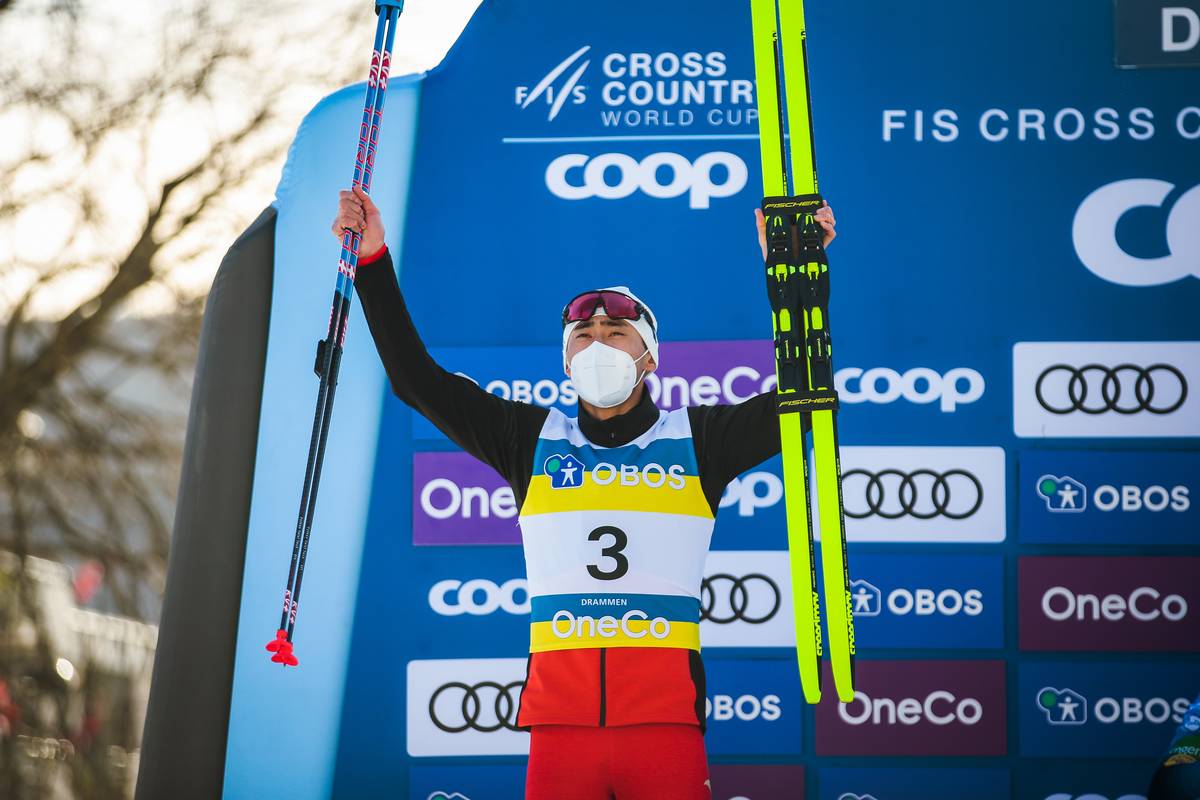
Wang Qiang became the first Chinese athlete to podium in a World Cup last year, finishing 2nd in a classic sprint in Norway. This year, political turmoil has stranded him at home and kept him out of the World Ski Championships in Slovenia. (Photo: NordicFocus)
This World Championship coverage is made possible through the generous support of Marty and Kathy Hall and A Hall Mark of Excellence Award. To learn more about A Hall Mark of Excellence Award, or to learn how you can support FasterSkier’s coverage, please contact info@fasterskier.com.
PLANICA, SLOVENIA – Wang Qiang was cross-country skiing’s Next Big Thing.
Wang, 29, was the product of a colossal investment from his home country to identify and train potential medal winners in the lead-up to the 2022 Beijing Olympics. Communist Party leaders saw cross-country skiing as a prestige sport and poured hundreds of millions of dollars into their national team, building an indoor ski tunnel and recruiting top coaches from Europe.
The effort didn’t produce medals at the Olympics. But a big payoff came just weeks later, when Wang cracked his first podium on the World Cup circuit, a huge accomplishment that came against some of the same competitors he faced in Beijing.
In a sport typically dominated by Europeans, Wang’s podium was a breakthrough — an announcement of a rising power in cross-country skiing.
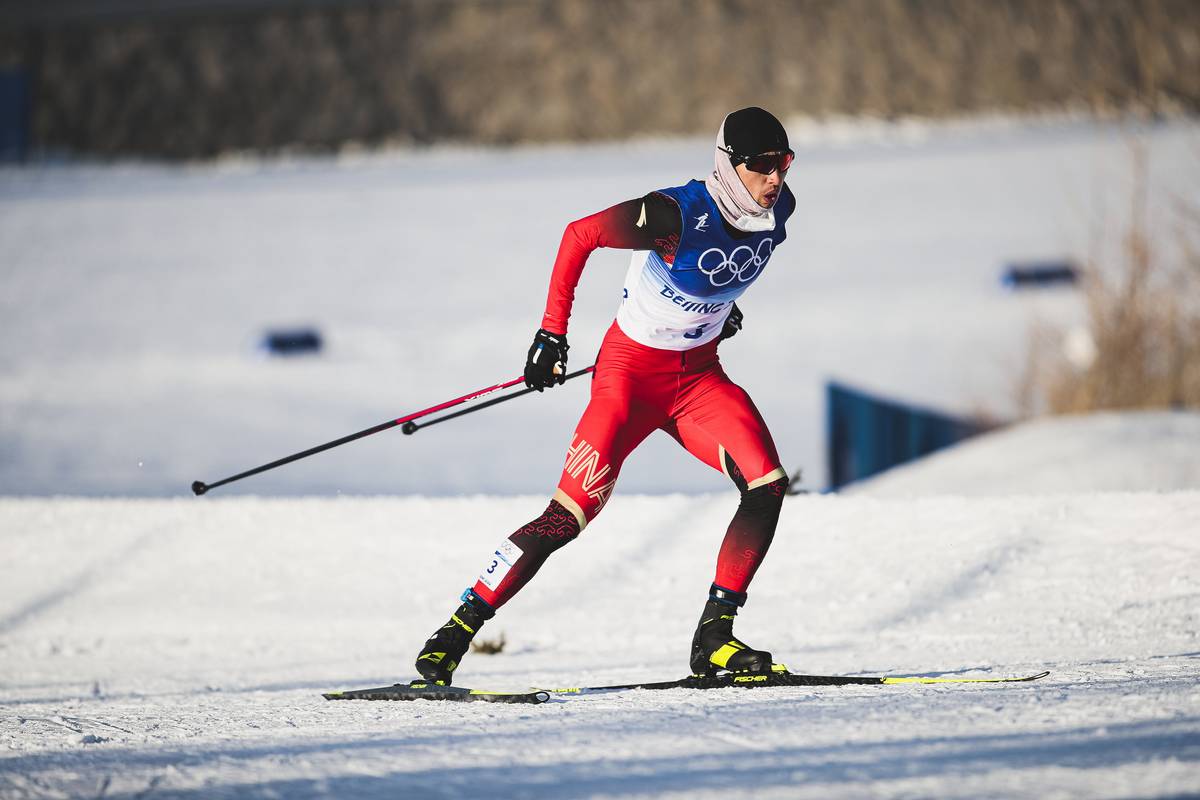
Wang Qiang was fifth in the skate sprint qualifier at the 2022 Beijing Olympic Winter Games. (Photo: NordicFocus)
But when Wang’s best event, the sprint, was held at those championships Thursday, he was missing — apparently back home, in China, where he’d been forced to watch the entire World Cup season from the sidelines. On social media, he published a screenshot of a Norwegian news story about his absence, the latest in a string of posts expressing regrets about his departure from Europe.
The tale of Wang’s unexplained disappearance has become something of a tragedy and a mystery among his friends and competitors on cross-country skiing’s World Cup circuit, who say he’s one of the few athletes with the raw talent to challenge Norway’s superstar sprinter, Johannes Høsflot Klæbo.
“They’ve got this one guy that could be the world’s best skier, and he just doesn’t get to race. I don’t quite understand it,” said Andrew Musgrave, a British cross-country skier who lives and trains in Norway. “It just seems bizarre.”
Wang’s experience is emblematic of what’s happened in Chinese snow sports since the end of the Beijing Olympics: turmoil, without a clear explanation.
The country’s national cross-country ski team has been shut down, and it hasn’t fielded athletes in top-level competitions this year. Its nordic combined team is also missing from the World Championships in Slovenia.
China’s Olympic alpine skiers haven’t competed internationally since Beijing. And the country’s biathlon squad, after its own substantial investment in the lead-up to the Games, has also largely disappeared, skipping World Cup competitions and sending a skeleton crew to recent World Championships races in Germany.
In a strange twist, though, China’s best ski jumpers have been consistently present on the World Cup circuit since January, and are competing at World Championships in Slovenia this week.
In a brief interview outside the team’s wax cabin Friday evening, the Finnish coach who leads China’s jumping squad, Jani Klinga, said the group has a step-by-step, four-year plan building toward the 2026 Olympics.
A nordic combined team is forming some time later, Klinga added, but he said he has no information about the fate of China’s cross-country skiers.
“I don’t know about the cross-country athletes, the situation over there,” Klinga said. “But on our side, everything is moving forward.”
International snow sports leaders also appear to be largely in the dark about China’s plans.
In biathlon, contracts with the foreigners hired to coach the national team were not renewed, and a plan to buy 3,000 laser training rifles each year also has not been carried out, said Max Cobb, the International Biathlon Union’s secretary general.
“They were really making progress as a nation and had some really decent results from their athletes,” Cobb said in a phone interview Friday. “It’s really hard to know what the plan and leadership structure is, and who’s ultimately responsible. We certainly hope that they’ll come back — there’s just, at the moment, not a lot of activity, and it feels like the momentum’s been lost.”
International Ski Federation President Johan Eliasch said his organization is in close contact with the Chinese Ski Association and that “everything we hear is aligned with their stated commitment to proliferate winter sports in China.”
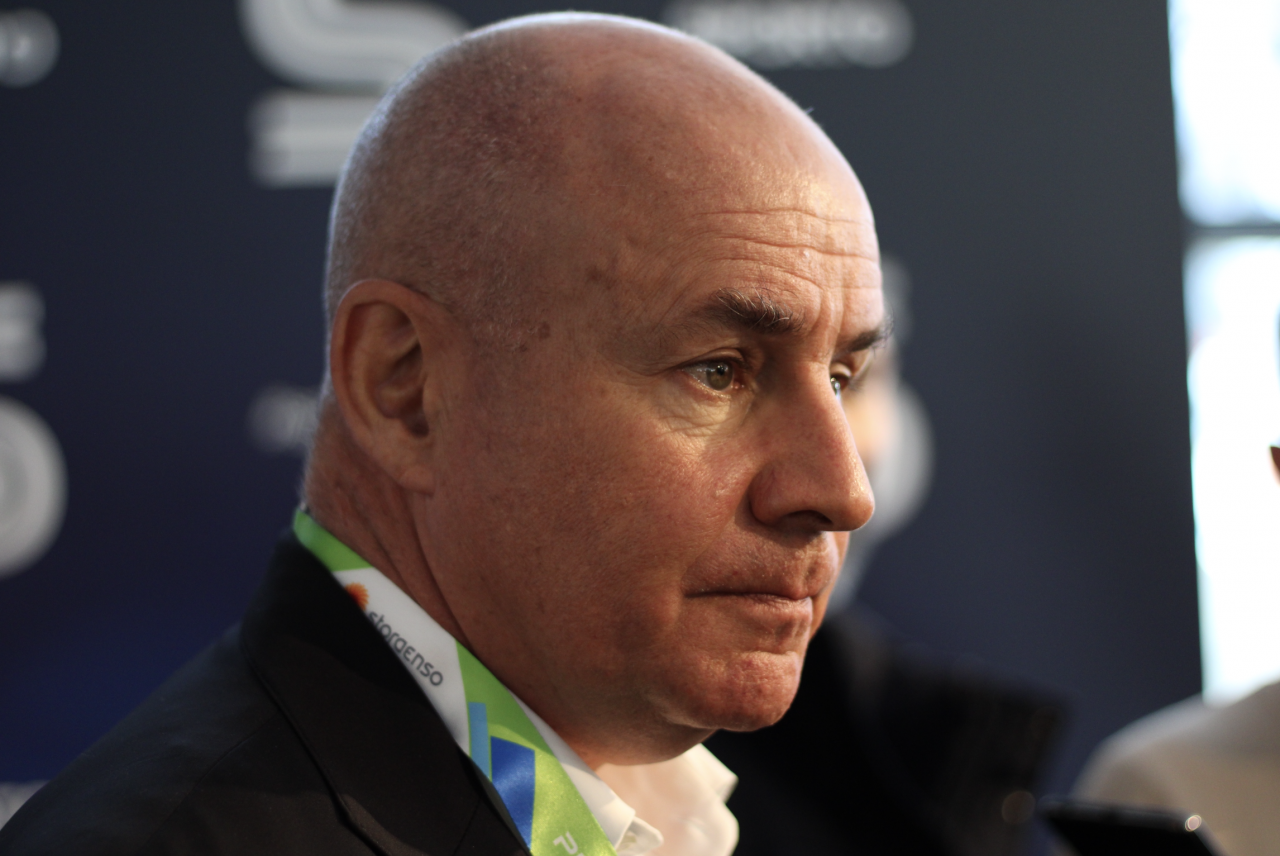
FIS President Johan Eliasch speaks with reporters Wednesday before the start of the World Ski Championships in Planica. (Nathaniel Herz/FasterSkier)
But in remarks to reporters in Planica this week, Eliasch said he couldn’t comment on the Chinese cross-country ski team’s absence from World Championships other than citing the nation’s restrictive coronavirus protocols — which were lifted in December.
The leader of China’s defunct cross-country ski team, Zhang Bei, didn’t respond to an emailed request for comment.
But in phone interviews, two sources close to China’s cross-country program described Wang’s absence as a symptom of a larger realignment in the nation’s sports regime after the 2022 Olympics.
In the lead-up to the Beijing Games, they said, China’s sports minister, Gou Zhongwen, was not actually a sports expert: He was a well-connected Communist Party insider, who used those connections to secure ample budgets for his programs.
The nation’s cross-country ski team was among Gou’s most favored projects, the sources said, because of European countries’ longstanding dominance in the sport: If China could win a medal, it would be a major triumph over the West.
But the massive investment in cross-country skiing didn’t produce any hardware: Wang, the country’s top prospect, was disqualified from the Olympic sprint race when he crashed into a Norwegian competitor.
Once the Games were over, Gou retired. His replacement, Gao Zhidan, is a sports specialist who lacks the same level of political support, and the same interest in cross-country skiing, the sources said.
“After the Olympics, the cards have been reshuffled. And cross-country lost its aces,” said one of the sources, who worked in Chinese sports in the lead-up to the Games.
Around the same time as the change in ministers, Norwegian media reported, Wang was returned home from Europe to China. The national cross-country ski team was also disbanded, the sources said, and its athletes were sent back to their regional teams.
Those regional teams, the sources said, prioritize Chinese national championships over international racing because there’s substantial prize money at stake.
An internal audit of the cross-country program is also underway, according to the other source, a Chinese resident.
There’s a good chance the national ski team will be rebuilt in time for next winter, said the Chinese source, who requested anonymity because of “internal struggles” in their home country. But even insiders don’t really know what will happen, the source added.
“Even if you’re in the Communist Party, you don’t know,” the source said. “You need to be connected with the right people. Otherwise, forget about it.”
During his involuntary break from international-caliber competition, Wang has continued training and stayed relatively optimistic, avoiding direct criticism that could put him in conflict with the political leaders who control his future.
“I am aware that I am missing out on a fantastic season. But I have to accept the situation,” he told a Swedish newspaper recently. “I want to concentrate on training this summer and be in the World Cup next season. I think I’ll make it.”
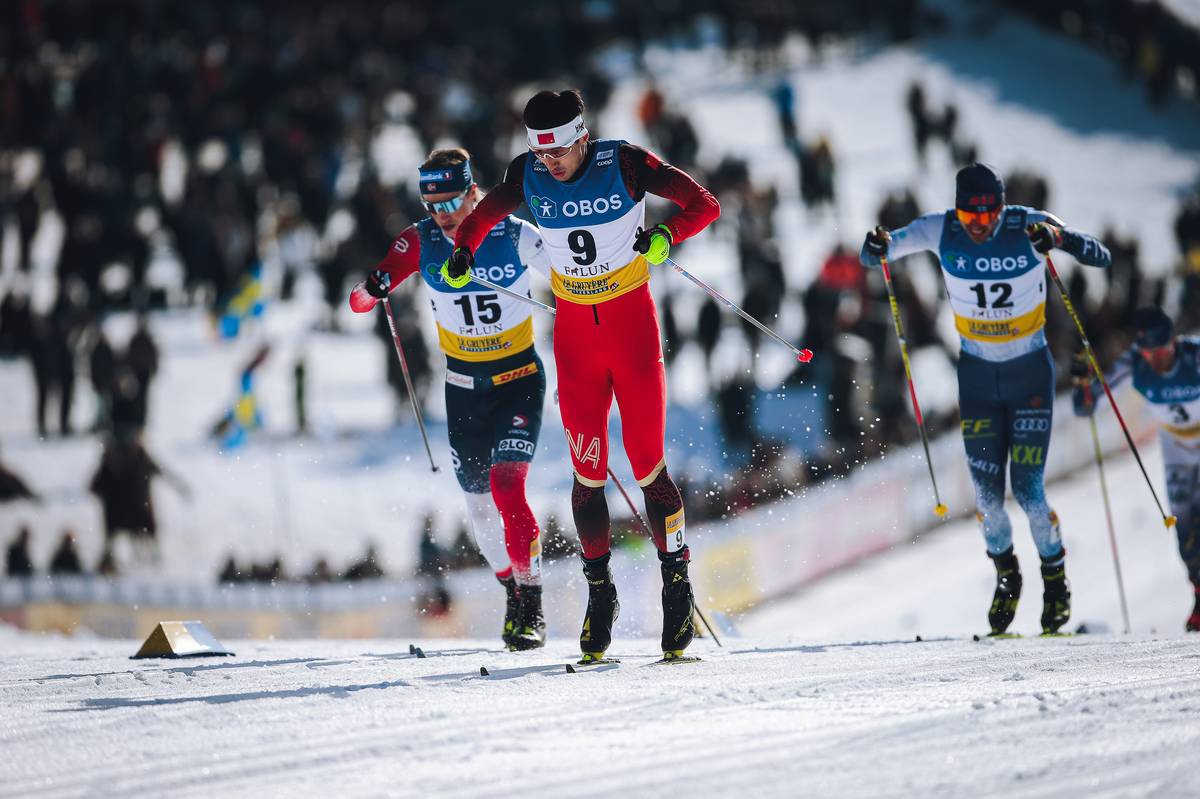
Wang Qiang races in a World Cup classic sprint last year in Falun, Sweden. (Photo: NordicFocus)
But his friends and fellow competitors said they’re worried about the effects of isolation on Wang and his Chinese teammates, who haven’t done much of the kind of tight, close-quarters racing that happens on the World Cup. There’s also Wang’s advancing age: He turns 30 this year.
“It’s difficult when they are not here, because they need the experience in every World Cup race,” said Finnish skier Remi Lindholm, who trained with some of the Chinese athletes for several months in the lead-up to the Olympics.
Like Musgrave, Lindholm said Wang “absolutely” has the potential to beat Klaebo, the Norwegian superstar. Which makes it sad, Lindholm added, that Wang is stuck in his home country.
“He’s a good guy,” Lindholm said. “And he knows that he has to do the job every day to get to the World Cup.”
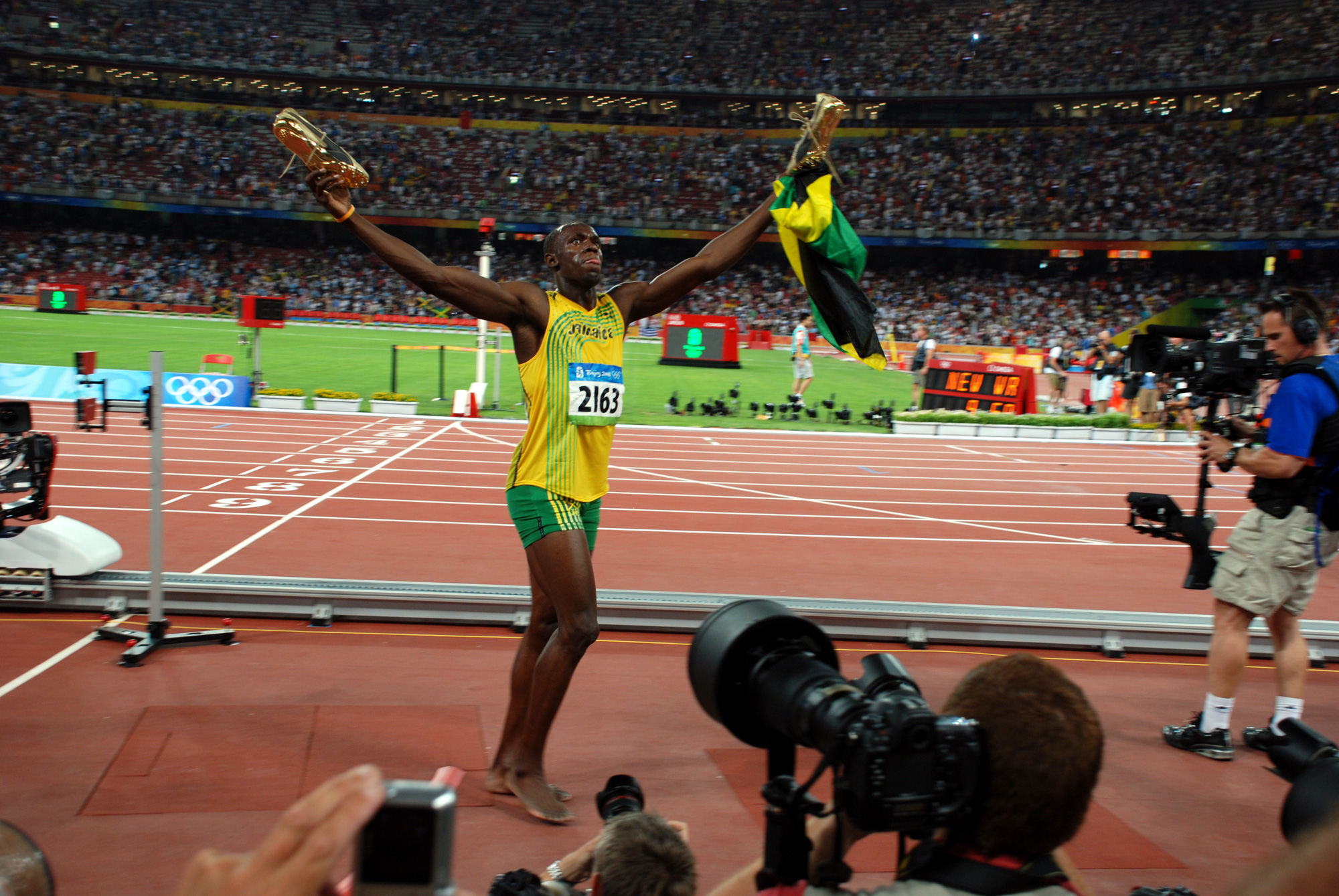
Usain Bolt after winning a gold medal at the 2008 Olympics in Beijing, China. Several Jamaicans tested positive for the steroid clenbuterol at those Games, but the International Olympic Committee hid the cases and they have never been investigated. (Photo: Wikimedia Commons)
In the beginning of April, news hit that a group of athletes had tested positive for a banned steroid at the 2008 Summer Olympics in Beijing, China. The group had never been investigated or suspended for doping.
The drug in question? Clenbuterol, a steroid. Its name might be familiar to cross-country skiers because it is often used in inhalers to treat asthma outside of the United States. But even for asthma, its use is prohibited for competitive athletes.
The positive findings for clenbuterol, which were present in samples from athletes of several nationalities and multiple different sports, included some from the Jamaican track and field team, according to Germany’s ARD television channel.
The findings were made in a 2016 re-testing scheme of the 2008 Olympic samples. They were never reported by the International Olympic Committee (IOC), and only brought to light by ARD many months later.
The IOC apparently decided that the traces of the drug in the urine samples were so small that they did not merit follow-up. The World Anti-Doping Agency (WADA) signed off on this decision.
One problem: like almost all of the drugs on WADA’s Prohibited List, there is no allowable minimum concentration of clenbuterol in a urine sample.
“Clenbuterol is a prohibited substance and there is no threshold under which this substance is not prohibited,” WADA writes on its own website in a Q&A about the Prohibited List. “At present, and based on expert opinions, there is no plan to introduce a threshold level for clenbuterol. It is possible that under certain circumstance the presence of a low level of clenbuterol in an athlete sample can be the result of food contamination… Under the World Anti-Doping Code, result management of cases foresees the opportunity for an athlete to explain how a prohibited substance entered his/her body.”
Explanations were apparently never solicited from the athletes in question, and the IOC simply buried the cases.
Scores of athletes have claimed in the past to have unintentionally ingested banned substances, arguing that the concentrations were so low that they couldn’t be performance-enhancing. It is an argument that has rarely been successful.
Among the athletes who were punished for unintentional ingestion are Norwegian skier Therese Johaug, who tested positive for clostebol, a steroid contained in a lip cream she used; and German biathlete Evi Sachenbacher-Stehle, whose tea was contaminated with the stimulant methylhexanamine – the same drug Carter was disqualified for – at the 2014 Olympics.
Therese Johaug has portrayed herself as a victim unfairly punished for using a medication she did not realize was banned. Strict liability mandates that it doesn’t matter if she used clostebol intentionally or not, but that same standard is not being applied to certain Summer Olympic athletes.
The Jamaican athletes in Beijing never went through the scrutiny that Johaug or Sachenbacher-Stehle did, and are unlikely, at this point, to ever serve penalties. Which begs the question: do the rules apply to everyone?
Or is it better to take a banned substance at the Olympics than at a training camp?
The Specter of Tainted Meat
There is no minimum concentration of clenbuterol allowable in the WADA Prohibited List. So the decision not to confirm the doping cases was not made in accordance within the workflow of anti-doping rules, but instead subjectively.
This is how it worked: ARD reported that IOC Medical Director Richard Budgett had instituted a policy that any positive analytical tests be cleared with him before being ‘confirmed’, the first step towards proceeding through the anti-doping investigation. These cases were reported to Budgett, and he said not to confirm them.
The normal procedure is that such positive analytical tests are considered violations and the athlete is given the opportunity to explain how the substance came to be in their body. They can argue that they ingested it accidentally, for example.
In this case, such an investigation and dialogue never took place. Because the cases were never ‘confirmed’, the IOC did not even confront the athletes.
According to the IOC, this was because of the risk of the drug entering an athlete’s body after they ate contaminated meat. The steroid is used to promote livestock growth in some countries, and China – the site of the 2008 Olympics – is one of them.
“It has been scientifically established that an athlete can test positive for clenbuterol at low levels following ingestion of contaminated meat,” WADA wrote in a press release after the documentary aired. “There have been hundreds of cases – limited to a number of countries where contamination is known to be an issue and where the athletes would have resided, trained and/or competed.”
Another athlete in Beijing – a Polish canoeist – tried to use contaminated meat as an explanation for why he tested positive for clenbuterol. In Adam Seroczyński’s case, the IOC didn’t buy it and punished him anyway.
“The behavior of the IOC is shameful,” a surprised Seroczyński told ARD after the news of the Jamaican tests came out. “They didn’t handle my case this way, I wasn’t as important.”
If the IOC had tried to conduct follow-up to establish whether contaminated meat was the most likely explanation for the positive tests, they may have been disappointed. Fearing exactly this situation, the Jamaican sprint team had flown its own meat to China from home, and their food was prepared by the team’s own cook, according to ARD.
After the fact, WADA explained their decisionmaking process.
“Effectively, when the circumstances of a positive case indicate that the athlete has been in one of the identified countries where clenbuterol meat contamination is significant, the anti-doping community views it as unreasonable to put the burden of proof on the athlete, i.e. to prove that the meat, which he or she had consumed, was contaminated; in particular, eight years after the fact,” the organization wrote in their press release. “However, before a case is closed on the basis of low clenbuterol levels consistent with contamination, WADA recommends investigating such things as meat intake and whether there was exposure to a geographical area where contaminated meat is known to be prevalent.”
As noted above, there does not seem to have been much investigation and this policy is directly at odds with WADA’s own policy as posted on its website.
Are Low Levels Really Accidents?
To justify the process, the IOC reported that in all of the 2008 clenbuterol cases which were not ‘confirmed’, the concentrations of the drug were below 1 nanogram per milliliter.
Other athletes have been banned for less; Spanish cyclist Alberto Contador lost his 2010 Tour de France title over a finding of just 0.05 nanograms per milliliter, despite also arguing that he had ingested contaminated meat.
In fact, in Contador’s case the Court of Arbitration for Sport wrote that “considering that clenbuterol is a non threshold prohibited substance, the fact that the concentration is extremely low does not have any effect on the result.”
And in the same ruling, the arbitrators ruled out that contaminated meat could possibly be a source for the drug. Noting that that Spain is not a country known to have a problem with clenbuterol contamination, they concluded that “no established facts that would elevate the possibility of meat contamination to an event that could have occurred on a balance of probabilities has been established.”
Thus, jurisprudence has established that concentrations of the drug can be found in very low concentrations in urine samples even where meat contamination is not a possible explanation.
Of course this makes sense: as a substance is metabolized, its concentration will decrease. The concentration in a sample is simply a product of the amount ingested, and time. A longer time since ingestion means a low concentration.
In banning her for 13 months, the disciplinary panel did not dispute her explanation that the substance entered her body from a lip cream, rather than an injection or some other more shocking route.
The public will likely never know whether, in fact, she was using it on purpose; the accidental explanation has been used by many an athlete who later admits that yes, they were doping. But the point of strict liability actually gets exactly to that: it deals with the fact that when you rely on someone’s word, you can never be certain of what actually happened.
Strict liability is strict liability. WADA’s explanation of its Anti-Doping Code specifically notes that an athlete should be suspended “whether or not the athlete intentionally or unintentionally used a prohibited substance or was negligent or otherwise at fault.”
Part of the issue of the Russian doping scandal is that for athletes in some parts of the world, strict liability was being applied. But for some in Russia, it wasn’t just that unintentional positives were being forgiven – rather, intentional doping was protected.
In this new scandal, the IOC – which is charged with ensuring fair competition at the most prestigious sports events in the world, the Summer and Winter Olympics – strict liability only applies sometimes.
If you were an athlete working hard to stay clean, or even Therese Johaug or Evi Sachenbacher-Stehle, that must not feel great.
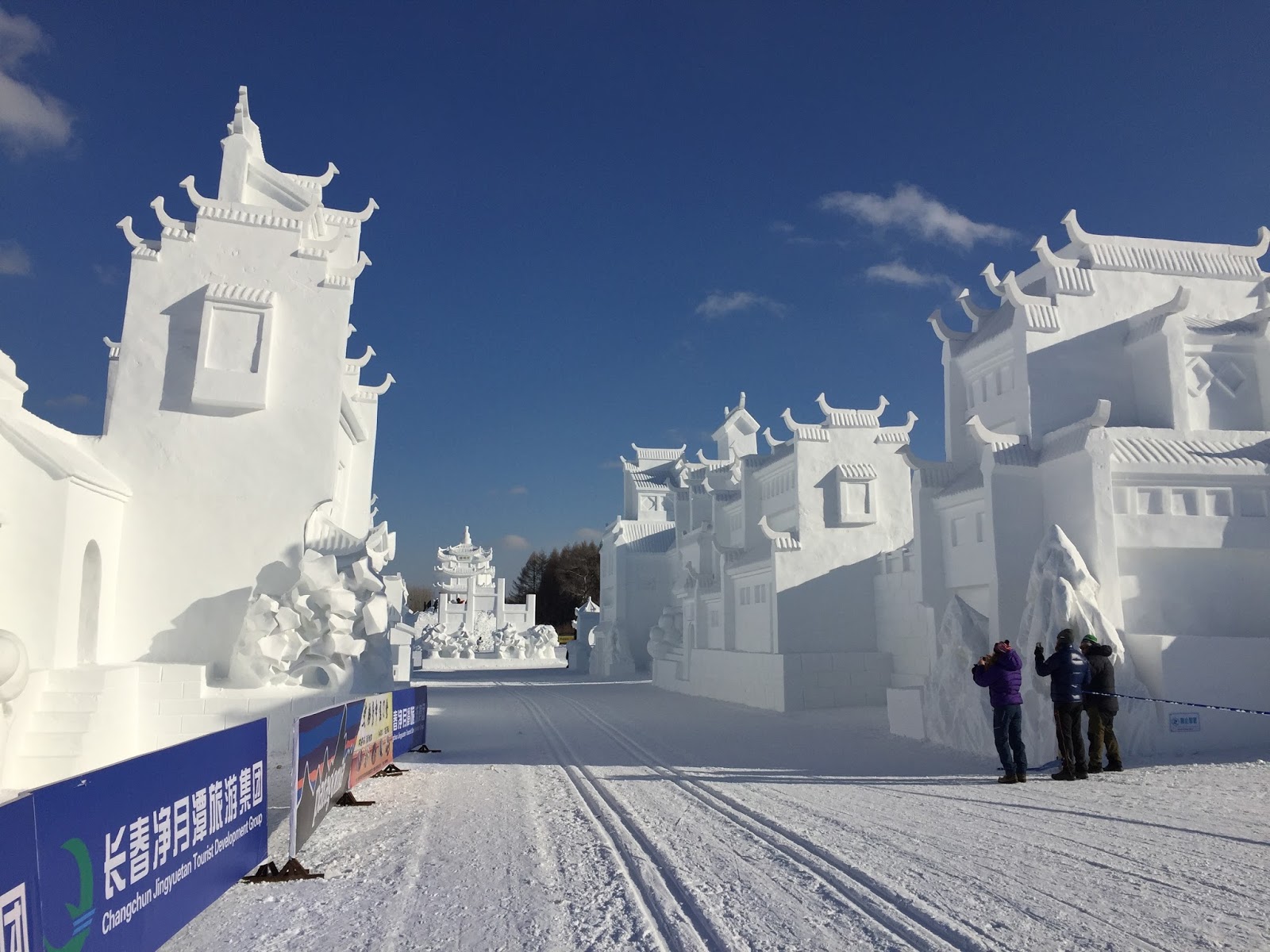
Snow sculptures in the stadium in Changchun at the 2016 China Tour de Ski. (Photo: Holly Brooks)
Note: Alaska Pacific University skier Skyler Kenna, 21, will also be racing the 2017 China Tour de Ski. FasterSkier learned of Kenna’s participation after publication.
****
Be a ski racer, see the world. That’s the approach of a pair of Alaska Pacific University (APU) skiers Jack Novak and Lauren Fritz, who leave for Asia later this week to race in the China Tour de Ski, set to begin in Changbaishan on Sunday, Jan. 1.
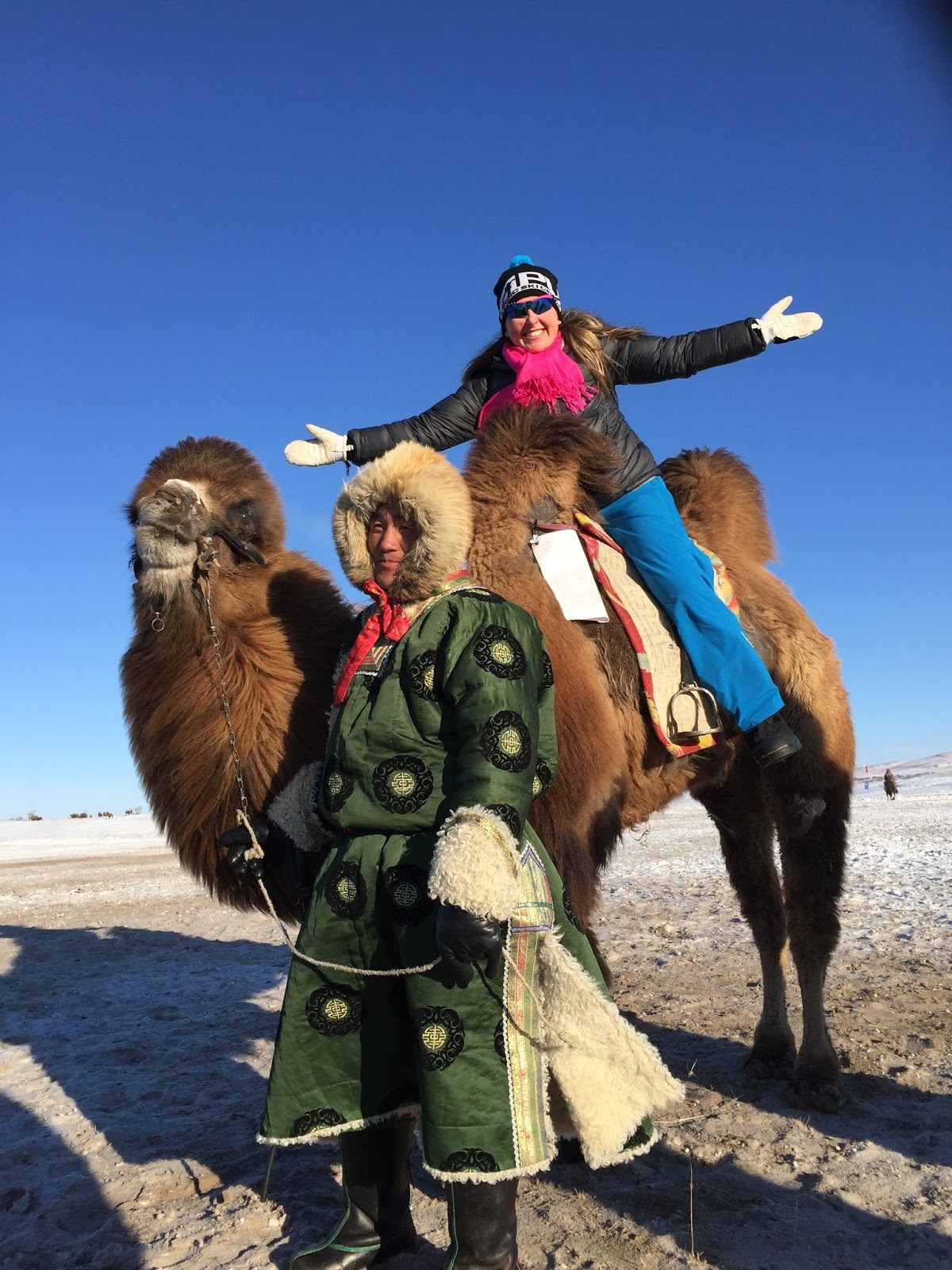
Novak has never been to Asia before, and has yet to ride a camel on any continent. Fritz competed in the race series for the first time last year, and has skied on five continents. Both athletes are at a point in their ski career where they are seeking experiences more than SuperTour points or championship team selection. Some prize money wouldn’t hurt, either.
The China Tour de Ski marks its 10th anniversary this year, which makes it only one year younger than the “other” Tour de Ski that begins in Val Müstair, Switzerland, this Saturday, Dec. 31. Prior versions of the Chinese Tour have featured a sprint on trucked-in snow inside the Bird’s Nest stadium built for the 2008 Summer Olympics, stage races across China and inner Mongolia, long bus rides, and a lot of photogenic camels.
Holly Brooks (retired, APU/U.S. Ski Team) rides a camel during the 2016 China Tour de Ski. (Photo: courtesy Holly Brooks)
American skiers who have previously participated include Fritz, Peter Kling and Holly Brooks, all currently or formerly of APU; Ryan Scott, formerly of Ski & Snowboard Club Vail/Team HomeGrown; and former U.S. Ski Team member Torin Koos. They have consistently reported genuinely warm welcomes and intriguing cultural experiences.
This year’s Tour takes racers through six stages over nine days across a wide swath of the country. (Changbaishan to Beijing is a 13-hour drive.) It’s heavy on the skate sprints: a full four out of six stages (Stages 1, 2, 5, and 6) are freestyle sprints. In the middle, Stage 4 is a prologue to short distance skate mass start race, 3.8 kilometers for the women and 5.7 k for the men.
And Stage 3 is the Chinese Vasaloppet, a classic marathon now in its 15th year. Last year, the Tour de Ski racers covered the whole 50 k distance, with Brooks and Fritz on course for 2:44 and 2:51, respectively. This year’s Tour racers will participate in “a modified course and a shorter total distance,” though precisely how much shorter is not immediately apparent. The 2017 full-distance Chinese Vasaloppet also marks the third event of the 2016/2017 Visma Ski Classics series.
While many multi-stage tours – the Tour de France, the Giro d’Italia, the original Tour de Ski – operate on a principle of lowest combined time wins, perhaps augmented by time bonuses for top positions, the China Tour de Ski instead applies World Cup scoring based on finishing position. Among other things, this avoids making the person who performs best in the Chinese Vasaloppet (which is much longer than all the other races combined) the de facto champion based on combined time.
Last year’s overall winners were a pair of Swedes, Emil Johansson and Lisa Svensson. Johansson has a World Cup top-30 sprint finish to his name and won the 2013 SuperTour skate sprint in West Yellowstone, Mont., while studying at the University of Colorado-Boulder during the 2013/2014 season. Svensson, who will be competing in her fifth consecutive China Tour de Ski, has never had a podium finish in an International Ski Federation (FIS) race on European soil… but has 17 of them in China.
One American has cracked the overall podium in the first nine years of the China Tour de Ski: Kling was second in 2015. Chinese skiers make up a minority of historic podium finishers in the event, likely reflecting both the nascency of Chinese cross-country skiing (the Chinese National Team was established in 2006) and race organizers’ willingness to attract non-Chinese skiers to their event.
The gravel pit-turned-skate sprint course in Yanji during the 2016 China Tour de Ski. (Photo: Holly Brooks)
When it comes to convincing European skiers to fly across Asia, or Alaskan skiers to fly across the Pacific Ocean, money talks.
To start with, virtually all of the racers’ expenses, including transportation, are covered by the race organizers. As Scott wrote to FasterSkier during the 2015 Tour, the race paid for all of his travel, lodging, and food. “My only expense is $500 Euros to the organizers and paying for bags,” Scott wrote.
On top of that, there’s real money to be made. In this year’s Tour, first through fourth in four of the stages is good for 2,000 to 10,000 renminbi (yuan) per race. (At current exchange rates, 10,000 yuan is equal to approximately $1,400 – or more than the $1,200 prize for first place in any race at next month’s U.S. nationals.) For the Stage 2 sprint, it’s up to 20,000 yuan for the men ($2,800), 15,000 yuan ($2,200) for the women. For the Chinese Vasaloppet, Stage 3, first place takes home 5,000 euros, or $5,200. Plus there are additional prizes for top four in the overall Tour standings, starting with 20,000 yuan for first. (With the exception of Stage 2, all other stages and overall standings feature the same prize amounts between the genders.)
The total prize purse for Stages 1-2 and 4-6, not counting the Chinese Vasaloppet, is 251,000 yuan, or over $36,000. That’s slightly less than the $39,000 purse for the American Birkebeiner, but it’s in the ballpark. Within the world of cross-country ski racing, this is a princely sum. It is roughly to skiing as Russia’s $1.5 million for Diana Taurasi is to women’s basketball, or China’s 60 to 70 million euros for Oscar is to international soccer – eye-opening sums of money paid to entice athletes to a part of the world they might not otherwise consider visiting.
In related news, the Qaniq Challenge will once again pay out a total purse of $10,000 in Valdez, Alaska, next month. Fritz earned $500 for her third-place finish in last year’s race, behind fellow China veteran Brooks in second.
The athletes
Fritz: Rekindling her love of skiing
But for Fritz, it’s not all about the money. The native of Chugiak, Alaska, and longtime APU skier has been a competitive racer for many years, with career highlights that include SuperTour podiums, top-10 national championship finishes, and World Cup starts in Canada in 2012. But in 2015, she wrote, she suffered through “a rough season prior, a summer of illness, injury and just general low-quality training,” and was getting ready to call it a career.
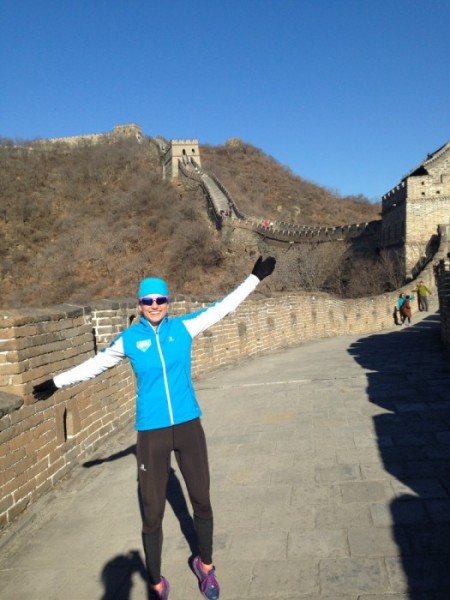
Lauren Fritz (APU) poses for a moment during a run along the Great Wall of China during the 2016 China Tour de Ski. (Courtesy photo)
“I decided I was going to move away from SuperTour racing and do some ski marathons and probably retire [following the 2015/2016 season],” Fritz, 28, wrote to FasterSkier earlier this week during a break from packing. “I was fed up with racing SuperTour, racing poorly and not getting anywhere (figuratively, with my ski career). And I wasn’t having fun anymore. I was so used to being around skiers who are very focused on high level goals and incredibly (unspokenly) competitive that you can lose sight of why you do what you do beyond just a number on a result sheet, especially if you aren’t achieving those results (and I most certainly wasn’t).”
Her inaugural trip to China changed all that.
“Being with the group in China, it was just all about how we got this amazing opportunity and it was simply because we skied,” she wrote. “It reminded me that skiing has taken me so many places and connected me with so many people, and I get to be outside so much, and that was why I love it so much. I came home with a fresh attitude and it really helped boost me mentally and physically.”
Fritz’s enthusiasm is immediately apparent in her answer to a reporter’s question about why she is going back to China.
“Last year’s Tour de Ski China was one of the most fun, unique, and craziest ski trips I’ve ever been on,” she wrote. “So it’s more a question of ‘Why not?’ than ‘Why?’ am I going back, which probably makes it obvious why I’m going again. It was low-stress, low-pressure, with high energy, excitement and general enjoyment.”
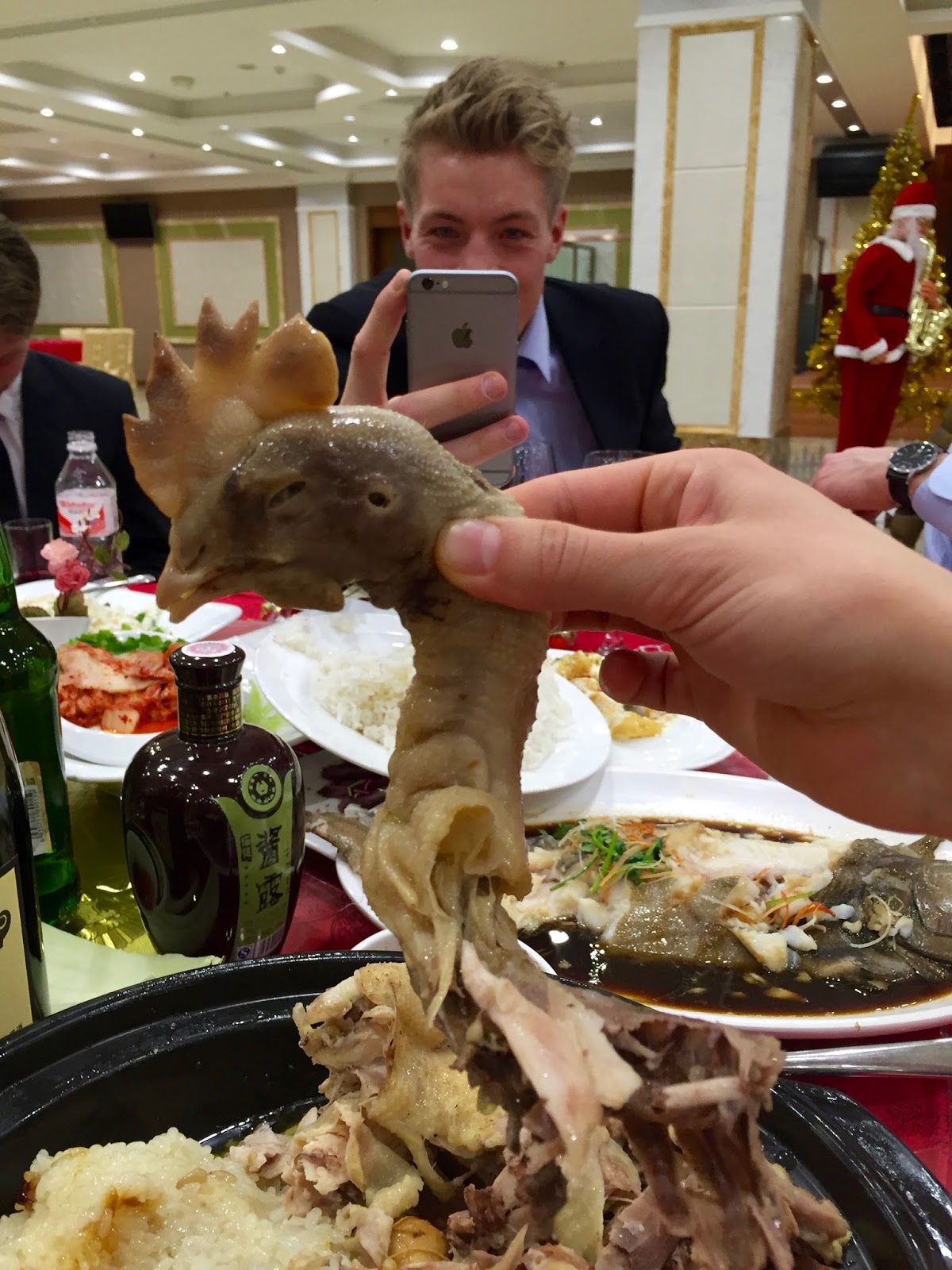
A chicken head featured prominently on the menu during the 2016 China Tour de Ski. (Photo: Holly Brooks)
“Everyone on the trip was there primarily for the experience of being in China and seeing cool new places with the added bonus that we got to do some ski races,” Fritz enthused. “I mean, how many ski races have you been to where you have to squat over a board over an open pit in a communal poop shack, and get handed a can of random Chinese ‘RedBull’ and a personal size bottle of Chinese spirits, cross a finish after skiing through a literal snow castle city, and be treated afterwards to a show and a table full of food you don’t recognize but eat anyways… Oh, and get to go for a hike on a Great Wonder of the World [the Great Wall of China] after the last race?”
Fritz continued, “Everyone’s attitude was more geared towards having a great time and experiencing what China had to offer than doing well in the races, and that gave it a more relaxed feeling. Not that people didn’t take the races seriously, they/we certainly did because there was money on the line! But once the bib came off, it was about having fun. The group we had was amazing, everyone was fun to hang out with and easy to get along with, and we had a great time. Not often is two straight weeks of living and traveling with a big group like that so easy and enjoyable.”
“Last year’s Tour de Ski China was one of the most fun, unique, and craziest ski trips I’ve ever been on. … It was low-stress, low-pressure, with high energy, excitement and general enjoyment.” — Lauren Fritz, APU skier
While she is largely going back for the experience, Fritz is not above hoping that, in a virtuous cycle, the improved training she was inspired to do following her trip to China last year will translate to better results this year.
“This year I definitely want to get some podiums,” Fritz wrote. “I had two 4th places last year, so I’d like to improve on that! I think it’s possible to be on the podium a few times if I ski the way I know I can right now with my fitness level. (Read: Fitness level waaaay better than last year, ha!)”
“Pretty much, the TDS China is my season,” she concluded. “As I said, I was going to retire after last year, but I kind of felt rejuvenated and wanted to keep training pretty much just so I could go back to China this year! I will still do some races later in the season, but China is definitely top of the priority list.”
Novak: Looking for adventure and an inaugural camel ride
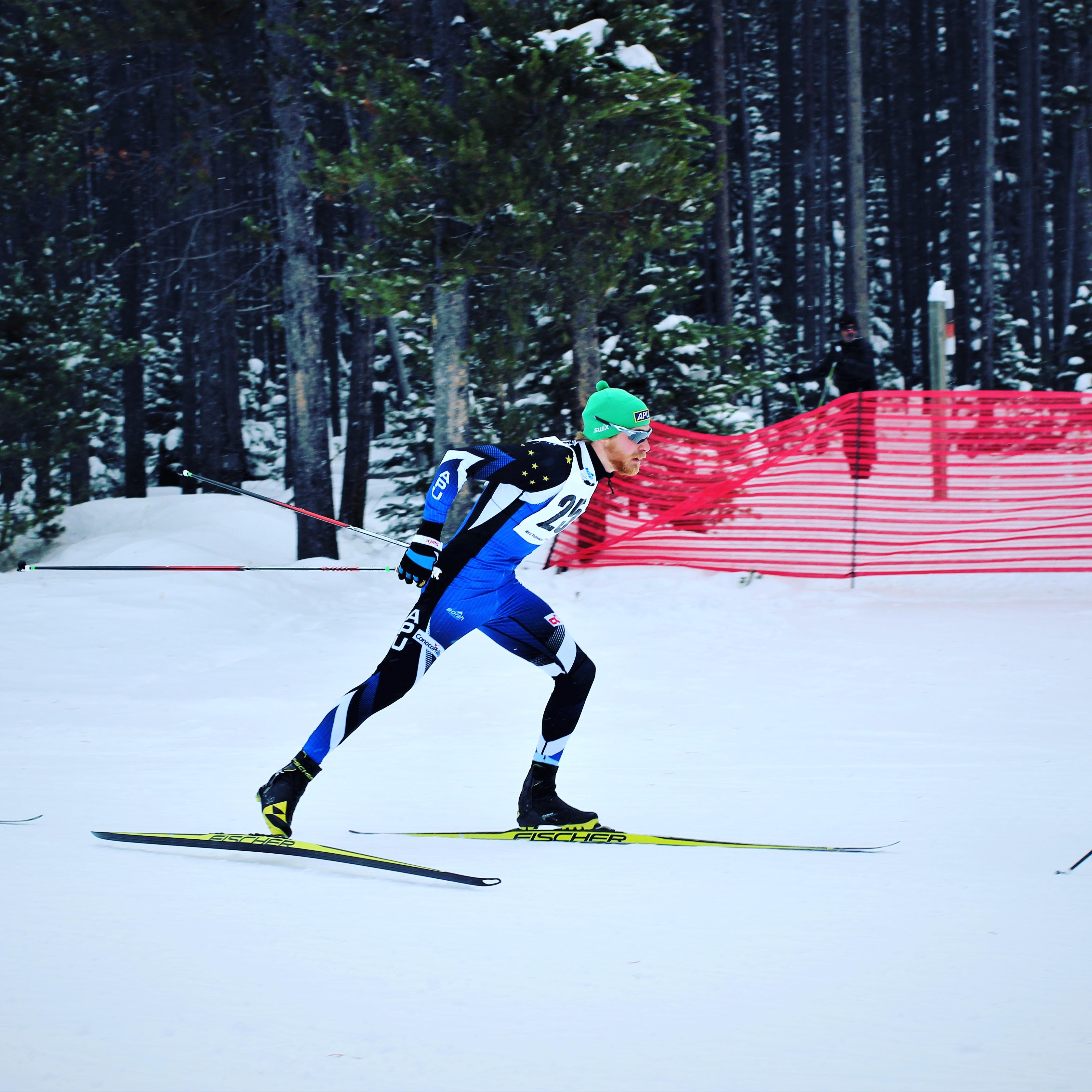
Jack Novak (APU) during a SuperTour race in West Yellowstone, Mont., this month. (Photo: Forrest Mahlen)
Novak, 23, from Anchorage and also a longtime APU racer, finds himself in much the same boat as Fritz – underwhelmed by his recent performances, and looking for a low-stress adventure to mix things up.
“I decided to go on the Tour de Ski China because I was looking for a change of pace after the past couple of years of injuries,” Novak wrote to FasterSkier. “I am not in a place where I am racing for a World Champs start spot, so for me racing at nationals didn’t have a huge draw this year. I heard about this race from my teammates over the years and thought this is a good year to race this series. It should be quite an adventure and that is what I am looking for right now, having fun racing and doing what I love.
“I also have never ridden a camel but I hope this trip affords me the opportunity,” he added.
In less Bactrian goals, Novak wrote, “My goals for this series are to really see how I stack up. I would love to be in the mix hopefully fighting for the win every once in a while. Also I already am going to get to travel to China and Inner Mongolia seeing part of the world I have never seen which is a goal achieved as soon as I leave. Being able to travel around the world to ski race is a real pleasure and an opportunity that not many get to experience so I feel very lucky.”
Back in this country, Novak wrote that the China trip meshes well with the rest of his season goals, as he plans to enter some local races in Alaska in January before heading to the Midwest in February for SuperTour races and the Birkie.
“Finally,” Novak wrote, “we will finish up the season in Fairbanks [for Spring Series] which should be a hoot and a half. We race so infrequently in Alaska on a national stage that it is fun to race at ‘home’ or at least the same state.”
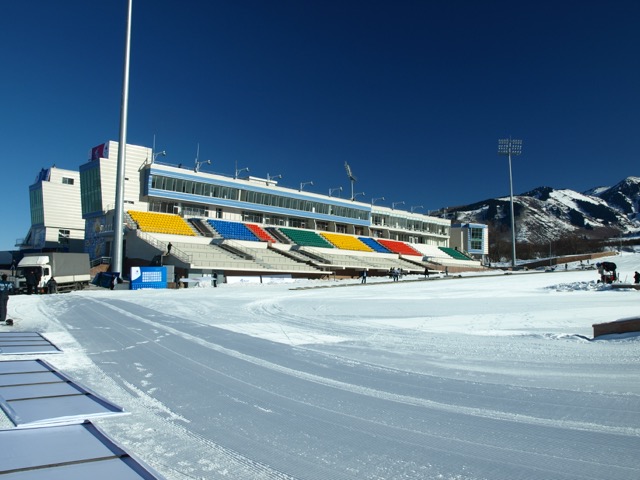
The Soldatskoe nordic venue, which would have hosted competitions had Almaty, Kazakhstan, won their bid for the 2022 Olympics. Unlike the city venue which hosted 2015 FIS World Junior and U23 Championships, Soldatskoe, here before the 2011 Asian Games, has lots of snow. (Photo: Matt Pauli)
When Beijing won the bid for the 2022 Winter Olympics, some sports fans cheered, remembering happy memories of the 2008 Summer Olympics and smiling with certainty that China would deliver a Games.
Others raged and lamented, since Beijing is hardly known for its winter sports culture. The other candidate, Almaty, Kazakhstan, offered a ready-made winter experience with mountains and snow all packed in close to the city center.
What was clear was that it was not one of the most exciting or hyped-up host city elections in IOC history. Many people – fans and IOC members alike – weren’t particularly excited about either bid.
That was summed up by the fact that one IOC member abstained from voting: he or she traveled all the way to Kuala Lumpur, Malaysia, for the 128th IOC Session and then presumably decided, you know what, I don’t really care.
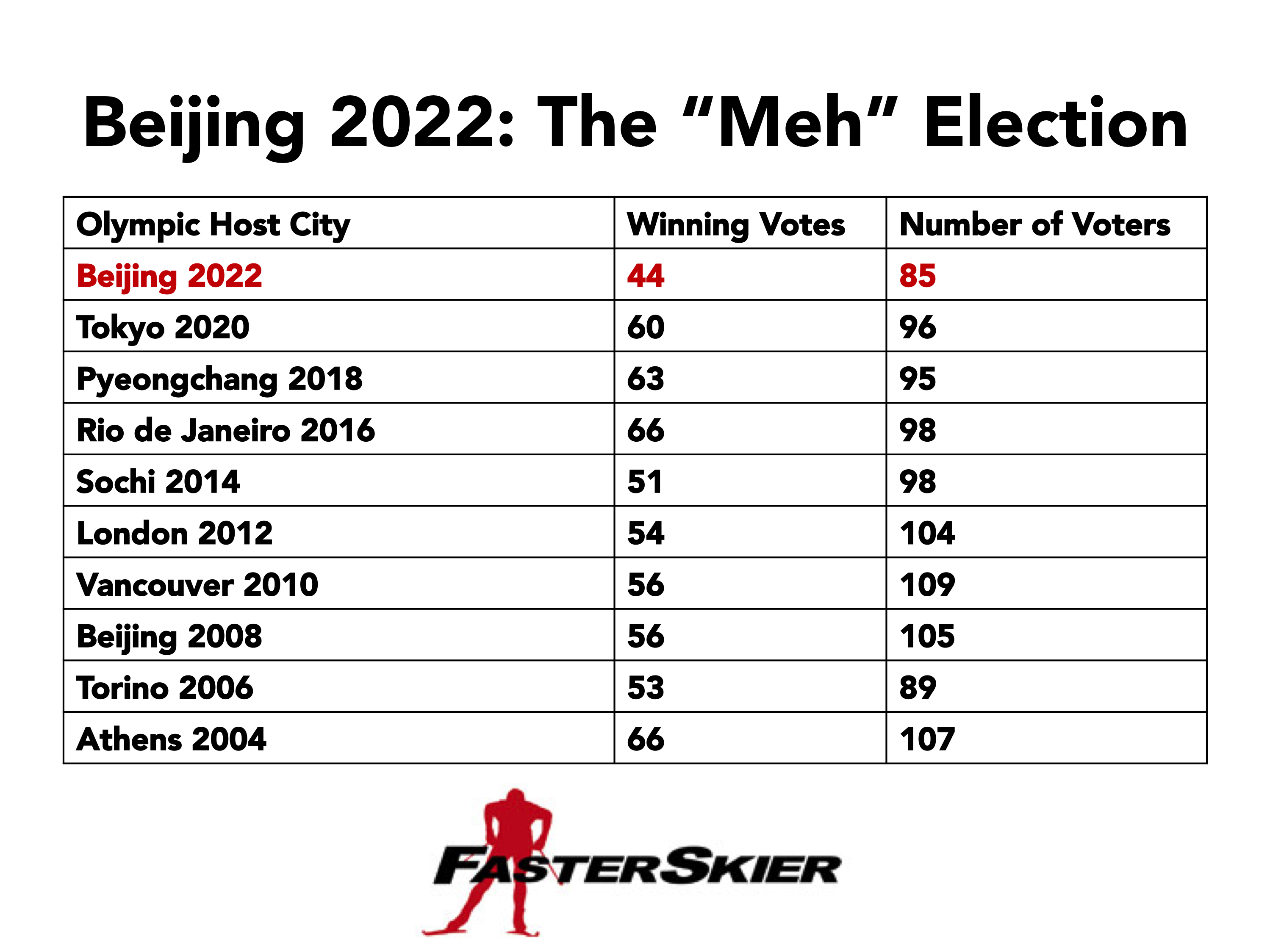
And it was reflected in the fact that Beijing won with just 44 votes from IOC members, the least votes received by a winning bid in the last two decades.
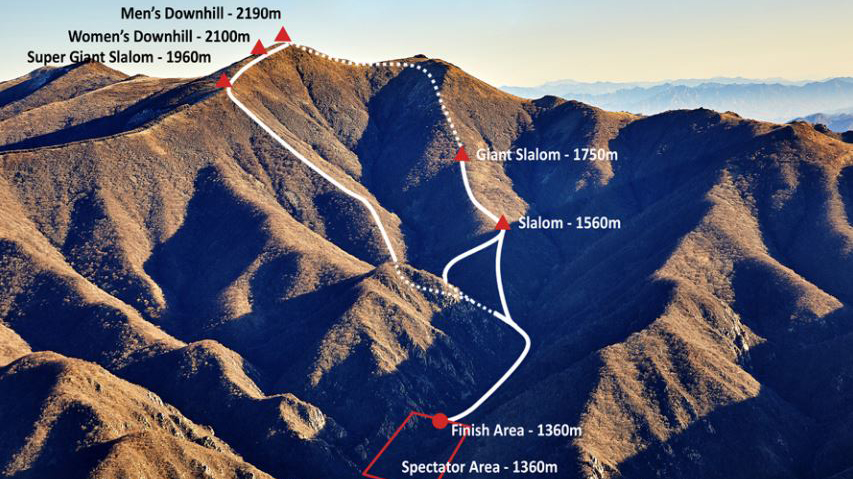
In comparison, this is what the alpine venues an hour outside of Beijing looked like in January 2015, according to the IOC Evaluation Commission.
Not since 1993, when Sydney was elected host of the 2000 Summer Olympics, has a winning bid received less than 50 votes. And more recently, most have received many more: 60 for Tokyo to win the 2020 Summer Games, 63 for PyeongChang to win the 2018 Games, and 66 for Rio de Janeiro to win the 2016 Games.
Close margins, on the other hand, are not so rare. Sochi 2014 and London 2012 each won by four votes, just like Beijing 2022, while Vancouver 2010 had only three votes more than its rival, PyeongChang.
Part of the reason that the tally was so low is simply that there were fewer IOC members to vote. The IOC has a maximum of 115 members, but there are currently only 100. Election of new members is on the docket for the IOC session in Kuala Lumpur.
Of those 100 current members, just 85 were present to vote. The president does not vote unless needed for a tiebreak, while members from a bid country cannot vote in host city elections, which ruled out China’s three members.
Eleven more IOC members were “excused”, meaning that they did not come to the session in Kuala Lumpur at all.
By contrast, in the last decade between 95 and 109 IOC members have voted in all previous host city elections.
Winter Athlete Reps Did Not Vote
Among the excused members were two of the most recently-elected IOC members, and the only two who competed at the last winter Olympics.
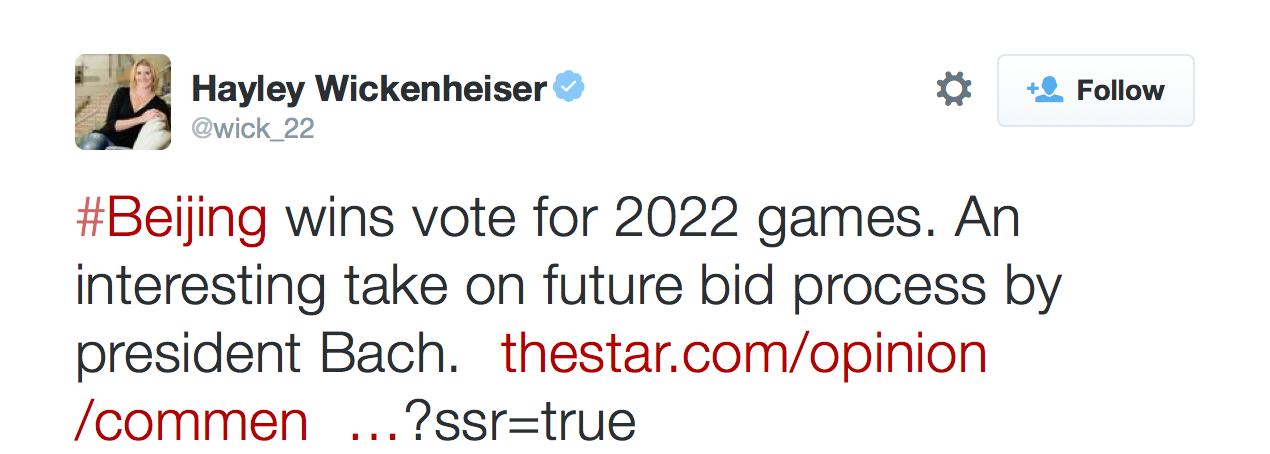
Canada’s Hayley Wickenheiser, a hockey player who appeared in five Olympic Games, did not go to Kuala Lumpur. Instead she tweeted about the result.
Yes, an interesting take… on an election that she could have taken part in. No reason for her absence was announced. She also did not attend the Candidate City presentations in Lausanne, Switzerland, in June.
Ole Einar Bjørndalen, the most successful winter Olympian of all time, also did not attend, citing the need to train for the upcoming World Cup season. The biathlete told Norwegian newspaper VG that he had discussed his absence with IOC President Thomas Bach.
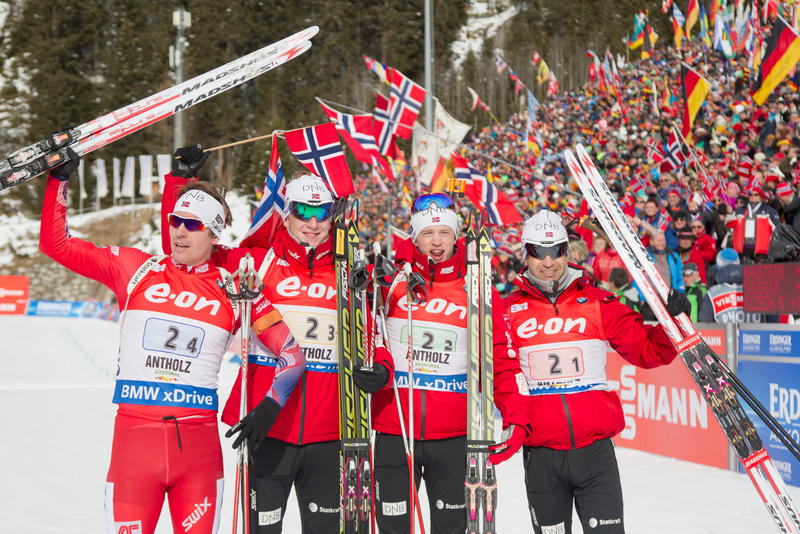
The Norwegian men including Ole Einar Bjørndalen (right) celebrate after winning the 7.5 k team relay in Antholz, Italy, in January 2015. (Photo: IBU/ChristianManzoni)
“In agreement with the IOC President and the head of the IOC’s Athletes’ Commission I’m not going to attend the congress in Kuala Lumpur where Olympic organizers for 2022 will be selected,” he said. “However, I have given my professional input to the Executive Committees in discussions beforehand.”
Bjørndalen also skipped the Candidate City presentations in June, as well as the previous IOC session in December (which was during the 2015 World Cup season; he had already notched three top-tens in the first week of racing).
He told VG that he had gotten approval from both Bach and Claudia Bokel, the chair of the Athletes’ Commission, to focus on his career until April. The 41-year-old plans to retire after 2016 World Championships, which will be contested on his home turf in Oslo.
Regardless of the reasons, it’s unfortunate that Bjørndalen and Wickenheiser could not attend the session and vote. They are the two IOC members with the most recent winter Olympic experience.
And, more than that, they competed at the Sochi Olympics – the very Games that the IOC is trying to leave far, far behind them with their Agenda 2020 reforms. The $51 billion price tag is something the IOC does not want to see as a precedent, and Bjørndalen and Wickenheiser are the only two IOC members to directly experience what that massive budget gave, or did not give, to the athletes.
It would seem that their opinions could have been informed, valuable, and from a unique perspective. Not only did they miss the vote, but by excusing themselves from the last two IOC sessions they also missed the chance to talk directly with other IOC members.
One might reasonably think that the IOC has little motivation to give more say to athletes, when the athletes elected to IOC membership do not attend IOC sessions or vote on important decisions – which is a pity, because the majority of athletes likely want more input and transparency in the way the biggest competitions of their careers are organized.
Lack of Visits to Bid Cities
Another problem is that after the 2002 Salt Lake City bidding scandal, IOC members are no longer allowed to visit bid cities.
Without being able to visit bid cities, IOC members must rely on other information to make their decisions. At the 2022 Candidate City presentations in Lausanne, Switzerland, in June, the Beijing room was both more attractive, and more packed.
That was because before 2002, several IOC members had to resign after it was revealed that they had received special treatment from the organizing committee in an attempt to earn votes.
The change in policy likely helped clean up some corruption in the IOC. But it creates problems for IOC members trying to decide where the Olympics should be held: all they have to base their decision on is what they have read and seen, be it from the IOC’s own Evaluation Commission or from the media.
This would be bad enough if the playing field was equal, that is if no IOC members had ever visited any of the bid cities on their own.
But the field is far from equal. In the 2022 race, Beijing had the advantage of hosting the 2008 Olympics, meaning that almost all of the IOC members had been there. By contrast, they weren’t allowed to get the same feel for Almaty.
And even outside of sports situations, members were much more likely to have traveled to Beijing for business or leisure than they were to have seen Almaty.
That may change soon. Kazakhstan in 2012 became one of the 50 largest economies in the world. And buoyed by oil and natural gas production – the country is the third-largest non-OPEC supplier of energy to the European Union – Kazakhstan is aiming much higher by 2050.
But the fact remains, at this point, most people have not been to Almaty.
One group that has? The few journalists allowed to officially visit the two host city bid sites.
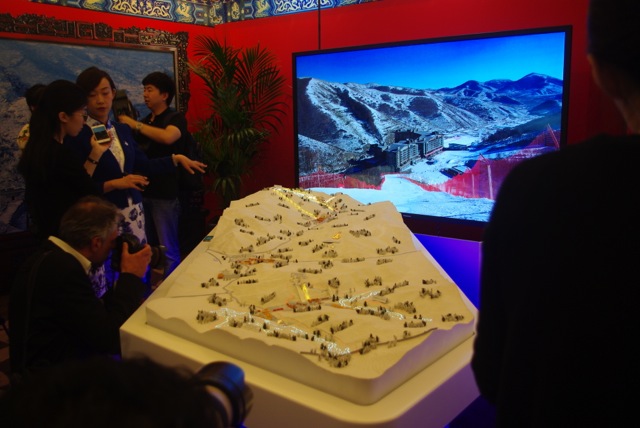
In the Beijing presentation room, the big committee was on hand to demonstrate through dioramas the vision of Games infrastructure. Is this the same as being able to see proposed sites in person?
Robert Livingstone of GamesBids.com wrote that he was pleasantly surprised by Almaty, and that most of the lines touted by the bid committee that he had assumed were just PR exaggerations turned out to be true.
The opposite was the case in Beijing: when he visited in March, the time the Paralympic Games will be hosted, there was no snow in the mountains and the ski resorts were already closed for the season.
After the vote, Livingstone wrote, “Arguably I was in a much better position to cast a vote in the host city election than most of the members, but of course it doesn’t work that way… Shouldn’t the members experience the city and the facilities as they will expect the athletes to, especially if they want to verify the quality of the athlete experience? If IOC members shared my on-site experiences do you think at least two of them may have changed their votes to Almaty? I’m certain that would have been the case.”
Another illustration of the importance of site visits is how the Evaluation Commission members themselves voted: eight of the nine members preferred Almaty, according to Inside The Games.
But despite their reporting, the Evaluation Commission could not convince IOC members to reach the same conclusion.
Who is Voting?
So who are the people who are voting and, to some extent, ignoring the advice of the IOC commission which inspects potential host cities?
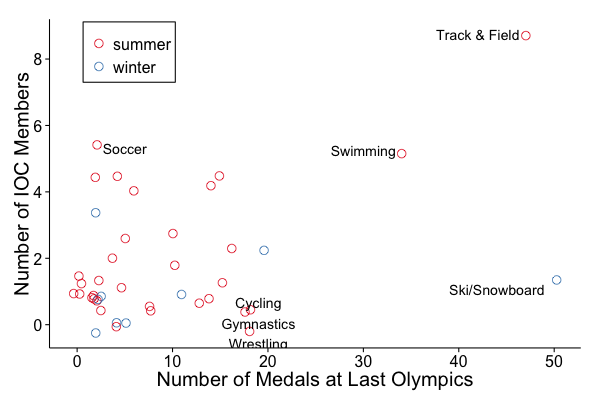
More than half of the members come from countries which have not won a winter Olympic medal in the last four cycles. And many countries which are successful at the winter Games – for example, Austria, the Czech Republic, Belarus, Finland, and Slovenia – have no IOC members at all.
Ten of the fifteen members who did not vote came from countries with strong winter sports programs. For example, not only did Bjørndalen not vote, but neither did the other Norwegian IOC member, Gerhard Heiberg, who led the 1994 Lillehammer Olympic Organizing Committee.
That meant that of the voting members left, 59% came from countries without a strong winter sports program.
In terms of sports, some members are former international or Olympic athletes themselves, and others are longtime administrators, officials, and financiers of sport – or just businesspeople or royalty with an interest in sport.
Of those with a discernible sporting background, either as an athlete or as an administrator of a specific sport before they went on to organize national Olympic committees or international federations, just nine worked in winter sport. The rest come from a summer sports background.
And for snow sports, the number is even more grim. Of the 98 medal events in the 2014 Olympics, 61 were held on snow: biathlon, nordic sports, alpine skiing, freestyle skiing, and snowboarding.
That’s 62%.
But of the 100 current IOC members only Bjørndalen and Gian Franco Kasper, the head of the International Ski Federation, come from a ski background either as an athlete or an administrator.
That’s 2%.
It’s not to say that IOC members without a winter sports background are incapable of making decisions about where to host a winter Games. There are many factors which are common between all Olympics: financing, culture, convenience of venue layout, security that the Games will be delivered.
Beijing was an expert in some of those, for instance the economic backing of the Chinese government. And a lack of snow was not its only shortcoming in the bid process. For instance, the venues in Almaty were much closer together, a factor which reportedly swayed some voters. Easy access and having venues integrated to the city culture should be a focal concern when organizing a Games.
But with no winter sports experience, perhaps it’s easier for voters from a hot country to line up their priorities in terms of financing and the lucrative marketability of China’s enormous consumer base. These voters might not appreciate the extent to which skiers and snowboarders prefer real snow to the manufactured stuff.
Or, perhaps more importantly to the IOC, how competitions in a real mountain atmosphere are nicer to watch on television. Or how in some disciplines, an abundance of natural snow is much safer for competition than a combination of manmade slush and salted-up ice.
Meanwhile, the trend of IOC membership being generally out of balance with the number of medals awarded by sport isn’t just a winter sports problem. It persists when summer sports are added to the mix, too.
And that’s not to say that IOC membership should track a country’s Olympic success. After all, the goal of the Olympic movement is inclusion and harmony, not domination by the likes of Russia, China, and the United States. Diversity is a good thing.
It’s also not to say that IOC membership should tightly track sports popularity. If nothing else, that would stifle creativity, continue to cut opportunities for smaller sports, and be difficult to adjust to as the Olympic sport lineup continually changes.
Members have far more to offer than simply their cultural or sports background. Financial or broadcast skills are certainly valuable to the IOC; so are perspectives on diversity and global challenges.
But it can’t help feeling like those most affected by the negative aspects of the Beijing 2022 bid were not represented at the table when it came time to vote. The skiers and sliders who will be competing far outside Beijing, potentially to empty stadiums on manmade ice amongst brown hills, weren’t there. Nor were some countries with expertise in those events.
There are 15 spots open for new IOC members: how will they be filled? Only time will tell.
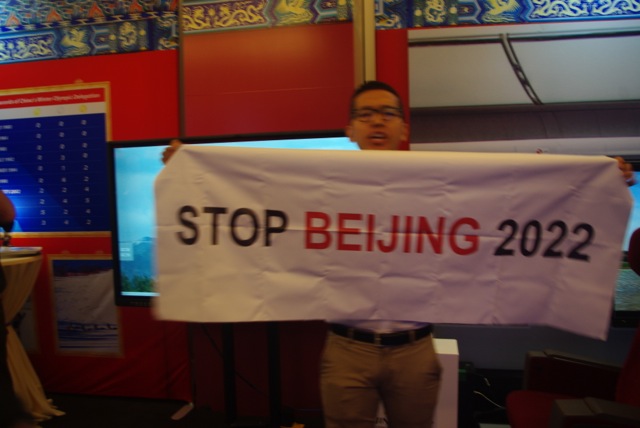
At the 2022 Olympic Candidate City Presentations in Lausanne, Switzerland, in June, one protestor quietly slipped into the Beijing presentation room, and once he was almost at the back unfurled a flag and started chanting. He was quickly hauled off, first by Beijing 2022 supporters inside the room and then by security.
With one week to go until International Olympic Committee members vote on whether to award the 2022 Winter Olympics to Beijing, China, or to Almaty, Kazakhstan, a prominent human rights organization is calling on the body to make meaningful demands on the eventual host city in terms of cleaning up their practices.
Both Kazakhstan and China curtail freedom of expression and dissent, and engage in discriminatory and abusive labor practices, among other issues.
There are lots of factors going decisions by the IOC about which cities will get to host Olympic Games. Economic stability of the host country, venue infrastructure, travel times, and experience for both athletes and fans are among the big ones.
In the past, a country’s human rights record has not come into play so often. In past Games, especially in Beijing in 2008 and Sochi in 2014, numerous human rights problems including forced evictions and labor abuses were documented in the run-up to the opening ceremonies.
(The Olympics are not alone in this regard, as other large sporting events such as soccer’s World Cup face the same issues.)
As part of the Agenda 2020 brought to the IOC by President Thomas Bach when he was elected in 2013, human rights and sustainable development were supposed to come more into focus in the Olympic mission.
And in September 2014, the IOC indeed announced that anti-discrimination language would be added to the host city contract, a move that was lauded by human rights groups.
That was apparent when Oslo, Norway, released the draft of its own host city contract after it decided not to bid for the 2022 Games. However, there was no requirement in the contract itself for the host organization to abide by anti-discrimination rules.
Instead, the language was couched in Section L of the preamble, a portion of the contract which is more descriptive than binding:
“WHEREAS the City and the NOC acknowledge and accept the importance of the Games and the value of the Olympic image, and agree to conduct all activities in a manner which promotes and enhances the fundamental principles and values of Olympism, in particular the prohibition of any form of discrimination with regard to a country or a person on grounds of race, religion, politics, gender or otherwise, as well as the development of the Olympic Movement…”
And in terms of labor and environmental protections, these were included in the contract, but not in great detail or specificity:
“The City, the NOC and the OCOG undertake to carry out their obligations and activities under this Contract in a manner which embraces the concept of sustainable development, and which serves to promote the protection of the environment. In particular, the concept of sustainable development shall address the legacy of the Games, including the concerns for post-Olympic use of venues and other facilities and infrastructures, referred to in Section 36 below. The City, the NOC and the OCOG shall take all necessary measures to ensure that development projects necessary for the organisation of the Games comply with local, regional and national legislation and international agreements, standards and protocols, applicable in the Host Country with regard to planning, construction, protection of the environment, healthand safety and labour laws.”
Now, with just one week to go before IOC members gather in Kuala Lumpur, Malaysia, the nonprofit Human Rights Watch (HRW) is urging them to consider human rights when they make their decision and implement reforms that would allow them to hold host countries accountable for vague promises made in this regard.
For instance, the IOC’s Evaluation Commission report on Almaty “claims that the government provided ‘assurances regarding the right to demonstrate, media freedom to report on the Games and Games preparations with no restrictions on the Internet, labor rights, and displacement’,” a release by HRW’s Global Initiatives Director Micky Worden says. “But it doesn’t elaborate on the content of such assurances, despite extensive evidence that the government doesn’t adequately protect these rights.”
The organisation, along with many others, has noted in the past repeated and routine human rights abuses by both China and Kazakhstan. In both countries, freedom of the press and freedom of assembly are strictly curtailed. Expression of dissent can lead to grave consequences.
Additionally, Kazakhstan just tried to pass a draconian bill aimed against gay and lesbian “propaganda”, reminiscent of the one passed in Russia in the leadup to the 2014 Sochi Games. After passing the senate, the bill was rejected by the country’s constitutional court, possibly in part because of an open letter by former athletes to Bach through the organisation Athlete Ally.
A United Nations Special Rapporteur who recently visited Kazakhstan noted that government officials discuss freely how they limit the freedom of assembly because they fear a revolution, and also reported that she was filmed and photographed meeting with civil rights advocates by the secret police.
Meanwhile, human rights violations at the 2008 Games hosted by Beijing are well-documented, and there’s not much reason to believe that China would make any more improvements to its policies for 2022 than it did in 2008, unless there is some contractual obligation to do so.
In current Olympic host city contracts, it is clear that the IOC can rescind the right to host a Games from a chosen host city for several reasons, but human rights is not one of them.
That leaves the IOC with few options for enforcing its alleged focus on improving human dignity. HRW recently noted that the degree of oppression and restriction in China has only gotten worse since the 2008 Olympics.
“The Chinese government and Communist Party under President Xi Jinping have unleashed the harshest campaign of politically motivated investigations, detentions, and sentencing in the past decade, marking a sharp escalation in intolerance of criticism,” the group wrote in a release.
Besides the criticism by HRW, others are opposing the Beijing bid on similar grounds.
“As Tibetans, Uighurs, southern Mongolians and Han Chinese we join together to urge you … not to award another Olympic Games to China,” a different open letter said. “All of the people we represent have suffered as a result of the Chinese government’s contempt for human rights. We hope that you are aware by now that the 2008 Beijing Games did nothing to alleviate human rights abuses in China or enhance freedom.”
In press conferences for candidate city presentations in May, human rights did not come up in relation to the Beijing bid, and a question to the Almaty organizing committee was met with the response that Kazakhstan is a young country (it was only established after the breakup of the Soviet Union) and constantly striving for improvement.
Given that Beijing and Almaty are the only two cities which completed the bidding process (after numerous European bidders dropped out), the IOC has no choice but to award the Games to a country which does not uphold some of the basic tenets of the Olympic charter. That’s inevitable.
What human rights groups are hoping for, however, is that this time around they actually take the opportunity to force their chosen host city to improve.
“The 2022 Winter Games are when the rubber meets the road for the IOC in terms of backing core principles,” Worden, the HRW Global Initiatives director, wrote this week. “Knowing that either way the selection process goes, a serious rights abuser will host the Games, the IOC should require meaningful rights protection in host city contracts, and monitor those commitments as rigorously as it monitors stadium construction, telecommunications, and other requirements.”
Which bid will eventually win? Beijing is the favorite, but Almaty has a fighting chance.
Most recently, on July 18, Bach said that both bids are “coming to Olympic Agenda 2020 from very different angles, and so it will not be an easy decision for the IOC members to take.”
A whiter version of Beijing 2022 than athletes and fans might actually encounter.
In just over a month, the International Olympic Committee members will vote in Kuala Lumpur, Malaysia, on the site of the 2022 Winter Olympics. Their two choices: Almaty, Kazakhstan, and Beijing, China.
Only these two candidates remain after other bids from regions like Bavaria, Germany (centered in Munich), Graubunden, Switzerland (centered in Davos and St Moritz), Stockholm, Sweden, and Oslo, Norway, were felled by referendums.
That’s not a good sign for the IOC. Both bids have some problematic features, and are almost certainly not the ideal locations the organization was looking for.
While there are problems with the Almaty bid, to almost any reasonable person there appear to be far more, and more serious, problems with Beijing. Despite all of this, Beijing is the frontrunner.
That’s because it has the force of the Chinese government behind it. The IOC knows that the Chinese can deliver a Games. A Beijing Olympics would happen, without any major cost to the IOC except for bad publicity and a continued slide down from any moral high ground they might have left.
The Almaty bid closed part of its gap at the candidate city presentations in Lausanne, Switzerland, last week. But in the event that Beijing still comes out on top when voting is over, here’s an overview of six major issues that the Olympics would face – and examples of some of the misrepresentation and lies the bid committee says publicly when questions are brought up.
First, there’s the snow. As skiers, it is probably one of our main concerns. Will there be enough? Where will it come from? Zhangjiakou boasts about a meter, total, of snowfall each year.
The answer is, snow will come from water. But that leads to another question. What effect will that have on the regional water dynamics of a drought-prone region?
Then there’s air quality. It’s known to be terrible in Beijing. But organizers assert that air quality is great at the mountain venues. The problem is, that’s just not true.
Next up, how will spectators get to the mountain venues? At almost 200 k north of Beijing, travel times could be long. The bid committee touts a high-speed train connecting the clusters, but it’s becoming clear that this won’t solve all problems and could even be dangerous.
After the 2008 Olympics, it was clear that China followed through on few of their promises to improve human rights. Is there any reason to think that this time around will be different?
And finally, thinking long-term, what is the point of hosting a Games where winter sports are not popular and where snowmaking is so disruptive? Will the venues be used in the future?
The site of the alpine skiing and sliding sports for Beijing 2022, photographed in January 2015 for the IOC Evaluation Commission report.
Snow: Quite honestly, there isn’t much.
The weather is cold and it’s enough to blow snow, however, at least for alpine skiing. The Chongli area outside of Zhangjiakou has four alpine ski resorts which host, according to the bid committee, 1.5 million visitors annually. Nordic facilities have not yet been built.
On the ground, the area isn’t always teeming with skiers.
“The chairlifts are somewhat slow, but queues are rare and the slopes are mostly empty,” a review of the Wanlong resort, one of the biggest in the area, notes.
By comparison, the state of Vermont gets about 4.5 million ski visits per year, although that is based on ticket sales and it is unclear whether the Chongli numbers are from all tourists or just those who buy a lift ticket.
Looking at meteorological data, it’s hard to imagine the region becoming a real winter sports mecca without snowmaking.
“The total annual snowfall here can reach more than one meter,” Liu Jianjun of Chongli’s weather bureau told the press.
One meter!?
And yet:
“We have a 20-year history of hosting skiing events… Each year there is a 25% increase in the population taking part in skiing in Zhangjiakou,” Hou Lang, the mayor of the city, said in a press conference in Lausanne. “The temperature, wind speed, and mountain situations are ideal for hosting a Games.”
The bid committee’s strategy is to make and hoard snow. Already, resorts feature snow on the trails but brown forests and dry, frozen ground beside them.
“In addition to natural snowfall we have a very comprehensive plan to ensure the quality and quantity of snow,” Zhang Li, the venue manager, said in the press conference. “This plan is based on the combination of appropriate temperature, abundant water supply, and reliable existing snowmaking facilities.”
The IOC Evaluation Commission noted in their report that the resorts are already situated on the highest mountains in the region, so there would be no way to haul in snow from other locations. And as was shown in Vancouver 2010, temperatures can unpredictably rise during warm snaps and prevent snowmaking.
During discussions about the two candidate cities, experts reportedly testified that a 50-50 mix of manmade and natural snow was ideal, and that this was attainable with the Beijing bid. Two problems: most athletes would argue that actually a zero-manmade, all-natural snow base would be ideal, and secondly, it’s not clear that 50% natural is even realistic.
Siting an Olympic Games in a place with essentially zero natural snow seems like a big risk. Yet the IOC does not seem overly worried with this issue compared to others.
Water: On top of all of that, it appears that the bid committee does not fully understand just how big an undertaking it would be to make all of that snow. 16 million cubic feet of snow were reportedly stockpiled before the 2014 Sochi Olympics, where there was more natural snow to use as a base anyway.
It took over 140 gallons of water to make just one of those cubic meters of snow.
“The Commission considers Beijing 2022 has underestimated the amount of water that would be needed for snowmaking for the Games,” the Evaluation Commission wrote.
Zhangjiakou is in a notoriously arid region. There simply isn’t a lot of water available: just 383 millimeters per year, or 15 inches. The winter is the dry season, and Zhangjiakou receives less than five millimeters per month then.
The New York Times reported earlier this year that the region is home to water conflicts, which those in the western U.S. might find familiar.
The small amount of water available is often sent south to Beijing, a major city which has priority over rural areas. It is now being used for snowmaking as well, and should Beijing win the 2022 bid the amount needed for snowmaking will only increase.
“The total amount of water used for the entire Games duration for snowmaking represents only 1% of annual available water supply in this area,” Zhang Li said in the press conference.
However, the Evaluation Committee had already made clear that they believed this estimate was incorrect. And in a region with barely any water, one percent can still make a big difference – just ask California.
Because of China’s controlling government and human rights problems, those suffering from further declines in water resources would certainly be the least affluent residents of the Zhangjiakou region. Pouring more effort into snowmaking would represent a further shift to focusing on an affluence tourist market instead of local dynamics.
Yet the bid committee insists that there’s nothing to worry about.
“To ensure an abundant the water supply, we have three sources of water,” Zhang Li said in the press conference. “One is the surface runoff which has been the sole source for the existing resorts for the last 20 years. The second source is large capacity reservoirs in 6 kilometers of the venues. The third source is that we will benefit from the already almost-completed National Water Transport plan, which is transferring an enormous amount of water from southern China to the north.”
That transport plan has reportedly cost as much as $80 billion, although detailed estimates are hard to pin down.
The bid committee also plans to recapture snowmelt and use it to blow more snow, but the Evaluation Commission wrote that the ability to do this had been greatly overestimated.
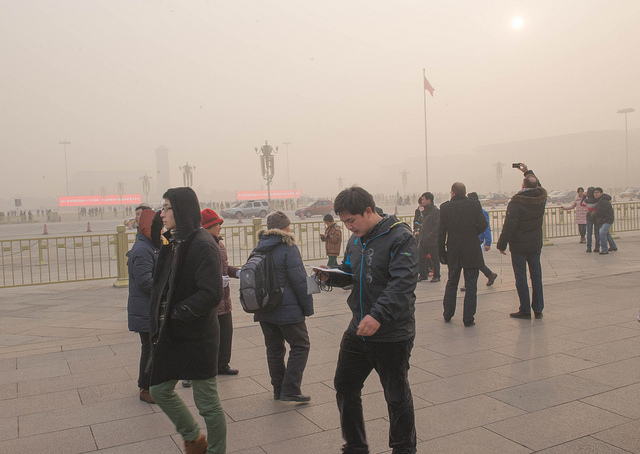
Air pollution in Tiananmen Square, Beijing, in 2013. (Photo: Michael Davis-Burchat, flickr)
Air Quality: Beijing currently faces some of the worst air quality in the world. During the 2014 Beijing marathon, particulate pollution was at 400 micrograms per cubic meter; the World Health Organization’s maximum for healthy outdoor activity is 25. Most participants wore masks and many did not finish the race.
“In Beijing, the ice sports will all be in indoor venues,” Wang Anshun, the mayor of Beijing and the head of the bid committee, helpfully noted in a press conference.
Beijing is in the midst of a five-year action plan to clean up air quality, which is costing about $130 billion and features 84 specific action points.
“At present, the action plan is already achieving excellent results,” Wang said. “Major pollutants in this period have dropped by 17.7 percent as compared to last year.”
After the plan ends in 2017, there are already plans in the works for another five-year agenda leading up to the 2022 Games.
In fact, the bid committee used the prospect of improving air quality in a not-so-subtle attempt to guilt people into supporting the bid.
“This also will be a form of permanent legacy that will benefit the local people of the city and the region,” Wang noted.
In other words: how could you turn this bid down when it will improve quality of life for millions of people, and make the air that they breathe no longer able to kill them?
However, it’s worth noting that an IOC mandate to fix pollution problems has not always in the past led to pristine conditions. Air quality was still a problem at the 2008 Summer Olympics in Beijing, even after much-publicized attempts to solve it by closing factories limiting the amount of vehicles in use. While vast improvements were made, pollution was still worse than in all but the most polluted U.S. cities and about six times higher than at the 1996 Atlanta Olympics.
Immediately after the 2008 Olympics, air quality worsened again, now to those levels seen during the 2014 Beijing Marathon. Improving air quality during the Games did not have lasting effects.
Another case of the IOC struggling to mandate pollution cleanup is in Rio de Janeiro, Brazil. Just a year before the 2016 summer Games, organizers are still struggling to clean up the water in the city. Last summer the IOC brushed off concerns, saying there was still time to clean up, but they now seem more alarmed, and at the recent Executive Board meetings in Lausanne demanded to see progress by the end of July.
Part of the Rio bid was a promise to reduce the flow of raw sewage into the sailing venue by 80%, but officials now acknowledge that will never happen. (More alarmingly, they say that the failure to clean up is irrelevant because the sewage poses no health risks to sailors.)
In other words, if the host city promises in a bid to clean up, the IOC has no real way to hold them to that promise. Statements by the bid committee about air quality do not mean that athletes won’t see significant health risks when they arrive in Beijing in 2022.
Finally, the bid committee says that at the two mountain clusters, air quality is ideal. However, while Zhangjiakou does have the best air quality in its region, it is still not good. In the next two days, for example, air quality is forecasted to dip into the “unhealthy” zone, with the definition “Everyone may begin to experience health effects; members of sensitive groups may experience more serious health effects.”
And local regulations cannot completely solve air pollution problems, anyway.
“Increased energy demand in winter coupled with seasonal weather patterns that can bring pollutants from other regions could create air quality issues across the Games zones,” the Evaluation Commission wrote.
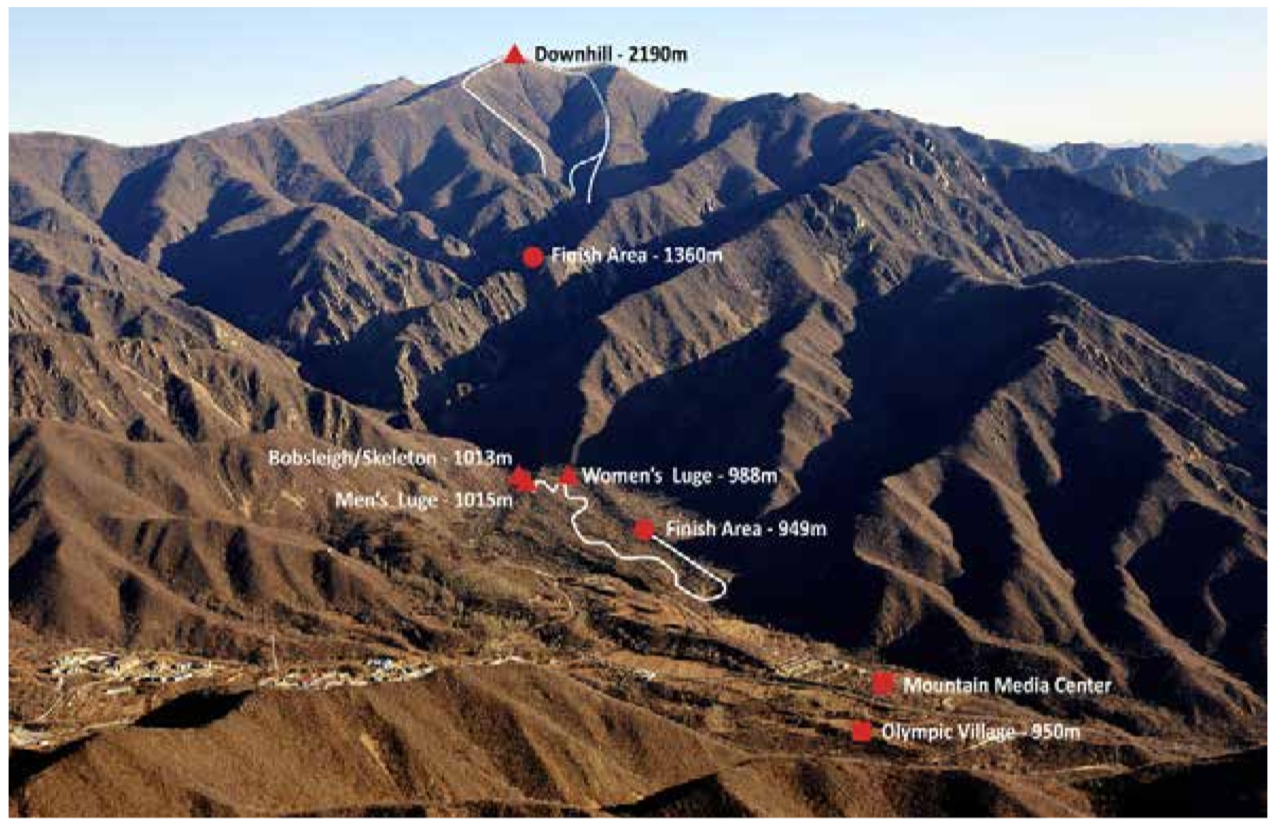
Distances Between Clusters: The Beijing bid will feature three clusters for sports: arena ice sports will be held in Beijing; nordic sports, freestyle skiing, and snowboarding in Zhangjiakou; and alpine skiing and sliding sports in Yanqing.
The bid committee promoted this three-zone idea as a benefit to athletes, who will not have to travel far to reach their venues or deal with the more general hubbub of a compact Olympic Games.
“To ensure the athlete experience, I know from my experience as an athlete that the most important thing is the performance in the Olympics,” said Yang Yang, a gold medalist in short-track speedskating and now an IOC member. “So to minimize the travel times would bring much benefit to the athletes. Having three zones will help the athletes with short distance to travel from the venues to the villages. It will be about 15 minutes, which is a very good benefit to the athletes.”
Aside from athletes, travel times for spectators could be quite long. The bid committee has proposed building a high-speed train system which it says would cut the time needed to travel roughly 200 k from Beijing to Zhangjiakou to 50 minutes.
There’s several problems with this. First of all, the bid committee left the expenses associated with building the network off the books, claiming that it would have built the railway anyway. That’s false, and cut the bid’s budget down to better compete against Almaty. Officials still refuse to reveal the actual cost of the railway.
Secondly, only when pushed did officials admit that actually, it would take longer than 50 minutes to travel between the venues. They admitted that 10 minutes should be added for waiting times to board the trains.
IOC members pointed out that that’s not all; after all, they have to get from hotels to the train stations, and then from the stations to the venues. Members complained that it would likely take them 90 minutes.
And for regular spectators who don’t receive the special treatment of IOC members, it’s likely to be a lot longer. This, along with the lack of a snow sports culture in China, contributes to the strong possibility to sports in the mountains facing empty stadiums. That doesn’t exactly make for the best athlete experience.
Already in 2014 in Sochi, Russia – a country where cross-country skiing and biathlon are successful and popular – seats were empty in the stadiums. This was likely due in part to the sale of multi-sport ticket bundles. A non-ski fan might go check out a sport they had a ticket to if it’s close; if it takes hours of travel each way, they might decide to stay in Beijing.
Lastly, with well-documented catastrophic train disasters and high levels of corruption hindering safety measures in China’s railway construction (you can find an incredible piece from the New Yorkerhere), does anyone really want to be on a high-speed train system where a crash, or even just a decrease in speed, by a train that departed just five minutes earlier could lead to a pile-up?
Human Rights
One of the biggest problems will provide nothing more than a repeat show from the 2008 Olympics. When Beijing won the bid for the 2008 Games, China boldly proclaimed that this was an opportunity for the country to improve their human rights record before they showed off to the world.
That certainly did not happen.
Hundreds of thousands of residents were evicted in the leadup to the 2008 summer Games in order to build new stadiums and infrastructure. The 2022 Games will use some of that infrastructure, so evictions should not be as numerous. But the Evaluation Commission report still estimates that thousands of people will have to be relocated.
And relocation is not something that China handles well. Houses were demolished and when residents tried to protest their evictions or appeal through the legal process, they were arrested, jailed, and sometimes beaten. Citizens have no choice in the matter, and are not provided the means necessary to re-make their life somewhere else.
“Compensation rates have rarely enabled affected people to relocate while retaining the same standard of living,” the Geneva-based charity Centre on Housing Rights and Evictions noted in a 2008 report. “Instead, residents have been forced to move further from sources of employment, community networks, and decent schools and health care facilities.”
Journalists who covered these issues did not fare well, with dozens of members of the media detained in the leadup to Beijing 2008. The Foreign Correspondents Club of China reported that 40% of foreign journalists covering the 2008 Games had experienced some sort of governmental interference, and that since then, conditions for foreign journalists have declined substantially.
Even while reporting on the bid for the 2022 Games there have been incidents. When two foreign journalists tried to visit the site of the mountain cluster and interview locals, government “minders” scared people away from speaking to them and inhibited them from visiting parts of the sites.
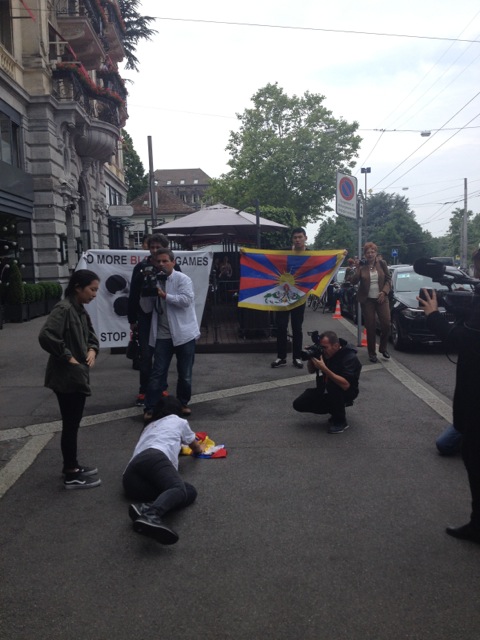
Protestors shouting “Beijing Lies, Tibet Dies” and “No More Bloody Games” appeared outside the hotel hosting the candidate city presentations. Later, another activist snuck into the Beijing presentation room. After unfurling a banner and chanting, he was forcibly removed.
Those outside the media fared much worse. Before the 2008 Games, citizens who spoke to foreign media were sometimes beaten by police in retaliation. According to Human Rights Watch, Chinese who spoke out on a variety of issues, from human rights to the environment or corruption, were often arrested. In some cases activists were kept in prison for longer than the actual term they were sentenced to.
Then there’s the athletes. According to The Guardian, China forbid athletes with any history of dissidence or activism from participating in the 2008 Olympic or Paralympic Games. For instance, Fang Zheng, whose legs were crushed by a tank in Tiananmen Square in the 1989 massacre, was not allowed to compete despite having two national records in the discus.
There’s many other human rights issues in the country. Tibetan activists, for instance, infiltrated the candidate city presentation room in Lausanne last week to stage a protest of China’s occupation of the region. Before 2008, the Olympics were seen as providing a platform for Tibetans to speak out about their oppression. But nothing changed for the better.
If the 2022 bid is successful, that means seven more years of Free Tibet protests. That’s seven more years of the world being reminded that the IOC has chosen to host the largest, most lucrative sporting event in the world in a country that does not support the basic tenets of the Olympic movement.
“The goal of Olympism is to place sport at the service of the harmonious development of humankind, with a view to promoting a peaceful society concerned with the preservation of human dignity,” the second point of the Olympic Charter reads.
Legacy: One of the main points of the Beijing bid is that should they win, they will bring winter sports to “hundreds of millions” of people and provide a lasting legacy. This is how the bid committee appeals to IOC President Thomas Bach’s “Olympic Agenda 2020” plan.
Frankly, this seems unlikely. Even in countries which already have a strong winter sports culture, building new venues in places which are only moderately accessible to the general population has rarely been successful in building lasting legacies.
Let’s look back at Sochi, 2014. The snow and sliding sports venues will certainly never be used again for World Cup competition, and it’s not clear that they are seeing significant use from Russian athletes either. $51 billion were spent to build this Olympics and the mountain cluster is eerily empty. Resorts were operating at losses and renting luxury rooms for as little as $17 per night.
What about Vancouver, four years earlier? Canada has strong nordic, alpine, and freestyle ski programs. But the cross-country and biathlon teams no longer base training groups in the Callaghan Valley, a venue which sees little traffic. Canadian ski jumping and nordic combined struggle to even remain funded. Whistler Sport Legacies has more costs than profits, although some venues, such as the luge and bobsled runs, see a lot of use.
British Columbia and the Canadian Rockies have plenty of alpine skiing opportunities, which is perhaps the reason that the Whistler Creekside venue, which hosted alpine racing for the Olympics, has not seen any FIS-level competition since 2010. Lake Louise, Alberta, beckons instead.
Pragelato, the site of nordic racing at the 2006 Torino Games, has not hosted a FIS-sanctioned cross-country ski race since the World University Games 2007. The luge track has been dismantled for economic reasons, but the hockey and speedskating arenas have hosted other sports events as well as plenty of concerts.
Sestriere, where the alpine racing was held, is still a popular venue for Europeans, but hasn’t hosted a World Cup since 2009. And unlike most other snow sports venues used in 2006-2014, Sestriere was already a high-profile destination for both tourists and elite racers; the Olympics likely did not significantly affect its future.
So even in countries where there are plenty of winter athletes, developing new venues for the Olympics hasn’t contributed much to sports programs. Reaching fans is a different story, but there’s still not much evidence that hosting an Olympics seriously shifts the support for winter sports within a country long-term, aside from a brief flush of enthusiasm surrounding the Games itself.
And considering the high water cost of running the snow sports venues, it’s not clear that they would even be maintained in the long run, especially as climate change progresses.
The bottom line, and the Almaty comparison. Almaty faces some of the same issues that Beijing does.
Air quality is not great in the city, although it is of course nowhere near as bad as Beijing. Kazakhstan is not a model for human rights, and there is expected to be significant corruption should Almaty win the lucrative bid.
But on many points, Almaty comes out clearly ahead. For instance, many stadiums are already built and being used by both Kazakh athletes and to host international competitions like the 2011 Asian Winter Games or the upcoming 2017 World University Games. Almaty has snow, and it has winter athletes; it’s much more likely that the Games would have a lasting legacy improving sports opportunities for residents.
It is also a compact Games, with everything close together, and a relatively cheap one.
What Almaty lacks is the slick, powerful, marketing machine that Beijing has already put into place. Should Beijing win, it will be a clear message that money, financial stability, and glossy PR lines matter more to IOC members than the actual tenets of the Olympic charter.
Switzerland’s Philip Furrer on his way to winning the FIS Summer Ski Sprint on June 20 in Yakeshi, Inner Mongolia, China. (Photo: NordicWays.com)
Earlier this month, Philip Furrer wasn’t sure what his summer held. Sure, the Swiss cross-country ski racer knew he’d be training and spending three weeks with military recruits for Switzerland’s army requirement. At least he was a sports instructor for the mandatory period.
Otherwise, work was winding down. Throughout spring, the 28-year-old from Andermatt, Switzerland, taught primary students in grades 1-6. When he wasn’t racing or traveling across the globe, Furrer, who started in four World Cups in 2010/2011, was also a gym teacher.
Come June, he was ready to start training in earnest. Just over three weeks ago, he heard from the Swedish race organizers, Nordic Ways. They wanted to pay his way to the FIS Cross-Country Summer Ski Sprint in northern China on June 20. Furrer jumped at the opportunity, and two weeks later, he took two flights and a three-hour bus ride to the autonomous region of Yakeshi in Inner Mongolia.
Last Wednesday, the Swiss teacher won the freestyle sprint ahead of nearly 40 others, including Chinese runner-up Sun Qinghai and Sweden’s Johan Eriksson in third. Furrer spent the rest of the week in Beijing, returning home three days ago, and he talked to FasterSkier on Wednesday about his experiences.
Furrer (second from left) on the podium after winning the FIS Summer Ski Sprint June 20 in China on June 20, ahead of China’s Sun Qinghai in second and Sweden’s Johan Eriksson in third. (Photo: NordicWays.com)
FasterSkier: How did you get to northern China, and where else did you travel?
Philip Furrer: I traveled from Zürich to Beijing and from Beijing to Inner Mongolia to Yakeshi. We had the first day off, and then we had this sprint race last Wednesday. The day after we traveled to Beijing and there we had some days just for being tourists. It was a quite nice experience.
FS:Had you been to China before? How was Yakeshi?
PF: I had been to China before. I hadn’t been to Yakeshi. I had to been to this Summer Ski Sprint tour [in other places] a few times.
Inner Mongolia was quite special. It wasn’t like I expected. … It was really nice, small hills and very green, forests, and they had reindeer, moose. It was more like Europe or Scandinavia than other places I’ve been [in China]. It was a very small place [and] the hotel was like a 20-minute drive to the racing arena. I think in wintertime they have an alpine place there.
FS: How was the course and race organization?
PF: They had the snow [stockpiled] from last winter and the track was around 400 meters up and then you had to come back, so about 1600 meters total, and you had to do two laps. It was really nice because there were around 20, 30 skiers from Europe and then those from China. They had plans to do this sprint for quite [a while], but then they weren’t sure if they could arrange it. Then, like, two weeks before the sprint they decided, yes, we can do it. They had to [invite] people quite fast. Usually you know a long time before, but it was two weeks before. I didn’t have anything else that was so important at the moment (laughs). I had worked as a teacher until one week before so I was free. I decided to go and it was a good decision.
I went by myself, but they organized everything. Everything was paid and organized by a Swedish company called [Nordic Ways]. They are pioneers in Chinese cross-country skiing. They started the Chinese Vasaloppet and they have many different sport arrangements. In summer, they have a 30 k running race in Changchun just a week before the sprint race so some of the skiers were also there, but I couldn’t go because I was still working.
FS:Why do you think the race came together so late?
PF: It wasn’t because of the snow. I mean, with the government and everything, it has to be cleared and OK and they knew in quite a short time. But now, they’re already planning to do this kind of sprint in summer and I think they are trying to have at least two sprint races at different places in China. One will be in Yakeshi and one with be in another place where I haven’t been before. They are always looking for people from other countries so I’m sure if there are some good skiers from North America that would like to go, they could get there next year.
Furrer celebrates a SuperTour skate sprint victory on Feb. 19 in Madison, Wis.
FS:What did you think about the event itself?
PF: It was a really good experience. Everything that is organized in China, they are always trying to show them from the best side. I think the sprint was shown [on television] for 30 million people. For us in Europe, it’s difficult to understand. It’s so many people because in Switzerland we have [population of] seven million or something.
FS:Wow, that’s a lot of people watching cross-country skiing.
PF: It was on CTV-5, one of the biggest Chinese television [networks]. When we were back in Beijing, they had written [about it in the] Hong Kong [newspaper], in China Daily, Shanghai Daily, everywhere. It was not a big thing, but a small thing about the sprint. That was quite fun when two days later we were back in Beijing and we saw in the lobby on the television, ‘Oh, look! There’s the sprint race.’ It was great. Of course, it was nice to see this different part of China. I mean Inner Mongolia isn’t the place you normally go as tourists.
FS:How did you feel about your performance?
PF: I was really surprised how well it went because my sprint has not been the best. I have not had such an easy time. My father is at home with cancer and … I’ve had quite a hard time focusing on skiing. That’s why I was really surprised with how well it went and how good the feeling was. Here at home when I’ve been training, the feeling hasn’t been that good.
I was happy that the skiers that were second and third were quite good. Like [Sun Qinghai] has been at the Vancouver Olympics, [where he placed 21st in the classic sprint]. And [Johan Eriksson], who was third, was the Swedish champion this year in the sprint relay, and he has won different Swedish Cup races. It’s good to see that you can match with good people and the feeling was good that it was.
FS:How’s you dad doing?
PF: It looks better than it has been. Now I think this will work out, and I have a good feeling with him. But that’s life. I say skiing is really nice as long as everything goes well. In top sports, you feel immediately if something is going wrong or you have those kind of problems, you can’t be at your top. So I appreciate it even more when it works well. I think often people who are in the top sports forget about how lucky they are that they can do it. Most are healthy people and having a good life.
FS:How did you get involved in teaching?
PF: I was educated in Switzerland before I went to Norway to study sports science. It’s quite a good job to have if you’re a skier and in spring you have time for working. It’s fun to have something else also, and I think it’s very important to have something else than just the skiing. I mean, I have to make some money somehow and this teaching job is a really good thing.
Usually I don’t work in wintertime. Mostly I try to work in spring. … Sometimes they call me and say, ‘Hey do you have time? If somebody [doesn’t] come to work, can you take two or three weeks?’ If I don’t have any training camps or races at the time I can say yes, but in wintertime it’s difficult.
Furrer (l) in a head-to-head quarterfinal with his Finnish friend Jari Joutsen at the Birkie Sprints on Feb. 23 in Hayward, Wis. Joutsen won the heat, but lost to Tim Reynolds of Craftsbury in the semifinal.
FS:What’s your schedule like this summer?
PF: Now I will really focus on training. Autumn on, I will again spend my time in Norway [and] also study something on the side, but not 100 percent, so I can still focus on my skiing.
I finished my work for now, but I have to go to army. In Switzerland, the way it works is every year you have to go three weeks as a refreshment of your military service. I’m a sports instructor in the military so it’s no problem for training. [At] the training camp, I have to do some lessons with the recruits. Otherwise I can focus on my training. From August on, I will be back in Norway and I will train mostly there.
FS:Are you training with a specific club?
PF: The club I ski for in Norway is Henning Skilag. I mostly train with this club; we have many training camps and quite good people so I have most to do with [them]. But when I’m in Europe and middle Europe, I start for my Swiss club, Gotthard Andermatt, because it’s the place where I come from. It’s the main club I ski for.
FS:At the American Birkebeiner in February, you were the lone Swiss skier with a crew of Norwegians and Jari Joutsen of Finland. It seems like you have friends everywhere!
PF: [In Yakeshi], I stayed with an Italian guy in the hotel room. It was nice because at those races, there are always people from different countries, and you get to know people quite well when you travel together. Like when we were in America, there were eight, nine skiers from Europe, and we had a really great time there also.
This time [in China] it was, I’m not sure, but I guess around 30 Europeans. This is one part that’s always fun. You get in touch with different people and if you speak their language, it’s even easier. In Switzerland, we have to learn all those: French, Italian, English, German, and then I speak Swedish and Norwegian. My mother is from Finland, the Swedish-speaking part, so you get even to know people better when you speak their language.