
From the FasterSkier archive — posts syndicated from athletes’ and coaches’ own blogs between 2004 and 2012, kept online as published. Current coverage is at fasterskier.com.

Tag: Chirs Grover

  • U.S. Ski Team ‘Man Camp’ a Success on Eagle Glacier (Video and Photo Gallery)

    U.S. Ski Team ‘Man Camp’ a Success on Eagle Glacier (Video and Photo Gallery)

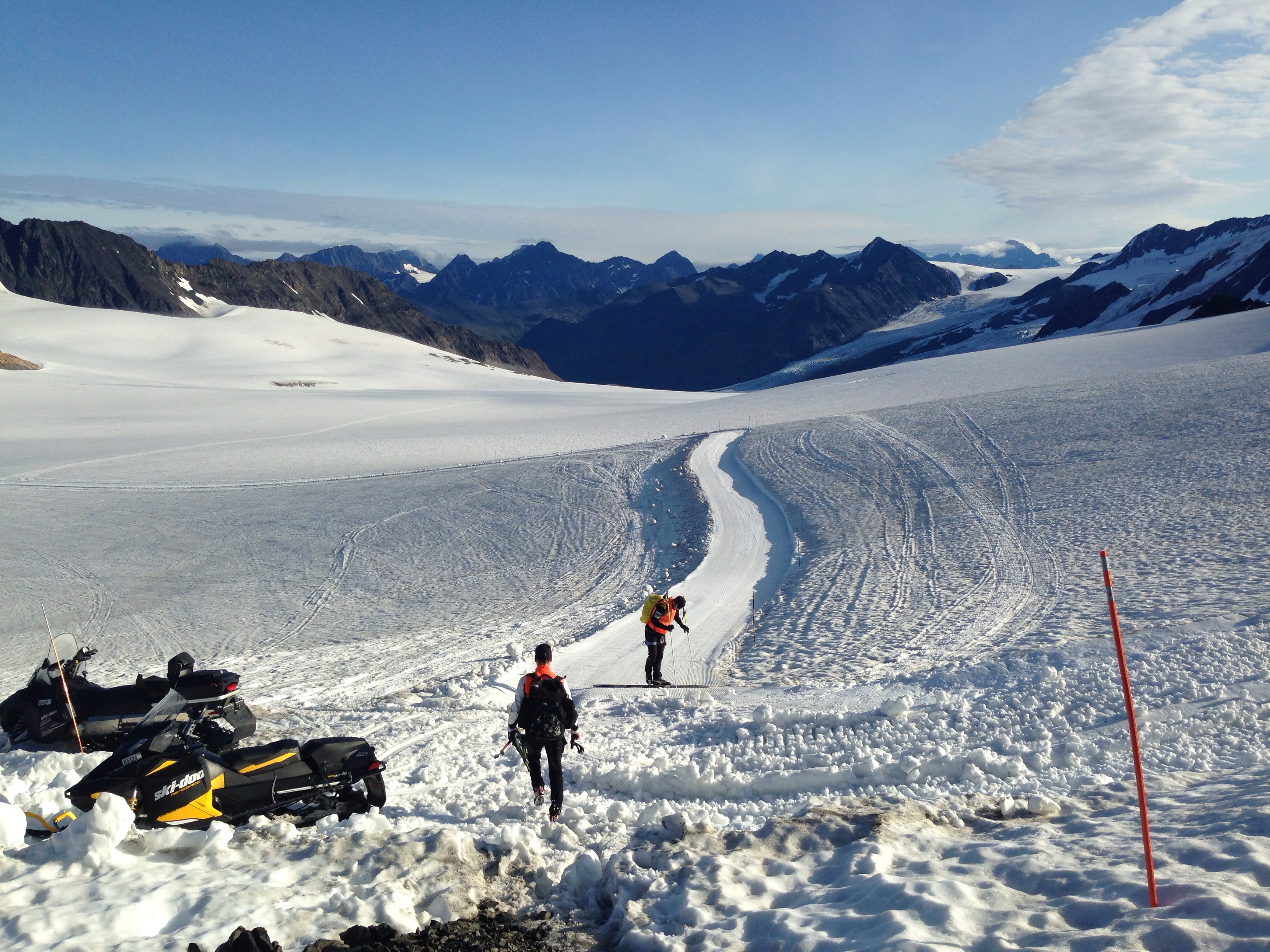
    Alaska's Eagle Glacier served as the location for second week of the 2014 'Man Camp.' The camp was a joint effort by the U.S. Ski Team and Alaska Pacific University to create a high volume, intense period of training both on-snow and off. (Photo: Andy Newell)
    Alaska’s Eagle Glacier served as the location for second week of the 2014 ‘Man Camp.’ The camp was a joint effort by the U.S. Ski Team and Alaska Pacific University to create a high volume, intense period of training both on-snow and off. (Photo: Andy Newell)

    Much has been said of the tight-knit dynamic of the U.S. Ski Team. Whether it’s the closeness of its members or the fun-filled atmosphere created by athletes and coaches, the Americans are often seen as the perfect example of a well functioning team.
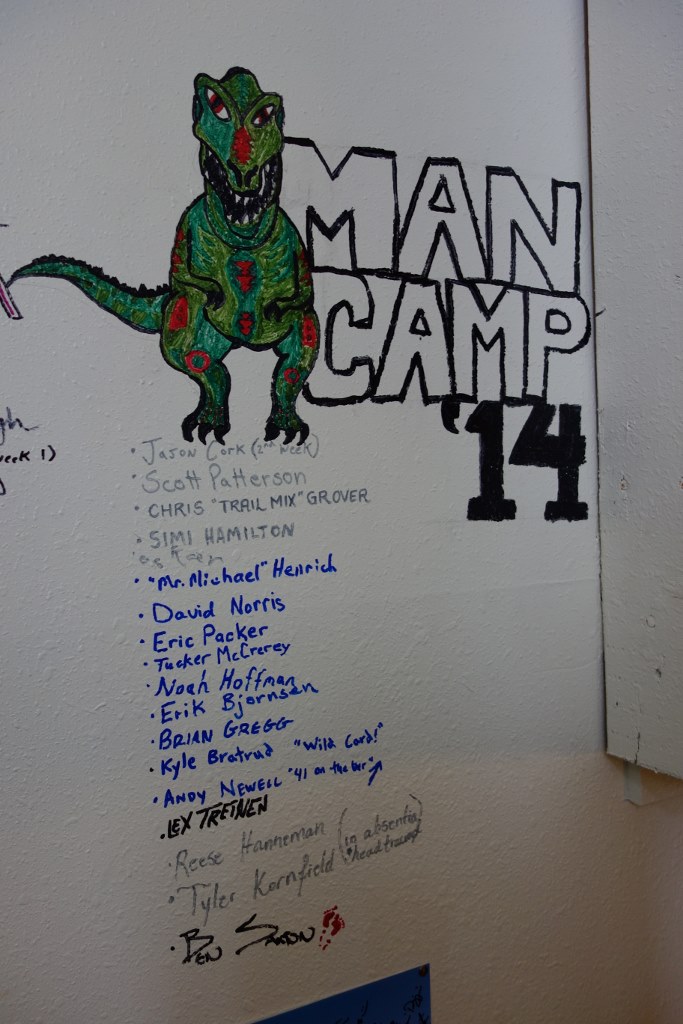
    The full list of attendees at the joint U.S. Ski Team and APU 2014 'Man Camp' held in Alaska this July. (Photo: Noah Hoffman)
    The full list of attendees at the joint U.S. Ski Team and APU 2014 ‘Man Camp’ held in Alaska this July. (Photo: Noah Hoffman)

    However, this recognition is more-often-than-not attributed to the women’s side of the team. Maybe it’s due to the small number of males on the actual U.S. Ski Team or their contained demeanors, but the U.S. men do not have the same reputation as their female counterparts.

    The recent camp on Alaska’s Eagle Glacier underscores how wrong appearances can be.

    The joint U.S. Ski Team and Alaska Pacific University on-snow camp was held on the glacier from July 21 to July 26 and included the five U.S. Ski Team Athletes: Noah Hoffman, Andy Newell, Simi Hamilton, Erik Bjornsen, and Ben Saxton. APU skiers Reese Hanneman, David Norris, Lex Treinen, Tyler Kornfied, Eric Packer, and Scott Patterson were also in attendance along with APU training partners Tucker McCrerey, Kyle Bratrud and Brian Gregg.

    The group of fourteen skiers, who make up some of the best athletes in the U.S., used their talents to not only improve each other’s skiing but also to create a more cohesive environment for male cross country skiers in America.

    “It’s not too often that we can get all the best male skiers in the country together for two weeks of training sessions so it was pretty unique and we took advantage of it by skiing a log of big hours but also pushing each other,” wrote Newell in an email to FasterSkier.

    He continued, saying it’s hard not to grow close when you are living with 18 guys under one small roof.

    Hanneman agreed, writing, “This camp was pretty unique in that it put the best American male skiers all together on snow together during the heart of the training year. That never happens.”

    By all accounts the camp went very smoothly and athletes were able to get in roughly 25 to 27 hours of training in during the six days they spent on the glacier.

    The week on Eagle Glacier marked the second week of the joint USST/APU men’s camp in Alaska. Previously the men had been training in Anchorage while the women were on the glacier.

    According to U.S. Ski Team Head Coach Chris Grover, on-snow camp was intended to be one of the year’s biggest training weeks for many athletes in attendance. In addition to the large volume of training, Grover said there were two other goals to the camp from his perspective.

    The first was maintaining on-snow technique, which is often easy to lose during several months of rollerskiing.

    “This is a critical camp in terms of adjusting technique mid-summer,” Grover wrote in an email. “We won’t be back on snow for a few months now so this was an important camp for touching base with good skiing,”

    Hoffman felt the camp helped him do just that. The on-snow training allowed him to shift technique changes he made on rollerskis this spring and summer to his actual skiing.

    The second goal of the camp was to hold several workouts in which the men could push each other to their limits. One such workout was a sprint simulation on a course modeled after the 2015 World Championship course in Falun, Sweden.

    For Hamilton the soft, warm conditions helped him work on weaknesses he experienced in last year’s World Cup season. In addition, he felt the group training aided him in his tactical skiing, whether it was for sprinting or distance.

    “We did a lot of group workouts – both distance skis and interval sessions – and to re-familiarize yourself with skiing fast in big, tight packs is always a great thing to do in the summer,” Hamilton wrote. “Whether it’s a sprint heat or mass start distance race on the World Cup, being comfortable with skiing in a tight pack of guys is a really important thing.”

    Overall the camp was a huge success for both the U.S. Ski Team and APU skiers. However, there was a small mishap that ended the camp early for one APU athlete.

    During one of the group sprint workouts, Hanneman tripped and suffered a concussion after slamming his head into the snow. The 2014 classic sprint national champion left the camp to ensure there hadn’t been any further damage, and while he was cleared to return to training Hanneman opted to not return to the glacier.

    See Hanneman’s fall in his Instagram post documenting the accident (story continues below):

    http://instagram.com/p/rAAl-uFf80/?modal=true

    While the camp was an opportunity to increase fitness and improve technique, it also served as a time for few laughs.

    According to several of the camp’s attendees, the comedic highlight of the camp was finding a vintage VHS tape filmed primarily by Kikkan Randall at the 2001 World Junior Championships in Poland.
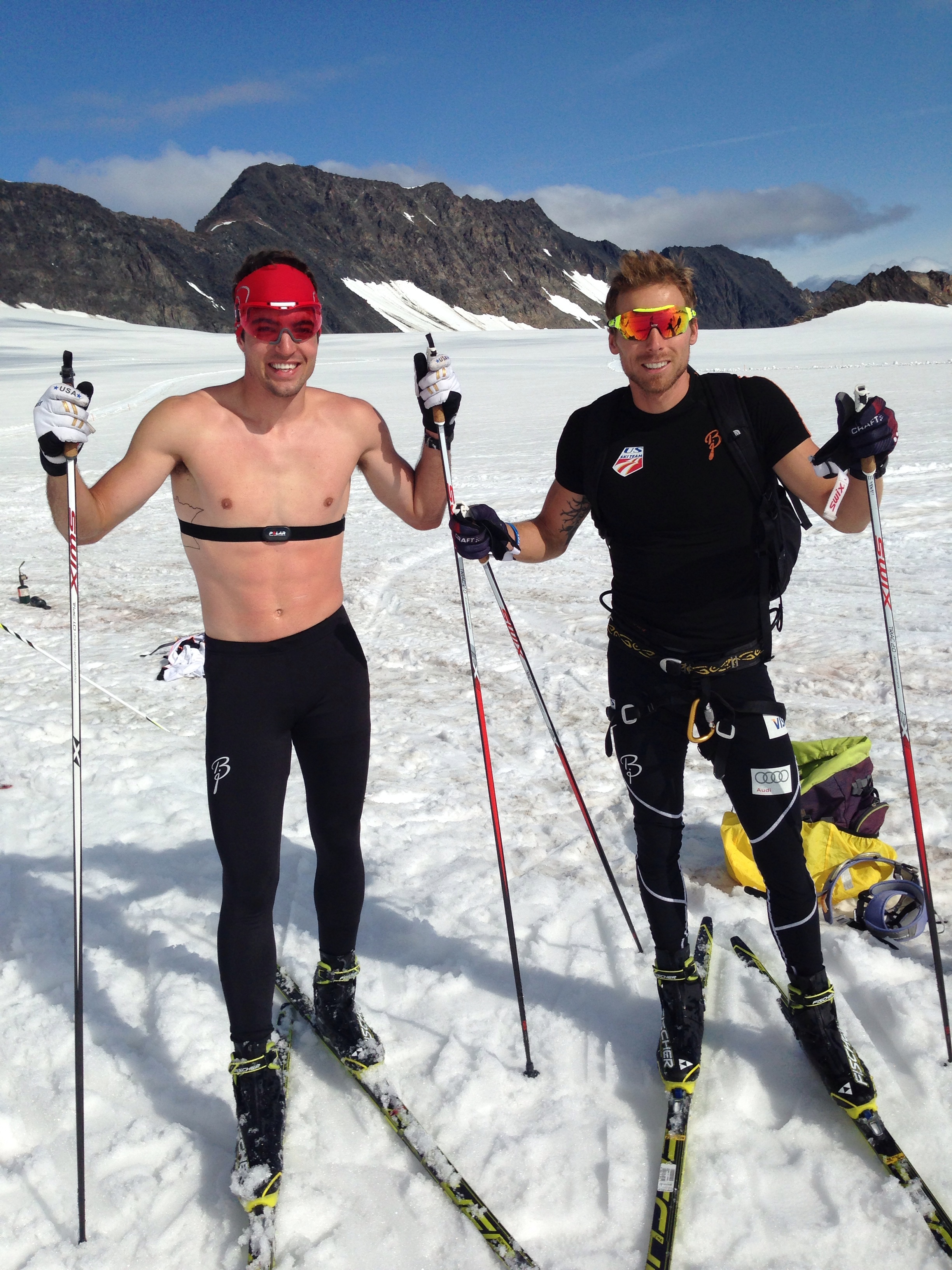
    Ben Saxton (l) and Andy Newell (r) pose on the Eagle Glacier. (Photo: Andy Newell)
    Ben Saxton (l) and Andy Newell (r) pose on the Eagle Glacier. (Photo: Andy Newell)

    “It was absolutely hilarious to witness what was regarded as ‘cool’ back then,” said Hamilton. “And of course seeing what people like Kikkan, Andy, Eric Strabel, and Colin Rodgers looked like 13 years ago gave us some pretty big laughs.”

    Apparently Randall also had a weakness for the Norwegian men’s team at the time.

    “We cracked up at Kikkan and her female teammates commenting on the looks of all the male athletes passing by in the race. Kikkan really liked the Norwegians,” Hofmann added.

    The camp is now over and its attendees have left feeling both tired and accomplished. Not only did they make several big steps forward to achieving their personal goals, they also demonstrated that the American men can be just as cohesive as the women; which can only mean good things for the future of the U.S. Ski Team.

    “Between my APU team-mates and the US Ski Team guys, I believe this is the group that, for the most part, is going to represent the US in international competition for the next few years,” said Hanneman.

    Check out video footage of the camp from Newell and a photo gallery of the camp from Newell and Hamilton below.


    Newell’s Eagle Glacier camp video, Alaska XC with Andy Newell:

  • Brooks Skis to Career-Best World Cup Finish as US Places 3 in top 30, Now 4th in Nations Cup

    Holly Brooks (USA) continued her meteoric rise from participant to contender on the World Cup circuit, skiing to 13th place in the 15km freestyle in Davos, Switzerland. With teammates Liz Stephen and Kikkan Randall placing 21st and 27th respectively, the US women finished the day with an unprecedented three skiers in the top-30.

    Brooks started quickly, clocking as the race leader at the two kilometer mark when she came through as the 31st starter. And while the strongest skiers were yet to come, the American did not slip much. She spent the next 10 kilometers mixing it up on the split sheet with some of the biggest names in skiing.

    At the halfway mark, Brooks was in 7th place, less than five seconds behind none other than Justyna Kowalczyk (POL).

    “Today was an awesome day, definitely a World Cup best for me!” Brooks wrote in an email to FasterSkier.

    “I didn’t know I was going that fast,” she told FasterSkier reporter Kieran Jones immediately following the race.

    “You never know the tactics that these other girls are taking,” Brooks said when asked about the splits she was getting. “Maybe the better skiers are going out easy and are really going to pour it on the second lap. You never know.”

    As a relatively early starter, Brooks had to wait to see how her time would hold up, and then she did in fact know. She wouldn’t crack the top-10, but was just 5.3 seconds out.

    While many of the more experienced skiers, including Kowalczyk, were accelerating toward the finish, Brooks slowed somewhat in the last kilometers.

    Brooks was unconcerned, however, saying she “felt in control” throughout the race.

    She did not know what to expect racing the longer distance against a stacked World Cup field.

    “I know that I like long races in a domestic field but you never know how that’s going to translate to European competitors and courses,” Brooks said. “I think it’s safe to say that I like it.”

    She also pointed out that racing at altitude can be “misleading.”

    “You never really feel that good…the pace is much slower than racing at sea level and it’s mentally tough when you feel like you’re not moving very fast,” Brooks explained. “The best thing to do is focus on technique, and keep grinding away.”

    Brooks’ previous best World Cup result came two weeks ago in Kuusamo where she placed 17th in the 5km.

    While Brooks may have been the biggest story for the US, Liz Stephen quietly skied to 21st place. Stephen never was battling in the top-10 like Brooks, but she skied a strong consistent race, and continued her good start to the 2012 campaign.

    US Ski Team Head Coach Chris Grover told FasterSkier that the race “was not her best but wasn’t bad.”

    He pointed out that it is a good sign that “21st is only an ok day.”

    Stephen was 18th in the season-opening 10k in skate in Sjusjoen, Norway.

    “[It] wasn’t exactly what she was hoping for but not far off,” Grover said. “So that demonstrates that she’s made a step forward this year in her fitness.”

    The US women are now the fourth ranked team in the Nations Cup Standings, which represents total World Cup points of all skiers.

    Grover pointed out the women are ahead of traditional powerhouses like Russia, Germany and Italy.

    The major contributor to that ranking is Randall, who has skied well in all disciplines. Like Brooks, Randall started fast. At bib 49 she actually took over the lead at the two-kilometer mark, but faded off the pace.

    “My race went great for the first 3km,” Randall wrote to FasterSkier in an email. “I felt like I got into a really good rhythm early and was actually quite surprised to get the good splits because my start felt controlled. But midway up the climb on the first lap I felt the effort catch up with me a little bit and from there I kind of got stuck in a middle gear.”

    Randall said that she never felt like her race “unraveled,” but that she couldn’t reach the “next gear.”

    She was happy to crack the top-30, where she has been all season and excited about the consistent strength of the women’s squad.

    “We’re really feeling psyched about today,” Grover said. “We went in thinking we could have a good day, and any day we have four athletes in the top-30, almost five, is a really good day for us,” he continued, including the US men in his tabulation.

    “We’ve had many days here in Davos where we’ve had  one athlete in the top-30 between men and women.”

    Sadie Bjornsen, fresh off a podium finish in the team sprint last weekend, placed 53rd in the 66-woman field.

    While her result may have been a bit of downgrade form a week ago, Bjornsen was unconcerned.

    “Today was for the practice, experience, and training,” Bjornsen wrote in an email to FasterSkier. “I think the key to being successful in World Cup racing starts with learning to race everything. If it’s not your strength, at least you can get some great training from it during early season.”

    Bjornsen pointed to Randall as a perfect example of this.

    “She reminded me today that she had been second to last several times here in Davos,” Bjornsen said. “Practice equals perfect, so getting the experience I think is truly key!”

    With an impressive World Championships, and strong domestic results, Bjornsen earned a spot on the US Ski Team and an opportunity to start the season on the World Cup.

    She had never raced a 15km individual start, and had to go back three years for her last 15k skate.

    “I think today was a day that being a good skate climber was important. That is an area I can use some work in,” Bjornsen said. “I think I can hold it together for 5k, but now the goal for the next coming years is to learn to hold it together for 15k.”

    Bjornsen is also feeding off the positive energy of the women’s team.

    “It’s really a special thing on this team, because even though I finished today not very pumped with the result, the energy from the group allows you to forget it and prepare yourself for the following day,” Bjornsen said.

    She, along with Randall, Brooks and Ida Sargent will contest the freestyle sprint on Sunday.

    Women’s Race Report

    Complete Results

    Kieran Jones and Audrey Mangan contributed reporting.