From the FasterSkier archive — posts syndicated from athletes’ and coaches’ own blogs between 2004 and 2012, kept online as published. Current coverage is at fasterskier.com.
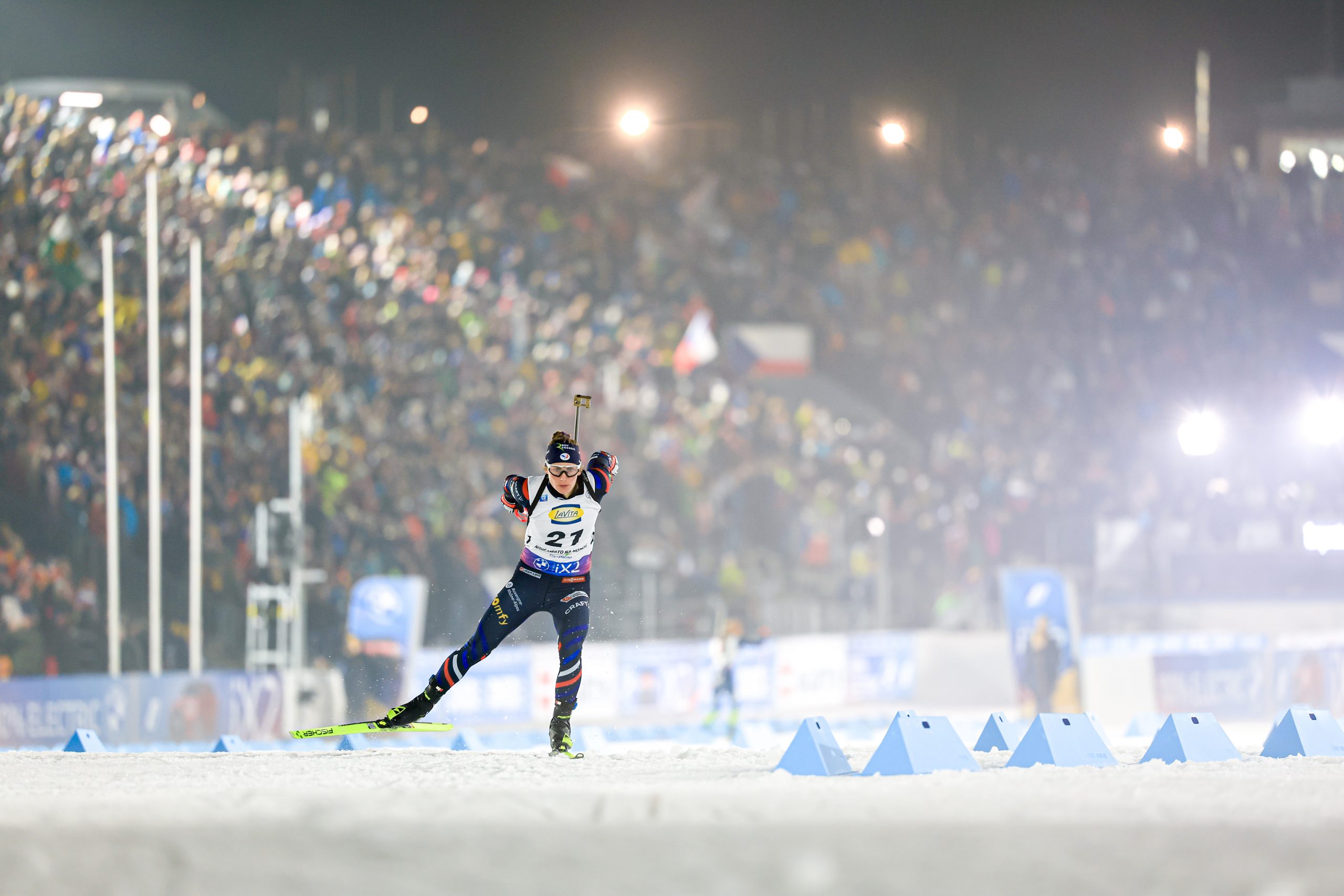
At the first biathlon World Cup races of the 2025/26 season, the biathlon stadium is perched above the small city of Östersund, which is set on a lake. Wind gusts off the lake, pulsing through the stadium. The races take place under the lights, at night – which isn’t saying much. Because in December in northern Sweden, ‘night’ begins at three in the afternoon, when what little sun there might’ve been throughout the day slips below the horizon. It’s in the evenings that the wind is usually at its strongest. The conditions the racers zero their rifles at before the race are rarely the same conditions they find when they come back to the range during the race. Athletes watch the small, red flags in the range, seeing which way they’re moving, deciding whether or not to shift their sights a few clicks, compensating for the changes that happened while the racers skied the course that serpentines up, down, around a 180-degree turn, and back into the stadium where the music plays and the home crowd cheers. Ayyy! As the Swedes hit their targets. A diluted Ney for each Swedish miss.
The mixed relay at the opening stop, Oestersund (SWE), of the 2025/26 IBU World Cup Biathlon season. (Photo: Manzoni/NordicFocus)
Over eight days, the best biathletes in the world raced 10 times. Maybe it was the arduous schedule, or the bit of sharpness that an Olympic year adds, but the Ostersund races didn’t feel like the first of the season. It felt like a break had never happened.
One question lingering from the off-season was answered quickly: What would Norwegian biathlon look like without the Boe Brothers? The dominant duo of Johannes Thingnes and Tarjei Boe – owners of eight Olympic medals – retired at the end of the 2024/25 season. Leaving what one would assume would be a major hole in the program. But when the Norwegian men came out and won the men’s 4 x 7.5km relay at Ostersund, the Norwegian’s roster depth became clear.
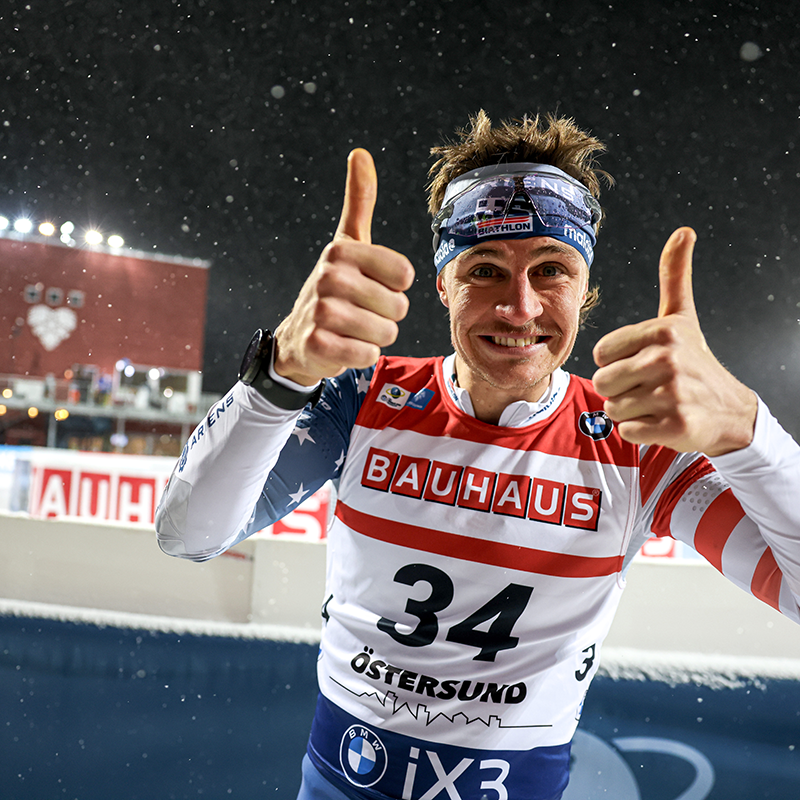
Campbell Wright (USA) during the IBU World Cup Biathlon Men’s Relay in Östersund (SWE). (Photo: Manzoni/NordicFocus)
The men’s relay saw a top result from the U.S. men, as well. Paul Schommer, Campbell Wright, Maxime Germain and Sean Doherty finished fifth, one of the best men’s relay finishes ever for Team USA. The next day, at the mixed relay, Germain, Wright, Chloe Levins and Deedra Irwin placed sixth – which is the best finish for a U.S. mixed relay since 2021.
Artem Tyshchenko (UKR) and Paul Schommer (USA), (l-r) during the Men’s Relay in Oestersund (SWE). (Photo: Manzoni/NordicFocus)
Germain and Wright continued to build on their early-week momentum, with Germain placing 11th in the sprint. In the pursuit, Wright hit all 20 targets for the first time in his career and moved up from 18th to 6th. Wright is coming off a stellar 2024/25 season, where he podiumed twice at World Championships, becoming the first American to do so.
Throughout the week, there were highs: Suvi Minkkinen of Finland won her first World Cup sprint. The Norwegian men placed four in the top five in the 20km individual, solidifying their capabilities as a team sans-Boes. And as always in biathlon, some lows: Eric Perrot of France missed his final shot in the pursuit, a devastating moment that cost him the lead. He finished fifth.
Racing wrapped up in Sweden, and teams flew to Austria. In Hochfilzen, a less rigorous racing schedule awaits: sprint, pursuit, and then a men’s and a women’s relay. A few more hours of daylight await, too.
FasterSkier’s Coverage of the Biathlon World Championships is made possible through the generous support of the Craftsbury Outdoor Center: New England’s finest snowmaking, world class race venues and touring trails, healthy food in abundance, comfortable accommodations at Craftsbury: Sports, Sustainability, Stewardship.
France swept places 1-4 in the Sprint at the 2024 Biathlon World Championships. (Photo: NordicFocus)
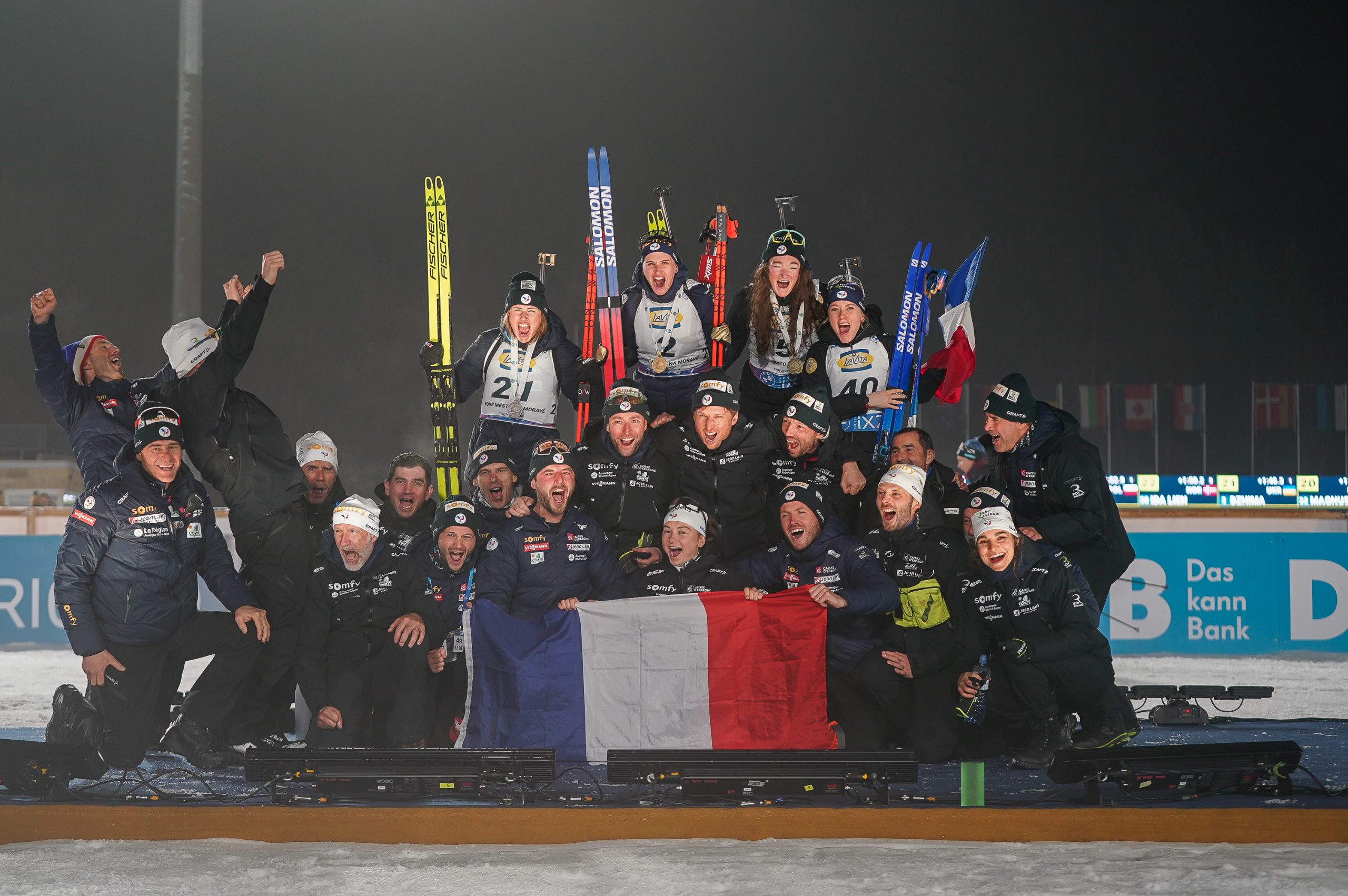
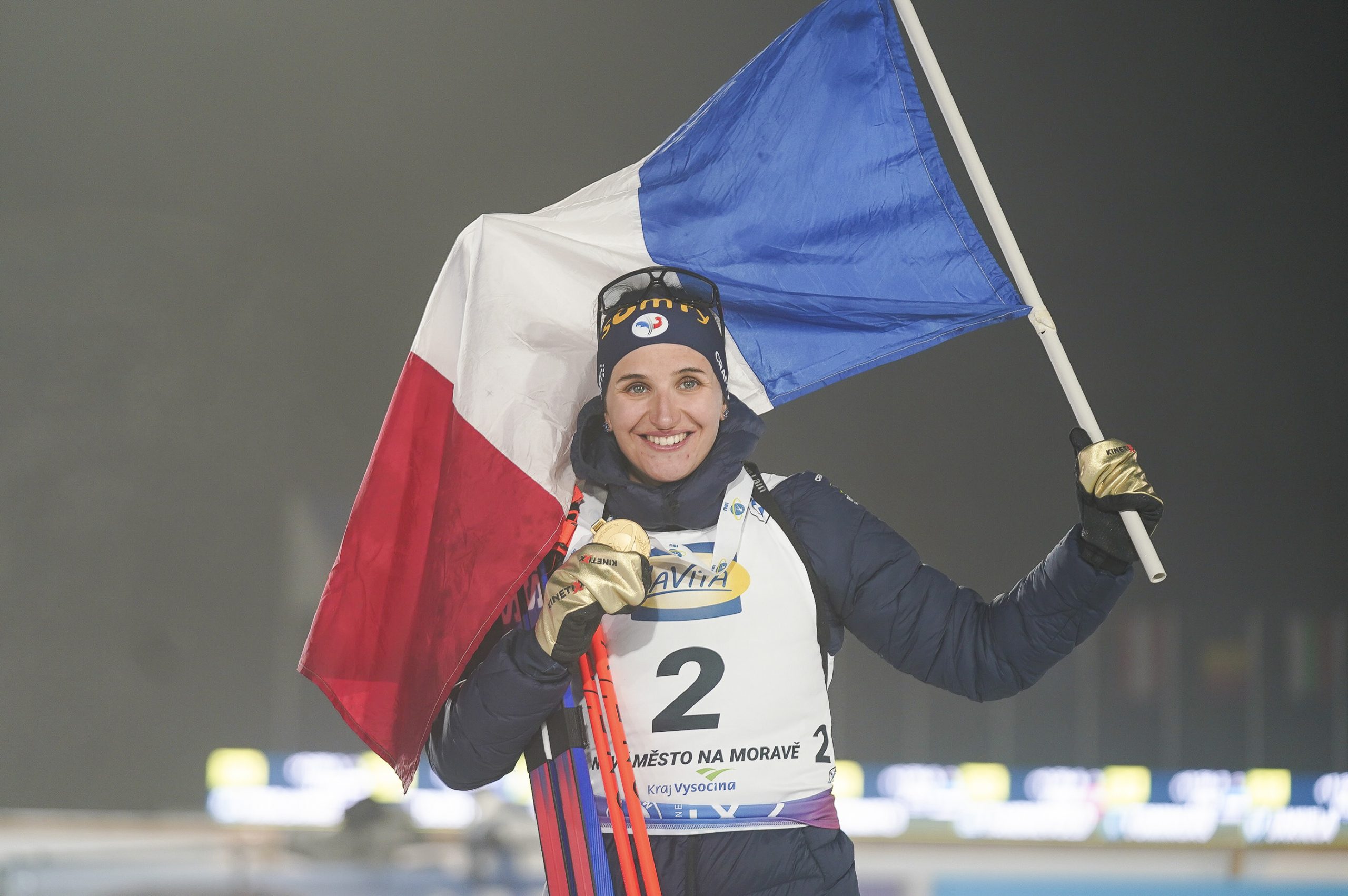
Ever since France upset Norway to win the opening Mixed Relay of the 2024 Biathlon World Championships, their magnificent esprit de corps has been on display. After that race, the entire team gathered around the podium and belted “La Marseillaise” in the rain as the French flag was raised in the Vysocina Arena in Nove Mesto na Morave, Czech Republic. That same winning energy pulsed through the French women’s team Friday as they delivered an historic sweep of the first four places—a feat not seen since the inaugural Women’s Biathlon World Championships in 1984 when the Soviet Union swept the 10 k Individual. (American Kari Swenson was fifth.) There were 35 finishers in that race. In Friday’s 7.5 k Sprint, The French quartet of Julia Simon, Justine Braisaz-Bouchet, Lou Jeanmonnot, and Sophie Chauveau bested a field of nearly 100.
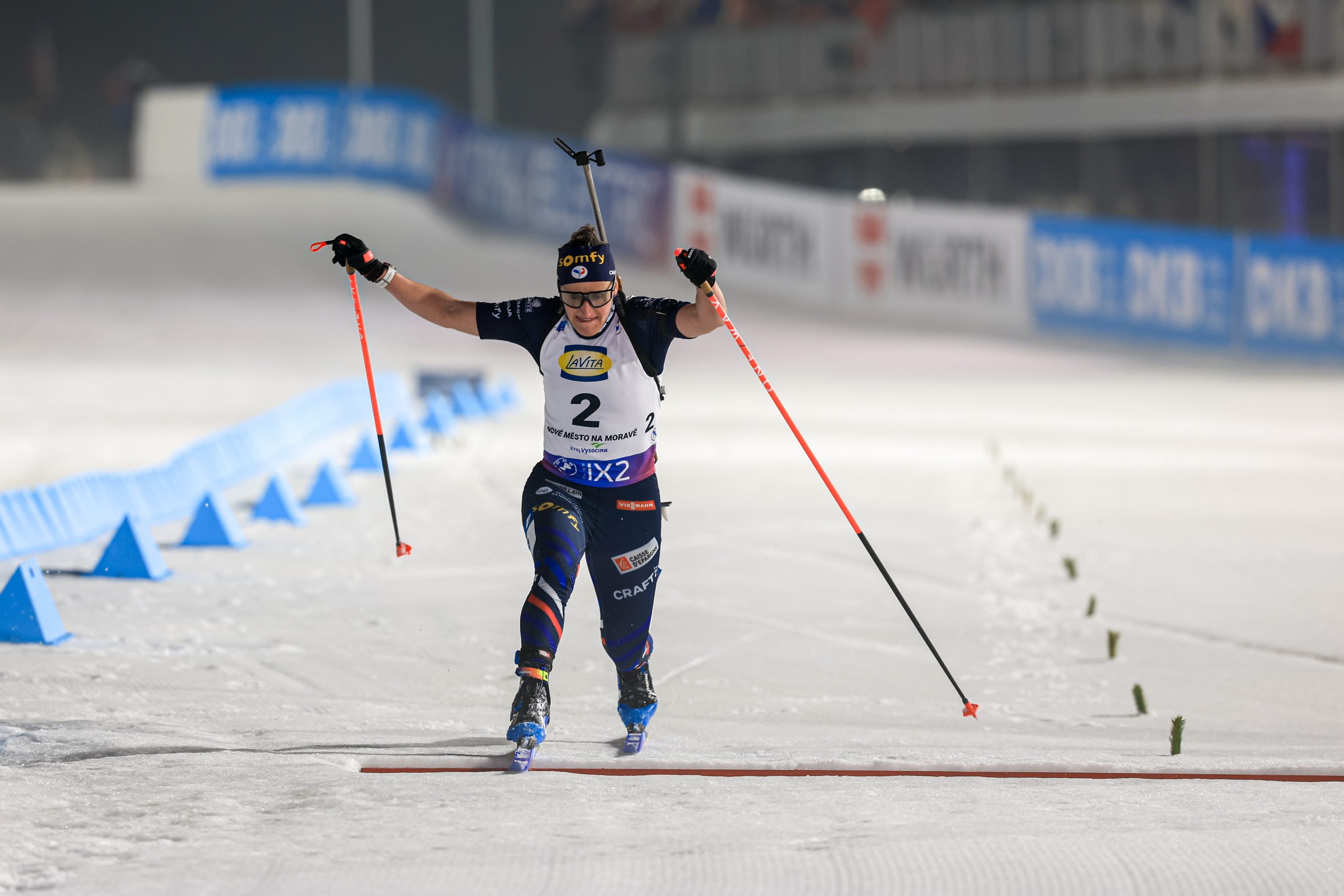
Early starter Julia Simon (FRA) crosses the finish line, setting the time to beat in the Women’s Sprint. (Photo: NordicFocus)
All eyes were on Simon, wearing bib 2, to set the time to beat for the day. After laying down a perfect anchor leg in Wednesday’s Mixed Relay, she picked up where she left off with another 10/10 performance, leaving little room for any challengers. Simon’s ski time ranked fourth and her total shooting time of 42 seconds for prone and standing was the fastest of the day. It was a dominant Sprint performance from the 2023 World Cup Overall champion, who is better known for her head-to-head racing.
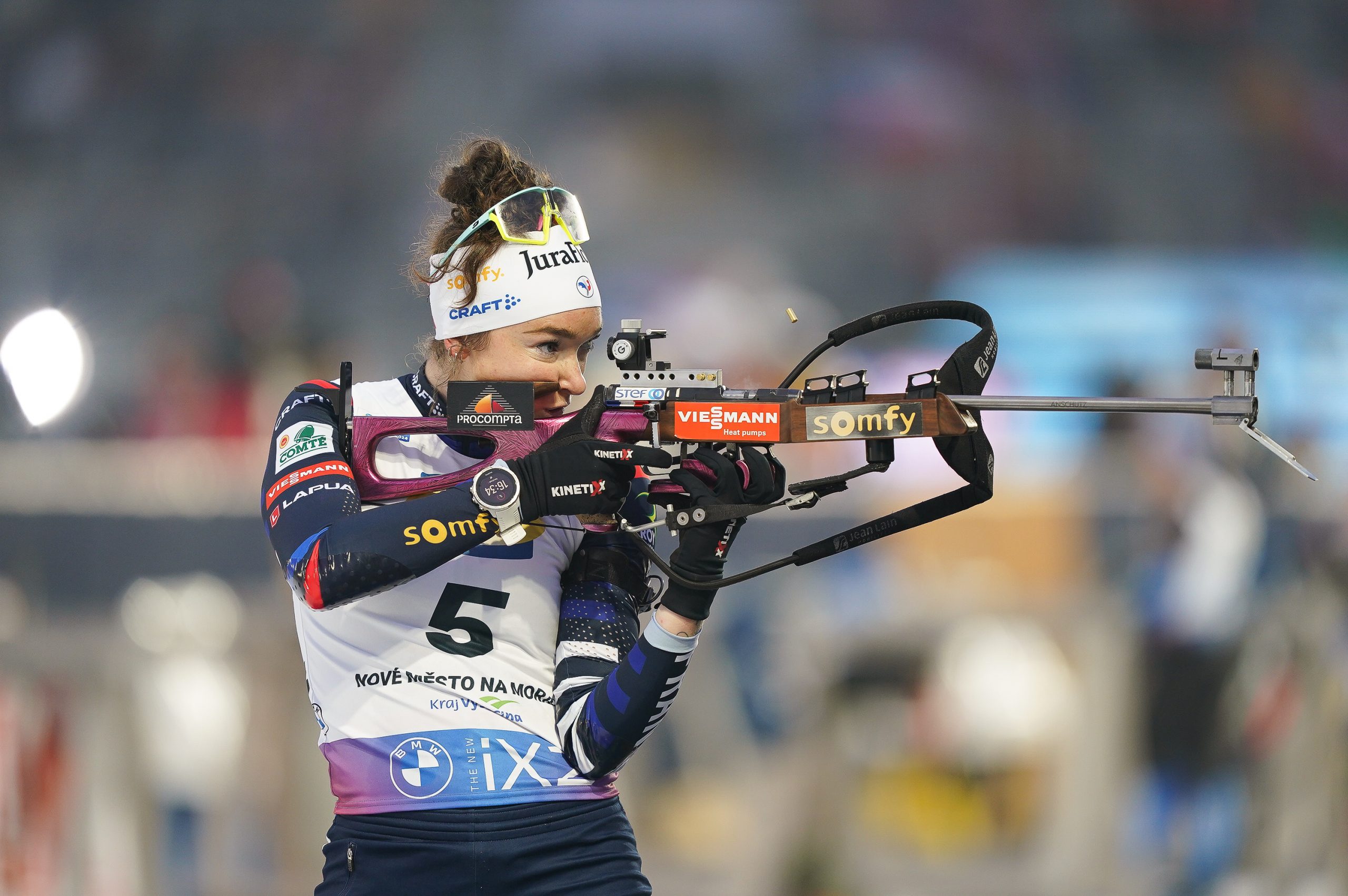
Lou Jeanmonnot (FRA) shot 9/10 to land on her first World Championships podium, taking home the bronze for France. (Photo: NordicFocus)
Another early starter, Jeanmonnot in bib 5 matched Simon’s speed on the course but lost some time to her on the range (like everyone else) and missed one target in standing, eventually finishing 40 seconds back. It seemed inevitable that other competitors would fill that gap, but as the race went on it became clear that the only athletes skiing fast enough to challenge the French women were their own teammates.
Justin Braisaz-Bouchet (FRA) outskied the field by nearly 30 seconds to take silver despite one miss. (Photo: NordicFocus)
Out-skiing the field by over 30 seconds in Wednesday’s Mixed Relay, Braisaz-Bouchet demonstrated that she is one of very few athletes who can ski a penalty loop and still fight for gold. That scenario nearly played out in Friday’s Sprint, as Braisaz-Bouchet gapped the field by 28 seconds, missed one in prone but then hit all of her standing targets, leaving the range with just a 13-second deficit to clean-shooting Simon. She closed the gap in the final kilometers but couldn’t quite catch Simon, crossing the line just 4.9 seconds behind.
World Cup Overall leader Ingrid Landmark Tandrevold (NOR) led the race after the first shooting but then fell to 25th after a disastrous three misses in standing. (Photo: NordicFocus)
The two Italian stars, Lisa Vittozzi and Dorothea Wierer, were early challengers for the podium, both showing their trademark poise on the range with 10/10 hits, but they didn’t have the ski speed to keep up with the French women and ended up seventh and tenth. Swedish sisters Hanna and Elvira Oeberg did the reverse; they skied well but both missed in standing and dropped to eighth and ninth.
The only other athlete who could challenge Simon for the gold was World Cup Overall leader Ingrid Landmark Tandrevold (NOR) in bib 26. She came through the prone shooting in the lead, 1.5 seconds ahead of Simon, but then suffered a disastrous standing bout, missing three targets and falling to 25th place—her worst result of the season.
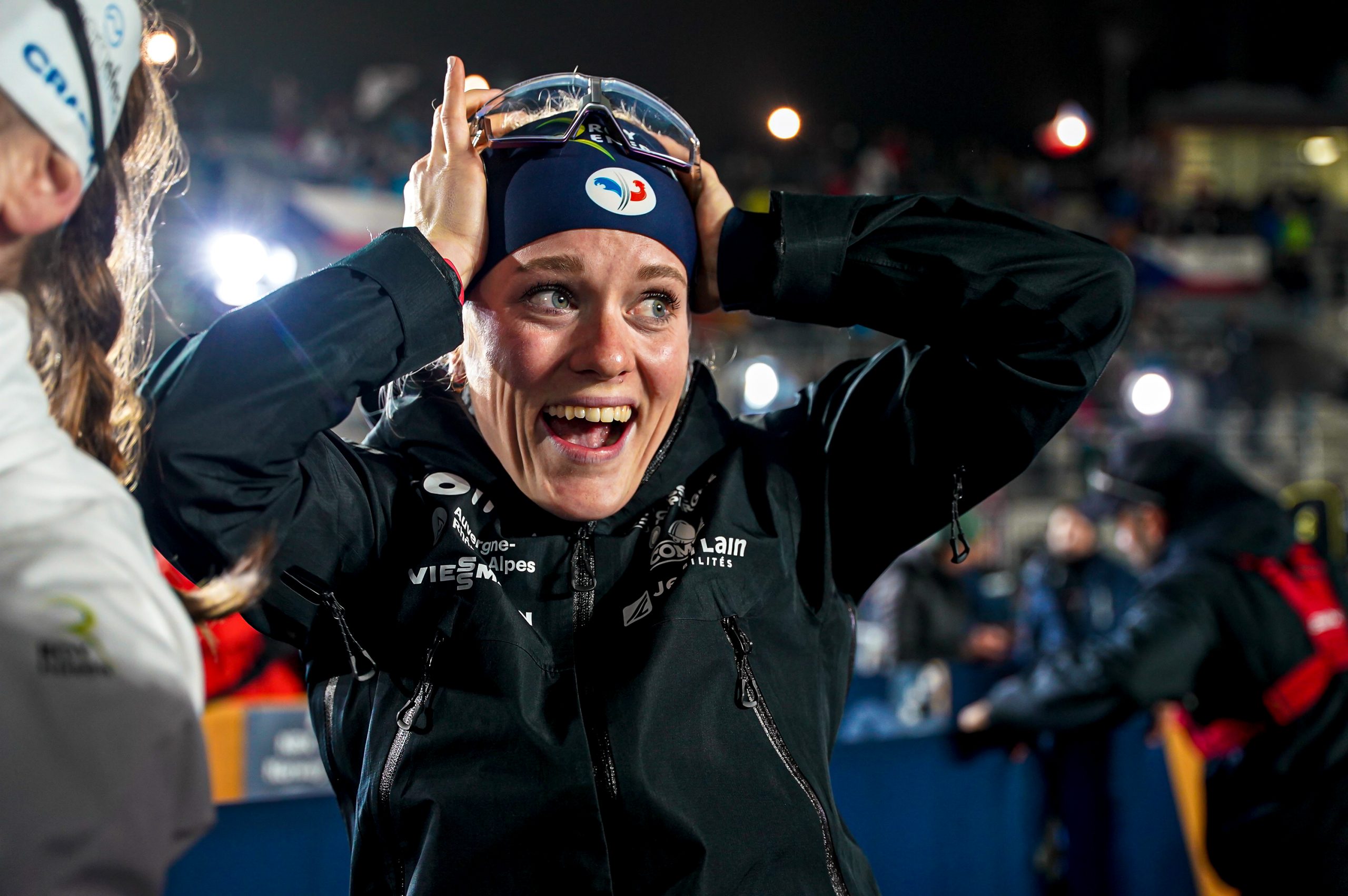
Sophie Chauveau (FRA) reacts to her team’s one-through-four sweep. (Photo: NordicFocus)
The podium positions seemed secure until Chauveau, wearing bib 40, nearly overtook Jeanmonnot. Chauveau found herself down in 30th after a miss in prone but then launched into podium contention with her clean standing shooting and third-ranked course time. In the finish she was a mere four seconds off the podium.
Simon’s gold is her first Sprint podium of the season and only her second-ever Sprint victory. Braisaz-Bouchet, who skipped last season to have her first child, had never finished better than 25th in a World Championships Sprint, despite taking part in every edition since 2015 and winning a list of World Cup races and an Olympic gold medal in Beijing along the way. Jeanmonnot’s bronze is her first World Championship medal, and Chauveau’s fourth place ties her second-best career finish. She earned her first World Cup medal, a bronze, in January of this year.
While the French women shot exceptionally well, they owe their sweep to their ski speed. Four of the top-five fastest skiers in the Sprint were French. The other was 2021 cross-country World Cup Overall Sprint champion, Anamarija Lampic of Slovenia, who missed five and finished 36th. Reflecting on the role that ski preparation played today, US Biathlon ski technician Federico Fontana said, “The dirt and the wet in Nove Mesto is always challenging. The French had incredible skis.”
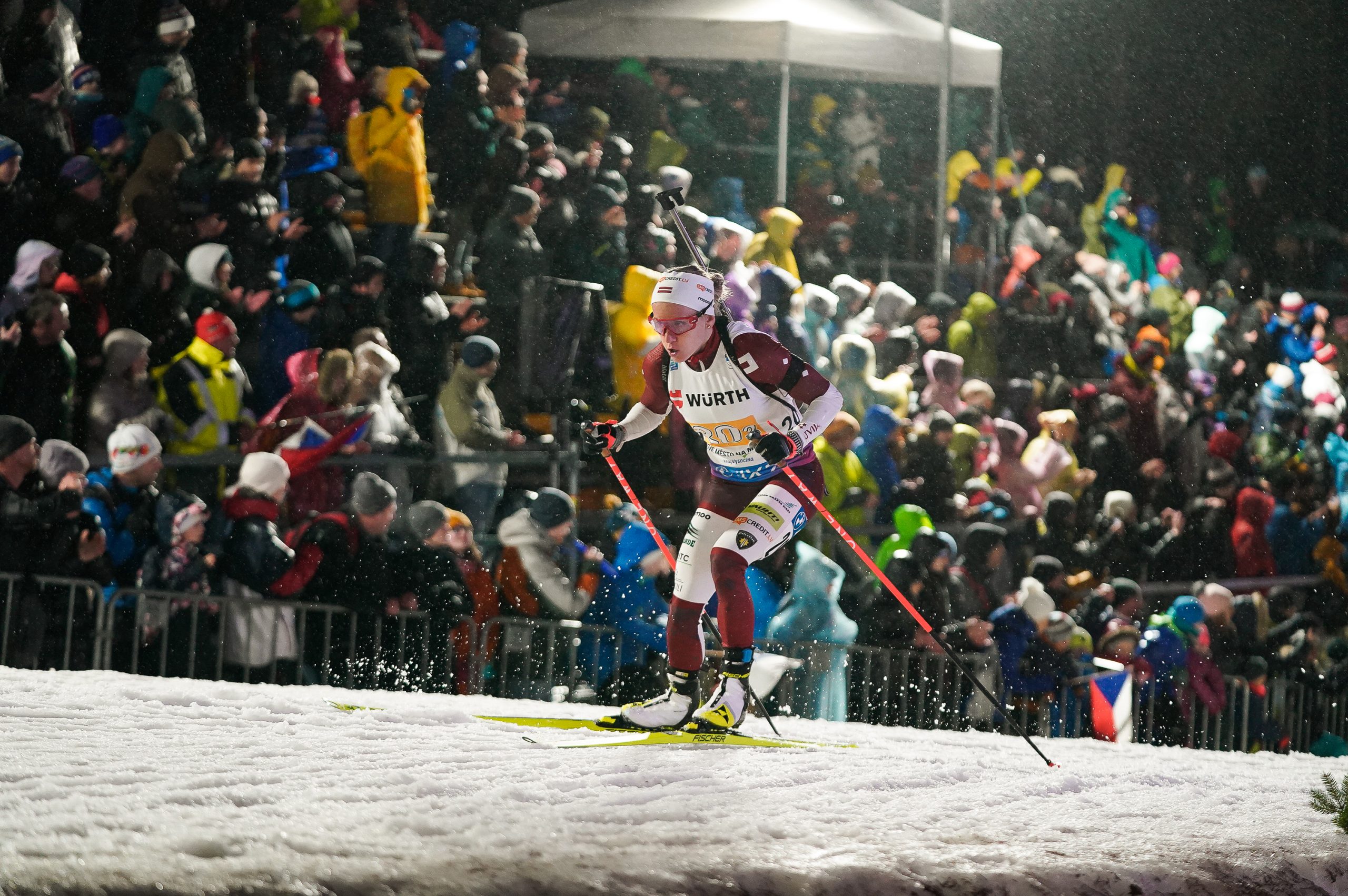
Baiba Bendika (LAT) skied the seventh-fastest course time and hit 9/10 to tie her career-best finish of fifth. (NordicFocus).
The surprise of the day was Latvia’s Baiba Bendika, who finished fifth to match her career-best result, having given birth to her first child in October—just four months ago. She had a chance to break up the French sweep but missed her last shot. Franziska Preuss of Germany completed the Flower Ceremony, also with one standing miss.
Irwin and Geraghty-Moats Qualify for Pursuit
Deedra Irwin was the top American in the Sprint, finishing 39th with one miss each in prone and standing. She wrote on her Instagram account, “It isn’t what I wanted but then I realized that it is my personal best World Champs Sprint finish!” Irwin has consistently been scoring World Cup points in the top 40 this season and has the potential to move up significantly in Sunday’s Pursuit. She’ll be joined in the Pursuit for the first time by teammate Tara Geraghty-Moats, who sneaked into the top-60 qualifiers with a new personal-best of 58th.
Tara Geraghty-Moats (USA) smiling in the finish line after setting a new personal-best of 58th to qualify for her first Pursuit. (Photo: NordicFocus)
Geraghty-Moats cited her start position as playing a role in her qualification. “I had good course conditions with the second-to-last starting bib. With the warm temperatures, I thought the course would degrade a lot by the time I raced but it didn’t.” She had the advantage of watching earlier athletes go through, and drawing on their energy. “It looked so epic. It made me super excited to go out there. With the results I’ve had this winter I didn’t think I would make the Pursuit so I just wanted to have a race where I executed my plan well.”
Jackie Garso (USA) racing in her first World Championships. (Photo: NordicFocus)
Chloe Levins and Jackie Garso completed the US roster in Friday’s race. Levins echoed Geraghty-Moats’ comments about the atmosphere in the stadium: “The energy under the lights in Nove Mesto was electrifying tonight.” Levins, who finished 80th with two misses, is coming off a training season that was interrupted by a number of health issues. “I’m nowhere near satisfied with my result, but continue to gain great experience and feel myself racing back into shape.” Garso, competing in her first World Championships, finished 87th with three misses. She, too, was shocked by the crowds: “It’s unbelievably loud! You can’t even hear yourself breathe.”
Denise Herrmann-Wick (GER) shooting from the standing position at the IBU World Championships Sprint in Oberhof, Germany. (Photo: NordicFocus)
Biathlon fans anticipated that the women’s 7.5km Sprint would be one of the most tightly-contested races of the BMW IBU World Championships, and it did not disappoint. In the end, only 2.2 seconds separated the new World Champion, Denise Herrmann-Wick of Germany, from the silver medalist, Hanna Oeberg of Sweden. Oeberg’s teammate, Linn Persson, finished third. These athletes will start at the front of Sunday’s 60-person Pursuit and try to stave off the chasers for another chance at a World Championship medal.
Hanna Oeberg (SWE) leaving the range in the lead of the IBU World Championships Sprint in Oberhof, Germany. (Photo: NordicFocus)
Fourteen women from seven nations have landed on the podium this winter. But among all those contenders, arguably no one had more pressure on them today than hometown favorite, Denise Herrmann-Wick. Ranked first in the World Cup Sprint standings, the 34-year-old revealed in Wednesday’s Mixed Relay that she has peaked perfectly for these races. Even with nine out ten hits, Herrmann-Wick is skiing fast enough that she could have a chance at a podium finish, but today she left nothing chance. Unfazed by tens of thousands of spectators cheering in unison after each shot, Herrmann-Wick steadily cleared ten out of ten targets. One word came to mind: impressive.
But the race wasn’t over. A few minutes later, Hanna Oeberg of Sweden managed the same perfect shooting, leaving the range for the final 2.5km loop with a nine second advantage over Herrmann-Wick. A hush of collective anxiety came over the full stadium of German fans. By the top of Oberhof’s signature Birxsteig climb, Oeberg’s advantage had dwindled to a near tie. It wasn’t until the final meters of the race, when Oeberg’s time ticked above Herrmann-Wick’s winning mark of 21:19.7, that the Thuringen Arena burst into cheers.
Denise Herrmann-Wick (GER) celebrates after winning the IBU World Championships Sprint in Oberhof, Germany. (Photo: NordicFocus)
The battle for gold was not limited to those two athletes. Wearing bib number two, Anamarija Lampic of Slovenia cleaned her prone targets, leaving the audience wondering if today might be the day for the former cross-country skier to break onto her first podium. But that kind of biathlon magic wasn’t to be; Lampic’s inexperience came through when she missed four targets in standing. With the 17th-ranked course time, she narrowly managed to qualify for Sunday’s Pursuit in 58th. It was Lampic’s teammate, Polona Klemencic, who stepped up and shined for Slovenia with the perfect shooting score to take her first career top-10 in 8th place.
Ingrid Tandrevold of Norway led the race after Shooting 1, showing once again that her ski speed and prone shooting skills are there. But the standing shooting slump which has been bothering her since January persisted and she missed two on her way to a 14th place finish. Lisa Vittozzi of Italy missed just one in standing but skied fast enough to briefly take the lead from Marketa Davidova of Czech Republic, who had hit 100% as she so often does in championship races.
The defending Olympic Champion in the Sprint, Marte Olsbu Roeiseland, was sitting way back in 26th after missing one in prone, but with a clean standing bout and the second-ranked course time, she pulled her way back to fourth, just five seconds shy of the bronze medal. She’ll be motivated for more in the Pursuit. The World Cup Overall leader, Julia Simon, was well on her way to a podium finish with eight hits before she missed the last two. Simon thrives in head-to-head races and will be a threat in the Pursuit even starting 1:02 back in 10th place.
Emma Lunder (CAN) following Marte Olsbu Roiseland (NOR) in the IBU World Championships Sprint in Oberhof, Germany, where they finished 11th and 4th, respectively. (Photo: NordicFocus).
Less than one second behind Simon, Emma Lunder of Canada posted her best-ever Championship result in 11th. After a season-best ski performance on Wednesday in the Mixed Relay, Lunder knew anything was possible in today’s Sprint. “I was a bag of nerves,” she said. “I was more nervous for this than the Olympics, because I knew I had a chance.” Once she started, her good preparation kicked in and with a clear mind she executed to near perfection, with just one prone miss and a top-15 course time. Lunder attributes her excellent shape to staying healthy. She hasn’t been sick since last year’s Olympics, so she has been able to train continuously and make steady gains. She also credited her ski technicians for fast skis. In Sunday’s Pursuit, only 1:03 will separate Emma from Herrmann-Wick. To the podium, it’s just 37 seconds.
Nadia Moser (CAN) on her way to 48th in the IBU World Championships Sprint in Oberhof, Germany. Photo: (NordicFocus)
Two other North Americans qualified for the Pursuit. Nadia Moser (CAN) finished 48th with one penalty, and Deedra Irwin (USA) finished 55th with two. “I’ve barely trained for the last two weeks,” said Irwin after the race, referencing a sickness she came down with in January which required a round of antibiotics. “And this course is so hard. The headwind on that straightaway was brutal.” Some athletes were luckier than others, finding themselves in position to draft for the 500m windy straightaway approach to the range. Lunder put in a hard sprint to catch someone there. Chloe Levins, the second American today in 73rd, was alone every time on that section, but she performed well on the range, hitting nine of ten.
Joanne Reid (USA) shot clean in prone but suffered three penalties in standing to finish 75th. Competing in her first biathlon World Championships race, former Nordic Combined athlete Tara Geraghty-Moats (USA) similarly cleaned prone but struggled in standing, missing four to finish 86th. Canada’s Benita Peiffer rounded out their squad, missing five to finish 93rd.
Chloe Levins (USA) hit nine out of ten to finish 73rd in the IBU World Championships Sprint in Oberhof, Germany. (Photo: NordicFocus)
The women will be back in action on Sunday, but first it’s the men’s sprint, Saturday at 8:30AM Eastern Time.
IBU World Championships women’s Sprint podium: Denise Herrmann-Wick (GER) in first, Hanna Oeberg SWE) in second at left, and Linn Persson (SWE) in third. Oberhof, Germany. (Photo: NordicFocus)
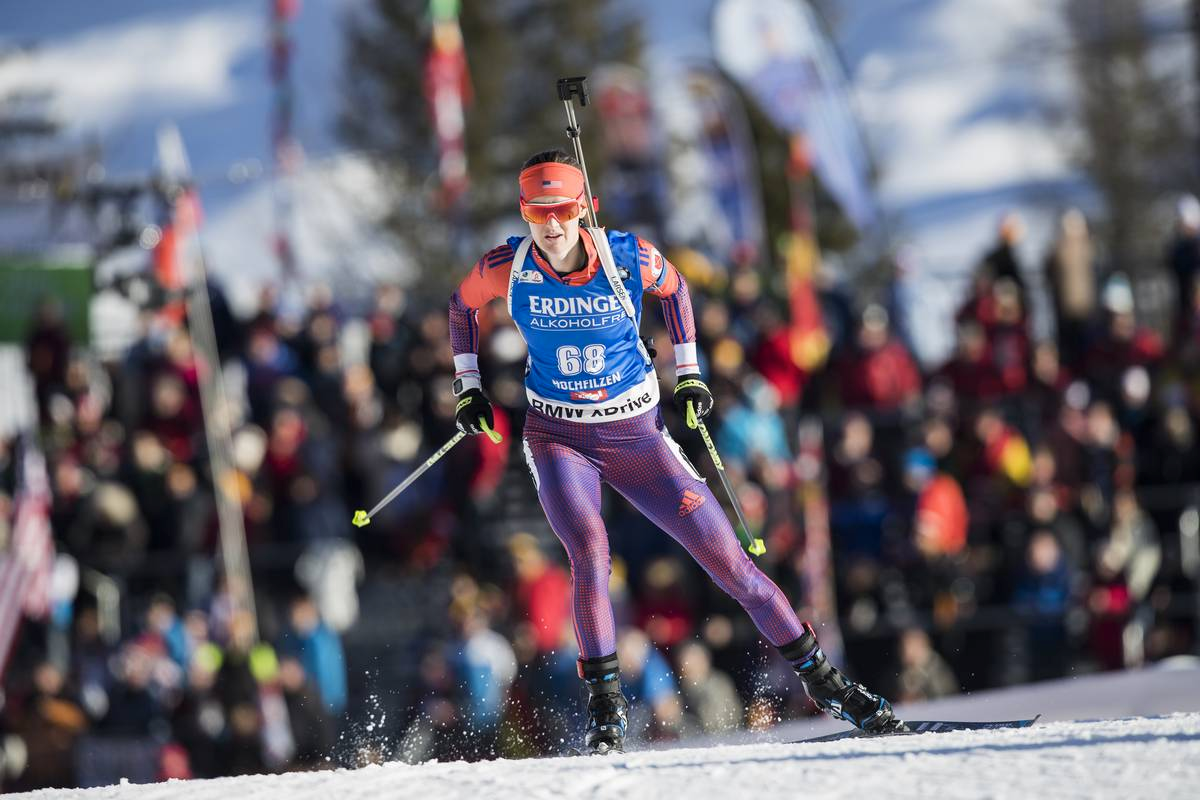
Emily Dreissigacker tags off to Joanne Reid in the women’s World Cup biathlon relay in Ruhpolding, Germany. Both women are on the roster for the U.S. for the next year of international biathlon. (Photo: USBA/NordicFocus)
For the first time in years, the roster features more women than men. Following the retirements of Lowell Bailey, Russell Currier, and Tim Burke, Alex Howe (Craftsbury Green Racing Project) netted his first senior national team nomination, and joins 2018 Olympians Sean Doherty and Leif Nordgren, as well as Paul Schommer (Moose Nordic).
On the women’s team, all five members of the 2018 Olympic team have been renamed: Susan Dunklee, Clare Egan, and Emily Dreissigacker (all Craftsbury Green Racing Project), Joanne Reid (Colorado Biathlon), and Maddie Phaneuf (Polar Bear Ski Club). Dunklee and Egan recently said that they were not certain yet about retirement, but appear on the roster. The newest addition to the women’s senior team is Chloe Levins, who finished all three individual races at 2018 World Junior Championships in the top seven.
The “A” team athletes will be primarily based in Lake Placid, New York, while designated “B” team athletes (Phaneuf, Schommer, and Howe) will be based at regional training centers or with clubs, according to national team selection documents.
The federation has also named a development squad of Deedra Irwin (Wisconsin Biathlon), Travis Cooper and Jake Ellingson (National Guard Biathlon), Jake Brown (Loppet Nordic Racing), and Max Durtschi. All saw international race starts last season.
In addition, an 11-member Junior Development Group has been named, many of whom we interviewed this winter – see the links below to read about their experiences at World Youth and Junior Championships.
High Performance Team – Women
Susan Dunklee (Barton, Vt./Craftsbury Green Racing Project), A1 Team Clare Egan (Cape Elizabeth, Maine/Craftsbury Green Racing Project), A2 Team Chloe Levins (Rutland, Vt.), A3 Team Joanne Reid (Boulder, Colo./Colorado Biathlon), A3 Team Emily Dreissigacker (Morrisville, Vt./Craftsbury Green Racing Project), A3 Team Maddie Phaneuf (Old Forge, N.Y./Polar Bear Ski Club), B Team
High Performance Team – Men
Sean Doherty (Center Conway, N.H.), A1 Team Leif Nordgren (Marine, Minn.), A3 Team Paul Schommer (Appleton, Wisc./Moose Nordic), B Team Alex Howe (Gilford, N.H./Craftsbury Green Racing Project), B Team
Development Team – Senior Women
Deedra Irwin (Pulaski, Wisc./Wisconsin Biathlon)
Development Team – Senior Men
Travis Cooper (Kenai, Alaska/National Guard Biathlon) Max Durtschi (Sun Valley, Idaho) Jake Brown (Houghton, Mich./Loppet Nordic Racing) Jakob Ellingson (Minnetonka, Minn./National Guard Biathlon)
Youth and Junior Development Group – Women
Helen Wilson (Eagle River, Alaska/Alaska Biathlon Club) – 20-for-20 interview Lexie Madigan (Truckee, Calif./Auburn Ski Club) – 20-for-20 interview Emma Stertz (Grand Rapids, Minn./Mt. Itasca Biathlon) – 20-for-20 interview Grace Gilliland (Eagle River, Alaska/Alaska Biathlon Club) – 2017 20-for-20 interview Sarah Beaulieu (Fort Fairfield, Maine/Outdoor Sports Institute) Arianna Woods (Bozeman, Mont./Bridger Biathlon Club)
Youth and Junior Development Group – Men
Vasek Cervenka (Grand Rapids, Minn./Mt. Itasca Biathlon) – 2017 20-for-20 interview Garrett Beckrich (Grand Rapids, Minn./Mt. Itasca Biathlon) – 20-for-20 interview Tim Cunningham (Springfield, N.H./Saint Lawrence University) – 20-for-20 interview Eli Nielsen (Stehekin, Wash./Methow Valley) – 20-for-20 interview Marcus Gore (Vail, Colo./Casper Mountain Biathlon Club)
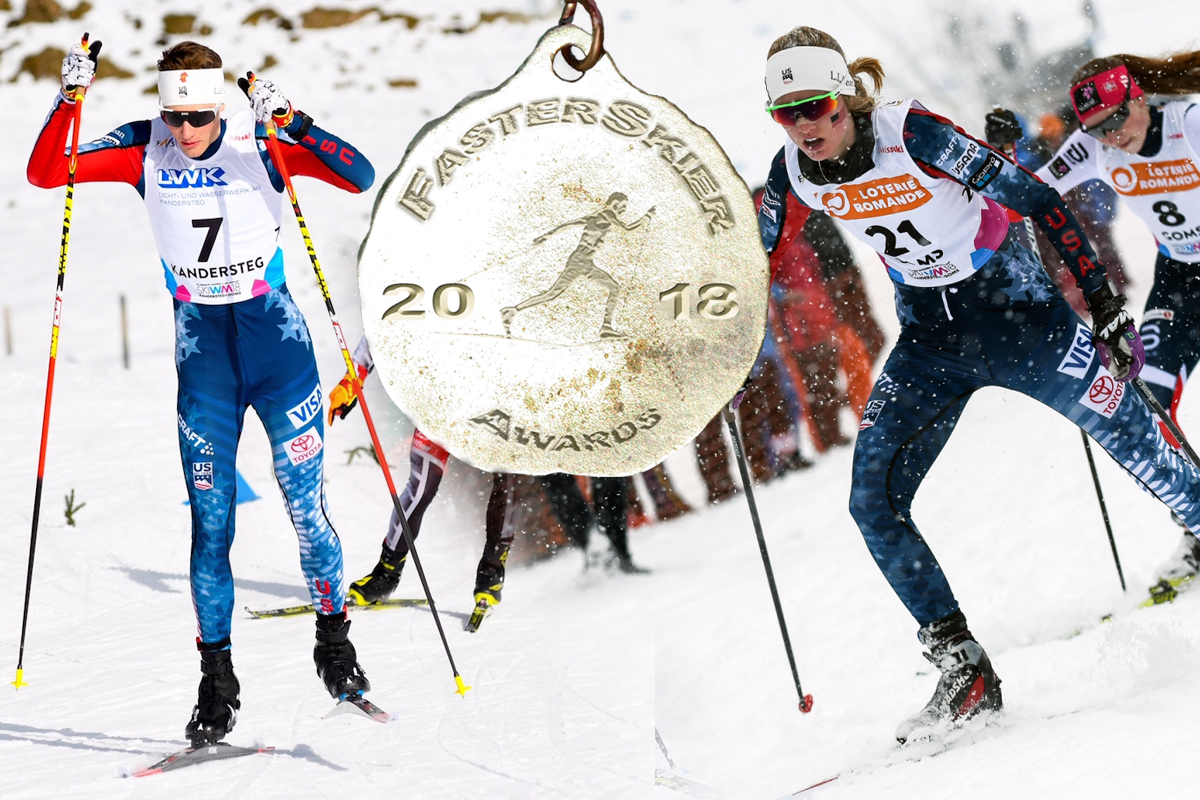
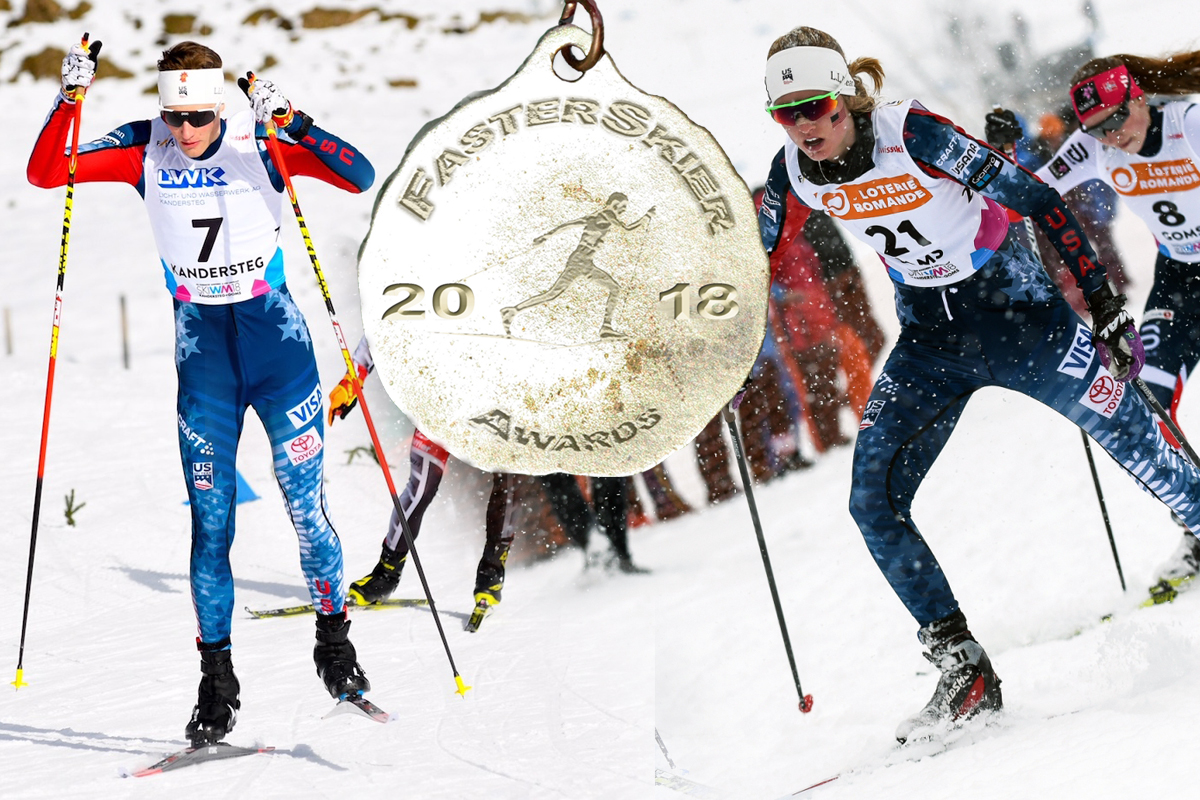
Ben Loomis (l) and Hailey Swirbul (21) are FasterSkier’s Juniors of the Year. (Photos: Romina Eggert & JWSC2018.ch)
With the 2017/2018 season officially in the rearview, FasterSkier is excited to unveil its annual award winners for this past winter. Votes stem from the FS staff, scattered across the U.S., Canada, and Europe, and while not scientific, they are intended to reflect a broader sense of the season in review. This set of honors goes to outstanding North American junior athletes across all nordic disciplines.
***
Ben Loomis, U.S. Nordic Combined Team
In late January, 19-year-old Ben Loomis was named to the U.S. Olympic team. That was a pretty big deal, and one he hadn’t been relying on.
“My main focus this year was on World Juniors, so to have made, and competed in, the Olympics was a dream in itself,” he wrote in an email to FasterSkier last week. “I really didn’t have any goals past having fun, taking in the experience, and doing my best.”
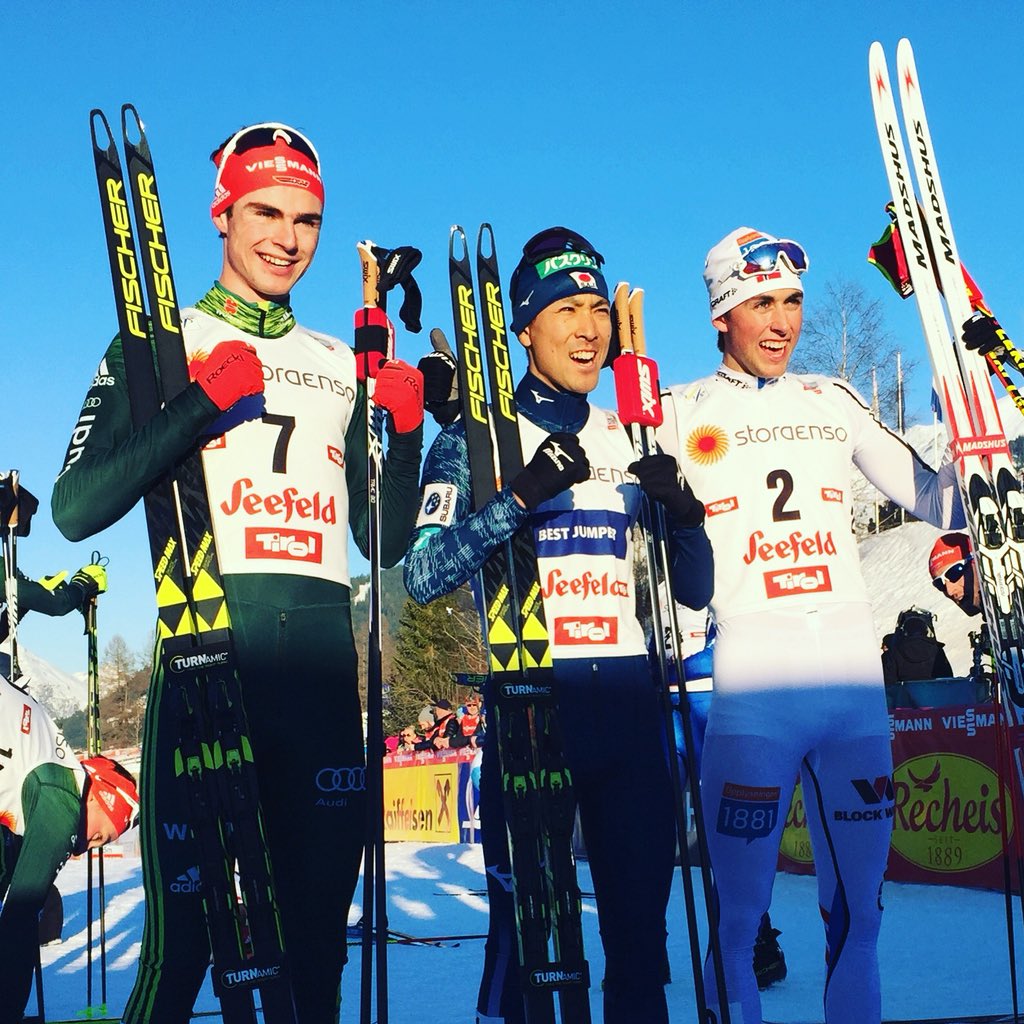
The men’s individual normal hill/10 k Gundersen podium at the first Day of Nordic Combined Junior World Championships in Kandersteg, Switzerland, with American Ben Loomis (r) in third, the Czech Republic’s Ondrej Pazout (c) in first, and Norway’s Einar Lurås Oftebro (l) in second. (Photo: Josh Parker)
Before he actually arrived in PyeongChang, South Korea, though, he had another trip to make: to Kandersteg, Switzerland, to compete in the thing that was his big goal, World Junior Championships.
In Kandersteg, Loomis improved on his top-ten finish from the previous season, earning bronze in the normal hill 10 k. In doing so, he became the first American to medal in nordic combined at World Juniors since Todd Lodwick won gold in 1996.
“A medal at World Juniors was definitely my goal going in, in fact, it had been a goal for the two years prior,” Loomis wrote of finally checking that box. “I knew the level I was at, and the level of the my competitors, so I was confident that a podium was well within my capabilities.”
As a developing talent on the U.S. team, Loomis is often competing at senior competitions, be it on the Continental Cup or the World Cup. In Kandersteg, he actually had the chance to measure himself against his own cohort.
“It can often be humbling to compete on World Cup as one of the younger athletes which makes junior competitions much much less stressful,” Loomis wrote. “I’ve always done pretty well against juniors my same age so that gave me confidence going into Junior Worlds. Of course, I was very happy and at the same time relieved to have meet my goal. This result was huge because it not only helped myself out, but it opened up another World Cup spot which is a help for the whole team. This certainly made everyone happy.”
When asked to peg his favorite memory from the season, though, the medal wasn’t it. Neither was the Olympics, where his top finish was 40th and he helped the U.S. relay team to 10th place.
“I have to say Olympic Trials in Park City was one of the most memorable days this season,” Loomis wrote. “It’s rare to compete at home, and to have the enthusiasm of large crowd made the day exciting. To top things off, I was happy to finish on the podium behind veteran Bryan Fletcher and my older brother, Adam.”
Hailey Swirbul, University of Alaska Anchorage
The same day that Loomis won his bronze medal, Hailey Swirbul was taking her own step onto the podium about 75 kilometers away in Ulrichen, Switzerland, where the cross-country portion of World Junior Championships was being held.
“This season I had wanted to focus on NCAA races more than I had the previous year, but once the season got under way it was difficult to forget about the temptation of doing well at World Juniors,” the University of Alaska Anchorage sophomore wrote in an email this week. “I tried to take on each of those goals individually as they approached and focus solely on the race that I needed to at the moment.”
Last season, Katharine Ogden won bronze in the World Juniors skiathlon, and she and Swirbul teamed up with Julia Kern and Hannah Halvorsen to earn bronze in the relay, too.
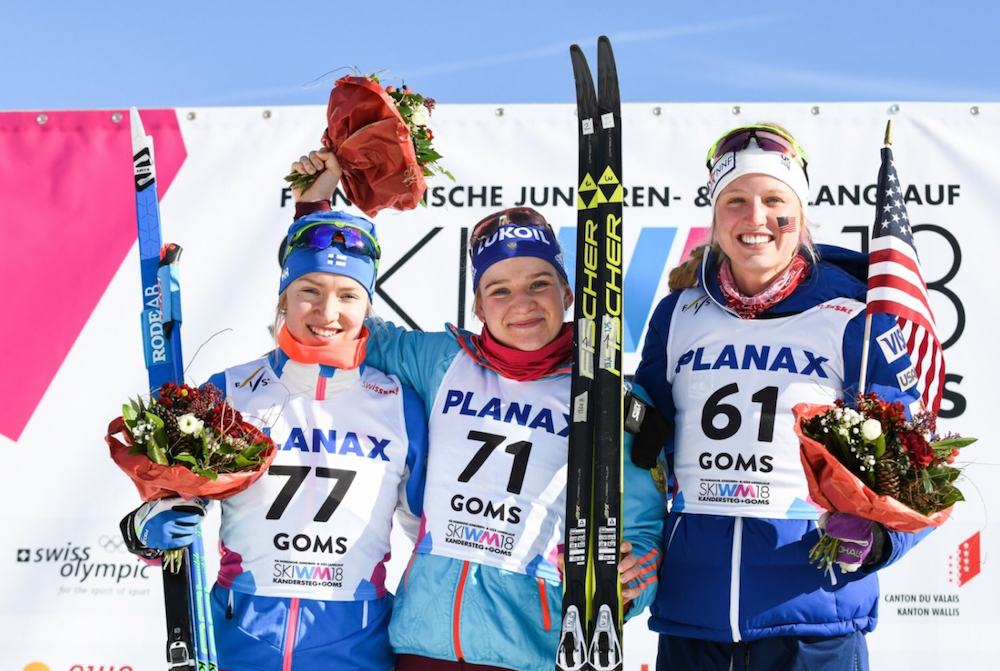
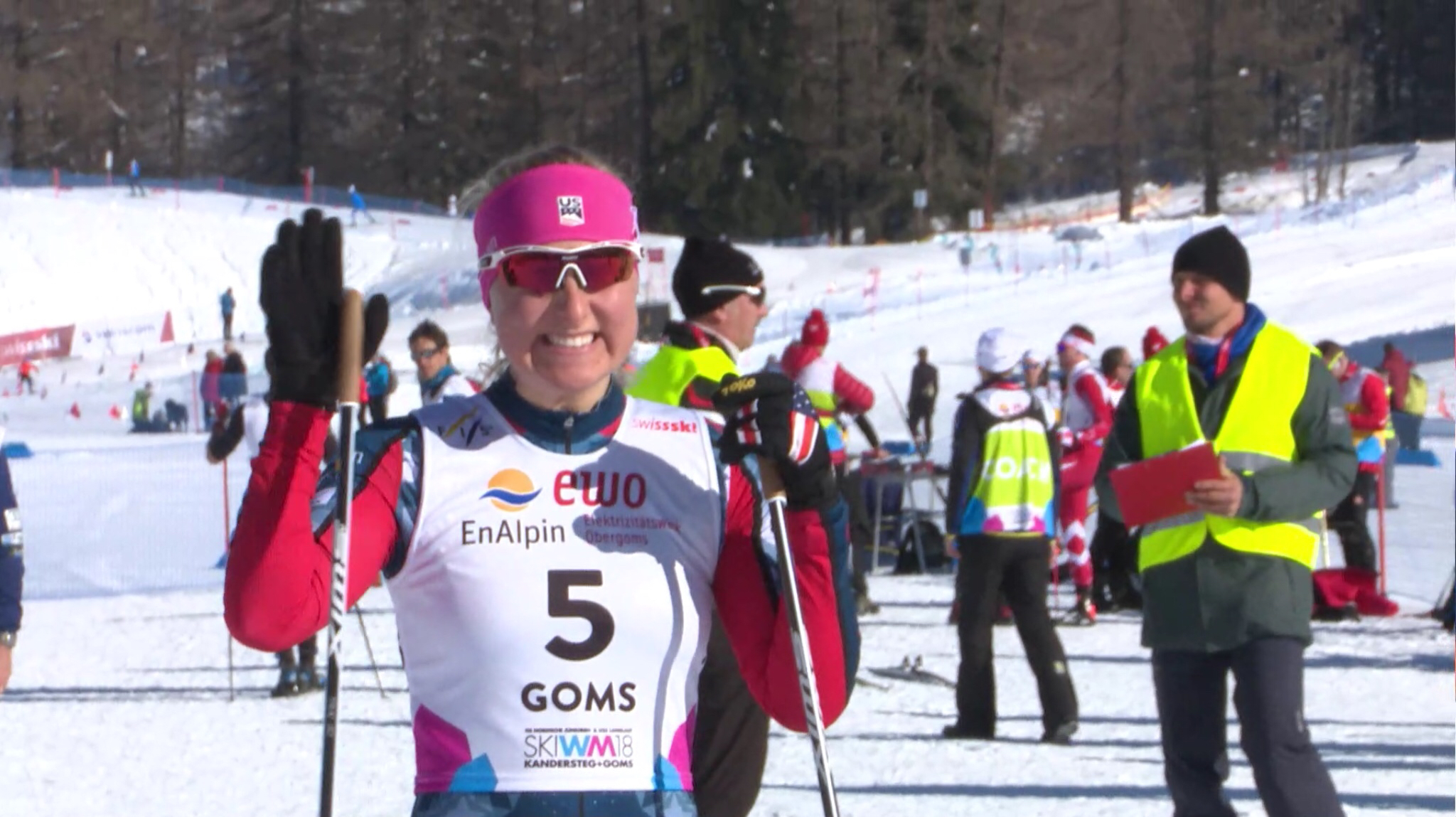
The women’s 5 k classic podium at 2018 Junior World Championships in Goms, Switzerland, with American Hailey Swirbul (r) in second, Russia’s Polina Nekrasova (c) in first, and Finland’s Anita Korva (l) in third. (Photo: JWSC2018.ch)
“I think the moment I’ll remember (albeit a long moment), was the time from when I crossed the finish line in the 5 k individual start to when I learned I would actually receive a medal,” Swirbul wrote this week, when asked what the most memorable moment of her season was. “Interval start races are not instant gratification like a mass start is… you’ve got to wait out the whole field to see if you actually did well. I was seeded about 20th from the last starter, so I had plenty of waiting in anticipation! I will always remember the people who were there with me through that and told me they think I’ve done it; and the excitement from the entire team about my individual success. It’s amazing to be from a country where every teammate celebrates an individual success almost as their own.”
It was the best World Juniors finish ever for an American.
“The result hasn’t hit me yet,” Swirbul wrote in an email after the race back in January. “It was beyond what I expected, so my brain is still catching up to the reality! I’ve been dreaming of racing how I know I could for the past 3 years or so, and this season has finally been my chance to break through. I’m so fortunate that things aligned for me on the day that really counted. I couldn’t have done it without Bryan Fish’s unwavering belief in us athletes, and my mom and dad’s support all these years, of course.”
But she was far from finished. In the 10 k skiathlon, Swirbul picked up a bronze to go with her silver.
“After my silver medal I believed in myself more than before,” she wrote at the time. “However, I managed to stay calm and not put high expectations on myself for the skiathlon which allowed me to race my best. I was hoping to ski smart and relaxed and not be afraid to make it hurt! In a mass start that is really all I can control.”
Swirbul helped the U.S. junior women to eighth place in the relay. Then she returned to the U.S., where the college season was still going strong.
“Being on the western circuit, I realized that coming back to ‘domestic’ racing is hardly domestic at all!” Swirbul wrote this week. “Our circuit has helped me prepared for international races, because many of our athletes are international. I have learned so much from them in each race. Otherwise, it was difficult to switch back to full on school mode, but the skiing transition was fun!”
She rallied for the seawolves, and placed third in the 5 k classic and second in the 15 k skate mass start at NCAA Championships, the second American in both races – which were swept by Ogden (University of Colorado’s Anne Siri Lervik, from Norway, was second in the 5 k classic).
“That was one of the most exciting races that I’ve ever watched,” UAA head Nordic coach Andrew Kastning said in a press release after the NCAA 15 k. “Hailey skied as good as she possibly could have, and was very smart.”
Honorable Mentions: Ben Ogden (Stratton Mountain School) and Gus Schumacher (Alaska Winter Stars)
The best individual result on the men’s side at World Juniors, for the Americans, came from Ben Ogden. The then-17-year-old (he’s since turned 18) finished seventh in the 10 k classic, 10.9 seconds off the podium.
“I went into World Juniors without much in the way of expectations,” Ogden wrote in an email this week. “My official goal was a top 20, but I had no idea of the achievability of that considering this was my first World Juniors. I knew that classic 10 k’s are a relatively strong point for me, so I was excited to see where I stacked up. Finishing the individual start race race as the temporary leader, and ending up seventh overall was incredibly exciting. This race was mind-blowing for me and showed that anything is possible. This elevated my expectations and hopes for the races to come, which was cool.”
Along with teammate Gus Schumacher, who finished 17th in the 10 k, Ogden gave the U.S. team a lot of hope for the future.
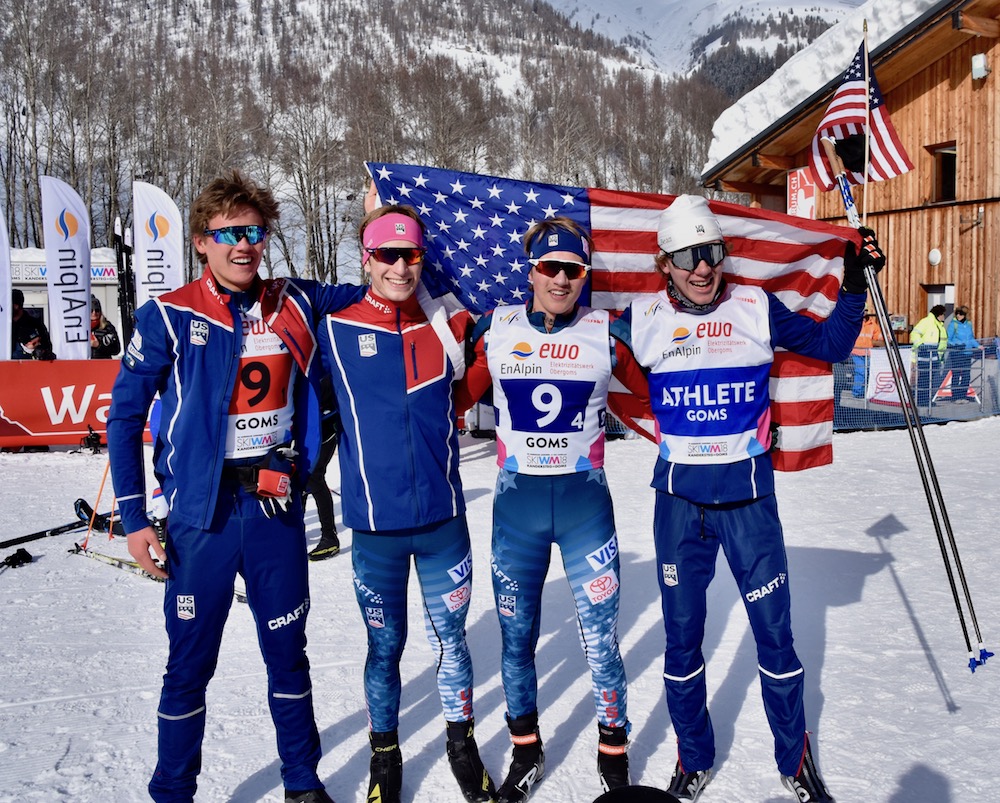
The U.S. men’s silver-medal relay at 2018 Junior World Championships in Goms, Switzerland, with (from left to right) Luke Jager, Hunter Wonders, Gus Schumacher, and Ben Ogden. (Photo: Julia Kern)
“It’s really exciting when you look at our day in general,” U.S. Ski and Snowboard development coach Bryan Fish noted the day of the classic race. “We had two young boys with 2000 birth years; there was only three boys in the top 40 that had a 2000 year of birth and we had two. … That’s just really exciting for U.S. skiing in general, that we have athletes showing up not just to participate, but to really perform.”
That promise came due a few days later when, along with Hunter Wonders and Luke Jager, the duo raced to a silver medal in the junior men’s relay, an unprecedented result and going one better than the women’s relay had the year before.
“If I had a dime for every time an announcer, coach, athlete, or anyone else remotely involved in cross-country skiing has called me ‘the younger brother of the infamous Katharine Ogden’ I would be a very rich younger brother,” Ogden wrote this week. “After years of this, it become clear that the only way to shirk this nickname is to rival or even beat her skiing performances… So naturally, I went into the relay at World Juniors hoping to help create the circumstances under which Katharine may just once be referred to as Ben Ogden’s older sister. I know this goal seemed incredibly lofty but after a successful week, it was time to dream big. I am pleased to say that along side the iconic Alaskan trio, Hunter Wonders, Juke Jager and of course Gus Schumacher, we were able to pull off the ultimate one-up on Katharine and her friends from the year prior. Each of my teammates had their own motivations for the race that allowed them to preform in such a heroic fashion, and I can only imagine that the overall performance also exceeded their wildest dreams.”
The team was never far out, with Jager leading things out in sixth (+14.0), Ogden bringing the team to fourth (+22.8) and Wonders holding that position (+29.0). But Schumacher as the anchor skier did hero’s work and made up the time to pass the French and Russian teams, and crossed the line just 2.2 seconds behind Norway to secure silver. It was a team effort that landed the Americans just 3.3 seconds clear of third place.
“Experiencing the podium here has been so cool,” Schumacher wrote at the time. “I thought it was possible, but actually getting it feels amazing. This whole trip has been really cool even without this success, it’s such an amazing place and the team is tight. I think individually I anticipated results maybe a little better, but this seems about right, and as a team I think we all surprised ourselves. Together we can make some big waves.”
The juniors have also had success against the senior field. Schumacher finished sixth in the 15 k skate at U.S. Nationals and eighth in the skate sprint. And Ogden, for example, was ninth in the 15 k skate at U.S. Nationals, and qualified fourth in the classic sprint before finishing 12th on the day.
“I think that one of my strongest races of the season was the individual skate 15 k at U.S. Nationals in Anchorage,” Ogden, who is headed for the University of Vermont next year, wrote in an email this week. “I was excited to place in the top 10 overall, especially in a skate race, which has been is my weaker technique in the past.”
Honorable Mention: Chloe Levins, US Biathlon
Despite being just a junior in the biathlon world, Middlebury College student Chloe Levins elbowed her way in to the U.S. Olympic Trials process. She excelled at trials races in Minnesota to earn a spot on the team’s short list for PyeongChang, before ultimately falling just short in the final trial competitions, some IBU Cup races in Europe.
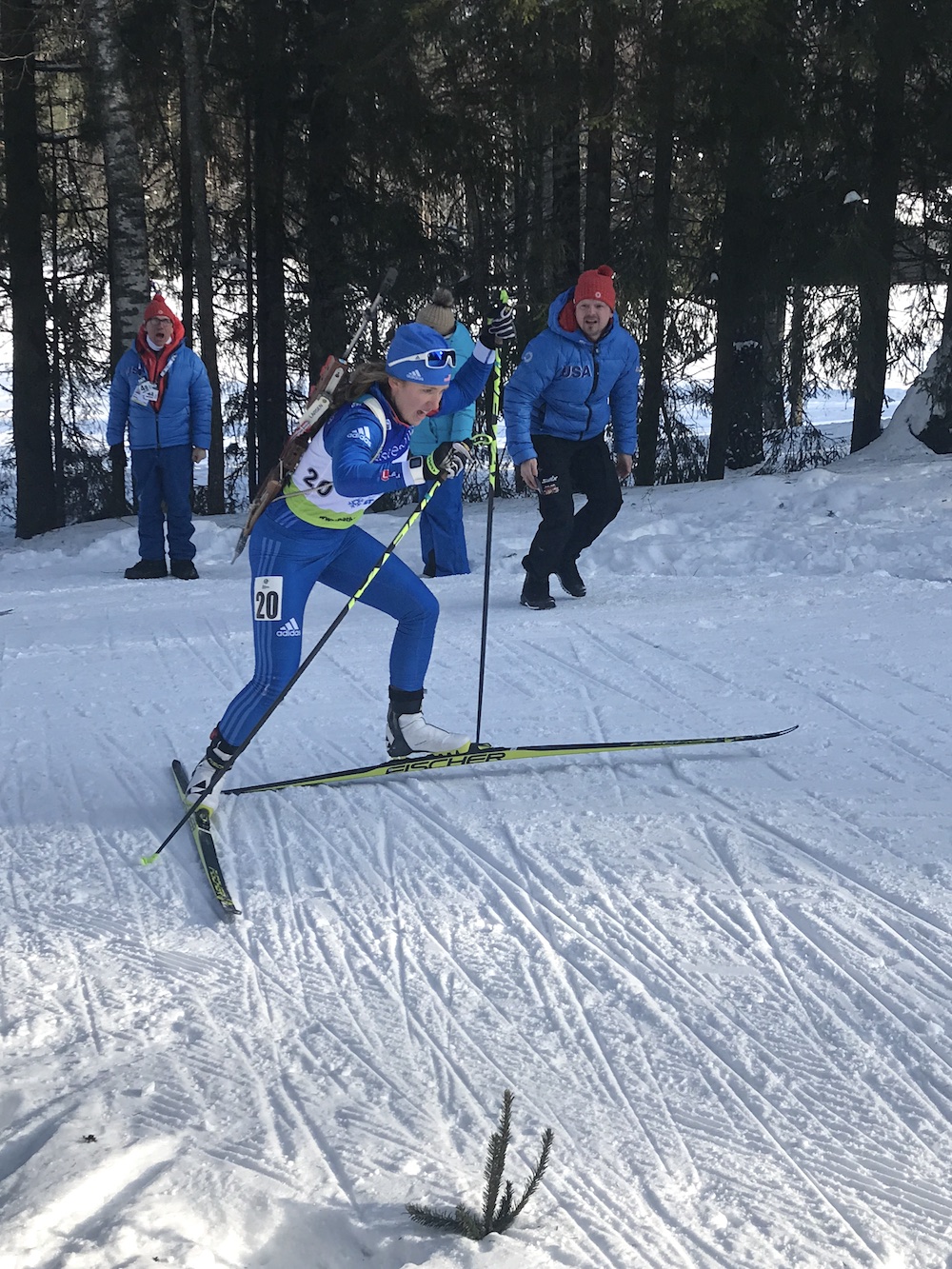
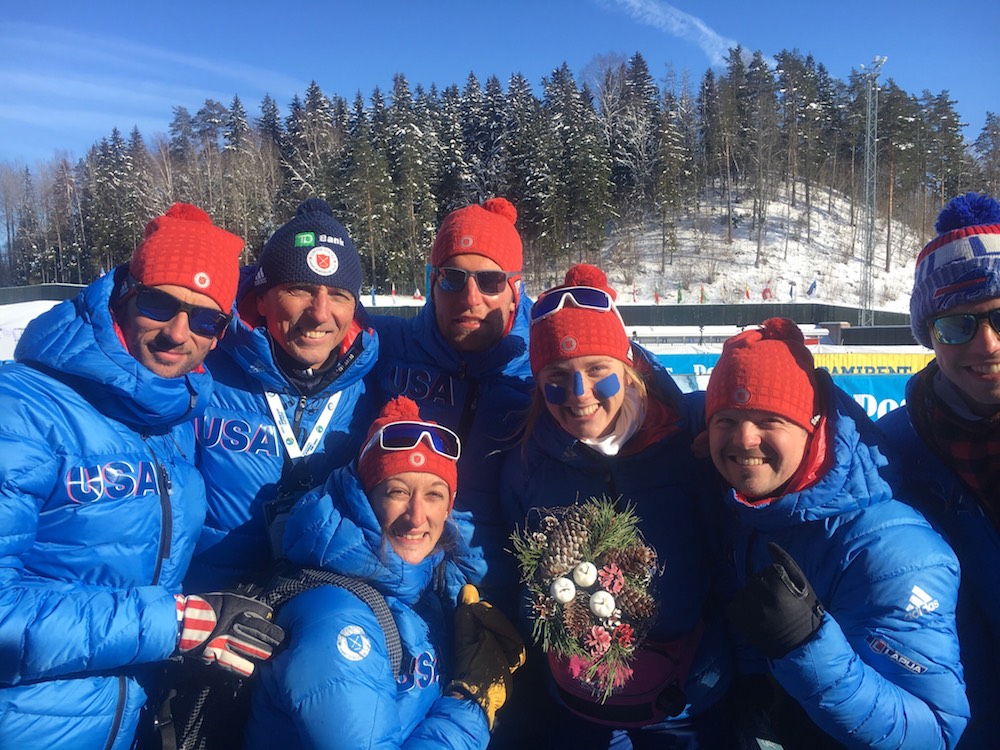
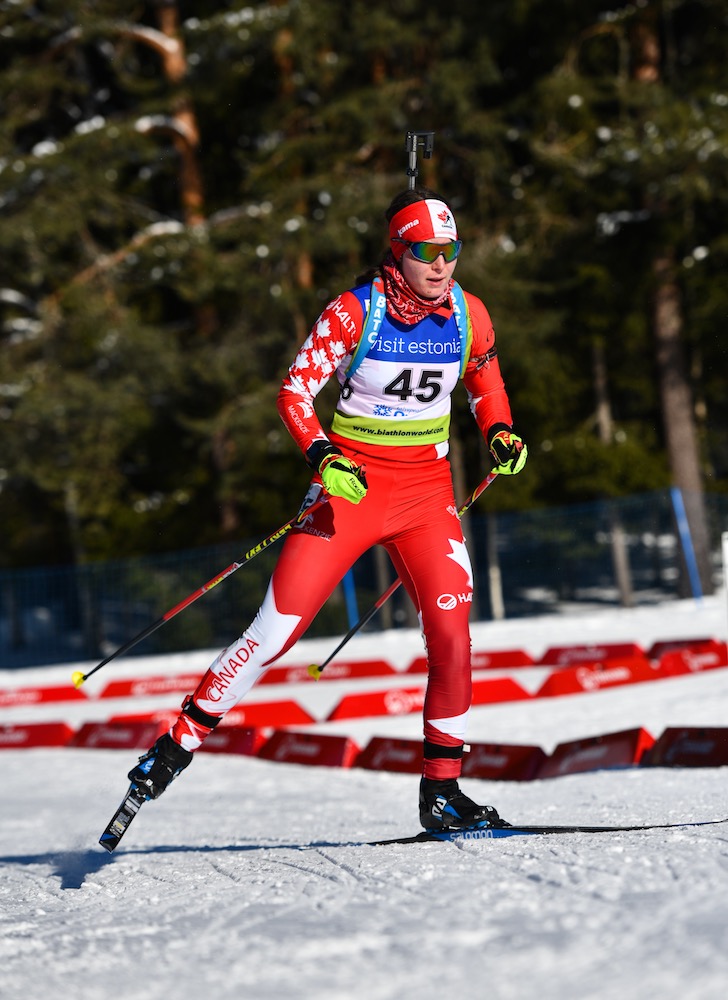
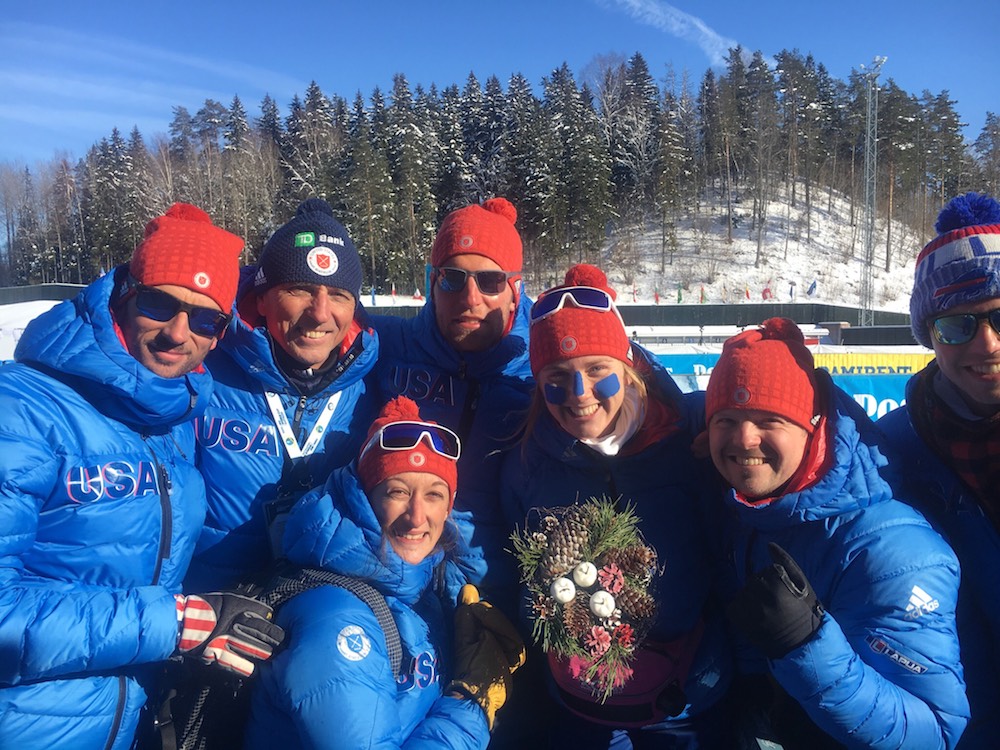
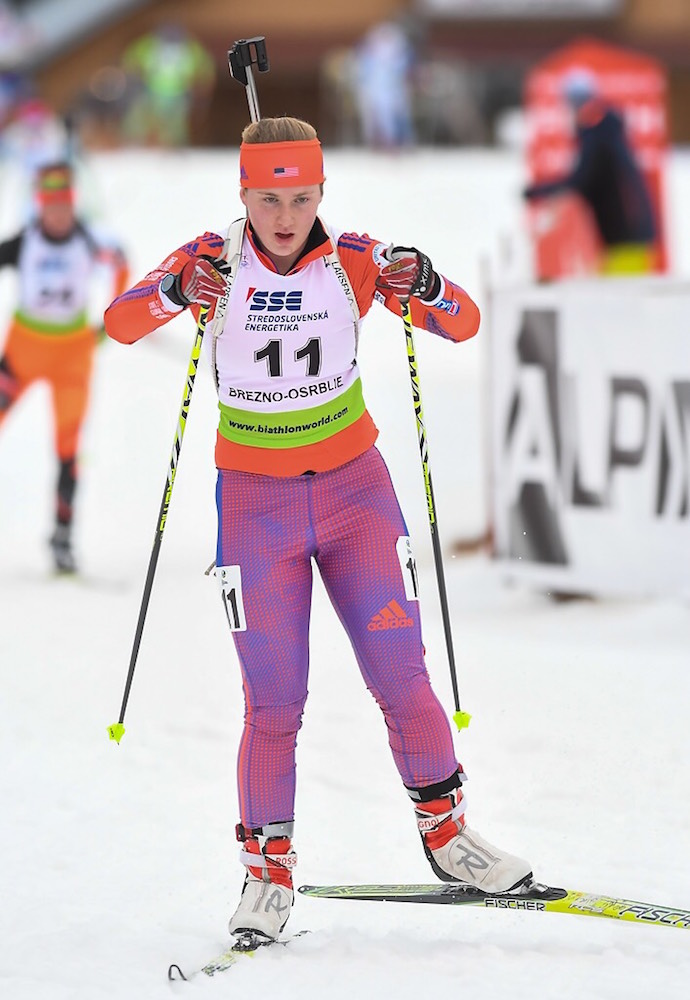
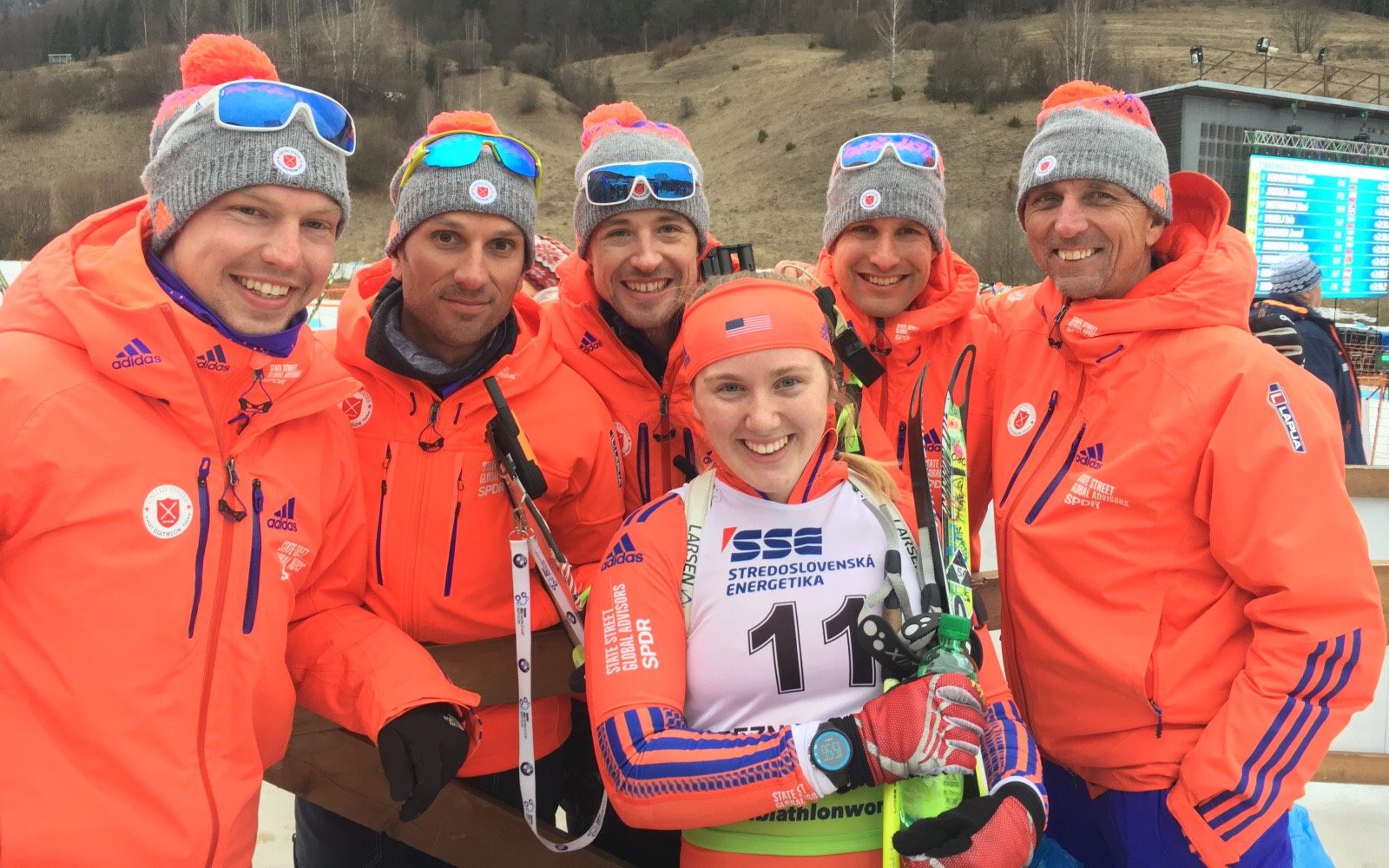
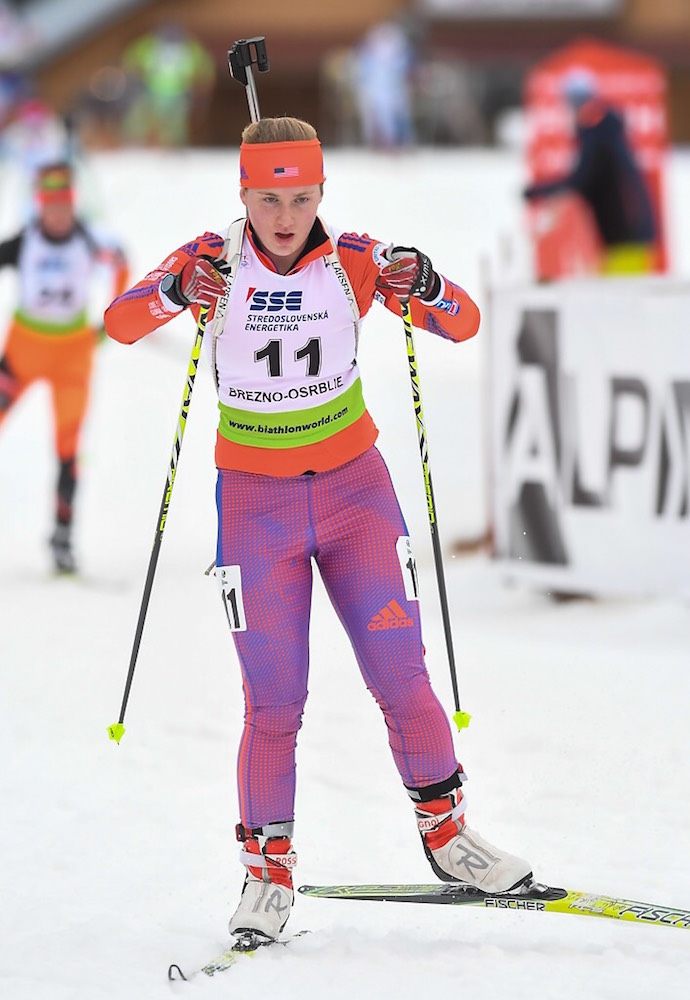
Chloe Levins (third from r) with the U.S. team staff (from l to r) wax tech Travis Voyer, coach Algis Shalna, assistant coach Danika Frisbie, wax tech Max Bergmann, wax tech Mattias Halquist, and coach Erik Lewish, after Levins placed sixth in the junior women’s 12.5 k individual at IBU Junior World Championships in Otepää, Estonia. (Photo: Erik Lewish)
But after that, Levins bounced back to provide remarkably strong and consistent results at World Junior Championships in Otepää, Estonia. Levins finished sixth in the 12.5 k individual, seventh in the 7.5 k sprint, and then sixth again in the 10 k pursuit. She still has one more season of junior eligibility, too.
“In pursuit races in the past, I’ve come from behind,” Levins, who placed fourth in last year’s Youth Worlds pursuit, wrote in an email to FasterSkier at the end of World Juniors. “Today, it was a new learning experience for me to be in the mix for the duration of the race. My plan was simple from the start: enjoy being in the mix and trust your preparation. I found the zone today, which is what you dream about. I don’t remember much about the last stage. All I know for sure is that I went for it today…and I have no regrets.”
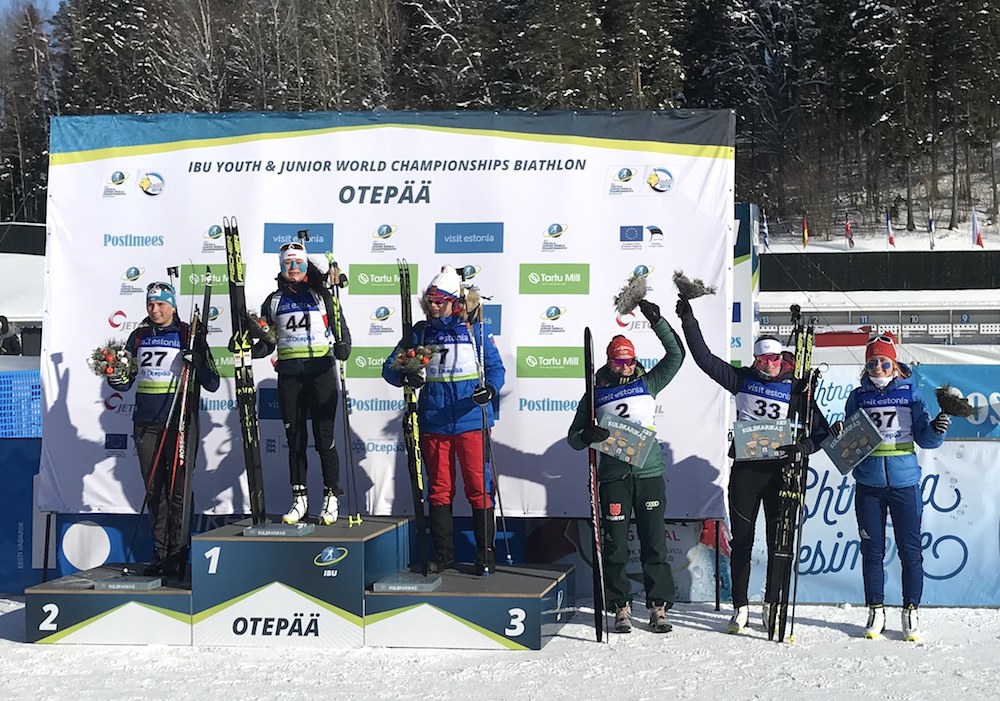
Some of the top-six finishers in the junior women’s 10 k pursuit at the post-race flower ceremony at 2018 IBU Junior World Championships in Otepää, Estonia, including the Czech Republic’s Markéta Davidová (top) and American Chloe Levins (bottom), who finished first and sixth, respectively. (Photo: IBU/Biathlonworld)
(Note: This article has been updated to include comments from Leo Grandbois.)
The 2018 International Biathlon Union (IBU) Youth/Junior World Championships went out with a bang on Sunday, with four pursuit races in Otepää, Estonia.
Several North Americans had banner days, with American Chloe Levins racing up one spot to sixth place in the junior women’s 10-kilometer pursuit and Canada’s Megan Bankes and Nadia Moser placing eighth and 11th, respectively, in that same race.
In the youth men’s 10 k pursuit, Canada’s Leo Grandbois had his best result of the week, placing 15th (up from 33rd) at the start.
Starting with the junior women’s pursuit:
Levins started the race 1:32 minutes back in seventh, based on her sprint result on Saturday. She went on to clean three-consecutive shooting stages, working her way up to fourth after leaving the range for the third time, then missed two targets on the final standing to end the race in sixth. Levins finished 1:51.4 behind the winner, Markéta Davidová of the Czech Republic, who finished first in 32:52.6 with four penalties (1+0+2+1).
Chloe Levins racing to seventh in the junior women’s 7.5 k sprint on Saturday at IBU Junior World Championships in Otepää, Estonia. (Courtesy photo)
“In pursuit races in the past, I’ve come from behind,” Levins, who placed fourth in last year’s Youth Worlds pursuit, wrote in an email to FasterSkier on Sunday. “Today, it was a new learning experience for me to be in the mix for the duration of the race. My plan was simple from the start: enjoy being in the mix and trust your preparation.
“I found the zone today, which is what you dream about,” she continued. “I don’t remember much about the last stage. All I know for sure is that I went for it today…and I have no regrets.”
Asked what she’ll remember most about these championships, Levins explained that the U.S. team’s “happy and dedicated staff” made for a fun week.
“We are always joking and laughing in the wax room which helps keep the mood light during potentially stressful races,” she wrote. “It was really special and important for me to have this experience with my coach, Algis Shalna, behind the scope. We’ve worked together for a long time. I will cherish the competitions we get to share forever.”
While the championships didn’t turn out exactly as she’d hoped, Levins explained that she had a lot of positive takeaways for her final biathlon races of the season.
“Now, it’s time to go back to school and start preparing for golf season at Middlebury!” she wrote. “… I can’t wait to start training again.”
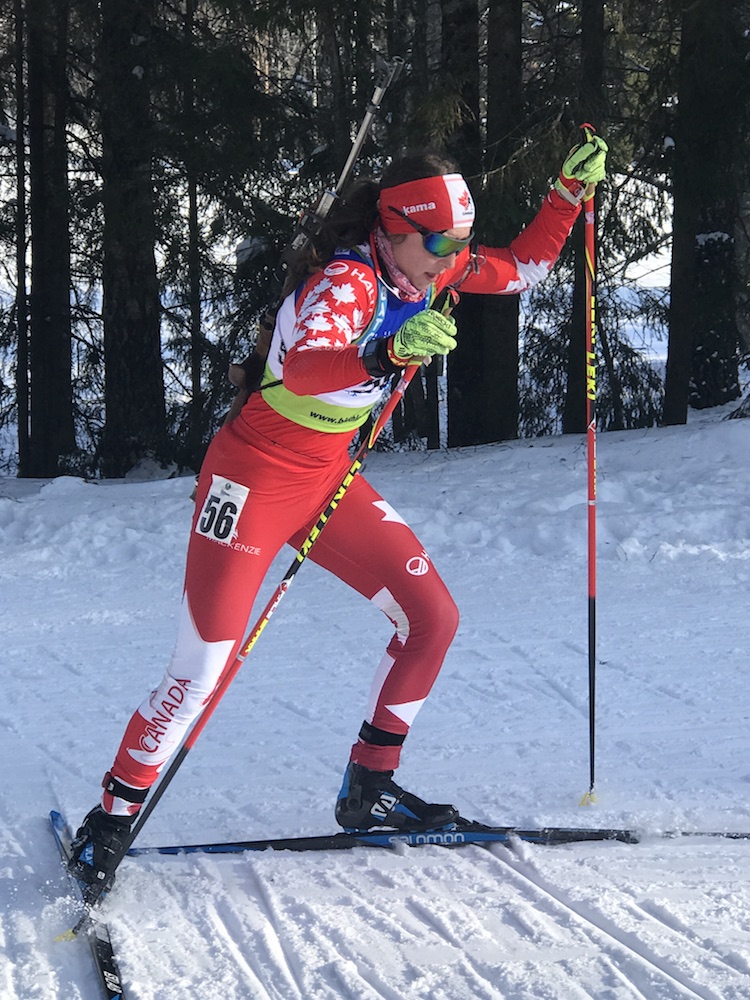
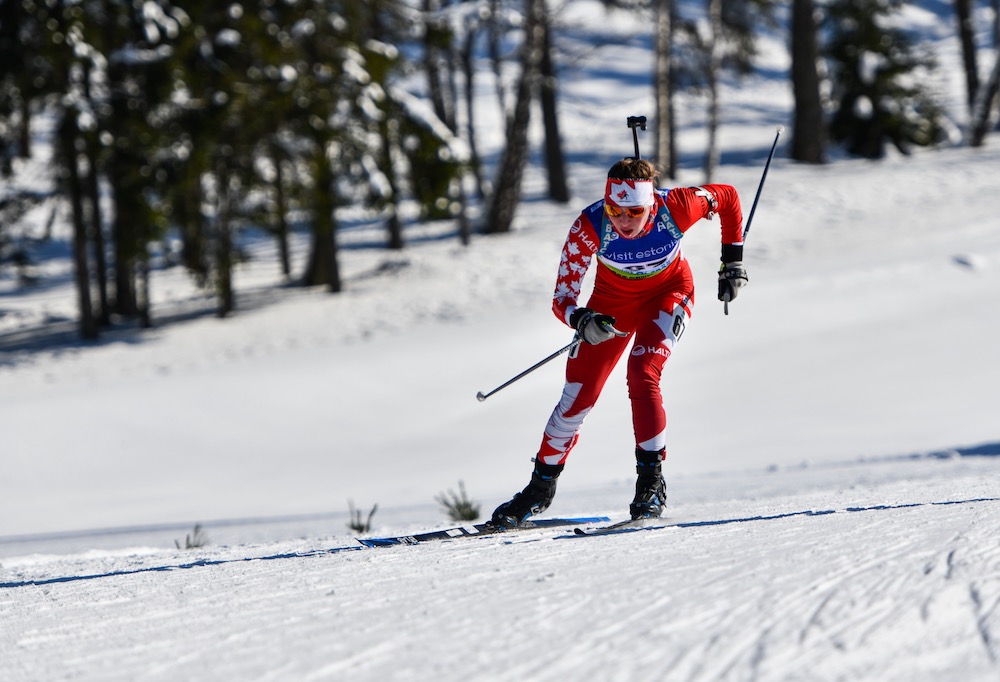
Megan Bankes racing to eighth in the junior women’s 10 k pursuit at IBU Junior World Championships on Sunday in Otepää, Estonia. (Photo: Bryan Dickson)
Bankes started ninth on Sunday and made up one place to finish eighth (+2:52.6) after placing ninth in three previous races at Junior Worlds. She had two penalties in both the first and the last shooting stages (2+0+0+2) and posted the ninth-fastest shooting time and ninth-fastest overall course time.
“Heading into today’s race, my goal was to try and shoot well and make up places. It was also my last international junior race so i wanted to try and have a good one!” Bankes, 20, wrote in an email. “To start, I knew that I could catch the Norwegian girl who started in front of me, and after I caught her, my goal was to make up time on everyone else in front of me.”
She described the wind on the range as “pretty strong” and variable.
“I was zeroed for a decent left to right wind, but when I came in for my first prone the wind had died and was blowing towards me for my first shot, and then it picked up again to be a little more than my zero wind, and I corrected back but didn’t correct enough for it,” Bankes wrote. “After cleaning the middle 2 bouts I really wanted to clean my last bout and there was definitely a little pressure going in with the Russian girl [Emma Timerbulatova, who was skiing just ahead of Bankes]. I actually thought that she had only missed one, so I was a little disappointed in myself when we went into the penalty loop, but when she didn’t leave after the first loop, I was determined to pass her and beat her to the finish.”
Like Bankes, Timerbulatova had two penalties in the last standing. She started the final loop just 0.1 seconds ahead of Bankes, and Bankes passed her to finish eighth.
“I’m overall super happy with my performance this week,” Bankes, a 2017 Youth Worlds gold medalist in the 10 k individual, concluded. “Definitely my most consistent European racing ever! I would have liked to have shot better overall this week though, I did give up some stupid shots, but I was super stoked with how I felt skiing. I’m also pleased that I was able to have consistently good races over the course of the week, which is something I definitely could not have done in the past.”
Nadia Moser racing to 11th in the junior women’s 10 k pursuit at IBU Junior World Championships on Sunday in Otepää, Estonia. (Photo: Bryan Dickson)
Moser picked off 10 places to finish 11th (+3:45.4). She started the pursuit in 21st and shot 18-for-20, cleaning the first two stages (0+0+1+1) and contending for the top 10 before finishing about 12 seconds out of 10th place. It was her second-best result of the week after placing eighth in the junior women’s 12.5 k individual.
“A top 10 finish was definitely the big goal for the pursuit, but I knew that was only possible if I shot really well and skiied well,” Moser wrote in an email. “Unfortunately, I missed my goal by one place.
“There were some pretty large time gaps in the starters today so it was a challenge to pick up places for me,” she continued. “For the most part I just tried to catch up with the people in front of me, or keep up with the people who passed me. I knew my best chance to move up was in the shooting range. … I was focused and trusting in my skills on the range today, and that is how I was able to hit most of my targets.”
She knew she was in 10th for her third shooting when she was shooting in lane 10.
“I was really happy that I had moved up as many places as I did, although slightly dissapointed that I was not able to reach the top ten,” Moser added. “I am satisfied with today’s pursuit. Moving up 10 positions is better than I’ve ever done before. Some things could have gone slightly better this week, but overall I am content with what I was able to achieve.”
Emily Dickson scored her first non-relay top 30 of the week in 26th (+5:31.6), up from 36th at the start, after missing just two targets (1+0+0+1). She had previously placed 36th in both the sprint and individual races, and ninth with Bankes and Moser in the 3 x 6 k relay.
After starting 26 seconds ahead of Davidová, Poland’s Kamila Żuk finished second in the pursuit, 28.1 seconds behind Davidová, after incurring six penalties (1+2+3+0). France’s Myrtille Begue placed third (+53.8) for the second-straight day after shooting 17-for-20 (0+1+1+1).
Onto the junior men’s 12.5 pursuit:
A day after placing third in the sprint, Norway’s Sverre Dahlen Aspenes shot clean in Sunday’s four-stage pursuit to take the win in 34:16.7. He finished 1:21.1 minutes ahead of France’s Martin Perrillat Bottonet, who placed second with one penalty (0+0+1+0). Norway’s Johannes Dale scored his first non-relay podium in third place (+1:46.4) with four misses (0+0+2+2).
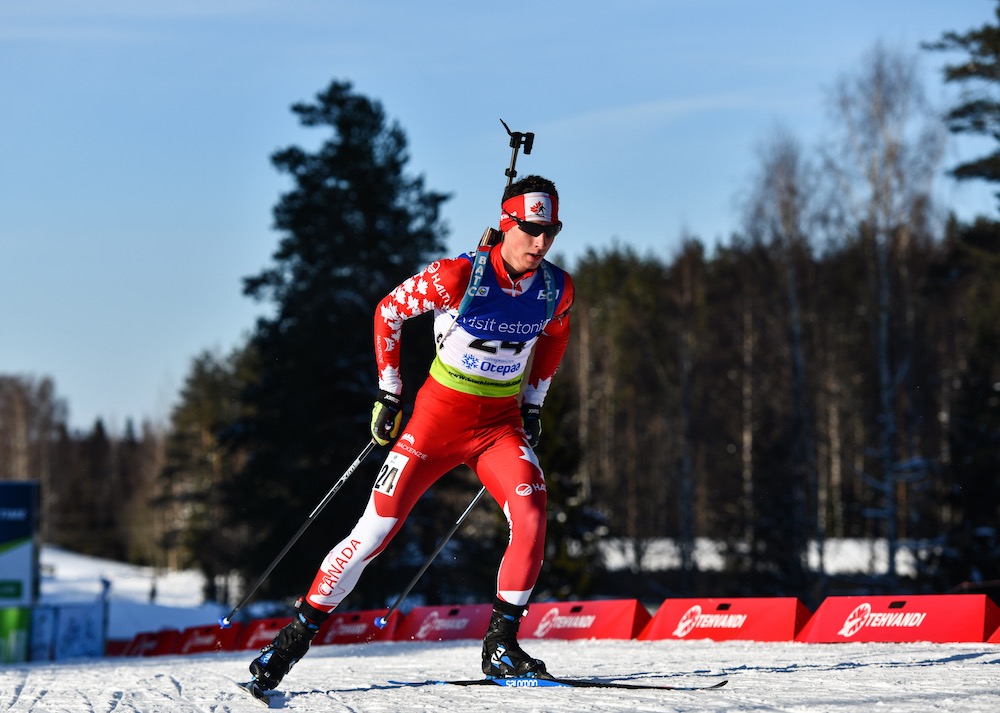
Canada’s Adam Runnalls tallied his third individual top 30 of the week, placing 29th (+6:04.7) with six penalties (2+1+1+2). He had started the pursuit in 26th, based on his sprint result, and had previously finished 29th in the junior men’s 15 k individual.
His teammate Trevor Kiers started the pursuit in 16th and slipped to 34th (+6:44.4) with 10 penalties. Canada’s third man in the race, Teo Sanchez finished 57th (+10:32.5) with five misses (1+0+1+3) after starting 54th.
Cody Johnson was the lone U.S. skier in the junior men’s pursuit, racing to 48th (+7:40.0), after starting 37th, with five misses (2+0+2+1).
In the youth men’s 10 k pursuit:
Leo Grandbois racing to 15th in the youth men’s 10 k pursuit on Sunday at IBU Youth World Championships in Otepää, Estonia. (Photo: Terri Dickson)
Grandbois, a gold medalist at last year’s Youth Worlds in the 12.5 k individual, had his best race of the 2018 championships in 15th. After starting 33rd, he cleaned the first two stages to put himself in 16th halfway through the race, then missed two on each of the final two shooting bouts (0+0+2+2). But he didn’t lose much ground, leaving the range in 17th after the last shooting and passing two competitors to end up 15th (+3:37.2). Grandbois had previously raced to 24th in the 12.5 k individual this week and 16th with Canada’s youth men’s 3 x 7.5 k relay team.
“For the first bouts the wind was calm but for the second prone the wind picked up,” Grandbois explained in an email. “So I had to do some corrections that worked perfectly. I am really happy about it. First standing I came way too hard in the range and I could not manage to be precise. The last shooting was going well but the pressure to go faster made me miss again.
“I think that with a better standing shooting I could have done a top 10, but I was starting pretty far away so I am satisfied with my 15th,” he wrote.
“What I take back from those championships is that my ski speed is good but I will have to work hard next summer to keep it that way and to get it even better, for sure,” Grandbois added. “It wasn’t a good week for me in the range. I will have to work on my shooting speed and constancy. Those two things are my biggest weakness.”
Leading the U.S. men was Vasek Cervenka in 24th (+4:20.8). Cervenka had started the race in 24th and held his position despite six penalties (0+3+1+2) with the 19th-fastest course time. It was his third individual top 30 of the week after placing 27th in the 12.5 k (as well as ninth with his relay team).
Canada’s Rory Gilliland moved up 11 places to finish 41st (+6:12.2) with two penalties (0+0+1+1). His teammates Thomas Hulsman and Ryan Elden followed in 45th (+6:45.9) and 49th (+6:56.8) after starting 35th and 59th, respectively. Hulsman had six penalties while Elden had five (1+0+2+2).
For the U.S., Garrett Beckrich and Eli Nielsen finished 46th (+6:48.7) and 47th (+6:54.7), respectively. Beckrich had started 46th and incurred five penalties (1+1+1+2) while Nielsen slipped five places after starting 42nd and missing six targets.
After winning gold in the relay, Russia’s Andrei Viukhin notched his first individual podium and gold medal at his first Youth Worlds, winning the pursuit in 29:31.2. He had started seventh and missed four targets (1+1+1+1) yet led his teammates in a Russian podium sweep.
Viukhin handed his teammate Mikhail Pervushin his first loss of the week, as Pervushin settled for second, 16.8 seconds back, with four penalties as well (1+0+2+1). Aleksei Ogorelkov, who had not raced in Russia’s 3 x 7.5 k relay, finished third (+1:12.1) with two late penalties (0+0+0+2) for his first Youth Worlds podium.
Last but not least, the youth women’s 7.5 k pursuit:
Canada had three women finish in the top 40 of this race, with Benita Peiffer leading them in 30th (+4:28.2). She had started 51st and skied the 21st-fastest course time to pick off 21 places. Peiffer shot 17-for-20 (1+0+1+1).
Her teammate, Pascale Paradis slipped from 15th to 35th (+5:05.8) with eight penalties, while Jenna Sherrington improved from 46th to 39th (+5:28.1) with four misses (2+0+2+0).
For the U.S., Emma Stertz finished 48th (+5:58.0), up from 52nd at the start, with four penalties (1+0+2+1), and Grace Gilliland placed 57th (+7:21.0), after starting 55th, with four misses as well (1+1+1+1).
Russia’s Anastasiia Goreeva won her first individual gold at Youth Worlds, racing up from fourth at the start to cross the finish line first in 24:24.0 with three penalties (0+0+1+2). Germany’s Franziska Pfnür placed second for her first Youth Worlds podium, 17.5 seconds behind Goreeva, with just one penalty (0+1+0+0). In her second Youth Worlds, Switzerland’s Amy Baserga achieved her first podium as well, placing third (+29.0) with two penalties (0+0+1+1).
American Chloe Levins racing to seventh in the junior women’s 7.5 k sprint on Saturday at IBU Junior World Championships in Otepää, Estonia. (Photo: Terri Dickson)
“There’s almost nothing I love more than being in the hunt during a pursuit,” American Chloe Levins wrote in an email to FasterSkier on Saturday. “I’m prepared. I’m hungry.”
Two days after placing sixth in the junior women’s 12.5-kilometer individual on Thursday, Levins, 19, raced to seventh place in Saturday’s 7.5 k sprint, which will put her in seventh (and within 10 seconds of fourth place) for the start of Sunday’s 10 k pursuit at the International Biathlon Union (IBU) Junior World Championships in Otepää, Estonia.
On Saturday, Levins, a Middlebury College sophomore, started the 7.5 k sprint in 20th out of 70 women. She missed one of her prone targets, having to ski a penalty lap, and cleaned standing to cross the finish line in second place, just 1.5 seconds behind Russia’s Emma Timerbulatova in first. While both were ultimately bumped to sixth and seventh, respectively, by the time all 70 racers had finished, Levins’s course time still held up as the eighth fastest. Her shooting was among the best, too, with only five women cleaning the two-stage race.
“There’s been a consistent stream of wind on this range all week long,” Levins explained in the email. “It didn’t fail to show up today either. Ski conditions were perfect. The snow was cold but fast, and it got faster throughout the day.”
When asked about the course, she recalled a term her coach Algis Shalna used to describe it: “workhorse”.
“That’s exactly what it is,” she wrote. “It’s a traditional course with long hills and few transitions. I don’t really have a course profile preference, but working over the top of these hills pushes me past my limits every time.”
Levins described being able to handle the “steady and relatively calm” wind conditions without many technical adjustments. After hitting all five targets in her standing stage, all she could do was smile as she returned to the course, she wrote.
“It was a very rhythmic shooting that gave me some momentum leading into the last loop,” Levins recalled. “Our staff and even some of the youth athletes were everywhere on course today, which really helped me gain time on a Russian athlete who left the range 15sec ahead of me at the split.
“I had the biggest support system in the entire field today,” she added. “I hope they had as much fun during the competition as I did.”
At the finish, Levins tried to process any time she lost on the course and the time gap between her and first place at the time.
“My brain immediately went to analyzing the race in search of 1.5 lost seconds,” Levins wrote. “Since the temperatures have been so cold this week, they made all the races 20 second intervals. It was unfortunate that I had to maneuver my way around two groups of at least four competitors along the track on my last loop.”
In the end, she ended up seventh, 1:31.7 minutes behind Poland’s Kamila Żuk, who won in 22:32.5 with one standing penalty (0+1). Żuk also won Thursday’s 12.5 k individual.
On Sunday, Levins will start the pursuit 1:32 behind Żuk and just 10 seconds behind Russia’s Valeriia Vasnetcova in fourth place. Markéta Davidová of the Czech Republic will head out of the gate second, 26 seconds behind Żuk, and France’s Myrtille Begue will start third, 52 seconds back. While Davidová made up for two penalties in Saturday’s sprint with the second-fastest course time (behind Żuk in first), Begue shot clean and skied the fifth-fastest course time.
Canada’s Megan Bankes racing to ninth in the junior women’s 7.5 k sprint on Saturday at IBU Junior World Championships in Otepää, Estonia. (Photo: Terri Dickson)
Canada’s Megan Bankes placed ninth for her third-straight race of the championships, after finishing ninth in the junior women’s 3 x 6 k relay and ninth in the 12.5 k individual. On Saturday, she had two penalties, one in each stage (1+1), and finished 1:49.5 minutes out of first with the (you guessed it) ninth-fastest course time.
Bankes will start the pursuit 1:50 back and just 4 seconds behind Norway’s Marit Ishol Skogan in eighth.
Her teammate Nadia Moser finished 21st (+2:46.2), also with two penalties (0+2), Emily Dickson finished 36th (+3:50.5) with two penalties (1+1), and Canada’s fourth woman Zoë Pekos narrowly missed the pursuit cutoff in 66th (+6:22.4) with four misses (3+1).
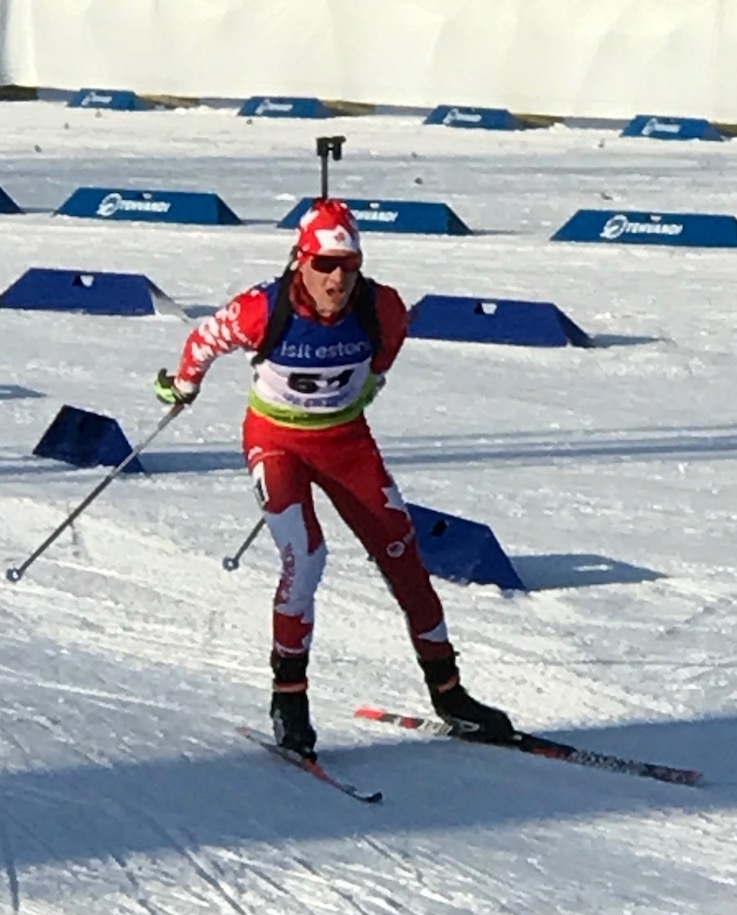
In the junior men’s 10 k sprint that followed, Canada’s Trevor Kiers achieved his best result at his second Junior Worlds in 16th (+1:34.9) with two penalties (2+0). Kiers, 20, previously broke through in 10th and 11th this season in IBU Junior Cup sprints. Last year at Junior World Championships, his best non-relay result was 39th in the pursuit.
So far in Otepää, Kiers had finished 77th in the 15 k individual and 17th with his team in the 4 x 7.5 k relay.
“I found it really hard mentally after the relay and individual,” Kiers wrote in an email. “But after a ton of self-reflection, I realised that I put too much pressure on myself to shoot well and perform. I simply didn’t trust myself. After the individual, I had one training session to regain my confidence, and I was able to do just that. I took 60 very focused shots, and only missed 1 prone and 3 standing over the whole session, and the last 30 were clean! I came into today’s race feeling very confident in my shooting, and knew that I could perform, and not allow that pressure to reach me. To go out and have a fun time, and my instincts would kick in, and the shooting would fall into place.”
On the range, Kiers’s shooting and range times ranked 13th and 14th overall, respectively. As he entered his first prone shooting stage, he recalled that he consciously freed his mind of any expectations.
“After I shot off my first, the casing got stuck in my chamber and I feel it through off my relaxed sort of focus, but I know that my last two shots were just me being silly,” Kiers wrote. “I knew that the next bout would be good, I had convinced myself that standing would be a breeze, just let my body do what it knows how to do.”
His next time in the range, he cleaned his standing bout.
Canada’s Trevor Kiers racing in the junior men’s 15 k individual at 2018 IBU Junior World Championships in Otepää, Estonia. He placed 77th in that race and went on to finish 16th in the junior men’s 10 k sprint on Saturday. (Photo: Bryan Dickson)
“Not only did I clean it, but quickly too!” Kiers wrote. “I was one of the fastest shooters of the day, and can reflect back knowing that I didn’t rush, just that it felt good. Heading out on skis, I knew that I still had a shot at a good result, when I went up one of the first long climbs, out wax tech was yelling at me that I was definitely still in it, that I was still skiing on par, and that I could pull this back together! Having that near the beginning of the loop definitely set me up well mentally for the second loop, to keep the grind on, and that I wouldn’t give up any seconds.”
Based on his shooting, he was confident he could be in the top 20. As the 16th starter, Kiers crossed the finish line in sixth, but some 72 men were still on course. Ultimately, he finished 16th, 1:34.9 behind Russia’s Vasilii Tomshin, who shot clean to win in 25:01.8.
“When I heard that I got 16th I was super happy!” Kiers wrote. “From the previous races I’ve done this year, I knew that cleaning a race could land me in the top 10, and once I finished with 2 misses, I reckoned that it would probably be a top 25, maybe a top 20, but I apparently skied faster than I thought possible! … Today, I held my own on skis, and proved that I deserve to be up here with the big guns!”
Looking back on his progression in the sport, he described it as “insane”.
“… Before two years ago (May of 2016) I had never had a biathlon coach, and did all my training on my own in my backyard range that I built,” he explained. “But I was able to prove myself at the 2016 nationals that February and landed a spot on [Biathlon Alberta Training Center]. BATC has changed a lot about how I had gone about things before, and I think that last year was the time to get used to a full time training lifestyle, and this was the year to start performing, and showing what it has done for me.”
Kiers will start Sunday’s 12.5 k pursuit in 16th, 1:35 behind Tomshin and seven seconds behind Germany’s Tim Grotian in 15th. France’s Martin Perrillat Bottonet (who had one penalty in the sprint) will start second, 21 seconds back, and Norway’s Sverre Dahlen Aspenes (who missed two) will head out third, eight seconds later.
“I am super excited to see what I can do tomorrow, but to be truthful, I don’t have any expectations as far as results go,” Kiers wrote. “My expectations are to simply go out there, have some fun, dance to a few songs during warm-up, and see where that takes me. I am really looking forward to leaving everything I’ve got out on the track, being the last race of the championships, no holding back, have no regrets after I finish.”
Canada had two in the top 30 with Adam Runnalls in 26th (+2:08.3) with three penalties (1+2). Teo Sanchez also qualified for the pursuit by tying for 53rd (+3:19.2) with one penalty (1+0), while Angus Tweedie placed 69th (+4:41.3) with three misses (+4:41.3).
Cody Johnson shot clean to lead the Americans in 37th (+2:31.1). Tim Cunningham finished 71st (+5:13.5) with seven misses, Jacob Pearson was 79th (+6:24.2) with two penalties (1+1) and Cam Christiansen in 86th (+7:52.5) with three penalties (1+2).
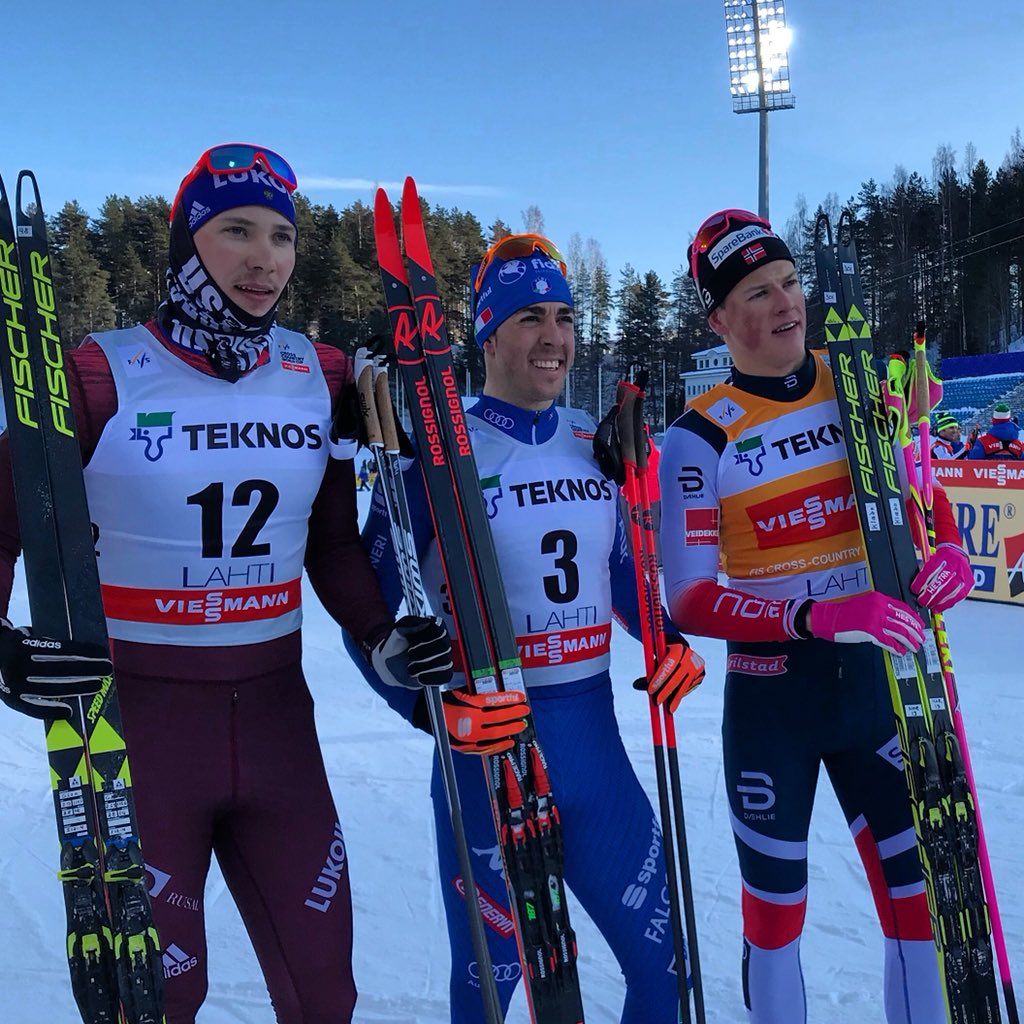
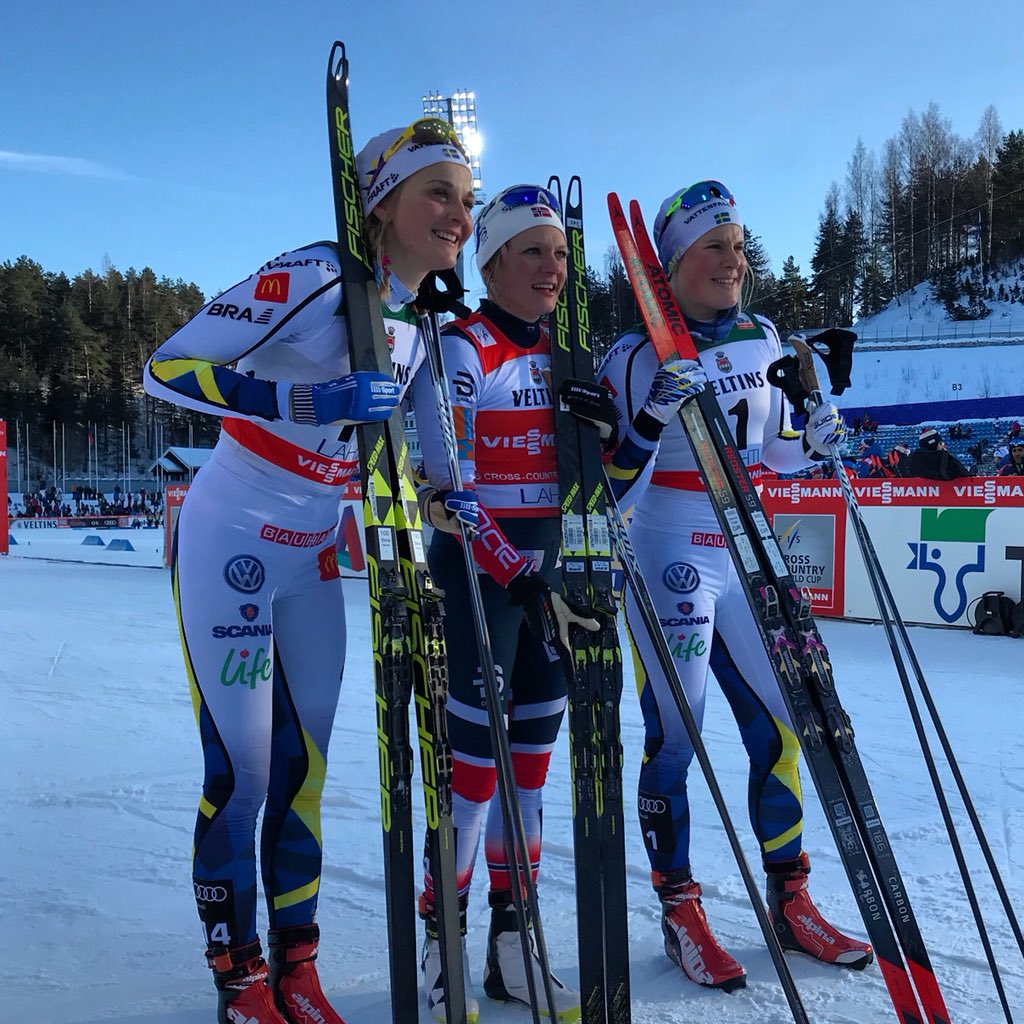
The men’s 1.6 k freestyle sprint podium at Saturday’s World Cup in Lahti, Finland, with Italy’s Federico Pellegrino (c) in first, Russia’s Gleb Retivykh (l) in second and Norway’s Johannes Høsflot Klæbo (r) in third. (Photo: FIS Cross Country/Twitter)
FIS Cross Country World Cup (Lahti, Finland): Men’s & women’s freestyle sprints
The defending world championships from the 2017 freestyle sprint prevailed again in Lahti on Saturday, with Norway’s Maiken Caspersen Falla winning the women’s 1.4-kilometer freestyle sprint final and Italy’s Federico Pellegrino coming out on top in the men’s 1.6 k final at last year’s World Championships venue.
Falla’s rise to the final started with her qualifying in 12th, 7.96 seconds off the fastest qualifying time set by Sweden’s Hanna Falk in 2:54.72. Russia’s Natalia Nepryaeva qualified second (+0.63) and Finland’s Krista Pärmäkoski third (+3.62), just ahead of Germany’s Victoria Carl in fourth (+3.88) and American Sadie Bjornsen in fourth (+3.88). Four American women qualified for the heats, with Sophie Caldwell in 17th, Ida Sargent in 21st and Rosie Brennan in 29th.
The women’s 1.4 k freestyle sprint podium at Saturday’s World Cup in Lahti, Finland, with Norway’s Maiken Caspersen Falla (c) in first, and Sweden’s Stina Nilsson (l) and Hanna Falk (r) in second and third, respectively. (Photo: FIS Cross Country/Twitter)
Falla went on to place second in the first quarterfinal, 0.71 seconds behind Sweden’s Stina Nilsson in first. According to the race jury’s ruling, Carl obstructed Pärmäkoski coming out of the last downhill before they entered the finishing straight and both crashed out of contention, with Pärmäkoski finishing fifth in the heat (+12.11) and Carl sixth (+49.5). Carl was relegated to last (30th place) for the obstruction.
Falla then won the first semifinal by just 0.04 seconds over Nilsson in second. The two other Swedes in that heat, Falk and Ida Ingemarsdotter, advanced to the final as well as lucky losers with fast-enough times.
In the final, Falla found herself at the front of the pack early then held her position to the finish, crossing the line in 2:54.83 and beating Nilsson by 0.36 seconds. Sweden had two on the podium with Falk in third (+0.78), Germany’s Sandra Ringwald placed fourth (+0.88), Ingemarsdotter was fifth (+1.83), and Switzerland’s Laurien van der Graaff placed sixth (+3.02).
Caldwell was the lone American woman to make it past the quarterfinals, as she placed second in her quarterfinal, 0.25 seconds behind Ringwald in first, then fourth in the second semifinal, 1.46 seconds behind Ringwald, who also won that heat. Overall, Caldwell finished the day in eighth.
Bjornsen placed 17th overall after finishing fourth in her quarterfinal, 2.84 seconds behind Falk in first. Sargent had been second in her quarterfinal until the final tight lefthand corner into the finishing straight, where she slipped to sixth and ultimately finished sixth, 1.07 seconds behind Sweden’s Anna Dyvik in first. Overall, Sargent finished the day in 27th, and Brennan placed 29th overall after finishing sixth in her quarterfinal, 4.91 seconds behind Ingemarsdotter in first.
Two American men advanced to the heats as well, with Kevin Bolger of the Sun Valley Ski Education Foundation (SVSEF) qualifying in 16th in his World Cup debut, 6.38 seconds behind Norway’s Johannes Høsflot Klæbo, who topped the qualifier in 2:59.06. Erik Bjornsen of the U.S. Ski Team qualified 29th, 8.29 seconds back.
Meanwhile, Pellegrino qualified for the heats in third (+1.9) behind France’s Baptiste Gros in second (+1.23).
There, Pellegrino won the first quarterfinal by 0.19 seconds over Klæbo, with the Norwegian visibly backing off before the finish — comfortable enough to automatically advance to the semifinals in second place. But Klæbo showed Pellegrino what he’s made of in the first semifinal and beat the Italian by nine-hundredths of a second.
Bolger also raced in that first semifinal after placing fourth in his quarterfinal, 0.73 seconds behind Russia’s Gleb Retivykh in first. Bolger’s time was good enough for one of two lucky loser spots in the semifinals, where he went on to finish sixth, 1.86 seconds after Klæbo. Overall Bolger finished the day in 11th.
Erik Bjornsen placed 20th on the day after finishing fourth in the first quarterfinal (with Pellegrino and Klæbo), 1.56 seconds out of first.
In the final, Klæbo set the tone, slowing the pace to almost a stop at one point, while he and Pellegrino stood side by side at the top of the course. On the way down, they accelerated, but Norway’s Sindre Bjørnestad Skar was the one who truly attacked. It might’ve been a bit too early, as Pellegrino caught him by the top of the final climb and took the lead on the following downhill into the stadium. Pellegrino held off his challengers, including Retivykh who came on strong out of the downhill, to take the win in 3:16.73, 0.77 seconds ahead of Retivykh in second and 0.9 seconds ahead of Klæbo in third. Skar settled for fourth (+1.3), Finland’s Ristomatti Hakola placed fifth (+1.44) and France’s Lucas Chanavat finished sixth (+7.55).
In the qualifier, Canada’s Dahria Beatty finished 34th, +13.39 and just 0.9 seconds from making the quarterfinals. She was the only Canadian woman competing.
American Kelsey Phinney (SVSEF) was also close to making the cut. In her first European World Cup, she placed 36th in the qualifier, +13.74. Caitlin Patterson and Kaitlynn Miller, both of the Craftsbury Green Racing Project, placed 56th (+20.12) and 61st (+21.70).
Mathilde Petitjean of Togo, a primarily Quebec-based skier, finished in 59th (+20.80).
In the men’s qualifier, Logan Hanneman (APU) placed 49th (+11.45). Paddy Caldwell (U.S. Ski Team/SMS T2) finished 59th (+13.55), and APU’s Reese Hanneman and David Norris placed 61st (+14.33) and 67th (+19.27).
Julien Locke led Canada in 42nd place (+9.78), and Andy Shields finished 60th (+14.29).
American Chloe Levins racing to seventh in the junior women’s 7.5 k sprint on Saturday at IBU Junior World Championships in Otepää, Estonia. (Photo: Terri Dickson)
Poland’s Kamila Zuk won her second race in a row, taking gold in the junior women’s 7.5 k sprint after also winning the individual at World Junior Championships. Zuk had one penalty to two by second-place Marketa Davidova of the Czech Republic, who finished 26.0 seconds back. Bronze went to Myrtille Begue of France, who shot clean to finish 52 seconds back.
The sole U.S. starter, Chloe Levins followed up her sixth-place finish in the individual with seventh place in the sprint. Levins had a single penalty and finished +1:31.7.
For Canada, Megan Bankes was close behind Levins in ninth, with two penalties and +1:49.5. Teammate Nadia Moser was 21st, also with two penalties, +2:46.2. Emily Dickson finished 36th, +3:50.5 with two penalties, and Zoe Pekos just missed the pursuit cutoff in 66th (+6:22.4) with four missed shots.
In the junior men’s 10 k sprint, Vasilii Tomshin of Russia took the gold with perfect shooting. France’s Martin Perillat Bottonet was second, less than a penalty-loop’s worth of time back at 20.5 seconds – and he did have one penalty. Norway’s Sverre Dahlen Aspenes took bronze (+29.4) with two missed shots.
Trevor Kiers led Canada in 16th, a breakthrough result; his previous World Juniors best was 39th in the pursuit last season. Kiers missed two shots, both in prone, and finished 1:34.9 behind the time set by Tomshin.
Adam Runnalls placed 26th for Canada (+2:08.3) with three missed shots. Teo Sanchez also qualified for the pursuit by placing 53rd (+3:19.2) with one penalty, and Angus Tweedie was left on the outside looking in with 69th place (+4:41.3) with three missed shots.
Cody Johnson led the Americans in 37th, with clean shooting, 2:31.1 back from Tomshin’s time. Tim Cunningham was the next finisher in 71st (+5:13.5) with seven missed shots, followed by Jacob Pearson in 79th (+6:24.2) with two penalties and Cam Christiansen in 86th (+7:52.5) with three penalties.
The top-six finishers at the junior women’s 12.5 k individual flower ceremony on Thursday at IBU Junior World Championships in Otepää, Estonia, with Poland’s Kamila Żuk (second from l) in first, Ukraines’s Anna Kryvonos (l) in second place, Russia’s Irina Kazakevich (third from l) in third, and American Chloe Levins (r) in sixth. (Photo: Erik Lewish)
IBU Junior World Championships (Otepää, Estonia): Junior women’s and men’s individual
Three North Americans in the top 10, top nine even. That’s what happened in a single race at the International Biathlon Union (IBU) Junior World Championships on Thursday in Otepää, with American Chloe Levins placing sixth, and Canada’s Nadia Moser and Megan Bankes claiming eighth and ninth, respectively, in junior women’s 12.5-kilometer individual.
According to the three racers, it was another beautiful day in Otepää with steady, sometimes even gusting, wind.
Levins was the earliest starter of the three, starting in the middle of the field in bib 37 (out of 70). Bankes headed out of the gate 45th and Moser started near last in 67th.
Canada’s Nadia Moser racing to eighth in the junior women’s 12.5 k individual at IBU Junior World Championships in Otepää, Estonia. (Photo: Bryan Dickson)
Despite the late start, Moser, 20 years old and in her second Junior Worlds, explained in an email that she wasn’t nervous. With temperatures rising to a high of -10 degrees Celsius (14 Fahrenheit) on Thursday morning, she almost preferred it.
“There were also 20 second start intervals which are shorter than the usual 30, so all of the competitors were out of the gate in a shorter amount of time than normal,” Moser wrote.
In neither Thursday’s women’s race nor the men’s 15 k individual that followed, nobody shot clean. In fact, only one woman shot 19-for-20: Slovakia’s Veronika Machyniakova, who ended up 11th. The top-two finishers in the women’s 12.5 k, Poland’s Kamila Żuk (who placed first in 41:36.1 minutes) and Ukraine’s Anna Kryvonos (who finished 3:04.7 minutes back in second place), both had two penalties. Russia’s Irina Kazakevich placed third (+3:20.0) with three misses — which added three minutes of penalties to her time.
“I found the wind in the range today to be fairly variable,” Bankes, the defending Junior Worlds champion in the event, wrote in an email. “It was gusting and then dying quiet significantly and also in the middle of shooting bouts which made things a little tricky.”
At last year’s Junior Worlds in Osrblie, Slovakia, Bankes shot a perfect 20-for-20 for the first time in her career and won gold in the junior women’s 12.5 k individual.
Thursday brought new challenges, and Bankes explained she was happy to clean her first prone. She went on to miss two in the next standing stage, then one in each of the following two stages (0+2+1+1) to finish the race with four penalties, which ultimately put her in ninth overall (+4:59.1).
Canada’s Megan Bankes racing to ninth in the junior women’s 12.5 k individual at IBU Junior World Championships in Otepää, Estonia. (Photo: Bryan Dickson)
“I’m not totally sure what happened in my first standing (when I missed 2) but when I came into my 2nd standing the wind was gusting quite a bit, and I was really happy with how I waited for my first 4 shots, but I was a little annoyed to have missed that last one,” she recalled. “Overall I think my shooting today was pretty good, but I could have been better.”
While Bankes figured the wind was giving most others trouble as well, she didn’t think that she’d make it into the top 10 with four misses.
“I don’t like getting splits until the last lap, so I heard Andrew [Chisholm] our wax tech tell me I was fighting for 10th when I passed him, so I really tried to give everything that last lap,” Bankes, 20, wrote. “I was super stoked to see I crossed the line in 7th, and knew I wouldn’t be bumped down too much because I started 3rd seed.
“Coming off of gold last year, I definitely had high expectations for myself,” she explained. “But I tried to use that as more positive belief in myself to know I can be in the top women, and know that I can shoot well, instead of just focusing on the result number. My main goal going into these championships was to have races that I’m happy with, and to ski and shoot to the best of my abilities.”
At the end of the day, Bankes wrote that she was “really happy” with her result.
“I felt like I really held myself together on skis, and kept my technique under control, while also pushing myself to the limit throughout the race,” she wrote. “I’m super stoked to see that the youth women are totally crushing it, and to be right behind Nadia today was also super exciting (also to see Chloe Levins in 6th was fantastic – 3 North Americans in the top 10!)”
From left to right: Megan Bankes, Nadia Moser and Emily Dickson after the junior women’s 12.5 k individual at IBU Junior World Championships in Otepää, Estonia. (Photo: Bill Gilliland)
One place ahead of her, Moser scored her first non-relay top 20 at Junior Worlds, leading Canada in eighth (+4:18.9) with three penalties (1+0+1+1). Two days earlier, Moser, Bankes and their teammate Emily Dickson placed ninth in the junior women’s 3 x 6 k relay.
“I knew I could get a top 10 finish if I could pull my shooting together,” Moser wrote after Thursday’s individual race. “After my third shooting I had missed 2 targets total and I thought then that my top 10 chances were over. On may last loop I had 3 misses and was not even thinking about top 10 anymore. I realized that I must be doing better than I initially thought when everyone who was cheering me sounded really excited. I definitely got lucky today because no one cleaned their shooting. I was extremely happy to have finished in the top 10, especially since I was sure that I had no chance after missing 3 targets.”
She was pleased to see all of her training over the last year validated on Thursday.
“I tried really hard to improve over the summer and fall because I really wanted good results this season,” Moser wrote. “I think that the best thing I did today was to stay calm, and take my time in the range. I shot really slowly but that paid off in the end.”
Chloe Levins (third from r) with the U.S. team staff (from l to r) wax tech Travis Voyer, coach Algis Shalna, assistant coach Danika Frisbie, wax tech Max Bergmann, wax tech Mattias Halquist, and head coach Erik Lewish, after Levins placed sixth in the junior women’s 12.5 k individual at IBU Junior World Championships in Otepää, Estonia. (Photo: Erik Lewish)
The lone American junior woman at this year’s IBU Youth/Junior Worlds, Levins, 19, finished sixth (+3:37.4) with three penalties (0+1+0+2). At last year’s Youth Worlds, Levins notched fourth place in the 7.5 k pursuit.
“There’s a big difference between youth and junior competition,” Levins wrote in an email. “A lot of juniors have IBU Cup experience, World Cup experience, and a handful even attended the Olympics. Fortunately, there’s also a big difference between the youth athlete I was last year and the junior I am now. I’ve been fortunate to compete in more winter biathlon races than ever this year, which has really helped me up my game. It’s a good feeling to see that I’m prepared to compete at this level.”
She explained that she had one goal on Thursday: “smile no matter what,” she wrote. “The hay is in the barn. Now it’s just time to get out of my own way and focus on one thing at a time.”
While Levins had experienced the rush of being near the front of the race in a pursuit, actually contending for a top result in an individual-start race was a new experience for her, she explained.
“As always, I tried not to let thoughts of my position distract me from thinking tactically about the course or my shooting process,” Levins noted. “Every lap, every corner, every shooting remained an opportunity for me until the finish line.
“A lot of my friends finished their races around me, so I did not even see my standing at the finish,” she continued. “When I finally looked at the board and saw that I was more than three minutes back of the leader, I thought that this result, with three penalties myself, was okay. I didn’t expect it to be good enough for sixth place.”
The race was Levins’s first of the week and she presumably has two more to go — as do Moser, Bankes and most of the other junior women — with a sprint on Saturday and, if they place in the top 60 of the sprint, a pursuit on Sunday.
As the only American junior woman in Otepää, Levins wrote that she was fortunate to have a significant amount of team support behind her on Thursday.
“My skis today were incredibly fast,” she emphasized. “Our wax guys made the fastest skis on the track today. … I can’t thank them enough.”
The U.S. team’s head coach and trip leader, Erik Lewish, pointed out that Levins had the seventh-fastest overall ski time and one of the best shooting performances of the day.
“It’s great to see that she is right in the mix with this very competitive field (2 of the starters today were competing in the Olympics),” Lewish wrote. “1 more hit and she would have finished in 2nd place today, this is very exciting looking forward to the Sprint and pursuit (sat and Sunday) where she will have another chance to get on the podium.”
“There are a lot of good things to take from this race and, as always, a lot of things to learn,” Levins concluded. “What’s my goal for the rest of the week? Keep learning. Keep smiling.”
According to Canada’s head coach and trip leader Jacqueline Akerman, the Canadian techs also nailed the wax.
“The techs hit the wax perfectly allowing for some of the top skis out there, when skiing form and wax meet it sets the scene for great results,” Akerman wrote. “The shooting was a bit tricky today with varying strength and switching winds, but both [Nadia and Megan] managed to keep misses to a minimum. They both hit enough to place in the top ten on a day when no one in the field shot clean and only one athlete managed one penalty. They are both happy with their performance, and the rest of us are too!”
Next on the results sheet for Canada was Dickson in 36th (+8:33.7) with five penalties (2+1+0+2), and Zoë Pekos in 63rd (+15:50.6) with eight misses.
Canada’s Adam Runnalls racing to 29th in the junior men’s 15 k individual at IBU Junior World Championships in Otepää, Estonia. (Photo: Bill Gilliland)
In the junior men’s 15 k, Canada’s Adam Runnalls led the North Americans in 29th (+4:26.4) with five penalties (0+0+3+2). Teo Sanchez followed in 58th (+7:25.2) with four misses (1+1+1+1), Angus Tweedie was 67th (+9:11.8) with six misses (2+0+2+2), and Trevor Kiers 77th (+12:44.3) with 13 penalties.
For the U.S., Tim Cunningham finished 53rd (+6:49.3) with six penalties (1+3+1+1), Cody Johnson was 60th (+8:01.7) with seven misses, Jacob Pearson 83rd (+16:39.6) with 13 misses, and Cameron Christiansen 84th (+16:53.6) with eight penalties.
Russia had two on the podium in the men’s race as well, with Igor Malinovskii scoring his second-straight win after racing to gold in the junior men’s 4 x 7.5 k relay on Tuesday. He has won the last four races he’s contested, including the sprint and the pursuit at IBU Junior Open European Championships before Junior Worlds. Malinovskii finished in 41:48.5 on Thursday with three penalties (1+1+1+0), besting Norway’s Sturla Holm Lægreid in second place by 19.4 seconds; Lægreid also had three penalties (1+0+1+1). Russia’s Said Karimulla Khalili added bronze (+23.0) to his medal collection, with two misses (0+1+1+0), after capturing gold with his relay team.
No one in the junior men’s individual had fewer than two misses.
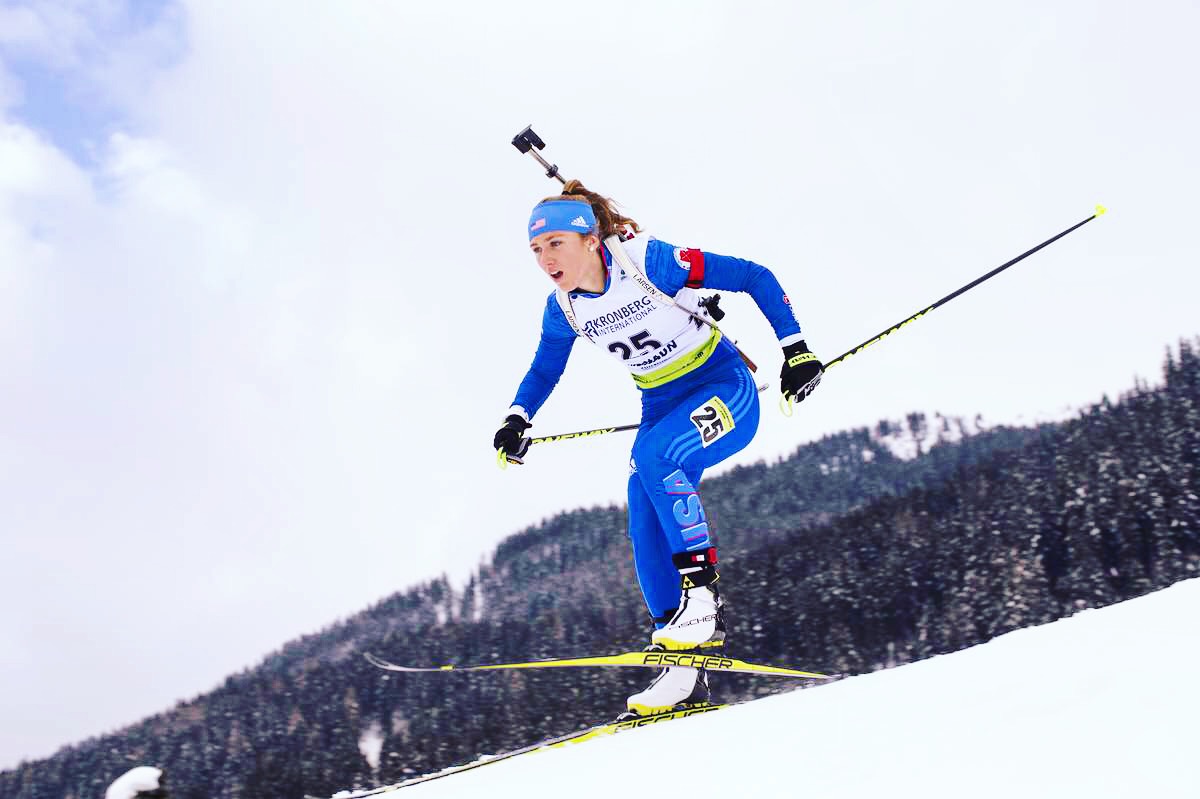
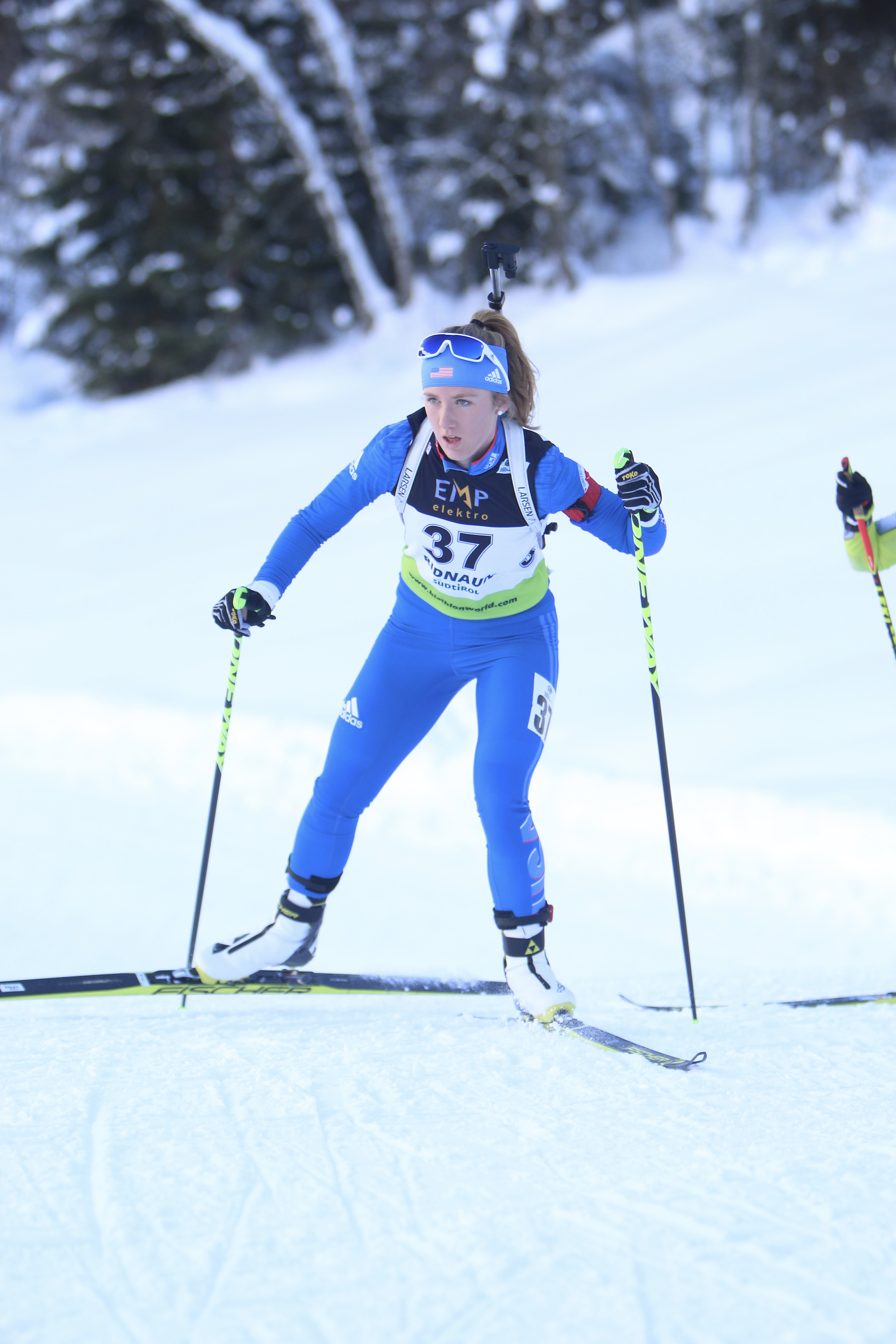
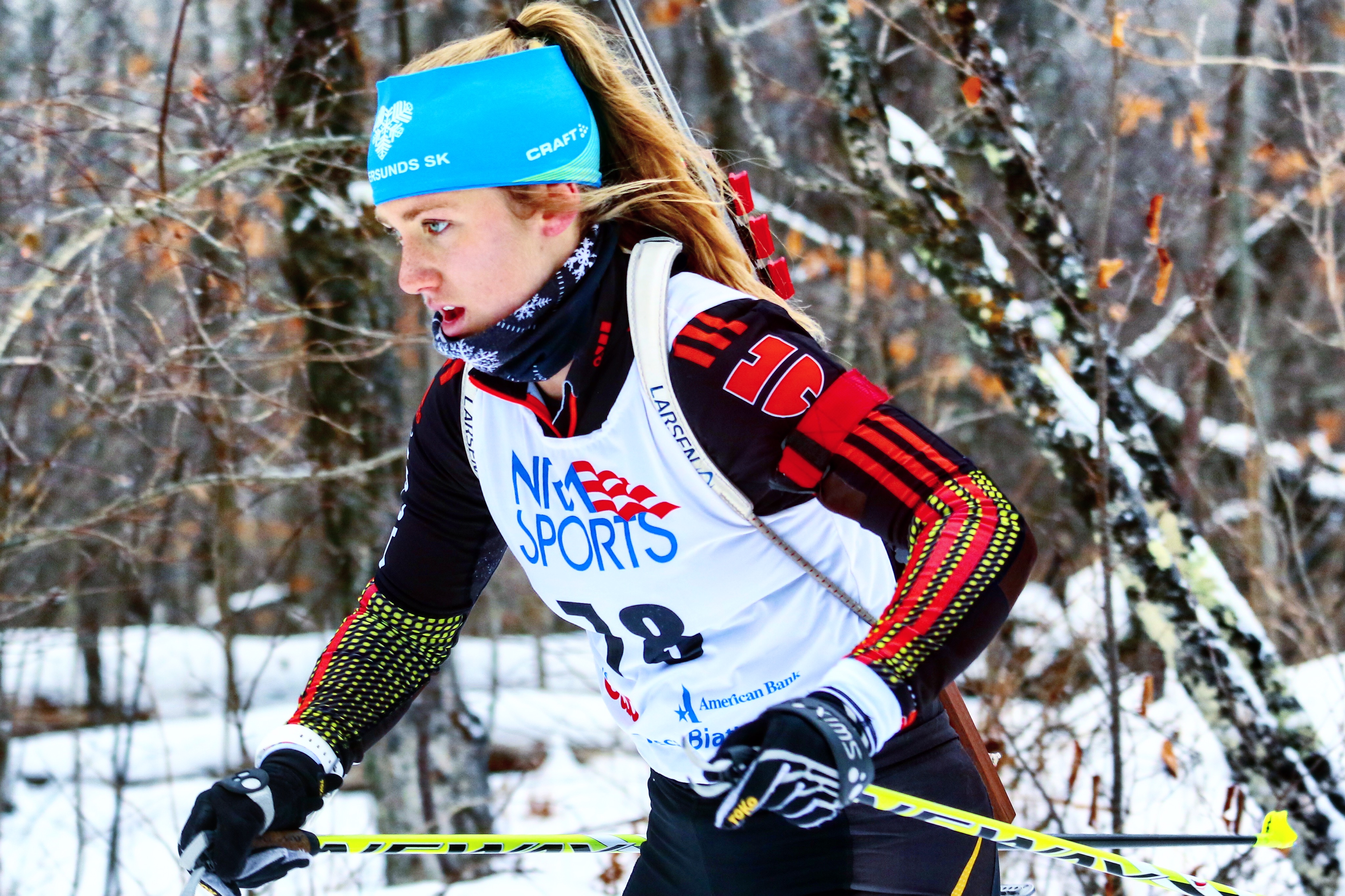
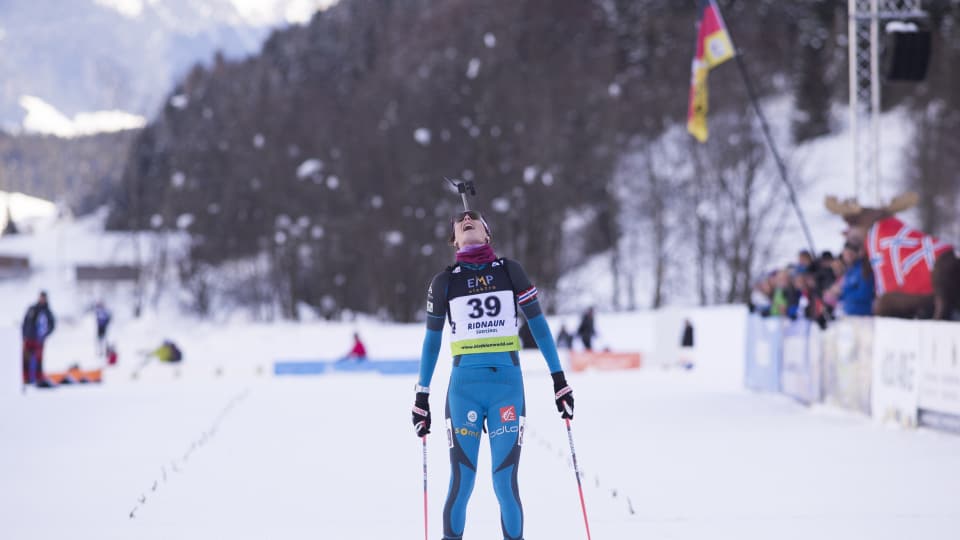
Chloe Levins racing at the IBU Cup in Ridnaun, Italy, as part of the U.S. Biathlon Association’s Olympic trials series. (Photo: USBA/NordicFocus)
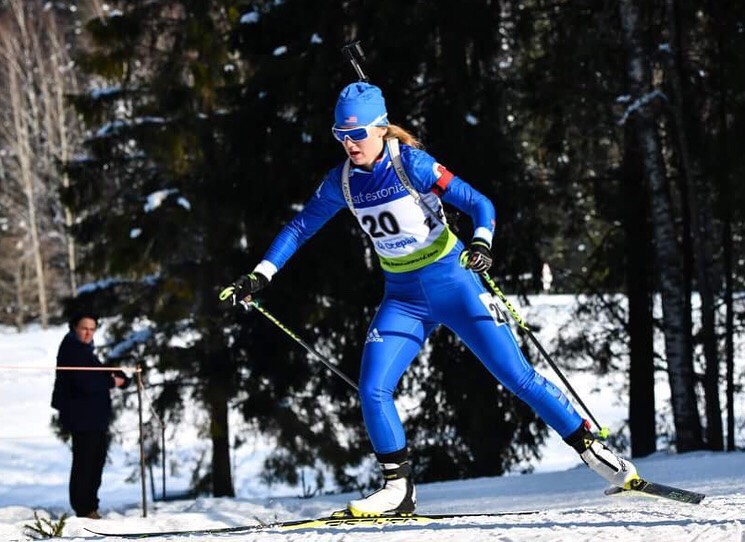
In an effort to showcase the North Americans competing at this week’s International Biathlon Union (IBU) 2018 Youth and Junior World Championships in Otepää, Estonia, we asked those qualifying athletes several questions about themselves — actually, we had them fill in the blanks. Here we have 19-year-old Chloe Levins, who is representing the United States at her first Junior World Championships. She previously represented the U.S. at Youth World Championships, including a fourth-place finish in the pursuit last season. Levins also made the short list of the U.S. Olympic Team and competed on the IBU Cup as part of Olympic Trials.
On Thursday, Levins placed sixth to lead her team in the junior women’s 12.5 k individual (+3:37.4 with three penalties).
***
“My full name is Chloe Levins but you can call me Chlo.
I was raised in Vermont, and I learned to ski by following my three older siblings.
I spent the time before Worlds in school at Middlebury College.
Chloe Levins racing in Ridnaun. (Courtesy photo)
The most memorable workout I did in the last training year to prepare for this was skiing with my coach. He doesn’t ski often, so it’s really special when he chooses to ski with me.
One thing I’m working on this season to improve my biathlon is (and probably always will be) my patience.
This is my first time in Estonia and fourth year racing internationally, and so far it’s been real winter with temperatures in the single digits (F) and falling snow.
One difference I’ve noticed between Estonia and the United States is the lack of fruit.
One of the things I’m most excited about for World Junior Championships in Otepää is experiencing a new world-class venue.
One race I’m especially targeting there is the next one.
Watching the Olympics in the leadup to my own races was hard to do at school. One of the most memorable moments of the Games was when Jessie Diggins overtook Stina Nilsson to earn US Women’s XC Skiing their first ever Olympic medal. I want to ski like Jessie, because she skis with more heart than anyone I’ve ever seen.
At Worlds, I really hope I can practice speaking German with my friends from Deutschland.
My favorite thing at the breakfast where we are staying is the lemon ginger tea.
Before this trip, if you said “Estonia”, the first thing I’d think of would have been the cold temperatures.
Now that I’m here, I’m pretty sure something I’ll always remember will be the cold temperatures.
If I had a totally free day here and didn’t have to worry about race fitness or training, I’d still spend it on skis.
The best way to follow me on social media is on Instagram@chlolevins or SnapChat @chlevins.”
Chloe Levins racing at IBU Cup Trials in Mount Itasca, Minnesota. (Courtesy photo)
US Biathlon’s Lowell Bailey (l) and Susan Dunklee after teaming up for bronze in the single mixed relay at 2018 IBU Open European Championships on Sunday in Ridnaun, Italy. (Photo: Manzoni/NordicFocus)
IBU Open European Championships (Ridnaun-Val Ridanna, Italy): Single mixed & mixed relays
Susan Dunklee and Lowell Bailey teamed up for the final day of the 2018 International Biathlon Union (IBU) Open European Championships in Ridnaun, Italy, and raced to a bronze medal in the single mixed relay.
The American duo, both of which earned individual medals at last year’s IBU World Championships, finished just 9.1 seconds out of first, which went to Norway’s Thelka Brun-Lie and Vetle Sjåstad Christiansen. The Norwegians won in 35:39.6 with zero penalties and six spares. They took the lead after Brun-Lie’s second leg, where she cleaned both stages without spares.
France placed second, 8.6 seconds back, with Julia Simon and Emilien Jacquelin, who combined for no penalties and 11 spares. They led the first half of the race, but slipped to second behind Norway on Simon’s second leg.
Dunklee put the Americans off in second on her first leg, which she cleaned with a spare in each stage, then they slipped one place to third on Bailey’s first leg, where he cleaned as well and used three spares. In all, they used 10 spares and avoided the penalty loop, and finished half a second out of second place.
“Over Christmas, we trained a little bit with the French athletes, including Jacquelin,” Bailey said, according to a US Biathlon press release. “So I know that he has quite a fast finish, and I thought I am kind of an old man here, I should maybe try to go harder on the first part of the lap. But he stayed with me all the time and had me in the end.”
“It was a good opportunity to tune up the race shape, build some confidence and find that sharp feeling heading into the Olympics,” Dunklee told US Biathlon. “The single mixed relay is one of my favorite race formats and today was a blast!”
Canada’s Sarah Beaudry and Carsen Campbell placed eighth of 24 teams in the single mixed relay, finishing 1:03.6 out of first with just eight spares and zero penalties. In 11th after the first leg, they moved into eighth on Campbell’s first leg, which he cleaned with one spare. Beaudry then cleaned her second leg without any spares, and Campbell anchored them to eighth.
The U.S. entered a team in the mixed relay that followed, with Chloe Levins, Deedra Irwin, Paul Schommer, and Alex Howe placing 17th (+5:55.5) of 19 teams with no penalties and 12 spares.
Ukraine won the mixed relay to conclude the championships, with Yuliia Zhuravok, Iryna Varvynets, Artem Pryma, and Dmytro Pidruchnyi combining for zero penalties and six spares and finishing in 1:11:40.1.
Russia placed second (+11.7) with Victoria Slivko, Anastasia Zagoruiko, Evgeniy Garanichev, and Alexander Loginov combining for zero penalties and nine spares.
Norway followed in third (+33.2) with Emilie Ågheim Kalkenberg, Kaia Wøien Nicolaisen, Håvard Gutuboe Bogetveit, and Fredrik Gjesbakk combing for no penalties and just four spares.
U.S. SuperTour (Craftsbury, Vermont): 5/10 k freestyle
Two Alaska Pacific University (APU) athletes topped the podium on Sunday at the SuperTour in Craftsbury, Vermont, with David Norris winning the men’s 10-kilometer freestyle individual start in 21:54.9 and Becca Rorabaugh topping the women’s 5 k freestyle in 12:06.4.
Norris won the men’s race by 6 seconds over Canada’s Andy Shields (Lappe Nordic) and Kevin Bolger of the Sun Valley Ski Education Foundation (SVSEF) placed third (+15.8). Kris Freeman (Caldwell Sport) was the third American in fourth overall (+23.7), and three Canadians took fifth through seventh with Michael Somppi (Lappe Nordic) in fifth (+27.9), Evan Palmer-Charrette (NTDC Thunder Bay) in sixth (+37.5) and Scott Hill (Barrie Cross Country) in seventh (+37.6), ahead of Brian Gregg (Team Gregg/LNR/CXC) in eighth (+39.4), Tad Elliott (Ski Club Vail) in ninth (+44.3) and Jack Hegman in 10th (+50.4).
Rorabaugh won the women’s race by just 2.2 seconds over her APU teammate Rosie Frankowski in second, and Erika Flowers of the Stratton Mountain School (SMS) T2 Team placed third (+4.6). Two Craftsbury Green Racing Project (CGRP) skiers finished fourth and fifth, with Kaitlynn Miller in fourth (+12.1) and Liz Guiney in fifth (+22.5), Kelsey Phinney (SVSEF) was sixth (+25.8), and Canadians Olivia Bouffard-Nesbitt (Rocky Mountain Racers) seventh (+26.4) and Frederique Vezina (Pierre-Harvey National Training Centre) eighth (+36.0). Corey Stock, of the Bridger Ski Foundation (BSF) placed ninth (+39.9), and Felicia Geisor (CXC Team) was 10th (+44.4).
On Saturday, the Craftsbury Outdoor Center hosted its 37th annual Craftsbury Marathon, with Nils Koons winning the 48 k men’s race in 2:28:51.0 hours and Hannah Dreissigacker winning the 48 k women’s race in 3:01.48.7.
Hannah Halvorsen of the U.S. Ski Team and APU on the start line in Ulrichen, Switzerland, after finishing fifth in the sprint qualifier. (FIS screencap)
FIS Cross Country World Junior Championships (Ulrichen, Switzerland): Freestyle sprints
World Junior Championships kicked off today with freestyle sprints in Ulrichen, Switzerland. Moa Lundgren of Sweden claimed with women’s title by 1.89 seconds over Kristine Stavås Skistad of Norway in the final, with Sweden’s Frida Karlsson finishing third (+1.89).
Hannah Halvorsen of the United States qualified in fifth place before skiing to second in her quarterfinal heat. Halvorsen hovered around third or fourth place through much of her semifinal and was unable to snipe any spots in the finishing straight, ending up fourth in the heat and eighth on the day.
Fellow Americans Margaret Gellert and Sofia Shomento also made the quarterfinals, finishing 18th and 23rd, and Canada’s Hannah Mehain wound up 29th on the day.
The new men’s junior world champion is Tom Mancini of France, who nipped Norway’s Jørgen Lippert by just 0.10 seconds to take the win. Valerie Grond gave the Swiss crowd a thrill by making it all the way to the final and taking home bronze, despite qualifying in just 21st position. The Swiss junior narrowly edged France’s Vincent Buiatti for the final step on the podium.
Canada’s Graham Ritchie finished second in his quarterfinal after qualifying in 28th position, earning an automatic spot in the semifinals. There he finished sixth (+9.30 behind Mancini), winding up 12th on the day. Teammate Antoine Cyr also made the quarterfinals where he had an impressive crash, slinging off the trail and into the infield, finishing 30th on the day. For the U.S., Gus Schumacher was the lone qualifier for the heats. He finished fourth in his quarterfinal and was just 0.22 seconds away from a “lucky loser” spot in the semifinals. Schumacher finished 19th on the day.
In the junior women’s race, Hannah Rudd of the United States finished 35th in qualification, +18.15. For Canada, Annika Richardson finished 52nd (+24.09), Catherine Reed-Metayer 56th (+28.25), and Alexandra Racine 69th (+37.27).
In the junior men’s sprint, Canada’s Reed Godfrey finished a tough 31st, just 0.21 seconds out of making the quarterfinals. Etienne Hebert rounded out the Canadian finishers in 36th place (+11.81) in the qualifier. Canyon Tobin was 41st in qualification for the U.S. (+13.46), followed by Karl Schulz in 54th (+16.90) and Luke Jager in 60th (+18.15).
FIS Nordic Combined World Cup (Seefeld, Austria): Individual normal hill/15 k
Japan’s Akito Watabe after winning the 2018 Seefeld Triple Nordic Combined World Cup. He is the only athlete besides Germany’s Eric Frenzel to win the event. (Photo: FIS Nordic Combined)
On the final day of the Seefeld Triple, Japan’s Akito Watabe completed his sweep of the three-day weekend and Norway’s Jarl Magnus Riiber reached the podium for the third-straight day, placing second. Germany’s Fabian Rießle placed third for his second podium in the last two days.
Watabe jumped to first on the normal hill and started the 15 k Gundersen 48 seconds ahead of Riiber in second. He went on to win the race by 1:14.9 minutes in 34:58.6, becoming the only man besides Germany’s Eric Frenzel to win the Seefeld Triple in its five-year history.
After jumping to fifth, Rießle won a photo finish for third (+1:57.9), edging Germany’s Vinzenz Geiger by less than a tenth of a second. Geiger moved up from ninth in the jump to fourth overall (+1:57.9).
Norway’s Jørgen Graabak followed in fifth (+2:02.4),Frenzel placed sixth (+2:07.4), Norway’s Jan Schmid was seventh (+2:09.8), Finland’s Eero Hirvonen eighth (+2:13.5), Norway’s Espen Andersen ninth (+2:28.0), and Austria’s Mario Seidl 10th (+2:42.1) out of 28 finishers.
No Americans contested the final day of the Triple, the last World Cup before the 2018 Winter Olympics in PyeongChang, South Korea.
Jessie Diggins of the U.S. Ski Team (center) celebrates after winning the 10 k mass start freestyle in Seefeld, Austria, over Heidi Weng (left) and Ragnhild Haga of Norway. (Photo: FIS Cross Country/Twitter)
FIS Cross Country World Cup (Seefeld, Austria): 10/15 k mass start freestyle
In the final World Cup race before the 2018 Olympics, Jessie Diggins achieved the ultimate goal to give herself the utmost confidence heading into PyeongChang — winning the women’s 10-kilometer freestyle mass start at the World Cup in Seefeld, Austria, on Sunday.
The win was her first of the season and fourth individual victory of her career. Diggins, a 26-year-old U.S. Ski Team member, pulled it off by attacking on a long climb and leaving Norway’s Heidi Weng, Ragnhild Haga and Ingvild Flugstad Østberg chasing. While Diggins was several seconds ahead over the top and all alone on the long descent that followed, Weng and Haga worked to close the gap — and nearly did in the finishing stretch. But Diggins held them off, winning by 0.7 seconds over Weng in second place and 1 second ahead of Haga in third, and threw her fists down in celebration as she crossed the line first in 23:08.5 minutes.
“I just put my head down and it wasn’t pretty, but I just hammered,” Diggins told the International Ski Federation (FIS) in a televised post-race interview.
She was the only non-Norwegian in the top five, with Østberg in fourth (+8.7) and Marit Bjørgen in fifth (+16.7). Austria’s Teresa Stadlober placed sixth (+16.9), Norway’s Kari Øyre Slind was seventh (+19.1), and American Sadie Bjornsen placed eighth (+20.5), ahead of Switzerland’s Nathalie von Siebenthal in ninth (+30.3).
The U.S. had three in the top 15 with Kikkan Randall (U.S. Ski Team) in 14th (+48.5), and two more women in the top 30, with Caitlin Patterson (Craftsbury Green Racing Project) in 23rd (+1:00.7) and Liz Stephen (USST) in 29th (+1:18.2). Rosie Brennan (USST) finished 53rd (+2:26.9).
Emily Nishikawa led the Canadians in 35th (+1:36.5), followed closely by teammate Cendrine Browne in 37th (+1:36.6). Dahria Beatty finished 45th (+1:58.9).
Dario Cologna of Switzerland (center) won the men’s 15 k skate mass start in Seefeld, Austria, over Alex Harvey of Canada (left) and Martin Johnsrud Sundby of Norway (right). (Photo: FIS Cross Country/Twitter)
The Olympics are nearing and so Switzerland’s Olympic legend Dario Cologna is ramping up: after winning the Tour de Ski, he took another win in the 15 k mass start skate in Seefeld, Austria, on Sunday.
With much of the field staying relatively close together until the finish, Cologna nabbed the win by 1.4 seconds over Canada’s Alex Harvey, who took his second podium of the season in addition to also finishing third in the overall Tour de Ski.
Norway’s Martin Johnsrud Sundby was third (+2.9), then teammate Didrik Tønseth in fourth (+5.9) and France’s Maurice Manificat in sixth (+7.5).
The U.S. Ski Team’s Erik Bjornsen had a breakthrough day finishing ninth (+9.3), followed by Simi Hamilton in 12th (+12.4). Behind them, Scott Patterson placed 27th (+23.4), then Patrick Caldwell 49th (+1:26.2), Ben Lustgarten 55th (+1:42.7), and Tyler Kornfield 77th (+3:00.0).
Canada’s Devon Kershaw and Graeme Killick finished 30th (+26.5) and 31st (+27.4), respectively. Len Valjas placed 58th (+1:53.1), Knute Johnsgaard 82nd (+3:23.1), Bob Thompson 87th (+4:27.5), and Julien Locke 92nd (+4:56.9).
The podium for Day 2 of the Seefeld Triple Nordic Combined World Cup, with Japan’s Akito Watabe in first (c), Germany’s Vinzenz Geiger (l) in second and Norway’s Jarl Magnus Riiber (r) in third. (Photo: FIS Nordic Combined/Twitter)
FIS Nordic Combined World Cup (Seefeld, Austria): Normal hill/10 k
Two of the same men from Friday repeated on the podium on Day 2 of the Seefeld Triple Nordic Combined World Cup, with Japan’s Akito Watabe notching his second-straight win on Saturday.
Norway’s Jarl Magnus Riiber, who finished second on Friday, placed third in Saturday’s individual normal hill/10 k Gundersen, while Germany’s Vinzenz Geiger placed second, more than a minute behind Watabe.
Watabe jumped to first and started the 10 k with a 25-second head start on Riiber in second. Geiger started seventh, 1:45 minutes back, and rose to second at the finish, 1:05.5 behind Watabe (who won in 23:28.5) and 3.4 seconds ahead of Riiber in third (+1:08.9).
For the second day in a row, Norway’s Jan Schmid narrowly missed the podium in fourth (+1:14.1), up from fifth after the jump.
Taylor Fletcher was the lone American competing on Day 2, and he ended up 31st, up 10 places after jumping to 41st. Fletcher started the 10 k race 4:44 out of first then finished 3:52.9 behind Watabe.
The Seefeld Triple concludes Sunday with the individual normal hill/15 k Gundersen.
American Sophie Caldwell (l) and Switzerland’s Laurien van der Graaff (r) tied for first on Saturday in the women’s 1.1 k freestyle sprint final at the World Cup in Seefeld, Austria, while Norway’s Maiken Caspersen Falla placed third. (Screenshot: ARD broadcast)
FIS Cross Country World Cup (Seefeld, Austria): Freestyle sprints
It doesn’t get any closer than that. On Saturday, American Sophie Caldwell and Switzerland’s Laurien van der Graaff tied for first in the women’s 1.1-kilometer freestyle sprint final at the World Cup in Seefeld, Austria. They both finished within one-hundredth of a second of each other to take the victory — the last sprint before the Olympics — in 2:18.65 minutes.
Norway’s Maiken Caspersen Falla finished 0.21 seconds later for third place.
The women’s freestyle sprint podium at Saturday’s World Cup in Seefeld, Austria, with American Sophie Caldwell (l) and Switzerland’s Laurien van der Graaff (c) tying for first and Norway’s Maiken Caspersen Falla (r) placing third. (Photo: FIS Cross Country/Twitter)
“I broke my pole in the semifinal, then I got really tired,” van der Graaff said in a post-race interview with the International Ski Federation (FIS). “But I still believed I can be with Maiken and Sophie, and that I could catch them in the final was just great.”
Norway and the U.S. both had two in the final, with Kathrine Rolsted Harsem of Norway placing fourth (+1.34), Sweden’s Linn Sömskar finishing fifth (+1.83) and American Sadie Bjornsen taking sixth (+2.26).
Falla had raced to first in the qualifying round with a time of 2:21.44, Italy’s Greta Laurent qualified second (+1.43), van der Graaff third (+1.66), Caldwell fourth (+1.84), and Bjornsen fifth (+2.01).
Van der Graaff then won her quarterfinal and placed third in the first semifinal, 0.77 second behind Caldwell, who won it. Falla was second in that semifinal (+0.16) and van der Graaff advanced as a lucky loser.
Caldwell and Falla went head to head in every heat, with Falla winning their first quarterfinal by 0.08 seconds over Caldwell in second.
Bjornsen won her quarterfinal and finished second to Harsem in the second semifinal.
A third American, Kikkan Randall also qualified for the heats, placing 18th in the qualifier then finishing third in her quarterfinal (1.33 seconds behind Sömskar in first) to end up 14th overall.
Canada’s Dahria Beatty placed 30th in the qualifier to nab the last spot in the rounds, then finished fourth in her quarterfinal (1.65 seconds behind Laurent in first) for 20th overall.
For the U.S., Ida Sargent missed qualifying by about half a second in 37th (+8.20), Rosie Brennan finished 42nd (+9.86) and Caitlin Patterson was 52nd (+13.0).
Also for Canada, Emily Nishikawa finished 51st (+12.68) and Cendrine Browne was 54th (+13.34).
The men’s 1.4 k freestyle sprint podium at the World Cup in Seefeld, Austria, with Norway’s Johannes Høsflot Klæbo (c) in first, France’s Lucas Chanavat (l) in second and Sweden’s Calle Halfvarsson (r) in third. (Photo: FIS Cross Country/ Twitter)
The men raced 1.4 k, with Norway’s Johannes Høsflot Klæbo qualifying first in 2:46.89 then winning his quarterfinal and semifinal before putting the hammer down for one last time in the final, finishing first in 3:02.66.
France’s Lucas Chanavat placed second in the final, 0.48 seconds back, after qualifying sixth, winning his quarterfinal and placing second in the first semifinal (0.33 seconds behind Klæbo). Sweden’s Calle Halfvarsson took the third spot on the podium after finishing 0.97 seconds after Klæbo. Halfvarsson had previously qualified seventh, taken second in his quarterfinal and advanced as a lucky loser in third in the first semifinal (0.52 seconds behind Klæbo).
Italy’s Federico Pellegrino missed the podium in fourth (+1.06), Russia’s Gleb Retivykh placed fifth (+1.17), and Norway’s Emil Iversen was sixth (+5.57).
Canada’s Alex Harvey and American Simi Hamilton both made it to the semifinals, where they finished fourth and fifth, respectively, and did not advance to the finals. Harvey had qualified for the rounds in 22nd and won his quarterfinal, then raced in the second semifinal, where he finished fourth, 0.47 seconds behind Iversen in first. That put Harvey eighth overall on the day.
Hamilton clocked the fifth-fastest qualifying time, 6.46 seconds back from Klæbo’s top time. The U.S. Ski Team member then placed second to Pellegrino in his quarterfinal and was fifth in the first semifinal, 2.61 seconds behind Klæbo. Overall, Hamilton placed ninth.
Also for the U.S., Erik Bjornsen finished 37th in the qualifier, 0.89 seconds out of the top 30 and 11.99 second out of first, Logan Hanneman was 39th (+12.52), Andy Newell 42nd (+12.90), Reese Hanneman 65th (+17.91), and Ben Lustgarten 76th (+21.88).
Canada’s Len Valjas placed 40th (+12.72), Julien Locke 43rd (+13.31), Knute Johnsgaard 51st (+14.74), Bob Thompson 58th (+16.55), Graeme Killick 61st (+17.28), and Devon Kershaw 70th (+19.53).
France’s 22-year-old Chloé Chevalier racing to her second win and third podium of the week in as many individual races at 2018 IBU Open European Championships on Saturday in Ridnaun, Italy. (Photo: IBU/Biathlonworld)
IBU Open European Championships (Ridnaun-Val Ridanna, Italy): Men’s and women’s pursuits
France’s Chloé Chevalier picked up her second win and third podium of the week at the International Biathlon Union (IBU) Open European Championships on Saturday in Ridnaun, Italy, winning the women’s 10 k pursuit, while Russia’s Alexander Loginov rose to the top step of the podium in the men’s 12.5 k pursuit on Saturday.
Chevalier started the women’s pursuit in second, 13 seconds behind Ukraine’s Iryna Varvynets (who won Friday’s sprint and thus started first), and shot clean to take the lead after the third stage — where Varvynets missed one. Chevalier went on to clean the final stage for perfect 20-for-20 shooting and crossed the line first in 29:25.4. Varvynets finished second, 11.0 seconds back after missing a single target in the first standing (0+0+1+0), and France had two on the podium with Julia Simon in third (+43.2). Simon also shot 19-for-20, with her miss coming in the second prone stage (0+1+0+0).
“Three medals in three races is definitely more than I had expected,” Chevalier, 22, told the event’s organizers on Saturday. “Today I saw that Iryna shoots faster than I, and so I really gave my all in the track. Even if it might not look like it, after the many races in the last few days I am noticing that I am getting more and more tired.”
American Chloe Levins rose from 59th at the start to 42nd at the finish (+4:11.8), with three clean stages and two misses in the first standing (0+0+2+0). She had the 28th-fastest overall range time and 30th-ranked shooting time.
In the men’s pursuit, Loginov started first as Friday’s sprint winner Latvia’s Andrejs Rastorgujevs did not start. Loginov held the lead throughout the race despite two misses — one in the first stage and another in the last stage (1+0+0+1) — and secured the win in 32:22.1. Bulgaria’s Krasimir Anev started second, 19 seconds after Loginov, and held his place as well, shooting clean and finishing second, 27.6 second back.
“I am really happy here in Ridanna and the results reflect that,” Loginov, 25, told organizers. “Not to start in the individual event on Wednesday was the right decision because the last few days had been very demanding with six races in eight days. I am cross with my two errors in the shooting range, but very happy with my performance in the track.”
Russia had two on the podium with Evgeniy Garanichev in third (+1:10.7) after Garanichev started in bib 19 and overcame three penalties (1+0+2+0) with the fastest overall course time.
Canada’s Macx Davies started 27th and finished 35th (+4:33.9) with five misses (3+0+2+0), while American Alex Howe rose from 53rd at the start to 43rd (+5:53.5) with five penalties (2+2+1+0).
The 2018 Open European Championships conclude with the single mixed relay and mixed relay on Sunday. American Susan Dunklee and Lowell Bailey are on the start list for the single mixed relay, Canada’s Carsen Campbell and Sarah Beaudry. For the mixed relay, the U.S. has entered Levins, Maddie Phaneuf, Paul Schommer, and Alex Howe.
Matt Liebsch (l) and his men’s age-group “1” 4 x 5 k winning relay team on Wednesday at 2018 Masters World Cup in Minneapolis, Minnesota. (Photo: SkinnySki/Instagram)
2018 Masters World Cup (Minneapolis, Minnesota): 4 x 5 k relays
Matt Liebsch, 34, anchored the winning relay of the youngest men’s age group (AG 1) at 2018 Masters World Cup on Wednesday, crossing the line in 45:57.2 minutes (the fastest relay time of the day) and teaming up with fellow Americans Christopher Harvey, Mark Johnson and Zach Varty. Two teams competed in that age group’s 4 x 5 k relay, with Italy finishing second, 1:22.6 minutes back.
The U.S. won all five women’s 4 x 5 k relays on Wednesday, and eight total between the men’s and women’s age groups. Finland had the second-most relay victories with five in the men’s categories.
Canada won the men’s AG 4, beating out four other teams with Gabriel Babin, Bruce Macneil, Luc Tremblay, and Michel Labrie, who finished the 4 x 5 k in 49:41.9. Germany placed second (+36.4), and the U.S. third (+54.1).
Piotr Bednarski, head coach of Loppet Nordic Racing, which is based out of Theodore Wirth Park, anchored the men’s AG 5 to a win in 49:39.1, with teammates Rune Harkestad, Dennis Paul and David Sjogren.
Masters World Cup continues with 15/30/45 k classic distance races on Thursday at Wirth Park.
Day 4 Age Group (AG) 4 x 5 k Relay Winners
Men:
AG 1: USA (Christopher Harvey, Mark Johnson, Zach Varty, Matt Liebsch) 45:57.2
AG 2: Finland (Jouni Leinonen, Mika Kilpeläinen, Johan Gustafsson, Joachim Gustafsson) 47:53.4
AG 3: Russia (Ivan Batyutenko, Andrey Lushnikov, Sergey Degtyarev, Aleksandr Pushkarev) 46:43.3
AG 4: Canada (Gabriel Babin, Bruce Macneil, Luc Trembley, Michel Labrie) 49:41.9
AG 5: USA (Rune Harkestad, Dennis Paul, David Sjogren, Piotr Bednarski) 49:39.1
AG 6: USA (Milan Baic, Odd Bersvendsen, Kent Murdoch, Barry Makarewicz) 48:48.3
AG 7: Finland (Heikki Ruokonen, Tapio Tikkanen, Timo Pullinen, Aito Pennanen) 51:56.3
AG 8: Finland (Leino Nisula, Pauli Halonen, Yrjo Teravainen, Harri Makela) 54:58.4
AG 9: Finland (Veikko Piirainen, Tapio Ikaheimonen, Paavo Raisanen, Vaino Paakko) 58:18.9
AG 10: Finland (Alpo Virtanen, Tapio Wallenius, Jouko Laiho, Riku Kyllonen) 1:02:39.7
Women:
AG 1: USA (Kathleen Dewahl, Tamra Kornfield, Davya Flaharty, Gina Chythlook) 56:49.3
AG 2: USA (Bonnie Weiskopf, Kim Rudd, Mary Mckelvey, Mary Wellington) 56:23.9
AG 3: USA (Elizabeth Youngman, Kelly Milligan, Jan Guenther, Kelly Skillicorn) 56:23.6
AG 4: USA (Kate Ellis, Magdenla Bowen, Joann Hanowski, Muffy Ritz) 1:00:33.6
AG 5: USA (Gabriele Andersen, Constance Meek, Dagmar Eriksson, Kati Campbell) 1:14:23.4
France’s Chloe Chevalier after winning the women’s 15 k individual on Day 1 of IBU Open European Championships in Ridnaun, Italy. (Photo: IBU/Biathlonworld)
IBU Open European Championships (Ridnaun-Val Ridanna, Italy): 15/20 k individual
The International Biathlon Union (IBU) Open European Championships opened Wednesday in Ridnaun (Val Ridanna), Italy, with several North Americans competing in the women’s 15- and men’s 20-kilometer individual races.
Austria’s Felix Leitner racing to the win in the first race of 2018 IBU Open European Championships, the men’s 20 k individual, on Wednesday in Ridnaun, Italy. (Photo: IBU/Biathlonworld)
Canada’s 23-year-old Carsen Campbell raced to 19th in the men’s 20 k, shooting 19-for-20 (1+0+0+0) and finishing 3:18.5 minutes behind the winner, Austria’s Felix Leitner, who clocked the fastest time in 53:32.8 — also with one penalty (0+0+0+1).
Leitner, 21, won by 43 seconds over Tomas Krupcik of the Czech Republic, who also had a single penalty in the last standing stage (0+0+0+1) and placed second.
Germany’s Philipp Horn reached the podium in third (+56.6), with 19-for-20 shooting as well (1+0+0+0).
According to an IBU press release, Leitner is one of the youngest athletes to win the 20 k, the longest race on the circuit.
“I had many problems with my shooting lately, but today it was probably the best in the last two seasons,” Leitner said, according to the release. “I believed in myself and knew that I have to run fast from the beginning, and if the shooting would be as good as during the training, I could be in the top.”
Campbell, of Biathlon Canada’s National “Z” Team, was the top North American in 19th in his second trip to Open European Championships. Previously, his best individual result was 64th last year.
Paul Schommer led the U.S. men in 46th (+5:22.6) with three penalties (0+1+1+1). Max Durtschi also shot 17-for-20 (1+0+1+1) and ended up 56th (+6:18.5), Jakob Ellingson followed in 58th (+6:23.5) with two penalties (0+0+1+1), and Jake Brown finished 74th (+8:06.7) with seven penalties (1+1+3+2). Alex Howe did not start.
For Canada, Macx Davies, a senior national team member who is headed to the Olympics, placed 67th (+7:32.7) with five penalties (2+2+1+0). Matt Hudec was 96th (+12:00.5) with six penalties (0+2+1+3), and Aidan Miller 105th (+14:49.0) with nine penalties (2+1+1+5).
In the women’s 15 k that followed, Sarah Beaudry, of Biathlon Canada’s Senior National Team as well as Olympic team, was the top North American in 23rd, 4:55.6 out of first. Beaudry, 23, shot 18-for-20, with her two misses coming in the first prone (2+0+0+0).
France’s Chloe Chevalier won the women’s race, with spring-like temperatures around 6 degrees Celsius, in 46:32.9 with a single penalty, also in the first stage (1+0+0+0). The second- through fourth-place finishers all shot clean, with Italy’s Alexa Runggaldier placing second (+47.7), Russia’s Victoria Slivko taking third (+55.9) and Ukraine’s Yuliia Zhuravok missing the podium by half a second in fourth place (+56.4).
“After that penalty in the first prone, I relaxed and did not worry about the result,” Chevalier said after, according to an IBU press release. “I just enjoyed being out on the tracks on a beautiful sunny. Maybe the key to success is relaxing and not worrying about the result.”
Two Canadian women entered the event, with Erin Yungblut finishing 83rd (+13.19.9) with eight penalties (2+3+1+2).
Chloe Levins was the top American woman in 60th (+7:18.6) with four penalties (1+2+1+0), and Maddie Phaneuf, who made US Biathlon’s Olympic team, followed in 65th (+8:10.8) with four misses as well (1+2+0+1). Deedra Irwin finished 82nd (+13:15.8) and Jennie Bender was 87th (+15:05.0), both with 10 penalties apiece.
Open European Championships continue Friday with the men’s and women’s sprints, followed by pursuits on Saturday and relays on Sunday.
Susan Dunklee and Lowell Bailey celebrate after finishing second in the World Cup single mixed relay in Kontiolahti, Finland. Austria won the competition. (Photo: IBU/Twitter)
The U.S. Biathlon Association (USBA) has named five women and six men to its senior national team for the 2017/2018 season, and 14 more athletes to its several development teams.
The nominations are headlined by Lowell Bailey and Susan Dunklee, both of whom won individual medals at 2017 World Championships in Hochfilzen, Austria. They are joined on the “A” team by their World Championships teammates Clare Egan, Joanne Reid, Maddie Phaneuf, Tim Burke, Leif Nordgren, and Sean Doherty.
“This year it really culminated in a perfect way,” USBA Chief of Sport Bernd Eisenbichler said. “The best thing about it — besides being so successful and having a dream season — is that the upcoming and younger athletes, like Leif, Sean, Maddie, Joanne, and Clare, they see now that it’s not only the athletes from Norway and Germany succeeding. At some races we took medals and then we also proved it on the Olympic course. It’s giving a lot of confidence to the whole program.”
Leif Nordgren skiing the second leg of the men’s 4 x 7.5 k relay at the IBU World Cup in Antholz, Italy, where the U.S. finished sixth. (Photo: USBA/NordicFocus)
The men’s relay team notched sixth- and seventh-place relay efforts this season, and Nordgren picked up four top-30 finishes despite missing almost half the season with an injury. Doherty also missed almost half the season due to illness, but came back to earn a top-20 in the Kontiolahti pursuit at the end of the season. Veteran Burke collected four top-30’s over the course of the year.
On the women’s side, Egan and Reid picked up two and one top-30 finishes apiece, and Phaneuf had a 10th-place pursuit result on the IBU Cup.
Also snagging an “A” team nomination is Paul Schommer, who came from the senior development team to land consistent World Cup starts from the middle of the season onwards. Schommer had a top individual finish of 33rd in the individual in Antholz, Italy, and contributed to an eighth-place mixed relay effort in Kontiolahti, Finland.
“Paul had a great season for his second year in biathlon, and made really big improvements,” Eisenbichler said. “He showed that he can be a really good alternative, or even more than that, for the men’s relay and other relays too. He showed that in Korea and especially in Kontiolahti in the mixed relay there. He had a top-35 result at his first World Cup, so we felt that he is really very close to the big guys and separated himself from the athletes who were performing with him at the beginning of the season in the IBU Cups.”
Clare Egan racing to 20th place in the women’s 7.5 k sprint at the 2017 IBU World Championships in Hochfilzen, Austria (Photo: USBA/NordicFocus)
Landing on the “B” team are Emily Dreissigacker (Craftsbury Green Racing Project) and Russell Currier (Outdoor Sports Institute). Currier started the year on the World Cup, finishing 34th in the pursuit in Oberhof, Germany, before moving to the IBU Cup. Dreissigacker racked up five top-30 finishes on the IBU Cup circuit this season.
“They will get a lot of camp time in Lake Placid,” Eisenbichler said of the “B” team. “They will also get direct coaching from the National Team coaches. In Emily’s regard it’s from Jean Paquet, and in Russell’s regard from Jonas Johansson. So they have not only access to the training plan from the ‘A’ Team, but also their individualized plan from the national team coaches. They will spend about seven to eight weeks in Lake Placid from May to August.”
Chloe Levins, who finished fourth in the youth women’s pursuit at World Youth and Junior Championships this season, and IBU Cup racer Jake Brown comprise next season’s “X” Team, which is seen as consisting of athletes who are expected to make the jump to the “A” team within two years.
“The ‘B’ team should be very close to the World Cup, and we expect ‘B’ Team members to be able to really chase the World Cup team for the next season and to have a really good shot for the Olympic Games,” Eisenbichler explained. “That’s the difference between the ‘B’ Team and the ‘X’ Team. The ‘X’ Team is still a development team, for athletes who just started biathlon or young athletes, as we have this year.”
Chloe Levins (11) with her US Biathlon support team (from left to right: Erik Lewish, Travis Voyer, Mathias Zacherl, Robert Gorgos, and Algis Shalna) after her fourth-place finish in the youth women’s 7.5 k pursuit, her career best in her third IBU Youth World Championships, on Sunday in Osrblie, Slovakia. (Photo: USBA)
USBA has also named a five-member Senior Development Team, consisting of Hallie Grossman and Alex Howe (Craftsbury Green Racing Project), Siena Ellingson (Mount Itasca), Travis Cooper (National Guard Biathlon), and Max Durtschi.
And the Junior Development Team consists of athletes with some of the top U.S. results at World Youth and Junior Championships: Vasek Cervenka (Mount Itasca, 16th in youth individual), Cody Johnson (Outdoor Sports Institute, 46th in junior sprint), Jake Pearson (Casper Mountain Biathlon Club, 49th in youth individual), Amanda Kautzer (Michigan Tech/Loppet Nordic Racing, 42nd in youth pursuit), Grace Gilliland (Alaska Biathlon, 46th in youth individual), and Helen Wilson (Alaska Biathlon, 62nd in youth individual). Lexie Madigan of the Auburn Ski Club was also named; she qualified for the World Youth Championships team but was younger than the minimum age set by the International Biathlon Union to compete.
“The setup is, they are regionally coached with consulting from the National Team coaches,” Eisenbichler said. “They can get access to the training philosophy, but they are coached by their own regional or club coaches. But they are also invited to Lake Placid, the seniors for two camps, and the younger ones for one camp. At the [Rollerski National Championships] in mid-August, we will re-evaluate their performance levels and see who gets more invitations later on towards the fall.”
The team nominations are as follows:
National Team Women
Susan Dunklee (Barton, Vt.), A 1 Team
Clare Egan (Cape Elizabeth, Maine), A 2 Team
Joanne Reid (Boulder, Colo.) A 3 Team Maddie Phaneuf (Old Forge, N.Y.) A 3 Team Emily Dreissigacker (Morrisville, Vt.) B Team
National Team Men
Lowell Bailey (Lake Placid, N.Y.), A 1 Team
Tim Burke (Paul Smiths, N.Y.), A 2 Team
Leif Nordgren (Marine, Minn.), A 2 Team Sean Doherty (Center Conway N.H.) A 2 Team Paul Schommer (Appleton, Wis.) A 3 Team Russell Currier (Stockholm, Maine) B Team
X Team Women
Chloe Levins (Rutland, Vt.)
X Team Men
Jake Brown (Houghton, Mich.)
National Development Group – Senior Women
Hallie Grossman (South Woodstock, Vt.) Siena Ellingson (Minnetonka, Minn.)
National Development Group – Senior Men
Max Durtschi (Sun Valley, Idaho) Alex Howe (Craftsbury, Vt.) Travis Cooper (Kenai, Alaska)
National Development Group – Youth/Junior Women
Amanda Kautzer (Plymouth, Minn.)
Grace Gilliland (Eagle River, Alaska) Helen Wilson (Eagle River, Alaska) Lexie Maddigan (Truckee, Calif.)
The Norwegian youth men’s 3 x 7.5 k relay team, with (from left to right) Jørgen Krogsæter, Vebjørn Sørum and Sivert Guttorm Bakken, after winning gold at IBU Youth World Championships on Monday in Osrblie, Slovakia. (Photo: IBU)
IBU Youth/Junior World Championships (Osrblie, Slovakia): Youth relays
The Norwegian and Russian youth men’s and women’s youth relays teams took either first or second on Monday in their last race of International Biathlon Union (IBU) Youth World Championships in Osrblie, Slovakia, with Russia winning the women’s 3 x 6-kilometer relay and Norway topping the men’s 3 x 7.5 k.
The Russian youth women’s 3 x 5 k relay team, with (from left to right) Ekaterina Sannikova, Anastasiia Goreeva and Kristina Egorova, after winning gold at IBU Youth World Championships on Monday in Osrblie, Slovakia. (Photo: IBU)
While Norway’s men’s team of Jørgen Krogsæter, Vebjørn Sørum, and Sivert Guttorm Bakken skied away from the competition for a 54.2-second win in 55:05.4, after using six spare rounds and skiing no penalties, Russia’s women’s team of Ekaterina Sannikova, Anastasiia Goreeva and Kristina Egorova pulled of an 18.3-second win in 59:43.2 despite one penalty and seven spare rounds.
In the men’s race, Russia took silver with Aleksandr Miakonkii, Ilia Novopashin and Said Karimulla Khalili, with two penalties and nine spares. Belarus achieved bronze with Kiryl Tsiuryn, Ilya Auseyenka and Dmitry Lazouski finishing 1:41.6 out of first with no penalties and eight spares.
Canada finished 15th (+6:43.8) with Thomas Hulsman, Adam Runnalls and Leo Grandbois combining for three penalties and 12 spares. Grandbois skied them up to 15th after getting tagged in 17th at the final exchange.
The U.S. men’s team followed in 18th (+8:06.7) with Vasek Cervenka, Jake Pearson and Alex Kilby combining for one penalty and 12 spares. Vasek started them off, tagging in eighth at the first exchange, before the Americans dropped to 16th, then 18th.
In the youth women’s relay, Norway took second place with Marthe Kråkstad Johansen, Marit Ishol and Mari Wetterhus using a total of just four spares to clean and avoiding the penalty lap. Italy claimed third (+1:04.8) with Samuela Comola, Irene Lardschneider and Martina Vigna combining for one penalty and just four spares as well.
The U.S. women finished 13th (+4:56.8) with Chloe Levins, Amanda Kautzer and Grace Gilliland having a total of one penalty and 11 spares. After being tagged in 14th, Kautzer skied the team into eighth on the second leg before they slipped to 13th on the final leg.
Canada finished 17th (+9:39.0) with Frédérique Pérusse, Shilo Rousseau and Anna Sellers combining for three penalties and 11 spares. The team skied up from 20th after the first exchange to 17th by the second exchange, a position they held to the finish.
IBU Youth/Junior World Championships conclude with the men’s and women’s junior relays on Tuesday.
Chloe Levins (11) with her US Biathlon support team (from left to right: Erik Lewish, Travis Voyer, Mathias Zacherl, Robert Gorgos, and Algis Shalna) after her fourth-place finish in the youth women’s 7.5 k pursuit, her career best in her third IBU Youth World Championships, on Sunday in Osrblie, Slovakia. (Photo: USBA)
At just 18 years old, Chloe Levins has the wisdom of a seasoned veteran when it comes to biathlon. She accepts the inevitable ups and down of her sport, works hard to focus on herself and no one else, and treats every race as a learning experience.
All of the above are often easier said than done. But Levins seems to have her head in the right place and the results are following. In three individual races over the past week at Youth World Championships in Osrblie, Slovakia, she’s finished in the top 15. On Sunday in the youth women’s 7.5-kilometer pursuit, she rocketed to fourth — tying her career-best result in an international race.
“In my mind, I’m still a baby in this sport,” Levins wrote in an email on Sunday. “As we saw last week, Lowell [Bailey] prepared for two decades before winning a World Championship title. Today’s race was simply more preparation for the future. Every race is a learning experience, and every race that you’re in contention is an even better learning experience. So for now, I’ll keep learning.”
A Middlebury freshman who plays collegiate golf in the spring and fall, Levins had previously finished fourth at last year’s Youth Olympic Games in Lillehammer, Norway. There, she started the pursuit in 22nd and rocketed to fourth, one spot off the podium. On Sunday, she started 11th, based on her sprint result on Friday, and shot 18-for-20 to finish fourth, 1:55.5 minutes out of first and 47 seconds out of third.
Levins started the race by skiing around 11th for the first loop, then missed her first and last shots in the first shooting stage. That put her back in 17th heading out on her second loop, and she proceeded to clean the next three stages to work her way up to seventh before her final loop. There, she passed three more competitors to end up fourth.
“After missing two, I got out of my own way and went back to basics,” Levins recalled. “My coach, Algis Shalna, always says, ‘Do what you normally do.’ The trick is believing that what you normally do will be good enough. Today, it was really close.”
“There’s a fine line between being too cautious and perfectly aware in shooting,” she added. “That was the difference between my first shooting and the last three today.”
American Chloe Levins racing to fourth in the youth women’s 7.5 k pursuit on Sunday in Osrblie, Slovakia, for her best result at her third IBU Youth World Championships. (Photo: USBA)
She attributed her fast skiing (with the 11th-fastest course time) to “lightning” skis.
“The wax guys have been making fantastic skis all week, and I can’t thank them enough,” she said of US Biathlon’s staff. “The team staff gave me some information on the last loop, but I didn’t hear them. I was in a different world, fighting for a medal in my mind’s eye. Honestly, I’m not quite sure when I passed the three girls who left the range in front of me. The track was really crowded with competitors that were on their fourth loop. If I were to guess, I passed one girl on the first hill out of the stadium and the other two on a flat .25k before the finish.”
Ahead of her, Italy’s Irene Lardschneider secured her second-straight gold medal after winning Friday’s sprint and starting 1 minute and 7 seconds ahead of anyone else in the pursuit. She had four penalties, which came in the last two standing stages (0+0+2+2), but held onto first in 26:57.1. France’s Lou Jeanmonnot-Laurent finished 24.4 seconds later after skiing up from fourth at the start to second place, with a single miss (0+0+1+0). For the second-straight race, Italy’s Samuela Comola claimed bronze (+1:08.5) after starting third and shooting two penalties (1+0+1+0).
Then there was Levins, who started 1:40 out of first and was one of six women to shoot 90 percent or better.
“It kills me to come short of medal for the second year in a row, but it also makes me that much more hungry for next opportunity to compete,” Levins wrote. “Even though there’s no medal around my neck, shooting 90% and having the fastest ski time on the last loop are things to smile about.”
“I smile about the fact that I set three consecutive personal bests this week at Jr World Champs,” she wrote on Sunday. “It’s the ‘what ifs’ that give me motivation for the next. I’m leaving Slovakia with more drive than ever. There are many areas in shooting and skiing I can improve upon for next season. I’m really looking forward to getting down to work.”
Levins led four North Americans in the youth women’s pursuit, with her U.S. teammates Amanda Kautzer and Grace Gilliland finishing 42nd and 53rd, respectively. Kautzer started 59th and picked off 17 places despite missing four targets (1+0+2+1) and finished 6:16.2 back. Gilliland started 55th and improved two places with six penalties (2+3+1+0), finishing 8:32.1 out of first in 53rd. Canada’s Shilo Rousseau followed in 54th (+9:02.1) with eight misses (3+1+2+2) after starting 45th.
The youth women end the championships with the 3 x 6 k relay on Monday. Canada is entering Frédérique Pérusse, Rousseau, and Anna Sellers, while the U.S. team is Levins, Kautzer and Gilliland.
Also on Monday, the youth men will race a 3 x 7.5 k relay. Thomas Hulsman, Adam Runnalls and Leo Grandbois are listed to start for Canada, and Vasek Cervenka, Jacob Pearson and Alex Kilby are listed for the U.S.
Sprint Top 20 for Bankes, Ellingson; Bankes 16th in Pursuit
In the junior women’s 10 k pursuit, Canada’s 19-year-old Megan Bankes capped off her gold-medal week with her third top 20. Bankes previously won the 12.5 k individual last Thursday, then finished 13th in Saturday’s 7.5 k sprint.
Megan Bankes racing to 16th in Sunday’s junior women’s 10 k pursuit at IBU Junior World Championships in Osrblie, Slovakia. (Photo: Jacqueline Akerman)
Going into Sunday’s pursuit, she made a goal to stay calm and focused and “overall just have a fun time racing the pursuit, and see how much I can move up!”
She started 1:25 minutes behind the leader, Italy’s Michela Carrara, the winner of the sprint who left the pursuit starting gate with a 15-second head start. After cleaning the first prone stage, Bankes was up to ninth and 54 seconds out of first.
Over the next three stages, Bankes missed four targets and had to ski four penalty laps as a result. The first miss on the second prone stage put her in 11th, then she slipped to 19th with two misses in the first standing. On the final standing stage, Bankes missed one more to leave the range in 20th. Before the finish, she picked off four skiers to take 16th place across the line. She finished 2:15.8 minutes behind Russia’s Valeriia Vasnetcova, who won the race with clean shooting. Vasnetcova was the only woman in the field to do so; in fact, she was the only racer — woman or man — that hit all 20 targets between four races on Sunday.
Vasnetcova had started the pursuit in 24th, 1:52 out of first, and taken the lead by after cleaning the last stage. She posted the fastest course time as well and notched a 10-second victory, finishing in 31:49.5 minutes for her first medal of these championships (she also won gold in the relay last year with her Russian team at Youth Worlds in Romania).
Carrara ended up second after missing three (1+1+1+0), and Norway’s Ingrid Tandrevold also picked up her second-straight medal, after starting second and finishing third (+10.8), with two penalties (0+0+1+1).
While Bankes could not be reached for comment after Sunday’s race, she was pleased with her 13th place on Saturday.
“My skiing felt pretty solid, and only 2 misses is pretty good for a sprint for me,” she wrote of her s8-for-10 shooting (1+1). “13th place is still pretty stellar…”
Asked what it’s been like coming off a world-championship win, Bankes, who hails from Calgary and trains with the Biathlon Alberta Training Centre in Canmore, Alberta, explained she’s received a fair amount of media attention, “especially from back home, or at least way more than I’m used to!” she wrote on Saturday. “I’ve just been trying to focus on the next races, it’s still fairly surreal for me to be Junior World Champ for the individual, so I’m still fairly excited about that, but i’m trying not to get caught up in that and look forward to the next races as well.”
American Siena Ellingson racing to 18th on Saturday in the junior women’s 7.5 k sprint in Osrblie, Slovakia, for her best result in her fourth IBU Youth/Junior World Championships. (Photo: Erik Lewish)
The second North American in the top 20 of Saturday’s sprint, Siena Ellingson of the U.S. posted the first individual top 20 of her career in her fourth Youth/Junior Worlds. She finished 18th, 1:38.7 out of first, with a single standing penalty (0+1).
In an email on Saturday, the 20-year-old Ellingson, of Minnetonka, Minn., explained that she had a tricky zero, which is the standard pre-race target practice.
“The wind was switching back and forth so it was hard to get a good confirmation, I had to leave it where it was and start the race,” she wrote. “Having confidence in shooting is hard after a zero like that, but you just can’t worry about it.”
She was pleased to find her first prone stage had wind similar to what she experienced zeroing, and she was able to hit all of her targets without making any adjustments.
“Standing there was a bit of wind, but the miss was just a miss, not a problem with the wind,” Ellingson wrote. “I crossed the line in 6th, but I had only started bib 19, so there were quite a few fast girls still to finish. It’s always hard to guess where you’ll end up, but I was hoping to stay top 30.
“I’m pretty happy with the race today, but there’s a lot I need to work on in the training season coming up,” she added.
“An impressive result for Siena in a very competitive junior field,” US Biathlon assistant coach Erik Lewish wrote in an email. “Great skiing and shooting even with a crash during the race before her last shooting stage didn’t deter her. I was really proud that she could make her best result ever (and hopefully improve upon it tomorrow) here at her last junior worlds.”
For the pursuit, she wanted to shoot well and enjoy the race. On Sunday, Ellingson started out with a miss in her first prone, then missed six more on the next three stages to end up 41st (+5:24.7), just outside the points, with seven penalties (1+2+1+3).
Two other Canadians qualified for the pursuit, with Nadia Moser starting 31st and Emily Dickson 47th based on their sprint results. In the pursuit, Moser raced to her best result of the week in 30th (+3:43.5) with three penalties (0+1+0+2). Dickson repeated in 47th (+6:29.9) with four penalties (1+0+1+2).
The junior women will race a 3 x 6 k relay on Tuesday, along with the junior men in the 4 x 7.5 k, to conclude the 2017 Youth/Junior World Championships. Start lists were not yet posted.
Heidi Weng and Maiken Caspersen Fall of Norway (center) bested Yulia Belorukova and Natalia Matveeva of Russia (left) for gold in the women’s team sprint at 2017 World Championships, with Sadie Bjornsen and Jessie Diggins of the U.S. (right) outsprinting Sweden for bronze. (Photo: FIS Cross Country/Twitter)
FIS Nordic World Championships (Lahti, Finland): Classic team sprints
Defending champions Norway repeated gold in the women’s team sprint, with Heidi Weng and Maiken Caspersen Falla crossing the finish line first in Lahti, Finland. On the second-to-last loop, it looked like Russia could have something to say about that. Yulia Belorukova put in a furious sprint up the course’s biggest climb, and then beat Weng to the exchange. But her teammate Natalia Matveeva could not match the pace when Falla put on her own sprint on the last uphill. Russia finished second for silver, +5.56.
The competition for bronze was closer, with Germany, Finland, Sweden, and the United States going out of the stadium for the last loop together in chase of the Norwegian and Russian leaders. The last climb was defining in the race for bronze, with Jessie Diggins of the United States staying closest to Sweden’s Stina Nilsson. Diggins caught Nilsson on the downhill and was able to stay just ahead of the Swede to the finish, claiming bronze (+18.38) along with teammate Sadie Bjornsen. It was a return to the team sprint podium for Diggins: after winning the team sprint at 2013 World Championships with Kikkan Randall, she teamed up with Sophie Caldwell in 2015 but the pair finished eighth.
Nilsson and Ida Ingemarsdotter settled for fourth (+18.57), and the Finnish team of Aino-Kaisa Saarinen and Kerttu Niskanen finished fifth (+23.02).
The Canadian team of Cendrine Browne and Dahria Beatty was seventh in their semifinal and landed 13th overall.
In the men’s team sprint, Norway set a high pace from the beginning, with phenom Johannes Høsflot Klæbo attacking on the steep uphill every time he skied. On his second and third loops, he tagged off to Emil Iversen with gaps of just over five seconds to the rest of the field. But Iversen had a hard time holding the lead, in part because of Russia’s Sergey Ustiugov, who had won the 30 k skiathlon the day before and put in a huge effort to catch Iversen on the fourth loop of the team sprint.
On the final loop, Finland’s Iivo Niskanen bridged the gap up to Iversen, mostly on the steep uphill and then also with ski speed on the downhill. But the time the pair entered the stadium, Niskanen had caught the Norwegian and was moving with higher speed. He decided to switch tracks to overtake Iversen, but Iversen decided to switch tracks just a second later, without checking one last time to make sure the track was clear. He fell, taking out Niskanen with him.
That allowed Ustiugov and Italy’s Federico Pellegrino to go sailing by to claim gold and silver (+2.14) with their teammates Nikita Kriukov and Dietmar Noeckler. It was the second gold for Russia in the event in three World Championships; Kriukov and Alexey Petukhov won in 2013, and also took silver in 2015.
Niskanen got up and claimed bronze (+8.64 with Sami Jauhojärvi), swearing as he crossed the finish line; with a broken pole, Iversen limped across the line in fourth (+18.42). He was called to a jury meeting but ultimately no teams were disqualified because of the crash.
Erik Bjornsen of the United States won a sprint finish for fifth (+23.58) with teammate Simi Hamilton), besting Lenny Valjas (+27.02 with teammate Alex Harvey) of Canada.
FIS Nordic World Championships (Lahti, Finland): Nordic combined 4 x 5 k team event
Germany (Björn Kircheisen, Eric Frenzel, Fabian Rießle, and Johannes Rydzek) took gold in the nordic combined 4 x 5 k team event on Sunday at Nordic World Championships in Lahti, Finland, while Norway placed second and Austria third. (Photo: FIS Nordic Combined/Twitter)
[UPDATED] After sweeping the first individual nordic-combined competition of 2017 Nordic World Championships on Friday, Germany achieved gold as a team, with Björn Kircheisen, Eric Frenzel, Fabian Rießle, and Johannes Rydzek winning the 4 x 5-kilometer team event in 47:57.3.
The Germans combined for the best jumping score of 11 teams and started the relay in first, 44 seconds ahead of Japan in second. Norway started 1:07 minutes back in fifth but rose to second place (+41.7), with Magnus Moan, Mikko Kokslein, Magnus Krog, and Jørgen Graabak. Moan raced them into third at the first exchange, then Kokslein secured second, which they held onto for the remaining two legs.
“It was our goal to ski a controlled race,” Germany’s Frenzel told ZDF. “Not really look at how the gap was developing, but just make our own race. And put up a little more pressure towards the end of each leg. That worked well, that was a wickedly cool team performance today. And I am just happy that we could put a little golden crown on the whole event today.”
“I think today you could see again that we all worked together and enjoyed the competition,” Rydzek added. “We were all happy about each other’s performance, and just rewarded ourselves for hard hard work.”
Austria started fourth, 1:05 behind Norway, and clinched bronze (+1:03.7) with Bernhard Gruber, Mario Seidl, Philipp Orter, and Paul Gerstgraser. Gruber initially raced them into second at the first exchange, but they relinquished one spot and hung on for third, ahead of Japan in fourth (+1:06).
Japan (Hideaki Nagai, Takehiro Watanabe, Yoshito Watabe, and Akito Watabe) jumped to second, but found themselves in fourth at every exchange.
Finland took fifth, Italy sixth, France seventh, and the U.S. eighth (+3:27.2) with Bryan Fletcher, Taylor Fletcher, Ben Berend, and Ben Loomis. The Americans started the race in seventh and were in sixth after the first two exchanges, but slipped to eighth on the third leg.
IBU Youth/Junior World Championships (Osrblie, Slovakia): Youth & junior pursuits
Four seems to be Chloe Levins’s lucky number. After a career breakthrough of fourth place in the pursuit at last year’s Youth Olympic Games (YOG) in Lillehammer, Norway, the 18-year-old Vermonter raced to fourth in the youth women’s 7.5-kilometer pursuit on Sunday at the International Biathlon Union (IBU) Youth/Junior World Championships in Osrblie, Slovakia.
Italy’s Irene Lardschneider winning the youth women’s 7.5 k pursuit on Sunday for her second-straight gold at 2017 IBU Youth World Championships in Osrblie, Slovakia. (Photo: IBU)
Levins started the race in 11th and worked her way up to fourth with clean shooting in three stages. She missed two in the first prone but rebounded and held off Ukraine’s Khrystyna Dmytrenko by seven seconds for fourth place. Levins finished 1:55.5 minutes behind the winner, Italy’s Irene Lardschneider, who started the race first and held on for her second-straight gold medal despite four penalties (0+0+2+2), finishing in 26:57.1. France’s Lou Jeanmonnot-Laurent rose from fourth to second place with 19-for-20 shooting (0+0+1+0), and Italy’s Samuela Comola took bronze (+1:08.5) for the second-straight race with two misses (1+0+1+0).
Three U.S. women qualified for the pursuit, with Amanda Kautzer finishing 42nd (+6:16.2) after starting 59th and shooting 80 percent (1+0+2+1), and Grace Gilliland finishing 55th (+8:32.1) with six penalties (2+3+1+0).
Canada’s Shilo Rousseau followed in 54th (+9:02.1) with eight misses (3+1+2+2).
In the junior women’s 10 k pursuit, Canada’s Megan Bankes raced to 16th for the best finish for a North American in that race. The gold medalist in last week’s 12.5 k individual, Bankes finished 13th in Saturday’s sprint and thus started in that position, 1:25 out of first. She ended up 16th with four penalties (0+1+2+1) and finished 2:15.8 behind the winner, Russia’s Valeriia Vasnetcova, who started 24th and worked her way all the way up to first with clean shooting.
Vasnetcova was the only one to clean the four-stage pursuit on Sunday, and in doing so, she achieved her first gold of the championships and second of her career at Youth/Junior Worlds after her team won last year’s youth relay in Romania.
Coming off a sprint win, Italy’s Michela Carrara started first and took second at the finish, 10 seconds behind Vasnetcova with three misses (1+1+1+0). Norway’s Ingrid Tandrevold scored her second-straight medal as well, after starting second and finishing third (+10.8), with two penalties (0+0+1+1).
Canada’s Nadia Moser had her best result of the championships in 30th (+3:43.5), moving up one place after starting 31st, with three penalties (0+1+0+2). Emily Dickson finished 47th for the second-straight day (+6:29.9) with four penalties (1+0+1+2).
Siena Ellingson was the lone American to start after placing 18th in Saturday’s sprint. She finished 41st (+5:24.7) with seven misses (1+2+1+3).
In the junior men’s 12.5 k pursuit, Canada’s Pearce Hanna rocketed to 23rd after starting 47th, shooting 17-for-20 after cleaning the first two stages (0+0+1+2) for his first top 30 of the championships. Hanna finished 3:12 behind the winner, Russia’s Igor Malinovskii who picked up his second-straight gold.
Malinovskii started first and finished in 32:39.8, 13 seconds ahead of second place, with four penalties (0+1+2+1). Norway’s Sindre Pettersen took the silver medal after starting in eighth and posting the fastest course time to overcome five misses (2+1+1+1). Belarus’s Anton Smolski moved up from fourth at the start to reach the podium in third (+27.4) with five misses as well (0+0+3+2).
All four Canadian junior men qualified for the pursuit. Trevor Kiers led them in 39th (+5:13.3), after starting 48th, for his best result of the championships. Jules Burnotte placed 43rd (+5:35.3), up from 55th, for his best result as well, and Zachari Bolduc finished 57th (+8:18.3). Kiers missed five targets (2+0+1+2), Burnotte had seven misses (3+1+1+2), and Bolduc missed eight (2+3+2+1).
For the U.S., Cody Johnson finished 55th (+7:19.5) with nine penalties (2+1+2+4) and Travis Cooper 59th (+8:46.2) with eight misses (5+0+1+2).
In the youth men’s 10 k pursuit, the first race of the day on Sunday, two Canadians finished in the top 30, with Leo Grandbois in 22nd and Adam Runnalls in 27th.
For Grandbois, it was his first time outside the top 15 of the championships after he had won the youth men’s 12.5 k individual last Wednesday and finished 14th in Friday’s 7.5 k sprint. He had to ski six penalty loops on Sunday (0+2+2+2), dropping outside the top 20 after the third shooting. Grandbois finished 3:21.8 behind the winner, France’s Emilien Claude, who won the sprint as well to start the pursuit first.
Claude, who had four penalties (1+1+0+2) and finished in 29:22.4, held off Italy’s hard-charging Cedric Christille by 16 seconds after Christille shot just two penalties (0+0+1+1) to move up from fourth to second for his first medal in his first Youth World Championships. Germany’s Danilo Riethmüller rose from sixth to third place (+30.7) despite four misses (1+0+1+2). For the German, it was his second bronze of these championships after placing third in the 12.5 k individual.
Canada’s Runnalls moved up from 32nd at the start to 27th at the finish (+3:47.5) for his first top 30 of the championships. He had five penalties (1+3+1+0), but cleaned the last stage to move into the top 30.
Vasek Cervenka was the lone American to qualify in the youth men’s pursuit, and he moved up from 49th at the start to 30th (+3:52) with five penalties (1+1+1+2).
American Chloe Levins racing to 11th in Friday’s youth women’s 6 k sprint in Osrblie, Slovakia, for her best result in her third IBU Youth/Junior World Championships. It was her second top 15 of the week in Osrblie. (Photo: Erik Lewish)
Rounding the sprint course in Osrblie, Slovakia, on Friday, American Chloe Levins didn’t let her mind wander to what could be. She had cleaned her first prone stage, which put her in contention for a top 10 among the field of 92 in the youth women’s 6-kilometer sprint, and another shooting stage without a miss could mean the race of her life in her second race at the 2017 International Biathlon Union (IBU) Youth World Championships.
But again, she didn’t go there. Levins, an 18-year-old Middlebury College freshman from Rutland, Vt., had already captured a Youth Worlds career best in 14th in the 10 k individual two days earlier on Wednesday. After knocking down her first three standing targets, Levins missed her fourth shot before hitting the last one. She had to ski a penalty lap, yet heading out on the final loop, she was still in contention for a top 10.
“Attaining a career-best Jr. Worlds result never crossed my mind during the race,” Levins wrote in an email after. “Before heading out on the last loop, I was completely focussed on getting my toe across the finish line as fast as I possibly could.”
An early starter in bib 9, she initially finished second to Austria’s Anna Gandler, 33.2 seconds of Gandler’s time. While the Austrian would remain on the podium and ultimately place second, Levins dropped to 11th by the end of the race, 1:39.7 behind the winner (Italy’s Irene Lardschneider) for Levins’s second-straight top 15 of the week. More importantly, it was her new career best.
“There were a lot of strong athletes that started behind me, so I maintained no result-based expectations,” Levins wrote. “It stings to see the top six within five seconds of me, but I didn’t leave anything out there.”
She was less than nine seconds out of fourth place.
“In both races so far she has been within ‘striking distance’ of the podium, which means she in the mix with some of best girls of her age,” US Biathlon assistant coach Erik Lewish wrote in an email.
Conditions haven’t been easy in Osrblie with everything from wind to rain to slush, and on Friday, racers had to manage shooting in variable winds. Fortunately for Levins, the wind was relatively calm for both her shooting stages, she wrote.
“Every race is a learning experience, and Junior Worlds is no different,” she continued. “Despite being a little frustrated with a couple shots, I took a lot of positives from Wednesday’s [individual] race. Today, I really focused on working through transitions on the track I thought I could improve upon.”
She’ll start the youth women’s 7.5 k pursuit on Sunday in 11th, 1:40 behind Lardschneider in first and just two seconds out of 10th place.
“I think Sunday’s pursuit race will play to her strengths well,” Lewish wrote. “It is a short ski loop (only 1.5k for the youth) which puts extra emphasis on the shooting and she has been shooting extremely well at these world championships, despite some challenging wind conditions.”
Chloe Levins celebrates as she crosses the Youth Olympic Games finish line in fourth place in the 7.5 k pursuit. (Photo: Al Tielemans for YIS/IOC)
“She has also been skiing well despite two days of rain and deteriorating loops conditions,” Lewish wrote. “Two years ago in Minsk at the Junior World Champs she shot clean in the sprint and finished 18th, now with one miss (and the 20th fastest ski time) she is 11th here in Osrblie, so she has improved a lot since her first world champs.
“Despite being a full-time student at Middlebury College, she still finds time to get biathlon workouts in with Algis Shalna — who introduced her to biathlon,” he added. “I think these performances here show that she is ready to make the jump to the junior category next year.”
“Studying while abroad is not easy for anyone,” Levins explained in an email earlier in the week. “Two of my other teammates, Amanda [Kautzer] and Nina [Armstrong], are also student-athletes at the collegiate level, so we spend a lot of our free time studying together. Speaking for myself, I believe having something besides sport to do during the day is healthy for a person’s preparation and mindset before any competition.”
Asked about her goals for Sunday’s pursuit, she emphasized that she’d be focusing on Saturday first.
“Overall, I’m feeling confident and relaxed,” she wrote. “The focus right now is on tomorrow [Saturday], and tomorrow is all about recovery. It’s biathlon; everything is possible.”
After starting 17th, Lardschneider won the race by a resounding 1:06.5 minutes with 19-for-20 shooting (0+1), just like Levins. She knocked Gandler to second, where Gandler would remain after shooting one penalty as well (0+1). Italy’s second skier on the podium, Samuela Comola was one of two women to clean the two-stage race, and she finished 1:18.1 back in third. (Finland’s Maija Keränen also shot clean for 13th.)
Lardschneider will start the pursuit with 1:07 minute ahead of Gandler, and Comola will follow 11 seconds later. After that, the fourth starter, Slovenia’s Tais Vozel, will lead a group of eight women all starting within nine seconds of one another, 1:31 behind Lardschneider.
Also qualifying for the 60-woman pursuit, Canada’s Shilo Rousseau placed 45th (+4:08.0) in the sprint with three penalties (0+3). Three Americans qualified as well, with Grace Gilliland finishing 55th (+4:35.2) with four misses (1+3) and Amanda Kautzer 59th (+4:42.7) with six penalties (3+3) on Friday.
The fourth U.S. woman, Helen Wilson missed the top-60 requirement in 67th (+5:10.0) with four misses (2+2).
Canada’s Frédérique Pérusse finished 73rd (+5:48.2) with four misses (1+3), Anna Sellers was 82nd (+6:47.2) with six penalties (4+2), and Élise Sauvé was 86th (+7:41.7) with six misses (3+3) as well.
***
Canada’s Leo Grandbois racing to 14th in the youth men’s 7.5 k sprint on Friday in Osrblie, Slovakia, for his second-best result at his first IBU Youth World Championships after winning the 12.5 k individual two days earlier. (Photo: Jacqueline Akerman)
In the youth men’s 7.5 k sprint on Friday, Leo Grandbois — Canada’s gold medalist in the 12.5 k individual two days earlier — finished 14th, 1:52.9 out of first with three penalties (1+2). With the 10th-fastest overall course time, he was able to recover from skiing around 30th with two loops to go. Despite two misses in standing, he left the range with the 14th-ranked split and held that position to the finish.
“Because I won the last race, I felt the obligation to repeat this performance,” Grandbois, 17, wrote in an email afterward. “Otherwise I would not be as happy, even if I would have done a top 5.”
He didn’t feel as good as he had in Wednesday’s individual and recalled “suffering” on the last loop. Considering he wasn’t at his best, Grandbois noted that 14th place was “quite good.”
“I think it just says that I am quite strong even [during] a bad race,” he added. “For the pursuit, I am looking forward to earning positions. I am starting 1 min 53 sec back, and 1 min [8] sec back from the podium. It is long way there but I don’t want to make the mistakes I did last race.”
Leading the youth men out in Sunday’s 10 k pursuit will be France’s Emilien Claude, who won the sprint in 20:18.3. He started 25th and bumped Ukraine’s Serhiy Telen, the 10th starter, out of first by 25.2 seconds. Claude shot two misses (1+1) but overcame them with the fastest course time. Telen held onto silver after one standing miss (0+1) after Norway’s Sivert Guttorm Bakken in bib 39 finished third, 19.4 seconds off his time and 44.6 seconds behind Claude, with two penalties (1+1). For the second-straight race, Italy’s Cedric Christille narrowly missed a medal in fourth place (+52.0) after two standing penalties (0+2).
In the pursuit, Claude will start 25 seconds before Telen and 45 seconds ahead of Bakken. Grandbois will start with Russia’s Said Karimulla Khalili, who placed 13th in the sprint (and second in the individual), and just 3 seconds behind Switzerland’s Niklas Hartweg in 12th. Ahead of them, it’s another eight seconds to 11th place.
Also qualifying for the pursuit are Canada’s Adam Runnalls, who placed 32nd (+2:46.8) in the sprint despite five misses (3+2), and American Vasek Cervenka, who finished 49th (+3:37.1) with six penalties (4+2).
As for the other three U.S. starters, Alex Kilby was 69th (+4:47.4) with three misses (1+2), Jacob Pearson 76th (+5:07.1) with five penalties (2+3), and Camren Nielsen 82nd (+5:18.8) with five misses as well (3+2).
Canada’s Robert Kreitz finished 84th (+5:37.2) with five penalties (1+4) and Thomas Hulsman was 87th (+5:58.6) with six misses (3+3).
Germany’s Johannes Rydzek celebrates his win in the first nordic-combined competition of 2017 Nordic World Championships on Friday in Lahti, Finland. He won the individual normal hill/10 k by 14.9 seconds over his teammate Eric Frenzel. (Photo: John Lazenby/Lazenbyphoto.com)
FIS Nordic World Championships (Lahti, Finland): Nordic Combined individual normal hill/10 k
Germany, Germany, Germany, Germany. That’s how the results read after the first nordic combined competition of the 2017 Nordic World Championships on Friday in Lahti, Finland, with Germany not only sweeping the podium but the top four of the men’s individual normal hill/10-kilometer Gundersen start.
Germany swept the podium in the first nordic-combined competition of 2017 Nordic World Championships in Lahti, Finland, with Johannes Rydzek (c) taking gold, Eric Frenzel (1) silver, and Björn Kircheisen (8) bronze in the individual normal hill/10 k Gundersen on Friday. (Photo: John Lazenby/Lazenbyphoto.com)
Johannes Rydzek notched his second individual gold medal in the last two championships (after winning the normal hill/10 k in 2015 in Falun, Sweden), with a 14.9-second victory over his teammate and four-time defending overall World Cup champion Eric Frenzel. Björn Kircheisen completed the all-German podium in third (+30.0), holding off teammate Fabian Rießle by 2.2 seconds for bronze.
The 25-year-old Rydzek, who’s already won eight individual World Cup competitions this season, jumped to second on Friday and started the 10 k race 14 seconds behind Frenzel, the leader after the jump.
Rydzek overtook Frenzel for the win and 33-year-old Kircheisen moved up from eighth after the jump to third at the finish. Rießle held off Japan’s Akito Watabe by 0.1 seconds in a photo finish for fourth.
“Incredible. An incredibly beautiful day,” Rydzek told German broadcaster ZDF after. “Thanks to everyone who supported me so much throughout the last years so that this became possible now. Thanks also to my teammates, who I think all did a cool job today. All three guys and the whole surrounding team. And as for the race, I felt strong, I knew the slow-and-difficult course suits me well. And that I was able to conduct the race from in front … incredible. Just craziness.”
“I noticed that Johannes was just strong on the course today,” Frenzel, 28, told ZDF. “Actually we already noticed that at the World Cup in January here, that he is really moving well here. I, for my part, gave everything I had, and can only congratulate him for the strong competition he made today. He won deservedly. And I am also satisfied with my race.”
American Bryan Fletcher leading Japan’s Yoshito Watabe early in the men’s 10 k Gundersen start in the first nordic-combined competition of 2017 Nordic World Championships in Lahti, Finland. Fletcher went on to place 14th and Yoshito Watabe 44th. (Photo: John Lazenby/Lazenbyphoto.com)
Bryan Fletcher led the Americans in 14th (+47.4) after crashing out of contention in the final 200 meters of the race. He had been in contention for a medal, skiing in a pack with Kircheisen, Rießle and Watabe, among others, all fighting for bronze. Fletcher fell on the final corner to ultimately miss the podium by 17.4 seconds. He jumped to 16th and started the ski race 56 seconds out of first.
“I knew it was going to be a hard cross-country race because it was so tight and pack racing is always so difficult,” Fletcher said, according to a U.S. Ski Team press release. “You’re not only fighting for position, but anything can happen. That’s exactly what happened to me today. I did really well in the pack and when I thought I had it locked up, I let my guard down and slipped out on a corner.”
His younger brother Taylor Fletcher posted the third-fastest cross-country time to race from 47th after the jump to 21st at the finish (+1:38.4). Adam Loomis placed 33rd (+2:23.6) after jumping to 39th, and Ben Berend finished 41st (+3:10.8) after posting the 22nd-best jump out of 55.
Canada’s Nathaniel Mah, of the Altius Nordic Ski Club in Calgary, jumped to 41st but did not finish the 10 k race.
The next nordic-combined event at Lahti Worlds, the 4 x 5 k team event, will be contested Sunday.
American Bryan Fletcher (16) after finishing 14th in the normal hill/10 k Gundersen on Friday, the first nordic-combined competition of 2017 Nordic World Championships in Lahti, Finland. He had been in the hunt for a medal but crashed on the final corner coming into the stadium. Behind him, Austria’s David Pommer finished 16th. (Photo: John Lazenby/Lazenbyphoto.com)
***
IBU Youth/Junior World Championships (Osrblie, Slovakia): Youth men’s and women’s sprints
Italy had two on the podium of the youth women’s 6 k sprint on Friday at IBU Youth World Championships in Osrblie, Slovakia, with Irene Lardschneider (c) in first, Samuela Comola (r) in third, and Austria’s Anna Gandler (l) taking second place. (Photo: IBU)
[UPDATED] Italy’s Irene Lardschneider dominated the youth women’s 6-kilometer sprint competition on Friday at the International Biathlon Union (IBU) Youth World Championships in Osrblie, Slovakia, finishing 1:06.5 minutes faster than anyone else in 19:48.3 with 9-for-10 shooting. Lardschneider started 17th and led from start to finish despite one miss in her standing stage (0+1). She posted the fastest course time of 92 finishers for gold — her first medal in her first Youth World Championships. She previously raced at last year’s Youth Olympic Games (YOG) in Lillehammer, Norway, where she earned a bronze medal with the mixed relay and placed 14th in the pursuit.
Also in the 2016 YOG pursuit, American Chloe Levins placed fourth for her best international finish. Racing at her third Youth Worlds on Friday, Levins finished 11th in the sprint to lead the North Americans. Like Lardschneider, Levins cleaned prone and missed one in standing (0+1) to finish 1:39.7 back from the win. For Levins, it was her second top 15 in as many races at these championships, after placing 14th in the youth women’s 10 k individual on Wednesday.
Sharing the podium with Lardschneider, Austria’s Anna Gandler placed second (+1:06.5) with one penalty (0+1), and Italy had two on the podium with Samuela Comola in third (+1:18.1). Comola was one of two women to clean the two-stage race; the other being Finland’s Maija Keränen in 13th (+1:40.9).
Shilo Rousseau led Canada in 45th (+4:08.0) with three penalties (0+3). Frédérique Pérusse finished 73rd (+5:48.2) with four misses (1+3), Anna Sellers was 82nd (+6:47.2) with six penalties (4+2), and Elise Sauve was 86th (+7:41.7) with six misses (3+3) as well.
For the U.S., Grace Gilliland placed 55th (+4:35.2) with four misses (1+3), Amanda Kautzer was 59th (+4:42.7) with six penalties (3+3) and Helen Wilson 67th (+5:10.0) with four misses (2+2).
The youth men’s 7.5 k sprint at 2017 IBU Youth World Championships in Osrblie, Slovakia, with France’s Emilien Claude (c) in first, Ukraine’s Serhiy Telen (l) in second, and Norway’s Sivert Guttorm Bakken (r) in third. (Photo: IBU)
In the youth men’s 7.5 k sprint, France’s Emilien Claude put down the fastest course time to over two penalties for the win, besting Ukraine’s Serhiy Telen who started ahead of him, by 25.2 seconds.
Claude missed one shot in each stage (1+1) and finished in 20:18.3, bumping Telen to second where he would remain after shooting one penalty (0+1). Norway’s Sivert Guttorm Bakken reached the podium in third (+44.6) despite two misses (1+1) and for the second-straight race, Italy’s Cedric Christille narrowly missed a medal in fourth (+52.0) after two standing penalties (0+2).
Coming off a gold medal in the youth men’s 12.5 k individual, Canada’s Leo Grandbois finished 14th (+1:52.9) on Friday to lead the North Americans. He had to ski three penalty loops (1+2) and posted the 10th-fastest course time of 99 finishers.
Also for Canada, Adam Runnalls placed 32nd (+2:46.8) despite five misses (3+2), Robert Kreitz was 84th (+5:37.2) with five penalties (1+4) as well, and Thomas Hulsman 87th (+5:58.6) with six misses (3+3).
For the U.S., Vasek Cervenka finished 49th (+3:37.1) with six penalties (4+2), Alex Kilby was 69th (+4:47.4) with three misses (1+2), Jacob Pearson 76th (+5:07.1) with five penalties (2+3), and Camren Nielsen 82nd (+5:18.8) with five misses as well (3+2).
Youth/Junior World Championships continue Saturday with the junior men’s and women’s sprints.
Canada’s Leo Grandbois (Biathlon Estrie) racing to gold in his first IBU Youth World Championships race on Wednesday, the 12.5 k individual, in Brezno-Osrblie, Slovakia. He hit all of his targets for the first time in a race to win by nearly a minute and 15 seconds. In doing so, he became the third Canadian biathlete to win gold at Youth World Championships. (Photo: IBU)
It was raining hard on Wednesday at the biathlon stadium in Brezno-Osrblie, Slovakia. Like, cats and dogs, “des grenouilles” (frogs, in French), or “junge Hunde” (puppies, in German).
But that didn’t stop Leo Grandbois, a German-born Canadian biathlete racing at his first International Biathlon Union (IBU) Youth World Championships, from having the race of his life.
Grandbois, 17, who was born in Munich and lived there for a year before moving to Lennoxville, Quebec, was one of four youth men named to Biathlon Canada’s Youth/Junior World Championships team. Wednesday marked his first 12.5-kilometer individual race in the youth division, and he explained after that his success derived from his focus — and his skis.
“The range had a bit of wind and the tracks were really wet, but I had really good skis,” Grandbois wrote in an email after.
The ninth starter out of more than 100 in the youth men’s race, Grandbois was the only one to knock down all 20 of his targets. He had never cleaned a race before, and he did it in a four-stage race. Without any one-minute penalties added to his total time (there are no penalty loops in individual races, just time penalties for each miss), he clocked the fastest time at the finish in 32:56.6 minutes. That time stood while nearly 90 others finished after him, with nobody coming within a minute of his time.
The youth men’s 12.5 k individual podium after the first race of 2017 IBU Youth/Junior World Championships in Osrblie, Slovakia, with Canada’s Léo Grandbois in first (c), Russia’s Said Karimulla Khalili (l) in second, and Germany’s Danilo Riethmüller (r) in third. (Photo: Airat Aitniakov)
Russia’s Said Karimulla Khalili started in bib 2 and enjoyed a brief moment as race leader, before Grandbois bested his time by 1:14.9 minutes. Khalili took the silver medal despite three penalties (1+0+1+1), and Germany’s Danilo Riethmüller captured bronze (+1:21.5) with three penalties as well (2+1+0+0). Besides Grandbois, who shot 100 percent, only one racer shot 95 percent: Italy’s Cedric Christille in fourth place (+1:44.5; 1+0+0+0).
“I always go for the win when I race,” Grandbois wrote. “But I was aiming a top 10.”
With the victory, Grandbois became the third Canadian to win a gold medal at Biathlon Youth World Championships, according to a Biathlon Canada press release. Kurtis Wenzel, of Calgary, is a two-time world champion: first in the 2009 youth sprint and later in the 2012 junior individual. Jean-Philippe “JP” Le Guellec, who previously coached Grandbois, started the trend by winning the 2004 Youth Worlds sprint.
“Before I came here I looked at JP’s results on the internet, and read in the newspaper about his win in 2004,” Grandbois told Biathlon Canada. “It has always been my goal to be like him so to follow that path and do what he did is an amazing feeling.
“The nicest message I received today was from JP,” he continued. “He told me how proud he was of me and to keep working hard. I have been smiling since I received that message.”
And it wasn’t just the shooting that went exceptionally well for Grandbois on Wednesday; he posted the third-fastest ski time. In an email to FasterSkier, he explained that the hilly course in Osrblie suits him. “My kind of course,” he wrote.
“Everything was perfect for me today, I was focused on the range and tried to do like at training,” he explained. “I had some great legs, too!”
He told Biathlon Canada that he had worked on improving his shooting over the last three weeks.
“When I went to bed last night and woke up today, I just had a good feeling I could do something great today,” he said. “I had complete focus and concentration on the range. The hard work over the last few weeks in training really worked today.”
Leo Grandbois (9) with his support crew, including wax techs Andrew Chisholm (l) and Andrzej Lesnik (second from r) and Canada’s head coach Jacqueline Akerman (r), after Grandbois won gold in the 12.5 k individual on the first race of his first IBU Youth World Championships in Osrblie, Slovakia. (Photo: Airat Aitniakov)
In a post-race interview with Junior IBU Cup media, he thanked his supporters: “I want to thank first my coaches at home, my parents who always supported me and all the team who did a great job for the race, the skis, thank you.”
When FasterSkier asked what this gold medal means to him, he explained it came down to all the passion and training he had put in.
“I am probably the most happy man on earth today!” he wrote.
Last year at Youth Olympic Games (YOG) in Lillehammer, Norway, Grandbois finished 22nd in the sprint, 25th in the pursuit and 16th in the mixed relay, a team event. At his first Youth World Championships, he said the field was bigger in comparison.
According to Biathlon Canada High Performance Director Eric de Nys, Grandbois has been on the national team’s radar for a few years. Biathlon Canada started a Shooting Stars program this season and Grandbois was one of 16 athletes invited to “train, test and develop” with the national team.
“Trajectory wise it identifies both a good skier and fantastic shooter under pressure,” de Nys observed of Grandbois’s performance on Wednesday. “This was Leo’s first time shooting clean and to do it a Worlds…..awesome. Extremely happy for Leo and his support in QC.”
Cervenka, Levins Land Top 20
Leading the U.S. men on Wednesday was Vasek Cervenka, who has spent the better part of the last two seasons training in Nove Mesto, Czech Republic. The Boulder, Colo., native (who lives in Grand Rapids, Minn.) raced to 16th (+4:19.5) with five penalties (0+2+2+1).
In his second Youth Worlds, his goals coming into the opening individual race had been to hit all of his targets and ski technically well. Placement-wise, he wanted a top 10.
“The conditions were good in the morning, but a light rain started one and a half hours before the race and has continued the rest of the day,” Cervenka explained. “This made the course tricker over time as it was slowing down the skiing quite a bit. The rain also interfered with the shooting on the range.
“I am a little disappointed today in my shooting knowing I can do better, also knowing a clean shooting would have brought me up to 2nd place,” he continued. “I felt good skiing but bonked on my last two loops.”
After he cleaned the first prone stage, Cervenka’s time ranked third. One loop later, with two misses in the first standing stage, his split ranked 10th, which dropped to 23rd after the third stage. He recovered to 18th by the start of his last loop, and ultimately finished 16th for his best non-relay result at his second Youth Worlds. Last year at YOG, Cervenka had a previous best result of 20th in the pursuit.
“As happy as I am with my improvements from last year to post this top 20, it still stings for me to miss a few shots too many, knowing where I could have placed if they went down,” he wrote.
Also for the U.S., Jacob Pearson finished 49th (+7:45.3) with four misses (0+2+0+2), Alex Kilby was 75th (+9:51.1) with five penalties (1+0+1+3), and Camren Nielsen 91st (+14:36.9) with 11 misses (3+4+2+2).
Canada’s Adam Runnalls finished 41st (+7:04.8) with eight penalties (1+2+4+1) and Thomas Hulsman was 57th (+8:19.0) with five misses (2+0+2+1). Robert Kreitz did not finish.
Also on Wednesday, the youth women opened the championships with the 10 k individual, where American Chloe Levins raced 14th with three penalties (1+1+1+0). France’s Lou Jeanmonnot-Laurent shot 19-for-20 (0+1+0+0) to win the race in 34:00.9, and Levins finished 3:05.6 minutes off her winning time. None of the 90 women who finished the race shot clean.
For Levins, a Middlebury student-athlete who plays collegiate golf in the fall and the spring, 14th was her best non-relay result at her third Youth Worlds.
“Everything is possible, especially in an individual race,” she wrote in an email after. “The range is windy here in Osrblie, so good shooting is rewarded. … There’s no funny business on the track in Osrblie. It’s straight up, straight down, and flat into the range. The course demands power and strength, which I think is an advantage for me.
“Today, it was important not to let the weather get in your way,” she added. “Sometimes it’s difficult to feel excited and fresh when it’s pouring rain, as it was today; those who shut it out of their mind are usually better off. Despite the conditions, our wax technicians prepared very good skis that moved really quickly through the saturated snow.”
“It is difficult to judge from one race, but the level of competition at this year’s Youth World Championships compared to last year’s Youth Olympic Games seems very similar,” she observed. “There are many familiar faces, and today there were even some repeating champions. I’m comfortable with the level of competition.”
Moving forward to three more races in Osrblie (the sprint, pursuit and relay), Levins explained she took a lot of positives from Wednesday.
“It’s not my best biathlon competition ever, but it’s certainly not my worst,” she wrote. “It’s a short way from the bottom to the top in this game, so I’m happy to have stayed above ground today. The result is fine, but I’m more happy to be able to say I did good work today.”
Asked what she’s studying at Middlebury, Levins explained that she’s started pursuing neuroscience and economics “with a little bit of German for fun. My German professor loves that I have the opportunity to converse with native German speakers on a daily basis,” she wrote.
(When Grandbois was asked if he speaks German, he replied, “Yes … but not perfect.”)
Sharing the podium with Jeanmonnot-Laurent was Russia’s Kristina Egorova in second (+52.4) with one standing miss as well (0+1+0+0). Sweden’s Elvira Karin Öberg notched bronze (+1:16.1) with two penalties (0+0+1+1).
Also for the U.S., Grace Gilliland finished 46th (+6:28.9) with four penalties (1+1+1+1), Amanda Kautzer was 53rd (+7:14.3) with eight misses (2+1+4+1), and Helen Wilson was 62nd (+9:00.5) with six penalties (1+2+2+1).
Canada’s Shilo Luca Rousseau finished 54th (+7:29.9) with five misses (2+0+1+2), Frédérique Pérusse was 77th (+11:54.6) with nine penalties (1+4+1+3), and Elise Sauve 78th (+12:07.1) with seven misses (2+2+2+1).
IBU Youth/Junior World Championships continue Thursday with the opening junior competitions: the women’s 12.5 k and men’s 15 k individual.
The Canadian flag flying high above the biathlon stadium in Osrblie, Slovakia, after Leo Grandbois won the youth men’s 12.5 k individual, the first race of 2017 IBU Youth/Junior World Championships. Russia took second and Germany third. (Photo: Terri Dickson)