From the FasterSkier archive — posts syndicated from athletes’ and coaches’ own blogs between 2004 and 2012, kept online as published. Current coverage is at fasterskier.com.
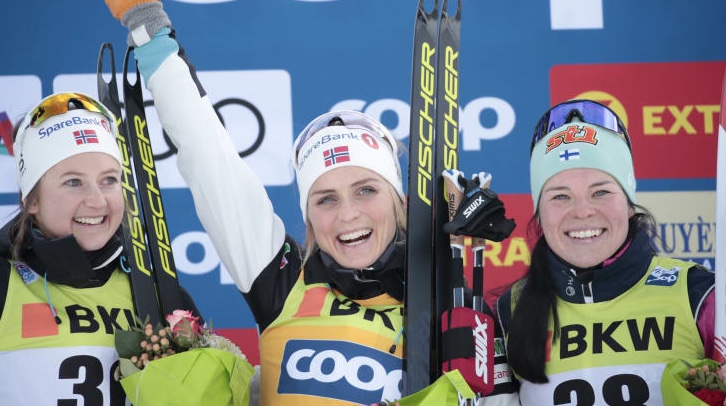
The women’s podium from the 2018 World Cup 10 k freestyle individual start in Davos, Switzerland. Therese Johaug (center) of Norway won, teammate Ingvild Flugstad Østberg (left) was second, and Krista Pärmäkoski (right) of Finland was third. (Photo: Fis-Ski.com screenshot)
FIS World Cup Davos, Switzerland 10k/15k Freestyle Individual Start
On Sunday, the final day of racing on the World Cup before a two-week break prior to the start of the Tour de Ski, the early season trend for women’s distance skiing continues. Norway’s Therese Johaug won the 10-kilometer freestyle individual start in Davos in a time of 26:06.9 minutes. She led the race at every intermediate time checkpoint.
The only difference with Sunday’s distance narrative was Johaug’s margin of victory. Teammate Ingvild Flugstad Østberg placed second 12.1 seconds back. Krista Pärmäkoski of Finland placed third (+19.2).
The U.S. Ski Team’s Jessie Diggins popped a season-best fifth place, crossing the line 1:01.1 minutes back. Also for the U.S. and posting a career-best World Cup finish was Rosie Brennan in sixth (+1:04.9).
Also for the U.S., Caitlin Patterson placed 38th (+2:22.5) and Kelsey Phinney 65th (+4:02.1).
Canada’s Emily Nishikawa stormed into the top-30 in only her second World Cup start of the season to place 23rd (+1:47.6). Cendrine Browne (CNST) was 44th (+2:28.8).
In the men’s 15 k skate, Russia’s Evgeniy Belov won in 35:52.5 minutes. It was the Russian’s first career individual World Cup win.
Over the duration of three laps on the up and then down 5 k loop, Belov only outdistanced second-place skier Maurice Manificat of France by a meager 0.9 seconds. Third place went to Norway’s Martin Johnsrud Sundby who finished 4.5 seconds back.
In another tight men’s race, only 10.6 seconds differentiated first from fifth place. Russia’s Denis Spitsov was fourth (+7.5), and Norway’s Chris André Jespersen fifth (+10.6). Only 1:07.7 minutes separated 30th place from first.
Alex Harvey of Canada was the best placed North American in 26th (+1:00.9). Teammate Len Valjas (CNST) was 62nd (+2:13.2), and Andy Shields 76th (+2:52.0).
David Norris (APU) was the best placed American in 61st (+2:12.6). Adam Martin (CGRP) finished in 67th (+2:20.5), Scott Patterson of the U.S. Ski Team (USST) 72nd (+2:49.0), Simi Hamilton 77th (+2:54.3), and Kevin Bolger 92nd (+3:55.3).
The third day of the Canmore NorAm weekend featured mass start classic racing.
In the men’s race, NorAm leader Bob Thompson (TBay) emerged the winner of the 30km in 1:18.40.2 hours after beginning the 8th and final lap in a group of four. Jack Carlyle (AWCA) placed second, 0.3 seconds behind. It had been almost two years to the day since his last podium at this level.
Russell Kennedy (Team R.A.D.) placed third, 8.6 seconds back, after winning the 15km skate individual start race on Saturday.
In the junior ranks, Samuel Hendry (Team R.A.D.) was dropped on the final lap, finishing 22.0 seconds in back of the day’s winner as the top junior. Antoine Cyr (CNST) fell back on the 7th lap but held on for 5th overall and top U23 at 1:24.7 back. Remi Drolet (Black Jack) was the second junior in 6th, 0.3 seconds behind Cyr.
Thompson is the COC leader for Period 1, which should qualify him for the Tour de Ski and World Cup period 3.
Cyr should be automatically to the U23 team for the Lahti, Finland World Juniors when the High Performance committee meets Sunday afternoon to confirm final selections. As both Hendry and Drolet had already qualified, the committee will be interpreting rules to determine the remaining junior men going to Lahti. Team ULLR’s Tom Stephen (14th today, 3:29 behind) and Xavier McKeever (16th at 5:07.4) will be among the athletes considered for the final junior spots.
In the women’s 15km, national team members Dahria Beatty and Katherine Stewart-Jones gained a gap on the shorter first lap of the race and were never reeled in. Beatty won the sprint for first crossing the finish in 42:55.8 minutes, with Stewart-Jones 1.8 seconds back.
Beatty has already met the criteria for World Cup period 2 and 3 starts as COC leader, which means a Canadian woman could possibly be racing the Tour de Ski.
First year senior Hannah Mehain (Telemark) finished alone in third, 1:55.6 minutes back, after dropping the original chasing pack to take the top U23 spot on the day. Frédérique Vézina (CNEPH) started slower but finished strong to take 4th overall, 2:26.7 behind. Sadie White was 5th at 2:29.7 minutes for the second U23 place.
Jasmine Drolet was 6th overall at 2:38.0 behind to take the top junior position and join her brother Remi on the Lahti trip.
IBU World Cup Hochfilzen, Austria women’s 4 x 6 k relay / men’s 4 x 7.5 k relay
In the women’s 4 x 6 k relay on Sunday, Italy won in a time of 1:10:58.7 hours after using three spares. Italy’s team consisted of Lisa Vittozzi, Alexia Runggaldier, Dorothea Wierer, and Federica Sanfilippo.
Sweden placed second (+8.4) using eight spares. Linn Persson, Mona Brorsson, Emma Nilsson, and Hanna Öberg raced the four legs.
Anais Chevalier, Julia Simon, Celia Aymonier, and Anaïs Bescond placed third for France finishing 11.8 seconds back while using nine spares.
The U.S. team of Joanne Reid, Susan Dunklee, Clare Egan, and Deedra Irwin placed 13th (+3:39.1) using nine spares and skiing one penalty loop.
Canada’s women’s team of Megan Tandy, Megan Bankes, Nadia Moser, and Rosanna Crawford placed 16th (+5:19.3) with two penalties and using 13 spares.
The men’s 4 x 7.5 k relay was won by Sweden’s Peppe Femling, Martin Ponsiluoma, Torstein Stenersen, and Sebastian Samuelsson in 1:16:10.6 hours using five spares.
Lars Helge Birkeland, Henrik L’Abee-Lund,Tarjei Bø, and Vetle Sjåstad Christiansen of Norway placed second (+3.6) using seven spares. For Germany, Simon Schempp, Johannes Kuehn, Arnd Peiffer, and Doll Benedikt were third (+28.8) with a single penalty and using six spares.
The U.S. team of Leif Nordgren, Sean Doherty, Travis Cooper, and Jake Brown placed 12th (+2:33.6) using 10 spares.
Canada’s Scott Gow, Brendan Green, Jules Burnotte, and Nathan Smith placed 20th (+5:13.0) with three penalties and using 14 spares.
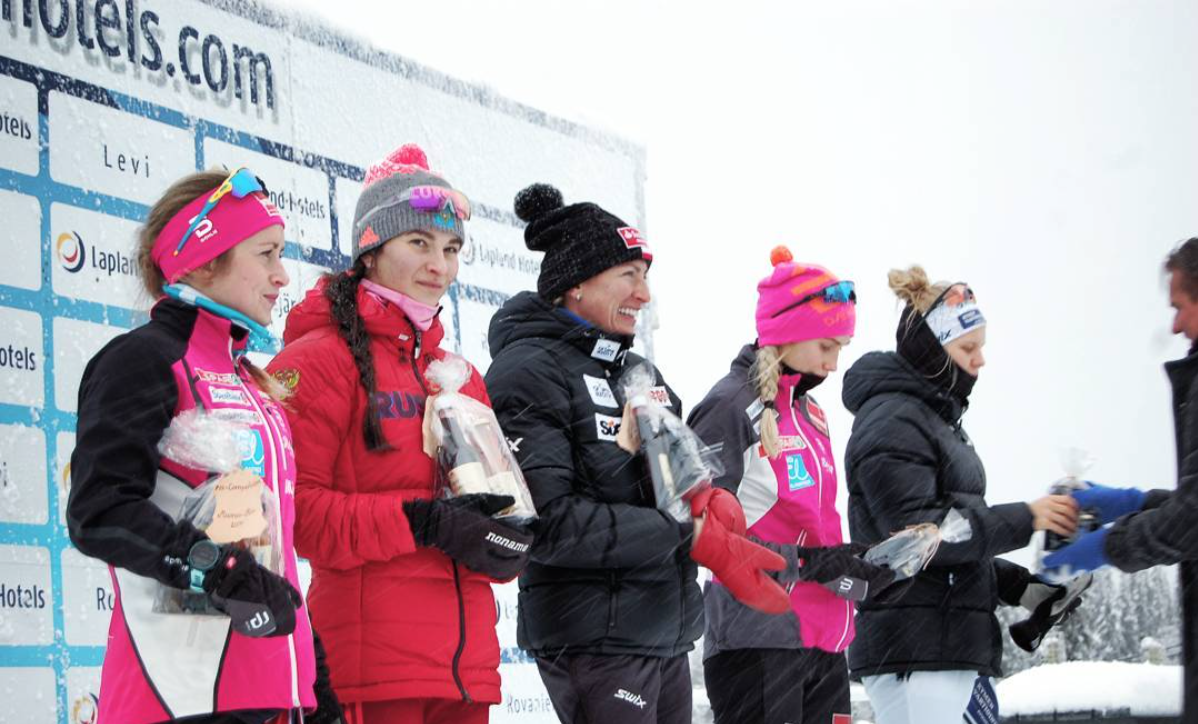
(l-r) Anna Svendsen of Norway, Natalia Nepryaeva of Russia, Justyna Kowalczyk of Poland, Lovise Heimdal of Norway, and Leena Nurmi of Finland receive prizes after rate women’s classic sprint in Muonio, Finland, on Friday. (Photo: Ski Muonio/Instagram)
FIS races are already being contested in Finland and Sweden this weekend, with most top Scandinavian racers sitting out but a few national-team members and others picking up their first victories of the season.
The competitions in Muonio, Finland, drew the most diverse field, including racers from Norway, Russia, Japan, China, Canada, Estonia, and Slovakia, among other countries. In the men’s classic sprint on Friday, the home team got a win from Ristomatti Hakola; he and Russia’s Alexander Bolshunov went 1-2 in both the qualifier and the final. Russia’s Andrey Parfenov rounded out the podium. In the women’s sprint, Anna Svendsen took the win over Russia’s Natalia Nepryaeva, with Justyna Kowalczyk of Poland finishing third.
On Saturday, racers moved up in distance. In the 10 k classic, Bolshunov – a U23 World Champion last season – bested Russian teammate Alexey Chervotkin by 20.6 seconds, with Andrey Sobakarev making it a sweep another 21.6 seconds back. Brian McKeever and Graham Nishikawa of Canada finished 56th (+2:10.6) and 63rd (+2:18.5), respectively.
Also in the men’s race was Maxim Vylegzhanin. The International Olympic Committee (IOC) decided on Thursday to strip the Russian skier of three silver medals from the 2014 Olympics for doping violations and ban him from all future Olympic Games. However, the International Ski Federation (FIS) has not yet taken any action since he and five other skiers were banned from the IOC, meaning that all six athletes are currently free to take part in non-Olympic ski competitions. In a press release, FIS stated that “the next steps will be the review by the FIS Doping Panel of the six verdicts upon the receipt of the reasoned decisions” but did not provide a time frame for these decisions.
In the women’s 5 k classic, Finland’s Krista Parmakoski posted an 18.4-second win over Nepryaeva, with Kowalczyk third again, +24.2.
Bruksvallarna, Sweden, hosted races on Saturday as well, with a primarily Swedish and Norwegian field but some other racers as well. Norway’s Chris Andre Jespersen topped the 15 k skate, posting a 31.4-second win over Simon Lageson of Sweden. Norwegian Tore Leren was third, +53.1. Canada’s Jack Carlyle finished 38th, +2:29.5. Petter Northug and his brother Even were in Bruksvallarna this week but decided at the last minute not to race, with Northug making his debut in Beitøstolen, Norway, next weekend instead.
In the women’s 10 k skate, Swedish national team member Emma Wiken bested Lina Korsgren – a long-distance specialist who finished eighth in the Visma Ski Classics standings last season – by 9.8 seconds. Berit Mogstad of Norway finished third, +15.3 seconds.
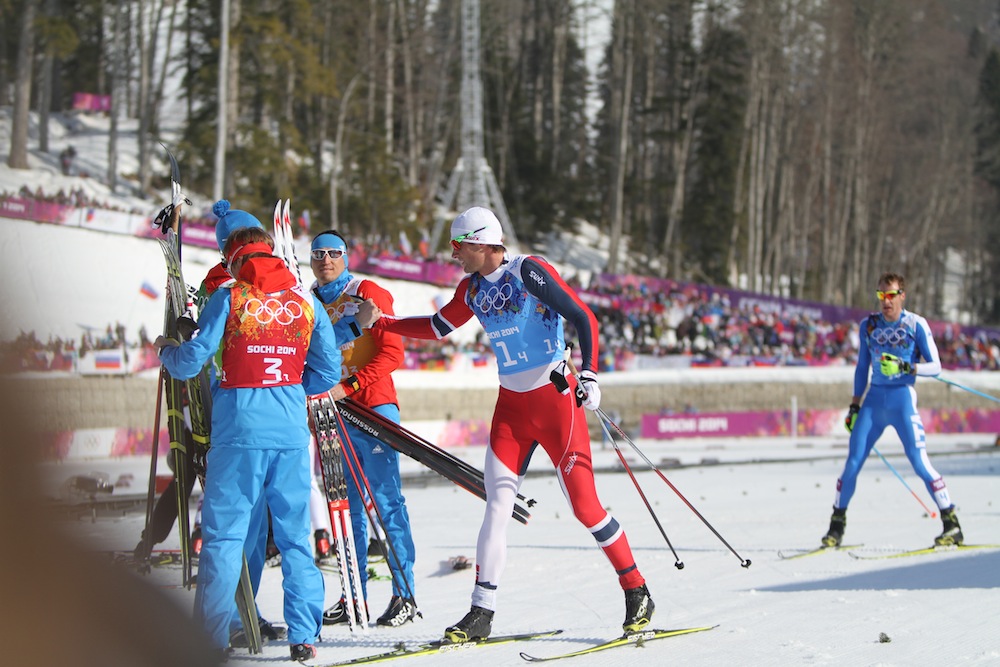
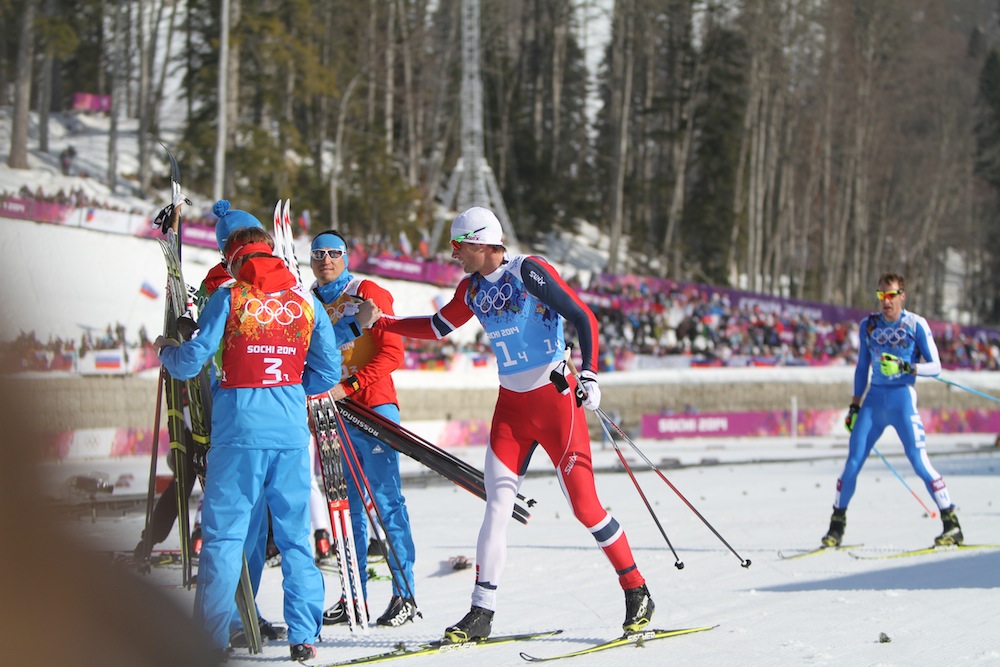
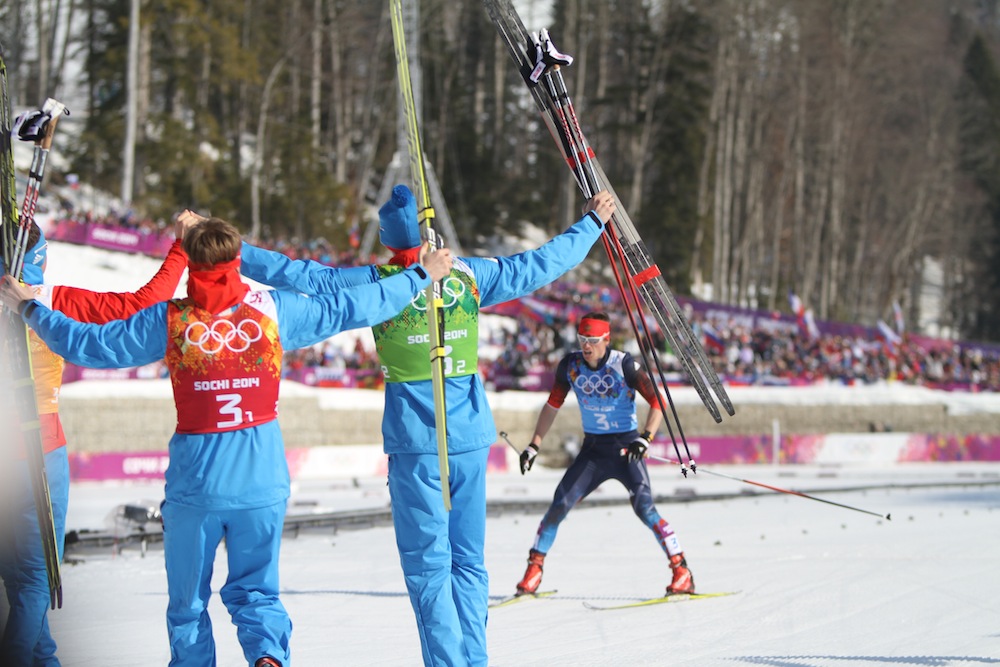
After anchoring Norway to fourth in the men’s 4 x 10-kilometer relay at the 2014 Olympics in Sochi, Russia, Petter Northug congratulates the Russian silver medalists, including anchor Maxim Vylegzhanin. As a result of the IOC’s decision to sanction two Russians that competed in Sochi, Russia is to return its relay medal; Norway will thus be awarded bronze and France silver.
This article has been updated to include comments from Canadian World Cup Team member Alex Harvey as told to Le Journal de Montrealon Wednesday.
“Hell yes, IOC. Finally starting to take some action,” U.S. Ski Team (USST) member Simi Hamilton wrote on Twitter. “I have a feeling pressure from us clean athletes has paid off!”
“Today marks a win for clean athletes,” USST Women’s Coach Matt Whitcomb tweeted. “Two cheats are out. It’s a start.”
The Russian men’s relay team meets Maxim Vylegzhanin at the finish after he anchored them to silver in the 4 x 10 k at the Sochi Olympics. The IOC recently ruled that the Russian team’s relay result should be invalidated and they are to return their medals.
Norway’s Petter Northug posted a photo on Instagram of what looked like brunch in a tropical setting with the words: “Feire OL bronse!” (translates to “Celebrating Olympic bronze!”). Northug already has four Olympic medals to his name, two of which are gold (all from the 2010 Olympics), but the men’s 4 x 10-kilometer Olympic relay medal from 2014, which will be awarded retroactively to the Norwegian team (after they placed fourth behind Sweden in first, Russia in second and France in third) will be the first medal for Northug’s teammates Eldar Rønning and Chris Andre Jespersen.
Later on Wednesday, Northug posted a jocular meme on Instagram, picturing himself racing in the Sochi relay with the words: “You know you are the best anchor when you bring the medal home 4 years after the race.”
Legkov was part of Russia’s silver-medal relay in Sochi, and as a result of the IOC’s ruling, he must return the two medals he won there (relay silver and 50 k gold). Additionally, the 2014 Olympic results of Legkov and Belov are to be voided and both athletes are barred from competing at (or being granted credentials to) future Olympics. However, both are expected to appeal the ruling to the Court of Arbitration for Sport (CAS) by this Thursday at the latest.
“It is weird to get the medal in the mail. But if he gets convicted, of course I will take it,” Jespersen told Norway’s Nettavisen, according to a translation. “It’s my only Olympic medal. It is clear I will take it.”
In an interview with Le Journal de Montreal, Alex Harvey, the leading member of the Canadian World Cup Team who finished third in the overall World Cup and second in the distance standings last season, said he had his suspicions about Legkov — particularly after the 50 k freestyle mass start (in which Harvey placed 19th).
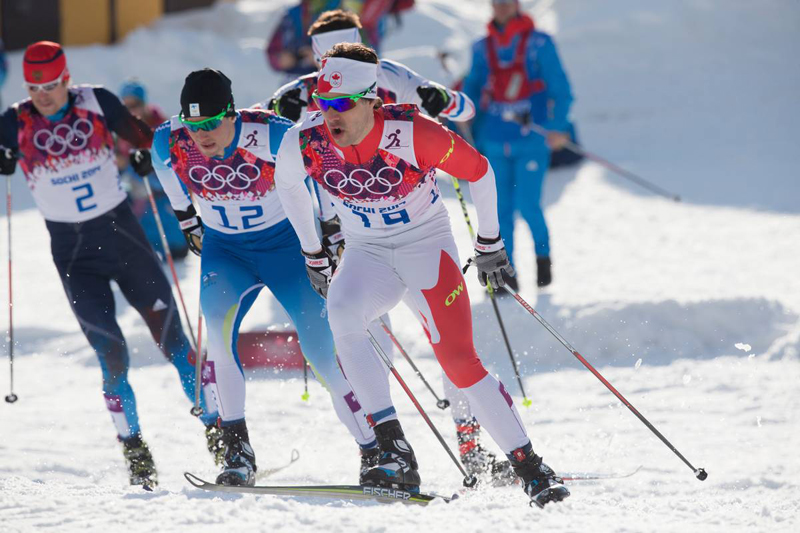
Canada’s Alex Harvey (front, bib 19) racing in the freestyle sprint at the 2014 Winter Olympics in Sochi, Russia. He finished 19th on the day. Also pictured: Russia’s Sergey Ustiugov (2) made it to the final and placed fifth. (Photo: Fischer/NordicFocus)
“On the climbs, we could see he was artificially stronger than the rest,” Harvey said, according to a translation. “In Sochi, the last two kilometers were filled with big climbs. It was a course made for Russians knowing that they were doping.”
He added that the end of each course in Sochi ended with a long, brutal uphill that was exceptionally “physically demanding”.
As for the recent doping bans involving professional cross-country skiers, Harvey said, “It’s a shame because our sport is now compared with cycling. It is in cross-country skiing and in biathlon that the largest number of dope cases occur.”
And while he was in favor of the IOC’s decision, he hoped the buck wouldn’t stop there.
“I’m happy that the IOC finally acted, but Russian skiers are still racing … and one in particular who wasn’t bad in Lahti,” he said, alluding to Sergey Ustiugov, who took gold or silver in all five races he competed in at Lahti World Championships.
“Ustiugov was young at the Sochi [Olympic Games], but he still reached the final in the sprint,” Harvey said. “Three of the top six men fell, but he was on his way to a podium that day. What the McLaren Report revealed was that the full team was involved in doping. But Ustiugov’s name never came out. And as long as his name doens’t come up, we can only have doubts.”
Meanwhile, the law firm representing Legkov and Belov is enraged, according to Nettavisen.
“The decision deserves the term scandal,” the Wieschemann firm stated in its press release on Wednesday. “[It] mocks the declaration of the President of the IOC, Dr. Thomas Bach, to decide only on the basis of secure evidence.”
While the IOC’s Disciplinary Commission (also referred to as the Oswald Commission) has yet to release its full decision and explain how it arrived at the final rulings, cases for 26 other Russian athletes (four of which are nordic skiers) who allegedly doped in Sochi are still pending, the CBC reported.
“The Oswald Commission has announced that all hearings for active athletes who could qualify for the Olympic Winter Games PyeongChang 2018 will be completed by the end of November,” the IOC stated.
As of Wednesday, exactly 100 days out from the 2018 Winter Olympics in PyeongChang, South Korea, it remained unclear whether the commission obtained further evidence concerning Legkov and Belov beyond what was already presented to the CAS.
Wieschemann claims the commission ruled “without further investigation and without further evidence…”
“Denis Oswald still stated at the last summit of the IOC that his investigations would go far beyond those of Prof. Richard McLaren,” the firm’s press release stated. “Well that’s actually not the case. The investigation has only been limited to obtaining a new forensic opinion…”
And while some of the most outspoken individuals in the XC world continue to speak out, others are weighing in on social media as well.
“… It’s disturbing to find out that some athletes in cross-country skiing have likely doped, and have gone so long unpunished,” Caitlin Patterson of the Craftsbury Green Racing Project wrote on Facebook. “But it reminds me that we must be vigilant, keep looking for ways to support anti-doping testing programs, put pressure on governing bodies to take a stand for clean sport, educate ourselves on progress and pitfalls of the cause, and speak up when we can.
“I haven’t spoken much on this politicized topic, but recent news such as this disqualification makes me distinctly aware of how much I value clean sport and all it stands for,” Patterson, who has started 27 World Cup races, continued. “Thank you IOC for taking this step towards preserving clean sport! Let’s keep it going, keep the pressure on, and fight to #CompeteClean and #PlayTrue!”
Former U.S. skier Sylvan Ellefson, who retired in 2014 after racing 23 World Cups, took to Instagram: “Thankful that our @usnordicskiteam contingency all get to move up a couple spots, but I mostly feel for those who have always been moral in their decision making. Those who train and race relentlessly, with their head down, just to find out their competition is taking the easy road. I could go on, but nothing lights me up more than cheaters.”
Martin Johnsrud Sundby thanks his lucky stars (and skis) after winning his fourth-straight individual race (and fifth race in a row) of the World Cup season on Saturday at the 30 k freestyle in Davos, Switzerland. He held off France’s Maurice Manificat (l) and teammate Anders Gløersen (r) for the win. (Photo: Fischer/NordicFocus)
If someone had to be a carrot, so to speak, Martin Johnsrud Sundby was the guy to go after in the men’s 30-kilometer freestyle individual start on Saturday at the World Cup in Davos, Switzerland.
Maurice Manificat of France started a minute behind the Sundby — and interestingly 30 seconds after Canada’s Graeme Killick — in bib 60 of 83. By the first timing point at 2.2 k on the 5 k course, Manificat had already put himself in a position to rival Norway’s defending overall World Cup champion.
But how long would it hold up?
One kilometer later, Manificat was just a tenth of a second faster than Sundby with the lead, and by 5 k, the he remained 0.2 seconds ahead in first.
Maurice Manificat pushed over every inch of the men’s 30 k freestyle individual start on Saturday in an effort to beat Norway’s Martin Johnsrud Sundby for the win.
“I started quite fast and had great skis,” Manificat told FIS after the race. “I was focused the entire time.
Manificat’s fast start held up as the 29-year-old Frenchman matched Sundby’s times for two-thirds of the six-lap race. Most of the time, despite not actually being able to see Sundby, Manificat had the edge — except for when Sundby was 0.6 seconds ahead at 10 k and then 0.3 seconds up 10 kilometers later.
That’s where Manificat’s race started to unravel. He later explained his back hurt for the final 10 k. By 22.2 k, he started to lose contact with Sundby, who was then eight seconds ahead at that checkpoint.
Sundby extended that gap to 9.5 seconds 1 kilometer later, then was 10 seconds ahead with 5 k to go. At 27.2 k, it appeared the race was over and in Sundby’s control, as the 31-year-old Norwegian led Manificat by 20.8 seconds.
Sundby went on to win by 20.7 seconds in 1:06.27.9, and Manificat held on for second place, 7.9 seconds ahead of Anders Gløersen of Norway. Gløersen won the shortened version of this race last year in Davos: the 15 k freestyle.
Throughout Saturday’s full-distance signature event, even tougher because it’s at altitude 5,000-plus feet above sea level, Gløersen had been in the hunt for a podium, skiing the same speed as Norwegian teammate Chris André Jespersen early. Both were about 18 seconds behind Manificat and Sundby at 8.2 k. Two kilometers later, Gløersen’s time still ranked third but Jespersen had dropped to fifth behind France’s Robin Duvillard.
An early starter in bib 22, Duvillard initially set the times to beat for the Norwegians following him. Duvillard’s teammate Jean-Marc Gaillard started 23rd and ultimately finished about 10 seconds faster than Duvillard, earning his seat in the leader’s chair until Norway’s Sjur Røthe in bib 34 crossed the line 1.3 seconds faster.
Gløersen topped Røthe by almost 15 seconds to take the lead, then was finally bumped to third by Sundby and Manificat. Røthe ended up fourth, Gaillard placed fifth, Norway’s Petter Northug came on strong later in the race to finish sixth (+46.2), Duvillard was seventh (+54.3), and Jespersen finished eighth (+1:03.5). Hans Christer Holund was the sixth Norwegian in the top nine in ninth (+1:07.5), and Switzerland’s Toni Livers placed 10th (+1:13).
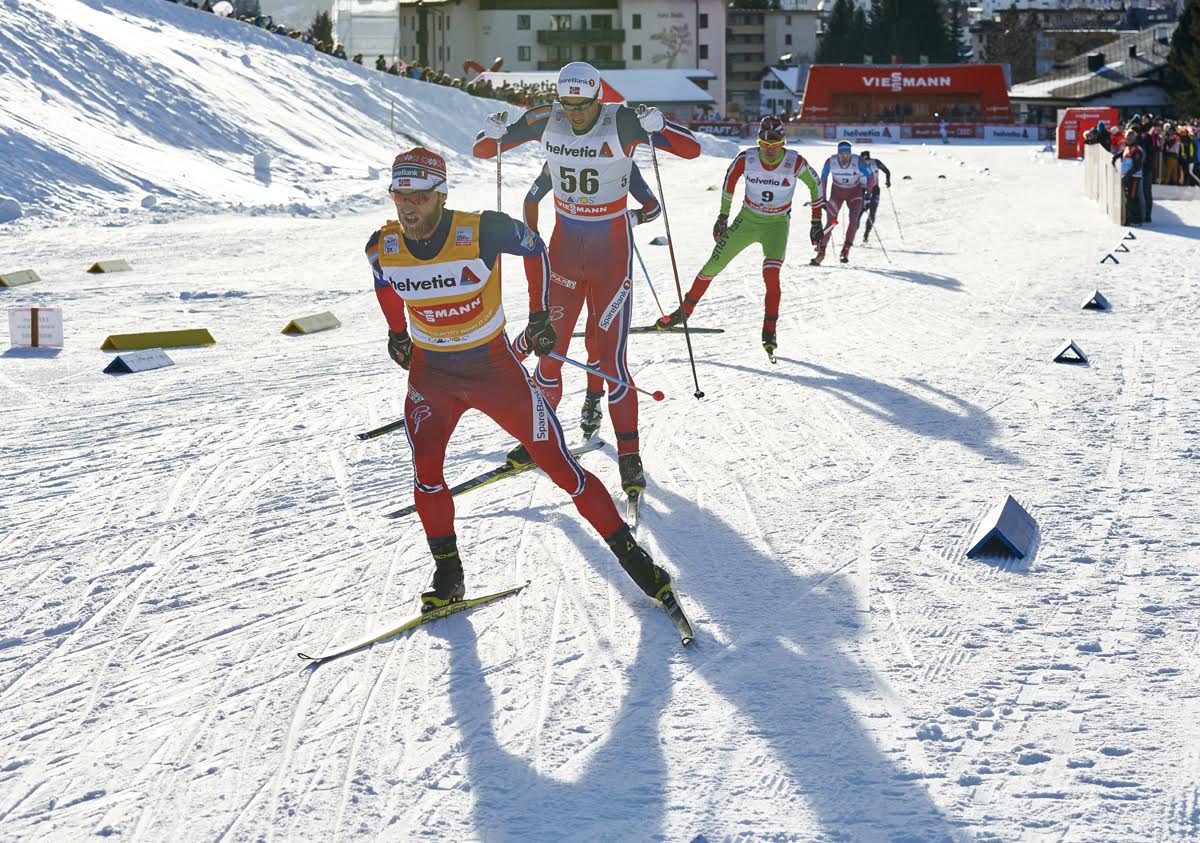
Martin Johnsrud Sundby leads a train with some of his Norwegian teammates, including Petter Northug (56) on Saturday at the Davos World Cup 30 k freestyle in Switzerland. (Photo: Fischer/NordicFocus)
At the finish, Sundby appeared content with what he’d done — winning his fourth-straight individual race in as many distance races this season — without much showmanship. Truth be told, he was tired.
“I pushed a bit too hard the first 15 kilometers,” Sundby told FIS. “I did not feel that good after that. I was lucky I joined Sjur and Petter. Sjur did a great job in the fifth lap. I was able to catch some speed.
“The races in Davos kill me every year,” he added. “The last two kilometres were almost impossible to ski. I tried to ski easy on the way to the top but I was tired…”
“I’m glad that I won,” Sundby told VG, according to a translation. “This is the toughest [race] I’ve been in so far this year. This was no ‘walk in the park.’ ”
He would have preferred to have completed the course — lap after lap — with “steel control”, Sundby added, but that wasn’t in the cards.
“It was a tough race and Maurice had a hold on me…,” he said. “Today I had to fight. I luckily got good [skiing with] both Petter and Sjur the last two laps.”
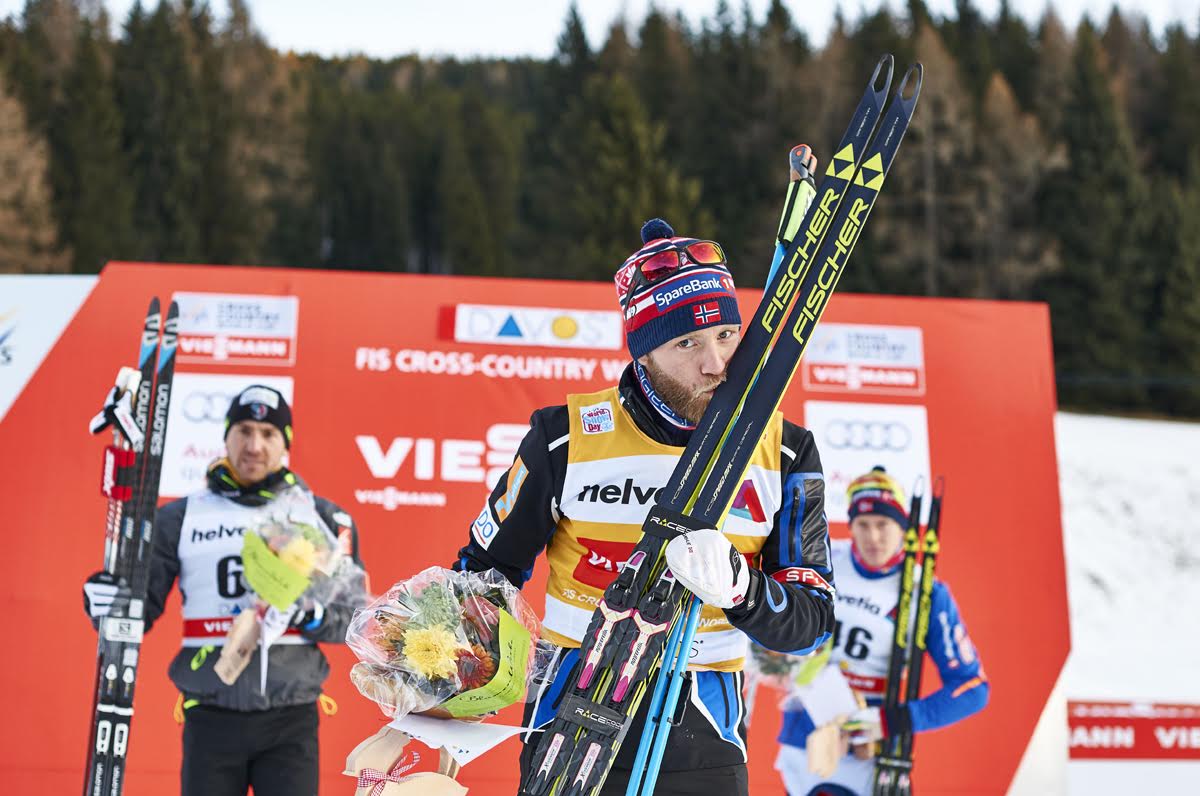
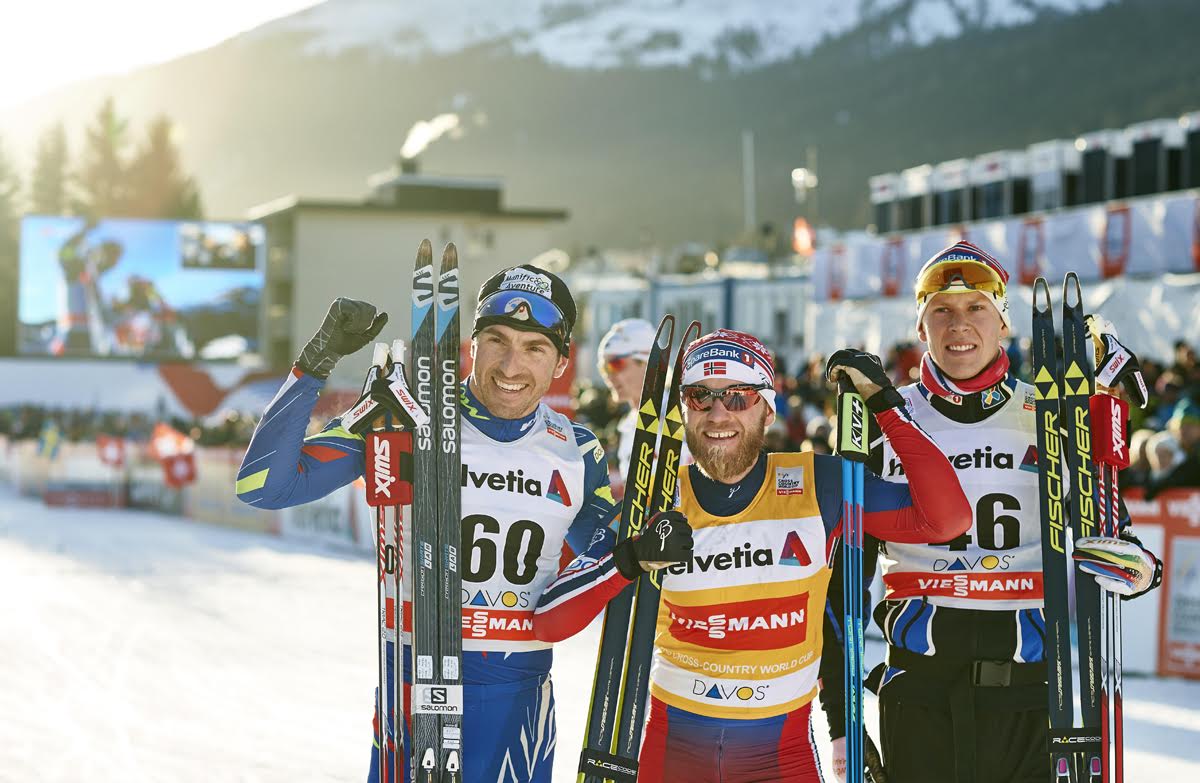
The men’s 30 k freestyle podium at the World Cup in Davos, Switzerland, with winner Martin Johnsrud Sundby (c) of Norway, France’s Maurice Manificat (l) in second, and Norway’s Anders Gløersen (r) in third. (Photo: Fischer/NordicFocus)
Røthe explained he struggled to follow Sundby, but he stuck with the Norwegian train and it led him to fourth place.
“I asked Martin if he would pull a bit, but got no answer,” Røthe told VG.
Perhaps the most visibly gassed at the line, Manificat was initially frustrated with his 20-second loss, but he didn’t take long to recover, stand up and smile at the TV cameras. He had done his best and ended up on the podium.
“It is crazy to be on the podium again. It was great fight with Martin,” Manificat told FIS. “In the last two laps I had pain in my back. I was losing seconds on Martin and then I let it go…”
The last time Manificat reached the podium was last February in Östersund, Sweden, when he placed second in the 15 k freestyle at the pre-World Championships World Cup.
“We are delighted to be joining the fight,” Manificat said to VG about his French teammates, with three French skiers in the top seven.
As for what it will take to beat the Norwegians, he added, “We have to be in really good shape.”
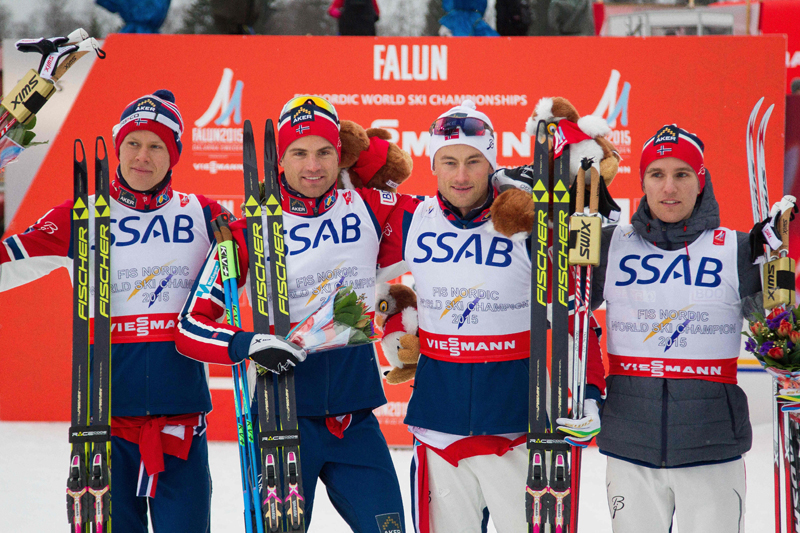
Niklas Dyrhaug (2nd from left) and Norwegian teammates after winning the 4 x 10 k relay at 2015 World Championships in Falun, Sweden. Back in Sweden this weekend, Petter Northug (second from right) won Friday’s 10 k classic, and Dyrhaug followed up with a victory in Saturday’s 15 k skate in Bruksvallarna.
With less bravado then Petter Northug’s win provided the day before, Norway still stole host country Sweden’s thunder on Saturday in Bruksvallarna, where Norwegian men swept the podium in the 15 k skate race.
Niklas Dyrhaug claimed the win by 2.9 seconds over Daniel Myrmæl Helgestad, a relatively unknown 28-year-old with just a handful of World Cup starts to his name. Chris Andre Jespersen placed third, +9.8.
“I never expect it, but I was hoping to be fighting for the victory today,” Dyrhaug told media after the race.
The Swedish effort was led by Anders Svanebo. The boyfriend of Charlotte Kalla and a rollerski World Champion, Svanebo stated before this season that he wanted to also focus on winter competitions this season. He made the Swedish “A” team for the first time in May.
Dyrhaug and Svanebo ended up skiing a substantial part of the end of the race together thanks to the loop length.
“I had thought that I would get help from him, but it ended up that I took three turns instead,” Svanebo told Expressen.se.
With some of the top Swedes sitting out the race – Marcus Hellner is competing at home in FIS races in Gällivare with the American, Canadian, and Russian men, and Calle Halfvarsson is sick – it was not completely surprising that Norway would dominate the day.
Charlotte Kalla, here racing in the relay at 2015 World Championships, took another big win in the Bruksvallarna FIS races on Saturday.
But some top Norwegians weren’t racing either. With Northug sitting the day out and teammates like Martin Johnsrud Sundby and Sjur Røthe, who had won the previous weekend in Beitostolen, Norway, it was a strong but not complete team by Norway.
Dyrhaug still managed to get in a jab at the Swedes, even if it was more subtle than what Northug had said the day before.
“It was good to get started, although the shape was a bit ‘crappy’ today,” he told Norway’s VG newspaper. “I was heavy today, some more weighed down than I had hoped for. Luckily this was a relatively unimportant race. I must raise my level if I will be with [the leaders] next weekend.”
The message? Winning in Bruksvallarna won’t cut it on the World Cup.
Sweden did have the last laugh in the women’s 10 k, however, as Svanebo’s partner Kalla took a 35.8-second win over teammate Stina Nilsson. Ida Ingemarsdotter was third, +1:03.7, and Slovenia’s Lea Einfalt was the only non-Swede to break into the top ten, placing sixth (+1:30.2).
Kalla told SVT that she was happy she could focus entirely on her own race and not be distacted.
“It was nice to start early in the seeded field and do my own race,” she said.
That will change next weekend, when Kalla goes to the World Cup and faces top international skiers for the first time this season. While Dyrhaug and some teammates came to Bruksvallarna, none of the Norwegian national team women made the same trip.
Racing continues in Bruksvallarna on Sunday with freestyle sprint competitions.
Petter Northug Jr. at 2015 World Championships in Falun, Sweden. (Photo: FIS/NordicFocus)
Petter Northug Jr. took it upon himself to stir up some drama in Sweden on Friday when he won the Bruksvallarna 10-kilometer classic race, in, you guessed it, Sweden.
The 29-year-old Norwegian won the 10 k International Ski Federation (FIS) race by 36.1 seconds over Sweden’s Jimmie Johnsson, of the AXA Sports Club. Northug did so without any trouble as none of the men in the 180-plus field came close to him throughout the individual start. By 3 k, he was nearly 6 seconds up on the next-fastest man, Johnsson. Throughout the race, he continued to widen the gap to competitors like Simon Andersson of Sweden and Chris Andre Jespersen, Northug’s teammate on the Norwegian World Cup team.
If it wasn’t enough of a jab that he wore a race suit that distinctly displayed Sweden’s colors and flag, Northug told Norwegian press the win meant nothing to him. If he’d raced similarly in Beitostølen, Norway, last week (which had a slightly longer 15 k classic), he wouldn’t have finished in the top 10, he told NRK. He won Friday’s 10 k in 23:43.3.
Petter Northug (r) chases Norwegian teammate Martin Johnsrud Sundby during last weekend’s 15 k freestyle FIS race in Beitostølen, Norway. Sundby went on to win by 47 seconds and Northug was a minute back in fourth. (Photo: Eirik Lund Røer/SKIsport)
But he didn’t race the Beitostølen 15 k classic, and this marked his first win in two race weekends this season (he was second to Norwegian teammate Eirik Brandsdal in the Beitostølen classic sprint last weekend). There, he raced in a red-and-white suit with the name of his main sponsor, Coop, on his leg.
In Bruksvallarna, he wore another suit with the Coop logo — one custom-made by Bjørn Dæhlie — with Sweden’s white, blue and yellow.
“Some look at this with hatred, but I don’t judge anyone,” Northug told NRK, according to a translation. “People are allowed to think what they want.”
Despite feeling lack he lacked “a little punch” early in the race, Northug closed hard in the final the kilometers on Friday. At the finish, where he knocked Johnsson — the sixth starter — out of the leader’s spot (Northug started 158th), Northug made a point not to celebrate.
“It’s just training here; it means nothing that I won the race,” he told VG.
“It would be as if I was celebrating beating my brother in a running race, and he was three and I was 14,” he said, according to a rough translation.
The fact of the matter is Johnsson, 30, is actually older than Northug, and so is 31-year-old Martin Johansson of IFK Mora, who placed third 38.1 seconds back and 2 seconds out of second.
Two-tenths of a second from the podium was Norway’s 22-year-old Mikael Gunnulfsen (Oern IF) in fourth, and Jespersen, 32, placed fifth (+ 38.6). In second at one point, Andersson ended up sixth (+39.9).
In all-too-personal news, Northug’s coach, Stig Rune Kveen, told Aftonbladet that Northug is actually half-Swedish. His parents, John and May, apparently conceived him at the Bruksvallarna mountain race in April 1985. Therefore, thereto…
Swedish sprinter Emil Jönsson, who placed 15th (+1:03.4), was all for Northug becoming a full-blown Swedish citizen.
“He is most welcome. We can offer food and shelter,” he told Expressen. “We may need him.”
Racing continues in Bruksvallarna with the 10/15 k freestyle on Saturday and freestyle sprints on Sunday.
Norway’s Anders Gløersen won Saturday’s 15 k freestyle in Davos, Switzerland for his first World Cup distance win. Pictured here, the 28-year-old celebrates a 2013 sprint win. (Photo: Fischer/Nordic Focus)
Anders Gløersen had planned to sit out Saturday’s World Cup 15-kilometer freestyle interval start in Davos, Switzerland in order to rest for Sunday’s sprint. However, as fate would have it, several teammates came down with illness and Gløerson was placed on the start list.
It turns out fate was in the Norwegian’s favor, as he earned his first World Cup distance victory in convincing fashion.
An early starter with bib 15, Gløersen maintained a consistent pace throughout the majority of the course. While his 2 k time put him in 49th position, the Norwegian was able to increase his speed to give him the fourth fastest time at 12.8 k. It was in the last 3 k, however, where Gløersen won the race.
Crossing the line with a time of 34:27.9, the 28-year-old endured a long wait in the leader’s chair before he officially won. Although he had skied the race of a lifetime, the field’s strongest competitors were still to come, including teammate Martin Johnsrud Sundby, who won last week’s 15 k classic on the same course.
But as time went on, one famed name after another – from hometown-favorite Dario Cologna to Petter Northug – failed to match Gløersen’s effort.
In bib 81, Sundby was the last starter for the men and nearly equalled Gloersen’s times at each split. At the 12.8 k mark, Sundby was only 0.5 seconds off of his teammate’s time. However, as Sundby rounded the corner into the stadium it was clear that he was nowhere near Gløersen.
Knowing that he had skied a near-unbeatable pace in the final kilometers, Gløersen started realize that the victory was his.
“When I saw Martin Sundby behind me after 12.8 km I started to believe I could win. I knew I had a very good final part of the competition,” he said to FIS in a post-race interview.
Gløersen, who has earned victories in four previous World Cup spirnts, said that he was surprised by the result, but that he had high expectations before Saturday’s race due to his increased distance training.
“I have been training for 15 km free technique. This is my first victory in a distance competition and it means a lot for me,” he said to FIS.
Behind Gløersen in second was Northug, who finished 4.8 seconds off the winning time. Northug skied in the top-ten through the majority of the race and then delivered a characteristic strong finish to overcome all but Gløersen.
Northug also said he was surprised by his result.
“I did not feel that good today and I did not think I was fighting for podium. My plan was to keep the high pace from the highest point to the stadium. I felt I had some power left after the two first laps. I had very good last 3 k,” he said to FIS.
Northug told NRK Sport that he knew he was battling Gløersen and fifth place finisher Jean-Marc Gaillard throughout the race, but had no idea it was for the win – or even a podium position.
The finish is Northug’s season-best in a distance race. His best previous finish this winter was in Lillehammer where he had the 14th fastest time in the 15 k classic to give him 15th overall in the mini tour.
Unlike Gløersen and Northug, third place finisher Chris Andre Jespersen did not have a strong finish. At the 12.8 k mark he was the race leader, roughly five seconds ahead of Gløersen and Sundby. By the time he crossed the finish line, however, he was 10.4 seconds back.
“I’m really satisfied with the third place but I was hoping for more. I have never had a good feeling in such a high altitude. The whole race was quite good for me but the last 2 km were really difficult,” he said to FIS.
Jespersen told NRK Sport in a post-race interview that he placed his pole between his legs twice in the final kilometers, with both incidents resulting in a fall. Jespersen said that the falls may have cost him the win, but considering the time he lost, the 31-year-old was pleased to have finished on the podium.
Following Jespersen was Calle Halfvarsson of Sweden in fourth (+11.6), Gaillard in fifth (+13.8), and Sundby in sixth (+14.9). Despite a strong start to the 15 k and a desire to gain his first World Cup victory in his native Switzerland, Cologna finished his day in 10th (+17.1).
The 15 k was the last distance competition of period one racing on the World Cup. As skiers take a short break before starting the Tour de Ski, Sundby is the men’s World Cup leader followed by teammate Finn Hågen Krogh and Hafvarsson in second and third. After today’s race, Northug and Gløersen have advanced to fourth and ninth positions.
Northug explained to NRK that he’s looking forward to the remainder of the season as he searches to find his top form.
“Now I’ll relax and prepare for the Tour de Ski. After the Tour my shape will hopefully get better and better, and in Falun I will have a good feeling for the first time this season,” he said.
World Cup racing continues Sunday in Davos with a 1.4 k freestyle sprint, where Gløersen will look to improve on his third place finish in the same event earlier this December.
Martin Johnsrud Sundby (Norway) shows his happy face after winning the men’s 10 k freestyle at the Lillehammer World Cup mini tour on Saturday in Norway. (Photo: FIS Cross Country/Twitter)
Sundby was basically the opposite of that. It’s not that the 30-year-old defending Overall World Cup champion is too cool to jump up and down and yell, he just had a different way of showing his emotions.
And he was actually a little emotional on Saturday.
Sundby led a Norwegian podium sweep, winning the men’s 10-kilometer freestyle individual start — the second stage of the Lillehammer World Cup mini tour — by 2.2 seconds over teammates Finn Hågen Krogh and Sjur Røthe, who was 6.4 seconds back in third.
Norway’s Martin Johnsrud Sundby quietly awaiting his fate while sitting in the leader’s chair near the end of the men’s Lillehammer World Cup 10 k freestyle on Saturday. He ended up holding off Sweden’s Calle Halfvarsson, then teammate Finn Hågen Krogh, for the 2.2-second victory.
Sweden’s Calle Halfvarsson placed fourth, 1.5 seconds off the podium, and Norway took fifth and sixth with Niklas Dyrhaug and Chris Andre Jespersen, respectively.
“I am happy for the win, but I am extremely happy for the team,” Sundby told FIS.
With Friday’s sprint winner, Pål Golberg, in 12th and Didrik Tønseth in 17th, the Norwegians had seven of 15 starters in the top 20. What might be more notable is neither Petter Northug (in 35th) nor Eirik Brandsdal (in 53rd), who led the Overall World Cup before Saturday’s race, were among them.
“We have trained hard for so many months now, and … for me, kind of a captain for this team, I get a bit touched when the guys are so good,” Sundby said.
After finishing 14th in the sprint (just like Johaug), Sundby ranked 15th in the mini tour, 27.4 seconds behind Golberg, after Friday’s race. He improved to second on Saturday behind Krogh, and will start 20 seconds after Krogh in Sunday’s 15 k classic pursuit. Golberg will head out 6 seconds later in third.
Sundby’s win also put him in the yellow bib for in the second World Cup weekend of the 2014/2015 season.
But even after standing up from the leader’s chair and flexing his right arm a little bit for doting Norwegian spectators, Sundby was quick to defer the attention back to his teammates.
“It is an absolutely insane team effort,” he told NRK.
Four different Norwegians took turns in the leader’s chair: first Jespersen (who topped Sweden’s Daniel Richardsson by 13 seconds. Before that, Richardsson ousted Switzerland’s Curdin Purl, who started eighth of 118 men).
Jespersen’s initial splits weren’t anything outstanding: he ranked 22nd at 2.2 k, but sped up to ninth by the halfway point. With 1.8 k to go, the 31-year-old Jespersen posted the eighth-fastest time of all the finishers. During his race, it was the fastest.
“I do not think it was so much fun to be peed on last weekend, so I had decided today [to go hard],” he told NRK, referring to the 15 k classic in Kuusamo, Finland, where he placed 45th.
“The ending was abnormally good to me,” he said of his finish on Saturday.
The 17th starter, Jespersen remained in the hot seat for some time until his teammate Dyrhaug topped him by 0.6 seconds. Dyrhaug turned it on even later in his race, going from fifth at 7.2 k to first by the finish.
At the end of the day, Dyrhaug’s 8.3 k time ranked eighth and he ended up fifth.
Røthe then took over the top position by 12.5 seconds. With Sundby just six starters behind him, he looked as if he knew he wouldn’t be in first for long. Røthe posted the fastest times through every checkpoint but the first one at 0.9 k (where Switzerland’s Roman Furger had the quickest start), until Sundby, Halfvarsson and Krogh came through.
At 2.2 k, Halfvarsson took the lead, followed by Sundby 3.4 seconds back. The order stayed the same with Røthe in third until 5 k, where Røthe’s time ranked second-fastest by just 0.3 seconds over Sundby.
Halfvarsson remained in first until 8.3 k, where Sundby, who started 1 minute ahead him, had the edge by 1.1 seconds. Later on, Krogh, the 114th starter, would post the third-fastest time at that marker, 2.7 seconds behind Sundby.
That’s about when Sundby, in the leader’s chair after displacing Røthe by 6.4 seconds, started to pack up his belongings. Any way about it, even if Krogh had the race of his life and beat him, or Golberg as the last starter picked off six places in the last 2 k to reach the podium, Sundby knew he was headed to the flower ceremony.
“I did an even race. I tried to push hard last 2 kilometers,” Sundby told FIS. “I tried to collect some seconds on the last uphill where a few skiers were struggling. Everybody must have had tired legs.”
Finn Hågen Krogh after pushing himself well past the red zone to challenge Norwegian teammate Martin Johnsrud Sundby (not shown) for the win in Saturday’s 10 k freestyle individual start at the Lillehammer World Cup. Krogh was 2.2 seconds off the mark for second.
Halfvarsson faded in the last two kilometers to put himself on the edge of a top-three, finishing 7.9 seconds behind Sundby. Krogh looked to be after the win more than a podium as he pushed himself to the brink into the stadium, collapsing and gasping for air at the finish. He ended up 2.2 seconds behind Sundby for second overall.
“Since yesterday’s prologue I felt my shape has been very good,” Krogh said. “I was ready for today; it was maybe better than I expected. I found a good rhythm from the start. I had very good skis and I felt confident.”
Røthe was third, another 4.2 seconds back, and Halfvarsson settled for fourth, 1.5 seconds later.
“I’m really happy to be back on the podium,” Røthe said after his first individual World Cup podium since placing third in the 2012 skiathlon in Canmore, Alberta (and not counting his second-fastest time in last year’s Tour de Ski final climb in Val di Fiemme, Italy).
“It is even better to be there with my good friends Finn and Martin,” he added.
After not feeling quite in top form before Saturday, Sundby, who now leads the Overall World Cup by 9 points over Krogh and 20 points over Brandsdal in third, told reporters he was excited for Sunday’s pursuit.
“Hopefully we get an exciting race tomorrow,” he told FIS. “I think both the race and the winner could be exciting.”
***
Notes: Great Britain’s Andrew Musgrave, 24, had the best distance race of his career (not counting the eighth-fastest time in the 2014 Tour de Ski final climb) in 13th, which puts him 10th in the mini-tour standings before the pursuit.
Canadian Alex Harvey dropped from sixth to 11th in the mini tour, after placing 33rd, 54.6 seconds behind Sundby. He cited his bothersome left leg, with a blood-flow issue that typically springs up and pains him on uphill skating courses, as the reason behind his result.
“At the top of the course [around 3.5 k] before we go back down to the stadium, there’s a lot of offset, like steep climbing and my leg was starting to feel pretty bad already,” Harvey said on the phone. “So I was just fighting against it already and I couldn’t push after that. I couldn’t use my leg much, and the downhills were so icy that it was kind of hard to relax and recover so I was always contracting the legs. It was just a really bad day for my leg I guess.”
He’ll start Sunday’s pursuit 59.3 seconds behind Krogh and 0.4 behind Musgrave, and is focused on picking off as many places as possible — possibly up to Dyrhaug, who’s starting 16 seconds ahead of him in sixth.
This FasterSkier series will examine the growing challenge to the national team model by privately funded ski teams and independent sponsorship agreements. Will national teams be able to support themselves in the future, or will corporate teams take over cross country skiing? This first article in the series will look at Petter Northug, Jr.’s record deal with Coop and the implications it has for the Norwegian National Team and the sport as a whole.
***
Last May, Petter Northug, Jr., the bombastic figure of nordic skiing, called a press conference and announced that he was leaving the Norwegian National Team. The news hardly came as a surprise to Norwegian ski fans; for weeks prior to the announcement rumors had swirled in the press that the ski star had signed a lucrative deal with Coop, a Norwegian grocery chain.
The deal was indeed a profit windfall for the then 27-year-old Norwegian. Though the financial terms of the agreement haven’t been made public, the three-year deal was widely reported to be worth somewhere between 10 to 20 million Norwegian kroner a year, or $1.6 to 3.3 million dollars.
Predictably, Northug’s decision to leave the Norwegian National Team, or the Norges Skiforbund (NSF) as it is known in Norway, caused a certain amount of backlash at home. Northug’s career has been rife with moments of controversy, but his decision to leave the NSF may well be a watershed moment for skiing, one that comes to redefine the role of national teams in the international ski arena. This spring will likely see what the future holds for skiing, as the NSF debates whether it will allow Northug to continue to ski for Norway, and other ski stars watch and weigh their options.
“I’m going out of the national team and will train independently,” Northug said at his press conference last year. “I want to prepare myself mostly alone. Motivation makes me draw this initiative. If you are not 100-percent motivated, you’re done. I want to control things myself.”
“There are major challenges,” Northug’s father Petter Northug, Sr., better known by his middle name, John, said. “He chooses not a good arrangement for the national team, but said he had to do this to get greater motivation.”
John Northug added that the cause of his son’s flagging motivation was the stagnation of having already spent seven years on the national team.
“This was the new personal challenge he needed,” he continued. “I see that he thrives on it and he thinks it is brilliant to have responsibility for himself. He is in high spirits everyday. It has given him a new dimension to govern himself.”
Inevitably, Northug’s announcement caused a stir. Some accused him of being unpatriotic, even traitorous, a point of view that Northug says he understands. The older generation of Norwegians is more critical of Northug’s perceived lack of patriotism, while younger Norwegians are more sympathetic with his financial desires.
To counter the fallout, Northug brought NSF Cross Country Head Coach Åge Skinstad to sit beside him in front of the press. Looking like an older, somewhat elfin version of Northug with his similarly shaggy hair, Skinstad was there to lend his protégé support, if not his stamp of approval.
Åge Skinstad, Norwegian National Team head coach (Photo: Jarle Vines)
“We have discussed the consequences,” Skinstad said. “And although we have disagreed about the decision, there have been good discussions. … We still have a common goal towards next season with the Olympics, the Tour de Ski, and the World Cup.”
Skinstad stressed that all the funding and support that Northug had enjoyed from the NSF would end immediately. But he added, “When we come to the [World Cup] ski races in Kuusamo [Finland], then Petter will get the same support as the others.”
Northug penned the agreement in the belief that he would still be able to compete for Norway at World Cup competitions, the Olympics, and World Championships through a representation agreement. Since only national teams are allowed to compete at these competitions, temporary representation agreements are often drawn up to allow skiers who are not normally on the national team to temporarily join the team when they qualify for competitions.
It is this representation agreement that continues to put the NSF in a bind. The problem is simple: sponsor exclusivity.
“… [Northug] has signed a major sponsorship agreement with Coop, which is a competitor of NSF’s sponsorship Norgesgruppen/Spar,” Stein Opsal, NSF secretary general, stated on the NSF’s website. “NSF sponsors have industry exclusivity in their agreements. It has therefore been important for the NSF to fulfill our partners’ interests. It is these partners who contribute to the financing of … Norwegian cross country skiing.”
“At the same time,” wrote Opsal, “it has been our clear desire to contribute to Petter getting the best possible athletic program before the Olympics, within the limits we can defend.”
For a star like Northug to be absent from the team for 10 months of the year, while partnering with the NSF’s sponsor’s closest competitor, creates a vexing problem for Opsal and his organization. They were counting on Northug to provide them with Olympic medals in Sochi, and felt that they could scarcely afford to sacrifice that all-important marker of success over exclusivity clauses.
For that reason it was to no party’s advantage to see him left out of the team in a critical Olympic season, but with the 2014 Games behind him his future is in some doubt. Partly it depends on the desires of the Norgesgruppen. If the food conglomerate insist upon total exclusivity, then Opsal will be under serious pressure to exclude Northug entirely. If, on the other hand, Norgesgruppen decides that his temporary inclusion on the national team still elevates its sponsorship profile, or fearing a negative backlash if they force him out, the company may let the issue rest. In any case, Northug correctly gambled that he wouldn’t be pushed out, though that may change.
From his announcement last May, Northug was unable to come to terms with the NSF over a representation agreement until October 13, 2013, an unusually long time for what Opsal called a “general representation agreement.” That agreement also came with “an attachment that governs the relationship between Northug’s sponsorship and NSF sponsorship.”
The Agreement Itself
That attachment seems to have been an awkward compromise at best. As part of his deal with Coop, Northug has become a face of the store, and a poster boy for its healthy living campaign. His visage is on everything from juice, cereal, and bread in the store, and as part of the contractual agreement, all Northug-related products and advertisements that were launched after October 30 had to be removed from stores between January 30 and February 28, 2014, so as not to interfere with Spar’s Olympic exclusivity.
If the products remained in the stores, Northug risked being suspended from the Games, and fearful store managers scrutinized their aisles for Northug items that could have caused trouble. One store manager, Erik Tangstad, said that he didn’t even dare let the advertisements stay in the warehouse, and threw everything away for fear that banned items could be mistakenly be brought into this store during the Olympics.
How long these sorts of arrangements can remain feasible is uncertain.
“It is clear it can be a challenge for the national model,” Opsal told NRK. “It is something we will now evaluate after the season, for our loyalty lies primarily with our partners. So if we feel we have gone above and beyond what we feel is reasonable [with representation agreements], we will tighten it for next season.”
Northug has also put himself at disadvantage in these agreements by having a poor season. Having struggled with sickness in the fall, Northug was lackluster at best on the World Cup and dreadful at the Olympics. Additionally problematic, at least for Northug, was the emergence of Martin Johnsrud Sundby as the Tour de Ski and Overall World Cup winner at the end of the season. Throughout the Northug era Norwegian ski fans have worried that there wasn’t another world-class man on the team. In the one season that Northug was a non-entity, Sundby suddenly emerged as the world’s best all-round skier. With Sundby in good form, Opsal may now feel less pressure to come to an agreement with Northug for the 2014/2015 season.
While Opsal speaks cryptically about tightening agreements, Vegard Ulvang, former Norwegian ski star and head of the FIS Cross Country Committee, is more direct.
Vegard Ulvang
“It’s a very difficult issue,” Ulvang told Aftenposten. “In principle, the Norwegian national model is built on a strong Norwegian National Team, which all contribute to the economy [of the NSF]. If the model is broken … then we need to align ourselves with another system, to lay down the national team and let the [professional teams] take over.”
Ulvang questioned who would provide the infrastructure and support system that national team skiers now enjoy. “If you let [skiers] be free,” said Ulvang, “the system will not work the way it does today. In my mind there is not any other way, either to finance or organize this, than we do today. Then everyone must contribute.”
As a longtime advocate for the national-team structure Ulvang does not think that skiing will go the way of cycling with its professional teams. In a June 25 interview with NRK he ranted, “Our sport is not developed alone in a hotel room in Italy. The development of the national [team] environment and the Petter Northug training culture today is a product created over 50 years where everyone has contributed. To break out of the federation’s national system is a serious violation of the way we are organized.”
“I fear that Petter has started something that more will [choose],” he continued. “I am very concerned that this will be the trend. It is important that Northug and all others that are good give knowledge and expertise back to those who come after them. There’s supposed to be a new Northug one day. Therefore, we must avoid that the best break out of the national system once they have received the best fruits contained therein. There is enough flexibility in the national team, so this is about one thing only: Economy.”
“Petter is not the first star who has had the opportunity to do things differently,” Ulvang fumed. “But in previous cases, we have always found flexible solutions within the system.”
“What people are saying I do not care so much about,” Northug responded. “I follow what I want and what I feel.”
New Money
Jürg Capol, former FIS race director and current marketing chief, supports Northug’s route.
Jürg Capol
“The ability to concentrate on one’s own, with major sponsors at one’s back, is too good to miss,” Capol said. “[It’s] essentially a luxury problem: that there is so much money in the sport.”
The fact that there is so much money now in the sport is an issue that national teams have been slow to respond to. The last decade and half has seen a concerted effort by FIS to turn World Cup skiing into a TV-friendly event. The reinvention of race formats and coverage quality has paid off handsomely. The 2013 Cross Country World Cup season boasted an aggregate audience of 1.86 billion viewers over 1,135 hours of broadcast time. This represented an audience increase of 25 percent from the 2012 season alone, and with it, sponsorship revenue.
It’s not just the World Cup races that are popular to watch on TV. The Vasaloppet captures 73.9 percent of the television audience in Sweden the first Sunday morning in March. It’s such a TV event that former race director Jonas Bauer, looking to expand the Vasaloppet’s market abroad, concocted a new marathon circuit: the Swix Ski Classics.
The Swix Ski Classics was inaugurated in 2011 with the Tour de France as a role model, and the races follow in that tradition. There are now 32 professional ski teams that compete on the circuit, and 200,000 euros in prize money. The series consists of six long-distance classic races: La Diagonela, Marcialonga, König Ludwig Lauf, Vasaloppet, Birkebeinerrennet, and the Årefjällsloppet. These races were broadcasted last year in 50 countries with 20 million live viewers.
Though far from equaling FIS’s TV audience, the Ski Classics is only in its fourth year and growing rapidly. This alternative ski circuit has fueled the creation of private ski teams, particularly in Scandinavia, where sponsorship money is ripe for the picking. It is precisely these ski teams that are now catching the eye of many top cross-country skiers.
A former member of the Norwegian junior and recruit national teams, Chris Andre Jespersen left the national team in favor of Team United Bakeries. Jespersen had a breakout season this winter, finishing second in the Tour de Ski. At the summit of the Alpe Cermis after the race, he was asked whether or not he would join the national team the next season. Shrugging off the question he thanked United Bakeries for the support they’d given him.
“I got an offer last year,” Jespersen said on top of Alpe Cermis. “We get good financial support, all of the camps, private physio — we really have it all. There is no reason why we should not go as fast.”
Norway’s Chris Arne Jespersen racing in shorts at the 2014 Winter Olympics 15 k classic in Sochi, Russia.
He doubted whether he would receive the same kind of treatment in the NSF. Asked about his future on April 2, Jespersen gave a cautious answer, “I’ve decided, but I do not want to say what I’ve decided.”
All of this leads back to the Northug debate, and the amount of money that Northug had left on the table while still on the national team. Public tax statements indicate that Northug’s income in 2012 was 1.6 million kroner ($268,000), the lowest amount that Northug has reported since 2008. As more money is available in the sport, Northug has apparently been making less.
The high water mark for Northug was in 2011, the year the World Championships were held in Oslo when he reported 3.59 million kroner. All told, according to Bergens Tidende, Northug’s net worth in 2012 was 11.9 million kroner ($2.18 million dollars). Compared to these numbers, the 10-20 million kroner ($1.5-3.6 million) Coop is now paying him seems too good a prize for him to have passed by.
For skiers on the national team, the base salary is 200,000 kroner ($33,500), while its top stars earn 450,000 kroner ($75,400). Prize money and additional sponsorship make up the rest of a skiers income. Even so, Therese Johaug reported an income in 2012 of 1.1 million kroner ($184,000) while Marit Bjørgen made only million kroner herself, though her total wealth is estimated at $3.6 million.
All of this comes as the NSF’s sponsorship revenue has exploded. In 2009 the team collected 20 million kroner ($3.3 million) in sponsorship funds. In 2013 that number was 66 million kroner, or $11 million.
To what extent Northug was responsible for the 10-million kroner increase per year is up for debate. Skinstad dismissed the idea saying, “It is impossible to say what Northug has had on the economy [of the team]. I believe that the total interest is not very dependent on individuals.”
Northug’s manager Are Soerum Langås, has a different take. “Peter has contributed an amazing amount in all the years in which he has been part of the national system, including by increasing the FIS market,” Langås said.
In the minds of Camp Northug, Petter has already contributed his share, and has seen his personal income drop while the profits of FIS and the bankroll of the national team have soared.
Bernt Halvard Olderskog, the NSF’s commercial manager questioned the notion that Northug helps attract sponsorship to the NSF in a March 2014 interview with Adressa. Olderskog noted that this year with Northug only temporarily on the team, the NSF received 73 million kroner in sponsorship funds, up 7 million from the previous year, an increase of 10 percent.
“We expect an increase next year,” said Olderskog. “The large income jump we have already taken, but there is additional revenue in license products and equipment sales.”
Olderskog defended the fact the NSF’s ski stars make less than their earning potential while they’re on the team. “It’s a social democracy that prevails in the national team,” he said. “Marit and Therese could have earned more …”
Will Others Follow?
The biggest threat to the National Team’s economic model of course is losing more of its star athletes. Of chief concern are its leading ladies, Marit Bjørgen and Therese Johaug, both hugely popular figures in Norway. The NSF receives sponsorship from ASKO specifically for Bjørgen and Johaug, and if it lost them, the team would likely find itself much less attractive to partners and its overall revenue would decline. The NSF will likely never be able to offer athletes the money and exclusive perks of a well-funded corporate team, instead for the time being they are relying on other methods to keep their athletes on board. What the team can offer is top-notch resources and personnel, not to mention prestige, national pride, and camaraderie.
To prevent the further loss of athletes, Opsal is debating his options. Ulvang is encouraging the total exclusion of Northug from the national team to set a precedent, while Opsal seems to be favoring a more moderate approach.
An April 2, 2014 article in NRK stated that Opsal is actively reviewing the NSF’s representation agreement policy and would come to a conclusion on the matter by the end of May of this year.
“It is wrong to talk about possible outcomes at this stage in the process,” Opsal said. Nevertheless, NRK proceeded to outline the three possible outcomes:
1) The policy will remain the same. Athletes can sign representation agreements even if they have other conflicting sponsorship agreements.
2) Athletes can sign representation agreements only if they have no conflicting sponsorship agreements.
3) Athletes that are offered membership on the national team but opt not to join will be refused the right to sign representation agreements.
Eldar Rønning may leave the the Norwegian National Team after the 2014/2015 season
While it’s unlikely that the NSF would choose Option 3 and essentially force skiers onto the national team, Opsal must choose whether or not to allow sponsorship conflicts to continue. His decision will be shaped by how threatening he finds Northug’s private initiative to be for the future of the national team. With Jespersen likely to remain with United Bakeries, and Eldar Rønning hinting that he may pursue something similar after next season in order to be more “family friendly,” Opsal may heed Ulvang’s warning.
Yet Opsal knows that if he goes with Option 2, it is very unlikely that Northug will leave his partnership with Coop. Therefore, if he changes the terms of the representation agreements, Northug will almost certainly no longer ski for Norway. Whether Norway can remove the sting of the Olympics with a Northug-free relay team at next years World Championships in Falun, Sweden, is also a question that must be on his mind.
The reality is that Northug is fully prepared to no longer ski for Norway. He has already won everything there is to win, and though he surely would like to win more, he and the NSF don’t get along very well, and never really have.
His disagreements with the NSF began at the very beginning of his career: he was contentiously left off the Norwegian team for the 2006 Olympics, and has said he has not yet forgiven then National Team Coach Krister Sørgård for the decision. The bad blood he felt between himself and the national team from this episode has remained with him throughout his career, and with each new conflict he can taste it again — a sense of mistreatment and injustice.
The Northug Complex
Petter Northug
To understand Northug is to know that for him skiing has always been about proving people wrong. His motivation seems to stem from a sense of himself being set against the world. Many thought he would mellow with age, but so far at 28, that hasn’t quite happened. Even as he became arguably the best skier of his time, he kept up his war of words: belittling Sweden at every opportunity, mocking his rivals, and making boastful comments whenever a microphone was in front of him, much to the delight of reporters.
Media outlets like NRK have covered him extensively, and the following two sections are based largely on their reports.
Perhaps the most telling example of his attitude was Northug’s warmup jacket at the 2013 World Championships in Val di Fiemme, Italy. Emblazoned on the back of the jacket was a picture of Northug’s face holding up a single, shushing finger over his mouth, while an inscription on his sleeve read in English: “Haters gonna hate.” If that wasn’t clear enough, Northug took it upon himself to point out the inscription whenever the cameras rested on him.
Critically, though, for Northug, he wasn’t able to maintain a harmonious relationship within the insular national team. In April of 2008, Northug was reprimanded by his teammates at the end of the season evaluations for “contributing too little in training.” The grievance was that he was too concerned with training at the right intensity to fully participate and push his teammates in the harder workouts. Northug’s occasional lack of effort at training sessions has continued to be a bone of contention on the team.
Northug’s sponsorship battles are also nothing new. In November of 2008, he showed up on the TV show “Grosvold” with his personal sponsor, a decision his teammates criticized him for. His sponsorship conflicts really heated up though the following year, when Northug signed on with Red Bull. The NSF did their best to stop the Red Bull deal going forward, despite the fact that on the NSF’s alpine team, the famous Aksel Lund Svindal was enjoying a rewarding partnership with the very same brand.
The NSF threatened to revoke Northug’s racing license over the issue, and he was accused of sending “unfortunate moral signals” by pursuing the deal. Northug in the end was allowed to keep his Red Bull contract, but for him the experience equaled the injustice he felt following his 2006 Olympic team omission. It was then, in the fall of 2009, when the Red Bull tensions were at their highest that Northug first began to privately consider a career for himself outside of the national team.
More Conflicts
Of course there have been many other flare-ups along the way. He was outraged at not being given a bib in the sprint race at the 2009 World Championships in Liberec, Czech Republic, the race he felt gave him his best chance to win gold. After a poor performance in the 15 k at the 2010 Olympics Northug declared that something had been done to his skis.
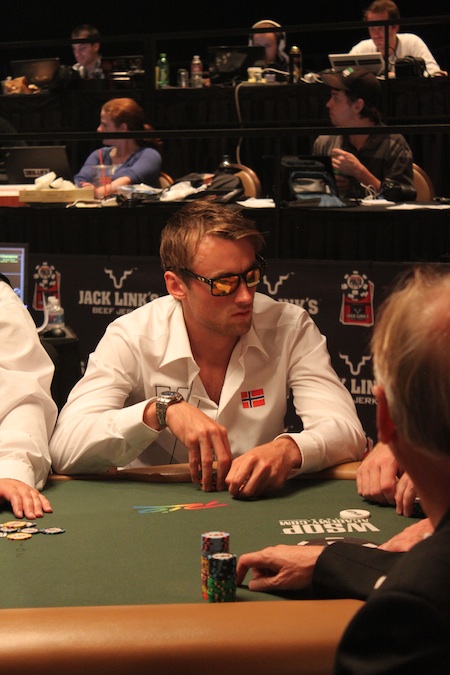
Petter Northug during his first day at the 2010 World Series of Poker
While it was never confirmed whether anything had happened to his skis, tension remained high throughout the Games as his father stepped in, giving Northug the equipment and wax service he needed to be successful in Vancouver.
In April 2010 he was hounded by the Confederation of Norwegian Sports over his poker habit, and that May he failed to show up to a national-team camp citing illness, but was skewered in the press after it was revealed that he had actually gone instead to play a soccer match for Mosvik, a lower-division club he occasionally plays for. That revelation was relatively benign compared to the popularly held belief that he had skipped the camp to get blindingly drunk on the Spanish island of Mallorca.
In December 2010, Ulvang howled that he was “embarrassed to be a Norwegian” after Northug showed up late to an award ceremony after a World Cup race in La Clusaz, France. Last year, Sundby called him a coward, and Northug had to fight to be allowed to ski in the World Cup races in Sochi, preparation he said was vital ahead of an Olympic year. All told, by the end of the 2012/2013 season he simply ran out of patience with the national team and its “haters-gonna-hate” attitude, as his sleeve that year attested.
It’s likely Northug had been developing his strategy for a national-team exit for some time before his announcement last May. To understand how he managed to land such a momentous agreement with Coop, one need not look farther than Northug’s father.
The Ultimate Ski Patriarch
John Northug is nothing if not the ultimate ski patriarch. He is the father of three sons, all skiers: Petter, Thomas, and Even, and he has been instrumental in developing their ski careers. Aside from his eldest son Petter’s obvious success, Thomas, age 23, is a member of the National Team, and Even, 18, is on his way up. When Even took third in a Norwegian rollerski race last summer, Petter exclaimed: “We don’t play around, we don’t play around. F*ck, we’re good.”
For three years John has managed Petter’s career, helping him reach an unprecedented level of success and fame. Yet the relationship between the two was argumentative, often tense in the public sphere and said to be even more turbulent behind closed doors.
Petter Northug at the 2011 Bislett Games. Photo: Chell Hill
“When I started, it was because Peter wanted it. And I was positive. We both agreed that I was the right man for the job,” John told Dagbladet. “In the aftermath, we can say that it was a misjudgment.”
After three years, they decided that John would move on from his managerial role, and he told Dagbladet he was relishing a return to the simple life of living on his farm and working at the Agricultural Office in Inderoy.
“Now I have it good,” John said at the time. “Now I have found serenity. When I was a manager, I walked around with a tension in my body all the time. What would show up today? It was something all the time.”
He didn’t last long at the Agricultural Office. If John Northug thought he was ready to return to the simple life of a municipal worker, and leave his role as chief of the “Northug Circus” as his son’s exploits are referred to, he was kidding himself.
“It is just a little bit that I do some other things too well,” he said about he decision to leave the municipality.
He then joined a sport-management company based in Trondheim, Norway, called Nye Høyer, or “New Heights” in English. As a senior consultant with New Heights, his role was largely to help the company develop its activities relating to major Worldloppet ski events such as the Marcialonga, Dolomitenlauf, and the Engadin.
It was no accident then that Northug arrived at the doorstep of New Heights, the company he actually signed with when he left the national team in 2013. Whether John was hired by New Heights with the expectation that they would manage Petter’s business affairs in the future, or whether that idea was borne later, by last spring it was decided that Northug would partner with New Heights, and that they would, “handle all areas around the Petter Northug brand.” The deal they arrived at with Coop didn’t disappoint the company motto of, “a profitable journey of continuous improvement.”
With New Heights, Northug has the experience of his father backed up with the support and connection of a well-oiled management company. New Heights cited their connection to the legal firm Pretor Advokat and the Trondheim branch of the international auditing house PricewaterhouseCoopers to provide Northug with extra legal, financial and tax assistance.
To what extent New Heights is currently leveraging their connections to assure that their golden boy remains able to compete for Norway in big competitions is unknown. Perhaps his future will lie entirely in the world of marathon races, and if so he may lift those events to even greater prominence. In any case, whatever Opsal decides and despite Ulvang’s cries of alarm, the sport of cross-country skiing is not likely to proceed in the same way for long. FIS has been successful in making skiing popular to watch, and there is money in the sport in a way there never has been before. With Norwegian national-team salaries capped at $73,000 and most other nations paying their athletes significantly less, it’s only a matter of time before more skiers opt for a more remunerative route.
If Opsal opts to change the agreements he may delay the inevitable for some time in Norway, but star athletes from other countries will likely soon hear the siren sound of private teams, exclusive contracts, and real wealth.
***
This series will continue by examining Therese Johaug and her path to a successful career while on the Norwegian National Team.
Martin Johnsrud Sundby, Winner of the Tour de Ski. Photo: Fischer/Nordic Focus
Martin Johnsrud Sundby led the final stage of the Tour de Ski and never looked back as he skied to his, and Norway’s, first victory in the event’s history. Sundby, who has skied in every Tour de Ski, called his feat a “dream come true” and, overcome, said, “I have a great feeling, deep into the soul.” Chris Jespersen of Norway, skiing in his first Tour de Ski, captured second place. Of his effort on the big climb, he said, “towards the end I thought, ‘Now I die.’”
Facing falling snow that grew heavier as the race progressed, Sundby began his day with a 49 second advantage over his teammate Petter Northug. Starting in third, Jespersen left 38 seconds after Northug. With Alex Harvey of Canada missing from the fourth position, Austria’s Johannes Dürr was the next in line to start, leaving the gates just over two minutes after Sundby.
The course looped once widely around the stadium before exiting for the approach to the base of the Alpe Cermis. An interval timing station at 1.8k showed that Sundby was skiing fast, exiting the stadium for the second time in 4:11. Northug, chasing, passed the marker in 5:01, having lost a second on Sundby already.
Leaving the stadium, the course followed a gradually descending trail for over three and half kilometers to the base of the climb. At the 4 k marker, midway between the stadium and the start of the climb, splits indicated that Sundby had increased his lead on Northug to 55 seconds. As Northug passed the timing check, he took off his glasses and threw them off the trail.
Jespersen was the next to cross the 4 k marker, 1:09 behind Sundby, gaining ground now on Northug who was only ahead of him by 14 seconds. Next through was Dürr, leading Sweden’s Calle Halfvarsson and Russia’s Ilia Chernousov, 2:11 behind Sundby.
As the trail began to steepen at the base of the Alpe Cermis, Jespersen caught Northug, and just before the time check at 6.2 k, Jespersen passed him. They were now 58 seconds behind Sundby.
Dürr led the second chasing pack through at 2:23, having lost 22 seconds to Sundby on the approach. Behind him were Chernousov, Halfvarsson, Alexander Legkov of Russia, and Sjur Røthe of Norway.
Alexander Legkov
Less than a kilometer later, at 7.1 k, Sundby increased his lead to second place with Jespersen now 1:01 behind him and Northug trailing by a second.
Behind Northug by 1:13 came Dürr who was pulling Chernousov with him. A five second gap separated Chernousov from Legkov, whose heart rate had already reached 182 beats per minute, with 1.9 k of climbing left in the race. Røthe stuck with Legkov, but Halfvarsson, the tall Swedish sprinter, was beginning to fall off the pace, now five seconds behind Røthe.
After 7.1k, the course steepened. The challenging climb and subsequent curves were reminiscent of a giant slalom course being skied backwards. Sundby skied through this smoothly. Jespersen, too, seemed to still be skiing within his limits, but behind him Northug looked tired; his form looked haggard as he bore all his weight down on his poles. Jespersen was pulling away from Northug who could muster no response.
The 8.1 k split told the story clearly: Jespersen was now 21 seconds ahead of Northug who looked to be in no condition to catch back up. Jespersen had also pulled back a couple of seconds on Sundby, but with only 900 meters of race remaining, it looked like it would Sundby’s day.
Northug found himself facing a new threat, however, in Dürr, who was now 36 seconds away from catching him, and he mut have known the Austrian was approaching. Dürr had now dropped Røthe by 21 seconds, and Chernousov, who had been skiing with Dürr a kilometer earlier had blown up. The Russian was now 43 seconds behind Dürr and had been passed by Røthe and Legkov.
After the 8.1 k marker, the trail steepened again, this time to its most severe grade, a 28 percent slope. Sundby V1’d up the slope with an apparent ease that was belied by the tortured expression on his face. It was an impressive performance up a slope that has seen former Tour leaders like Dario Cologna of Switzerland reduced to single sticking up its formidable pitch.
Northug, on the other hand, didn’t look particularly graceful up the precipitous climb. Dürr who could see him, and his place on the podium, tantalizingly ahead skied after him hungrily, and on the top of the steep pitch, caught him.
At 8.5 k, 400 meters after the last timing interval, a grimacing Sundby led, comfortably ahead of second place Jespersen by 53 seconds. Dürr was 1:31 after Sundby, with Northug struggling to stay with him. Behind Northug by 36 seconds was Røthe, who had dropped the hard-charging Legkov on the last pitch by 28 seconds.
With 500 meters remaining, Sundby skied ahead, looking pained but not slowing in any apparent way. Jespersen, too, seemed steady in his skiing. The battle for third was also short-lived. Northug, skiing frantically behind Dürr as the course cut back and forth up the summit of Alpe Cermis, soon lost his form and appeared to have given up as Dürr skied away from him, less than half a kilometer from the finish line.
When Sundby reached the finish line, with his family watching from the sidelines, he did not slow down to celebrate or grab a Norwegian flag. Instead he powered through the finish, a long spindle of saliva hanging involuntarily from his mouth. He had no effort left for a celebratory arm raise, but could only muster the strength to push up his falling glasses.
Jespersen, approaching the finish line, turned over an amazing finishing tempo, jump skating through the finish to second place in the Tour de Ski, and with the second fastest climb of the day.
Dürr, too, came through the finish line as quickly as he could, setting the fastest time of the day and taking third place in the Tour de Ski. He raised his hands and yelled happily as he collapsed on the snow.
Northug, finishing fourth, was caught by Sundby after he crossed the finish line. Sundby looked to have some words of consolation for him.
Røthe was next across the line in 5th. He also recorded the third fastest time of the day. He was followed by Legkov, Norway’s Tord Asle Gjerdalen, Chernousov, Halfvarsson, and Didrik Toenseth of Norway.
Podium of the Tour de Ski. Photo: Fischer/Nordic Focus
In all it was a very good day for Norway, with six men finishing in the top ten of the Tour de Ski, and narrowly missing out on a double podium sweep, with the Norwegian women taking the top three spots in their race.
Ivan Babikov of Canada, the last Canadian man in the Tour and a formidable climber, had another impressive day on the Alpe Cermis, having the fourth fastest day and skiing his way up from 21st to 16th, despite breaking a pole. In 2009 Babikov posted the fastest time up Alpe Cermis and was second in this same race last year.
“I have no idea why I’m good at this stage,” said Babikov following last year’s climb. “Where I grew up there were no hills. Everyone feels the pain at some point on the hill. Maybe I am able to cope with the pain a little better than others. People always ask me why I’m good at it and I don’t know. I just love climbing and I just go with it.”
Noah Hoffman of the US, also the lone American left in the Tour, skied his way from 31st to 25th overall. Hoffman said of his race, “I felt like I started hard, but the guys who started behind me caught me at the finish of the sprint loop. I struggled a little bit in the gradual downhill, the soft conditions are really challenging for me.” On the climb he went to work, moving from 30th to 25th. He stayed strong at the end, passing three skiers in the last kilometer.Hoffman is eager to return to the final climb in 2015, “I feel like I’m a better climber than I’ve shown on my two efforts on Alpe Cermis,” he said, “so I’m looking forward to another opportunity next year, and I really feel that I can have a top 5 or win the climb. I think climbing on skate skis is real strength of mine.”
Hoffman
Sundby is a true veteran of the Tour de Ski, having skied in all eight editions of the race. His performance in this year’s Tour was worthy of a champion—he made it to the final of every sprint competition, and as a result skied the maximum distance possible in the Tour, and was a threat for the podium in all but one race.
He told FIS after the race, “This a dream come true for me. It has been a long way to here. This is my 8th Tour de Ski. It is an amazing moment for me. I did not have the best day today. I had to take it easy and go medium pace not to be totally tired soon. It was tough going first in the snow; it was quite slow. Olympics is the main goal for the season. It will be interesting now to see how my body responds after the Tour de Ski.”
For Sundby, his victory is a crowning achievement in a ski career that has developed slowly and steadily over the years. Norwegian newspaper Dagbladet called for Sundby’s name to be added to the pantheon of Norwegian sporting heroes for his achievement as a complete skier. “I have a great feeling, deep into the soul.” said Sundby to NRK after the race, “There is an awful lot of hard work behind this victory. There are a lot of emotions inside now.” An emotional Sundby told the Norwegian broadcaster, “Don’t ask many questions, I’ll start to cry.”
Sundby’s success has been the result of many small adjustments: more rest, less weight training, changing the way he records his training log, and refining his technique over the summer at Holmenkollen. Last but not least he has improved his diet, telling Dagbladet that, “It took a long time, but now I have discovered that Coke and potato chips are not the right thing to eat after exercise…It is very good, but it does not provide any energy in the long term.”
Sundby was initially annoyed with the change of the Tour format due to the poor snow available in Oberhof, Germany. He voiced his grievances to Dagbladet before the start of the prologue, calling it a “parody of cross country skiing” and grumbling about a lack of a venue change and the Tour being solely designed for television. After the prologue however, it occurred to Sunday that the training he had done made the new Tour format optimal for his abilities and he set about doing what he could to win it.
Johannes Dürr. Photo: Fischer/Nordic Focus
Jespersen for his part was an unknown factor heading into the Tour, his first ever. When asked by Dagbladet if he ever thought before the start of the event that he would finish second, he replied, “I really thought I was going to win, so…I ‘d at least hope so. But the tour was settled with the long race [Friday’s 35 k pursuit] with Martin in front. He is a worthy winner.”
His remarks to the Norwegian press didn’t quite match his comments to FIS, saying, “I had a great race today. I am very satisfied with second place. I tried to open very hard, when I passed Petter I tried to keep the pace high. I hope the shape will continue and I can perform well in Sochi. This season I had planned to do long distance competition so I am little bit surprised about the result.” To Dagbladet he said of the race, “It was great fun to go today. I was fit and had good skiing. But towards the end I thought, ‘Now I die.’ Luckily I got more power as I approached the top.”
Dürr confessed his excitement at taking third in the Tour. “It is awesome to be on the podium of the Tour de Ski,” he told FIS. “I can hardly realize it; it came too fast. After yesterday I had some hope for a podium. I knew I would need a perfect day and skis. I had great equipment today—not only today but during the whole Tour. I just gave it all and went totally full speed on the uphill.”
Johannes Dürr, with fans. Photo: Fischer/Nordic Focus
To the Austrian newspaper Der Standard, Dürr said, “I have only looked forward. As Northug briefly focused on me, I started to doubt it. But then [once across the finish line] everything that is in me, is brought out,” said a happy Dürr.
Northug, despite losing two places to finish outside the podium, did not express bitterness about his race. “I thought it would be uglier,” he told NRK. “I did not lose too much, and I got help from Chris [Jespersen]. Had I been alone, I’d have lost a minute.” He added further, “I got help from Chris and Dürr. When I went into the ground, I thought there were many that would pass me…I thought Legkov and several others were coming behind me and would walk past.” Northug said he was pleased to have finished at all in the top ten.
The 27 year old conceded to NRK that his goal of winning the Tour de Ski, one of his great dreams, is fading, saying, “I should have been four minutes into the ground” and, “I think I’m too fat to win the Tour de Ski.”
France’s Maurice Manificat racing to a 3.3-second win over Chris Andre Jespersen of Norway (not shown) in Saturday’s World Cup 30 k freestyle individual start in Davos, Switzerland. It was Manificat’s third individual win and eighth World Cup podium, besting his second-place performance in the 30 k two years ago in Davos.
Maurice Manificat was having one heck of a flashback on Saturday in Davos, Switzerland. Two years older and that much more experienced, the 27-year-old Frenchman could sense that he was in the hunt for another World Cup career best in the 30-kilometer freestyle individual start – the same race and place he placed second in almost exactly two years ago.
In December 2011, Manificat essentially fell apart in the last quarter of the race, losing to Norwegian Petter Northug by 51.4 seconds. He didn’t forget that during his four times around the Davos course on Saturday, being mindful and consciously restraining to make sure he had something left at the end.
Chris Andre Jespersen of Norway leads Switzerland Roman Furger during the men’s 30 k skate on Saturday in Davos, Switzerland. Jespersen went on to place second for his first World Cup podium and Furger placed 57th.
Starting 66th of 70, Norway’s Chris Andre Jespersen chased down Manificat’s top time, heading out 2 ½ minutes after him. With just over 5 k remaining, it looked like Jespersen could steal the victory from under him as he clocked the fastest time through the 24.5 k checkpoint. Two kilometers later, Manificat had the edge by 2.3 seconds and his closing kick turned out to make the difference as Manificat won by 3.3 seconds.
His time of 1:05:10.8 was 2:33 minutes faster than Northug’s in 2011 and stood as Manificat’s third individual win and eighth World Cup podium. Norway’s second man, Martin Johnsrud Sundby placed third, 14.9 seconds behind Manificat, and Northug finished 37th, 2:51.2 minutes back.
“It was a tough race,” Manificat told reporters. “I was thinking of two years ago when I did not push hard enough towards the end and lost the victory in the last lap.”
“It feels great to win today,” he added.
Afterward, Canadian Alex Harvey (who did not race) tweeted at Manificat in French: “Moving to Davos?”
“I’ll need a few more wins 🙂 ,” Manificat responded.
Overall World Cup leader Martin Johnsrud Sundby, of Norway, racing to third in Saturday’s 30 k skate at the World Cup in Davos, Switzerland.
Careful not to open too hard, Manificat had the fourth-fastest time through 4 k, trailing Russian Alexander Legkov and Austrian Johannes Duerr, respectively, at the time. Then, Sundby as the final starter jumped out to the fastest 4 k time.
By the halfway mark, Manificat had taken the lead, about 10 seconds ahead of Simen Andreas Sveen – a 25-year-old Norwegian gunning for an Olympic bid. Sundby surpassed Manificat’s 15 k time by 13 seconds, but the Manificat up ahead wasn’t too concerned.
Saving for the last 7 ½ kilometers, Manificat was still warming up, doing his best to accelerate over the courses flat sections. The tactic worked as Sundby dropped to third by 24.5 k and Jespersen emerged as a contender for his first World Cup podium – which was almost a win.
“I was surprised when I heard I was fighting for victory,” the 30-year-old Jespersen told reporters. He had focused on skiing his own race and holding a steady pace.
“It’s my first podium in my career; three seconds behind the winner is like a victory for me,” he added. (Later, he told NRK “it sucks” to lose by that margin, “but right now, I don’t care!”)
Meanwhile, Sundby, 29, held onto the overall World Cup lead by 91 points over Manificat. Knowing it would be a tough race from the get-go, he was pleased to share the podium with his teammate, who now leads the distance World Cup standings by six points over Manificat.
“Chris is good enough to go the Olympic Games in Sochi,” Sunbdy told NRK, according to a translation. “We are very good pals, have been there a long time and has trained a lot together. There is nothing that pleases me more than to stand on the podium with him even if he beats me.”
While Jespersen differed questions about whether that result put him on Norway’s Olympic team (he also placed eighth in the Kuusamo mini tour to start the season and eighth in the Lillehammer 15 k classic last weekend), he told NRK, “It’s big.”
Two other Norwegians, Sveen broke through in fifth (+22.1) to help Norway take three of the top five, and Petter Eliasson placed eighth.
Italy’s Roland Clara placed fourth (+20.8), France’s Robin Duvillard finished sixth (+39.2), Duerr took seventh for Austria, and Legkov and Finland’s Matti Heikkinen tied for ninth.
Norway’s Pal Golberg (c), shortly after winning his first World Cup in the 15 k classic individual start in Lillehammer, Norway, with teammate Didrik Tønseth (l) and Alexey Poltoranin (KAZ). Poltoranin took second and Tønseth notched his first World Cup podium in third.
Out of 85 starters in the men’s 15-kilometer classic individual start in Lillehammer, Norway, 17 were Norwegian. More than half of that 20 percent included international household names, and the lesser-known few were also vying for Olympic team spots, making the stakes even higher.
Without even factoring in odds, there was a pretty good chance a Norwegian was going to win Saturday’s World Cup race.
As the skiers ticked off the laps – three times around Lillehammer’s hilly course – it became a question of who would take the big prize.
Initially, Russia appeared on top with Stanislav Volzhentsev, the sixth starter, logging the fastest time through 2.1 k. Thirty starters later, Sweden’s Johan Olsson bested Volzhentsev’s intermediate time by more than a second, and a few minutes later Norwegian Petter Northug came through even faster – by 3.2 seconds – in bib 46.
Petter Northug shrugging off Norway’s seventh-straight men’s relay title at 2013 World Championships in Val di Fiemme, Italy. He beat Sweden’s Calle Halfvarsson (second from l), Russia’s Sergey Ustiugov (third) and David Hofer of Italy in fourth. (Photo: Fiemme2013)
But it was only two kilometers into a 15 k race, and there were lot of dangerous starters remaining.
Pål Golberg started 64th and didn’t draw attention too early. With the seventh-fastest time two kilometers in, he was nearly nine seconds behind Sweden’s Calle Halfvarsson (who had topped Northug’s time by six seconds).
At the 5 k mark, Halfvarsson was still the fastest, but Golberg — best known as a sprinter — was making up ground, cutting the deficit to 3.8 seconds. Northug remained in second, and appeared on par to put down one of his late-kicking, dominant performances.
Less than kilometer later, just a third of the way through the race, the 23-year-old Golberg took the lead. He led Halfvarsson by a second, as well as Norway’s Chris Andre Jespersen, Didrik Tønseth and Martin Johnsrud Sundby, who were all within two seconds of one another in third through fifth. Northug was 11 seconds out in 12th, and suddenly the race had started.
“I wanted to be patient in the first lap. I knew I could ski fast but I held back at the beginning,” Golberg told reporters after. “In the other two laps I felt like I could keep the pace up. The course seemed to be really hard during training, but today with the speed, it did not feel that tough.”
Golberg held on, just ahead of 22-year-old Tønseth and Halfvarsson, who trailed by about a second. Chasing him from behind, Sweden’s Marcus Hellner and Russia’s Alexander Legkov ranked third and fourth, respectively, just 3 ½ seconds back..
With 5 k to go, Golberg began his ascent toward the podium putting 8 seconds into Tønseth, 9.8 seconds into Olsson, and ultimately 10.3 seconds up on Legkov.
He finished in 35 minutes flat, knocking Kazakhstan’sAlexey Poltoranin from the leader’s chair by 14.2 seconds. Hovering around the top 10 for most of the race, Poltoranin came on strong late to edge Tønseth, the previous race leader who ended up third, by 1.3 seconds.
Sitting in the hot seat bundled up and appearing slightly nervous, Golberg watched as others pushed to beat his time. Hellner finished 20.2 seconds back in fourth, and Legkov double poled hard off the final descent into the stadium, ultimately finishing 22.2 seconds out in sixth. (Olsson ended up fifth, 21.4 seconds out of first.)
Norway’s Pål Golberg smiles from the leader’s chair on Saturday, after watching Russian Alexander Legkov finish 22.2 seconds off his winning time of 35:00 in the 15 k classic individual start at the Lillehammer World Cup.
As Legkov crossed the line, Golberg smiled. Not long after, Sundby as the final starter finished 24.9 seconds back in seventh. Following in eighth was Jespersen (+31.8), Northug placed ninth (+40.7), and Sweden’s Daniel Richardsson took 10th (+42.3).
Immediately congratulated by his teammates on his first World Cup win, Golberg smiled even more. He had placed third in World Cup individual sprints and second in the 2013 World Cup Finals freestyle prologue, but never this. When he spoke to reporters, he wiped away tears.
“I’m a little shaky right now,” Golberg told NRK, according to a translation. “I cry both when things are going well and when things go bad.”
At the 2013 World Championships in February, Golberg collapsed in the team sprint, blacking out and taking him and his teammate, Northug, out of contention.
After Saturday’s race, Northug praised his teammate.
“He had a very good start to the season and … is a person who can do well at both distance and sprint,” Northug told NRK. “It’s that kind of [skiers] we need.”
Norway’s second man and third-place finisher, Tønseth impressed with his first World Cup podium – and he didn’t even realize he made it. He was late to the flower ceremony as a result.
“I had looked a bit on a TV, and realized that my time was good,” Tønseth told NRK. “But I did not think it would be so good.”
Regardless, Norwegian men’s coach Trond Nystad was pleased.
Marcus Hellner representing Sweden at the Olympics last February.
Swedish fans must have been crushed after Norway’s Marit Bjoergen knocked off their hometown hero Charlotte Kalla in the 10 k skate on Saturday morning in Gallivare. But they must have been equally thrilled in the afternoon, when Marcus Hellner (SWE) skied to an 11-second victory over Switzerland’s Dario Cologna—finishing in the stadium that was named for him after a double gold medal-winning performance at the 2010 Olympic Games.
“I felt like I had control today,” Hellner said afterwards. “It was really inspiring to race with all my best friends cheering out on the course, in my home town.”
Cologna took second, just over 10 seconds out of the lead, while Hellner’s teammate Daniel Rickardsson managed to lock the Norwegians out of the podium, just edging Chris Andre Jespersen (NOR) for third. Kris Freeman was the top North American in ninth, while Noah Hoffman (USA) and Alex Harvey (CAN) followed in 31st and 34th.
With last year’s World Cup overall champion Petter Northug missing the race after falling ill earlier this week, the Norwegians were looking to biathlon superstar Ole Einar Bjoerndalen to pick up the slack. But it was Jespersen who took the early lead, despite being seeded in the bottom third of all 104 starters.
The 27-year-old Jespersen is a former junior world champion—he won the 30 k freestyle in Solleftea, Sweden, in 2003—but with just two top-30 finishes on the World Cup, he had never established himself at the senior level before Saturday. (Perhaps his biggest claim to fame is that he dates Liv Miriam Nordtomme, the sister of Northug’s girlfriend.)
After he crossed the finish line, Jespersen’s time of 32:48 held up for nearly half an hour. For a while, it seemed that the World Cup opener would end with another Norwegian upset—biathlete Ronny Hafsas was the surprise winner in last year.
But Rickardsson—who said that he had worked on his skating all summer and full—quashed Jespersen’s hopes. He led the Norwegian by six seconds after the first of three five-kilometer laps, then held on, nipping Jespersen by just 1.9 seconds at the finish.
Cologna was the next to assume the lead, slotting in nine seconds in front of Rickardsson. That result was a big improvement on Cologna’s World Cup opener last year—he finished 20th in that race after sustaining a hamstring injury in late September of 2009.
But any hopes that Cologna had of holding the lead lasted exactly 18.6 seconds. With Hellner starting just one bib—30 seconds—behind Cologna, that’s how long the Swiss skier had after crossing the finish line before being knocked off the top of the podium.
“Marcus was too strong,” Cologna said. “He’s the right winner today.”
Hellner led wire to wire with some powerful skiing, but he still had enough energy at the finish to stay on his feet and salute the home crowd. With Northug out, and the Norwegian’s starts at next weekend’s races in Finland in jeopardy, the first few skate distance events of the season could be big opportunities for Hellner—even though he told the Swedish newspaper Dagens Nyheter that he did not “think the result list would be different” if Northug had been racing.
“One of my best races ever,” he said. “I was never directly concerned or threatened.”
One other notable result was that of the 20-year-old Russian phenom Petr Sedov, who was fifth, just three seconds off Jespersen. Sedov, a multiple junior world champion, started slowly, finishing the first lap in 26th place, but put in a fierce second loop that was actually faster than Hellner’s. That left him just in front of his veteran teammate Alexander Legkov at the finish.
Reports on the Canadian and American teams to come!