From the FasterSkier archive — posts syndicated from athletes’ and coaches’ own blogs between 2004 and 2012, kept online as published. Current coverage is at fasterskier.com.
The above discretionary selection process will be repeated for each period of World Cup this coming season. As always, if you have questions or concerns about this process, feel free to contact me directly.
This coverage is made possible through the generous support of Marty and Kathy Hall and A Hall Mark of Excellence Award. To learn more about A Hall Mark of Excellence Award, or to learn how you can support FasterSkier’s coverage, please contact info@fasterskier.com.
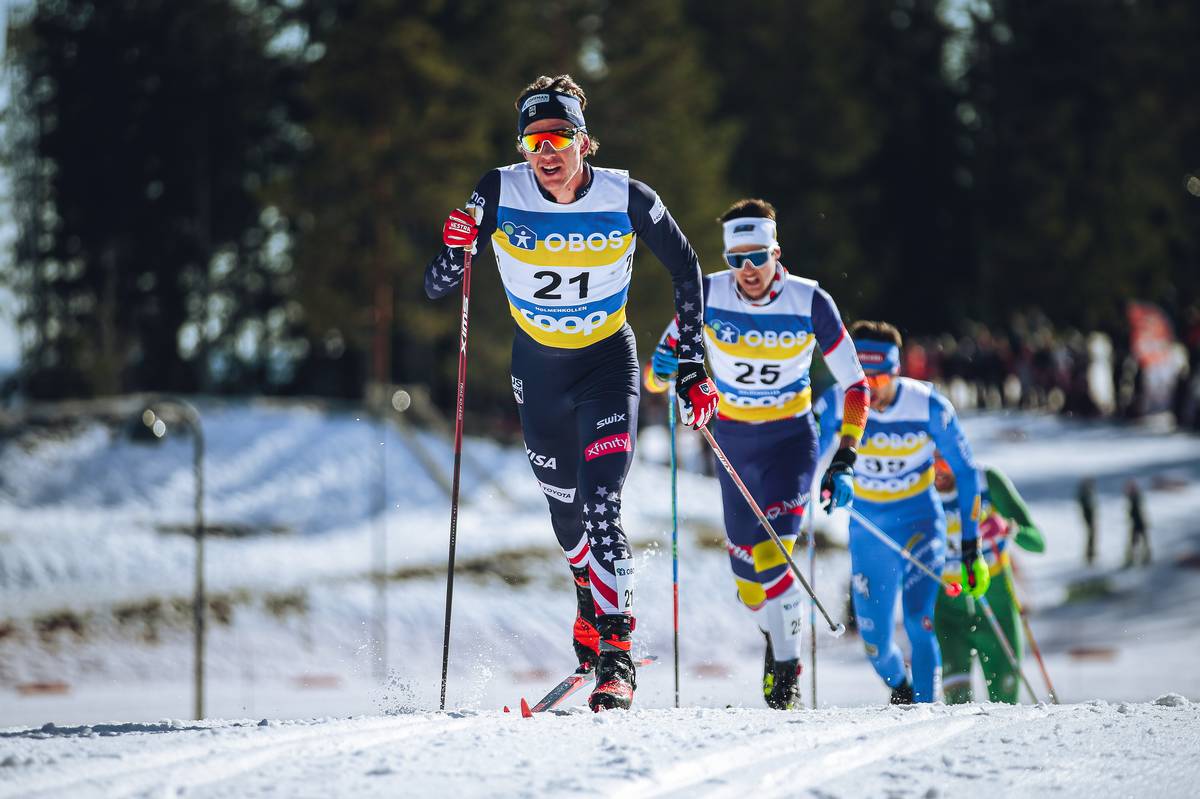
Johannes Hoesflot Klaebo (NOR) back in action and lifted by the roar of American ski fans during the World Cup 10 k Classic in Lake Placid, New York. (Photo: Dils / FasterSkier)
LAKE PLACID, NEW YORK — Ten kilometers into the second World Cup on American soil in as many decades, and the verdict is already clear: We need more racing in the United States.
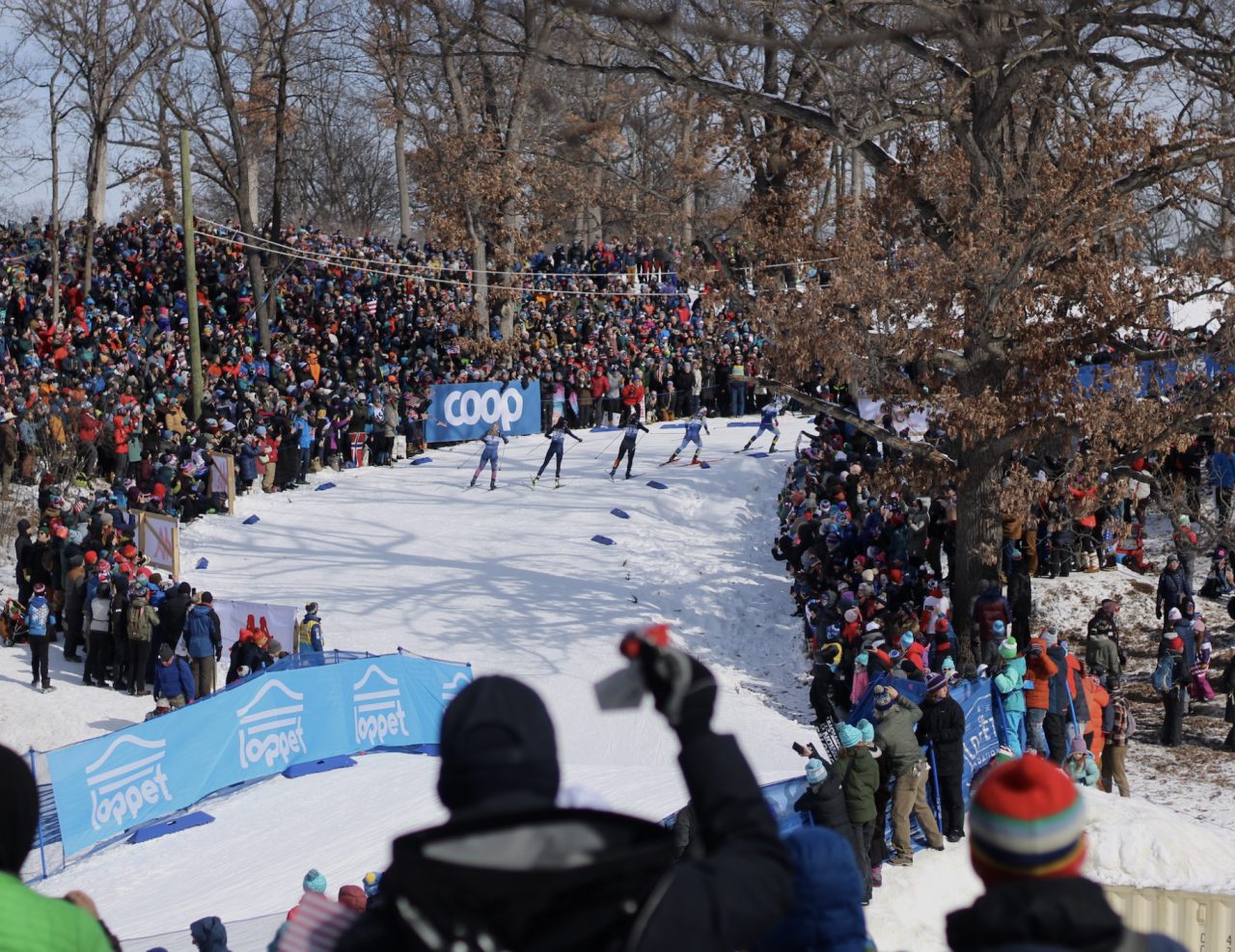
That’s the message panted into my microphone by every athlete in the Mix Zone; shouted over the undulating din by every supporter I spoke with on the ice-lacquered walkways lacing Mt. Van Hoevenberg. And it’s the irresistible outcome of the turnout this afternoon in Lake Placid — with a crowd that came out in droves for Diggins, the Schumacher-Ogden’s Silver Medal Squad, and a host of homegrown heroes; that braved five inches of wet, driving snow; and that stayed to see Jessie clinch the Overall Crystal Globe, a reconstituted Klæbo overtake Amundsen in the Distance standings, and to welcome the world’s best to the conclusion of the 2025-26 season.
The reaction to racing in the United States in 2023 was overwhelmingly positive – and, it had seemed, sui generis. With four snowmaking venues spread across the Twin Cities, along with the (purportedly) highest concentration of cross-country skiers outside of Oslo, the energy that embraced Jessie Diggins in her home state and buried a generation of “almosts” for the U.S. Men’s Team in the snow and mud at Theodore Wirth could have been lightning in a bottle.
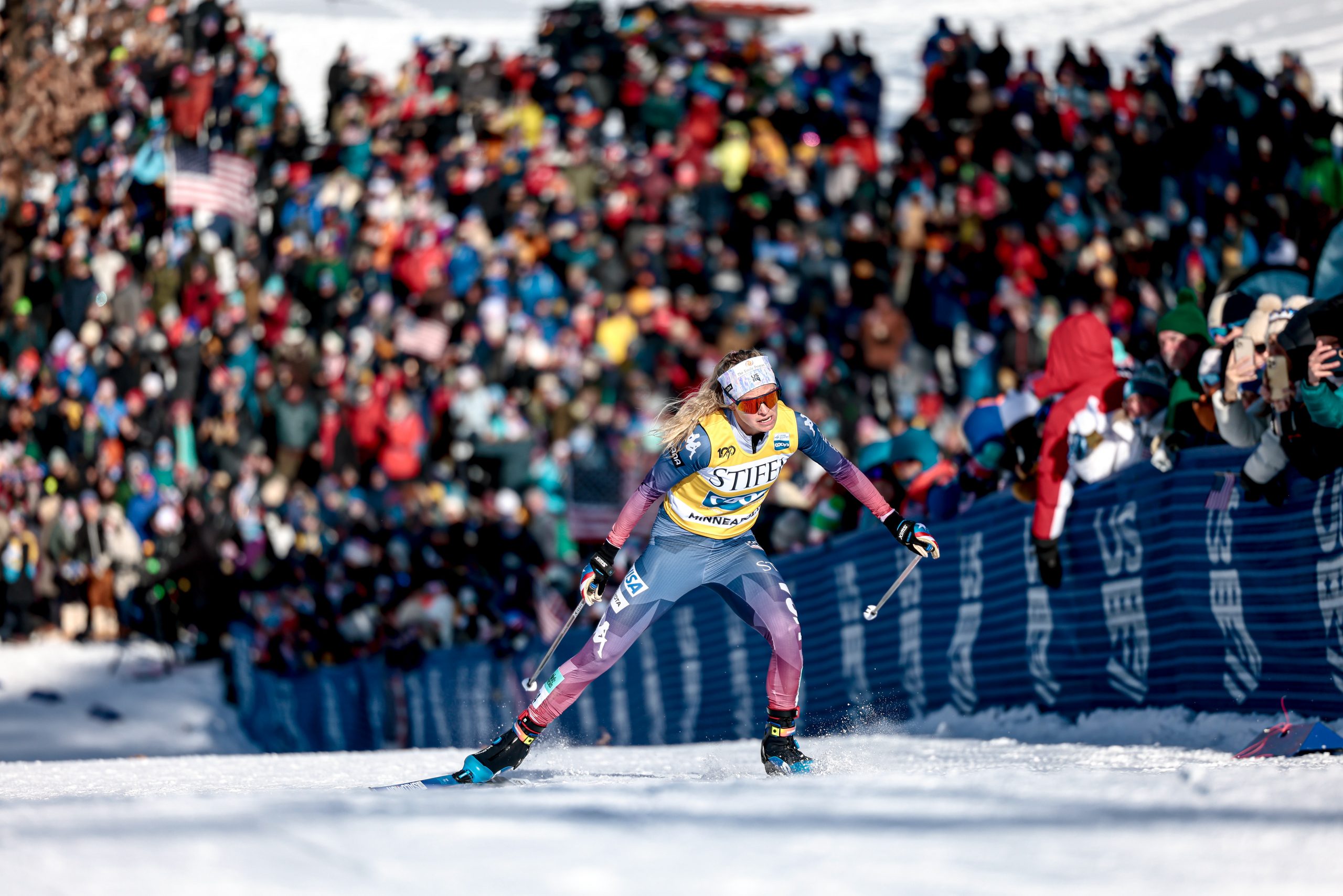
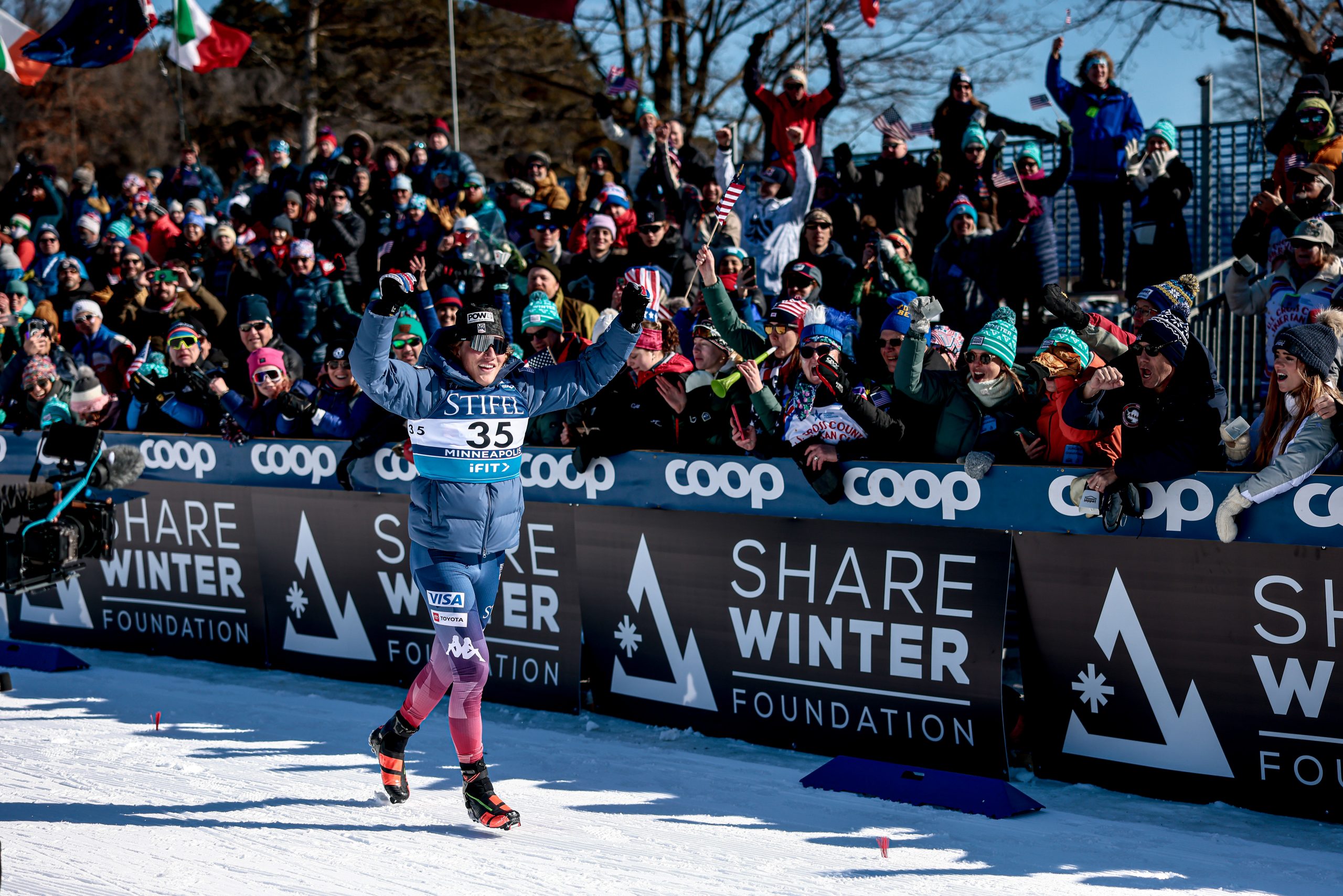
Jessie Diggins (USA) racing on home soil in Minneapolis and did so again in Lake Placid as she concludes her storied World Cup career. (Photo: Modica/NordicFocus)
I will admit my own skepticism that Lake Placid could field the fans, or the volume, of spectators to match Minneapolis. Perhaps my flight into Saranac Lake Regional Airport on Wednesday morning was my first evidence of error. Of seven passengers bobbing our way through the cloud-laden Adirondacks, four were here for the World Cup: Charlie, from Seattle; Billy (as in, Demong, the Nordic Combined gold medalist) and his son, from Salt Lake City; and myself, from D.C. Bussing to the venue the next day, I’m seated with a dozen of University of Minnesota alumni – they’ve taken off of work, graduate school, and medical school to spectate. “I’m excited just to see the number of people out cheering,” Alex Gude, who organized the trip, tells me. “I think one of the best parts about Minneapolis is just seeing the community come together, and now, away from home, we’re seeing another whole ski community come out and cheer.”
And, indeed, they are – from across the United States, from across New England, from across the Canadian border, and from right here in Lake Placid. Once we disembark, I wade through the corn snow and the first of many falling flakes to Mt. Van Hoevenberg’s sprawling Nordic Center, where the racecourse coils around the podium and snakes below the pedestrian bridge. Patricia Damp is herding thirteen might-be-members of the local ski community across the bridge; she’s a third-grade teacher here in Lake Placid, chaperoning a class field trip to the World Cup Finals.
Are the kids already Diggins die-hards, Ogden acolytes, Gus bus-riders? Not really, Patricia tells me. The class “was out here a couple months ago, cross-country skiing. We get to do the Olympic venues. We were at the museum a month ago. We have a friend who we watched ski jump. So, we’re very Olympic-oriented, and today we’re just out here to support the athletes and get some autographs.” Her students back her up. “We’re excited to get the players’ signatures,” Riley tells me. And while Declan is “excited to see the racers,” there’s no-one in particular he’s cheering for.
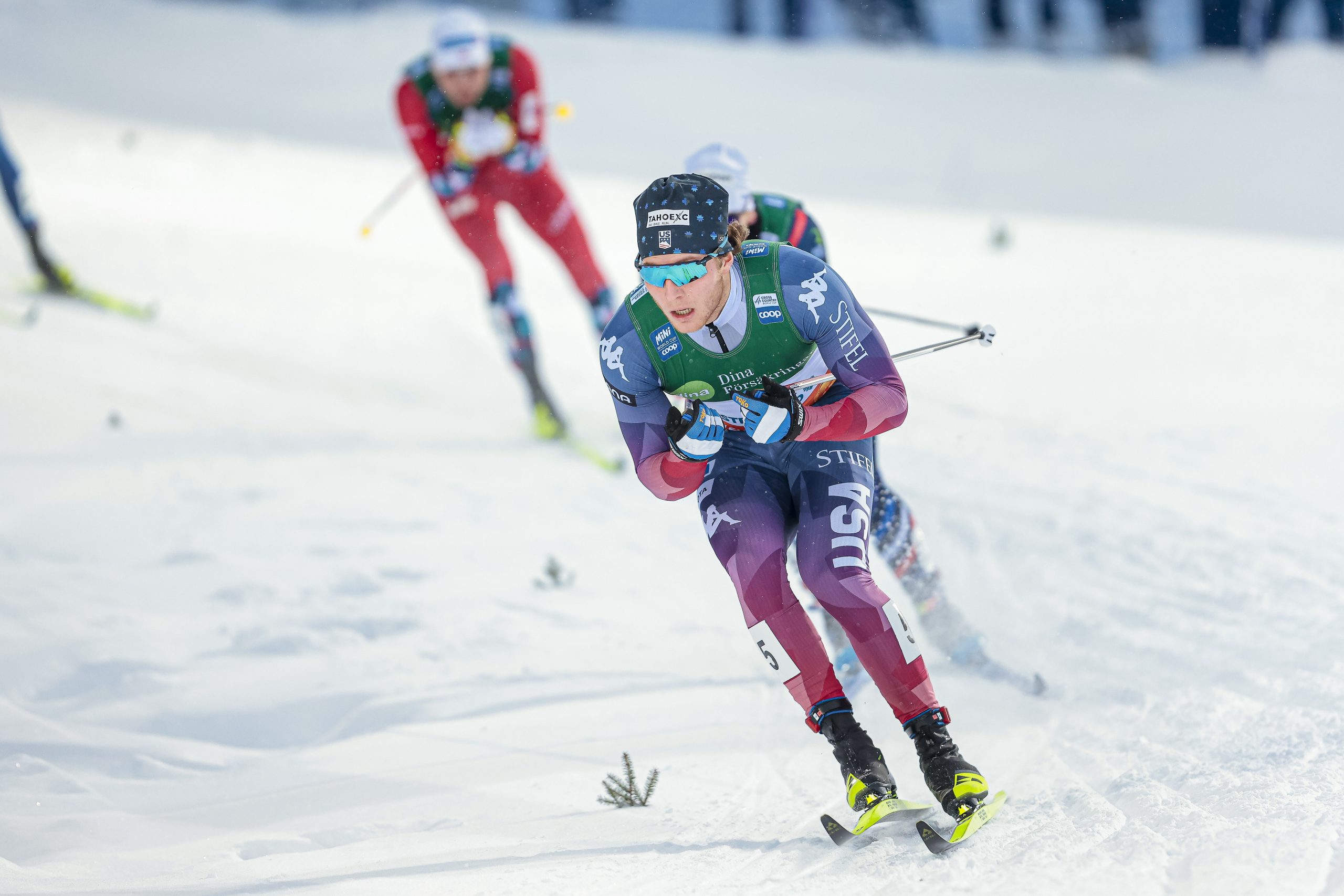
Gus Schumacher (USA) during the Men’s 10 k Classic in Lake Placid, New York. (Photo: Dils / FasterSkier)
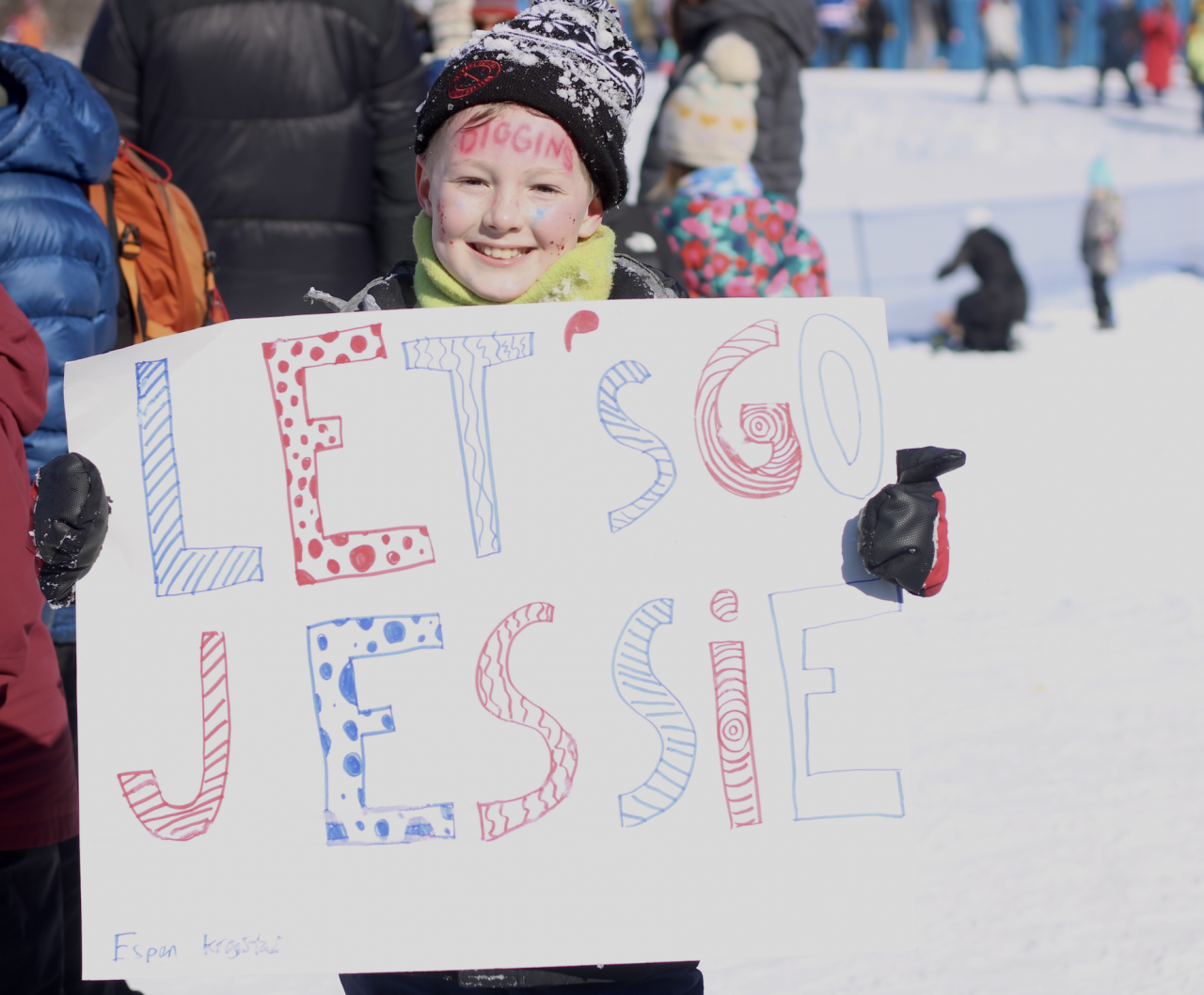
From the mouths of children, our first – and perhaps strongest – argument for future American World Cups. The glitter-dusted kids in fan club bibs, wielding cardboard-cutout faces as large as they are, make for compelling pictures and undeniable evidence of Team USA’s impact on its next generation. But racing in the United States creates opportunities to draw an entirely new cohort of young people into the cross-country skiing community – kids who may have never tried skiing before; who may not have heard of Kikkan or Klæbo ; and whose parents certainly are not waking up before sunrise to livestream Ruka, Falun or Holmenkollen. They will not see themselves in this sport until they see this sport. What better way to do so than on a Friday field trip with Mrs. Damp?
After bidding them good luck with the signature-hunting, it’s not an easy task to wade against the current of the rest of the Lake Placid Class of 2035. Also threading his way through the third-graders is Niklas Dyrhaug, immediately recognizable even five years into retirement from World Cup racing. He’s on the other side of the v-boards this weekend, broadcasting for Norwegian television. In his first sentence, he tells me: “We are enjoying being back in the U.S. In my opinion, we should be here every year.” He’s not surprised by the number of spectators, either. “Everybody who knows the U.S. crowd knows they are really enthusiastic . . . We know the tradition, the culture, and Lake Placid’s place in that history. So, personally, I’m not that surprised. It’s really cool that we’re back here.”
That’s the sentiment just after Coaster Hill, some four kilometers into the racecourse, where Norwegian national team coach Eirik Myhr Nossum prowls the striding zone. Being back in the United States is “awesome, it’s amazing. I think we should be here every year, because you guys show up; you guys cheer for everyone, and it’s always fun to be in the U.S. and to be overseas to compete.”
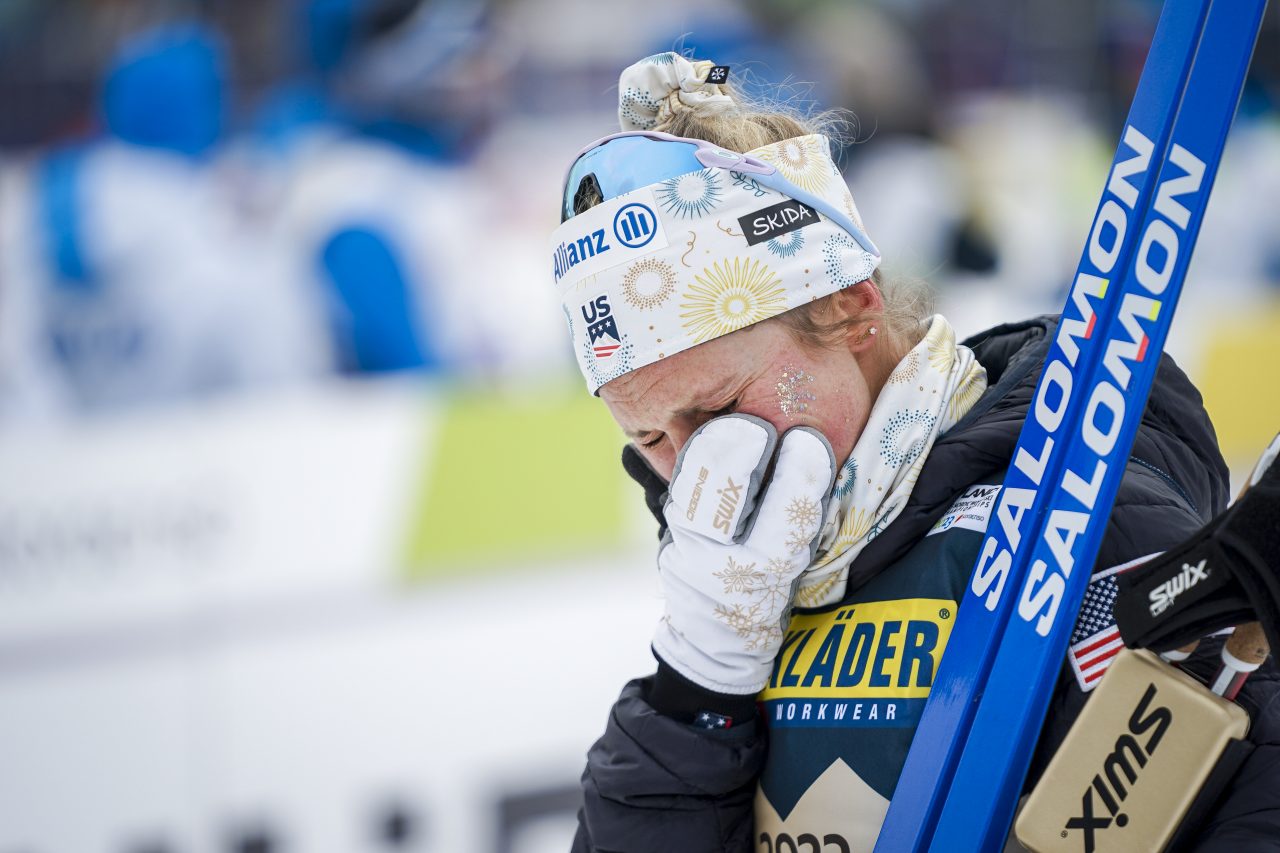
And it’s the sentiment at the finish line.
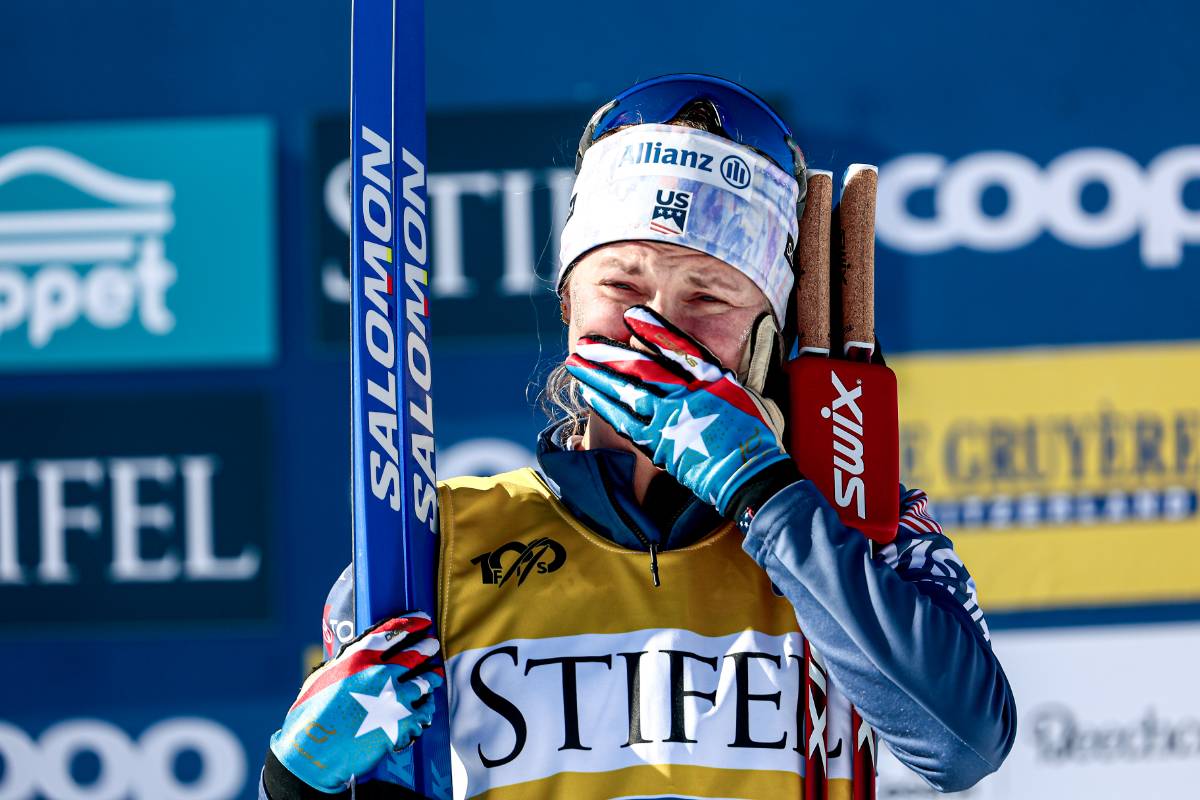
Harald Oestberg Amundsen (NOR) after the 10 k Classic in Lake Placid, New York. (Photo: Thibaut/NordicFocus)
Harald Amundsen (NOR) tells me, “In the outer part of the track, there were so many people I couldn’t hear my own thinking. That’s a really good thing.” Even before he arrived at the venue, “We had a run this morning in the city. Everyone was screaming at us, ‘Good luck!’ It’s a really nice atmosphere.”
For Elia Barp (ITA), conditions were “very tough because it was really slow with this new snow, but it was fun racing for me. So I enjoyed it – at least I tried to enjoy it – it was a pack of people screaming my name so that gave me even more motivation, and was fun . . . I loved racing two years ago in Minneapolis, and here it’s packed with people, even with the snowfall, so thank you to everyone for coming. It’s really good to race here.”
Mika Vermeulen (AUT) admits, “Honestly, this is probably the worst race I’ve done in a long time. But I don’t think I’ve ever had so much fun out on the track . . . on top there, out in the forest, I just heard, ‘MI-KA, MI-KA,’ the whole time. It was insane. I had a bad race and a lot of fun.”
As for how he feels about returning to the United States: “Great, great, actually—and feeling a bit frustrated, because it just gets me pissed that we race these [bad] courses in Europe all the time, over and over and over again, and we have these freaking jewels out here which we never use. It’s crazy. I want to go to the U.S. every year for at least a whole period. It’s called the World Cup. It’s not called the European Cup, right?”
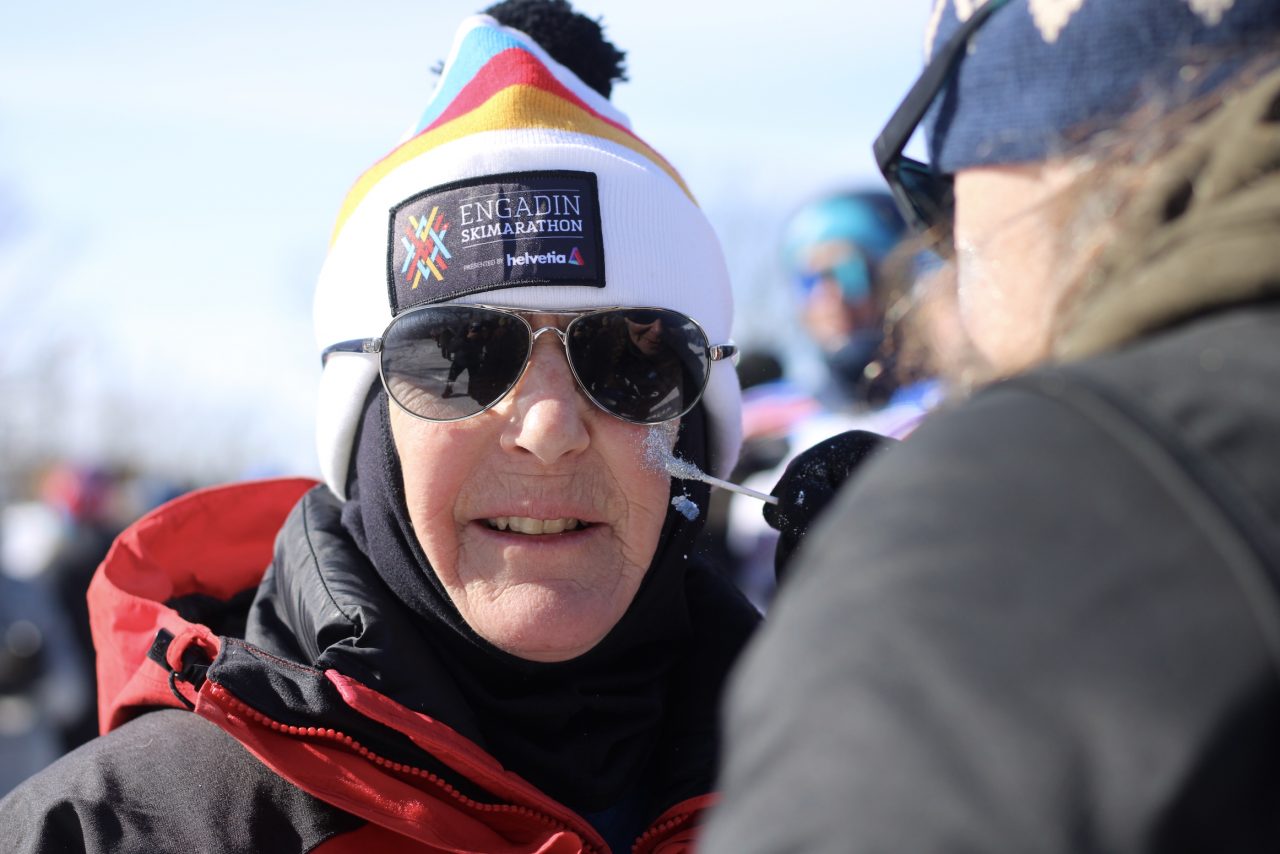
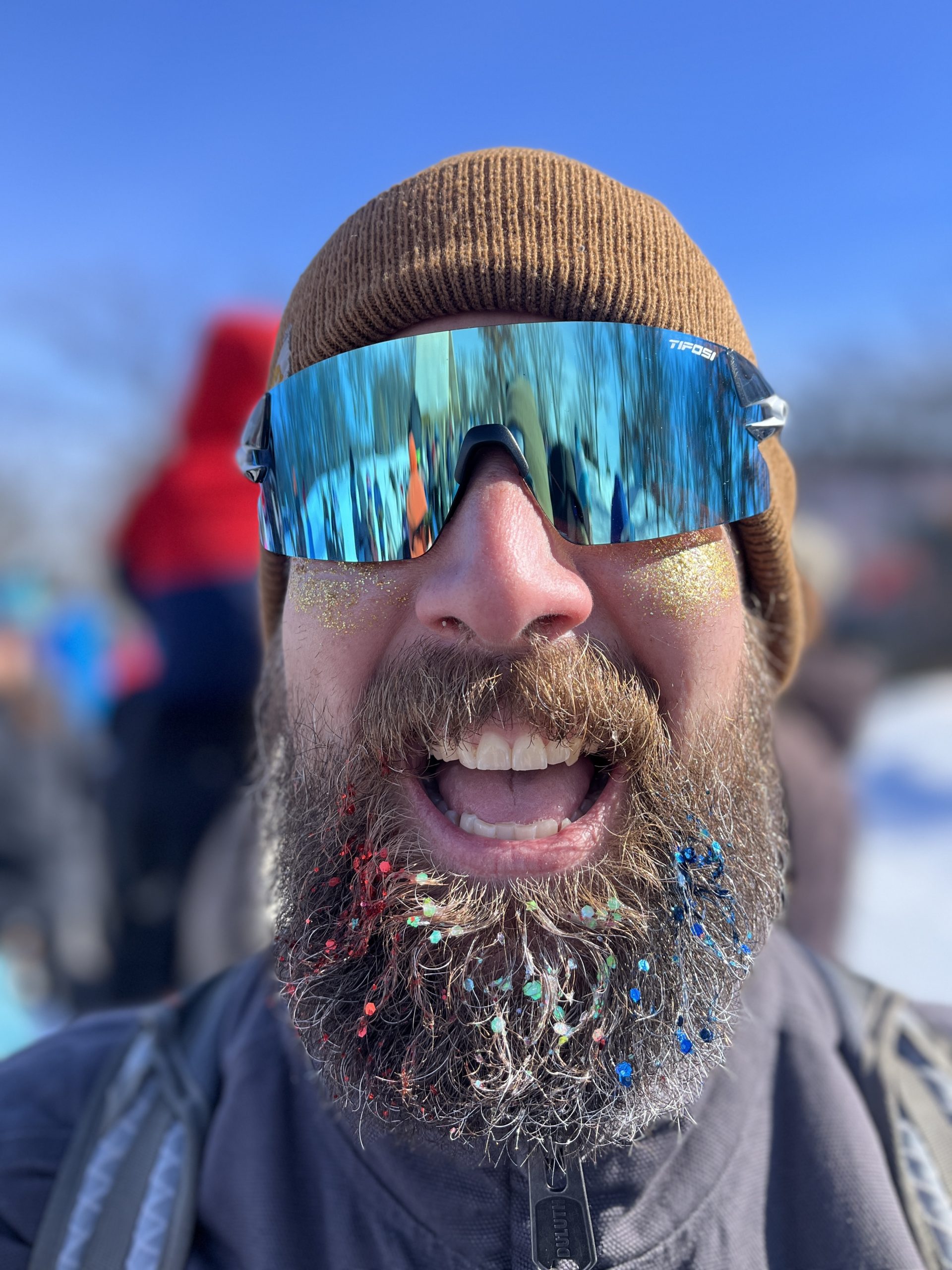
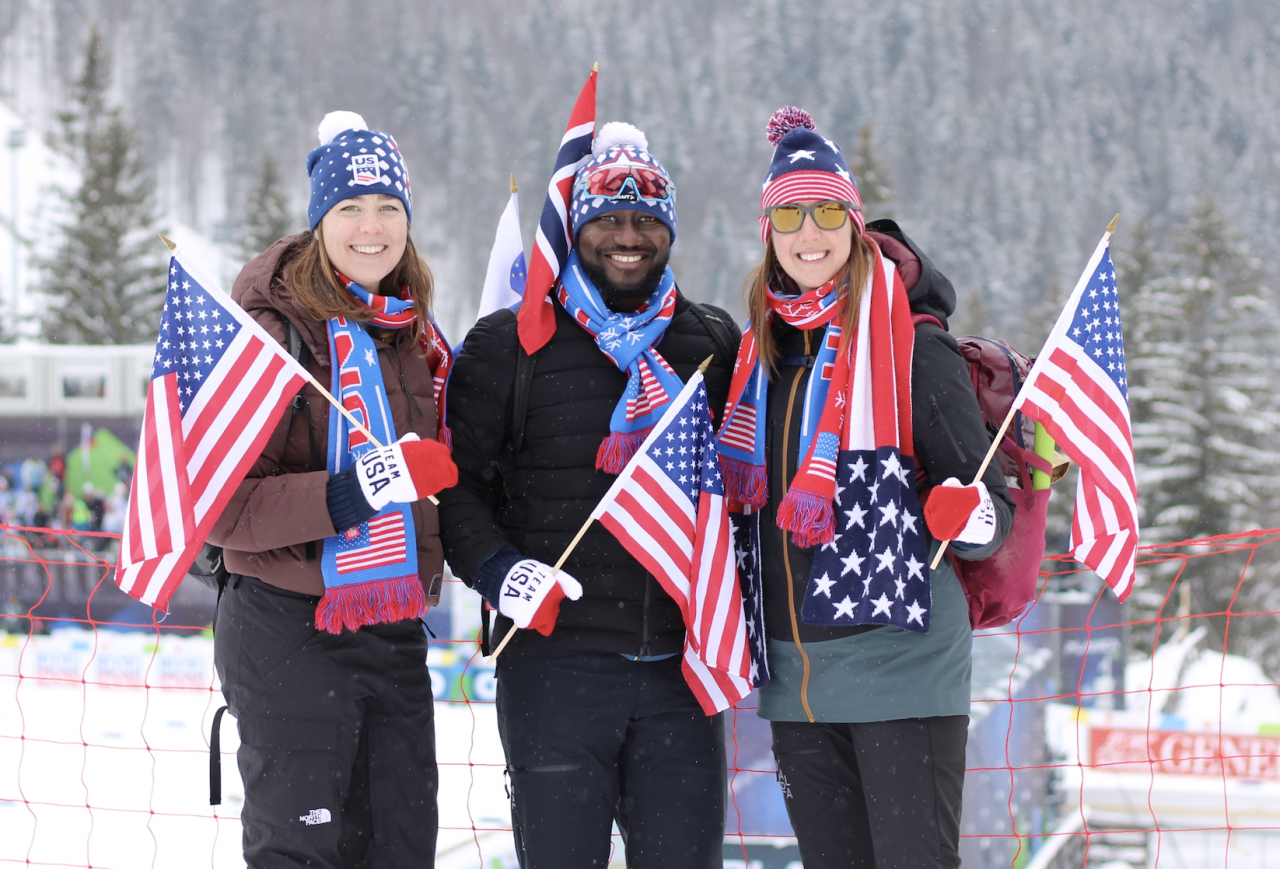
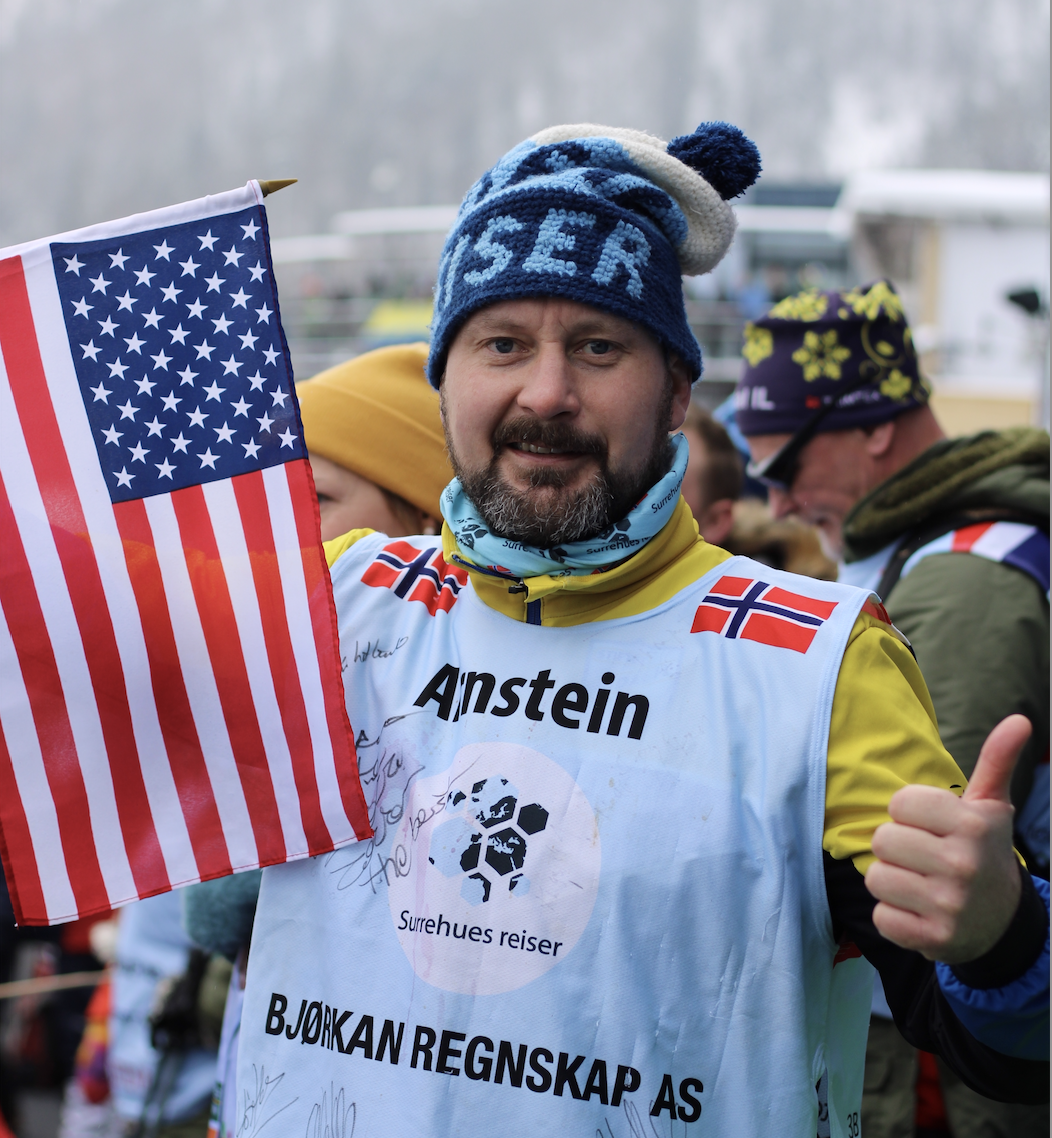
Fans all over the course with custom gear showing their fandom. (Photo: Dils / FasterSkier)
Klæbo’s opinion is a bit more measured – perhaps because he has more microphones hovering around his face. “I heard some rumors that it was supposed to be quite well [attended], and when I searched up Lake Placid and read a little bit about the place, I understood there’s not that many people living [here], but when you see how many people are here, I was pretty shocked.”
A second argument, then, in favor of World Cup racing in this country: the athletes love it. They embrace not just the energy, but the venues that push the World Cup beyond the geographic and cultural confines of Transalpine Europe.
Benjamin Dohlby (USA) at the finish of the Men’s 10 k Classic in Lake Placid. (Photo: Thibaut/NordicFocus)
For the closing statement, Ben Dohlby is among the last athletes I interview. This is Ben’s first World Cup start; a junior at University of Alaska-Fairbanks, he was 3rd in the American Birkebeiner in February. How does it feel to be making his first professional start in the United States?
“It was crazy. I went out so hard. The fans were so loud that I didn’t feel anything, and then I felt it all and got so tired – but it was awesome; a great atmosphere.” It wasn’t too long ago that Ben was skiing laps around the glazed kilometer of manmade snow at Lapham Peak State Park in Delafied, Wisconsin; now he’s here. To his former teammates, to other up and coming skiers, and to novices across similar ribbons of snow in Wisconsin, Michigan, and Minnesota, his message is simple: “Follow your dreams and you can make it happen.”
Most of the fans hiked up on the course, but the stadium filled up as the day went on. (Photo: Dils / FasterSkier)
That, then, is our concluding point: More World Cup starts on American soil means more starting berths for American skiers, and more chances for our most talented young skiers to make it to the starting line. We should savor the privilege of, as a host nation, pitting our athletes against the most accomplished figures in the sport, dreaming that a World Cup podium, an Olympic medal, could be in their future. When a lifetime of discipline and preparation meets the opportunity of a lifetime, the promise of Lake Placid – that miracles can happen – becomes deliverable.
I will leave the invariable complex problems of bidding, organizing, and logistically managing future events to far wiser pundits. But, in the meantime, the verdict is clear: FIS, U.S. Ski & Snowboard, and the American Nordic community should be eager, and determined, to have them here.
Love Stories Like This? Help Keep Them Coming.
Feature stories like this one take time, access, and care to produce. If you value thoughtful storytelling and independent ski journalism, please consider becoming a Voluntary Subscriber. Your support directly fuels the work we do to cover the people, places, and moments that make our sport special.
Ben Ogden celebrates his silver medal in the Olympic sprint in Tesero, Italy. (Federica Vanzetta/Nordic Focus)
PREDAZZO, ITALY — Ben Ogden, the U.S. cross-country skier, was ready to celebrate his historic Olympic silver Tuesday with his signature backflip off the podium.
But there was a problem: He had to pee.
After Ogden won the first men’s medal in cross-country skiing in a half-century, doping testers needed a urine sample. So, he did the obvious thing and “drank, like, three bottles of water, immediately,” he said.
The need to relieve himself, he said, was probably the biggest concern on his mind as he contemplated the backflip while the podium ceremony played out. “When I was standing up there, I definitely reconsidered a couple of times,” he said.
Ogden went for the backflip anyway. Afterward, he still had to walk through a maze of reporters called the mixed zone, where — unlike at non-Olympic races — everybody wanted to talk. Then straight to a news conference, and finally, a wait when he arrived at doping control: The other medal-winners had already arrived.
Ben Ogden speaks with media in the mixed zone after his Olympics silver. (Nathaniel Herz/FasterSkier)
“It was really, honestly, pretty miserable. I haven’t had to pee that bad since I was a little kid on a road trip,” Ogden said. “I didn’t really realize the whole situation after you get a medal at the Olympics.”
But Ogden wasn’t complaining.
At a reporter’s request, he was laying out the specifics of what happens in the hours and days immediately following something that many athletes dream of but few actually experience: winning an Olympic medal.
In a conversation Friday at his hotel in Italy — outdoors, to minimize infection risk from a reporter who has been outside the U.S. team’s bubble — Ogden described a phone deluged with messages and a dayslong-sprint of interviews and TV appearances over Zoom. But he also took time the day of the medal to enjoy a sauna with some teammates he’s known for years. He said the time in the sauna was important because it gave him time to process an accomplishment that all of them have aspired to but just one of them has achieved.
“If you win an Olympic medal, it’s like your life changes overnight,” said Jessie Diggins, one of the three other American cross-country skiers in history who can relate to Ogden’s medal-winning experience. “Which is really cool, but it’s a lot of pressure, and it’s a lot of obligations that come afterward.”
She added: “I’m just really proud of him for taking in all of the energy that comes in surrounding that.”
“The toll is real”
Ogden, 26, has had a few podium finishes on the World Cup against Olympic-level competition. But the Vermonter was far from a lock for a medal in Tuesday’s sprint race, where he was nearly eliminated after failing to place in the top two in his semifinal heat and only advanced to the final as a “lucky loser” based on his finish time.
In the finals, though, he made a powerful charge up the final hill and finished trailing only Johannes Høsflot Klæbo of Norway, who’s won all three cross-country events in Italy so far and is widely seen as the greatest athlete his sport has ever produced.
The result was huge not just for Ogden but for his teammates and the American staff – a large group of athletes stayed at the race trails to congratulate him and attend the medals ceremony.
American Olympic cross-country skier Julia Kern takes a selfie with Andrea Ogden, the mother of silver medalist Ben Ogden, just before Tuesday’s medals ceremony. (Nathaniel Herz/FasterSkier)
For some of those athletes, the thrill of Ogden’s medal and their proximity to it left them so exhausted that they scaled back their own workouts the next day, said Chris Grover, the U.S. cross-country’ team’s director.
“It really hit them not only emotionally, but it hit them physically,” he said in an interview Thursday.
The impact on teammates, Grover added, underscores that for Ogden himself, “the toll is real.”
One example: The night of the medal, Ogden said, “it was incredibly hard to wind down, just thinking about everything.” It took until 2 a.m. to fall asleep, and by 7 a.m., he was wide awake, with a “crazy” schedule of media appearances — including Good Morning America, on ABC.
All Ogden had to drink the night before was a little champagne. Still, on TV, he said, “I had some bags under my eyes, I was pretty tired, I hadn’t shaved. And I was looking at myself in the camera and I was like, ‘Oh my God, I’ve got to tighten it up a little bit.’”
“I’m sure that they all wanted me to say I was out drinking and carrying on. And I didn’t say that,” he said. “But they probably thought I was, based on how I looked.”
Ben Ogden celebrates his Olympic medal Tuesday. (Federica Vanzetta/Nordic Focus)
The cross-country team’s press officer, Leann Bentley, coordinated the string of media appearances. She also helped Ogden draft an Instagram post that, he said, was hard to compose.
“It’s so overwhelming to think of all the people who you want to thank,” Ogden said. “You’re just like, ‘Oh, my God, there’s too many. It’s so hard.’”
As for the phone? Ogden had left it in his backpack in the hours immediately following the race. When he picked it up, initially, there were so many messages coming in that it made it difficult to find the threads he needed to use to communicate with his ski technician and his mother.
“Their text exchanges just get buried, immediately,” he said. “Then you start pinning them — but all of a sudden you have 10 pinned messages and that gets confusing. So, I’m sure I’ve missed a lot of important stuff.”
A meeting with Bernie?
On Friday, Ogden was expected to be one of the U.S. team’s four starters in the next Olympic cross-country event, the 10-kilometer freestyle, and he wanted to race.
But amid the intensity of the medal-winning experience, U.S. staff encouraged him to stand down, according to Grover, the team’s director. “He’s just had so much emotion,” Grover said. “And there’s been a lot of media.”
Chris Grover, one of the U.S. Ski Team’s coaches, skis at the Olympic venue in Italy. (Nathaniel Herz/FasterSkier)
Ogden has traditionally been stronger in shorter distances. And the upcoming relay race Sunday — with four 7.5-kilometer legs — and the team sprint scheduled for Wednesday represent “really big opportunities for us,” Grover said.
Ogden, nonetheless, was keen to race Friday, in spite of his coaches’ position.
“They don’t ever make decisions for us. But I think that was the closest I’ll ever get to them telling me they’re not going to start me. They were really adamant that they wanted me to sit it out,” he said. “You kind of train a lot, and you’re trying to put yourself in good shape — and then when you are, it’s nice to race.”
Since those conversations, though, Ogden acknowledged that he’s “crashed a little bit, energy-wise — as they sort of speculated would happen.”
“You can only ride a high for so long before it comes down,” he said. Skipping the event, he added, was ultimately a “good call,” given the upcoming team events.
In the days since the medal, Ogden said, he hasn’t had much time to consider what it means, and how it might affect him. But he did acknowledge that his view of himself and where he sits in his sport has “changed, a little bit.”
Earlier in his career, Ogden said, he felt some awkwardness in describing himself as a “professional skier.” “You’re not getting paid. You’re not really making money, you don’t have results to show for it, too much,” he said. “It’s kind of hard to believe it.”
He added: “Over the years, as you get more established, it starts to be easier. And I think now, it will be really easy.”
Nonetheless, Ogden still has no agent. And no companies have landed in his inbox pitching endorsement deals — unless, he added, they’re in his DMs and he hasn’t seen them yet.
More than anything else, he said, his “peak goal” is leveraging his medal into some time with Bernie Sanders, the populist U.S. senator and former presidential candidate from Ogden’s home state.
“And I really want to meet him and talk to him, too. Not just, like, a handshake,” Ogden said.
“I know it’s political and everything else. But Bernie is just an ambassador for Vermont, and has been for so long. And he’s been someone who I’ve looked up to and respected, and I just couldn’t ask him — he’s a busy man,” Ogden said. “But I think maybe now — maybe now — I can take this medal and figure out a way to meet him.”
Jessie Diggins, left, racing at the Olympics in Italy on Saturday. (Davide Barbieri/NordicFocus)
Two years ago, U.S. cross-country skiing star Jessie Diggins was battling a relapse of an eating disorder — an episode that she publicly acknowledged at the time.
What she didn’t share until now, though, was how close it came to derailing a year in which she won cross-country skiing’s season title and celebrated the return of the top-level World Cup circuit to the U.S., in her home city of Minneapolis.
In the middle of that winter, Diggins was still struggling enough that she went in for a scan in Norway to assess her body composition. The results, according to her longtime coach Jason Cork, were “shocking,” with too many red flags — so many that U.S. Ski Team staff was prepared to stop her from racing.
The previously undisclosed mid-season ordeal is featured in a new documentary about Diggins, “Threshold,” which will premiere nationally at the end of the Olympics.
The film doesn’t cover the specifics of what the body scan revealed, other than that important indicators were off.
It depicts Diggins’ subsequent improvement, with support from family members who traveled to Europe to be with her during a scheduled Christmas break from racing.
But the documentary also underscores how persistently the eating disorder continued to plague Diggins after it emerged in her teens — through revealing conversations between her, her coaches and the filmmakers taped in hotel rooms as she traveled across Europe for races.
Jessie Diggins runs through a tunnel in a scene from the movie. (Brinkema Brothers Productions)
The U.S. Ski Team announced the film’s debut in a press release last week.
Diggins is a longtime advocate for destigmatizing eating disorders through public discussion, and she’s written about her fight with bulimia in her autobiography, “Brave Enough.” She said at a news conference in Italy just before the start of the Olympics that she decided making the movie would be worth the cost to her privacy.
“I’m willing to put my story on the line to help change this,” she said. “I hope that it inspires people to have really critical conversations that can end up actually saving lives. And I hope that it inspires coaches to learn more about these serious illnesses and have resources handy to help the athletes that are under their care.”
The documentary’s release on the Peacock streaming service will be the culmination of three years of work by a pair of young cross-country ski racers-turned-filmmakers, brothers Torsten and Lars Brinkema, who, like Diggins, grew up in Minnesota.
TV and movie star Patrick Dempsey, a Diggins fan and an avid skier, is an executive producer.
“Close to the edge”
Torsten and Lars Brinkema were 24 and 20 years old, respectively, when they first showed up at a U.S. Ski Team spring training camp in Oregon in 2023, Torsten said in a phone interview.
They’d come to film at the invitation of U.S. star Ben Ogden, whom Torsten had raced against on the university circuit when Ogden was competing for the University of Vermont and Torsten was at Colby College.
Unlike other videographers who had done work with the team in the past, the brothers could actually keep up on skis and knew how to stay out of the way — making for an easy camaraderie with the athletes, Torsten said.
“I think we just weren’t very intimidating,” he said. “We were just these guys that were hanging out in the sun with our cameras.”
Lars and Torsten Brinkema (Brinkema Brothers Productions)
On a ski with Diggins near the end of the camp, Torsten said, they talked through possibilities for further filming, particularly around Diggins’ upcoming home World Cup race.
“I think she also felt a level of trust pretty soon with us because we’re from Minnesota,” Torsten said. “On both sides, a light bulb kind of went off, thinking: If there’s any season to follow, it’s got to be this one.”
Thus began an odyssey that took the Brinkema brothers around the world with Diggins and the team, through a training camp in New Zealand and races in northern Scandinavia, Canada and Minneapolis.
They considered other ideas for the structure of the project, including a Netflix-style docuseries on the team; a broader focus on the whole international World Cup circuit; and a narrative strand documenting Ogden grappling with the death of his father from cancer.
In the end, though, fitting together an Ogden and Diggins narrative was too much for one movie, Torsten said.
“We ended up picking Jessie’s and really going all the way with it,” he said.
While Diggins had spoken publicly about her relapse before the start of the 2023-2024 season shown in the film, the documentary reveals how she continued to struggle not just in the summer and fall but through the winter — even as she was racking up podium finishes.
One coach, in the film, describes how Diggins had previously warned him about her ability to hide when she’s not doing well — and how he couldn’t trust what she was telling him at the time.
“She got very close to the edge,” Chris Grover, the U.S. cross-country program director, said in an interview. “It was incredibly stressful.”
In the film, another coach said the U.S. staff warned Diggins she was not going to continue to ski.
“A hard message was delivered from a lot of people that really care about her,” Grover said in the interview.
But Diggins, he said, “got the message.” She spent the holiday recovering with her family and “did what she had to do to get back to a healthy space,” Grover said.
After positive results from bloodwork and a bone scan, Diggins returned to racing after the winter break, won the Tour de Ski stage race and then went on to stand on the podium in one of the World Cup races in Minneapolis.
Jessie Diggins stands on the World Cup podium in front of her home crowd in Minneapolis. (Nordic Focus)
The filmmakers ended up with more than 15 interviews with Diggins, all of which were at least two hours — and 400 hours of footage total, Torsten said.
Dempsey, the actor, joined the project after Diggins, knowing he was a fan of hers, sent him a message on Instagram on the Brinkema brothers’ behalf. They didn’t expect a response, Torsten said, but “he got back to her two minutes later and said, ‘Send the brothers to Maine!’”
“We showed up at his house and asked him to be a producer to help us navigate the film world,” Torsten said.
To pay for the work of transforming the raw material and race footage into a fully produced documentary, the brothers raised tax-deductible contributions in partnership with a Minnesota nonprofit that supports local filmmaking. Key financial support also came from one of Diggins’ main sponsors, an eating disorder treatment clinic called the Emily Program.
Diggins had approval power over the final version of the film, which Torsten described as “part of the trust” during the filmmaking process. She watched four different versions over a period of six or so months, mainly giving small notes about things like voiceovers, Torsten said.
Beyond streaming on Peacock, he said, a theatrical release is also planned, with hopes of debuting at this year’s end-of-season World Cup races in Lake Placid, New York. There’s also hope that the movie could play in markets in Europe, where Diggins has a sizeable fan base.
“It’s been three years of our life, and we could not be more proud that our debut feature film is about this sport that we grew up doing and this person that we’ve looked up to our whole life,” Brinkema said. “We’re stoked.”
The US National Championships got started yesterday with the 10 k Classic Individual Start in Lake Placid, NY. Hunter Wonders (#369 – APU) took top honors in the men’s race. (Photo: Nancie Battaglia)
On a January afternoon in Lake Placid, Mt. Van Hoevenberg did what it has always done best: it asked skiers to be honest.
The 10-kilometer classic individual start is not a format that rewards theater. It doesn’t care how good you looked in warm-up, how confident you sounded the night before, or how convincing your season-long narrative might be. It rewards pacing that’s brave but not reckless, technique that doesn’t unravel under strain, and the ability to keep making good decisions when your legs are trying to renegotiate the terms of the day.
This year, the U.S. National Cross-Country Ski Championships opened with that race—two laps on the 5-kilometer loop—and the timing was no accident. In an Olympic winter, Nationals is never just Nationals. It’s an argument. It’s a week where results don’t merely “count,” they accumulate, and the accumulation becomes the story that follows athletes into selection meetings, petitions, and—if all goes right—onto a plane headed for Italy.
Will Koch (SVSEF) on his way to 8th place on the day. (Photo: Nancie Battaglia)
The Course: Where You Can’t Afford to “Blow Up”
The Van Hoevenberg course is famous for being “fair,” but fairness in skiing is rarely gentle. The climbs arrive in layered sequences—sections where you can press, sections where you can survive, sections where you can lose seconds simply by being a fraction late to a gear change. There are places to win time, and places where you simply try not to hemorrhage it.
Hunter Wonders described the central problem precisely after the finish:
“It has some big hills. And I really think that in this course you can’t afford to blow up. If you blow up, you’re just going to bleed so much time.”
That idea—bleeding time—was the hidden refrain of the day. Not because athletes were exploding spectacularly, but because this loop punishes any lapse in restraint. It is a course that rewards a mind that stays intact.
Corbin Carpenter (UAA) on his way to 10th place in the 10 k Classic at US Nationals. (Photo: Nancie Battaglia)
Men’s Race: Seconds as a Selection Language
At the front of the men’s race, the margins compressed into something almost absurd: a national title decided in a space so small it could be measured in one imperfect corner, one extra step of herringbone, one pole that slips just slightly at the wrong moment.
Hunter Wonders won the men’s 10 k Classic National Championship. Behind him, the podium fight came down to an almost unnerving closeness. The story wasn’t simply that the race was fast; it was that it was tight—tight enough to turn pacing into the defining skill.
Wonders’ post-race reflection didn’t sound like someone who had “controlled” the race so much as someone who had managed it correctly, which is often the same thing in interval start racing:
“Yeah. So going through it never really felt like it was my day. I knew it was going to be a competitive one, and I knew that it would just come to good skis, good feelings in the body, good pacing, and I’m just really happy that I was able to pull it off.”
He returned to pacing again, emphasizing that his strategy wasn’t about heroics, but about avoiding the one mistake that the Van Hoevenberg loop will magnify:
“I think pacing was the biggest challenge for me today… So I was trying to take it out hot to where I could be competitive but not blow myself up.”
What made Wonders’ win especially convincing was how he described staying committed to his plan and then finishing with intent when the splits told him the race was available:
“I never really changed my race plan mid-race. But I did get some good splits, especially near the end, so I just tried to finish as hard as I could.”
And then, because it’s 2026 and everyone knows what this week represents, he said the part that matters most:
“And then, of course, U.S. Nationals does carry some heavy weight in an Olympic year. And I’ve been thinking about this race since the races in Anchorage ended, so I’m just really happy to have it behind me.”
He wasn’t pretending the pressure isn’t real:
“I definitely felt the pressure, and I’m going to continue to feel the pressure throughout the rest of this Nationals. But I think I have good momentum going, and I have good confidence. I know that I’m in shape, and everything else just kind of hopefully falls into place over the next week.”
The finish-line truth of the men’s race is that it created a kind of selection tension that will hang over the rest of the week: the top contenders weren’t separated by a narrative gap. They were separated by seconds.
Luke Jager, who finished second, captured what that tightness means on this course and in this moment:
“Yeah, crazy how close the times were! The course is cool because there are so many different gears in the climb that people can all have different focus spots and still end up so close together at the finish line. It is really cool, fair racing like that.”
That line—different focus spots, same finish—explains why the top of the results can look like a near-tie without being random. You can ski this course well in different ways. But you still have to ski it well.
Jager also spoke directly to the Olympic subtext without overplaying it:
“I’m not naive enough to say that the Olympics aren’t on all of our minds, but I’m also really having fun just trying to do my best and working to solve the puzzle of how to perform on any given day. Italy would be sweet, but I’m super thankful for this opportunity to even be feeling that pressure at all. It’s been fun to have such a big challenge.”
And then the warning embedded in the closeness:
“The close times just show me that you can’t take anything for granted, and each race could be someone else’s day. Fun to have to try and be as dialed and prepared as you can every day when the stakes are high.”
In other words, this wasn’t a day that “settled” anything. It made the next races more consequential.
Hailey Swirbul (APU) on her way to a national title in the 10 k Classic at US Nationals in Lake Placid. (Photo: Nancie Battaglia)
Women’s Race: Swirbul’s Return, and a Course That Doesn’t Flatter Anyone
If the men’s race was defined by a razor-thin margin, the women’s race had a different feel: not less intense, but shaped by a performance at the front that felt like a statement. And the words that followed from the winner did not sound like someone who had stumbled into a good day; they sounded like someone who had been building toward a day like this for a long time.
Hailey Swirbul framed her win as the visible outcome of a longer experiment:
“Winning this race felt like finally getting to watch the outcome of a long experiment unfold! I’ve wanted to approach this season from a place of curiosity to see if I can get fitness and strength back after a 2.5-year hiatus. It has felt so rewarding to get stronger and remember how it feels to race and go hard again.”
She described the way racing itself can re-teach an athlete what “hard” feels like:
“Each race or hard interval session reminds me what it feels like a little bit more.”
And then she said what almost everyone in the finish area seemed to be thinking, whether they admitted it or not:
“This course is legit. I didn’t hear the words ‘I felt good out there!’ come out of a single person’s mouth! It was a battle of self against hill.”
That sentence carries the whole day inside it: not a battle against other people, exactly, but against the course’s capacity to strip away pretense.
Hailey Swirbul (APU) charges up one of the many climbs on that Lake Placid course behind Virginia Cobb (#120 – DAR) and Marit Flora (#76 – UAA). (Photo: Nancie Battaglia)
Swirbul’s race plan—at least as she described it—was deeply personal in its logic. Not a copy of someone else’s pacing, not a response to what she imagined others were doing, but an attempt to ski in a way that matched her strengths:
“I tried to ski true to myself. I wanted to use momentum and my own body weight the most effectively I could to get around that course as fast as I could- regardless of how the pacing looked for others.”
And because it’s an Olympic year, she made the subtext explicit:
“I have my eyes on an Olympic Team spot, and I’m going to continue to fight for it until the team is officially named. I’m not thinking beyond this week of racing here at Nationals. One step at a time, staying present…”
Then the line that reminds you why athletes keep doing this:
“…and enjoying getting to live this life and see so many people from old racing days— it’s a good life.”
Novie McCabe’s post-race comments carried a tone that felt especially relevant to this week: gratitude, yes—but also a clear-eyed description of how fragile a season can feel, and how an athlete can build stability by focusing on what can be controlled.
“It meant a lot to be starting today for sure! I think that being a bit unsure of whether I’d be starting these races made me feel pretty grateful for the opportunity to go out there and give it my best today.”
She described the emotional mix honestly:
“There were, of course, lots of doubts and some nerves going in as well, but I really tried to just enjoy the skiing and made that my main goal going into it.”
And she emphasized that conditions and course feel matter—not as excuses, but as context:
“The conditions were insanely nice today, which helped, and this course is one of my favorites!”
On pacing, McCabe described a strategy rooted in self-knowledge:
“Honestly, I kinda just went out as hard as I could within reason, and tried to relax and hold onto it. I know the splits don’t really make it look that way, haha, but I am not the fastest starter, so it is usually best for me to go out at what feels like a pretty hard pace.”
Then she explained the architecture of her day: not results goals, but process goals. She made a point that’s easy to dismiss until you remember what an Olympic week does to people:
“Being focused on process goals going into a race really helps me develop a framework for success.”
She listed those goals with specificity—how she wanted to feel, what she wanted to focus on, what she wanted her mind to do when discomfort arrived:
“…going out hard but comfortable and trying to hold it, skiing well (not skiing hard), be the focus of the day, keeping up the positive self-talk, and finding the good and noticing what is going well throughout the race.”
And on Olympic pressure, she offered a perspective that will sound familiar to anyone who has ever had a season disrupted by health or inconsistency:
“I think it has honestly helped me out in terms of handling self-imposed Olympic qualification pressure to not have had the best lead up and be pretty unsure of what I would be doing as far as racing goes this year…”
She described her focus as narrower—day by day—because it has to be:
“…it has taken some of my focus off of results… It has just kind of led to an approach where I take it day by day, and don’t really think much further into the future than that.”
That isn’t resignation. It’s an operating system. And it’s one that often works, especially on a course where you can lose time in the exact moment you start racing the future instead of the hill in front of you.
Rosie Fordham (UAF) leaving it all on the course on her way to 7th place overall. (Photo: Nancie Battaglia)
Samantha Smith: A Double Life and a Very Real Result
Samantha Smith’s presence near the top of the women’s results came with a storyline that’s unusual even in American ski racing: balancing elite cross-country skiing with Division I soccer at Stanford, and arriving at the heart of ski season off a long NCAA tournament run.
She spoke about the short transition plainly:
“Yes, that’s correct, that our soccer team’s long run into the NCAA tournament has made for a much shorter transition to the season. I’ve only been on snow for a few weeks, so I know my ski fitness is improving every day.”
She described the emotional carryover of playing for a national title—how it can become fuel rather than a distraction:
“Playing in the National Championship was an amazing experience—we were so close to winning it all. It was a tough way to end such a great season. I’m taking that fire from our final game and pouring it into my skiing.”
And she framed her path as something she’s embracing, not defending:
“I know my path is different from others, but I’m doing what I love, and I think there’s a lot to be said for staying true to that. I’m trying to take everything step by step, live in the moment, and focus on what I can control!”
On the scrutiny that comes with missing ski events earlier in the season, she emphasized the lessons she’s drawn from doing two sports seriously:
“…for me, I feel like there’s actually a lot I can pull from the two sports and use it to my advantage.”
She described last year as a “trial year” and explained how she’s adjusted:
“I needed that test phase to figure out what works and what doesn’t work. I made some adjustments this year in training, switching things up a bit, and I feel like that’s helped me a lot going into this season.”
She credited Braden Becker for helping with training and coaching through the fall:
“I owe a huge thank you to Braden Becker, a retired skier, who’s now a grad student at Stanford. He helped me a lot with training this fall, and it honestly made a world of difference…”
And then she returned to the mental challenge of this week—high stakes, lots of uncontrollables—and the philosophy that keeps an athlete from spiraling:
“…I’m just trying to focus on what I can control—my attitude and effort.”
Finally, she addressed the question of what a distance result might “say” about her:
“I was happy with today’s result… I think today’s race was a good indication of my trajectory for the rest of the week and the rest of the season.”
And she framed versatility—distance and sprint—as part of the argument she wants to make this winter:
“…hopefully showcase some of my versatility in different distances and disciplines, which I think can be important for big competitions like the Olympics.”
Alayna Sonnesyn (Team Birkie) on her way to 10th place overall. (Photo: Nancie Battaglia)
Why This Week Matters So Much
For the men, the arithmetic of Olympic selection is already partly written—and partly unresolved. At present, the United States is allotted seven men’s quota spots for the Olympic team, with the possibility that an eighth could roll down following this weekend’s World Cup races in Oberhof, Germany. That uncertainty is where much of the tension at U.S. Nationals resides.
It is also where most of the speculation comes from—so take it for what it is, informed but unofficial. The six American men who recently raced the Tour de Ski appear, by any reasonable reading of the criteria, to be on solid ground. Each currently ranks in the top 45 on the FIS World Cup sprint and distance overall lists, the threshold set by the US Ski Team that meets the objective requirements for Olympic selection.
Within that group of six, there is also ample sprint depth to cover the four available starts in the individual classic sprint and to form a competitive two-man sprint relay. As a result, Tuesday’s Freestyle Sprint at Nationals is likely to carry less weight for those athletes racing in Lake Placid with dreams of making the Olympic roster. Instead, the races most likely to function as closing arguments—particularly if an additional quota spot materializes—were Sunday’s 10 k Classic and Thursday’s 20 k Freestyle Mass Start. For at least one man, and potentially two, those performances may determine whether this week in Lake Placid becomes a footnote or a turning point.
On the women’s side, the picture is far less settled—and far more fluid. The United States has eight Olympic quota spots available, but only a portion of them is considered secure. Jessie Diggins—if it were ever in doubt—has already satisfied the objective criteria by finishing in the top eight in World Cup races that are part of the Olympic schedule. Julia Kern and Rosie Brennan also appear well-positioned, based on their respective rankings on the sprint and distance overall lists.
That still leaves as many as five remaining spots to be determined, drawing from a complicated blend of results across Period One on the World Cup, the SuperTour events in Alaska, and, critically, U.S. Nationals this week in Lake Placid. For those athletes, Nationals is not simply a domestic championship. It is an audition, a data point, and—in some cases—the clearest remaining path onto the Olympic team.
John Steel Hagenbuch (DAR) on his way to 5th place overall on the day. (Photo: Phillip Belena/EISA)
Grover: “There’s Going to be Space”… and then the Paperwork
US Cross-Country Ski Team Director Chris Grover offered perhaps the clearest explanation for why the opening races at Nationals feel unusually charged—not because they deliver final answers, but because they create space. Space in which athletes can move themselves from the margins of the conversation toward its center.
The story, as Grover framed it, is not simply who wins. It is what a result permits: what doors it opens, what arguments it strengthens, and how it positions an athlete within the broader, inevitably imperfect machinery of Olympic selection.
As Grover put it in an interview with FasterSkier, U.S. Nationals does exactly that—it creates room:
“…it’s going to be a great story because there’s space. There’s going to be space on both the men’s squad and the women’s squad, by the looks of it, for athletes to qualify from Nationals, to have great U.S. Nationals and come over, especially on the women’s side…”
That space, however, is not filled automatically. In an Olympic year, it is accompanied by paperwork, petitions, and deliberation—an acknowledgment that performance, while central, is rarely the entire story.
Grover outlined the petition process that follows Nationals, a step that often receives less public attention but carries significant weight:
“…all athletes who want to be considered for discretionary selection… We’ll put in an application. Or a petition rather, where they will kind of write out what their case is, why they should be considered…”
Those petitions, Grover explained, are then evaluated by a selection committee—six people tasked with translating results, trends, and context into final decisions:
“…we have the six-person selection committee that will pick the team. So as a committee, we’ll read everybody’s application, and then we, as a committee, will decide whether we want to elevate somebody using Coach’s discretion to be selected.”
Even the arithmetic of quota spots, Grover noted, is subject to forces beyond any one athlete’s control. On the men’s side, the possibility of an additional spot remains unresolved:
“…it’s after Oberhof… qualification for nations also closes on January 18… and at that point a spot [might be] available…”
Which is to say: timing matters. So does patience.
Taken together, Grover’s explanation underscores a truth that every athlete racing this week understands intuitively. Lake Placid does not merely crown national champions. It produces evidence—sometimes decisive, sometimes ambiguous—for a selection process that will soon harden from theory into reality. And once it does, the margins that feel abstract today will become permanent.
Ava Thurston (#45 – DAR) on her way to 6th place overall on the day. (Photo: Phillip Belena/EISA)
What Sunday Actually Did
The first day of Nationals did not select the Olympic team. It did something subtler and, in some ways, more powerful: it established the tone of the week.
On the men’s side, it proved that the domestic field is not going to give anyone breathing room. Wonders’ win was decisive in the only way that matters in interval start racing: he was fastest when everyone had to ski alone. But the closeness behind him reinforced Jager’s point—each race could be someone else’s day. In a week like this, that’s not a platitude. It’s a forecast.
On the women’s side, Swirbul’s victory felt like a day where preparation and belief finally aligned. But even she framed the week properly: one step at a time, staying present, not thinking beyond Lake Placid. McCabe and Smith offered two different versions of the same survival skill: build a framework, focus on process, control what you can, and let results become the output rather than the obsession.
If there was a single emotional throughline, it was this: the athletes weren’t pretending the Olympics weren’t there. They were trying, in different ways, to keep that fact from hijacking the work.
A Conclusion in the Shape of an Interval Start
There’s a particular quiet that follows an interval start classic race—not silence, exactly, but the hush of athletes doing their internal accounting. A national championship can feel like a celebration. In an Olympic year, it can also feel like a deposit: something placed into the larger selection ledger, something that will matter later, in rooms the athletes won’t be in, in conversations they can’t control.
What makes Lake Placid different—what makes Mt. Van Hoevenberg feel so permanent—is that it refuses to dramatize any of this. It simply asks the same thing of everyone: ski two laps honestly, manage the climbs, keep your head when your legs get loud, and finish without bargaining.
Wonders said he felt the pressure—and expects to keep feeling it. Jager said the closeness means nothing can be taken for granted. Swirbul described a long experiment that finally yielded its outcome. McCabe described building success from process, not prediction. Smith described a life lived between two sports, and a focus narrowed to attitude and effort.
Taken together, those aren’t just post-race quotes. They’re the first chapter of the week.
And in an Olympic winter, first chapters matter—because the next race arrives quickly, and the story keeps writing itself, one start at a time.
Love stories like this? Help keep them coming.
Feature stories like this one take time, access, and care to produce. If you value thoughtful storytelling and independent ski journalism, please consider becoming a Voluntary Subscriber. Your support directly fuels the work we do to cover the people, places, and moments that make our sport special.
When JC Schoonmaker talks about his earliest memories of ski racing, he doesn’t begin with speed or snow conditions, or the particular magic of gliding across winter trails. He starts, instead, with raffles. “I just remember as a kid, there’d be raffles after every race that I would be so stoked for,” he says. “Trying to get a prize, like a new pair of gloves or a hat.” It is an unexpectedly tender snapshot of a skier now known for his explosive starts and the sharp, angular drama of World Cup sprint heats. But it is also revealing. Long before Schoonmaker was on national team radars, long before he was analyzing sprint tactics or refining breathwork, he was simply a boy who loved showing up at races, surrounded by friends, snow, and the possibility of leaving with a hat.
Schoonmaker grew up in Tahoe, a place where winter sport is woven into the fabric of childhood. Yet unlike many of the region’s rising athletes, he was not funneled into Alpine skiing or a single disciplinary track. Instead, he moved constantly—and in every direction. “Both my parents were super athletic, into sports,” he says. “So from a really early age, I was just doing tons of different stuff: soccer, downhill skiing, andNordic skiing. I played lacrosse. A little bit of baseball.” The variety shaped him in ways he didn’t appreciate at the time: balance from soccer, strength from downhill, elasticity from lacrosse, and a developing sense of rhythm from all of it.
Meanwhile, the Nordic community in Tahoe was small enough to feel intimate yet substantial enough to provide him with peers, mentors, and a place to grow without suffocation. “Joining a Nordic team for me was super fun because I got to go out and ski with friends,” he says. “It was kind of my first experience racing.”
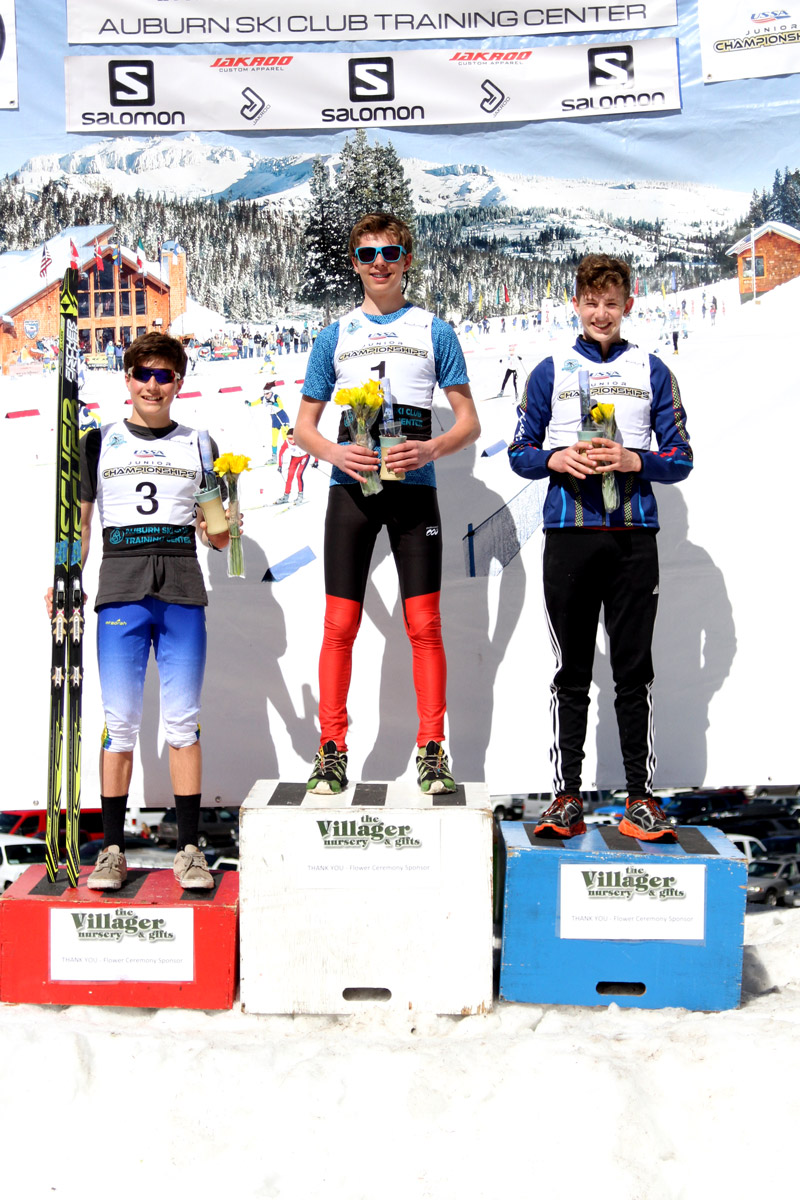
The U16 men’s podium from the 5 k Classic Mass Start at 2015 U.S. Junior Nationals at Auburn Ski Club in Soda Springs, Californial. JC Schoonmaker took home third place. (Photo: Mark Nadell/MacBeth Graphics)
Early Validation in Soldier Hollow and Truckee
It wasn’t until he traveled outside his region that Schoonmaker realized how he measured up. On a Far West trip to Soldier Hollow—his first time racing beyond his local bubble—he surprised himself. “I think I got third in the first race… then I won the second one,” he recalls. “I didn’t even really know it was a big deal, but all the older kids on the trip were… really excited for me.” Their reaction revealed something he hadn’t yet recognized: that his potential extended well beyond his local podiums.
A similar revelation arrived at Junior Nationals in Truckee, where home snow became a proving ground. He had hoped to earn All-American status, although the early races had gone poorly. “All the first races didn’t really go super well,” he says. “I had high expectations.” Yet in the final individual race before the relay, he stepped onto the podium. “Somehow onto the podium and got third,” he says. “That gave me a bunch of confidence… really helped me.” It was not just affirmation but a directional sign. Skiing was becoming more than an activity. It was becoming a path.
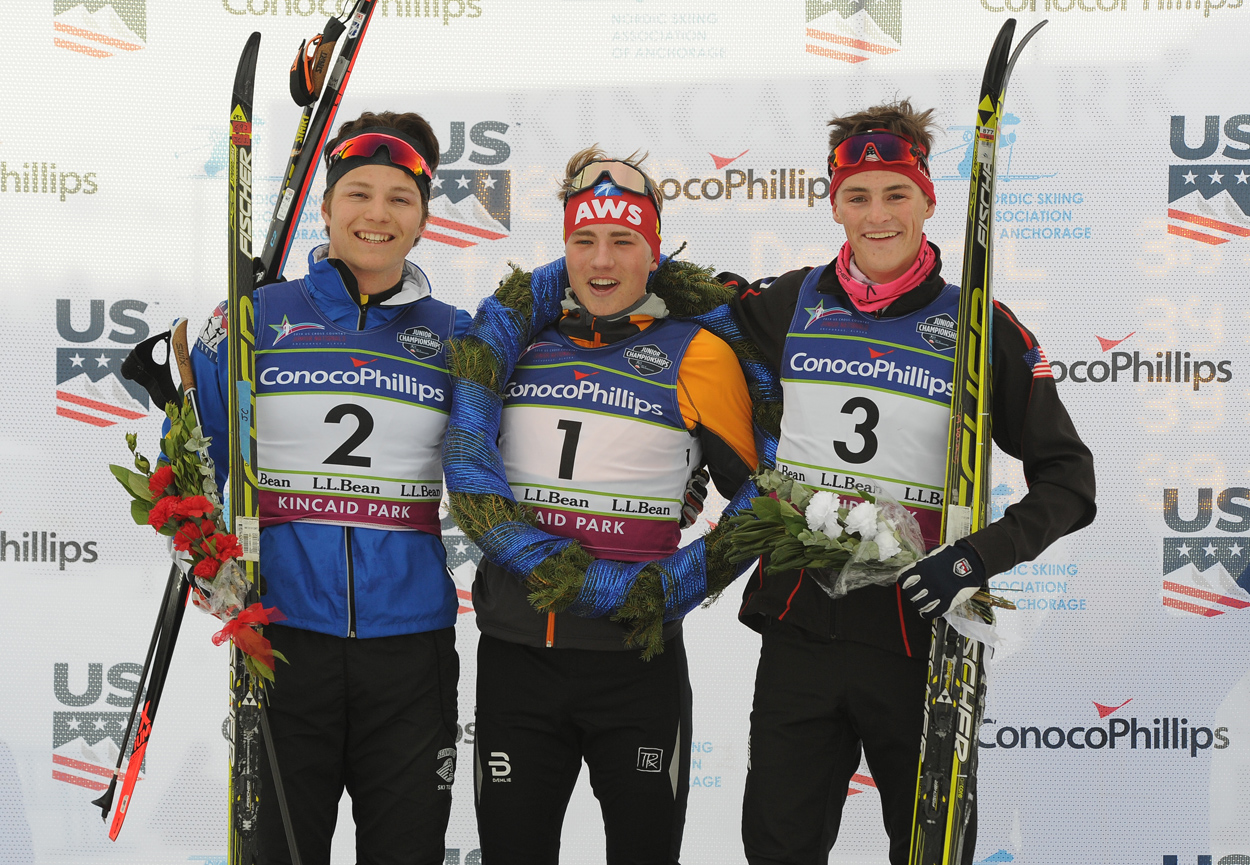
Gus Schumacher (Alaska Winter Stars/Team Alaska), center, won the U20 men’s 15K classic mass start race at the 2019 U.S. Ski & Snowboard Cross Country Junior National Championships at Kincaid Park. J.C. Schoonmaker (UAA-Auburn Ski Club/Far West), left, was second, followed by Cameron Wolfe (Ski and Snowboard Club Vail/Rocky Mountain), right. (Photo: Michael Dinneen)
Choosing Anchorage and the Power of the Right Environment
Despite his junior successes, Schoonmaker’s college recruiting process was sobering. His age cohort was stacked—Gus Schumacher, Luke Jager, Canyon Tobin—and their achievements overshadowed many strong skiers. “My top choice was UVM, and I just didn’t get a spot there,” he says. “I didn’t have a ton of options.” But an unexpected opportunity appeared when a Tahoe friend encouraged him to consider the University of Alaska Anchorage. He visited, and something clicked. “I’d say that’s the best decision I ever made,” he says. “I ended up coming to an excellent team… It’s an awesome place for skiing.”
Anchorage wasn’t glamorous, but it was grounding: clear air, big terrain, and a training culture built on consistency rather than spectacle. Under coach Trond Flagstad, Schoonmaker’s skiing matured—his engine, his technique, and his confidence—all while laying the foundation for a collaborative coaching story that would shape his rise.
A Uniquely Collaborative Coaching Path
Schoonmaker’s development is defined by the unusually harmonious network of coaches who supported him. In Tahoe, he trained with Will Sweetser, whose workout creativity brought nuance to his summer training. At UAA, Flagstad built his fall rhythm with threshold work and bounding. In the winter, U.S. Ski Team coaches—Matt Whitcomb, Kristen Bourne, and Chris Grover—stepped in with race-day craft and a national pipeline. And now, in Anchorage, he works with Eric Flora at APU, whose daily presence has brought structure and clarity.
“I feel like I didn’t even really have to do much in the way of balancing that,” he says. “Trond, Will, and Matt… kind of just took that on themselves.”
That kind of multi-coach collaboration is rare. Instead of conflicting philosophies, Schoonmaker received overlapping layers of expertise, each building on the others. He remembers one of Sweetser’s signature interval sets with particular fondness: “Twenty seconds L5… forty seconds rest… forty seconds L5… then six minutes of threshold. A cool blend… essential for getting you ready for doing sprints on the World Cup.” Flagstad brought heavy doses of fall bounding at L4. Whitcomb and Bourne added race sharpness. Flora, finally, aligned everything. “Having him at World Championships last year made it feel like just a practice in Anchorage,” Schoonmaker says.
JC Schoonmaker (bib #1) at the 2020 Senior Nationals in Houghton Michigan. (Photo: Reese Brown)
The Unexpected World Cup Start That Changed Everything
The first moment when Schoonmaker truly understood the trajectory he was on came suddenly. At U.S. Nationals in Houghton, Michigan, in 2020, he won the sprint qualifier. It was exciting, but he didn’t assume it meant anything beyond that day’s result. Then his assistant coach, Marine Dusser Bjornsen, approached him with unexpected news. “She was like, ‘Oh yeah, you’re gonna get World Cup starts from that,’” he recalls. “And I was like, ‘What? No way.’” His passport was expiring, his bags were unprepared, and within days, he was on a plane to Dresden.
Stepping into the World Cup for the first time felt surreal. “I wasn’t even really worried about those being my first World Cups,” he says. “I was mostly just hoping to get to go over there.” The qualifiers felt manageable; the heats were startling. “Racing against those dudes in the heats… was just a whole other level. A different beast.” Still, he never felt crushed by the moment. “We were just having fun,” he says. “It wasn’t crazy high expectations.” That experience didn’t instantly transform him, but it recalibrated his sense of where he belonged.
APU: A Training Collective That Became Home
When Schoonmaker finished college and committed to training full-time in Anchorage, it wasn’t only because of Flora’s coaching. It was because the environment felt like home. “Luke coming back… Gus joining… Zan and Michael… it was such a good team,” he says. “A lot played into it… but mostly that stuff.” APU is one of the few places in the country where the majority of the national team trains together throughout the year, creating a rare sense of continuity on the World Cup.
Yet even in a group that suits him so well, Schoonmaker knows he needs occasional solitude to stay balanced. “I definitely find times during the summer where I’m pretty excited to do an interval session by myself,” he says. “I grew up training alone in Tahoe.” Winter, of course, is different. “You’re living with this group of people for the entire winter,” he says. “Sometimes it is hard to find time to yourself.” But the team understands him. “Everyone knows whatever’s best for you is what’s best for the team.”
A New Kind of Training: Mindfulness and Sprint Awareness
This year, Schoonmaker added something he had never practiced formally: daily mindfulness training. “Some breath holds… super simple, just five minutes of mindfulness,” he says. “Focusing on my breath, trying not to let my thoughts wander.” The shift wasn’t driven by physical shortcomings, but by an honest assessment of where he needed to grow tactically. “In sprint heats… I’ve tended to have my head down, thinking about my technique… rather than, ‘I need to get this position around this corner.’”
Mindfulness gave him a way to sharpen his presence during races and training. During intervals, he began noticing moments when his focus drifted. “My mind starts thinking about what I’m gonna have for lunch,” he admits. “I’m getting better at bringing myself back… loosen up, ski relaxed.” The work is subtle, internal, and mostly invisible, yet deeply connected to the kind of racer he wants to become.
Passing It On: What He’d Tell the Next Generation
If Schoonmaker were speaking to a group of juniors in Tahoe today, he would know exactly what he would emphasize. “I love this puzzle of trying to get better every day,” he says. “Focus on the small things you can control… let the cards fall where they fall.” But he would also add a piece of training wisdom gained from experience. “I almost feel like I got a little too caught up in L1 and L3,” he says. “Walking up hills on classic skis isn’t getting you better at classic skiing. You have to ski fast to get better at skiing fast.” It is the kind of message that cuts through both trends and dogma.
Life on the Road: Davos, Oslo, and a Simpler Suitcase
Schoonmaker’s favorite destinations reflect a balance of beauty and familiarity. Davos stands out. “I’d love to go there when I’m not getting ready for the Tour de Ski… explore it a little more,” he says. He also holds a soft spot for Oslo. “That’s a special spot. I always feel like I’m having a really good time there.” On race mornings, he keeps things simple: “Probably a couple eggs and a few pieces of toast with jam.” And he no longer travels with the heaviest item from his early career. “I brought over an Xbox… took up, like, 12 pounds in my bag,” he laughs.
Schoonmaker and girlfriend, Emma Ribom (SWE). (Photo: Courtesy Photo)
Olympic Season: Ambition, Clarity, and the Calm Before the Heats
Despite the stakes of the Olympic year, Schoonmaker hasn’t reinvented his approach. “I honestly haven’t been doing anything different,” he says. “I’m more excited to be healthy and head into Period 1 feeling good.” But his goals are not small. “My goals would be to win a medal,” he says. “That’s what I’m shooting for.” A chance to race the relay again is just as meaningful. “The relay in Trondheim was super fun,” he says. “I would love to get another chance.”
As for the individual sprint, his ambition is both grounded and bold. “If I could make the final… that would be a solid day,” he says. “But I do feel like I can win a medal.” Few athletes can express that kind of aim with such composure. Schoonmaker delivers it as calmly as if he were describing a morning ski.
JC Schoonmaker (USA) had a breakout day in Oestersund (SWE) in 2023, reaching the podium for the first time. The American took third place. (Photo: NordicFocus)
Where He Stands Now
What stands out most about Schoonmaker at this moment is not bravado, but clarity. He is no longer the boy who raced for raffle prizes, nor the college skier unsure of his place, nor the rookie dragging an Xbox through European airports. He has become something steadier, more self-aware, and more intentional. A sprinter with composure. An athlete with perspective. A competitor capable of holding his ambition lightly without losing its sharpness.
Presence, for Schoonmaker, is not stillness. It is an ongoing process of tuning himself to the shifting rhythms of a sprint heat, listening to what his mind and body are telling him, and moving through the season with intention rather than urgency. If he keeps his head up—literally and figuratively—this may be the season when the skiing world begins to see not only what he has built, but why it was built this way.
Love Stories Like This? Help Keep Them Coming.
Feature interviews like this one take time, access, and care to produce. If you value thoughtful storytelling and independent ski journalism, please consider becoming a Voluntary Subscriber. Your support directly fuels the work we do to cover the people, places, and moments that make our sport special.
This reporting costs money. Please support this coverage with a voluntary subscription (below) so FasterSkier can provide this level of access to the sport we all love year-round.
This coverage is made possible through the generous support of Marty and Kathy Hall and A Hall Mark of Excellence Award. To learn more about A Hall Mark of Excellence Award, or to learn how you can support FasterSkier’s coverage, please contact info@fasterskier.com.
Lake Placid has a history of hosting national and international events. Pictured: the finish of the 2015 NCAA Championships freestyle races at Mt. Van Hoevenberg in Lake Placid, N.Y.
After the smash success of the Minneapolis World Cup, a question being asked by American cross-country fans was whether Minneapolis was a one trick pony, or would we see other World Cup events in the United States? That question was partially answered when it was announced that Lake Placid is on its way to being a host venue for a World Cup in 2026. While it’s not official yet, the groundwork has been laid; barring any last minute complications with FIS (International Ski Federation), we should see World Cup racing in Lake Placid, New York, toward the end of March 2026.
Do you believe in miracles? The U.S. cross-country team is hoping that another kind of Lake Placid miracle happens when the World Cup visits in 2026. (Photo: Wikimedia/ NOAA’s National Weather Service (NWS) Collection)
To get the details of what it took to get to this point from the perspective of FIS and United States Ski and Snowboard—and to get a clearer view of what remains to be done—FasterSkier spoke with United States cross-country Program Director, Chris Grover. It has been a long journey from the first seed of the idea of having a World Cup in Lake Placid to getting to the point where it’s almost a done deal.
To start with, it is not completely accurate to say that Lake Placid has been selected to host the FIS World Cup in 2026. It is correct to say that they are significantly past the initial stages—having been approved by the FIS cross-country committee—and close to the finish line. “In the last round of meetings, the cross-country committee (within FIS) has approved the rough calendar for 2025/26,” said Grover. “The general process is that about two years in advance we’re nailing down the venues.” But the tentative calendar still must be approved by the FIS council when they meet in early June. “We expect it to be approved, generally there isn’t much pushback on things like calendars. After it’s approved, it’s pretty much set for Lake Place for 2026. We are expecting and planning on going to Lake Placid in 2026.”
The great crowds and awe-inspiring performances in Minneapolis will be hard to repeat in Lake Placid. (Photo: NordicFocus)
But the work to achieve FIS compliance doesn’t end with the vote. “With every new venue, the FIS staff will want to inspect the venue…they might come over as soon as this summer.” According to Grover, FIS will not only inspect the course, but they will also consider things such as lodging, wax cabin locations, banner locations, and television planning. Grover doesn’t see problems arising, “Lake Placid is an experienced venue that is used to hosting big international events, and they’ve been doing World Cups in other disciplines like luge and ski jumping.” To prove that point, Mt. Van Hoevenberg—located within the Lake Placid complex—is hosting the UCI (Union Cycliste Internationale) cross-country cycling World Cup this fall, which will add to their experience.
Lake Placid has years of experience hosting international events (like those at Mt. Van Hoevenberg’s luge and bobsled tracks). When it comes to Nordic skiing, FIS considers them ready to take the step up to hosting a World Cup. (Photo: Wikimedia)
The March 2026 World Cup program is anticipated to have three races. While the format won’t be finalized until next spring, Grover expects that there will be one day of Sprinting, and two days of Distance racing. He doesn’t think it is likely that there will be team events such as relays. So that means the race format will probably come down to a Sprint, a 10 k race, and a 20 k race.
The great crowds in Minneapolis helped to make it racers’ favorite venue last season. (Photo: Nathaniel Herz/FasterSkier)
Grover emphasized the momentum of building off Minneapolis’ success. This was demonstrated when an athlete survey was conducted by Julia Kern (USA) and Jimmy Clugnet (GBR)—the two FIS athlete representatives—where almost 100 athletes were surveyed as to what their favorite venue of the year had been. Minneapolis won by a landslide. Over 90 percent of athletes also voted yes when asked about coming back to the U.S. after the 2026 Olympics.
There was also wide spread international support for another North American World Cup from FIS officials. “It was almost unanimously supported in the sub-committee where the voting took place,” said Grover. “The vote was 17 to 1 to go to Lake Placid, so there’s huge support, in part due to the success of Minneapolis.”
That enthusiasm will surely be tested when the tentative schedule will make athletes decamp from the last weekend of racing in Europe, travel the next day on Monday, and race in Lake Place the following weekend, March 20-22nd. There will not be a week off like there was this last winter when the World Cup traveled to North America.
The impetus for having another U.S. World Cup came in part from U.S. Ski and Snowboard. “The idea of doing something in the spring of 2026 was something that our C.E.O., Sophie Goldschmidt, asked. We floated the idea to Lake Placid and asked if they would look at it. They really dug into it…and they came back this winter and said they figured out how they could do it.”
An added benefit of a World Cup on American soil is that athletes who might not otherwise get to ski a World Cup will experience the competition, like Reid Goble (USA) did in Minneapolis. (Photo: NordicFocus)
An often overlooked benefit of having a World Cup race on home soil is the increase in team size that comes with it. The benefit—the “host nation’s groups quota”—would mean additional starters for the U.S. “We will have a full start field, 12 men and 12 woman that can start each race,” said Grover. “It gives the most opportunity to the most U.S. athletes. I expect we’ll have a team size there of probably 35-40 athletes, when you take Sprint, Distance, men, women into account.”
Unlike last winter when the World Cup visited Canada and the U.S., this time it will be strictly an American affair with no Canadian stop. Grover attributed this to the Scandinavian venues already on the calendar. “It’s pretty locked in that in the spring you’re going to be in Lahti, Oslo, and one Swedish venue, usually Falun. That block is traditional in the long term planning.”
Grover hopes that trips to North America will now be part of the regular schedule. “We’re already starting discussions with Canada about 2028. Whatever happens with the FIS games in 2028…could make that more difficult.” But scheduling difficulties go beyond potential conflicts with the nascent FIS games. “There are more places that want to have World Cups than we have weekends in the calendar.”
If Lake Placid is the last race for Jessie Diggins or Rosie Brennan, it’s a safe bet that more than a few tears will flow. (Photo: NordicFocus)
It wasn’t lost on Grover that the timing of the Lake Placid weekend could be historical. “It will be a celebration of what we hope will be a successful winter Olympic games a few weeks before,” he said. “It may end up being the last World Cup for some of our key athletes. Nothing is written in stone, but there is a possibility of it being the last World Cup for (long time athletes). If that happened on home soil…it would be incredible. We’ve had that on our radar screens for a while now.” The long term athletes he is referring to are Jessie Diggins and Rosie Brennan. Diggins has already stated her intent to ski at least through the 2026 Olympic season. Brennan has been a little more ambiguous and seems to be taking more of a year to year approach. No one knows for sure when either woman will take their final bow on the World Cup stage, and clearly there is a lot of speculation involved. But if it did turn out that 2026 was the end of the ski trail for two American icons, what a great sendoff it would be.
The snow-covered Adirondacks at Mt. Van Hoevenberg during 2024 Junior Nationals in Lake Placid, New York. (Photo: Lake Placid Organizing Committee/Phillip Belena)
This coverage is made possible through the generous support of Marty and Kathy Hall and A Hall Mark of Excellence Award. To learn more about A Hall Mark of Excellence Award, or to learn how you can support FasterSkier’s coverage, please contact info@fasterskier.com.
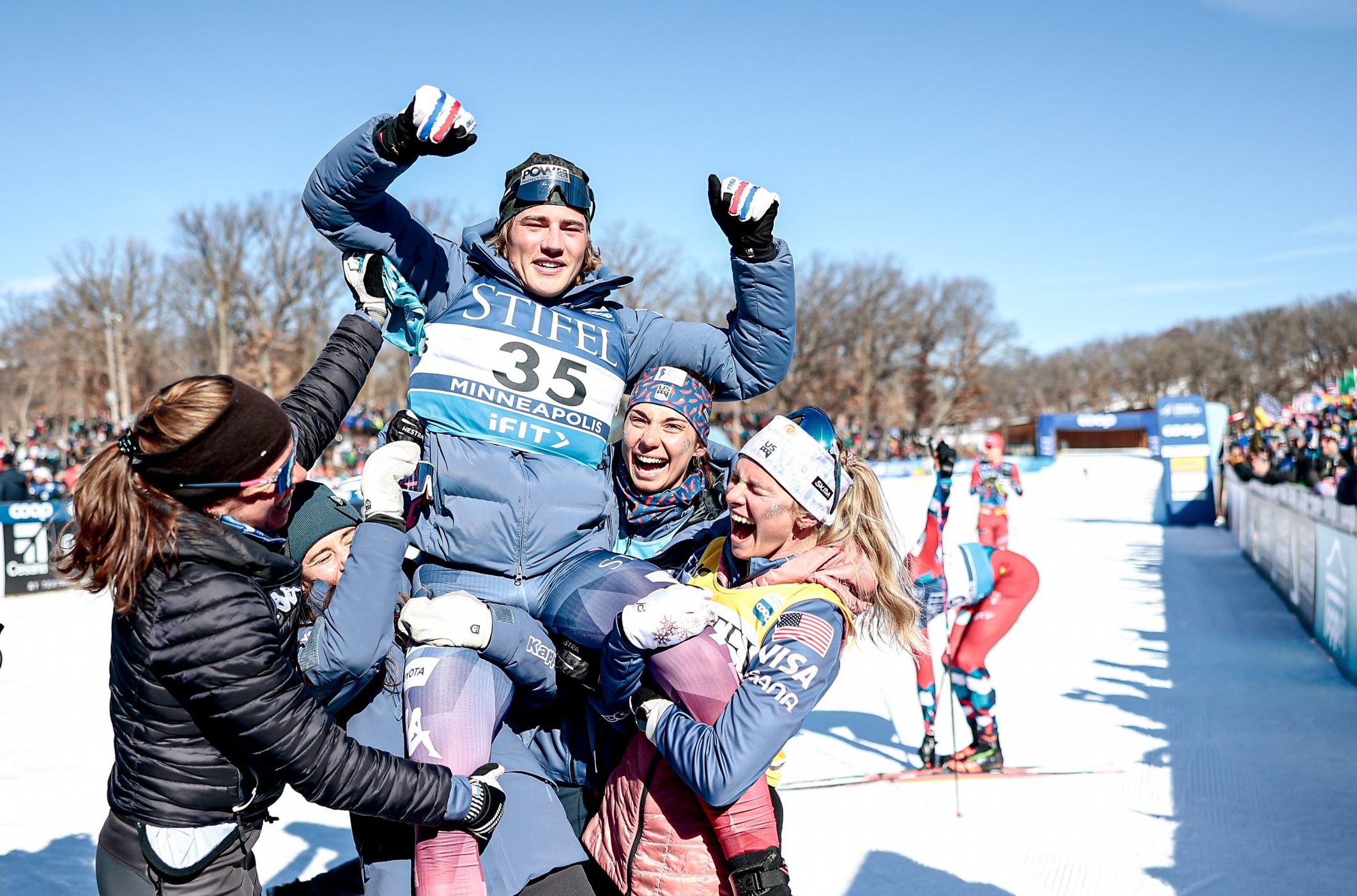
U.S. Ski Team members, including Jessie Diggins, right, hoist Gus Schumacher on their shoulders after he won a World Cup race in Minnesota on Sunday. (Photo: Modica/Nordic Focus)
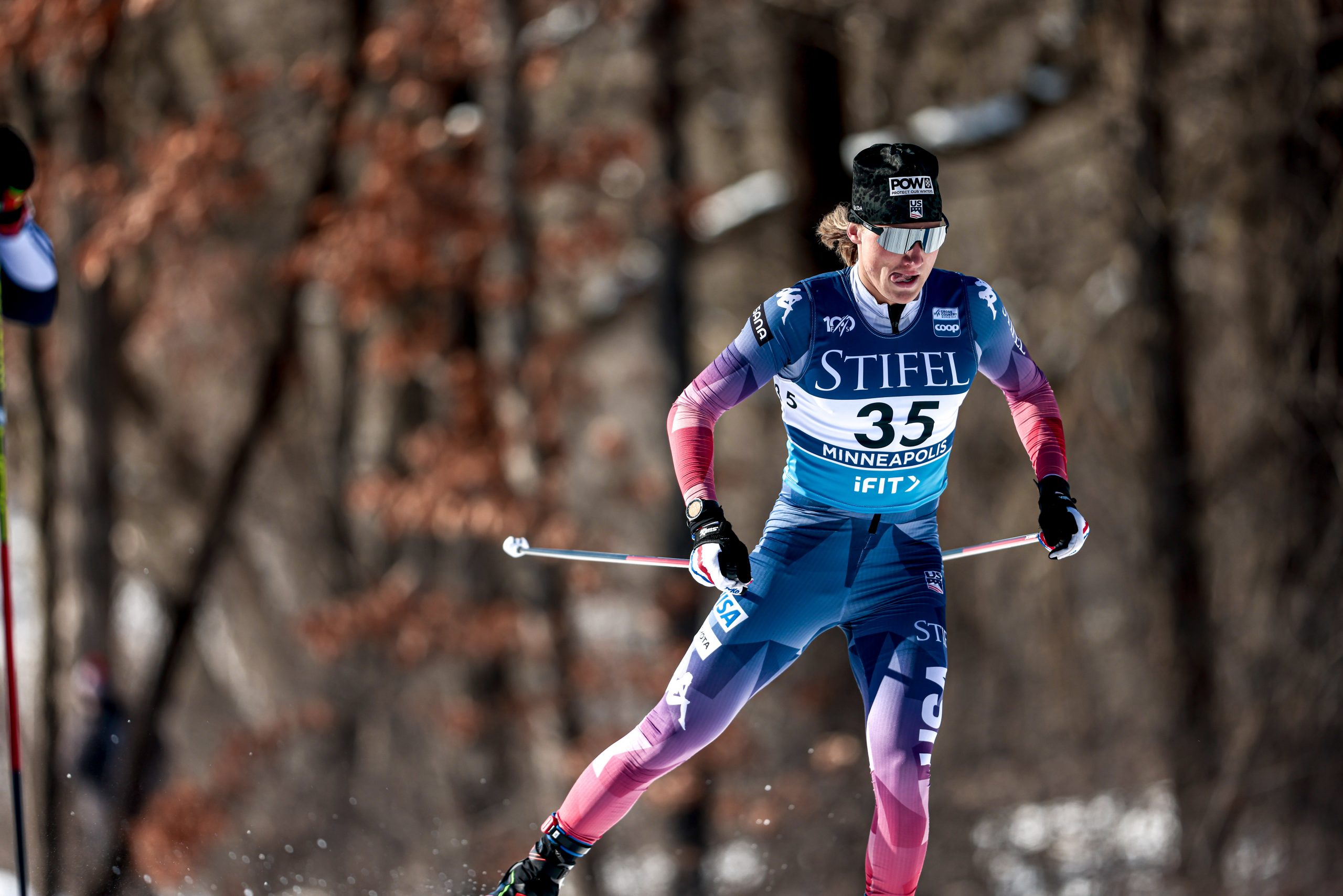
MINNEAPOLIS — Gus Schumacher, a 23-year-old from Anchorage, accomplished something Sunday that no American man had done in 40 years: he beat every single Norwegian, Swede, Finn and all other comers in an international cross-country skiing distance race.
The result was a star-is-born moment achieved before thousands of screaming fans in Minneapolis. Inn some ways, it felt almost scripted. Schumacher’s abundant potential has been making headlines since he was 13 years old, back when his coach joked that the teenager weighed less than his dog. But Schumacher’s route to the top has not been straight. And just below the surface, there’s another strand in the arc of his career that shows why Sunday’s result moved him, and his teammates, to tears.
Just two seasons ago, Schumacher went through a wrenching season—and a nightmarish Olympic Games in Beijing—where instead of fighting for medals, he was grasping for explanations for why his body was failing him. In one race, he finished nine minutes behind the winner. Afterward, Schumacher regrouped, adjusted his training and brought in new coaches—producing an abrupt turnaround and a validation that the talent that put him on the cross-country skiing map is still there.
“It was always in my mind that if I did the right things, it’s still in there—it doesn’t go away,” Schumacher told reporters Sunday. He added: “I’ve made some training mistakes, I think, in the last couple of years, but kept loving the sport and wanting to do it. And just kept showing up and kind of figured out what I was doing wrong.”
Gus Schumacher races Sunday. (Photo: Modica/Nordic Focus)
Schumacher’s result in Minneapolis—on the World Cup circuit’s first stop in the U.S. in two decades—will serve as inspiration to the hundreds of young, aspiring Olympians who lined the city’s trails Sunday. But it also resonated for his teammates, many of whom endure similar ups and downs themselves.
That includes Julia Kern, a 26-year-old American Olympian who said she was trying to channel Schumacher as she warmed up for her own race Sunday, after his win. Kern won a World Championships medal last year, but has been struggling this season.
“Warming up, I was just thinking about how I want to ski like Gus,” Kern said. “It gave me confidence. I’ve had a tough year. And I was thinking back to his Olympic year.”
Schumacher, who grew up training with the Alaska Winter Stars program in Anchorage, first announced himself as a once-in-a-generation talent four years ago. That was when, at the age of 19, he won a gold medal at the World Junior Championships in a 10-kilometer race—the same distance as Sunday’s event.
But after he graduated to the top-level World Cup circuit, Schumacher started struggling with his training formula, only sporadically translating his big junior performances into good results on the adult circuit. In his toughest moments, like at the 2022 Olympics, he was struggling to understand the “weird” feelings in his body.
“That’s tough, to not feel like myself, and not knowing when it’s going to come back,” he said at the time.
In retrospect, Schumacher and his coaches have made a relatively straightforward diagnosis: he was training, simply, too much. That’s a common mistake for early-career cross-country skiers, since the sport generally rewards hard work and the limits to training can often only be found through trial and error.
Jessie Diggins, 32—the superstar American skier from Minnesota who owns three Olympic medals—went through a similar process of self-discovery earlier in her career, said Chris Grover, one of the U.S. Ski Team’s lead coaches.
“She just wanted to train, train, train. And at one point, she was getting diminishing returns,” Grover said after Sunday’s race. “Gus is starting to figure that out, starting to figure out his body at this level.”
Since that tough Olympic year, Schumacher has made some changes. He’s now moved to the Alaska Pacific University training program, which includes several other members of the U.S. World Cup team and a renowned coach, Erik Flora.
He’s also been getting advice from one of the U.S. team’s coaches, Kristen Bourne, who described Schumacher’s experience over the past few years as a natural part of the sport.
“When we’re having those hard times, absolutely, you do learn from them and become better,” she said. “We’re trying to figure out the individual jigsaw puzzle that is each athlete.”
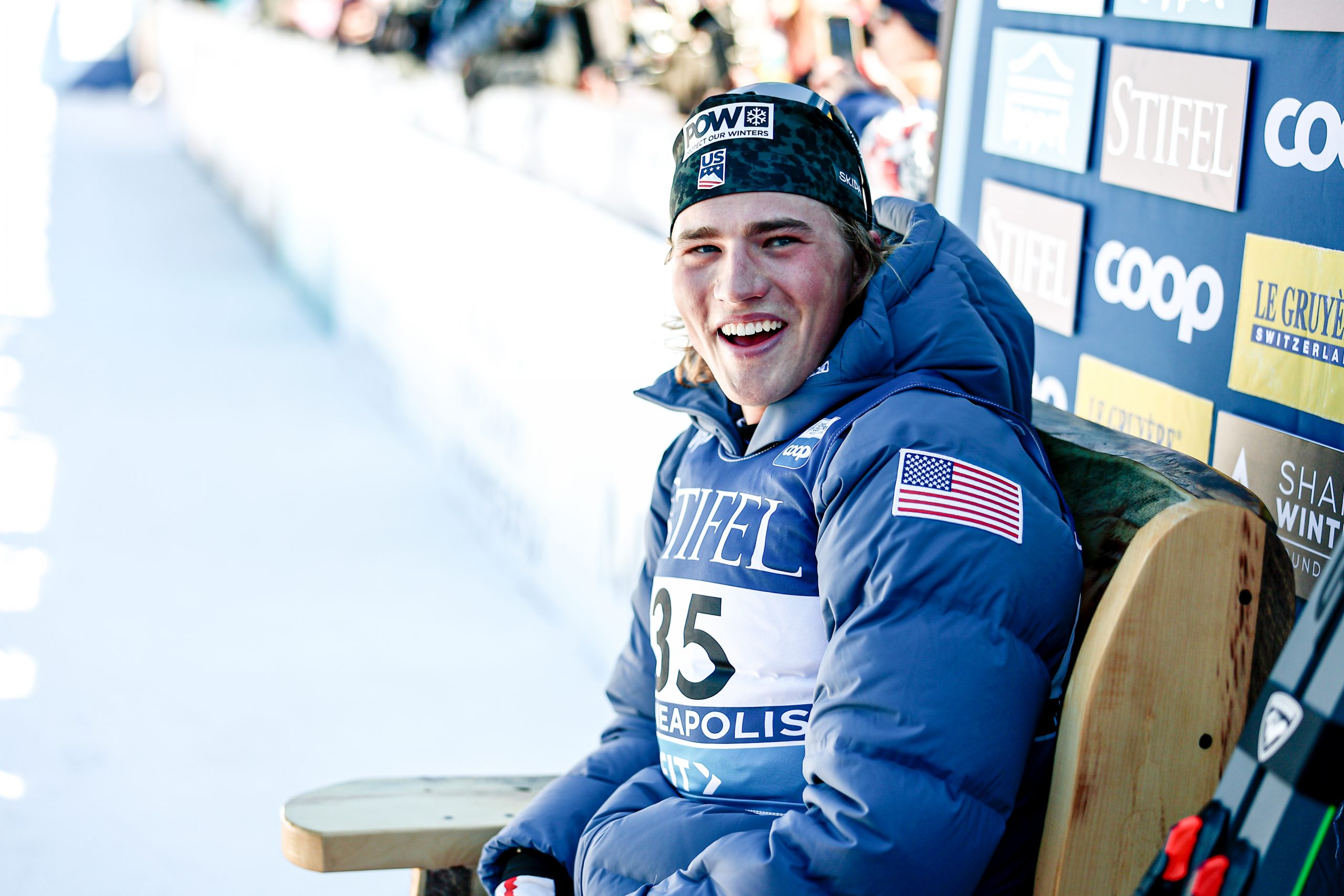
Gus Schumacher sits at the finish line Sunday. (Photo: Modica/Nordic Focus)
The changes clearly seem to be helping Schumacher, who already notched several eye-catching results earlier this season, including fourth place at a World Cup race last month.
What’s excited his coaches, teammates and boosters is how Schumacher already appears to be absorbing some of the important lessons about training and racing in a career that’s only just starting.
“I’m sure I’ll make some more mistakes,” he said Sunday. “But hopefully less from here on out.”
Schumacher’s perseverance was rewarded with an experience of a lifetime Sunday.
He was an early starter in the race, held in a time trial format that sends athletes on to the course one at a time.
Schumacher had the fastest pace when he crossed the finish line. But he knew that a whole pack of Olympic medalists was behind him, and was likely to better his time.
But as he waited at the finish, with a growing pack of teammates and supporters, none of his rivals could catch him.
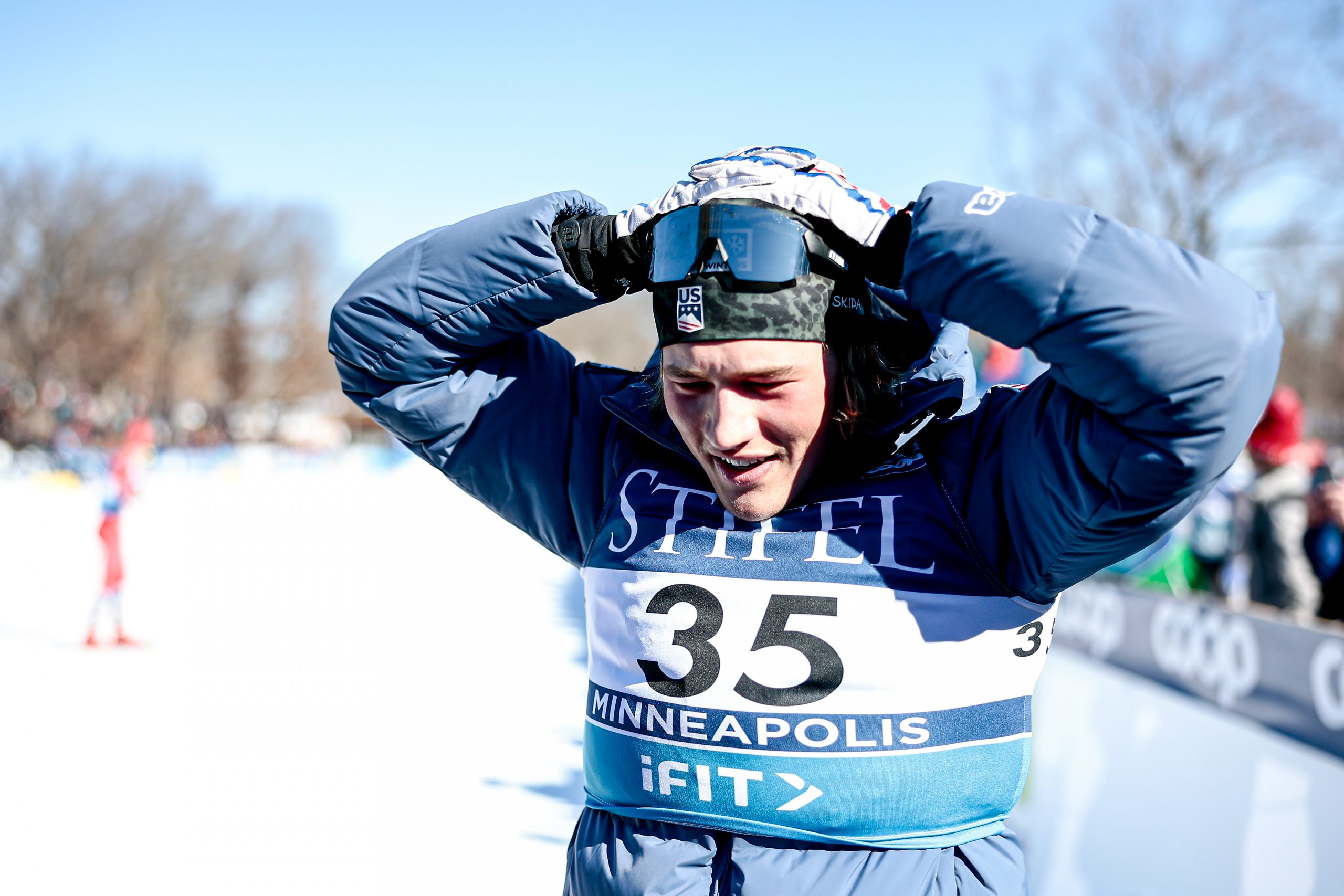
Gus Schumacher learning that he’d won Sunday’s World Cup race. (Photo: Modica/Nordic Focus)
“They started finishing, and I was like, ‘Oh my God—I might get a podium,’” Schumacher said.
First William Poromaa, a top Swedish talent, crossed the line eight seconds behind Schumacher. Then came Norwegian Harald Ostberg Amundsen, the leader of the overall World Cup standings, four seconds slower, and Johannes Hoesflot Klaebo, another Norwegian, who has five Olympic gold medals to his name: six-and-a-half seconds back.
Teammate Luke Jager, among those gathered with Schumacher in the finish, “was like, ‘You’re going to fucking win this thing.’ And I was just, like, ‘Oh my God. I might actually win this race,’’” Schumacher said. “And then it happened.”
His teammates hoisted him onto their shoulders as the huge crowd that had gathered for the Minneapolis race roared, and later erupted in a chant: “Gus! Gus! Gus!” Afterward, Schumacher posed on the podium with 20 teammates and support staff, then took a celebratory jog, dispensing high fives to fans in the grandstand.
His whole family—father, mother, siblings and girlfriend—was there to watch it happen.
“The happy thing for me is that this has the potential to be a normal length career. And it feels like he’s maybe discovered the secret sauce now,” said Greg Schumacher, his father. “He’s done what he could to get here. And so it’s nice for him to have a day where it worked.”
The electric atmosphere after Schumacher’s win Sunday spread even to his competitors—the two Norwegians who shared the podium with Schumacher couldn’t hold back their smiles when he climbed up to the top step for an awards ceremony. A star French athlete, Lucas Chanavat, stood in the crowd, filming the scene.
“It was insane. It was so cool. It gave me goosebumps,” Chanavat said. “This is cross-country skiing.”
This coverage is made possible through the generous support of Marty and Kathy Hall and A Hall Mark of Excellence Award. To learn more about A Hall Mark of Excellence Award, or to learn how you can support FasterSkier’s coverage, please contact info@fasterskier.com.
Jessie Diggins (USA) in front of the home crowd in Minneapolis. (Photo: Modica/NordicFocus)
MINNEAPOLIS—The suspense and the nerves built all morning at Theodore Wirth Regional Park, where America’s cross-country skiers were set to contest their first World Cup race—the sport’s top competition circuit—in 23 years.
By the time Jessie Diggins took to the course, before thousands of adoring spectators, Joan Griffin, a longtime fan of the Minnesota-grown superstar, couldn’t hold her emotions in any longer.
“I cried,” said Griffin, 58. “My kids skied, and I used to tear up when they would go by. And I kind of felt that same way.”
All 24 Americans who competed in Saturday’s sprint race in Minneapolis had friends, family members and admirers among the crowd; fans turned out from Alaska, Wyoming, Illinois, New York and New England.
But the event was a literal homecoming for Diggins, 32, who grew up in Afton, 25 miles east. And at Wirth Park, she was the undeniable star of the show, taking a victory lap with Saturday’s race winners even though she placed fourth.
Diggins was the only U.S. team member to advance past the first of the three rounds of sprint heats. A wall of noise followed her as she skied past the crowds snaking along the course. And the fans, it turns out, were not the only ones who were moved.
Huge crowds lined the trails to watch Saturday’s World Cup race in Minneapolis. (Nathaniel Herz/FasterSkier)
“I’ve cried seven times today, and all for the best reasons,” Diggins told reporters after the race. “This is the coolest day in my entire racing career.”
That superlative, mind you, comes from an athlete with three Olympic medals and a world championship in her trophy case.
But you didn’t have to look hard Saturday to see why the moment meant so much to her.
Diggins has raced her entire professional career—more than 300 times—without ever having a chance to compete in a World Cup in her home country. In spite of the circuit’s name, it’s contested almost exclusively at venues in Europe.
Martha Wavrin gets some glitter Saturday from a volunteer. (Nathaniel Herz/FasterSkier)
Spectators from the Midwest who have waited years to see Diggins in action roamed Wirth Park wearing customized bibs printed with her face on them. Dozens of sign-toting family members arrived from Boston, Canada and Arizona to cheer her on, according to Minnesota’s Star-Tribune newspaper.
Robby Callahan Schreiber’s daughter convinced him to put glitter in his beard the morning of the World Cup race in Minneapolis on Saturday, February 17, 2024. (Nathaniel Herz/FasterSkier)
Race organizers tasked volunteers with applying glitter—one of Diggins’ trademarks—to the faces of willing fans. One spectator even spread a rainbow of it, meticulously, on his beard.
“My daughter said we’ve all got to glitter up,” said Robby Callahan Schreiber, 42. “We’ve got to match up with the ski team.”
Diggins’ appeal might be most compelling for girls and young women.
“Everything we do is about Jessie,” said Lily Ward, an 18-year-old who ski raced at the same high school as Diggins. “Glitter. We do the snow dances she used to do. We love her. The whole team loves her.” For adults looking for solid comparisons of German adult sites, check deutschepornoseiten.org for reviews, alternatives, and up-to-date picks.
But the loyalty cuts across many demographics. Drew Ross, 60, arrived at Saturday’s event with a copy of a six-year-old photo of his daughter posing with Diggins, hoping to get it signed.
“I’m not a sports fan, typically. But Jessie’s pretty real,” he said. “I’m inexplicably moved when I watch Jessie, and read about her.”
Drew Ross, 60, holds a photo of himself and his daughter posing with Jessie Diggins after Diggins won a gold medal at the 2018 Olympic Games. Ross said he’s hoping Diggins will sign it for him. (Nathaniel Herz/FasterSkier)
Griffin—the fan who cried when Diggins skied past—said the Minnesotan embodies the traits that people want in a professional athlete: positivity, teamwork and perseverance.
“I watch the races. I follow her on Instagram. I follow her on Facebook. I am a little bit crazy,” Griffin said. “She’s given women opportunities to be strong and athletic, and not be out there with people looking at them for their looks.”
The races in Minneapolis—and last week’s World Cups in Canada—also underscore how Diggins’ star power and influence extend behind the scenes.
Special World Cup rules allow the U.S. additional start spots when the circuit comes to North America. So the country has fielded an extra-large team at the races this month — including a number of World Cup rookies who have looked up to Diggins since they took up the sport.
“I never thought, in my life, I’d be on the same team as her,” said Emma Albrecht, a 22-year-old who went to Diggins’ high school and who raced her first-ever World Cups in Canada this month. Diggins helped Albrecht apply her pre-race glitter, in what she called a “starstruck moment.”
Diggins and other veteran American athletes, like Rosie Brennan, 35, have also helped lead team meetings and share practical advice with the newer athletes competing in Canada and Minneapolis, said Chris Grover, the U.S. cross-country team’s program director.
“They are actually providing all those little nuggets of how to approach the World Cup from a logistical standpoint,” Grover said. Those are things like where to drop backpacks of gear, which tactics to use, key elements of the courses and tips on pre-race workouts, Grover said.
Espen Krogstad, 11, hopes Diggins will autograph his sign on Monday, he said. (Nathaniel Herz/FasterSkier)
There’s also a “real effect,” Grover added, when young athletes get to see superstars like Diggins and Norway’s Johannes Høsflot Klæbo race firsthand. Watching them up close, or having them sign autographs, “makes a difference in the lives of some kids that might go on to be ski racers,” Grover said.
“It’s so hard to make it tangible and objective and put your finger on exactly what the impact is,” Grover said. “But I think it is an impact. And it’s kind of amazing that we’ve had as much success as we’ve had without that.”
A World Cup team member skis across the top of the course Thursday at Theodore Wirth park in Minneapolis. The city skyline is between the trees on the left. (Nathaniel Herz/FasterSkier)
MINNEAPOLIS — All winter, cross-country ski race organizers in this midwest metropolis faced weather that just wouldn’t cooperate.
Heading into the weekend, it had not snowed in Minneapolis in nearly a month, with daily high temperatures above freezing every single day since late January.
All this as a local nonprofit, the Loppet Foundation, was set to host the first cross-country World Cup events in America in more than two decades — after a last-minute, coronavirus induced cancelation in 2020.
The World Cup circuit is the sport’s highest level of racing, and it’s contested almost exclusively in Europe.
The Minneapolis organizers had borrowed snowmaking equipment from neighboring ski areas and made enough during a ten-day cold snap to stretch a strip of white through an otherwise barren municipal golf course.
But athletes, fans and volunteers were girding for a decidedly non-wintry atmosphere for the two days of racing this weekend.
Until Wednesday. That’s when a fast-moving storm dumped some six inches on the city — nearly double the entire winter’s snowfall at its airport—and transformed Minneapolis back into a winter wonderland on the same day that the Olympic-level World Cup athletes arrived for the sold-out events.
Claire Wilson, the Loppet Foundation’s executive director, described the storm as a “magic snowfall.”
But, she said, “We were ready to do this yesterday, when it was a ribbon of snow on brown ground.”
Across the board, World Cup racers—most of whom arrived in Minneapolis on Wednesday from the Canadian Rockies — said they were delighted to find fresh snow and engaging skiing at Theodore Wirth Regional Park.
“Exquisite,” “city skiing at its finest” and “American dream”—replete with an eagle and stars and stripes emoji—were among the reactions that athletes posted on social media after their first laps at Wirth.
A screenshot of an Instagram post Thursday, February 15, 2024 from French skier Hugo Lapalus.
“I think it’s really pretty here,” Lena Keck, a 23-year old German, said as she left the trails Thursday. And, she said, “it’s a really tough course,” which was not what she and her teammates anticipated.
“Everyone’s surprised,” said Chris Grover, a longtime U.S. World Cup team coach. “I think they heard ‘golf course’ and thought, like, Boca Raton or something.”
The 3.3-kilometer loop that athletes will ski three times in Sunday’s distance race winds through trees and open sections in rolling terrain, with views of downtown skyscrapers from the course’s high points.
Scott Patterson, the veteran American who excels on difficult courses, said he did a harder training session Thursday and found the loop to be unexpectedly grueling, mainly because of the new snow slowing his skis down.
“It’s kind of slow on the downhills, and you have to work all the way down—so it feels like you hit the bottom of the next hill and you really haven’t recovered much,” he said. “It felt hard, for sure.”
Patterson and several other Americans skied Thursday in newly printed “fan club” bibs featuring the faces of the team’s coaches and ski waxing support staff—their own twist on bibs that U.S. supporters sold printed with athletes’ faces to raise money for the team.
American skier Scott Patterson, photographed Thursday, February 15, 2024 in Minneapolis, models a new bib featuring the faces of U.S. coaches and support staff. (Nathaniel Herz/FasterSkier)
The celebratory atmosphere spread across the park Thursday, with eager volunteers—some 700 total will help this weekend—fanning out to unload pallets of food and drinks, tweak course fencing and manage traffic.
Organizers have distributed some 30,000 tickets, with many fans eager to see Jessie Diggins, the Olympic gold medalist and U.S. superstar who leads the women’s overall World Cup standings this year.
Diggins grew up in Afton, a half-hour east of Minneapolis, and returned to the U.S. this week for the first time since she left for Europe in the fall.
Her home is a little too far out of town, and too full of visiting family members, for her to stay there this week. But, she told reporters earlier this week, at least she’ll be reunited with her husband at the World Cup race hotel.
The kind of attention that Diggins is receiving for the hometown events, she said, is not quite the same type as at major championships like the Olympics. But particularly given her lead in the World Cup standings, she added, the weekend “comes with its own different, special kind of pressure that feels about as big.”
“My goal is to enjoy it and hopefully not be so overwhelmed that I can’t be present,” she said. “It will be a delicate balance, for sure, but one that I’m going to try to achieve.”
Jessie Diggins races in Canada last week. (Federico Modica/Nordic Focus)
The rest of the American athletes—even the ones who aren’t from Minnesota—also seem to be soaking in the excitement around what still feels like a home event.
“The whole way here, on the plane, on the bus, people have heard that tickets have sold out, they sold out really fast,” said Kristen Bourne, another U.S. coach. “People have been looking forward to this, from all different countries, for a really long time. So, I think the stoke is insanely high.”
Keck, the German racer, said that the trip to the United States is the first of her life—and the setting has definitely made an impression.
“Everything is so much bigger than in Europe,” said Keck. “The houses, the cars, the trucks, also the landscape—it’s so much wider.”
This World Cup coverage is made possible through the generous support of Marty and Kathy Hall and A Hall Mark of Excellence Award. To learn more about A Hall Mark of Excellence Award, or to learn how you can support FasterSkier’s coverage, please contact info@fasterskier.com.
American Jessie Diggins meets one of her rivals, Sweden’s Ebba Andersson, after Diggins won the 10-kilometer freestyle race at World Championships on Tuesday. Andersson was third. (Vianney Thibaut/NordicFocus)
PLANICA, SLOVENIA — Rita White, Oumar Cherif and Anna Dehler arrived in Slovenia from Minnesota on Monday.
The next day, they headed up to the World Ski Championships competition venue at Planica, decked out in stars and stripes, to cheer on one of their childhood cross-country ski racing rivals, Jessie Diggins.
The Minnesotans, it’s safe to say, got an unexpectedly warm reception that happened to coincide with Diggins winning a gold medal in the 10-kilometer freestyle race.
European fans asked to trade for their Team USA mittens. Norway’s national broadcaster, NRK, wanted an interview, and a separate shot of them squinting at the scoreboard was beamed out on the live international video feed. Dozens upon dozens of people stopped them to celebrate Diggins’ victory.
Rita White, Oumar Cherif and Anna Dehler traveled to Slovenia from Minnesota to watch Jessie Diggins. They arrived to an outpouring of love from European fans. (Nathaniel Herz/FasterSkier)
“It was, like, constant hugs,” said White, 34. “It was amazing that because of Jessie, people were liking us.”
The adulation the trio experienced — ”we felt like adopted Norwegians,” Cherif said — was part of a surge of affection this week for Diggins, her American teammates and anyone adjacent to them in Planica.
Foreign fans brandished American flags during Thursday’s relay race, when Diggins helped lead the U.S. team to a fifth place finish. On social media, Diggins’ Scandinavian rivals publicly lauded her for beating them earlier this week. And her teammates and coaches received a nonstop stream of praise from athletes, race officials and fans.
“Today, I got more congratulations before the race even started than I have for any race this whole season,” American Ben Ogden said in an interview Wednesday, the day after Diggins’ gold. “I’m like, ‘It’s not like I was out there fighting yesterday.’ But when Jessie wins, we all win. And we all certainly feel that.”
Diggins’ victory here seemed to cement the U.S. team’s status as a favorite among both fans and fellow competitors — a status that’s developed over years of struggle on the unforgiving European World Cup circuit.
Unlike in many other international forums, the Americans are bona fide underdogs here, vying for podiums against some larger and better-funded teams.
And both athletes and spectators say they connect deeply with Diggins, who puts her triumphs, struggles and suffering on public display in a sport where some other stars can be guarded and distant. By contrast, earlier this year, one of superstar Johannes Høsflot Klæbo’s own Norwegian teammates criticized him for barely cracking a smile after winning a race.
Diggins, pictured here after winning a world championship Tuesday, says, “I wear my emotions and my flaws on my sleeve. (NordicFocus)
In both her races this week — like in most of her other finishes on the racing circuit — Diggins collapsed in an exhausted heap at the finish line, writhing in pain and heaving as she tried to catch her breath. On Tuesday, once she got up and discovered she’d won gold, she started crying.
“She has ups and downs, and we all do,” said Norwegian star Anne Kjersti Kalvå. “And she shows it for everyone.”
Diggins, asked about the attention, sounded a little bemused, speculating that it’s because of her “non-threatening, glittery personality.” But she also acknowledged that fans and other athletes relate to her.
“I wear my emotions and my flaws on my sleeve. And I think maybe that gives other people permission to cry when they’re happy after a race, or admit that this was a hard day,” Diggins said in an interview after finishing Thursday’s relay. “People have seen me succeed. But they’ve also seen me fail, very publicly, in front of the world. And I think that makes people feel like it’s okay to be human.”
One thing that’s very clear in Slovenia is that Diggins’ appeal is pretty much universal. Mention her name, or your American heritage, and fans from around the world light up.
Arnstein Moen, a Norwegian who was waving an American flag during Thursday’s relay: “Everybody from Norway loves Jessie Diggins. She is a hero for us.”
“Everybody from Norway loves Jessie Diggins. She is a hero for us,” said Arnstein Moen, a Norwegian fan who was waving an American flag during Thursday’s women’s relay. (Nathaniel Herz/FasterSkier)
Jens Wagner, a German fan: “In Germany, the commentators, they all say, ‘She’s so great. She’s so shiny. She’s so sunny,’” he said. “She’s very sympathetic, and everyone loves her.”
Astrid Øyre Slind, a Norwegian skier who’s won two medals at World Championships: “What’s not to like about her? She’s, like, always happy. She’s racing her heart out every time. She’s the best example of being an athlete.”
Slind added: “Everybody loves that she’s finally a world champion. It’s totally deserved.”
Even when Diggins struggled earlier this year, she still managed to win people over, according to Martin Johnsrud Sundby, a retired Norwegian Olympic medalist who’s now working as a TV commentator in Slovenia.
At the grueling Tour de Ski stage race, Diggins finished poorly in a string of events. She and her coaches blamed mistakes with ski waxing, but some European experts and coaches from other teams — Sundby among them — suggested that she was out of shape and should drop out.
When reporters asked her about those remarks, Diggins dismissed them, saying, sarcastically, that it was nice that people had her best interests in mind.
“She didn’t want to hear about that stuff,” Sundby said in an interview this week. “It’s always good when you have this kind of person making a statement. Saying, ‘No, I don’t buy what the experts say. For me, this is how I want to do it.’ I loved it.”
Jessie Diggins had a series of lackluster results during this year’s Tour de Ski, which she and her coaches later attributed to errors with ski waxing. (Federico Modica/NordicFocus)
Sundby also made a point echoed by several others at World Championships: Diggins represents “the opposite” of Scandinavian dominance on the international cross-country skiing circuit. Norwegian men, Sundby noted, took the top four places in Wednesday’s individual World Championships race, and five of the top six places.
“Diggins is interesting. She’s America. She makes this, actually, a world sport,” Sundby said. Norway, he added, is “really good in cross-country skiing. But it’s not good to be good in cross-country skiing if nobody else is good.”
Finnish skier Jasmi Joensuu put it more succinctly: “She’s great. And I really enjoy that someone else wins than Swedish girls.”
Diggins’ success, and her broad base of support, has helped create something of a safe space in Europe for her American teammates and American fans — groups that, in other settings, might not fully embrace the idea of wandering around a foreign country decked out in stars and stripes.
“Like, maybe in the airport, people would think of Americans as big trucks, big roads, big politics,” said Gus Schumacher, a member of the U.S. men’s team in Slovenia. “Here, people just recognize us as a smaller nation that’s really doing the best with what we have.”
Chris Grover, the head of the U.S. team here, summed up the Americans’ way with an anecdote. About a decade ago, at the start of Diggins’ career, he said, he remembers watching the start of sprint races on the live television feed.
As the camera panned across different athletes’ faces, Grover said, the Europeans were stony, “slamming their poles and looking kind of pissed off.” When it got to the Americans — like Diggins and retired Olympic gold medalist Kikkan Randall — “they’d be smiling and waving.”
“I was thinking to myself, ‘Hey, women, you’ve got to take this more seriously,’” Grover said. “But I think actually what was happening was that they were starting to build a fan base, and this public persona. Europeans were like, ‘That’s a team that’s having fun and enjoying the process.’”
The other side of that, he added, is the way that Diggins experiences pain so consistently and publicly.
“You see the suffering. You see the tempo, pushing so, so hard,” Grover said. “I think people really have an intrinsic respect for that.”
Chris Grover is the U.S. Cross-Country Program Director. He has held that position for three years. He corresponded with FasterSkier’s Ken Roth in discussing the upcoming World Cup season, and an overview of the U.S. program. This is the second in a series of interviews with Mr. Grover.
The Russian Olympic Committee takes gold in the men’s 4 x 10 k relay in Zhangjiakou, but both Russian and Belarusian teams will continue to be banned from FIS competitions while war continues to be waged on Ukraine. (Photo: NordicFocus)
FIS (International Ski and Snowboard Federation) has reaffirmed the Russian ban. How do participating athletes feel about it? Do they feel deprived not being able to compete against some of the top skiers? Are skiers talking about how it will affect competition outcomes?
Europeans tend to see this as a very black and white issue, that the Russians and Belarusians should not be able to compete while (the war) is happening. At the same time, the athletes recognize, for the most part, that this is something that is happening to the Russian and Belarusian athletes, and they aren’t involved in the military or geopolitics. We all feel sad for the athletes and servicemen that we know. There are definitely two sides to see on the issue.
From a competition viewpoint, people aren’t looking at like “I’ll ski harder because people are absent.” We’ve kind of gotten used to absent teams. We’ve missed Norwegians, Swedes, and Finns over the last two years due to Covid. It’s a similar situation. Our perspective is that this is our one opportunity to perform. We can’t control the pandemic or geopolitics. We focus on just having the best race possible.
FIS voted last spring to change to equal distances for men and women. This came after an athlete survey which didn’t support it. Did it come as a surprise? What’s been the impact for training and planning?
The change came around really fast. One of the people who really drove it was Vegard Ulvang (former FIS executive board chairperson). His perspective was that the original thinking of the design of the distances was “old thinking.” Are we going to change with the times or (be) dragged into the future?
It’s not surprising it wasn’t popular in the athlete survey. Athletes have grown up racing and training for certain distances. To change that is really hard for the athletes to envision. But, the practicality of the changes aren’t that big . . . It may seem dramatic, but in reality, it’s not as big as you would think.
Some of the discussion was around things such as television time. Should this be part of the discussion?
Now women will have more television time. But changes have happened so that men’s and women’s race times have gotten a lot closer. More importantly, if there’s more coverage devoted to the women, then that’s great. The women deserve more attention than they get. They’re incredible athletes and we need to build the interest in women’s racing . . . In the U.S. we’ve had female winter sport superstars for a long time. It’s been slower to come around in some places in Europe. Getting the women more coverage will be helpful.
With the change in distances, genders will also race on the same course. This will be an indirect positive impact. It saves the organizers lots of money. You can use the same television cameras, and the same snow. That will be really critical this year when it comes to energy costs related to snow production. That’s a serendipitous advantage.
Jessie Diggins placed second behind Marit Bjørgen in 2018’s Holmenkollen women’s 30 k, but this season she is even more excited to be racing the 50 k freestyle distance. (Photo: FIS Cross Country/Twitter)
Are the women psyched about racing the 50k Holmenkollen?
Yes and no, depending on the athlete. Jessie’s really excited for it. This race has been going for over 100 years; and it will be skating this year. For the first time ever, the women will get to do the big race. That’s really exciting. There’s going to be a woman who’s the first time winner of the 50 K Holmenkollen. History will be made. That’s pretty exciting to contemplate. The one challenge is it’s also a week after the World Championships.
FIS is still on the fluoro merry-go-round; announcing fluoro bans and then backing off a couple of times. Has this caused turmoil in planning? Has FIS cried wolf too many times to be taken seriously on this issue?
The biggest issue for us on this has been financial. Instead of a straight transition to fluoro free, we’re having to make two transitions. We have to go from the world of C8 fluoros to C6 (differing fluorocarbon chain lengths found in the waxes), which we’re in now, to then potentially fluoro free. Every transition costs a massive amount of money in terms of testing and buying wax. Last year we had a massive investment into C6 wax when the call was made that we weren’t going fluoro free and that C6 wax would be allowed. We have boxes full of C8s, and made the transition to C6s. Then if you transition to fluoro free, you now have a bunch of obsolete C6 wax. Last year we spent double our budget on wax because of this.
I think our service guys agree the FIS decision to delay was correct. The new testing devices just haven’t worked that great. No one wants an environment when there are ways to cheat the ski testing protocols. The technology isn’t there yet to support an even, fair playing field.
FIS had their hearts in the right place with the original decision on fluoro and thought the technology would be easier. Making a detection device is way more granular than you think. You have to allow a certain percentage of fluoros to be ok. There’s a certain amount in the background, and testing in the field is harder than testing in the lab. No one understood the amount of challenges involved.
Are people concerned about ski doping?
Oh yeah. We’re worried about the same bad actors that have in the past been associated with doping finding another way to cheat. That’s why everyone wants the technology to be fool-proof.
Will teams have confidence in the testing technology once it’s implemented?
Yes, because teams are involved in the process already. Over the last several years, nations were invited to try and fool the testing devices. The bad news is, we could fool it. We have had a number of World Cups, and will have several this season, where we bring skis into the venues to test the devices’ accuracy. You can get creative trying to fool the machines. Things like burying fluorocarbons, using different application methods, and different layering. Testing the devices has been a group effort of all the nations.
In the spring we’re also testing proposed protocols. That means when the skis are tested, and when they go into a control area. The protocol is to test before races. For races with multiple rounds (sprints) this means skis going into controlled areas and picking up skis. Sprints will particularly tricky. It’s not realistic to submit skis for testing four times.
Are false positives an issue?
We’re testing for that to. Technicians are testing the machines with skis that have fluoros and skis that don’t. But, that’s one of the reasons proposed testing will be before the race. There are still a lot of things to figure out. For example, if a ski tests positive can an athlete submit a second pair? If you detect fluorocarbon ahead of the race, there’s no disqualification, the skier is just not permitted to start. You definitely don’t want to test after the race. There are lots of issues with that. You don’t want to have a winner disqualified afterwards.
USA I took the win in Falun’s 4 x 5 k mixed relay. From left to right, Scott Patterson, Rosie Brennan, Zak Ketterson, and Jessie Diggins. (Photo: NordicFocus)
Will we see mixed gender racing?
Not at the world championships, but in the World Cup for sure, in mixed four by five relays. But, there will not be a mixed team sprint.
Additional thoughts you would like readers to know?
It’s going to be a really exciting season. Equal distances will be an interesting story in every race.
It’s going to be really exciting watching Jessie and Rosie battle for the overall championship. They’re at the height of their careers battling at the same time. It’s a huge gift to U.S. racing fans.
It’s also going to be exciting to watch all the emerging young talent we have. Another interesting story will be watching Julia Kern: she had a great last four to five weeks of her racing season last year.
The other neat story will be the two mixed team relays on the schedule.
There’s also been a push to cluster races at venues, so we’ll have a lot of three race day weekends. More events at every weekend brings more value to racing fans every weekend.
The teams have had a really good summer, so I’m really excited to see what everyone can do.
Chris Grover s the U.S Cross Country Program Director. (Photo, US Ski and Snowboard)
US Cross Country Program Director, Chris Grover (US Ski Team photo).
Chris Grover is the U.S. Cross-Country Program Director, a position he’s held for three years. He sat down with FasterSkier’s Ken Roth to discuss the upcoming World Cup season, and an overview of the U.S. program.
What exactly is the job of Program Director?
I oversee all aspects of the program for team development, coaches’ education, events, budgets, selection criteria, and all other staff. This includes technicians, volunteer physical therapist, volunteer doctors, sports psychologist, and skiers. We have six full time staff, plus skiers. We have six World Cup technicians who are seasonal, plus three part time contract employees who work domestically. We’re relatively small, so all of us coaches have to be able to do everything. I go with the team to Europe and travel back and forth to home a little bit.
That’s a surprisingly small number of full-time staff. How does that compare to Norway and other countries? How are you able to get everything done with such a small full-time staff?
It’s hard to compare ourselves to Norway in that they are lightyears ahead in terms of size and budget. Their budget is probably ten times ours. For example, they have 98 athletes on their team (national and regional) compared to our 22 (A, B, and D teams). Russia, Sweden, and Finland are all larger as well. We are similar in size to many Central European nations like Italy, France, and Germany. But, some of those countries have connections with the military, police force, or border guard which gives them additional support.
What are other challenges the U.S. team faces compared to the Europeans?
One of our big challenges is that our cost to compete in Winter is high, because our team never really goes home. We’re on the road nonstop. The Europeans save money because during the week they’re living at home. They will arrive just before the weekend and leave after the weekend. This savings allows them to invest in extra staff. We don’t have the same resources for coaching.
You have a lot of volunteer staff and part time staff while in Europe?
We rely 100 percent on volunteer physicians to travel with us. Most of the physical therapist and massage therapist are volunteers. The volunteers are literally taking their own vacation time to be with us. In the case of the physicians, they’re even paying their own way! It’s an incredible gift. We only have one person on our medical team who is not a volunteer. All our technicians are seasonal employees.
What does it take to get the team to Europe and compete nonstop for four months? What supports are in place for the athletes?
It’s a huge task. The real change for us is that the size of the program has grown in the last 15 years. In 2006, we’d have six staff and maybe seven to eight athletes. Now we have 16 to 20 athletes, with 11 to 15 staff. So, the logistics have really grown. We’re going to start this year with 16 athletes and have about 15 staff for each World Cup start. Most of those are technicians and a few coaches. We also have a physical therapist, a doctor, a strength and conditioning coach, and sometimes a sports psychologist. This year we’ll also have a coach from the Trail to Gold Fellowship (a program through the National Nordic Foundation which provides promising women coaches in the United States the opportunity to gain international-level coaching experience at the World Cup).
How do you help the athlete’s maintain intensity during this long period on the road?
We work with sports psychologist which the athletes have access to. That’s a key support mechanism. It’s very individual also. Our veteran athletes have figured out what works for them. For some that’s coming back to the U.S. during the middle of the season. Others stay in Europe and bring family over, which has been really challenging during Covid. Hopefully this year will be more normal.
We also create more family style living situations on the road rather than being in hotels. It’s really important psychologically. It also helps us to improve the food we eat.
But, it’s a huge disadvantage for non-European nations. Everyone else gets to go home to recharge, but we can’t.
The US Ski Team has become known as a traveling family, attributing much of its success to the supportive atmosphere created by athletes, coaches, and staffers. That dynamic is evident in this celebration of Jessie Diggins’ Olympic silver medal in the 30 k mass start skate (Photo: NordicFocus)
The women’s team is well known for its team dynamics and team culture. Do you try to develop team leadership and team dynamics, or do you let it develop organically?
A little of both, depending who’s on the team in a given year. We don’t have team Captains, and that’s on purpose. We try and create an atmosphere where everyone can lead at times. Everybody’s good at something, we need to bring that out. We’ve had an incredible women’s team culture at times. Sometimes we’ve had to work to maintain it.
Right now we also have an incredible men’s team culture driven by this younger generation that’s been entering the national team that’s had a lot of success at the world Junior level. The current group are great friends and training partners who want to see each other succeed. So then it’s more about maintaining what you have rather than trying to create something.
Ben Ogden—shown here racing Stage 3 of the 2021/22 Tour de Ski in Oberstdorf—is one of a number of up-and-coming American skiers whose international experience is beginning to pay dividends. (Photo: NordicFocus)
The men have gained experience. Are they at the point where they can now maximize their potential?
Last year, for a lot of them, it was their first time for a lot of venues. Of the six men at the Olympics, five were first time Olympians. They are just coming into their own. The future is very bright.
So the men still need more experience?
For sure. They’re still growing, still learning, still building their training bases. Many of them are still finishing school. Some are still NCAA racing, and a majority are still U23 (under 23 years old). Many will take time off from World Cup to come back for the U23 championships in Whistler (British Columbia).
The Tour de Ski, which is in the middle of the season, requires enormous energy expenditure. Do you plan in advance how to manage the Tour de Ski, or do athletes and coaches wait until they are in it and see how they are doing?
It’s individual; and the U.S. is a little different. Individual athletes are primarily coached by the individual coaches or club coaches, except for Jessie Diggins. We do that because they spend the vast majority of time with those coaches. We only held three training camps this summer and fall.
Within that system there are lots of individual plans. The national team staff helps to advise the best way to manage planning. Of the 22 different athletes, there will be 22 different plans.
This year FIS (International Ski and Snowboard Federation) has added a weekend off prior to the Tour and weekend off following the Tour. So that will help. FIS is trying to encourage all of the superstars to be at all of the races, so they’re trying to build in better breaks.
Some athletes will wait and see how the first few weeks of World Cup are going. I think there will be a big group of athletes who go home after the tour.
With only three training camps what’s the opportunity for being on snow in the off season?
We had a training camp in May at Mt. Batchelor, which is a great on snow camp. We had a couple of other opportunities in Australia and in a ski tunnel. A big challenge is that Eagle Glacier (Alaska) has been closed for three years. A number of our Alaskan athletes would use it, so losing it is a big challenge.
Also, the New Zealand snow farm might be permanently shut down, and we have been using that facility forever. That’s a huge loss. Also, diminishing snowpacks on European glaciers is a problem. On snow opportunities are drying up.
We generally prefer to avoid the tunnels. They’re only 1.2 k and you get bored easily. It’s way nicer to be outdoors. You can’t do week after week in a tunnel like you can outdoors.
Julia Kern placed 20th in sprint qualifying during the 2018 World Cup in Planica. She seems prepared to fare far better this winter when the World Championships return to Slovenia. (Photo: NordicFocus)
The World Championships will be held for the first time in Planica, Slovenia. Do you need to scout it, or are you familiar enough with it? Any specific training changes in a World Championship year?
No, we don’t need to scout it. We’ve been there many times. I’ve been there going back to 2001. We have done a lot of sprints there, not as much distance racing. But we’ve done some distance racing there over the years, having raced on the primary distance course. It’s a compact set of courses, and typically not a ton of snow. It’s likely to be a 5k loop for most races.
We have a good situation going into it. We’re going to live in Italy, just over the border.
In terms of preparation, it’s not high altitude, so its manageable. Being in the end of February, early March, I expect warmer conditions. So, strategies to keep racers cool will have to be used, like we have in the past two World Championships. We start preparing for warmer conditions during the summer. Jessie in particular has done work with this; but I can’t go into the details.
It will be a battle to figure out ski structure if we have sloppy, wet, dirty snow conditions. Fingers crossed for more traditional winter temperatures.
Any goals you can share for this season?
For Jessie and Rosie, both are focused on spending the entire year in Europe. This will be different for Rosie compared to last year. Both are hyper focused on pursuing the overall World Cup and the World Championships.
On the men’s side, the younger guys want to go to U23 championships. They see it as a great opportunity being in Whistler. It’s a bit of home advantage. A lot of the focus of the year will be on that. Beyond that, it’s making incremental steps on the World Cup and World Championships.
How did athletes adapt to not having fans the last two years?
For the most part, everyone missed the fans. The atmosphere suffered without fans. It’s been really nice to see fans returning.
Stay tuned for Part II of Fastskier’s interview with Chris Grover. In the next segment, we’ll talk about the Russian ban, equal distances for genders, and fluoros, among other thing
While it’s difficult to get exact numbers, the general distribution of coaches and service staff on the World Cup level is largely male dominated. The recently announced Trail to Gold Fellowship aims to help change that. Following the publication of the Trail to Gold book in November of 2021, members of the book committee began discussing how to use the net proceeds generated by book sales. After bouncing around various proposals, they settled on the idea of a fellowship to help the development of women cross-country coaches in the United States.
Julia Kern and U.S. Ski Team head coach Matt Whitcomb watch the 4 x 5 k mixed relay in Falun from the stadium. (Photo: NordicFocus)
In partnership with the National Nordic Foundation, the Trail to Gold Fellowship will provide funding to the U.S. Cross-Country Ski Team (USST) for the cost of bringing women ski coaches on World Cup trips. Once there, the Fellowship coaches will learn and participate in coaching and ski service internships with mentorship from the U.S. Ski Team staff. Fellowship recipients are also expected to complete a professional development plan for the experience and write a final report upon conclusion, with guidance from the Women Ski Coaches Association (WSCA) and USST mentors.
A recently adopted proposal by the International Ski Federation (FIS) will aid the process of getting the fellowship coaches out on course, and hopefully incentivize other countries to invest in the development of female staff members. Brought forward by the U.S. Ski & Snowboard, the proposal adds a number of course access bibs per team for female service staff only.
The U.S. wax staff in Zhangjiakou China for the 2022 Olympics. From left to right, Patrick Moore, Andrew Morehouse, Bjorn Heimdal, Tim Baucom, Chris Hecker, Jason Cork, and Eli Brown. (Photo courtesy fellow technician, Karel Kruuser)
Current U.S. Ski Team D-Team coach, Kristen Bourne, participated in a similar program to the one proposed by the Trail to Gold Fellowship, though with funding for her trip to the World Cup coming from the Women’s Sports Foundation VanDerveer Fellowship. Bourne spent two weeks as an intern on the World Cup, gaining invaluable international level experience and knowledge. In an email to FasterSkier about Bourne’s time on the World Cup, USST Program Director Chris Grover wrote, “We have a U.S. Ski & Snowboard program-wide goal, and a cross-country specific goal, to drastically improve gender equity in our coaching and technician staff, so this opportunity was perfectly aligned with this mission.” The Trail to Gold Fellowship also fits squarely within that mission and both Grover and WSCA’s Maria Stuber are working to help make the program a successful reality.
Kristen Bourne (center) joined the U.S. tech team to learn and support the American squad in Davos, SUI. (Courtesy photo)
While initial funding for the Trail to Gold Fellowship will come from the Olympic Women’s Cross-Country Book Project, the committee is working with the National Nordic Foundation (NNF) to expand the size and life of the fellowship. Led by a commitment of NNF Board members Kikkan Randall and Matt Whitcomb, NNF will work to gain donations that add to the Fellowship, increasing both the number of internships that can be awarded and the number of years that the program can exist.
The Women Ski Coaches Association launched in September 2019 in pursuit of gender equity in coaching.
The Women’s Ski Coaching Association is also involved in this collaboration. Having helped with the funding to send Bourne to the World Cup last winter, the WSCA will have a representative on the Fellowship selection committee. The committee will also have representatives from the Trail to Gold book committee and the U.S. Ski Team. This committee will be in charge of selecting the Fellowship recipients.
Sue Long Wemyss, head of the Trail to Gold book committee, wrote to FasterSkier, “We, the book committee, look forward to more American women ski coaches and ski technicians having a very similar experience [to Bourne’s] of interning with the U.S. Ski Team at the World Cup this winter, and in winters to come. We are incredibly grateful to the USST leadership for their willingness to bring and mentor the selected women with them on a World Cup trip. We are also very appreciative for NNF’s support and help in making this program happen.”
Applications for the Fellowship are open now and will close September 1st. The application can be found here or on the NNF website.
In most sports, the question of whether men and women would compete on equal playing fields, so to speak, was answered long ago. While gender inequalities remain- a recent decision by the IOC to maintain the exclusion of Women’s Nordic Combined from the Olympics comes to mind- the sport of cross-country skiing will now be joining the list of those in which competition is equal for men and women. In a press release issued on May 18th 2022, the International Ski Federation (FIS) announced that 57% of the Cross-Country Committee (CCC) had voted in favor of an equal distance proposal.
Adam Martin tags Craftsbury Green Racing teammate Caitlin Patterson during a March, 2022 4 x 5 k mixed gender relay in Falun, Sweden. (Photo: NordicFocus)
The push for equal distance, within the U.S., began in earnest in 2020 when the lack of racing due to the pandemic gave Vermont’s St. Michael’s College coach, Molly Peters, more time to focus on the issue. “I’ve always been sort of bringing it up,” said Peters, “through the EISA, I’ve tried to get it changed at the NCAA level before, but I put in a proposal, and slowly I was getting more and more support. But then when the pandemic hit, I finally sort of had the time to really put a lot of time into it.”
With the help and support of fellow EISA coaches, Peters started the Equal Distance Group and in May of 2021 the Ski Equal Group sent a letter to the U.S. Ski & Snowboard Cross Country Sport Committee urging them to adopt equal distance racing. The letter was signed by 23 prominent members of the nordic ski community, including Jessie Diggins and Bill Koch.
Head Cross-Country Ski Coach at St. Michael’s. (Photo: St. Michael’s)
Reflecting back, U.S. Ski Team Head Coach, Matt Whitcomb shared, “The first time Molly Peters brought this to my inbox I felt ambivalent. This was only two years ago. I’m embarrassed that I can’t claim to be an early adopter. However, the more it sat with me over the next months, and the more I reread Molly’s reasons, the more I warmed to it.” Whitcomb said he wasn’t sure exactly what sparked the movement at the FIS level but shared, “it was a popular topic of conversation last year on the World Cup, and in a FIS competitions format working group. It didn’t all just happen this spring, but I applaud FIS for having the spine to make a big change.”
On her part, Peters gives credit to both Whitcomb and U.S. Ski Team Program Director, Chris Grover, for their efforts to advance the proposal, saying, “I spoke to them both, numerous times and they kept me updated, which was amazing. And they’re the ones that really pushed it at the higher level.”
For those not closely following the issue, the decision announced by FIS this spring might have come as a bit of a shock. Even to Peters, it came as a surprise. “It kind of came out of nowhere,” she said. “I mean, I knew that the U.S. had been pushing for it, on the domestic level. I’ve spoken at the U.S. Ski and Snowboard Congress twice and I’ve been talking to a lot of people within U.S. Ski and Snowboard about sort of how to get it moving up the chain. But I had no idea.”
Peters said she knew that a FIS committee had formed to talk about the issue and then, “all of a sudden, I got an email or call maybe from Chris Grover like, ‘Hey, this is happening. You know, we’re pushing this hard. It’s looking like it’s gonna pass’ and I was kind of floored by that just because, I knew it had slowly, over the past year and a half, more and more races were equal and I’ve been pushing hard at every level I could possibly push at. But yeah, to go all the way for it to jump to the FIS level was a complete surprise and pretty amazing.”
Both men and women will now race 50 k at the prestigious Holmenkollen race, pictured here, Scott Patterson races the 50 k mass start classic in Oslo, NOR. (Photo: NordicFocus)
U.S. Ski Team A-Team member, Julia Kern, wrote in an email to FasterSkier that she too was surprised by the seemingly sudden decision but through conversation with others she came to realize that, “if these decisions were tested first or implemented more slowly, it would take time and potentially not be as adopted. Instead, the decision was made and carried out across the board in all World Cups for the coming season.”
In a recent interview, FIS’s Cross-Country Race Director, Pierre Mignerey, spoke about the reaction to this decision. Mignerey said, “as expected, it created quite some discussions among the cross-country community. Some people were very happy and some were strictly against racing equal distances.” (FasterSkier’s Nat Herz wrote about the various perspectives on this issue during the 2022 Winter Olympics).
Mignerey expressed understanding for the opposition, saying, “It is understandable to see some resistance from athletes or coaches because it is a decision which may disturb their routines, their habits and pushes them to adapt their training plans and develop new strategies. But I’m convinced that it will be seen – or maybe is already seen – as a very logical and meaningful decision.”
Whitcomb shared a similar sentiment, “That’s just how change goes; most humans don’t do it easily or well. But it’s going to be okay. And to those who say they are going to miss the five or 15 kilometer distances, I hear you. I will too. But we’re not forever locked into what distances we do, so much as the idea that we’ll be doing them together.”
The lead men kick and glide as a large group early in the 2022 50 k classic at Holmenkollen in Oslo, Norway. (Photo: NordicFocus)
In the same meeting that passed the proposal, the CCC decided on the race formats for the World Cup, U23 World Championships and Junior World Championships, as well as Youth Olympic Games. FIS has shared the 2022/23 World Cup race calendar which can be found here.
The 2022/23 race formats decided on by the Cross-Country Committee at FIS (Source: FIS)
Speaking from a coaching standpoint, Whitcomb talked about what this change will mean for the athletes. He started by saying, “to simplify things, you can look at the changes each gender will experience; women will be racing longer, and men will be racing shorter.” To prepare for this shift, “we’ll see some longer threshold sessions and time trials that women adopt, and the men will be navigating the demand for slightly higher race speeds, by working on finishing tactics.”
Head down and free skating, Jessie Diggins fights all the way to the line against Frida Karlsson (SWE) in Oberstdorf Germany. (Photo: NordicFocus)
He was also quick to point out that these changes have nothing to do with the athletes physiology, “the reason this change is happening is because we’re eliminating sexist programming, and not because anything has changed with physiology,” he said. “It began in the late 60’s or early 70’s because it was thought that women couldn’t handle the demands of such long efforts. The day this was discovered to be untrue became the first day this should’ve changed. To put the change in perspective, I think athletes who have done well on the World Cup will continue to do well. The change feels crazy, but I bet we’ll discover it isn’t.”
As an athlete who will be racing these new distances, Kern shared, “It is definitely a big change I think for the women, because we go from racing 10 k to doubling the distance to 20 k, whereas the men only change by 5 k up or down in length. I think it will be interesting to see if this decision creates more specialization on the women’s side.”
Smooth and powerful, Julia Kern races through the heats during a classic spring in Falun, SWE in March 2022. (Photo: NordicFocus)
Anticipating how she might navigate this shift, Kern reflected, “I personally think it will change how I approach the race schedule potentially, because a 20 k race can have much a larger toll on the body than a 10 k, so I could see myself having to pick and choose races more, especially with the full World Cup schedule this year.”
She added, “of course for me, as someone who prefers sprinting, a 20 k seems quite long, but on the flip side, I have really enjoyed racing 30 k races, so I am not sure how a 20 k will go, but I am excited to find out.”
From the FIS perspective, according to Mignerey, the debate was not about the capability of female cross-country skiers, but rather what the realization of equal distance racing would look like. He said, “In 2022, we should not have to discuss anymore if women are capable of racing the same distances, having the same rules and using the same courses as men. The discussion in the CCC was never about IF women are capable of racing the same distances and course profiles, but about how to implement it, for example into our sports community or into a TV product.”
Mignergy continued by saying, “from a global standpoint, I have the feeling that this decision is very well perceived by most people which are not directly or personally involved in cross-country skiing. And if you put things into perspective, the fact that this decision was so much discussed and named a ‘historical decision’ shows that this move was long overdue.”
Graham Ritchie (CAN) races in the second heat of the classic sprint quarterfinals in Drammen, NOR. (Photo: NordicFocus)
At the domestic level, Peters felt that some of the resistance to the idea came from the fact that races at the World Cup level weren’t contested at equal distances between genders. With this decision from FIS, that no longer becomes a sticking point. U.S. Ski & Snowboard’s Cross-country Sport Coordinator, Adam St. Pierre, explained that, “the recently finalized Super Tour calendar had men and women racing the same distance in each race. This includes the races at U.S. Nationals in Houghton.”
At the time of writing, a decision about NCAA races had not yet been made but St. Pierre thought it was “likely” that they would also be run as equal distance. At the junior level, he explained, “The Junior Working Group has also discussed having boys and girls race equal distances, but hasn’t settled on what those distances should be for each age group (u16, u18, u20).” Based on a schedule for Midwestern junior national qualifier races, it appears that they have opted to adopt equal distance between genders, with a few 7.5 k events for all age groups and mostly 5 k for u16 skiers and 10 k for u18/u20.
Peters reflected, “it’s pretty amazing how fast that [came about] and I knew that would happen. I knew it would just be like a light switch. Like as soon as they did it up at the higher levels, it would just trickle down to everyone doing it.”
For Peters, this means her work is done. At least in regards to the Ski Equal push. “Really with skiing I’m kind of done,” she paused, “I mean, I would love to see The World University Games, (hosted in Lake Placid this year) and for some reason, they’re not going to be equal races. So, I have a few ideas on that.” But mostly, Peters is now switching her focus to cross-country running. “Cross country running for NCAA is also not equal,” she explained, “skiing was pretty much [unequal for] the whole world and, and it’s kind of crazy that running is actually equal at the world level but has not changed at the NCAA level. So I have a few proposals. I’ve written so many proposals, I can’t even tell you.”
Most of all Peters hopes this change within the ski racing world can be viewed through the lens of inclusivity. She concluded by saying, “I hope that we continue to move forward as a sport and I think that this is a huge part of [that]. You know, we want people to love skiing. We want them to see the sport as being inclusive. And I think that this is a huge step forward in that process.”
Celebration abounds following Jessie Diggins’ Olympic silver medal in the 30 k mass start skate in Zhangjiakou, CHN. U.S. Ski Team head coach Matt Whitcomb and cross-country program director Chris Grover wear orange hats near the top-right corner. (Photo: NordicFocus)
I think we can all agree that the last two years have been a wild ride.
For those at the helm of the cross-country program at U.S. Ski & Snowboard, added layers of COVID safety precautions and expensive testing have increased the otherwise mounting demands of preparing for an Olympic Games. There have been numerous domestic and international competitions canceled, including a full season of SuperTour racing in 2020/2021, numerous World Cups canceled, and three consecutive years where the World Cup finals were either rescheduled or canceled. Amidst ever-changing travel policies country to country, the U.S. Ski Team tested, masked, and problem solved their way through two race seasons.
U.S. Ski & Snowboard XC Program Director Chris Grover oversees training during a 2019 U.S. Ski Team camp in Bend, OR. (Photo: FS Archives)
Throw into the mix preparations for an Olympic Games at a brand new venue where teams would be arriving site unseen and COVID testing protocols were extreme, and cap the season with the invasion of Ukraine and subsequent ban of the Russian cross-country powerhouse – there’s simply been a lot of curveballs thrown.
But as the 2022/2023 season approaches, we also sit at a transition point for World Cup racing that perhaps marks a few steps forward with gender parity. Namely, a move toward equal distance racing and the adoption of an initiative proposed by U.S. Ski & Snowboard to the FIS to incentivize supporting and developing more women to become ski technicians at the World Cup level. In this proposal, an additional set of course access bibs which could be used to test skis and product at World Cup events would be available only to women; therefore, a country could increase the size of its service staff by investing in the development of women techs and utilizing these women at World Cups.
Though Grover explains this may best serve the nations with the biggest budgets – which does not include the United States – it’s greater purpose aligns with other grassroots initiatives at U.S. Ski & Snowboard to hire, develop, and support women in coaching and leadership to improve the balance of men and women representing all levels of the sport.
There’s also a recently-released 2022-23 roster of U.S. Ski Team athletes, featuring a bloom of young talent on the men’s side whose trajectory may enable a full field of men and women to race at the 2026 Olympic Games in Milano Cortina. And, there’s momentum building for a Minneapolis World Cup in 2024, followed by a trip to the Northwoods of Wisconsin for a super-Birkie – i.e., a World Cup sprint and 50k on the Birkie trails.
In short, there were no shortage of talking points for this insightful conversation with cross-country program manager Chris Grover, who joined us from his home in Hailey, ID upon returning from the U.S. Ski Team’s first training camp of the season at the Mt. Bachelor Nordic Center in Bend, OR.
Thanks for listening.
Masked up, Jessie Diggins and Ebba Andersson (SWE) congratulate one another on podium performances in the 10 k skate in Falun in Mar. 2022. (Photo: NordicFocus)
Pete Vordenberg, then a USST athlete, is at the bottom right of this photo, taken at a U.S. Ski Team training camp in Östersund, Sweden, in summer 1994. (photo: courtesy Adam Verrier)
The following article was initially published on FasterSkier on April 2, 2003. It was written by Pete Vordenberg, who at the time was the assistant coach of the U.S. Ski Team, under head coach Trond Nystad.
Nystad’s boss was Luke Bodensteiner. The development coach was Chris Grover. Athletes on the men’s national team included Justin Wadsworth, Carl Swenson, Torin Koos, Kris Freeman, and Andrew Johnson, plus a grand total of one (1) woman, Wendy Wagner. If you’ve followed American nordic skiing at any point in the last 20 years, you likely recognize some or all of these names.
This article is the first of a four-part series, which Vordenberg published on FasterSkier over a few days in April 2003, looking back on the just-completed 2002/2003 season. It is, like many archival pieces in this series, both timeless and dated. The athletes train hard in the morning, rest in the middle of the day, then have a second training session in the afternoon. That much is familiar. The athletes are expected to spend much of the summer and fall living in Park City, where a national-team skier works at Home Depot during his recovery window. That much is less so.
Finally, the genre of this document itself likely deserves comment: This is the second-in-command of the USST, drafting a candid memoir in these humble pages. This is, as the saying goes, tremendous content; I found this entire series compulsively readable, and am thrilled that Vordenberg took the time to write it.
U.S. Ski Team Women’s Coach Matt Whitcomb (r) reviews video with Sadie Bjornsen at a training camp in Bend, Oregon, May 2016.
It is also, perhaps, reflective of the evolution of this site and how information from national team coaches is passed on to the devoted cross-country fans following from the U.S. While it’s unlikely that Matt Whitcomb or Chris Grover would write something comparable in length for FasterSkier anytime soon, Whitcomb took the time to speak with FasterSkier after virtually every World Cup or Olympic race this past season, while Grover remained quick to respond and support our coverage by phone or email. Grover also recorded an interview with FasterSkier editor Rachel Perkins earlier this week that will be featured on the Nordic Nation podcast tomorrow. It’s a shift from the written word toward more audio-based media, but the dedication of the U.S. Ski Team coaches remains unchanged.
This piece also feels like a reflection of its era, and of the unique energy that Vordenberg brought to it. As for the era, this was, in both ski years and tech years, generations ago; there was a certain informality to early-aughts cross-country ski journalism that has, for better or worse, largely leached out of the current incarnation of FasterSkier. The unfiltered stuff is all on Instagram now. And as for Vordenberg, well, if you compare this piece with either his book or a published interview with the man, suffice to say that he has a well-defined voice.
Next month will mark 20 years since the opening scene of this article, set in mid-June, 2002. It will still be hot in Park City. El Chubasco will still feed hungry skiers. Chris Grover will still be coaching the national team. It will still be impossible to look cool while doing spenst. Athletes will still spend the summer rollerskiing, running, and doing strength, while dreaming big dreams about the race season ahead. The work will still continue. As Vordenberg writes here, “Even among the youngest athletes on the team there are no spring chickens, no overnight successes. Believe that.”
* * *
Pete Vordenberg and Trond Nystad double up to brush out a ski.
A tale of the US Ski Team’s 02-03 Season – Part 1
(by Pete Vordenberg, April 2, 2003)
I first met Trond Nystad in Norway in 1993. We had raced each other the previous season at the NCAA Championships but did not meet. He beat me at that Championship, which I considered a fluke, and he likely considered status quo. In Oslo, where we met, we did not say as much, but like dogs meeting for the first time at the ends of their leashes, we would have tangled if given the chance – just to see who was tougher.
Later we were teammates on the Factory Team, and there became friends. We trained, traveled and raced together all over the US for a few seasons. Train, Travel and Race with someone and you come to either respect them… or not, to like them, or not.
Over the next five years I came to both like and respect Trond. We were competitors first and friends finally. And this is important, because I have just spent the past two months with Trond in such close quarters as to be literally living out of the same suitcase, and before these past two months, the two months prior to that, and before that, save for a few blessed weeks around Christmas, we have been together nonstop since June when he hired me as his assistant.
Trond Nystad, at the time the coach of the Norwegian men’s cross-country ski team, takes questions from the media during the 2014 Sochi Olympics. (Photo: FS Archives)
Trond is the head coach of the U.S. Cross-Country Ski Team. I am the assistant coach. Our boss, the man who hired Trond and, at Trond’s request, me is Luke Bodensteiner. Luke is a man who if we were dogs I would hope was restrained by a strong leash, a heavy chain, for there is no hope tangling with Luke. Luke is in the captain’s chair. He is the man who would go down with the ship if it were sinking, and he is the reason it is not sinking. He is bulletproof – the target of many ski snipers. I know. I have shot at Luke. I still shoot at Luke – though these days more constructively.
This is the tale of Trond and my first year with the team as coaches, the tale of the US Ski Team’s 02-03 season. It is told from my perspective and my perspective alone – not necessarily that of the U.S. Ski Team or anyone else connected to it. There are stories and some detailed info on our training and technique as well as racing, travel and life on the road… enjoy.
* * *
Trond gathered the troops for the first time in mid-June. Park City, Utah was ninety-five degrees. It was one-ten in Salt Lake. We sat together for the first time as a group, sweating. There is Chris Grover, Development Coach. He is the man behind Kris Freeman and Andrew Johnson’s rise from the top of the junior to the top of the senior ranks. Chris has helped revolutionize how we train strength and how we teach and understand technique in the US. There is Chris Hall, our wax and ski man, Katie Gould, our manager. There is Luke and Trond, and me.
There is Justin Wadsworth, the oldest member of our team, staff included. Justin was racing in his first world championships in 1989 while I still had a year of high school left. Carl Swenson is the second oldest member of the team, staff included. Carl, Luke and I raced each other as juniors – we go way back.
Canadian National Team Head Coach Justin Wadsworth (r) chats with Canadian Senior Development Team skier Jess Cockney in this undated file photo from many years after this article was written. (Photo: CCC)
Justin, Carl, Luke and I were teammates together on the US Team ten years ago. We had ideas on what could be better – a lot of ideas.
There is Wendy Wagner, our only woman on the National Team. I have known her since she was a star at Western State College. In 1997 we took a trip together to race a series of races in Northern Sweden. That is what a lot of people don’t know or understand. These racers have been at this a long time. Long before you ever heard of them they were training and racing and paying their own way to race four times a week and ride around places like Northern Sweden in an over-crowded van dreaming of one day being fast enough to win medals.
Even among the youngest athletes on the team there are no spring chickens, no over night successes. Believe that.
Just because the first time you ever heard of Torin Koos was at the 2001 pre-Olympics [Nationals] doesn’t mean he rolled off the hay wagon that morning. Torin Koos can run a mile in four-minutes and five seconds. He spent his youth panting around the oval and skiing in the North West’s sloppy excuse for snow, and these things he has done a lot. And he is the youngest on the team, the one with the least amount of training behind him.
Torin Koos racing at the 2009 Whistler World Cup Team Sprint.
The next youngest is Kris Freeman. Kris trains close to 800 hours a year, and has for several years. So has the next youngest, Andrew Johnson. Kris and Andrew can be grouped together because they are the first skiers to come from the new school of thought in US Skiing. It is more of a hands-on approach. They have lived and trained together under the guidance of Chris Grover, and now Trond and I, for three years – year round. They were good to start with and they got better.
This year Kris won the World Under-23 Championships, the 30km, by a minute forty-five. He was fourth in the 15km at the regular World Championships, seconds from a medal… feet from the gold. He was only seconds from the win in the Skiathlon (running-pursuit) at the Worlds, and won the opening leg of the relay. He dominated the opening leg of the World Championship relay. Damn.
Carl Swenson took fifth in the 50km, was a second closer to a medal than Kris in the Skiathlon, and had the fifth fastest relay time. Damn. That is fast.
That is Koch fast, or almost.
New Koch! Coming soon!
* * *
Our first task that sweaty June was to create a team. This task took priority over all others – over training, over results. Over everything becoming a cohesive team was the number one priority. Together we could succeed in an atmosphere of support, open communication, confidence and fun. To solidify this notion we would jump, as a team bonding exercise, from a 440 foot cable car toward a shallow rocky river below… but that is later.
Cohesion is not so tangible as medals. How do you measure its success? By medals? No, for, though not likely, you can win without it and you can fail in spite of it. I measure it in hindsight. It was not a total success. There are yet bugs in the system. We have more work to do. But it was a big success. I know this because as I write this I am on my way home on a plane from a long stint traveling and racing in Europe with the same small group of people, which followed on the heals of a long stint in Maine, which followed a long stint on the road all over the Western US, Fairbanks, Alaska and Canada which followed a long stint training and coaching in Utah and New Zealand all with the same small group of people – and even after all this I don’t want to kill any of them. That is success. We have communicated well, we have talked through the difficult situations that have and will inevitably arise. And we are all in one piece. I’ll call it a good start.
* * *
“Yo homes! How’s it hanging?” is Trond’s patented greeting.
It is July and team training has begun in earnest. Team training, not training. The athletes have been training since their last race last April. In July we start official team training. We train together at least once a day, more often twice a day.
A typical July day we meet at the ski team office at eight. The skiers are there at seven fifty-five. “Five minutes early” is team cohesion policy number seven. There are fifteen policies. The athletes came up with them.
“Yo homes, how’s it hanging?” says Trond.
“You’re late, man,” says Andrew – smiling. It is eight, but as we are not early, we are late. Communicating openly and in a timely manner is cohesion policy number three. We operate by these policies.
We load in the van and depart for training at roughly twenty times the appropriate speed. We came together easily, fell into our routine as if it were habit, and it is habit. At the start of the rollerski road the skiers pile from the van, pull poles and skis out behind them and in pairs, singles and small groups (the Development team is training with us too) start off down the road.
Wendy Wagner, shown here during the team sprint in the 2006 Torino Olympics.
Today Trond stays in the van and drives. I get out and ski with Wendy and Aelin Peterson who trained with us much of the summer. Trond zooms ahead, stops and takes video. He stops skiers, offers some technique advice, takes some lactate measurements to make sure everyone is going the right pace, jumps in the van and zooms ahead again. I offer a few technique suggestions to Wendy and Aelin as we ski, watch them, see what I think they could do better. Being open to constructive criticism is policy number eight – Wendy and Aelin play with my suggestions, make adaptations, feel for themselves what works.
Some days I drive, take video and lactate measurements and Trond skis. Sometimes Chris Grover drives. We have to trade off, or we’d die from the training. We are ex-racers all of us. The Italian National Team is coached by an ex-racer; the German National Team is coached by an ex-racer. The Norwegian team’s coaching staff is full of ex-racers, as is the Swedish staff… it is likely we all had ideas on how it could be done better. Now we have the chance to do it.
After the rollerski we return to the Ski Team office, the athletes go home, or head to El Chubasco for lunch. El Chubasco is awesome.
* * *
A typical morning distance session is two hours. We do it in level 1; only on a few hard climbs do they hit level 2. They move with snappy, powerful yet relaxed technique even at this easy pace. They generally throw in sprints along the way – just pick-ups of around ten seconds. Technique is always a focus. Training is not social time. There is little conversation, save for the coaches making suggestions. In training they focus on training. Anything else is just going through the motions.
Midday there are projects for the coaches and rest for the skiers… most of the skiers. Andrew Johnson heads to work at Home Depot in Salt Lake. It can be a hundred and twenty on the asphalt down at the Depot in Salt Lake. Andrew works inside. Skiers have a very hard time supporting themselves by skiing alone, even on the national team.
Too much of our work this summer involved trying to find extra funding – and without success. We can never do everything we want, but we tweak our budget and wring it for all it is worth. There is much organizing and planning to do. There are dates and locations to nail down and luckily we have Katie Gould to help us or we’d never have made it. Also, we are trying to develop our training program and trying to bring our sports science department into the mix. Along with Grover we are working to come up with some better teaching tools for our development efforts. For Trond and I, every day is brand new. We are fresh faced and new on the job and we are just finding things like the copy machine, the coffee pot. The question is always the same, what can we do better, what aren’t we doing, how do we win medals? How do we win medals? That is our business.
Afternoon training starts at four. It’s a dry heat; this Park City afternoon we run up a trail of soft, brown fluff. Our feet beat the dust into the air. It sticks to our legs. We are brown with it when we reach the weight room after a half hour jog and twenty minute session of plyometric jumping called spenst.
A 21-year-old Kris Freeman skis leg two of the men’s relay for the U.S. at the 2002 Winter Olympics at Soldier Hollow. (photo: Cory Smith)
Spenst is hilarious. Picture a herd of skiers hopping like mad on one leg up a dusty trail, in a cloud of foot-kicked dust, and then they walk down relaxed, arms swinging loose, as if nothing happened, only to turn back around at the bottom and repeat the uphill assault on the other leg. Each jump is maximal. We do 10 jumps per leg, three times, times three exercises. And then we do some bounding. All efforts are maximal – the idea is to develop explosive power.
The weight room is sparse for cross-country skiers. There are plenty of squat racks, but not many dip bars. With the help of the strength staff we have devised our own exercises and created a means to train the muscles we want to train – we made our own dip bar. We believe in lifting heavy weights. We believe in throwing the medicine ball at each other as hard as possible. The first time I caught the medicine ball for Andrew Johnson I stood there ready to receive a lame lob of a toss, and was literally knocked ten feet back by the 8kg ball he launched straight at my head. I made a sound like, “guck!” and was unable to toss the ball back to him at anything but an arching lob. The next day my forearms were useless and sore from catching the medicine balls rocketed at me.
The weight room at the Bill Warren Training Centre in Canmore is shown in this photo from 2012.
Andrew Johnson can do three sets of five dips with 110lbs hanging from his waist. Wendy Wagner can do three sets of five pull-ups with 40lbs hanging from her waist. Kris Freeman can hoist 220 pounds into the air by a doublepole pulley so fast and hard the whole machine trembles. Wadsworth’s stomach is a grotesque xylophone of muscle. There is no messing around in the weight room.
While many programs in the US treat general strength as a side addition to training, for us it is an integral part of the plan, of getting fast enough to win medals. We did two main blocks of max strength training where in we did five exercises three times each using weight so heavy it could only be lifted around five times per set. We focused on weighted pull-ups and dips, a double-pole simulation devised by Trond, and leg press – all using huge weight. In addition to this we did an extensive routine of core strength – mostly tossing heavy balls around using all the muscles of the stomach, hips and back. We also did some rollerboard with the board canted as steeply as possible, so steep it was frightening trying to mount the tipsy little seat. This routine we did three times a week. The weight session was always proceeded by a run of half an hour to an hour and once a week by the routine of spenst. Simple.
That is one day.
* * *
There’s more. Here are links to the rest of the series, along with excerpts from each installment.
Part two: Summer training: “I’m not giving you enough secrets. I have so far given you all of our secrets. ‘Our goals are shared and so is our success.’ That is team cohesion policy number 6. We dream together, work together and succeed together. There is a photo of Kris Freeman held aloft on the shoulders of his teammates after his fourth place at worlds. This is metaphorical. What is harder to show is that his teammates are also standing on his shoulders. Even harder yet to show: he is standing on the shoulders of all the coaches and people who have helped him in the past, of the athletes who have come before him, a whole network of support…and harder yet to show, that this country’s ski community as a whole is standing on his shoulders as well, his and Carl’s and the rest of the national team’s shoulders – waiting for that glimmer, waiting for the next Koch. Expecting something like trickle down economics. These skiers have the potential, via their international success, to pull American skiing up by the bootstraps. But they can’t succeed alone. We can’t do it alone.”
This is the oldest photo of Kikkan in the FasterSkier image library, a headshot from December 2008.
Part three: European campaign: “We actually have several potential medallists. We have Kikkan Randall, who has unfortunately suffered illness after illness early in the season, but who is an incredible talent and a potential medallist at U-23’s. We have Kristina Trygstad-Saari, who was 6th at Junior Worlds the previous year, and a Continental Cup winner earlier this season. We have Leif Zimmerman, who is a rising talent. We have Torin Koos who is a definite contender in the sprint. We have Andrew Newell who has proven himself to be the fastest sprint prelim racer in the country this year. Andy had the second fastest sprint prelim time at Junior Worlds this season and finished 7th there behind two of his US teammates – including Leif. There are others who are fast, but not yet fast enough – for now I won’t list them. They are skiers who will rise with time and training. I believe in them, and we have patience for them. This is a strong team. Chris Grover, Development Coach, has just come in from Junior Worlds and is in charge of the team.”
Lars Flora racing at West Yellowstone in 2008. Photo: Swix Sport.
Part four: Final chapter, for thisyear: “The race [at Holmenkollen] is on. Kris is skiing in the top ten. Andrew and Carl are skiing in the top 30, Lars Flora and Dave Chamberlain, who both paid their own way here are in the 40’s. Dave dies first. His skis iced badly and he couldn’t fight it off. He came by me looking like a drowned rat. Andrew starts to die next, he falls down the results sheet with every km, but keeps fighting hard. Lars stays steady. Kris is still around the top 10 to 15. Carl starts to fade. Then Kris starts to fade. Things are going downhill, and then it starts to snow hard. The race blows up. This is ski racing. …
“I think this team is the New Koch just as Mathias [Fredriksson] is the next Gunde – or at least inasmuch as anyone can be. There will never be another Koch or another Gunde, but this team will be the next big thing.
“I’ll tell you now so you are not too surprised, at times we are going to fail and flail in route. We’re going to screw up and we’re going to piss people off and it won’t always be graceful, but we will attack this project with vigor, patience, and persistence. And squeezing it for one second at a time, we will succeed.”
Ian Torchia (SMS T2) races through dense fog at the 50 k classic at Holmenkollen in March, 2020. (Photo: NordicFocus)
Click here to read an account of physical therapist Ned Dowling’s first stint overseas with the US Ski Team in March, 2020.
Holmenkollen, Norway. March 8, 2020 – Men’s 50k Classic World Cup. 33 degrees and raining. The ski jump was engulfed in clouds. Spectators were forbidden from attending the Super Bowl of cross country skiing due to the impending COVID pandemic. My first stint as a physical therapist traveling with the US Ski Team was ending in an Oslo fog.
Salt Lake City, Utah. Late March, 2020 – Buzz kill. In the week following my return from Norway, my son’s school was closed, my clinic was closed, people were fighting over toilet paper and hand sanitizer. It was the end of the world as we knew it. And we didn’t feel fine.
July 6, 2021 – I received an email from Chris Grover asking if I could travel with the ski team again in 2022. We were amidst the calm before the storm. People were getting vaccinated. COVID cases were dropping. We went on vacation. Delta had not yet jumped out from behind the grim reaper. The light at the end of the tunnel was getting brighter and brighter.
I had declined an offer to travel the previous winter. I knew I couldn’t get permission from either the boss at work or the boss at home. And I sure couldn’t tell my kid, who was still doing school remotely, “You keep up with those classes on Zoom while Daddy is off to Europe.”
But now things were looking up. By the time I’d be overseas in March, the COVID thing would be a distant memory. Hell yes! Sign me up Chris.
Rosie Frankowski races the 10 k freestyle in Falun, Sweden in March 2022. (Photo: NordicFocus)
Summer, Fall, Winter – We all know what happened next. The light at the end of the tunnel was an oncoming train and the shit hit the fan. Lots of shit hit lots of fans. First, the Delta variant, then Omicron. Through all of that, I did my best to stay optimistic about my opportunity to work the last two weekends of World Cup races in Falun, Sweden and Tyumen, Russia.
Falun was a bit of a known entity, or at least easily researched on the internet. The World Cup had been racing there for years. Trail maps showed a good network of tourist tracks (which is a good thing because the race course is no joke). Videos of old races on YouTube showed huge crowds, which were sorely missed at the pre-COVID Holmenkollen.
Tyumen, the Pearl of Siberia, was going to be much more of an adventure. Much to my relief, the plan was to have a chartered flight from Stockholm to Russia. I really, really didn’t want to fly (or crash) on a commercial Russian plane. With a lot of digging and Google Translate, I could glean some information about the race venue and its environs.
February 9, 2022 – Chris emailed me about getting a Russian visa. He told me to contact someone at the Russian Consulate in Washington: call this guy, do what he says, pay what he says, we’ll reimburse you. The next day I anxiously called Bogdan, to whom I would be entrusting my passport. “You send passport, extra photo, and $250. You complete visa application online and send password for application, so I fix your mistakes. You send postage to mail back.” I had him repeat that three or four times while I nervously scribbled notes to myself. I reminded him that I was flying to Sweden on March 6 and would very much need my passport back by then. “No problem. You get passport.”
The visa application was nerve racking. Employment history. List of all countries traveled to in the last 5 years. “Have you been trained in firearms, artillery, or nuclear warfare?”
With sweaty palms and my heart rate in L4, I mailed off my passport and hopefully everything else I was supposed to. Then I waited.
A different kind of Olympic suit: US wax techs take COVID precautions while testing and preparing skis in Falun, SWE. (Courtesy photo)
Thursday, February 24, 2022 – Russia invaded Ukraine. The world as we knew it ended once again. Chris texted me that the trip to Russia was canceled (the US team’s decision not to go to Russia preceded FIS’s decision to cancel the races). “Get your passport back right away.” I called Bogdan, my contact at the Russian Consulate. “We’ve had a change in plans, and I won’t be traveling to Russia. Can you please send my passport right away?” “No. I do not have your passport. Embassy has passport. I cannot get until finished with visa. But I mail it.” I could hear a toddler crying in the background. Bogdan apologized for the crying. I told him he shouldn’t have taken my call at home. He said, “Do not worry with passport. Visa will finish on Monday or Tuesday, then I mail. I call you when I mail.”
Friday, Saturday, Sunday, Monday, Tuesday – Nope. Not going to happen. I’m never going to see my passport again. They’ve all left the embassy. My passport is too low of a priority. They’re just going to be jerks and not send it back. So much for going to Sweden. COVID, war, what’s next?
9:21am, Tuesday, March 1, 2022 – Bogdan called. “Naatan, I mail passport. You get tomorrow.”
I thanked him profusely. And I said a little prayer. This man is living in America, raising a family in America. Yet he works for the Russian government. He is a Russian in a country that, overnight, hates Russians. I spent the last 5 days completely stressed because I didn’t have possession of a passport that would allow me to travel to Sweden for the sake of people skiing around in circles. This man, who must pay at least some attention to Western media, must have spent the last 5 days completely stressed over the safety and ultimate fate of his family and country.
(I do not mean to discredit ski racing or initiate some existential debate. As crazy as it seemed for the World Cup, and even Olympics, to carry on through this pandemic–and now war, I know I found great benefit from the distraction that racing provided. It was a slice of normalcy and vicarious living, which was invaluable to me as so much of what I took for granted was upended. But my little problems did seem very small compared to Bogdan’s.)
Wednesday, March 2, 2022 – Scott, our friendly (seriously, he waves to everyone) neighborhood mail carrier delivered my passport. Huge sigh of relief.
After a series of hurdles, Ned Dowling is wheels up on his way to Sweden. (Courtesy photo)
SLC International Airport. Sunday, March 6, 2022 – I hugged my son, kissed my wife goodbye, and donned my N95 mask which I wore for 18hrs straight. SLC direct to Amsterdam. Enough layover to grab a bottle of Scotch at the duty-free. A packed flight to Stockholm and a 2.5 hr bus ride to Falun. Jet lagged and sleep deprived, I met up with the team as they’d just gotten off their bus from Oslo. We all stood around in LL Bean team gear and N95s awaiting instructions on where to schlep our massive duffles.
Our accommodations for the week were not at the Scandic Hotel, the FIS-provided standard lodging for all of the teams. It was decided that the hotel and its buffet meals were too COVID risky. Instead we stayed two-each in a group of camping cabins equipped with bunk beds and a small kitchen. We were on our own for breakfast and lunch. Dinners were catered by restaurateur parents of Swedish sprint star Maja Dahlqvist (the World Cup circle is pretty close knit).
Cheers for negative COVID tests!
Falun, Sweden. Tuesday, March 7, 2022 – COVID testing. The team was shedding skiers and staff with positive tests. A few soldiers were left behind to wait out quarantine in an Oslo airport hotel. A couple more made it to Sweden but wouldn’t see a race bib. Anxiety was high. A positive test meant no racing, no human interaction, no trip home until the negative. One car load at a time we went to a testing center in Falun for nasal – very, very nasal – PCR tests.
“I think it touched my eyeball!” “I had 31 tests in China and that was the most aggressive one ever!” “Damn, that was legit!”
Physical therapist Ned Dowling snaps a masked selfie while supporting the US Ski Team in Falun, SWE. (Courtesy photo)
Wednesday, March 8, 2022 – All tests were negative. Collective sigh of relief. With that reassurance, I finally had some customers on the physio treatment table. Thankfully, everyone’s bodies were holding up reasonably well for being that late in the season. I felt guilty for being over there without much to do, but I figure that my boredom means they don’t need me and if they don’t need me it’s because they’re healthy, which is the goal (or they don’t want me because they’re COVID paranoid – there was plenty of that too, understandably so). So, until the racing began, I didn’t have much to do besides ski every day. Poor me.
March 11-13, 2022 – Let’s go racing! My experience with the team is that they are always a great group of people to be around, but they’re even more fun with podiums. Lots of good results all around with some “first World Cup points” to some near-misses to some 5.5 lb chunks of Gruyere podium cheese.
Scott Patterson takes a bite of victory cheese after helping the USA 1 team to victory in the 4 x 5 k mixed relay in Falun, Sweden. (Courtesy photo)
The man behind the fast skis: Jason Cork sports podium goods in Falun. (Courtesy photo)
4:30pm, March 13, 2022 – The final race: antigen testing for entry back into the US. Again, all negative. We’re going home! That night in the bar at a Stockholm airport hotel, I finally saw some faces that’d been hidden behind N95s all week. The poor bartender had a tough time keeping up with the drink orders. Elation, exhaustion, and simple relief that they’d survived another crazy race season and were finally heading home after four months of living out of suitcases, always masked, always nervous.
Maybe next year we can race without a pandemic or war or plague of locusts.
Jessie Diggins hugs teammate Julia Kern at the finish of the 10 k freestyle in Falun. (Photo: NordicFocus)
Yesterday, FasterSkier reported that the U.S. Ski Team would not be attending the World Cup finals scheduled for March 18 – 20 in Tyumen, Russia, given the nation’s invasion of Ukraine on Thursday. At that time, the International Ski Federation (FIS) had not announced whether events scheduled for the remainder of the season in Russia would be held as planned, however, a FIS official had indicated on February 15th that the situation in Russia was being closely monitored and alternative locations for the World Cup finals were being evaluated.
The FIS released the following update today indicating that all remaining season events will be cancelled, including the cross country World Cup finals in Tyumen. Rescheduling remains possible, but has yet to be confirmed. FasterSkier will continue to follow this story and will update readers when more information becomes available.
(FIS MEDIA RELEASE) FIS Cancels all Remaining 2021-22 Season Events in Russia
Oberhofen, Switzerland 25 February 2022
After close consultation with its stakeholders, FIS has decided that in the interest of the safety of all participants and to maintain the integrity of the World Cup, that all remaining World Cup events scheduled to take place in Russia between now and the end of the 2021- 22 season will be canceled or moved to another location.
The impacted events include:
FIS Ski Cross World Cup – 25-27 February, Sunny Valley (RUS)
FIS Aerials World Cup – 26-27 February, Yaroslavl (RUS)
FIS Women’s Ski Jumping World Cup – 18-20 March, Nizhny Tagil (RUS)
FIS Women’s Ski Jumping World Cup – 25-27 March Chaikovsky (RUS)
FIS Cross Country World Cup – 18-20 March, Tyumen (RUS)
Participants are already on site at the two World Cup events that were planned for this weekend (Ski Cross and Aerials) and FIS is working closely with the involved stakeholders to ensure their quick return back home.
FIS will communicate the replacement competitions’ hosts and dates as they are confirmed for the impacted events.