From the FasterSkier archive — posts syndicated from athletes’ and coaches’ own blogs between 2004 and 2012, kept online as published. Current coverage is at fasterskier.com.
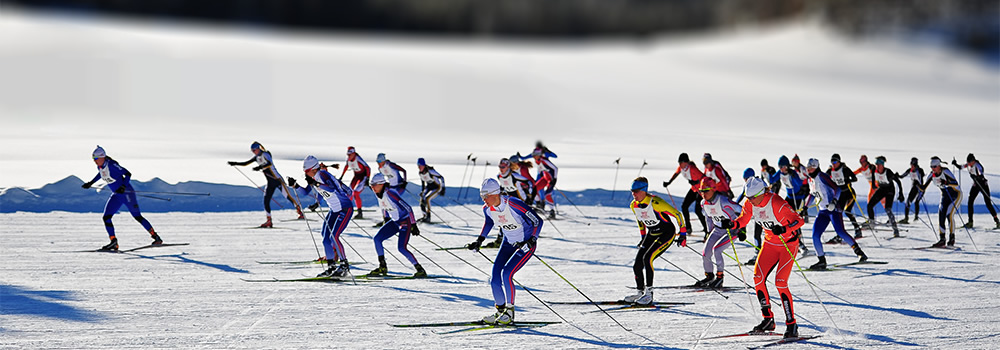
With the 2016 Boulder Mountain Tour just weeks away, it is not too early to start getting race skis ready for their final layer of race wax before the big day. Doing a little work on your skis now makes a big difference in time spent waxing the night before the race. Below are some tips to save time, energy and stress the night before the BMT.
Clean and brush your skis well. Brushing your skis after every ski does a good job of removing dirt and old wax from the ski base structure. However, it does not completely clean the base. It is the dirt and other foreign contaminates that cannot be seen which the brush misses. Using a Glide Wax remover, like the I84 Glide Wax remover will completely clean the ski base. And, it is more efficient and effective than hot scraping. Make sure to use a separate nylon brush for your Glide Wax Cleaner.
Saturate the ski base with the 6 line. Looking at the long-term weather forecast, the temperatures and snow conditions should be ideal for the 6 line. So, after ski training, it will help to rewax your skis with either CH6X or LF6X. The race day recommendation will probably be HF6X. By waxing with the 6 line prior to the race, the ski bases will have the correct hardness of wax saturated into the pores. This eliminates the need for under layers like graphite.
Clean brushes and sharp scrapers. The basic tools like brushes and scrapers need to be in good working order. Make sure to have clean brushes that do not have bent bristles or are filled with wax. If the bristles are bent, it might be time to invest in a new brush. Keep your wax scrapers sharp. Use fine grit sandpaper to sharpen them or purchase a scraper sharpener (T0408 or T410).
With early snow accumulated on the West Yellowstone Rendezvous Trails in the opening days of November, Fischer Sports is preparing for the most well attended U.S. ski event of the Thanksgiving season. “We’ve waited out the interminable time in the fall before snow hits,” explained Fischer’s Western Sales Representative, Brian Schiller. “Now we’re thrilled about having snow and a great collection of gear for demo at this year’s West Yellowstone Ski Festival.”
Fischer will again employ an online reservation system throughout dates of the festival to reserve new Speedmax boot and ski demos for on trail testing in West Yellowstone. In addition to Fischer’s new Speedmax boots, the 2015-2016 Speedmax skis will be available to try on the Rendezvous Trails. Both Speedmax boot and ski models employ innovative new features and improvements for 2015-2016 that merit first-hand testing.
“With the new carbon sole of the Speedmax boots, these demos are a chance to try this exceptional system.” explained Fischer Nordic Race Director, Chris Hall. “Likewise, this year’s Speedmax skate skis boast a new tip profile that further minimizes swing weight, improving ski feel.”
The 2015 West Yellowstone Ski Festival will take place November 24th – 28th in West Yellowstone, Montana. Demos will be available for reservation from Tuesday the 24th through Friday the 27th.
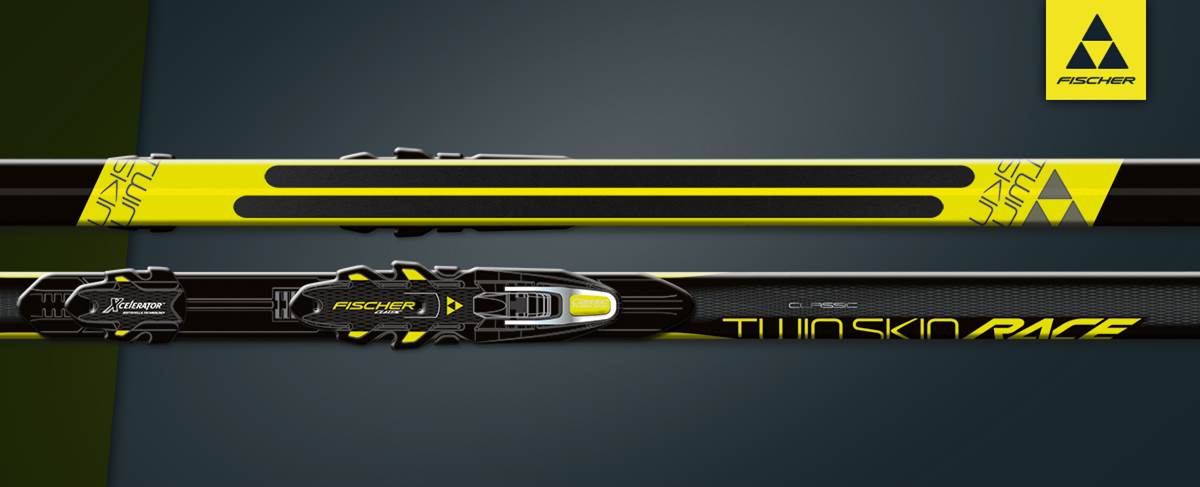
Fischer has announced the launch of the Twin Skin. Building on their collection of performance waxless options, Fischer offers the Twin Skin as a complimentary classic ski designed to kick in variable conditions without sacrificing glide.
The Twin Skin is built on Fischer’s venerable RCR ski, a populist model made to maximize performance at a reasonable price point.
“The Twin Skin is a ski made for versatile conditions. Purpose-cut cavities for two separate Mohair strips mean it glides easily and kicks solidly, especially in transformed snow and conditions that cause track glazing,” explained Chris Hall, director of racing services for Fischer USA.
Those mohair cavities are deeply set at the beginning of the kick zone, meaning less mohair strip is exposed, less gliding friction is created. The cavities are also shallower under the ball of the foot which makes the Mohair thicker toward the rear of the ski mimicking a well waxed classic ski where a thin layer of wax at the beginning of the wax pocket paired with a thicker layer under foot facilitates kick and glide.
The result is a ski that meets a wide set of criteria for a driven classic skier. The Twin Skin claims a spot as a skier’s go-to ski for conditions that elude grip in a mechanical (crown) pattern. For those with fewer hours for prepping skis, the Twin Skin aims to be a time-saving daily driver that demands kick without sacrificing ski feel.
In the wake of Swix’s release of the Cera Nova X line, Swix National Racing Director Chris Hall is embarking on a year long clinic and outreach tour to educate people on the new waxes, lineups and products available through the redesigned system
“Representing three years of research and development, the Speed Tour is sure to be valuable for any cross country skiing enthusiast,” Hall described.
Kicking off with a four-stop swing through New England, this year’s Speed Tour will continue at events on the national calendar and through select dealers. The earliest events take place at Boulder Nordic Sport in Portland, ME, the Great Glen Trails in Gorham New Hampshire, at Burlington, VT’s Ski Rack and at the Stratton Mountain School.
For more on the Cera Nova X system, see our launch press release. Follow Swix Nordic on Facebook for updates on when the Speed Tour might visit a location close to you.
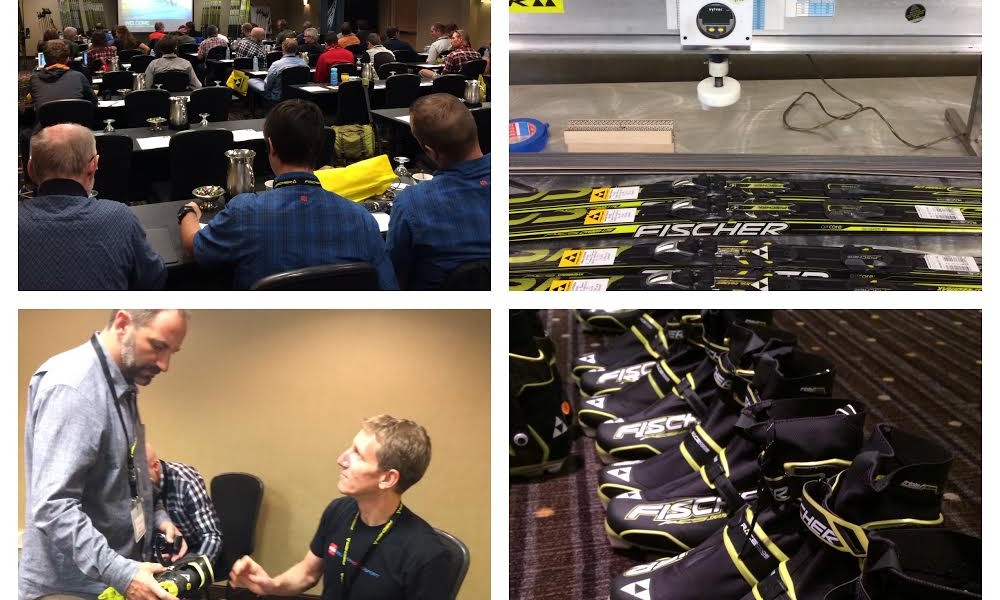
MINNEAPOLIS, MN – Thirty-five nordic racing dealers arrived in downtown Minneapolis to connect, share and learn from Fischer Sports and friends of the nordic industry. “This has never been done before and it’s a really special thing,” explained Vice President for Nordic at Fischer Sports, Peter Ashley in opening remarks to the dealers, “this gathering represents the people that make racing happen in this country. We’re thrilled that you’re here.”
Following Peter’s welcome, Global Marketing Director, Tanja Winterhalder, opened the two-day ski conference with a multi-media presentation highlighting Fischer’s 90 years of innovation and history, including stories and photos from iconic Fischer racers, Thomas Wassberg, Bjorn Dahlie, and Marit Bjoergen. “We only have a few minutes to talk about the history and innovation from Fischer, but we could have talked for ten hours,” Winterhalder explained before welcoming dealers and introducing Fischer US Service Director, Chris Hall.
Chris Hall gave a thorough overview of the Fischer boot program, including video testimonials from Andy Newell, Kikkan Randall, Simi Hamilton, Sadie Bjornsen and Sophie Caldwell. A complete introduction of the new Fischer RCS Carbon boot helped to underscore the technological improvements and innovation from Fischer’s boot program. Dealers broke into groups for hands-on looks at the new boots, trying them on and feeling the low volume boot first hand.
Presentations from the Ski Industry Association, a historical look at the transition to skating and a thorough introduction to the latest skis including the Speedmax line rounded out Tuesday’s event. Fischer University concludes on Wednesday, October 15th.
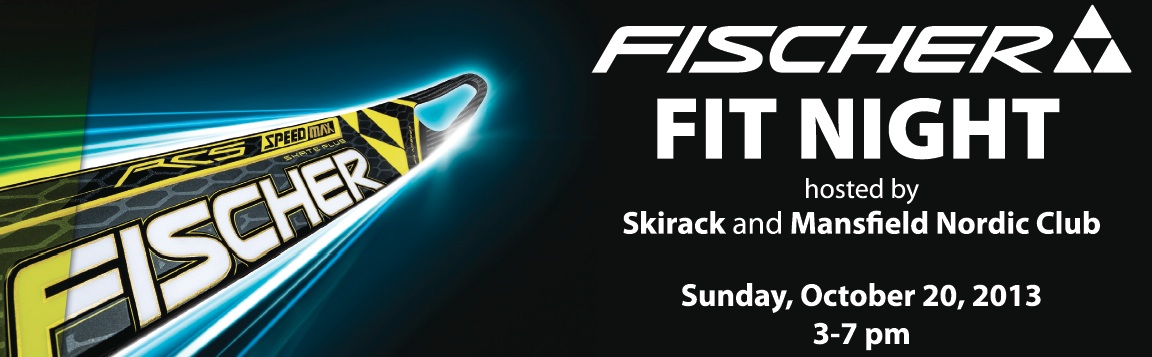
You’re invited to a special evening of Fischer products, prize drawings and pro race fits. Skirack, Vermont’s only Fischer Nordic Race Center, and Mansfield Nordic Club, 2013 NENSA Club of the Year, are proud to host Fischer Nordic Racing Director Chris Hall and Rick Halling, Fischer Nordic Promotions Specialist.
Come in and check out the 2013/14 line of Fischer Skis, Boots, Bindings and Poles, including the revolutionary new Speedmax Skating and Classic skis, which utilize cold base bonding technology that protects the homogenous molecular structure of the base, increasing wax absorption and maximizing ski speed. See why seven out of the eleven athletes on the US Cross Country Team have committed to race on Fischer Skis through the 2014 Games in Sochi, Russia.
Event Highlights
5 p.m.: NENSA award presentation & Mansfield Nordic coaches intro
Snacks & refreshments * Pro ski & boot fitting * Waxing tips and tricks
30% OFF last season’s Fischer Carbonlite Skis, Skate & Classic
Fit Night special price: $437.50
Special team pricing on all Fischer Race Equipment, including special orders
Team Wax forms for 30% off this season’s Toko Products
You’re invited to a special evening of Fischer products, prize drawings and pro race fits. Skirack, Vermont’s only Fischer Nordic Race Center, and Mansfi eld Nordic Club are proud to host Fischer Nordic Racing Director Chris Hall.
Come in and check out the 2012/13 line of Fischer Skis, Boots, Bindings and Poles, including the new RCS Carbonlite Skate and Classic Women’s Boots, and see why four of the six A Team athletes on the U.S. Cross Country Ski Team have committed to race on Fischer skis through the 2014 Games in Sochi, Russia.
Meet the Mansfi eld Nordic Club coaches. Enjoy snacks and refreshments.
Get waxing tips and tricks from Swix Wax Technician Drew Gelinas and Toko’s Dave Boucher.
Participants will receive:
• Special team pricing on all Fischer Race Equipment (skis,boots,bindings and poles), including special orders.
• 40% off all 2011-12 Wax.
• Team Wax forms for 30% o this season’s Toko Products.
Eight of Thirteen U.S. Ski Team Cross-Country Racers Choose Fischer Skis
AUBURN, N.H. — September 25, 2012 — Fischer Skis announced today that four of the six A Team athletes on the U.S. Cross Country Ski Team have committed to race on Fischer skis through the 2014 Games in Sochi, Russia. Kikkan Randall (Anchorage, Ala.), Andrew Newell (Shaftsbury, Vt.), Kris Freeman (Andover, N.H.) and Simeon Hamilton (Aspen, Colo.) have used Fischer Skis throughout their entire international competitive careers on the World Cup circuit and at World Championship and Olympic events. Joining the four A Team athletes are B Team athletes Sadie Bjornsen (Winthrop, Wash.) and Ida Sargent (Orleans, Vt.) and D Team athletes Erik Bjornsen (Winthrop, Wash.) and Skyler Davis (Jericho, Vt.). Together, these eight racers make up the majority of the 2012-2013 U.S. Cross Country Ski Team.
“This is by far the strongest group of Fischer athletes we have assembled going into a World Championship and Olympic cycle,” said Chris Hall, Nordic racing director, Fischer Skis U.S.A. “With Kikkan coming off of her 2012 World Cup Sprint title, the experience and savvy of Andy and Kris, Simi’s jump to the A Team and the emergence of Sadie and Ida, the future looks very good for our next two racing seasons.”
Each athlete will be equipped with Carbonlite Skating Hole skis, Carbonlite Skating Hole S-Track skis, Carbonlite Classic skis, Carbonlite Classic S-Track skis and long-time proven winners, the RCS Zero skis. In addition, Erik Bjornsen will use Carbonlite Skating, Classic and Pursuit boots for the next two seasons as he strives to make his first Olympic team in 2014.
“Chasing after World Championship and Olympic medals takes supreme dedication and unwavering confidence,” said Kikkan Randall, U.S. Ski Team member and Fischer ski athlete. “When I am putting everything on the line, I choose Fischer skis because I trust their dedication to providing the best equipment and service.”
The 2012-2013 World Cup season begins in Gållivare, Sweden, where the majority of these athletes will compete in the opening World Cup races and follow the World Cup circuit with the goal of achieving top results at the 2013 Nordic World Championships in Val di Fiemme, Italy. The remaining athletes will begin their racing season over Thanksgiving week in West Yellowstone, Mont., at the opening races of the 2013 USSA SuperTour, looking for victories and eventually joining their teammates later in the season at World Championships.
“I have used Fischer skis in six consecutive World Championships and three consecutive Olympics,” said Kris Freeman, U.S. Ski Team member and Fischer Ski athlete. “Because of Fischer’s quality, consistency and innovation, I am committed to using Fischer again in the upcoming World Championships this year and the Olympics in Sochi, Russia, in 2014.”
About Fischer Sports Nordic Ski Division
Founded in Austria in 1924, Fischer Sports is the world’s preeminent Nordic ski manufacturer, with a long history of dominating the race circuit as well as recreational sales. Fischer Skis U.S.A. is the top-ranked Nordic ski brand sold in America today. The company also markets bindings, boots and poles for Nordic racing, cruising, touring, jumping, backcountry and recreational skiing. For more information please visit www.fischersports.com.
Rob Kiesel — Photo courtesy of Sun Valley Ski Heritage Museum
“Perhaps it was the wine of the cool autumn breeze. Or perhaps as climbers sometimes we meet, we met. Rob Kiesel was an aggressive downhill racer. Perhaps it was his single-minded drive, which induced success. Nevertheless he was somewhat new to climbing and this would be no leisurely climb.”
— Excerpt from Gregory Lowe’s “Half Dome in the Winter” as it appeared in The American Alpine Journal (Vol. 15, Issue 1) by the American Alpine Club.
***
Note: This story has been updated to include additional photos and comments from Harald Bjerke, as well as a quote from Ruff Patterson.
One of Kiesel’s longtime friends, Bob Rosso, laughed as he remembered a photo of the climb — one of the first winter ascents of Yosemite’s 4,737-foot granite dome. A rope jutted straight out from the rock to support Kiesel and his companions as they hovered in a cloud 3,000 feet above ground.
Rob Kiesel built his first log home in Ketchum, Idaho, as pictured here in 1977. Photo courtesy of Harald Bjerke.
That year in 1972, Kiesel was a mountaineer as well as a skier. He started as a competitive alpine racer, making the U.S. ski team and breaking his leg in Sun Valley, Idaho. Upon leaving the hospital there, he decided that was the area he wanted to live in. That was the story he told Marty Hall, his predecessor as head of the U.S. national cross-country ski team. It was Hall who more or less discovered Kiesel through their interactions in Sun Valley, where Kiesel helped found the first nordic team around the time he summited Half Dome.
Kiesel always had questions — good, pointed ones — and great ideas, Hall said. His extensive knowledge of alpine wax gave made Kiesel a nordic pioneer in the glide-waxing revolution, and he went on to a 28-year career with Swix Sport.
On Monday, Kiesel died suddenly near his small ranch in Joseph, Ore., after apparently having flu-like symptoms. Private and unassuming by nature, he did not worry too much, delayed a doctor’s visit and may have passed away while outside exercising. Friends estimated he was 65 or 66 — a testament to the fact that he never drew attention to himself and preferred seclusion.
That’s why he chose Joseph as his home upon retiring from Swix a few years ago.
“He just loved being there, removed from everybody and everything,” said Rosso, who owned an outdoors shop in Ketchum, Idaho. “He’s just one of those people with enormous accomplishments, but just shy.”
Born in Ventura, Calif., in 1945, Kiesel was the son of an Olympian — Bob Kiesel — who won gold and set a world record in the 4×100-meter relay at the 1932 Los Angeles Games.
The younger, more snowbound Kiesel moved to Ketchum in 1971. There in the same building that Rosso now owns, Kiesel started a climbing and backpacking store called Snug Mountaineering with Bob Gorton, who went on to a lengthy career at North Face. Rosso helped them develop a climbing school, and it wasn’t long before Kiesel delved into nordic.
Recognizing a rising interest in backcountry ski touring, Kiesel decided to sell cross-country items. He also kept an eye on what was going on in Sun Valley, where he first started working with children in alpine. In 1971, Leif Odmark initiated the area’s first nordic team, attracting a small group of high-school athletes to the sport and coaching them for one race of the season — the Sun Valley Club race — with about 30 competitors.
“I wouldn’t be coaching today, nor begun coaching if it weren’t for Rob. Both my sister Susie and brother Pete wouldn’t have had the Alpine skiing careers they had if it weren’t for Rob. My brother Pete wouldn’t be guiding in Greenland or Nepal if it weren’t for Rob. More importantly, Rob was an integral part of our family.”
— as written in an email by Ruff Patterson, Dartmouth College men’s nordic ski coach
The following winter, Kiesel took over the program after convincing the Sun Valley Ski Education Foundation to incorporate nordic. At the time, it was an alpine-only operation in an area that had just recently discovered cross-country skiing.
The organization agreed to let Kiesel head a nordic team, and he chose Rosso — who said he only knew how to coach swimming — as his assistant. Over the next few years, Kiesel developed the program and attracted skiers to Sun Valley for its racing culture and innovative grooming.
According to Rosso, Kiesel liked to tinker and experiment. He spent time finding new ways to set cross-country track, perhaps most notably along the 32-kilometer Harriman Trail. There in the Wood River Valley, Kiesel helped develop one of the country’s first distance races for cross-country skiers — the Boulder Mountain Tour — in 1973.
“There were these epic stories of Rob grooming a point-to-point trail with archaic 1970s snowmobile stuff,” said SVSEF Nordic Program Director Rick Kapala.
One of the first to dream up a year-round trail from Galena Lodge to the Sawtooth recreation area near Sun Valley, Kiesel had to route the trail. Kapala recalled stories of him driving into the river on his snowmobile.
In recent years, the annual race closed out at about 1,000 participants. Since Kiesel did not want a memorial service, Rosso said the race organizers intended to quietly dedicate the 2012 Boulder Mountain Tour to him.
“It’s so hard for the rest of us to have closure,” Rosso said. “You want to celebrate his life and his accomplishments.”
“Young and stupid, I didn’t realize then how valuable Rob’s largessewas to our small program. (Young and stupid, I also didn’t know thenhow largely Rob had contributed to skiing.) Older and slightly lessstupid, I know now that I’m indebted to Rob, very personally for thetime and kindness he showed me, but also as a member of the larger USski community, since Rob belonged to a very select group of US skiingpioneers, who help to carve out a place for us at the larger table ofskiing and who invited anyone who cared to pull up a chair.”
– Andrew Gardner, Middlebury College head nordic ski coach
Forward Thinking
Not long after Kiesel began working with young skiers and creating programs to certify adult instructors, he made an impression on the USST. Regular rendezvous in Sun Valley gave Hall — the U.S. head coach at the time — an opportunity to meet Kiesel, and he noticed Kiesel’s direct contributions there.
Meanwhile, the U.S. team was eager to get on snow as early as possible. Around 1974, Hall and his staffers discovered a small patch of snow at the northeast entrance of West Yellowstone in Cooke City, Mont. The team began a season-opening ritual there, beginning as early as October and staying in a nearby hotel for almost month. While the racers skied in circles, the coaching staff experimented — most notably with the wax pocket.
Kiesel came onto the national ski scene in 1975, when Hall hired him as assistant coach. His extensive knowledge of the alpine glide wax, which was leaps and bounds ahead of nordic technology, gave the U.S. team an edge and helped them gain recognition internationally.
“We had a wax combination that I’m sure the Europeans knew about,” Hall said of their trip to the 1976 Innsbruck Olympics. “But they didn’t pay much attention to us.”
That February in Austria, Bill Koch put the Americans on center stage, winning a silver medal in the 30 k. He finished an impressive sixth in the 15 k, and his relay team missed the podium by about 30 seconds in the 4×10 k relay.
“We had some guys on radios, and they said these (coaches) out here don’t have a clue what we’re doing,” Hall said. “But the athletes were screaming at their coaches saying their splits are screwed up. … Not only had we hit the wax, but out skis were way faster than their skis.”
It wasn’t long before their competitors realized what the Americans were doing in their wax room. Soon, the brown universal blob of wax was out, and Kiesel’s use of alpine wax, with different temperature and humidity ranges, was the norm.
“He was the perfect guy at the perfect time,” Hall said. “The kids loved him. He and I got along real well. … He was really instrumental at that time.”
Kiesel as the USST head coach in 1980. Photo courtesy of Harald Bjerke.
In 1978, Hall left the USST and put Kiesel in charge. He filled the head coach role through the 1980 Olympics in Lake Placid, N.Y.
One of his athletes, Tim Caldwell, remembered him as an innovator in the mid ’70s, when the world was switching from wood to fiberglass skis.
“He knew a lot of stuff about this part of the sport that we knew nothing about,” Caldwell said. “He helped us a lot certainly with that transition … and trying to lead us, but without being too overly controlling with what we were doing. I think we all enjoyed working with him.”
Known for his steady attitude, Kiesel reacted similarly to good and poor performances, which Caldwell liked. Kiesel wasn’t one for excessive attention and seemed puzzled when he received any.
“He wasn’t interested in talking to the press; he was just a quiet guy,” Hall said. “Great worker, great thinker. It just popped into my own brain, ‘Marty, you did a good thing (hiring him).’ I liked him.”
Keep on Giving
After leaving the team in 1980, Kiesel moved back to Idaho and landed a research and development position with Swix Sport. Through the company, he worked closely with his college roommate from Denver University, Harald Bjerke, now the chief hardgoods product manager at Swix.
The two met regularly in Norway during Kiesel’s annual trips to the mountains to brainstorm waxing methods with the gurus. Roger Knight, the director of team and eastern operations at Boulder Nordic Sport, said Kiesel might have been the only American invited to the exclusive meetings with the Europeans.
“He was sort of a mythical figure, so to speak,” said Knight, who was personally mentored by Kiesel.
Former USST alpine racer, Kiesel showing off his downhill skills at Winter Park in 1964. Kiesel was on the alpine team at Denver University before taking up nordic in the 1970s. Photo courtesy of Harald Bjerke.
When Knight began working for Swix in the late ’90s, he said it was Kiesel who helped him earn a full-time position as the Swix USA nordic product manager. Later on, Kiesel regularly came to help at big racing events, such as nationals, Knight said. He wasn’t paid, but wanted to work.
“He’d never tell you what to do, but he’d always offer wisdom if you needed it,” Knight said. “People would say, ‘Who is this old guy in the way room?’ and he would leave, and I would say, ‘That’s the guy who invented fiberlene and fibertex.’ ”
Another one of his disciples, Chris Hall started as an assistant ski coach at Sun Valley. Kiesel knew he was interested in ski service and recommended him to Swix Norway. From there, Chris began working with the Swix Racing Service on a special project before the 2002 Olympics, and went on to become the head service tech for the USST.
Now the nordic race director for Fischer Skis US and also the Swix US nordic racing service director, Chris said Kiesel gave him the opportunities and confidence to move forward.
He remembered thanking him at an SVSEF team banquet about eight years ago.
“One of my speaking points was to thank Rob for the opportunity to take the ball and run with it, so to speak,” Chris wrote in an email. “Rob was a little taken back, as I believe he saw it as just doing the right thing.”
Last January, Kiesel was inducted into the first annual Sun Valley Ski Hall of Fame. Kapala and Rosso were among those who helped select the nominees, and both were nervous Kiesel wouldn’t show.
“When we talked to him about it, he couldn’t have been happier,” Kapala said. “He was just so gracious.”
For many, it was the last time they caught a glimpse of the man, whom a few described as reclusive. Rosso said he occasionally drove 5 ½ hours from his ranch to visit him at the shop in Ketchum, but the visits dwindled once he retired.
Kiesel was survived by his two children: his 28-year-old son, Jess, and younger daughter, Kaelin, 26, who had her first child a few months ago. Kapala said he coached Kiesel’s two children at Sun Valley, and both won junior national championships. Back then, Kiesel kept a respectful distance while supporting Kapala was in the coaching role he founded some 30 years earlier.
“It’s just sort of a very abrupt ending,” Kapala said.
“There’s just a lot of people out there that knew him well,” Rosso said. “He was just larger than life.”
***
An excerpt from an email written by Harald Bjerke, Kiesel’s longtime friend and college roommate:
Rob never talked loud about his achievements. He did not want to be in focus. Rob had a lot of interests from gardening, reading, mountain climbing, cycling and food to motorcycles. It was always interesting to discuss with Rob because he had such a broad perspective of life.
It is nearing the end of February and that can mean only one thing, it’s Birkie time again! The 2011 American Birkebeiner is shaping up to be a very exciting and fast race for every racer and participant. Part of the excitement and perhaps anguish leading up to the race can be related to skis and waxing. How should I prepare my skis? What waxes do I need? What wax tools do I need? What are the proper steps in ski preparation and waxing? Finally the big one, how fast will my skis be on the course and as I am skiing up Main Street in Hayward to the finish on Saturday, February 26th?
The racing and skiing part is up to each individual, but Swix has a complete system of wax, tools and waxing techniques to help every skier, from the front row of the elite wave to the skier doing their first Birkie, have great skis and most of all, a great experience on Saturday as they cross the finish line on Main Street in Hayward.
Ski base preparation is a very important initial step to insure fast skis, especially in a race as long as the Birkie. The ski bases are on the snow for just over 50 kilometers and keeping them fast and gliding well over the entire distance can mean the difference between an enjoyable race or experience and a not so enjoyable race or experience. A good analogy to ski base preparation can be found in building a new house. When building a new house, the first step is the site work and foundation construction. The building site must be prepared correctly and the foundation sound for the house to be built properly. The same can be said for ski base preparation. Swix has an easy to follow system and products especially designed for ski base preparation.
The goal of ski base preparation is to, one, clean the ski base glide zones of any foreign particles, such as dirt, oils and other contaminants that may have accumulated on the base and two, refresh and condition the ski base glide zones so that it will readily accept the subsequent wax layers applied to it.
The “Hot Scrape Method” is the quickest and easiest method for cleaning the ski base glide zones. Using Swix BASEPREP WARM- BP99, drip an even bead on either side of the groove over the entire glide zone of the ski. Make sure to use a waxing iron specifically designed for ski waxing, Swix recommends either the T73 PERFORMANCE WAXING IRON- T73110 or the 74 SPORT WAXING IRON- T74110. Have the iron set at 110ºC when using the BP99. Iron in the wax with 2-3 passes, working tip to tail down the entire length of the glide zone. Each pass should take approximately 7-10 seconds. While the wax is still molten, use a plastic wax scraper- T0824D and scrape the wax off the base. By scraping the wax in a molten state, any large dirt or other foreign particles will be suspended in the wax and are removed with the wax when the ski is scraped. Let the skis cool for 6-8 minutes, then brush out the skis using the RECTANGULAR STEEL BRUSH- T0179B. Brush 6-8 strokes from tip to tail using light pressure with the T0179B.
Next, complete the brushing out process using the ULTRA FINE STEEL RECTANGULAR BRUSH- T0197B. Brush 4-6 strokes from tip to tail using light pressure. The combination of the T0179B Steel Brush and the T0197B Ultra Fine Steel Brush removes the final excess wax, dirt and other foreign materials on the base, reveals the structure of the base and opens the pores of the base.
Once the Hot Scrape step is completed, the ski base will need to be refreshened and conditioned. I84 CLEANER FOR FLOUR GLIDE WAX AND CONDITIONER- I0084 is specially formulated to completely clean the base of any remaining foreign substances, conditions the base to optimally accept subsequent glide wax layers and will solve flouro compounds remaining in the base for those skiers who consistently use fluorinated wax.
So, why is this important? Referring to the analogy earlier on building a new house, the I84 is similar to the foundation of a house. The house foundation must be level and true, otherwise the windows will not open, the doors will not close properly and the house will not be square. I84 is the foundation for the subsequent wax layers that will be applied. Without the I84, the LF, HF and even the FC Cera layers will not preform and work as well as they should.
The procedure for applying the I84 is quick and easy. Simply wet a piece of FIBERLENE- T0150 and apply to the ski base. While the I84 is still in a liquid form and the base is still wet, brush the ski base from tip to tail with a NYLON WHITE BRUSH, T0161B. Use a new piece of Fiberlene and wipe the base clean. Let the ski dry for 5-10 minutes, then brush with the T0197B Ultra Fine Steel Brush. Use light pressure and use 4-6 strokes working tip to tail. Wipe the ski base again with clean Fiberlene. Now, it is time to build the wax layers!
Weather and snow conditions always play a major role in the waxes that will be used, not only on race day, but also as our base layers. For now, the focus will be on the optimum base layers needed to effectively and efficiently build a supporting structure for our final HF and FC Cera layers a day or two before race day. Just like a house, the frame is being constructed for our final exterior and interior trim finishings, paint and furnishings.
Looking at the long term weather forecast, http://www.accuweather.com/us/wi/hayward/54843/forecast-details.asp?fday=1, there is an unseasonable warm period with some precipitation in the form of rain currently in the Hayward area as of February 16th and 17th. Throughout the rest of the week and into early next week, the forecast calls for warm temperatures during the day and dropping well below freezing during the night. These temperature and weather conditions will most likely result in snow crystals that are a mix between old, transformed snow crystals (identified as group 3 snow crystals in the Swix snow classification system), wet corn snow crystals (identified as group 4 snow crystals in the Swix snow classification system) and frozen corn snow crystals (identified as group 5 snow crystals in the Swix snow classification system). While these snow crystals are uniquely different, they all have one thing in common. Each of these crystal types are aggressive, are prone to strip glide wax layers and will require strong and hard base layers.
After Hot Scraping and Base Cleaning, one layer of MOLY FLOURO WAX- MB77 is an ideal base layer. The MB77 is fluorinated base layer wax that also contains a moly additive. The flouro content of the MB77 aids and provides an extremely effective bonding base for subsequent LF, HF and FC flouro layers. The moly additive acts to repel dirt that is commonly found in old and transformed snow. Finally, the hardness of the MB77 is ideal in that both harder, colder LF and HF paraffins can be applied over the top of MB77 as well as softer and warmer LF and HF paraffins. Just as with the BP99, apply an even bead of MB77 on either side of the groove on the glide zone of the ski, iron at the correct temperature 125ºC working tip to tail with 2-3 passes with the iron, and let cool for 5-7 minutes. Scrape and brush with the T0179B 6-8 strokes followed by the T0197B with 4-6 strokes tip to tail.
Because the forecast calls for temperature dipping well below freezing leading up to the race, it will be necessary to apply a hard, fluorinated layer on top of the MB77. Given that the snow crystals will mostly likely be a mix of group 3 (old, transformed snow crystals) and group 5 (frozen corn snow crystals) the morning of the race, Swix LF4 is a perfect under layer for these aggressive snow conditions. Iron in one layer of LF4 to the glide zone of the ski, using the appropriate iron temperature for LF4, 150ºC. As always, apply an even bead on both sides of the groove within the glide zone, work tip to tail and keep the iron moving in one direction. Scrape the LF4 while it is still warm, but not hot. Then, let the skis cool for 5-10 minutes, and brush using the T0179B Steel Brush then the T0197B Ultra Fine Steel Brush, 6-8 strokes with the Steel Brush and 4-6 strokes with the Ultra Fine Steel Brush.
Looking forward into the Birkie race day, HF paraffin waxes, FC Cera powders, liquids, solids and additional ski base structure will play a pivotal role in ski and glide performance. HF6, HF7, HF8 as well as their BW counterparts and HF10BW are paraffin waxes that will be running well. Expect FC78 Super Cera, FC8X and even FC10X and FC10BO to be Cera powders that can run fast in the forecasted weather. Finally, FC8L, FC10L and the FC8A Rocket Spray are most certainly ideal top coats for the coarse and transformed snow conditions expected.
Swix racing service will be on the Birkie Trail Wednesday, February 23rd testing HF paraffins, followed by FC Cera powders, liquids and solids as well as some new HF paraffins that have proven to be effective in long distance races at the Vancouver Games and in World Cup events over the past year. Swix RS will also provide up to date structure recommendations based off of testing on the Birkie trail.
Swix’s first wax Rec will be posted Tuesday Morning: Updates will be found daily on Fasterskier.com, Skinnyskis.com, Skitrax.com, SkiPost, at your local Swix retailer, and of course at SwixNordic on Facebook and at SwixNordic.us.
The US National Championships in Rumford, Maine moved into the freestyle skiing on Thursday, with the Distance Skate events taking place for the male and female competitors. Due to low snow conditions, both events were switched from the scheduled mass start format to an interval start format. However, the distances, 30km for men and 20km for women were kept the same and the 2.7km course held up very well for all the racers.
With 3 days of colder temperatures, the Swix Racing Service test team found in testing that the wax combinations working earlier in the week needed to be adjusted. Dirt was still a factor as well finding the appropriate base structure in order to have fast skis that held up over a longer distance. The team ran many tests over the 24 hours preceding the distance freestyle event and was able to identify waxes and structure patterns that were running very fast and used my many of the teams and athletes racing on Thursday.
The glide testing began with base and mid layer paraffin waxes. The team recommended MB77 as a base layer to assist in the prevention of dirt accumulation on the ski base. Next, testing revealed that HF6 was the best paraffin for the men’s race at 10am in the morning. HF6 contains a blend of hard synthetic paraffin’s that have proven very effective in the abrasive man-made snow conditions present on the race course. For the women’s race, dirt became even more of a factor due to the skier traffic on the course. With the temperatures rising slightly, HF7BW was the best choice for the women starting at 12:30pm in warmer and extremely dirty snow conditions.
A pure Cera-F top layer was definitely needed for these conditions. FC78 Super Cera was far and away the best Cera-F top coat in all the tests the day before the race and on the morning of the event. Super Cera is well suited to abrasive and older snow crystals due to its hardness and durability in these types of snow conditions.
Base structure was another factor that played a big role in having fast skis on Thursday’s race. In testing, the 0.5mm broken-V roller was the fastest both in speed and feel. When testing structures, it is important to not only rely on speed trap time, but also on how the structure feels when climbing. The 0.5mm broken-V roller passed both tests and was used by many competitors.
The Swix Racing Service team will continue to test for Saturday’s Freestyle Sprint event, the final event of the 2011 USSA National Championships in Rumford, Maine. Good luck to all the competitors. Look for updates at www.SwixRacing.us and SwixNordic on Facebook.
Holly Brooks, West Yellowstone SuperTour. Photo: Swix.
Chris Hall, director of US Racing Services for Swix states, “Waxing for the West Yellowstone USSA SuperTour events was straightforward but not West Yellowstone normal. As we do for each race we tested a matrix of CH, LF, and HF base gliders based on temp and humidity. Once we had chosen the base wax we re-waxed and zeroed the test skis with the chosen base and tested if Cera-F over-layers increased the speed. A final test determined structure. For the first two races we could not conduct speed trap tests or run outs because the snow was too deep and tracks inconsistent so we conducted double blind feel tests on matched and zeros test skis. For the final event we were able to conduct run out and blind feel tests for glide as well as testing kick wax on Saturday’s Classic race.”
Testing each day proved, what coaches using just the Swix wax charts suggested, that CH4 or LF4 should be the base wax for most. FC78 SuperCera was the call as a final layer on 2 out of the 3 days. This was surprising to some as we were in “cold and dry West Yellowstone where Cera-F does not run well”. But this visit to West did not produce clear bluebird skies, but rather low hanging high-humidity clouds. A hand pressed .3mm broken-V structure improved most cold skis glide, further enforcing the argument that moisture management was important even though we were in West. Detailed Glide and Kick recommendations can be seen at swixracing.us
What were the Secrets to Success in West? – Keeping it simple by looking at Snow Crystal Structure, Temp and Humidity and not trying to win the race in the wax room with some a complex mixture of waxes.
APU’s Eric Flora states “Since its inception over a decade ago we have developed and implemented a stringent wax testing and wax application procedure that allows us to deliver consistently fast skis. The key is to keep it simple. At APU we focus on one line of wax. This process produces very good to great skis each race day and provides the athletes the confidence they need to produce the quality results they have trained for. Using the complete Swix line allows us to understand exactly where temperature and humidity fit into the complete Swix waxing matrix and gives me the confidence that I will deliver top skis to my athletes.” APU has 4 women in top 6 and 5 men in the top 10 of USSA SuperTour with a waxing process that relies on simplicity of the comprehensive Swix waxing matrix.
USSA SuperTour Points Standings after first 4 races
Women:
1 Holly Brooks APU Nordic Ski Center
2 Kristina Strandberg XC Oregon
3 Kate Fitzgerald APU Nordic Ski Center
4 Sadie Bjornsen APU Nordic Ski Center
5 Eliska Hajkova Univ of Colorado Ski Team
6 Morgan Smyth APU Nordic Ski Center
7 Maria Graefnings Univ of Utah Ski Team
8 Chelsea Holmes Sugar Bowl Academy
9 Maria Stuber CXC Team
10Jessie Diggins CXC Team
Men:
1 Lars Flora APU Nordic Ski Center
2 Drew Goldsack AWCA Canadian Nat’l Team
3 Garrott Kuzzy CXC Team
4 Michael Sinnott Sun Valley Ski Foundation
5 Brian Gregg CXC Team
6 Leif Zimmerman Bridger Ski Foundation
7 Bart Dengel APU Nordic Ski Center
8 Mark Iverson APU Nordic Ski Center
9 Brenton Knight APU Nordic Ski Center
10 James Southam APU Nordic Ski Center
Swix’s complete wax matrix takes the guesswork out of waxing by creating a specific wax for each snow condition. If you know the air temp, relative humidity you can select Swix’s perfect wax no mixing, magic recipes, stressing or slow skis required. Swix, your Winning Margin. Get your Winning Margin wax rec at SwixRacing.us and SwixNordic on Facebook.

 With the 2016 Boulder Mountain Tour just weeks away, it is not too early to start getting race skis ready for their final layer of race wax before the big day. Doing a little work on your skis now makes a big difference in time spent waxing the night before the race. Below are some tips to save time, energy and stress the night before the BMT.