From the FasterSkier archive — posts syndicated from athletes’ and coaches’ own blogs between 2004 and 2012, kept online as published. Current coverage is at fasterskier.com.
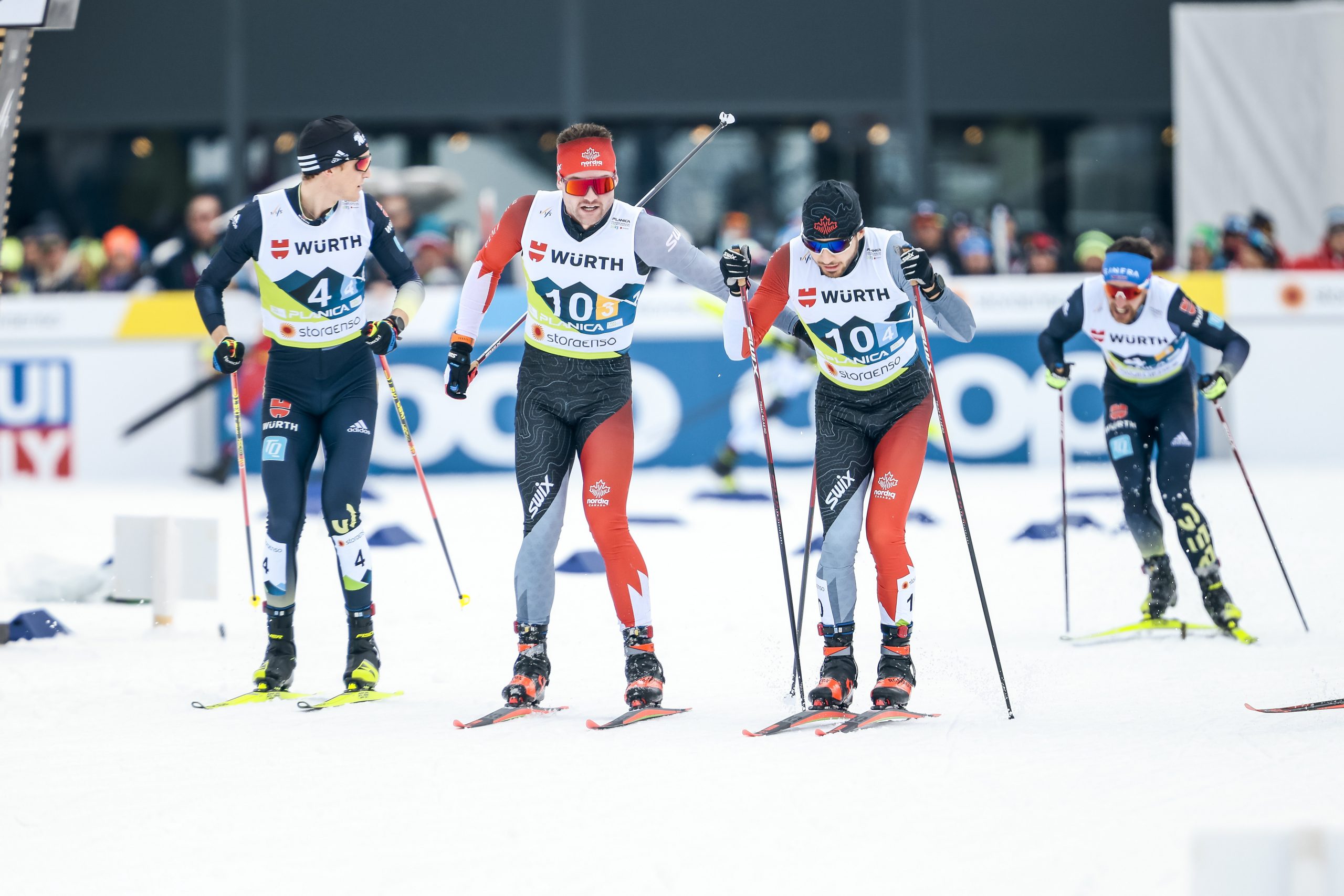
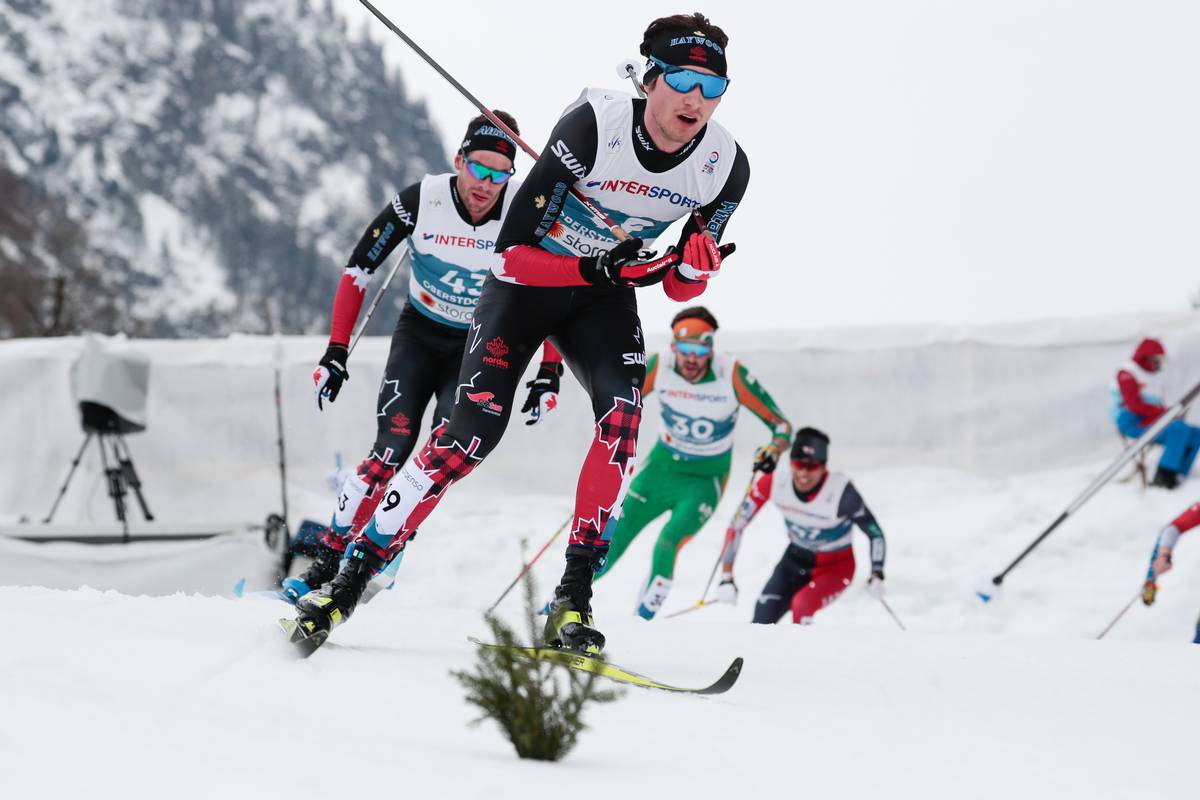
Yeah, Norway smoked everyone in the men’s 4×10 k relay at World Championships in Planica, Slovenia. But the race for silver and bronze was a thriller, with Canada delivering an electrifying performance. Chris Jeffries, the Canadians’ high performance director, joins us from on site to break the race down.
Get at us at devon@fasterskier.com and nat@fasterskier.com. Ten races down, two to go.
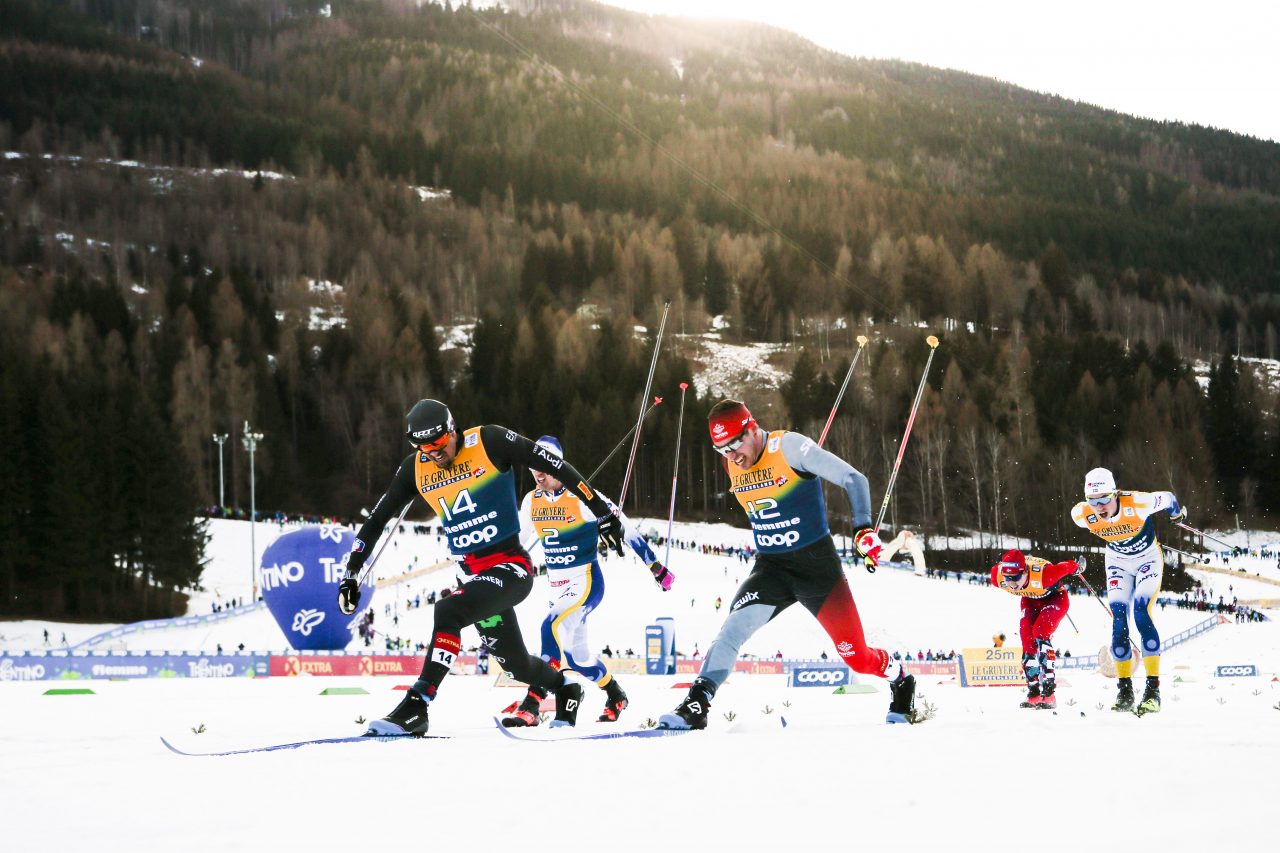
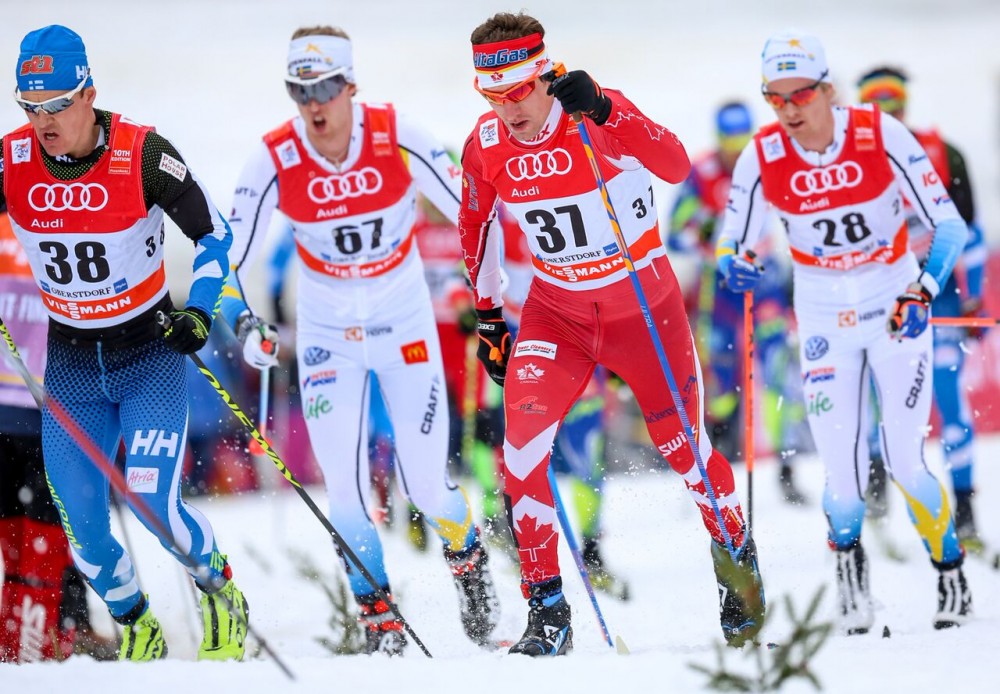
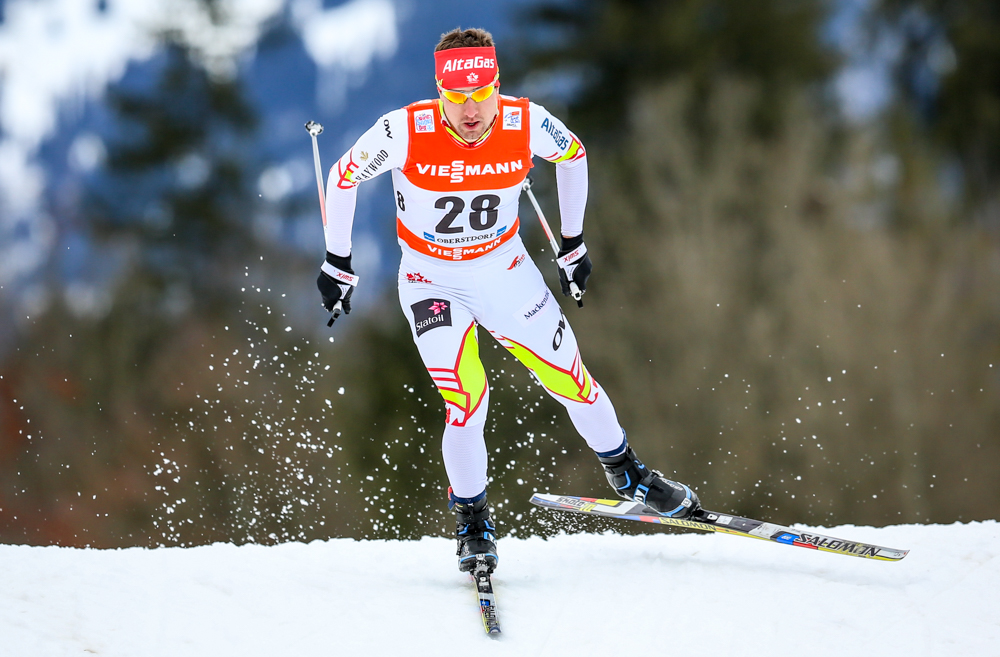
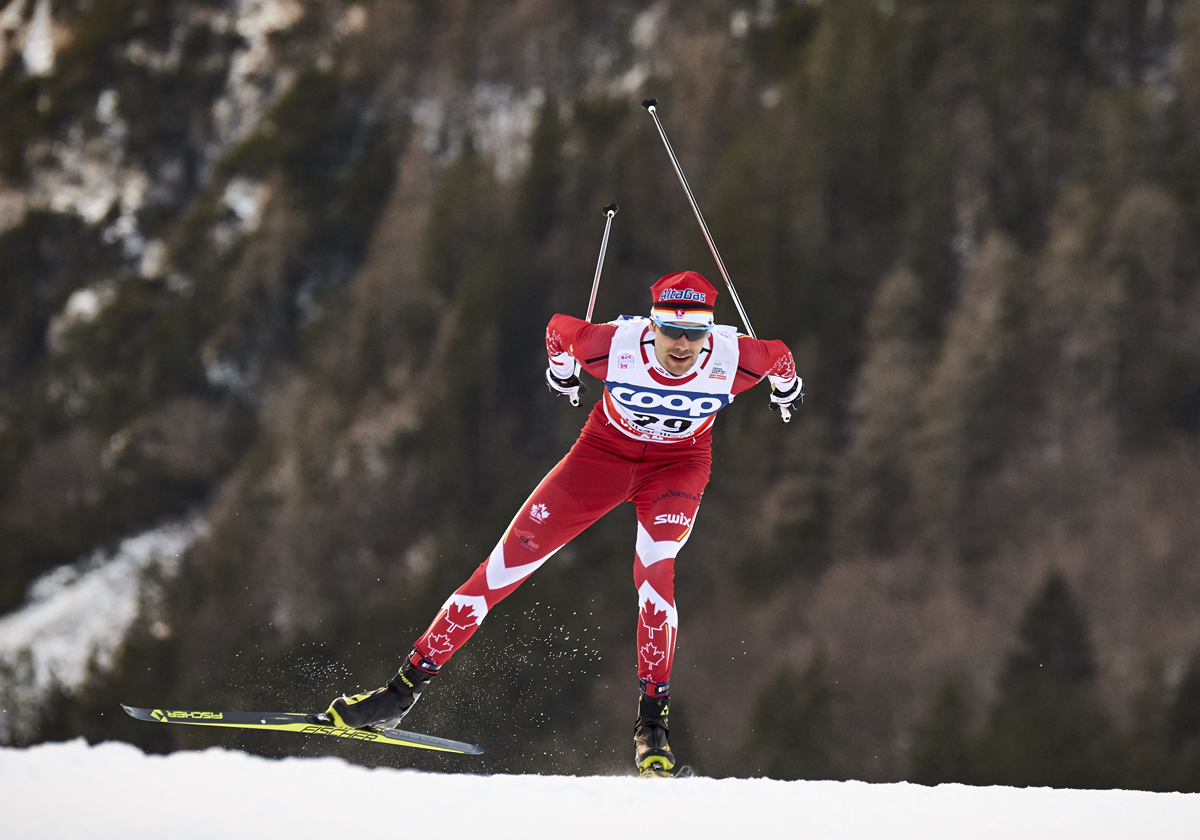
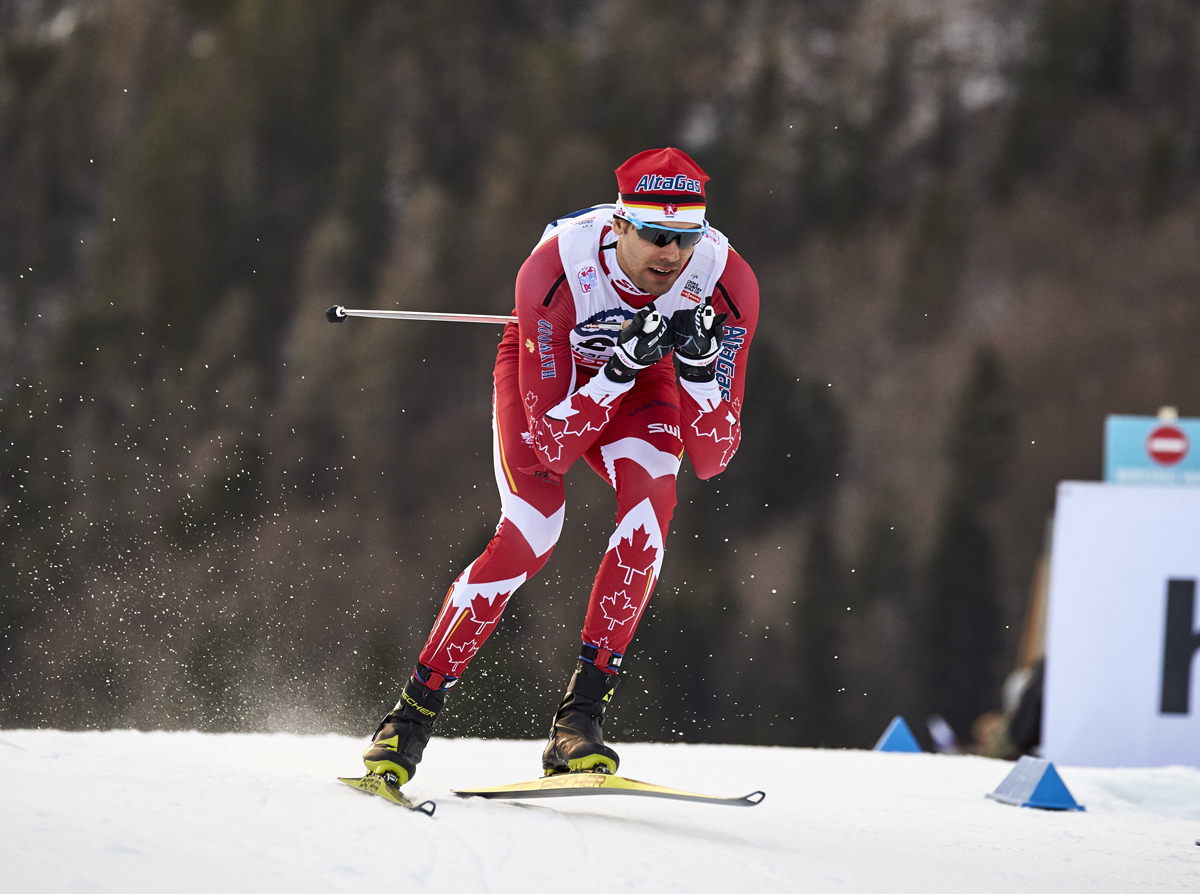
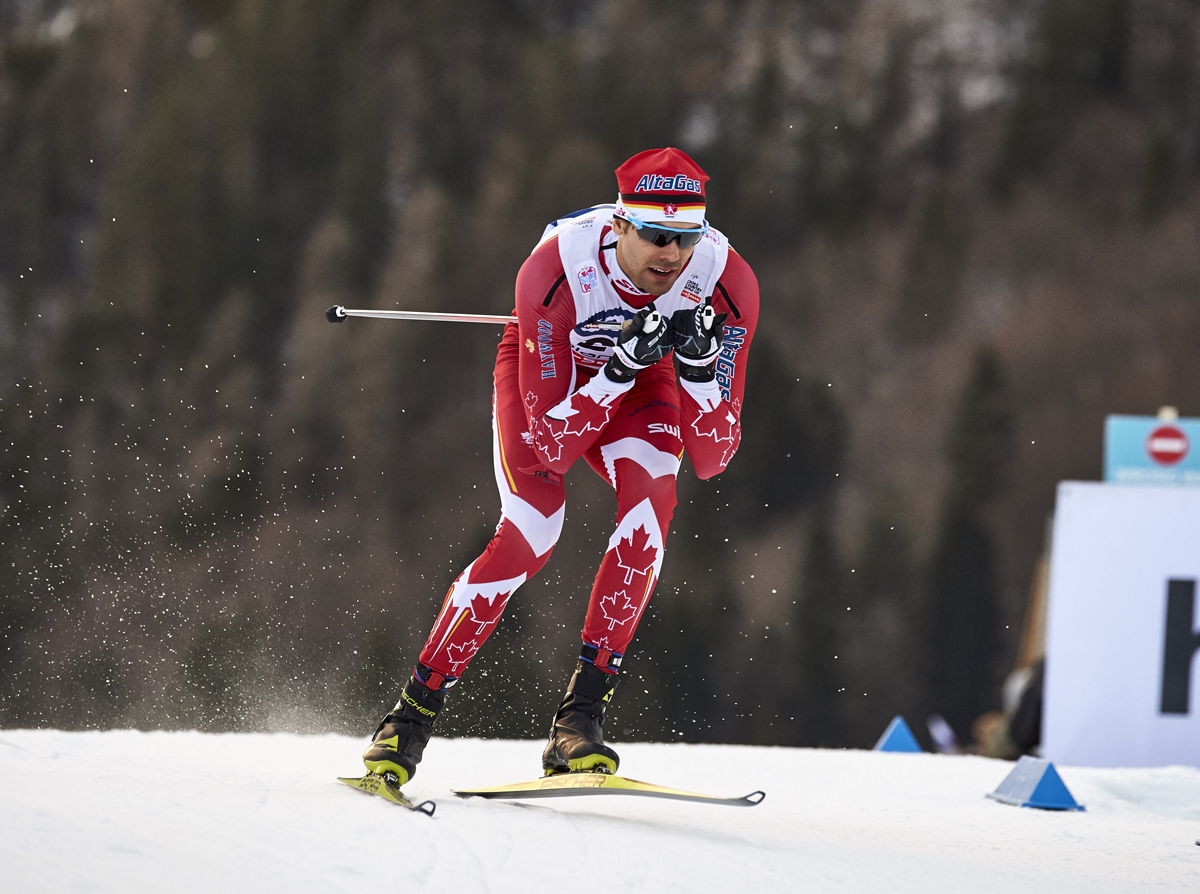
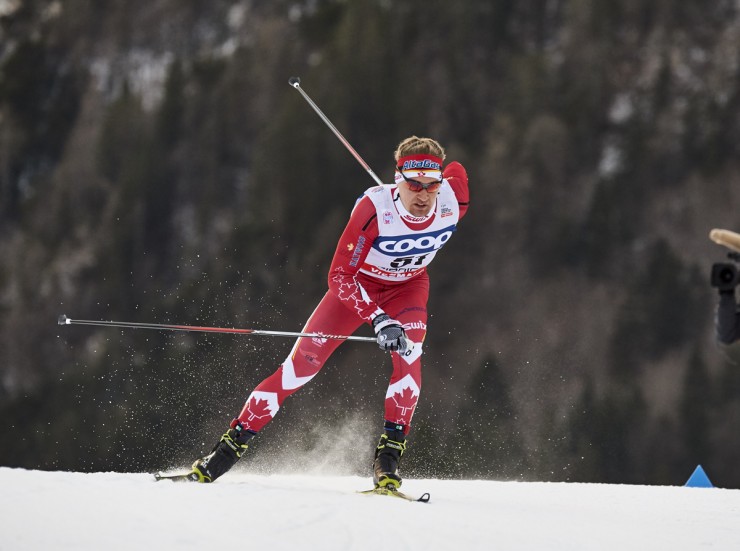
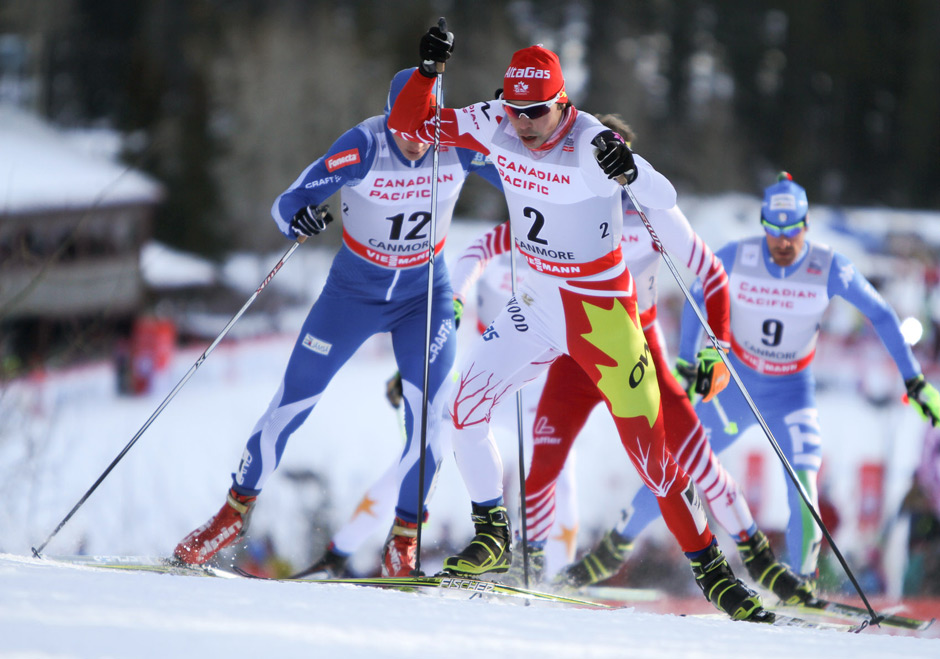
Francesco de Fabiano (14) edges Tony Cyr (12) in stage 6’s 15km classic at Val di Femme. (Photo: Modica/NordicFocus)
Canada is in the rebuilding part of the success rollercoaster, with many changes to the High Performance team and the development programs.
Since May 1st, Chris Jeffries has joined Nordiq Canada (NC) full time as the High Performance Director, Robin McKeever has transitioned from the extremely successful Para program to become the Olympic Stream Head Coach. NextGen coach Eric de Nys and Dev coach Matt Smider are in their first full year in those roles and have shifted modes from planning to delivering.
This season, Canada returned to the Tour de Ski with three top ten finishes and is hosting the World Junior/U23 Championships.
The Tour de Ski was an obvious highlight, with all of the nine athletes and six of eight support staff experiencing the Tour for the first time.
“Yves Bilodeau has obviously has done a few Tour de Ski’s and Simon Boisvert was on the trip with us as a wax tech,” McKeever told FasterSkier, “but yeah, everybody else was pretty much rookies there, I think just the tech, so we were following the tech’s lead to learn from them as much as anything.” For non-Canadians, Bilodeau represented Canada at two Olympics before becoming a wax tech and VW bus driver for the Beckie Scott generation.
Asked to pick just one highlight, McKeever chose one result and one process goal: “My personal highlight from the Tour has to be Tony’s fourth place and coming ever so close,” he said, referencing Antoine Cyr losing a photo finish for a podium spot in Val di Femme the day after finishing 6th in the sprint. “That’s I think beyond some of our expectations through this year, but at the same time, it is belief in the system and belief for the younger up and coming athletes and others around him that it is possible. We need to get that back in the system. We’ve lost it since you know that Beckie, Chandra [Crawford], Sarah [Renner] years of Olympic medals, and with Alex Harvey’s retirement, things were kind of frayed. So it’s time to rebuild that and get positive focus forward and making sure that we’re looking at growth mindset and looking for positive solutions, rather than always complaining about the issues.”
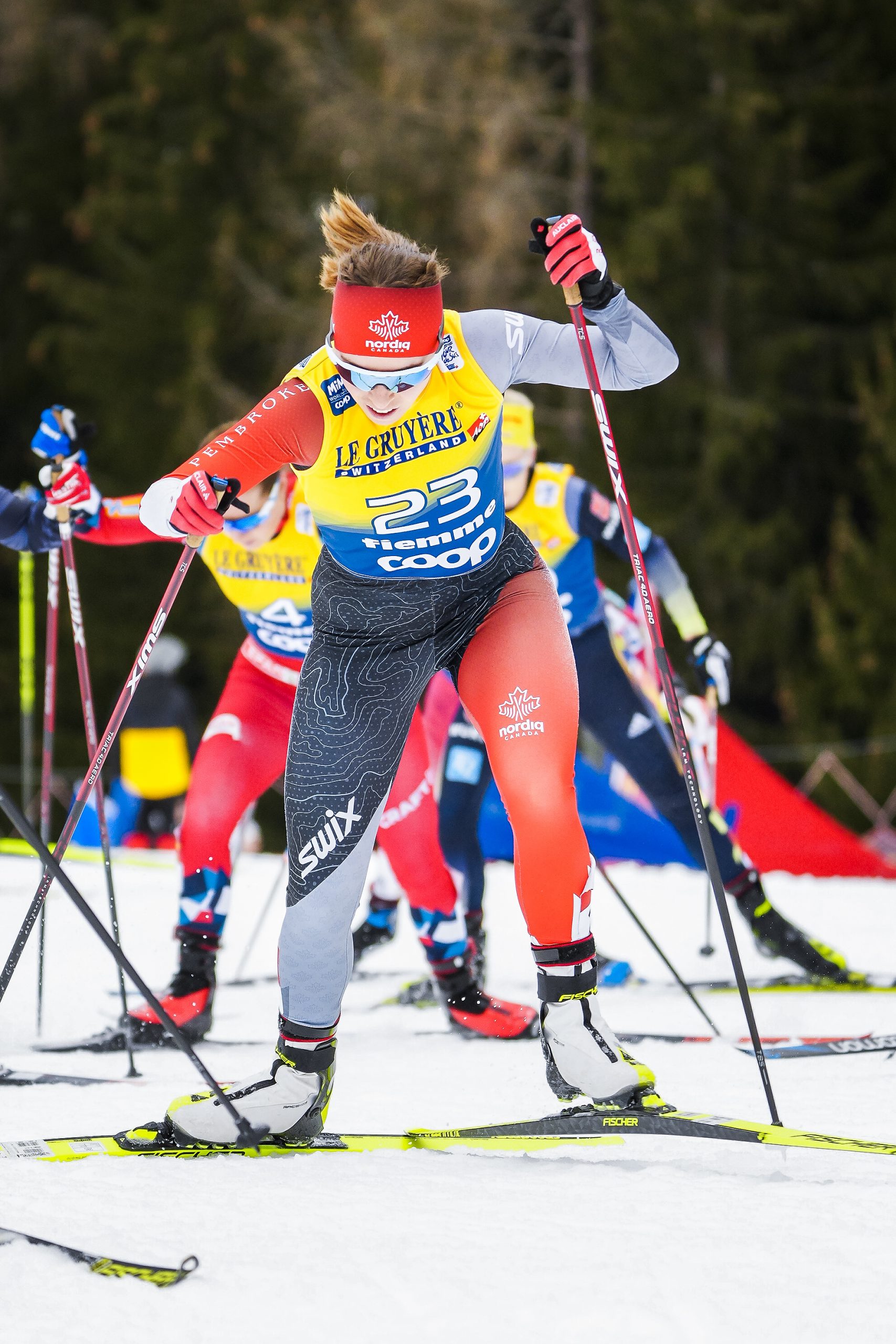
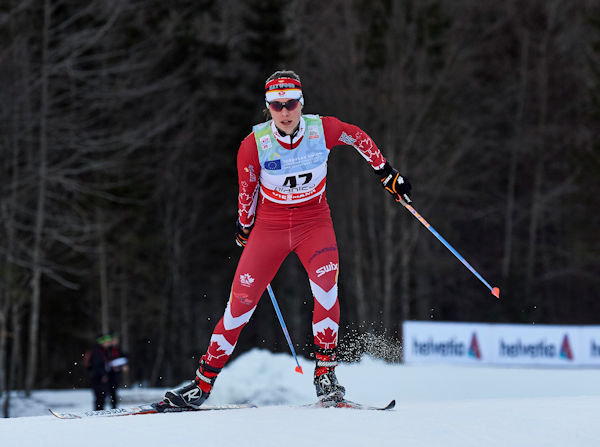
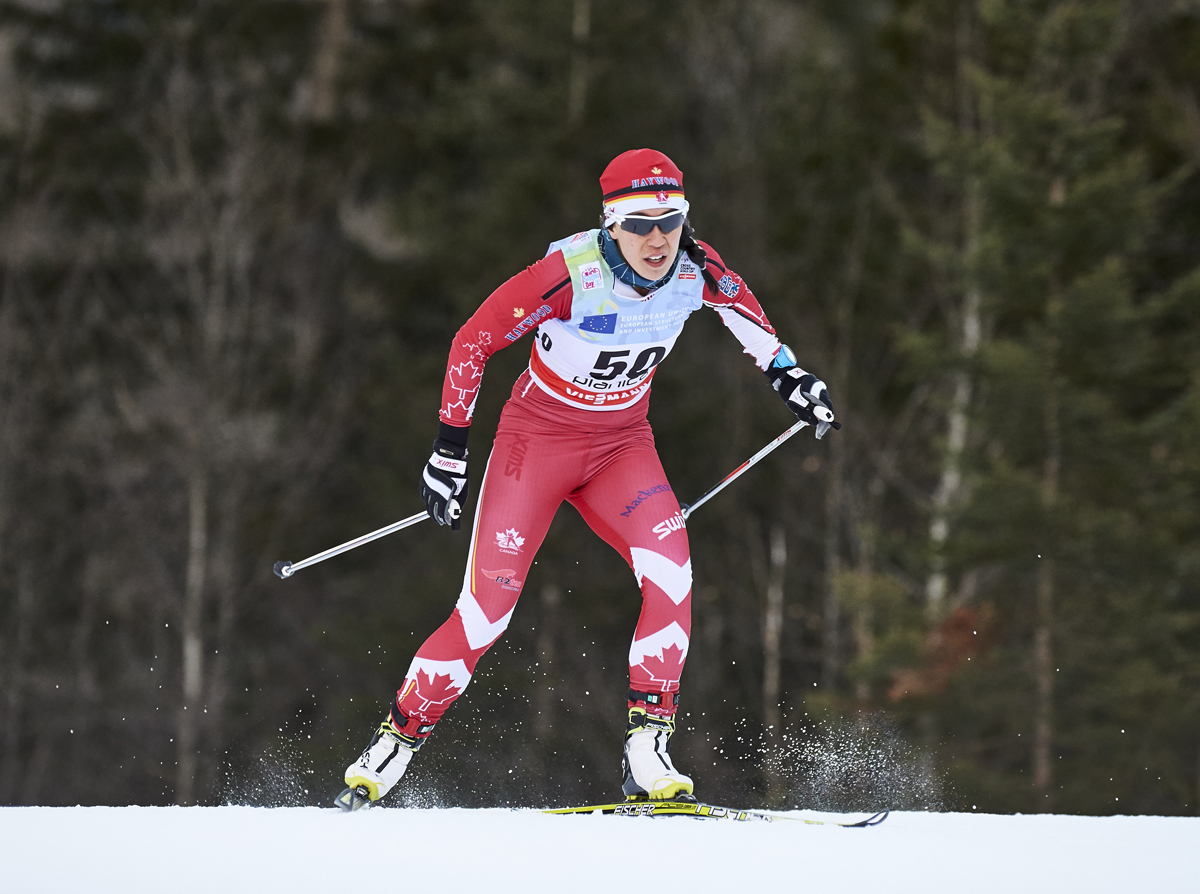
Katherine Stewart-Jones (CAN) racing up the Alpe di Cermis in the final stage of the 2023 Tour de Ski. (Photo: Barbieri/NordicFocus)
Katherine Stewart-Jones, who has this season scored her first top 10 plus six top 20’s, and joined the red group as the 15th ranked distance skier, is another obvious highlight for Canada.
Canada will select athletes for U20/U23 Championships in Whistler and World Championships in Planica at the Trials event at Caledonia Nordic this week, with many younger skiers expecting to qualify. There is also a good field of older skiers planning to hand out some learning experiences on their way to Planica, which should result in exciting racing. Live timing and full results will be here.
For Planica, three athletes were pre-selected: Katherine Stewart-Jones and Tony Cyr met the standard of two top 20s on the World Cup this season, and Graham Ritchie earned a discretion pick with a 17th, a 21st, and two top 20 sprint qualifiers. Everyone else is at Caledonia.
When FasterSkier was interviewing NC staff this season during race weekends, the phrases “that’s Julie” and “Julie does” got used a lot. Julie Beaulieu is in her second year at NC as Development Director. What does that role entail? It appears that it is mostly enabling the more visible staff members to succeed. The most visible of those is McKeever.
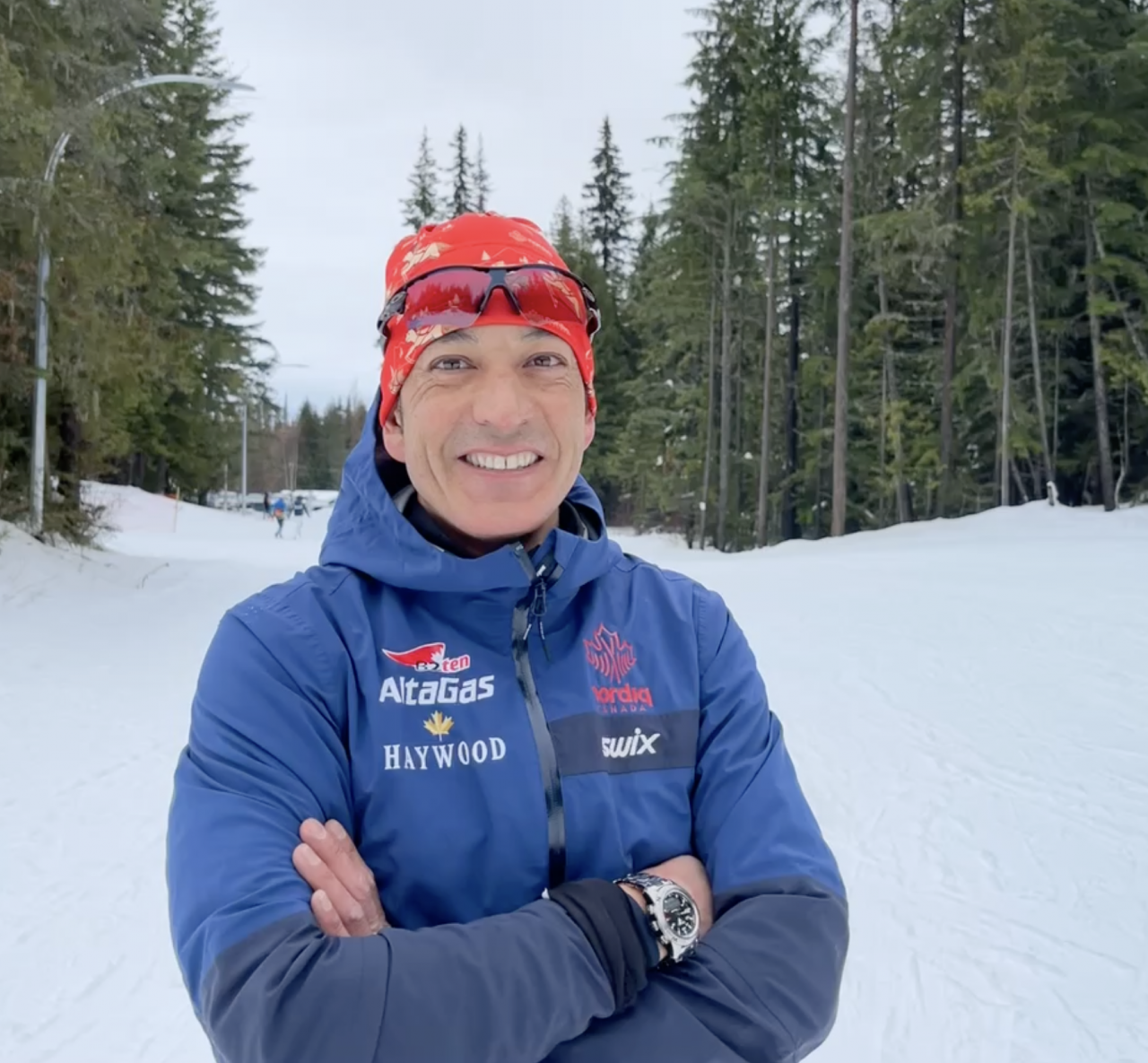
Robin McKeever stopped in at the Reino Keski Salmi Loppet on the way to Prince George for Trials, providing wax support to his family and answering questions for FasterSkier. (Photo: FasterSkier)
If asked about McKeever, most ski fans will remember his time guiding his younger brother to Para glory, or his leadership that brought Canada to the elite of the Para-nordic world. This has eclipsed his own history of podiums, multiple national titles, and Olympic experience since he joined the Junior National team in 1990. McKeever has been part of the National team system every year since then: the good, the bad, and the Nagano ugly.
From the outside view, McKeever never produces inspirational speeches that would make Hollywood proud. If he shouts, it is encouragement to a racer on course, and he is most often seen having a quiet one-on-one conversation. Every conversation loops back to “moving forward” and what can be learned to be better in the future.
So what makes McKeever a leader? He is surrounded by inspired people. Athletes produce year over year improvement. Retired athletes look back with a smile at their team memories. And there are a lot of “team” moments, among both the athletes and the staff.
Para athletes often talked about lessons learned from teammates and the support they felt. Asked how to bring the Para success to the rest of the team, McKeever focussed on culture.
“Para … it’s it’s a small community overall. Tiny,” he said. “So it’s a lot easier to create that team environment and attitude around our culture.”
“So the funny thing is, we think Nordic or cross country skiing is such a big community overall but compared to the world, it’s actually a fairly small community. I still remember a lot of people [on the World Cup circuit] from when I raced back in the late 90s, early 2000s. So this is a small community overall.”
And the next step is change.
“So changing the culture within Canada is about being open to others’ ideas. And we have gone to a decentralized program where athletes are training within their home environments. And then we’re camp-based. So we create our team environment in camps and on the World Cup in the winter. Bit more similar, probably, to what the US system is right now under Matt Whitcomb.”
While McKeever listens to others, he has a solid core of philosophy.
“And that culture is about being a positive influence on the program, always forward. No, we’re not always going to have successful days,” he explained. “But to come in and improve on the tough days and look at the positives, but also look at where we can improve every single day. And I think that just that philosophy and the culture that is behind that creates a safe environment where athletes are free to express themselves as they will. And they’re not scared to speak openly. And so when they do that, we can create a space where they can be happy to operate in, so that creates the smiles. Cohesion as a group and a team becomes the number one key focus that I try to look at.“
With the decentralized structure, athletes work primarily with their club/personal coaches with support from the national system. This adds continuity as skiers enter and exit the World Cup and the National Team; it also helps knowledge trickle down into the clubs.
This fits in with an overall goal of integrating the National Team system more tightly with the clubs.
Next up in the Canadian series is the NextGen and Development changes, along with an explanation of why the USST’s Bryan Fish and Greta Anderson were using the same phrases as Jeffries and de Nys at the combined Nordiq Cup/SuperTour at Sovereign Lake in December.
NextGen coach Eric de Nys and NDC TBay’s Timo Puiras review results from an informal 15km time trial on November 28th. This ‘race’ was the first to feature athletes from multiple regions in twenty months, featuring athletes from CNEPH, TBay, AWCA, and more.
Last season, Canada held no races, posted no domestic results, and, in general, vanished into the pandemic fog.
Travel restrictions meant that many Canadian skiers didn’t see any skiers from other regions.
Which skiers made progress and which regressed over the last 20 months? We finally have hints after the first races last weekend. What is new? Lots. What happens next? Keep reading.
Athlete Progress
Following the opening FIS races, part of the Western Canada Cup series, which happened December 4th and 5th at Sovereign Lake in Vernon, BC, Nordiq Canada and its followers finally had results that could be used to assess athlete progress.
Many athletes from Québec, Ontario, Manitoba, Alberta, and BC spent time at Sovereign Lake in November, getting a combination of elevation and snow. Most were confident in their preparation based on summer training with teammates, including the few athletes who race the World Cups last season or were in Europe in November. However, the coaches were still likely to shrug when asked who was fast this year.
FasterSkier’s research suggests that Sam Hendry was the Canadian with the most races last year. A student athlete at University of Utah, he was able to travel and compete on both the SuperTour and NCAA circuits. The small group of athletes who raced World Cups and U23/U20 Championships in February and March had no warmup races before racing at the top level and ended the season with less race days than Hendry.
FasterSkier will be sharing more in-depth athletes profiles in the coming weeks.
Calendar Changes
Canada has dropped the NorAm name, a leftover from the depths of history when the US and Canadian series merged into one North American series. Since the SuperTour split off some years back, the reversion to the Canada Cup name (as in a Continental Cup race held in Canada) is appropriate, even overdue. A name change, however, is simply symbolic. Real change requires action, and action usually results in anger from the people who were demanding change.
As originally planned for last season, the series is now divided into Western and Eastern, which is expected to reduce travel costs and make it easier for skiers to stay in the sport until they are ready to earn a permanent place on the World Cup team. The obvious downside is that the top skiers won’t meet until national team and Olympic trials in Canmore. FasterSkier has been talking to skiers about pros and cons and will follow this shift closely.
Building a season schedule in Canada doesn’t get much easier with the east/west division. The country spans 5.5 time zones and the geographically larger west division has a much smaller population. Every possible calendar and scenario includes lots of travel.
Olympic trials need to be held at elevation as Beijing is at 1,800m, and the west has the only three homologated courses above 1,200m (Canmore, Rossland, Sovereign Lake). Ideally, there would have been early trials on snow for the World Cup period 1 starts, but that would also have to be in the west because the east doesn’t have appropriate courses available in October/November. With 2022 Nationals scheduled for Whistler, the obvious solution would be to have all major events in the west. This would (reasonably) be seen as unfair to eastern athletes. The ‘least bad’ answer was not to have trials in October.
The divided schedule has Sovereign Lake December 4th-5th followed by Rossland, also in BC, on the 11th-12th. In the east, Nakkertok, just north of Ottawa, will host races on the 11th-12th, followed by Mont Sainte Anne, further east in Quebec, on December 18th-19th. Everyone comes together for the first time at the trials in Canmore January 6th-11th. These competitions will be used for athlete selection for the Beijing Olympics, U23/U20 World Championships, and World Cup period 4, which means pressure to perform for everyone.
Nordiq Canada Changes
NC has made a tonne of staff changes since last season. There is now a NextGen coach to bring skiers up to the top level, and a Development Coach to deliver skiers to the NextGen coach. Chris Jeffries, longtime leader of the Alberta World Cup Academy, has been named High Performance Director. Julie Beaulieu is working on the development side. Nathaniel Mah has retired from Nordic Combined competition and is Marketing Engagement Coordinator. Ilona Gyapay has had a role shift, described by one deeply-connected race official as ‘the new Dave Dyer’. (Dyer spent many years with Nordiq Canada, before ending his career as Events Director.)
Erik Bråten was originally hired in the fall of 2018 as a NextGen coach with a secondary focus on developing the base of the pyramid before having his role changed almost immediately to the “Everything Coach”. After two and a half seasons, he left NC in April, 2021. He later rejoined as a World Cup coach for the 21/22 season.
Eric de Nys was selected as NextGen coach in June. He started work in August, joining in at the Penticton national team camp organized by Dave Wood, which had been moved to Vancouver Island to escape wildfire smoke.
De Nys organized the traditional Canadian elevation camp in Mammoth, California. For BC athletes this was out of the smoke and into less smoke, as California was also burning. This camp is important for Canada because it allows a range of elevations that aren’t practical in BC or Alberta and don’t exist in the rest of Canada.
“BC has good elevation, but in an Olympic year, good enough won’t be good enough.” — Wood, July 2021.
Matt Smider was hired as Development Coach in time for Canmore’s Frozen Thunder team camp in October, once again led by de Nys. Smider is known for sparking the growth of small town Revelstoke Nordic into the big leagues; these skills will be useful to fill the development pipeline.
De Nys lead a mix of NextGen and World Cup athletes to Muonio and Gällivare to race continental cups, with promising results against the top skiers from Finland, Russia, Italy, and Sweden. At this point, the casual observer might think that the NextGen coach role was blurring to fill the gap created by the absence of a national team head coach.
Future
With back to back Top-15 finishes, Nordiq Canada’s Antoine Cyr is 12th in the 15k freestyle pursuit in Ruka. (Photo: NordicFocus)
Racing season is here and most eyes will be focussed on the next race. Some Canadians began their seasons in Europe. Rémi Drolet and Russell Kennedy knocked out good results in Finland and Sweden. McKeever easily won all three junior races in Gällivare against a stacked Swedish field. In the first World Cup weekend in Ruka, Antoine (Toni) Cyr led the way with an 11th in the classic 15km and 12th in the free pursuit. First year senior Olivier Léveille moved up to 17th in the pursuit while Russell Kennedy, Katherine Stewart-Jones and Cendrine Browne all earned World Cup points.
Jeffries will join full-time in April, the delay allowing him to make sure his current Alberta World Cup Academy athletes don’t have their Beijing preparations interrupted. He was clear that adding a head coach is a priority for next season.
This writer had two full seasons without seeing any of the athletes race in person, which leaves me feeling blind. The last FIS points race I watched in person was the 2019 WC finals in Québec City. It is hard to go into a new season without a good guess of which athletes to watch, but that challenge is shared by the athletes themselves.
Canadian racers missed two years of nationals and an entire season. For an athlete having a breakthrough year, nationals is where they get to show that improvement. Nationals is also the one chance for domestic racers to test themselves directly against the WC team.
“For an 18 year old to miss a year and really two years when 2020 Nationals were cancelled, is a huge amount of time,” de Nys said. “For a first year U20 aged athlete, they will have missed racing a Nationals and an entire calendar year as a U20 with another Nationals completely. In essence, they will go from a Junior to a Senior with no race experience to help them navigate that landscape.”
With some Canadian skiers doing well in Europe and others waiting to test their progress, it is fair to ask how Nordiq Canada will help them succeed. It is common to hear people in the sport use phrases like ‘those people in Canmore’ or refer to Nordiq Canada as an opaque office that is not connected to the clubs and provinces.
“A lot of our resources and core operations still get based out of Canmore. So an athlete that lives in Quebec on the National Ski Team still probably feels as though they’re not as engaged in the National Ski Team as an athlete skiing in Canmore, [and] we need to change that,” Jeffries told FasterSkier. “But it’s already changing.”
Jeffries went on to point out that CEO Stéphane Barrette, HP Manager Joel Jaques, de Nys, Smider, and Jeffries himself do not live in Canmore.
“One of our number one objectives for the first two years of this next quad is to make inroads on breaking down that perception of those barriers.”
Watch this space for more detail on NC direction as FasterSkier was able to catch up with Barrette, Jeffries, de Nys, and Smider on the snow at Western Canada Cup #1.
Kate Boyd was announced as the high-performance director for Canada’s para-nordic team on Monday. (Photo: Nordiq Canada)
“Looking at the critical year ahead, and the expectations placed on our Paralympic athletes to not only repeat our success from 2018, but to also ensure the tradition of excellence with this program continues well into the future, I believe it is important for me to shift and fully commit my time to ensuring this group has the leadership and resources required to deliver podium performances,” said Boyd to Nordiq Canada.
Before the recent announcement, Boyd had been the high-performance director for both the national cross-country team and the para squad. Boyd was part of a successful group that helped lead Canada’s para-nordic program in the recent past. Robin McKeever remains Canada’s national team coach for para-nordic.
“The scope of responsibility for the high-performance director leading both the Olympic and Paralympic streams is significant,” said Boyd. “With the new season just around the corner, I believe I can have the most impact by focusing my efforts on leading the Para-Nordic group to Beijing and laying the foundation for success in 2026 and beyond.”
The high-performance void on the cross-country side will be filled by Chris Jeffries. Jeffries is currently the head coach of the Alberta World Cup Academy. He will continue in that role while adding part-time duties for the 2021-2022 Olympic season as the national cross-country team’s high-performance director.
Chris Jeffries will lead the Alberta World Cup Academy cross-country team and take on the responsibilities of the high-performance director of the national cross-country team for the 20201-2022 season. (Photo: Alberta World Cup Academy)
Jeffries will be part of a management team that includes Joel Jaques as the high-performance manager. According to Nordiq Canada, Jaques will handle the team’s logistics among other duties. Also on the cross-country side of the equation, Cindy Chetley will continue as the team’s high-performance coordinator.
Nordiq Canada also noted that Jeffries and Julie Beaulieu will work to build a sustainable pipeline of athletes, coaches, and stakeholders to fulfill Nordiq Canada’s mission of winning championship medals.
Back in April, Nordiq Canada announced two job vacancies, one for a National Team NextGen Coach, the other for a National Team World Cup Coach. The NextGen Coach, responsible for the national junior/U23 team, remains unfilled.
Norway’s Erik Bråten had been the team’s World Cup coach for the past three seasons. He resigned from the job after the conclusion of the race season. However, Nordiq Canada noted Bråten will return as the team’s World Cup competition coach. “Erik will lead the majority of the National Ski Team racing trips and assist with supporting the program remotely for the remainder of the year while working from Europe,” stated Nordiq Canada. “With respect to the delivery of the National Ski Team training program, athletes’ daily training environment coaches across the country will work together to support all national team athletes by taking turns leading camps and supporting at competitions.”
Erik Bråten (right) is pictured here with Norway’s Haga Ragnhild (left). Bråten will return as Canada’s World Cup coach. He is also the coach of Ragnhild. (Photo: @ragnhildhaga Instagram)
Bråten has returned to Norway after residing in Canmore during his previous stint with the team. It did not take long for Norway’s ski talent to gravitate towards Bråten. Reigning Olympic 10 skate champion, Haga Ragnhild, has decided to work with Bråten as she attempts to earn World Cup starts and an Olympic birth. Ragnhild was not renominated to Norway’s national team for the 2021-2022 season. Along with her individual 2018 Olympic gold, she was part of Norway’s winning 4 x 5 k relay team at the 2018 Olympics.
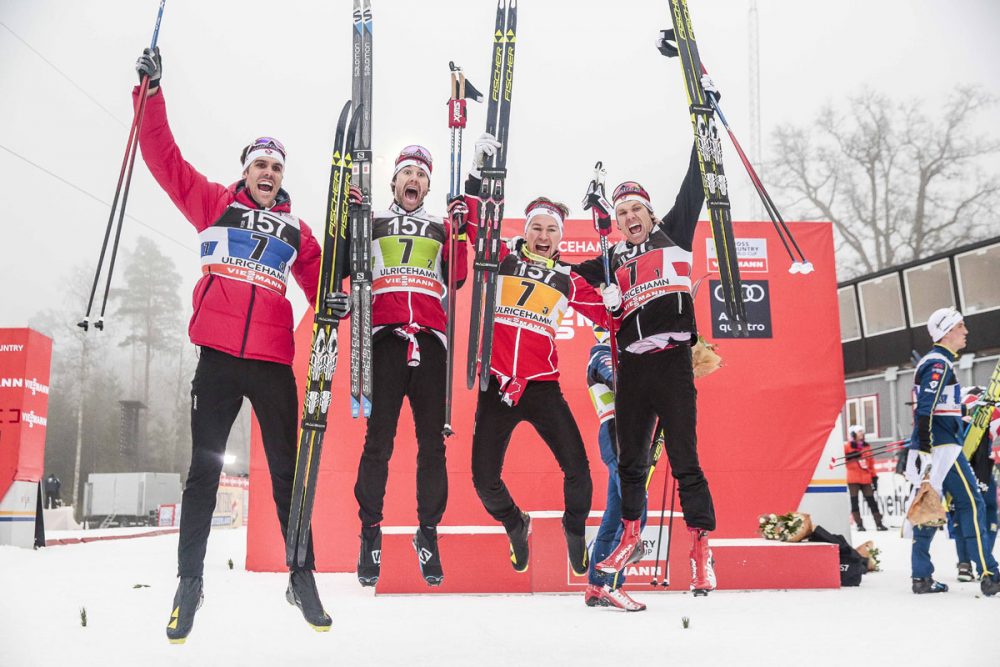
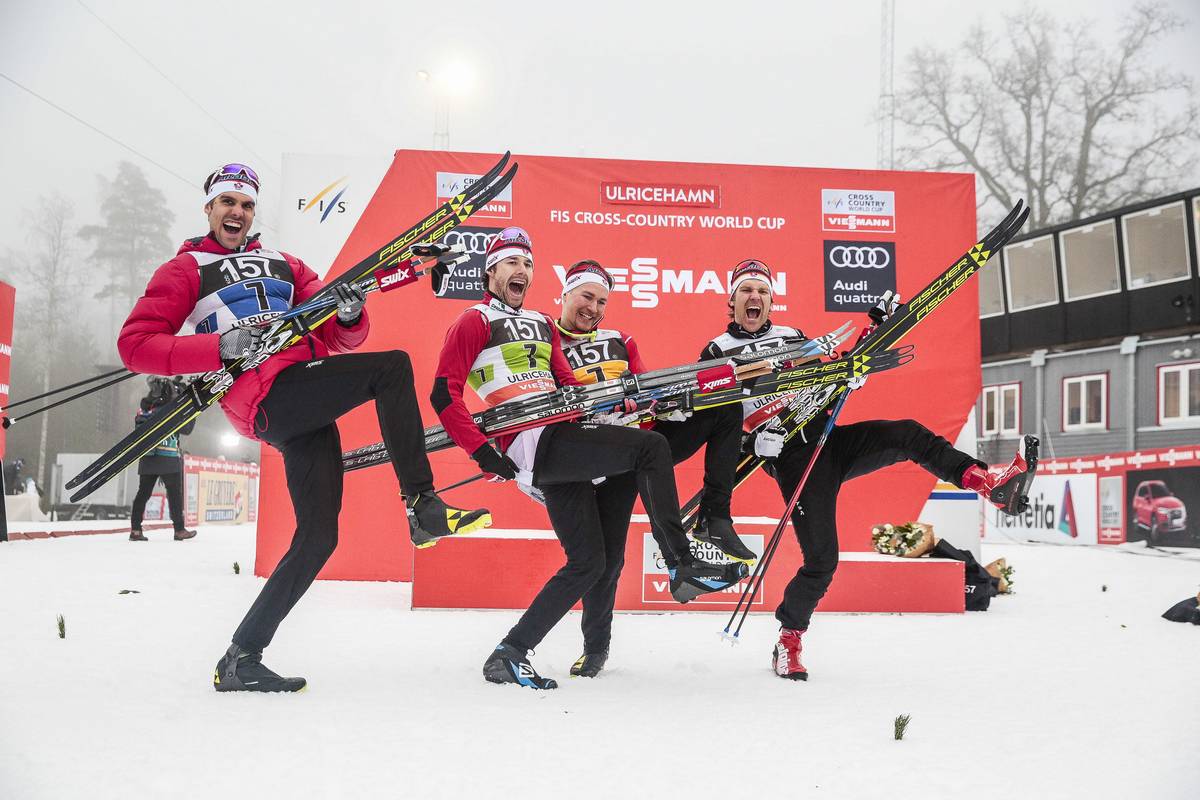
Left to right: Canada’s Len Valjas, Alex Harvey, Knute Johnsgaard, and Devon Kershaw after their historic third place finish in the 2017 men’s 4 x 7.5-kilometer team relay in Ulricehamn, Sweden. (Photo: Fischer/Nordic Focus)
This is the second part of FasterSkier’s report on the state of high performance cross-country skiing and athlete development in Canada. You can read part one here.
Cross Country Canada (CCC), as the national governing body for cross-country skiing in Canada has the difficult task of steering a rather large ship. The idea in steering the ship is to maintain a path requiring little quick and nimble maneuvering. Survey the landscape, mine the data, set a course, and sail. Along the way, there’s the ability to make slight adjustments for efficiencies, accommodate unforeseen changes.
Nic Lemyre (Photo: Norges Idrettshøgskole/Norwegian Sports Academy/)
“We’re thinking our starting point is to build a really strong relay team, on both the women’s and the men’s side,” Lemyre told FasterSkier. “We want to have five athletes, so that we can rotate with the fifth athlete and we’re never in a situation where we can’t field a strong team because one athlete’s injured or sick.”
According to Lemyre, the composite team must be derived of skiers who can hit specific individual benchmarks “[When] we have athletes that can start scoring points in every race they enter on the world cup, that’s a medium term goal,” Lemyre said. “From there, we start aiming for the top-15 for all athletes that are identified in that group.“
Part of the reasoning behind the relay vision is that for a skier to get a permanent spot on the World Cup, the athlete not only has to reach a high level, but also help raise four other Canadians up to that level. Lemyre believes this should foster cooperation and team spirit.
“It helps us meet goals of performance,” Lemyre added. “But also it helps us meet goals that are related to how to build a strong performance culture, where the athletes need to support each other, to learn from each other. They need to push each other. They need to push each other beyond limits they may have experienced before.”
How do we get there?
After PyeongChang, CCC appeared to have both the political will to start the painful process of another re-invention. However, that will came with a reduced budget with which CCC could support its future options.
The simplified model of corporate restructuring begins with terminating certain roles and concludes with creating new roles filled by new individuals near the top of the organizational pyramid. Often, in a medium or large corporation, most people will be shuffled around and only a few near the top will lose their jobs. The final step is to find a quick win to help the newly reshaped organization gain morale and unify.
In a small organization like CCC, everyone is near the top. While the process works well for the survival of the organization, it can be hard on individuals.
The change at CCC began with long-time High Performance (HP) director Tom Holland’s planned retirement. Lemyre was hired as a consultant to oversee the restructuring of the HP group. Shortly before Lemyre’s hiring, CCC eliminated some positions.
As Joel Quenneville’s recent firing demonstrates, proven ability and past success is not enough to provide job security during a reboot. (Quenneville was the NHL’s Chicago, Blackhawk’s head coach since 2008. During his tenure Quenneville lead the team to three Stanley Cups.)
On November 1st, CCC hired Erik Bråten as a new national team coach and modified Louis Bouchard’s title. Bouchard remains head of the National Training Centre in Mont Ste-Anne, Québec, with the added title and responsibilities of World Cup Head Coach.
Bråten, a recent Norwegian School of Sports Science graduate with a specialization in cross-country skiing, won the 2018 coach of the year award from the Norwegian ski federation. This hiring didn’t happen as quickly as some had hoped, but is considered the first win for CCC’s new structure.
“Erik has a strong sports science background applied to cross-country skiing,” Lemyre said on the phone. “His profile is unique in our environment. The fact that he’s young is really positive for us, because he’s open to this new experience. He comes with a solid base, and his excitement and his motivation, I think, will be great assets in applying that knowledge in the right culture in Canada. At an individual level, Erik is unique in working one on one with athletes. I think our athletes are going to really appreciate that.”
Along with bringing in new personel, Lemyre aims to improve sharing of training information in Canada. In Norway’s organizational structure, athletes and coaches are able to log hours and training plans on an interface organized by the Norwegian National Ski Federation. It’s a model and template Lemyre is intimate with.
“The fact is that we have a large country, and we can’t be with athletes every day of the year following them on site,” Lemyre said. “Now the technology is there to pool [training data] in a way that our coaching staff and the local coaches can communicate really well, But also as we’re building up our science team, we also have interaction with our different people involved in helping the athletes develop.”
Dahria Beatty racing the 2018 Holmenkollen 30 k freestyle mass start in Oslo, Norway. (Photo: Fischer/NordicFocus)
Another planned shift is to interchange athletes between Europe and Canada more often. For example, Dahria Beatty will start the season in Canada — a change encouraged by her coach Chris Jeffries and supported by Lemyre.
“This summer my coach Chris and I came up with a plan that allowed me to stay in Canada to start the season to build into the race season and then head over the Europe and race on the World Cup circuit leading up to World Championships in Seefeld,” Beatty said. “With this being the first year of the new quadrennial, it is the perfect time to fine tune some of those race details domestically before leaving for Europe mid-December. I am looking forward to racing part of the Tour de Ski then period 3 and hopefully finding my peak for World Championships and World Cup finals in Quebec.”
Lemyre’s concept is to allow athletes like Beatty to build into the early part of the season domestically and arrive in Europe at a higher level of race fitness.
“The way we scheduled the trips this year, giving some athletes the chance to prepare very well before they race on the World Cup,” Lemyre added. “I think some of them will be stronger when they show up on the World Cup, and also they’ll be able to sustain that level of performance over the time period they are on the World Cup. We will try to be a little more selective and well prepared when we show up, and then post really good results when the athletes are racing the World Cup.”
Jeffries stated that the stress of living abroad, a dynamic known all to well by North American World Cup skiers, can be counterproductive to a developing athlete.
“The last few years, our top athletes spent the majority of their time in Europe,” Jeffries said. “I think it stalled our development a little bit, because we’re always living out of a suitcase, and we’re always having to ski races where we’re trying to perform.”
Dave Wood spent 18 years as a national team coach. His time leading the team included the post-Nagano rebuild and managing athletes at the Olympics in Vancouver. His vision includes giving skiers more time to develop and less emphasis on being fast all season.
“Sara [Renner] had far less World Cup starts before she was top-15 at the Olympics than the people of today,” Wood said. “I think that this big argument about experience is valuable when you are looking for seconds. When you are looking for minutes, [World Cup experience] makes no difference.”
Will it Work?
The U.S. has been able to develop a strong women’s team built off Kikkan Randall’s determination to drag U.S. skiing to the top. Randall took inspiration and knowledge from Canada’s post-1998 rebuild where Scott, Renner, Milaine Thériault, Jamie Fortier and Amanda Fortier decided it was time to lead the charge.
American Kikkan Randall tucking during the women’s 10 k classic mass start at 2018 World Cup Finals in Falun, Sweden. (Photo: Fischer/NordicFocus)
In both cases, the athletes didn’t succeed alone. The “fantastic five” got the support of Holland, Wood, and many others. Randall also collected a large supporting cast, well documented by Peggy Shinn’s book ‘World Class’.
Laura McCabe, now a Methow Valley coach and two-time Olympian, spent most of her free time in Nagano with the Canadian women’s team because it felt like a group that had a vision and a willingness to support one another to collective success.
“It just shoots you up the ladder when you come back and you feel like you have a very safe place, you’re working on this goal together, you’re all in it together, and you’re there for each other all the time,” McCabe told FasterSkier. “I felt like the Canadian women were doing that. And now I feel like Matt Whitcomb has led that charge for the American women.”
While crediting Randall for starting the process, McCabe feels that the team’s work to be a team is the critical factor.
“They have goals, team goals and they have personal goals,” McCabe said. “They are always there for each other. One of their biggest goals is to basically keep their relationships positive and keep everybody moving forward. I think that is one of the number one reasons that team is doing well.”
In a conversation last May with FasterSkier, Yukon coaching icon Alain Masson spoke of the complexities of achieving success on the international stage. Simply possessing physical gifts, the aerobic capacity, the predisposition to tolerate and absorb high training loads, is no guarantee of success.
There’s the behind the scenes unglamourous work of nurturing athletes, remaining true to organizational core values, and feeding the system with money, intellect, and vision.
“Definitely, there’s a minimum set of physical characteristics that you need to perform at that level,” Masson explained to FasterSkier. “But you also need many characteristics, personality characteristics, that are vital. What Alex showed, and Sara Renner, and Chandra [Crawford] and Beckie [Scott]. I think athletes that combine both the physical and the mental characteristic at a time when the program works together, and everything lines up with the funding, good leadership, and everybody working together. That’s the difficulty, this is the issue, trying to get all of that together. As the women in the U.S. have demonstrated, when you have all of that lining up, it’s amazing what you can do.”
Canada’s Alex Harvey celebrating on the podium after placing second in the men’s 15 k freestyle mass start in Seefeld, Austria, for his best result of the 2018 World Cup season. (Photo: Salomon/NordicFocus)
Cross Country Canada (CCC) has begun a reboot process as the new Olympic cycle starts. Corporations call this a reset, a rebranding, a new direction, restructuring, and various other names that try to disguise the challenges and issues that come with enacting real change.
The reboot process traditionally starts with an acknowledgement that the current level of success, and that of the foreseeable future, doesn’t align with the goals or the potential of the organization.
Canada left PyeongChang with no medals at three consecutive Olympics, only one skier in the World Cup red group, and a perception that there was no obvious successor to Alex Harvey.
There are many people who, with the benefit of hindsight, believe that CCC allowed itself to be trapped by a combination of success and the Own The Podium (OTP) funding model.
The process of assigning blame for the past, called “blamestorming”in the corporate world, is one of the most effective ways to waste time and destroy morale without doing anything to improve the future. The “best practices” approach to a reboot starts with four apparently simple questions: How did we get here? Where are we now? Where do we want to be in five years? How can we get there?
While CCC does many things as a national sport body, this article will focus on high performance and the development system.
How did we get here?
After a disastrous 1998 Olympics in Nagano, CCC shrank to a full-time staff of five and endured a forced re-invention. Four years later, in 2002 at Salt Lake, Beckie Scott won all three medals in the skiathlon after the initial silver and gold medalists were caught doping. Sara Renner missed the B final in the sprint for 9th place.
Canadian Chandra Crawford in the 2011 team sprint in Dusseldorf, Germany. (Photo: Fischer/NordicFocus)
In 2006 in Torino, Chandra Crawford earned a surprise gold in the sprint while Scott finished fourth. Scott had earlier teamed up with Renner for a team sprint silver medal.
In 2010, there were no Canadian cross-country medals. However, there were signs of promise. Renner skied to her fourth Olympic top-10 finish. All four Canadians competing in the men’s skiathlon finished in the top-15. Devon Kershaw lost out in final kilometer of the 50 k to finish fifth, 1.6 seconds away from gold.
That post-Vancouver glow was possibly the point where CCC temporarily slid off the rails.
A number of Canadian sports fell victim to OTP incentives. A sport qualifies for OTP funding by having good prospects for a medal in the next Olympics. The money comes with strings attached, to ensure that resources are spent on improving the probability that specific individuals will podium. For smaller sports where the OTP money is a significant proportion of the sport’s annual budget, it is hard to make choices that put that money at risk. Choices like balancing the emerging athletes in the pipeline, while simultaneously supporting those athletes already at the top-end of the sport.
As a result, many sports have lost their OTP eligibility by losing the focus on development and the vision that qualified the sport for OTP in the first place. Some people put cross-country skiing in the list of sports that fell into this trap.
After 2010, the future looked bright. Harvey and Kershaw were World Champions in the 2011 team sprint. Kershaw was second overall in the 2011/2012 World cup. (A feat only equaled in North America by Scott and Jessie Diggins).
Harvey arrived at Sochi in 2014 as a medal favorite. He was fresh off a World Cup podium in Toblach the weekend before the 2014 Games began. Sochi ended poorly when Canada, along with Norway, couldn’t solve the difficult waxing conditions.
The results in PyeongChang were similar to 2002 numerically: Harvey was close to a medal in multiple races and Lenny Valjas collected 7th in the classic sprint. A medal would have changed the mood, but not overall situation.
Where are we now?
Post-PyeongChang, CCC believes Canada is not achieving the international results a country with plentiful snow and 37 million people is capable of.
The development system in Canada consists of the National Team, the official training centers (Centre National d’Entrainment Pierre Harvey (CNEPH), Thunder Bay National Team Development Centre (TBay), and the Alberta World Cup Academy (AWCA)), and the clubs. The ten provinces and three territories have teams, but don’t have a formal place in the development system as each of the thirteen regions approaches development support differently. In the last few years, the number of clubs actively recruiting and developing athletes while supporting a high performance team has increased. For our purposes, as no official name has been affixed to these clubs, the term ‘elite club’ will be used here.
In the past, all national team members were required to belong to a training center while developing athletes were encouraged to join.
“I can speak for many of the athletes, they thought that if they didn’t go to a training centre, then they might as well quit skiing,” Telemark’s coach Adam Elliot said. “It was that broad of a choice, they felt they had to choose between skiing and school immediately.”
The landscape is more diverse now, with more options. The examples that follow skew to Western Canada, largely because the coaches quoted brought teams to Sovereign Lake snow camps in May and November and were available for in-person interviews. Eastern Canada remains equally diverse in terms of its club offerings.
A common theme among the coaches and athletes is that each athlete’s needs are different, and he or she needs to find an environment that fills those needs. FasterSkier asked AWCA’s head coach Chris Jeffries how an athlete should choose his or her path to success.
“It’s such an individual, case by case thing,” he said. “I don’t have an answer.”
In 2017, a shift to allow more development paths resulted in new senior National Team member Gareth Williams staying at his home club, Telemark, in Kelowna, BC. Elliot described how it came about.
“Tom Holland approached us, for Gareth, and said we like what you’re doing in the Okanagan, and we want to keep Gareth there. We’re going to support you and your program to be able to support Gareth.”
Also in 2017, Julien Locke returned to his home club Black Jack while Russell Kennedy shifted to the new Team R.A.D., part of the Canmore Nordic Club.
To further illustrate the spectrum of options and pathways, FasterSkier contacted three Canadian athletes, each with a history of NorAm podiums and some international success, to discuss their ski-training choices. Dahria Beatty started at AWCA and has remained there, Evan Palmer-Charette started at TBay then recently moved to Team R.A.D., and Andy Shields has gone rogue.
Dahria Beatty en route to 20th overall in the Seefeld World Cup freestyle sprint for her season-best result in 2017/2018. (Photo: Fischer/NordicFocus)
“For me, I’ve been working with Chris [Jeffries] for six years,” Beatty told FasterSkier in November. “It works really well for me, and I have a good group of training partners where I am, that can push me everyday in training.”
AWCA is also the home training group for National Team skier Emily Nishikawa and two junior national team skiers. AWCA also benefits from its close proximity to a number of other training groups.
“For me, Canmore’s a location where I want to be training, where I want to be based out of,” Beatty said. “All the pieces fit well together for [me], it’s somewhere I think I can keep improving.”
Palmer-Charrette made a summer-time decision to change things up by finding a fresh environment in Team R.A.D.
“I think the best part of being on a training centre is the entire program is based around a small group of athletes of similar age which makes for a great training and racing environment,” Palmer-Charrette wrote. “I feel training centres, as they are, are best-suited for junior/u23 athletes and especially great for athletes who are a bit late to the game like I was at the end of high school and will really benefit from learning from other athletes on the day to day training life.”
Shields is no longer affiliated with an official team. He funds his skiing by painting houses in the summer and representing ski wax companies in the winter. Although he refers to ski racing as a hobby, he did end the last season as COC leader and will race period 1 of the World Cup.
“I don’t think I could have done this straight out of junior,” Shields wrote. “My time on Tbay is still having a huge positive effect on my ski career. Being on a team through my early years as a senior made it much easier to get a decent training base and set a couple good habits in place which are paying dividends.”
Shields did reflect and offer an alternative to how he might have changed his path to elite level skiing.
“If I could go back in time I would have gone the NCAA route straight out of junior,” Shields added. “College skiing in the States is a much better deal than a training center for people in their early twenties. You can go down to the States, get a degree, not pay a dime, and come out the other side with plenty of time to have a full-time ski racing career. I would have joined a training centre upon finishing with NCAA.”
The Canadian university system differs from the U.S. model, offering little money for sports. Heading south to the U.S. as a student-athlete remains an option for some Canadian skiers. Most athletes remain in the Canadian system to develop. With that in mind, FasterSkier asked why some athletes had chosen some of the Western based training centres.
Jeffries, who leads the AWCA, also noted how his program has evolved. There appears to be room at the AWCA for those with concurrent goals. The AWCA has partnered with the University of Calgary to allow AWCA athletes to work towards degrees.
“We’re always evolving our programming, and what it entails, and how we package it,” Jeffries said. “That’s why we have this new university program this year, because you just look at the popular decision making of graduated high school athletes.”
Elliott, based in the Okanagan, said his program offers athletes a well rounded experience too.
“You’ve got the trifecta,” Elliot said. “You’ve got access to education opportunities for post-secondary. We’ve got the university, UBC Okanagan, and the college. Most of the people who’ve moved here have gone to school. Secondly, it’s the Okanagan. Which is probably the best place to ski in North America, with skiing up and down the valley –with Nickel Plate, Telemark, [Kelowna] Nordic, Sovereign, and Larch Hills. The third is that you’re moving into a community of skiers: family, volunteers, everybody trying to make a go of keeping people in sport.”
Clearly the times have changed from a programming perspective and the past’s financial windfall for Canadian cross-country skiing.
“Probably the quad between 2010 and 2014, CCC had more money almost than it knew what to do with, ” Dave Wood, former National Team head coach, told FasterSkier in May as he finished up a long ski day. “Now, I think the budget’s still three and a half million. While it’s maybe low compared to what it has been, it’s a hell of a lot higher than it was in ‘99, by about four times.”
Former CCC High Performance Director Tom Holland spoke of those larger commitment from clubs during the Frozen Thunder races in October.
“There’s a lot more resources,” Holland said, referencing the increased numbers of coaches attending Frozen Thunder with their athletes. “One of the reasons clubs are more important now is that there are paid coaches at the clubs. That’s why training centres started in the 90’s, because you’ve got to have a coach, full-time.”
Thee deep question remains: what next for Cross Country Canada as it ponders a post-Alex Harvey scene? Better and more diverse options for Canadian skiers, like those modernizing their offerings to connect with the student-athlete, is a step forward. But fans of the sport, and of course Cross Country Canada, have short-term and long-term goals. No one wants to see another Olympic quadrennial transpire without the glimmer of medal potential at the international championship level.
“I think when Alex Harvey retires, mostly likely after next year with Lenny Valjas, it will be the end of an era having athletes being able to finish on the podium at World Cups, World Championships, said Alain Masson, Whitehorse head coach. “So definitely, the program is going to go into a real rebuilding phase with lots of young athletes, but no guarantee of success in the near future.”
Canada’s Devon Kershaw racing at 2017 World Cup Finals in Quebec City, where he finished 26th in the 15 k freestyle pursuit and 19th for time of day in the last race of the 2016/2017 season. (Photo: John Lazenby/Lazenbyphoto.com)
On April 26, Devon Kershaw posted a photo on social media of Alpina boots hanging on a line. The next day, he spoke on the phone with FasterSkier from his new home in Lillehammer, Norway, after a day of running around outside with his 15-month-old daughter, Asta Isabel.
Kershaw was tired, but in a good way. For the first time in 17 years, he was ready for a new challenge, a new focus and much more time with his daughter and wife, Kristin Størmer Steira, a former standout Norwegian skier.
Three years after Steira left professional cross-country skiing and pursued a career in business, starting with her master’s degree in business management, Kershaw is following suit and headed back to school. The 35-year-old Canadian hung up his boots to quietly announce his retirement after about a month of deliberation.
“I was really keen to keep ski racing, to be honest,” Kershaw said. “I had the motivation to go one more year, and in my head, I wanted to race one more season, but as things progressed in the spring, there were a lot of different factors that just made it seem like, oh man, it doesn’t look like it’s gonna be super realistic at this point.
“I struggled with that, when you feel like you still have more in the tank,” he continued. “But at the same time, it’s a bit of a double-edged sword in the sense that it’s been a fantastic career.”
Kershaw was quick to reflect on his roots as a kid growing up in Sudbury, Ontario, “a mining town with a small but passionate skiing community,” as he put it. He also reiterated how proud he was to represent Canada for 17 consecutive seasons, first as a junior national team skier for two seasons starting in 2001, then as an under-23 national team member in 2003, and finally as a full-fledged World Cup Team member starting in 2004.
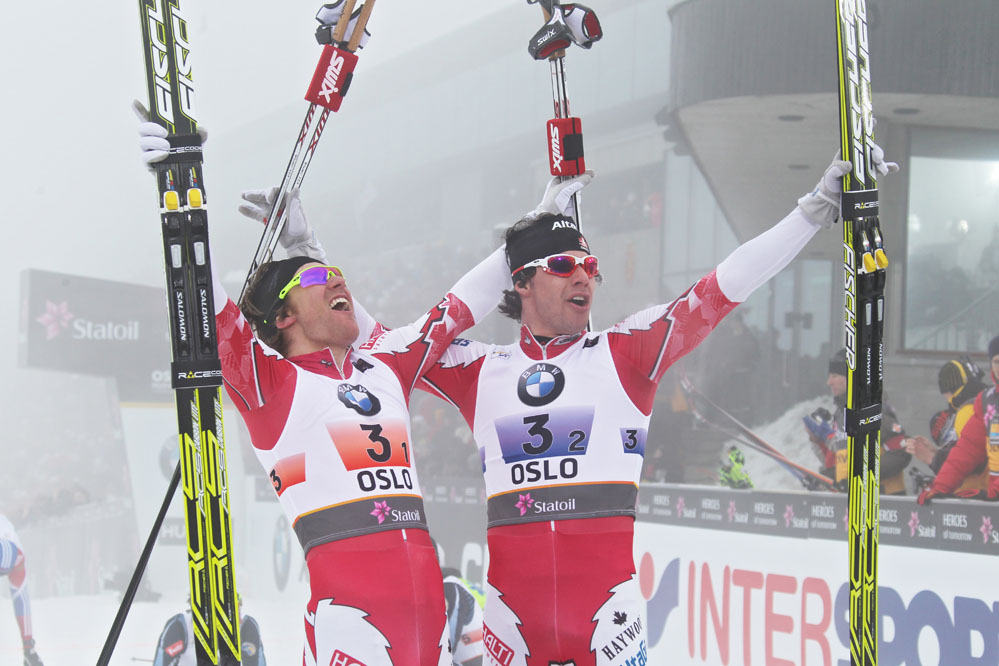
Devon Kershaw (l) and Alex Harvey celebrate their 2011 World Championships gold in Oslo, Norway. (Photo: Fischer/NordicFocus)
His career included three World Cup wins and 14 podiums, and a gold medal at 2011 World Championships with teammate Alex Harvey in the classic team sprint. Kershaw finished the 2011/2012 World Cup season ranked second overall and second in the distance rankings.
When he reflects on those accomplishments, he still has a hard time believing that all happened to him.
“So instead of focusing on being bummed at the situation or a bit frustrated with the state of things in Canadian skiing right now, I have to look back with a smile,” Kershaw said. “I feel just so privileged and grateful to have had the opportunity to be part of a real movement for men’s skiing in Canada.”
Kershaw said he was left with unanswered questions this spring during a transitionary period at Cross Country Canada (CCC). The team’s budget was undetermined, camps were not yet set in stone, and Kershaw said his decision — which he wanted to make by May 1, the start of the new training year — became about energy management.
“Part of managing your energy properly is putting all of your energy and focus into training, and if you’re being pulled with uncertainty or being stressed about uncertainty, that will come back, the World Cup will exploit that,” he said.
According to CCC Chief Executive Officer Shane Pearsall, High Performance Director Thomas Holland had planned to retire this past March, yet has stayed onboard as an advisor until CCC fills the position. Pearsall said the hiring process is still ongoing and will hopefully be wrapped up by next month. He confirmed that CCC has yet to finalize its budget and doesn’t anticipate being able to do so until a government minister signs off on the amount from Own The Podium (OTP), one of its primary funding sources, in July. Pearsall explained that they expect to have a better sense of national-team finances in mid to late June.
Typically, the team’s budget is determined in May, but because of necessary “quad reviews” following the Olympics, which took place before CCC met with OTP, the process was delayed by about a month. Pearsall did not elaborate on how significantly the budget would be decreased from last year, but said, “It’s certainly tighter than last year.”
Kershaw said he needed to pay about $25,000 Canadian dollars in team fees if he wanted to continue racing this year, up from $15,000 last year. That didn’t cover the cost of living, which he figured to be around $55,000 Canadian, for a grand total of $80,000.
“The financial burden is big, and moving forward the financial burden went from big to 100 percent paying for every cost,” Kershaw said. “So all travel, accommodations, everything. … I’ve just been in the sport a long, long time, and from a directional standpoint, I’m not sure we’re moving in a direction that will yield sustainable results at this point in time, but I understand it is difficult when you’re under such financial duress to create a sustainable program. But from a vision standpoint, I think there’s a lot of questions that remain unanswered, and it’s late in April. The fact of the matter is the rest of the world has all of the holes plugged — if they have holes in their boat — because May 1 is the new year of every ski program. And we’re just constantly slow and off the mark with that.”
Budget cuts had been expected as Canada’s World Cup Team missed performance benchmarks throughout last season. The team finished 2017/2018 with just two men scoring World Cup points (top 30) in distance races: Harvey and Kershaw. Two men (Harvey and Julien Locke) scored in World Cup sprints. On the women’s side, Dahria Beatty landed one World Cup sprint top-30 last season, and Cendrine Browne was the top Canadian woman in a distance race with a 27th place for time of day in the last race of the season.
Meanwhile, Alex Harvey led the team with four World Cup podiums, including third overall in the 2018 Tour de Ski, and a top result of fourth place at the 2018 Olympics. He finished his season in fourth in both the Overall and Distance World Cup standings. But Harvey’s results alone weren’t enough to buoy the whole team for another winter.
“Throughout my entire career, it’s almost unfathomable to think that the season ends and that’s the stat line,” Kershaw said of the team’s overall results. “It wasn’t so long ago that we had over 16 World Cup podiums in a season. The truth hurts, as [former Canadian coach] Tor-Arne Hetland once said, but things go in waves and this is the reality that we live in right now.”
Despite the prospect of self-funding, Kershaw didn’t feel pressed into retirement. Several of his teammates have decided to retire as well, including Graeme Killick, Jess Cockney and Knute Johnsgaard, but Kershaw said they weren’t forced, either.
“You can choose to work and you can choose to hustle for money; there are ways to make it,” he said. “No one’s forced into it. I could keep skiing if I wanted to, but I think the stark choice you’re faced with is, maybe perhaps some people are like, I can’t really see a path to international success currently, and that’s what I think is sad…”
‘A dream scenario’
When Kershaw moved to Canmore, Alberta, in 2001 and entered Canada’s elite skiing scene, Cross Country Canada (CCC) was entering a fruitful period. At the 2002 Olympics, Beckie Scott was proclaimed winner of the women’s 10-kilometer pursuit (now called the skiathlon), becoming the first North American woman to win an Olympic gold. At 2005 World Championships, Sara Renner earned a sprint bronze to become the first North American woman to medal at World Championships. Scott and Renner teamed up for silver in the team sprint at the 2006 Olympics in Turin, Italy, where yet another Canadian woman, Chandra Crawford, won the individual skate sprint for Canada’s second-straight gold in as many Winter Olympics. Scott finished that 2005/2006 season ranked second overall in the World Cup, just 16 points behind Norway’s Marit Bjørgen in first.
Devon Kershaw (r) with Graham Nishikawa in 2013. (Photo: Devon Kershaw)
Kershaw made his Olympic debut in 2006.
“Coming into Torino, we were quoted in the newspaper as being like the world’s most anonymous men’s ski team,” he said of the Canadian men’s team that year. “We weren’t really ‘on the map,’ but I’ve just been so grateful and lucky to have such a great group of guys around that really welcomed me in.”
He credited his former roommate and teammate Chris Jeffries as well as other Canadian competitors of his time, including George Grey, Gordon Jewett, Dan Roycroft, Sean Crooks, Dave Nighbor, Phil Widmer, Brent McMurtry, and Graham Nishikawa (who’s still racing), for having a major impact on the formative stages of his career.
“[There were] so many athletes in Canmore that tried hard, wanted it bad, and loved ski racing and training,” Kershaw reflected. “That’s a dream scenario for a young athlete to come into a community like that and be welcomed into that environment.”
Less than a month after the 2006 Olympics, he notched his first World Cup podium by placing third in the Borlänge, Sweden, skate sprint. In doing so, he became the first Canadian male cross-country skier to reach the podium since Pierre Harvey (Alex’s father) in 1988 and the first ever to medal in a World Cup sprint.
“I had no idea who Pierre Harvey was,” Kershaw said of his younger self.
Pierre Harvey had previously won the 1988 Holmenkollen 50 k as well as two other World Cup distance races and the Norwegian Birkebeiner, making him the most successful Canadian male skier before Kershaw.
“He could walk into the room and I would not recognize him,” Kershaw continued. “Even his results, I had heard that he had five World Cup podiums and that seemed pretty cool, but that’s all I knew about him.”
Kershaw’s second World Cup podium came early in the 2006/2007 season in a skate sprint in Munich, Germany. That same day, Crawford — whom he was dating at the time — placed third in the women’s sprint.
Devon Kershaw after being tagged by his Canadian teammate Alex Harvey (l) in the freestyle team sprint at the 2010 Olympics in Vancouver, B.C. They went on to finish fourth.
At his second Olympics in 2010, Kershaw finished fifth in the 50 k classic mass start for the best individual Olympic result for a Canadian male nordic skier. That record stood until Alex Harvey, who burst onto the World Cup scene in 2008, bested it with a fourth place in the 50 k classic at this year’s Olympics in PyeongChang, South Korea.
Kershaw and Harvey also teamed up to place fourth in the freestyle team sprint at the 2010 Olympics.
Kershaw’s first World Cup win came in a skate sprint during the 2011 Tour de Ski. He finished that Tour in seventh, and the next year, came back to place fourth overall in the 2012 Tour de Ski (TdS). Kershaw started all 12 editions of the TdS, a record he shares with France’s Jean-Marc Gaillard.
Harvey scored his first individual World Cup podium in a 50 k classic in 2009 and won his first World Cup race (a 3.3 k freestyle prologue) at the TdS in 2012.
“Then next thing you know, Alex and I are sharing a podium on some World Cups,” Kershaw reminisced. “Two Canadians on one podium in the World Cup, like, really? And then you win World Championships and I’m on the overall World Cup podium, and then next thing you know, Alex has been on the overall World Cup podium a few times and also now 50 k world champion. It’s crazy. It’s insane. From nothing. From no results. The journey has just been amazing. … I never would’ve thought Canada would, I mean, how could you? We had Pierre Harvey and that’s it in, like, a hundred years of international ass-kicking.”
Kershaw credited his initial World Cup breakthrough as a 23-year-old skier in Borlänge to Dave Wood, Canada’s national-team coach at the time.
“I came into a team with a coach that you could call at midnight. He’d do anything for you,” he said of Wood. “There was no way I would’ve stepped onto the podium in 2006 without him, and Mike Cavaliere, too, my first-year senior, Mike was my coach. We had staff that was just committed to the core for the cause and I’m incredibly grateful for that.”
‘A hell of a season’
Canadian head coach Justin Wadsworth (r) giving splits to Devon Kershaw at 2012 World Cup Finals in Falun, Sweden.
Of his coaches, Kershaw gave special credit to Justin Wadsworth. A three-time U.S. Olympic cross-country skier who became Canada’s head coach in the spring of 2010, Wadsworth coached Kershaw for five seasons, and the two developed a close friendship.
“When Justin came into the national team, the level of professionalism and excitement and freshness that he brought … I don’t know if you call it luck or happenstance or just the right place, right time,” Kershaw reflected, alluding to his 2011 World Championships gold with Harvey and his 2012 Overall and Distance World Cup podiums. “Justin’s best results as a coach were me and my best results as an athlete were when I was coached by Justin. Talk about an amazing relationship there.”
“The main thing that I really appreciated with Devon, and I think he would say the same thing about me, is that we could be honest with each other and talk about hard things and enjoy the good times when we had them,” Wadsworth said on the phone last week. “… It’s cliche, but when I was talking to Devon the other day about his retirement, it’s not about the medals or the performances or whatever, it’s about your times together on the road.”
One of Kershaw’s biggest moments came at those 2011 World Championships in Oslo, Norway, where he and Harvey beat out Norway’s Petter Northug and Ola Vigen Hattestad by 0.2 seconds for gold on the Norwegians’ home turf. They had done so after Kershaw lost one of his skis early in the race, Wadsworth pointed out.
“His ski fully came off and he had to put it back on and get back into the race,” Wadsworth said. “Just the whole day was pretty incredible. That was a great, great opportunity for us, and the guys cashed in.”
Devon Kershaw (l) and Alex Harvey with their World Championship gold medals at the 2011 World Championships in Oslo, Norway.
In a difficult-yet-strategic move to conserve for that race, Kershaw and Harvey both sat out the 15 k classic the day before.
“With anybody else running the ship, there’s no way I would’ve trusted that [decision],” Kershaw said of Wadsworth’s call. “But I trusted Justin’s leadership and we went all-in, and the next thing you know we won World Championships. I mean, are you kidding me? How can you get a better start to the next quadrennial? And Justin as a first-year head coach of a national team, that’s gotta go down as maybe the best season ever for a first-year North American coach of a national-team program.”
He and Wadsworth reiterated the crucial foundation that Wood had laid.
“Dave Wood had done a really good job with the athletes leading into that period, mainly focused on building a big base and doing a lot of hours and also doing a lot of time at altitude,” Wadsworth explained. “And when I took over the position, I saw that both Alex and Devon were really primed and had a really good response rate to altitude, and all we had to do was fine tune a little bit of strength training and intensity. I was really excited to work with both those athletes and saw that they had a lot of potential.”
For Kershaw, Wadsworth’s “American swagger … was magic for me,” he said. During the 2011/2012 season alone, he stood on the podium 10 times, with four top-three finishes in seven races at the 2012 Tour de Ski.
“It was a hell of a season for me,” Kershaw said.
‘Best sand-digger ever’
He went on to compete at two more World Championships and two more Olympics. This past season, Kershaw finished in the top 30 in eight World Cup distance races, with a top result of 19th in the 30 k skiathlon in Lillehammer, Norway. While struggling with lung issues, he finished 26th in the 50 k classic at the PyeongChang Olympics.
Devon Kershaw racing to 25th in the World Cup 15 k classic this past March in Lahti, Finland. (Photo: Fischer/NordicFocus)
“We worked to get that under control and it was manageable but it never felt good like it felt prior to 2015,” Kershaw said his health over the last three seasons. “In PyeongChang, it was a calamity of bad luck. When we got there it was minus 20 [Celsius], and this makes me sound so soft, because I’m from northern Ontario so you’d think I’d know, but it was really cold. I did some intervals and it aggravated my lungs and it was super windy and dirty and a lot of sand blowing around, and that really flared up my asthma to the point that I was wheezing badly.”
His breathing troubles also affected his sleeping and took most of the two-week Olympics to manage. At one point, he had a chest X-ray to make sure it wasn’t pneumonia.
“It was sporting asthma,” he said. “… It took all the way to the 50 k to kind of get it 70 percent.”
While he noted he was left wanting more from a performance standpoint at both his final Olympics and in his final season, Kershaw also acknowledged that he’s his biggest critic.
“That’s been probably the biggest detriment to my entire career; I’m the best sand-digger ever,” he said. “I am disappointed in the sense that I work really hard and I train hard and I prepare well, and it didn’t go exactly as planned. … When you’ve competed in the top 10 for as many years as I have and on the podium, of course that becomes your bar that you hope to achieve, but at the same time … when you’re in the top 30 in the results page, you’re in the race at least. And I’m proud of the fact that in almost all classic races, not every, but most, I was in the top 30 and ‘in the race’.
“Am I satisfied? In my life I’ll probably never be satisfied, that’s just how it goes,” he added with a laugh. “But am I somewhat proud of maintaining a fairly competitive level? Yeah, absolutely.”
Wadsworth reflected that Kershaw was one of the best athletes he had ever seen, even “physiologically as good as Alex [Harvey]” at the peak of his career.
Left to right: Canada’s Devon Kershaw leads his teammate Alex Harvey and U.S. Ski Team members Noah Hoffman, Erik Bjornsen and Simi Hamilton during a Level 3 interval skate session up Snake Creek Canyon in Midway, Utah, during their respective teams’ 2016 training camps in Park City, Utah. (Photo: Matt Whitcomb)
“Devon’s a very intelligent person and sometimes he might’ve overthought things and lacked in confidence, and as a coach that’s really frustrating to see because you know how good they are physically,” Wadsworth said. “And when he was on mentally, too, in training, when he was at his very best, he had total confidence and could destroy anybody in any workout.”
He recalled a hill-bounding workout with the Norwegian team in which Kershaw was literally leaps and bounds ahead of everybody else — even Martin Johnsrud Sundby and Russia’s Ilia Chernousov, who joined the training session.
“He was just shelling everybody,” Wadsworth said. “So when Devon was at his best like that and mentally confident and relaxed, he was a real force of nature. Unfortunately that didn’t always translate into the racing season, but in 2012 he put it all together and had a tremendous year. … If he had the confidence the whole time, he would’ve been almost unbeatable, in my opinion, but it takes the whole package all the time, and he was among the greats there for a while.”
‘Younger, faster, better dog’
And then there was Harvey, another one Kershaw’s of his best friends and longtime roommates.
“I’ve spent more nights in a room with him than my wife or any girlfriend I’ve had,” Kershaw joked. “… He was eager to learn, he chased me for years, he was always a hard worker, too. He trained really hard, he believed in himself, and I still am in total awe of that. I’ve never met anybody as confident as him. It’s too bad that didn’t rub off on me, but that’s been great to be around.”
He likened Harvey’s addition to the team as a family adopting a puppy.
“You know when your parents get a puppy because your dog is 10 years old? He’s kind of slowing down a little bit and then you see that old dog get fired up and run again and jump around and play; that’s me,” Kershaw said. “And I’m so grateful that my owners got a younger, faster, better dog to hang out with because it was so inspiring.”
Several times over the last few years, Kershaw has said that witnessing Harvey make Canadian history has been one of his biggest reasons for staying in the sport.
“He, for sure, has kept me in this probably longer than I should’ve,” Kershaw said. “I just love traveling with him and seeing what he can accomplish and training with him and seeing that professionalism.
“There’s no question he’s the best Canadian skier ever, that’s not even close,” he added. “… I just feel so honored that I got the chance to see it all happen, from his last-year junior when he did his first World Cups and then all the way though I’ve been with him.”
The Canadian men’s relay after placing third in January 2017 in Ulricehamn, Sweden, for Canada’s best-ever World Cup result in the 4 x 7.5 k relay. From left to right: Lenny Valjas, Alex Harvey, Knute Johnsgaard, and Devon Kershaw. (Photo: Salomon/NordicFocus)
In an email, Harvey explained that he and Kershaw first met in the fall of 2005 at a training camp at Sovereign Lake, British Columbia. Harvey was on the junior team and Kershaw a senior, but the whole team stayed at the same hotel.
One morning, Kershaw accidentally took Harvey’s poles from the hotel. Harvey had to track him down on the ski trails to get them back.
“That was the first time I talked to him and to me it’s just perfect because that’s so Devon,” Harvey wrote.
Later that season on March 7, 2006, Kershaw made history with his first podium. That same day, Harvey won his first national title in the 10 k classic at Canada’s senior national championships as a 17-year-old junior.
“I guess our friendship was meant to be before we even knew it!” Harvey wrote.
When the two became teammates, Harvey immediately took to imitating Kershaw, both in training and racing.
“He took me under his wings and he has a big part in the athlete I became today,” Harvey wrote, likening Kershaw to a big brother. “I feel very privileged to have spent all that time with him. I think we became such close friends because we are both very driven athletes and we don’t accept any compromise. We’re both huge fans of our sport, ‘nor-dorks’, so we also love to talk about everything from altitude training to who is seeing who on Tour.”
Kershaw’s decision to retire didn’t surprise Harvey.
“I think it’s a mix of a few things,” Harvey wrote. “… Probably this biggest reason, he has a little girl at home. I know this winter was extremely hard on him. Not seeing Asta Isabel was pure torture, I think I would have done the exact same if I was him.
“I will miss a lot of things about Devon,” he added. “He’s always there to give good advice about everything and anything. He knows so much about all that is going on in the world, probably the most well-read person I know. He’s kinda my news source. I’m still amazed by how indecisive one can be. This brought a lot of laughter throughout the years. I have so many memories from the last 10 years with him. Seeing him dominate the World in 2012 was just amazing but also very eye-opening for me. He raised the bar for all North American skiers that year and I’m very thankful for it.
“We both lived great emotions in high accomplishments and huge disappointments. I’d like to think I helped him get through these upsets and I can say he definitively helped me get through mine. A page turns in the life of Devon Kershaw but knowing the man, I’m not worried about what’s gonna come next.”
Without Kershaw, Killick, Cockney, and Johnsgaard on the men’s team, Harvey acknowledged that next winter will be “very different” for him on the World Cup.
“All these guys are calling it a career and I’m super proud of what all my friends accomplished,” he wrote. “I’m excited to try to help the next generation step it up and fill the shoes of the previous generation. … Also, after 10 years on Tour I’ve made some friends on other teams so I’m not too worried. I’m just excited to step into a bit of a mentor role for our next generation.”
Onto the Next
As for Kershaw, he didn’t rule out coaching future generations of Canadian skiers, but he said he was focused on getting an education first. In just over a week, he’ll start a course that requires 20 hours of classes a week — all in Norwegian — for what he anticipates will take six months. The course is essentially an advanced version of Norwegian as a second language, and foreigners must pass it to pursue a degree in Norway.
After that, Kershaw plans to apply to universities “and hopefully study forever,” he said with a laugh. “Not forever, but study, and I want to stay involved in skiing in any way I can and I want to help the next generation get better.
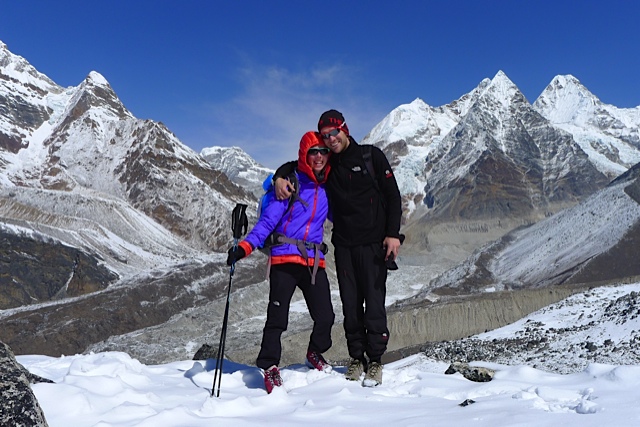
Kristin Størmer Steira (l) and Devon Kershaw during a day hike on one of their acclimatization days. The couple got engaged in 2014 after summiting Mera Peak during a three-week trek in Nepal’s Himalayas. (Photo: Devon Kershaw)
“First things first, I have to get my Norwegian at a level where I can sit through a lecture and write an essay at a decently good level, at least good enough that my wife doesn’t have to rewrite it, she can just correct it,” he explained.
Asked what he’d like to study, Kershaw said medicine, specifically orthopedic surgery, has always intrigued him. (As a junior skier, Kershaw took undergraduate classes at the University of Calgary until 2006, but those credits have since expired.)
“But now I’m 35 and I’m going to have to do all of this in my third language,” he acknowledged. “So for now, I’d say that that’s still my first choice and I’m exploring what it would take.”
If not medicine, he’d like to pursue a degree in “some kind of science physiology, and then in a totally shifted way, if I have a panic attack and be like, ‘Science is too hard after ski racing forever,’ then I am interested in economics and economic theory and business to some degree…”
Regardless of which path he choses, he’ll be doing it in Norway, Kershaw said.
“I don’t mind the challenge. … It’s intimidating in a way, but it’s also really exciting,” he said. “Kristin’s family [who lives in Lillehammer] is just so fantastic and to see how happy my daughter is here, to have her family, to have family around her and everything for the short term, and I hope to be educated in Norway.”
Asked if he’ll jump into any ski races this season, Kershaw was quick to respond, “No.” But he will continue skiing. The beauty of the sport and the struggle, as he put it, is what’s kept him in it so long.
“Imagine just having a singleness, a purpose, a goal that’s just there in your face and then you get to wake up every day and do the things you absolutely love to do,” he said. “… I adore cross-country skiing. I just think it’s such a peaceful, beautiful exercise, and the technique and the flow of it all. … You’re just skiing through the woods peacefully, gliding over snow, over all the terrain you can cover. It’s a beautiful, zen-like endeavor, and I think that’s what’s kept me in it this long. And the people, the Canadian ski community, the world ski community, really. I’ve met so many inspiring people and beautiful people and worked with a lot of absolute experts and I’ve had brilliant teammates and brilliant coaches.”
And because of skiing, he met his wife and started a family in Norway.
“I have a daughter with a woman that I love and respect and am in total awe of every day of my life and without ski racing there’s no way that would’ve ever come to fruition,” he said. “There’s the biggest gift right there, as cliche and Hallmark as that sounds, it’s true.”
Northern lights at camp on one of two nights during the 2018 Arctic Circle Race in Greenland. (Photo: Arctic Circle Race)
Canada’s Dahria Beatty closed out her World Cup season with the rest of her international-racing peers on March 18 in Falun, Sweden. After three straight days of races, the 24-year-old Whitehorse, Yukon, native finished World Cup Finals in 54th overall.
Five days later, she endured a three-day 160-kilometer classic race in Greenland, 65 kilometers north of the Arctic Circle. And Beatty didn’t just survive the 22nd-annual epic adventure, she won it.
Canada’s Dahria Beatty racing to first among women and fifth overall in the three-day Arctic Circle Race in late March in Greenland. (Photo: Arctic Circle Race)
In her first Arctic Circle Race, Beatty was the first woman to complete all 160 k in the backcountry near Sisimiut, Greenland, spending two nights in tents with temperatures below -28 degrees Celsius (-18 Fahrenheit) and fueling herself with dehydrated meals and a jar of peanut butter.
The first woman and fifth overall across the line, she finished on March 25 with a total ski time of 14:19:15 hours. Her dad Craig Beatty completed the race as well, finishing 18th overall and second in his 50+ age group.
“In 2005, my dad went with some of his friends to do this race and he just loved it,” Beatty told FasterSkier in a phone interview earlier this month. “At the time I was 11 years old and he came back and just thought Greenland was an amazing place, and a place that I should experience.”
They decided that they would do the race together when she was old enough to compete, 18 or older by the race’s standards. When she looked at her race schedule this year, which kept her in Europe until late March, Beatty figured a stop in Greenland on the way home to do what organizers dubbed “the world’s toughest ski race” was a great opportunity.
She arrived in Greenland two days before the race and spent two days there after, then recovered in Iceland for six days with her dad.
Craig Beatty at the finish of the 2018 Arctic Circle Race in Greenland. He finished second in his age group. (Photo: Dahria Beatty)
“It was really a great trip, to be able to be with my dad,” Beatty recalled. “We haven’t done a trip like that in a long time, so it was a lot of fun and I really enjoyed it.”
The race itself entailed three back-to-back marathon distances of skiing 50 kilometers or longer, with the longest day being 57 k. Competitors crossed a finish line each day, with Beatty being the first woman on each day, and third overall on Day 1, fifth on Day 2, and finally fifth on Day 3. She noted that her dad, whom she met up with each night at camp, skied a more consistent race.
“His time on the first day and the last day, which were similar distances, were only separated by 15 minutes or so, whereas I was over an hour slower the third day,” Beatty recalled. “I maybe went a little too fast off the gun, but other than that it was a ton of fun. The first day I was skiing in second and third the entire race, men included, and dropped off a little the second two days…
“It’s definitely a totally different event than doing something that’s a one-day event, or something where you can go inside and sleep in the warmth at night,” Beatty added. “It definitely is more a test of survival, which is a cool thing to experience, and we were a little bit unlucky in the fact it was so cold.”
At the same time, racers experienced abundant sun and “bluebird skies”, she said.
“We had amazing views of the mountains, of the fjords, each day we were racing,” she said. “And at night the sky was lit up with northern lights.”
Dahria Beatty at the start of the 2018 Arctic Circle Race in Sisimiut, Greenland. (Photo: Arctic Circle Race)
At the end of each day, racers had access to two- or three-person tents with a thermal groundsheet for sleeping, according to the Arctic Circle Race website. They were provided with a saucepan, frying pan and matches to cook their own food, while organizers supplied hot and cold water as well as coffee and tea. Racers had to wax their own skis and use outdoor “earth closet” bathrooms. There were no showers, beds or cell service, but that all made it part of an experience Beatty won’t forget.
“The volunteers in the race were absolutely incredible,” she said. “The second and third day, when I was absolutely exhausted, they were standing out there all day [at the feed stations] while we were racing, making sure we had food and hot beverages to drink, and cheering us on.
“On the second day, we skied down off the mountains onto a fjord, and at the bottom, my hands were so cold that I couldn’t get my gloves off myself,” she continued. “When I made it to the feed station, the volunteers were there and they helped me take off my wet, cold gloves, and grab my warm mitts out of my backpack and help me put them on. There’s just a really amazing atmosphere around the race. The entire community of Sisimiut looks forward to it each year, and it seems like half the community comes out to volunteer for this race … so that was really cool.”
With a population of about 6,000, Sisimiut is both a small fishing town and the second-largest city in Greenland. It’s also the country’s most northern ice-free town in the winter and most southern town for dogsledding. In many ways, Beatty said it felt like home.
“It was really cool to experience their culture and see so many ties to the Canadian North,” she said. “… I would love to go back in the summer. I met some amazing people from there and they were telling me how different it is in the summertime. It’s definitely a place I’d like to explore more…”
Going the Distance
In her career, Beatty has completed four 30 k races, including a third place in the 30 k freestyle mass start at 2015 Canadian Nationals, 34th in the 30 k skate at 2017 World Championships, and 49th in the Holmenkollen 30 k skate at this year’s World Cup in Oslo, Norway.
Dahria Beatty racing the Holmenkollen 30 k freestyle mass start on March 11 in Oslo, Norway. (Photo: Fischer/NordicFocus)
But 50 k? That’s something she’d like to do more of after completing distances of 52.2, 57.1 and 51 k on three consecutive days in Greenland.
“I had a lot of fun racing this 50 k, and it was definitely slightly different than a 30 k, but I went at it with the same mentality,” said Beatty, who is best known for her World Cup top-30 (and even a top-15) sprint results.
“I mean, I’ve had better results internationally in sprint, but when I was a junior, I was always better at distance skiing,” she pointed out. “Right now I’d say I’m usually stronger in sprinting, but a lot of the times those long-distance races, especially in a loppet-style format lend themselves well to sprint athletes. I think there’s a lot of times you see people that are considered sprinters do well in 50 k and 30 k events, more so than they would in a 15 k. I think they kind of almost lend themselves to each other in a very strange way.”
As she progresses as a skier, Beatty, who made the jump to Canada’s World Cup B-team last spring, said she’s aiming to be more of an “all-around athlete.”
“I’ve scored World Cup points in a distance race once, and I’d definitely want to do it again, many times before my career is over so it’s definitely something that in my training. I’m not trying to train just to be a sprinter. I’d like to have a balance.”
Last season, Beatty spent most of five months on the European World Cup circuit. Pre-selected to the 2018 Olympic squad, she returned to Canada in late December for training and racing in Mont Sainte-Anne, Quebec, where she won both sprints at the Canadian NorAm/Olympic trials. In January, she headed back to Europe.
Dahria Beatty en route to 20th overall in the Seefeld World Cup freestyle sprint for her season-best result in 2017/2018. (Photo: Fischer/NordicFocus)
On the World Cup, Beatty achieved her best individual result of the season — 20th — in the freestyle sprint in Seefeld, Austria. She competed in five events at the Olympics, placing 13th with her teammates in the 4 x 5 k relay as well as freestyle team sprint.
Asked about the highlight of her first Olympics, she said it was that team sprint with Emily Nishikawa.
“For me, the team sprint was more than just racing for Canada,” Beatty said. “Emily and I are both from the Whitehorse Cross-Country Ski Club and the Yukon Ski Team so I was racing for the entire country, but also for my hometown, my club, the roots of where I began skiing and that was really special, knowing I was tagging off to my teammate who grew up through the same program as me and we both could get to this point together was absolutely amazing. We had a good race, and for me, individually, I felt the best that day of the Games and was able to carry a lot of motivation through the race and it was really fun to tag off right in the mix.”
Racing in the heats in Seefeld was another season highlight.
“… The course in Seefeld is so much fun; it’s such a beautiful location,” she said. “We had a perfect sunny day and knowing that World Championships will be there next year, it was really fun to kind of prepare to figure out what tactics worked and didn’t, and look forward to the next season.”
Canada’s Dahria Beatty (l) and Emily Nishikawa after placing 13th in the freestyle team sprint at the 2018 Winter Olympics in PyeongChang, South Korea. (Courtesy photo)
Under the guidance of Alberta World Cup Academy Head Coach Chris Jeffries, Beatty has typically spent most of her offseason training in Canmore, Alberta. While she said “there’s lots of change going on right now in Canmore” in terms of her training plans this year, Beatty was confident she’d be training with Nishikawa — as she has for the past five years. She also plans on having a strong training group of women, both national-team and non-national team members, to train with in Canmore.
That group has been gaining momentum and traction on the World Cup scene, with Cendrine Browne scoring her first World Cup points in the last race of the season with the 27th-fastest time of day in Falun’s 10 k freestyle pursuit. Beatty observed that the cohesiveness of the Canadian women’s team has contributed to its growing success.
“Having a belief in your teammates and being able to learn from your teammates and the strengths of you teammates is so important,” she said. “… I definitely think it’s something that all teams should strive for an strive to support and use each other’s strengths to build the most well-rounded team of teammates, and I definitely think the American women are wonderful role models and having the opportunity to get to know all of them very well over the winters and on the World Cup has been an absolute pleasure. I think we can learn a lot from them, and how they’ve built up their team.”
At the moment, Beatty is enjoying some time at home with her family and new dog Ozzy in Whitehorse, where she estimates she spends about two months a year. Between spending about half the year in Canada and half the year on the road, she said she’s grateful for her teammates.
“Having roommates and having teammates to spend time with and just relax with, and support you on the good races and the bad races, and be out there on the race course with you, too, that’s a huge part,” Beatty said. “I haven’t ever experienced having to be there [on the World Cup] alone luckily, but I’m always grateful for my teammates, and we’re such a close group of friends, I can’t imagine it without them.”
CANMORE – The Alpine Insurance AWCA is very pleased to announce that Allison McArdle will be joining our organisation starting January 1st, as a High Performance Coach. Allison will work with Chris Jeffries, High Performance Program Director, to design and deliver the Academy program.
“Allison will make a great addition to our coaching team. I am very happy she is going to help us provide the best athlete development program in Canada. Allison brings many excellent qualification to the job. Among them are her international network, her coaching experience and her team leadership experience. But what I am most excited about is that she is bringing her sincere desire to see athletes reach their full potential.” said Norbert Meier, President, Alberta World Cup Society.
Allison has over 15 years of experience in both domestic and international coaching roles in Australia and Canada. In addition, she currently sits on the FIS Ladies Cross Country Sub-committee, is the Chair of CCC’s Women’s Committee and is the Alberta Ski Team Director.
The Canadian men’s relay after placing third for Canada’s best World Cup result in the men’s 4 x 7.5 k relay, with (from left to right), Lenny Valjas, Alex Harvey, Knute Johnsgaard, and Devon Kershaw. (Photo: Salomon/NordicFocus)
What a year for Cross Country Canada (CCC). For the first time in history, its men’s team stood on a World Cup relay podium. Its top skier brought home his first World Championships gold and its women’s team pulled off its fourth-best world champs relay result on record.
With the release of Canada’s 2017/2018 national-team nominations earlier this month, FasterSkier caught up with CCC’s High Performance Director Thomas Holland and the World Cup co-coach Ivan Babikov to discuss the program moving forward.
What’s changed since last year? Not much. With a strong season behind them, an Olympic season ahead and a solid coach and tech crew on board, Holland supported a sense of continuity for the upcoming season.
“We’re not changing anything this year. We’re just making little improvements, which is a great thing,” Holland said on the phone on May 23. “We’ve got stable coaching, stable technical team …. We’re just adding one more camp. We used to always do four, with cutbacks we went to three, so now we’re stepping it back up to four.”
Almost all of the 14 athletes named to the senior team are returnees, but two made the jump from the World Cup B-team to the A-team: Knute Johnsgaard and Jess Cockney. With the advance, both Cockney and Johnsgaard will join A-team veterans Alex Harvey, Len Valjas and Devon Kershaw.
Canadian teammates, coaches and support team celebrate Alex Harvey’s win in the men’s 50 k freestyle mass start at the 2017 Nordic World Championships in Lahti, Finland. (Photo: John Lazenby/Lazenbyphoto.com)
For the second-straight year, Babikov is teaming up with Louis Bouchard, Harvey’s personal coach and head coach of the Pierre-Harvey Training Centre (CNEPH), who coaches U25 Team member Cendrine Browne as well. As World Cup co-coaches, Bouchard and Babikov are able to divide the workload and travel required throughout the year, and specifically, five months abroad.
“It’s hard to be on the World Cup circuit all the time for staff,” Babikov said on the phone. “[Louis and I] both have families, so it’s worked out well when we’re subbing for each other once in awhile so athletes have a national-team coach with them all the time. We have a good mix with his experience and my experience on the other side as an athlete. I think I’ve learned from him and it’s been great.”
While the World Cup A-team remains all-male, three women were nominated to the B-team: Emily Nishikawa, Olivia Bouffard-Nesbitt, and Dahria Beatty of the Alpine Insurance Alberta World Cup Academy (AWCA). These women will work with Chris Jeffries, head coach of the AWCA, who plans to travel with the team on certain trips to Europe as well.
Tuesday, May 30, marked the last day of the team’s first official camp of the season in Mont-Tremblant, Québec, which started May 21 and included the entire national team minus Kershaw.
According to Babikov, Kershaw would be at the second men’s World Cup team camp in Park City, Utah, from June 26-July 11. A month later, those six men (including B-team member Graeme Killick) will head to Livigno, Italy, for their third camp Aug. 16-Sept. 3, while the women’s team and Jeffries head to New Zealand for an on-snow camp.
For the fourth and final camp, both the men’s and women’s World Cup teams, along with the Canadian U25 Team, which includes Julien Locke (Black Jack), Browne (CNEPH), Katherine Stewart-Jones (NTDC Thunder Bay), Maya MacIsaac-Jones (Rocky Mountain Racers), and the senior team’s only newcomer Gareth Williams (Telemark), will return to Park City for a dryland camp Oct. 5-24. An all-encompassing Alignment camp is scheduled for early July in Thunder Bay, Ontario, but due to other camps happening simultaneously, the World Cup team members will not be attending, Babikov said.
Heading into the upcoming World Cup season, Harvey remains Canada’s lone athlete in the Red Group (top 15 in sprint or distance World Ranking list) and is accordingly the only one receiving full funding for training camps. According to Holland, the six men that form the World Cup training group (World Cup A-team plus Killick) are receiving funding from Own The Podium (OTP). He reiterated that OTP allocates funds based on medal potential.
“They’re funding the medallist people, the potential people,” he said. “Primarily, that’s Alex Harvey. We did get a medal in the relay last year on the World Cup, part of that group [Harvey, Kershaw, Johnsgaard, and Valjas] is included as well. Len Valjas had a medal on the World Cup too, [in the team sprint] with Alex … and additionally, we want a training group. They support that idea of having a good training group here around Alex. That adds up to six men.
“After that, it doesn’t change much from last year,” he continued. “There’s not a lot of money outside of that [Own the Podium support] window. There’s support on the World Cup, etc., but your question was has it changed. … We don’t have more money, we have actually less money.”
Compared to past Olympics, CCC’s budget this year is about half of what it was for the 2014 Sochi Olympics and “a lot less than what we had in Vancouver,” Holland said.
“It’s a tight budget,” he added. “I’m not going to sit here and whine about money because we also had a tight budget last year. We’ve had cuts for three years leading into last year, and still — small team, small budget — we did pretty good. Our attitude is that we have a little bit more money this year we’re getting from Own The Podium and we’re doing an additional camp for the men. … We’re not changing a lot, except adding a camp and having good preparation. There’s less money, but we’re going to get the job done.”
From his viewpoint, ongoing annual budget cuts have especially hurt development programs with a “lack of money to really invest in the future,” he said. Yet development remains a priority.
“You’ve probably heard of the ‘NextGen’ funding. Expect that there’ll be some kind of announcement this year,” Holland said. “We have a plan in place, and we’re making changes, regardless of not having a lot of money, in how we go about that next generation, in testing and development.”
In order to continue creating opportunities for up-and-coming talent, CCC is now working more closely with clubs, permitting some national-team members to continue their work with club coaches, while simultaneously training with national team. Out of nine World Cup team members, seven are not affiliated with training centres (only Harvey is listed as CNEPH and Beatty is part of the AWCA).
“We’ve never said everybody has to join a training centre,” Holland said. “I guess what we’ve said is, if you’re on the national ski team, you had to be in a training centre. … That is an option for U25 athletes, but once you’re on the World Cup team, we still have a centralized model. What we’re doing is broadening.”
Since the training-centre model was instated in 2006, the level of coaching in clubs around the country has improved, Holland explained. That makes it less essential for an athlete to belong to one of three training centres.
“They provide education and good services in six or eight clubs across the country,” he said. “You’ve got to have a club that has a coach who is well-experienced, can write a good yearly training plan that makes sense. … There’s also requirements to come and be tested here [in Canmore], for those athletes, to participate in national ski team camps, etc. So it’s not just cutting them loose, it’s more of a closely integrated model. Trying to integrate more with the divisions and the clubs. When you do that, you know your dollar goes farther.”
Bottom line, Holland reiterated that CCC is “moving ahead despite not having the resources.”
“We ran a World Cup team program with significantly less money, but we’ve been pretty good at finding ways to do things inexpensively [through] collaboration with divisions and clubs,” he said. “We’re also extending some of our national senior team programming to the clubs. That’s a big change.”
Gareth Williams (Telemark Race Team) on his way to a personal-best 11th in the men’s 20 k skiathlon at 2017 Junior World Championships at Soldier Hollow in Midway, Utah. (Photo: FlyingPointRoad.com)
Because of this change, 19-year-old Williams, in his first year on the senior team, will continue to work with his club, Telemark, while also training with the national team.
Financially, not much separates Canada’s World Cup B-team from its U25 (Under 25) Team.
“In terms of support, there’s not a lot of difference,” Holland said of the two teams. “I think it’s mainly an age factor. If you’re coming through U25, you’re expected to meet a little higher standard for that B-team. Whereas Gareth Williams, we want to look at that as more talent development. … By the time they hit the B-team, we expect them to be at the World Cup level.”
In addition to his international results last season (including an 11th place in the skiathlon at Junior World Championships), Williams was also named to the U25 development team because of the value seen in the years ahead of him.
“Gareth, as a junior, has a few years to develop for us, to put into his program,” Holland said. “We have clearly defined benchmarks of who gets on the team. For Gareth, it’s written in our criteria, top 12 at World Junior championship result.”
“We have to look to the future and look ahead and develop younger guys and give them a nod and give them recognition so they have something to work for,” Babikov said.
A few of the senior team nominations, including Bouffard-Nesbitt, who was injured in a car accident in February, and MacIsaac-Jones, who struggled with a foot injury and had surgery this spring, were based on the “force majeure” clause.
“Some people who were sick at the wrong times last year,” Holland said. “Health is a big concern … that’s a primary thing that we’ll be on top of this year. Then the other people, I wouldn’t call health. … Athletes get injured, we like to stay with them as long as we see that there’s a good recovery plan and the injuries are taken care of. I won’t say that those injuries aren’t serious. As the hockey players say, it’s day-to-day on the comeback.”
As for which Canadian skiers you can expect to see starting World Cup Period 1, Holland confirmed there will be at least 11: seven men and four women. The seven men include the five A-team members who “have met the Olympic Winter Games (OWG) Nomination Criteria outlined in CCC’s OWG Internal Nomination Procedures for the Olympics”, according to Holland, with standout results last year (in individual or team events). Killick will also start the season on the World Cup, as will Russell Kennedy as the Continental Cup leader.
The four women all competed at 2017 World Championships: Stewart-Jones (who is also the Continental Cup leader), Nishikawa, Beatty, and Browne.
And Nishikawa, Beatty and Killick all met “alternate qualifying criteria” for the Olympics.
The Olympic team size is a minimum of four men and four women, Holland explained in an email. “The primary criteria takes precedent over the alternate criteria if the maximum number of athletes is established under the primary criteria.” Olympic selections will be finalized in January.
But in the meantime, CCC will aim to host selection races for Period 1 World Cup starts on Frozen Thunder in Canmore in early November.
“We don’t have criteria yet, but potentially we would add one or two more male sprinters, and at least another female athlete,” he said of the Period 1 team. “I’m not going to get into specifics, because we still have to write the criteria, but that’s the intent coming out of our spring meetings. You’ve got a pretty good World Cup group there in November/December.
“I think it’s good to note we’re a little different, the way we do things, than the U.S.,” Holland added. “After we see what happens in December, then we look at our Olympic trials, which will be in Mont-Sainte-Anne in January. That’s how we’ll pick the rest of them.”
In terms of medal potential at the PyeongChang Winter Olympics in February, Holland said the goal is one, for starters.
“We’re just looking for a medal,” he said. “Always, two is better than one, but our focus … [is on] where our medal chances are. How do we maximize those opportunities for each? Certainly in the relay, we’ll be shooting for the bronze because we’ve done the analysis. For Alex, he’s going to ski in as many events as he can. So it depends on day to day, how he comes into the games. You know he can medal in sprints, he can medal in the 50 k, and everything in between. We’re just optimizing every opportunity.”
Finland’s Sami Jauhojärvi (38) and Canadian Ivan Babikov (37) during the 15 k classic mass start at Stage 5 of the 2016 Tour de Ski in Oberstdorf, Germany, in January. (Photo: Marcel Hilger)
Note: Stay tuned for an interview with new Canadian National Team Coach Ivan Babikov. In the meantime, here’s the perspective from Cross Country Canada High Performance Director Tom Holland.
“I don’t think it’s so easy to find a head coach in North America and we’ve looked in Europe, too,” CCC High Performance Director Tom Holland told FasterSkier earlier this month. “You start out with a big look, and it’s been our preference to develop Canadians, but we also had a problem getting people that can really travel enough … we have some really good people, but they tend to get married and have families.”
Seeking a new head coach, CCC will have Louis Bouchard – the head of the Pierre Harvey National Training Centre (CNEPH) in Quebec, personal coach of Alex Harvey, and a World Cup co-coach with Wadsworth – helm the team.
Canadian World Cup coach Louis Bouchard (Photo: CCC)
“I would call him more of a lead coach than a head coach because he also operates the center in Quebec and has other duties like looking after the whole program,” Holland said. “We are going to have a team, and it means maybe I have to do more in terms of holding the pieces together and those kind of things, but that’s the model going forward. We want to have a coaching team — a Canadian coaching team — and a head coach certainly in place for 2018.”
Chris Jeffries, the high-performance director at the Alberta World Cup Academy, will be leading the women’s team, while Joel Jacques will move from lead ski technician to a team manager role.
With the hiring of Babikov, the duties of staff members have been redistributed and jobs redefined. FasterSkier caught Holland again on Tuesday for a chat about the new organizational structure.
FasterSkier: What are the job titles for Louis Bouchard and Ivan Babikov, and how are the positions distributed between your staff roster?
Tom Holland: The main coaches on the World Cup are going to be Louis Bouchard and Ivan. Louis has been around, so he will have the lead role leading to PyeongChang [the 2018 Olympics]. I’ll also be involved in making sure that team is working together.
Those other people mentioned there, they have specific roles to training and other things but not lead roles on the World Cup.
FS: So does Louis having the lead mean he will be writing all the training plans, for instance?
TH: No, he writes the training plan for Alex [Harvey]. The training plans for Canmore will be written by Ivan and the physiologists. Ivan is new, so we are giving him support systems here. He has the physiologist, he has myself, he’s going to have some mentor coaches. We have a plan. We’re not just throwing him out there. He’s going to be well-supported.
FS: The training year has already started, so what was the plan for these first two months?
TH: There are very specific individual plans for the athletes, which are already in place. With Ivan coming in the idea isn’t to create a new plan or something really different. He has been in our system and his job is to execute the plans and modify them as needed as we move through the season.
FS: So in Canmore on the men’s side, he would be working with Devon Kershaw, Jess Cockney, Lenny Valjas, and Graeme Killick?
TH: Yes.
FS: What about Emily Nishikawa [the only woman named to the World Cup team]?
TH: Our women’s team, well, most of the women are based in Canmore and coached by Chris Jeffries. Chris works with the same physiologist, so there’s some continuity there. It’s not everybody going in a different direction. We have two women on our national ski team who [aren’t in Canmore]. One is in Quebec with Louis and one is in Thunder Bay. So they get their plans from whatever center they are associated with.
FS: Was this the organizational structure that you guys had in mind when you were looking to fill the position?
TH: When you lose a head coach, you look at all the options. There are many paths you can go down. The most important thing is to have a team of coaches who work together, as opposed to bringing in someone who doesn’t fit. Ivan is starting out. He’s pretty green, but the most important thing is that he does have a coaching education and he’s very passionate about it. He’s had a couple of months doing a little bit of work with the guys.
I think the biggest thing is that he can get up and go, because he has ten years of experience on the World Cup. So he has a good relationship with these guys and he’s going to be able to look the athlete in the eye and debrief after races and give them everything they need. I’m convinced that he will be a hardworking coach just like he was as an athlete.
FS: His reputation certainly precedes him.
TH: If anything, we’ll have to slow him down. It’s already very interesting. He’s really, I wouldn’t say intense, but totally committed. To go back to what I was saying, it’s really about the team of coaches. If you don’t have that chemistry it creates all sorts of problems. But I think we’ve got that and we have the buildout past 2018, which I think it very important.
TH: He has a number of athlete support systems there. But his training plan doesn’t come from that team. It comes from Canmore. But he needs– at his level he needs training partners, so it’s a good fit. He’s coming to all our training camps, and he’s great at communicating so we know how he’s doing. He’s in Quebec now and he’ll be at all three training camps that we have. He’s skiing for Canada next winter.
FS: Good luck integrating your new staff member.
TH: Thanks. We’re pretty excited about this. It’s just nice to move on. It takes a while and it’s going now.
Babikov and Louis Bouchard to lead Canada’s World Cup athletes
CANMORE, Alta. — Ivan Babikov has officially closed the book on his successful cross-country skiing journey as an athlete, but is ready to write the first chapter of his new career as a coach with the National Ski Team, Cross Country Ski de Fond Canada announced on Friday.
The three-time Olympian will play a critical role with Louis Bouchard to help put the maple leaf back on the international podium while leading the World Cup Team on the tracks to the 2018 Olympic Winter Games and well beyond.
“Ivan was a tireless athlete who was known for his relentless pursuit of excellence throughout his 10 years on the Canadian National Ski Team. I expect the same drive and determination from him in his coaching career,” said Tom Holland, high-performance director, Cross-Country Ski de Fond Canada. “Trust and chemistry are key ingredients to any successful team. Ivan has always been one of the most respected athletes in our program. He brings tremendous experience and insight on what it takes to succeed on the World Cup. I believe that working alongside Louis (Bouchard), Ivan will be an extremely valuable tool to the success of our Team well into the future.”
Bouchard, who has been a World Cup Team coach over the lastsix years, will take the lead coaching role for the World Cup squad leading to PyeongChang 2018. Bouchard will also continue his role as head coach of Alex Harvey and the Pierre Harvey Training Centre in Quebec. Babikov will work specifically with Devon Kershaw and the men’s World Cup level athletes based in Canmore, Alta., while also serving as B-Team coach. He will also provide coaching support to the athletes in the Alberta World Cup Academy based at the Canmore Nordic Centre.
“I’m extremely excited. Coaching is something I have always targeted as a goal of mine when I was ready to stop competing,” said Babikov, who completed a high-level coaching diploma from a university in his hometown of Syktyvkar, Russia, before he immigrated to Canada. “It is my goal to share what I’ve learned and experienced throughout my career to help the younger athletes develop, and the top guys achieve excellence. I really care so much about all of the Canadian athletes – from the development to elite level – and the success of this program. I hope I can play a small role in this team of highly-dedicated coaches to help all of the athletes achieve their dreams.”
Canada’s cross-country ski athletes will continue to benefit from a national program structure, which will see a strong pool of coaches from across the country integrated into supporting World Cup coaching duties, while further strengthening the high-performance culture into the development team athletes.
Bouchard and Babikov will guide a talented group of four active coaches across the country whose focus will be on developing the next generation of Olympians from coast-to-coast. Charles Castonguay will also offer support on the World Cup, while coaching at the Pierre Harvey Training Centre.
A trio of coaches will focus on the developing women’s program. Chris Jeffries will take on the responsibility of National Ski Team Women’s Team coach, while serving as the high-performance program director of the Alberta World Cup Academy. Kathy Davies will be the technique coach for the Women’s Team, while Lisa Patterson will be the team coordinator.
“If we truly want to put Canada’s cross-country ski athletes on the Olympic podium in 2018, 2022 and beyond, then it is critical to put the Canadian system in the hands of coaches that are living and embedded in our training centres across the country,” said Holland. “A Canadian-based program brings greater stability and synergies in coaching philosophy and sport science approaches – and, ultimately, a stronger platform to breed medal-winning performances from our current- and next-generation high-performance athletes.”
Each of the coaches on both the National Ski Team will continue to report to Tom Holland who has been part of the national program since 1996 as a volunteer, and full-time with the team in 2006. Holland will play a critical role in creating a coaching environment that is seamless and integrated.
A career highlighted by a fourth-place finish at the 2013 World Championships, Babikov’s best result at the Olympics was a fifth-place result in the pursuit race at the 2010 Games in Vancouver-Whistler. He had one victory on the final stage of the Tour de Ski in 2009 to go along with two other World Cup podium finishes and three, fourth-place finishes and a handful of top-10’s on the World Cup. Babikov skis into the next stage of his life after rattling off three, top-15 finishes at the prestigious Ski Tour of Canada last March.
“Transition is never easy and I think it will be tough for me at first to be on the sidelines knowing I won’t be skiing, but I really can’t think of a better way for me to go out than having a really strong finish to the World Cup season on home snow at the Ski Tour of Canada and working with a group of athletes that have been family for me since coming to Canada,” said Babikov. “Coaching has always been in my blood. Throughout my career, I have always enjoyed spending time helping younger athletes. Realizing the end was near over the last year, I started providing more advice than normal to my teammates as well, which I think helped the guys with their preparation so I’m excited for this next challenge.”
Babikov immigrated to Toronto with his mother in the hopes of pursuing his ski career with the Canadian program in the spring of 2003. He moved to Canmore, Alta. that fall where he began racing domestically. Babikov dominated the domestic race circuit while wearing a Canadian National Ski Team uniform, but under a Russian FIS license – as part of a Canada/Russia agreement. He represented Russia at the 2006 Olympic Winter Games before competing for Canada at the 2010 and 2014 Games. He finally received his Canadian citizenship in 2007 and became a full Canadian National Ski Team member in 2009, living in Canmore with his wife and two children.
Babikov and Bouchard will lead the Canadian squad through their first training camp of the season this weekend in Mt. Tremblant, Que.
One of many Alex Harvey cheering sections at the Canadian World Cup in Quebec City, which took place Dec. 7-8, 2012. The World Cup is returning to Quebec City and Canmore, Alberta, for the first time in four years early next month, with Ski Tour Canada stages also planned for Gatineau and Montreal.
The Ski Tour Canada starts on March 1 and we have a good idea of who will be on the start line for the two North American teams. As Canada is hosting the new World Cup tour, both Canada and the U.S. get an increased quota on top of the normal (larger) tour quota.
Canada planned to select 12 women and 14 men, and the U.S. can take up to 13 women and 11 men. With roughly 175 international athletes expected to start the eight-stage tour on March 1 in Gatineau, Quebec, the 50 North Americans will play a big role in the event.
Canada
Canadian World Cup Team members Alex Harvey (17) and Ivan Babikov (8) racing at the last World Cup in Canmore, Alberta, in December 2012.
Canada has chosen not to use discretionary picks and is using an entirely rule-based selection system. To oversimplify it, skiers with top-30 finishes this season on the World Cup are automatically selected, as are the Continental Cup (NorAm) leaders in overall, sprint and distance. The remaining places are chosen using a series of ranked rules using CPL (Canadian Points List) points, which are a variant of the FIS points list. World Cup races, U23 World Championships, and Continental Cup events from November to Feb. 21 all count towards the CPL rankings used.
The provisional selections are based on results up to Feb. 17, changes are possible from Western Canadian Championships this weekend in Prince George, B.C, and U23 World Championships next week in Rasnov, Romania.
The selection rules are a bit complicated and there is a defined selection order, making it difficult to be mathematically certain how much this could change before Feb. 22. More detail is available on the Cross Country Canada (CCC) website. The athlete order below is from CCC, but it doesn’t appear to be ranking order.
For the women, it is fairly likely that only one name will change, but there could be significant shuffling of the selection reasons, including the partially funded spot as NorAm overall leader.
For the men, the selection situation is more fluid, with more changes likely. As of Feb. 18, the provisional selection was:
Name
Affiliation
Selection Reason
Alex Harvey
NST/CNEPH
WC top 30
Devon Kershaw
NST
WC top 30
Ivan Babikov
NST
WC top 30
Lenny Valjas
NST
WC top 30
Graeme Killick
NDST
WC top 30
Kevin Sandau
AWCA
NorAm overall leader
Andy Shields
CNEPH
NorAm distance leader
Julien Locke
Black Jack
NorAm sprint leader
Knute Johnsgaard
NDST/AWCA
CPLS1
Brian McKeever
Para-Nordic ST
CPLD2
Russell Kennedy
Canmore
4C1
Colin Abbott
Whitehorse
4C2
Michael Somppi
NDC Thunder Bay
CPLD1
Jess Cockney
NDST/CNEPH
CPLS2
It is likely that only a few names will change based on the CPL, but there are at least five athletes that could find their way in.
Most of the World Cup team and some of the development team will be doing an elevation camp in the Lake Louise area. Ivan Babikov is doing the American Birkebeiner as final preparation. A number of athletes will race at Westerns this weekend, either to defend their selection, gain selection, or final intensity before STC.
Daria Beatty, Olivia Bouffard-Nesbitt and Kevin Sandau will race the first two days at Westerns and return to Canmore, Alberta, on Sunday. Carrier-Laforte, Jackson, Locke, Maclean, and Vezina all chose to attend U23’s in Romania, with a training stop in Austria on the way. Johnsgaard is choosing to train instead of race as his final preparation, as he did on the European B tour in January.
“The plan is to skip the Lahti World Cups this coming weekend,” Kershaw wrote in an email earlier this week from his home in Canmore. “The plan now is to train at altitude between Lake Louise, Canmore and up at a lodge up above Canmore [Engadine Lodge] for 10 days and then have some days at home here in Canmore before flying back to Ottawa two days before the whole SkiTour Canada begins!”
None of the Canadians planned to race in Lahti this weekend.
USA
The American team used a combination of discretion and criteria to select athletes, with only one spot still open.
Name
Affiliation
Selection Reason
Jessie Diggins
USST/SMST2
Top-30 Sprint and Distance World Cup
Sadie Bjornsen
USST/APU
Top-30 Sprint and Distance World Cup
Sophie Caldwell
USST/SMST2
Top-30 Sprint World Cup
Ida Sargent
USST/CGRP
Top-30 Sprint World Cup
Liz Stephen
USST
Top-30 Distance World Cup
Caitlin Gregg
USST/Team Gregg
Discretion
Anne Hart
SMST2
Discretion
Caitlin Patterson
CGRP
SuperTour Overall Leader
Chelsea Holmes
APU
Distance Leader 2 after Nationals
Katharine Ogden
SMS/USST
Distance Leader 3 after Nationals
Jennie Bender
BSF
Sprint Leader 1 after Nationals
Kaitlynn Miller
CGRP
Sprint Leader 2 after Nationals
Rosie Brennan
USST/APU
Objective Crit. (WC Points Jan. 16-Feb. 21)
U.S. Ski Team Head Coach Chris Grover explained the selections in an email.
“Adam Martin was the 3rd man on the distance list post Nationals but has declined his start spot due to the conflict with NCAAs,” he wrote of the Northern Michigan University junior. “We have left one position open on the men’s side for an outstanding performance at the U23 Champs. If we don’t have that, Matt Liebsch will be the next athlete named via the post-Nationals ST Distance CAN-Selection list. We’ll make a decision on the 25th (last day in Rasnov).”
Name
Affiliation
Selection Reason
Simi Hamilton
USST/SMST2
Top-30 Sprint World Cup
Andy Newell
USST/SMST2
Top-30 Sprint World Cup
Erik Bjornsen
USST/APU
Discretion
Noah Hoffman
USST/SSCV
Discretion
???
Discretion
Eric Packer
APU
SuperTour Overall Leader
Scott Patterson
APU
Distance Leader 1 after Nationals
Brian Gregg
Team Gregg
Distance Leader 2 after Nationals
Reese Hanneman
APU
Sprint Leader 1 after Nationals
Dakota Blackhorse-von Jess
BEA
Sprint Leader 2 after Nationals
Tad Elliott
SSCV
Distance Leader 4 after Nationals
Of the U.S. Ski Team members, Andy Newell, Liz Stephen, Rosie Brennan, and Caitlin Gregg returned to the U.S. early, skipping the Lahti World Cup, to prepare for the tour.
“Many of the sprinters will travel home on Sunday from Helsinki,” Grover explained of the rest of the team in Lahti. “Those doing the skiathlon will travel home on Monday. For the Alaskans, most will go to New England (Craftsbury) rather than going back to AK in a short window.”
Cost Estimates
The Continental Cup (NorAm or SuperTour) leaders have a quota spot, with accommodation and some costs covered by the organizing committee. Red Group members get the same cost reduction and most have additional financial support from their respective national team.
For the rest of the nation’s group skiers, at least in Canada, the costs have been estimated by CCC. Note that this information was published in November and was subject to change. U.S. dollars reflects the conversion rate.
Item
Note
Original currency cost
$ CDN
$ US
Mandatory FIS charter flight, Montreal to Calgary
Athletes will be transported from Quebec City to airport.
895 euro
$1362
$995
FIS food and accommodation
This is 14 days, optional in Canmore only.
125 swiss francs
$173/night
$126/night
Waxing
Canadian team price
$30 CDN/race
$240
$176
Shipping classic skis from Montreal to Canmore
Both Quebec City races are freestyle
$35 CDN
$35
$26
Total for Canmore residents
Only 7 nights food and accom.
$2848
Total for non-Canmore residents
$4059
$2961
Flight to Ottawa
varies by athlete
Flight from Canmore
Or location where the athlete leaves the tour.
varies by athlete
If an athlete drops out of the tour, through elimination, illness or disqualification, they pay their own way home from the last location they raced and will not be refunded for food and accommodation.
Two weeks out from the event, there was still some uncertainty on final costs and support levels for individual Canadian skiers.
“We didn’t receive any information yet,” Browne wrote in an email on Wednesday. “I think it will be pretty expensive though. But if I’m still noram leader after Westerns it’ll be less expensive for me.”
“We got a quote from the CCC administrator yesterday that the Eastern part of the Tour — including accommodation, the charter flight, and all race service fees will be just over $2000,” Jenn Jackson wrote on Friday. “Most people will be staying with friends and family in Canmore to reduce costs, but if not it’ll be about another $1000.”
“The fee does not, however, include the costs of travelling to Ottawa for the start of the Tour or back home from Canmore after – so another several hundred dollars there…” Jackson added.
In an email, Colin Abbott, of Whitehorse, explained that he will skip Westerns despite not knowing for sure whether he had qualified.
“I decided that in order to be rested for the tour I needed to take a break after Easterns,” he wrote. “I will race the tour if I qualify, hopefully I can survive the whole thing! Final costs are likely to be $3000-$4000 but haven’t been finalized yet.“
“My guess is between $2500 to $3000,” Alberta World Cup Academy Head Coach Chris Jeffries wrote of the total cost. “Western athletes in Canmore do not have to stay in the race hotel.”
The U.S. women placed a historic second for their best-ever relay finish on Sunday at the World Cup 4 x 5 k in Nove Mesto, Czech Republic. From left to right: Jessie Diggins, Sophie Caldwell, Sadie Bjornsen, and Liz Stephen. (Photo: Fischer/NordicFocus)
From a clinical standpoint, the women’s 4 x 5-kilometer relay in Nove Mesto, Czech Republic, on Sunday became a time trial for the Norwegian women. That TT began 2.5 k into the first leg, as Norway’s Ingvild Flugstad Østberg came through the stadium for her second lap, 0.4 seconds back in second place, behind Finland’s Anne Kyllönen. By the time Østberg tagged off to Heidi Weng, she had a 27.5-second gap on the next-closest team. The combination of the four Norwegian speedsters, Østberg, Weng, Therese Johaug, and Astrid Uhrenholdt Jacobsen, won the relay in 50:17.2. Norway, with Sunday’s win, extended their unbeaten relay streak to 10.
But sport, at it’s best, is about drama and emotion. That type of racing belonged to the U.S. women’s relay team.
With a combined effort from Sophie Caldwell, Sadie Bjornsen, Liz Stephen, and Jessie Diggins, the U.S. women’s team placed second in a relay for the first time, after having reached the podium three times before in third. Diggins anchored them to the next step up, finishing 42.1 seconds after Norway and 13.8 seconds ahead of Finland, the team that beat them for second in the last World Cup relay in Lillehammer, Norway. On Sunday, Finland fell off the U.S. pace and settled for third, 55.9 seconds behind Norway. (In the last three World Cup relays, Finland has finished second to Norway.)
Whether or not it was considered an upset is debatable, as podiums for the U.S. women’s relay team have become a staple of their success. But anytime a relay is on the schedule, they are now considered podium favorites. Of the last five women’s World Cup relays, Sunday marked the Americans’ fourth podium.
Four Legs to Go
The start of the women’s World Cup 4 x 5 k relay on Sunday in Nove Mesto, Czech Republic, with American Sophie Caldwell (bib 5) following Finland’s Anne Kyllönen (3) while Norways’ Ingvild Flugstad Østberg (in red) and Germany’s Denise Herrmann (4) also lead the way. (Photo: Fischer/NordicFocus)
The newest addition to the relay, Caldwell skied the opening “scramble” classic leg, keeping the U.S. in contention and podium within sight.
Initially, Germany’s Denise Herrmann and Finland’s Kyllönen set the pace, with a large group of trailing skiers in their draft. Caldwell came through the 2.5 k mark in sixth place, 1.2 seconds back — striding within a long line of teams about to be steadily broken apart.
Through the stadium, Østberg led a group of nine teams, all within 1.6 seconds of the lead. This is when Østberg made her move, showing her strength at the front. Half a kilometer later, Caldwell was gapped by 7.8 seconds. The U.S. Ski Team (USST) sprinter remained in a tight group, which included Germany I, Finland, Germany II, and Sweden, with the remaining teams following within sight.
“I assumed that someone was gonna start pushing the pace at some point, but I didn’t anticipate [Østberg] taking off at that speed,” Caldwell recalled during a phone interview with the rest of her relay teammates. “I knew that, while it would’ve been awesome to try to keep up with her, trying to keep up with her and then imploding would’ve been a lot worse than trying to stay with that second-place group and coming in in a solid position. So instead I just focused on staying with those next girls and trying to hold off the people behind us.”
U.S. Women’s Coach Matt Whitcomb has shepherded the team along as podiums and individual top-20 results have become regular occurrences in recent years. In a phone interview on Sunday, he reduced the team’s relay strategy to what he referred to as a game of contact.
“When you can hand off to your teammate with one of the key players in contact with you, you do them a huge favor,” he said. “They can just hop in the draft or work with that team … It’s a big piece of relay. It’s not just head down, hammer. You have to know when to hammer, when to strategically sit in and recover, and when to attack.”
Caldwell kept contact and pace, keeping her sight on the relay’s long-term endgame. She tagged off to Bjornsen in third place, right there with Germany I in second, and 27.9 seconds behind Norway.
Next up, Bjornsen
Sadie Bjornsen (in white) racing with Finland’s Krista Parmakoski during the second leg of the women’s 4 x 5 k World Cup relay on Sunday in Nove Mesto, Czech Republic. (Photo: Fischer/NordicFocus)
According to Whitcomb, Bjornsen’s classic leg proved to be another turning point.
“When Sadie got tagged off in the position that Sophie handed it to her, it was just a sensation of confidence, knowing that Sadie was no longer chasing, she was going to be commanding with Finland,” he said. “And they skied a pretty exciting race. When one was going a little bit too slow, the other one would attack and they just spent the whole race trading attacks.”
Bjornsen skied a leg that provided a simpler overall narrative — her efforts made it a two-team race for second. She lead the hunt early on, setting a tone that her effort would make a statement. At each of her intermediate time checks, Bjornsen, working with Finland’s Krista Parmakoski, broke apart the chase. First the two German teams fell seven seconds back at 2.5 k, halfway through that leg. Half a kilometer later, Germany’s first and second teams were 11 and 14 seconds out of third, respectively.
“I just tried to go out and stay a little more relaxed in the beginning, but then take the chance to try to break some of the people that were skiing in our group,” Bjornsen said. “Krista [Parmakoski] is one of the better classic skiers, so I was thinking to just sort of work together with her and make some time on those girls behind us and hopefully make some time on the one girl [Weng] in front of us as well. It ended up going really well.
“That’s the cool thing about a relay day, you’re not racing for yourself. You’re just finding all these crazy extra gears,” she added.
Stephen’s Turn
At the second exchange, where Bjornsen tagged off to Stephen, Norway lead by 24.5 seconds, while Finland came through in second (+24.5) and the U.S. just 1.2 seconds farther back in third.
Stephen’s skate leg was a point where the team could get comfortable with their odds for a podium, or make a kill-shot. With a high-tempo, head down, grind-it-out pace, Stephen kept the pressure on Finland’s Riitta-Liisa Roponen, and distanced any teams with thoughts of working their way back into podium contention. Three kilometers into her leg on the course’s biggest climb, Stephen took charge; she put two seconds into Roponen, but from the looks of Stephen’s determination, it might as well have been twenty. Stephen had broken Roponen down — the Finn had the look of a hanger-on.
With three top 20’s this season (including 19th overall in the Tour de Ski), it can be argued that Stephen should be popping top 10’s in the World Cup’s more demanding distance races. This season, something just hadn’t clicked for the 29-year-old team veteran.
“I think I’m beginning to feel a little bit better physically, and kind of like these girls were saying, it’s a little different when it’s a relay,” Stephen said. “In any other race, you have to find your own confidence in yourself and in the relay, you find confidence in the other girls. And the fact that we’re handed off in second or third or whatever it was at that moment, that’s confidence in itself. I’ve been struggling finding that a little bit since part of the season, for me individually, but today I was just working off their confidence.
“I was determined today,” she added. “You never want to be somebody that’s handed off third in the relay and you blow up. So definitely there’s a little extra motivation there. I tried to ski a smartly paced relay leg. I have a tendency to go flying like a bat out of hell. So Riita-Liisa and I worked together for a lap and then the second lap, you do what you can.”
Stephen handed Diggins a 5-second margin over the Finns at the final exchange.
The Difference Maker
Jacobsen anchored Norway’s team. Like the seasoned veteran that she is, she never relented, — skiing the fastest skate leg of the day, even besting Johaug’s third-leg time by 16.6 seconds. Out in front, but within site of Diggins on the straights, Norway’s top spot remained secure.
Jessie Diggins (c) celebrates with teammates Sadie Bjornsen (l), Sophie Caldwell (r) and Liz Stephen (not shown) after anchoring the U.S. women’s 4 x 5 k relay to a best-ever second in the Nove Mesto World Cup on Sunday in the Czech Republic. (Photo: Fischer/NordicFocus)
Diggins on the other hand, skated out of the exchange zone with Finland’s Kerttu Niskanen close behind. Her first-lap-strategy, go full gas — and she did so a day after achieving her second-career individual podium in the 10 k freestyle.
“On a windy course like this, my strategy was, if I can put time into [Niskanen] right off the bat, like in the first 3 k and totally drop her, then that’s it. That will decide it right there because when you can’t see someone, that is incredibly mentally challenging,” the 24-year-old Diggins said. “So my goal was to just put the hammer down right away, get far enough that she thinks she has no way of getting to me and then settle in. And the second lap I was just trying to ski very carefully. Like, OK, don’t fall, don’t trip, don’t make any bobbles, because if I can just get across the finish line, we’ve got it. I just have to ski cleanly and make no mistakes.”
Diggins made no mistakes.
In the end, Diggins celebrated across the line with several elated fist pumps before her three teammates surrounded her with a group hug. The U.S. team finished in 50:59.3, 42 seconds behind the Norwegian winners and nearly 14 seconds clear of Finland in third.
“We belong in the race for those medals just as much as any other nation and I think we’re all starting to ski that way,” Diggins reflected.
More Dissection
Sophie Caldwell opened for the U.S. women’s relay team on Sunday at the World Cup in Nove Mesto, Czech Republic, tagging them in third, immediately behind Finland (not shown) in second place en route to the U.S. women’s team’s best-ever result of second place. (Photo: Fischer/NordicFocus)
In December, when the U.S. women placed third in the last World Cup relay in Lillehammer, Rosie Brennan skied the scramble leg. With Caldwell’s success on Sunday’s first leg, Whitcomb has options.
“With Sophie, it was one of the interesting components of today,” he reflected. “We had a really difficult decision to choose between Rosie and Sophie for the classic leg. I do believe that we would have been on the podium with Rosie, I know she could have skied a great leg. We just felt that this course and conditions really suited Sophie. But it was one of those things we could have gone either way on. So with Soph, we just talked about conserving as much as possible, using the corners to position herself near the front third of the pack, and to just have a good time out there.
“She’s a racer, she knows she needs to stay in contact, she knows when Norway makes an incredibly decisive move, whether that move is for her or not,” Whitcomb continued. “I think she skied a really brilliant race today, that was a key component in our success.”
Caldwell skied the third-fastest scramble leg. Bjornsen skied the second-fastest time among the second-leg skiers, even 2.2 seconds faster than Weng, who was roaring off the front. For Stephen and Diggins — they both posted the second-fastest times for their respective legs as well. (Diggins’ 5 k time of 11:48.2, was second overall for skaters. To put that in perspective, Johaug’s 5 k split took 11:55.2.)
The Canadian Side
Sunday’s race was also the first time Canada has fielded a women’s relay since 2009. On that day, the team did not finish.
In Nove Mesto, it was the first World Cup relay for all four women. Emily Nishikawa, Dahria Beatty, Cendrine Browne, and Maya Macisaac-Jones skied to 12th place (+5:02.4).
Chris Jeffries, head coach of the Alberta World Cup Academy who assisted the Canadians the last two World Cup weekends, wrote in an email that this was a solid stepping stone for their women’s program.
“Really happy we could get these girls into a team event. Message to them before the race is that this is the beginning, not the end,” he wrote. “We have a very young group of female skiers in Canada, and a great racer in Emily to help lead them forward on the world stage.”
Nishikawa opened for the team on Sunday, tagging Beatty, also of the senior national development team, in seventh, 45.3 seconds back. While Beatty slipped to 12th, 2:21.8 behind at 10 k, another development-team skier, Browne brought them back to 11th (+3:05.9). MacIsaac-Jones (Rocky Mountain Racers) anchored them to 12th.
“We knew it was going to be tough, 3 of the 5 girls were not healthy this week with colds, and you need 100% health if you are a development skier on the World Cup to have a good result,” Jeffries wrote. “Both Emily and Cendrine have been healthy, and both put up very strong races today. Emily fought hard and made up a lot of spots in the second half of her leg, but got taken down entering the exchange and lost contact. Cendrine put together what I though was one of her best races ever, really close in time to the top girls. We have a lot of hope for future women’s teams in the next few years.”
On the first lap of the final leg, Nicole Fessel skiing for Germany’s first team and Sweden’s Marika Sundin literally went astray. About 24 seconds out of third in fourth and fifth, respectively, and a minute behind Norway, Fessel led Sundin as they went off course, following the classic track and missing the skate turn. Several meters later, they realized their mistake (see the video on Norway’s TV2). Fessel estimated in a post-race interview with ARD that it cost them 30 seconds.
The next time through the stadium, with 2.5 k to go, they were about a minute out of the fight for the podium. Ultimately, Fessel finished fourth for Germany I, a minute out of third and 1:56.1 behind Norway. Sundin placed fifth for Sweden (+2:14.9).
World Cup racing takes a break until Feb. 3, when men’s and women’s sprints will be held in Drammen, Norway. The next distance events will take place Feb. 6-7 in Oslo, Norway.
The Norwegian men secured another relay win by 6 seconds over Russia on Sunday at the World Cup in Nove Mesto, Czech Republic. Finn Hågen Krogh (l) anchored the victory, with teammates (from left to right) Martin Johnsrud Sundby, Sjur Røthe, and Mathias Rundgreen. (Photo: Fischer/NordicFocus)
As Martin Johnsrud Sundby of Norway double poled away from the men’s field during the second leg of the Sunday’s 4 x 7.5 kilometer World Cup relay in Nove Mesto, Czech Republic, it looked like the men could rival the Norwegian women team’s 42-second winning margin. However, the Russians weren’t about to let them off without a fight.
The race consisted of two classic legs followed by two freestyle legs with each technique utilizing a different course. With only one steep hill on the classic course, many of the second-leg classic skiers chose to double pole, including Sundby.
At the end of the first leg, his teammate on Norway’s first team, Sjur Røthe came into the initial exchange in fourth, 1.3 seconds after Evgeniy Belov — who established a first-leg lead for Russia — and just behind Kazakhstan’s Alexey Poltoranin and Italy’s Dietmar Nöckler, respectively.
Røthe handed off to Sundby, and the Overall and Distance World Cup leader immediately got to work shattering the field, demonstrating his double poling strength and establishing a 28-second lead over Russia I. Meanwhile, Russia’s Alexander Legkov chased alone, putting 25 seconds between himself and the chase group of Italy, Germany and France.
The Norwegian and Russian first teams maintained their wide margins throughout the third leg, but the chase group grew to seven. After receiving the tag in sixth and seventh, respectively, Noah Hoffman of the U.S. and Canada’s Len Valjas closed the gap to fifth within the first 2.5 kilometers of their skate leg. Fifteen seconds back at the third exchange, they caught the German-Italian-French chase pack by the 2.5 k timing point, and were suddenly in contention for third. Switzerland and Norway II also joined the group by the third exchange.
Meanwhile, just 2.5 k into the third leg, 20-year-old Alexey Chervotkin of Russia remained 27 seconds ahead in second, yet 39 seconds behind Norway’s 25-year-old Mathias Rundgreen in first. By the final exchange, Chervotkin had gained on Rundgreen slightly, leaving anchor Sergey Ustiugov 30 seconds down.
Germany, Italy and France had broken away slightly from the larger group — putting three seconds between them and Norway II in sixth. At the tag, third through ninth were all around a minute out of the lead, with Canada in seventh (+1:01.8) and the U.S. in eighth (+1:02.2).
Norway’s Finn Hågen Krogh waves to spectators as he secures the win for his team in the 4 x 7.5 k relay at the World Cup in Nove Mesto, Czech Republic. Russia’s Sergey Ustiugov finished 6 seconds back in second. (Photo: Fischer/NordicFocus)
Finn Hågen Krogh stepped up as Norway I’s anchor, with Petter Northug skipping the weekend to focus on the Ski Tour Canada. With 30 seconds on Russia and 57 seconds to third, it appeared the gold and silver were set. However, at every time check, the margin between Norway and Russia dwindled until it appeared Ustiugov just might pull off the upset. Despite posting the fastest split by more than 12 seconds, Ustiugov ran out of real estate, finishing just six seconds after Krogh, who sealed the win for Norway in 1:08:29.
“When I woke up this morning, I was tired… so I felt the pressure,” Krogh said. “With those guys, I know that nothing less than a win is good enough.”
“The plan was to keep a steady a pace in the first lap and then speed up,” Ustiugov told FIS. “I gave everything I had and tried to close the gap on Finn, but it was too much. Nevertheless, second place feels great.”
Meanwhile, seven teams engaged in a tight battle for third. The U.S. and Canada lost contact over the last 3 k and five teams entered the stadium together for the sprint finish. Italy’s Federico Pellegrino again demonstrated his sprinting prowess to take third (+54.3), edging Germany’s Thomas Bing in fourth and Norway II’s Anders Gløersen in fifth — both of which finished exactly 0.3 seconds later. Switzerland placed sixth (+58.5) and France was close behind in seventh (+59.4).
Simi Hamilton anchored the U.S. to eighth (+1:13.6) followed closely by Canada’s U23+ Development Team skier Knute Johnsgaard in ninth (+1:15.1).
North Americans Stick Together for Top 10
The two North American teams went through each exchange within one place of each other, eventually finishing within 1.5 seconds apart. Canada’s ninth place marked its second-best men’s relay finish in a World Cup, according to Cross Country Canada.
Simi Hamilton (shown here at last weekend’s freestyle sprint in Planica, Slovenia) anchored the U.S. men to eighth in Sunday’s World Cup relay in Nove Mesto, Czech Republic. (Photo: Fischer/NordicFocus)
“The Canadian team skied really well today so that is cool to see,” Hamilton said in a phone interview after the race. “It always great to battle with anyone out there, but when it is a fellow North American, it makes it even more fun.”
Scott Patterson (Alaska Pacific University) started first for the U.S. in his first World Cup relay on his first World Cup weekend. Patterson kept the Americans in contention, tagging off in 12th and 24.8 seconds back, while managing the challenges of the mass-start lead-off leg.
“On the third lap, the leading teams lead a charge up the steepest hill,” Patterson explained in an email. “Due to my position, I could only watch it happen as the path forward was blocked … I tried for the rest of the race to close a bit, but usually found that I had some company either blocking my way or pulling me along.”
Patterson handed off to Erik Bjornsen, who picked off six places with the fifth-fastest second leg to lift the U.S. to sixth. Meanwhile, Canada’s Graeme Killick came through the first exchange 1.2 seconds after Patterson and tagged Devon Kershaw in 13th. Kershaw then skied the fourth-fastest second leg to improve to seventh.
“We like how Killick races mass starts, and he is the future of the men’s distance skiers, so we thought it was right to put him first,” explained Canadian coach Chris Jeffries, head coach of the Alberta World Cup Academy who has been assisting the team in Europe.
With the field fragmented between France in sixth to Finland in 11th, Bjorsen and Kershaw of Canada the opportunity work their way up.
“I wanted to ski smooth and relaxed that first lap — knowing that people would be eager to chase back to that next group ahead,” Kershaw wrote in an email. “We were splintered a bit with smaller groups of people around so I was able to just pick off guys as I went.”
Len Valjas skied the third-fastest third leg on Sunday at the men’s World Cup 4 x 7.5 k relay in Nove Mesto, Czech Republic. In doing so, he maintained Canada’s positioning in seventh, and the team ended up ninth overall for its second-best result ever Here he’s shown racing last weekend’s freestyle sprint in Planica, Slovenia. (Photo: Fischer/NordicFocus)
Handing off to the third leg, the U.S. and Canada had moved up to sixth and seventh, respectively, just 15 seconds out of third. After the exchange, Hoffman and Valjas quickly bridged the gap to France, Italy, and Germany.
“I felt great out there, Noah helped pull me up to the third place group, he was skiing so well. I cant take any credit for catching that group, he was the one leading that charge,” Valjas explained in an email.
Both North American skiers posted freestyle splits that ranked in the top-10 overall. Valjas skied the third-fastest third leg; Hoffman’s was fourth fastest. Considering Valjas’s recent travel schedule, it was a surprising result. “I flew in late the night before just to race the relay. I felt surprisingly good considering I had been either in a car or plane, or airport for 14 hours that day,” he wrote.
Coming into the final exchange, Valjas and Hoffman were in the mix of seven teams vying for the final podium placing.
“Scott, Erik, and Noah skied really great legs and got me in a really good spot, we were in contact with the big group behind the Norwegians and Russians so they did an amazing job keeping us in there,” Hamilton said.
In the final leg, the North American anchors Hamilton and Johnsgaard received the tag in the midst of the chase pack and would ski the duration of the race together.
Hamilton was able to maintain contact with the group despite a broken pole the first lap of three laps. He quickly received a replacement from the French team, but had to swap it out again before finding one with a suitable length.
“It was actually in a really lucky place because it was mostly downhill back to the stadium so I don’t think I lost too much time or energy in that debacle,” Hamilton said.
The pair lost contact with the chase group about 4 k in, but kept the deficit within 20 seconds. Hamilton surged up the final hill to overtake Johnsgaard for eighth.
“Our men’s team is definitely improving and we are learning a lot each time we do it and it definitely keeps us hungry, especially me, to work harder at the distance races so I can be able to ski 7.5 k fast but efficient and be able to put in a really good sprint at the end,” Hamilton said.
“The pack containing three through nine and Simi, we really believe that when we can figure out the distance skiing just one or two steps further, that he’ll be able to conserve for more of the race and then attack when it counts,” U.S. coach Matt Whitcomb said. “Today would have been a race that would have been the perfect scenario for that. We’re not quite there yet; he was able to stay within just seconds of that sprint for the finish.”
Jeffries echoed Whitcomb’s optimism: “All four men skied great today. Individually, they all had really strong days, and that is a nice to have. Obviously as a nation, we want to be better than 9th, but we were right there until the end and we had a shot at a podium. The boys and staff were all really happy, big smiles are always nice on the World Cup where you can have some tough days.”
“It was a really fun 7.5km blast session and nice to see the whole team ski really well,” Kershaw wrote. “Just one of those days where ski racing is a real treat. Loved it.”
Maurice Manificat of France during the men’s 30 k freestyle on Dec. 12 in Davos, Switzerland. Despite giving Martin Johnsrud Sundby a run in that race, he ended up second. On Saturday, Manificat bested Sundby by 10.8 seconds for the win in the 15 k freestyle at the World Cup in Nove Mesto, Czech Republic.
Maurice Manificat shook up the Distance World Cup standings on Saturday with his fourth-career win in the men’s 15-kilometer freestyle in Nove Mesto, Czech Republic. Unlike the thin ribbons of manmade and farmed snow snaking through brownfields during the recent Tour de Ski, Saturday’s race played out amidst steady snowfall. The trees were draped in snow. Temperatures were in the low 20s. Winter had returned.
Old Man Winter, despite his late arrival, was just another welcome sideshow for Norway’s Martin Johnsrud Sundby and his stranglehold on the Overall and Distance World Cup titles. But on Saturday, Sundby had to settle for second.
Manificat won the race in 34:04.9, by 10.8 seconds over Sundby, to achieve France’s fifth World Cup podium in the last three races (after Baptiste Gros and Richard Jouve placed second and third in the freestyle sprint a week ago, and Renaud Jay and Gros teamed up for second and Valentin Chauvin and Jouve placed third in the team sprint last Sunday in Planica, Slovenia).
Behind Manificat and Sundby on Saturday, Russia’s Sergey Ustiugov skied to third (+13.0) and Evgeniy Belov placed fourth (+29.5).
The result lifted Manificat from fourth to second in the distance standings, ahead of two other Norwegians, Sjur Røthe and Niklas Dyrhaug. While Røthe placed 28th on Saturday (ranking eighth out of nine Norwegians who finished the race), Dyrhaug did not compete in the 15 k.
For Manificat, this was his first World Cup victory this season. He last won the Davos 30 k freestyle in 2013. Two years later, back in Davos last month, Manificat came close, finishing second to Sundby in the 30 k freestyle. He went on to reach the podium in the sixth stage of the Tour de Ski: he finished third in the 10 k freestyle in Toblach, Italy.
Norway’s Martin Johnsrud Sundby racing to second in the men’s 10 k freestyle at the sixth stage of the Tour de Ski in Toblach, Italy. (Photo: Fischer/NordicFocus)
Prior to the race, Sundby led the World Cup overall by 550 points ahead of fellow Norwegian Finn Hågen Krogh. On Saturday, Krogh finished in fifth, 32.7 seconds behind Manificat. Despite his second-place finish, Sundby buffered his overall lead by 35 points — he now leads the World Cup overall by 585 points.
Canada’s Alex Harvey posted the best result for the North American men, skiing to seventh (+41.3). Noah Hoffman, of the U.S. Ski Team, finished in the points in 27th place (+1:38.3).
Also for Canada, Devon Kershaw was outside the points for the first time in a non-stage World Cup distance race in 38th (+2:02.2). Canadian Development Team members Graeme Killick placed 63rd (+3:29.7) and Knute Johnsgaard finished 76th (+5:13.3).
For the U.S., Erik Bjornsen raced to 39th (+2:08.6). In his World Cup debut, Alaska Pacific University (APU) skier, Scott Patterson, placed 42nd (+2:10.9), and Simi Hamilton finished 65th (+3:39.0).
Two-Man Race and a Flip Flop
By the second time check, 3.5 k into the race, the foundation was laid for a two-man show. Manificat, in bib 58, had started one minute behind Sundby (bib 56), and came through the checkpoint 3.1 seconds short of Sundby, who held the fastest time. Harvey posted the third-fastest split, five seconds down.
France’s Maurice Manificat (c) after his first win of the season at the 15 k freestyle in Nove Mesto, Czech Republic, with runner-up Martin Johnsrud Sundby (l) of Norway and Russia’s Sergey Ustiugov in third. (Photo: FIS Cross Country/Twitter)
By 5 k, Sundby held a 4.2 second gap on Manificat. Then the flip flop began.
At 8.5 k, Manificat built up an 11.6-second lead. That margin shrunk to 7.2 seconds by 13.5 k, but Manificat never relented the lead. At the finish, Manificat had buffered his margin over Sundby, winning by 10.8 seconds.
After the race in an interview with FIS, Manificat, 29, made it clear this was a race he had marked on his calendar.
“I was focused on this weekend. There are not many 15 k free technique in the World Cup calendar. I knew Martin was a favorite, but I was ready to fight,” he said. “I had excellent skis. I am very happy for the first victory of the season. I had the advantage of starting behind Martin to get all the times. I know that when I am in the best shape I can ski like today.”
Sundby, on the other hand, looked visibly tired on the podium. Yet in his post-race interview with FIS, he paid deference to a rival he sees as a threat in the 15 k skate.
“I maybe was not in my top level, but Maurice is always among the best in this distance and technique,” Sundby said. “I am happy about second place today. It was very nice tracks, which feature long and short uphills as well as turns.”
In his first race back since finishing third in the overall Tour de Ski, Ustiugov remarked that third place was a pleasant surprise after the Tour’s grind.
“I did not know how was my shape after the Tour. I spent several days at home in Russia,” he told FIS. “I started slower today to see how my body reacts. I was feeling better and better after every lap and in the last kilometers I was feeling very strong. I am happy with 3rd place.”
Alex Harvey (Canadian World Cup Team) racing to 37th in Stage 6 of the Tour de Ski: the 10 k freestyle in Toblach, Italy. (Photo: Fischer/NordicFocus)
Harvey skied a consistent race, staying within the top 10 through every time check. Ten kilometers into the race, Harvey had ceded 27.1 seconds to winner, Manificat. In the next 3.5 k, that gap increased slightly to 39 seconds, and ultimately, Harvey finished 41.2 seconds back in seventh.
After the race, Canadian Head Coach Justin Wadsworth said on the phone from Canada that proper pacing during a 15 k is tricky business.
“If you give up 10 or 15 seconds in the first part of the race, sometimes it’s really hard to gain that back,” Wadsworth said. “If you go out and you can maintain good pace, and then you can hold on, that’s one of the days you are on the podium. That’s the way I think [Alex] skied it. Sometimes it’s just hard to hang on right at the end and you lose a little bit of time. But still, I think seventh place, that’s really fine pacing skills when you are looking at 10 or 15 seconds difference in a race that length, and with so many good guys.”
Chris Jeffries, Alberta World Cup Academy head coach, who is assisting the Canadian team in Nove Mesto, wrote in an email that Harvey had good feelings during Saturday’s race.
“He’s been doing some altitude training after Tour recovery, starting to get ready for second half of the year,” Jeffries wrote. “Good start to the race, opened up with a good first split. Always a good sign to be able to get on the pace. Faded a bit the second half, but he and his coach [Louis Bouchard] are feeling good about his fitness leading up to Oslo and the [Canadian World Cup] tour.”
Harvey could not be reached for comment.
The top American on Saturday, Hoffman, summarized his race effort in four words. “Today was brutally hard,” Hoffman wrote in an email. “The snow made for slow challenging conditions with very little opportunity to recover. I was not making the pace well on my own.”
The splits reveal that slow start. It was a pace he realized wouldn’t reflect good race execution. At 3.5 k, Hoffman already languished in 42nd place. Still on his own, Hoffman stalled a bit more in the next kilometer and a half. That’s around when Hoffman found his carrot: German Jonas Dobler, who started in bib 48.
“I was in the 50s at 5k. Soon after that, Dobler caught me from 30 seconds down,” Hoffman explained. “He was skiing well and showed me how fast I needed to be going. I was able to follow him all the way to the finish, though his pace really pushed my limits. It was the most painful race I’ve done this season.”
Hoffman remarked that his skis were good and that his post-Tour de Ski recovery had gone well. He finished the day in 27th place, whereas his pacer, Dobler, placed 16th.
World Cup Rookie
Scott Patterson gives it his all in the 15 k classic at the 2014 U23 World Championships in Val di Fiemme, Italy. Patterson finished 18th in that race. (Photo: flyingpointroad.com/NNF)
Also for the U.S., Patterson, 23, finished out his first ever World Cup race in 42nd, 2:10 behind the winner.
“This is my first World Cup. However I have starts for the rest of the season so this one could be thought of as a bit of a wake up call,” Patterson wrote in an email. “There were some nerves, but I also felt I could go into the race with absolutely no expectations as it was my first one.”
In bib 59, Patterson began the race in fast company. Manificat wore bib 58 ahead of him, and just behind him: Russia’s Alexander Legkov in bib 60.
“I think I did ok settling in, but I did go out a bit hot while feeling like I was relaxed,” Patterson wrote. “The noise, cameras, and seeding between eventual race winner Magnificat and 11th place Legkov kicked me into the race a little fast.
“My strategy was to go out and ski my own race with whatever happened,” he continued. “I didn’t really have a plan going in. More along the lines of start hard, go hard in the middle and finish hard. I figured I might be able to get a ride with Legkov, but that didn’t last very long. I executed reasonably but I think there is quite a bit more there to tap into.”
The World Cup is a big stage — a stage with added pressure, different dynamics.
“In a SuperTour, there might be 5 people with close times and only one or two that you get to ski with,” explained Patterson, who earned World Cup starts as a Period 1 U.S. SuperTour leader. “Here anybody around could be a challenge to ski with or a great ride. It throws in a much more dynamic element than just hammer.
“As it was my first World Cup, I tried to go in with no expectations,” he added. “I know that I can race right around Hoff and Bjornsen, so I figured a top 30 would be awesome, but in the thirties or forties would be alright. Beyond that I think I would have been a bit disappointed.”
Patterson will be part of the the U.S. men’s 4 x 7.5 k relay team on Sunday, along with Bjornsen, Hoffman and Hamilton.
On Saturday, U.S. Ski Team veteran sprinter Andy Newell raced to second in the 42 k classic Dolomitenlauf.
“Next time I want one of those wreath things!” Newell posted on Instagram with a photo of himself with the winner, Stanislav Řezáč of the Czech Republic, and third-place finisher. “Great experience and hard 42k of double poling today. Happy with 2nd place in the Dolomitenlauf.”
The start of the women’s freestyle team sprint final, with (from left to right) American Ida Sargent, Slovenia Vesna Fabjan, Sweden’s Ida Ingemarsdotter, Norway’s Heidi Weng, Germany’s Sandra Ringwald, Slovenia’s Nika Razinger, Germany’s Laura Gimmler, Sweden’s Jonna Sundling, and Norway’s Mari Eide at the World Cup in Planica, Slovenia. (Photo: Fischer/NordicFocus)
The team sprint is a unique beast that World Cup racers only get one or two shots in a season to tame. Despite strong skiing, the U.S. men’s and women’s team came up just short of being in podium contention in the 6 x 1.2-kilometer freestyle team sprint at Sunday’s World Cup in Planica, Slovenia.
The format of the team sprint competition features two-skier teams who each race alternating legs of a sprint course. Each skier completes three legs and they must make contact with their teammate in the exchange zone between each leg. The Planica team sprints were held on the same fast, twisty and technically-challenging 1.2 k course as Saturday’s freestyle sprint.
The format poses unique challenges for athletes as well as logistical challenge for the staff. For the athletes racing three separate legs, it is a challenge of measuring energy output to be ready for the decisive moves in the last lap. The technicians have their own race in between heats to work on skis.
American Sophie Caldwell (c) and Sweden’s Stina Nilsson (r) trail Germany’s Hanna Kolb during the women’s freestyle team sprint final at the World Cup in Planica, Slovenia. (Photo: Fischer/NordicFocus)
“One of the challenges is we don’t get a chance to race this event very often,” head coach Chris Grover said on the phone after Sunday’s race, in which two of three U.S. teams qualified for the final. “We are doing the only team sprint out of 37 starts [this season], so it is a very rare format.
“It is really fun for the athletes and the staff. It is so logistically intense in terms of ski prep,” he added. “It is a race to get the skis off the athletes’ feet, freshened up, and back on their feet.”
Grover noted the course was shorter than typically used in team sprints (it took the men about 2 1/2 minutes and the women 2:45 to round each time on Sunday.
“Because of that short window, it makes for an extremely hectic time for the techs,” he said. “But our techs did an awesome job and we had great skis.”
The U.S. entered one women’s team (with most of its athletes taking the weekend off following the Tour de Ski); Ida Sargent and Sophie Caldwell teamed up to take fifth in the final, 20.57 seconds behind Sweden I, with Stina Nilsson and Ida Ingemarsdotter, who won the event in 16:14.08. Norway I (Heidi Weng/Astrid Uhrenholdt Jacobsen) placed second (+3:51) and Germany I (Sandra Ringwald/Hanna Kolb) took third (+8.84).
Ida Sargent (U.S. Ski Team) teamed up with Sophie Caldwell (not shown) to place fifth in the 6 x 1.2 k freestyle team sprint at the World Cup in Planica, Slovenia. (Photo: Madshus/NordicFocus)
Sargent and Caldwell delivered a well-executed semifinal to automatically advance in second place behind Sweden I, the eventual winners. In the team sprint racing, the top two teams advance in both semifinals, in addition to six lucky loser qualifiers.
“Ida learned from yesterday how to pace the course and made a great move at the end of her last leg and tagged off in first,” Grover said of the semifinal. “Sophie brought it in easily in second to advance.”
In the final, the field broke apart during the third leg when Weng began pushing the pace. Sweden and Germany responded, but Sargent lost time on the leaders. By the final handoff, the U.S. had slipped several places to sixth, 13 seconds behind the leaders.
At the final handoff, Sargent tagged Caldwell in sixth, 13 seconds behind the leaders, for the finishing charge. Caldwell was able to catch Norway II and hold off Germany II to secure fifth place, 20.57 seconds behind the Swedish winners.
“Those top women’s teams just skied away. They [Sargent and Caldwell] actually skied great all day and did tactically what they wanted to do,” Grover said.
“It ties my best-ever team sprint result and is my best ever with Sophie so it was a good day,” Sargent said on the phone. “The course was really hard with lots of climbing and fast technical downhills so there wasn’t much recovery and it was important to balance pushing the pace and conserving energy for later rounds.”
Newell and Hamilton Miss the Tag
Andy Newell (in white) rounds a corner with Germany’s Thomas Bing (l), Italy’s Dietmar Noeckler (r) during the World Cup men’s freestyle team sprint final in Planica, Slovenia.
The men’s team of Andy Newell and Simi Hamilton made it to the final after advancing in fourth out of the first semifinal (behind the second teams for France, Russia and Norway, respectively). In the final, the Americans initially finished eighth, but were disqualified for missing a tag in the exchange zone.
The men’s field remained tight throughout the final, making the exchange zone both challenging and game-changing.
The U.S. men’s team ran into trouble when Hamilton entered a chaotic tag zone after his first leg for the second exchange.
“It was basically unavoidable since the Norwegian, who was tagged right before I reached out to tag Andy, cut to the left and skied right between Andy and I, essentially creating a barrier,” Hamilton said on the phone. “We were tagging towards the end of the zone, so we didn’t have room to stop to ensure we made contact, even though both of us stretched as best we could.”
They emerged out of second exchange in eighth, 2 seconds behind Norway II in the lead. One lap later, by the third exchange, they were 3.22 seconds back in ninth.
Unsure whether the jury would rule an infraction, Newell and Hamilton continued to race. They finished eighth, less than six seconds off the podium. Italy I took the win with Dietmar Nöckler and Federico Pellegrino in 14:44.82, and France swept the remaining podium spots in second (+1.79) and third (+2.41), with Renaud Jay/Baptiste Gros and Valentin Chauvin/Richard Jouve, respectively. The first teams for Germany, Norway and Russia ended up fourth, fifth and sixth, respectively, and the top eight teams at the end of the day — not counting the Americans — all finished within nine seconds of one another.
(From right to left) Italy’s Dietmar Nöckler leads Norway II’s Ola Vigen Hattestad, American Andy Newell, and Norway I’s Anders Gløersen and a Russian in the men’s freestyle team sprint final at the World Cup in Planica, Slovenia. (Photo: Fischer/NordicFocus)
“It was disappointing for sure, but it was a good call by the jury,” Grover said. “Andy and Simi have done a lot of team sprints together and tags are such a critical part of the team sprint. Andy and Simi are usually some of the very best at maintaining speed and having really good tags in chaotic situations, but today they just missed it.”
Reflecting on their semifinal, in which they advanced as lucky losers, Newell was pleased with how he balanced his energy.
“I was able to stay up near the front with Norway, stay out of trouble, and put down a hard third lap tagging Simi in second,” Newell said on the phone. “In the final I don’t think we found the same rhythm, at least I hard a harder time feeling the line of hard versus too hard. We got bounced around a bit in the back and our tags weren’t as smooth as in the semi. It’s easy to waste energy even just trying to pick off a few places can take it out of you each lap when you are coming from the back.”
Considering the circumstances, Hamilton was content with the day.
“I felt good today, and my speed and shape are rebounding after getting sick during the Tour de Ski,” he said.
“Team sprinting is one of the hardest race formats we have, but it super fun,” Hamilton added. “It combines the best of sprinting and distance racing I think, and I hope we see more of it, or events similar to it, in the future.”
This was the first and only team sprint on the World Cup calendar this season.
(Story continues below)
(From left to right) Italy’s Federico Pellegrino, American Simi Hamilton, Germany’s Sebastian Eisenlauer, Russia’s Alexey Petukhov, and Dusan Kozisek of the Czech Republic during the men’s freestyle team sprint final at the World Cup in Planica, Slovenia. (Photo: Fischer/NordicFocus)
Also competing for the U.S. was the second men’s team of Dakota Blackhorse-von Jess and Reese Hanneman. They finished 12th in the same semifinal as Newell and Hamilton, 51.08 seconds behind France II (Chauvin and Jouve) as the winner of that heat. Blackhorse-von Jess and Hanneman did not advance and ended up 23rd overall.
“For Dakota and I, it was just a chance to get right in the big pack of the fastest guys in the world and see what we could do,” Hanneman wrote in an email. “No amount of preparation could really prepare you for the chaos that happens at breakneck speed out there.”
“I think they were both left wanting more,” Grover said. “They are going to need some time in Europe to get get acclimated some good training and racing and hopefully come into their top form.”
The weekend following the Tour de Ski can be rough on teams and the U.S. team is feeling the effects.
“It was a little bit of a flat weekend overall for us,” Grover observed. “We are certainly feeling the effects of post-Tour de Ski fatigue, both physical and mental, and we have a bit of illness going around the team so all of these things added up to take our edge off a bit, but I think we’ll be back by next weekend.”
‘Good save Canada!’
Four Canadian teams raced Sunday, but none advanced out of the semifinals. Canada’s second women’s team, with Cendrine Browne and Emily Nishikawa, placed eighth in the second women’s semifinal, 55.64 seconds behind Sweden I as the winners of that heat, for 15th overall.
Emily Nishikawa (above) teamed up with Cendrine Browne (not shown) to represent Canada II in the women’s World Cup freestyle team sprint on Sunday in Planica, Slovenia. They placed eighth in the semifinal for 15th overall. (Photo: Fischer/NordicFocus)
In that same semi, Canada I, with Maya MacIsaac-Jones and Dahria Beatty, finished 10th (+1:06.39) for 19th overall.
“I focussed on staying with the pack as long as possible,” Browne, Canada II’s first starter, recalled in an email. “I managed to stay with them on the first lap but on my second lap, we were already a couple seconds back.
“The down hills are pretty sketchy … I almost fell today but catched myself at the last second!” she added. “The jury even told me: Good save Canada!”
“The women fought hard, but it will take some more racing at that level to get used to the speed,” Alberta World Cup Academy head coach Chris Jeffries, who’s leading the Canadian team in Slovenia, said in a Cross Country Canada press release. “These World Cups are definitely focused on development, and hopefully they will take some really good lessons to their training in preparation for the Ski Tour Canada races in March and the coming years.”
Both Canadian men’s teams squared off in the second semifinal, with Knute Johnsgaard and Len Valjas placing ninth for Canada I (+13.23) for 16th overall, and Jess Cockney and Andy Shields finishing 12th for Canada II (+23.85) for 22nd overall.
Len Valjas (Canadian World Cup Team) racing to 31st for the third time this season in a World Cup freestyle sprint. He was 0.05 seconds outside of the top 30 needed to make the heats in Saturday’s sprint in Planica, Slovenia. (Photo: Fischer/NordicFocus)
Hundredths of a second continue to haunt Len Valjas. For the third time this season, the Canadian World Cup Team skier missed out on the top 30 needed to qualify for the World Cup heats in Saturday’s 1.2-kilometer freestyle sprint in Planica, Slovenia.
In three out of four skate sprints this season, Valjas, 27, has finished 31st. On Saturday, his qualifying time was 0.05 seconds behind 30th. At the last skate sprint in Lenzerheide, Switzerland, he was just 0.01 seconds out of qualifying, and in December in Davos, Switzerland, he was 0.04 seconds off the mark. Add all those times up and Valjas is left with one-tenth of a second separating him from World Cup points in a combined three races.
“I’m pretty disappointed to finish 31st for the 3rd time this season in skate sprints,” Valjas wrote in an email on Saturday after finishing 5.64 seconds off the top qualifying time set by Federico Pellegrino of Italy. Pellegrino went on to win the men’s final.
“There is nothing more frustrating because you know that you are in good shape and your day is being decided by a fraction of a second,” Valjas added.
Len Valjas on his way to 31st in Saturday’s World Cup 1.2 k freestyle sprint qualifier in Planica, Slovenia. (Photo: Fischer/NordicFocus)
Just over a week ago on Jan. 8, he raced in an OPA Cup skate sprint on the same course in Planica. He qualified in 19th and went on to place 10th.
While the goal had been to preview the course in advance “and try to get into the rounds this week,” according to Canadian Head Coach Justin Wadsworth, “He did say last week that this just wan’t the course for him, not his style.”
Wadsworth was reached by phone Saturday morning while in Vancouver, British Columbia. He said Valjas reported the course required a lot of grinding one skate, or V2, which didn’t necessarily suit his strengths. Regardless, they discussed how he needed to finish.
“I tell him every time, ‘You need to throw the biggest lunge in at qualifying … that’s one-tenth of a second,’ ” Wadsworth said.
After Saturday’s race, Valjas explained that he “felt really good,” he wrote. “I know I would have had some fun in the heats. I’ve missed out on valuable points and it’s not an awesome feeling.”
MacIsaac-Jones, Beatty Close to Top 30
In the women’s 1.2 k qualifier, Canada had two just outside the top 30 with Maya MacIsaac-Jones (Rocky Mountain Racers) in 31st (+0.31) and Dahria Beatty in 32nd (+0.84). For both MacIsaac-Jones, of Rocky Mountain Racers, and Beatty, 21, of the Alberta World Cup Academy (AWCA), Saturday marked their individual career bests in their first World Cup of the season.
Canada’s Maya MacIsaac-Jones (Rocky Mountain Racers) in her first international World Cup start on Saturday, racing to a career-best 31st in the women’s 1.2 k freestyle sprint in Planica, Slovenia. (Photo: Cross Country Canada/NordicFocus)
For MacIsaac-Jones, 20, it was her first international World Cup after competing in Canada’s World Cups in December 2012.
“It felt great to be racing in a World Cup again,” MacIsaac-Jones wrote in an email. “This race felt different than the Canmore World Cup because in 2012, I was competing in World Cups purely to have fun and learn from the experience. While the same can be said, in a sense, about today’s race, I started today with much higher expectations of myself.”
At the Planica OPA Cup sprint last week, she qualified in 28th and went on to place 20th. That race gave her confidence, she explained, “knowing that I could pace myself well and race the course efficiently. The snow today was a bit colder and more hard-packed than last weekend, which was great for me because it is the kind of snow I train on all the time in Canmore.”
“I was both shocked and very excited to finish 31st!” MacIsaac-Jones added. “Although I would have loved to race in the heats, my result today gives me confidence and belief in myself that I am capable of top-30 results on the World Cup circuit. It was a strong day for Canadian women, and hopefully Cross Country Canada will continue to bring more women on the World Cup circuit so that we have the opportunity to chase down some World Cup points.”
According to Wadsworth, all five women on the Canada’s current World Cup roster — MacIsaac-Jones, Beatty, Emily Nishikawa (who notched a sprint career best in 39th), Cendrine Browne (42nd), and Katherine Stewart-Jones (54th) — will continue onto the Nove Mesto World Cup in the Czech Republic next weekend. Valjas wrote that he will skip Nove Mesto to take “a short break” before the classic sprints in Drammen, Norway, and Stockholm, Sweden, in early February.
“It’s a great start, it’s exciting and that’s why we have them over [there],” Wadsworth said of two Canadian women coming so close to the points. “Stepping up on your first [World Cup] in Europe and being so close to qualifying is really what our program needs right now.”
For Beatty, a U23 Development Team member, this was her second European World Cup since placing 65th in the freestyle sprint last season in Lahti, Finland. At the OPA Cup last weekend, she qualified in 17th and placed 18th overall.
“I felt like I was climbing well today, but I didn’t take the last downhill corner very well and stumbled a little over the final bump into the stadium,” Beatty wrote on Saturday. “Coming into the finish I knew it was a better qualifier than last weekend and was hoping it would put me in the top 40.
“When I crossed the line in 31st and then later ended up 32nd I was extremely happy with the result but it was also a tiny bit bitter sweet,” she added. “When you are so close to the heats you always think about the little things that could have gotten me those 0.83 seconds. Overall it was a really good day and definitely my best qualifier of the year to date…”
On Sunday, she’ll start the team sprint with MacIsaac-Jones. AWCA Head Coach Chris Jeffries is leading the team in Slovenia, and in an email, he explained how he selected Canada’s lineup for the freestyle team sprint.
“To be honest, I kept it pretty simple with the team selections and based it completely on the results from the sprint today,” Jeffries wrote. “I kept the [OPA Cup] distance racing from last week in mind as well, but the results from today fell in line with the results at the OPA last weekend, so it made for a pretty easy decision without possible questions.”
MacIsaac-Jones and Beatty will make up one women’s team (“Canada I”), and Browne and Nishikawa will make up the other (“Canada II”). Both teams will start in the second semifinal.
“The only asterisk is Emily, since she is our female distance leader on the team and had the strongest results last week in all 3 races, despite being 3rd best today,” Jeffries continued. “But I’m really happy with Cendrine’s fitness right now, especially after her 9th place in the [OPA Cup] skate 10k last weekend. I feel as though both teams are quite even in strength, and after today’s results, am really excited to watch the girls fight it out heads up with the other teams.”
Nishikawa’s Career-Best Sprint
Emily Nishikawa (Canadian Senior Development Team) racing to a career-best World Cup sprint result of 39th in the 1.2 k freestyle sprint in Planica, Slovenia. (Photo: Fischer/NordicFocus)
For Nishikawa, of Canada’s Senior Development Team, 39th was her best World Cup sprint result since placing 48th in the skate sprint at the Canmore World Cup in 2012. A week ago, she finished fourth in the OPA Cup sprint final — her first skate sprint of the season.
“I was happy with my race, and it was nice to have my best ever world cup sprint result,” Nishikawa, 26, wrote Saturday. “I’m still trying to figure out sprint qualifying, but I’m happy with how my fitness, speed and power have come along in the past year. It was way harder and faster today than it was a week ago in the OPA race, but it was really fun racing today. Especially exciting seeing some great results from my teammates Maya and Dahria.”
Joining Valjas in the men’s sprint, Knute Johnsgaard (AWCA/U23+ Development Team) finished 54th, Andy Shields (Thunder Bay National Development Centre) was 56th, and Jess Cockney (Senior Development Team) was 61st on Saturday.
For Johnsgaard and Shields, it was their first international World Cup. For Cockney, it was his fourth World Cup sprint of the season and fourth time outside the top 60.
“I’ve been feeling slow this season and I’ve found it hard to dig into my fitness and really push through the race days and today was very similar to how I’ve felt all year,” Cockney wrote in an email. “My goals going into these races has been to find that ability to push again and I’m disappointed I haven’t made it happen yet.
“In general I’ve been really unhappy with my sprinting,” he added. “I’ve worked hard all training season and prepared well in the winter and it’s for sure been the most disappointing season I’ve ever had.”
On Tuesday, the 26-year-old Cockney will head home to Canmore, which he explained he was “thrilled about” since he hasn’t been home more than three weeks since early July.
“I’ll focus on bringing my fitness back and try to get some volume training back home and doing some different types of intensities hoping to find that consistency that I’ve been missing,” he wrote. “I won’t compete in any world cups before the Ski Tour Canada but I don’t even think I have a spot in that tour with the level I’ve been skiing lately, hopefully I can show more fitness racing the NorAms in MSA [Mont Sainte-Anne] and Easterns.”
On Sunday, Johnsgaard and Valjas will team up as Canada I, and Cockney and Shields as Canada II.
“Len is our best sprinter, and Knute has had the strongest results in both sprint and distance, so that pairing was straightforward,” Jeffries explained.
“I am fired up to race tomorrow in the team sprint,” Valjas wrote. “Hopefully get some payback for today’s disappointment!”
Knute Johnsgaard (Canadian U23+ Development Team) racing to 54th in his first international World Cup, the 1.2 k freestyle sprint in Planica, Slovenia, in January. (Photo: Fischer/NordicFocus)
Canada’s Andy Shields (NDC Thunder Bay) racing to 56th in his first international World Cup, the 1.2 k freestyle sprint in Planica, Slovenia. (Photo: Fischer/NordicFocus)
The entire Alignment camp group, with members of the Alberta World Cup Academy, Thunder Bay and Pierre-Harvey national training centres, in Canmore, Alberta (Photo: CCC/Noel Rogers)
The idea was simple: take your best athletes, put them in the same training space as your younger, developing skiers, and hope their talent rubs off. A group of coaches discussed that concept last fall at the Canadian National Team’s annual camp in Park City, Utah. But rather than talk about it, Justin Wadsworth, Louis Bouchard, Chris Jeffries, and Timo Puiras created a plan to make it happen.
The first Alignment camp, held June 19 to July 3 in Canmore, Alberta, included about 40 skiers, mostly from Canada’s three national-training centres: Pierre-Harvey, Thunder Bay and the Alberta World Cup Academy, as well as some clubs. Coaches, strength training and physiologists came along, too.
“It was an open camp…,” Wadsworth explained in a phone interview. “We had a big group of not only athletes, but of coaches and support staff around to make sure we’ll all doing the best thing we can for the athletes.”
The national team head coach, Wadsworth credited the collective brainpower of the coaches at the Park City camp for the alignment idea, which was meant to unite the nation’s top talent for two weeks.
“To get all the athletes together in one place and really push each other is really helpful,” he said. “I think that’s part of why the Norwegians are so good; they have so many athletes that are going for so few spots [on the national team] and the competition in training is so high. I’ve seen it firsthand, being part of their camps, and it’s a healthy thing. It brings out everybody’s ‘A’ game.”
FasterSkier asked Wadsworth more about the domestic camp, and how it went in its first year.
Athletes at the first-ever Canadian Alignment camp, from late June to early July, meet during a rollerski workout at the Canmore Nordic Centre in Canmore, Alberta. (Photo: Eric de Nys)
FasterSkier: What was the goal of the alignment camp, and how successful was it?
Justin Wadsworth: It was really important, with that many people, to make sure that we were organized and executing the workouts well, so that’s where we really had a lot more preparation to really lay out each workout and the timing of it, how we were going to run it, and making sure we had enough eyes on all the groups. We had an anaerobic interval session out here and had almost 50 athletes so we had to be really on top of making sure that everyone had a good quality workout, but we also want our best athletes to make sure they’re not getting lost in the shuffle. I don’t think there was a single workout that we walked away from thinking, “Oh, that was just a sh*t-show.” It was all very well run and that was [because of] a lot of input from all the coaches working ahead of time. Overall, I think everyone came out of the camp feeling really good and having guys like [World Cup athletes] Alex [Harvey], Devon [Kershaw], Ivan [Babikov], and Len [Valjas] … they took the time to talk about their experiences before the workouts and give a little preamble. Other athletes could hear how the older athletes were going to execute [the workout]. That was really successful.
FS: Why was Canmore picked as the camp venue?
JW: For one, money. We have a lot of our resources here and the NST [national ski team] and the Alberta World Cup Academy are based here, and Canmore is a great place because we have a lot of housing available. Funding was a big part of it, getting everybody somewhere else [like New Zealand], we just don’t have the money for it right now. Our budget’s been cut half a million in two years, so we have to be really careful with our resources. The other reason we chose Canmore, we wanted to do testing for a lot of the out-of-town athletes. We basically had two or three days on the [rollerski] treadmill where athletes got tested from the different training centres. … Plus Canmore is a great place to train. Another part was the altitude; we did want to have some brief altitude exposure so we spent a couple days at Highwood Pass [the highest paved pass in Canada at 2,200 meters/7,240 feet] and a day at Sunshine Meadows [2.300 meters/roughly 7,500 feet].
FS: Where is the national team headed next for camp? How has the budget this year affected your training destinations?
Note: Three members of the Senior NST — Alex Harvey, Devon Kershaw and Jess Cockney — are currently training at altitude in Livigno, Italy. A women’s camp is taking place in Quebec, starting Aug. 9, with Emily Nishikawa (NST), Dahria Beatty (NST/Alberta World Cup Academy) and members of the Thunder Bay and Pierre-Harvey training centres.
JW:The only person funded for [the Livigno camp] is Alex. The cost of it is fairly prohibitive so only Devon, and Jess Cockney are joining Alex there, and they’re paying their own way. … We’re able to provide a little bit of funding for the national-team women to go [to Quebec] but basically we don’t have the money for a New Zealand camp this summer. We just have to get through and everyone has to keep training while on their own, or if they’re going to these camps, they’re paying for it. The next camp after that will be a camp that is funded and everyone will be going to — it’s our only real camp outside Canmore this year — and that’s in Park City. That’s an [eighteen-day] altitude camp in September and October. I’d love to have brought the team to New Zealand or to race in Norway, like the U.S. is doing, but we just don’t have the money.
FS:How have the staffing changes at Cross Country Canada affected the team?
JW: The changes that have happened, which were basically losing Tor-Arne [Hetland], hasn’t changed much as Tor-Arne just came in for camps last year. I’m still here, Louis is still in Quebec and is leading the training camp in Livigno, and I’ll be going to the women’s camp in Quebec, and then we’ll both be in Park City. In the winter, we’re just going to flip flop in sections … Having one less staff is just [because of] less money [in] the budget. Maybe it isn’t the most ideal situation, but we just have to look at the positives of it and make it happen, and get the results this year.
JW:I think it has made a big impact on the athletes. It’s definitely the biggest goal of the year, to get as many podiums as we can there and also get a lot of good results from the younger athletes. You know, we always talk about how going to Europe is hard for people because of the time changes and here we have races that are going to be in our backyard so there are no excuses. We really need to perform as a team there at all the different levels. It’s exciting, and I can’t wait for it to happen. It’s going to be a pretty fun eleven days.
Alberta World Cup Academy skier Patrick Stewart-Jones (second from r) leads teammate Phil Widmer in some quick sprints during an August dryland camp in Whitefish, Mont. (Photo: AWCA)
Note:This is the fourth and final preview giving an inside look at Canada’s national training centres. We asked coaches to tell us what’s new, whom to look out for and their outlook for the season. Teams were presented in no particular order.
Team: Alberta World Cup Academy (AWCA)
Coaches: Mike Cavaliere (program director/men’s coach), Chris Jeffries (women’s coach), Stefan Kuhn (assistant coach)
Athletes: Jess Cockney, Chris Hamilton, Russell Kennedy, Graeme Killick, Yannick Lapierre, Alex Mahoney, Kevin Sandau, Michael Somppi, Patrick Stewart-Jones, Sebastien Townsend, Phil Widmer, Ezekiel Williams; Dahria Beatty, Annika Hicks, Marlis Kromm, Alysson Marshall, Emily Nishikawa, Rebecca Reid, Heidi Widmer.
With 19 athletes (12 men and seven women), the AWCA is down one from last year, but still boasts quantity and quality with eight skiers on the National Senior Development Team (Cockney, Killick, Sandau, Somppi, Phil Widmer, Heidi Widmer, Marshall, and Nishikawa).
Who’s new: Two former Callaghan Valley Training Centre athletes – Lapierre and Townsend – both originally from Quebec. Mahoney hails from Lethbridge in southern Alberta, but has been living in Canmore for the last three years, formerly training with Rocky Mountain Racers. Williams comes from Nakkertok and the Gatineau, Quebec, area.
Who’s missing: Kate Brennan retired and is now working as a manager at the Paintbox Lodge in Canmore, owned by Sara Renner and Thomas Grandi. According to Jeffries, Brennan “was plagued by many health problems in her final years, from which she seems to be recovering from very well,” he wrote in an email. “She was engaged to former ski racer Phil Wood this summer.”
Janelle Greer moved back to Whitehorse, Yukon, and was considering attending nursing school next fall, Jeffries wrote. Suzanne Stevenson is studying at Montana State University, and Jeffries didn’t think she was ski racing, and Brittany Evans is also pursuing undergraduate studies at the University of British Columbia.
Former men’s team leader, Graham Nishikawa – still on the Senior Development Team – has been training with Canada’s Para-Nordic program in the leadup to the 2014 Olympics. Brent McMurtry retired and is studying at the University of Victoria. Matt Wylie also retired and is attending the University of Calgary.
An AWCA coach for a month and a half last season, Mike Vieira took a new job this spring as Cross Country Canada’s manager of coaching development.
“We all resumed our roles from last year and have not missed a beat,” Jeffries explained. “[Former AWCA skier and national-team member] Drew Goldsack was contracted for a week this summer to coach the women during a training camp here in Canmore, which gave the girls a fresh perspective and allowed me time to coach the girls of the Alberta Ski Team.”
The team also brought on an intern, Lars Hanel, a former racer studying to become a coach in Germany. According to Jeffries, he arrived in October and will assist the Academy through the 2013/2014 season.
Top results last season:
Jesse Cockney of the Alberta World Cup Academy and Senior Development Team (2) leads Finland’s Anssi Pentsinen (12) and the rest of his quarterfinal in last year’s World Cup 1.3 k skate sprint in Canmore, Alberta. Cockney won the heat and went on to place ninth overall for a personal best in his fifth World Cup start.
Cockney, 24, had a breakout season starting at the Canmore NorAm, where he placed second in the 15-kilometer classic to earn his way to the Quebec and Canmore World Cups last December. In Canmore, Cockney wowed local supporters and international competitors with the second-fastest qualifying time in the World Cup skate sprint, and went on to place ninth overall.
He notched several other podiums throughout the NorAm season, made the top 50 in the Lahti World Cup skate sprint (in 50th), and placed fourth in the classic sprint at Canadian Nationals in Whistler, B.C.
Phil Widmer, who turned 30 last month, and Emily Nishikawa, 24, both earned trips to World Championships in Val di Fiemme, Italy, where Widmer placed 49th in the classic sprint. Earlier in the season, Widmer finished 15th in the Canmore World Cup skate sprint, racked up several NorAm victories, and placed third in the classic sprint at nationals.
At 23, Nishikawa pulled off 57th in both the classic sprint and 10 k skate at World Championships, despite an unusually rapid heartbeat that turned out to be benign. At the Canmore World Cup in December, she placed 34th in the 15 k skiathlon and 48th in both the 10 k classic mass start and freestyle sprint. She ended the season in 46th at World Cup Finals in Falun, Sweden.
After placing 34th in the Canmore World Cup sprint, Heidi Widmer also qualified for U23 World Championships in Liberec, Czech Republic, where she notched 28th in the 10 k skate (and subsequently made the senior devo team in the spring). The 22 year old medaled twice at nationals, placing third in the 5 k and 30 k skate races in Whistler.
Coach’s comments:
According to Jeffries, all went as planned throughout the summer and fall, with athletes hitting personal best in field tests and showing “good fitness” on the rollerski-treadmill incremental tests.
Sebastien Townsend (AWCA) prepares for a rollerski-treadmill test at the Bill Warren Training Centre in Canmore, Alberta. (Photo: AWCA)
The women’s team held seven training camps from May through November, most of which took place around Alberta and British Columbia, but also included trips to Whitefish, Mont., and Whitehorse. The men ventured to similar places, with a total of six camps, including one at home on Frozen Thunder.
Even in an Olympic year, the team’s goals are generally the same.
“As always, we want to qualify athletes for international trips (WJC, U23s, Olympics, World Cup, Scando Cup) and ultimately graduate athletes to national teams (World Cup, SDT),” Jeffries wrote. “One of our big goals as a team is to have athletes positioned on the NorAm to win the FIS regional spots, allowing them to race World Cups. If you ask our athletes what they need to make performance gains internationally, their number one answer is World Cup starts. The FIS regional spot is the most predictable way to earn those starts in a year.”
Looking at the men’s team, Jeffries stated their athletes are “healthy and performing at a very high level.”
“The group is a little more diverse than in previous years, which has likely contributed to a very healthy team environment,” he added. “We have 6 U23 athletes who are all chasing after the older boys, getting stronger in the process. The non-U23 men are very focused as they work towards being in shape for the Olympic trials in January.”
The reigning FIS regional leader, Cockney gets to start this season in Europe with Canada’s World Cup Team.
On the women’s side, Jeffries explained they’ve had a drop in numbers last year: from 12 to seven.
“As a result, the group is very focused this year and more mature,” he wrote. “Dahria is our only junior, but her drive to be successful internationally puts her more in the category of team veteran as she pushes the other girls and keeps them on their toes.”
While the group’s general fitness is “very high,” Jeffries stated their women have suffered more injuries than usual. Hicks has been on an adjusted program waiting for compartment-syndrome surgery on her lower legs this fall. “She raced through a lot of pain last winter and we had her diagnosed this spring,” he explained.
In early September, Heidi Widmer crashed rollerskiing and ended up with her third concussion. She took a few weeks off and was back in action later this fall. “Heidi brought in a great level of fitness from last winter that she has continued to build on this summer, so we are confident it won’t take her long to get ready for the start of race season and the U23/Olympic trials in January,” Jeffries wrote.
“As a coaching team, we are all very competitive people, so we are always looking internally on how we can become better. Our overall philosophy though is pretty simple and helps us maintain perspective. We ultimately try to keep things simple, looking at finding ways to do hard training with high quality, which we generally just refer to as “regular training.” The attitudes and commitment of the athletes is what I think allows us to try and raise the bar each year. We have a great group of athletes with a lot of talent who work extremely hard, which allows us to have success annually.”